Our Morning Offering – 28 January – The Memorial of St Thomas Aquinas (1225-1274) Doctor angelicus (Angelic Doctor) and Doctor communis (Common Doctor)
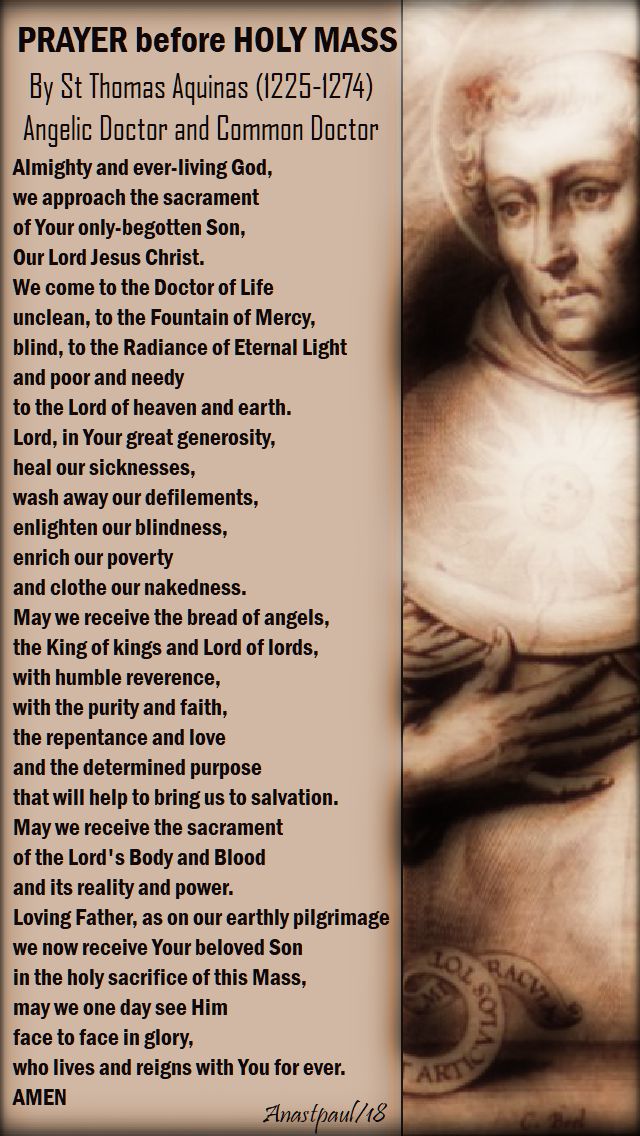
PRAYER before HOLY MASS By St Thomas Aquinas (1225-1274) Angelic Doctor and Common Doctor
Almighty and ever-living God,
we approach the sacrament
of Your only-begotten Son,
Our Lord Jesus Christ.
We come to the Doctor of Life
unclean, to the Fountain of Mercy,
blind, to the Radiance of Eternal Light
and poor and needy
to the Lord of heaven and earth.
Lord, in Your great generosity,
heal our sicknesses,
wash away our defilements,
enlighten our blindness,
enrich our poverty
and clothe our nakedness.
May we receive the bread of angels,
the King of kings and Lord of lords,
with humble reverence,
with the purity and faith,
the repentance and love
and the determined purpose
that will help to bring us to salvation.
May we receive the sacrament
of the Lord’s Body and Blood
and its reality and power.
Loving Father, as on our earthly pilgrimage
we now receive Your beloved Son
in the holy sacrifice of this Mass,
may we one day see Him face to face in glory,
who lives and reigns with You for ever,
AMEN.
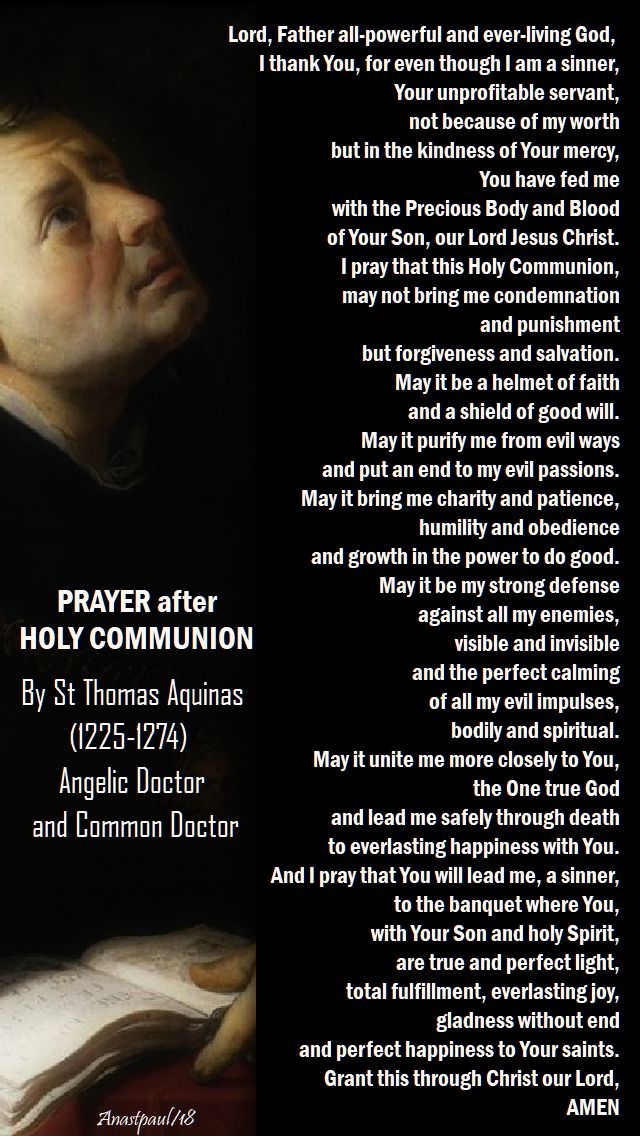
PRAYER after HOLY COMMUNION By St Thomas Aquinas (1225-1274) Angelic Doctor and Common Doctor
Lord, Father all-powerful and ever-living God,
I thank You, for even though I am a sinner,
Your unprofitable servant,
not because of my worth
but in the kindness of Your mercy,
You have fed me
with the Precious Body and Blood
of Your Son, our Lord Jesus Christ.
I pray that this Holy Communion,
may not bring me condemnation
and punishment
but forgiveness and salvation.
May it be a helmet of faith
and a shield of good will.
May it purify me from evil ways
and put an end to my evil passions.
May it bring me charity and patience,
humility and obedience
and growth in the power to do good.
May it be my strong defense
against all my enemies,
visible and invisible
and the perfect calming
of all my evil impulses,
bodily and spiritual.
May it unite me more closely to You,
the One true God
and lead me safely through death
to everlasting happiness with You.
And I pray that You will lead me, a sinner,
to the banquet where You,
with Your Son and holy Spirit,
are true and perfect light,
total fulfillment, everlasting joy,
gladness without end
and perfect happiness to Your saints.
Grant this through Christ our Lord,
AMEN.
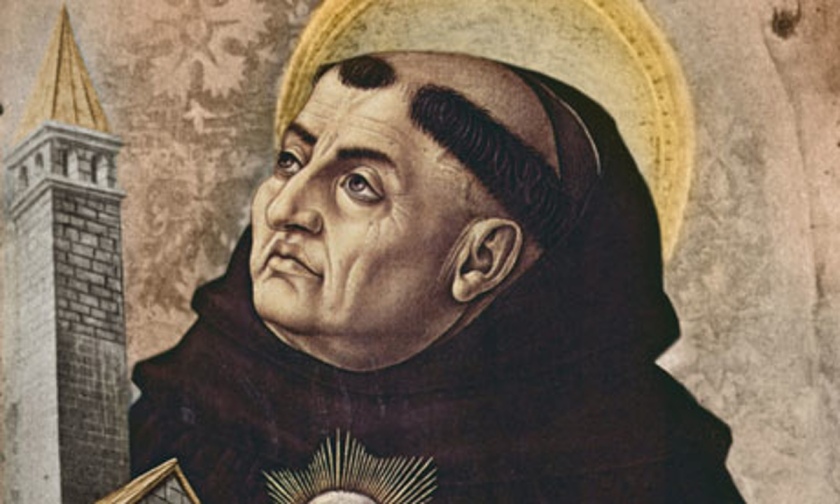
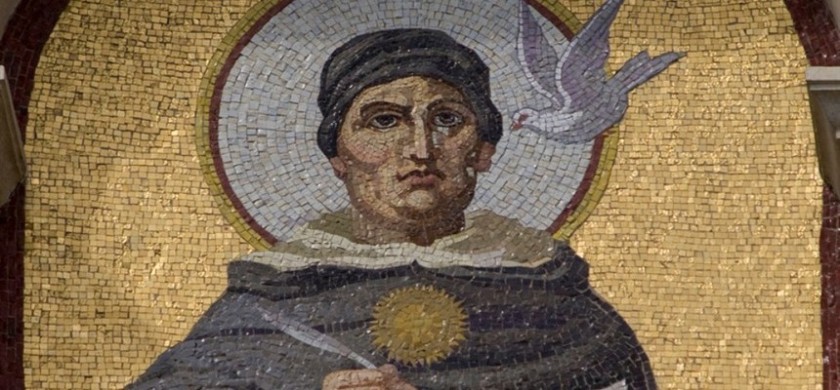
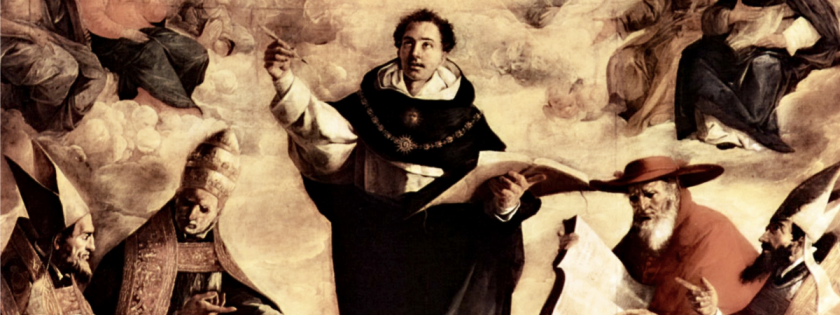
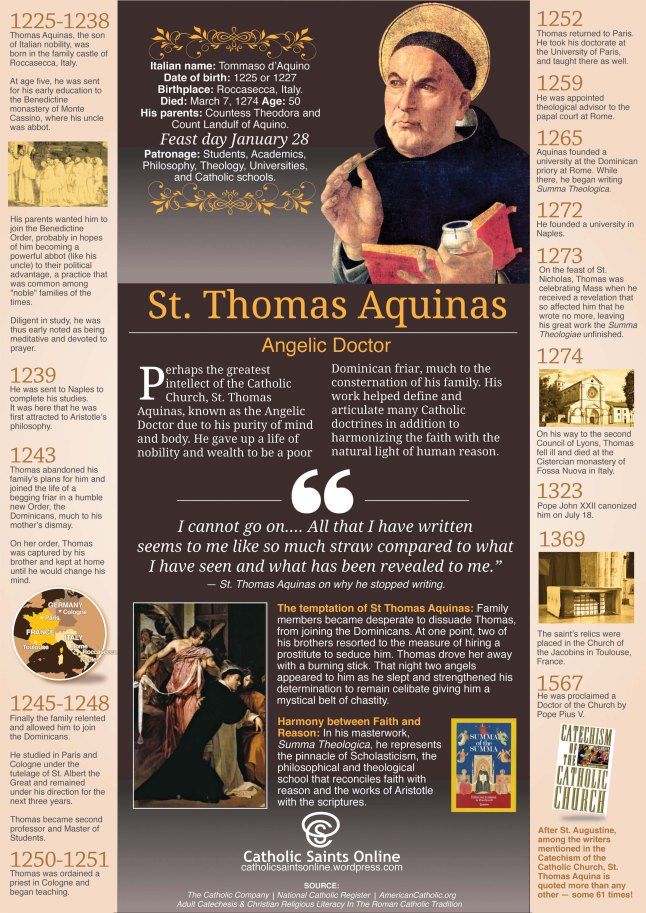
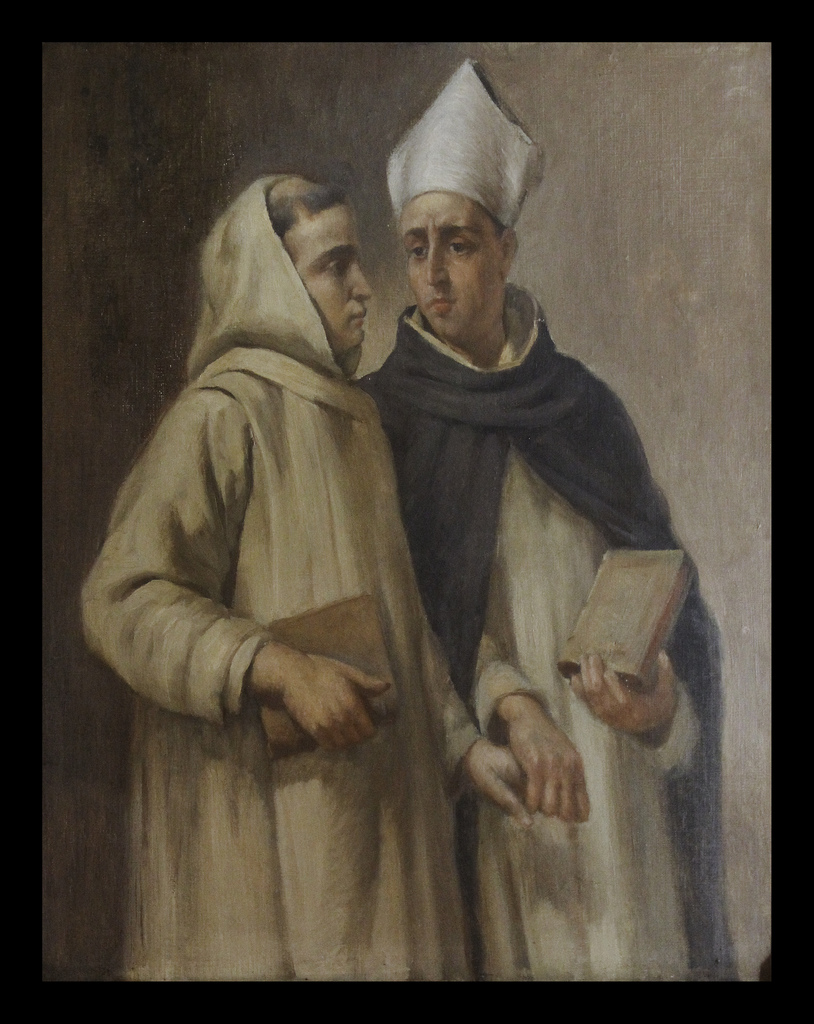
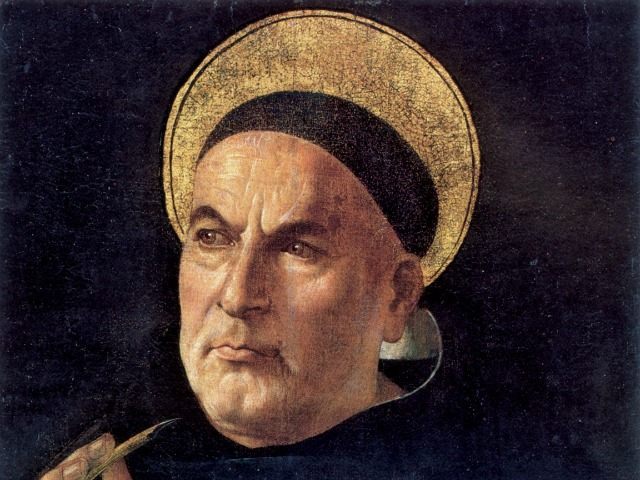
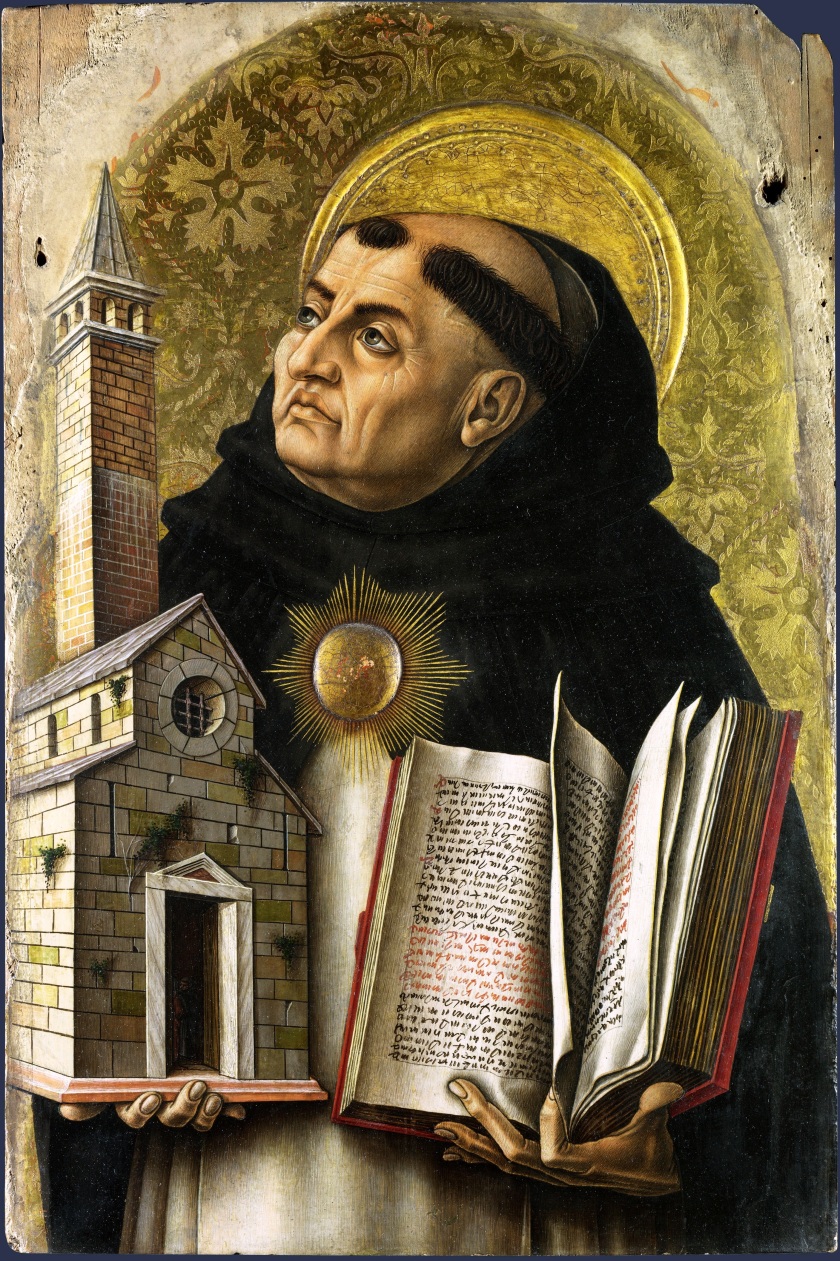
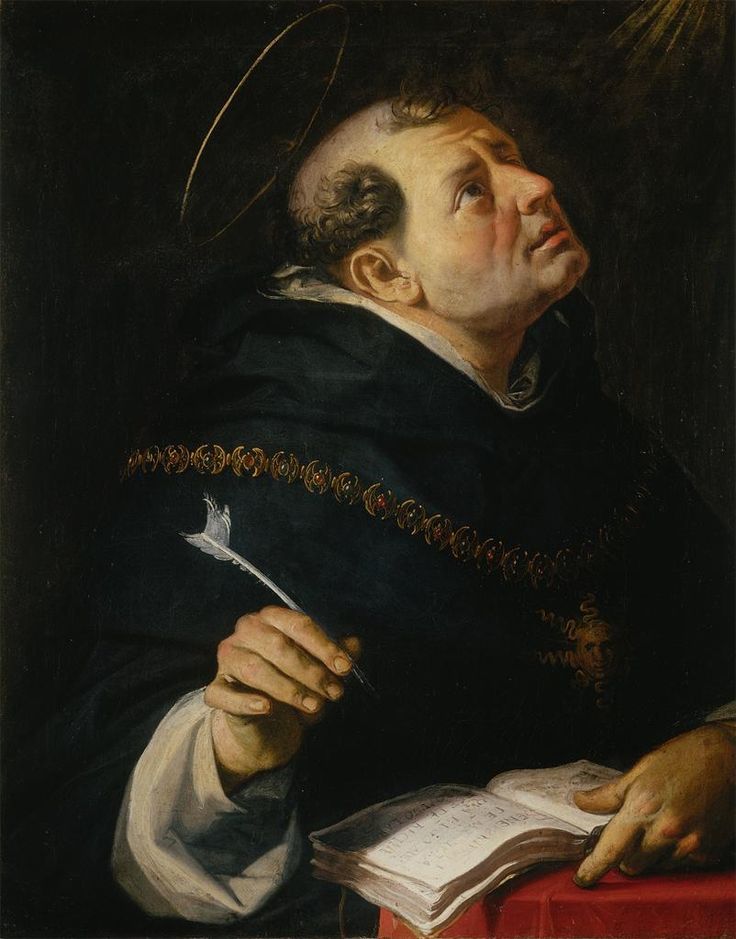
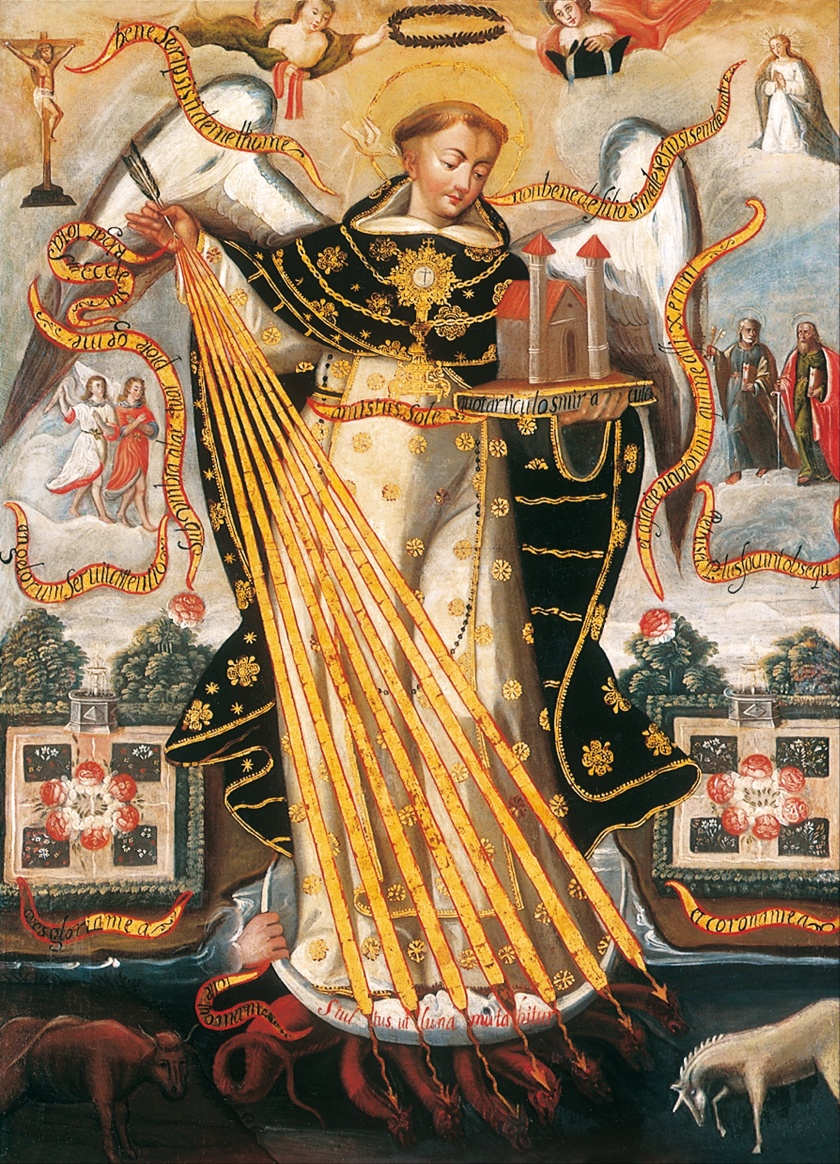
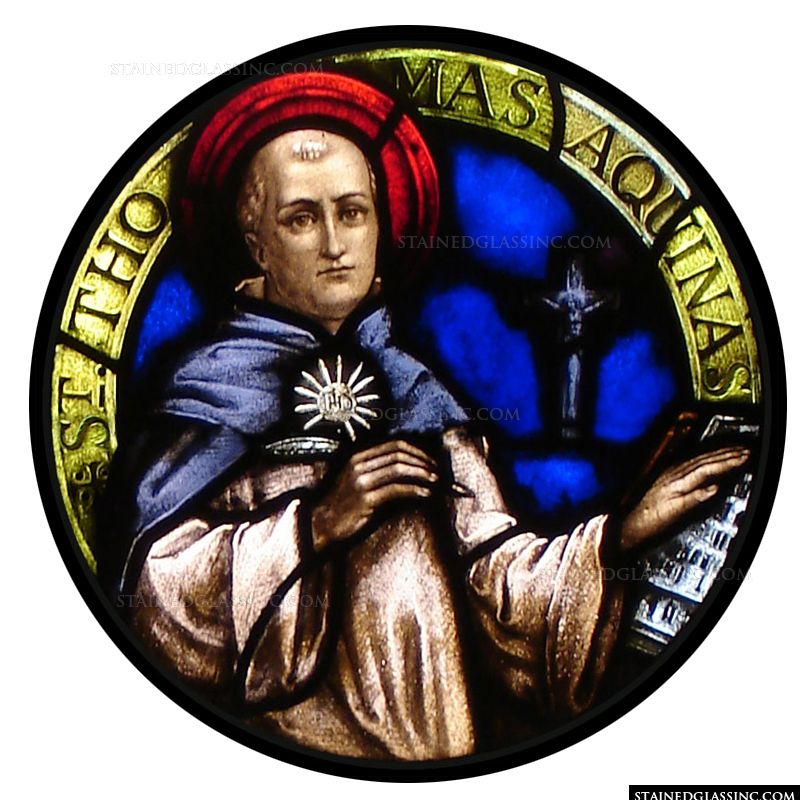
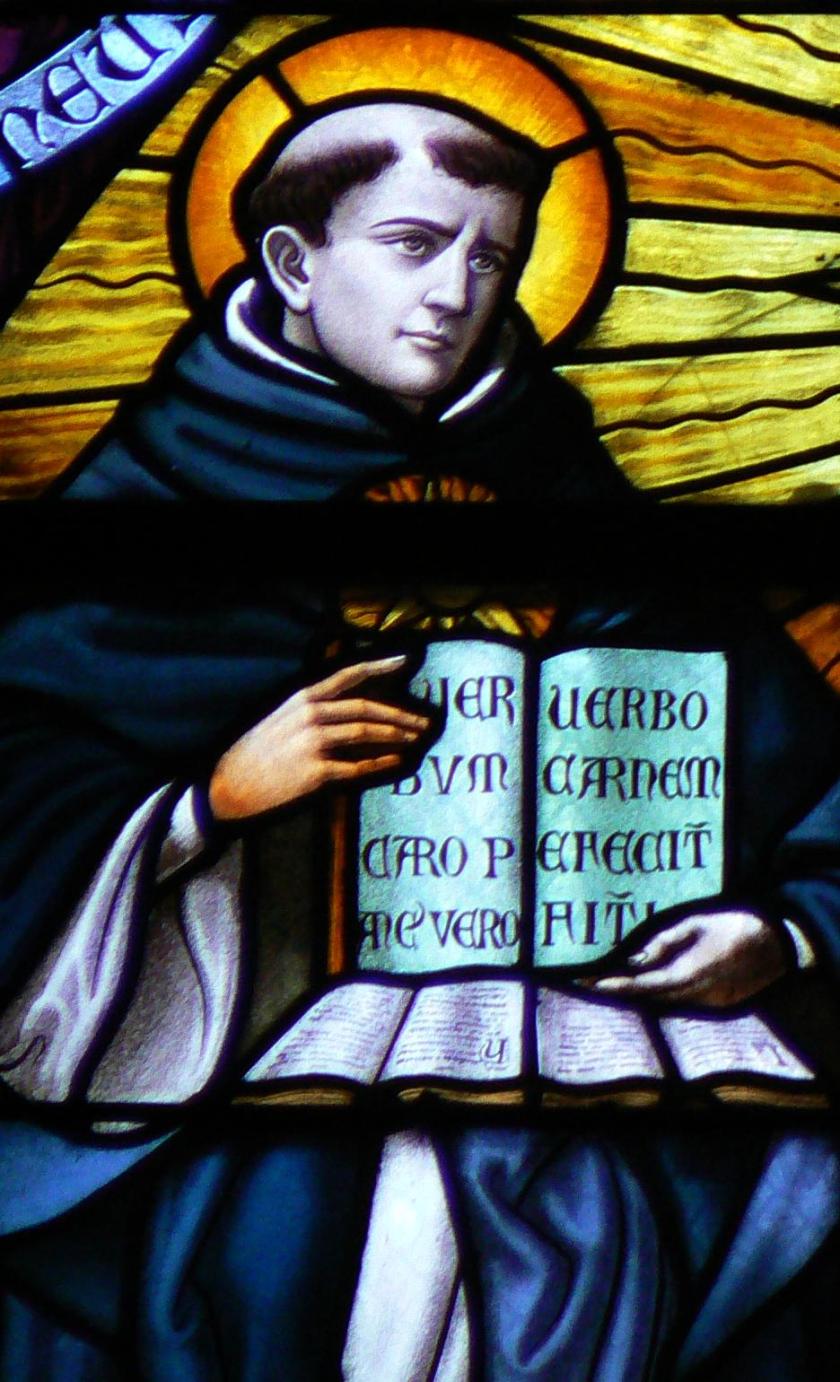
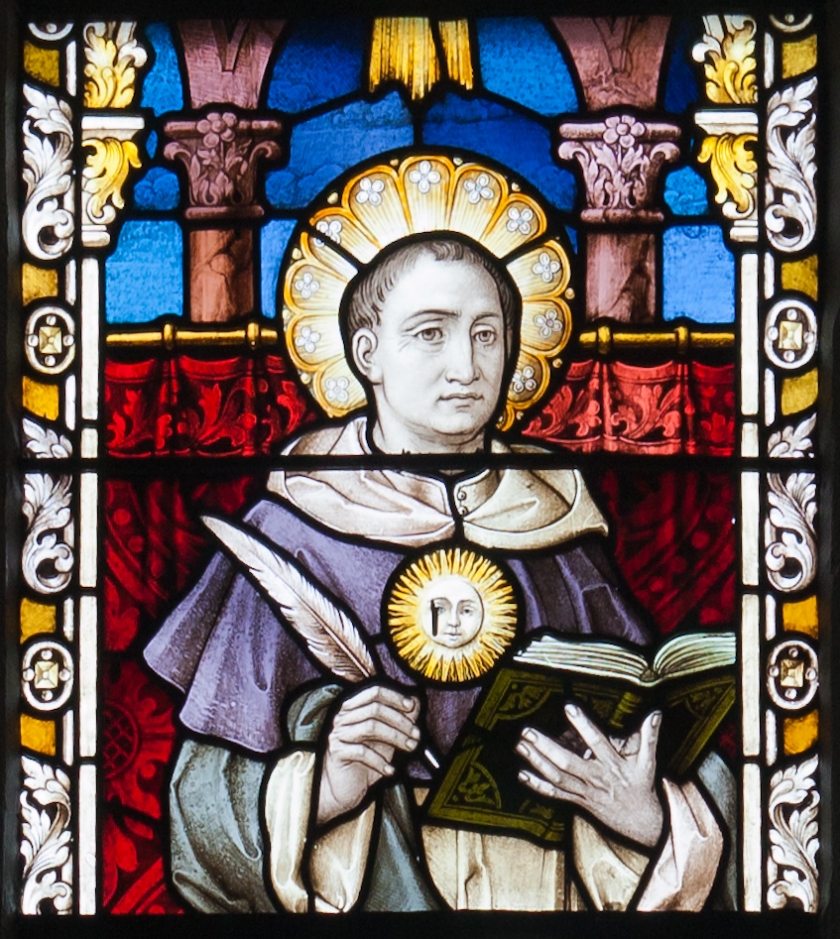
Saint of the Day – 28 January – St Thomas Aquinas O.P. (1225-1274 aged 49 ) Doctor angelicus (Angelic Doctor) and Doctor communis (Common Doctor). Priest, Religious, Master Theologian, Philosopher, Write, Teacher, Jurist. Also known as: The Angelic Doctor/Doctor Angelicus, Common Doctor/Doctor Communis. The Great Synthesiser, The Dumb Ox, The Universal Teacher. Patron of Academics, Theologians, against storms, against lightning, apologists, book sellers, Catholic academies, Catholic Schools – (proclaimed on 4 August 1880 by Pope Leo XIII), Catholic universities, Catholic Colleges, chastity, learning; pencil makers, philosophers, publishers, scholars, students, University of Vigo and of St. Tomas, Batangas, theologians, Aquino, Italy; Belcastro, Italy, Diocese of Aquino, Falena, Italy. Attributes – chalice, dove, usually speaking into his ear, sometimes as he writes, monstrance, ox, star, sun, teacher with pagan philosophers at his feet, teaching, person trampled under foot. By universal consent, Thomas Aquinas is the pre-eminent spokesman of the Catholic tradition of reason and of divine revelation. He is one of the great teachers of the medieval Catholic Church, honoured with the titles Angelic and Common Doctor, being one of the 36 Doctors of the Church and is regarded as the “Master Theologian.”
St Thomas Aquinas is known as the greatest philosopher and theologian of the intellectually rich 13th century and for many hundreds of years the work of this Patron Saint of Catholic Schools dominated the curriculum of seminaries and colleges around the world. He has been called one of the most profound teachers on Eucharistic doctrine, not only expounding on the mysterious processes in which bread and wine become the actual Body and Blood of Christ but coining the word transubstantiation used to describe it. And, because he wrote not only for scholars but also for the simple Catholic worshipper down the ages, the church has officially accorded him the titles “Angelic” and “Common” Doctor of the Church.”
It is generally believed Thomas Aquinas was born about the year 1225 at the castle of his father, the Count of Aquino, in Rocca Secca near Naples, Italy. A precocious child, he amazed his teachers at the Monastery of Monte Cassino, where he received his early education, with one persistent question: “What is God?” It was a question he would reflect upon all his life.
When attending the University of Naples, he was attracted to the intellectual apostolate of the Dominican Friars and joined the order. Outraged at his rejection of their own plans for him to become a prestigious abbot and looking down on Dominicans as beggars, his aristocratic family kidnapped him on his way to Paris and imprisoned him at Rocca Secca. It took almost two years and the intercession of the Pope and the Emperor before his family finally gave up and allowed him to rejoin the Dominicans.
St Albert the Great (1200-1280), also a Doctor of the Church, who taught him Aristotelian philosophy at Paris and Cologne, soon spotted his genius and became his mentor. When Thomas was nicknamed the “Dumb Ox” by his classmates, most likely because of his bulky frame and quiet manner, Albert prophesied: “You call him a dumb ox, but I tell you this dumb ox will bellow so loudly that his bellowing will fill the world.”
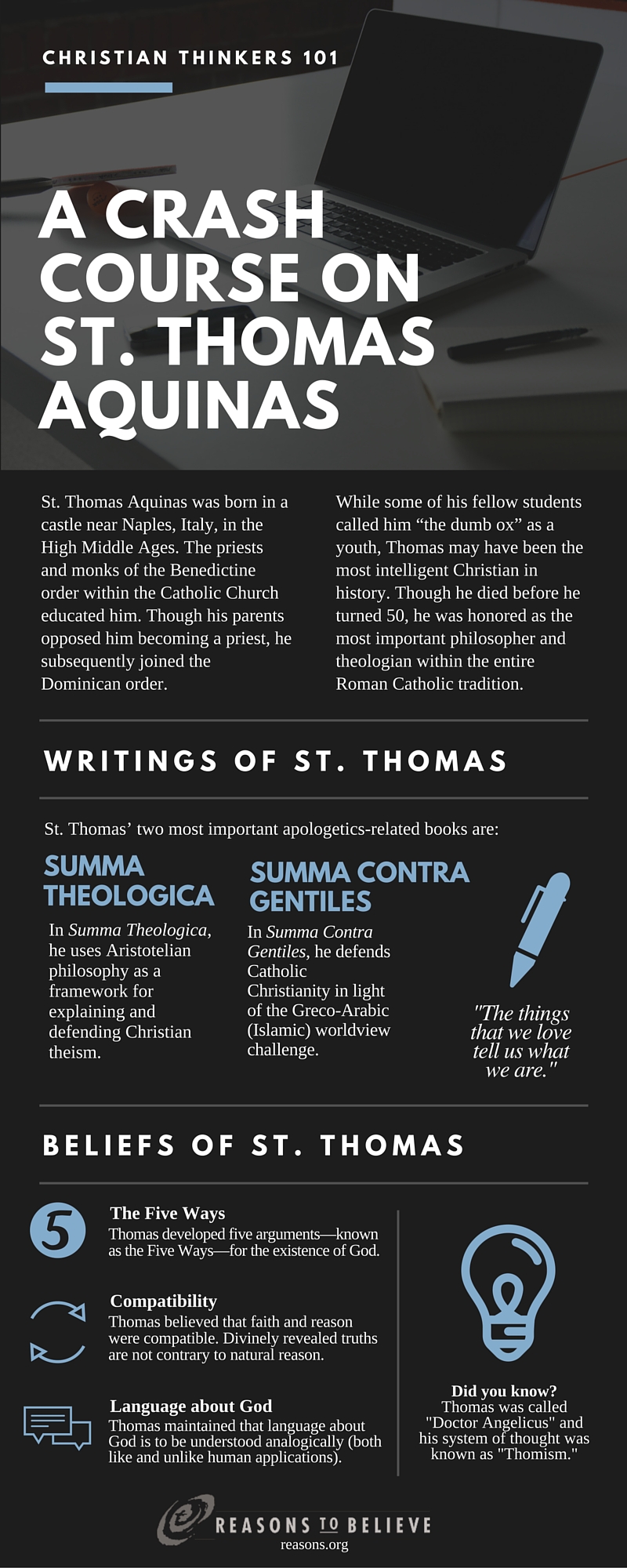
Indeed, this master teacher attracted thousands of people to his public lectures, compiled more than 20 volumes of work, was consulted by popes and a king (Louis IX), and showed that one could use pure reason, not faith, to defend theological tenets such as the existence of God. His greatest work, the Summa Theologica (Summary of Theology), which he began in 1265, is, a comprehensive treatise on all the Christian mysteries.
Despite his reputation as a thinker, Thomas remained a humble, devout priest who resisted attempts to make him a bishop, fasted frequently and spent whole nights in prayer before the Blessed Sacrament and the Crucifix. He told his intimate friend, St Bonaventure(1217-1274), another Doctor of the Church, that it was while he leaned his head against the tabernacle and turned his mind in sorrow to the image of the crucified Christ, that he derived all his learning.
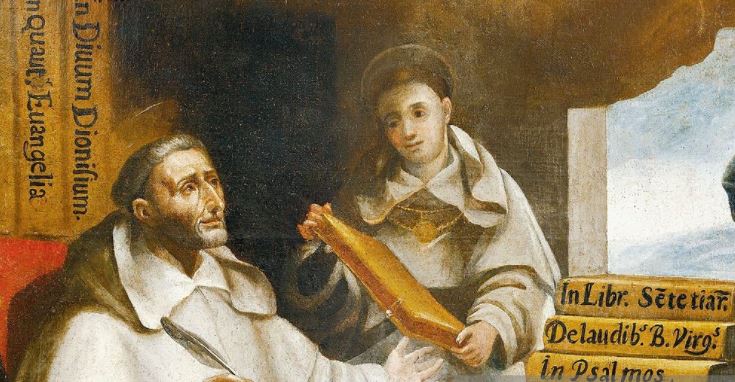
Painting depicting Saint Thomas Aquinas by Antoni Viladomat (1678-1755) Catalonian painter in the Baroque style. Dated 18th Century. (Photo by Universal History Archive/UIG via Getty Images)
Once, when Thomas was lost in prayer while living in the Dominican priory in Naples, a sacristan concealed himself to watch. He saw Thomas lifted into the air and heard Christ speak to him from the crucifix on the chapel wall, “Thomas, you have written well of me. What reward will you have?”
“Lord, nothing but yourself,” he heard Thomas reply.
Soon after, while saying Mass on 6 December 1273 in that same chapel, Thomas had a profound revelation. He told his longtime secretary that compared to this experience, “All that I have written seems like straw to me.”
After that, he never wrote again, leaving his Summa Theologica unfinished.
In May of 1274, Thomas was called to the Second Council of Lyon, where his works for Pope Urban IV would be presented. While journeying to the meeting, Thomas hit his head on the branch of a fallen tree and fell ill. He was escorted to Monte Cassino to recover, then he set out again. Unfortunately, he became ill once again and stopped at the Cistercian Fossanova Abbey, where the monks cared for him for several days.
He received his last rites and prayed, “I receive Thee, ransom of my soul. For love of Thee have I studied and kept vigil, toiled, preached and taught…”
On the day of Thomas’ death, 7 March1274, St Albert the Great, then in Cologne, suddenly broke into tears among the community and exclaimed, “Brother Thomas Aquinas, my son in Christ, the light of the Church, is dead! God has revealed it to me.”
—
St Aemilian of Trebi
St Agatha Lin
Bl Amadeus of Lausanne
St Antimus of Brantôme
St Archebran
Bl Bartolomé Aiutamicristo
St Brigid of Picardy
St Callinicus
St Cannera of Inis Cathaig
Bl Charlemagne (a decree of canonization was issued by the anti-pope Paschal III, but this was never ratified by valid authority.)
St Constantly
St Flavian of Civita Vecchia
St Glastian of Kinglassie
Bl James the Almsgiver
St James the Hermit
St Jerome Lu
St John of Reomay
St Joseph Freinademetz
Bl Julian Maunoir
St Julian of Cuenca
St Lawrence Wang
St Leucius of Apollonia
Bl María Luisa Montesinos Orduña
St Maura of Picardy
Bl Mosè Tovini
Bl Odo of Beauvais
Bl Olympia Bida
St Palladius of Antioch
St Paulinus of Aquileia
Bl Peter Won Si-jang
St Richard of Vaucelles
St Thyrsus of Apollonia
—
Martyrs of Alexandria: A group of 4th-century parishioners in Alexandria, Egypt. During the celebration of Mass one day an Arian officer named Syrianus led a troop of soldiers into their church and proceded to murder all the orthodox Christians in the place. 356 in Alexandria, Egypt.
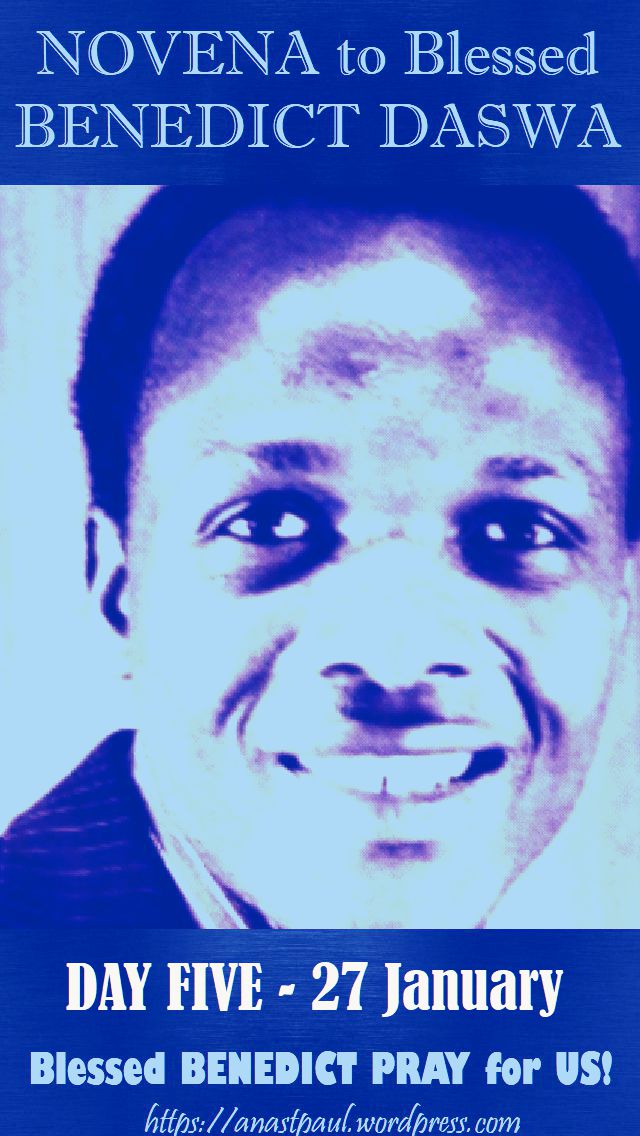
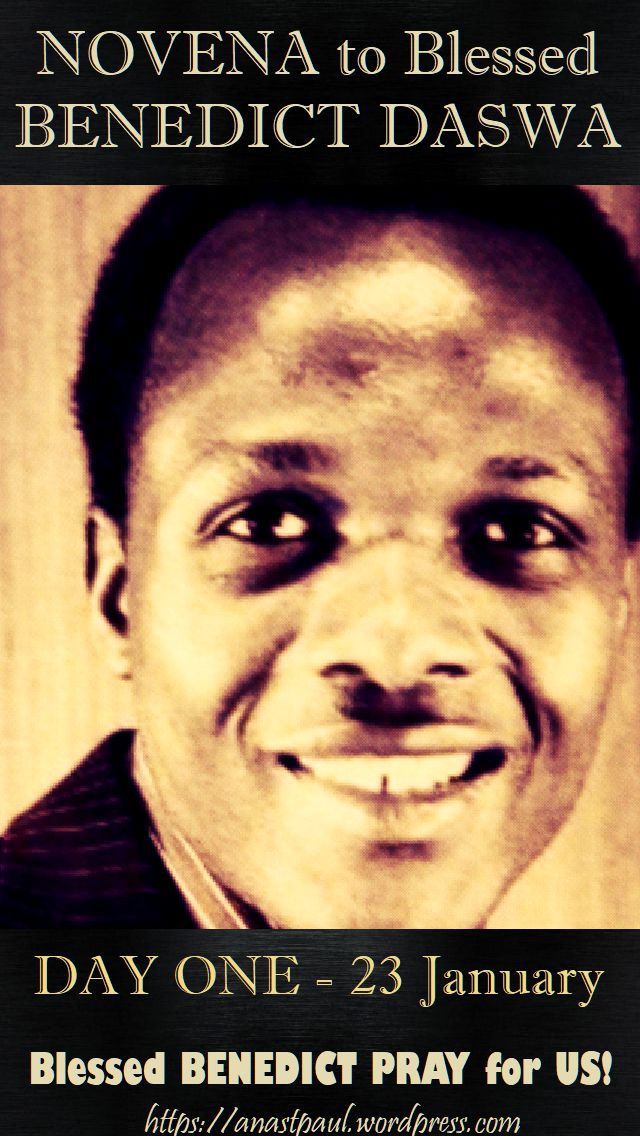
Novena to Blessed Benedict Daswa- Day Five – 27 January
5th Day: A MAN COMMITTED TO THE CHURCH
As a voluntary catechist, Benedict Daswa helped to build up the Church community,
especially by preparing people for baptism. He was a member of the Parish Pastoral
Council and was always regular at the meetings. He led the Sunday Service when a
priest or a pastoral worker was not available and was very involved in youth ministry,
encouraging the young people to live good, productive lives and to be proud of their
faith.
Benedict promised his wife that he would start building their house as soon as the new
Church of Nweli was finished. This task of building the first Catholic Church in the area
was a project so dear to his heart that he not only helped the priest with his own car to
transport the building material for it but worked tirelessly on it and encouraged others
to do likewise. After its completion, true to his promise, he started building his own
house.
Word of God So we, though many, are one body in Christ and individually members one of another. Having gifts that differ according to the grace given to us, let us use them; if prophecy, in proportion to our faith; if service, in our serving; he who teaches, in his teaching; he who exhorts, in his exhortation; he who contributes, in liberality; he who gives aid, with zeal; he who does acts of mercy, with cheerfulness. (Romans 12, 5-8)
Reflection: What do I do for the Church and in the Church?
Do I contribute to the building/upkeep of the church and its services?
Prayer: I will not enter my house or get into my bed;
I will not give sleep to my eyes or slumber to my eyelids,
Until I find a place for the Lord,
A dwelling place for the Mighty One of Jacob. (Psalm 132,3-5)
NOVENA PRAYER:
O Blessed Trinity,
I believe that you dwell in me through my baptism.
I love You, I adore You and I worship You.
I give you thanks for Blessed Benedict,
Whom you chose to bear witness unto death for his faith
In Jesus Christ, my Saviour and my Lord.
Almighty Father, You filled the heart of Blessed Benedict,
With great love and zeal in building up your kingdom.
You gave him the courage and the strength
To stand up for his faith without fear, even the fear of death.
Loving God, keep me free from all deeds of darkness.
Protect me from evil spirits and the powers of evil.
Make me a true apostle of life in my family and in society.
May Your light, O Lord, shine upon me and through me.
Lord Jesus, through the intercession of Blessed Benedict,
I ask that I may follow his example
Of always being ready to forgive in a Christian spirit.
You know all about my many problems and worries
And my great fears when I look to the future.
I draw strength and courage from the life of Blessed Benedict.
I come to You now, Lord, and through his intercession
I ask for this very special favour
………………………………..
(mention your request/s)
if it is according to Your will.
Help me always to follow the good example of Blessed Benedict.
By daily prayer and regular attendance at Church,
Help me to love You, O Lord, above all things
And to love others as You love me.
Amen
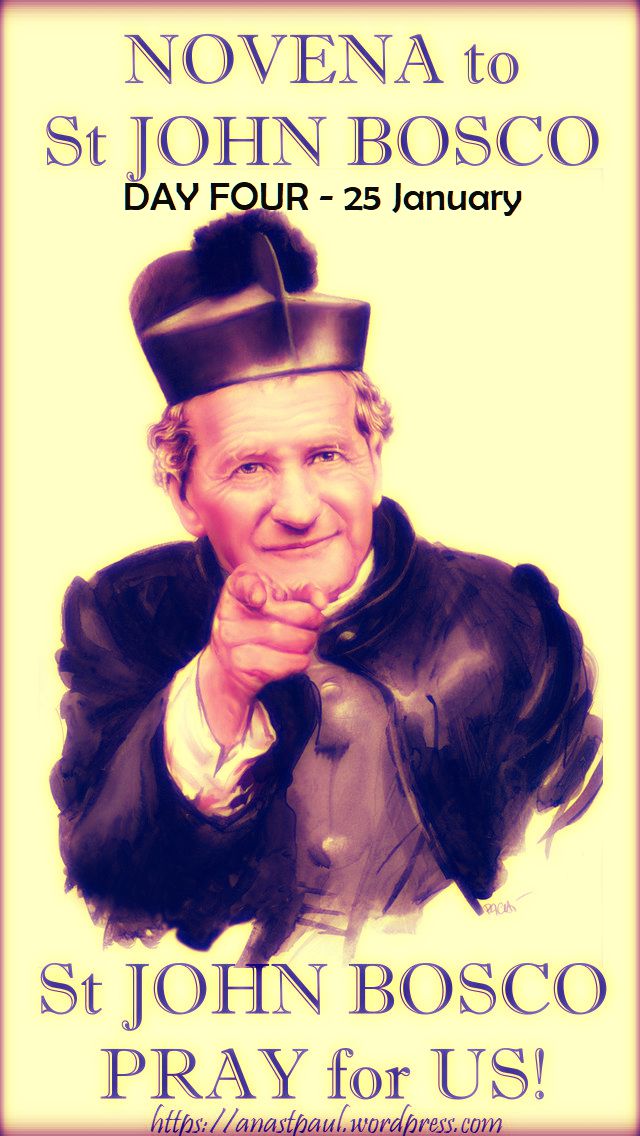
6th Day: For Salesian Cooperators and the Salesian Family
O Saint John Bosco,
you founded the Association of Salesian Cooperators,
the seed of the worldwide Salesian Family,
in order to ensure the widest possible participation
in the charitable work on behalf of young people.
Pray for all the members of the Salesian Family that,
inspired by your example and bonded in one spirit,
they may share in the Salesian mission and model in their life
and work pastoral educative charity.
Through your intercession may God
grant me the following grace
……………………………….
(mention your intention)
so that together with the Salesian Family
I may assist all I am able to
and help young people in today’s society.
Our Father… Hail Mary… Glory to the Father…
St John Bosco Pray for us!
Thought for the Day – 27 January – The Memorial of St Angela Merici (1474-1540)
“I ask you, Lord, to receive all my self-will that by the infection of sin is unable to distinguish good from evil. Receive, O Lord, all my thoughts, words and deeds, interior and exterior, that I lay at the feet of your Divine Majesty. Although I am utterly unworthy, I beseech you to accept all my being.”
At Angela Merici’s death in 1540 she had started 24 groups. St Charles Borromeo organised the Ursulines into a formal religious congregation and it was given papal approval in 1544. Over the years the Ursulines have flourished as the oldest and one of the most respected of the church’s teaching orders.
To the long list of authorities Ursulines were to obey—Ten Commandments, Church, parents, civil laws—St Angela added “divine inspirations that you may recognise as coming from the Holy Spirit.” A refreshing and liberating rule. Also a dangerous one, for when it’s obeyed, the Holy Spirit may act in unexpected ways.
Innovation has always been a part of genuine sanctity. New wineskins are often needed for the eternally new wine of the Gospel and the saints are not only holy but they are often creative geniuses as well – always, listening to the creative genius, the Holy Spirit!
Quote/s of the Day – 27 January – The Memorial of St Angela Merici (1474-1540)
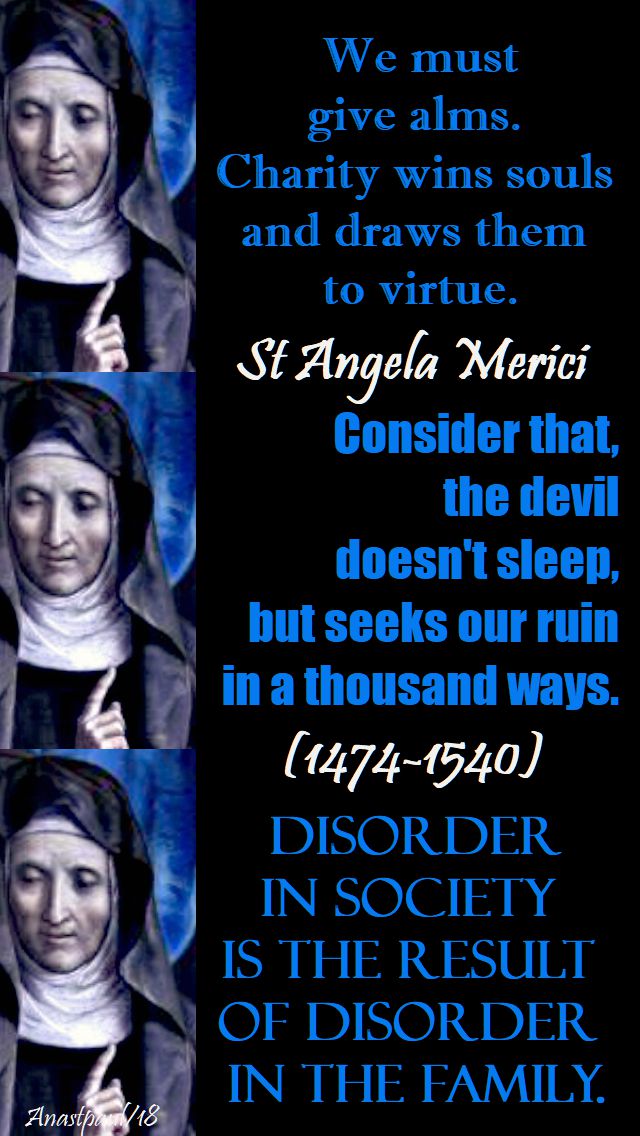
“We must give alms. Charity wins souls and draws them to virtue.”
“Consider that the devil doesn’t sleep, but seeks our ruin in a thousand ways.”
“Disorder in society is the result of disorder in the family.”
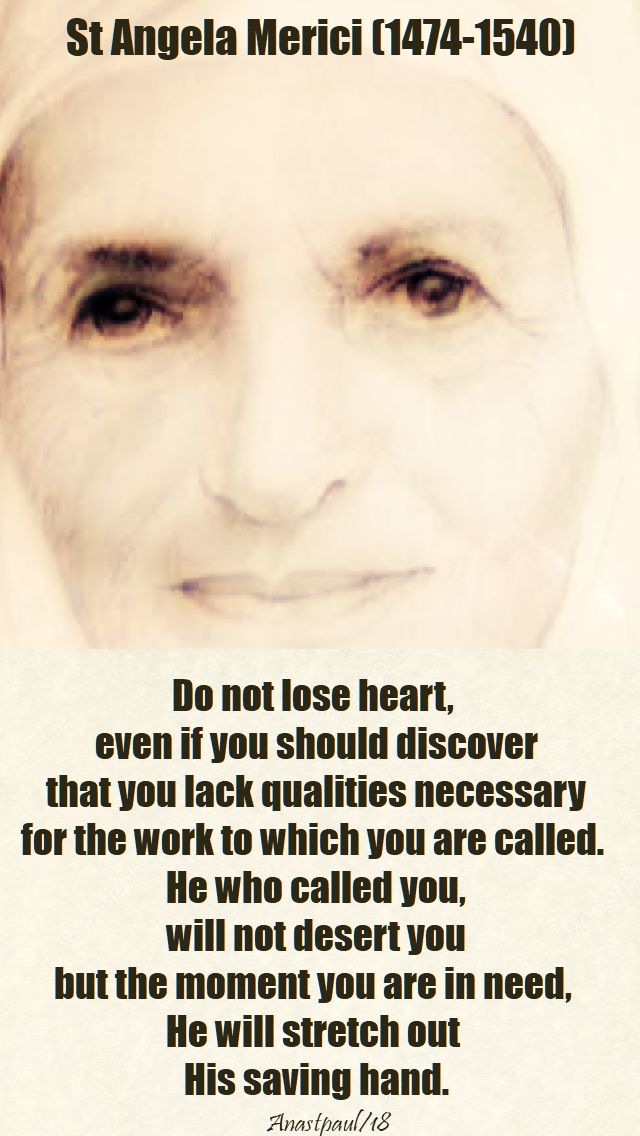
“Do not lose heart, even if you should discover that you lack qualities necessary for the work to which you are called. He who called you will not desert you but the moment you are in need, He will stretch out His saving hand.”
One Minute Reflection – 27 January – The Memorial of St Angela Merici (1474-1540)
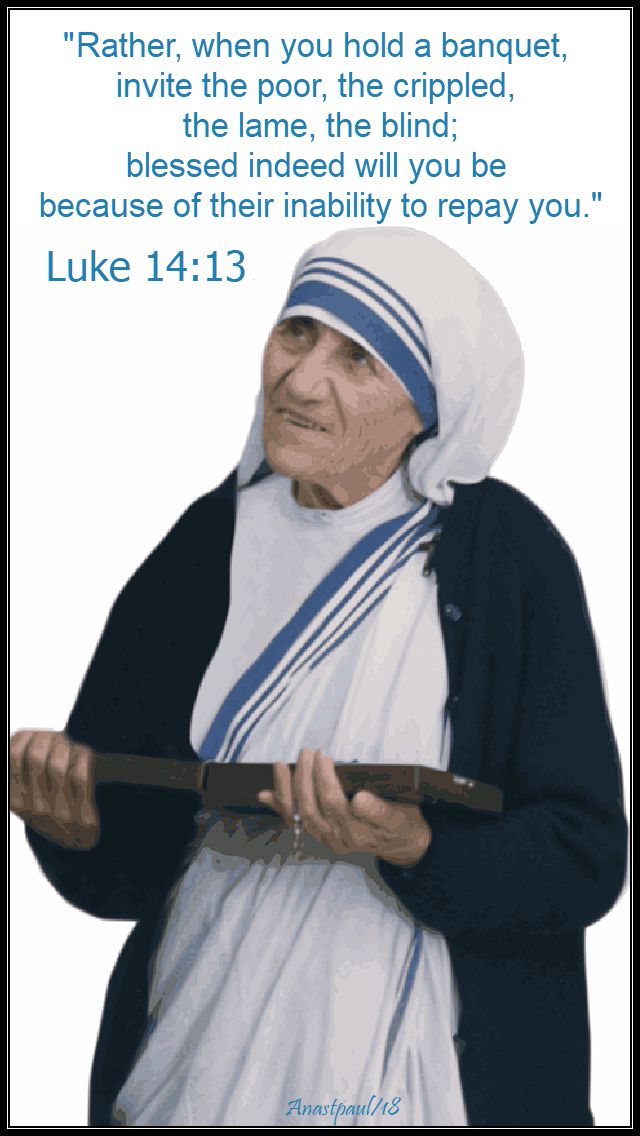
“Rather, when you hold a banquet, invite the poor, the crippled, the lame, the blind; blessed indeed will you be because of their inability to repay you.”…Luke 14:13
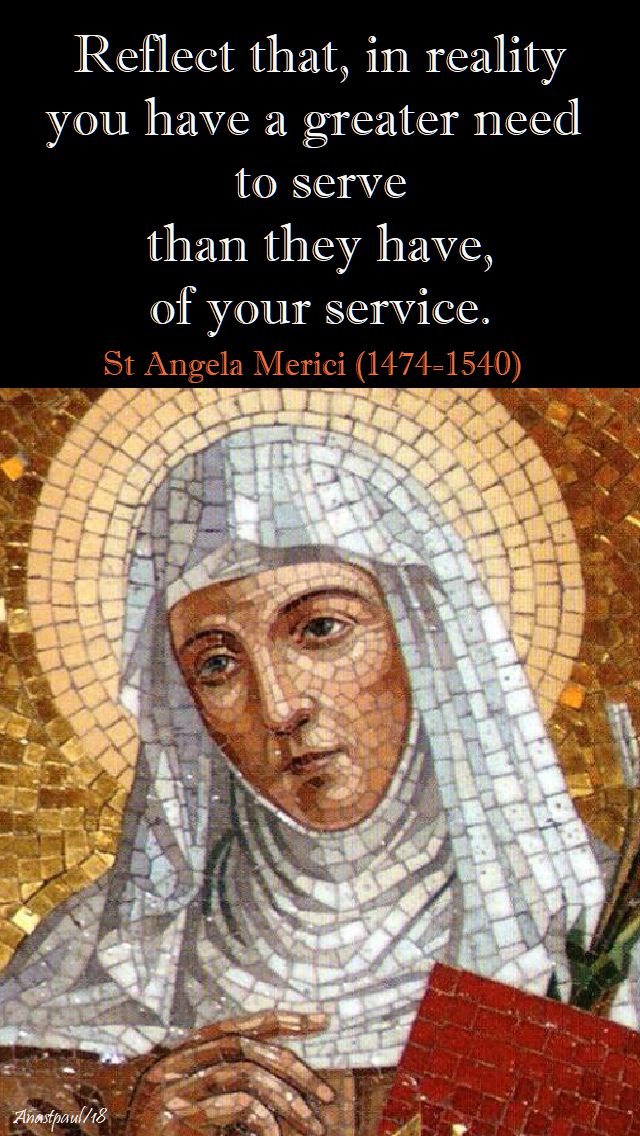
REFLECTION – “Reflect that in reality you have a greater need to serve [the poor] than they have of your service….St Angela Merici (1474-1540)
PRAYER – Lord God, let St Angela ever commend us to Your love and care. May her charity and wisdom inspire us to treasure Your teaching and express it in our lives. Through our Lord Jesus, in union with the Holy Spirit, one God forever, amen.
Our Morning Offering – 27 January – The Memorial of St Angela Merici (1474-1540)
Excerpt from St Angela Merici’s Daily Prayer
My God, enlighten the darkness of my heart
and give me grace to die
rather than ever offend Your divine Majesty.
Place a guard around my affections
and my thoughts,
so that they may never turn aside
from You and Your ways
and banish me not from Your presence,
in which afflicted hearts find such consolation.
O Lord,
I beg of You by Your holy Passion,
by Your precious blood shed for love of us,
by the holy name of Jesus,
that this adorable name may be blessed
in heaven and on earth
and by the heavenly choirs
of angels and archangels.
I regret, O Lord, that I have begun so late
to serve Your divine Majesty.
Accept, I beseech You, O Lord,
all my thoughts, words and actions,
together with my whole being;
and placing all at the feet of Your divine Majesty,
I beg You to accept them,
unworthy as I am of such a favour.
Amen
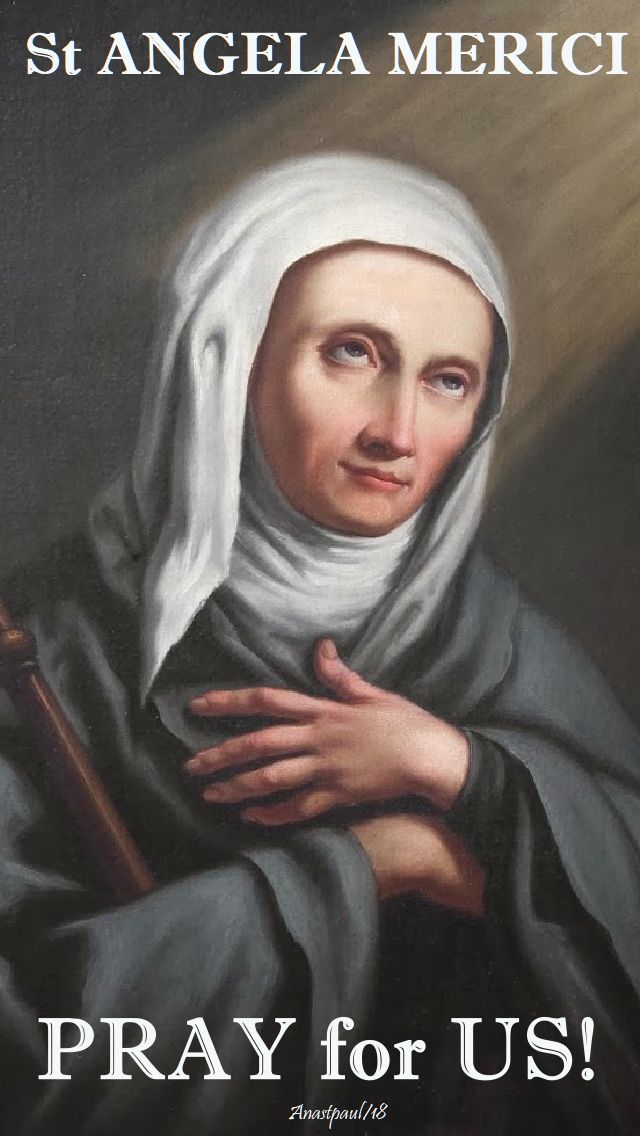
Saint of the Day – 27 January – St Angela Merici C.S.U. (1474-1540) – Virgin, Founder, Religious sister, Teacher, Writer – born on 21 March 1474 at Desenzano, Lake Garda, Italy – 24 January 1540 at Brescia, Italy. Her body is interred in the church of Saint Afra, Brescia, Italy and is incorrupt. Patronages – against bodily ills, illness, sickness, the death of parents, disabled, handicapped or physically challenged people, sick people. Attributes – cloak, ladder, tall ladder with young women climbing it. St Angela founded the Company of St Ursula in 1535 in Brescia, in which women dedicated their lives to the service of the Church through the education of girls. From this organisation later sprang the monastic Order of Ursulines, whose nuns established places of prayer and learning throughout Europe and, later, worldwide, most notably in the new world.
Angela Merici was born in Northern Italy and lived on Lake Garda with her parents and sister, her closest companions. Angela diligently worked on her father’s farm and was also encouraged by her family to develop habits of prayer and fasting — which she continued to practice her whole life.
After the untimely death of her entire family, Angela went to stay with her uncle in a neighbouring town. Angela, obviously quite distraught over this loss, prayed day and night to God for some sign that her family was in heaven. One mid-day during harvest Angela was alone in the fields when she experienced a life-changing vision: the heaven’s opened and angels and young women came toward her singing a melody, surrounded by light. One of the young girl’s was Angela’s sister. From this experience, Angela knew it was her purpose to establish a community of religious and dedicated young women — thus the foundation of the Sisters of Ursuline Order was laid.
Angela spent her early life helping others as a member of the Third Order of Saint Francis. She led a simple life, with only a few hours of sleep a night — much of her waking hours were spent praying. When she was 40 years old she was asked by the Order to travel to the aid of Caterina Patengola, who had just lost her husband and two sons. On her way to Brescia, Angela came to meet up with a religious reform movement, Divino Amore, that catered to the needs of the time.
They established infirmaries for those suffering from syphilis, cared for widows and their families and founded an orphanage and a shelter for former prostitutes. Here, Angela encountered people and experiences that proved to be especially significant in her later life. In only a few short years, a group of men and women gathered around Angela as their spiritual centre.
By 1532, Angela has assembled a small group of women who were her followers and together they embarked on the formation of Angela’s community. By 1536, Angela had won approval from the Diocese for the first Rule written by a woman for a community of women.
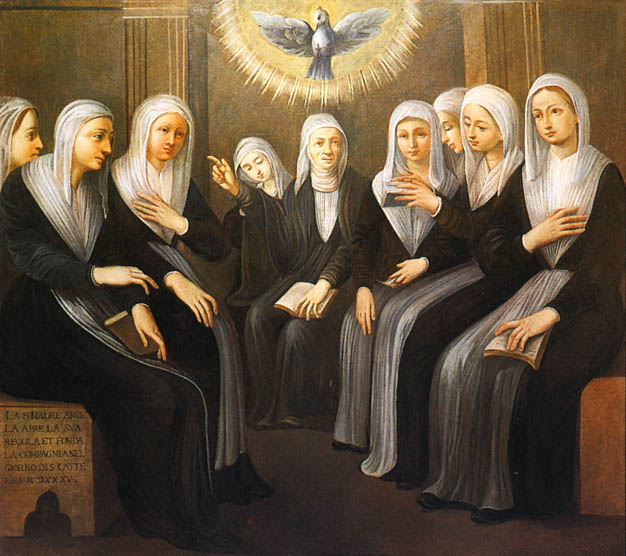
On 25 November 1535, Merici gathered with 12 young women who had joined in her work in a small house in Brescia near the Church of St Afra, where together they committed themselves in the founding of the Company of St Ursula, placed under the protection of the patroness of medieval universities. Her goal was to elevate family life through the Christian education of future wives and mothers. Merici taught her companions to be consecrated to God and dedicated to the service of their neighbour but to remain in the world, teaching the girls of their own neighbourhood and to practice a religious form of life in their own homes. The members wore no special habit and took no formal religious vows. Merici wrote a Rule of Life for the group, which specified the practice of celibacy, poverty and obedience in their own homes. The Ursulines opened orphanages and schools. On 18 March 1537, she was elected “Mother and Mistress” of the group. The Rule she had written was approved in 1544 by Pope Paul III. Angela gave the Ursulines a military structure, dividing towns into districts governed hierarchically by mature Christian women. This design allowed the community to support members in daily Christian living and protect them from spiritually unhealthy influences.
The rule that Angela wrote for the company required members to remain faithful to the Christian basics. In the following excerpt, she explains the importance of daily vocal and mental prayer:
“Each one of the sisters should be solicitous about prayer, mental as well as vocal, that is a companion to fasting. For Scripture says prayer is good with fasting. As by fasting we mortify the carnal appetites and the senses, so by prayer we beg God for the true grace of spiritual life. Thus, from the great need we have of divine aid, we must pray always with mind and heart, as it is written, “Pray constantly” (1 Thessalonians 5:17 NJB). To all we counsel frequent vocal prayer that prepares the mind by exercising the bodily senses. So each one of you, every day will say with devotion and attention at least the Office of the Blessed Virgin and the seven penitential psalms (Psalm 6, 32, 38, 51, 102, 130, and 143) because in saying the office we are speaking with God.
To afford matter and some method in mental prayer, we exhort each one to raise her mind to God and to exercise herself in it every day. And so in the secret of her heart, let her say: “My Saviour, illumine the darkness of my heart, and grant me grace rather to die than to offend your Divine Majesty any more. Guard, O Lord, my affections and my senses, that they may not stray, nor lead me away from the light of your face, the satisfaction of every afflicted heart.
I ask you, Lord, to receive all my self-will, that by the infection of sin is unable to distinguish good from evil. Receive, O Lord, all my thoughts, words, and deeds, interior and exterior, that I lay at the feet of your Divine Majesty. Although I am utterly unworthy, I beseech you to accept all my being.”
When Merici died in Brescia on 27 January 1540, there were 24 communities of the Company of St. Ursula serving the Church through the region. Over the years the Ursulines have flourished as the oldest and one of the most respected of the church’s teaching orders. Her body was clothed in the habit of a Franciscan tertiary and was interred in the Church of St Afra. Her body was later found to be incorrupt. Merici was beatified in Rome on 30 April 1768, by Pope Clement XIII. She was later canonised on 24 May 1807 by Pope Pius VII.
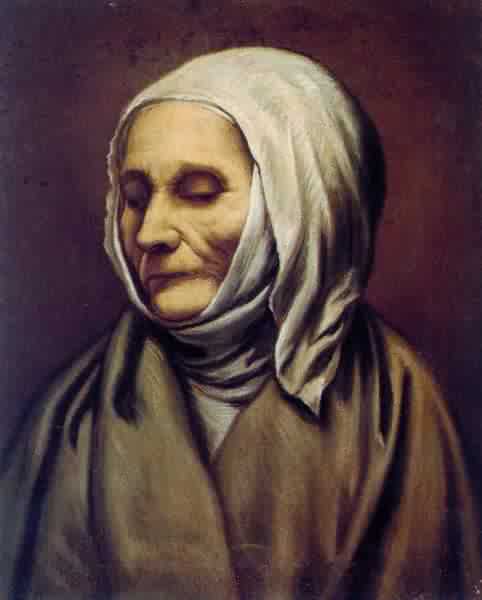
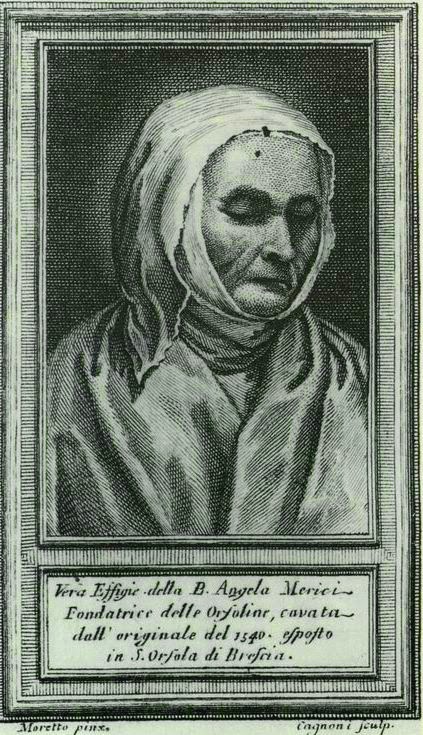
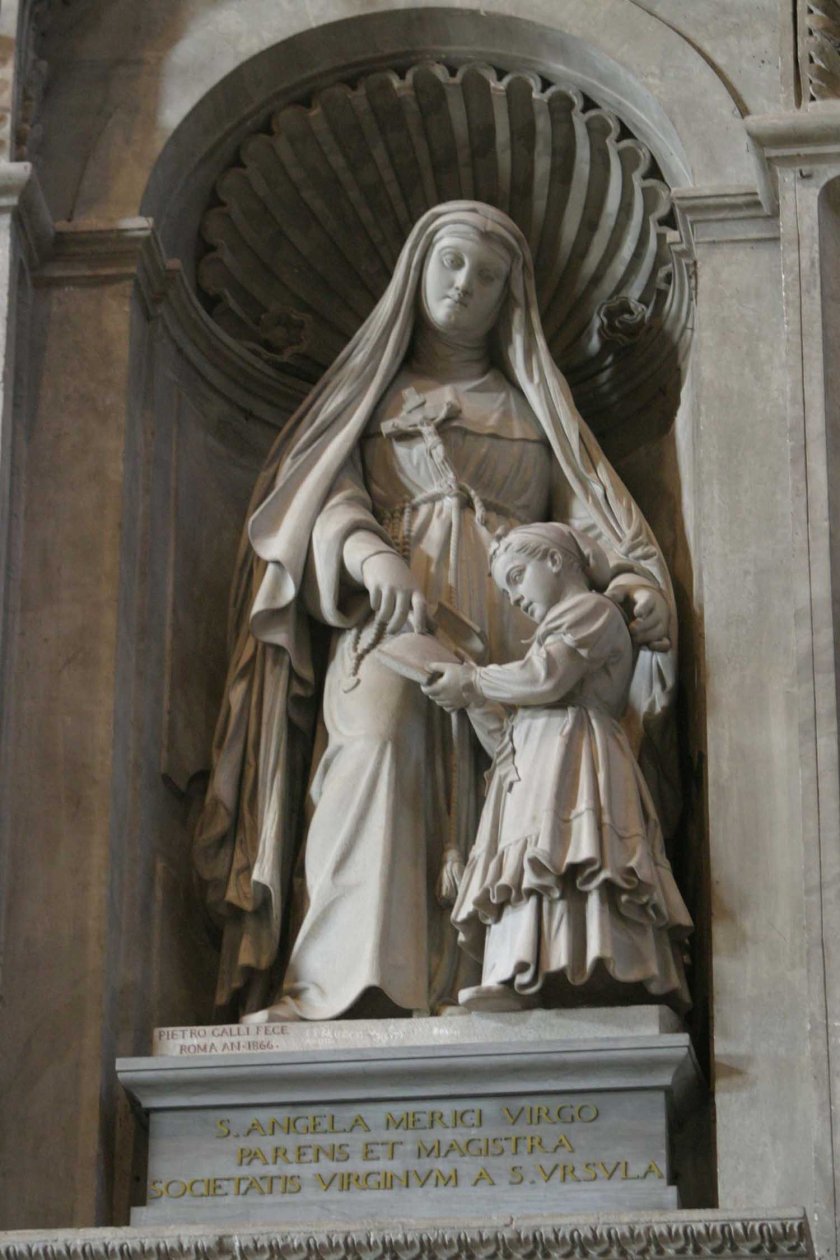
St Angela Merici (1474-1540) (Optional Memorial) INCORRUPT
—
Bl Antonio Mascaró Colomina
St Avitus
St Candida of Bañoles
St Carolina Santocanale
St Devota of Corsica
St Domitian of Melitene
St Emerius of Bañoles
Bl Jurgis Matulaitis-Matulewicz/George Matulaitis
St Gilduin
Bl Gonzalo Diaz di Amarante
St Henry de Osso y Cervello
St John Maria Muzeyi
Bl John of Warneton
St Julian of Le Mans
St Julian of Sora
St Lupus of Châlons
Bl Manfredo Settala
St Marius of Bodon
Bl Michael Pini
St Natalis of Ulster
St Paul Josef Nardini
Bl Rosalie du Verdier de la Sorinière
St Theodoric of Orléans
St Pope Vitalian
—
Martyrs of North Africa – 30 saints: A group of 30 Christians martyred together by Arian Vandals. The only details to have survived are four of their names – Datius, Julian, Reatrus and Vincent. c 500 in North Africa.
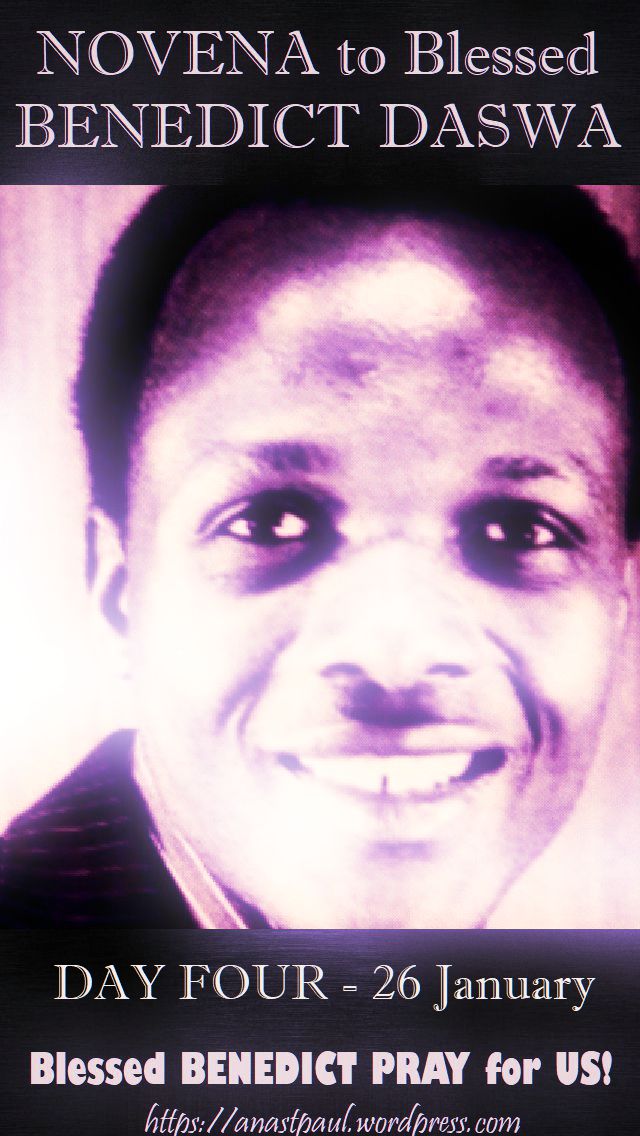
Novena to Blessed Benedict Daswa- Day Four – 26 January
4th Day: A MAN COMMITTED TO THE COMMUNITY
Benedict was highly respected in the community. He was a natural leader and a confidant of the headman who chose him as the secretary of his council. Always guided by his Christian principles, Benedict was never afraid to speak his mind. He was greatly respected for his honesty and integrity as also for his truthfulness and humility. On one occasion, falsely accused of using school funds to build his house, Benedict’s innocence and good stewardship were upheld after the headman had ordered an enquiry.
As Benedict believed strongly in character formation through sporting activities for
young people, he started soccer clubs for the youth. He wanted them to be busy,
disciplined, and off the streets. During a drought in the Venda area in the eighties, Benedict used his contacts and persuasive skills to obtain food supplies for the children in his school.
Word of God You are the salt of the earth; but if salt has lost its taste, how shall its saltness be restored? It is no longer good for anything except to be thrown out and trodden under foot by men. You are the light of the world. Acity set on a hill cannot be hid. Nor do men light a lamp and put it under a bushel but on a stand and it gives light to all in the house. Let your light so shine before men, that they may see your good works and give glory to your Father who is in heaven. (Matthew 5, 13-16)
Reflection: What/how do I contribute to improve my community?
Do I take my public/political responsibilities seriously?
Prayer: But you do see; you do observe this misery and sorrow; You take the matter in hand. To you the helpless can entrust their cause; you are the defender of the orphans. (Psalm 10, 14)
NOVENA PRAYER:
O Blessed Trinity,
I believe that You dwell in me through my baptism.
I love You, I adore You and I worship You.
I give You thanks for Blessed Benedict,
Whom You chose to bear witness unto death for his faith
In Jesus Christ, my Saviour and my Lord.
Almighty Father, You filled the heart of Blessed Benedict,
With great love and zeal in building up Your kingdom.
You gave him the courage and the strength
To stand up for his faith without fear, even the fear of death.
Loving God, keep me free from all deeds of darkness.
Protect me from evil spirits and the powers of evil.
Make me a true apostle of life in my family and in society.
May Your light, O Lord, shine upon me and through me.
Lord Jesus, through the intercession of Blessed Benedict,
I ask that I may follow his example
Of always being ready to forgive in a Christian spirit.
You know all about my many problems and worries
And my great fears when I look to the future.
I draw strength and courage from the life of Blessed Benedict.
I come to You now, Lord, and through his intercession
I ask for this very special favour
………………………….………
(mention your request/s)
if it is according to Your will.
Help me always to follow the good example of Blessed Benedict.
By daily prayer and regular attendance at Church,
Help me to love You, O Lord, above all things
And to love others as You love me.
Amen.
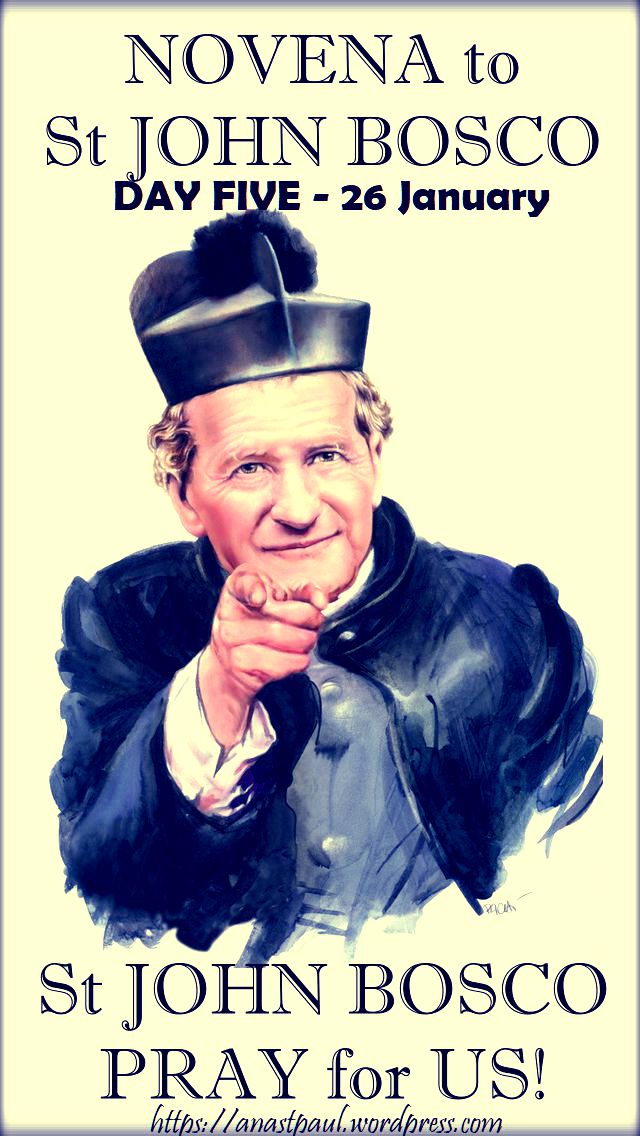
5th Day: For Salesian Brothers, Sisters and Priests
O Saint John Bosco,
you founded the Salesian Society
and the Institute of the Daughters of Mary Help of Christians
for the continuation and extension of the work on behalf of young people.
Pray for all your sons and daughters,
the members of these two religious families that,
inspired by your example and imbued with your spirit
they may be faithful to their religious consecration
and steadfast in the Salesian mission.
Through your intercession
may God grant me the following grace
………………………………..
(mention your request)
so that together with the sons and daughters
of your religious families
I may assist and help all especially young people.
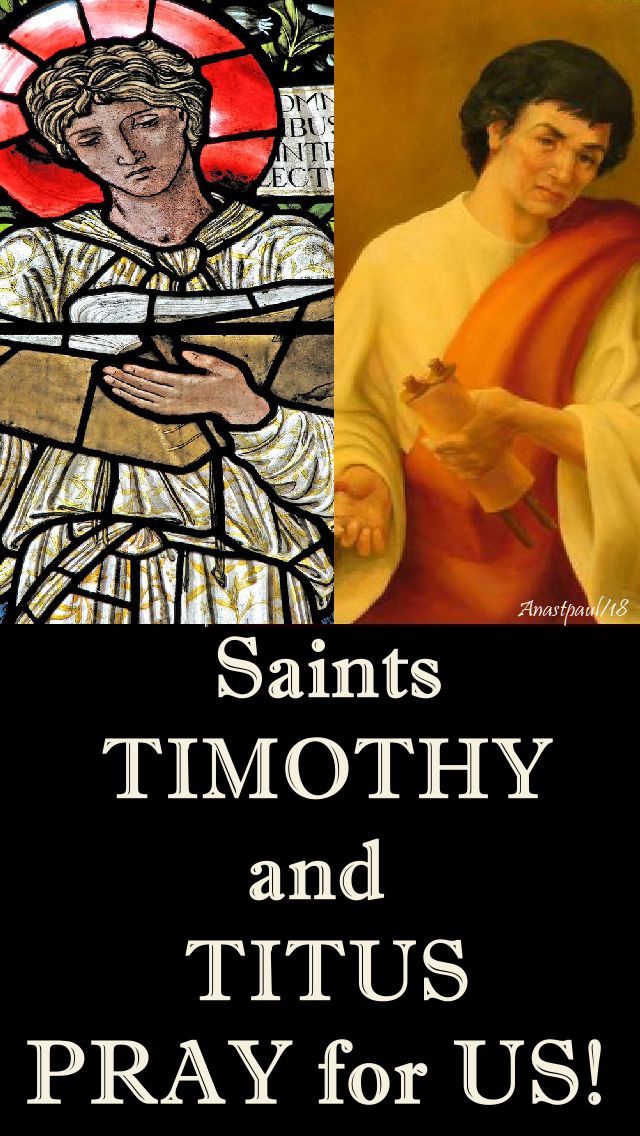
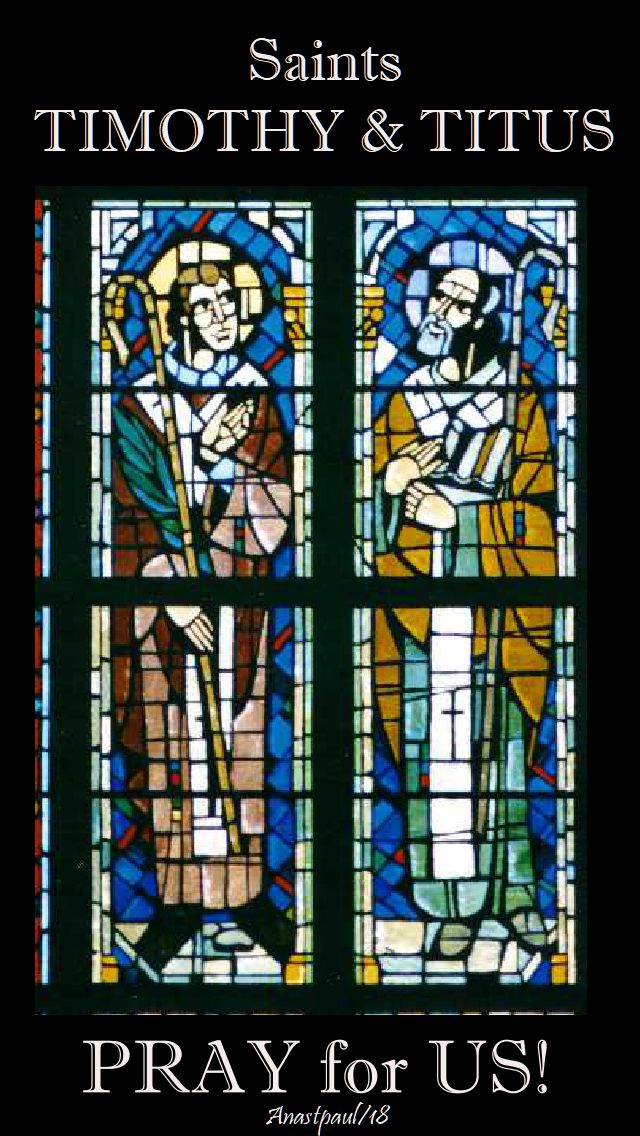
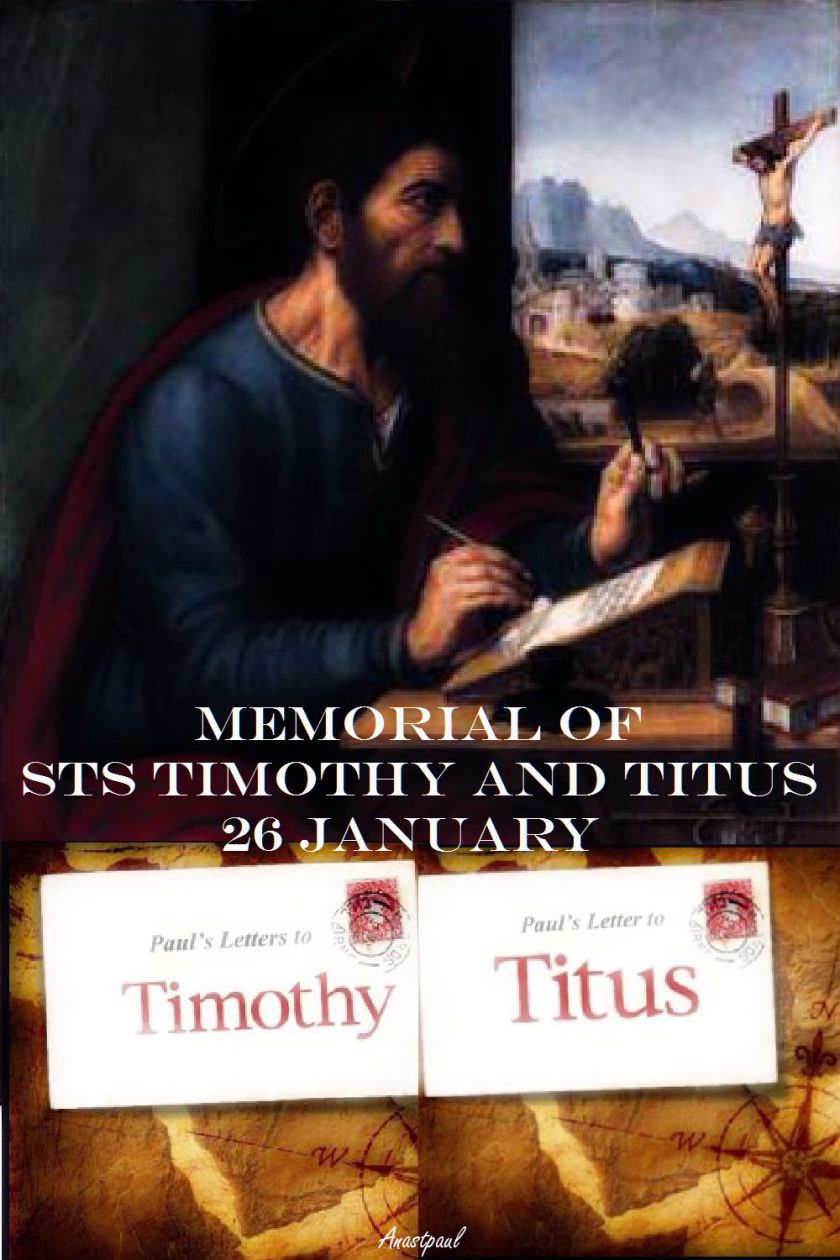
Thought for the Day – 26 January – Memorial of Sts Timothy and Titus, Disciples and Companions of the Apostle Paul and Bishops of the Catholic Church
St Paul makes it clear to Timothy that he is to proclaim the Word with persistence BUT “through all patience.” This is the most important part of these instructions! Growth in the Spirit is a lifelong journey, in which great patience is needed. The one who proclaims the Word needs patience in dealing with the one being taught. This is a human enterprise and humans are notoriously slow to understand, accept and implement the Word of God in their lives. Christians are to proclaim the Word without being judgmental. So, as Paul tells Timothy so he tells you and me to go forth, proclaim the Word, live your faith, treat others with respect and kindness and do it all with patience and love. Thus faith is the centre of the Christian’s life and from that centre he radiates Christ’s love to all whom he meets. (Msgr. Bernard Bourgeois)
In these letters, we get another glimpse of life in the early Church: great zeal in the apostolate, great communion in Christ, great friendship. Yet always there is the problem of human nature and the unglamorous details of daily life: the need for charity and patience in “quarrels with others, fears within myself,” as Paul says. Through it all, the love of Christ sustained them. At the end of the Letter to Titus, Paul says that when the temporary substitute comes, “hurry to me.”
Quote/s of the Day – 26 January – Memorial of Sts Timothy and Titus, Disciples and Companions of the Apostle Paul and Bishops of the Catholic Church
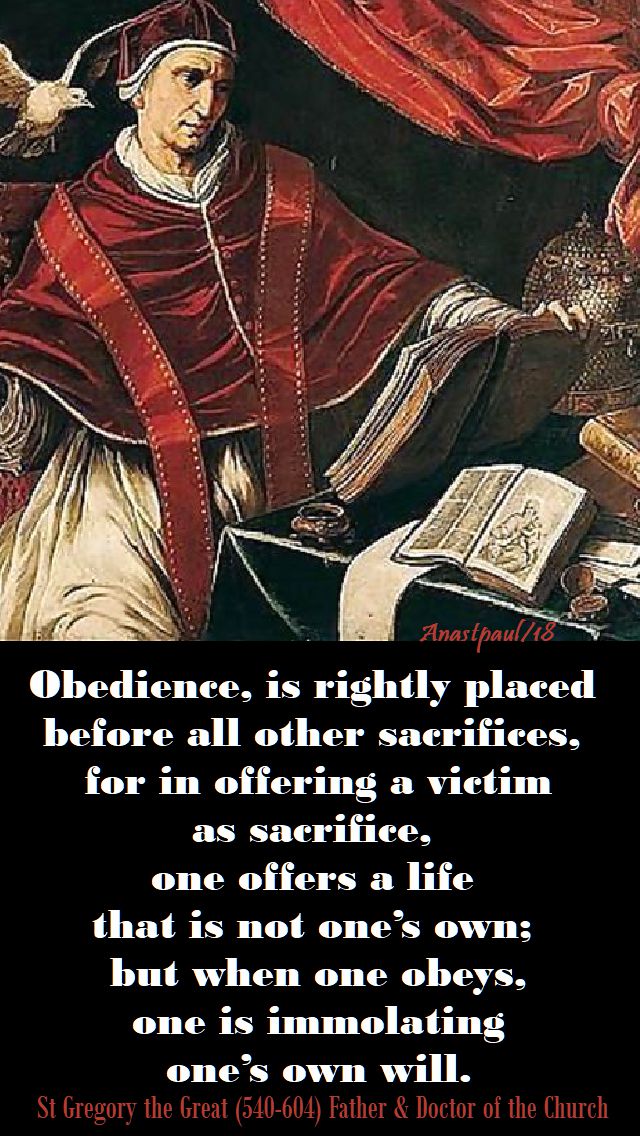
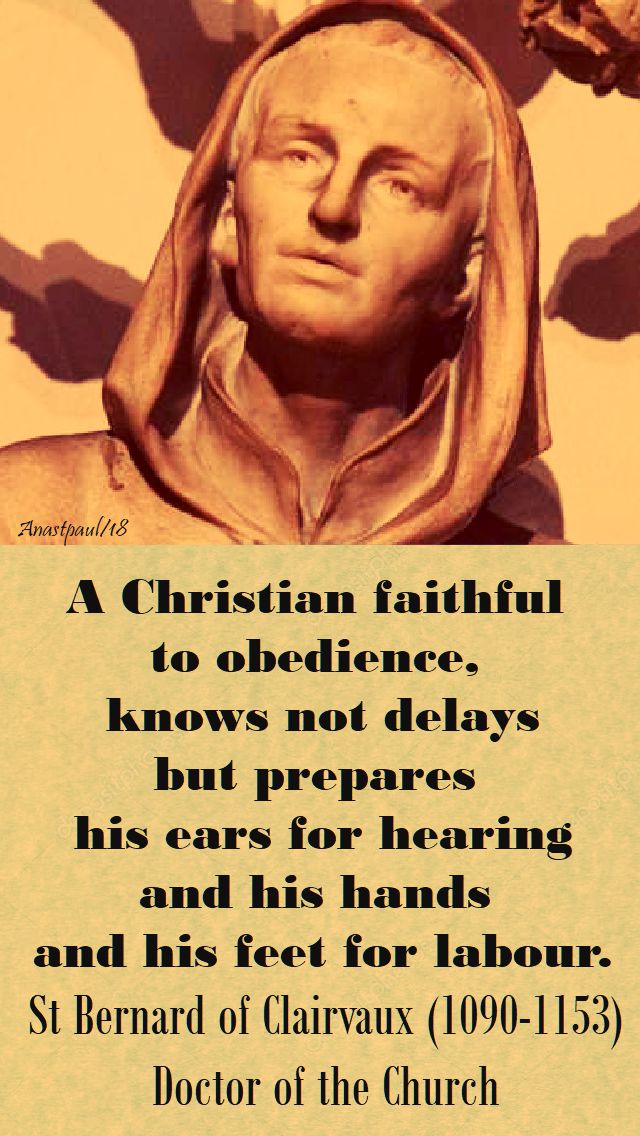
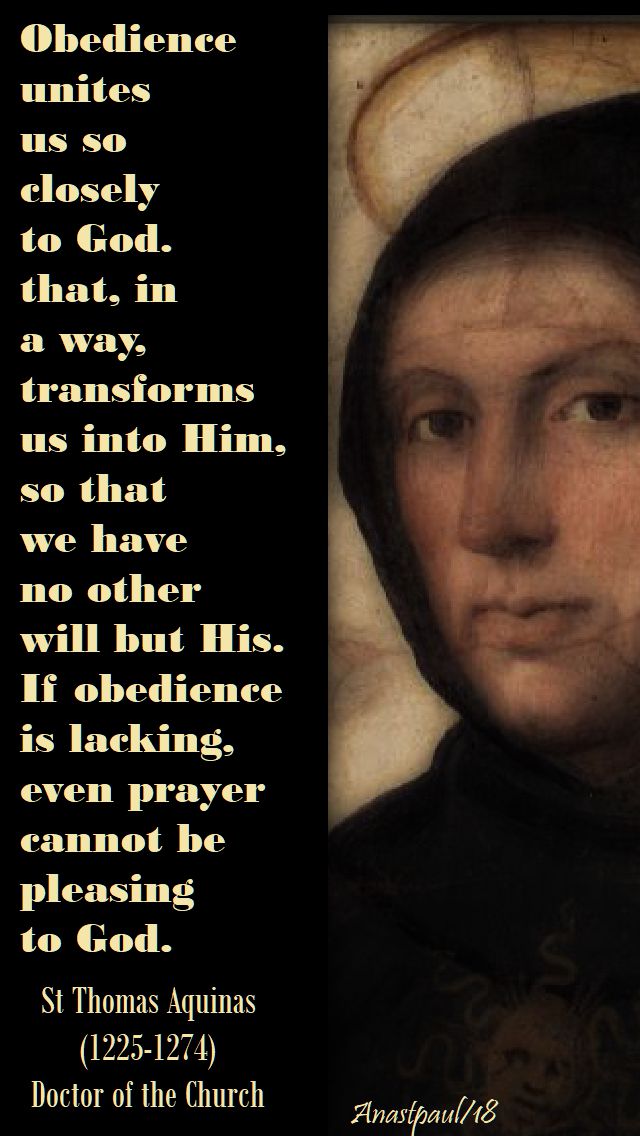
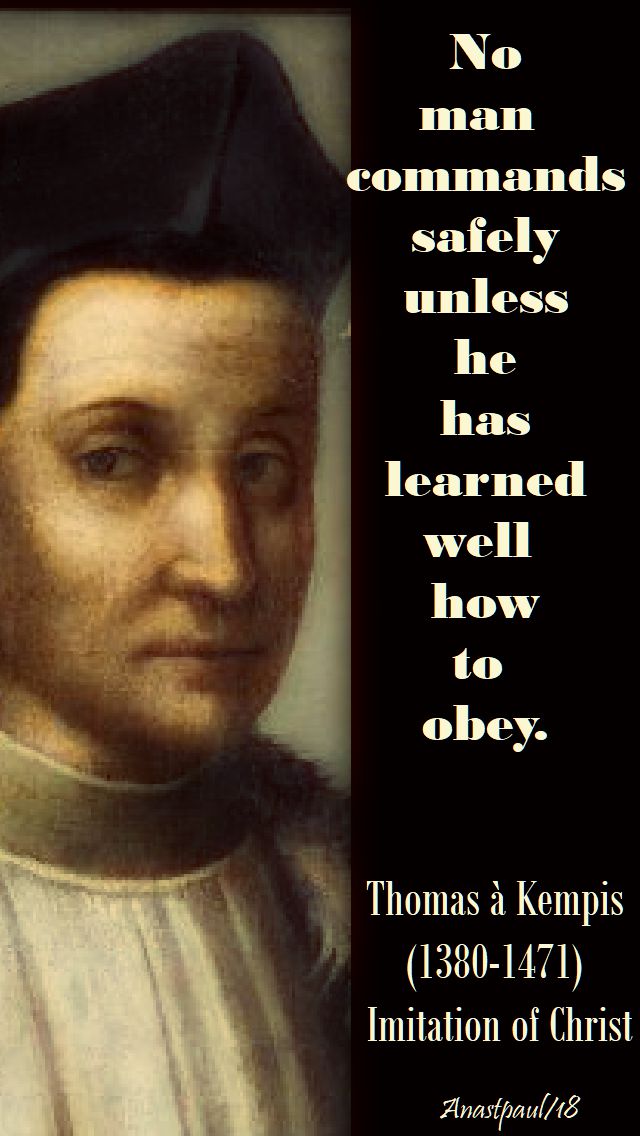
“Speaking of Obedience”
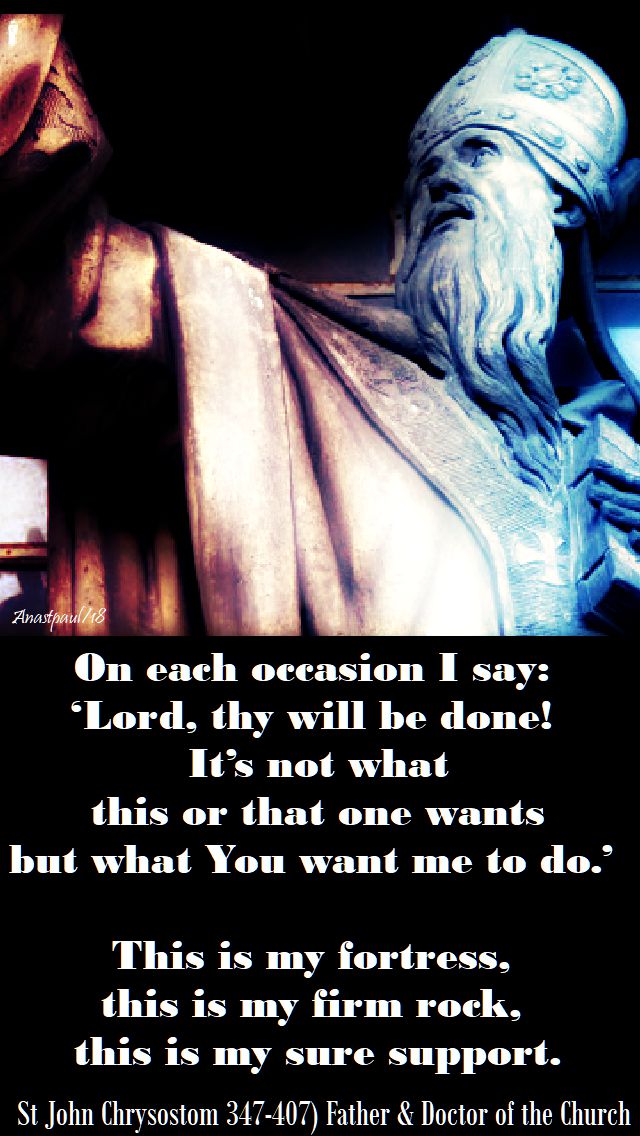
“On each occasion I say: ‘Lord, thy will be done! It’s not what this or that one wants but what You want me to do.’ This is my fortress, this is my firm rock, this is my sure support.”
St John Chrysostom 347-407) Father & Doctor of the Church
“Obedience, is rightly placed before all other sacrifices, for in offering a victim as sacrifice, one offers a life that is not one’s own; but when one obeys, one is immolating one’s own will.”
St Gregory the Great (540-604) Father & Doctor of the Church
“A Christian faithful to obedience, knows not delays but prepares his ears for hearing and his hands and his feet for labour.”
St Bernard of Clairvaux (1090-1153) Doctor of the Church
“Obedience unites us so closely to God. that in a way transforms us into Him, so that we have no other will but His. If obedience is lacking, even prayer cannot be pleasing to God.”
St Thomas Aquinas (1225-1274) Doctor of the Church
“No man commands safely unless he has learned well how to obey.”
Thomas à Kempis (1380-1471) – Imitation of Christ
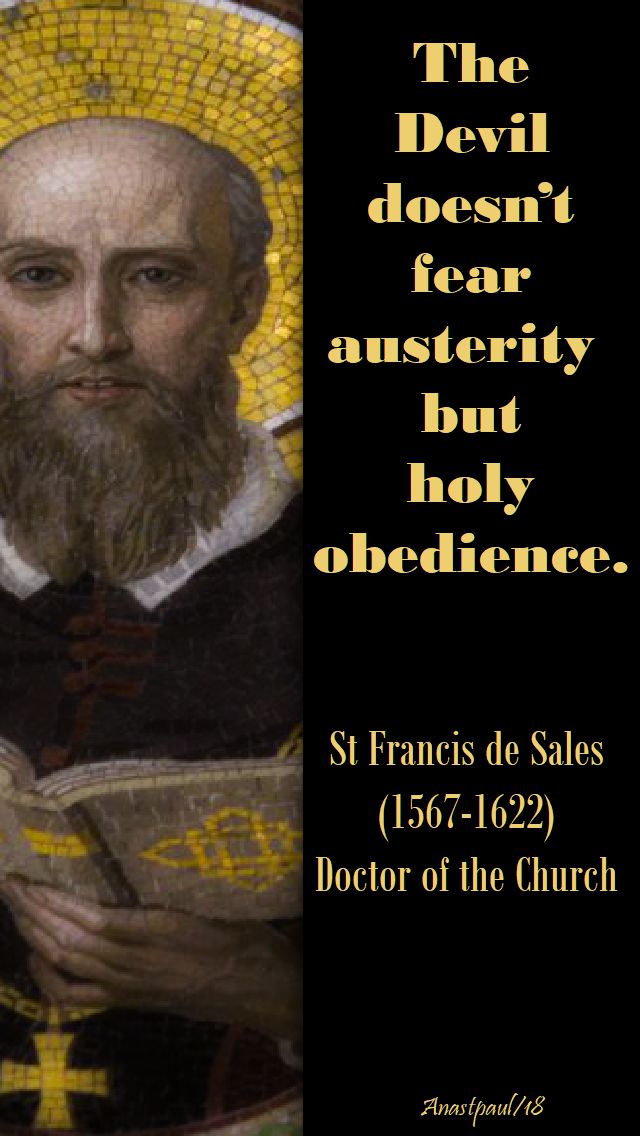
“The Devil doesn’t fear austerity but holy obedience.”
St Francis de Sales (1567-1622) Doctor of the Church
One Minute Reflection – 26 January – Memorial of Sts Timothy and Titus, Disciples and Companions of the Apostle Paul and Bishops of the Catholic Church
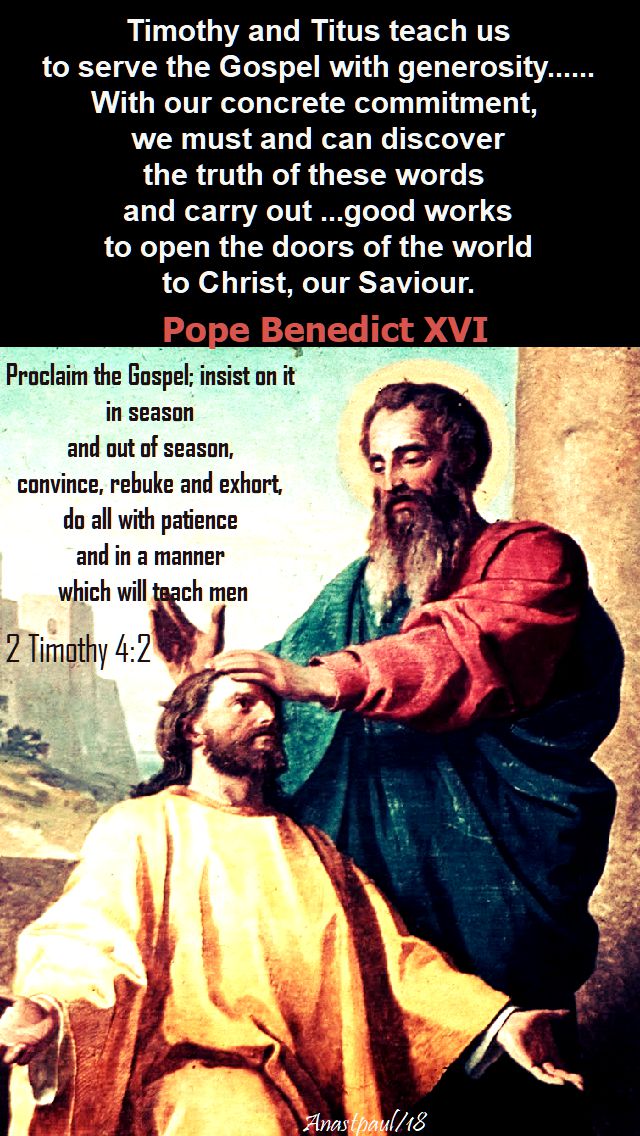
Proclaim the Gospel; insist on it in season and out of season, convince, rebuke and exhort, do all with patience and in a manner which will teach men….2 Timothy 4:2
REFLECTION – “…The sources we have on Timothy and Titus underline their willingness to take on the different tasks, which often consisted in representing Paul even in difficult circumstances. In other words, they teach us to serve the Gospel with generosity...”I want you to insist on these points, that those who have believed in God be careful to devote themselves to good works; these are excellent and beneficial to others” (Titus 3:8). With our concrete commitment, we must and can discover, the truth of these words and carry out …good works to open the doors of the world to Christ, our Saviour.”…Pope Benedict 13 December 2006
PRAYER – Almighty God, You endowed Saints Timothy and Titus with power to preach Your Word. Grant that, living a life of integrity and holiness in this world, reaching out to teach the Gospel both by our lives and our words, we may, through their prayers, come to our true home in heaven. Through our Lord Jesus Christ, in union with the Holy Spirit, one God forever, amen.
Our Morning Offering – 26 January – Memorial of Sts Timothy and Titus, Disciples and Companions of the Apostle Paul and Bishops of the Catholic Church
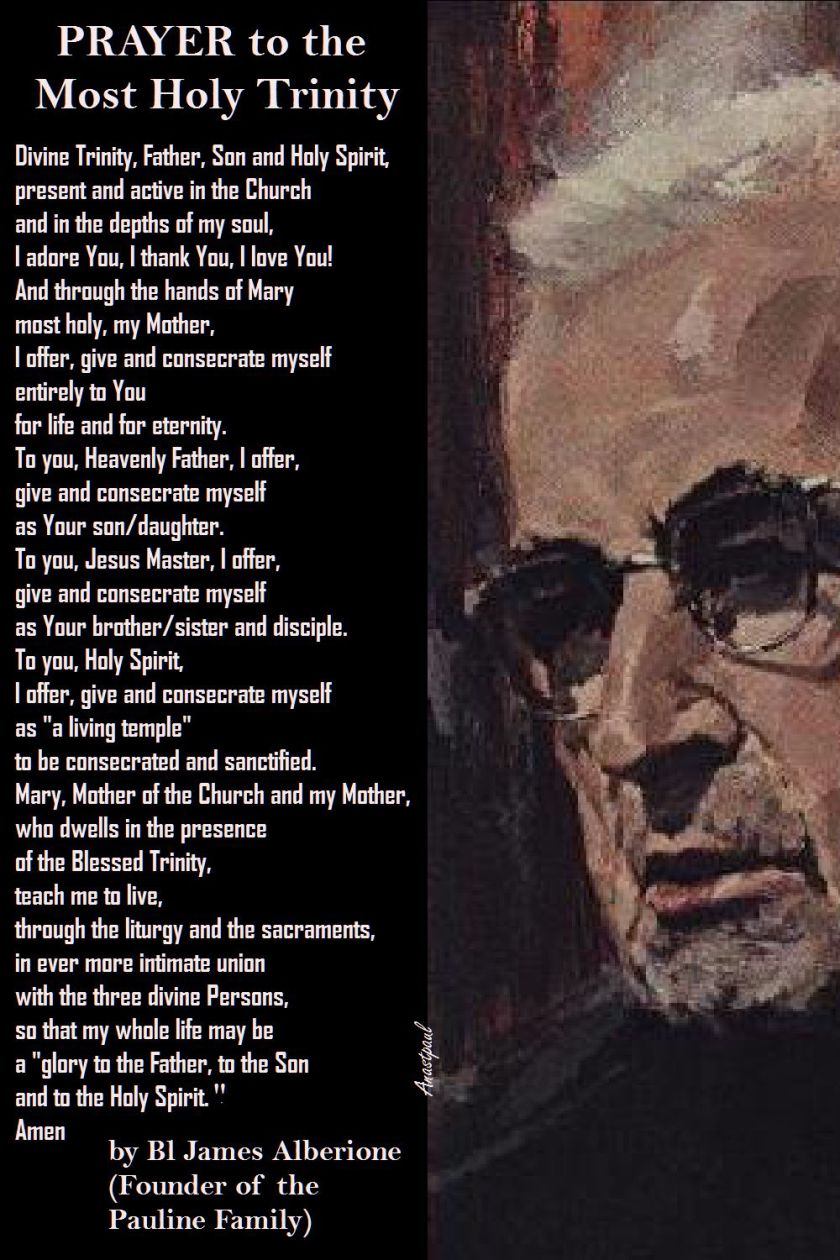
Consecration to the Most Holy Trinity by Blessed James Alberione (1884-1971) (Founder of the Pauline Family)
Divine Trinity, Father, Son and Holy Spirit,
present and active in the Church
and in the depths of my soul,
I adore You, I thank You, I love You!
And through the hands of Mary
most holy, my Mother,
I offer, give and consecrate myself
entirely to You
for life and for eternity.
To you, Heavenly Father, I offer,
give and consecrate myself
as Your son/daughter.
To you, Jesus Master, I offer,
give and consecrate myself
as Your brother/sister and disciple.
To you, Holy Spirit,
I offer, give and consecrate myself
as “a living temple”
to be consecrated and sanctified.
Mary, Mother of the Church and my Mother,
who dwells in the presence
of the Blessed Trinity,
teach me to live,
through the liturgy and the sacraments,
in ever more intimate union
with the three divine Persons,
so that my whole life may be
a “glory to the Father, to the Son
and to the Holy Spirit.” Amen.
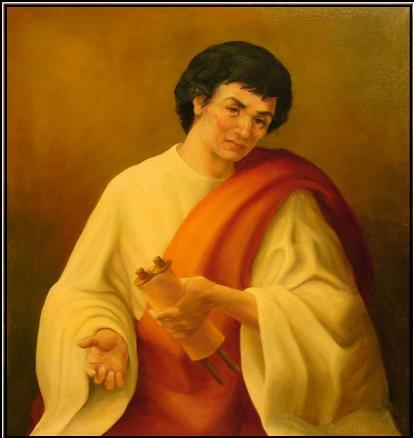
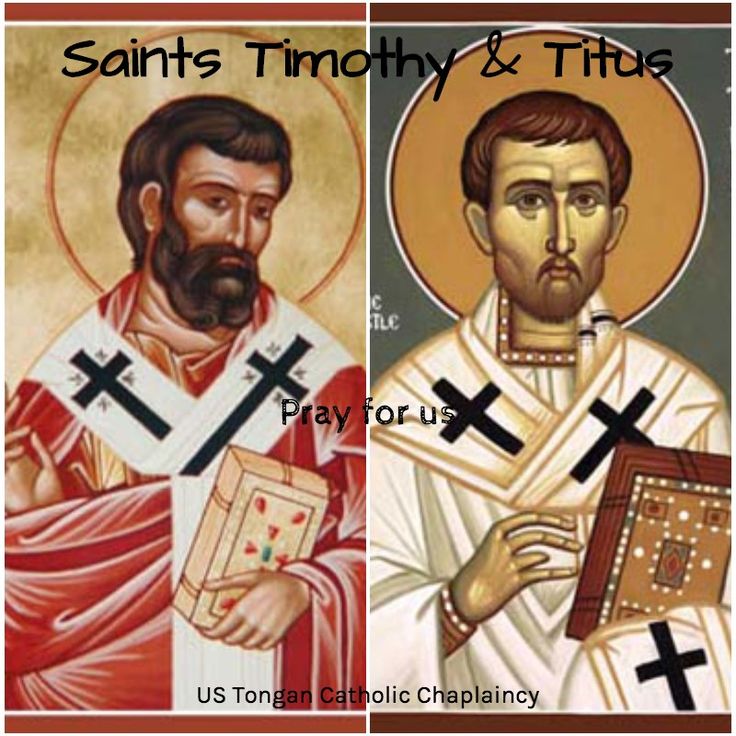
Saints of the Day – 26 January – Sts Timothy and Titus – Bishops, Disciples and trusted and loyal Companions of St Paul.
“Timothy” is a Greek name and means “who honours God.” While Luke, in the Acts of the Apostles, mentions him six times, Paul names him on 17 occasions in his letters (moreover he appears once in the Letter to the Hebrews). We can deduce that from Paul he enjoyed great consideration, although Luke does not tell us all that he had to do with him. The Apostle, in fact, entrusted him with important missions and saw in him a sort of “alter ego,” as can be seen in his great praise of him in the Letter to the Philippians. “I have no one like him, who will be genuinely anxious for your welfare” (2:20).
Timothy was born in Lystra (some 200 kilometers northwest of Tarsus) of a Jewish mother and a pagan father (cf. Acts 16:1). The fact that his mother had contracted a mixed marriage and that she did not circumcise her son leads one to think that Timothy was brought up in a family that was not strictly observant, though it is said that he knew the Scriptures from his childhood (cf. 2 Timothy 3:15). His mother’s name has been transmitted to us, Eunice, and that of his grandmother, Lois (cf. 2 Timothy 1:5).
When Paul passed through Lystra at the start of his second missionary journey, he chose Timothy as his companion, as “he was well spoken by the brethren at Lystra and Iconium” (Acts 16:2), but he “circumcised him because of the Jews that were in those places ” (Acts 16:3). Together with Paul and Silas, Timothy went across Asia Minor to Troas, from where he went to Macedonia. We are told that in Philippi, where Paul and Silas were accused of disturbing the city and imprisoned for having been opposed to some unscrupulous individuals who were taking advantage of a slave girl who had a spirit of divination (cf. Acts 16:16-40), Timothy was released. When Paul then was obliged to travel to Athens, Timothy caught up with him in that city and from there was sent to the young Church of Thessalonica to confirm her in the faith (cf. 1 Thessalonians 3:1-2). He then joined the Apostle in Corinth, giving him good news about the Thessalonians and collaborating with him in the evangelisation of that city (cf. 2 Corinthians 1:19).
We again find Timothy in Ephesus, during Paul’s third missionary journey. From there, the Apostle wrote probably to Philemon and to the Philippians and both letters were written with Timothy (cf. Philemon 1; Philippians 1:1). From Ephesus, Paul sent him to Macedonia with a certain Erastus (cf. Acts 19:22) and later to Corinth, with the task to take a letter, in which he recommended to the Corinthians that they give him a good reception (cf. 1 Corinthians 4:17; 16:10-11).
He appears again as co-writer of the Second Letter to the Corinthians and when from Corinth Paul wrote the Letter to the Romans, he transmitted greetings to Timothy, as well as to others (cf. Romans 16:21). From Corinth, the disciple again travelled to Troas, on the Asian shore of the Aegean Sea, there to await the Apostle who was going to Jerusalem at the end of his third missionary journey (cf. Acts 20:4).
From that moment, we can say that the figure of Timothy stands out as that of a pastor of great importance. According to Eusebius’ subsequent “Ecclesiastical History,” Timothy was the first bishop of Ephesus (cf. 3:4). Some of his relics have been in Italy since 1239, in the Cathedral of Termoli, in Molise, having come from Constantinople.
As regards the figure of Titus, whose name is of Latin origin, we know that he was Greek by birth, that is, pagan (cf. Galatians 2:3). Paul took him to Jerusalem on the occasion of the so-called Apostolic Council, in which the preaching of the Gospel to pagans was solemnly accepted without imposing upon them the precepts of the Mosaic law.
In the Letter he addresses to him, the Apostle praises him describing him as “my true child in our common faith” (Titus 1:4). After Timothy went to Corinth, Paul sent Titus with the task to call that rebellious community to obedience. Titus brought peace to the Church of Corinth and the Apostle wrote these words: “But God, who comforts the downcast, comforted us by the coming of Titus, and not only with his coming but also by the comfort with which he was comforted in you, as he told us of your longing, your mourning, your zeal for me, so that I rejoiced still more…. Therefore we are comforted. And besides our own comfort we rejoiced still more at the joy of Titus, because his mind has been set at rest by you all” (2 Corinthians 7:6-7,13). Paul again sent Titus — whom he called “partner and co-worker” (2 Corinthians 8:23) — to organise the completion of the collections for the Christians of Jerusalem (2 Corinthians 8:6). Subsequent news found in these pastoral letters speak of him as bishop of Crete (cf. Titus 1:5), from whence, by invitation of Paul, he joined the Apostle in Nicopolis, in Epirus, (cf. Titus 3:12). Later he also went to Dalmatia (cf. 2 Timothy 4:10). We do not have any more information on Titus’ subsequent trips or on his death.
In short, if we consider together the two figures of Timothy and Titus, we are aware of some significant facts. The most important is that Paul used collaborators in the development of his missions. He is, of course, the Apostle par excellence, founder and pastor of many Churches. Nevertheless, it is clear that he did not do it all alone but leaned on trustworthy persons, who shared the effort and responsibilities.
To be pointed out, moreover is the willingness of his collaborators. The sources we have on Timothy and Titus underline their willingness to take on the different tasks, which often consisted in representing Paul even in difficult circumstances. In other words, they teach us to serve the Gospel with generosity, knowing that this also implies a service to the Church herself. (Pope Benedict 13 December 2006)
—
St Alberic of Citreaux
St Alphonsus of Astorga
St Ansurius of Orense
St Athanasius of Sorrento
St Conan of Iona
Bl Eystein Erlandsön
Bl José Gabriel del Rosario Brochero
Bl Marie de la Dive veuve du Verdier de la Sorinière
Bl Michaël Kozal
St Paula of Rome
St Robert of Molesme
St Theofrid of Corbie
St Theogenes of Hippo
St Tortgith of Barking
—
Martyred Family of Constantinople: Saint Mary and Saint Xenophon were married and the parents of Saint John and Saint Arcadius. Theirs was a wealthy family of Senatorial rank in 5th century imperial Constantinople, but were known as a Christians who lived simple lives. To give their sons a good education, Xenophon and Mary sent them to university in Beirut, Phoenicia. However, their ship wrecked, there was no communication from them, and the couple assumed, naturally, that the young men had died at sea. In reality, John and Arcadius had survived and decided that instead of continuing to Beirut, they were going to follow a calling to religious life and became monks, eventually living in a monastery in Jerusalem. Years later, Mary and Xenophon made a pilgrimage to Jerusalem – where they encountered their sons. Grateful to have their family re-united, and taking it as a sign, Xenophon and Mary gave up their positions in society in Constantinople, and lived the rest of their lives as a monk and anchoress. in Jerusalem. A few years later, the entire family was martyred together.
They were martyred in 5th century Jerusalem.
St Xenophon
St Mary
St John
St Arcadius
Series on the Catechesis of Pope BENEDICT XVI on St Paul
“Speaking of St Paul ” No 1 – Wednesday, 2 July 2008
Religious and Cultural Environment
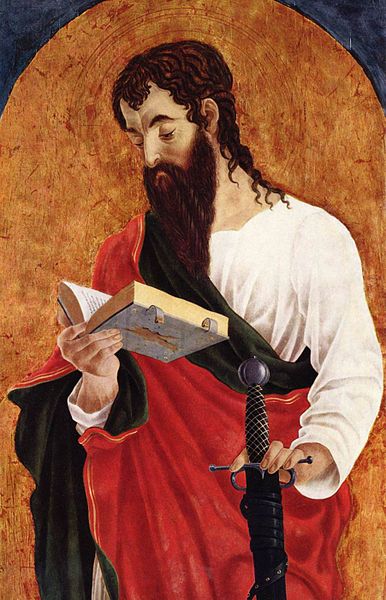
Marco Zoppo (1433–1478) – Italian painter (1433-1478) St Paul circa 1468
Dear Brothers and Sisters,
Today I would like to begin a new cycle of Catechesis focusing on the great Apostle St Paul. As you know, this year is dedicated to him, from the liturgical Feast of Sts Peter and Paul on 29 June 2008 to the same Feast day in 2009. The Apostle Paul, an outstanding and almost inimitable yet stimulating figure, stands before us as an example of total dedication to the Lord and to his Church, as well as of great openness to humanity and its cultures. It is right, therefore, that we reserve a special place for him in not only our veneration but also in our effort to understand what he has to say to us as well, Christians of today. In this first meeting let us pause to consider the environment in which St Paul lived and worked. A theme such as this would seem to bring us far from our time, given that we must identify with the world of 2,000 years ago. Yet this is only apparently and, in any case, only partly true for we can see that various aspects of today’s social and cultural context are not very different from what they were then.
A primary and fundamental fact to bear in mind is the relationship between the milieu in which Paul was born and raised and the global context to which he later belonged. He came from a very precise and circumscribed culture, indisputably a minority, which is that of the People of Israel and its tradition. In the ancient world and especially in the Roman Empire, as scholars in the subject teach us, Jews must have accounted for about 10 percent of the total population. Later, here in Rome, towards the middle of the first century, this percentage was even lower, amounting to three percent of the city’s inhabitants at most. Their beliefs and way of life, is still the case today, distinguished them clearly from the surrounding environment and this could have two results: either derision, that could lead to intolerance, or admiration which was expressed in various forms of sympathy, as in the case of the “God-fearing” or “proselytes”, pagans who became members of the Synagogue and who shared the faith in the God of Israel. As concrete examples of this dual attitude we can mention on the one hand the cutting opinion of an orator such as Cicero who despised their religion and even the city of Jerusalem (cf. Pro Flacco, 66-69) and, on the other, the attitude of Nero’s wife, Poppea, who is remembered by Flavius Josephus as a “sympathiser” of the Jews (cf. Antichità giudaiche 20, 195, 252); Vita 16), not to mention that Julius Caesar had already officially recognised specific rights of the Jews which have been recorded by the above-mentioned Jewish historian Flavius Josephus (cf. ibid., 14,200-216). It is certain that the number of Jews, as, moreover, is still the case today, was far greater outside the land of Israel, that is, in the Diaspora, than in the territory that others called Palestine.
It is not surprising, therefore, that Paul himself was the object of the dual contradictory assessment that I mentioned. One thing is certain: the particularism of the Judaic culture and religion easily found room in an institution as far-reaching as the Roman Empire. Those who would adhere with faith to the Person of Jesus of Nazareth, Jew or Gentile, were in the more difficult and troubled position, to the extent to which they were to distinguish themselves from both Judaism and the prevalent paganism. In any case, two factors were in Paul’s favour. The first was the Greek, or rather Hellenistic, culture which after Alexander the Great had become a common heritage, at least of the Eastern Mediterranean and of the Middle East and had even absorbed many elements of peoples traditionally considered barbarian. One writer of the time says in this regard that Alexander “ordered that all should consider the entire oecumene as their homeland… and that a distinction should no longer be made between Greek and barbarian” (Plutarch, De Alexandri Magni fortuna aut virtute, 6, 8). The second factor was the political and administrative structure of the Roman Empire which guaranteed peace and stability from Britain as far as southern Egypt, unifying a territory of previously unheard of dimensions. It was possible to move with sufficient freedom and safety in this space, making use, among other things, of an extraordinary network of roads and finding at every point of arrival basic cultural characteristics which, without affecting local values, nonetheless represented a common fabric of unification super partes, so that the Jewish philosopher, Philo of Alexandria, a contemporary of Paul himself, praised the Emperor Augustus for “composing in harmony all the savage peoples, making himself the guardian of peace” (Legatio ad Caium, 146-147).
There is no doubt that the universalist vision characteristic of St Paul’s personality, at least of the Christian Paul after the event on the road to Damascus, owes its basic impact to faith in Jesus Christ, since the figure of the Risen One was by this time situated beyond any particularistic narrowness. Indeed, for the Apostle “there is neither Jew nor Greek, there is neither slave nor free, there is neither male nor female; for you are all one in Christ Jesus” (Gal 3: 28). Yet, even the historical and cultural situation of his time and milieu could not but have had an influence on his decisions and his work. Some have defined Paul as “a man of three cultures”, taking into account his Jewish background, his Greek tongue and his prerogative as a “civis romanus [Roman citizen], as the name of Latin origin suggests. Particularly the Stoic philosophy dominant in Paul’s time which influenced Christianity, even if only marginally, should be recalled. Concerning this, we cannot gloss over certain names of Stoic philosophers such as those of its founders, Zeno and Cleanthes and then those closer to Paul in time such as Seneca, Musonius and Epictetus: in them the loftiest values of humanity and wisdom are found which were naturally to be absorbed by Christianity. As one student of the subject splendidly wrote, “Stoicism… announced a new ideal, which imposed upon man obligations to his peersbut at the same time set him free from all physical and national ties and made of him a purely spiritual being” (M. Pohlenz, La Stoa, I, Florence, 2, 1978, pp. 565 f.). One thinks, for example, of the doctrine of the universe understood as a single great harmonious body and consequently of the doctrine of equality among all people without social distinctions, of the equivalence, at least in principle, of men and women and then of the ideal of frugality, of the just measure and self-control to avoid all excesses. When Paul wrote to the Philippians, “Whatever is true, whatever is honourable, whatever is just, whatever is pure, whatever is lovely, whatever is gracious, if there is any excellence, if there is anything worthy of praise, think about these things” (Phil 4: 8), he was only taking up a purely humanistic concept proper to that philosophical wisdom.
In St Paul’s time a crisis of traditional religion was taking place, at least in its mythological and even civil aspects. After Lucretius had already ruled polemically a century earlier that “religion has led to many misdeeds” (De rerum natura, 1, 101, On the Nature of Things), a philosopher such as Seneca, going far beyond any external ritualism, taught that “God is close to you, he is with you, he is within you” (Epistulae morales to Lucilius, 41, 1). Similarly, when Paul addresses an audience of Epicurean philosophers and Stoics in the Areopagus of Athens, he literally says: “God does not live in shrines made by man,… for in him we live and move and have our being” (Acts 17: 24, 28). In saying this he certainly re-echoes the Judaic faith in a God who cannot be represented in anthropomorphic terms and even places himself on a religious wavelength that his listeners knew well. We must also take into account the fact that many pagan cults dispensed with the official temples of the town and made use of private places that favoured the initiation of their followers. It is, therefore, not surprising that Christian gatherings (ekklesiai) as Paul’s Letters attest, also took place in private homes. At that time, moreover, there were not yet any public buildings. Therefore, Christian assemblies must have appeared to Paul’s contemporaries as a simple variation of their most intimate religious practice. Yet the differences between pagan cults and Christian worship are not negligible and regard the participants’ awareness of their identity as well as the participation in common of men and women, the celebration of the “Lord’s Supper”, and the reading of the Scriptures.
In conclusion, from this brief over-view of the cultural context of the first century of the Christian era, it is clear that it is impossible to understand St Paul properly without placing him against both the Judaic and pagan background of his time. Thus he grows in historical and spiritual stature, revealing both sharing and originality in comparison with the surrounding environment. However, this applies likewise to Christianity in general, of which the Apostle Paul, precisely, is a paradigm of the highest order from whom we all, always, still have much to learn. And this is the goal of the Pauline Year: to learn from St Paul, to learn faith, to learn Christ, and finally to learn the way of upright living.
The Octave of Prayer for Christian Unity 18-25 January 2018
BIBLICAL REFLECTIONS AND PRAYERS FOR THE EIGHT DAYS Your right hand, O Lord, glorious in power (Ex 15:6)
Day 8: He will gather the dispersed… from the four corners of the earth
Isaiah 11:12-13 Ephraim shall not be jealous of Judah, and Judah shall not be hostile towards Ephraim
Psalm 106:1-14, 43-48 Gather us to give thanks to your holy name
Ephesians 2:13-19 He has broken down the dividing wall
John 17:1-12 I have been glorified in them
The Caribbean churches work together to heal the wounds in the Body of Christ in the region, which are a legacy left by colonization. Reconciliation often demands repentance, reparation and the healing of memories. One example is the acts of apology and reparation between Baptists in Britain and the Caribbean. Like Israel, the Church in its unity is called to be both a sign and an active agent of reconciliation.
Reflection
Throughout the biblical narrative of salvation history, an unmistakable motif is the unrelenting determination of the Lord to form a people whom he could call his own. The formation of such a people – united in a sacred covenant with God – is integral to the Lord’s plan of salvation and to the glorification and hallowing of God’s Name.
The prophets repeatedly remind Israel that the covenant demanded that relationships among its various social groups should be characterized by justice, compassion and mercy. As Jesus prepared to seal the new covenant in his own blood, his earnest prayer to the Father was that those given to him by the Father would be one, just as he and the Father were one. When Christians discover their unity in Jesus they participate in Christ’s glorification in the presence of the Father, with the same glory that he had in the Father’s presence before the world existed. And so, God’s covenanted people must always strive to be a reconciled community – one which itself is an effective sign to all the peoples of the earth of how to live in justice and in peace.
Prayer
Lord,
we humbly ask that, by your grace,
the churches throughout the world
may become instruments of your peace.
Through their joint action as ambassadors
and agents of your healing, reconciling love
among divided peoples,
may your Name be hallowed and glorified.
Amen.
The right hand of God is planting in our land, planting seeds of freedom, hope and love; in these many-peopled lands, let his children all join hands, and be one with the right hand of God.
Novena to Blessed Benedict Daswa- Day Three – 25 January
3rd Day: A TRUE FAMILY MAN
In 1980, Benedict married Shadi Eveline Monyai, a Lutheran who was then received
into full communion with the Catholic Church. They had eight children, the last being
born four months after his death. Benedict believed that helping his wife with the
children and doing household chores were part of his marriage commitment. He told
people, “You should assist your wife with her household chores” and taught his
children to help in the home. He also trained them to work hard, both at school and in
his orchard.
The family prayed together each evening. This family prayer time, which included the
reading of Scripture as well as family prayer, was a true “domestic Church”. As family,
they always attended the Sunday liturgical celebrations. Benedict instituted the
“Daswa Day” around the Feast of Christmas. The family and all their close relatives
used to spend the day together during which as Christmas gifts, each child received
useful school materials for the coming year.
Word of God ”For this reason a man shall leave his father and mother and be joined to his wife, and the two shall become one flesh”. This mystery is a profound one, and I am saying that it refers to Christ and the Church; however, let each one of you love his wife as himself, and let the wife see that she respects her husband. … Fathers, do not provoke your children to anger but bring them up in the discipline and instruction of the Lord.
(Ephesians 5, 31-32; 6, 4)
Reflection: – How do I relate to my spouse, my children?
Do we pray together as a family? How often?
Prayer– Blessed is everyone who fears the Lord, who walks in his ways! Your wife will be like a fruitful vine within your house; your children will be like olive shoots around your table. Lo, thus shall the man be blessed who fears the Lord.
(Psalm 128, 1. 3-4)
NOVENA PRAYER:
O Blessed Trinity,
I believe that You dwell in me through my baptism.
I love You, I adore You and I worship You.
I give You thanks for Blessed Benedict,
Whom You chose to bear witness unto death for his faith
In Jesus Christ, my Saviour and my Lord.
Almighty Father, You filled the heart of Blessed Benedict,
With great love and zeal in building up Your kingdom.
You gave him the courage and the strength
To stand up for his faith without fear, even the fear of death.
Loving God, keep me free from all deeds of darkness.
Protect me from evil spirits and the powers of evil.
Make me a true apostle of life in my family and in society.
May Your light, O Lord, shine upon me and through me.
Lord Jesus, through the intercession of Blessed Benedict,
I ask that I may follow his example
Of always being ready to forgive in a Christian spirit.
You know all about my many problems and worries
And my great fears when I look to the future.
I draw strength and courage from the life of Blessed Benedict.
I come to You now, Lord, and through his intercession
I ask for this very special favour
…………………………………….(mention your request/s)
if it is according to Your will.
Help me always to follow the good example of Blessed Benedict.
By daily prayer and regular attendance at Church,
Help me to love You, O Lord, above all things
And to love others as You love me.
Amen.
O Saint John Bosco,
you became father, teacher and friend
to young people by the great love
and personal sacrifice with which you worked
for their salvation.
Pray for us that, inspired by your example
we also may love this chosen portion of God’s flock
with Christ’s own pastoral charity
and receive every child as we would the Lord Jesus himself.
Through your intercession
may God grant me the following grace
………………….…………….
(mention your request)
so that together with others
I may assist and help young people in today’s society, AMEN.
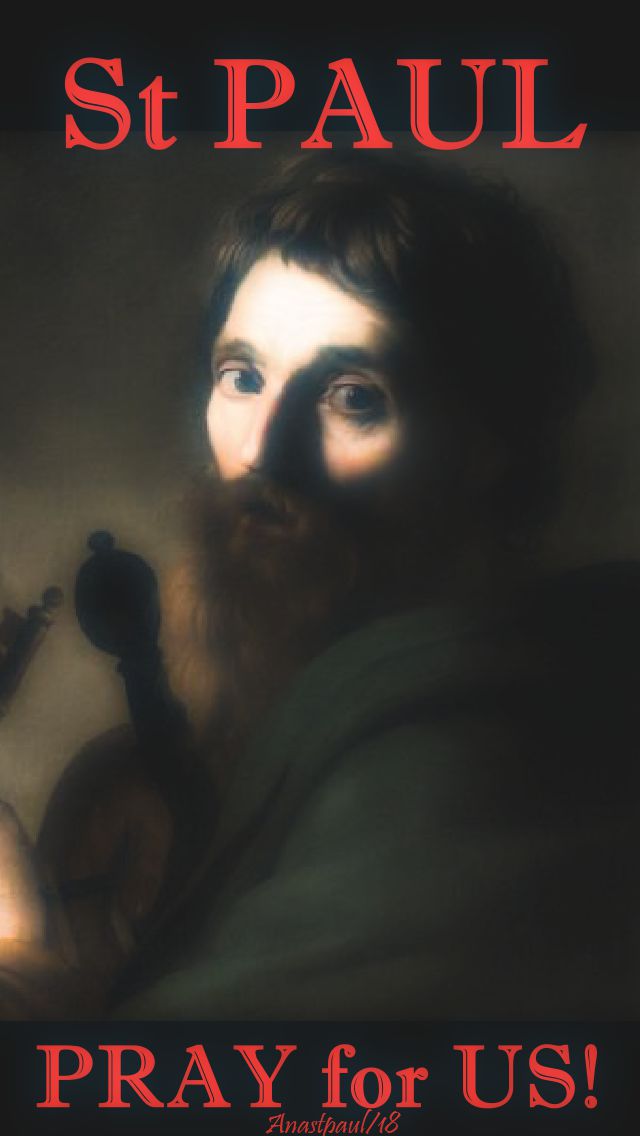
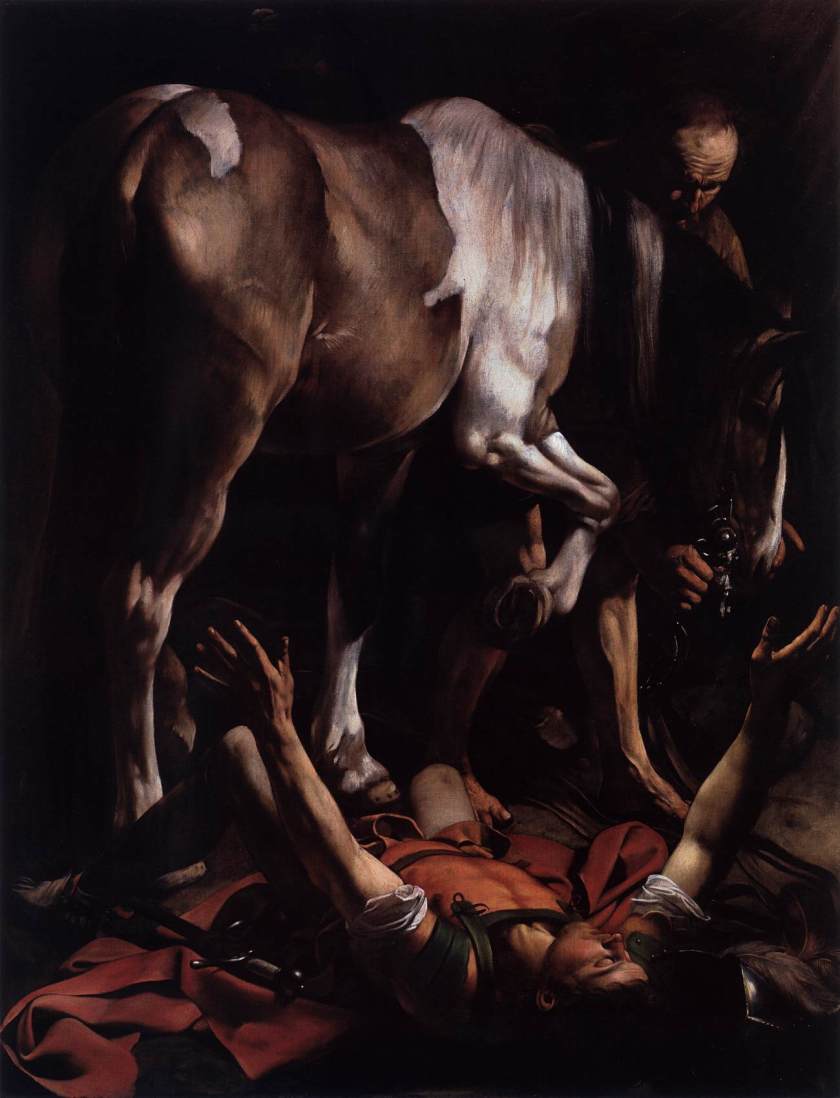
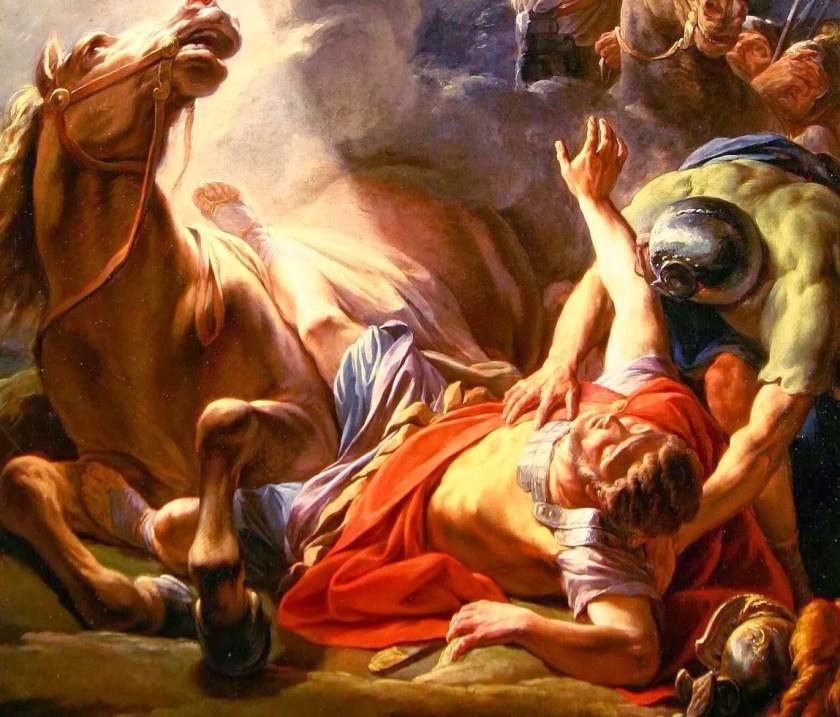
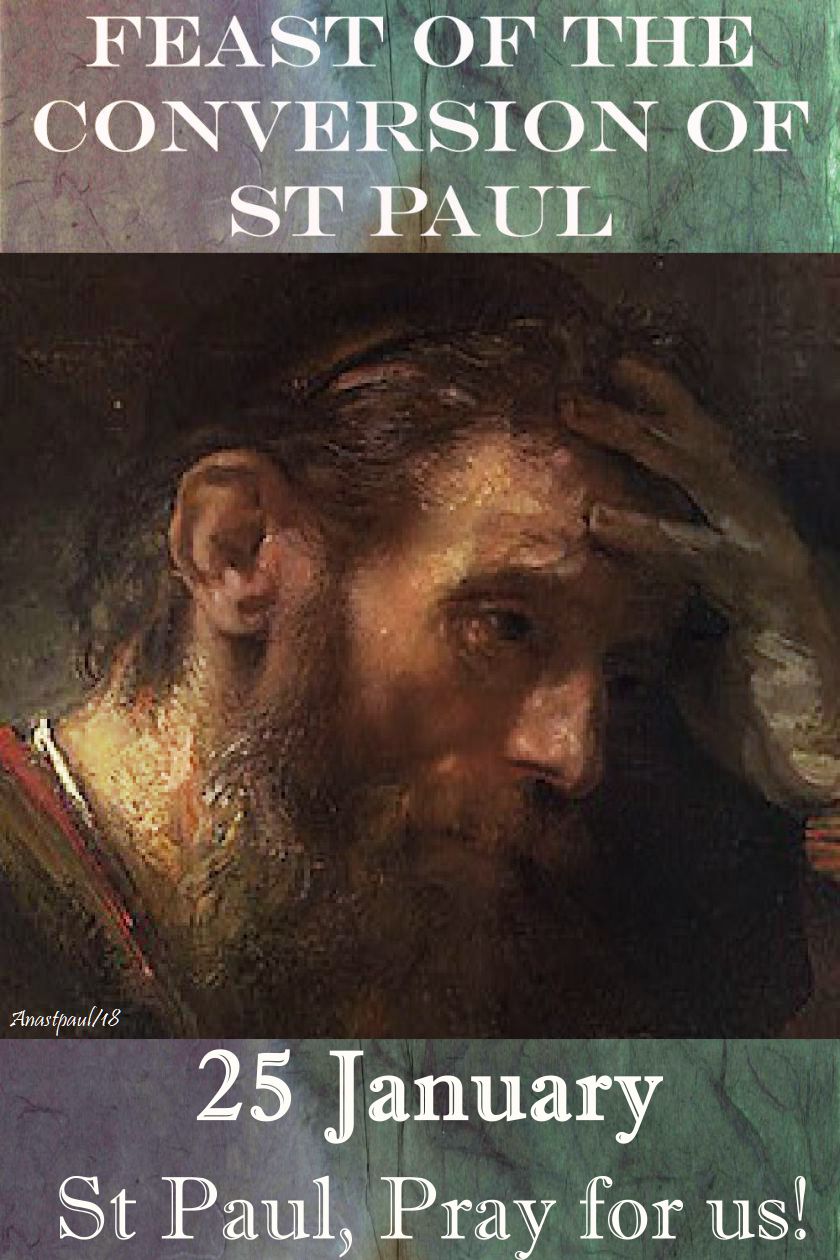
Second Thoughts for Today – 25 January – Feast of the Conversion of St Paul the Apostle
St Paul’s life is perhaps the best known in the annals of the saints and his conversion was one of the most earth-shattering miracles of the early Church.
Of course, not all of us can be knocked off our feet by a vision of Jesus Christ but we can live our faith with the same intensity as that of St Paul did. After his conversion, St Paul spent his life spreading the news of Jesus everywhere and died as his final witness to the faith.
It is total commitment and heroism that planted the Christian faith and it is still needed very badly in our day. The bottom-line is this:
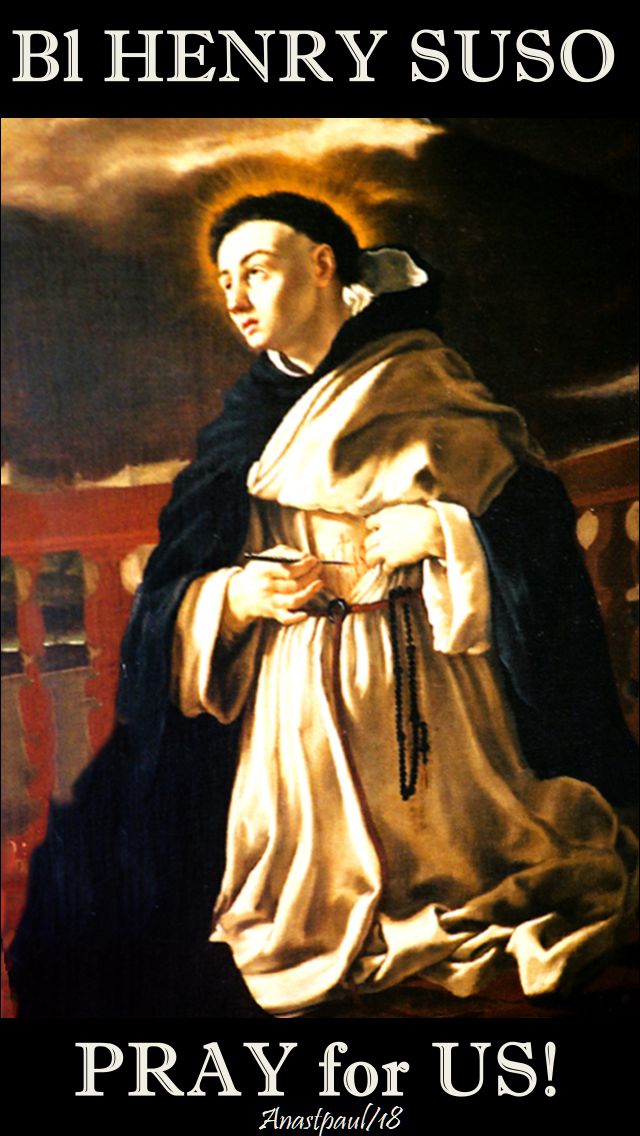
Thought for the Day – 25 January – The Memorial of Blessed Henry Suso O.P. (1290-1365)
Henry Suso is a bundle of contradictions and a person, moreover, who has gathered legends about him like a snowball rolling downhill. He was a poet, which is not always a key to happiness in this world; a mystic of the highest order; a hard working Dominican; and a man with a positive genius for getting into embarrassing situations. He has suffered at the hands of chroniclers who dislike his followers, or his tactics, or his poetry; he is all but canonised by those who see in him the Dominican mystic. It will require many years of exhaustive research to sort out the diverse elements in his personality, if, indeed, it can ever be accomplished. Poets are not easy to analyse, and Henry, before all else, was a poet and a mystic.
Anyone who endures dryness at prayer or feels abandoned by God will find instruction, and perhaps some relief, in the experience of Henry Suso. A mystic who called himself the “servant of Eternal Wisdom,” he endured long stretches of spiritual darkness interrupted only by occasional bursts of brightness. Henry’s life says to us that in apparent barrenness the soul draws closest to God. And we see him only by learning to look deep within.
Henry Suso was born at Constance, Switzerland and became a Dominican there at 13. Five years later an extraordinary divine encounter launched him on his lifelong mystical pursuit of God. For the next decade, however, Suso suffered severe depression and doubt. Finally, counsel with Meister Eckhart, the patriarch of 14th-century German mysticism, delivered him from the worst of it.
Like many other mystics, at midlife Henry threw himself into active Christian work. For nearly two decades he travelled throughout the Rhineland preaching, teaching and giving spiritual direction. He also wrote extensively about the inner life. His work on prayer, The Little Book of Eternal Wisdom, became the most popular Christian book in Europe before The Imitation of Christ appeared. In this excerpt he asks God, the Eternal Wisdom, why he seems to forsake those he loves:
Eternal Wisdom: When I hide myself, only then do you become aware of who I am or who you are. I am eternal Good, and so when I pour myself forth so lovingly, everything I enter becomes good. One can thus detect my presence as one detects the sun by its brightness since one cannot see its essence.
Servant: Lord, I find within myself a great unevenness. When I feel forsaken, my soul is like a sick person to whom everything is repugnant. But when the bright morning star bursts forth in my soul, all gloom disappears. Quickly, however, it is all snatched away and I am again forsaken. But then after intense sadness it returns. What is going on?
Eternal Wisdom: I am causing it, and it is the game of love. As long as love is together with love, love does not know how dear love is. But when love departs from love, then truly love feels how dear love was.
Servant: Dear Lord, teach me how to conduct myself in this game.
Eternal Wisdom: On good days you should consider the bad days, and on the bad days consider the good days. Then neither exuberance at my presence nor despondency can harm you. To find joy on earth, it is not enough that you give me a certain period of the day. You must constantly remain within yourself if you want to find God, hear his familiar words and be sensitive to his secret thoughts.
Suso’s individualistic piety and his association with Meister Eckhart, who was suspected of heresy, won him many enemies. He was accused of theft, sacrilege, fathering a child, poisoning and heresy, he suffered greatly but he was completely cleared of all charges. Toward the end of his life he served as the prior of the Dominican house at Ulm in central Germany. Henry Suso died there in 1366.
Henry died in 1365, in Ulm and was buried there in the convent of St Paul. However, in spite of the fact that his body was found intact and giving forth a sweet odour two hundred and fifty years later, the beatification was delayed until 1831. The relics, meantime, had disappeared entirely and have never been recovered.
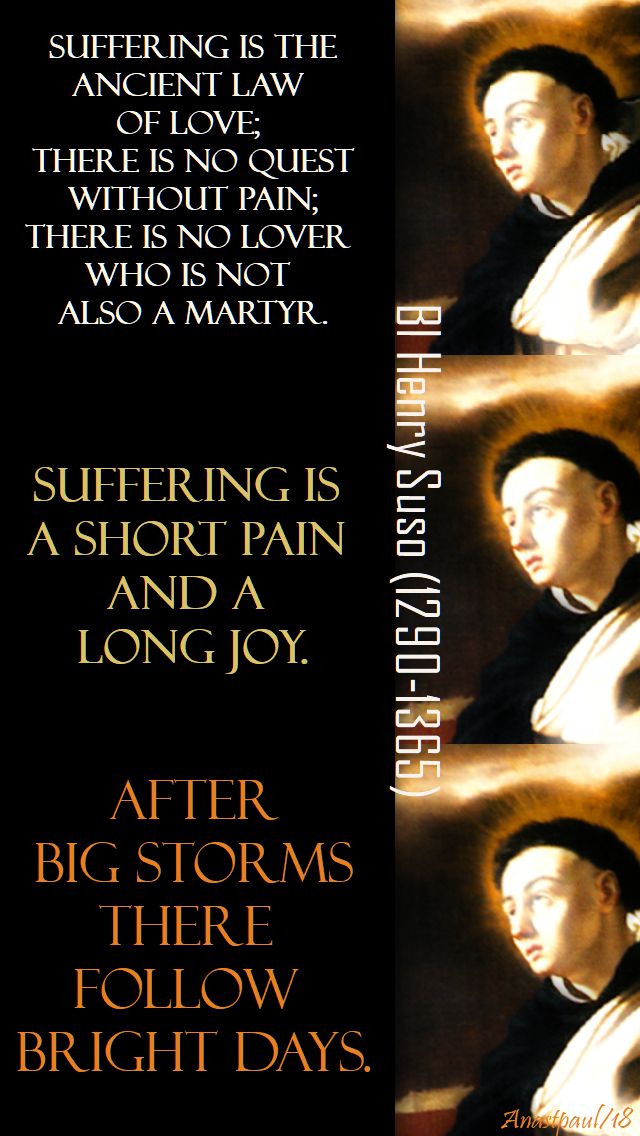
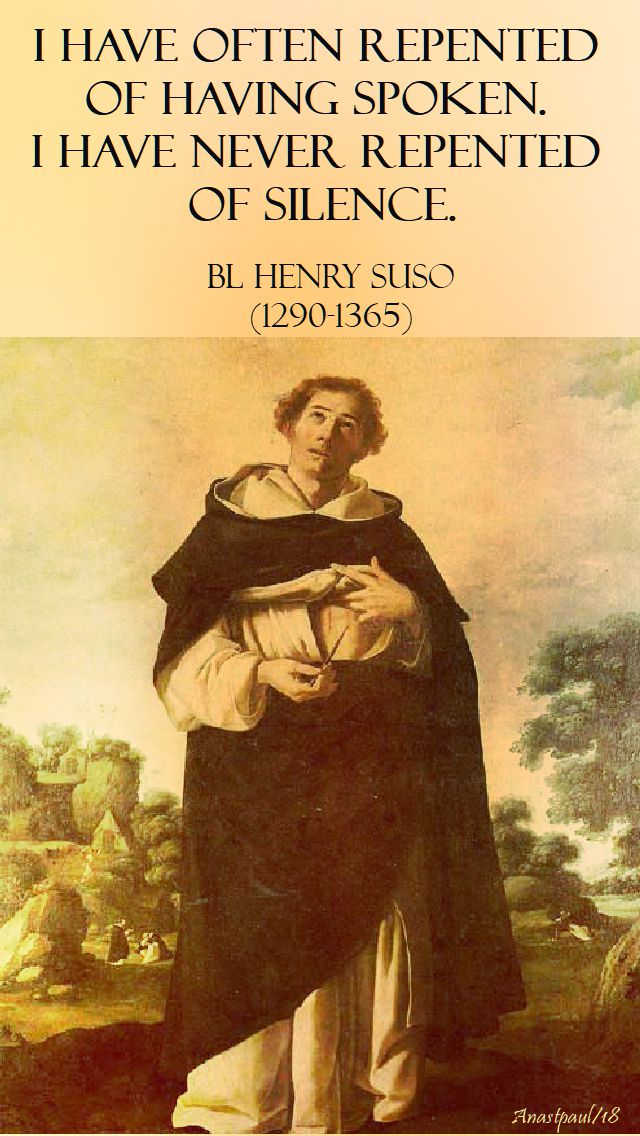
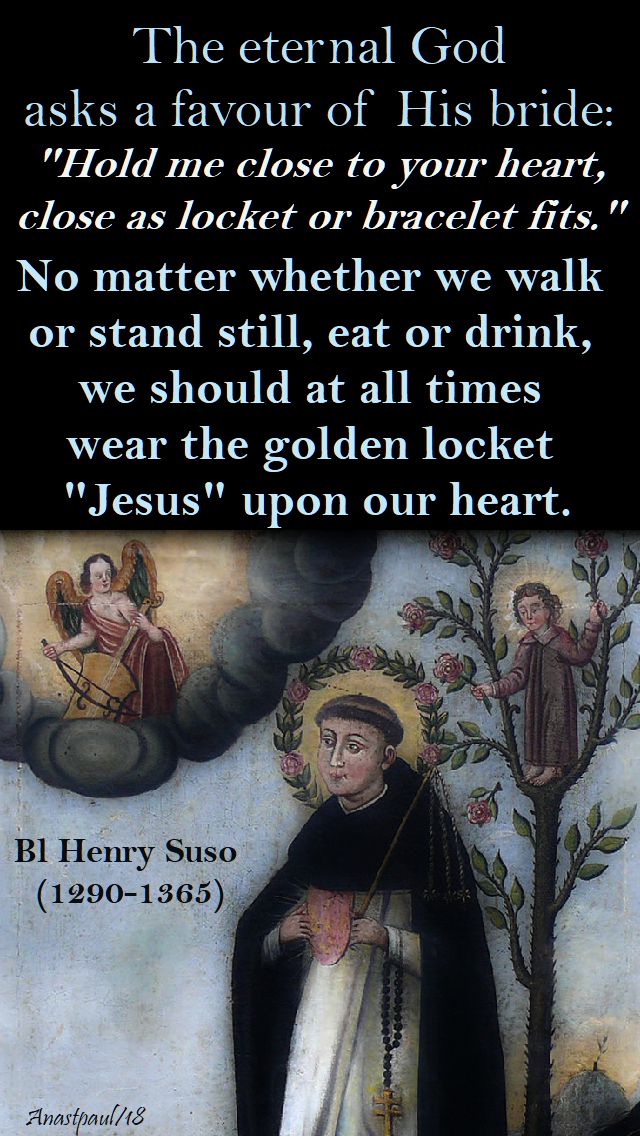
Quote/s of the Day – 25 January – The Memorial of Blessed Henry Suso O.P. (1290-1365)
“Suffering is the ancient law of love; there is no quest without pain; there is no lover who is not also a martyr.”
“Suffering is a short pain and a long joy.”
“After big storms there follow bright days.”
“I have often repented of having spoken. I have never repented of silence.”
“The eternal God asks a favour of His bride: “Hold me close to your heart, close as locket or bracelet fits.” No matter whether we walk or stand still, eat or drink, we should at all times wear the golden locket “Jesus” upon our heart.”
“Nowhere does Jesus hear our prayers more readily than in the Blessed Sacrament.”
One Minute Reflection – 25 January – Feast of the Conversion of St Paul the Apostle
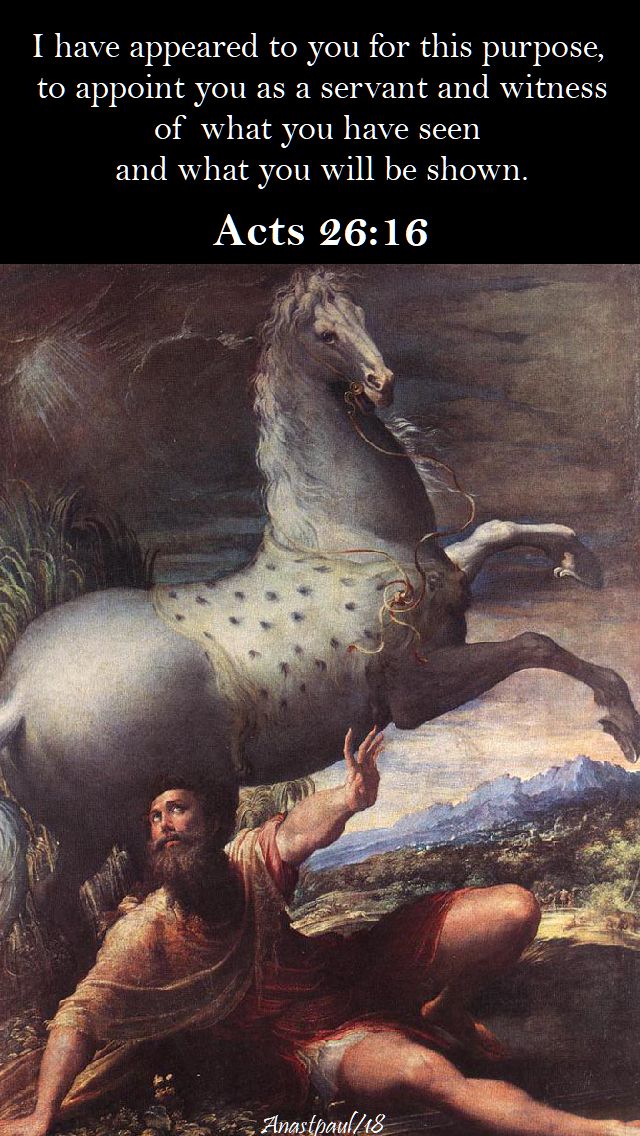
I have appeared to you for this purpose, to appoint you as a servant and witness of what you have seen and what you will be shown. I shall deliver you from this people and from the Gentiles to whom I send you,to open their eyes that they may turn from darkness to light and from the power of Satan to God, so that they may obtain forgiveness of sins and an inheritance among those who have been consecrated by faith in me…Acts 26:16-18
REFLECTION – “Paul, more than anyone else, has shown us what man really is and in what our nobility consists and of what virtue this particular animal is capable. Each day he aimed ever higher; each day he rose up with greater ardour and faced with new eagerness the dangers that threatened him. He summed up his attitude in the words: “I forget what is behind me and push on to what lies ahead”…The most important thing of all to him, however, was that he knew himself to be loved by Christ. Enjoying this love, he considered himself happier than anyone else”…….St John Chrysostom
PRAYER – Today Lord, we celebrate the conversion of St Paul, Your chosen vessel for carrying Your name to the whole world. Help us to make our way towards You by following in his footsteps and by being Your disciples before the men and women of our day. Grant that by the prayers of St Paul, we too may say, “Yet I live, no longer I, but Christ lives in me; insofar as I now live in the flesh, I live by faith in the Son of God who has loved me and given himself up for me.” (Galatians 2:20) Through Jesus Christ, our Lord, in union with the Holy Spirit, one God forever and ever, amen.
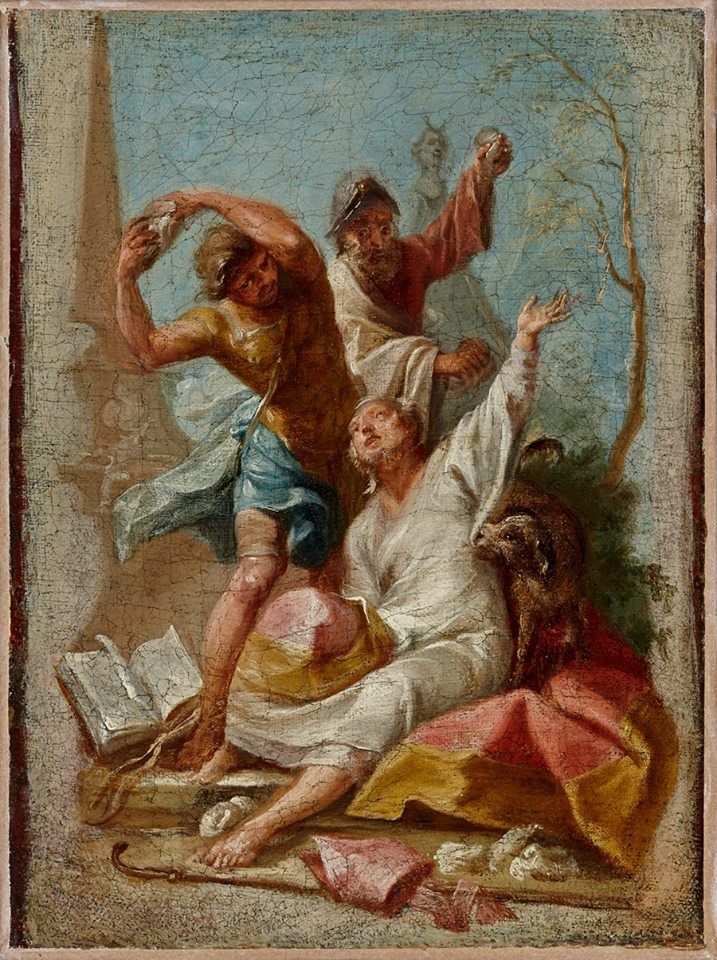
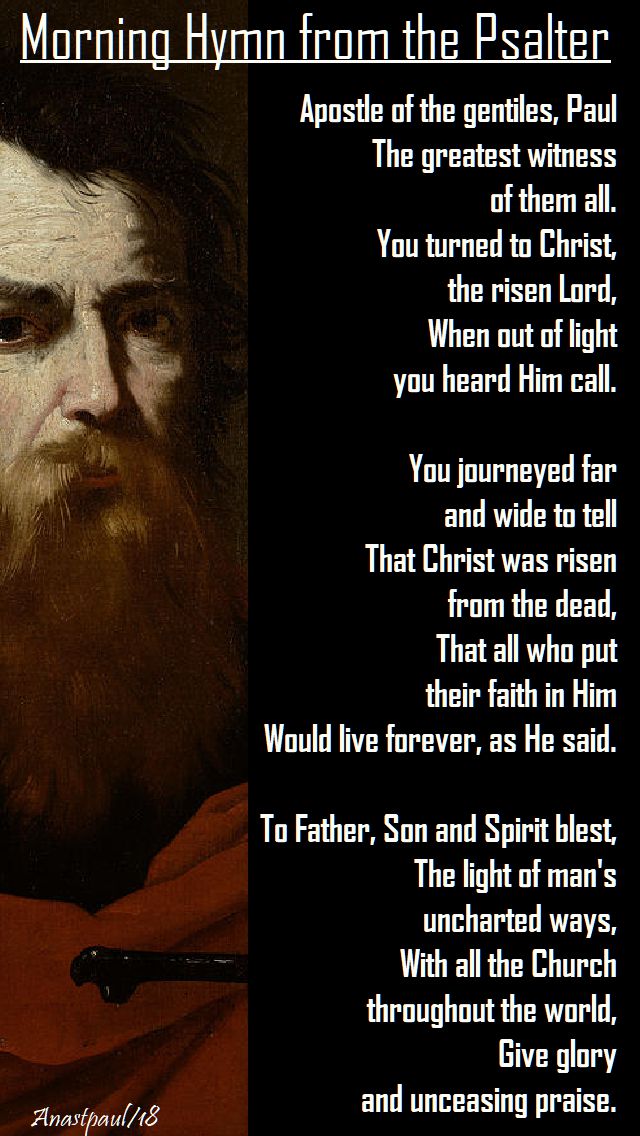
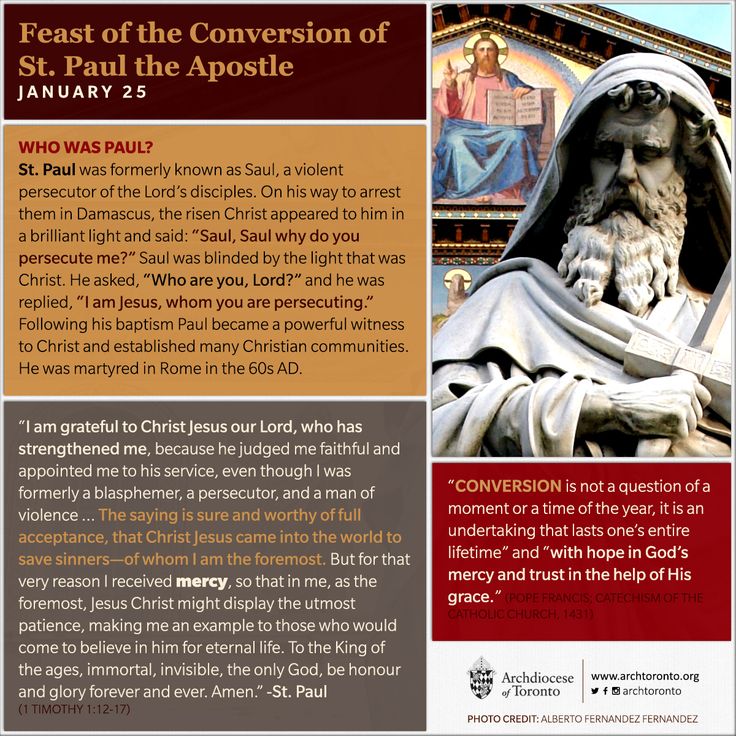
St Paul the Apostle is the greatest of the early Christian missionaries. He first appears in the Acts of the Apostles under the name of Saul. Saul was raised in the Jewish faith as a Pharisee trained in the strict observance of God’s Law. He believed the Law should be obeyed by himself and all Jews. Saul was upset by the early Christian Church, believing that the early Christians had broken away from their Jewish traditions. He actively persecuted the Church in Jerusalem. As the first Christian martyr Stephen was being stoned to death, Saul watched the cloaks of the persecutors (Acts 7:58).
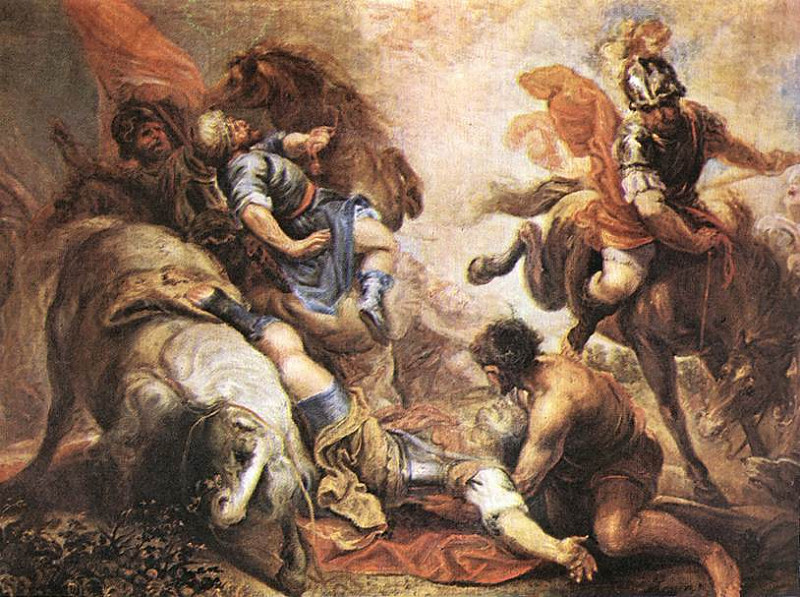
Paul then traveled to Damascus to further persecute early Christians. On the road to Damascus Saul had an encounter with the Risen Jesus Christ (Acts of the Apostles 9:1–19, Galatians 1: 13–14). Jesus asked, “Saul, Saul, why are you persecuting me?” Paul replied, “Who are you, sir?” Jesus responded, “I am Jesus whom you are persecuting”(Acts 9: 4 – 5). Jesus then sent Saul into Damascus to wait for further instructions. Saul was shaken and blinded by the experience. When a Christian named Ananias came and baptised Saul, his blindness went away. As a result of this encounter Saul became a follower of Christ. He was now convinced that fellowship with the risen Jesus Christ, not the observance of the Law, was all that was needed to receive God’s promise of salvation. (Galatians 1:11–12; 3:1–5)
Saul, whose name now became Paul, went to Jerusalem to consult with Peter (Galatians 1: 18). After his first missionary journeys, Paul was called by Jesus to proclaim the Gospel to the Gentiles. He spent the rest of his life journeying on his missions, establishing local churches and writing to them when he heard of their accomplishments and failures. Paul’s letters are the earliest records of the life and history of the early Church. As inspired by the Holy Spirit Paul’s letters are part of the Canon of the New Testament. As a record of the happenings in the early Church they are in invaluable record of the expansion of the Christianity.
St Paul’s Writings
All together, there are 13 epistles that bear Paul’s name as the author. However, scholars do not believe that he wrote them all. Paul himself was the author of first and second Thessalonians, Galatians, Philippians, first and second Corinthians, Romans and Philemon. The epistles to the Ephesians, Colossians, Titus and first and second Timothy bear Paul’s name but it is believed that they were written after his death. The writers of these letters were disciples of Paul who wanted to continue his teaching. Whoever the authors of these epistles were, these writings have been accepted into the New Testament as inspired by the Holy Spirit.
Centrality of Jesus Christ
The most profound and moving day in Paul’s life was when he met the risen Jesus Christ. Paul was well respected by the Jewish community and his peers. But he gave it all up for Christ. “More than that, I even consider everything as a loss because of the supreme good of knowing Jesus Christ my Lord.” (Philippians 3:8) Jesus Christ, Paul realised, was sent by the Father to bring salvation for all. Paul taught that we are united with Christ in faith and Baptism – “We were indeed buried with him through baptism into death, so that, just as Christ was raised from the dead by the glory of the Father, we too might live in newness of life.”(Romans 6:4)
On the personal level, individual Christians recognise that when they are united with Christ, they receive the grace needed to overcome sin and to live moral lives. (Galatians 5:16–26)
Justification
Paul teaches that the justice of God was saving justice at its best. God is faithful, fulfilling the promises made in the Old Testament covenant. Through the sin of Adam and Eve the human family was alienated from God. Through Christ the human family is called back into relationship with God. This process of reuniting the human family with God is called justification. (Romans 3:21–31) It is impossible for us to justify ourselves; we are only justified by being united in faith with Jesus Christ and by accepting the gift of grace won by Christ. (Romans 5:1–2) We can only be made right with God and set free from a life of immoral living by accepting the gift of God’s reconciling grace.
Life in the Spirit
Paul teaches that the love of God is being poured into our hearts through the Holy Spirit. (Romans 5:5) The Holy Spirit is the source of all love. The Holy Spirit creates a bond between us and God like children bound to a father. (Romans 8:14–16) The Holy Spirit not only establishes our relationship with the Father. Even though we are weak, the Holy Spirit helps us to live faithfully within that relationship. (Romans 8:26–27) It is through the Holy Spirit that we can live in love with all people. (1 Corinthians 13:3–7)
The Moral Life
What does it mean to live a Christian moral life? Paul thought deeply about this question. He was raised as a faithful Jew. As we have seen Paul, was raised to believe that following the strict moral code of the Jewish faith was the way to salvation. Paul believed “… the law is holy and the commandment is holy and righteous and good.”(Romans 7:12.) What Paul realised, however, that because we are weakened by the sin of Adam and Eve, it was impossible to us to reconnect in our relationship with God through our efforts alone (Romans 7:14).
After his experience with Jesus Christ, Paul knew that he was not alone on the road to salvation. Jesus Christ has already accomplished salvation for us. In faith and Baptism, Christians receive the grace of the Holy Spirit, who is our constant guide. The Holy Spirit helps us to live in relationship with God and others.
So Paul’s great message to the world was: You are saved entirely by God, not by anything you can do. Saving faith is the gift of total, free, personal and loving commitment to Christ, a commitment that then bears fruit in more “works” than the Law could ever contemplate.
—
St Agape the Martyr
St Agileus of Carthage
St Amarinus of Clermont
St Ananias of Damascus
Bl Antoni Swiadek
Bl Antonio Migliorati
St Apollo of Heliopolis
Bl Archangela Girlani
St Artemas of Pozzuoli
St Auxentius of Epirus
St Bretannion of Tomi
St Donatus the Martyr
St Dwynwen
St Emilia Fernández Rodríguez de Cortés
St Eochod of Galloway
Bl Francesco Zirano
Bl Henry Suso
St Joel of Pulsano
St Juventinus of Antioch
Bl Manuel Domingo y Sol
St Maximinus of Antioch
St Palaemon
St Poppo
St Praejectus of Clermont
St Publius of Zeugma
St Racho of Autun
St Sabinus the Martyr
Bl Teresa Grillo Michel




















 AnaStpaul
You must be logged in to post a comment.