Quote/s of the Day – 9 December – The Second Sunday of Advent
“How I wish you were ….hot or cold! But because you are lukewarm … I will spew you out of my mouth!….”
Revelations 3:15
“The Word of God moves swiftly. He is not won by the lukewarm nor held fast by the negligent. Be attentive to His message and diligently follow the path God tells you to take. For He is swift in His passing.”
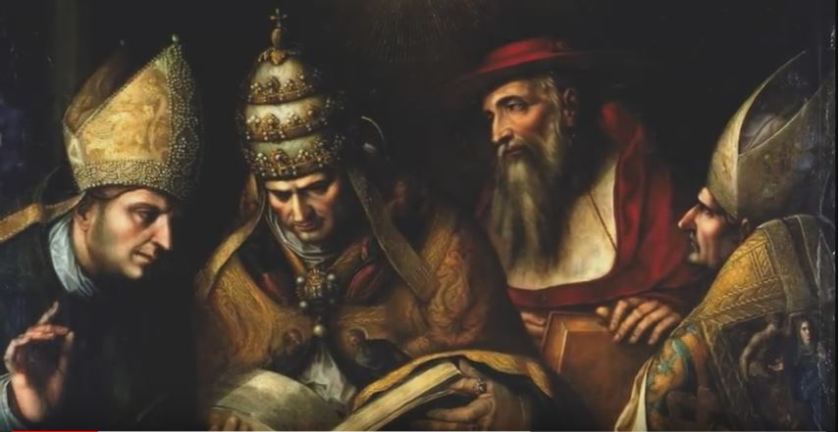
St Ambrose (340-397) Father & Doctor of the Church
Advent and Christmas Wisdom with St Alphonsus Liguori
9 December – The Second Sunday of Advent
God sent the Son to restore us to life.
“Consider that sin is the death of the soul, because this enemy of God deprives us of divine grace, which is the life of the soul. Therefore, we miserable sinners, were dead and condemned but God, through the immense love which the Father bears for us, determined to restore us to life. How die He accomplish this? He sent His only-begotten Son into the world to die, so that by His death, God might restore us to life.
Behold our Redeemer who has come “so that we might have life to the full.” For this purpose, Jesus accepted death, so that He might give us life. It is reasonable that we should live only in God. It is reasonable that Jesus should be the only sovereign of our heart, since He has spent His blood for us.”
Scripture
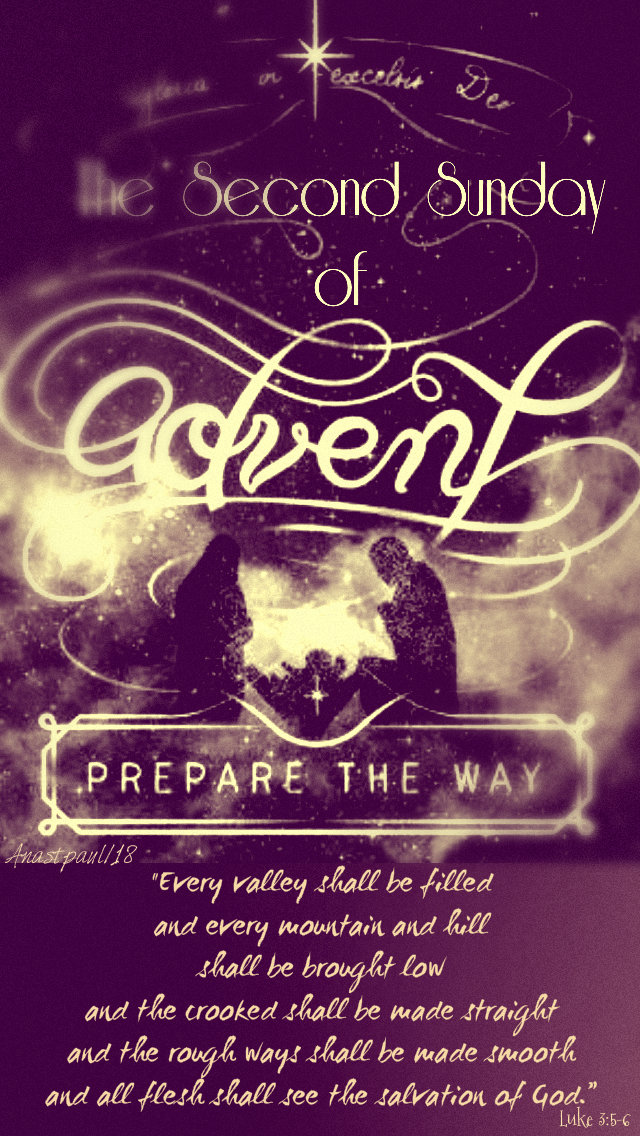
“Every valley shall be filled and every mountain and hill shall be brought low and the crooked shall be made straight and the rough ways shall be made smooth and all flesh shall see the salvation of God.”
Luke 3:5-6
“O my God! Who would be so ungrateful a wretch, as to believe that Jesus died to secure the love of sinful humanity and yet refuse to love Him.”
Prayer
Almighty and merciful God,
let neither our daily work
nor the cares of this life,
prevent us from hastening
to meet Your Son.
Lord, make straight
the winding ways within us.
Draw us to repent!
Enlighten us with Your wisdom
and lead us into His company,
that we may love Him
and do homage to Him.
Amen
ADVENT ACTION
It is John the Baptist coming out of the desert breathing the fire of repentance, dressed like an animal, who is the one preparing and making ready. This hints to us that the rest of the gift (Jesus at Christmas) will not be the perfect, shining diamond we would like but will represent the rougher side of life. The poor, the lame, the outcast and the sick will be part of the experience of the Christ Child in the stable and the adult Christ on the roads of Galilee. We are asked to prepare and to be ready, to accept this rough gift this Christmas!
Our Morning Offering – 9 December – The Second Sunday of Advent
Dear Lord, I Approach You (Prayer before Holy Communion) By Thomas à Kempis (1380-1471)
Dear Lord,
with simplicity of heart,
in good and stable faith
and at Your command,
I approach You,
full of confidence and adoration,
truly believing that You are present
in this Sacrament, God and Man.
It is Your will that I receive You
and bind myself to You in love.
Most merciful Lord,
I beg of You that special grace,
that my soul may melt and overflow
with Your love,
never concerning myself again
with any other comfort but Your own.
Amen
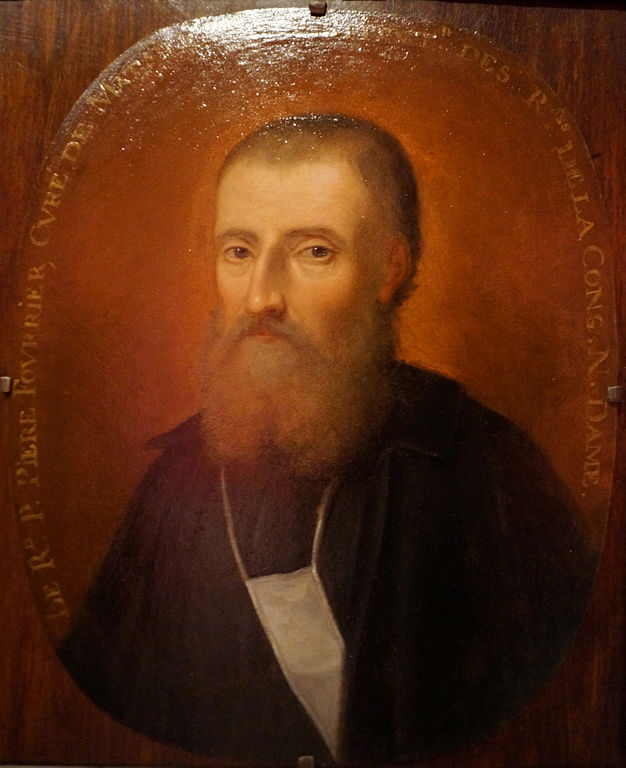
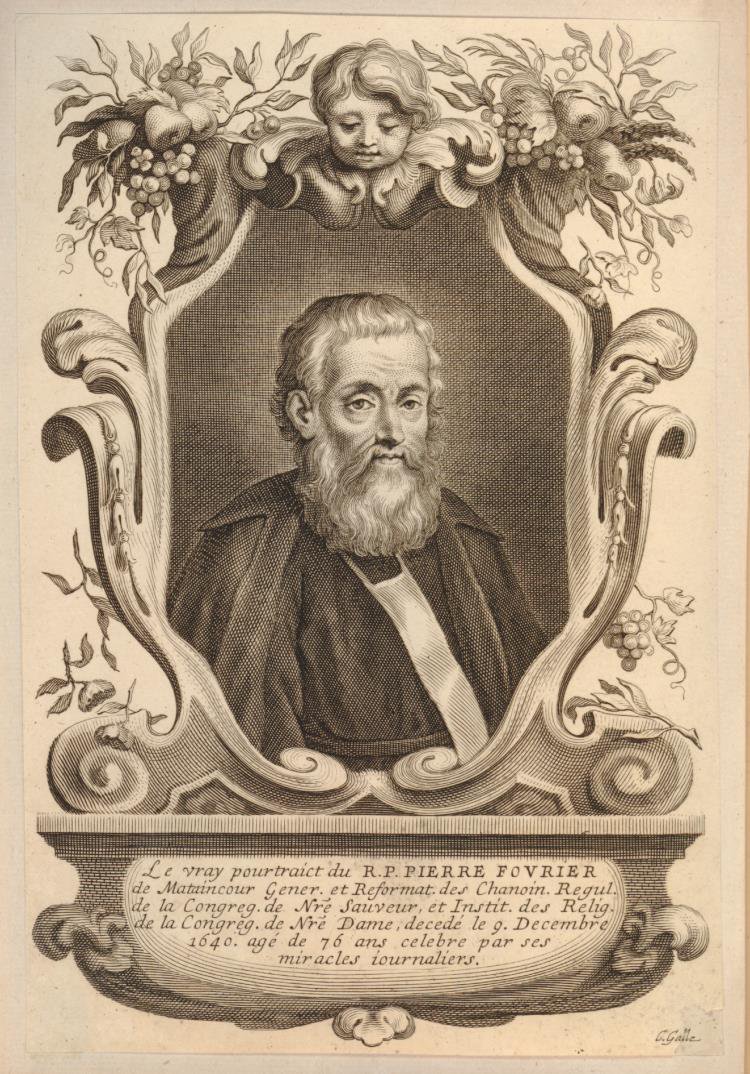
Saint of the Day – 9 December – St Peter Fourier C.R.S.A. (1565-1640) Priest, Founder, Reformer, Confessor, Theologian, Teacher, Preacher, Apostle of Prayer, Penance and Charity, Marian devotee – “the Good Father of Mattaincourt”“le bon pere de Mattaincourt” – born Pierre Fourier and died on 9 December 1640 at Gray, Haute-Saone (modern France) of natural causes.
Peter Fourier was born at Mirecourt, Lorraine, on 30 November 1565. At fifteen he was sent to the University of Pont-à-Mousson. His piety and learning led many noble families to ask him to educate their sons. He became a Canon Regular in the Abbey of Chaumousey and was ordained in 1589. By order of his abbot he returned to the university and became proficient in patristic theolog – he knew the “Summa Theologica” of St Thomas by heart.
Before saying his first Mass he passed several months of retreat in the exercises of prayer, penance and tears. He was then sent to complete his theological studies at the university of Pont-au-Mousson, also in Lorraine. There Father Jean Fourier, a relative who was Rector of that University, directed him admirably. His progress in virtue and the sacred sciences placed him high in the opinion of the Cardinal of Lorraine and Bishop of Metz, who desired to have him in his diocese; he offered him a parish where his talents would bring him advancement. But the young priest, wishing to flee all honours, declined, to return to his Abbey.
After his return to his canonical community, however, he was subjected to two years of hostility and abuse by his fellow canons, even by some accounts a case of attempted poisoning. He chose not to confront his abbot with the situation and accepted this persecution patiently. The care of local parishes in that region of France was routinely entrusted to the many abbeys and priories of canons. In 1597, when his abbot was assigning him a post, Fourier passed over two prestigious options and accepted the post of vicar of the parish of Mattaincourt in order to combat the indifference to religion widespread in the town, and to counter nascent Calvinism in the area. He went on to spend the next twenty years of his life serving its people.
To this end, Fourier instituted two major reforms that showed his intelligence and concern for his flock. The first of these was to improve the financial lives of his community by setting up a community bank, from which the townspeople could borrow without interest. His motto in serving the parish was ‘to feed only one person, was to to be of use to all.’ His second innovation was in his preaching style, where he employed dialogues with small groups of his parishioners to explain better their Catholic faith to them. He had his pupils engage in dialectics on Sundays on the various virtues and vices in practice by the congregation. This style proved immensely successful.
Fourier led an extremely ascetic way of life while serving the people of his parish. He would spend much of the night in prayer. He refused the services of a housekeeper, even when his own stepmother offered to provide his care. His severe self-denial enabled him to direct much of the income of the parish to the needy of the town. He himself would often spend the night nursing the sick of the town.
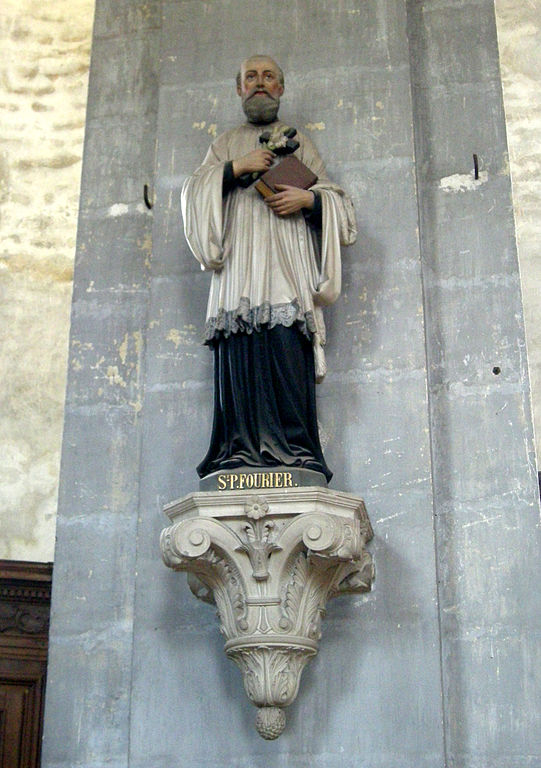
18th-century statue in the former Abbey Church of Moyenmoutier, Vosges, France
The success of Fourier’s pastorate in inspiring his flock to a greater fidelity to the faith was brought to the attention of the local bishops of the region. They prevailed upon him to go about to different parishes to preach to the people. He did so and, as a result of seeing the situation of the populace throughout the region, he was struck by the depths of their ignorance and superstition.
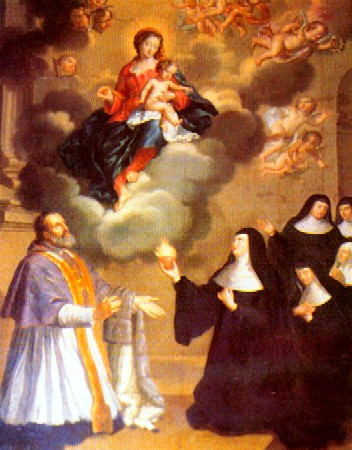
Together with the Blessed Alix Le Clerc, in 1597, Fourier founded the Congregation of Notre Dame of Canonesses Regular of St Augustine, who were committed to the free education of children, taking a fourth vow to that goal. Soon there were six schools run by his spiritual daughters. He played an active role in their education, being credited with the invention of the blackboard and its use in the classroom, as well as the division of students into classes of a similar level of instruction. By the time of his death, the number of schools run by the canonesses had grown to forty. They went on to spread throughout France, Germany and England.
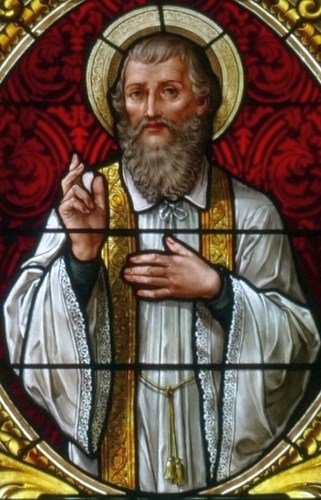
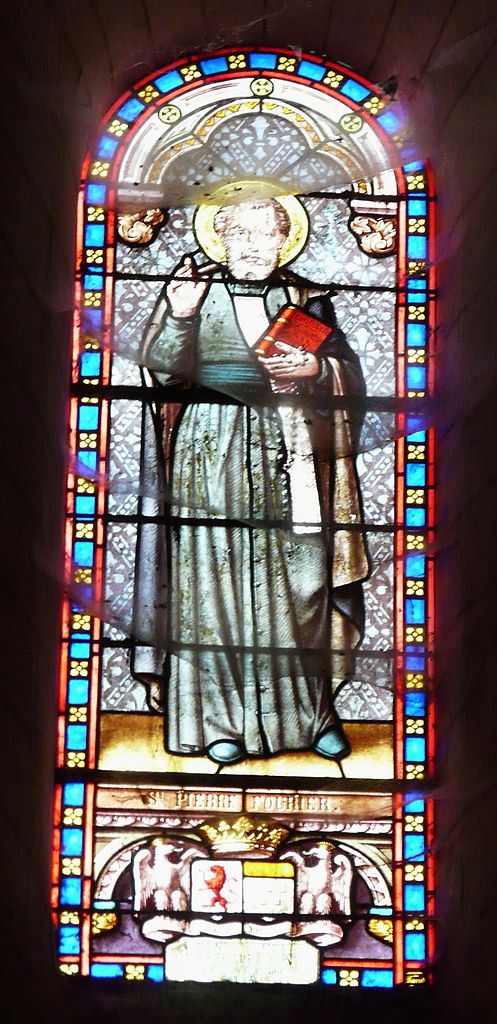
Stained glass window depicting St Peter Fourier, C.R.S.A., with the white sarozium of a canon regular Church of Saint Martin, Coulaures, Dordogne, France
Fourier’s vision also extended to the life of his own Order. He sought to revive a spirit of fervour and discipline in the communities of the canons regular. In 1621 the Bishop of Toul, Jean des Porcellets, chose him to organise the canonical communities in his diocese. He, therefore, entrusted the ancient Abbey of St Remy in that city to Fourier and six companions, where they could lead the way of life he envisioned. Within four years, eight houses of the Order had embraced his reform. In 1625 they were formed into a new congregation of all the priories of canons in the duchy. To reinforce the reform, any canons who wished to join had to undergo a new novitiate and profession of vows. Otherwise they could retire with a pension from the canonical life. On 11 February 1628 they were officially named the Congregation of Our Saviour by the Holy See.
The method of reform established by Fourier served as a model for the reform of the canons regular in the Kingdom of France, where, with the support of Cardinal Rochefoucauld, the Congregation of France was established with these same conditions. In 1625, Fourier was charged with preaching to the people of the Principality of Salm-Salm, which had embraced Calvinism. Within six months his gentle persuasion and efforts were rewarded with the re-establishment of Catholicism in the realm.
Fourier himself was elected as Abbot General of the congregation in 1632. He hoped to guide his fellow canons to caring for children, as the canonesses were doing. This vision never took root among the men, however.
After the invasion by the Kingdom of France of the Duchy of Lorraine in 1632 under Cardinal Richelieu, Fourier refused to swear an oath of loyalty to King Louis XIII of France. Thus he and his community were forced to flee their monastery in 1636, taking refuge in the town of Gray in the neighbouring County of Burgundy. Fourier and the canons with him were occupied in that city nursing plague victims. It was there that he died on 9 December 1640.
His spiritual sons, his spiritual daughters, the good people of Gray in Bourgogne, who had welcomed him and whom he had served admirably during an epidemic of the pestilence, all wanted the honour of possessing his mortal remains. But so did also the parish of Mattaincourt. To the reformed Order of Saint Augustine this privilege was granted officially but the pious women of Mattaincourt, blocking the church door, would not permit the Canons to resume their journey with the coffin, after they had stopped in his former parish for a day or so. His heart had already been left to the parish of Gray.
St Peter spread everywhere devotion to the Immaculate Conception of the Blessed Virgin. More than two centuries before the Miraculous Medal in 1830 and the proclamation of the dogma in 1854, he saw to the distribution of large quantities of a medal he had struck, on which were engraved the words – “Mary was conceived without sin.”
Miracles abounded at his tomb, as they did during his lifetime, by his prayers. He was Beatified by Pope Benedict XIII in 1730 and Canonised by Pope Leo XIII in 1897. St Peter Fourier is honoured by a statue of him in St Peter’s Basilica among the founders of religious orders.
The vision of Fourier was exported to Canada in 1654 by St Marguerite Bourgeoys CND (1620-1700), who was the president of a sodality of volunteers associated with the work of the cloistered canonesses. Moving to New France at the invitation of its governor, she became one of the early founders of the new colony. There she established the Congregation of Notre Dame of Montreal, which was the first to provide education to the children of the colonists, as well as to the Native American children. Her work has been highly successful both there and in the United States of America.
St Adam Scotus
Bl Agustín García Calvo *
Bl Antonio Martín Hernández *
St Auditor of Saint-Nectaire
St Balda of Jouarre
St Bernhard Mariea Silvestrelli
St Budoc of Brittany
Bl Carmen Rodríguez Banazal *
St Caesar of Korone
St Cephas
Bl Clara Isabella Fornari
St Cyprian of Perigueux
Bl Dolores Broseta Bonet *
Bl Estefanía Irisarri Irigaray *
St Ethelgiva of Shaftesbury
St Gorgonia
Bl Isidora Izquierdo García *
Bl José Ferrer Esteve *
Bl José Giménez López *
Bl Josefa Laborra Goyeneche *
Bl Josep Lluís Carrera Comas *
St Julian of Apamea
Bl Julián Rodríguez Sánchez *
St Leocadia of Toledo
St Liborius Wagner
Bl María Pilar Nalda Franco *
St Michaela Andrusikiewicz
St Nectarius of Auvergne
St Peter Fourier C.R.S.A. (1565-1640)
St Proculus of Verona
Bl Recaredo de Los Ríos Fabregat *
St Syrus of Pavia
St Valeria of Limoges
St Wulfric of Holme
Blessed Mercedarian Fathers – (10 beati): The memorial of ten Mercedarian friars who were especially celebrated for their holiness.
• Arnaldo de Querol • Berengario Pic • Bernardo de Collotorto • Domenico de Ripparia • Giovanni de Mora • Guglielmo Pagesi • Lorenzo da Lorca • Pietro Serra • Raimondo Binezes • Sancio de Vaillo
Martyred Salesians of Valencia – (5 beati)
Martyrs of North Africa – (4 saints): Twenty-four Christians murdered together in North Africa for their faith. The only details to survive are four of their names – Bassian, Peter, Primitivus and Successus.
Martyrs of Paterna – (7 beati)
Martyrs of Samosata – (7 saints): Seven martyrs crucified in 297 in Samosata (an area of modern Turkey) for refusing to perform a pagan rite in celebration of the victory of Emperor Maximian over the Persians. They are – Abibus, Hipparchus, James, Lollian, Paragnus, Philotheus and Romanus. They were crucified in 297 in Samosata (an area in modern Turkey).
Martyrs of the Spanish Civil War – (13 beati):
• Blessed Agustín García Calvo
• Blessed Antonio Martín Hernández
• Blessed Carmen Rodríguez Banazal
• Blessed Dolores Broseta Bonet
• Blessed Estefanía Irisarri Irigaray
• Blessed Isidora Izquierdo García
• Blessed José Ferrer Esteve
• Blessed José Giménez López
• Blessed Josefa Laborra Goyeneche
• Blessed Josep Lluís Carrera Comas
• Blessed Julián Rodríguez Sánchez
• Blessed María Pilar Nalda Franco
• Blessed Recaredo de Los Ríos Fabregat
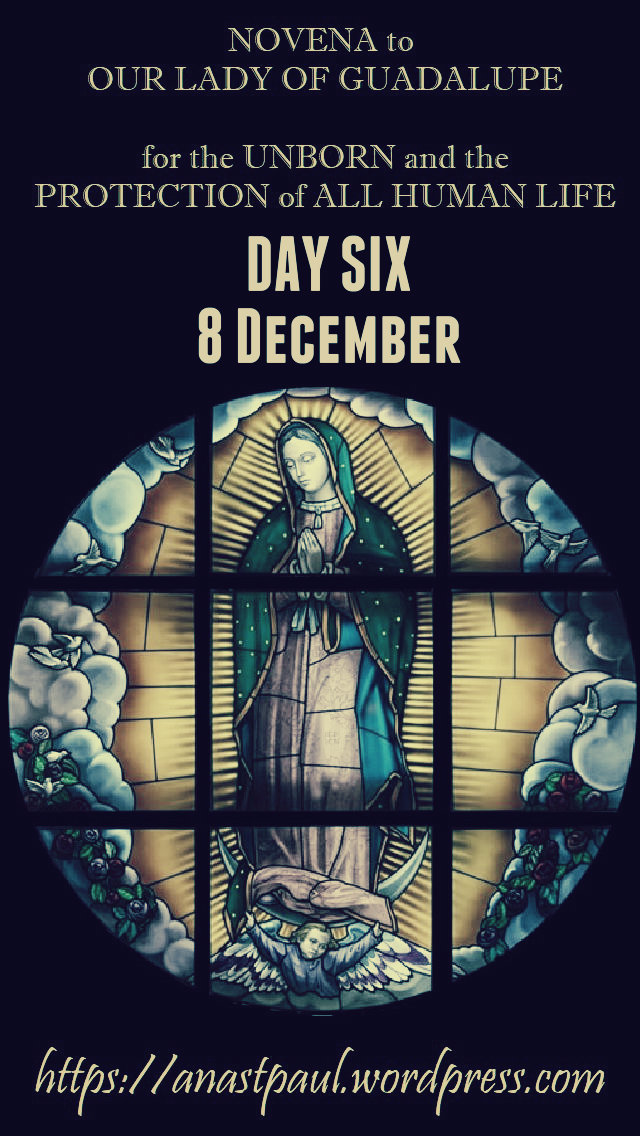
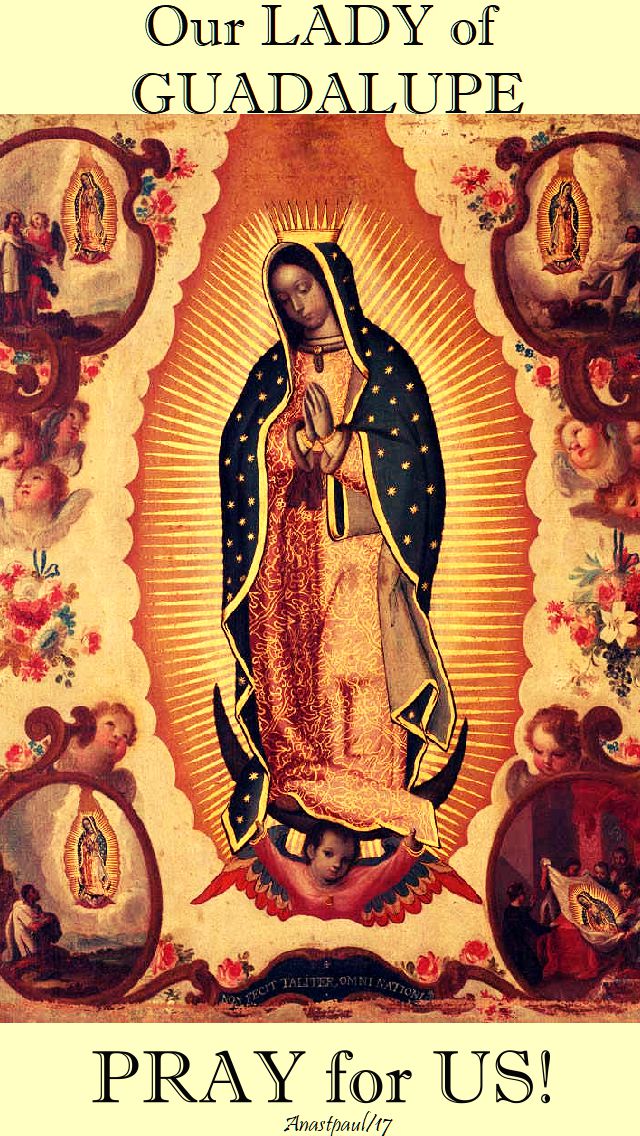
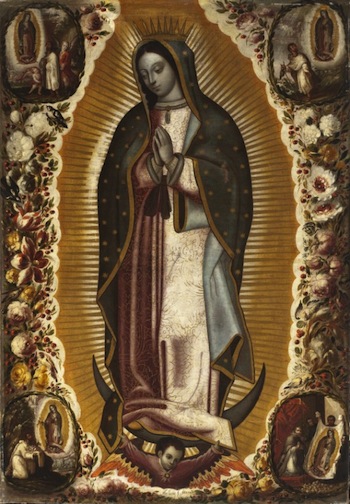
Novena to Our Lady of Guadalupe for the Protection of the Unborn and all Human Life, Our Lady of Guadalupe, Madonna of the Americas, Patroness of the Unborn – Day Six – 8 December
Sixth Day
Mary, Mother of vocations,
multiply priestly vocations
and fill the earth
with religious houses
which will be light
and warmth for the world,
safety in stormy nights.
Beg your Son to send us
many priests and religious,
after His own heart.
This we ask of you,
O Mother.
Amen
Our Father, Hail Mary, Glory be and the Prayer for the Protection of all Human Life
Prayer for the Unborn and the Protection of all Human Life
Our Lady of Guadalupe,
we turn to you,
who are the protectress of unborn children
and ask that you intercede for us,
so that we may more firmly resolve to join you
in protecting all human life.
Let our prayers be united
to your perpetual motherly intercession
on behalf of those whose lives are threatened,
be they in the womb of their mother,
on the bed of infirmity,
or in the latter years of their life.
May our prayers
also be coupled with peaceful action
which witnesses to the goodness
and dignity of all human life,
so that our firmness of purpose may give courage
to those who are fearful and bring light
to those who are blinded by sin.
O Virgin Mother of God,
present our petitions to your Son
and ask Him to bless us with abundant life.
Amen
Thought for the Day – 8 December – The Solemnity of the Immaculate Conception
Virgin Mary, all Nature is Blessed by You
From a sermon by Saint Anselm of Canterbury (1033-1109) Bishop and Doctor of the Church
“Blessed Lady, sky and stars, earth and rivers, day and night – everything that is subject to the power or use of man – rejoice that through you they are in some sense restored to their lost beauty and are endowed with inexpressible new grace. All creatures were dead, as it were, useless for men or for the praise of God, who made them. The world, contrary to its true destiny, was corrupted and tainted by the acts of men who served idols. Now all creation has been restored to life and rejoices that it is controlled and given splendour by men who believe in God. The universe rejoices with new and indefinable loveliness. Not only does it feel the unseen presence of God Himself, its Creator, it sees Him openly, working and making it holy. These great blessings spring from the blessed fruit of Mary’s womb.
Through the fullness of the grace that was given you, dead things rejoice in their freedom and those in heaven are glad to be made new. Through the Son who was the glorious fruit of your virgin womb, just souls who died before His life-giving death rejoice as they are freed from captivity and the angels are glad at the restoration of their shattered domain.
Lady, full and overflowing with grace, all creation receives new life from your abundance. Virgin, blessed above all creatures, through your blessing all creation is blessed, not only creation from its Creator but the Creator Himself has been blessed by creation.
To Mary, God gave His only-begotten Son, whom He loved as Himself. Through Mary, God made Himself a Son, not different but the same, by nature Son of God and Son of Mary. The whole universe was created by God and God was born of Mary. God created all things and Mary gave birth to God. The God who made all things gave Himself form, through Mary and thus He made His own creation. He who could create all things from nothing would not remake His ruined creation, without Mary.
God, then, is the Father of the created world and Mary the mother of the re-created world. God is the Father by whom all things were given life and Mary the mother through whom all things were given new life. For God begot the Son, through whom all things were made and Mary gave birth to Him as the Saviour of the world. Without God’s Son, nothing could exist; without Mary’s Son, nothing could be redeemed.
Truly the Lord is with you, to whom the Lord granted that all nature should owe as much to you as to Himself. Holy Mary, Blessed Virgin of the Immaculate Conception, Mother of God and Mother of Jesus Christ our Saviour and Redeemer, pray for us!”
Advent and Christmas Wisdom with St Alphonsus Liguori – 8 December – The First Saturday of Advent
The Son of God was laden with all our sins
Consider the humble state which the Son of God freely chose to assume. He not only took upon Himself the form of a slave but also, the form of a sinful servant “in the likeness of sinful flesh.” Therefore, St Bernard writes, “He not only assumed the form of a servant but even that of a wicked servant.” And thus, in this way, He presented Himself to His Father, even from His birth, as a criminal and a debtor, guilty of all of our sins and, as such, was condemned to die as a malefactor, accursed on a cross.
Scripture All things came to be through him and without him nothing came to be. What came to be through him was life and this life was the light of the human race
John 1:3-4
“Behold the man” the Eternal Father, seems to say to all of us, showing Jesus to us in the stable of Bethlehem. “This poor child whom you behold, laid in a manager for beasts and stretched on straw, is my beloved Son, who has come into the world to take upon Himself your sins and your sorrows – love Him because He is infinitely worthy of your love and you are under an infinite obligation to do so.”
O my innocent Redeemer, enlighten the minds of those who do not know You or who do not love You.
PRAYER
Good and gracious God,
I sincerely thank and praise You for loving me.
Your love is the joy of my life.
Lord, help me to love You and others totally.
Take away any malice or bitterness in my life.
Help me love as Your Son, Jesus, loved.
And to love Him as my Life!
Amen
ADVENT ACTION
Remember the Babe in the Manger, keep Him before your eyes and you will not be able to forget what our sins do.
Our Morning Offering – 8 December – Act of Consecration to the Immaculate Conception
Act of Consecration By St Maximillian Kolbe (1894-1941)
O Immaculate, Queen of heaven and earth,
Refuge of sinners and our most loving Mother,
God has willed to entrust the entire order of mercy to You,
I, an unworthy sinner, cast myself at Your feet,
humbly imploring You
to take me with all that I am and have,
wholly to Yourself as Your possession and property.
Please make of me,
of all my powers of soul and body,
of my whole life, death and eternity,
whatever pleases You.
If it pleases You,
use all that I am and have without reserve,
wholly to accomplish what has been said of You:
“She will crush your head”,
and “You alone have destroyed all heresies in the whole world.”
Let me be a fit instrument in Your immaculate
and most merciful hands for introducing and increasing Your glory
to the maximum in all the many strayed and indifferent souls
and thus help extend as far as possible,
the blessed Kingdom of the Most Sacred Heart of Jesus.
For, wherever You enter,
You obtain the grace of conversion and sanctification,
since it is through Your hands,
that all graces come to us.
from the Most Sacred Heart of Jesus.
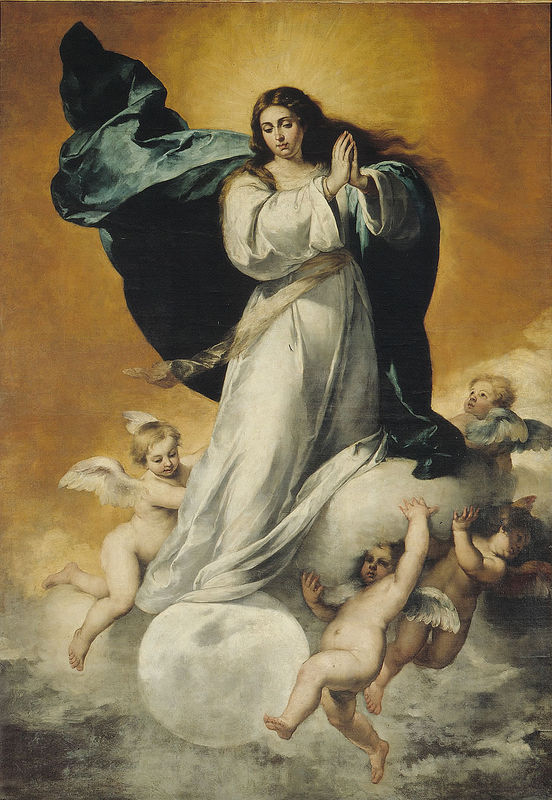
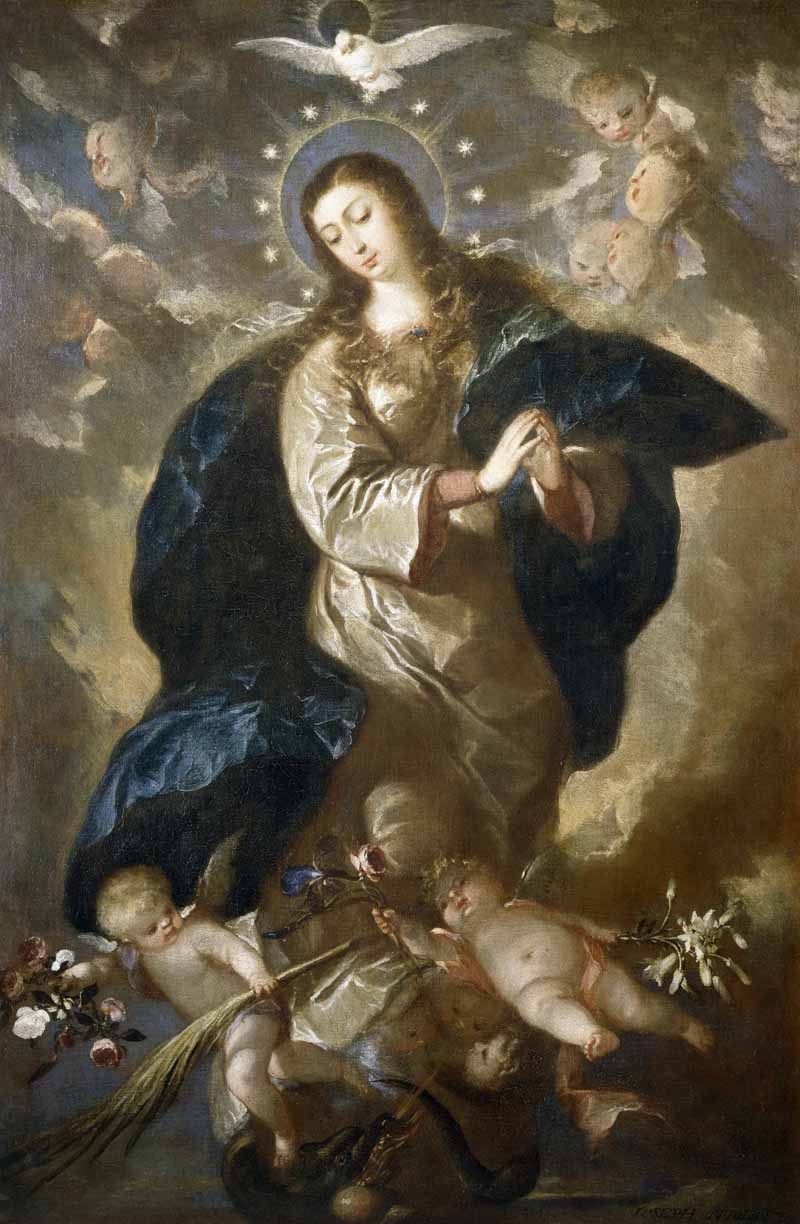
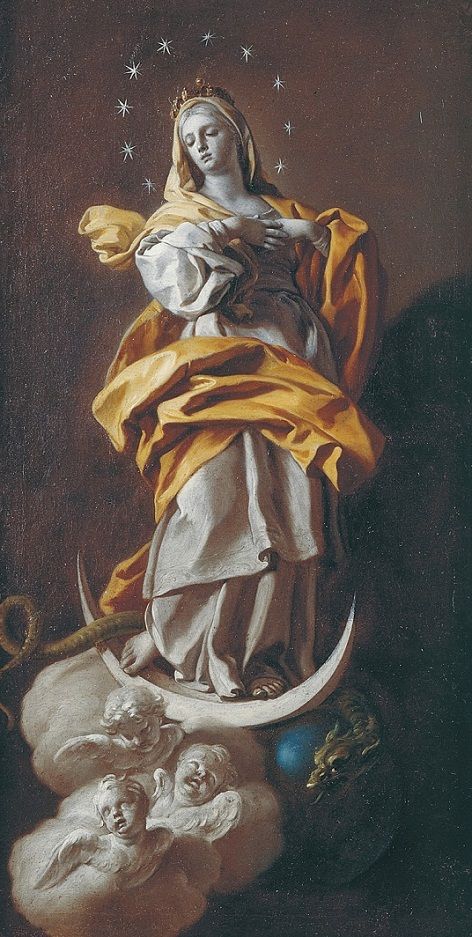
Today, 8 December, we celebrate the Solemnity of the Immaculate Conception. I wish you all a Blessed and Holy Feast Day!
Murillo 1678
Pope Benedict XVI, Angelus, 8 December 2012
“I would like to emphasise that Mary is Immaculate through a freely given gift of God’s grace, which, however, found perfect willingness and cooperation in her. It is in this sense that she is “blessed” because “she believed” (Lk 1:45) and because she had steadfast faith in God. Mary represents that “remnant of Israel”, that holy root which the Prophets proclaimed. The promises of the Old Covenant find a ready welcome in her. In Mary, the Word of God is met with listening, acceptance and a response, He encounters that “yes” which enables Him to take flesh and to come and dwell among us.
Prado
In Mary, humanity and history are truly opened to God, they welcome His grace and are prepared to do His will. Mary is a genuine expression of Grace. She represents the new Israel, which the Scriptures of the Old Testament describe with the symbol of the bride. And St Paul takes up this language in his Letter to the Ephesians where he speaks of marriage and says “Christ loved the Church and gave himself up for her, that he might sanctify her, having cleansed her by the washing of water with the word, that he might present the Church to himself in splendour, without spot or wrinkle or any such thing, that she might be holy and without blemish” (5:25-27). The Fathers of the Church developed this image and thus the Doctrine of the Immaculate Virgin first came into being with reference to the Church virgin-mother and, subsequently, to Mary. Thus Ephraim the Syrian writes poetically: “Just as [it was] because these bodies themselves have sinned and are themselves dying, that the earth, their mother was also accursed (cf. Gen 3:7-19), because of this body which is the incorruptible Church, her land was blessed from the outset. This land is the body of Mary, a temple in which a seed was sown” (Diatessaron 4, 15: sc 121, 102).
Francesco de Mura
The light that shines from the figure of Mary, also helps us to understand the true meaning of original sin. Indeed that relationship with God which sin truncates is fully alive and active in Mary. In her there is no opposition between God and her being, there is full communion, full understanding. There is a reciprocal “yes” – God to her and her to God. Mary is free from sin because she belongs entirely to God, she empties herself totally for Him. She is full of His Grace and of His Love.
To conclude, the Doctrine of the Immaculate Conception of Mary expresses the certainty of faith that God’s promises have been fulfilled and that His Covenant does not fail but has produced a holy root from which came forth the blessed Fruit of the whole universe, Jesus the Saviour. The Immaculate Virgin shows that Grace can give rise to a response, that God’s fidelity can bring forth a true and good faith.”
Jusepe de Ribera (1637)
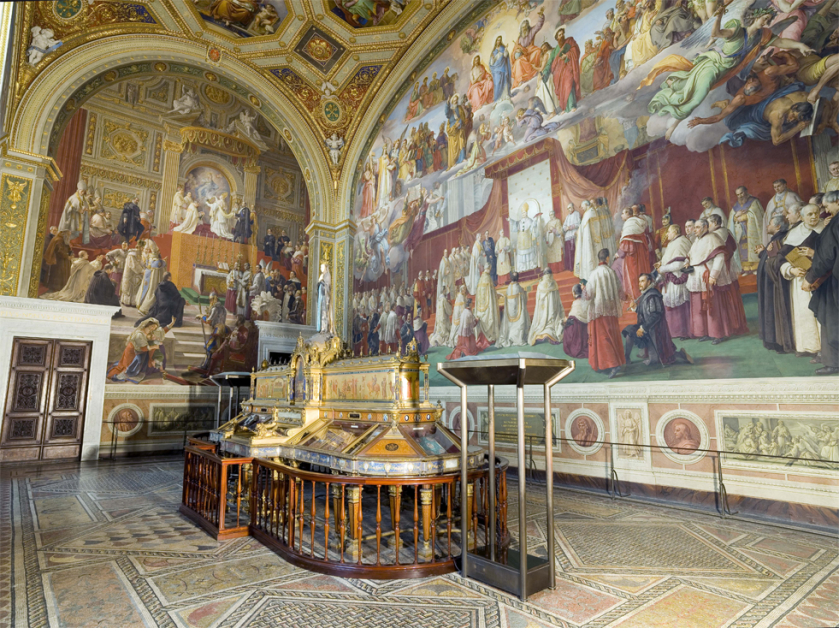
Room of the Immaculate Conception
Following the proclamation of the dogma of the Immaculate Conception by Pius IX, which took place on 8 December 1854, the pontiff decide to celebrate the event with a cycle of frescoes.
The large room adjacent to the Raphael Rooms was chosen and the task was assigned to Francis Podesti (1800-1895), a painter originally from Ancona but rooted in the Roman artistic and academic panorama. The artist, along with his team of workers, worked on the commission from 1856 to 1865, planning it and following its execution in all its aspects – the wooden doors and window frames and the inlaid marble work, as well as the installation of the Roman mosaic from Ostia Antica, purchased specifically for this space.
The pictorial decoration proceeds from the ceiling, with allegorical scenes alluding to the virtues of the Virgin; it continues along the northern wall with the homage of the continents to the Church enthroned; it continues on the west wall, devoted to the Discussion of dogma in St Peter’s Basilica and concludes on the east wall, with the Coronation of the Image of Mary, an event following the Proclamation, which took place in St Peter’s. Podesti, who was present, included a self-portrait here.
Novena in Preparation for the Solemnity of The Immaculate Conception
By St Josemaria Escriva (1902-1975)
DAY NINE – 8 December
Our Lady Queen of Apostles
If we have this filial contact with Mary, we won’t be able to think just about ourselves and our problems. Selfish personal problems will find no place in our mind. Mary brings us to Jesus and Jesus is “the firstborn among many brothers.” And so, if we know Jesus, we realise that we can live only by giving ourselves to the service of others. Christians can’t be caught up in personal problems;they must be concerned about the universal Church and the salvation of all souls. (Christ is Passing By, 145)
If we are imbued with this spirit, our conversations with God eventually aid other people, even though they may begin on an apparently personal level. And if we take our Lady’s hand, she will make us realise more fully that all men and women are our brothers and sisters – because we are all children of that God whose daughter, spouse and mother she is. (Christ is Passing By, 145)
Be daring. Count on the help of Mary, Queen of Apostles. Without ceasing to be a mother, our Lady is able to get each of her children to face their own responsibilities.
Mary always does the immense favour of bringing to the Cross, of placing face to face with the example of the Son of God, those who come close to her and contemplate her life. It is in this confrontation that Christian life is decided. And here Mary intercedes for us so that our behaviour may lead to a reconciliation of the younger brother – you and me – with the firstborn Son of the Father.
Many conversions, many decisions to give oneself to the service of God have been preceded by an encounter with Mary. Our Lady has encouraged us to look for God, to desire to change, to lead a new life. And so her counsel “Do whatever he tells you” has turned into real self-giving, into a Christian vocation, which from then on enlightens all our personal life. (Christ is Passing By, 149)
Let us Pray
Mary, who brought Jesus up and accompanied Him through His life and is now beside Him in heaven, will help us recognise Jesus as He crosses our path and makes Himself present to us in the needs of our fellow men.
Our mother, you brought to earth Jesus, who reveals the love of our Father God. Help us to recognise Him in the midst of the cares of each day. Stir up our mind and will, so that we may listen to the voice of God, to the calls of grace.”
Sancta Maria, spes nostra, ancilla Domini, sedes sapientiæ, ora por nobis! Holy Mary, our hope, handmaid of the Lord, seat of wisdom, pray for us! Amen (Christ is Passing By, 149)
Bl Alojzy Liguda
St Anastasia of Pomerania
St Anthusa of Africa
St Antonio García Fernández
St Casari of Villeneuve-lès-Avignon
St Eucharius of Trier
St Pope Eutychian
St Gunthildis of Ohrdruf
Bl Jacob Gwon Sang-yeon
Bl Johanna of Cáceres
Bl José María Zabal Blasco
St Macarius of Alexandria
St Marin Shkurti
St Noel Chabanel
St Patapius
Bl Paul Yun Ji-chung
St Rafael Román Donaire
St Romaric of Remiremont
St Sofronius of Cyprus
Novena to Our Lady of Guadalupe for the Protection of the Unborn and all Human Life, Our Lady of Guadalupe, Madonna of the Americas, Patroness of the Unborn – Day Five – 7 December
Fifth Day
O most holy Mother,
I beg you to obtain for me
pardon of all my sins,
abundant graces
to serve your Son
more faithfully from now on
and lastly,
the grace to praise Him
with you forever in heaven.
Our Father, Hail Mary, Glory be
and the Prayer for the Protection of all Human Life
Prayer for the Unborn and the Protection of all Human Life
Our Lady of Guadalupe,
we turn to you,
who are the protectress of unborn children
and ask that you intercede for us,
so that we may more firmly resolve to join you
in protecting all human life.
Let our prayers be united
to your perpetual motherly intercession
on behalf of those whose lives are threatened,
be they in the womb of their mother,
on the bed of infirmity,
or in the latter years of their life.
May our prayers
also be coupled with peaceful action
which witnesses to the goodness
and dignity of all human life,
so that our firmness of purpose may give courage
to those who are fearful and bring light
to those who are blinded by sin.
O Virgin Mother of God,
present our petitions to your Son
and ask Him to bless us with abundant life.
Amen
Novena in Preparation for the Solemnity of The Immaculate Conception
By St Josemaria Escriva (1902-1975)
DAY EIGHT – 7 December
Mary, our teacher in everyday life
We must imitate her natural and supernatural refinement. She is a privileged creature in the history of salvation, for in Mary “the Word became flesh and dwelled among us.”
But she is a reserved, quiet witness. She never wished to be praised, for she never sought her own glory. Mary is present at the mysteries surrounding the infancy of her Son but these are “normal” mysteries, so to speak. When the great miracles take place and the crowds acclaim them in amazement, she is nowhere to be found. In Jerusalem when Christ, riding a little donkey, is proclaimed king, we don’t catch a glimpse of Mary. But after all have fled, she reappears next to the Cross. This way of acting bespeaks personal greatness and depth, the sanctity of her soul….(Christ is Passing By, 173)
To become God-like, to be divinised, we must begin by being very human, accepting from God our condition as ordinary men and women, and sanctifying its apparent worthlessness. That is how Mary lived. She who is full of grace, the object of God’s pleasure, exalted above all the angels and the saints, lived an ordinary life.
Mary is as much a creature as we are, with a heart like ours, made for joy and mirth as well as suffering and tears. Before Gabriel communicates God’s plan to her, our Lady does not know she has been chosen from all eternity to be the Mother of the Messiah. She sees herself as a humble creature. That is why she can acknowledge, with full humility, that “he who is mighty has done great things” in her. (Christ is Passing By, 172)
We can’t forget that Mary spent nearly every day of her life just like millions of other women who look after their family, bring up their children and take care of the house. Mary sanctifies the ordinary everyday things – what some people wrongly regard as unimportant and insignificant: everyday work, looking after those closest to you, visits to friends and relatives. What a blessed ordinariness, that can be so full of love of God!
For that’s what explains Mary’s life – her love. A complete love, so complete that she forgets herself and is happy just to be there where God wants her, fulfilling with care what God wants her to do. That is why even her slightest action is never routine or vain but, rather, full of meaning. Mary, our mother, is for us both an example and a way. We have to try to be like her, in the specific circumstances in which God wants us to live. (Christ is Passing By, 148)
Let us Pray
We turn to Our Lady for protection, because we can be quite sure that each of us, in our own state in life – priest or lay-person, single, married or widowed – if we are faithful in the daily fulfilment of our duties, will achieve victory on this earth, the victory of being always loyal to Our Lord. And afterwards we will reach Heaven and rejoice for ever in the friendship and love of God, with the Blessed Virgin Mary. (Prayer before Our Lady of Guadalupe, 24 May 1970)
Hail Mary full of grace!
It’s fair, gentle Lady,
for me to ask you for a present,
a proof of your affection –
contrition, compunction for my sins,
sorrow of love.
Hear me, O Lady, my life, my hope.
Take me by the hand
and if there is anything in me now
that is displeasing to my Father God,
make me see it,
and between the two of us,
we’ll tear it out.
Amen
Thought for the Day – 7 December – The Memorial of St Ambrose (c 340-397)- Father and Doctor of the Church
“Holy Bishop Ambrose – about whom I shall speak to you today – died in Milan in the night between 3 and 4 April 397. It was dawn on Holy Saturday. The day before, at about five o’clock in the afternoon, he had settled down to pray, lying on his bed with his arms wide open in the form of a cross. Thus, he took part in the solemn Easter Triduum, in the death and Resurrection of the Lord. “We saw his lips moving”, said Paulinus, the faithful deacon who wrote his Life at St Augustine’s suggestion, “but we could not hear his voice”. The situation suddenly became dramatic. Honoratus, Bishop of Vercelli, who was assisting Ambrose and was sleeping on the upper floor, was awoken by a voice saying again and again, “Get up quickly! Ambrose is dying…”. “Honoratus hurried downstairs”, Paulinus continues, “and offered the Saint the Body of the Lord. As soon as he had received and swallowed it, Ambrose gave up his spirit, taking the good Viaticum with him. His soul, thus refreshed by the virtue of that food, now enjoys the company of Angels” (Life, 47).
On that Holy Friday 397, the wide open arms of the dying Ambrose expressed his mystical participation in the death and Resurrection of the Lord. This was his last catechesis – in the silence of the words, he continued to speak with the witness of his life.
Like the Apostle John, Bishop Ambrose – who never tired of saying: “Omnia Christus est nobis! To us Christ is all!”– continues to be a genuine witness of the Lord. Let us thus conclude our Catechesis with his same words, full of love for Jesus: “Omnia Christus est nobis! If you have a wound to heal, He is the doctor; if you are parched by fever, He is the spring; if you are oppressed by injustice, He is justice; if you are in need of help, He is strength; if you fear death, He is life; if you desire Heaven, He is the way; if you are in the darkness, He is light…. Taste and see how good is the Lord, blessed is the man who hopes in Him!” (De Virginitate, 16, 99). Let us also hope in Christ. We shall thus be blessed and shall live in peace.”
Pope Benedict – Excerpt, General Audience, Catechesis on St Ambrose, 24 October 2007
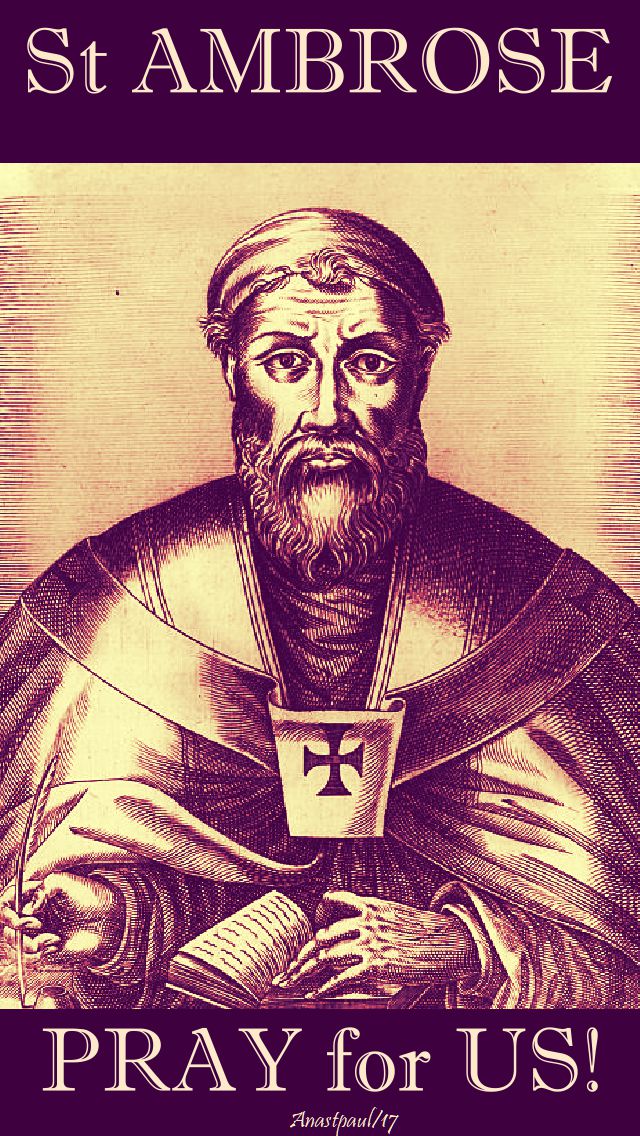
Quote/s of the Day -– 7 December – The Memorial of St Ambrose (c 340-397)- Father and Doctor of the Church
Note: I am still unable to make images so these are taken from this site.
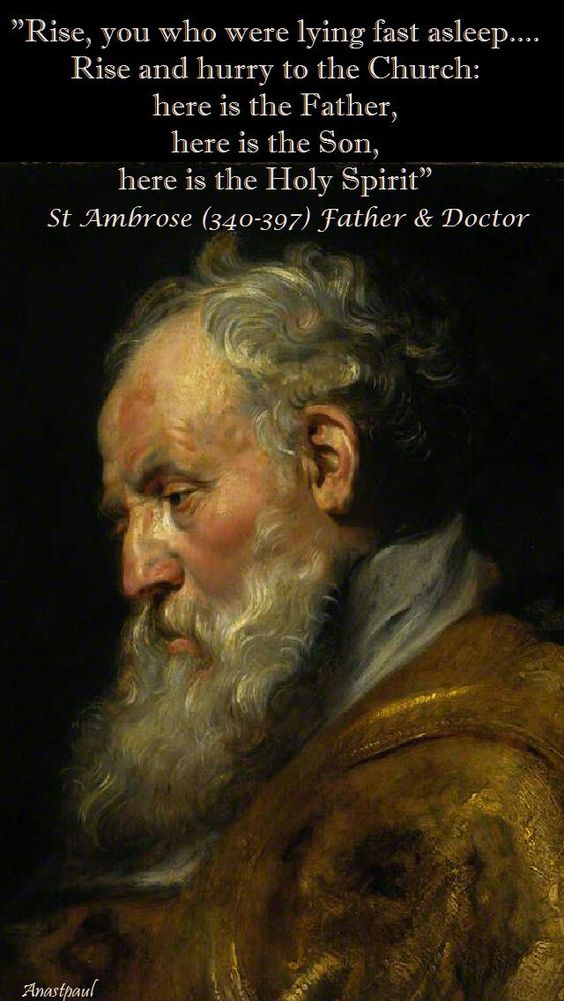
“Rise, you who were lying fast asleep… Rise and hurry to the Church: here is the Father, here is the Son, here is the Holy Spirit.”
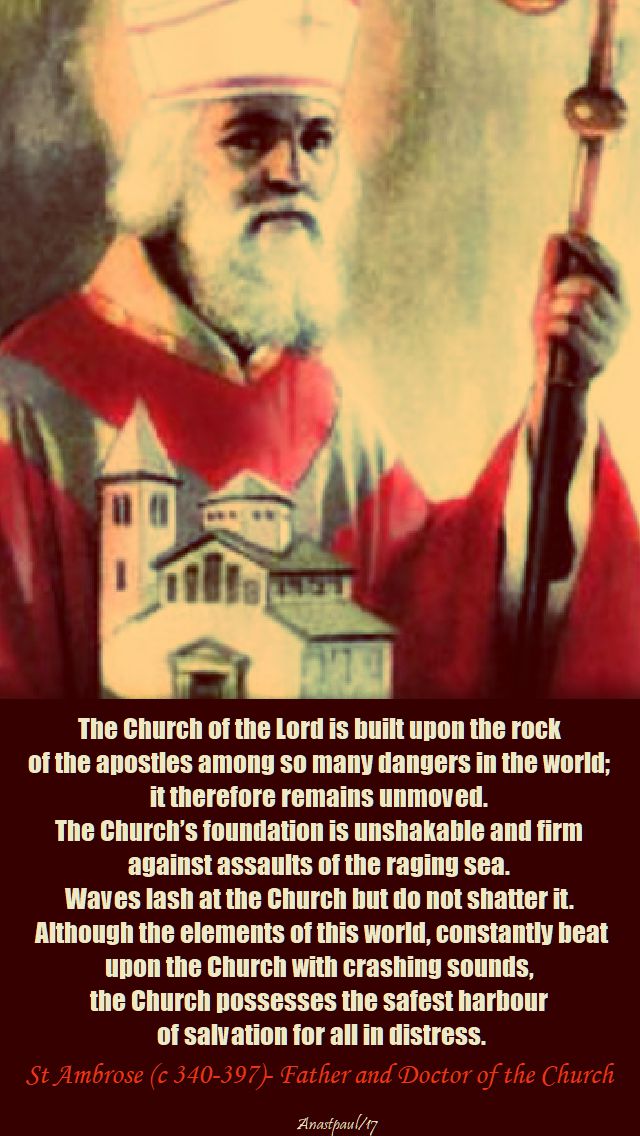
“The Church of the Lord is built upon the rock of the apostles among so many dangers in the world; it therefore remains unmoved. The Church’s foundation is unshakeable and firm against assaults of the raging sea. Waves lash at the Church but do not shatter it. Although the elements of this world, constantly beat upon the Church with crashing sounds, the Church possesses the safest harbour of salvation for all in distress.”
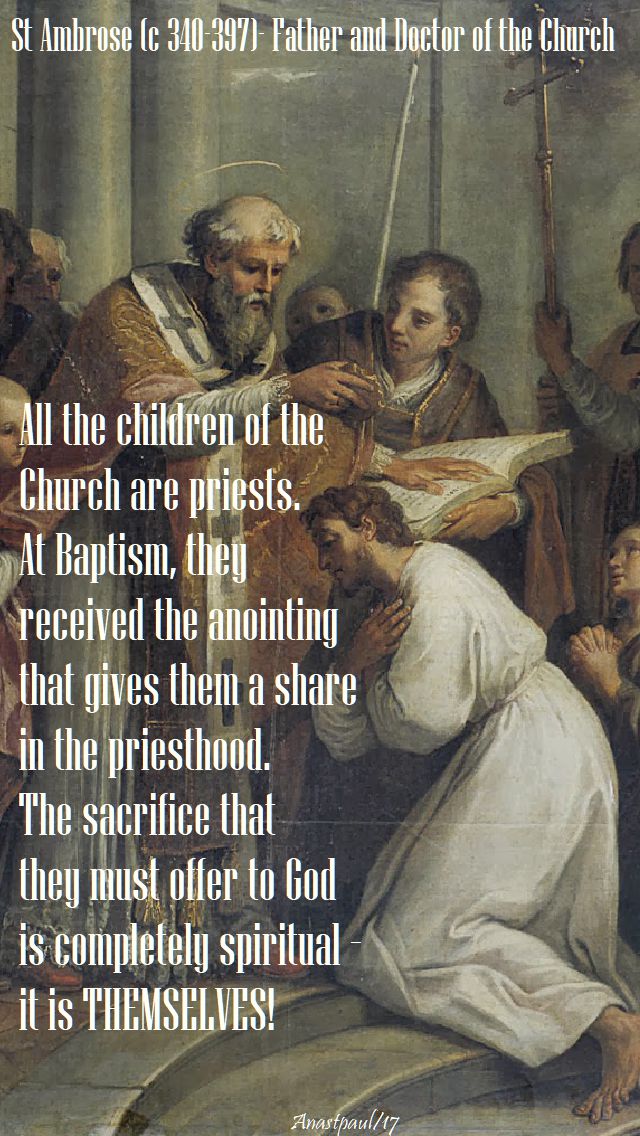
“All the children of the Church are priests. At Baptism, they received the anointing that gives them a share in the priesthood. The sacrifice that they must offer to God is completely spiritual – it is themselves.”
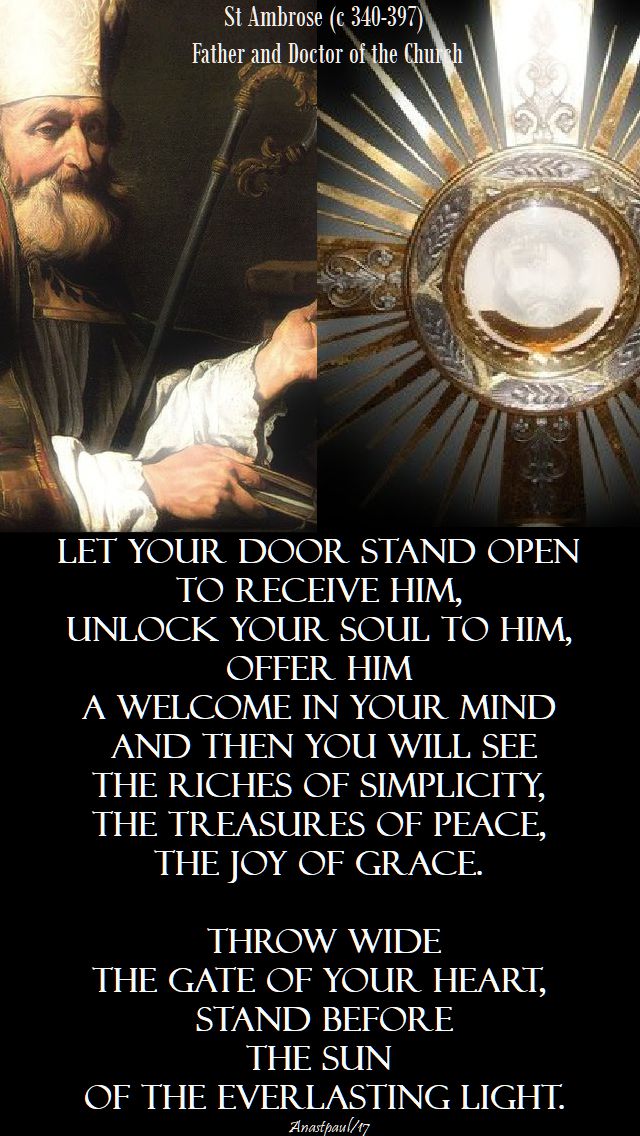
“Let your door stand open to receive Him, unlock your soul to Him, offer Him a welcome in your mind and then you will see the riches of simplicity, the treasures of peace, the joy of grace. Throw wide the gate of your heart, stand before the sun of the everlasting light.”
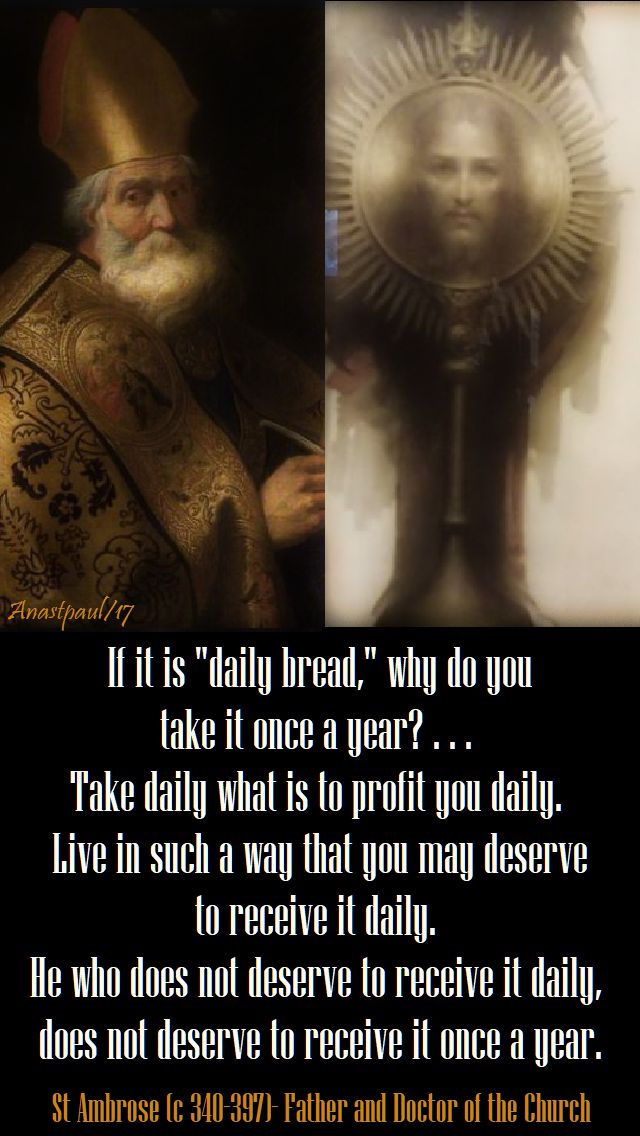
“If it is “daily bread,” why do you take it once a year? . . . Take daily what is to profit you daily. Live in such a way that you may deserve to receive it daily. He who does not deserve to receive it daily, does not deserve to receive it once a year.”
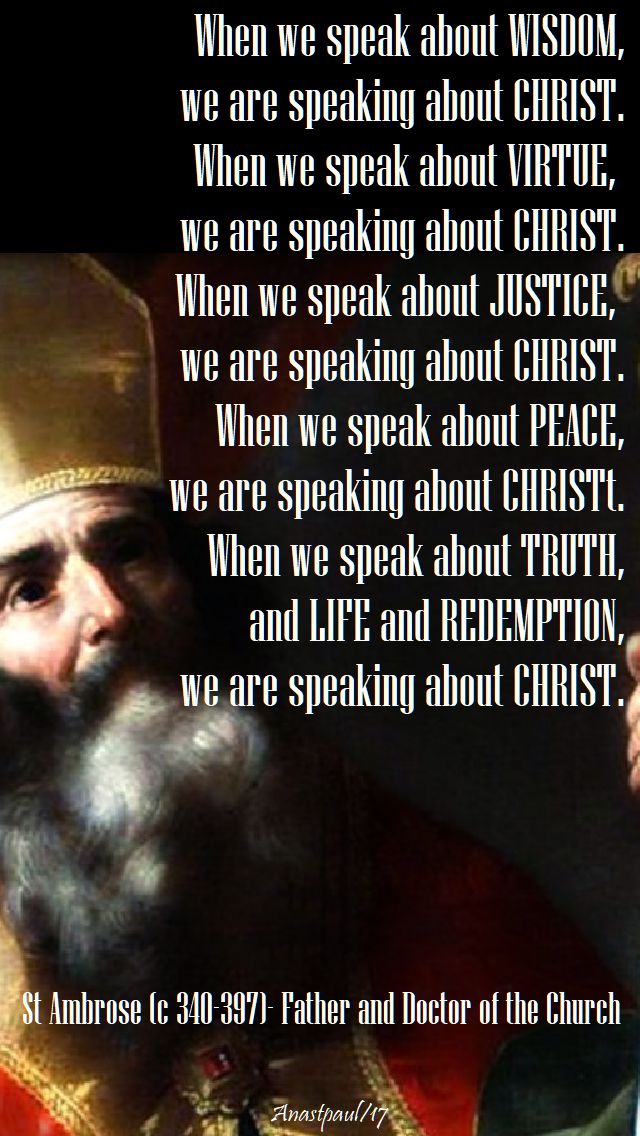
“When we speak about WISDOM, we are speaking about CHRIST. When we speak about VIRTUE, we are speaking about CHRIST. When we speak about JUSTICE, we are speaking about CHRIST. When we speak about PEACE, we are speaking about CHRIST. When we speak about TRUTH, and LIFE and REDEMPTION, we are speaking about CHRIST.”
St Ambrose (c 340-397)- Father and Doctor of the Church
Our Morning Offering – 7 December – The Memorial of St Ambrose (c 340-397)- Father and Doctor of the Church
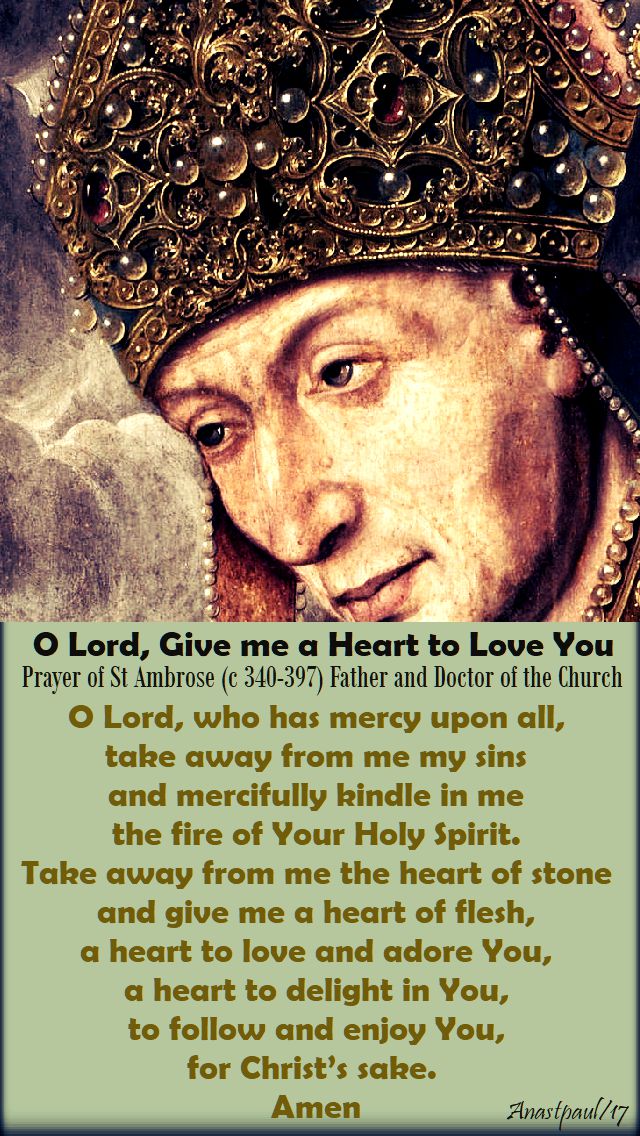
O Lord, Give me a Heart to Love You Prayer of St Ambrose (c 340-397) Father and Doctor of the Church
O Lord, who has mercy upon all,
take away from me my sins
and mercifully kindle in me
the fire of Your Holy Spirit.
Take away from me the heart of stone
and give me a heart of flesh,
a heart to love and adore You,
a heart to delight in You,
to follow and enjoy You,
for Christ’s sake.
Amen
Saint of the Day – 7 December – St Ambrose (c 340-397) – Father and Doctor of the Church
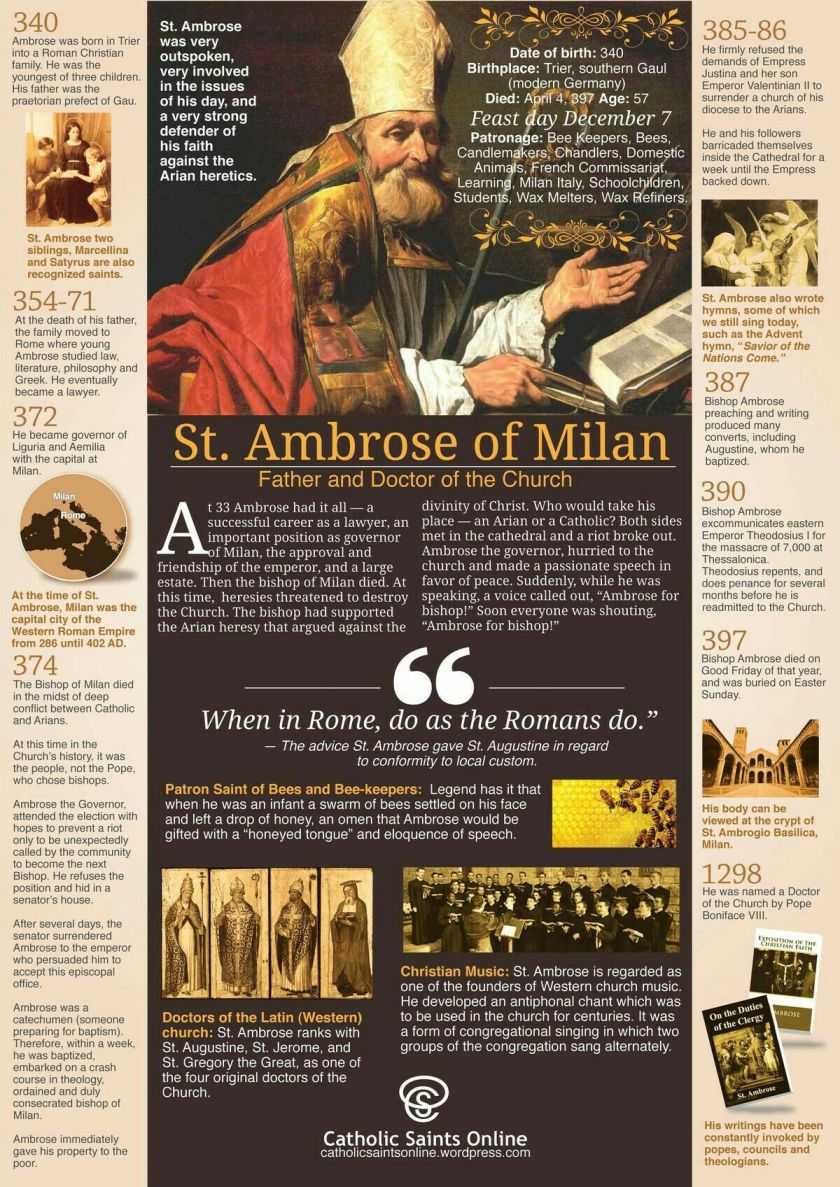
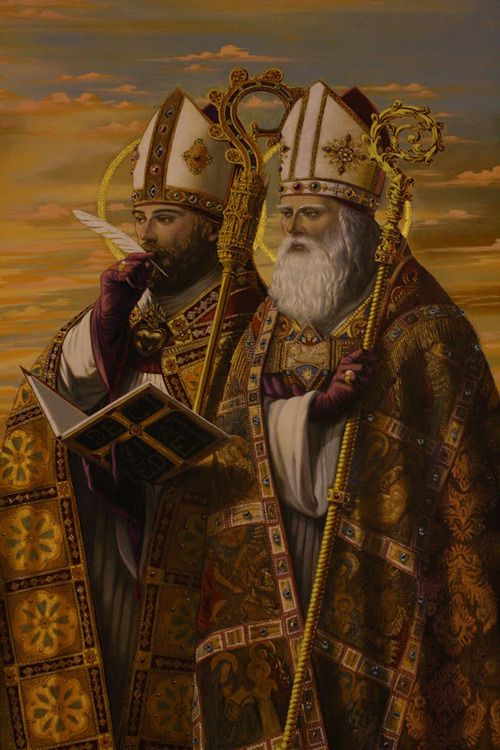
Today the Catholic Church celebrates the memory of St Ambrose, the brilliant Bishop of Milan who influenced St Augustine’s conversion and was named a Doctor of the Church.
Like Augustine himself, the older Ambrose (born around 340) was a highly educated man who sought to harmonise Greek and Roman intellectual culture with the Catholic faith. Trained as a lawyer, he eventually became the governor of Milan. He manifested his intellectual gifts in defence of Christian doctrine even before his baptism.
While Ambrose was serving as the governor of Milan, a bishop named Auxentius was leading the diocese. Although he was an excellent public speaker with a forceful personality, Auxentius also followed the heresy of Arius, which denied the divinity of Christ. Although the Council of Nicaea had reasserted the traditional teaching on Jesus’ deity, many educated members of the Church – including, at one time, a majority of the world’s bishops – looked to Arianism as a more sophisticated and cosmopolitan version of Christianity. Bishop Auxentius became notorious for forcing clergy throughout the region to accept Arian creeds.
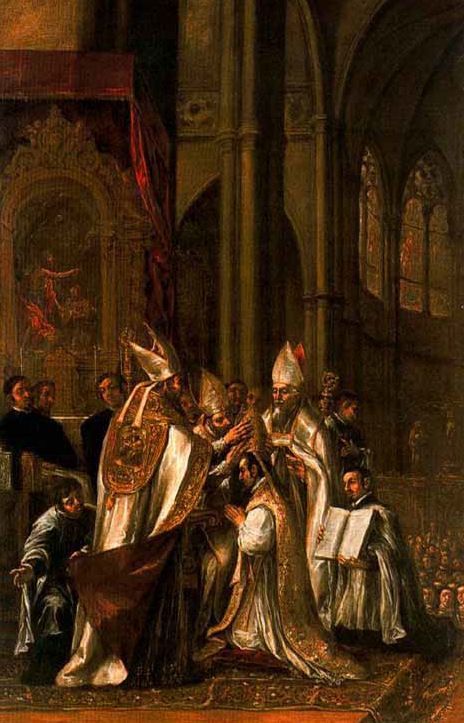
At the time of Auxentius’ death, Ambrose had not yet even been baptised. But his deep understanding and love of the traditional faith were already clear to the faithful of Milan. They considered him the most logical choice to succeed Auxentius, even though he was still just a catechumen. With the help of Emperor Valentinan, who ruled the Western Roman Empire at the time, a mob of Milanese Catholics virtually forced Ambrose to become their bishop against his own will. Eight days after his baptism, Ambrose received episcopal consecration on 7 December 374. The date would eventually become his liturgical feast.
St Ambrose consecrated as Bishop
Bishop Ambrose did not disappoint those who had clamoured for his appointment and consecration. He began his ministry by giving everything he owned to the poor and to the Church. He looked to the writings of Greek theologians like St Basil for help in explaining the Church’s traditional teachings to the people during times of doctrinal confusion.
Like the fathers of the Eastern Church, Ambrose drew from the intellectual reserves of pre-Christian philosophy and literature to make the faith more comprehensible to his hearers. This harmony of faith with other sources of knowledge served to attract, among others, the young professor Aurelius Augustinus – a man Ambrose taught and baptised, whom history knows as St Augustine of Hippo.
St Augustine and St Ambrose
Ambrose himself lived simply, wrote prolifically and celebrated Mass each day. He found time to counsel an amazing range of public officials, pagan inquirers, confused Catholics and penitent sinners. The people of Milan never regretted their insistence that the reluctant civil servant should lead the local church. His popularity, in fact, served to keep at bay those who would have preferred to force him from the diocese, including the Western Empress Justina and a group of her advisers, who sought to rid the West of adherence to the Nicene Creed. Ambrose heroically refused her attempts to impose heretical bishops in Italy, along with her efforts to seize churches in the name of Arianism.
Ambrose also displayed remarkable courage when he publicly denied communion to the Emperor Theodosius, who had ordered the massacre of 7,000 citizens in Thessalonica. The chastened emperor took Ambrose’s rebuke to heart, publicly repenting of the massacre and doing penance for the murders.
“Nor was there afterwards a day on which he did not grieve for his mistake,” Ambrose himself noted when he spoke at the emperor’s funeral. The rebuke spurred a profound change in Emperor Theodosius. He reconciled himself with the Church and the bishop, who attended to the emperor on his deathbed.
St. Ambrose died in 397. His 23 years of diligent service had turned a deeply troubled diocese into an exemplary outpost for the faith. His writings remained an important point of reference for the Church, well into the medieval era and beyond.
At the Catholic Church’s Fifth Ecumenical Council – which took place at Constantinople in 553, and remains a source of authoritative teaching for both Catholics and Eastern Orthodox Christians – the assembled bishops named Ambrose, along with this protege St Augustine, as being among the foremost “holy fathers” of the Church, whose teaching all bishops should “in every way follow.”
St Agatho of Alexandria
St Anianas of Chartres
St Antonius of Siya
St Athenodoros of Mesopotamia
St Buithe of Monasterboice
St Burgundofara
St Charles Garnier
St Diuma
St Geretrannus of Bayeux
Bl Humbert of Clairvaux
St John the Silent
St Martin of Saujon
St Mary Joseph Rosello
St Nilus of Stolbensk
St Polycarp of Antioch
St Sabinus of Spoleto
St Servus the Martyr
St Theodore of Antioch
St Urban of Teano
St Victor of Piacenza
Again, all I can do is pray and beg of you all, your prayers too. My country is in chaos, power is being ‘loadshedded’ on and off all day across the land. Damage control is all we can do. Much trauma to many systems and appliances. The software I use to make my pics has also corrupted along with some other software. I know others who have lost their telephone connections due to corrupted and burnt out telephone cables, etc etc. Sorry!
Novena to Our Lady of Guadalupe for the Protection of the Unborn and all Human Life, Our Lady of Guadalupe, Madonna of the Americas, Patroness of the Unborn – Day Four – 6 December
Fourth Day
Dearest Mother of Guadalupe,
I beg you for a fortified will to imitate
your divine Son’s charity,
to always seek the good of others in need.
Grant me this,
I humbly ask of you.
Our Father, Hail Mary, Glory be
and the Prayer for the Protection of all Human Life
Prayer for the Unborn and the Protection of all Human Life
Our Lady of Guadalupe,
we turn to you,
who are the protectress of unborn children
and ask that you intercede for us,
so that we may more firmly resolve to join you
in protecting all human life.
Let our prayers be united
to your perpetual motherly intercession
on behalf of those whose lives are threatened,
be they in the womb of their mother,
on the bed of infirmity,
or in the latter years of their life.
May our prayers
also be coupled with peaceful action
which witnesses to the goodness
and dignity of all human life,
so that our firmness of purpose may give courage
to those who are fearful and bring light
to those who are blinded by sin.
O Virgin Mother of God,
present our petitions to your Son
and ask Him to bless us with abundant life.
Amen
Again, all I can do is pray and beg of you all, your prayers too. My country is in chaos, power is being ‘loadshedded’ on and off all day across the land. Damage control is all we can do. Much trauma to many systems and appliances. The software I use to make my pics has also corrupted along with some other software. I know others who have lost their telephone connections due to corrupted and burnt out telephone cables, etc etc. Sorry! Mary, our refuge and our strength!
Novena in Preparation for the Solemnity of The Immaculate Conception
By St Josemaria Escriva (1902-1975)
DAY SEVEN – 6 December
Mary, our refuge and our strength
When it comes to the scandal of the Sacrifice of the Cross, Mary is there, hearing with sadness how “the passers-by blasphemed against him, tossing their heads, ‘Come now, they said, you would destroy the temple and build it up in three days, rescue yourself; come down from that cross, if you are the Son of God’.” Our Lady is there listening to the words of her Son, united to Him in His suffering, “My God, my God, why hast thou forsaken me?” What could she do? She united herself fully with the redemptive love of her Son and offered to the Father her immense sorrow, which pierced her pure Heart like a sharp-edged sword.
Jesus is comforted anew by the quiet, loving presence of His Mother. Mary does not shout; she does not run about frantically. Stabat: she is there, standing next to her Son. It is then that Jesus looks at her and then turning His gaze to John He exclaims, “Woman, this is thy son.” Then He said to the disciple, “This is thy Mother.” In the person of John, Christ is entrusting all men to His Mother and especially His disciples: those who were to believe in Him. Felix culpa the Church sings. Happy fault, that has brought us so great and wonderful a Redeemer. Happy fault, we could add, which has merited that we should receive Mary as our Mother. Now we are safe. Nothing should worry us now, because Our Lady, the crowned Queen of heaven and earth, is omnipotent in her supplication before our Father God. Jesus cannot deny anything to Mary, nor to us, who are children of his own Mother. (Friends of God, 288)
Marvel at Mary’s courage: at the foot of the Cross, with the greatest of human sorrows – there is no sorrow like her sorrow – filled with fortitude. And ask her for that same strength, so that you too can remain beside the Cross. (The Way, 508)
Don’t let discouragement enter into your apostolate. You haven’t failed, just as Christ didn’t fail on the Cross. Take courage!… Keep going, against the tide, protected by Mary’s Immaculate and Motherly Heart: Sancta Maria, refugium nostrum et virtus!, you are my refuge and my strength. Hold your peace. Be calm… God has very few friends on earth. Don’t yearn to leave this world. Don’t shy away from the burden of the days, even though at times we find them very long. (The Way of the Cross, 13th Station, 3)
We can’t forget that Mary spent nearly every day of her life just like millions of other women who look after their family, bring up their children and take care of the house. Mary sanctifies the ordinary everyday things – what some people wrongly regard as unimportant and insignificant: everyday work, looking after those closest to you, visits to friends and relatives. What a blessed ordinariness, that can be so full of love of God!
For that’s what explains Mary’s life – her love. A complete love, so complete that she forgets herself and is happy just to be there where God wants her, fulfilling with care what God wants her to do. That is why even her slightest action is never routine or vain but, rather, full of meaning. Mary, our mother, is for us both an example and a way. We have to try to be like her, in the specific circumstances in which God wants us to live (Christ is Passing By, 148)
Let us Pray
Say to her:
Mother, my Mother – yours,
because you are hers on many counts –
may your love bind me to your Son’s Cross,
may I not lack the Faith,
nor the courage,
nor the daring,
to carry out the will of our Jesus.
Amen The Way, 497
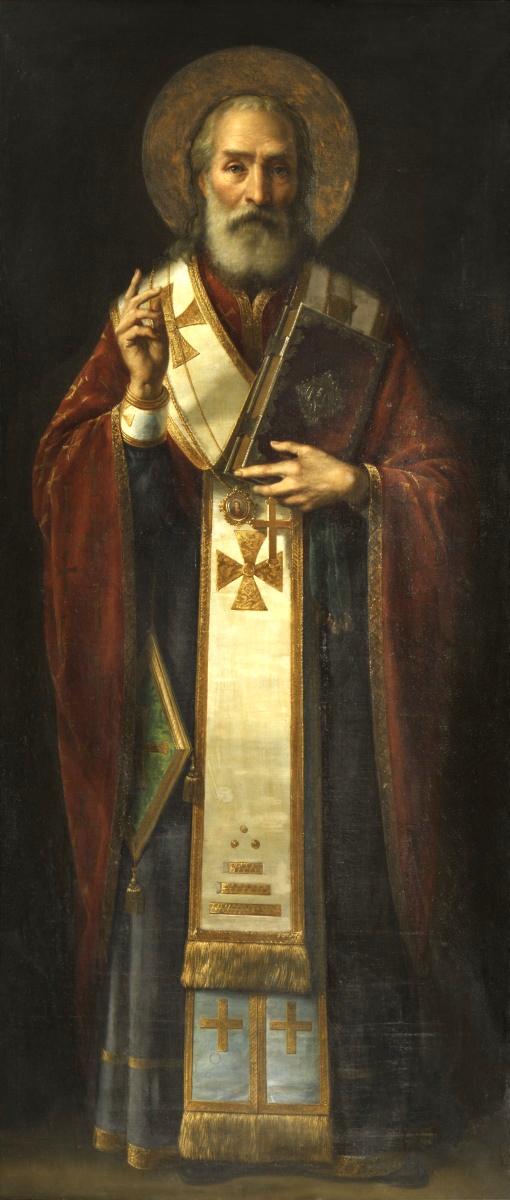
Saint of the Day – 6 December – St Nicholas (270-343) Bishop
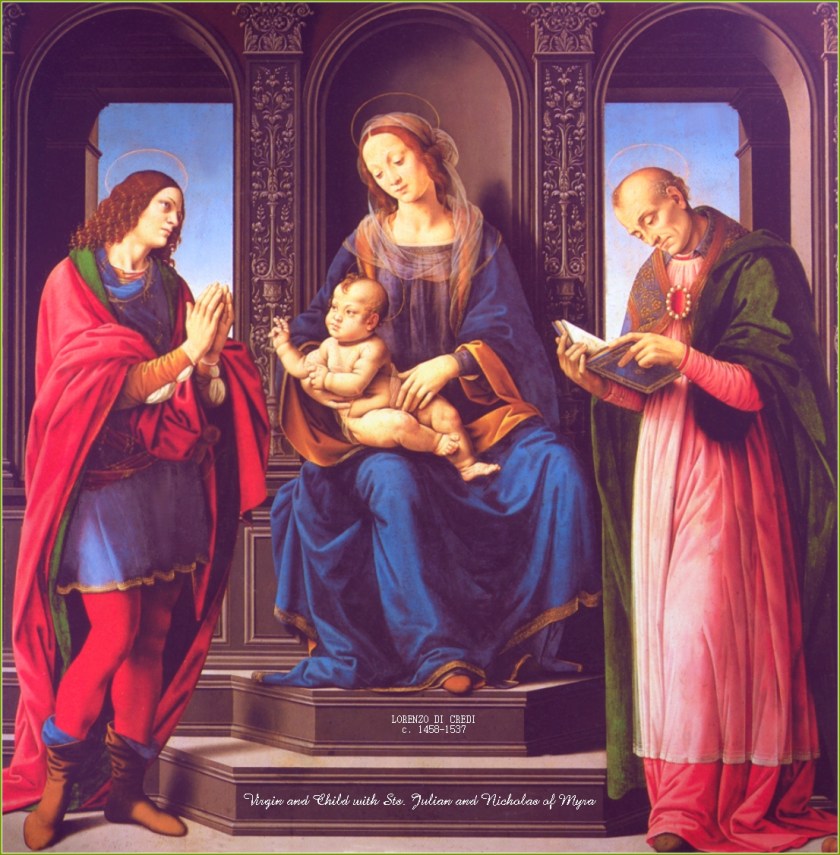
The absence of the “hard facts” of history is not necessarily an obstacle to the popularity of saints, as the devotion to Saint Nicholas shows. Both the Eastern and Western Churches honour him and it is claimed that after the Blessed Virgin, he is the saint most pictured by Christian artists. And yet historically, we can pinpoint only the fact that Nicholas was the fourth-century bishop of Myra, a city in Lycia, a province of Asia Minor.
As with many of the saints, however, we are able to capture the relationship which Nicholas had with God through the admiration which Christians have had for him—an admiration expressed in the colourful stories which have been told and retold through the centuries.
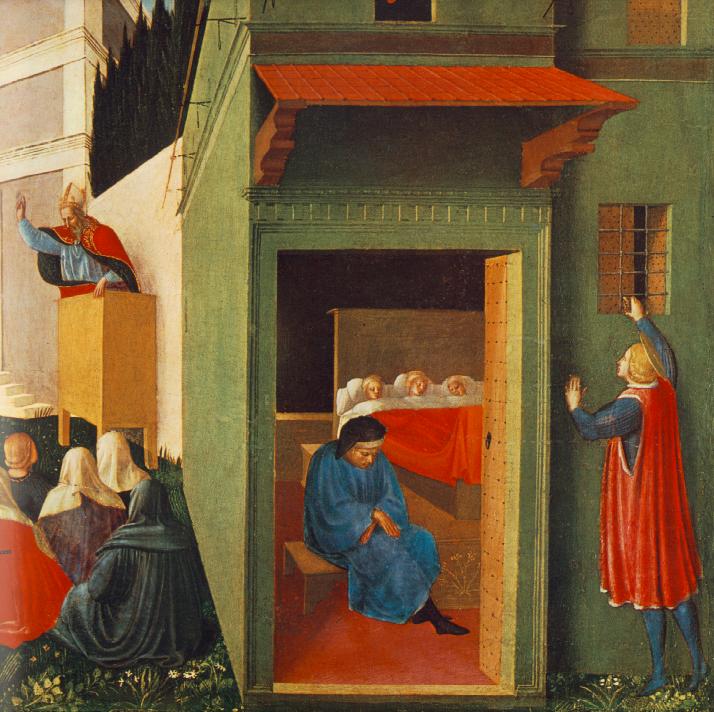
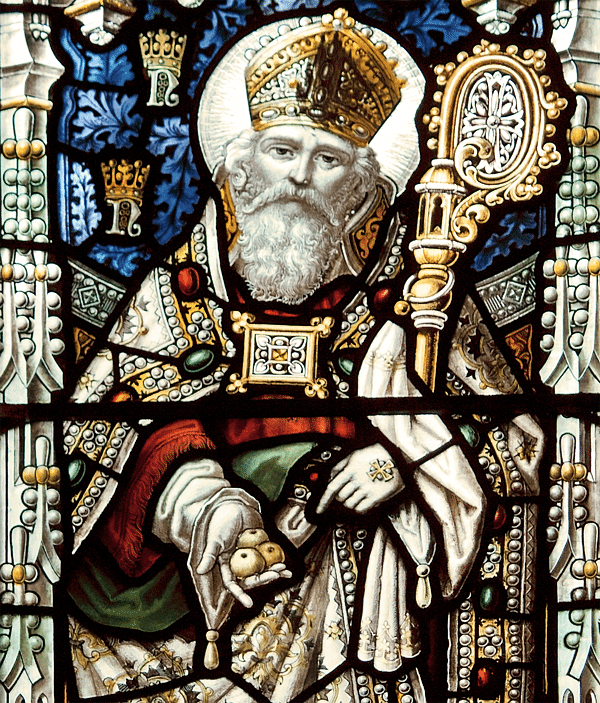
Perhaps the best-known story about Nicholas concerns his charity toward a poor man who was unable to provide dowries for his three daughters of marriageable age. Rather than see them forced into prostitution, Nicholas secretly tossed a bag of gold through the poor man’s window on three separate occasions, thus enabling the daughters to be married. Over the centuries, this particular legend evolved into the custom of gift-giving on the saint’s feast.
Fra Angelico’s St Nicholas donating the dowries
In the English-speaking countries, Saint Nicholas became, by a twist of the tongue, Santa Claus—further expanding the example of generosity portrayed by this holy bishop.
St Abraham of Kratia
St Aemilianus the Martyr
Bl Angelica of Milazzo
St Asella of Rome
St Boniface the Martyr
St Dativa the Martyr
St Dionysia the Martyr
St Gerard of La Charite
St Gertrude the Elder
St Giuse Nguyen Duy Khang
St Isserninus of Ireland
Bl Janos Scheffler
St Leontia the Martyr
St Majoricus the Martyr
Bl Peter Pascual
St Polychronius
St Tertus
—
Martyred in the Spanish Civil War:
• Blessed Esteban Vázquez Alonso
• Blessed Florencio Rodríguez Guemes
• Blessed Gregorio Cermeño Barceló
• Blessed Heliodoro Ramos García
• Blessed Ireneo Rodríguez González
• Blessed Juan Lorenzo Larragueta Garay
• Blessed Luis Martínez Alvarellos
• Blessed Luisa María Frías Cañizares
• Blessed Miguel Lasaga Carazo
• Blessed Narciso Pascual y Pascual
• Blessed Pascual Castro Herrera
• Blessed Vicente Vilumbrales Fuente
Sincere apologies for the late arrival of today’s Novena – I have been unable to post anything due to a national electricity crises!
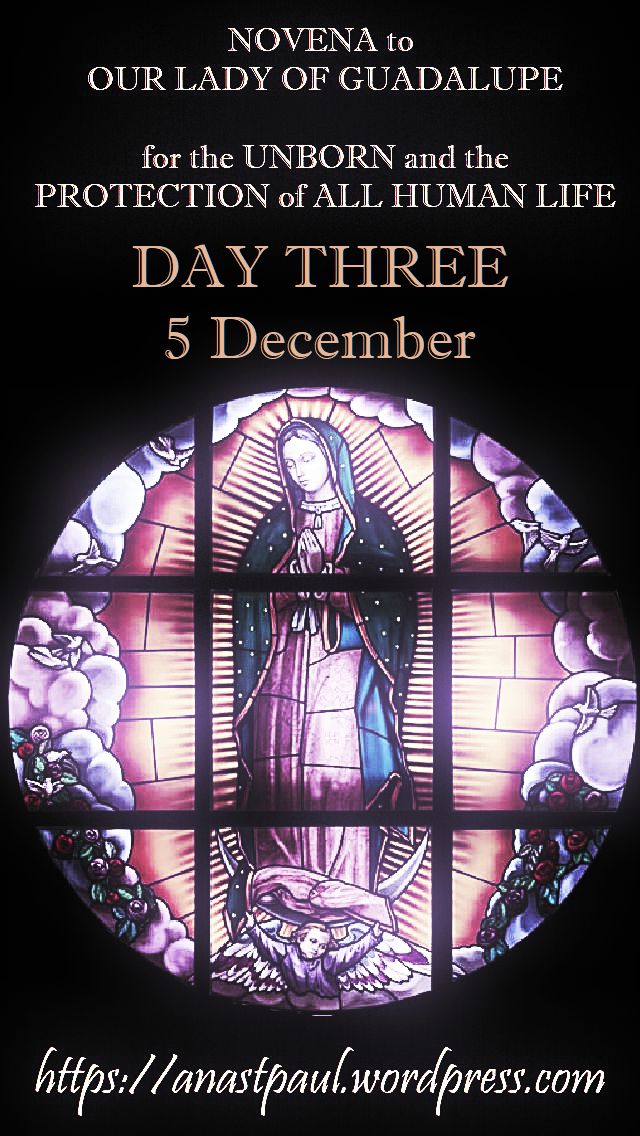
Novena to Our Lady of Guadalupe for the Protection of the Unborn and all Human Life, Our Lady of Guadalupe, Madonna of the Americas, Patroness of the Unborn – Day Three – 5 December
Third Day
O Mary,
whose Immaculate Heart was pierced
by seven swords of grief,
help me to walk valiantly
amid the sharp thorns
strewn across my pathway.
Obtain for me the strength
to be a true imitator of you.
This I ask you, my dear Mother.
Our Father, Hail Mary, Glory be
and the Prayer for the Protection of all Human Life
Prayer for the Unborn and the Protection of all Human Life
Our Lady of Guadalupe,
we turn to you,
who are the protectress of unborn children
and ask that you intercede for us,
so that we may more firmly resolve to join you
in protecting all human life.
Let our prayers be united
to your perpetual motherly intercession
on behalf of those whose lives are threatened,
be they in the womb of their mother,
on the bed of infirmity,
or in the latter years of their life.
May our prayers
also be coupled with peaceful action
which witnesses to the goodness
and dignity of all human life,
so that our firmness of purpose may give courage
to those who are fearful and bring light
to those who are blinded by sin.
O Virgin Mother of God,
present our petitions to your Son
and ask Him to bless us with abundant life.
Amen
Sincere apologies for the late arrival of today’s Novena – I have been unable to post anything due to a national electricity crises!
Novena in Preparation for the Solemnity of The Immaculate Conception
By St Josemaria Escriva (1902-1975)
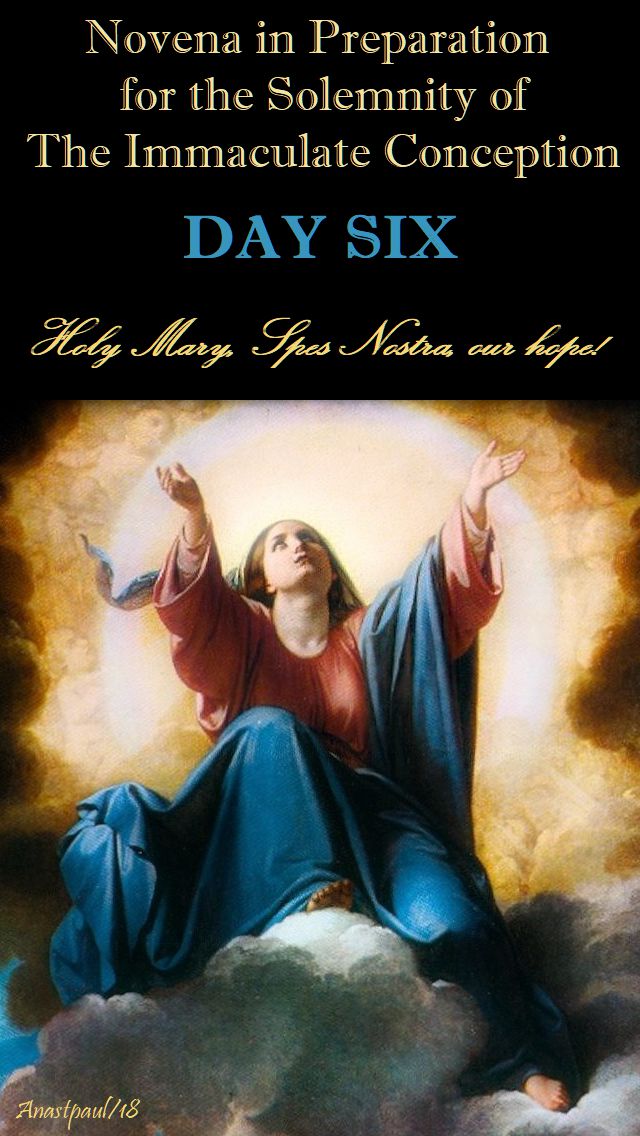
DAY SIX – 5 December
Holy Mary, our hope
Mary teaches us to hope. She proclaimed: “All generations will call me blessed.” Humanly speaking, how could she hope for such a thing? Who was she, in the eyes of the men and women of her time? The great heroines of the Old Testament – Judith, Esther, Deborah – won a measure of human glory even here on earth, for they were acclaimed and exalted by the people. Mary’s throne, by contrast, like that of her Son, is the Cross. During the rest of her life, until she was taken body and soul into Heaven, what most impresses us about her is her quiet presence. St Luke, who knew her well, describes her as being close to the first disciples, in prayer. This was the way she lived to the end of her days on earth, she who was to be praised by all creatures for all eternity.
What a contrast between Our Lady’s hope and our own impatience! So often we call upon God to reward us at once for any little good we have done. No sooner does the first difficulty appear than we start to complain. Often we are incapable of sustaining our efforts, of keeping our hope alive. Why? Because we lack faith. “Blessed art thou for thy believing; the message that was brought to thee from the Lord shall have fulfilment.” (Friends of God, 286)
Let us be full of hope! This is the great thing about being a contemplative soul. We live by Faith, Hope and Love and Hope makes us powerful. Do you remember what St John says? “I am writing to you, young men, because you are strong and the word of God abides in you and you have conquered the evil one.” God is urging us on, for the sake of the eternal youthfulness of the Church and of all mankind. You have the power to transform everything human into something divine, just as King Midas turned everything he touched into gold!
Do not ever forget that after death you will be welcomed by Love itself. And in the love of God you will find as well all the noble loves which you had on earth. Our Lord has arranged for us to spend this brief day of our earthly existence working and, like His only-begotten Son, “doing good.” Meanwhile we have to be on our guard, alert to the call St Ignatius of Antioch felt within his soul as the hour of his martyrdom approached.
“Come to the Father,” come to your Father, who anxiously awaits you. (Friends of God, 221)
Let us Pray
Let us ask Holy Mary, Spes Nostra, our hope, to kindle in us a holy desire that we may all come together to dwell in the house of the Father. Nothing need disturb us if we make up our minds to anchor our hearts in a real longing for our true fatherland. Our Lord will lead us there with His grace and He will send a good wind to carry our ship to the bright shores of our destination. (Friends of God, 221)
Teach us Holy Mother Mary,
teach us your holy hope!
This virtue that comes from the grace of God.
Intercede on our behalf that we may
be always guided by hope
that the great love of our Father,
will be our strength and our stay.
Pray for us Holy Mother of Hope.
Grant us your guiding hand.
Amen
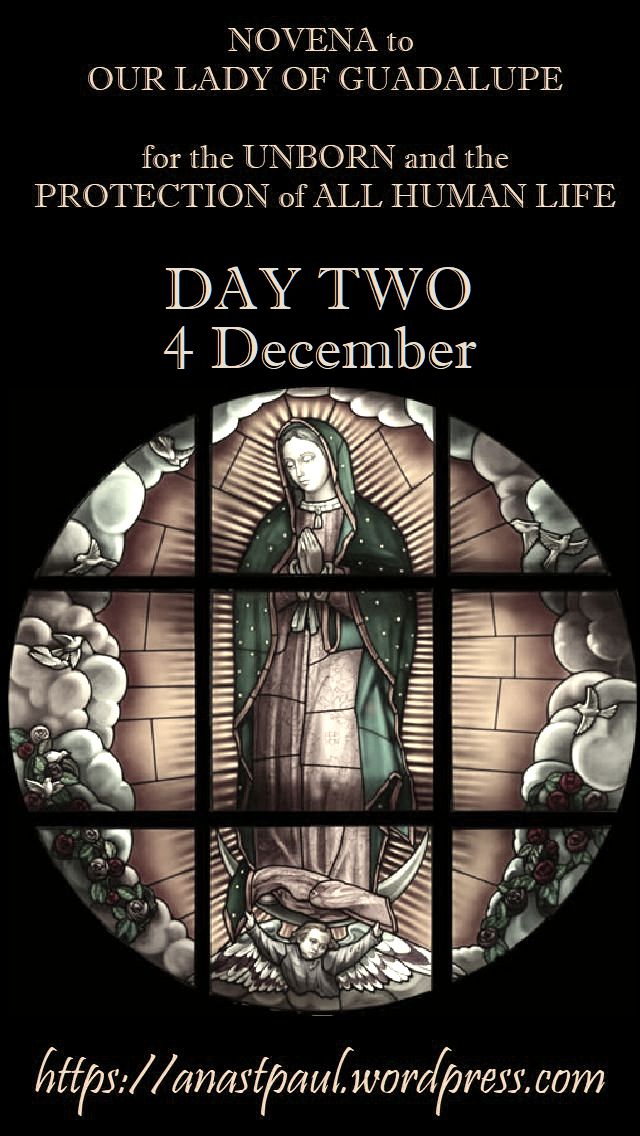
Novena to Our Lady of Guadalupe for the Protection of the Unborn and all Human Life, Our Lady of Guadalupe, Madonna of the Americas, Patroness of the Unborn – Day Two – 4 December
Second Day
O Mary, conceived without sin,
I come to your throne of grace
to share the fervent devotion
of your faithful Mexican children
who call to you under the
glorious title of Guadalupe.
Obtain for me a lively faith
to do your Son’s holy will always.
May His will be done on earth
as it is in heaven.
Our Father, Hail Mary, Glory be
and the Prayer for the Protection of all Human Life
Prayer for the Unborn and the Protection of all Human Life
Our Lady of Guadalupe,
we turn to you,
who are the protectress of unborn children
and ask that you intercede for us,
so that we may more firmly resolve to join you
in protecting all human life.
Let our prayers be united
to your perpetual motherly intercession
on behalf of those whose lives are threatened,
be they in the womb of their mother,
on the bed of infirmity,
or in the latter years of their life.
May our prayers
also be coupled with peaceful action
which witnesses to the goodness
and dignity of all human life,
so that our firmness of purpose may give courage
to those who are fearful and bring light
to those who are blinded by sin.
O Virgin Mother of God,
present our petitions to your Son
and ask Him to bless us with abundant life.
Amen
Novena in Preparation for the Solemnity of The Immaculate Conception
By St Josemaria Escriva (1902-1975)
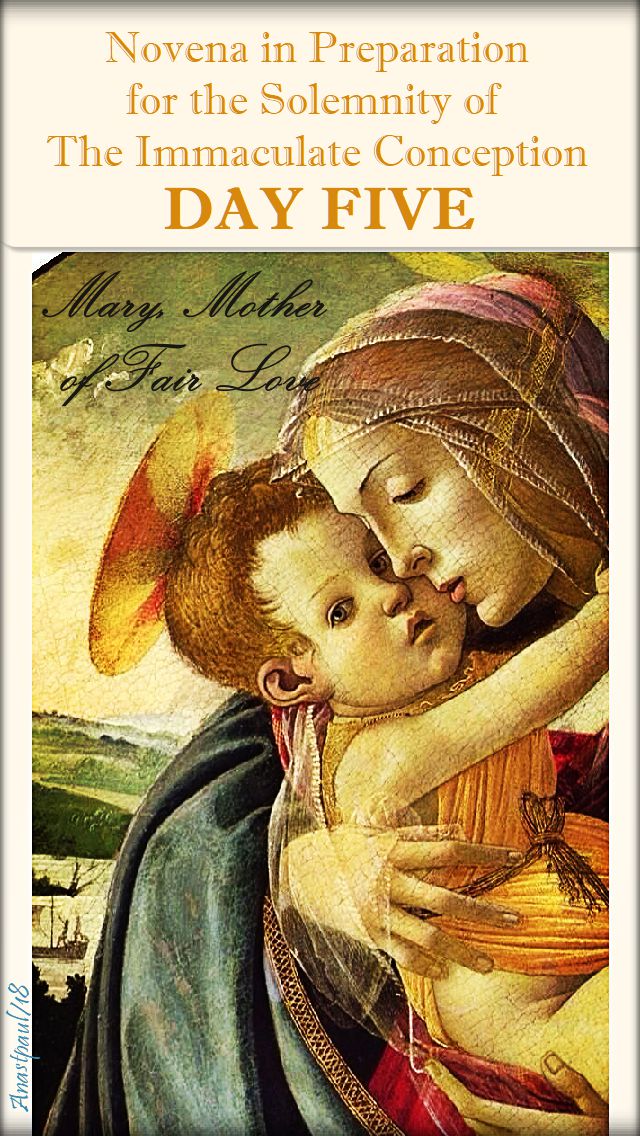
DAY FIVE – 4 December
Mary, Mother of Fair Love
“I am the Mother of fair love and of fear and of knowledge and of holy hope.” These are he lessons which Mary reminds us of today. The lesson of fair love, of living a clean life, of having a sensitive and passionate heart, so that we may learn to be faithful in our service to the Church. This is no ordinary love. It is Love itself. There is no room here for betrayal, or calculation, or forgetfulness. It is a fair, a beautiful love, because its beginning and end is God, who is thrice Holy, who is all Beauty, all Goodness and all Greatness.
But there is also a reference to fear. For myself, the only fear I can imagine is that of turning away from Love. God Our Lord, certainly does not want us to be inhibited, timid or lukewarm about our dedication to Him. He wants us to be daring, courageous and refined. When the sacred text speaks of fear here I am reminded of a complaint we find elsewhere in Scripture, “I searched for my heart’s love but found him not.” This can happen, if one has not yet fully understood what it means to love God. Then our hearts can be swayed by things which do not lead to Our Lord and so we lose sight of Him. At other times it may be Our Lord who hides Himself. He knows the reason why. In such cases, He will be encouraging us to seek Him more earnestly and, when we find Him, we shall be able to cry out with joy, “I took hold of Him and I will never let Him go.” (Friends of God, 277)
The spotless purity of John’s whole life makes him strong before the Cross. The other apostles fly from Golgotha: he, with the Mother of Christ, remains. Don’t forget that purity strengthens and invigorates the character. (The Way, 144)
This heart of ours was born to love. But when it is not given something pure, clean and noble to love, it takes revenge and fills itself with squalor. True love of God and consequently purity of life, is as far removed from sensuality as it is from insensitivity and as far from sentimentality as it is from heartlessness or hard-heartedness. (Friends of God, 183)
Why don’t you give yourself to God once and for all… really…, now? (The Way, 902)
Mary, the holy Mother of our King, the Queen of our heart, looks after us as only she knows how. Mother of mercy, throne of grace, we ask you to help us compose, verse by verse, the simple poem of charity in our own life and the lives of the people around us; it is “like a river of peace.” For you are a sea of inexhaustible mercy: “ All streams run to the sea, but the sea is never full.” (Christ is Passing By, 187)
Let us Pray:
At this very moment, you should trustingly beg Our Lady, as you accompany her in the solitude of your heart, without saying anything out loud:
“Mother, this poor heart of mine rebels so foolishly! If you don’t protect me…” Holy Mother, come to my aid, help me here and now. Help me always to love with a pure heart, to love my Lord and my God, to seek Him always! For you, who I dearly love, are my Mother, amen.
And she will help you, to keep it pure and to follow the way to which God has called you. (Friends of God, 180)
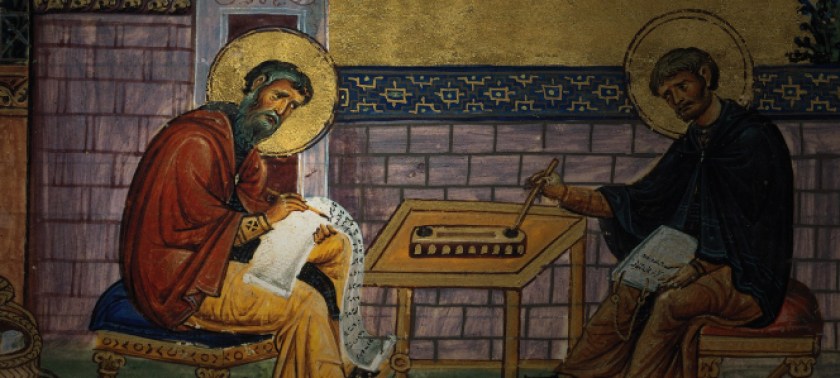
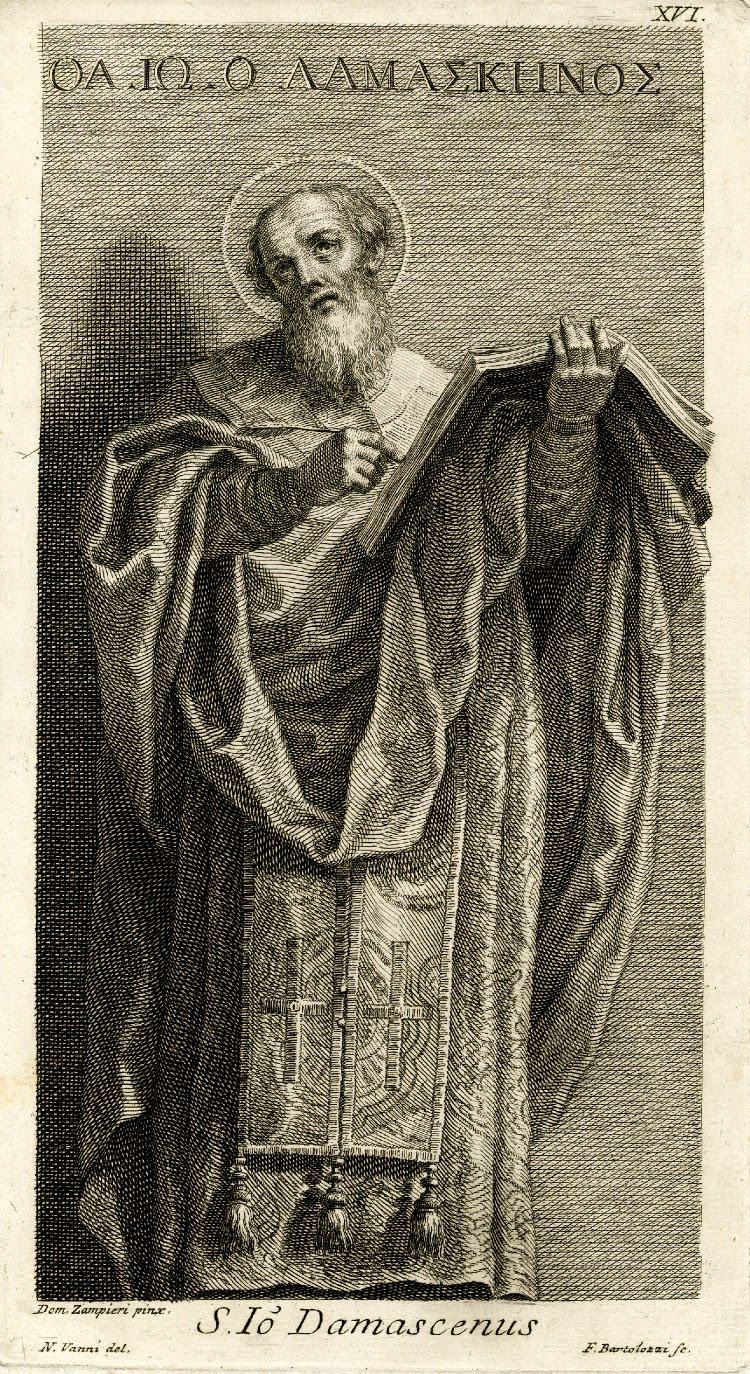
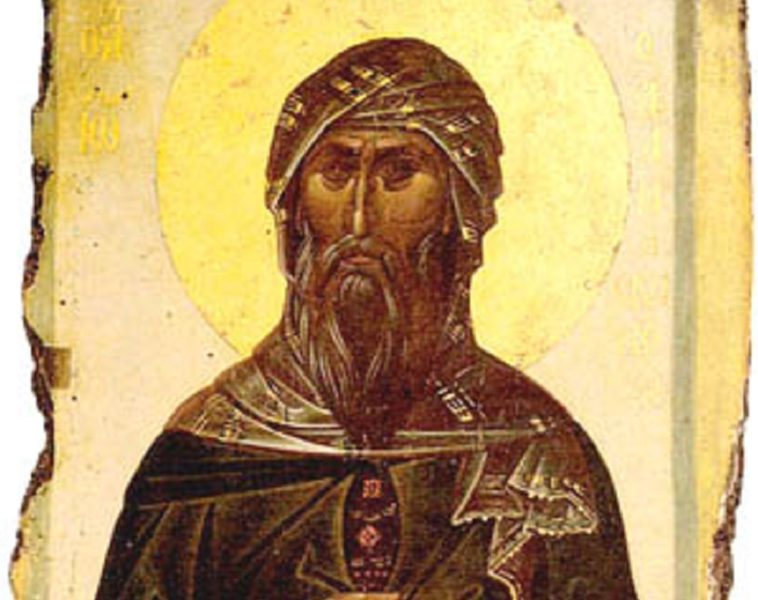
Saint of the Day – 4 December – St John Damascene (675-749) Confessor, Father & Doctor of the Church – Priest, Monk, Theologian, Writer, Defender of Iconography, Poet, a Polymath whose fields of interest and contribution included law, theology, philosophy, music, Marian devotee. Also known as – Johannes Damascenus, John Chrysorrhoas (“golden-stream”), John of Damascus. Born in c 675 at Damascus, Syria and died in 749 of natural causes. Patronages – pharmacists, artists, theologians and theology students.
While the Churches of Rome and Constantinople were still united during St John’s life, the Byzantine Emperor Leo III radically separated from the ancient tradition of the Church, declaringthat the veneration of Sacred Imagery was a form of idolatry.
Saint John was born in the late 7th Century and is the most remarkable of the Greek writers of his time. His father was a Civil Authority who was Christian amid the Saracens of Damascus, whose caliph made him his minister. This enlightened man found, in the public square one day, amid a group of sad Christian captives, a Priest of Italian origin who had been condemned to slavery, he ransomed him and assigned him to his young son to be his tutor. Young John made extraordinary progress in grammar, dialectic, mathematics, music, poetry, astronomy but, above all, in theology, the discipline imparting knowledge of God. John became famous for his encyclopedic intellect and theological method, later a source of inspiration to Saint Thomas Aquinas.
During the 720s, the upstart theologian began publicly opposing the Emperor’s command against Sacred Images in a series of writings. The heart of his argument was twofold – firstly, that Christians did not actually worship images but rather, through them they worshipped God and honoured the memory of the Saints. Secondly, he asserted that by taking an incarnate physical form, Christ had given warrant to the Church’s depiction of Him in images.
By 730, the young public official’s persistent defence of Christian artwork had made him a permanent enemy of the emperor, who had a letter forged in John’s name offering to betray the Muslim government of Damascus. The ruling caliph of the city, taken in by the forgery, is said to have cut off John’s hand. The saint’s sole surviving biography states that the Virgin Mary acted to restore it miraculously. John eventually managed to convince the Muslim ruler of his innocence, before making the decision to become a monk and later a priest.
Although a number of imperially-convened synods condemned John’s advocacy of Christian iconography, the Roman church always regarded his position as a defence of apostolic tradition. Years after the priest and monk died, the Seventh Ecumenical Council vindicated his orthodoxy and ensured the permanent place of holy images in both Eastern and Western Christian piety.
St John Damascene’s other notable achievements include the “Exact Exposition of the Orthodox Faith,” a work in which he systematised the earlier Greek Fathers’ thinking about theological truths in light of philosophy. The work exerted a profound influence on St Thomas Aquinas and subsequent scholastic theologians. Centuries later, St John’s sermons on the Virgin Mary’s bodily assumption into heaven were cited in Pope Pius XII’s dogmatic definition on the subject.
The saint also contributed as an author and editor, to some of the liturgical hymns and poetry that Eastern Orthodox and Eastern Catholics still use in their celebrations of the liturgy.
“Show me the icons that you venerate, that I may be able to understand your faith.” – Saint John of Damascus.
St John Damascene (675-749) Father & Doctor of the Church (Optional Memorial)
St Ada of Le Mans
St Adelmann of Beauvais
Bl Adolph Kolping
St Anno II
St Apro
St Barbara
St Bernardo degli Uberti
St Bertoara of Bourges
St Christianus
St Clement of Alexandria
St Cyran of Brenne
St Eraclius
St Eulogio Álvarez López
St Ezequiel Álvaro de La Fuente
St Felix of Bologna
Bl Francis Galvez
St Francisco de la Vega González
St Giovanni Calabria
St Heraclas of Alexandria
St Jacinto García Chicote
Bl Jerome de Angelis
St John the Wonder Worker
St Maruthas
St Melitus of Pontus
St Osmund of Salisbury
Bl Pietro Tecelano
St Prudens
St Robustiano Mata Ubierna
St Sigiranus
Bl Simon Yempo
St Sola
St Theophanes
Martyred in the Spanish Civil War:
• Blessed Eulogio Álvarez López
• Blessed Ezequiel Álvaro de La Fuente
• Blessed Francisco de la Vega González
• Blessed Jacinto García Chicote
• Blessed Robustiano Mata Ubierna








 AnaStpaul
You must be logged in to post a comment.