Posted in MORNING Prayers, NOVENAS, PRAYERS of the CHURCH, St JOSEPH

Novena to St Joseph Day Two 11 March

Novena to St Joseph  – Day Two:  11 March

Day Two
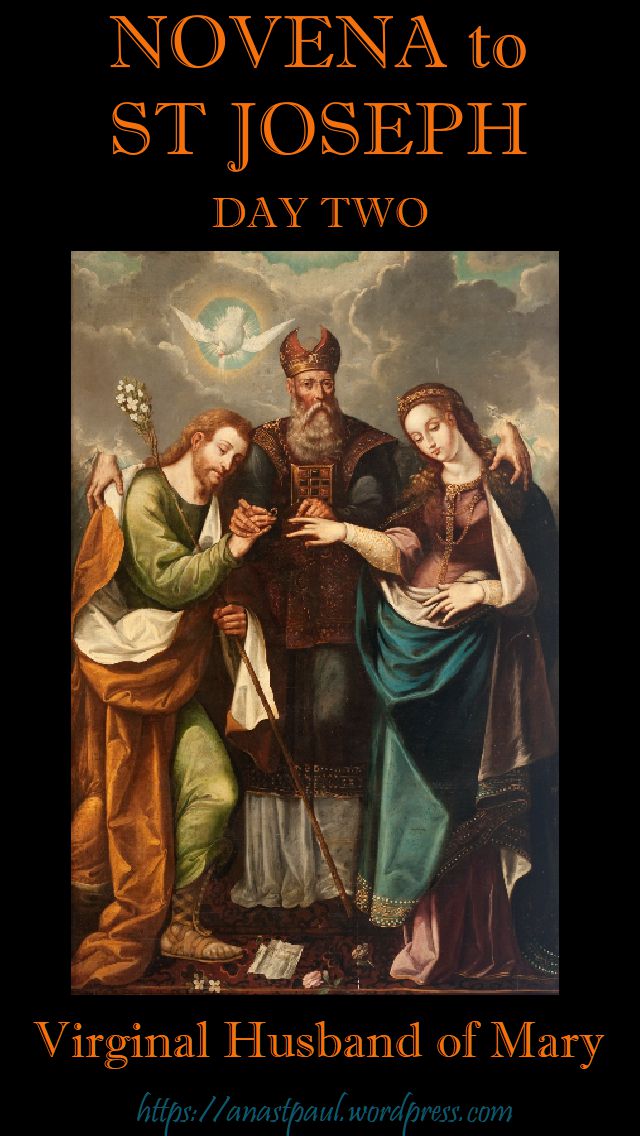
VIRGINAL HUSBAND OF MARY

Saint Joseph, I honour you as the true husband of Mary.
Scripture says: “Jacob begot Joseph, the husband of Mary and of her was born Jesus who is called Christ” (Matt. 1:16). Your marriage to Mary was a sacred contract by which you and Mary gave yourselves to each other.
Mary really belonged to you with all she was and had.
You had a right to her love and obedience and no other person so won her esteem, obedience and love.

You were also the protector and witness of Mary’s virginity.
By your marriage you gave to each other your virginity and also the mutual right over it – a right to safeguard the other’s virtue.
This mutual virginity also belonged to the divine plan of the Incarnation, for God sent His angel to assure you that motherhood and virginity in Mary could be united.

This union of marriage not only brought you into daily familiar association with Mary, the loveliest of God’s creatures but also enabled you to share with her a mutual exchange of spiritual goods.
And Mary found her edification in your calm, humble and deep virtue, purity and sanctity.
What a great honour comes to you from this close union with her whom the Son of God calls Mother and whom He declared the Queen of heaven and earth!
Whatever Mary had belonged by right to you also and this included her Son, even though He had been given to her by God in a wonderful way. Jesus belonged to you as His legal father.
Your marriage was the way which God chose to have Jesus introduced into the world, a great divine mystery from which all benefits have come to us.

God the Son confided the guardianship and the support of His Immaculate Mother to your care.
Mary’s life was that of the Mother of the Saviour, who did not come upon earth to enjoy honours and pleasures but to redeem the world by hard work, suffering and the cross.
You were the faithful companion, support and comforter of the Mother of Sorrows.
How loyal you were to her in poverty, journeying, work and pain.
Your love for Mary was based upon your esteem for her as Mother of God.
After God and the Divine Child, you loved no one as much as her.
Mary responded to this love.
She submitted to your guidance with naturalness and easy grace and childlike confidence.
The Holy Spirit Himself was the bond of the great love which united your hearts.

Saint Joseph, I thank God for your privilege of being the virginal husband of Mary.
As a token of your own gratitude to God, obtain for me the grace to love Jesus with all my heart, as you did and love Mary with some of the tenderness and loyalty with which you loved her.NOVENA TO ST JOSEPH - DAY TWO - 11 MARCH - VIRGINAL HUSBAND OF MARY
*NOVENA PRAYER
*(prayer to be said at the end of each day’s devotion)

Saint Joseph, I, your unworthy child, greet you.
You are the faithful protector and intercessor of all who love and venerate you.
You know that I have special confidence in you and that, after Jesus and Mary,
I place all my hope of salvation in you, for you are especially powerful with God
and will never abandon your faithful servants.
Therefore I humbly invoke you and commend myself,
with all who are dear to me and all that belong to me, to your intercession.
I beg of you, by your love for Jesus and Mary, not to abandon me during life
and to assist me at the hour of my death.
Glorious Saint Joseph, spouse of the Immaculate Virgin,
obtain for me a pure, humble, charitable mind
and perfect resignation to the divine Will.
Be my guide, my father and my model through life
that I may merit to die as you did in the arms of Jesus and Mary.
Loving Saint Joseph, faithful follower of Jesus Christ,
I raise my heart to you to implore your powerful intercession
in obtaining from the Divine Heart of Jesus all the graces necessary
for my spiritual and temporal welfare,
particularly the grace of a happy death and the special grace I now implore:
…………………………………………
(Mention your request)
Guardian of the Word Incarnate, I feel confident that your prayers
on my behalf will be graciously heard before the throne of God.
Amen.

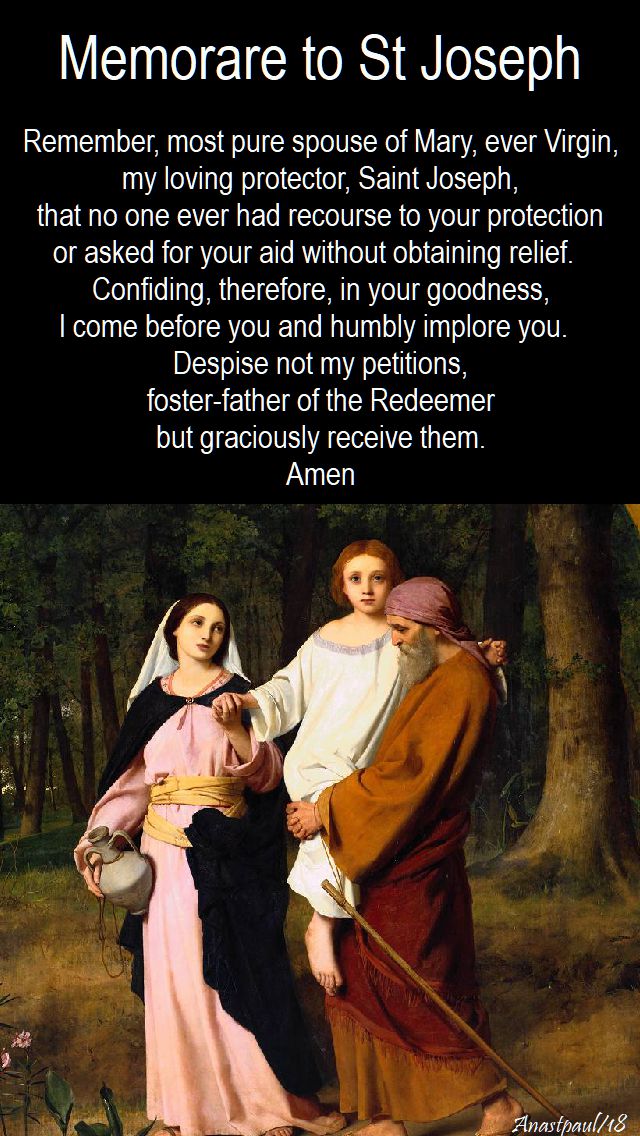
Memorare to St Joseph

Remember, most pure spouse of Mary, ever Virgin,
my loving protector, Saint Joseph,
that no one ever had recourse to your protection
or asked for your aid without obtaining relief.
Confiding, therefore, in your goodness,
I come before you and humbly implore you.
Despise not my petitions,
foster-father of the Redeemer
but graciously receive them.
AmenMemorare to St Joseph - 11 march 2018
Posted in MORNING Prayers, NOVENAS, PRAYERS of the CHURCH, St JOSEPH

Novena to St Joseph Day One 10 March

Novena to St Joseph – Day One:  10 March

*NOVENA PRAYER
*(prayer to be said at the end of each day’s devotion)

Saint Joseph, I, your unworthy child, greet you.
You are the faithful protector and intercessor of all who love and venerate you.
You know that I have special confidence in you and that, after Jesus and Mary,
I place all my hope of salvation in you, for you are especially powerful with God
and will never abandon your faithful servants.
Therefore I humbly invoke you and commend myself,
with all who are dear to me and all that belong to me, to your intercession.
I beg of you, by your love for Jesus and Mary, not to abandon me during life
and to assist me at the hour of my death.
Glorious Saint Joseph, spouse of the Immaculate Virgin,
obtain for me a pure, humble, charitable mind
and perfect resignation to the divine Will.
Be my guide, my father and my model through life
that I may merit to die as you did in the arms of Jesus and Mary.
Loving Saint Joseph, faithful follower of Jesus Christ,
I raise my heart to you to implore your powerful intercession
in obtaining from the Divine Heart of Jesus all the graces necessary
for my spiritual and temporal welfare,
particularly the grace of a happy death and the special grace I now implore:
…………………………………………
(Mention your request)
Guardian of the Word Incarnate, I feel confident that your prayers
on my behalf will be graciously heard before the throne of God.
Amen.

Memorare to St Joseph

Remember, most pure spouse of Mary, ever Virgin,
my loving protector, Saint Joseph,
that no one ever had recourse to your protection
or asked for your aid without obtaining relief.
Confiding, therefore, in your goodness,
I come before you and humbly implore you.
Despise not my petitions,
foster-father of the Redeemer
but graciously receive them.
AmenMemorare to St Joseph - 10 march 2018

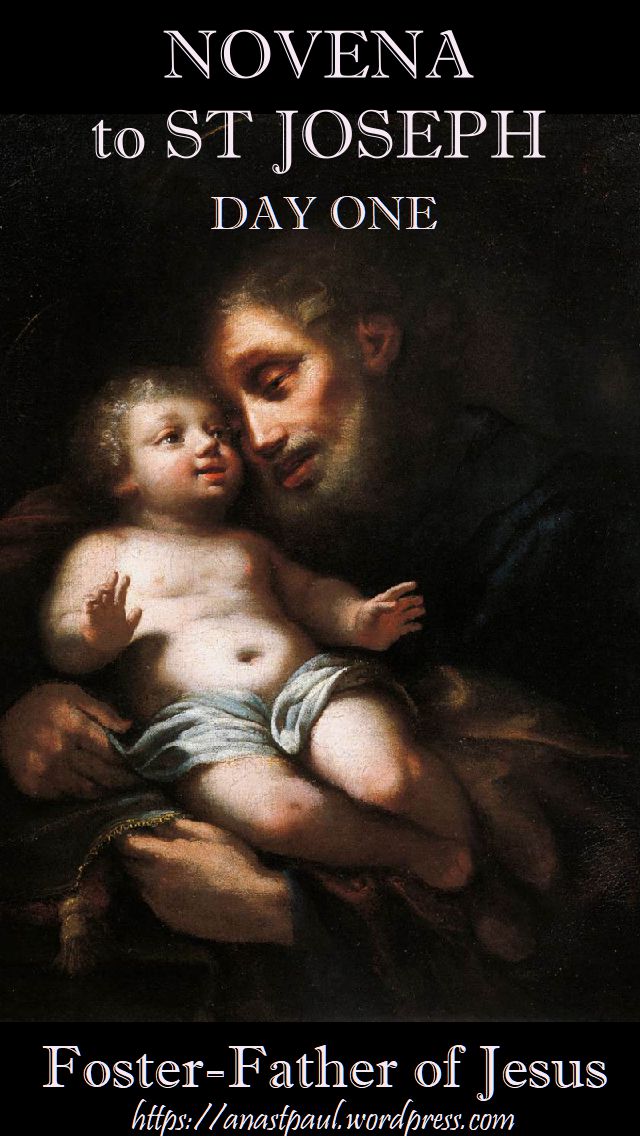
Day One
FOSTER-FATHER OF JESUS

Saint Joseph, you were privileged to share, in the mystery of the Incarnation as the foster-father of Jesus.
Mary alone was directly connected with the fulfillment of the mystery, in that she gave her consent to Christ’s conception
and allowed the Holy Spirit to form the sacred humanity of Jesus from her blood.
You had a part in this mystery in an indirect manner, by fulfilling the condition necessary for the Incarnation –
the protection of Mary’s virginity before and during your married life with her.
You made the virginal marriage possible and this was a part of God’s plan, foreseen, willed and decreed from all eternity.

In a more direct manner you shared in the support, upbringing and protection of the Divine Child as His foster-father.
For this purpose the Heavenly Father gave you a genuine heart of a father — a heart full of love and self-sacrifice.
With the toil of your hands you were obliged to offer protection to the Divine Child, to procure for Him food, clothing and a home.
You were truly the saint of the holy childhood of Jesus – the living created providence which watched over the Christ-Child.

When Herod sought the Child to put Him to death, the Heavenly Father sent an angel but only as a messenger, giving orders for the flight; the rest He left entirely in your hands.
It was that fatherly love which was the only refuge that received and protected the Divine Child.
Your fatherly love carried Him through the desert into Egypt until all enemies were removed.
Then in your arms the Child returned to Nazareth to be nourished and provided for during many years by the labour of your hands.
Whatever a human son owes to a human father for all the benefits of his up-bringing and support, Jesus owed to you, because you were to Him a foster-father, teacher and protector.
You served the Divine Child with a singular love. God gave you a heart filled with heavenly, supernatural love – a love far deeper and more powerful than any natural father’s love could be.

You served the Divine Child with great unselfishness, without any regard to self-interest but not without sacrifices.
You did not toil for yourself, but you seemed to be an instrument intended for the benefit of others, to be put aside as soon as it had done its word, for you disappeared from the scene once the childhood of Jesus had passed.

You were the shadow of the Heavenly Father not only as the earthly representative of the authority of the Father but also by means of your fatherhood – which only appeared to be natural – you were to hide for a while the divinity of Jesus.
What a wonderfully sublime and divine vocation was yours – the loving Child which you carried in your arms and loved and served so faithfully, had God in Heaven as Father and was Himself God!

Yours is a very special rank among the saints of the Kingdom of God, because you were so much a part of the very life of the Word of God made Man.
In your house at Nazareth and under your care the redemption of mankind was prepared.
What you accomplished, you did for us.
You are not only a powerful and great saint in the Kingdom of God but a benefactor of the whole of Christendom and mankind.
Your rank in the Kingdom of God, surpassing far in dignity and honour of all the angels, deserves our very special veneration, love and gratitude.

Saint Joseph, I thank God for your privilege of having been chosen by God to be the foster-father of His Divine Son.
As a token of your own gratitude to God for this your greatest privilege, obtain for me the grace of a very devoted love for Jesus Christ, my God and my Saviour.
Help me to serve Him with some of the self-sacrificing love and devotion which you had while on this earth with Him. Grant that through your intercession with Jesus, your foster-Son, I may reach the degree of holiness God has destined for me, and save my soul.

*NOVENA PRAYERNOVENA TO ST JOSEPH - DAY ONE -10 MARCH - FOSTER-FATHER OF JESUS

Posted in CATHOLIC Quotes, FEASTS and SOLEMNITIES, MARIAN QUOTES, MARIAN TITLES, MARY, MATER ECCLESIAE, PAPAL DECREE, The BLESSED VIRGIN MARY

Pope Francis institutes new celebration of Mary, Mother of the Church

Pope Francis institutes new celebration of Mary, Mother of the Church

Congregation of Divine Worship and the Discipline of the Sacraments

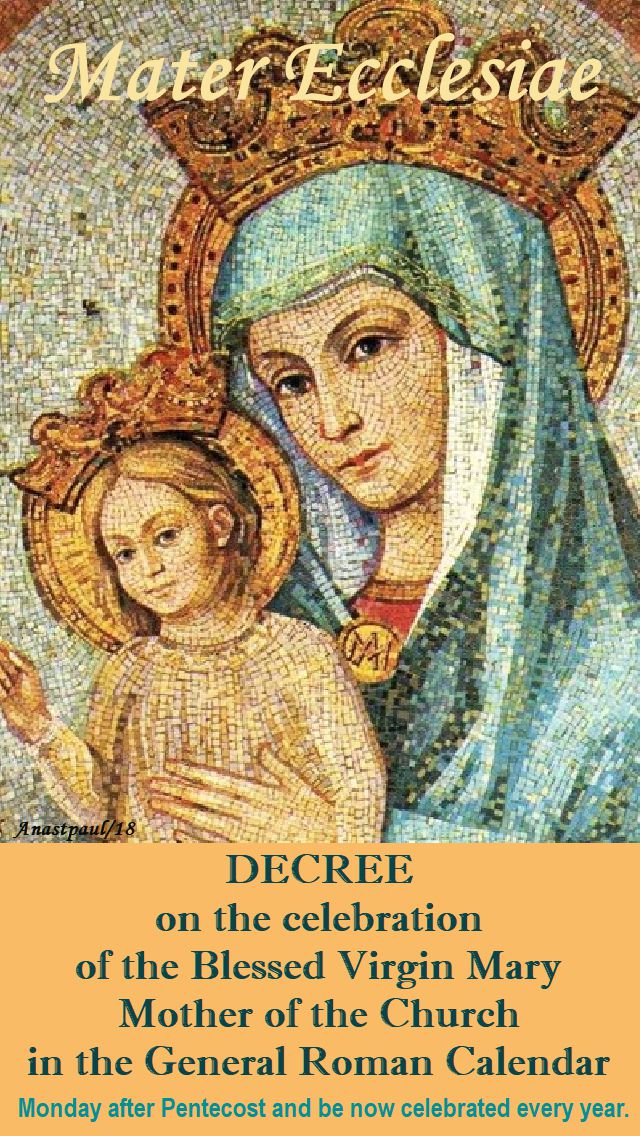
DECREE
on the celebration
of the Blessed Virgin Mary
Mother of the Church
in the General Roman Calendar

The joyous veneration given to the Mother of God by the contemporary Church, in light of reflection on the mystery of Christ and on his nature, cannot ignore the figure of a woman (cf. Gal 4:4), the Virgin Mary, who is both the Mother of Christ and Mother of the Church.

In some ways this was already present in the mind of the Church from the premonitory words of Saint Augustine and Saint Leo the Great.   In fact the former says that Mary is the mother of the members of Christ, because with charity she co-operated in the rebirth of the faithful into the Church, while the latter says that the birth of the Head is also the birth of the body, thus indicating that Mary is at once Mother of Christ, the Son of God, and mother of the members of his Mystical Body, which is the Church.   These considerations derive from the divine motherhood of Mary and from her intimate union in the work of the Redeemer, which culminated at the hour of the cross.

Indeed, the Mother standing beneath the cross (cf. Jn 19:25), accepted her Son’s testament of love and welcomed all people in the person of the beloved disciple as sons and daughters to be reborn unto life eternal.   She thus became the tender Mother of the Church which Christ begot on the cross handing on the Spirit.   Christ, in turn, in the beloved disciple, chose all disciples as ministers of his love towards his Mother, entrusting her to them so that they might welcome her with filial affection.

As a caring guide to the emerging Church, Mary had already begun her mission in the Upper Room, praying with the Apostles while awaiting the coming of the Holy Spirit (cf. Acts 1:14).   In this sense, in the course of the centuries, Christian piety has honoured Mary with various titles, in many ways equivalent, such as Mother of Disciples, of the Faithful, of Believers, of all those who are reborn in Christ and also as “Mother of the Church” as is used in the texts of spiritual authors as well as in the Magisterium of Popes Benedict XIV and Leo XIII.

Thus the foundation is clearly established by which Blessed Paul VI, on 21 November 1964, at the conclusion of the Third Session of the Second Vatican Council, declared the Blessed Virgin Mary as “Mother of the Church, that is to say of all Christian people, the faithful as well as the pastors, who call her the most loving Mother” and established that “the Mother of God should be further honoured and invoked by the entire Christian people by this tenderest of titles”.

Therefore the Apostolic See on the occasion of the Holy Year of Reconciliation (1975), proposed a votive Mass in honour of Beata Maria Ecclesiæ Matre, which was subsequently inserted into the Roman Missal.   The Holy See also granted the faculty to add the invocation of this title in the Litany of Loreto (1980) and published other formularies in the Collection of Masses of the Blessed Virgin Mary (1986).   Some countries, dioceses and religious families who petitioned the Holy See were allowed to add this celebration to their particular calendars.

Having attentively considered how greatly the promotion of this devotion might encourage the growth of the maternal sense of the Church in the pastors, religious and faithful, as well as a growth of genuine Marian piety, Pope Francis has decreed that the Memorial of the Blessed Virgin Mary, Mother of the Church, should be inscribed in the Roman Calendar on the Monday after Pentecost and be now celebrated every year.

This celebration will help us to remember that growth in the Christian life must be anchored to the Mystery of the Cross, to the oblation of Christ in the Eucharistic Banquet and to the Mother of the Redeemer and Mother of the Redeemed, the Virgin who makes her offering to God.

The Memorial therefore is to appear in all Calendars and liturgical books for the celebration of Mass and of the Liturgy of the Hours.   The relative liturgical texts are attached to this decree and their translations, prepared and approved by the Episcopal Conferences, will be published after confirmation by this Dicastery.

Where the celebration of the Blessed Virgin Mary, Mother of the Church, is already celebrated on a day with a higher liturgical rank, approved according to the norm of particular law, in the future it may continue to be celebrated in the same way.

Anything to the contrary notwithstanding.

From the Congregation of Divine Worship and the Discipline of the Sacraments, 11 February 2018, the memorial of the Blessed Virgin Mary of Lourdes.

Robert Card. Sarah
Prefect

+ Arthur Roche
Archbishop Secretarydecree - mater ecclesiae - new memorial monday after pentecost - 4 march 2018

Posted in CATHOLIC DEVOTIONS of the Month, LENT, MORNING Prayers, NOVENAS, St JOSEPH

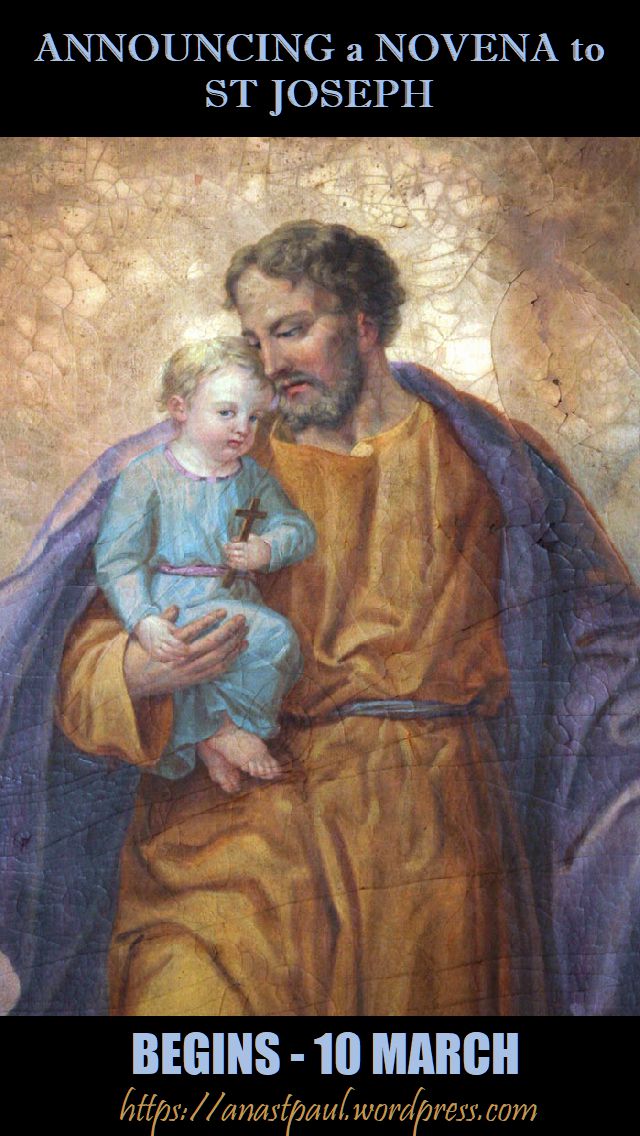
Announcing a Novena to St Joseph Patron of the Universal Church Begins – 10 March

In 1989, St Pope John Paul, in his Apostolic Exhortation Redemptoris Custos (Guardian of the Redemeemer), said:

“…may all grow in devotion to the Patron of the Universal Church and in love for the Saviour whom he served in such an exemplary manner … In this way the whole Christian people not only will turn to St Joseph with greater fervour and invoke his patronage with trust but also will always keep before their eyes his humble, mature way of serving and of “taking part” in the plan of salvation.”

St Joseph plays a prominent part in popular devotion:   in numerous popular traditions; the custom of reserving Wednesdays for devotion to St. Joseph — popular at least since the end of the seventeenth century — has generated several pious exercises including that of the Seven Wednesdays;  in the pious aspirations made by the faithful;  in prayers such as that of Pope Leo XIII, Ad te, Beate Ioseph, which is daily recited by the faithful;  in the Litany of St Joseph, approved by St. Pope Pius X;  and in the recitation of the Chaplet of St Joseph, recollecting the Seven agonies and seven joys of St. Joseph.

That the solemnity of St Joseph falls in Lent, when the Church concentrates her attention on preparation for Baptism and the memorial of the Lord’s Passion, inevitably gives rise to an attempt to harmonise the Liturgy and popular piety.   Hence, the traditional practices of a “month of St. Joseph” should be synchronised with the liturgical Year. Indeed, the liturgical renewal movement attempted to instil among the faithful a realisation of the importance of the meaning of Lent.   Where the necessary adaptations can be made to the various expressions of popular piety, devotion to St Joseph should naturally be encouraged among the faithful who should be constantly reminded of the “singular example […] which, surpassing all states of life, should be recommended to the entire Christian community, whatever their condition or rank.”…Directory on Popular Piety and the Liturgy

St Joseph, pray for us!announcing a novena to st joseph - begins 10 march - 5 march 2018

Posted in CATHOLIC DEVOTIONS of the Month, CATHOLIC-PRAYERS OF THE CHURCH, MORNING Prayers, PRAYERS for VARIOUS NEEDS, PRAYERS of the CHURCH, SAINT of the DAY, St JOSEPH, THE HOLY FAMILY - FAMILIAE SANCTAE

Catholic Devotion for the Month: March is the Month of St Joseph!

Devotion for March
St Joseph

The month of March is dedicated to St Joseph.   Joseph was the husband of the Blessed Virgin Mary and the foster-father of Jesus.   Holy Scripture proclaims him as a “just man” and the Church has turned to Joseph for his patronage and protection.   Pope Leo XIII in his encyclical Quamquam Pluries (On the Devotion to St Joseph) in 1889 explains why we place so much trust in this saint:

“Thus in giving Joseph the Blessed Virgin as spouse, God appointed him to be not only her life’s companion, the witness of her maidenhood, the protector of her honor, but also, by virtue of the conjugal tie, a participator in her sublime dignity. And Joseph shines among all mankind by the most august dignity, since by divine will, he was the guardian of the Son of God and reputed as His father among men.

Hence it came about that the Word of God was humbly subject to Joseph, that He obeyed him, and that He rendered to him all those offices that children are bound to render to their parents. From this two-fold dignity flowed the obligation which nature lays upon the head of families, so that Joseph became the guardian, the administrator, and the legal defender of the divine house whose chief he was. And during the whole course of his life he fulfilled those charges and those duties.

…It is, then, natural and worthy that as the Blessed Joseph ministered to all the needs of the family at Nazareth and girt it about with his protection, he should now cover with the cloak of his heavenly patronage and defend the Church of Jesus Christ.”march devotion - st joseph - 1 march 2018

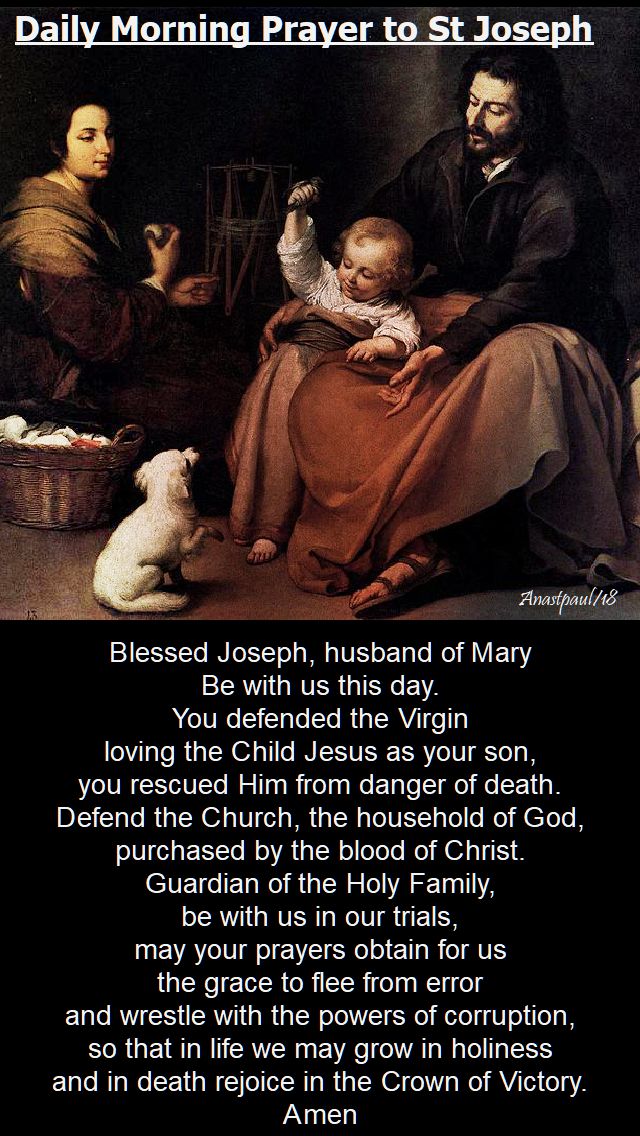
Daily Morning Prayer to St Joseph

Blessed Joseph, husband of Mary
Be with us this day.
You defended the Virgin
loving the Child Jesus as your son,
you rescued Him from danger of death.
Defend the Church, the household of God,
purchased by the blood of Christ.
Guardian of the Holy Family,
be with us in our trials,
may your prayers obtain for us
the grace to flee from error
and wrestle with the powers of corruption,
so that in life we may grow in holiness
and in death rejoice in the Crown of Victory.
Amendaily morning prayer to st joseph - 1 march 2018

Posted in MORNING Prayers, PRAYERS for VARIOUS NEEDS, PRAYERS of the CHURCH

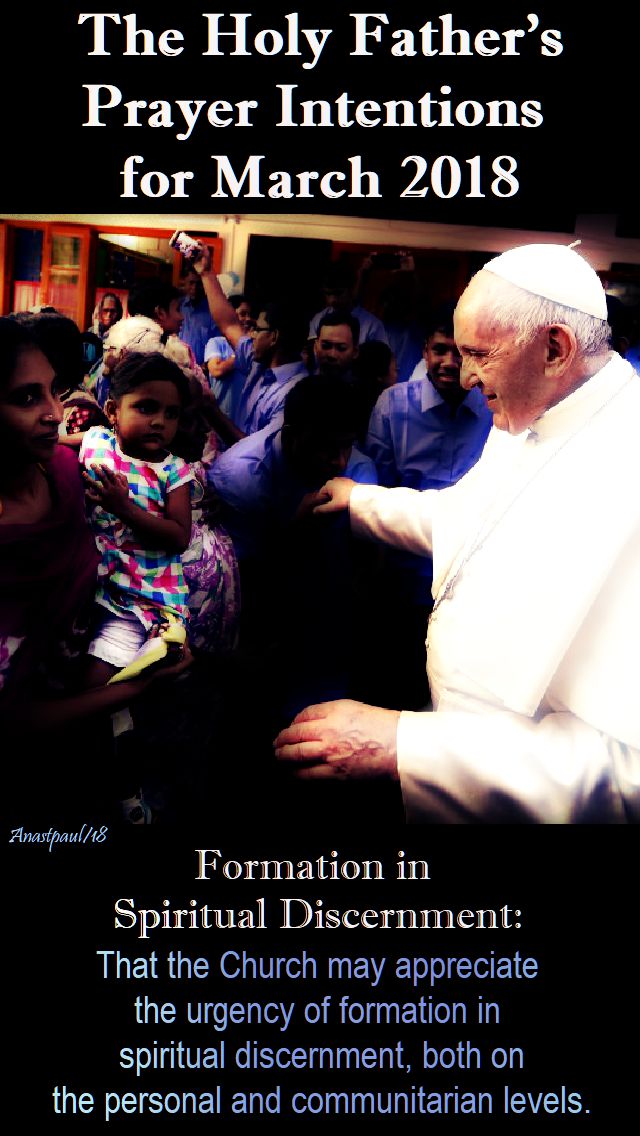
The Holy Father’s Prayer Intentions for March 2018

The Holy Father’s
Prayer Intentions for March 2018

Formation in Spiritual Discernment

That the Church may appreciate the urgency of formation in

spiritual discernment, both on the personal and communitarian levels.the holy father's prayer intentions for march 2018

A Living Message of God

1. The joy of the gospel fills the hearts and lives of all who encounter Jesus.   Those who accept His offer of salvation are set free from sin, sorrow, inner emptiness and loneliness.   With Christ joy is constantly born anew.   In this Exhortation I wish to encourage the Christian faithful to embark upon a new chapter of evangeliSation marked by this joy, while pointing out new paths for the Church’s journey in years to come.

115. The People of God is incarnate in the peoples of the earth, each of which has its own culture.   The concept of culture is valuable for grasping the various expressions of the Christian life present in God’s people.   It has to do with the lifestyle of a given society, the specific way in which its members relate to one another, to other creatures and to God. Understood in this way, culture embraces the totality of a people’s life.   Each people in the course of its history develops its culture with legitimate autonomy.   This is due to the fact that the human person, “by nature stands completely in need of life in society” and always exists in reference to society, finding there a concrete way of relating to reality. The human person is always situated in a culture: “nature and culture are intimately linked”.   Grace supposes culture and God’s gift becomes flesh in the culture of those who receive it.

117. When properly understood, cultural diversity is not a threat to Church unity.   The Holy Spirit, sent by the Father and the Son, transforms our hearts and enables us to enter into the perfect communion of the blessed Trinity, where all things find their unity.   He builds up the communion and harmony of the people of God.   The same Spirit is that harmony, just as He is the bond of love between the Father and the Son.   It is He who brings forth a rich variety of gifts, while at the same time creating a unity which is never uniformity but a multifaceted and inviting harmony.   Evangelisation joyfully acknowledges these varied treasures which the Holy Spirit pours out upon the Church. We would not do justice to the logic of the incarnation if we thought of Christianity as monocultural and monotonous.   While it is true that some cultures have been closely associated with the preaching of the Gospel and the development of Christian thought, the revealed message is not identified with any of them;  its content is transcultural. Hence in the evangelisation of new cultures, or cultures which have not received the Christian message, it is not essential to impose a specific cultural form, no matter how beautiful or ancient it may be, together with the Gospel.   The message that we proclaim always has a certain cultural dress but we in the Church can sometimes fall into a needless hallowing of our own culture and thus show more fanaticism than true evangelising zeal…EVANGELII GAUDIUM OF THE HOLY FATHER, FRANCIS

Reflection:  The Holy Father says that the expression of truth can take different forms.   In the same way that each individual member of the community needs to re-examine themselves and critically establish if we are not too set in our ways, in practising and promoting customs, which are no longer relevant and also labelling any changes within the Church, as wrong and undesirable.   The message of God remains the same – that really is all that matters.   However, the manner in which we express and live it, has to adapt to the society and culture that is being addressed.   Let us keep an open heart and mind always and know, that where we are in the world, is not where my brother or sister, in the Mystical Body, is!

Posted in NOTES to Followers

Apologies

Apologies for my hasty exodus.

My departure has caught me completely by surprise!   I am so sorry but I leave tomorrow for my annual Retreat and have prepared absolutely nothing as yet!

So no posts today I am afraid.   I will be back in +- 10 days.

I will be praying for you all!   Keep on keeping on.gone on retreat - 1 march 2018- NO 2

Posted in SAINT of the DAY

Memorials of the Saints – 1 March

St Abdalong of Marseilles
St Adrian of Numidia
St Agapios of Vatopedi
St Agnes Cao Guiying
St Albinus of Angers
St Albinus of Vercelli
St Amandus of Boixe
St Antonina of Bithynia
Bl Aurelia of Wirberg
Bl Bonavita of Lugo
St Bono of Cagliari
Bl Christopher of Milan
Bl Claudius Gabriel Faber
St David of Wales (c 542-c 601)
St Domnina of Syria
St Donatus of Carthage
St Eudocia of Heliopolis
St Felix III, Pope
Bl George Biandrate
Bl Giovanna Maria Bonomo
Bl Gonzalo de Ubeda
St Hermes of Numidia
St Jared the Patriarch
St Leo of Rouen
St Leolucas of Corleone
St Lupercus
St Marnock
St Monan
Bl Pietro Ernandez
Bl Roger Lefort
St Rudesind
St Seth the Patriarch
St Simplicius of Bourges
St Siviard
St Swithbert
St Venerius of Eichstätt

Martyrs of Africa – A group of 13 Christians executed together for their faith in Africa. The only details about them to survive are ten names – Abundantius, Adrastus, Agapius, Charisius, Donatilla, Donatus, Fortunus, Leo, Nicephorus and Polocronius. c290

Martyrs of Antwerp – A group of Christians martyred together, buried together and whose relics were transferred and enshrined together. We know nothing else but their names – Benignus, Donatus, Felician, Fidelis, Filemon, Herculanus, Julius, Justus, Maximus, Pelagius, Pius, Primus, Procopius and Silvius. Died in the 2nd Century in Rome. They are buried in the St Callistus Catacombs and their relics were enshirned in the Jesuit Church in Antwerp on 28 February 1600.

Martyrs of the Salarian Way – A group of 260 Christians who, for their faith, were condemned to road work on the Salarian Way in Rome, Italy during the persecutions of Claudius II. When they were no longer needed for work, they were publicly murdered in the amphitheatre. Martyrs. c269 in Rome.

Martyrs Under Alexander – A large but unspecified number of Christians martyred in the persecutions of Emperor Alexander Severus and the praefect Ulpian who saw any non-state religion to be a dangerous treason. c219

Posted in LENT, MORNING Prayers, PRAYERS of the SAINTS, QUOTES of the SAINTS, QUOTES on CONVERSION, QUOTES on FAITH, QUOTES on LOVE, QUOTES on OBEDIENCE, QUOTES on SANCTITY, QUOTES on TRUST and complete CONFIDENCE in GOD, The WORD

Lenten Reflection – 28 February 2018 – Wednesday of the Second Week of Lent

Lenten Reflection – 28 February 2018 – Wednesday of the Second Week of Lent

Jeremiah 18:18-20, Psalms 31:5-6, 14-16, Matthew 20:17-28

Jeremiah 18:18-19 – Then they said, “Come, let us make plots against Jeremiah, for the law shall not perish from the priest, nor counsel from the wise, nor the word from the prophet. Come, let us smite him with the tongue and let us not heed any of his words.” Give heed to me, O LORD and hearken to my plea.

Psalm 31:5 & 13-14 – Into thy hand I commit my spirit; thou hast redeemed me, O LORD, faithful God. Yea, I hear the whispering of many – terror on every side! – as they scheme together against me, as they plot to take my life. But I trust in thee, O LORD, I say, “Thou art my God.”

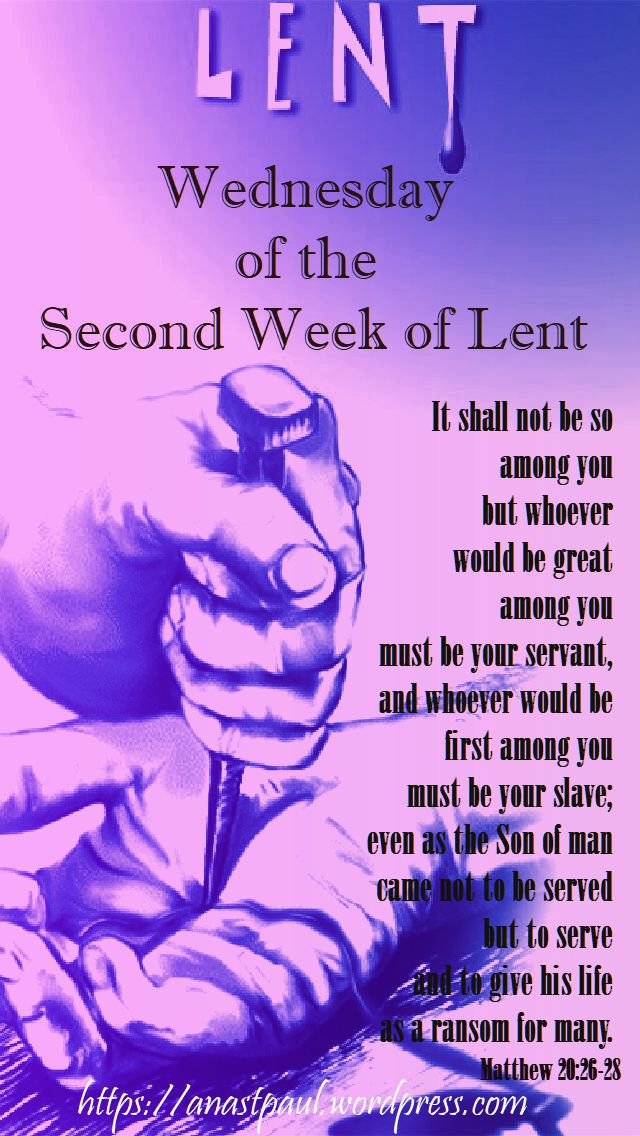
Matthew 20:26-28 – It shall not be so among you; but whoever would be great among you must be your servant, and whoever would be first among you must be your slave; even as the Son of man came not to be served but to serve and to give his life as a ransom for many.”wed of the second week - 28 feb 2018

There are several ways in which we can get things wrong on our journey to God and this season of Lent is a good time to become aware of them.

Firstly, we must not be taken by surprise if trying to follow God’s lead brings us persecution and hatred. Jeremiah in today’s first reading is not at all pleased with this state of affairs and is quite firm in his demands that his God should rescue him.

The psalmist is facing a similar situation (“terror all aound me”) and he is not exactly delighted that his life is in danger. However, he does not make any complaints, simply places his life confidently into the hands of God.

In the Gospel, Jesus is for the third time privately predicting to his slightly dim-witted disciples (though it is easy for us at this distance to second-guess the disciples – you? me? – have we done any better?) what is going to happen to Him and it is at least, as bas as what faces Jermiah, except for the last part of the prediction, which we hardly ever notice “and on the third day he will be raised.” That, however, is not what goes wrong. The failure on the part of His hearers is that of the mother of the sons of Zebedee. So James and John have to have it explained to them that Jesus’ way is the way of death.

Not that the other apostles are any better and now it is their turn to get things wrong, as they turn crossly on the two brothers. This is presumably not because they are shocked that James and John had so radically misunderstood Jesus but because, they had got ahead in the power-game.

For, the odd thing is – and at this point in Lent we shall do well to remind ourselves of it – that we are following a Lord who came not to be served but to serve – and to give His life!

On my journey to the Resurrection, do I trust God despite the difficulties I encounter?
Are there times in my life where I exercise power over others and delight in it?
Am I really one who serves?

Fr Nicholas King – The Lenten Journey to Easter

Loyalty to You 
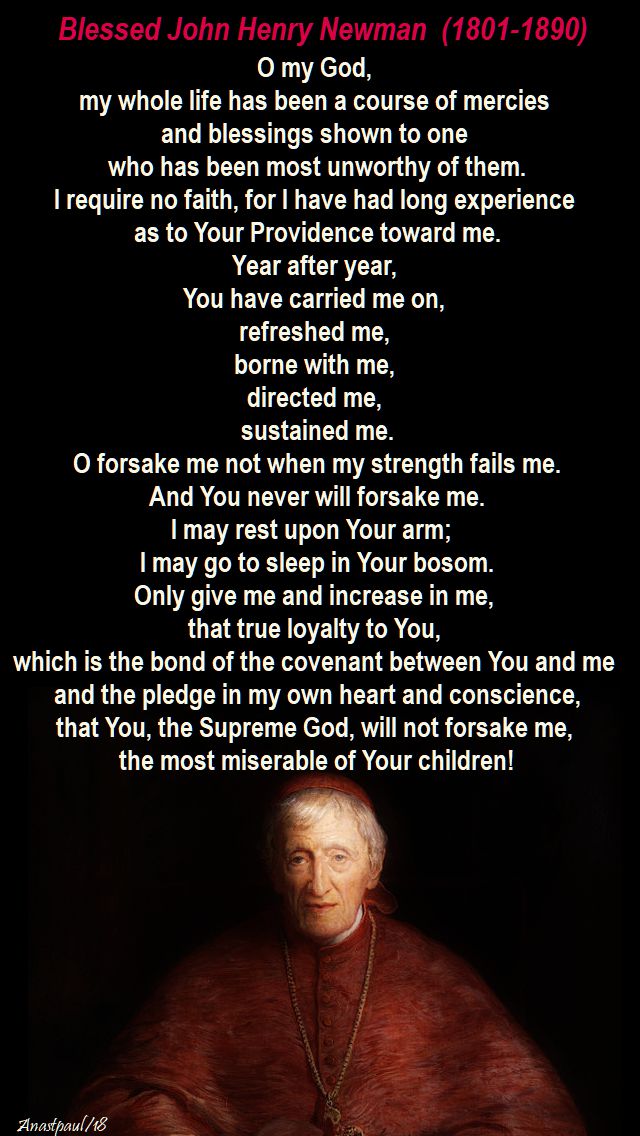
Blessed John Henry Newman (1801-1890)

O my God, my whole life has been a course of mercies and blessings shown to one who has been most unworthy of them.
I require no faith, for I have had long experience as to Your Providence toward me.
Year after year, You have carried me on, refreshed me, borne with me, directed me, sustained me.
O forsake me not when my strength fails me.
And You never will forsake me.
I may rest upon Your arm; I may go to sleep in Your bosom.
Only give me and increase in me, that true loyalty to You, which is the bond of the covenant between You and me and the pledge in my own heart and conscience that You, the Supreme God, will not forsake me, the most miserable of Your children!o my god, my whole life - bl john henry newman - 28 feb 2018

Posted in GOD the FATHER, LENT, MORNING Prayers, QUOTES - J R R Tolkien and MORE, QUOTES on CONVERSION, QUOTES on FAITH, QUOTES on LOVE, QUOTES on REPENTANCE, QUOTES on SANCTITY, QUOTES on SUFFERING, The HOLY CROSS, The PASSION, The WORD

Thought for the Day – 28 February 2018 – Wednesday of the Second Week of Lent

Thought for the Day – 28 February 2018 – Wednesday of the Second Week of Lent

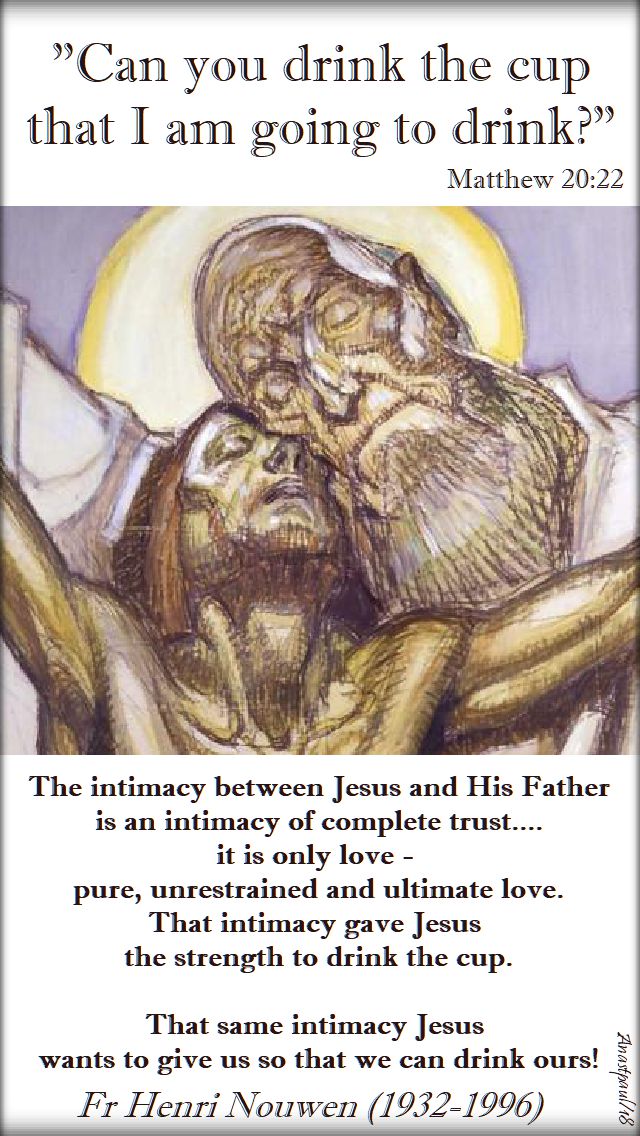
“The cup that Jesus speaks about is neither a symbol of death nor a symbol of victory.
It is a symbol of life, filled with sorrows and joys, that we can hold, lift and drink
as a blessing and a way to salvation. “Can you drink the cup that I am going to drink?”,
Jesus asks us. It is a question that will have a different meaning every day of our lives.
Can we embrace fully the sorrows and joys that come to us day after day?

Drinking the cup that Jesus drank is living a life in and with the spirit of Jesus, which is
the spirit of unconditional love. The intimacy between Jesus and His Father is an
intimacy of complete trust….it is only love – pure, unrestrained and ultimate love.
That intimacy gave Jesus the strength to drink the cup.

That same intimacy Jesus wants to give us so that we can drink ours!”

Fr Henri Nouwen (1932-1996) (Can you drink the Cup)the intimacy between jesus and his father - 28 feb 2018-henri nouwen

Posted in LENT, MORNING Prayers, QUOTES of the SAINTS, QUOTES on LOVE, QUOTES on SUFFERING, Uncategorized

Quote of the Day – 28 February 2018 – Wednesday of the Second Week of Lent

Quote of the Day – 28 February 2018 – Wednesday of the Second Week of Lent

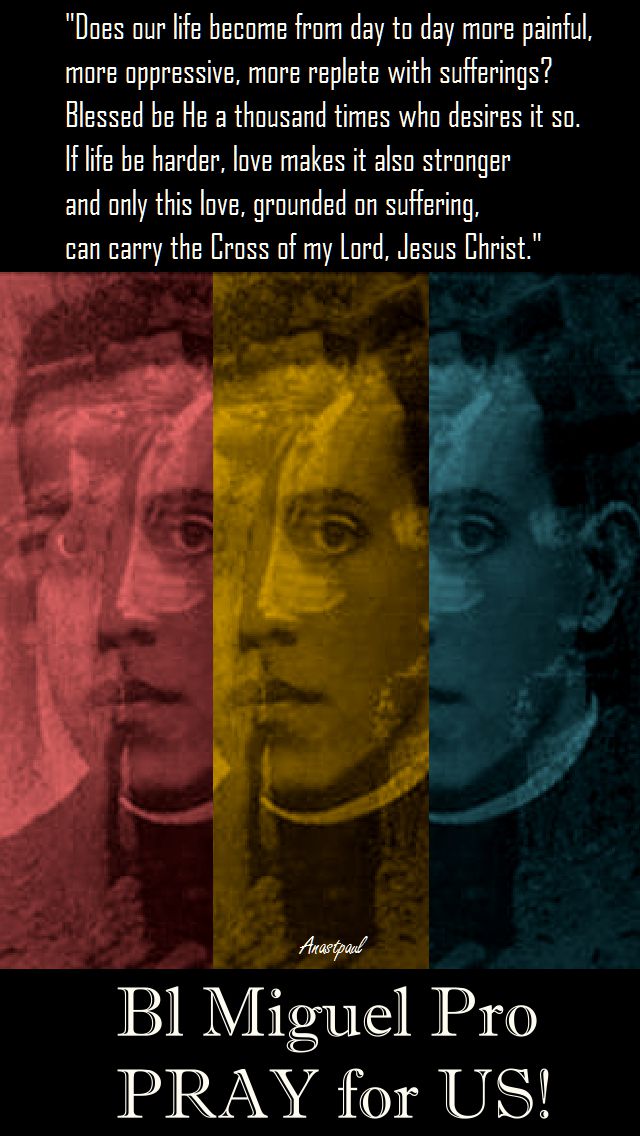
“Does our life become from day to day more painful,
more oppressive, more replete with sufferings?
Blessed be He a thousand times who desires it so.
If life be harder, love makes it also stronger 
and only this love, grounded on suffering,
can carry the Cross of my Lord, Jesus Christ.”

Blessed Miguel Pro – Martyr (1891-1927)DOES OUR LIFE BECOME-BL MIGUEL PRO

Posted in franciscan OFM, LENT, MORNING Prayers, QUOTES on FAITH, QUOTES on LOVE, QUOTES on SANCTITY, QUOTES on SUFFERING, SACRED and IMMACULATE HEARTS, SAINT of the DAY, The PASSION, The WORD

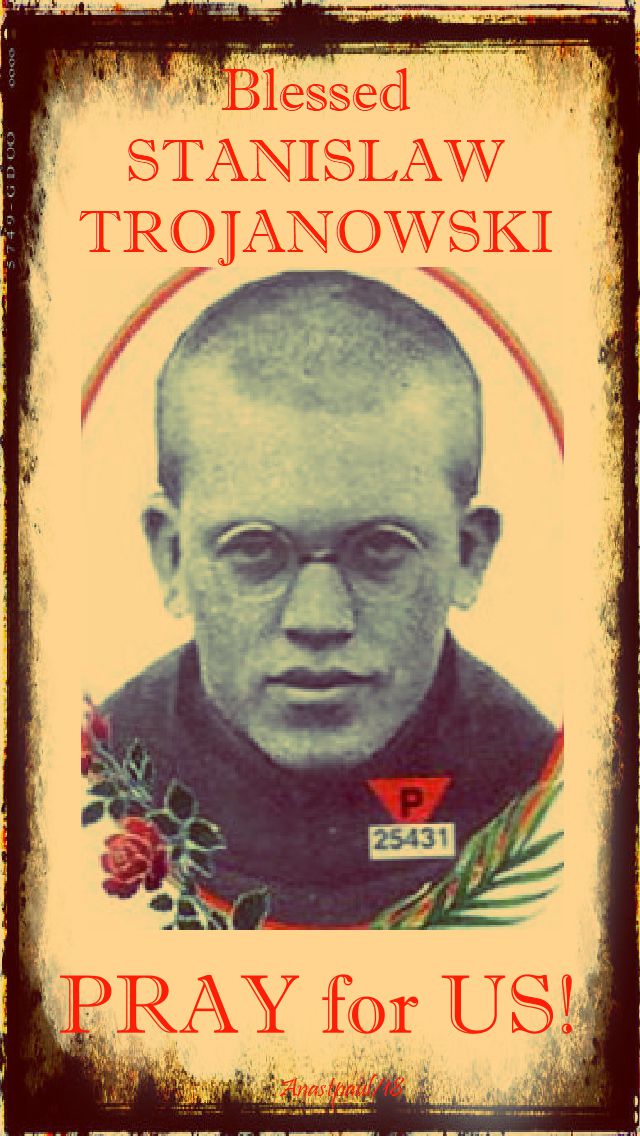
One Minute Reflection – 28 February 2018 – Wednesday of the Second Week of Lent and the Memorial of Blessed Stanislaw Antoni Trojanowski (1908-1942) Martyr

One Minute Reflection – 28 February 2018 – Wednesday of the Second Week of Lent and the Memorial of Blessed Stanislaw Antoni Trojanowski (1908-1942) Martyr

But Jesus answered, “You do not know what you are asking. Are you able to drink the cup that I am to drink?”…Matthew 20:22

REFLECTION – “The task of the heart is self-preservation, holding together what is its own.   The pierced Heart of Jesus has truly… overturned this definition.   This Heart is not concerned with self-preservation but with self-surrender.   It saves the world by opening itself.   The collapse of the opened Heart is the content of the Easter Mystery.   The Heart saves, indeed, but it saves, by giving itself away.”…Pope Benedict XVIthe task of the heart is self-preservation - pope benedict xvi - 28 feb 2018

PRAYER – We give You thanks Holy God and Father, for sending us Your Son to teach us how to love, to teach us that only in giving ourselves may we receive ourselves.   Our hearts are made of stone but You O God, can turn them into flesh and teach us to open our hearts completely to the way of the Cross.   May the Martyr Blessed Stanislaw Trojanowski, offer his prayers for us, as we strive to learn, as he did, this way our Lord taught us.   Through Jesus Christ, Your Son, in the unity of the Holy Spirit, one God forever, amen.bl stanislaw trojanowski pray for us - 28 feb 2018

Posted in LENT, MORNING Prayers, PRAYERS of the SAINTS, QUOTES on SUFFERING, SACRED and IMMACULATE HEARTS

Our Morning Offering – 28 February 2018 – Wednesday of the Second Week of Lent

Our Morning Offering – 28 February 2018 – Wednesday of the Second Week of Lent

Heart Of Jesus
By Blessed Miguel Pro – Martyr (1891-1927)

I believe, O Lord
but strengthen my faith,
Heart of Jesus, I love Thee
but increase my love.
Heart of Jesus, I trust in Thee,
but give greater vigour
to my confidence.
Heart of Jesus,
I give my heart to Thee,
but so enclose it in Thee
that it may never
be separated from Thee.
Heart of Jesus, I am all Thine,
but take care of my promise
so that I may be able
to put it into practice even unto
the complete sacrifice of my life.
Amenheart of jesus - bl miguel pro - 28 feb 2018

Posted in SAINT of the DAY, VATICAN Resources

Saint of the Day – 28 February – Blessed Stanislaw Antoni Trojanowski (1908-1942) Martyr

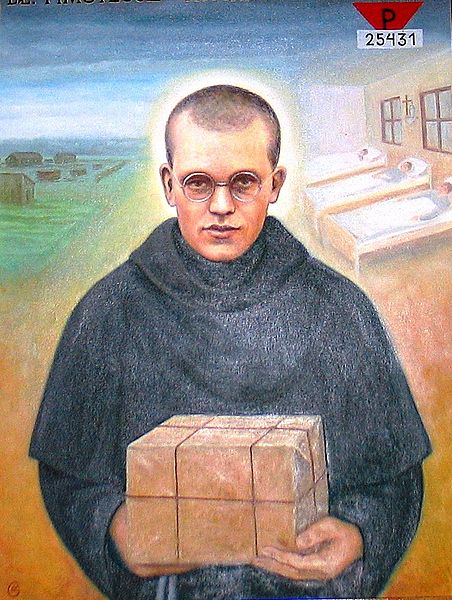
Saint of the Day – 28 February – Blessed Stanislaw Antoni Trojanowski (1908-1942) Martyr  and Religious Brother – also known as:  Tymoteusz, Timoteo Trojanowski, Stanislaw Tymoteusz Trojanowski,   prisoner 25431.   Born on 29 July 1908 in Sadlowo, Mazowieckie, diocese of Plock, Poland – 28 February 1942 in the death camp hospital at Oswiecim (Auschwitz), Malopolskie, Nazi-occupied Poland of pneumonia.   He was Beatified on 13 June 1999 by St Pope John Paul II.

452px-Stanisław_Tymoteusz_Trojanowski

In the Auschwitz death camp near Krakow in Poland, Blessed Timoteusz Trojanowski, a Brother of the Order of Friars Minor Conventual and martyr, who, during the domination of his homeland under a regime hostile to humanity and religion, exhausted by tortures suffered for confessing his Christian faith, brought to fruition his martyrdom.

Stanislaw Antoni was born 29 July 1908 in the village of Sadlowo, in the diocese of Plock, parents and Ignacy Franciszka Zebkiewicz.   The precarious economic situation of the family led him to work from an early age.   This involved poor attendance at primary school.   On 5 March 1930 he entered the convent of Friars Minor Conventual and Niepokalanow (founded by St Maximillian Kolbe) and on 6 January 1931 he was able to begin his novitiate with the name of Tymoteusz.   He made a simple profession of vows on 2 February 1932 and professed his solemn vows on 11 February 1935.   His whole religious life was held in Niepokalanow, working in the shipping department of the magazine “Knights of the Immaculate Conception” in the warehouse and infirmary, where he devoted himself to the sick brethren.

On 3 May 1937, he reported to his superior his wish to go on a mission “anywhere, anytime, provided the will of God.”

He was disciplined and faithful to his vocation, had great confidence on the part of his famous superior, Father Kolbe.

With the outbreak of World War II in 1939, he chose to remain at Niepokalanow.   On 14 October 1941 he was arrested by the Gestapo with six brothers, including a Friar Bonifacy and locked up in prison in Warsaw because they were Catholics.   In prison he was able to devote much time to prayer, bolstering the courage to others.

On 8 January 1942 he was again deported with Bonifacy to the concentration camp of Oswiecim with the number 25431.   He was originally intended for the transport of construction materials, then the excavation and transport of gravel and finally to the collection of rapeseed.   He endured, with great courage, the hunger, cold and hard work.   He never lost heart, always encouraging others to trust in the protection of God.   The cold caused the pneumonia that led to his death in the hospital at the death camp on 28 February 1942.   (From the translated Roman Martyrology)

img-Blessed-Stanislaw-Antoni-Trojanowski

Posted in SAINT of the DAY

Memorials of the Saints – 28 February

St Abercius
Bl Antonia of Florence
St Augustus Chapdelaine
St Caerealis
St Caerealis of Alexandria
St Cyra of Beroea
Bl Daniel Brottier
St Ermine
St Gaius of Alexandria
St Pope Hilary/Hilarius
St Justus the Potter
St Llibio
St Macarius the Potter
St Maidoc
St Marana of Beroea
St Oswald of Worcester
St Proterius of Alexandria
St Pupulus of Alexandria
St Romanus of Condat
St Ruellinus of Treguier
St Rufinus the Potter
St Serapion of Alexandria
St Sillan of Bangor
Bl Stanislaw Antoni Trojanowski  (1908-1942) Martyr
St Theophilus the Potter
Bl Villana de’Botti

Martyrs of Alexandria – A number of clerics and layman who died as martyrs of charity for ministering to the sick during a plague that ravaged Alexandria, Egypt in 261.

Martyrs of Unzen – 16 lay people martyred together in one of the periodic anti-Christian persecutions in imperial Japan – They were martyred on 28 February 1627 in Unzen, Japan and Beatified on 24 November 2008 by Pope Benedict XVI.
• Alexius Sugi Shohachi
• Damianus Ichiyata
• Dionisius Saeki Zenka
• Gaspar Kizaemon
• Gaspar Nagai Sohan
• Ioannes Araki Kanshichi
• Ioannes Heisaku
• Ioannes Kisaki Kyuhachi
• Leo Nakajima Sokan
• Ludovicus Saeki Kizo
• Ludovicus Shinzaburo
• Maria Mine
• Paulus Nakajima
• Paulus Uchibori Sakuemon
• Thomas Kondo Hyoemon
• Thomas Uzumi Shingoro

Posted in DOCTORS of the Church, GOD the FATHER, LENT, MORNING Prayers, QUOTES of the SAINTS, QUOTES on CONVERSION, QUOTES on FAITH, QUOTES on HUMILITY, QUOTES on LOVE, QUOTES on MERCY, QUOTES on PRAYER, QUOTES on REPENTANCE, QUOTES on SANCTITY, QUOTES on SIN

Lenten Reflection – 27 February 2018 – Tuesday of the Second Week of Lent, Year B and the Memorial of St Gregory of Narek (950-1003) – Doctor of the Church

Lenten Reflection – 27 February 2018 – Tuesday of the Second Week of Lent, Year B and the Memorial of St Gregory of Narek (950-1003) – Doctor of the Church

Isaiah 1:10, 16-20, Psalms 50:8-9, 16-17, 21, 23, Matthew 23:1-12

Isaiah 1:10 – Hear the word of the Lord, you rulers of Sodom!
Give ear to the teaching of our God, you people of Gomorrah!
Psalm 50:8-9 – I do not reprove you for your sacrifices;
your burnt offerings are continually before me.
I will accept no bull from your house,
nor he-goat from your folds.
Matthew 23:2-3 – “The scribes and the Pharisees sit on Moses’ seat; so practice and observe whatever they tell you but not what they do; for they preach, but do not practice…
All their actions are done to be seen by others, for they broaden their CLERICAL COLLARS and lengthen their CHASUBLES.”tuesday of the second week - 27 feb 2018

God often works by shocking us (otherwise we should drift into comfortable complacency).   Today’s readings are very shocking indeed.
First of all you have Isaiah calling the religious leaders of his time and place “rulers of Sodom” and his compatriots, ‘peoples of Gomorrah” and as they digest this he bellows at them:  “Wash! Make yourselves clean!” and reminds them – that is us of course, of how much they have got wrong and how much they have still to put right.
But there is hope, nevertheless, ‘come now, let us reason together’, says God disarmingly.

And the Psalm today offers another shock.   Suddenly, it is the sacrificial system that is thrown into doubt.   God is apparently bored by all these sacrifices – unless they are accompanied by internal reform, they are of not value.   And this Lent, the same applies to all of us, of course!

Finally, the Gospel brings yet another shock, as Jesus lays into the Pharisees and scribes. Now, we must be beware of nodding wisely as we listen and saying ‘quite right Jesus, they had it coming to them’, for the scribes and the Pharisees are you and me, anyone who exercises any kind of Christian leadership and so ‘I have translated the word ‘phylactery’ as ‘clerical collar’ and ‘hem’ as ‘chasuble’.   For all these criticisms can be laid against us all and this Lent we need to look closely at this fact!   (Fr Nicholas King S.J. – Daily Meditations for Lent)

Our task, by contrast, is to ‘humble ourselves’ as Jesus did in the awfulness of the Cross and from that plight it is possible for God to rescue us.

Sometimes we need to be reminded of our failings in order to start that turn back toward God. Many of us are unaware that we are in the pig pen like the prodigal before he realised his state and sought his father’s house.

Where in my life could I be more humble?
Where do I seek recognition, honour or positions of power, perhaps to the detriment of my neighbour?
Has power gone to my head?

YOU HAVE NOT THE TIME!

“We can only find our happiness on earth in loving God and we can only love Him in prayer to Him.   We see that Jesus Christ, to encourage us often to have recourse to Him through prayer, promises never to refuse us anything if we pray for it as we should.   But there is no need to go looking for elaborate and roundabout ways of showing you that we should pray often, for you have only to open your catechism and you will see there that the duty of every good Christian is to pray morning and evening and often during the day — that is to say, always….

Which of us, my dear brethren, could, without tears of compassion, listen to those poor Christians who dare to say that they have not time to pray?   You have not the time!   Poor blind creatures, which is the more precious action:  to strive to please God and to save your soul, or to go out to feed your animals in the stable or to call your children or your servants in order to send them out to till the earth or to tidy up the stable?   Dear God!   How blind man is! …. You have not the time!   But tell me, ungrateful creatures, if God had called you to die that night, would you have exerted yourselves?   If He had sent you three or four months of illness, would you have exerted yourselves?   Go away, you miserable creatures;  you deserve to have God abandon you in your blindness and leave you thus to perish.   We find that it is too much to give Him a few minutes to thank Him for the graces which He is giving us at every instant! ….

You must get on with your work, you say.

That, my dear people, is where you are greatly mistaken.  You have no other work to do except to please God and to save your souls.   All the rest is not your work.   If you do not do it, others will, but if you lose your soul, who will save it?”

St John Vianney (1786-1859)

And now, my heavy laden soul,
what will you do?
You call with your lips and voice to
God most high,
God, who cares only for deeds and
is not taken in by words.
You, my soul, with a heart always turned toward Egypt,
how can I describe you?

Am I
a Sodom, to be punished likewise with destruction, 
or the prosecutor of Ninevah, who was struck dumb? 

Am I
more cowardly and barbarous than the
queen of the south, 
lower than Canaan, 
more stubborn than Amalek,
incurable as the city of idols, 
a relic left behind from the rebellion of Israel,
a reminder of the broken covenant of Judah, 
more reproachable than Tyre, 
more shunned than Zidon, 
more immoral than Galilee,
more unpardonable than faithless Capernaum,
maligned like Korazin, 
slandered like Bethsaida? 

Or am I
immodest as Ephraim as he grayed,
or a dove, whose gentleness seems due to
feeblemindedness and not to inner calm, 
or an evil serpent born of lion’s cubs,
or the serpent’s egg filled with decay,
or like the last blow against Jerusalem?

Or am I
in the words of our Lord
and the sayings of the prophets,
an abandoned tabernacle about to collapse,
the unlatched doors of the stronghold,
my speaking edifice stained again,
having given up my rightful inheritance,
my home built by God,
as Moses, David and Jeremiah prophesied?  
My thinking body now consumed by disease,
afflicted with carping counsel, rehabilitated by the law,
anointed with the clay of mildness,
incapable of finding my own salvation,
torn away from the maker’s hand,
expelled as just punishment
by order of the Almighty, to an unholy place,
rejected, exiled, greatly shunned, nothing spared,
having buried my gift in the ground, 
like the one chastised in the Gospel by
losing his inheritance.

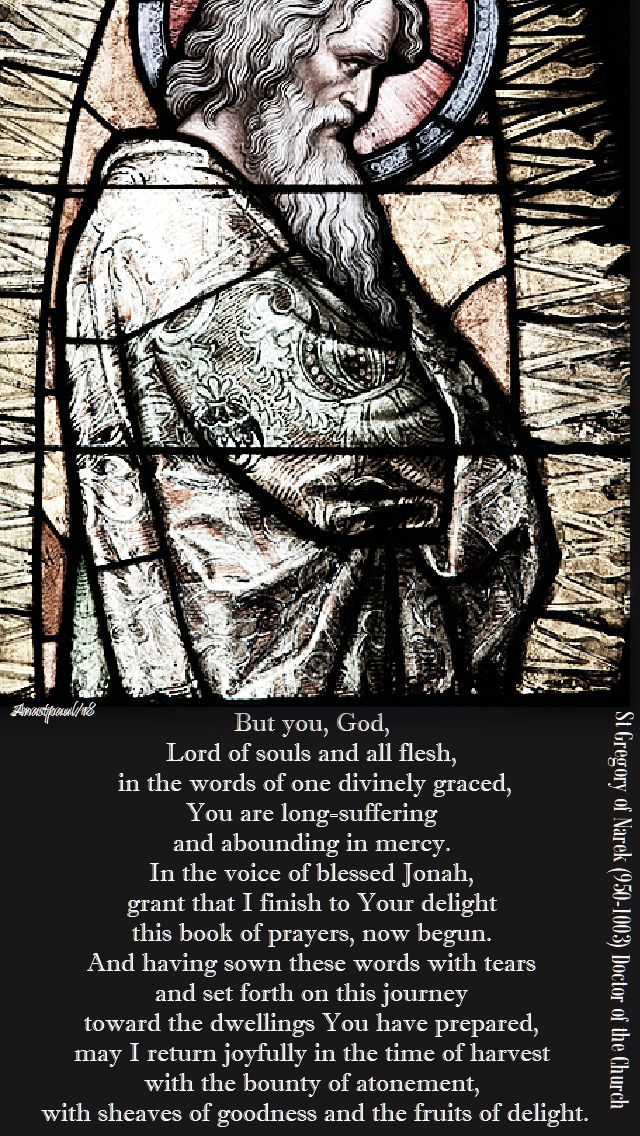
But you, God,
Lord of souls and all flesh,
in the words of one divinely graced, 
You are long-suffering and abounding in mercy.
In the voice of blessed Jonah,
grant that I finish to Your delight
this book of prayers, now begun.
And having sown these words with tears
and set forth on this journey toward the dwellings You have prepared,
may I return joyfully in the time of harvest
with the bounty of atonement,
with sheaves of goodness and the fruits of delight.

St Gregory of Narek (950-1003) – Doctor of the Churchbut you God - st gregory of narek - 27 feb 2018

Posted in DOCTORS of the Church, LENT, MORNING Prayers, QUOTES of the SAINTS, QUOTES on CONVERSION, QUOTES on FAITH, QUOTES on LOVE, QUOTES on MERCY, QUOTES on REPENTANCE, SAINT of the DAY

Thought for the Day – 27 February – The Memorial of St Gregory of Narek (950-1003) – Doctor of the Church and Tuesday of the Second Week of Lent, Year B 2018

Thought for the Day – 27 February – The Memorial of St Gregory of Narek (950-1003) – Doctor of the Church and Tuesday of the Second Week of Lent, Year B 2018

We welcome you, St Gregory of Narek, as our newest Doctor of the Universal Church, with gratitude and joy!
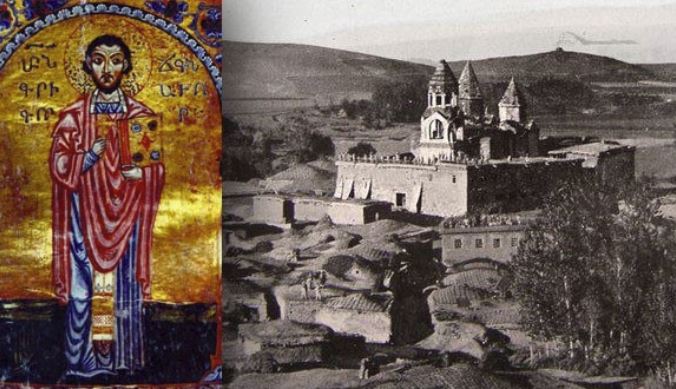
Gregory’s Book of Lamentations was the source of consolation and guidance for generations in times of immense suffering. His monastery survived for a thousand years but was destroyed by the Turks during the genocide.
Armenians lost Narek but they still have the book they call by that name “Narek”, in his honour and many Armenians have traditionally slept with a copy of the work under their pillows.
The words of Gregory, too, are consonant with Pope Francis’ call on all Catholics to reach out to God in our brokenness with humble and contrite hearts.
Perhaps we should allow St Gregory to help us through our Lenten journey this year?
As Gregory wrote in the Lamentations, “Hear the prayers of my embattled heart for mercy, when I cry out to you, ‘Lord,’ in my time of need.”

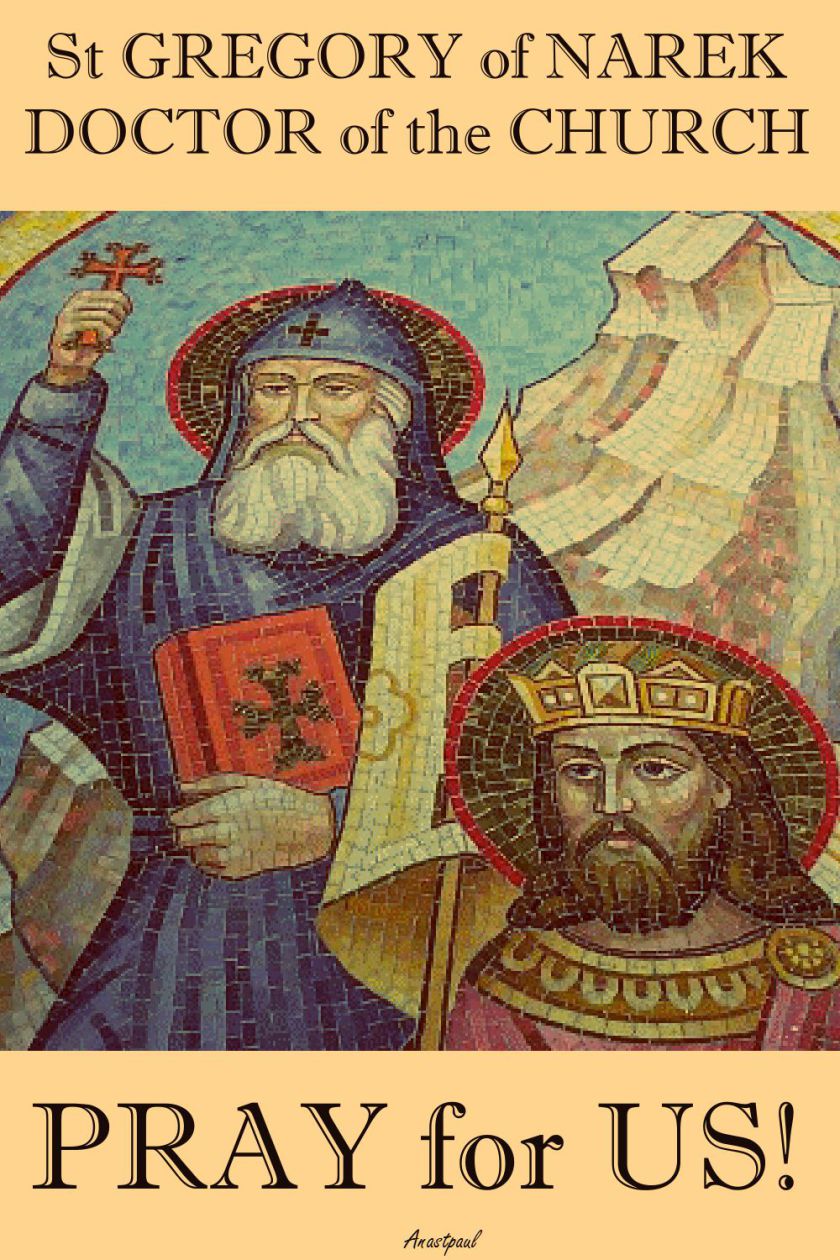
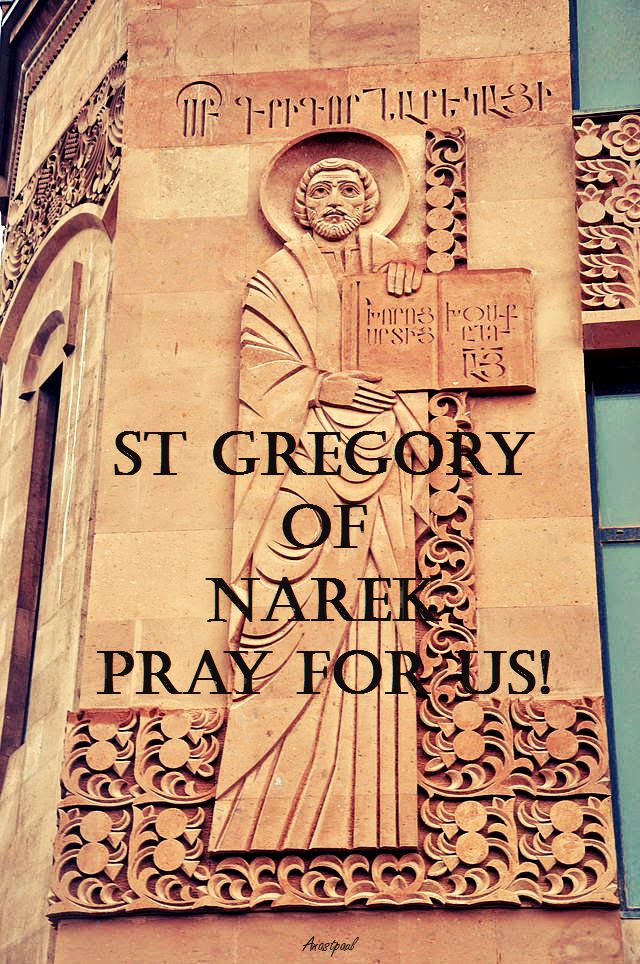
St Gregory of Narek- Doctor of the Universal Church, pray for us!st-gregory-of-narek-pray-for-us-27 feb 2017.2.st-gregory-of-narek-pray-for-us-27 march 2018.3

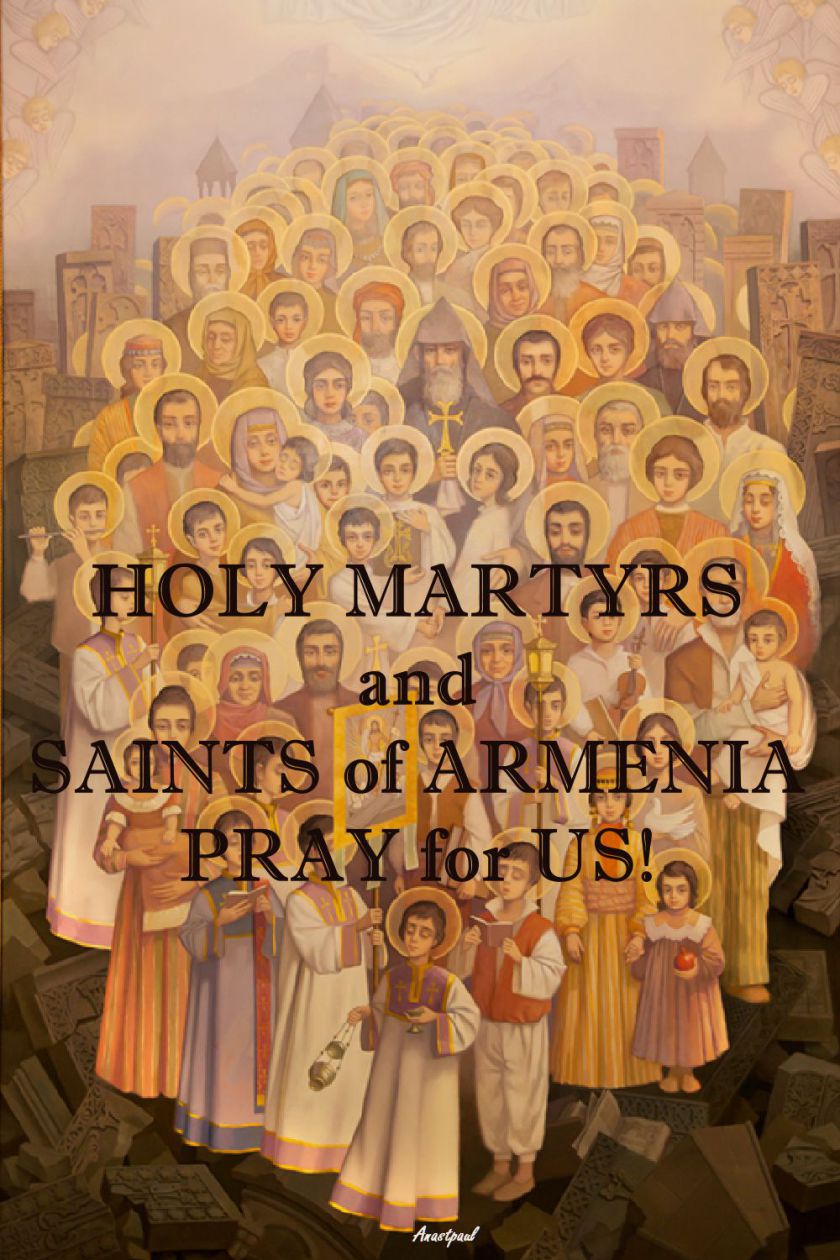
All you Holy Martyrs and Saints of Armenia, pray for us!armenian-martyrs-ico-pray-for-us-27 feb 2017

Posted in DOCTORS of the Church, LENT, MORNING Prayers, QUOTES of the SAINTS, QUOTES on CONVERSION, QUOTES on FAITH, QUOTES on LOVE, QUOTES on SIN, SAINT of the DAY, The GOOD SHEPHERD

Quote of the Day – 27 February – The Memorial of St Gregory of Narek (950-1003) – Doctor of the Church

Quote of the Day – 27 February – The Memorial of St Gregory of Narek (950-1003) – Doctor of the Church

“You found me,
a sinner,
lost in darkness
crying like
the psalmist in prayer,
and because of
Your willing care
you were called Shepherd,
for not only
did You care
but You sought,
not only did You find,
O worker of miracles
but with the goodness
of Your love,
a love that
defies description,
You rescued me,
lifting me upon
Your shoulders,
to set me down alongside
Your heavenly army,
the heirs to
Your fatherly legacy. ”

St Gregory of Narek (Book of Lamentations)you found me a sinner - st gregory of narek - 27 feb 2018

Posted in DOCTORS of the Church, LENT, MORNING Prayers, QUOTES of the SAINTS, QUOTES on FAITH, QUOTES on PRAYER, QUOTES on SANCTITY, SAINT of the DAY, The WORD

One Minute Reflection – 27 February – The Memorial of St Gregory of Narek (950-1003) – Doctor of the Church

One Minute Reflection – 27 February – The Memorial of St Gregory of Narek (950-1003) – Doctor of the Church

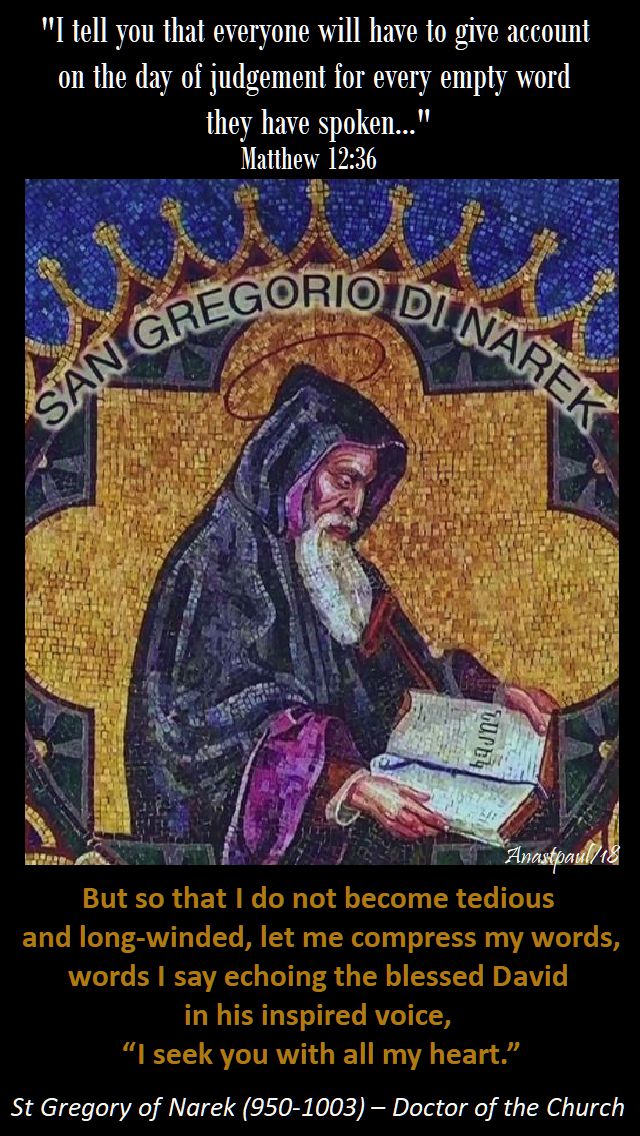
I tell you that everyone will have to give account on the day of judgement for every empty word they have spoken…“…Matthew 12:36.

REFLECTION – “But so that I do not become tedious and long-winded, let me compress my words, words I say echoing the blessed David in his inspired voice, “I seek you with all my heart.”…St Gregory of Narekbut so that i do not become tedious - st gregory of narek - 27 feb 2018

PRAYER – God of goodness, teach us Your ways.   Do not let us waste a moment in futile and worthless words and deeds but help us to seek and to find You.   Grant that by the prayers of St Gregory, we may follow the steps of Your Son, so that we may be found worthy to stand with him and with all the saints, praising You with our hearts and words, amen.st gregory of narek pray for us - 27 feb 2018

Posted in DOCTORS of the Church, MORNING Prayers, PRAYERS of the SAINTS

Our Morning Offering – 27 February – The Memorial of St Gregory of Narek (950-1003) – Doctor of the Church

Our Morning Offering – 27 February – The Memorial of St Gregory of Narek (950-1003) – Doctor of the Church

I Long Not so Much for the Gifts as for the Giver
By St Gregory of Narek (950-1003)

I long not so much for the gifts
as for the Giver.
I yearn not so much for the glory
as the Glorified.
I burn not so much with the desire for life
as in memory of the Giver of Life.
I sigh not so much with the rapture of splendour
as with the heartfelt fervour for its Maker.
I seek not so much for rest
as for the Face of our Comforter.
I pine not so much for the bridal feast
as for the distress of the Groom,
through whose strength I wait with certain
expectation believing with unwavering hope
that in spite of the weight of my transgressions
I shall be saved by the Lord’s mighty hand and
that I will not only receive remission of sins
but that I will see the Lord Himself
in His mercy and compassion.l long not so much for the gift but for the giver - st gregory of narek - 27 feb 2018

Posted in DOCTORS of the Church, ON the SAINTS, SAINT of the DAY

Saint of Day – 27 February – St Gregory of Narek (950-1003) – Doctor of the Church

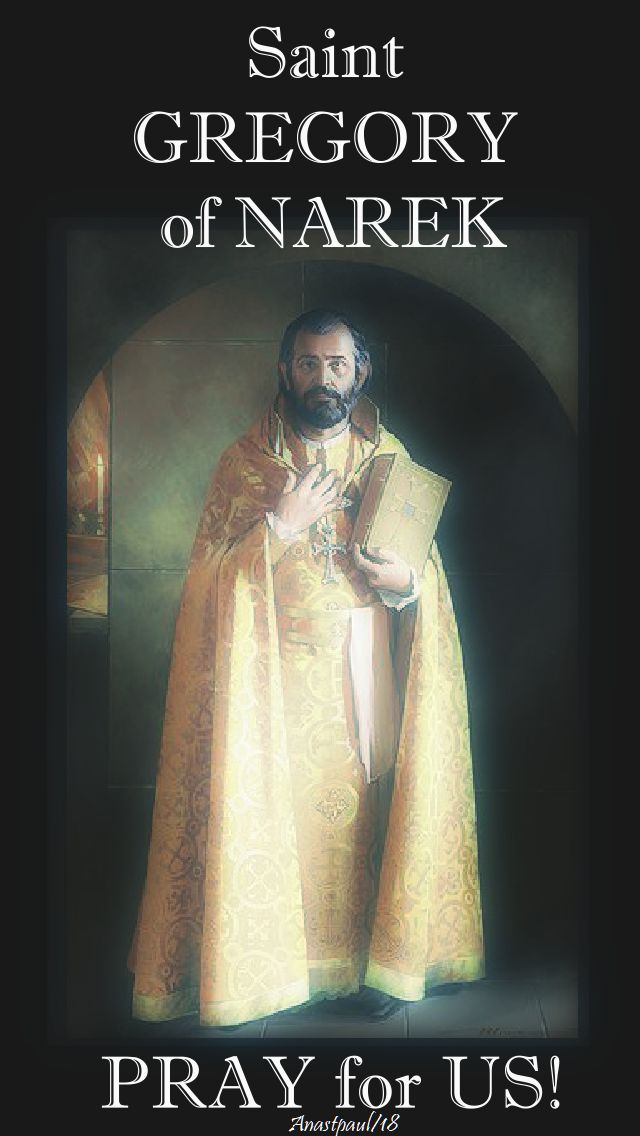
Saint of Day – 27 February – St Gregory of Narek (950-1003) – Doctor of the Church – Armenian monk, poet, mystical philosopher, theologian, writer and saint of the Armenian Apostolic Church and Catholic Church, born into a family of writers.   Based in the monastery of Narek (Narekavank), he was “Armenia’s first great poet”and as “the watchful angel in human form”.header - st gregory of narek

Born circa 950 to a family of scholarly churchmen, St Gregory entered Narek Monastery on the south-east shore of Lake Van at a young age.   Shortly before the first millennium of Christianity, Narek Monastery was a thriving centre of learning.   These were the relatively quiet, creative times before the Turkic and Mongol invasions that changed Armenian life forever.   Armenia was experiencing a renaissance in literature, painting, architecture and theology, of which St Gregory was a leading figure.   The Prayer Book is the work of his mature years.  He called it his last testament:  “its letters like my body, its message like my soul.”    His best-known writings include a commentary on the Song of Songs and his “Book of Lamentations,” more commonly known as “Narek.”   St Gregory left this world in 1003 but his voice continues to speak to us for all earthly time.

st gregory of narek portrait

Pope Francis named the tenth century Armenian monk, St Gregory Narek, the 36th Doctor of the Church on 21 Feb 2015.   I love the writing of St Gregory!   He’s a poet to the core and demonstrated amply, like the Hebrew prophets, that beauty is the truest form of divine discourse.  Many of his theological and mystical-ascetical works are written as a colloquy — a dialogue with God — as was St Augustine’s autobiography, the Confessions. Theological colloquy offers such a deep insight into the nature of theological discourse which must always be, in the first instance, a dialogue with the revealing God Himself. God reveals to us not mere data for speculative consideration but Himself for consummating union.

And, true to Pope Francis’ pastoral style, this doctor is chosen from the “margins” of the suffering church. (Incidentally, in 2012 Pope Benedict named a “marginal” medieval woman as Doctor of the Church, the twelfth century Abbess Saint Hildegard of Bingen.  A genius.   Sadly, so little fuss was made subsequently.

The Armenian Apostolic Church (great documentary here), that traces its origins back to the first century, has a rich monastic, liturgical and theological tradition and a rich history of saints and culture.   But Armenian Christians also have a long history of oppression, climaxing in the horrors of the “Armenian Holocaust” genocide of 1915, carried out by the Ottoman Turks who slaughtered more than one million Armenian Christians.

The Armenian Divine Liturgy is magnificent in its poetry, sense of mystery, and theological depth. One of the most cherished hymns of the Liturgy is called Khorhoort Khoreen, “O Mystery Deep.” (Dr Tom Neal)

O Mystery deep, inscrutable, without beginning.   Thou hast decked Thy supernatural realm as a chamber unto the light unapproachable and hast adorned with splendid glory the ranks of Thy fiery spirits.

lovely - st gregory of narek artwork

St Gregory has shown up a couple of times in Magisterial writings.   The Catechism of the Catholic Church, for instance, contains a reference to him:

Medieval piety in the West developed the prayer of the rosary as a popular substitute for the Liturgy of the Hours. In the East, the litany called the Akathistos and the Paraclesis remained closer to the choral office in the Byzantine churches, while the Armenian, Coptic, and Syriac traditions preferred popular hymns and songs to the Mother of God. But in the Ave Maria, the theotokia, the hymns of St Ephrem or St Gregory of Narek, the tradition of prayer is basically the same. (§2678)

St Pope John Paul II also referred to him in his encyclical, Redemptoris Mater:

In his panegyric of the Theotokos, Saint Gregory of Narek, one of the outstanding glories of Armenia, with powerful poetic inspiration ponders the different aspects of the mystery of the Incarnation, and each of them is for him an occasion to sing and extol the extraordinary dignity and magnificent beauty of the Virgin Mary, Mother of the Word made flesh.

st gregory of narek mosaic

With the formation of the Armenian Catholic Church St Gregory received his first liturgical veneration within the Catholic Church.   He has not been officially canonised by the pope.   Some have speculated that the declaration of Gregory as a Doctor of the Church might have served as an equipollent canonization (see more on this below). Others have simply stated that the recognition of the Armenian liturgy and liturgical calendar by the Catholic Church served as a confirmation of the cultus of saints in that rite.   Though it appears that he was placed in the Roman Martyrology, prior to the declaration on 12 April 2015.

St. Gregory’s proclamation as a Doctor of the Church was commemorated by the Vatican City state with a postage stamp issued 2 September 2015.Minifoglio

Equipollent or equivalent canonisation

It should be noted that when Pope Benedict XVI declared St. Hildegard von Bingen as a Doctor of Church he used the process of equipollent or equivalent canonisation, as she also had not been formally canonised.   Even St Albert the Great was canonised in this fashion when he was declared a doctor of the Church in 1931 by Pope Pius XI.   Pope Benedict used this process of canonisation a few other times and Pope Francis has also done so.

‘When there is strong devotion among the faithful toward holy men and women who have not been canonised, the Pope can choose to authorise their veneration as saints without going through that whole process. … This is often done when the saints lived so long ago that fulfilling all the requirements of canonisation would be exceedingly difficult.’
Posted in SAINT of the DAY

Memorials of the Saints – 27 February

St Abundius of Rome
St Alexander of Rome
St Alnoth
St Anne Line
St Antigonus of Rome
St Baldomerus of Saint Just
St Basilios of Constantinople
St Comgan
St Emmanuel of Cremona
St Fortunatus of Rome
St Gabriel of Our Lady of Sorrows/Gabriel Possenti
St Gregory of Narek (950-1003) – Doctor of the Church

St Herefrith of Lindsey
St Honorina
St John of Gorze
Bl Josep Tous Soler
St Luke of Messina
Bl Maria Caridad Brader
Bl Mark Barkworth
St Procopius of Decapolis
Bl Roger Filcock
St Thalilaeus
Bl William Richardson

Martyrs of Alexandria: –
Besas of Alexandria
Cronion Eunus
Julian of Alexandria


Posted in CATHOLIC-PRAYERS OF THE CHURCH, CHRIST, the WAY,TRUTH,LIFE, GOD ALONE!, LENT, MORNING Prayers, POETRY, PRAYERS of the CHURCH, QUOTES for CHRIST, QUOTES on LOVE of GOD, The WORD, Thomas a Kempis

Lenten Reflection – 26 February 2018 – Monday of the Second Week of Lent

26 February 2018 – Monday of the Second Week of Lent
Daniel 9:4-10, Psalms 79:8-9, 11, 13, Luke 6:36-38

Daniel 9:4-5 – “I prayed to the Lord my God and made confession, saying, “O Lord, the great and terrible God, who keepest covenant and steadfast love with those who love him and keep his commandments, we have sinned and done wrong and acted wickedly and rebelled, turning aside from thy commandments and ordinances…”

Luke 6:36-38 – Be merciful, even as your Father is merciful. “Judge not, and you will not be judged; condemn not and you will not be condemned; forgive and you will be forgiven; give and it will be given to you; good measure, pressed down, shaken together, running over, will be put into your lap. For the measure you give will be the measure you get back.”monday of the second week - 26 feb 2018

Daniel confesses that his people’s sufferings in exile are due to their own lack of fodelity to God. This sort of confession is a frank admission that evil has consequences. It is similar to Jesus’ teaching – “one who takes up the sword will perish by the sword.”

The argument may be turned round – good deeds have beneficial consequences. “The measure you give will be the measure you get back” whether it be mercy, forgiveness or sympathetic understanding.

If we keep giving out good things consistently, the blessings we will receive will be beyond measure. Every giving enriches the giver, whether gift be in the form of material assistance, psychologival affirmation or spiritual admonition, giving up an argument, settling a quarrel or going out of our way to help someone who deserves it least!

Be not afraid then to give, for you will receive beyond anything you could ever expect.

Am I generous with my time, material gifts, with my love?
Am I patient and willing to be forgiving, even when I was not in error?
Am I aware that as part of the Body of Christ, my good and my bad, affect all?
Archbishop Thomas Menamparampil SDB – God’sWord

“Desire not the praises of men, seeing they are vain.   Be not fearful of their reproach, for instead of doing harm to your soul, humiliations cleanses it and renders it more meet to receive a brighter crown in heaven and none are worthy to be glorified in heaven who are unable to bear reproach on earth for the love of God.”Thomas a Kempis

Help us, O God of our salvation, for the glory of thy name;
deliver us and forgive our sins, for thy name’s sake! …Psalm 79:9

For ah! the Master is so fair,
His smile so sweet to banished men
That they who meet it unaware
Can never rest on earth again.

And they who see Him risen afar
At God’s right hand to welcome them
Forgetful stand of home and land,
Desiring fair Jerusalem.

Praise God! the Master is so sweet;
Praise God! the country is so fair,
We would not hold them from His feet.
We would but haste to meet them there.

English Missal 1936for ah, the master is so fair - lenten prayer - missal 1936 - monday of the 2nd week - 26 feb 2018

Posted in LENT, MORNING Prayers, QUOTES of the SAINTS, QUOTES on CONVERSION, QUOTES on SIN, The INCARNATION, The PASSION

Thought for the Day – 26 February 2018 – Monday of the Second Week of Lent

Thought for the Day – 26 February 2018 – Monday of the Second Week of Lent
Daniel 9:4-10, Psalms 79:8-9, 11, 13, Luke 6:36-38

WE ARE WRETCHED CREATURES

We cannot dwell upon the conduct of the Jews, my dear people, without being struck with amazement.   These very people had waited for God for four thousand years, they had prayed much because of the great desire they had to receive Him and yet when He came, He could not find a single person to give Him the poorest lodging.   The all-powerful God was obliged to make His dwelling with the animals.

And yet, my dear people, I find in the conduct of the Jews, criminal as it was, not a subject for explanations but a theme for the condemnation of the conduct of the majority of Christians.

We can see that the Jews had formed an idea of their Redeemer which did not conform with the state of austerity in which He appeared.   It seemed as if they could not persuade themselves that this could indeed be He who was to be their Saviour;  St Paul tells us very clearly that if the Jews had recognised Him as God, they would never have put Him to death.   There is, then, some small excuse for the Jews.   But what excuse can we make, my dear brethren, for the coldness and the contempt which we show towards Jesus Christ?

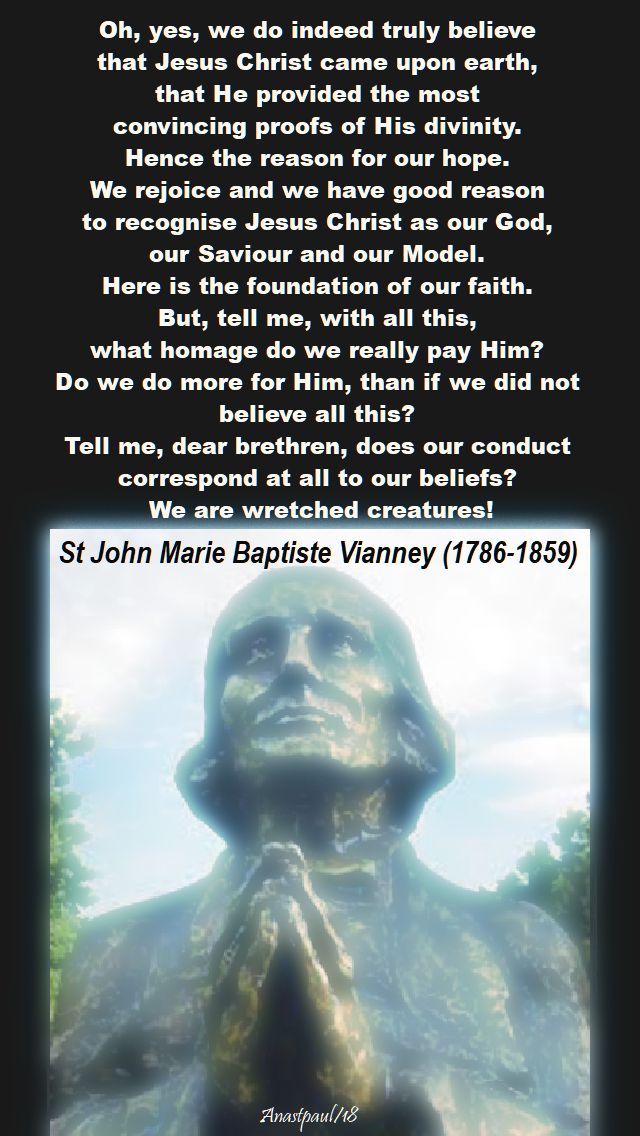
Oh, yes, we do indeed truly believe that Jesus Christ came upon earth, that He provided the most convincing proofs of His divinity.   Hence the reason for our hope.   We rejoice and we have good reason to recognise Jesus Christ as our God, our Saviour and our Model.   Here is the foundation of our faith.

But, tell me, with all this, what homage do we really pay Him?   Do we do more for Him than if we did not believe all this?   Tell me, dear brethren, does our conduct correspond at all to our beliefs?   We are wretched creatures.

We are even more blameworthy than the Jews!

St John Marie Baptiste Vianney (1786-1859)oh yes, we do indeed truly believe - st john vianney - 26 feb 2018


Posted in LENT, MORNING Prayers, QUOTES of the SAINTS, QUOTES on CONVERSION, QUOTES on FAITH, QUOTES on SANCTITY

Quote of the Day – 26 February 2018 – Monday of the Second Week of Lent

Quote of the Day – 26 February 2018 – Monday of the Second Week of Lent

“There is one thing everyone can do,
whether they find it hard to meditate or not
and that is to make up their mind in the morning,
to cultivate some particular virtue during the day,
to practice the interior Presence of God
and to live their life in union with Him.”

St John Marie Baptiste Vianney (1786-1859)there is one thing - st john vianney - 26 feb 2018 - mon 2nd week lent

Posted in MORNING Prayers, QUOTES of the SAINTS, SAINT of the DAY, The WORD

One Minute Reflection – 26 February – St Paula Montal Fornés of Saint Joseph of Calasanz (1799-1889)

One Minute Reflection – 26 February – St Paula Montal Fornés of Saint Joseph of Calasanz (1799-1889)

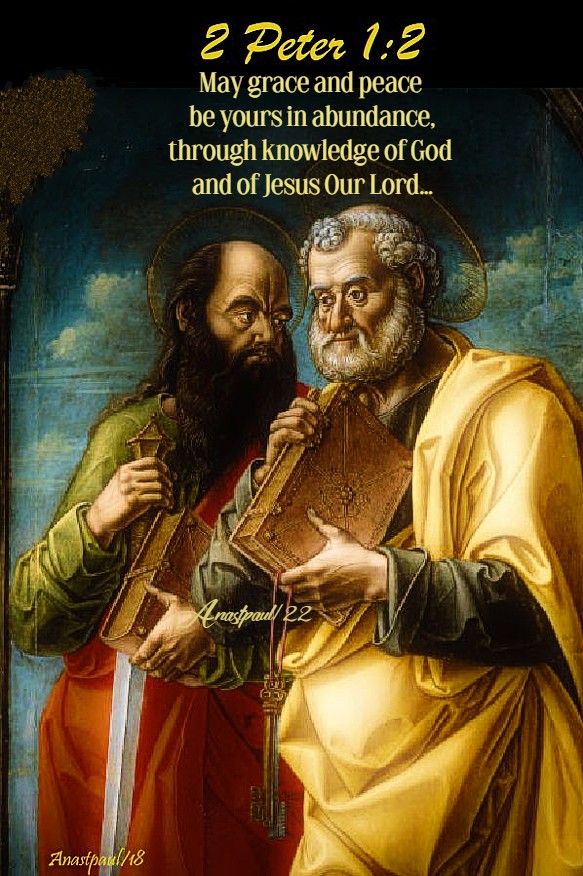
…may grace and peace be yours in abundance through knowledge of God and of Jesus our Lord…2 Peter 1:2

REFLECTION – “… (St Paula) as foundress of a religious family, inspired by the slogan of St Joseph Calasanz “Piety and Letters”, she gave herself to advancing women and the family with her ideal: “Save the family, educating the young girls in a holy fear of God”... (She) belongs to the group of founders of religious orders who in the 19th century came forward to meet the many needs that were present and that the Church, inspired by the Gospel and by the Spirit, wanted to respond to for the good of society.  The message of St Paula is still valid today and her educational charism is a source of inspiration in the formation of the generations of the third Christian millennium.”…St Pope John Paul II Canonisation Homily 25 November 2001

PRAYER – Heavenly Father, may Your Holy Saints’ examples inspire us to living contemplation of Christ the King, crucified and risen. May St Paula’s supporting intercession, help us to walk faithfully in the footsteps of the Redeemer, to share one day with her together with Mary and all the saints, His eternal glory in heaven. Amen.st paula montal fornes - pray for us - 26 feb 2018

Posted in EUCHARISTIC Adoration, MORNING Prayers, PRAYERS of the SAINTS, SACRED and IMMACULATE HEARTS

Our Morning Offering – 26 February 2018 – Monday of the Second Week of Lent

Our Morning Offering – 26 February 2018 – Monday of the Second Week of Lent

O Heart of Jesus, I Offer You All
By Blessed John Henry Newman (1801-1890)

O Heart of Jesus, all love,
I offer You these humble prayers for myself
and for all those who unite themselves
with me in spirit to adore You.
O holiest Heart of Jesus most lovely,
I intend to renew and to offer to You,
these acts of adoration and these prayers,
for myself a wretched sinner
through all moments while I breathe,
even to the end of my life.
I recommend to You, O my Jesus,
Holy Church, Your dear spouse
and our true Mother, all just souls
and all poor sinners, the afflicted,
the dying and all mankind.
Let not Your Blood be shed for them in vain.
Finally, deign to apply it, in relief of the
souls in Purgatory and of these in particular
…………………………………..
Ameno heart of jesus, I offer you all by bl john henry newman - 26 feb 2018

Posted in SAINT of the DAY, VATICAN Resources

Saint of the Day – 26 February – St Paula Montal Fornés De San José De Calasanz (1799-1889)

Saint of the Day – 26 February – St Paula Montal Fornés De San José De Calasanz (1799-1889) Religious nun and Founder – born on 11 October 1799 at Arenys de Mar, near Barcelona, Spain – 26 February 1889 at Olesa de Montserrat, Barcelona, Spain of natural causes. St Paula’s religious name was Paula of Saint Joseph Calasanz.  She was a Spanish Roman Catholic professed religious and the foundress of the Sisters of the Pious Schools. cause for sainthood opened several decades after her death in the 1950s after being titled as a Servant of God; confirmation of her heroic virtue in 1988 saw her named as Venerable.   St Pope John Paul II Beatified her on 18 April 1993 and Canonised her on 25 November 2001.

st paula montal fornes - 26 feb 2018

The life of Paula Montal Fornés de San José de Calasanz, fruitful and prophetic, almost centennial, unfolded within a broad historical context (1799-1889), a crisis period during the troubled 19th Century in Spain, torn between the postulates of the Old Regime and the new liberal trends, with significant socio-political, cultural and religious repercussions.   Four cities were especially representative of her life, well-rooted in the land and historical surroundings:

In Arenys de Mar (Barcelona), she spent her childhood and youth (1799-1829).   A coastal village, facing the sea, cosmopolitan and industrial, is where she was born into this life, on 11 October 1799 and born into grace that same afternoon.   She was brought up in a modest Christian family atmosphere.   She participated in the spiritual life of her parish.   She stood out because of her love for the Virgin Mary.   From the age of 10, she learned the harshness of working to help her mother, a widow with five children.   She was the eldest.   During that time, through her own experience, she realised that girls, young ladies, women, had scarce possibilities for access to education, to culture… and she felt called by God to assist in rectifying the situation and carrying out that task.

Figueras (Gerona), a border city between Spain and France and a military stronghold famous for its weaponry castle, was where she had set her sights.   Accompanied by her  friend Inés Busquets, in 1829, she moved to the capital of that area to open her first school for girls, with broad educational programs which far surpassed those required for boys.   It was a new school.   Figueras was where her special educational apostolate for girls began.   A new charisma was born in the Church, an Apostolic Work aimed toward the complete human Christian education of girls and young women and toward the advancement of women, to save families and transform society.   Her followers would distinguish themselves by professing a fourth vow of teaching.

Sabadell (Barcelona) signifies the origin of her educational work in the Pious Schools. We know that, at least since 1837, she felt totally identified with the spirit of Saint Joseph of Calasanz, and wanted to live by the Calasanz spirituality and rules.   With that purpose, after founding a second school in her hometown of Arenys de Mar in 1842, where she came into direct contact with the Piarist Fathers of Mataró, she opened a third school in Sabadell in 1846.   The presence of the Piarist Fathers, Fr Jacinto Felíu and Fr Agustín Casanovas in the Sabadell school, was providential.   There, with their help and guidance, she achieved in a short time, the canonical structure of her newly formed Congregation.   On 2 February 1847, she made her profession as a Daughter of Mary Religious of the Pious Schools, along with her first three companions, Inés Busquets, Felicia Clavell and Francisca de Domingo.   At the General Chapter meeting, held in Sabadell on 14 March 1847, she was not elected General Superior, or even Assistant General.

During the period from 1829 to 1859, she was intensely active, personally founding 7 schools:  Figueras (1829), Arenys de Mar (1842), Sabadell (1846), Igualada (1849), Vendrell (1850), Masnou (1852) and Olesa de Montserrat (1959).   She inspired and helped to found 4 others:  Gerona (1853), Blanes (1854), Barcelona (1857) and Sóller (1857).   She was also the formulator of the first 130 Sisters of the Pious Schools of the Congregation.   A very active and prophetic period in her life.

Olesa de Montserrat (Barcelona), 1859.  The last school personally founded by her.   A poor small town, at the foot of the Monastery of Our Lady of Montserrat, to whom she professed great devotion.   It was her favourite School, where she stayed until her death (15 December 1859 to 26 February 1889).   Those were 30 years of grace for the girls and young women of Olesa, who benefited from her rich testimony with the example of her generous and holy life.   “Everyone loved and adored her…”.   And for the Congregation:  a total yes to God;  the living of the virtues that should characterise the Pious Schools’ educator.   And the twilight of a life in God.

The design of Mother Paula Montal’s spirituality is comprised of two facets:  her participation in the Calasanz spirituality and her unique educational charisma, directed toward the complete human Christian education of women.

Upon her death, the Congregation of the Daughters of Mary, Sisters of the Pious Schools, founded by her, was made up of 346 Escolapias (Sisters of the Pious Schools), who carried out the spirit of the Pious Schools teaching, the legacy of their Foundress, in 19 schools extending throughout the Spanish region.

The canonical process for her Beatification began in Barcelona on May 3, 1957.   St Pope John Paul II beatified her in Rome on 18 April 1993.   The miracle of her Canonisation, performed in September of 1993, in Blanquizal, a very marginal and violent area of Medellín (Colombia), for a little 8-year old girl, Natalia García Mora, was approved by St Pope John Paul II on 1 July 2000.

To our society, wounded by so many pressures, where the subjects of education for all, the advancement of women, the family and youth are currently unresolved issues, the new Saint delivers the message of her life and her educational work, a message of love and of service.  Her charisma in the 19th Century was a statement of love and hope, especially for women, who found in her a mother and teacher for the young women and girls.   And today it continues to be as urgent and current an issue as it was back then.

The educational work of Saint Paula Montal Fornés de San José de Calasanz continues today in the Church, particularly through the more than 800 Sisters of the Pious Schools, spread out over 112 communities, who educate some 30,000 students, in 19 nations on four continents, for the development of women, so that the “civilization of love” may become a reality. (vatican.va)

Posted in SAINT of the DAY

Memorials of the Saints – 26 February

Bl Adalbert of Tegernsee
St Agricola of Nevers
St Alexander of Alexandria
St Andrew of Florence
St Dionysius of Augsburg
St Faustinian of Bologna
St Felix
St Fortunatus
St Irene
St Isabelle of France
Bl Ottokar of Tegernsee
St Paula Montal Fornés of Saint Joseph of Calasanz (1799-1889)
Bl Piedad de la Cruz Ortiz
St Porphyrius of Gaza
Bl Robert Drury
St Victor the Hermit

Posted in LENT, MORNING Prayers, POETRY, QUOTES of the SAINTS, QUOTES on CONVERSION, QUOTES on FAITH, QUOTES on LOVE, QUOTES on OBEDIENCE, QUOTES on PERSECUTION, QUOTES on REPENTANCE, QUOTES on SANCTITY, QUOTES on SUFFERING, The HOLY CROSS, The TRANSFIGURATION, The WORD

25 February 2018 – Lenten Reflection – The Second Sunday in Lent, Year B THE GLORY OF THE CRUCIFIED CHRIS

25 February 2018 – Lenten Reflection – The Second Sunday in Lent, Year B
THE GLORY OF THE CRUCIFIED CHRIST

Genesis 22:1-2, 9-13, 15-18, Psalms 116:10, 15-19, Romans 8:31-34, Mark 9:2-10

Mark 9:2-3 – And after six days Jesus took with him Peter and James and John and led them up a high mountain apart by themselves;  and he was transfigured before them and his garments became glistening, intensely white, as no fuller on earth could bleach them.second sunday lenten reflection - mark 9 3

On the second Sunday in Lent we always read the Gospel of the Transfiguration of our Lord.   We do so in order that our focus may be directed towards the glory of Easter and our Lord’s victory over sin and death by His glorious Resurrection.   Our Lenten penance is not an end in itself but a means to an end;  that cleansed of our faults and sanctified in both body and mind we might more fully appreciate and participate in God’s own glory. The word that Sacred Scripture most commonly uses to describe the nature of God is glory.   We associate glory with power, majesty, radiance, awe and wonder.   Yet all the Gospels, especially the Gospel of John, speak of God’s humiliation as His exaltation, His glory.   By faith, we are seized by the beauty and glory of the Crucified Christ.   In this mystery of the Transfiguration a twofold glory is revealed:  the glory which our Lord possesses as the eternal Son of the Father and the glory that is manifested in His sacred Passion;  the glory that is manifested from the unsurpassable torture of Holy Week.   God Himself is “whipped to blood, crowned with thorns, mocked, spat upon, ridiculed, nailed, pierced…   In this consummate ugliness, this unspeakable outrage, shines a picture of divine beauty, of divine glory.   The Gospel of the Transfiguration presents us with a vision of the glory of God on its way to the Passion”… (Cardinal Hans Urs Von Balthasar 1905-1988).

The glory revealed to Peter, James and John is a glimpse of the glory of the Resurrection, a glory that we too are destined to share;  however, it is the Passion that “leads to the glory of the Resurrection” (Preface for the Second Sunday in Lent, The Roman Missal). Consequently, we are ever mindful that “we preach Christ crucified … Christ the power of God and the wisdom of God” (1 Cor 1:23-24).   Our Lord Jesus Christ “is the radiant light of God’s glory and the perfect copy of His nature” (Heb 1:3).   Those who gaze on the Crucified Christ in faith are able to perceive that His hour of highest spiritual beauty—and glory—is a moment of utmost bodily degradation.   In the humiliation of the Cross the Saviour brings near and makes visible the divine glory for we see in Him the ineffable love of God for sinners.   This is a love, a beauty and a glory that can only be perceived by a prayerful, contemplative gaze  . It is only by means of prayer and penance that we can come to some understanding of why our Lord brought about our salvation in such weakness, diminishment and pain.

No human life is exempt from diminishment and pain.   If we are given the grace to grow older, the weight of years alone brings about diminishment.   Why must it be so?   Perhaps our own diminishment is meant to conform us to the self-emptying of the Son of God on the Cross.   This may very well be the grace of old age.   That our redemption has taken place through suffering of the flesh and spilling of blood may mean that it could take place in no other way.   It is for this reason that above all things we must seek simply to be with Jesus and to learn from Him what He alone can teach us in the silence of prayer.   On the Cross we have the ultimate and only adequate answer to the problem of evil, the only solution to the mystery of sin.   The world’s redemption could only be brought about “in the mystery of a love that by suffering understands all the insults inflicted upon it” (Hans Urs Von Balthasar).   Our profession of faith, if taken seriously, is journey into the depth of this Mystery.

What do we discover as we come to know more of this mystery?   Quite simply, that the essence of Christian discipleship is to be with Jesus and to learn from Him who accompanies us on life’s journey and who is never distant from us by means of His grace. We must endeavour to abandon ourselves to the will of the Father as He did and in this is our peace:  not only our peace but also our way to holiness, to glory.   Christians are not immune from suffering.   Indeed, our long history teaches us that often we suffer more precisely because of our Christian faith but as St Paul asks, “who will separate us from the love of Christ? Will hardship, or distress or persecution, or famine, or nakedness, or peril or sword? No, in all these things we are more than conquerors, through him who loved us” (Rom 8:35-37).   These words are more than ever relevant as we witness the persecution of Christians in the Middle East, Africa and elsewhere.   Our faith enables us not only to overcome the trials we suffer but also to be sanctified by them and through them.   We understand these as our means to holiness; a state to which we are called.

“The entire virtue of what we call holiness lies in faithfulness to what God ordains” (Jean Pierre de Caussade, The Joy of Full Surrender, [Paraclete Press], p.17).   Surely, this is what we learn when we contemplate the life and Passion of our Lord.   Fidelity to duty, discipline of life, moral rectitude;  these are the ways in which we are faithful to what God ordains.   They are no less the means by which our lives are so transformed and so transfigured that we come to “live for the praise of his glory” (Eph 1:12).   Anything that contradicts these principles is a path to misery and destruction and a betrayal of the Cross of Christ.

After His glorious resurrection our Lord asked the disciples on the road to Emmaus, “Was it not necessary that the Christ should suffer these things and enter into his glory?” (Lk 24:26).   And so it is with us; we must be willing to recognise what is best for us in what God ordains for us.   Like the disciples on the mountain, the revelation of God’s will for us, whether it be in the suffering that He asks of us or permits us to endure, or simply in the challenges that we face in living; these may confound us and might even cause us to be very much afraid.   Like Peter, James and John, however, we too are privileged to perceive the glory of the Lord;  a glory however that is veiled in the poverty, humility, and vulnerability of the Crucifix that hangs before us and in the Sacrament of the Cross, the Eucharist.   These reveal a love so powerful that neither hate nor death could conquer it.   Because we receive and worship this Sacrament, this same love is at work in the hearts of all who believe.   By its power great deeds of love are done and great evils are faced and overcome.   The Passion of our Lord gives a human face to the love of God for a fallen humanity.   Our own sufferings, mysterious as they may be in both their origin and purpose, place us in the very heart of the Paschal Mystery.   Suffering is not meaningless nor is it without purpose and neither is our life.   “Nothing short of suffering, except in rare cases, makes us what we should be;  gentle instead of harsh, meek instead of violent, conceding instead of arrogant, lowly instead of proud, pure-hearted instead of sensual”   (Bl. John Henry Newman (1801-1890), “The Sweet Yoke of Christ,” 1839).

Transfiguration
By Blessed John Henry Newman (1801-1890)

They were talking to Him about resurrection,
about law, about the suffering ahead.
They were talking as if to remind Him who He was and
who they were. He was not

Like his three friends watching a little way off,
not like the crowd At the foot of the hill.
A grey-green thunderhead massed
from the sea

And God spoke from it and said He was His.
They were talking about how the body, broken or
burned,
could live again, remade.

Only the fiery text of the thunderhead could explain it.
And they were talking
About pain and the need for judgement
and how He would make Himself

A law of pain, both its spirit and its letter in His own
flesh,
and then break it,
That is, transcend it.
His clothes flared like magnesiumtransfiguration by bl john henry newman - 2nd sun lent 25 feb 2018

My Lord, I Offer You Myself
Blessed John Henry Newman (1801-1890)

My Lord,
I offer You myself in turn,
as a sacrifice of thanksgiving.
You have died for me,
And I in turn make myself over to You.
I am not my own.
You have bought me:
I will, by my own act and deed,
complete the purchase.
My wish is to be separated
from everything of this world;
To cleanse myself simply from sin;
To put away from me even what is innocent,
If used for its own sake
and not for Yours.
I put away reputation and honour
and influence and power,
For my praise and strength,
shall be in You.
Enable me to carry out what I profess
Amenmy lord i offer you myself - bl john henry newman - lenten prayer - 25 feb 2018 - 2nd sun lent