Quote/s of the Day 25 November – The Solemnity of Our Lord Jesus Christ, King of the Universe
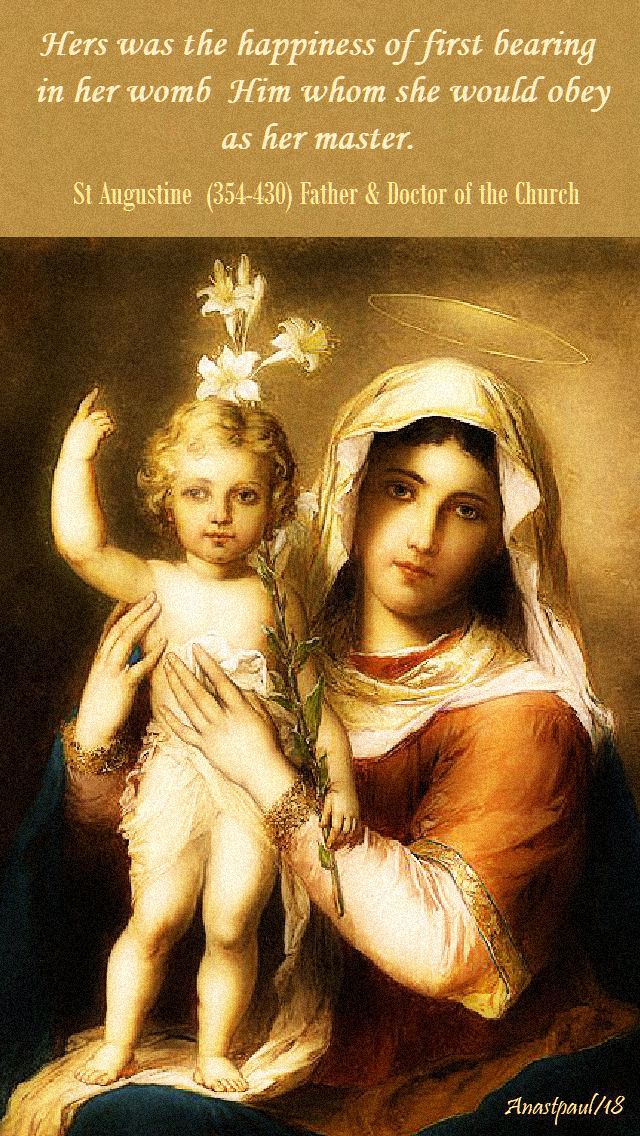
“Hers was the happiness of first bearing in her womb Him whom she would obey as her master.”
St Augustine (354-430) Father & Doctor of the Church
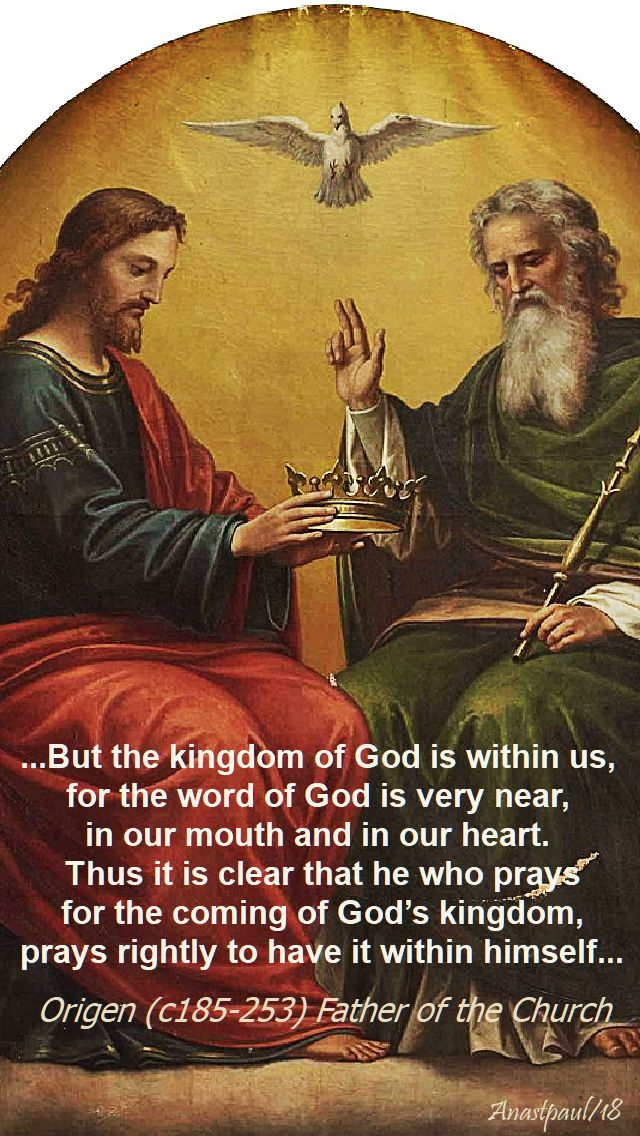
“The kingdom of God, in the words of our Lord and Saviour, does not come for all to see; nor shall they say: Behold, here it is, or behold, there it is; but the kingdom of God is within us, for the word of God is very near, in our mouth and in our heart. Thus it is clear that he who prays for the coming of God’s kingdom, prays rightly to have it within himself, that there it might grow and bear fruit and become perfect. For God reigns in each of his holy ones. Anyone who is holy obeys the spiritual laws of God, who dwells in Him as in a well-ordered city. The Father is present in the perfect soul and with Him Christ reigns, according to the words: We shall come to him and make our home with him.”
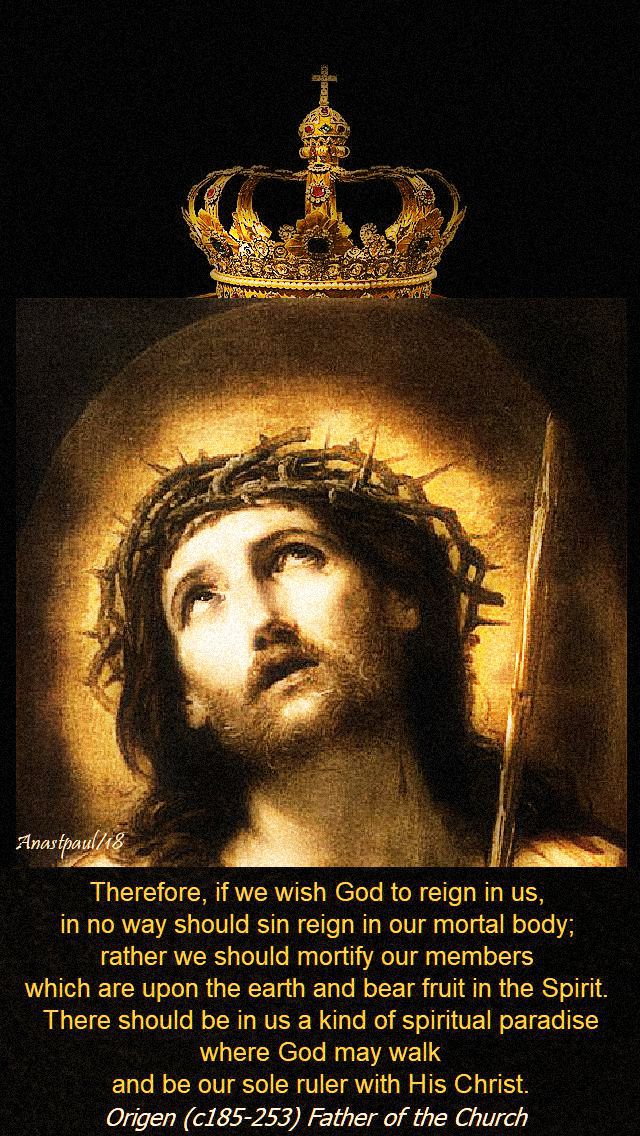
“The kingdom of God cannot exist alongside the reign of sin. Therefore, if we wish God to reign in us, in no way should sin reign in our mortal body; rather we should mortify our members which are upon the earth and bear fruit in the Spirit. There should be in us a kind of spiritual paradise where God may walk and be our sole ruler with His Christ. In us the Lord will sit at the right hand of that spiritual power which we wish to receive. And He will sit there until all His enemies, who are within u,. become His footstool and every principality, power and virtue in us is cast out.”
Origen (c185-253) Father of the Church
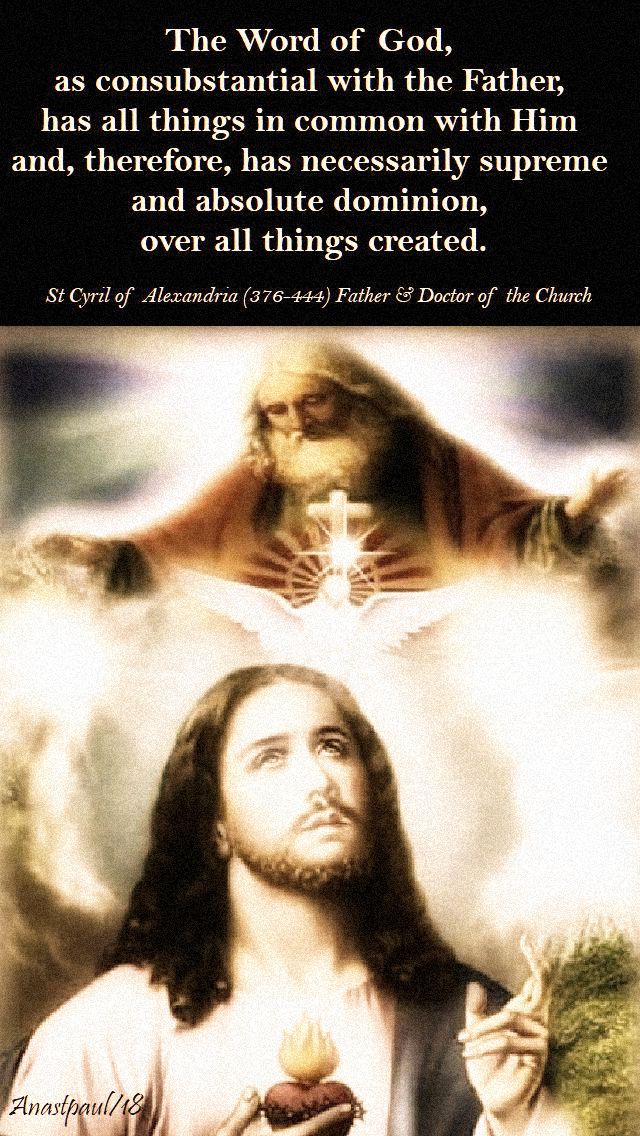
“The Word of God, as consubstantial with the Father, has all things in common with Him and, therefore, has necessarily supreme and absolute dominion, over all things created.”
St Cyril of Alexandria (376-444) Father & Doctor of the Church
One Minute Reflection – 25 November – Today’s Gospel: John 18:33–37 – The Solemnity of Our Lord Jesus Christ, King of the Universe
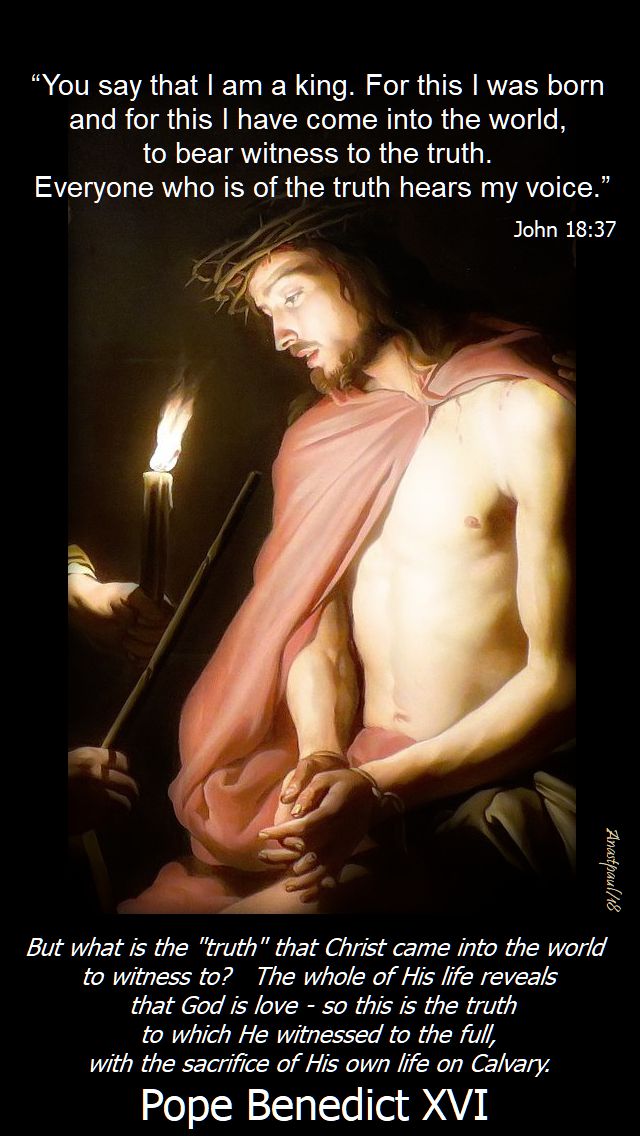
“You say that I am a king. For this I was born and for this I have come into the world, to bear witness to the truth. Everyone who is of the truth hears my voice.”...John 18:37
REFLECTION – “But what is the “truth” that Christ came into the world to witness to? The whole of His life reveals that God is love – so this is the truth to which He witnessed to the full, with the sacrifice of His own life on Calvary.
The Cross is the “throne” where He manifested His sublime kingship as God Love, by offering Himself in expiation for the sin of the world, He defeated the “ruler of this world” (Jn 12: 31) and established the Kingdom of God once and for all. It is a Kingdom that will be fully revealed at the end of time, after the destruction of every enemy and last of all, death (cf. I Cor 15: 25-26). The Son will then deliver the Kingdom to the Father and God will finally be “everything to everyone” (I Cor 15: 28).
The way to reach this goal is long and admits of no short cut, indeed, every person must freely accept the truth of God’s love. He is Love and Truth and neither Love nor Truth are ever imposed, they come knocking at the doors of the heart and the mind and where they can enter they bring peace and joy. This is how God reigns, this is His project of salvation, a “mystery” in the biblical sense of the word, a plan that is gradually revealed in history.”….Pope Benedict XVI 26 November 2006
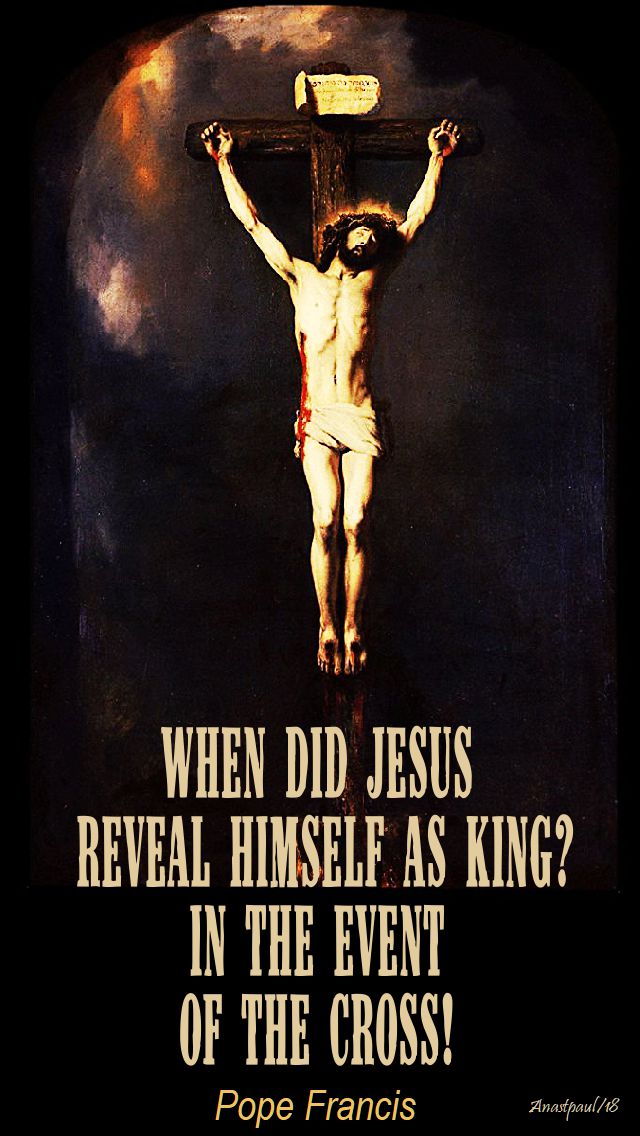
“When did Jesus reveal Himself as king? In the event of the Cross! Those who look at the Cross cannot but see the astonishing gratuitousness of love. One of you could say, “Father, that was a failure!”. It is precisely in the failure of sin — sin is a failure — in the failure of human ambitions – the triumph of the Cross is there, the gratuitousness of love is there. In the failure of the Cross, love is seen, a love that is gratuitous, which Jesus gives us.”…Pope Francis – Angelus, 22 November 2015
PRAYER – Lord God, You gave the peoples of the world as the inheritance of Your only Son; You crowned Him as King of Zion, Your holy city and gave Him Your Church to be His Bride. As He proclaims the law of Your eternal kingdom, may we serve Him faithfully and so share His royal power forever. We make our prayer, through Him and with Him and in Him, our King and our Redeemer, with the Holy Spirit, God forever, amen.
Our Morning Offering – 25 November – The Solemnity of Our Lord Jesus Christ, King of the Universe
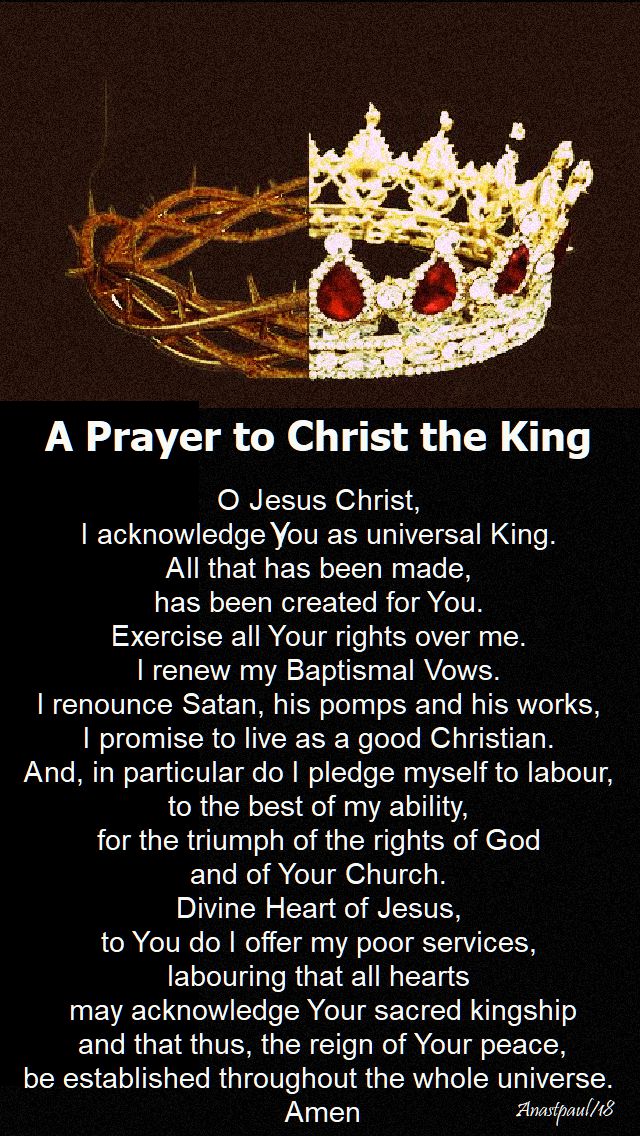
A Prayer to Christ the King
O Jesus Christ,
I acknowledge You as universal King.
All that has been made,
has been created for You.
Exercise all Your rights over me.
I renew my Baptismal Vows.
I renounce Satan, his pomps and his works,
I promise to live as a good Christian.
And, in particular do I pledge myself to labour,
to the best of my ability,
for the triumph of the rights of God
and of Your Church.
Divine Heart of Jesus,
to You do I offer my poor services,
labouring that all hearts
may acknowledge Your sacred kingship
and that thus, the reign of Your peace,
be established throughout the whole universe.
Amen
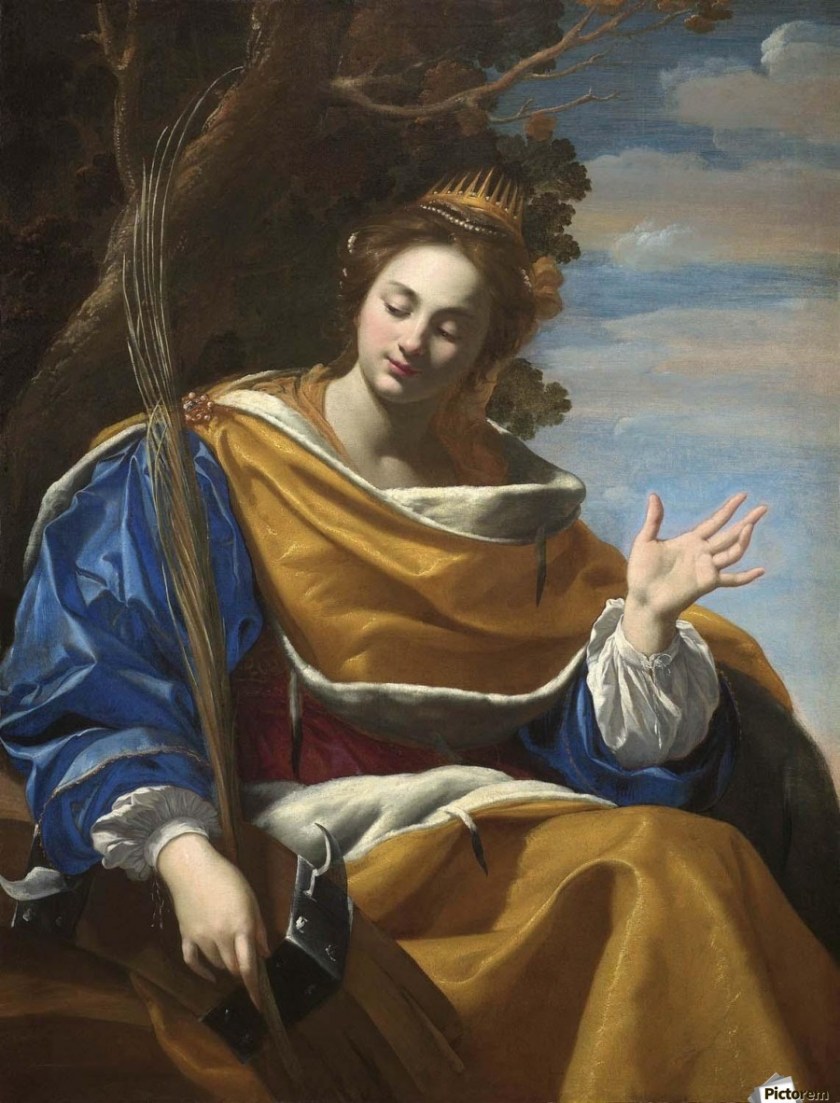
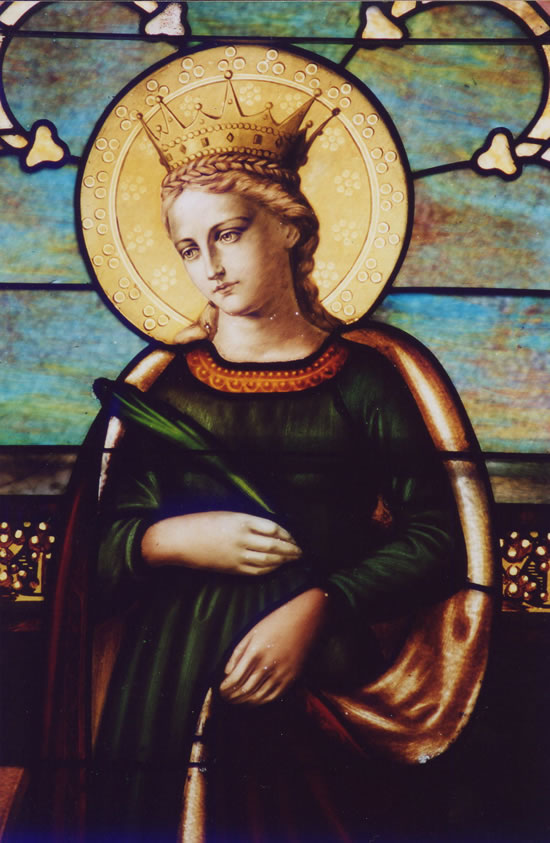
Saint of the Day – 25 November – St Catherine of Alexandria (Died c 305) Virgin and Martyr, Philosopher – One of the Fourteen Holy Helpers – Patronages: unmarried girls and women, apologists, craftsmen who work with a wheel (potters, spinners), archivists, dying people, educators, jurists, knife sharpeners, lawyers, librarians, libraries, mechanics, millers, milliners, hat-makers, nurses, philosophers, preachers, schoolchildren, secretaries, stenographers, students, tanners, theologians, haberdashers, wheelwrights, 6 Universities worldwide, 12 Cities, 2 Diocese. It is important to note that whilst much of St Catherine’s history is regarded as apocryphal (by historians), St Catherine, like many of the early Martyrs, did exist though the details and circumstances of her life are probably partly unknown.
According to the traditional narrative, Catherine was the daughter of Constus, the governor of Egyptian Alexandria during the reign of the emperor Maximian (286–305). From a young age, she devoted herself to study. A vision of the Madonna and Child persuaded her to become a Christian. When the persecutions began under Maxentius, she went to the emperor and rebuked him for his cruelty. The emperor summoned 50 of the best pagan philosophers and orators to dispute with her, hoping that they would refute her pro-Christian arguments but Catherine won the debate. Several of her adversaries, conquered by her eloquence, declared themselves Christians and were at once put to death.
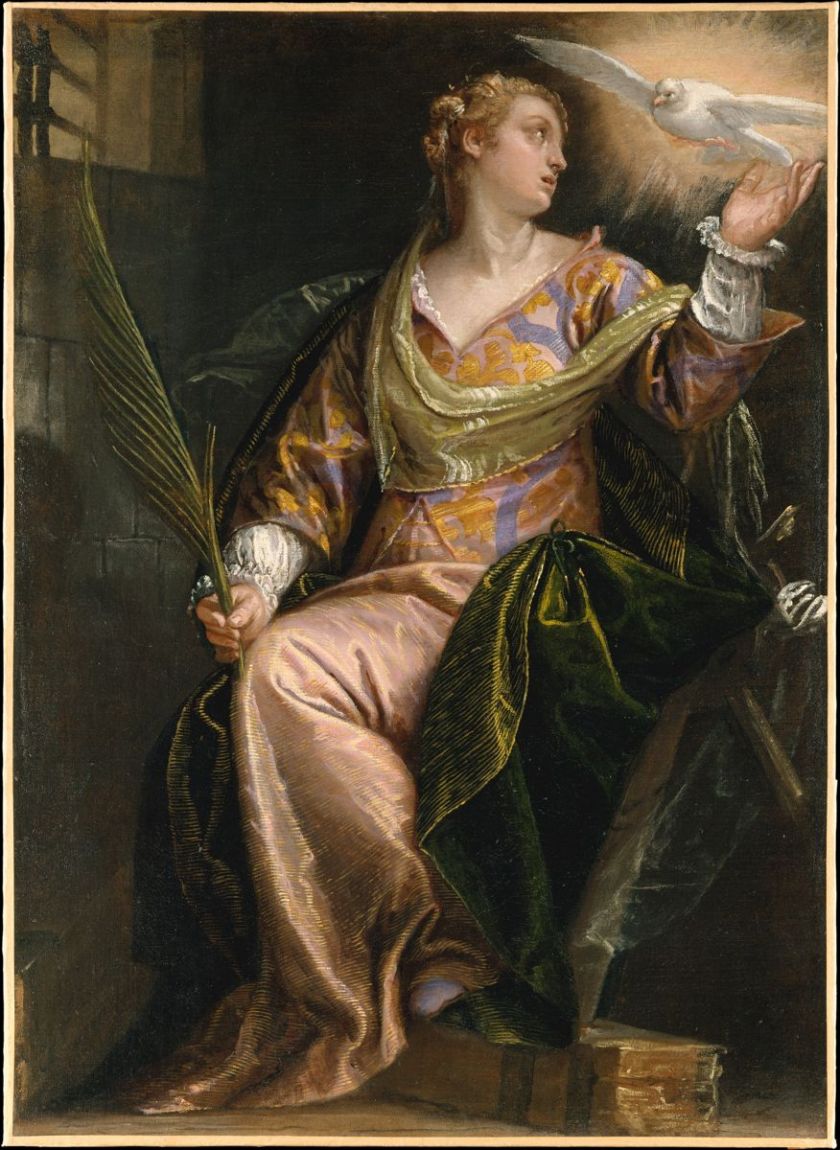
Catherine was then scourged and imprisoned. She was scourged so cruelly and for so long, that her whole body was covered with wounds, from which the blood flowed in streams. The spectators wept with pity but Catherine, strengthened by God, stood with her eyes raised to heaven, without giving a sign of suffering or fear. He ordered her to be imprisoned without food, so she would starve to death. During the confinement, angels tended her wounds with salve. Catherine was fed daily by a dove from Heaven and Christ also visited her, encouraging her to fight bravely and promised her the crown of everlasting glory.
During her imprisonment, over 200 people came to see her, including Maxentius’ wife, Valeria Maximilla – all converted to Christianity and were subsequently martyred. Twelve days later, when the dungeon was opened, a bright light and fragrant perfume filled it and Catherine came forth even more radiant and beautiful.
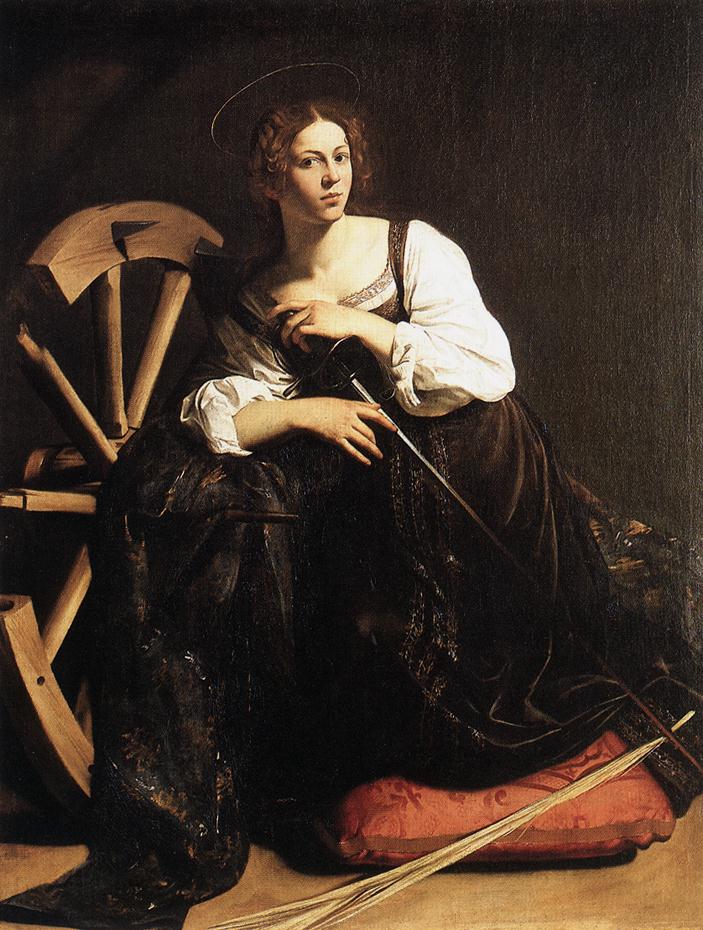
Upon the failure of Maxentius to make Catherine yield by way of torture, he tried to win the beautiful and wise princess over by proposing marriage. The saint refused, declaring that her spouse was Jesus Christ, to whom she had consecrated her virginity. The furious emperor condemned Catherine to death on a spiked breaking wheel but, at her touch, it shattered. Maxentius ordered her to be beheaded. Catherine herself ordered the execution to commence. A milk-like substance rather than blood flowed from her neck.
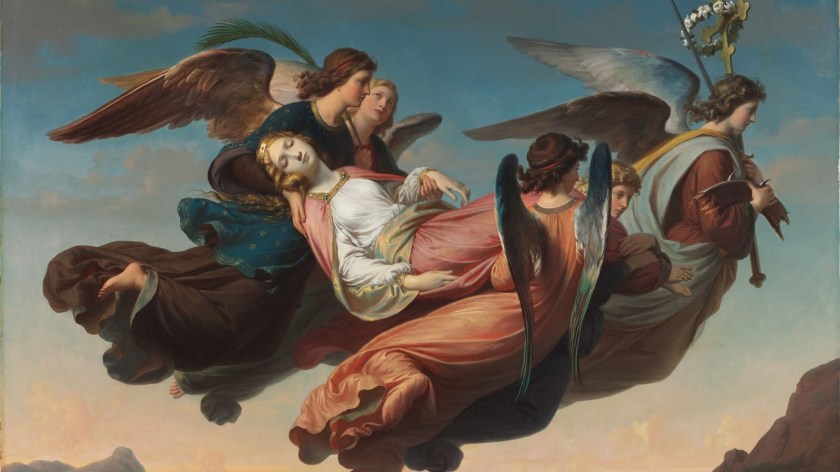
Angels transported her body to the highest mountain (now called Mount Saint Catherine) next to Mount Sinai, where God gave His Law. In 850, her incorrupt body was discovered by monks from the Sinai Monastery. The monks found on the surface of the granite on which her body lay, an impression of the form of her body. Her hair still growing and a constant stream of the most heavenly fragranced healing oil issuing from her body. This oil produced countless miracles.
Saint Catherine was one of the most important saints in the religious culture of the late Middle Ages and arguably considered the most important of the virgin martyrs, a group including Saint Agnes, Margaret of Antioch, Saint Barbara, Saint Lucy, Valerie of Limoges and many others. Her power as an intercessor was renowned and firmly established in most versions of her hagiography, in which she specifically entreats Christ at the moment of her death to answer the prayers of those who remember her martyrdom and invoke her name.
The pyrotechnic Catherine wheel, from which sparks fly off in all directions, took its name from the saint’s wheel of martyrdom.
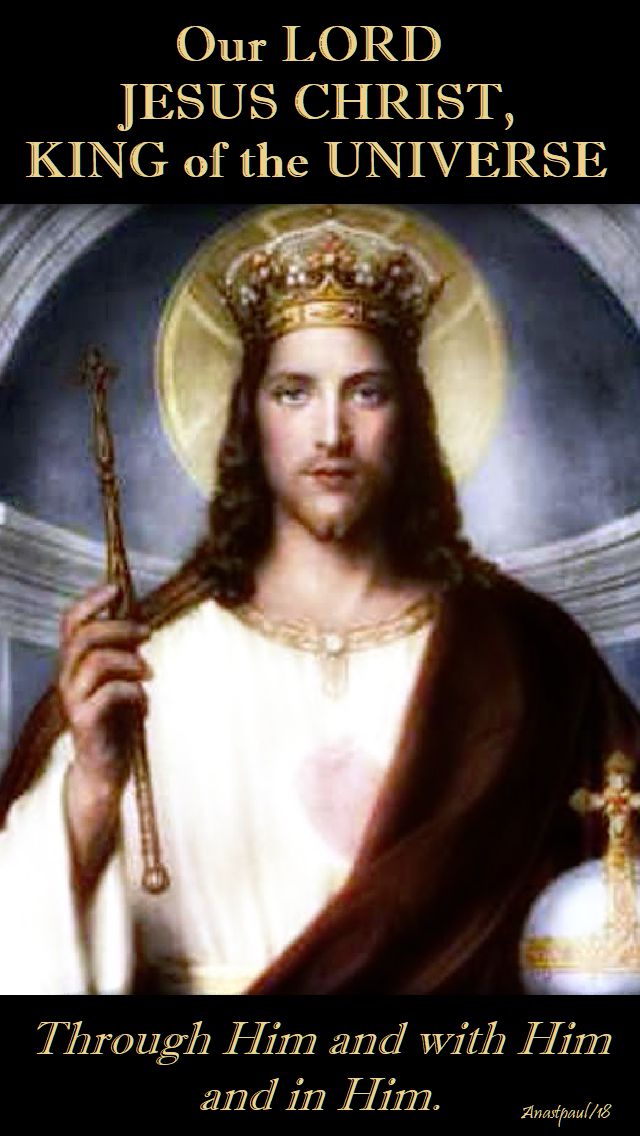
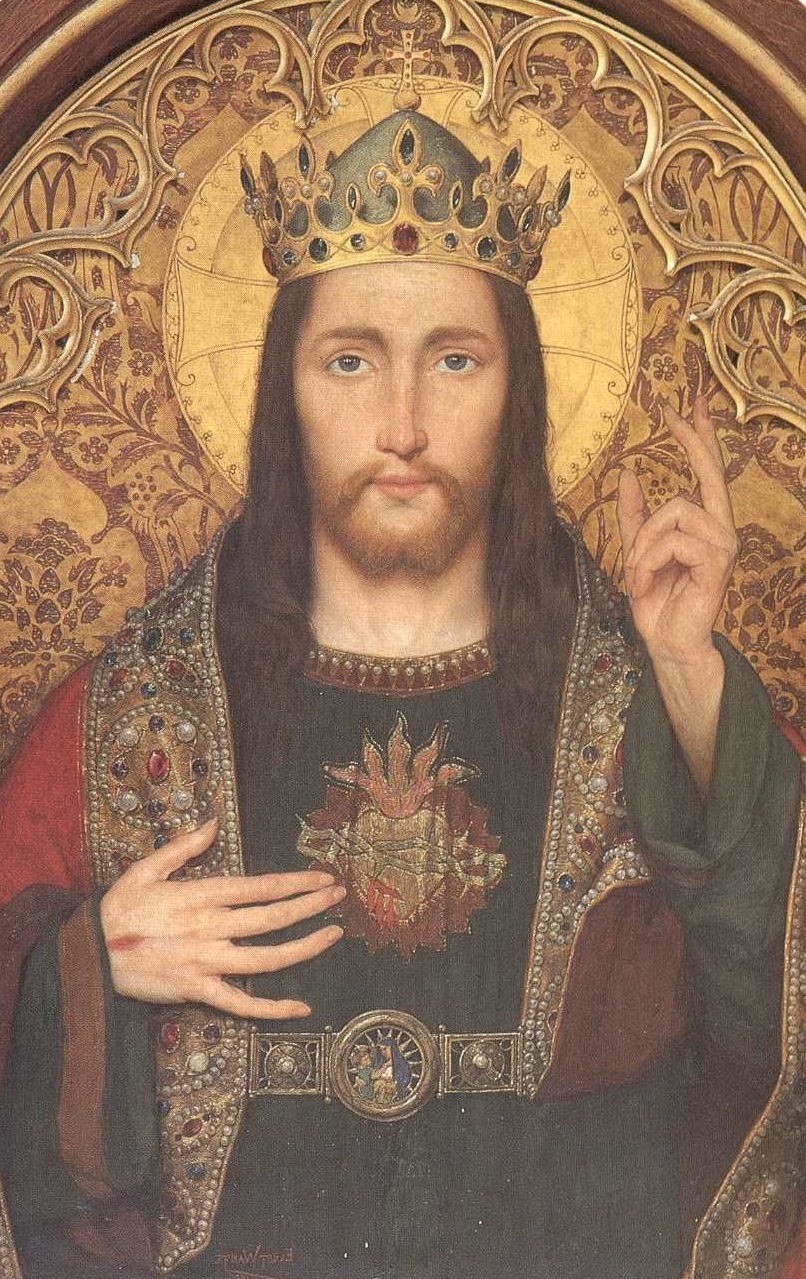
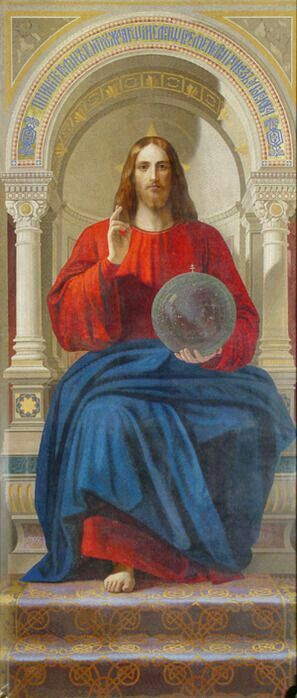
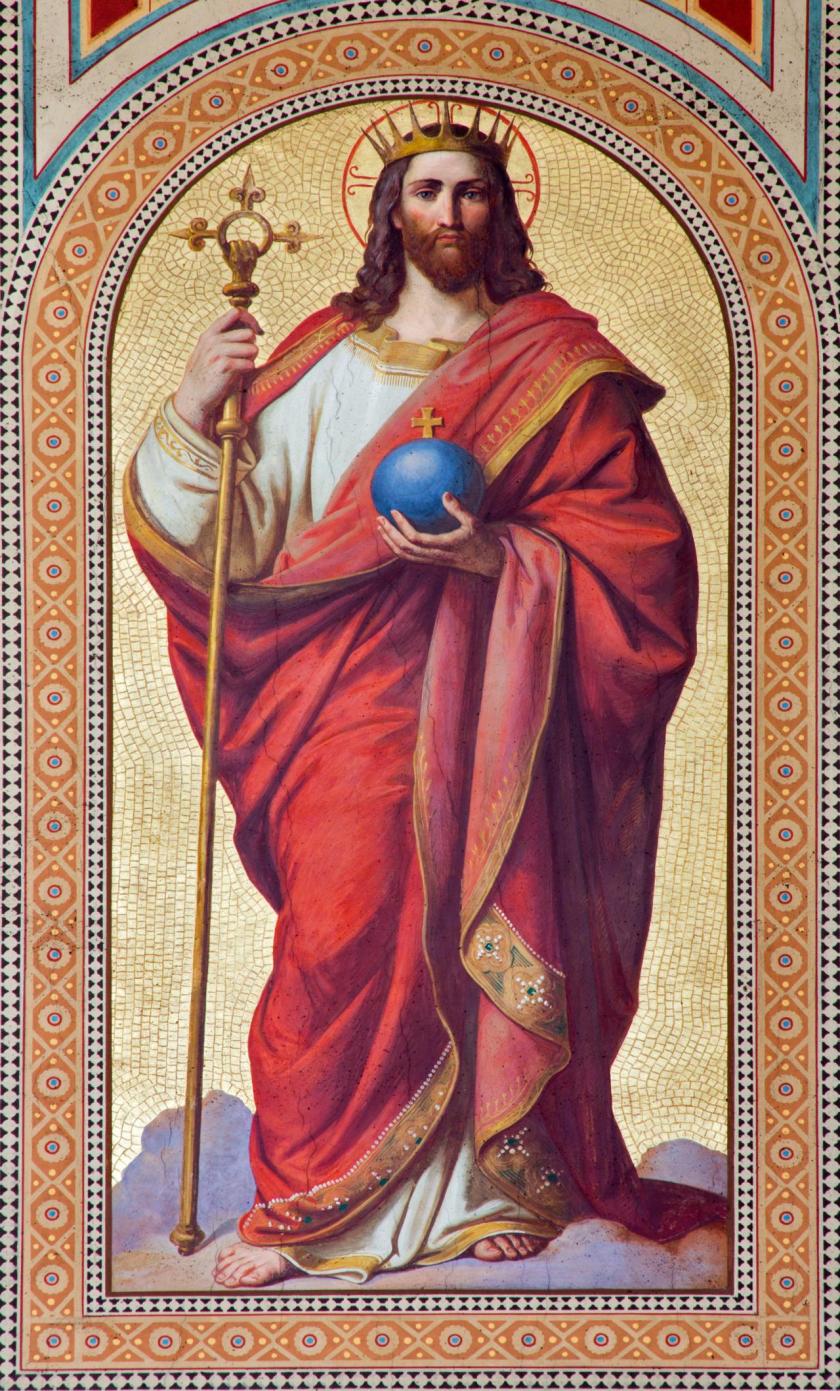
25 November – The Solemnity of Our Lord Jesus Christ, King of the Universe
The political context in which Pope Pius XI, by the Encyclical Quas Primas, established the feast of Christ the King in 1925, was the still unresolved Roman Question, which concerned the papacy and the kingdom of Italy regarding the temporal authority of the popes and the Papal States. For those of us who have grown up with the separation of church and state, the Papal States are a distant historical oddity.
Yet even if these political issues no longer resonate for us today, Quas Primas commemorated these same issues and problems by taking the view that marks the Church off as a unique society, one that is eternal, whose King’s authority transcends all political divisions and historical epochs. The Church exists in the messiness of history and responds to events that emerge from that same messiness but claims a King who transcends it all.
Already in the book of Daniel and in earlier prophetic books, the hope for the true king, the one who would establish God’s kingdom, emerged in the language and imagery of ancient Near Eastern myth, when the prophet sees “I saw in the night visions and behold, with the clouds of heaven there came one like a son of man.” While scholars dispute the identification of the son of man as the messiah in Daniel, the earliest Christians understood that the one to whom “was given dominion and glory and kingdom, that all peoples, nations and languages should serve him; his dominion is an everlasting dominion, which shall not pass away and his kingdom one that shall not be destroyed.”
When would this King of all peoples, nations and languages arrive? When would God’s kingdom, the everlasting dominion, be established? The book of Revelation, written in opposition to the Caesars of Rome and their empire, declared that Jesus was already “the ruler of kings on earth” who “made us a kingdom, priests to his God and Father, to him be glory and dominion for ever and ever.” And Revelation promised, evoking the language of Daniel, that Jesus’ first coming will be followed by a second coming with the clouds when “every eye will see him, every one who pierced him; and all tribes of the earth will wail on account of him.”
Even Jesus’ disciples, though, who followed Him faithfully if unsurely to Jerusalem, must have wondered about the answer when they heard the Roman procurator Pilate, ask their teacher, “Are you the King of the Jews?” Jesus answered, “My kingship is not of this world; if my kingship were of this world, my servants would fight, that I might not be handed over to the Jews; but my kingship is not from the world.” It is a true answer, of course but also elusive, for though Jesus’ kingdom is “not from this world” and does not involve peach treaties, concordats, armies and diplomatic corps, it includes all of this world and all that is in it.
It is a point Pope Pius XI makes in Quas Primas (13), citing St Cyril of Alexandria, who wrote that “Christ has dominion over all creatures …by essence and by nature.” Pope Pius XI also writes that though Jesus’ kingship is founded upon the ineffable hypostatic union, “Christ is also our King by acquired, as well as by natural right, for He is our Redeemer.” Jesus’ kingship is unlike any other by nature and by behaviour.
But there is another consideration as to why Jesus declared that His kingdom was ‘not from this world’. Pope Pius XI states that all people can enter “this kingdom, whoever they are and from wherever they are, since “this kingdom is opposed to none other than to that of Satan and to the power of darkness” (18). This kingdom welcomes all kingdoms and all peoples.
If we see only the messiness of history and politics, we are missing the true story of eternity and the true King of all, who is already “the ruler of the kings of the earth.” I f we believe it to be true, we must never despair of the politics of our age, for He came as King, is now King and is coming again in glory as King!
St Catherine of Alexandria (Died c 305) (Optional Memorial)
Bl Adalbert of Caramaico
St Alanus of Lavaur
St Audentius of Milan
St Bernold of Ottobeuren
Bl Conrad of Heisterbach
Bl Ekbert of Muensterschwarzach
Bl Elisabeth Achler
St Erasmus of Antioch
Bl Garcia of Arlanza
Bl Guido of Casauria
St Imma of Wurzburg
Bl Jacinto Serrano López
St Jucunda of Reggio Aemilia
Bl Maria Corsini Beltrame Quattrocchi
St Mercurius of Caesarea
St Moses of Rome
St Peter of Alexandria
Bl Santiago Meseguer Burillo
—
Martyrs of Africa – (13 saints): A group of 13 Christians murdered together for their faith in Africa, date unknown. The only details to have survived are their names – Claudian, Cyprian, Donatus, Felix, Januarius, Julian, Lucian, Marcian, Martialis, Peter, Quirianus, Victor and Vitalis.
Thought for the Day – 24 November – The Memorial of Saint Andrew Dung-Lac, Priest, and Companions, Martyrs
The Martyrs’ share in Christ’s victory
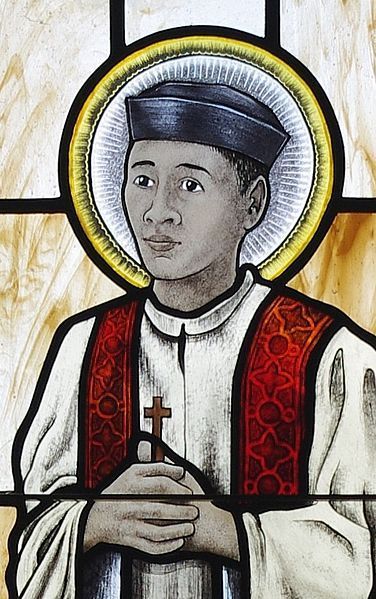
Saint Paul Le-Bao-Tinh (1793-1857) – Priest & Martyr
An excerpt from Letter to the Seminarians of Ke-Vinh
I, Paul, in chains for the name of Christ, wish to relate to you the trials besetting me daily, in order that you may be inflamed with love for God and join with me in His praises, for His mercy is for ever. The prison here is a true image of everlasting hell: to cruel tortures of every kind—shackles, iron chains, manacles—are added hatred, vengeance, calumnies, obscene speech, quarrels, evil acts, swearing, curses, as well as anguish and grief. But the God who once freed the three children from the fiery furnace is with me always, He has delivered me from these tribulations and made them sweet, for His mercy is for ever.
In the midst of these torments, which usually terrify others, I am, by the grace of God, full of joy and gladness, because I am not alone—Christ is with me.
Our Master bears the whole weight of the cross, leaving me only the tiniest, last bit. He is not a mere onlooker in my struggle but a contestant and the victor and champion in the whole battle. Therefore upon His head is placed the crown of victory and his members also share in His glory.
How am I to bear with the spectacle, as each day I see emperors, mandarins and their retinue blaspheming Your holy name, O Lord, who are enthroned above the Cherubim and Seraphim? Behold, the pagans have trodden Your cross underfoot! Where is Your glory? As I see all this, I would, in the ardent love I have for You, prefer to be torn limb from limb and to die as a witness to Your love.
O Lord, show Your power, save me, sustain me, that in my infirmity Your power may be shown and may be glorified before the nations, grant that I may not grow weak along the way and so allow Your enemies to hold their heads up in pride.
Beloved brothers, as you hear all these things may you give endless thanks in joy to God, from whom every good proceeds, bless the Lord with me, for His mercy is forever. My soul proclaims the greatness of the Lord, my spirit rejoices in God my Saviour, for He has looked with favour on His lowly servant and from this day all generations will call me blessed, for His mercy is forever.
O praise the Lord, all you nations, acclaim Him all you peoples, for God chose what is weak in the world to confound the strong, God chose what is low and despised to confound the noble. Through my mouth He has confused the philosophers who are disciples of the wise of this world, for His mercy is forever.
I write these things to you in order that your faith and mine may be united. In the midst of this storm, I cast my anchor toward the throne of God, the anchor that is the lively home in my heart.
Beloved brothers, for your part, so run, that you may attain the crown, put on the breastplate of faith and take up the weapons of Christ for the right hand and for the left, as my patron Saint Paul has taught us. It is better for you to enter life with one eye or crippled than, with all your members intact, to be cast away.
Come to my aid with your prayers, that I may have the strength to fight according to the law and indeed to fight the good fight and to fight until the end and so finish the race. We may not again see each other in this life but we will have the happiness, of seeing each other again, in the world to come, when, standing at the throne of the spotless Lamb, we will together join in singing His praises and exult forever in the joy of our triumph. Amen
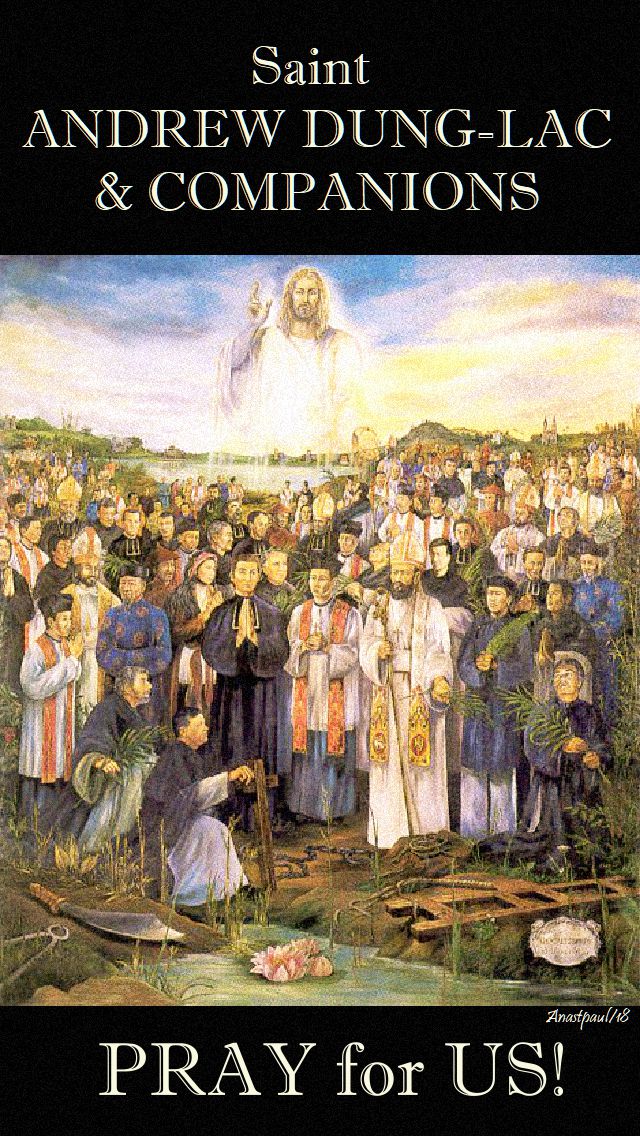
St ANDREW DUNG-LAC & ALL VIETNAMESE MARTYRS, PRAY for US!
One Minute Reflection – 24 November – Today’s Gospel: Luke 20:27–40 – Saturday of the Thirty Third Week in Ordinary Time, Year B – The Memorial of St Andrew Dung-Lac & Companions, Vietnam Martyrs
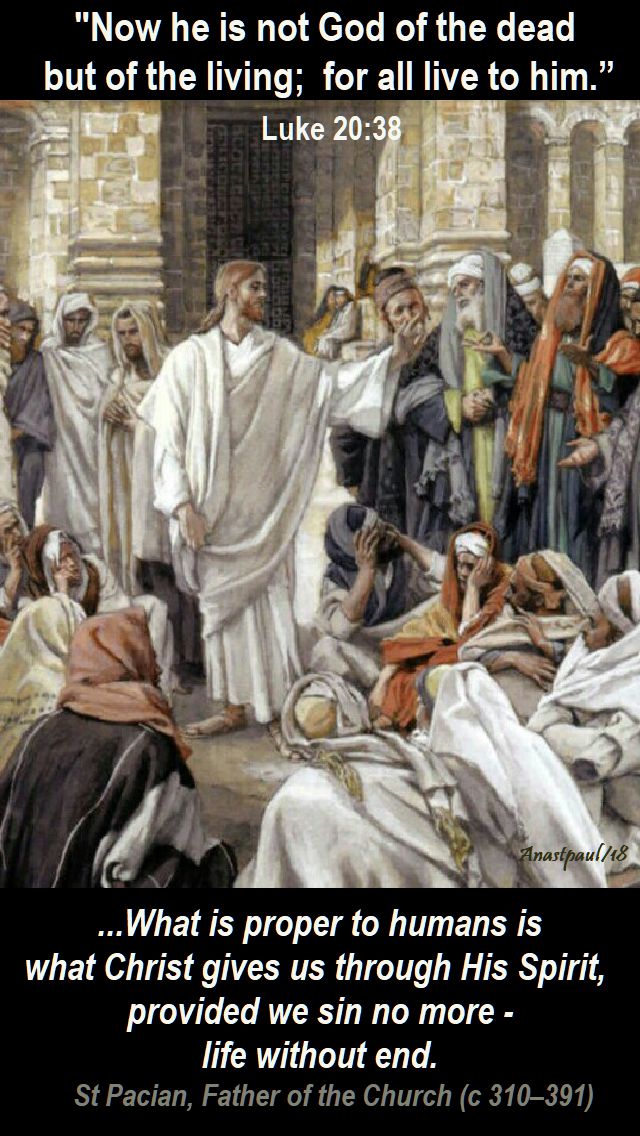
“Now he is not God of the dead but of the living; for all live to him.”...Luke 20:38
REFLECTION – “ Just as we have borne the image of the earthly one, we shall also bear the image of the earthly one. The first man was from the earth, earthly; the second man from heaven. ” If we thus act, beloved, then we shall nevermore die in time to come. Even though our bodies may decay, we shall be living in Christ as he himself affirmed: “Whoever believes in me, even if he dies, will live.” We are assured, on the witness of our Lord Himself, that Abraham, Isaac, Jacob and all the saints are alive. For it was concerning them that our Lord said: “All are alive for him, for he is not God of the dead but of the living.” And the apostle Paul said, speaking of himself: “For me, life is Christ, death gain. I long to depart and be with Christ.” And again: “So long as we are in the body, we are away from the Lord . For indeed, we walk by faith, not by sight.” This is what we believe, my dearest brethren. Besides: “If we have placed our hope in this world only, we are the most pitiable people of all.”
Life in this world, as you yourselves can see, is just the same for animals, wild beasts, birds and ourselves and it can even be longer for them. But what is proper to humans is what Christ gives us through His Spirit, provided we sin no more – life without end…: “The wages of sin is death; the gift of God is eternal life through Jesus Christ our Lord.”…St Pacian, Father of the Church (c 310–391) (Biblical references: 1Cor 15:49.47; Jn 11:25; Phil 1:21.23; 2Cor 5:6-7; 1Cor 15:19; Rm 6:23)
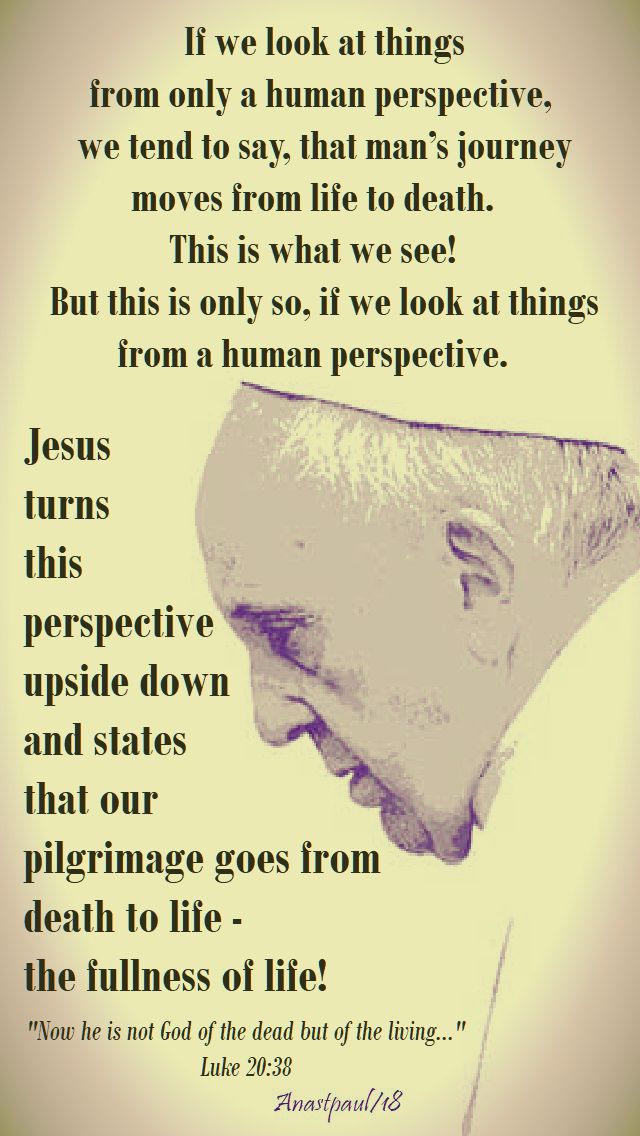
“It is not this life that will serve as a reference point for eternity, for the other life that awaits us; rather, it is eternity — that life — which illumines and gives hope to the earthly life of each one of us! If we look at things from only a human perspective, we tend to say that man’s journey moves from life to death. This is what we see! But this is only so if we look at things from a human perspective. Jesus turns this perspective upside down and states that our pilgrimage goes from death to life – the fullness of life!” …Pope Francis – Angelus, 10 November 2013
PRAYER – O God, source and origin of all fatherhood, who kept the Martyrs Saint Andrew Dung-Lac and his companions faithful to the Cross of Your Son, even to the shedding of their blood, grant, through their intercession, that, spreading Your love among our brothers and sisters, we may be Your children both in name and in truth and thus come to our resurrection with Jesus Christ, Your Son. Through our Lord Jesus Christ, Who lives and reigns with You in the unity of the Holy Spirit, one God, for ever and ever.
Our Morning Offering – 24 November – Saturday of the Thirty Third Week in Ordinary Time, Year B – Saturday with Mary
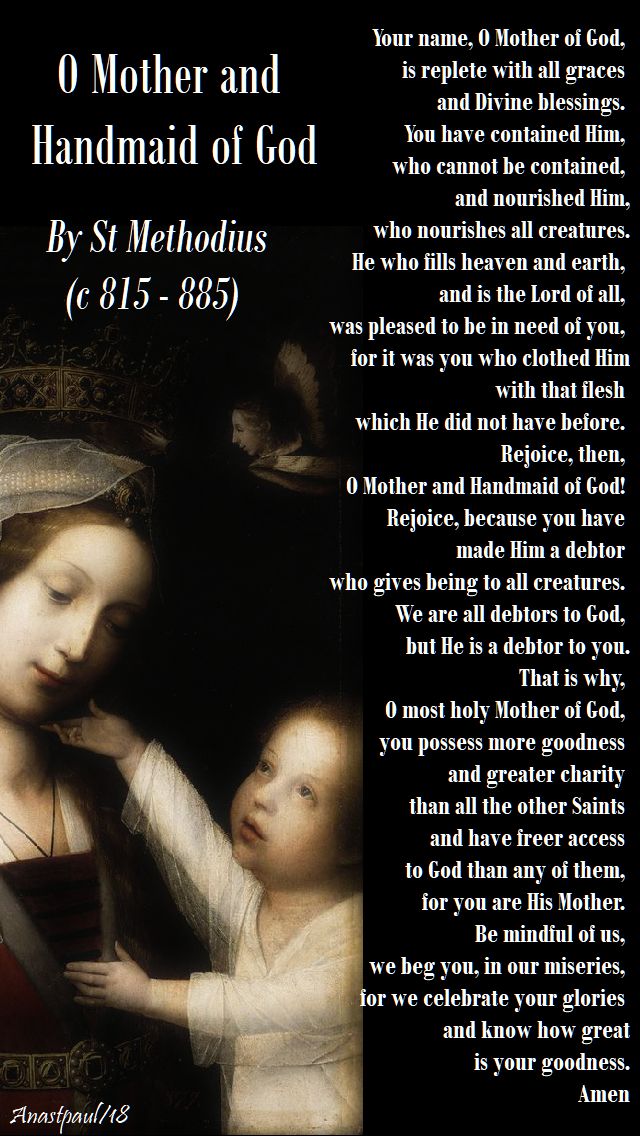
O Mother and Handmaid of God St Methodius of Constantinople (c 815-885)
Your name, O Mother of God,
is replete with all graces
and Divine blessings.
You have contained Him who cannot be contained,
and nourished Him who nourishes all creatures.
He who fills heaven and earth,
and is the Lord of all,
was pleased to be in need of you,
for it was you who clothed Him with that flesh
which He did not have before.
Rejoice, then, O Mother and Handmaid of God!
Rejoice, because you have made Him a debtor
who gives being to all creatures.
We are all debtors to God,
but He is a debtor to you.
That is why, O most holy Mother of God,
you possess more goodness
and greater charity than all the other Saints,
and have freer access to God than any of them,
for you are His Mother.
Be mindful of us,
we beg you,
in our miseries,
for we celebrate your glories
and know how great is your goodness.
Amen
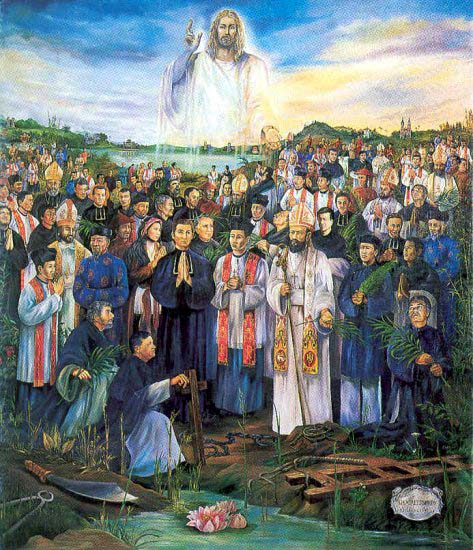
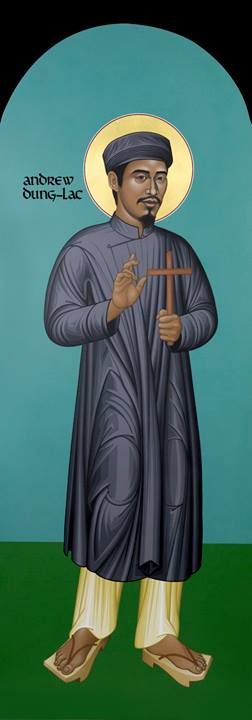
Saints of the Day – 24 November – St Andrew Dung-Lac (1795-1839) and Companions – Martyrs of Vietnam – Patronage – Vietnam.
Born in 1795 in the Tonkinese town of Bac-Nihh in North Vietnam, Tran An Dung was the son of pagan parents. In search of work for themselves in 1807, his parents moved to the ancient citadel of Hanoi. Here their twelve-year-old son was taken care of by a catechist and for three years was instructed in the Catholic faith. Baptised in Vinh-Tri, he received the Christian name Andrew (Anrê) in baptism and went onto learn both Chinese and Latin and himself became a catechist. He was selected for further studies in theology and was ordained to the priesthood on 15 March 1823.
An exemplary priest, Andrew was ardent and indefatigable in his preaching, often fasted and drew many to the Faith by his simple and moral life. As a testament of the love which his congregation had for him, in 1835, when he was imprisoned during the persecution of the Annamite emperor Minh-Mang, his freedom was purchased exclusively by donations from his parishioners. The Vietnamese Christians suffered unspeakably during this time.
Beginning in 1832 Minh-Mang expelled all foreign missionaries and commanded all Vietnamese Christians to demonstrate their renunciation of the Catholic Faith by trampling on a crucifix. Churches were destroyed; religious instruction was forbidden. Christians were branded on the face with the words ta dao (false religion) and Christian families and villages were obliterated. Many endured extreme privations and hardship; many more were put to death for their fidelity to the Faith.
To avoid further persecution by the authorities, Andrew Dung changed his name to Lac and relocated to a different region.
While visiting a fellow priest, in order to confess himself, Dung-Lac was arrested with Father Peter Thi on 10 November 1839. In exchange for a monetary ransom paid to their captors, the two priests were liberated but their freedom was short-lived. Re-arrested not long afterwards, they were taken to Hanoi and severely tortured. They were beheaded shortly before Christmas Day on 21 December 1839.
The priests, Andrew Dung-Lac and Peter Thi, were beatified on 27 May 1900 by Pope Leo XIII and formed part of a group of Vietnamese martyrs beatified together on that day.
Another group, Dominicans all, was beatified on 20 May 1906 and a third on 2 May 1909 both by St Pope Pius X. A fourth group, which included two Spanish bishops, was beatified on 29 April 1951 by Pope Pius XII. All 117 martyrs were Canonised in Rome on 19 June 1988 by St Pope John Paul II.
These 117 martyrs met their deaths during several persecutions of Christians that swept through the Vietnamese peninsula between the years 1625 and 1886.
Approximately 300,000 gave their lives for the Catholic Faith and further beatifications may be expected from amongst their glorious ranks. Among the 117 that have been Canonised were 96 Vietnamese and 21 foreign missionaries.
Of the Vietnamese group 37 were priests and 59 were lay people, among whom were catechists and tertiaries. One of them was a woman, mother of six children. Of the missionaries 11 were Spaniards: 6 bishops and 5 priests, all Dominicans and 10 were French, 2 bishops and 8 priests from the Société des Missions Etrangères in Paris.
The tortures these martyrs endured were among the worst in the history of Christian martyrdom. The means included cutting off limbs joint by joint, ripping living bodies with red hot tongs and the use of drugs to enslave the minds of the victims.
Among the 117 Martyrs of Vietnam, 76 were beheaded, 21 were suffocated, 6 burnt alive, 5 mutilated and 9 died in prison as a result of torture.
St Andrew Dung-Lac and Companions – Martyrs of Vietnam – (Memorial) – 117 saints and beati
St Albert of Louvain
St Alexander of Corinth
St Balsamus of Cava
St Bieuzy of Brittany
St Chrysogonus
St Colman of Cloyne
Bl Conrad of Frisach
St Crescentian of Rome
St Eanfleda of Whitby
St Felicissimus of Perugia
St Félix Alonso Muñiz
St Firmina of Amelia
St Flora of Cordoba
St Francisco Borrás Román
St Hitto of Saint-Gall
St Kenan of Damleag
St Leopardinus of Vivaris
Bl Maria Anna Sala
St Marinus of Maurienne
St Mary of Cordoba
St Phêrô Võ Ðang Khoa
St Pierre Rose Ursule Dumoulin Borie
St Portianus of Miranda
St Protasius of Milan
St Romanus of Le Mans
St Vinh-son Nguyen The Ðiem
—
Martyred in the Spanish Civil War – Martyred Carmelite Sisters of Valencia – 12 beati:
• Blessed Antonia Gosens Sáez De Ibarra
• Blessed Cándida Cayuso González
• Blessed Clara Ezcurra Urrutia
• Blessed Concepción Rodríguez Fernández
• Blessed Daría Campillo Paniagua
• Blessed Erundina Colino Vega
• Blessed Feliciana de Uribe Orbe
• Blessed Félix Alonso Muñiz
• Blessed Francisco Borrás Román
• Blessed Justa Maiza Goicoechea
• Blessed María Concepción Odriozola Zabalía
• Blessed María Consuelo Cuñado González
• Blessed Niceta Plaja Xifra
• Blessed Paula Isla Alonso
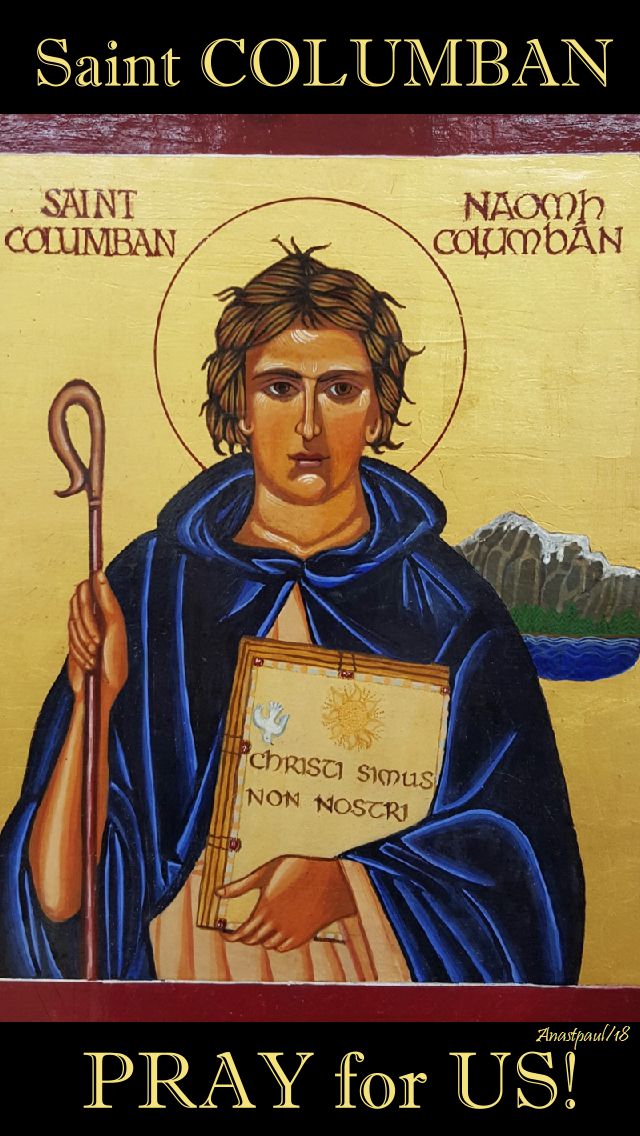
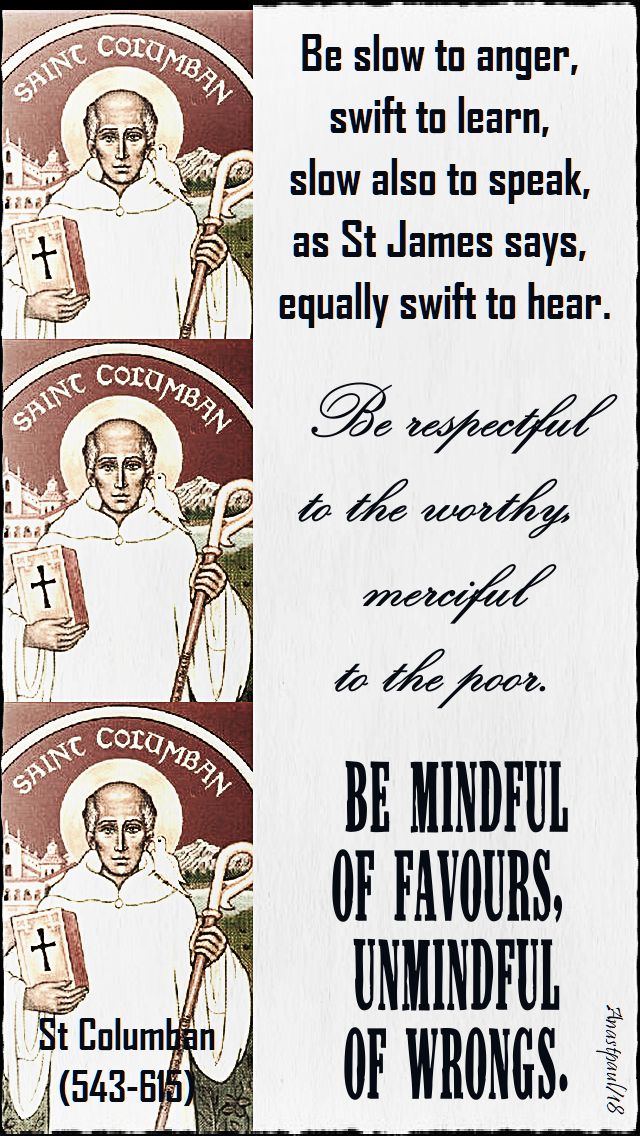
Thought for the Day – 23 November – The memorial of St Columban (543-615)
God called you out of the darkness into his wonderful light. Once you were less than nothing, now you are God’s own. Once you knew very little of God’s kindness, now your very lives have been changed by it….1 Peter 2:9-10
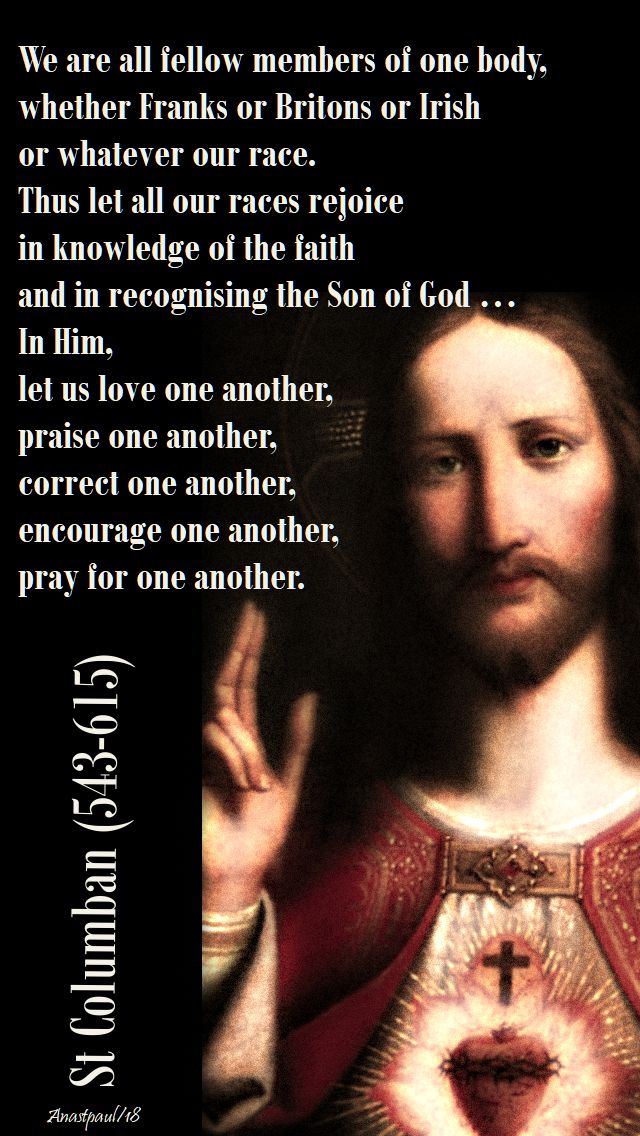
From St Columban’s letter to the French Bishops: “We are all fellow members of one body, whether Franks or Britons or Irish or whatever our race. Thus, let all our races rejoice, in knowledge of the faith and in recognising the Son of God … In Him, let us love one another, praise one another, correct one another, encourage one another, pray for one another.”
(Letter 2, to the French bishops)
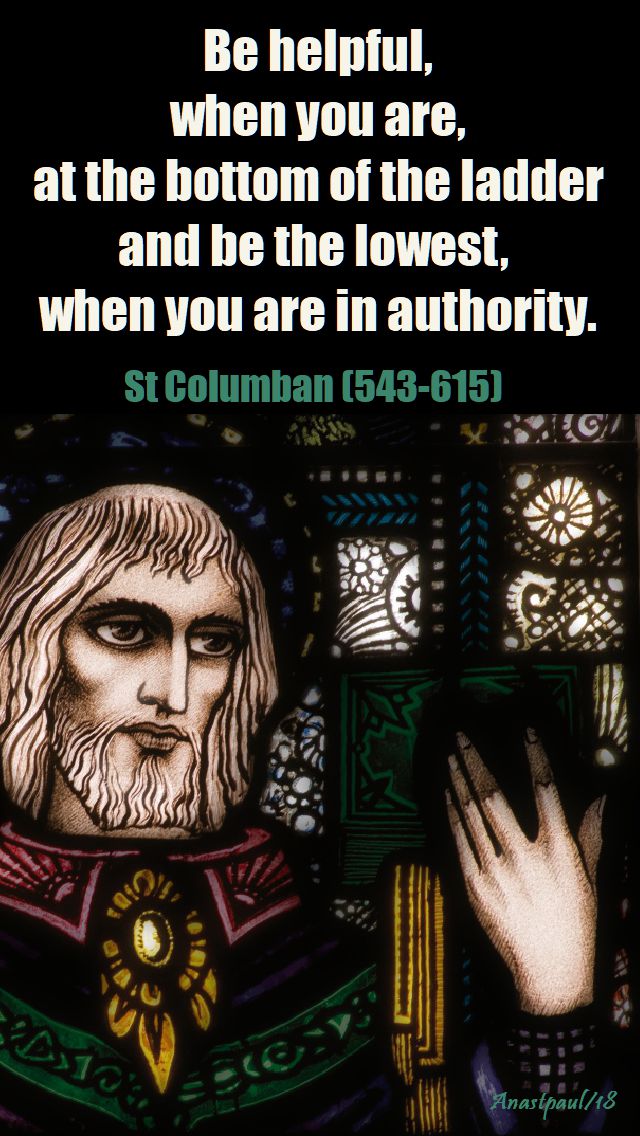
St Columban suffered for his outspokenness in the face of moral corruption and public depravity. He was exiled but his words were remembered years later and many of his warnings heeded. He preached the word of Christ fearlessly and was not afraid of the anger of kings. It is the kind of Christian courage we should have.
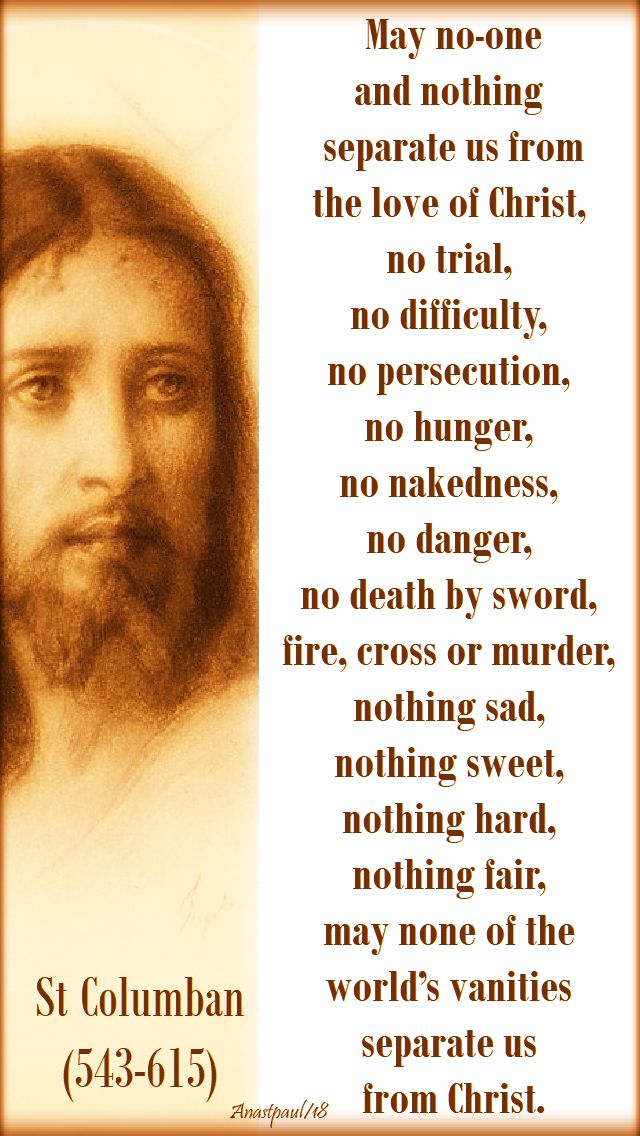
From his fourth letter: “May no-one and nothing separate us from the love of Christ, no trail, no difficulty, no persecution, no hunger, no nakedness, no danger, no death by sword, fire, cross or murder, nothing sad, nothing sweet, nothing hard, nothing fair, may none of the world’s vanities separate us from Christ.”
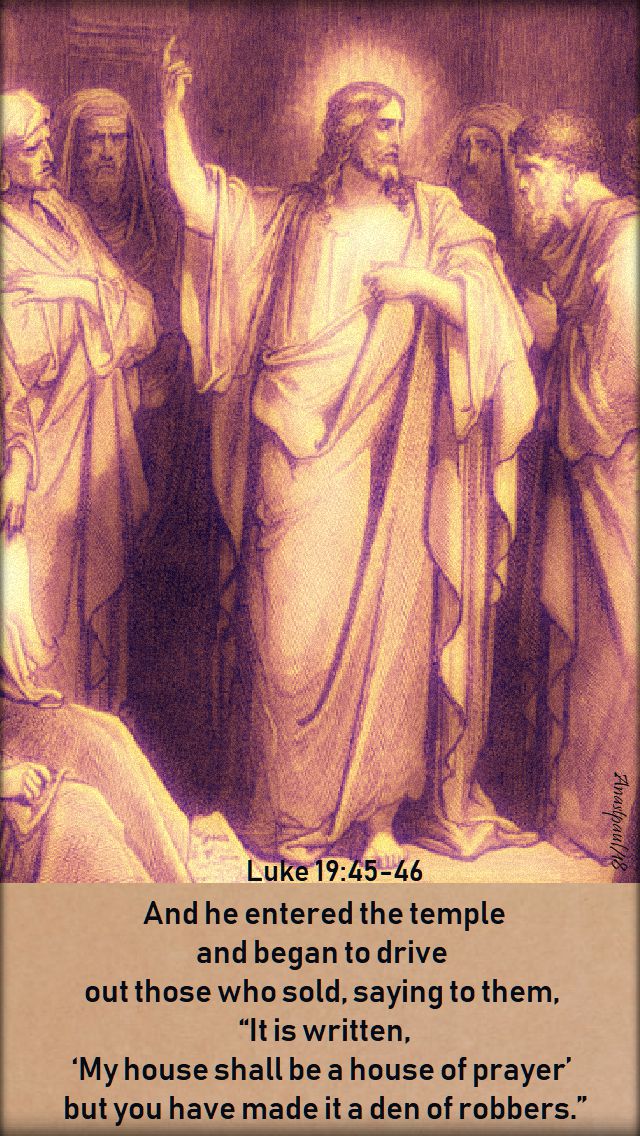
One Minute Reflection – 23 November – Today’s Gospel: Luke 19:45–48 – Friday of the Thirty-third week in Ordinary Time and the Memorial of St Columban (543-615)
And he entered the temple and began to drive out those who sold, saying to them, “It is written, ‘My house shall be a house of prayer’ but you have made it a den of robbers.”…Luke 19:45-46
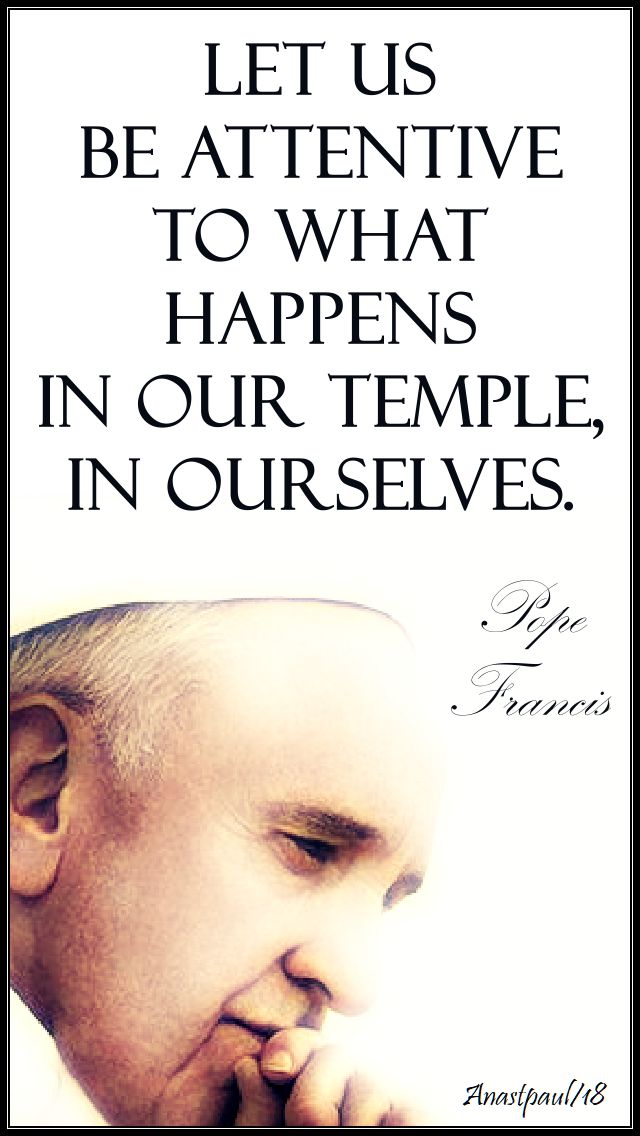
REFLECTION – “Have I learned to watch over myself, that the temple of my heart is only for the Holy Spirit? Purify the temple, the inner temple and watch. Be careful, be careful: what happens in the heart. Who comes in and who goes out, the feelings, the ideas… Do we speak to the Holy Spirit? Do we listen to the Holy Spirit? Watch out. Let us be attentive to what happens in our temple, in (us) ourselves.”…Pope Francis – Santa Marta, 24 November 2017
PRAYER – Lord God, in the life of St Columban you combined a zeal for mission and a love of the monastic life. May his prayer and example, prompt us to love You above all things, to listen and respond to the promptings of the Holy Spirit who teaches us to be true ‘stones’ of the temple, building up the Body of Christ. May we always we aware, that our actions affect the whole building of Your Church. Grant us the grace, that by our lives, we may strengthen and increase the household of the Faith. We make our prayer through Christ, our Lord with the Holy Spirit, one God, forever amen.
Our Morning Offering – 23 November – The Memorial of St Columban (543-615)
Lord, Kindle our Lamps By St Columban
Lord, kindle our lamps,
Saviour most dear to us,
that we may always shine
in Your presence
and always receive light
from You, the Light Perpetual,
so that our own personal darkness
may be overcome
and the world’s darkness
driven from us.
Amen
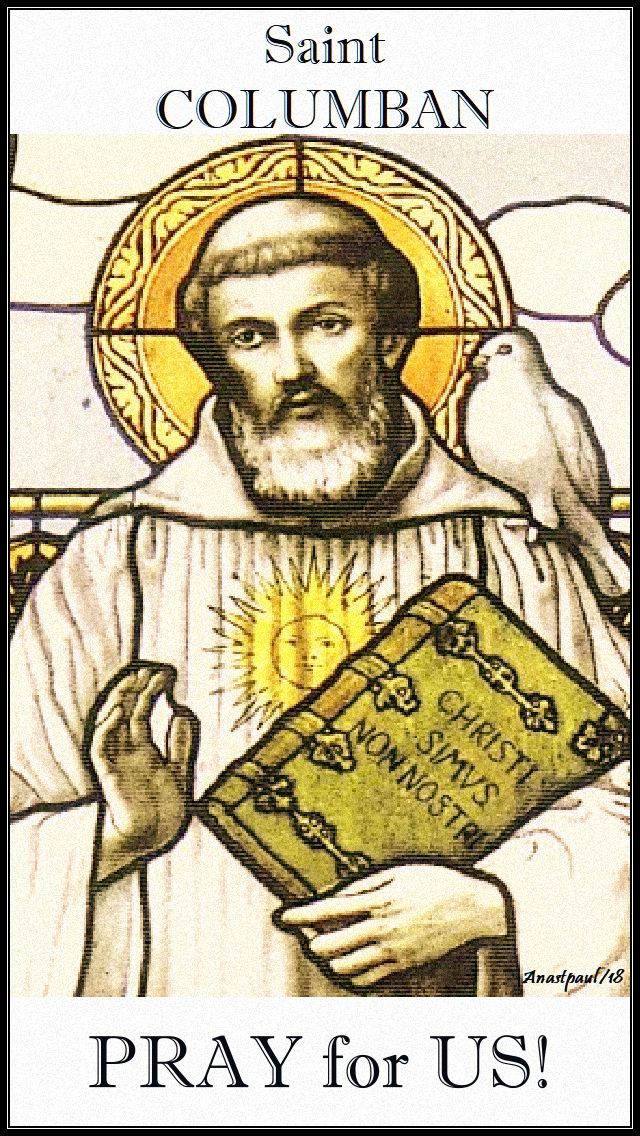
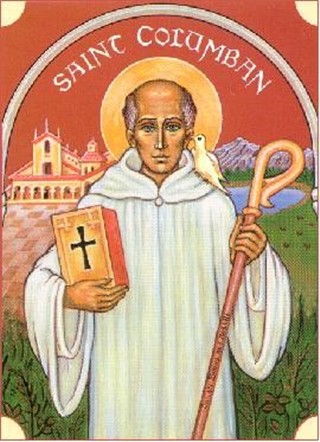
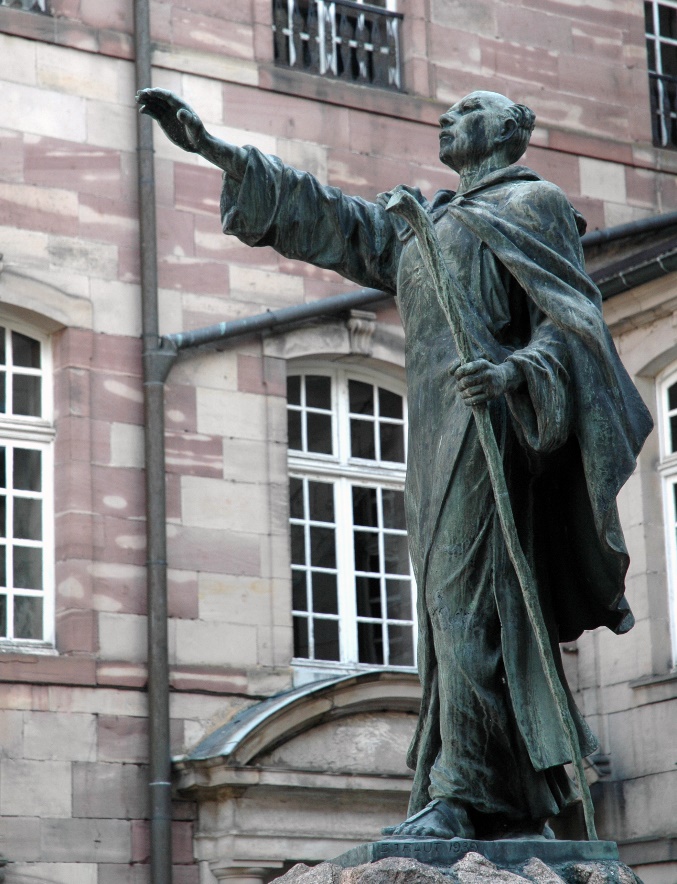
Saint of the Day – 23 November – St Columban (543-615) – Monk, Irish Missionary, Abbot, Writer, Reformer, Teacher, Miracle-worker, Founder of numerous monateries in present-day France and Italy. Patronages – against floods, Bobbio, Italy, Missionary Society of Saint Columban, motorcyclists. Columban is named in the Roman Martyrology on 23 November, which is his feast day in Ireland. His feast is observed by the Benedictines on 24 November and 26 November by the Franciscans.
Well-born, handsome and educated, Columban was torn between a desire for God and easy access to the pleasures of the world. Acting on advice of a holy anchoress, he decided to withdraw from the world. His family opposed the choice, his mother going so far as to block the door. He became a Monk at Lough Erne and studied Scripture extensively, writing a commentary on the Psalms. He then became a Monk at Bangor under abbot Saint Comgall.
In middle age, Columban felt a call to missionary life. With twelve companions (Saint Attala, Columban the Younger, Cummain, Domgal, Eogain, Eunan, Saint Gall, Gurgano, Libran, Lua, Sigisbert and Waldoleno) he travelled to Scotland, England and then to France in 585. The area, though nominally Christian, had fallen far from the faith but were ready for missionaries and they had some success. They were warmly greeted at the court of Gontram and king of Burgundy invited the band to stay. They chose the half-ruined Roman fortress of Annegray in the Vosges Mountains for their new home with Columban as their abbot.
The simple lives and obvious holiness of the group drew disciples to join them and the sick to be healed by their prayers. Columban, to find solitude for prayer, often lived for long periods in a cave seven miles from the monastery, using a messenger to stay in touch with his brothers. When the number of new monks over-crowded the old fortress, King Gontram gave them the old castle of Luxeuil to found a new house in 590. Soon after, a third house was founded at Fontaines. Columban served as master of them all and wrote a Rule for them which incorporated many Celtic practices, was approved by the Council of Macon in 627 but was superseded by the Benedictine.
Problems arose early in the 7th century. Many Frankish bishops objected to a foreign missionary with so much influence, to the Celtic practices he brought, especially those related to Easter and his independence from them. In 602 he was summoned to appear before them for judgement, instead of appearing, he sent a letter advising them to hold more synods and to concern themselves with more important things than which rite he used to celebrate Easter. The dispute over Easter continued to years, with Columban appealing to multiple popes for help but was only settled with Columban abandoned the Celtic calendar when he moved to Italy.
In addition to his problems with the bishops, Columban spoke out against vice and corruption in the royal household and court, which was in the midst of a series of complex power grabs. Brunehault stirred up the bishops and nobility against the abbot, he was ordered to conform to the local ways. Columban refused and was briefly imprisoned at Besançon but he escaped and returned to Luxeuil. An armed force was sent to order Columban and his foreign monks back to Ireland. As soon as his ship set sail, a storm drove them back to shore, the captain took it as a sign and set the monks free.
They travelled to Metz, France, then Mainz, Germany, Suevi, Alamanni and finally Lake Zurich. Their evangelisation work there was unsuccessful and the group passed on to Arbon, then Bregenz and then Lake Constance. Saint Gall, who knew the local language best, took the lead in this region and many were converted to the faith. The group founded a new monastery as their home and base. However, a year later political upheaval caused Columban to cross the Alps into Italy, arriving in Milan in 612. The Christian royal family treated him well and he preached and wrote against Arianism and Nestorianism. In gratitude, the Lombard king gave him a tract of land call Bobbio between Milan and Genoa in Italy. There he rebuilt a half-ruined church of Saint Peter and around it he founded an abbey that was to be the source for evangelisation throughout northern Italy for centuries to come.
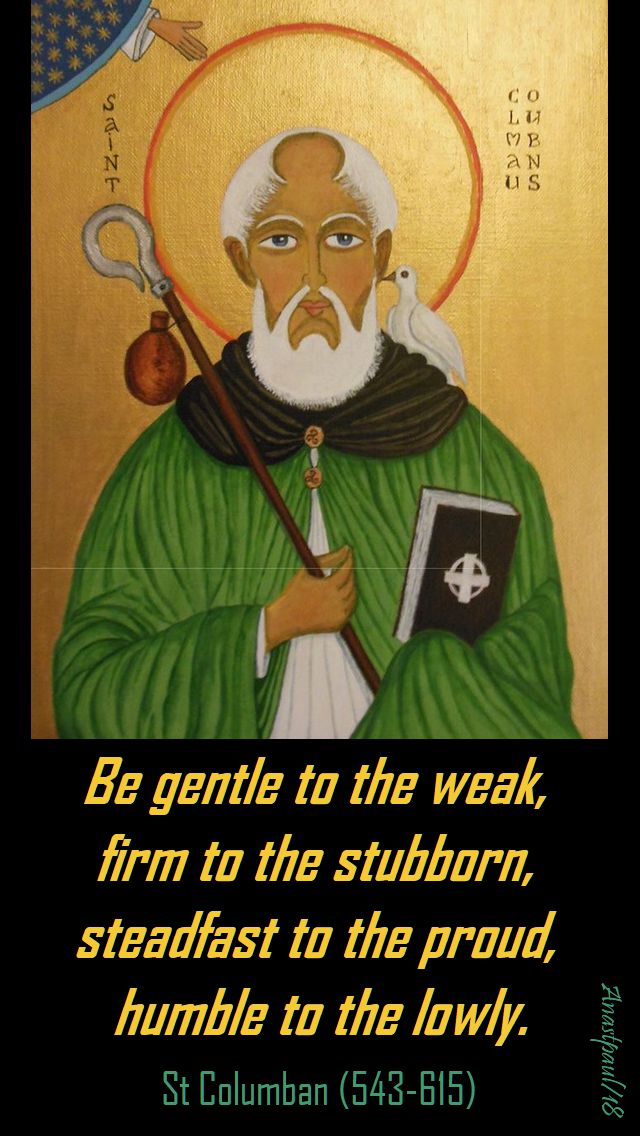
Columban always enjoyed being in the forests and caves and as he walked through the woods, birds and squirrels would ride on his shoulders. Toward the end of his life came word that his old enemies were dead and his brothers wanted him to come back north, but he declined. Knowing that his time was almost done, he retired to a cave for solitude and died as he had predicted. His influence continued for centuries as those he converted handed on the faith, the brothers he taught evangelised untold numbers more and his brother monks founded over one hundred monasteries to protect learning and spread the faith.
Miracles ascribed to Columban during his lifetime, include –
• to obtain food for a sick brother monk, he cured the wife of the donor;
• once when he was surrounded by wolves, he simply walked through them;
• at one point he needed a cave for his solitary prayers; a bear lived there; when Columban asked, the bear left;
• when he needed water in order to live in the cave, a spring appeared nearby;
• when the Luxeuil Abbey granary ran empty, Columban prayed over it and it refilled;
• he multiplied bread and beer for his community;
• he cured several sick monks, who then got straight out of bed to reap the monastery’s harvest;
• gave sight to a blind man at Orleans;
• he destroyed a vat of beer being prepared for a pagan festival by breathing on it;
• when the monastery needed help in the fields, he tamed a bear, and yoked it to a plough.
He impressed his contemporaries as a giant of a man in mind and spirit, who revived religion on the continent and prepared the way for the Carolingian renaissance. He died at Bobbio on 23 November 615.
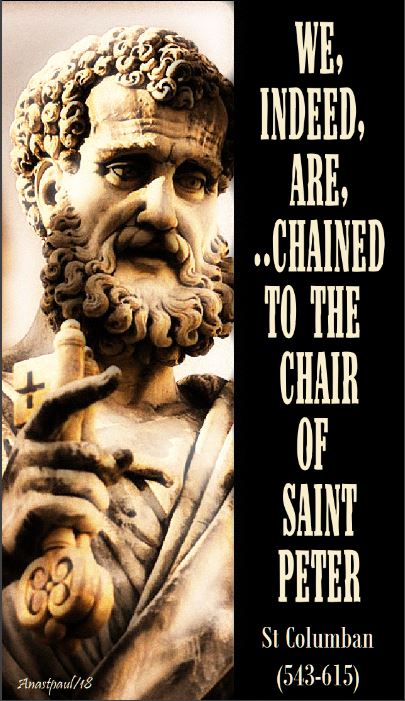
Columban did not lead a perfect life. According to biographers, he could be impetuous and even headstrong, for by nature he was eager, passionate and dauntless. These qualities were both the source of his power and the cause of his mistakes. His virtues, however, were quite remarkable. Like many saints, he had a great love for God’s creatures. Stories claim that as he walked in the woods, it was not uncommon for birds to land on his shoulders to be caressed, or for squirrels to run down from the trees and nestle in the folds of his cowl. Although a strong defender of Irish traditions, he never wavered in showing deep respect for the Holy See as the supreme authority. His influence in Europe was due to the conversions he effected and to the rule that he composed. The life of Columban stands as the prototype of missionary activity in Europe.
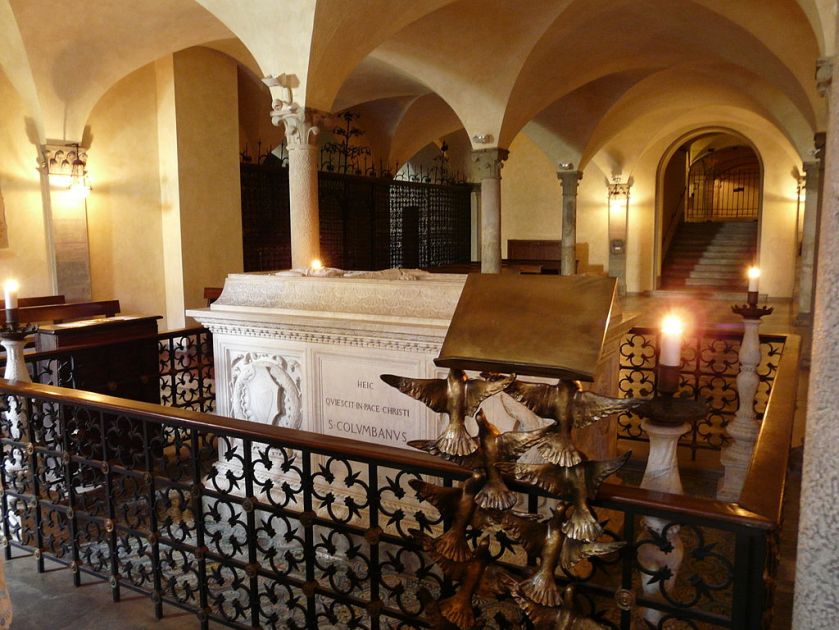
The remains of Columban are preserved in the crypt at Bobbio Abbey. Many miracles have been credited to his intercession. In 1482, the relics were placed in a new shrine and laid beneath the altar of the crypt. The sacristy at Bobbio possesses a portion of the skull of the saint, his knife, wooden cup, bell and an ancient water vessel, formerly containing sacred relics and said to have been given to him by Pope Gregory I. According to some authorities, twelve teeth of the saint were taken from the tomb in the fifteenth century and kept in the treasury but these have since disappeared.
Shrine of St Columban, Bobbio Abbey crypt
The St Columban’s Missionary Society took its name from him, recognising in him a missionary genius with a uniquely Irish spirit.
St Columban’s works are:
• Penitencial
• Seventeen short Sermons
• Six Epistles
• Latin Poems
• A Monastic Rule
St Pope Clement I (c 88 – c 101) Martyr (Optional Memorial)
St Columban (543-615) (Optional Memorial)
Bl Miguel Agustin Pro SJ (1891 – 1927) Martyr (Optional Memorial)
—
St Adalbert of Casauria
St Alexander Nevski
St Amphilochius of Iconium
St Augusta of Alexandria
St Cecilia Yu Sosa
St Clement of Metz
Bl Detlev of Ratzeburg
Bl Enrichetta Alfieri
St Falitrus of Chabris
St Faustina of Alexandria
Bl Felícitas Cendoya Araquistain
St Felicity of Rome
St Gregory of Girgenti
Bl Guy of Casauria
St Jaume Nàjera Gherna
St Loëvan of Brittany
St Lucretia of Mérida
Bl Margaret of Savoy
St Mustiola of Chiusi
St Paternian of Fano
St Paulinus of Whitland
St Rachildis of Saint-Gall
St Severin of Paris
St Sisinius of Cyzicus
St Trudo of Hesbaye
St Wilfetrudis of Nivelless
Thought for the Day – 22 November – The Memorial of St Cecilia (died 3rd Century) Virgin Martyr
For the early Christians, their faith was an amazing revelation that brought light and joy into a world of gloom and uncertainty. It is should not be difficult for us to truly realise how startling this must’ve been in those pagan times, for how different are these times of ours, which seem to be the return of barbarism. We should reflect on what the faith means to us now, in our modern world and perhaps, we will begin to understand this stupendous courage and wonderful joy of the martyrs.
Quote of the Day – 22 November – The Memorial of St Cecilia (died 3rd Century) Virgin Martyr – Patron of Musicians
Praise the Lord! Sing to the Lord a new song, his praise in the assembly of the faithful!…Psalm 149:1
Let us sing to the Lord, a song of love!
“Sing to the Lord a new song, His praise is in the assembly of the saints. We are urged to sing a new song to the Lord, as new men who have learned a new song. A song is a thing of joy, more profoundly, it is a thing of love. Anyone, therefore, who has learned to love the new life has learned to sing a new song and the new song reminds us of our new life. The new man, the new song, the new covenant, all belong to the one kingdom of God and so the new man will sing a new song and will belong to the new covenant.
There is not one who does not love something, but the question is, what to love. The psalms do not tell us not to love but to choose the object of our love. But how can we choose unless we are first chosen? We cannot love unless someone has loved us first. Listen to the apostle John: We love Him, because He first loved us. The source of man’s love for God can only be found in the fact that God loved him first. He has given us Himself as the object of our love and He has also given us its source. What this source is you may learn more clearly from the apostle Paul who tells us: The love of God has been poured into our hearts. This love is not something we generate ourselves, it comes to us through the Holy Spirit who has been given to us.
Since we have such an assurance, then, let us love God with the love He has given us. As John tells us more fully. God is love and whoever dwells in love dwells in God and God in him. It is not enough to say, Love is from God. Which of us would dare to pronounce the words of Scripture – God is love? He alone could say it who knew what it was to have God dwelling within him. God offers us a short route to the possession of Himself. He cries out – Love me and you will have me, for you would be unable to love me if you did not possess me already.
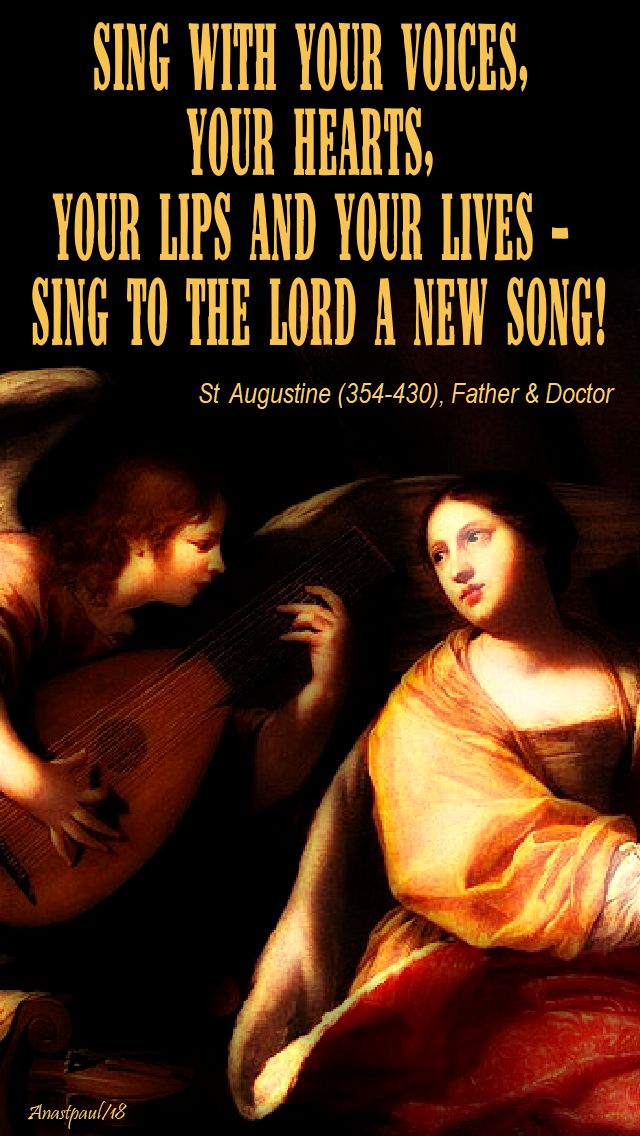
My dear brothers and sons, fruit of the true faith, holy seed of heaven, all you who have been born again in Christ and whose life is from above, listen to me, or rather, listen to the Holy Spirit saying through me: Sing to the Lord a new song. Look, you tell me, I am singing. Yes indeed, you are singing, you are singing clearly, I can hear you. But make sure that your life does not contradict your words. Sing with your voices, your hearts, your lips and your lives – Sing to the Lord a new song!
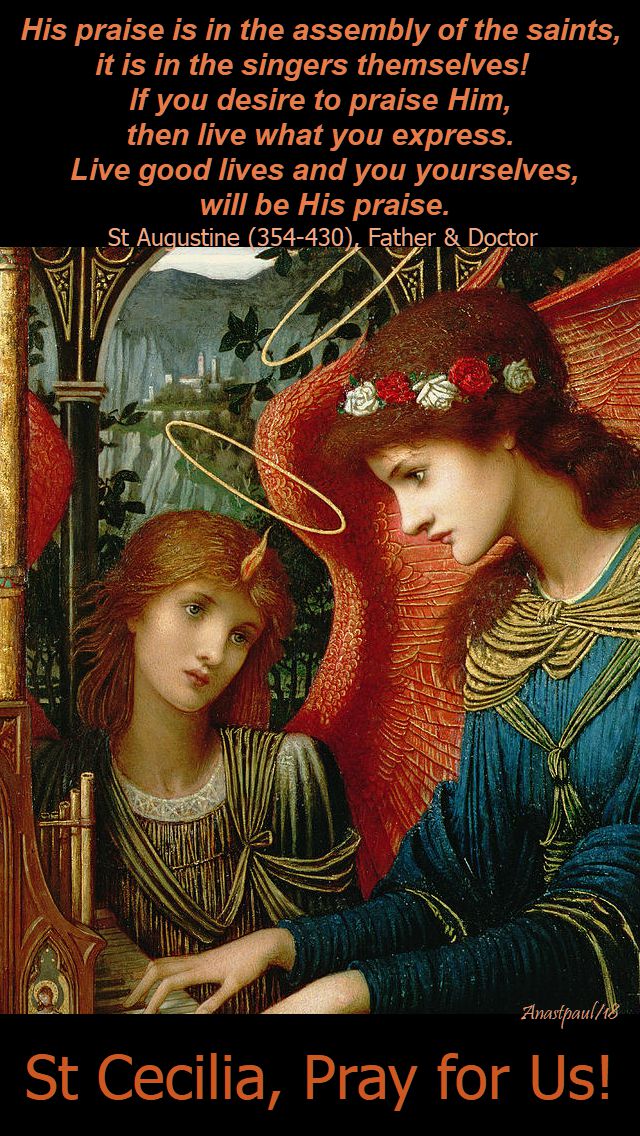
Now it is your unquestioned desire to sing of Him whom you love but you ask me how to sing His praises. You have heard the words – Sing to the Lord a new song and you wish to know what praises to sing. The answer is – His praise is in the assembly of the saints, it is in the singers themselves . lf you desire to praise Him, then live what you express. Live good lives and you yourselves, will be His praise.”
From a sermon by Saint Augustine (354-430), Father & Doctor – (Sermo 34.1-3, 5-6; CCL 41, 424-426) …Vatican.va
One Minute Reflection – 22 November – Today’s Gospel: Luke 19:41-44, Thursday of the Thirty-third week in Ordinary Time, Year B and The Memorial of St Cecilia (died 3rd Century) Virgin Martyr
And when he drew near and saw the city he wept over it, saying, “Would that even today you knew the things that make for peace!”…Luke 19:41-42
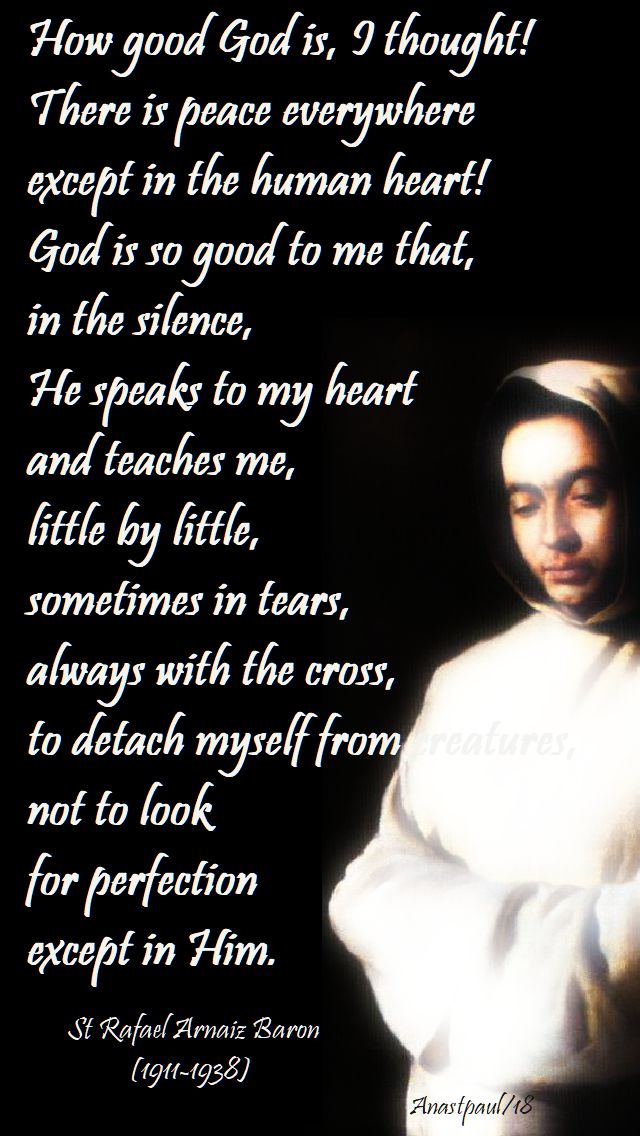
REFLECTION – “I leaned out of the window… The sun was beginning to rise. A great peace reigned over nature. Everything began to wake up – earth, sky, birds. Everything began, little by little, to wake up under God’s order. Everything obeyed His divine laws without complaint or sudden spurts, gently, smoothly, the light as much as the darkness, the blue sky as much as the hard earth covered with morning dew. How good God is, I thought! There is peace everywhere except in the human heart.
And delicately, gently, by means of this sweet and peaceful dawn, God taught me, too, to obey – a very great peace filled my soul. I thought how God alone is good, how all is ordained by Him, how nothing is of importance in what people do or say and how, where I am concerned, there must be nothing else in the world but God. God who will arrange everything for my good. God who causes the sun to rise each morning, who makes the ice melt, who cause the birds to sing and changes the clouds of heaven in a thousand soft colours. God who offers me a little corner on this earth for prayer, who gives me a little corner in which to wait for what I hope.
God is so good to me that, in the silence, He speaks to my heart and teaches me, little by little, sometimes in tears, always with the cross, to detach myself from creatures, not to look for perfection except in Him and showing me Mary and saying to me : “Here is the only perfect creature, you will find in her the love and charity you fail to find in men. What are you complaining about, Brother Raphael? Love me; suffer with me, it is I, Jesus!”... St Raphael Arnaiz Baron (1911-1938)
PRAYER – Lord our God, in Your mercy listen to our prayers! Teach us the peace of Your love. Guide us in the ways of Your Commandments. Let the path laid out by Your Son, be our Light and our Joy. Grant that by the prayers of Your Martyr, St Cecilia and all Your Saints, we may receive strength for our journey. Through Jesus our Lord, with the Holy Spirit, God for all eternity, amen.
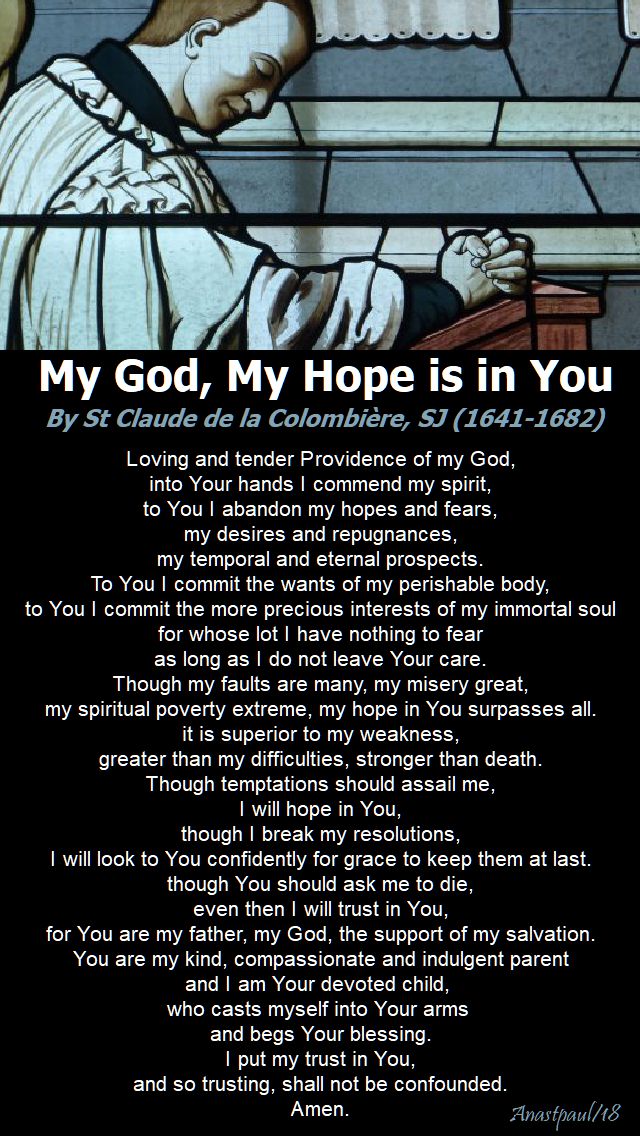
Our Morning Offering – 22 November – My God, My Hope is in You
My God, My Hope is in You By St Claude de la Colombière, SJ (1641-1682)
Loving and tender Providence of my God,
into Your hands I commend my spirit,
to You I abandon my hopes and fears,
my desires and repugnances,
my temporal and eternal prospects.
To You I commit the wants of my perishable body,
to You I commit the more precious interests of my immortal soul
for whose lot I have nothing to fear
as long as I do not leave Your care.
Though my faults are many, my misery great,
my spiritual poverty extreme,
my hope in You surpasses all.
it is superior to my weakness,
greater than my difficulties, stronger than death.
Though temptations should assail me, I will hope in You,
though I break my resolutions,
I will look to You confidently for grace to keep them at last.
though You should ask me to die, even then I will trust in You,
for You are my father, my God, the support of my salvation.
You are my kind, compassionate and indulgent parent,
and I am Your devoted child,
who casts myself into Your arms and begs Your blessing.
I put my trust in You
and so trusting, shall not be confounded.
Amen.
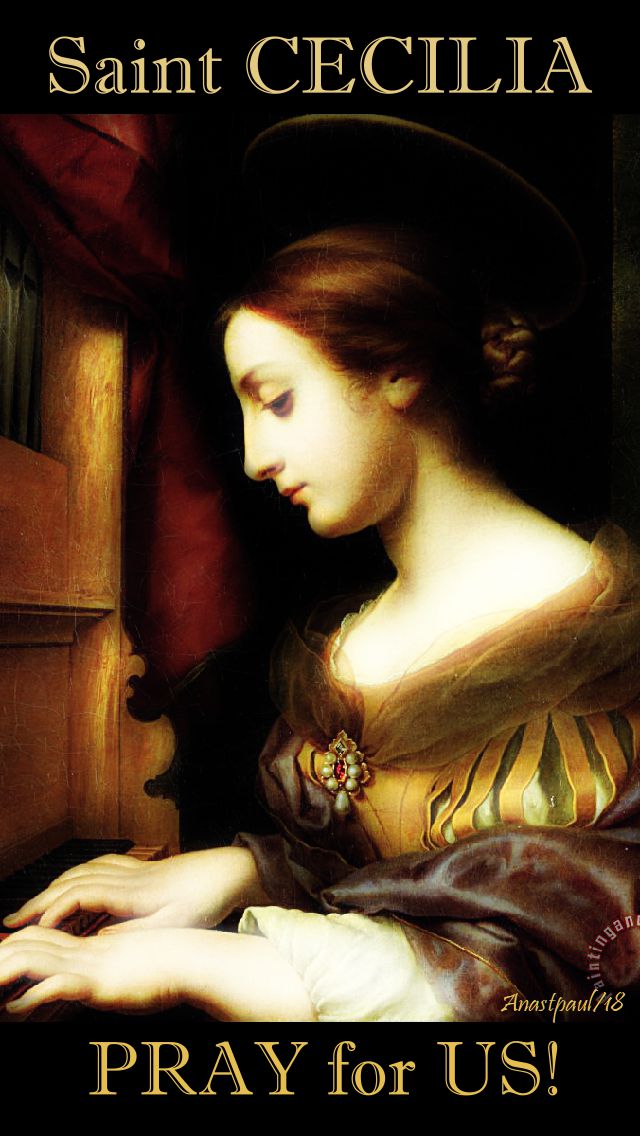
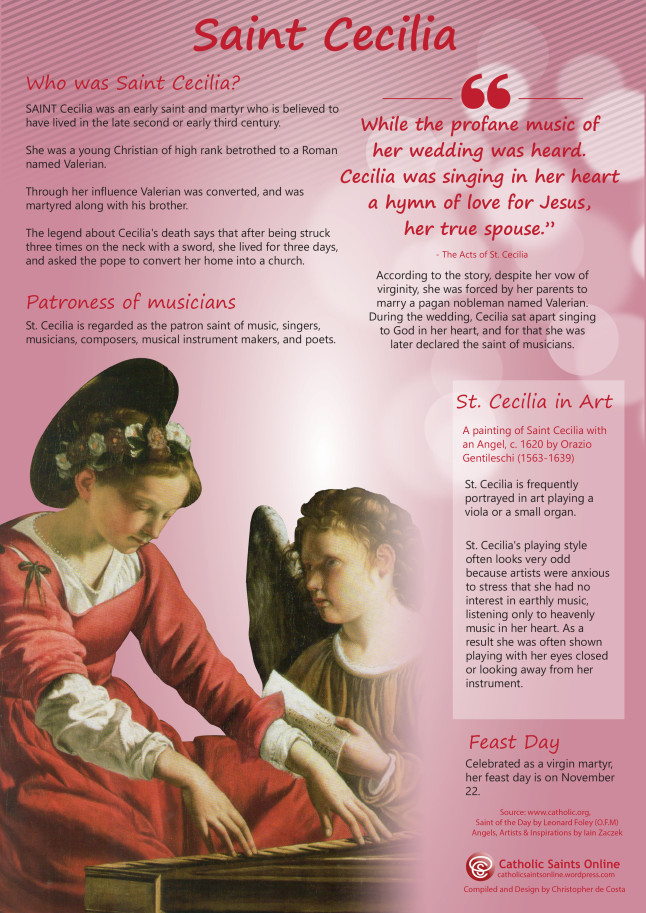
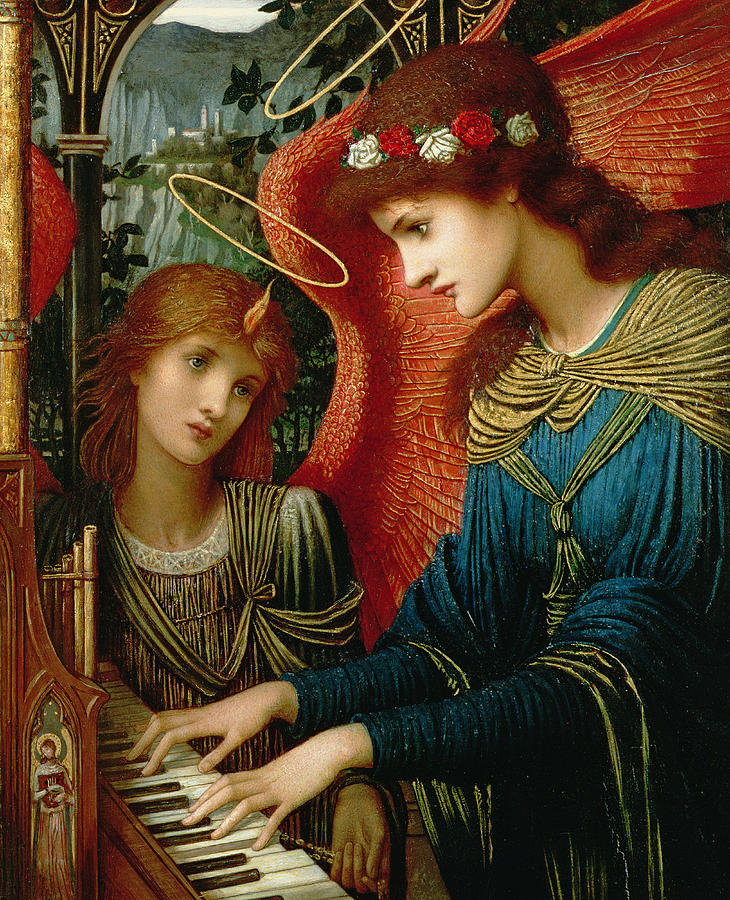
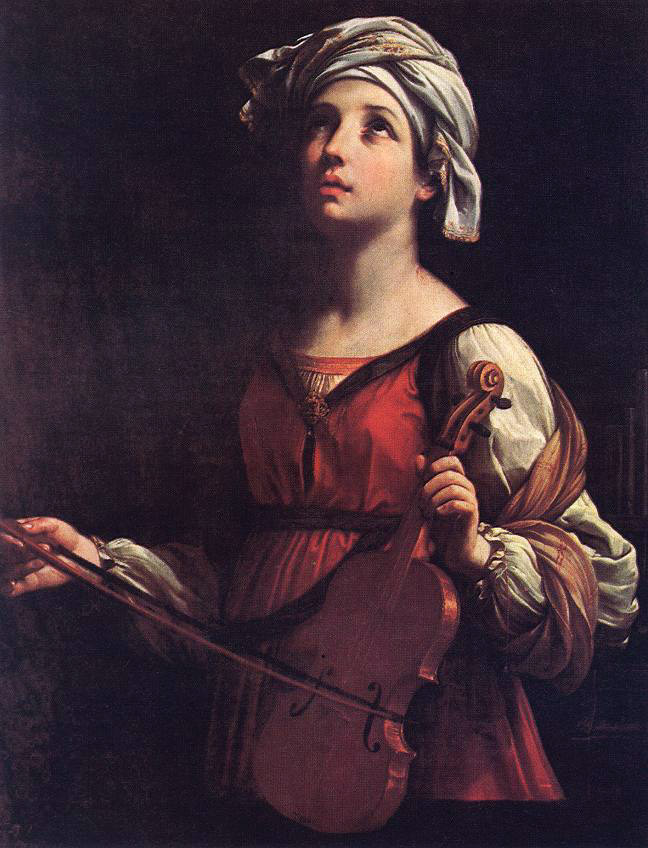
Saint of the Day – 22 November – St Cecilia (died 3rd Century) Virgin & Martyr – Patronages: Hymns, musicians, poets, City of Albi in France, Mar del Plata, Argentina, Academy of Music in Rome, chastity and purity, composers, musical instrument manufacturers, 3 Diocese, City of Acquasparta, Italy. St Cecilia, is the Patroness of Musicians because it is written that as the musicians played at her wedding she “sang in her heart to the Lord”.
With many of the early church martyrs, there are often stories and legends but not much historical information. Saint Cecilia probably lived in the third century and tradition says she died about 177 – 230 AD. Although details of her life may be unknown to us, Saint Cecilia was one of the most revered early virgin martyrs of Rome, as evidenced by her name appearing in the Roman Canon of the Mass (Eucharistic Prayer 1). She is one of the seven women commemorated by name in the Roman Canon. There is evidence of a church named in her honour dating to the late fourth century. A feast day in honour of Saint Cecilia was celebrated as early as 545.
Cecilia was born in a wealthy Roman family and was a Christian by birth. Her family gave her in marriage to Valerius, a pagan nobleman. Cecilia promised to remain a virgin and she was successful in persuading Valerius to respect her virginity on their wedding night. Later, Valerius was converted to Catholicism along with his brother, Tiburtius.
These two brothers dedicated themselves to burying the Christian martyrs, which was illegal. They were arrested and sentenced to death for refusing to renounce their religion.
Cecilia continued the work of converting people to the Christian faith and of burying the Christian dead, even though it was against the law. Hundreds were baptised through her witness and strength of faith. She planned to have her home preserved as a church after her death. Her refusal to worship false gods and her burying of the dead lead to her arrest.
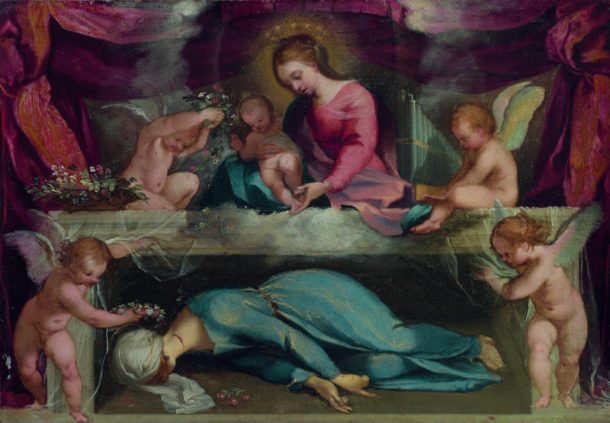
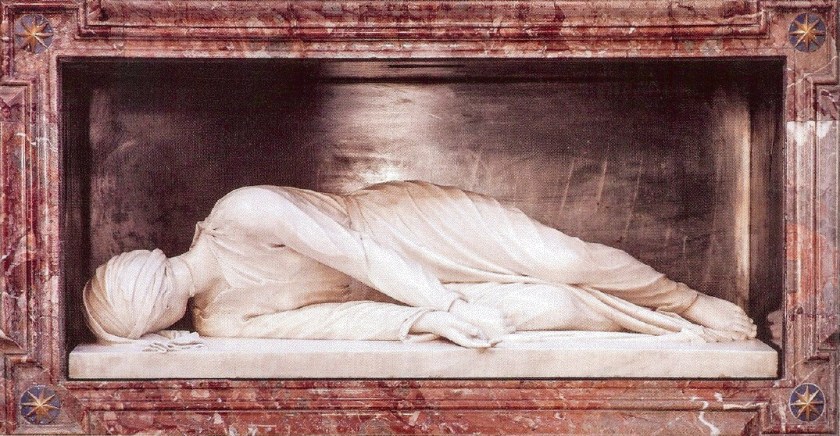
Saint Cecilia was brought to trial and sentenced to death. It took several days for her to die and it is said that she converted many people who came to care for her as she was dying. Saint Cecilia died lying on her right side with her hands crossed in prayer. The position of her fingers—three extended on her right hand and one on the left—were her final silent profession of faith in the Holy Trinity, Three Persons in one God. Saint Cecilia was buried in the Catacomb of Saint Callistus.
In the Middle Ages, Saint Cecilia became a very popular saint. There is a story that Saint Cecilia was said to have heard heavenly music inside her heart when she was forced to marry the pagan Valerian. During her wedding, Cecilia sat and sang to God in her heart. Thus, she was declared to be the patron of musicians. Musical compositions, poems, art, and festivals have grown out of this story.
A few examples of the many artistic works about Saint Cecilia:
The first record of a music festival in her honor was held at Évreux in Normandy in 1570.
Chaucer commemorates Saint Cecilia in his “Second Nun’s Tale.”
John Dryden’s poem “A Song for Saint Cecilia’s Day” was set to music by Handel in his “Ode for Saint Cecilia’s Day.”
Charles Gounod composed the Saint Cecilia Mass.
Benjamin Britten composed the “Hymn to Saint Cecilia.”
Saint Cecilia reminds us of the ways that our music and art can lead us to praise God.
The Sisters of Saint Cecilia, religious sisters, shear the lambs’ wool used to make the palliums of new metropolitan archbishops. The lambs are raised by the Cistercian Trappist Fathers of the Tre Fontane (Three Fountains) Abbey in Rome. The lambs are blessed by the Pope every year on 21 January, the Feast of the martyr Saint Agnes. The pallia are given by the Pope to the new metropolitan archbishops on the Solemnity of Saints Peter and Paul, 29 June.
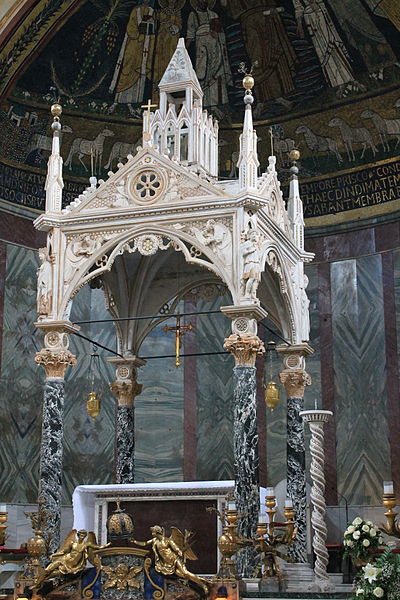
St Cecilia’s body was exhumed in the 1599 and is the first instance in the Church of a saint being incorrupt. Her remains are located at the Church of St Cecilia in the Trastevere region of Rome, where a beautiful Statue depicting the position in which her body lay as she died by Stefano Maderno (1600), one of the most famous examples of Baroque sculpture. The pavement in front of the statue encloses a marble slab with Maderno’s sworn statement that he has recorded the body as he saw it when the tomb was opened in 1599. The statue depicts the three axe strokes described in the 5th-century account of her martyrdom. It also is meant to underscore the incorruptibility of her body, which miraculously still had congealed blood after centuries,
Church of St Cecilia in the Trastevere region of RomeThe Ciborium containing the Body of St Cecilia attributed to Arnolfo di Cambio.Stefano Maderno (1600)This similar Sculpture is in the Cathedral of St Cecilia in Albi, France of which city she is the Patron
St Amphilochius of Iconium
St Ananias of Arbela
St Apphia
St Benignus of Milan
St Christian of Auxerre
St Dayniolen the Younger
St Mark of Antioch
St Maurus of North Africa
Bl Pedro Esqueda Ramirez
St Philemon
St Pragmatius of Autun
St Sabinian the Abbot
Bl Salvatore Lilli
Stephen of Antioch
Bl Tommaso Reggio
—
Apostles of Bulgaria – 7 saints
Martyrs of Armenia – 8 beati: A group of eight Franciscans martyred in the region of Mujuk-Dersi, Armenia (modern Turkey) by invading Islamic Turks who tortured them, demanded they convert, and murdered them when they did not. They were
• Baldji Oghlou Ohannes
• David Oghlou David
• Dimbalac Oghlou Wartavar
• Geremia Oghlou Boghos
• Khodianin Oghlou Kadir
• Kouradji Oghlou Tzeroum
• Salvatore Lilli
• Toros Oghlou David
They were martyred on 22 November 1895 in Mujuk-Dersi, Armenia (in modern Turkey) and Beatified on 3 October 1982 by St Pope John Paul II.
Martyrs of England, Scotland and Wales – 85 beati: 85 English, Scottish and Welsh Catholics who were martyred during the persecutions by Protestants in the 16th and 17th centuries. They are commemorated together on 22 November.
• Blessed Alexander Blake • Blessed Alexander Crow • Blessed Antony Page • Blessed Arthur Bell • Blessed Charles Meehan • Blessed Christopher Robinson • Blessed Christopher Wharton • Blessed Edmund Duke • Blessed Edmund Sykes • Blessed Edward Bamber • Blessed Edward Burden • Blessed Edward Osbaldeston • Blessed Edward Thwing • Blessed Francis Ingleby • Blessed George Beesley • Blessed George Douglas • Blessed George Errington • Blessed George Haydock • Blessed George Nichols • Blessed Henry Heath • Blessed Henry Webley • Blessed Hugh Taylor • Blessed Humphrey Pritchard • Blessed John Adams • Blessed John Bretton • Blessed John Fingley • Blessed John Hambley • Blessed John Hogg • Blessed John Lowe • Blessed John Norton • Blessed John Sandys • Blessed John Sugar • Blessed John Talbot • Blessed John Thules • Blessed John Woodcock • Blessed Joseph Lambton • Blessed Marmaduke Bowes • Blessed Matthew Flathers • Blessed Montfort Scott • Blessed Nicholas Garlick • Blessed Nicholas Horner • Blessed Nicholas Postgate • Blessed Nicholas Woodfen • Blessed Peter Snow • Blessed Ralph Grimston • Blessed Richard Flower • Blessed Richard Hill • Blessed Richard Holiday • Blessed Richard Sergeant • Blessed Richard Simpson • Blessed Richard Yaxley • Blessed Robert Bickerdike • Blessed Robert Dibdale • Blessed Robert Drury • Blessed Robert Grissold • Blessed Robert Hardesty • Blessed Robert Ludlam • Blessed Robert Middleton • Blessed Robert Nutter • Blessed Robert Sutton • Blessed Robert Sutton • Blessed Robert Thorpe • Blessed Roger Cadwallador • Blessed Roger Filcock • Blessed Roger Wrenno • Blessed Stephen Rowsham • Blessed Thomas Atkinson • Blessed Thomas Belson • Blessed Thomas Bullaker • Blessed Thomas Hunt • Blessed Thomas Palaser • Blessed Thomas Pilcher • Blessed Thomas Pormort • Blessed Thomas Sprott • Blessed Thomas Watkinson • Blessed Thomas Whitaker • Blessed Thurstan Hunt • Blessed William Carter • Blessed William Davies • Blessed William Gibson • Blessed William Knight • Blessed William Lampley • Blessed William Pike • Blessed William Southerne • Blessed William Spenser • Blessed William Thomson •
Beatified on
22 November 1987 by St Pope John Paul II.
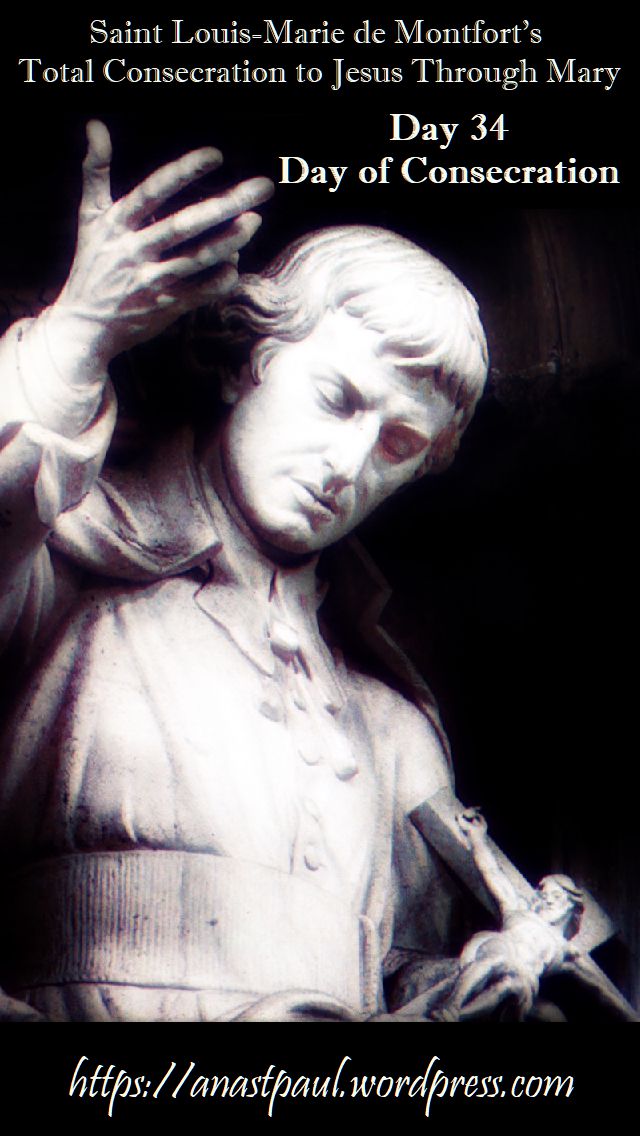
Saint Louis-Marie de Montfort’s Total Consecration to Jesus Through Mary
Day 34 – Day of Consecration
On the day of consecration, either fast, give alms, or offer a votive candle for the good of another (or all of the above); do some spiritual penance and approach consecration in the spirit of mortification.
Now go to Confession (or, if that is not possible, go during the 8 days prior) and then receive Communion with the intention of giving yourself to Jesus, as a slave of love, by the hands of Mary.
Now pray the words of the consecration. Copy them and have them with you at church, read them after the Mass (in front of the tabernacle would be nice) and sign your copy of the Act of Consecration.
The words of consecration are:
O Eternal and incarnate Wisdom! O sweetest and most adorable Jes us! True God and true man, only Son of the Eternal Father and of Mary, always virgin! I adore Thee profoundly in the bosom and splendours of Your Father during eternity and I adore You also in the virginal bosom of Mary, Your most worthy Mother, in the time of Your incarnation.
I give You thanks for that You have annihilated Yourself, taking the form of a slave in order to rescue me from the cruel slavery of the devil. I praise and glorify You for that You have been pleased to submit Yourself to Mary, Your holy Mother, in all things, in order to make me Your faithful slave through her. But, alas! Ungrateful and faithless as I have been, I have not kept the promises which I made so solemnly to You in my Baptism; I have not fulfilled my obligations; I do not deserve to be called Your child, nor yet Your slave and as there is nothing in me which does not merit Your anger and Your repulse, I dare not come by myself before Your most holy and august Majesty. It is on this account that I have recourse to the intercession of Your most holy Mother, whom You have given me for a mediatrix with You. It is through her that I hope to obtain of Your contrition, the pardon of my sins and the acquisition and preservation of wisdom.
Hail, then, O immaculate Mary, living tabernacle of the Divinity, where the Eternal Wisdom willed to be hidden and to be adored by angels and by men! Hail, O Queen of Heaven and earth, to whose empire everything is subject which is under God. Hail, O sure refuge of sinners, whose mercy fails no one. Hear the desires which I have of the Divine Wisdom and for that end, receive the vows and offerings which in my lowliness I present to you.
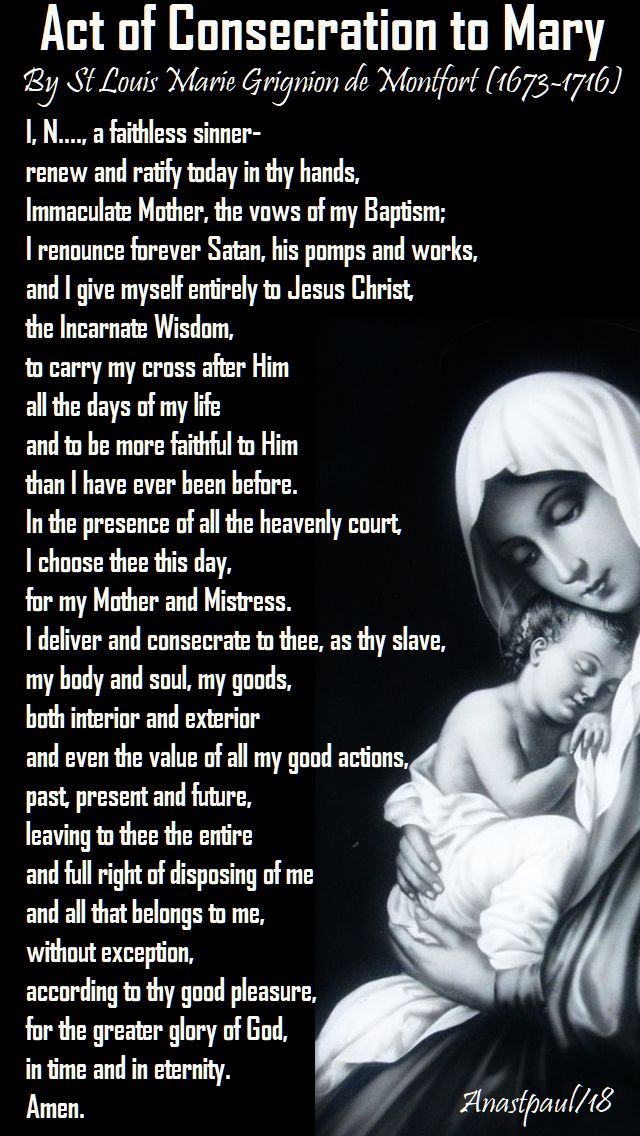
I, N_____, a faithless sinner, renew and ratify today in your hands the vows of my Baptism, I renounce forever Satan, his pomps and works and I give myself entirely to Jesus Christ, the Incarnate Wisdom, to carry my cross after Him all the days of my life and to be more faithful to Him than I have ever been before. In the presence of all the heavenly court, I choose you this day for my Mother and Mistress. I deliver and consecrate you, as your slave, my body and soul, my goods, both interior and exterior and even the value of all my good actions, past, present and future, leaving to you the entire and full right of disposing of me and all that belongs to me, without exception, according to your good pleasure, for the greater glory of God in time and in eternity.
Receive, O holy Virgin, this little offering of my service, in honour of and in union with, that subjection which the Eternal Wisdom deigned to have to your maternity, in homage to the power which both of you have over this poor sinner and in thanksgiving for the privileges with which the Holy Trinity has favoured you. I declare that I wish henceforth, as your true slave, to seek your honour and to obey you in all things.
O admirable Mother, present me to thy dear Son as His eternal slave, so that as He has redeemed me by you, by you He may receive me! O Mother of mercy, grant me the grace to obtain the true Wisdom of God and for that end, receive me among those whom you love and teach whom you lead, nourish and protect as your children and your slaves.
O faithful Virgin, make me in all things so perfect a disciple, imitator and slave of the Incarnate Wisdom, Jesus Christ your Son, that I may attain, by your intercession and by your example, to the fullness of His age on earth and of His glory in Heaven. Amen.
——————————-
Sign your name here
——————-
Date
After Consecration
Once you have consecrated yourself to Jesus through Mary, live that consecration. St. Louis-Marie de Montfort recommended the following:
• Keep praying to develop a “great contempt” for the spirit of this world.
• Maintain a special devotion to the Mystery of the Incarnation (e.g., through meditation; spiritual reading; focusing on Feasts centring around the Incarnation, such as the Annunciation and the Nativity, etc.)
• Frequently recite the Ave Maria, Rosary and the Magnificat.
• Do everything through, with, in and for Mary for the sake of Jesus, with the prayer, “I am all yours Immaculate One, with all that I have, in time and in eternity” in your heart and on your lips.
• Associate yourself with Mary in a special way before, during and after Communion.
• Wear a little iron chain (around the neck, arm, waist, or ankle) as an outward sign and reminder of holy service. This practice is optional, but very recommended by St Louis. The appearance of this chain is not further specified.
• Renew the consecration once a year on the same date chosen above and by following the same 33-day period of exercises. If desired, also renew the consecration monthly with the prayer, “I am all Yours and all I have is Yours, O dear Jesus, through Mary, Your holy Mother.” • Optional: Join the Confraternity of Mary, Queen of All Hearts – http://queenofallhearts.com/
for Enrolment: http://queenofallhearts.com/enrollment/
Our Morning Offering – 19 November – Feast of Our Lady of Divine Providence
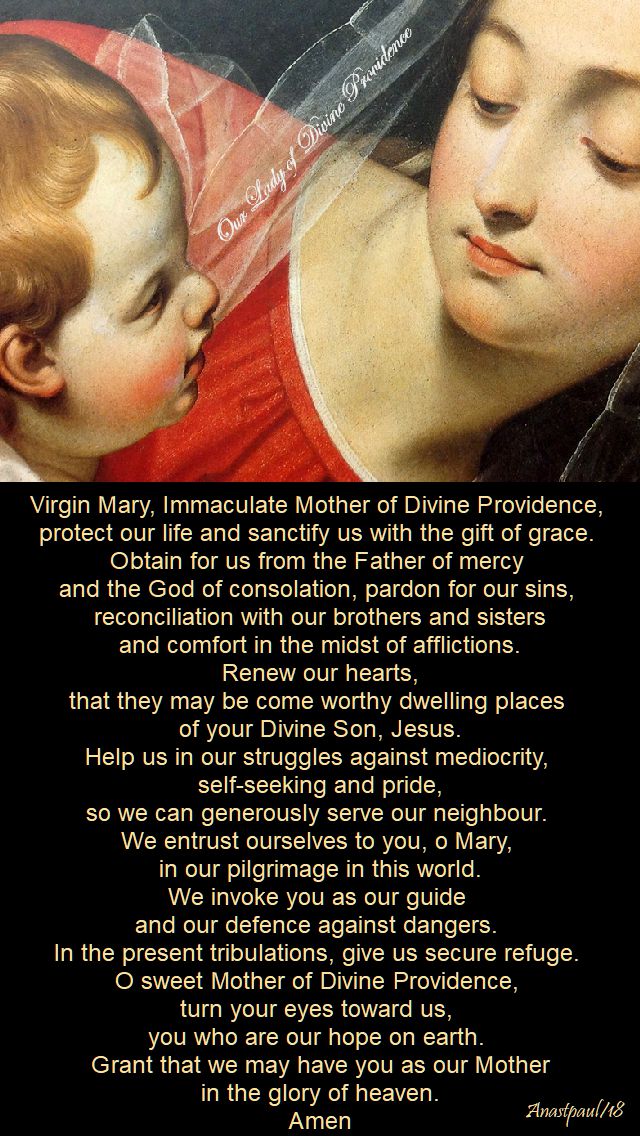
Prayer to Mary, Mother of Divine Providence
Virgin Mary, Immaculate Mother of Divine Providence,
protect our life and sanctify us with the gift of grace.
Obtain for us from the Father of mercy
and the God of consolation, pardon for our sins,
reconciliation with our brothers and sisters
and comfort in the midst of afflictions.
Renew our hearts,
that they may be come worthy dwelling places
of your Divine Son, Jesus.
Help us in our struggles against mediocrity,
self-seeking and pride,
so we can generously serve our neighbour.
We entrust ourselves to you, o Mary,
in our pilgrimage in this world.
We invoke you as our guide
and our defence against dangers.
In the present tribulations, give us secure refuge.
O sweet Mother of Divine Providence,
turn your eyes toward us,
you who are our hope on earth.
Grant that we may have you as our Mother
in the glory of heaven.
Amen
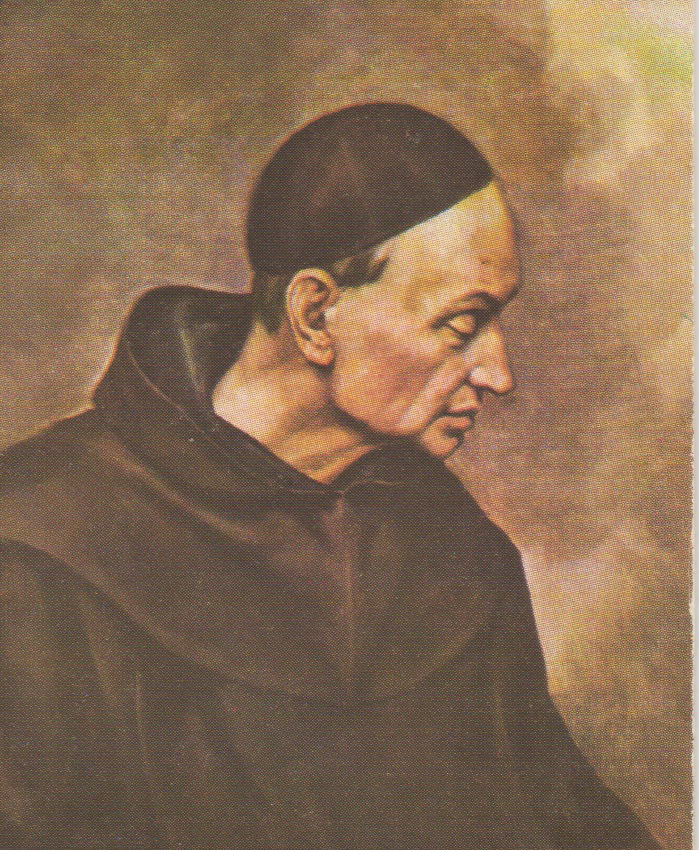
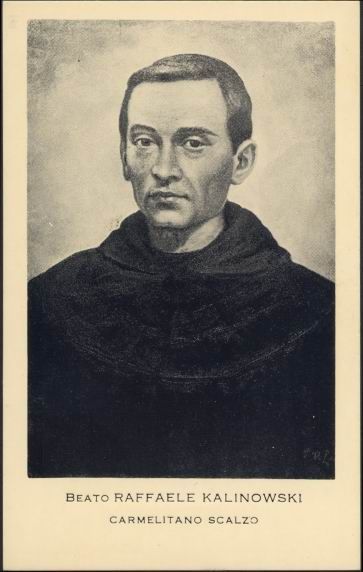
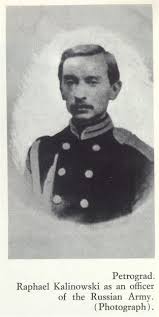
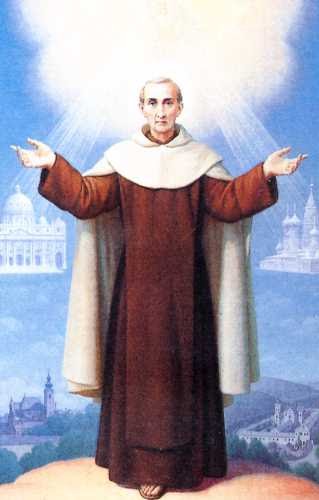
Saint of the Day – 19 November – St Raphael of St Joseph Kalinowski O.C.D. (1835-1907) – Carmelite Friar and Priest, Teacher, Engineer, Prisoner of war, Royal tutor, Spiritual Director, founder of many Carmelite monasteries in Poland. St Raphael was born on 1 September 1835 at Vilna, Russian Poland (modern Vilnius, Lithuania) as Joseph Kalinowski and died on 15 November 1907 at Wadowice, Malopolskie, Poland of natural causes.
Father Raphael of Saint Joseph Kalinowski, was born at Vilna and at baptism received the name Joseph. Under the teaching of his father Andrew, at the Institute for Nobles at Vilna, he progressed so well that he received the maximum distinction in his studies. He then went for two years (1851-1852) to the school of Agriculture at Hory-Horky. During the years 1853-1857, he continued his studies at the Academy of Military Engineering at St Petersburg, obtaining his degree in Engineering and the rank of Lieutenant. Immediately afterwards he was named Lecturer in Mathematics at the same Academy. In 1859, he took part in the designing of the Kursk-Kiev-Odessa railway.
In 1863 the Polish insurrection against their Russian oppressors broke out. He resigned from the Russian forces and accepted the post of Minister of War for the region of Vilna, in the rebel army. On 24 March 1864, he was arrested and condemned to death, a penalty that was mitigated to 10 years hard labour in Siberia. With an admirable strength of spirit, patience and love for his fellow exiles, he knew how to instil into them the spirit of prayer, serenity and hope and to give material help, together with a word of encouragement.
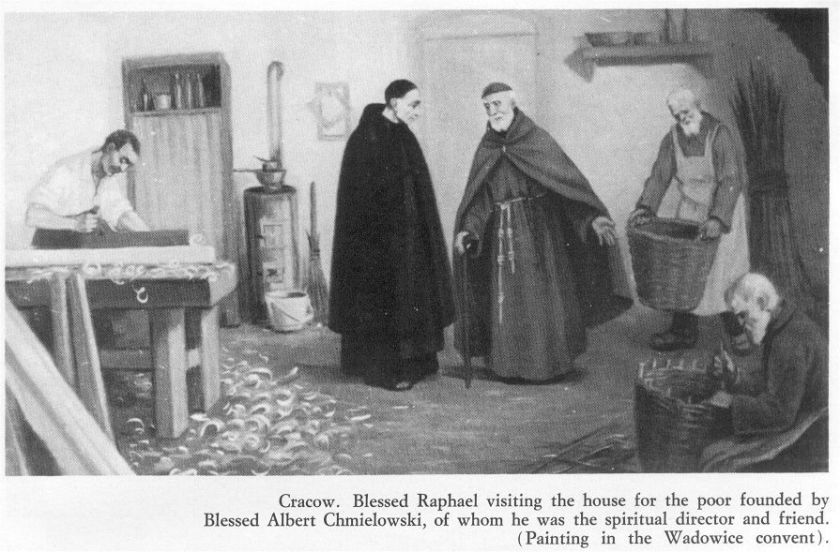
Repatriated in 1874, he accepted the post of tutor to the Venerable Servant of God, Prince Augusto Czartoryski (1858-1893) (now Blessed- he was Beatified in 2004), living mostly in Paris. His influence on the young prince was such, that Augusto discovered his true vocation as priest and religious. He was received into the Salesians by their founder, Saint John Bosco, in 1887. On the other hand, Joseph Kalinowski entered the Discalced Carmelites at Graz in Austria and received the religious name of Brother Raphael of Saint Joseph. He studied theology in Hungary and was ordained Priest at Czerna near Krakow, on 15 January 1882.
Afire with apostolic zeal, he did not spare himself in helping the faithful and assisting his Carmelite brothers and sisters and many others in the ascent of the mountain of perfection.
In the sacrament of Reconciliation, he lifted up many from the mire of sin. He did his utmost for the work of reunification of the Church and bequeathed this mission to his Carmelite brothers and sisters. His superiors entrusted him with many important offices, which he carried out perfectly, right until the time of his death.
Overcome by fatigue and suffering and held in great respect by all the people, he gave his soul to God, on 15 November 1907, at Wadowice in the monastery founded by himself. He was buried in the monastery cemetery, at Czerna, near Krakow.
During his life and after death, he enjoyed a remarkable fame for sanctity, even on the part of the most noble and illustrious of people, such as the Cardinals Dunajewski, Puzyna, Kakowski and Gotti. The Ordinary Process for his eventual beatification, was set in motion in the Curia of Krakow during the years 1934-1938 and later taken to Rome where in 1943 was issued the Decree concerning his writings. His cause was introduced in 1952. From 1953-1956 the Apostolic Process was carried out and the Congregation proceeded to the discussion on his virtues.
Pope John Paul II, on 11 October 1980, promulgated the Decree on the heroism his virtues. After the approval of the miraculous healing of the Reverend Mis, the Holy Father Beatified Father Raphael Kalinowski at Krakow on 22 June 1983.
As the fame of his miracles was increasing, the Curia of Krakow in 1989, set in motion the Canonical Process to investigate the extraordinary healing of a young child. The discussions of the doctors, theologians and cardinals, were brought to a happy conclusion. On 10 July 1990, the Holy Father St John Paul II, approved the miracle for the Canonisation.
In the Consistory of 26th November 1990, Pope John Paul together with the Cardinals, decided to Canonise Blessed Raphael Kalinowski. They set the ceremony for Sunday, 17 November 1991.
St Pope John Paul II, today Canonises him and presents him as a model to all Christians in the universal Church….vatican.va 17 November 1991.
Note: Attending the Canonisation rite, were delegations from the Carmelite Order, from Russia, Byelorussa, Ukraine and especially from Poland and Lithuania, with their cardinals and bishops. And in the places of honour knelt Lech Walesa, president of liberated Poland, and Vytautas Landsbergis, president of the Supreme Council of the Lithuanian Republic.
Proud to do honour to this new saint who was both Pole and Lithuanian and who reached out towards the Eastern Churches as well, they must have responded warmly when the pope cried out: “Rejoice, O Mother Poland … Rejoice, O Mother of God, Mother of the Church, Mother of all peoples!”
Our Lady of Divine Providence : The title of “Mary, Mother of Divine Providence” is often traced to her intervention at the wedding in Cana. Christ’s first public miracle was occasioned in part by the intercession of His Mother. She assisted, through her foresight and concern, the avoidance of an embarrassing situation for the newlywed couple. Our Lady of Providence is also identified as Queen of the Home.
Devotion to Our Lady of Divine Providence originated in Italy and spread to France and Spain. The devotion was brought to Puerto Rico in the early 1850s by the Servite Fathers. According to tradition, Philip Benizi (1233 – 1285) prayed to Mary for aid in providing food for his Friars and subsequently, found several baskets of provisions left at the door of the convent. Our Lady of Providence was declared the Patroness of Puerto Rico on 19 November 1969. Her feast day is celebrated in many immigrant Puerto Rican communities.
Around 1580, the Italian Painter Scipione Pulzone created a work titled “Mater Divinae Providentiae” which depicted the Blessed Mother cradling the Infant Jesus. Devotion to Mary, Mother of Divine Providence in the first house of the Congregation of the Clerics Regular of St Paul (Barnabites) in Rome at San Carlo ai Catinari church began around year 1611, when one of the clerics travelled to Loreto to pray for assistance in finding the financial resources to complete the Church of San Carlo. Upon his return, they received the necessary assistance and the Barnabites began to promote devotion to Our Lady of Providence.
Pulzone’s painting was given to the Barnabites in 1663. It was placed on the Altar of a Chapel on the first floor of the Saint Charles rectory behind the main Altar. In 1732, a copy of the painting was placed in a location adjacent to the main Altar of the Church of San Carlo ai Catinari in Rome, where it drew many faithful visitors.
In 1774, Pope Benedict XIV authorised the Confraternity of Our Lady of Providence, a lay organisation created for the purpose of promoting special works of Christian charity or piety. Pope Gregory XVI elevated it to an Archconfraternity in 1839. In 1888, Pope Leo XIII ordered the solemn Crowning of the “Miraculous Lady” and approved the Mass and Office of Mary, Mother of Divine Providence. On 5 August 1896, Superior General of the Barnabites, Father Benedict Nisser decreed that every Barnabite have a copy of the painting in their home.
Patronage:
Our Lady of Providence is the Patroness of the Barnabite Order.
Our Lady of Providence is the Patroness of Indiana and the Roman Catholic Diocese of Providence, Rhode Island. The Chapel of Saint Vincent Hospital in Worcester, Massachusetts is dedicated to Our Lady of Providence.
Our Lady of Divine Providence is the patroness of St Benedict’s Abbey in Atchison, Kansas.
Our Lady of Divine Providence is also the Patroness of the Caribbean island of Puerto Rico.
Bl Alexandre Planas Saurí
St Atto of Tordino
St Azas of Isauria
St Barlaam of Antioch
St Ebbe of Minster-of-Thanet
Bl Eliseo García y García
Bl James Benefatti
St James of Sasseau
St Maximus of Caesarea
St Maximus of Rome
St Mechtilde of Helfta
St Medana
St Nerses the Great
Obadiah the Prophet
St Pope Pontian
St Raphael Kalinowski, O.C.D. (1835-1907)
St Tuto
—
Martyrs of Heraclea
Martyrs of Vienne: – 3 saints
St Exuperius
St Felicianus
St Severinus
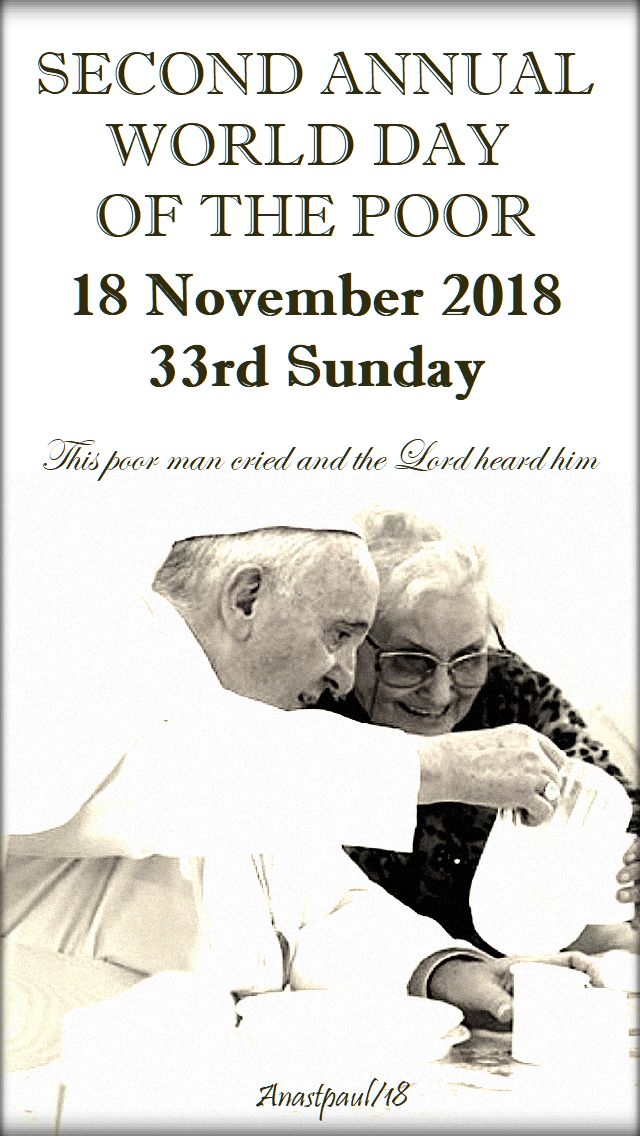
SECOND WORLD DAY OF THE POOR – 33rd Sunday in Ordinary Time – 18 November 2018
Excerpt From Pope Francis Message for the Second Annual World Day of the Poor
This poor man cried and the Lord heard him
6. The poor are the first to recognise God’s presence and to testify to His closeness in their lives. God remains faithful to His promise and even in the darkness of the night, He does not withhold the warmth of His love and consolation. However, for the poor to overcome their oppressive situation, they need to sense the presence of brothers and sisters who are concerned for them and, by opening the doors of their hearts and lives, make them feel like friends and family. Only in this way can the poor discover “the saving power at work in their lives” and “put them at the centre of the Church’s pilgrim way” (Evangelii Gaudium, 198).
On this World Day, we are asked to fulfil the words of the Psalm: “The afflicted shall eat and be satisfied” (Ps 22:26). We know that in the Temple of Jerusalem, after the rites of sacrifice, a banquet was held. It was this experience that, in many dioceses last year, enriched the celebration of the first World Day of the Poor. Many people encountered the warmth of a home, the joy of a festive meal and the solidarity of those who wished to sit together at table in simplicity and fraternity.
I would like this year’s and all future World Days, to be celebrated in a spirit of joy at the rediscovery of our capacity for togetherness. Praying together as a community and sharing a meal on Sunday is an experience that brings us back to the earliest Christian community, described by the evangelist Luke in all its primitive simplicity: “They devoted themselves to the apostles’ teaching and fellowship, to the breaking of bread and the prayers… And all who believed were together and had all things in common and they sold their possessions and goods and distributed them to all, as any had need” (Acts 2:42.44-45).
7. Countless initiatives are undertaken every day by the Christian community in order to offer closeness and a helping hand in the face of the many forms of poverty all around us. Often too, our co-operation with other initiatives inspired not by faith but by human solidarity, make it possible for us to provide help that otherwise we would have been unable to offer. The realisation that in the face of so much poverty, our capacity for action is limited, weak and insufficient, leads us to reach out to others so that, through mutual co-operation, we can attain our goals all the more effectively. We Christians, are inspired by faith and by the imperative of charity but we can also acknowledge other forms of assistance and solidarity, that aim, in part, for the same goals, provided that we do not downplay our specific role, which is to lead everyone to God and to holiness. Dialogue between different experiences and humility in offering our co-operation, without seeking the limelight, is a fitting and completely evangelical response that we can give.
In the service of the poor, there is no room for competition. Rather, we should humbly recognise that the Spirit is the source of our actions that reveal God’s closeness and His answer to our prayers. When we find ways of drawing near to the poor, we know that the primacy belongs to God, who opens our eyes and hearts to conversion. The poor do not need self-promoters but a love that knows how to remain hidden and not think about all the good it has been able to do. At the centre must always be the Lord and the poor. Anyone desirous of serving is an instrument in God’s hands, a means of manifesting His saving presence. Saint Paul recalled this when he wrote to the Christians in Corinth who competed for the more prestigious charisms: “The eye cannot say to the hand, ‘I have no need of you,’ nor again the head to the feet, ‘I have no need of you’” (1 Cor 12:21). Paul makes an important point when he notes that the apparently weaker parts of the body are in fact the most necessary (cf. v. 22) and that those “we think less honourable we invest with the greater honour and our unpresentable parts are treated with greater modesty, which our more presentable parts do not require” (vv. 23-24). Paul offers the community a basic teaching about charisms but also about the attitude it should have, in the light of the Gospel, towards its weaker and needier members. Far be it from Christ’s disciples to nurture feelings of disdain or pity towards the poor. Instead, we are called to honour the poor and to give them precedence, out of the conviction that they are a true presence of Jesus in our midst. “As you did it to one of the least of these my brethren, you did it to me” (Mt 25:40).
8. Here we can see how far our way of life must be from that of the world, which praises, pursues and imitates the rich and powerful, while neglecting the poor and deeming them useless and shameful. The words of the Apostle Paul invite us to a fully evangelical solidarity with the weaker and less gifted members of the body of Christ: “If one member suffers, all suffer together; if one member is honoured, all rejoice together” (1 Cor 12:26). In his Letter to the Romans, Paul also tells us: “Rejoice with those who rejoice, weep with those who weep. Live in harmony with one another, do not be haughty but associate with the lowly” (12:15-16). This is the vocation of each of Christ’s followers, the ideal for which we must constantly strive is ever greater conformity to the “mind of Jesus Christ” (Phil 2:5).
9. Faith naturally inspires a message of hope. Often it is precisely the poor who can break through our indifference, born of a worldly and narrow view of life. The cry of the poor, is also a cry of hope, that reveals the certainty of future liberation. This hope is grounded in the love of God, who does not abandon those who put their trust in Him (cf. Rom 8:31-39). As Saint Teresa of Avila writes in The Way of Perfection: “Poverty comprises many virtues. It is a vast domain. I tell you, whoever despises all earthly goods is master of them all” (2:5). It is in the measure in which we are able to discern authentic good, that we become rich before God and wise in our own eyes and in those of others. It is truly so. To the extent that we come to understand the true meaning of riches, we grow in humanity and become capable of sharing.
10. I invite my brother bishops, priests and especially deacons, who have received the laying on of hands for the service of the poor (cf. Acts 6:1-7), as well as religious and all those lay faithful – men and women – who in parishes, associations and ecclesial movements, make tangible the Church’s response to the cry of the poor, to experience this World Day as a privileged moment of new evangelisation. The poor evangelise us and help us each day, to discover the beauty of the Gospel. Let us not squander this grace-filled opportunity. On this day, may all of us feel that we are in debt to the poor, because, in hands outstretched to one another, a salvific encounter can take place, to strengthen our faith, inspire our charity and enable our hope, to advance securely on our path, towards the Lord who is to come.













 AnaStpaul
You must be logged in to post a comment.