Posted in SAINT of the DAY

Saint of the Day – St Anthony Mary Pucci OSM (1819-1892)

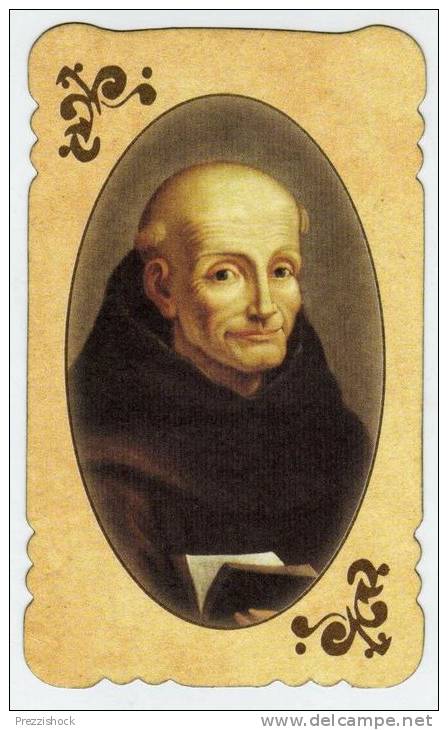
Saint of the Day – St Anthony Mary Pucci OSM (1819-1892) – Religious Priest of the Servite Order, known as “the Father of the Poor”, Apostle of prayer, Mystic, Eucharistic and Marian devotee – born Eustance Pucci on 16 April 1818 in Poggiole di Vernio, Italy as Eustacchio Pucci and died on 12 January 1892 at Viareggio, Italy.

Anthony Mary Pucci was born of fine Christian parents at Poggiole, in the diocese of Pistoia, Italy, in 1819, he was the second of nine children.   After a youth marked by prayer and study, his devotion to Mary, the Mother of God, caused him to seek entrance in the Order of Servants of Mary at the age of eighteen.   He made his novitiate at Florence and studied philosophy and theology at Monte Senario for six years, where he also made his solemn profession.   In 1844, a year after his ordination to the priesthood, Anthony was sent to Viareggio as assistant pastor.   In 1847 he was named pastor and for forty-five years, until his death, he fulfilled this responsibility with great love, giving an example of a pure and fruitful life, singularly dedicated to God and his flock. Notwithstanding pastoral duties he continued his studies and in 1850 received the title of Master in Theology.sant'antonio_maria_pucci_icona
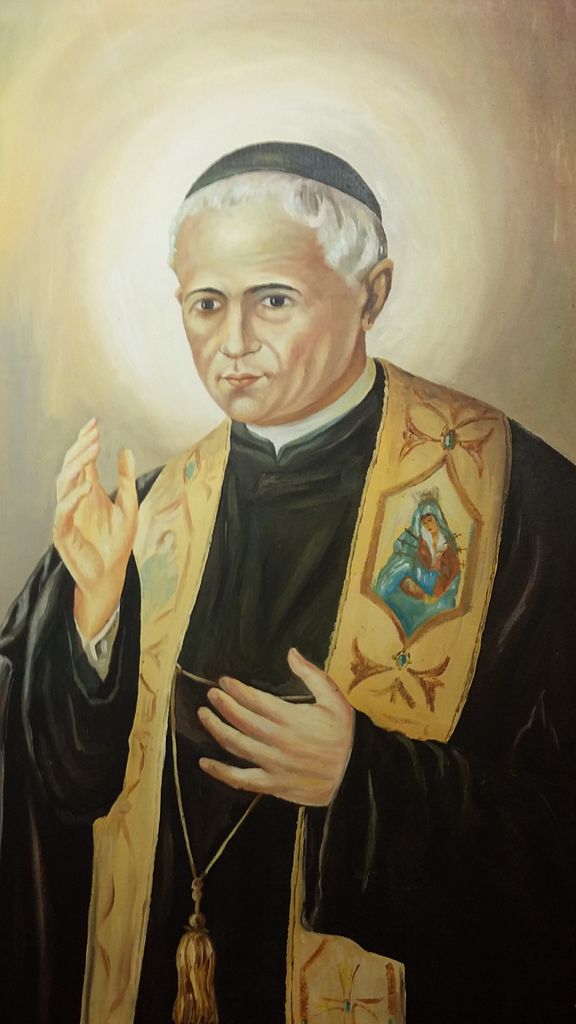
For many years Father Anthony was prior of the community in Viareggio and also prior provincial of the Tuscan Province.   This was a period of hostility between Church and civil authorities due to laws passed against religious orders and congregations.   In these offices, mindful of the words of Saint Augustine, he preferred to be loved rather than feared by his brothers and was happy to serve with love rather than exercise power.

Anthony was characterised by humility of spirit, reserve in speaking, abiding contact with God and love of poverty.   He dedicated himself completely to his priestly ministry in order to lead all to Christ; he knew his parishioners individually, he showed them fatherly love, offering them the word of God and supporting them with his advice and direction.   His charity to the needy knew no limits – he even went so far as to give a poor man the shirt off his back and because of this he was called “the Father of the Poor”.blessed-anthony-maria-pucci-now-st-mater
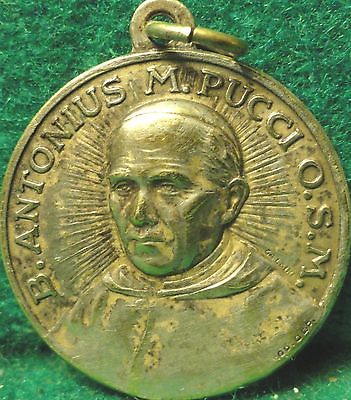
He was a faithful minister of the sacrament of penance, dedicating several hours a day to this work.   Of greatest importance to him was reconciling sinners to God, comforting the afflicted, forgiving those who had offended him, uniting those separated by hatred and violence, bringing peace to families, and assisting the sick and dying.   His love for others was particularly visible during the cholera epidemic of 1854-1856, when day and night, almost without rest, he worked with the sick.   God gave him many gifts, including discernment of spirits and the gift of healing.   He was seen at times in ecstasy or raised from the ground in prayer.

Father Anthony founded a congregation of Servite sisters in his parish for the education of youth and he directed them with particular concern.   He was a pioneer in establishing parish associations for young children, teenagers, men and women in order to intensify the Christian life of his community.   He promoted the St Vincent de Paul Society, recently introduced into Italy from France and the work for the Propagation of the Faith.   He founded the first permanent seaside home for the care of children.   In this work of the apostolate he was supported and animated by his great love for the Eucharist and Our Lady of Sorrows to whom he solemnly consecrated his parish.st antonio maria pucci.jpg
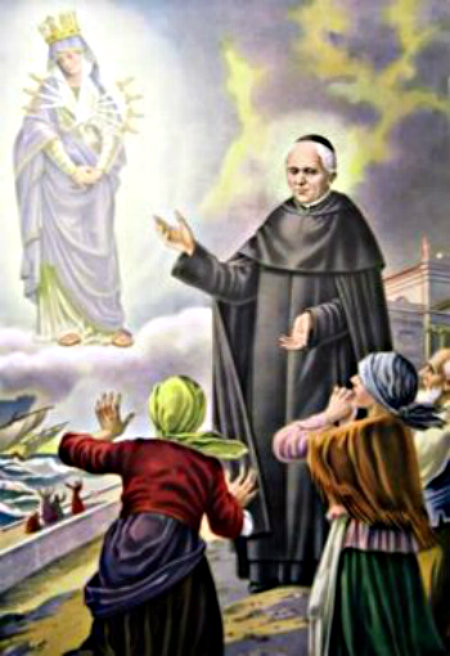
He was stricken with pneumonia on a winter’s day after he gave his coat to a poor man on the street.   A few days later, 12 January 1892, having received the sacraments, he died a holy death.
The entire city, including even those hostile to the Church, wept at the death of their beloved pastor.

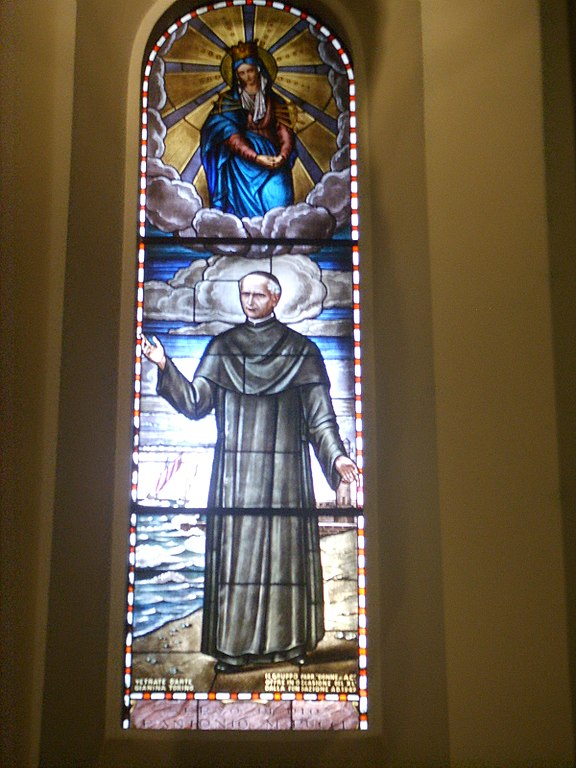
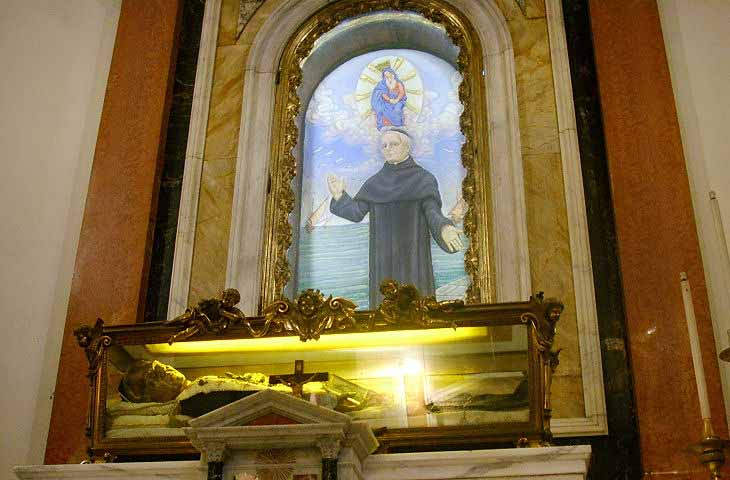
At the end of the first session of the Second Vatican Council St Pope John XXIII, on 9 December 1962, added his name to the list of saints.   The body of Saint Anthony Pucci is venerated in the Basilica of St Andrew in Viareggio, below is his tomb and a stained glass window in the Basilica.shrine st antonio maria pucci576px-viareggio,_chiesa_di_sant'andrea,_vetrata_di_sant'antonio_maria_pucci
Posted in SAINT of the DAY

Memorials of the Saints – 12 January

St Aelred of Rievaulx OCSO (1110-1167)
About St Aelred: https://anastpaul.wordpress.com/2018/01/12/saint-of-the-day-12-january-st-aelred-of-rievaulx-1110-1167-saint-bernard-of-the-north/

Bl Antoine Fournier
St Antonio Maria Pucci OSM (1819-1892)
St Arcadius of Mauretania
Bl Bartholomew Alvarez
Bl Bernardo de Plano
St Biccianus
St Benedict Biscop
St Bernard of Corleone
St Caesaria of Arles
St Caroticus
Bl Emmanuel d’Abreu
St Eutropius
St Ferreolus of Grenoble
Bl John Gaspard Cratz
St John of Ravenna
Bl Lucia of Valcaldara
St Marguerite Bourgeoys CND (1620-1700)
St Marguerite’s Biography: https://anastpaul.wordpress.com/2017/01/12/saint-of-the-day-12-january-st-marguerite-bourgeoys/

St Martinian of Belozersk
St Martin of León
Bl Nicholas Bunkerd Kitbamrung
St Peter of Abessala
Bl Pierre-François Jamet
St Probus of Verona
St Quinctus the Soldier
St Satyrus
St Tatiana of Rome
St Tigrius
St Victorian of Asana
Bl Vincent da Cunha

Martyrs of Africa – 44 saints: A group of 44 Christian soldiers murdered together for their faith in Africa. The only details that survive are four of their names – Castulus, Modestus, Rogatus and Zoticus.
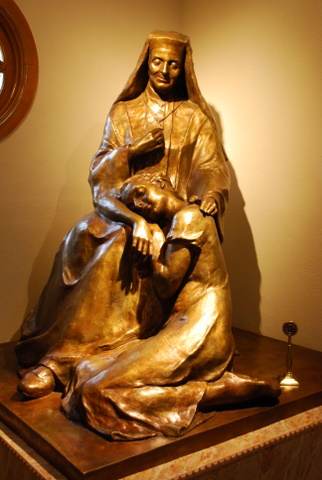
Martyrs of Ephesus – 42 saints: Forty-two monks martyred at a monastery in Ephesus (modern Turkey) during the persecutions of the Iconoclast Byzantine Emperor Constantine V. Their names have not come down to us. Martyred c 762.

Martyrs of Iona – 38 saints: Thirty-eight monks martyred in Iona, Ireland. Their names have not come down to us. They were Martyred in 750 at Iona, Ireland.

Posted in CONFESSION/PENANCE, DIVINE Mercy, Goodness, Patience, QUOTES "CARPE DIEM" - Seize the Day, QUOTES of the SAINTS, QUOTES on DIVINE PROVIDENCE, QUOTES on REPENTANCE, QUOTES on TIME, QUOTES on WORRY/ANXIETY, SPEAKING of ....., The WORD

Thought for the Day – 11 January – Living the Present Moment and the Joy of Confession

Thought for the Day – 11 January – 5th day after Epiphany

Living the Present Moment and the Joy of Confession:

The Wisdom of Venerable Fulton J Sheen (1895-1979)

“All our anxieties relate to time.   A human being is the only time-conscious creature. Humans alone can bring the past to mind, so that it weighs on the present moment, with its accumulated heritage and they can also bring the future into the present, so as to imagine its occurrences as happening now.   No animal ever says: “I have suffered this pain for six years and it will last until I die.”   But, because a human being can unite the past to the present by memory and the future to the present by imagination, it is often necessary to distract him in his sufferings — to break up the continuity of misery.   All unhappiness (when there is no immediate cause for sorrow) comes from excessive concentration on the past or from extreme preoccupation with the future.   The major problems of psychiatry revolve around an analysis of the despair, pessimism, melancholy and complexes that are the inheritances of what has been or with the fears, anxieties, worries, that are the imaginings of what will be.

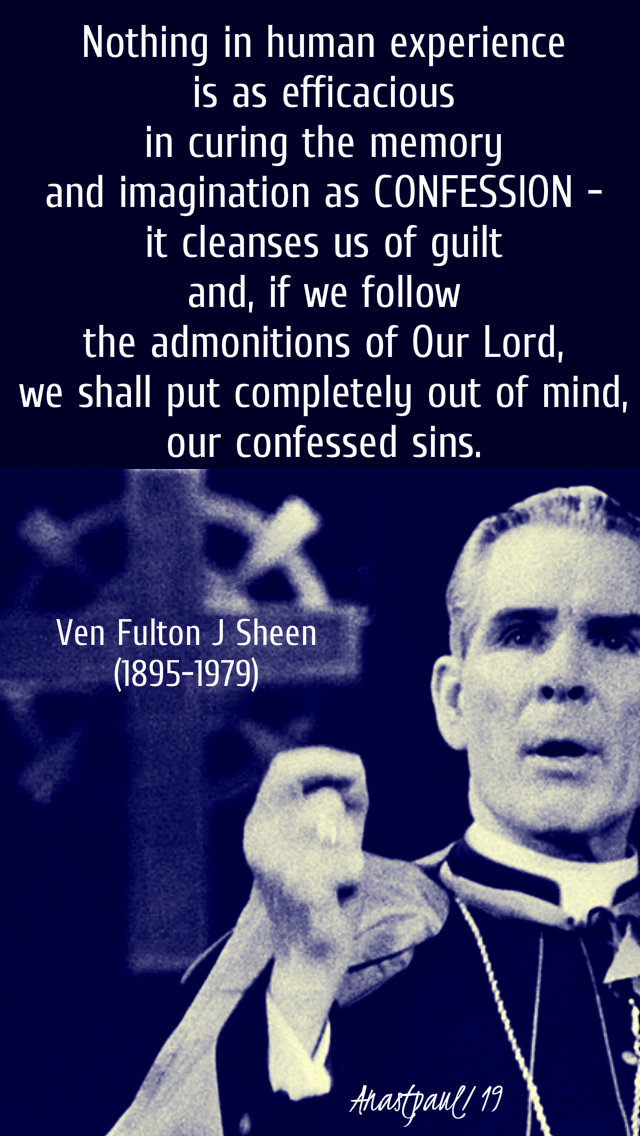
…A conscience burdened with the guilt of past sins is fearful of divine judgement.   But God in His mercy, has given us two remedies for such an unhappiness.   One is the Sacrament of Penance, which blots out the past by remission of our sins and lightens the future by our hope for divine mercy, through continued repentance and amendment of our lives.     Nothing in human experience, is as efficacious in curing the memory and imagination, as confession – it cleanses us of guilt and if we follow the admonitions of Our Lord, we shall put completely out of mind our confessed sins:  “No one who puts a hand to the plow and looks back is fit for the kingdom of God” (Lk 9:62).   Confession also heals the imagination, eliminating its anxiety for the future – for now, with Paul, the soul cries out:  “I can do all things through Him who strengthens me” (Phil 4:13).nothing in human experience - ven fulton sheen 11 jan 2019.jpg

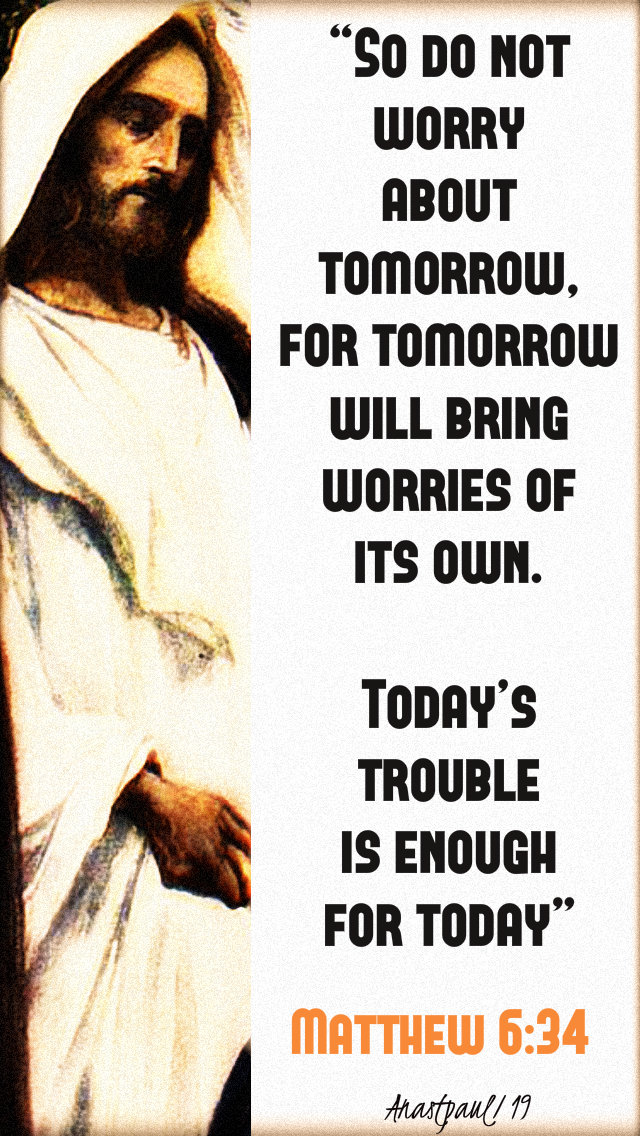
The second remedy, for the ills, that come to us from thinking about time, is what might be called the sanctification of the moment — or the Now.   Our Lord laid down the rule for us in these words:  “So do not worry about tomorrow, for tomorrow will bring worries of its own. Today’s trouble is enough for today” (Mt 6:34). so do not worry about tomorrow - matthew 6 34 11 jan 2019 - fulton sheen.jpg

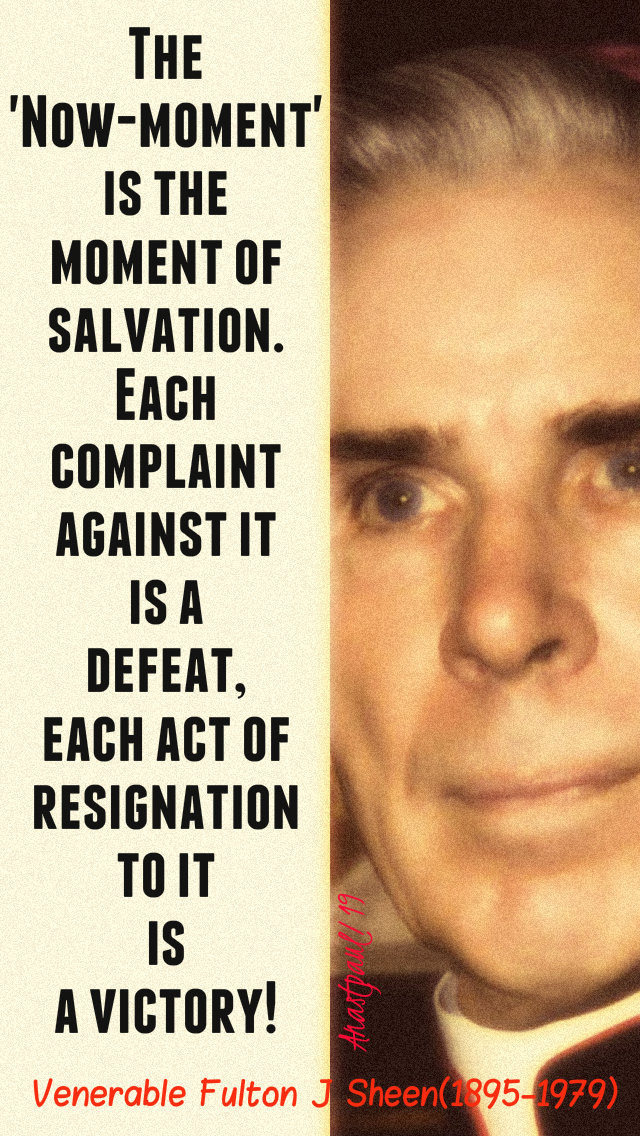
This means, that each day, has its own trials, we are not to borrow troubles from tomorrow, because that day too will have its cross.   We are to leave the past to divine mercy and to trust the future, whatever its trials, to God’s loving providence.   Each minute of life has its peculiar duty — regardless of the appearance that minute may take.   The Now-moment is the moment of salvation.   Each complaint against it is a defeat, each act of resignation to it is a victory.”the now-moment is the moment of salvation - ven fulton j sheen 11 jan 2019.jpg

Posted in DOCTORS of the Church, MORNING Prayers, QUOTES "CARPE DIEM" - Seize the Day, QUOTES of the SAINTS, QUOTES on GRATITUDE, QUOTES on WORRY/ANXIETY

Quote/s of the Day – 11 January – “Carpe Diem”

Quote/s of the Day – 11 January – 5th day after Epiphany

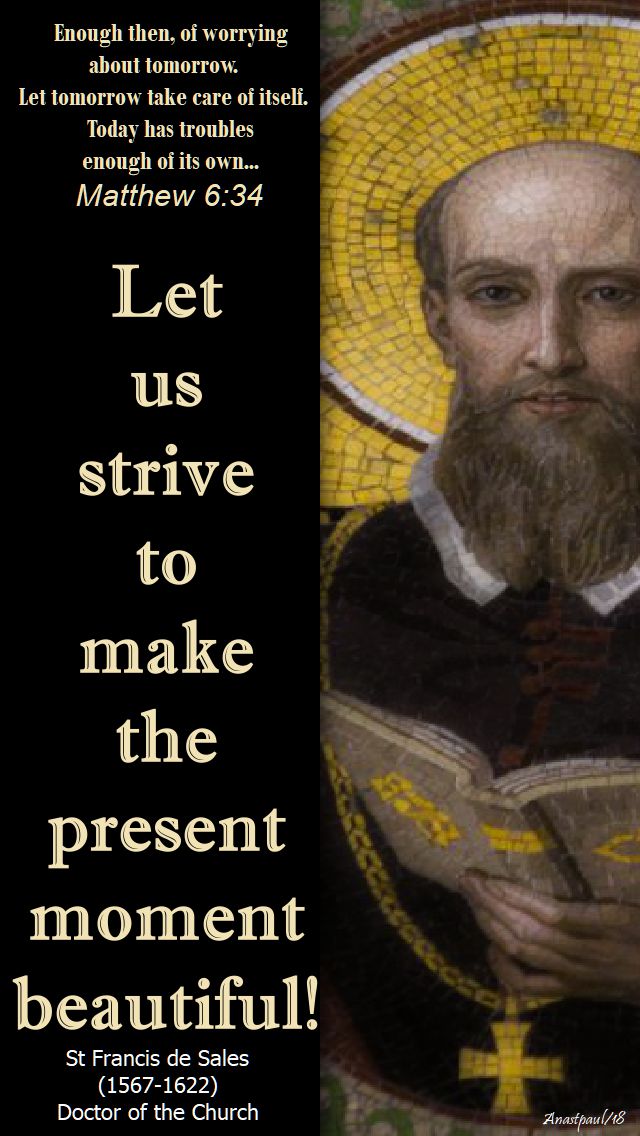
“Let us strive to make
the present moment beautiful!”

St Francis de Sales (1567-1622) Doctor of the Churchlet-us-strive-st-frances-de-sales-11-jan-2018

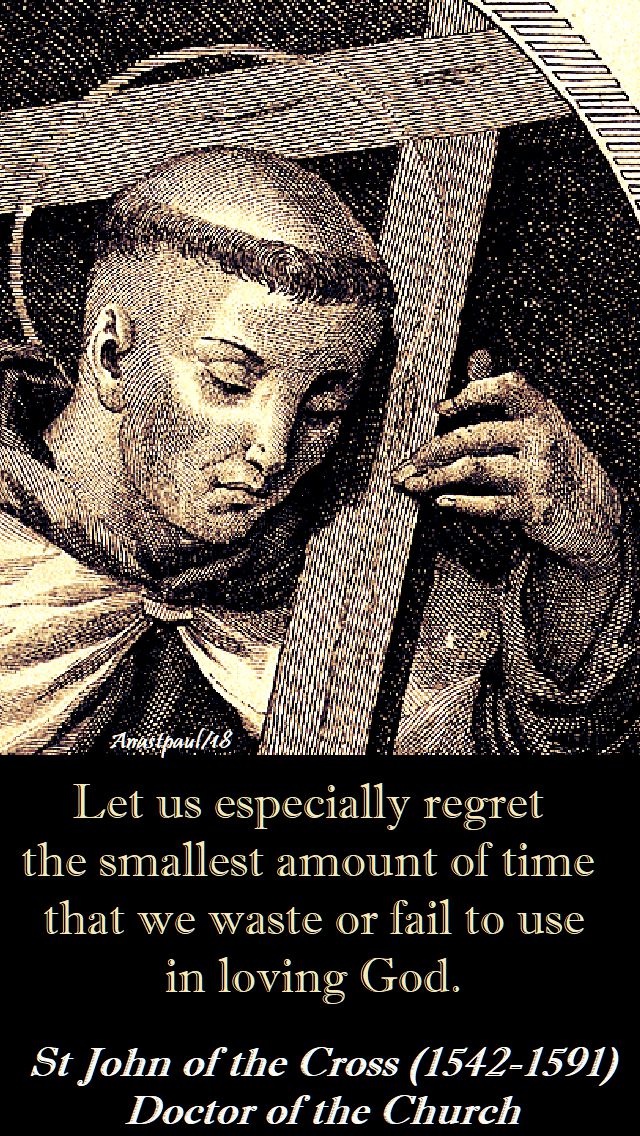
“Let us especially regret,
the smallest amount of time,
that we waste, or fail to use,
in loving God.”

St John of the Cross (1542-1591) Doctor of the Churchlet-us-especially-regret-st-john-of-the-cross-11-jan-2018

Posted in FATHERS of the Church, MORNING Prayers, QUOTES of the SAINTS, QUOTES on PRAYER, SAINT of the DAY, The WORD

One Minute Reflection – 11 January – 5th day after Epiphany – Today’s Gospel: Luke 5:12–16

One Minute Reflection – 11 January – 5th day after Epiphany – Today’s Gospel: Luke 5:12–16

But he withdrew to the wilderness and prayed…Luke 5:16

REFLECTION – “Not by words alone but also by deeds, has God taught us to pray.   He Himself prayed frequently and demonstrated what we ought to do, by the testimony of His own example.   As it is written:  “But he himself was in retirement in the desert and in prayer,” and again, “He went out into the mountain to pray and continued all night in prayer to God.”   But if He who was without sin prayed, how much more ought sinners to pray and if He prayed continually, watching through the whole night with uninterrupted petitions, how much more ought we to lie awake at night in continuing prayer!”…St Cyprian of Carthage (c 200- c 258) Bishop and Martyr, Father of the Church (The Lord’s Prayer #29)luke 5 16 but he withdrew to the wilderness - but if he who was without sin - st cyprian 11 jan 2019.jpg

PRAYER – Almighty God and Father, by the guidance of a star, You revealed the birth of the Saviour of the world and by His teachings, the way of our path to You is shown to us. Open our minds and our hearts to these revelations and let them bear fruit in our lives. Listen we pray, to the prayers of St Tommaso da Cori on our behalf, who so diligently followed Your revelationS.   Through Jesus, our Lord and Christ, with the Holy Spirit, God forever, amen.st tommaso of cori pray for us 11 jan 2019.jpg

Posted in Our MORNING Offering, PRAYERS of the SAINTS, Thomas a Kempis

Our Morning Offering – 11 January – Grant Me Rest in You, above All – By Thomas à Kempis (1380-1471)

Our Morning Offering – 11 January – 5th day after Epiphany

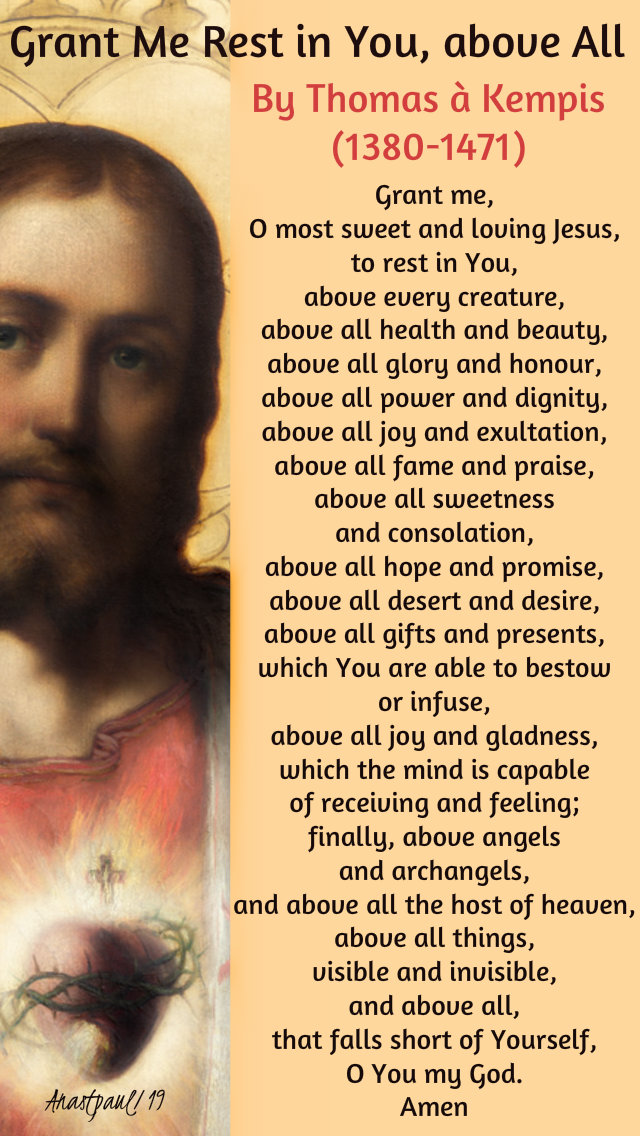
Grant Me Rest in You, above All
By Thomas à Kempis (1380-1471)

Grant me, O most sweet and loving Jesus,
to rest in You, above every creature,
above all health and beauty,
above all glory and honour,
above all power and dignity,
above all joy and exultation,
above all fame and praise,
above all sweetness and consolation,
above all hope and promise,
above all desert and desire,
above all gifts and presents,
which You are able to bestow or infuse,
above all joy and gladness,
which the mind is capable of receiving and feeling;
finally, above angels and archangels,
and above all the host of heaven,
above all things, visible and invisible,
and above all,
that falls short of Yourself,
O You my God.
Amengrant me rest in you above all o Jesus - thomas a kempis 11 jan 2019.jpg

Posted in franciscan OFM, SAINT of the DAY

Saint of the Day – 11 January – St Tommaso da Cori OFM (1655-1729)

Saint of the Day – 11 January – St Tommaso da Cori OFM (1655-1729) Franciscan Friar and Priest, Preacher, Spiritual advisor, Evangeliser, Apostle of the Holy Eucharist, Prayer and Charity – known as the “Apostle of the Sublacense” – born Francesco Antonio Placidi on 4 June 1655 in Cori, Latina, Italy as Francesco Antonio Placidi and died on 11 January 1729 at Bellegra, Rome, Italy of natural causes.   Patronages – Subiaco, Province of Rome (co-patron), Preachers.119tomaso4_zpsfb73ac5d

St Tommaso was born in Cori (Latina) on 4 June 1655.   He knew a childhood marked by the premature loss first of his mother and then of his father, thus being left alone at the age of 14 to look after his younger sister.   Shepherding sheep, he learned wisdom from the simplest things.   Once his sister was married, the youth was free to follow the inspiration that for some years he had kept in the silence of his heart – to belong completely to God in the Religious Life of a Franciscan.   He had been able to get to know the Friars Minor in his own village at the St Francis convent.   Once his two sisters were settled in good marriages and he was rendered free of all other preoccupations, he was received into the Order and sent to Orvieto (PG) to fulfill his novitiate year.   After professing his vows according to the Rule of St Francis and completing his theological studies, he was ordained to the priesthood in 1683.   He was immediately nominated vice master of novices at Holy Trinity convent in Orvieto, since his superior recognised at once his gifts.

After a short time, Fr Tommaso heard of the hermitages that were beginning to bloom in the Order and the intention of the superiors of the Roman Province to inaugurate one at the convent at Civitella (today Bellegra).   His request was accepted and the young friar thus knocked at the door of the poor convent in 1684, saying, “I am Fr Tommaso of Cori and I come here to become holy!”   In speech perhaps distant from ours, he expressed his anxiousness to live the Gospel radically, after the spirit of Saint Francis.st tommaso young

From then, Fr Tommaso lived at Bellegra until death, with the exception of six years in which he was Guardian at the convent of Palombara, where he initiated the Hermitage modelled after the one at Bellegra.   He wrote the Rule first for one and then for the other, observing it scrupulously and consolidating by word and example the new institution of the two Hermitages.
The long years spent at Saint Francis of Bellegra can be summed up in three points:

Prayer:
St Tommaso of Cori was surely – as is said of St Francis – not so much a man who prayed as a man who became prayer.   This dimension animated the entire life of the founder of the Hermitage.   The most evident aspect of his spiritual life was undoubtedly the centrality of the Eucharist, as attested by St Tommaso in his celebration of the Eucharist, which was intense and attentive and in the silent prayer of adoration during the long nights at the Hermitage after the Divine Office, celebrated at midnight.   His life of prayer was marked by a persistent aridity of spirit.   The total absence of sensible consolation in prayer and in his life of union with God was protracted for a good 40 years, finding him always serene and totally in living the primacy of God.   Truly, his prayer was configured as a remembrance of God that made concretely possible a unity of life, notwithstanding his manifold activities.

Evangelisation:
St Tommaso did not close himself up in the Hermitage, forgetting the good of his brothers and sisters, and the heart of the Franciscan vocation, which is apostolic.   He was called with good reason the Apostle of Sublacense (the Subiaco region), having crossed the territory and its villages with the indefatigable proclamation of the Gospel, in the administration of the sacraments and the flowering of miracles at his passage, a sign of the presence and nearness of the Kingdom.   His preaching was clear and simple, convincing and strong.   He did not climb the most illustrious pulpits of his time, his personality was able to give its best in an ambit restricted to our territory, living his Franciscan vocation in littleness and in the concrete choice of the poorest.

Exquisite charity:
St  Tommaso of Cori was to his brothers, a very gentle father.   In the face of the resistance of some brothers before his will to reform and his radicality in living the Franciscan ideal, the Saint knew how to respond with patience and humility, even finding himself alone to mind the convent.   He had understood well that every true reform initiates itself.st tomasso of cori

The considerable correspondence left by him, demonstrates St Tommaso’ attention to the smallest expectations and needs of his Friars and of numerous friends, penitents and Friars who turned to him for his counsel.   In the convent, he demonstrated his spirit of charity in his availability for every necessity, even the most humble.

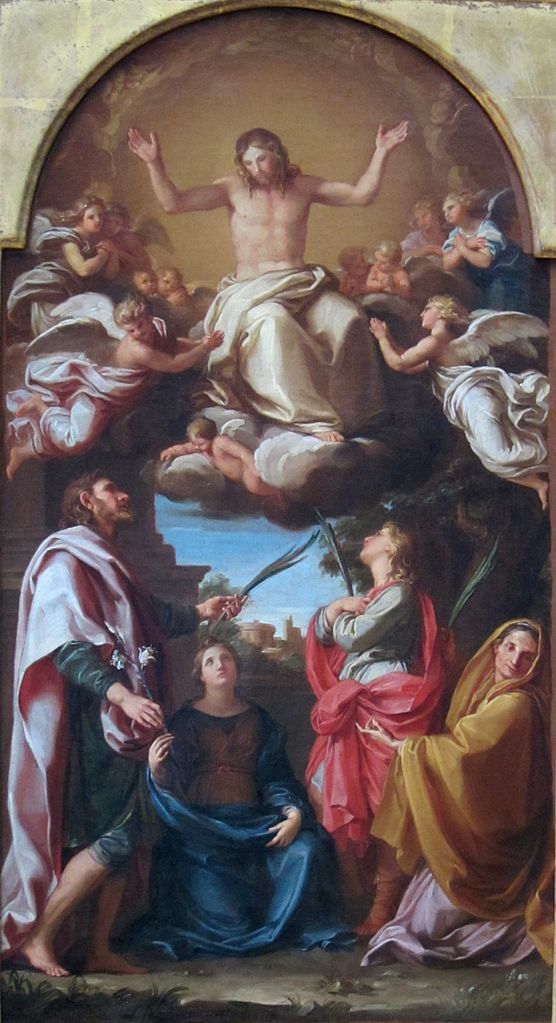
Rich in merits, he fell asleep in the Lord on 11 January 1729.   St Tommaso of Cori shines among us and in Rome, of which he is the co-patron, above all in his thirst for a Christian and Franciscan ideal that is pure and lived in its essentials.   A inspiration for all of us, not to take lightly the Gospel and its all-encompassing exigencies….Vatican.vastatua-san-tommaso-da-cori-620x639

St Tommaso’s body is enshrined in the Franciscan Chapel of Bellagra.   He was Beatified on 3 September 1786, at Saint Peter’s Basilica, by Pope Pius VI and Canonised on 21 November 1999, at Saint Peter’s Square, Vatican City by St Pope John Paul II.st tommaso body

Posted in Uncategorized

Memorials of the Saints -11 January

St Alexander of Fermo
St Anastasius of Suppentonia
Bl Anna Maria Janer Anglarill
St Boadin of Ireland
St Breandan of Ireland
St Eithne
St Fedelemia
Bl Francis Rogaczewski
St Francisca Salesia Aviat
St Honorata of Pavia
St Pope Hyginus
St Leucius of Alexandria
St Leucius of Brindisi
St Liberata of Pavia
St Lucius the Soldier
St Luminosa of Pavia
St Mark the Soldier
St Michael of Klopsk
St Palaemon
St Paldo
St Peter Balsam
St Peter of Alexandria
St Peter of Anea
St Peter the Soldier
St Salvius of Amiens
St Severus of Alexandria
St Speciosa of Pavia
St Taso
St Theodosius the Soldier
St Theodosius of Antioch
St Theodosius the Cenobiarch
St Tipasio of Tigava
St Tommaso da Cori OFM (1655-1729)

St Vitalis of Gaza (Died c 625)
Biography: https://anastpaul.wordpress.com/2018/01/11/saint-of-the-day-11-january-st-vitalis-of-gaza-died-c-625/

Bl William Carter


Posted in SAINT of the DAY

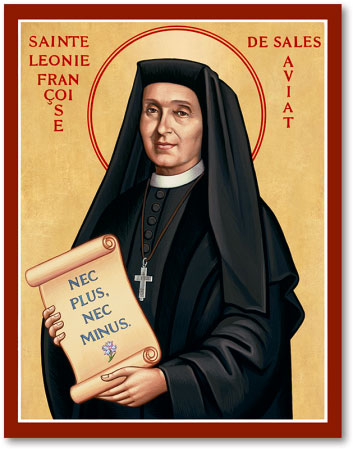
Thought for the Day – 10 January – St Léonie Aviat

Thought for the Day – 10 January – 4th day after Epiphany and The Memorial of St Léonie Françoise De Sales Aviat (1844-1914) the co-founder of the Oblate Sisters of St Francis de Sales

St Pope John Paul on the Canonisation of St Léonie – 25 November 2001

“The loving plan of the Father “who has made us enter the kingdom of his beloved Son” found a splendid realisation in St Léonie Frances de Sales Aviat, who lived her self-offering to the end.

At the heart of her dedication and of her apostolate, Sister Léonie put prayer and union with God, where she found the light and the energy to overcome trials and difficulties and to persevere to the end of her life in the life of faith, desiring to be led by the Lord – “O my God, let my happiness be found in sacrificing my will and my desires for you!”   The resolution which distinguished Mother Aviat so well, “Forget oneself completely“, is also for us an appeal to go against the current of egotism and easy pleasures and open ourselves to the social and spiritual needs of our time.

Dear Oblate Sisters of St Francis-de-Sales, at the school of your foundress, in profound communion with the Church and wherever God has placed you, be determined to receive the present graces and to benefit from them, for it is in God that we find the light and the help necessary in every circumstance!

Trusting in the powerful intercession of the new saint, accept with joy the invitation to live, with renewed fidelity, the intuitions which she so perfectly lived.”

“O my God, let my happiness be found in sacrificing my will and my desires for you!”

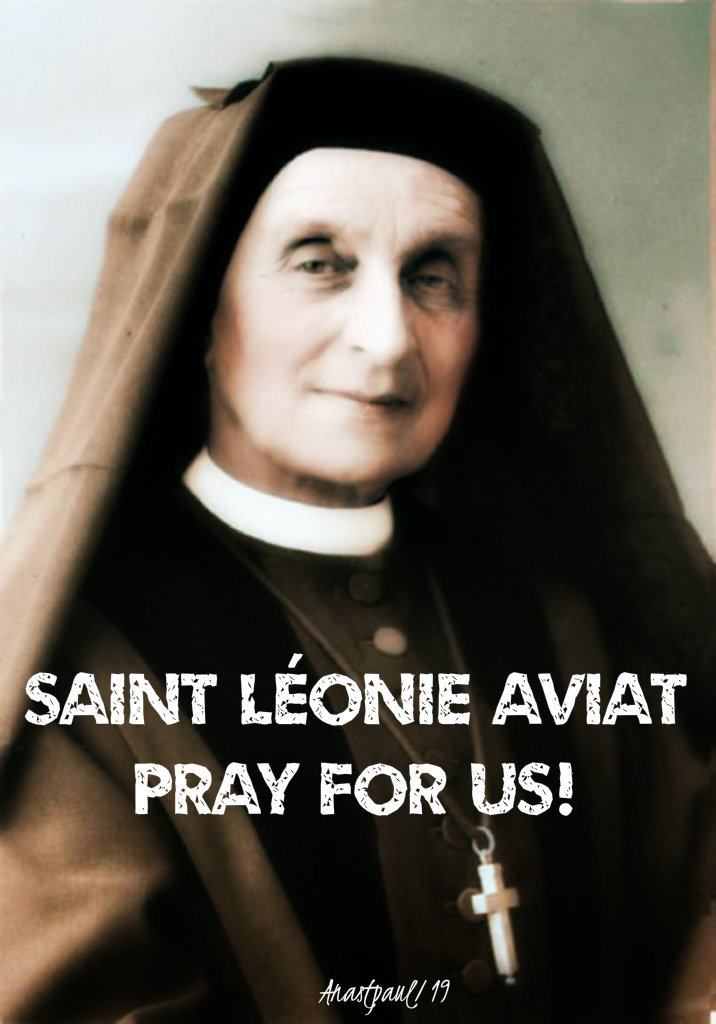
St Léonie Aviat, Pray for Us!st leonie aviat opray for us no 2 10 jan 2019

Posted in ArchAngels and Angels, EUCHARISTIC Adoration, QUOTES of the SAINTS, QUOTES on CHARITY, QUOTES on DIVINE PROVIDENCE, QUOTES on FAITH, QUOTES on GRACE, QUOTES on PERSEVERANCE, QUOTES on PRAYER, QUOTES on SACRIFICE, QUOTES on SUFFERING, QUOTES on TRUST and complete CONFIDENCE in GOD, QUOTES on WORK/LABOUR, SAINT of the DAY

Quote/s of the Day – 10 January – St Léonie Françoise De Sales Aviat OSFS (1844-1914)

Quote/s of the Day – 10 January – 4th day after Epiphany and The Memorial of St Léonie Françoise De Sales Aviat OSFS (1844-1914)

“Let us work for the happiness of others.”

let us work for the happiness of others st leonie aviat 10 jan 2019.jpg

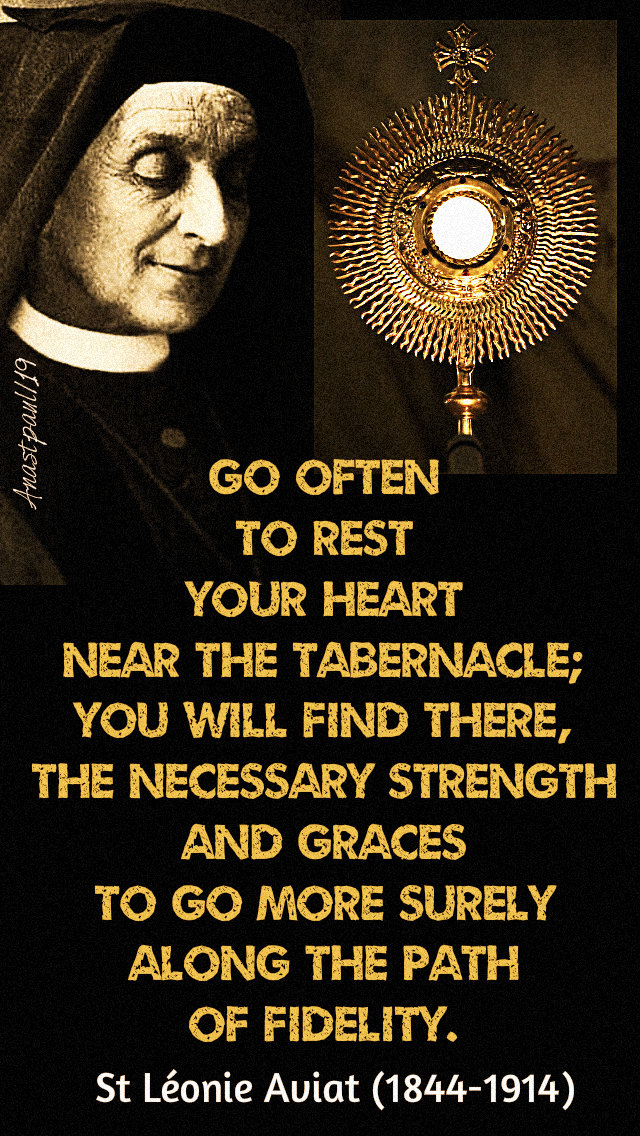
“Go often to rest your heart
near the tabernacle;
you will find there,
the necessary strength
and graces
to go more surely
along the path of fidelity.”go often to rest your heart near the tabernacle - st leonie aviat no 1 - 10 jan 2019.jpg

“God does not try us beyond our strength.
When He sends difficulty,
He adds the means of overcoming it.”god does not try us - st leonie - 10 jan 2019.jpg

“Our good Jesus always puts grace,
where He puts a sacrifice.”

“Our good Master never lets Himself
be outdone in generosity.
He gives back one hundredfold
what we sacrifice to Him.”our good Jesus, our good master - st leonie aviat - 10 jan 2019.jpg

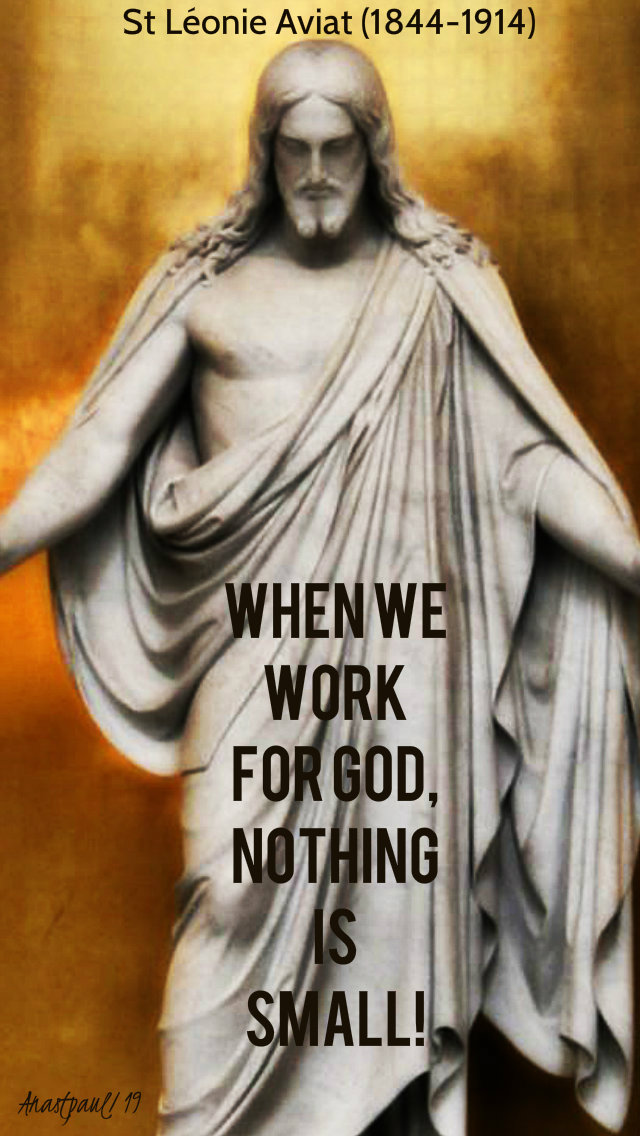
“When we work for God, nothing is small!”when we work for god nothing is small st leonie aviat 10 jan 2019.jpg

“I formed the habit
of never approaching anyone
without casting a glance at our Lord.
Try my little method –
I can assure you it is a good one.”I formed the habit of never approaching st leonie aviat 10 jan 2019.jpg

“Pray to your good angels;
use them as messengers
in your little joys and sufferings.”pray to your good angels - st leonie aviat - 10 jan 2019.jpg

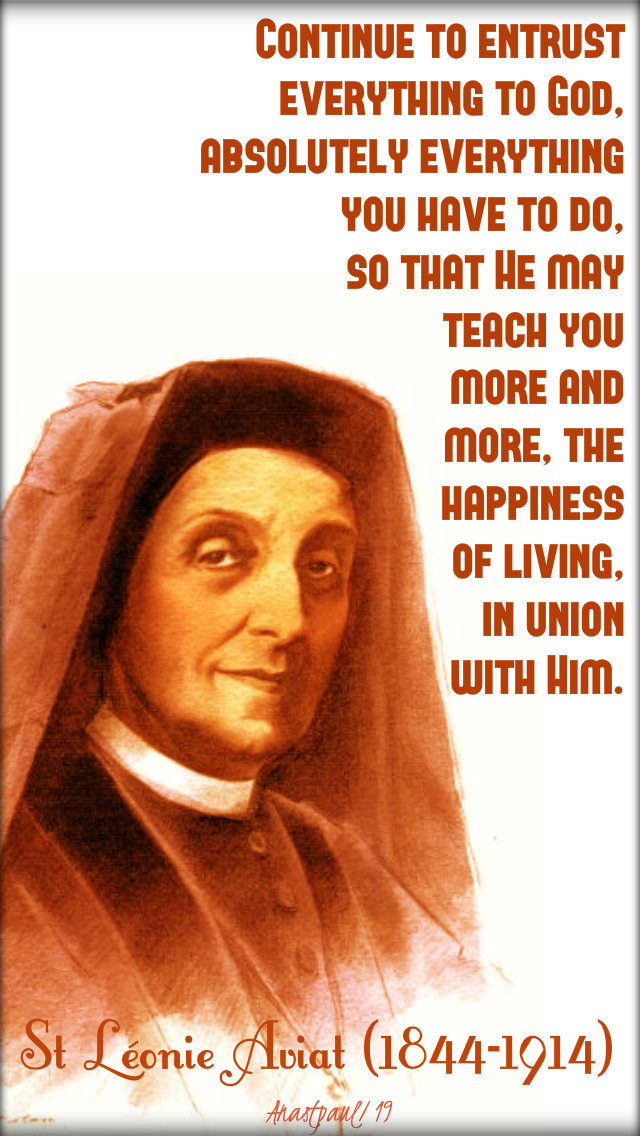
“Continue to entrust everything to God,
absolutely everything you have to do,
so that He may teach you more and more,
the happiness of living,
in union with Him.”

St Léonie Aviat (1844-1914)continue to entrust everything to god - st leonie aviat 10 jan 2019.jpg

Posted in MORNING Prayers, SAINT of the DAY, The WORD

One Minute Reflection – 10 January – 4th day after Epiphany:  Gospel Luke 4:14–22

One Minute Reflection – 10 January – 4th day after Epiphany:  Gospel  Luke 4:14–22 and The Memorial of St Léonie Françoise De Sales Aviat (1844-1914)

“The Spirit of the Lord is upon me,
because he has anointed me to preach good news to the poor.
He has sent me to proclaim release to the captives
and recovering of sight to the blind,
to set at liberty those who are oppressed...” Luke 4:18the spirit of the lord - luke 4 18-10 jan 2019

REFLECTION – “Evangelising the poor – this is Jesus’ mission.   According to what He says, this is also the mission of the Church and of every person baptised in the Church. Being a Christian is the same thing as being a missionary.   Proclaiming the Gospel with one’s word and even before, with one’s life, is the primary aim of the Christian community and of each of its members.  It is noted here that Jesus addresses the Good News to all, excluding no one, indeed favouring those who are distant, suffering sick, cast out by society.”...Pope Francis – Angelus, 24 January 2016being a christian is the same thing - pope francis - 10 jan 2019

PRAYER – Through Your Son, Lord God, You shed Your eternal light on all mankind.   You gave us our mission, You taught us our way.   Grant us the grace to acknowledge the full splendour of our Redeemer, so that, in His steps, we may grow from strength to strength in evangelising all.   Fill us with Your Spirit to enlighten and guide us.   May the intercession of St Léonie Françoise De Sales Aviat, who followed our Saviour and imitated Him, help us in our mission.   Through our Lord Jesus Christ, in union with the Holy Spirit, God forever, amen.st leonie aviat pray for us 10 jan 2019

Posted in DOCTORS of the Church, Our MORNING Offering, PRAYERS of the SAINTS, SAINT of the DAY

Our Morning Offering – 10 January – The Memorial of St Léonie Françoise De Sales Aviat

Our Morning Offering – 10 January – 4th day after Epiphany and The Memorial of St Léonie Françoise De Sales Aviat (1844-1914) the co-founder of the Oblate Sisters of St Francis de Sales

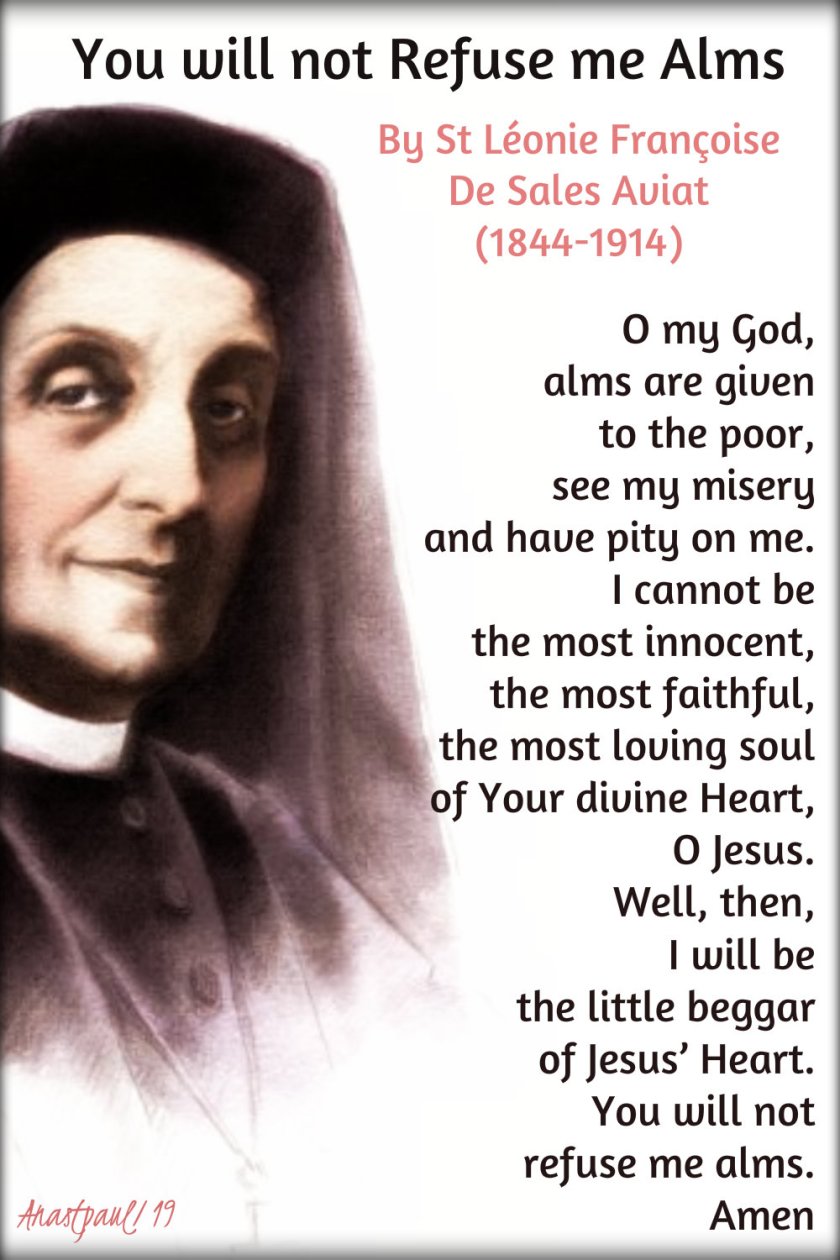
You will not Refuse me Alms (The Little Beggar of Jesus’ Heart)
By St Léonie Françoise De Sales Aviat (1844-1914)

O my God,
alms are given to the poor,
see my misery and have pity on me.
I cannot be the most innocent,
the most faithful,
the most loving soul of Your divine Heart, O Jesus.
Well, then,
I will be the little beggar of Jesus’ Heart.
You will not refuse me alms.
Amenyou will not refuse me alms - st leonie aviat 10 jan 2019

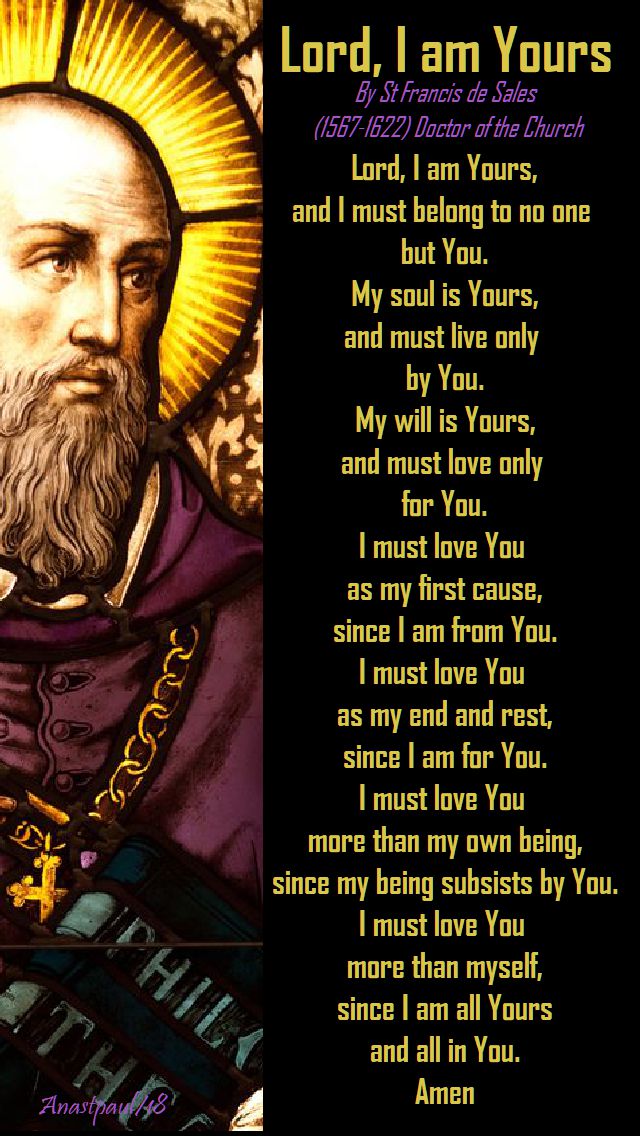
Lord I am Yours
By St Francis de Sales (1567-1622) Doctor of the Church

Lord, I am Yours,
and I must belong to no one but You.
My soul is Yours,
and must live only by You.
My will is Yours,
and must love only for You.
I must love You as my first cause,
since I am from You.
I must love You as my end and rest,
since I am for You.
I must love You more than my own being,
since my being subsists by You.
I must love You more than myself,
since I am all Yours and all in You.
Amenlord, i am yours by st francis de sales - 28 july 2018

Posted in SAINT of the DAY

Saint of the Day – 10 January – St Léonie Françoise De Sales Aviat (1844-1914)

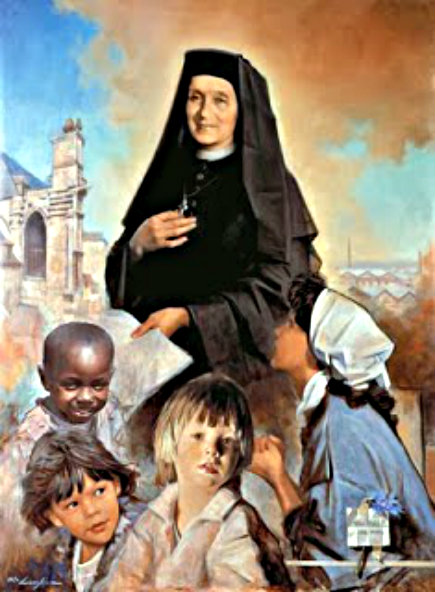
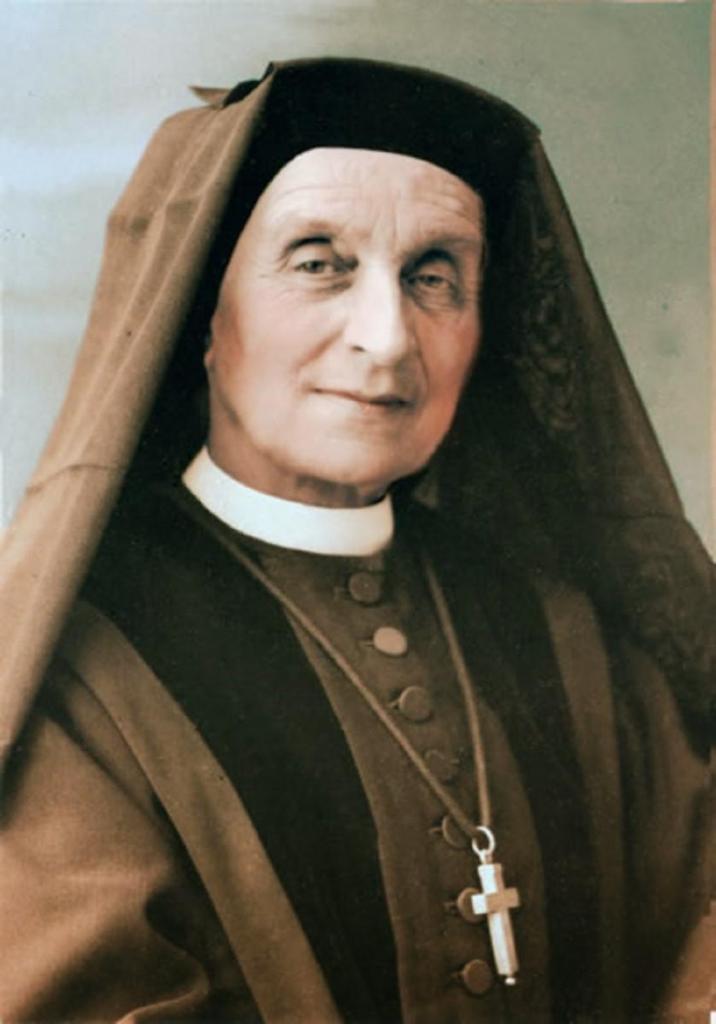
Saint of the Day – 10 January – St Léonie Françoise De Sales Aviat (1844-1914) was a professed religious and the co-founder of the Oblate Sisters of St Francis de Sales alongside Blessed Louis Brisson (1817–1908), Teacher, Apostle of Eucharistic Adoration, Prayer and Charity.  Born in Sézanne, France on 16 September 1844 and died on 10 January 1914 (aged 69) in Perugia, Italy, she was baptised on 17 September in the local parish church.    Patronages – Oblate Sisters of St Francis de Sales, Marne, Aube, Sézanne, Teachers.st leonie aviat

Léonie Aviat was born in Sézanne, in the region of Champagne (France) on 16 September 1844.   She attended school at the Monastery of the Visitation in the city of Troyes, where Mother Marie de Sales Chappuis, the superior and Father Louis Brisson, the chaplain, exerted a decisive influence on her.   Having thus been formed at the school of St Francis de Sales, she prepared herself for the mission with which she was to be entrusted – the foundation of a Congregation committed to the Salesian spirituality and to the evangelisation of young workers.santa_francesca_salesia-leonia_aviat-a

The beginnings came in the year 1866.   This was the time when large industrial concerns were attracting an underpaid labour force to the cities.   This was also the case in the city of Troyes, where textile mills engaged young girls of rural extraction.   Father Brisson, a zealous apostle and already one of the forerunners of the great social movement that developed at the end of the 19th century, had opened a centre, in 1858, to welcome young girls working in the textile mills in order to give them a complete education, both human and Christian.   Unable to find a suitable directress and a stable supervisory staff for this centre, known as the “Workers of Saint-François de Sales”, with God’s inspiration, he decided to establish a religious congregation.   He found in Léonie Aviat an incomparable co-worker, in whom he discerned a vocation to the consecrated life as well.   Indeed, upon completing her studies, the young lady left the Visitation monastery with the firm intention of returning to it as a lay Sister.   But Father Brisson and Mother Chappuis advised her to wait.   Obedient to what she regarded as God’s will, she received a special sign from Him a little later, one that couldn’t be mistaken for an illusion – obliged to go to the factory, where glasses were manufactured and repaired, in Sézanne, her native city, an inspiration enlightened her mind and guided her decision.   The sight of the workroom filled with young factory workers busily engaged in their work beneath the watchful and maternal gaze of a supervisor aroused in her heart the desire to take her place among them in order to counsel and guide them.   This attraction would press her even more strongly the day that Father Brisson invited her to visit the “Workers of Saint-François de Sales” which he had founded in Troyes.

On 18 April 1866, she joined the “Oeuvre (Workers of) Saint-François de Sales”, with one of her former classmates of the Visitation, Lucie Canuet.st-leonie-aviat-icon-390

On 30 October 1868, the young foundress was clothed with the religious habit and received the name of Sister Françoise de Sales.   This name was a sign indicating what would be her life’s work, as she herself expressed it in the form of a prayer in her personal notes:  “St Francis de Sales, you have chosen me to be at the head of this little group;  give me your spirit, your heart…  Grant me a share of your union with God and of that interior spirit which knows how to do everything in union with Him and nothing without Him” (August, 1871).   The “little group” which she guided placed itself under the protection of the saintly Bishop of Geneva and completely adopted his method of spirituality and of pedagogy, hence, the name that it chose for itself – the “Oblate Sisters of St Francis de Sales”, which means offered to God and to the neighbour by means of their whole life.

On 11 October 1871, Sister Françoise de Sales professed her vows and the following year, she was elected Superior General of the new Congregation which was thus canonically established and able to expand rapidly.   Under her guidance, the community grew in numbers and the social apostolate developed.   At the same time, grade schools were opened in parishes and in Paris the first boarding school for young ladies was also opened, an establishment which Mother Aviat directed for eight years.   The apostolate of the Oblate Sisters thus extended to the different classes of society and to all forms of education and, from the very first years of its foundation, to the missions to the nations, as well.santa_leonie_aviat

In 1893, after a period of effacement which brought to light her humility, Mother Françoise de Sales was again elected Superior General, an office she held until her death. During this time, she endeavoured to develop the apostolate of the Congregation in Europe, South Africa and Ecuador, while lavishing her untiring solicitude on every community and on each of her Sisters.   In 1903, she had to cope with the persecution directed against religious orders in France.   While maintaining the houses of her Congregation that could be maintained in France, she transferred the Mother House to Perugia, Italy.   In 1911, she secured the final approbation of the Constitutions of the Institute from Pope St Pius X.Mother_Françoise_de_Sales_Aviat (1).jpg

On 10 January 1914, she died in Perugia with serenity, totally entrusting herself to God. To the very end, she remained faithful to the resolution made at the time of her Profession:  “To forget myself entirely”.   To her daughters in every age, she left this very Salesian precept:  “Let us work for the happiness of others”.snip st leonia aviat

The beatification miracle came from Cape Town in South Africa and concerned the January 1976 healing of Vincent Kesner who was a child stricken with cancer that had been deemed incurable.   The canonisation miracle concerned the cure of Bernadette McKenzie (aged fourteen) from Philadelphia in the United States of America from paralysing spinal disease.

Léonie was Beatified on 27 September 1992, at St Peter’s and Canonised on 25 November 2001, also at St Peter’s and on both occasions by St Pope John Paul II.- good lg image of st francisca_de_sale_aviat_leonia_-_10_de_enero.jpgstleonie

Posted in SAINT of the DAY

Memorials of the Saints -10 January

St Aldo of Carbonari
St Pope Agatho
Bl Anna of the Angels Monteagudo
St Arcontius of Viviers
Bl Benincasa of Cava
St Dermot of Inis Clothrann
St Domitian of Melitene
Bl Pope Gregory X
Bl Giles of Lorenzana
St Léonie Aviat/Françoise de Sales OSFS (1844-1914)
St Marcian of Constantinople
Bl Maria Dolores Rodríguez Sopeña y Ortega
St Maurilius of Cahors
St Nicanor of Cyprus
St Paul the Hermit
St Peter Orseolo O.S.B. Cam. (928–987)

About St Peter – https://anastpaul.wordpress.com/2018/01/10/saint-of-the-day-10-january-st-peter-orseolo-o-s-b-cam-928-987/

St Petronius of Die
Bl Raymond de Fosso
St Saethryth of Faremoutier
St Thecla of Lentini
St Thomian of Armagh
St Valerius of Limoges
St William of Bourges

Posted in SAINT of the DAY

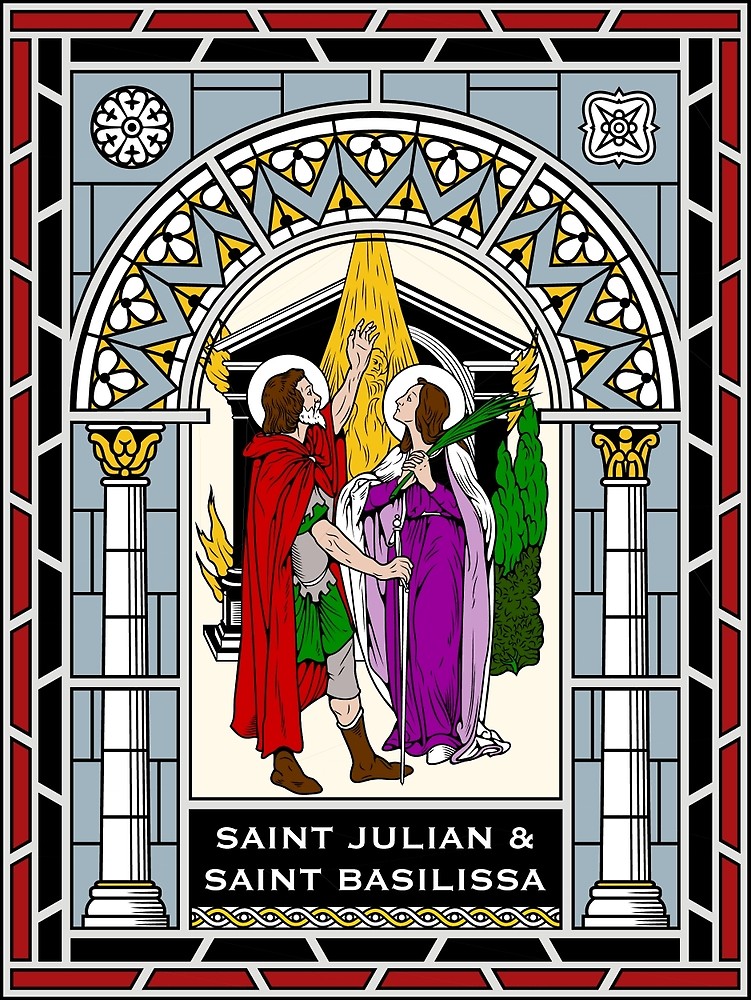
Saints of the Day – Sts Julian and Basilissa (died c 304) – Martyrs

Saints of the Day – Sts Julian and Basilissa (died c 304) – Martyrs – Julian and Basilissa were husband and wife.   They were Christian martyrs who died at either Antioch or, more probably, at Antinoe, in the reign of Diocletian, early in the fourth century.

Forced by his family to marry, Julian, agreed with his spouse, Basilissa, that they should both preserve their virginity and further encouraged her to found a convent for women, of which she became the superior, while he himself gathered a large number of monks and undertook their direction.   The two converted their home into a hospital which could house up to 1,000 people (thus, Julian is often confused with Julian the Hospitaller). There, they worked tirelessly, using their own funds, to assist the poor, the sick, the needy.  Basilissa attended those of her sex, in separate lodgings from the men, these were taken care of by Julian, who from his charity is named the Hospitalarian.   Egypt, where they lived, had then begun to abound with examples of persons who, either in the cities or in the deserts, devoted themselves to the most perfect exercises of charity, penance, and mortification.  sts julian and basilissa

Basilissa, after having stood severe persecutions, died in peace.   Julian survived her many years but was martyred, (together with Celsus a youth, Antony a priest, Anastatius and Marcianilla the mother of Celsus) under the Persecutions of Diocletian.

During the persecution of Diocletian he was arrested, tortured and put to death at Antioch, in Syria, by the order of the governor, Martian, according to the Latins, at Antinoe, in Egypt, according to the Greeks, which seems more probable.   Celsus, the young son of Marcionilla, was martyred along with Julian.   The priest Anthony (Antony) was martyred at the same time, as well as a convert and neophyte named Anastasius. Marcionilla’s seven brothers are also said to have been killed.

In any case, these two saints must have enjoyed a great reputation in antiquity and their veneration was well established before the eighth century.   Only a fragment of Ælfric’s Passion of St Julian and His Wife Basilissa from his Lives of the Saints has survived but the traditional legend is there – the two saints vow not to consummate their marriage on their wedding night and devote themselves to chastity.   Julian suffers martyrdom by beheading.

Many churches and hospitals especially in the West, bear the name of one or other of these martyrs.   Four churches at Rome and three out of five at Paris, which bear the name of St Julian, were originally dedicated under the name of St Julian, the Hospitalarian and martyr.

In the time of St Gregory the Great, the skull of St Julian was brought out of the East into France and given to Queen Brunehault, who gave it to the nunnery which she founded at Étampes. Part of it is at present in the monastery of Morigny, near Étampes and part in the church of the regular canonesses of St Basilissa at Paris.

556px-Basilissa_Julian.jpg
Christ with Saints Julian and Basilissa, Celsus and Marcionilla, Pompeo Batoni, 1736-8.
Posted in CHRISTMASTIDE!, MORNING Prayers, PAPAL SERMONS, The NATIVITY of JESUS

Thought for the Day – 9 January – 3rd Day after Epiphany

Thought for the Day – 9 January – 3rd Day after Epiphany

Excerpt from Pope Francis’ Homily for the Solemnity of the Epiphany of the Lord, celebrated 6 January 2019, in St Peter’s Basilica

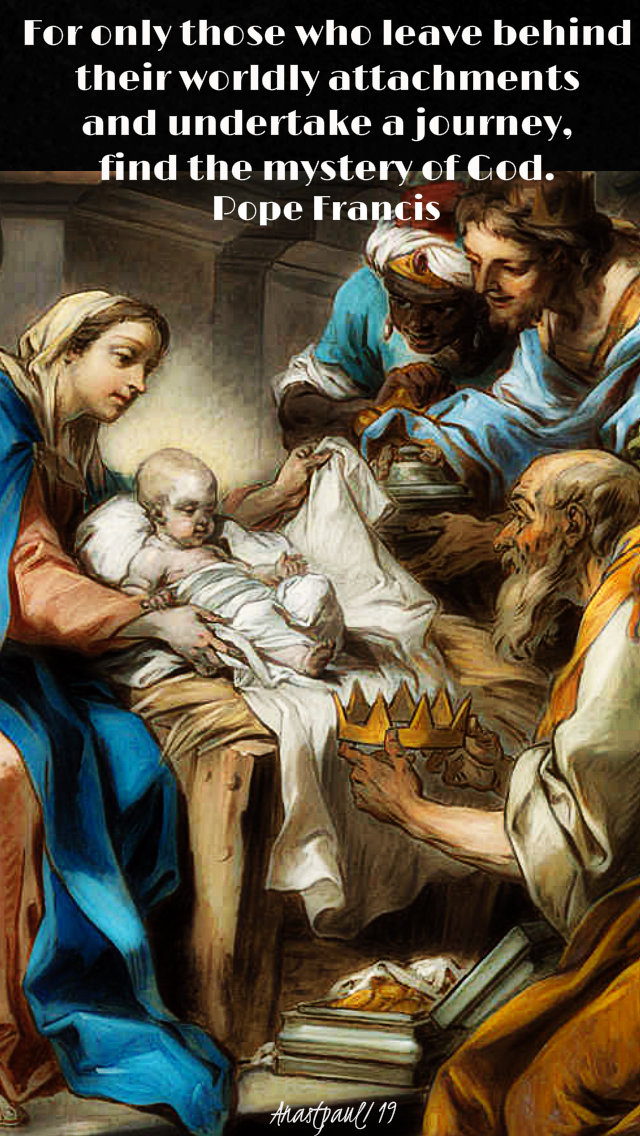
“In order to find Jesus, we also need to take a different route, to follow a different path, His path, the path of humble love.   And we have to persevere.   Today’s Gospel ends by saying that the Magi, after encountering Jesus, “left for their own country by another road” (Mt 2:12).   Another road, different from that of Herod.   An alternative route than that of the world, like the road taken by those who surround Jesus at Christmas – Mary and Joseph, the shepherds.   Like the Magi, they left home and became pilgrims on the paths of God.   For only those, who leave behind their worldly attachments and undertake a journey, find the mystery of God.for only those who leave behind their worldly attachments - pope francis epiphany 2019 9jan2019.jpg

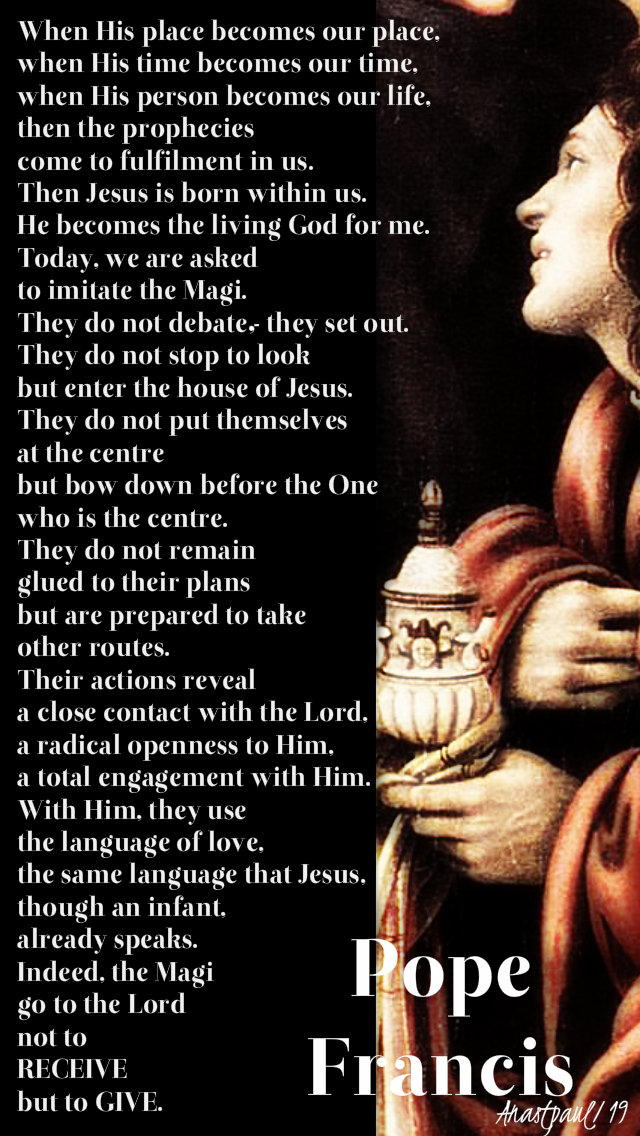
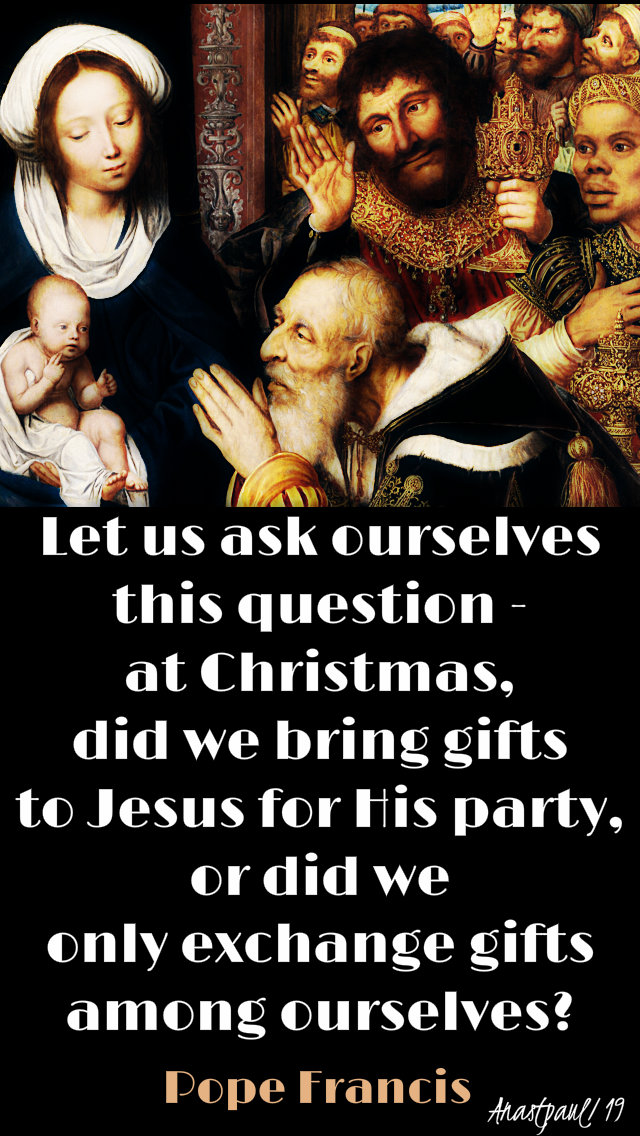
This holds true for us too.   It is not enough to know where Jesus was born, as the scribes did if we do not go there.   It is not enough to know that Jesus was born, like Herod, if we do not encounter Him.   When His place becomes our place, when  His time becomes our time, when His person becomes our life, then the prophecies come to fulfilment in us.   Then Jesus is born within us.   He becomes the living God for me.   Today we are asked to imitate the Magi.   They do not debate – they set out.  They do not stop to look but enter the house of Jesus.   They do not put themselves at the centre but bow down before the One who is the centre.   They do not remain glued to their plans but are prepared to take other routes.   Their actions reveal a close contact with the Lord, a radical openness to Him, a total engagement with Him.   With Him, they use the language of love, the same language that Jesus, though an infant, already speaks.   Indeed, the Magi go to the Lord not to receive but to give.   Let us ask ourselves this question – at Christmas did we bring gifts to Jesus for His party, or did we only exchange gifts among ourselves?when his place becomes our place - pope franics epip homily 2019 9 jan 2019.jpg

let us ask ourselves - pope francis 9 jan 2019 epiphany homily 2019.jpg

If we went to the Lord empty-handed, today we can remedy that.   The Gospel, in some sense, gives us a little “gift list”: gold, frankincense and myrrh.   Gold, the most precious of metals, reminds us God has to be granted first place – He has to be worshipped. But to do that, we need to remove ourselves from the first place and to recognise our neediness, the fact that we are not self-sufficient.    Then there is frankincense, which symbolises a relationship with the Lord, prayer, which like incense rises up to God (cf. Ps 141:2).   Just as incense must burn in order to yield its fragrance, so too, in prayer, we need to “burn” a little of our time, to spend it with the Lord.   Not just in words but also by our actions.   We see this in the myrrh, the ointment that would be lovingly used to wrap the body of Jesus taken down from the cross (cf. Jn 19:39).   The Lord is pleased when we care for bodies racked by suffering, the flesh of the vulnerable, of those left behind, of those who can only receive without being able to give anything material in return.   Precious in the eyes of God is mercy shown to those who have nothing to give back.   Gratuitousness!

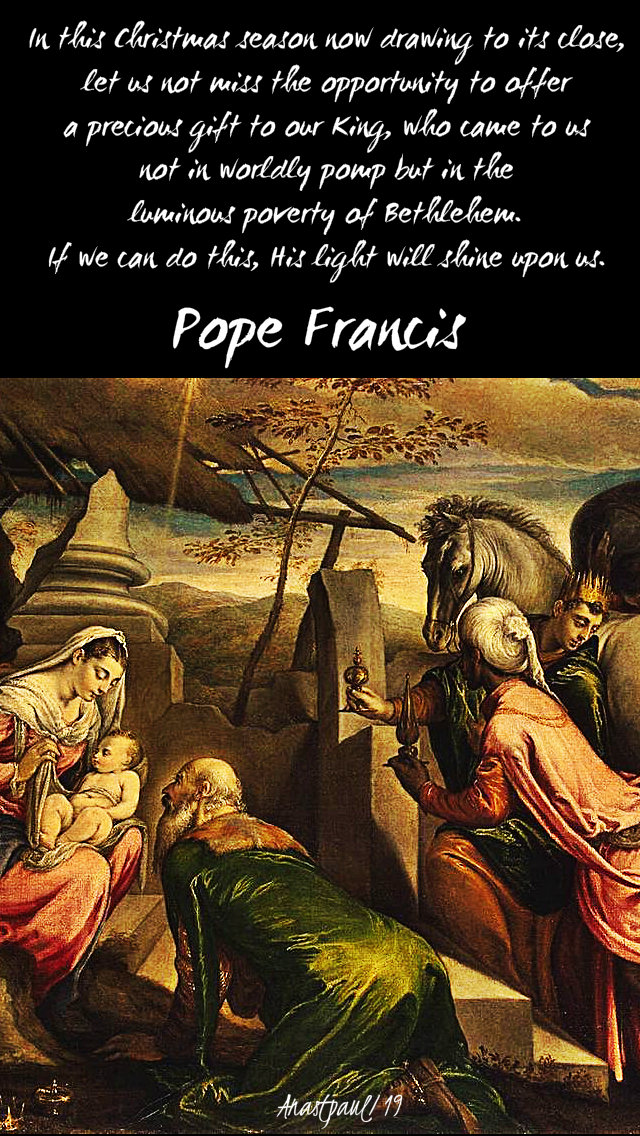
In this Christmas season now drawing to its close, let us not miss the opportunity to offer a precious gift to our King, who came to us not in worldly pomp but in the luminous poverty of Bethlehem.   If we can do this, His light will shine upon us.”in this christmas season - pope francis - 9 jan 2019.jpg

Posted in QUOTES - J R R Tolkien and MORE, QUOTES on PRAYER, Uncategorized

Quote/s of the Day – 9 January – 3rd Day after Epiphany

Quote/s of the Day – 9 January – 3rd Day after Epiphany

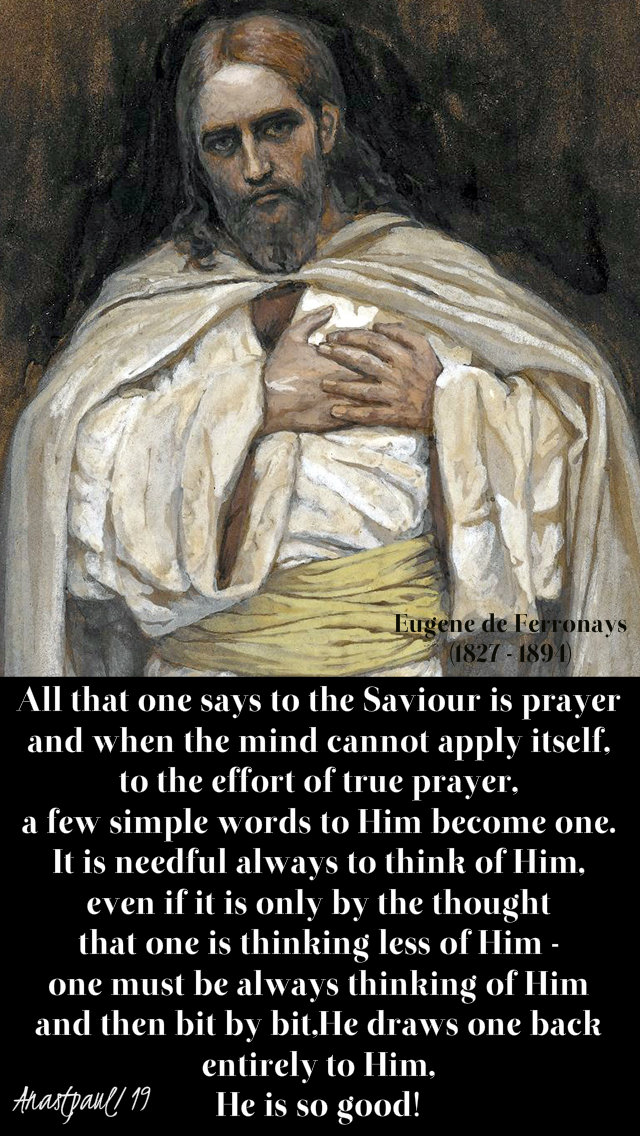
“All that one says to the Saviour is prayer
and when the mind cannot apply itself,
to the effort of true prayer,
a few simple words to Him become one.
It is needful always to think of Him,
even if it is only by the thought
that one is thinking less of Him –
one must be always thinking of Him
and then bit by bit,
He draws one back entirely to Him,
He is so good!”all that one says to the saviour is prayer - eugene de ferronays 9 jan 2019.jpg

“As You will, my Lord!
I will all that You do will,
because the only thing I do not will,
You also do not will it –
that I shall cease to be Your child!”

Eugene de Ferronays (1827 – 1894)as you will my lord - euegene de ferronays 9 jan 2019.jpg

Posted in CHRISTMASTIDE!, MORNING Prayers, The WORD, Uncategorized

One Minute Reflection – 9 January – 3rd Day after Epiphany – Gospel: Mark 6:45-52

One Minute Reflection – 9 January – 3rd Day after Epiphany – Gospel: Mark 6:45-52

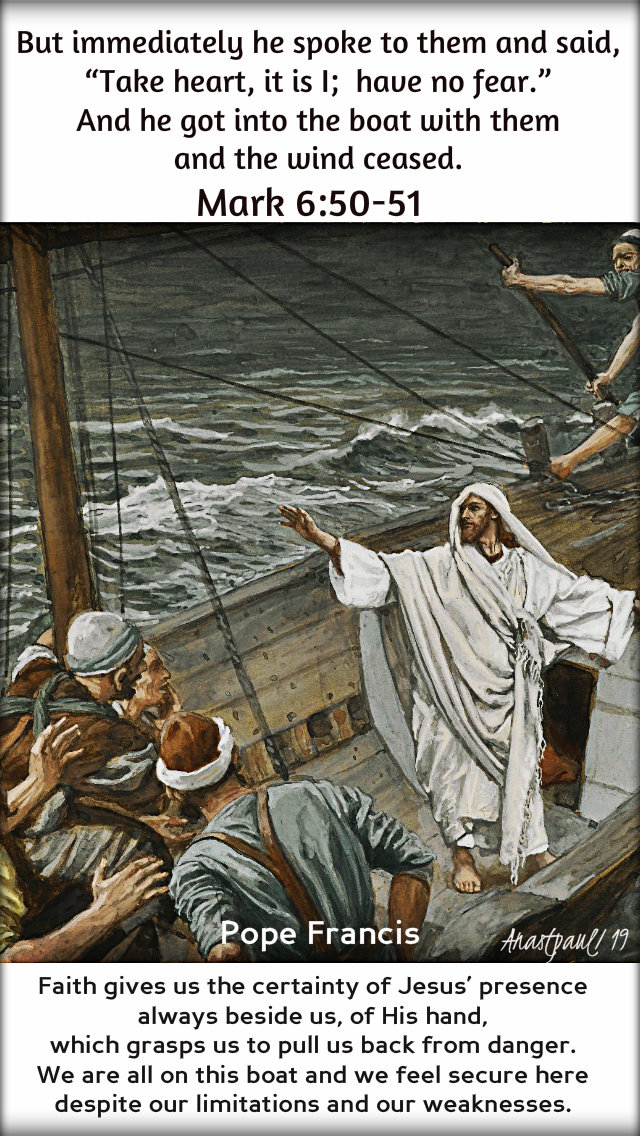
But immediately he spoke to them and said, “Take heart, it is I;  have no fear.”  And he got into the boat with them and the wind ceased. ...Mark 6:50-51

REFLECTION – “This is an effective image of the Church – a boat which must brave the storms and sometimes seems on the point of capsizing.   What saves her is not the skill and courage of her crew members but faith which allows her to walk, even in the dark, amid hardships.   Faith gives us the certainty of Jesus’ presence always beside us, of His hand which grasps us to pull us back from danger.   We are all on this boat and we feel secure here despite our limitations and our weaknesses.   We are safe especially when we are ready to kneel and worship Jesus, the only Lord of our life.”...Pope Francis – Angelus, 10 August 2014mark 6 50-51 - take heart it is I - faith gives us the certainty - pope francis 9 jan 2019.jpg

PRAYER – O Lord, You who came to save us, teach us all to live and breathe our love for You and Your teachings.   Help us all to realise and give thanks for Your love for us and always to feel and grasp Your presence.   Your life of pain and sorrow, lived to save us, is our only guide.   Through Mary, Your holy and loving Mother and our Mother, grant us courage and gratitude, amen.holy-mary-mother-of-god-pray-for-us-9-jan-2018

Posted in CHRISTMASTIDE!, Our MORNING Offering

Our Morning Offering – 9 January – 3rd day after Epiphany

Our Morning Offering – 9 January – 3rd day after Epiphany

I Wish to Clasp Your Hand – Do Not Refuse Me!
Prayer of Eugene de Ferronays (1827 – 1894)

Dear Lord! It is just when I am in the world
that I have most need of You
because You know it is full of snares
that the devil has set for me.
You must hold my hand, dear Lord,
if You will not abandon me.
A little of the world is not bad for me;
it is even good, for it teaches me how small it is
and I feel the greater happiness
when I come back to You.
But, that I may surely do so,
You must only loose Your hold a little,
that it may not try me too far,
You must not entirely leave hold.
Do You see dear Lord?

I wish to clasp Your hand – do not refuse me!i wish to clasp your hand dear lord, do not refuse me eugene de ferronays 9 jan 2019

Posted in SAINT of the DAY

Feast of the The Black Nazarene and Memorials of the Saints -9 January

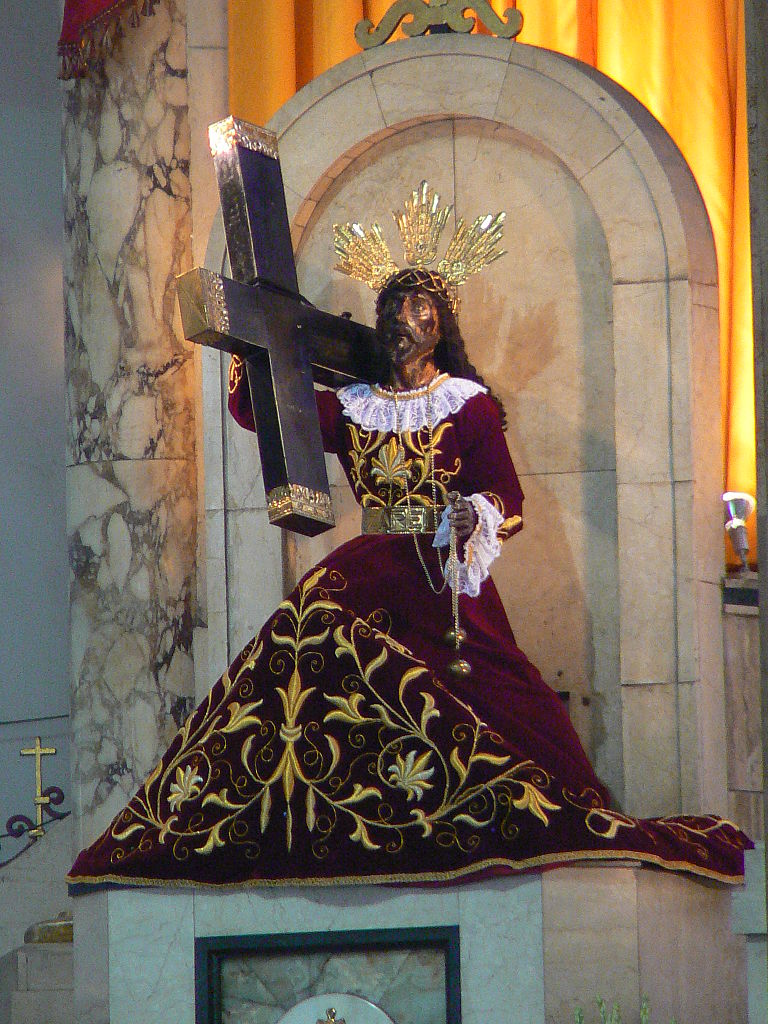
The Black Nazarene:   The Black Nazarene is a blackened, life-sized wooden icon of Jesus Christ carrying a cross.   It was constructed in Mexico in the early 17th century by an Aztec carpenter. Spanish Augustinian Recollect friar missionaries to Manila, Philippines originally brought the icon to Manila in 1606.   The transport ship caught fire, burning the icon but the locals kept the charred statue. Miracles, especially healings, have been reported in its presence.  The church in which it stood burned down around it in 1791 and 1929, was destroyed by earthquakes in 1645 and 1863 and was damaged during bombing in 1945.   It used to be carried through the streets every January and Christians would rub cloths on it to make healing relics but centuries of this treatment have left the statue in bad shape and since 1998 a replica is paraded at the feast day celebrations.   In 1650, Pope Innocent X issued a papal bull which canonically established the Cofradia de Jesús Nazareno to encourage devotion.   In the 19th century Pope Pius VII granted indulgences to those who piously pray before the image. Patronage: Quiapo, Philippines.768px-black_nazarene

St Adrian of Canterbury (c 635-710)
About: https://anastpaul.wordpress.com/2018/01/09/saint-of-the-day-9-january-st-adrian-of-canterbury-c-635-710/

Bl Alix le Clerc
St Agatha Yi
Bl Antony Fatati
St Brithwald of Canterbury
St Eustratius of Olympus
Bl Franciscus Yi Bo-Hyeon
St Honorius of Buzancais
Bl Józef Pawlowski
Sts Julian and Basilissa (died c 304) Martyrs
Bl Kazimierz Grelewski
St Marcellinus of Ancona
St Marciana
Bl Martinus In Eon-min
St Maurontius
St Nearchus
St Paschasia of Dijon
St Peter of Sebaste
St Philip Berruyer
St Polyeucte
St Teresa Kim
St Waningus of Fécamp

Martyrs of Africa – 21 saints: A group of 21 Christians murdered together for their faith in the persecutions of Decius. The only details to survive are 14 of their names – Artaxes, Epictetus, Felicitas, Felix, Fortunatus, Jucundus, Pictus, Quietus, Quinctus, Rusticus, Secundus, Sillus, Vincent and Vitalis. They were martyred in c 250.
Martyrs of Antioch – 6 saints: A group of Christians martyred together during the persecutions of Diocletian – Anastasius, Anthony, Basilissa, Celsus, Julian and Marcionilla

Posted in CHRISTMASTIDE!, PAPAL SERMONS, The NATIVITY of JESUS

If we want to live Christmas, we must open our heart and be open to surprises, namely, to an unexpected change of life’

Thought for the Day – 8 January – 2nd Day after Epiphany – It is still Christmastide!

‘If we want to live Christmas, we must open our heart
and be open to surprises, namely, to an unexpected change of life’

Pope Francis’ Homily – 19 December 2018 – General Audience

Dear Brothers and Sisters, good morning!

In six days, it will be Christmas.   The trees, the decorations and the lights everywhere recall that this year also there will be a celebration.   Advertising invites to keep exchanging newer and newer gifts to have surprises.   However, is this the celebration that pleases God?   What Christmas would He want, what presents and surprises?

We look at the first Christmas of history to discover God’s tastes.   That Christmas was full of surprises.   It begins with Mary, who was Joseph’s promised bride – the Angel arrives and changes her life.   From being a virgin, she will be a mother.   It continues with Joseph, called to be the father of a son without generating Him.   A son that — in a dramatic turn of events — arrives in the least indicated moment, namely, when Mary and Joseph were betrothed and, according to the Law, could not live together.   In face of the scandal, the good sense of the time invited Joseph to repudiate Mary and save his good name but he, although he had the right, surprises us – not to hurt Mary he thinks of taking leave of her in secret, at the cost of losing his own reputation.   Then, another surprise – in a dream, God changes his plans and asks him to take Mary to himself.   Jesus having been born, when Joseph had his plans for the family, again in a dream he is told to rise and go to Egypt.   To summarise, Christmas brought unexpected life changes.  And if we want to live Christmas, we must open our heart and be open to surprises, namely, to an unexpected change of life.

However, it’s on Christmas Eve that the greatest surprise arrives – the Most High is a little baby.   The divine Word is an infant, which means literally, “incapable of speaking.”   And the divine Word becomes “incapable of speaking.”  The Authorities of the time or of the place or the ambassadors were not there to receive the Saviour – no, it was simple shepherds, who, surprised by the Angels while they were working at night, run without delay.   Who would have expected it?   Christmas is to celebrate the unheard-of God, or better, it is to celebrate an unprecedented God, who overturns our logics and our expectations.

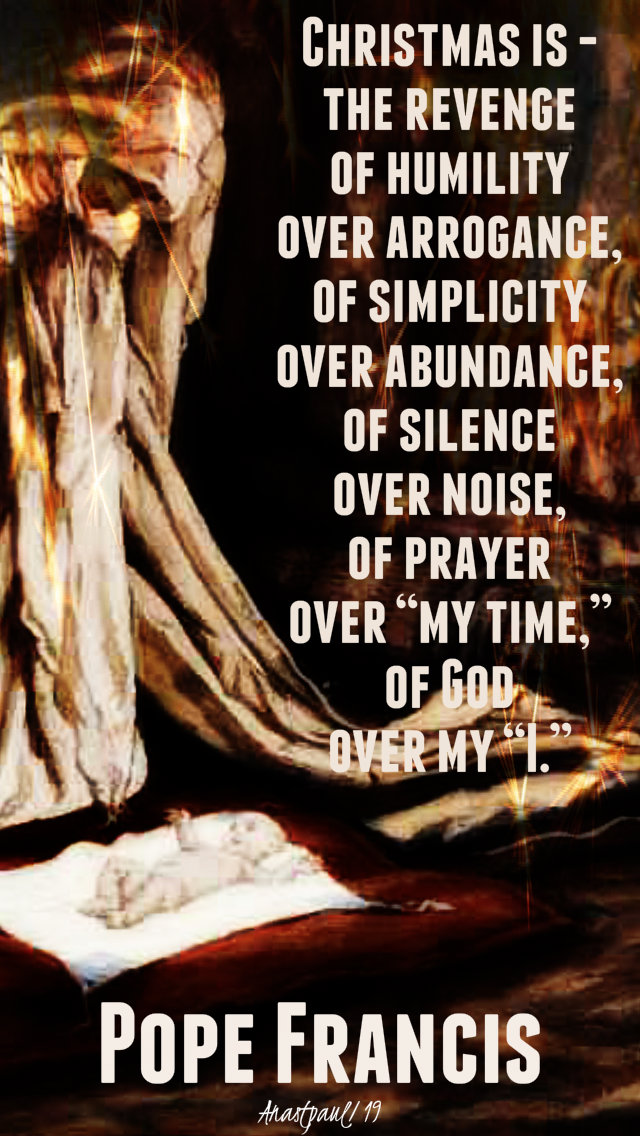
To celebrate Christmas, then, is to receive on earth Heaven’s surprises.   One can’t live “down to earth,” when Heaven has brought its novelties into the world.   Christmas inaugurates a new era, where life isn’t planned but is given;  where one no longer lives for oneself, on the basis of one’s tastes, but for God;  and with God because since the first Christmas, God is God-with-us, who lives with us, who walks with us.   To live Christmas is to let oneself be shaken by its surprising novelty.   Jesus’ Birth doesn’t offer the reassuring warmth of a fireplace but the divine thrill, that shakes history.  Christmas is the revenge of humility over arrogance, of simplicity over abundance, of silence over noise, of prayer over “my time,” of God over my “I.”christmas is - pope francis no 2 - 8 jan 2019

To celebrate Christmas is to do as Jesus did, who came for us needy people and to come down to those in need of us.   It is to do as Mary did, to entrust ourselves, docile to God, even without understanding what He will do.   To celebrate Christmas is to do as Joseph did, to rise to do what God wants, even if it’s not according to our plans.   Saint Joseph is surprising – he never speaks in the Gospel, there isn’t one word of Joseph in the Gospel and the Lord speaks to him in silence, He speaks to him in fact in his sleep. Christmas is to prefer God’s silent voice to the noises of consumerism.   If we are able to be silent before the Crib, Christmas will be a surprise for us also, not something already seen.   To be in silence before the Crib – this is the invitation for Christmas.  Take a bit of time, go before the Crib and stay in silence.   And you will feel, you will see the surprise.

Unfortunately, however, the celebration can be mistaken and we can prefer the usual things on earth, to the novelties of Heaven.   If Christmas remains only a beautiful traditional feast, where we and not Him, are at the centre, it will be a lost occasion.   Please, let us not make Christmas worldly!   Let us not put the One celebrated aside as ‘happened’ then, when “He came among His own and His own received Him not” (John 1:11).   Since the first Gospel of Advent, the Lord has put us on guard, asking us not to be weighed down with “dissipation” and “the cares of life” (Luke 21:34).   In these days one runs, perhaps more than ever during the year.   So, the opposite is done of what Jesus wants.   We blame the many things that fill our day, the world that goes fast.   Yet Jesus didn’t blame the world.   He asked us not to let ourselves be dragged, to watch at all times praying (Cf. v. 36).

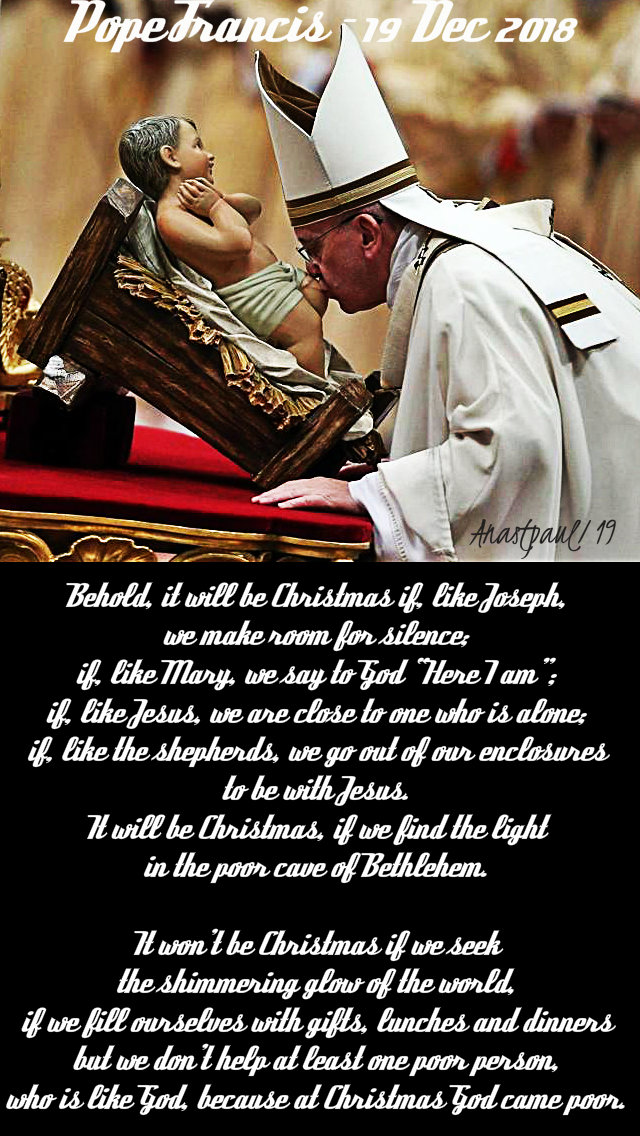
Behold, it will be Christmas if, like Joseph, we make room for silence;  if, like Mary, we say to God “Here I am”;  if, like Jesus, we are close to one who is alone;  if, like the shepherds, we go out of our enclosures to be with Jesus.   It will be Christmas, if we find the light in the poor cave of Bethlehem.   It won’t be Christmas if we seek the shimmering glow of the world, if we fill ourselves with gifts, lunches and dinners but we don’t help at least one poor person, who is like God, because at Christmas God came poor.

Dear brothers and sisters, I wish you a happy Christmas, a Christmas rich in Jesus’ surprises!   They might seem uncomfortable surprises but they are God’s tastes.   If we embrace them, we will have a splendid surprise for ourselves.   Each one of us has hidden in the heart, the capacity to be surprised.   Let us let Jesus surprise us this Christmas.

It’s Christmas every day!  behold it will be christmas - pope francis given 19 dec 2018 gen aud - 8 jan 2019

Posted in CHRISTMASTIDE!, MORNING Prayers, The WORD

Quote/s of the Day – 8 January – 2nd Day after Epiphany

Quote/s of the Day – 8 January – 2nd Day after Epiphany

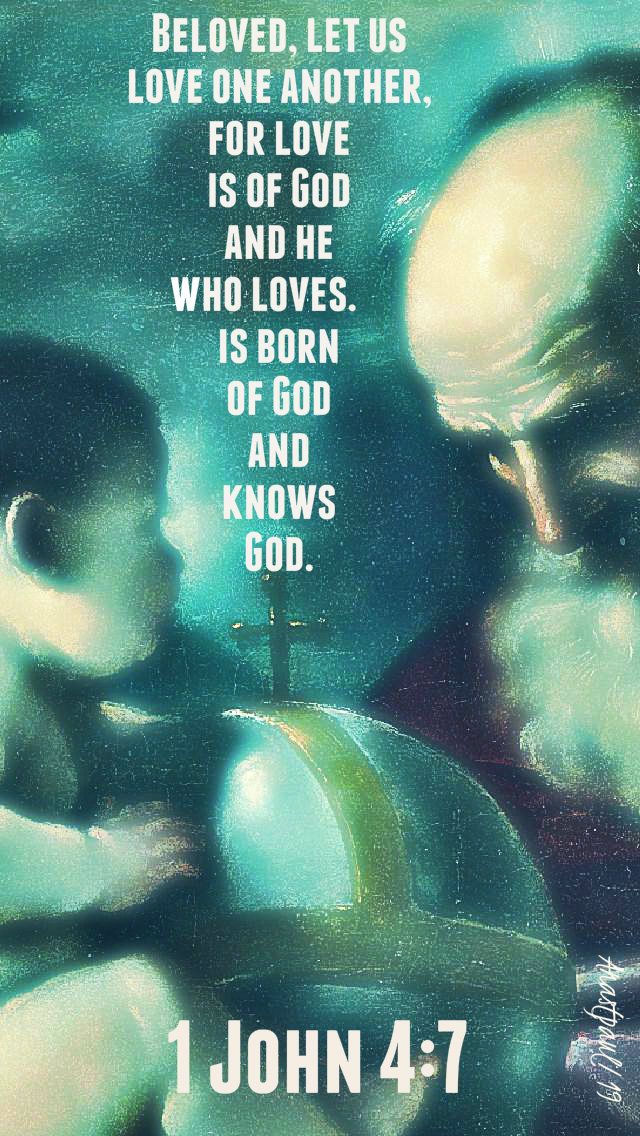
7 Beloved, let us love one another;
for love is of God and he who loves.
is born of God and knows God.1 john 4 7 - beloved let us love one another 8 jan 2019

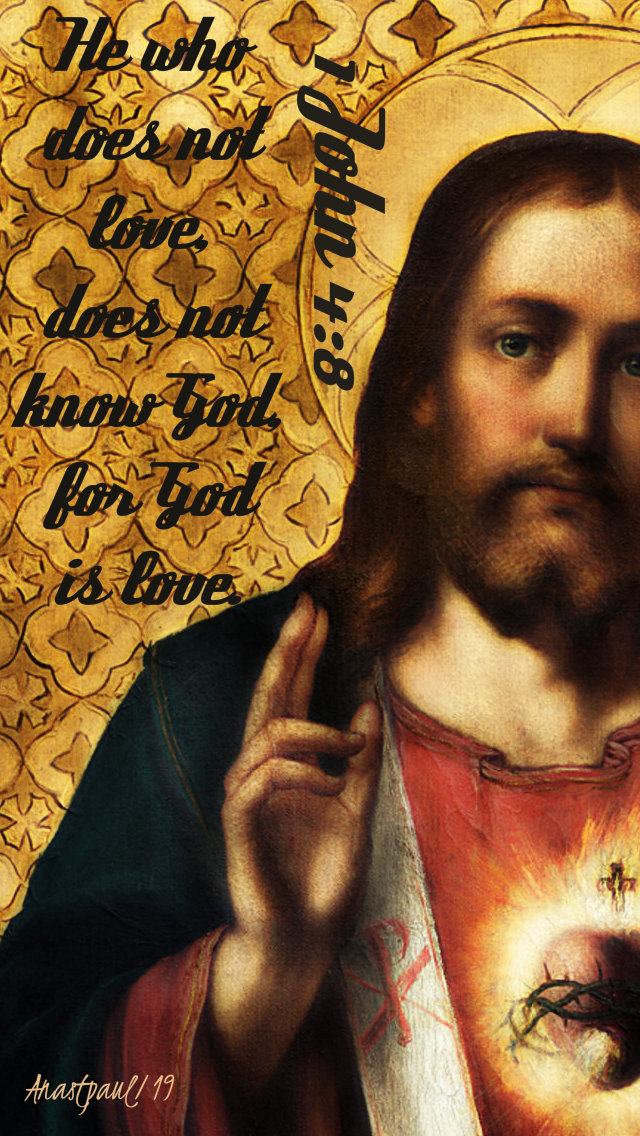
8 He who does not love,
does not know God,
for God is love.1 john 4 8 he who does not love - 8 jan 2018

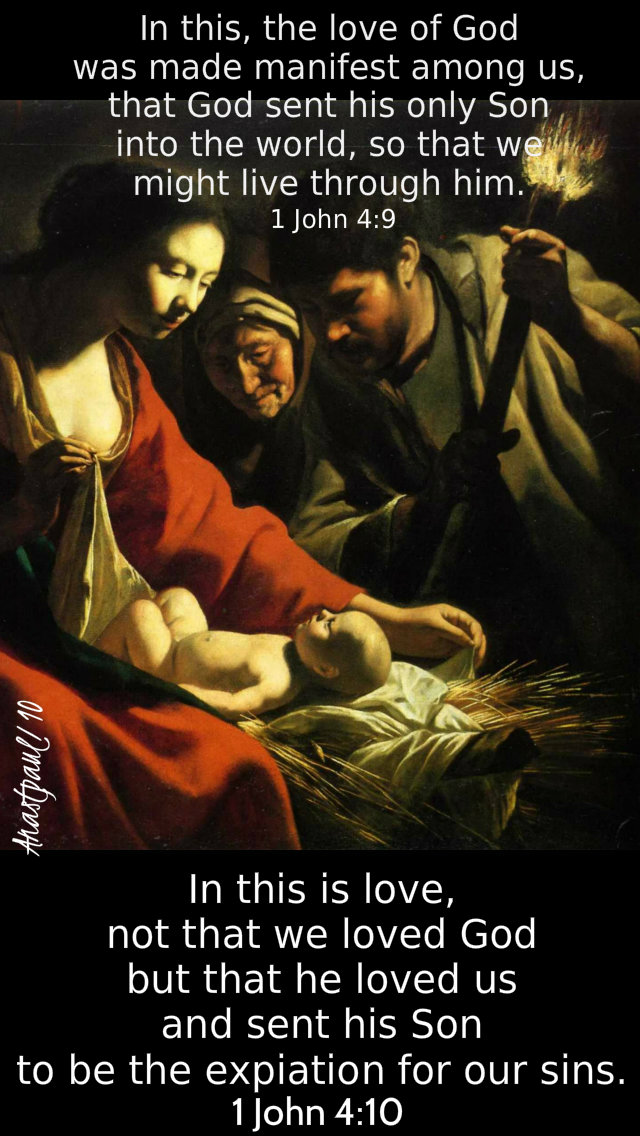
9 In this, the love of God
was made manifest among us,
that God sent his only Son
into the world, so that we
might live through him.

10 In this is love, not that we loved God
but that he loved us and sent his Son
to be the expiation for our sins.

Today’s First Reading : 1 John 4:7-101 john 4 9-10 in this the love of god was manifest - 8 jan 2019

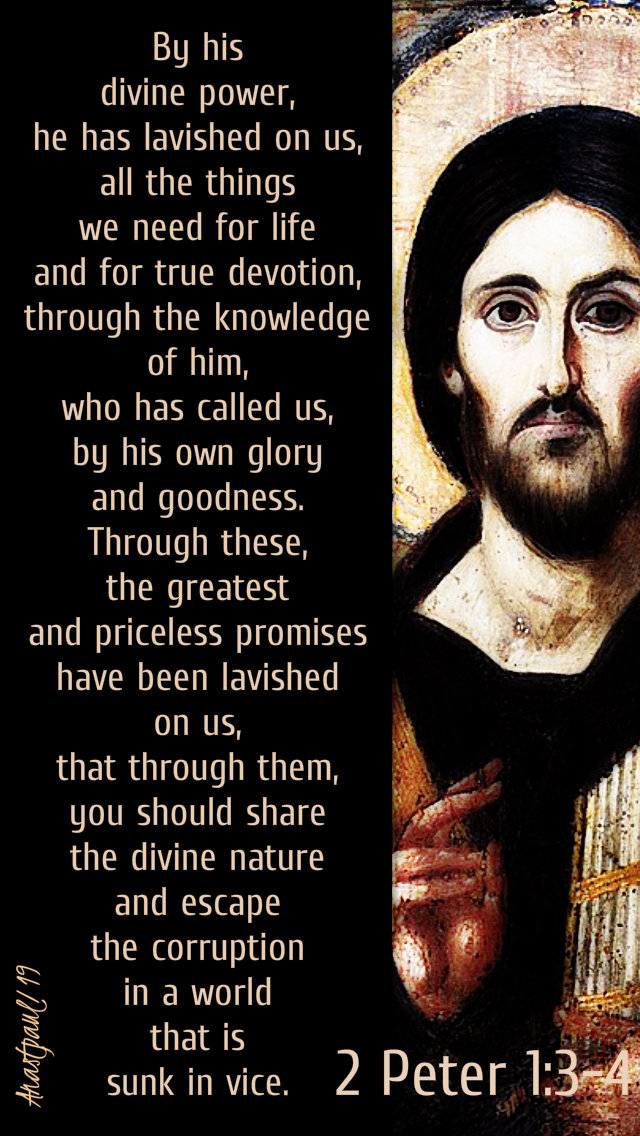
By his divine power, he has lavished on us,
all the things we need for life
and for true devotion,
through the knowledge of him,
who has called us,
by his own glory and goodness.
Through these, the greatest and priceless promises
have been lavished on us, that through them,
you should share the divine nature
and escape the corruption in a world
that is sunk in vice.

2 Peter 1:3-42 peter 1 3-4 by his divine power he has lavished on us - 8 jan 2019

Posted in CHRISTMASTIDE!, MORNING Prayers, SAINT of the DAY, The WORD

One Minute Reflection – 8 January – 2nd Day after Epiphany – Gospel: Mark 6:34-44

One Minute Reflection – 8 January – 2nd Day after Epiphany – Gospel: Mark 6:34-44

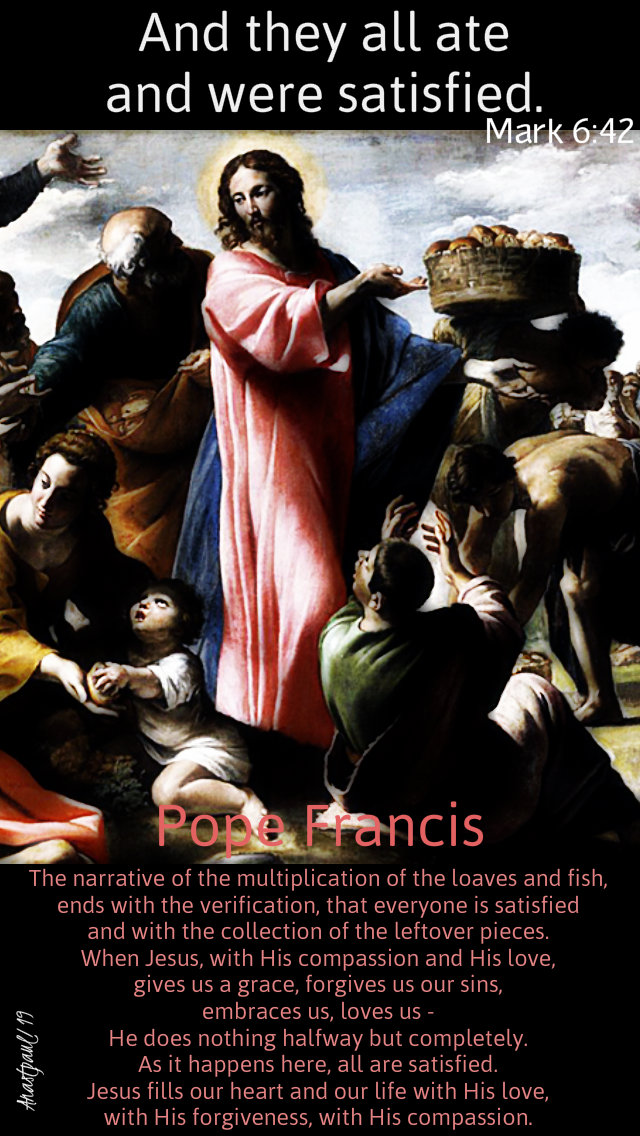
And they all ate and were satisfied. And they took up twelve baskets full of broken pieces and of the fish. And those who ate the loaves were five thousand men.…Mark 6:42-44

REFLECTION – “The narrative of the multiplication of the loaves and fish, ends with the verification, that everyone is satisfied and with the collection of the leftover pieces.  When Jesus, with His compassion and His love, gives us a grace, forgives us our sins, embraces us, loves us – He does nothing halfway but completely.   As it happens here, all are satisfied.   Jesus fills our heart and our life with His love, with His forgiveness, with His compassion.”…Pope Francis – General Audience, 17 August 2016mark 6 42 and they all ate and were satisfied - pope francis - the narrative of the loaves 8 jan 2019.jpg

PRAYER – God our father, when Your only-begotten Son, revealed Himself in flesh and blood, we came to know Him as our fellow-man.   As He transformed 5 loaves and 2 fish, may He transform us inwardly, until we bear His likeness.   Blessed Eurosia, you were filled with the love of God and your neighbour and by His grace, transformed all those who came within your care, please intercede on our behalf.   We ask this through Christ, our Lord, in the unity of the Holy Spirit, one God forever, amen.bl eurosia fabris pray for us 8 jan 2019

Posted in JESUIT SJ, Our MORNING Offering, PRAYERS to the SAINTS

Our Morning Offering – 8 January – 2nd Day after Epiphany

Our Morning Offering – 8 January – 2nd Day after Epiphany

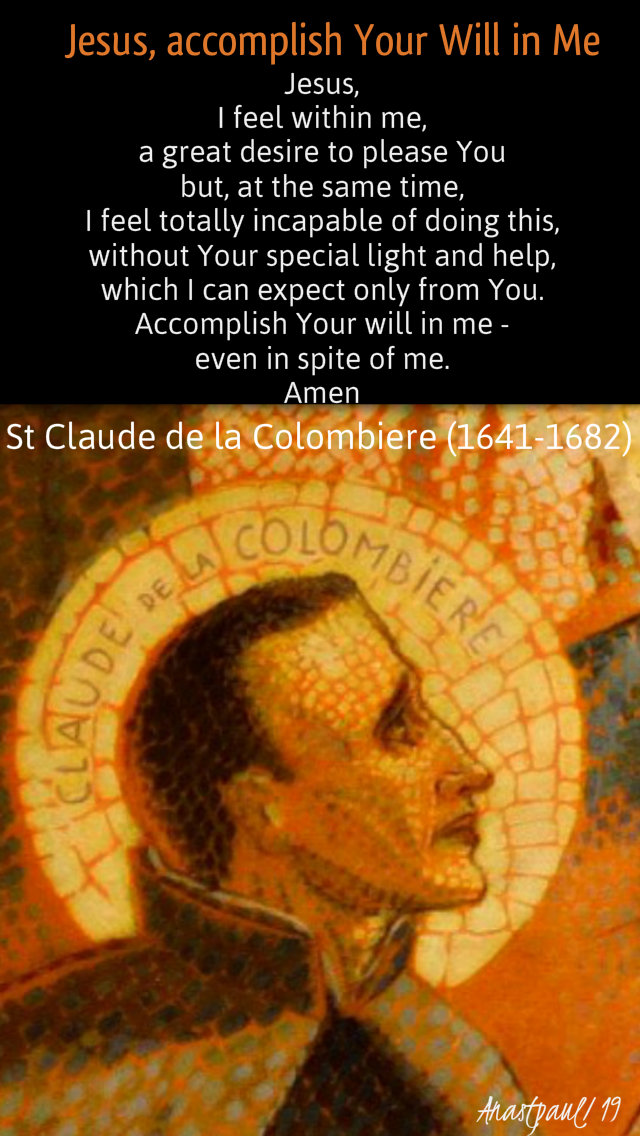
Jesus, accomplish Your Will in Me
by St Claude de la Colombiere (1641-1682)

Jesus,
I feel within me,
a great desire to please You
but, at the same time,
I feel totally incapable of doing this,
without Your special light and help,
which I can expect only from You.
Accomplish Your will in me –
even in spite of me.
Amenjesus accomplish your will in me - st claude de la colombiere 8 jan 2019

Posted in franciscan OFM, SAINT of the DAY, VATICAN Resources

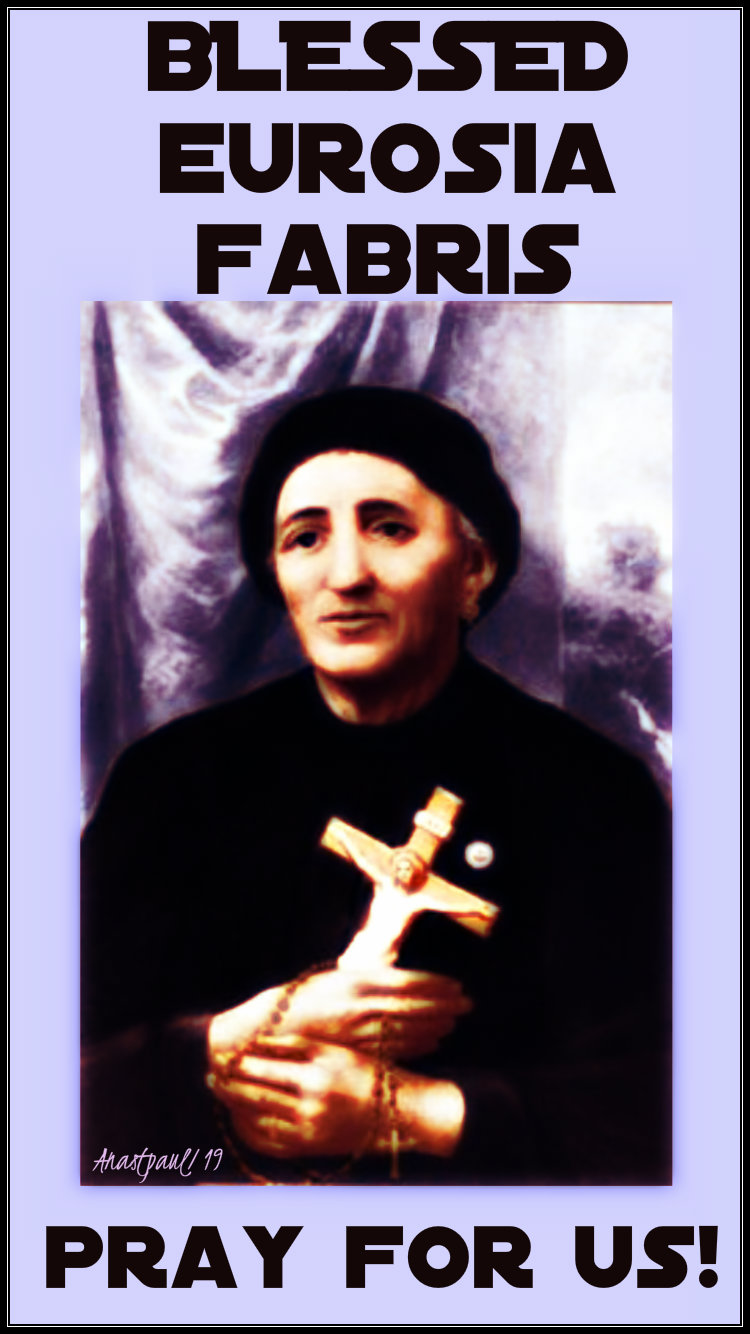
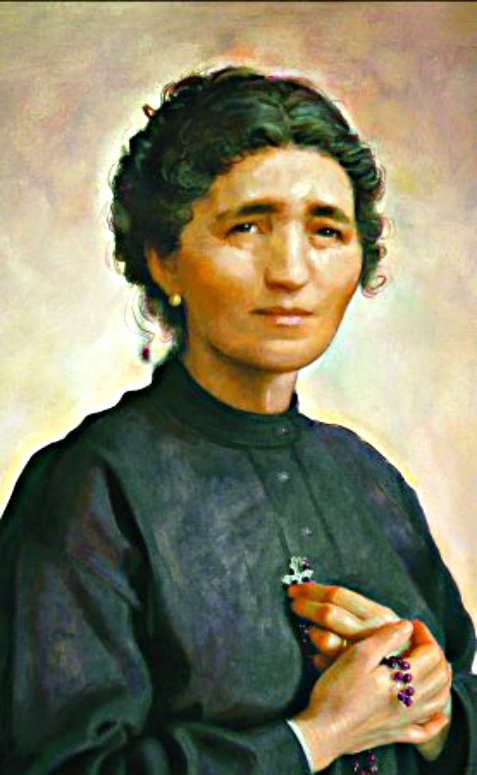
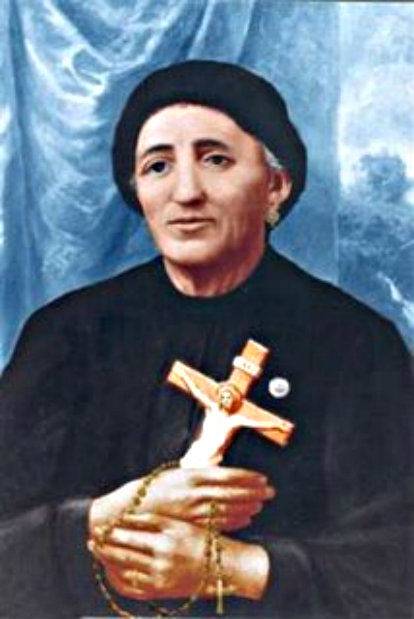
Saint of the Day – 8 January – Blessed Eurosia Fabris (1866-1932) “Mamma Rosa”

Saint of the Day – 8 January – Blessed Eurosia Fabris (1866-1932) “Mamma Rosa”Laywoman, Wife and Mother, Secular Franciscan, Apostle of Charity, Marian devotee, Apostle of Prayer and of the Holy Eucharist – born on 27 September 1866 in Quinto Vicentino, Italy and died on 8 January 1932 at Marola di Torri, Vicenza, Italy of natural causes.bl eurosia fabris 1855-1932.jpg

Eurosia Fabris was born in Quinto Vicentino, an agricultural area, some kilometers from Vicenza in Italy, on 27 of September 1866.   Her parents, Luigi and Maria Fabris, were farmers.   In 1870, at the age of four, Eurosia moved with her family to Marola, a village in the municipality of Torri di Quartesolo (Vicenza).   She lived there for the rest of her life.   She attended only the first two years of elementary school between 1872 and 1874 because even at such a young age, she was forced to help her parents with farm work and her mother in particular with the household chores.   It was enough, however, for her to learn to read and write with the help of the Holy Scriptures or religious books such as the Catechism, Church history, the Philothea and the Eternal Maxims of St Alfonso Liguori.

Besides her domestic tasks, she helped her mother in her work as a dressmaker, a practice which Eurosia would also take on later.   Even as a child, she was rich in virtue and spirituality, always very careful in providing for the needs of her family.

She was twelve years old when she made her First Holy Communion.   From then on, she received Holy Eucharist on all religious feasts, since at that time daily communion was not the practice.   It was not until 1905 that daily communion was permitted by a Decree of Pope St Pius X.

Eurosia joined the Association of the Daughters of Mary in the parish church of Marola, and was faithful in participating in their devotions.   She diligently observed the practices of the group which helped increase in her a love for Mary.   In Marola, she lived within sight of the shrine of the Madonna of Monte Berico.

Her favourite devotions were to the Holy Spirit, the infant Jesus, the Cross of Christ, the Eucharist, the Virgin Mary and the souls in the Purgatory.   She was an apostle of good will in her family, among her friends and in her parish, where she taught catechism to the children and sewing to the girls who came to her home.

At the age of eighteen, Eurosia was a dedicated, pious and hardworking young lady. These virtues, along with her pleasant personality, did not go unobserved and several young men proposed marriage to her, though she did not feel called to accept.

In 1885, Rosina, as she was called by her family, was affected by a tragic event.   A young married woman near her home died leaving three very young daughters.   The first of them died shortly after her mother.   The other two girls, Chiara Angela and Italia were only 20 months old and 2 months old, respectively.   The father of these girls was away, living with his uncle and a grandfather who suffered from a chronic disease.   They were three very different men, always quarrelling among themselves.

For six months, every morning, Rosina would go to care for the children and take care of their home.   Later, following the advice of her relatives and that of the parish priest and after praying about this turn of events, she decided to marry.   Rosina was joined in marriage to a man named Carlo Barban, well aware of the sacrifices that married life would hold for her in the future.   She accepted this fact as the will of God who she now felt was calling her through these two babies to embrace a new mission.   The parish priest would often comment:  “This was a true act of heroic charity towards others.”

The marriage was celebrated on the fifth of May 1886 and, in addition to the two orphaned babies, was blessed with nine other children.   Her home was always opened to other children as well.   Among them were Mansueto Mazzuco, who became a member of the Order of Friars Minor, taking the name, Brother Giorgio.   To all these children, “Mamma Rosa”, as she was called since her marriage, offered affection and care, sacrificing her own needs to provide for them a solid Christian formation.  Between 1918-1921, three of her sons were ordained priests, two for the Diocesan clergy and one as a Franciscan (Fr Bernardino), who would become her first biographer.

Once married, she embraced her marital obligations, always showing the greatest love and respect for her husband and becoming his confidante and adviser.   She had a tender love for all her children.   She was a hard worker and a person who could be counted on to fulfil her duties.

Mamma Rosa lived an intense life of prayer, which was evident by her great devotion to God love’s, to the Holy Eucharist and to the Blessed Virgin Mary.   Like the strong woman in Sacred Scripture, she became a real treasure to her family.   She knew how to balance the family budget and at the same time exercised great charity towards the poor, sharing her daily bread also with them.   She cared for the sick and gave them continuous assistance, showing heroic strength during the final illness of her husband Carlo, who died in 1930.

Mamma Rosa became a member of the Franciscan Third Order, known today as the Secular Franciscans.   She faithfully attended all their meetings but above all tried to live the true Franciscan spirit of poverty and joy in her home, in the midst of her daily work and prayer.   She had a gentle manner with everyone and praised God as the Creator and source of all good and the giver of all hope.

Mama Rosa’s family home was an ideal Christian community where her children were taught to pray, to obey, to respect the will of God and to practice Christian virtues.   In her vocation as a Christian mother, Mamma Rosa sacrificed and consumed herself day by day like a lamp burning brightly on the altar of charity.   She died on 8 January 1932 and was buried, with the hope of final resurrection, in the church of Marola.

The canonical process of beatification and canonisation was initiated on 3 February 2005 at the Diocesan curia of Padova, after getting passed several difficulties and misunderstandings among the different juridical persons trying to promote the Cause.

Mamma Rosa was a model of holiness in what should be the daily life of a Catholic family.   Her three sons who became priests were encouraged in their vocation by her example of holiness.   She was proclaimed Venerable on the 7th of July, 2003, by St Pope John Paul II who recognised the testimony of her heroic and singular virtues.   It was the wish of Venerable Pope Pius XII that the life of this marvellous woman be known among all Christian families of our day…Vatican.va

Blessed Eurosia was Beatified on 6 November 2005 by Pope Benedict XVI
the recognition was celebrated by Cardinal Saraiva Martins at Vincenza, Italy.
blessed-eurosia-fabris-barban-jan-8

Posted in SAINT of the DAY

Feast of Our Lady of Prompt Succour and Memorials of the Saints – 8 January

8 January – Our Lady of Prompt Succour –

In 1727, French Ursuline nuns founded a monastery in New Orleans, Louisiana, and organised their area schools from it.   In 1763 Louisiana became a Spanish possession and Spanish sisters came to assist. In 1800 the territory reverted back to France and the Spanish sisters fled in the face of French anti – Catholicsm.   In 1803, short on teachers, Mother Saint Andre Madier requested reinforcements in the form of more sisters from France  . The relative to whom she wrote, Mother Saint Michel, was running a Catholic boarding school for girls. Bishop Fournier, short-handed due to the repressions of the French Revolution, declined to send any sisters.   Mother Saint Michel was given permission to appeal to the pope.   The pope was a prisoner of Napoleon and it seemed unlikely he would even receive her letter of petition.   Mother Saint Michel prayed,

O most Holy Virgin Mary, if you obtain for me a prompt and favorable answer to this letter, I promise to have you honoured at New Orleans under the title of Our Lady of Prompt Succour.

and sent her letter on 19 March 1809.   Against all odds, she received a response on 29 April 1809.   The pope granted her request and Mother Saint Michel, commissioned a statue of Our Lady of Prompt Succour holding the Infant Jesus. Bishop Fournier blessed the statue and Mother’s work.

Mother Saint Michel and several postulants came to New Orleans on 31 December 1810.   They brought the statue with them and placed it in the monastery chapel.   Since then, Our Lady of Prompt Succour has interceded for those who have sought her help.

A great fire threatened the Ursuline monastery in 1812.   A lay sister brought the statue to the window and Mother Saint Michel prayed

Our Lady of Prompt Succour, we are lost if you do not come to our aid.

The wind changed direction, turned the fire away, and saved the monastery.

Our Lady interceded again at the Battle of New Orleans in 1815.   Many faithful, including wives and daughters of American soldiers, gathered in the Ursuline chapel before the statue of Our Lady of Prompt Succour and spent the night before the battle in prayer.  They asked Our Lady for victory by Andrew Jackson’s forces over the British, which would save the city from being sacked. Jackson and 200 men from around the South won a remarkable victory over a superior British force in a battle that lasted twenty-five minutes, and saw few American casualties.

It is still customary for the devout of New Orleans to pray before the statue of Our Lady of Prompt Succour whenever a hurricane threatens New Orleans.

our_lady_of_prompt_succor_patroness_of_louisiana

St Abo of Tblisi
St Albert of Cashel
St Apollinaris the Apologist
St Athelm of Canterbury
St Atticus of Constantinople
St Carterius of Caesarea
Bl Edward Waterson
St Ergnad of Ulster
St Erhard of Regensburg
St Eugenian of Autun
Bl Eurosia Fabris (1866-1932)
St Garibaldus of Regensburg
St Gudule of Brussels
St Helladius
St Julian of Beauvais
St Lawrence Giustiniani
St Lucian of Beauvais
St Maximian of Beauvais
St Maximus of Pavia
Bl Nathalan of Aberdeen
St Patiens of Metz
St Pega of Peakirk
St Severinus of Noricum
St Theophilus the Martyr
St Thorfinn
St Wulsin of Sherborne

Martyrs of Greece – 9 saints: A group of Christians honored in Greece as martyrs, but we have no details about their lives or deaths – Euctus, Felix, Januarius, Lucius, Palladius, Piscus, Rusticus, Secundus and Timotheus

Martyrs of Terni – 4 saints: A group of Christian soldiers in the imperial Roman army. Executed during the persecutions of emperor Claudius. Martyrs. – Carbonanus, Claudius, Planus and Tibudianus.   They were martyred in 270 in Terni, Italy.

Posted in DOMINICAN OP, PRAYERS of the SAINTS, QUOTES of the SAINTS, QUOTES on CONVERSION, QUOTES on FAITH, QUOTES on PATIENCE, QUOTES on PEACE, QUOTES on PERSECUTION, QUOTES on PERSEVERANCE, QUOTES on SANCTITY, SAINT of the DAY

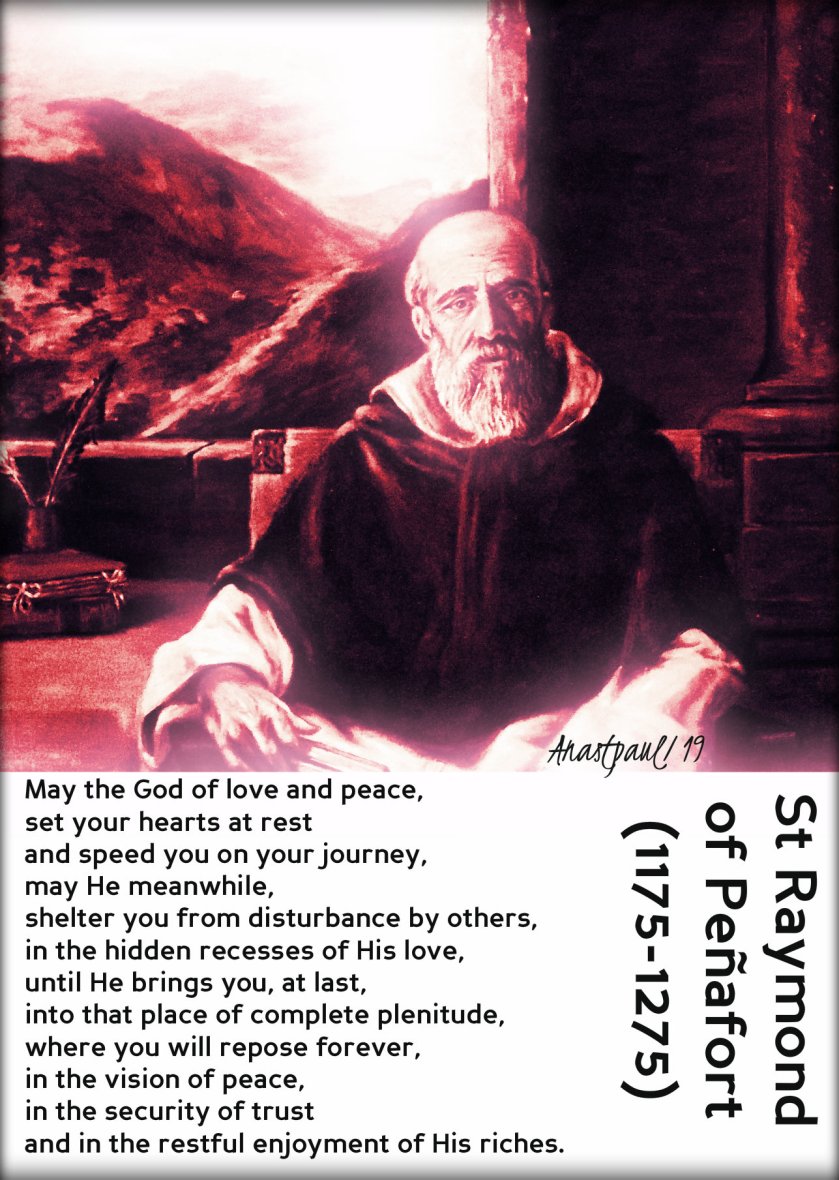
Thought for the Day – 7 January – The Memorial of St Raymond of Peñafort (1175-1275) “Father of Canon Law”

Thought for the Day – 7 January – The Memorial of St Raymond of Peñafort (1175-1275) “Father of Canon Law”

As a lawyer, priest and preacher, St Raymond of Penyafort made a significant mark on the history of Spain and the church.   His preaching helped re-Christianise Spain after the Moors were overthrown.   And his compilation of papal and conciliar decrees was the main source of canon law for seven centuries.

An accomplished lawyer and scholar, Raymond joined the Dominicans at Barcelona in 1222.   The 47-year-old novice was assigned to develop a book of case studies for confessors that helped to shape the medieval church’s penitential system.   Also a gifted preacher, Raymond had remarkable success evangelising Moors and Jews.   And he travelled throughout Spain, rejuvenating the spiritual life of Christians, that the Moors had enslaved.   Among his main themes were spiritual combat and standing firm in trials.

He wrote:

“Your purity of life, your devotion, deserve and call for a reward, because you are acceptable and pleasing to God, your purity of life must be made purer still, by frequent buffetings, until you attain perfect sincerity of heart.   If from time to time you feel the sword falling on you with double or treble force, this also should be seen as sheer joy and the mark of love.”

And then, he encouraged and prayed for us all:

“May the God of love and peace,
set your hearts at rest
and speed you on your journey,
may He meanwhile,
shelter you from disturbance by others,
in the hidden recesses of His love,
until He brings you, at last,
into that place of complete plenitude,
where you will repose forever,
in the vision of peace,
in the security of trust
and in the restful enjoyment of His riches.”may the god of love and peace - st raymond of penafort - 7 jan 2019.jpg

St Raymond of Peñafort, Pray for Us!st raymond of penafort pray for us no 2. 7 jan 2019.jpg

Posted in DOCTORS of the Church, FATHERS of the Church, MORNING Prayers, PRACTISING CATHOLIC, QUOTES of the SAINTS, SAINT of the DAY, The INCARNATION, The NATIVITY of JESUS, The WORD

One Minute Reflection – 7 January – Monday after Epiphany – Gospel:  Matthew 4:12-17, 23-25

One Minute Reflection – 7 January – Monday after Epiphany – Gospel:  Matthew 4:12-17, 23-25 and the Memorial of St Raymond of Peñafort (1175-1275) “Father of Canon Law”

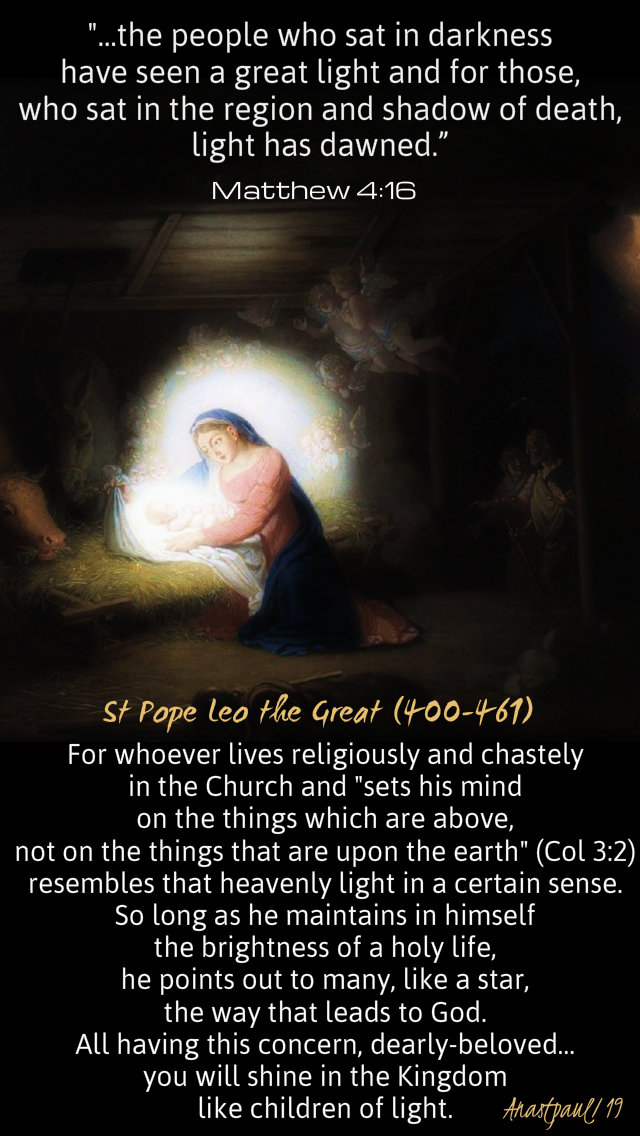
“…the people who sat in darkness have seen a great light and for those, who sat in the region and shadow of death, light has dawned.”…Matthew 4:16

REFLECTION – “All these things we know to have taken place ever since the three wise men, aroused in their far-off land, were led by a star to recognise and worship the King of heaven and earth.   The responsiveness of that star exhorts us to imitate it’s obedience and, as much as we can, to make ourselves servants of that grace which invites us all to Christ.   For, whoever lives religiously and chastely in the Church and “sets his mind on the things which are above, not on the things that are upon the earth” (Col 3:2) resembles that heavenly light in a certain sense.   So long as he maintains in himself the brightness of a holy life, he points out to many, like a star, the way that leads to God.   All having this concern, dearly-beloved… you will shine in the Kingdom like children of light.”…St Pope Leo the Great (400-461) Father & Doctor of the Churchmatthew 4 16 - the people who sat in darkness - for whoever lives - st pope leo 7 jan 2019

PRAYER – Lord, may the radiance of Your glory, light up our hearts and bring us through the shadows of this world, until we reach our homeland of everlasting light.   Grant we pray, that by the intercession of St Raymond of Peñafort , our way may be smoothed and our troubles eased.   We ask this through Jesus, our Lord, with the Holy Spirit, God forever, amen.st raymond of penafort pray for us 7 jan 2019

Posted in Our MORNING Offering, PRAYERS of the SAINTS

Our Morning Offering – 7 January – Christmas Weekday  Monday after Epiphany

Our Morning Offering – 7 January – Christmas Weekday Monday after Epiphany

O my God, all is Good if it comes from You
By Blessed John Henry Newman (1801-1890)

O my God,
I will put myself without reserve,
into Your hands.
Wealth or woe, joy or sorrow,
friends or bereavement,
honour or humiliation,
good report or ill report,
comfort or discomfort,
Your presence
or the hiding of Your countenance,
all is good if it comes from You,
You are wisdom and You are love –
what can I desire more?
You have led me in Your counsel
and with glory You have received me
What have I in heaven
and apart from You,
what want I upon earth?
My flesh and my heart fail
but God is the God of my heart
and my portion forever.
Ameno-my-god-all-is-good-if-it-comes-from-you-bl-john-henry-newman-no-3-25-sept-2018

Posted in DOMINICAN OP, SAINT of the DAY

Memorials of the Saints -7 January

St Raymond of Peñafort OP (1175-1275) (“Father of Canon Law”) (Optional Memorial)

St Aldric of Le Mans
Bl Ambrose Fernandez
St Anastasius of Sens
St Brannock of Braunton
St Candida of Greece
St Canute Lavard
St Cedd
St Clerus of Antioch
St Crispin I of Pavia
St Cronan Beg
St Emilian of Saujon
St Felix of Heraclea
Bl Franciscus Bae Gwan-gyeom
St Januarius of Heraclea
St Julian of Cagliari
St Kentigerna
St Lucian of Antioch
Bl Marie-Thérèse Haze
St Pallada of Greece
St Polyeuctus of Melitene
St Reinhold of Cologne
St Spolicostus of Greece
St Theodore of Egypt
St Tillo of Solignac
St Valentine of Passau
St Virginia of Ste-Verge
Bl Wittikund of Westphalia