Posted in SAINT of the DAY

Memorials of the Saints – 13 January

St Hilary of Poitiers (315-368) Doctor of the Church (Optional Memorial)
Biography:
https://anastpaul.wordpress.com/2018/01/13/saint-of-the-day-13-january-st-hilary-of-poitiers-315-368-father-doctor-of-the-church/

St Agrecius of Trier
St Andrew of Trier
St Berno of Cluny
St Ðaminh Pham Trong Kham
St Designatus of Maastricht
St Elian of Brittany
St Emil Szramek
St Enogatus of Aleth
St Erbin of Cornwall
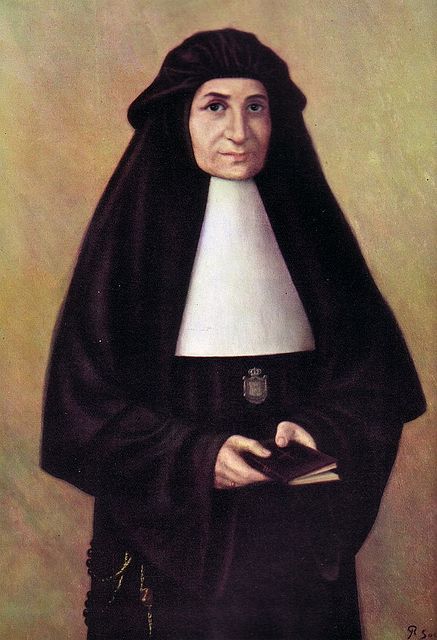
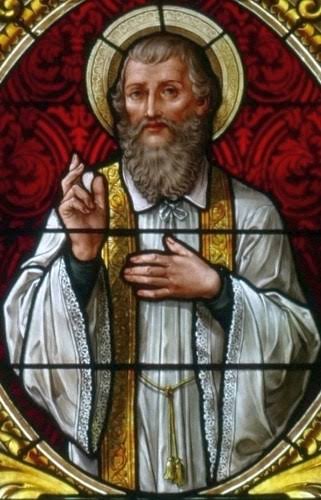
Blessed Francesco Maria Greco (1857-1931)
Blessed Francesco’s Life:
https://anastpaul.com/2019/01/13/saint-of-the-day-13-january-blessed-francesco-maria-greco-1857-1931/
Bl Francisca Inés Valverde González
St Giuse Pham Trong Ta
St Glaphyra
St Gumesindus of Córdoba
St Hermylus
Bl Hildemar of Arrouaise
Bl Ida of Argensolles
Bl Ivetta of Huy
St Kentigern “Mungo” of Glasgow (c 518-614)

St Leontius of Caesarea
St Luca Pham Trong Thìn
Bl María Francisca Espejo y Martos
Bl Matteo de Lana
St Peter of Capitolíade
St Servusdei of Córdoba
St Stephen of Liège
St Stratonicus
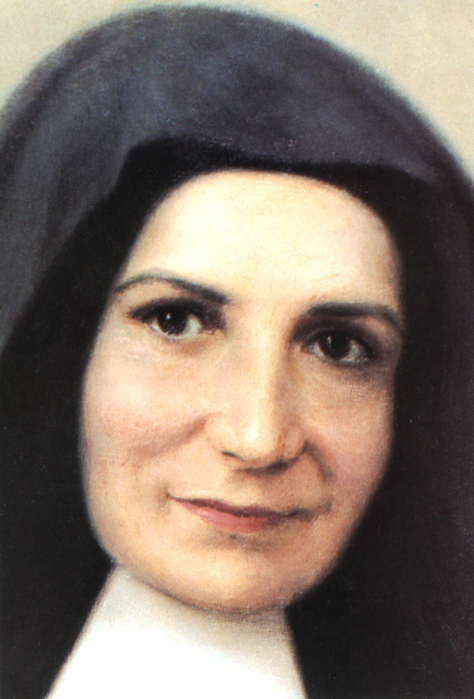
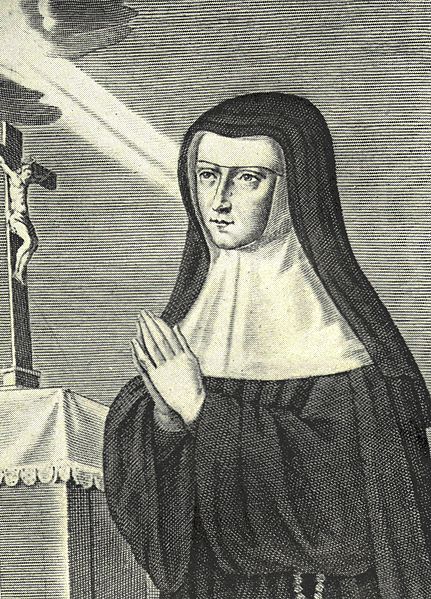
Blessed Veronica of Binasco (1445-1497)
St Viventius
St Vivenzio of Blera

Forty Martyred Soldiers at Rome: Forty soldiers martyred in the persecutions of Gallienus.
They were martyred in 262 on the Via Lavicana, Rome, Italy.

Posted in MEDITATIONS - ANTONIO CARD BACCI, QUOTES - J R R Tolkien and MORE, QUOTES on DEATH

Thought for the Day – 12 January – The Death of the Just

Thought for the Day – 12 January – Meditations with Antonio Cardinal Bacci (1881-1971) – Feast of the Baptism of the Lord

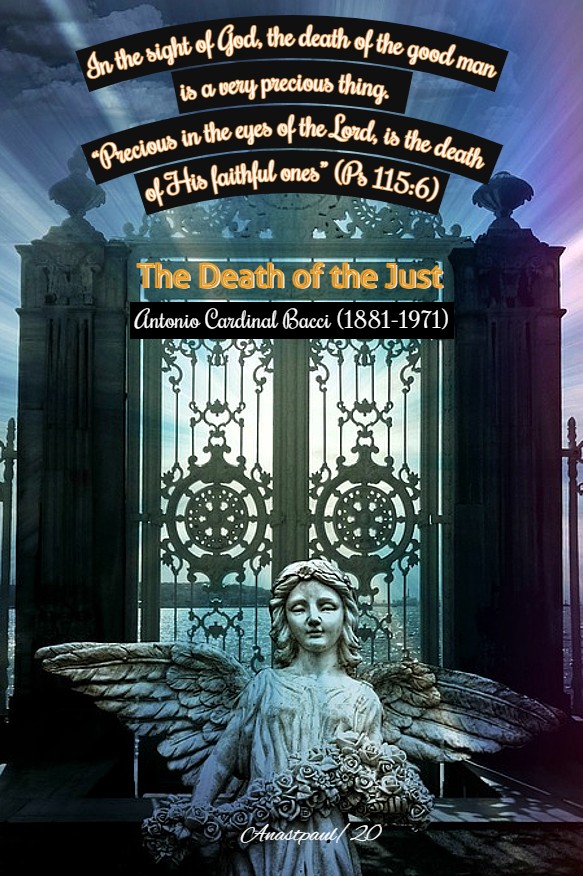
The Death of the Just

“Consider now the death of the just man.
Through his dying tears, he also will see the world slipping away from him.   But, one thing will remain to comfort him, namely, the memory of his good actions, of the virtues he acquired, of his fervent prayers and of his voluntary mortifications.
Above all, there will remain his great love of God, for Whom he has lived, worked and drawn breath.
In that moment, this love will even increase the flaming desire consuming his poor, frail body, to be united to God.
He will be able to say, as some of the Saints have said – “I never thought it would be so sweet to die.”
With St Louis, he will be able to say: “I am going joyfully to meet my God.”
He will be able to exclaim with St Charles: “I long for my body to be dissolved, so that I may be with Christ!” (Phil 1:23)

In the sight of God, the death of the good man is a very precious thing.   “Precious in the eyes of the Lord, is the death of His faithful ones” (Ps 115:6).”

Antonio Cardinal Bacci

Posted in CHRIST, the WAY,TRUTH,LIFE, DOCTORS of the Church, FATHERS of the Church, FEASTS and SOLEMNITIES, PRACTISING CATHOLIC, QUOTES of the SAINTS, The BAPTISM of the LORD

Quote/s of the Day – 12 January – Feast of the Baptism of the Lord

Quote/s of the Day – 12 January – Feast of the Baptism of the Lord

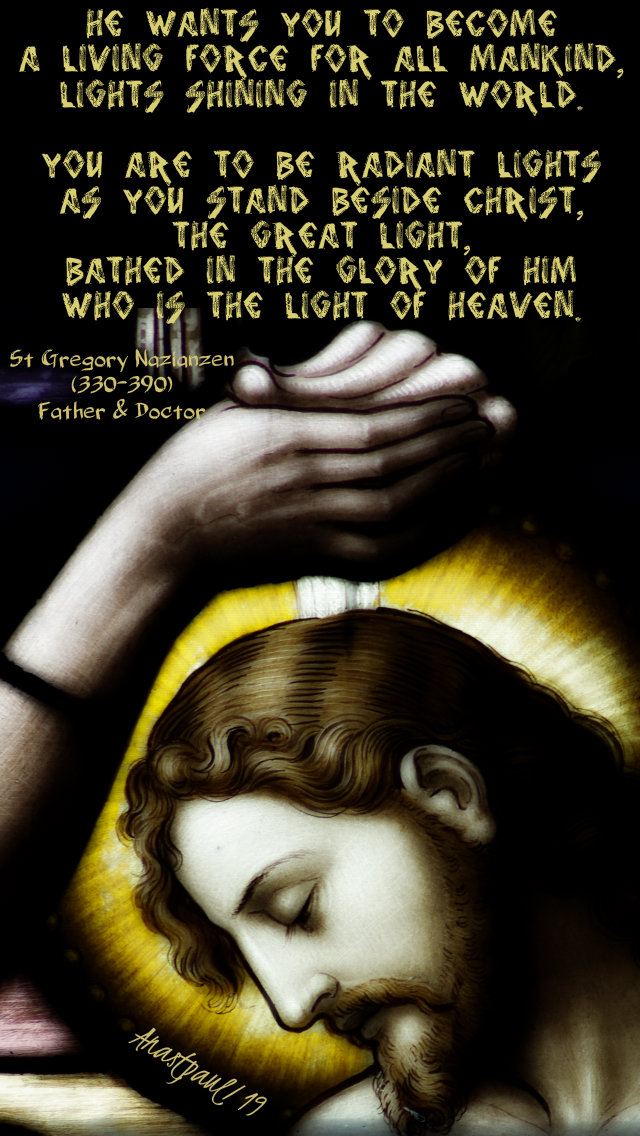
“He wants you to become
a living force for all mankind,
lights shining in the world.

You are to be radiant lights
as you stand beside Christ,
the great light,
bathed in the glory of Him
who is the light of heaven.”

St Gregory Nazianzen (330-390)
Father & Doctor of the Churchhe-wants-you-to-become-a-living-force-st-gregory-of-nazianzen-13-jan-2019 and 12 jan 2020.jpg

(An excerpt from Oration 39 – On Holy Light)

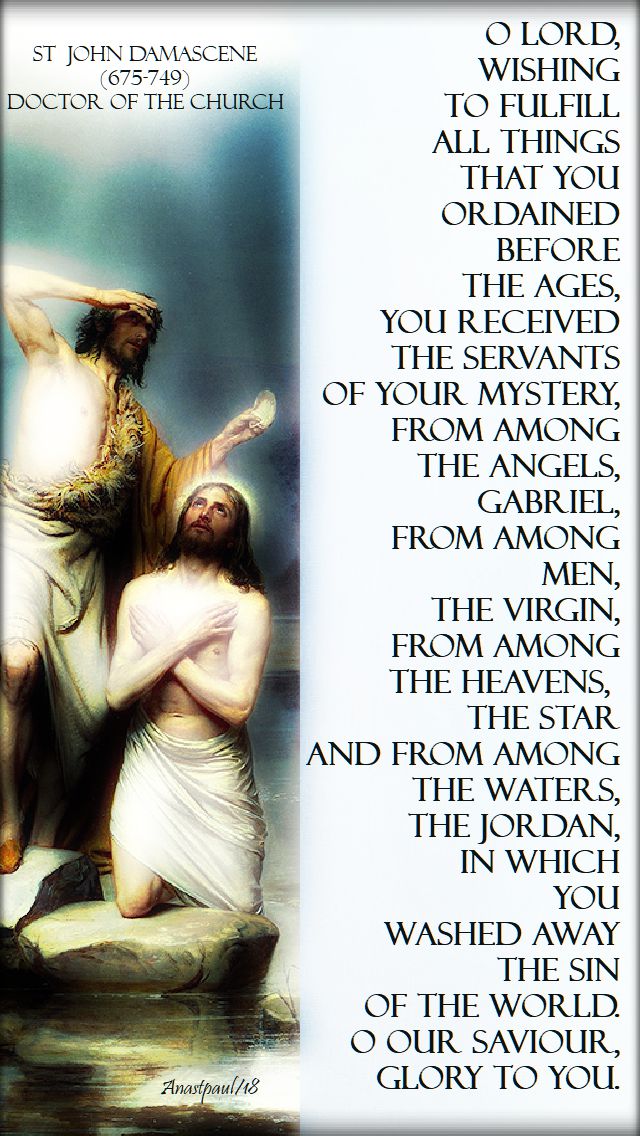
“O Lord, wishing to fulfil all things
that You ordained before the ages,
You received the servants of Your mystery,
from among the Angels, Gabriel,
from among Men, the Virgin,
from among the Heavens, the Star
and from among the Waters, the Jordan,
in which You washed away the sin of the world,
O our Saviour, glory to You.”

St John Damascene (675-749)
Father & Doctor of the Churcho lord wishing to fulfil all things - st john damascene - 7 jan 2018.jpg

Posted in BAPTISM, FEASTS and SOLEMNITIES, ONE Minute REFLECTION, QUOTES of the SAINTS, The BAPTISM of the LORD, The WORD

One Minute Reflection – 12 January – ‘..The Father reveals, that His Son is to be worshipped by all the nations.’

One Minute Reflection – 12 January – Feast of the Baptism of the Lord,
Readings: Isaiah 42:1-4, 6-7, Psalm 29:1-4, 9-10, Acts 10:34-38, Matthew 3:13-17

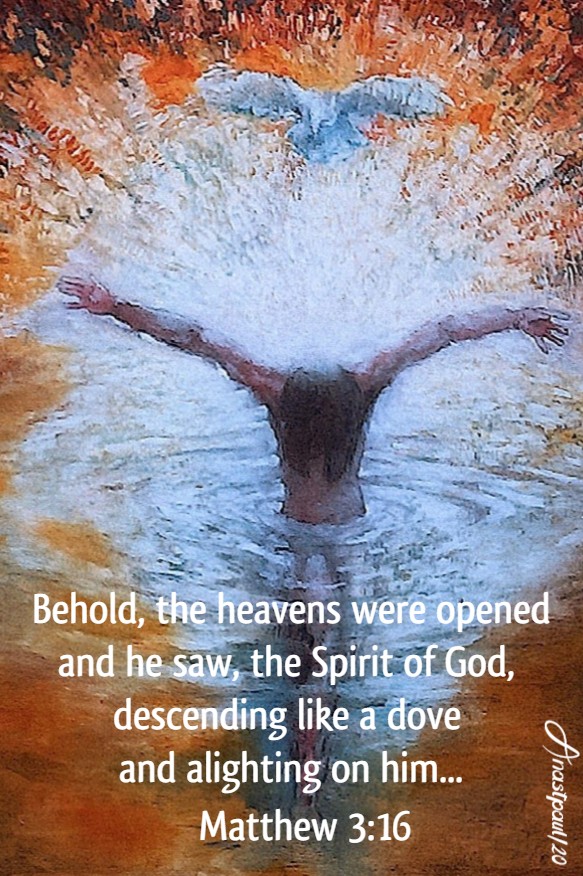
And when Jesus was baptised, he went up immediately from the water and behold, the heavens were opened and he saw, the Spirit of God, descending like a dove and alighting on him... Matthew 3:16matthew 3 16 behold the heavens were opened - 12 jan 2020.jpg

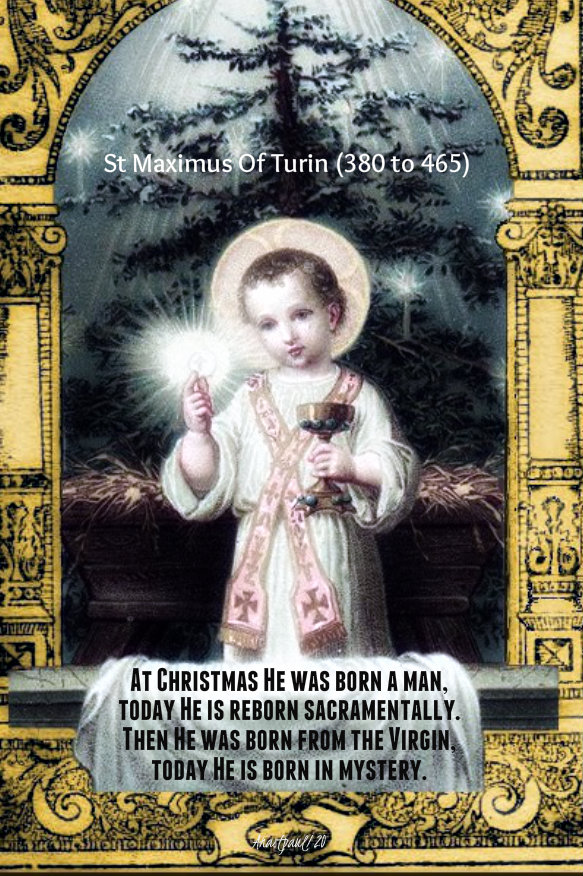
REFLECTION – “At Christmas, He was born a man, today, He is reborn sacramentally. Then He was born from the Virgin, today, He is born in mystery.
When He was born a man, His mother Mary held Him close to her heart; when He is born in mystery, God the Father embraces Him with His voice when He says: ‘This is my beloved Son in whom I am well pleased, listen to him.’
The mother caresses the tender baby on her lap, the Father serves His Son by His loving testimony.   The mother holds the child for the Magi to adore, the Father reveals, that His Son is to be worshipped by all the nations.
That is why the Lord Jesus went to the river for baptism, that is why He wanted His holy body, to be washed with Jordan’s water.at christmas he was born a man today he is bor sacramentally st maximus of turin 5 jan 2019.jpg

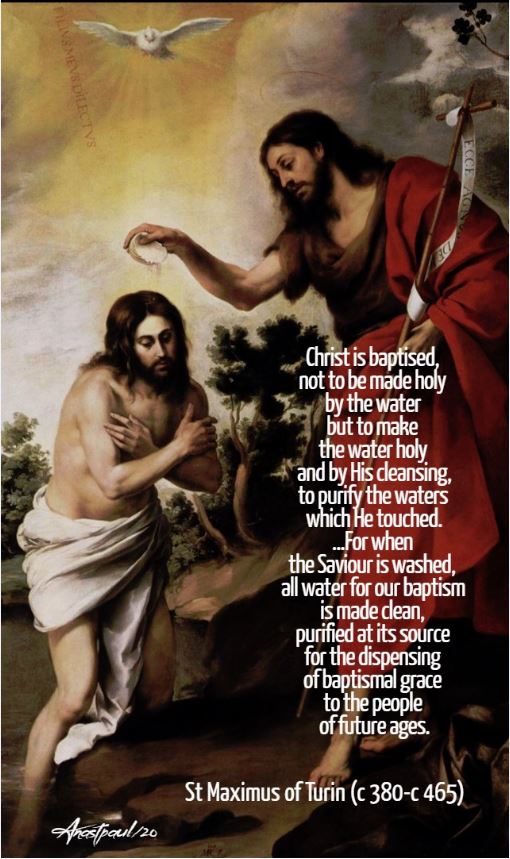
Someone might ask, “Why would a holy man desire baptism?”  Listen to the answer: Christ is baptised, not to be made holy by the water but to make the water holy and by His cleansing, to purify the waters which He touched.  For the consecration of Christ involves a more significant consecration of the water.
For when the Saviour is washed, all water for our baptism is made clean, purified at its source for the dispensing of baptismal grace to the people of future ages.
Christ is the first to be baptised then, so that Christians will follow after Him with confidence.” … St Maximus of Turin (c 380-c 465)christ is baptised not to be made holy but to make the water holy - st maximus of turin 12 jan 2020.JPG

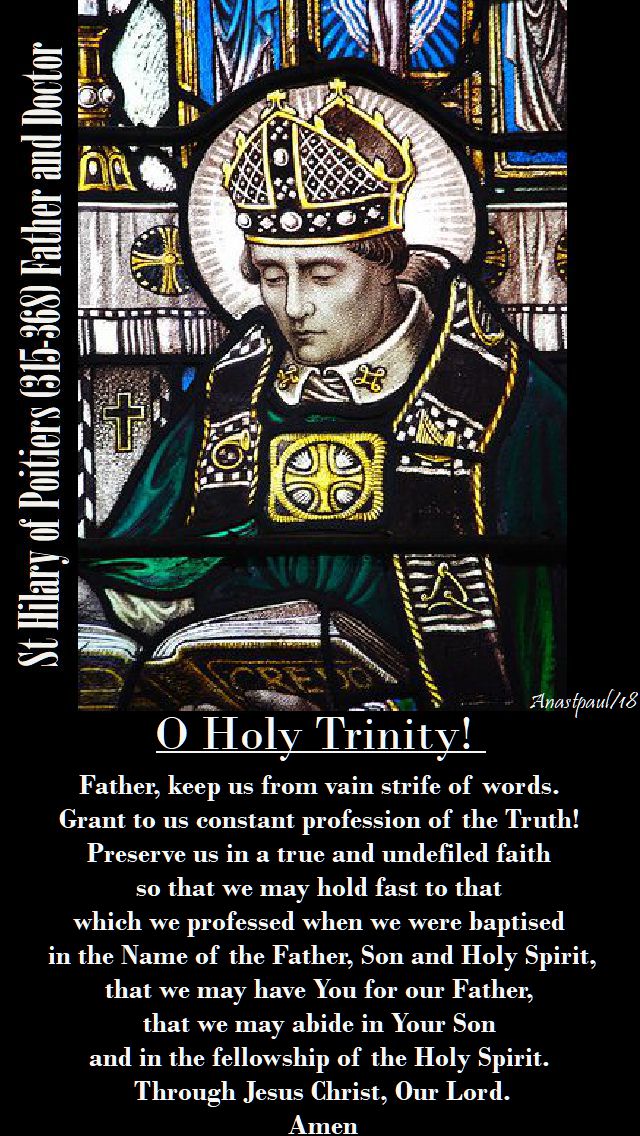
PRAYER – Father, keep us from vain strife of words.
Grant to us constant profession of the Truth!
Preserve us in a true and undefiled faith
so that we may hold fast to that
which we professed when we were baptised
in the Name of the Father, Son and Holy Spirit,
that we may have You for our Father,
that we may abide in Your Son
and in the fellowship of the Holy Spirit.
Through Jesus Christ, Our Lord.
Amen…St Hilary of Poitiers (315-368) Father and Doctor of the Churcho-holy-trinity-prayer-for-perseverance-in-truth-st-hilary-of-poitiers-13-jan-2018 and 12 jan 2020.jpg

Posted in DOCTORS of the Church, EUCHARISTIC Adoration, FATHERS of the Church, QUOTES of the SAINTS, SUNDAY REFLECTIONS, The HOLY EUCHARIST / The HOLY MASS, The PASSION

Sunday Reflection – 12 January – This Body He gave to us

Sunday Reflection – 12 January – Feast of the Baptism of the Lord

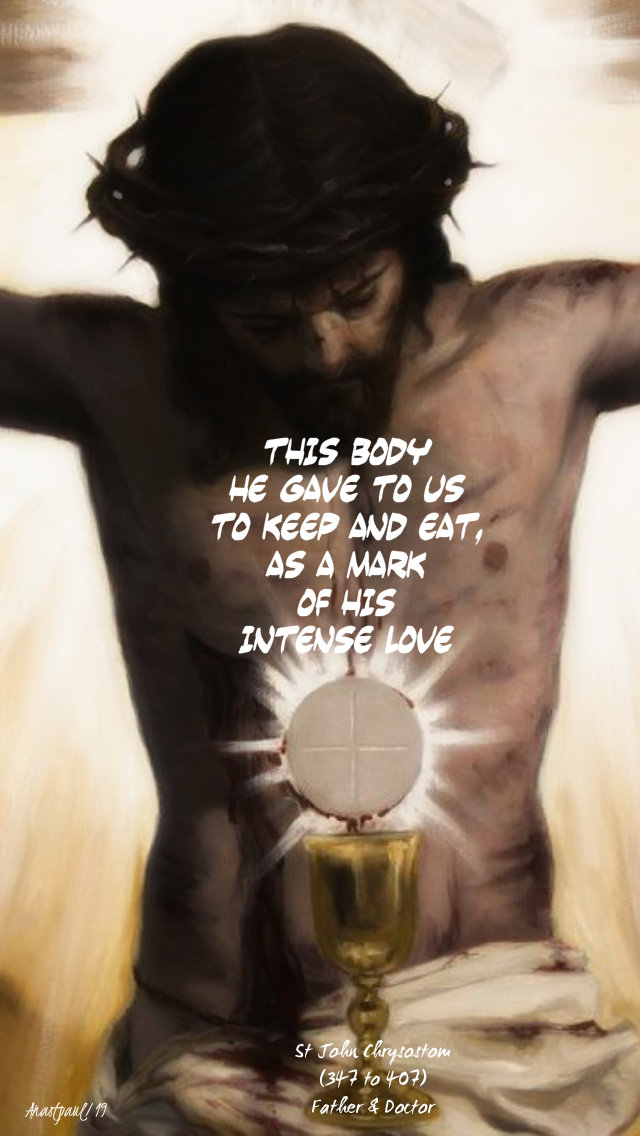
“When you see (the Most Blessed Sacrament) exposed, say to yourself –

‘Thanks to this Body, I am no longer dust and ashes, I am no more a captive but a freeman, hence, I hope to obtain heaven and the good things that are there in store for me… eternal life, the heritage of the angels, companionship with Christ; death has not destroyed this Body which was pierced by nails and scourged . . . this is that Body which was once covered with blood, pierced by a lance, from which issued saving fountains upon the world, one of blood and the other of water. . . This Body He gave to us to keep and eat, as a mark of His intense love’.”

St John Chrysostom (347 to 407)
Father & Doctor

this-bodty-he-gave-to-us-st-john-chrysostom-1-sept-2019 and 12 jan 2020.jpg

Posted in DOCTORS of the Church, FATHERS of the Church, FEASTS and SOLEMNITIES, Our MORNING Offering, PRAYERS of the SAINTS, The HOLY EUCHARIST / The HOLY MASS

Our Morning Offering – 12 January – Prayer after Holy Communion By St John Damascene

Our Morning Offering – 12 January – Feast of the Baptism of the Lord

Prayer after Holy Communion
By St John Damascene (675-749)
Father and Doctor of the Church

God, my God,
unextinguishable and invisible fire,
You make Your angels flaming fire.
Out of Your inexpressible love,
You have given me
Your divine Flesh as food
and through this communion
of Your immaculate Body
and precious Blood,
You receive me
as a partaker of Your divinity.
Permeate all my body and soul,
all my bones and sinews.
Consume my sins in fire.
Enlighten my soul
and illumine my mind.
Sanctify my body
and make Your abode in me,
together with Your Blessed Father
and All-Holy Spirit,
that I may always abide in You,
through the intercession
of Your immaculate Mother
and all Your saints.
Amenprayer after holy comm by st john damascene 12 jan 2020.jpg

Posted in SAINT of the DAY

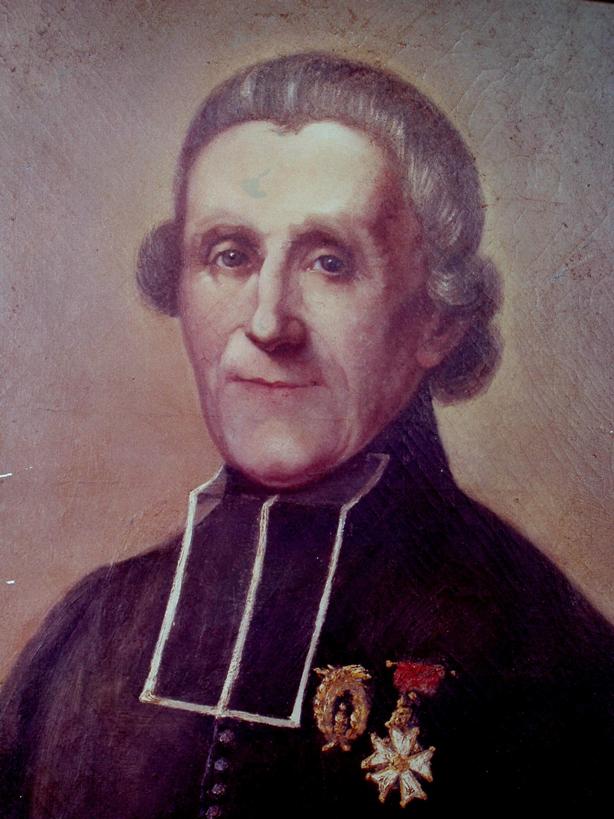
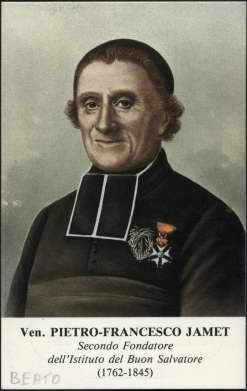
Saint of the Day – 12 January – Blessed Pierre-François Jamet (1762-1845)

Saint of the Day – 12 January – Blessed Pierre-François Jamet (1762-1845) Priest, Confessor, apostle of the poor, the deaf, the mentally ill, teacher and protector of the deaf-mute, called the “Second Founder” due to restoring the dwindled order of the Sisters of the Bon Sauveur.   Born on 12 September 1762 in Fresnes, Aisne, France and died on 12 January 1845 in Caen, Calvados, France of natural causes, aged 82.   Blessed Pierre built schools, homes and clinics for the poor and needy.   In 1827 he was awarded the Legion of Honour for his service as a priest.Bl frnabbejamet.jpg

Pierre-François Jamet was born on 13 September 1762 in France to the poor farmers Pierre Jamet and Marie Madeleine Busnot.   He had eight siblings – two became priests and one sister became a nun.

In 1782 he began his theological and philosophical studies at the University of Caen upon feeling that he was being called to become a priest and commenced his studies for the priesthood in that same village in 1784.   He graduated with a masters in arts and completing a bachelor of theological studies.   Jamet was Ordained to the Priesthood on 22 September 1787.   However, he could not further his studies due to the outbreak of revolution not long after.

Fr Pierre refused to swear allegiance to the new government of the French Revolution in 1790 and was later arrested due to this dissidence.   He even suffered death threats at this time.   Upon his release, he set about the restoration of the Sisters of the Good Saviour, which was in decline at that time and would celebrate Mass in secret.   On 19 November 1790 he was appointed as the Chaplain and Confessor of the Order.   He became the Superior of the Congregation in 1819.

For nine years the Blessed was sought, denounced and persecuted, he was imprisoned and exposed to death several times but for this he did not cease to travel, now on foot, now on horseback, throughout the region to administer the Sacraments to the dying and animate everyone to the perseverance in faith.   In the frequent visits he made to the nuns directed by him, he sought to nourish their hope for the future, devotion to the Sacred Heart of Jesus, frequent communion and meditation on the Passion of Jesus. Towards the end of 1796 the rigours of persecution began to fade.   He took the opportunity to give lectures to the nuns, to celebrate Mass in song and to celebrate Benediction, assisted by Fr Carlo Boscher, his close friend, who was also hunted by the police.

As soon as he heard that the Capuchin monastery was for sale, he urged them to buy it for 30,000 francs and make it the centre of their apostolate.   He also settled there to direct the work, help the nuns to pay their debts, instruct them in the practice of vows and get them used to celebrating liturgical services with piety, dignity and solemnity.  The Sisters of the Good Saviour venerated him and blessed him as if he were their “second founder” and Fr Jamet in turn, placed all his energies and skills at the disposal of the Institute.

Among many his many occupations, Fr Jamet did not neglect sacred studies.   His contemporaries admired him, not only for his zeal and charitable works but also for his scientific publications on the re-education of deaf-mutes and his ascetic and historical works.

Thanks to his cultural merits and talents, on 14 November 1822 Fr Jamet was appointed Rector of the University of Caen, despite the opposition of Freemasons and Gallicans.   On the other hand, he himself had been aspiring to this position for some years, in order to offset the atheist, secularist and Jansenist teaching imparted there.   In the eight years in which he held this position he worked, with extreme energy,

For all his memorable merits, King Charles X appointed the Blessed Fr Jamet as a Knight of the Royal Order of the Legion of Honour in 1827 but in 1830, he was so troubled and distressed by the political situation in France with the advent to the throne of Luigi Filippo d’Orièans (+1850), (known as “the usurper”) Fr Jamet resigned his position as the of Rector of the University.

Fr Jamet enjoyed robust health and was of ardent temperament, quick to notice the problems of his neighbour.   However, the amount of work he had to take on daily, started to have a detrimental effect on his health and occasionally causing him illnesses which he endured by praying and suffering.   His health began to decline seriously in 1836.

Blessed Pierre died on 12 January 1845.   At his funeral, officiated by the Bishop of Bayeux, a large crowd of his admirers attended. St John Paul II recognised his heroic virtue on 21 March 1985 and Beatified him on 10 May 1987.   His relics are venerated in Caen in the crypt of the chapel of the Sisters of the Good Saviour.

In the teachings that he imparted to the religious, the mystery of the Sacred Heat of Jesus and the Holy Trinity occupied a prominent place.   He used to repeat to them:  “We are part of the family of God … We must therefore resemble Him, walking in the footsteps of His only Son.”   Or he said:  “The soul consecrated to God no longer belongs to himself.   It belongs entirely to God.   By means of vows it gives God everything.   Every sin becomes a profanation.   From now on, God alone must count for us, God alone must suffice.”

Fr Jamet will be remembered widely for his devotion to the material and spiritual assistance to deaf-mute children and mentally insane.   In this, he demonstrated that he truly possessed the “genius of charity”.   With the help of the nuns directed by him, from 1816 he began to build special schools for the intellectual, moral and religious education of deaf-mutes, he also invented a sign language based on words and not on objects.

The assistance of the Sisters of the Good Savior gradually extended to other social classes which were in particular need.   In fact, they opened free schools for the children of the people, a boarding school for girls, a retirement home for ladies and a dispensary for the poor.bl Pierre-Francois Jamet.jpg

Blessed Pier Francesco Jamet is considered an authentic martyr of charity at the time of the French Revolution.   On the day of his Beatification, 10 May 1987, St Pope John Paul II said:

“He lived ardent charity in the many forms of his priestly activity.   We are impressed by his courage, by his attitude in impressing on the faith an itinerary of a man of high culture, a faithful priest, a servant of the poor …   We admire his intrepid generosity, his attention in not leaving the most handicapped without care of his brothers …   he loved them to the point of learning to heal them and through them to heal ourselves.”

Posted in DOCTORS of the Church, FATHERS of the Church, FEASTS and SOLEMNITIES, The BAPTISM of the LORD

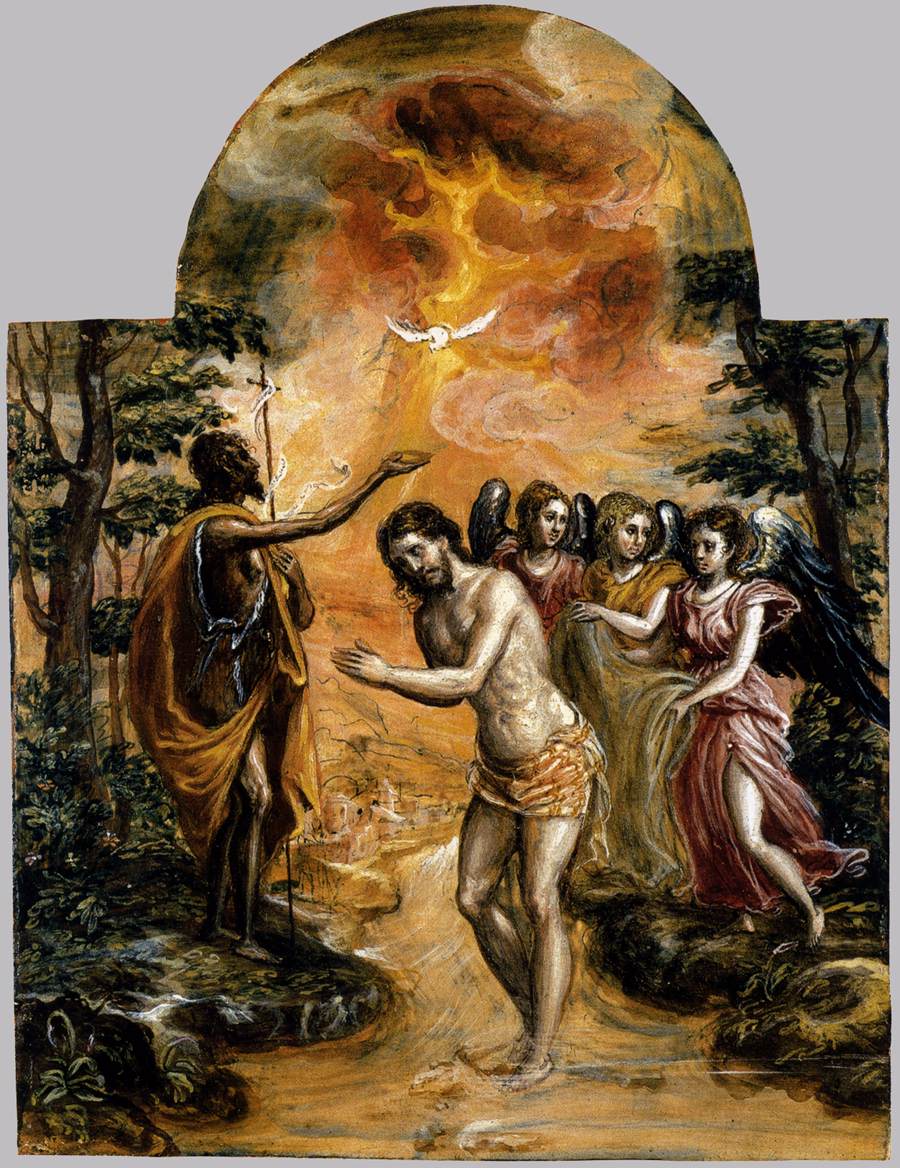
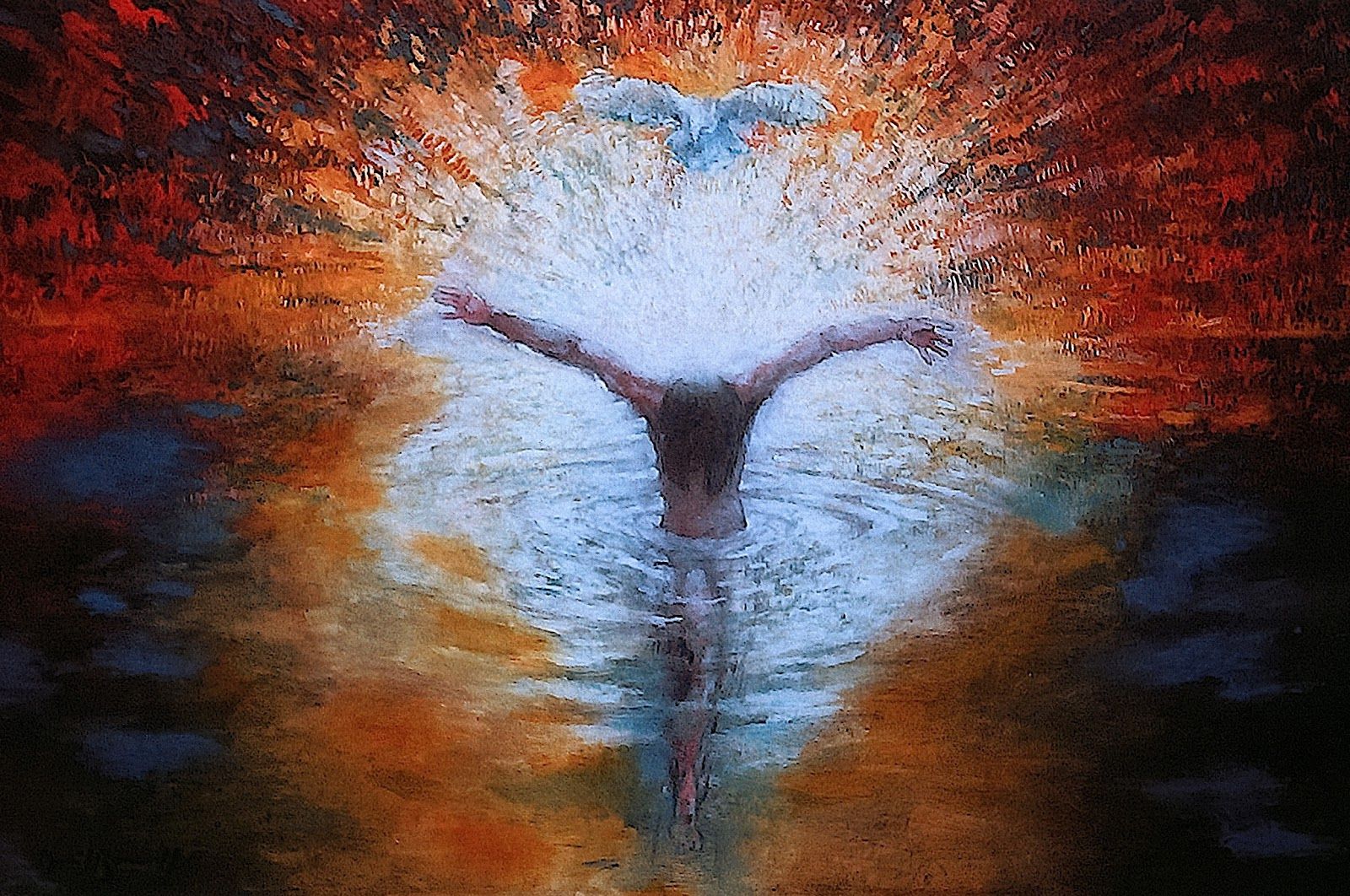
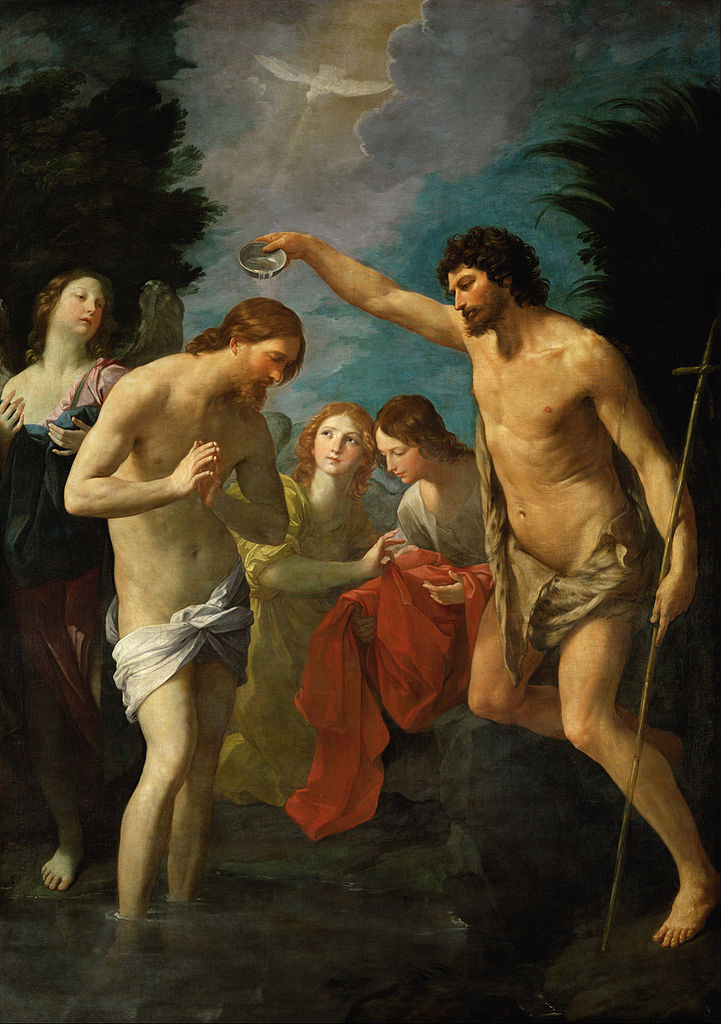
Feast of the Baptism of the Lord – 12 January – St Gregory Nazianzen

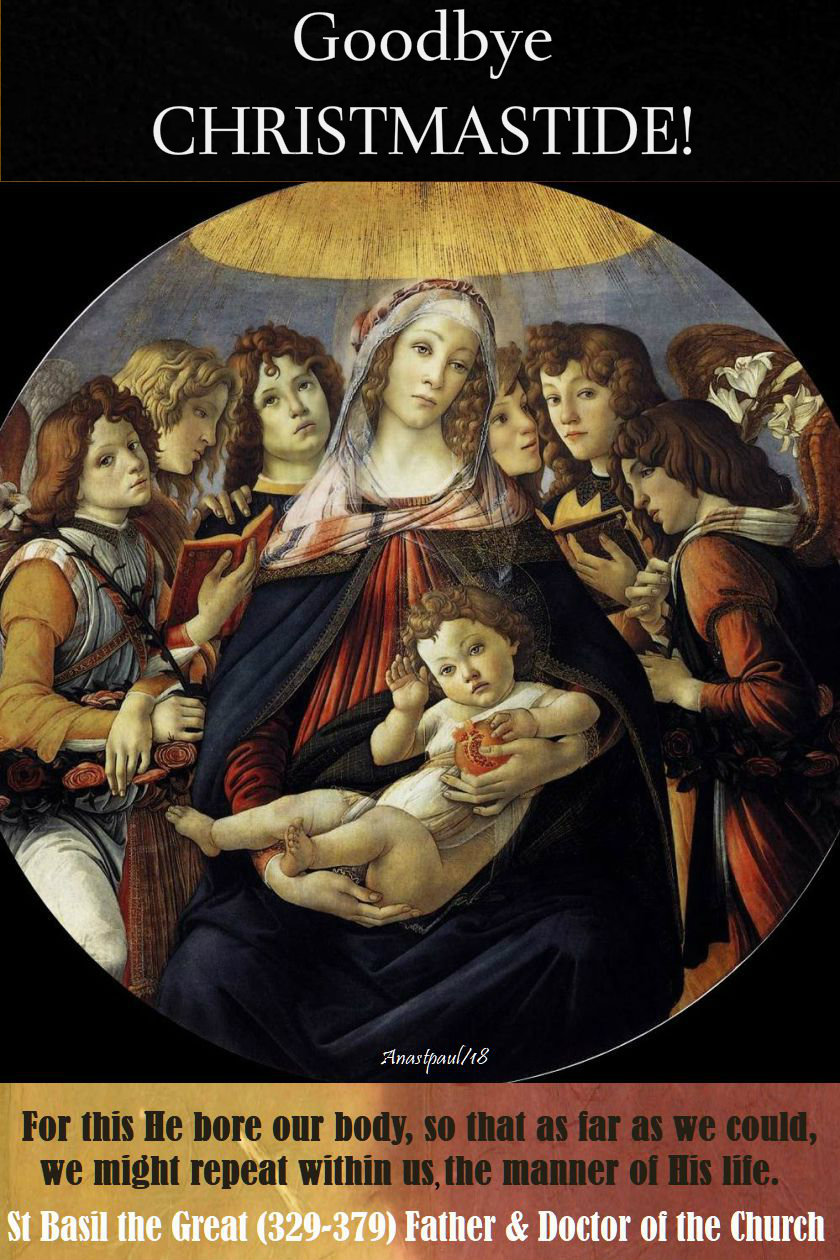
This feast marks the ending of the Christmas season.   Traditionally, the event of Christ’s Baptism was linked with the visit of the Magi and the wedding feast of Cana as two additional “manifestations” of God with us.

Matthew’s simple account of the Baptism ends with the heavenly voice introducing “my beloved Son.”   Here, at the end of our focus on the mystery of Christmas, we are invited to welcome the Beloved One into our midst once more and to prepare ourselves through the Sundays which follow to hear His proclamation of Good News.

Many have expressed the wish that the spirit of Christmas last all through the year. Christians take that responsibility seriously – We want to make the meaning of Christmas—the fact that God has come to dwell with us in Jesus Christ — the central fact of life. And, we want all we say and do to help express, to make manifest, that basic truth.   Merry Christmas, one more time!goodbye-christmastide-13-jan-2019 AND 12 JAN 2020-for-this-he-bore-our-body-st-basil-the-great.jpg

The Baptism of Christ
A sermon by St Gregory Nazianzen (330-390)
Father and Doctor of the Church

Christ is bathed in light, let us also be bathed in light.
Christ is baptised, let us also go down with Him and rise with Him.

LORD BAPTISM.JPG

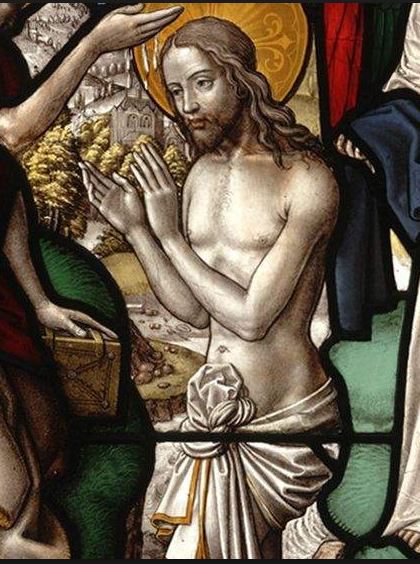
John is baptising when Jesus draws near.   Perhaps He comes to sanctify His baptiser, certainly He comes to bury sinful humanity in the waters.   He comes to sanctify the Jordan for our sake and in readiness for us, He who is spirit and flesh comes to begin a new creation through the Spirit and water.

The Baptist protests – Jesus insists.   Then John says:  I ought to be baptised by You.   He is the lamp in the presence of the sun, the voice in the presence of the Word, the friend in the presence of the Bridegroom, the greatest of all born of woman in the presence of the firstborn of all creation, the one who leapt in his mother’s womb in the presence of Him who was adored in the womb, the forerunner and future forerunner in the presence of Him who has already come and is to come again.   I ought to be baptised by you – we should also add, “and for you,” for John is to be baptised in blood, washed clean like Peter, not only by the washing of his feet.

11580-baptism-of-christ-el-greco.jpg

Jesus rises from the waters – the world rises with Him.   The heavens, like Paradise with its flaming sword, closed by Adam for himself and his descendants, are rent open.   The Spirit comes to Him as to an equal, bearing witness to His Godhead.   A voice bears witness to Him from heaven, His place of origin.   The Spirit descends in bodily form like the dove that so long ago announced the ending of the flood and so gives honour to the body that is One with God.

baptism of the lord - daniel bonnell not a mormon.jpg

Today, let us do honour to Christ’s Baptism and celebrate this feast in holiness.   Be cleansed entirely and continue to be cleansed.   Nothing, gives such pleasure to God, as the conversion and salvation of men, for whom His every word and every revelation exist.   He wants you to become a living force for all mankind, lights shining in the world. You are to be radiant lights as you stand beside Christ, the great light, bathed in the glory of Him who is the light of heaven.   You are to enjoy, more and more, the pure and dazzling light of the Trinity, as now you have received – though not in its fullness – a ray of its splendour, proceeding from the one God, in Christ Jesus our Lord, to whom be glory and power for ever and ever.   Amen.

721px-Guido_Reni_-_The_Baptism_of_Christ_-_Google_Art_Project.jpg

Posted in FEASTS and SOLEMNITIES, SAINT of the DAY

Feast of the Baptism of the Lord – 12 January and Memorials of the Saints

Feast of the Baptism of the Lord – 12 January 2020
2019:
https://anastpaul.com/2019/01/13/feast-of-the-baptism-of-the-lord-13-jan-2019/
St Aelred of Rievaulx OCSO (1110-1167)
About St Aelred:
https://anastpaul.wordpress.com/2018/01/12/saint-of-the-day-12-january-st-aelred-of-rievaulx-1110-1167-saint-bernard-of-the-north/

Bl Antoine Fournier
St Antonio Maria Pucci OSM (1819-1892)

Biography:
https://anastpaul.com/2019/01/12/saint-of-the-day-st-anthony-mary-pucci-osm-1819-1892/
St Arcadius of Mauretania
Bl Bartholomew Alvarez
Bl Bernardo de Plano
St Biccianus
St Benedict Biscop
St Bernard of Corleone
St Caesaria of Arles
St Caroticus
Bl Emmanuel d’Abreu
St Eutropius
St Ferreolus of Grenoble
Bl John Gaspard Cratz
St John of Ravenna
Bl Lucia of Valcaldara
St Marguerite Bourgeoys CND (1620-1700)

St Marguerite’s Biography:

https://anastpaul.wordpress.com/2017/01/12/saint-of-the-day-12-january-st-marguerite-bourgeoys/

St Martinian of Belozersk
St Martin of León
Bl Nicholas Bunkerd Kitbamrung
St Peter of Abessala
Blessed Pierre-François Jamet (1762-1845)
St Probus of Verona
St Quinctus the Soldier
St Satyrus
St Tatiana of Rome
St Tigrius
St Victorian of Asana
Bl Vincent da Cunha

Martyrs of Africa – 44 saints: A group of 44 Christian soldiers murdered together for their faith in Africa. The only details that survive are four of their names – Castulus, Modestus, Rogatus and Zoticus.

Martyrs of Ephesus – 42 saints: Forty-two monks martyred at a monastery in Ephesus (modern Turkey) during the persecutions of the Iconoclast Byzantine Emperor Constantine V. Their names have not come down to us. Martyred c 762.

Martyrs of Iona – 38 saints: Thirty-eight monks martyred in Iona, Ireland. Their names have not come down to us. They were Martyred in 750 at Iona, Ireland.

Posted in MEDITATIONS - ANTONIO CARD BACCI, PRACTISING CATHOLIC, QUOTES - J R R Tolkien and MORE, QUOTES on CONVERSION, QUOTES on DEATH, QUOTES on DESPAIR, QUOTES on HEAVEN, QUOTES on HELL, QUOTES on SIN, The LAST THINGS

Thought for the Day – 11 January – The Death of the Sinner

Thought for the Day – 11 January – Meditations with Antonio Cardinal Bacci (1881-1971) – Saturday after Epiphany

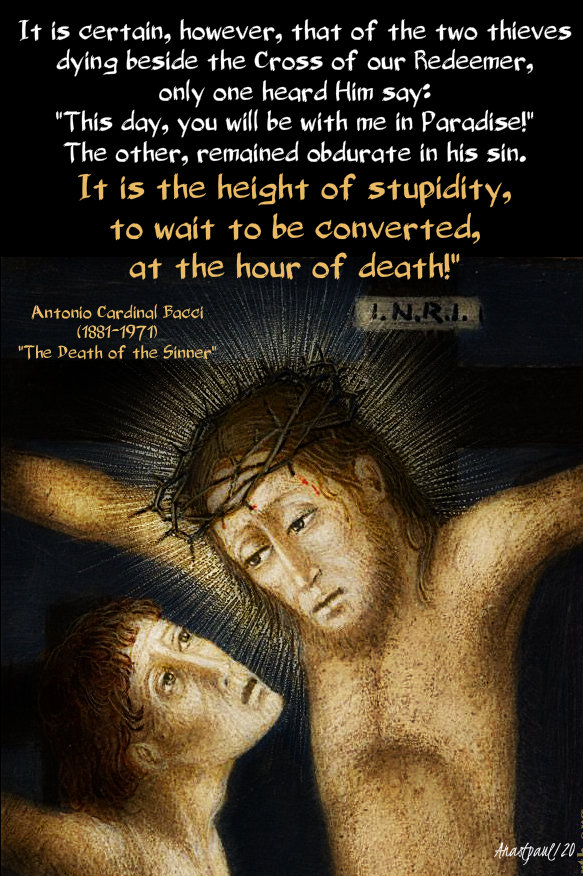
The Death of the Sinnerit is the height of stupidity - bacci - 11 jan 2020.jpg

“The Sinner must also die.
For him death is really terrible.
Imagine him lying on his deathbed, instinctively aware, that his life is over.
The past will rise up to reproach him, a past full of sin and of ingratitude towards his Creator and Redeemer.
The plans which he has centred around profit, ambition and honour, will have vanished like smoke.
His friends, will have either deserted him, or will be at hand, to utter useless words, which will have no power to comfort him.
Now he must stand alone, alone before God!

What will happen, at that moment?
Perhaps, despair will overcome his soul, as it overcame the soul of Judas?
Perhaps, the innumerable graces which he has despised, will tip the balance of Divine Justice towards the abyss of damnation?
Or, will a final ray of mercy pierce his tired mind, burning with remorse, so that, with it’s last throb, his poor heart will torn towards God and implore His pardon?
Who can say?
It is certain, however, that of the two thieves dying beside the Cross of our Redeemer, only one heard Him say:
“This day, you will be with me in Paradise!”
The other, remained obdurate in his sin.
It is the height of stupidity, to wait to be converted, at the hour of death!”

Antonio Cardinal Bacci

Posted in CHRIST, the WAY,TRUTH,LIFE, CHRISTMASTIDE!, DOCTORS of the Church, FATHERS of the Church, QUOTES for CHRIST, QUOTES of the SAINTS, QUOTES on CONVERSION, QUOTES on DISCIPLESHIP, QUOTES on FAITH, QUOTES on HUMILITY, QUOTES on SANCTITY, QUOTES on TRUST and complete CONFIDENCE in GOD, The CHRIST CHILD, THE EPIPHANY of the LORD, The FAITHFUL on PILGRIMAGE, The WORD

Quote/s of the Day – 11 January – ‘Then Jesus is born within us…’

Quote/s of the Day – 11 January – Saturday after Epiphany, Readings: 1 John 5:14-21, Psalm 149:1-6, 9, John 3:22-30

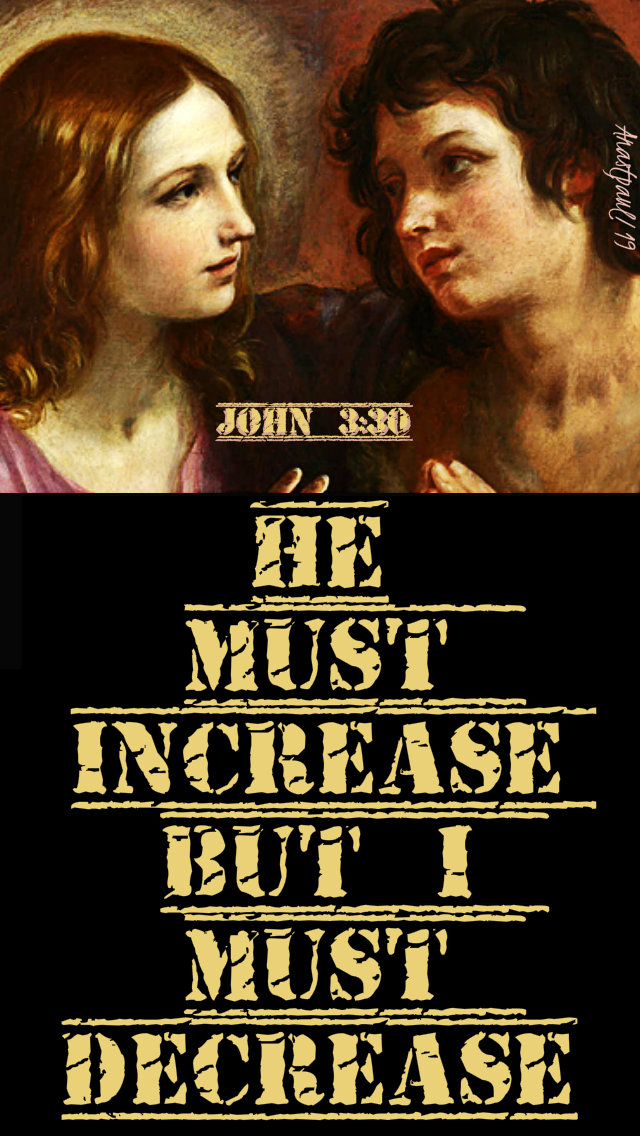
“He must increase
but I must decrease.”

John 3:30john-3-30-he-must-increase-12-jan-2019-no-2.and 11 jan 2020jpg.jpg

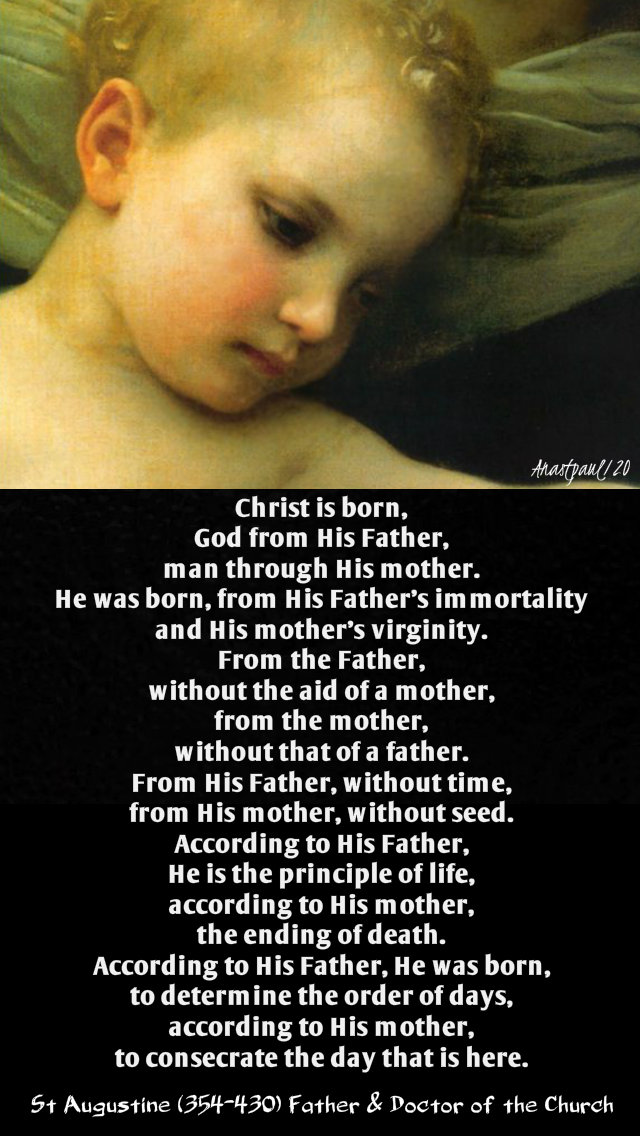
“Christ is born, God from His Father,
man through His mother.
He was born from His Father’s immortality
and His mother’s virginity.
From the Father, without the aid of a mother,
from the mother, without that of a father.
From His Father, without time,
from His mother, without seed.
According to His Father,
He is the principle of life,
according to His mother,
the ending of death.
According to His Father,
He was born to determine the order of days,
according to His mother,
to consecrate the day that is here.”

St Augustine (354-430)
Father & Doctor of the Churchchrist is born god from his father man through his mother - st augustine 11 jan 2020.jpg

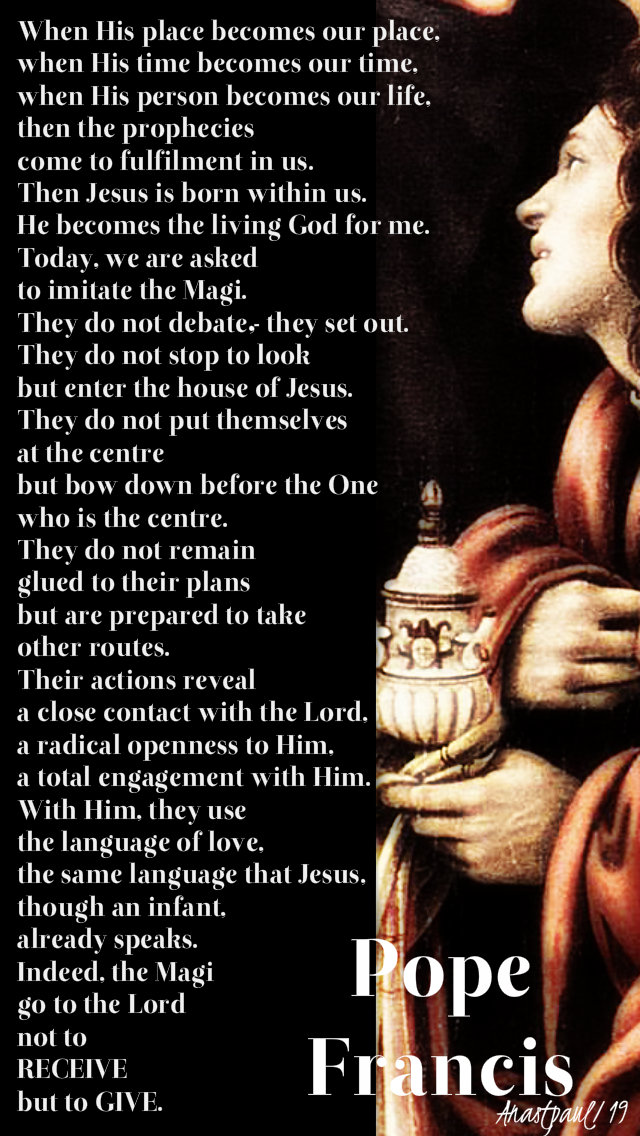
“When His place becomes our place,
when His time becomes our time,
when His person becomes our life,
then the prophecies come to fulfilment in us.
Then Jesus is born within us.
He becomes the living God for me.
Today we are asked to imitate the Magi.
They do not debate – they set out.
They do not stop to look but enter the house of Jesus.
They do not put themselves at the centre
but bow down before the One who is the centre.
They do not remain glued to their plans
but are prepared to take other routes.
Their actions reveal a close contact with the Lord,
a radical openness to Him,
a total engagement with Him.
With Him, they use the language of love,
the same language that Jesus, though an infant, already speaks.
Indeed, the Magi go to the Lord not to receive but to give.

when-his-place-becomes-our-place-pope-franics-epip-homily-2019-9-jan-2019 and 11 jan 2020

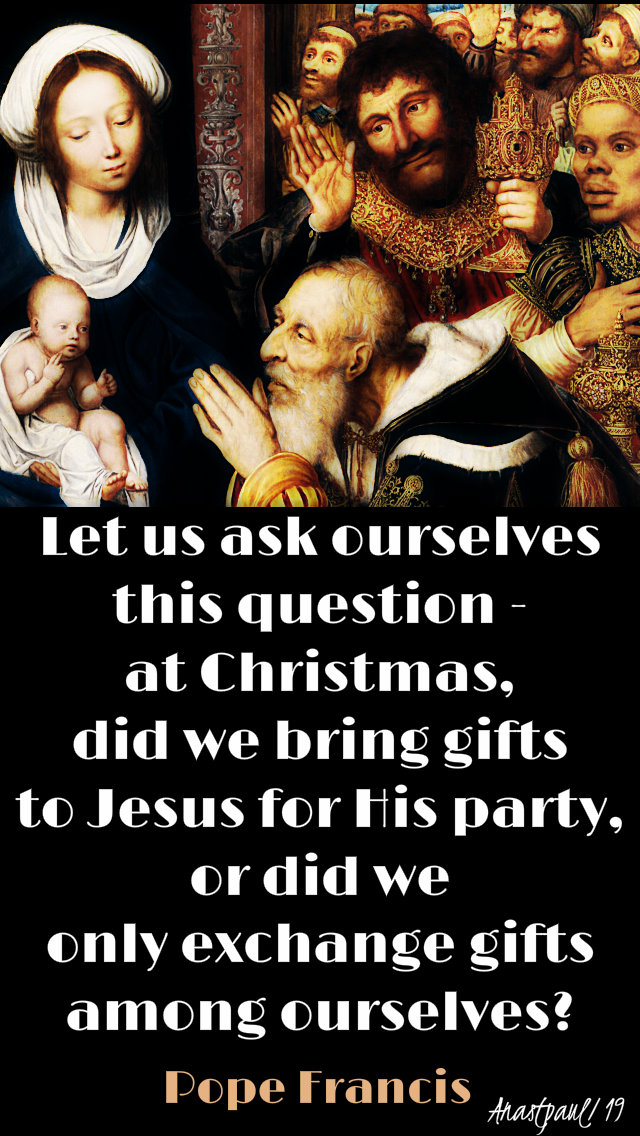
Let us ask ourselves this question –
at Christmas, did we bring gifts to Jesus for His party,
or did we only exchange gifts among ourselves?

let-us-ask-ourselves-pope-francis-9-jan-2019-epiphany-homily-2019 and 11 jan 2020.jpg

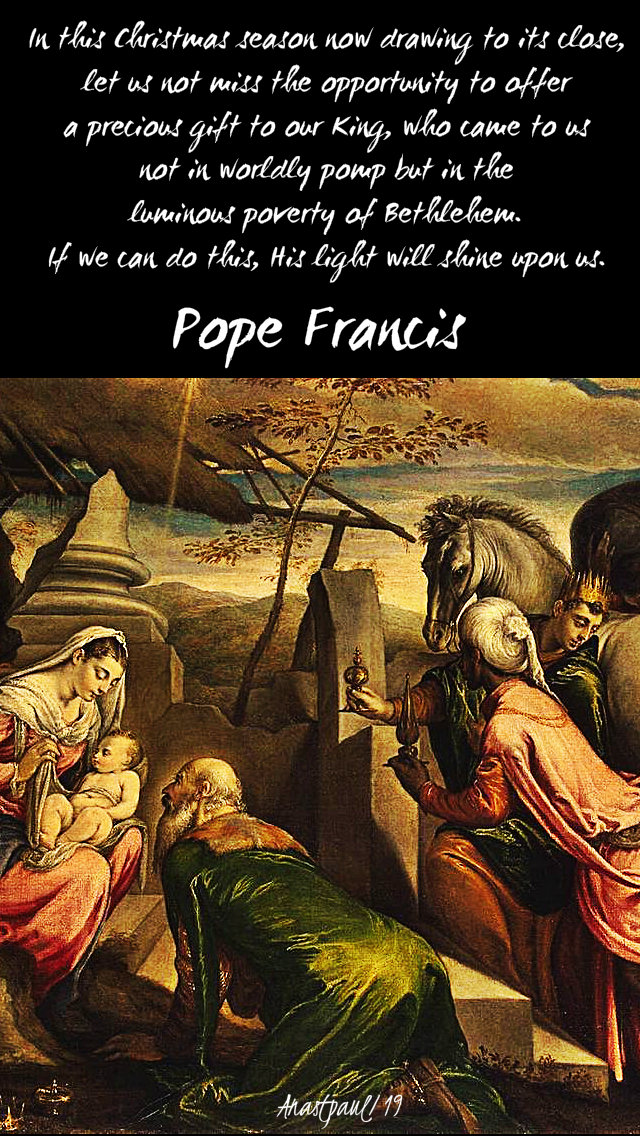
In this Christmas season, now drawing to its close,
let us not miss the opportunity
to offer a precious gift to our King,
who came to us,
not in worldly pomp
but in the luminous poverty of Bethlehem.
If we can do this,
His light will shine upon us.”

Pope Francis

6 January 2019

in-this-christmas-season-pope-francis-9-jan-2019 and 11 jan 2020

Posted in ONE Minute REFLECTION, PRAYERS of the SAINTS, QUOTES of the SAINTS, QUOTES on CONSOLATION, QUOTES on SANCTITY, QUOTES on SUFFERING, The WORD, Thomas a Kempis

One Minute Reflection – 11 January – My Words are Spirit and Life

One Minute Reflection – 11 January – Saturday after Epiphany, Readings:  1 John 5:14-21, Psalm 149:1-6, 9, John 3:22-30

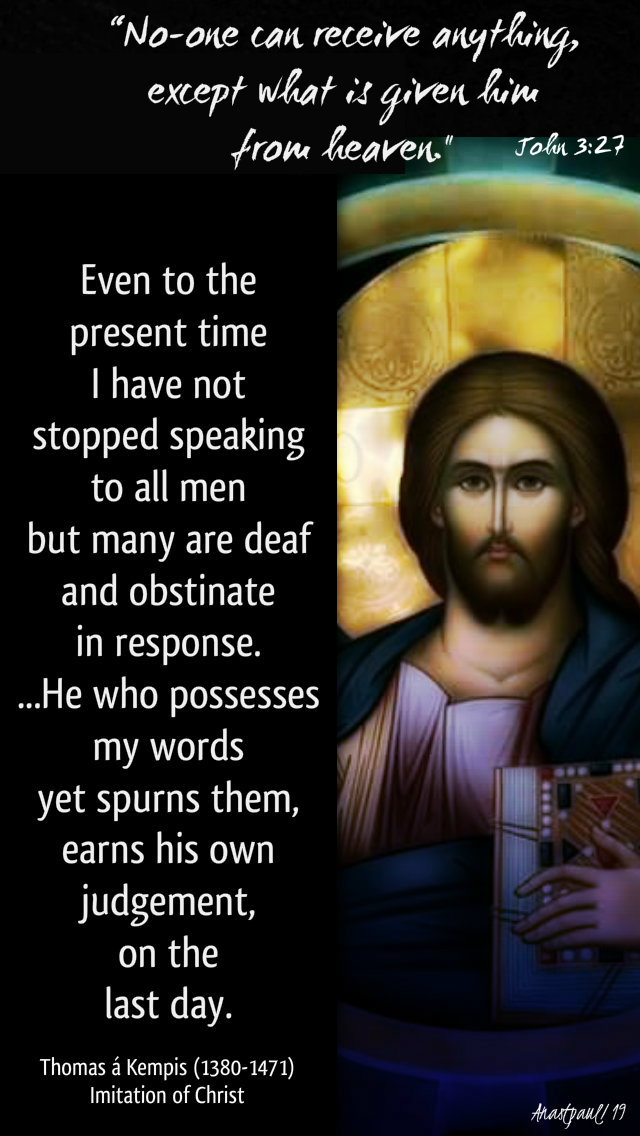
“No-one can receive anything, except what is given him from heaven. “ … John 3:27

REFLECTION – “My son, says the Lord, listen to my words, the most delightful of all words, surpassing all the knowledge of the philosophers and wise men of this world.   My words are spirit and life and cannot be comprehended by human senses alone.   They are not to be interpreted according to the vain pleasure of the listener but they must be listened to, in silence and received with all humility and great affection.   And I said – Blessed is the man whom you teach, Lord and whom you instruct in your law, for him you soften the blow of the evil day and you do not desert him on the earth.   The Lord says, I have instructed My prophets from the beginning.   Even to the present time, I have not stopped speaking to all men but many are deaf and obstinate in response.

Many hear the world more easily than they hear God – they follow the desires of the flesh more readily than the pleasure of God.   The world promises rewards that are temporal and insignificant and these are pursued with great longing.   I promise rewards that are eternal and unsurpassable, yet the hearts of mortals respond sluggishly.   Who serves and obeys me in all matters, with as much care as the world and its princes, are served?   Blush, then, you lazy, complaining servant, for men are better prepared for the works of death than you are for the works of life.   They take more joy in vanity than you in truth.   Yet they are often deceived in their hope, while my promise deceives no-one and leaves empty-handed no-one who confides in Me.   What I have promised, I shall give, what I have said I will fulfil for any man, who remains faithful in my love unto the very end.   I am the Rewarder of all good men, the one who rigorously tests the devoted.

Write my words in your heart and study them diligently, for they will be absolutely necessary in the time of temptation.   Whatever you fail to understand, in reading my words, will become clear to you on the day of your visitation.   I am accustomed to visit my elect in a double fashion, that is, with temptation and with consolation.   And I read to them two lessons each day – one to rebuke them for their faults, the other to exhort them to increase their virtue.   He who possesses my Words yet spurns them, earns His own judgement on the last day.” … Thomas á Kempis (1380-1471), Priest – My Words are Spirit and Life, The Imitation of Christjohn 3 27 no-one can receive anything -he-has-set-me-to-proclaim-even-to-the-present-time-thomas-a-kempis-imitation- 11 jan 2020.jpg

PRAYER – “[Lord God] I believe in You, increase my faith.   All my hopes are in You, secure my trust.   I love You, teach me to love You more each day…   I adore You as my first beginning, I long for You as my final end.   I praise You as my constant helper and call on You as my loving protector.   Guide me by Your Wisdom, correct me with Your Justice, comfort me with Your Mercy, protect me by Your Power…  Lord, enlighten my understanding, enflame my will, purify my heart, sanctify my soul  . Help me to repent of my past sins and to rise above my human weaknesses and to grow stronger as a Christian…” … (from the Universal Prayer by Pope Clement XI (1649-1721)lord-god-i-believe-from-the-universal-prayer-pope-clement-xi-27-april-2018 AND 11 JAN 2020.jpg

Posted in CATHOLIC DEVOTIONS of the Month, Our MORNING Offering, PRAYERS of the SAINTS, The HOLY NAME

Our Morning Offering – 11 January – Jesus, Name Full of Glory

Our Morning Offering – 11 January – Saturday after Epiphany

Jesus, Name Full of Glory
By St Bernardine of Siena (1380-1444)

Jesus,
Name full of glory,
grace, love and strength!
You are the refuge of those who repent,
our banner of warfare in this life,
the medicine of souls,
the comfort of those who morn,
the delight of those who believe,
the light of those
who preach the true faith,
the wages of those who toil,
the healing of the sick.
To You our devotion aspires,
by You our prayers are received;
we delight in contemplating You.
O Name of Jesus,
You are the glory of all the saints for eternity.
Amenjesus name full of glory by st bernardine of siena - 11 jan 2020.jpg

Posted in SAINT of the DAY

Saint of the Day – 11 January – Blessed Ana Maria Janer Anglarill (1800-1885)

Saint of the Day – 11 January – Blessed Ana Maria Janer Anglarill (1800-1885) Religious and Founder of the Sisters of the Holy Family of Urgell, of which order she is the Patron, Nurse, Teacher, apostle of the poor, the sick and the needy.   Born on 18 December 1800 in Cervera, Lleida, Spain and died on 11 January 1885 in Talarn, Lleida, Spain.   She dedicated her life to the service of God through aiding the poor and downtrodden across Spain in hospitals and educational facilities.bl ana maria janer artwork.jpg

Anna Maria Janer Anglarill was born on 18 December 1800 in Spain to Josep Janer i Pallés and Magina Anglarill i Olivé.   She studied at the Real Colegio de Educandras.

She decided to devote herself to the service of God at the age of sixteen and so joined the Sisters of Charity on 25 January 1819.   In May 1819 she made her vows.

Sr Ana worked as a nurse at the Castelltort Hospital.   She also served as the Director of the House of Charity – after her 1849 appointment – and in that position helped to care for both the old and children who were orphaned.bl ana maria janer art.jpg

In 1833 the outbreak of the First Carlist War made the hospital take in wounded soldiers. Janer became a well-known figure in the hospital due to providing consolation to the patients and staff alike, when the hospital had to work to cater to greater numbers of wounded patients.  The war wounded referred to her as “Mother” due to her tender care and devotion.

Ana also worked as a teacher and commissioned a hospital dedicated to the treatment of the poor.bl madre Ana María Janer

In 1836 nuns were expelled from Spain and so she went to France to Toulouse where she worked at a hospital for a brief period of time.   She was called to co-ordinate hospitals in Solsona at the behest of Charles V.   In 1844 she returned to her original hospital.

She founded the Sisters of the Holy Family of Urgell on 29 June 1859 which would spread to Andorra and Mexico amongst other places.

bl ana maria sisters of the holy family - novices mid 20th cent
Novices of the Holy Family sisters – mid 20th century

She died in 1885 at the age of 84.

Cardinal Angelo Amato presided over the Beatification on behalf of the Pontiff, Pope Benedict XVI on 8 October 2011.bl ana maria janer anglarill.jpg

Posted in SAINT of the DAY

Memorials of the Saints – 11 January

St Alexander of Fermo
St Anastasius of Suppentonia
Bl Ana Maria Janer Anglarill (1800-1885)
St Boadin of Ireland
St Breandan of Ireland
St Eithne
St Fedelemia
Bl Francis Rogaczewski
St Francisca Salesia Aviat
St Honorata of Pavia
St Pope Hyginus
St Leucius of Alexandria
St Leucius of Brindisi
St Liberata of Pavia
St Lucius the Soldier
St Luminosa of Pavia
St Mark the Soldier
St Michael of Klopsk
St Palaemon
St Paldo
St Peter Balsam
St Peter of Alexandria
St Peter of Anea
St Peter the Soldier
St Salvius of Amiens
St Severus of Alexandria
St Speciosa of Pavia
St Taso
St Theodosius the Soldier
St Theodosius of Antioch
St Theodosius the Cenobiarch
His lifestory:
https://anastpaul.com/2017/01/11/saint-of-the-day-11-january-st-theodosius-the-cenobiarch/
St Tipasio of Tigava
St Tommaso da Cori OFM (1655-1729)
About St Tommaso:
https://anastpaul.com/2019/01/11/saint-of-the-day-11-january-st-tommaso-da-cori-ofm-1655-1729/

St Vitalis of Gaza (Died c 625)
Biography:
https://anastpaul.wordpress.com/2018/01/11/saint-of-the-day-11-january-st-vitalis-of-gaza-died-c-625/

Posted in MEDITATIONS - ANTONIO CARD BACCI, QUOTES - J R R Tolkien and MORE, QUOTES on HEAVEN, QUOTES on SUFFERING

Thought for the Day – 10 January – The Apostolate of Suffering

Thought for the Day – 10 January – Meditations with Antonio Cardinal Bacci (1881-1971) – Fifth Day after Epiphany

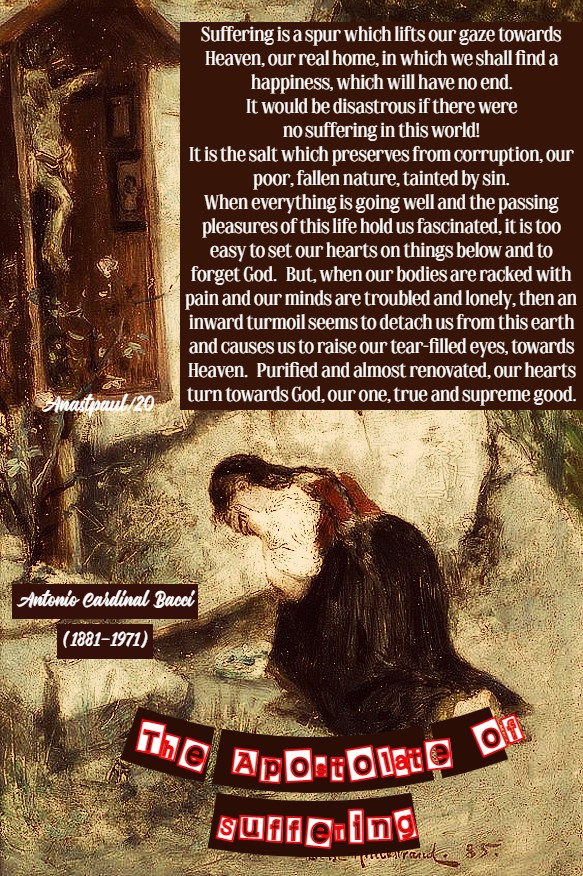
The Apostolate of Suffering

In God’s plan, suffering has a special mission.
One might even call it a kind of apostolate.
Suffering reminds us continually, that we have not been made for this world but are on a journey towards eternity.
“Here we have no permanent city but we seek for the city that is to come” (Heb 13:14)

Suffering is a spur which lifts our gaze towards Heaven, our real home, in which we shall find a happiness, which will have no end.
It would be disastrous if there were no suffering in this world!
It is the salt which preserves from corruption, our poor, fallen nature, tainted by sin.

When everything is going well and the passing pleasures of this life hold us fascinated, it is too easy to set our hearts on things below and to forget God.
But, when our bodies are racked with pain and our minds are troubled and lonely, then an inward turmoil seems to detach us from this earth and causes us to raise our tear-filled eyes, towards Heaven.   Purified and almost renovated, our hearts turn towards God, our one, true and supreme good.

This is why the Saints loved suffering.   Not only did they accept it with complete resignation but, they desired and requested it from God.
“Either to suffer or to die,” was the please of St Therese of the Child Jesus.
St Mary Magdalene del Pazzi, even added:  “To suffer and not to die.”

How well the Saints understood the mission which God has entrusted to suffering!
If it is accepted with faith, resignation and love, it can make us living images of Jesus, Who suffered beneath the weight of the Cross and died upon it, His Hands and Feet pierced with nails, His Head crowned with thorns, while He prayed for us and for all those who had crucified Him.

Antonio Cardinal Bacci

Posted in ArchAngels and Angels, EUCHARISTIC Adoration, QUOTES of the SAINTS, QUOTES on DIVINE PROVIDENCE, QUOTES on FEAR, QUOTES on LOVE, QUOTES on PEACE, QUOTES on TRUST and complete CONFIDENCE in GOD, QUOTES on WORRY/ANXIETY, SAINT of the DAY, The HOLY EUCHARIST / The HOLY MASS

Quote/s of the Day – 10 January – St Léonie Françoise De Sales Aviat

Quote/s of the Day – 10 January – Fifth day after Epiphany and The Memorial of St Léonie Françoise De Sales Aviat OSFS (1844-1914)

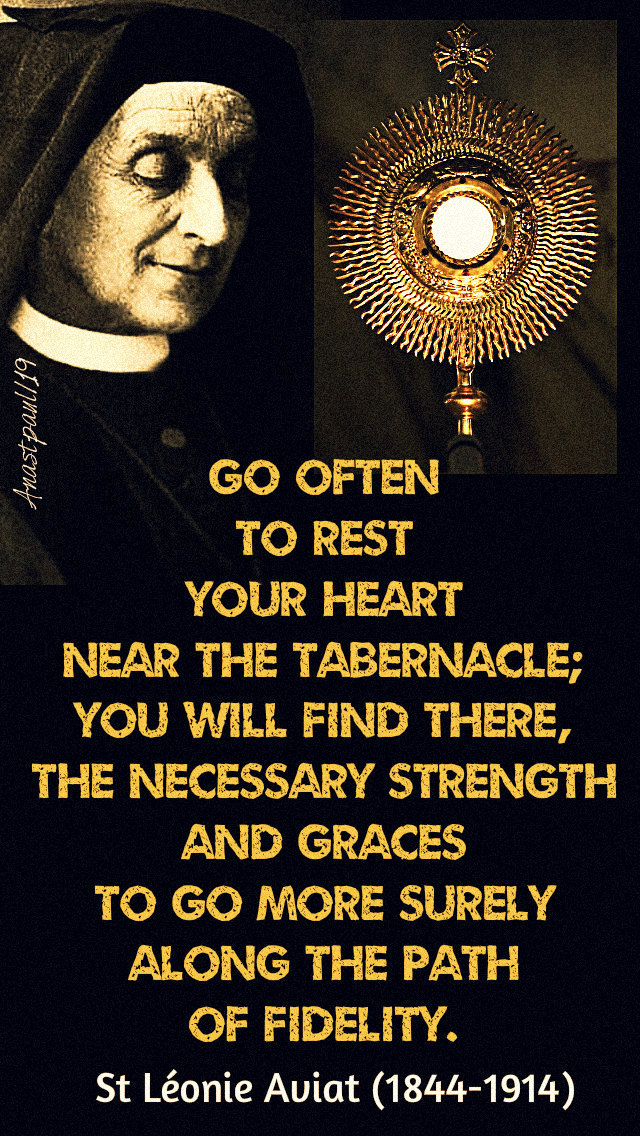
“Go often to rest your heart
near the tabernacle;
you will find there,
the necessary strength
and graces
to go more surely
along the path of fidelity.”go-often-to-rest-your-heart-near-the-tabernacle-st-leonie-aviat-no-1-10-jan-2019 and 2020.jpg

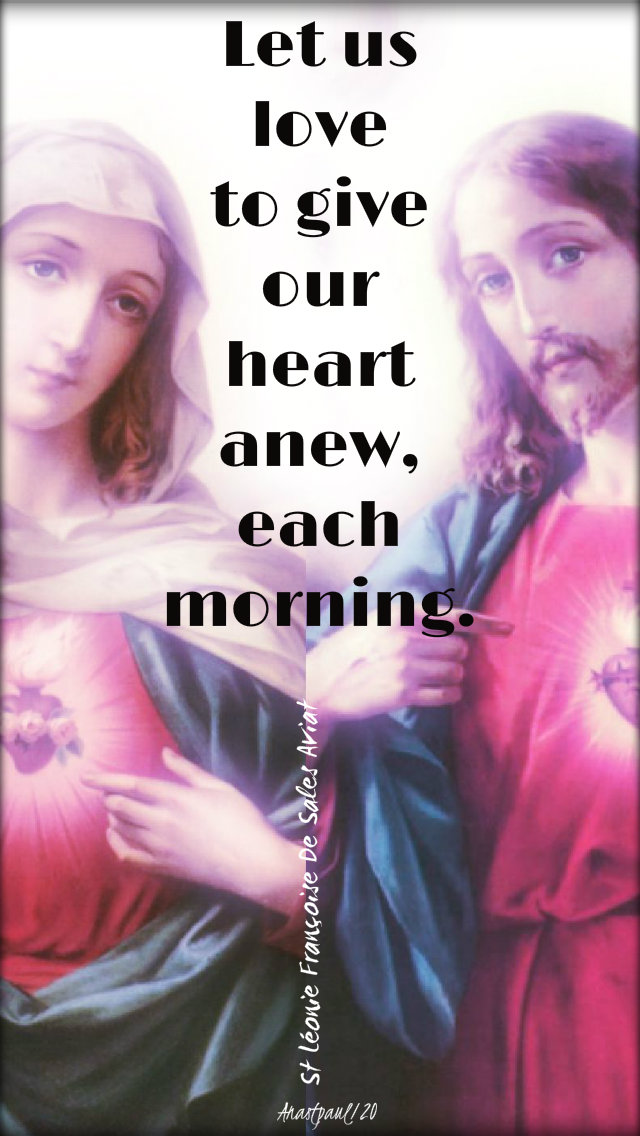
“Let us love
to give our heart anew,
each morning.”let us love to give our heart anew each morning st leonie aviat 10 jan 2020.jpg

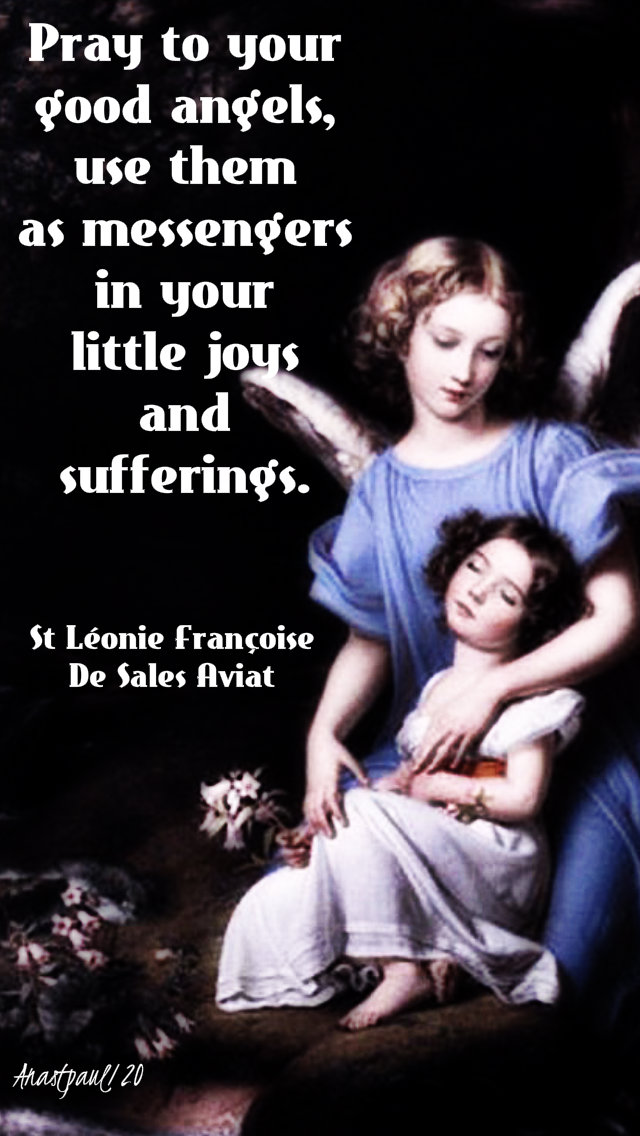
“Pray to your good angels,
use them as messengers
in your little joys
and sufferings.”pray to your good angels - st leonie aviat 10 jan 2020.jpg

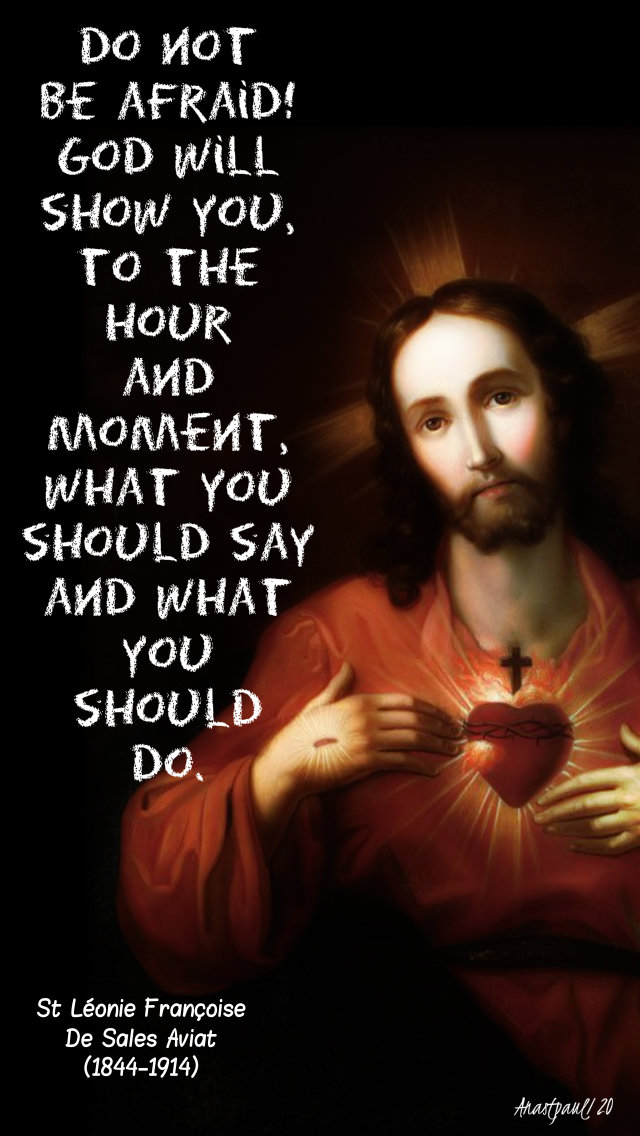
“Do not be afraid!
God will show you,
to the hour and moment,
what you should say
and what you should do.”do not be afraid god will show you - st leonie aviat 10 jan 2020.jpg

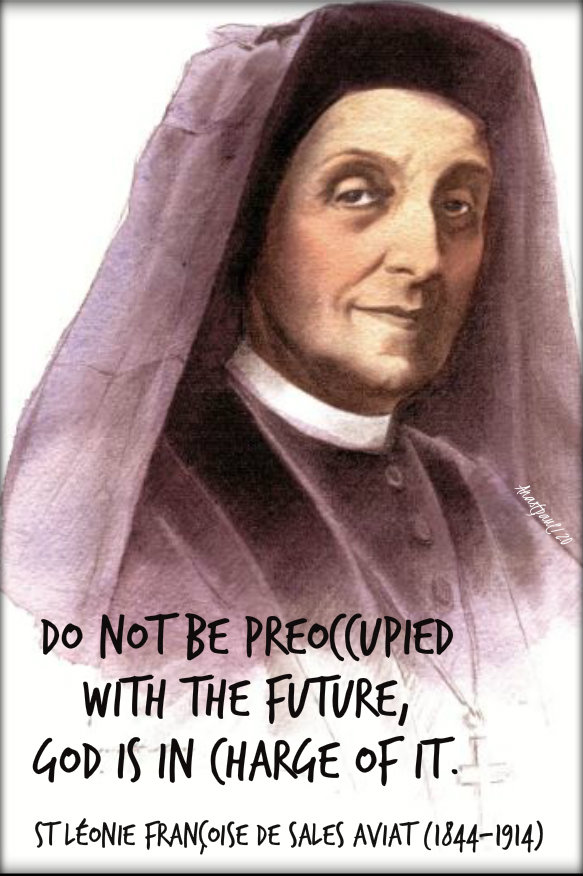
“Do not be preoccupied
with the future,
God is in charge of it.”

St Léonie Françoise De Sales Aviatdo not be preoccupied with the future - st leonie aviat 10 jan 2020.jpg

Posted in CHRIST, the WAY,TRUTH,LIFE, CHRISTMASTIDE!, DOCTORS of the Church, GOD is LOVE, ONE Minute REFLECTION, QUOTES of the SAINTS, SAINT of the DAY, The WORD

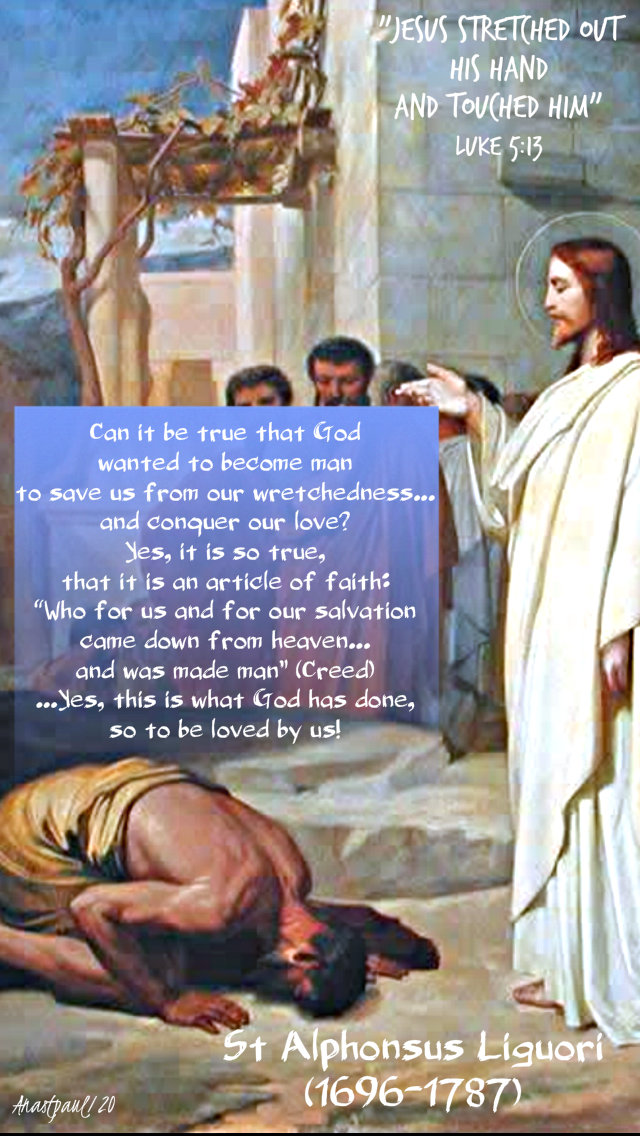
One Minute Reflection – 10 January – ‘Can it be true ….?’

One Minute Reflection – 10 January – Fifth Day after Epiphany and the Memorial of Bl Dolores Rodríguez Sopeña (1848-1918), Readings:  1 John 5:5-13, Psalm 147:12-15, 19-20, Luke 5:12-16

“Jesus stretched out his hand and touched him” … Luke 5:13luke 5 13 jesus stretched out his hand and touched him - can it be true - st alphonsus liguori 10 jan 2020.jpg

REFLECTION – “Christ said when He came into the world:  ‘Sacrifice and offering you did not desire but a body you prepared for me (…)   Then I said: Behold I come to do your will’ ” (Heb 10:5.7; Ps 40:7-9 LXX).   Can it be true that God wanted to become man to save us from our wretchedness (…) and conquer our love?   Yes, it is so true that it is an article of faith:  “Who for us and for our salvation came down from heaven… and was made man” (Creed) (…)   Yes, this is what God has done, so to be loved by us! (… )   This is how He wanted to make known the immensity of His love for us:  “the grace of God our saviour has appeared to all” (Ti 2:11).   It is, as though, our Lord said:  “Man does not love Me because he cannot see me, I am going to make Myself visible and talk to him, in that way I shall surely make Myself loved”:  “He has appeared on earth and spoken with us” (cf. Bar 3:38).

God’s love for humankind is vast, vast from all eternity:  “with age-old love I have loved you;  so in mercy I have drawn you to myself” (cf. Jer 31:3).   But we have not yet seen how great and incomprehensible He is.   When the Son of God was seen in the form of a child lying on the straw in a stable then He was made known indeed:  “the kindness and generous love of God our saviour appeared” (Ti 3:4).   As Saint Bernard observed:  “The creation of the world made God’s power shine out, the ordering of the world, His wisdom but the incarnation of the Word, caused His mercy to break forth in the sight of all.” (…)

“By showing disdain towards God,” Saint Fulgentius said, “man was separated from Him forever and, since man could no longer return to God, God deigned to come to find him on earth.”   And as Saint Augustine had already said:  “We were unable to go to the doctor, therefore the doctor had the graciousness to come to us.” … St Alphonsus Maria de Liguori (1696-1787) – Bishop and Doctor of the Church – 1st address for the Octave of Christmas

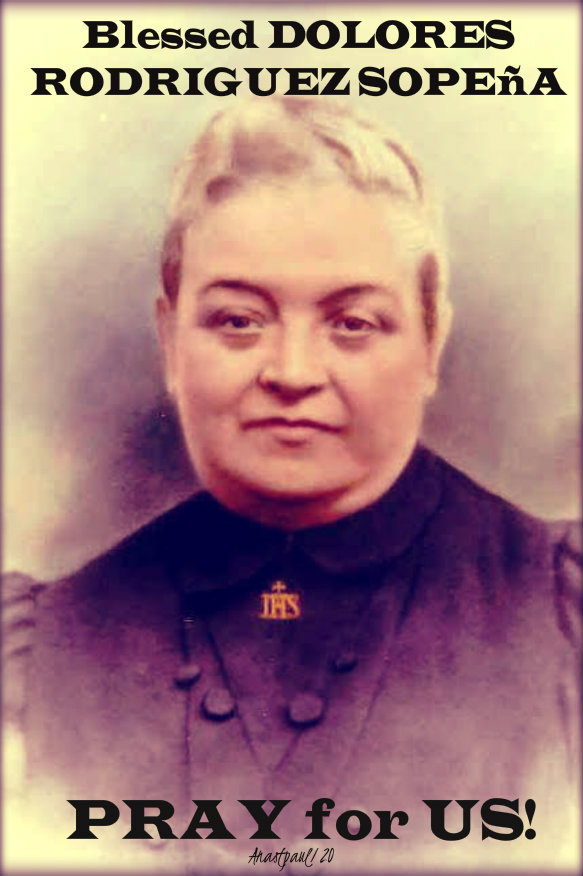
PRAYER – Almighty God and Father, by the guidance of a star, You revealed the Birth of the Saviour of the world.   Open our minds and hearts to that revelation and may it bear fruit in our lives.   May Your nearness, be understood in our hearts and minds, ‘may the Lord Jesus touch our eyes, as He did those of the blind’ and may the prayers of Bl Dolores Rodríguez Sopeña, grant us strength on our journey.   We make our prayer, through Christ, our Lord in the unity of the Holy Spirit, God forever and ever, amen.bl dolores sopena pray for us 10 jan 2020.jpg

Posted in FATHERS of the Church, Our MORNING Offering, PRAYERS for VARIOUS NEEDS, PRAYERS of the SAINTS

Our Morning Offering – 10 January – May the Lord Jesus Touch Our Eyes

Our Morning Offering – 10 January – Fifth Day after Epiphany

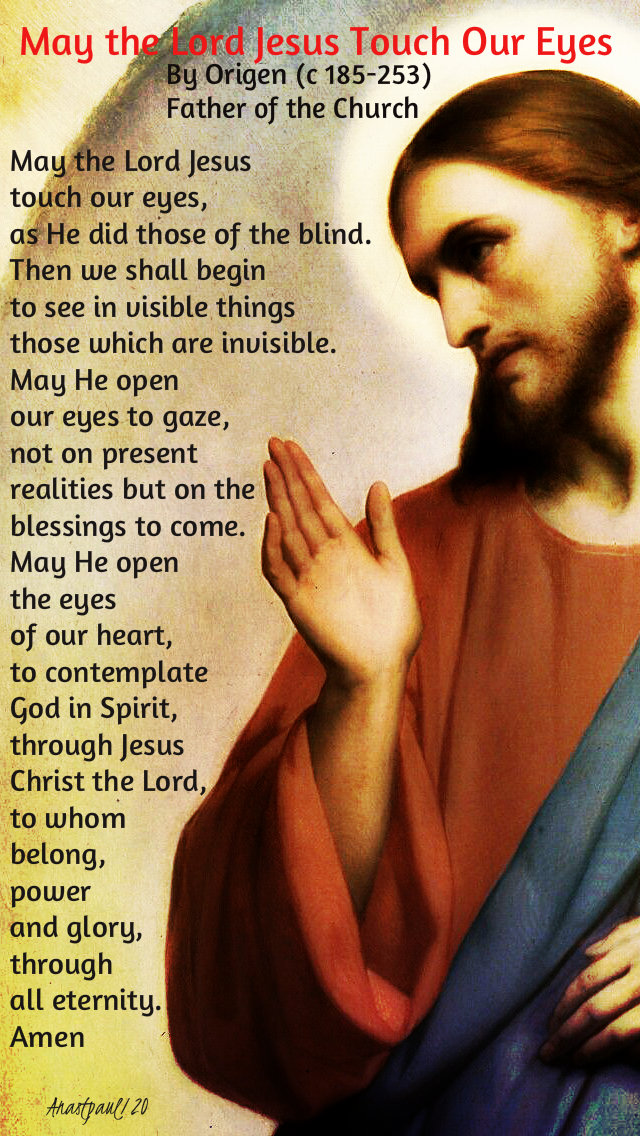
May the Lord Jesus Touch Our Eyes
By Origen (c 185-253)
Father of the Church

May the Lord Jesus touch our eyes,
as He did those of the blind.
Then we shall begin to see in visible things
those which are invisible.
May He open our eyes to gaze,
not on present realities
but on the blessings to come.
May He open the eyes of our heart,
to contemplate God in Spirit,
through Jesus Christ the Lord,
to whom belong,
power and glory,
through all eternity.
Amenmay the lord jesus touch our eyes by origen - 10 jan 2020.jpg

Posted in SAINT of the DAY

Saint of the Day – 10 January – Blessed María Dolores Rodríguez Sopeña (1848-1918)

Saint of the Day – 10 January – Blessed María Dolores Rodríguez Sopeña (1848-1918) Religious and Founder of the Sisters of the Catechetical Institute, apostle of the poor – born on 30 December 1848 in Velez Rubio, Almería, Spain and died on 10 January 1918 in Madrid, Spain of natural causes.   Patronage – Sisters of the Catechetical Institute.bl dolores sopena
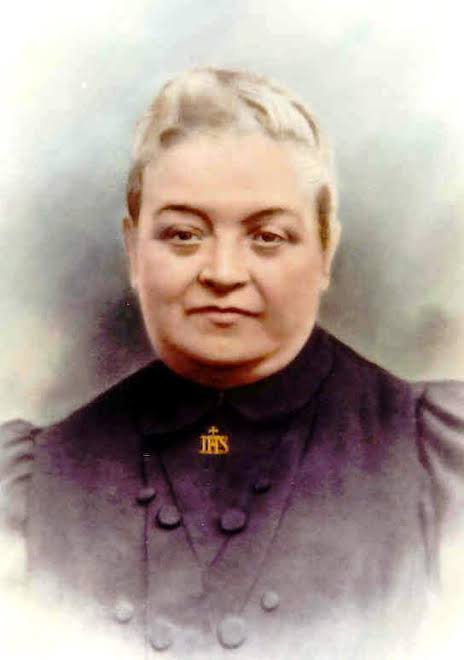
Dolores Rodríguez Sopeña was born in Velez Rubio, Almería, Spain, on 30 December 1848, the fourth of seven siblings.   Her parents, Tomas Rodríguez Sopeña and Nicolasa Ortega Salomon, had moved from Madrid to Velez Rubio due to employment.   Don Tomas had received his law degree at a very young age and because of this, could not work as a lawyer.   He was able to find employment as an administrator of the Marqueses de Velez farms.

Dolores grew up in the Andalucía region where her father began to work as a magistrate and even though he was transferred often, she defined this time of her life as a “lake of tranquility.”

In 1866, her father was named Judge of Almería.   Dolores was 17 and was formally introduced to society, though she did not enjoy the parties or the social life.   Her interest was in doing good for others.   In Almería, she had her first apostolic experiences – she attended, materially and spiritually, to two sisters who had typhoid fever and to a leper. She kept this hidden from her parents because she was afraid that they might forbid her from continuing her work.   She also visited the poor of Saint Vincent de Paul with her mother.   Three years later her father was sent to Puerto Rico.  He travelled there with one of his sons while the rest of his family moved to Madrid.   Dolores chose a spiritual adviser and began teaching the Catholic doctrine to women in prison, in the Princess Hospital and in the Sunday Schools.bl dolores very young.jpg
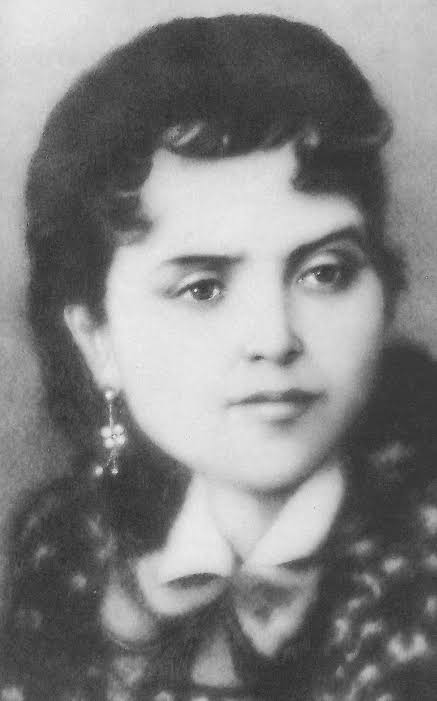
In 1872, the family reunited in Puerto Rico.   Dolores was 23 years old and would remain in the Americas’ until she was 28.   She began her contact with the Jesuits and Father Goicoechea became her spiritual adviser.   In Puerto Rico, she founded the Association of the Sodality of the Virgin Mary and the schools for the disadvantaged where she taught reading and writing, as well as Catechism.

In 1873, her father was named state attorney of Santiago de Cuba.   These were difficult times, because a religious schism was raging on the island.   Because of this, her work of  visiting the sick was prohibited.   She requested admission into the Sister of Charity community but was not admitted due to her poor eye sight.   At the age of 8, Dolores had an eye operation and this disability remained with her the rest of her life.

At the conclusion of the schism, she began working in the poor neighbourhoods and founded the “Centres of Instruction.”   There she taught Catechism, general instruction and provided medical assistance to those in need.   For these efforts she was able to get much assistance and was able to establish the centres in three different neighbourhoods.

Her mother died in Cuba and her father applied for retirement.   The family returned to Madrid in 1877.   In Madrid she organised her life on three fronts – her home and the care of her father, her apostolic work (the same work she did before leaving Spain) and her spiritual life (she chose a spiritual adviser and annually participated in Saint Ignatius Spiritual Retreat).   In 1883 her father died and once again she began to struggle with her vocation.   At the advice of her spiritual advisor, Father López Soldado, S.I., she entered the convent of the Salesians, even though she had never thought of devoting her whole life to contemplation.   After 10 days she left the convent, as she came to the realisation that this was not her vocation.   She then began to give all of her attention to her apostolic work.bl dolores sopena young artwork.jpg
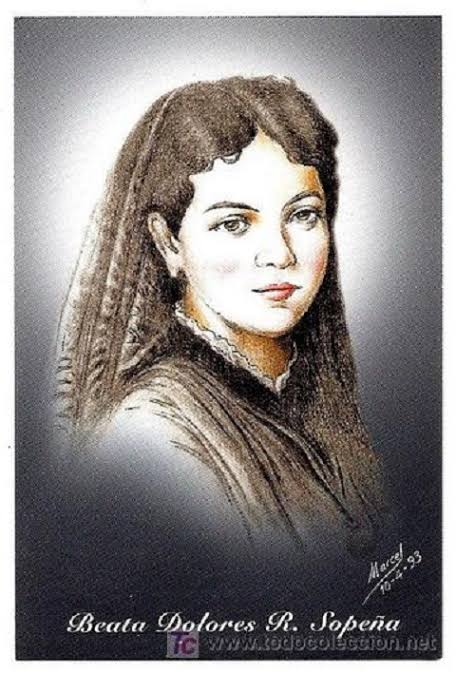
In 1885, Dolores opened a centre similar to modern social work centres.   There, the poor and the needy were able to take their problems and their concerns were addressed and resolved.   During this time she visited the neighbourhood of the Injurias.   When she saw the moral, material and spiritual condition of the people, she began visiting this area every week and invited many of her friends to help her with her work.   There she began the organisation “Works of the Doctrines,” later named “Centre for the Workers”.

In 1892, at the suggestion of the Bishop of Madrid, D. Ciríaco Sancha, she founded the Association of the Apostolic Laymen (which today is known as the Sopeña Lay Movement).   The following year she received approval from the government which allowed her to expand her work to 8 neighbourhoods of Madrid.

In 1896 she began her activities outside Madrid.   In 4 years she took 199 trips all over Spain to establish and consolidate the “Centre for the Workers.”   At the same time, she accompanied Father Tarin to Andalucía to help in the missions.

In 1900, Dolores participated in a pilgrimage to Rome for the celebration of the Holy Year.   There she took part in a retreat at the Saint Peter’s tomb and received approval to establish a Religious Institute that would provide continuation of her “Centre for the Workers” and help to sustain spiritually the Sopeña Lay Movement.   Cardinal Sancha, then Archbishop of Toledo, proposed founding it there.

The “Sisters of Catechetical Institute” was founded on 24 September 1901.  Dolores and 8 companions had just participated in the Spiritual Exercises, in Loyola, where St Ignatius was born and in the city of Toledo, on 31 October they started living as a religious community.bl dolores older artwork.jpg

One of the greatest inspirations that Dolores had, was to establish at the same time, the Civil Association which today is known as OSCUS or Social & Cultural Work Sopeña.   In 1902, the Association was officially recognised by the Spanish government.

In 1905, the Institute received from the Holy See the Degree of Praise.   Two years later, on 21 November 1907, Dolores received the approval directly from Pope Pius X.   Today the Institute is known as the “Sopeña Catechetical Institute”.

During these years, the anti clerical sentiment was an important facet in the decision for the religious community of this Institute not to wear a ‘habit’ and did not to wear any outward sign of religion.   These changes were made with the end result in mind – to get close to the workers who were “alienated from the church,” that had been unable to receive any cultural, moral or religious instruction and to unite those who were socially outcast.

One of the main objectives of the centres was to bring people together to give them an opportunity to learn from each other.   These encounters would result in mutual respect and a desire to help each other.

Her deep faith, rich in spirituality was the reason for her commitment to the service to others.   Her commitment to the dignity of people was born through her experience that God the Father of all, who loves us with infinite tenderness and who wishes for us to live as sons and brothers and sisters, was the driving force behind all that she did.   From there, she had a great desire to “Make of all, one family in Christ Jesus.”  Her total immersion in Christ allowed her to see Him in everything and feel Him in everyone, especially in those that were in the most need of dignity and love.

Towards the end of the 19th century, it was inconceivable to find a woman, who would go out to work in the poor neighbourhood.   The secret of her fearlessness was her deep faith, her confidence without limit.   She recognised this as her greatest treasure and it made her feel that she had become the instrument of God’s work, the instrument of love, hope, dignity and justice.

In a few years, she was able to established communities and centres in industrialised cities.   In 1910, the community celebrated the first General Chapter and Dolores was re-elected Superior General.   In 1914 she founded a community in Rome and in 1917 opened their first house in the Americas.

The following year, on 10 January 1918, Dolores Sopeña died in Madrid.   All were already speaking of her as being a saint.

On 11 July 1992, St John Paul II declared Dolores’ life work heroic and on 23 April 2002 he certified the miracle attributed to Dolores Sopeña which advanced her to Beatification status.

Currently the Sopeña Family which encompasses the three institutions founded by Dolores Sopeña are: the Sopeña Catechetical Institute, The Sopeña Lay Movement and the Sopeña Social and Cultural Work, can be found in Spain, Italy, Argentina, Colombia, Cuba, Chile, Ecuador, Mexico and the Dominican Republic.

Blessed Dolores’ life was a “constant doing” but a doing, with a clear understanding of being an instrument in God’s hands.   This experience develops in her such a sense of complete trust, that it made her courageous, capable of overcoming obstacles.   She developed such confidence in her trust in God, that she attempted all and everything, regardless of the fact that often, her endeavours were incredibly risky for a woman of her time…. Vatican.vabl dolores sopena old.jpg

Posted in SAINT of the DAY

Memorials of the Saints – 10 January

St Aldo of Carbonari
St Pope Agatho
Bl Anna of the Angels Monteagudo
St Arcontius of Viviers
Bl Benincasa of Cava
St Dermot of Inis Clothrann
St Domitian of Melitene
Bl Pope Gregory X
Bl Giles of Lorenzana
St Léonie Aviat/Françoise de Sales OSFS (1844-1914)
St Léonie’s Life:
https://anastpaul.com/2019/01/10/saint-of-the-day-10-january-st-leonie-francoise-de-sales-aviat-1844-1914/
St Marcian of Constantinople
Bl Maria Dolores Rodríguez Sopeña y Ortega (1848-1918)
St Maurilius of Cahors
St Nicanor of Cyprus
St Paul the Hermit
St Peter Orseolo OSB Cam. (928–987)

About St Peter:
https://anastpaul.wordpress.com/2018/01/10/saint-of-the-day-10-january-st-peter-orseolo-o-s-b-cam-928-987/

St Petronius of Die
Bl Raymond de Fosso
St Saethryth of Faremoutier
St Thecla of Lentini
St Thomian of Armagh
St Valerius of Limoges
St William of Bourges

Posted in MEDITATIONS - ANTONIO CARD BACCI, PRACTISING CATHOLIC, QUOTES - J R R Tolkien and MORE, QUOTES for the NEW YEAR, QUOTES on PRAYER

Thought for the Day – 9 January – Good wishes and resolutions?

Thought for the Day – 9 January – Meditations with Antonio Cardinal Bacci (1881-1971) – Fourth Day after Epiphany

Good wishes and resolutions?

“During these days, it is customary to exchange, verbally or in writing, good wishes for the New Year.
But these poor greetings are often nothing more than conventional phrases.
Men lack the power to transmute such good wishes into reality.
God alone is the source of every material and spiritual good, therefore, He alone can ensure that these benevolent expressions are translated into deeds of Christian renovation.
Since we are at the beginning of a new year, it is especially important for us to ask God more fervently and insistently, to bless the resolutions which are making for ourselves and the good wishes, which we are showering on our friends.

These wishes have no meaning and these resolutions have no force, if they are not accompanied by fervent and persevering prayer!”

Antonio Cardinal Baccigood wishes and resolutions -these wishes have no meaning - prayer - bacci 9 jan 2020.jpg

Posted in CHRIST, the WAY,TRUTH,LIFE, PRAYERS of the SAINTS, QUOTES of the SAINTS, SAINT of the DAY, The HOLY GHOST

Quote of the Day – 9 January – The Spirit of the Lord

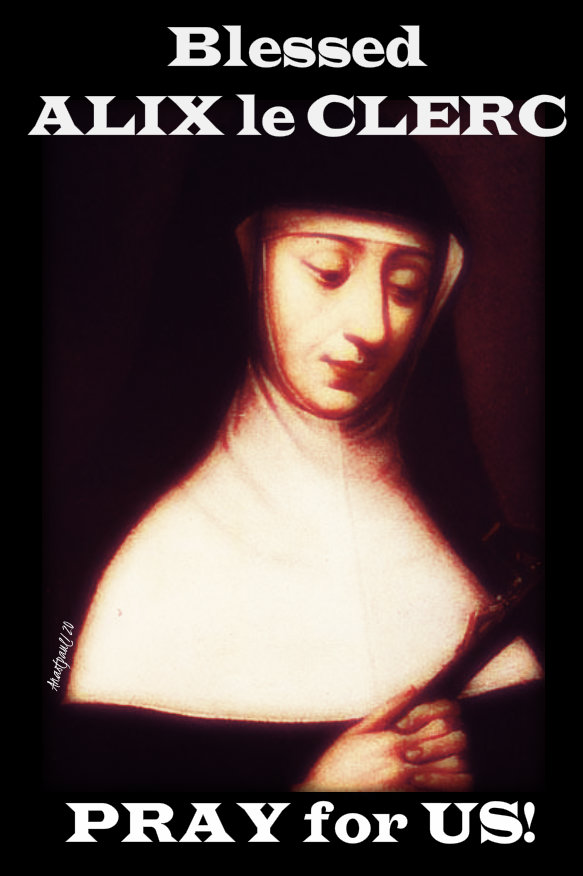
Quote of the Day – 9 January – The Memorial of Blessed Alix le Clerc/Teresa of Jesus CND (1576-1622) known as Mother Alix and the Fourth Day after Epiphany

“The Spirit of the Lord is upon me,
because he has anointed me to preach good news to the poor.
He has sent me to proclaim release to the captives
and recovering of sight to the blind,
to set at liberty those who are oppressed…”

Luke 4:18luke-4-18-the-spirit-of-the-lord-is-upon-me-27-jan-2019 and 9 Jan 2020.jpg

“My God and Lord,
send me the light
of Your Holy and Blessed Spirit,
that I may find the path of peace
which You declared to us
on the day of Your holy Nativity…
I implore You,
my God and Saviour,
to grant us all such grace,
that we may walk
by the road
it has pleased You
to tread for us…”

Blessed Alix le Clerc/Teresa of Jesus (1576-1622)my god and lord send me the light of your holy and blessed spirit - bl alix le clerc 9 jan 2020.jpg

“He is the Gospel of God,
He is the Mercy of God,
He is the liberation of God,
He is the One who became poor
so as to enrich us
with His poverty.”

Pope Francis

Angelus, 24 January 2016he is the gospel of god - pope francis - 27 jan 2019.jpg

Posted in CONFIRMATION, DOGMA, ONE Minute REFLECTION, SAINT of the DAY, The HOLY GHOST, The WORD

One Minute Reflection – 9 January – “The Spirit of the Lord is upon me”

One Minute Reflection – 9 January – Fourth Day after Epiphany, Readings: 1 John 4:19-5:4, Psalm 72:1-2, 14-15, 17, Luke 4:14-22 and the Memorial of Blessed Alix le Clerc/Teresa of Jesus CND (1576-1622) known as Mother Alix

“The Spirit of the Lord is upon me,
because he has anointed me to preach good news to the poor.
He has sent me to proclaim release to the captives
and recovering of sight to the blind,
to set at liberty those who are oppressed…”…Luke 4:18the-spirit-of-the-lord-luke-4-18-10-jan-2019 and 9 jan 2020.jpg

REFLECTION – “Symbols of the Holy Spirit:  Anointing.   The symbolism of anointing with oil signifies the Holy Spirit, to the point of becoming a synonym for the Holy Spirit.   In Christian initiation, anointing is the sacramental sign of Confirmation, called ‘chrismation’ in the Churches of the East.   Its full force can be grasped only in relation to the primary anointing accomplished by the Holy Spirit, that of Jesus.   Christ (in Hebrew ‘messiah’) means the one ‘anointed’ by God’s Spirit.

There were several anointed ones of the Lord in the Old Covenant, pre-eminently King David.   But Jesus is God’s Anointed in a unique way – the humanity the Son assumed, was entirely anointed by the Holy Spirit.   The Holy Spirit established Him as ‘Christ’.   The Virgin Mary conceived Christ by the Holy Spirit who, through the angel, proclaimed Him the Christ at His birth and prompted Simeon to come to the Temple to see Christ the Lord.   The Spirit filled Christ and the power of the Spirit went out from Him in His acts of healing and saving.

Finally, it was the Spirit who raised Jesus from the dead.   Now fully established as ‘Christ’ in His humanity victorious over death, Jesus pours out the Holy Spirit abundantly until the ‘saints’ constitute, in their union with the humanity of the Son of God, the perfect man “to the measure of the stature of the fullness of Christ” – “the whole Christ”, in St Augustine’s expression.” … CCC #695CCC 695 jesus is god's anointed one 9 jan 2020.jpg

PRAYER – Almighty, ever-living God, through Christ, Your Son, You made of us a new creation. Shape us then, in His likeness, by the gift of the Holy Spirit, since in Him, our human nature now lives with You.   Lord God, let Blessed Alix le Clerc ever commend us to Your love and care.   May her charity and wisdom inspire us to treasure Your teaching and express it in our lives.   Through our Lord Jesus, in union with the Holy Spirit, one God forever, amen.bl aliz le clerc pray for us 9 jan 2020.jpg

Posted in DOCTORS of the Church, Our MORNING Offering, PRAYERS of the SAINTS

Our Morning Offering – 9 January – Lord I am Yours

Our Morning Offering – 9 January – Fourth Day after Epiphany

Lord I am Yours
By St Francis de Sales (1567-1622)
Doctor of the Church

Lord, I am Yours,
and I must belong to no-one but You.
My soul is Yours
and must live only by You.
My will is Yours
and must love only for You.
I must love You
as my first cause,
since I am from You.
I must love You
as my end and rest,
since I am for You.
I must love You
more than my own being,
since my being
subsists by You.
I must love You
more than myself,
since I am all Yours
and all in You.
Amenlord I am yours by st francis de sales - 9 jan 2020.jpg

Posted in SAINT of the DAY

Saint of the Day – 9 January – Blessed Alix le Clerc/Teresa of Jesus CND (1576-1622)

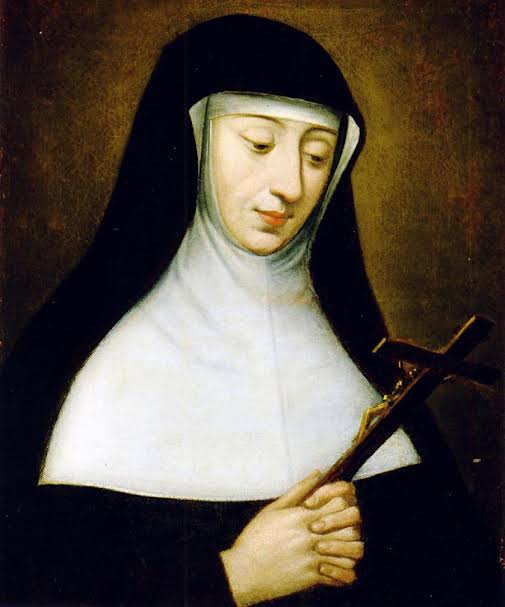
Saint of the Day – 9 January – Blessed Alix le Clerc/Teresa of Jesus CND (1576-1622) known as Mother Alix -Religious, Teacher, Apostle of the Poor and Founder of the Canonesses of St Augustine of the Congregation of Our Lady (French: Notre-Dame), a religious order founded to provide education to girls, especially those living in poverty.   They opened Schools of Our Lady throughout Europe.   Offshoots of this order brought its mission and spirit around the globe.bl alix le clerc.jpg

Alix (the local form of Alice) Le Clerc was born into a wealthy family in Remiremont in the independent Duchy of Lorraine, part of the Holy Roman Empire.   She was a vivacious girl who loved music and dancing.   She would spend her evenings partying with her young friends.   When she was about 18, her family moved to Mattaincourt, a manufacturing centre.

Conversion:
Three years later, a sudden illness confined her to her bed.   While there, her only reading material was a devotional book.   From the reading and reflection, while recuperating from her illness, Le Clerc began to feel the need for a change in her life.   She approached the Parish Priest of the town, Dom Peter Fourier, with whom she shared this growing conviction.   She was considering the religious life but that none of the religious orders appealed to her.

A vision of Our Lady answered her questioning and gave her the direction she sought, as she felt called to care for the daughters of the poor of the region, who had little or no access to education.   Supported in this by Fr Fourier (1565–1640), who himself had seen the desperate need for this among the rural populace of his parish, Alix resolved to commit her life to this goal.   She was joined in this enterprise by four of her friends, with whom she established a community where they could follow lives of simplicity, prayer and respecting the presence of God in each girl whom they would receive for instruction.

Foundress:
On Christmas Day 1597, Alix and her companions made private vows in the parish church to Fr Fourier.   The small community opened their first school the following July in Poussay, where they offered free education to the girls of the duchy.   Expansion of their work developed quickly, with communities being opened in Mattaincourt (1599), Saint-Mihiel (1602), Nancy (1603), Pont-à-Mousson (1604), Verdun and Saint-Nicolas-de-Port (1605).   All the schools took the name of Notre-Dame.

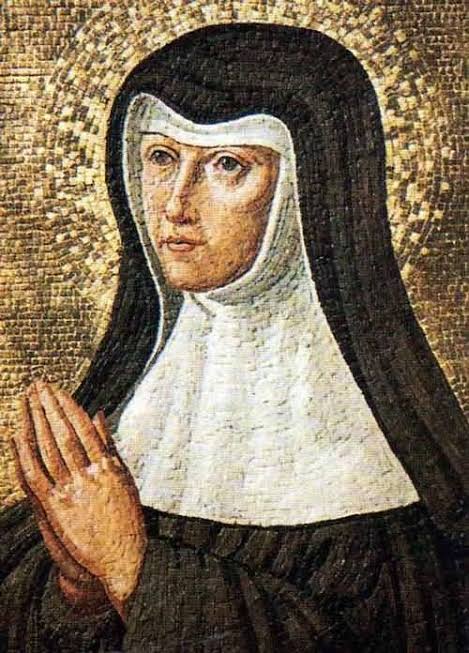
Alix established herself in Nancy, capital of the duchy and devoted herself to the care of the girls who came to the schools of the new congregation.   At the same time, working through major obstacles, she and Fourier developed constitutions for the new congregation through which the communities could be legally recognised by the Church and the State.bl alix le clerc mosaic.jpg

The vision Le Clerc and Fourier had was one in which schools would give a free education to all, poor and rich and all girls would be welcome, regardless of whether they were Catholic or Protestant.   Additionally, the other needs of their locales would be answered, with visits to the sick and poor.   They encountered resistance to this open form of life from the hierarchy, who did not look favourably on their teaching outside a cloister.   In consultation with the first Sisters, especially Le Clerc, the final form of the constitutions which Fourier wrote took an innovative answer to this, by allowing two ways of life to those women who wished to follow the goals of the congregation.   In keeping with ancient practice, each community would be autonomous, subject to the local bishop and would each have to seek this formal recognition on its own, from the local religious authorities.   The houses were to be of two forms, all following the Rule of St Augustine, as well as the constitutions:

“Convents whose members who would take public vows (canonesses) and would observe full monastic enclosure, wearing the habit of the congregation.
Convents whose members would take private vows (Daughters/Sisters of the congregation) and would be free to leave the convent, with the approval of the Superiors of the house for any legitimate purpose, such as going to Confession, participating in Mass when unable to do so in the convent, or participating in works of charity.   They would not wear the religious habit of the Congregation but instead one developed for that community.”
The first approval for the Constitutions came on 6 March 1617 from the Bishop of Toul, in whose territory Nancy then lay, as a result of which that became the first monastery of the congregation.   Le Clerc and the members of that community professed public vows on 2 December 1618, at which time she took the religious name of Teresa of Jesus, after the great Carmelite foundress.   Immediately following the ceremony, Fourier met with the assembled Superiors of the various houses and distributed copies of the approved constitutions, for their study and observance.   Shortly after that, the canonesses of Nancy held their first formal elections and Sr Teresa of Jesus was elected the prioress of the community.

st peter fourier.jpg
St Peter Fourier

Sr Teresa of Jesus oversaw the development of the congregation as the various houses, each in their own turn, became formally recognised.   For the rest of her life, she led the development of the spiritual and practical aspects of the lives of the canonesses in the various monasteries.   She would visit each new community, to instill in them the spirit of their founding, saying to them, “May God be your only love!” Que Dieu soit votre amour entier!  reflecting the deep spiritual life she maintained in the midst of her responsibilities in the congregation.431px- bl Alix_Le_Clerc_3

Death and veneration:
Sr Teresa of Jesus died on 9 January 1622 at the convent in Nancy.   She was buried in the cemetery of the convent in a lead coffin.

The cause for her Canonisation was begun in the latter part of the century but proceeded slowly.   The monastery in Nancy was destroyed during the upheavals of the French Revolution and the traces of the grave were lost.   With the re-establishment of Catholic institutions in France in the early 19th-century, the cause was taken up again but faced the difficulty of there being no remains, normally required during the process.   Various efforts were made by a number of priests to find Le Clerc’s remains in the precincts of the former cloister of the monastery over the next century, without success.

Despite this obstacle, the Holy See decided to proceed with the Beatification of Mother Teresa of Jesus.   This was celebrated by Pope Pius XII on 4 May 1947.

Finding her remains:
Not long after this declaration of her holiness by the Church, in 1950 a group of young students in Nancy was exploring the basement of a building in the city and found a lead coffin buried nearly 5 feet (1.5 meters) below the ground.

By 1960, the remains were conclusively identified as those of Blessed Alix and were placed for veneration in the chapel of the Notre Dame School of the city.   A special chapel was eventually built for the remains in the cathedral and they were transferred there on 14 October 2007, where they are available for veneration by the public.

Legacy:
The congregation spread throughout France, into which the duchy was forcibly absorbed in the 1630s.   Within thirty years of Le Clerc’s death, the monastery which had been established in Troyes was instrumental in the extension of her vision to the New World. Through a connection with the governor of Fort Ville-Marie in the colony of New France, the canonesses had offered to go there to educate its children but the governor felt, that the colony was unable to support a cloistered community of teachers at that stage of its development.   Instead, they recruited St Marguerite Bourgeoys, the president of a sodality attached to the community, to bring this service to the colony.   She went there in 1653 and within five years her work there led to the founding of the Congregation of Notre Dame of Montreal, an unenclosed institute of religious sisters with the same goal of free education for the poor.   Today, they have 1,150 Sisters serving worldwide.

The congregation had also spread to other regions of Europe by the time it faced a century of upheaval, starting with the French Revolution, which closed many of their houses.   In central Europe, communities were scattered, moving back and forth between Germany (founded in 1640) and Bohemia.   Out of this chaos, Theresa Gerhardinger, a former student of the suppressed monastery in Stadtamhof, came to found the School Sisters of Notre Dame in the Kingdom of Bavaria in 1833.   It currently has 3,500 members working in over 30 countries around the world.

At the time of St Peter Fourier’s Canonisation in 1897 by Pope Leo XIII, thirty convents of the congregation still functioned in Europe.   Over the next decades, the congregation expanded to South America, Africa and Asia and they now serve in 43 nations.   Their mission has expanded to include work for human rights, such as the protection of the rights of migrants and the promotion of justice for developing nations.   The General Chapter of 2008 formally recognised the many groups of alumni and associates of the congregation which had sprung up around the world as full partners in the heritage of St Fourier and Blessed Alix Le Clerc.AlixPierre.gif

Posted in SAINT of the DAY

Feast of the Black Nazarene and Memorials of the Saints – 9 January

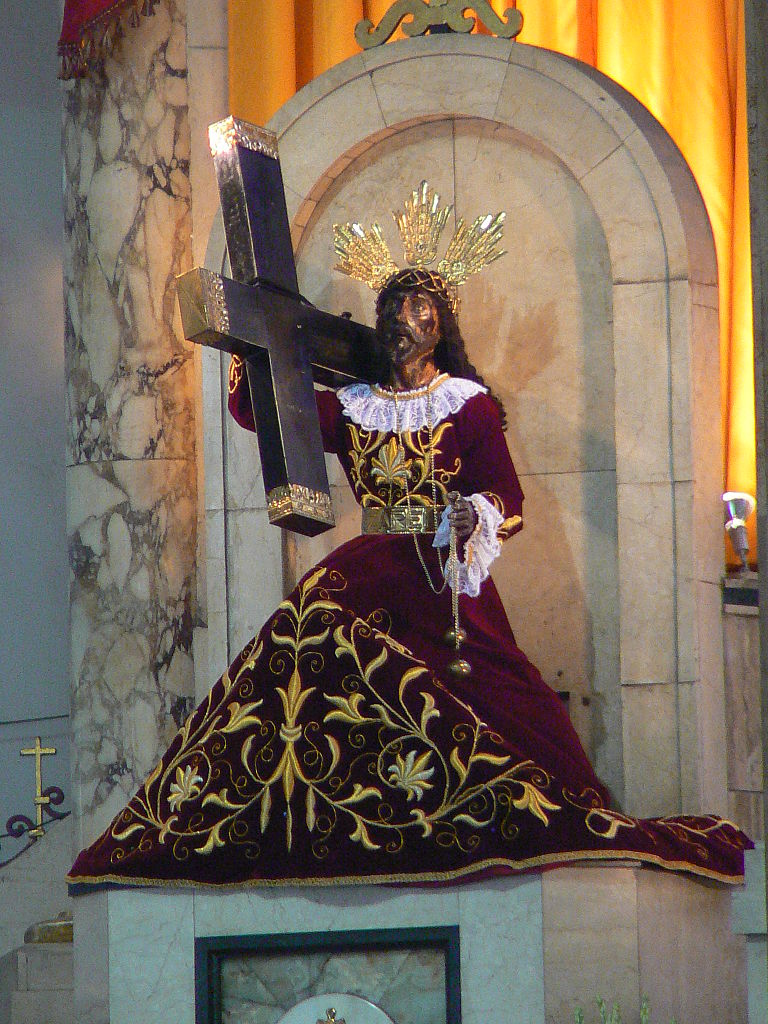
Feast of the Black Nazarene, 9 January:
The Black Nazarene is a blackened, life-sized wooden icon of Jesus Christ carrying a cross. It was constructed in Mexico in the early 17th century by an Aztec carpenter. Spanish Augustinian Recollect friar missionaries to Manila, Philippines originally brought the icon to Manila in 1606.   The transport ship caught fire, burning the icon but the locals kept the charred statue. Miracles, especially healings, have been reported in its presence.   The church in which it stood burned down around it in 1791 and 1929, was destroyed by earthquakes in 1645 and 1863 and was damaged during bombing in 1945.   It used to be carried through the streets every January and Christians would rub cloths on it to make healing relics but centuries of this treatment have left the statue in bad shape and since 1998 a replica is paraded at the feast day celebrations.   In 1650, Pope Innocent X issued a papal bull which canonically established the Cofradia de Jesús Nazareno to encourage devotion. In the 19th century Pope Pius VII granted indulgences to those who piously pray before the image. Patronage: Quiapo, Philippines.768px-black_nazarene.jpg

St Adrian of Canterbury (c 635-710)
About St Adrian:
https://anastpaul.wordpress.com/2018/01/09/saint-of-the-day-9-january-st-adrian-of-canterbury-c-635-710/

https://youtu.be/JPnrrfvsMZ8

Blessed Alix le Clerc/Teresa of Jesus CND (1576-1622)
St Agatha Yi
Bl Antony Fatati
St Brithwald of Canterbury
St Eustratius of Olympus
Bl Franciscus Yi Bo-Hyeon
St Honorius of Buzancais
Bl Józef Pawlowski

Sts Julian and Basilissa (died c 304) Martyrs

Biography:
https://anastpaul.com/2019/01/09/saints-of-the-day-sts-julian-and-basilissa-died-c-304-martyrs/
Bl Kazimierz Grelewski
St Marcellinus of Ancona
St Marciana
Bl Martinus In Eon-min
St Maurontius
St Nearchus
St Paschasia of Dijon
St Peter of Sebaste
St Philip Berruyer
St Polyeucte
St Teresa Kim
St Waningus of Fécamp

Martyrs of Africa – 21 saints: A group of 21 Christians murdered together for their faith in the persecutions of Decius. The only details to survive are 14 of their names – Artaxes, Epictetus, Felicitas, Felix, Fortunatus, Jucundus, Pictus, Quietus, Quinctus, Rusticus, Secundus, Sillus, Vincent and Vitalis. They were martyred in c 250.
Martyrs of Antioch – 6 saints: A group of Christians martyred together during the persecutions of Diocletian – Anastasius, Anthony, Basilissa, Celsus, Julian and Marcionilla.

Posted in PRAYERS for CANONISATION, SAINT of the DAY

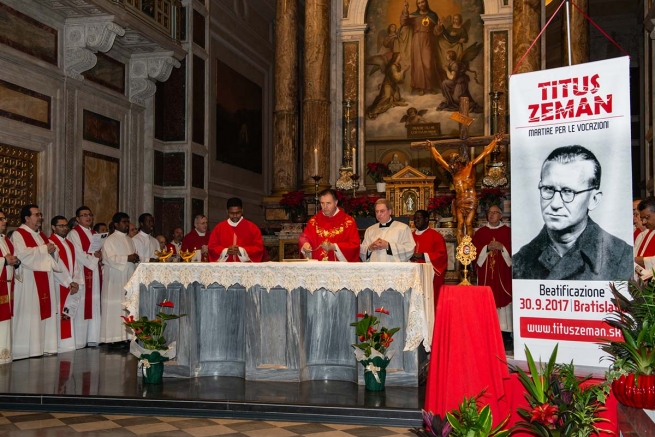
Second Thought for the Day – 8 January – Blessed Fr Titus Zeman

Second Thought for the Day – 8 January – Third day after Epiphany and the Memorial of Blessed Titus Zeman SDB (1915-1969) Priest and Martyr

Many people who knew Fr Titus offered their testimony about his character, dedication and courage, even before the events that led to his martyrdom.   One of his students described him as “my spiritual father.”   Another calls him “simple-hearted, very funny and a great sportsman.”   He helped hide Jews during World War II and hide nuns when the Red Army advanced through Slovakia.   A Salesian student of theology remarked on how he helped clean up their school after the Russians left it full of excrement and stinking like a sewer:  “I saw there his great love and tenacity for his work.   He was a true Salesian who did everything in a humble way.   It was clear he liked us, the young students of theology, a lot.   He saw us as the hope for the Salesian Congregation in Slovakia.”bl titus zeman mass celebration of his birth

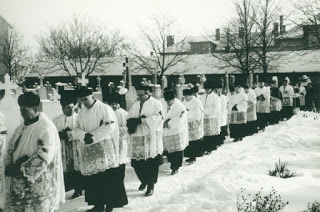
Fr Zeman’s “funeral was exceptionally touching … not only because of its outer aspects (it was a true triumph of sympathy, wonder and gratitude) but, mainly because such unity of emotion … is truly rare.   There was not only a homily at the Mass but also several speeches and a funeral oration.   All of the speakers emphasised the great qualities of the deceased – conscientiousness, strength of his spirit, profound faith, strong will, transcendental devotion to God’s will but mainly absolute self-sacrifice for the priestly ideal and effort to save young priestly vocations for the Church and the Salesian Society.”1-9 Zeman funeral (800x532)

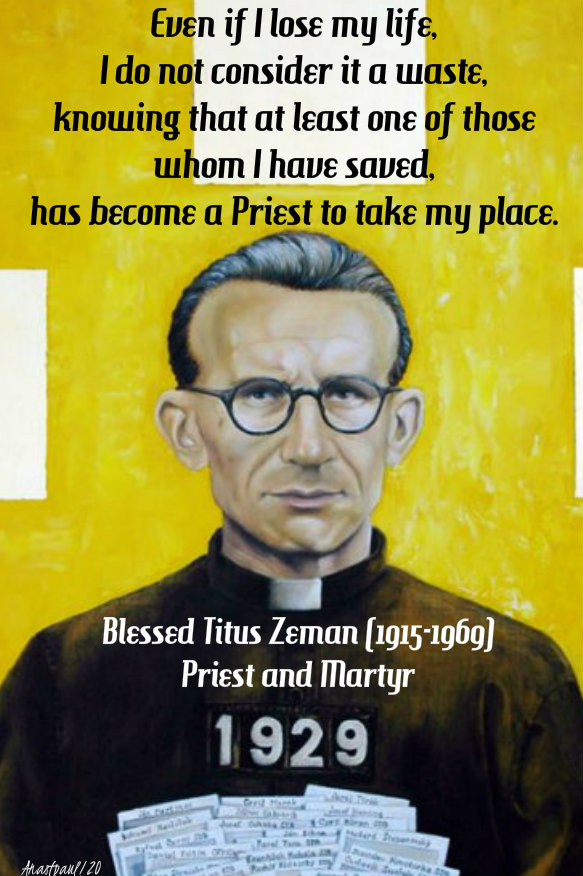
Blessed Titus’s best known saying is probably, “Even if I lose my life, I do not consider it a waste, knowing that at least one of those whom I have saved has become a priest to take my place.”   At his funeral the Slovak provincial noted that more than 50 priests and religious owed their vocations to him, his life was a kernel of wheat that fell to the ground and produced abundant fruit.   “If every priest who died in Slovakia left such religious posterity, the funerals of Slovak priests would mean not a decrease but an increase in the priestly ranks.”

Blessed Titus Zeman, Pray for the Salesians, for all the Church, our Priests and us all, amen!

Prayer for the canonisation of Fr Titus Zeman

Almighty God,
you called Fr Titus Zeman
to follow St John Bosco’s charism.
Under the protection of Mary Help of Christians
he became a priest and an educator of the young.
He lived in accordance with your commandments,
and was known and respected among the people
for his friendly character and availability to everyone.
When the Church’s enemies
suppressed human rights and freedom of the Faith,
Fr Titus did not lose courage
and persevered in the way of truth.
Because of his fidelity to his Salesian vocation
and because of his generous service of the Church,
he was incarcerated and tortured.
He bravely resisted his torturers
and was mocked and humiliated because of this.
He suffered it all out of love and with love.
We ask you, almighty Father,
to grant that Blessed Titus
be enrolled among your saints
and through his intercession,
grant us the grace that we now ask you.
Through Christ Our Lord,
Amenbl titus zeman pray for us no 2- 8 jan 2020

Posted in MEDITATIONS - ANTONIO CARD BACCI, QUOTES - J R R Tolkien and MORE, QUOTES on DEATH, The LAST THINGS

Thought for the Day – 8 January – Death

Thought for the Day – 8 January – Meditations with Antonio Cardinal Bacci (1881-1971) – Third Day after Epiphany

Death

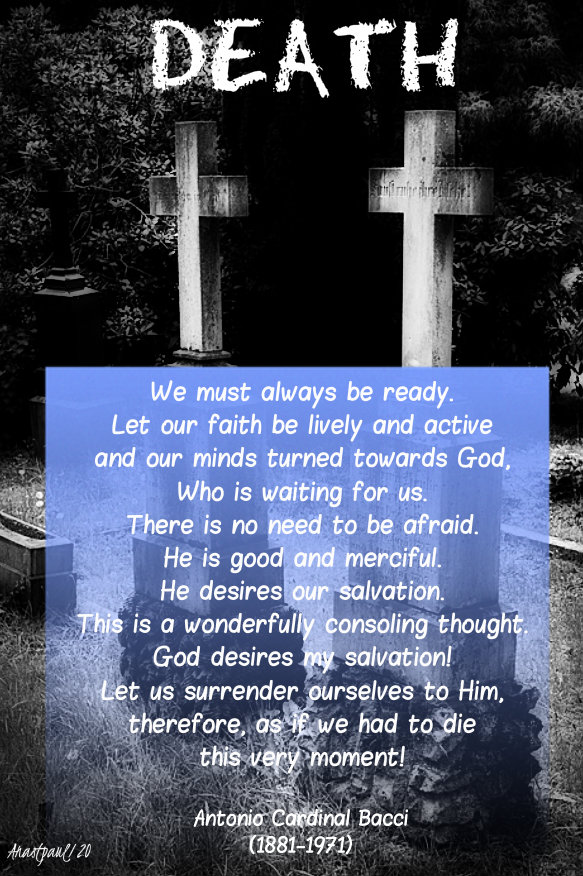
death - we must always be ready - bacci - 8 jan 2020.jpg

In theory, everybody believes in death.
In practice, many live as if they did not believe in it.
So, it is necessary and helpful, for us to meditate on death.
We begin to die on the day when we were born.
People say:  “I have lived twenty, thirty or forty years.” But, if they said, “I have used up twenty or thirty or forty years of my life,” how many would then be left?   We do not know, we only know that death will come at the very moment when we least expect it.
Let us always be prepared.
“You also must be ready, because at an hour that you do not expect, the Son of Man is coming.” (Lk 12:40)

We must always be ready.
Let our faith be lively and active and our minds turned towards God, Who is waiting for us.
There is no need to be afraid.
He is good and merciful.
He desires our salvation.
This is a wonderfully consoling thought.   God desires my salvation!
Let us surrender ourselves to Him, therefore, as if we had to die this very moment!

Antonio Cardinal Bacci

Posted in FATHERS of the Church, POETRY, QUOTES - J R R Tolkien and MORE, QUOTES on COURAGE, QUOTES on DEATH, QUOTES on FAITH, QUOTES on FEAR, QUOTES on TRUST and complete CONFIDENCE in GOD, SAINT of the DAY, The WORD

Quote/s of the Day – 8 January – “Take courage, it is I” and Bl Titus Zeman

Quote/s of the Day – 8 January – Third day after Epiphany, Readings: 1 John 4:11-18, Psalm 72:1-2, 10-13, Mark 6:45-52 and the Memorial of Blessed Titus Zeman SDB (1915-1969) Priest and Martyr

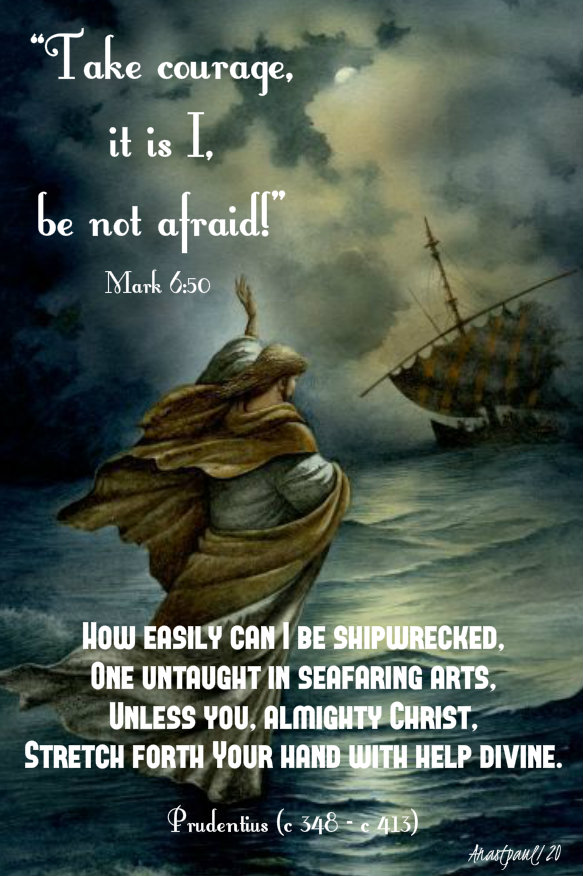
“They had all seen him and were terrified.   But at once he spoke with them, “Take courage, it is I, be not afraid!” (Mark 6:50)

Prudentius (c 348 – c 413) (formally known as Aurelius Clemens Prudentius) comments on this verse from the Gospel proclaimed during today’s Mass:

Thus I by my loquacious tongue
From the heaven of silence am led
Into perils unknown and dark.

Not as Peter, disciple true,
Confident in his virtue and faith,
I am as one whose unnumbered sins
Have shipwrecked on the rolling seas.

How easily can I be shipwrecked,
One untaught in seafaring arts,
Unless you, almighty Christ,
Stretch forth Your hand with help divine.

(Against Symmachus, 2)

Aurelius Prudentius Clemens was a Roman Christian poet, born in the Roman province of Tarraconensis (now Northern Spain) in 348.   He probably died in the Iberian Peninsula some time after 405, possibly around 413.
Prudentius practised law with some success and was twice provincial governor, perhaps in his native country.   Towards the end of his life (possibly around 392) Prudentius retired from public life to become an ascetic, fasting until evening and abstaining entirely from animal food and writing poems, hymns and controversial works in defence of Christianity. Prudentius later collected the Christian poems written during this period and added a preface, which he himself dated 405.
The poetry of Prudentius is influenced by early Christian authors, such as Tertullian and St. Ambrose, as well as the Bible and the acts of the martyrs.   His hymn Da, puer, plectrum (including “Corde natus ex parentis” – “Of the Father’s Love Begotten”) and the hymn for Epiphany O sola magnarum urbium (“Earth Has Many A Noble City”), both from the Cathemerinon, are still in use today.mark 6 5- it is I be not afraid - how easily can I be shipwrecked - prudentius 8 jan 2020.jpg

“Even if I lose my life,
I do not consider it a waste,
knowing that at least one of those
whom I have saved,
has become a Priest
to take my place.”

Blessed Titus Zeman

even if i lose my life - bl titus seman 8 jan 2020.jpg