Thought for the Day – 6 October – Meditations with Antonio Cardinal Bacci (1881-1971)
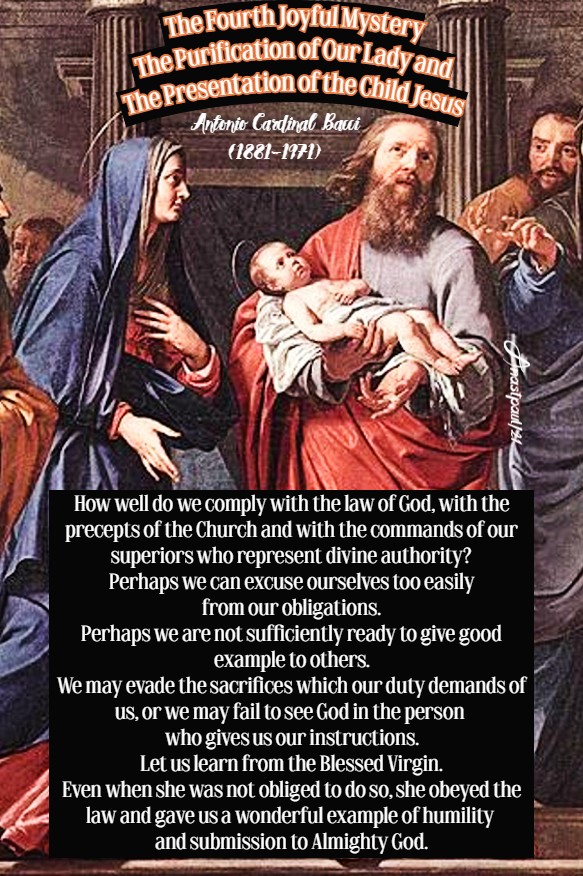
“Month of the Holy Rosary” The Fourth Joyful Mystery The Purification of Our Lady and The Presentation of the Child Jesus in the Temple
“Since the fall of our first parents, human mothers have carried in their wombs, souls dead to grace and have given birth to children stained with sin. Therefore, it is necessary for the waters of Baptism to confer on these infants, a second life, the supernatural life. A ceremony of purification is also required for these mothers, a rite which was of obligation under the Old Law but, under the New Law, remains only as a pious custom.
The Blessed Virgin was not subject to the rule of sin. By a special privilege, she was preserved free from the stain of original sin and was created and conceived in the fullness of grace. Moreover, she became a mother, not by any human agency but, by the power of the Holy Spirit, which preserved intact, her angelic virginity. For this reason, Mary was not bound by the Mosaic Law which laid down the ceremony of purification as necessary for all mothers. Nevertheless, in order to give us an example of humility and of absolute obedience to the law of God, she chose to fulfil this sacred rite.
How well do we comply with the law of God, with the precepts of the Church and with the commands of our superiors who represent divine authority? Perhaps we can excuse ourselves too easily from our obligations. Perhaps we are not sufficiently ready to give good example to others. We may evade the sacrifices which our duty demands of us, or we may fail to see God in the person who gives us our instructions.
Let us learn from the Blessed Virgin. Even when she was not obliged to do so, she obeyed the law and gave us a wonderful example of humility and submission to Almighty God.”
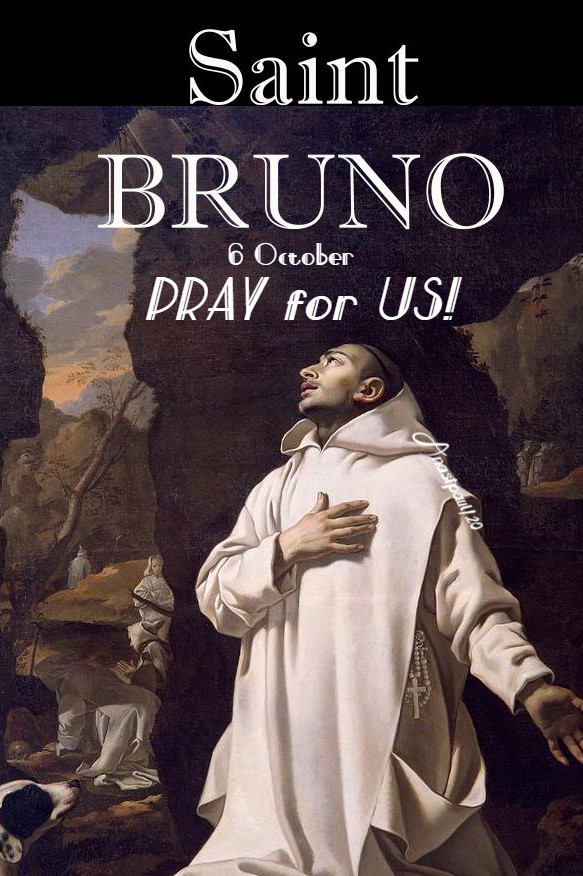
Quote/s of the Day – 6 October – The Memorial of St Bruno O.Cart (c 1030-1101)
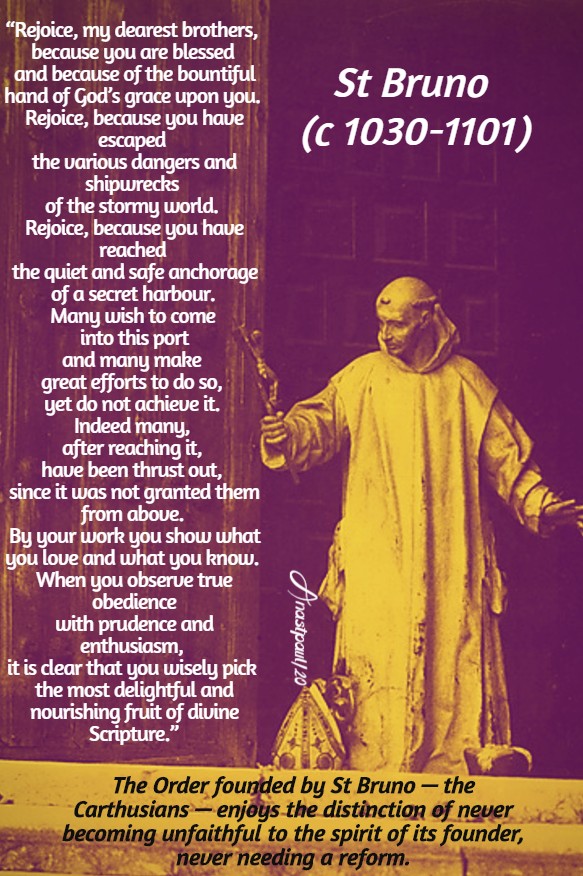
The Order founded by st Bruno — the Carthusians — is one of the strictest in the Church. Carthusians follow the Rule of St Benedict but accord it a most austere interpretation; there is perpetual silence and complete abstinence from flesh meat (only bread, legumes and water are taken for nourishment). Bruno sought to revive the ancient eremitical (hermit) way of life. His Order enjoys the distinction of never becoming unfaithful to the spirit of it’s founder, never needing a reform.
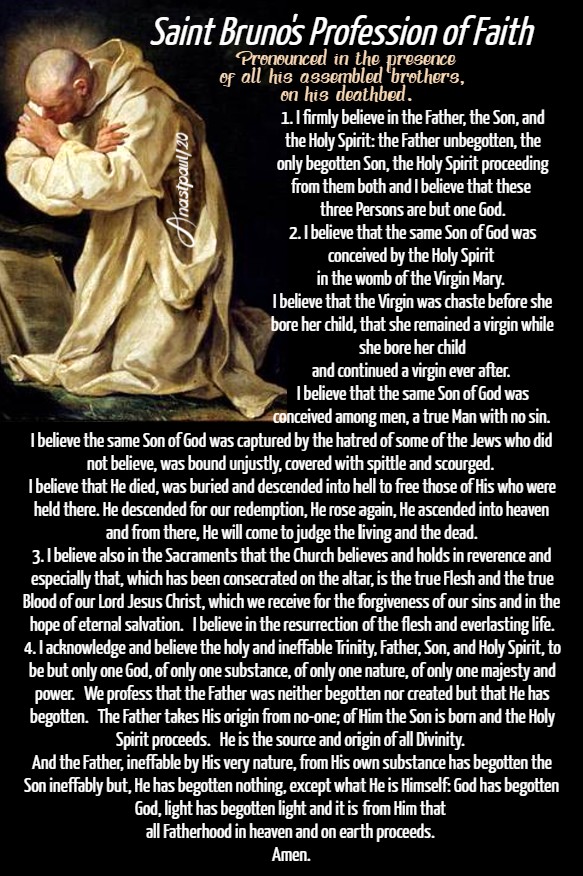
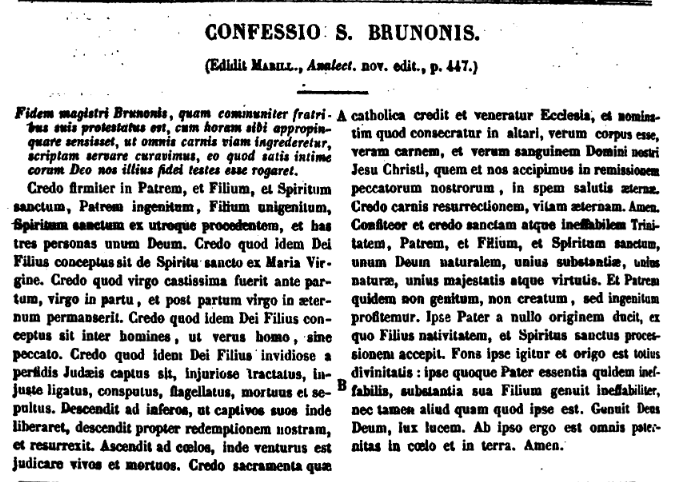
Saint Bruno’s Profession of Faith, which he pronounced in the presence of all his assembled brothers, when he felt the time was approaching for him to go the way of all flesh, because he had urgently requested us to be witnesses of his faith before God:
I firmly believe in the Father, the Son, and the Holy Spirit: the Father unbegotten, the only begotten Son, the Holy Spirit proceeding from them both and I believe that these three Persons are but one God.
I believe that the same Son of God was conceived by the Holy Spirit in the womb of the Virgin Mary. I believe that the Virgin was chaste before she bore her child, that she remained a virgin while she bore her child and continued a virgin ever after. I believe that the same Son of God was conceived among men, a true Man with no sin. I believe the same Son of God was captured by the hatred of some of the Jews who did not believe, was bound unjustly, covered with spittle and scourged. I believe that He died, was buried and descended into hell to free those of His who were held there. He descended for our redemption, He rose again, He ascended into heaven and from there, He will come to judge the living and the dead.
I believe also in the Sacraments that the Church believes and holds in reverence and especially that, which has been consecrated on the altar, is the true Flesh and the true Blood of our Lord Jesus Christ, which we receive for the forgiveness of our sins and in the hope of eternal salvation.
I believe in the resurrection of the flesh and everlasting life.
I acknowledge and believe the holy and ineffable Trinity, Father, Son, and Holy Spirit, to be but only one God, of only one substance, of only one nature, of only one majesty and power.
We profess that the Father was neither begotten nor created but that He has begotten. The Father takes His origin from no-one; of Him the Son is born and the Holy Spirit proceeds. He is the source and origin of all Divinity. And the Father, ineffable by His very nature, from His own substance has begotten the Son ineffably but, He has begotten nothing, except what He is Himself: God has begotten God, light has begotten light and it is from Him that all Fatherhood in heaven and on earth proceeds. Amen.
The Creed Every late of the night, in a cell at the end of the Office of Lauds of Our Blessed Virgin Mary, about around 2:30 am, the Carthusians always recite a choice between three catholic creeds: The Athanasian Creed [QUICUNQUE VULT] | The Apostle’s Creed The Nicene Creed. This is a deep transforming contemplative prayer of our revealed Creed, like a constant heartbeat and is the defining of the heart of the Carthusian souls in Trinitarian life and of Saint Bruno’s followers’ vocation of devoted presence, like the Seraphim before the revealed God, in the Church for the world.
“Rejoice, my dearest brothers, because you are blessed and because of the bountiful hand of God’s grace upon you. Rejoice, because you have escaped the various dangers and shipwrecks of the stormy world. Rejoice, because you have reached the quiet and safe anchorage of a secret harbour. Many wish to come into this port and many make great efforts to do so, yet do not achieve it. Indeed many, after reaching it, have been thrust out, since it was not granted them from above. By your work you show what you love and what you know. When you observe true obedience with prudence and enthusiasm, it is clear that you wisely pick the most delightful and nourishing fruit of divine Scripture.”
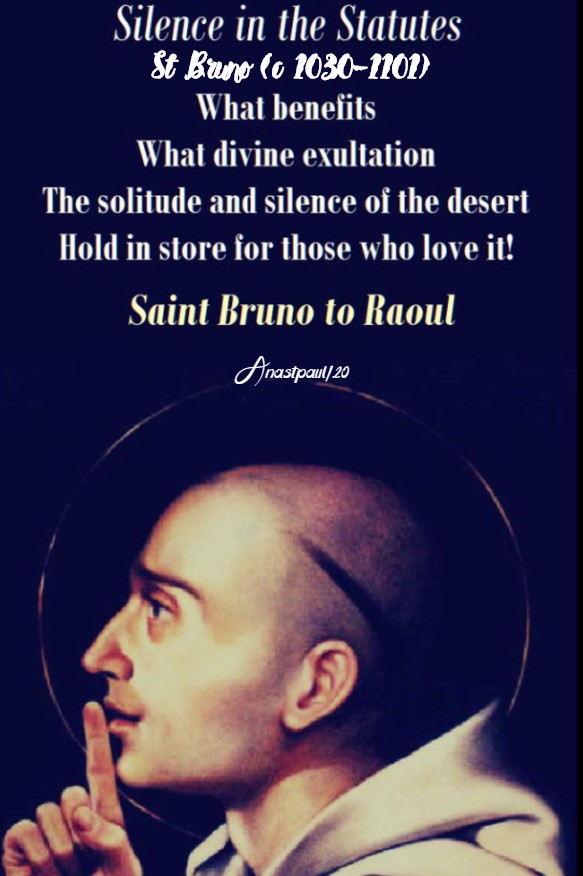
“What benefits What divine exultation The solitude and silence of the desert Hold in store for those who love it!”
One Minute Reflection – 6 October – Tuesday of the Twenty Seventh week in Ordinary Time, Readings: Galatians 1:13-24, Psalms 139:1-3, 13-14, 14-15, Luke 10: 38-42 and the Memorial of St Bruno O.Cart. (c 1030-1101)
“As they continued their journey he entered a village where a woman whose name was Martha welcomed him. She had a sister named Mary [who] sat beside the Lord at his feet listening to him speak…”– Luke 10:38-39
REFLECTION – “Adopt the habit of conversing one to one with God, familiarly, trustingly and with love, as though with the dearest and most affectionate friend you have. (…)
You are not being asked for a continual application of spirit that makes you forget your duties or even your recreational times. Without neglecting your occupations, you are only being asked to behave with God, in the different circumstances that present themselves, as you act with people who love you and whom you love. Your God is always beside you, not to say within you: “In him we live and move and have our being” (Acts 17:28). Whoever wishes to speak to Him has no need of setting up an antechamber, far from it! God wants to see you treat Him without ceremony. Converse with Him about your affairs, projects, annoyances, fears and all that interests you. The essential thing, I repeat, is that you do it without embarrassment and with an open heart. Indeed, God does not speak at all, to the soul that does not speak to Him and who, in consequence, only hears His voice with difficulty, not being accustomed to speak to Him. (…)
It is true that we owe God sovereign respect. But when He favours you with the feeling of His presence and encourages you to speak to Him as to the best of your friends, open your heart freely and with all confidence.” – St Alphonsus Maria de Liguori (1696-1787) Bishop and Doctor of the Church – To converse with God is both pleasant and easy
PRAYER – Lord God, You called St Bruno to serve You in a life of solitude. Amidst this world’s changes, help us, by his prayers, to set out hearts always on You. Heavenly Father, let me realise that You guide our lives through Your Providence, Your Word and Sacraments. Help me to be obedient to the rules for my state in life and so be obedient to Your will for me. Grant that the prayers of St Bruno may assist us as we strive to grow in humility. Through our Lord, Jesus Christ, Your Son in union with the Holy Spirit, one God forever and ever, amen.
Our Morning Offering – 6 October – Tuesday of the Twenty Seventh week in Ordinary Time
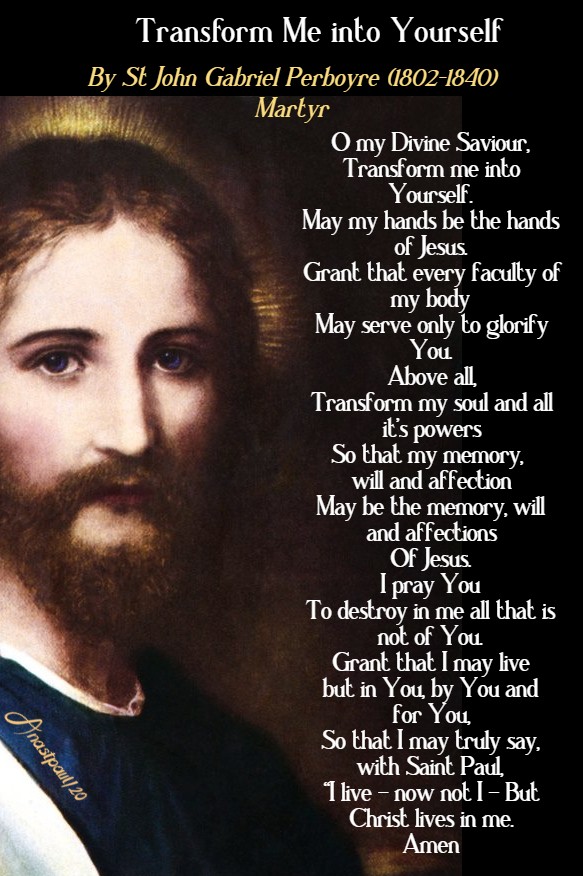
Transform me into Yourself By St John Gabriel Perboyre (1802-1840) Martyr
O my Divine Saviour, Transform me into Yourself. May my hands be the hands of Jesus. Grant that every faculty of my body May serve only to glorify You. Above all, Transform my soul and all it’s powers So that my memory, will and affection May be the memory, will and affections Of Jesus. I pray You To destroy in me all that is not of You. Grant that I may live but in You, by You and for You, So that I may truly say, with Saint Paul, “I live – now not I – But Christ lives in me. Amen
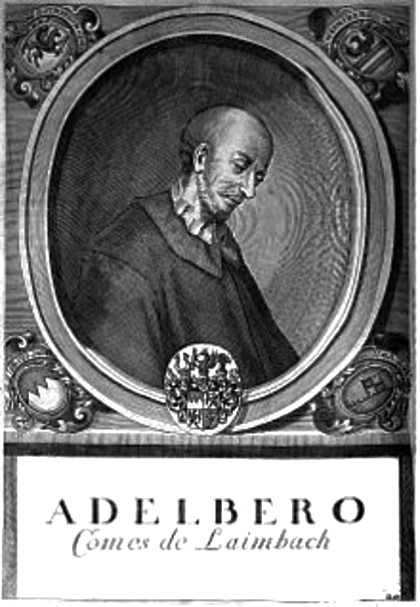
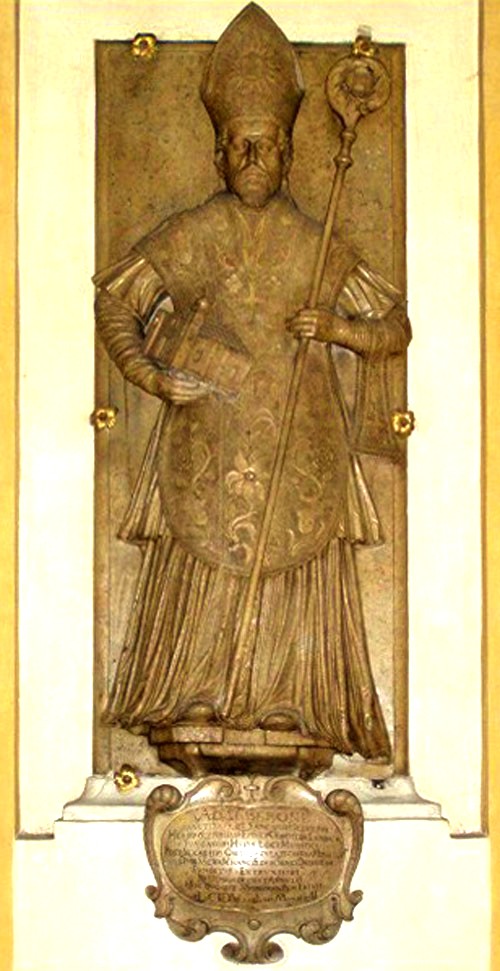
Saint of the Day – 6 October – Blessed Adalbero of Lambach (c 1010–1090) Bishop of Würzburg and Count of Lambach-Wels, Reformer, Mediator and Advisor, founder of Churches and Monasteries – born c 1010 in Lambach an der Traun, Austria and died on 6 October 1090 at the Abbey at Lambach, Austria of natural causes, where his mortal remains were buried. Blessed Adalbero’s Episcopal Motto was “Christ yesterday, today and forever.”
Adalbero was born around 1010 in Lambach an der Traun. He was the youngest son of the Carinthian Margrave. Arnold II of Lambach-Wels (Upper Austria) and his wife, the East Franconian Countess Reginlindis. The youngest and, after the violent death of his brothers in 1050, the last male offspring of the family. He was sent to study at the Würzburg Cathedral School, which at the time was highly regarded.
After his studies in the Cathedral School at Würzburg and later in Paris, Adalbero became a Canon of Würzburg. In 1045, King Henry III, nominated Adalbero successor to Bruno, who was Adalbero’s Uncle, as Bishop of Würzburg.
Bishop Adalbero continued the construction of the new Würzburg Cathedral begun by Bruno, adding the east crypt and the east choir. He established the “Neumünsterkirche” (“New Minster Church”) (built between 1058 and 1063). Significant contributions in the reform of ecclesiastical life are attributed to him. He was in close contact with the reformers at Cluny, Gorze and Hirsau. He brought the monk Egbert from Gorze, who proved extremely effective firstly in bringing about renewal.
In 1056 he began the restoration of the Abbey of Lambach, founded by his father in the family castle. After the death of Henry III that same year, Adalbero, Godfather to Henry IV, spent more time attending court, where he gained a reputation as an advisor and mediator. He also intensified his involvement in the councils of the empire and in the synods.
Lambach Abbey
In 1057 Adalbero re-settled the Abbey of St Peter, Paul and Stephen in Würzburg, until then a College of Canons Regular, with Benedictines from Münsterschwarzach. In 1066 in Würzburg he performed the marriage ceremony between Henry IV and Bertha of Savoy. Together with other Princes he brokered the Peace of Speyer in 1075.
Steadfast fighter for the Church and the Pope: In the Investiture Controversy (Controversy between Church and State related to the choosing and investiture of Bishops) which broke out shortly afterwards, Adalbero took the side of Pope Gregory VII in opposition to Henry IV (remember he was the Godfather of Henry IV and his tutor). Gregory objected to the practice of the appointment of Bishops being vested in territorial princes rather than in the Papacy. The Synod of Worms however, supported Henry against Gregory’s ideas and declared the Pope deposed, whereupon Gregory excommunicated Henry, forcing him to set off on the famous “walk to Canossa” (January 1077) to see the Pope and seek absolution.
Having obtained this, however, the dependency of the Bishops on the King was once again reinforced. Adalbero and other Princes, therefore, in March 1077 appointed as anti-king Duke Rudolf of Rheinfelden. Henry IV, hastened to return to Germany and in the same year besieged Wurzburg. Wurzburg was strategically important because it controlled communications between the rebel areas of Saxony and Swabia. Having succeeded in raising the citizens against Adalbero, the Bishop had to leave the city. King Henry appointed a series of anti-bishops.
In 1086 Rudolf of Rheinfelden returned him to Würzburg but he was soon ejected again. Adalbero rejected all attempts at mediation and compromise proposals – Henry IV is said to have offered him the diocese again, saying that he would die rather than yield. At the Synod of Mainz in 1085, therefore, he was formally deposed and forced into exile. He remained faithful to the Pope and was sent to his Monastery in Lambach. In 1088 Adalbero renounced his episcopal dignity and dedicated the Monastery of Komburg, near Schwabisch Hall, in Württemberg. The following year, he was also co-founder of Zwiefalten Abbey in Swabia. On 6 October 1090 he died in Lambach and was buried in the Abbey church which he himself had founded and dedicated.
Soon after his death he began to be venerated as a saint in his Austrian home and his veneration in Münsterschwarzach is evidenced since the 17th century.
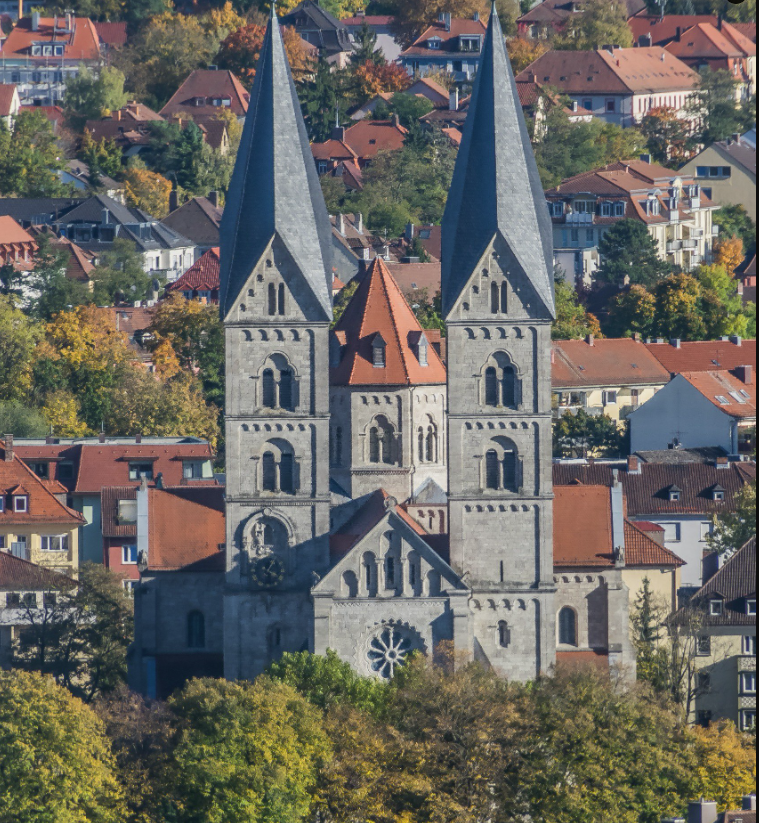
In 1883 Pope Leo confirmed Adalbero’s cult and Beatified him. Since 1948, in the “Neumünsterkirche” in Würzburg there has been a glass shrine, by Josef Amberg, containing a thighbone of Adalbero as a relic. Also in Würzburg is the neo-Romanesque St Adalbero’s Church.
Blessed Adalbero of Lambach (c 1010–1090) Bishop St Alberta of Agen Bl Artaldo of Belley St Aurea of Boves St Ceollach St Epiphania St Erotis St Faith of Agen St Francis Trung Von Tran Bl François Hunot Bl Isidore of Saint Joseph St Iwi St John Xenos Bl Juan de Prunera St Magnus of Orderzo St Mary Frances of the Five Wounds TOSF (1715-1791) Mystic, Stigmatist Her Life: https://anastpaul.com/2019/10/06/saint-of-the-day-6-october-saint-mary-frances-of-the-five-wounds-tosf-1715-1791/ St Pardulf St Renato of Sorrento St Romanus of Auxerre St Sagar of Laodicea — Martyrs of Capua – 4 saints: A group of martyrs who were either killed in Capua, Italy, or that’s where their relics were first enshrined. We now know nothing but their names – Aemilius, Castus, Marcellus and Saturninus.
Martyrs of Kyoto – 52 beati: Fifty-two Japanese lay people, some single, some married, some parents, some children, who were martyred together during one of the government sponsored persecutions of Christians.
Martyrs of Trier: Commemorates the large number of martyrs who died in Trier, Germany in the persecutions of Diocletian. 287 in Trier, Germany.
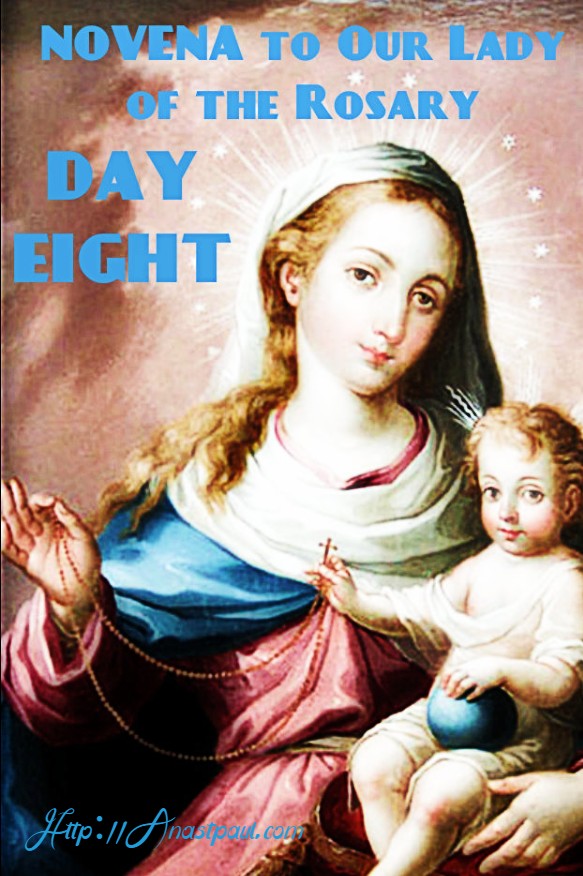
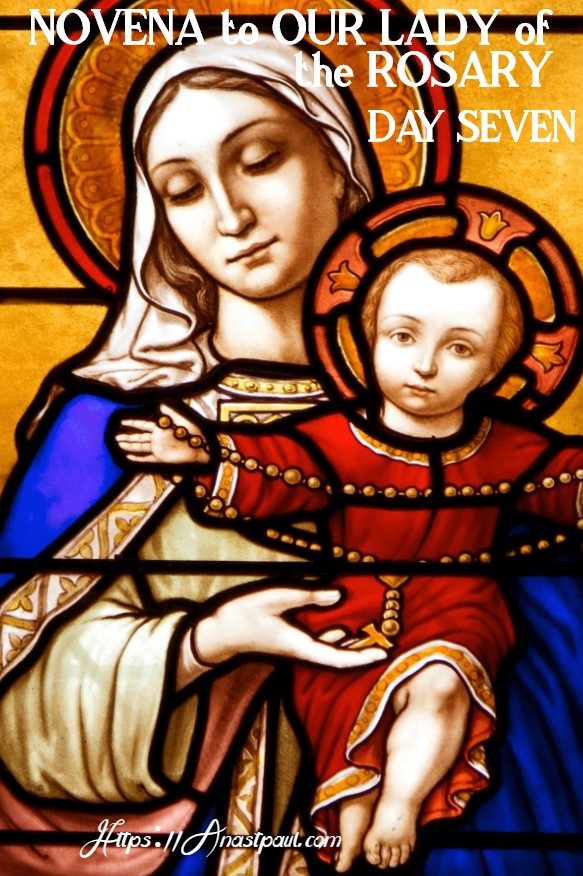
Novena to Our Lady of the Rosary – Day Eight – 5 October
Day Eight: We Pray for the Virtue of Faith and for our private intentions
Thank You, Jesus You our Great Mystery, For Your life that transcends our understanding, For Your presence from which we can never flee, for Your Resurrection which is never defeated and for the gift of faith that enables us to trust even in the midst of our doubts and fears. Amen
Daily Prayer along with our Daily Rosary:
My dearest Mother Mary, behold me, your child, in prayer at your feet. Accept this Holy Rosary, which I offer you in accordance with your requests at Fatima, as a proof of my tender love for you, for the intentions of the Sacred Heart of Jesus, in atonement for the offenses committed against your Immaculate Heart and for this special favour which I earnestly request in my Rosary Novena: ………………………….. (Mention your request).
I beg you to present my petition to your Divine Son. If you will pray for me, I cannot be refused. I know, dearest Mother, that you want me to seek God’s holy Will concerning my request. If what I ask for should not be granted, pray that I may receive that which will be of greater benefit to my soul.
I offer you this spiritual Bouquet of Roses because I love you. I put all my confidence in you, since your prayers before God are most powerful. For the greater glory of God and for the sake of Jesus, your loving Son, hear and grant my prayer. Sweet Heart of Mary, be my salvation.
Our Lady of the Rosary, pray for our Holy Mother Church and for our country.
Our Lady of Fatima, obtain for humanity a lasting peace.
Sweet Heart of Jesus, be my love.
Sweet Heart of Mary, at the hour of my death, lead me home.
Thought for the Day – 5 October – Meditations with Antonio Cardinal Bacci (1881-1971)
“Month of the Holy Rosary” The Third Joyful Mystery The Birth of Jesus
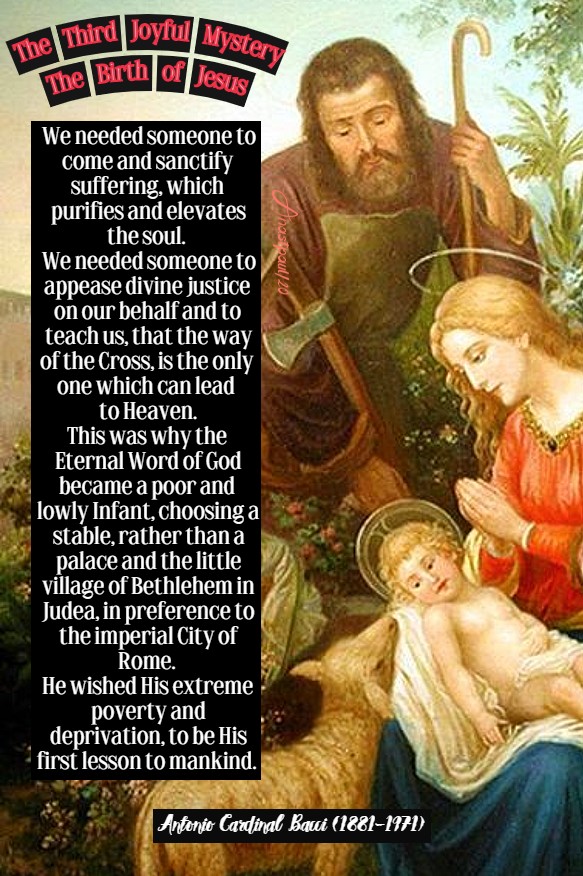
“When God became man in order to instruct and redeem the lost and erring human race, the gesture would have been deprived of it’s real significance if He had chosen to be born in a palace, surrounded by the splendour of worldly glory and wealth.
It would have been meaningless, not only for God but also, for us, if He had abandoned the imperishable glory of Heaven and the infinite wealth of everlasting happiness, in order to assume the kind of earthly grandeur which, in His eyes is but a vanishing cloud. What we needed, was to learn the way of humility and of detachment from worldly things, which can so easily lead us to forget the supernatural. We needed someone to come and sanctify suffering, which purifies and elevates the soul. We needed someone to appease divine justice on our behalf and to teach us, that the way of the cross, is the only one which can lead to Heaven. This was why the Eternal Word of God became a poor and lowly infant, choosing a stable, rather than a palace and the little village of Bethlehem in Judea, in preference to the imperial city of Rome. He wished His extreme poverty and deprivation, to be His first lesson to mankind.”
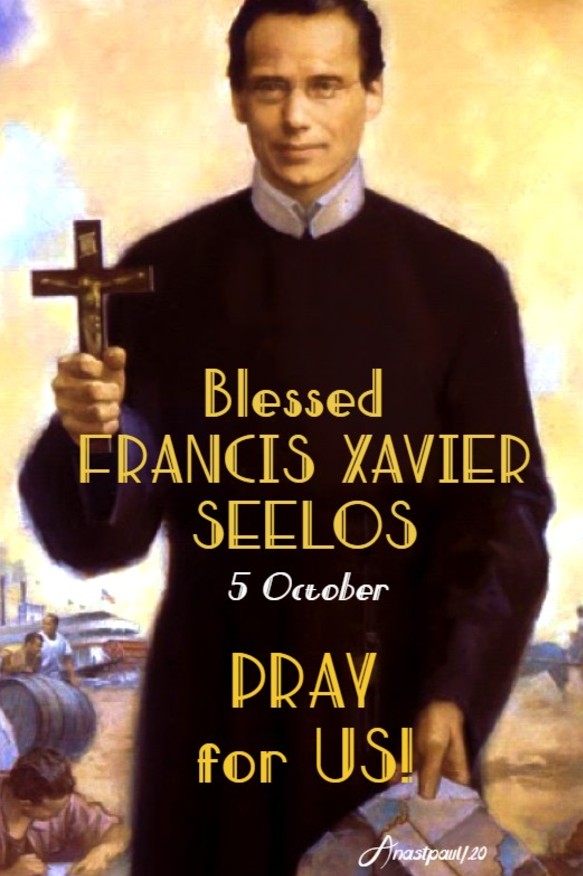
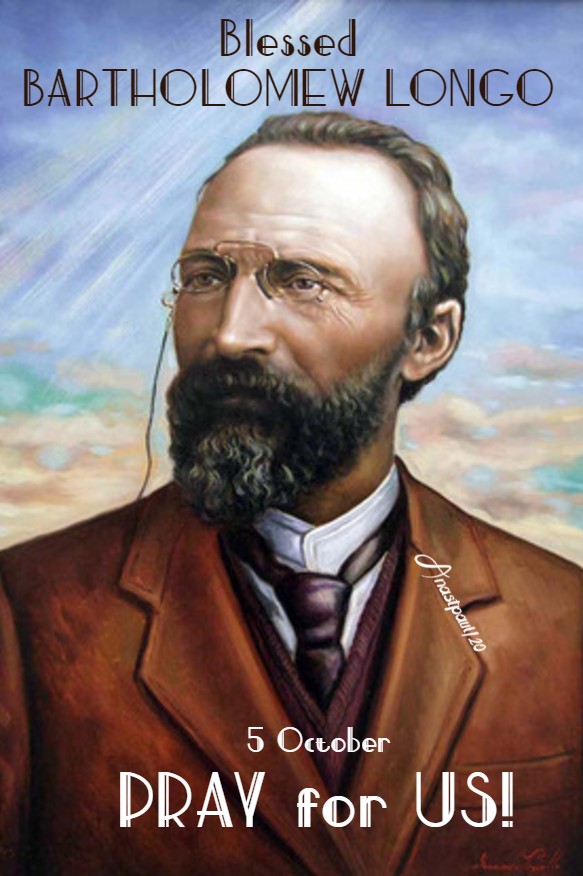
Quote/s of the Day – 5 October – the Memorial of Blessed Raymond of Capua OP (c 1330-1399) “The Second Founder,” Blessed Francis Xavier Seelos CSsR (1819-1867), Blessed Bartholomew Longo (1841-1926) “Apostle of the Holy Rosary”
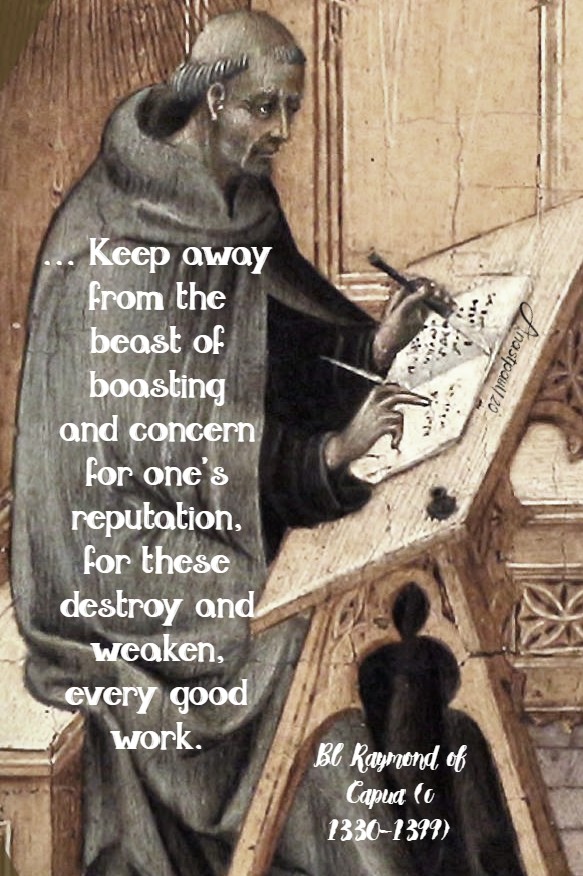
“My brothers, keep away from the beast of boasting and concern for one’s reputation, for these destroy and weaken, every good work.”
Bl Raymond of Capua (c 1330-1399)
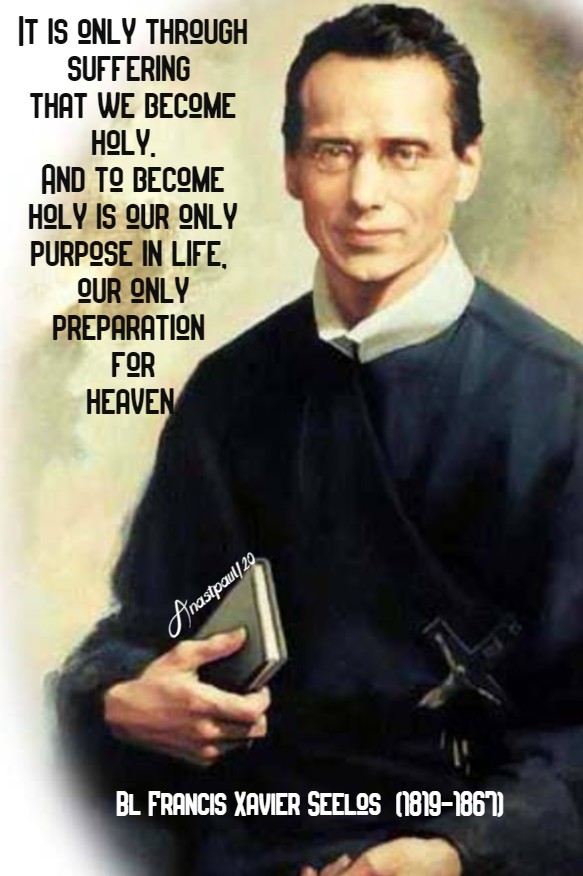
“It is only through suffering that we become holy. And to become holy is our only purpose in life, our only preparation for heaven.”
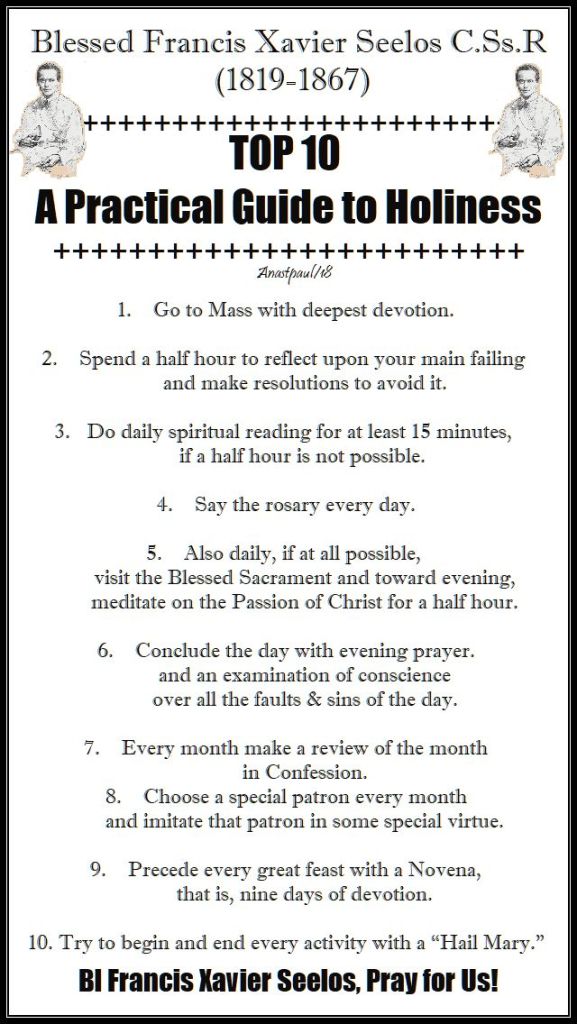
TOP 10 Practical Guide to Holiness
Go to Mass with deepest devotion.
Spend a half hour to reflect upon your main failing and make resolutions to avoid it.
Do daily spiritual reading for at least 15 minutes, if a half hour is not possible.
Say the rosary every day.
Also daily, if at all possible, visit the Blessed Sacrament and toward evening, meditate on the Passion of Christ for a half hour.
Conclude the day with evening prayer and an examination of conscience over all the faults & sins of the day.
Every month make a review of the month in confession.
Choose a special patron every month and imitate that patron in some special virtue.
Precede every great feast with a novena, that is, nine days of devotion.
Try to begin and end every activity with a “Hail Mary.”
Bl Francis Xavier Seelos CSsR (1819-1867)
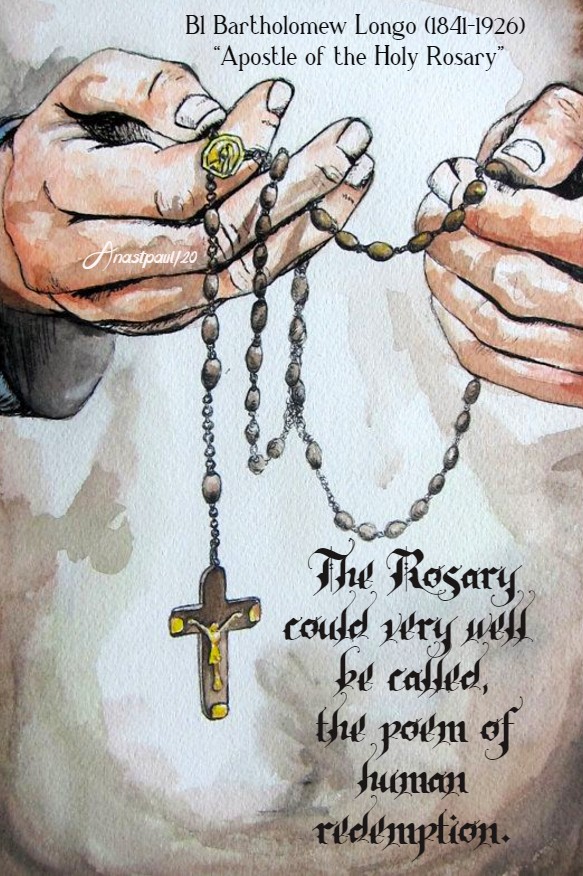
“The Rosary could very well be called, the poem of human redemption.”
“The Rosary is the prayer dearest to Mary, most loved by the Saints, most frequently used by Christian peoples, most honoured by God with astounding wonders, most enriched with great promises, by the Virgin.”
Bl Bartholomew Longo (1841-1926) “Apostle of the Holy Rosary
One Minute Reflection – 5 October – Monday of the Twenty Seventh week in Ordinary Time, Readings: Galatians 1:6-12, Psalms 111:1-2, 7-8, 9 and 10, Luke 10: 25-37 and the Memorial of Blessed Raymond of Capua OP (c 1330-1399) “The Second Founder,” Blessed Francis Xavier Seelos CSsR (1819-1867), Blessed Bartholomew Longo (1841-1926) “Apostle of the Holy Rosary”
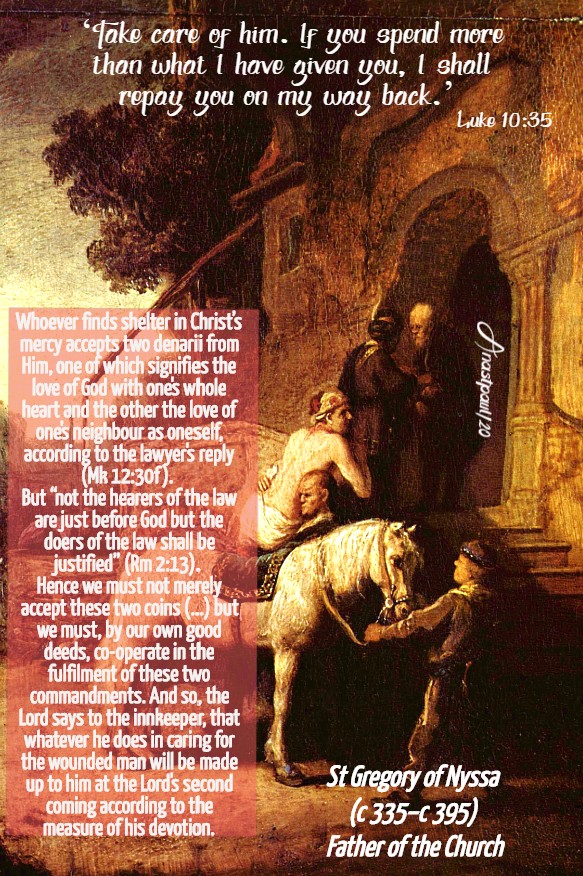
“The next day he took out two silver coins and gave them to the innkeeper with the instruction, ‘Take care of him. If you spend more than what I have given you, I shall repay you on my way back.’” – Luke 10:35
REFLECTION – “Who is my neighbour?” In answer the Word explained, in the form of a story, God’s entire economy of salvation. He told of man’s descent from heaven, the robbers’ ambush, the stripping of the garment of immortality, the wounds of sin, the progress of death over half of man’s nature while his soul remained immortal. Then came the passage of the Law that brought no help—neither the priest nor the Levite tended the wounds of the man who fell among robbers—for “it was impossible for the blood of goats and oxen to remove man’s sin” (Heb 10:4). And then He came, clothed in our human nature as the first-fruits of the mass in which there was a portion of every race, Jewish, Samaritan, Greek — all mankind. With His body (that is, the beast of the story) He proceeded to the place of man’s disaster, healed his wounds and set him upon His own beast. He created for him the inn of His loving providence, in which all those who labour and are burdened can find rest (Mt 11,28) (…)
“Whoever abides in me, and I in him” (Jn 6:56) (…) Whoever finds shelter in Christ’s mercy accepts two denarii from Him, one of which signifies the love of God with one’s whole heart and the other the love of one’s neighbour as oneself, according to the lawyer’s reply (Mk 12:30f). But “not the hearers of the law are just before God but the doers of the law shall be justified” (Rm 2:13). Hence we must not merely accept these two coins (…) but we must, by our own good deeds, co-operate in the fulfilment of these two commandments. And so, the Lord says to the innkeeper, that whatever he does in caring for the wounded man will be made up to him at the Lord’s second coming according to the measure of his devotion.” … St Gregory of Nyssa (c 335–C 395) Father of the Church, Monk, Bishop – Sermons on the Song of Songs, no14 – [Brother of St Basil the Great (Father & Doctor)]
PRAYER – God our Father, we are Your children and You have set us aside to come home to You by the light of the way of Your divine Son. Grant we pray, that we may grow in faith and love for You and our neighbour daily, by the intercession of Saints Bl Raymond of Capua, Francis Xavier Seelos, Bartholomew Longo, may we learn the gentleness and tenderness of love, to all around us. We make our prayer through our Lord Jesus with You in the unity of the Holy Spirit, God forever, amen.
Our Morning Offering – 5 October – Monday of the Twenty Seventh week in Ordinary Time
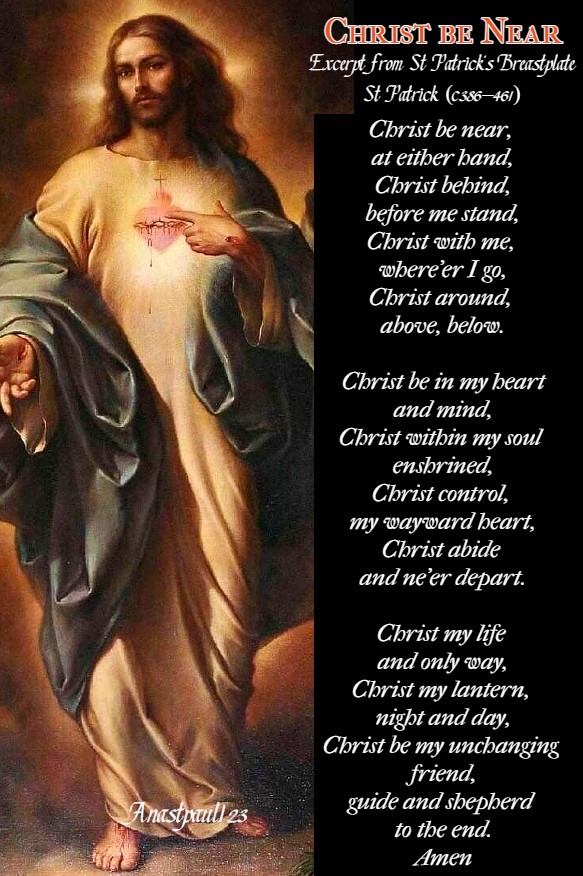
Excerpt from St Patrick’s Breastplate Christ be Near St Patrick (c 386 – 461)
Christ be near, at either hand, Christ behind, before me stand, Christ with me, where’er I go, Christ around, above, below.
Christ be in my heart and mind, Christ within my soul enshrined, Christ control, my wayward heart, Christ abide and ne’er depart.
Christ my life and only way, Christ my lantern, night and day, Christ be my unchanging friend, guide and shepherd to the end.
We have this prayer and his own story in one of the few certainly authentic writings of Patrick – his Confessio, which is above all an act of homage to God for having called Patrick, unworthy sinner, to the apostolate.
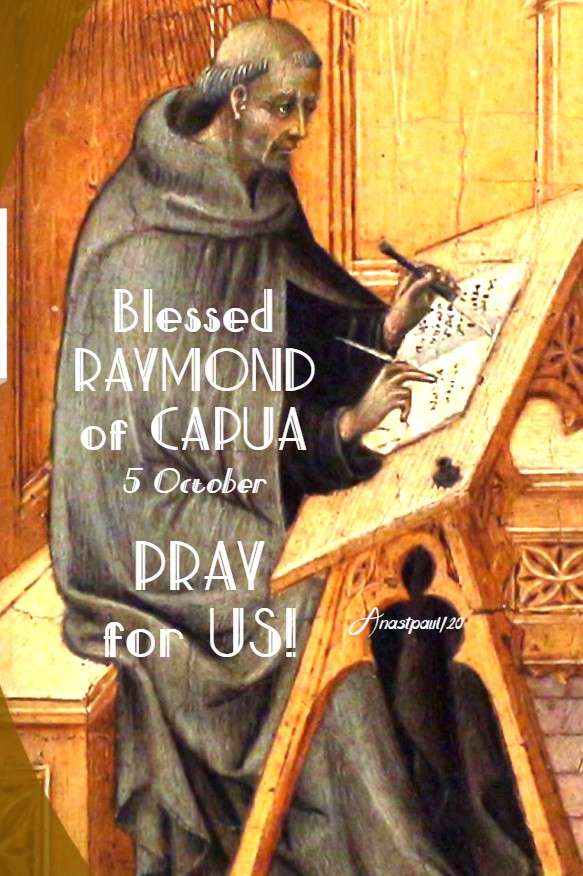
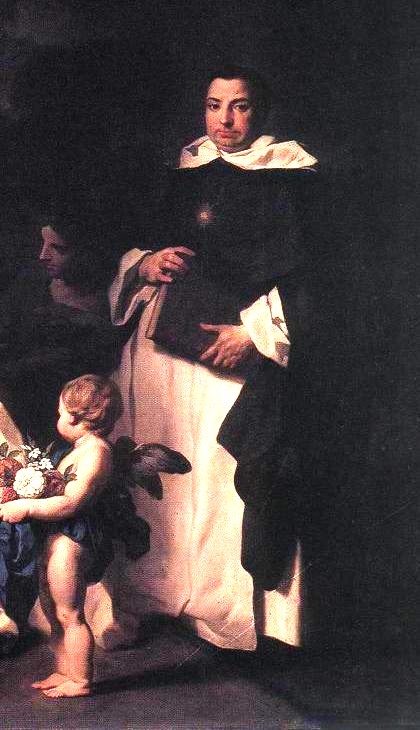
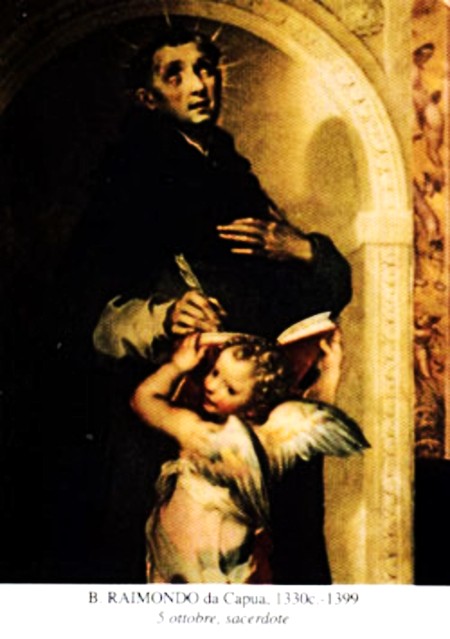
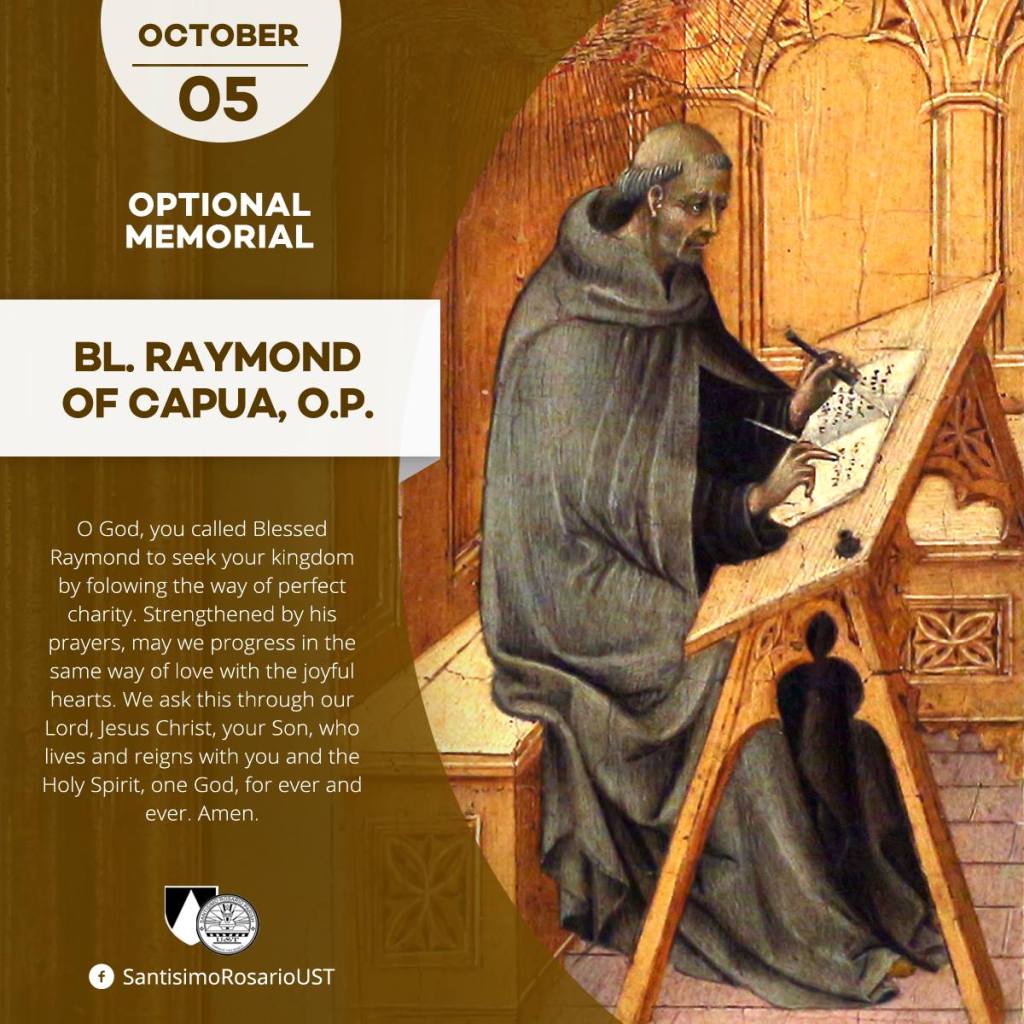
Saint of the Day – 5 October – Blessed Raymond of Capua OP (c 1330-1399) Priest, “The Second Founder” of the Dominican Order of Preachers, Reformer, Spiritual Director, he worked with St Agnes of Montepulciano and St Catherine of Siena, hagiographer, teacher – born in c 1330 in Capua, Naples as Raymondo delle Vigne and died on 5 October 199, aged 69, in Nuremberg, Germany of natural causes. Also known as – Raymond delle Vigne, Raymund, Raimondo. Raymond was a leading member of the Dominican Order and served as it’s Master General from 1380 until his death. First as Prior Provincial of Lombardy and then as Master General of the Order, Raymond undertook the restoration of Dominican religious life. For his success in this endeavour, he is referred to as the Order’s “Second Founder.” Raymond also worked for the return of the papacy to Rome and for a solution to the Western schism. The important Mystic, Reformer, Doctor of the Church, St Catherine of Siena, accepted him as her spiritual director because of his burning passion for the Church and for the revival of religious life, most especially in their own Order.
He was born “Raymondo della Vigna” a member of a prominent family of that city, and was a descendant of Pietro della Vigna (a figure mentioned in Dante’s Divine Comedy). In 1350, while a student of law at the University of Bologna, he entered the Dominican Order. For the next twenty-five years he worked as a spiritual director or as a teacher in various communities of the Order.
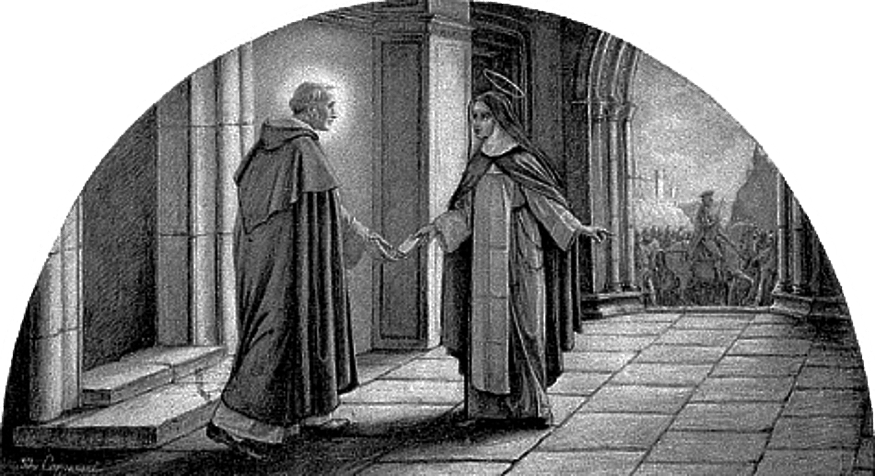
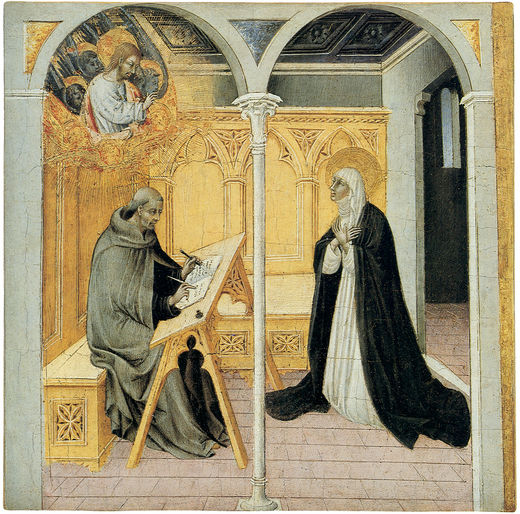
Raymond was first assigned to Montepulciano, where he served as a chaplain to a monastery of nuns of the Dominican Second Order. He was the first biographer of their venerated former prioress, St Agnes of Montepulciano, who had died about fifty years earlier. He was then stationed in Rome, to serve as the Prior of the Friars at Santa Maria sopra Minerva. Later he was sent to Siena, where he was assigned by the Master General to be the spiritual director and confessor to the noted Dominican tertiary, Catherine of Siena.
Raymond spent the next six years advising her and hearing her confidences. While there, Raymond gradually learned to trust her holiness and her judgement. This was sealed, when they both became involved in nursing victims of the plague in 1374. When he contracted the disease himself and lay near death, Catherine came and sat at his bedside until he recovered. Knowing how close he was to death, Raymond credited his recovery to her prayers.
By 1374 Raymond had come to the attention of Pope Gregory XI, then living in Avignon, as a result of his connection to Catherine and also for his novel ways of confronting issues like the Crusades in the Holy Land, the return of the papacy to Rome, and the general reform of the Church. He was well known for his ability to pass seamlessly from dealing with spiritual and supernatural considerations to the more mundane matters of practical politics. For four years Raymond accompanied Catherine in her journeys and went to Avignon to act as an intermediary between her and the Pope.
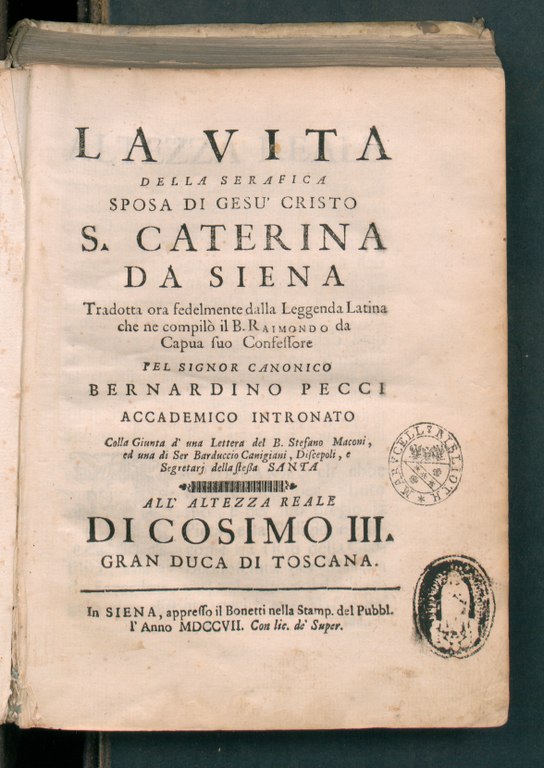
This experience of trying to reconcile the Church proved to be incredibly important for Raymond who, only weeks after St Catherine’s death, was elected Master of the Order. Not only had the Church been suffering through a schism but the Order too, was undergoing is own divisive period. Raymond strove to unite the two factions in the Order and with the help of holy friars, such as Bl John Dominici, he was able to re-establish the regular observance in the Order and restore peace and concord. For this, he was referred to as the “Second Founder” of the Order. Thanks to Raymond, the Dominican Order never split. During this time, Raymond also wrote The Life of St Catherine of Siena.
In 1379 by command of Pope Urban VI Raymond was examined by Fra. Giacomo Altoviti who promoted him to the grade of Master of Theology.
Raymond was buried first in Nuremberg (now Germany) where he died but his body was later moved to Naples, to the Church of San Domenico Maggiore. In 1899 Pope Leo XIII Beatified him, on the 500th anniversary of his death.
O God, You called Blessed Raymond to seek Your kingdom by following the way of perfect charity. Strengthened by his prayers, may we progress in the same way of love with joyful hearts. We ask this, through our Lord, Jesus Christ, Your Son, who lives and reigns with you and the holy Spirit, one God forever and ever. Amen
Bl Alberto Marvelli St Alexander of Trier St Anna Schaeffer St Apollinaris of Valence St Attilanus of Zamora St Aymard of Cluny Blessed Bartholomew Longo (1841-1926) Apostle of the Holy Rosary Biography here:
St Firmatus of Auxerre St Flaviana of Auxerre Bl Flora of Beaulieu St Gallo of Aosta St Jerome of Nevers Bl John Hewett St Magdalveus of Verdun St Mamlacha St Marcellinus of Ravenna Bl Marian Skrzypczak St Meinulph St Palmatius of Trier Blessed Raymond of Capua OP (c 1330-1399) Priest Bl Robert Sutton Bl Sante of Cori St Thraseas of Eumenia St Tranquilino Ubiarco Robles Bl William Hartley — Martyrs of Messina – 30 saints: A group of about 30 Benedictine monks and nuns, some blood relatives, who were sent in the early days of the order to establish monasteries in the vicinity of Messina, Sicily, Italy, and who were martyred. We know the names, and a few details, about seven of them – • Donatus • Eutychius • Faustus • Firmatus • Flavia • Placidus • Victorinus 6th century Messina, Sicily, Italy.
Martyred in the Spanish Civil War: • Blessed Eugenio Andrés Amo • Blessed Sebastià Segarra Barberá • Blessed Rafael Alcocer Martínez
Novena to Our Lady of the Rosary – Day Seven – 4 October
Day Seven: We Pray for the Virtue of Fortitude along with our private intentions.
Holy Spirit, may we be granted today, the virtue by which we do the right thing, even in the midst of hardship. We ask Thee to consider our need for courage and bravery, so that we may stay strong, to do what is good. You alone know how often, in our lives, many situations arise in which it becomes difficult to do the right thing, even when we know what it is. We ask this through Jesus Christ, Our Lord
Daily Prayer along with our Daily Rosary:
My dearest Mother Mary, behold me, your child, in prayer at your feet. Accept this Holy Rosary, which I offer you in accordance with your requests at Fatima, as a proof of my tender love for you, for the intentions of the Sacred Heart of Jesus, in atonement for the offenses committed against your Immaculate Heart and for this special favour which I earnestly request in my Rosary Novena: ………………………….. (Mention your request).
I beg you to present my petition to your Divine Son. If you will pray for me, I cannot be refused. I know, dearest Mother, that you want me to seek God’s holy Will concerning my request. If what I ask for should not be granted, pray that I may receive that which will be of greater benefit to my soul.
I offer you this spiritual Bouquet of Roses because I love you. I put all my confidence in you, since your prayers before God are most powerful. For the greater glory of God and for the sake of Jesus, your loving Son, hear and grant my prayer. Sweet Heart of Mary, be my salvation.
Our Lady of the Rosary, pray for our Holy Mother Church and for our country.
Our Lady of Fatima, obtain for humanity a lasting peace.
Sweet Heart of Jesus, be my love.
Sweet Heart of Mary, at the hour of my death, lead me home.
Thought for the Day – 4 October – Meditations with Antonio Cardinal Bacci (1881-1971)
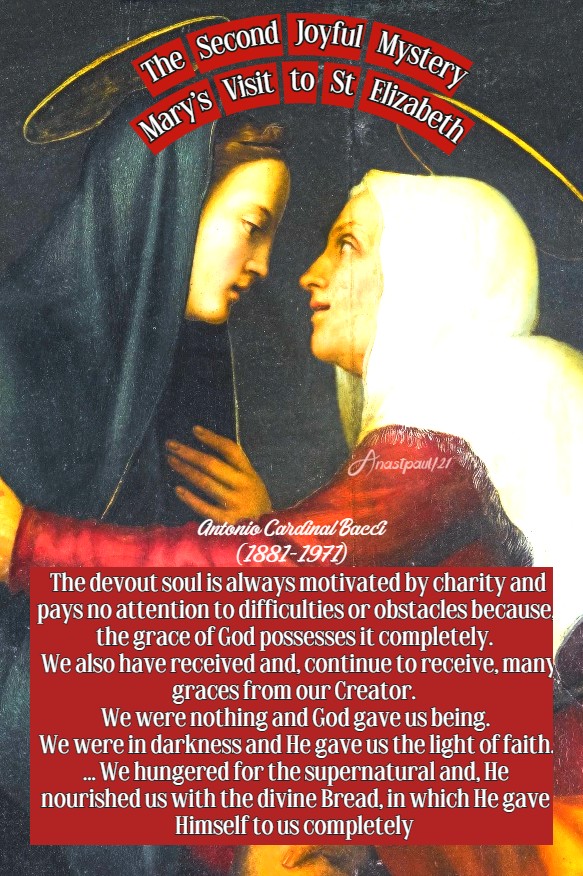
“Month of the Holy Rosary” The Second Joyful Mystery Mary’s Visit to St Elizabeth
“When the Angel told Mary that she had been chosen to be the Mother of God, he proceeded to reveal also the imminent birth of the Precursor of Jesus Christ. Her cousin, Elizabeth, he told her, who had been sterile for such a long time, would soon have the joy of bearing a son. When the Blessed Virgin heard this good news, she set out for a long and difficult journey to congratulate her cousin.
The devout soul is always motivated by charity and pays no attention to difficulties or obstacles because, the grace of God possesses it completely. We also have received and, continue to receive, many graces from our Creator. We were nothing and God gave us being. We were in darkness and He gave us the light of faith. We were slaves of sin and Jesus Christ broke the bonds in which the devil held us and gave us the freedom of the children of God. We were exiles on this earth and God became our companion and our guide. We hungered for the supernatural and, He nourished us with the divine Bread in which He gave Himself to us completely!”
Quote/s of the Day – 4 October – The Memorial of St Francis of Assisi (c 1181–1226)
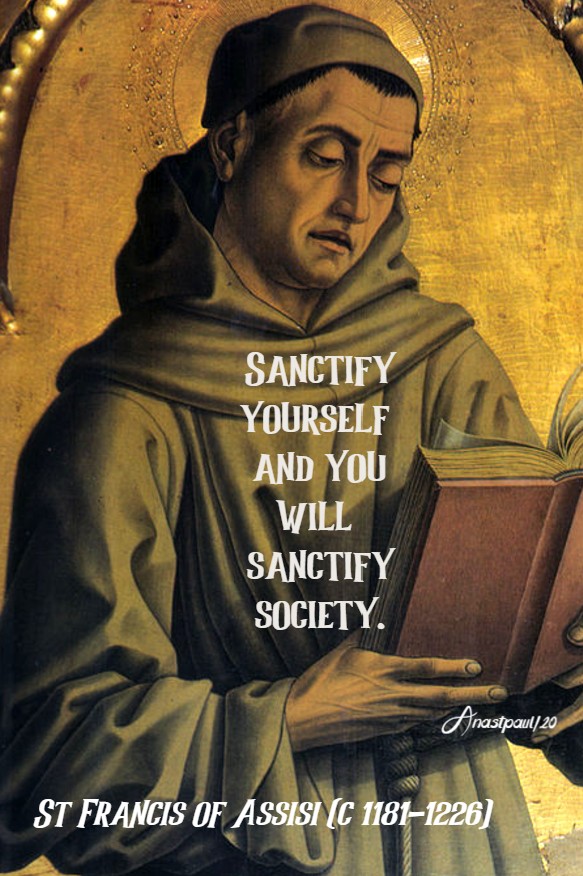
“Sanctify yourself and you will sanctify society.”
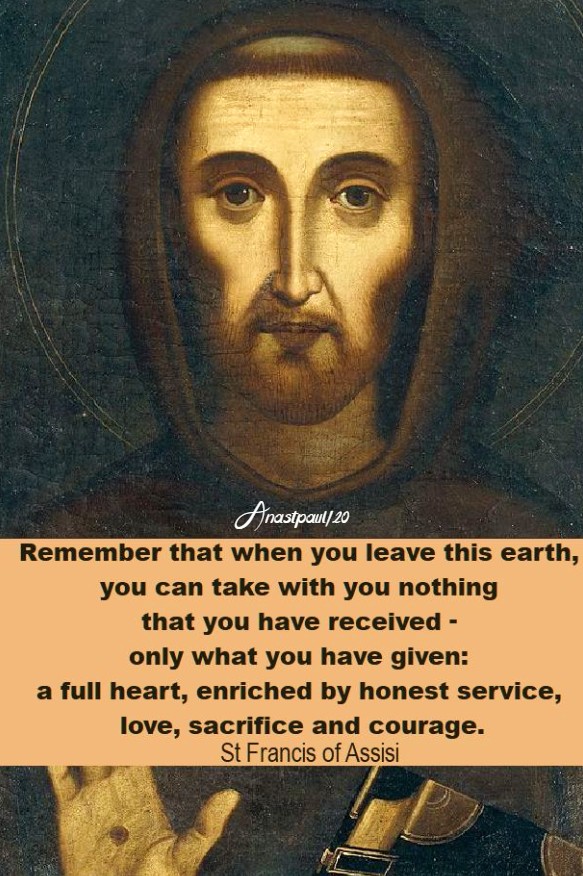
“Remember that when you leave this earth, you can take with you, nothing that you have received— only what you have given – a full heart, enriched by honest service, love, sacrifice and courage.”
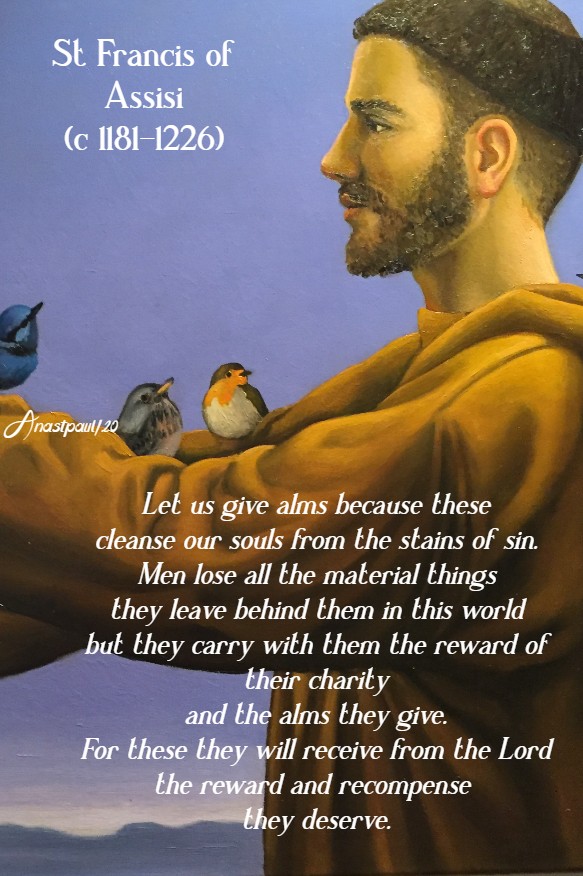
“Let us give alms because these cleanse our souls from the stains of sin. Men lose all the material things they leave behind them in this world but they carry with them the reward of their charity and the alms they give. For these they will receive from the Lord the reward and recompense they deserve.”
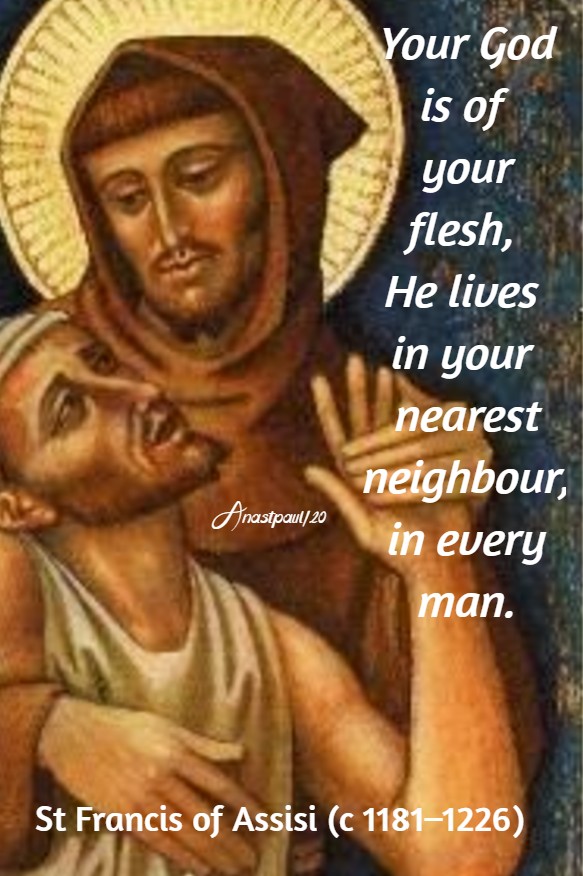
“Your God is of your flesh, He lives in your nearest neighbour, in every man.”
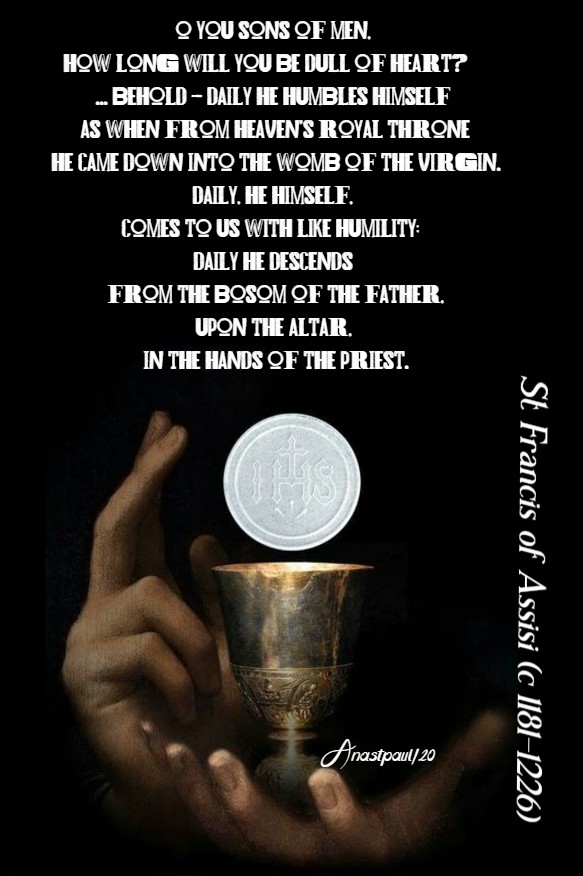
“O you sons of men, how long will you be dull of heart? … Behold – daily He humbles Himself as when from heaven’s royal throne He came down into the womb of the Virgin. Daily, He Himself, comes to us with like humility; daily He descends from the bosom of the Father, upon the altar, in the hands of the priest.”
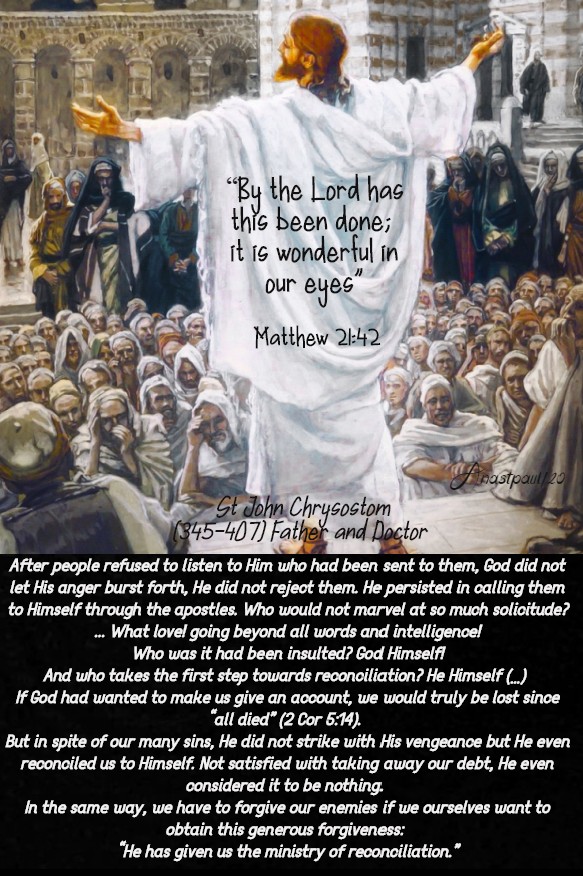
“By the Lord has this been done; it is wonderful in our eyes” … Matthew 21:42
REFLECTION – “Christ has given us the ministry of reconciliation.” (2 Cor 5:18) Saint Paul thus brings out the greatness of the apostles, by showing us the ministry that was entrusted to them and at the same time, he shows us the love with which God loved us. After people refused to listen to Him who had been sent to them, God did not let His anger burst forth, He did not reject them. He persisted in calling them to Himself through the apostles. Who would not marvel at so much solicitude?
They killed the Son who had come to reconcile them, who was the only Son and of the same nature as the Father. The Father did not turn away from the murderers, He did not say: “I sent them my Son, and they, not satisfied with not having listened to Him, put Him to death and crucified Him. So now, it is only just that I abandon them.” He did the opposite. And after Christ had left earth, it is we, His ministers, who have the responsibility to replace Him. “He has given us the ministry of reconciliation. I mean that God, in Christ, was reconciling the world to himself, not counting men’s transgressions against them.”
What love! going beyond all words and intelligence! Who was it had been insulted? God Himself! And who takes the first step towards reconciliation? He Himself (…) If God had wanted to make us give an account, we would truly be lost since “all died” (2 Cor 5:14). But in spite of our many sins, He did not strike with His vengeance but He even reconciled us to Himself. Not satisfied with taking away our debt, He even considered it to be nothing. In the same way, we have to forgive our enemies if we ourselves want to obtain this generous forgiveness: “He has given us the ministry of reconciliation.” … St John Chrysostom (345-407) Father and Doctor – Homily 11 on the Second Letter to the Corinthians, 4-5
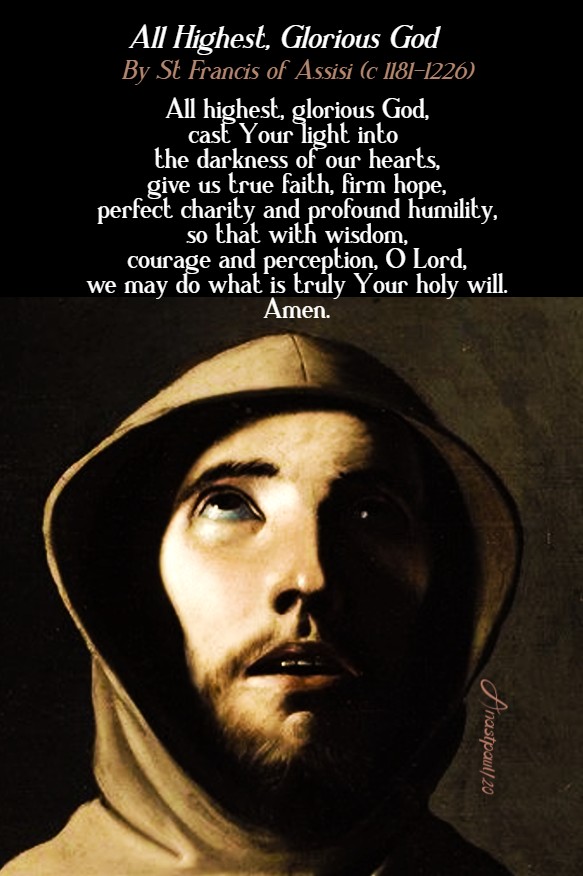
PRAYER – All highest, glorious God, cast Your light into the darkness of our hearts, give us true faith, firm hope, perfect charity and profound humility, so that with wisdom, courage and perception, O Lord, we may do what is truly Your holy will. Amen. By St Francis of Assisi
Our Morning Offering – 4 October – Twenty Seventh Sunday in Ordinary Time
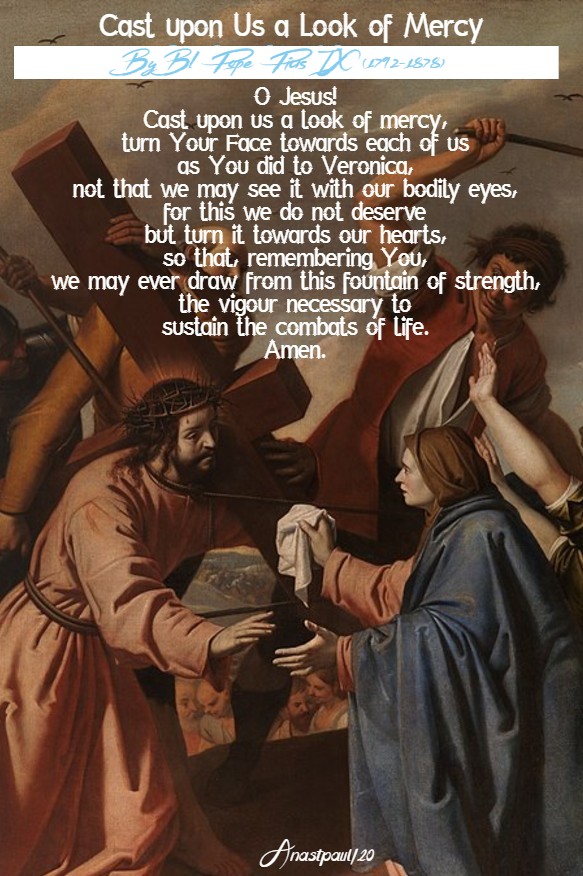
Cast Upon Us a Look of Mercy By Blessed Pope Pius IX (1792-1878)
O Jesus! Cast upon us a look of mercy, turn Your Face towards each of us as You did to Veronica, not that we may see it with our bodily eyes, for this we do not deserve but turn it towards our hearts, so that, remembering You, we may ever draw from this fountain of strength, the vigour necessary to sustain the combats of life. Amen.
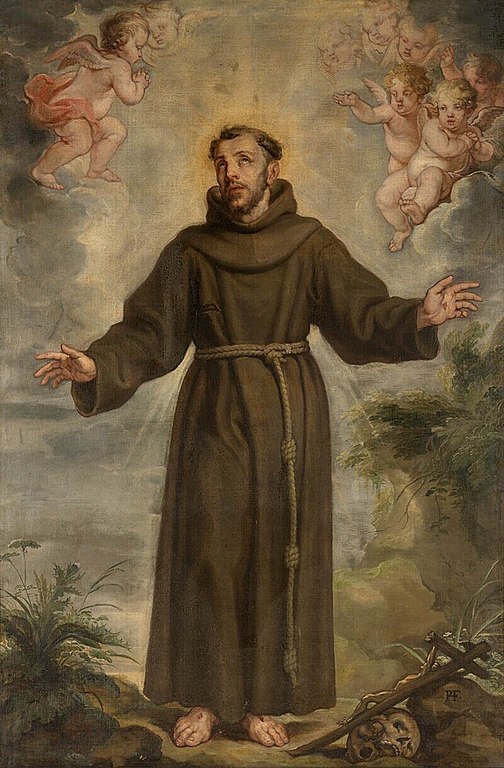
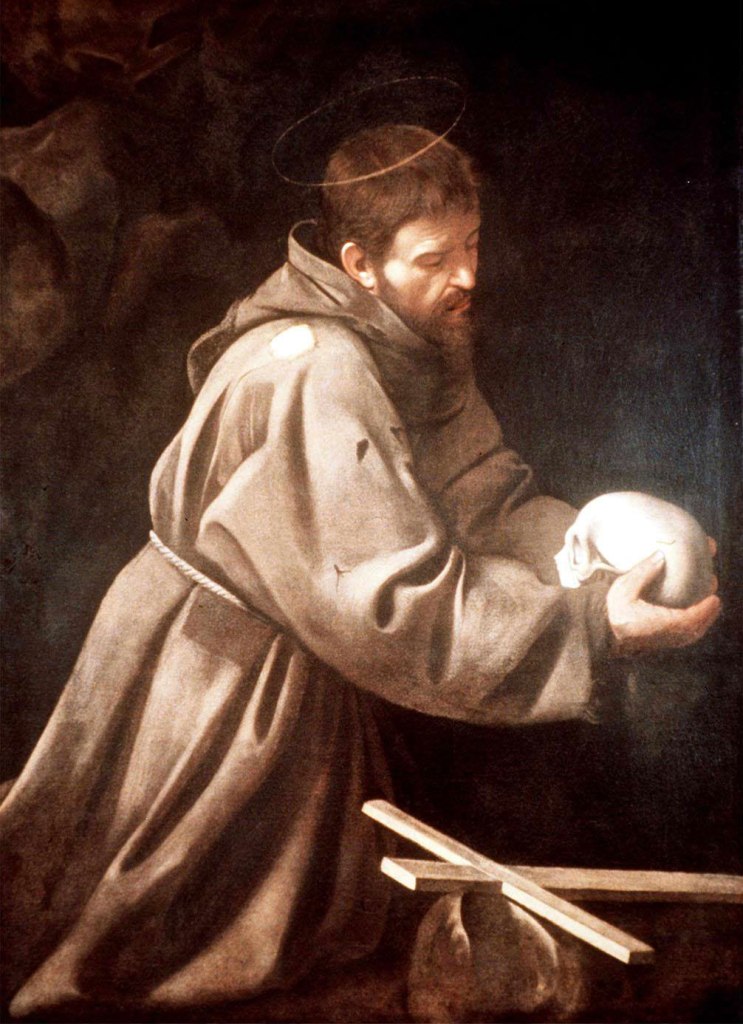
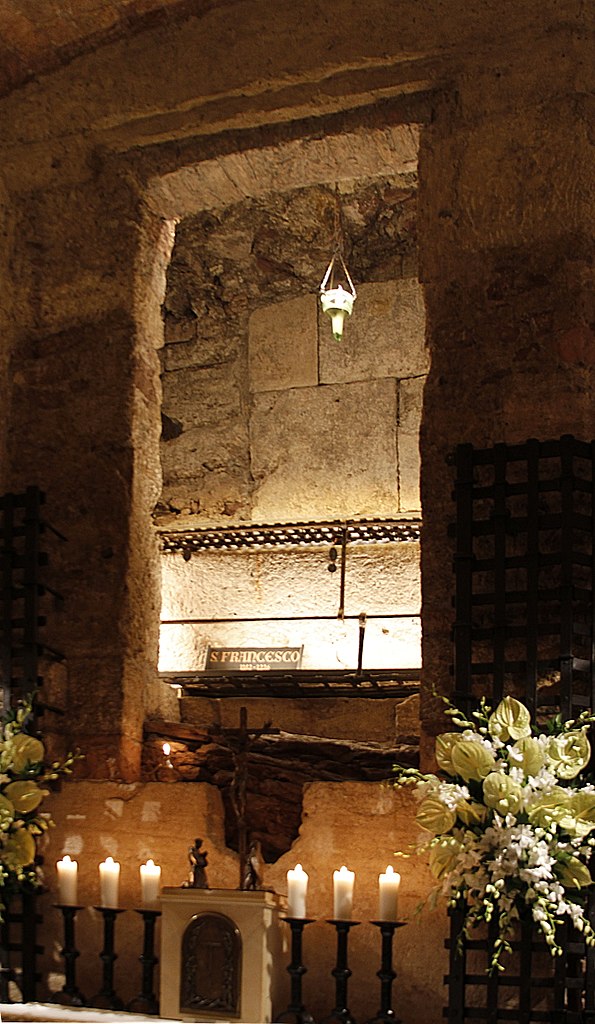
Saint of the Day – 4 October – St Francis of Assisi OFM (c 1181–1226)- Founder of the Franciscan Order, Confessor of the Faith, Stigmatist. Francis set out to imitate Christ and literally carry out His work. This is vital in understanding Francis’ character, his affinity for the Eucharist and respect for the priests who carried out the sacrament. He preached: “Your God is of your flesh, He lives in your nearest neighbour, in every man.”
He and his followers celebrated and even venerated poverty, which was so central to his character that in his last written work, the Testament, he said, that absolute personal and corporate poverty was the essential lifestyle for the members of his order.
St Francis of Assisi was the living embodiment of Jesus Christ. He left home, riches and family to be with the poor and the destitute. In all creation he saw the image of God. In imitating Jesus Christ, his self-denial led to the foundation of orders and movements of evangelical poverty. Not to mention, his love was so total that – when he had nothing left to give – but gave more, he received the stigmata.
St Francis was the son of a cloth merchant. His worldly successes culminated in a career as a soldier. While preparing for a second campaign, St Francis received a vision. The moment was life-changing in that he realised he had been called apart. Climbing to the “Mount Tabor” of prayer to discern the will of God, he received another prompting; whereupon the once affluent man began to imitate the poor so that he might preach to them. When, at last, he took his father’s cloth to sell for alms that the Church of San Damiano may be restored, his father took him to court for relieving him of his possessions. In that moment, in the presence of the Bishop, St Francis went all in; doubling down on his mission by stripping off his garments and declaring that now he had no possessions.
Fully committed to imitating Jesus by administering to them exactly as He had done, St Francis preached to the poor – going barefoot and quite literally “(taking) no gold, nor silver, nor money in your belts, no bag for your journey, nor two tunics, nor sandals, nor a staff…” Submitting to papal authority since Tradition was handed to the Apostles by Jesus, St Francis encountered an obstruction in Pope Innocent III but the latter gave consent for St Francis’ Order after seeing, in a dream, St Francis holding up the Church of San Giovanni in Laterano. The rule of poverty and preaching Friars raised up altars where churches once lay abandoned. The order of the Poor Clares and Franciscan lay movements, also stemmed from St Francis’ apostolate. He refined his rule to include complete poverty and self-denial to live and be with Christ.
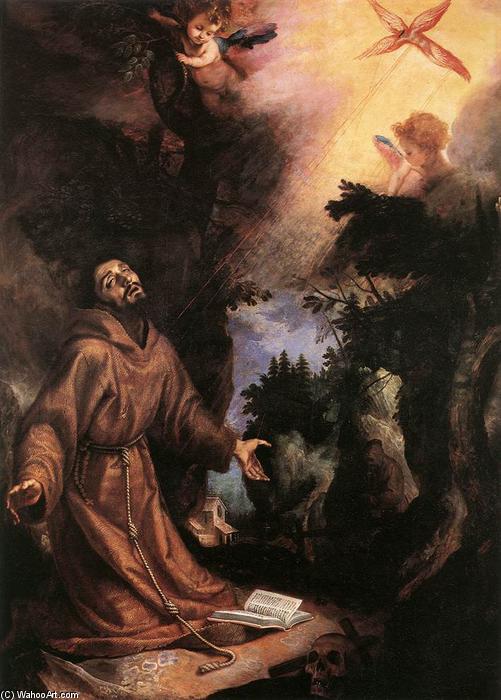
St Francis’ missions even brought him to Egypt, where an audience with the Sultan during the Crusades resulted in the Franciscan order gaining privileged access to Jerusalem. St Francis was a tireless worker; practicing prayer, penance, mortification and works to the extreme that Christ would go. Jesus fell asleep in the stern of a boat while the storm was raging – so exhausted was He. Then in 1224, while preparing for the feast of the Exaltation of the Cross, St Francis asked in prayer how to best please God. In that moment, as recorded by St Francis’ biographers and those he was with, he saw a vision of a man coming down from heaven, with 2 wings above his head, 2 outstretched in fligh, and 2 covering his body; whose face was beautiful beyond earthly description and who smiled gently upon St Francis; making him see, that not in bodily martyrdom but in mind and heart he should conform to Christ. The brilliance of that vision never left St. Francis. Brimming with life, he received the stigmata.
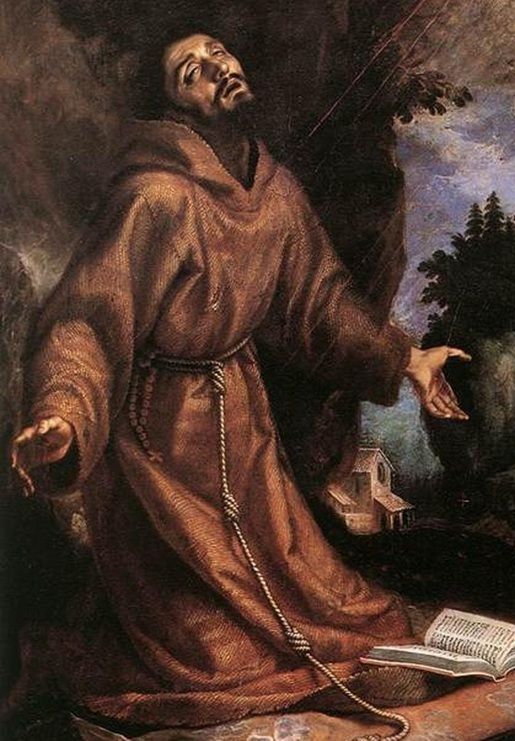
St Francis receives the Stigmata – detail – Cigoli
At the time St Francis received the stigmata, he was feeble and blind. He sought to give more when he had absolutely nothing. Honouring him by not creating needs for ourselves, being humbled by others and bearing it for Christ, rejecting hedonism and conforming our will and intellect to that of the Divine, is how we can celebrate this mystic who forever rejoices by the side of and in-step with Jesus Christ.
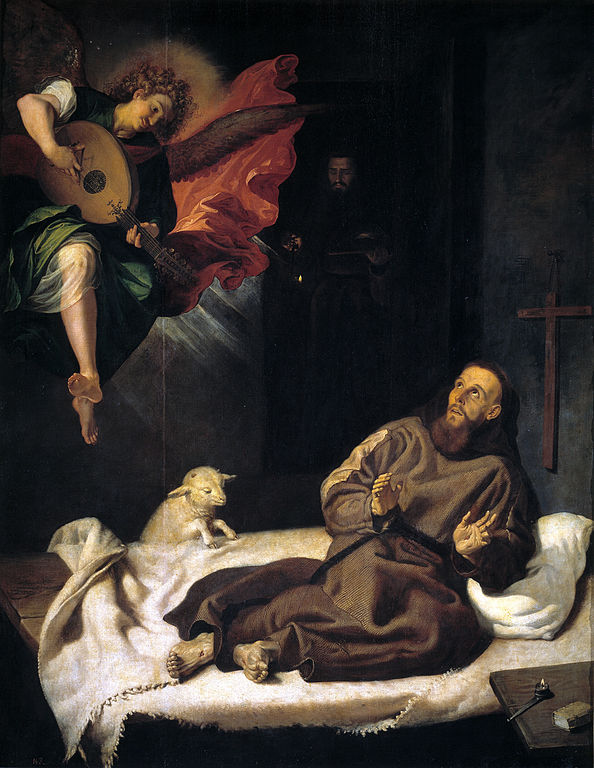
Francis Serenaded by an Angel – Francisco Ribalta (1565–1628)
On 18 June 1939, Pope Pius XII named Francis a joint Patron Saint of Italy along with Saint Catherine of Siena with the apostolic letter “Licet Commissa.”
St Francis is the patron of animals, merchants and ecology. He is also considered the patron saint against dying alone; patron saint against fire; patron saint of the Franciscan Order and Catholic Action; patron saint of families, peace, and needleworkers. He is the patron saint of many dioceses and other locations around the world, including – Italy; San Pawl il-Bahar, Malta; Freising, Germany; Lancaster, England; Kottapuram, India; San Francisco de Malabon, Philippines (General Trias City); San Francisco, California; Santa Fe, New Mexico; Colorado; Salina, Kansas; Metuchen, New Jersey and Quibdó, Colombia.
St Adauctus of Ephesus Bl Alfonso Tabela St Aurea St Berenice St Caius of Corinth St Callisthene of Ephesus St Crispus of Corinth St Damaris of Athens St Diogenes of Milan St Domnina St Hierotheus Bl Julian Majali St Lucius of Alexandria St Peter of Damascus St Petronius (Died c 450) About St Petronius: https://anastpaul.com/2019/10/04/saint-of-the-day-4-october-saint-petronius-died-c-450/ St Prosdoce St Quintius of Tours — Martyrs of Alexandria – 2+ saints: A group of Christians, men and women, young and old, murdered together for their faith. The only names that have come down to us are the brothers Mark and Marcian.
Martyred in the Spanish Civil War: • Blessed Alfredo Pellicer Muñoz • Blessed Avelí Martínez de Arenzana Candela • Blessed Dionisio Ibáñez López • Blessed Francisco Martínez Granero • Blessed Fulgencio Martínez García • Blessed José Aloy Doménech • Blessed José Gafo Muñiz • Blessed José Miguel Peñarroya Dolz • Blessed Juan de Francisco Pío • Blessed Juan José Orayen Aizcorbe • Blessed Martina Vázquez Gordo • Blessed Publio Fernández González • Blessed Tomás Barrios Pérez
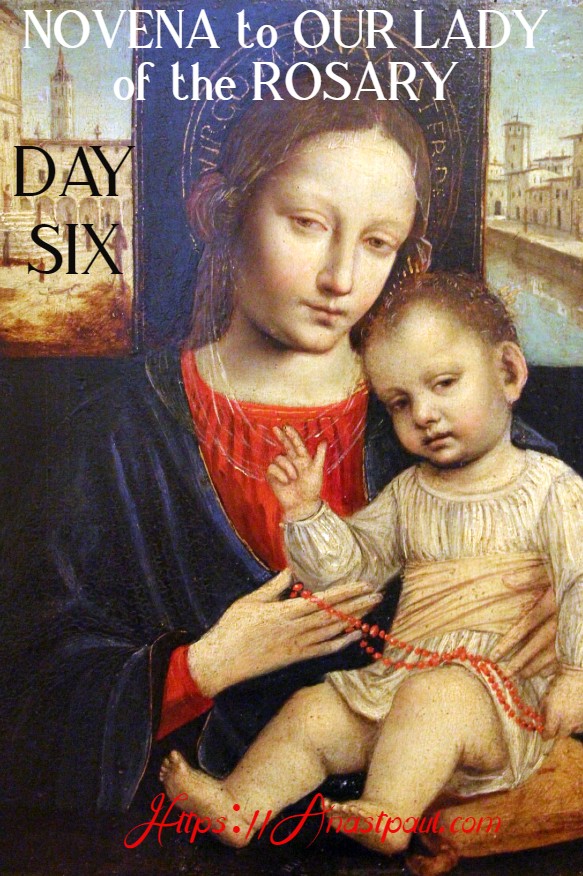
Novena to Our Lady of the Rosary – Day Six – 3 October
Day Six: We Pray for the Virtue of Meekness along with our private intentions.
O Jesus, our pride, stubbornness and lack of faith labelled each thorn as it pierced Your Sacred Head. Our exclusion of spiritual realities tightened the branches around Your Head. Our lack of confidence in Your Mercy and the lukewarmness of our love, braided torture into a wreath of unspeakable pain. O Jesus, let us NEVER forget Your love for us all and the reparation You offered the Father for our sake. Let our soul magnify the Lord by humility of heart, purity of mind and a gentle spirit, so that we may overcome pride, vainglory and resentments and look forward for an increase in faith. Send Your beloved Mother and ours, O Lord, to teach us meekness and humility. Make us like unto Yourself, O Lord, “for I am meek and humble of heart.” Amen
Daily Prayer along with our Daily Rosary:
My dearest Mother Mary, behold me, your child, in prayer at your feet. Accept this Holy Rosary, which I offer you in accordance with your requests at Fatima, as a proof of my tender love for you, for the intentions of the Sacred Heart of Jesus, in atonement for the offenses committed against your Immaculate Heart and for this special favour which I earnestly request in my Rosary Novena: ………………………….. (Mention your request).
I beg you to present my petition to your Divine Son. If you will pray for me, I cannot be refused. I know, dearest Mother, that you want me to seek God’s holy Will concerning my request. If what I ask for should not be granted, pray that I may receive that which will be of greater benefit to my soul.
I offer you this spiritual Bouquet of Roses because I love you. I put all my confidence in you, since your prayers before God are most powerful. For the greater glory of God and for the sake of Jesus, your loving Son, hear and grant my prayer. Sweet Heart of Mary, be my salvation.
Our Lady of the Rosary, pray for our Holy Mother Church and for our country.
Our Lady of Fatima, obtain for humanity a lasting peace.
Sweet Heart of Jesus, be my love.
Sweet Heart of Mary, at the hour of my death, lead me home.
Thought for the Day – 3 October – Meditations with Antonio Cardinal Bacci (1881-1971)
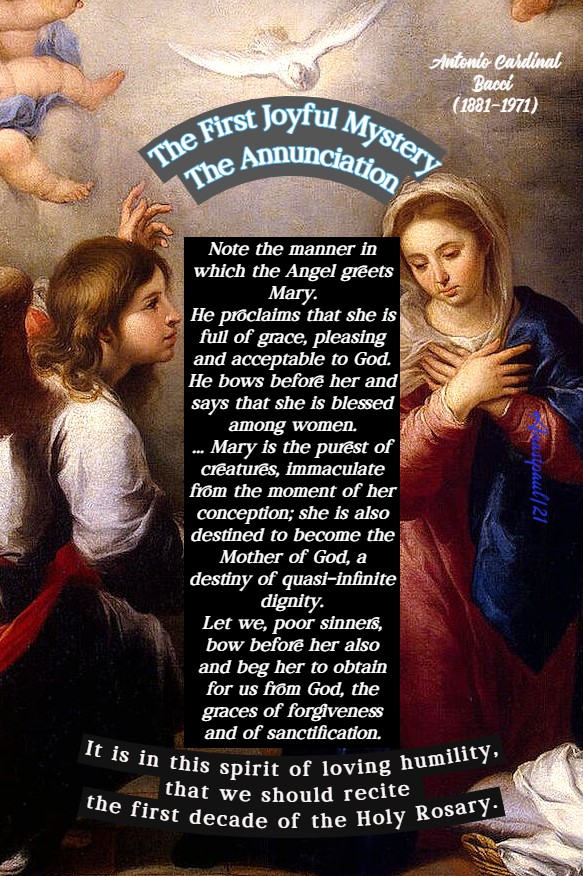
“Month of the Holy Rosary” The First Joyful Mystery The Annunciation
The Rosary is both a vocal and a mental prayer. When reciting the first five decades, we should meditate on the principal joyful mysteriest of our faith, beginning with the Annunciation to the Blessed Virgin. In other words, during the first decade, we should visualise the scene described in the Gospel.
“The angel Gabriel was sent from God to a town of Galilee called Nazareth, to a virgin betrothed to a man named Joseph, of the house of David and the Virgin’s name was Mary. And, when the Angel had come to her, he said “Hail, full of grace, the Lord is with thee. Blessed art thou among women” (Lk 1:26-28).
Note the manner in which the Angel greets Mary. He proclaims that she is full of grace, pleasing and acceptable to God. He bows before her and says that she is blessed among women. On previous occasions Angels had appeared to Patriarchs, Kings and Prophets but always, as superior beings bearing a command from Almighty God. Why, then, does an Angel bow before this maiden and salute her with such reverence? The reason is twofold. Mary is the purest of creatures, immaculate from the moment of her conception; she is also destined to become the Mother of God, a destiny of quasi-infinite dignity. Let we, poor sinners, bow before her also and beg her to obtain for us from God, the graces of forgiveness and of sanctification. It is in this spirit of loving humility, that we should recite the first decade of the Holy Rosary.
Quote/s of the Day – 3 October – Saturday of the Twenty Sixth week in Ordinary Time, Readings: Job 42:1-3, 5-6, 12-17, Psalms 119:66, 71, 75, 91, 125, 130, Luke 10:17-24
“I Believe”
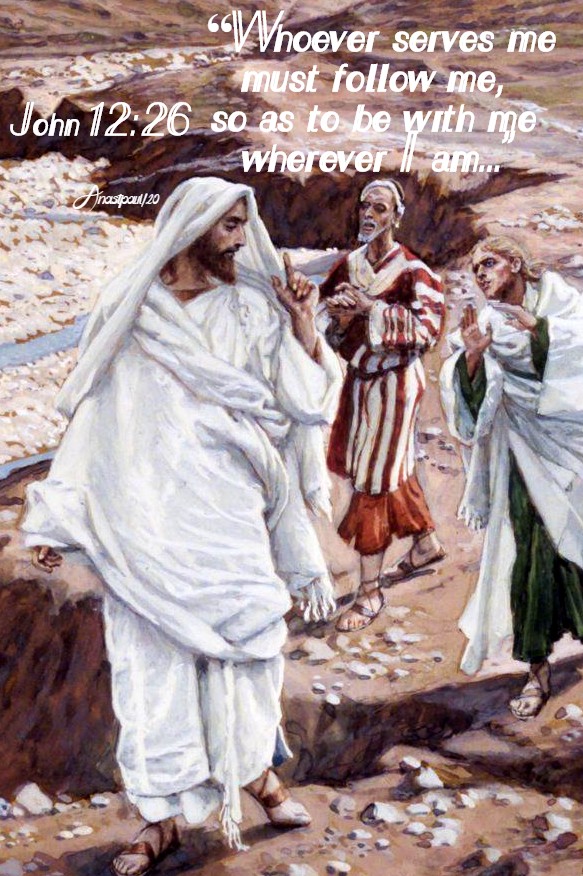
“Whoever serves me must follow me, so as to be with me wherever I am…”
John 12:26
“But it is God, who establishes us, with you in Christ and has anointed us, by putting his seal on us and giving us his Spirit in our heart, as a first instalment.”
St Paul 2 Corinthians 1:21
“Remember, then, that you received a spiritual seal, the spirit of wisdom and understanding, the spirit of knowledge and reverence, the spirit of holy fear. Keep safe what you received. God the Father sealed you, Christ the Lord strengthened you and sent the Spirit into your hearts as the pledge of what is to come.”
St Ambrose (340-397) Father & Doctor of the Church
“Faith is to believe what you do not see; the reward of this faith, is to see what you believe.”
“A person can do other things against his will but belief is possible, only in one who is willing.”
St Augustine (354-430) Father and Doctor of Grace
“If you wish to enter into life, keep My commandments. If you will know the truth, believe in Me. If you will be perfect, sell all. If you will be My disciple, deny yourself. If you will possess the blessed life, despise this present life. If you will be exalted in heaven, humble yourself on earth. If you wish to reign with Me, carry the Cross with Me. For only the servants of the Cross find the life of blessedness and of true light.”
Thomas à Kempis (1380-1471) The Imitation of Christ Chapter 56
“If God had a wallet, your picture would be in it.”
One Minute Reflection – 3 October – “Month of the Holy Rosary” – Saturday of the Twenty Sixth week in Ordinary Time, Readings: Job 42:1-3, 5-6, 12-17, Psalms 119:66, 71, 75, 91, 125, 130, Luke 10:17-24
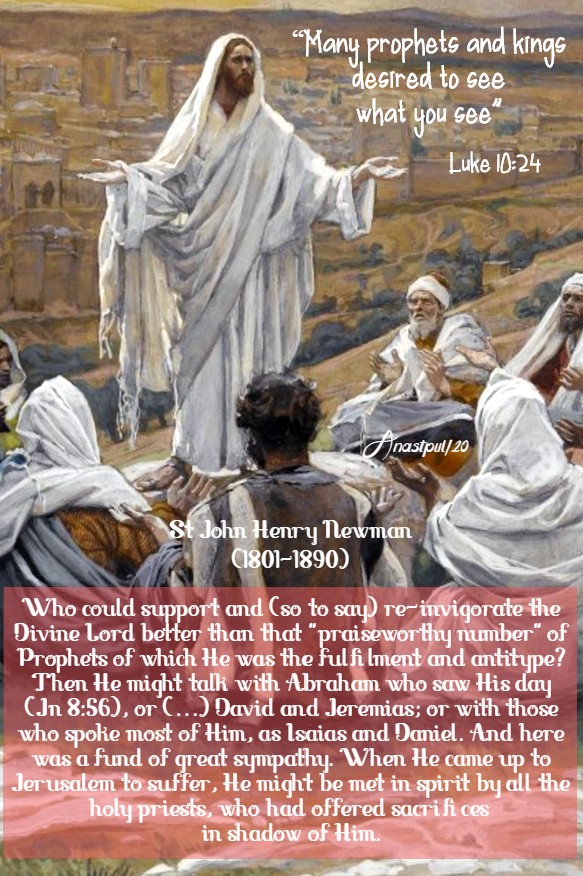
“Many prophets and kings desired to see what you see” … Luke 10:24
REFLECTION – “From the time of His birth we may suppose He held communion with the spirits of the Old Fathers, who had prepared His coming and prophesied of it. On one occasion He was seen all through the night, conversing with Moses and Elias, and that conversation was about His Passion. What a field of thought is thus opened to us, of which we know how little. When He passed whole nights in prayer (…) Who could support and (so to say) re-invigorate the Divine Lord better than that “praiseworthy number” of Prophets of which He was the fulfilment and antitype? Then He might talk with Abraham who saw His day (Jn 8:56), or (…) David and Jeremias; or with those who spoke most of Him, as Isaias and Daniel. And here was a fund of great sympathy. When He came up to Jerusalem to suffer, He might be met in spirit by all the holy priests, who had offered sacrifices in shadow of Him.” … St John Henry Newman (1801-1890) Cardinal, founder of the Oratory in England, Theologian – Meditations and Devotions: Part III, 2, 2, “Our Lord refuses sympathy”
PRAYER – Amidst this world’s changes, help us, by his prayers, to set out hearts always on You. Heavenly Father, let me realise that You guide our lives through Your Providence, Your Word and Sacraments. Help me to be obedient to the rules for my state in life and so be obedient to Your will for me. Grant that the prayers of our Blessed Mother, the Holy Virgin of the Rosary, may assist us as we strive to grow in humility. Through our Lord, Jesus Christ, Your Son in union with the Holy Spirit, one God forever and ever, amen.
Our Morning Offering – 3 October – “Month of the Holy Rosary” – Saturday of the Twenty Sixth week in Ordinary Time
Through Thee, to Us, our Saviour Came To Our Lady of the Rosary By St Amadeus of Lausanne O.Cist (1108-1159)
Through thee, to us, our Saviour came, Through thee, to Him, we fain would go. Our lives are marred by wrong and shame, Yet, confidence in thee we know. The friendship thou dost give to all Who love thy name, shall ever be Assurance thou wilt hear our call, Sweet Lady of the Rosary!
Thou art our Strength upon the way, Our Morning Star, to cheer and guide; Our Beacon Light to show the day, And lead us to the Saviour’s Side; A Comforter in ev’ry pain We find, O Mother blest, in thee, And seek we, never, thee in vain, Fair Lady of the Rosary!
Thy praises, Mary, we would sing, And all our faculties employ, That unto thee our hearts might bring A glory-crown of love and joy. Bless thou each humble effort made In thy regard and grant that we, May by thy influence be swayed, Our Lady of the Rosary!
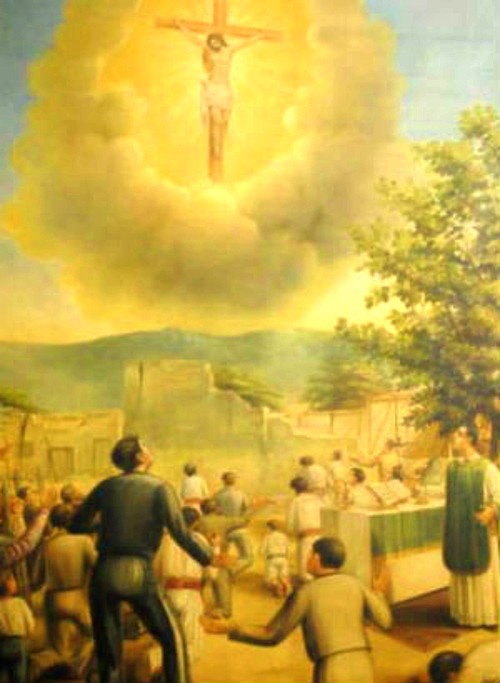
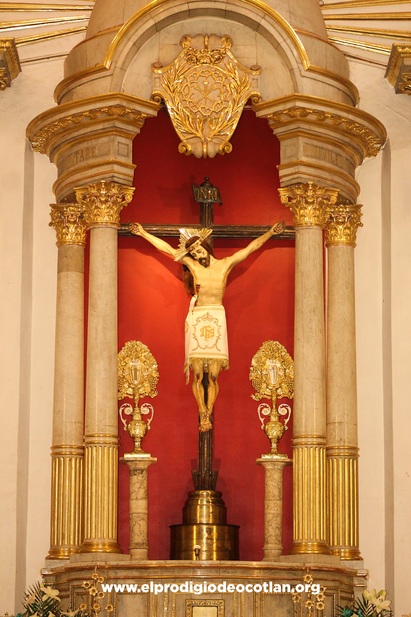
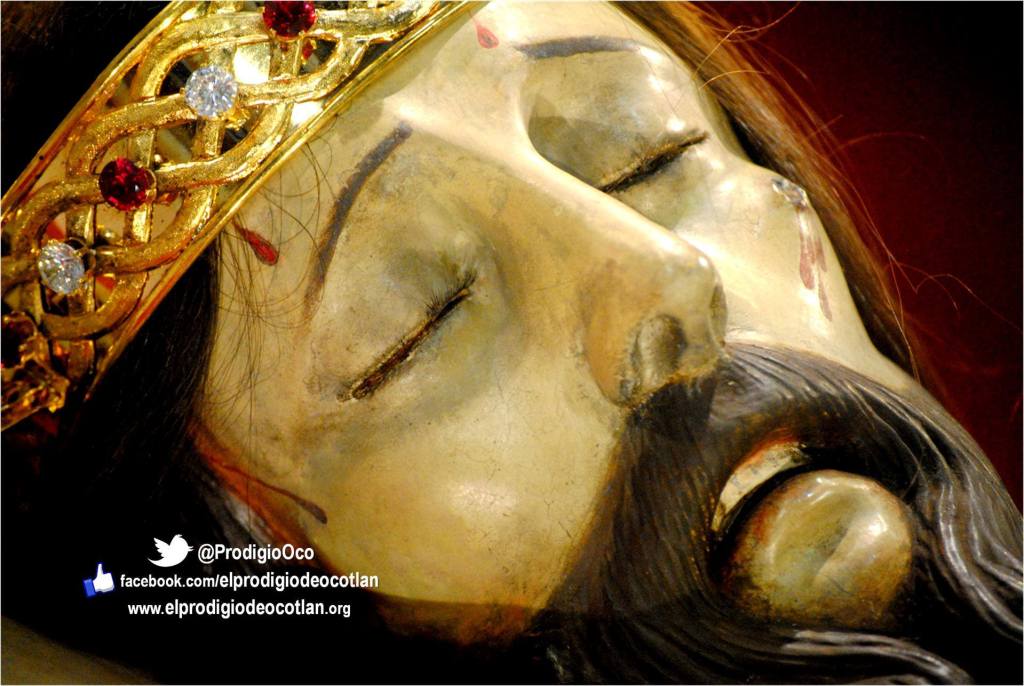
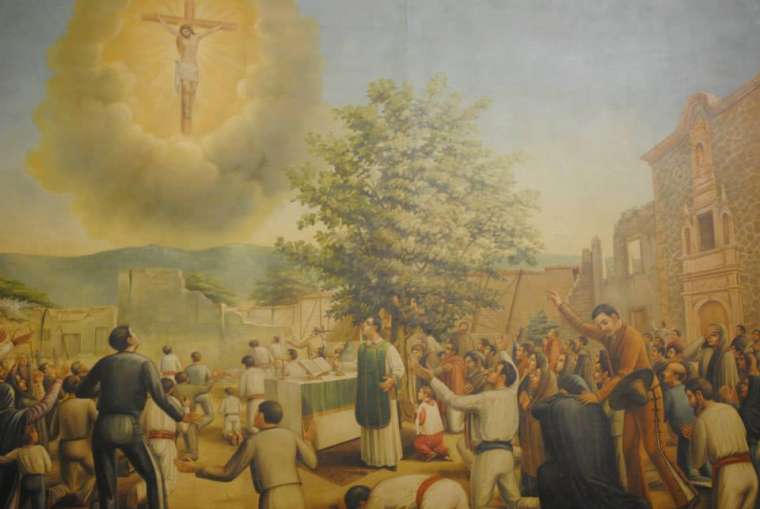
Feast of The Miracle of Ocotlán – Our Lord of Mercy – 3 October. This is a major miracle that you’ve probably never heard of, the appearance of Christ in the clouds, in Ocotlan, Mexico, in 1847. This historical event – approved by the Archdiocese of Guadalajara in 1911 – is known as “The Prodigy of Ocotlán“
On Saturday 2 October 1847, a massive earthquake hit the region of the town of Ocotlán, Mexico; much of the city was destroyed and 40 people died. The next day, Sunday 3 October 1847, before a Mass was celebrated in the cemetery of the Chapel of La Purísima Concepción in the city of Ocotlán, more than 2,000 people witnessed a perfect image of Jesus Christ Crucified that appeared in the skies for more than 30 minutes.
Before Mass began that 3 October which would be presided over by the parochial vicar, Fr Julián Navarro, two very white clouds began to join in the north-west of the sky and in the middle of them the image of Christ appeared.
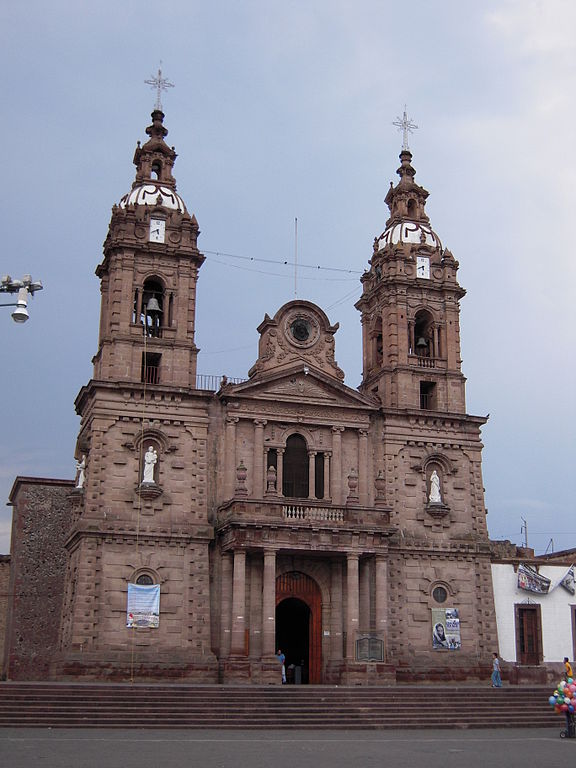
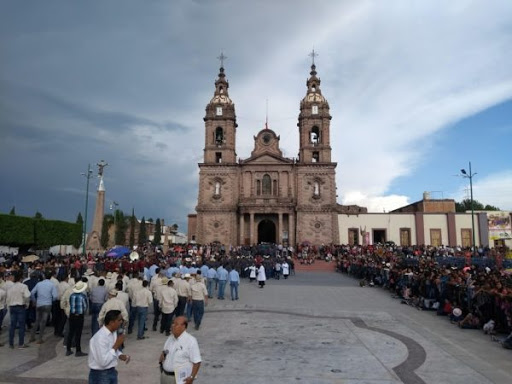
Those present and those in nearby towns were moved, made acts of contrition and shouted for “Mercy to the Lord.” For this reason this Christ was named the “Lord of Mercy” and in his honour, in September 1875, a new Church dedicated to Him was blessed and consecrated.
Among the faithful who witnessed the prodigy were also Fr Julián Martín del Campo, Parish Priest of the community and Antonio Jiménez, the Mayor of the city. Both sent letters to their respective superiors telling what happened.
In addition, after the miracle, a file was prepared with 30 eyewitness testimonies by order of the layman Lic. Miguel Castellanos. Fifty years later, in 1897, under the order of the then Archbishop of Guadalajara, Mons. Pedro Loza y Pardavé, a new file was drawn up with 30 more people, including 5 priests.
On 29 September 1911, the Archbishop of Guadalajara at that time. Mnsgr José de Jesús Ortiz y Rodríguez. signed the document that endorsed the appearance of Jesus Christ in Ocotlán and the worship and veneration that the faithful of that town carry out to the venerated image of the Lord of Mercy located in the Sanctuary of the same name.
“We must recognise as a perfectly proven historical fact the appearance of the blessed image of Jesus Christ Crucified (…) and that it could not have been the work of hallucination or fraud, since it was verified in broad daylight, in view of more than two thousand people, ” said the Archbishop.
He also pointed out that so that the Mercy of the Lord is never forgotten, the faithful should “congregate in the way possible, after purifying their consciences with the holy sacraments of Penance and Holy Communion and solemnly swear in the presence of God, for himself and his descendants, that year by year they will celebrate the anniversary of 3 October. ”
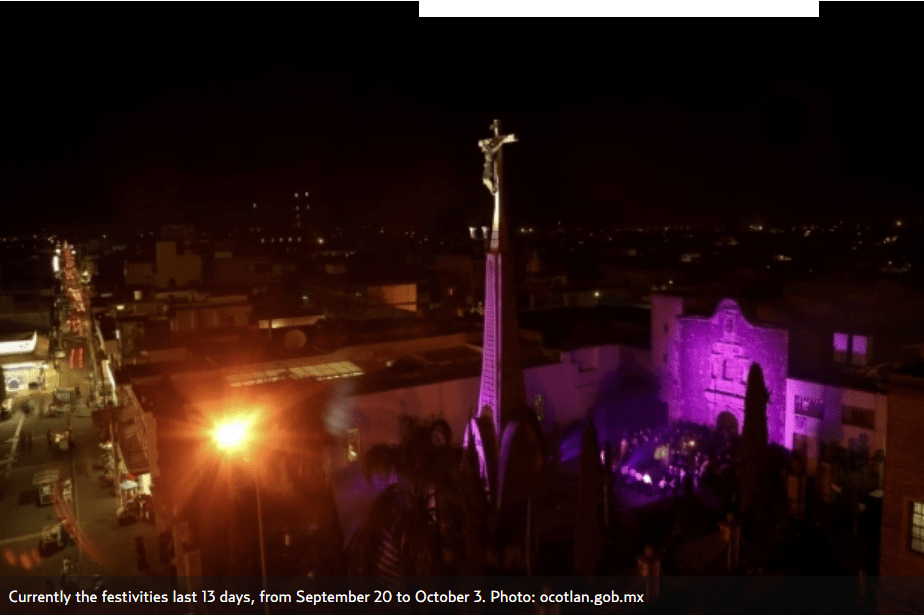
In 1912, after approval and to comply with the provisions of the Archbishop of Guadalajara, the public festivities began in honour of the Lord of Mercy, remembering the Prodigy of 1847. Currently the festivities last 13 days, from September 20 to September 3. October.
In 1997, John Paul II sent his Apostolic Blessing to the town of Ocotlán for the 150th anniversary of the prodigy and asked to celebrate their festivals in a holy way, living the sacraments.
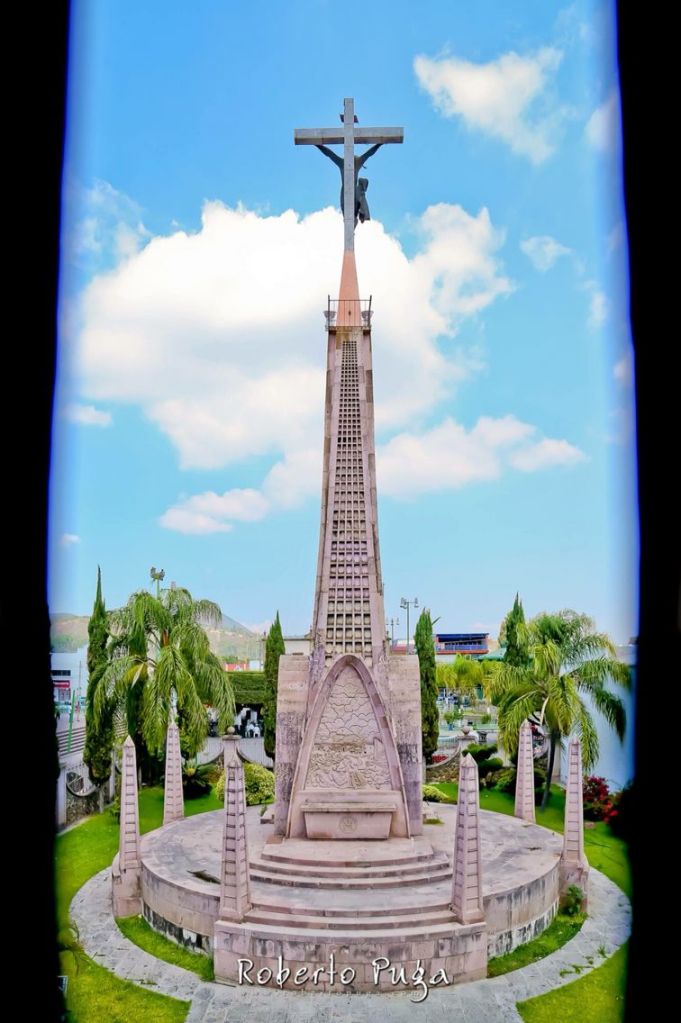
To commemorate the event, a monument, which is entirely carved in pink quarry. On the eastern altar there is a scene of the destruction of the town by the 1847 earthquake and on the western altar there is a representation of the prodigy with the Lord of Mercy in the centre. It has a height of approximately 20 meters.
Prayer to Our Lord of Mercy
Oh Lord of Mercy, Father and King of joyful Ocotlán; our assembled people adore You and a fervent song raise to You. For our people sinned and their sin provoked divine justice and a tremor left nothing but ruins of what was the lovely Ocotlán but the people repented and from Heavens, You came lovingly and with outstretched arms You gave us, a safe haven of peace … Amen
Bl Utto of Metten St Widradus — Martyrs of Alexandria – 9 saints: A number of Christian martyrs remembered together. We know the names Caius, Cheremone, Dionysius, Eusebio, Fausto, Lucio, Maximus, Paul, Peter and that there were at least two more whose names have not come down to us, and that’s about all we know.
Martyrs of Brazil – 30 beati: On 25 December 1597 an expedition of colonists, with two Jesuit and two Franciscan evangelists, arrived at Natal, Rio Grande do Norte, Brazil. The region was colonized by Portuguese Catholics but was invaded by Dutch Calvinists who soon took over the whole territory. They immediately made a policy of the persecution of Catholics. On Sunday 16 July 1645 at Cunhau, Brazil, 69 people were gathered in the Chapel of Our Lady of the Candles for Mass celebrated by Father Andre de Soveral. At the moment of the elevation a group of Dutch soldiers attack the Chapel, murdering many of the faithful including Father Andre; the parishioners died professing their faith and asking pardon for their sins. On 3 October 1645, 200 armed Indians and a band of Flemish troops, led by a fanatical Calvinist convert, hacked to death an unknown number of people of Rio Grande including: • Blessed Ambrosio Francisco Ferro • Blessed André de Soveral • Blessed Antônio Baracho • Blessed Antônio Vilela • Blessed Antônio Vilela Cid • Blessed Diogo Pereira • Blessed Domingos Carvalho • Blessed Estêvão Machado de Miranda • Blessed Francisco de Bastos • Blessed Francisco Mendes Pereira • Blessed João da Silveira • Blessed João Lostau Navarro • Blessed João Martins • Blessed José do Porto • Blessed Manuel Rodrigues de Moura • Blessed Mateus Moreira • Blessed Simão Correia • Blessed Vicente de Souza Pereira and other lay people whose names have not come down to us. They were Beatified on 5 March 2000 at Rome, Italy by Pope John Paul II.
Martyred in the Spanish Civil War: • Blessed Crescencio García Pobo • Blessed José María González Solís • Blessed José María Poyatos-Ruiz • Blessed Manuel Lucas Ibañez • Blessed Raimundo Joaquín Castaño González
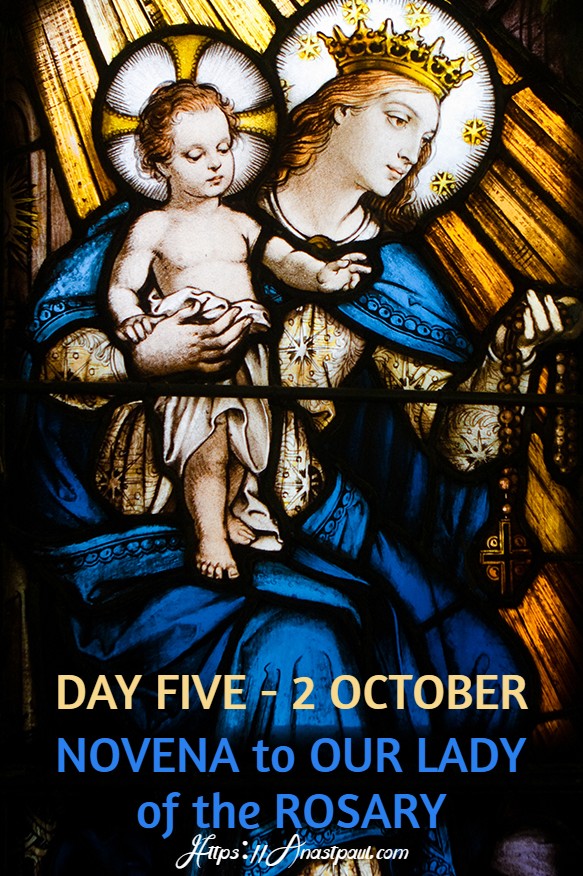
Novena to Our Lady of the Rosary – Day Five – 2 October
Day Five – We Pray for Purity of Heart and our personal intention:
The Ever-Virgin Mary was and remains pure in charity, chastity and love of truth and orthodoxy of faith. And that purity is divine because it is inspired by God! Each of us benefits from the purity of Mary, regardless of how difficult it is to be pure in charity, chastity and right belief, IT IS POSSIBLE… We WILL be pure when we adopt the attitude of Our Blessed Lady and seek the divine purity that even yet radiates from Her. By abandoning ourselves to God as She did, we open ourselves to fresh opportunities of achieving purity. (The Virtue of Purity: An Undivided Heart by Msgr Charles M Mangan)
To Our most holy Mother. To you do we pray first with heartfelt thanks for your YES to the Father. Grant us your guidance and assistance to become as pure as you are.
Daily Prayer along with our Daily Rosary:
My dearest Mother Mary, behold me, your child, in prayer at your feet. Accept this Holy Rosary, which I offer you in accordance with your requests at Fatima, as a proof of my tender love for you, for the intentions of the Sacred Heart of Jesus, in atonement for the offenses committed against your Immaculate Heart and for this special favour which I earnestly request in my Rosary Novena: ………………………….. (Mention your request).
I beg you to present my petition to your Divine Son. If you will pray for me, I cannot be refused. I know, dearest Mother, that you want me to seek God’s holy Will concerning my request. If what I ask for should not be granted, pray that I may receive that which will be of greater benefit to my soul.
I offer you this spiritual Bouquet of Roses because I love you. I put all my confidence in you, since your prayers before God are most powerful. For the greater glory of God and for the sake of Jesus, your loving Son, hear and grant my prayer. Sweet Heart of Mary, be my salvation.
Our Lady of the Rosary, pray for our Holy Mother Church and for our country.
Our Lady of Fatima, obtain for humanity a lasting peace.
Sweet Heart of Jesus, be my love.
Sweet Heart of Mary, at the hour of my death, lead me home.
Thought for the Day – 2 October – Meditations with Antonio Cardinal Bacci (1881-1971)
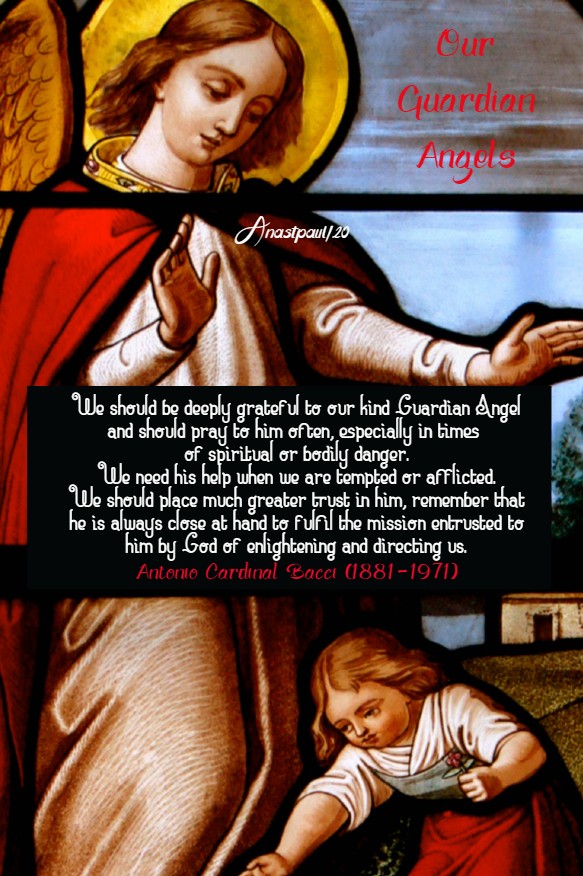
Our Guardian Angels
“Among the many expressions of God’s goodness towards us, is His designation of a heavenly spirit to accompany and to assist each of us on our journey through life. The human eye cannot see him although, he is always on guard by our side. Even while he is near us, he enjoys the beatific vision of God.
This is a wonderful thought. During the day, when we are preoccupied with so many affairs which can cause us to forget God, our angel is beside us, to inspire us to love God more. When we are asleep, he is watching over us and praying for our welfare. When we pray, he gathers our feeble supplications and offers them to God. When temptation presses hard, it is he who sustains us and encourages us to resist with Christian fortitude. Finally, when by some misfortune we fall into grave sin because we have been deaf to the appeals of our Creator, he takes pity on us and inspires in us remorse for our misdeeds and the desire to be restored as soon as possible to God’s favour.
We should be deeply grateful to our kind Guardian Angel and should pray to him often, especially in times of spiritual or bodily danger. We need his help when we are tempted or afflicted. We should place much greater trust in him, remember that he is always close at hand to fulfil the mission entrusted to him by God of enlightening and directing us.”
Quotes of the Day – 2 October – The Memorial of the Holy Guardian Angels
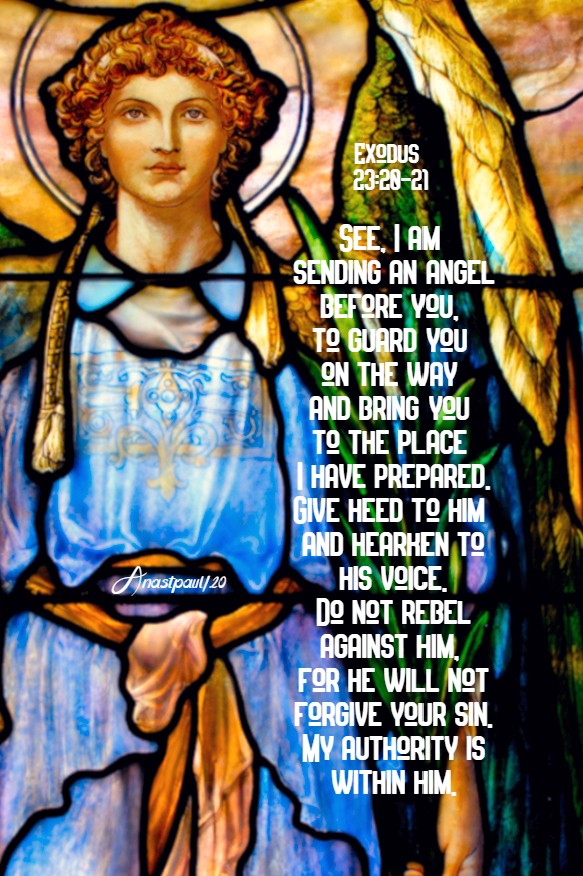
“See, I am sending an angel before you, to guard you on the way and bring you to the place I have prepared. Give heed to him and hearken to his voice. Do not rebel against him, for he will not forgive your sin. My authority is within him.”
Exodus 23:20-21
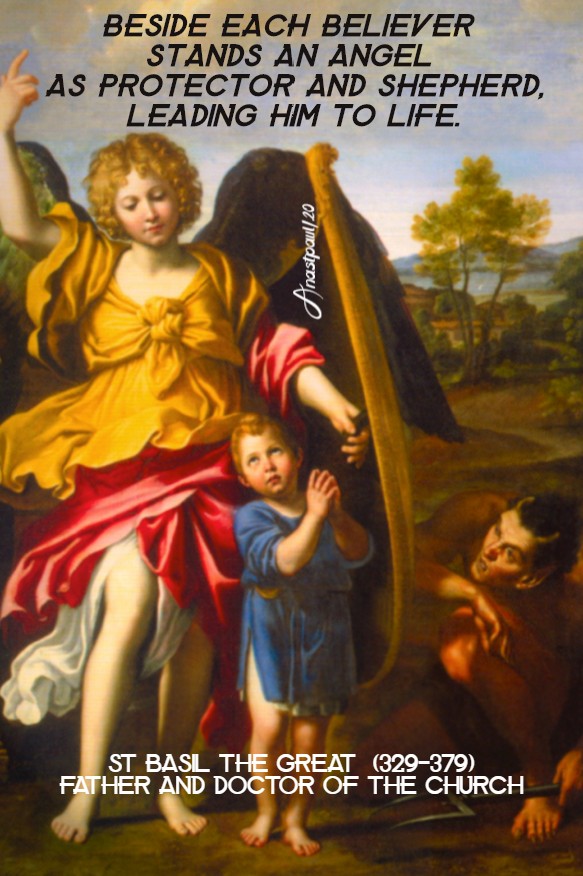
“Beside each believer stands an Angel as protector and shepherd, leading him to life.”
St Basil the Great (329-379) Father and Doctor of the Church
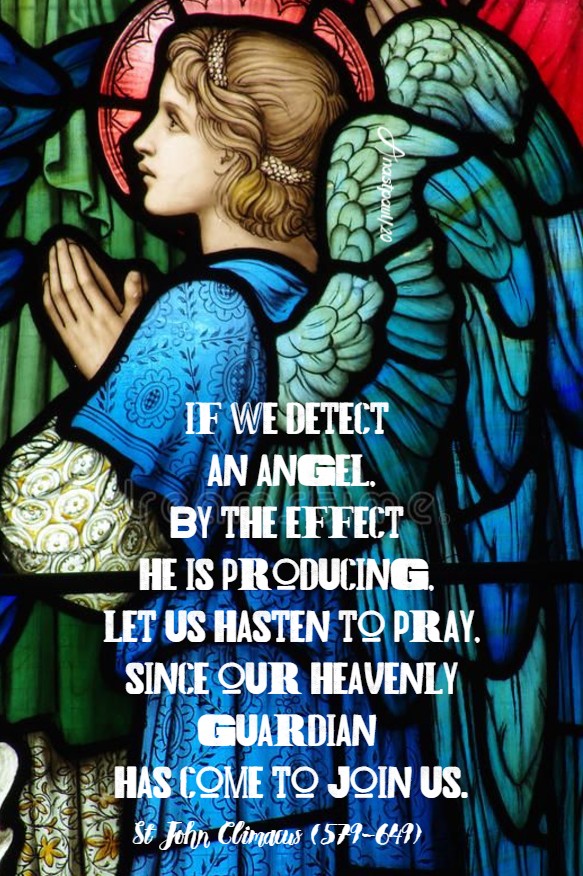
“If we detect an angel, by the effect he is producing, let us hasten to pray, since our heavenly guardian has come to join us.”
St John Climacus (579-649) Father of the Church
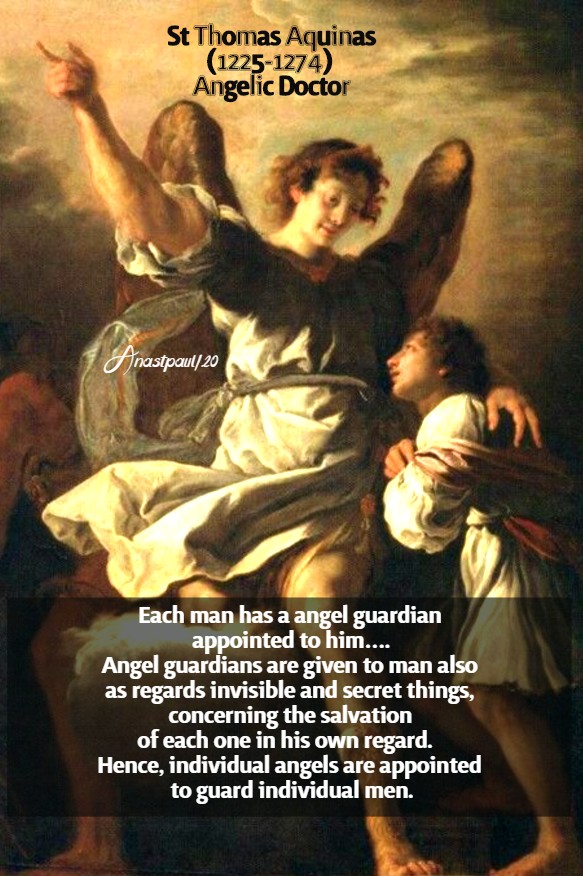
“Each man has a angel guardian appointed to him…. Angel guardians are given to man also as regards invisible and secret things, concerning the salvation of each one in his own regard. Hence, individual angels are appointed to guard individual men.”
St Thomas Aquinas (1225-1274) Angelic Doctor
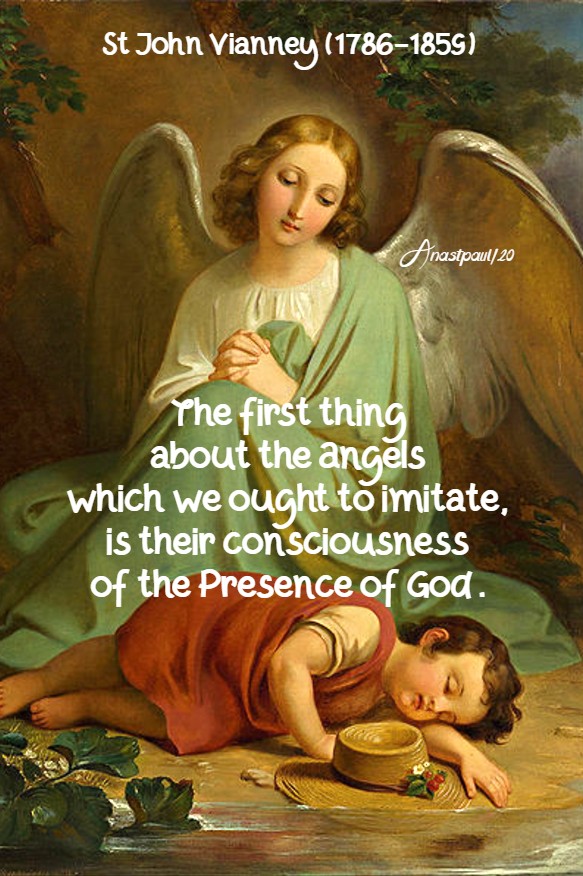
“The first thing about the Angels which we ought to imitate, is their consciousness of the Presence of God.”
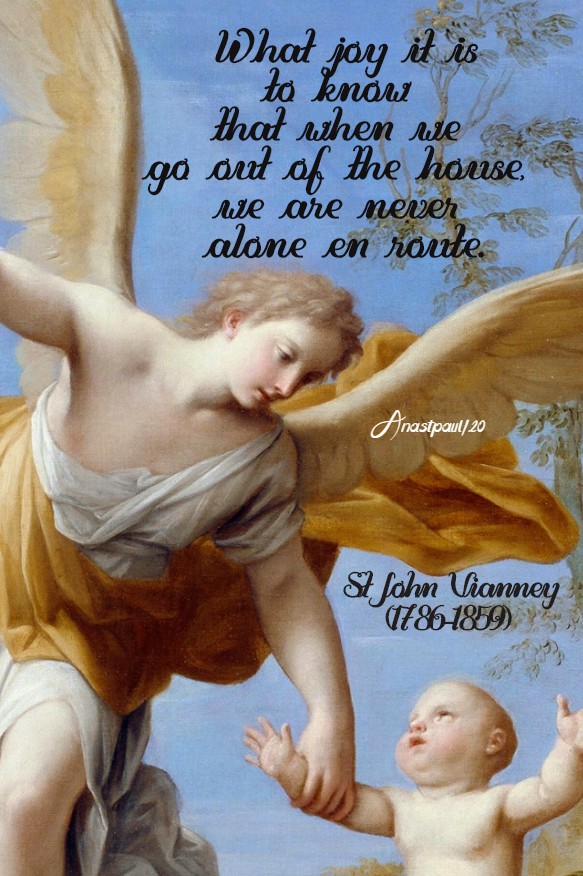
“What joy it is to know that when we go out of the house, we are never alone en route.”








 AnaStpaul
You must be logged in to post a comment.