Thought for the Day – 15 February – Meditations with Antonio Cardinal Bacci (1881-1971)
The Spirit of Prayer
“The alchemists of old were searching for a legendary stone which would transform metal into gold. This stone, does not exist, of course but, in the supernatural order, the spirit of prayer really can change everything to gold. When they are accompanied by this spirit, all our actions are most pleasing to God and draw His further favours. Blessed Maria Assunta Pallotta, understood this truth clearly and put it into practice in her life. She tended animals, served in the kitchen and was a missionary in China but, no matter what she was doing, she was moved by the spirit of prayer and of the love of God. “I ask God,” she wrote to her parents, “to spread throughout the world that purity of intention which consists in performing our most ordinary actions for the love of God.” Let us follow this example. Let us put into practice this great rule of the spiritual life. Then, all our actions will be acceptable prayer ascending to God.”
Quote/s of the Day – 15 February – The Memorial of St Claude de la Colombiere SJ (1641-1682) “Apostle of the Sacred Heart”
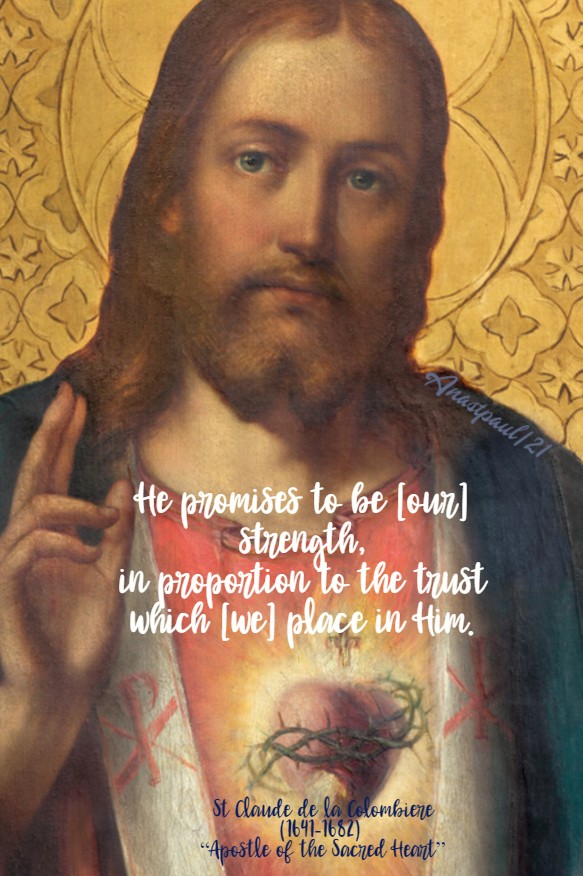
“He promises to be [our] strength, in proportion to the trust which [we] place in Him.”
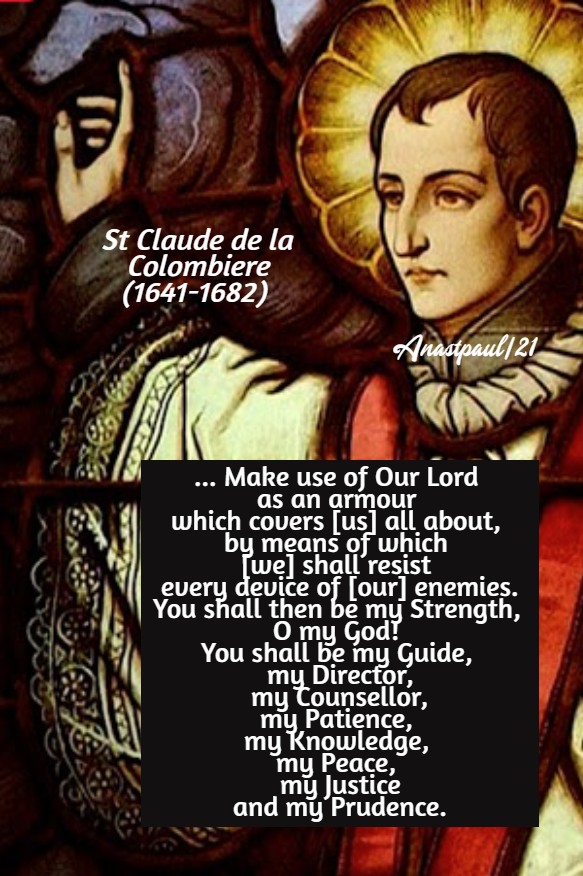
“… Make use of Our Lord as an armour which covers [us] all about, by means of which [we] shall resist every device of [our] enemies. You shall then be my Strength, O my God! You shall be my Guide, my Director, my Counsellor, my Patience, my Knowledge, my Peace, my Justice and my Prudence.”
“[Prayer] is the one means for our purification, the one way to union with God, the one channel by which God may unite Himself with us, that He may do anything with us, for His glory. To obtain the virtues of an apostle, we must pray; to make them of use to our neighbour, we must pray; to prevent our losing them, while we use them in His service, we must pray. The counsel, or rather the commandment: Pray always, seems to me extremely sweet and by no means impossible. It secures the practice of the presence of God …”
St Claude de la Colombiere (1641-1682) “Apostle of the Sacred Heart”
One Minute Reflection – 15 February – Readings: Genesis 4:1-15, 25, Psalms 50:1 and 8,16-17, 20-21, Mark 8:11-13 and the Memorial of St Claude de la Colombiere SJ (1641-1682) “Apostle of the Sacred Heart”
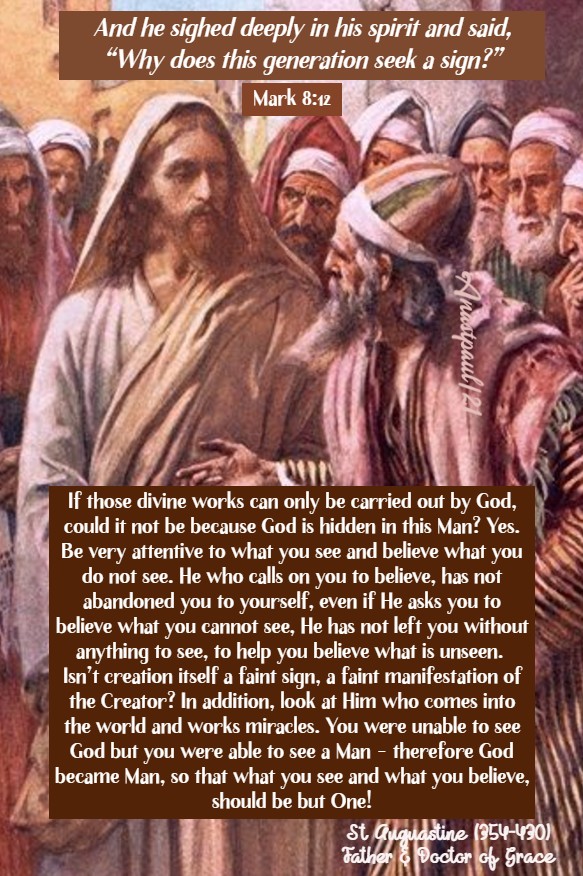
And he sighed deeply in his spirit and said, “Why does this generation seek a sign?” – Mark 8:12
REFLECTION – “Admire God’s wonderful work, come out of your sleep. Are you only going to admire extraordinary miracles? But are they any greater than those that daily take place before your eyes? Are people astonished because our Lord Jesus Christ satisfied several thousand persons with five loaves (Mt 14,19f) and are not surprised that a few seeds are enough to cover the ground with abundant harvests? They are filled with wonder when they see our Saviour change water into wine (Jn 2,19); isn’t it the same thing when rain goes through the roots of the vine? The author of both these miracles is the same…
Our Lord worked miracles and yet many despised him… They said to themselves : ‘The works are divine but, as for Him, he is only a man.’ Therefore, you see two things: divine works on the one hand and a Man on the other. If those divine works can only be carried out by God, could it not be because God is hidden in this Man? Yes. Be very attentive to what you see and believe what you do not see. He who calls on you to believe, has not abandoned you to yourself, even if He asks you to believe what you cannot see, He has not left you without anything to see, to help you believe what is unseen. Isn’t creation itself a faint sign, a faint manifestation of the Creator? In addition, look at Him who comes into the world and works miracles. You were unable to see God but you were able to see a Man – therefore God became Man, so that what you see and what you believe, should be but One!” – St Augustine (354-430) Bishop of Hippo (North Africa), Father and Doctor of the Church – Sermon 126, 4-5
PRAYER – Almighty Lord and God, protect us by Your power throughout the course of this day, even as You have enabled us to begin it. Your grace is all that we need, to see the loving kindness of Your Son, our Lord Jesus in all we see and do and think. Do not let us turn aside from His path but by the faith You have granted us, let us find meaning in all, which is the sign of Your glory. Do not let us turn aside to sin and may the intercession of St Claude de la Colombiere (1641-1682), grant us courage and peace. Through Jesus Christ, our Saviour, with the Holy Spirit, God now and forever, amen.
Our Morning Offering – 15 February – The Memorial of St Claude de la Colombiere SJ (1641-1682) “Apostle of the Sacred Heart”
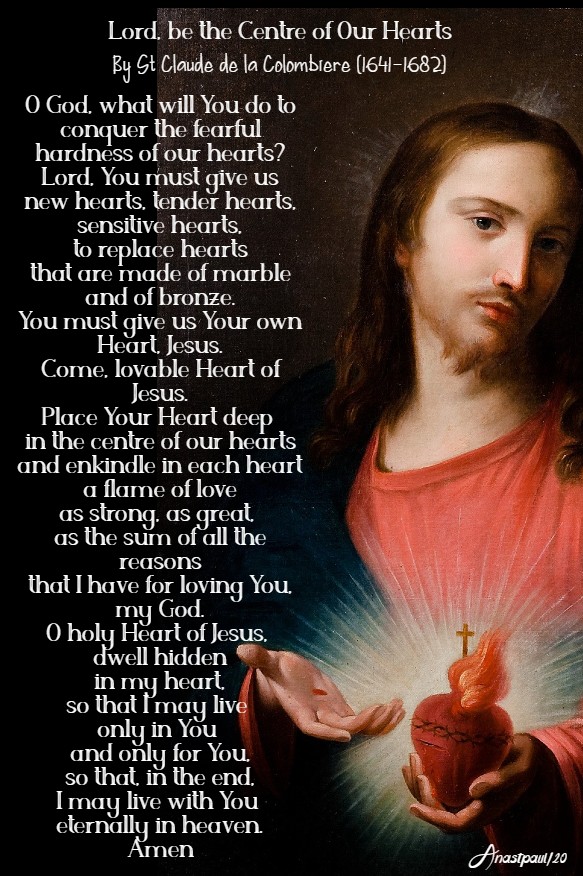
Lord, be the Centre of Our Hearts By St Claude de la Colombiere
O God, what will You do to conquer the fearful hardness of our hearts? Lord, You must give us new hearts, tender hearts, sensitive hearts, to replace hearts that are made of marble and of bronze. You must give us Your own Heart, Jesus. Come, lovable Heart of Jesus. Place Your Heart deep in the centre of our hearts and enkindle in each heart a flame of love as strong, as great, as the sum of all the reasons that I have for loving You, my God. O holy Heart of Jesus, dwell hidden in my heart, so that I may live only in You and only for You, so that, in the end, I may live with You eternally in heaven. Amen
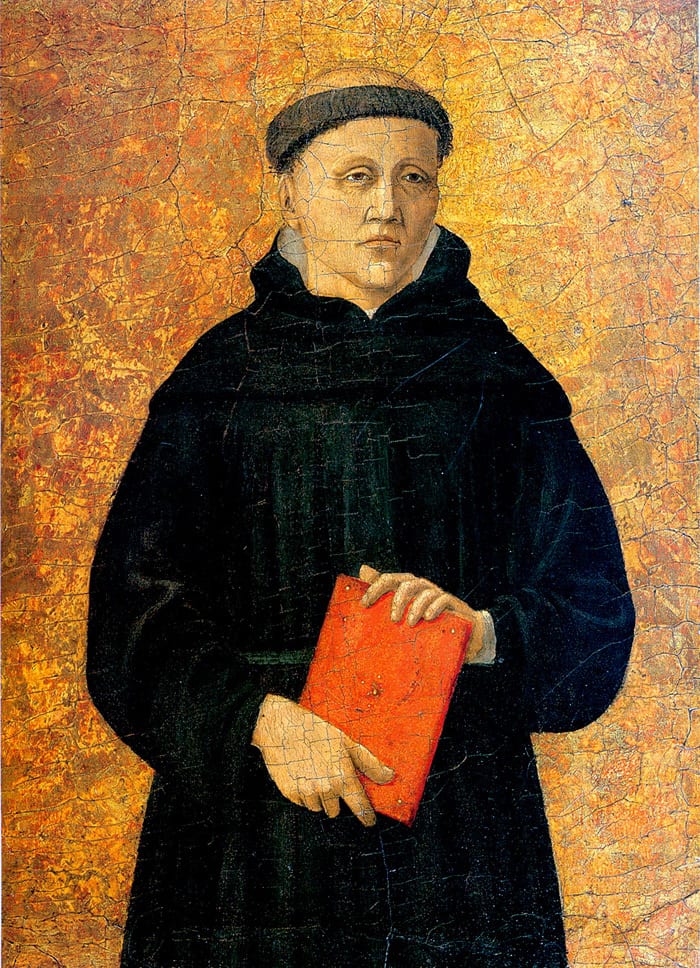
Saint of the Day – 15 February – Blessed Angelus de Scarpetti OSA (Died c 1306) Religious of the Order of the Hermits of St Augustine, Missionary, miracle-worker. Born at Borgo San Sepolcro modern Sansepolcro, Italy and died in 1306 at Borgo San Sepolcro modern Sansepolcro, Italy. Also known as – Angelo de Scarpetti, Angelus of Sansepolcro, Angelo of Borgo San Sepolcro
Angelus was born into the Scarpetti family in Sansepolcro, Italy, in the first half of the thirteenth century. He entered the convent in his city of the Hermits of St John the Good in approximately 1254. In 1256 the convent passed to the new Order of the Hermit Friars of St Augustine. There he became a fellow-student with Saint Nicholas of Tolentino.
He was sent to England as a Missionary but we have little information of his time there.
His reputation for sanctity was endowed by some miraculous episodes that occurred during his lifetime, including the resurrection of an innocent man who was condemned to death. Angelus had made a formal request for the innocent man’s pardon but it was refused and the man was executed. However, by Angelus’ fervent entreaties to the only Judge, the man was raised to life.
Since the sixteenth century, Augustinian writers have noted his profound humility, unflinching charity and his spotless purity of spirit and body. All of these gained him, among his countrymen, renown as a man acceptable to God, who God made full of supernatural gifts.
Angelus died in Sansepolcro in 1306. In 1905 the local Diocese began the process for his Beatification, which reached a successful conclusion in 1922.
His body is currently kept in a carved, gilt wooden casket that is decorated with scenes from his life and is kept under the main altar of the Church of Sant’Agostino in Sansepolcro.
Angelus was Beatified on 27 July 1921 by Pope Benedict XV.
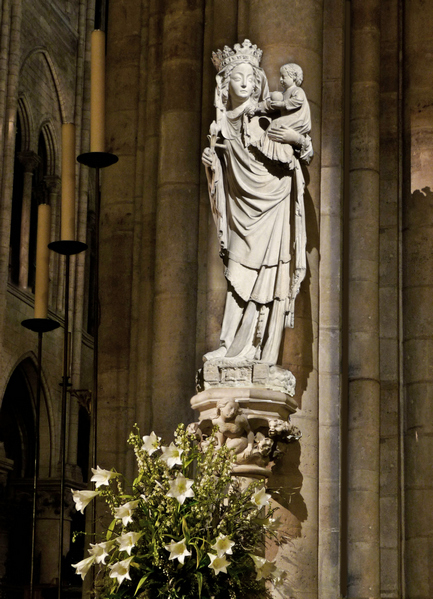
Notre-Dame de Paris / Our Lady of Paris, France (522) – 15 February:
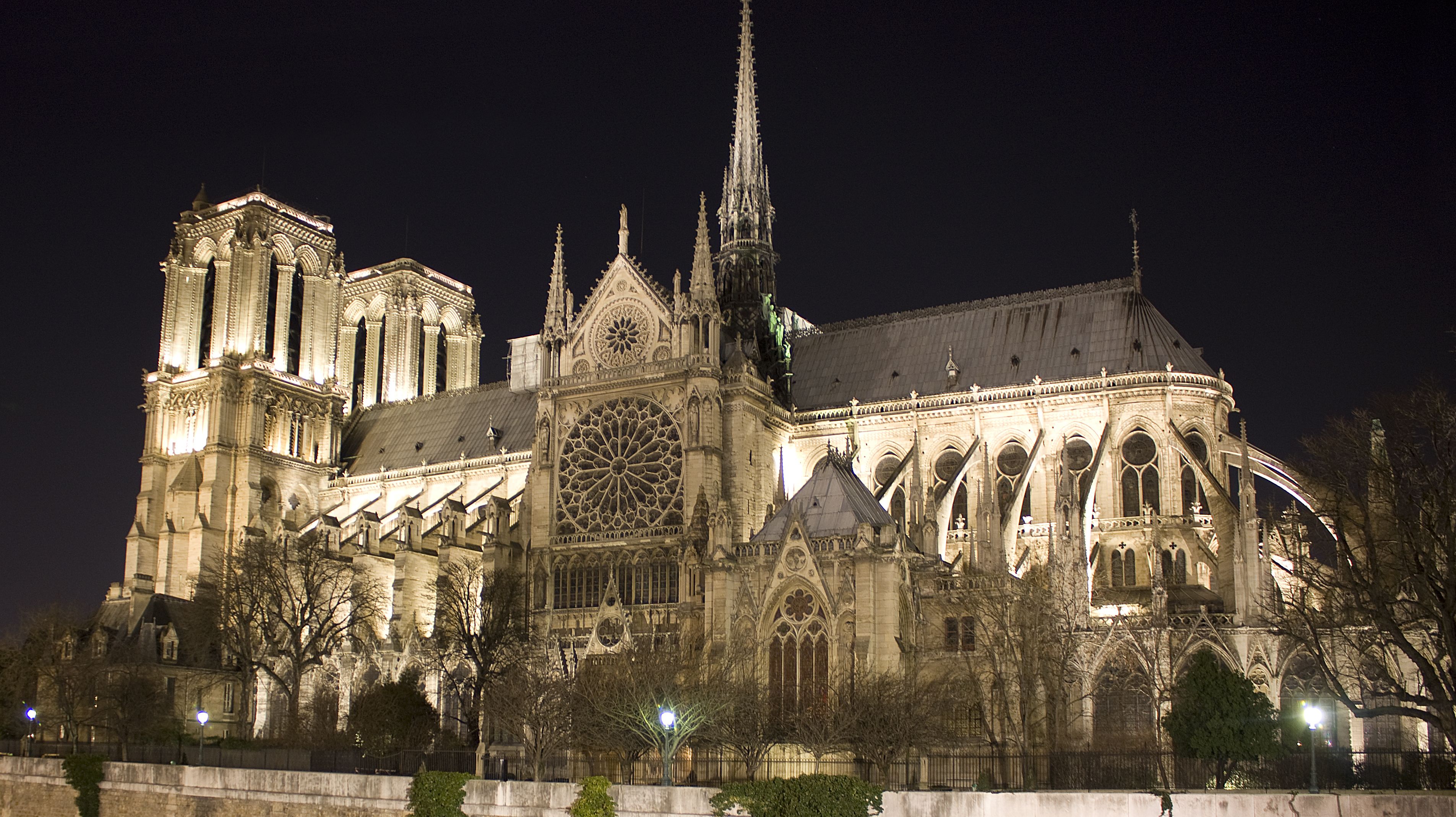
There does not seem to be a great deal of information about Our Lady of Paris; it is an ancient title and can be traced well back before the 12th Century, when the Cathedral of Notre Dame de Paris (Our Lady of Paris) was begun. Some authorities say that veneration of the Blessed Virgin in Paris can be traced to the first apostles of the city. Since Saint Paul was in Gaul (France) during his travels, it may be assumed that this veneration dates to the first century of the Christian era. And, if Mary was venerated in Paris at that early date, it is possible that she was, even then, known as Our Lady of Paris. Briefly, as long as Christian minds can remember, Paris was consecrated to the Virgin Mary, whom the inhabitants always venerated. It is known that Our Lady of Paris was a Church first built by King Childebert in the year 522. About the year 1257, the King, Saint Louis IX assisted in the construction of a larger Church carried on in the same place, on the foundations which King Philip Augustus had laid in the year 1191. The older Church built by King Childebert, which had been dedicated to the Blessed Virgin, had became too ruinous to be repaired, so Maurice, Bishop of Paris, decided to rebuild it and, at the same time, adorn Paris with a Cathedral that would outshine all those which had hitherto been built anywhere.
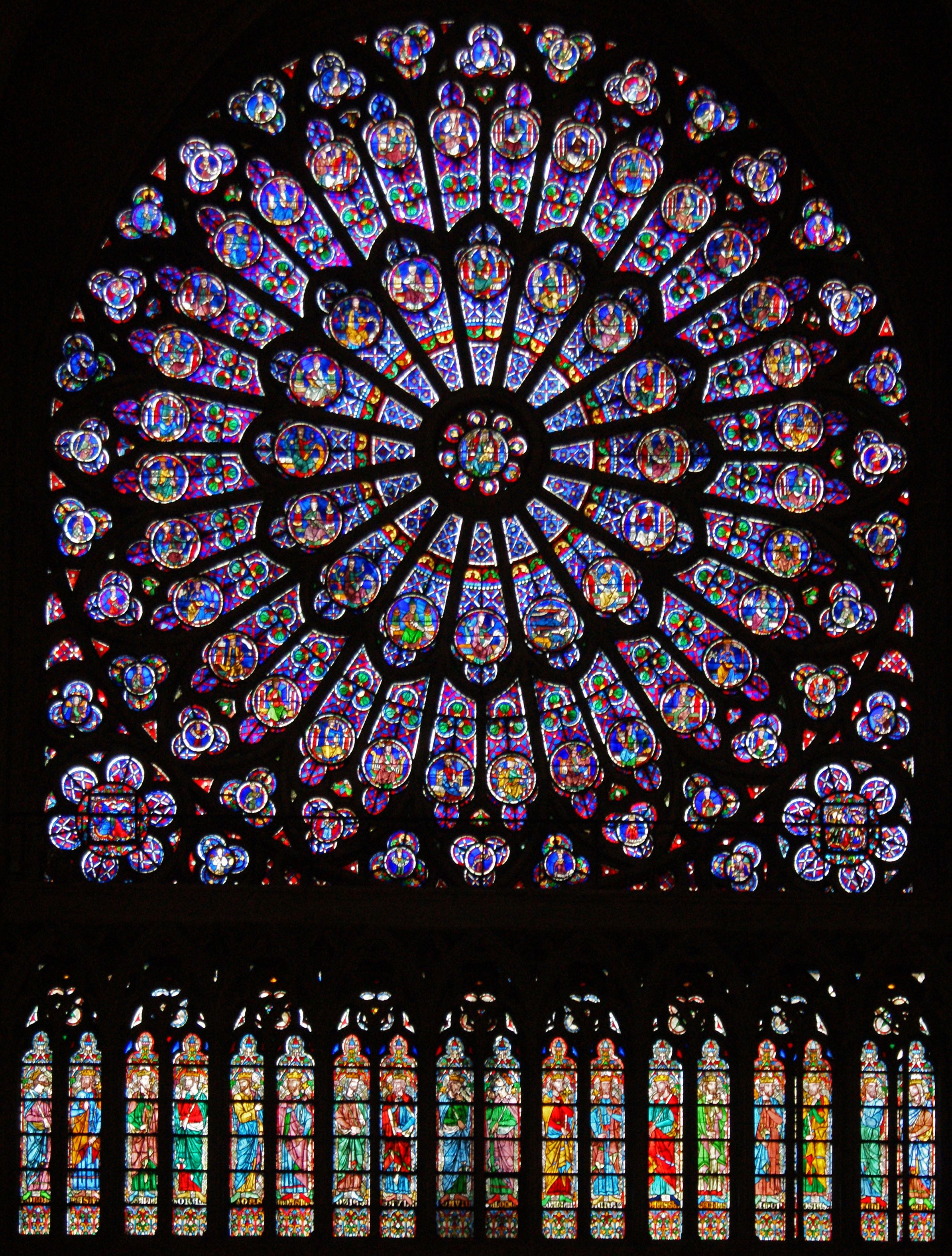
Plans were drawn up during the reign of King Louis VII and work had actually begun on Notre Dame de Paris, Notre Dame Cathedral, in 1162. The cornerstone was laid in the presence of Pope Alexander III. Notre Dame is a huge Gothic Cathedral on the Ile de la Cite, with beautiful flying buttresses to support the tremendous height of the walls and are adorned with stylish gargoyles. It is home to a reliquary which contains Christ’s Crown of Thorns. By the beginning of the fourteenth century, perhaps 1345, the Cathedral was finished, virtually as it stands today. Sometime during the building of the Cathedral, a statue of Our Lady was fashioned and installed in place. As was typical, the Cathedral was desecrated during the French Revolution and many of the religious artifacts were lost to future generations, although the incredible stained glass windows were not destroyed, including the three spectacular “rose window” that can still be seen today.
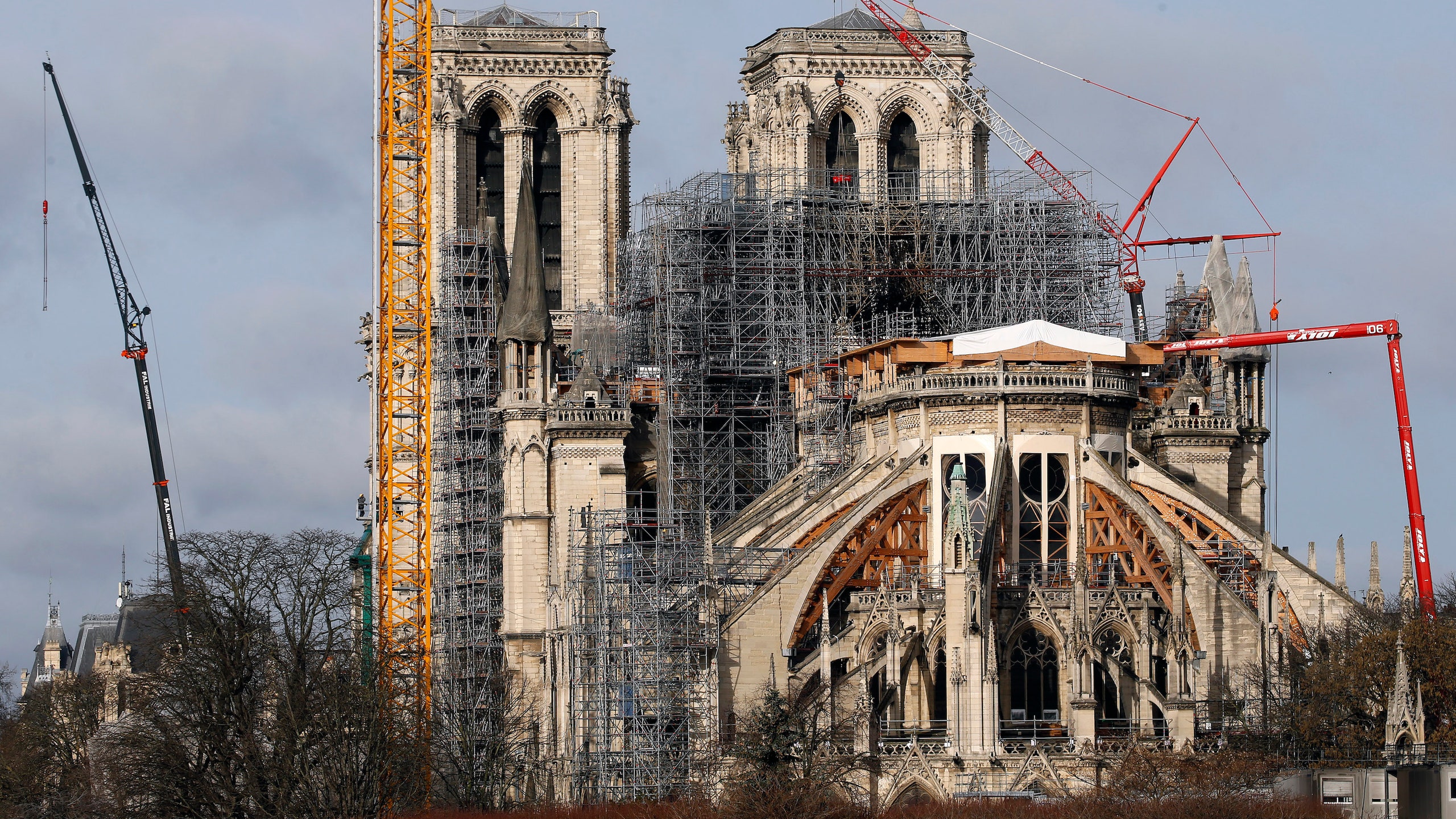
A smoke detector first alerted building staff to a fire beneath the roof at 6:18 pm on 15 April 2019, f Notre-Dame de Paris. By the time it was extinguished, the building’s spire collapsed and most of its roof had been destroyed and its upper walls severely damaged. Extensive damage to the interior was prevented by its stone vaulted ceiling, which largely contained the burning roof as it collapsed.
The restoration in early 2020
Many works of art and religious relics were moved to safety early in the emergency but others suffered some smoke damage and some exterior art was damaged or destroyed. The Cathedral’s altar, two pipe organs, and its three 13th-century rose windows suffered little to no damage.
The Nave before the fireThe Nave after the fire
Three emergency workers were injured. French President, Emmanuel Macron, said that the Cathedral would be restored by 2024 and launched a fundraising campaign which brought in pledges of over €1 billion as of 22 April 2019. A complete restoration could require twenty years or more. On 25 December 2019, the Cathedral did not host ChristmasMass for the first time since 1803.
Martyrs of Passae: Castulus Lucius Magnus Saturninus
Martyrs of Prague – 14 beati – Franciscan Friars Minor martyred together by a mob led by Lutherans – • Blessed Antonín of Prague • Blessed Bartolomeo Dalmasoni • Blessed Bedrich Bachstein • Blessed Christoffel Zelt • Blessed Didak Jan • Blessed Emmanuel of Prague • Blessed Gaspare Daverio • Blessed Giovanni Bodeo • Blessed Girolamo degli Arese • Blessed Jakob of Prague • Blessed Jan of Prague • Blessed Juan Martínez • Blessed Klemens of Prague • BlessedSimon of Prague They were martyred on • Shrove Tuesday 15 February 1611 at the Church of Our Lady of the Snows in Prague, Czech Republic • body dumped nearby but given Christian burial on 19 February 1611 in the monastery • re-interred in the side chapel of the church in 1616. Beatified 13 October 2012 by Pope Benedict XVI
Martyrs of Sweden: Sigfrid Sunaman Unaman Winaman
Martyred in the Spanish Civil War: Bl Pere Vallmitjana Abarca
Thought for the Day – 14 February – Meditations with Antonio Cardinal Bacci (1881-1971)
The Three Grades of Perfection – One and Two
“According to St Ignatius, there are three grades of perfection. The first consists in being ready to avoid mortal sin at all costs, even to the ultimate sacrifice. Circumstances may require us to be martyrs for the faith by being prepared to shed our blood, rather than deny Jesus. Circumstances may also require us to be martyrs for our Christian way of life, by being prepared to lose everything, health, fortune and friendship, rather than commit a mortal sin. We are all obliged to reach this first grade of perfection. If anyone refuses to recognise this, he is already in a state of mortal sin, insofar, as he is prepared to sin grievously, rather than make any real sacrifice. Such a man loves himself and his own comfort, more than he loves God.
The second grade of perfection, consists in a state of indifference to created things, to everything except God, whether it is to health or sickness, wealth or poverty, praise or blame, success or failure. All these things can be used equally well in the loving service of God and in the salvation of our souls. The first grade of perfection is based on the love of God. The second is founded on the love of God alone, so that we are indifferent to everything else, as long as we love, serve and give glory to God. We seek other things, only insofar, as they can help us to know and love God better. We avoid them, insofar, as they can keep us apart from Him.”
Quote/s of the Day – 14 February – Readings: Leviticus 13:1-2, 44-46, Psalms 32:1-2, 5, 11, 1 Corinthians 10:31-11:1, Mark 1:40-45
LENTEN THOUGHTS
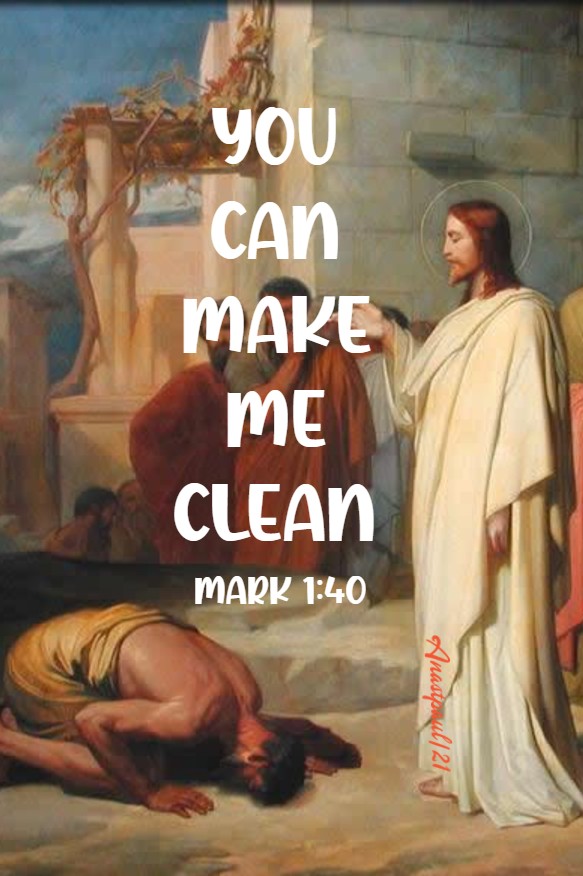
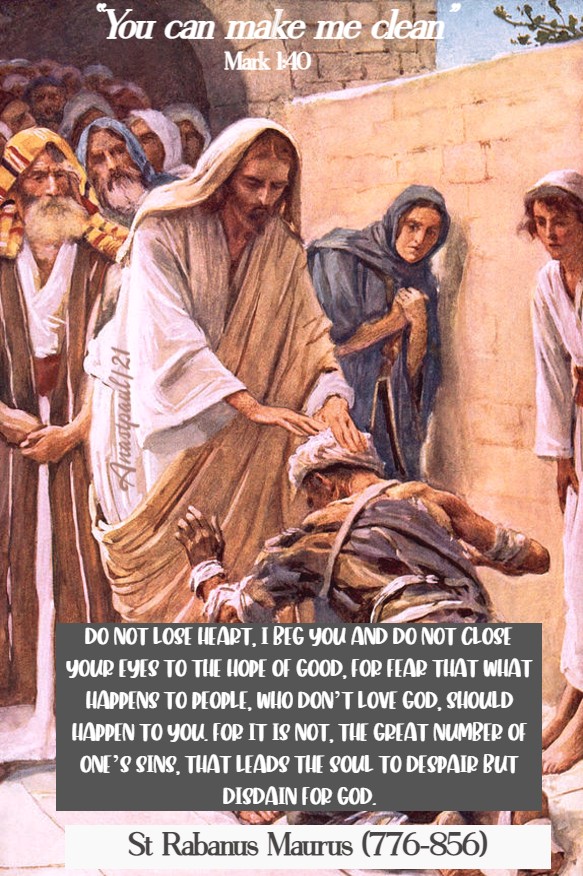
“You can make me clean”
Mark 1:40
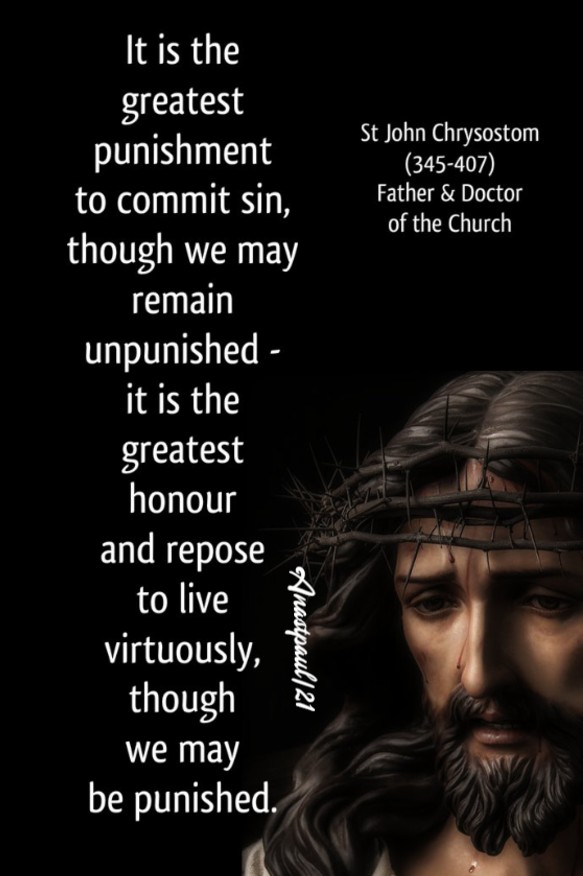
“It is the greatest punishment to commit sin, though we may remain unpunished – it is the greatest honour and repose to live virtuously, though we may be punished.”
St John Chrysostom (345-407) Father & Doctor of the Church
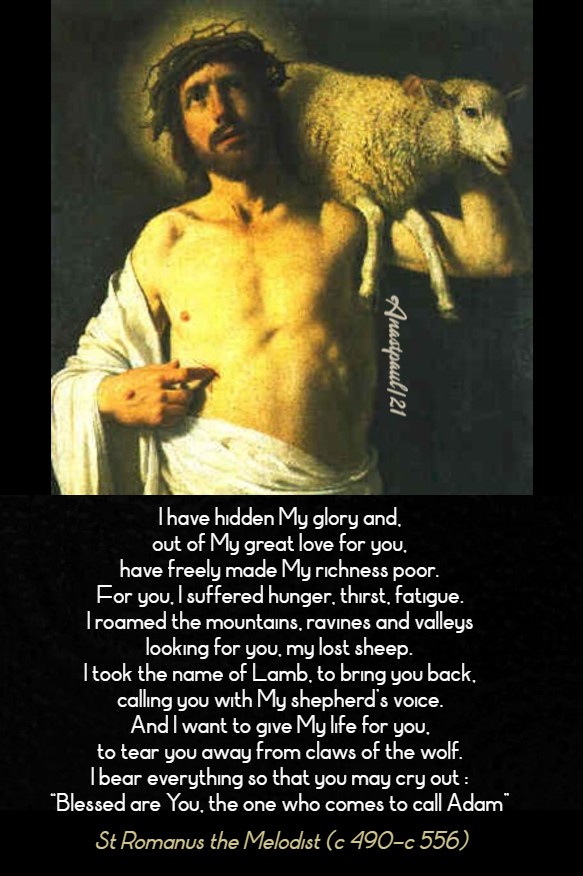
“I have hidden My glory and, out of My great love for you, have freely made My richness poor. For you, I suffered hunger, thirst, fatigue. I roamed the mountains, ravines and valleys looking for you, my lost sheep. I took the name of Lamb, to bring you back, calling you with My shepherd’s voice. And I want to give My life for you, to tear you away from claws of the wolf. I bear everything so that you may cry out : “Blessed are You, the one who comes to call Adam.”
St Romanus the Melodist (c 490-c 556)
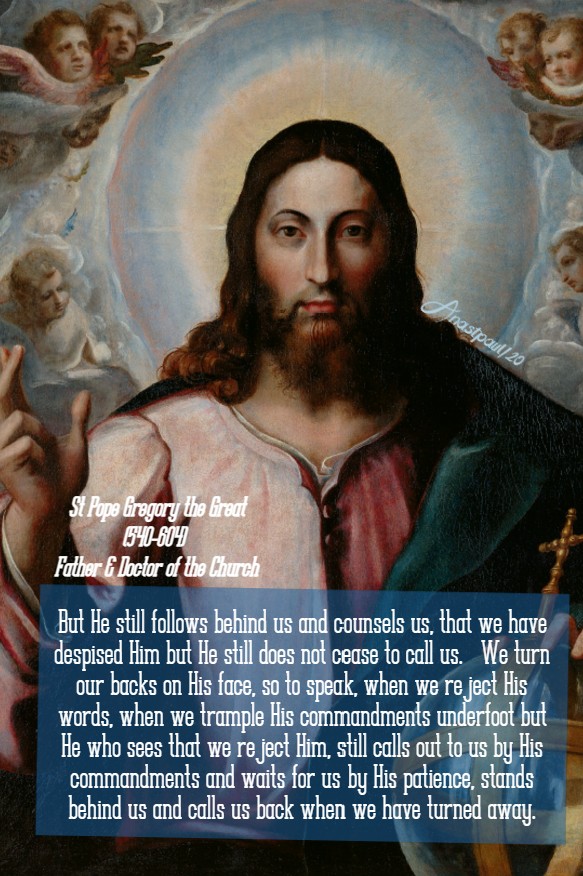
“But He still follows behind us and counsels us, that we have despised Him but He still does not cease to call us. We turn our backs on His face, so to speak, when we reject His words, when we trample His commandments underfoot but He who sees that we reject Him, still calls out to us by His commandments and waits for us by His patience, stands behind us and calls us back when we have turned away.”
St Pope Gregory the Great (540-604) Father & Doctor of the Church
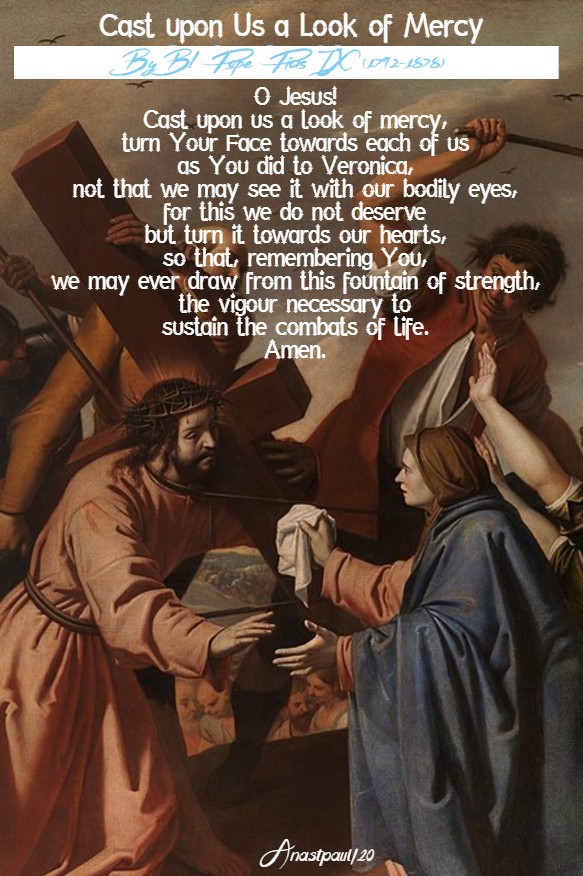
Cast Upon Us a Look of Mercy By Blessed Pope Pius IX (1792-1878)
O Jesus! Cast upon us a look of mercy, turn Your Face towards each of us as You did to Veronica, not that we may see it with our bodily eyes, for this we do not deserve but turn it towards our hearts, so that, remembering You, we may ever draw from this fountain of strength, the vigour necessary to sustain the combats of life. Amen
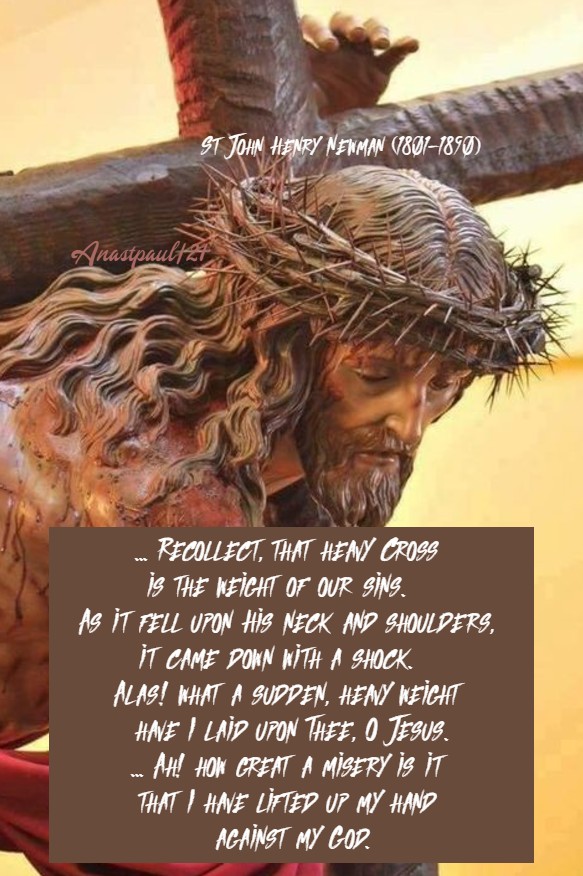
“… Recollect, that heavy Cross is the weight of our sins. As it fell upon His neck and shoulders, it came down with a shock. Alas! what a sudden, heavy weight have I laid upon Thee, O Jesus. … Ah! how great a misery is it that I have lifted up my hand against my God.”
REFLECTION – “You must never fail to trust in God, nor despair of His mercy. I should not like you to doubt, or despair of becoming better. For even if the devil were able to throw you down, from the heights of virtue, to the depths of wickedness, how much more, can God recall you to the summit of goodness. And, not just bring you back to the state you were in before your fall but He can make you much happier, than you seemed to be before. Do not lose heart, I beg you and do not close your eyes to the hope of good, for fear that what happens to people, who don’t love God, should happen to you. For it is not, the great number of one’s sins, that leads the soul to despair but disdain for God. As the Wise man says: “It is the characteristic of the impious to despair of salvation and hold it in contempt since they have fallen into the pit of sin” (cf. Prv 18,3 Vg).
Therefore, every thought that takes our hope away, follows on from a lack of faith, like a heavy stone around our neck, it forces us to be always looking downwards, to the earth and doesn’t allow us to raise our eyes to the Lord. But those with a brave heart and enlightened mind, know how to release their necks from this horrid weight. “Behold, as the eyes of servants are on the hand of their masters, as the eyes of a maid are on the hands of her mistress, so our eyes are on the Lord our God till he have pity on us” (Ps 123,2). – St Rabanus Maurus OSB (776-856) Archbishop, Monk, Abbot,Theologian, Poet – Three books dedicated to Bonosus, Bk 3, 4
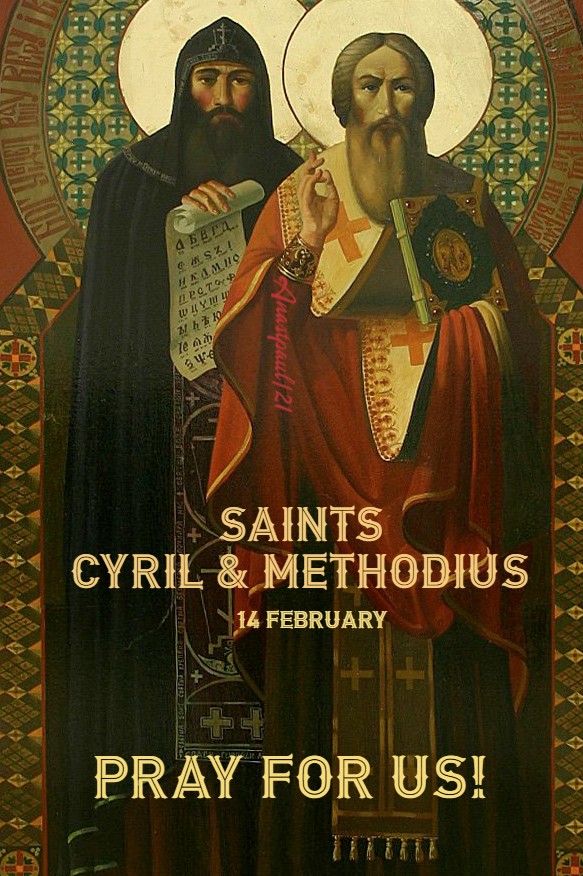
PRAYER – To those who love You, Lord, You promise to come with Your Son and make Your home within them. If You will, You can make us clean, come then with Your purifying grace and make our hearts a place where You can dwell. May the prayers of intercession of Saints Cyril and Methodius, help us to reach our everlasting home with You. Through Christ our Lord, with the Holy Spirit, God now and forever, amen.
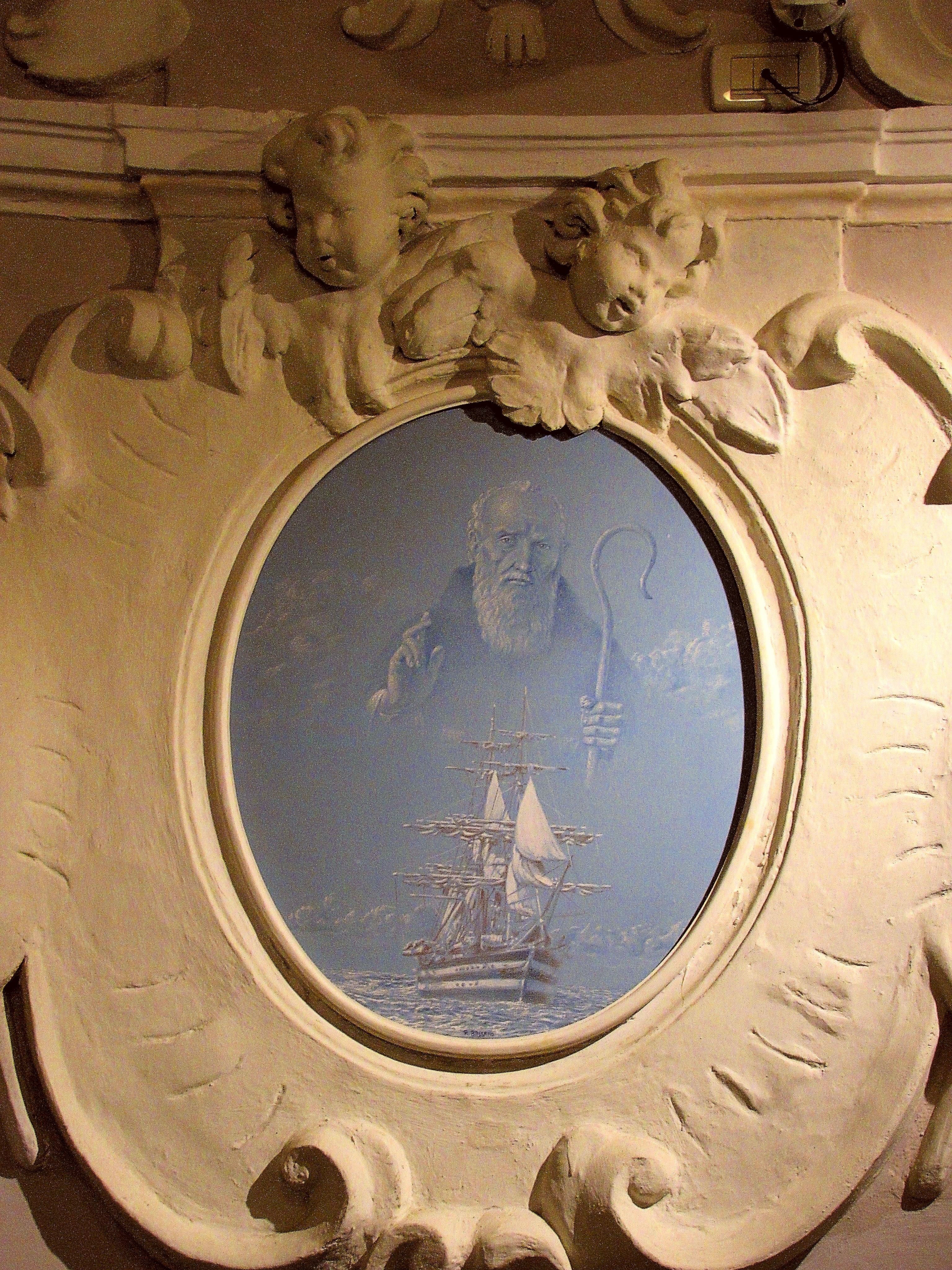
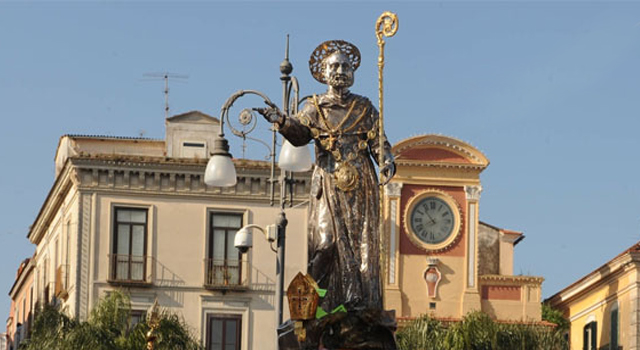
Saint of the Day – 14 February – Saint Antoninus of Sorrento OSB (c 555-625) Abbot, Hermit, miracle-worker – born in c 555 in Campagna, Italy and died in 625 in Sorrento, Naples of natural causes. Patronages – Campagna and Sorento. Also known as – Antoninus of Campagna, Antoninus Cacciottolo, Antony the Abbot, Antonino, Anthony of Sorrento.
Antoninus was born at Campagna. He left his native town to become a monk at Monte Cassino. During that time, Italy was suffering from barbarian invasions and Antoninus was forced to leave this Monastery. Monte Cassino had been plundered by the Lombards and the Monks escaped to Rome to seek protection from Pope Pelagius II. Antoninus, however, headed for Campagna where he ended up at Castellammare di Stabia. Here Saint Catellus was the Bishop. Catellus, wishing to become a hermit, gave up his office as Bishop and entrusted Antoninus with the task of serving as the town’s Bishop. Catellus withdrew to Monte Aureo.
The desire to remain a Hermit himself, led Antoninus to convince Catellus to return to his see. Antoninus retired to Monte Aureo himself and lived in a natural grotto. However, Catellus again decided to withdraw to this mountain and dedicate himself only sporadically to the cares of his Diocese.
An apparition of Saint Michael is said to have convinced the two to construct the stone Church now known as Monte San Angelo. Subsequently, Catellus was accused of witchcraft by a Priest named Tibeius (Tibeio) of Stabia and was held captive at Rome until the new Pope released him. Catellus returned to Stabia and dedicated himself to expanding the church that he had helped found.
Inhabitants of Sorrento, meanwhile, convinced Antoninus to settle at Sorrento. Antoninus became an Abbot of the Benedictine Monastery of San Agrippino, succeeding Boniface in this capacity.
A miracle attributed to Saint Antoninus states that he saved a young child from a whale after it had been swallowed up by this sea creature. The Sorrentini erected a Crypt and Basilica in honour of Antoninus. He saved the City from many dangers – a Moorish naval invasion; the revolt of the Sorrento leader Giovanni Grillo against Spanish domination; demonic possession; bubonic plague and cholera.
If you ask anyone from Sorrento what is celebrated on 14 February, do not be surprised at the answer! Forget Valentine’s Day, on this day all around the town of Sorrento, people celebrate the death of the Patron Saint of Sorrento, St Anthoninus Abbot, which occurred on the 14th of February, in 265.
Words are not enough to describe how much this local feast is truly felt! The celebration is preceded by a Novena beginning on 5 February with the tolling of Church bells, that advise the people of Sorrento, that the feast is soon to be and as a result, also the coming of spring.
On the eve of the feast, from the early morning hours, the prodigious silver statue of the Saint is exposed on the high altar of the Basilica of Sant’Antonino, ready to accommodate the flow of faithful who celebrate the entrance of the Saint to eternal life.
During the festival the statue is carried by sailors from Marina Piccola on their shoulders, throughout the main streets of Sorrento, by the Archbishop and by the civil and military authorities.
After the statue is brought around town, it is then carried to the Basilica where the Archbishop celebrates the Eucharist. The Basilica is indeed the true focus of the celebration, where locals come and “greet” the patron.
“Not inside, not outside the walls,” these were the last words of St Anthoninus about his burial and this explains the exact location of the Basilica which houses the mortal remains of the Saint, which is situated amongst the ancient town walls of Sorrento.
The most visited part of the Church is the Crypt, more commonly known as Succorpo, which houses the remains of St Anthoninus. It occupies the entire left side of the building and is placed at a lower level, accessible by two staircases. Once down below in the Crypt, the first thing that attracts the eye is the Altar, placed at the centre of theCrypt, around which a path leads the devotees to pay homage to the Saint.
Behind the same Altar, an oil lamp with silver foil is touched and followed by reciting prayers. This is nothing more than a story of a miracle healing of a Bishop of Sorrento. The Bishop was riding a mule and then thrown off and, therefore, fractured his leg. During that night, the Bishop dreamed about Sain tAntoninus taking an oil vial that had been blessed by the the Virgin Mary. The Bishop woke up with a cured leg.
The silver statue itself was a miracle – it seems that during the invasion of the Turks (1558) it was stolen and Sorrento, not having enough money to make another, had to accept the fact of it’s loss. It was on that occasion, that St Anthoninus appeared in flesh and blood to the sculptor, who reproduced him from his own image!
Sixth Sunday in Ordinary Time +2021 Quinquagesima Sunday (Traditional Calendar) +2021 – From Latin quinquagesimus meaning “fiftieth,” therefore, this is the period of fifty days before Easter. It begins with the Sunday before Ash Wednesday, called Dominica in Quinquagesima or Esto Mihi from the beginning of the Introit of the Mass; it is a Sunday of the second class and the colour the Mass and Office is violet.
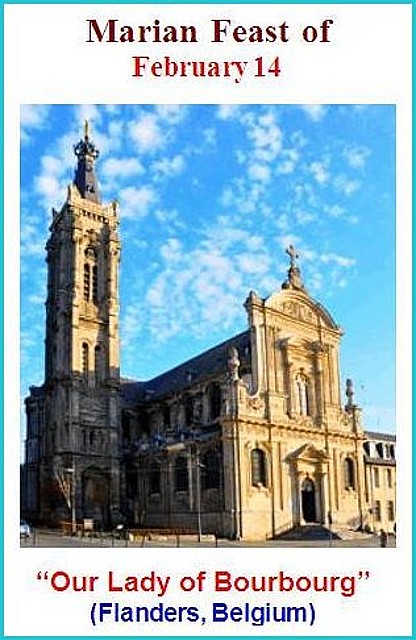
Notre-Dame de Bourbourg /Our Lady of Bourbourg, Flanders (1383) – 14 February:
Jean Froissart, born in the 1330s, was a man devoted to literature. His famous Chronicles was aimed at a knightly and aristocratic audience and was devoted to “the honourable enterprises, noble adventures and deeds of arms, performed in the wars between England and France…to the end that brave men taking example from them may be encouraged in their well-doing.” His history is one of the most important sources for the first half of the Hundred Years’ War, and certain events of the era, such as the battles of Crecy and Poitiers and the English Peasant Revolt of 1381. He was also an eyewitness to the miracles of Our Lady of Bourbourg that occurred in the year 1383. “When the king of France came before Bourbourg there were never seen such fine men at arms nor such numbers as he had with him. The lords and their men were all drawn up, and eager for the attack. Those who had reconnoitred the place, said it could not hold out long. The Bretons, Burgundians, Normans, Germans and others, who knew there was much wealth in the place, which, if taken by storm, would probably fall to their share, began to skirmish with the infantry at the barriers, without waiting for orders from the constable or marshals of the army. This skirmish increased so much that the French set fire to the town by means of fire-arrows and cannons, so that such a flame and smoke came from the houses of Bourbourg as might have been seen forty leagues off. Many gallant deeds were done and the assailants leaped cheerfully into the mud of the ditches above the knees when they engaged with the English at the palisade and barriers. The garrison defended themselves handsomely, indeed, they had need of their exertions, for they knew not on which side to turn themselves. They were attacked on all part and the houses of the town were blazing with fire, which more confounded the English than anything else. This, however, did not throw them off their guard, nor cause them to quit their posts. Sir Matthew Redman and Sir Nicholas Drayton, with their men, in the centre of the town, endeavoured to check the progress of the fire but it was such a dry season, that the smallest spark set the houses in flames. It is certain, that if the attack had begun earlier, or had not the night come on soon, the town must have been taken by storm but the approach of night put an end to it. On the attack ceasing, the French retired to their quarters, to attend the sick and bury the dead. They said that on the morrow they would renew the attac, and it should be irresistible. The English were employed in repairing the palisades which had been broken, in putting all things in a good state and in extinguishing the fires in the town. They were in a most perilous situation, being surrounded on all sides, without means of escaping by flight. The Duke of Brittany, who was on the opposite side of the town to the King, entered into negotiations with the English, aware of the peril they were in. He advised them to surrender the town, on their lives and fortunes being spared. This they were very willing to do and they entreated the Duke, through love of God and in honour of his gentility, to undertake the business. The King of France replied, that, in God’s name, he would willingly agree to a treaty. The English had been much renowned for gallantry and deeds of arms and it was settled that the English should depart from Bourbourg and Gravelines and carry away with them as much of their wealth as they could. Several of the Bretons, French, Normans and Burgundians were much vexed at this treaty, for they thought of partaking of the spoils but the King and his council had ordered it otherwise. The whole of Tuesday they employed in shoeing their horses and in packing up all their wealth, of which they had much and in making preparations for their departure. On the Wednesday morning they loaded their baggage-horses and began their march, passing through the army with passports from the King. The Bretons were much exasperated when they saw them so loaded, waiting at Calais for a favourable wind to return to England. The King of France and all the lords of his army, with their attendants, entered Bourbourg on Thursday morning. The Bretons began to plunder it, without exception, even the Church of St John. In that Church a pillager stood upon an Altar with the intent of forcing out a precious stone that was in the crown of an image of Our Lady. As he reached to steal the stone, the image suddenly turned about and the pillager in his fright, fell from the Altar and was instantly struck dead. This is a certain truth, for many persons were witnesses of it. Shortly afterwards, another pillager came with a similar intent of robbing the image but all the bells began a peal without anyone touching them, for no-one could have rung them, the bell-ropes being drawn up and fastened. On account of these miracles, the Church was visited by large crowds. The King made a handsome present to the Church, as did all the lords, so that the amount of their gifts was upwards of three thousand francs.” __
Martyrs of Terni: Three Christians who gave proper burial to Saint Valentine of Terni. Martyred in the persecutions of Aurelius. 273 in Terni, Italy – Apollonius, Ephebus, Proculus.
Martyrs of Alexandria: A group of Christians murdered in various ways for their faith in Alexandria, Egypt. We know the names and a few details about 16 of them – Agatho, Agatone, Ammonio, Ammonius, Antonius, Bassiano, Bassianus, Cirione, Cyrio, Dionysius, Dionysius, Lucio, Moses, Moses, Proto and Tonione.
Thought for the Day – 13 February – Meditations with Antonio Cardinal Bacci (1881-1971)
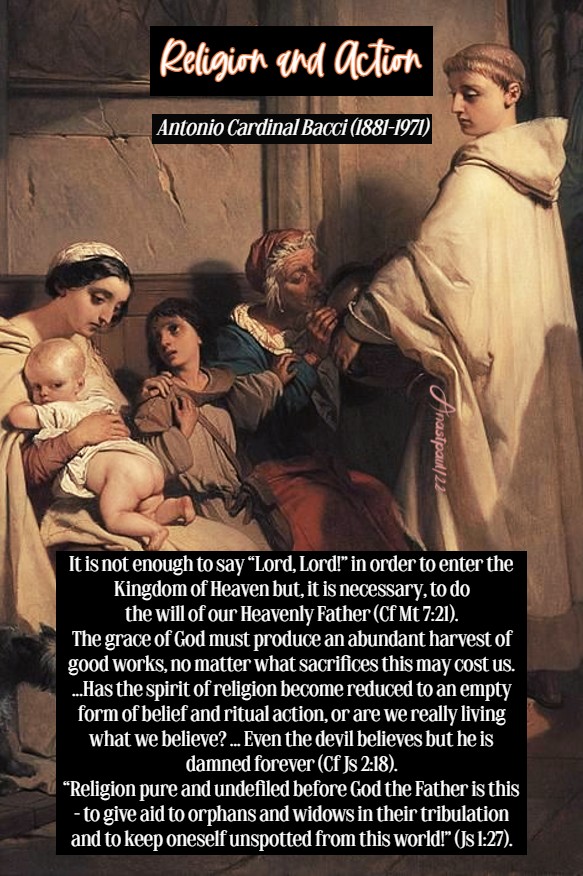
Religion and Action
“Anyone who fails to correspond with the grace of God, is not living the life of Jesus. Without the life of Jesus, he is a dead limb, a withered branch cut away from the vine. It is not enough to say “Lord, Lord!” in order to enter the kingdom of Heaven, but, it is necessary to do the will of our Heavenly Father (Cf Mt 7:21). The grace of God must produce an abundant harvest of good works, no matter what sacrifices this may cost us. Otherwise, God’s gift would have been bestowed in vain and, before the Supreme Judge one day, would be a reason for a terrible retribution, instead of a reward. Let us think seriously about this. Has the spirit of religion become reduced to an empty form of belief and ritual action, or are we really living what we believe? Meditate with attention to these words of St James: “What will it profit, my brethren, if a man says he has faith but does not have works? Can the faith save him? And if a brother or a sister be naked and in want of daily food and, one of you say to them, ‘Go in peace, be warmed and filled,’ yet you do not give them what is necessary for the body, what does it profit? So faith too, unless it has works, is dead in itself” (Js 2:14-17).
Even the devil believes but he is damned forever (Cf Js 2:18). “Religion pure and undefiled before God the Father is this – to give aid to orphans and widows in their tribulation and to keep oneself unspotted from this world!” (Js 1:27).
Quote/s of the Day – 13 February – The Memorial of Blessed Jordan of Saxony OP (1190-1237)
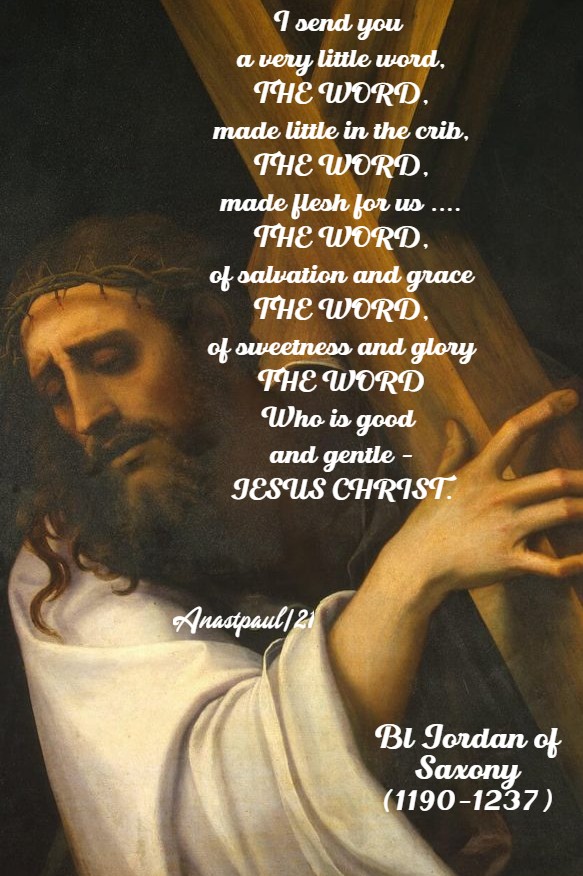
“I send you a you a very little word, THE WORD, made little in the crib, THE WORD, made flesh for us …. THE WORD, of salvation and grace THE WORD, of sweetness and glory THE WORD Who is good and gentle – JESUS CHRIST.”
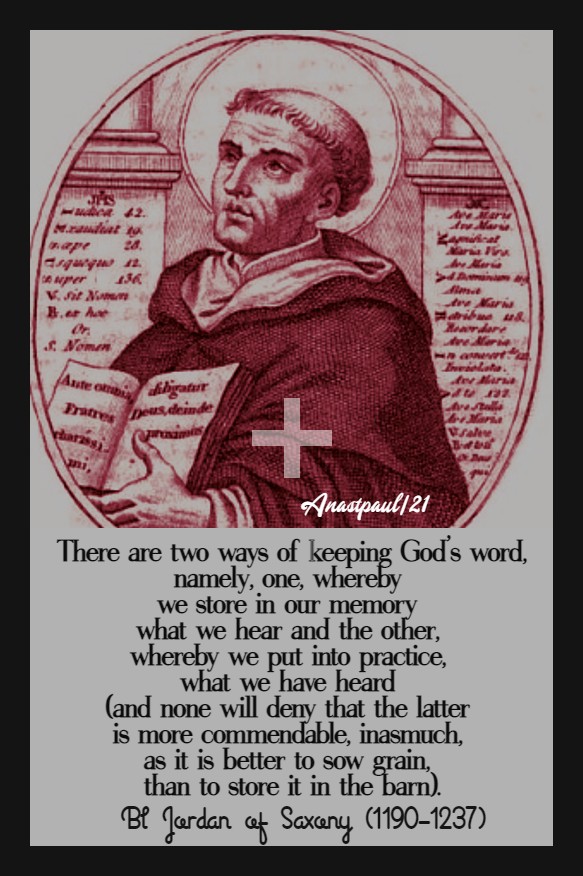
“There are two ways of keeping God’s word, namely, one, whereby we store in our memory what we hear and the other, whereby we put into practice, what we have heard (and none will deny that the latter is more commendable, inasmuch, as it is better to sow grain, than to store it in the barn).”
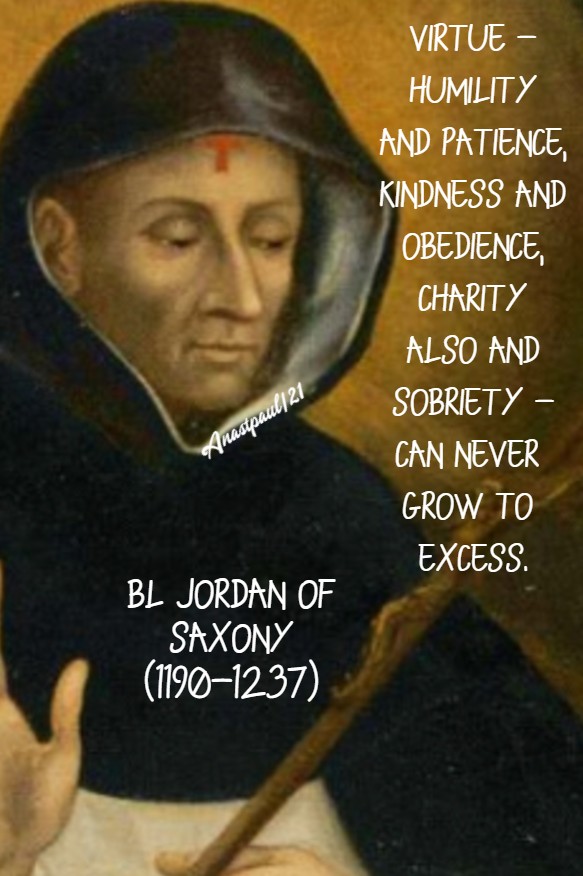
“Virtue – humility and patience, kindness and obedience, charity also and sobriety – can never grow to excess.”
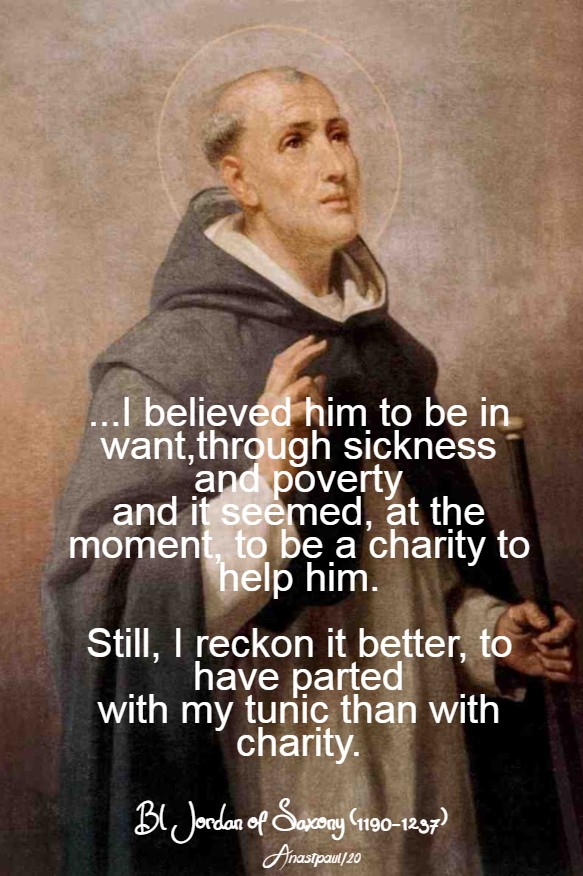
Meeting a vagabond upon the road who feigned sickness and poverty, Blessed Jordan gave him one of his tunics, which the fellow at once carried straight to a tavern for drink. The brethren, seeing this done, taunted him with his simplicity:
‘There now, Master, see how wisely you have bestowed your tunic.’
“I did so,’ said he, ‘because I believed him to be in want, through sickness and poverty and it seemed, at the moment, to be a charity to help him. Still, I reckon it better, to have parted with my tunic than with charity.”
“And if I send them away hungry to their homes, they will faint on the way. And some of them have come from far away.” – Mark 8:3
REFLECTION – “Lord Jesus, how well I know You have no wish to allow these people here with me, to remain hungry but to feed them, with the food You distribute, and so, strengthened with Your food, they will have no fear of collapsing from hunger. I know, too, that You have no wish to send us away hungry, either… As You have said – You do not want them to collapse on the way, meaning to collapse in the byways of this life, before reaching the end of the road, before coming to the Father and understanding that You come from the Father…
Our Lord takes pity, then, so that none may collapse along the way… Just as He makes it rain on the just as well as the unjust (Mt 5,45) so He feeds the just, as well as the unjust. Was it not thanks to the strength of the food, that the holy prophet Elijah, when he was collapsing on the way, was able to walk for forty days? (1Kgs 19,8). It was an angel who gave that food to him but, in your case, it is Christ Himself who feeds you. If you preserve the food you have received, in this way, then you will walk, not forty days and forty nights… but for forty years, from your departure from the borders of Egypt to your arrival in the land of plenty, the land where milk and honey flow (Ex 3,8)…
And so Christ shares out the foodstuffs and, there is no question, He wants to give it to all. He withholds it from no-one, for He provides for everyone. Nevertheless, when He breaks the loaves and gives them to the disciples, unless you hold out your hands to receive your portion, you will collapse along the way… This bread that Jesus breaks, is the mystery of the Word of God, it increases as it is distributed. With only a few words Jesus has provided abundant nourishment for all peoples. He has given us His words as bread and, while we are tasting them, they increase in our mouths… Even as the crowds are eating, the pieces increase and become more numerous to such an extent that, in the end, the leftovers are even more plentiful than the loaves that were shared.” – St Ambrose (340-397) Father and Doctor of the Church – Commentary on the Gospel of Saint Luke, VI, 73-88
PRAYER – Lord support us as we pray, protect us day and night. Grant us the grace of total trust and teach us to hear Your Voice and do Your Will. By Your Word You teach and lead us and Your Word, we share with all. May Your food always strengthen us for the journey that we may reach the end of the road in Heaven. May the prayers of Blessed Jordan of Saxony, help us and strengthen us that we may grow in worthiness to receive Your grace. Through our Lord Jesus Christ in the unity of the Holy Spirit, one God forever, amen.
Our Morning Offering – 13 February – The Memorial of Blessed Jordan of Saxony OP (1190-1237) and a blessed Marian Saturday
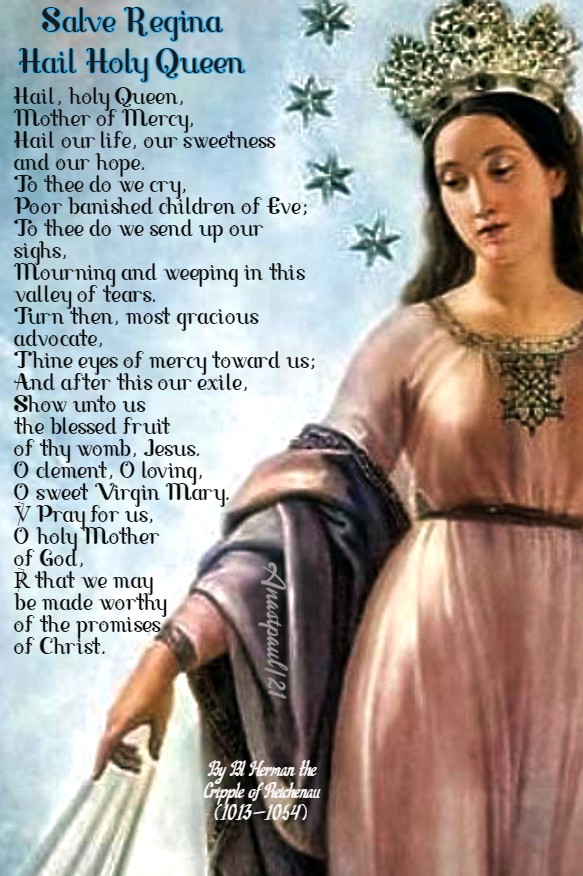
It was Jordan who initiated the custom of singing the Salve Regina in procession each night after Compline, to ask Our Lady’s protection of the brothers against temptations from the devil. This is a custom still practised by Dominicans throughout the world and by our community each night.
Salve Regina Hail Holy Queen By Blessed Herman the Cripple of Reichenau(1013–1054)
Hail, holy Queen, Mother of Mercy, Hail our life, our sweetness and our hope. To thee do we cry, Poor banished children of Eve; To thee do we send up our sighs, Mourning and weeping in this valley of tears. Turn then, most gracious advocate, Thine eyes of mercy toward us; And after this our exile, Show unto us the blessed fruit of thy womb, Jesus.
This line, below, by St Bernard of Clairvaux (1090-1153) Doctor of the Church
O clement, O loving, O sweet Virgin Mary.
℣ Pray for us, O holy Mother of God, ℟ that we may be made worthy of the promises of Christ.
Let us pray: Almighty, everlasting God, who by the co-operation of the Holy Spirit didst prepare the body and soul of the glorious Virgin-Mother Mary to become a dwelling-place fit for Thy Son, grant that as we rejoice in her commemoration, so by her fervent intercession, we may be delivered from present evils and from everlasting death. Through the same Christ our Lord. Amen
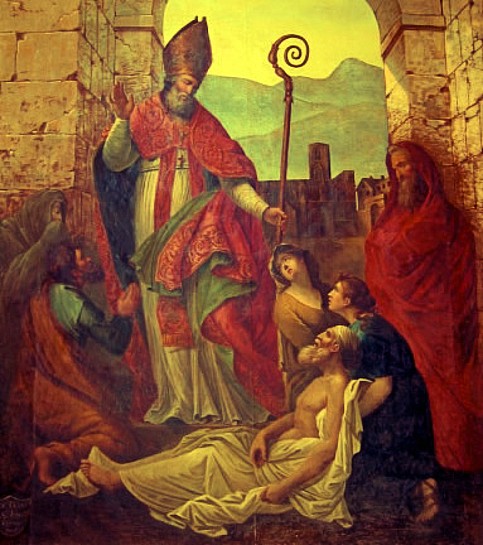
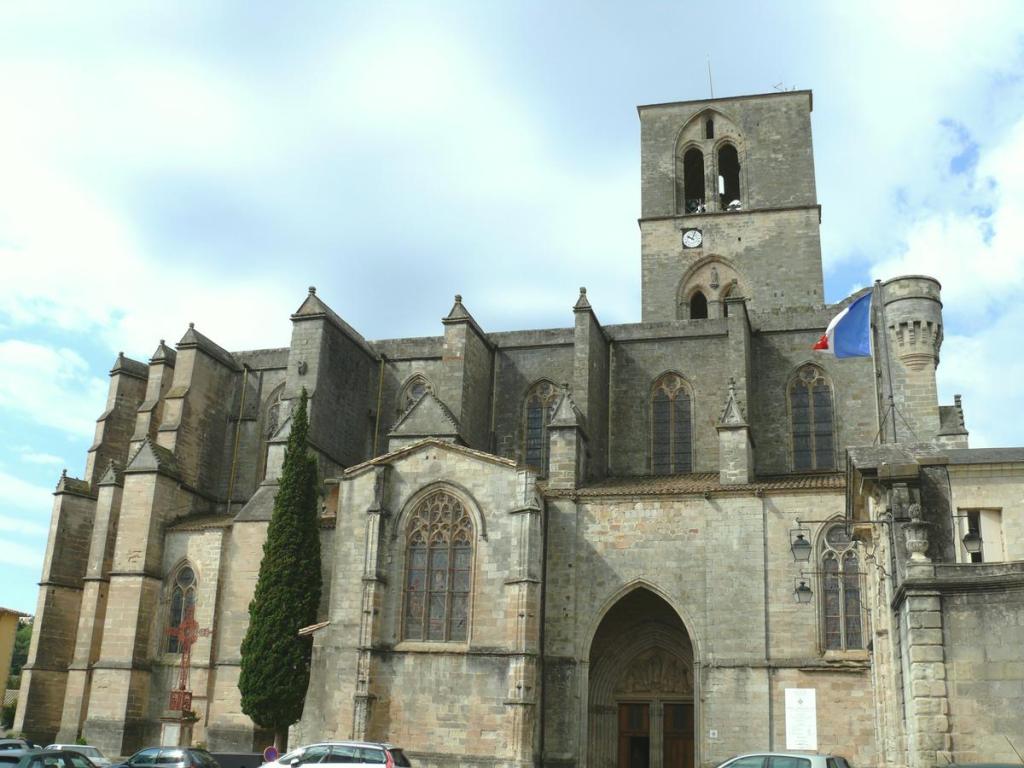
Saint of the Day – 13 February – Saint Fulcran of Lodève (Died 1006) Bishop of Lodève, Reformer, especially within the clergy and religious orders, builder of many Churches, Convents and Hospitals, apostle of the poor and needy, miracle-worker. Unknown birth date – died on 13 February 1006 of natural causes. Patronage – co-Patron of the Diocese of Lodève.
According to the biography which Bernard Guidonis, Bishop of Lodève, who died in 1331, has left us, his saintly predecessor, Fulcran came of a distinguished family. From his youth led a pure and holy life and consecrated himself at an early age to the service of the Church and became a Priest.
When in 949, Theoderich, Bishop of Lodève, died, Fulcran, notwithstanding his unwillingness, was chosen as his successor and was Consecrated by the Archbishop of Narbonne on 4 February of the same year.
He was untiring in his efforts to conserve the moral life within his Diocese, especially among the clergy and the religious orders. He rebuilt many Churches and Convents, among them the Cathedral dedicated to St Genesius and the Church of the Holy Redeemer with the Benedictine Monastery attached to it.
The poor and the sick were the objects of his special care; for their support he founded Hospitals and endowed others, already existing.
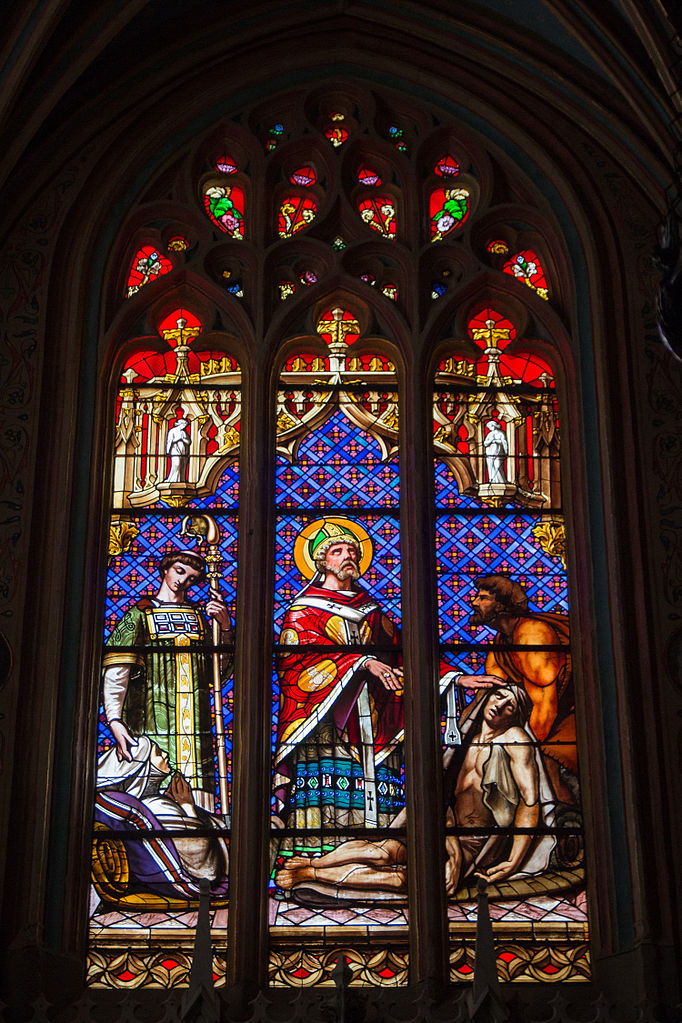
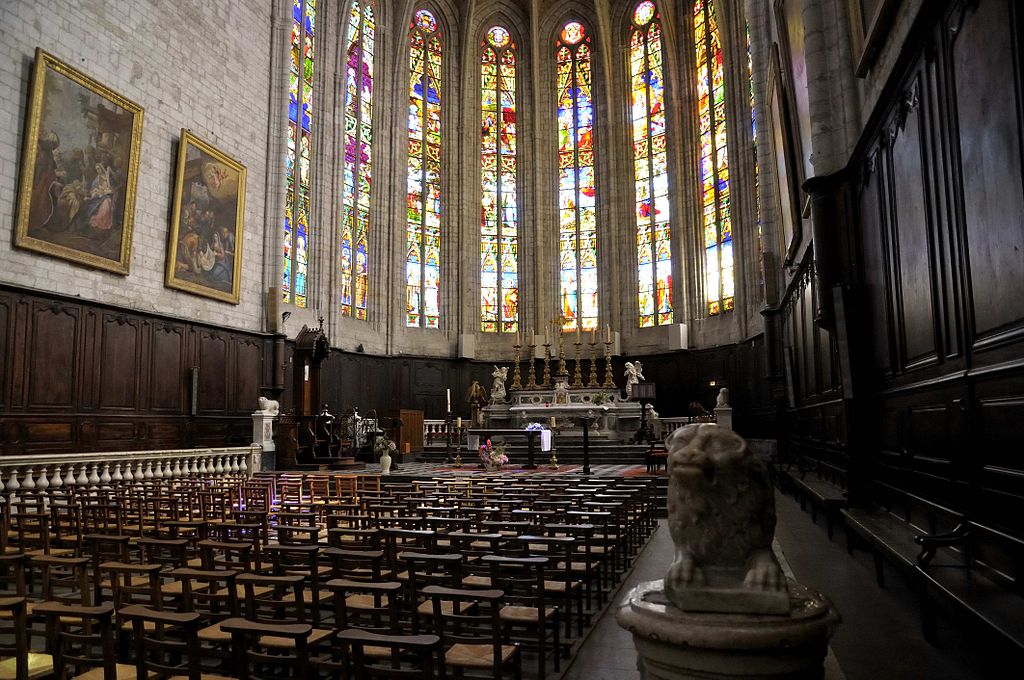
St Fulcran in Lodève Cathedral
The following anecdote from his Vita is worthy of mention:
A Bishop of Gaul had fallen away from the Faith and had accepted Jewish teachings. When the news reached Fulcran, he exclaimed in an excess of zeal: “This bishop should be burned!” Shortly afterwards the renegade prelate was actually seized by his incensed flock and delivered up to death by fire. Fulcran was then filled with remorse that by his utterance he should have been the cause of the apostate’s death and, after doing severe penance, he made a pilgrimage to Rome, there to receive absolution for his supposed guilt.
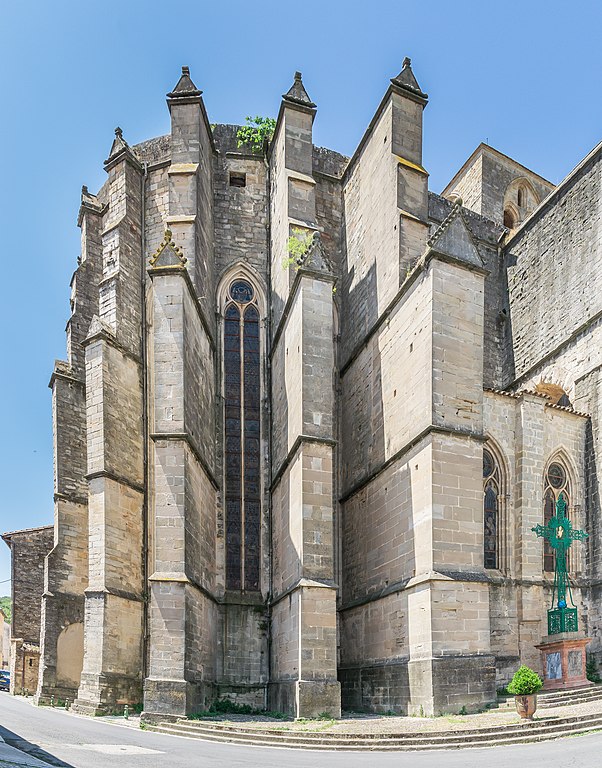
After his death he was buried in the Cathedral of Lodève which was renamed after and dedicated to him and honoured as a saint. His body, which had been preserved intact, was burned by the Huguenots in 1572 and only a few particles of his remains were saved.
The City of Lodève celebrates the Fête de St Fulcran every year for a week, during which there are many festivities and liturgical celebrations amongst other events.
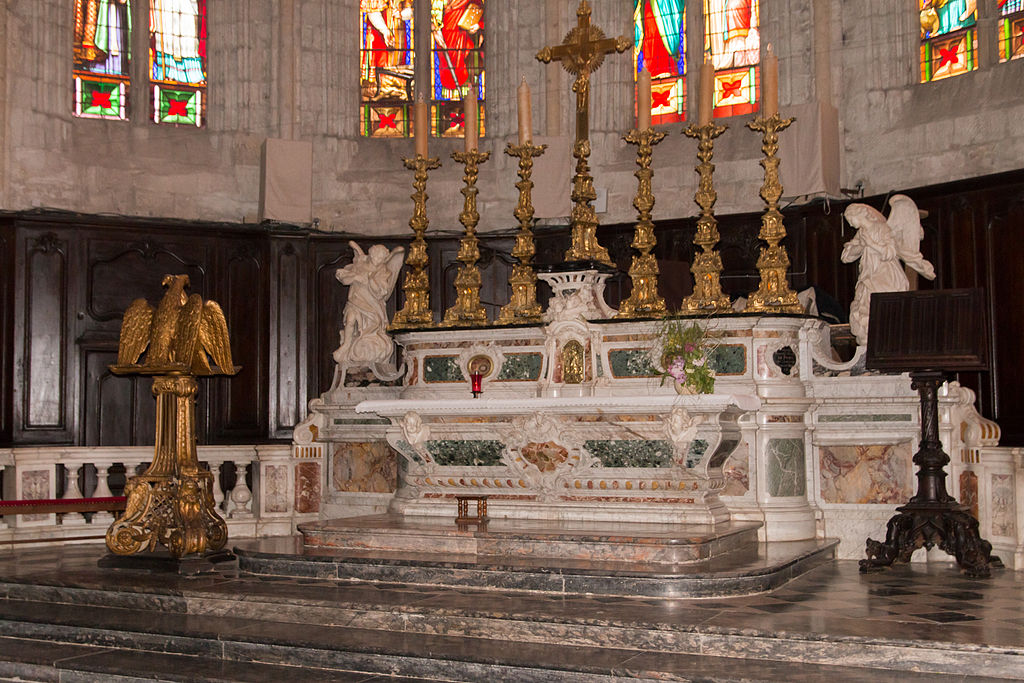
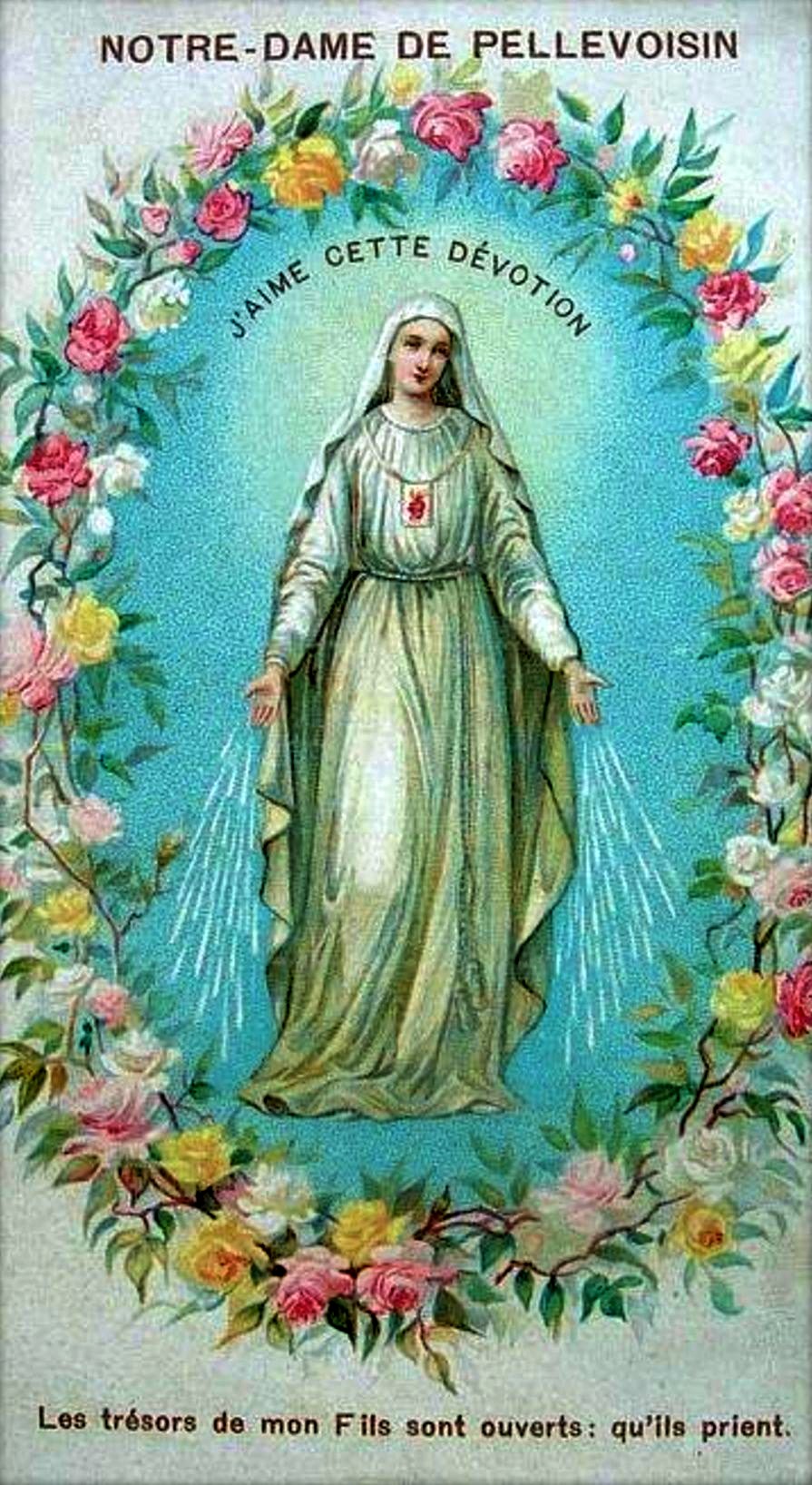
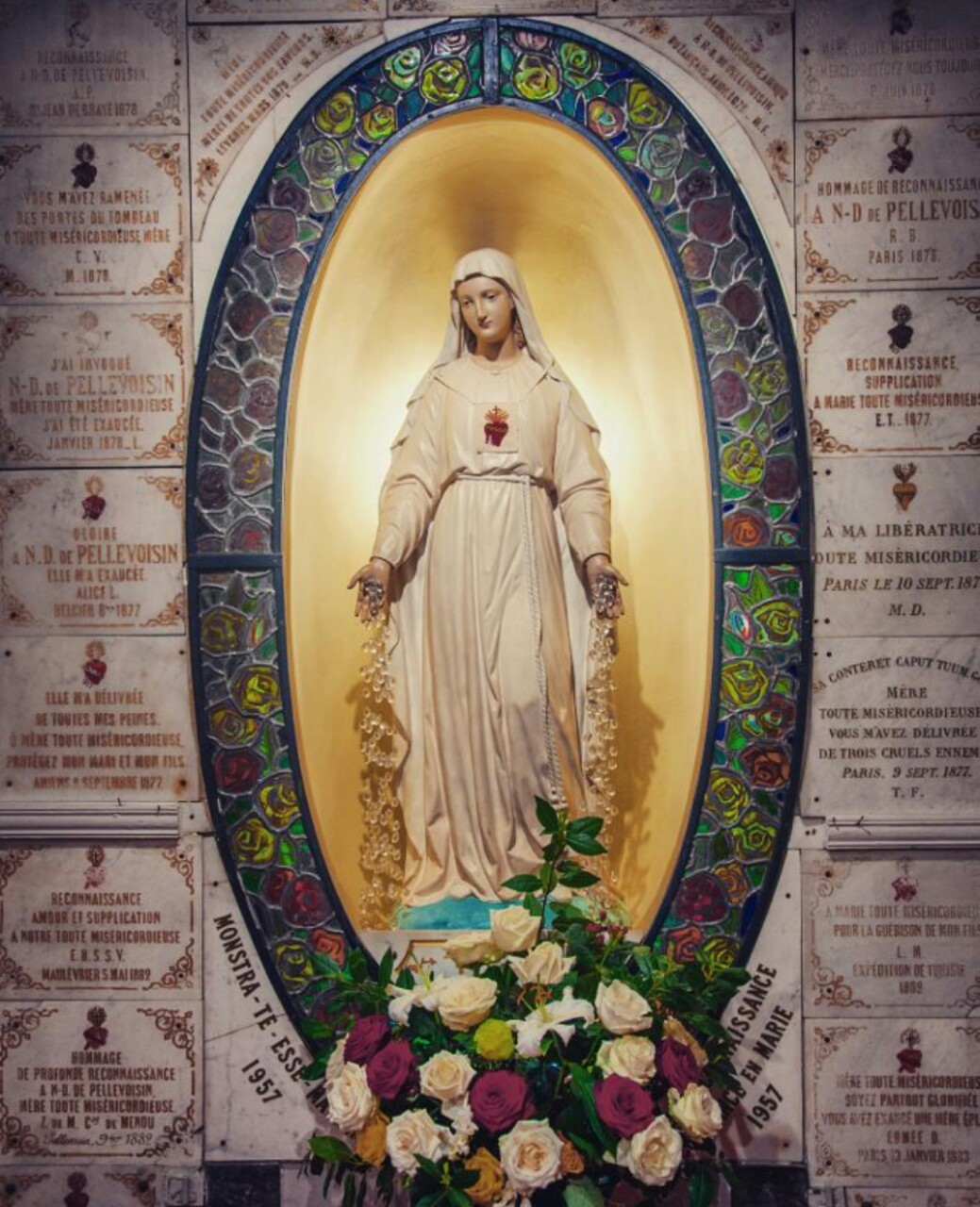
Mother of Mercy, Notre-Dame de Pellevoisin / Our Lady of Pellevoisin, France (1876) – 13 February: Pellevoisin is a little village not far from Tours in France. In 1876, a young woman, Estelle Faguette, lay dying from tuberculosis, at the aged of 33 – only five hours to live in the opinion of the doctors. With childlike faith, Estelle composed a letter to the Blessed Virgin Mary in which she asked for a cure. The letter was laid at the feet of a Statue of the Virgin in Montbel, the summer chateau of the Rochefoucaulds, about 3 km from Pellevoisin.
And, on the 13th of February, when all were expecting her death, Our Lady appeared near the sickbed. This occurred on three successive nights and then, as Our Lady had promised, the sick woman was instantly cured on a Saturday. During the visits, Our Lady of Pellevoisin frequently spoke to Estelle, her theme being that which she so often has expressed during the past hundred years:
“I am all-merciful and have great influence over my Son. What distresses me most is the lack of respect for my Son. Publish my glory.”
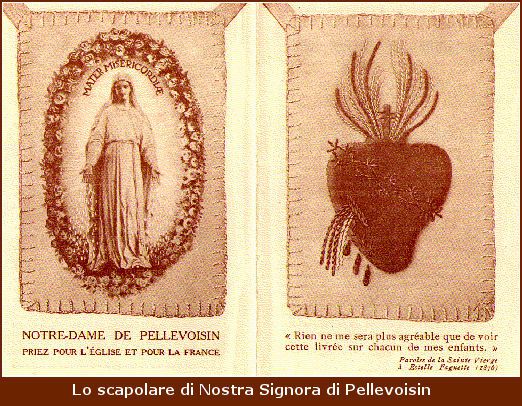
For some months after her miraculous cure, Estelle continued to live quietly at Pellevoisin. She was at a loss to find the means of fulfilling the mission entrusted to her by Our Lady. Her heavenly visitor, however, was watching over her and Estelle was to see her again and receive more minute instructions as to what was required of her. On the feast of Our Lady’s Visitation in the same year, 1876, as Estelle was praying in her room, she was granted another vision. Our Lady, robed in white and wearing on her breast a white scapular with the image of the Sacred Heart of Jesus, appeared to her favoured friend. This was the first of a series of wonderful visions enjoyed by Estelle, ten in all. Again and again Mary pointed to the great need for penance and expiation – a return to God. During one of these apparitions, Our Lady of Pellevoisin, taking her white scapular in her hand, held it before Estelle saying,
“I love this devotion.”
Immediately Estelle knew that her life’s work was to propagate devotion to the Sacred Heart by means of a scapular modeled on Mary’s. On her last appearance, December 8th, Our Lady commanded Estelle to approach her Bishop and give him a copy of the new scapular.
“Tell him to help you with all his power and that nothing would be more agreeable to me, than to see this badge on each one of my children, in reparation for the outrages that my Son suffers in the Sacrament of His Love. See, the graces I pour upon those who wear it with confidence and who help to make it known.”
The Prelate in question, the Archbishop of Bourges, Mnsgr de La Tour d’Auvergne, gave Estelle a favourable hearing and immediately set up a commission to investigate the whole matter. The result of all this was the establishment at Pellevoisin in 1894 by Pope Leo XIII of an Archconfraternity under the title of Mother of Mercy, Our Lady of Pellevoisin. The membership of this Confraternity has gone on increasing year after year, while Pellevoisin itself has become a centre of pilgrimages for thousands of Mary’s friends. Estelle lived her quiet and peaceful life at Pellevoisin, neither desiring nor receiving any personal credit. She died in 1929. Her miraculous cure was recognised in 1983 by Monsignor Paul Vignancour. Although no formal approval has been granted acknowledging the authenticity of the events at Pellevoisi, either by the local bishop at Bourges or by the Holy See, numerous acts of secondary level of approval, including recognition of Mary’s scapular request, have been granted. Pope Leo XIII, by a Motu Proprio, granted indulgences to encourage the pilgrimage to Pellevoisin on 20 December 1892, and on 4 April 1900, The Congregation of Rites issued a decree granting approval to the Scapular of the Sacred Heart.
St Julian of Lyon St Lucinus of Angers St Marice St Martinian the Hermit St Maura of Ravenna St Modomnoc St Paulus Lio Hanzuo St Peter I of Vercelli St Phaolô Lê Van Loc St Stephen of Lyons St Stephen of Rieti
Thought for the Day – 12 February – Meditations with Antonio Cardinal Bacci (1881-1971)
Spiritual Communion
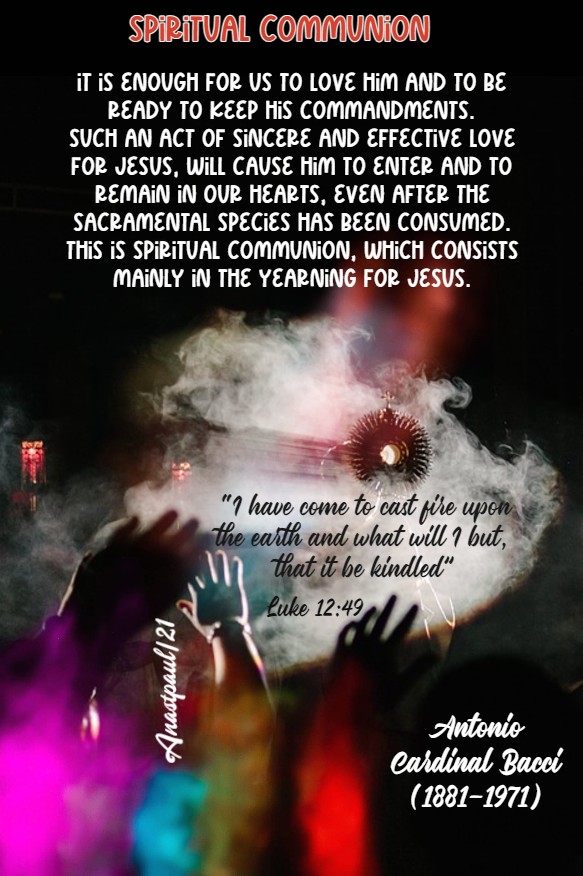
“Jesus, not only desires to come to us but, He desires to remain continually present in us with His love and grace. “If anyone love me, he will keep my word,” He tells us “and, my Father will love him and we will come to him and make our abode with him” (Jn 14:23). It is enough for us to love Him and to be ready to keep His commandments. Such an act of sincere and effective love for Jesus, will cause Him to enter and to remain in our hearts, even after the sacramental species has been consumed. This is Spiritual Communion, which consists mainly in the yearning for Jesus. “I have come to cast fire upon the earth and what will I but, that it be kindled” (Lk 12:49).
Quote/s of the Day – – 12 February – Readings: Genesis 3:1-8, Psalms 32:1-2, 5, 6,7, Mark 7:31-37
The Divine Remedy
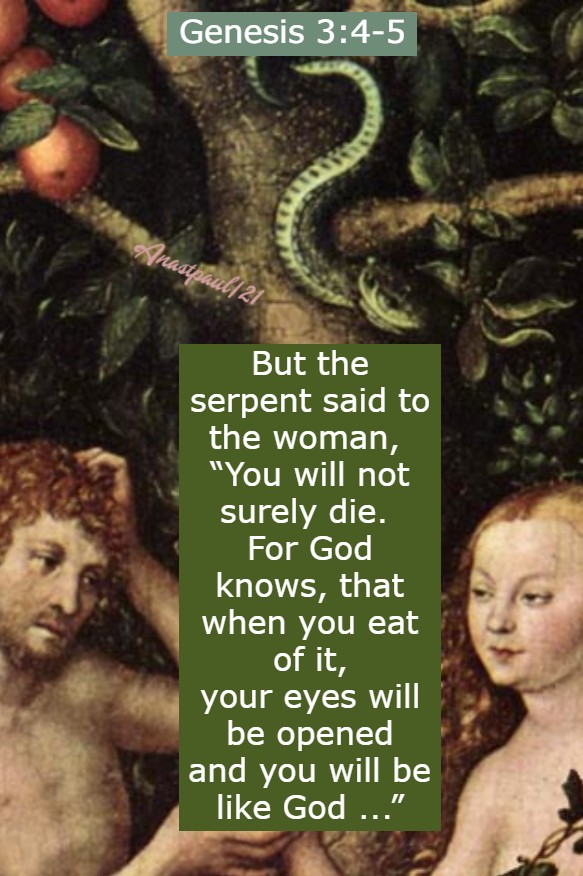
But the serpent said to the woman, “You will not surely die. For God knows, that when you eat of it, your eyes will be opened and you will be like God …”
Genesis 3:4-5
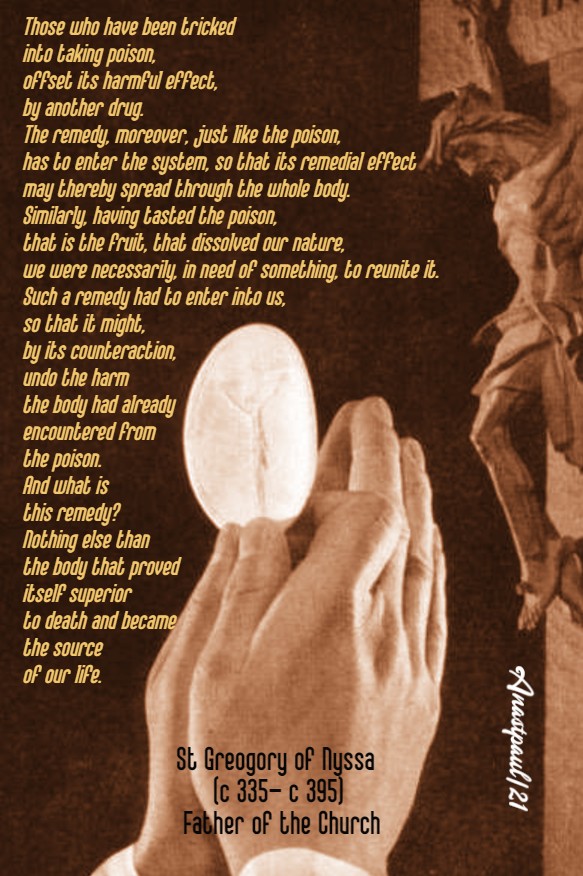
“Those who have been tricked into taking poison, offset its harmful effect, by another drug. The remedy, moreover, just like the poison, has to enter the system, so that its remedial effect may thereby spread through the whole body. Similarly, having tasted the poison, that is the fruit, that dissolved our nature, we were necessarily, in need of something, to reunite it. Such a remedy had to enter into us, so that it might, by its counteraction, undo the harm the body had already encountered from the poison. And what is this remedy? Nothing else than the body that proved itself superior to death and became the source of our life.”
St Greogory of Nyssa (c 335– c 395) Father of the Church
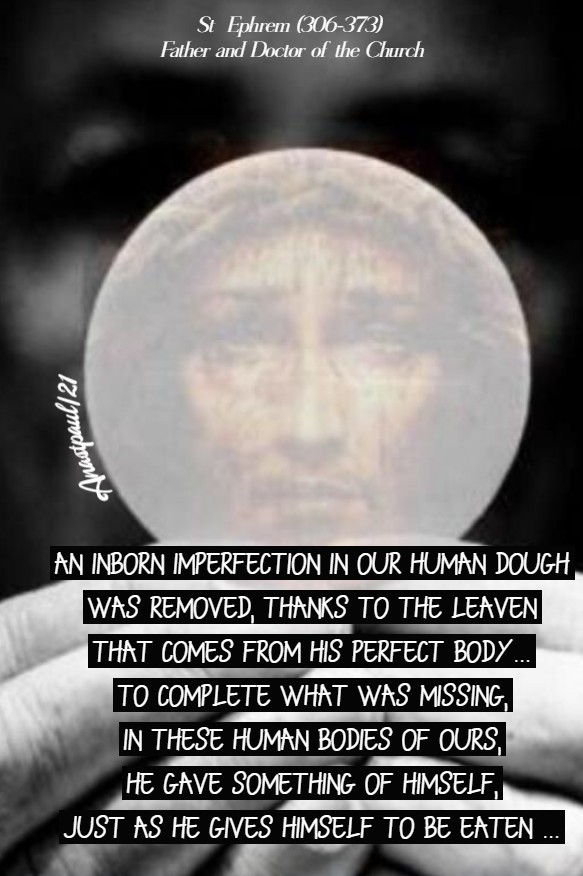
“An inborn imperfection in our human dough was removed, thanks to the leaven that comes from His perfect body… To complete what was missing, in these human bodies of ours, He gave something of Himself, just as He gives Himself to be eaten …”
St Ephrem (306-373) Father and Doctor of the Church
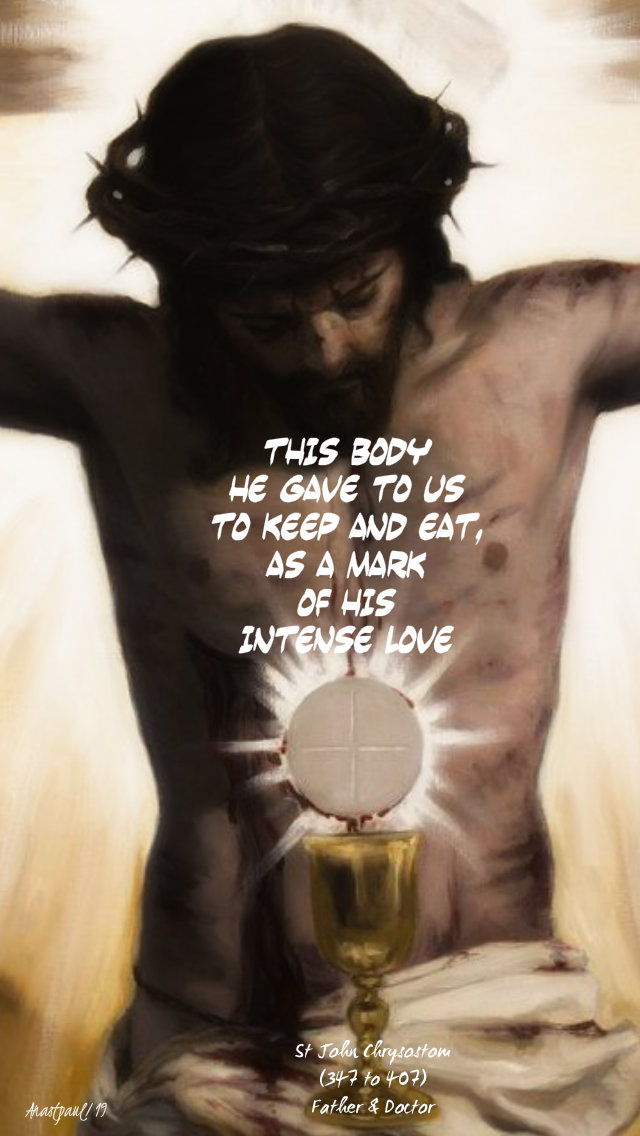
“This Body He gave to us to keep and eat, as a mark of His intense love’.”
St John Chrysostom (347 to 407) Father & Doctor of the Church
“Dust, so to speak, had forcibly entered humanity’s eye; earth had entered it, had injured the eye and it could not see the light. … That physician made a salve for you. And because He came, in such a way, that by His flesh, He might extinguish the faults of the flesh and by His death He might kill death … ”
St Augustine (354-430) Father and Doctor of the Church
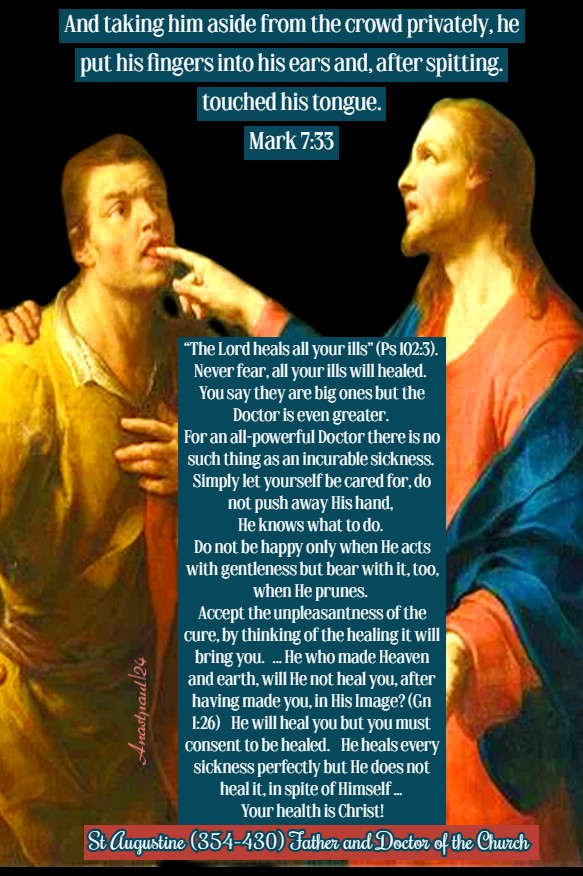
“And taking him aside from the crowd privately, he put his fingers into his ears and, after spitting. touched his tongue.” – Mark 7:33
REFLECTION – “The Lord heals all your ills” (Ps 102:3). Never fear, all your ills will healed. You say they are big ones but the Doctor is even greater. For an all-powerful Doctor there is no such thing as an incurable sickness. Simply let yourself be cared for, do not push away His hand, He knows what to do. Do not be happy only when He acts with gentleness but bear with it, too, when He prunes. Accept the unpleasantness of the cure, by thinking of the healing it will bring you. Notice all those things, brethren which people put up with in their physical ills, so as to prolong their lives a few days … You, at least, are not suffering for an uncertain result – He, Who has promised you your health,, cannot be mistaken. Why is it that doctors are sometimes mistaken? Because they have not created the body they are treating. But God has made your body, God has made your soul. He knows how to re-create that which He has created; He knows how to re-fashion that which He has formed. You have only to abandon yourself into His Doctor’s Hand! … Endure His Hands, then, O soul who “blesses Him and forgets not all His benefits – He heals all your ills” (P2 102:2-3). He who had made you never to become sick, if you would keep His precepts, will He not heal you? He who made the Angels and, in re-creating you, will make you equal to the Angels – will He not heal you? He who made Heaven and earth, will He not heal you, after having made you, in His Image? (Gn 1:26) He will heal you but you must consent to be healed. He heals every sickness perfectly but He does not heal it, in spite of Himself … Your health is Christ!” – St Augustine (354-430) Father and Doctor of the Church – Sermon on the Psalms, Ps 102[103]: 5-6; PL 37, 1319
PRAYER – Almighty and merciful God, open the ears and eyes of our hearts and fill us with Your grace. May we follow You in holiness all the days of our lives. Grant we pray, that as You brought Your Saints and Martyrs to overcome fearlessly, the persecutions of Your people, that we too may remain invincible under Your protection and by their prayers, be strengthened against the snares of the enemy. Through our Lord Jesus Christ, your Son, who lives and reigns with you in the unity of the Holy Spirit, one God, forever and ever. Amen.
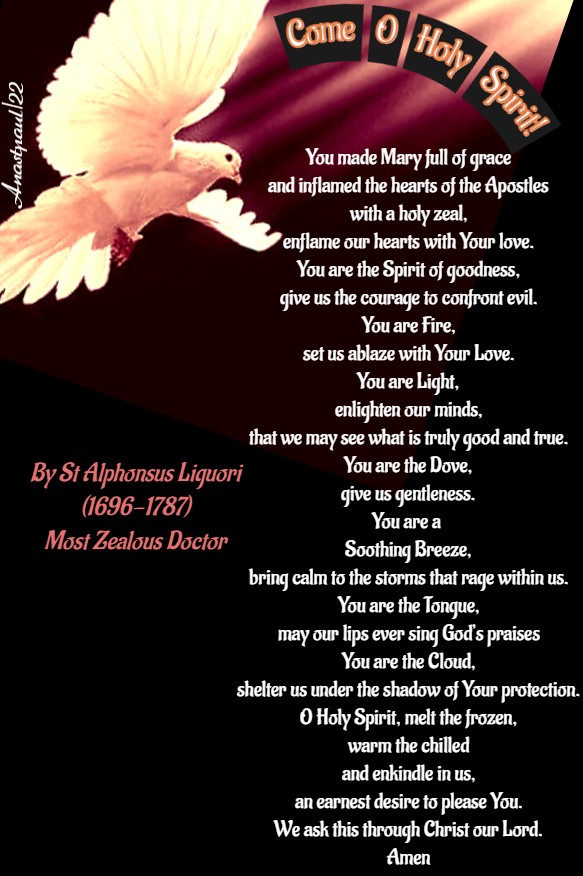
Come O Holy Spirit! By St Alphonsus Liguori (1696-1787) Most Zealous Doctor
You made Mary full of grace and inflamed the hearts of the Apostles with a holy zeal, enflame our hearts with Your love. You are the Spirit of goodness, give us the courage to confront evil. You are Fire, set us ablaze with Your love. You are Light, enlighten our minds, that we may see what is truly good and true. You are the Dove, give us gentleness. You are a soothing Breeze, bring calm to the storms that rage within us. You are the Tongue, may our lips ever sing God’s praises You are the Cloud, shelter us under the shadow of Your protection. O Holy Spirit, melt the frozen, warm the chilled and enkindle in us, an earnest desire to please You. We ask this through Christ our Lord. Amen
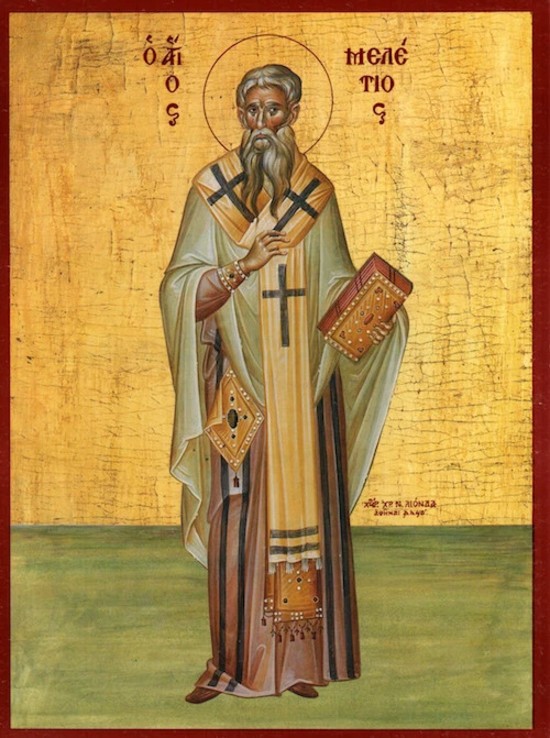
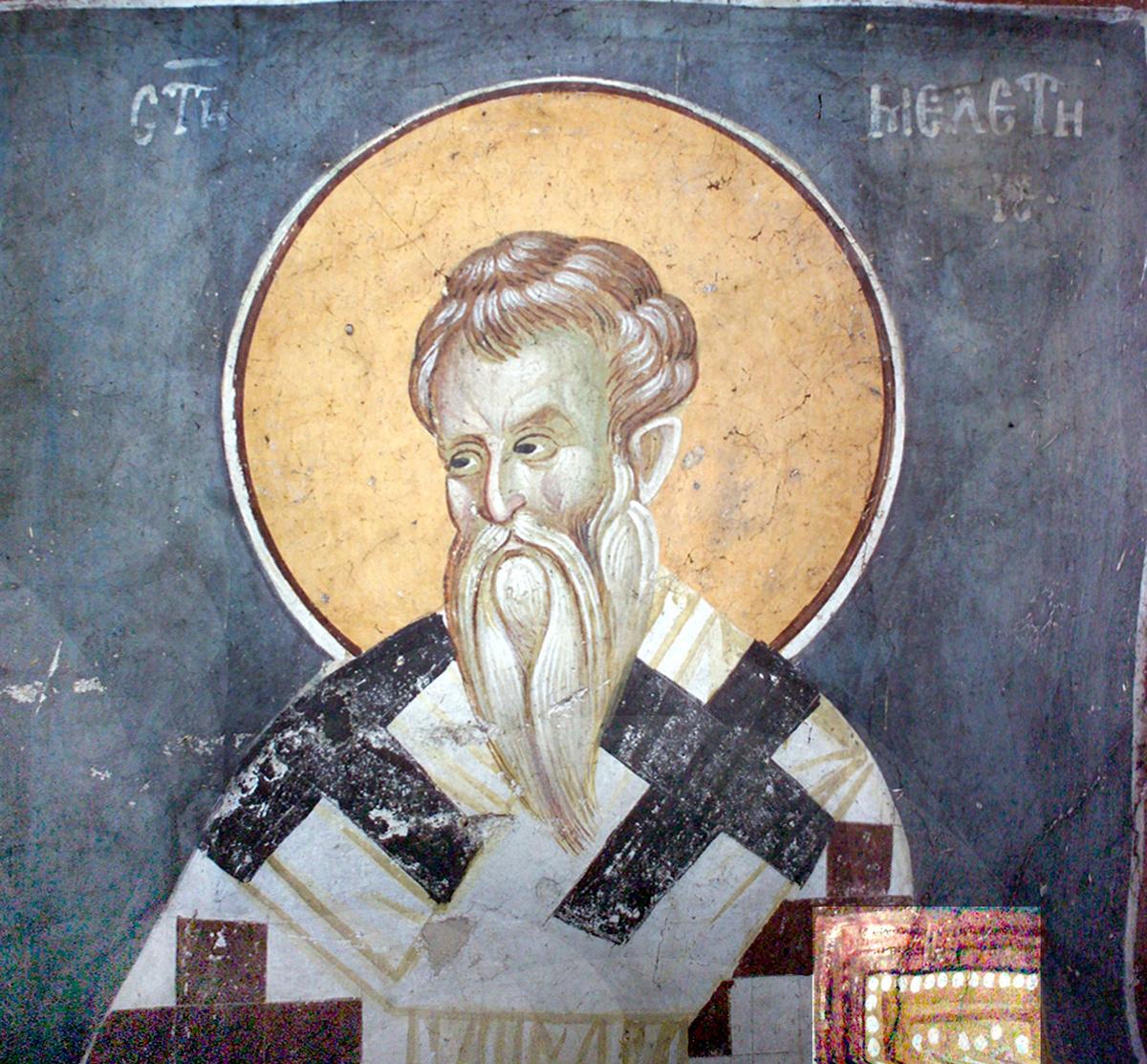
Saint of the Day – 12 February – Saint Meletius of Antioch (Died 381) Bishop of Antioch from 360 until his death in 381, Confessor, Defender of the true Faith against heresies – born in the early 4th century Melitene, Lower Armenia (modern Malatya, Turkey) and died in 381 at Constantinople (modern Istanbul, Turkey) of natural causes. Meletius asceticism was remarkable in view of his great private wealth. He was opposed by a rival bishop named Paulinus and his episcopate was dominated by the schism, usually called the Meletian schism. As a result, he was exiled from Antioch in 361–362, 365–366 and 371–378. One of his last acts was to preside over the First Council of Constantinople in 381.
Meletius of Antioch is an important early Christian Saint, who became Bishop of one of the largest and most ancient congregations of Christianity—the Syrian city of Antioch.
Meletius was born at Melitene in Armenia in the first half of the fourth century. He was born into a distinguished and wealthy family, leading him to seek a distinguished ecclesial office in the Church. Meletius was appointed the Bishop of the Christian City of Sebaste.
During the fourth century, debates over the divinity of Christ raged throughout Eastern and Western Christianity. Antioch was, for a long time, a stronghold of orthodox Christianity, where Christians believed in Christ’s two natures—divine and human—united in the one person of Jesus.
Meletius resisted both the rise of Arianism and the Eastern emperor, Constantius II, who supported the Arian Christians. During these bickerings, the important Christian city of Antioch was being pulled between many different Bishops. The people of Antioch were divided between these heretical Bishops vying for the See. Finally, they appointed Meletius, who was an orthodox Christian but who focused mostly on the moral Christian life and living a life of Christian charity. The divided people of Antioch admired their saintly Bishop and adhered to his example.
Meletius became known as a hero among the faithful in Antioch, for uniting the church that had been divided by heresies. The good Bishop Meletius Consecrated as a Deacon, one of Antioch’s most famous Bishops, the great St John Chrysostom. John Chrysostom later praised him in one of his homilies, eulogising him for his great wisdom and his calm and holy leadership.
Meletius died soon after the opening of the First Council of Constantinople and the Emperor Theodosius, who had received him with special distinction, ordered his body to be carried to Antioch and buried with the honours of a saint. The Meletian schism, however, did not end immediately with his death. In spite of the advice of Gregory Nazianzus, Paulinus was not recognised as the sole bishop and Flavian was consecrated as Meletius’ successor.
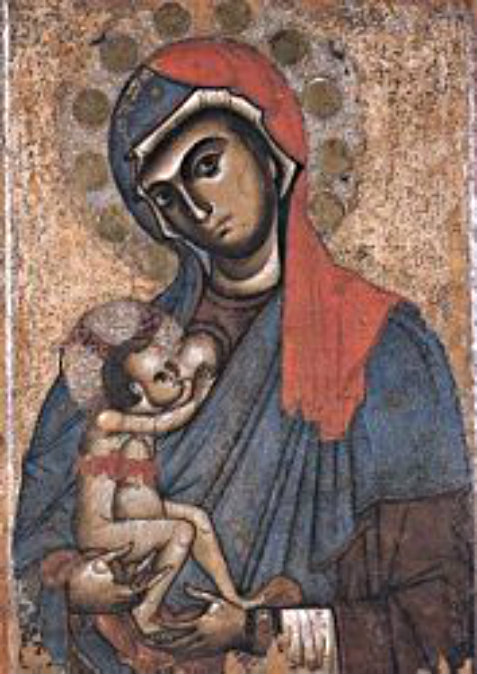
Madonna del Pilerio, Italy (12th Century) – 12 February: is the Patron of the City of Cosenza and of the Archdiocese of Cosenza-Bisignano, Italy. The Madonna del Pilerio is depicted in an icon dating back to the twelfth century that is found since 1607 in the Chapel built specifically within the Cathedral of Cosenza , commissioned by Msgr Giovani Battista Costanzo ( 1591 – 1617 ). On 10 May 1981, the Cathedral of Cosenza was raised to the Shrine of Our Lady of Pilerio by the Archbishop Msgr Dino Trabalzini. The patronal feast of Cosenza is not celebrated on 8 September, the Feast of Our Lady of Pilerio and date to which the Nativity of the Virgin is recognised but 12 February, to remember the devastating earthquake that hit Calabria on that date, in 1854.
Official Prayer to the Madonna del Pilerio
Virgin of Pilerio, Mother of the Church, You are for us Support, Help and Hope. We thank you and bless you but above all we love you. You are our tender Mother, given to us by Christ on the Cross. Listen to your children’s prayer. Do not let us ever turn away from you. Strengthen our faith in us, sustain hope, revive charity. May you praise the Father, the Son and the Holy Spirit forever and ever. Amen O Madonna del Pilerio, our glorious Patron, pray for us.
St Modestus of Alexandria St Modestus of Carthage St Modestus the Deacon Bl Nicholas of Hungary St Sedulius Bl Thomas of Foligno — Martyrs of Albitina – 46 saints: During the persecutions of Diocletian, troops were sent to the churches of Abitina, North Africa on a Sunday morning; they rounded up everyone who had arrived for Mass and took them all to Carthage for interrogation by pro-consul Anulinus. The 46 who proclaimed their Christianity were executed. We know some of their names and stories. They were tortured to death in 304 in prison at Albitina, North Africa.
Martyred in England: Bl George Haydock Bl James Fenn Bl John Nutter Bl John Munden Bl Thomas Hemeford
Martyred in the Spanish Civil War: Josep Gassol Montseny
Thought for the Day – 11 February – Meditations with Antonio Cardinal Bacci (1881-1971)
The Power of Mary
“We should turn confidently to Mary, especially when we are tempted. She cannot allow us to offend her Jesus and to fall into the foils of the devil, as long as we pray to her with faith in her intercession. “The devil, as a roaring lion,” says St Peter, “goes about seeking someone to devour” (1 Peter 5:8). But, our Mother Mary is always by our side seeking to protect us. Let us entrust ourselves to her maternal care. Not only does Mary wish to help us, declares St Bonaventure but, those who do not pray to her, commit almost as great an offence, as those who openly insult her (In Spec Virg)!
Quo/ste of the Day – 11 February – The Memorial of Our Lady of Lourdes
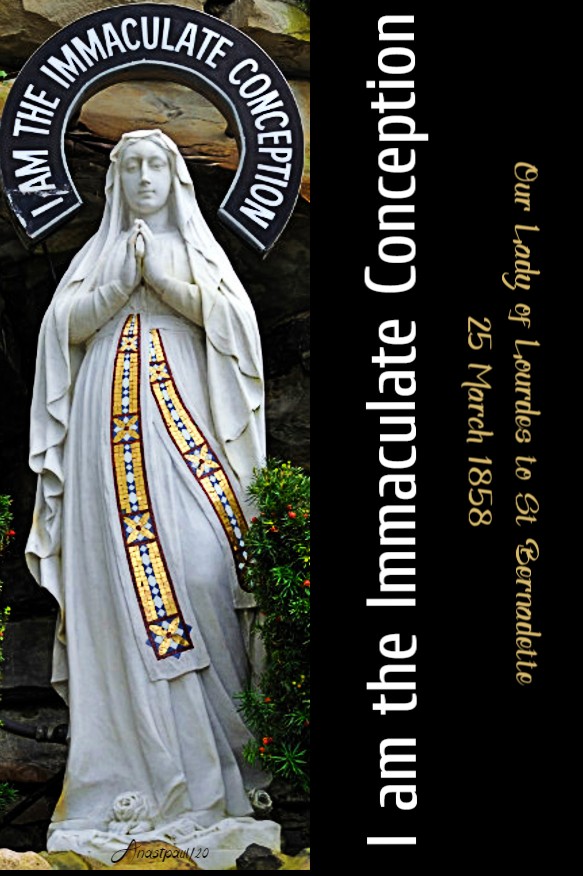
“I am the Immaculate Conception.”
Our Lady of Lourdes to St Bernadette 25 March 1858
“Mary is the great mould of God … He who is cast in this divine mould is soon formed and moulded in Jesus Christ and Jesus Christ in him. With little effort and in a short time, he will become divine, since he is cast in the same mould which formed a God.”
St Louis Marie Grignion de Montfort (1673-1716)
O daughter of King David and Mother of God, the universal King. O Divine and living object whose beauty has charmed God the Creator; your whole soul is completely open to God’s action and attentive to God alone. … Your womb will be the abode of the one whom no place can contain. Your milk will provide nourishment for God, in the little Infant Jesus. Your hands will carry God and your knees will serve as a throne for Him that is more noble than the throne of the Cherubim. … You are the temple of the Holy Spirit, the city of the living God, made joyous by abundant flowers, the sacred flowers of Divine grace. You are all-beautiful and very close to God, above the Cherubim and higher than the Seraphim, right near God Himself! Amen
St John Damascene (675-749) Father and Doctor of the Church
One Minute Reflection – 13 February – Readings: Genesis 2:18-25, Psalms 128:1-2, 3,4-5, Mark 7:24-30 and the Feast of Our Lady of Lourdes
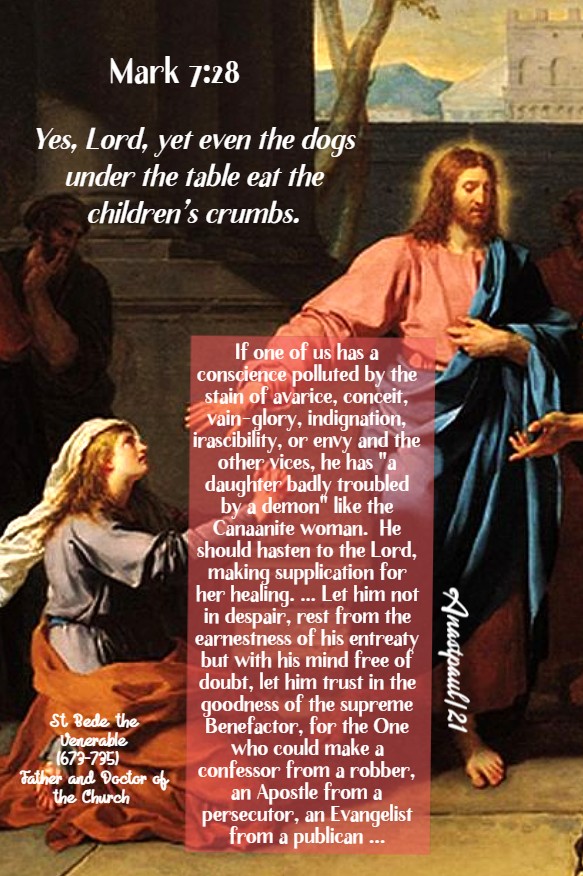
“Yes, Lord, yet even the dogs under the table eat the children’s crumbs.” … Mark 7:28
REFLECTION – “O woman, your faith is great. Let it be done to you as you wish” (Mt 15:28). Indeed, she had great enough faith, since she knew neither the ancient miracles, commands and promises of the prophets, nor the more recent ones of the Lord Himself. In addition, as often as she was disregarded by the Lord, she persevered in her entreaties and she did not cease knocking by asking Him, though she knew only by popular opinion that He was the Saviour. On account of this, she secured the great object for which she implored. … If one of us has a conscience polluted by the stain of avarice, conceit, vain-glory, indignation, irascibility, or envy and the other vices, he has “a daughter badly troubled by a demon” like the Canaanite woman. He should hasten to the Lord, making supplication for her healing. … Being submissive with due humility, [such a person] must not judge himself to be worthy of the company of the sheep of Israel, (that is, souls that are pure) but instead, he must be of the opinion, that he is unworthy of heavenly favours. Nevertheless, let him not in despair rest from the earnestness of his entreaty but with his mind free of doubt, let him trust in the goodness of the supreme Benefactor, for the One who could make a confessor from a robber (Lk 23:39f.), an Apostle from a persecutor (Acts 9:1-30, an Evangelist from a publican (Mt 9:9-13) and who could make sons for Abraham out of stones, could turn even the most insignificant dog, into an Israelite sheep.” – St Bede the Venerable (673-735) Father and Doctor of the Church – Homilies on the Gospels
PRAYER – Grant us, O merciful God, protection in our weakness, that we, who keep the Memorial of the Immaculate Mother of God, may, with the help of her intercession, rise up from our iniquities. Grant, we pray that our lives may be gifts to all those who cry out in pain. Through our Lord Jesus Christ, your Son, Who lives and reigns with you in the unity of the Holy Spirit, One God, forever and ever, amen.
Our Morning Offering – 11 February – The Memorial of Our Lady of Lourdes
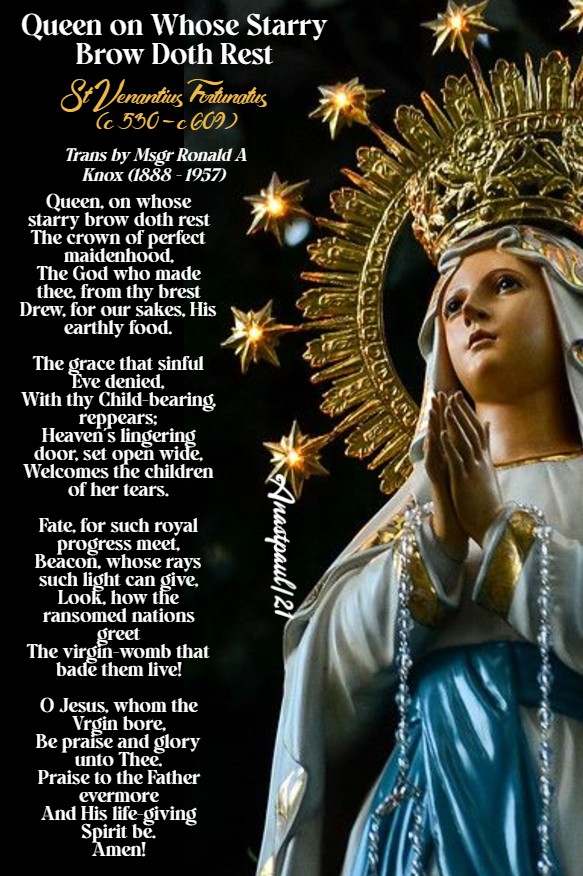
Queen on Whose Starry Brow Doth Rest St Venantius Fortunatus (c 530-c 609) Translation by Monsignor Ronald A Knox (1888 – 1957)
Queen, on whose starry brow doth rest The crown of perfect maidenhood, The God who made thee, from thy brest Drew, for our sakes, His earthly food.
The grace that sinful Eve denied, With thy Child-bearing, reppears; Heaven’s lingering door, set open wide, Welcomes the children of her tears.
Fate, for such royal progress meet, Beacon, whose rays such light can give, Look, how the ransomed nations greet The virgin-womb that bade them live!
O Jesus, whom the Vrgin bore, Be praise and glory unto Thee. Praise to the Father evermore And His life-givine Spirit be. Amen!
Saint Venantius Fortunatus (c 530 – c 609) Bishop, Poet, Hymnist, Writer – born c 530 at Rreviso, Italy and died c 609 at Poitiers, modern France of natural causes. St Venantius was unique, first a travelling lay poet, he later became a Priest and then a Bishop. But he always remained a professional author of poetry, a “troubadour” of Christ. He is the author of the Ave Maris Stella, amongst many others.
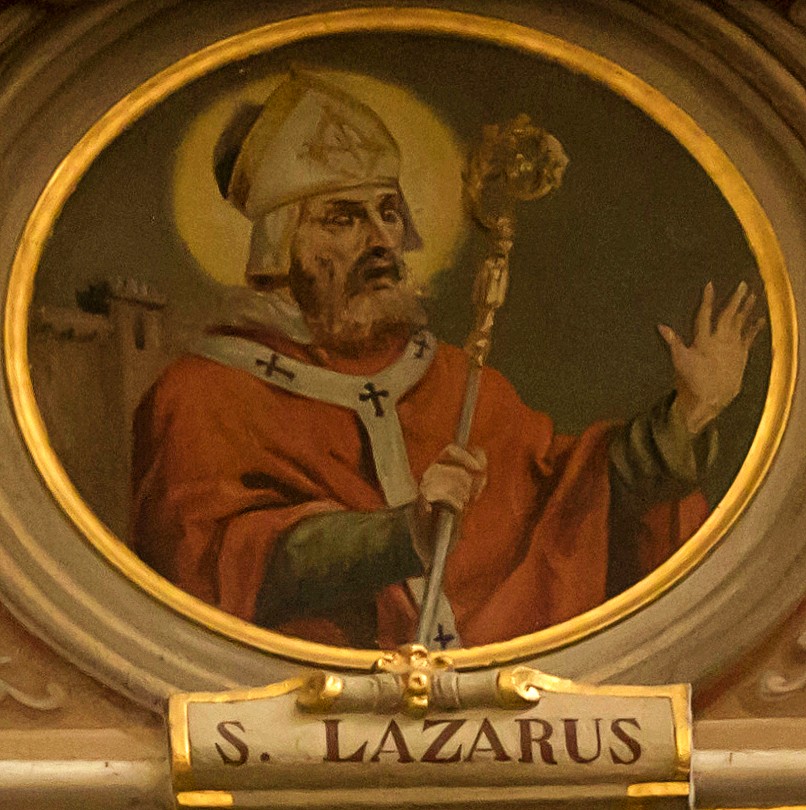
Saint of the Day – 11 February – Saint Lazarus of Milan (Died 449) Archbishop of Milan from 438 to 449.
We have almost no information about the life and episcopate of St Lazarus, though his name means “he who is assisted by God.” He probably studied in Milan and is reported to have been of stern appearance. A late tradition, with little historical basis, associates Lazarus with the Milan’s family of the Beccardi. It is believed that he resisted the Manichaeans, in the footsteps of St Pope Leo the Great.
St Lazarus became Bishop of Milan in 438. The times were volatile and troublesome, for the Goths were ravaging Italy and were masters of Milan but although Lazarus had much to suffer at their hands, he ruled his flock prudently and faithfully.
St Magnus Felix Ennodius (c 473-521), the Bishop of Pavia and Rhetorician and Poet (Feast day – 17 July), includes him in a list of twelve holy Bishops of Milan, of whom St Ambrose was the first and most eminent.
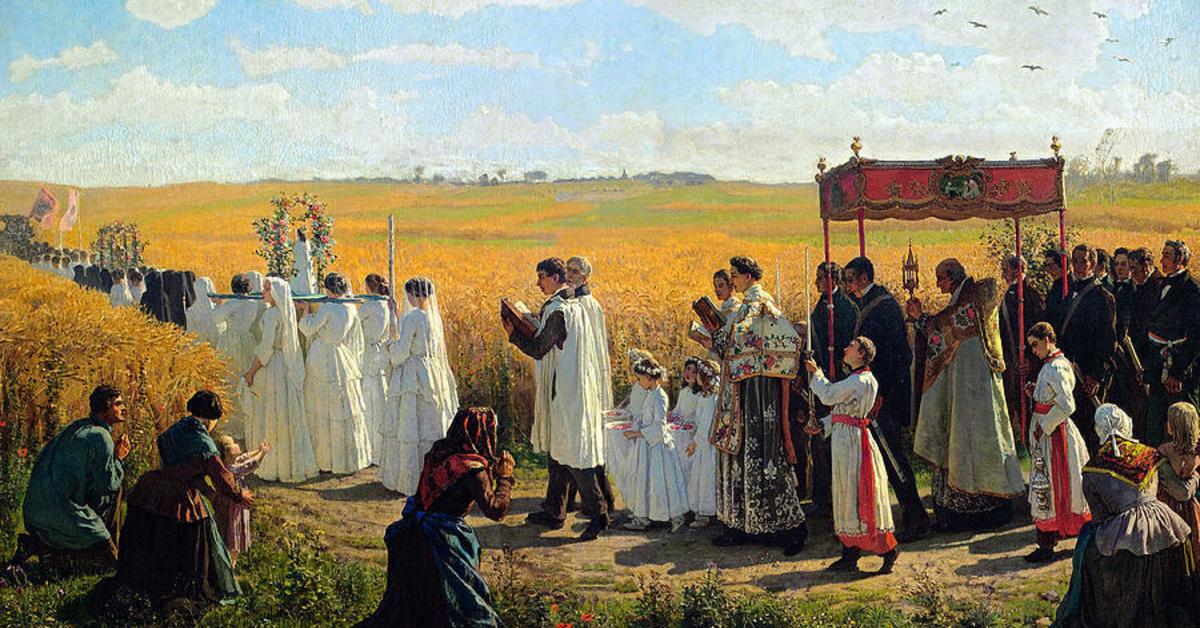
Lazarus is chiefly remembered in connextion with the Rogationtide litanies which, it is believed, he was the first to introduce. To invoke the protection of God at that distressful period, he ordered a three days’ fast with processions, litanies and visits to various Churches from the Monday to the Wednesday within the Octave of the Ascension. Afterwards, it is believed that St Mamertus introduced these litanies into the Diocese of Vienne and changed the date to the three days before Ascension day. The first Council of Orleans (511) ordered that this observance should be general throughout France and it spread quickly to England and elsewhere.
Later still, Archbishop Stephen Nardini and St Charles Borromeo did much to encourage and establish this custom in Milan, which continues to the present day. The word rogation comes from the Latin verb rogare, meaning “to ask,” which reflects the beseeching of God for the appeasement of His anger and for protection from calamities.
Lazarus died on 14 March in the year 449, after having been the Archbishop of Milan for eleven years but his Feast is kept on today, 11 February because Saints’ days are not celebrated during Lent, in the Diocese of Milan which, as is well known, follows its own Ambrosian rite.
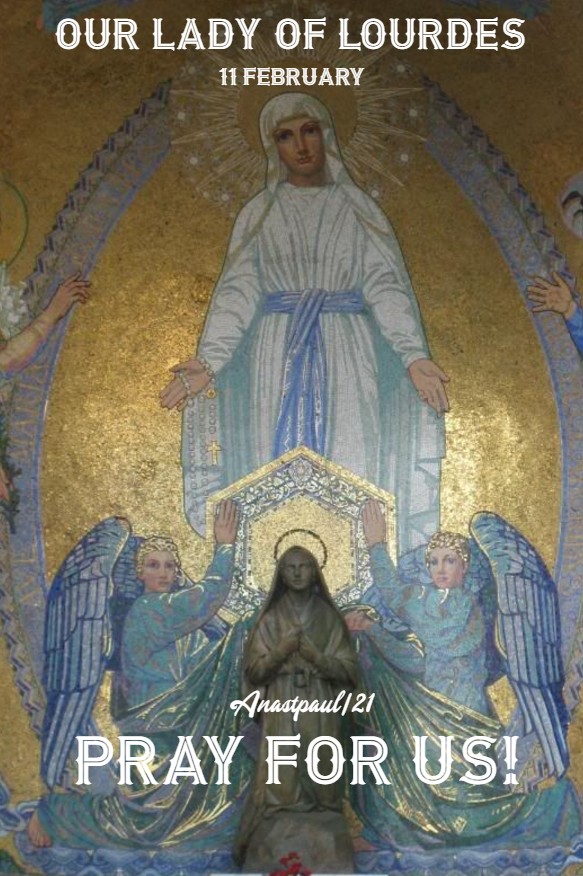
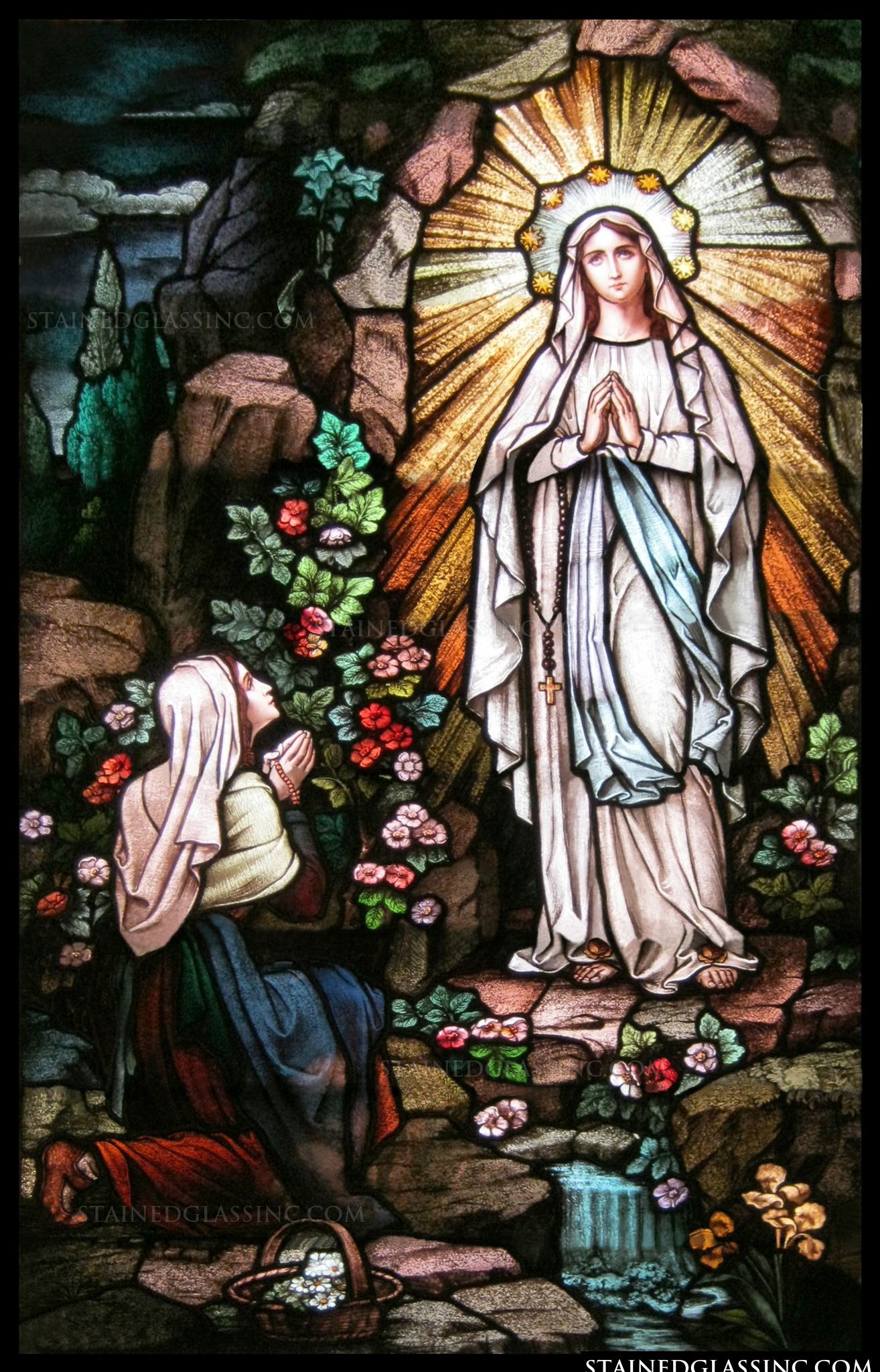
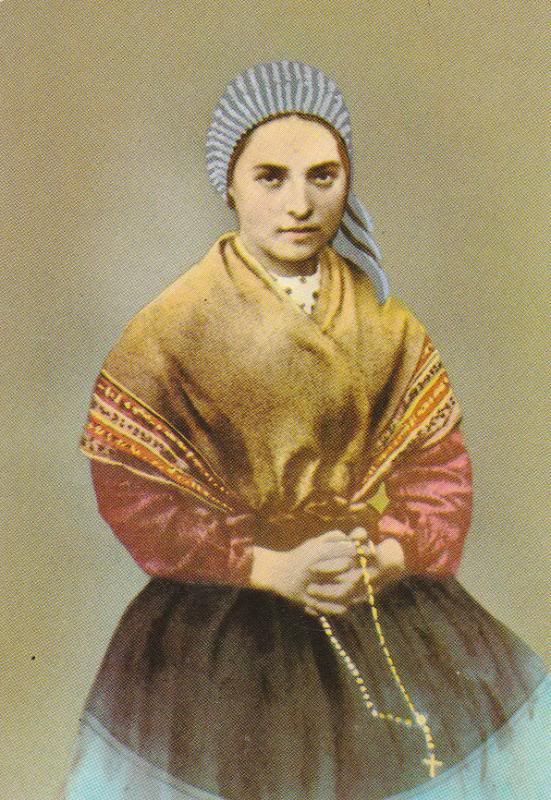
In 1858, there lived in the village of Lourdes, a little peasant girl, Bernadette Soubirous, 14 years old, uneducated, simple, poor, good. On 11 February, she was sent with two more girls to collect wood. They walked to the Rock of Massabielle, where the two companions crossed a mountain stream; while Bernadette was removing her shoes to follow them, she became conscious of a ravishing beautiful Lady, standing in the hollow of the rock, looking at her. Bernadette fell involuntarily upon her knees, gazing enraptured at the lovely Lady, who smiled lovingly at Bernadette and then disappeared. The mysterious Lady from heaven appeared in all, eighteen times to the little girl and among other things told her to drink the water from a mysterious fountain which was not yet observed. Bernadette scratched in the sand at a spot indicated and water began to trickle through the earth; after a few days there gushed forth every day 27,000 gallons of pure, clear spring water and this water flows still.
Bernadette was asked by Our Lady of Lourdes, who always showed her a sweet heavenly courtesy, to request the Priest to have a Church built on the spot, that processions should be made to the grotto, that people should drink of the water. The main emphasis of her message was that the faithful should visit the grotto in order to do penance for their sins and for those of the whole world. In answer to Bernadette’s inquiry, “Who are you?” the Lady answered, “I am the Immaculate Conception.”
The apparitions appeared for the last time on 16 July 1858. Bernadette never again had the supreme privilege of seeing and visiting with Our Lady. Later, Bernadette became a nun at Nevers and there spent the rest of her life. Through her, “Lourdes was destined to become a focus of faith and mercy; thousands of souls were to flock thither to increase their piety, to borrow new energy and resolution. Suffering and charity were to join hands under the eyes of the Divine Mother. Miracles were to be never-ceasing.” Four years after, the Bishop declared, upon an exhaustive and scrupulous investigation, to the faithful, that they are “justified in believing the reality of the apparitions.” In 1873, a Basilica was built on top of the rock and in 1883 another Church was built below and in front of the rock. From 1867 when records began to be kept until 1908, about 5,000,000 pilgrims had visited the grotto; now about 1,000,000 people visit Lourdes every year. Although Our Lady never at any time promised that pilgrims who visited the grotto would be healed of their physical ills, remarkable cures began at once and have continued ever since. Many of them are of such a character that they can be ascribed only to supernatural power.
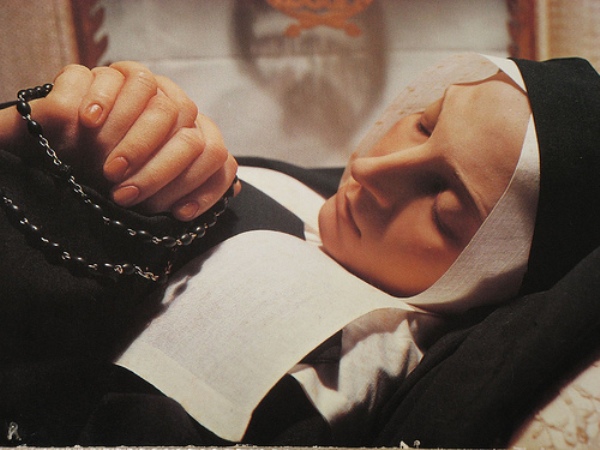
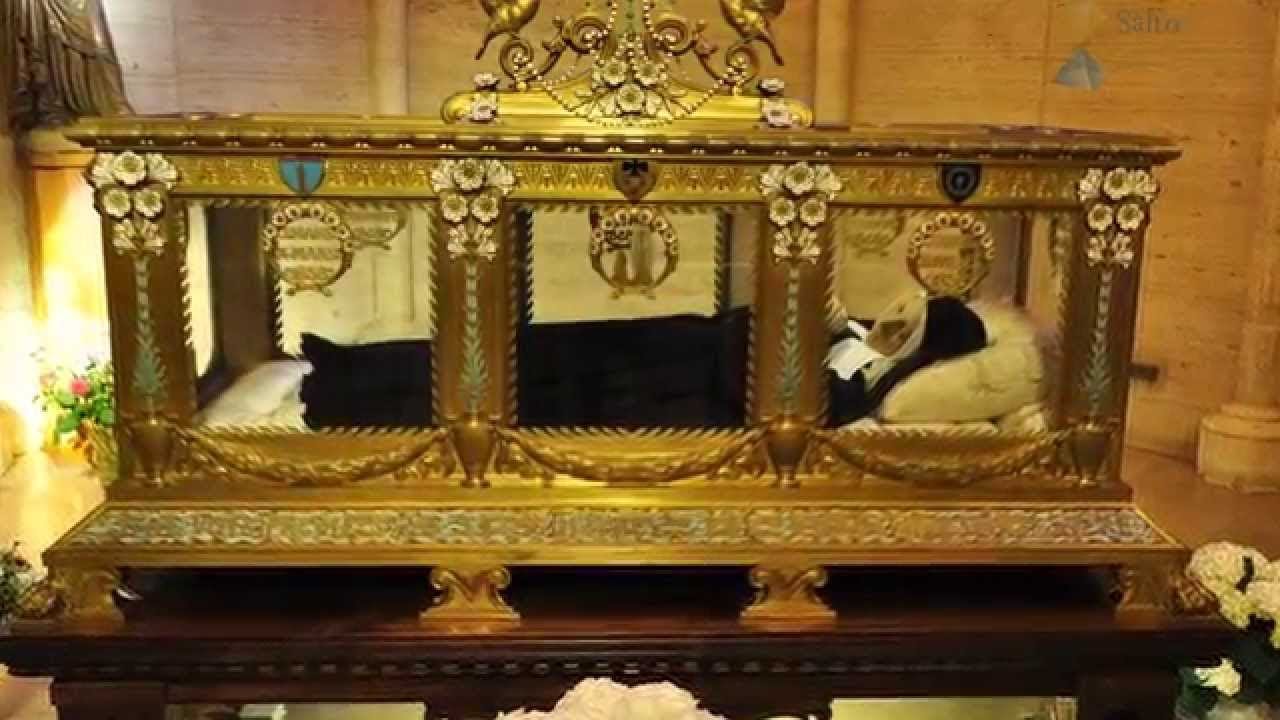
There is no doubt that the cures are miraculous because every possible natural cause has been proved false. There is no chemical composition in the water to make it have curative properties. It has been claimed that the cures might be due to suggestion but Bernheim, head of the famous school of Nancy, says that although suggestion has a chance of success in certain functional diseases, it requires the co-operation of time. Suggestion cures slowly and progressively, while complete cures at Lourdes are instantaneous, the supreme Life Giver Himself is responsible for the many cures witnessed at this shrine of the Immaculate Conception and He chose a simple peasant to reveal to the world the love He bears all mankind, as the adopted children of His Blessed Mother. Bernadette died in 1879 at the age of 35 and was later Canonised. The body of the blessed Saint can still be seen in its glass coffin, intact and incorrupt, looking as its photographs show, like a young woman asleep. The chair at which she prayed, the altar where she received her First Holy Communion, the bed in which she slept, the room in which she lived – all can be seen at Lourdes. Lourdes is one of the greatest Marian shrines in the world. Here, praying to Our Lady of Lourdes, one may obtain refreshment, courage, energy and inspiration to continue the age-old struggle of the great Catholic Faith against the forces of darkness and disintegration. This great shrine, all its miracles and the streams of grace that are poured into the world through Our Lady of Lourdes, were made possible, through the faithfulness and the sanctity of a little peasant girl. Amen Our Lady of Lourdes, pray for us, St Bernadette, pray for us!
St Calocerus of Ravenna St Castrensis of Capua St Dativus the Senator Bl Elizabeth Salviati St Etchen of Clonfad St Eutropius of Adrianopolis St Felix the Senator St Gobnata St Pope Gregory II (669-731) About “The Defender of Icons” https://anastpaul.com/2020/02/11/saint-of-the-day-11-february-saint-pope-gregory-ii-669-731-defender-of-icons/ Bl Gaudencia Benavides Herrero St Helwisa St Jonas of Muchon St Lazarus of Milan (Died 449) Bishop
St Lucius of Adrianople St Pope Paschal I St Pedro de Jesús Maldonado-Lucero St Saturninus of Africa St Secundus of Puglia St Severinus of Agaunum St Soter of Rome St Theodora the Empress Bl Tobias Francisco Borrás Román — Guardians of the Holy Scriptures: Also known as – • Anonymous Martyrs in Africa • Martyrs of Africa • Martyrs of Numidia • Martyrs of the Holy Books A large number of Christians tortured and murdered in Numidia (part of modern Algeria) during the persecutions of Diocletian, but whose names and individual stories have not survived. They were ordered to surrender their sacred books to be burned. They refused. Martyrs. c 303 in Numidia.
Martyrs of Africa – 5 saints: A group of five Christians who were martyred together; we know nothing else but the names of four of them – Cyriacus, Oecominius, Peleonicus and Zoticus.



















 AnaStpaul
You must be logged in to post a comment.