Thought for the Day – 13 April – Meditations with Antonio Cardinal Bacci (1881-1971)
My Life is Christ
“St Paul reached such a degree of union with Christ that he could exclaim” “To me to live is Christ” (Phil 1:21). Elsewhere he says” “It is now no longer I that live but Christ lives in me” (Gal 2:20). This is a characteristic of the Saints. They live their own lives no longer, for they live the life of Christ. That is to say, their minds and hearts are always fixed on Jesus. They love the Lord, more than all things and, more than themselves. God is the object of all their desires, affections and actions. As a result, the soul is transfigured and is infused with divine life, so that it does nothing which is not activated by grace. In the Saints, then, there is reflected something heavenly which attracts and stimulates one to virtue.
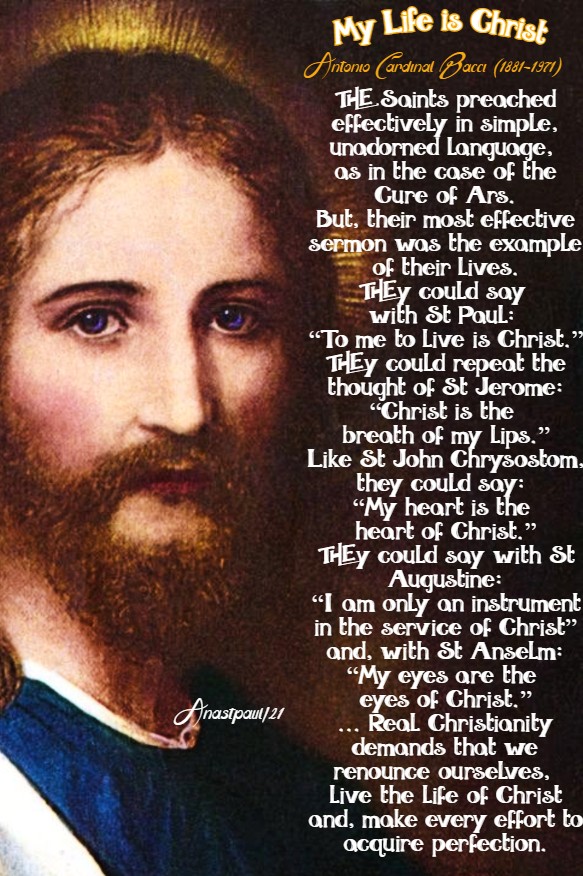
The Saints preached effectively in simple, unadorned language, as in the case of the Cure of Ars. But, their most effective sermon was the example of their lives. They could say with St Paul: “To me to live is Christ.” They could repeat the thought of St Jerome: “Christ is the breath of my lips.” Like St John Chrysostom, they could say: “My heart is the heart of Christ.” They could say with St Augustine: “I am only an instrument in the service of Christ” and, with St Anselm: “My eyes are the eyes of Christ.”
When we meditate on these words, which signify the height of sanctity, we feel very small, shabby and far from the Christian perfection to which we should aspire. Perhaps we are still immersed in sin, or perhaps, we are wavering between the things of this world and the things of God, or perhaps, as yet, we have not given up our egoism and complacent mediocrity in order to offer ourselves entirely to God. Real Christianity demands that we renounce ourselves, live the life of Christ and, make every effort to acquire perfection.”
Quote/s of the Day – 13 April – Tuesday of the Second Week of Easter, Readings: First: Acts 4: 32-37, Psalm: Psalms 93: 1ab, 1cd-2, 5, Gospel: John 3: 7b-15
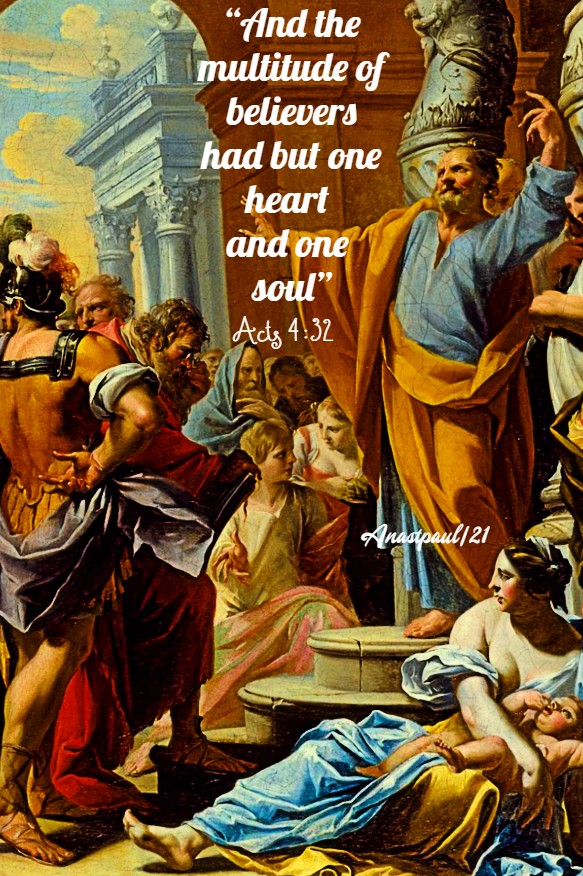
“And the multitude of believers had but one heart and one soul”
Acts 4:32
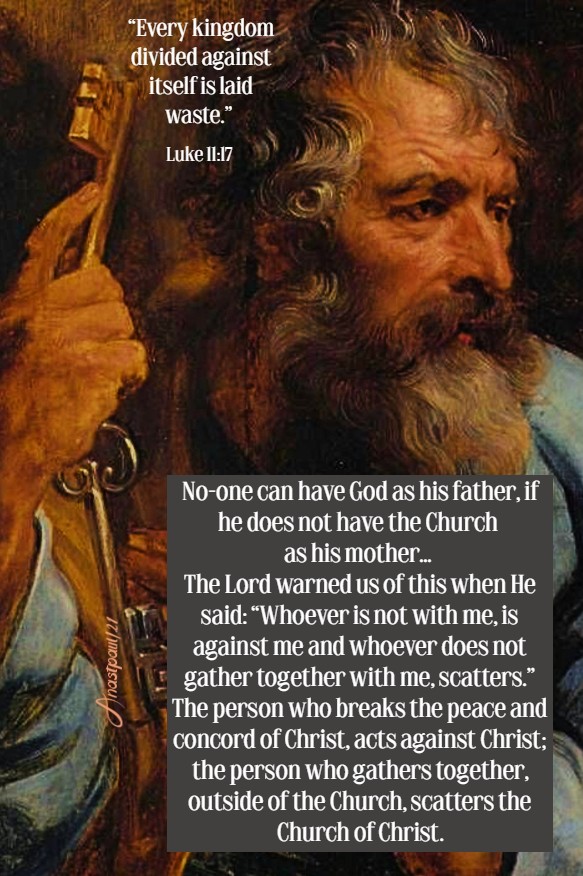
Every kingdom divided against itself is laid waste.”
Luke 11:17
“No-one can have God as his father, if he does not have the Church as his mother… The Lord warned us of this when He said: “Whoever is not with me, is against me and whoever does not gather together with me, scatters.” The person who breaks the peace and concord of Christ, acts against Christ; the person who gathers together, outside of the Church, scatters the Church of Christ.”
St Cyprian of Carthage (c 200- c 258) Bishop and Martyr, Father of the Church On the unity of the Church
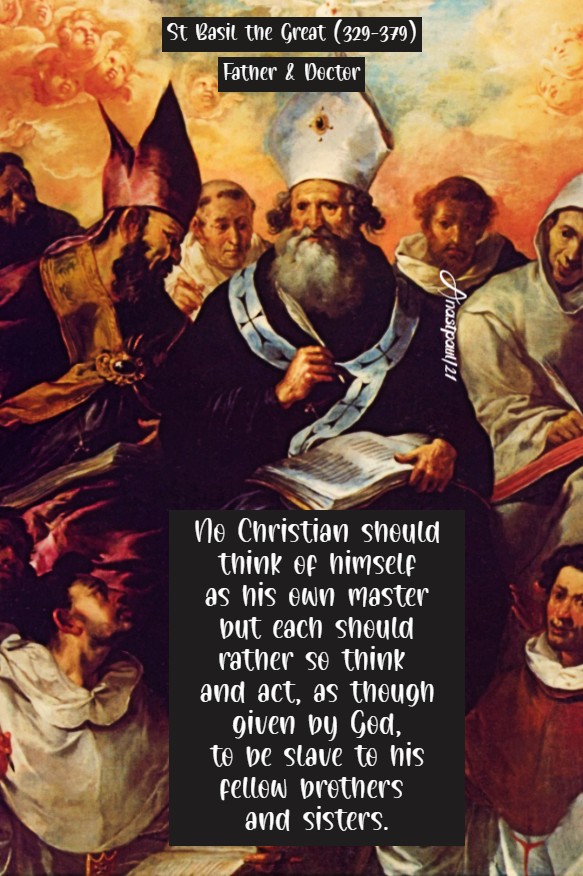
“No Christian should think of himself as his own master but each should rather so think and act, as though given by God, to be slave to his fellow brothers and sisters.”
St Basil the Great (329-379) Father & Doctor
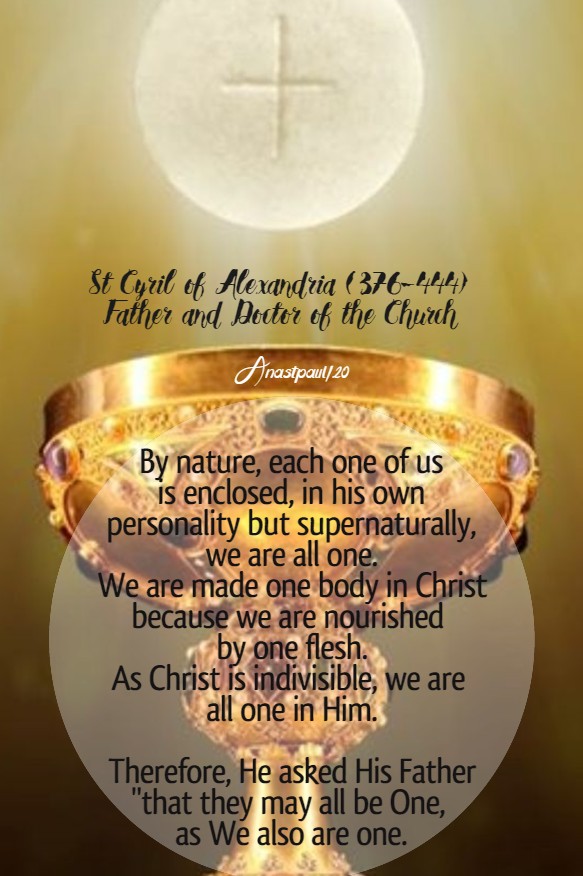
“By nature, each one of us is enclosed, in his own personality but supernaturally, we are all one. We are made one body in Christ because we are nourished by one flesh. As Christ is indivisible, we are all one in Him. Therefore, He asked His Father “that they may all be One, as We also are one.”
St Cyril of Alexandria (376-444) Father and Doctor of the Incarnation
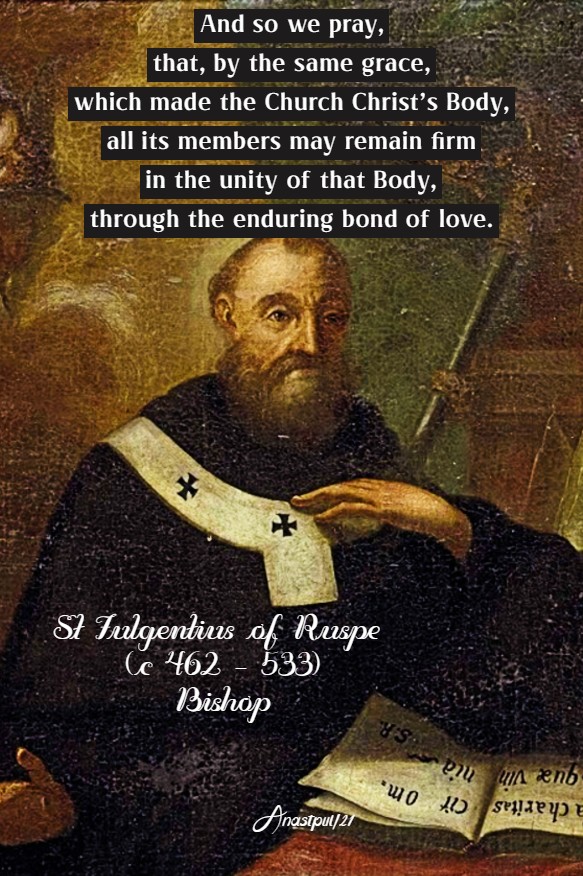
“And so we pray, that, by the same grace, which made the Church Christ’s Body, all its members may remain firm in the unity of that Body, through the enduring bond of love.”
St Fulgentius of Ruspe (c 462 – 533) Bishop, Father of the Church
One Minute Reflection – 13 April – Tuesday of the Second Week of Easter, Readings: First: Acts 4: 32-37, Psalm: Psalms 93: 1ab, 1cd-2, 5, Gospel: John 3: 7b-15 *Readings below
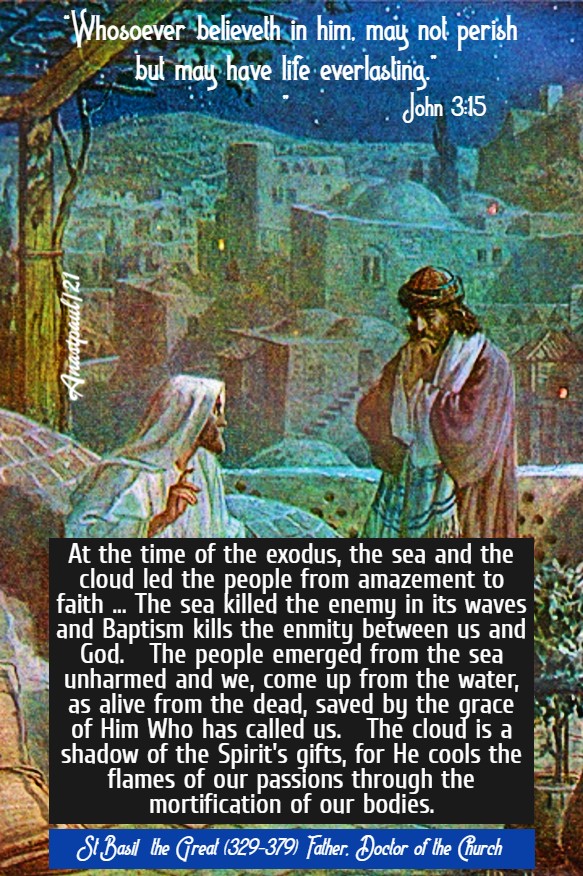
“Whosoever believeth in him, may not perish but may have life everlasting.” – John 3:15
REFLECTION – “Typology points out what is to be expected, indicating through imitation, what is to happen before it happens. Adam was a type of Him who was to come (Rom 5:14); “the Rock was Christ” (1 Cor 10:4) typologically and, the water from the rock, was a type of the living power of the Word, for He says, “If anyone thirst, let him come to Me and drink.” (Jn 7:37) The manna was a type of the living bread which came down from heaven (Jn 6:41) and the serpent suspended on the pole, was a type of the saving Passion accomplished on the Cross (Nb 21:8f.), since the life of everyone who looked at the serpent was preserved.
Similarly, the history of Israel’s exodus, was recorded to typify those who would be saved through Baptism. The firstborn of the Israelites were saved …) through grace given, to those who were marked with blood. The blood of the lamb is a type of the blood of Christ …
At the time of the exodus, the sea and the cloud led the people from amazement to faith but ,they also typified the grace which was yet to come. “Whoever is wise, let him understand these things” – how the baptism in the sea, which brought about Pharaoh’s demise, typifies the washing, which makes the devil’s tyranny depart. The sea killed the enemy in its waves and Baptism kills the enmity between us and God. The people emerged from the sea unharmed and we come up from the water, as alive from the dead, saved by the grace of Him Who has called us. The cloud is a shadow of the Spirit’s gifts, for He cools the flames of our passions through the mortification of our bodies.” – St Basil the Great (329-379) Bishop of Caesarea in Cappadocia, Father, Doctor of the Church – Treatise on the Holy Spirit, 14
PRAYER – True Light of the World, Lord Jesus Christ, as You enlighten all men for their salvation, fill us the grace of the Holy Spirit, that our eyes may be opened and our path visible. May our hearts be filled with the certainty of Your love and grant us the grace to share Your light with all. May Your love in us overcome all things, let there be no limit to our faith, our hope and our endurance. Lead us in Your ways of peace to eternal life by Your Mother’s protecting help. Who live and reign with the Father and Holy Spirit, God forever and ever, amen.
Acts 4: 32-37 32 And the multitude of believers had but one heart and one soul, neither did anyone say that aught of the things which he possessed, was his own but all things were common unto them. 33 And with great power did the apostles give testimony of the resurrection of Jesus Christ our Lord and great grace was in them all. 34 For neither was there anyone needy among them. For as many as were owners of lands or houses, sold them and brought the price of the things they sold 35 and laid it down before the feet of the apostles. And distribution was made to everyone, according as he had need. 36 And Joseph, who, by the apostles, was surnamed Barnabas, (which is, by interpretation, The son of consolation), a Levite, a Cyprian born, 37 having land, sold it and brought the price and laid it at the feet of the apostles.
John 3: 7b-15 7 Wonder not, that I said to thee, you must be born again. 8 The Spirit breatheth where he will and thou hearest his voice but thou knowest not whence he cometh and whither he goeth, so is everyone that is born of the Spirit. 9 Nicodemus answered and said to him: How can these things be done? 10 Jesus answered and said to him: Art thou a master in Israel and knowest not these things? 11 Amen, amen I say to thee, that we speak what we know and we testify what we have seen and you receive not our testimony. 12 If I have spoken to you earthly things,and you believe not; how will you ,believe, if I shall speak to you heavenly things? 13 And no man hath ascended into heaven but he that descended from heaven, the Son of man who is in heaven. 14 And as Moses lifted up the serpent in the desert, so must the Son of man be lifted up: 15 that whosoever believeth in him, may not perish but may have life everlasting.
Our Morning Offering – 13 April – Tuesday of the Second Week of Easter
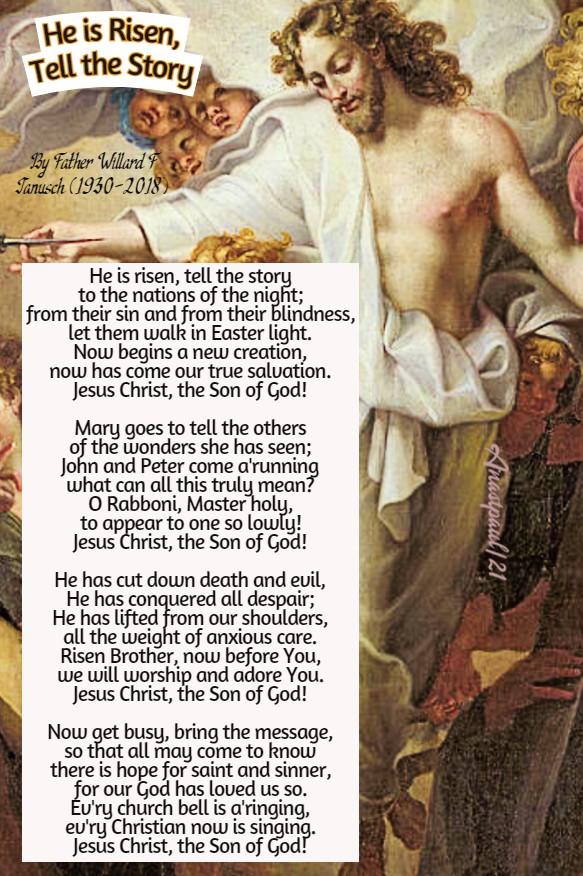
He is Risen, Tell the Story By Father Willard F Janusch (1930-2018)
He is risen, tell the story to the nations of the night; from their sin and from their blindness, let them walk in Easter light. Now begins a new creation, now has come our true salvation. Jesus Christ, the Son of God!
Mary goes to tell the others of the wonders she has seen; John and Peter come a’running what can all this truly mean? O Rabboni, Master holy, to appear to one so lowly! Jesus Christ, the Son of God!
He has cut down death and evil, He has conquered all despair; He has lifted from our shoulders, all the weight of anxious care. Risen Brother, now before you, we will worship and adore You. Jesus Christ, the Son of God!
Now get busy, bring the message, so that all may come to know there is hope for saint and sinner, for our God has loved us so. Ev’ry church bell is a’ringing, ev’ry Christian now is singing. Jesus Christ, the Son of God!
A Parish Priest, Seminary Professor and prolific Musician and Hymnist, Fr Willard wa Ordained in 1956 and died at the age of 88 in 2018.
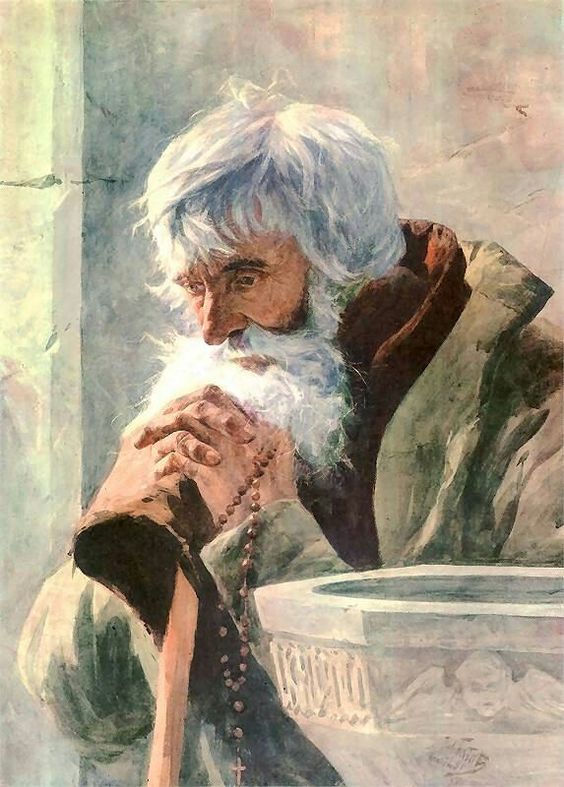
Saint of the Day – 13 April – Saint Caradoc of Wales (Died 1124) Priest, Monk, Hermit , miracle-worker, Harpist. Born in the 11th century in Brycheiniog, Wales and died on 13 April 1124, which was Low Sunday that year, at Saint Isells, Wales of natural causes. His body is incorrupt. Also known as Caradog, Caractacus, Caradocus, Caradoco.
Caradoc was a Welsh nobleman, native of Brecknockshire, who after he had received a liberal education, enjoyed the confidence of Rees, or Resus, Prince of South-Wales and held an honourable place in his Court, as a harp player.
The Prince one day, on account of two greyhounds ,which were lost, fell into such a fury against Caradoc as to threaten his life. Caradoc, from this disgrace learned the inconstancy and uncertainty, of worldly honours and the best founded hopes and resolved to dedicate himself altogether to the service of the King of kings, whose promises can never fail and whose rewards are eternal.
Upon the spot he broke the tip of his spear to turn it into a walking stick and he made the sacrifice of himself to God, by a vow of perpetual chastity and of embracing a religious life. Repairing to Landaff to become a Monk, he received from the Bishop the clerical tonsure and for some time served God in the Church of St Theliau.
Being desirous of finding a closer union with God in solitude, he spent some years in a little hut, which he built himself, near the abandoned Church of St Kined.
The reputation of his sanctity filled the whole country and the Archbishop of Menevia, or St David’s, calling him to that town, promoted him to the Priestly orders. The saint hence retired, with certain devout companions, to the isle of Ary.
Certain pirates from Norway, who often infested these coasts, carried them off as prisoners,but, fearing the judgements of God, safely set them on shore again the next day. However, the Archbishop of Menevia assigned the saint another habitation in the Monastery of St Hismael, commonly called Ysam, in the country of Ross, or Pembroke-shire.
Henry I., King of England, having subdued the southern Welsh, sent a colony of Flemings into the country of Ross, who drove the old Britons out of their possessions. The saint and his Monastery suffered much from the oppressions of these new inhabitants, especially of Richard Tankard, a powerful Englishman among them. This nobleman was, after some time, struck by God with a dangerous illness and having recourse to St Caradoc, was, by his prayers, restored to his health. From this time the saint and his Monastery found a benefactor and protector.
St Caradoc died on Low-Sunday, the 13th of April, in the year 1124 and was buried with great honour in the Church of St David. We are assured that his tomb was illustrated by miracles and his body was found whole and incorrupt several years after, when it was translated with great solemnity. The historian, William of Malmesbury, tried to cut off a finger to take as a relic but St Caradoc’s hand jerked away!
A letter from Pope Innocent III ordering an enquiry into his life and miracles still survives. The Church at Lawrenny in Wales, is dedicated to him.
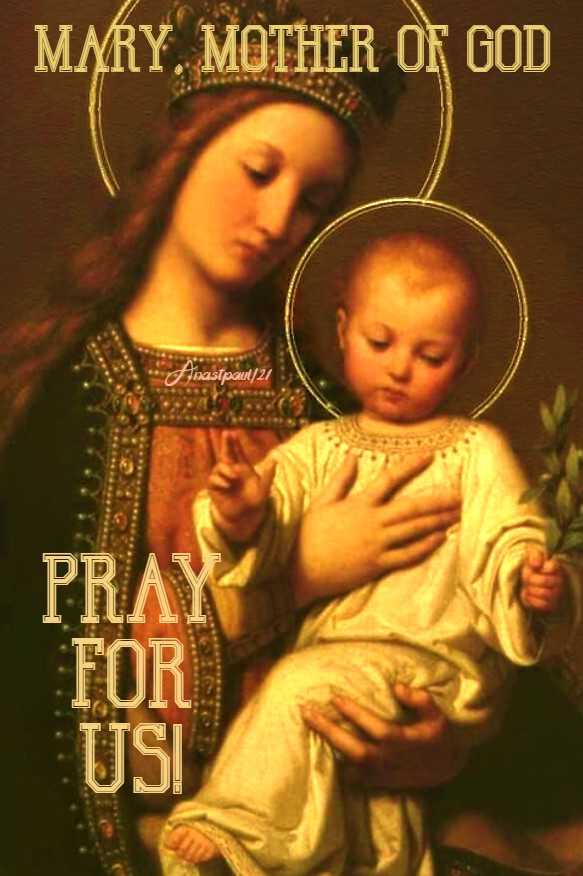
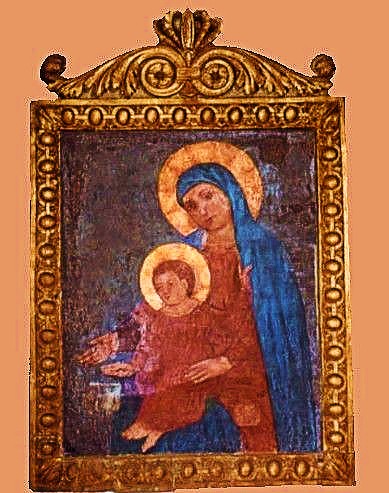
Santa Maria dei Voti / Our Lady of Mantua, Italy (1640) – 13 April:
This present Shrine to Our Lady of Mantua was built by the Gonzaga family in the year 1460. There is seen a miraculous painting of the Blessed Virgin Mary holding the Baby Jesus, that is known to have been venerated since about the year 1000. Originally known as Saint Mary of the Vows, the painting is crowned today.
According to tradition, the history of the site dates back to Saint Anselm. At that time, the Blessed Virgin had promised her protection to the City. Starting in 1477, word spread that before the image numerous miracles had occurred, so that by then substantial offerings began to pour into the Church (hence the name of Santa Maria dei Voti). After the plague of 1630, which had overwhelmed the City and its territory, the Princess Maria Gonzaga, regent of the duchy, wanted to entrust herself, her dynasty and the region, to the protection of the Blessed Virgin. The Princess was determined to place herself, her son Charles II and the City of Mantua and of Monferrato, under the special protection of Mary. She ordered that the image of Mary should be carried in procession through the streets and desired that the image be solemnly crowned in the Basilica of Saint Andrea, as the Queen of Mantua. The solemn crowning of Our Lady commonly called Santa Maria dei Voti, was strongly urged by the pious Princess Maria Gonzaga in the year 1640, when the dam of the Po River in Italy broke. The coronation took place with great solemnity on 28 November 1640. Since then, the Church and the picture painted of Santa Maria dei Voti were named dell’Incoronata, or ‘Saint Mary the Crowned,’ and the annual festival was fixed on the first Sunday after the Feast of Saint Martin, 11 November. On this occasion but also during the month of May, which is traditionally dedicated to Marian devotion, the dell’Incoronata is exposed in the Cathedral, covered in sumptuous dresses dating from the seventeenth century. The three following centenary years, in particular, saw an unanimous and grateful expression of love on the part of the Mantuans, who still venerate the Madonna “Incoronata,” the Madonna who said, “Mantua is mine and as mine I will always defend it.”
St Agathonica of Pergamus St Agathodorus of Pergamus St Caradoc of Wales (Died 1124) Priest, Hermit St Carpus of Pergamus Bl Edward Catherick Bl Francis Dickenson St Guinoc St Hermengild St Ida of Boulogne Bl Ida of Louvain Bl Isabel Calduch Rovira Bl James of Certaldo Bl John Lockwood Blessed Margaret of Castello OP (1287-1320) About Blessed Margaret: https://anastpaul.wordpress.com/2018/04/13/saint-of-the-day-13-april-blessed-margaret-of-castello-o-p-1287-1320/
St Ursus of Ravenna — Martyrs of Dorostorum – 3 saints: A lector and two students martyred together in the persecutions of Diocletian – Dadas, Maximus and Quinctillianus. Beheaded c303 in Dorostorum, Lower Mysia (modern Sillistria, Bulgaria.
You must be logged in to post a comment.