One Minute Reflection – 13 May – “Mary’s Month” – Thursday of the Sixth Week of Easter, Readings: Acts 18: 1-8, Psalms 98: 1, 2-3, 3-4, John 16: 16-20 and the Memorial of Blessed Imelda Lambertini (1322-1333) Child Mystic, “Adorer of the Blessed Sacrament”
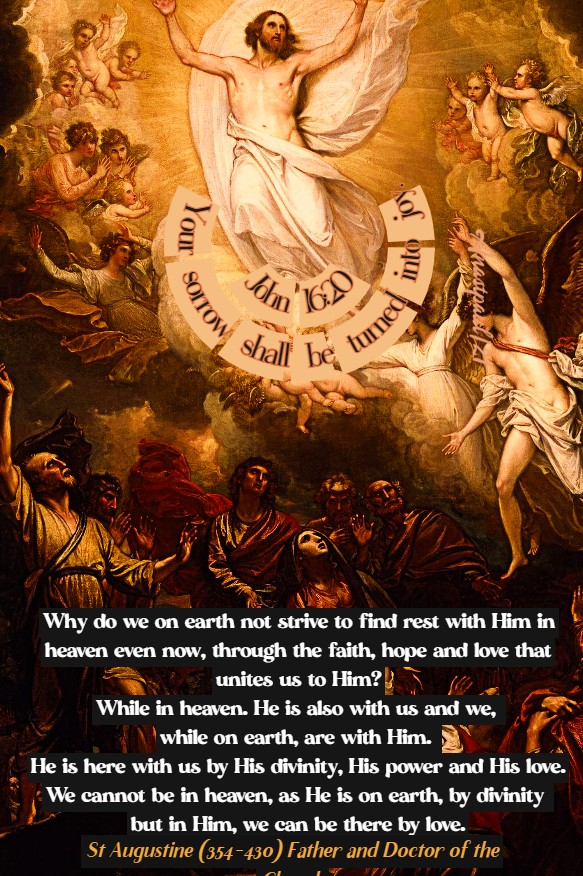
“Your sorrow shall be turned into joy.” … John 16:20… John 16:16
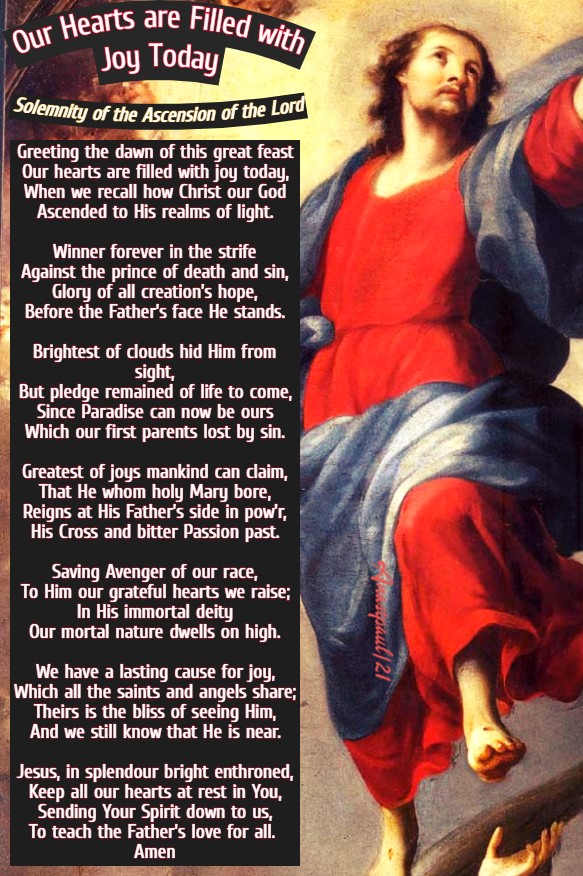
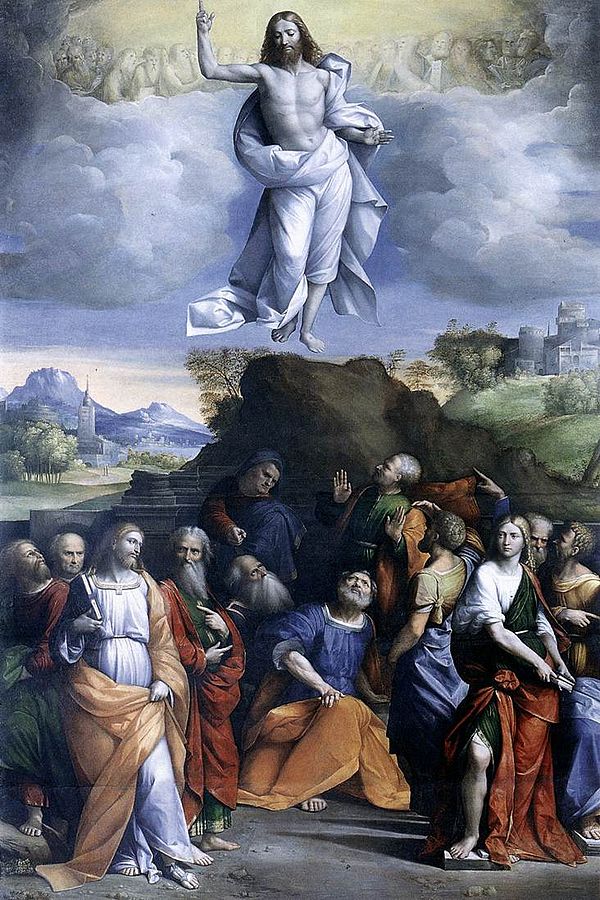
REFLECTION – Today, our Lord Jesus Christ ascended into heaven, let our hearts ascend with Him. Listen to the words of the Apostle – If you have risen with Christ, set your hearts on the things that are above where Christ is, seated at the right hand of God; seek the things that are above, not the things that are on earth. For just as He remained with us even after His ascension, so we too, are already in heaven with Him, even though what is promised us has not yet been fulfilled in our bodies.
Christ is now exalted above the heavens but He still suffers on earth all the pain that we, the members of His body have to bear. He showed this when He cried out from above – Saul, Saul, why do you persecute Me? and when He said: I was hungry and you gave me food.
Why do we on earth not strive to find rest with Him in heaven even now, through the faith, hope and love that unites us to Him? While in heaven. He is also with us and we, while on earth, are with Him. He is here with us by His divinity, His power and His love. We cannot be in heaven, as He is on earth, by divinity but in Him, we can be there by love.
He did not leave heaven when He came down to us, nor did He withdraw from us when He went up again into heaven. The fact that He was in heaven even while He was on earth, is borne out by His own statement – No-one has ever ascended into heaven except the one who descended from heaven, the Son of Man, who is in heaven. … Thus, no-one but Christ descended and no one but Christ ascended; not because there is no distinction between the head and the body but because the body, as a unity cannot be separated from the head” – St Augustine (354-430) Bishop and Great Western Father and Doctor of the Church – An excerpt from his Sermon on the Lord’s Ascension
PRAYER – Almighty God, fill us with a holy joy, teach us how to thank You with reverence and love for the joy of the ascension of Christ Your on. You have raised us up with Him, where He the head has preceded us in glory, there we, the body, are called in hope. Grant, too we beg, that by Mary’s prayer and the prayer of Your loving child Blessed Imelda Lambertini, we may give You faithful service and spread abroad the glory of Your nameThrough Christ our Lord, i the unity of the Holy Spirit and the glory of the Father, God forever, amen.
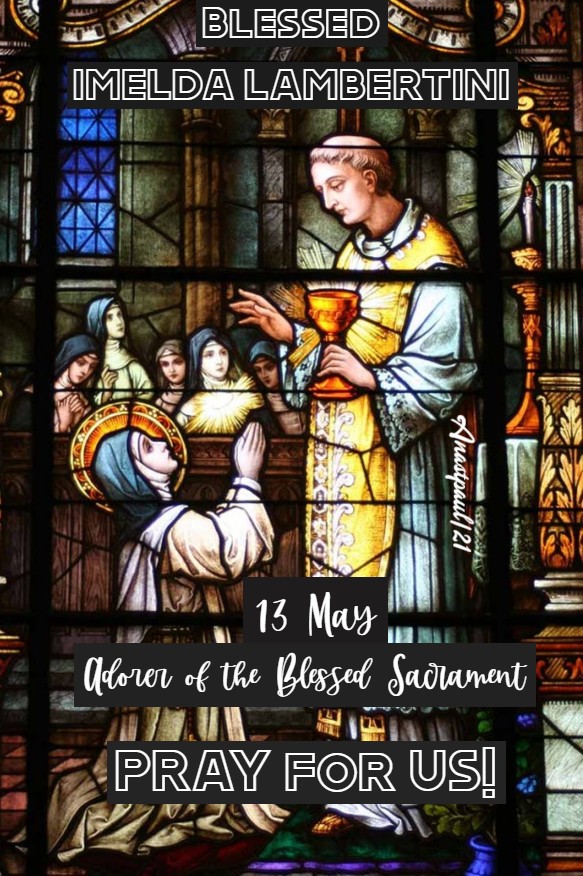
Saint of the Day – 13 May – Blessed Imelda Lambertini (1322-1333) Child Mystic, Virgin. Born in 1322 AS Imelda Dpmenica Lambertini at Bologna, Italy and died on the Feast of the Ascension, 12 May 1333 Bologna, Italy. Patronage – First Communicants (named by Pope Saint Pius X).
Imelda Lambertini was born of a noble family in Bologna, Italy in 1322. Her parents raised her to love her Catholic faith and through their influence she developed a love for prayer, especially for the Mass. Often she would attend Mass and Compline (Night Prayer of the Divine Office) at a nearby Dominican Church. Her mother also taught Imelda to cook and sew for the poor and cultivated in her child an eagerness to perform the corporal works of mercy. Even so, her mother and father, both of whom were getting on in years, were surprised when Imelda asked permission at the tender age of nine to go to live with the Dominican nuns at a neighbouring Monastery. As difficult a decision as this was, her parents evidently sensed the depth of their child’s desire and entrusted her spiritual formation to the Dominicans at Val di Pietra.
At this distance of centuries and culture it is not easy to determine precisely what little Imelda’s status was at the Convent. It seems she was well loved by the Sisters, who allowed her to wear the Dominican habit, to pray with them and to follow their way of life, to the extent that a little girl would be able to do, while still remaining a child. Imelda, we are told, longed (and intensely, it seems) to be allowed to receive Holy Communion with the nuns but in that day, such a thing would have been unheard of for a child her age. Her pleading was again and again gently refused, with the explanation that she would need to wait until she was older and more prepared.
For a time Imelda had to be content with this answer, meanwhile learning to chant Office from hearing the nuns in choir and developing her own interior prayer life in simple childlike ways. The saints, whose stories she had learned from her parents and from the nuns, became her “secret companions” and probably had a hand, in nurturing the longing she felt, to receive Jesus intimately in the Sacrament of the Eucharist. In her private conversations with Jesus, with whom she was developing a deep friendship, we can imagine that she often made known her desire to be allowed to receive Communion. There is no evidence that He put up any opposition to the proposal—but neither did the Sisters relent. And so, Imelda continued, with the intensity of a child, to get to know Jesus more deeply and to desire Him all the more.
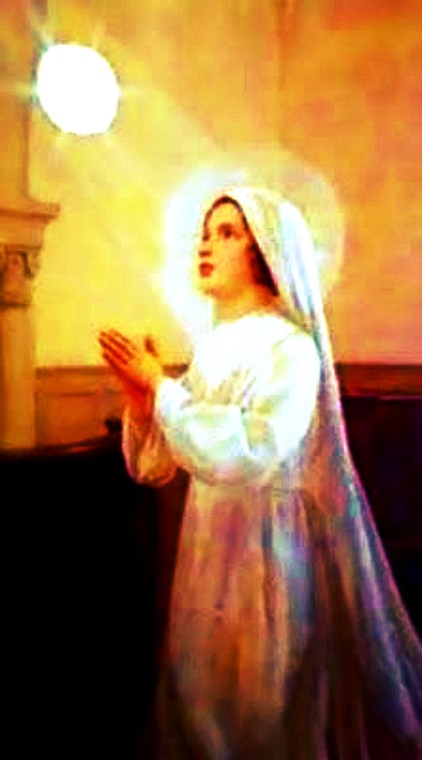
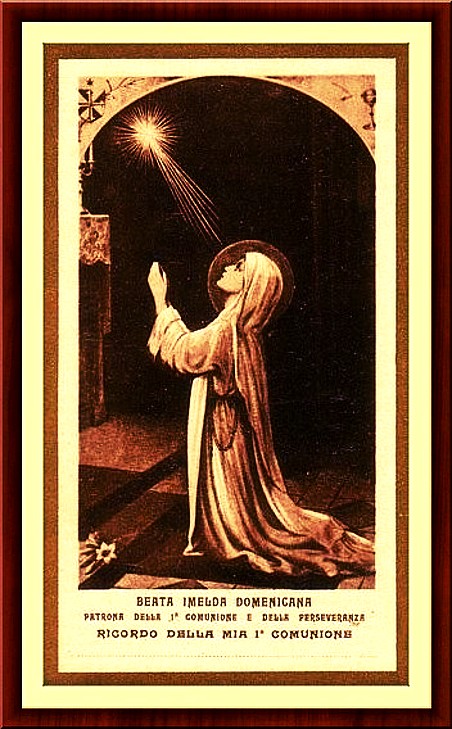
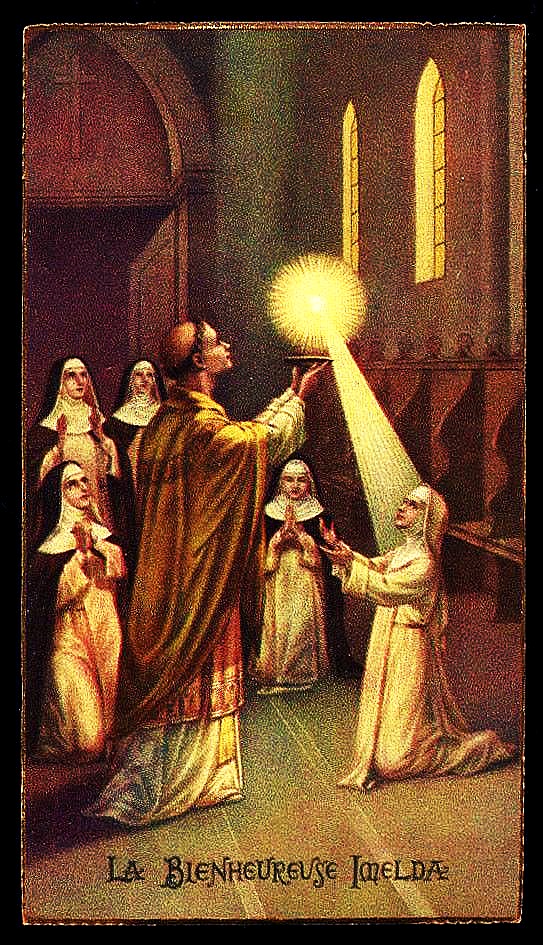
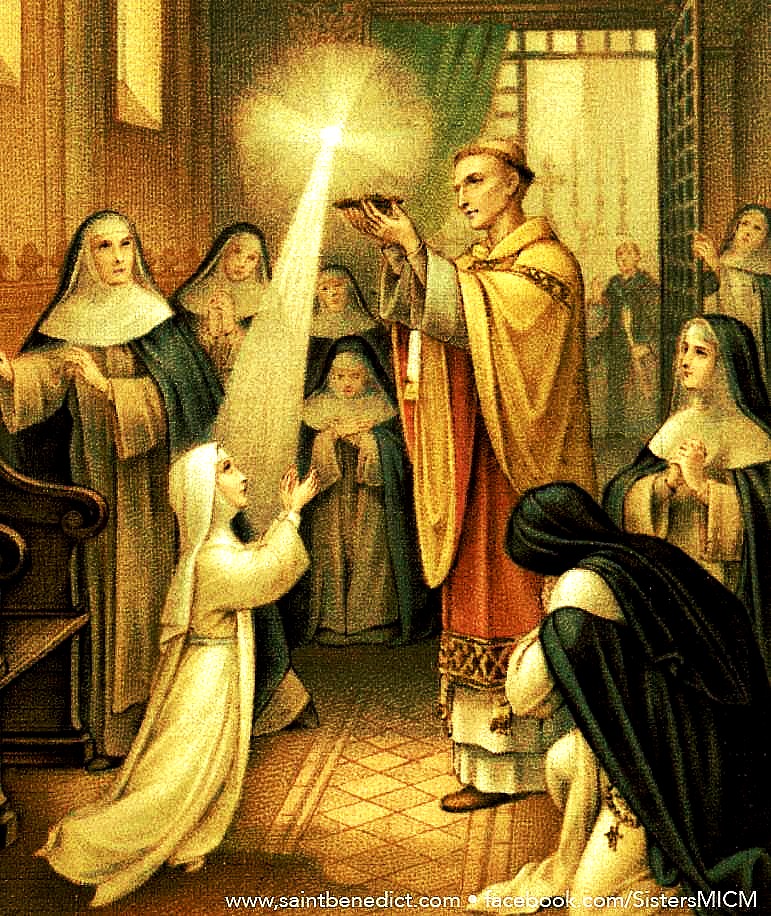
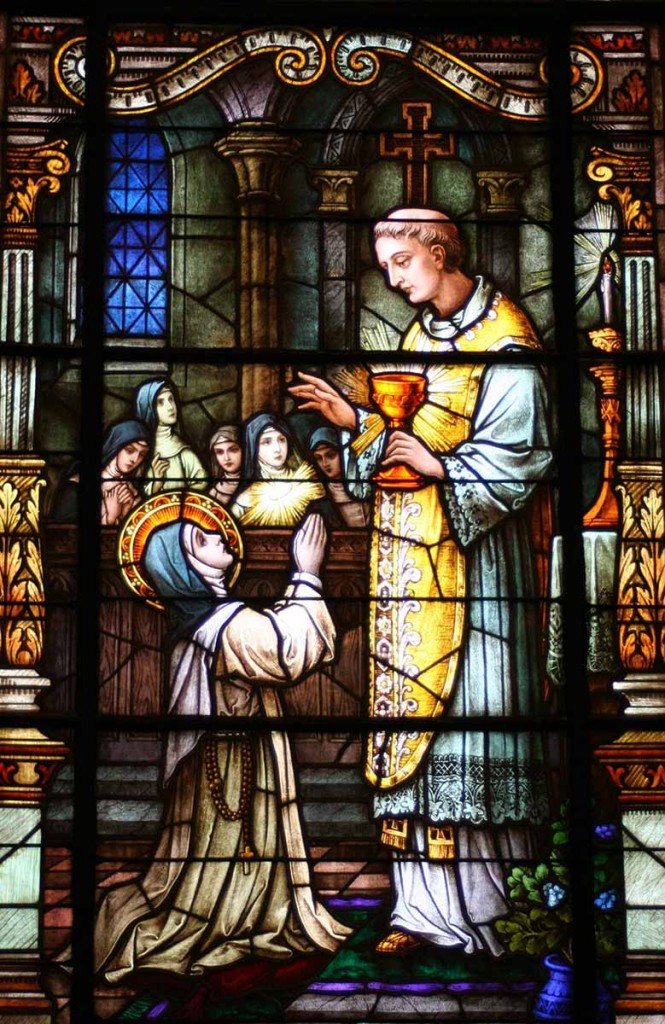
As spring approached, the sisters, who perhaps thought that they had succeeded in diverting Imelda’s “childish fancy” to go to Communion with the grown-ups, were a bit startled when she asked again, shortly before the Feast of the Ascension, to receive her First Holy Communion. (“Asked,” in fact, is not the word. She begged them insistently, it seems.) When the Chaplain was consulted, he agreed with the Sisters and responded with no hesitation that Imelda was much too young. On the Vigil of the Ascension Imelda was in her place in the Chapel, quietly praying as the Sisters received Communion. Then Jesus did a little “insisting” of His own. After Mass, as one of the nuns was clearing the Altar, she heard a noise and looked up to the choir to see Imelda, a glowing light shining above her head, with the Sacred Host suspended in the light.
The Chaplain was called at once and he understood that Jesus Himself was making his desire known. “Let the little children come to Me and do not stop them.” The Priest gave Imelda her First Holy Communion.
We can well imagine that the nuns were amazed and thrilled both at the great blessing to their little one and to their Convent. The Prioress allowed Imelda to remain for some time in thanksgiving and then sent for her to come and have her breakfast. Imelda was still kneeling as they had left her, a smile on her face. Yet when called for, Imelda’s body was still. She had died of pure joy. Her thanksgiving had been well completed and she had nothing left to desire.
Imelda’s story is so well entrenched in the collective memory of her Dominican Brothers and sisters, that it has remained firmly in the Order’s history. She continues to offer the witness of a child with mature desires,and a faith unspoiled in its intensity.
Imelda understood instinctively what many of us have forgotten – that it is the single-hearted who are blessed and that unless we become like children we cannot enter the Kingdom of Heaven.
Lord Jesus Christ, You received into heaven Blessed Imelda, who loved You in the Eucharistic banquet. By her prayers, may we learn to approach Your holy table with that same fervent love and so fulfill our longing to be with You, Who live and reign with the Holy Spirit, one God, forever and ever. Amen
General Calendar of the Order of Preachers
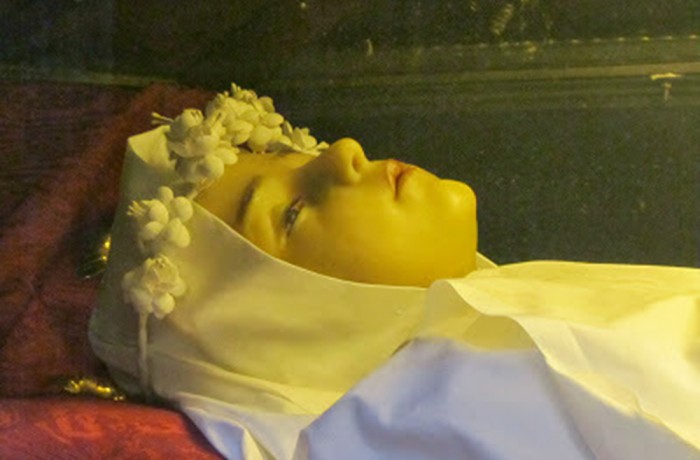
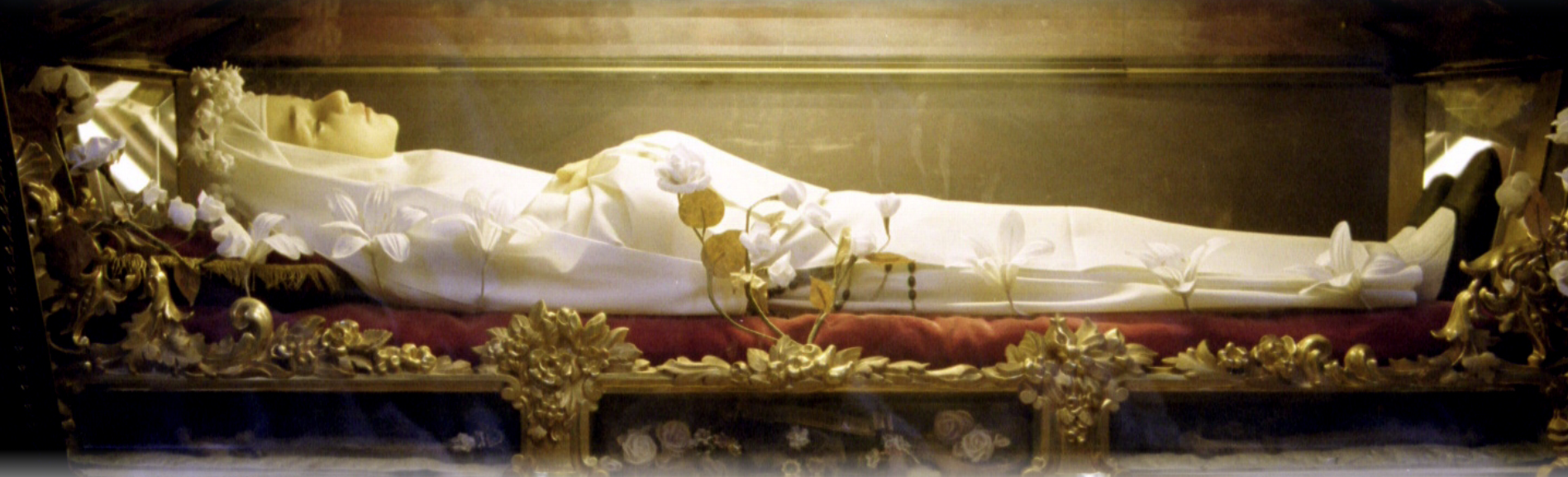
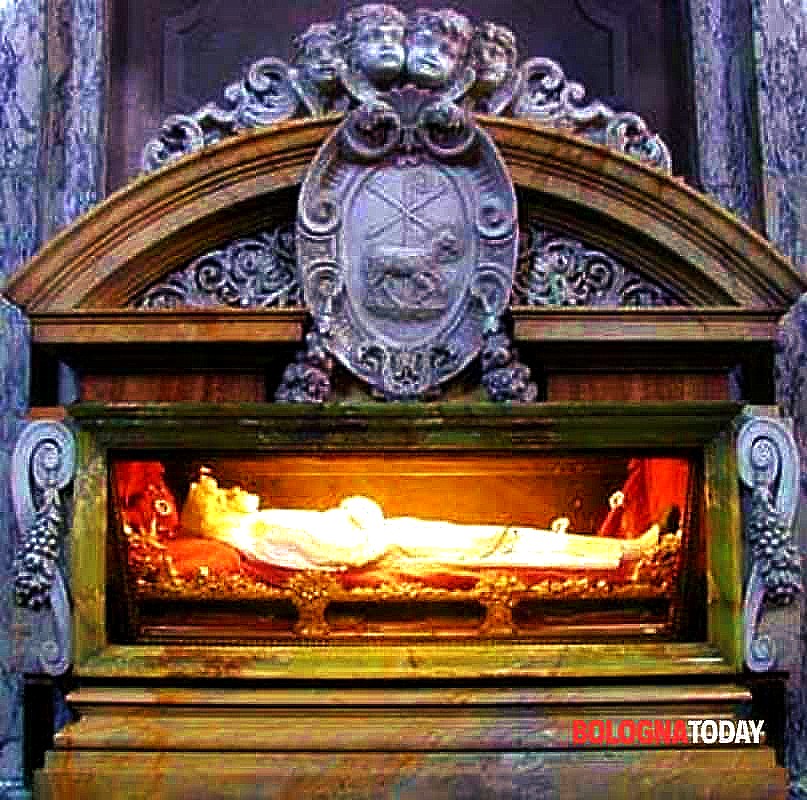
Her remains are kept in Bologna at the Church of San Sigismondo, beneath the wax effigy of her likeness. Blessed Imelda was Beatified on 20 December 1826 by Pope Leo XIII.
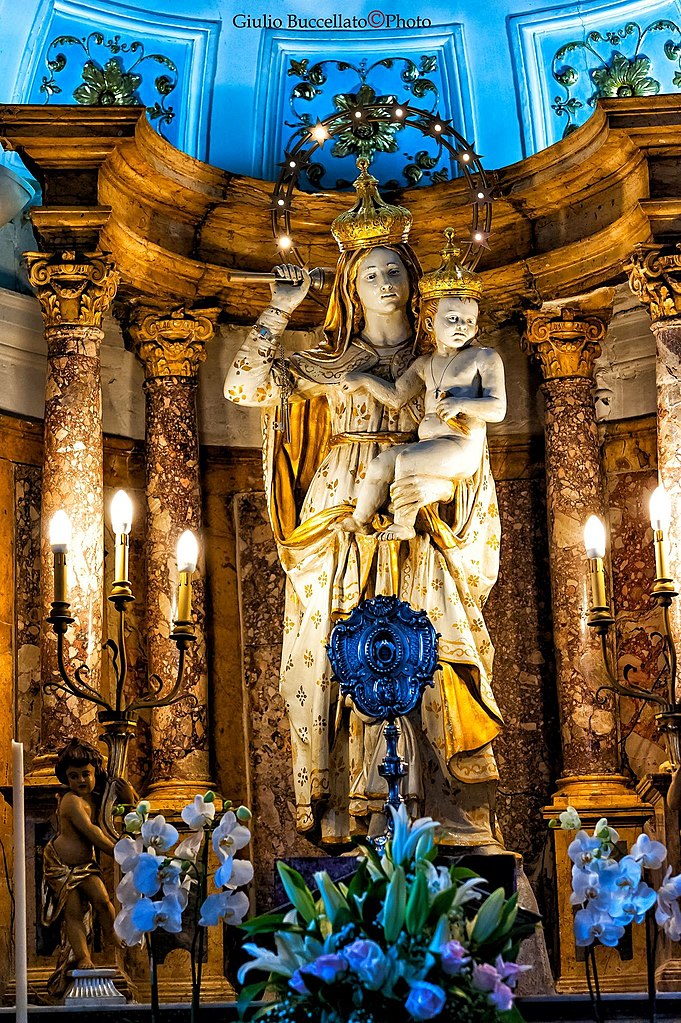
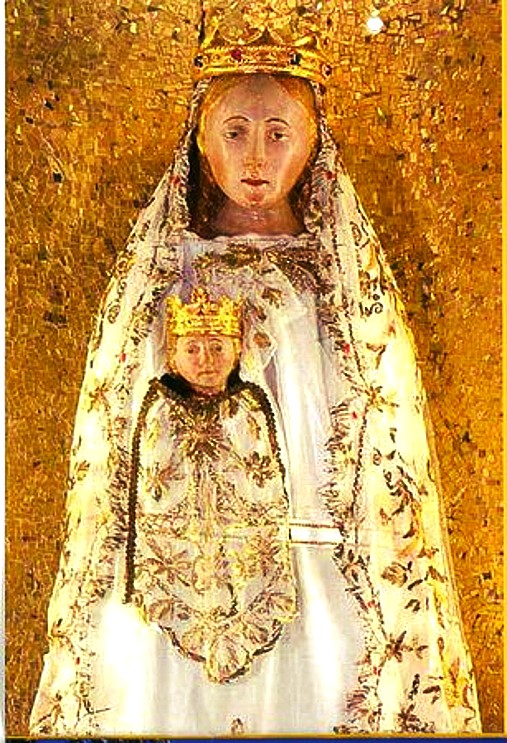
Madonna del Soccorso / Our Lady of Succour of Sicily (14th Century):
Madonna del Soccorso kept in the Mother Church of Castellammare del Golfo .
Devotion to the Blessed Virgin Mary under this title began in Palermo, Sicily in the 14th century and has since spread throughout the Augustinians. It began when Father Nicola Bruno, who suffered from severe and long-term pains in his side, prayed to Our Lady for a cure while meditating on a painting of Mary in which she used a stick or club to chase away the dragon and protect the Infant Jesus, the artist was making reference to passages in Genesis and Revelations that referred to the eternal enmity between The Woman and the serpent. That night, Father Nicola received a vision of Mary and was cured. The painting received the title “Our Lady of Succour” and the devotion began. Since 1804 the celebration has had its own liturgy.
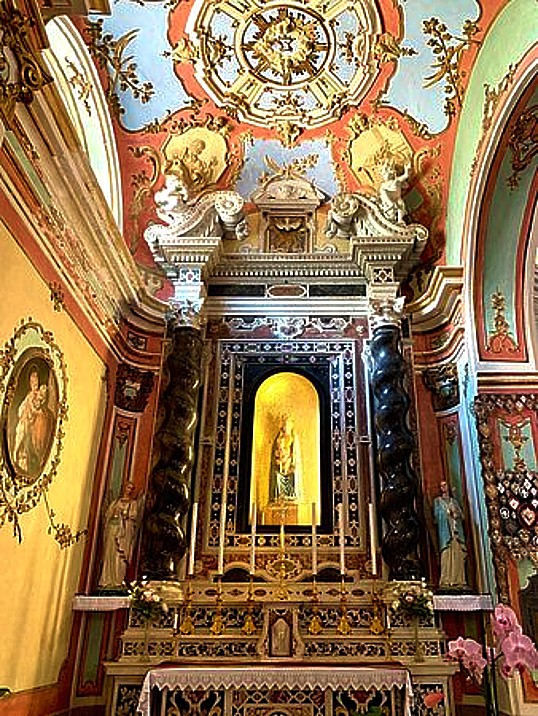
Our Lady’s Altar
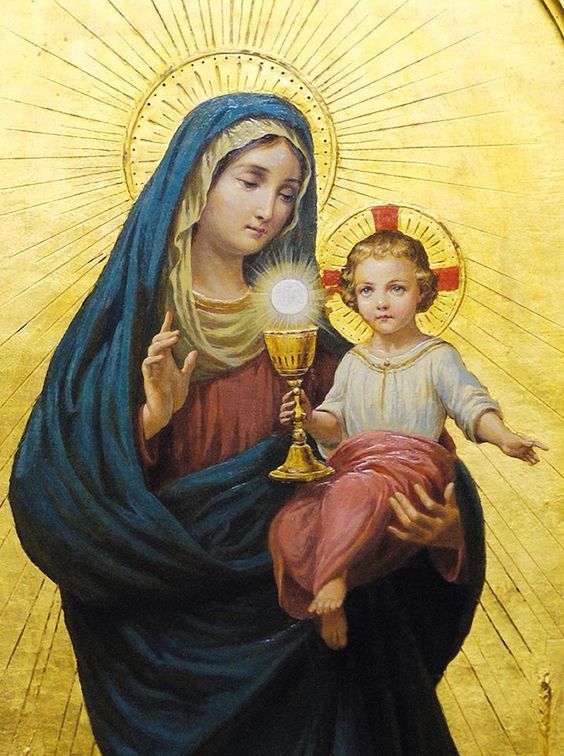
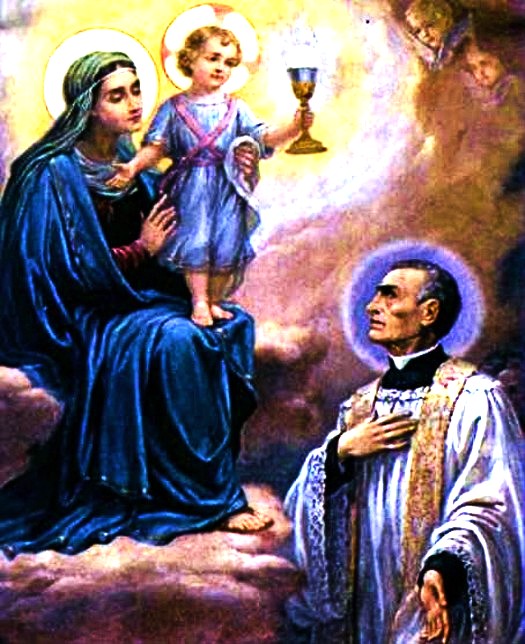
Our Lady of the Most Blessed Sacrament: St Peter Julian Eymard (1811-1868) and Our Lady of the Blessed Sacrament:
The title of Our Lady of the Blessed Sacrament was first given to Mary by St Peter Julian Eymard in May 1868, while speaking to his novices. A few years later he described what her statue should look like: “The Blessed Virgin holds the Infant in her arms and He holds a chalice in one hand and a Host in the other.”
He exhorted them to invoke Mary: “Our Lady of the Blessed Sacrament, pray for us who have recourse to thee!”
St Anno of Verona St Argentea of Cordoba St Euthymius the Illuminator Bl Fortis Gabrielli Bl Gerard of Villamagna Bl Gemma of Goriano St Glyceria of Trajanopolis Blessed Imelda Lambertini (1322-1333) Child Mystic St John the Silent
St Lucius of Constantinople St Mael of Bardsey Bl Magdalen Albrizzi St Merewenna of Rumsey St Mucius of Byzantium St Natalis of Milan St Onesimus of Soissons St Servatus of Tongres St Valerian of Auxerre — Martyrs of Alexandria: A group of Catholic Christians martyred in the church of Theonas, Alexandria, Egypt by order of the Arian Emperor Valens. Their names have not come down to us. 372 in Alexandria, Egypt.
Thought for the Day – 12 May – Meditations with Antonio Cardinal Bacci (1881-1971)
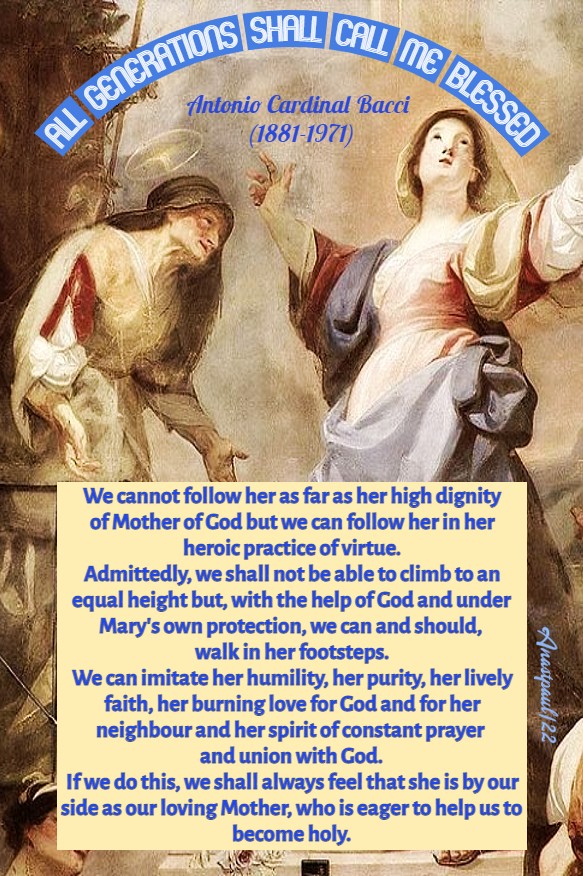
“All Generations Shall Call Me Blessed”
“It is related in the Gospel, that once a certain occasion, a woman in the crowd, was roused by the preaching and miracles of Jesus and cried out: “Blessed is the womb that bore thee and the breasts that nursed thee.” But Jesus replied: “Rather blessed are they who hear the word of God and keep it” (Lk 11:27-28). These words take nothing from the glory of the Mother of God. They were not intended for her but, for us. She was great and holy, not only because she was chosen to be the Mother of the Word Incarnate but also because she perfected herself in virtue by carrying out, in everything, the teaching of her divine Son, Jesus.
We cannot follow her as far as her high dignity of Mother of God but we can follow her in her heroic practice of virtue. Admittedly, we shall not be able to climb to an equal height but, with the help of God and under Mary’s own protection, we can and should, walk in her footsteps.
We can imitate her humility, her purity, her lively faith, her burning love for God and for her neighbour and her spirit of constant prayer and union with God. If we do this, we shall always feel that she is by our side as our loving Mother, who is eager to help us to become holy.”
Quote/s of the Day – 12 May – The Memorial of St Germanus of Constantinople (c 640-733) Defender of Sacred Images
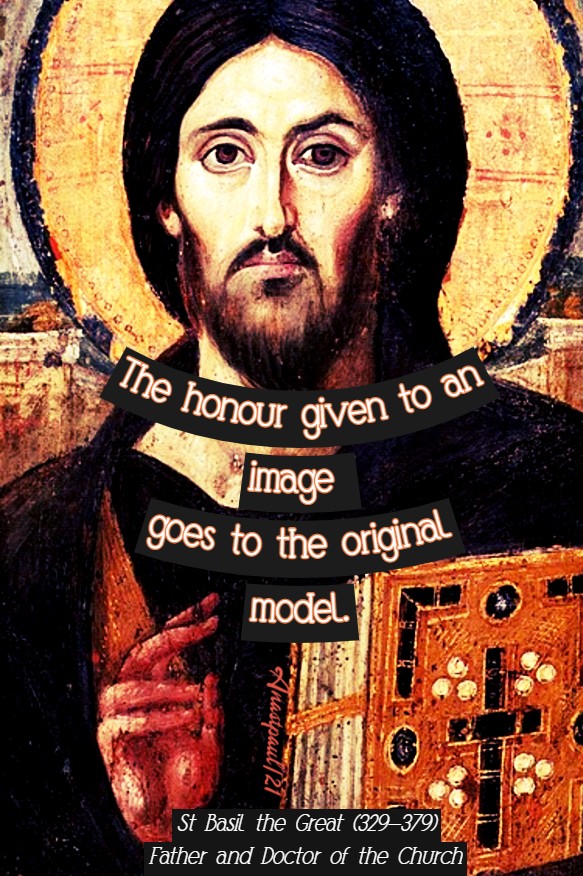
“The honour given to an image goes to the original model.”
St Basil the Great (329-379 Father and Doctor of the Church
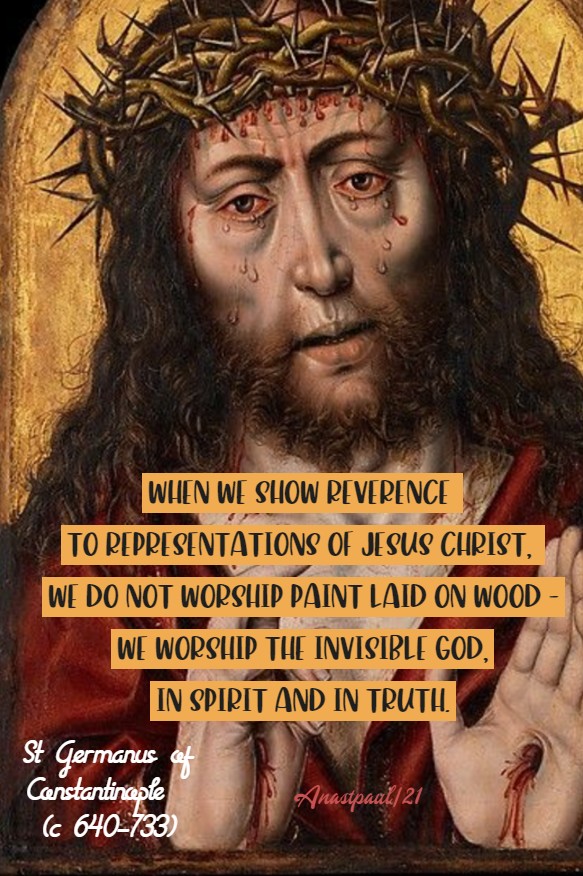
“When we show reverence to representations of Jesus Christ, we do not worship paint laid on wood – we worship the invisible God, in spirit and in truth.”
St Germanus of Constantinople (c 640-733)
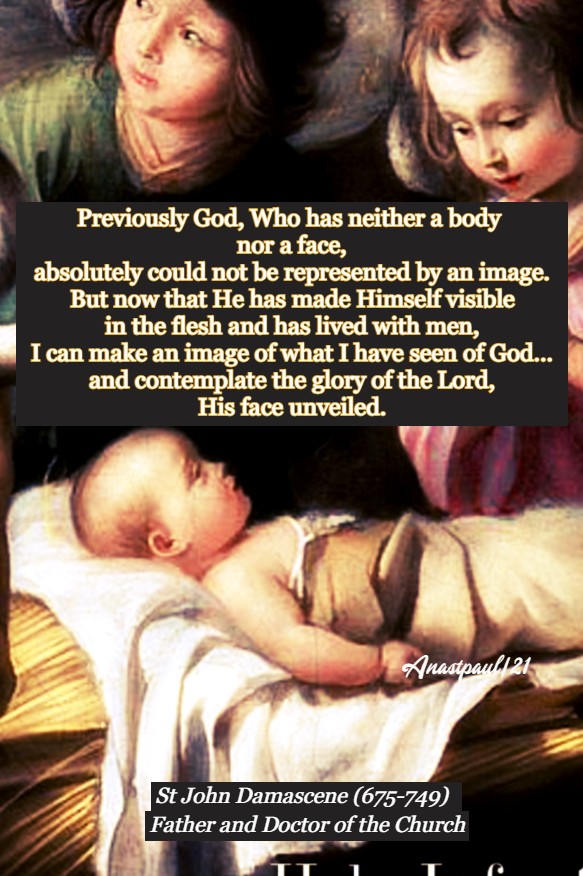
“Previously God, Who has neither a body nor a face, absolutely could not be represented by an image. But now that He has made Himself visible in the flesh and has lived with men, I can make an image of what I have seen of God… and contemplate the glory of the Lord, His face unveiled.”
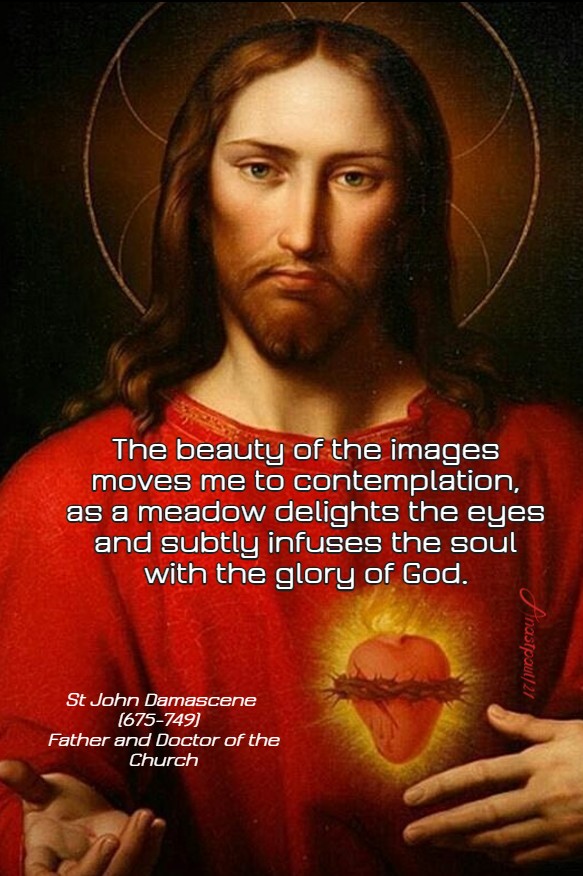
“The beauty of the images moves me to contemplation, as a meadow delights the eyes and subtly infuses the soul with the glory of God.”
St John Damascene (675-749) Father and Doctor of the Church
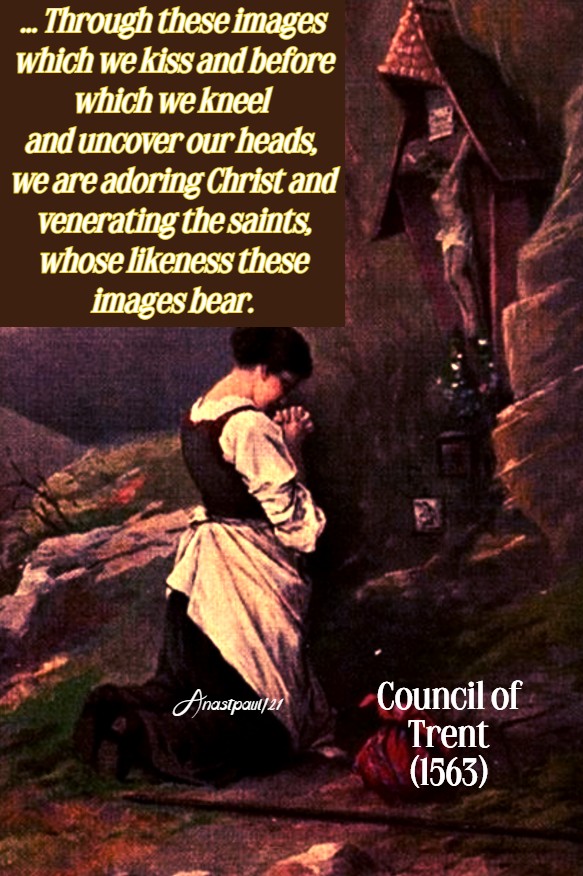
“… Through these images which we kiss and before which we kneel and uncover our heads, we are adoring Christ and venerating the saints, whose likeness these images bear.”
One Minute Reflection – 20 May – “Mary’s Month!” – Wednesday of the Sixth Week of Easter, Readings: Acts 17: 15, 22 – 18: 1, Psalms 148: 1-2, 11-12, 13, 14, John 16: 12-15
“The Spirit of truth will guide you to all truth” … John 16:13
REFLECTION – “Who knows what pertains to a person, except the spirit of the person that is within? Similarly, no-one knows what pertains to God, except the Spirit of God” (1 Cor 2:11). Run, then, to enter into communion with the Holy Spirit. No sooner do we call on Him, than He is there and if we call on Him, it is because He is already present to us. When called, He comes, He comes in the abundance of divine blessings. He it is, Who is that rushing river giving joy to God’s city (Ps 46[45]:5).
If, when He has come, He finds you to be humble and without anxiety, fearing God’s word, then He will come to rest on you and reveal to you those things that God hides from the wise and learned of this world (Mt 11:25). Then, all those truths will begin to shine out before you, that Wisdom spoke to the disciples while on earth but which they could not bear, before the coming of the Spirit of truth, that was to teach them all truth…
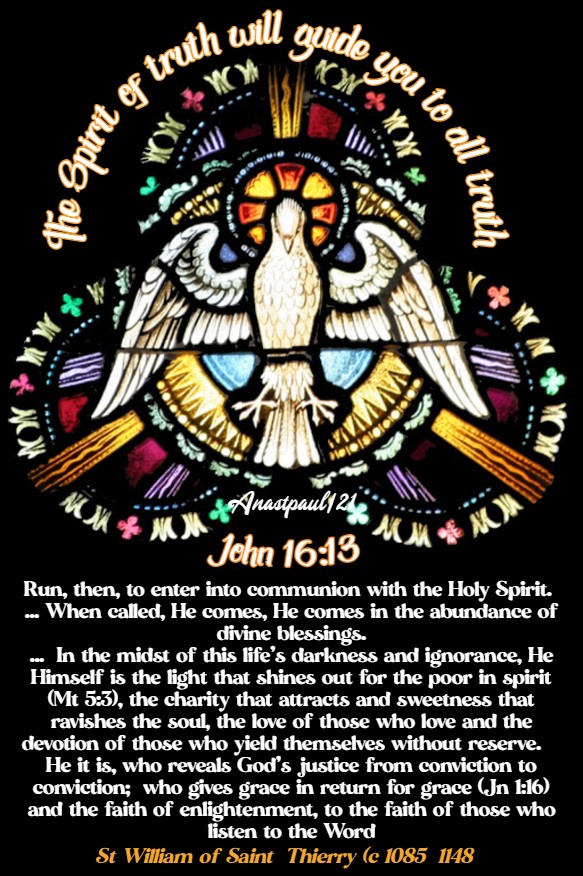
Just as those who worship God must necessarily worship Him “in spirit and truth” (Jn 4:24), so those who would know Him, have only to seek an understanding of the faith in the Holy Spirit. … In the midst of this life’s darkness and ignorance, He Himself is the light that shines out for the poor in spirit (Mt 5:3), the charity that attracts and sweetness, that ravishes the soul, the love of those who love and the devotion of those who yield themselves without reserve. He it is, who reveals God’s justice from conviction to conviction; who gives grace in return for grace (Jn 1:16) and the faith of enlightenment, to the faith of those who listen to the Word.” … St William of Saint-Thierry (c 1085-1148) – The Mirror of Faith, 6
PRAYER – Send forth Your Spirit and they shall be created and Thou shall renew the face of the earth! O God who did give life to the world by the resurrection of Thou Son, our Lord Jesus Christ, grant that through the same Spirit, we may be ever truly wise and rejoice in His consolation and truth. Let the one holy Blessed Virgin, she who is the Spouse of the Holy Ghost, pray for us. We make our prayer through Christ our Lord, with the Holy Ghost, one with You forever and ever, amen.
Our Morning Offering – 12 May – “Mary’s Month” – Wednesday of the Sixth Week of Easter
The Memorare By St Bernard (1090-1153) Mellifluous Doctor
REMEMBER, O most gracious Virgin Mary, that never was it known, that anyone who fled to thy protection, implored thy help, or sought thy intercession was left unaided. Inspired by this confidence, I fly unto thee, O Virgin of virgins, my Mother, to thee do I come, before thee I stand, sinful and sorrowful. O Mother of the Word Incarnate, despise not my petitions but in thy mercy hear and answer me. Amen
(The Express Novena you will recall, is 9 times the Memorare)
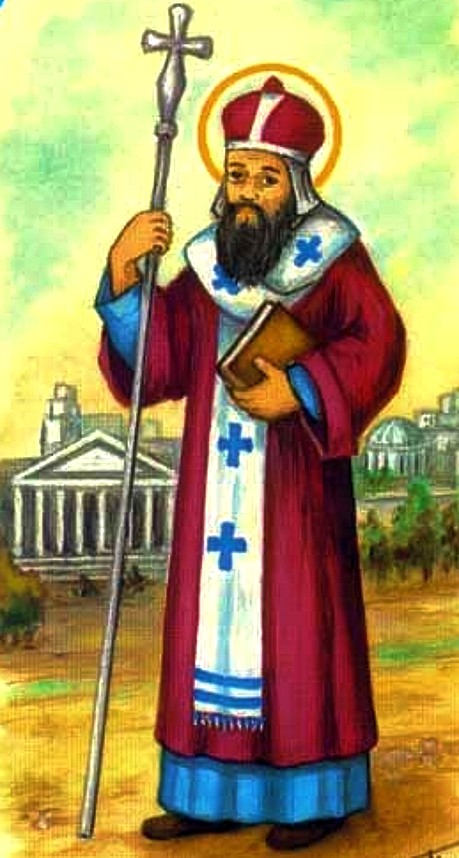
Saint of the Day – 12 May – Saint Germanus of Constantinople (c 640-733) Bishop of Constantinople from 715 to 730, Defender of the Doctrine of the Church both against Monothelitism and Iconoclasm, Poet, Hymnist, Spiritual writer, some of his works being used and quoted still today. Born in c 640 in Constantinople and died on 12 May 733 at Platonium of natural causes at an advanced age. Tradition depicts Germanus as much more determined in his position, even winning a debate on the matter with Constantine, Bishop of Nacoleia, a leading Iconoclast. Pope Gregory II (term 715-731), a fellow Iconodule, praised Germanus’ “zeal and steadfastness.“
The Roman Martyrology includes him today and states: “At Constantinople, Saint Germanus, a Bishop distinguished by virtues and learning, who, with great courage, reprehended Leo the Isaurian, for promulgating an edict against holy images.”
The son of Justinianus, a patrician, Germanus dedicated himself to the service of the Church and became a Priest at the Cathedral of the City. Some time after the death of his father, who had filled various high official positions, Germanus was Consecrated Bishop of Cyzicus but the exact year of his elevation is not known.
According to St Theophanes (c 75- 817/818), he was present in this capacity at the Synod of Constantinople held in 712 at the insistence of the new Emperor, Philippicus, who favoured Monothelitism. The object of the Council was to re-establish Monothelitism and to condemn the Acts of the Sixth General Council of 681. Even Germanus is said to have bowed to the imperial will, with the majority of the Greek Bishops. However, immediately after the dethronement of Emperor Philippicus (713) his successor, Anastasius II, restored orthodoxy and Monothelitism was now definitively banished from the Byzantine Empire. If Germanus really had yielded for a short time to the false teachings of the Monothelites (though this is very doubtful), he now once more acknowledged the orthodox definition of the two wills in Christ.
When the Bishop of Constantinople died, Germanus was raised to the patriarchal see (715), which he held until 730. Immediately (715 or 716), he convened, a Synod of Greek Bishops, who acknowledged and proclaimed anew the Doctrine of the two wills and the two operations in Christ and placed under anathema, Sergius, Cyrus and the other leaders of Monothelitism. Germanus entered into communication with the Armenian Monophysites, with a view to restoring them to unity with the Church but without success. Soon after his elevation to the ecclesiastical dignity the Iconoclastic storm burst forth in the Byzantine Church, Bishop Constantine of Nacoleia in Phrygia, who, like some other Bishops of the Empire, condemned the veneration of the images of Christ and the Saints, went to Constantinople and entered into a discussion with Germanus on the subject.
Germanus represented the traditional use of the Church and sought to convince Constantine of the propriety of reverencing images. Apparently he was converted to the teaching of the Germanus but he did not deliver the letter entrusted to him, by Germanus to the Metropolitan of Synnada, for which he was excommunicated.
At the same time the learned Bishop wrote to Bishop Thomas of Claudiopolis, another Iconoclast and developed in detail the sound principles underlying the reverencing of images, as against the recent innovations. Emperor Leo III, however, did not recede from his position and everywhere encouraged the iconoclasts. In a volcanic eruption between the islands of Thera and Therasia, Leo saw a Divine judgement for the idolatry of image- worship and in an edict (726) explained that Christian images had taken the place of idols and the venerators of images were idolaters, since, according to the law of God (Exodus 20:4), no product of the hand of man may be adored.
Immediately afterwards, the first Iconoclastic disturbances erupted in Constantinople. Germanus vigorously opposed the Emperor and sought to convert him to a truer view of things, whereupon Leo attempted to depose him.
In 722) Leo issued a series of edicts against the worship of images (726–729). A letter by Germanus written before 726 to two Iconoclast Bishops, says that “now whole towns and multitudes of people are in considerable agitation over this matter” but we have very little evidence as to the growth of the debate. Germanus turned to Pope Gregory II (729), who in a lengthy epistle praised his zeal and steadfastness. The Emperor in 730 summoned the Council before which Germanus was cited, to subscribe to an imperial decree prohibiting images. He resolutely refused and was thereupon, compelled to resign his Bishopric, being succeeded by the pliant Anastasius.
Germanus withdrew to the home of his family, where he died some years later at an advanced age. in 733. The Ecumenical Council of Nicaea (787) bestowed high praise on Germanus and included hims in the diptychs of the Saints. He is venerated as a Saint in both the Greek and the Latin Church. His feast is celebrated today, 12 May.
Several writings of Germanus have been preserved,“Narratio de sanctis synodis,” a dialogue “De vitae termino,” a letter to the Armenians and three letters on the reverencing of images, as well as nine discourses. The “Historia ecclesiastica et mystica,” also attributed to him – was a popular work in Greek and Latin translations, for many centuries
Pope Pius XII included one of his texts in the Apostolic Constitution proclaiming Mary’s Assumption into Heaven, a Dogma of the Church.
Among his writings was the hymn translated by John Mason Neale as “A Great and Mighty Wonder,”although Neale misattributed this to Anatolius of Constantinople.
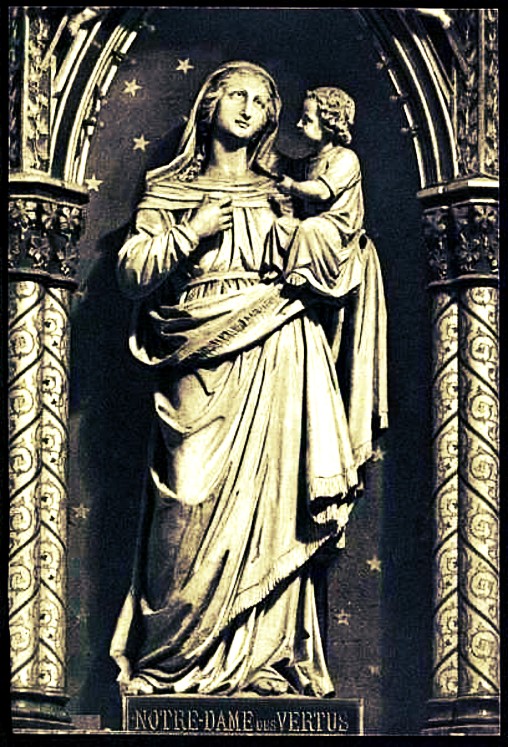
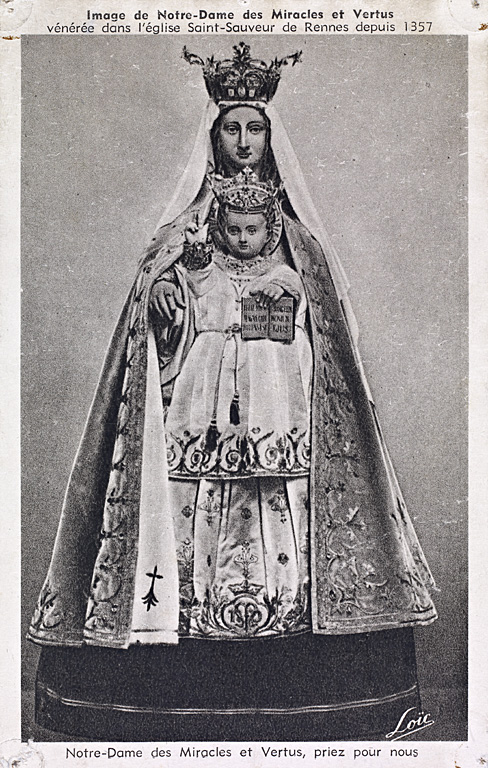
Notre-Dame-des-Vertus / Our Lady of Power, Aubervilliers, France(1336) – 12 May:
The Abbot Orsini wrote: “This image has wrought so many miracles in this Church, that it is called Our Lady of Power, though the Church is dedicated to Saint Christopher.”
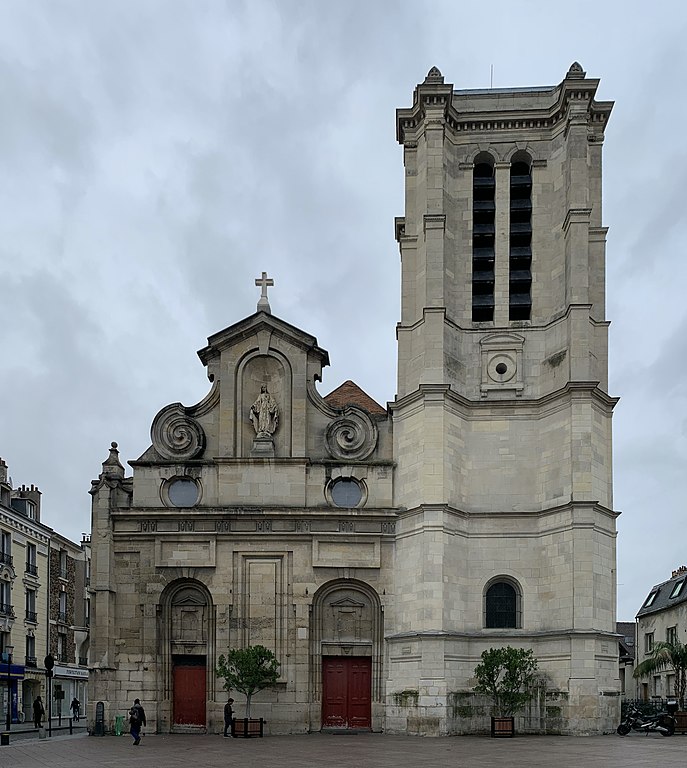
Known now as Notre-Dame-des-Vertus, this is the 14th century Church in Aubervilliers that is the very location that experienced so many miracles during the Middle Ages. As noted by the Abbot Orsini, the Church was originally dedicated to Saint Christopher, yet the name soon changed to honour the Mother of God, in recognition of the graces and miracles obtained there due to the intercession of the Blessed Virgin Mary. The Parish had been built around the Saint Christopher Chapel and after whom the road leading to the Church is named. The first miracle occurred on 14 May 1336 and is known locally as the Miracle of Rain. It was during a time of terrible drought when a small girl entered the Church of Saint Christopher with flowers to adorn the Statue of the Blessed Virgin Mary. While praying that Our Lady would send rain to save the crops, the girl suddenly noticed, that the Statue had become covered, with what appeared to be drops of sweat and the sky turned dark, as the weather began to turn.
This, I believe, is a Holy Card of the original Statue which was desecrated during the French Revolution
The inhabitants of the Parish flocked to the Church, alerted by the sound of the Church bell, to see the wonder and give thanks to God for this miracle. This was but the beginning of the pilgrimages to the Church that began almost immediately, especially from the Parishes of Paris. These pilgrimages were encouraged by the authorities of the Church, as well as by the example of the many distinguished visitors and the continued occurrences of many other miracles over the following centuries. These miracles included many cures, as well as the miracles of two children who were brought back to life. Kings and Queens were among the many pilgrims who came during the Middle Ages, including King Louis XIII, who came to pray for the capture of Rochelle. The Archbishop of Paris confirmed the celebration of the festival on the second Tuesday of May, which is the month of Mary. After all these miracles, the Chapel was far too small to contain the influx of pilgrims, in particular the processions coming from Paris to the Basilica that stopped at the miraculous little Chapel on their way.
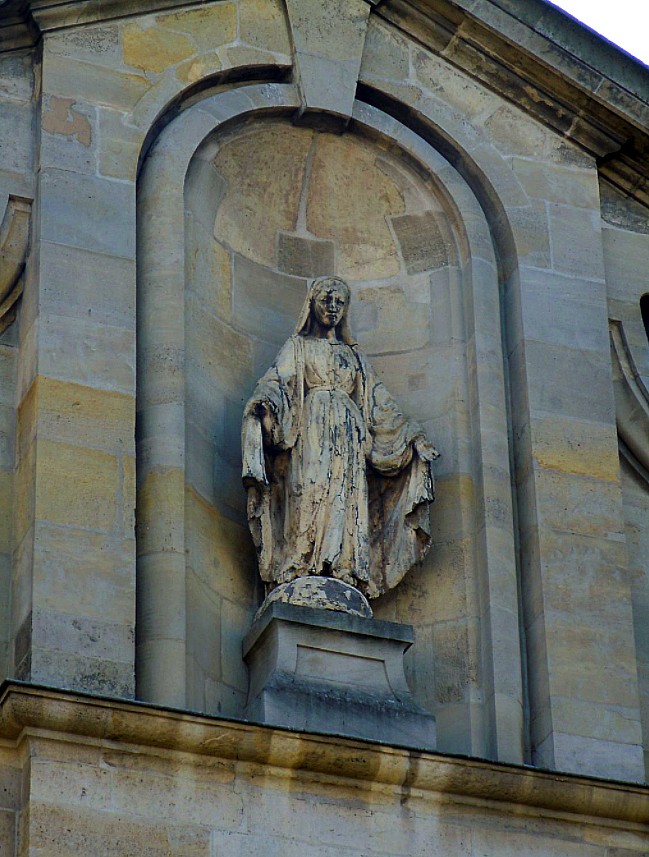
This is our Blessed Lady on the Facade
The small Sanctuary was later replaced by a more imposing Church whose construction began in the fifteenth century. Particularly remarkable are the stained glass windows that adorn the Church and remind the visitor of the extraordinary history of this place, for they relate to the many different miracles performed by the Blessed Virgin in the Chapel, of which there were many. Virtually every great Saint is depicted in these windows too – if you wish to see them, although they are not professional photographs, go here: https://www.tripadvisor.com/Attraction_Review-g3347617-d10980848-Reviews-Eglise_Notre_Dame_des_Vertus- There are numerous Statues and Altars of the Blessed Virgin in the Sanctuary, all of them highly venerated by pilgrims.
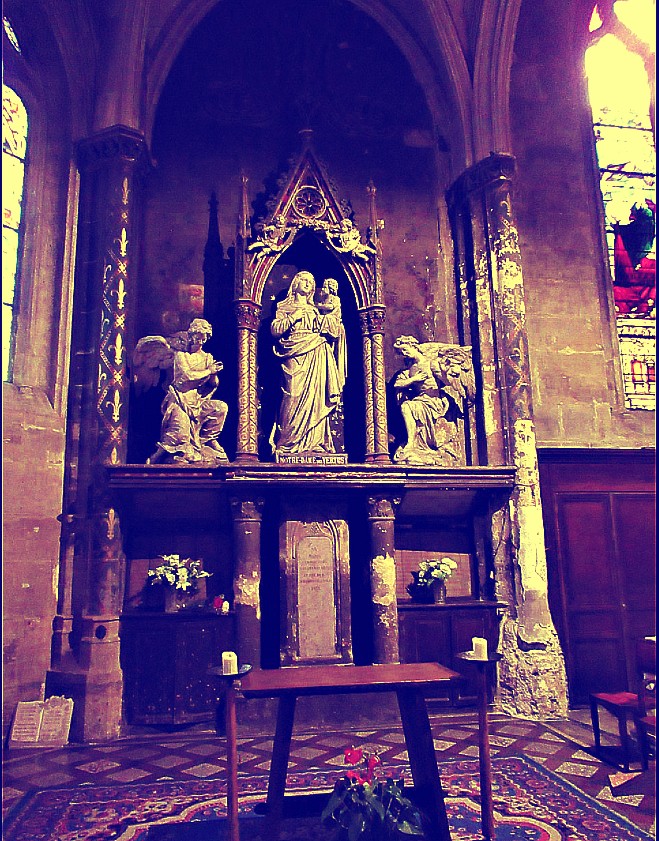
During the French revolution, in 1789, the Statue of the miraculous Virgin was profaned. It was dragged on the road leading to Saint Denis with a rope around its neck; the Sans-Culottes movement burned it singing the French song “Carmagnole et Ah! Ca ira!” proof of the Satanic roots of the French Revolution. One of her hands was saved from the flames and was preserved. The present Statue of the Virgin, located in the left Chapel, was sculpted in wood by Baffet House in 1873. It is a copy of an ancient Statue found that year in the Chapel Saint-Julien-Le-Pauvre at Hotel-Dieu. It was inserted into a Neo Gothic frame, flanked by two angels holding phylacteries, (a coiled-end speech scroll bearing legends) which recall the miracle in 1582 when the Virgin restored a stillborn child to life.
St Pancras of Rome (c 289 – c 303) Martyr Child of 14, Roman Convert (Optional Memorial) Biography: https://anastpaul.com/2017/05/12/saint-of-the-day-st-pancras/ — St Crispoldus St Cyril of Galatz St Dedë Malaj St Diomma of Kildimo St Dionysius of Asia St Dominic de la Calzada St Ejëll Deda St Ephrem of Jerusalem
St Erc Nasca of Tullylish St Ethelhard of Canterbury St Euphrosyna of Terracina Bl Francis Patrizzi of Siena Bl Gemma of Goriano St Germanus of Constantinople (c 640-733) Bishop
Blessed Joanna of Portugal OP (1452-1490) Religious of the Second Order of St Dominic, Virgin, Princess of Portugal of the House of Aviz, daughter of King Afonso V of Portugal and his first wife Isabella of Coimbra, Penitent. About Blessed Joanna whom the Portuguese called “Saint Princess Joanna”: https://anastpaul.com/2020/05/12/saint-of-the-day-12-may-blessed-joanna-of-portugal-1452-1490/
Bl Juan de Segalars St Lucien Galan
St Maria Domenica Mazzarello
St Modoald of Trier St Palladius of Rome St Philip of Agira St Richrudis of Marchiennes St Theodora of Terracina St Thomas Khampheuane Inthirath
Thought for the Day – 11 May – Meditations with Antonio Cardinal Bacci (1881-1971)
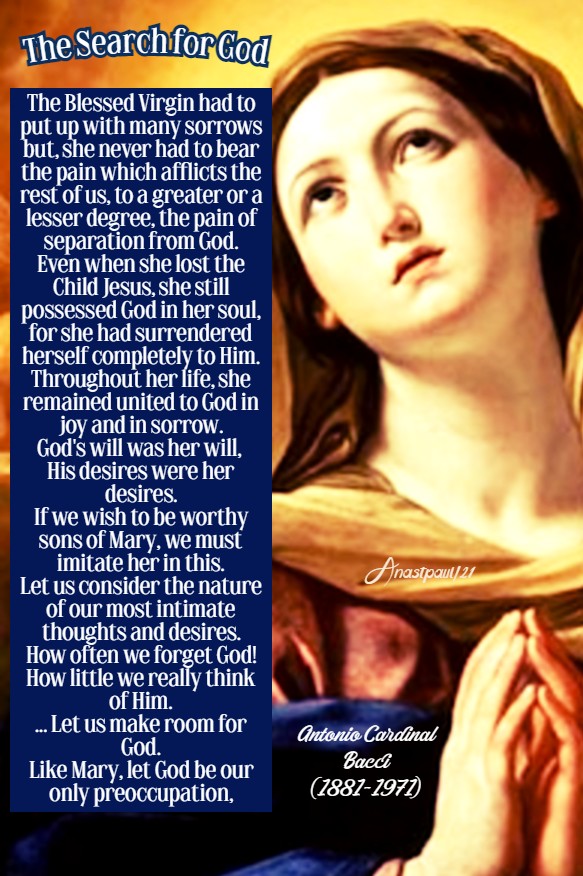
The Search for God
“All men are looking for God, whether they are aware of it or not. They are discontented and cannot understand why. They do not realise, that the real source of their discontent, is that they have not found God and God alone can make men happy. The Blessed Virgin had to put up with many sorrows but, she never had to bear the pain which afflicts the rest of us, to a greater or a lesser degree, the pain of separation from God. Even when she lost the Child Jesus, she still possessed God in her soul, for she had surrendered herself completely to Him. Throughout her life, she remained united to God in joy and in sorrow. God’s will was her will, His desires were her desires.
If we wish to be worthy sons of Mary, we must imitate her in this. Let us consider the nature of our most intimate thoughts and desires. How often we forget God! How little we really think of Him. We are absorbed in so many other affairs, that we forget Him, Who should be the centre of our plans. We are too fond of ourselves and of our own comfort and interests. As a result, we forget Him, to Whom we owe everything and Who should be the final goal of our lives. Our hearts are very small. If we fill them with worldly desires, there is no room for God. But God should be the absolute master of our souls.
Let us empty ourselves of useless worldly preoccupations and make room for spiritual aims. Let us make room for God. Like Mary, let God be our only preoccupation, If we look for Him in everything, we shall find Him.”
Quote/s of the Day – 11 May – “Mary’s Month” – Tuesday of the Sixth Week of Easter,Readings: Acts 16: 22-34, Psalms 138: 1-2, 2-3, 7-8, John 16: 5-11
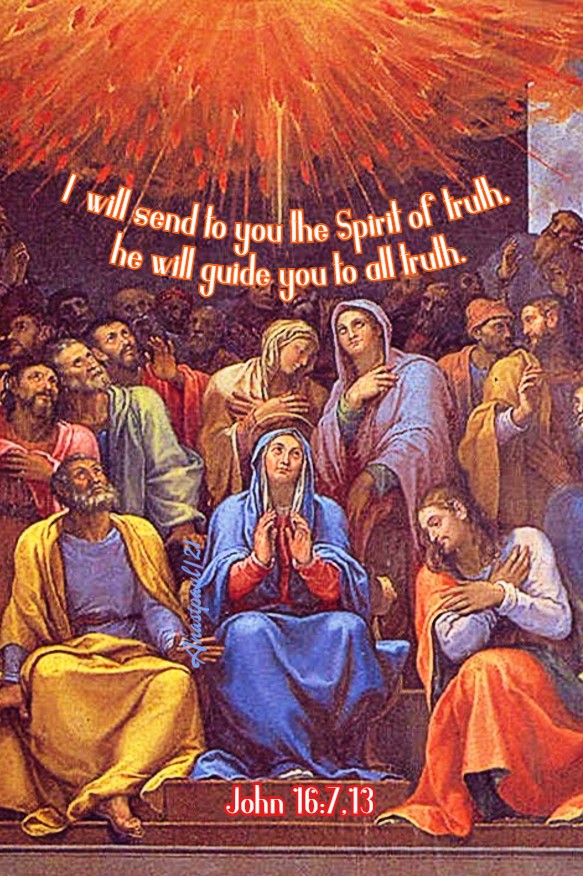
“I will send to you the Spirit of truth, says the Lord; he will guide you to all truth.”
John 16:7,13
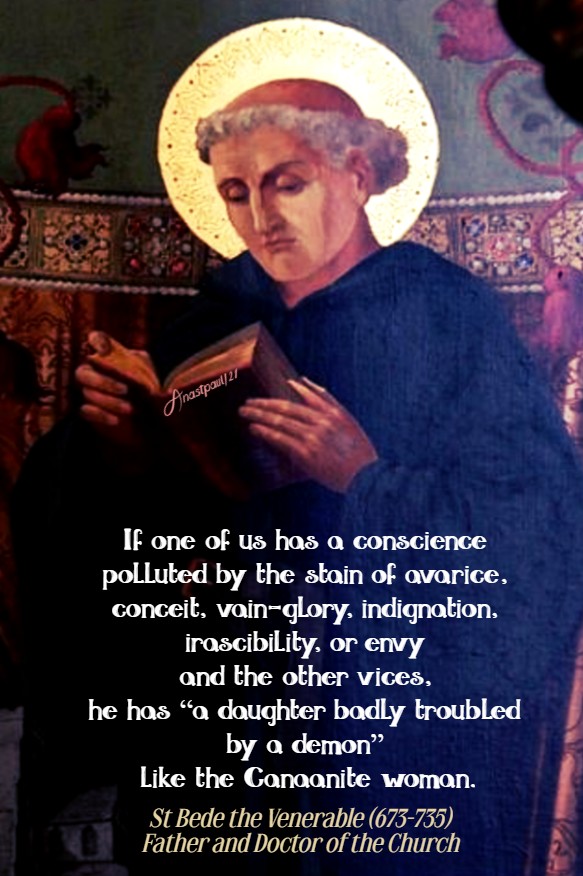
“If one of us has a conscience polluted by the stain of avarice, conceit, vain-glory, indignation, irascibility, or envy and the other vices, he has “a daughter badly troubled by a demon” like the Canaanite woman.”
St Bede the Venerable (673-735) Father and Doctor of the Church
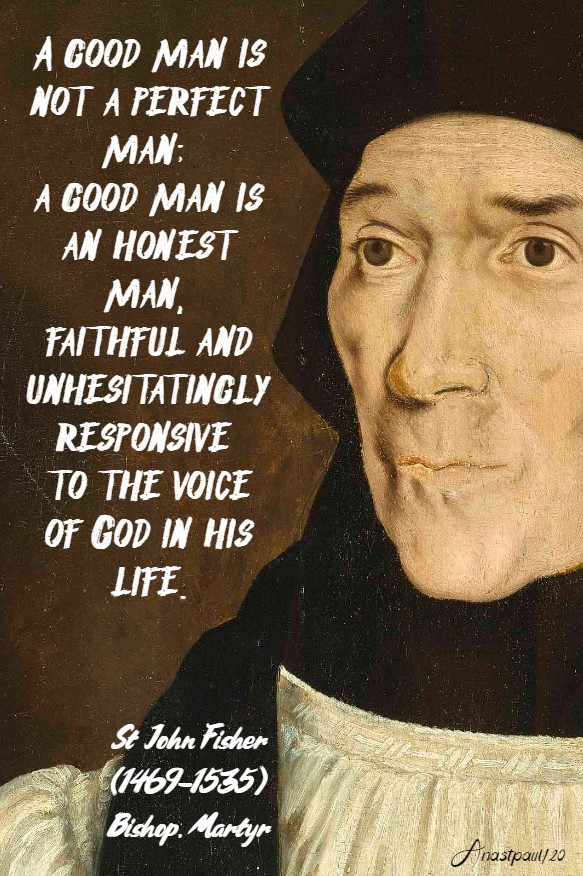
“A good man is not a perfect man; a good man is an honest man, faithful and unhesitatingly responsive to the Voice of God in his life.”
St John Fisher (1469-1535) Bishop, Martyr
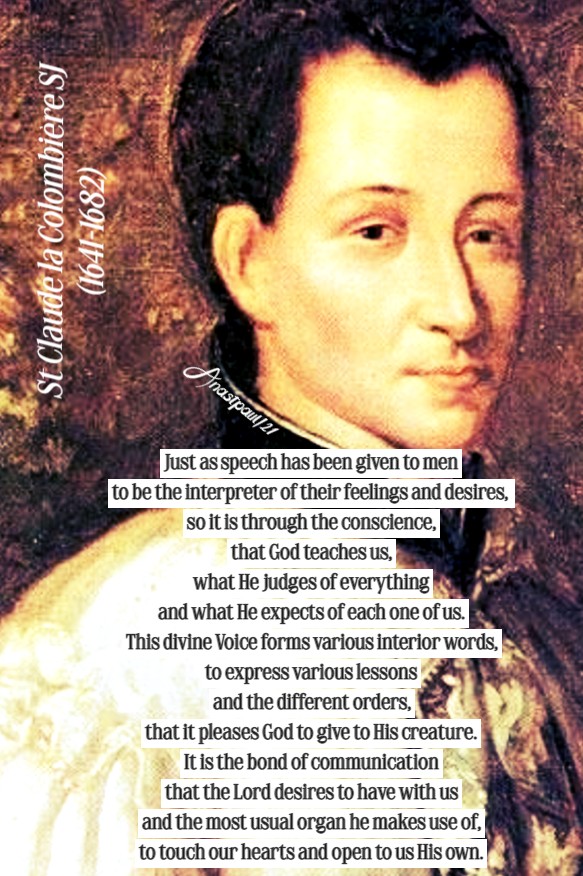
“Just as speech has been given to men to be the interpreter of their feelings and desires, so it is through the conscience, that God teaches us, what He judges of everything and what He expects of each one of us. This divine Voice forms various interior words, to express various lessons and the different orders, that it pleases God to give to His creature. It is the bond of communication that the Lord desires to have with us and the most usual organ he makes use of, to touch our hearts and open to us His own.”
St Claude la Colombière SJ (1641-1682)
Christian reflections (Spiritual writings, coll. Christus no 9,)
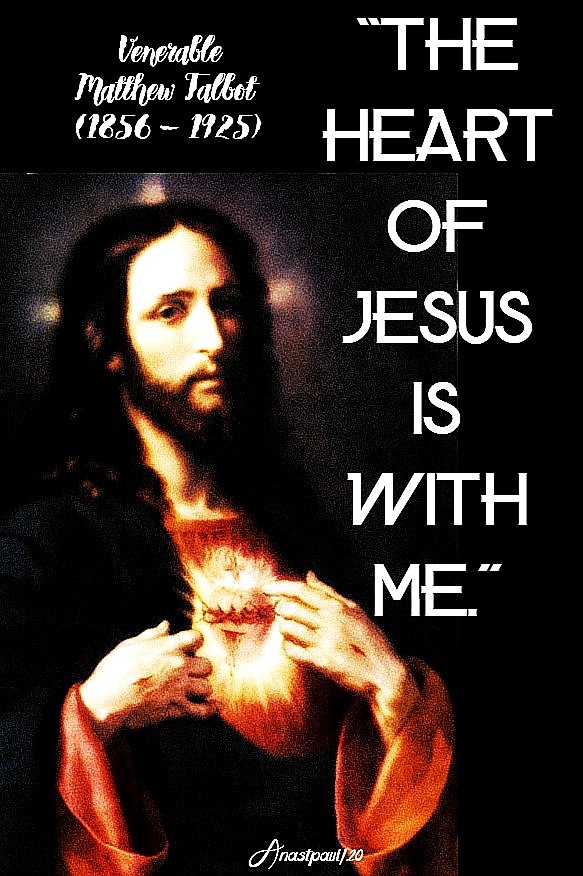
“The Heart of Jesus is with me.”
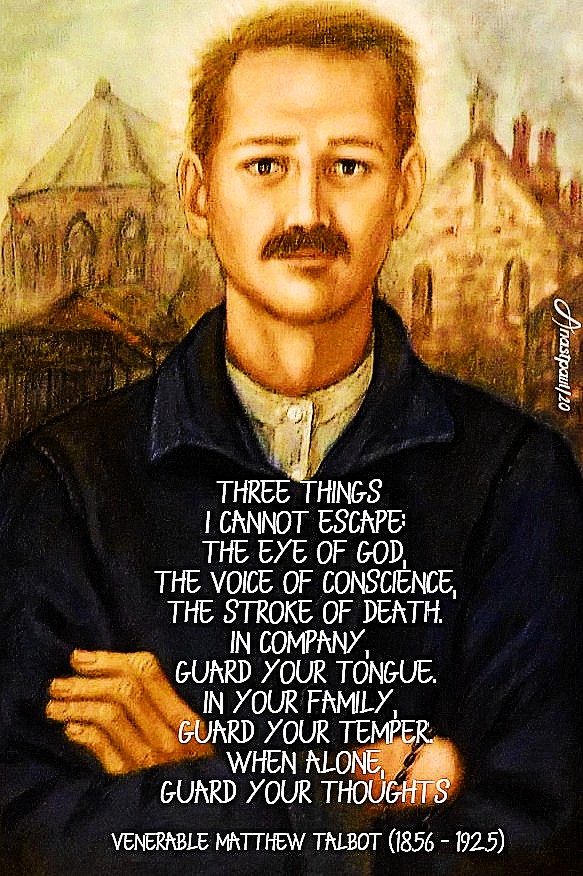
“Three things I cannot escape: the eye of God, the voice of conscience, the stroke of death. In company, guard your tongue. In your family, guard your temper. When alone guard your thoughts.”
Venerable Matthew Talbot (1856 – 1925)
“Then steer your ship with steady arm, Trust Me and rest your soul. Your little boat I’ll keep from harm, I’ll guide it toward its goal. … Be therefore, steadfast, calm and true, Your God is at your side. Through storm and night He’ll see you through With conscience as your guide.”
St Teresa Benedicta of the Cross OCD.(1891-1942 Edith Stein “At the Helm”
One Minute Reflection – 11 May – “Mary’s Month” – Tuesday of the Sixth Week of Easter,Readings: Acts 16: 22-34, Psalms 138: 1-2, 2-3, 7-8, John 16: 5-11
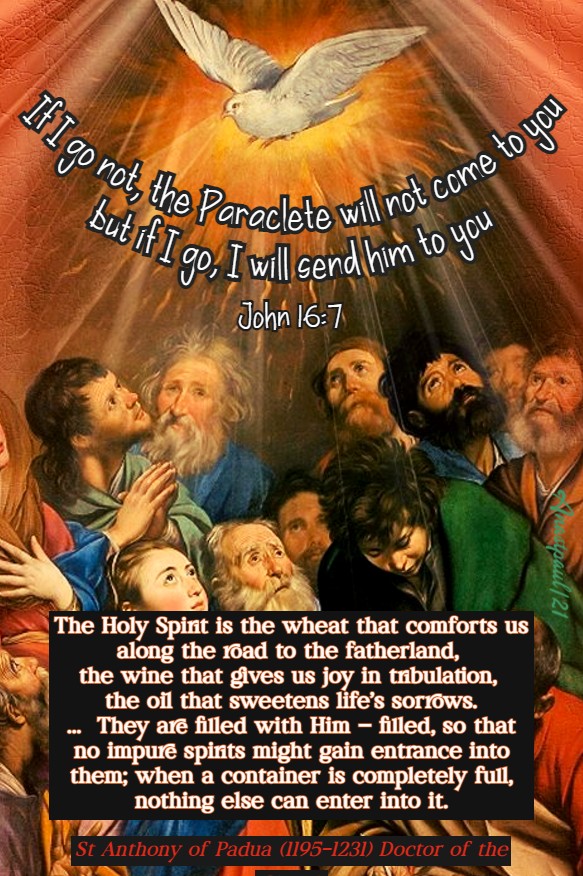
“But I tell you the truth, it is expedient to you that I go; for if I go not, the Paraclete will not come to you but if I go, I will send him to you.” – John16:7
REFLECTION – “The Holy Spirit is the wheat that comforts us along the road to the fatherland, the wine that gives us joy in tribulation, the oil that sweetens life’s sorrows. This threefold support, was needed by the apostles who had to go out to preach through the whole world. This is why Jesus sends the Holy Spirit to them. They are filled with Him – filled, so that no impure spirits might gain entrance into them; when a container is completely full, nothing else can enter into it.
The Holy Spirit “will teach you.” (Jn 16,13) so that you can know; he will prompt you. so that you can will. He gives both knowledge and will, add to this our “ability,” according to the measure of our strength and we shall be temples of the Holy Spirit (1Cor 6,19).” – St Anthony of Padua (1195-1231) Franciscan, Doctor of the Church – Sermons
PRAYER – Almighty God and Father, Your ways are not our ways, teach us to willingly agree to them, for You know which way we should go. Help us to say “yes” always to Your plan and to render ourselves, as a sacrament of Your divine love to all we meet. Fill us with the Your grace and Your Spirit, to make us Your tools, to bring glory to Your kingdom. Our Father, who art in heaven, may Your Will be done on earth, as it is in heaven. Mary Mother of God, pray for us! Through our Our Lord Jesus Christ together with the Holy Ghost ✠ in the glory of God the Father. Amen.
Our Morning Offering – 11 May – “Mary’s Month” – Tuesday of the Sixth Week of Easter
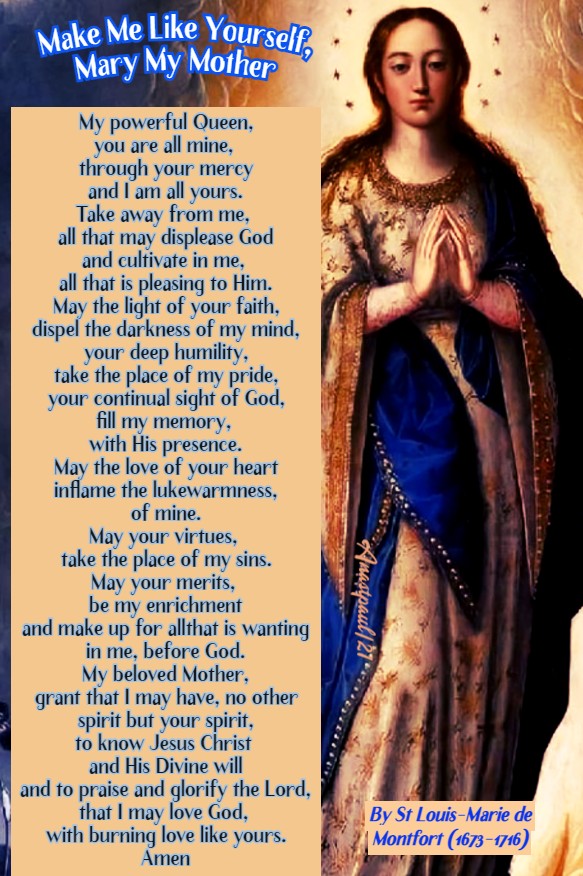
Make Me Like Yourself, Mary My Mother By St Louis-Marie de Montfort (1673-1716)
My powerful Queen, you are all mine, through your mercy and I am all yours. Take away from me, all that may displease God and cultivate in me, all that is pleasing to Him. May the light of your faith, dispel the darkness of my mind, your deep humility, take the place of my pride, your continual sight of God, fill my memory, with His presence. May the love of your heart inflame the lukewarmness, of mine. May your virtues, take the place of my sins. May your merits, be my enrichment and make up for allthat is wanting in me, before God. My beloved Mother, grant that I may have, no other spirit but your spirit, to know Jesus Christ and His Divine will and to praise and glorify the Lord, that I may love God, with burning love like yours. Amen
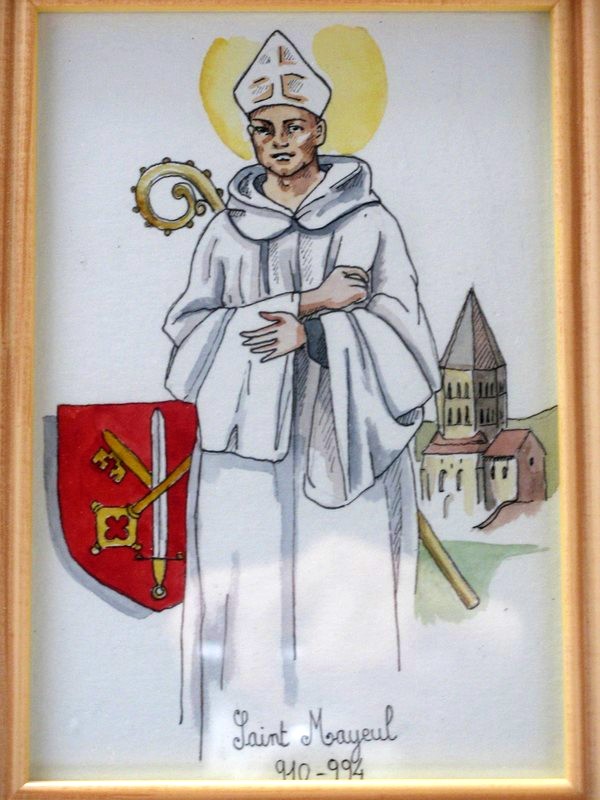
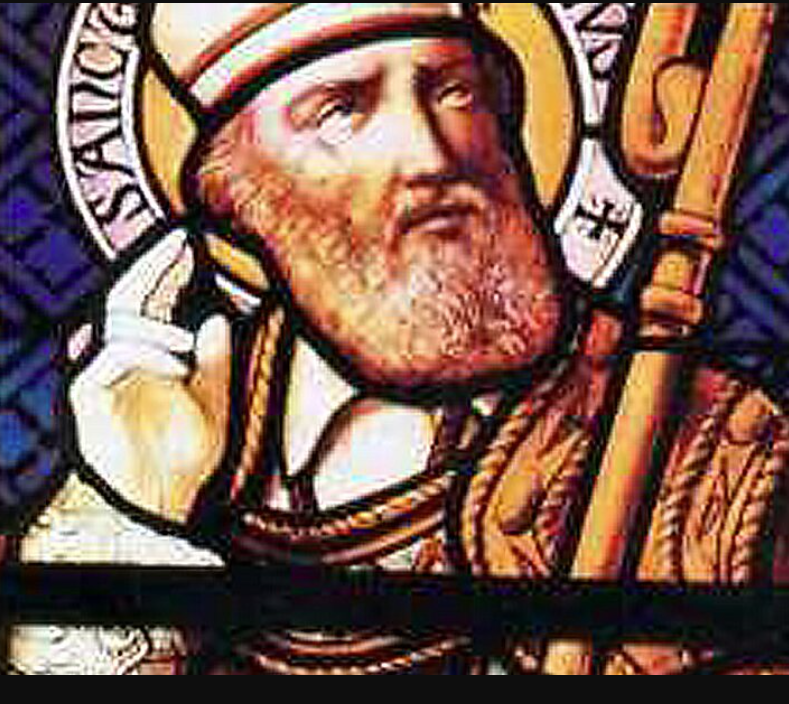
Saint of the Day – 11 May – Saint Mayeul of Cluny (c 906–994) Priest, Abbot, the 4th Abbot of Cluny, Reformer., miracle-worker. Born in c 906 in Avignon, France and died in 994 at Souvigny, France en route to Paris, of natural causes. He is also known as Majolus, Maieul, Mayeul, Mayeule.
Mayeul was revered in his own time as a holy man. He spent much time in prayer and solitude, he rebuked sinners, he disliked public praise and high honours but he would do much good in secret, away from the eyes of the public. Whenever he went on a journey, he would have an open book in his hand, which could be either a spiritual or philosophical work, which he would read as he rode. He had great knowledge of the Sacred Scriptures and other subjects but would never offer his knowledge unsolicited. He would only speak when asked his opinion. He always spoke very briefly. He drank a little wine. He was said to be a very gentle and kind person, although strict and unwavering when required.
Mayeul was very active in reforming individual communities of Monks and Canons; first, as a personal commission, requested and authorised by the Emperor or other nobility. Later, he found it more effective to affiliate some of the foundations to the motherhouse at Cluny to lessen the likelihood of later relapse. He travelled widely and was highly regarded as a person of influence, both in Rome and at the Imperial Court. He is buried at the Priory of Souvigny, along with St Odilo, the 5th bbot of Cluny and commemorated individually on 11 May and also on 29 April with four other early Abbots of Cluny.
Mayeul’s father, named “Fulcher,” was from a wealthy provincial family of Avignon. His mother was named Raimodis. They had two sons. Mayeul and Cynricus. It is not known for sure which was the older but traditionally, the younger sons of noble families were given to the Church and the elder sons were made the heirs to the father’s estate, hence because Mayeul became a Monk, it is sometimes assumed he is the younger. Around 916, Mayeul fled his family’s estates near Rietz to stay with relatives at Mâcon due to the feudal wars. Both his parents died during his absence, while he was still very young.
Mayeul studied the liberal arts at Lyon and became Canon and later Archdeacon of Mâcon; his Ordination to the Priesthood was in Mâcon. While there, he gave free lessons to a large body of clerks. He built a small Oratory on the opposite side of the river from the Town, where he would retire for prayer. In personal habits he was always kind, never telling lies, detraction or flattery and he was severe against sinners, if it was necessary to call them to repent. He gained a reputation among the local people as a holy person and so, when Besançon needed a new Bishop, many people, called on him to become their Bishop but he refused.
There was a famine at the time and Mayeul prayed for help for those begging for food. One day as he prayed, seven gold coins appeared in front of him. He was afraid that this was a trick of the devil or that the money was lost and he wouldn’t touch it. But when he discovered the money was real and no-one claimed it, he then used it to buy food for the starving peoples.
He decided then to enter Cluny Abbey, which he had visited previously. Aymard of Cluny was Abbot at the time. Aymard appointed Mayeul “armarius” (book-keeper and master of ceremonies). He was later made librarian. He had read the poems of Virgil and he considered that Monks should not read these works but that the Sacred Scriptures alone was enough for them. He was very strict in the discipline he applied to new monks.
He was sent with a fellow monk from Cluny to Rome, on one occasion and on the return journey his companion became sick. Mayeul waited by the suffering Monk for three days with much anxiety and on the third night, he dreamed that he saw a white-haired old man who said ‘Why art thou cast down in idle grief? Hast thou forgotten what my brother James orders for the sick?’ He awoke and realised, that the dream was referring to the Sacrament of Extreme Unction mentioned in the letter of James (5:14-15). He then anointed his brother-monk with the holy oil. The sick Monk then started to recover from his illness. This miracle was then told at Cluny and the Monks held Mayeul in veneration.
Around 948, Mayeul became co-adjutor to Abbot Aymard. Aymard became blind and he resigned his Abbacy, recommending that the Monks choose to elect a new Abbot and suggested they choose Mayeul but he refused. However, Mayeul again had a dream in which St Benedict appeared to him and told him to accept the responsibility of the office and that the Sacred book would be his guide. The next day, Mayeul addressed the Monks and said, “Now in Him who is able to smooth over rough places, to raise up heavy burdens and to overthrow the adversary, I place my hope and submit myself to your unchanged command.” Mayeul became Abbot about the year 954.
The construction of Cluny II, c 955–981, begun after the destructive Hungarian raids of 953,. The replacement Abbey Church of Cluny II was consecrated in 981. The relics of Peter and Paul were taken from Rome to Cluny during Mayeul’s Abbacy. Under him, a network of Monasteries dependent on Cluny’s leadership, began to develop and would continue under his successors Odilo and Hugh.
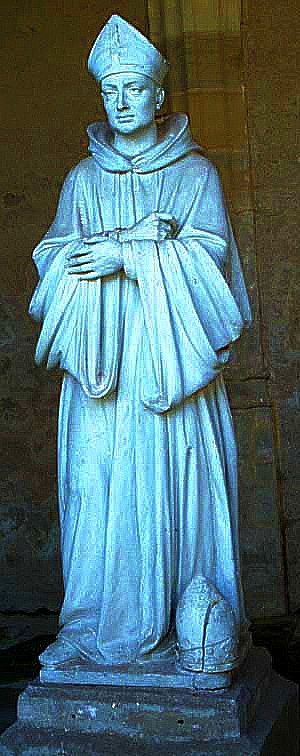
Statue of St Mayeul at Souvigny Monastery
Mayeul was graced by God with miracles during his lifetime and after his death. He cured the sick, restored sight to the blind, healed those bitten by serpents, dogs or wolves, he also miraculously rescued people from death by drowning or fire. Among the stories of miracles attributed to him, the following are here related:
Once when Mayeul was returning from Aquitaine, he decided to visit a Monastery along the way and sent a messenger ahead of him to say he was on his way. The Monks of this Monastery were happy that he was coming but the purveyor felt concerned because they had run out of fish. However, he asked the Monks to go down to the river and call on God by the name of Mayeul and when they did, they caught an enormously large salmon.
The water that Mayeul used to wash his hands was said to have miraculous powers. Once in Vallavaense a blind beggar caught hold of Mayeul’s bridle as he was leaving the Town and begged him to bless water in a jar he had brought. Mayeul was moved by this show of faith and so he blessed the water. The beggar then washed his eyes with the water and received his sight.
After his death several pilgrims, when returning from his tomb, reached the Loire river and they could not cross it because the boat was on the other side. Tthe boatman refused to come over for them. They called on Mayeul to intercede for them and the boat crossed over by itself to them and took them, without being rowed, to the other side.
A woman who brought her dead child to Mayeul’s tomb in Souvigny where she placed the child’s body in front of the altar, where it remained the whole night. At nine o’clock in the morning, the eyes of the boy opened and the boy called for his mother.
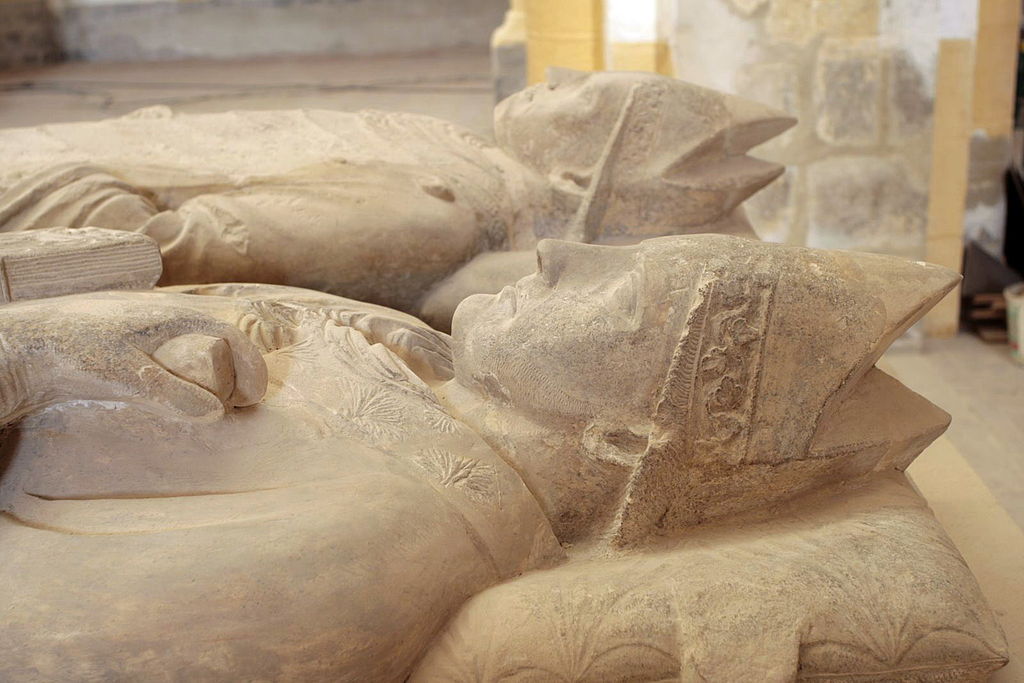
Mayeul lived to the old age of 84. Two years before he died, he gave up the Abbacy and made Odilo his co-adjutor, just as Aymard had done with him about 50 earlier. He retired to one of the smaller Cluniac houses where he devoted time to serving the brothers there by instruction, correction and inspiration. He continued to work even into his old age and he died on his way to reform Saint-Denis in Paris. He did not get far and stopped at Souvigny Priory, where he died and was buried. After he died, the Monks at Cluny wanted to bring him to Cluny but the Monks at Sovigny protested and insisted that he remain there. The tomb of St Majolus became the focus of pilgrimages and miracles.
Madonna dello Scoglio / Madonna of the Rock, Placanica, Reggio Calabria, Calabria, Italy (mid 1900s) – 11 May:
Fratel Cosimo Fragomeni was born in 1950 in Santa Domenica di Placanica, a village of Calabria, one of the poorest regions in Italy. From an early age he was a committed Roman Catholic and when he was 18, he reported to the village priest, Don Rocco Gregorace, having had four visions in which the Mother of God, standing on a rock (scoglio), appeared to him. The first of these visions took place on the 11th May 1968. The Virgin Mary asked Cosimo to transform the valley into a Shrine in order to bring people closer to God.
For that reason, on the rock of the apparition, Cosimo built a little Chapel,and called the Shrine “Madonna dello Scoglio” (Our Lady of The Rock) because the Virgin Mary appeared to him on the top of the rock. He also placed a marble Statue of Our Lady on the rock of the apparitions. Pilgrims come from all over the world to pray and touch the sacred rock, through the metal fencing that circumscribes it, testifying great miracles and conversions.
Shortly after the apparitions of the Virgin Mary, Cosimo began to lead prayer devotions for pilgrims and many people were cured from diseases. Although he had received little formal education, he was admitted to the lay order of the Franciscan brothers with the name of “Fratel Cosimo.” He led a mystical life, living in solitude in a house near the apparition rock, fasting and praying and avoiding any sense of celebrity.
Fratel Cosimo was a man of God, appreciated by his Bishop for his obedience and humility to the Catholic Church. He emphasised prayer as the primary vehicle for opening oneself to God and for receiving spiritual and physical renewal through the Divine Physician and His Holy Mother. Thanks to the donations of the pilgrims, the Shrine grounds and facilities have been expanded. A foundation and a rosary prayer group have been established and on the 8th December 2007, the local Bishop Mnsgr Morosini, declared the “Scoglio” an official Catholic shrine.
St Anastasius of Lérida St Anthimus of Rome St Bassus of Sabina St Bertilla St Criotan of MacReddin Bl Diego of Saldaña St Evellius of Pisa St Fabius of Sabina St Fremund of Dunstable St Gengulphus of Burgundy
St Maximus of Sabina St Mayeul of Cluny (c 906–994) Priest and Abbot St Mozio of Constantinople St Possessor of Verdun St Principia of Rome St Tudy St Vincent L’Hénoret Bl Vivaldus St Walbert of Hainault — Martyrs of Camerino: An imperial Roman official, his wife, their children and servants, all of whom were converts and martyrs: Anastasius, Aradius, Callisto, Eufemia, Evodius, Felice, Primitiva, Theopista.
Thought for the Day – 10 May – “Mary’s Month” Meditations with Antonio Cardinal Bacci (1881-1971)
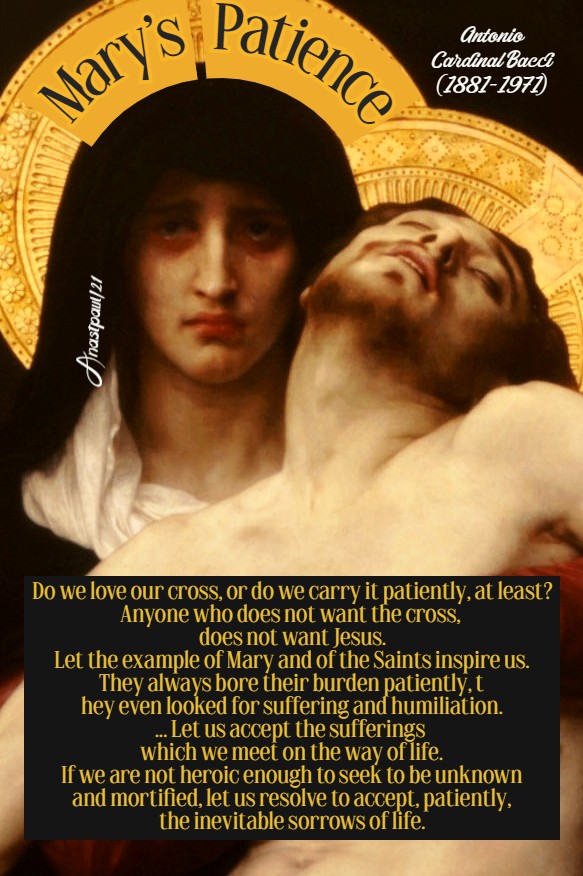
Mary’s Patience
“We also have our share of suffering and humiliation. It is useless to try and escape from it, useless to rebel against it. If we embrace the cross patiently and lovingly, a Jesus and Mary did, it will seem lighter, even welcome. If we attempt to cast it from us, it will weigh more heavily on our shoulders. There are two kinds of men, those who bear their cross, patiently and embrace it because they wish to be like Jesus and, those who do not want to suffer and rebel. The former may stagger beneath their daily burden but, they have peace of soul because they are putting into practice, the great Gospel precept: “By your patience, you will win your souls” (Lk 21:19). They know that they are on the path to Heaven and this thought is consolation, which cannot be taken from them. The second group of men, rebel against the cross and, therefore, suffer doubly, in body and in soul. “The senseless man,” the Holy Spirit says, “loves not to be reproved” (Prov 15:12).
To which of these two categories do we belong? Do we love our cross, or do we carry it patiently, at least? Anyone who does not want the cross, does not want Jesus. Let the example of Mary and of the Saints inspire us. They always bore their burden patiently, they even looked for suffering and humiliation. If we cannot reach such heroic heights, let us at last, accept, from the hands of Our Lord, the cross which He offers us. Let us accept the sufferings which we meet on the way of life. If we are not heroic enough to seek to be unknown and mortified, let us resolve to accept, patiently, the inevitable sorrows of life.”
Quote/s of the Day – 10 May – “Mary’s Month” – Monday of the Sixth Week of Easter, Readings: Acts 16:11-15, Psalms 149:1-2, 3-4, 5-6, 9, John 15:26–16:4
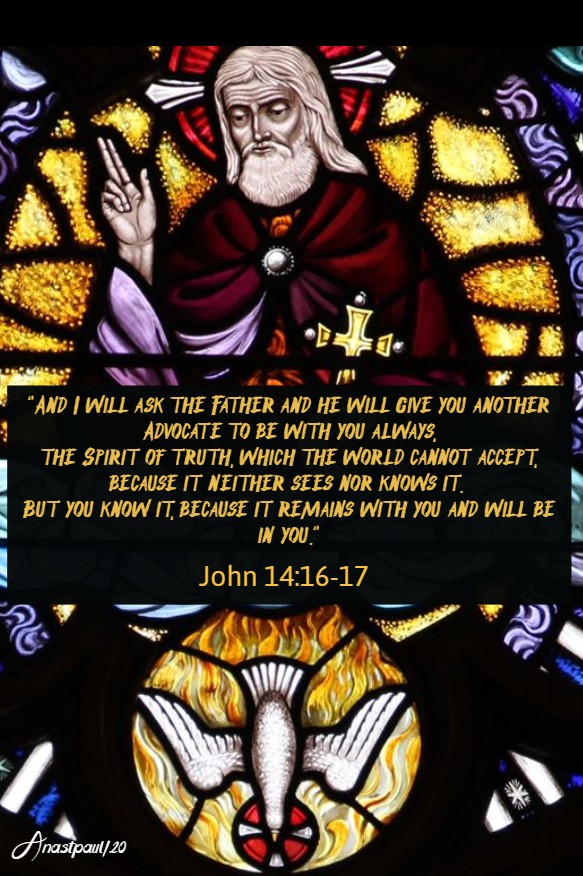
“And I will ask the Father and he will give you another Advocate to be with you always, the Spirit of truth, which the world cannot accept, because it neither sees nor knows it. But you know it, because it remains with you and will be in you.”
John 14:16-17
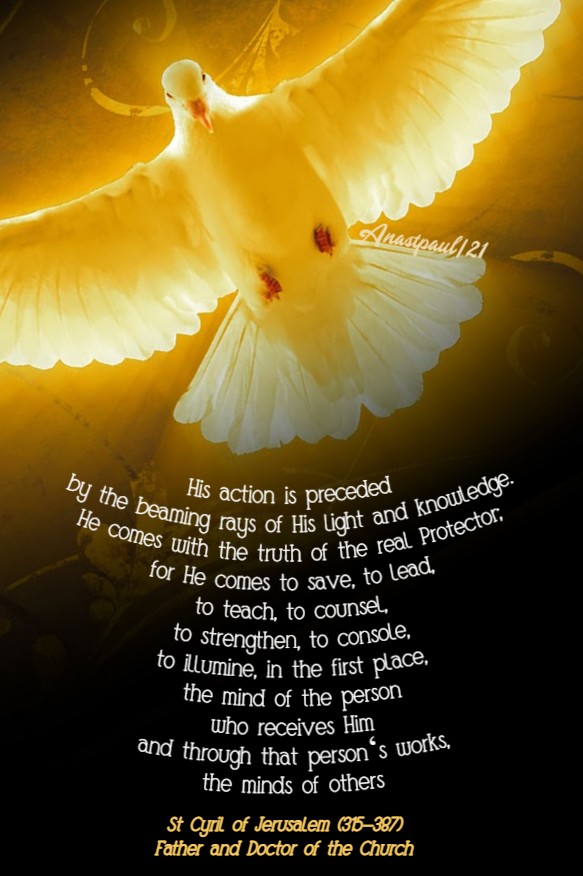
“His action is preceded by the beaming rays of His light and knowledge. He comes with the truth of the real Protector; for He comes to save, to lead, to teach, to counsel, to strengthen, to console, to illumine, in the first place, the mind of the person who receives Him and through that person‘s works, the minds of others.”
St Cyril of Jerusalem (315-387) Father and Doctor of the Church
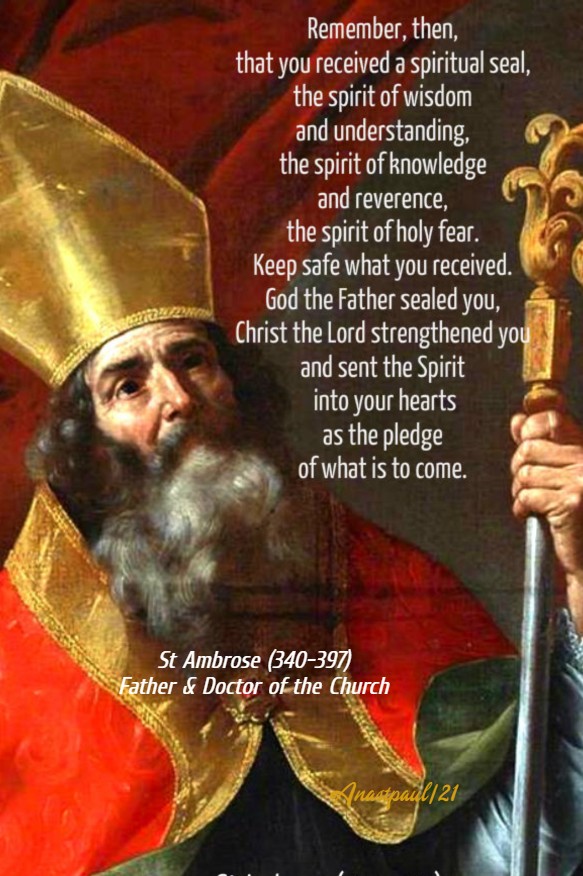
“Remember, then, that you received a spiritual seal, the spirit of wisdom and understanding, the spirit of knowledge and reverence, the spirit of holy fear. Keep safe what you received. God the Father sealed you, Christ the Lord strengthened you and sent the Spirit into your hearts as the pledge of what is to come.”
St Ambrose (340-397) Father & Doctor of the Church
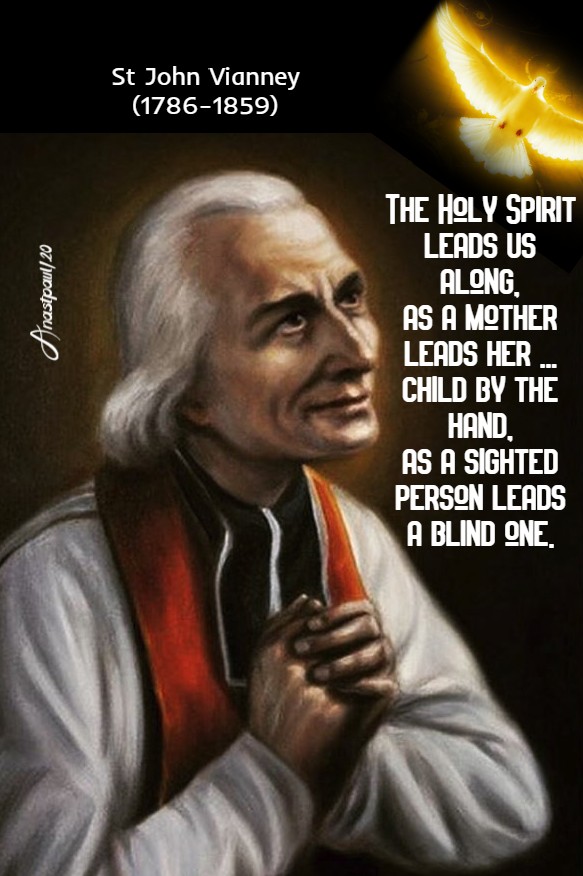
“The Holy Spirit leads us along, as a mother leads her two year old child by the hand, as a sighted person leads a blind one. We should say each morning: “Oh my God, send me Your Holy Spirit who will make me understand what I am and what you are …” A soul who possesses the Holy Spirit enjoys an exquisite taste in prayer, it never loses the holy presence of God.”
One Minute Reflection – 10 May – “Mary’s Month” – Monday of the Sixth Week of Easter, Readings: Acts 16:11-15, Psalms 149:1-2, 3-4, 5-6, 9, John 15:26–16:4
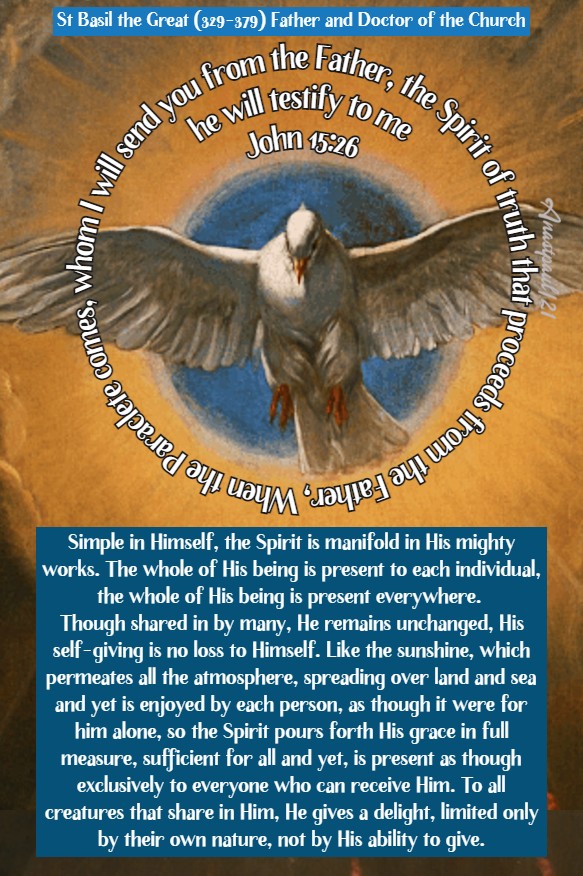
“When the Paraclete comes, whom I will send you from the Father, the Spirit of truth that proceeds from the Father, he will testify to me” … John 15:26
REFLECTION – “The Spirit is the source of holiness, a spiritual light and He offers His own light to every mind, to help it in its search for truth. By nature, the Spirit is beyond the reach of our mind but we can know Him by His goodness. The power of the Spirit fills the whole universe but He gives Himself only to those who are worthy, acting in each according to the measure of his faith.
Simple in Himself, the Spirit is manifold in His mighty works. The whole of His being is present to each individual, the whole of His being is present everywhere. Though shared in by many, He remains unchanged, His self-giving is no loss to Himself. Like the sunshine, which permeates all the atmosphere, spreading over land and sea and yet is enjoyed by each person, as though it were for him alone, so the Spirit pours forth His grace in full measure, sufficient for all and yet, is present as though exclusively to everyone who can receive Him. To all creatures that share in Him, He gives a delight, limited only by their own nature, not by His ability to give.
The Spirit raises our hearts to heaven, guides the steps of the weak and brings to perfection, those who are making progress. He enlightens those who have been cleansed from every stain of sin and makes them spiritual by communion with Himself. As clear, transparent substances become very bright when sunlight falls on them and shine with a new radiance, so also souls in whom the Spirit dwells and who are enlightened by the Spirit, become spiritual themselves and a source of grace for others.
From the Spirit comes foreknowledge of the future, understanding of the mysteries of faith, insight into the hidden meaning of Scripture and other special gifts. Through the Spirit we become citizens of heaven, we enter into eternal happiness and abide in God. Through the Spirit we acquire a likeness to God, indeed, we attain what is beyond our most sublime aspirations—we become God..” … St Basil the Great (329-379) Bishop, Father and Doctor of the Church – An excerpt from his On the Holy Spirit, Chapter 9.
PRAYER – Lord God, You sanctify Your Church in every race and nation by the joy of Your risen Son. By His life, Death and Resurrection You grant us life and through Your Holy Spirit, You grant us the fruits of faithful love. May we ever be graced by Your gift of faith and be led to our heavenly Home. Through the prayers of the Blessed Virgin Mary may we be strengthened for the journey. We make our prayer through Christ our Lord, together with the Holy Spirit, in the glory of God now and forever, amen.
Our Morning Offering – 10 May – “Mary’s Month” Monday of the Sixth Week of Easter
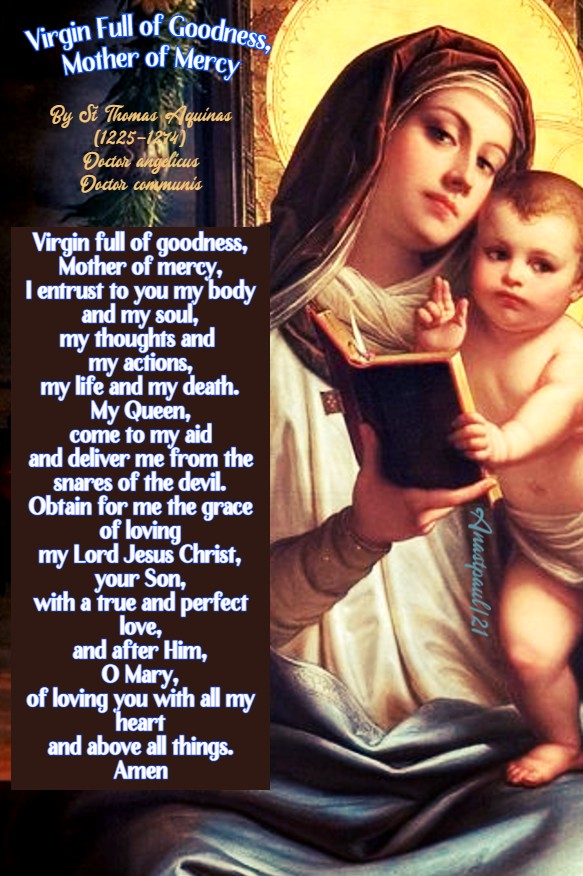
Virgin Full of Goodness, Mother of Mercy By St Thomas Aquinas (1225-1274) Doctor angelicus Doctor communis
Virgin full of goodness, Mother of mercy, I entrust to you my body and my soul, my thoughts and my actions, my life and my death. My Queen, come to my aid and deliver me from the snares of the devil. Obtain for me the grace of loving my Lord Jesus Christ, your Son, with a true and perfect love, and after Him, O Mary, of loving you with all my heart and above all things. Amen
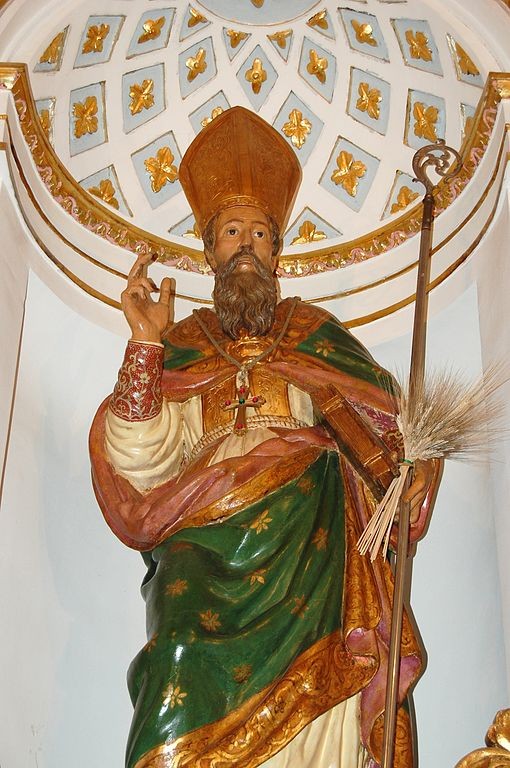
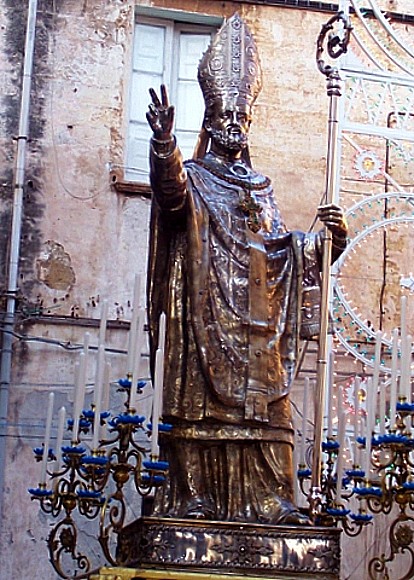
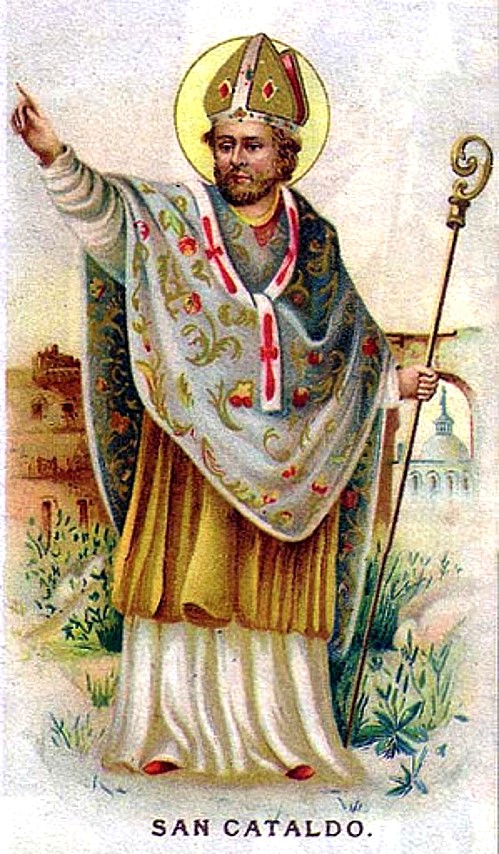
Saint of the Day – 10 May – Saint Catald of Taranto (Died c 685) Bishop, Monk, miracle-worker. Born in the 7th century Munster, Ireland and died in c. 85 in Taranto, Italy of natural causes. Also known as – Catald of Tarentum, Catald of Rachau, Cataldus, Cathal, Cattaldo, Cathaluds, Cathaldus, Cataldo. Patronages – against blindness, against drought, against epilepsy, against hernias, against paralysis, against plague, against storms, blind people, drought relief, epileptics, paralyzed people, Massa Lubrense, Italy, Taranto, Italy.
Born in Munster, Ireland, Catald was a pupil, then the headmaster of the monastic school of Lismore in Waterford, after the death of its founder, St Carthage.
Upon his return from a pilgrimage to the Holy Land, he was shipwrecked at Taranto in southern Italy and ,chosen by the people as their Bishop and then Archbishop of the Diocese.
Some of the miracles claimed in Catald’s name include protecting the City against the plague and floods that, apparently, had occurred in neighbouring areas.
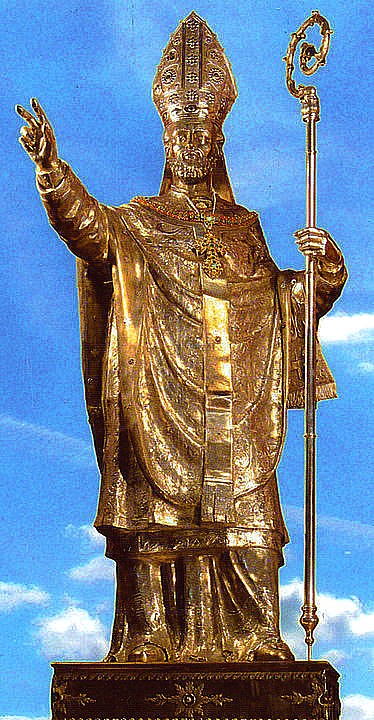
He is the titular of Taranto’s Cathedral and the principal Patron of the Diocese. This epitaph is given under an image of Saint Catald in Rome:
Statue of Saint Catald at Taranto
Me tulit Hiberne, Solyme traxere, Tarentum Nunc tenet: huic ritus, dogmata, jura dedi.
This has been loosely translated as: Hibernia gave me birth, thence wafted over, I sought the sacred Solymean shore. To thee Tarentum, holy rites I gave, Precepts divine and thou to me a grave. (Hibernia is the classical Latin name for Ireland).
It is odd that an Irishman, should be so honoured throughout Italy, Malta,and France but have almost no recognition in his homeland. His Irish origins were discovered only two or three centuries after his death, when his relics were recovered during the renovation of the Cathedral of Taranto. When his coffin was open at that time, a pastoral staff of Irish workmanship was found with the inscription Cathaldus Rachau. Further investigations identified him with Cathal, the teacher of Lismore.
Veneration to Catald spread, especially in southern Italy, after the 10 May 1017, translation of his relics when the Cathedral was being rebuilt, following its destruction at the hands of Saracens in 927. Four remarkable cures occurred as the relics were moved to the new Cathedral. There is a Town of San Cataldo in Sicily and another on the southeast coast of Italy .
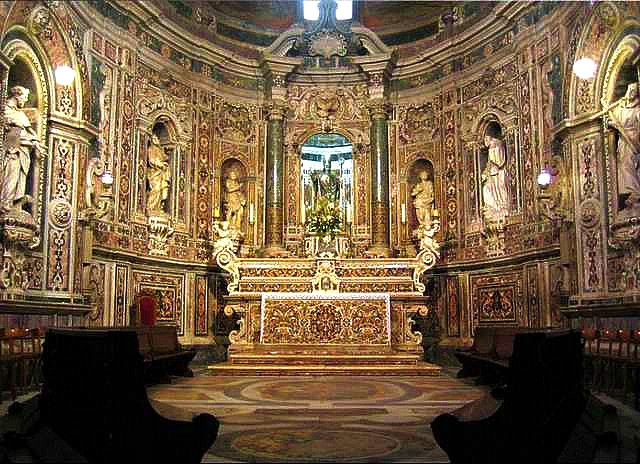
Cathedral of St Catald in Taranto, Italy
Cathedral of St Catald in Taranto, Italy
Saint Catald is depicted in art as an early Christian Bishop with a mitre and pallium in a 12th century mosaic at Palermo (Roeder). He is the subject of a painting on the 8th pillar of the nave ,on the left in the Basilica of the Nativity in Bethlehem There are also 12th-century mosaics in Palermo and Monreale depicting the Saint.
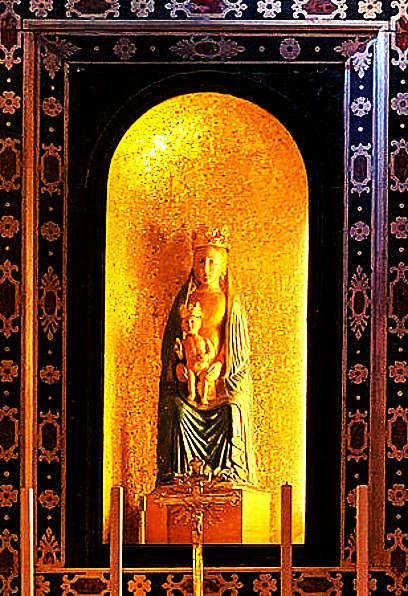
Madonna della Rovere, Roble San Bartolomeo al Mare, Italy (1671) – 19 May (Additional Memorial 18 April):
“The Madonna della Rovere is an ancient devotion from an image that was found in a village called Oak. There were two apparitions of the Virgin Mary and several miracles in the seventeenth century. San Bartolomeo al Mare is a Town in the Province of Imperia, Liguria region in northwest Italy. The ancient and vast territory in the medieval village of Oak is located between the Towns of Cervo and Diano. In the pre-Roman era it was called “Lucus Bormani” where “Lucus” means “sacred forest,”,”Bor” to “source” and “man,” whereby the “Lucus Bormani” means “ sacred grove dedicated to the god Borman “the god of springs, cruel and bloodthirsty. The Romans also devoted to the jungle forests, Diana, goddess of the hunt, so the Town of Diano called “Pagus Dianius”. The five oak trees that still surround the Shrine of Robre are the last remnants of the ancient forest. It is said that the Statue was found in an oak but perhaps more true is that the Statue was made of oak timber.
Perato Giacinto di Rollo, aged 50, on the night of 3 April 1671, after working all day in the fields, called his wife, saying his arm was hurt. The left arm was dead, insensible to pinching and medical punctures. After several attempts at restoring his arm, it remained insensitive. A few days later, on 18 April, with his arm in a sling, Perato took his donkey to graze in the area of the Town of Armea. Below is his miraculous tale: “A few hours before noon, a few steps ahead of me, I saw a woman dressed in turquoise shining like the sun … She told me that I should trust the Madonna to help me . “
On 19 April 1671, Giacinto, riding on his donkey, went to the Shrine of Our Lady of the Oak, with his wife and Don Damián Tagliaferro. During the Mass, at the moment of Consecration, his eyes glazed over and he fell to the ground unconscious. When after three quarters of an hour he awoke and with the support of his wife, rose slowly, his arm functioned again. He was completely healed. This miracle has been recorded under oath by seven people, including a doctor, a lawyer and six priests. The documents are stored in the Curia of the Diocese of Albenga.
On 10 May 1671 Our Lady appeared to cure a peasant and asked him to build a Chapel in the place where she had appeared. The Church was built immediately, the faithful and clergy of the surrounding areas all being piously devoted to Our Lady.” (The above has been translated from Italian).
St Joseph de Veuster SS.CC. (1840-1889) – St Damian of Molokai “The Martyr of Molokai,” Priest of the Congregation of the Sacred Hearts of Jesus and Mary, Missionary – known as “Martyr of Molokai”, “Martyr of Charity”, “Apostle to the Lepers” – Patron of lepers. (Optional Memorial) St Damian’s life: https://anastpaul.wordpress.com/2017/05/10/10-may-the-memorial-of-st-damian-de-veuster-de-molokai/
St Alphius of Lentini Bl Amalarius of Metz Bl Antonio of Norcia St Aurelian of Limoges Bl Beatrix d’Este the Elder St Blanda of Rome St Calepodius of Rome St Catald of Taranto (Died c 685) Bishop St Comgall of Bangor St Cyrinus of Lentini St Dioscorides of Smyrna
Bl Nicholas Albergati St Palmatius of Rome St Philadelphus of Lentini St Quartus of Capua St Quintus of Capua St Simplicius of Rome St Solange of Bourges St Thecla Bl William of Pontnoise
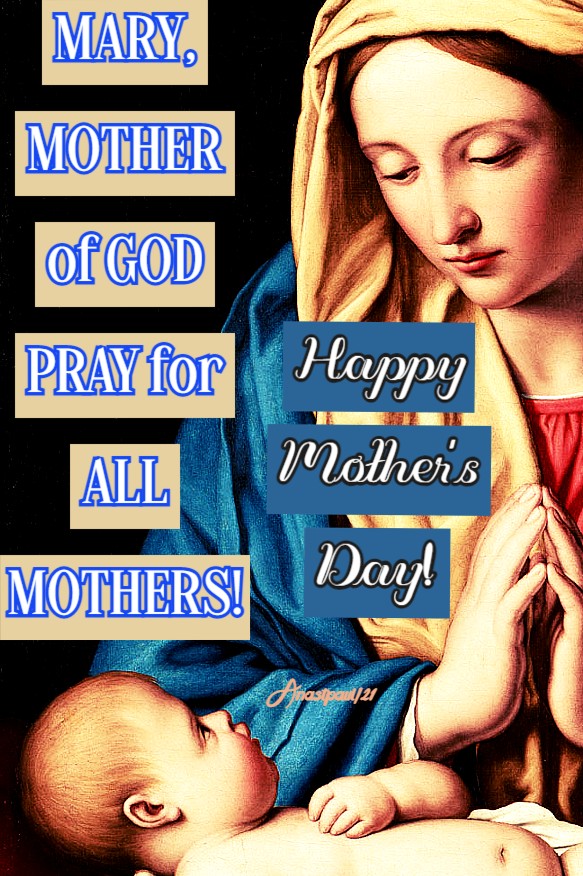
Wishing all Mothers a Blessed and Happy Mothers’ Day May Mary, the Mother of our Lord Jesus Christ and our Mother, be a guide and a comfort to us all.
Mother’s Day Prayer Hail Mary, Mother of God Intercessions from 1727 the Liturgical Order of Blessing
Hail Mary, Mother of God and our Mother, pray for all mothers, so that they will be able to fulfil their maternal responsibilities. Help them to be lovers and nurturers of all human life from the moment of conception until natural death, all the while, being examples for their own children. Pray for their children, so that they, too, will be faithful followers of your Son. We pray for our mothers, who have given us life and love, that we may show them reverence and love. We pray for mothers, who have lost a child through death, that their faith may give them hope and their family and friend, support and console them. We pray for mothers who have died, that God may bring them into the joy of His kingdom We offer these prayers through Christ, our Lord and your Son, in union with the Holy Spirit, one God, forever and ever. Amen
Thought for the Day – 9 May – “Mary’s Month” Meditations with Antonio Cardinal Bacci (1881-1971)
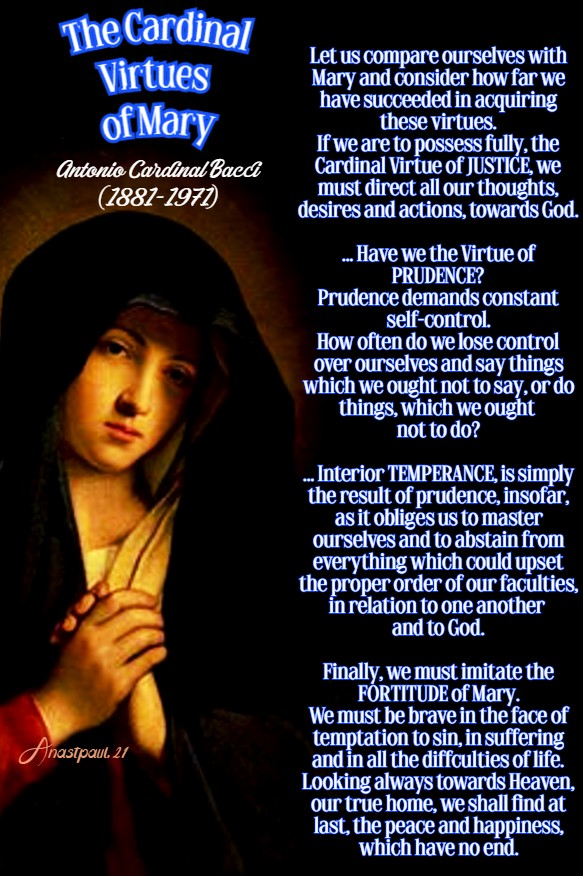
The Cardinal Virtues of Mary
“Let us compare ourselves with Mary and consider how far we have succeeded in acquiring these virtues. If we are to possess fully, the Cardinal virtue of JUSTICE, we must direct all our thoughts, desires and actions, towards God. Since everything comes from God, we should offer everything back to Him. If we fail to do this, we are guilty of injustice towards God. We take for ourselves, something which belongs to Him. We must also be just to our neighbour. It is not enough to be charitable only because there can be no charity, unless, it is founded on justice. This justice should characterise our thoughts and judgements, as well as our words and actions.
Have we the Virtue of PRUDENCE? Prudence demands constant self-control. How often do we lose control over ourselves and say things which we ought not to say, or do things, which we ought not to do? Prudence is a splendid virtue, which can be obtained by the grace of God, by living a life of union with Him. It necessitates constant vigilance over our faculties and passions, in order to ensure, that nothing will interfere with our rational conduct and with our observance of the commandments of God.
Interior TEMPERANCE, is simply the result of prudence, insofar, as it obliges us to master ourselves and to abstain from everything which could upset the proper order of our faculties, in relation to one another and to God. If we are inwardly temperate, we shall show external temperance in our words and deeds. We shall abstain, in other words, from everything suggested by our lower nature, which is contrary to the commandments of God and the precepts of the Church. This means, we shall observe among other things, the Church’s laws of fasting and abstinence. We shall keep away from dangerous amusements and from anything else which could be harmful to ourselves or to our neighbour.
Finally, we must imitate the FORTITUDE of Mary. We must be brave in the face of temptation to sin, in suffering and in all the diffculties of life. Looking always towards Heaven, our true home, we shall find at last, the peace and happiness, which have no end.”
Quote/s of the Day – 9 May – Sixth Sunday of Easter, Readings: First: Acts 10: 25-26, 34-35, 44-48; Psalm: Psalms 98: 1, 2-3, 3-4 (2b); Second: First John 4: 7-10; Gospel: John 15: 9-17
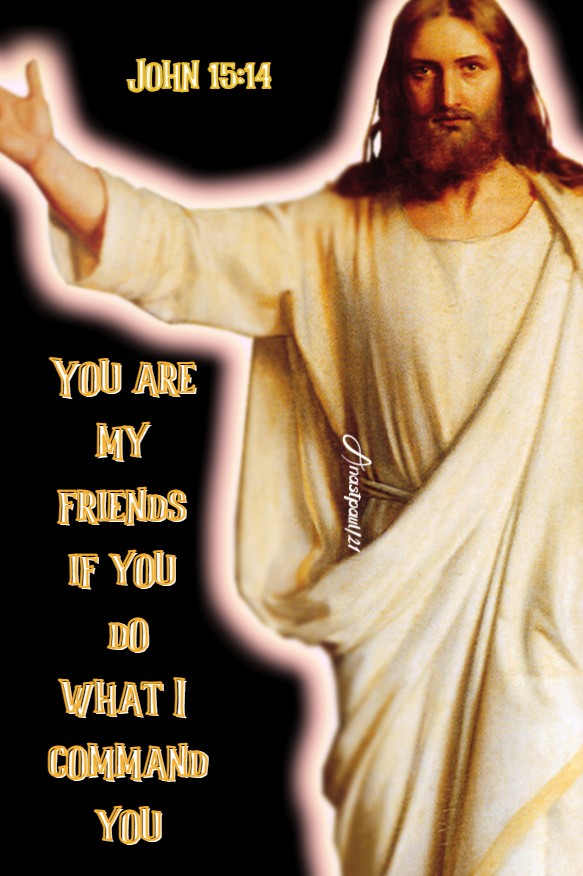
“You are my friends if you do what I command you. “
John 15:14
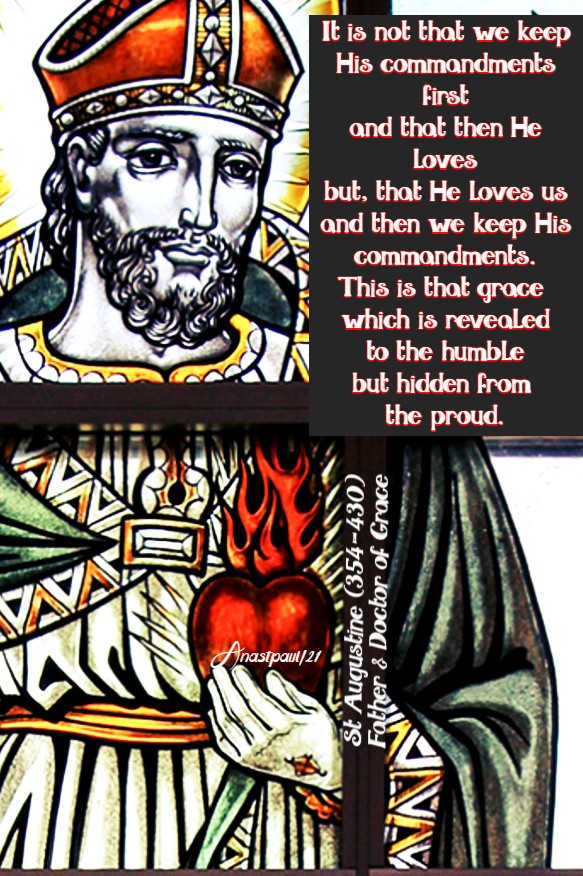
“It is not that we keep His commandments first and that then He loves but, that He loves us and then we keep His commandments. This is that grace which is revealed to the humble but hidden from the proud.”
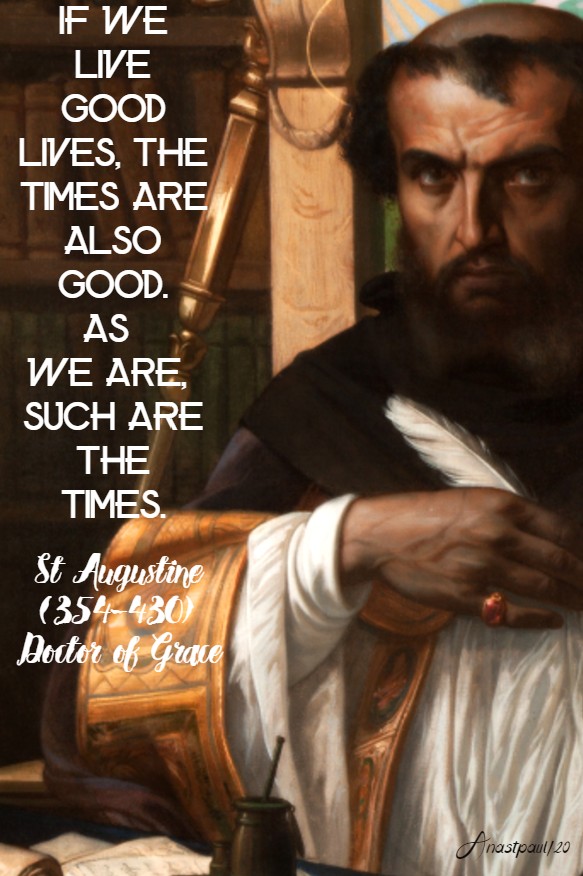
“If we live good lives, the times are also good. As we are, such are the times.”
St Augustine (354-430) Father & Doctor of Grace
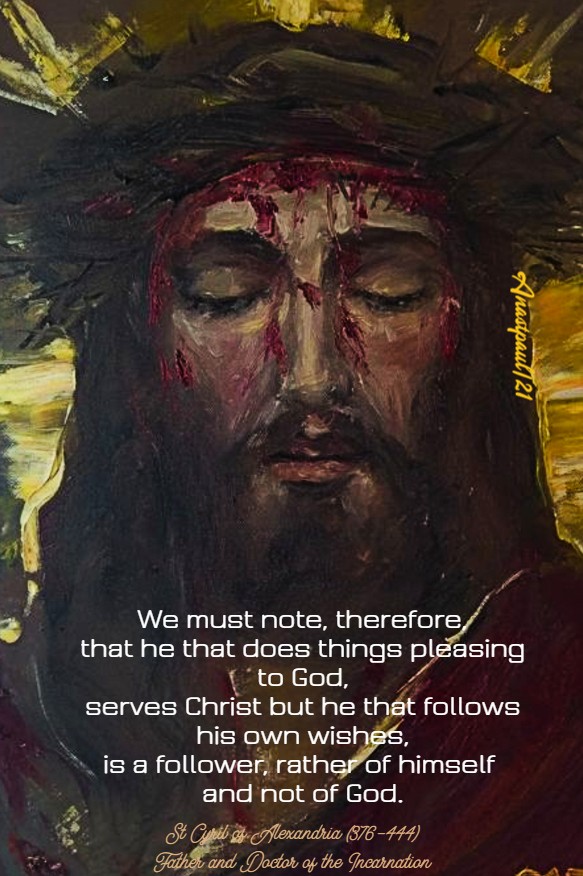
“We must note, therefore, that he that does things pleasing to God, serves Christ but he that follows his own wishes, is a follower, rather of himself and not of God.”
St Cyril of Alexandria (376-444) Father and Doctor of the Incarnation
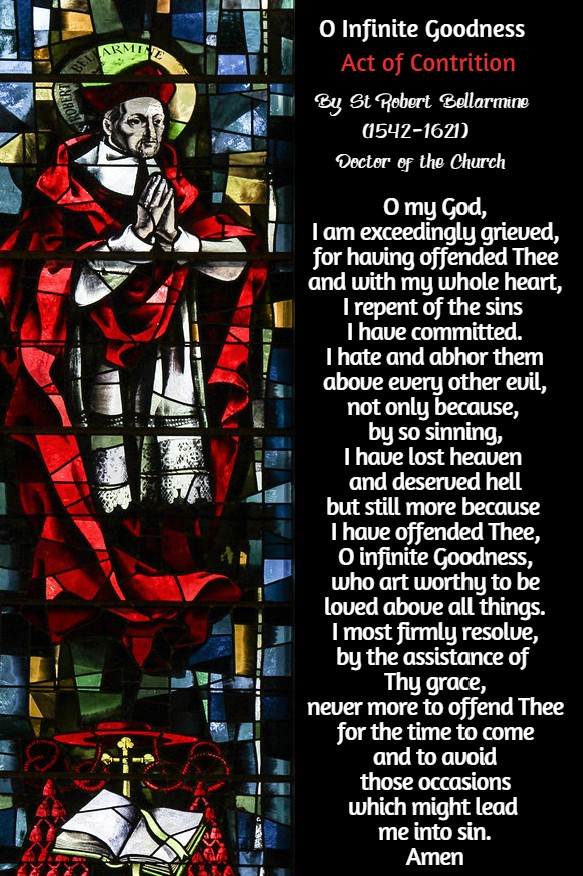
PRAYER – O Infinite Goodness – Act of Contrition By St Robert Bellarmine (1542-1621) – Doctor of the Church
O my God, I am exceedingly grieved, for having offended Thee and with my whole heart, I repent of the sins I have committed. I hate and abhor them above every other evil, not only because, by so sinning, I have lost heaven and deserved hell but still more because I have offended Thee, O infinite Goodness, who art worthy to be loved above all things. I most firmly resolve, by the assistance of Thy grace, never more to offend Thee for the time to come and to avoid those occasions which might lead me into sin. Amen
One Minute Reflection – 9 May – Sixth Sunday of Easter, Readings: First: Acts 10: 25-26, 34-35, 44-48; Psalm: Psalms 98: 1, 2-3, 3-4 (2b); Second: First John 4: 7-10; Gospel: John 15: 9-17
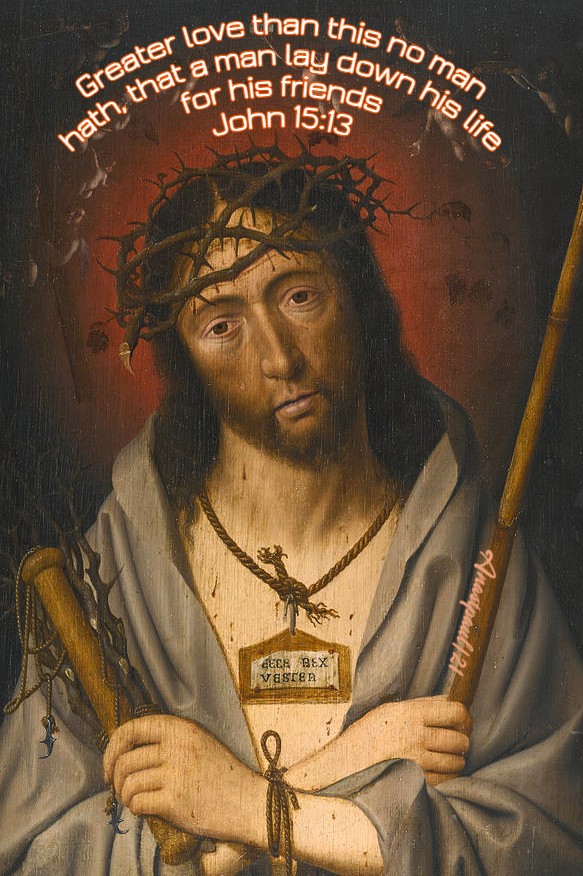
“Greater love than this no man hath, that a man lay down his life for his friends.” – John 15:13
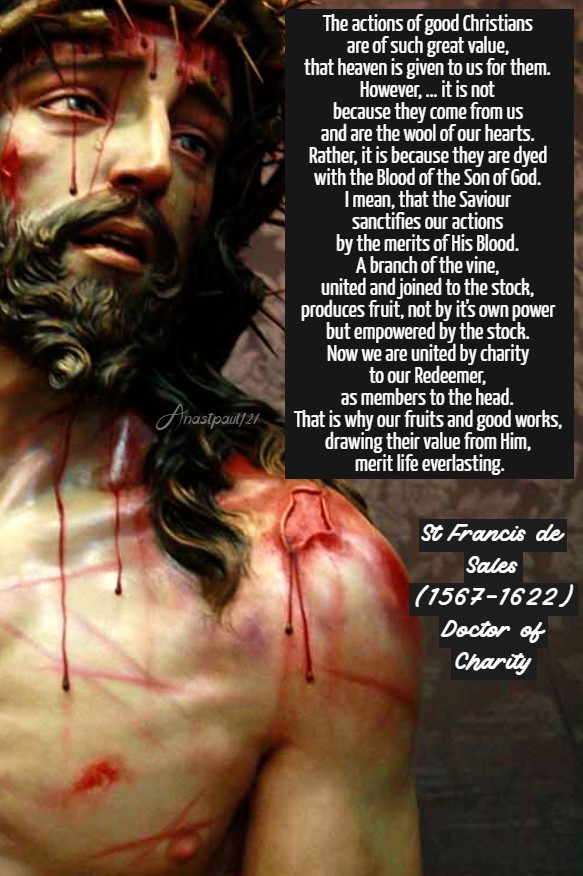
REFLECTION – “Cloth of scarlet or purple is a very precious and royal fabric, not because of the wool but because of the colour. The actions of good Christians are of such great value, that heaven is given to us for them. However, … it is not because they come from us and are the wool of our hearts. Rather, it is because they are dyed with the blood of the Son of God. I mean, that the Saviour sanctifies our actions by the merits of His blood. A branch of the vine, united and joined to the stock, produces fruit, not by it’s own power but empowered by the stock. Now we are untied by charity to our Redeemer, as members to the head (Eph 4:15-16). That is why our fruits and good works, drawing their value from Him, merit life everlasting.
… We, ourselves, are branches that are dry, unprofitable and unfruitful. We are not competent of ourselves to claim anything as coming from us, our competence is from God, who has made us competent to be ministers (2 Cor 3:5-6) and able to do His will. Therefore, as soon as sacred love engraves on our hearts the name of our Saviour, our great Shepherd (1 Pet 2:25), we begin to bear delicious fruits for life everlasting.” …. St Francis de Sales (1567-1622) Doctor of Charity
PRAYER – Almighty, ever-living God, bring us to the joy of Your heavenly city, so that we, Your little flock, may follow where Christ, our Good Shepherd, has gone before us, by the power of His Resurrection. May our hearts overflow with the joy of His eternal presence, that in Him and through Him and with Him, we may attain the happiness of life eternal. May the prayers of the Blessed Virgin, guide us that we may always follow our Shepherd in faithful love. We make our prayer through Christ, our Lord, with the Holy Spirit, God now and for all eternity, amen.
Saint of the Day – 9 May – Blessed Thomas Pickering OSB (c 1621-1679) Martyr, Benedictine Lay Brother. bBorn in c 1621 in Westmorland, England and died by being hanged, drawn and quartered on 9 May 1679 at Tyburn, London, England. He was one of the 107 martyrs Beatified by Pope Pius XI on 15 December 1929 and is, therefore, remembered with them all on 4 May. In character, he was described, as the most charitable and sweet-tempered of men.
Thomas was a member of an old Westmoreland family. He was sent to the Benedictine Monastery of St Gregory at Douai, where he took vows as a lay brother in 1660.
In 1665 he was sent to London, where, as steward or procurator to the little community of Benedictines who served the Queen’s Chapel Royal, Catherine of Braganza, the Catholic wife of King Charles II. Thomas became personally known to the Queen and Charles II and when in 1675, urged by the Parliament, Charles issued a proclamation ordering the Benedictines to leave England within a fixed time, Pickering was allowed to remain, probably on the grounds that he was not a Priest.
In 1678 came the infernal concocted fabricaltion of Titus Oates, claims of a Catholic plot against the King’s life. In consequence, Thomas was accused of conspiring to murder the King. At his trial on 17 December 1678, no evidence of treasonwas produced except Oates’s mere word and Pickering’s Housekeeper, the formidable Ellen Rigby, testified that Oates had only seen Pickering once in his life, when he had been begging for alms at the Benedictine’s London house in the summer of 1678. She also testified that he had a personal grudge against Pickering, who, despite his habitual charity and good temper, told her “never to let that man come in again.” Pickering’s innocence was so obvious, that the Queen publicly announced her belief in him, saying that she could not accept that he was a risk to the royal family: “I should have more fear to be alone in my chamber with a mouse.” But, the jury found him guilty and with two others, William Ireland and John Grove, he was condemned to be hanged, drawn and quartered.
The King, who himself had Catholic leanings, was divided between the wish to save the innocent men and fear of the popular clamour, which loudly demanded the death of Oates’s victims and twice, within a month, the three prisoners were ordered for execution and then reprieved.
At length Charles remitted the execution of the other two, hoping that this would satisfy the people and save Pickering from his fate. The contrary took place, however and on 26 April 1679, the House of Commons petitioned for Pickering’s execution. Charles yielded and the long-deferred sentence was carried out on the ninth of May.
A small piece of cloth stained with his blood is preserved among the relics at Downside Abbey.
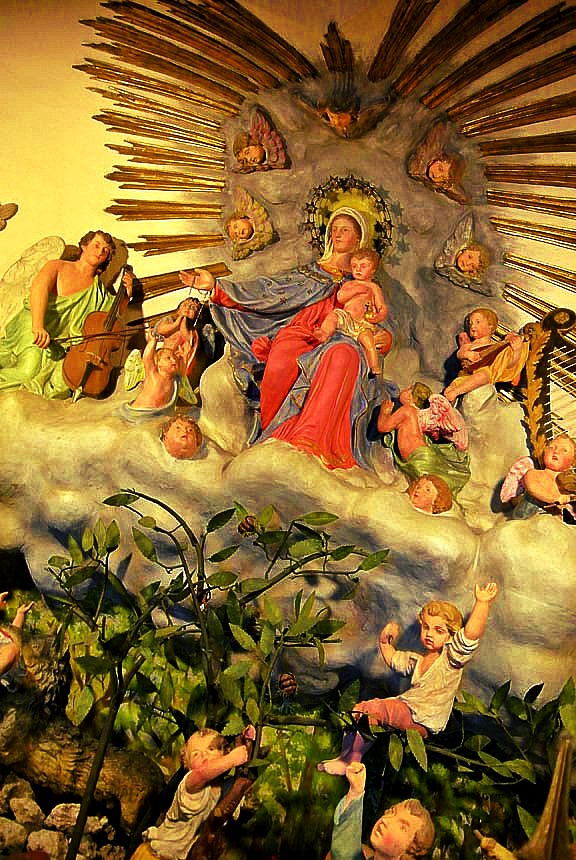
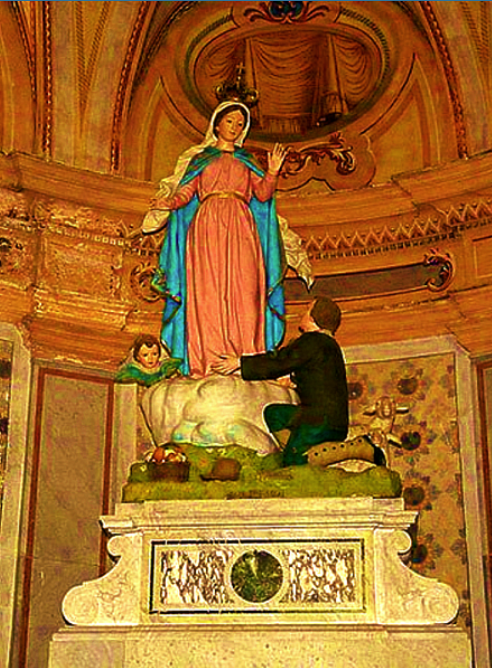
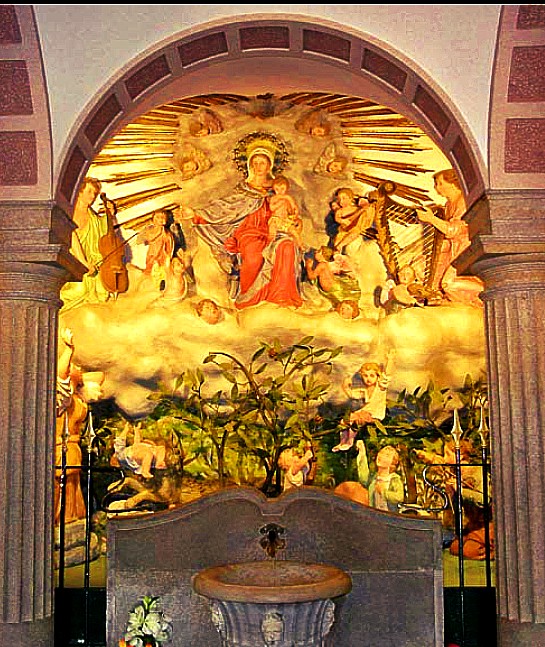
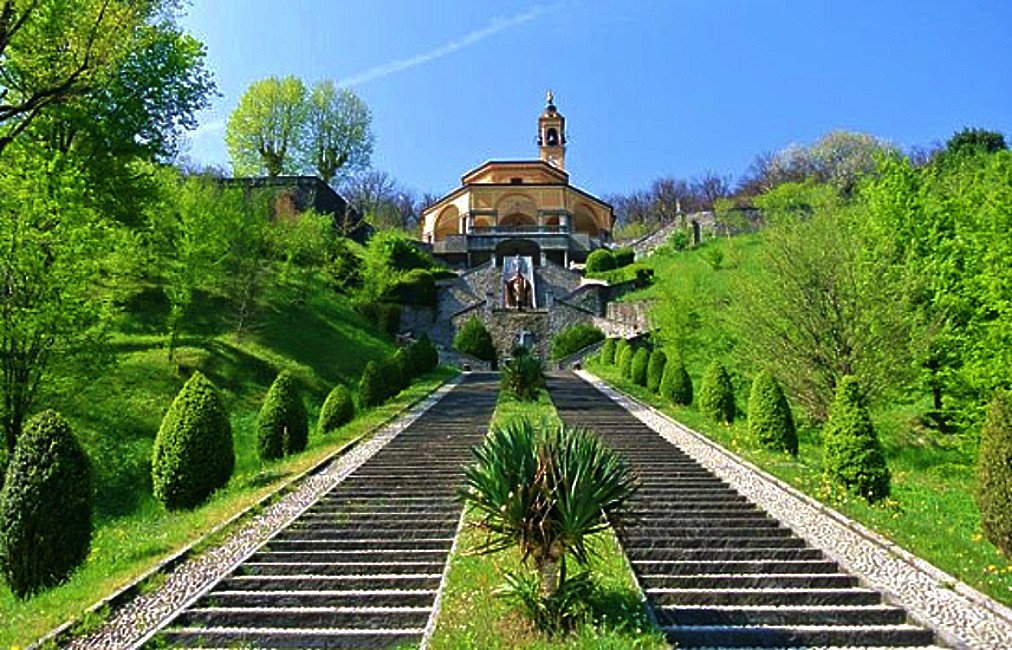
Madonna del Bosco / Our Lady of the Woods, Imbersago, Como, Lombardy, Italy (1617) – 9 May:
On 8 May 1617, three shepherds, one named Peter, saw the Madonna near a large tree, a chestnut tree to be exact. They reported that the apparition rose up and disappeared into the sky. They were believed immediately as that particular and only chestnut tree, was found full of fruit out of its normal season. In 1632 at the site, visited by the Virgin, a Chapel was erected, then replaced with a large and most beautiful Church in 1677., which has since been raised to the status of a Minor Basilica. In it we honor what is called the Madonna del Bosco (The Our Lady of the Woods).u Two years before this apparition, some had seen, in the same place, a lady bathed in light hovering on top of those chestnut trees and heard beautiful songs coming from the spot. Many other miracles occured here, the most well-known being that of a mother whose child was being attacked by wolves, which were very prevalent in the area. She called to the Virgin, who appeared and saved the child from the wolf-attack. The Statue within the Sanctuary commemorates these miracle.s
The main Altarpiece is a depiction of the Madonna and Child above a grove of Chestnut trees (1888).
The Sanctuary can be accessed via the 392 steps of the Scala Santa. Most are linear steps until the end with a scenic sweep of two accesses.
St Banban the Wise St Beatus of Laon St Beatus of Lungern St Brynoth of Scara St Dionysius of Vienne Bl Fortis Gabrielli St Gerontius of Cervia
Blessed Thomas Pickering (c 1621-1679) Martyr, Benedictine Lay Brother
St Vincent of Montes
Martyrs of Persia: 310 Christians murdered together for their faith in Persia. No details about them have survived.
20 Mercedarian Martyrs of Riscala: 20 Mercedarian friars who were murdered by Huguenot heretics for refusing to denounce their faith. 16th century at the Santa Maria convent at Riscala, France.
Thought for the Day – 8 May – “Mary’s Month” Meditations with Antonio Cardinal Bacci (1881-1971)
The Theological Virtues of Our Lady
“We also possess the Catholic faith, or at any rate, believe that we possess it, for we often recite the Creed and were received, at Baptism, into the family of the Catholic Church.
But is our faith alive? When a man is living his faith, he has a constant realisation of the presence of God, Who has created him, maintains him in existence, has redeemed him, loves him and commands him to do good. Otherwise, our faith is dead, for as St James writes, “faith, without works, is dead” (Js 2:26). If our faith is not living, neither is our hope nor our charity.
Let us examine ourselves thoroughly. Perhaps we do not think about God enough and, as a result our faith is weak. Perhaps we place all our hope in earthly things and look for these passing pleasures, which cannot satisfy or hearts. Perhaps we love ourselves and our possessions too much and have too little love for God, our only real good. It maybe that we are constantly seeking our own interests and ease and are lacking in sincere and active charity towards our neighbour, when he is in need, even though he is our brother in Jesus Christ and we should love him as ourselves. If this is the way matters stand, we are not genuine Catholics, for we have not the three theological virtues, which should form the basis of our lives. Neither are we sincere sons of Mary, who possessed these three virtues in an outstanding manner. Let us examine ourselves with a view to forming a few good and earnest resolutions.”













 AnaStpaul
You must be logged in to post a comment.