Quote/s of the Day – 3 May – “Mary’s Month” – Monday of the Fifth Week of Easter, Readings: First: First Corinthians 15: 1-8; Psalm: Psalms 19: 2-3, 4-5; Gospel: John 14: 6-14 and the Feast of Sts Philip and James Apostles and Martyrs
“Whoever has seen me has seen the Father.”
John 14:9
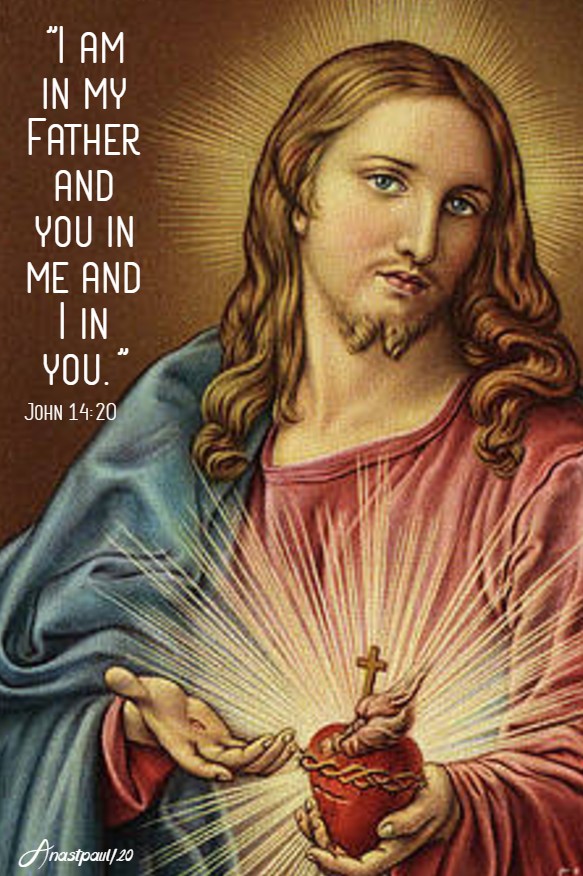
“I am in my Father and you in me and I in you.”
John 14:20
“It is no advantage to be near the light, if the eyes are closed.”
“Faith is to believe what you do not see. The reward of this faith, is to see what you believe.”
One Minute Reflection – 3 May – “Mary’s Month” – Monday of the Fifth Week of Easter, Readings: First: First Corinthians 15: 1-8; Psalm: Psalms 19: 2-3, 4-5; Gospel: John 14: 6-14 and the Feast of Sts Philip and James Apostles and Martyrs
“Jesus said to him, “Have I been with you for so long a time and you still do not know me, Philip? Whoever has seen me has seen the Father. How can you say, ‘Show us the Father’? …” -John 14:9
REFLECTION – “In the Church, I know of only one image, that is, the image of the unseen God. God has said about this image, “Let us make man [humankind] in our image.” Of this image it is written that Christ is the “effulgence of the glory and impress of His hypostasis.” In that image, I perceive the Father, as the Lord Jesus Himself has said, “The one who has seen me has seen the Father.” For this image is not separated from the Father, which indeed, has taught me the unity of the Trinity, saying, “I and the Father are one” and again, “All things whatever the Father has are mine.” [In this image, also perceive] the Holy Spirit, seeing that the Spirit is Christ’s and has received of Christ, as it is written, “He shall receive of mine and shall announce it to you.” – St Ambrose (340-397) Bishop of Milan, Father and one of the original four Doctors of the Latin Church( – Sermon Against Auxentius, 32)
PRAYER – Lord God, each year You grant us the blessing of celebrating with joy, the feast day of Your Apostles and Martyrs Saints Philip and James. Make us partners with them by their prayers, in the Passion and Resurrection of Your only-begotten Son, so that we may come, with them, to the eternal vision of Your glory. We make our prayer through Jesus Christ, our Lord in the unity of the Holy Spirit, one God now and forever, amen.
Our Morning Offering – 3 May – “Mary’s Month” – Monday of the Fifth Week of Easter
Mary, Mother of Grace St Athanasius (297-373) Father & Doctor (whose Feast we celebrated yesterday, 2 May)
It becomes you to be mindful of us, as you stand near Him who granted you all graces, for you are the Mother of God and our Queen. Help us for the sake of the King, the Lord God and Master, Who was born of you. For this reason, you are called full of grace. Remember us, most holy Virgin, and bestow on us gifts from the riches of your graces, Virgin full of graces. Amen
Saint of the Day – 3 May – Saint Ansfrid of Utrecht (c 940-1010) Bishop, Count of Huy and the sword-bearer and Knight for Otto I, Holy Roman Emperor. He became Bishop of Utrecht in 995. He appears to have been the son or grandson of Lambert, a nobleman of the Maasgau, the area where he later founded the Abbeys of Thorn and Heiligenberg and to have been related to various important contemporaries including the royal family. Born in c 940 in the Brabant region of the Netherlands and died on 3 May 1010 in Amersfoort, Netherlands of natural causes. Patronage – Amersfoort. He is also known as Ansfridus, Ansfried, Ansfrido.
The young Knight St Ansfrid in the Abbey Church of Heiligenberg
The principal source of information regarding Ansfrid is the De diversitatem temporum by the Benedictine Albert of Metz, written around 1022.
Ansfrid had the same name as a paternal uncle, Ansfrid the elder, a Count who held 15 counties. The young Ansfrid studied secular and clerical subjects under another paternal uncle, Robert, Archbishop of Trier, before attending the Cathedral school at Cologne.
In 961, Otto I took Ansfrid into his personal service and made him his swordbearer. When Otto was in Rome the following year to be crowned Holy Roman Emperor, he directed Ansfrid to keep close at hand ,with the sword as a precaution against any unforeseen eventualities.
Because of his Christian commitment, he was highly respected and an important Knight of the Emperor’s circle, holding rich possessions along the Meuse, in Brabant and Gelderland. Possibly all or some of his counties were inherited from his paternal uncle of the same name. As Count, he had considerable success in suppressing piracy and armed robbery. In 985, Otto III granted Ansfrid the right to mint coins at Medemblik, on the north-south shipping route through the Vlie, as well as, the income from tolls and tax collecting.
He was married to Heresuint or Hilsondis. They had one child, Benedicta. He founded a Romanesque Abbey Church on his wife’s estate at Thorn under the patronage of St Michael. The Abbey itself had a double cloister that housed both man and women religious. Ansfrid planned it as a place of retirement for himself and his family after he left public service. His wife was to be the first Abbess but she died on her way there and Benedicta, their daughter, took her place.
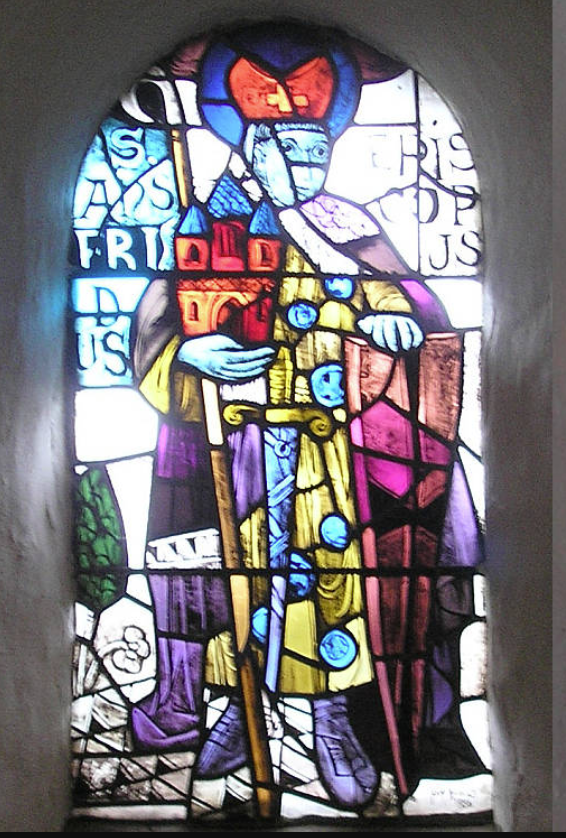
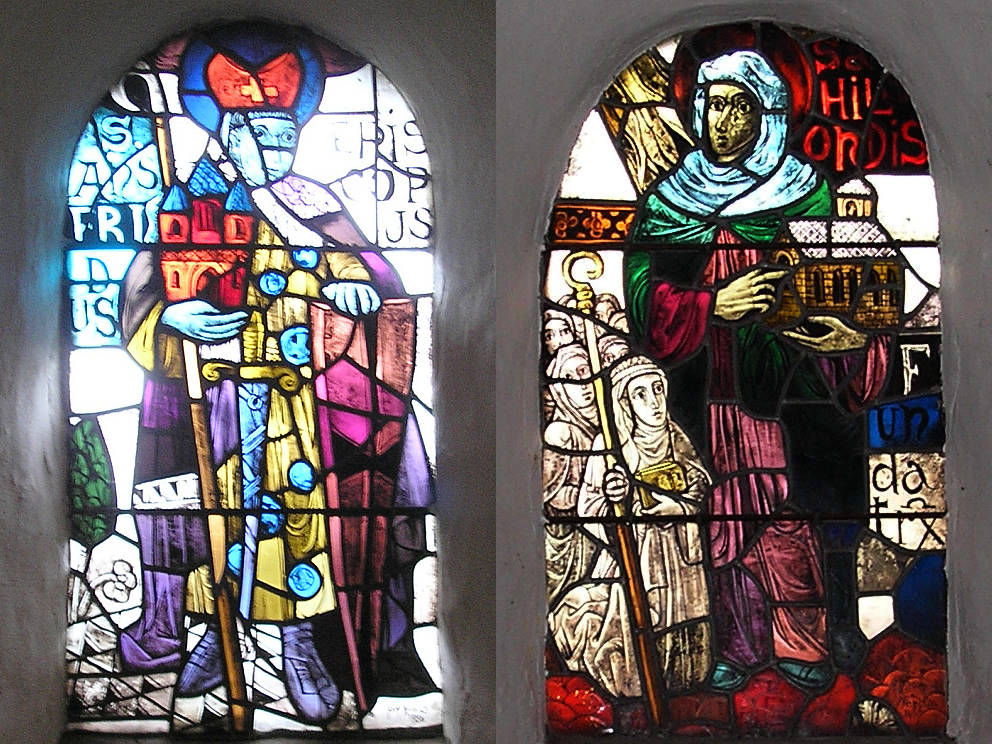
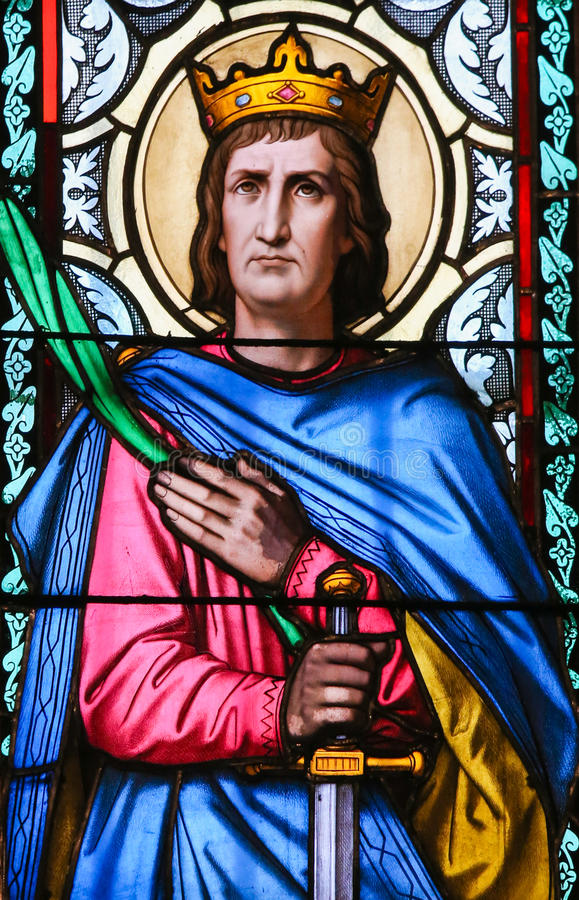
sT Ansfrid and Hilsondis. Stained glass windows in the Abbey of Thorn
After his wife’s death, Ansfrid desired to retire and become a Monk. However, in 995, Emperor Otto III and Bishop Notker of Liège persuaded the reluctant Ansfrid to assume the then vacant Aee of Utrecht. Ansfrid objected that as he had borne weapons as a Knight, he was unworthy of the office but the Emperor prevailed. The elderly Count laid down his sword on the Altar of St Mary in Aachen and was Ordained Priest and Consecratedas the eighteenth Bishop of Utrecht, in the same ceremony. Bishop Ansfrid never took a commission in the royal army, in contrast to Notger and the Bishop of Cologne.
In 1006 Bishop Ansfrid founded the Abbey of Heiligenberg, also under the patronage of St Michael. Toward the end of his life he became increasingly weakened through fasting and retired there as a Monk, caring for the sick, although almost blind himself.
Upon his death, during the funeral, the faithful of Heiligenberg took possession of his body, while the people of Utrecht were extinguishing a not coincidental fire. The Abbess of Thorn mediated and Ansfrid was buried in the Cathedral of Saint Martin in Utrecht.
St Ansfrid, fine bronze of the fountain “Li bassinia” in Huy
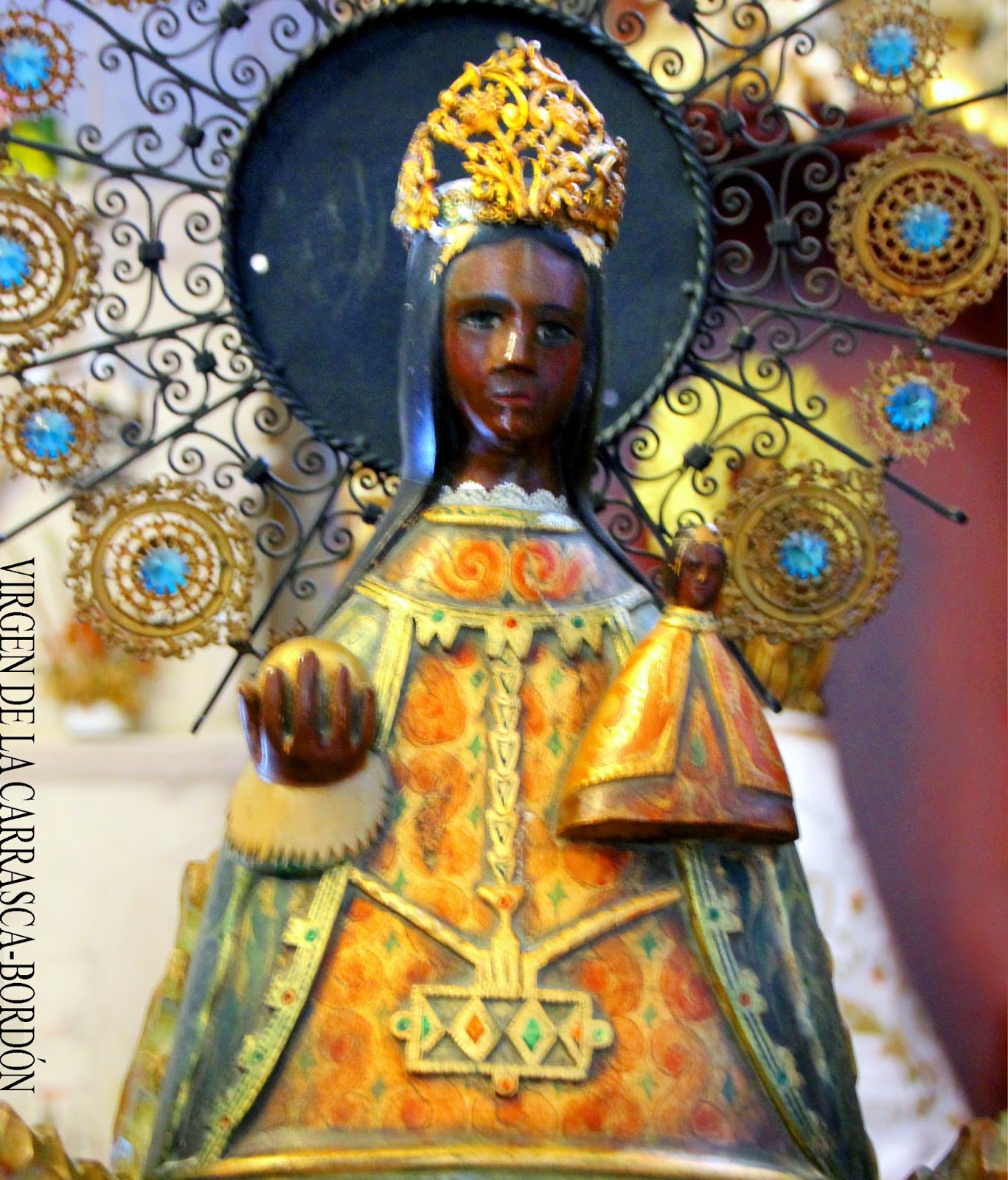
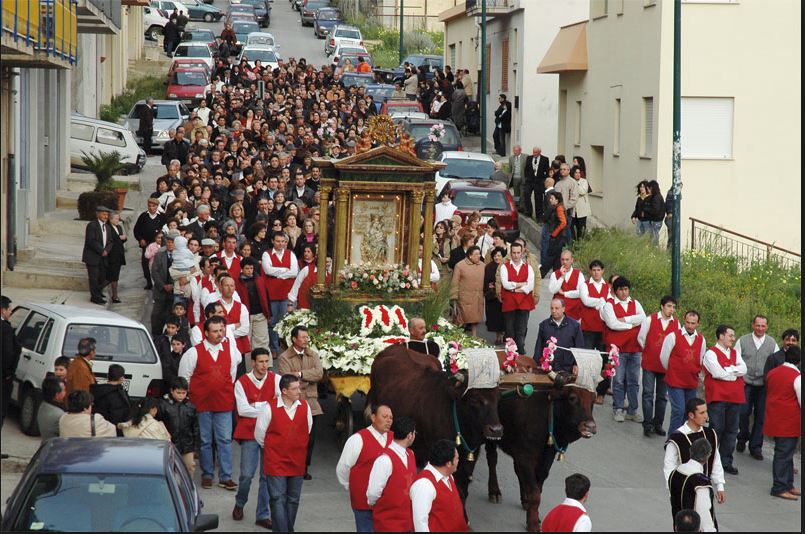
Virgen de la Carrasca, Bordón, Teruel, Aragón, Spain (1212) – 3 May:
Commemorated on First Monday of May
In 1212, a herder found an image of the Virgin in a holm oak (carrasca) in the rocky countryside of Aragón in Spaon. There are several stories about what happened then, all of them ending with a Shrine in Bordón. Templars carried the Statue to Castellote, 12 miles north but the next day the image was back in the oak, the Virgin made those carrying her to Castellote keep turning toward Bordón and springs arose at each turn.
Original Statue
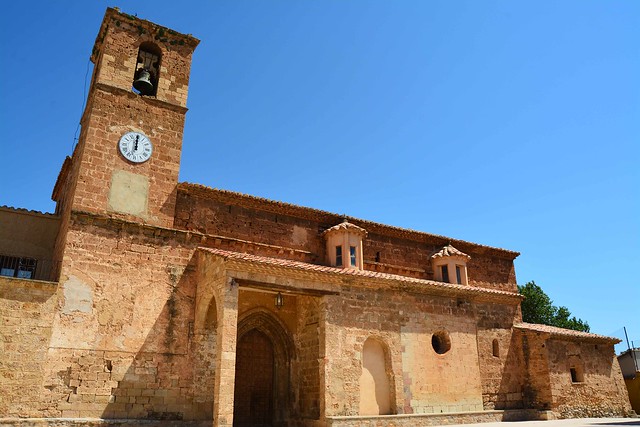
In the place where it was found, a hermitage was built to house it, which would later be replaced by the building that today is the Parish Church of Bordón, built in 1306 by the Templar Order (The Order was dissolved by Pope Clement V in 1312 ).
Although its exterior hardly stands out, its interior is magical and fascinating, a place full of mystery. In one of the Chapels inside, the Templar novices who previously made a pilgrimage on foot from Castellote, capital of the Templar Commandery, performed initiation rites to become Knights of the Order.
In the 18th century, the interior of the Church was covered with marvellous frescoes, which have been recently restored. Unfortunately, the venerated carving of the Black Virgin of the Carrasca was lost during the Civil War, along with another very famous Romanesque carving with a reputation for miraculously calming storms, the Virgin of the Spider, only a series of photographs being preserved, which allowed the making a replica.
Replica Statue
On the first Monday in May, the faithful from the three towns to the south—Tronchón, Olocau del Rey and Mirambel—conduct a processional pilgrimage to the Virgin de la Carrasca. They have done this “from time immemorial,” according to a document of 1390 in the Parish archives of Tronchón.
St Adalsindis of Bèze Bl Adam of Cantalupo in Sabina St Ahmed the Calligrapher St Aldwine of Peartney St Pope Alexander I St Alexander of Constantinople Bl Alexander of Foigny St Alexander of Rome Bl Alexander Vincioli St Ansfrid of Utrecht (c 940-1010) Bishop St Antonina of Constantinople St Diodorus the Deacon
St Ethelwin of Lindsey St Eventius of Rome St Fumac St Gabriel Gowdel St Juvenal of Narni Bl Maria Leonia Paradis St Maura of Antinoe St Peter of Argos St Philip of Zell Bl Ramon Oromí Sullà St Rhodopianus the Deacon St Scannal of Cell-Coleraine Bl Sostenaeus
Thought for the Day – 2 May – Meditations with Antonio Cardinal Bacci (1881-1971)
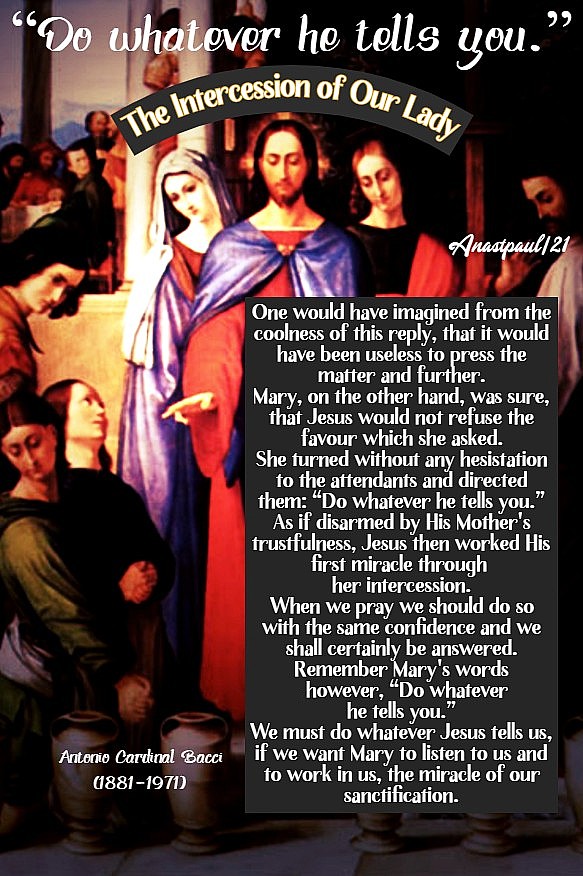
The Intercession of Our Lady
“There is a passage in the Gospel which illustrates, in outstanding fashion, Mary’s great power of intercession. St John relates (Cf Jn 2:1-2) that, along with Mary and the Apostles, Jesus took part at a wedding celebration in Cana of Galilee. During the banquet, the wine ran short. Mary realised how embarrassing this would be for the young couple and took pity on them. She said to Jesus in a tone of request: “They have no wine.” But Jesus seemed quite indifferent to her appeal. “What would thou have me do, woman?” He said, “My hour has not yet come.”
One would have imagined from the coolness of this reply, that it would have been useless to press the matter and further. Mary, on the other hand, was sure, that Jesus would not refuse the favour which she asked. She turned without any hesistation to the attendants and directed them: “Do whatever he tells you.”
As if disarmed by His Mother’s trustfulness, Jesus then worked His first miracle through her intercession. When we pray we should do so with the same confidence and we shall certainly be answered.
Remember Mary’s words,however, “Do whatever he tells you.” We must do whatever Jesus tells us, if we want Mary to listen to us and to work in us, the miracle of our sanctification. If we desire to be true sons of Mary, her advice to us, is to carry out the commands of Jesus Christ.”
Quote/s of the Day – 2 May – “Mary’s Month” – and the Memorial of St Athanasius (297-373) Father & Doctor of the Church
“If we follow Christ closely we shall be allowed, even on this earth, to stand, as it were, on the threshold of the heavenly Jerusalem and enjoy the contemplation, pf that everlasting feast, like the blessed Apostles, who, in following the Saviour as their leader, showed and still show, the way to obtain the same gift from God. They said – See, we have left all things and followed You. We too follow the Lord and we keep His feast by deeds rather than by words.”
“He cries out, saying: See, I am with you all the days of this age. He is Himself the shepherd, the high priest, the way and the door, and has become all things at once for us.”
“Mary, Mother of Grace, it becomes you to be mindful of us, as you stand near Him who granted you all graces, for you are the Mother of God and our Queen. Help us for the sake of the King, the Lord God and Master, Who was born of you.”
One Minute Reflection – 2 May – The Fifth Sunday of Easter, Readings: Acts 9:26-31, Psalm: Psalms 22: 26-27, 28, 30, 31-32 (26a), Second: First John 3: 18-24, Gospel: John 15: 1-8 and the Memorial of St Athanasius (297-373)
“I am the vine, you the branches; he that abides in me and I in him, the same bears much fruit; for without me you can do nothing.” – John 15:5
REFLECTION – “I must warn each of you about His vine – for who has never cut back everything that is superfluous in himself ,to the point of thinking that there is nothing more to cut?
Believe me, what has been cut, grows back; the vices that have been chased away return and we see tendencies that had gone to sleep, waking up again. It is, therefore, not enough to cut one’s vine once; rather, we have to do it again and often and if possible, even without ceasing. For if you are sincere, you ceaselessly find in yourself ,something to cut…
Virtue cannot grow among the vices; for virtue to develop, we must prevent the vices from increasing. So suppress what is superfluous; then the necessary will be able to spring up.
For us, Brothers, it is always the time for cutting, it is always necessary. For I am sure that we have already left winter behind us, we have left behind the fear without love, which introduces us all to wisdom but which doesn’t let anyone grow in perfection. When love comes, it chases away that fear just as the summer chases away the winter… So may the winter rains stop, that is say, the tears of anguish that arise because of the memory of your sins and the fear of judgement… If “the winter is over” and “the rain has topped” (Song 2:11)… the sweetness of the spring of spiritual grace shows us, that the time has come to cut our vine. What else is there for us to do other than to become entirely committed to this work?” – St Bernard (1091-1153) Mellifluous Doctor of the Church – Sermon 58 on the Song of Songs
PRAYER – Holy God and Father, help us to discern through prayer and meditation what You truly want of us. Then enable us to offer it to You and indeed, to offer ourselves and all we have and all we are, to You. When You bring us sufferings to mould us closer and make us more like You, help us to accept them and offer them back to You. Following Your divine Son, let us pick up those crosses in peace and love. Our Lady Holy Mother of Our Lord and our own, pray for us! St Athanasius, pray for us. Through Christ our Lord, with the Holy Spirit, God now and forever, amen.
Our Morning Offering – 2 May – Fifth Sunday of Easter
Prayer to the Blessed Virgin Mary Before Holy Mass
O most blessed Virgin Mary, Mother of tenderness and mercy, I, a miserable and unworthy sinner, fly to you with all the affection of my heart and I beseech your motherly love, that, as you stood by your most dear Son, while He hung on the Cross, so, in your kindness, you may be pleased to stand by me, a poor sinner, and all Priests who today are offering the Sacrifice here and throughout the entire holy Church, so that with your gracious help we may offer a worthy and acceptable oblation in the sight of the most high and undivided Trinity. Amen.
(This prayer is adapted from the Priests’ Prayers Before each Mass)
Saint of the Day – 2 May – Saint St Zoe of Pamphylia (Died 127) Martyr, Laywoman, Wife and Mother. The Roman Martyrology states of her and her family: “The holy mMartyrs , Exuperius and Zoe, his wife, with their sons, Cyriacus and Theodolus, who suffered under the Emperior Adrian.”
Zoe was married to Saint Exuperius. They had 2 sons, Saint Cyriacus and Saint Theodulus.
They were slaves, and were owned by a rich devout worshipper of the ancient Roman gods in Atalia, Pamphylia. One of Zoe’s duties was to tend the house dogs and prevent them from biting visitors. She rarely saw her husband as he worked the fields, a distance from the house.
Since she worked near a roadway, she gave of her own meagre rations to those even poorer than herself. One pagan feast day, the slaves were given meat to sacrifice to an idol. They refused and the entire family was tortured and murdered.
Nuestra Señora de Oviedo / Our Lady of Oviedo, Spain (711) – 2 May:
The Abbot Orsini wrote: “Our Lady of Oviedo, Spain, where they possess some of the Blessed Virgin’s hair.”
The Cathedral of Oviedo was founded in 781 AD, and enlarged by Alfonso the Chaste, who made Oviedo the Capital of the Kingdom of Asturias. The Chapel was once called the Sancta Ovetensis, owing to the quantity and quality of relics contained in the Camara Santa (Holy Chamber).
There is in the City of Oviedo a Holy Chest that contains many and varied relics. It rests in the Town where King Alfonso II, the Chaste, built a Shrine to house it and there it can be seen even today as it was well over a millennium ago. Like the Arc of the Covenant, or the Holy Grail, it is a singular thing the like of which is almost utterly unknown in the entire history of mankind.
This Holy Chest is made of oak and was skillfully constructed without the use of any nails. It measures roughly four feet by three feet by two feet and has been venerated, by faithful Catholics, since apostolic times. Indeed, it is believed to have been fashioned by devoted disciples of the twelve Apostles. Many men and woman throughout history have given their entire lives in service to the holy relics contained therein, or to save the chest from pagans who sought its destruction. The chest originated in the Holy City of Jerusalem. When the Persain’s attacked and conquered Jerusalem in 614, many priceless relics from the region were gathered and placed in it for protection, as the Persians sought relics to destroy them. The chest was taken for safekeeping to a small community of Catholiacs in Alexandria, Egypt. A short time later, Alexandria was also sacked by the Muslims and the chest was taken across the Mediterranean Sea to Spain, where St Isidore kept it in Seville. Upon St. Isidore’s death, the chest was transferred to the City of Toledo, which was then becoming an important centre in Spain. When the wave of Muslim aggression reached even Toledo in 711, the Holy Chest was taken to the Asturias and hidden in a well in Pelayo’s mountain. The chest has a lock and key but by the time of the eleventh century it had not been opened for hundreds of years. The last time it was known to have been opened was when it was done by a living saint, St Ildephonsus, for in it he had placed a chasuble that the Mother of God herself had given him during an apparition. By the year 1030, the exact contents of the Holy Chest were no longer known. Bishop Ponce of Oviedo and with him many clerics, determined to examine the chest to unlock its secrets. As soon as the lid was raised only the slightest bit, “there burst forth so stupendous a light that the terrified clerics, some of them stricken blind, dropped the lid and fled, leaving the mystery unsolved.” After Mass, on Friday, 13 March 1075, the key was again placed in the lock. On this occasion, God was pleased to reveal the contents of the Holy Chest. The chest contained the Sudarium, mentioned by St John the Evangelist in his Gospel, as the cloth that covered the face of Christ, after the crucifixion. On it can be seen the bloodstains of Our Lord that evidence his passion and death. It alone is a treasure without reckoning… The chest also contained a piece of the True Cross of Our Lord, a small stone of the sepulcher in which He was buried, some of the cloths in which He was wrapped in the manger, several thorns from the Crucifixion, a piece of the earth of Mount Olivet touched by His feet when He ascended into heaven, one of the thirty coins given to Judas, a lock of the Blessed Mother’s hair, the chasuble given by the Virgin Mary to Saint Ildephonsus, a chest of gold and precious stones containing the forehead of St John the Baptist and his hair and a host of other relics from many saints and prophets, including St Stephen, the first martyr, St Mary Magdalene, St Peter the Apostle, St Vincent and the rod of Moses which parted the Red Sea and the manna supplied from heaven during the Exodus from Egypt, and many other priceless relics.
King Alfonso VI commissioned a silversmith to sheath the Holy Chest in gilded silver, adorning it with figures of Our Lord and His angels and saints. It can still be seen even today.”
Cathedral of Oviedo
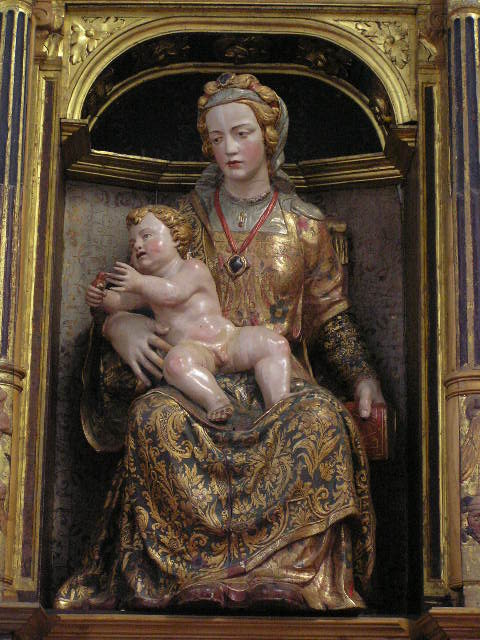
There are numerous Marian images, in their different invocations, which can be seen in the Cathedral of Oviedo. The month of May dedicated to the Virgin inspires a tour of different chapels and altarpieces in which the Immaculate, Virgin Asuntas are preserved, also affectionate Mothers with a Child in their arms, without forgetting the suffering Mothers of the Piedades and ,of course ,the Virgin from Covadonga, our Santina. In the Chapel of Santa María del Rey Casto a small Altarpiece houses one of the most precious Marian images of the Cathedral of Oviedo and which, perhaps, due to its modest size, goes unnoticed. The Altarpiece of Our Lady of Light . This Altarpiece was donated in 1552 by Gutierre González de Cienfuegos, magistrate of Medina del Campo and Salamanca and was placed in the retrochoir of the Cathedral, where it served as an Altar.
Bl Bernard of Seville St Bertinus the Younger Bl Boleslas Strzelecki Bl Conrad of Seldenbüren St Cyriacus of Pamphylia St Eugenius of Africa St Exsuperius of Pamphylia St Felix of Seville St Fiorenzo of Algeria St Gennys of Cornwall St Germanus of Normandy (Died c 460) St Gluvias St Guistano of Sardinia
St Joseph Luu Bl Juan de Verdegallo St Longinus of Africa St Neachtain of Cill-Uinche St Theodulus of Pamphylia St Ultan of Péronne St Vindemialis of Africa St Waldebert of Luxeuil
Bl William Tirry St Zoe of Pamphylia (Died 127) Martyr, Laywoman — Martyrs of Alexandria – 4 saints: A group of Christians marytred together in the persecutions of Diocletian. We know little more than their names – Celestine, Germanus, Neopolus and Saturninus. 304 in Alexandria, Egyp
Thought for the Day – 1 May – Meditations with Antonio Cardinal Bacci (1881-1971)
The Month of Mary
“This work of eradicating of our faults and replacing them by their opposite virtues, is a difficult task which we cannot carry out on our own. Prayer is necessary if we are to obtan the grace which we need. During Mary’s month, we should beseech our heavenly Mother, with greater earnestness, to obtain for us, from her divine Son, the grace which we need to correct the evil in our nature and to perfect it in goodness.
Mary wants us to pray to her because she wishes to obtain for us, the graces which we require. She loves us very much and is ready to help us to become, like her, living imitations of Jesus, insofar as the weakness of our nature will permit.
Among our other prayers, let us remember to give pride of place to the Holy Rosary, whether we recite it in Church or with the family. Let us include, at least a quarter of an hour meditation; a daily visit, however short, to the Blessed Sacrament and to Our Lady’s Altar; an examination of conscience in the evening and many ejaculatory prayers during the day, which will express our love for Mary and for her divine Son.”
Rejoice! It’s 1 May The Month of the Blessed Virgin Mary
The May Magnificat By Gerard Manley Hopkins SJ (1844-1889)
May is Mary’s month, and I Muse at that and wonder why: Her feasts follow reason, Dated due to season-
Candlemas, Lady Day: But the Lady Month, May, Why fasten that upon her, With a feasting in her honour? Ask of her, the mighty Mother: Her reply puts this other Question: What is Spring? Growth in everything- All things rising, all things sizing Mary sees, sympathising With that world of good, Nature’s motherhood.
Well but there was more than this: Spring’s universal bliss Much, had much to say To offering Mary May.
Quote/s of the Day – 1 May – Saturday of the Fourth Week of Easter, Readings: Acts 13:44-52, Psalm 98:1-4, John 14:7-14
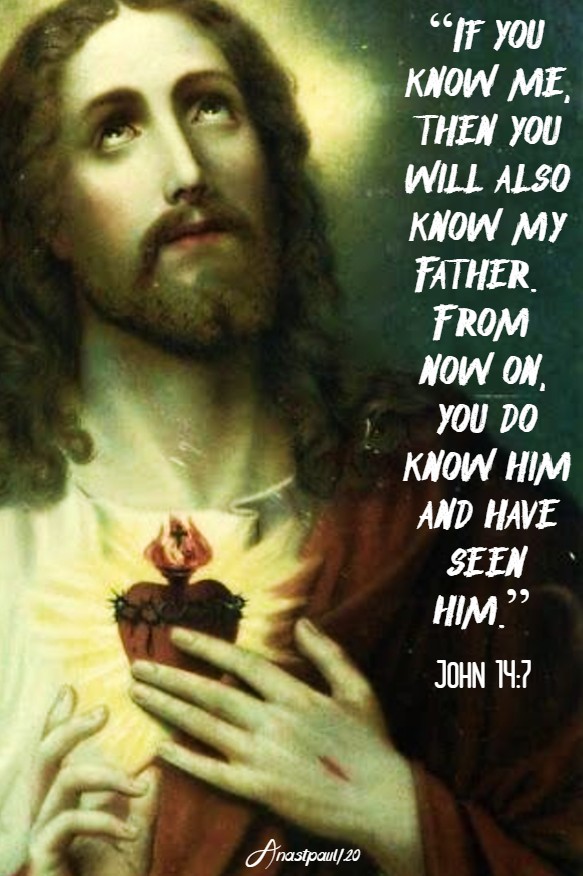
“If you know me, then you will also know my Father. From now on, you do know him and have seen him.”
John 14:7
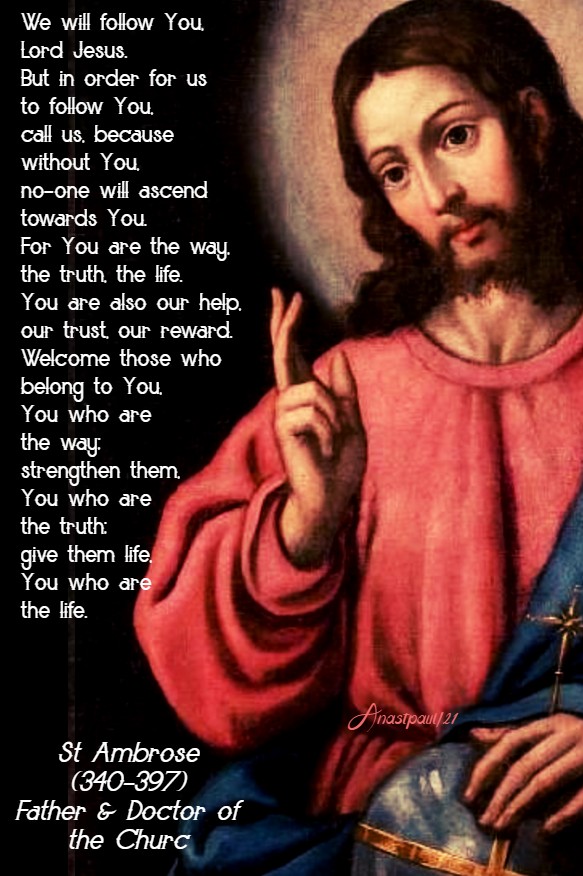
“We will follow You, Lord Jesus. But in order for us to follow You, call us,because without You, no-one will ascend towards You. For You are the way, the truth, the life. You are also our help, our trust, our reward. Welcome those who belong to You, You who are the way; strengthen them, You who are the truth; give them life, You who are the life.”
St Ambrose (340-397) Father & Doctor of the Church
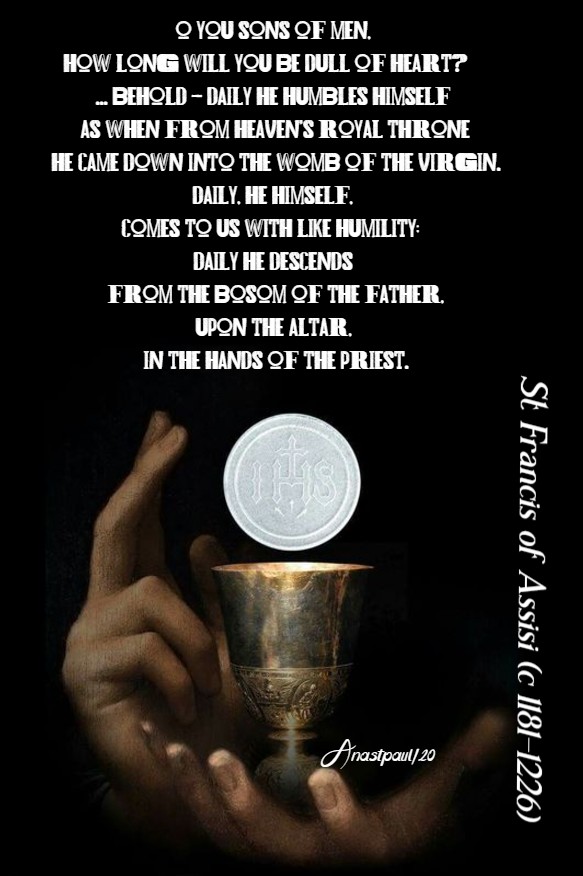
“O you sons of men, how long will you be dull of heart? … Behold – daily He humbles Himself as when from heaven’s royal throne He came down into the womb of the Virgin. Daily, He Himself, comes to us with like humility; daily He descends from the bosom of the Father, upon the Altar, in the hands of the Priest.”
One Minute Reflection – 1 May – Saturday of the Fourth Week of Easter, Readings: Acts 13:44-52, Psalm 98:1-4, John 14:7-14
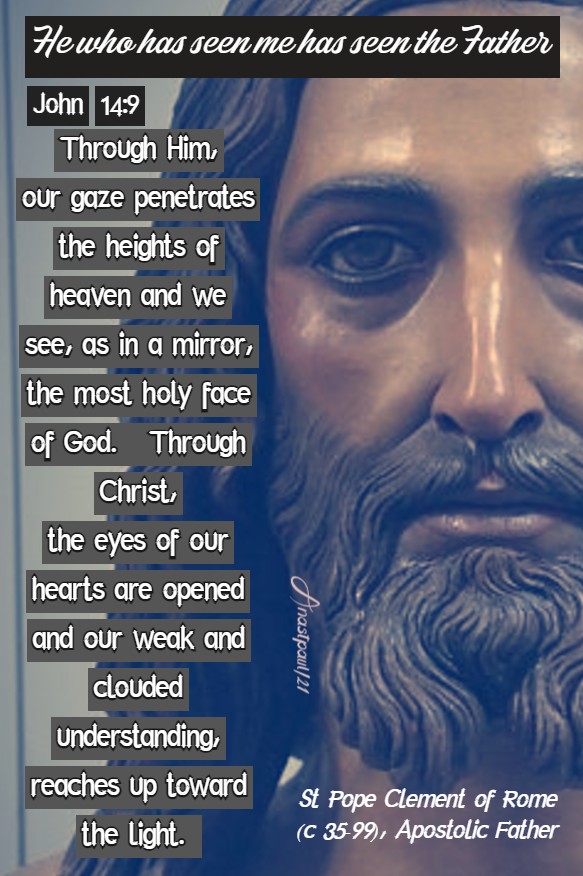
“He who has seen me has seen the Father…”… John 14:9
REFLECTION – “Beloved, Jesus Christ is our salvation, He is the high priest through whom we present our offerings and the helper who supports us in our weakness. Through Him, our gaze penetrates the heights of heaven and we see, as in a mirror, the most holy face of God. Through Christ, the eyes of our hearts are opened and our weak and clouded understanding, reaches up toward the light. Through Him the Lord God willed that we should taste eternal knowledge, for Christ is the radiance of God’s glory and as much greater than the angels as the name God has given Him is superior to theirs. … Think, my brothers, of how we first came into being, of what we were at the first moment of our existence. Think of the dark tomb out of which our Creator brought us into His world, where He had His gifts prepared for us, even before we were born. All this we owe to Him and for everything, we must give Him thanks. To Him be glory forever and ever. Amen.” … St Pope Clement of Rome (c 35-99), Apostolic Father, Bishop of Rome and Martyr – An excerpt from his Letter to the Corinthians
PRAYER – Since it is from You God, our Father, that redemption comes to us, Your adopted children, look with favour on the family You love, give us true freedom and to all who believe in Christ and bring us all alike to our eternal heritage. Grant we pray, that by the prayers of Your holy angels and saints, Blessed Giovanni Benincasa and most especially our beloved Virgin Mary, Mother of Christ, we may run this race always in prayer, trusting in Your divine Son’s intercession, to attain the Glory of Your Kingdom and the Light of Your Face. Through Jesus Christ, in the union of the Holy Spirit, God with You, forever and ever, amen.
Our Morning Offering – 1 May – “Mary’s Month” and Friday of the Third Week of Easter
Hail, O Mary, Mother of God By St Cyril of Alexandria (376-444) Father & Doctor of the Church
Hail, O Mary, Mother of God, Virgin and Mother! Morning Star, perfect vessel. Hail, O Mary, Mother of God, Holy Temple in which god Himself was conceived. Hail, O Mary, Mother of God, Chaste and pure dove. Hail, O Mary, Mother of God, Who enclosed the One who cannot be encompassed in your sacred womb. Hail, O Mary, Mother of God, From you flowed the true light, Jesus Christ, our Lord. Hail, O Mary, Mother of God, Through you the Conqueror and triumphant Vanquisher of hell came to us. Hail, O Mary, Mother of God, Through you, the glory of the Resurrection blossoms. Hail, O Mary, Mother of God, You have saved every faithful Christian. Hail, O Mary, Mother of God, Pray for us sinners now and at the hour of our death. Amen
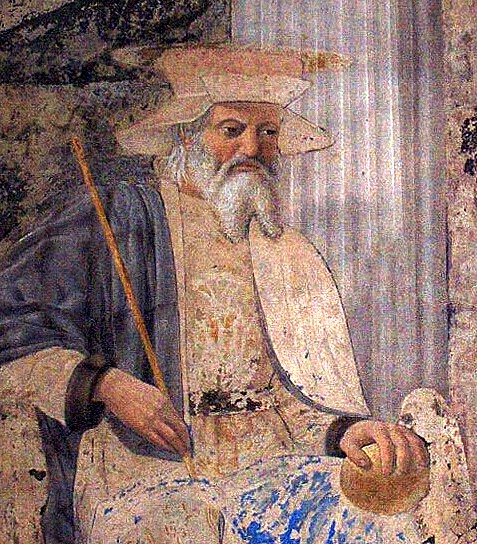
Saint of the Day – 1 May – St Sigismund of Burgundy (Died 524) King and Martyr. King of the Burgundians from 516 until his death, Reforemer, Penitent, apostle of the needy and the poor. Patronages – Czech Republic, Monarchs, Germanic peoples, bibliophiles, Monasteries.
The Roman Martyrology states of him today: “At Siom, i Switzerland, Saint Sigismund, King of the Burgundians, who was drowned in a well and afterwards became renowned for miracles.”
Sigismund succeeded his father Gundobad asKking of the Burgundians in 516. At the time, Burgundy was perhaps the most powerful of all the kingdoms of Gaul – not least because of its strong links with the Byzantine court – and both the Franks and the Ostrogoths were keen to limit Burgundian power.
Sigismund soon established his reputation as a statesman and lawmaker by issuing (in 517) a legal compendium, the Lex Gundobada (more properly known as the Liber Constitutionum). He was equally enthusiastic about reforming the Church and, in the same year, he convened a Council of Burgundiam Bishops with a view to establishing ecclesiastical discipline and dismantling the infrastructure of the Arian Church in Burgundy.
Gundobad had been an Arian, though he seems to have contemplated conversion to Catholicism,and Sigismund converted by 515 – thanks in large part to his association with the Catholic Bishop of Vienne, St Avitus (a poet and man of letters who remained a beacon of classical civilisation in a barbarian world), with whom he maintained a correspondence.
Shortly after his conversion, Sigismund founded the Monastery of St Maurice at Agaune, where he instituted the practice of the laus perennis, according to which (as happened in other royal monasteries in the Germanic world) groups of Monks would chant the psalms in relays in an unceasing round of praise (the sixth century equivalent of perpetual adoration).
In spite of such positive beginnings, Sigismund’s relationship with his Bishops deteriorated. Much more seriously, in 522 his second wife persuaded him that Sigistrix, his son by his deceased first wife, was plotting against him with the intention of killing him and taking control not only of Burgundy but also of Italy.
In a fit of uncontrolled rage, Sigismund had Sigistrix strangled. Once his anger had subsided, he was appalled at the enormity of his crime and retired to St Maurice to do penance, devoting himself to the poor in whose service he distributed part of his wealth.
Whatever he undertook by way of reparation, however, seemed wholly inadequate in view of the horrific nature of the murder of his own son and Sigismund came to believe, that only by suffering some equivalent calamity, could he atone for his sin.
Such a calamity duly occurred when Burgundy was attacked by Chlodomer, the King of Orleans, together with his brothers Childebert and Chlothar (the three brothers were the sons of the Frankish King Clovis whose father had been murdered by Sigismund’s father Gundobad). Sigismund escaped, disguising himself as a monk and hiding in a cell at Agaune, but was captured and taken to Orleans as a prisoner where he was executed (524), by being thrown down a well.
His bones having been recovered, a shrine developed at Agaune and he was soon recognised as a Martyr, though strictly speaking he did not die for his faith, as the motives for his assassination had to do with politics and blood-feuds, rather than with Arian persecution of Catholics.
St Sigismund: Fresco by Piero della Francesca
In fact, he is best remembered not primarily as a Martyr (for all that he endured death in a spirit of faith and courage) but as one of the great penitents – as a man whose profound repentance, culiminating in a death, which at some level he seems to have sought (at least in prayer) by way of atonement for his gravest of crimes, was rightly perceived not only by his contemporaries but also by subsequent generations as a paradigm of a particular kind of Christian sanctity.
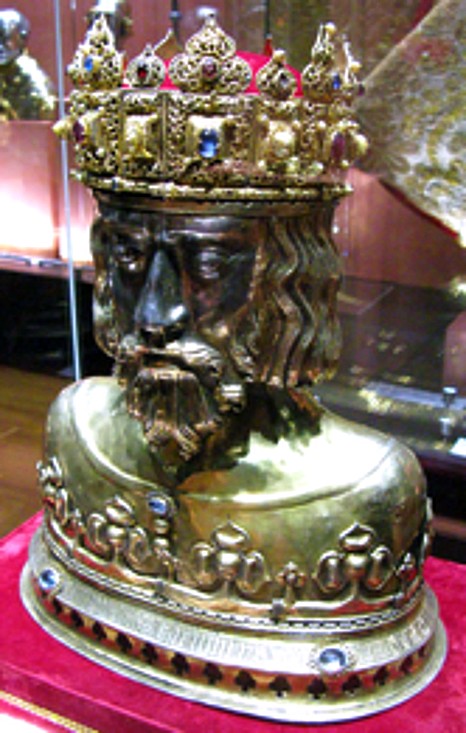
A bust of St Sigismund n Plock
His body was kept honourably at Agaune, until it was removed to the Cathedral of Prague by the Emperor Charles IV. His tomb has been venerated for centuries and has been famous for many miracles. He became a Patron of the Czech Republic, see his Statue on Charles Bridge in Prague, below.
Maria Santissima di Giubino, Siciliy / Madonna of Giubino, Sicily (1655) – 1 May:
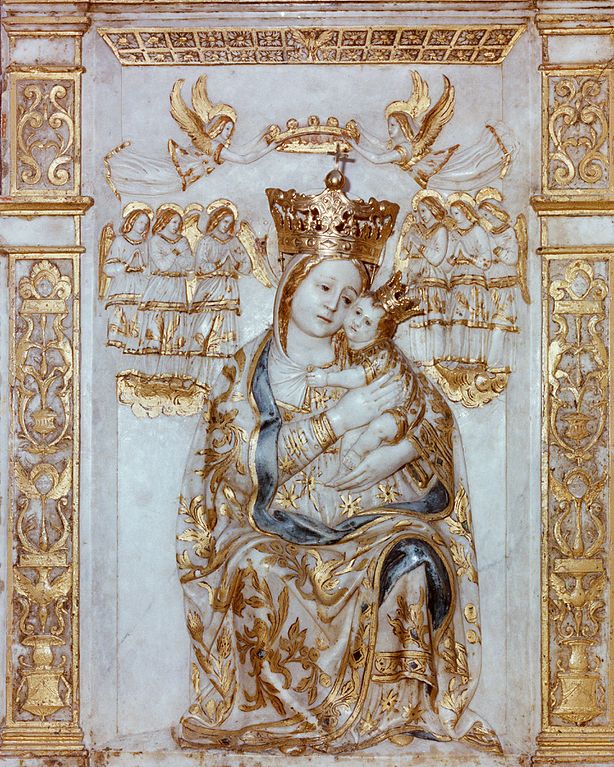
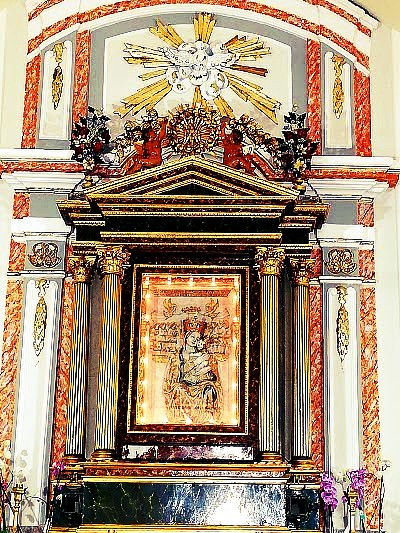
The Church of the Madonna of Giubino was built in 1721 to house a miraculous marble-relief icon of the Madonna. (A copy of the relief is housed in the Church of St Joseph in Brooklyn, New York, giving testimony to the large emigrant community of Calatafimesi who lived in Brooklyn in the early 20th century). The Church of Maria Santissima di Giubino is dedicated to the Patroness of the Town. It has a single nave, with an elegant barrel vault decorated with frescoes and ornamental motifs. Inside there are some important works – the painting with the Assumption, Our Lady with Angels and Saints dated 1617, the Altarpiece of All Saints, an 18th-century wooden organ and a 15th-century marble alto-rilievo representing Madonna of Giubino with the Infant Jesus. In 1655 an invasion of grasshoppers was destroying all the crops in the countryside of Calatafimi. The people, assembled in a Church, decided that, after putting all the names of the Saints who had an aAtar in Town inside a ballot box, they would choose as a Patron that one whose name had been drawn. After they invoked the Holy Ghost, it was chosen the name of Maria Santissima di Giubino by lots. The central part of the triptych with the image of the Virgin was soon taken out from the wall in the country Church of Giubino and taken in procession: with prayer and Holy Mass and thereafter, Calatafimi was free from grasshoppers.
Maria Santissima di Giubino was elected Patroness of the Town (25 April 1655) and the bas-relief of the Virgin of Giubino was then placed on the high Altar of the new Church, designed by Giovanni Biagio Amico (the same planner of the Church of Santissimo Crocifisso) in 1721. In 1931 the triptych was recomposed in the Town Sanctuary and restored.
St Aceolus of Amiens St Acius of Amiens St Aldebrandus of Fossombrone St Amator of Auxerre St Ambrose of Ferentino St Andeolus of Smyrna Bl Arigius of Gap St Arnold of Hiltensweiler St Asaph of Llanelwy St Augustine Schöffler St Benedict of Szkalka OSB (Died 1012) Monk and Hermit St Bertha of Avenay St Bertha of Kent St Brieuc of Brittany St Ceallach of Killala St Cominus of Catania Evermarus of Rousson Bl Felim O’Hara St Grata of Bergamo St Isidora of Egypt St Jeremiah the Prophet St John-Louis Bonnard Bl Klymentii Sheptytskyi St Marculf St Orentius of Auch St Orentius of Loret St Patientia of Loret
St Romanus of Baghdad St Sigismund of Burgundy (Died 524) King and Martyr St Theodard of Narbonne St Thorette St Torquatus of Guadix Blessed Vivald of Gimignano
Martyrs of Amiens: Aceolus Acius
Martyrs of Loret: Orentius Patientia
Martyrs of Vietnam: Augustine Schöffler John-Louis Bonnard












 AnaStpaul
You must be logged in to post a comment.