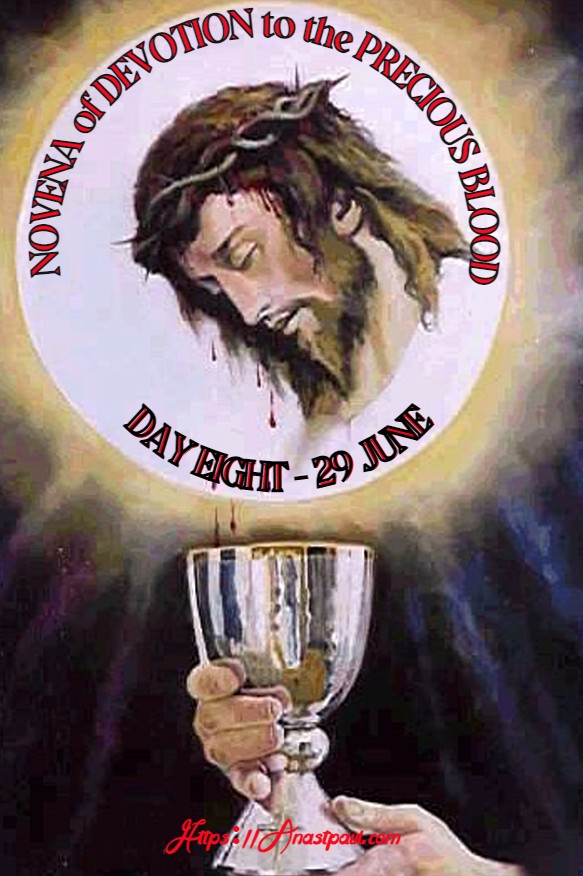
DAY EIGHT – NOVENA of DEVOTION to the PRECIOUS BLOOD of JESUS
Opening Prayer for each Day:
Grant me the grace to know You, to love You and to be truly sorry that I have offended You. I ask this grace by Your Precious Blood – By that Precious Blood, which bathed Your Sacred Body and trickled down to the ground in the Garden of Olives. By that Precious Blood, which poured forth from Your Sacred Body during the scourging. By that Precious Blood, which which covered Your Sacred Face when You were crowned with thorns. By that Precious Blood, which burst from Your hands and feet on Calvary. By that Precious Blood, which came forth from Your Sacred Heart after Your death. By that Precious Blood, which we drink in Holy Communion and of which You said: “He who feeds on My Flesh and drinks My Blood has life eternal.” Amen.
Day Eight : Jesus Sheds Blood in the Piercing of His Sacred Heart
Final prayer:
Eternal Father, we offer You the Precious Blood of Jesus, shed in the piercing of the Sacred Heart of Your Son. Open our hearts to share His life and continue to bless us with His love. Help us renew and live our Baptismal promises. Father of mercy, sanctify Your Church. May the opening of the heart of Your Son be an invitation to all the peoples of the world to live in harmony, peace,and love and to see the only way to eternal life is through the Church, given birth, by the Precious Blood of Christ. Through Jesus Christ our Lord. Amen
Our Father … Glory be …
V. Praise and thanksgiving be evermore to Jesus. R. Who with His Blood has saved us. V. Glory to the Blood of Jesus! R. Now and forever. Amen
Thought for the Day – 29 June – Meditations with Antonio Cardinal Bacci (1881-1971)
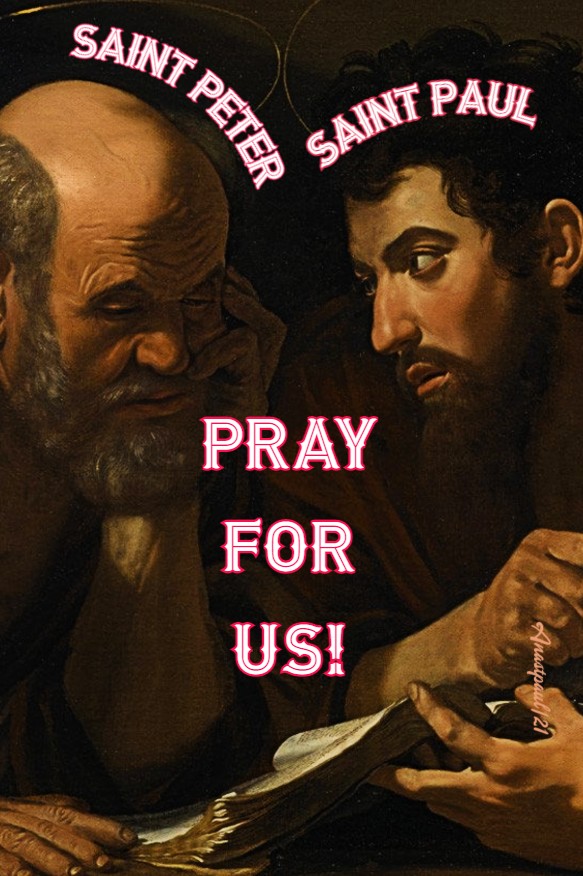
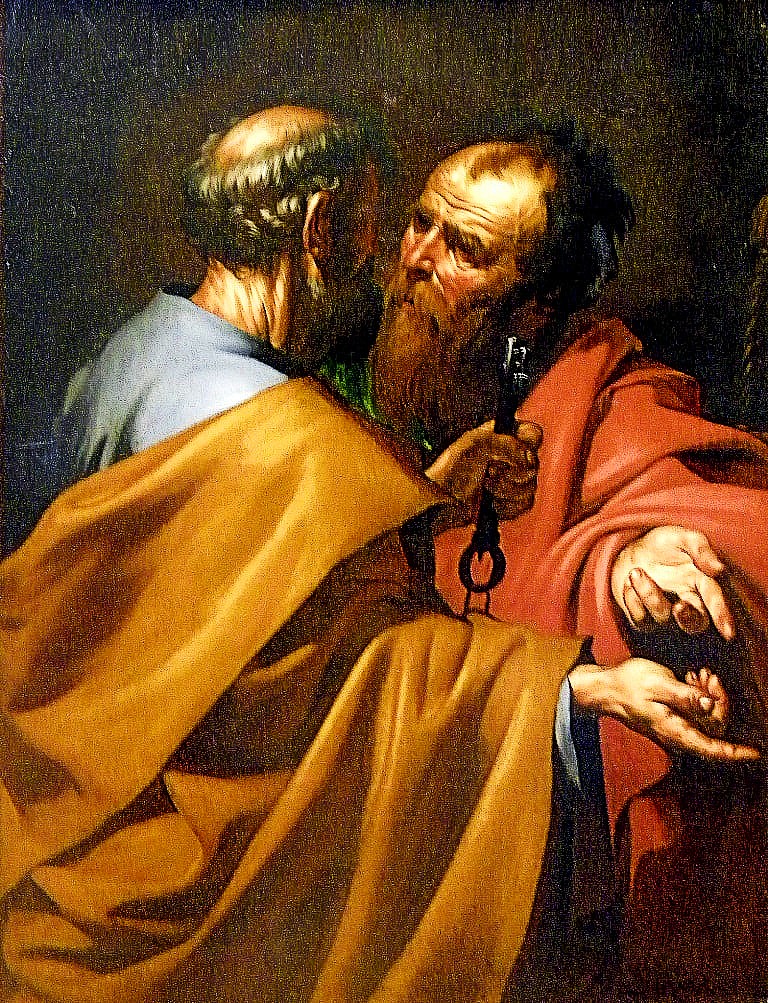
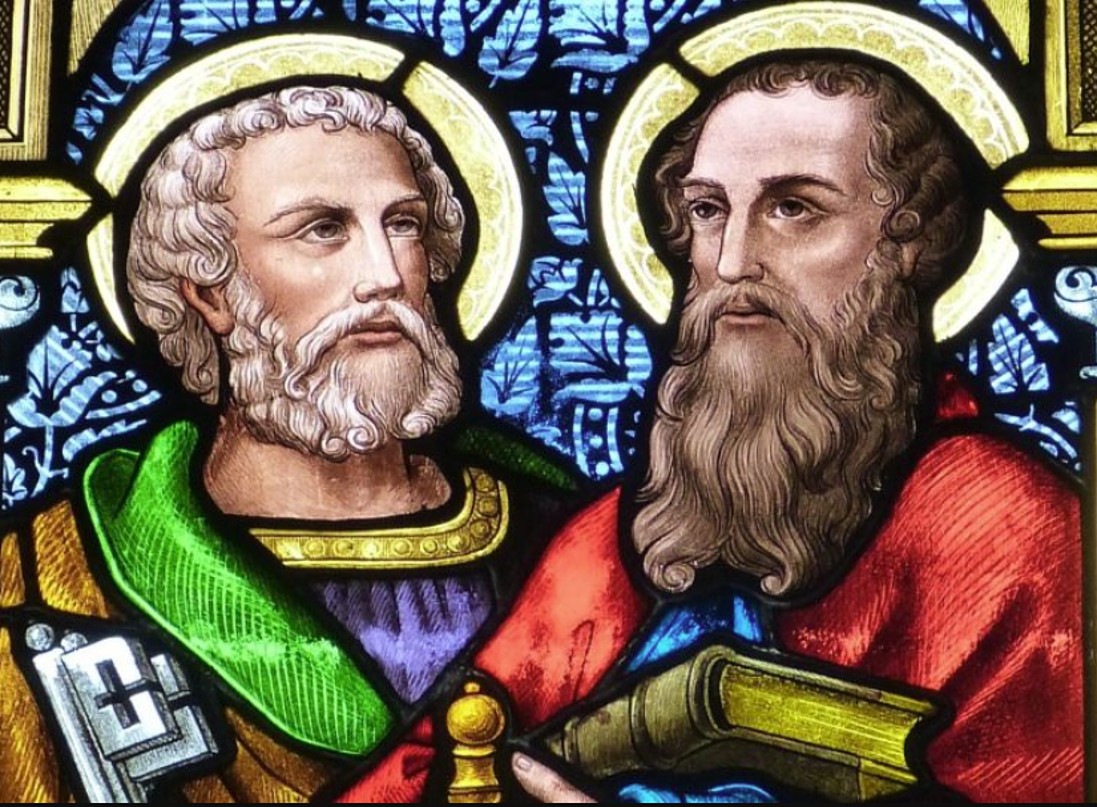
St Peter, Prince of the Apostles St Paul, the Apostle to the Gentiles
“Jesus was walking one day along the shoe of the Sea of Galilee, when He saw two fishermen casting their nets into the water. He approached them and said: “Come, follow me and I will make you fishers of men” (Mk 1:17). These two fishermen were brothers named, Simon and Andrew. The divine Master won their hearts immediately, so that they left their boat and their nets and followed Jesus. Simon was later called Peter and became the leader of the Apostles.
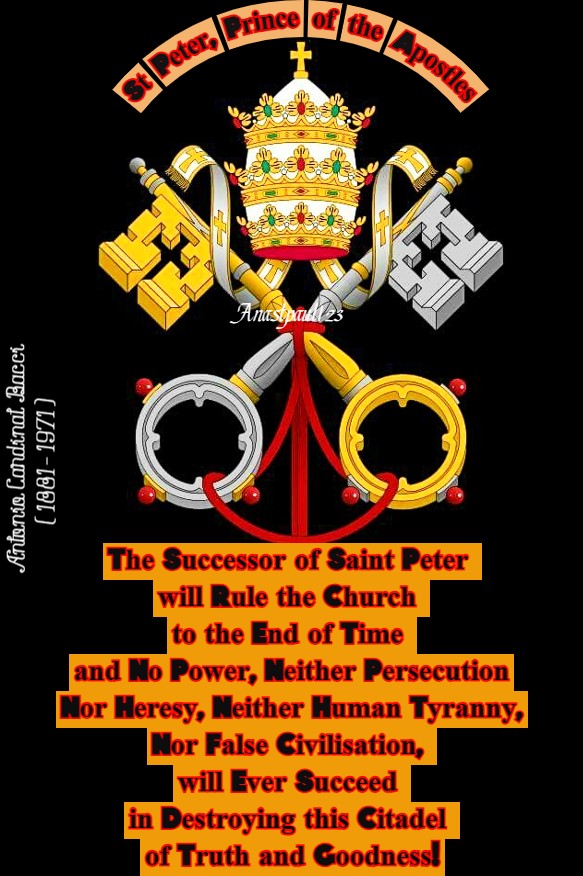
Peter’s generosity and great love for Jesus are evident in the pages of the Gospel. When Our Lord foretold the institution of the Blessed Eucharist, many of His disciples were scandalised and left Him. “Do you also wish to go away?” Jesus asked His Apostles. St Peter answered Him without delay. “Lord, to whom shall we go? Thou has the words of everlasting life and we have come to believe and to know, that Thou are the Christ, the Son of God” (Jn 6:69). On another occasion, Jesus asked His disciples – “Who do men say the Son of Man is?” The Apostles hesitated and began to suggest the names of various Prophets. But St Peter was inspired to make the reply: “Thou are the Christ, the Son of the living God.” Then Our Lord appointed him Head of the Church. “Blessed are thou, Simon Bar-Jona … thou are Peter and upon this rock I will build my Church and the gates of hell, shall not prevail against it. And I will give thee the keys of the kingdom of heaven and whatever you shall bind on earth shall be bound in heaven” (Mt 16:15-19). By these words there was instituted the loftiest and most ancient of the dynasties, the Papacy. The successor of St Peter will rule the Church to the end of time and no power, neither persecution nor heresy, neither human tyranny nor false civilisation, will ever succeed in destroying this citadel of truth and goodness!”
St Paul, the Apostle to the Gentiles
“St Paul was by nature, fiery and zealous. Once he discovered the truth, he was ready to die for it. Originally he was convinced that Judaism contained the whole truth and, for this reason he hated the Christians, whom he regarded as a sect which had corrupted the sacred Hebrew tradition. The deacon Stephen was the first victim of his persecuting zeal. As he was being stoned and beaten to death this saintly young man prayed for his persecutors. It may be that in this moment his eyes, shining with faith and love, encountered those of the man who hated him. Soon afterwards, Saul (this was Paul’s real name), left Jerusalem for Damascus, carrying letters investing him with new powers for the persecution of the infant Church. On the way, this headstrong but sincere enemy of Christianity was suddenly dazzled by a light from Heaven. He fell to the ground and heard a mysterious voice saying: “Saul, Saul, why do thou persecute me?” Terrified he answered: “Who are thou, Lord?” “I am Jesus,” the voice said, “whom thou are persecuting” (Acts 9:1-15). From that day, Saul was changed completely. Under the influence of divine grace, he became the Apostle to the Gentiles.
Before he set out on his missionary journeys, Paul wet apart into the desert of Arabia (Cf Gal 1:17), where, he remained sometime in prayer and recollection. Then he went to Jerusalem to pay homage to the Prince of the Apostles, St Peter (Gal 1:18). After this, he began his apostolic travels, in the course of which, he encountered all kinds of hardships and dangers. The Jews frequently hunted him, in order to put him to death. He was often cruelly scourged and flung into prison and, several times, he was shipwrecked and had miraculous escapes from death (CF 2 Cor 11:23-27). He bore everything joyfully however, in order to prove his liove for Jesus Christ. Charity was always his main incentive. “The love of Christ impels us” (2 Cor 5:14). Charity, he said himself, “Believes all things, hopes all things,edues all things” (Cf 1 Cor 13:4-13). His charity was so great, that he could truthfully say: “Who is weak and I am not weak? Who is made to stumble and I am not inflamed?” (2 Cor 11:29).
St Paul could make this claim because his heart had become identified with the Heart of Jesus. Therefore, he could say: “It is now no longer I that live but Christ lives in me,” (Gal 2:20) and: “For me to live is Christ and to die is gain,” (Phil 1:21) and: “I am hard pressed from both sides, desiring to depart and to be with Christ, a lot by far the better; yet, to stay on in the flesh is necessary, for your sake” (Phil 1:23-24).
Let us meditate on this ardent love of God. Let us cast aside our coldness and indifference and ask St Paul, to set us on fire with divine charity.” Amen
Quote/s of the Day – 29 June – “Month of the Sacred Heart” – The Solemnity of Saints Peter and Paul
“Look at the holy Apostles. It was by sinful jealousy that Peter was subjected to tribulation, not once or twice but many times; it was in that way, that he bore his witness before leaving us for his well-earned place in glory. And Paul, because of jealousy and contention, has become the very type of endurance rewarded. … In him we have one of the greatest of all examples of endurance. … [And] we too, are in the same arena and have the same conflict before us.”
St Pope Clement I of Rome (c 35-99)
Letter to the Corinthians, 5-7
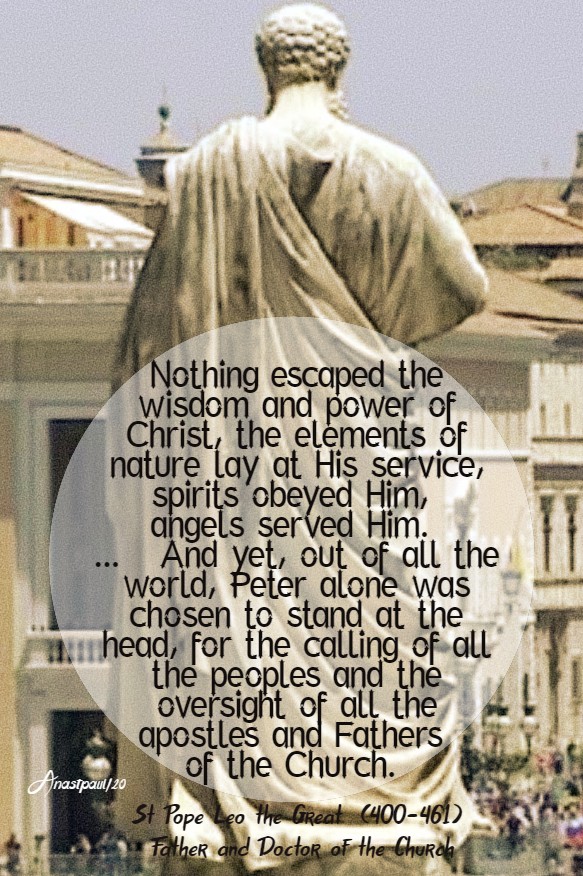
“Nothing escaped the wisdom and power of Christ, the elements of nature lay at His service, spirits obeyed Him, angels served Him. … And yet, out of all the world, Peter alone was chosen to stand at the head, for the calling of all the peoples and the oversight of all the apostles and Fathers of the Church. .”
St Pope Leo the Great (400-461) Father and Doctor of the Church
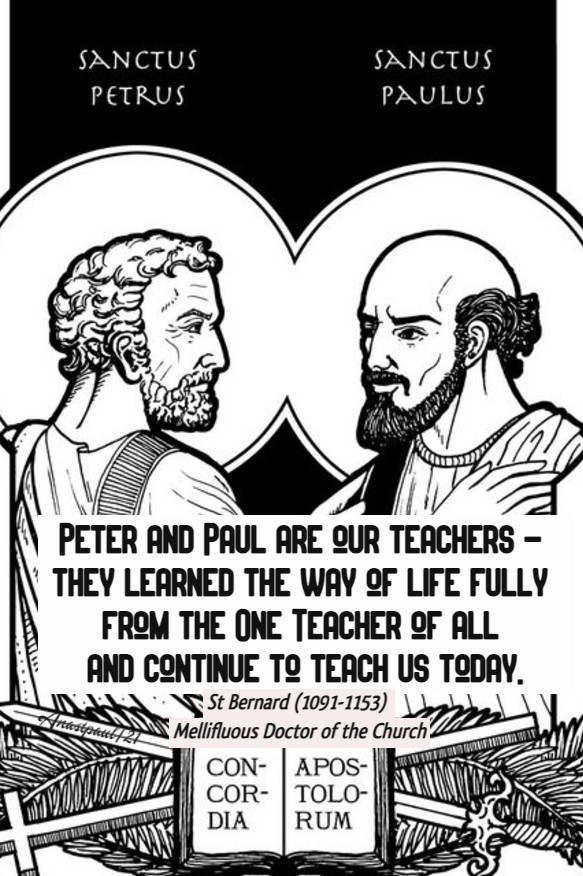
“Peter and Paul are our teachers – they learned the way of life fully from the One Teacher of all and continue to teach us today.”
St Bernard (1091-1153) Mellifluous Doctor of the Church
One Minute Reflection – 29 June – “Month of the Sacred Heart” – The Solemnity of Saints Peter and Paul, Readings: Acts 12:1-11, Psalm 34:2-9, 2 Timothy 4:6-8, 17-18, Matthew 16:13-19
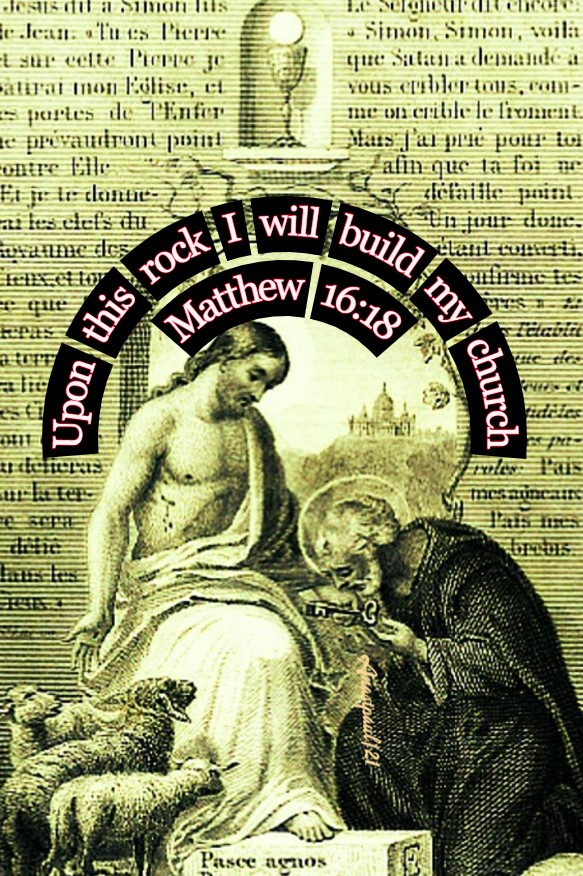
“Upon this rock I will build my church” – Matthew 16:18
REFLECTION –“Though the earth and all who dwell in it quake, I have set firm its pillars” (Ps 74[75],40). All the Apostles are pillars of the earth but, at their head, the two whose feast we are celebrating. They are the two pillars who support the Church with their teaching, their prayer and the example of their steadfastness. The Lord Himself strengthened these pillars. For at first they were weak, completely incapable of supporting either themselves or others. And in this, the Lord’s great design appears – if they had always been strong, people could have thought their strength came from themselves. That is why the Lord wanted to show, what they were capable of, before strengthening them, so that all might know their strength came from God… Peter was thrown to the ground by the voice of a mere servant… and the other pillar was very weak too: “I was once a blasphemer and persecutor and an arrogant man” (1Tm 1,13)…
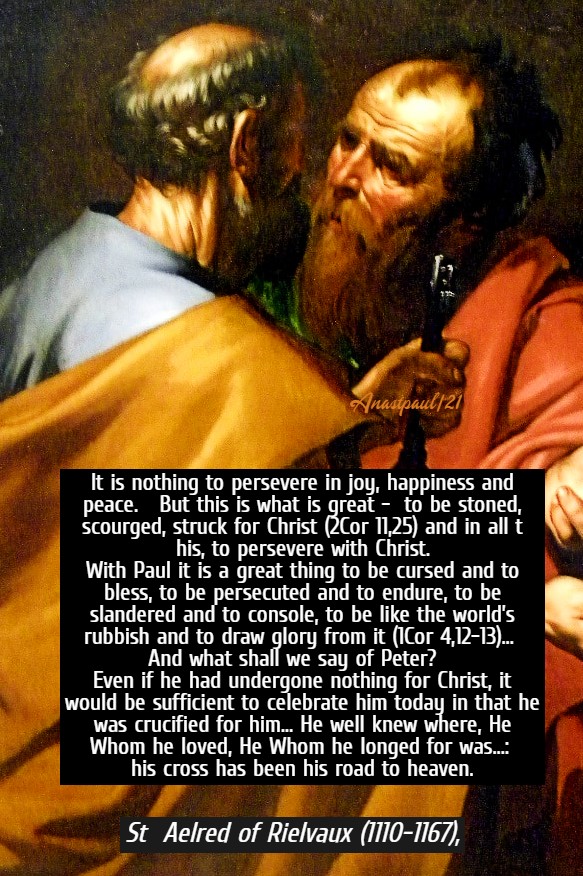
Hence, we ought to praise these Saints with all our heart – our fathers who bore such trials for the Lord’s sake and who persevered with such determination. It is nothing to persevere in joy, happiness and peace. But this is what is great – to be stoned, scourged, struck for Christ (2Cor 11,25) and in all this, to persevere with Christ. With Paul it is a great thing to be cursed and to bless, to be persecuted and to endure, to be slandered and to console, to be like the world’s rubbish and to draw glory from it (1Cor 4,12-13)… And what shall we say of Peter? Even if he had undergone nothing for Christ, it would be sufficient to celebrate him today in that he was crucified for him… He well knew where, He Whom he loved, He whom he longed for was…: his cross has been his road to heaven.” – St Aelred of Rielvaux (1110-1167), Cistercian Monk – Sermon 18, for the Feast of Saints Peter and Paul – PL 195, 298
PRAYER – Almighty ever-living God, You give us the great joy of devoting this day to the honour of the great Apostles Peter and Paul. Grant Your Church may follow their teachings fully because these are the men who first taught us to worship You in Christ, Your Son, Who lives and reigns with You and the Holy Spirit, God forever and ever, amen.
Our Morning Offering – 29 June – The Solemnity of Saints Peter and Paul
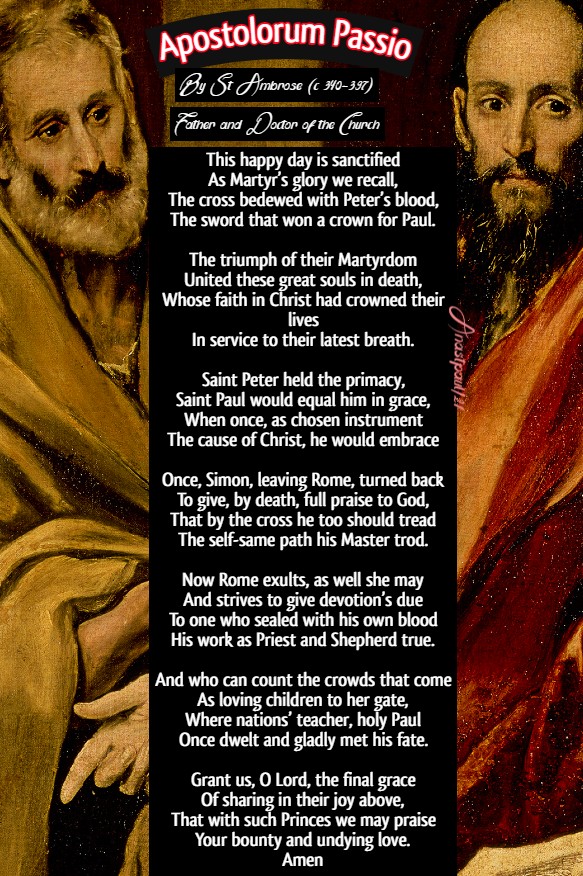
Apostolorum Passio By St Ambrose (c 340-397) Father and Doctor of the Church
This happy day is sanctified As Martyr’s glory we recall, The cross bedewed with Peter’s blood, The sword that won a crown for Paul.
The triumph of their Martyrdom United these great souls in death, Whose faith in Christ had crowned their lives In service to their latest breath.
Saint Peter held the primacy, Saint Paul would equal him in grace, When once, as chosen instrument The cause of Christ, he would embrace
Once, Simon, leaving Rome, turned back To give, by death, full praise to God, That by the cross he too should tread The self-same path his Master trod.
Now Rome exults, as well she may And strives to give devotion’s due To one who sealed with his own blood His work as Priest and Shepherd true.
And who can count the crowds that come As loving children to her gate, Where nations’ teacher, holy Paul Once dwelt and gladly met his fate.
Grant us, O Lord, the final grace Of sharing in their joy above, That with such Princes we may praise Your bounty and undying love. Amen
Translation: The Benedictines of Saint Cecilia’s Abbey, Ryde, UK
Solemnity of Saints Peter and Paul Apostles and Martyrs – 29 June
After the great Solemnities of the movable cycle, and the Feast of St John the Baptist, none is more ancient, nor more universal in the Church, than that of the two Princes of the Apostles. From the beginning, Rome celebrated their triumph on the very day itself which saw them go up from earth to heaven, 29 June. Her practice prevailed, at a very early date, over the custom of several other countries, which put the Apostles’ feast towards the close of December. It was, no doubt, a fair thought which inspired the placing of these Fathers of the Christian people in the cortege of Emmanuel at His entry into this world. But, as we have already seen, today’s teachings have intrinsically an important preponderance in the economy of Christian dogma; – they are the completion of the whole Work of the Son of God – the cross of Peter fixes the Church in her stability and marks out for the Divine Spirit, the immutable centre of His operations. Rome, therefore, was well inspired when, leaving to the Beloved Disciple the honour of presiding over his brethren at the Crib of the Infant God, she maintained the solemn memory of the Princes of the Apostles upon the day chosen by God Himself to consummate their labours and to crown, at once, both their life and the whole cycle of mysteries.
Fully today, do the heavens declare the glory of God, as David expresses it, today do they show us the course of the Spouse completed on the eternal hills (Ps. xviii. 2-6). Day unto day uttereth speech and night unto night revealeth the deep secret (Ibid. 3). From north and south of the new Sion, from either side of her stream, Peter and Paul waft one to other, as a farewell song, as a sacred Epithalamium, the good Word (Ps. xliv. 2); sublime that echo, sonorous its power, vocal still throughout the whole earth (Ibid. xviii. 4, 5), and yet, to resound as long as the world lasts. These two torches of salvation blend their flames above the palaces of ancient Rome; the passing darkness of their death, that night of which the Psalmist sings, now concentrates light, forever, in the midst of the Queen City. Beside the throne of the Bridegroom fixed forever and ever, on yonder seven hills (Ps. xliv. 7-10), the Gentile world, now become the Bride, is resplendent in glory (Eph. v. 27), all fair in that peerless purity which she derives from their blood united, as it is, to that of the Son of God.
But seemly is it, not to forget, on so great a day, those other messengers sent forth by the divine householder and who watered earth’s highways with their sweat and with their blood, the while they hastened the triumph and the gathering in of the guests invited to the Marriage feast (St.Matth. xxii. 8-10). To them is it due, if now the law of grace is definitively promulgated throughout all nations and if, in every language and upon every shore, the good tidings have been sounded (Ps. xviii. 4, 5). Thus the festival of St Peter, completed by the more special memory of St Paul his comrade in death, has been from earliest times regarded as the festival likewise of the whole Apostolic college. In those primitive times it seemed impossible to dream of separating from their glorious leader any of those whom Our Lord had so intimately joined together in the responsibility of one common work. But in course of time, however, particular solemnities were successively consecrated to each one of the Apostles and so, the feast of 29 June was more exclusively attributed to the two Princes whose Martyrdom rendered this day illustrious. (from the Liturgical Year, 1904).
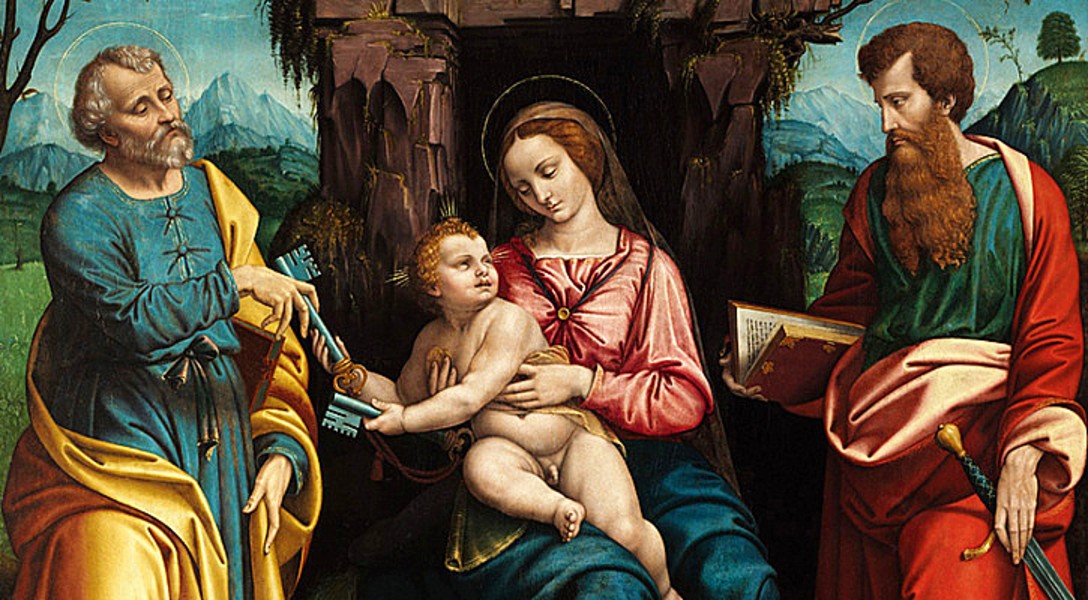
the Virgin and Child with Saints Peter and Paul by Girolamo Figino
Notre-Dame de Buglose / Our Lady of Buglose, France (1634) – 29 June:
Located about two leagues from Acqe in Glascony is the Shrine containing a miraculous image of Our Lady of Buglose. The original Shrine of Notre-Dame de Buglose was burned and completely destroyed by the Huguenots, and the Statue of Our Lady was hidden in a marsh. The exact location of the Statue was eventually forgotten, as was the memory even that the place had once been the location of a Shrine in honour of the Blessed Virgin. Years later, a shepherd led his herd into the marshes and observed that one of his oxen did not go with the others but went into an area of the marsh alone and began to bellow in a strange manner. The shepherd climbed a tree to see what was happening, and saw the ox licking an unknown object that was half buried in the mud. Not understanding the mystery, he ran into Town to bring others back with him to see what had happened. When the shepherd returned, the Statue of the Blessed Virgin holding the baby Jesus in her arms had been revealed. It was respectfully removed from the water and the Bishop of Dax desired to take the image to his Church in Pouy. He placed the Statue in a cart that was pulled by oxen to transport it back to Pouy. The procession began with hymns and prayers but had only gone a short distance, when the oxen stopped and would not move any further. It was understood that the Blessed Virgin desired that her image should stay near the fountain. The Bishop accepted the revelation as a divine order and thanks to the zeal and enthusiastic support of the people living in the region, a new Church was built with prodigious speed. The Shrine was, for a long time, popular as a place of pilgrimage in France – now it is further renowned as the birthplace of Saint Vincent de Paul. The house where he was born and where he spent his boyhood, is still visited as a Museum of the Saint.
|The Basilica of St Vincent de Paul and Our Lady of Buglose
There have been many miracles at the Shrine, as indeed Buglose had become known as a land of miracles. There were 19 miracles recorded in the year 1622 alone. There is a fountain near the Chapel marking the place where the Statue of Our Lady of Buglose was found buried. In 1623, a man named Bernard Ducassou came to the shrine seeking a cure for the seven boils that covered his left leg. He spent the entire night in prayer and the next day bathed at the fountain. The ulcers that would not heal were suddenly closed. Pilgrims still travel to the famous Shrine of Our Lady where miracles are continuously granted to pious devotees.
St Anastasius of Bourges St Benedicta of Sens St Cassius of Narni St Ciwg ap Arawn St Cocha St Ilud Ferch Brychan St Judith of Niederaltaich St Marcellus of Bourges St Mary, the Mother of John Mark St Salome of Niederaltaich St Syrus of Genoa Bl William of Sann — Martyrs of China Ioannes Baptista Wu Mantang Magdalena Du Fengju Maria Du Tianshi Paulus Wu Anju Paulus Wu Wanshu






 AnaStpaul
You must be logged in to post a comment.