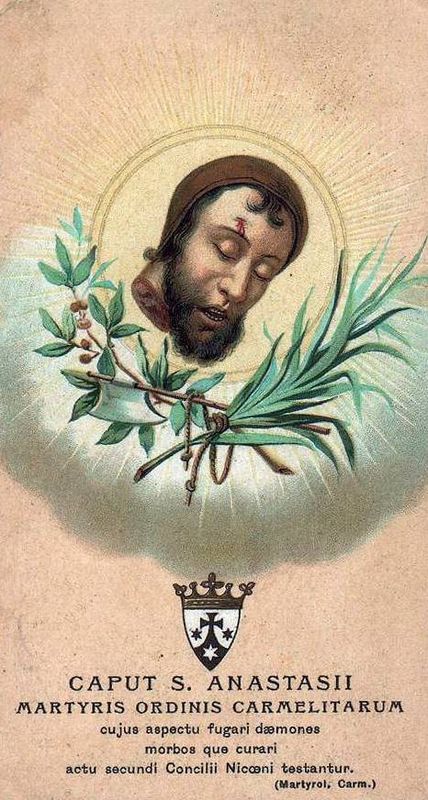
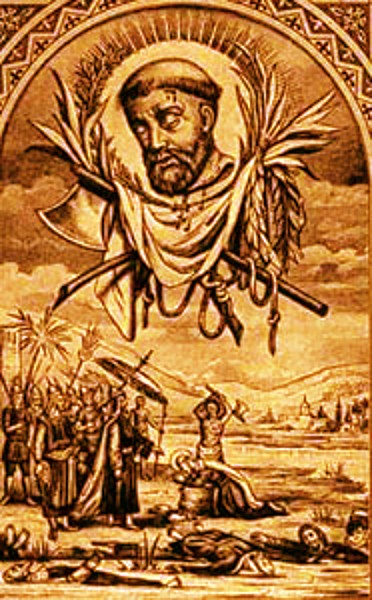
Saint of the Day – 21 January – St Anastasius the Persian (Died 628) Martyr, Monk. Born in Persia as Magundat and died by strangulation and beheading in 628 in Persia. Patronages – against headaches, of goldsmiths.
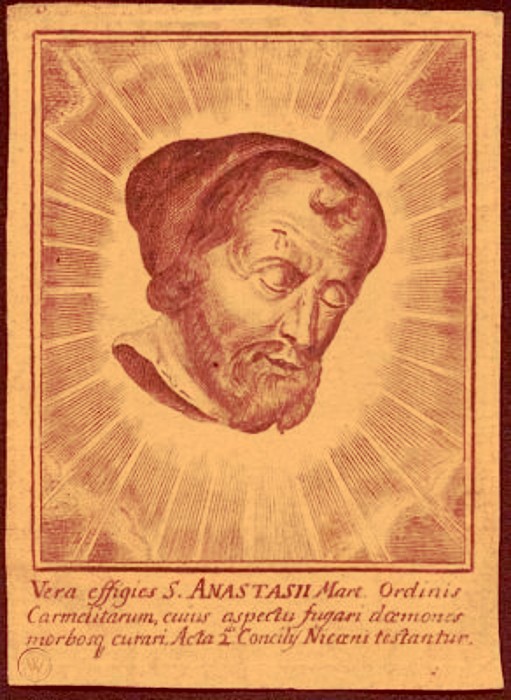
The Roman Martyrology reads: “At Rome, at Aquiae, Salviae, St Anastasius, a Persian Monk, who, after suffering much at Caesarea in Palestine, from imprisonment, stripes and fetters, had to bear many afflictions from Chosroes, King of Persia, who caused him to be beheaded. He had sent before him, to Martyrdom, seventy of his companions, who were precipitated into rivers. His head was brought to Rome, together with his venerable likeness, by the sight of which, the demons are expelled and diseases cured, as is attested by the Acts of the Second Council of Nicacea.”
Anastasius was born in the City of Ray. He was the son of a Magian named Bau. He had a brother whose name is unknown. He was a cavalryman in the army of Khosrow II (590–628) and participated in the capture of the True Cross in Jerusalem which was carried to the Sasanian capital.
The occasion prompted him to ask for information about the Christian religion. He then experienced a conversion of faith, left the army, became a Christian and then a Monk at the Monastery of Saint Savvas (Mar Saba) in Jerusalem.
Anastasius was baptised by St Modestus, the Bishop of Jerusalem, receiving the Christian name Anastasius to honour the Resurrection of Jesus Christ (anástasis” in Greek meaning resurrection).
After seven years of the monastic observance, he was moved by the Holy Ghost to go in quest of Martyrdom and went to Caesarea, then subject to the Sasanians. There he interrupted and ridiculed the pagan priests for their religion and was, as a result, arrested by the local governor, taken prisoner, cruelly tortured to make him deny Christ and finally carried down near the Euphrates river, where his tortures was continued, while at the same time, the highest honours in the service of King Khosrow II, as a Magi, were promised him, if he would renounce Christianity.
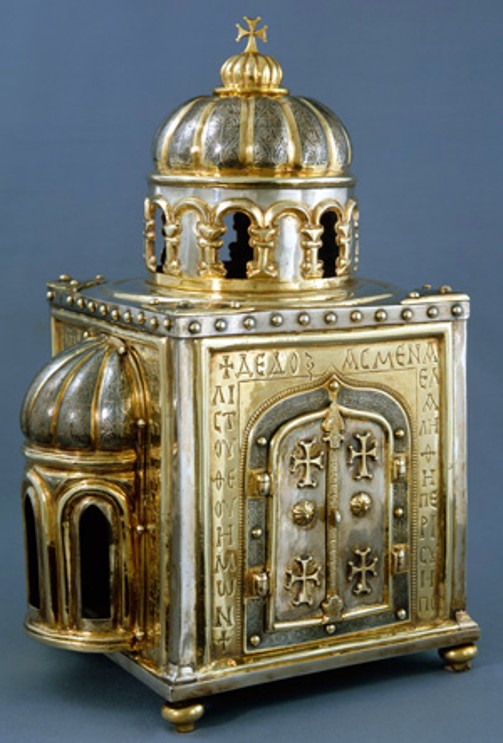
Finally, after refusing to renounce Christ, with seventy others, he was strangled to death and decapitated on 22 January 628. His body, which was thrown to the dogs but was left untouched by them, was carried from there to Palestine, then to Constantinople and finally, to Rome, where the relics were venerated at the Tre Fontane Abbey.
A Passio written in Greek, was devoted to the Saint. An adapted Latin translation, possibly by Archbishop Theodore of Canterbury, was available to the Anglo-Saxon Historian, the Venerable St Bede, who criticised the result and took it upon himself to improve it. There are sadly, no surviving manuscripts of St Bede’s revision, although one copy did survive to the 15th Century.
St Antonio della Chiesa St Blaesilla of Rome St Brithwald of Ramsbury St Caterina Volpicelli St Dominic of Sora
Blessed Giuseppe Giaccardo SSP (1896-1948) St Guadentius of Novara
Blessed Maria Mancini of Pisa OP (1356-1431) Widow, Second Order Sister of the Order of Preachers, spiritual disciple of St Catherine of Siena, Prioress, Mystic, Reformer, Apostle of the poor and the sick. The Roman Martyrology states: “In Pisa, Blessed Maria Mancini, who, twice widowed and all her children lost, under the exhortation of St Catherine of Siena, began community life in the Monastery of St Domenic, which she led for ten years.” Her Life: https://anastpaul.com/2022/01/22/saint-of-the-day-22-january-blessed-maria-mancini-of-pisa-op-1356-1431/
Bl Walter of Himmerode Bl William Patenson
Martyrs of Puigcerda: St Orontius St Victor St Vincent
Thought for the Day – 21 January – Meditations with Antonio Cardinal Bacci (1881-1971)
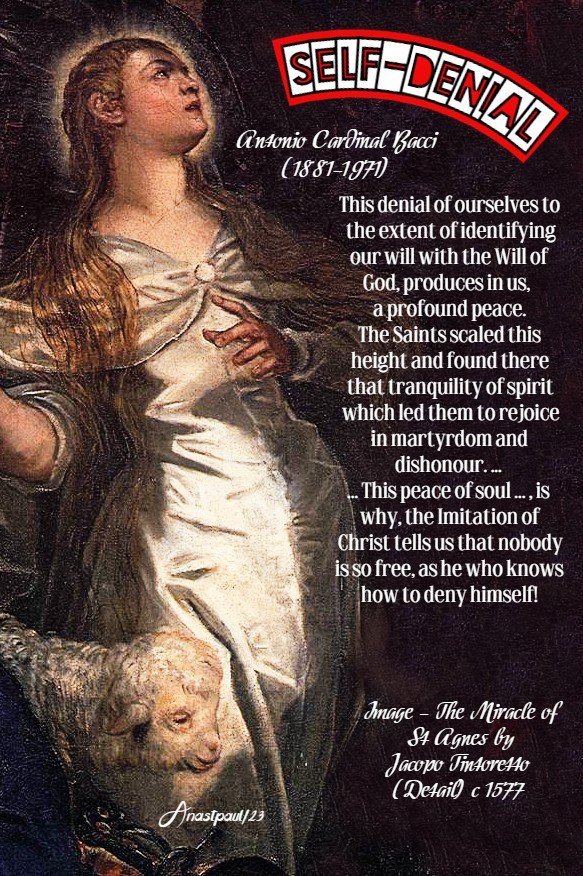
Self-Denial
“This denial of ourselves to the extent of identifying our will with the Will of God, produces in us, a profound peace. The Saints scaled this height and found there that tranquility of spirit which led them to rejoice in martyrdom and dishonour.
It was this peace of soul which made the dying St Aloysius Gonzaga smile and say: “I am happy to be going.” It was this which enabled the saintly, Cardinal Fisher, when he was going to the scaffold, to behold a light which does not fail and say: “Commit to the Lord your way … He will make justice dawn for you like the light (Ps 36:5-6). This too, is why, the Imitation of Christ tells us that nobody is so free, as he who knows how to deny himself!””
Quote/s of the Day – 21 January – “The Month of the Most Holy Name of Jesus” – St Agnes (c 291- c 304) Virgin and Martyr – Ecclesiasticus 51:1-8, 12, Matthew 25:1-13 – Scripture search here: https://www.drbo.org/
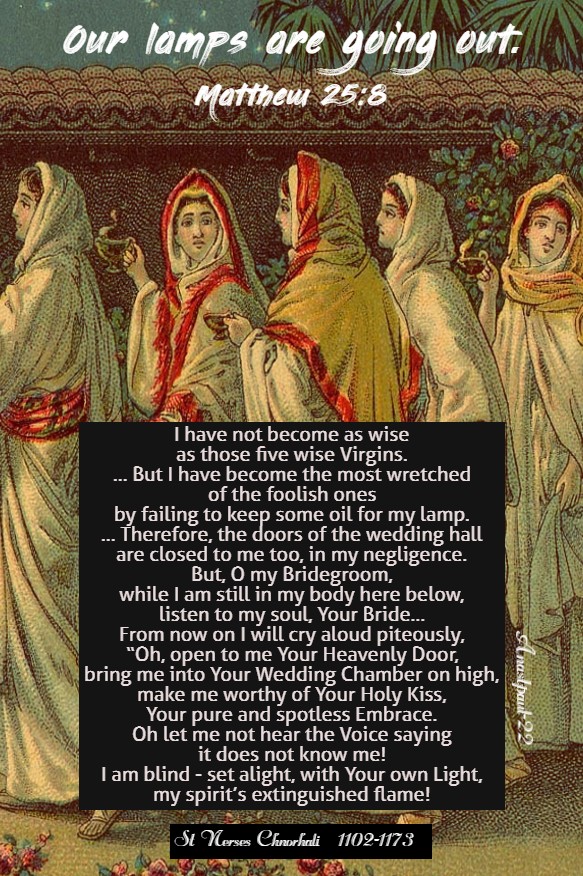
“Our lamps are going out.”
Matthew 25:8
“I have not become as wise as those five wise Virgins. … But I have become the most wretched of the foolish ones by failing to keep some oil for my lamp, namely, mercy together with virginity or, still more, the anointing from Baptism’s Sacred fount…
Therefore, the doors of the wedding hall are closed to me too, in my negligence. But, O my Bridegroom, while I am still in my body here below, listen to my soul, Your Bride… From now on, I will cry aloud piteously, “Oh, open to me Your Heavenly Door, bring me into Your Wedding Chamber on high, make me worthy of Your Holy Kiss, Your pure and spotless Embrace. Oh let me not hear the Voice saying it does not know me! I am blind; set alight with Your own Light my spirit’s extinguished flame!”
St Nerses Chnorhali (1102-1173) Armenian Bishop
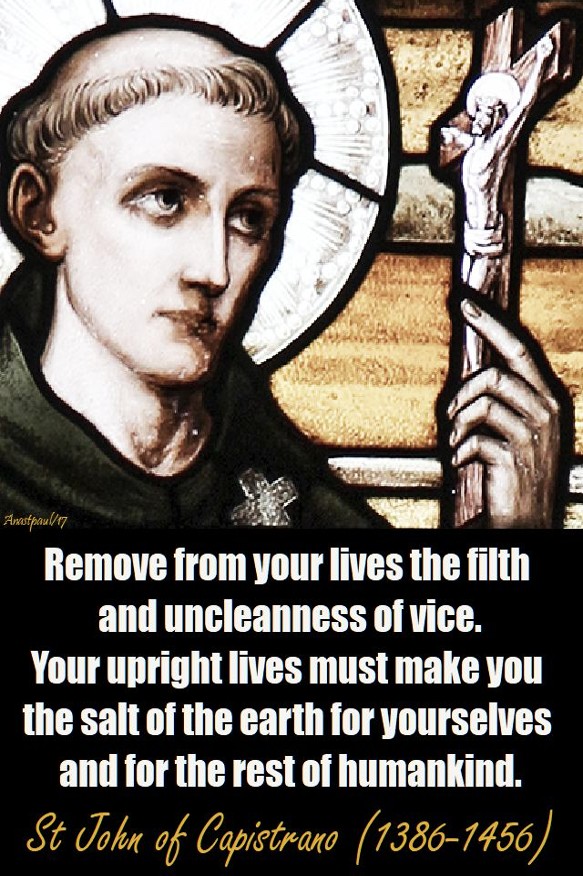
“Remove from your lives the filth and uncleanness of vice. Your upright lives must make you the salt of the earth for yourselves and for the rest of humankind…”
St John of Capistrano OFM (1386-1456)
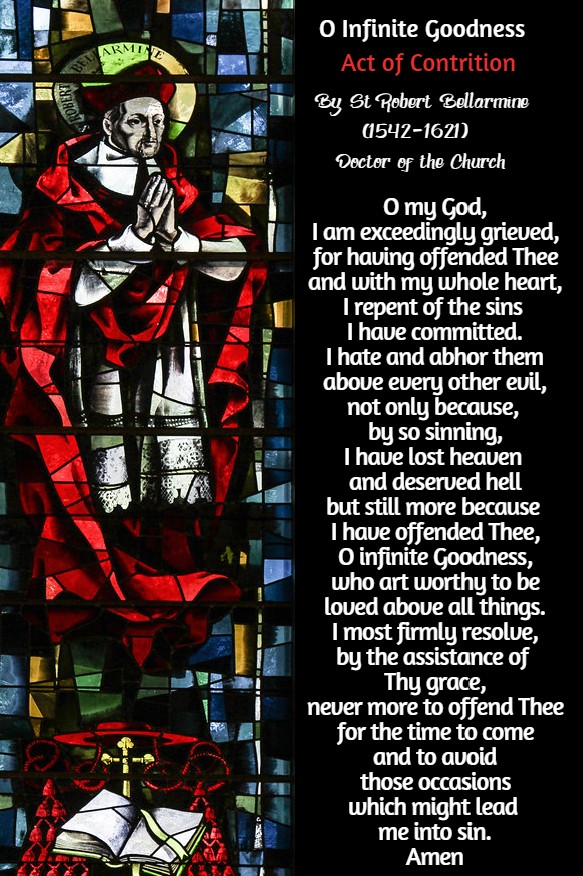
O Infinite Goodness – Act of Contrition By St Robert Bellarmine (1542-1621) – Doctor of the Church
O my God, I am exceedingly grieved, for having offended Thee and with my whole heart, I repent of the sins I have committed. I hate and abhor them above every other evil, not only because, by so sinning, I have lost heaven and deserved hell but still more because I have offended Thee, O infinite Goodness, who art worthy to be loved above all things. I most firmly resolve, by the assistance of Thy grace, never more to offend Thee for the time to come and to avoid those occasions which might lead me into sin. Amen
One Minute Reflection – 21 January – “The Month of the Most Holy Name of Jesus” – St Agnes (c 291- c 304) Virgin and Martyr – Ecclesiasticus 51:1-8, 12, Matthew 25:1-13 – Scripture search here: https://www.drbo.org/
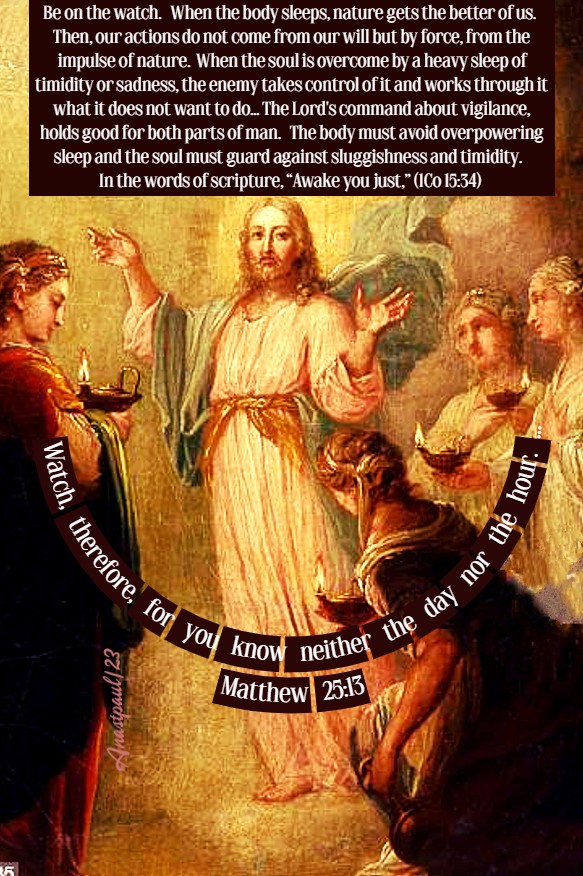
“Watch, therefore, for you know neither the day nor the hour.” – Matthew 25:13
REFLECTION – “To prevent His disciples from questioning Him about the time of His Coming, Christ said, ‘Of that hour no-one knows, neither the Angels nor the Son. It is not for you to know the times or moments.’ (Mt 24:36; Apoc 1:7). He hid the time from us, so that we would be on the watch and so, that each of us might think that the Coming will happen in His own lifetime…
Be on the watch. When the body sleeps, nature gets the better of us. Then, our actions do not come from our will but by force, from the impulse of nature. When the soul is overcome by a heavy sleep of timidity or sadness, the enemy takes control of it and works through it what it does not want to do… The Lord’s command about vigilance, holds good for both parts of man. The body must avoid overpowering sleep and the soul must guard against sluggishness and timidity. In the words of scripture, “Awake you just,” (1Co 15:34) and “I rose up and Am still with you,” (Ps 138:18) and “Do not lose heart” (cf Ep 3:13)…
“Five of them were foolish and five of them were prudent,” the Lord says. Their virginity had nothing to do with Him calling them wise, for they were all virgins but rather, their good works. Even though your chastity is of angelic holiness, note well that the Angels’ holiness is free of all envy or other evil. So even though you are not rebuked for impurity, take care not to be so, for impatience or anger either… “Gird your loins” so that chastity may lighten our steps. “And light your lamps” (Lk 12:35) because the world is black as night, it stands in need of the light of the upright. “Your light must shine before others, that they may see your good deeds and glorify your heavenly Father” (Mt 5:16).” – St Ephrem (306-373) Deacon in Syria, Father and Doctor of the Church [Commentary on the Diatessaron, 18, 15f. ; SC 121] (trans. cf Breviary).
PRAYER – Almighty, eternal God, Thou Who choose the weak things of the world to confound the strong, mercifully grant that we, who are celebrating the feast of blessed Agnes, Thy Virgin and Martyr, may reap the benefit of her patronal intercession with Thee. Through Jesus Christ, Thy Son our Lord, Who lives and reigns with Thee, in the unity of the Holy Ghost, God, world without end. Amen (Collect).
Our Morning Offering – 21 January – Mary’s Saturday
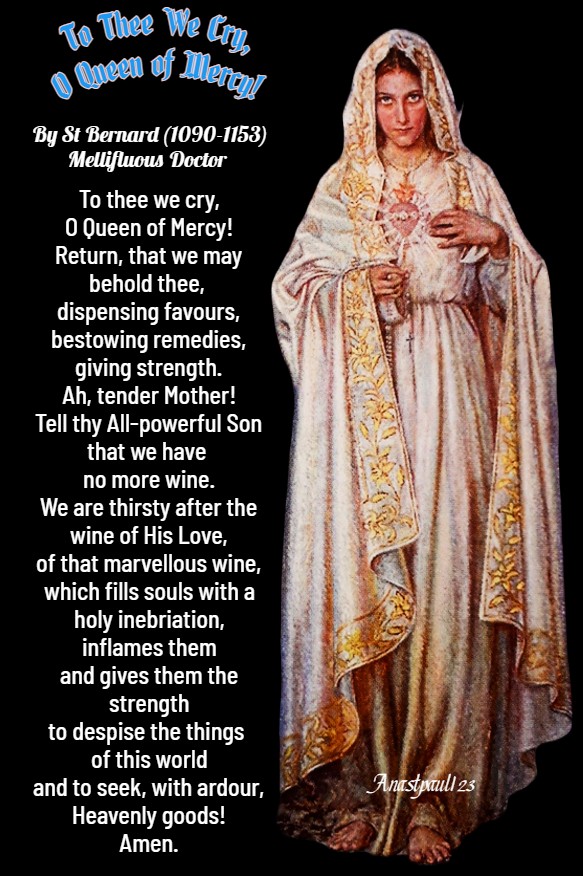
To Thee We Cry, O Queen of Mercy! By St Bernard (1090-1153) Mellifluous Doctor of the Church
To thee we cry, O Queen of Mercy! Return, that we may behold thee, dispensing favours, bestowing remedies, giving strength. Ah, tender Mother! Tell thy All-powerful Son that we have no more wine. We are thirsty after the wine of His Love, of that marvellous wine, which fills souls with a holy inebriation, inflames them and gives them the strength to despise the things of this world and to seek, with ardour, Heavenly goods. Amen.
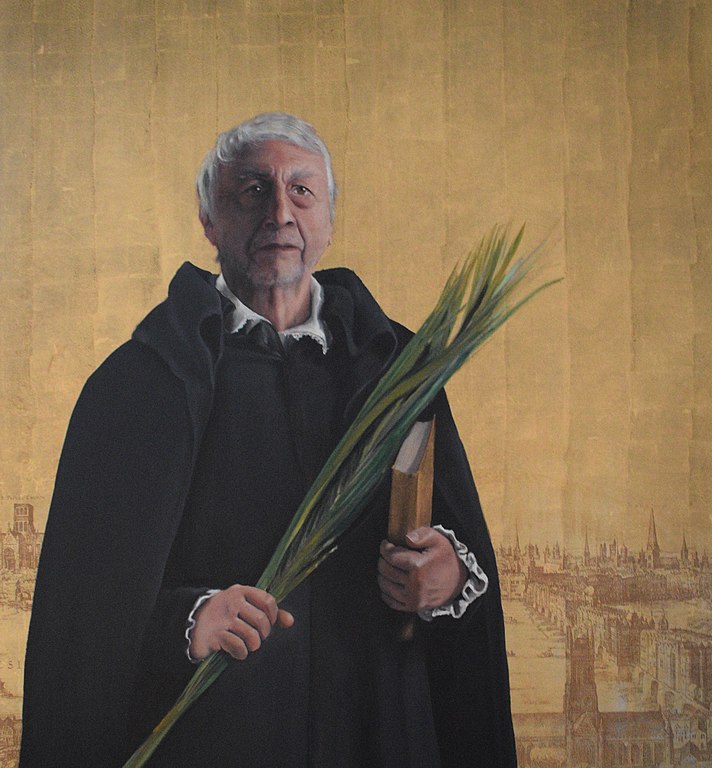
Saint of the Day – 21 January – Blessed Thomas Reynolds (1562-1642) Priest Marty.r Born in 1562 in Oxfordshire, England as Thomas Green and died by being hanged, drawn, and quartered on 21 January 1642 at Tyburn, London, England. Also known as – Richard Reynolds (not to be confused with the Saint of the same name, of the Order of Bridgettine Monks executed in England by Henry VIII), Thomas Green. Additional Memorials – 4 May as one of the 107 Martyrs of England and Wales, also known as Thomas Hemerford and One Hundred and Six Companion Martyrs, 29 October as one of the Martyrs of Douai, 1 December as one of the Martyrs of Oxford University. Thomas was Beatified on 15 December 1929 by Pope Pius XI.
Painting in of Blessed Thomas in the English College, Valladolid, Spain
We believe Thomas was born in Oxfordshire (or possibly Warwickshire) into a Catholic family. In keeping with the necessity of the times, he left England to study for the Priesthood on the continent, initially going to Rheims before continuing his studies from September 1590 in the English College, at Valladolid, Spain, as one of its first students and finally, at another newly founded Jesuit institution, the English College of St Gregory in Seville.
Thomas was Ordained a Priest in Seville in 1592 and immediately returned to England, where he ministered to the recusant Catholic community until his arrest in 1606, in the wave of anti-Catholic measures that were taken, following the Gunpowder Plot of November 1605. Whilst the duration of his early years of ministry reflected the slightly less difficult times for Catholics during that period, the Gunpowder Plot changed the atmosphere, making it far more hostile.
Thomas was one of the Priests who were fortunate, in being just exiled from England rather than immediately Martyred, in response to the Plot. However, he soon returned and once more set about caring for Catholics in secret. This he continued for about twenty years until he was arrested in 1628.
He was put on trial and condemned to death but given a reprieve at the behest of the Queen, Henrietta Maria, wife of Charles I, a Catholic. Although imprisoned, he was kept under relatively mild conditions which included being allowed to receive visitors readily. Many Catholics visited him, not only to offer him care and support but also for his spiritual guidance and the Sacraments.
In 1635 he was one of a number of Priests who would pay a bond and then be released from prison which allowed him to minister to the local Catholic population in London on a regular basis. With the Crown at that time having Catholic sympathies and the rather more anti-Catholic feelings of Parliamentarians being diffused due to Parliament’s long suspension, this was a period when the pressures on Catholics were eased. It was due to this that a number of Priests were able to act in a similar manner to Thomas.
The financial needs of King Charles I forced him to recall Parliament in 1640. At this time, Parliament was increasingly being dominated by Puritan protestants who were hostile to Catholicism. As a result, conditions for Catholics and Priests became far more difficult with Priests, once more, being confined full time to their prisons. The trials and death sentences for Priests resumed and one of the early victims was Thomas. Now eighty years of age, by nature a gentle and slightly timid person and being somewhat infirm, Thomas admitted his fears of facing execution and how he would be able to manage the ordeal he was soon to undergo. He spent his final couple of days in prayer and asking for the prayers of his fellow Priests, imprisoned with him.
On the morning of his execution, 21 January 1642, Thomas was embued by grace with a sense of complete peace and serenity. He had been filled with the courage and strength of Christ, so much so, that he was no longer afraid of what lay ahead and using supplies that had been brought to him in prison, he said his final Holy Mass, before being summoned to his execution.
On arrival at Tyburn, he addressed the assembled crowd for nearly half-an-hour. He pointed out that in forty years work as a Priest in England, no-one could testify to him having ever uttered a word of treason and that his sole aim had been to ‘reduce strayed souls to the fold of the Catholic Church.’ He added that he had no desire to criticise or meddle with the actions of Parliament but rather, that God would bless them and teach them what to do best for the kingdom. He extended his prayers to the King and Queen and all the Kingdom which he hoped would flourish. He concluded by asking forgiveness of all he had offended and granting forgiveness to any, who sought it for actions against him, particularly in regard to his imminant death. Turning to the sheriff overseeing the execution, he specifically thanked him and for his patience whilst he addressed the crowd and prayed, that God would reward him for that, by one day making him a saint in Heaven. The sheriff in turn commended himself to Reynolds and was heard to remark to one of those present that he had never seen a man die like Thomas. Having finished his address, Thomas knelt to pray. He and Roe were placed in the cart, embraced one another, then recited the Miserere Psalm in turn, until the cart was pulled away.
When the sheriff offered Thomas a blindfold, he replied: “I dare look death in the face.” The sheriff allowed the Martyrs to hang till they expired to spare them the suffering of being drawn and quartered, which he only carried out after they were dead. Catholics amongst the crowd, of which there were found to be many, came forwards to dip cloths in their blood to provide Relics for veneration.
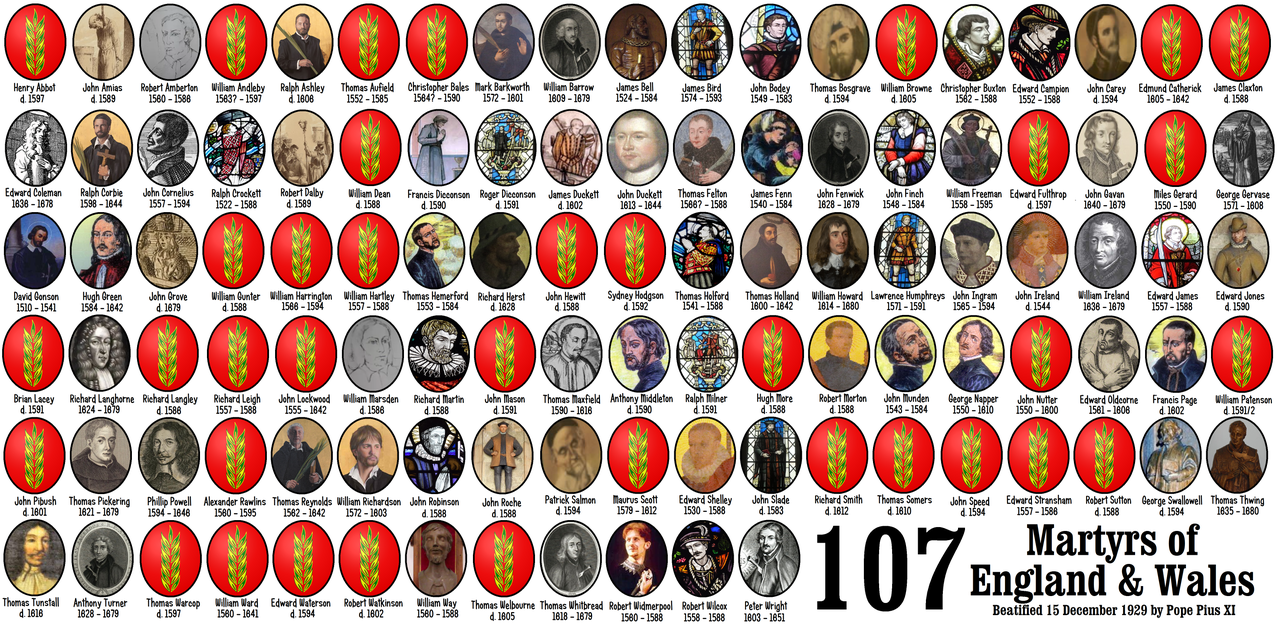
Thomas Reynolds was Beatified by Pope Pius XI on 15 December 1929, therefore, he is among the group of One Hundred and Seven Martyrs of England and Wales. On the image below, our Blessed Thomas Reynolds appears at no 81, the 5th image on the second-last row.
St Agnes of Aislinger St Anastasius of Constantinople St Aquila of Trebizond St Brigid of Kilbride St Candidus of Trebizond Bl Edward Stransham
St Epiphanius of Pavia (c 439–496) Bishop of Pavia, Italy from from 466 until his death. Papal and Secular Mediator and Peacemaker, Known as – “Epiphanius the Peacemaker,” “The Glory of Italy,” “The Light of Bishops.” The Roman Martyrology for 21 January reads : “In Pavia, Saint Epifanio, Bishop , who, at the time of the barbarian invasions, worked zealously for the reconciliation of the peoples, for the liberation of prisoners and for the reconstruction of the destroyed City.” Biography: https://anastpaul.com/2022/01/21/saint-of-the-day-21-january-saint-epiphanius-of-pavia-439-496/
St Eugenius of Trebizond St Gunthildis of Biblisheim
Blessed Josefa María Inés de Benigánim OAD (1625–1696) Nun of the Discalced Augustinian Nuns with the religious name of “Josefa María of Saint Agnes,” Virgin, Mystic, gifted with the charism of prophecy and counsel. She became known for her profound spiritual and theological insight as well as for her severe austerities she practised during her life. Her body is incorrupt. Blessed Josefa was Beatified on 26 February 1888, at Saint Peter’s Basilica by Pope Leo XIII. Biography: https://anastpaul.com/2020/01/21/saint-of-the-day-21-january-blessed-josefa-maria-ines-de-beniganim-oad-1625-1696/
St Lawdog St Maccallin of Waulsort
St Meinrad of Einsiedeln OSB (c 797–861) “Martyr of Hospitality,” Martyr, Priest, Monk, Hermit. In 1039, the year of Meinrad’s Canonisation as a Saint, his remains were brought back to Einsiedeln. During the French Revolution, Meinrad’s relics were hidden at Tyrol, Austria, by Abbot Conrad Tanner and his reliquary is now enshrined in the Grace Chapel of the Abbey Church at Einsiedeln. St Meinrad’s Life and Death: https://anastpaul.com/2021/01/21/saint-of-the-day-21-january-saint-meinrad-of-einsiedeln-osb-c-797-861-martyr/
St Patroclus of Troyes St Publius of Malta (Died c 112) Bishop Blessed Thomas Reynolds (1562-1642) Priest Martyr St Valerian of Trebizond St Vimin of Holywood St Zacharias the Angelic
Mercedarian Nuns of Berriz – Three pious Mercedarian Nuns at the Monastery of Vera Cruz, Berriz, Spain who are remembered together on the Mercedarian calendar – Cristina, Mary Magdalene and Mary of Jesus.
Blessed Martyrs of Laval – 19 Beati: Fifteen men and four women who were Martyred in Laval, France by anti-Catholic French Revolutionaries. The were born in France and they were Martyred on several dates in 1794 in Laval, Mayenne, France. They were Beatified on 19 June 1955 by Pope Pius XII at Rome, Italy.
Blessed André Duliou
Blessed Augustin-Emmanuel Philippot
Blessed François Duchesne
Blessed François Migoret-Lamberdière
Blessed Françoise Mézière
Blessed Françoise Tréhet
Blessed Jacques André
Blessed Jacques Burin
Blessed Jean-Baptiste Triquerie
Blessed Jean-Marie Gallot
Blessed Jeanne Veron
Blessed John Baptist Turpin du Cormier
Blessed Joseph Pellé
Blessed Julien Moulé
Blessed Julien-François Morin
Blessed Louis Gastineau
Blessed Marie Lhuilier
Blessed Pierre Thomas
Blessed René-Louis Ambroise
Martyrs of Rome – 30 Saints: Thirty Christian soldiers executed together in the persecutions of Diocletian. They were Martyred in 304 in Rome, Italy.
Martyrs of Tarragona: Augurius, Eulogius, Fructuosus.
Thought for the Day – 20 January – Meditations with Antonio Cardinal Bacci (1881-1971)
Blessed are the Poor
“Those who are really poor should not be too disturbed. If they are resigned to their poverty and are not consumed by the desire for riches, the blessing of the Gospel is theirs. Let them remember that when Jesus became Man, in order to redeem us, He did not choose to be wealthy. He chose to be the poorest of men. Similarly, Our Blessed Lady, St Joseph and all the Saints, were free from all desire of worldly possessions, so that there was room in their hearts only for God, their supreme good. Let them remember too, for their cosolation that it is much easier for them to gain Heaven because they are not weighed down by worldly cares.
Let us all love and aim at acquiring the true riches of the spirit, which are to be found now in the practice of virtue and later in Heaven.”
Quote/s of the Day – 20 January – St Fabian, Pope, and St Sebastian – Martyrs – Hebrews 11:33-39, Luke 6:17-23 – Scripture search here: https://www.drbo.org/
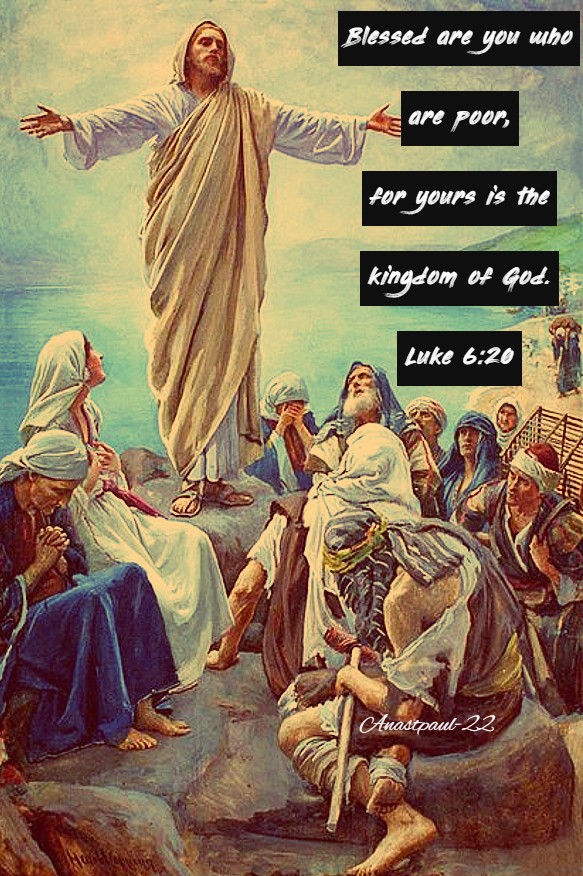
“Blessed are you who are poor, for yours is the Kingdom of God.”
Luke 6:20
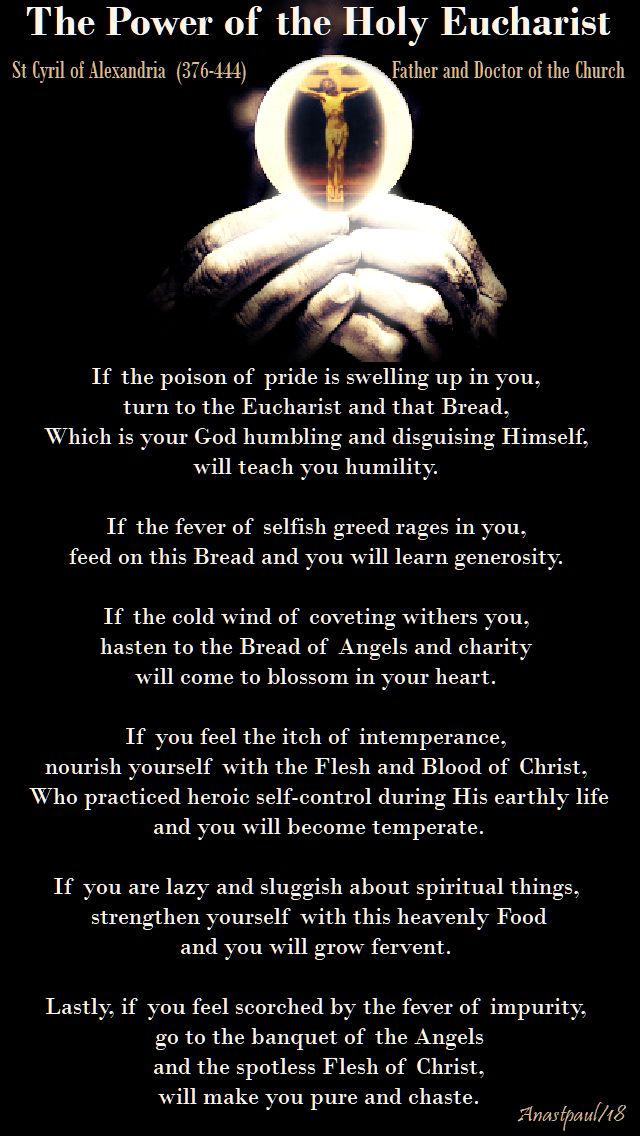
“If the poison of pride is swelling up in you, turn to the Eucharist and that Bread, Which is your God humbling and disguising Himself, will teach you humility.
If the fever of selfish greed rages in you, feed on this Bread and you will learn generosity.
If the cold wind of coveting withers you, hasten to the Bread of Angels and charity will come to blossom in your heart.
If you feel the itch of intemperance, nourish yourself with the Flesh and Blood of Christ, Who practiced heroic self-control during His earthly life and you will become temperate.
If you are lazy and sluggish about spiritual things, strengthen yourself with this heavenly Food and you will grow fervent.
Lastly, if you feel scorched by the fever of impurity, go to the banquet of the Angels and the spotless Flesh of Christ, will make you pure and chaste.”
St Cyril of Alexandria (376-444) Father and Doctor
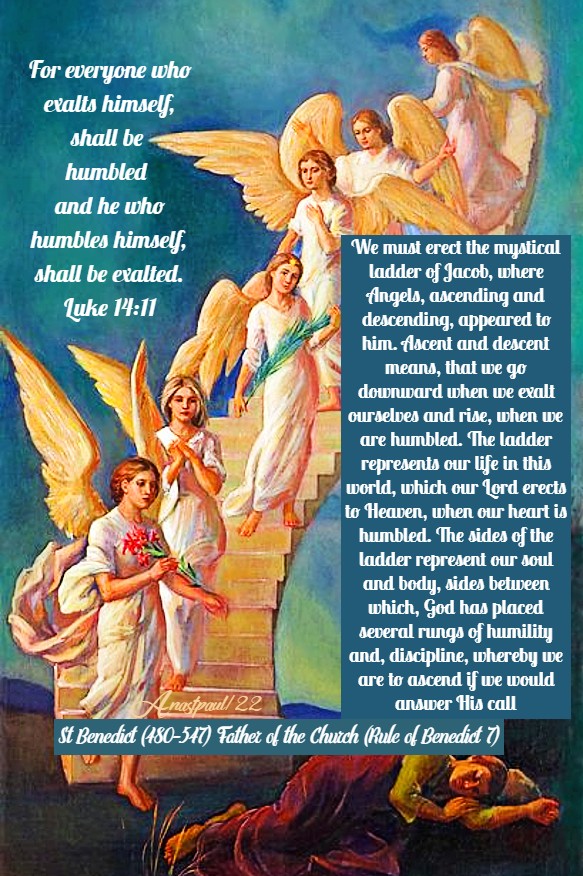
“For everyone who exalts himself, shall be humbled and he who humbles himself, shall be exalted.”
Luke 14:11
“We must erect the mystical ladder of Jacob, where Angels, ascending and descending, appeared to him. Ascent and descent means, that we go downward when we exalt ourselves and rise, when we are humbled. The ladder represents our life in this world, which our Lord erects to Heaven, when our heart is humbled. The sides of the ladder represent our soul and body, sides between which, God has placed several rungs of humility and, discipline, whereby we are to ascend if we would answer His call.”
(Rule of Benedict #7)
St Benedict (480-547) Father of the Church
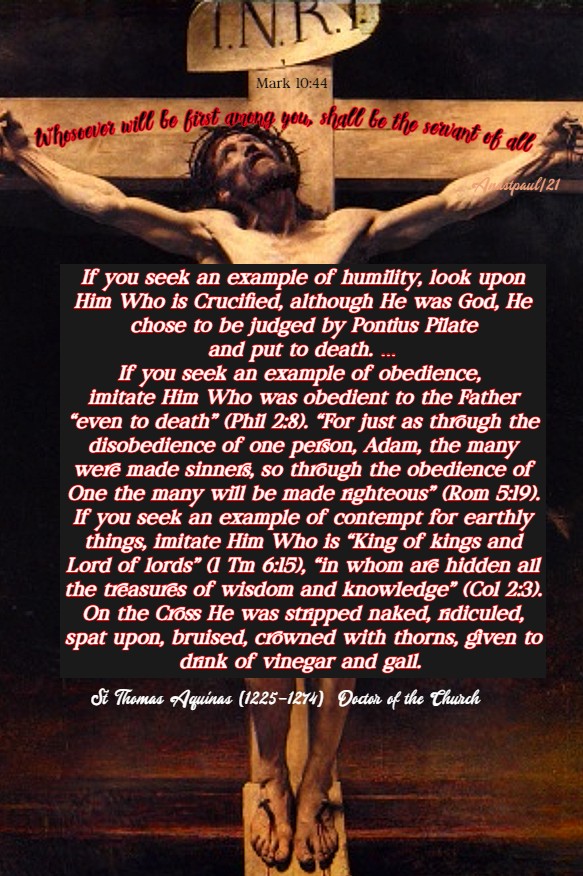
“If you seek an example of humility, look upon Him Who is Crucified, although He was God, He chose to be judged by Pontius Pilate and put to death. … If you seek an example of obedience, imitate Him Who was obedient to the Father “even to death” (Phil 2:8). “For just as through the disobedience of one person, Adam, the many were made sinners, so through the obedience of One, the many will be made righteous” (Rom 5:19). . If you seek an example of contempt for earthly things, imitate Him Who is “King of kings and Lord of lords” (1 Tm 6:15), “in whom are hidden all the treasures of wisdom and knowledge” (Col 2:3). On the Cross He was stripped naked, ridiculed, spat upon, bruised, crowned with thorns, given to drink of vinegar and gall.”
St Thomas Aquinas (1225-1274) Angelic Doctor of the Church
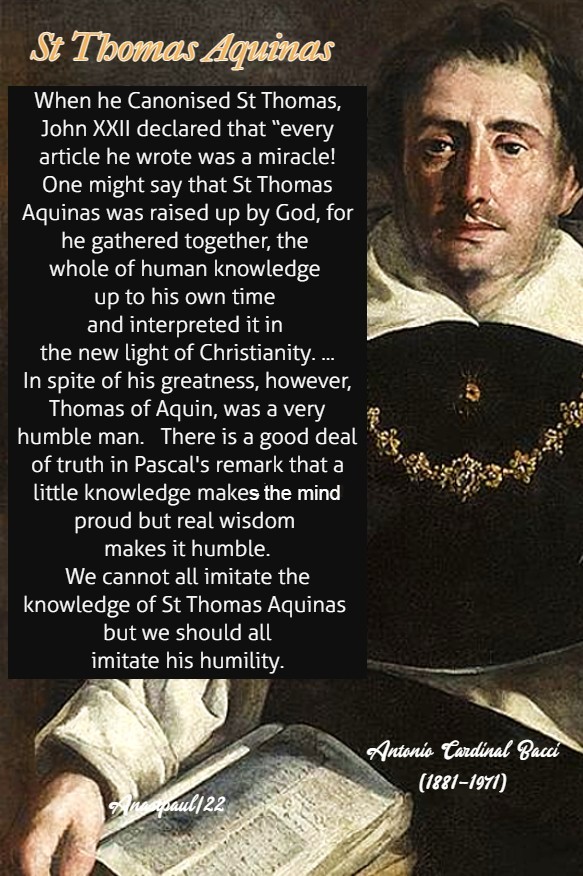
“When he Canonised St Thomas, John XXII declared that “every article he wrote was a miracle!” One might say that St Thomas Aquinas was raised up by God, for he gathered together, the whole of human knowledge up to his own time and interpreted it in the new light of Christianity. … In spite of his greatness, however, Thomas of Aquin, was a very humble man. There is a good deal of truth in Pascal’s remark that a little knowledge makes the mind proud but real wisdom, makes it humble. We cannot all imitate the knowledge of St Thomas Aquinas but we should all imitate his humility.”
One Minute Reflection – 20 January – “The Month of the Most Holy Name of Jesus” – St Fabian, Pope, and St Sebastian – Martyrs – Hebrews 11:33-39, Luke 6:17-23 – Scripture search here: https://www.drbo.org/
“Blessed are you who are poor, for yours is the Kingdom of God.” – Luke 6:20
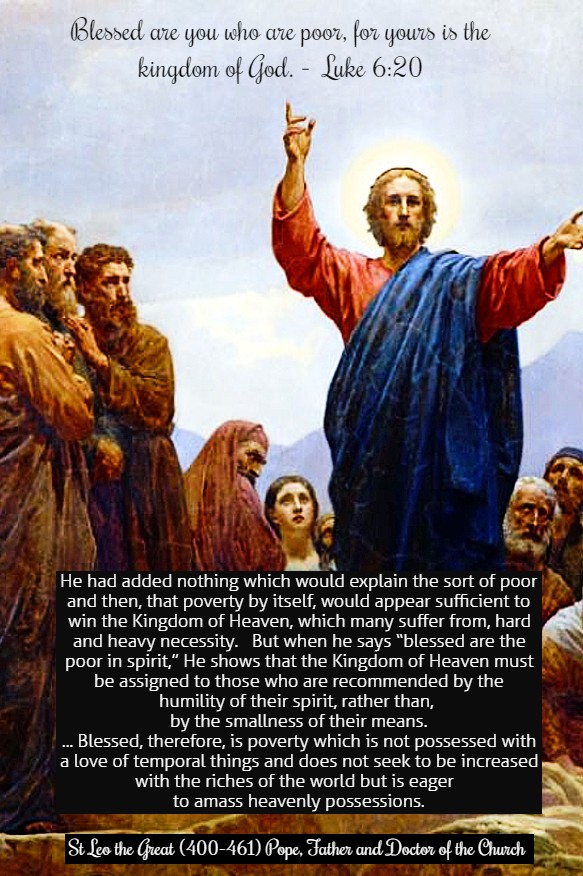
REFLECTION – “Blessed,” He says, “are the poor in spirit, for theirs is the kingdom of heaven” (Mt 5:3). It would perhaps be doubtful what poor He was speaking of, if in saying “blessed are the poor ” He had added nothing which would explain the sort of poor and then, that poverty by itself, would appear sufficient to win the Kingdom of Heaven, which many suffer from, hard and heavy necessity. But when he says “blessed are the poor in spirit,” He shows that the Kingdom of Heaven must be assigned to those who are recommended by the humility of their spirit, rather than, by the smallness of their means.
Yet it cannot be doubted, that this possession of humility is more easily acquired by the poor than the rich: for submissiveness is the companion of those, who want, while loftiness of mind dwells with riches. Notwithstanding, even in many of the rich, is found that spirit which uses its abundance, not for the increasing of its pride but on works of kindness and counts that for the greatest gain, which it expends in the relief of others’ hardships. It is given to every kind and rank of men, to share in this virtue, because men may be equal in will, though unequal in fortune and it does not matter, how different they are in earthly means, who are found equal in spiritual possessions. Blessed, therefore, is poverty which is not possessed with a love of temporal things and does not seek to be increased with the riches of the world but is eager to amass heavenly possessions.” – St Leo the Great (400-461) Pope, Father and Doctor of the Church (Sermon 95, PL 54, 461).
PRAYER – Be mindful of our weakness, Almighty God and since the burden of our sins weighs heavily upon us, may the glorious intercession of Thy holy Martyrs, Fabian and Sebastian sustain us. Through Jesus Christ, Thy Son our Lord, Who lives and reigns with Thee, in the unity of the Holy Ghost, God, world without end. Amen (Collect).
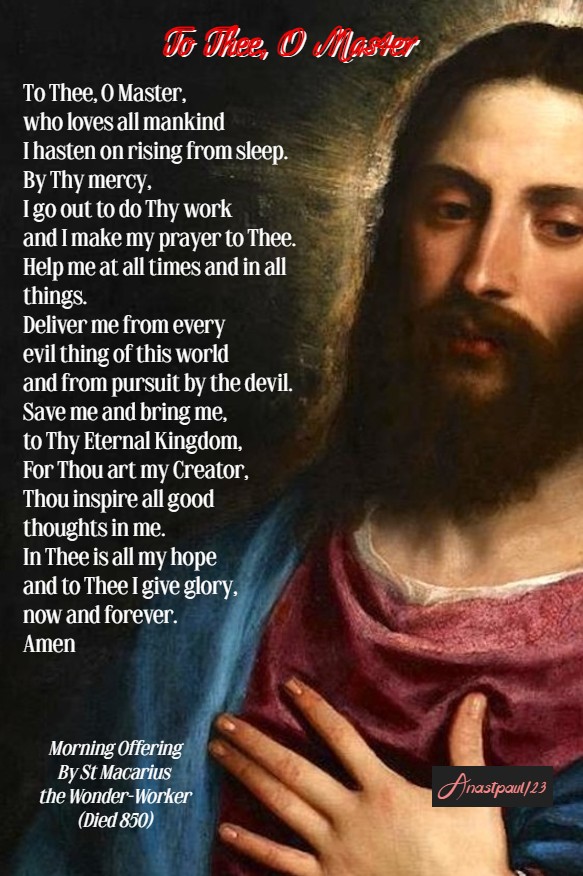
To Thee, O Master Morning Offering By St Macarius the Wonder-Worker (Died 850)
To Thee, O Master, who loves all mankind I hasten on rising from sleep. By Thy mercy, I go out to do Thy work and I make my prayer to Thee. Help me at all times and in all things. Deliver me from every evil thing of this world and from pursuit by the devil. Save me and bring me, to Thy Eternal Kingdom, For Thou art my Creator, Thou inspire all good thoughts in me. In Thee is all my hope and to Thee I give glory, now and forever. Amen
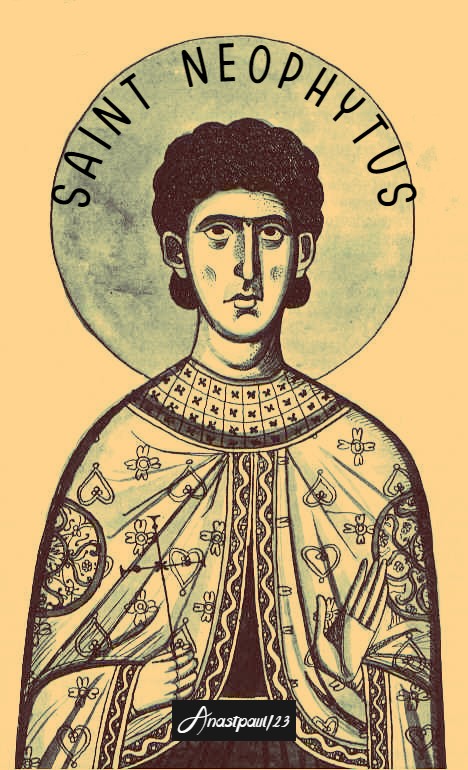
Saint of the Day – 20 January – Saint Neophytus of Nicaea (Died c 303) Martyr, Confessor, Lay Youth. Died at Nicaea by the sword.
The Roman Martyrology reads: “At Nicaea, in Bithynia (present day Turkey), St Neophytus, Martyr who, in the fifteenth year of his age was scourged, cast into a furnace and exposed to wild beasts. As he remained uninjured and constantly Confessed the Faith of Christ, he was at last killed with the sword.”
Neophytus was born to Christian parents who were named Theodore and Florentia.
During the Diocletianic persecution he presented himself to the local Governor named Decius. Roused to fury by his unexpected boldness, Decius had him scourged, then laid out on a bed of fire. When he had been preserved by grace, through these torments, he gave him up to wild beasts.
But since the Saint remained unharmed, a certain pagan fell on him with a sword and slew him. This occurred in c 303, 10 years before the Edict of Milan permanently established religious toleration for Christianity within the Roman Empire.
In 2014 the underwater Byzantine Basilica of Saint Neophytus was discovered in Lake İznik, modern-day Turkey. The Basilica had been built in the place where he was killed on the shore of the lake and subsequently became submerged after an earthquake.
St Pope Fabian (c 200 – c 250) Martyr, Confessor, Peacemaker, Administrator and Reformer, Apostle of Charity. Bishop of Rome from 10 January 236 until his death in 250, succeeding Anterus. He is famous for the miraculous nature of his election, in which a dove is said to have descended on his head to mark him as the Holy Spirit’s unexpected choice. He was succeeded by Cornelius. Biography: https://anastpaul.com/2019/01/20/saint-of-the-day-20-january-st-pope-fabian-c-200-c-250-martyr/
St Ascla of Antinoe St Basilides the Senator St Bassus the Senator Blessed Benedict Ricasoli (Died 1107) Monk, Hermit Bl Bernardo of Poncelli Bl Cyprian Michael Iwene Tansi St Daniel of Cambron Bl Didier of Thérouanne St Eusebius the Senator
Thought for the Day – 19 January – Meditations with Antonio Cardinal Bacci (1881-1971)
HUMILITY
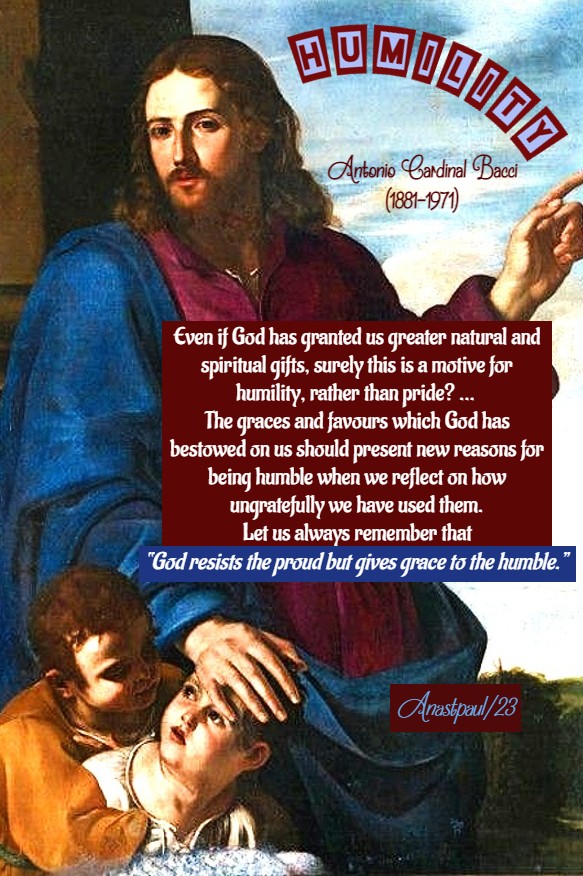
“Some people realise that they can achieve something good or beautiful by making use of their natural gifts, along with the grace of God. Meanwhile, they see others failing where they succeeded. As a result, they are lacking in humility. Theirs is a mistaken attitude. Do we know what difference there is between the gifts God has given us and those He has given to others?
Even if God has granted us greater natural and spiritual gifts, surely this is a motive for humility, rather than pride? St Therese of the Child Jesus was accustomed to ask God’s forgiveness, not only for the sins which she had committed but, also for those which she would have committed, if God had not given her such exceptional graces.
The graces and favours which God has bestowed on us should present new reasons for being humble when we reflect on how ungratefully we have used them. Let us always remember that “God resists the proud but gives grace to the humble” (Js 4:6).”
Quote/s of the Day – 19 January – “The Month of the Most Holy Name of Jesus” – St Marius and Family of Persia, (Died c 270) Martyrs – Hebrews 10:32-38, Matthew 24:3-13 – Scripture search here: https://www.drbo.org/
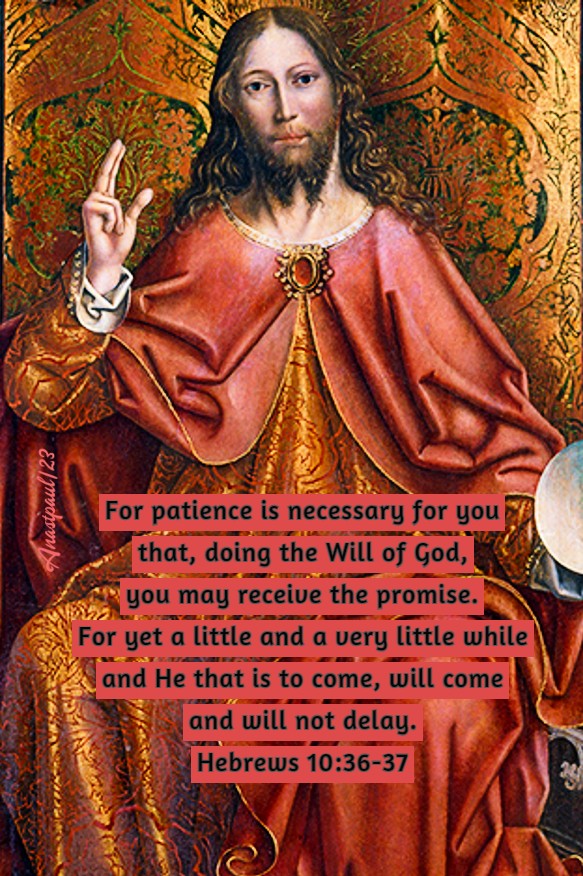
“For patience is necessary for you that, doing the Will of God, you may receive the promise. For yet a little and a very little while and He that is to come, will come and will not delay.”
Hebrews 10:36-37
“Even so, when you see all these things, know that it is near, even at the door. ”
Matthew 24:33
“Watch” over your life. Do not let “your lamps” go out and do not keep “your loins ungirded,” but “be ready,” for “you do not know the hour when our Lord is coming.” Meet together frequently, in your search for what is good for your souls, since “a lifetime of faith will be of no advantage” to you, unless you prove perfect at the very end.”
The Unknown Author of the Didache (Didache, 16) .
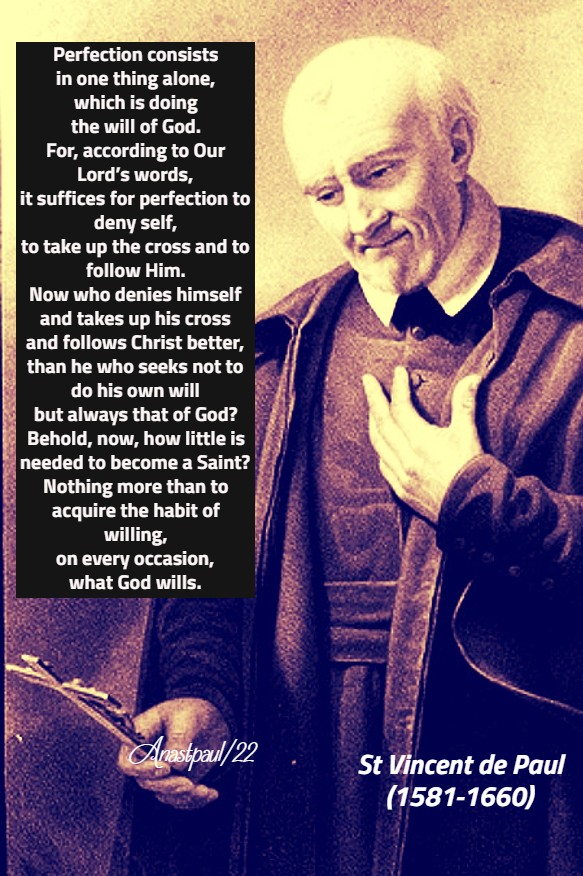
“Perfection consists in one thing alone, which is doing the will of God. For, according to Our Lord’s words, it suffices for perfection to deny self, to take up the cross and to follow Him. Now who denies himself and takes up his cross and follows Christ better, than he who seeks not to do his own will but always that of God? Behold, now, how little is needed to become a Saint? Nothing more than to acquire the habit of willing, on every occasion, what God wills.”
St Vincent de Paul (1581-1660)
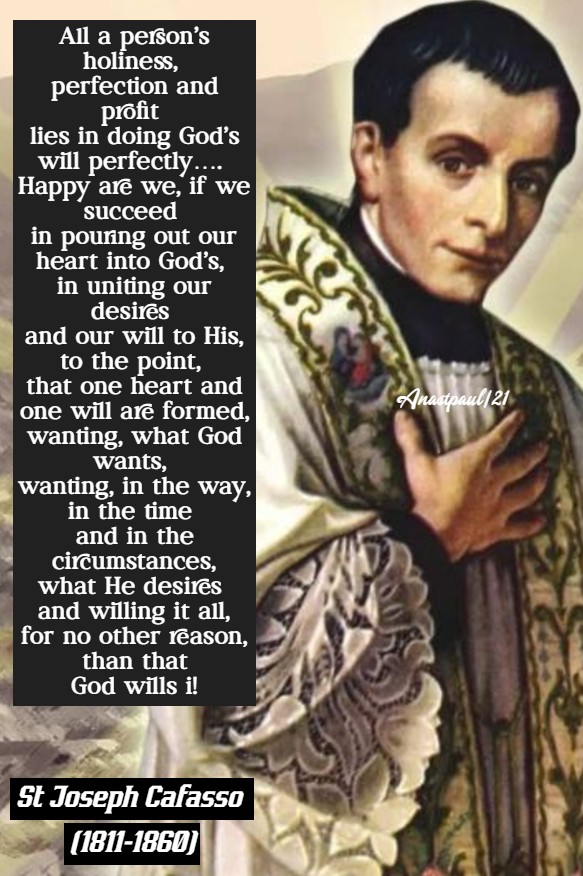
“All a person’s holiness, perfection and profit lies in doing God’s will perfectly…. Happy are we, if we succeed in pouring out our heart into God’s, in uniting our desires and our will to His, to the point, that one heart and one will are formed, wanting, what God wants, wanting, in the way, in the time and in the circumstances, what He desires and willing it all, for no other reason, than that God wills it.”
St Joseph Cafasso (1811-1860)
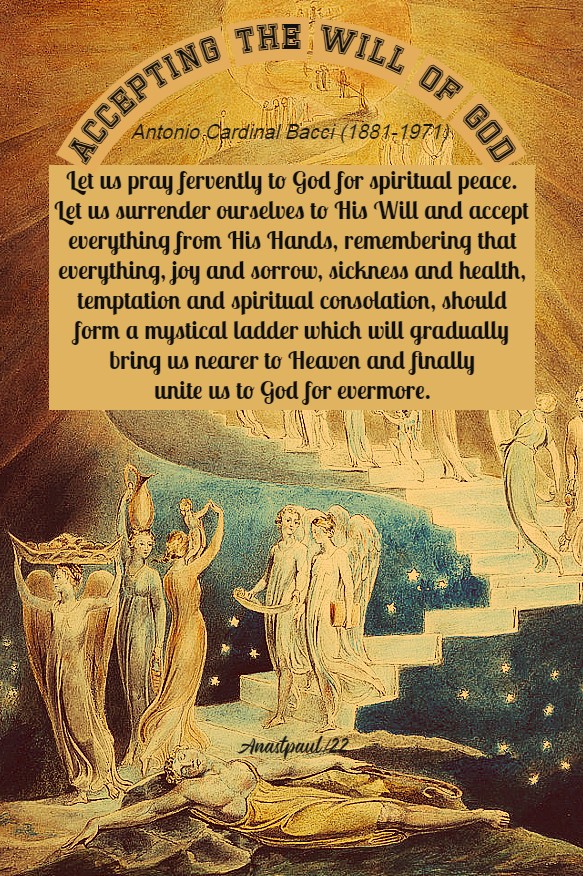
“Let us pray fervently to God for spiritual peace. Let us surrender ourselves to His Will and accept everything from His Hands, remembering that everything, joy and sorrow, sickness and health, temptation and spiritual consolation, should form a mystical ladder which will gradually bring us nearer to Heaven and finally unite us to God for evermore.”
One Minute Reflection – 19 January – “The Month of the Most Holy Name of Jesus” – St Marius and Family of Persia, (Died c 270) Martyrs – Hebrews 10:32-38, Matthew 24:3-13 – Scripture search here: https://www.drbo.org/
“Tell us when shall these things be? and what shall be the sign of Thy Coming and of the consummation of the world? ” – Matthew 24:3
REFLECTION – “… In fact, according to the merit and fervour of each one, there is a frequent and familiar advent of the Lord that, in this intermediary period, between His First and Last Coming, models us on one and prepares us to the other.
The Lord comes to us now, so that His First Coming to us, may not be in vain and that the Last One, may not be that of wrath. Through His Present Coming, in fact, He works at reforming our pride, in the image of the humility of His first advent, to then remodel our humble body, in the image of the glorified body He will show us, when He will return. This is why we should desire and fervently ask this personal coming – which gives us the grace of this first advent and promises us the glory of the last. …
The first was humble and hidden, the last will be resounding and magnificent; the one we are talking about is hidden but it is also magnificent. I say it is hidden, not because it is ignored by whom it concerns but because, it happens secretly in him. … He comes without being seen and He leaves without being noticed. His simple Presence is Light for the soul and for the spirit, by it you may see the invisible and get to know the unknown. This coming of the Lord puts the soul of whom, contemplates it, in a gentle and happy state of admiration. Then, from the inmost depths of man, the cry may burst out: “O Lord, Who is like Thee!” (Ps 34:10). Those who have experienced it know, please God, that those who have not yet had this experience, may feel, at least, the desire to!” – Blessed Guerric of Igny (c 1080-1157) Cistercian Abbot (2nd sermon for Advent, 2-4: PL 185, 15-17).”
PRAYER – O Lord, hear Thy people as they humbly pray, in union with the patronal intercession of Thy Saints that Thou wouldst grant us to enjoy peace, during our life on earth and to find help for life eternal. Through Jesus Christ, Thy Son our Lord, Who lives and reigns with Thee, in the unity of the Holy Ghost, God, world without end. Amen (Collect).
Eternal God, Our Refuge By St Boniface (672-754) Martyr
Eternal God, the refuge and help of all Thy children, we praise Thee for all Thou hast given us, for all Thou hast done for us, for all that Thou art to us. In our weakness, Thou art strength, in our darkness, Thou art light, in our sorrow, Thou art comfort and peace. We cannot number Thy blessings, we cannot declare Thy love – for all Thy graces, we bless Thee. May we live as in Thy presence, and love the things that Thou loves and serve Thee in our daily lives, through Jesus Christ our Lord. Amen
Saints of the Day – 19 January – St Marius and Family of Perisa – Martha, Audifax, Abacjum (Died c 270) Martyrs, Husband, Wife and 2 Sons – in the time of Emperor Claudius. Born in Persia and died on the Nymphae Catabassi Way in Rome in c 270. Patronage – Caselette, Italy. Also known as – Maris, Mario.
The Roman Martyrology today states: “At Rome, on the Cornelian road, the holy Martyrs, Marius and his wife Martha, with their sons, Audifax and Abachum, noble Persians, who came to Rome, through devotion, in the time of the Emperor Claudius. After they had been beaten with rods, tortured on the rack and with fire, lacerated with iron hooks and had endured the cutting off their hands, Martha was put to death in the place called Nympha. The others, were beheaded and cast into the flames.”
Marius, a Persian nobleman, his wife Martha and his sons Audifax and Abachum, came to believe in Christ and became Christians. In imitation of the early Christians of Jerusalem, they gladly gave away their fortune to the poor.
Then the family travelled to Rome to venerate the tombs of the Apostles and lend their aid to the persecuted Christians. Among other things, they gathered the ashes of the Martyrs and buried them with respect.
The family’s assistance to Christians exposed them to persecution. They were seized and delivered to the judge Muscianus or Marcianus, who, unable to persuade them to deny their faith, condemned them to various tortures. Despite the torture, the Saints refused to deny Christ.
Marius and his two sons were thus beheaded on the Via Cornelia and their bodies were burnt. Martha, meanwhile, was killed at a place called in Nymphae Catabassi (later called Santa Ninfa), thirteen miles from Rome. Tradition states that Martha was cast into a well.
According to tradition, a Roman lady named Felicitas secured the half-consumed remains of the father and sons and also the mother’s body from the well and had the sacred relics secretly interred on her estate at Buxus, today Boccea. This occurred on 20 January. A Church arose at Boccea and during the Middle Ages, it became a place of pilgrimage.
The Relics of the Martyrs later suffered various vicissitudes – some were transferred to the Churches of Sant’Adriano al Foro and Santa Prassede, in Rome and part of these Relics were sent to Eginhard, the biographer of Charlemagne, who lodged them in the Monastery of Seligenstadt. Some Relics went to Prüm Abbey where their presence was recorded in the early 11th century. The original reliquary chest was destroyed during the French occupation at the end of the 18th Century. The current chest dates from the 19th Century.
The Martyrs Feast was included today, 19 January, in the General Roman Calendar from the 9th century to 1969, when they were excluded because nothing is known with certainty about them except their names, their place of burial (the cemetery at Nymphas on the Via Cornelia) and the day of their burial (19 or 20 January).
St Marius and Martha with the Madonna and child and Saints
Sts Marius and Family of Perisa – Martha, Audifax, Abacjum (Died c 270– Martyrs, Husband, Wife and 2 Sons – in the time of Emperor Claudius.
St Canute (1040-1086) Martyr, King of Denmark, known as Canutus the Holy – Canutus was an ambitious King who sought to strengthen the Danish monarchy, devotedly supported the Roman Catholic Church and had designs on the English throne. Slain by rebels in 1086, he was the first Danish King to be Canonised. He was recognised as Patron Saint of Denmark in 1101. Biography: https://anastpaul.com/2019/01/19/saint-of-the-day-19-january-st-canutus-1040-1086/
St Abachum of Persia + (St Marius and Family of Persia – Martyrs) Bl Andrew of Peschiera St Arsenius of Corfu St Audifax of Persia + (St Marius and Family of Persia – Martyrs) St Bassian of Lodi (c 320–c 409) About St Bassian: https://anastpaul.com/2020/01/19/saint-of-day-19-january-st-bassian-of-lodi-c-320-c-413/ Bl Beatrix of Lens St Branwallader of Jersey St Catellus of Castellammare St Contentius Bl Elisabetta Berti St Faustina of Como St Fillan St Firminus of Gabales St Germanicus of Smyrna St Godone of Novalesa St John of Ravenna St Joseph Sebastian Pelczar St Liberata of Como St Martha of Persia + (St Marius and Family of Persia – Martyrs) St Messalina iof Foligno St Ponziano of Spoleto St Remigius of Rouen
St Wulstan (c 1008–1095) Bishop of Worcester , England, from 1062 to 1095, Monk, Prior, a man of extreme holiness and penitence who was admired by all, he was a he was a man of iron will, immense charm and unworldly humility and piety and suffered no luxury, preferring always the poor to himself. Biography: https://anastpaul.com/2021/01/19/saint-of-the-day-19-january-saint-wulfstan-c-1008-1095/
Martyrs of Numidia – 9 Saints: A group of Christians Martryred together for their faith. The only details to survive are nine of their names – Catus, Germana, Gerontius, Januarius, Julius, Paul, Pia, Saturninus and Successus. 2nd century Numidia in North Africa.
Martyrs of Carthage – 39 Christians Martyred together in Carthage, date unknown. We have no information about them except 9 of the names – Catus, Germana, Gerontius, Januarius, Julius, Paul, Pia, Saturninus and Successus. Died IN Carthage, North Africa (modern Tunis, Tunisia).
Thought for the Day – 18 January – Meditations with Antonio Cardinal Bacci (1881-1971)
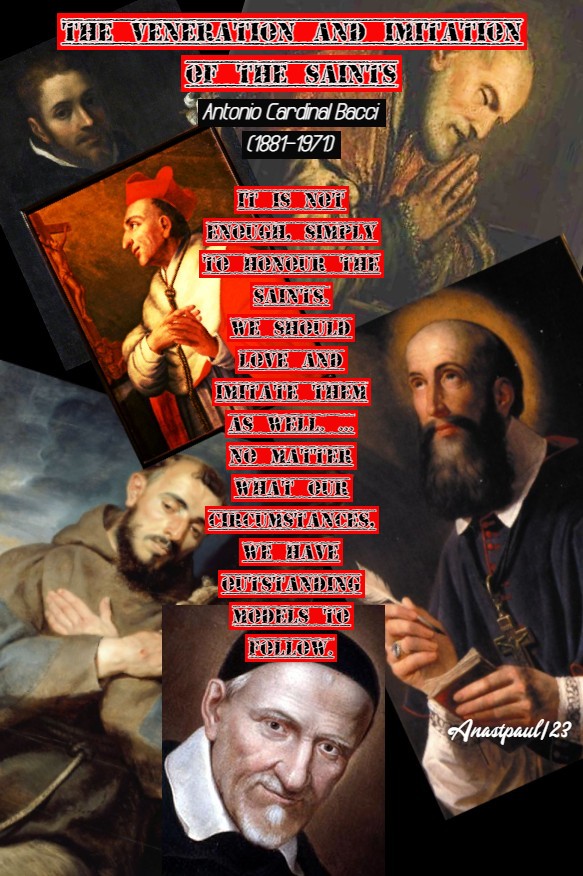
The Veneration and Imitation of the Saints
“It is not enough, simply to honour the Saints. We should love and imitate them as well. Following the example of the Saints, as St Paul says, is the same as imitating Jesus Christ Himself (1 Cor 4:16). It is a step towards Christian perfection. No matter what our circumstances, we have outstanding models to follow.
From St Francis of Assisi, we can learn to be detached from worldly things, even to the point of loving poverty! From St Philip Neri, we can learn to despise honours and to make God and Heaven, the object of our desires and actions. St Francis de Sales, although he was by nature resentful and scathing, can teach us how to be gentle, kind and calm in all the trials of life. We can learn heroic love for the poor and unfortunate, from St Vincent de Paul. We can imitate the fervent apostolic work of St Francis Xavier,. St Charles Borromeo sold his goods and gave all to the poor. During the plague in Milan, he dedicated himself lovingly to the care of the unfortunate victims, selling his household furniture and even his bed, so that he had nothing left to sleep on but a table! We can learn from his example, how the flame of Christ’s charity can transform the heart and overcome all human wretchedness.
Above all, let us remember that our devotion to the Saints will be valueless, if it is not accompanied by untiring efforts to follow their example.”
Quote/s of the Day – 18 January – Feast of the Chair of the Apostle, St Peter at Rome – 1 Peter 1:1-7, Matthew 16:13-19 – Scripture search here: https://www.drbo.org/
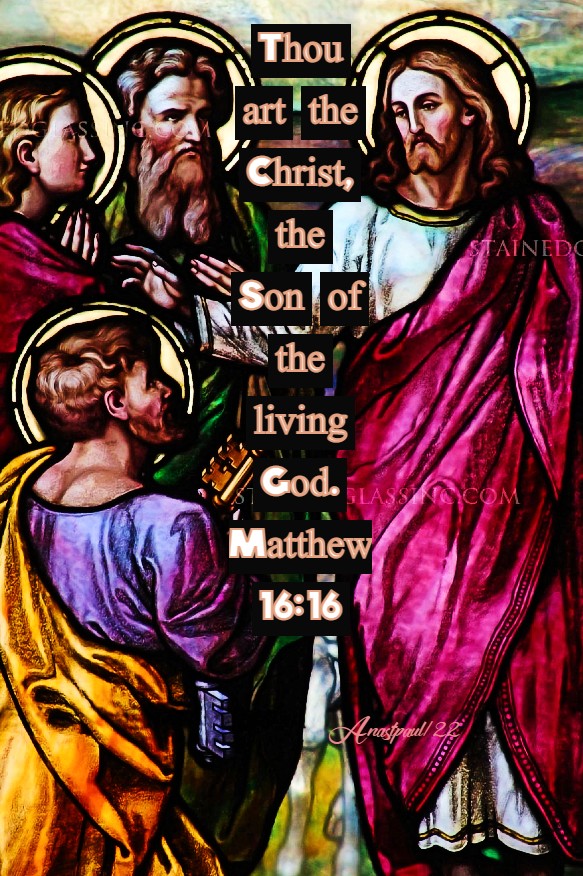
“Thou art the Christ, the Son of the living God.”
Matthew 16:16
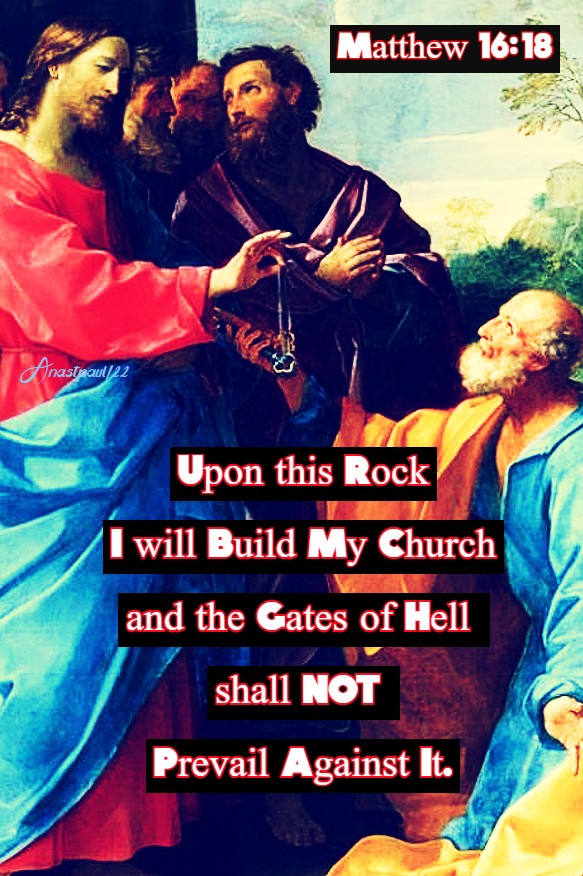
“Upon this rock I will build My Church”
Matthew 16:18
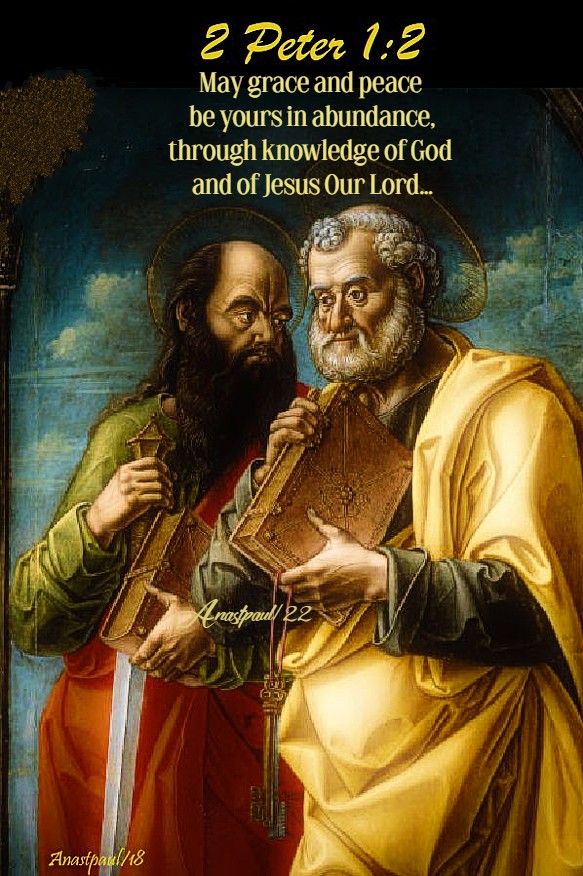
“… May grace and peace be yours in abundance, through knowledge of God and of Jesus Our Lord…”
2 Peter 1:2
“So Peter wept and wept bitterly; he wept so hard that he washed away his offence with his tears. And you, too, if you would win pardon, wipe out your guilt with tears. At that very moment, in that same hour, Christ will look at you. If some kind of fall happens to you, then He, the ever-present witness of your intimate life, looks at you to call you back and cause you to confess your lapse. Then do as Peter did, who thrice said: “Lord, you know that I love you” (Jn 21:15). He denied three times and three times he also confessed. But he denied by night; he confessed in broad daylight.”
St Ambrose (340-397) Father and Doctor of the Church
“Yes, the Apostle chosen to be His co-worker, merited to share, the same Name as Christ. They built the same Building together – Peter does the planting, the Lord gives the increase and it is the Lord, too, Who sends those, who will do the watering (cf 1 Cor 3:6f).”
St Augustine (354-430) Father & Doctor of the Church
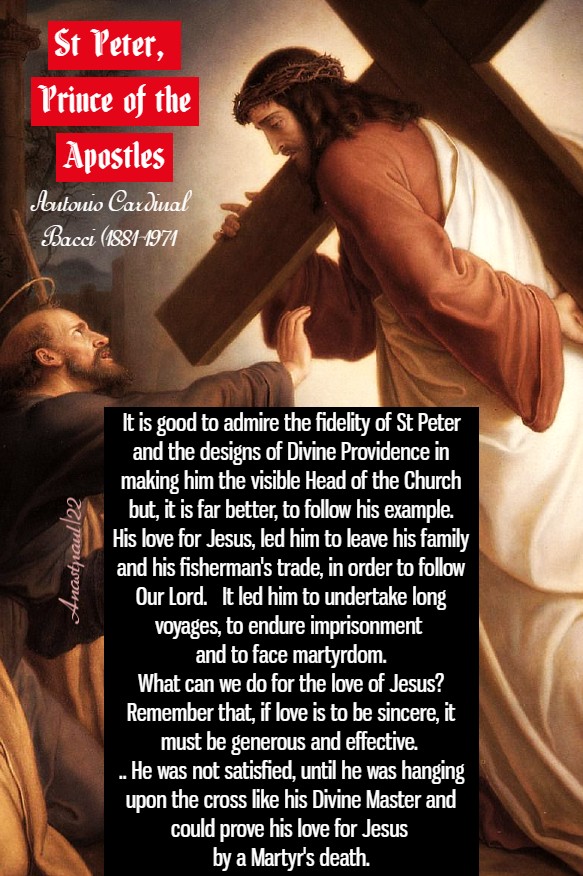
“It is good to admire the fidelity of St Peter and the designs of Divine Providence in making him the visible Head of the Church but, it is far better, to follow his example. His love for Jesus, led him to leave his family and his fisherman’s trade, in order to follow Our Lord. It led him to undertake long voyages, to endure imprisonment and to face Martyrdom. What can we do for the love of Jesus? Remember that, if love is to be sincere, it must be generous and effective. … He was not satisfied, until he was hanging upon the cross like his Divine Master and could prove his love for Jesus by a Martyr’s death.”
One Minute Reflection – 18 January – Feast of the Chair of the Apostle, St Peter at Rome – 1 Peter 1:1-7, Matthew 16:13-19 – Scripture search here: https://www.drbo.org/
“Upon this rock I will build my church” … Matthew 16:18
REFLECTION – “Nothing escaped the Wisdom and Power of Christ, the elements of nature lay at His service, spirits obeyed Him, Angels served Him. … And yet, out of all the world, Peter alone was chosen to stand at the head, for the calling of all the peoples and the oversight of all the Apostles and Fathers of the Church. Thus, even though there are many Priests and shepherds among the People of God, Peter governed them all in person, while Christ also governs them in the capacity of Head. …
The Lord asks all the Apostles what people think of Him and they all say the same thing, so long as they are making known the doubts deriving from human ignorance. But when the Lord demands to know, what the disciples themselves think, the first to confess the Lord is he, who is the first in dignity of the Apostles. As he had said: “You are the Christ, the Son of the Living God,” Jesus answers him: “Blessed are you, Simon son of Jonah. For flesh and blood has not revealed this to you, but my heavenly Father.” That is to say, blessed are you because My Father taught this to you. Earthly opinion has not led you astray but it is heavenly inspiration that has instructed you. It is not flesh and blood that enabled you to discover Me but He, Whose only Son I Am.
“And so I say to you,” that is to say- just as my Father has manifested My Divinity to you, so I Am making known your superiority to you. “You are Peter” namely, I am the unshakeable Rock, the Cornerstone who makes two peoples one (Eph 2:14), the foundation other than which, no-one can lay any other (1 Cor 3:11). But you also, you are rock, since you are impregnable by My Strength and, what I have by virtue of My Power, you have in common with Me, by the fact,, that you participate in it. “On this rock I will build My Church” … On the firmness of this foundation, He says, will I build an everlasting temple and My Church, whose summit is to reach to Heaven, will be raised on the strength of that faith.” … Saint Pope Leo the Great (400-461) Father and Doctor of the Church ( 4th sermon for the Anniversary of his Consecration).
PRAYER – O God, Who together with the keys of the Kingdom of Heaven didst bestow on thy blessed Apostle Peter the pontifical power of binding and loosing, grant that by the aid of his intercession, we may be released from the bonds of our sins. ThroughJesus Christ, Thy Son our Lord, Who lives and reigns with Thee, in the unity of the Holy Ghost, God, world without end. Amen (Collect).
Our Morning Offering – 18 January – Feast of the Chair of the Apostle, St Peter at Rome
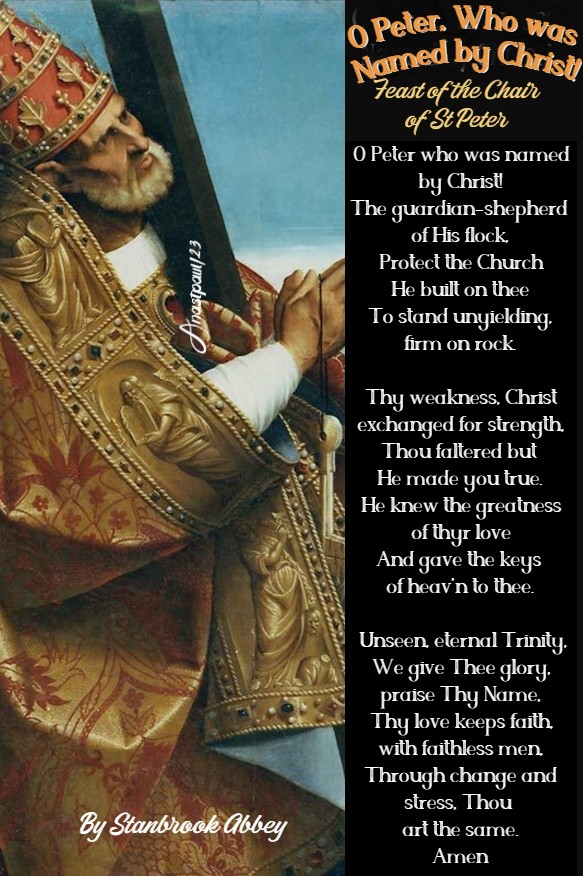
O Peter, Who was Named by Christ! By Stanbrook Abbey For the Feast of the Chair of St Peter
O Peter who was named by Christ! The guardian-shepherd of His flock, Protect the Church He built on thee To stand unyielding, firm on rock.
Thy weakness, Christ exchanged for strength, Thou faltered but He made thee true. He knew the greatness of thy love And gave the keys of heav’n to thee.
Unseen, eternal Trinity, We give Thee glory, praise Thy Name, Thy love keeps faith, with faithless men, Through change and stress, Thou art the same. Amen
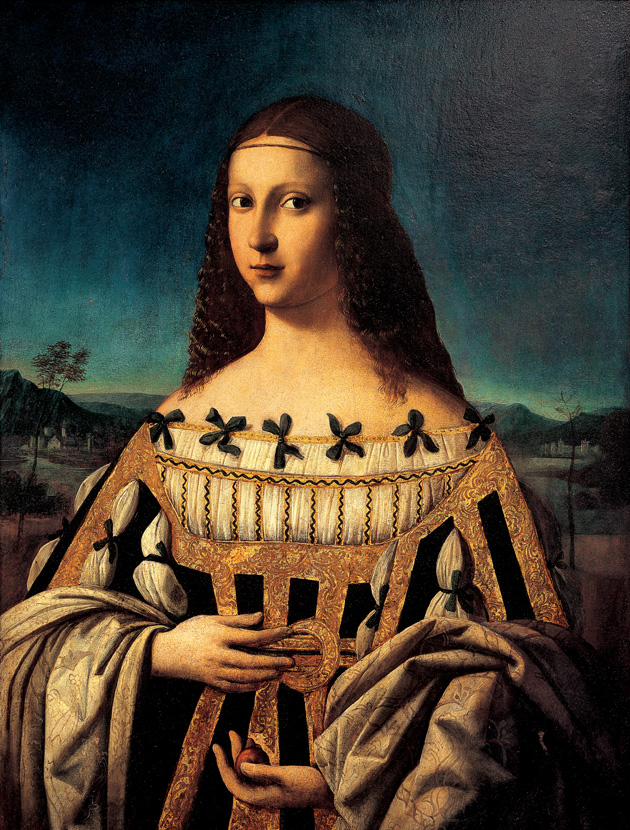
Saint of the Day – 18 January – Blessed Beatrix d’Este the Younger (c 1230-1262) Benedictine Nun, founded a Convent. Born in c 1230 at Castello Estense, Ferrara and died on 18 January 1262 of natural causes. Beatrix was Beatified in 1774 by Pope Clement XIV. Her memorial date was decreed by Pope Pius VI for today. Additional Memorial – 19 January. Also known as – Beatrice.
The Roman Martyrology states: “In Ferrara, Blessed Beatrice d’Este, Nun, who, on the death of her future husband, having renounced the kingdom of this world, consecrated herself to God in a Monastery founded by herself under the rule of Saint Benedict.”
By Bartolomeo Veneto, 1510
An account of her life was written, in both medieval Latin and the Italian vernacular, by a Monk, Brother Alberto of the Church of the Holy Spirit. This text was unknown for centuries, until it was rediscovered in the eighteenth Century in an “old Ferrarese codex.”
Beatrix was the daughter of Azzo IX, the Marquis d’Este and Lord of Ferrara and of Giovanna di Puglia, Beatrice was born in Ferrara around 1230. She was educated following the examples of her aunt St Beatrix the Elder, a Nun in Gemmola (Padua)
She was given in marriage to Galeazzo, son of Manfredi and Mayor of Vicenza. On travelling to join him in Milan, she received the painful news of his death in battle, against Frederick II.
She returned to Ferrara and retired to monastic life on the islet of St Lazzarus, west of the City, with some court maids, there receiving the habit.
In 1257, as the number of Nuns grew, she obtained from Pope Innocent IV, permission to move to the Monastery of St Stephen della Rotta, near which, in 1267, the Church of St Anthony Abbot was built. Beatrix made her vows by the hands of the Bishop John, embracing the Rule of St Benedict.
Beatric lived in holiness and died on 18 January 1262 and not, as Muratori believed, in 1270. She was buried in a wing of the large cloister transformed into a Chapel and her sepulchre soon became the destination of pilgrimages .
Pope Clement XIV approved the cult on 23 July 1774 and Pope Pius VI granted the Mass and the Office in 1775, setting the celebration for 19 January in Padua, since the 18th was the now suppressed Feast of the Chair of St Peter in Rome.
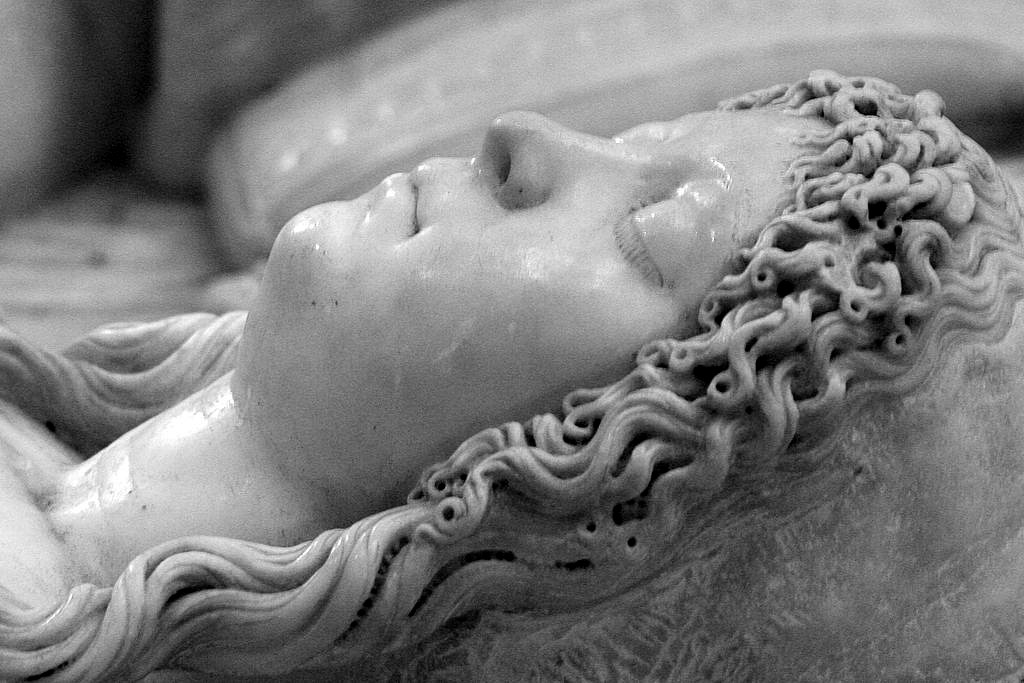
From Beatrix’s marble tomb, at certain times of the year, a liquid miraculously exudes and a delicate perfume is released from her bones. The many graces obtained on the occasions of public calamities, make the place an object of great veneration.
Feast of the Chair of the Apostle, St Peter at Rome: This Feast was instituted to commemorate the establishment of the Holy See at Rome. In 1960, Pope John XXIII removed from the General Roman Calendar, the 18 January Feast of the Chair of Peter at Rome. Two Liturgical Feasts were celebrated in Rome, in Honour of Chairs of Saint Peter, one of which was kept in the Baptismal Chapel of St Peter’s Basilica, the other at the Catacomb of Priscilla. The dates of these celebrations are 18 January and 22 February. The two Feasts were included in the Tridentine Calendar with the rank of Double, which, in 1604, Pope Clement VIII raised to the rank of Greater Double. Those traditional Catholics. who do not accept the changes made by Pope John XXIII, continue to celebrate both Feast days: “Saint Peter’s Chair at Rome” on 18 January and the “Chair of Saint Peter at Antioch” on 22 February. https://anastpaul.com/2017/02/22/feast-of-the-chair-of-st-peter-22-february/
St Archelais the Martyr Blessed Beatrix d’Este the Younger (c 1230-1262) Benedictine Nun St Catus
Blessed Cristina Ciccarelli OSA (1481–1543) Religious of the Order of Saint Augustine, Mystic, Stigmatist, Apostle of the poor, Reformer, she had a had a particular devotion to the Eucharist and to the Passion and Death of Christ, she was granted the gift of Prophecy, visions and levitation. Beatified in 1841 by Pope Gregory XVI . About Bl Cristina: https://anastpaul.com/2020/01/18/saint-of-the-day-18-january-blessed-cristina-ciccarelli-osa-1481-1543/
St Day/Dye St Deicola of Lure Bl Fazzio of Verona St Leobard of Tours St Moseus of Astas St Susanna the Martyr St Thecla the Martyr St Ulfrid of Sverige St Volusian of Tours
Thought for the Day – 17 January – Meditations with Antonio Cardinal Bacci (1881-1971)
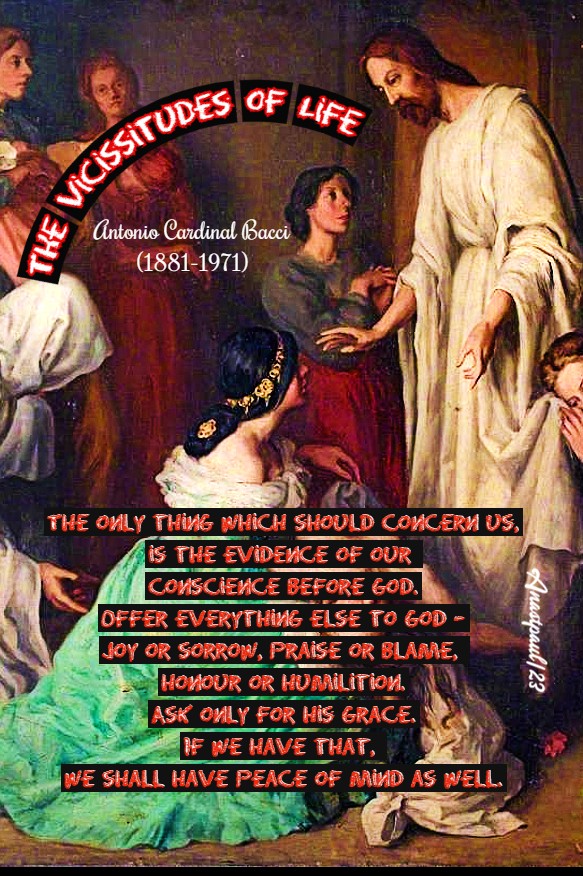
The Vicissitudes of Life
“Let this be our resolution and the result of our meditation. When we are tempted to sin, especially against holy purity, let us resist immediately and take flight. When we encounter misunderstanding on the part of others, or even coldness or calumny, or injustice, let us not be depressed or annoyed. The only thing which should concern us, is the evidence of our conscience before God.
Offer everything else to God – joy or sorrow, praise or blame, honour or humilition. Ask only for His grace. If we have that, we shall have peace of mind as well.”
Quote/s of the Day – 17 January – St Anthony Abbot (251-356)
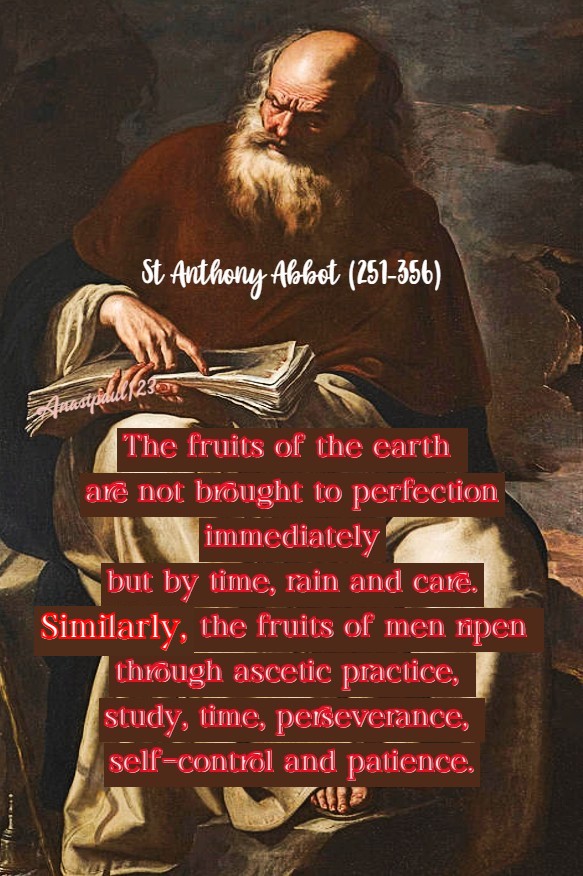
“The fruits of the earth are not brought to perfection immediately but by time, rain and care. Ssimilarly, the fruits of men ripen through ascetic practice, study, time, perseverance, self-control and patience.”
“Regard as free, not those, whose status makes them outwardly free but those, who are free in their character and conduct. For we should not call men truly free when they are wicked and dissolute, since they are slaves to worldly passions. Freedom and happiness of soul consist in genuine purity and detachment from transitory things.”
“. . . You should know that there is present with you, the Angel whom God has appointed for each man. . . This Angel, who is sleepless and cannot be deceived, is always present with you; he sees all things and is not hindered by darkness. You should know, too, that with him, is God!”
One Minute Reflection – 17 January – “The Month of the Most Holy Name of Jesus” – St Anthony Abbot (251-356) – Ecclesiasticus 45:1-6, Luke 12:35-40 – Scripture search here: https://www.drbo.org/
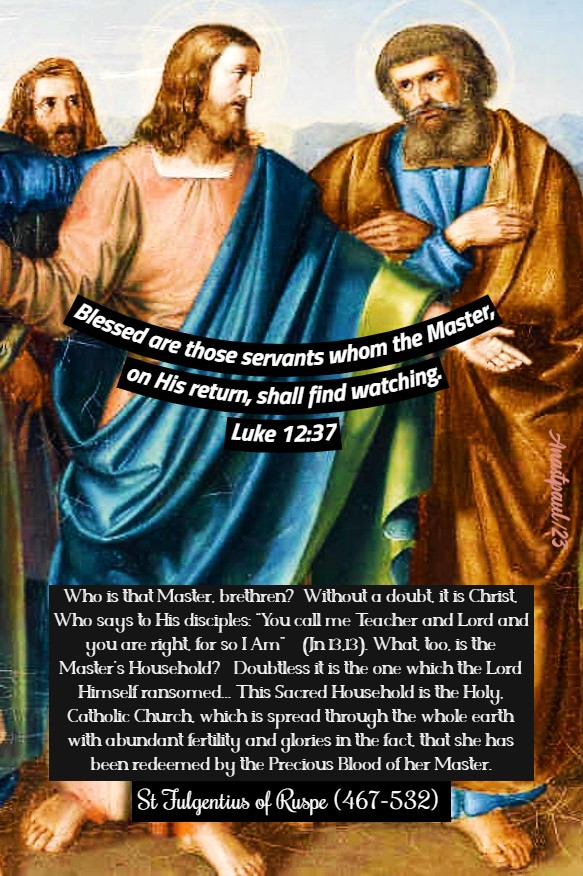
“Blessed are those servants whom the Master, on His return, shall find watching.” – Luke 12:37
REFLECTION – “Wishing to emphasise the special office of the servants, whom He has placed in charge of His people, the Lord says, ‘Who, do you think, is the faithful and wise steward, whom the Lord sets over His household, to give to them their measure of wheat at the proper time? Blessed is that servant whom his Master will find so doing when he comes.” Who is that Master, brethren? Without a doubt, it is Christ, Who says to His disciples: “You call me Teacher and Lord and you are right, for so I Am” (Jn 13,13). What, too, is the Master’s Household? Doubtless it is the one which the Lord Himself ransomed… This Sacred Household is the Holy, Catholic Church, which is spread through the whole earth with abundant fertility and glories in the fact, that she has been redeemed by the Precious Blood of her Master. As He Himself says: “The Son of Man came, not to be served but to serve and to give His Life as a ransom for many” (Mk 10,45).
He is, too, the Good Shepherd ”Who laid down His Life for His sheep” (Jn 10,11)…As to who the steward is, who ought to be faithful, as well as wise, the Apostle Paul shows us, when, speaking of himself and his companions, he says: “This is how one should regard us, as the servants of Christ and stewards of the mysteries of God. Moreover, it is required of stewards that they should be found trustworthy” (1Cor 4,1-2).
Now, lest anyone of us should think that it is only the Apostles who have been made stewards…, the blessed Apostle Paul shows us that the Bishops also are stewards, when he says: “For a bishop, as God’s steward, must be blameless” (Tt 1,7)…We, therefore, who are the servants of the Master of the Household, we are the stewards of the Lord, we have received the measure of wheat to disburse to you.” – St Fulgentius of Ruspe (467-532) Bishop in North Africa (Homily 1, on the Lord’s servants) (trans. Breviary Common of Pastors).
PRAYER – May the intercession of the Blessed Abbot Anthony, commend us, we beseech Thee, O Lord, so that what we do not deserve by any merits of our own, we may obtain by his patronage. Through tJesus Christ, Thy Son our Lord, Who lives and reigns with Thee, in the unity of the Holy Ghost, God, world without end. Amen (Collect).
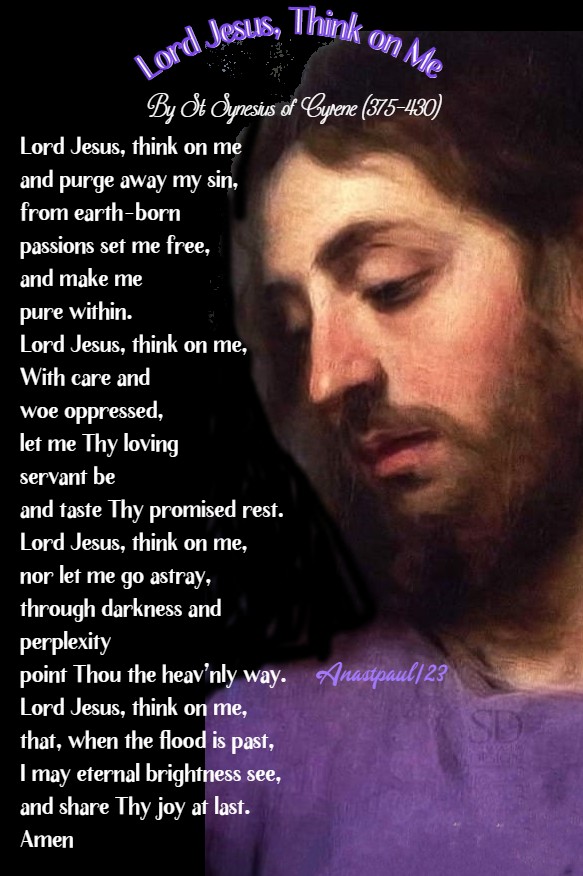
Lord Jesus, Think on Me By St Synesius of Cyrene (375-430) Bishop of Ptolemais
Lord Jesus, think on me and purge away my sin, from earth-born passions set me free, and make me pure within. Lord Jesus, think on me, With care and woe oppressed, let me Thy loving servant be and taste Thy promised rest. Lord Jesus, think on me, nor let me go astray, through darkness and perplexity point Thou the heav’nly way. Lord Jesus, think on me, that, when the flood is past, I may eternal brightness see, and share Thy joy at last. Amen



















 AnaStpaul
You must be logged in to post a comment.