Thought for the Day – 3 April – Meditations with Antonio Cardinal Bacci (1881-1971)
The Betrayal of Judas
“Failure to comply with the extraordinary graces which Jesus had granted him was responsible for the fall of Judas. Whoever receives a great deal must give as much! Judas had been called to the dignity of the Apostolate. At the Last Supper, he received the fullness of the Priesthood along with the other Apostles and received Jesus Himself into his soul, under the species of the Consecrated bread. In spite of all this, he deserted and betrayed his Master.
What about us? Let us consider how many spiritual and temporal graces God has bestowed on us, throughout our lives. Have we been thankful for them? If we have not corresponded generously with all these favours, or if we have done worse and have rejected them by sin, let us repent and resolve to do better. The example of Judas should, at the least, teach us this lesson!”
Quote/s of the Day – 3 April – Monday in Holy Week – Isaias 50:5-10, John 12:1-9 – Scripture search here: https://www.drbo.org/
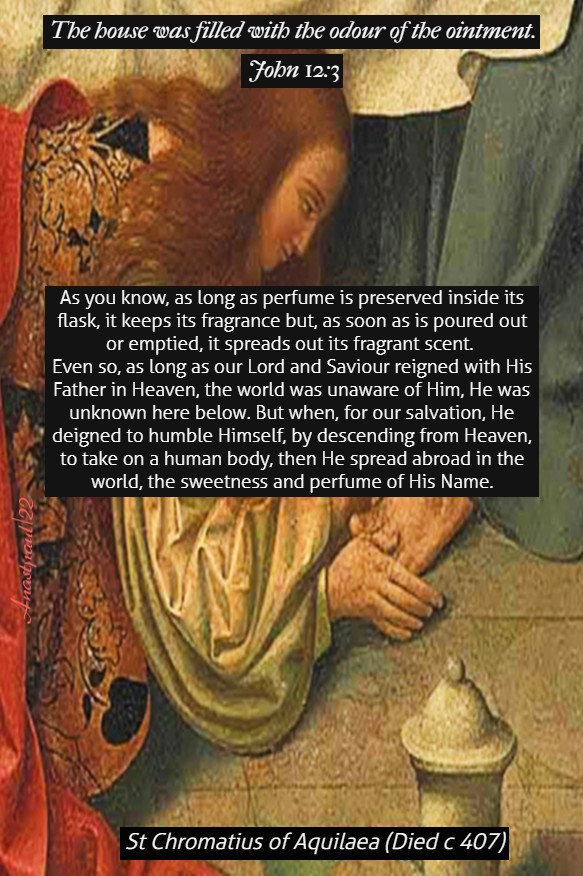
“The house was filled with the odour of the ointment.”
John 12:3
“As you know, as long as perfume is preserved inside its flask, it keeps its fragrance but, as soon as is poured out or emptied, it spreads out its fragrant scent. Even so, as long as our Lord and Saviour reigned with His Father in Heaven, the world was unaware of Him, He was unknown here below. But when, for our salvation, He deigned to humble Himself, by descending from Heaven, to take on a human body, then He spread abroad in the world, the sweetness and perfume of His Name.”
St Chromatius of Aquilaea (Died c 407) Bishop of Aquileia, Italy, Father
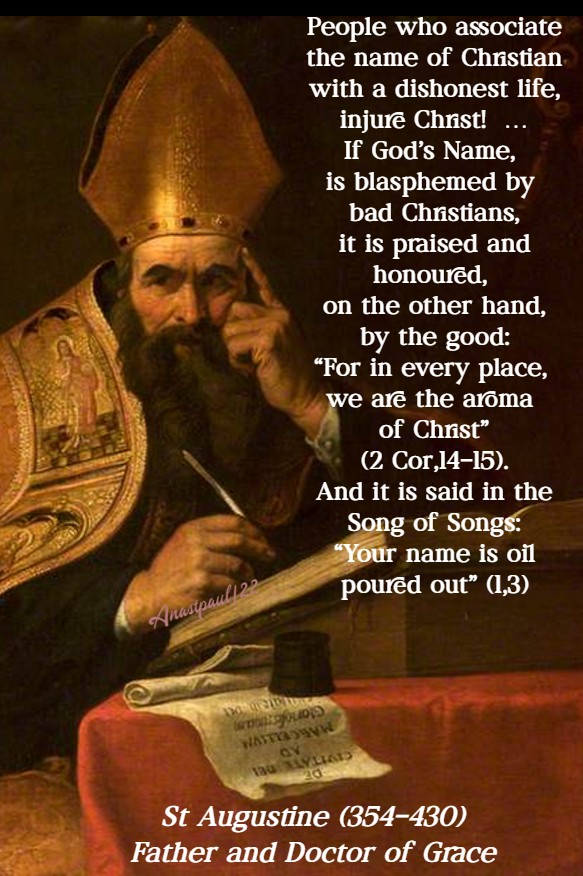
“People who associate the name of Christian with a dishonest life, injure Christ! … If God’s Name, is blasphemed by bad Christians, it is praised and honoured, on the other hand, by the good: “For in every place, we are the aroma of Christ” (2 Cor,14-15). And it is said in the Song of Songs: “Your name is oil poured out” (1,3).”
St Augustine (354-430) Father and Doctor of Grace
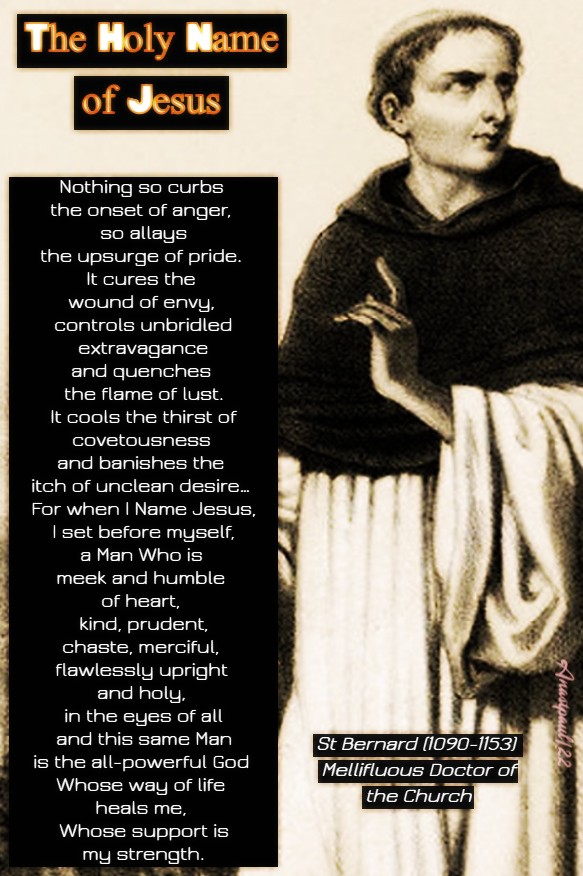
“Nothing so curbs the onset of anger, so allays the upsurge of pride. It cures the wound of envy, controls unbridled extravagance and quenches the flame of lust. It cools the thirst of covetousness and banishes the itch of unclean desire… For when I Name Jesus, I set before myself, a Man Who is meek and humble of heart, kind, prudent, chaste, merciful, flawlessly upright and holy in the eyes of all and this same Man, is the all-powerful God Whose way of life heals me, Whose support is my strength.”
St Bernard (1090-1153) Father and Mellifluous Doctor of the Church
Our Lenten Journey with St Francis de Sales – 3 April – Monday in Holy Week
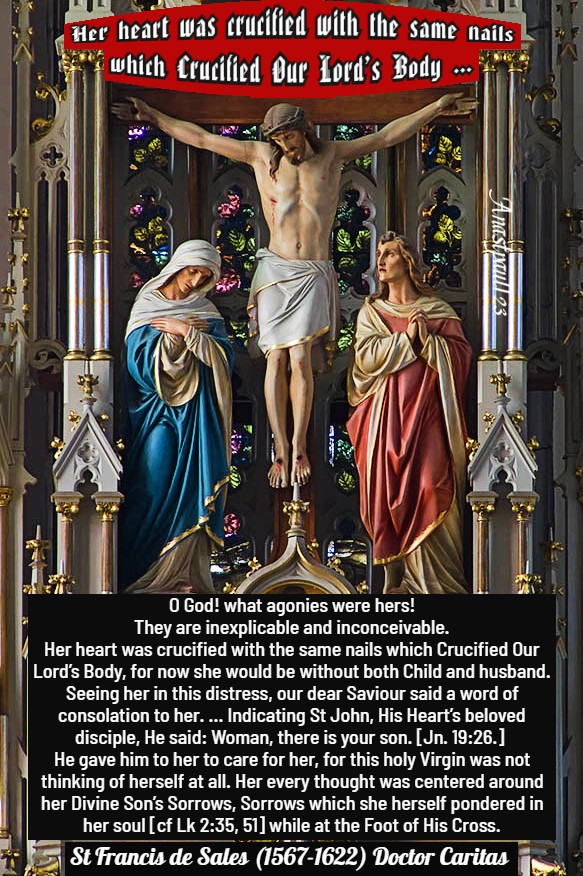
“Her heart was crucified with the same nails which Crucified Our Lord’s Body …” St Francis de Sales
MONDAY in HOLY WEEK Our Lord’s Third Word … St Francis de Sales (1567-1622) Doctor Caritas
“OUR LORD’S THIRD WORD was one of consolation. He spoke it to His sacred Mother who was at the foot of the Cross, pierced by a sword of sorrow [Lk 2:35] but certainly not swooning, nor with faint heart, as artists have falsely and impertinently painted her. The Evangelist clearly says the contrary, insisting that she remained standing with an incomparable firmness [Jn. 19:25]. That courage did not keep her from the grieving which she endured with the generous and magnanimous heart belonging to her alone. O God! what agonies were hers! They are inexplicable and inconceivable. Her heart was crucified with the same nails which Crucified Our Lord’s Body, for now she would be without both Child and husband.
Seeing her in this distress, our dear Saviour said a word of consolation to her. But this consoling and tender word was not given to lift her heart from such great desolation. The heart of this perfectly submissive and resigned holy Virgin needed to be extremely strong and Our Lord, Who knew her so well, dealt with her accordingly. Indicating St John, His Heart’s beloved disciple, He said: Woman, there is your son. [Jn. 19:26.] He gave him to her to care for her, for this holy Virgin was not thinking of herself at all. Her every thought was centered around her Divine Son’s Sorrows, Sorrows which she herself pondered in her soul [cf Lk 2:35, 51] while at theFoot of His Cross.” – (Sermons of St Francis de Sales for or Lent).
One Minute Reflection – 3 April – “The Month of the Resurrection” – Monday in Holy Week – Isaias 50:5-10, John 12:1-9 – Scripture search here: https://www.drbo.org/
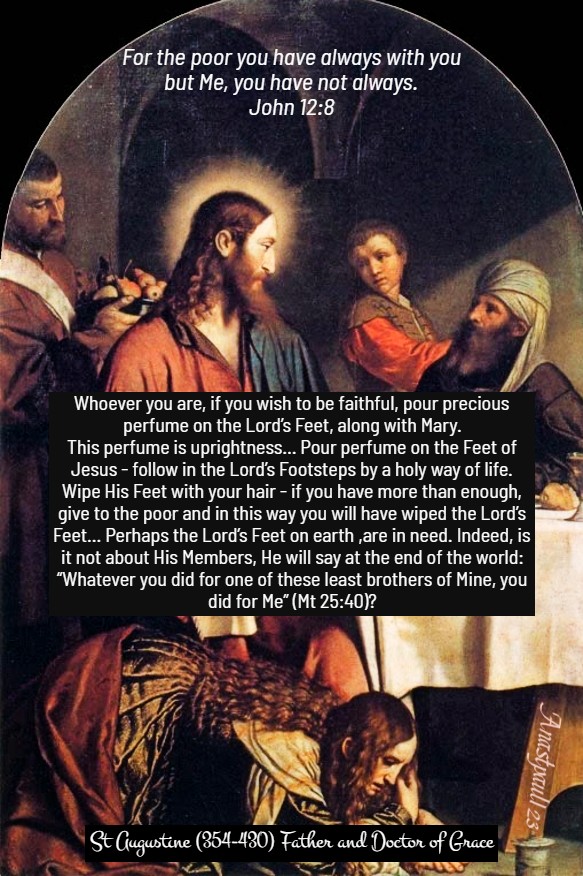
“For the poor you have always with you but Me, you have not always.” – John 12:8
REFLECTION – “This is the historical event, now let us look for the symbol. Whoever you are, if you wish to be faithful, pour precious perfume on the Lord’s Feet, along with Mary. This perfume is uprightness… Pour perfume on the Feet of Jesus – follow in the Lord’s Footsteps by a holy way of life. Wipe His Feet with your hair – if you have more than enough, give to the poor and in this way you will have wiped the Lord’s Feet… Perhaps the Lord’s Feet on earth ,are in need. Indeed, is it not about His Members, He will say at the end of the world: “Whatever you did for one of these least brothers of Mine, you did for Me” (Mt 25:40)?
“And the house was filled with its fragrance.” That is to say, the world has been filled with the renown of this woman, for the sweet fragrance is her good name. People who associate the Name of Christian with a dishonest life injure Christ… if God’s Name is blasphemed by bad Christians, it is praised and honoured, on the other hand, by the good: “For in every place we are the aroma of Christ” (2 Cor 14-15). And it is said in the Song of Songs: “Your Name is oil poured out” (1:3).” – St Augustine (354-430) Father and Doctor of Grace (Sermons on Saint John’s Gospel, no 50 6-7).
PRAYER – Grant, we beseech Thee, Almighty God, that we who fail through our weakness in so many difficulties, may be relieved through the pleading of the Passion of Thy Only-begotten Son. Through the same Jesus Christ, Thy Son our Lord, Who lives and reigns with Thee, in the unity of the Holy Ghost, God, world without end. Amen (Collect).
Our Morning Offering – 3 April – Monday in Passion Week and the Memorial of St Richard of Chichester (1197-1253)
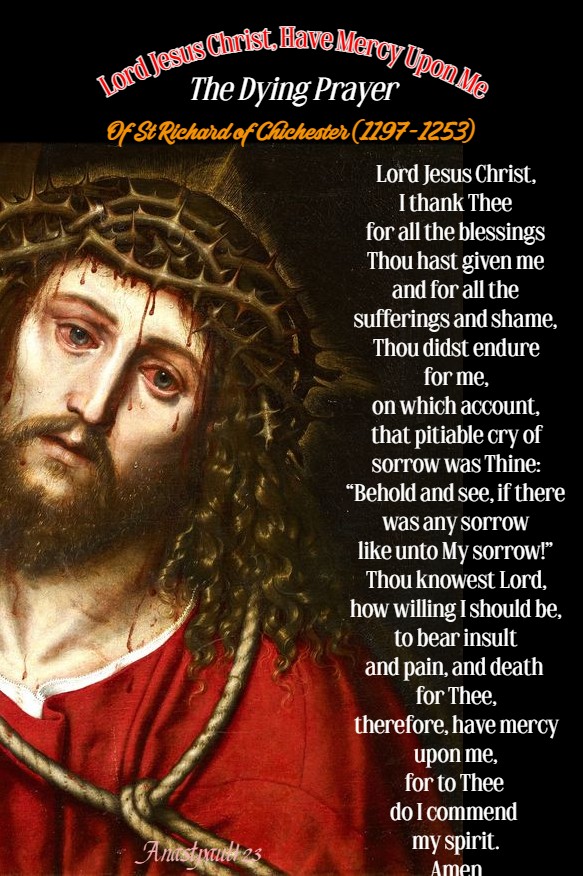
Lord Jesus Christ, Have Mercy Upon Me. The Dying Prayer of St Richard of Chichester (1197-1253)
Lord Jesus Christ, I thank Thee for all the blessings Thou hast given me and for all the sufferings and shame, Thou didst endure for me, on which account, that pitiable cry of sorrow was Thine: “Behold and see, if there was any sorrow like unto My sorrow!” Thou knowest Lord, how willing I should be, to bear insult and pain, and death for Thee, therefore, have mercy upon me, for to Thee do I commend my spirit. Amen
St Richard recited this prayer on his deathbed, surrounded by the Clergy of his Diocese. The words were transcribed, in Latin, by his Confessor and friend, Fr Ralph Bocking (who ultimately also became his Biographer), a Dominican Friar and were eventually published in the Acta Sanctorum, an encyclopedic text in 68 folio volumes of documents examining the lives of Saints. The British Library copy contains Fr Bocking’s transcription of the prayer:
Gratias tibi ago, Domine Jesu Christe, de omnibus beneficiis quae mihi praestitisti; pro poenis et opprobrious, quae pro me pertulisti; propter quae planctus ille lamentabilis vere tibi competebat. Non est dolor similis sicut dolor meus.
However, the first English translation is as above an not the version below, or the one more commonly known as “Day by Day” which words were never in the original and were added and used in the extremely sacrilegious and blasphemous “Godspell” – even though the common version with the rhyming “Triplet” (i.e. clearly, dearly, nearly) – is the one found commonly in Hymn and Prayer Books. Bearing in mind that this was “The Dying Prayer ” of St Richard, it is obviously highly unlikely that he would have requested the grace of daily sanctity, “day by day!”
Thanks be to Thee, my Lord Jesus Christ For all the benefits Thou hast given me, For all the pains and insults Thou hast borne for me. O most merciful Redeemer, Friend and Brother, May I know Thee more clearly, Love Thee more dearly, Follow Thee more nearly. Amen
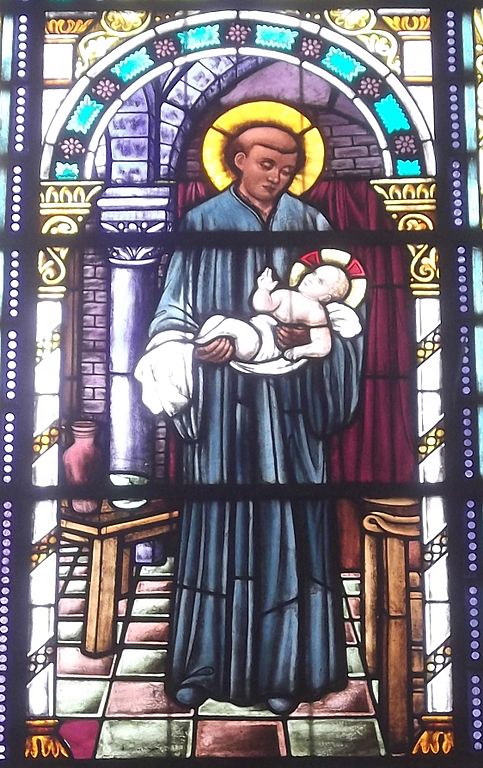
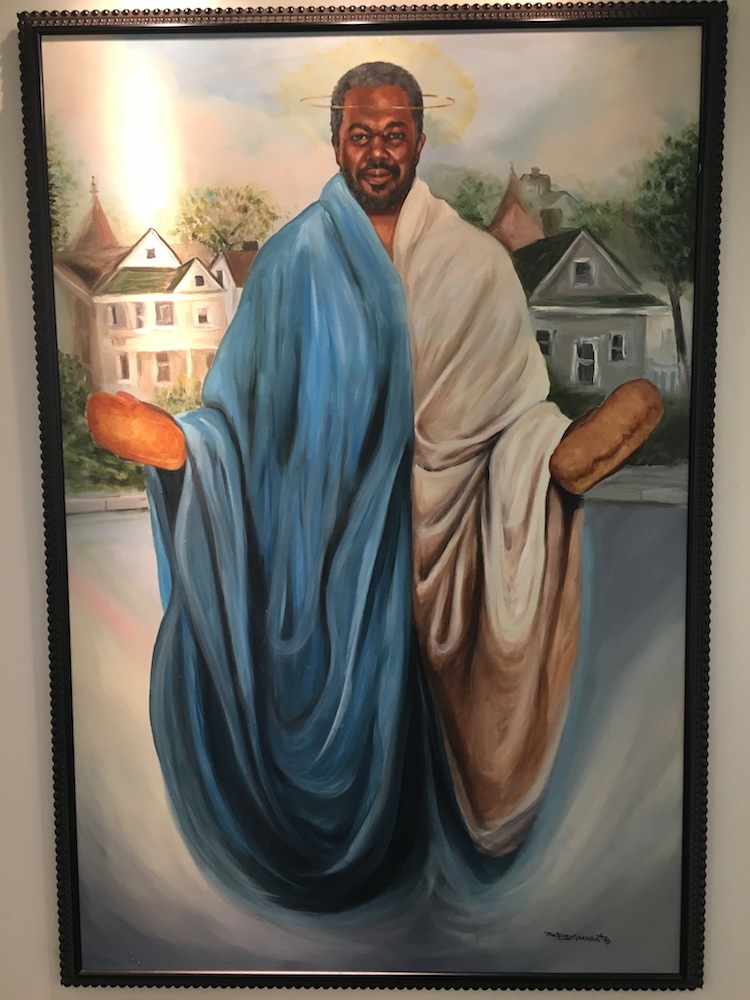
Saint of the Day – 3 April – St Benedict of Palermo OFM (1526-1589) Lay Friar of the Order of Friars Minor of the Observance, Confessor, spiritual counsellor, Apostle of the poor and needy, graced with the gift of healing the sick. Born as Benedetto Manasseri in1526 in San Fratello, Messina, Sicily and died on 4 April 1589 (aged 62–63) in Palermo, Sicily of natural causes. Patronages – African missions and Missionaries to Africa, Black Catholic Americans, African Americans, black people, Palermo, San Fratello. Also known as – Benedict the Moor, Benedict the Black, Benedict the African, Benedetto. His body is incorrupt. Additional Memorial – 4 April. St Benedict’s gifts for prayer, his love for the Blessed Virgin and the Infant Jesus and the wisdom displayed in his guidance of souls, earned him, a reputation for holiness, throughout Sicily. Following the example of St Francis, Benedict kept seven 40-day fasts throughout the year. He also slept only a few hours each night.
Benedict was born to Cristoforo and Diana Manasseri, Africans, who were taken as slaves in the early 16th Century to San Fratello, a small town near Messina, Sicily. They were given Italian names and later converted to Christianity.
Benedict’s parents were granted freedom for their son before his birth because of their “loyal service.” Like most peasants, Benedict did not attend any school and was illiterate. During his youth, he worked as a shepherd and was quick to give what he had earned to the poor.
When he was 21 years old, he was publicly insulted for the colour. of his skin His forbearance and silence was noted by the leader of an independent group of hermits on nearby Monte Pellegrino, who followed the Rule for Hermit life written by St Francis of Assisi.
Benedict was invited to join that community and shortly thereafter, he gave up all his earthly possessions and joined them. He served as the cook for the community and at the age of twenty-eight succeeded Jerome Lanze as the Superior of the group.
In 1564 Pope Pius IV disbanded independent communities of hermits, ordering them to attach themselves to an established religious Order, in this case, the Order of Friars Minor. As soon as Benedict was professed as an official Friar of the Franciscans, he was assigned to Palermo to the Franciscan Friary of St Mary of Jesus. He started there as the cook,but, showing the degree of his advancement in the spiritual life, he was soon appointed as the Master of Novices and later, as Guardian of the community, although he was a lay brother rather than a Priest and was illiterate.
Benedict accepted the promotion and successfully helped the Convent adopt a stricter version of the Franciscan Rule of life. He was widely respected for his deep, intuitive understanding of theology and Scripture and was often sought for counselling. He also had a reputation as a healer of the sick. Combined, these characteristics continued to draw many visitors to him. As he enjoyed cooking, he returned to kitchen duty in his later years.
Benedict died at the age of around 63 on the very day and hour which he had predicted. At the entrance of his cell in the Franciscan Friary of St Mary of Jesus, there is a plaque with the inscription: “Benedict was quickly invited to join that community, and shortly thereafter he gave up all his earthly possessions and joined them. He served as the cook for the community and at the age of twenty-eight succeeded Jerome Lanze as leader of the group.[3]
In 1564 Pope Pius IV disbanded independent communities of hermits, ordering them to attach themselves to an established religious Order, in this case, the Order of Friars Minor. Once a friar of the Order, Benedict was assigned to Palermo to the Franciscan Friary of St. Mary of Jesus. He started at the friary as a cook, but, showing the degree of his advancement in the spiritual life, he was soon appointed as the master of novices, and later as Guardian of the community, although he was a lay brother rather than a priest, and was illiterate.
Benedict accepted the promotion, and successfully helped the order adopt a stricter version of the Franciscan Rule of life. He was widely respected for his deep, intuitive understanding of theology and Scripture, and was often sought for counseling. He also had a reputation as a healer of the sick. Combined, these characteristics continued to draw many visitors to him. As he enjoyed cooking, he returned to kitchen duty in his later years.
Benedict died at the age of around 63 on the very day and hour which he had predicted. At the entrance of his cell in the Franciscan Friary of St Mary of Jesus, there is a plaque with the inscription: “This is the cell where Saint Benedict lived” with the dates of his birth and death – 1526 and 1589.
Upon his death, King Philip III of Spain ordered the construction of a magnificent tomb to house his remains, in the Friary Church. He was Beatified by Pope Benedict XIV in 1743 and Canonised in 1807 by Pope Pius VII. His body was found incorrupt during the Canonisation process.
Benedict is remembered for his patience and understanding when confronted with racial prejudice and taunts. He was declared a Patron Saint of Catholic African Americans, along with the Dominican lay brother, St Martin de Porres. In the United States, at least seven historically Black Catholic Parishes bear his name.
Blessed Gandulphus of Binasco OFM (c 1200-1260)Priest, Friar of the First Order of St Francis. He was a renowned Preacher mainly in Sicily, Hermit, Miracle-worker . He was one of those who entered the Order while the Seraphic Father was still alive and the life he led was one of great self-abnegation. He was Beatified on 10 March 1881 by Pope Leo XIII. Biography: https://anastpaul.com/2022/04/03/saint-of-the-day-3-april-blessed-gandulphus-of-binasco-ofm-c-1200-1260/
Martyrs of Greece – 4 Saints: A group of young Christian men who protested to City authorities that gifts to temples of pagan gods should be used to feed the poor during a regional famine. When the officials refused, the group went to local temples, broke up the idols and fixtures and gave the gold and silver bits to the poor to use to buy food. The group was imprisoned and executed. The only other thing we know about these Martyrs are the names – Bythonius, Elpideforus, Dius and Galycus. They Died in the 3rd Century at an unknown location in Greece.
Martyrs of Tomi (Romania) – 9 Saints who were Martyred together. We know nothing else about them but the names – Arestus, Benignus, Chrestus, Evagrius, Papo, Patricius, Rufus, Sinnidia and Zosimus. They Died at Tomi, Scythia (modern Constanta, Romania).










 AnaStpaul
You must be logged in to post a comment.