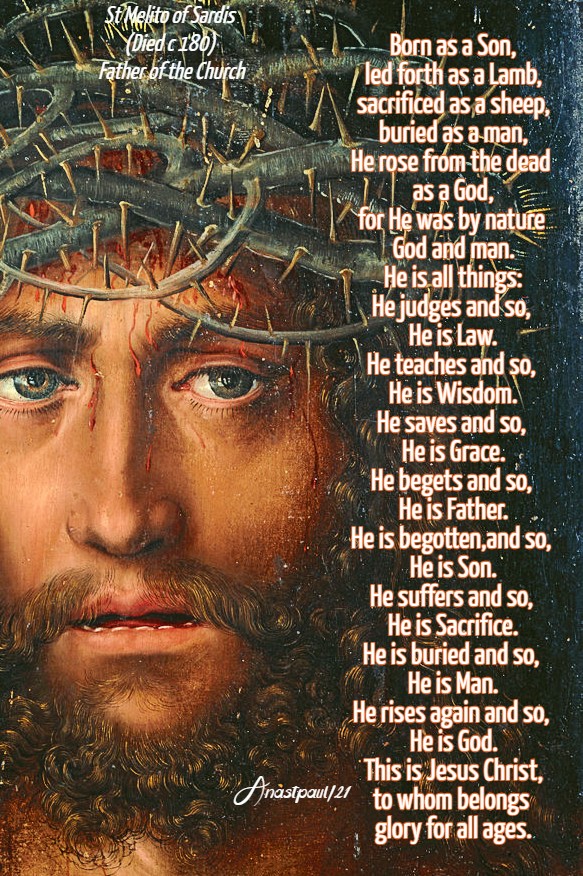
“Born as a Son, led forth as a Lamb, sacrificed as a sheep, buried as a man, He rose from the dead as a God, for He was by nature God and man.
He is all things – He judges and so, He is Law. He teaches and so, He is Wisdom. He saves and so, He is Grace. He begets and so, He is Father. He is begotten,and so, He is Son. He suffers and so, He is Sacrifice. He is buried and so, He is Man. He rises again and so, He is God. This is Jesus Christ, to Whom belongs glory for all ages.”
St Melito of Sardis (Died c 180) Bishop, Early Church Father
Our Lenten Journey with St Francis de Sales – 6 April – Maundy Thursday – Scripture search here: https://www.drbo.org/
“But could God not have provided the world with a remedy, other than that of His Son’s Death? ” St Francis de Sales
MAUNDY THURSDAY “Father, forgive them” St Francis de Sales (1567-1622) Doctor Caritas
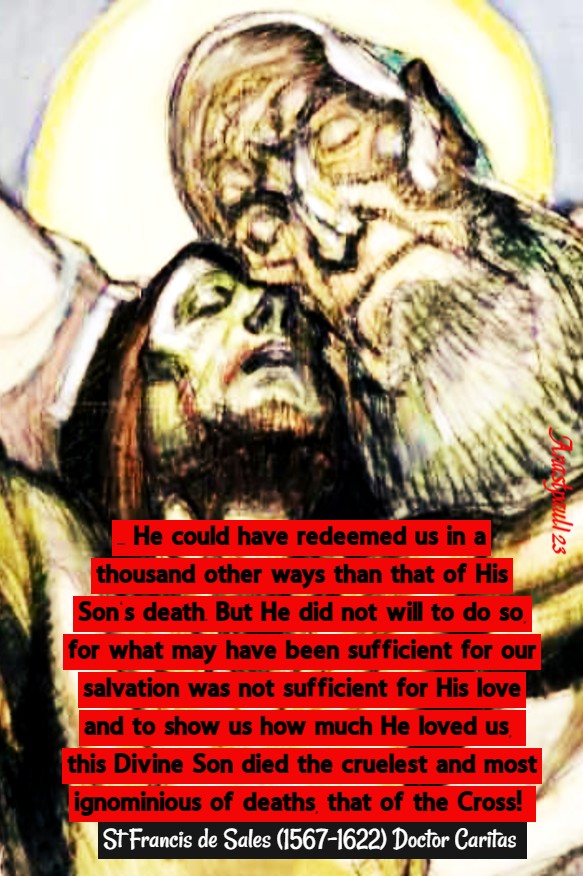
“BUT COULD GOD not have provided the world with a remedy, other than that of His Son’s Death? Certainly, He could have done so and by a thousand other means. Could He not have pardoned human nature with absolute power and pure mercy, not invoking justice or the intervention of any creature? Doubtless He could and who would have dared to question or criticise Him? No-one, for He is Sovereign Master and can do all He wills. Besides, if He had wanted some creature to undertake our redemption, would He not have created one of such excellence and dignity that, by its deeds or sufferings, it could have satisfied for all our sins? Assuredly and He could have redeemed us in a thousand other ways than that of His Son’s death. But He did not will to do so, for what may have been sufficient for our salvation was not sufficient for His love and to show us how much He loved us, this Divine Son died the cruelest and most ignominious of deaths, that of the Cross! …”
“OH, HOW GREAT was the flame of love which burned in the Heart of our gentle Saviour, since at the height of His sufferings, at a time when the vehemence of His torments seemed to take from Him, even the power of praying for Himself, He succeeded, through the strength of His charity in forgetting Himself but not His creatures and with a strong and intelligible Voice uttered these words: “Father, forgive them.” With this prayer, He wanted to make us understand the love He bore us, undiminished by any suffering and to teach us how our heart should be toward our neighbour.” – (Sermons of St Francis de Sales for Lent).
One Minute Reflection – 6 April – Maundy Thursday – 1 Corinthians 11:20-32, John 13:1-15 – Scripture search here: https://www.drbo.org/
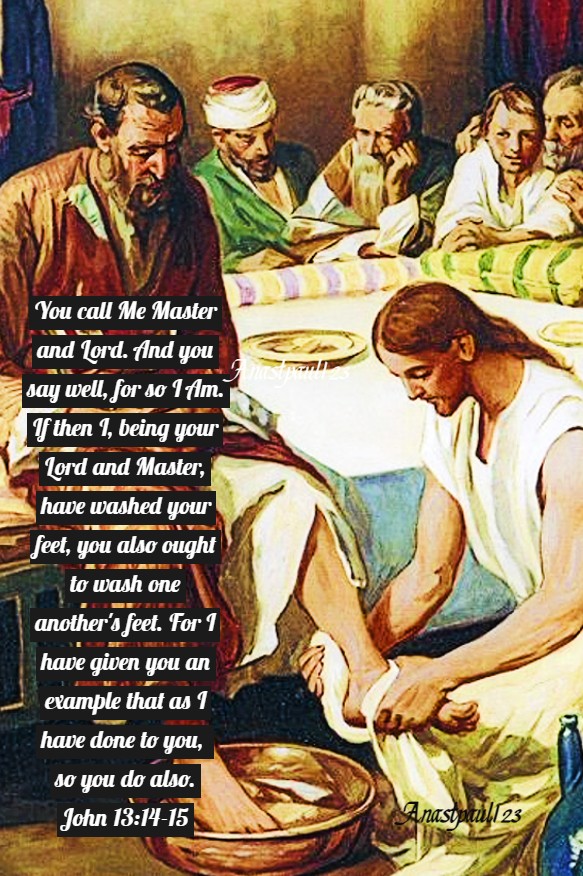
“You call Me Master and Lord. And you say well, for so I Am. If then I, being your Lord and Master, have washed your feet, you also ought to wash one another’s feet. For I have given you an example that as I have done to you, so you do also.” – John 13:14-15
REFLECTION – “Jesus rose from supper and took off His outer garments. He took a towel and tied it around His waist. Then He poured water into a basin and began to wash the disciples’ feet. We read a story of the same kind in Genesis. Abraham says to the messengers – the three Angels who visit him: “Let some water be brought that you may bathe your feet and then rest yourselves under the tree; let me bring you a little food that you may refresh yourselves” (Gen 18:4-5). What Abraham did for the three Angels, Christ did for His Apostles, those messengers of the Truth, who were to preach faith in the Blessed Trinity, to all the world.
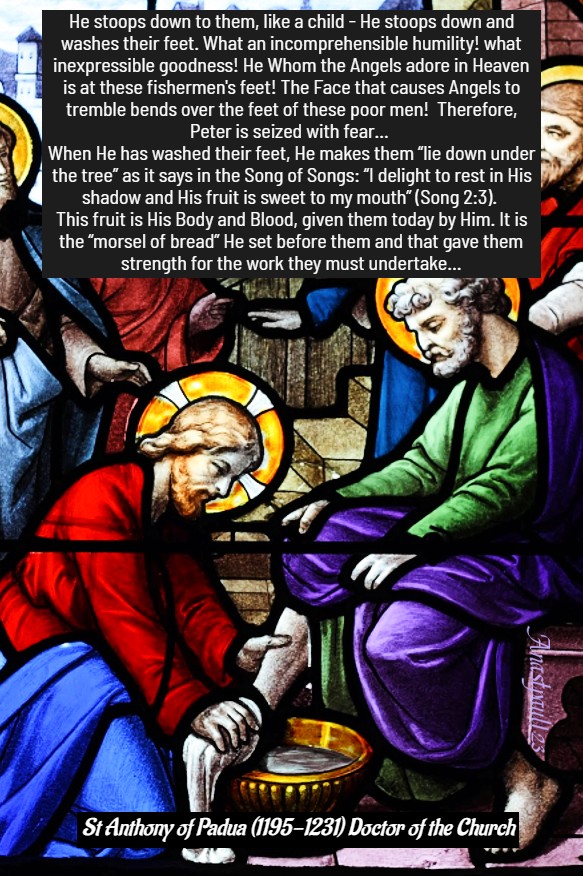
He stoops down to them, like a child – He stoops down and washes their feet. What an incomprehensible humility! what inexpressible goodness! He Whom the Angels adore in Heaven, is at these fishermen’s feet! The Face that causes Angels to tremble bends over the feet of these poor men!Therefore, Peter is seized with fear… When He has washed their feet He makes them “lie down under the tree” as it says in the Song of Songs: “I delight to rest in His shadow and His fruit is sweet to my mouth” (Song 2:3). This fruit is His Body and Blood, given them today by Him. It is the “morsel of bread” He set before them and that gave them strength for the work they must undertake…
Behold, “on this mountain the Lord of Hosts will prepare for all peoples a feast of rich meat with the marrow” (Is 25:6)… In the Upper Room where the Apostles are to receive the Holy Spirit on the day of Pentecost, the Lord of all the world, throws a feast today for all the peoples who believe in Him… This is what the Church does today throughout the world. It was for her sake that Christ prepared this feast on Mount Zion, this food that restores us, His True Body, rich in every spiritual virtue and charity. This He has given to His Apostles and has commanded them to give to those who believe in Him.” – St Anthony of Padua (1195-1231) Franciscan, Doctor of the Church (Sermons for Sundays and Feasts, Maundy Thursday).
PRAYER – O God, from Whom Judas received the punishment of his guilt and the thief the reward of his confession: grant unto us the full fruit of Thy clemency, that even as in His Passion, our Lord Jesus Christ gave to each a retribution according to his merits, so having taken away our old sins, He may bestow upon us the grace of His Resurrection. Who with Thee lives and reigns in the unity of the Holy Ghost, God, world without end. Amen (Collect).
Our Morning Offering – 6 April – Maundy Thursday in Holy Week
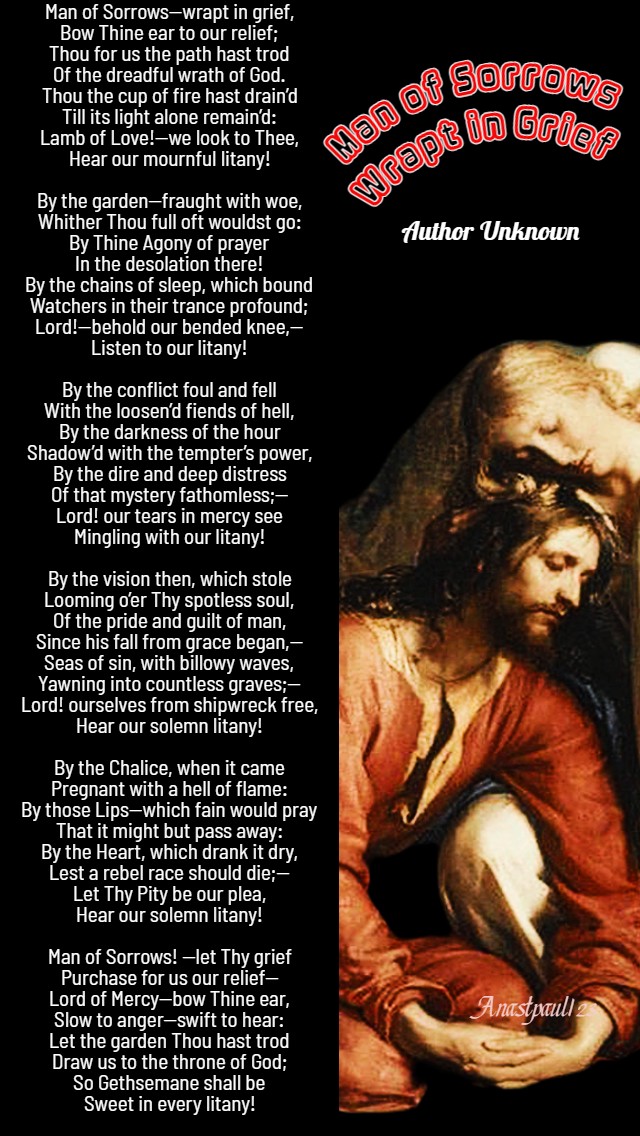
Man of Sorrows—Wrapt in Grief From an old French Hymn Author Unknown
Man of Sorrows—wrapt in grief, Bow Thine ear to our relief; Thou for us the path hast trod Of the dreadful wrath of God. Thou the cup of fire hast drain’d Till its light alone remain’d: Lamb of Love!—we look to Thee, Hear our mournful litany!
By the garden—fraught with woe, Whither Thou full oft wouldst go: By Thine Agony of prayer In the desolation there! By the chains of sleep, which bound Watchers in their trance profound; Lord!—behold our bended knee,— Listen to our litany!
By the conflict foul and fell With the loosen’d fiends of hell, By the darkness of the hour Shadow’d with the tempter’s power, By the dire and deep distress Of that mystery fathomless;— Lord! our tears in mercy see Mingling with our litany!
By the vision then, which stole Looming o’er Thy spotless soul, Of the pride and guilt of man, Since his fall from grace began,— Seas of sin, with billowy waves, Yawning into countless graves;— Lord! ourselves from shipwreck free, Hear our solemn litany!
By the Chalice, when it came Pregnant with a hell of flame: By those Lips—which fain would pray That it might but pass away: By the Heart, which drank it dry, Lest a rebel race should die;— Let Thy Pity be our plea, Hear our solemn litany!
Man of Sorrows! —let Thy grief Purchase for us our relief— Lord of Mercy—bow Thine ear, Slow to anger—swift to hear: Let the garden Thou hast trod Draw us to the throne of God; So Gethsemane shall be Sweet in every litany!
This translation by Matthew Bridges (1800-1894) (The Passion of Jesus 1852) Hymnist, Poet, Writer Converted to Catholicism in 1848, by the influence of John Henry Newman (1801-1890) Tune: “Anima Christi (English)” traditional English melody.
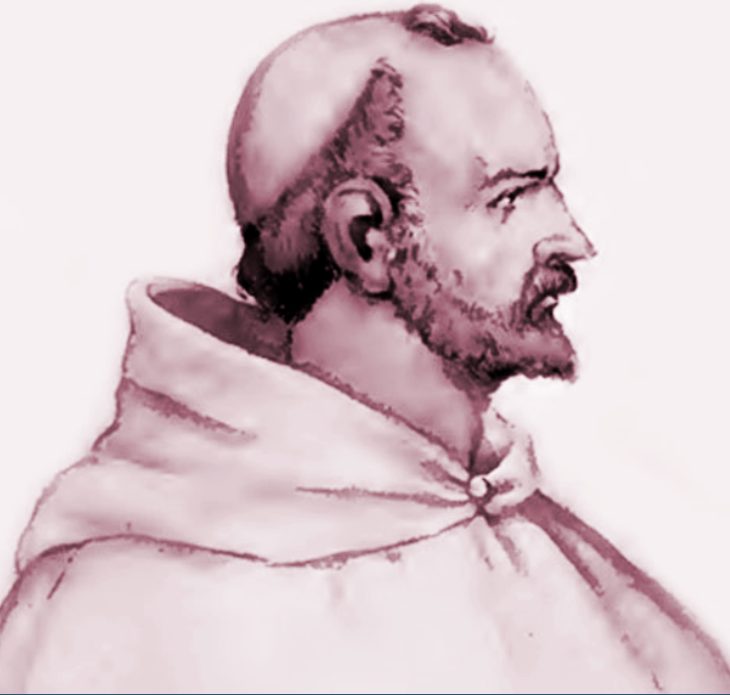
Saint of the Day – 6 April – St William of Eskilsoe (1125-1203) Priest, Abbot, Reformer – be it by his fervour, mortification, charity to the poor and uprightness of life. Born IN 1125 at Paris, France and died ion Easter Sunday, 6 April 1203 in Denmark of natural causes. Also known as – William of Aebelhold, William of Aebelholt, William of Ebelholt, William of Eskhill, William of Eskyll, William of Ise Fjord, William of Paris, William of the Paraclete, Wilhelm, Willem, Villem. St William was Canonised on 21 January 1224 by Pope Honorius III.
William was born of an illustrious family in Paris, about the year 1125 and received his education in the Abbey of St Germain-des-Prez, under his uncle Hugh, the Abbot. By the regularity of his conduct,and the sanctity of his manners, he was the admiration of the whole community. Having finished his studies, he was Ordained Deacon, then Priest and installed as a Canon in the Church of St Genevieve au-Mont. His assiduity in prayer, love of retirement and mortification,and exemplary life, seemed a troublesome censure of the slothful and worldly life of his colleagues and what ought to have gained him their esteem and affection, served to provoke their envy and malice against him.
Having in vain endeavoured to prevail on this reformer of their Chapter, as they called him, to resign his Canonry, in order to remove him, they presented him to the curacy of Epinay, a Church five leagues from Paris, depending on their chapter.
But not long after, Pope Eugenius III coming to Paris, in 1147 and being informed of the irregular conduct of these Canons, he commissioned the celebrated Sugar, Abbot of St Denys and Prime Minister to King Louis the Young, to expel them and introduce in their place, regular Canons from the Abbey of St Victor which was happily carried into execution, Eudo of St Victor’s being made the first Abbot. William with joy embraced this institution and was, by his fervour and devotion, a pattern of the most perfect Priest and Monk. He was in a short time chosen Sub-Prior.
The perfect spirit of religion and regularity which he established in that community, was an illustrious proof of the incredible influence which the example of a prudent Superior has over docile religious minds. His zeal for regular discipline, he tempered with so much sweetness and modesty in his injunctions, that made all to love the precept itself and, to practice with cheerfulness, whatever was prescribed them. The reputation of his wisdom and sanctity reached the ears of Absalon, Bishop of Roschild, in Denmark, who, being one of the most holy prelates of his age, earnestly sought to allure him into his Diocese. In 1161, he sent the provost of his Church, who seems to have been the learned historian Saxo the Grammarian, to Paris on this errand. A prospect of labours and dangers for the glory of God was a powerful motive with the Saint and, in 1165, he cheerfully undertook the voyage, taking with him 3 Monks.
The Bishop appointed him Abbot of Eskilsoe, a Monastery of Regular Canons which he had reformed. But when Abbot William arrived there were only six religious left at Eskilsoe, two of whom were dismissed when they refused to submit to the new rule. Here William sanctified himself by a life of prayer and austere mortification but had much to suffer from the persecutions of powerful men, from the extreme poverty of his house in a severe climate and, above all, from a long succession of interior trials but the most perfect victory over himself, was the fruit of his constancy, patience and meekness. On prayer was his chief dependence and it proved his constant support. And by his life of holiness, he soon filled the Monastery with new Monks who were drawn by the sanctity of their Abbot.
During the thirty years of his Abbacy, he had the comfort of seeing many walk with fervour in his steps. He never omitted wearing his hair-shirt, lay on straw and fasted every day. Penetrated with a deep sense of the greatness and sanctity of our Mysteries, he never approached the Altar without watering it with his tears, making himself a victim to God in the spirit of adoration and sacrifice, together with and through, the merits of the Holy Victim offered thereon: the dispositions in which every Christian ought to assist at it.
William died on 6 April, 1203, which that year was Easter Sunday. Numerous miracles were reported at his grave and in 1218 the Archbishop of Lund, Anders Sunesen, requested that Pope Honorius III appoint a local commission to investigate the claims of William’s sanctity. William was Canonised only 21 years after his death by Pope Honorius III in 1224. In 1238 St William’s Relics were translated to the new Church built at his Abbey of Eskilsoe. In time some of his Relics were shared in various Cathedrals and Churches across Denmark.
St Agrarius the Martyr St Amand of Grisalba St Berthanc of Kirkwall St Brychan of Brycheiniog Bl Catherine of Pallanza St Diogenes of Philippi St Elstan of Abingdon St Galla of Rome St Gennard St Irenaeus of Sirmium St Marcellinus the Martyr
St Philaret of Calabria St Platonides of Ashkelon St Prudentius of Troyes St Pope Sixtus I St Timothy of Philippi St Ulched St Urban of Peñalba St William of Eskilsoe (1125-1203) Priest, Abbpt St Winebald
Martyrs of Sirmium : 7 Saints – A group of fourth century Martyrs at Sirmium, Pannonia (modern Sremska Mitrovica, Serbia). We know little more than seven of their names – Florentius, Geminianus, Moderata, Romana, Rufina, Saturus and Secundus.
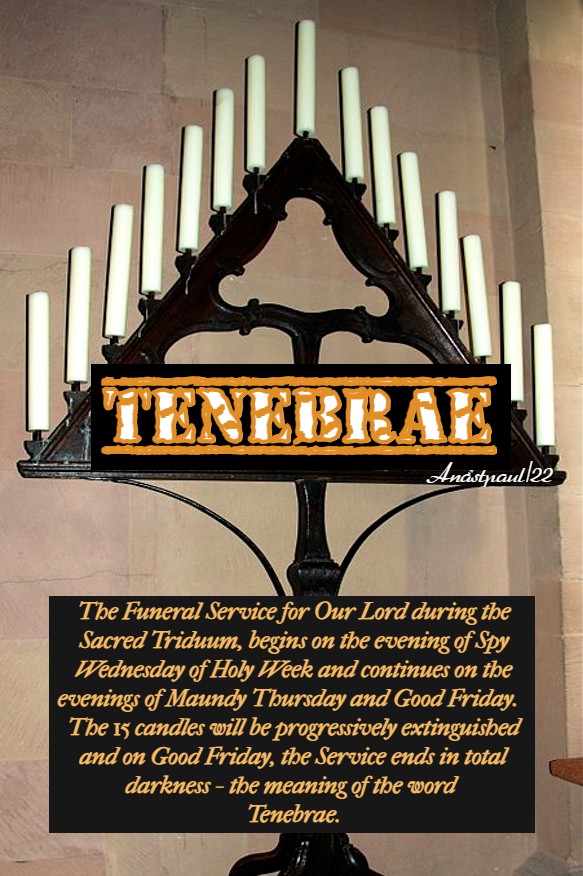
The Office of Tenebrae (Darkness from the Latin) The Funeral Service of the Lord on Spy Wednesday, Maundy Thursday and Good Friday
The public singing of part of the Divine Office, on Wednesday, Thursday and Friday evenings of Holy Week, anticipating Matins and Lauds of Holy Thursday, Good Friday, and Holy Saturday. A custom that went back centuries, it acquired the name because of the mourning ritual surrounding the ceremony, which included a triangular stand with fifteen candles. These were put out one by one until, after the last candle was extinguished, a prayer was said in darkness, one candle was lighted, and the assembly dispersed in silence. — Fr John Hardon, Modern Catholic Dictionary
The Matins and Lauds of the Divine Office sung during the Triduum (Holy Thursday, Good Friday and Holy Saturday) are known as the Tenebrae services (“tenebrae” meaning “darkness or shadows”), which is basically a funeral service for Our Lord.
During the Matins on Good Friday, one by one, the candles are extinguished in the Church, leaving the congregation in total darkness and in a silence that is punctuated by the “strepitus” (a loud clang intended to evoke the earthquake that occurred at the moment of Our Saviour’s Death) meant to evoke the convulsion of nature at the Death of Christ. It has also been described as the sound of the tomb door closing.
Thought for the Day – 5 April – Meditations with Antonio Cardinal Bacci (1881-1971)
The Agony of Jesus
“While Jesus was praying and suffering in the Garden of Gethsemane and the Apostles were unconcernedly sleeping, a group of hired ruffians approached, led by the traitor, Judas. Jesus went to meet them and quietly allowed Himself to be fettered by these rascals. He could have struck them to the ground in an instant or, as He said Himself, called more than twelve legions of Angels to His defence (Cf Mt 16:33). But this was the hour of the power of darkness. “This is your hour and the power of darkness” (Lk 22:53). When the Apostles saw Him being bound and led away, like an evil-doer, they deserted Him and ran away. “Then, all the disciples left him and fled” (Mt 26:56).
We also, may have been guilty of such shameful conduct on many occasions! Whenever God granted us the experience of His consoling presence by means of His grace or favours, we formed the most generous resolutions. But, in the presence of difficulties or of bad example from others, we may have shamefully deserted Jesus! Let us reflect whether this is so and reinforce our good resolutions.”
Our Lenten Journey with St Francis de Sales – 5 April – “Spy” Wednesday in Holy Week – Scripture search here: https://www.drbo.org/
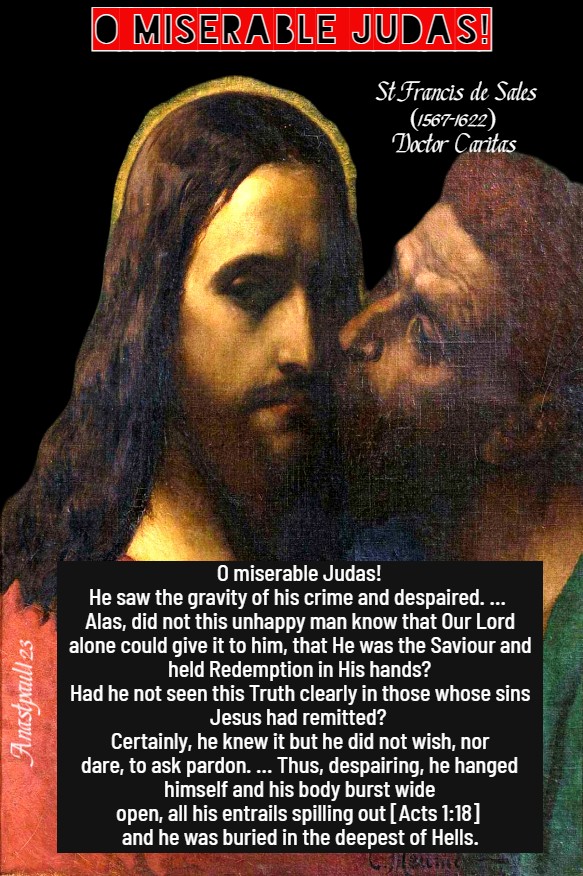
“O miserable Judas! He saw the gravity of his crime and despaired.” St Francis de Sales
“SPY” WEDNESDAY Judas St Francis de Sales (1567-1622) Doctor Caritas
“O MISERABLE JUDAS! He saw the gravity of his crime and despaired. Truly, he confessed his sin, for in returning to the chief priests the thirty pieces of silver ,for which he had sold his good Master, he acknowledged aloud that he had sold innocent blood. [Matt. 27:3-5.] But these priests would give him no absolution. Alas, did not this unhappy man know that Our Lord alone could give it to him, that He was the Saviour and held Redemption in His hands? Had he not seen this Truth clearly in those whose sins Jesus had remitted? Certainly, he knew it but he did not wish, nor dare, to ask pardon.
To make him despair, the devil showed him the enormity and hideousness of his crime and, perhaps, made him fear that if he asked his Master’s pardon, He might impose too great a penance. Perhaps for fear of such penance, he was unwilling to ask for forgiveness. Thus, despairing, he hanged himself and his body burst wide open, all his entrails spilling out [Acts 1:18] and he was buried in the deepest of Hells.” – (Sermons of St Francis de Sales for Lent).
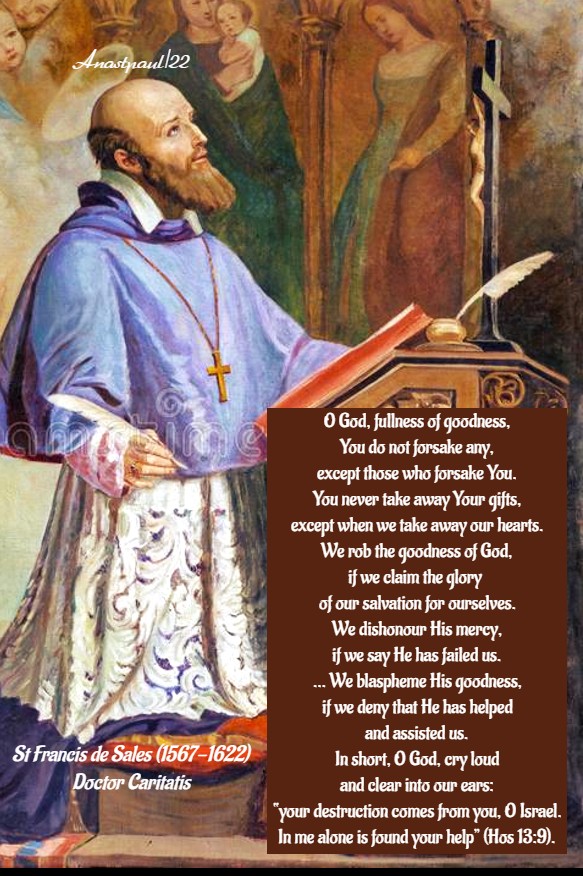
“O God, fullness of goodness, You do not forsake any, except those who forsake You. You never take away Your gifts, except when we take away our hearts. We rob the goodness of God, if we claim the glory of our salvation for ourselves. We dishonour His mercy, if we say He has failed us. … We blaspheme His goodness, if we deny that He has helped and assisted us. In short, O God, cry loud and clear into our ears: “your destruction comes from you, O Israel. In me alone is found your help” (Hos 13:9).
St Francis de Sales (1567-1622) Doctor Caritatis Treatise on the Love of God, Ch 9
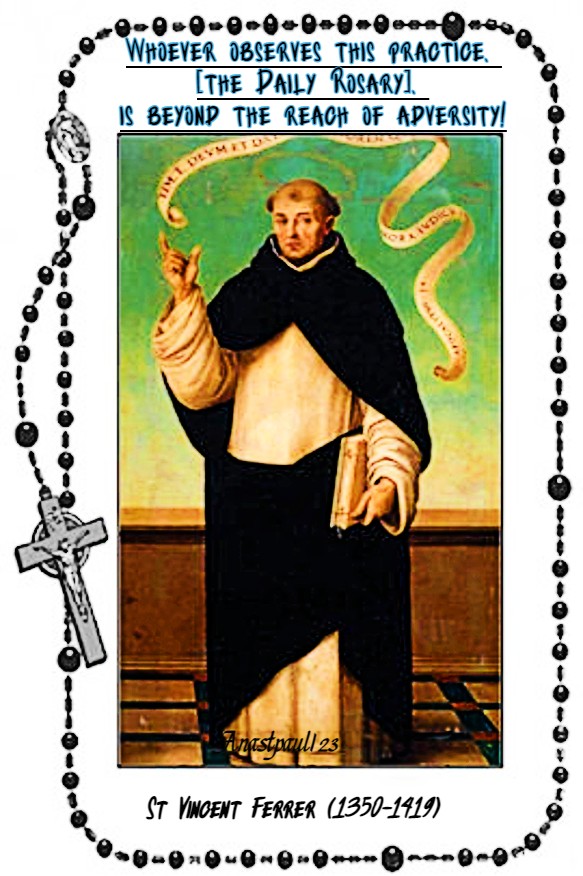
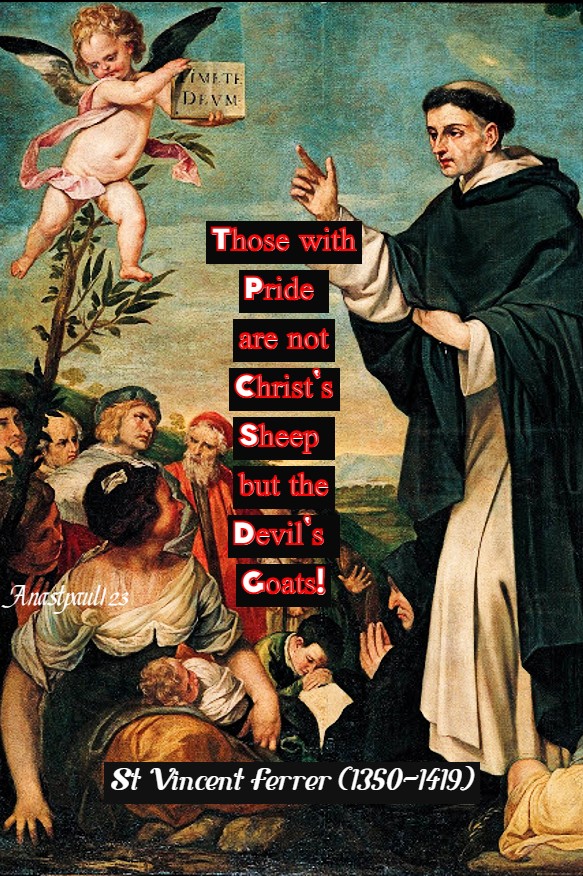
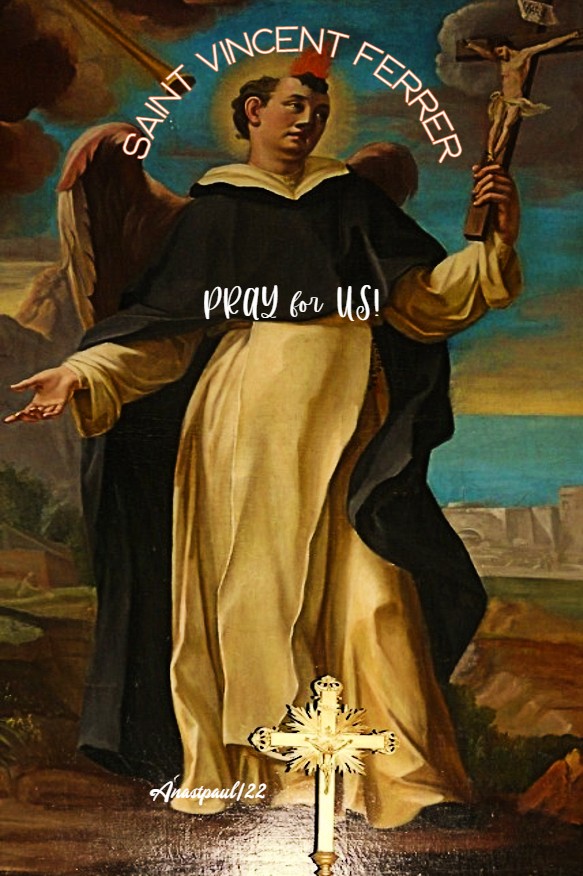
Quote/s of the Day – 5 April – St Vincent Ferrer OP (1350-1419) Confessor, called “The Angel of the Apocalypse” and of “The Last Judgement” and the “Mouthpiece of God.”
“Whoever observes this practice, [the Daily Rosary], is beyond the reach of adversity!”
“Those with pride are not Christ’s sheep but the devil’s goats!”
Grant me, O my God By St Vincent Ferrer (1350-1419)
Good Jesus, let me be penetrated with love to the very marrow of my bones, with fear and respect toward You. Let me burn with zeal for Your honour, so that I may resent terribly, all the outrages committed against You, especially those of which I myself have been guilty. Grant further, O my God, that I may adore and acknowledge You humbly, as my Creator and that, penetrated with gratitude for all Your benefits, I may never cease to render You thanks. Grant that I may bless You in all things, praise and glorify You with a heart full of joy and gladness and that, obeying You with docility in every respect, I may one day, despite my ingratitude and unworthiness, be seated at Your table together with Your Holy Angels and Apostles, to enjoy ineffable delights. Amen
One Minute Reflection – 5 April – St Vincent Ferrer (1350-1419) Confessor called the “Angel of the Apocalypse” and of “The Last Judgement” and the “Mouthpiece of God.”– “Spy” Wednesday in Holy Week – Isaias 53:1-12, Luke 22:1-71 and 23:1-53 – Scripture search here: https://www.drbo.org/
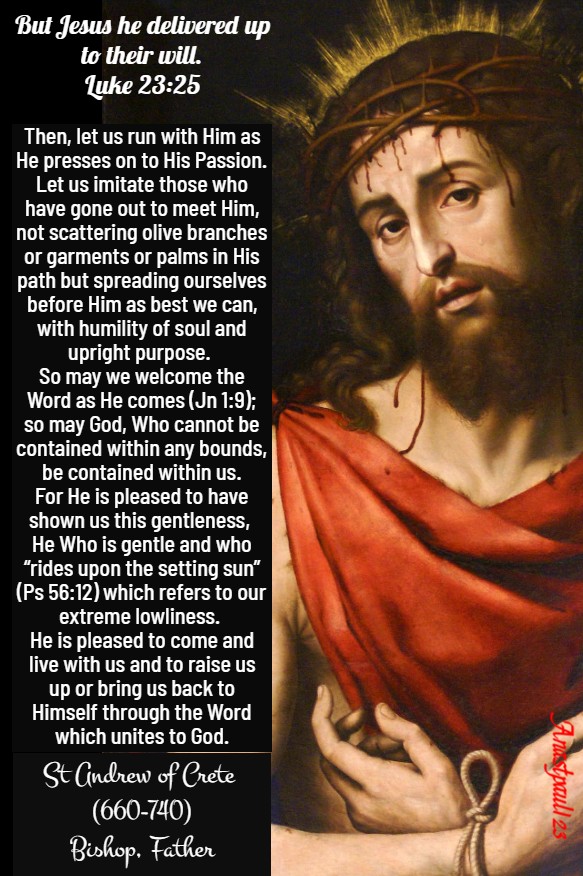
“But Jesus he delivered up to their will.” – Luke 23:25
REFLECTION – “Come, come, let us go up together to the Mount of Olives. Together let us meet Christ, Who is returning today from Bethany and going of His own accord to that Holy and Blessed Passion, to complete the Mystery of our Salvation. And so He comes, willingly taking the road to Jerusalem, He Who came down from the heights for us, to raise us who lie in the depths, to exaltation with Him, as the revealing Word says: “above all authority and rule and power and above every Name that is named” (Eph 1:21). He comes without display, without boast. For, as the prophet says, “He will not contend or shout out and no-one will hear His Voice” (Is 42:2). He is gentle and lowly and His entrance is humble…
Then, let us run with Him as He presses on, to His Passion. Let us imitate those who have gone out to meet Him, not scattering olive branches or garments or palms in His path but spreading ourselves before Him as best we can, with humility of soul and upright purpose. So may we welcome the Word as He comes (Jn 1:9); so may God, Who cannot be contained within any bounds, be contained within us.
For He is pleased to have shown us this gentleness, He Who is gentle and who “rides upon the setting sun” (Ps 56:12) which refers to our extreme lowliness. He is pleased to come and live with us and to raise us up or bring us back to Himself through the Word which unites to God.” – St Andrew of Crete (660-740) Bishop and Father (Homily for Palm Sunday).
PRAYER – O God, Who graciously enlightened Thy Church by the virtues and preaching of blessed Vincent, Thy Confessor, grant that we, Thy servants, may be taught by his example and delivered from all harm by his intercession. Through Jesus Christ, Thy Son our Lord, Who lives and reigns with Thee, in the unity of the Holy Ghost, God, world without end. Amen (Collect).
Our Morning Offering – 5 April – ‘Spy’ Wednesday in Holy Week
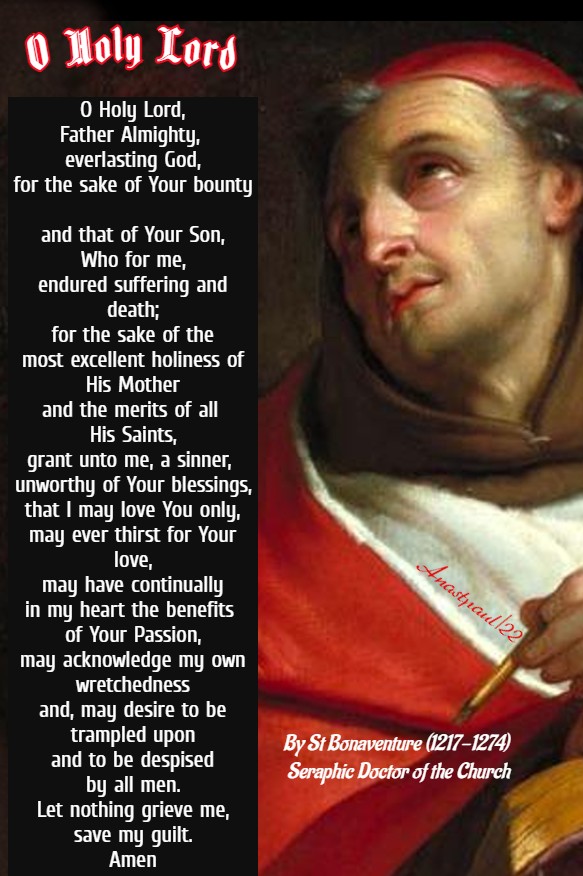
O Holy Lord By St Bonaventure (1217-1274) Seraphic Doctor of the Church
O Holy Lord, Father Almighty, everlasting God, for the sake of Your bounty and that of Your Son, Who for me, endured suffering and death; for the sake of the most excellent holiness of His Mother and the merits of all His Saints, grant unto me, a sinner, unworthy of Your blessings, that I may love You only, may ever thirst for Your love, may have continually in my heart the benefits of Your Passion, may acknowledge my own wretchedness and, may desire to be trampled upon and to be despised by all men. Let nothing grieve me, save my guilt. Amen
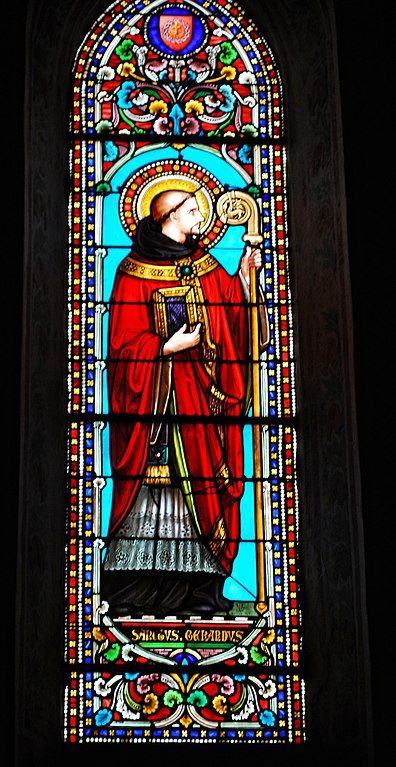
Saint of the Day – 5 April – Saint Gerald of Sauve-Majeure OSB (c1025-1095) Priest, Abbot, Reformer, Founder of the great Monastery of Sauve-Majeure, also known as Grande-Sauve. Born at Corbie, Picardy, France and died 1095 of natural causes. Also known as – Gerald of Corbie, Gerard, Geraud. St Gerald was Canonised in 1197 by Pope Celestine III.
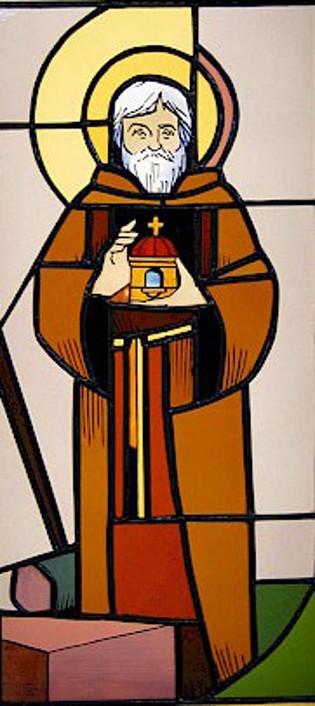
Stained glass of St Gerald at the Parish Church at Sauve-Majeure
Gerald was born in Corbie, Picardy and was entrusted, by his parents, to the Abbey of Corbie for his studies under the Abbot Richard where he later became a Monk and where he was appointed as the Cellarer.
Gerald suffered greatly from violent headaches and optical problems with which the doctors were unable to assist. These severed afflictions prevented him from carrying out his devotions. as he wished.
In an effort to cure this affliction, he accompanied Abbé de Corbie Foulques to Rome where they were both Ordained Priests by Pope Leo IX . From there they went onto Monte Gargano and then to Monte Cassino, seeking the intercession of St Benedict and St Michael.
After his cure, Gerald made a pilgrimage to the Holy Land in thanks giving for the miraculous cure. He stayed until 1974 when he returned to Corbie. He was then elected as the Abbot of St Vincent’s Abbey, Laon but the Monks did not accept his authority or the imposition of reforms in the form of proper discipline. After some years, Gerald resigned from Laon in order to become the Abbot of St Medard’s Abbey, Soissons but wasfaced with opposition and was driven out by an usurper.
He then sought instead to found a new Benedictine Monastery. Duke William VIII of Aquitaine gave him a huge tract of forest in the Gironde near Bordeaux, where Gerald founded the Abbey of Grande-Sauve, of which he was also the first Abbot. Here, at this Monastery, Gerald developed a powerful community steeped in the advancement of the Benedictine Rule and a disciplined mode of life, with significant influence from the customs of Cluny.
Here, Gerald initiated the practice of celebrating Mass and the Office for the Dead for 30 days after the death of a community member. His constant advice to his Monks for as long as he lived was – that they should shun all idle conversation and discussion.
Near the end of his life, he wrote the Vita and Miracles of St Adelard . He died at the Abbey of -Majeure in 1095.
A Note on St Gerald’s great work of Founding the Monastery of Sauve-Majeure:
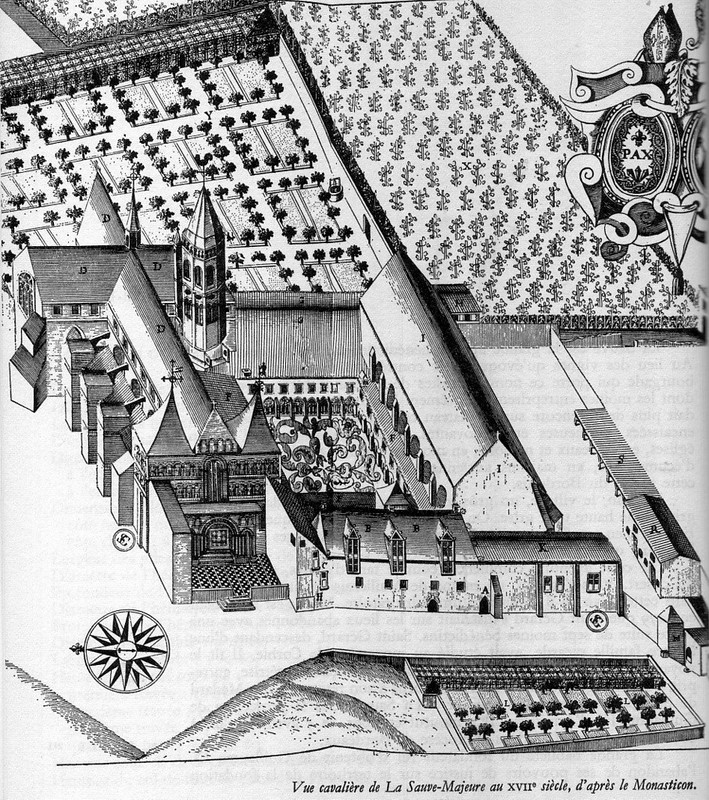
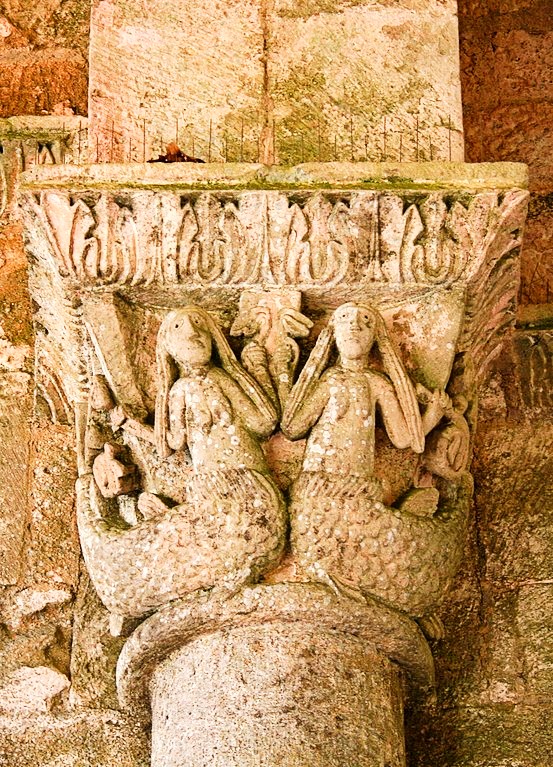
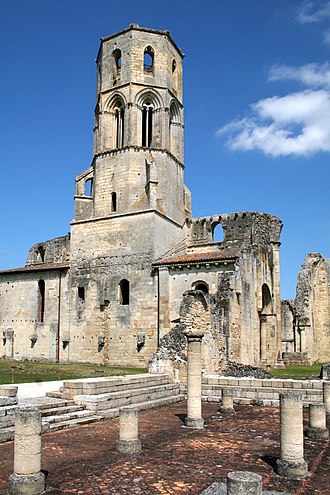
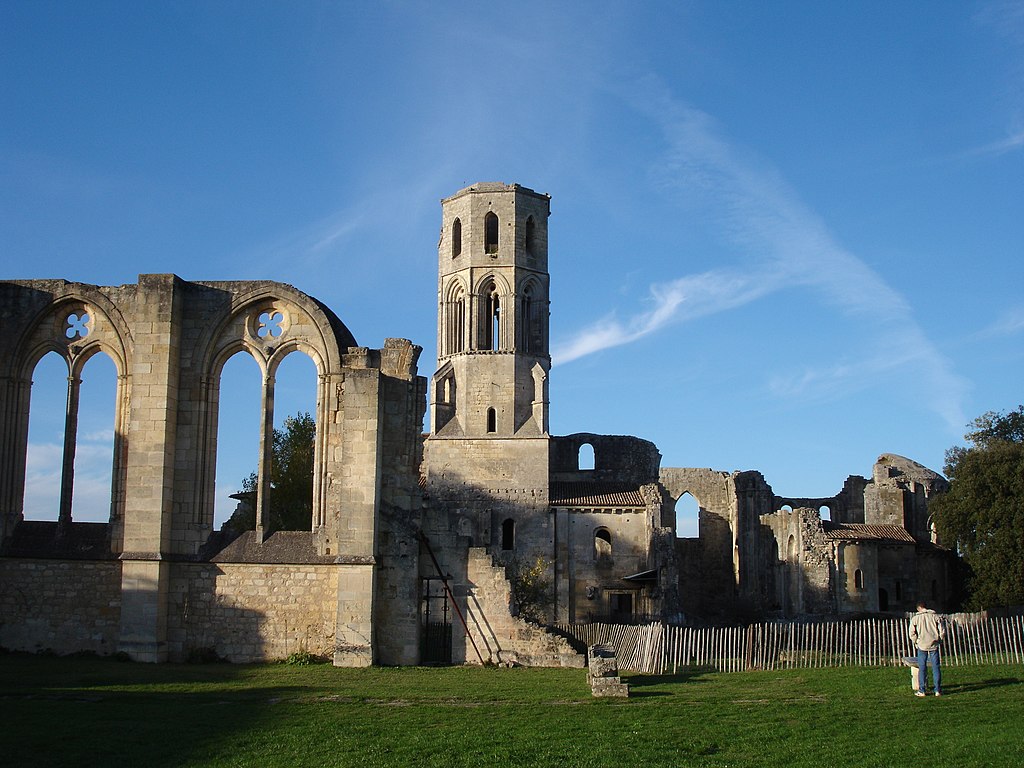
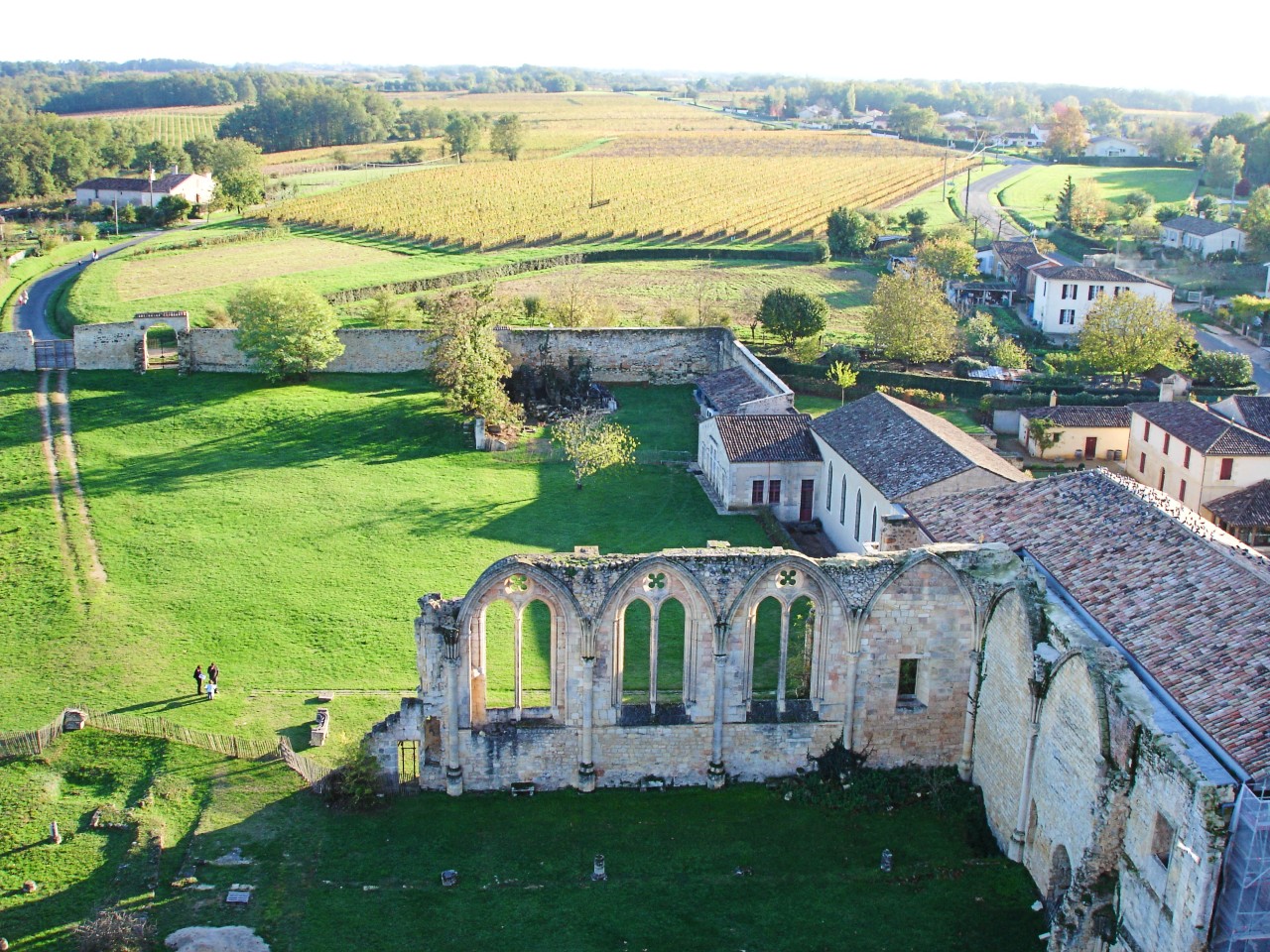
“Sauve-Majeure Abbey is a former Benedictine Monastery near the present village of La Sauve in the department of the Gironde, in a region once heavily forested. Although now in ruins, the remains of the Abbey are still of great interest in terms of Romanesque architecture, especially because of the many sculpted capitals still surviving.
In 1998 the Abbey ruins were included as part of the UNESCO world heritage site of the pilgrimage route to St James of Compostela.
On the spot known as Hauteville, halfway between the Garonne and the Dordogne, St Gerald of Sauve-Majeure founded the Abbey of Grande-Sauve in 1079, of which he was also the first Abbot. Its name refers to the Silva Major, the great forest that then occupied the whole region known as the Vignoble de l’Entre-Deux-Mers (“vineyard between two seas”) which was a gift to St Gerald from Duke William VIII of Aquitaine.
With the support of the Duke, the Pope and a large number of generous benefactors and protectors, including the Kings of England and France, its Patrons, the Abbey prospered and grew rapidly. It is sited on the route to Santiago de Compostela and served as a local point of departure for pilgrims.
During the French Revolution the Abbey’s assets were confiscated and dispersed. The surviving buildings were used from 1793 as a prison. The Church roofcollapsed in 1809 and for the next forty years, the remains were used as a quarry for the village of La Sauve.
In 1837 the Archbishop bought up the site and had a Jesuit college built there, which was later converted into a teachers’ training college. But in 1910 the school was destroyed in a fire and the site was again abandoned. Between 1914 and 1918 the remaining buildings were used as a small military hospital.
In 1960 the site was acquired by the French government and the ruins made stable. The site is now open to the public under the management of the Centre des Monuments Historiques.”
St Gerald of Sauve-Majeure (c1025-1095) Abbot St Irene of Thessalonica St Maria Crescentia Hoss St Pausilippus Bl Peter Cerdan St Theodore the Martyr
Martyrs of Lesbos: 5 Saints: Five young Christian women Martyred together for their faith. We don’t even know their names. island of Lesbos, Greece.
Martyrs of North-West Africa: Large group of Christians murdered while celebrating Easter Mass during the persecutions of Genseric, the Arian king of the Vandals. They were Martyred in 459 at Arbal (in modern Algeria).
Martyrs of Seleucia: 120 Saints :One-hundred and eleven (111) men and nine (9) women who, because they were Christians, were dragged to Seleucia and Martyred for refusing to worship the sun or fire or other pagan idols during the persecutions of King Shapur II. They were burned alive in 344 in Seleucia, Persia.
Thought for the Day – 4 April – Meditations with Antonio Cardinal Bacci (1881-1971)
Jesus in Gethsemane
“In His sadness and loneliness, Jesus is comforted by an Angel. It is true that, being God, He was in no need of being consoled by Angels. Moreover, He had willingly allowed Himself to be offered as a Victim of Expiation for our sins. “He was offered because it was His own will” (Is 53:7). But, He wished to be an example to us in this matter too.
If we trustingly abandon ourselves to God’s will in moments of temptation and of sorrow, we shall receive comfort from our Angel too. How many times have we experienced this mysterious consolation in our souls? When we have bowed our heads in suffering and have offered ourselves as pure victims to God, we have felt an inner light and peace which only Divine grace can give.”
Quote/s of the Day – 4 April – The Memorial of St Isidore of Seville (c 560-636) Bishop, Confessor, Father & Doctor of the Church
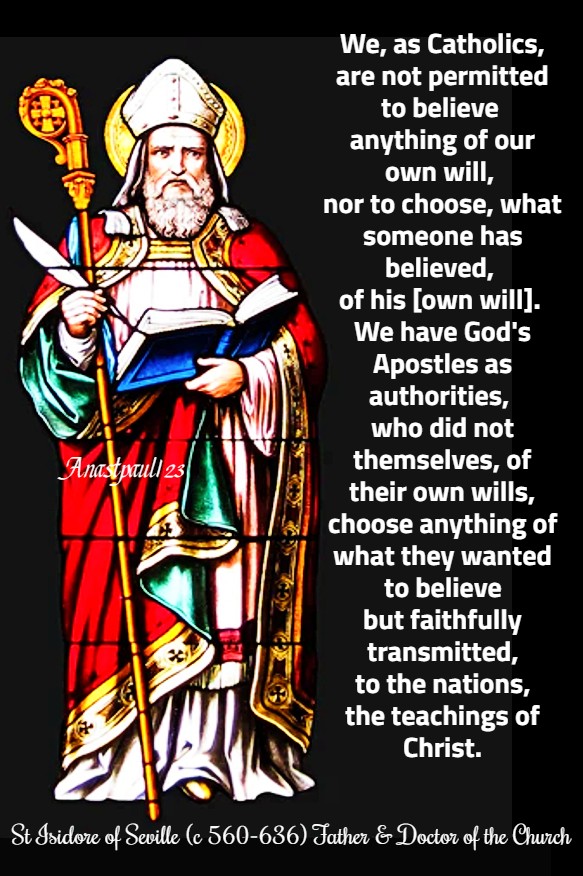
“We, as Catholics, are not permitted to believe anything of our own will, nor to choose, what someone has believed, of his [own will]. We have God’s Apostles as authorities, who did not themselves, of their own wills, choose anything of what they wanted to believe but faithfully transmitted, to the nations, the teachings of Christ.”
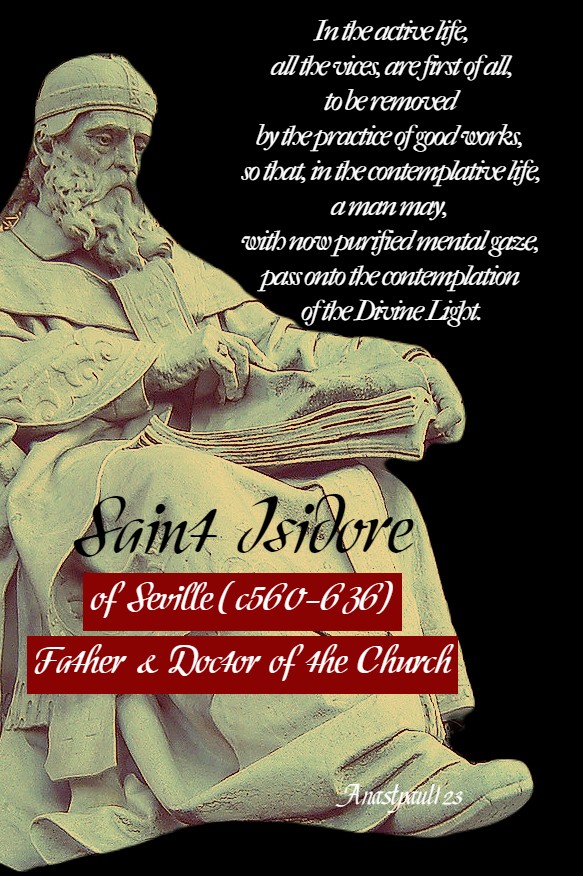
“In the active life, all the vices, are first of all, to be removed by the practice of good works, so that, in the contemplative life, a man may, with now purified mental gaze, pass onto the contemplation of the Divine Light.”
Our Lenten Journey with St Francis de Sales – 4 April – Tuesday in Holy Week
“There is no salvation except in this Cross” St Francis de Sales
TUESDAY IN HOLY WEEK Obedience St Francis de Sales (1567-1622) Doctor Caritas
“MISERABLE PEOPLE, what do you mean by asking our dear Saviour and Master, to descend from this gibbet? He will certainly not do so, for as St Paul says, He humbled Himself, obediently accepting even death, death on a Cross.
He mounted the Cross through obedience and died on it through obedience.
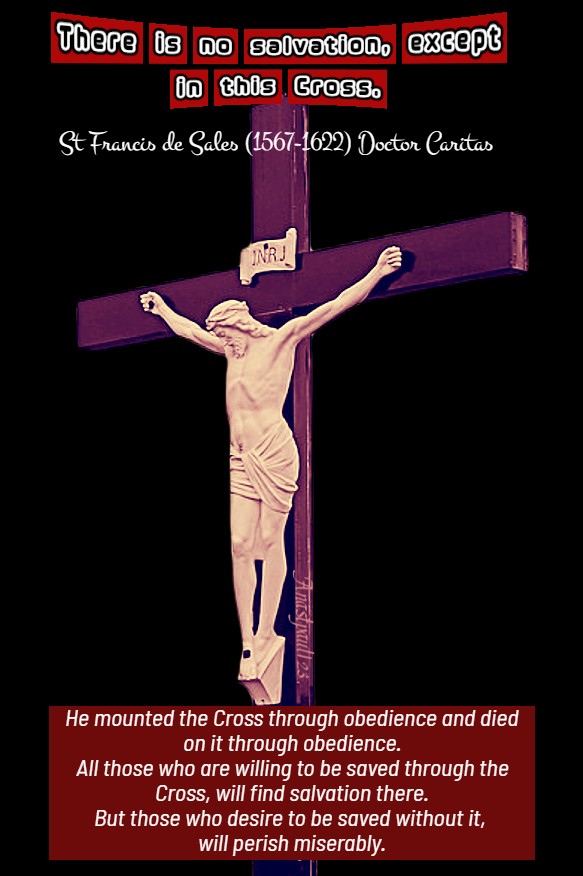
All those who are willing to be saved through the Cross, will find salvation there. But those who desire to be saved without it, will perish miserably. There is no salvation, except in this Cross.” – (Sermons of St Francis de Sales for Lent).
One Minute Reflection – 4 April – “The Month of the Resurrection” – Tuesday in Holy Week – Jeremias 11:18-20, Mark 14:1-72; 15:1-46 – Scripture search here: https://www.drbo.org/
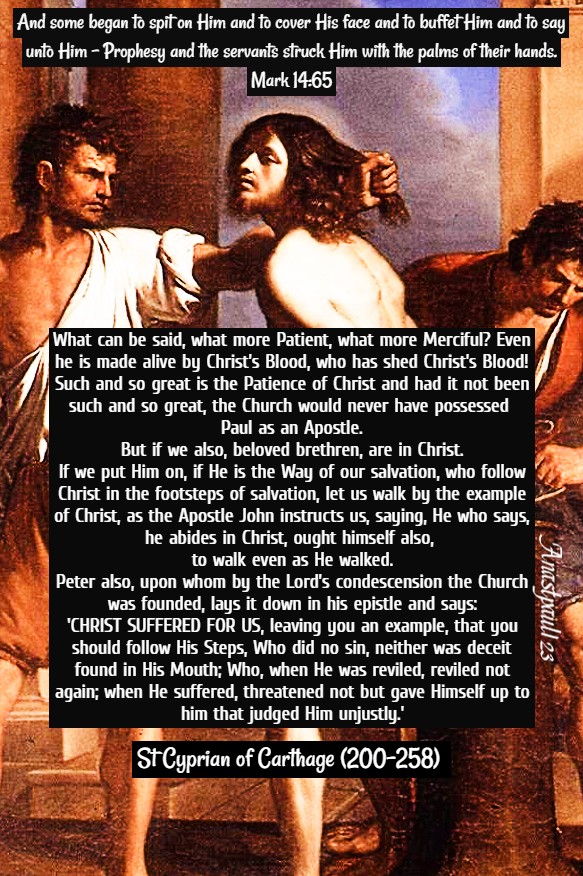
“And some began to spit on Him and to cover His face and to buffet Him and to say unto Him – Prophesy and the servants struck Him with the palms of their hands.” – Mark 14:65
REFLECTION – “He received the spittings of insulters, Who with His spittle, had a little before, made eyes for a blind man. And He, in Whose Name the devil and his angels are scorned, is now scourged by the devil’s servants, Himself suffering scourgings! He was crowned with thorns, Who crowns Martyrs with eternal flowers. He was smitten on the Face with palms, Who gives the true palms to those who overcome. He was despoiled of His earthly garment, Who clothes others in the vesture of immortality. He was fed with gall, Who gave heavenly food. He was given to drink of vinegar, Who appointed the cup of salvation. That guiltless, that just One—nay, He Who is Innocence itself and Justice itself—is counted among transgressors and Truth is oppressed with false witnesses.
He, Who shall judge, is judged and the Word of God is led silently to the slaughter. And when, at the Cross, of the Lord the stars are confounded, the elements are disturbed, the earth quakes, night shuts out the day, the sun… He speaks not, nor is moved, nor declares His Majesty even in His very Passion itself. Even to the end, all things are borne perseveringly and constantly, in order that in Christ, a full and perfect patience may be consummated.
And after all these things, He still receives His murderers, if they will be converted and come to Him. And with a saving patience, He who is benignant to preserve, closes His Church to none. Those adversaries…, if they repent of their sin, if they acknowledge the crime committed, He receives, not only to the pardon of their sin but to the reward of the Heavenly Kingdom.
What can be said, what more Patient, what more Merciful? Even he is made alive by Christ’s Blood, who has shed Christ’s Blood! Such and so great is the Patience of Christ and had it not been such and so great, the Church would never have possessed Paul as an Apostle.
But if we also, beloved brethren, are in Christ. If we put Him on, if He is the Way of our salvation, who follow Christ in the footsteps of salvation, let us walk by the example of Christ, as the Apostle John instructs us, saying, He who says, he abides in Christ, ought himself also, to walk even as He walked. Peter also, upon whom by the Lord’s condescension the Church was founded, lays it down in his epistle and says:
CHRIST SUFFERED FOR US, leaving you an example, that you should follow His Steps, Who did no sin, neither was deceit found in His Mouth; Who, when He was reviled, reviled not again; when He suffered, threatened not but gave Himself up to him that judged Him unjustly.” – St Cyprian of Carthage (200-258) Bishop of Carthage and Martyr, Father of the Church (On Patience, 7-9).
PRAYER – Almighty and eternal God, grant us so to celebrate the mysteries of our Lord’s Passion, that we may deserve to obtain forgiveness. Through the same Jesus Christ, Thy Son our Lord, Who lives and reigns with Thee, in the unity of the Holy Ghost, God, world without end. Amen (Collect).
Our Morning Offering – 4 April – Tuesday in Holy Week
My God, I Love Thee By St Francis Xavier (1506-1552) (Attri) Transr: Fr Edward Caswall CO (1814-1878)
My God, I love Thee, not because I hope for heav’n thereby, nor yet for fear, that loving not, I might forever die but for that Thou didst all mankind upon the Cross embrace; for us didst bear the nails and spear and manifold disgrace.
And griefs and torments numberless and sweat of agony; e’en death itself and all for man, who was Thine enemy. Then why, most loving Jesus Christ, should I not love Thee well? Not for the sake of winning heav’n, nor any fear of hell.
Not with the hope of gaining aught, nor seeking a reward but as Thyself hast loved me, O ever loving Lord! E’en so I love Thee and will love and in Thy praise will sing, solely because Thou art my God and my eternal King! Amen
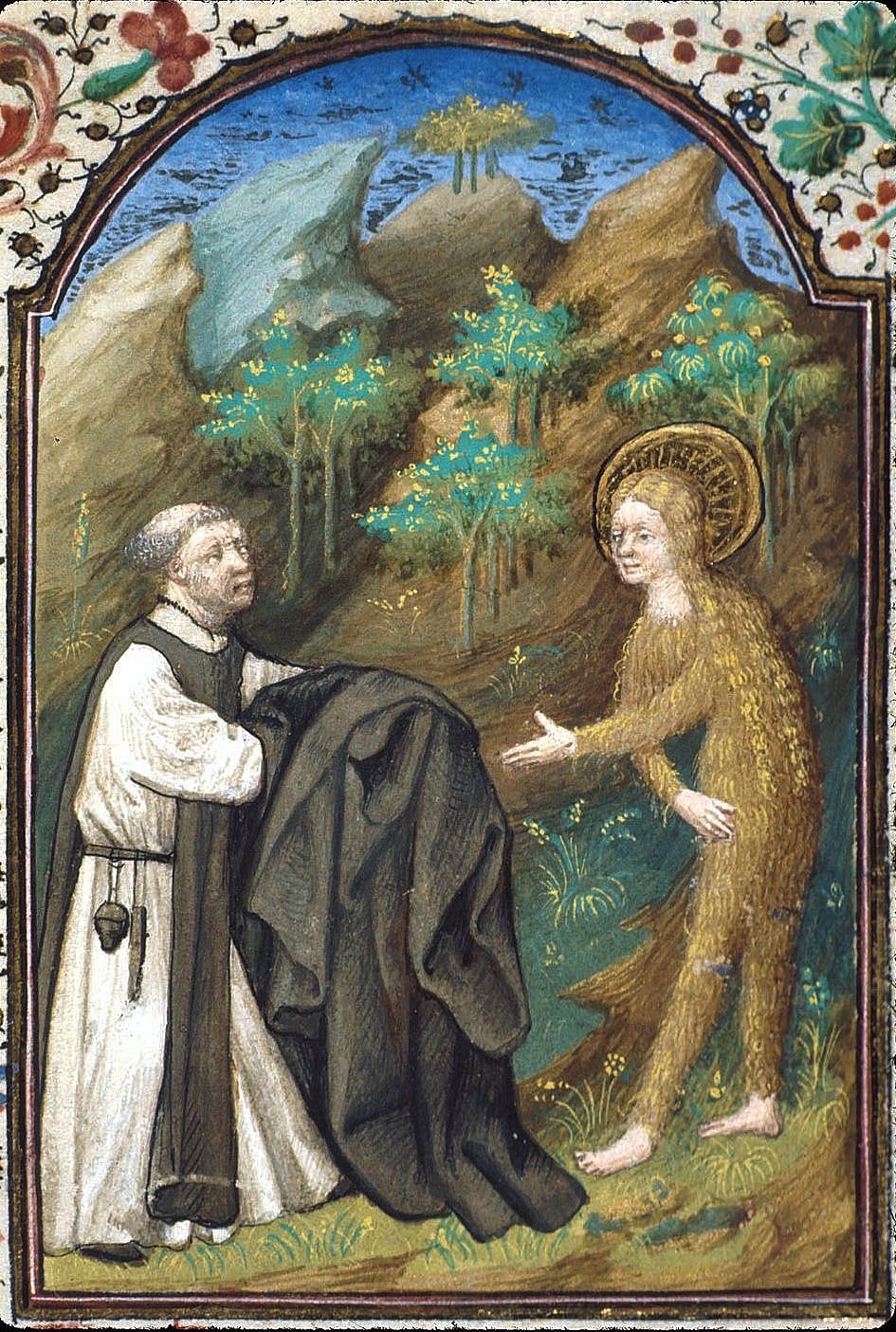
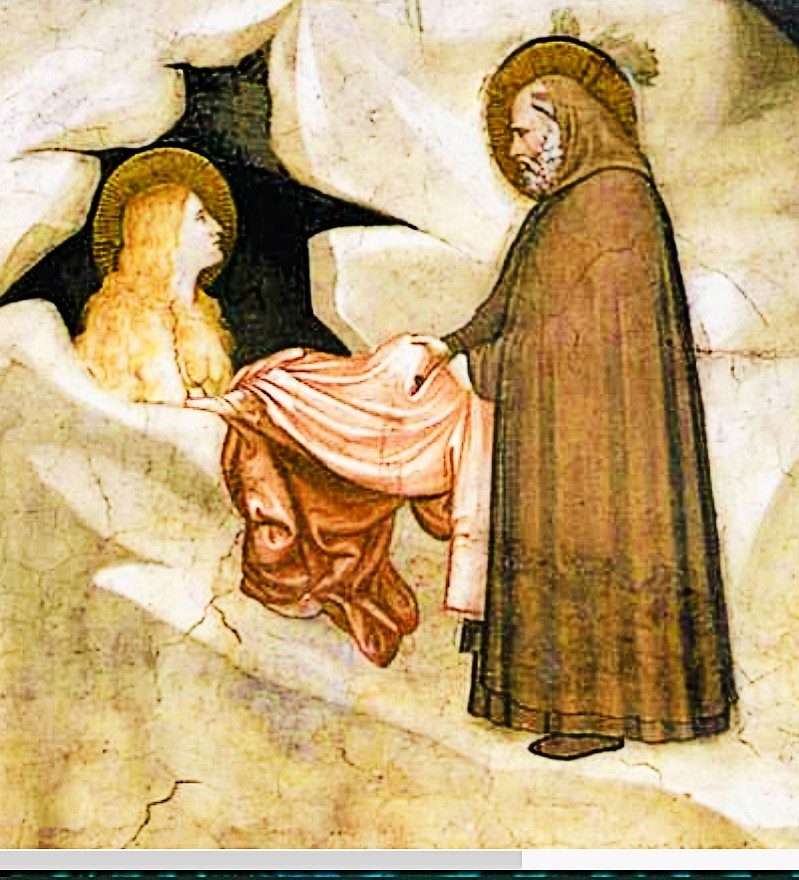
Saint of the Day – 4 April – St Zosimus of Palestine (c 460-c 560) Priest, Monk, Hermit. As already reported in the legendary life of St Mary of Egypt, St Zosimus, a Monk and Hermit, is the one who discovers St Mary in the desert and gave her Holy Communion shortly before her death. When she died, he buried her and related her lifestory (as she had related it to him) to his fellow Monks, who in turn finally recorded it in writing.
The Roman Martyrology reports: “In Palestine, the Anchorite, St Zosimus, who buried the remains of St Mary of Egypt.”
Zosimas was born in the second half of the fifth century, during the reign of Emperor Theodosius II. He became a Monk in a Monastery in Palestine at a very young age. At the age of fifty-three, he moved to a very strict Monastery located in the wilderness close to the Jordan River, where he spent the remainder of his life. He is best known for his encounter with Mary of Egypt, as we read below from her Vita:
“Approximately one year before her death, she recounted her life to Saint Zosimas of Palestine (c 460-c 560), who encountered her in the desert. When he unexpectedly met her in the desert, she was completely naked and almost unrecognisable as human. She asked St Zosimas to give her his mantle to cover her nakedness and then she narrated her life’s story to him.
She then asked him to meet her at the banks of the Jordan, on Holy Thursday of the following year and bring her Holy Communion. When he fulfilled her wish, she crossed the river to get to him by walking on the surface of the water and received Holy Communion, asking him to meet her again in the desert the following Lent.
The next year, St Zosimas travelled to the same spot where he first met her, some twenty days’ journey from his Monastery and found her lying there dead. According to an inscription written in the sand next to her head, she had died on the very night he had given her the Blessed Sacrament and had been somehow miraculously transported to the place he found her. Her body was preserved incorrupt.
He buried her body with the assistance of a passing lion. On returning to the Monastery, he related her life story to the brethren and it was preserved among them, as oral tradition, until it was written down by St Sophronius.”
St Theodulus of Thessalonica St Theonas of Egypt St Tigernach of Clogher St Zosimus of Palestine (Died c560) Priest, Monk, Hermit
Martyred in Cairo François de la Terre de Labour Nicolas of Montecorpino
Martyrs of Thessalonica – 14 Saints: Fourteen Christians who were Martyred together, date unknown. No other information, except the names of 12 of them, has survived – Ingenuus, Julianus, Julius, Matutinus, Orbanus, Palatinus, Paulus, Publius, Quinilianus, Saturninus, Successus, Victor and two whose names have not come down to us. Agathopus the Deacon, Theodulus the Lector.
Thought for the Day – 3 April – Meditations with Antonio Cardinal Bacci (1881-1971)
The Betrayal of Judas
“Failure to comply with the extraordinary graces which Jesus had granted him was responsible for the fall of Judas. Whoever receives a great deal must give as much! Judas had been called to the dignity of the Apostolate. At the Last Supper, he received the fullness of the Priesthood along with the other Apostles and received Jesus Himself into his soul, under the species of the Consecrated bread. In spite of all this, he deserted and betrayed his Master.
What about us? Let us consider how many spiritual and temporal graces God has bestowed on us, throughout our lives. Have we been thankful for them? If we have not corresponded generously with all these favours, or if we have done worse and have rejected them by sin, let us repent and resolve to do better. The example of Judas should, at the least, teach us this lesson!”
Quote/s of the Day – 3 April – Monday in Holy Week – Isaias 50:5-10, John 12:1-9 – Scripture search here: https://www.drbo.org/
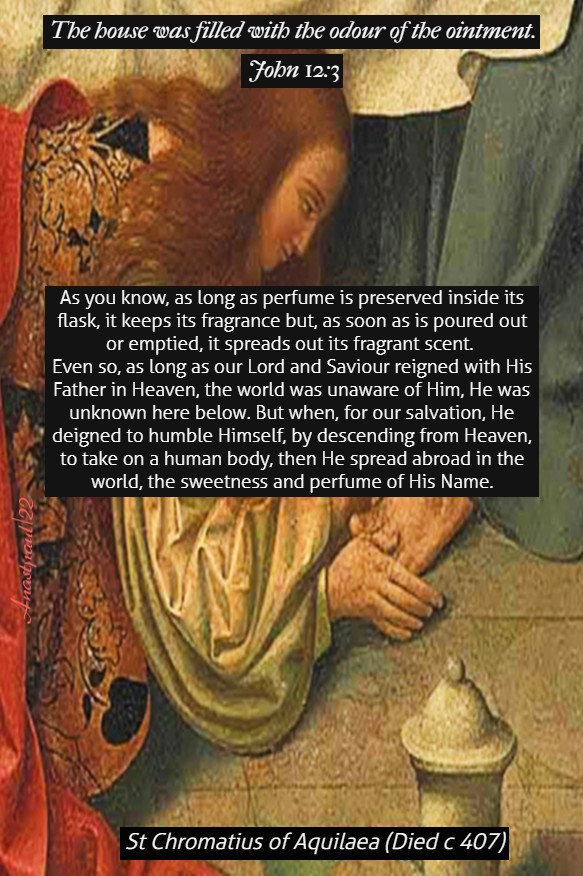
“The house was filled with the odour of the ointment.”
John 12:3
“As you know, as long as perfume is preserved inside its flask, it keeps its fragrance but, as soon as is poured out or emptied, it spreads out its fragrant scent. Even so, as long as our Lord and Saviour reigned with His Father in Heaven, the world was unaware of Him, He was unknown here below. But when, for our salvation, He deigned to humble Himself, by descending from Heaven, to take on a human body, then He spread abroad in the world, the sweetness and perfume of His Name.”
St Chromatius of Aquilaea (Died c 407) Bishop of Aquileia, Italy, Father
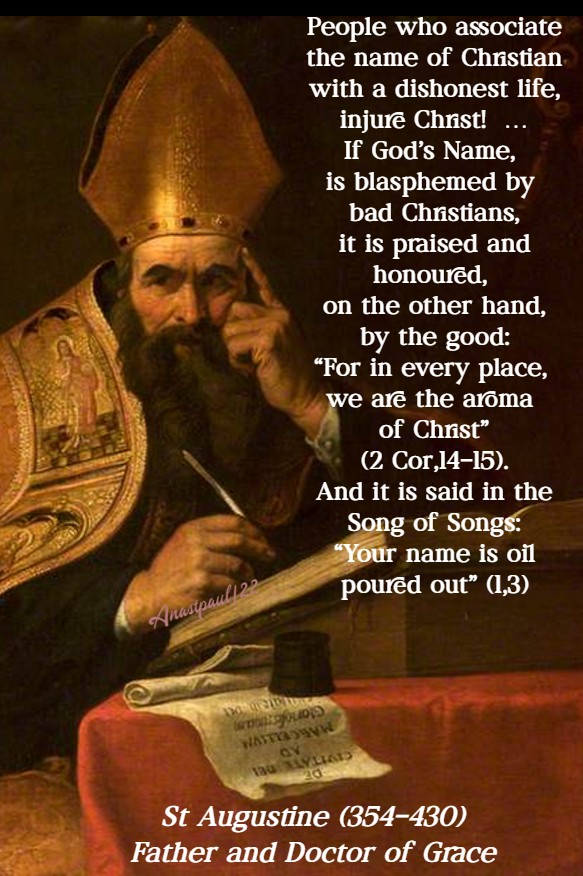
“People who associate the name of Christian with a dishonest life, injure Christ! … If God’s Name, is blasphemed by bad Christians, it is praised and honoured, on the other hand, by the good: “For in every place, we are the aroma of Christ” (2 Cor,14-15). And it is said in the Song of Songs: “Your name is oil poured out” (1,3).”
St Augustine (354-430) Father and Doctor of Grace
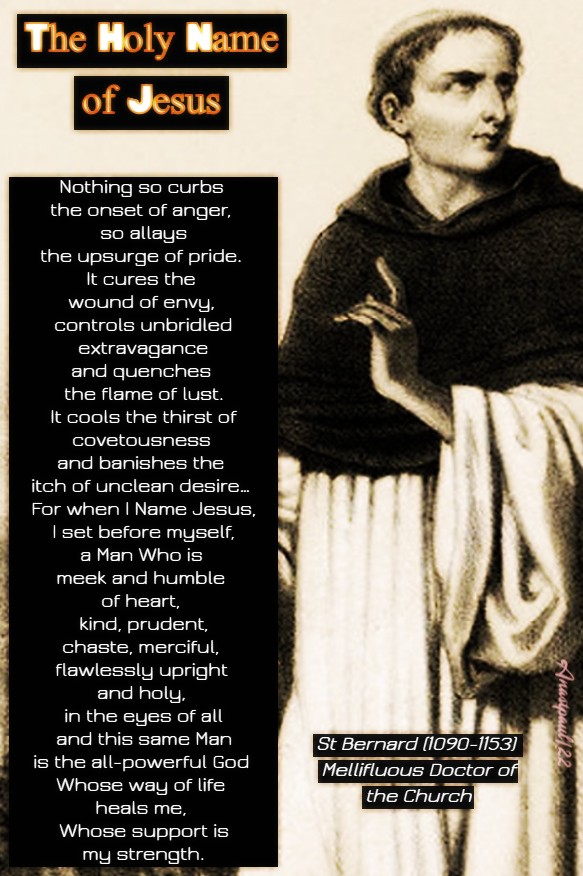
“Nothing so curbs the onset of anger, so allays the upsurge of pride. It cures the wound of envy, controls unbridled extravagance and quenches the flame of lust. It cools the thirst of covetousness and banishes the itch of unclean desire… For when I Name Jesus, I set before myself, a Man Who is meek and humble of heart, kind, prudent, chaste, merciful, flawlessly upright and holy in the eyes of all and this same Man, is the all-powerful God Whose way of life heals me, Whose support is my strength.”
St Bernard (1090-1153) Father and Mellifluous Doctor of the Church
Our Lenten Journey with St Francis de Sales – 3 April – Monday in Holy Week
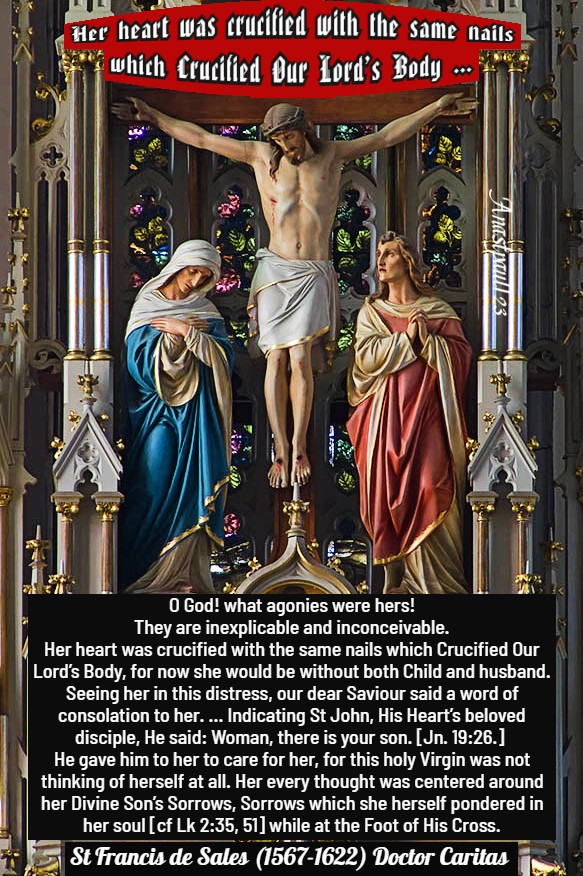
“Her heart was crucified with the same nails which Crucified Our Lord’s Body …” St Francis de Sales
MONDAY in HOLY WEEK Our Lord’s Third Word … St Francis de Sales (1567-1622) Doctor Caritas
“OUR LORD’S THIRD WORD was one of consolation. He spoke it to His sacred Mother who was at the foot of the Cross, pierced by a sword of sorrow [Lk 2:35] but certainly not swooning, nor with faint heart, as artists have falsely and impertinently painted her. The Evangelist clearly says the contrary, insisting that she remained standing with an incomparable firmness [Jn. 19:25]. That courage did not keep her from the grieving which she endured with the generous and magnanimous heart belonging to her alone. O God! what agonies were hers! They are inexplicable and inconceivable. Her heart was crucified with the same nails which Crucified Our Lord’s Body, for now she would be without both Child and husband.
Seeing her in this distress, our dear Saviour said a word of consolation to her. But this consoling and tender word was not given to lift her heart from such great desolation. The heart of this perfectly submissive and resigned holy Virgin needed to be extremely strong and Our Lord, Who knew her so well, dealt with her accordingly. Indicating St John, His Heart’s beloved disciple, He said: Woman, there is your son. [Jn. 19:26.] He gave him to her to care for her, for this holy Virgin was not thinking of herself at all. Her every thought was centered around her Divine Son’s Sorrows, Sorrows which she herself pondered in her soul [cf Lk 2:35, 51] while at theFoot of His Cross.” – (Sermons of St Francis de Sales for or Lent).
One Minute Reflection – 3 April – “The Month of the Resurrection” – Monday in Holy Week – Isaias 50:5-10, John 12:1-9 – Scripture search here: https://www.drbo.org/
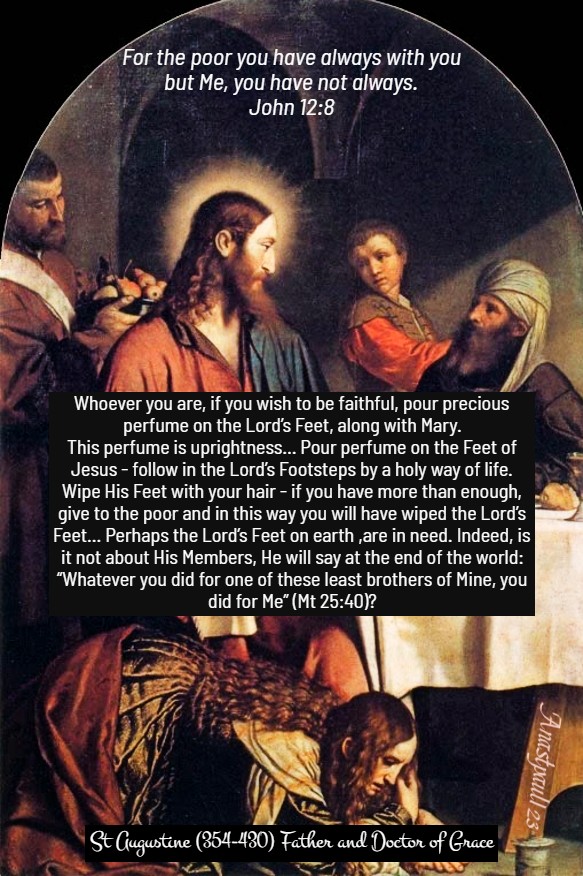
“For the poor you have always with you but Me, you have not always.” – John 12:8
REFLECTION – “This is the historical event, now let us look for the symbol. Whoever you are, if you wish to be faithful, pour precious perfume on the Lord’s Feet, along with Mary. This perfume is uprightness… Pour perfume on the Feet of Jesus – follow in the Lord’s Footsteps by a holy way of life. Wipe His Feet with your hair – if you have more than enough, give to the poor and in this way you will have wiped the Lord’s Feet… Perhaps the Lord’s Feet on earth ,are in need. Indeed, is it not about His Members, He will say at the end of the world: “Whatever you did for one of these least brothers of Mine, you did for Me” (Mt 25:40)?
“And the house was filled with its fragrance.” That is to say, the world has been filled with the renown of this woman, for the sweet fragrance is her good name. People who associate the Name of Christian with a dishonest life injure Christ… if God’s Name is blasphemed by bad Christians, it is praised and honoured, on the other hand, by the good: “For in every place we are the aroma of Christ” (2 Cor 14-15). And it is said in the Song of Songs: “Your Name is oil poured out” (1:3).” – St Augustine (354-430) Father and Doctor of Grace (Sermons on Saint John’s Gospel, no 50 6-7).
PRAYER – Grant, we beseech Thee, Almighty God, that we who fail through our weakness in so many difficulties, may be relieved through the pleading of the Passion of Thy Only-begotten Son. Through the same Jesus Christ, Thy Son our Lord, Who lives and reigns with Thee, in the unity of the Holy Ghost, God, world without end. Amen (Collect).
Our Morning Offering – 3 April – Monday in Passion Week and the Memorial of St Richard of Chichester (1197-1253)
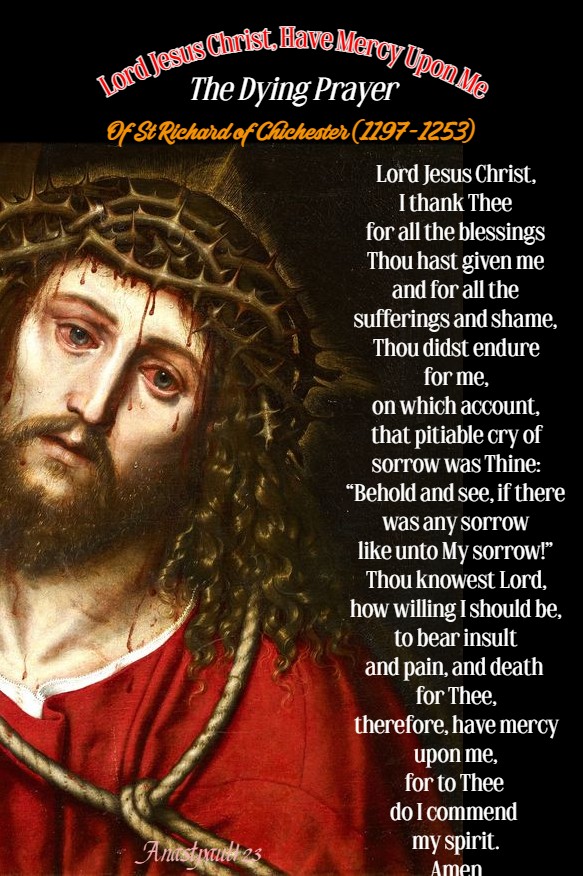
Lord Jesus Christ, Have Mercy Upon Me. The Dying Prayer of St Richard of Chichester (1197-1253)
Lord Jesus Christ, I thank Thee for all the blessings Thou hast given me and for all the sufferings and shame, Thou didst endure for me, on which account, that pitiable cry of sorrow was Thine: “Behold and see, if there was any sorrow like unto My sorrow!” Thou knowest Lord, how willing I should be, to bear insult and pain, and death for Thee, therefore, have mercy upon me, for to Thee do I commend my spirit. Amen
St Richard recited this prayer on his deathbed, surrounded by the Clergy of his Diocese. The words were transcribed, in Latin, by his Confessor and friend, Fr Ralph Bocking (who ultimately also became his Biographer), a Dominican Friar and were eventually published in the Acta Sanctorum, an encyclopedic text in 68 folio volumes of documents examining the lives of Saints. The British Library copy contains Fr Bocking’s transcription of the prayer:
Gratias tibi ago, Domine Jesu Christe, de omnibus beneficiis quae mihi praestitisti; pro poenis et opprobrious, quae pro me pertulisti; propter quae planctus ille lamentabilis vere tibi competebat. Non est dolor similis sicut dolor meus.
However, the first English translation is as above an not the version below, or the one more commonly known as “Day by Day” which words were never in the original and were added and used in the extremely sacrilegious and blasphemous “Godspell” – even though the common version with the rhyming “Triplet” (i.e. clearly, dearly, nearly) – is the one found commonly in Hymn and Prayer Books. Bearing in mind that this was “The Dying Prayer ” of St Richard, it is obviously highly unlikely that he would have requested the grace of daily sanctity, “day by day!”
Thanks be to Thee, my Lord Jesus Christ For all the benefits Thou hast given me, For all the pains and insults Thou hast borne for me. O most merciful Redeemer, Friend and Brother, May I know Thee more clearly, Love Thee more dearly, Follow Thee more nearly. Amen
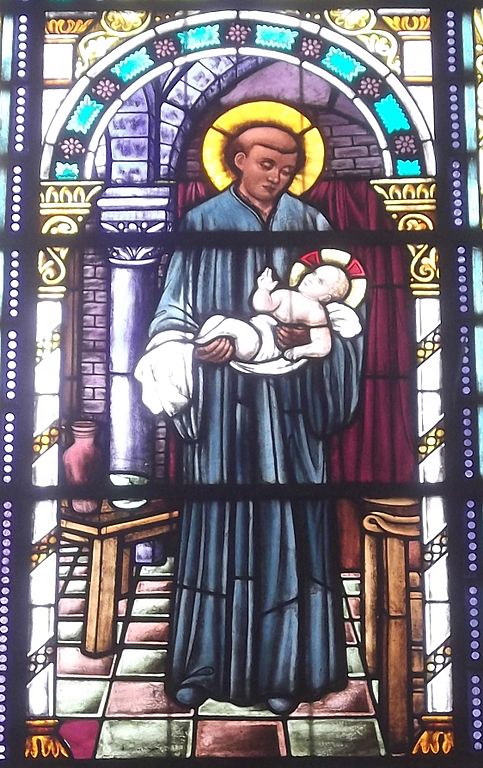
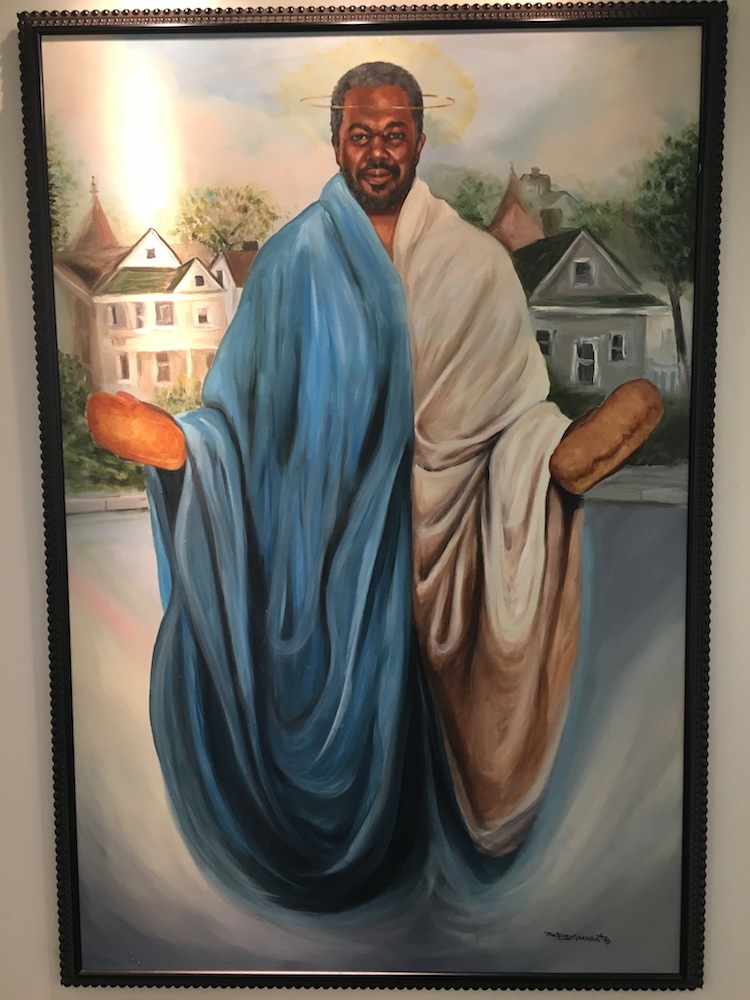
Saint of the Day – 3 April – St Benedict of Palermo OFM (1526-1589) Lay Friar of the Order of Friars Minor of the Observance, Confessor, spiritual counsellor, Apostle of the poor and needy, graced with the gift of healing the sick. Born as Benedetto Manasseri in1526 in San Fratello, Messina, Sicily and died on 4 April 1589 (aged 62–63) in Palermo, Sicily of natural causes. Patronages – African missions and Missionaries to Africa, Black Catholic Americans, African Americans, black people, Palermo, San Fratello. Also known as – Benedict the Moor, Benedict the Black, Benedict the African, Benedetto. His body is incorrupt. Additional Memorial – 4 April. St Benedict’s gifts for prayer, his love for the Blessed Virgin and the Infant Jesus and the wisdom displayed in his guidance of souls, earned him, a reputation for holiness, throughout Sicily. Following the example of St Francis, Benedict kept seven 40-day fasts throughout the year. He also slept only a few hours each night.
Benedict was born to Cristoforo and Diana Manasseri, Africans, who were taken as slaves in the early 16th Century to San Fratello, a small town near Messina, Sicily. They were given Italian names and later converted to Christianity.
Benedict’s parents were granted freedom for their son before his birth because of their “loyal service.” Like most peasants, Benedict did not attend any school and was illiterate. During his youth, he worked as a shepherd and was quick to give what he had earned to the poor.
When he was 21 years old, he was publicly insulted for the colour. of his skin His forbearance and silence was noted by the leader of an independent group of hermits on nearby Monte Pellegrino, who followed the Rule for Hermit life written by St Francis of Assisi.
Benedict was invited to join that community and shortly thereafter, he gave up all his earthly possessions and joined them. He served as the cook for the community and at the age of twenty-eight succeeded Jerome Lanze as the Superior of the group.
In 1564 Pope Pius IV disbanded independent communities of hermits, ordering them to attach themselves to an established religious Order, in this case, the Order of Friars Minor. As soon as Benedict was professed as an official Friar of the Franciscans, he was assigned to Palermo to the Franciscan Friary of St Mary of Jesus. He started there as the cook,but, showing the degree of his advancement in the spiritual life, he was soon appointed as the Master of Novices and later, as Guardian of the community, although he was a lay brother rather than a Priest and was illiterate.
Benedict accepted the promotion and successfully helped the Convent adopt a stricter version of the Franciscan Rule of life. He was widely respected for his deep, intuitive understanding of theology and Scripture and was often sought for counselling. He also had a reputation as a healer of the sick. Combined, these characteristics continued to draw many visitors to him. As he enjoyed cooking, he returned to kitchen duty in his later years.
Benedict died at the age of around 63 on the very day and hour which he had predicted. At the entrance of his cell in the Franciscan Friary of St Mary of Jesus, there is a plaque with the inscription: “Benedict was quickly invited to join that community, and shortly thereafter he gave up all his earthly possessions and joined them. He served as the cook for the community and at the age of twenty-eight succeeded Jerome Lanze as leader of the group.[3]
In 1564 Pope Pius IV disbanded independent communities of hermits, ordering them to attach themselves to an established religious Order, in this case, the Order of Friars Minor. Once a friar of the Order, Benedict was assigned to Palermo to the Franciscan Friary of St. Mary of Jesus. He started at the friary as a cook, but, showing the degree of his advancement in the spiritual life, he was soon appointed as the master of novices, and later as Guardian of the community, although he was a lay brother rather than a priest, and was illiterate.
Benedict accepted the promotion, and successfully helped the order adopt a stricter version of the Franciscan Rule of life. He was widely respected for his deep, intuitive understanding of theology and Scripture, and was often sought for counseling. He also had a reputation as a healer of the sick. Combined, these characteristics continued to draw many visitors to him. As he enjoyed cooking, he returned to kitchen duty in his later years.
Benedict died at the age of around 63 on the very day and hour which he had predicted. At the entrance of his cell in the Franciscan Friary of St Mary of Jesus, there is a plaque with the inscription: “This is the cell where Saint Benedict lived” with the dates of his birth and death – 1526 and 1589.
Upon his death, King Philip III of Spain ordered the construction of a magnificent tomb to house his remains, in the Friary Church. He was Beatified by Pope Benedict XIV in 1743 and Canonised in 1807 by Pope Pius VII. His body was found incorrupt during the Canonisation process.
Benedict is remembered for his patience and understanding when confronted with racial prejudice and taunts. He was declared a Patron Saint of Catholic African Americans, along with the Dominican lay brother, St Martin de Porres. In the United States, at least seven historically Black Catholic Parishes bear his name.
Blessed Gandulphus of Binasco OFM (c 1200-1260)Priest, Friar of the First Order of St Francis. He was a renowned Preacher mainly in Sicily, Hermit, Miracle-worker . He was one of those who entered the Order while the Seraphic Father was still alive and the life he led was one of great self-abnegation. He was Beatified on 10 March 1881 by Pope Leo XIII. Biography: https://anastpaul.com/2022/04/03/saint-of-the-day-3-april-blessed-gandulphus-of-binasco-ofm-c-1200-1260/
Martyrs of Greece – 4 Saints: A group of young Christian men who protested to City authorities that gifts to temples of pagan gods should be used to feed the poor during a regional famine. When the officials refused, the group went to local temples, broke up the idols and fixtures and gave the gold and silver bits to the poor to use to buy food. The group was imprisoned and executed. The only other thing we know about these Martyrs are the names – Bythonius, Elpideforus, Dius and Galycus. They Died in the 3rd Century at an unknown location in Greece.
Martyrs of Tomi (Romania) – 9 Saints who were Martyred together. We know nothing else about them but the names – Arestus, Benignus, Chrestus, Evagrius, Papo, Patricius, Rufus, Sinnidia and Zosimus. They Died at Tomi, Scythia (modern Constanta, Romania).
Thought for the Day – 2 April – Meditations with Antonio Cardinal Bacci (1881-1971)
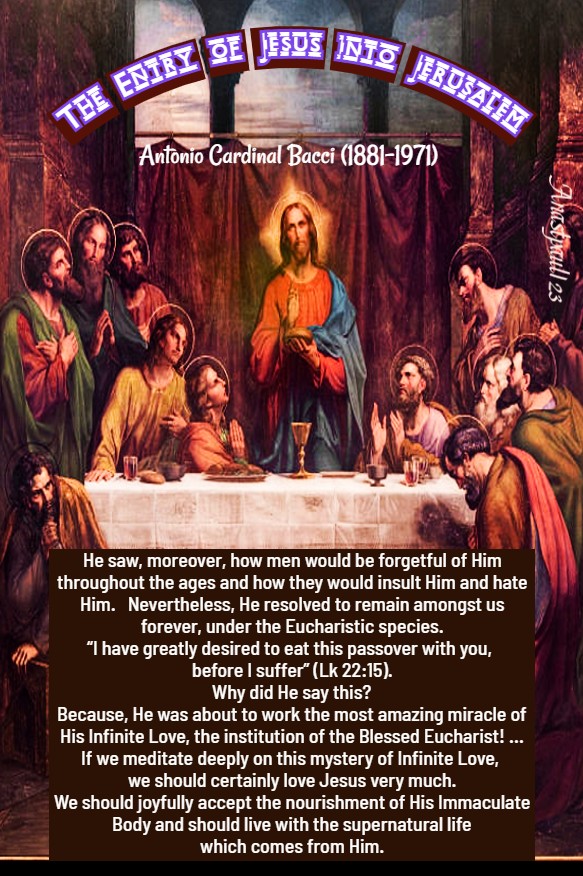
The Entry of Jesus into Jerusalem
“The evening before Our Lord was arrested and put to death, Judas was negotiating His betrayal for a handful of money. Peter was about to deny Him in public and the Apostles would abandon Him in the hour of trial. Jesus knew all this. He saw, moreover, how men would be forgetful of Him throughout the ages and how they would insult Him and hate Him. Nevertheless, He resolved to remain amongst us forever, under the Eucharistic species. “I have greatly desired to eat this passover with you, before I suffer” (Lk 22:15). Why did He say this? Because, He was about to work the most amazing miracle of His Infinite Love, the institution of the Blessed Eucharist! He took bread, blessed and broke it and gave it to His Apostles, saving: “This is My Body, which is being given for you.” Then He took the cup of wine, gave thanks to His Heavenly Father and said: “This is the chalice of My Blood, the mystery of faith, which shall be shed for you. Do this in remembrance of Me.” There was nothing left for the Infinite Power and Goodness of Jesus to give. He had given Himself, not only to His Apostles but, to all men throughout the ages.
If we meditate deeply on this mystery of Infinite Love, we should certainly love Jesus very much. We should joyfully accept the nourishment of His Immaculate Body and should live with the supernatural life which comes from Him.”
Quote/s of the Day –2 April – Palm Sunday – Philippians 2:5-11, Matthew 26:36-75; 27:1-60 – Scripture search here: https://www.drbo.org/
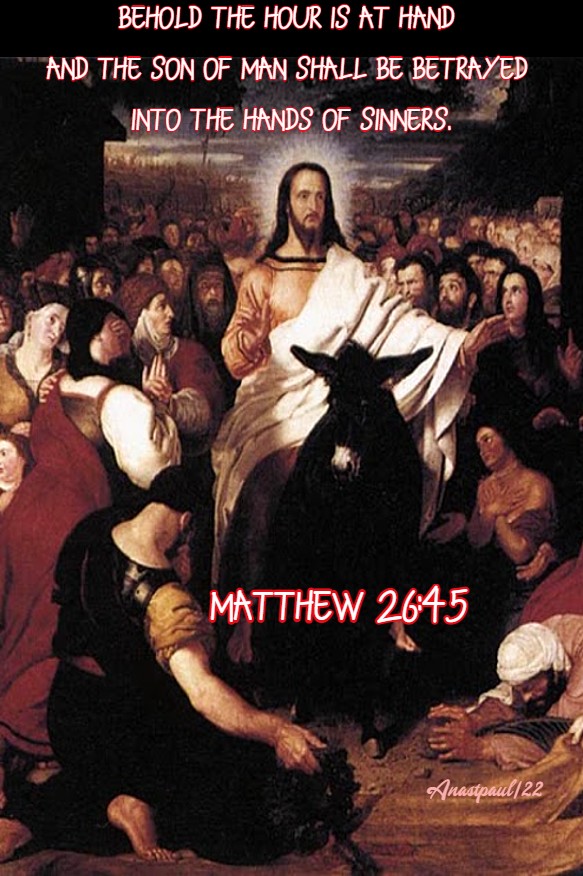
“Behold the hour is at hand and the Son of man shall be betrayed into the hands of sinners.”
Matthew 26:45
“Yesterday, Christ raised Lazarus from the dead; today, He is going to His own death. Yesterday, He tore off the strips of cloth which bound Lazarus; today, He is stretching out His Hand, to those who want to bind Him. Yesterday, He tore that man away from darkness; today, for humankind, He is going down into darkness and the shadow of death. And the Church is celebrating. She is beginning the feast of Feasts, for she is receiving her King as a Spouse, for her King is in her midst.”
St Ephrem (306-373) (Attri) Father ad Doctor of the Church
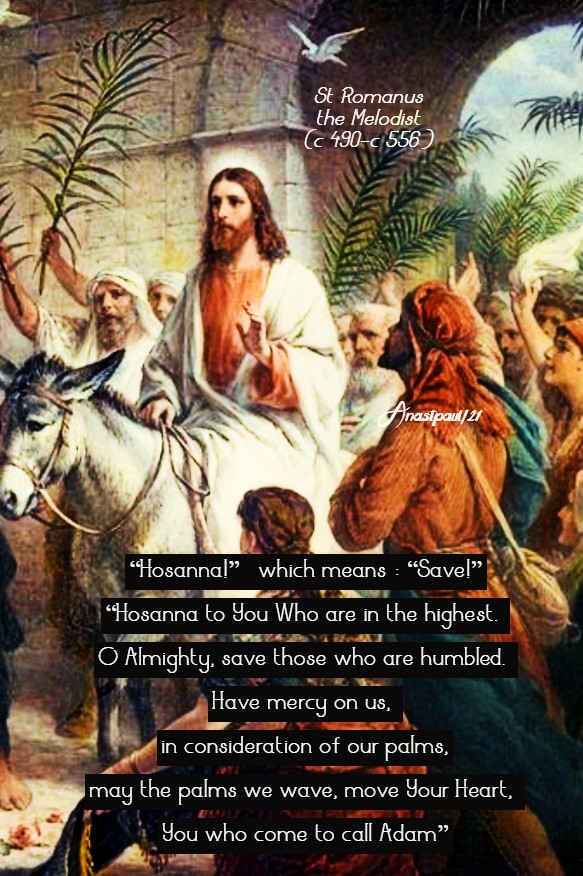
“Hosanna!”—which means : “Save!” “Hosanna to You Who are in the highest. O Almighty, save those who are humbled. Have mercy on us, in consideration of our palms, may the palms we wave move Your Heart, You Who come to call Adam”…
St Romanus the Melodist (c 490-c 556)
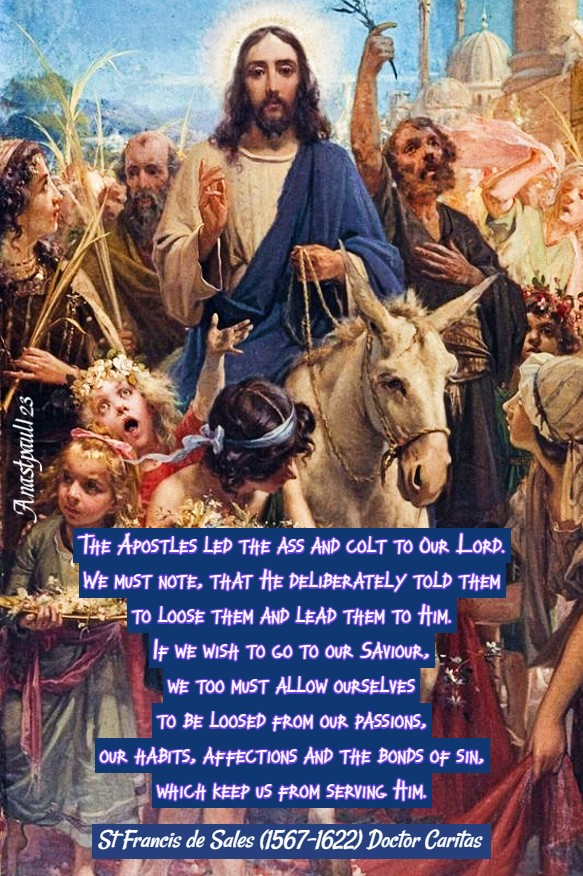
“The Apostles led the ass and colt to Our Lord. We must note, that He deliberately told them to loose them and lead them to Him. If we wish to go to our Saviour, we too must allow ourselves to be loosed from our passions, our habits, affections and the bonds of sin, which keep us from serving Him.”


























 AnaStpaul
You must be logged in to post a comment.