Thought for the Day – 23 January – The Spiritual Combat (1589) – Dom Lorenzo Scupoli OSM (c1530-1610)
“None shall be crowned who has not fought well.” 2 Tim 2: 5
The Third Weapon of the Spiritual Combat
XII: … Of the Diverse Wills in Man and the Warfare Between Them (Part One)
“Although in this combat, we may be said to have within us, two wills, the one of the reason which is called rational and superior, the other of the senses, called sensual and inferior and commonly described, by the words — appetite, flesh, sense and passion; yet, as it is the reason which constitutes us men, we cannot be said to will anything which is willed by the senses, unless we be also inclined thereto, by the superior will.
And herein does our spiritual conflict principally consist. The Reasonable Will. being placed, as it were, midway between the Divine Will which is above it — and, the Inferior Will, or Will of the Senses which is beneath it, is continually assaulted by both — each seeking, in turn, to attract and subdue and bring it into obedience. Much hard toil and trouble must, however, be undergone by the unpracticed, especially at the outset, when they resolve to amend their evil lives and, renouncing the world and the flesh, to give themselves up to the love and service of Jesus Christ.
For the opposition encountered by the Superior Will, from the continual warfare between the Divine and Sensual Will, is sharp and severe and accompanied by acute suffering. It is not so with those who are well practiced in the way of virtue or of vice — they pursue, without difficulty, the path on which they have entered — the virtuous yielding readily to the Divine Will and the vicious yielding, without resistance, to the will of the senses.”
Quote/s of the Day – 23 January – St Raymond of Peñafort OP (1175-1275) Confessor, “Father of Canon Law”
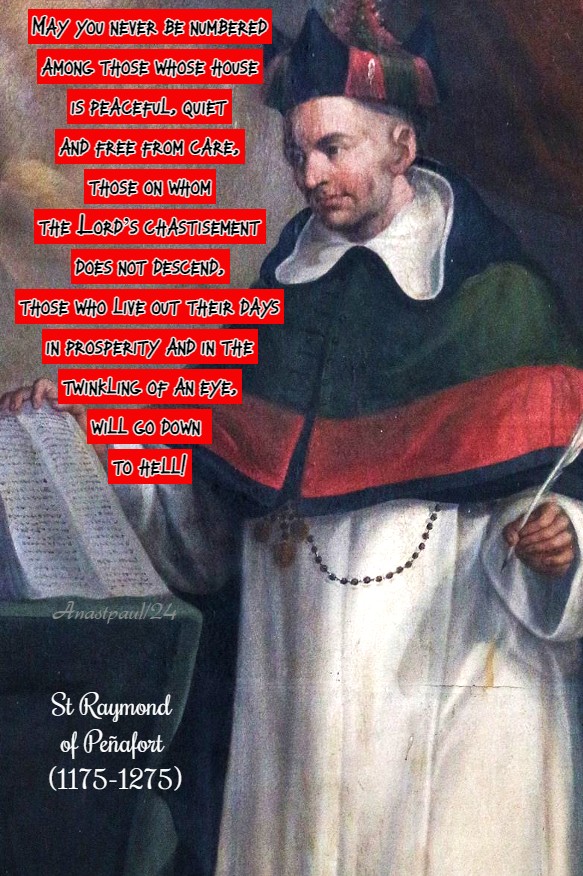
“May you never be numbered among those whose house is peaceful, quiet and free from care, those on whom the Lord’s chastisement does not descend, those who live out their days in prosperity and in the twinkling of an eye, will go down to hell!”
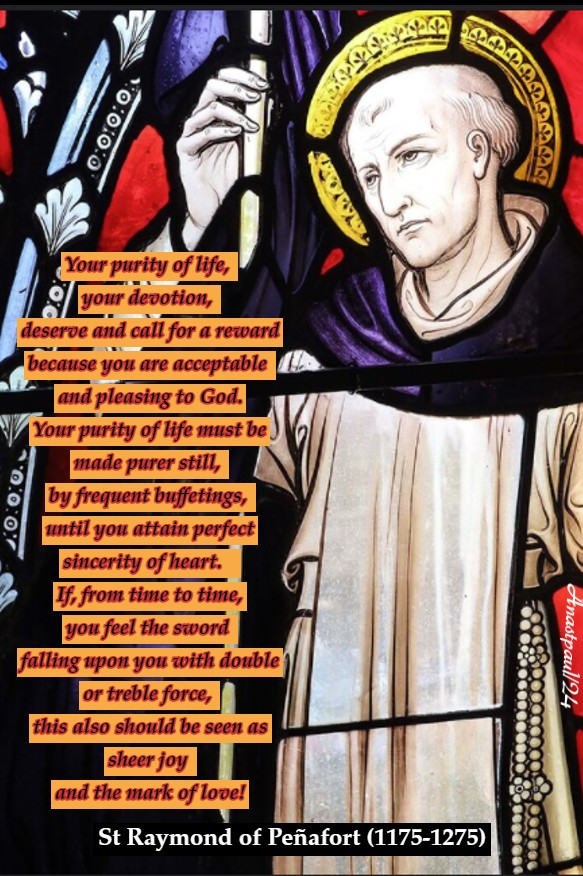
“Your purity of life, your devotion, deserve and call for a reward because you are acceptable and pleasing to God. Your purity of life must be made purer still, by frequent buffetings, until you attain perfect sincerity of heart. If, from time to time, you feel the sword falling upon you with double or treble force, this also should be seen as sheer joy and the mark of love!”
“Look then on Jesus, the Author and Preserver of faith — in complete sinlessness, He suffered and, at the hands of those who were His own and was numbered among the wicked. As you drink the cup of the Lord Jesus (how glorious it is!), give thanks to the Lord, the Giver of all blessings. May the God of love and peace set your hearts at rest and speed you on your journey; may He meanwhile, shelter you from disturbance by others in the hidden recesses of His Love, until He brings you, at last, into that place of complete plenitude, where you will repose forever in the vision of peace, in the security of trust and in the restful enjoyment of His riches. ”
One Minute Reflection – 23 January – “The Month of the Most Holy Name of Jesus and of the Holy Family”– St Raymond of Peñafort (1175-1275) – Sirach 31:8-11, Luke 12:35-40 – Scripture search here: https://www.drbo.org/
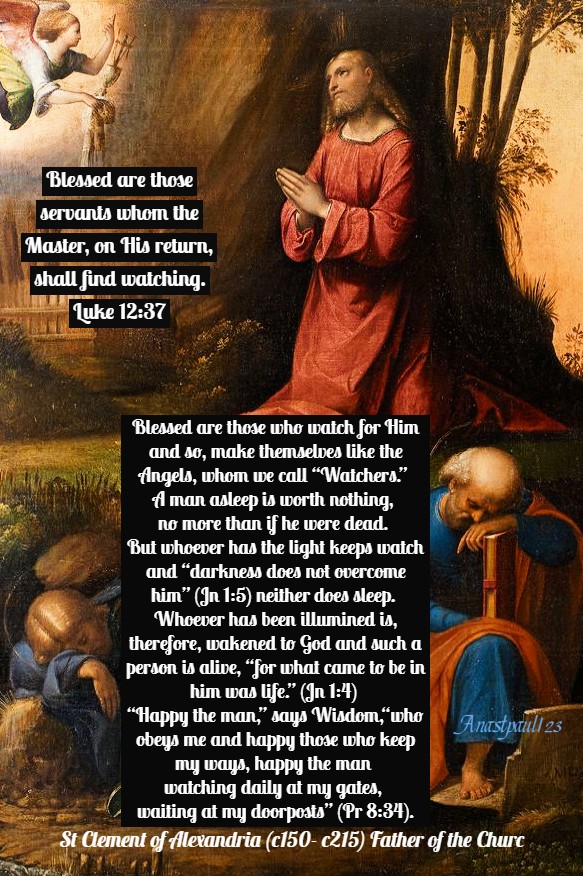
“Blessed are those servants whom the Master, on His return, shall find watching.” – Luke 12:37
REFLECTION – “We must sleep in such a way as to be easily awakened. For Scripture says, “Gird your loins and light your lamps and be like servants who await their master’s return from a wedding, ready to open immediately when He comes and knocks.” (Lk 12:35-36). For a sleeping man is of no more use than a dead man. Therefore, we ought often to get up at night and bless God!
Blessed are those who watch for Him and so, make themselves like the Angels, whom we call “Watchers.” A man asleep is worth nothing, no more than if he were dead. But whoever has the light keeps watch and “darkness does not overcome him” (Jn 1:5) neither does sleep. Whoever has been illumined is, therefore, wakened to God and such a person is alive, “for what came to be in him was life.” (Jn 1:4) “Happy the man,” says Wisdom,“who obeys me and happy those who keep my ways, happy the man watching daily at my gates, waiting at my doorposts” (Pr 8:34).
Therefore, “let us not sleep, as the rest do but let us stay alert and sober” as Scripture says. “For those who sleep, go to sleep at night and those who are drunk, get drunk at night,” that is, in the darkness of ignorance. “But since we are of the day, let us be sober.” (1Th 5:6-8) “For all of you are children of the light and children of the day. We are not of the night or of darkness.” (1Th 5:5).” – St Clement of Alexandria (c150- c215) Father of the Church, Theologian and Philosopher, Professor who taught at the Catechetical School of Alexandria (The Instructor II:9).
PRAYER – O God, Thou Who chose blessed Raymond to be a renowned minister of the Sacrament of Penance and miraculously brought him through the waves of the sea, grant that, by his intercession, we may produce good results from our penance and reach the Heaven of eternal salvation Through Jesus Christ, Thy Son our Lord, Who lives and reigns with Thee, in the unity of the Holy Ghost, God, world without end. Amen (Collect).
Our Morning Offering – 23 January – “The Month of the Most Holy Name of Jesus and of the Holy Family”
The Love of Thy Name By Thomas à Kempis CRSA (1380-1471) The Imitation of Christ (Book 3 Ch 26:1-4)
My God, Sweetness beyond words, make bitter all the carnal comfort which draws me from love of the eternal and lures me to its evil self, by the sight of some delightful good in the present. Let it not overcome me, my God. Let not flesh and blood conquer me. Let not the world and its brief glory deceive me, nor the devil trip me by his craftiness. Give me courage to resist, patience to endure and constancy to persevere. Give me the soothing unction of Thy spirit, rather than all the consolations of the world and in place of carnal love, infuse into me, the love of Thy Name. Amen
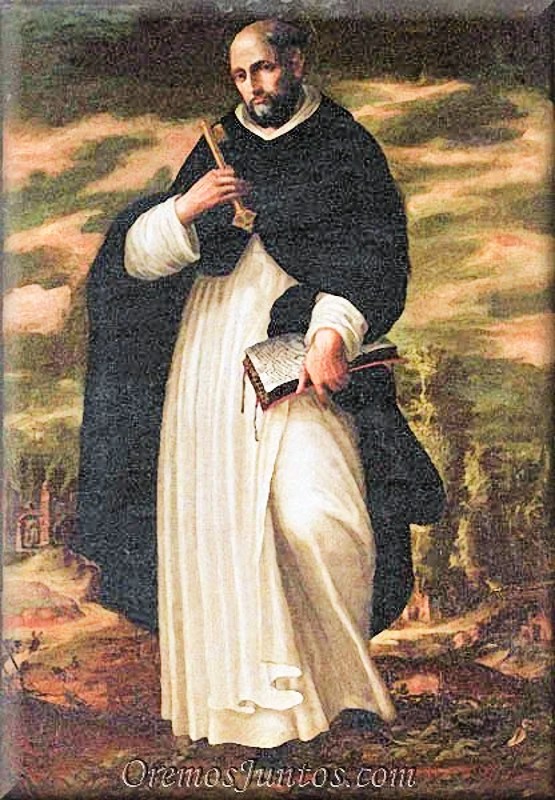
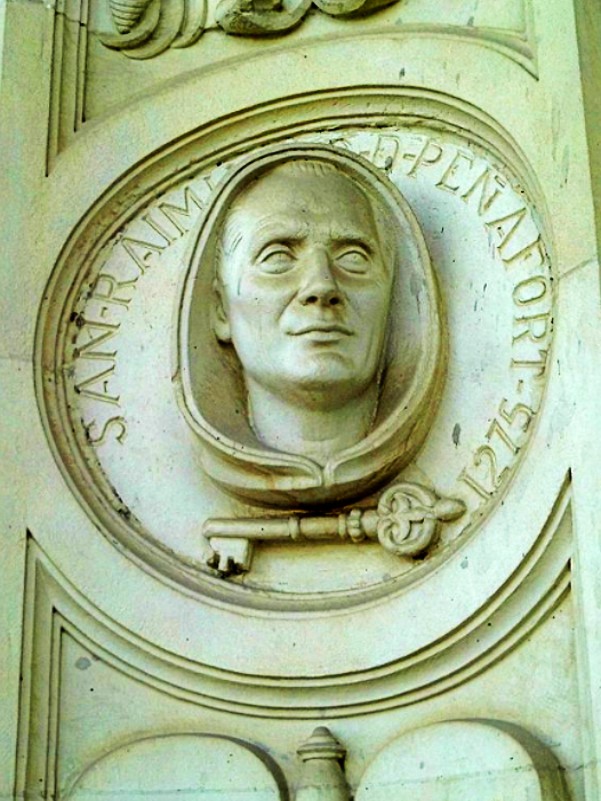
Saint of the Day – 23 January – St Raymond of Peñafort OP (1175-1275) Confessor, “Father of Canon Law” Dominican Priest, Co-Founder of the Mercedarian Friars with St Peter Nolasco, Miracle-Worker – born on 1175 at Peñafort, Catalonia, Spain and died on 6 January 1275 at Barcelona, Spain of natural causes. Raymond compiled the Decretals of St Gregory IX (Reign 1227-1241), a collection of Canonical Laws which remained a major part of Church Law until the 1917 Code of Canon Law abrogated it. Patronages – Lawyers, Canon Lawyers, Medical Record Librarians, Barcelona, Spain, Navarre, Spain. Also known as – Ramon de Penyafort, Raymond of Rochefort. … of Penyafort, Raymund. https://anastpaul.com/2019/01/07/saint-of-the-day-st-raymond-of-penafort-op-1175-1275-father-of-canon-law/
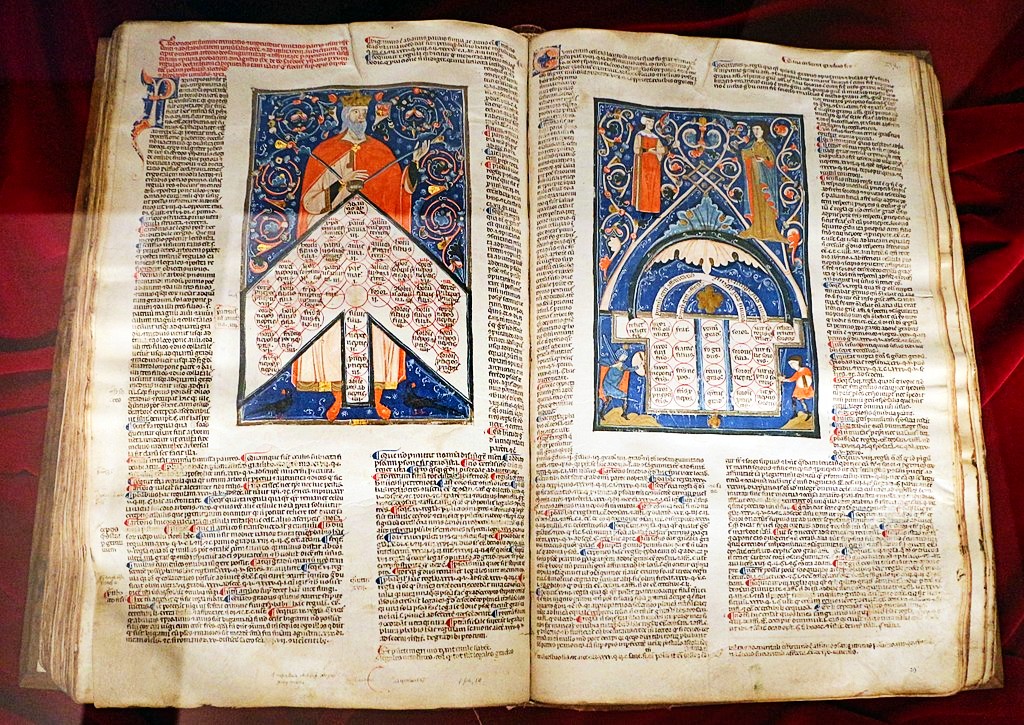
Decretals of St Gregory IX
St Raymond of Peñafort OP (1175-1275) By Fr Francis Xavier Weninger SJ (1805-1888)
“Raymond, sprung from the noble race of Peñafort, was born at Barcelona, in Catalonia, Spain, in the year 1175. Even in early childhood. his only delight was in prayer and study and, when but a mere youth, he was so advanced in learning, as to be deservedly appointed to instruct others. Subsequently, he devoted himself to Canon and Civil Law and soon excelled amongst the most celebrated Jurists of his time.
At Bologna he lectured publicly and gratuitously. At this time, Berengarius, Bishop of Barcelona, happening to pass through Bologna and hearing of Raymond’s wide-spread fame, persuaded him to return to his native land, where he first installed him as Canon, subsequently, however, as Provost. Nor did the Bishop hesitate to consult him in his most important affairs.
At the age of forty-four Raymond entered the Order of St Dominic, in which he soon acquired a great reputation for learning and piety. Pope Gregory IX, called him to Rome and chose him for his Spiritual Guide and Confessor, of which duties he acquitted himself with remarkable modesty and frankness. Observing that many poor people visited the Papal Palace, in whose fate no-one seemed to interest themself, Raymond imposed upon the Pope, as a penance, the duty of better providing for Christ’s poor. The Pope, who tells this anecdote himself, loved Raymond the more and valued him the more highly on this account, carefully regulating his manner of life, according to the instructions of the Saint.
As some reward for his many services, the Holy Father wished to appoint him to the Bishopric of Taragona but Raymond, steadfastly refused the proffered dignity, only begging to be dismissed from the Papal Court. In fact, his physicians had already decided that, if he wished to recover from a malady with which he was afflicted, he must seek his native air. Once more restored to his old home, he resumed his primitive fervour, in which he ever persevered. He wrote various instructions for the use of his neighbour, to whose eternal salvation he entirely devoted himself.
In the foundation of the Order for the Redemption of Captives, he took no little part; for he too, like St. Peter Nolasco, was admonished, in an apparition of Our Lady, to interest himself in its cause. He compiled Rules for those who wished to enter the Order, received St Peter as its first member, afterwards appointing him, with permission of the Holy See, its first General. In 1238, Raymond himself was elected the 3rd General but hastened, after three years, to resign, preferring the quiet of the cloister, devoted to prayer, the writing of edifying books and other such holy and useful occupations. He was looked upon by all, as a model of Christian perfection,but he excelled especially in a wonderful humility, an obliging condescension to the poor and a most childlike devotion to the Virgin Mother.
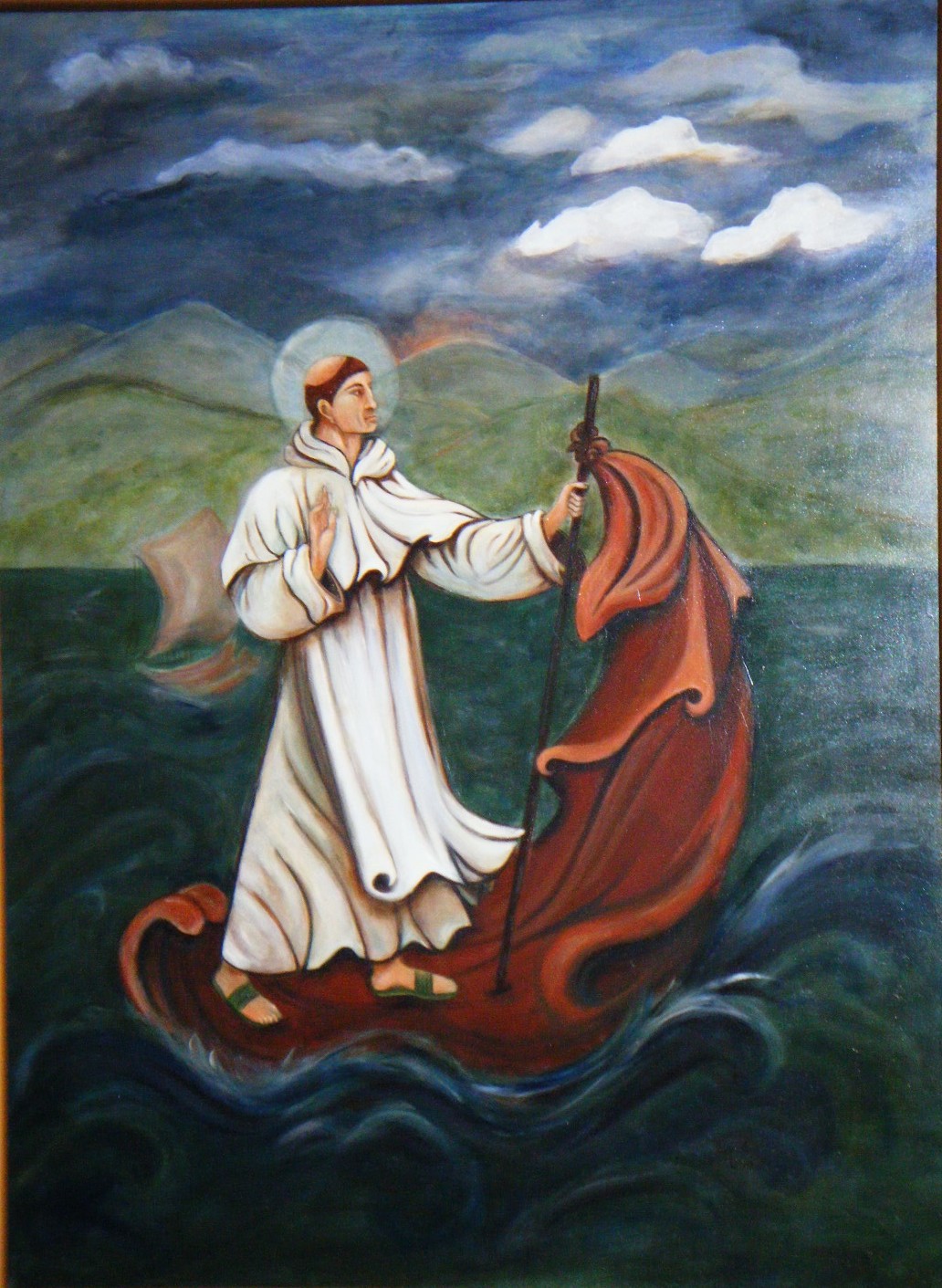
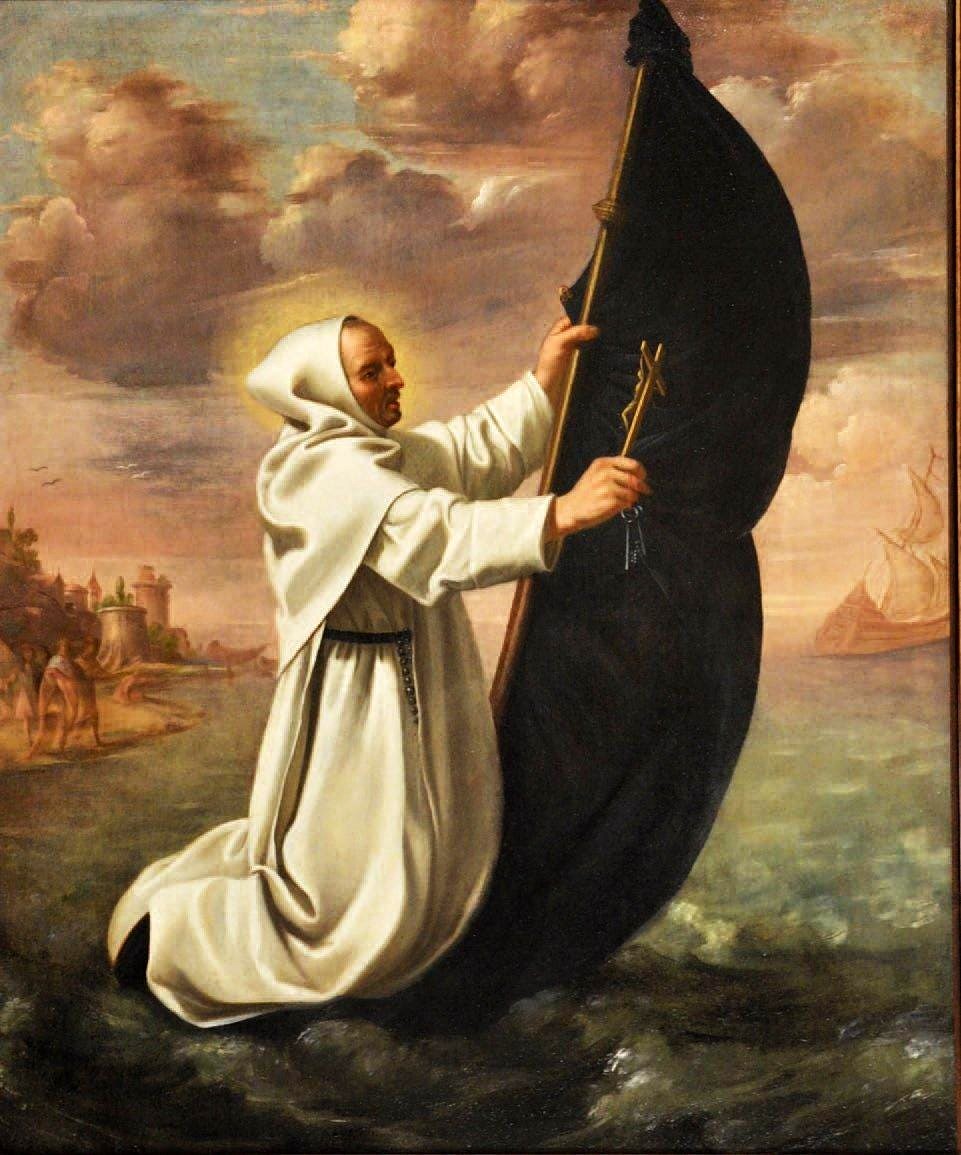
Many and remarkable are the miracles recorded of him but the following, which is the most known, may suffice here. James the First, King of Arragon, had chosen Raymond for his Confessor and desired him to favour him with his company on a journey to the Island of Majorca. But the King, incited by an unholy love for a certain woman, clandestinely conveyed her with him. Raymond had repeatedly and with holy zeal conjured the King to dismiss her and James had even promised to comply with the holy man’s request but upon their arrival at Majorca the Saint, soon perceiving that the King had broken his promise, went up to him and thus addressed him: “Your Majesty must either dismiss this person, or I shall be obliged to set sail for Barcelona to return to my cloister.” The King, growing angry at this reproof, gave strict orders that no-one should give passage to Raymond, should he wish to return to Spain. The holy man, unconscious of the intrigues of the King, hastened to the sea-coast, where a vessel lay ready to sail. He sought for admission in vain, the Officers showed him the Royal Mandate in Raymond’s regard.
Full of confidence in God, the Saint stepped upon a huge rock which stretched far into the sea. After making the Sign of the Cross, he spread his cloak upon the water and mounted the same, as if it were a seaworthy vessel. In vain did he press a fellow-Religious to join him, who had followed him to the coast but who now stood stupefied at this manner of sailing. Raymond did not allow himself to be shaken in his purpose by the fright of his companion but, placing his staff upright on his cloak and gathering up the folds in front in the manner of a sail, he glided off, to the most profound astonishment of all present! He arrived safely in Barcelona within six hours after his departure, the distance being 160 miles. In the presence of a large concourse of people, he stepped ashore, and, throwing his perfectly dry cloak over his shoulders, he hurried to his Monastery.
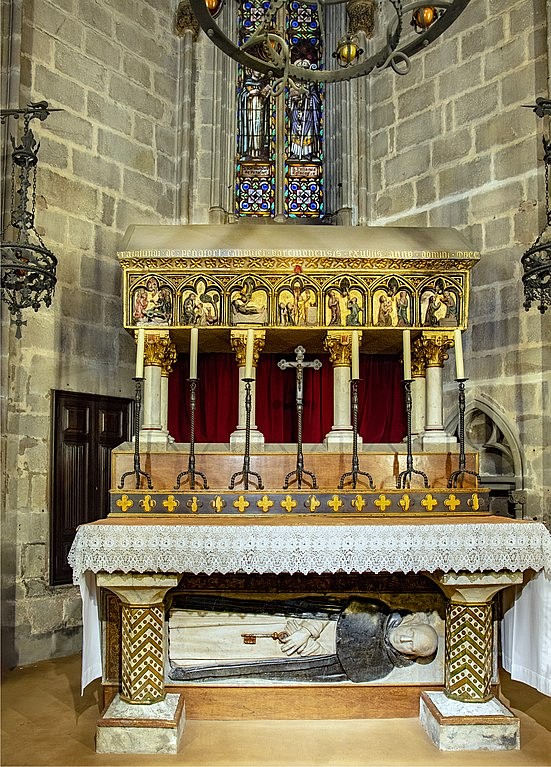
There, he lived for some time in great sanctity and, when he had almost reached his hundreth year, he slept quietly in the Lord, full of virtues and merits.” Below is St Raymon’d Tomb and Shrine in Barcelona Cathedral.
St Raymond of Peñafort OP (1175-1275) “Father of Canon Law” Dominican Priest, Doctor of Canon Law, the Third Master of the Order of Preachers, Founder of the Mercedarian friars, Writer, Teacher, Miracle-Worker. St Raymond of Peñafort’s Feast day was inserted in the General Roman Calendar in 1671 for celebration on 23 January. In 1969 it was moved to 7 January, the day after that of his death. He is the Patron Saint of canon lawyers, specifically and lawyers, in general. Biography: https://anastpaul.com/2019/01/07/saint-of-the-day-st-raymond-of-penafort-op-1175-1275-father-of-canon-law/
St Abel the Patriarch St Agathangelus St Amasius of Teano St Aquila the Martyr St Asclas of Antinoe St Clement of Ancyra St Colman of Lismore St Dositheus of Gaza
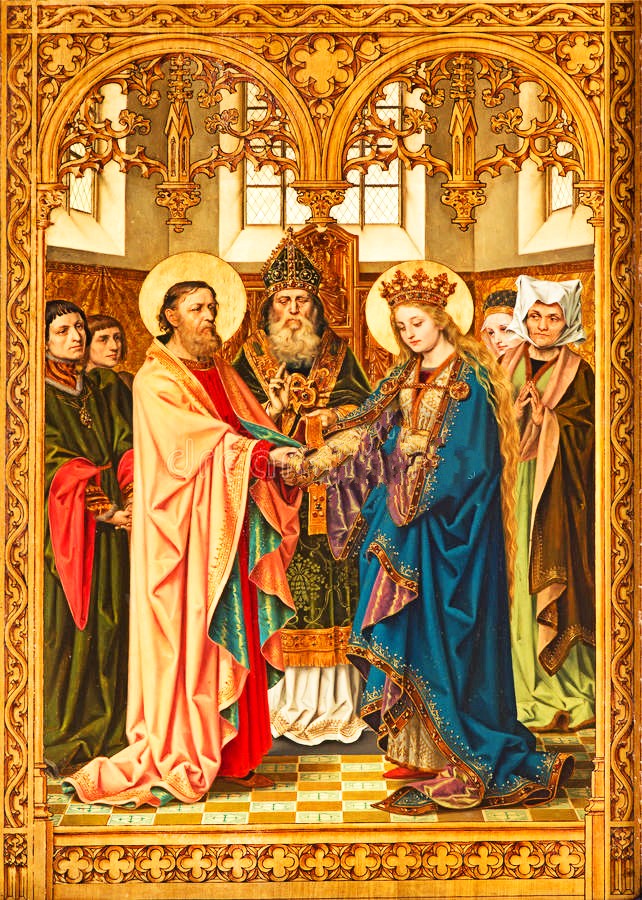
St Ildephonsus (506-667) Archbishop of Toledo. Theologian, Scholar, Marian devotee, Writer, Evangeliser. Abbot Dom Guéranger calls him the Doctor of the Virginity of Mary. Saint Ildephonsus established the Feast of the Expectation of the Blessed Virgin Mary, which is still kept in some places on 18 December. Biography: https://anastpaul.wordpress.com/2018/01/23/saint-of-the-day-23-january-st-ildephonsus-607-667/









 AnaStpaul
You must be logged in to post a comment.