St Bitheus St Calocerus of Brescia St Cogitosus St Corebus St Eleuterius of Illyria St Elpidius of Melitene St Eusebius of Fano St Galdinus della Sala of Milan (c1096-1176) Cardinal Bishop St Gebuinus of Lyons St Genocus St Hermogenes of Melitene
Blessed Idesbald of Dunes O.Cist (c1095-1167) Cistercian Priest and Abbot of Ten Duinen Abbey, Our Lady of the Dunes. The Roman Martyrology states: “In Bruges in Flanders, in today’s Belgium, Blessed Idesbaldo, Abbot, who, soon became a widower and exercised for another thirty years, duties in the palace of the Counts, entered the Monastery of Dune at a mature age, which he held holy, as the third Abbot for twelve years.” Biography: https://anastpaul.com/2021/04/18/saint-of-the-day-18-april-blessed-idesbald-of-dunes-o-cist-c-1095-1167/
Thought for the Day – 17 April – The Spiritual Combat (1589) – Dom Lorenzo Scupoli OSM (c1530-1610)
“None shall be crowned who has not fought well.” 2 Tim 2: 5
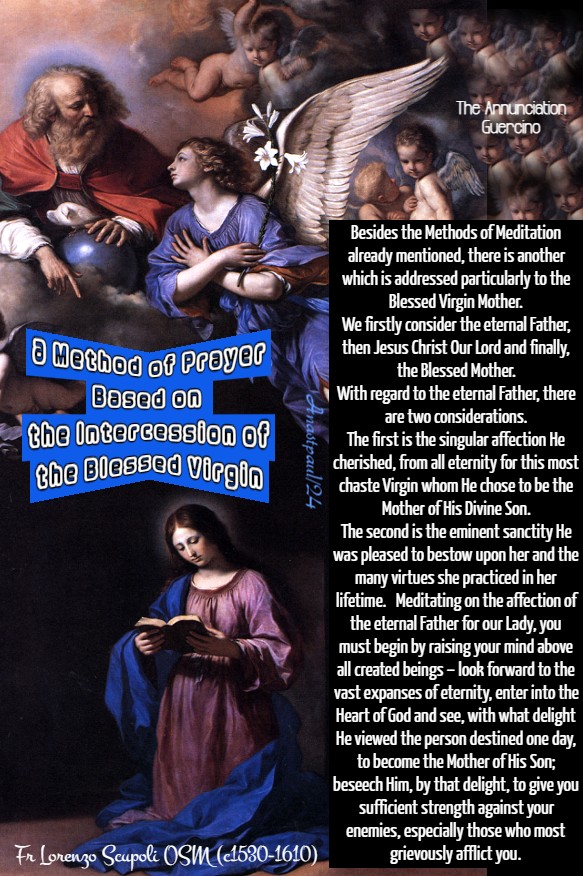
XLVIII: … A Method of Prayer Based on the Intercession of the Blessed Virgin
“Besides the Methods of Meditation already mentioned, there is another which is addressed particularly to the Blessed Virgin Mother. We firstly consider the eternal Father, then Jesus Christ Our Lord and finally, the Blessed Mother.
With regard to the eternal Father, there are two considerations. The first is the singular affection He cherished, from all eternity for this most chaste Virgin whom He chose to be the Mother of His Divine Son. The second is the eminent sanctity He was pleased to bestow upon her and the many virtues she practiced in her lifetime. Meditating on the affection of the eternal Father for our Lady, you must begin by raising your mind above all created beings – look forward to the vast expanses of eternity, enter into the Heart of God and see, with what delight He viewed the person destined one day, to become the Mother of His Son; beseech Him, by that delight, to give you sufficient strength against your enemies, especially those who most grievously afflict you.
Contemplate, then, the virtues and heroic actions of this incomparable Virgin. Make an offering of each or all of them to God, as they are of such efficacy, as to obtain for you, divine assistance in your particular necessities.
After this address yourself to Jesus, begging Him to be mindful of that loving Mother who, for nine months carried Him in her womb, and, from the moment of His birth, paid Him the most profound adoration. For this was her acknowledgment that this Child was at once God and Man, her Creator and her Son. With compassion she saw Him poorly accommodated in a humble stable, nourished Him with her pure milk, kissed and embraced Him a thousand times, with maternal fondness and throughout His Life and at His Death, suffered for Him beyond expression. Present this picture to the Saviour that He may be compelled, as it were, by such powerful motives, to hear your prayers.
Appeal to the Blessed Virgin herself, reminding her of her commission ,from all eternity, to be the Mother of Mercy and the Refuge of sinners and that, after her Divine Son, you place your greatest confidence in her intercession. Present to her the fact, asserted by the learned and confirmed by miracles that no-one ever called upon her with a lively faith and love, was left unaided.
Finally, remind her of the sufferings of her Son for your salvation that she may obtain of Him, the grace necessary to make proper use of His sufferings for the greater glory of that loving Saviour!”
Quote/s of the Day – 17 April – Solemnity of the Patronage of St Joseph Confessoris
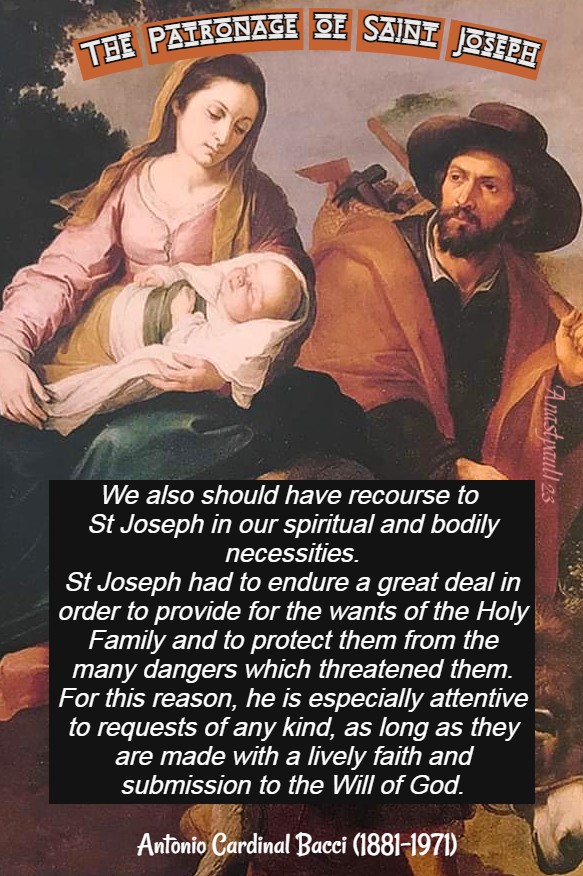
“We also should have recourse to St Joseph in our spiritual and bodily necessities. St Joseph had to endure a great deal in order to provide for the wants of the Holy Family and to protect them from the many dangers which threatened them. For this reason, he is especially attentive to requests of any kind, as long as they are made with a lively faith and submission to the Will of God.”
“St Joseph is the Universal Patron of the Church. We, who are loved children of the Church should invoke his special intercession, therefore, for the triumph and expansion of the Kingdom of God upon earth. … If we are loyal sons of the Church, we should pray that She may triumph. We should ask for the special intercession of St Joseph, Her Heavenly Patron.”
“We shall come to the end of our lives too, perhaps sooner than we imagine. Let us ask the Holy Patriarch for the favour of a happy death. Let us ask him to ensure that Jesus and Mary will help us too, when we are leaving this world.”
One Minute Reflection – 17 April – “The Month of the Resurrection and the Blessed Sacrament” –Solemnity of the Patronage of St Joseph Confessoris – Genesis 49:22-26; Luke 3:21-23– Scripture search here: https://www.drbo.org/
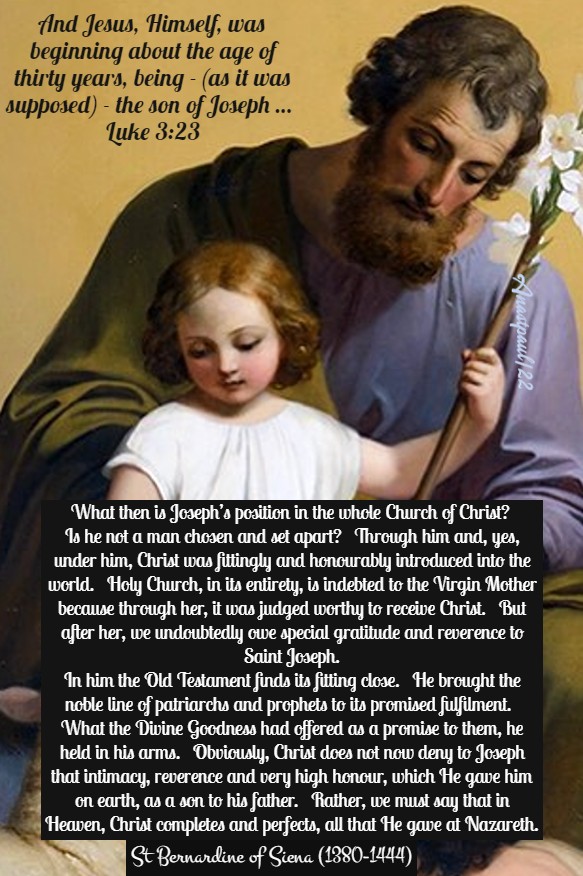
“And Jesus, Himself, was beginning about the age of thirty years, being – (as it was supposed) – the son of Joseph … ” – Luke 3:23
REFLECTION – “There is a general rule, concerning all special graces granted to any human being. Whenever the Divine favour chooses someone to receive a special grace, or to accept a lofty vocation, God adorns the person chosen, with all the gifts of the Spirit, needed to fulfil the task at hand.
This general rule is especially verified in the case of Saint Joseph, the Foster-Father of our Lord and the husband of the Queen of our world, enthroned above the Angels. He was chosen by the eternal Father as the trustworthy Guardian and Protector of his greatest treasures, namely, his Divine Son and Mary, Joseph’s wife. He carried out this vocation with complete fidelity until at last God called him, saying: Good and faithful servant, enter into the joy of your Lord.
What then is Joseph’s position in the whole Church of Christ? Is he not a man chosen and set apart? Through him and, yes, under him, Christ was fittingly and honourably introduced into the world. Holy Church, in its entirety, is indebted to the Virgin Mother because through her, it was judged worthy to receive Christ. But after her, we undoubtedly owe special gratitude and reverence to Saint Joseph.
In him the Old Testament finds its fitting close. He brought the noble line of Patriarchs and Prophets to its promised fulfilment. What the Divine Goodness had offered as a promise to them, he held in his arms. Obviously, Christ does not now deny to Joseph that intimacy, reverence and very high honour which He gave him on earth, as a son to his father. Rather, we must say that in Heaven, Christ completes and perfects, all that He gave at Nazareth.
Now, we can see ,how the last summoning words of the Lord appropriately apply to Saint Joseph – Enter into the joy of your Lord. In fact, although the joy of eternal happiness enters into the soul of a man, the Lord preferred to say to Joseph – Enter into joy. His intention was, that the words should have a hidden spiritual meaning for us. They convey, not only that this holy man possesses an inward joy but also, that it surrounds him and engulfs him, like an infinite abyss.
Remember us, Saint Joseph and plead for us to your Foster-Child. Ask your most holy bride, the Virgin Mary, to look kindly upon us, since she is the Mother of Him, Who, with the Father and the Holy Ghost, lives and reigns eternally. Amen.” – St Bernardine of Siena (1380-1444) (An excerpt on his Sermon 2 of St Joseph).
PRAYER – God, Who in thine unspeakable foreknowledge didst choose Thy blessed servant Joseph, to be the husband of Thine Own most holy Mother; mercifully grant that now that he is in Heaven with Thee, we who on earth do reverence him for our Defender, may worthily be helped by the succour of his prayers to Thee on our behalf. Through the same Jesus Christ, Thy Son our Lord, Who lives and reigns with Thee, in the unity of the Holy Ghost, God, world without end. Amen (Collect).
Our Morning Offering – 17 April – “The Month of the Resurrection and the Blessed Sacrament” – Wednesday, St Joseph’s Day and The Solemnity of the Patronage of St Joseph
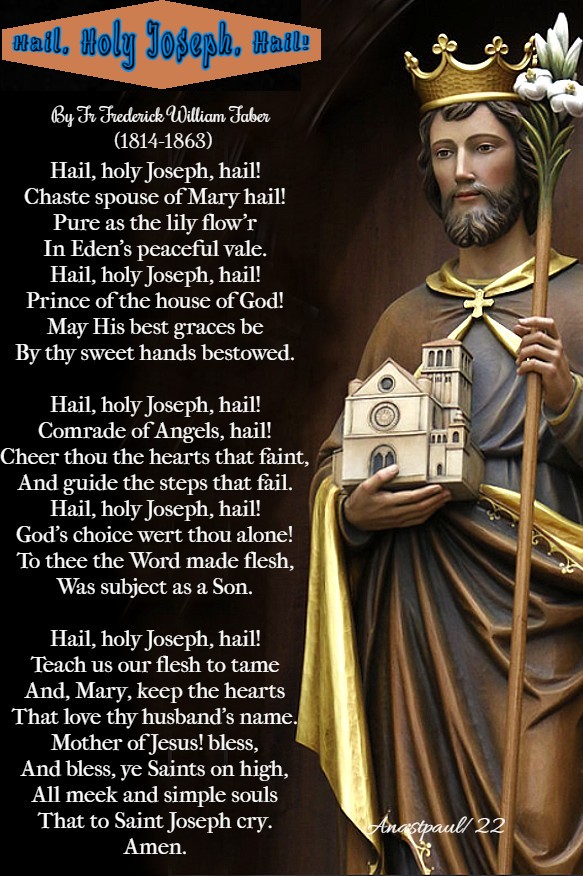
Hail, Holy Joseph, Hail! By Father Frederick William Faber CO (1814-1863)
Hail, holy Joseph, hail! Chaste spouse of Mary hail! Pure as the lily flow’r In Eden’s peaceful vale. Hail, holy Joseph, hail! Prince of the house of God! May His best graces be By thy sweet hands bestowed.
Hail, holy Joseph, hail! Comrade of Angels, hail! Cheer thou the hearts that faint, And guide the steps that fail. Hail, holy Joseph, hail! God’s choice wert thou alone! To thee the Word made flesh, Was subject as a Son.
Hail, holy Joseph, hail! Teach us our flesh to tame And, Mary, keep the hearts That love thy husband’s name. Mother of Jesus! bless, And bless, ye Saints on high, All meek and simple souls That to Saint Joseph cry. Amen
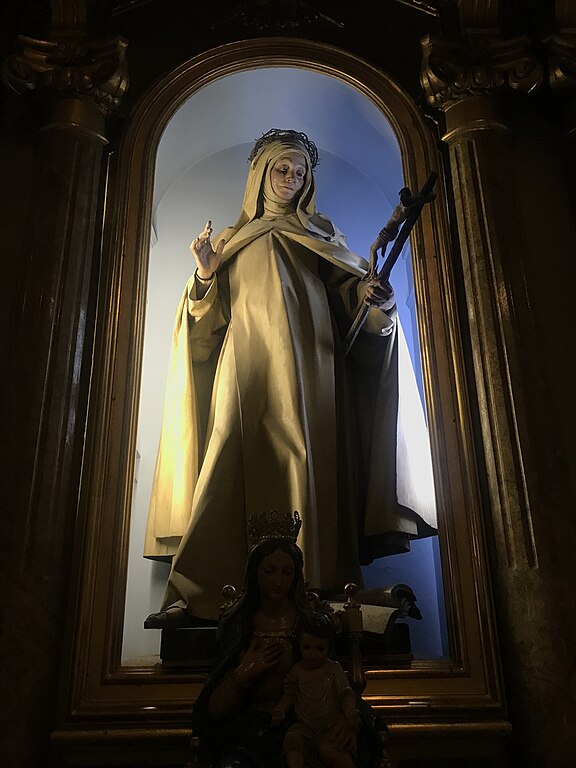
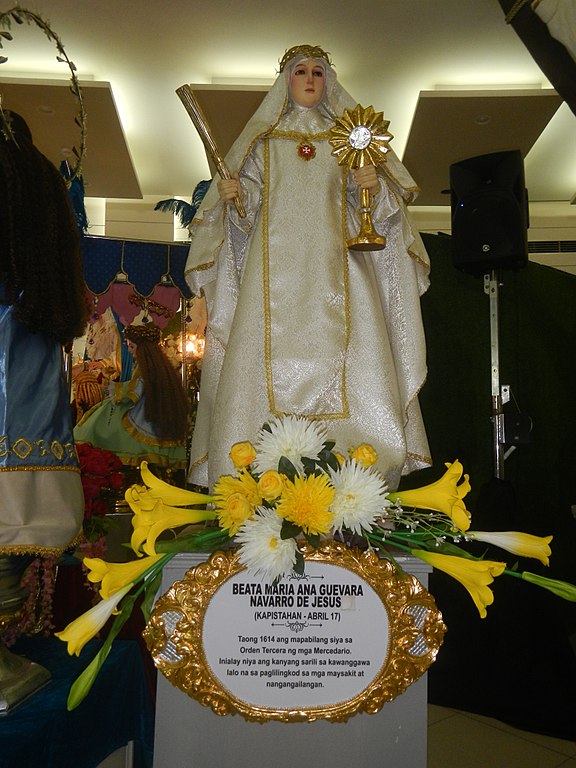
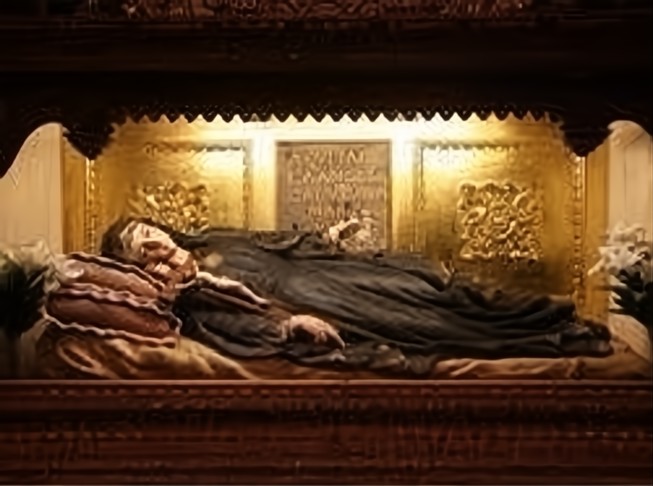
Saint of the Day – 17 April – Blessed Mariana of Jesus OdeM(c1565-1624) “The Lily of Madrid” Tertiary Sister of the Mercadarian Order (the Servants of Mary) Mystic and Ecstatic, graced with Visions of Our Lord and His Mother and granted the ability, by her intercession, to be responsible for many miracles, Spiritual Director and Apostle of the poor and the sick. In addition, Mariana was known to bilocate and levitate during her ecstasies. Born on 17 January 1565 at Madrid, Spain as María Ana Navarro de Guevara y Romero and died on 17 April 1624 of natural causes at Madrid, aged 59. Patronages – of Madrid, Mercedarian Tertiaries Mercedarian Lay Fraternities and Apostolates. Also known as – “The Lily of Madrid,” “The Saint of Madrid,”Mariana Navarra de Guevara, Mary Ann of Jesus Navarro, Maria Ana de Jesus Navarro de Guevara. Her body is Incorrupt.
Mariana was born in Madrid on 17 January 1565 into a wealthy family. Her father was an affluent merchant whose business supplied leather goods to the Spanish Court. He, himself being in the service of King Philip II.
She was Baptised on the 21st of the same month of her birth in the Church of Santiago (St James). Mariana was attracted very early to religious life. At the age of 22, she already had the firm determination to enter a Convent, despite the strong opposition of her father (who, widowed early, had remarried) and her stepmother, who had arranged her marriage. However, her parents’ attempts to separate her from her vocation were of little use. Legend says that she went as far as to disfigure her face and cut her hair in order to see herself rejected by the young man chosen for her..
In 1598 she retired as a penitent to the hermitage of Santa Bárbara in the Capital of the Kingdom. There she was assisted by Brother Juan Bautista Sacramento, a Mercedarian Religious and reformer of the Order, who was her Spiritual director until her death and by other pious people. She made her home in a small house, next to the Convent of the Discalced Mercedarians where she spent several years dedicated to prayer and penance, as well as serving the poor and needy of the City. In 1613 she was received into the Order of Mercy, given the Tertiary Habit by order of Brother Felipe Guimerán, Master General of the Order, who the following year, on 20 May 1614, received her profession.
The fame of her virtues and the supernatural appearances and miracles which accompanied her, spread quickly throughout Madrid. Her Superiors ordered her to write about these experiences. In these writings, Mariana narrates, among other things, the visions she had of Jesus Christ and the Virgin Mother and her mystical ecstasies.
The Queen of Spain , Isabel de Borbón, sent for Mariana to attend at the Palace whereafter their acquaintance grew so much that Mariana was considered one of the Queen’s closest friends. At that time, Mariana was already called “The Saint of Madrid.”
Mariana’s death occurred on 17 April 1624 in the Mercedarian Convent of Santa Bárbara in Madrid, as a result of a lung condition. He was 59 years old.
Her body is preserved Incorrupt in the Church of the Mercedarian Nuns of Don Juan Alarcón in Madrid as the Convent of Santa Bárbara was destroyed during later unrest. The Tomb where Mariana rests, was given by Queen Elizabeth II.
The extraordinary thing about her life of great solitude is precisely her ability to welcome, listen to and attend, to the spiritual and material needs of so many people who came to request assistance, or to ask for spiritual succour.
She was Beatified by Pope Pius VI on 18 January 1783.
If already during her life Mariana had achieved great renown for her piety and the prodigies of all kinds which were attributed to her, after her death, it only increased. It includes among them the fall of rain in Madrid, in times of severe drought, such as the one which devastated the two Castiles in 1613.
Mariana’s body was displayed to the public for two days in the midst of a large gathering. The artist Vicente Carducho made several death masks of the deceased. The same year of her death, the Canonical process of her Beatification began, encouraged by the people, the nobility and King Philip IV himself , a great devotee of hers. Barely a month after her death, the information process on the life and miracles of Mariana de Jesús began. 152 witnesses testified in it. On 8 August 1624, the Board of Theologians and Canonists of Madrid proposed that she could be given a private cult.
On 31 August 1627, her grave was opened and to the general astonishment, it was found that the body was intact, with fresh flesh and flexible limbs and exhaling a pleasant fragrance. Only her face was slightly disfigured due to the manipulations necessary to obtain the death mask. This fact has been verified each of the successive times when the mortal remains were inspected — in 1731, 1924 and 1965.
The Solemnity of the Patronage of St Joseph Wednesday preceding the Third Sunday after Easter: Few Catholics are likely familiar with the Eastertide Solemnity of St Joseph. According to Father Francis Xavier Lasance (1860-1946) it was instituted during the hostile occupation of Rome by the Troops of the Italian King, Victor Emmanuel II. The Pope proclaimed St Joseph the Patron of the oppressed Household of the Faith, entrusting to St Joseph, the defence of Holy Mother Church.
In the beginning, this Feast Day was observed on the Third Sunday after Easter but when Pope St Pius X reformed the Liturgical Calendar to restore the Sunday Offices to prominence over those of the Saints, the second Feast of St Joseph was moved to the Wednesday preceding the Third Sunday after Easter. In 1911, the Feast was raised to a Double of the First Class and it was assigned an Octave after it was moved to the Wednesday before the Third Sunday after Easter. It is a Common Octave, so the Octave may or may not be commemorated on the intra Octave days depending on the rank of the Feasts which occur during the Octave. While this Feast day is not in the 1962 Missal, it is still kept by Priests who celebrate Holy Mass according to the pre-1955 reforms.
Bl essed Andrés Hibernón Real OFM (1534-1602) Religious Friar, Apostle of the Holy Eucharist, the Blessed Virgin and the Holy Rosary, Apostle of the poor. He predicted the date of his death four years before the fact, which was 18 April 1602 in Gandia, Valencia, Spain of natural causes immediately after having prayed a rosary. He was Beatified on 22 May 1791 by Pope Pius VI. His body is incorrupt. Biography: https://anastpaul.wordpress.com/2018/04/17/saint-of-the-day-17-april-blessed-andres-hibernon-real-o-f-m-1534-1602/
St Agia of Hainault St Anthia of Illyria St Athanasia of Aegina St Bitheus St Calocerus of Brescia St Cogitosus St Corebus
St Eleuterius of Illyria St Elpidius of Melitene St Eusebius of Fano St Galdinus of Milan St Gebuinus of Lyons St Genocus St Hermogenes of Melitene St Innocent of Tortona Bishop and Confessor Bl Idesbald of Dunes Blessed James of Cerqueto OSA (1285-1366)
St Laserian of Leighlin Blessed Mariana of Jesus OdeM (c1565-1624)
St Pantagathus of Vienne Bishop St Perfecto of Córdoba St Pusicio
St Robert de Turlande/Chaise-Dieu OSB (c1000-1067) Priest, professed religious of the Order of St Benedict, Monk, Abbot, Apostle of Charity, Marian devotee. He was of noble stock, was related to Saint Gerald of Aurillac (c855–c909) and was a descendant of St Caesarius of Arles (470-543). He is best known for the establishment of the Benedictine Convent of La Chaise-Dieu (‘Home of God’) and for his total commitment to the poor. He became a spiritual inspiration for Pope Clement VI (1291–1352) – whose own origin,s in the religious life were based at that Convent – and it was Pope Clement who confirmed the Canonisation of the Benedictine Abbot on 19 September 1351 in Avignon. His Life: https://anastpaul.com/2019/04/17/saint-of-the-day-17-april-st-robert-de-chaise-dieu-osb-c-1000-1067/
Thought for the Day – 16 April – The Spiritual Combat (1589) – Dom Lorenzo Scupoli OSM (c1530-1610)
“None shall be crowned who has not fought well.” 2 Tim 2: 5
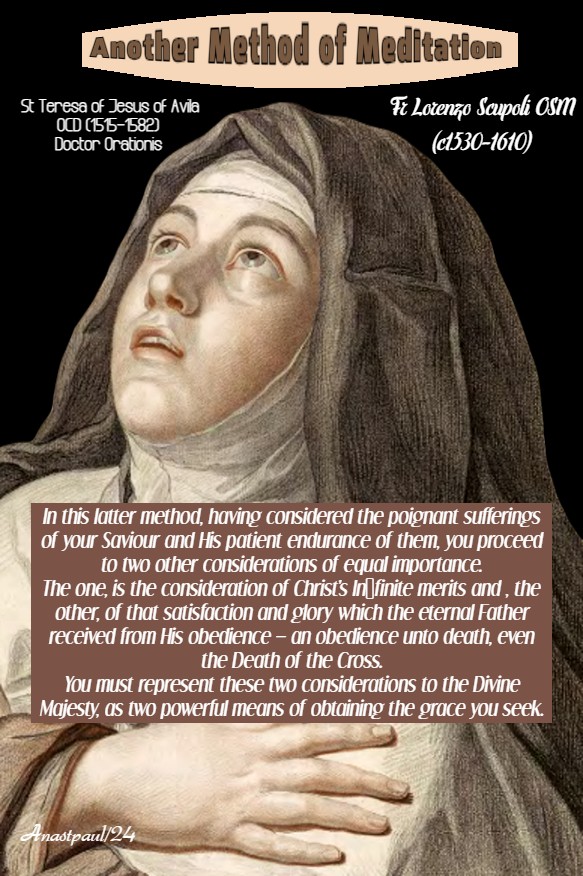
XLVII: … Another Method of Meditation
“There is another method of prayer and meditation besides the one to which we have referred.
In this latter method, having considered the poignant sufferings of your Saviour and His patient endurance of them, you proceed to two other considerations of equal importance. The one, is the consideration of Christ’s Infinite merits and , the other, of that satisfaction and glory which the eternal Father received from His obedience – an obedience unto death, even the Death of the Cross. You must represent these two considerations to the Divine Majesty, as two powerful means of obtaining the grace you seek.
This method is applicable, not only to all the Mysteries of Our Lord’s Passion but, to every exterior or interior act He performed in the course of His Passion.”
Quote/s of the Day – 16 April – “The Month of the Resurrection and the Blessed Sacrament” – – Ferial Day – 1 Peter 2:21-25; John 10:11-16 – Scripture search here: https://www.drbo.org/
“My sheep hear My Voice; I know them and they follow Me.”
John 10:27
“I am like the sick sheep which strays from the rest of the flock. Unless the Good Shepherd takes me on His shoulders and carries me back to His fold, my steps will falter and, in the very effort of rising, my feet will give way!”
St Jerome (343-420) Father and Doctor of the Church
“Christ said that the shepherd enters through the gate and that He is Himself the Gate, as well as the Shepherd. Then, it is necessary, that He enter through Himself. By so doing, He reveals Himself and through Himself, He knows the Father. But we enter through Him because through Him. we find happiness.”
St Thomas Aquinas (1225-1274) Doctor Angelicus Doctor Communis
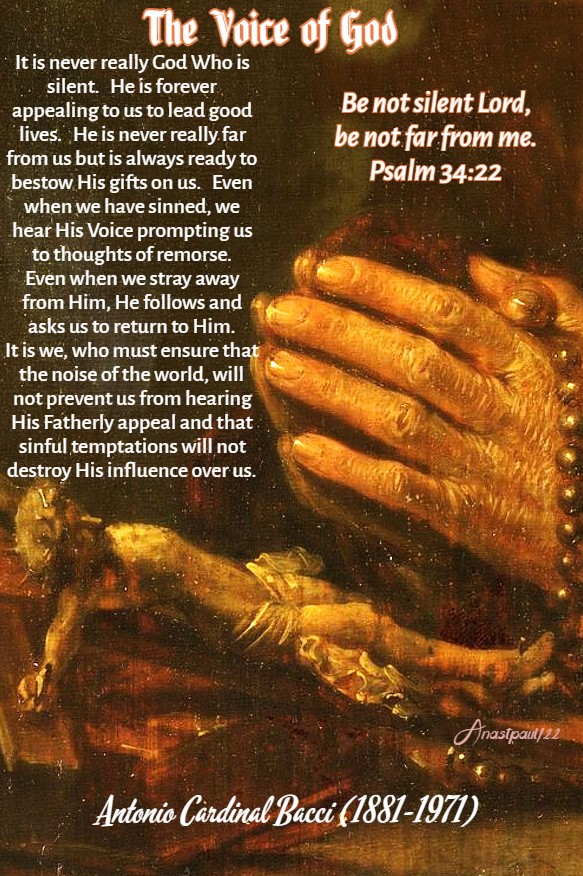
“It is never really God Who is silent. He is forever appealing to us to lead good lives. He is never really far from us but is always ready to bestow His gifts on us. Even when we have sinned, we hear His Voice prompting us to thoughts of remorse. Even when we stray away from Him, He follows and asks us to return to Him. It is we, who must ensure that the noise of the world, will not prevent us from hearing His Fatherly appeal and that sinful temptations will not destroy His influence over us.”
One Minute Reflection – 16 April – “The Month of the Resurrection and the Blessed Sacrament”– Ferial Day – 1 Peter 2:21-25; John 10:11-16 – Scripture search here: https://www.drbo.org/
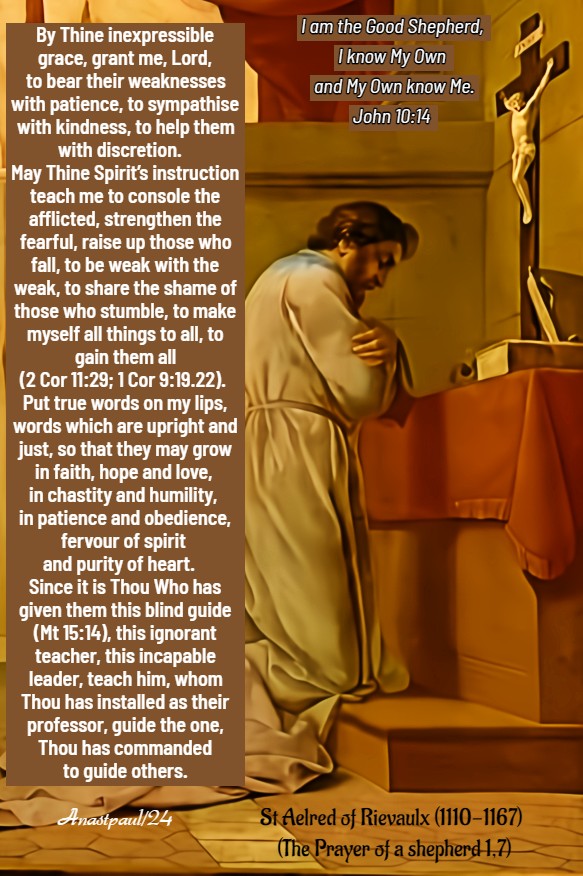
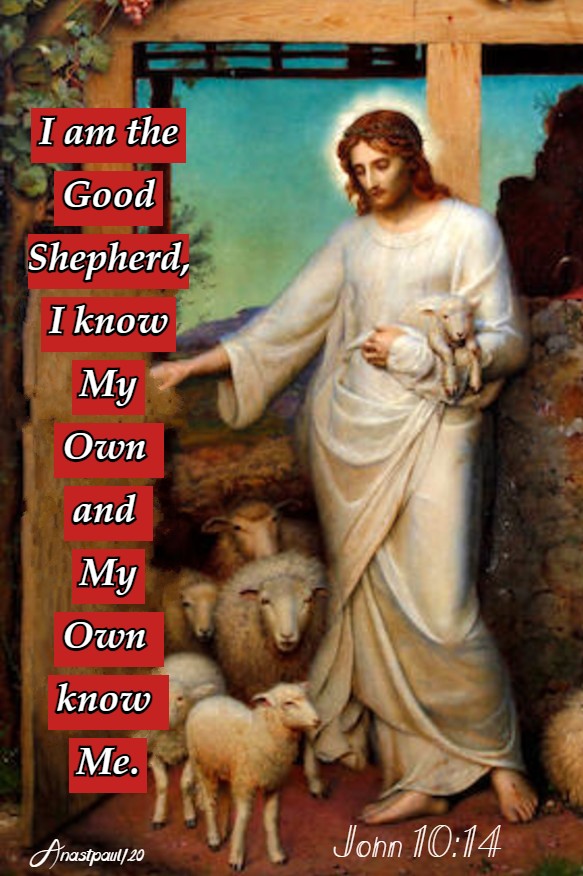
“I am the Good Shepherd, I know My Own and My Own know Me.”- John 10:14
REFLECTION – “O Jesus, Good Shepherd, a Shepherd who is truly good, Shepherd full of loving kindness and gentleness, the cry of a poor and wretched shepherd rises up to Thee: a weak and clumsy shepherd, an unprofitable shepherd (cf. Lk 17:10) and yet, in spite of all, a shepherd of Thyine flock. Yes, Good Shepherd, the cry of this shepherd who is far from being good rises up to Thee. He cries to Thee, uneasy for himself, uneasy for Thine flock … Thou knows my heart, Lord, Thou knows my wish is to spend entirely, for those Thou has entrusted to me ,all Thou has given to Thy servant …, and more than anything, to spend myself for them without counting the cost (2 Cor 12:15)…
Even Thou Thyself, did not disdain to spend Thyself for them. Therefore, teach me, Lord, even me Thy servant, teach me through Thine Holy Ghost, how to expend myself for them … By Thine inexpressible grace, grant me, Lord, to bear their weaknesses with patience, to sympathise with kindness, to help them with discretion. May Thine Spirit’s instruction teach me to console the afflicted, strengthen the fearful, raise up those who fall, to be weak with the weak, to share the shame of those who stumble, to make myself all things to all, to gain them all (2 Cor 11:29; 1 Cor 9:19.22). Put true words on my lips, words which are upright and just, so that they may grow in faith, hope and love, in chastity and humility, in patience and obedience, fervour of spirit and purity of heart. Since it is Thou Who has given them this blind guide (Mt 15:14), this ignorant teacher, this incapable leader, teach him, whom Thou has installed as their professor, guide the one, Thou has commanded to guide others.” – St Aelred of Rievaulx (1110-1167) Cistercian Monk (The Prayer of a shepherd 1,7)
PRAYER – Grant, we beseech Thee, O Lord God, unto all Thy servants that they may remain continually in the enjoyment of soundness, both of mind and body and by the glorious intercession of the Blessed Mary, always a Virgin, may be delivered from present sadness and enter into the joy of Thine eternal gladness. Through the Jesus Christ, Thy Son our Lord, Who lives and reigns with Thee, in the unity of the Holy Ghost, God, world without end. Amen (Collect).
Our Morning Offering – 16 April – “The Month of the Resurrection and the Blessed Sacrament”
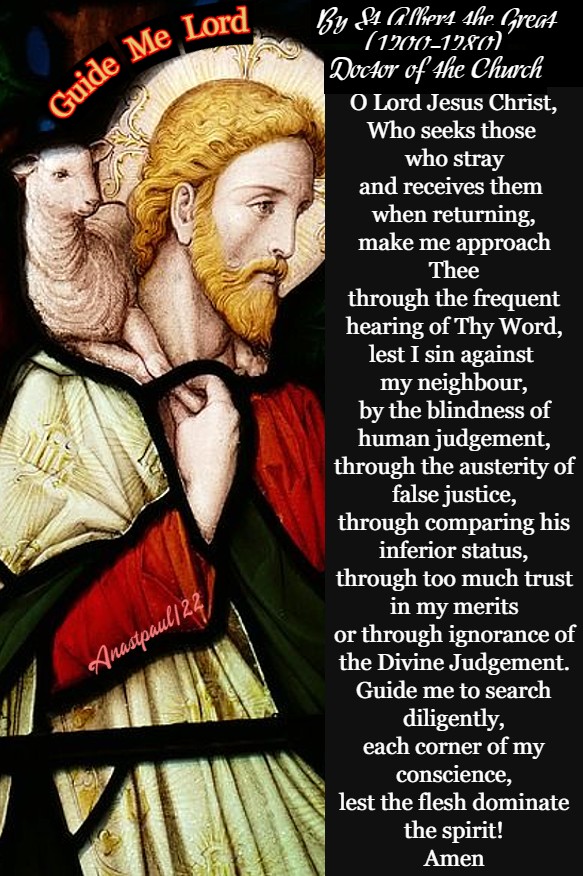
Guide Me Lord By St Albert the Great (1200-1280) Doctor of the Church
O Lord Jesus Christ, Who seeks those who stray and receives them when returning, make me approach Thee through the frequent hearing of Thy Word, lest I sin against my neighbour, by the blindness of human judgement, through the austerity of false justice, through comparing his inferior status, through too much trust in my merits or through ignorance of the Divine Judgement. Guide me to search diligently, each corner of my conscience, lest the flesh dominate the spirit! Amen
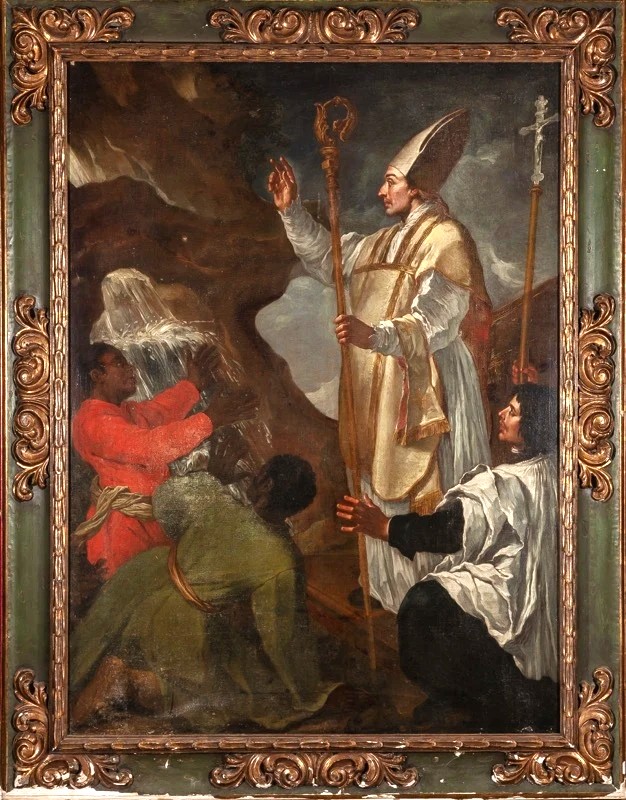
Saint of the Day – 16 April – Saint Turibius of Astorga (c402-c460) Bishop, Hermit, Monk, Defender of the Faith against heresy, in particular, the heresy of Priscilian., Miracle-worker (the image below is known as The Miracle of St Turibius of Astorga but unfortunately I can find no references to this ‘Miracle.’Born in Astorga in c402 and died there in c460 of natural causes. Patronages – Diocese of Palencia, Diocese of Santander, Diocese of Astorga. Also known as – Toribi, Toribio, Turrybiusz. Additional Memorial – On the Monday of the Second Week of Easter, a Solemnity is celebrated in the Diocese of Astorga.
The Roman Martyrology reads: “At Palencia, St Turibius, the Bishop of Astorga, Spain, who with the aid of Pope St Leo the Great, drove the heresy of Priscilian entirely out of Spain and, went to rest in the Lord with a great renown for miracles.”
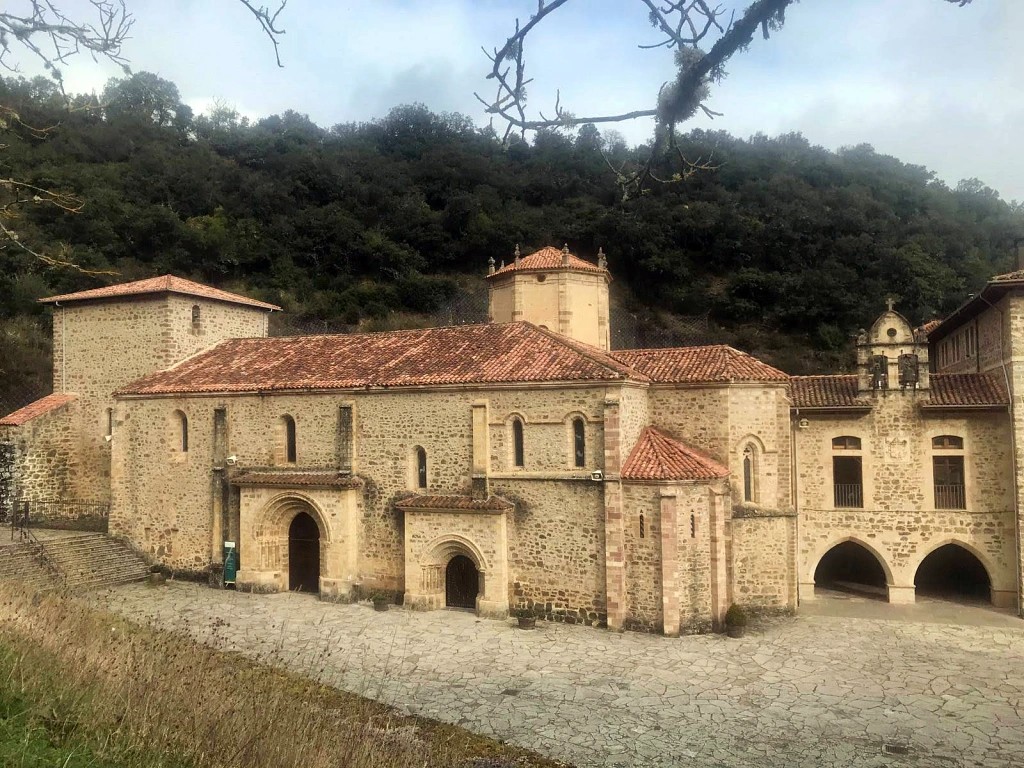
According to tradition, Turibius lived for some time as a Hermit in a cave in the mountains near the Monastery of Santo Toribio de Liébana near Pottes which has been named after Turibius of Liébana since 1181.
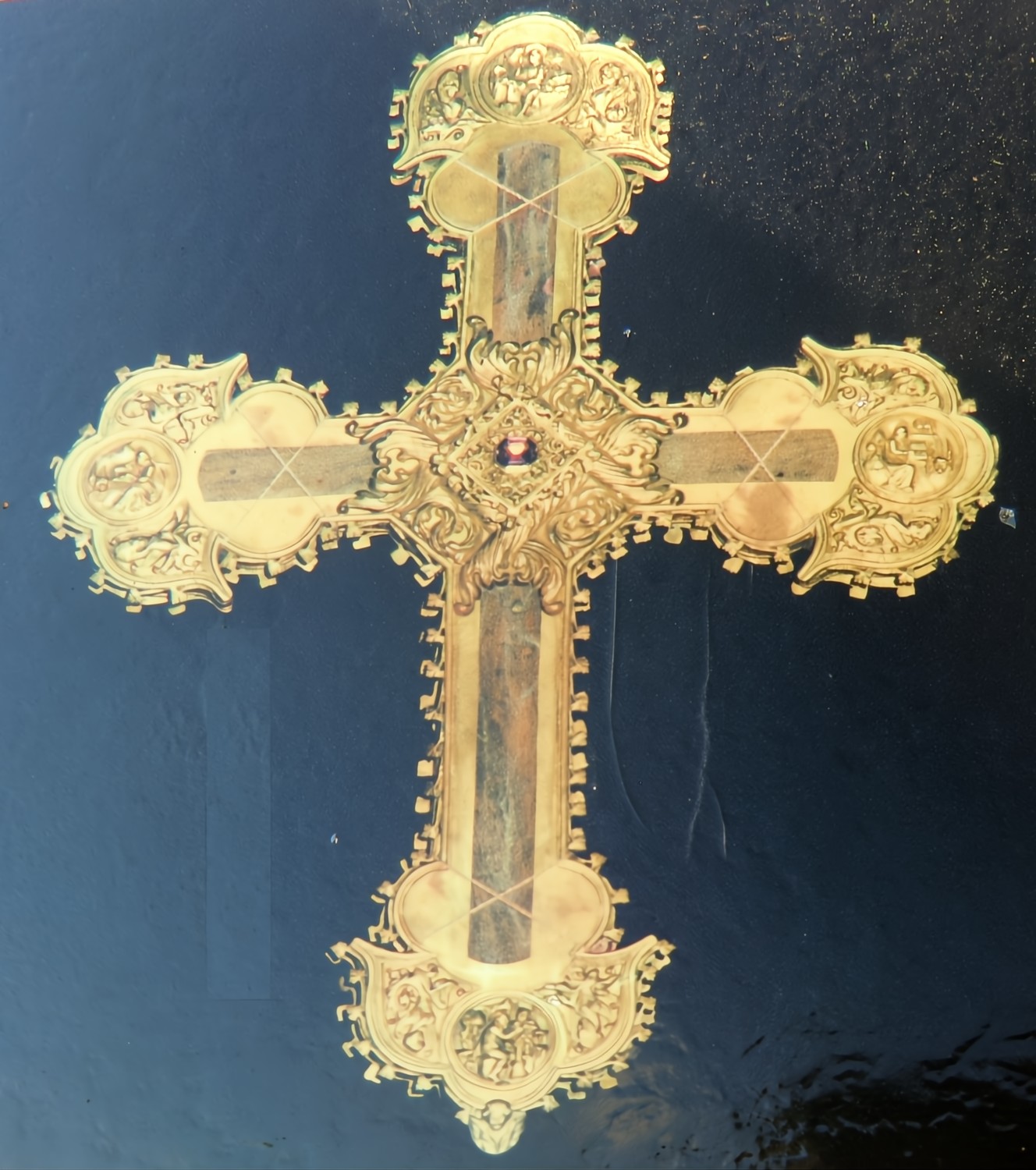
He undertook a pilgrimage to the Holy Land, was Ordained a Priest and was appointed as a Guard at the Holy places. Due to the Persian invasion of the Holy City, Turibius went to Rome taking with him a Relic belonging to the Cross of Jesus. In Rome, Pope Saint Leo the Great appointed him as the first Bishop of the Diocese of Astorga. Thus, he returned to his hometown as the Bishop and bringing the very important Relic with him. He solemnly deposited it in the Cathedral of Astorga. In the 8th Century and due to the Arab domination, it was brought to this Sanctuary of the Monestery of St Turibius of as a safe place.
The Cross containing the Relic of the Holy Cross of Jesus now residing in the Monastery of Sat Toribius of Liébana
This turned the Monastery into an important pilgrimage centre which is why, in 1512, Pope Julius II granted this place the privilege of the Holy Year. It is celebrated every time thathe Monastery lies on t 16 April, the Feast of Saint Turibius, falls on a Sunday. Another important aspect is the fact that the Monastery lies on route to Compostela and so attracts many visitors to view the Relic of the Holy Cross.
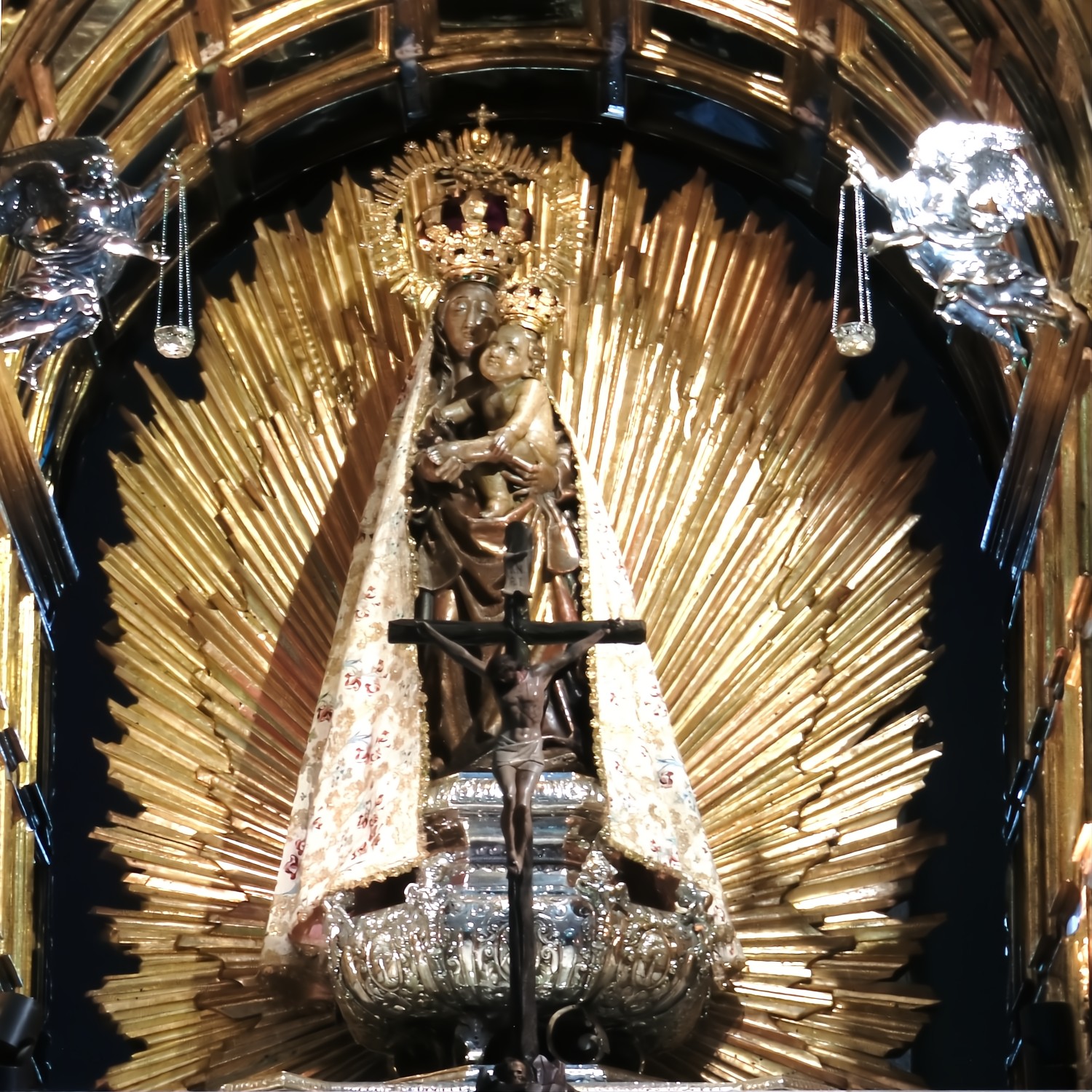
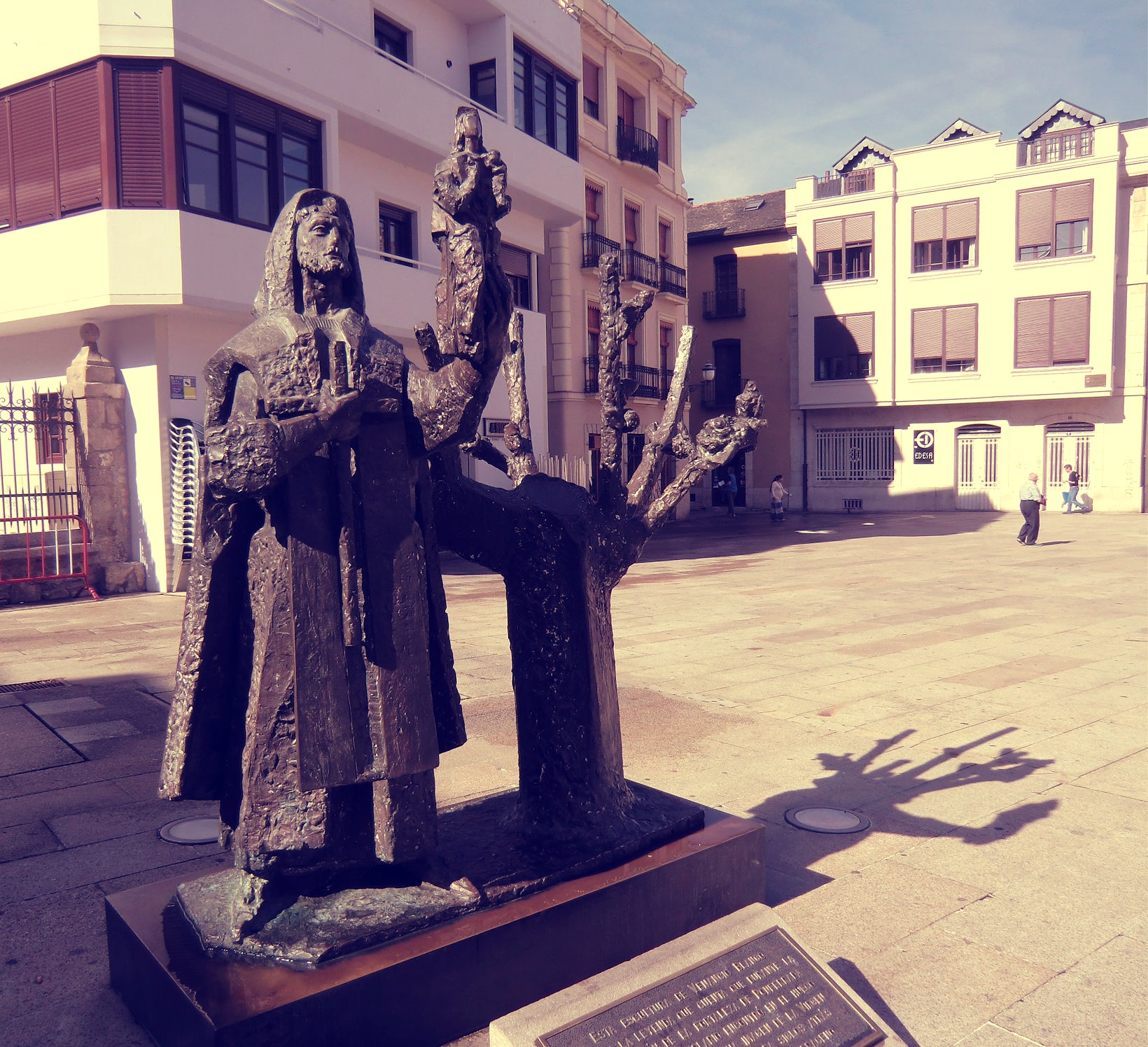
He also brought a Statue of the Blessed Virgin Mary which was, in later years, hidden from the Arabs during the times of war. For a long time the Statue was considered lost but was finally found around 1200, under a Holm Oak tree by a Knight Templar named Venacio Blanco who was involved in the construction of their new castle in Ponferrada. This Statue has been revered publicly ever since in that City; of Ponferrada.
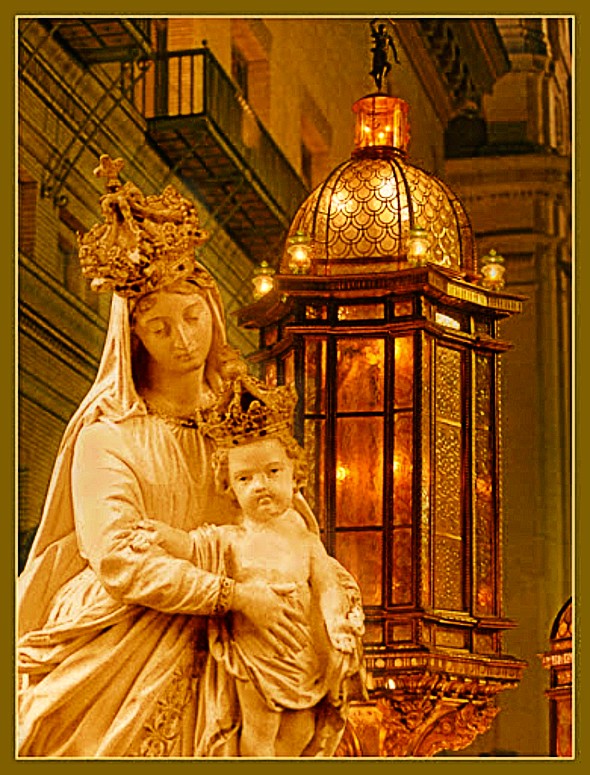
Our Lady of the Holm Oak
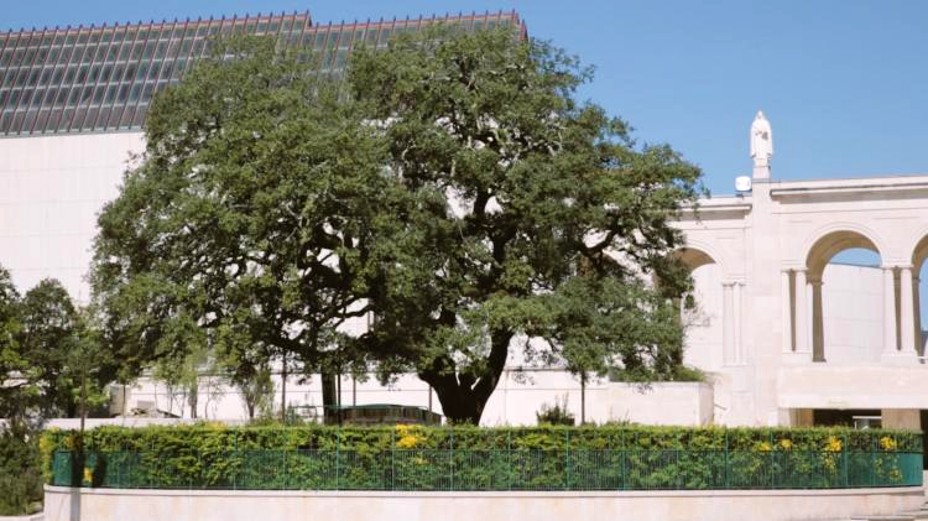
The Church of Nuestra Señora de la Encina, Our Lady of the Holm Oak , was built there in the 16th Century retaining the ancient Holm Oak in front of the Church which remains there today.
Venacio Blanco. the Templar finds the Statue of the Blessed Virgin Mary hidden under a Holm Oak. A modern sculpture in front of the Church of Nuestra Señora de la Encina in Ponferrada.
As Bishop, Turibius brought about the conversion of the Suebi peoples who were residing in the area and confronted the supporters of Priscillianism. He wrote two books criticising this heresy and presented them to Pope Leo I, who then commissioned him to call a Council. Turibius’ efforts against the heretics was succesful and he vanquished this heresy from the Spanish land.
When the Visigoth King Theuderic II, conquered Astorga in 456, Turibius was captured and taken to Gaul. After his release, he contributed to the reconstruction of the City of Astorga.
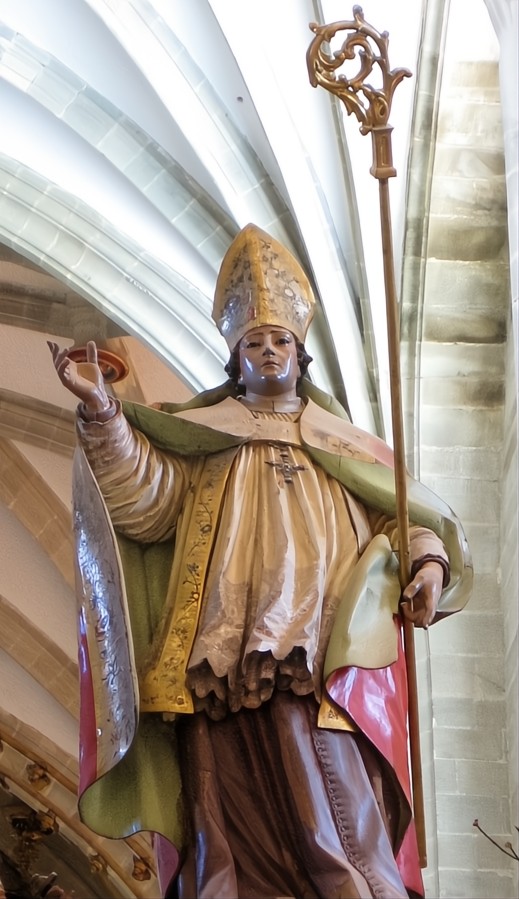
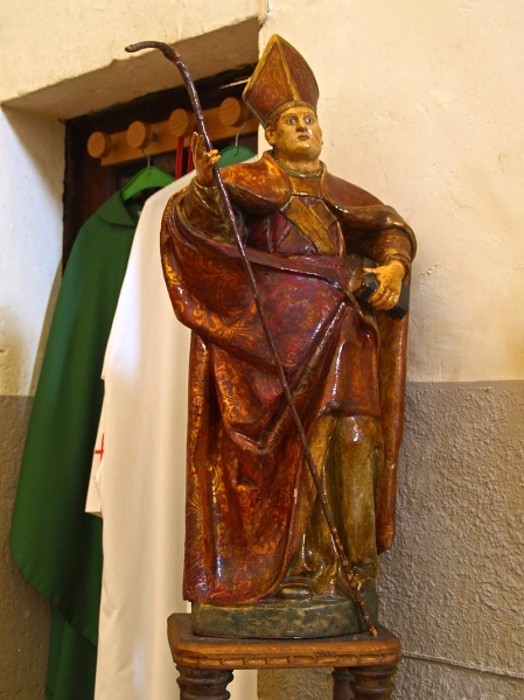
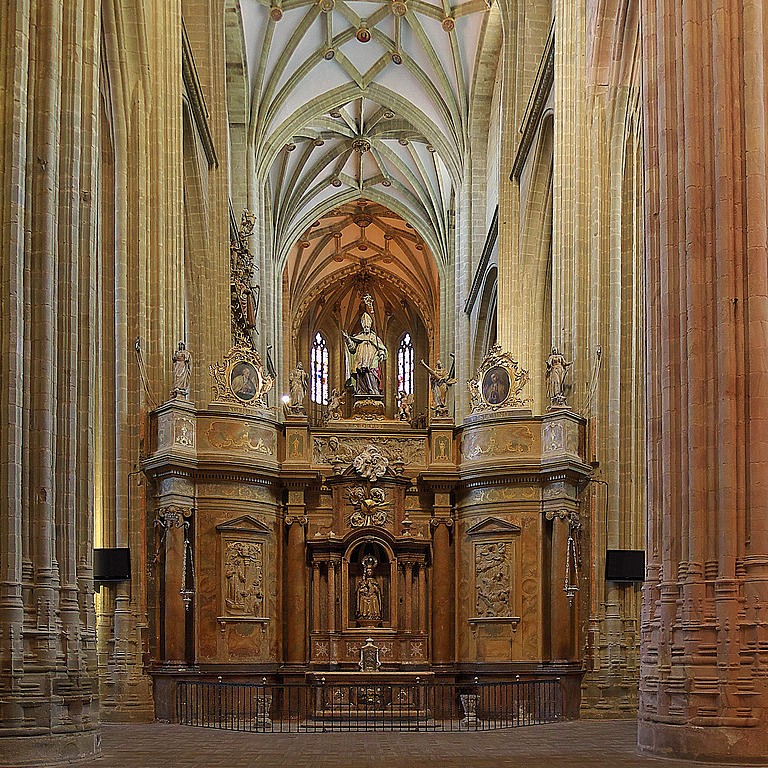
St Turibius in the Cathedral of Astorga
Over time, more Hermits settled in the mountains of Liébana, the Monastery of San Martín was founded there – probably in the 6th or at the latest in the 8th Century. After the Muslim occupation of Spain, Turibius’ Relics were brought here to safety. With the spread of the cult of St Turibius in the late 12th Century, the Monastery was now named after him which is why Turibius of Astorga is often confused with its Founder also St Truibius but remembered as “of Liébana.”
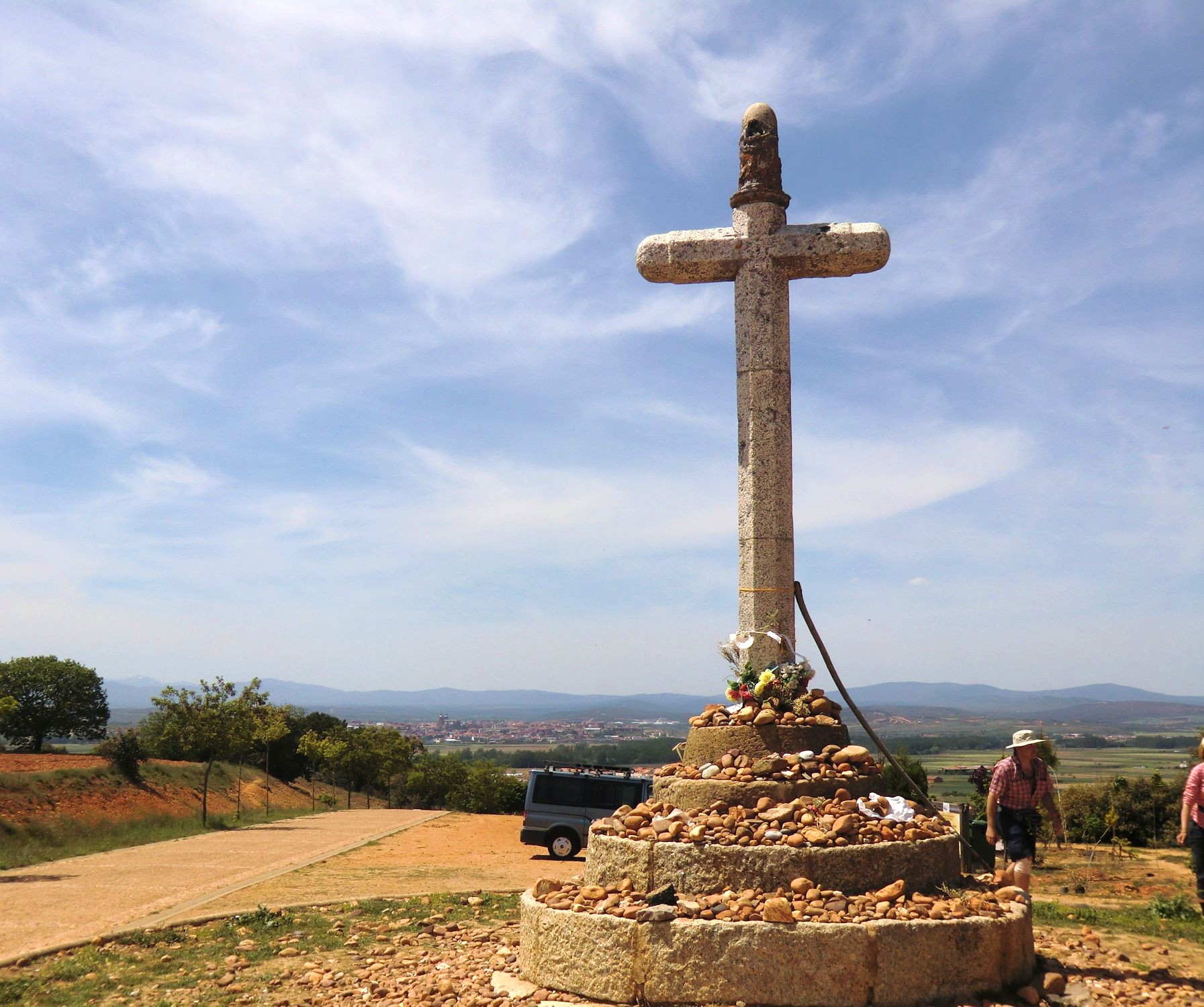
The Cross of Turibius on the Way of St James, 4 km west of Astorga.
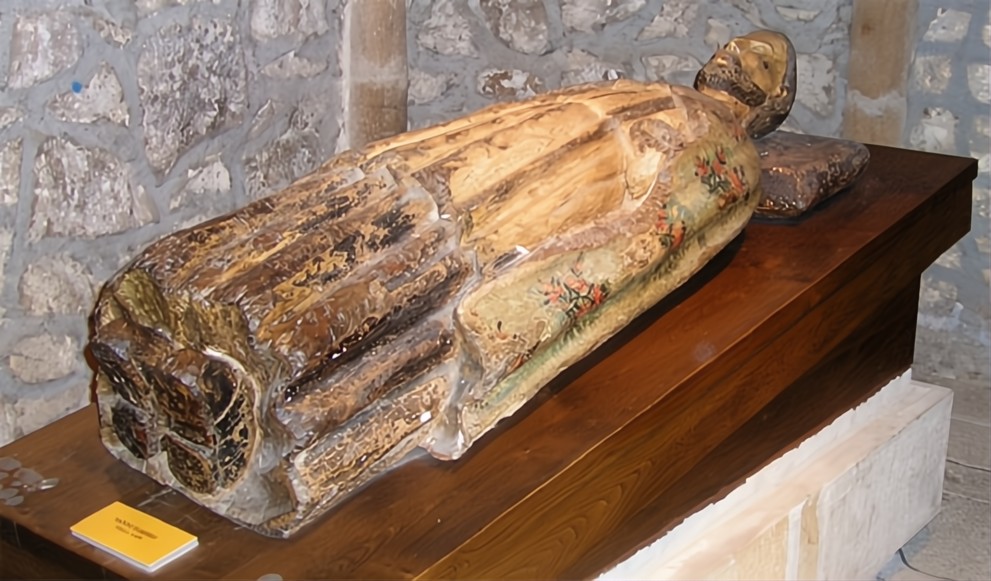
A recumbent Statue of St Turibius in the Monastery in Liébana.
St Benedict Joseph Labre – Known as the Beggar of Perpetual Adoration (1748-1783) Laqy Penitent and Pilgrim – he “abandoned his country, his parents and whatever is flattering in the world, to lead a new sort of life, a life most painful, most penitential, not in a wilderness, nor in a cloister but in the midst of the world, devoutly visiting as a pilgrim the famous places of Christian devotion.” Canonised by Pope Leo XIII on 8 December 1881. Dearest St Benedict Joseph: https://anastpaul.wordpress.com/2017/04/16/saint-of-the-day-16-april-st-benedict-joseph-labre/
Blessed Arcangelo Canetoli (1460-1513) Priest and Canon of the Canons Regular of the Congregation of the Most Holy Saviour at Bologna, Mystic gifted with the charism of prophecy and of many visions of the Blessed Virgin, Born in 1460 in Bologna, Italy and died on 16 April 1513 (aged 53) in Gubbio, Italy of natural causes. His body is incorrupt. Arcangelo was Beatified on 2 October 1748 by Pope Benedict XIV. Holy Arcangelo: https://anastpaul.com/2023/04/16/saint-of-the-day-16-april-blessed-arcangelo-canetoli-crssb-1460-1513-priest/
St Turibius of Astorga (c402-c460) Bishop St Vaise St William Gnoffi
Martyrs of Corinth – 9 Saints: A group of nine Christians who were tortured and Martyred together in the persecutions of Decius. We know little more than three of their names – Callistus, Charisius and Leonide. They were thrown into the sea at Corinth, Greece c250.
Martyrs of Saragossa: Group of 18 Martyrs murdered in 304 in Saragossa, Spain in the persecutions of Diocletian and the prefect Dacean. We know little more than the names – Apodemus, Caecilian, Caius, Crementius, Engratia, Eventius, Felix, Fronto, Gaius, Julia, Lambert, Lupercus, Martial, Optatus, Primitivus, Publius, Quintilian, Saturnius (4 men of this name), Succesus and Urban. Their graves re-discovered in 1389 in the crypt under the Church of San Encrazia in Saragossa.
Thought for the Day – 15 April – The Spiritual Combat (1589) – Dom Lorenzo Scupoli OSM (c1530-1610)
“None shall be crowned who has not fought well.” 2 Tim 2: 5
XLVI: … On Meditation
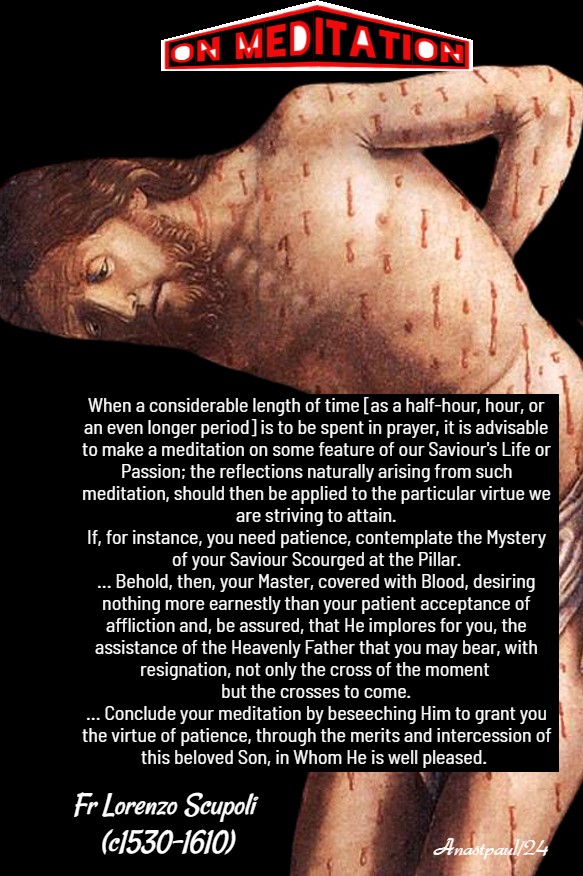
“When a considerable length of time [as a half-hour, hour, or an even longer period] is to be spent in prayer, it is advisable to make a meditation on some feature of our Saviour’s Life or Passion; the reflections naturally arising from such meditation, should then be applied to the particular virtue we are striving to attain.
If, for instance, you need patience, contemplate the Mystery of your Saviour Scourged at the Pillar. Consider firstly, the blows and revilements hurled at Him by the soldiers as they brutally drag their innocent victim to the appointed place as ordered. Secondly, consider Him stripped of His garments, exposed to the piercing cold. Thirdly, picture those innocent hands, bound tightly to the pillar. Fourthly, consider His Body, torn with whips until His Blood moistened the earth. And finally, envision the frequency of the blows, creating new wounds, re-opening others on that Sacred Body.
Dwelling on these or similar details, calculated to inspire in yourself, a love of patience, you should try to feel within your very soul the inexpressible anguish so patiently borne by your Divine Master. Then consider the excruciating agony of His spirit and the patience and mildness with which that agony was endured by Him, Who was ready to suffer even more for God’s glory and your welfare.
Behold, then, your Master, covered with Blood, desiring nothing more earnestly than your patient acceptance of affliction and, be assured, that He implores for you, the assistance of the Heavenly Father that you may bear, with resignation, not only the cross of the moment but the crosses to come.
Strengthen, therefore, by frequent acts, your resolution to suffer, with joy and, raising your mind to Heaven, give thanks to the Father of mercies, Who didst send His Only Son into this world to suffer indescribable torments and, to intercede for you in your necessities.
Conclude your meditation by beseeching Him to grant you the virtue of patience, through the merits and intercession of this beloved Son, in Whom He is well pleased.”
Quote/s of the Day – 15 April – “The Month of the Resurrection and the Blessed Sacrament” – Ferial Day – 1 Peter 2:21-25; John 10:11-16– Scripture search here: https://www.drbo.org/
“I am the Good Shepherd, I know My Own and My Own know Me.”
John 10:14
“He cries out, saying: See, I am with you all the days of this age. He is Himself the Shepherd, the High Priest, the Way and the Door and has become all things at once for us.”
St Athanasius (297-373) Father & Doctor of the Church
“So Saul was led to Ananias – the ravaging wolf is led to the sheep. But the Shepherd, Who guides everything from Heaven above, reassures him… “Do not fear, I will show him what he will have to suffer, for My Name’s sake” (Acts 9:16). What wonder is this! The wolf is led, a captive, to the sheep… The Lamb who died for the sheep, teaches it not to be afraid any more!”
St Augustine (354-430) Father and Doctor of the Church
“With good reason Christ declares: I am the Good Shepherd, I seek out the lost sheep, the strayed I will bring back, the injured I will bind up, the sick I will heal (Ez 34:16). I have seen the flock of mankind struck down by sickness; I have witnessed my lambs wander about where demons dwell; I have seen my flock ravaged by wolves. All this I have seen and have not witnessed it from on high. That is why I took hold of the withered hand, gripped by pain, as if by a wolf; I have unbound those whom fever had bound; I taught him to see, whose eyes had been shut from his mother’s womb; I brought Lazarus out from the tomb where he had lain for four days (Mk 3:5; 1:31; Jn 9; 11). For I am the Good Shepherd and the good shepherd lays down his life for his sheep.”
Basil of Seleucia (Died 448) Bishop of Seleucia
(Oratio 26)
“The measure of love, is to love without measure.”
St Francis de Sales (1567-1622) Doctor of the Church
One Minute Reflection – 15 April – “The Month of the Resurrection and the Blessed Sacrament” – Ferial Day – 1 Peter 2:21-25; John 10:11-16– Scripture search here: https://www.drbo.org/
“I Am the Good Shepherd, I know My Own and My Own know Me.”- John 10:14
REFLECTION – “Let us consider Christ, our Shepherd … He rejoices in those sheep of His who are around Him and goes in search of those who stray. Mountains and forests cause Him no fear; He crosses ravines to reach the sheep who is lost. Even if He finds it in a piteous state, He is not angry but touched with pity; He takes it on His shoulders and, from His own weariness, heals the exhausted sheep (Lk 15:4 ) …
With good reason, Christ declares: “I am the Good Shepherd, I seek out the lost sheep, the strayed I will bring back, the injured I will bind up, the sick I will heal (Ez 34:16). I have seen the flock of mankind struck down by sickness; I have witnessed My lambs wander about where demons dwell; I have seen My flock ravaged by wolves. All this I have seen and have not witnessed it from on high. That is why I took hold of the withered hand, gripped by pain as if by a wolf; I have unbound those whom fever had bound; I taught him to see whose eyes had been shut from his mother’s womb; I brought Lazarus out from the tomb where he had lain for four days (Mk 3:5; 1:31; Jn 9; 11). For I am the Good Shepherd and the Good Shepherd lays down His Life for His sheep.” …”
The Prophet knew this Shepherd when, long before His Passion, he declared what would take place: “Like a sheep led to the slaughter or a sheep, dumb before the shearers, He opened not His mouth” (Is 53:7). Like a sheep, the Shepherd has offered His neck for His flock … By His death, He heals from death; by His tomb He empties the tomb … The tombs are full and the prison shut so long as the Shepherd, come down from the Cross, has not come to bring His captive sheep the joyful news of their liberation. We see Him in hell where He gives the order for their release (1 Pt 3:19); we see Him call His sheep once more, giving them the call to life from the dwellings of the dead. “The Good Shepherd lays down His Life for HIs sheep.” This is how He intends to win the affection of His sheep and those who know how to listen to His Voice love Christ.” – Basil of Seleucia (Died c468) ArchBishop and Father of the Church (Oratio 26).
PRAYER – O God, Who, by the humility of Thy Son, didst lift up a fallen world, grant unending happiness to Thy faithful, that those whom Thou hast snatched from the perils of endless death, Thou mayest cause to rejoice in everlasting days. Through the same Jesus Christ, Thy Son our Lord, Who lives and reigns with Thee, in the unity of the Holy Ghost, God, world without end. Amen (Collect).
Our Morning Offering – 15 April – “The Month of the Resurrection and the Blessed Sacrament” – Ferial Day
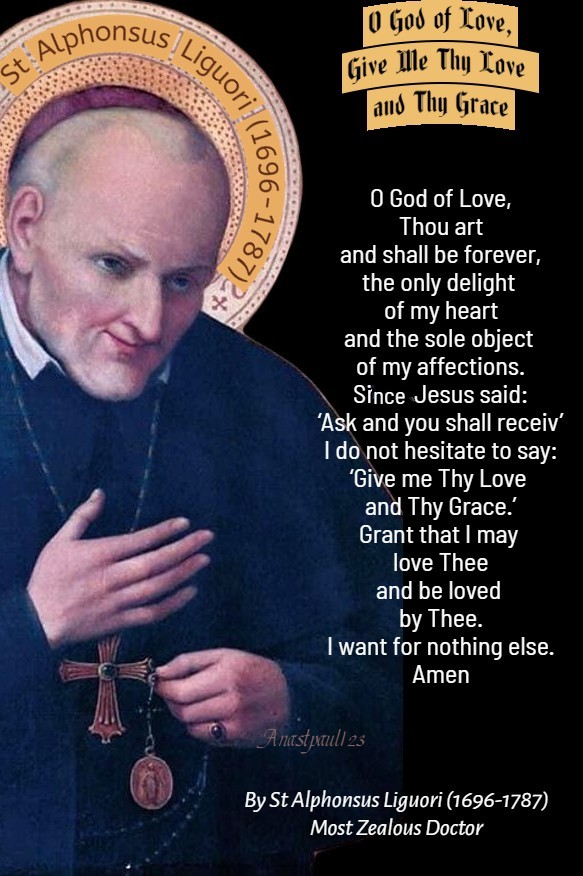
O God of Love, Give Me Thy Love and Thy Grace By St Alphonsus Liguori (1696-1787) Most Zealous Doctor
O God of Love, Thou art and shall be forever, the only delight of my heart and the sole object of my affections. Since Jesus said: ‘Ask and you shall receive,’ I do not hesitate to say: ‘Give me Thy Love and Thy Grace.’ Grant that I may love Thee and be loved by Thee. I want for nothing else. Amen
Saint of the Day – 15 April – Saint Ortarius of Landelles (Died c580) Priest, Abbot of Landelles, near Vire in Normandy, France. A man of great wisdom, austerity and devotion, a renowned and rivetting Preacher, a skilled and beloved leader as well as the benefactor of all the poor and the sick within his reach. Also known as “The Apostle of Normandy,” Ortario. Additional Memorial – 21 May in Normandy.
The Roman Martyrology states: “In the Monastery of Landelles in the territory of Bayeux in Normandy, France, Saint Ortarius, the Abbot, dedicated to a life of austerity and prayer and assiduous in caring for the sick and assisting the poor.”
The figure of Saint Ortarius, the Abbot of Landelles in Normandy, emerges from the mists of the 6th Century as a beacon of holiness and dedication to others. His life, although shrouded in the patina of time and enriched by popular legends, nevertheless offers us a portrait of a deeply religious man and a charismatic leader.
We know nothing about his precedents or his life before becoming a Monk of great religious fervour was appointed as the Abbot of the Monastery of Landelles, located near today’s Vire. Under his leadership, the monastic community flourished, becoming a centre of spiritual learning and culture in the region. The holiness and wisdom of Ortarius spread rapidly, attracting disciples and the faithful from all over the region.
Ortarius is considered “The Apostle of Normandy,” for his fundamental role in the spread of Christianity in the region. His fiery preaching and his example of virtuous life converted many pagans and strengthened the faith of the Christians. His evangelisation work left an indelible mark on the history of Normandy, helping to shape its Christian identity.
In addition to his dedication to prayer and preaching, Ortarius stood out for his profound charity towards the poor and the sick. He did his utmost in charitable works, treating the sick with his own hands and giving relief to the suffering. His compassion and generous and kind heart, made him a shining example of Christian charity.
The remains of Saint Ortarius rested for centuries in the Monastery of Landelles, a destination for pilgrimages and a place of veneration. The cult of the Saint spread around Normandy and the surrounding regions, with his Feast celebrated on 21 May, the anniversary of a translation of the Relics. In some calendars, his memory is also commemorated on 15 April.
Saint Anastasia of Rome (Died c 68) Martyr, Spiritual Student of St Peter the Apostle AND: St Basilissa of Rome (Died c 68) Martyr, Spiritual Student of St Peter the Apostle. put to death during the reign of Nero. They were among the first converts to Christianity in the 1st century after Christ. The Roman Martyrology states today: “At Rome, the Saints Basilissa and Anastasia. Of noble families, they were disciples of the Apostles and, as they persevered courageously in the profession of their faith, in the time of the Emperor Nero, they had their tongues and feet cut off, were put to the sword and thus obtained the Crown of Martyrdom.” Their Life and Death: https://anastpaul.com/2022/04/15/saint-s-of-the-day-15-april-saints-anastasia-and-st-basilissa-died-c-68-martyrs/
St Crescens of Myra St Eutyches of Rome St Eutychius of Ferentino
Bl Laurentinus Sossius St Maro of Rome St Maximus of Persia St Mundus St Nidger of Augsburg St Olympiades of Persia St Ortarius of Landelles(Died c580) Priest, Abbot
St Sylvester of Réome St Theodore of Thrace St Victorinus of Rome St Waltmann of Cambrai O.Praem. (Died 1138) Abbot
Mercedarian Martyrs of Africa: A group of Mercedarian Monks sailing to Africa as on a mission to redeem capture Christians. Captured by Moors, they were tortured and executed for their faith. Martyrs. 1393.
Thought for the Day – 14 April – The Spiritual Combat (1589) – Dom Lorenzo Scupoli OSM (c1530-1610)
“None shall be crowned who has not fought well.” 2 Tim 2: 5
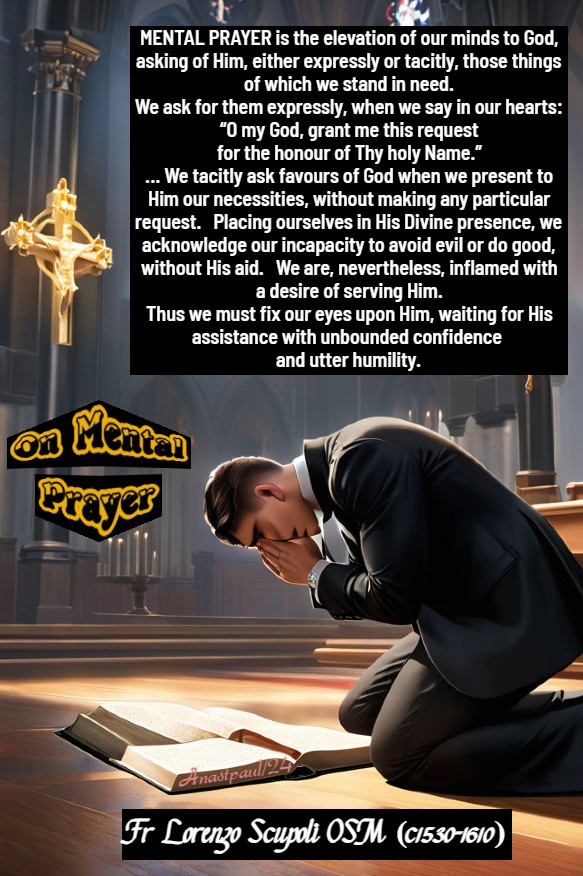
XLV: … On Mental Prayer
“MENTAL PRAYER is the elevation of our minds to God, asking of Him, either expressly or tacitly, those things of which we stand in need. We ask for them expressly, when we say in our hearts: “O my God, grant me this request for the honour of Thy holy Name” OR “Lord, I am firmly convinced that this petition is Thy Will and, for Thy greater honour, I ask this petition. Accomplish, therefore, Thy Divine Will in me.”
When harassed by the attacks of the enemy, let us say: “Come swiftly, O Lord, to my assistance lest I fall a prey to my enemy.” OR “O God, my refuge and my strength, help me speedily, lest I perish.”
When temptation continues, we must continue the same prayer, courageously resisting the foe and, when the fury of the combat has passed, let us address ourselves to the Almighty, imploring Him to consider our weakness in the face of the enemy’s strength: “Behold, my God, Thy creature, the work of Thy hands, a man redeemed by Thy Precious Blood. And behold, Satan trying to carry him from Thee to utterly destroy him. It is to Thee I fly for aid and it is in Thee that I place my entire confidence, for I know that Thou alone art Infinitely good and powerful. Have pity on a miserable creature who stumbles blindly, though willfully, into the path of his enemies, as do all who forsake the assistance of Thy grace. Help me, therefore, my only hope, O sole strength of my soul!”
We tacitly ask favours of God when we present to Him our necessities, without making any particular request. Placing ourselves in His Divine presence, we acknowledge our incapacity to avoid evil or do good, without His aid. We are, nevertheless, inflamed with a desire of serving Him. Thus we must fix our eyes upon Him, waiting for His assistance with unbounded confidence and utter humility. The confession of our weakness and the desire to serve Him, this act of faith so performed, is a silent prayer which will infallibly obtain our request from Heaven. The more sincere the confession, the more ardent the desire and the more lively the faith, the greater will be the efficacy of the prayer before the throne of God.
There is another method of prayer similar to this but more concise, consisting as it does, in but a single act of the soul. The soul presents her requests to the Almighty, adverting to a favour already asked and still sought, although not formally expressed.
Let us endeavour to cultivate this kind of prayer and employ it on all occasions; for experience will convince us that nothing is easier, yet nothing more excellent and efficacious!”
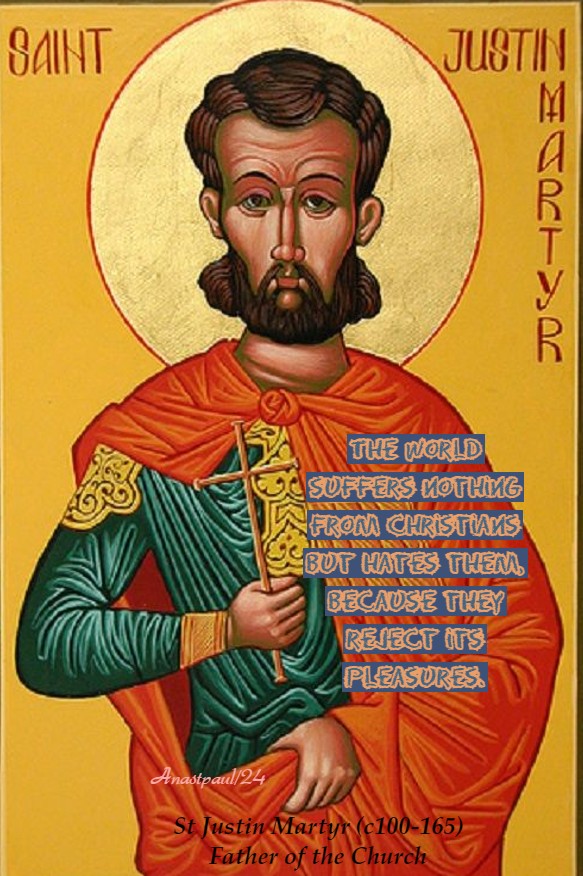
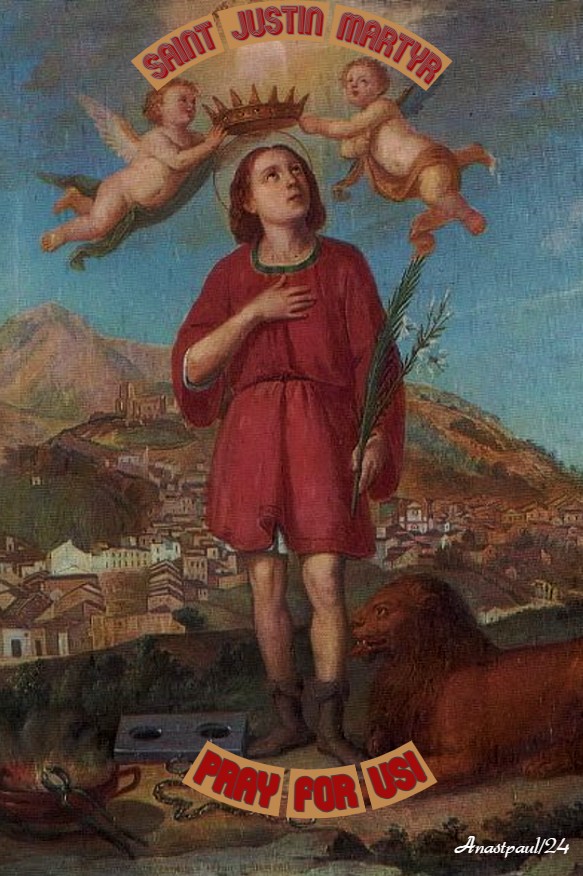
One Minute Reflection – 14 April – “The Month of the Resurrection and the Blessed Sacrament” – The Second Sunday of Easter – Commemoration of St Justin Martyr (c100-165) – 1 Peter 2:21-25; John 10:11-16 – Scripture search here: https://www.drbo.org/
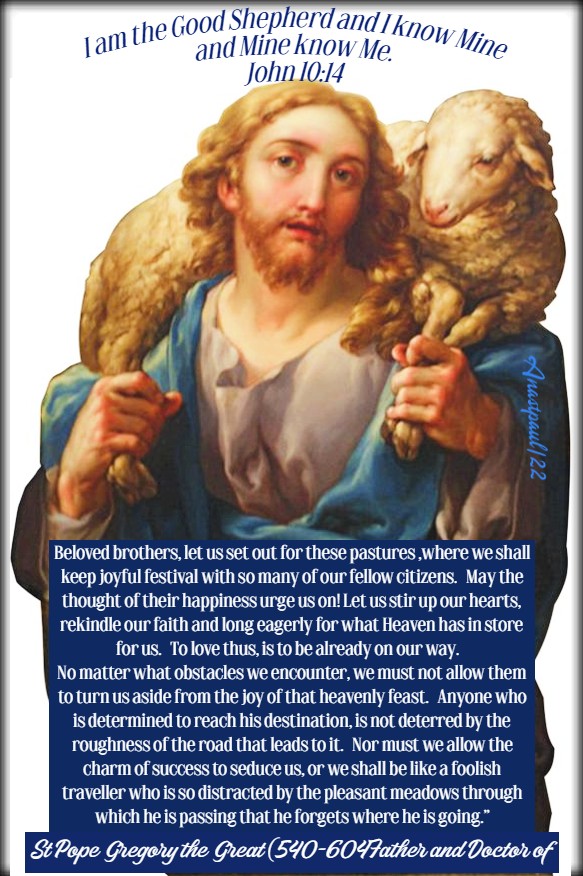
“I am the Good Shepherd and I know Mine and Mine know Me.”- John 10:14
REFLECTION – “I am the good shepherd. I know My Own—by which I mean, I love them—and My Own know Me. In plain words – those who love Me are willing to follow Me, for anyone who does not love the Truth, has not yet come to know it.
My dear brethren, you have heard the test we shepherds have to undergo. Turn now to consider, how these words of our Lord, imply a test for yourselves too. Ask yourselves whether you belong to His flock, whether you know Him, whether the Light of His Truth shines in your minds. I assure you that it is not by faith that you will come to know Him but, by love, not by mere conviction but, by action. John the Evangelist is my authority, for this statement. He tells us that anyone who claims to know God, without keeping His commandments, is a liar.
Consequently, the Lord immediately adds: ‘As the Father knows Me and I know the Father and I lay down My life for My sheep.‘ Clearly, He means that laying down His life for His sheep, gives evidence of His knowledge of the Father and the Father’s knowledge of Him. In other words, by the love with which He dies for His sheep, He shows, how greatly He loves His Father.
Again He says: ‘My sheep hear My voice and I know them; they follow Me,and I give them eternal life.’ Shortly before this He had declared – ‘If anyone enters the sheepfold through Me, he shall be saved, he shall go freely in and out and shall find good pasture.‘ He will enter into a life of faith; from faith, he will go out to vision, from belief to contemplation and will graze in the good pastures of everlasting life.
So our Lord’s sheep will finally reach their grazing ground, where all who follow Him in simplicity of heart, will feed on the green pastures of eternity. These pastures are the spiritual joys of Heaven. There, the elect look upon the Face of God with unclouded vision and feast at the banquet of life, forever more.
Beloved brothers, let us set out for these pastures ,where we shall keep joyful festival with so many of our fellow citizens. May the thought of their happiness urge us on! Let us stir up our hearts, rekindle our faith and long eagerly for what Heaven has in store for us. To love thus, is to be already on our way. No matter what obstacles we encounter, we must not allow them to turn us aside from the joy of that heavenly feast. Anyone who is determined to reach his destination, is not deterred by the roughness of the road that leads to it. Nor must we allow the charm of success to seduce us, or we shall be like a foolish traveller who is so distracted by the pleasant meadows through which he is passing that he forgets where he is going.” – St Gregory the Great (540-604) Bishop of Rome and Great Western Father and Doctor of the Church (An excerpt from his Sermon 14).
PRAYER – O God, Who through the preaching of the Cross,which is to them who perish, foolishness, didst wonderfully teach, unto thy blessed Martyr Justin, the excellence of the knowledge of Christ Jesus Our Lord, grant unto us we beseech Thee, at his prayer,s the grace to cast off all false teaching and ever to hold fast to the Faith. Through the same Jesus Christ, Thy Son our Lord, Who lives and reigns with Thee, in the unity of the Holy Ghost, God, world without end. Amen (Collect).
Our Morning Offering – 14 April – “The Month of the Resurrection and the Blessed Sacrament” – The Second Sunday of Easter
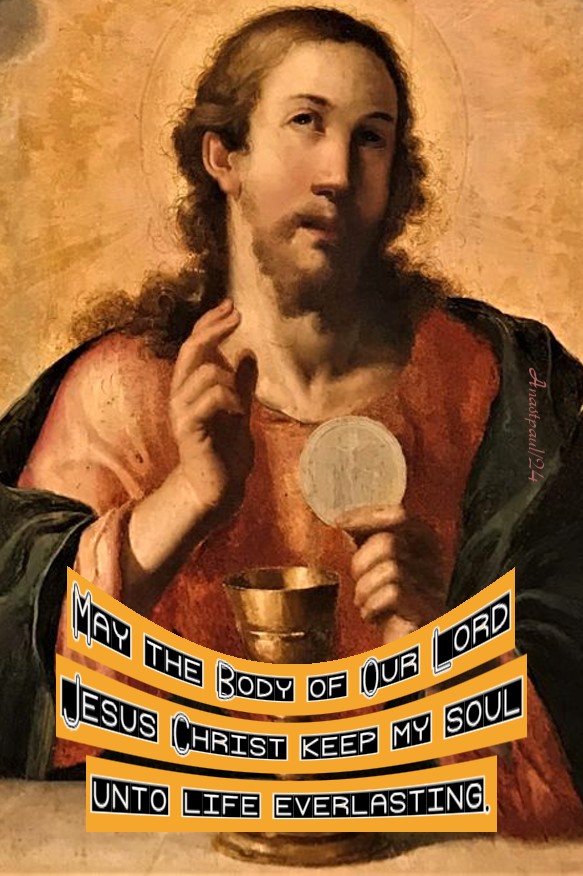
Prayer Before Holy Communion By St Anselm (1033-1109) Doctor of the Church
O Lord Jesus Christ, Son of the living God, Who according to the Will of the Father and with the co-operation of the Holy Ghost, has, by Thy Death. given Life to the world, I adore and revere this, Thy Holy Body and this, Thy Holy Blood which was given up and poured forth, for the many, unto remission of sins. O merciful Lord, I beg of Thee mercy, that through the power of this Sacrament, Thou will make me one of that many. Through faith and love, make me feel the power of these Sacraments, so I may experience their saving power. Absolve and free from all sin and punishment of sin, Thy servants, Thy handmaidens, myself, all who confessed their sins to me, those whom I have promised, or am obliged, to pray for and so too, those who themselves hope or beg, to be helped, by my prayers to Thee. Make our Church rejoice in Thy constant protection and consolation. Amen
Saints of the Day – 14 April – St Tiburtius of Rome (Died 3rd Century) Martyr, Layman, brother of St Valerian; St Maximus of Rome (Died 3rd Century) Martyr, Layman; St Valerian of Trastevere (c177-c229) Martyr, Layman, brother of St Tiburtius and husband of St Cecilia (Died c232) the Martyrs.
The Roman Martyrology reads: “At Rome, on the Appian Way, the birthday of the Holy Martyrs, Tiburtius, Valerian and Maximus, who suffered in the time of the Emperor, Alexander and the Prefect, Almachius. The first two being converted to Christ by the exhortations of the blessed Cecilia and Baptised by Pope St Urban, were beated with rods and decapitated for the True Faith. But Maximus, the Chamberlain of the Prefect, moved by their constancy and encouraged by the vision of an Angel, believed in Christ and was scourged with leaded whips until he expired.”
Saints Cecilia, Valerian and Tiburtius by Botticini
The three holy Martyrs Tiburtius, Valerian and Maximus, who lived in the 3rd Century in Rome, are remembered by ancient sources since the 5th Century, however, there are two versions which deal with their personality and historical existence – one is linked to the ‘Passio’ of St Cecilia, while the other is reported by the ‘Hieronymian Martyrology’ or the Martyurology of St Jerome.
In the aforementioned Martyrology they are mentioned four times, the first indicates them as buried in the Catacombs of Praetextatus on the Appian Way and remembered on 14 April and this version is the one then passed into the Roman Martyrology, still in use today.
The Martyrdom of St Valerian
The other versions remembers them as buried in other Cemeteries in Rome and celebrates them on various dates, sometimes confused, like the case of Tiburzio with another namesake. Scholars have not reached an absolute certainty, it seems however, that only St Tiiburtius is celebration on 14 April, while, in theCatacombs of of Callistus, the other two were buried and celebrated on 21 April. It seems that later, it was St Gregory the Great who united them in a single celebration today.
However, according to the ‘passio’ Valerian was St Cecilia’s husband and converted by her, he was Baptised by St Pope Urban I (222-230) and in his turn he converted hid brother, Tiburtius to Christianity. Both were sentenced to death by the Prefect Almachius, who entrusted them to the Adjutant (second-in-command of the Prefect) who, before having the sentence carried out, also converted, thus being condemned and killed a few days later.
Valerian and Tiburtius were martyred and buried in a place called Pagus da Cecilia, four miles from Rome but which, has not been identified. Maximus was placed in a different sarcophagus. Their tombs were restored first by Pope Gregory III (731-741) then by Pope Hadrian I (772-795) and finally by Pope Paschal I (817-824) who transferred their Relics to the Basilica of St Cecilia in Trastevere.
Amico Aspertini: Burial of Saints Valerian and Tiburtius
St Tiburtius of Rome (Died 3rd Century) Martyr, Layman St Maximus of Rome (Died 3rd Century) Martyr, Layman St Valerian of Trastevere (c177-c229) Martyr, Layman, brother of St Tiburtiusabove and husband of St Cecilia (Martyrs)
St Bernard of Tiron (1046-1117) Monk, Abbot, Founder of the the Tiron Abbey and the Tironensian Order. St Bernard had a deep devotion to the Passion of Christ, teaching and instruction his disciples in the love of the Holy Cross. The Roman Martyrology reads: “In the Monastery of Tiron near Chartres in France, Saint Bernard, Abbot, who on several occasions gave himself up to a hermit life in the woods and on the Island of Chausey but also dedicated himself to instructing and guiding the disciples, who in great numbers, flocked to him.” St Bernard’s Life: https://anastpaul.com/2022/04/14/saint-of-the-day-14-april-st-bernard-of-tiron-c-1046-1117/
St Domnina of Terni St Fronto of Nitria Abbot Bl Hadewych O.Praem. (c1150-c1200) Nun
Thought for the Day – 13 April – The Spiritual Combat (1589) – Dom Lorenzo Scupoli OSM (c1530-1610)
“None shall be crowned who has not fought well.” 2 Tim 2: 5
The Fourth Weapon of the Spiritual Combat XLIV: … On Prayer (Part Four)
“Continue perseveringly in prayer; for humble perseverance vanquishes the invincible. And, if the importunity of the widow in the Gospel, inclined to her request the unjust judge, laden with iniquity, shall a like perseverance fail to incline to our petitions that Good God, Who is Himself the plenitude of goodness?!
And, although the Lord should delay to hear and even seem to reject your prayer, pray on still and still hold fast firm and lively confidence in His aid; for, in Him, there is no lack but an Infinite superabundance of all things needful for the grace we ask.
Therefore, unless there be some fault on your part, you may rest assured either of obtaining all your petition, or something which will be more profitable to you, or, it may be, both together and the more He seems to repulse you, the more do you humble yourself in your own sight, considering your own de-merits and fixing your eyes steadfastly on the mercy of God.
Establish thus, more and more, your confidence in Him which will be most acceptable to your Lord, if you maintain it more lively and entire, the more it is assailed.
Lastly, give thanks always to God, acknowledging Him to be no less good and wise and loving, when some things are denied, than if all were granted you. Happen what may, do you remain ever steadfast and joyful in humble submission to His Divine Providence.”
Quote/s of the Day – 13 April – “The Month of the Resurrection and the Blessed Sacrament” – Wisdom 5:1-5; Luke 14:26-33 – Scripture search here: https://www.drbo.org/
“If anyone comes to Me without hating his father and mother, wife and children, brothers and sisters and even his own life, he cannot be My disciple.”
Luke 14:26
“So likewise, everyone of you, who does not renounce all that he possesses, cannot be My disciple.”
Luke 14:33
“Take nothing for your journey, neither staff, nor bag, nor bread, nor money; neither have two tunics.”
Luke 9:3
“He seems to demand of us the most entire renunciation … So, if we keep back for ourselves , any earthly goods or any perishable supplies, our minds will remain sunk in them, as though in mud. Then, inevitably, our souls will become unable to contemplate God and will be unmoved by desire for the splendours of Heaven and for the good things promised us. We shall only be able to acquire those good things, if we ask for them unceasingly, with a burning desire that will, besides, make easy the effort needed to gain them.”
St Basil the Great (329-379) Father and Doctor of the Church
“If you wish to enter into life, keep My commandments. If you will know the truth, believe in Me. If you will be perfect, sell all. If you will be My disciple, deny yourself. If you will possess the blessed life, despise this present life. If you will be exalted in Heaven, humble yourself on earth. If you wish to reign with Me, carry the Cross with Me. For only the servants of the Cross find the life of blessedness and of true Light.”
Thomas à Kempis (1380-1471)
The Imitation of Christ Chapter 56
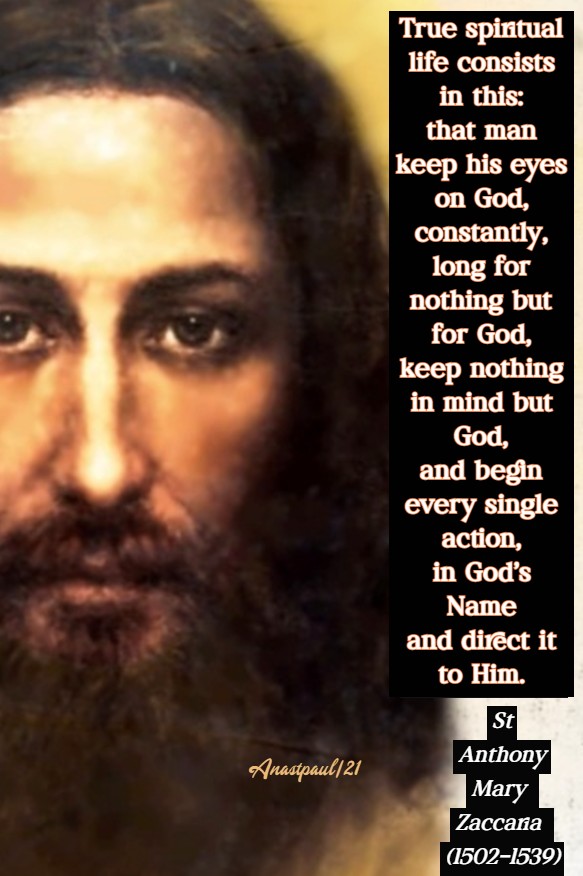
“True spiritual life consists in this: that man keep his eyes on God, constantly, long for nothing but for God, keep nothing in mind but God and begin every single action, in God’s Name and direct it to Him.”
One Minute Reflection – 13 April – “The Month of the Resurrection and the Blessed Sacrament” – St Hermenegild (Died 585) Martyr, Confessor – Wisdom 5:1-5; Luke 14:26-33 – Scripture search here: https://www.drbo.org/
“If anyone comes to Me, without hating his father and mother, wife and children, brothers and sisters and even his own life, he cannot be my disciple.” – Luke 14:26
REFLECTION – “On another occasion, the Lord says, “Whoever comes to me and does not hate his father and mother, and wife and children and brothers and sisters and even his own soul, cannot be my disciple.” As a rule, this is more upsetting to the mind of new Christians, who are eager to begin at once, to live in accordance with the precepts of Christ. To those who do not fully grasp its meaning, it would seem contradictory …. He has condescended to call His disciples to the eternal Kingdom. He also called them brothers. In the Kingdom these relationships are transcended because, “there is neither Jew nor Greek, neither male nor female, neither slave nor freeman but Christ, is all things and in all.” The Lord says, “For in the resurrection, they will neither be married nor marry but will be as the Angels of God in Heaven.”
Whoever wishes to prepare himself now, for the life of that Kingdom, must not hate people but those earthly relationships, through which the present life is sustained, the temporary life that begins at birth and ends with death. Whoever does not hate this necessity, does not yet love that other life, in which there will be no condition of birth and death, the condition which makes marriages natural on earth.” – St Augustine (354-430) Bishop, Father, Doctor of Grace (Sermon on the Mount,15).
PRAYER – OGod, Who didst teach Thy blessed Martyr Hermenegild to choose a heavenly, rather than an earthly crown, grant, we beseech Thee, that we, like him, may so pass through temporal things that we finally miss not those which are eternal. Through esus Christ, Thy Son our Lord, Who lives and reigns with Thee, in the unity of the Holy Ghost, God, world without end. Amen (Collect).
Our Morning Offering – 13 April – “The Month of the Resurrection and the Blessed Sacrament” – Saturday in the Second Week after Easter
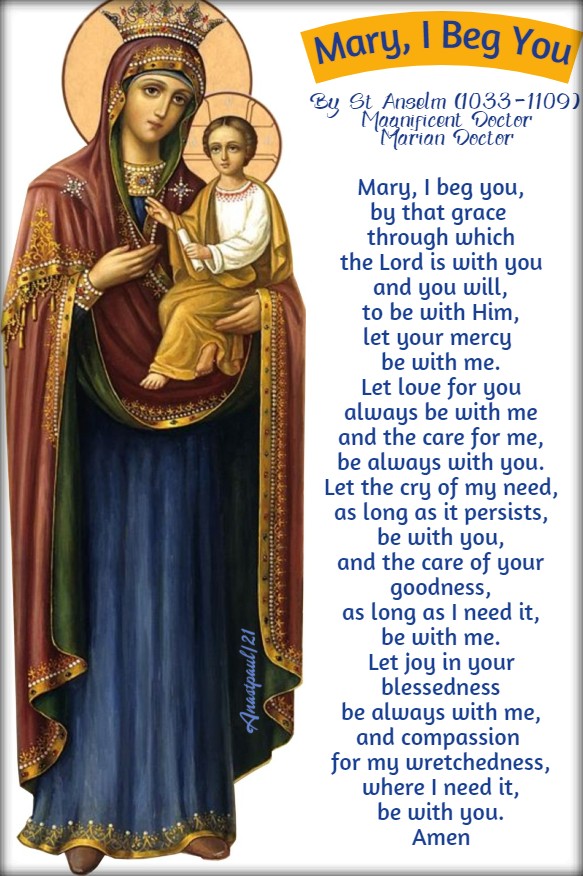
Mary, I Beg You By St Anselm (1033-1109) Magnificent Doctor Marian Doctor
Mary, I beg you, by that grace through which the Lord is with you and you will to be with Him, let your mercy be with me. Let love for you always be with me, and the care for me be always with you. Let the cry of my need, as long as it persists, be with you, and the care of your goodness, as long as I need it, be with me. Let joy in your blessedness be always with me, and compassion for my wretchedness, where I need it, be with you. Amen.
Saint of the Day – 13 April – Saint Ida of Boulogne (c1040-1113) Widow, Countess, Apostle of charrity to the poor and needy, a lady of pious devotion and love for the Church to which she extended donations and assistance wherever needed. She supported and became a friend and correspondent of St Anselm of Canterbury who was deeply involved in the Cluniac reform in France. Born in c1040 in Ardennes, France and died on 13 April 1113 of natural causes. Patronage – of widows. Also known as – Ida of Lorraine, Ida of Lower Lorraine, Ida of Verdun, Ide…
Ida was the daughter of Godfrey III, the Duke of Lower Lorraine and his wife Doda. She became the bride of Eustace II, Count of Boulogne and the couple became the parents of Eustace III, Godfrey of Bouillon, the Leader of the First Crusade and also the first Ruler of Jerusalem under the title, Advocate of the Holy Sepulchre, having refused the title of King and Baldwin, who did accept the title of King of Jerusalem.
Count Eustace and St Ida his Countess
She was a great benefactor of the Church and the poor. After her husband’s death she founded several monasteries: Saint-Wulmer in Boulogne for the Augustinian Canons, Saint-Michel-du-Wast for the Cluniac Monks. She made considerable donations to the Abbeys of Saint-Bertin, Bouillon and Afflighem, favoured the reform of Cluny under the influence of St Anselm of Canterbury who remained a great friend and in correspondence with her. Some of St Anselm’s letters to Ida have survived.This detail underlines the role the holy Archbishop had in the monastic reform in Flanders.
Ida did not take the Benedictine Habit, as has been believed but she obtained it from St Ugo at Cluny, so that she could consider herself a secular oblate of the Benedictine Order.
She died today in 1113 and was buried in the Church of Wast (we note that many biographical information read, wrongly, Saint-Waast, instead of Wast). In 1669 her Relics were transferred to the Benedictines of the Holy Sacrament in Paris, who took them with them, when, in 1808, they settled in Bayeux, where they are still kept (one Relic, however, was left in Wast).
Ida’s Feast which was celebrated in the ancient Diocese of Boulogne, was later authorised in the Diocese of Arras and Bayeux. The commemoration of the Saint is found in many medieval calendars on 13 April. Blessed Ida of Louvain is also remembered on this day, although the date of her death is unknown.

































 AnaStpaul
You must be logged in to post a comment.