Thought for the Day – 11 July – Meditations with Fr Richard Frederick Clarke SJ (1839-1900)
PATIENCE Meditations for a Month
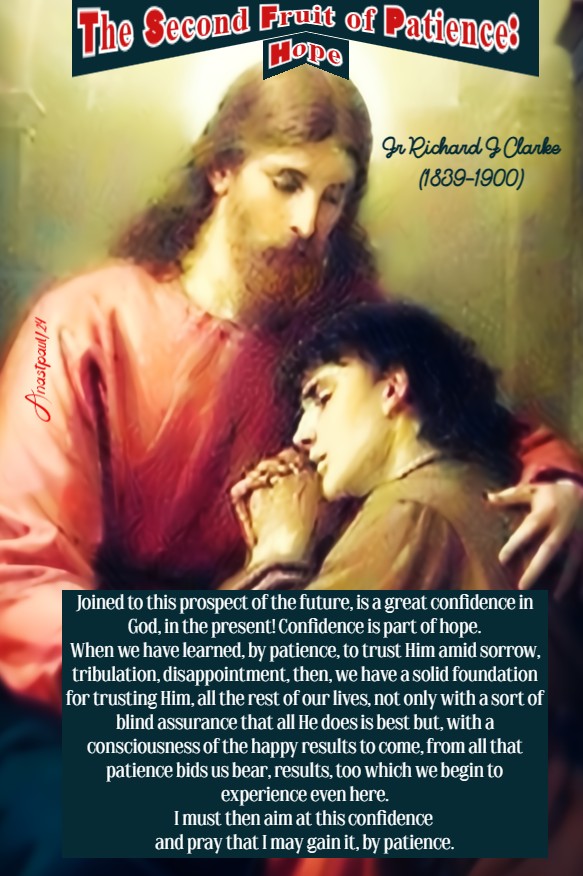
The Second Fruit of Patience: – Hope
‘Patience,’ says St Paul, ‘works out our trial and trial, hope.‘ (Romans 5 : 4) If we humbly accept the sufferings God sends us without rebellion or complaint, then, we reap the reward in rapid growth of hope within our heart. Through the darkness, we descry a bright light in the distance and, although our path be a dreary and a painful one, this prospect cheers us and makes us go on our way, rejoicing. In the earlier part of the time of trial, hope was dim and faint but, when we have been proved faithful servants, hope begins to anticipate the future and to fill us with a happiness which makes the present sufferings comparatively light. Have I attained that happy state?
Joined to this prospect of the future, is a great confidence in God, in the present! Confidence is part of hope. When we have learned, by patience, to trust Him amid sorrow, tribulation, disappointment, then, we have a solid foundation for trusting Him, all the rest of our lives, not only with a sort of blind assurance that all He does is best but, with a consciousness of the happy results to come, from all that patience bids us bear, results, too which we begin to experience even here. I must then aim at this confidence and pray that I may gain it, by patience.
St Paul tells us that if we hope for that which we see not, we have to wait for it, for the perfect ,work of patience, is to wait contentedly for the time, when God will give us the good things He has promised us. This was the Apostle’s frame of mind when he said: ‘I have fought a good fight, have kept the faith, at the last there is laid up for me, a crown of justice.’ (2 Timothy 4 : 7) So, too, for me, if I persevere to the end, there is laid up a like crown. The thought of it shall animate me to fresh patience.
Quote/s of the Day – 11 July – St Pius I, Pope (Died c 154) Martyr – 1 Peter 5:1-4; 5:10-11, Matthew 16:13-19 – Scripture search here: https://www.drbo.org/
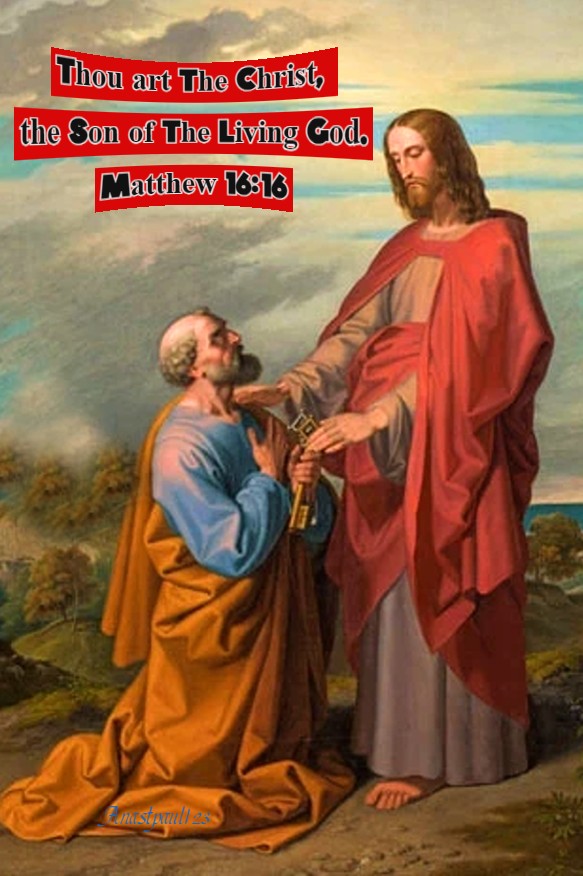
“Thou art the Christ, the Son of the living God.”
Matthew 16:16
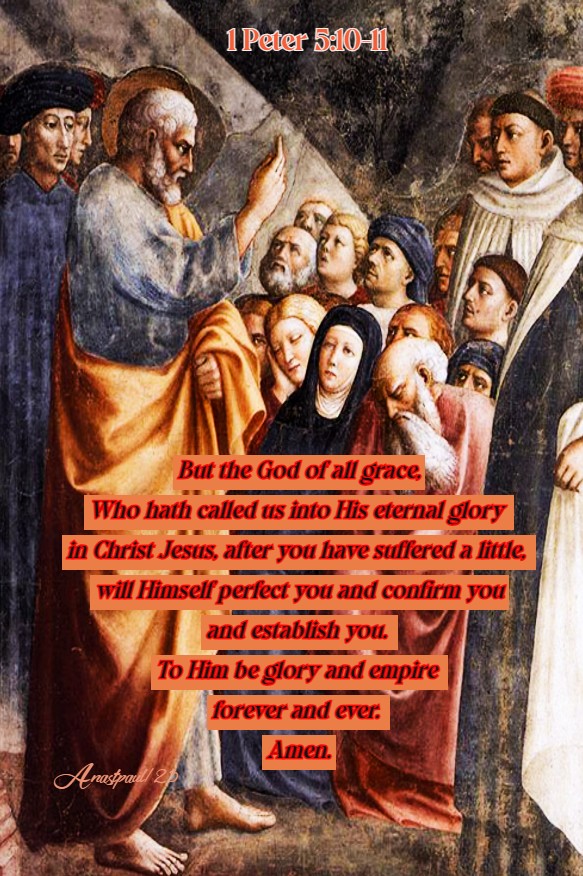
“But the God of all grace, Who hath called us into His eternal glory in Christ Jesus, after you have suffered a little, will Himself perfect you and confirm you and establish you. To Him be glory and empire forever and ever. Amen.”
1 Peter 5:10-11
“Wake up then, believer and note whatis stated here: “In My Name.” That [Name] is Christ Jesus. Christ signifies King, Jesus signifies Saviour. Therefore, whatever we ask for that would hinder our salvation, we do not ask in our Saviour’s Name and yet, He is our Saviour, not only when He does what we ask but also, when He does not. When He sees us ask anything to the disadvantage of our salvation, He shows Himself our Saviour by not doing it. The physician knows whether what the sick person asks for, is to the advantage or disadvantage of his health. And [the physician] does not allow what would be harmful to him, although the sick person himself, desires it. But the physician looks to his final cure.”
St Augustine (354-430) Father and Doctor of Grace of the Church
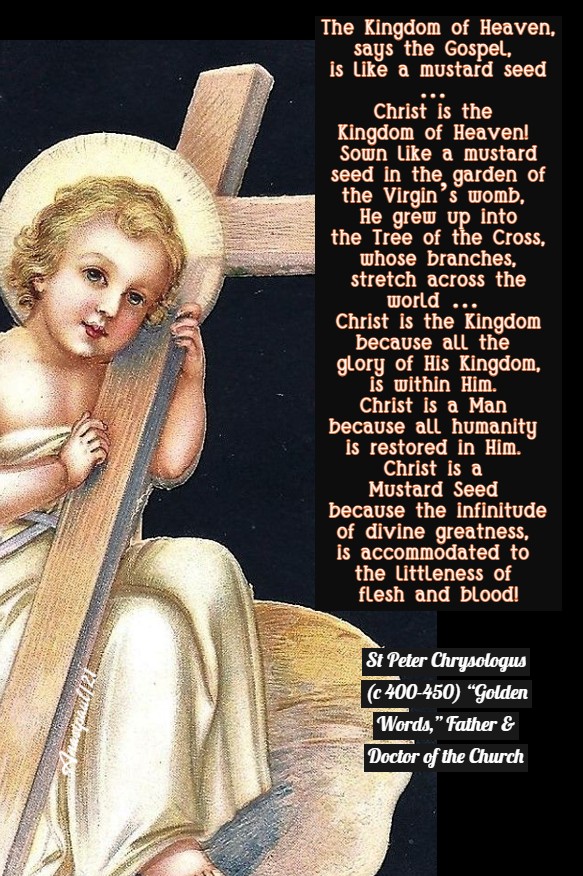
“The Kingdom of Heaven, says the Gospel, is like a mustard seed … Christ is the Kingdom of Heaven! Sown like a mustard seed in the garden of the Virgin’s womb, He grew up into the Tree of the Cross, whose branches, stretch across the world … Christ is the Kingdom because all the glory of His Kingdom, is within Him. Christ is a Man because all humanity is restored in Him. Christ is a Mustard Seed because the infinitude of Divine greatness, is accommodated to the littleness of flesh and blood!”
St Peter Chrysologus (c 400-450) “Golden Words” Father & Doctor of the Church
“May Christ be heard in our language, may Christ be seen in our life, may He be perceived in our hearts”
St Peter Damian (1007-1072) Doctor of the Church
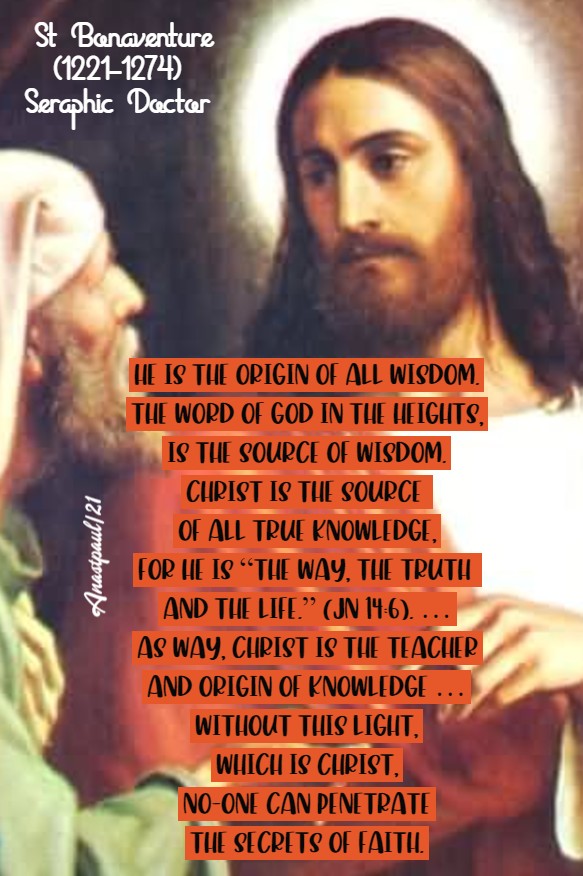
“He is the origin of all wisdom. The Word of God in the heights, is the source of wisdom. Christ is the source of all true knowledge, for He is “the way, the truth and the life.” (Jn 14:6). … As way, Christ is the teacher and origin of knowledge … Without this Light, which is Christ, no-one can penetrate the secrets of faith.”
One Minute Reflection – 11 July – “The Month of the Most Precious Blood” – St Pius I, Pope (Died c 154) Martyr – 1 Peter 5:1-4; 5:10-11; Matthew 16:13-19 – Scripture search here: https://www.drbo.org/
“Upon this rock I will build My Church” – Matthew 16:18
REFLECTION – “Brothers, when it comes to fulfilling my duties as Bishop, I discover that I am weak and slack, weighed down by the weakness of my own condition, while at the same time, I want to act generously and courageously. However, I draw my strength from the untiring intercession of the almighty and eternal Priest, Who, like us but equal to the Father, lowered His Divinity to the level of man and raised humankind to the level of God. The decisions He made, give me a just and holy joy. For, when He delegated many shepherds to care for His flock, He did not abandon watching over His beloved sheep. Thanks to that fundamental and eternal assistance, I in turn, have received the protection and support of the Apostle Peter, who also does not abandon his function. This solid foundation, on which the whole of the Church is built, never grows tired of carrying the whole weight, of the building which rests upon it.
The firmness of faith, for which the first of the Apostles was praised, never fails. Just as everything which Peter professed in Christ remains, so that which Christ established in Peter, remains … The order willed by God’s Truth remains. Saint Peter perseveres in the solidity which he received; he has not abandoned the governance of the Church which was placed in his hands. That, my brothers, is what that profession of faith, inspired by God the Father, obtained in the heart of the Apostle. He received the solidity of a rock which no assault can shake. In the entire Church, Peter says everyday: “Thou art the Messiah, the Son of the living God.” – St Leo the Great (400-461) Pope, Father and Doctor of the Church (Sermon on the anniversary of his Consecration as Bishop).
PRAYER – Look forgivingly on thy flock, Eternal Shepherd and keep it in Thy constant protection, by the intercession of blessed Pius thy Martyr and Sovereign Pontiff, whom Thou didst constitute Shepherd of the whole Church.. Through the same Jesus Christ, Thy Son our Lord, Who lives and reigns with Thee, in the unity of the Holy Ghost, God, world without end. Amen (Collect).
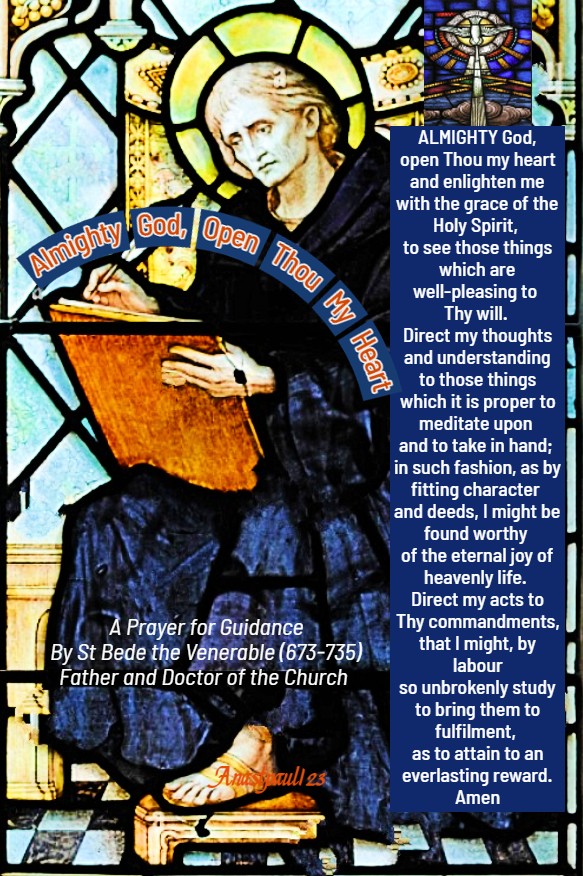
Almighty God, Open Thou My Heart A Prayer for Guidance By St Bede the Venerable (673-735) Father and Doctor of the Church
ALMIGHTY God, open Thou my heart and enlighten me with the grace of the Holy Spirit, to see those things which are well-pleasing to Thy will. Direct my thoughts and understanding to those things which it is proper to meditate upon and to take in hand; in such fashion, as by fitting character and deeds, I might be found worthy of the eternal joy of heavenly life. Direct my acts to Thy commandments, that I might, by labour so unbrokenly study to bring them to fulfilment, as to attain to an everlasting reward. Amen
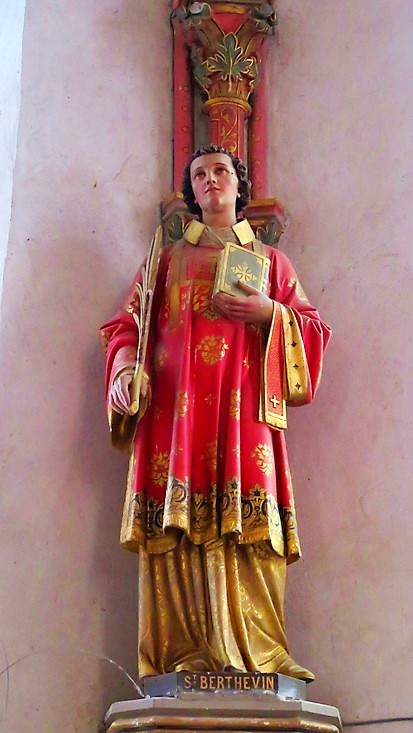
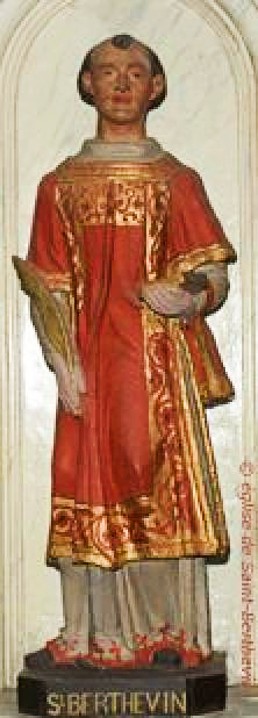
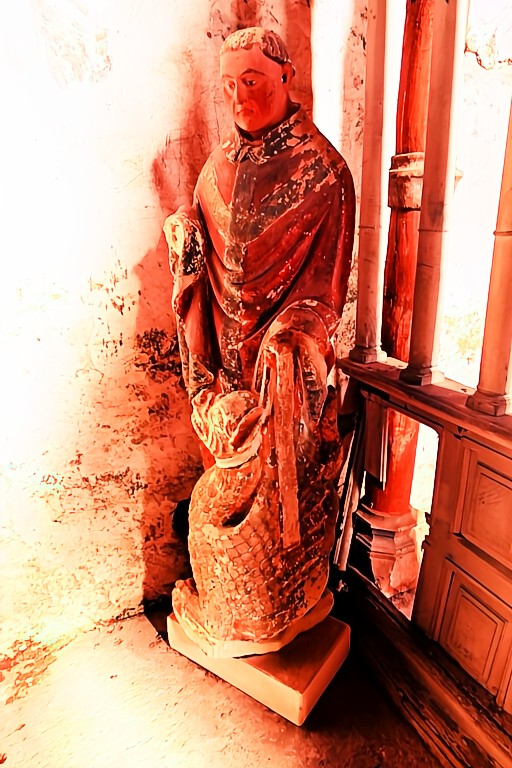
Saint of the Day – 11 July – Saint Berthevin of Laval (10th Century) Deacon Martyr, Hermit, Teacher. We believe he was born in Parigny, in the region of Lisieux, France and died in Laval by being murdered. Also known as – Berthevin of Laval, Berthevin of Parigny, Berthevin of Vicoin, Berthevin of Val-Guidon, Bertevin, Bertewin, Bertewinusn Berthvinn Berthwinus, Bertininus, Bertivinus, Bertunius, Bertunus, Bertuwinus, Bertuwius, Bertwin, Brévin. Additional Memorials – 11 June (translation of Relics) and 8 September on some calendars.
Berthevin was a member of the noble family of Argence. He is said to be the son of Pierre d’Argence. A village of the same name St Berthevin, still exists in Parigny today.
What we know about Saint-Berthevin was transcribed by a Monk of Mont Saint-Michel in the 12th or 14th Century.
Saint-Berthevin, a Cleric from Parigny in Normandy, became a Hermit to escape the Norman invaders. The Lord of Laval , noticed his virtues and he charged him with ensuring the education of his children. Berthevin carried out his new function with zeal. As soon as he had the leisure, he would retire to his old Hermit’s cave to pray and instruct thimself and he children of the surrounding area.
His Vita tells us that, while carrying out his duties with prudence and justice, he studied Sacred Scripture and spiritual literature and went to pray every day in a Church dedicated to Saint Nicholas .
Having gained the full trust of his Master, other servants killed him out of jealousy and threw his body into a river near which he was accustomed to pray. But then, fearing that his body would be discovered, they hid it, in turn, in a fountain in the Vicoin, before hoisting it into the crevice of a cliff overlooking the Vicoin. It was there that his godmother, warned by a heavenly voice, came to collect his body and brought it to Parigny.
St Pius I, Pope (Died c 154) Martyr – The Ninth Successor of St Peter. Papal Ascension c 142. Born at Aquileia, Italy and died in Rome. The Roman Martyrology states of him today: “At Rome, the blessed Pius, Pope and Martyr, who was crowned with Martyrdom in the persecution of Marcus Aurelius.” His Life and Death: https://anastpaul.com/2021/07/11/saint-of-the-day-11-july-saint-pope-pius-i-died-c-154/
St Abundius of Ananelos St Amabilis of Rouen St Anna An Jiaoshi St Anna An Xingshi Bl Antonio Muller St Berthevin of Laval (Died 10th Century) Deacon Martyr St Cindeus St Cowair St Cyprian of Brescia St Cyriacus the Executioner St Hidulf of Moyenmoutier St Januarius St John of Bergamo
St Leontius the Younger St Marcian of Lycaonia St Marciana of Caesarea Bl Maria An Guoshi Bl Maria An Linghua Bl Marie-Clotilde Blanc Bl Marie-Marguerite de Barbégie d’Albrède
St Olga Queen of Kiev (c 890-969) She was known as a ruthless and effective ruler but “when Olga was enlightened, she rejoiced in soul and body. The Bishop, who instructed her in the faith, said to her, ‘Blessed art thou among the women of Rus,’,for thou hast loved the light and quit the darkness. The sons of Rus’ shall bless thee to the last generation of thy descendants.” About St Olga: https://anastpaul.com/2020/07/11/saint-of-the-day-11-july-saint-olga-queen-of-kiev-c-890-969/
St Placidus of Disentis * (7th Century) Monk (see below)
Bl Rosalie-Clotilde Bes St Sabinus of Brescia St Sabinus of Poitiers St Sidronius
Thought for the Day – 10 July – Meditations with Fr Richard Frederick Clarke SJ (1839-1900)
PATIENCE Meditations for a Month
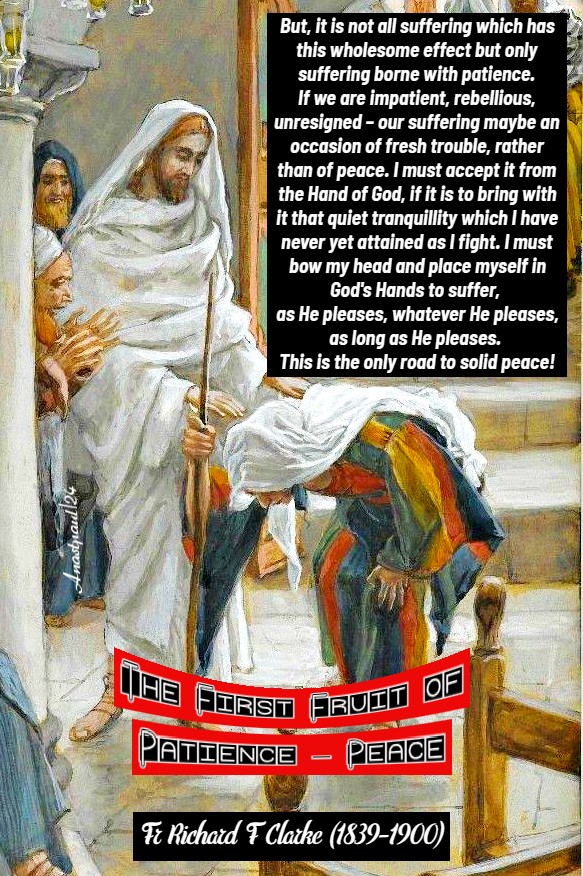
The First Fruit of Patience: – Peace
We all long after peace; we are anxious, not for inactivity, nor indeed that we should have nothing against which to fight but, for the absence of that conflict within us which is the source of all our misery. It is the struggle, in our own hearts, between two opposing forces of duty and inclination, which troubles and disturbs us. I f this struggle is to cease, one of these two forces must be crushed. It is the process of crushing our corrupt inclinations which we dread. We have not the necessary courage, although we know that the only way to peace is to mortify our members which are upon the earth. This is the story of my troubles, I have not conquered my lower nature and my self-will!
How is the victory to be gained and peace restored to our hearts? It is impossible without suffering. Nothing else has the power to break our proud wills and make us put our stubborn necks beneath the yoke. We speak of those who have suffered, as having a chastened look and it always attracts us. There is in suffering a sort of supernatural force which ought to commend it to us, or at least, to reconcile us to it. If I have to suffer, I will think of this and console myself with knowing that God will bring peace and happiness out of it.
But, it is not all suffering which has this wholesome effect but only suffering borne with patience. If we are impatient, rebellious, unresigned – our suffering maybe an occasion of fresh trouble, rather than of peace. I must accept it from the Hand of God, if it is to bring with it that quiet tranquillity which I have never yet attained as I fight. I must bow my head and place myself in God’s Hands to suffer, as He pleases, whatever He pleases, as long as He pleases. This is the only road to solid peace!
Quote/s of the Day –10 July – Proverbs 31:10-31, Matthew 12:46-50 – Scripture search here: https://www.drbo.org/
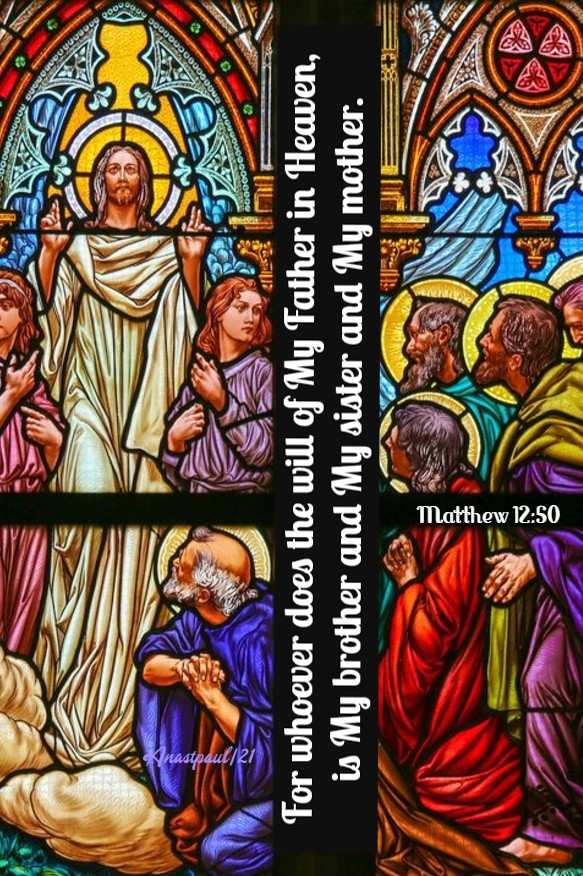
“For whoever does the Will of My Father in Heaven, is My brother and My sister and My mother.”
Matthew 12:50
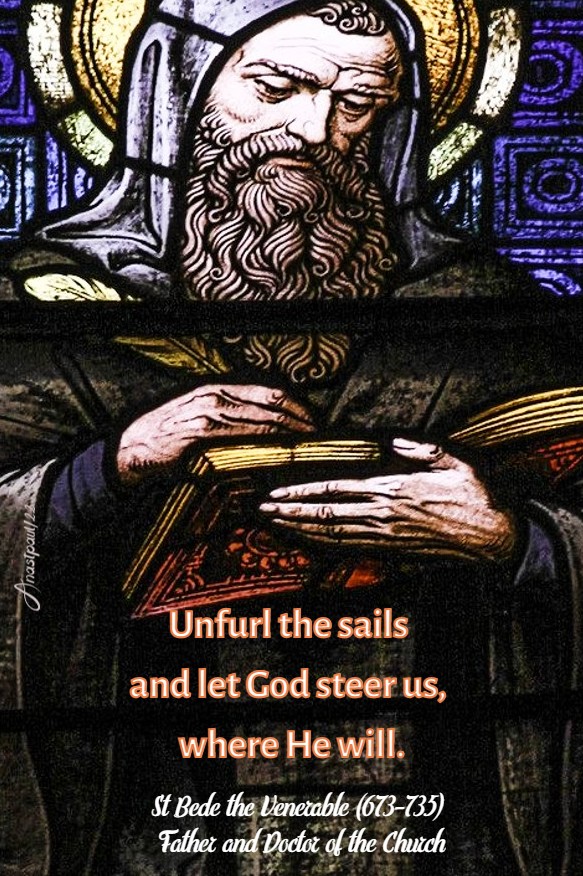
“Unfurl the sails and let God steer us where He will.”
St Bede the Venerable (673-735) Confessor, Father and Doctor of the Church
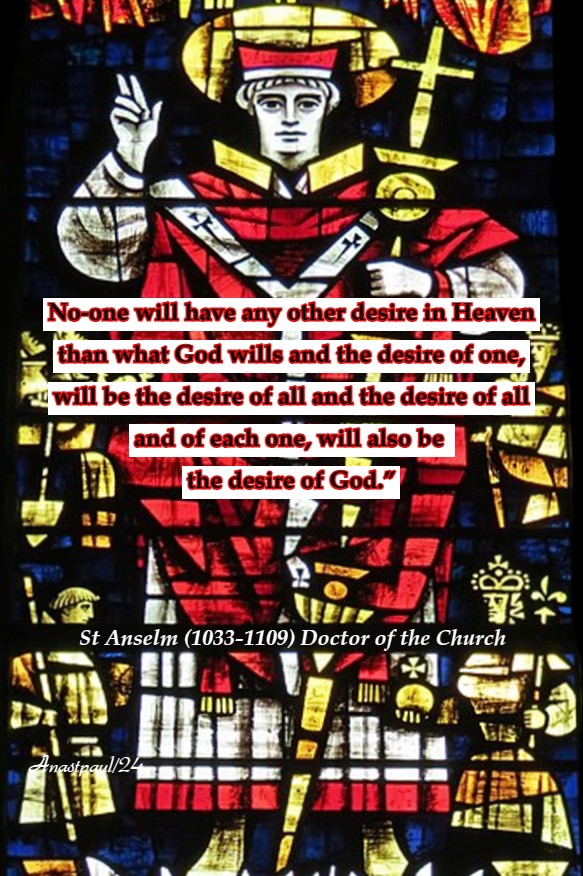
“No-one will have any other desire in Heaven than what God wills and the desire of one, will be the desire of all and the desire of all and of each one, will also be the desire of God.”
St Anselm (1033-1109) Archbishop of Canterbury
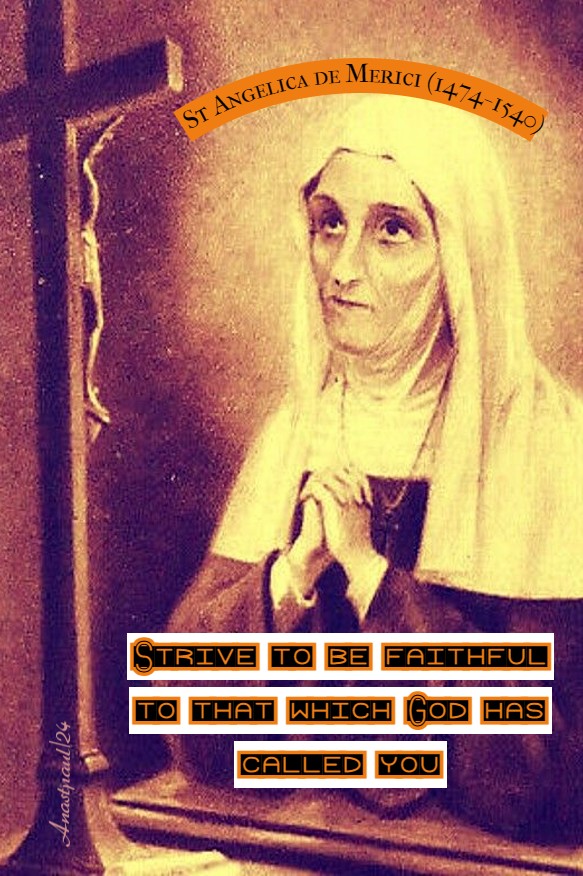
“Strive to be faithful to that which God has called you.”
St Angelica de Merici (1474-1540) Virgin
“It is impossible, that he could be denied the favours for which he asks and which we should request him to obtain for us. Let us go to him trustingly but, let us remember, that the surest way of being heard by him, is to imitate his wonderful virtues, especially his humility, his spirit of prayer, his purity and his calm desire always, to do God’s will.”
One Minute Reflection – 10 July – “The Month of the Most Precious Blood of Jesus” – St Rufina and St Secunda of Rome (3rd Century) Virgin Martyrs – Proverbs 31:10-31, Matthew 12:46-50 – Scripture search here: https://www.drbo.org/
“For whoever does the will of My Father in heaven, is My brother and My sister and My mother.” – Matthew 12:50
REFLECTION – “I beg you to listen to what the Lord had to say when He stretched out His hand towards His disciples: “Here are My mother and My brethren” and, “whoever does the will of My Father in heaven, is My brother and My sister and My mother.”Are we to take it from this that the Virgin Mary did not do the will of the Father, she who by faith believed, by faith conceived; she who was chosen to bring forth salvation on our behalf and who, was by Christ created that Christ in her, might be created? Indeed and indeed, she did the Father’s will and it is a greater thing for Mary that she was Christ’s disciple, than that she was His Mother. It is a happier thing to be His disciple, than to be His Mother. Blessed then is Mary, who bore her Lord in her body, before she gave Him birth…
Mary is holy. Mary is blessed. Yet the Church is greater than she is. What reason do I bring? Mary is part of the Church. She is a holy member of the Church; she is THE holy member; she is the member above all member hut, she is still one member of the whole body… Brothers, listen very closely – you are members of Christ’s body and you are the body of Christ (1 Cor 12:27). And this is how you are what He said: “Here are My mother and My brothers.” But how does this prove you are Christ’s mother? He goes on: “Whoever hears and whoever does the will of my heavenly Father, is My brother and My sister and My mother.” – St Augustine (354-430) Father and Doctor of the Church (Sermon 25 on Saint Matthew).
PRAYER – Grant, we beseech Thee, Almighty God, that we, who know how courageously Thy holy Martyrs have confessed the faith, may experience their goodness as they intercede for us with Thee.Through the same Jesus Christ, Thy Son our Lord, Who lives and reigns with Thee, in the unity of the Holy Ghost, God, world without end. Amen (Collect).
Our Morning Offering – 10 July – “The Month of the Most Precious Blood”
I Love Thee, O My God By St John Marie Baptiste Vianney (1786-1859)
I love Thee, O my God and my only desire is to love Thee until the last breath of my life. I love Thee, O my infinitely lovable God and I would rather die loving Thee than live without loving Thee. I love Thee, Lord and the only grace I ask, is to love Thee eternally. My God, if my tongue cannot say in every moment that I love Thee, I wish my heart to repeat it to Thee as often as I draw breath! Amen
Saint of the Day – 10 July – Blessed Bernard of Quintavalle OFM (c1175-c1241) Friar of the Friars Minor, the first disciple of St Francis and is often called “First Fruits of the Minor Order.” Missionary, Master Provincial and trustworthy companion and legate of St Francis. He received. from St Francis on his deathbed, custody of the Friars Minor. He died nearly 20 years after St Francis. Born in c1175 in Assisi, Italy and died between 1241 and 1246 in Assisi of natural causes. Also known as – Bernard of Assisi, Bernardo… “First fruits of the Minor Order” (“Minorum Ordinis Prima Plantula”). Additional Memorial – 2 July on some calendars.
Bernard, son of Quintavalle di Berardello, was a wealthy young noble from Assisi. His family’s house still stands in Assisi to this day.
He studied at Bologna University receiving his Degree in both Civil and Canon Law. He also fought in the First Crusade.
He was a rich young merchant who became acquainted with St Francis when the Saint visited his palace. On the Feast of Saint Matthias, 24 February 1208, Francis had heard the Gospel, “And going, preach, saying: The Kingdom of Heaven is at hand. … Do not possess gold, nor silver, nor money in your purses … And when you come into the house, salute it, saying: Peace be to this house. … Behold I send you as sheep in the midst of wolves. Be ye therefore wise as serpents and simple as doves!” (Matthew 10:7-19).
Then Francis knew that his path was pointed out, took off his shoes and gave them away together with the staff and the belt. He put on an undyed woollen coat, tied it with a rope and went out as a beggar. This was the suit he gave to his brothers the following year.
Many began to admire Francis and some wanted to become his companions and disciples. The first of these was Bernard of Quintavalle. He sold everything he owned and shared the money among the poor and thus became the first fruit in the Order.
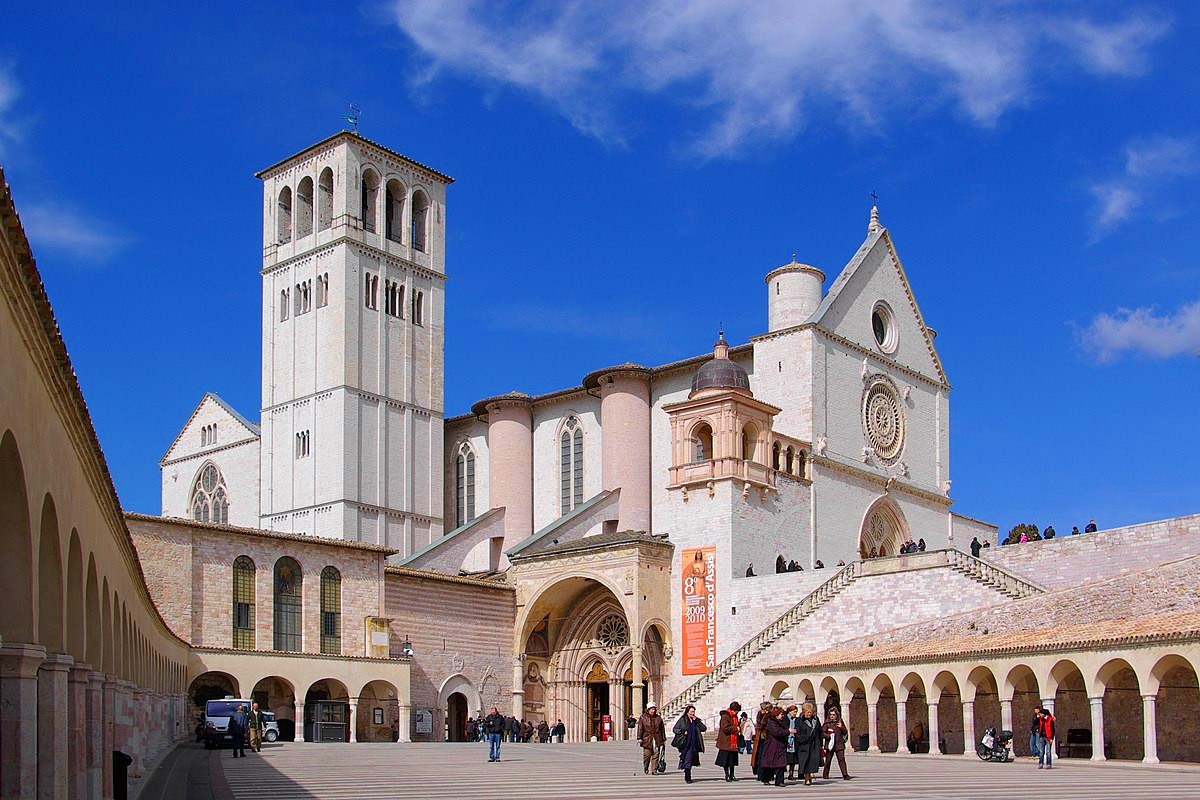
View of the Upper Basilica in Assisi
Peter of Cattaneo (Pietro Cattani), the Canon of the Cathedral of Assisi, also wanted to become Francis’s disciple and Francis gave them both the garb on 16 April 1208. The third to join them was the famous Blessed brother Giles , a man of great simplicity and spiritual wisdom. He arrived on 23 April.
Together with Francis, Bernard went to Rome to see Pope Innocent III (1198-1216) to obtain the approval of The Seraphic Rule (16 April 1209), then in 1211 he was in Florence and Bologna, places which can thank him for the beginning of his Franciscan presence in those Cities. Together with brother Giles, he travelled to Spain, where he was later,appointed as the Master Povincial (1217-1219). Between 1241 and 1243 he spent some time in Siena.
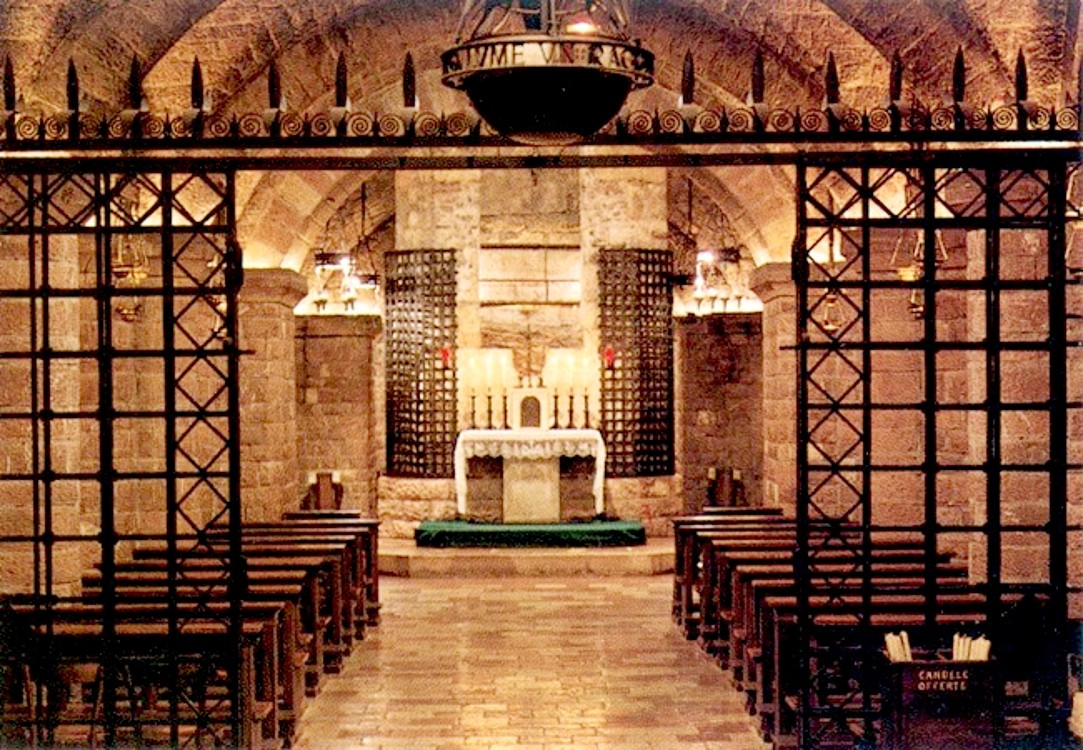
His date of death is not known, although some records declare it to have been 10 July 1241. What is quite clear, is that he was no longer alive on 11 August 1246, as his companions, the brothers Leo, Rufinus and Angelus, sent his memoirs of Francis to the General Minister and Crescentius and Bernard were then dead. He had died in Assisi as he had predicted and he is buried close to the Tomb of St Francis (below), in the Basilica of St Francis in Assisi. The Franciscan Martyrology commemorates him today, 10 July.
St Sylvanus of Pisidia Bl Sylvie-Agnès de Romillon St Waltram
Martyrs of Africa – 4 Saints: A group of Christians Martyred together in Africa. The only information that has survived are four of their names – Felix, Januarius, Marinus and Nabor.
Martyrs of Antioch – 10 Saints: A group of ten Christians Martyred together. We have no details about them but the names – Diogenes, Domnina, Esicius, Macarius, Maxima, Maximus, Rodigus, Timoteus, Veronia and Zacheus. They were martyred in Antioch, date unknown.
Martyrs of Damascus – 11 Beati: A group of Franciscans and laymen ordered by Druz Muslims to convert to Islam. They refused and were hacked to pieces. ‘Abd Al-Mu’ti Masabki Carmelo Bolta Bañuls Engelbert Kolland Francisco Pinazo Peñalver Fransis Masabki Juan Jacobo Fernández y Fernández Manuel Ruiz López Nicanor Ascanio de Soria Nicolás María Alberca Torres Pedro Soler Méndez Rufayil Masabki They were cut to pieces on 9-10 July 1860 in Damascus, Syria. Beatified on 10 October 1926 by Pope Pius XI.
Martyrs of Nicopolis – 45 Saints: A group of 45 Christians tortured and Martyred together in the persecutions of emperor Licinius. We know nothing else but six of their names – Anicetus, Anthony, Daniel, Leontius, Mauritius and Sisinno. c 329 in Nicopolis, Armenia (modern Koyulhisar, Turkey).
Martyrs of Nitria – 5 Saints: Fathers of Nitria – Four Monks and the Bishop of Alexandria, Egypt who were Martyred by heretics. Saint John Chrysostom wrote about them but their names have not come down to us. They were Martyred in the 4th century in Nitria, Egypt.
Thought for the Day – 9 July – Meditations with Fr Richard Frederick Clarke SJ (1839-1900)
PATIENCE Meditations for a Month
The Patience of the Holy Souls
In Purgatory the suffering is more intense than any suffering of this present life and there is greater need of patience to endure it. But the Holy Souls have their wills in perfect conformity to the Will of God and they cannot be anything but patient amid their torments. They do not and they cannot rebel but their submission does not remove the bitterness of their unceasing sorrow, as they think, how comparatively easy it would have been, for them to avoid, while still on earth, their present anguish, by greater faithfulness to grace and by uniting their actions and sufferings, to the actions and sufferings of the Divine Son of God.
If we could look forward to those sufferings, with an appreciation of what they are, how patient we should be now! We should consider it a privilege to suffer now, as the very best way of avoiding the agony of that fire which will be kindled, by the wrath of God and will, in some way, correspond to our ingratitude and unfaithfulness to our King and Benefactor. If no other motive makes me patient, under my earthly sufferings, yet at least, the prospect of long years of far worse sufferings, ought to make me choose the lighter suffering now. What am I doing to shorten my Purgatory?
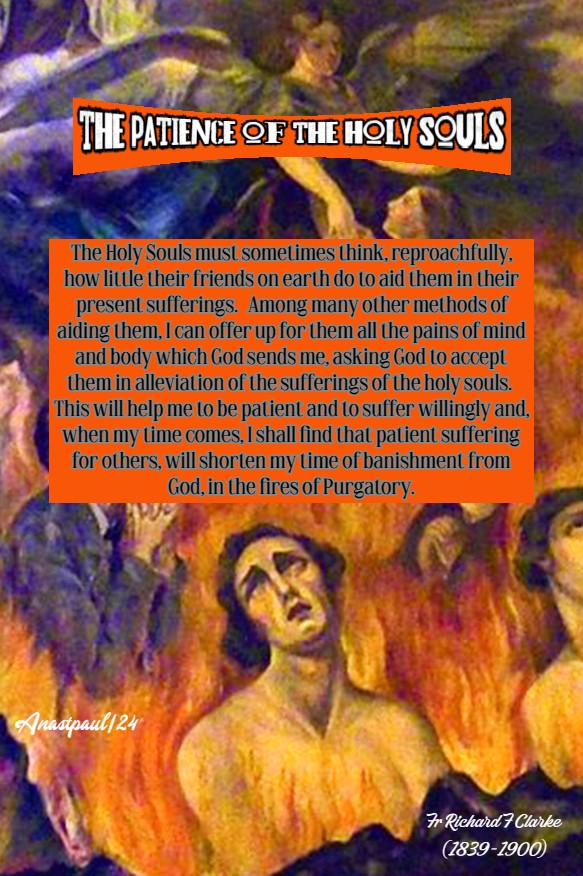
3 The Holy Souls must sometimes think, reproachfully, how little their friends on earth do to aid them in their present sufferings. Among many other methods of aiding them, I can offer up for them all the pains of mind and body which God sends me, asking God to accept them in alleviation of the sufferings of the holy souls. This will help me to be patient and to suffer willingly and, when my time comes, I shall find that patient suffering for others, will shorten my time of banishment from God, in the fires of Purgatory.
Quote/s of the Day – 9 July – St John Fisher (1469-1535) Bishop, Martyr, Cardinal and St Thomas More (1478-1535) Martyr, Confessor.
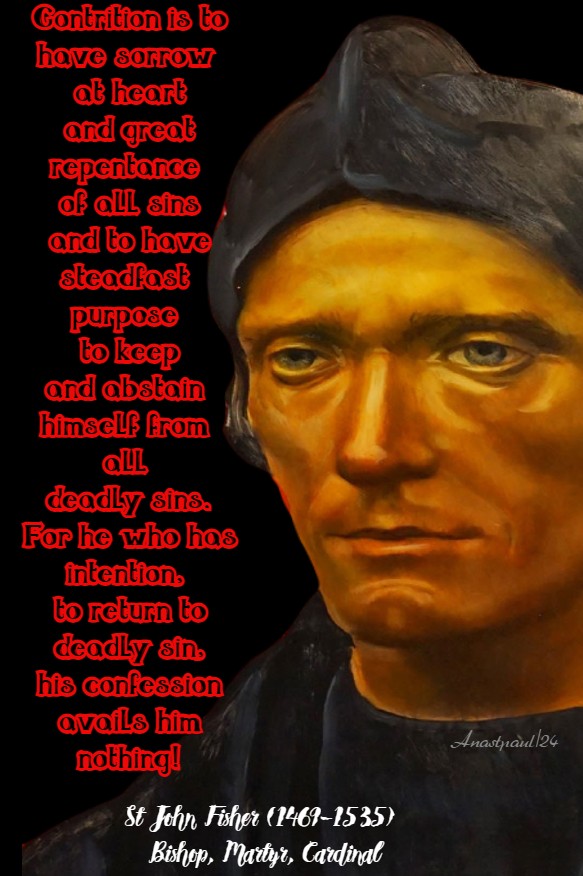
“Contrition is to have sorrow at heart and great repentance of all sins and to have steadfast purpose to keep and abstain himself from all deadly sins. For he who has intention, to return to deadly sin, his confession avails him nothing!”
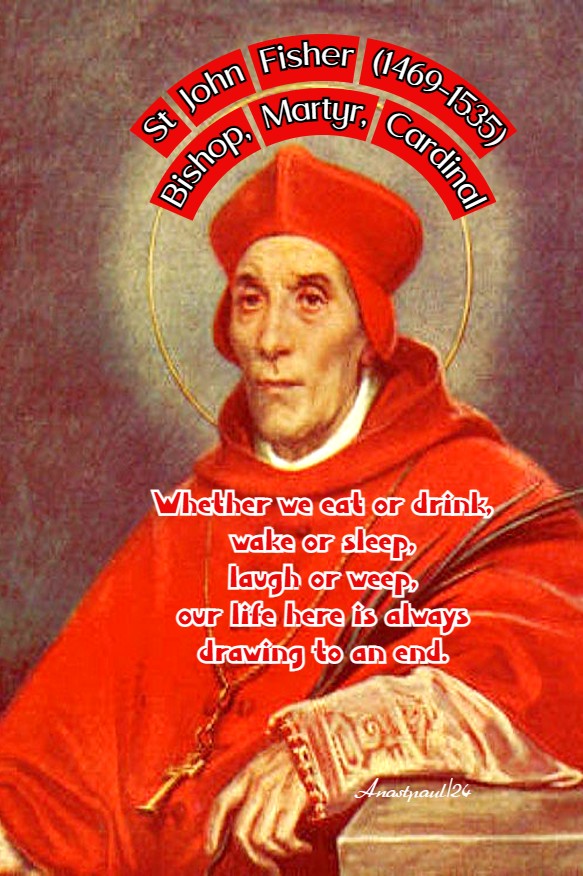
“Whether we eat or drink, wake or sleep, laugh or weep, our life here is always drawing to an end.”
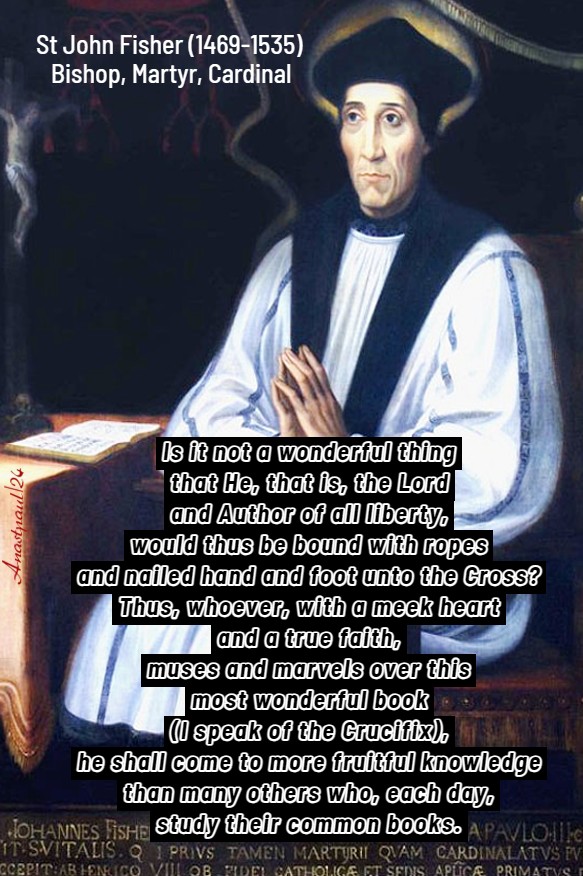
“Is it not a wonderful thing that He, that is, the Lord and Author of all liberty, would thus be bound with ropes and nailed hand and foot unto the Cross? Thus, whoever, with a meek heart and a true faith, muses and marvels over this most wonderful book (I speak of the Crucifix), he shall come to more fruitful knowledge than many others who, each day, study their common books.”
St John Fisher (1469-1535) Bishop, Martyr, Cardinal
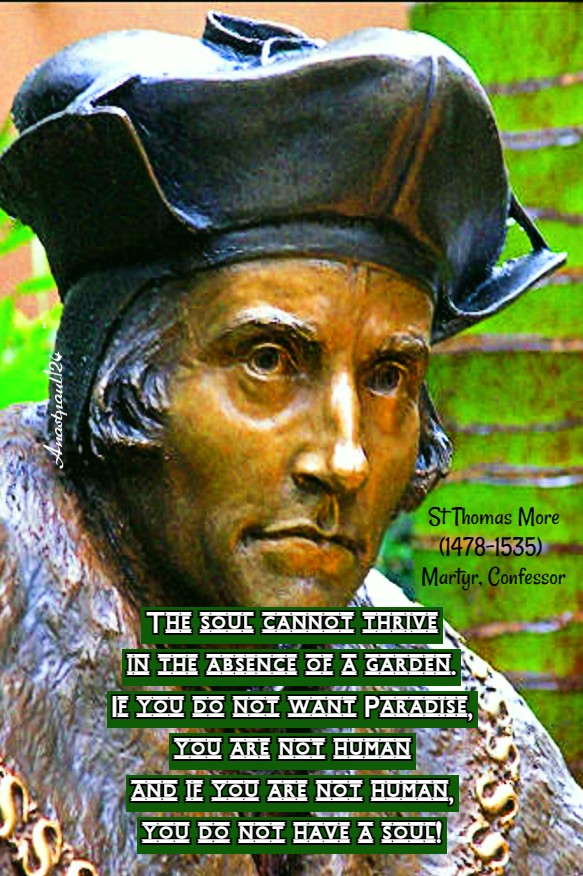
“The soul cannot thrive in the absence of a garden. If you do not want Paradise, you are not human and if you are not human, you do not have a soul!”
“We cannot go to Heaven in featherbeds.”
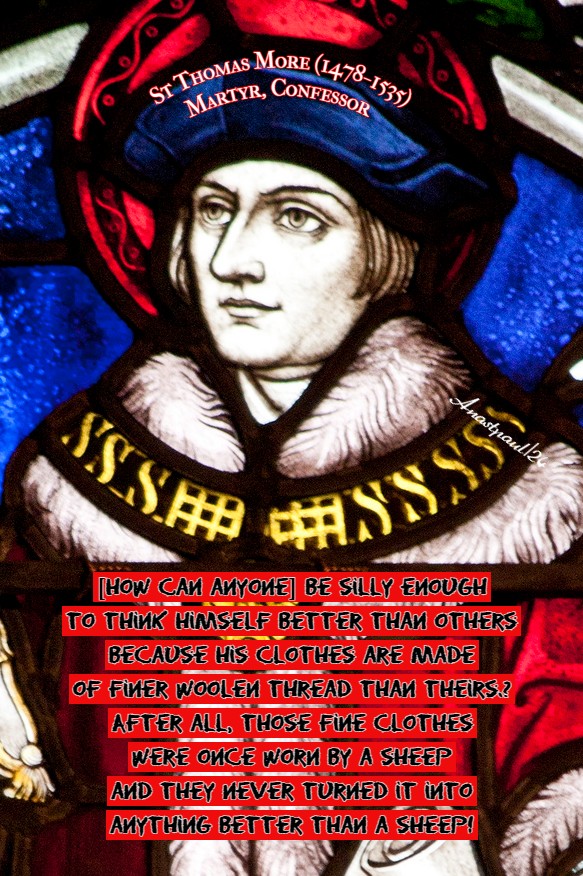
“[How can anyone] be silly enough to think himself better than others because his clothes are made of finer woolen thread than theirs.? After all, those fine clothes were once worn by a sheep and they never turned it into anything better than a sheep!”
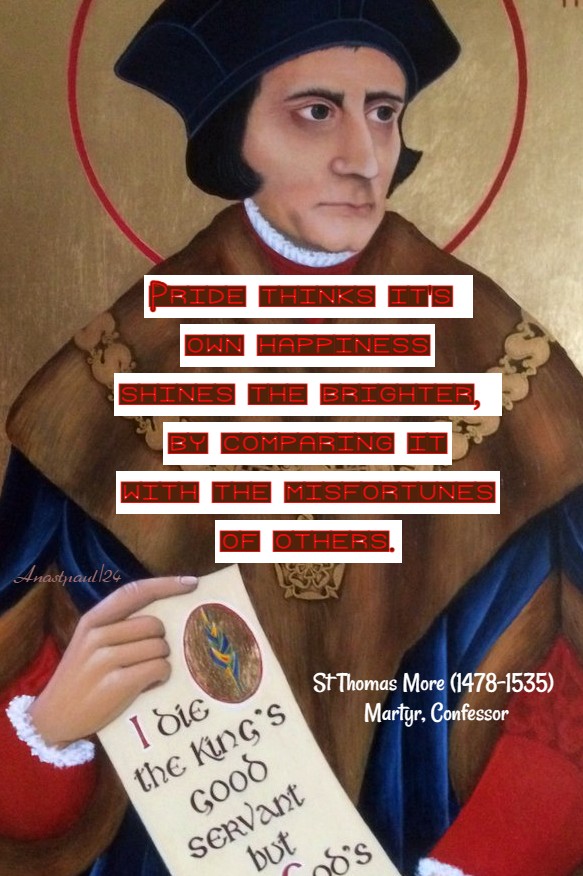
“Pride thinks it’s own happiness shines the brighter, by comparing it with the misfortunes of others.”
One Minute Reflection – 9 July – “The Month of the Most Precious Blood” – Romans 6:19-23; Matthew 7:15-21– Scripture search here: https://www.drbo.org/
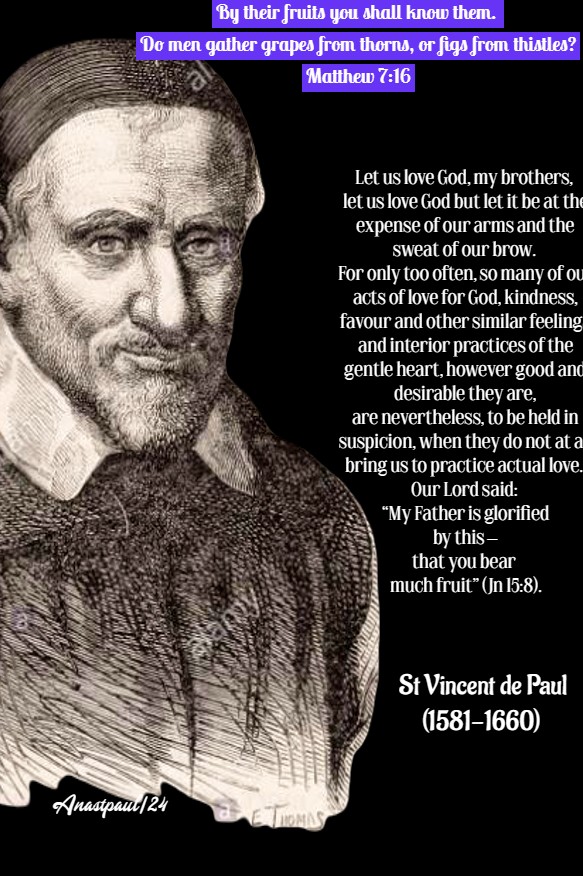
“By their fruits you shall know them. Do men gather grapes from thorns, or figs from thistles? ” – Matthew 7:16
REFLECTION – “Let us love God, my brothers, let us love God but let it be at the expense of our arms and the sweat of our brow. For only too often, so many of our acts of love for God, kindness, favour and other similar feelings and interior practices of the gentle heart, however good and desirable they are, are nevertheless, to be held in suspicion, when they do not at all bring us to practice actual love. Our Lord said: “My Father is glorified by this – that you bear much fruit” (Jn 15:8).
Now this is something about which we need to be very careful because, there are many who, so as to be exteriorly well-ordered and interiorly full of great feelings for God, stop at that. And when it comes to the point and they find themselves in a situation for action, they stop short. They pride themselves on their inflated imaginations; they are satisfied with the sweet exchanges they have with God in prayer; they even talk about it like Angels. But when they come away, is there any question of working for God, of suffering, practicing mortification, teaching the poor, searching for the lost sheep (Lk 15:4), being pleased when they lack something, accepting sickness or some other misfortune? Alas, then, there is no-one to be seen, courage fails them! No, let us not deceive ourselves – our whole task consists in progressing towards acts!” – St Vincent de Paul (1581-1660) Priest, Founder (Spiritual conferences to the Missionaries, Fragment 171).
PRAYER – From all perils of soul and body defend us, O Lord, we beseech Thee,and by the intercession of blessed and glorious ever Virgin Mary, Mother of God, of blessed Joseph, of thy blessed Apostles Peter and Paul and of blessed Martyrs St John Fisher, St Thomas More, St Maria Goretti and all the Saints, graciously grant us safety and peace that all adversities and errors being overcome, Thy Church may serve Thee in security and freedom.Through the same Jesus Christ, Thy Son our Lord, Who lives and reigns with Thee, in the unity of the Holy Ghost, God, world without end. Amen (Collect).
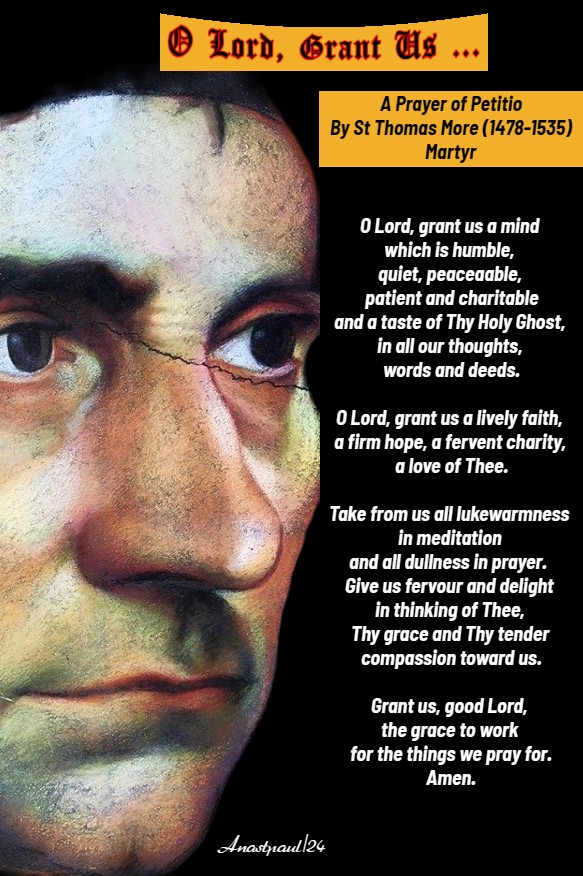
Our Morning Offering – 9 July– “The Month of the Most Precious Blood” – Feast of St Thomas More (1478-1535) Martyr, Confessor
O Lord, Grant Us … A Prayer of Petitio By St Thomas More (1478-1535)
O Lord, grant us a mind which is humble, quiet, peaceaable, patient and charitable and a taste of Thy Holy Ghost, in all our thoughts, words and deeds.
O Lord, grant us a lively faith, a firm hope, a fervent charity, a love of Thee.
Take from us all lukewarmness in meditation and all dullness in prayer. Give us fervour and delight in thinking of Thee, Thy grace and Thy tender compassion toward us.
Grant us, good Lord, the grace to work for the things we pray for. Amen.
Saint of the Day – 9 July – Saint Brictius of Martola (Died c312) Bishop and Confessor. Brictius was the Bishop of Martola, near Spoleto in Umbria in Italy. Also known as Brixtius.
The Roman Martyrology reads: “At Martola, St Brixius, Bishop. Under the Judge Marcian, after having suffered much for the confession of Our Lord and converted a great multitude to Christ. he rested in peace.”
We have very little information about the life of our Saint. Tradition believes that he was imprisoned during the persecutions of Diocletian but escaped Martyredom and died peacefully as Constantine was begining to take power.
St Maria Goretti (1890-1902) Virgin and Martyr, known as “Saint Agnes of the 20th Century.” She was Canonised on 24 June 1950 by Pope Pius XII The ceremony was attended by 250,000 including her mother, the only time a parent has witnessed her child’s Canonisation. Her Life and Death: https://anastpaul.com/2017/07/06/saint-of-the-day-6-july-st-maria-goretti/
Blessed Adrian Fortescue TOSD (1476-1539) Martyr,. A husband and father, a Justice of the Peace, a Knight of the Realm, a Knight of Malta and a Dominican Tertiary (Lay Dominican), he was at once a loyal servant of the Crown so far as he could be but still more, he was a man of unshakeable faith and love of the One True Faith. He was Beatified on 13 May 1895 by Pope Leo XIII. His Life and Death: https://anastpaul.com/2018/07/09/saint-of-the-day-blessed-adrian-fortescue-1476-1539-martyr/
St Agrippinus of Autun St Alexander of Egypt St Audax of Thora St Brictius of Martola(Died c312) Bishop and Confessor St Copra of Egypt St Cyril of Gortyna Bl Dionysius the Rhetorician St Everild of Everingham St Faustina of Rome St Felician of Sicily
Blessed Giovanna Scopelli O.Carm (1428 – 1491) Virgin, Mystic, Italian Religious of the Carmelites and established her own Convent as its first Prioress. She was known, during her lifetime as a Miracle-worker with many coming to her to ask for her assistance and prayers. Her body is incorrupt. About Blessed Giovanna: https://anastpaul.com/2021/07/09/saint-of-the-day-9-july-blessed-giovanna-scopelli-o-carm-1428-1491/
St Floriana of Rome St Hérombert of Minden Bl Joachim Ho
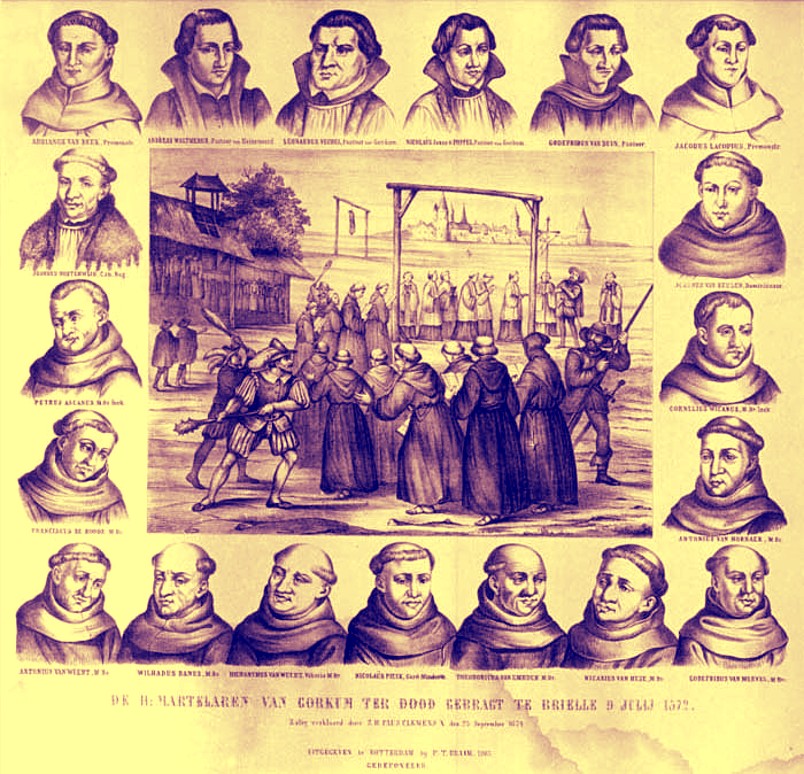
St John of Cologne OP (Died 1572) Priest Martyr and the MARTYRS of GORKUM
Bl Luigi Caburlotto Bl Marguerite-Marie-Anne de Rocher Bl Marie-Anne-Madeleine de Guilhermier St Patermutius of Egypt St Paulina do Coração Agonizante de Jesus
Four Holy Polish Brothers – 4 Saints: Four brothers who became hermits, Benedictine Monks and Saints – Andrew, Barnabas, Benedict and Justus. They were born in Poland and died in 1008 of natural causes.
Martyrs of Gorkum – 19 Saints: The Roman Martyrology (1914 Ed) notes today as the Feast of a group of Saints known as the Martyrs of Gorkum: “At Briel in Holland, the Martyrdom of the 19 Martyrs of Gorkum. For vindicating the authority of the Roman Church and the Real Presence of Christ in the Eucharist, they endured various ignominies and torments from the Calvinist heretics and ended their suffering by being put to death. In the year 1867, Pope Pius IX placed them among the holy Martyrs.” They are – Adrianus van Hilvarenbeek • Andreas Wouters • Antonius van Hoornaar • Antonius van Weert • Cornelius van Wijk • Francisus de Roye • Godfried van Duynen • Godfried van Melveren • Hieronymus van Weert • Jacobus Lacops • Joannes Lenaerts • John of Cologne • Leonardus van Veghel • Nicasius Janssen van Heeze • Nicolaas Pieck • Nicolaas Poppel • Petrus van Assche • Theodorus van der Eem • Willehad van Deem • They were hanged on 9 July 1572 in Brielle, Zuid-Holland, Netherlands. Beatified on 24 November 1675 by Pope Clement X and Canonised on 29 June 1867 by Pope Pius IX.
Martyrs of Orange – 32 Beati: 32 Nuns from several Orders who spent up to 18 months in prison and were finally executed for refusing to renounce Christianity during the persecutions of the French Revolution. Anne Cartier • Anne-Andrée Minutte • Dorothée-Madeleine-Julie de Justamond • élisabeth Verchière • élisabeth-Thérèse de Consolin • Jeanne-Marie de Romillon • Madeleine-Françoise de Justamond • Madeleine-Thérèse Talieu • Marguerite-Eléonore de Justamond • Marguerite-Marie-Anne de Rocher • Marguerite-Rose de Gordon • Marguerite-Thérèse Charensol • Marie Cluse • Marie-Anastasie de Roquard • Marie-Anne Béguin-Royal • Marie-Anne Depeyre • Marie-Anne Doux • Marie-Anne Lambert • Marie-Anne-Madeleine de Guilhermier • Marie-Claire du Bac • Marie-Clotilde Blanc • Marie-Elisabeth Pélissier • Marie-Gabrielle-Françoise-Suzanne de Gaillard de Lavaldène • Marie-Gertrude de Ripert d’Alauzier • Marie-Marguerite Bonnet • Marie-Marguerite de Barbégie d’Albrède • Marie-Rose Laye • Rosalie-Clotilde Bes • Suzanne-Agathe Deloye • Sylvie-Agnès de Romillon • Thérèse-Henriette Faurie They were guillotined between 6 July and 26 July 1794 at Orange, Vaucluse, France. Beatified on 10 May 1925 by Pope Pius XI.
Martyrs of the Baths – 10,204 Saints: A group of Christians enslaved by Diocletian to build the gigantic baths in imperial Rome, Italy. The end of their labours coincided with the beginning of the great persecutions of Diocletian and they were all executed. Ancient records indicated there were 10,204 of them; Zeno of Rome is the only one whose name has come down to us and we know nothing else about any of their individual lives.
Thought for the Day – 8 July – Meditations with Fr Richard Frederick Clarke SJ (1839-1900)
PATIENCE Meditations for a Month
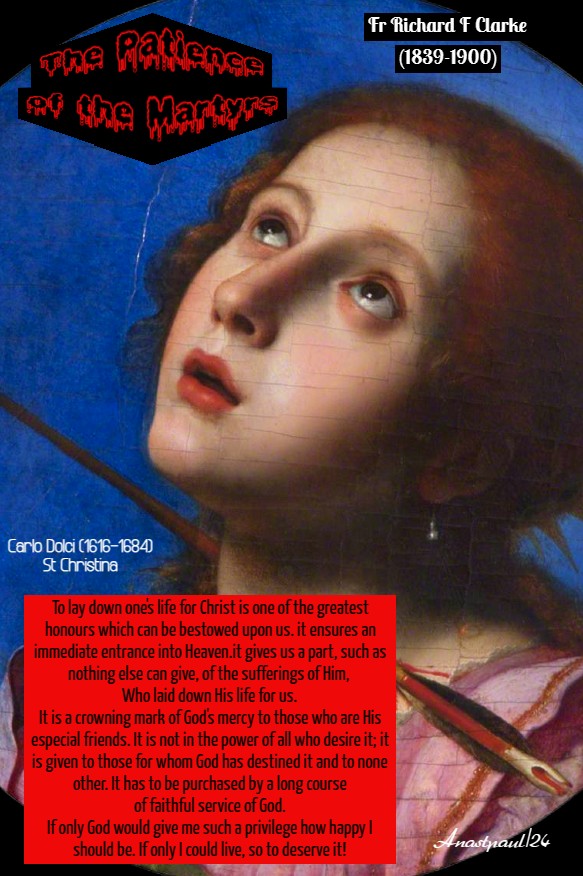
The Patience of the Martyrs
To lay down one’s life for Christ is one of the greatest honours which can be bestowed upon us. it ensures an immediate entrance into Heaven.it gives us a part, such as nothing else can give, of the sufferings of Him, Who laid down His life for us. It is a crowning mark of God’s mercy to those who are His especial friends. It is not in the power of all who desire it; it is given to those for whom God has destined it and to none other. It has to be purchased by a long course of faithful service of God. If only God would give me such a privilege how happy I should be. If only I could live, so to deserve it!
Even the weak, the timid, the sensitive, can, if God gives them the special grace of Martyrdom, face undismayed, the most cruel tortures. Sometimes they did not feel the pain, even when it was most agonising. The secret joy of their hearts, the thought that they were suffering for Christ – made it seem light to them and gave them fortitude to endure to the end. If God should, at a time, give me the happiness of dying for Him, He will take away all the fear and will give me a light, joyous heart even in the midst of the greatest physical sufferings!
3 If there is little or no prospect of my laying down my life for Christ, yet I can, at least, make the offering to Him – I can present myself to suffer anything which He has in store for me. It may be that I am destined for suffering, worse than death, the prolonged Martyrdom of physical or mental anguish. But one thing I know, that He will never lay upon me suffering beyond that which I am able to bear, and will, with the suffering, give the grace necessary, to endure it with resignation and perhaps even with joy!
Quote/s of the Day – 8 July– Proverbs 31:10-31, Matthew 13:44-52
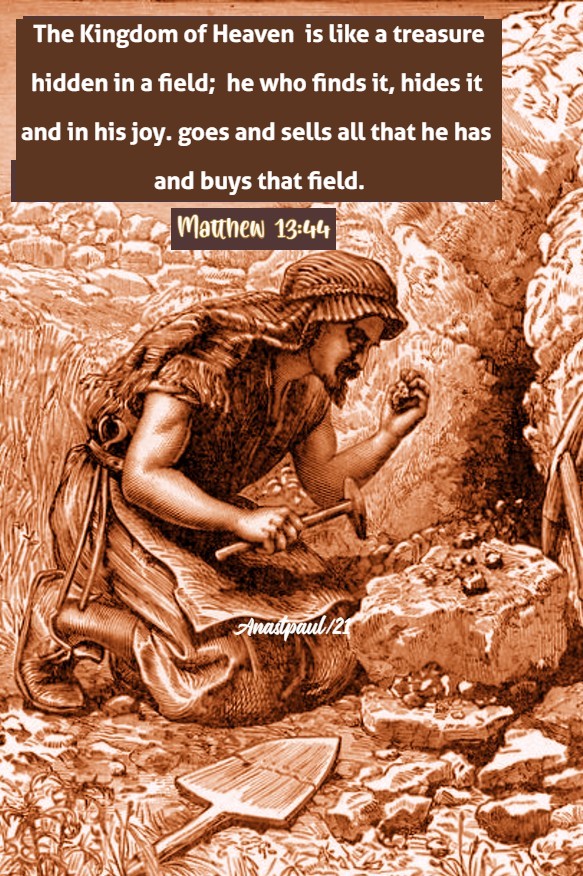
“Jesus said in parables: The Kingdom of Heaven is like unto a treasure, hidden in a field.”
Matthew 13:44
“What is a man’s treasure but the heaping up of profits and the fruit of his toil? For, whatever a man sows, this too will he reap and each man’s gain, matches his toil and where delight and enjoyment are found, there the heart’s desire is attached. Now, there are many kinds of wealth and a variety of grounds for rejoicing – every man’s treasure is that, which he desires. If it is based on earthly ambitions, its acquisition makes men not blessed but wretched. … By distributing what might be superfluous to support the poor, they are amassing imperishable riches, so that what they have discreetly given, cannot be subject to loss. They have properly placed those riches, where their heart is – it is a most blessed thing, to work to increase such riches, rather than to fear that they may pass away.”
St Pope Leo the Great (400-461) Father and Doctor of the Church
“Look at the fig tree and all the trees, when they produce their fruit you know that summer is near. So too, when you see these things happening, know that the Kingdom of God is near.” Luke 21:29-31
“He means that just as the coming of summer is recognised by the fruit on the trees, so is the nearness of the Kingdom of God recognised by the destruction of the world. These words show that the fruit of the world is destruction – it increases only to fall, it produces, only to destroy by its disasters whatever it produces. The Kingdom of God is aptly compared to summer, because it is then that the clouds of our sorrow pass away and the days of life shine with the brightness of the Eternal Sun. … Therefore, my friends, do not love what you see cannot long exist. Keep in mind the Apostle John’s precept, in which he counsels us not “to love the world or the things in the world because, if anyone loves the world, the love of the Father is not in him” (1 Jn 2:15).”
St Gregory the Great (540-604) Pope, Father and Doctor of the Church
“But seek first the Kingdom of God and His righteousness and all these things shall be added to you.” Matthew 6:33
“But, [you will tell me], there is so much to do, so many household jobs, so much business in town, in the fields – work everywhere! Do we have to abandon it all, then, so as to think of nothing but God?” No – but these occupations have to be sanctified by seeking God in them and doing them to find Him in them, rather than, to see them done. What our Lord wants, is for us to seek His glory, His Kingdom, His righteousness, before all else and, for this, to make our foundation the interior life, faith, trust, love, religious exercises …, labours and sufferings, with God our Sovereign Lord in view… Once we are firmly set in the search for God’s glory, we can be assured that the rest will follow.”
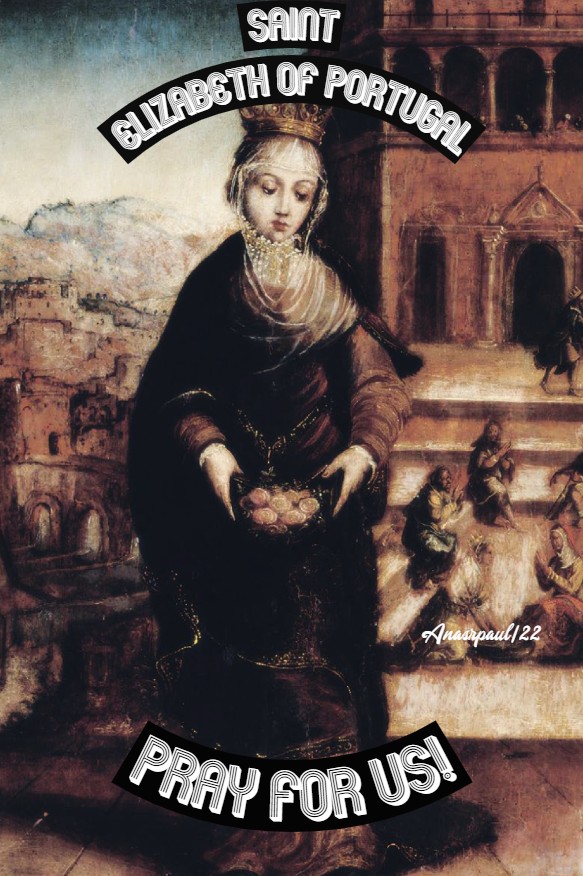
One Minute Reflection – 8 July– “The Month of the Most Precious Blood” – St Elizabeth of Portugal TOSF (1271-1336) Widow, Queen – Proverbs 31:10-31; Matthew 13:44-52 – – Scripture search here: https://www.drbo.org/
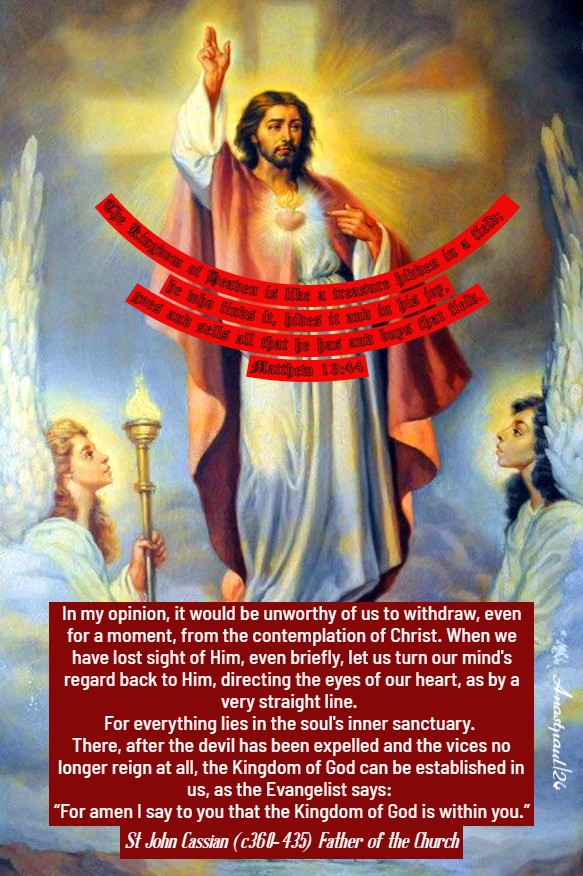
“The Kingdom of Heaven is like a treasure hidden in a field; he who finds it, hides it and in his joy, goes and sells all that he has and buys that field.” – Matthew 13:44
REFLECTION – “In my opinion, it would be unworthy of us to withdraw, even for a moment, from the contemplation of Christ. When we have lost sight of Him, even briefly, let us turn our mind’s regard back to Him, directing the eyes of our heart, as by a very straight line. For everything lies in the soul’s inner sanctuary. There, after the devil has been expelled and the vices no longer reign at all, the Kingdom of God can be established in us, as the Evangelist says: “For amen I say to you that the Kingdom of God is within you.”
But within us there can be nothing else than knowledge or ignorance of the truth and the love, of either the vices, or the virtues, by which we make ready a Kingdom in our hearts, either for the devil or for Christ.
The Apostle Paul also describes the characteristics of this Kingdom when he says: “For the Kingdom of God is not food and drink but righteousness and peace and joy in the Holy Ghost.” Thus, if the Kingdom of God is within us and the Kingdom of God is itself, righteousness and peace and joy, then, whoever abides in these things, is undoubtedly in the Kingdom of God … Let us lift up the eyes of our soul to that Kingdom which is endless joy!” – St John Cassian (c360-435) Monk, Theologian, Founder of Monasteries, Father of the Church, Disciple of St John Chrysostom (Conferences No 1).
PRAYER – Most merciful God, Who among other admirable gifts, endowed blessed Queen Elizabeth with the special grace of calming the tumult of war; grant by her intercession that, after the peace for which we humbly pray, we may attain everlasting happiness. Through the same Jesus Christ, Thy Son our Lord, Who lives and reigns with Thee, in the unity of the Holy Ghost, God, world without end. Amen (Collect).
Our Morning Offering – 8 July – Pentecost Thursday
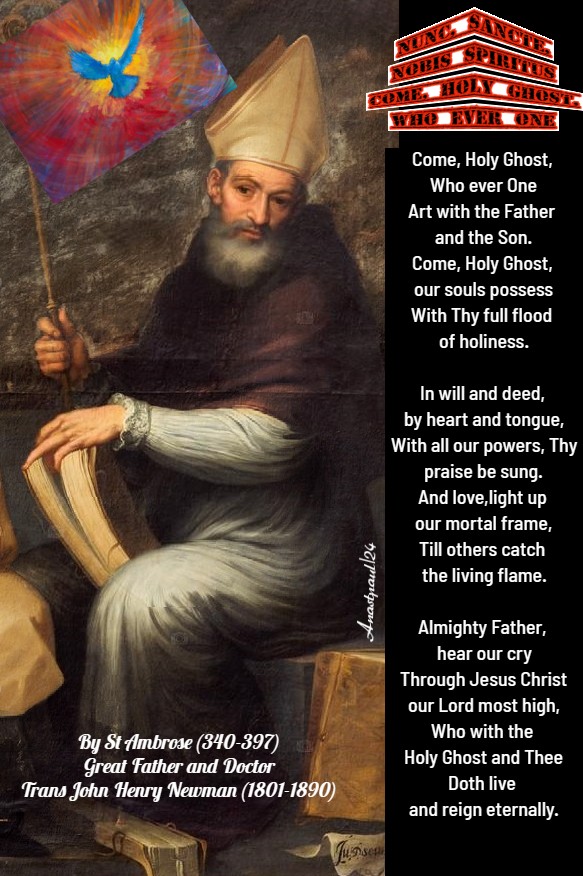
Nunc, Sancte, nobis Spiritus Come, Holy Ghost, Who ever One By St Ambrose (340-397) Trans John Henry Newman (1801-1890) Trans 1836
Come, Holy Ghost, Who ever One Art with the Father and the Son. Come, Holy Ghost, our souls possess With Thy full flood of holiness.
In will and deed, by heart and tongue, With all our powers, Thy praise be sung. And love, light up our mortal frame, Till others catch the living flame.
Almighty Father, hear our cry Through Jesus Christ our Lord most high, Who with the Holy Ghost and Thee Doth live and reign eternally.
Saint of the Day – 8 July – Saint Grimbald (c827-901) Abbot, Confessor, Overseer of the foundation of Newminster Monastery in England. Born in c827 at St Omer in Flanders, now Belgium (although this Town now lies within the French territories near the Belgiab border) and died on 8 July 901 of natural causes at jis new Monastery Newminster. Also known as – Grimwald, Grimbold.
Grimbald became a Monk at the Abbey of St Bertin near his home town of St Omer.
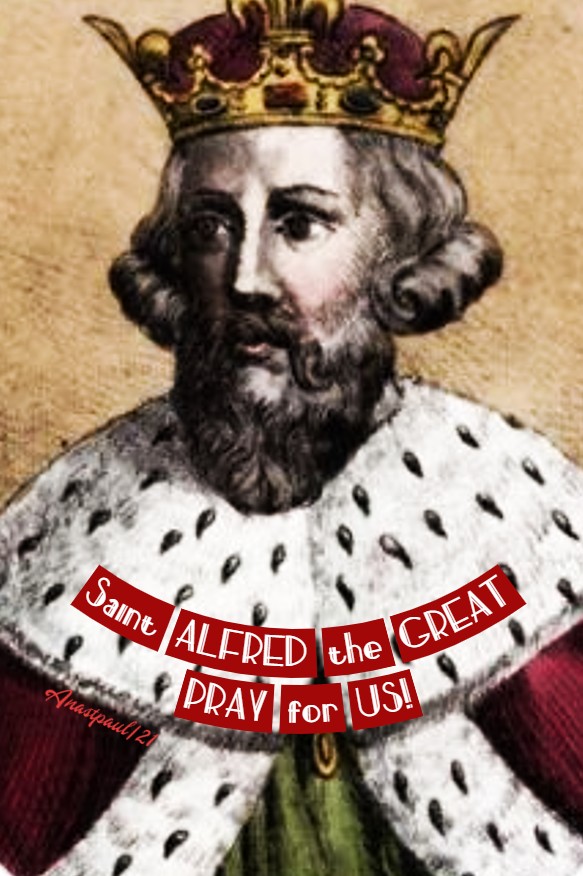
According to Grimbald’s ‘Vita Prima’ St Alfred the Great (849-899) King of Wessex (and effectively all of England) met Grimbald before his reign, at St Bertin’s Monastery whilst St Alfred was travelling to Rome. He was greatly impressed by our Saint and after his Coronation, in around 892, King Alfred, with the agreement and advice of St Eldred, the Archbishop of Canterbury, sent messengers to St Bertin’s to invite Grimbald to visit England.
Invited for his lpiety, devotion and scholarship, Grimbald was one of severallearned men who had been invited to the English Court to assist the King in his educational pursuits and was among the most prominent.
In fact, in the Introduction of his translation of St Gregory the Great’s Pastoral Care, KingAlfred mentions the assistance he had received from St Grimbald in the work and especially in translation of the Latin.
St Alfred is represented as the Founder of Oxford University together with our Saint and other learned and saintly men. It is believed that Grimbald was appointed as the first Professor of Divinity.
Grimbald refused King Alfred’s offer of the appointment to the See of Canterbury but after Alfred’s death, he accepted the appointment as the Abbot, to the yet unbuilt Monastery, Newminster, in Winchester by King Alfred’s son and successor as King, Edward the Elder.
After two decades in England, Grimbald became ill. He attended Holy Mass and sought the consolation of the reception of the Blessed Eucharist. He then spent several days in prayer and contemplation, gathered the Monks of the community to his cell for one last time of unity and died. It was 8 July 901. He was immediated venerated as a Saint and confessor and many Churches were dedicated to him. The Grimbald Gospels in the British Library are named after him.
St Elizabeth of Portugal TOSF (1271-1336) Widow, Queen Consort, Widow, Franciscan Tertiary, Apostle of Charity and Peace, Political Negotiator and Mediator. In the year 1694 Pope Innocent XII moved her Feast to 8 July, so that it would not conflict with the celebration of the Octave of Saints Peter and Paul, Apostles. Biography: https://anastpaul.com/2018/07/04/saint-of-the-day-4-july-st-elizabeth-of-portugal-t-o-s-f-1271-1336/
St Abraham the Martyr Bl Adolf IV of Schauenburg St Pope Adrian III
St Morwenna – No details about her have survived. She is reported to have appeared in visions in Morwenstow, Cornwall, England, where her Relics are apparently buried under the Church floor.
St Pancras of Taormina Bl Peter the Hermit St Procopius of Ceasarea St Sunniva of Bergen St Thibaud de Marly St Totnan of Thuringia
Abrahamite Monks/Martyrs of Constantinople: A group of Monks in a Monastery founded by Saint Abraham of Ephesus. Martyred in the iconoclast persecutions of Emperor Theophilus. In c 835 in Constantinople.
Martyrs of Shanxi – 7 Saints: In 1898 seven sisters of the Franciscan Missionaries of Mary were sent to the Shanxi Diocese in China to serve the poor in hospitals and care for the unwanted or other destitutes in orphanages. They were: Anne-Catherine Dierks, Anne-Francoise, Moreau, Clelia Nanetti, Irma Grivot, Jeanne-Marie Kuergin, Marianna Giuliani, Pauline Jeuris There they all died in one of the periodic persecutions against foreign missionaries. They were beheaded on 9 July 1900 at Taiyuanfu, China- Canonisedon 24 November 1946 by Pope Pius XII.
Martyrs of Syrmium – 5 Saints: Five Christians Martyred together for their faith. We know nothing else about them but the names – Cecilia, Eperentius, Eraclius, Sostratus and Spirus. They were martyred in the 4th century in Syrmium, Pannonia (modern Serbia).
Thought for the Day –7 July – Meditations with Fr Richard Frederick Clarke SJ (1839-1900)
PATIENCE Meditations for a Month
The Patience of the Saints
To the grace of patience, all the Saints, in great measure, owe their eternal reward. Their crown in Heaven will not be due, so much to what they have done for God, as to what they have suffered for Him. In them, ‘patience has its perfect work’ (St James 1 : 4) and that work has been to prepare them for the eternal joys of Heaven. Oh, how grateful they will be to God for the patience which He has given them to suffer willingly for Him! How grateful they will be for the sufferings which have procured for them, such happiness inexpressible and peace, which knows no end!
The Saints, while still on earth, have a truer view of all the events of life than we have. They value, above all things, even while they are still suffering them, the crosses and afflictions which God sends them. The Apostles counted it joy to suffer shame for Christ’s sake. ‘We glory in tribulation,’ says St Paul. St Francis Xavier prayed for more suffering; St Teresa that she might go on suffering until her death. This was no mere sentiment, it was common sense and ordinary prudence. They found a real joy, even here in suffering. Have I any such joy? or do I dislike and try to avoid suffering? Here is a test of whether I am like the Saints?
The patience of the Saints was more severely tried than is ours. Not only were they stoned, racked, torn asunder, not only did they suffer want, distress, afflictions (Hebrews 11 : 37) but, they had to endure what was still more difficult – ingratitude, failure, unkindness, false accusations, desolation, darkness. Yet they willingly endured all for Jesus’ sake, never ceasing to love Him through it all. I have my trials, yet none so dreadful as theirs, yet I complain even under my lighter cross!
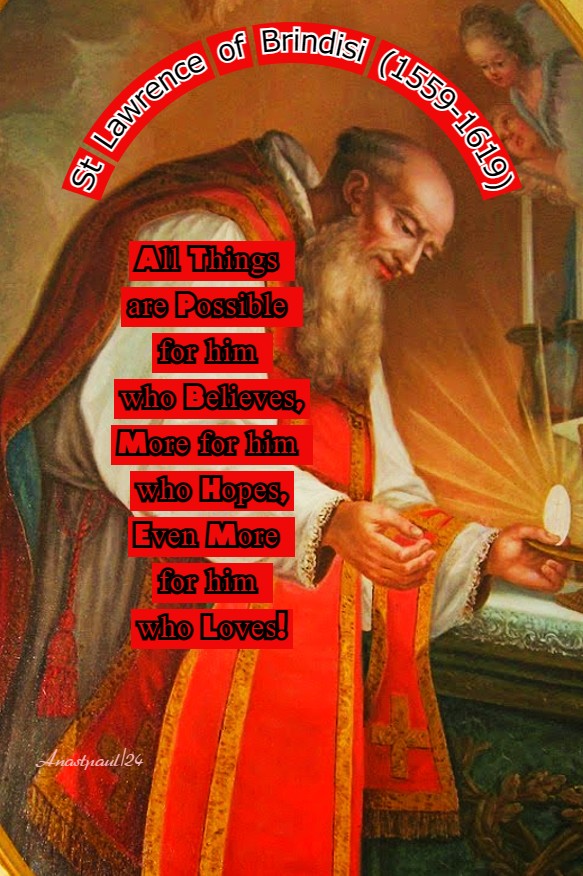
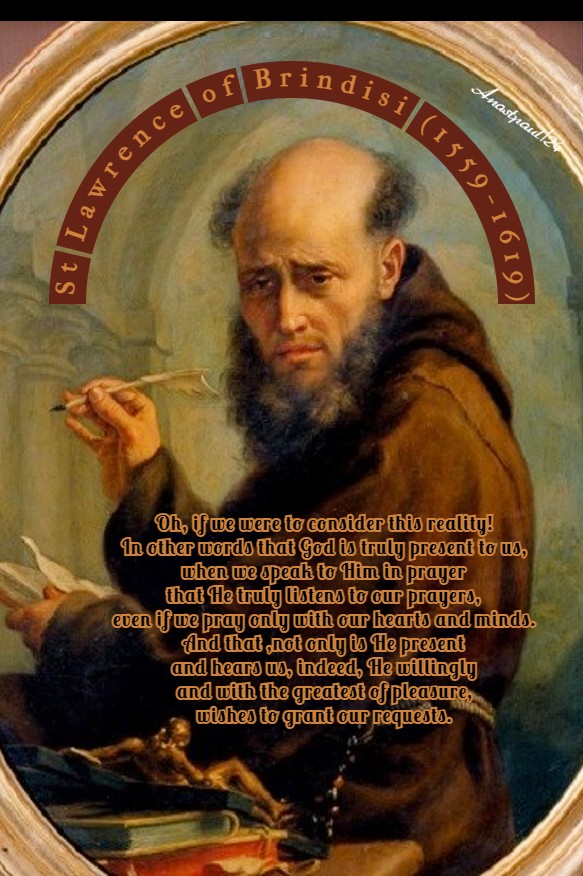
Quote/s of the Day – 7 July – St Lawrence of Brindisi OFM Cap (1559-1619) Confessor, The “Franciscan Renaissance Man,” Priest
“All things are possible for him who believes, more for him who hopes, even more for him who loves.”
“Oh, if we were to consider this reality! In other words that God is truly present to us, when we speak to Him in prayer that He truly listens to our prayers, even if we pray only with our hearts and minds. And that ,not only is He present and hears us, indeed, He willingly and with the greatest of pleasure, wishes to grant our requests.”
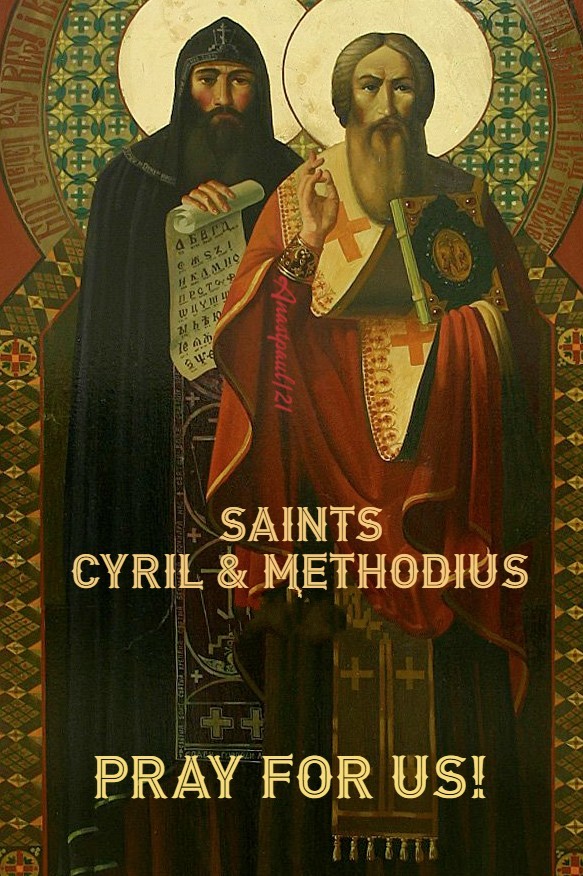
One Minute Reflection – 7 July – “The Month of the Most Precious Blood” – Saint Cyril (827-869) and Saint Methodius (826-885) “Apostles to the Slavs,” Sibling Brother Bishops, Confessors – Romans 6:19-23; Matthew 7:15-21 – Scripture search here: https://www.drbo.org/
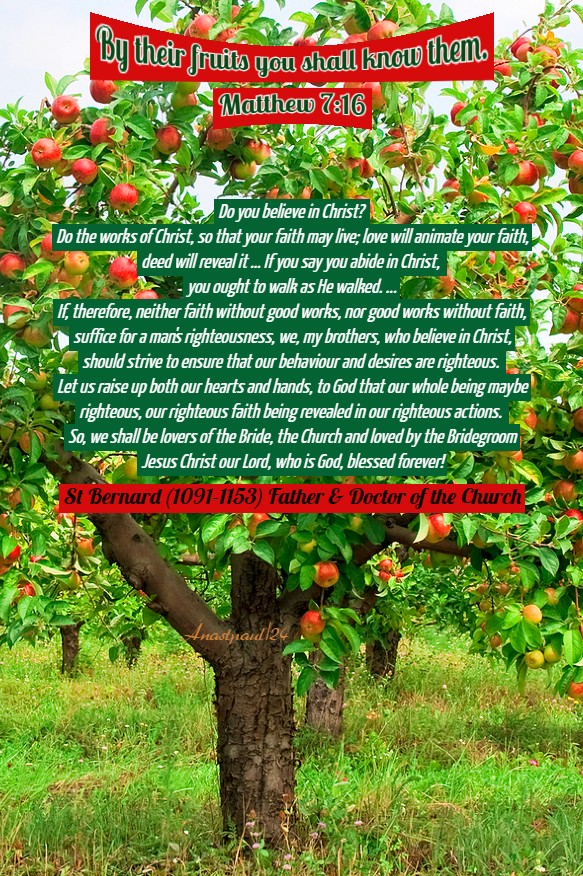
“By their fruits you shall know them.”- Matthew 7:16
REFLECTION – “Do you believe in Christ? Do the works of Christ, so that your faith may live; love will animate your faith, deed will reveal it … If you say you abide in Christ, you ought to walk as He walked. But if you seek your own glory, envy the successful, slander the absent, take revenge on those who injure you, this Christ did not do. You profess to know God, yet reject Him by your deeds! … “Such a one honours Me with his lips but his heart is far from Me” (Is 29:13; Mt 15:8)…
You see then that right faith, will not make a man righteous, unless it is enlivened by love. Someone, who has no love, has no means of loving the Bride, Christ’s Church. But, on the other hand, deeds, however righteous, cannot make the heart righteous, without faith. Who would call a person righteous, who does not please God? But “without faith it is impossible to please God” (Heb 11:6). And God, cannot please the one, who is not pleasing to Him; for if God is pleasing to someone that person cannot displease God. Furthermore, if God is not pleasing to that person, neither is His Bride, the Church. How then can he be righteous, who loves neither God nor God’s Church, to whom is said: “The righteous love you”? (Sg 1,3 Vg.).
If, therefore, neither faith without good works, nor good works without faith, suffice for a man’s righteousness, we, my brothers, who believe in Christ, should strive to ensure that our behaviour and desires are righteous. Let us raise up both our hearts and hands, to God that our whole being maybe righteous, our righteous faith being revealed in our righteous actions. So, we shall be lovers of the Bride, the Church and loved by the Bridegroom Jesus Christ our Lord, who is God, blessed forever!” – St Bernard (1091-1153) Cistercian, Father and Ddoctor of the Church (24th sermon on the Song of Songs).
PRAYER – Look forgivingly on Thy flock, Eternal Shepherd and keep it in Thy constant protection, by the intercession of the blessed brothers, Cyril and Methodius, who, by the power of the Holy Ghost were moved to bring the light of the Gospel to a hostile and divided people. Through Jesus Christ, Thy Son our Lord, Who lives and reigns with Thee, in the unity of the Holy Ghost, God, world without end. Amen (Collect).
Our Morning Offering – 7 July – “The Month of the Most Precious Blood” – Pentecost VII
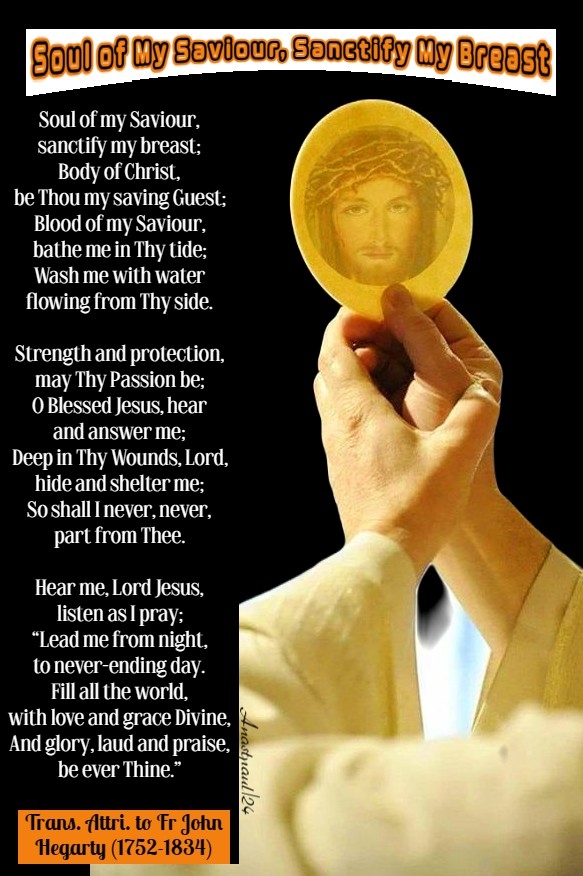
Soul of My Saviour, Sanctify My Breast Trans. Attri. to Fr John Hegarty (1752-1834)
Soul of my Saviour, sanctify my breast; Body of Christ, be Thou my saving Guest; Blood of my Saviour, bathe me in Thy tide; Wash me with water flowing from Thy side.
Strength and protection, may Thy Passion be; O Blessed Jesus, hear and answer me; Deep in Thy Wounds, Lord, hide and shelter me; So shall I never, never, part from Thee.
Hear me, Lord Jesus, listen as I pray; “Lead me from night, to never-ending day. Fill all the world, with love and grace Divine, And glory, laud and praise, be ever Thine.”
This Hymn is based on the original Latin text of the Anima Christi. Fr Hegarty is attributed with its translation and/or arrangement. He was born in County Derry, Ireland, educated at Dublin University and was Ordained in June 1890 and spent most of active apostolic years in Brisbane, Australia. He died aged 82 years.
Saint of the Day – 7 July – Saint Odo of Urgell (c1063-1122) Bishop, a zealous Defender of the rights of his See, builder and restorer of numerous Churches but most of all, Bishop Odo is remembered as a most gentle and generous benefactor of the poor, the needy and the ill. Born in Sort, Catalan, Spain in c1063 and died on 7 July 1122 in Urgell, Catalan, Spain. Patronage – of La Seu d’Urgell, Spain. Also known as – Oddone, (in Catalan -Ot, Dot) Odón.
Odo was the third son of Artal and Lucia, of the noble family of the Counts of Pallars. He was born in Sort between 1063 and 1065.
He embraced the Ecclesiastical state from a young age and was the Archdeacon of the Cathedral of Urgell for several years. He was elected as the Bishop in 1095.
Odo was a courageous defender of the rights of his See and built or restored numerous Churches. He promoted religious and social brotherhoods and spent much of this time and energy on assisting the poor and ill.
He died on 7 July 1122 and in the inscription engraved on his Tomb, he was praised as “father of orphans and widows, health of the sick and life of the poor.”
He is buried in the Monastery of Santa Maria de Gerri – see the Monastery below. In 1133 his successor declared him to be a Saint and he is venerated as such today. Odo is one of the Patron Saints of the town of La Seu d’Urgell.
His successor, Peter Berenguer (1123-1141) and the Cathedral Chapter, together authorised his public veneration on 21 June 1133. Since then, his Feast has been celebrated in Urgell, of which he is the Patron Saint, on 7 July, with his own Office until the reform of Saint Pius V in 1568 and with the O“ffice de Comuni Confessorum Pontificum,” thereafter. He entered the Roman Martyrology in the second edition of 1589.
Saint Cyril (827-869) Saint Methodius (826-885) “Apostles to the Slavs,” Sibling Brother Bishops, Confessors, Theologians, Missionaries, Writers, Preachers, Patrons of Europe. Creators of the Glagolitic alphabet, the first alphabet used to transcribe Old Church Slavonic and Cyrillac Alphabet, which was developed from it. Their Feast Day is 7 July (moved in 1969). The great Saints Cyril & Methodius: https://anastpaul.wordpress.com/2018/02/14/saints-of-the-day-14-february-sts-cyril-827-869-methodius-826-885/
St Lawrence of Brindisi OFM Cap (1559-1619) Confessor, The “Franciscan Renaissance Man,” Priest and Friar of the Friars Minor Capuchin, Theologian, Vicar General of the Franciscans, Language scholar, Humanist, Philosopher, Biblicist, Preacher, Missionary, Professor, International Administrator, Confidant of Popes, Emperors, Kings and Princes, Diplomatic envoy, Army Chaplain, Military Strategist and Morale builder, Polemicist, Prolific writer. He was Beatified on 1 June 1783 by Pope Pius VI and Canonised on 8 December 1881 by Pope Leo XIII. His Zealous Life: https://anastpaul.com/2017/07/21/saint-of-the-day-21-july-st-lawrence-of-brindisi-o-f-m-cap-doctor-of-the-church/
St Alexander St Angelelmus of Auxerre St Apollonius of Brescia
Blessed Pope Benedict XI OP (1240-1303) Cardinal-Priest of St Sabina, Bishop of Ostia then of Rome, Dominican Friar, Prior Provincial of Lombardy prior to becoming the Master of the Order in 1296, Apostolic Papal Legate to Hungary and France, Teacher, Preacher, Writer and renowned Scholar with special emphasis on Scriptural commentary. His Papacy began on 22 Ocober 1303 and ended at his death on 7 July 1304. His Life: https://anastpaul.com/2020/07/07/saint-of-the-day-7-july-blessed-pope-benedict-xi-1240-1303/
Bl Bodard of Poitiers St Bonitus of Monte Cassino St Carissima of Rauzeille St Eoaldus of Vienne
St Hedda of Wessex St Maelruan St Medran St Merryn Bl Oddino Barrotti St Odo of Urgell (c1063-1122) Bishop St Odran St Palladius of Ireland St Pantaenus of Alexandria
St Pantænus (Died c 216) Father of the Church, Theologian, Philosopher, Teacher, Confessor and Defender of the Faith, Writer and interpreter of the Bible, the Trinity and Christology, |Missionary. Convert of the disciples of the Apostles. Head of the Alexandrian School of Learning – a famous pupil was St Clement of Alexandria. Biography: https://anastpaul.com/2019/07/07/saint-of-the-day-7-july-st-pantaenus-father-of-the-church-died-c-216/
St Peter Fourier C.R.S.A. (1565-1640) Priest, Founder, Reformer, Confessor, Theologian, Teacher, Preacher, Apostle of Prayer, Penance and Charity, Marian devotee – “the Good Father of Mattaincourt” “le bon pere de Mattaincourt”. Although he died on 9 December his Feast Day is celebrated today, 7 July, possibly the date of the translation of part of his Relics. St Peter spread everywhere devotion to the Immaculate Conception of the Blessed Virgin. More than two centuries before the Miraculous Medal in 1830 and the proclamation of the dogma in 1854, he saw to the distribution of large quantities of a medal he had struck, on which were engraved the words – “Mary was conceived without sin.” He was Beatified by Pope Benedict XIII in 1730 and Canonised by Pope Leo XIII in 1897. St Peter Fourier is honoured by a statue of him in St Peter’s Basilica among the founders of religious orders. His Zealous Life: https://anastpaul.com/2018/12/09/saint-of-the-day-9-december-st-peter-fourier-c-r-s-a-1565-1640/
Martyrs of Durres – 7 Saints: Also known as – Martyrs of Dyrrachium/Martyrs of Durazzo. A group of seven Italian Christians who fled Italy to escape the persecutions of Emperor Hadrian. Arrived in Dyrrachium, Macedonia to find Saint Astius tied to a cross, covered in honey, laid in the sun and left to be tortured by biting and stinging insects. When they expressed sympathy for Astius, they were accused of being Christians, arrested, chained, weighted down, taken off shore and drowned. We know little more about each of them than their names – Germaus, Hesychius, Lucian, Papius, Peregrinus, Pompeius and Saturninus. They were born in Italy and were Martyred at sea c117 off the coast of Dyrrachium (Durazzo), Macedonia (modern Durres, Albania).























 AnaStpaul
You must be logged in to post a comment.