Our Morning Offering – 2 April – Maundy Thursday in Holy Week
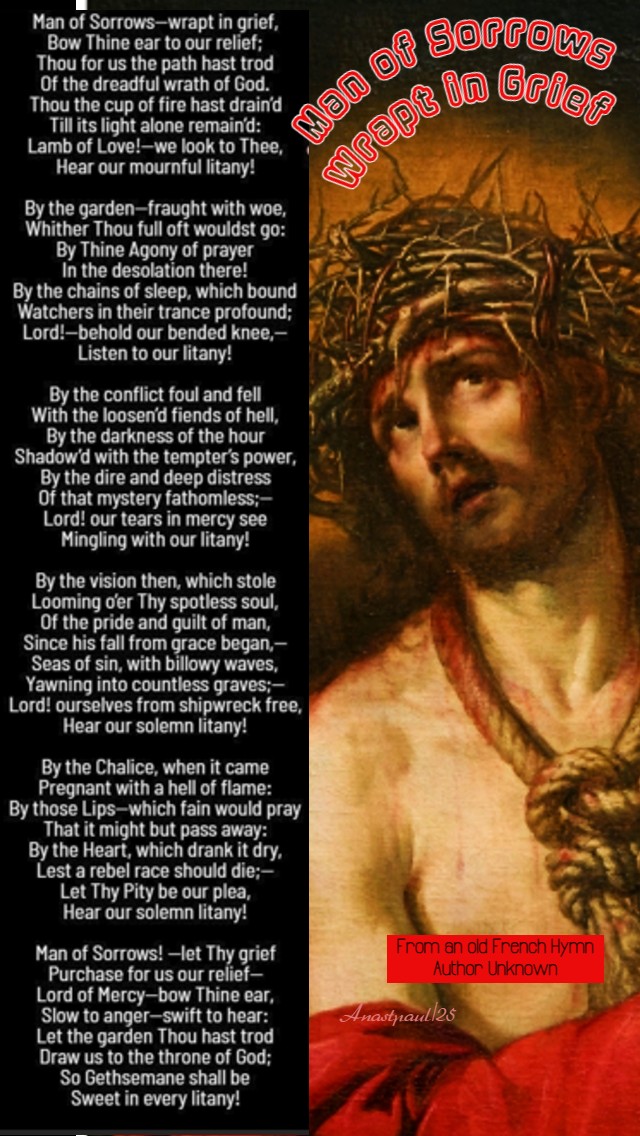
Man of Sorrows—Wrapt in Grief From an old French Hymn Author Unknown
Man of Sorrows—wrapt in grief, Bow Thine ear to our relief; Thou for us the path hast trod Of the dreadful wrath of God. Thou the cup of fire hast drain’d Till its light alone remain’d: Lamb of Love!—we look to Thee, Hear our mournful litany!
By the garden—fraught with woe, Whither Thou full oft wouldst go: By Thine Agony of prayer In the desolation there! By the chains of sleep, which bound Watchers in their trance profound; Lord!—behold our bended knee,— Listen to our litany!
By the conflict foul and fell With the loosen’d fiends of hell, By the darkness of the hour Shadow’d with the tempter’s power, By the dire and deep distress Of that mystery fathomless;— Lord! our tears in mercy see Mingling with our litany!
By the vision then, which stole Looming o’er Thy spotless soul, Of the pride and guilt of man, Since his fall from grace began,— Seas of sin, with billowy waves, Yawning into countless graves;— Lord! ourselves from shipwreck free, Hear our solemn litany!
By the Chalice, when it came Pregnant with a hell of flame: By those Lips—which fain would pray That it might but pass away: By the Heart, which drank it dry, Lest a rebel race should die;— Let Thy Pity be our plea, Hear our solemn litany!
Man of Sorrows! —let Thy grief Purchase for us our relief— Lord of Mercy—bow Thine ear, Slow to anger—swift to hear: Let the garden Thou hast trod Draw us to the throne of God; So Gethsemane shall be Sweet in every litany!
This translation by Matthew Bridges (1800-1894) (The Passion of Jesus 1852) Hymnist, Poet, Writer Converted to Catholicism in 1848, by the influence of John Henry Newman (1801-1890)
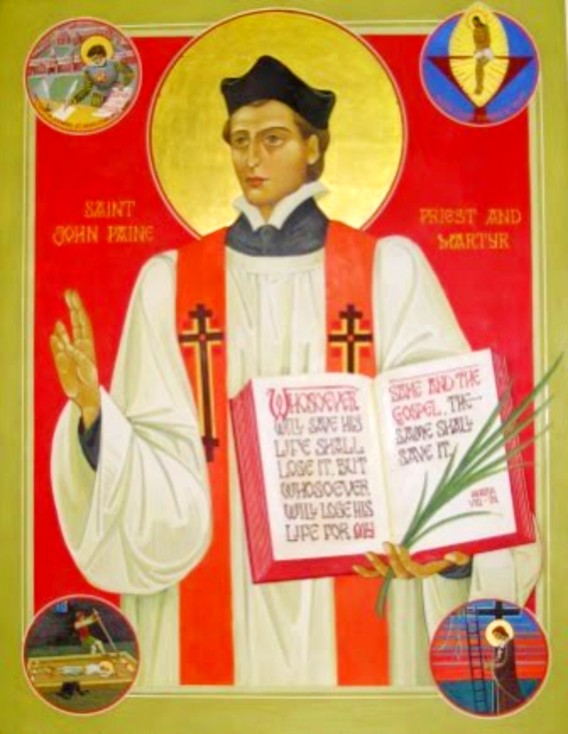
Saint of the Day – 2 April – Blessed John Payne (c1550-1582) Priest Martyr, Born in c1532 in Peterborough, Huntingdonshire, Cambridge, England and died on 2 April 1582 in Chelmsford, Essex by being hung, drawn and quartered, Also known as – Pain, Paine. Blessed John was Beatified on 29 December 1885 by Pope Leo XIII.
John Payne was born around 1550 near Peterborough in Huntingdonshire. Nothing is known of his youth, except that he was raised a Protestant. Only later did he convert to Catholicism and in 1574, he entered the new college in Douai to prepare for the Priesthood. There he was entrusted with the task of Bursar and in 1576 he was Ordained a Priest, although this suggests Blessed John had already undertaken Theological studies elsewhere.
He then returned home with Blessed Cuthbert Mayne, to exercise his ministry, settling in Essex at Ingatestone Hall, a guest of the Petres family, who were strongly opposed to the religious policies of the English Government. This facilitated his pastoral activity among the local Catholics, even though these were still difficult times for Catholics in communion with the Holy See.
In 1577 he was arrested and briefly imprisoned. Once released, he returned to Douai but by mid-1578 he was back at Ingatestone Hall.
In 1581, while working in Warwickshire, John Payne was betrayed, arrested and taken to the Tower of London. Accused of treason against the Queen, he was tortured on the wheel and sentenced to be hung, drawn and quartered.
He refused the assistance offered him by a certain George Elliott, reiterating instead “he had always, in mind or word, honoured her Majesty the Queen more than any other woman in the world; that he would always happily obey every civil duty; that he prayed for her as for his own soul; that he had never thought or plotted any treason against her Majesty or any nobleman of England.”
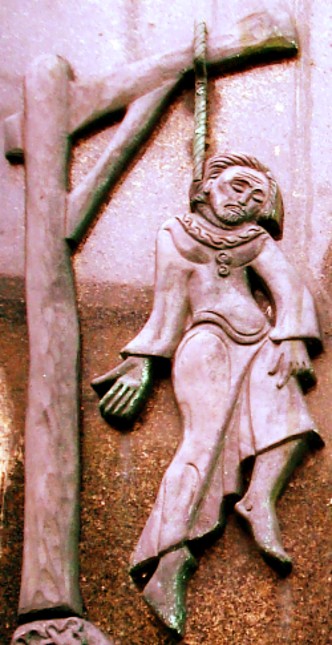
On 2 April 1582, the sad event occurred near Chelmsford in Essex which earned John Payne the Martyr’s Ccrown. Those who witnessed his execution, struck by the Priest’s upright conduct, asked that his body be left hanging until death, thus waiting to perform the gruesome procedures prescribed.
The Saint died uttering the words “Jesus, Jesus, Jesus.”
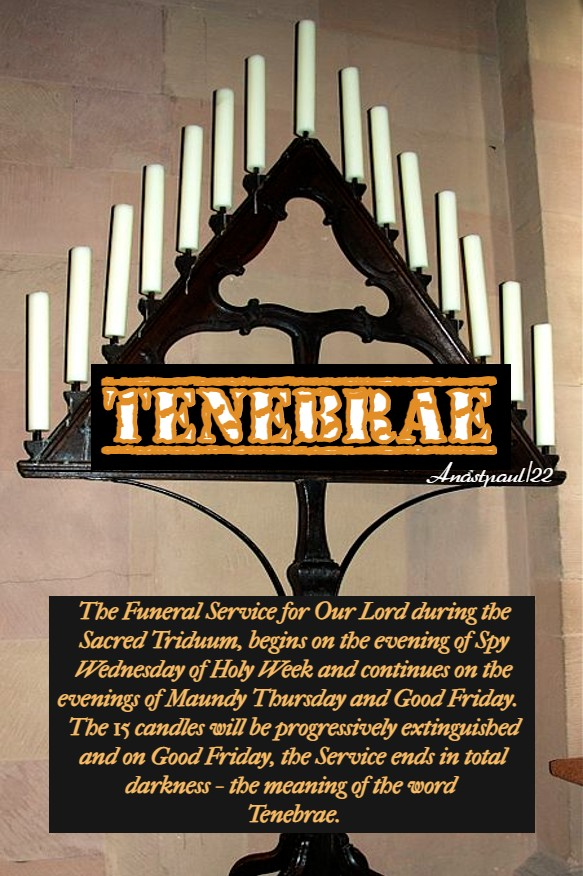
The Office of Tenebrae The public singing of part of the Divine Office, on Wednesday, Thursday and Friday evenings in Holy Week, anticipating Matins and Lauds of Holy Thursday, Good Friday and Holy Saturday. This custom goes back centuries and acquired the name because of the mourning ritual surrounding the ceremony which includes a triangular candlabra bearing fifteen candles. These are extinguishedt one by one until, after the last candle is extinguished, a prayer is said in darkness, one candle is lit and the assembly dispersed in silence.
St Francis of Paola O.M. (1416-1507) known as “Saint Francis the Fire Handler” – Confessor, Monk and Founder, inspired with the Gift of Prophecy and still called the “Miracle-Worker” Apostle of the poor, Peacemaker. He was an Italian mendicant Friar and the Founder of the Order of Minims. Unlike the majority of founders of men’s religious orders and like his Patron Saint, Francis was never ordained a priest. His Body was Incorrupt until destroyed in the French Revolution. He was Canonised in 1519 by Pope Leo X. St Francis’s Life: https://anastpaul.wordpress.com/2018/04/02/saint-of-the-day-2-april-st-francis-of-paola-o-m-1416-1507/
St Bronach of Glen-Seichis St Constantine of Scotland St Ebbe the Younger St Eustace of Luxeuil St Gregory of Nicomedia Blessed John Payne (c1550-1582) Priest Martyr
Blessed Leopold of Gaiche OFM Cap (1732-1815) Priest and Friar of the Order of Friars Minor of the Capuchin branch, Missionary Preacher in Italy, called “The Apostle of Umbria.” He became renowned for wearing a crown of thorns. He served in a position of power in the Franciscan Order in the Umbrian region in which he supported strong adherence to the Rule of Saint Francis. Biography: https://anastpaul.com/2022/04/02/saint-of-the-day-2-april-blessed-leopold-of-gaiche-ofm-cap-1732-1815/
Martyrs of Africa – 10 Saints: A group of ten Christians Martyred together in Africa, date unknown. We have six of their names – Marcellinus, Procula, Quiriacus, Regina, Satullus and Saturnin but no other information has survived.
Martyrs of Thessalonica – 16 Saints: Sixteen Christians who were Martyred together in Thessalonica in Greece, date unknown. We know nothing else about them but 13 of their names – Agapitus, Agatophus, Cyriacus, Dionysius, Gagus, Julianus, Mastisius, Proculus, Publius, Theodoulus, Urbanus, Valerius and Zonisus.





 AnaStpaul
You must be logged in to post a comment.