Passionate Catholic.
Being a Catholic is a way of life - a love affair "Religion must be like the air we breathe..."- St John Bosco
Prayer is what the world needs combined with the example of our lives which testify to the Light of Christ.
This site, which is now using the Traditional Calendar, will mainly concentrate on Daily Prayers, Novenas and the Memorials and Feast Days of our friends in Heaven, the Saints who went before us and the great blessings the Church provides in our Catholic Monthly Devotions.
This Site is placed under the Patronage of my many favourite Saints and especially, St Paul.
"For the Saints are sent to us by God
as so many sermons.
We do not use them, it is they who move us
and lead us, to where we had not expected to go.”
Charles Cardinal Journet (1891-1975)
This site adheres to the pre-Vatican II Catholic Church and all her teachings. .
PLEASE ADVISE ME OF ANY GLARING TYPOS etc - In June 2021 I lost 100% sight in my left eye and sometimes miss errors. Thank you and I pray all those who visit here will be abundantly blessed. Pax et bonum! 🙏
Thought for the Day – 21 October – Meditations with Antonio Cardinal Bacci (1881-1971)
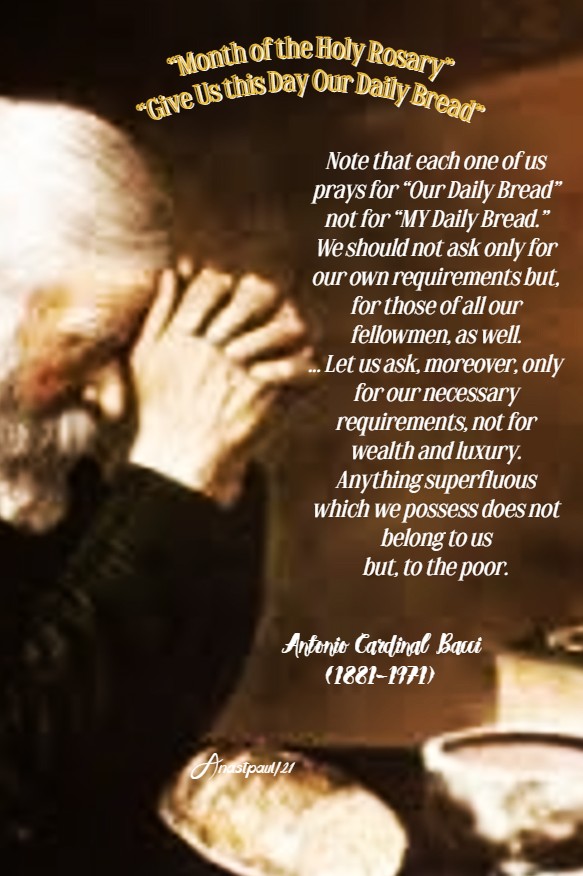
“Month of the Holy Rosary” “Give Us this Day Our Daily Bread”
“Note that each one of us prays for “Our Daily Bread” not for “MY Daily Bread.” We should not ask only for our own requirements but, for those of all our fellowmen, as well.
There are many poverty-stricken people for whom bread is very scarce. We should pray especially for them and should be prepared to share our bread with those who have none. Both charity and justice demand this of us. Let us ask, moreover, only for our necessary requirements, not for wealth and luxury. Anything superfluous which we possess does not belong to us but, to the poor. “Give that which remains,” the Gospel commands, “as alms” (Lk 11:41). Let us remember that, whether we are rich or poor, we are all one great family. Our love for one another should not be merely theoretical but practical, otherwise we are not sincere Christians!”
Quote/s of the Day – 21 October – “The Month of the Most Holy Rosary and of the Angels”
Remember the Angels especially during October
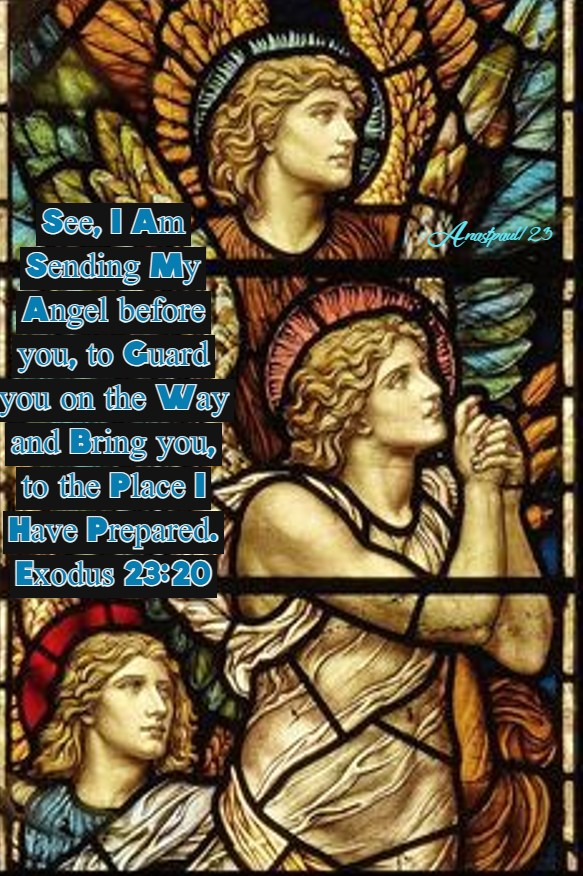
“See, I am sending My Angel before you, to guard you on the way and bring you to the place I have prepared.”
Exodus 23:20
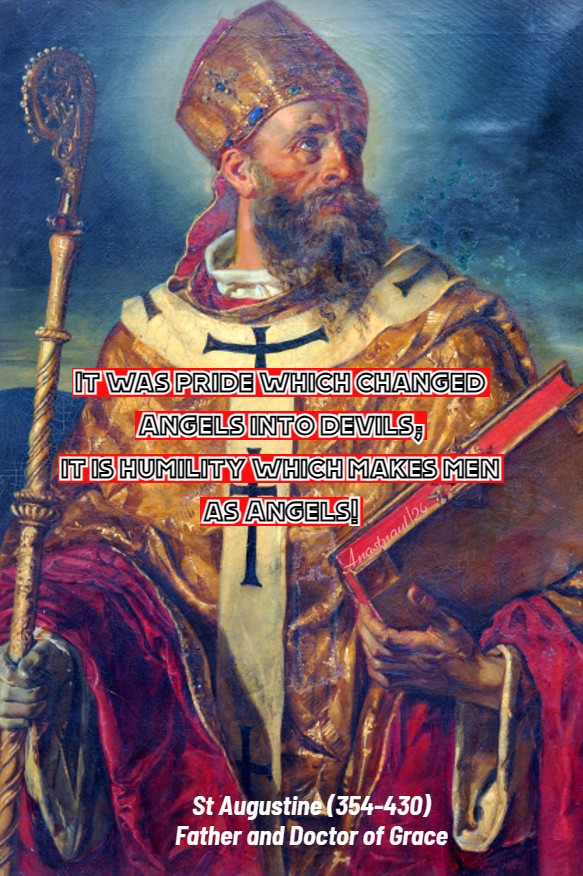
“It was pride which changed Angels into devils; it is humility which makes men as Angels!”
St Augustine (354-430) Father and Doctor of Grace
“We are like children, who stand in need of masters, to enlighten us and direct us and God has provided for this, by appointing His Angels, to be our teachers and guides.”
St Thomas Aquinas (1225-1274) Doctor Angelicus / Doctor Communis
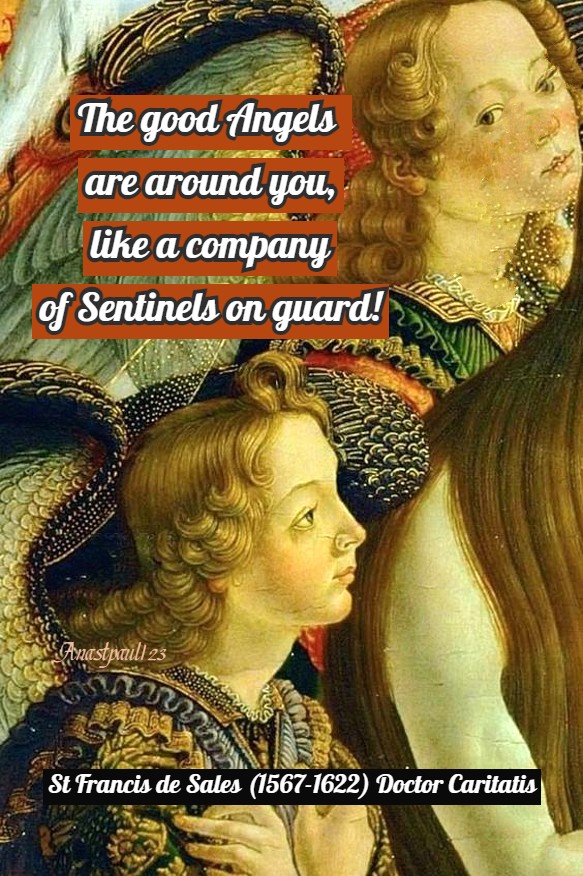
“The good Angels are around you, like a company of Sentinels on guard!”
St Francis de Sales (1567-1622) Doctor Caritatis
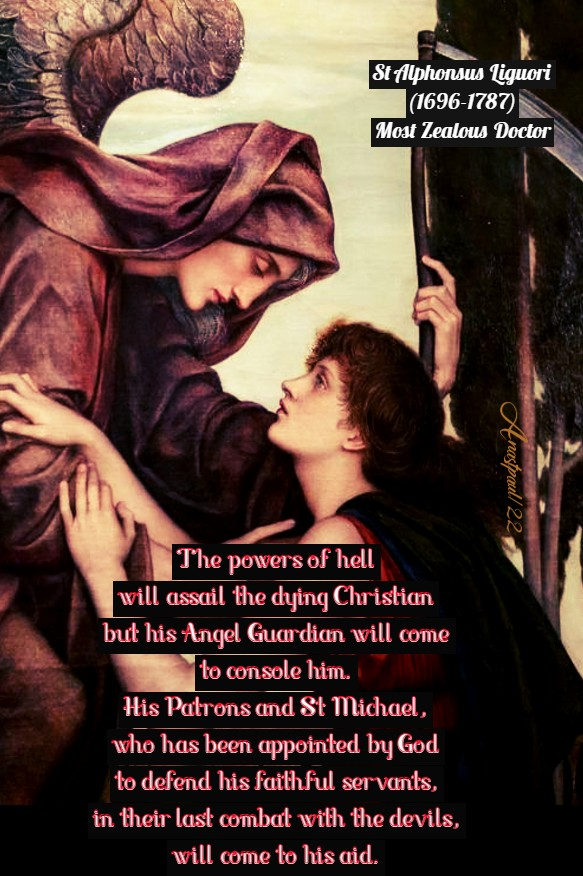
“The powers of hell will assail the dying Christian but his Angel Guardian will come to console him. His Patrons and St Michael, who has been appointed by God to defend his faithful servants, in their last combat with the devils, will come to his aid.”
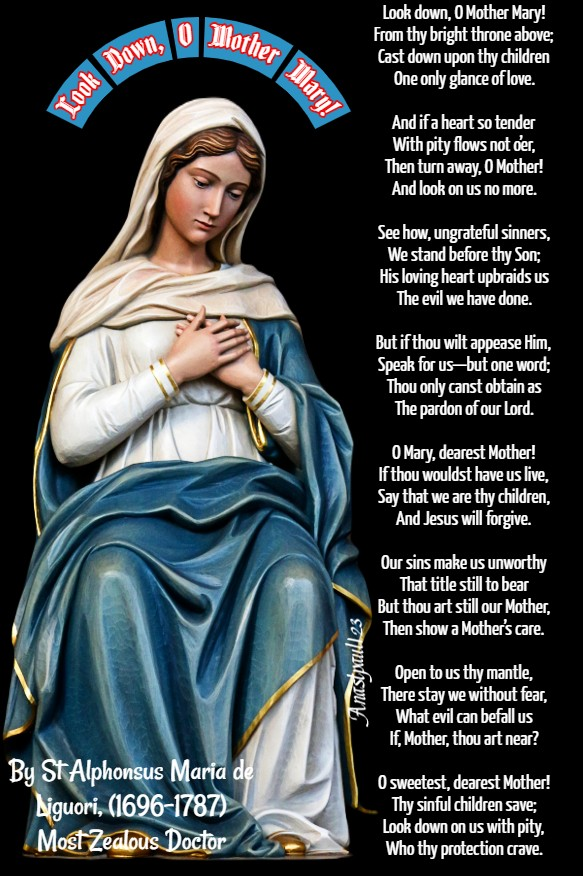
St Alphonsus Liguori (1696-1787) Most Zealous Doctor
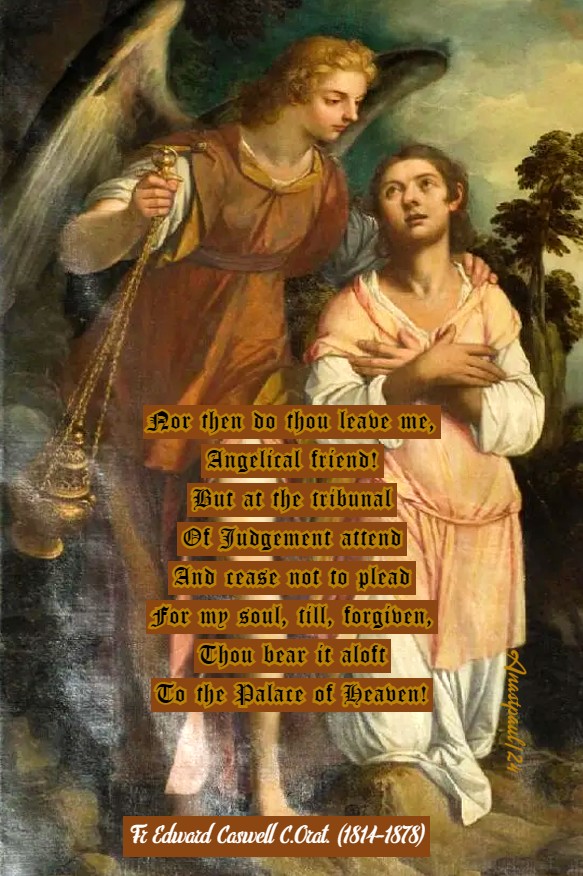
“Nor then do thou leave me, Angelical friend! But at the tribunal Of Judgement attend And cease not to plead For my soul, till, forgiven, Thou bear it aloft To the Palace of Heaven!”
From “Sweet Angel of Mercy!” By Fr Edward Caswell C.Orat. (1814-1878)
One Minute Reflection – 21 October – “The Month of The Most Holy Rosary and The Holy Angels” – Saint Ursula and Companions (Died c 238) Virgin Martyrs – Ecclesiasticus 45:1-6 – Matthew 19:27-29 – Scripture search here: https://www.drbo.org/
“… Shall receive a hundredfold and shall possess life everlasting.” – Matthew 19:29
REFLECTION – “The possessions which we have, are not our own: God has given them to us to cultivate and He wishes us to render them fruitful and profitable … Always deprive yourself, therefore, of some part of your means, giving them to the poor with a willing heart … It is true that God will return it to you, not only in the next world but also in this, for there is nothing which makes a person prosper, in temporal matters, so much, as almsgiving. But until such time as God shall repay it, you will always be impoverished to that extent. Oh! how holy and rich is the impoverishment which is caused by almsgiving.
Love the poor and poverty, for by this love you will become truly poor, since, as Scripture says: “We become like the things that we love” (cf Hos 9:10). Love makes those who love, equal to one another: “Who is weak and I am not weak?” says St Paul (2 Cor 11:29). He might have said: “Who is poor, with whom I am not poor?” For love made him become, such as those whom he loved. If, then, you love the poor, you will be truly participating in their poverty and poor like them. Now, if you love the poor, be often among them; be pleased to see them in your house and to visit them in theirs; associate willingly with them; be glad that they are near you in the Churches, in the streets and elsewhere. Be poor in speech with them, speaking to them as their equal but be rich in deed, giving them of your goods, as one who possesses more abundantly.
Will you do even more? … Become a servant of the poor; go to serve them … with your own hands … and at your own expense. This service has more glory in it than a throne!” – St Francis de Sales (1567-1622) Bishop of Geneva and Doctor of the Church (Introduction to the devout life, Part three Ch 15).
PRAYER – Grant, we beseech Thee, O Lord our God that we may never cease devoutly, to venerate the triumphs of Thy holy Virgins and Martyrs, Ursula and her companions that, as we cannot worthily shew forth their praises, yet we may continually honour them, with lowly service. Through Jesus Christ, Thy Son our Lord, Who lives and reigns with Thee, in the unity of the Holy Ghost, God, world without end. Amen (Collect).
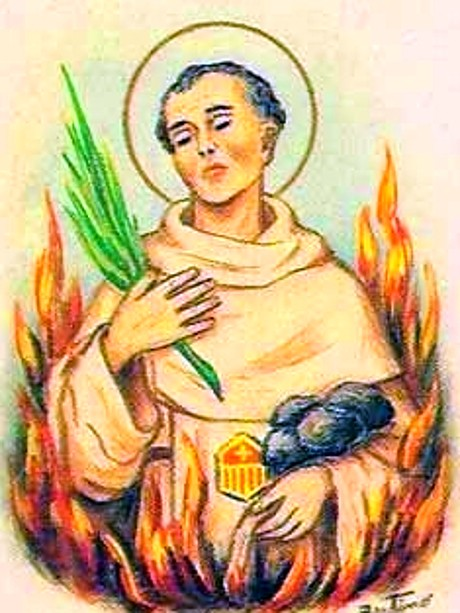
Saint of the Day – 21 October – Saint Malchus (Died c390) Monk and Hermit of Syria. Born around the 4th Century near Antioch, Syria and died there in c390. Malchus is the subject of Saint Jerome’s “Life of Malchus the Captive Monk” (Vita Malchi Monachi Captivi), written in Latin around 391. Also known as – Malchus of Chalcis, Malchus of Maronia.
The Roman Martyrology reads today: “At Marconia near Antioch, in Syria, St Malchus, Monk.”
In 375, Saint Jerome retired to Maronia (a small village around 50 kms south of Antioch), on the estates of his friend St Evagrius Ponticus (c345-399), to lead a Hermit’s life. There he met the Monk Malchus, who recounted the romantic details of his life.
A few years later (390-391), St Jerome recounted these events in the “Vita Malchus Monachi Captivi.” The work, as St Jerome himself states, has the feel of a literary exercise (“I wish to try my hand at a small work and thus, put aside a certain rustiness of the tongue”) and has a parenetic-ascetic purpose (“I expose to chaste people, a tale about chastity… You tell this to posterity, so that they may know that, among swords and deserts and wild beasts, modesty is never enslaved and, the man consecrated to God, can die and never be defeated”).
From a literary perspective, it is highly valuable. Perhaps based on a historical figure he knew, St Jerome composed the Vita with a purposes in favor of monasticism and chastity.
According to the Vita Malchus, descended from a noble family, had retreated to the desert of Chalcis to devote himself to monastic life, despite his father’s staunch opposition. In the Monastery, however, he clashed with the Abbot because, following his father’s death, he intended to take possession of the family property to distribute it to the poor and build a Monastery.
For this attachment to worldly things, Ma;chus was punished; in fact, having left the Monastery, he fell in with a group of Bedouins in the desert, who sold him to a landowner from a distant region. He was entrusted with the care of the flock, a task he did not dislike, as in the midst of the pastures he was able to pray and enrich his spiritual life by contemplation.
In recognition of his faithfulness and excellent service, his master intended to marry him to a slave who had been violently separated from her husband. The idea of an adulterous marriage aroused a sense of despair in Malchus but the woman proposed a sham marriage, living in absolute chastity. They spent some time together, then attempted an escape. St Jerome’s narrative at this point takes on romantic overtones. The two, joined in the desert by their master and a servant, took refuge in the den of a lioness, who first mauled the servant and then the master. Malchus and the woman, using the camels of the slain, reached the Monastery where Malchus had begun his monastic life. Having been rejected, Malchus moved, followed by the woman, to Maronia, where he met St Jerome . There, the woman retired to a Convent.
The episode of the spouses, who lived in perfect chastity, is a very common motif in ancient hagiography. St Jerome’s work was translated into verse by Jean de la Fontaine, a 17th Century French Poet. Three ancient versions of the Vita exist (Latin, Greek, Syriac) which differ only marginally.
St Malchus’ cult spread widely in the East, where the he is remembered on 26 March and in the West on 21 October.
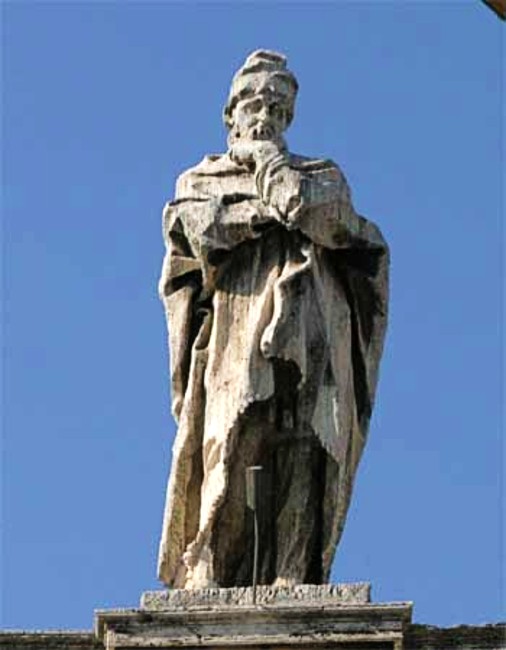
St Malchus on the North Colonnade at St Peter’s Basilica
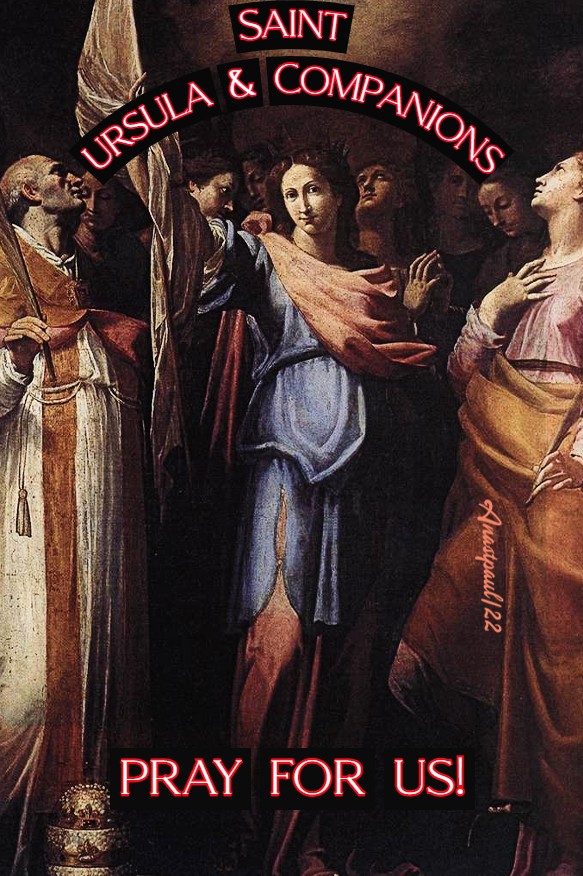
Saint Ursula and Companions: (Died c238) Virgin Martyrs This Amazing Story: https://anastpaul.com/2022/10/21/saint-of-the-day-21-october-saint-ursula-and-companions-died-c-238-virgin-martyr/ There are other Saints closely associated with Ursula and her story – travelling companions who were Martyred with her. They are: Antonia of Cologne Cesarius of Cologne Cyriacus of Cologne Daria Fiolanus of Lucca Ignatius of Cologne James of Antioch Mauritius of Cologne Pontius of Cologne Sulpitius of Ravenna Vincent of Cologne Travelling companion, but escaped the massacre: Cunera Led by a dove to the lost tomb of St Ursula: Cunibert of Cologne.
St Agatho the Hermit St Asterius of Périgord St Asterius of Rome
Thought for the Day – 20 October – Meditations with Antonio Cardinal Bacci (1881-1971)
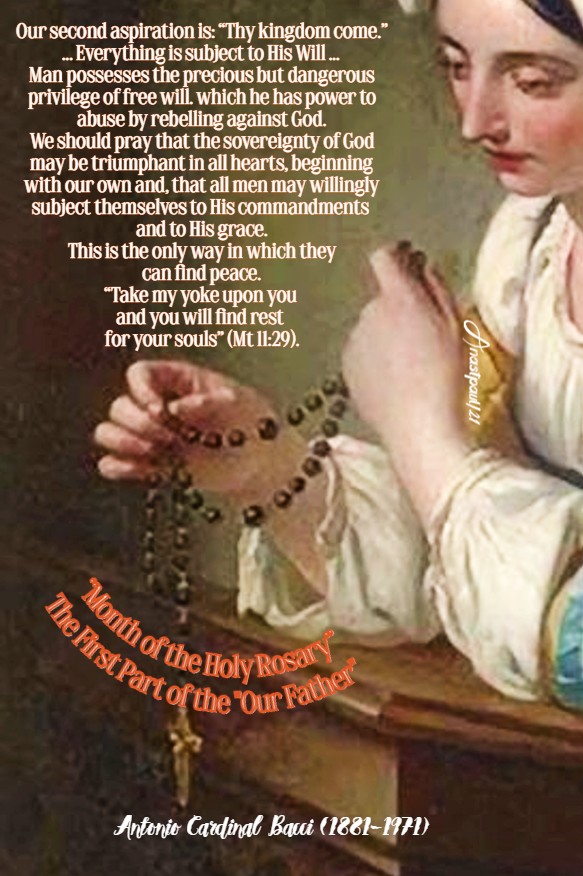
“Month of the Holy Rosary” The First Part of the “Our Father”
“Our second aspiration is: “Thy Kingdom come.” It is true, that God reigns over Heaven, earth and the infernal regions. Everything is subject to His Will – the sun, the stars, the birds of the air, the fishes of the sea and the tiniest insects carry out His commands. Even the demons of Hell, who He has condemned to eternal punishment, are obedient to His Will. But what about the human race?
Man possesses the precious but dangerous privilege of free will which he has power to abuse by rebelling against God. We should pray that the sovereignty of God may be triumphant in all hearts, beginning with our own and, that all men may willingly subject themselves to His commandments and to His grace. This is the only way in which they can find peace. “Take my yoke upon you and you will find rest for your souls” (Mt 11:29).
We should pray, moreover, for the Church, which is the Kingdom of God upon earth. We should pray for her peaceful victory over her enemies, who persecute her and impede her work for the salvation of souls. We should love the Church even as we love Jesus Christ, for the Church is His handiwork and the fruit of His Precious Blood.”
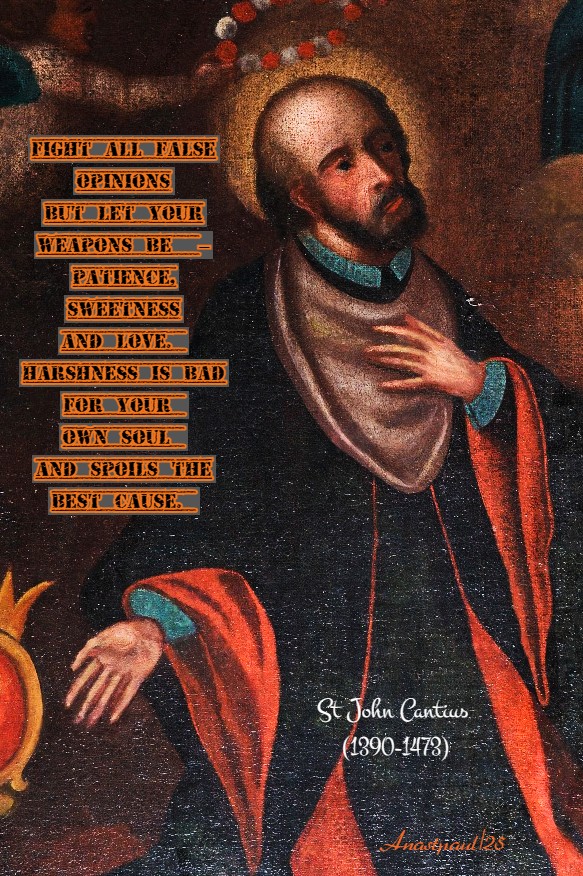
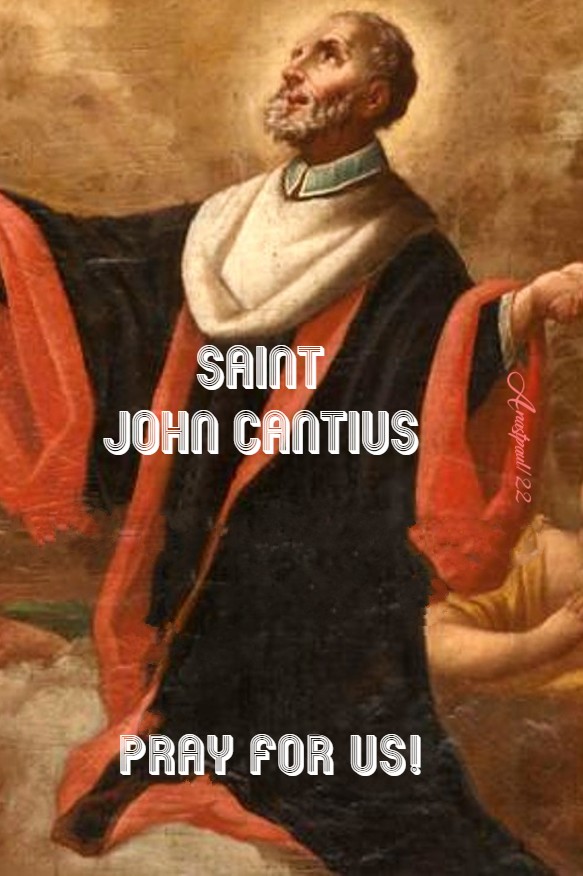
One Minute Reflection – 20 October – “The Month of The Most Holy Rosary and The Holy Angels” – St John Cantius (1390-1473) Confessor – The Feast of Mater Admirabilis / Mother Most Admirable – James 2:12-17 – Luke 12:35-40 – Scripture search here: https://www.drbo.org/
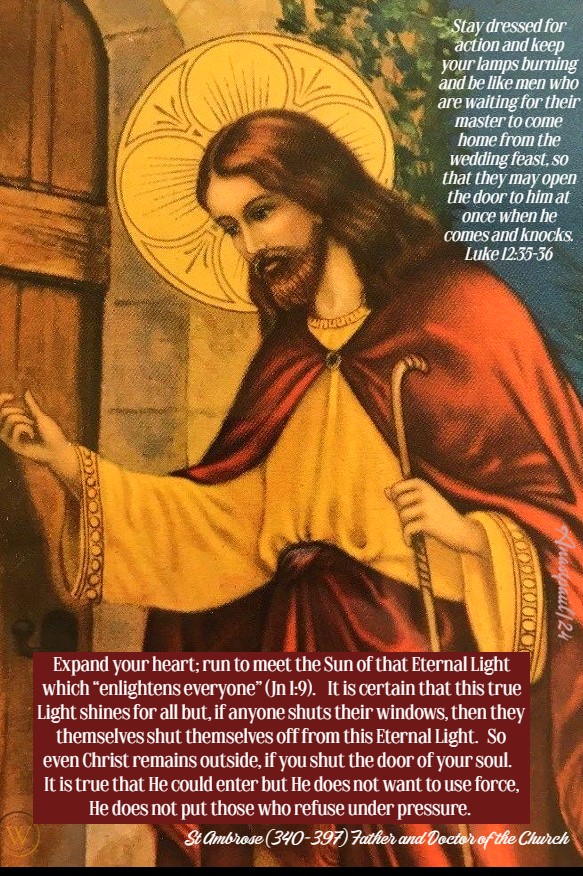
“Stay dressed for action and keep your lamps burning and be like men who are waiting for their master to come home from the wedding feast, so that they may open the door to him at once when he comes and knocks.” – Luke 12:35-36
REFLECTION – “God, the Word, stirs up the lazy and arouses the sleeper. For indeed, someone who comes knocking at the door is always wanting to come in. But it depends on us, if He does not always enter or always remain. … May your door be open to Him who comes; open your soul, enlarge your spiritual capacities, that you may discover the riches of simplicity, the treasures of peace and sweetness of grace. Expand your heart; run to meet the Sun of that Eternal Light which “enlightens everyone” (Jn 1:9). It is certain, that this true Light shines for all but, if anyone shuts their windows, then they themselves, shut themselves off from this Eternal Light.
So even Christ remains outside, if you shut the door of your soul. It is true, He could enter but He does not wish to use force, He does not put those who refuse under pressure. Descended from the Virgin, born from her womb, He shines throughout the universe to give Light to all. Those who long to receive the Light, Who shines with an everlasting brightness, open up to Him. No night comes to intervene . Indeed, the sun we see each day, gives way to night’s darkness but the Sun of Justice (Mal 3:20) knows no setting, for Wisdom is not overcome by evil.” – St Ambrose (340-397) Bishop of Milan and Father and Doctor of the Church (12th Sermon on Psalm 118).
PRAYER – Grant, we beseech Thee, Almighty God, that by following the example of blessed John, Thy Confessor, we may advance in a knowledge of holiness and, by showing pity for others, obtain Thou forgiveness through his merits. Through Jesus Christ, Thy Son our Lord, Who lives and reigns with Thee, in the unity of the Holy Ghost, God, world without end. Amen (Collect).
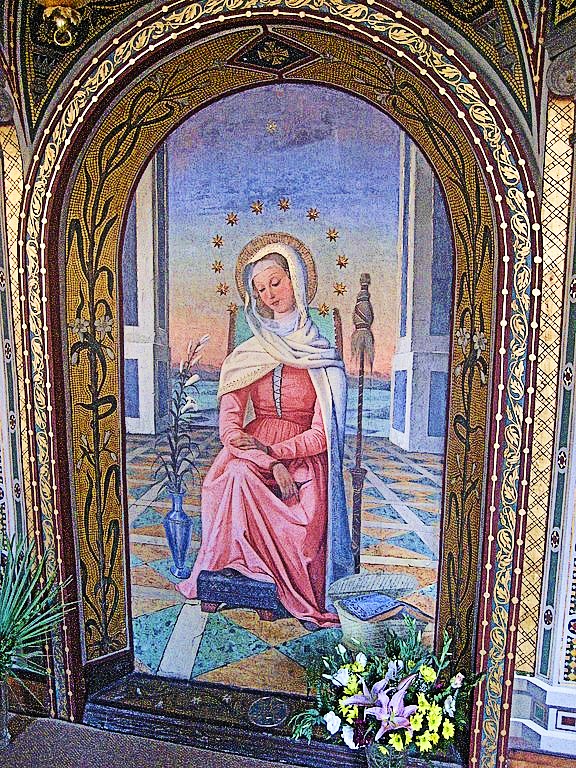
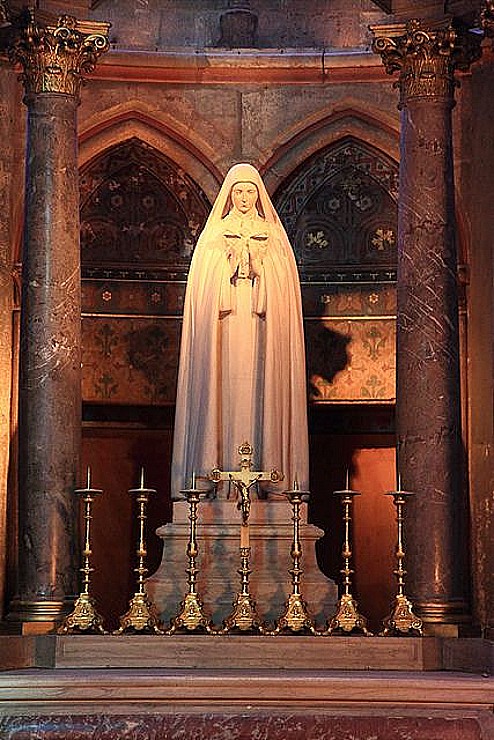
Our Morning Offering – 20 October – “The Month of the Most Holy Rosary and of the Angels” – Feast of Mater Admirabilis / Mother Most Admirable
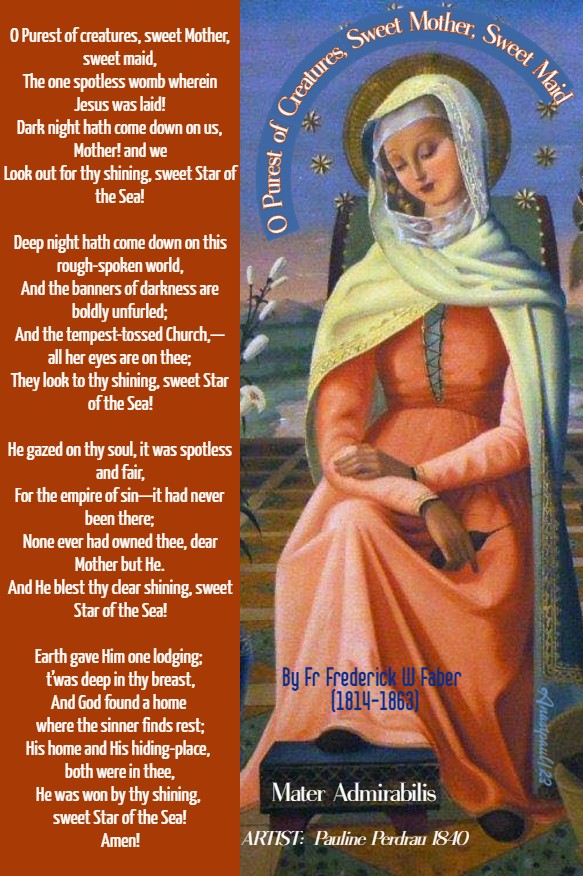
O Purest of Creatures, Sweet Mother, Sweet Maid By Fr Frederick W Faber C.Orat. (1814-1863)
O Purest of creatures, sweet Mother, sweet maid, The one spotless womb wherein Jesus was laid! Dark night hath come down on us, Mother! and we Look out for thy shining, sweet Star of the Sea!
Deep night hath come down on this rough-spoken world, And the banners of darkness are boldly unfurled; And the tempest-tossed Church,— all her eyes are on thee; They look to thy shining, sweet Star of the Sea!
He gazed on thy soul, it was spotless and fair, For the empire of sin—it had never been there; None ever had owned thee, dear Mother but He. And He blest thy clear shining, sweet Star of the Sea!
Earth gave Him one lodging; t’was deep in thy breast, And God found a home where the sinner finds rest; His home and His hiding-place, both were in thee, He was won by thy shining, sweet Star of the Sea!
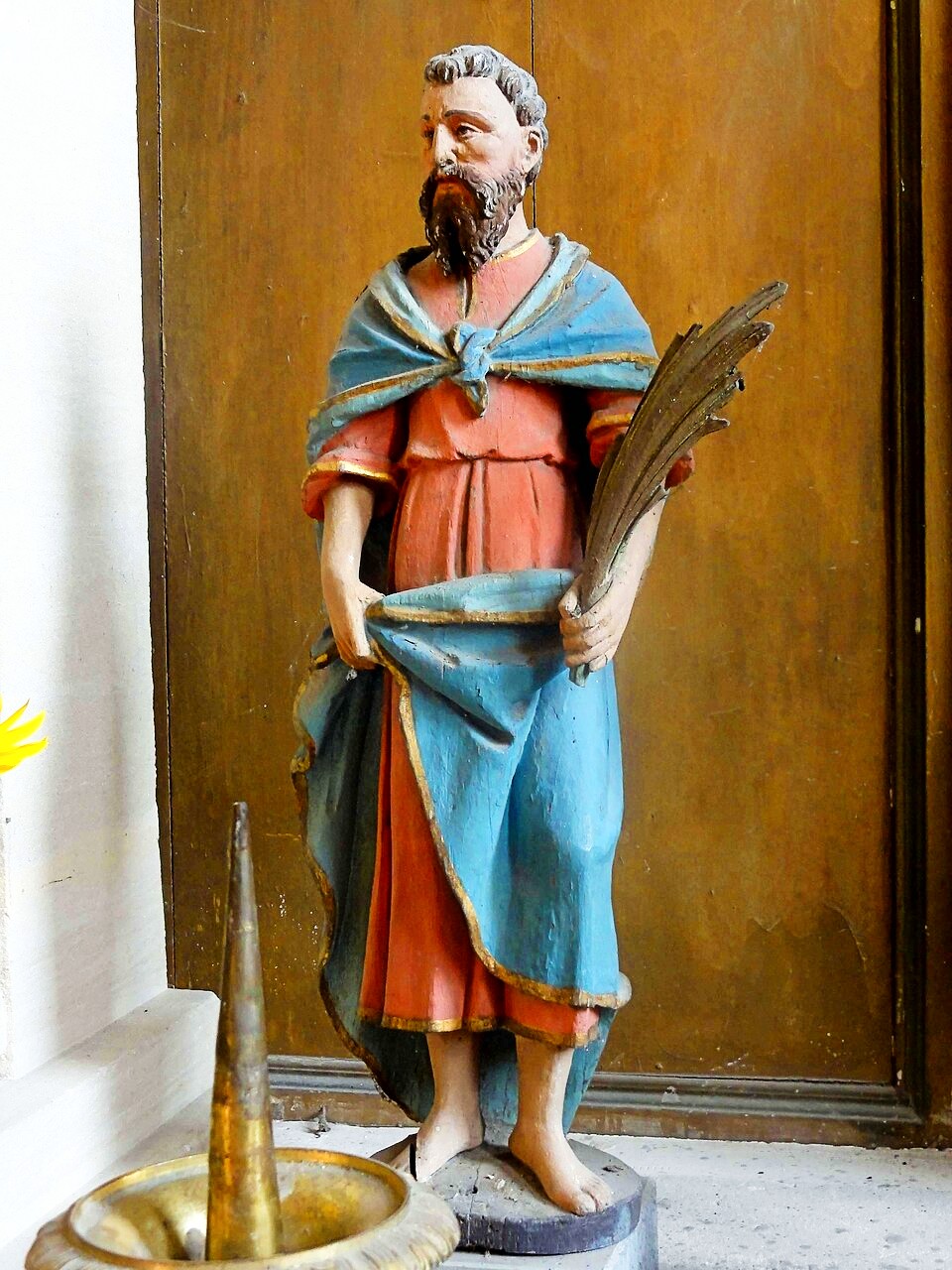
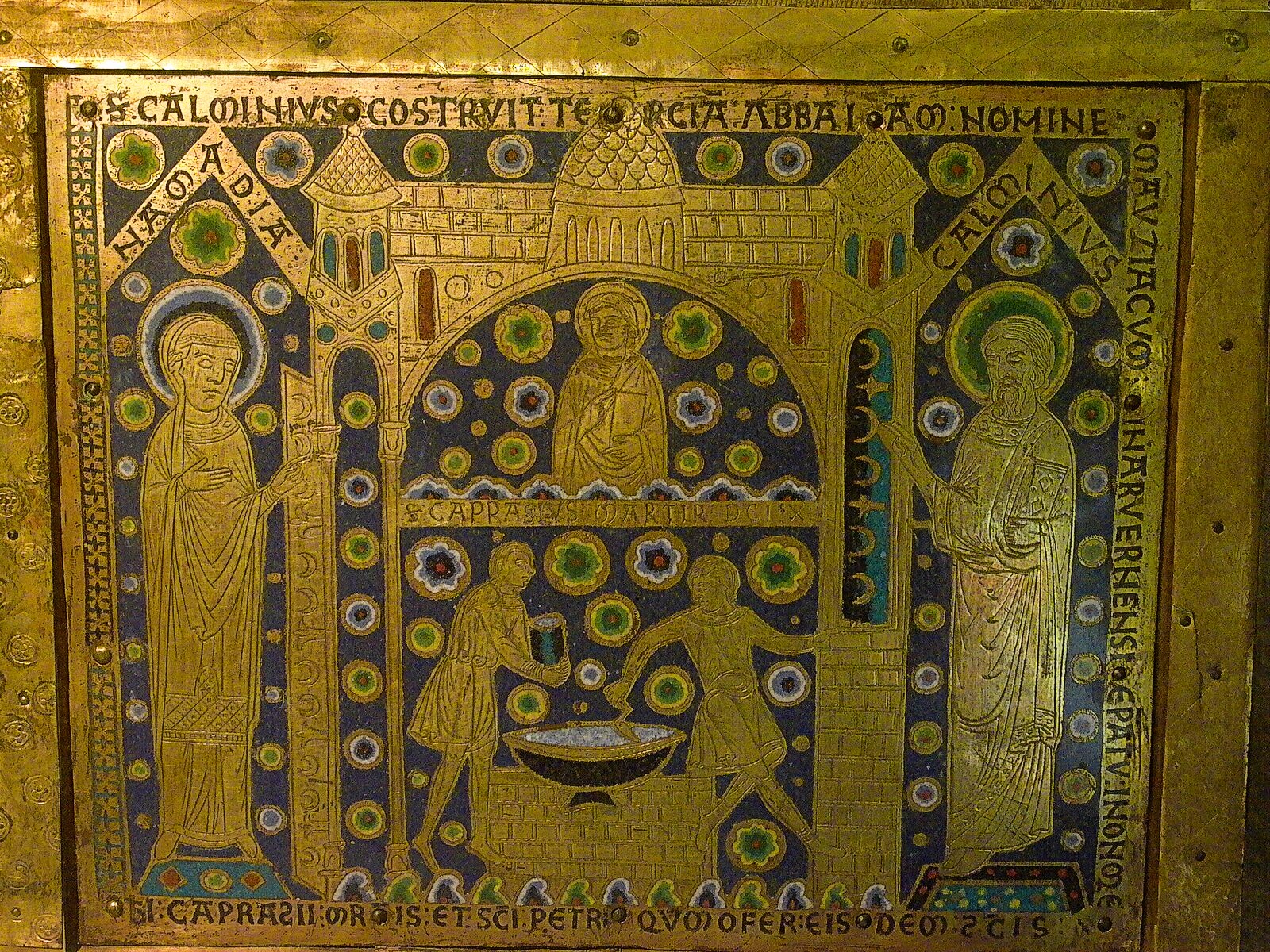
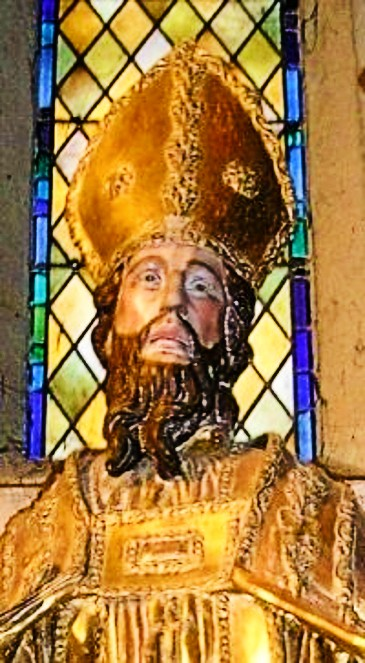
Saint of the Day – 20 October – Saint Caprasius (Died c303) Martyr of Agen. Born in France and died there by being beheaded in c303. Born in France he is known as St Capraise. Some sources consider him to have been the 1st Bishop of Agen but there are no records to substantiate this claim. However, St Caprasius is most often depicted as a Bishop.
The Roman Martyrology reads today: “At Agen in France, St Caprasius, Martyr. As he was hiding himself in a cavern, to avoid the violence of the persecution, the report of the blessed virgin Faith’s courage in suffering for Christ, animated him to endure torments and he prayed to God that, if he were deemed worthy of the glory of Martyrdom, clear water might flow from the rock of his cavern. God, having granted his prayer, he went with confidence to the scene of combat and, after a valiant struggle, merited the Palm of Martyrdom under Maximian.”
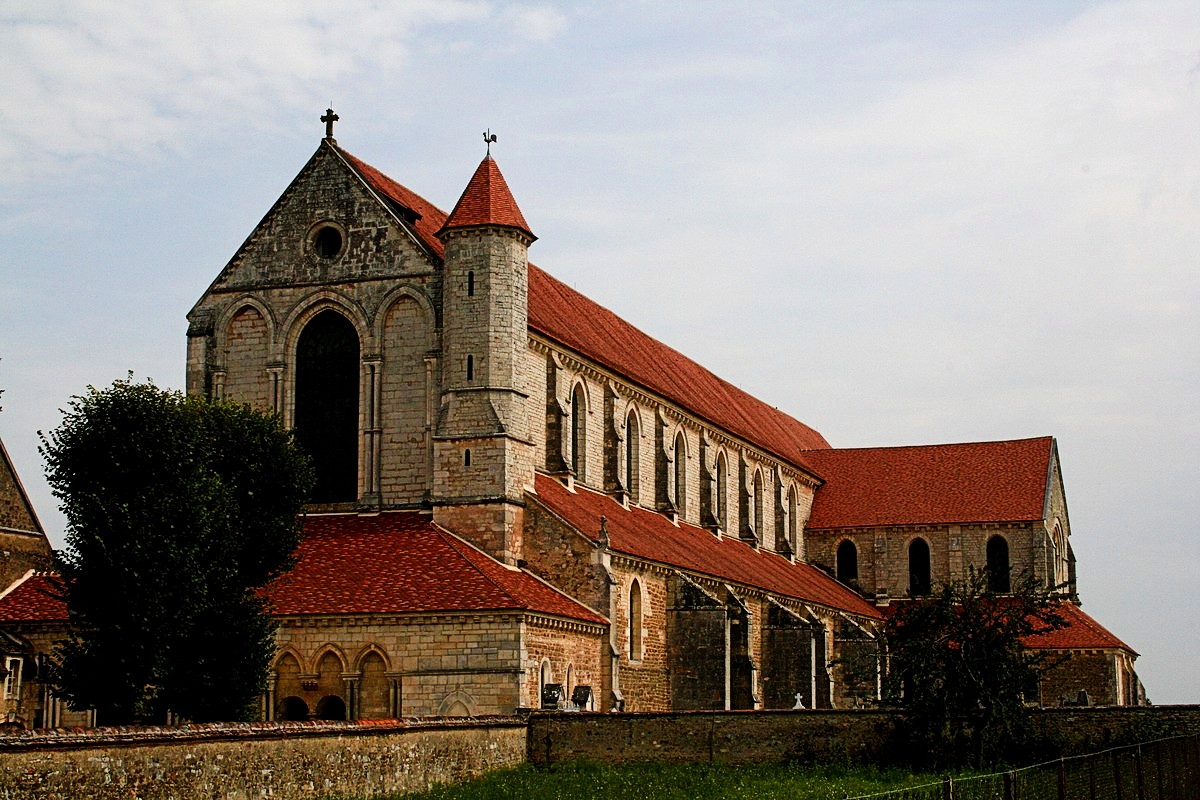
On 20 October, in the additions to the Martyrology of St Jerome, Caprasius is commemorated, to whom, as St Gregory of Tours recalls, a Church was dedicated which later, after various vicissitudes and following the Concordat of 1801, became the Cathedral of Agen.
Unfortunately, information regarding Caprasius has been transmitted through hagiographic legends no earlier than the 9th Century, in which it is difficult to distinguish truth from embellishment. In a 10th Century codice, there is a Passion of Caprasius which, however, is a pure and simple reproduction of that of St Symphorian of Autun; in general, however, all the other codici narrate the events of Caprasius together with those of St Faith, also a Martyr in Agen.
According to these texts, therefore, Caprasius, to escape Diocletian’s persecution, had retreated to a cave. Upon learning of Faith’s Martyrdom, he desired to share it and, encouraged by a miracle, presented himself to the Judge Dacianus, who, flattering him, initially tried to persuade him to apostatise but then, seeing his steadfastness, handed him over to the executioners.
Statue of St Caprasius in the Cathedral of Agen
While the Martyr was being tortured, two brothers, Primus and Felicianus, converted and, along with Faith and Caprasius, were beheaded on 6 October. The bodies of the four, displayed in a square, were stolen by Christians and buried honourably. They were later transferred by Bishop Dulcitius, to the Church dedicated to the Virgin Mary.
After the discovery of the body (5th Century), the cult of St Caprasius flourished, so much so that, in the 14th Century, he was considered the 1st Bishop of Agen.
Blessed James Strepar OFM (c1340-1409) Archbishop of Halicz, Poland from 1392 until his death Religious Priest of the Order of Friars Minor, Missionary. St Pius X proclaimed Blessed James, along with St Anthony of Padua, the Patrons of the Conventual Franciscan Order of Krakow Province. He was given the title of “Protector of the Kingdom, Defender and Guardian of the Homeland,” for his exceptional merits, including civil ones. Such was he considered by all. He was Canonised by by Pope Pius VI on 11 September 1791. His body is incorrupt. His Life: https://anastpaul.com/2020/10/20/saint-of-the-day-20-october-blessed-james-strepar-ofm-c-1340-1409/
St Leopardo of Osimo St Lucas Alonso Gorda St Martha of Cologne + Virgin Martyr
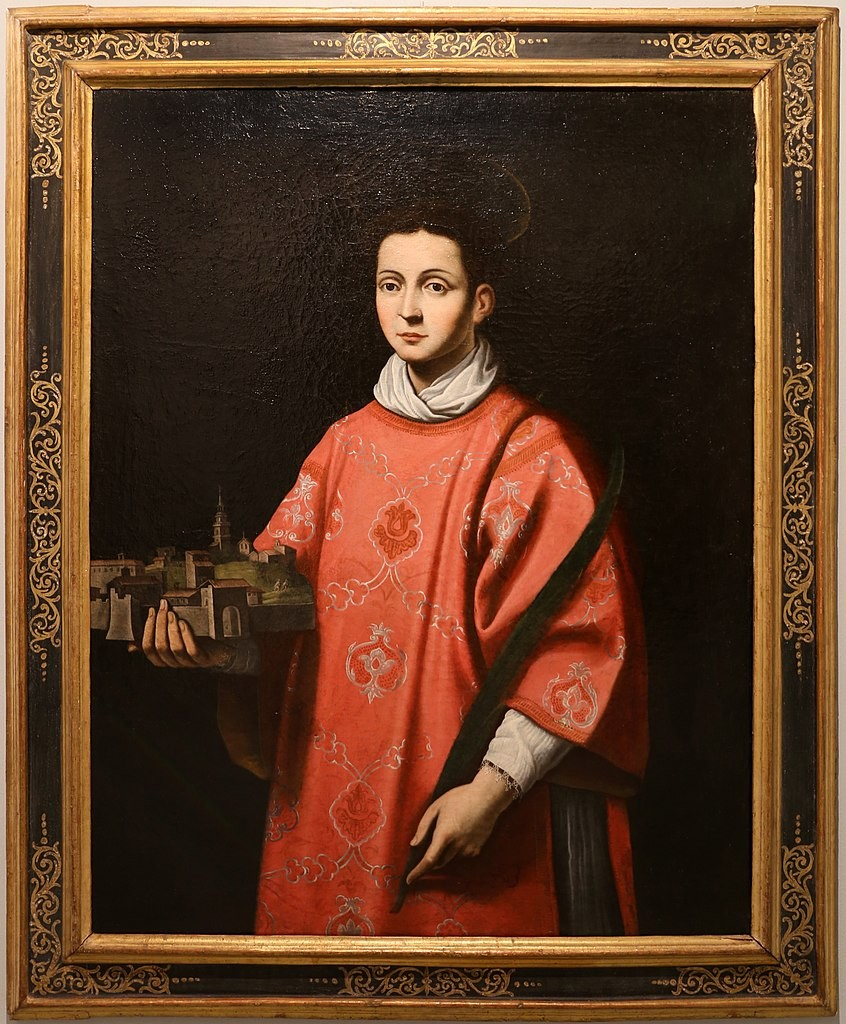
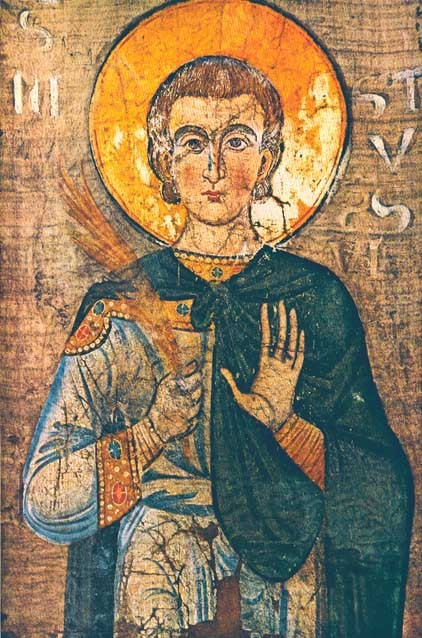
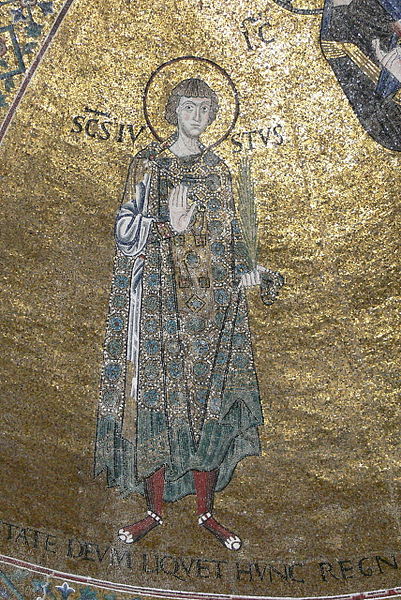
St Maximus of Aquila (c228-c250) Deacon Martyr. The Roman Martyrology reads: “At Aveia, near Aquila in Abruzzo, Italy, the birthday of blessed Maximus, Deacon and Martyr, who, through the desire of suffering, presented himself to the persecutors who sought him. After answering with great constancy, he was racked and tortured, then beaten with rods and finally, he died by being precipitated from an elevated place.” His Life and Death: https://anastpaul.com/2023/10/20/saint-of-the-day-20-october-saint-maximus-of-aquila-c228-c250-deacon-martyr/
St Orora St Saula of Cologne + Virgin Martyr St Sindulphus of Rheims St Usthazanes St Vitalis of Salzburg (Died c730) Bishop
DISCLAIMER: Please note: I cannot control the content of the Advertisements on this Site, or of pop-ups which may appear, The revenue from the Advertisements, however, does provide a little assistance in the support of the Site. I do apologise for any inappropriate content.
Thought for the Day – 18 October – Meditations with Antonio Cardinal Bacci (1881-1971)
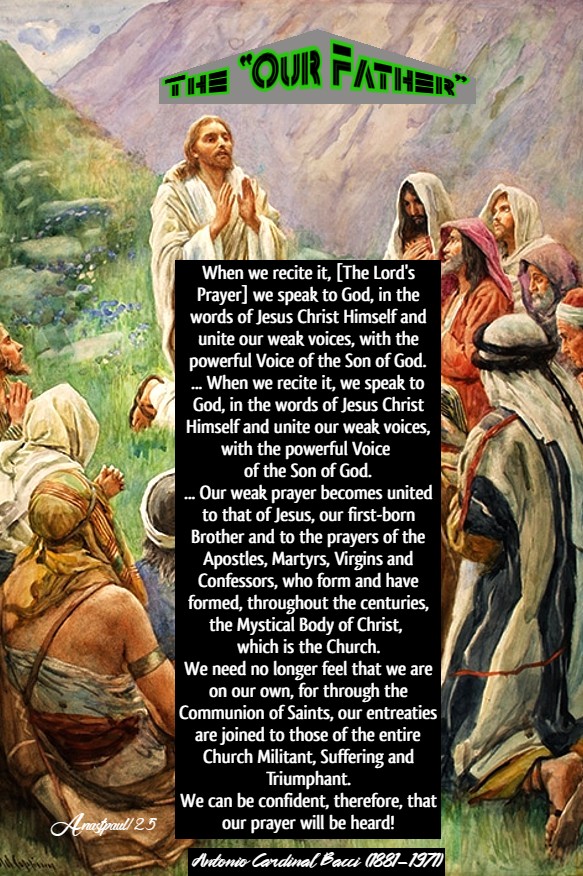
“The Month of the Holy Rosary” The “Our Father”
“Our Lord exhorted His disciples on many occasions to pray often and with confidence, if they wished to be heard. Everything which they asked His heavenly Father, in His name, He said, they would obtain. Ask, He said and it shall be given you; seek and you shall find, knock and it shall be opened to you. Finally, He insisted that we ought to pray and never to give up. In other words, life can be a continuous prayer if we offer to God all our thoughts, words and actions.
The ideal Christian prayer is to do the Will of God at all times from the motive of pure love. The Apostles, however, who had not made that much progress in the spiritual life, asked Jesus to teach them how to pray (Lk 11:1). It was then that Our Lord composed the most beautiful of prayer, the “Our Father” (Mt 6:9-13). When we recite it, we speak to God, in the words of Jesus Christ Himself and unite our weak voices, with the powerful Voice of the Son of God. We address the Eternal God, moreover, by the name of Father. Even in the Old Testament, God is often referred to in this way. Then, however, He figured as the Father of the chosen people, whereas now, He is the Father of all. He is our Father, the Father of all mankind and of all races, whom He has willed to redeem from the slavery of sin. The term “Our Father” has taken on a new and fuller meaning. Our weak prayer becomes united to that of Jesus, our first-born Brother and to the prayers of the Apostles, Martyrs, Virgins and Confessors, who form and have formed, throughout the centuries, the Mystical Body of Christ, which is the Church. We need no longer feel that we are on our own, for through the Communion of Saints, our entreaties are joined to those of the entire Church Militant, Suffering and Triumphant. We can be confident, therefore, that our prayer will be heard!”
Quote/s of the Day – 19 October – St Peter of Alcantara OFM (1499-1562) Confessor
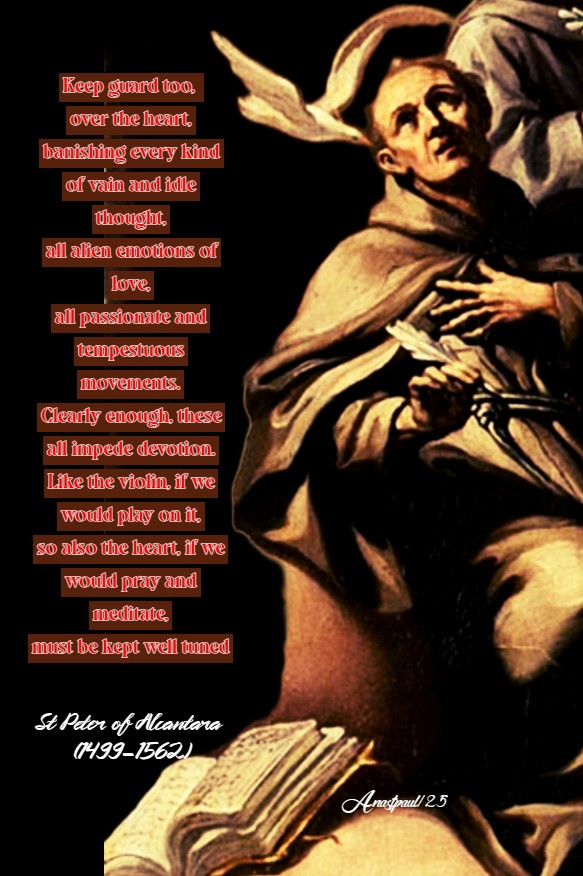
“Keep guard too, over the heart, banishing every kind of vain and idle thought, all alien emotions of love, all passionate and tempestuous movements. Clearly enough, these all impede devotion. Like the violin, if we would play on it, so also the heart, if we would pray and meditate, must be kept well tuned!”
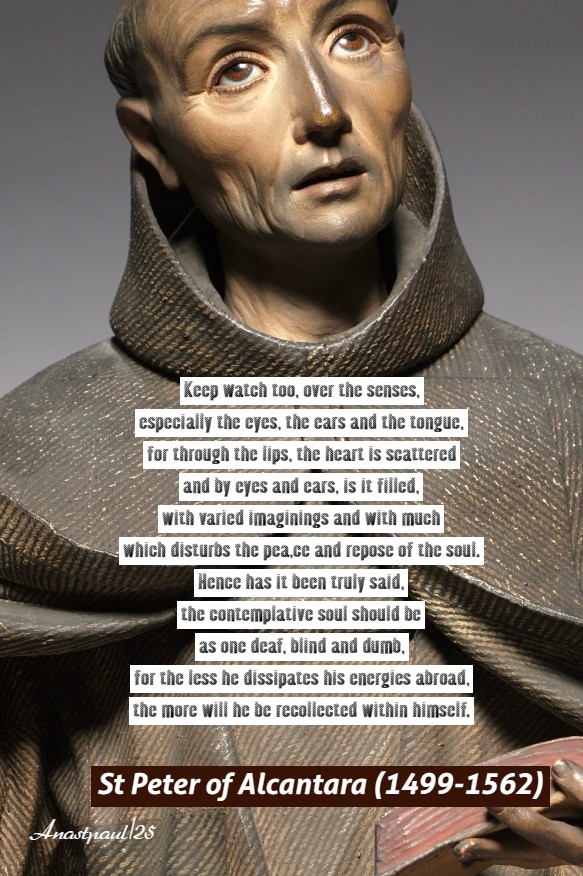
“Keep watch too, over the senses, especially the eyes, the ears and the tongue, for through the lips, the heart is scattered and by eyes and ears, is it filled, with varied imaginings and with much which disturbs the pea,ce and repose of the soul. Hence has it been truly said, the contemplative soul should be as one deaf, blind and dumb, for the less he dissipates his energies abroad, the more will he be recollected within himself.”
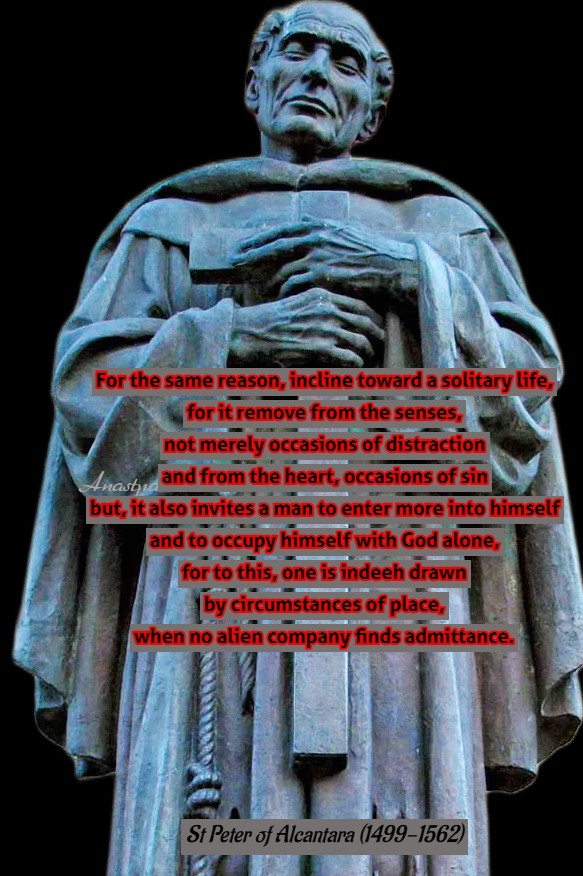
“For the same reason, incline toward a solitary life, for it remove from the senses, not merely occasions of distraction and from the heart, occasions of sin but, it also invites a man to enter more into himself and to occupy himself with God alone, for to this, one is indeeh drawn by circumstances of place, when no alien company finds admittance.”
One Minute Reflection – 19 October – “The Month of The Most Holy Rosary and The Holy Angels” – St Peter of Alcantara OFM (1499-1562) Confessor – Ephesians 4:23-28 – Matthew 22:1-14 – Scripture search here: https://www.drbo.org/
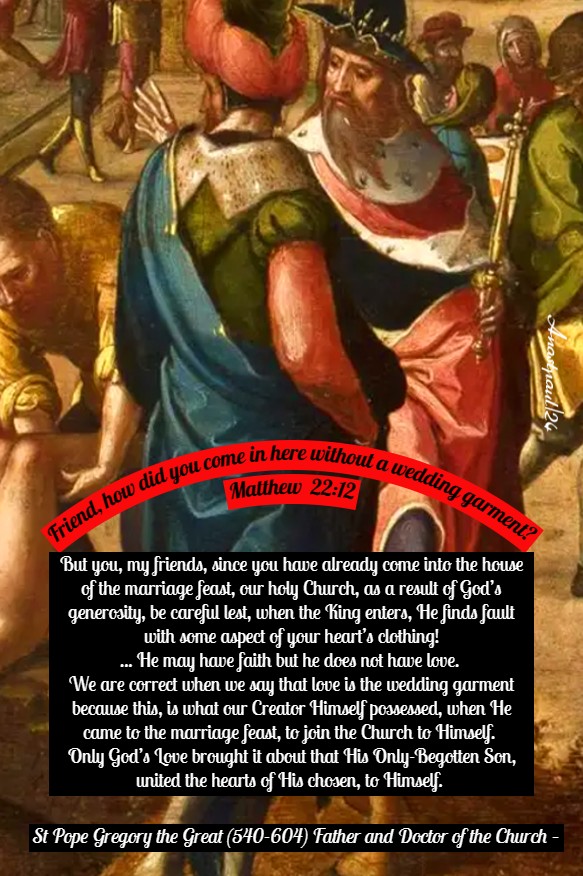
“Friend, how did you come in here without a wedding garment?” – Matthew 22:12
REFLECTION – “But you, my friends, since you have already come into the house of the marriage feast, our holy Church, as a result of God’s generosity, be careful lest, when the King enters, He finds fault with some aspect of your heart’s clothing!
What do we think is meant by the wedding garment, dearly beloved? For if we say it is Baptism or faith, is there anyone who has entered this marriage feast without them? A person is outside because he has not yet come to believe. What then must we understand by the wedding garment but love? That person enters the marriage feast but without wearing a wedding garment, who is present in the Holy Church. He may have faith but he does not have love. We are correct when we say that love is the wedding garment because this, is what our Creator Himself possessed, when He came to the marriage feast, to join the Church to Himself. Only God’s Love brought it about, that His Only-Begotten Son, united the hearts of His chosen, to Himself. John says “God so Loved the world that He gave His Only-Begotten Son for us.” – St Pope Gregory the Great (540-604) Father and Doctor of the Church – (Sermons on the Gospel No 38).
PRAYER – O God, Who graciously made blessed Peter, Thy Confessor, glorious by the gift of remarkable penance and sublime contemplation, grant, we beseech Thee, that, by the merit of his prayers, we may the more easily understand the things of Heaven by curbing our passions. Through Jesus Christ, Thy Son our Lord, Who lives and reigns with Thee, in the unity of the Holy Ghost, God, world without end. Amen (Collect).
Our Morning Offering – 19 October – “The Month of The Most Holy Rosary and The Holy Angels” – St Peter of Alcantara OFM (1499-1562) Confessor
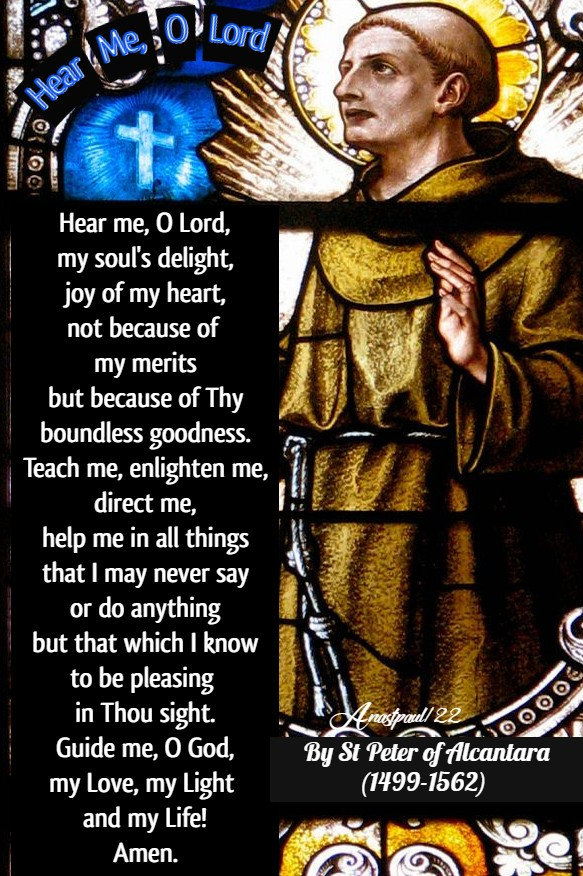
Hear Me, O Lord By St Peter of Alcantara (1499-1562)
Hear me, O Lord, my soul’s delight, joy of my heart, not because of my merits but because of Thy boundless goodness. Teach me, enlighten me, direct me, help me in all things that I may never say or do anything but that which I know to be pleasing in Thou sight. Guide me, O God, my Love, my Light and my Life! Amen
Saint of the Day – 19 October – Saint Veranus (Died 589) Bishop of Cavaillon, France, Hermit, a protector of monastic life and Monasteries, apostle of the poor and ill, Miracle-worker. Born in Vaucluse in France and died in Arles, France in 589 of the Plague. Patronage – Cavaillon and Saint-Veran and Saont-Verain, in France; Abbadia Alpina and Peccioli, 2 Citiess in Italy. Also known as – Uranus, Verain, Veranus, Verà del Gavalda, Vrain of Cavaillon, Wrain of Cavaillon.
The Roman Martyrology reads today: “In the Diocese of Orleans, the departure from this world of St Veranus, Bishop.”
The little information known about his life are sufficient to provide a portrait. A contemporary of St Gregory of Tours, Veranus was Ordained a Priest in 540. Having retired to his hermitage in Vaucluse, he undertook a pilgrimage to Rome passing through Embrun , Briançon Ravenna, Milan and, on his return, through Albenga and Cassis, of which City he is now the Patron.
In 568, Sigebert I , who had created the chose him as the Bishop of Cavaillon, as we learn from the ‘Orléans Manuscript.’
The following year, 569, Fredegonda, having had Praetextatus, the Archbishop of Rouen assassinated during a Sunday Office, Veranus reproach him for the murder. This earned him the position of Godfather of the future Merovingian King Theodoric II, son of Childebert II. In 577, the Baptism took place, in Orléans.
St Gregory of Tours writes of miracles performed by Veranus, including the expulsion of a dragon. He is also remembered as a leader in charitable works and as a patron of local Monasteries, not only in France but also in Italy, particulaly in the City of Albenga, where he was instrumental in the conversion of the people to Christianity.
In the early 11th Century, some of his Relics were transferred from his place of burial to Orléans. In the 13th Century, most were transferred again, to Cavaillon Cathedral which is dedicated to him but some were sent to Albenga Cathedral in Liguria, where they are still preserved in a Shrine dedicated to him as the Patron of that City.
The French Villages of Saint-Véran and Saint-Verain are named after him. In Fontaine de Vaucluse, there is a Church dedicated to our Saint. It was the place of his birth and in the small Church there is a Tomb reputed to be his.
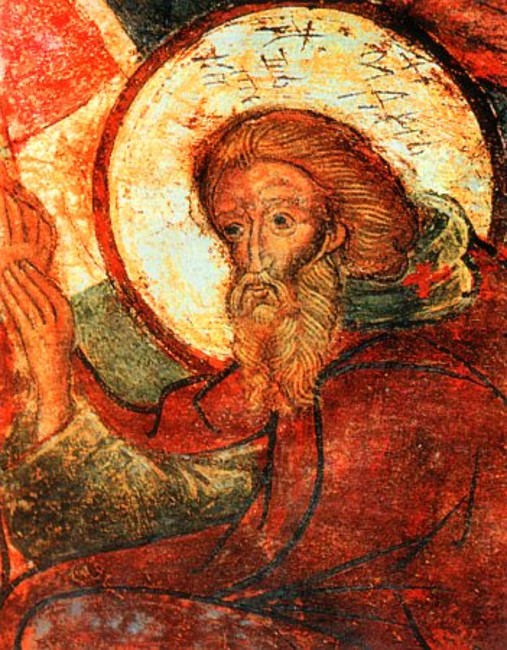
St Altinus St Aquilinus of Evreux St Asterius of Ostia St Beronicus of Antioch St Columban — Priest in Tours, France. Listed in the Martyrology of St Jerome. No other details have survived.
St Desiderius of Longoret St Ednoth St Ethbin St Eusterius of Salerno
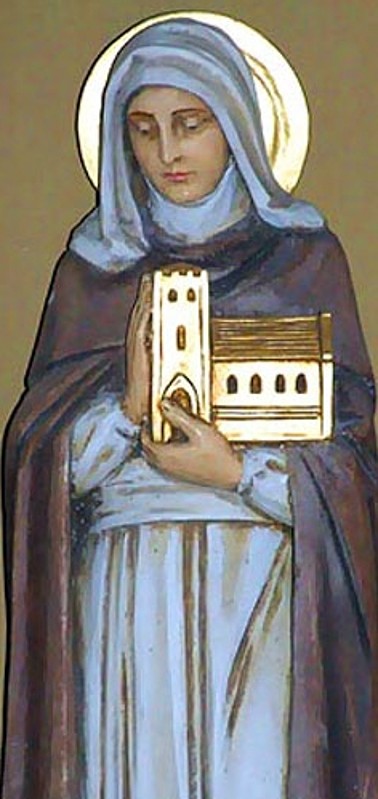
St Frideswide (c665-735) Virgin, Abbess, Founder of the St Mary’s Convent, Miracle-worker The Convent is now Christ Church College, University of Oxford and the Convent Church became Oxford Cathedral. Patronage – of the City of Oxford, England and of the University of Oxford. Her Holy and Zealous Life: https://anastpaul.com/2024/10/19/saint-of-the-day-19-october-saint-frideswide-c665-c735-virgin/
St Laura of Cordoba St Lucius of Rome St Lupus of Soissons St Pelagia of Antioch
St Varus and 6 Companions (Died c307) Martyrs, Soldier. Died in c307 by being tortured and then hanged from a tree on 19 October 307 in Kemet, Upper Egypt. The Roman Martyrology reads: “In Egypt, St Varus, Solder under the Emperor Maximinus. He used to visit and comfort seven saintly Monks, detained in prison, when one of them happening to die, he wished to take his place and having suffered cruel afflictions, with them, he obtained the Palm of Martyrdom.” Their Lives and Deaths: https://anastpaul.com/2023/10/19/saint-of-the-day-19-october-saint-varus-and-six-companions-died-c307-martyrs/
Thought for the Day – 18 October – Meditations with Antonio Cardinal Bacci (1881-1971)
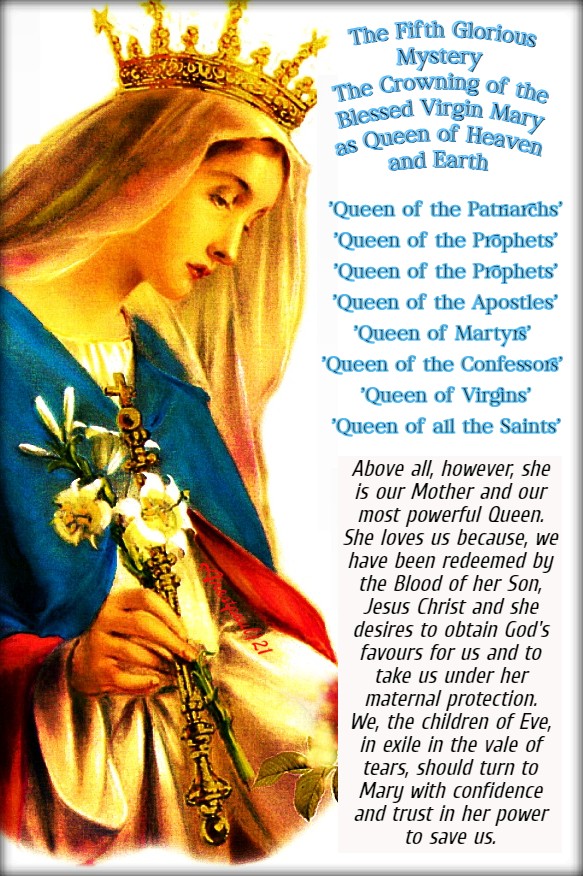
“Month of the Holy Rosary” The Fifth Glorious Mystery The Crowning of the Blessed Virgin Mary as Queen of Heaven and Earth
“Mary is also styled, ‘Queen of the Patriarchs‘ because, it was through her, that they came to possess the object of their desires, the divine Redeemer, Who released them from Limbo and brought them to Heaven. She is ‘Queen of the Prophets‘ because, their prophecies were realised through her. She is ‘Queen of the Apostles‘ whom she assisted and encouraged after the departure of her divine Son. She is the ‘Queen of Martyrs‘ because, her maternal heart was pierced by a sword of sorrow. She is ‘Queen of the Confessors‘ because, nobody else was capable of so deep and lively a profession of the Faith. She is ‘Queen of Virgins‘ because, her virginal purity was crowned by the supreme dignity of Mother of God. She is ‘Queen, moreover, of all the Saints‘, for no other human creature could ever surpass, or even dream of the summit of holiness, to which she attained. Above all, however, she is our Mother and our most powerful Queen. She loves us because, we have been redeemed by the Blood of her Son, Jesus Christ and she desires to obtain God’s favours for us and to take us under her maternal protection.
We, the children of Eve, in exile in the vale of tears, should turn to Mary with confidence and trust in her power to save us.”
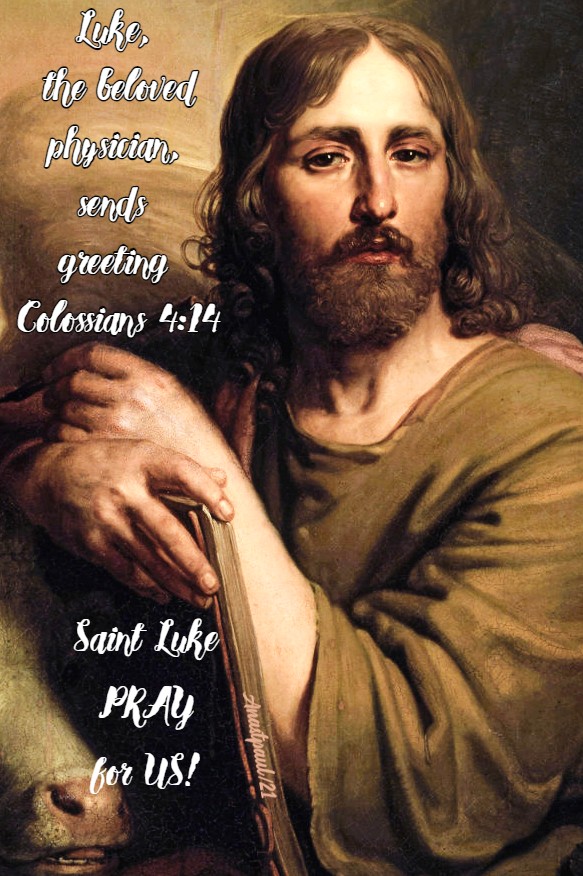
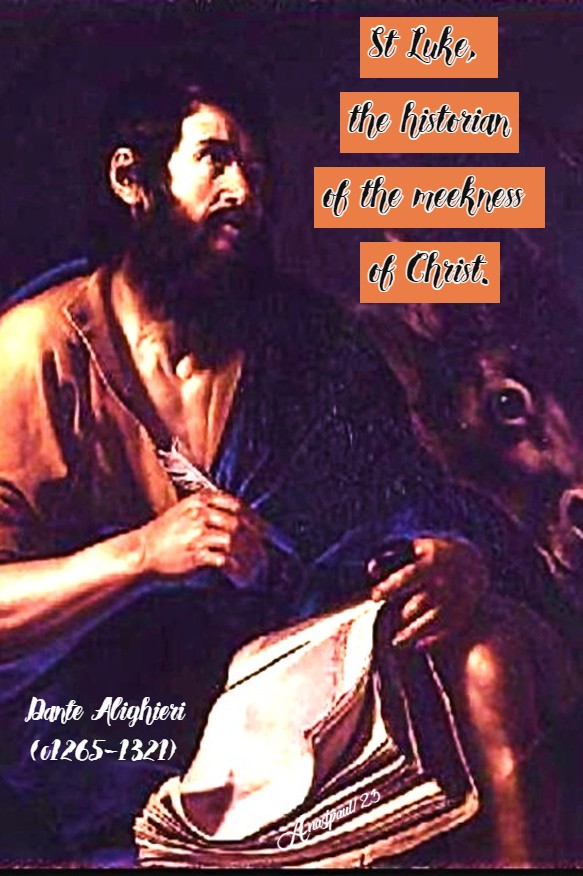
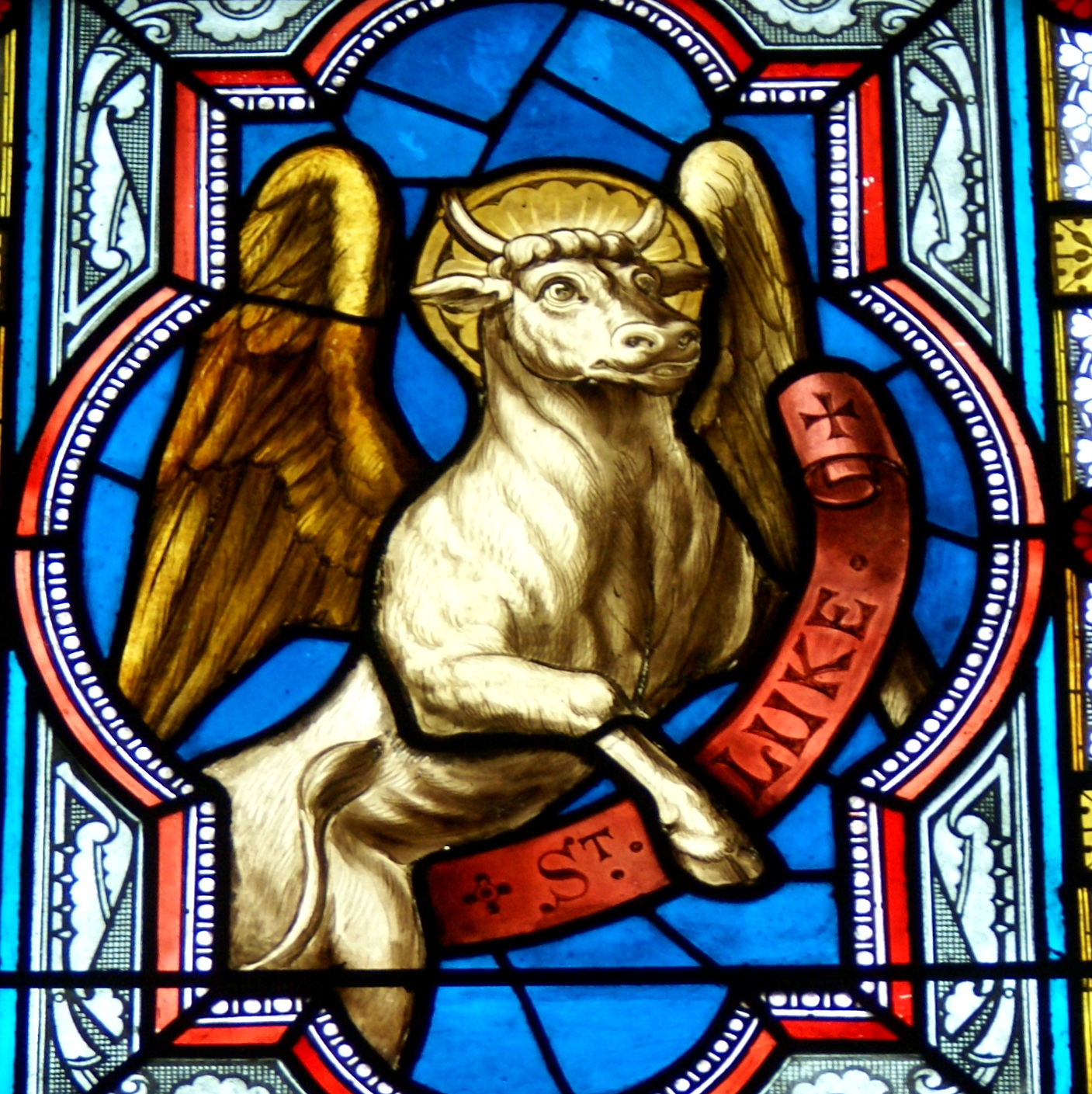
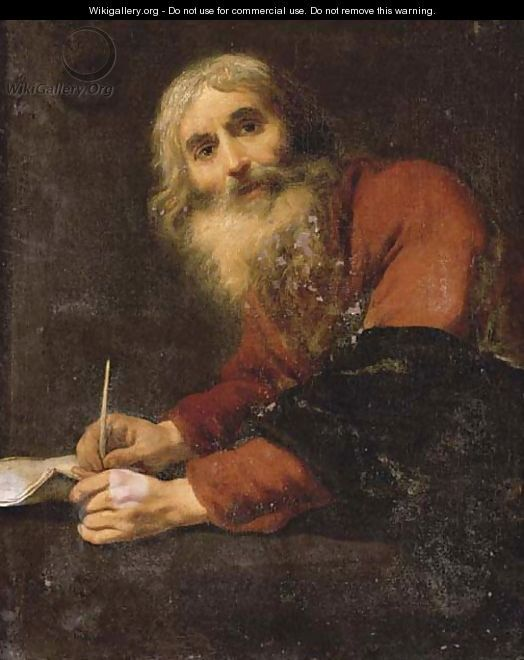
Quote/s of the Day – 18 October – The Feast of St Luke, the Evangelist
“Luke, the beloved physician, sends greetings … ”
Colossians 4:14
“St Luke, the historian of the meekness of Christ.”
Dante Alighieri (c1265-1321)
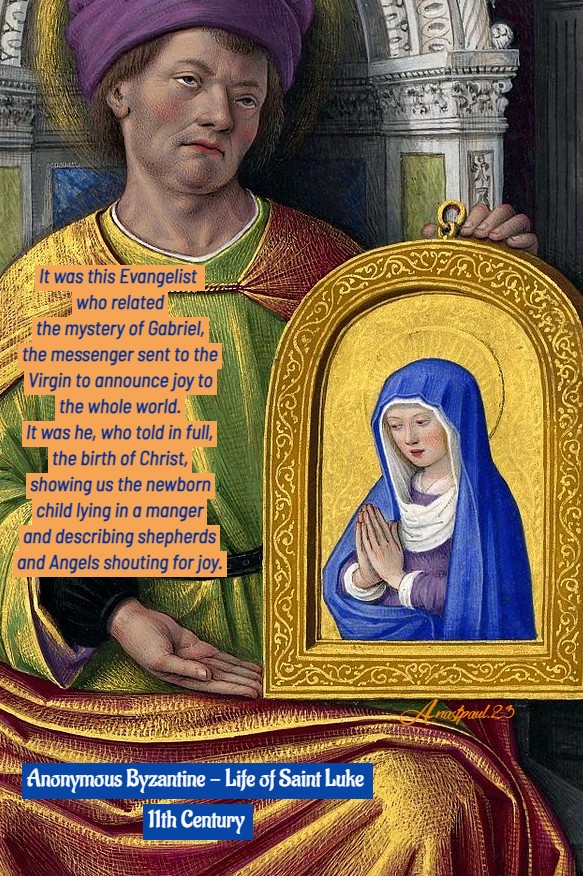
“It was this Evangelist who related the mystery of Gabriel, the messenger sent to the Virgin to announce joy to the whole world. It was he, who told in full, the birth of Christ, showing us the newborn Child lying in a manger and describing shepherds and Angels shouting for joy.”
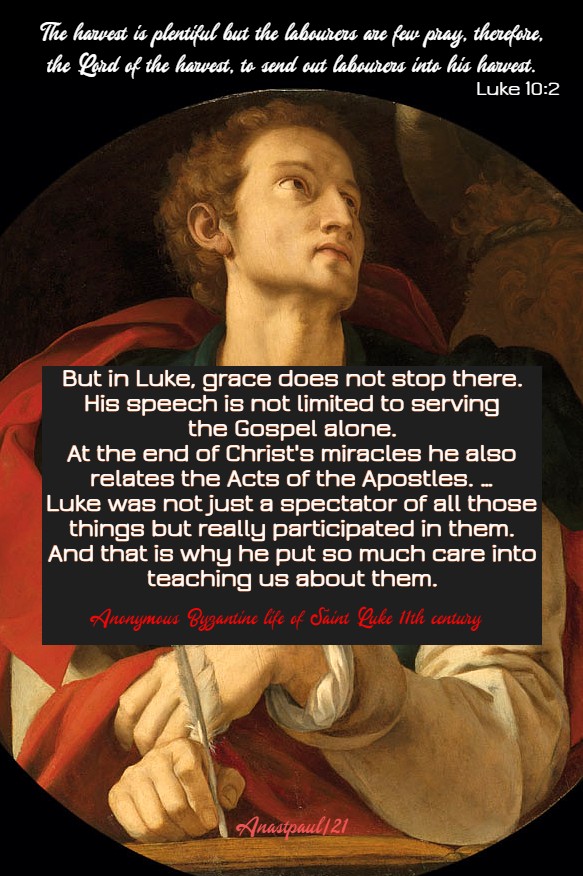
“The harvest indeed is great but the labourers are few. Pray ye, therefore, the Lord of the harvest that He send labourers into His harvest.” Luke 10:2
“But in Luke, grace does not stop there. His speech is not limited to serving the Gospel alone. At the end of Christ’s miracles he also relates the Acts of the Apostles. … Luke was not just a spectator of all those things but really participated in them. And that is why he put so much care into teaching us about them.”
Anonymous Byzantine – Life of Saint Luke 11th Century
One Minute Reflection – 18 October – “The Month of The Most Holy Rosary and The Holy Angels” – The Feast of St Luke, the Evangelist – 2 Corinthians 8:16-24 – Luke 10:1-9 – Scripture search here: https://www.drbo.org/
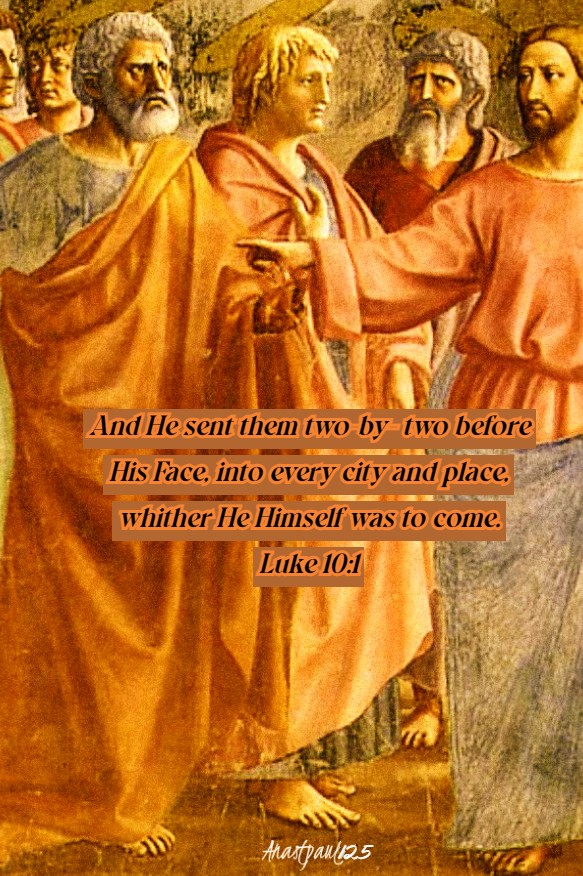
“And He sent them two-by- two before His Face, into every city and place, whither He Himself was to come.” – Luke 10:1
REFLECTION – “The Kingdom of Heaven is like a mustard seed which a person took and sowed in a field. It is the smallest of all the seeds, yet when full-grown it is the largest of plants. It becomes a large bush and the ‘birds of the sky come and dwell in its branches.’ (Mt 13:31). This small seed for us, is the symbol of Jesus Christ, Who, sowed into the garden where He was buried, rose from it shortly after, through His Resurrection, as a big tree.
One could say that when He Died He was like a small seed, a small seed because of the humiliation of His Flesh but, a big tree because of the glorification of His Majesty. He was like a small seed when He appeared completely disfigured before our eyes but, like a large tree when He rose again like “the most handsome of men” (Ps 44:3).
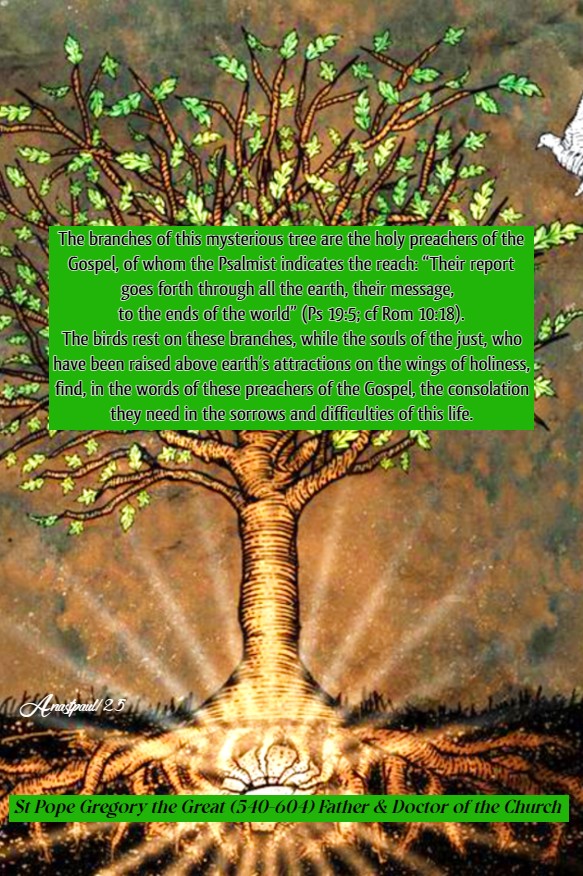
The branches of this mysterious tree are the holy preachers of the Gospel, of whom the Psalmist indicates the reach: “Their report goes forth through all the earth, their message, to the ends of the world” (Ps 19:5; cf Rom 10:18). The birds rest on these branches while the souls of the just, who have been raised above earth’s attractions on the wings of holiness, find, in the words of these preachers of the Gospel, the consolation they need in the sorrows and difficulties of this life.” – St Gregory the Great (540-604) Pope, Father & Doctor of the Church (Sermons on Matthew, Ch 13).
PRAYER – O Lord, we beseech Thee, that Luke, Thy holy Evangelist, who for the honour of Thy Name bore continuously in his body the suffering of the Cross, may intercede on our behalf. Through the same Jesus Christ, Thy Son our Lord, Who lives and reigns with Thee, in the unity of the Holy Ghost, God, world without end. Amen (Collect).
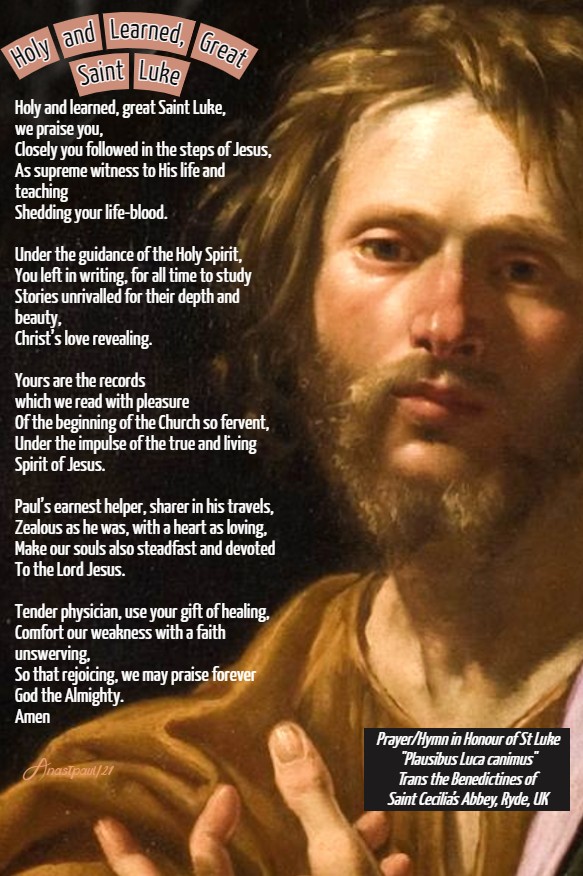
Our Morning Offering – 18 October – The Feast of St Luke, the Evangelist
Holy and Learned, Great Saint Luke Prayer/Hymn in Honour of St Luke “Plausibus Luca Canimus” Trans the Benedictines of Saint Cecilia’s Abbey, Ryde, UK
Holy and learned, great Saint Luke, we praise you, Closely you followed in the steps of Jesus, As supreme witness to His life and teaching Shedding your life-blood.
Under the guidance of the Holy Spirit, You left in writing, for all time to study Stories unrivalled for their depth and beauty, Christ’s love revealing.
Yours are the records which we read with pleasure Of the beginning of the Church so fervent, Under the impulse of the true and living Spirit of Jesus.
Paul’s earnest helper, sharer in his travels, Zealous as he was, with a heart as loving, Make our souls also steadfast and devoted To the Lord Jesus.
Tender physician, use your gift of healing, Comfort our weakness with a faith unswerving, So that rejoicing, we may praise forever God the Almighty. Amen
Saint of the Day – 18 October – St Tryphonia (3rd Century) Widow of Rome. Some sources believe she might have been a Martyr. Also known as – Tryfonia, Tryphona.
The Roman Martyrology reads today: “At Rome, St Tryphonia, at once time the wife of the Caesar Decius. She was buried in a crypt near St Hippolytus.”
Tradition states that she may have been the widow of the Christian enemy, Emperor Trajanus Decius or the widow of his son. It is unclear whether she was Martyred.
Martyrs of Africa – 9 Saints: A group of Christians Martryed together in Africa. The only details that have survived are the names – Beresus, Dasius, Faustinus, Leucius, Lucius, Martialis, Victoricus, Victrix and Viktor. They were Martyred in c300 in Africa.
Thought for the Day – 17 October – Meditations with Antonio Cardinal Bacci (1881-1971)
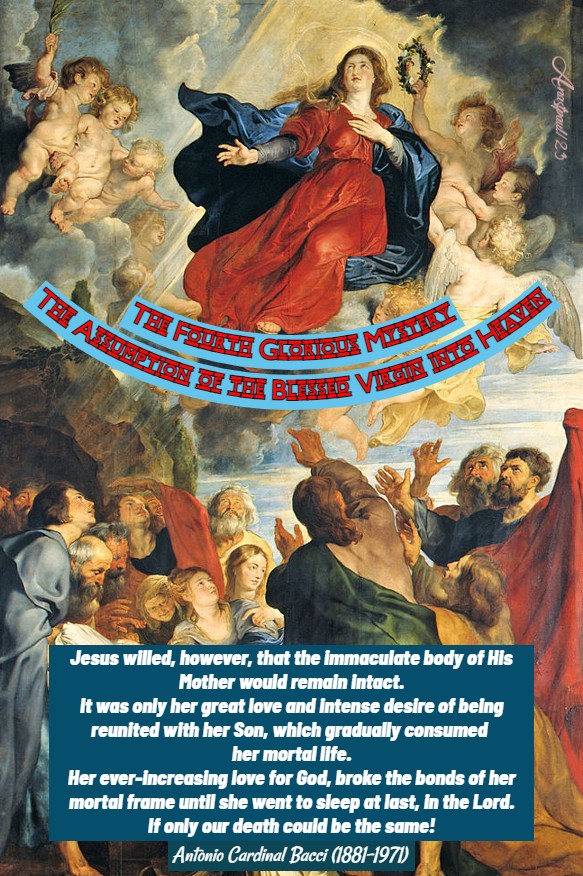
“Month of the Holy Rosary” The Fourth Glorious Mystery The Assumption of the Blessed Virgin into Heaven
“The fourth Book of Kings tells us, that the Prophet Elias was brought up into Heaven in a fiery chariot without having first endured the pains and humiliations of death (Cf 4 Kings 2:11). Why did God not do likewise in the case of the Blessed Virgin, commanding His Angels to bear her to Heaven before death struck her innocent body? As St Paul says, it was sin which caused death to enter the world. From the moment of her conception, Mary was free from the slightest taint of sin, for she was immaculate and full of grace. Nevertheless, according to the most widely held tradition, Mary chose to die, even as her divine Son had willed to die. Jesus “was offered because it was his own will” (Isa 53:7). The same is true in Mary’s case, with only this difference. Jesus died a cruel death after the most hideous tortures in the midst of a blaspheming and hate-ridden mob. Nothing like this happened to Mary, although she is called the Queen of Martyrs because of the sword which pierced her soul at the sight of her divine Son, dying in such agony.
Jesus willed, however, that the immaculate body of His Mother would remain intact. It was only her great love and intense desire of being reunited with her Son, which gradually consumed her mortal life. Her ever-increasing love for God, broke the bonds of her mortal frame until she went to sleep at last, in the Lord.
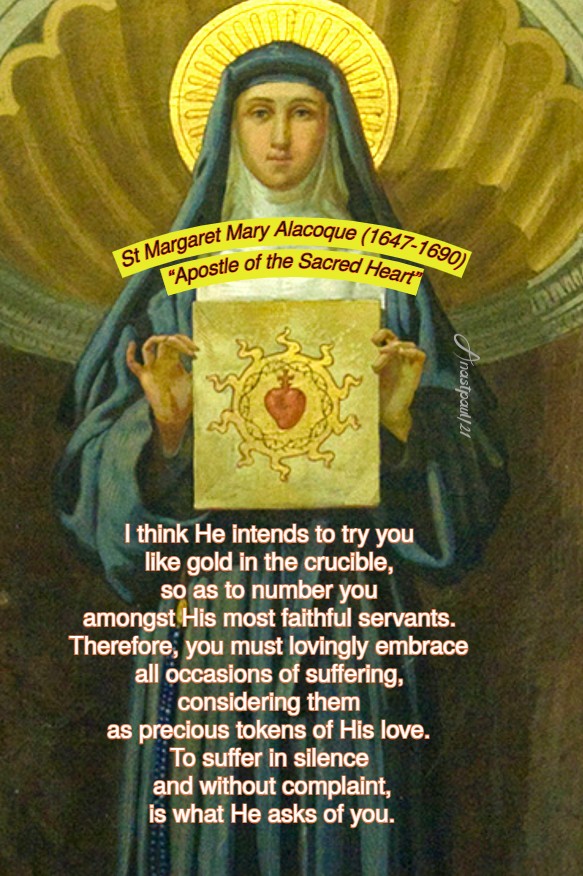
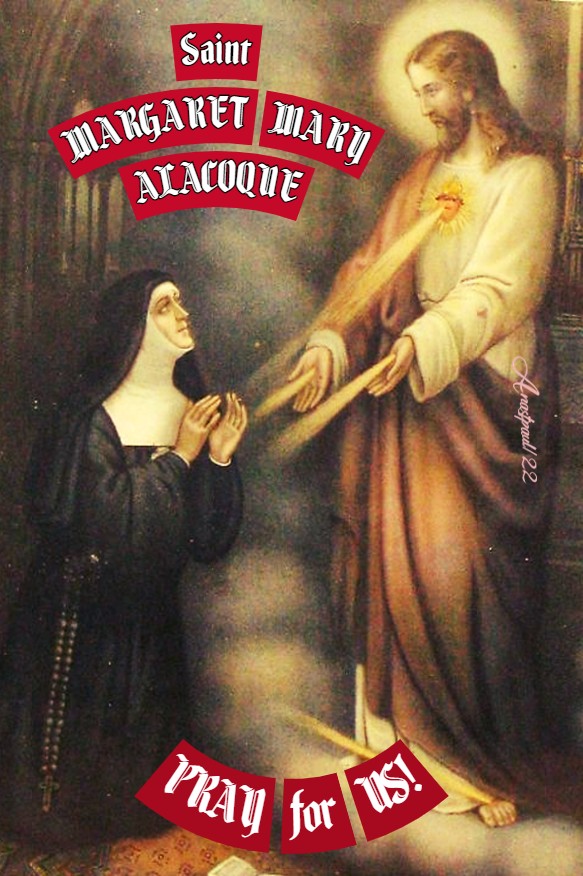
Quote/s of the Day – 17 October – St Margaret Mary Alacoque (1647-1690) Virgin
“Keep your heart in peace and let nothing trouble you, not even your faults. You must humble yourself and amend them peacefully, without being discouraged or cast down, for God’s dwelling, is in peace.”
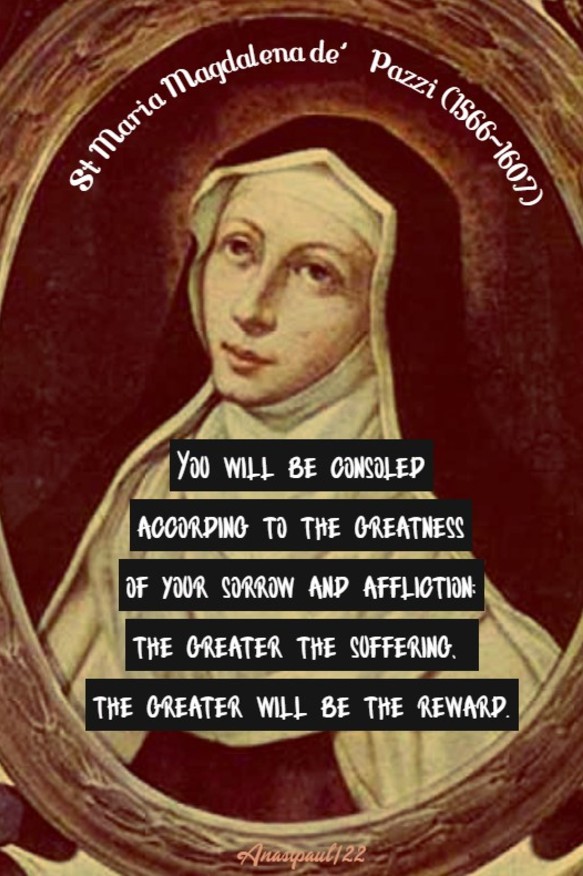
“You will be consoled according to the greatness of your sorrow and affliction; the greater the suffering, the greater will be the reward.”
“I think He intends to try you like gold in the crucible, so as to number you amongst His most faithful servants. Therefore, you must lovingly embrace all occasions of suffering, considering them as precious tokens of His love. To suffer in silence and without complaint, is what He asks of you.”
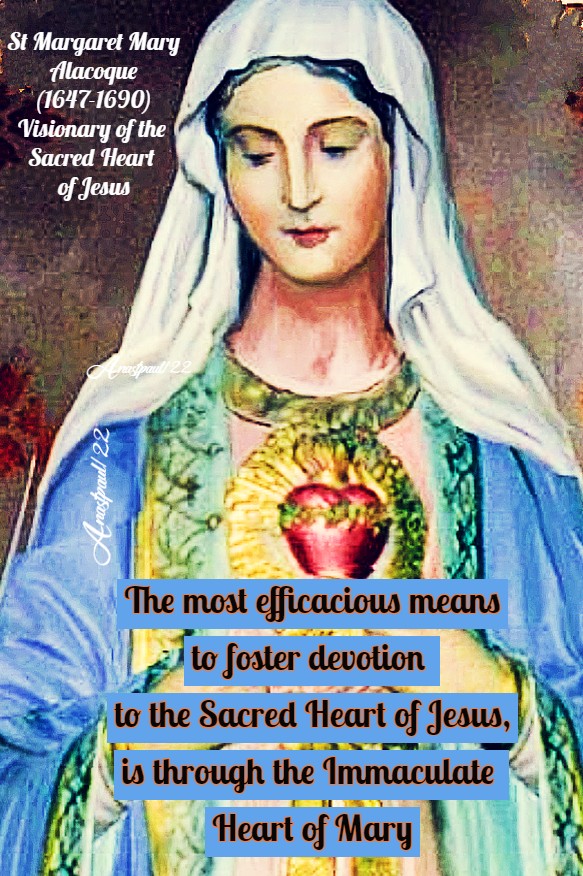
“The most efficacious means to foster devotion to the Sacred Heart of Jesus, is through the Immaculate Heart of Mary.”
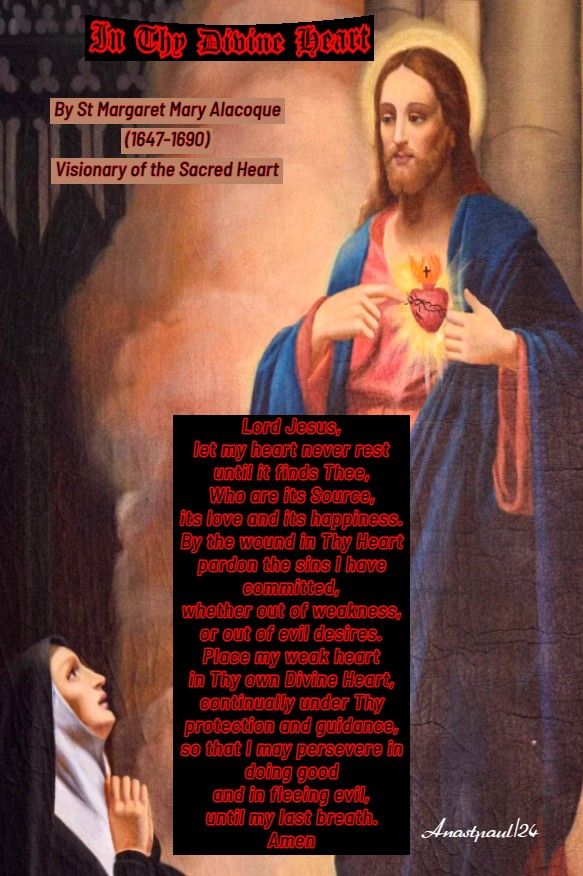
In Thy Divine Heart By St Margaret Mary Alacoque (1647-1690) Visionary of the Sacred Heart
Lord Jesus, let my heart never rest until it finds Thee, Who are its Source, its love and its happiness. By the wound in Thy Heart pardon the sins I have committed, whether out of weakness, or out of evil desires. Place my weak heart in Thy own Divine Heart, continually under Thy protection and guidance, so that I may persevere in doing good and in fleeing evil, until my last breath. Amen
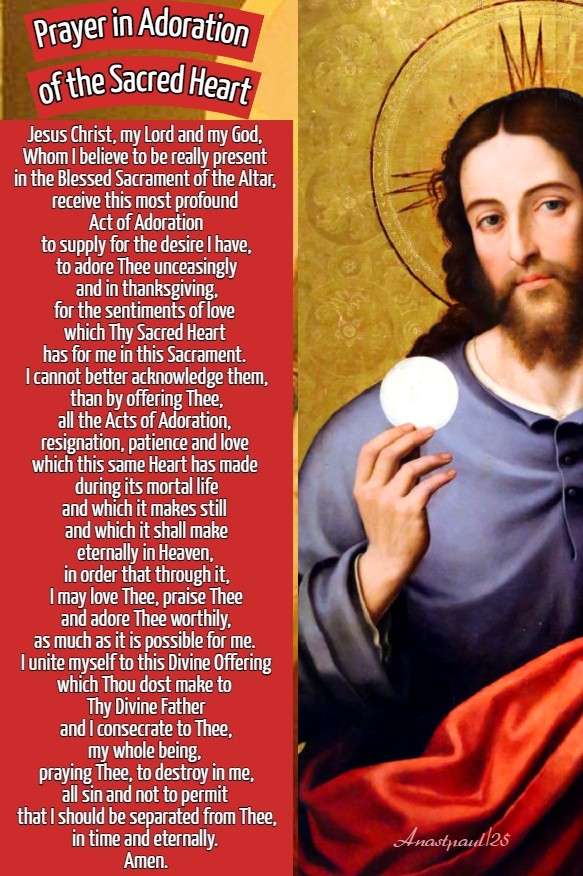
Prayer in Adoration of the Sacred Heart in the Blessed Sacrament By St Margaret Mary Alacoque (1647-1690) Visionary and Apostle of the Sacred Heart of Jesus
Jesus Christ, my Lord and my God, Whom I believe to be really present in the Blessed Sacrament of the Altar, receive this most profound Act of Adoration to supply for the desire I have, to adore Thee unceasingly and in thanksgiving, for the sentiments of love which Thy Sacred Heart has for me in this Sacrament. I cannot better acknowledge them, than by offering Thee, all the Acts of Adoration, resignation, patience and love which this same Heart has made during its mortal life and which it makes still and which it shall make eternally in Heaven, in order that through it, I may love Thee, praise Thee and adore Thee worthily, as much as it is possible for me. I unite myself to this Divine Offering which Thou dost make to Thy Divine Father and I consecrate to Thee, my whole being, praying Thee, to destroy in me, all sin and not to permit that I should be separated from Thee, in time and eternally. Amen.
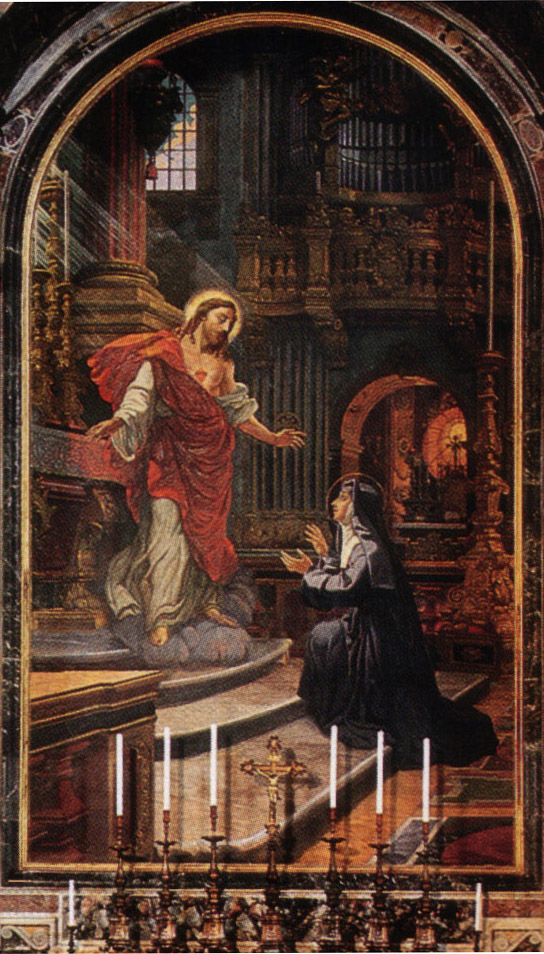
One Minute Reflection – 17 October – “The Month of the Most Holy Rosary and of the Angels” – St Margaret Mary Alacoque (1647-1690) Virgin – Ephesians 3:8-9, 14-19, Matthew 11:25-30 – Scripture search here: https://www.drbo.org/
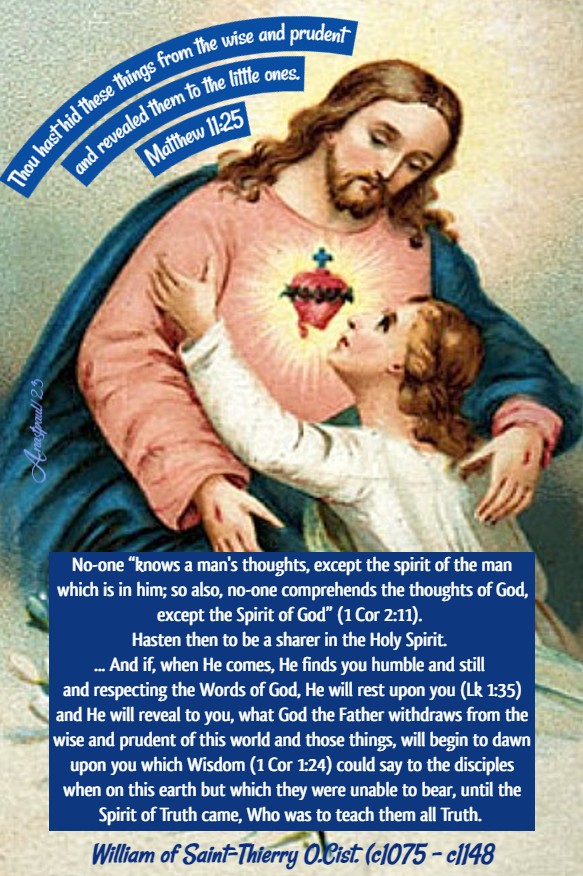
“Thou hast hid these things from the wise and prudent and revealed them to the little ones.” – Matthew 11:25
REFLECTION – “When more obscure Mysteries are presented to your timid nature by your faith Christian soul, take courage and say [like Mary], “How shall this be done …?” (Lk 1:34), not in a controversial spirit but with the love of a disciple. Let your questioning be your prayer, your love, your piety, your humble desire – not seeking to plumb the depths of God’s majesty but looking for salvation, in the healing acts of the God, Who saves us. …
No-one “knows a man’s thoughts, except the spirit of the man which is in him; so also, no-one comprehends the thoughts of God, except the Spirit of God” (1 Cor 2:11). Hasten then to be a sharer in the Holy Spirit. He is present when He is called upon; nor could He be called upon, if He were not present. When, on being called upon, He comes, it is with the abundance of the blessings of God. He is the flowing of “the river which gives joy to God’s city” (Ps 45:5). And if, when He comes, He finds you humble and still and respecting the Words of God, He will rest upon you (Lk 1:35) and He will reveal to you, what God the Father withdraws from the wise and prudent of this world and those things, will begin to dawn upon you which Wisdom (1 Cor 1:24) could say to the disciples when on this earth but which they were unable to bear, until the Spirit of Truth came, Who was to teach them all Truth (Jn 16:12-13).” – William of Saint-Thierry O.Cist. (c1075-c1148) Cistercian Monk, Mystic, Theologian, Writer (The Mirror of Faith 6).
PRAYER – O Lord Jesus Christ, Who wondrously revealed the unsearchable riches of Thy Heart to blessed Margaret Mary, the Virgin, grant us, by her merits and through imitating her, to love Thee, in all things and above all things, so that we may be found worthy to possess a lasting dwelling place in Thou Heart itself. Through the same Jesus Christ, Thy Son our Lord, Who lives and reigns with Thee, in the unity of the Holy Ghost, God, world without end. Amen (Collect).
Our Morning Offering – 17 October – St Margaret Mary Alacoque (1647-1690) Virgin
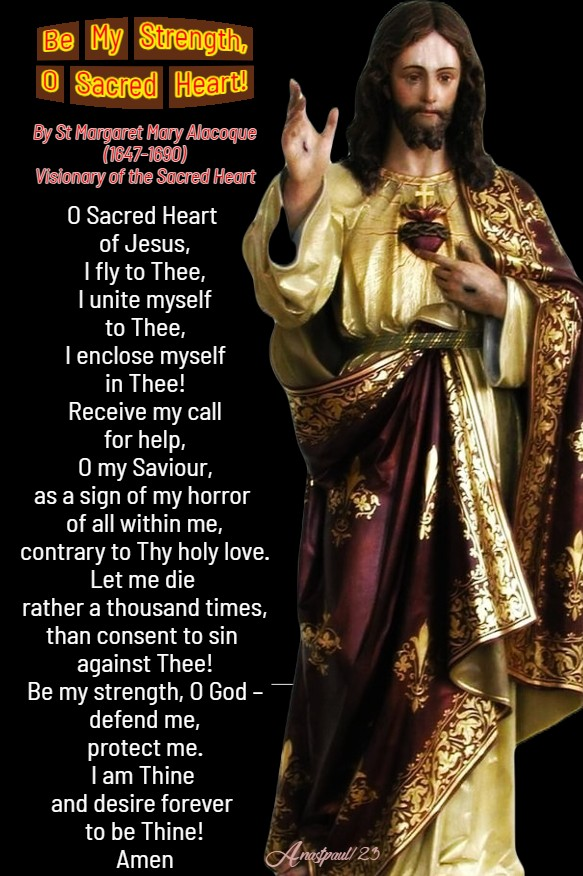
Be My Strength, O Sacred Heart! By St Margaret Mary Alacoque (1647-1690) Visionary of the Sacred Heart
O Sacred Heart of Jesus, I fly to Thee, I unite myself to Thee, I enclose myself in Thee! Receive my call for help, O my Saviour, as a sign of my horror, of all within me contrary to Thy holy love. Let me die rather a thousand times, than consent to sin against Thee! Be my strength, O God – defend me, protect me. I am Thine and desire forever to be Thine! Amen
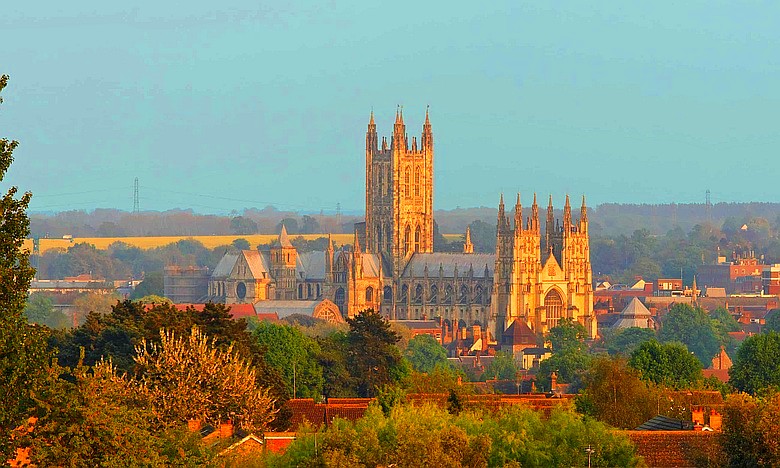
Saint of the Day – 17 October – Saint Nothhelm (Died 739) Archbishop of Canterbury, spiritual writer, a friend and correspondent of both the Venerable Saint Bede and the great Missionary Martyr, Saint Boniface, it was Nothhelm who gathered materials from Canterbury for St Bede’s historical works. After his appointment to the Episcopate of Canterbury in 735, Nothhelm attended to Ecclesiastical matters, including holding Church Councils. Nothhelm was the author of a number of works, although these were later disputed. Of English birth (unknown place and date) and died on 17 October 739 in Canterbury where he is buried. Also known as – Nothelm.
Nothhelm, being aSt Bede’s friend and colleague, was happy to obtain information the later required for his historical works from the Papal Library whilst in Rome on a pilgrimage. He also researched, for St Bede, the history of Kent and the surrounding region. Before his appointment As the Archbishop of Canterbury, he whad been the Archpriest of the Saxon-built St Paul’s Cathedral, in London
Named to the See of Canterbury in 735, Nothhelm was Consecrated the same year. Pope Gregory III sent him a Pallium in 736. He may have been appointed by Æthelbald, King of Mercia, to whom Nothhelm had acted as a Counsellor. Nothhelm was one of a number of Mercians who became Archbishop of Canterbury, during a time of expanding Mercian influence.
Nothhelm held a Synod in 736 or 737 which drew nine Bishops; the meeting adjudicated a dispute over the ownership of a Monastery located at Withington. A significant feature of this Synod was that no King attended, but yet, the Synod still rendered judgement in the ownership even without secular involvement which was most unusual at that time in that country.
As the Archbishop of Canterbury, Nothhelm oversaw the reorganisation of the Mercian Dioceses which took place in 737. The Archbishop Consecrated Witta as the Bishop of Lichfield and Totta as the Bishop of Leicester. The Diocese of Leicester was firmly established by this action, although earlier unsuccessful ttempts had been made to establish a Diocese there. In 738, Nothhelm was a witness on the Charter of Eadberht I, the King of Kent.
St Bede addressed his work “In Regum Librum XXX Quaestiones“ to Nothhelm, who had asked the thirty questins on the Scriptural Bok of Kings which St Bede answered. Bede’s work “De VIII Quaestionibus” may have been written for Nothhelmtoo.
While Nothhelm was Archbishop, St Boniface wrote to him requesting a copy of the Libellus Responsionum of St Pope Gregory the Great, for use in Boniface’s missionary efforts. St Boniface also asked for information on the historical records of the English Gregorian mission to England.
Nothhelm died on 17 October 739 and was buried in Canterbury Cathedral. The antiquaries and writers John Leland, John Bale, and Thomas Tanner all felt that Nothhelm was the author of various works but later sources dispute these historians. A verse eulogy for Nothhelm, of uncertain date, survives in a 16th Century manuscript now at the Lambeth Palace Library.
Bl Gilbert the Theologian St Heron of Antioch Bl Jacques Burin St John the Short/Dwarf St Louthiern St Mamelta of Persia St Nothhelm (Died 739) Archbishop of Canterbury St Richard Gwyn St Rudolph of Gubbio St Rufus of Rome St Solina of Chartres
Martyrs of Nicomedia – 3 Saints: A group of Christians Martyred in the persecutions of Diocletian. The only details about them that have survived are their names – Alexander, Marianus and Victor. 303 in Nicomedia (in modern Turkey).
Martyrs of Valenciennes -5 Beati: A group of Ursuline nuns Martyred in the persecutions of the French Revolution. Hyacinthe-Augustine-Gabrielle Bourla Jeanne-Reine Prin Louise-Joseph Vanot Marie-Geneviève-Joseph Ducrez Marie-Madeleine-Joseph Déjardins
Martyrs of Volitani: A group of Martyrs who were praised by Saint Augustine of Hippo. In Volitani, proconsular Africa (in modern Tunisia).




















 AnaStpaul
You must be logged in to post a comment.