Passionate Catholic.
Being a Catholic is a way of life - a love affair "Religion must be like the air we breathe..."- St John Bosco
Prayer is what the world needs combined with the example of our lives which testify to the Light of Christ.
This site, which is now using the Traditional Calendar, will mainly concentrate on Daily Prayers, Novenas and the Memorials and Feast Days of our friends in Heaven, the Saints who went before us and the great blessings the Church provides in our Catholic Monthly Devotions.
This Site is placed under the Patronage of my many favourite Saints and especially, St Paul.
"For the Saints are sent to us by God
as so many sermons.
We do not use them, it is they who move us
and lead us, to where we had not expected to go.”
Charles Cardinal Journet (1891-1975)
This site adheres to the pre-Vatican II Catholic Church and all her teachings. .
PLEASE ADVISE ME OF ANY GLARING TYPOS etc - In June 2021 I lost 100% sight in my left eye and sometimes miss errors. Thank you and I pray all those who visit here will be abundantly blessed. Pax et bonum! 🙏
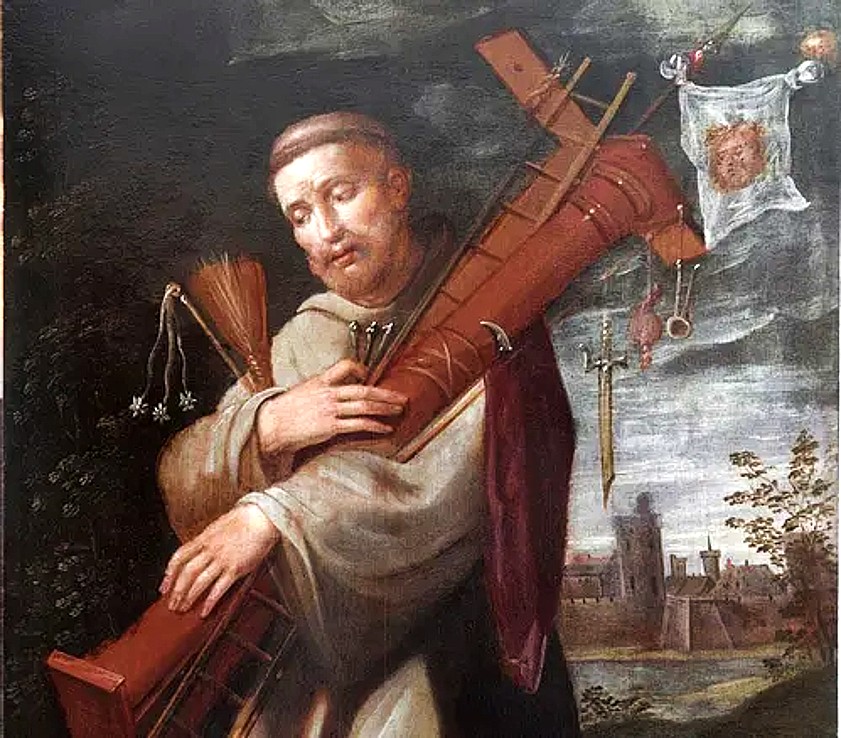
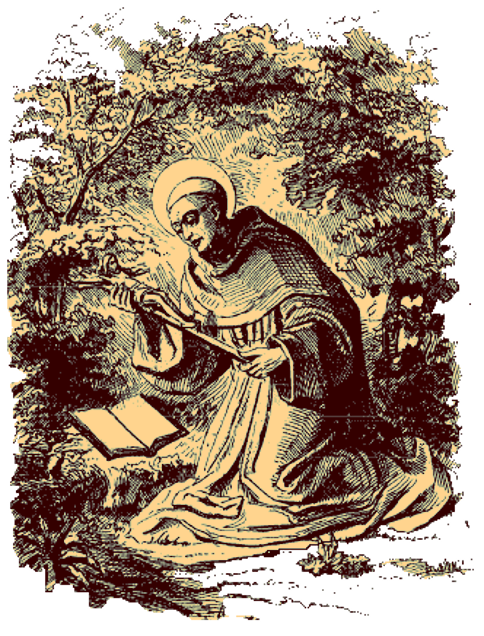
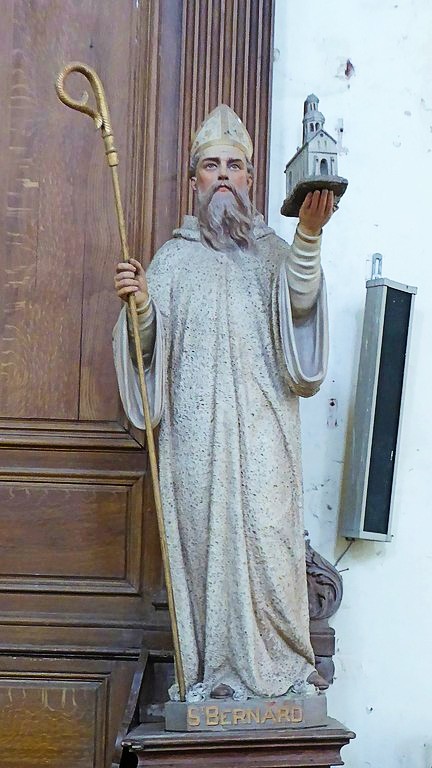
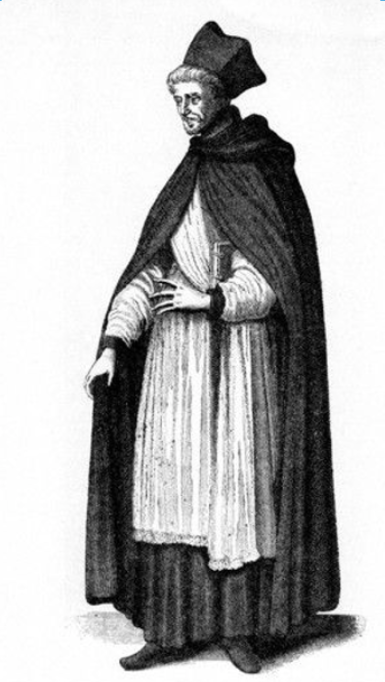
Saint of the Day – 14 April – St Bernard of Tiron (c 1046-1117) French Monk, Hermit, Abbot, Founder of the the Tiron Abbey and the Tironensian Order. St Bernard had a deep devotion to the Passion of Christ, teaching and instruction his disciples in the love of the Holy Cross. Also known as – Bernard of Ponthieu, Bernard of Abbeville, Bernhard…
The Roman Martyrology reads: “In the Monastery of Tiron near Chartres in France, Saint Bernard, Abbot, who on several occasions gave himself up to a hermit life in the woods and on the Island of Chausey but also dedicated himself to instructing and guiding the disciples, who in great numbers, flocked to him.”
Saint Bernard of Tiron is represented as a Monk. He carries the instruments of the Passion, among which we can see: the column of the flagellation, the spear of Longinus, the Cross, the veil of Saint Veronica, the nails, the sword of Saint Peter, the lantern of the guards, the whip , the scale.
Bernard was born near Abbeville in 1046. Having already made good studies and knowing the Sacred Scriptures, in particular, Bernard, at the age of around 19, was accepted at the Monastery of Saint-Cyprien, near Poitiers. He remained there for ten years, before being transferred to Saint-Savin-sur-Gartempe to fill the position of Prior. When the Abbot was convicted of simony in 1082, Bernard assumed the responsibilities of superior. For fear of being elected Abbot, Bernard escaped secretly, becoming a Hermit in the Craon forest, on the borders of Brittany and the Maine, in a place called Tiron.
Being discovered after three years by the Monks of St Savin, who still wished to have him as their Abbot, Bernardo again disappeared and went to live in perennial contemplation on the Island of Chausey. Only after three more years, having learned that the Monks of St Savin had elected another as Abbot, did Bernard return to Tiron. He did not stay there for long, however, for, he gained many followers to his hermit way of life, including St Adelelmus of Flanders. The community grew into a centre for hermits, with many building cells around his. Bernard fame grew eventually gaining the attention of the Saint Cypriene Monastery. (Bernard’s first Monastery) . Abbot Renault then called for Bernard to return to the Monastery bringing with him his new followers. Bernard returned and resumed the habit as well as being appointed Renault’s successor. Bernard accepted the office of Prior of that Monastery and then, on the death of Rinaldo, that of Abbot.
He took part in the Council of Poitiers in 1100 and obtained from Rome, permission of independence from Cluny, for his Monastery of St Cypriene. He returned to the Island of Chausey, which he again had to leave because he was disturbed by the pirates and then accepted the land of Brunelles, given to him by a benefactor, in the forest of Tiron, founding a new Monastery there (1109). However, since a quarrel arose with the Monks of Nogent, of the Cluniac Congregation, who demanded a tithe, instead of agreeing to this demand, he abandoned the Monastery and went to found another at the mouth of the Tiron (1113/14).
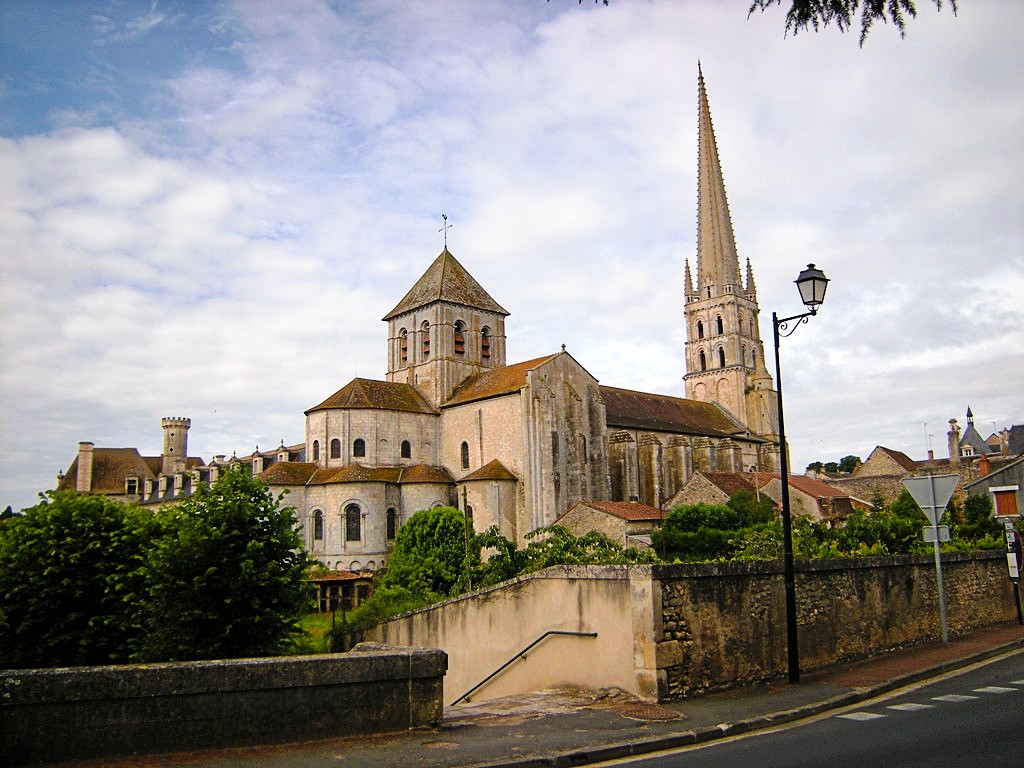
Abbey of the Holy Trinity of Tiron
With the aid of donations from the kings and nobles of France, England and Scotland, Bernard established the Abbey of the Holy Trinity of Tiron in 1114. From here Bernard founded the Tironensian Order, based on a strict observance of the Rule of Saint Benedict and an emphasis on manual labour. This Abbey was so succesful, that the Monks there soon reached the number of five hundred! The Tironensian Order, spread to Germany, England, Scotland and elsewhere. The Order ceased to exist in the 17th Century.
The life of a Tironensian – The Passion of Christ, Sacred Scriptures and working the land.
Bernard remained there until his death on 14 April 1117. His cult, previously limited to Tiron, extended to the whole of his Congregation. Pope Pius IX authorised the Diocese of Chartres and Amiens to celebrate the Feast on 14 April, a Feastwhich is also found in toitiers, Séez, Lavai and Bourges.
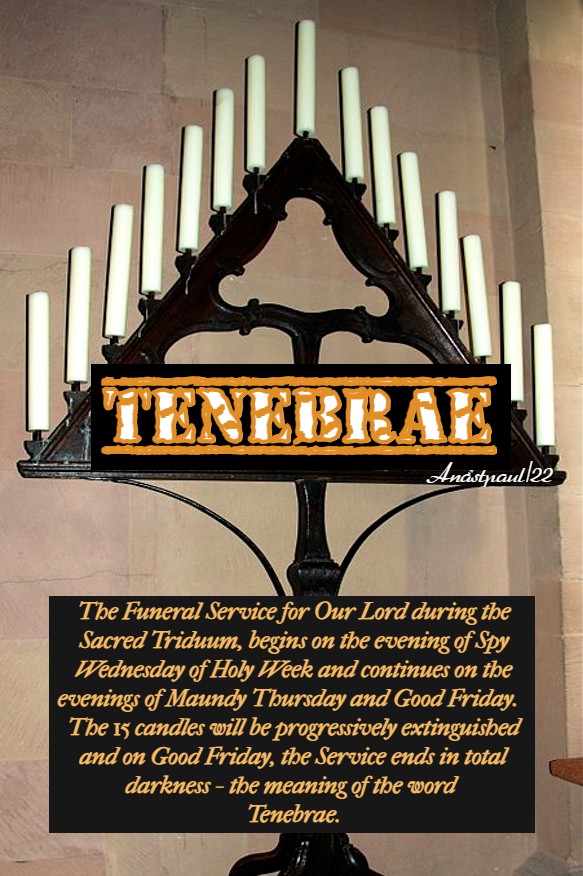
The public singing of part of the Divine Office, on Wednesday, Thursday and Friday evenings of Holy Week, anticipating Matins and Lauds of Holy Thursday, Good Friday, and Holy Saturday. A custom that went back centuries, it acquired the name because of the mourning ritual surrounding the ceremony, which included a triangular stand with fifteen candles. These were put out one by one until, after the last candle was extinguished, a prayer was said in darkness, one candle was lighted, and the assembly dispersed in silence. — Fr John Hardon, Modern Catholic Dictionary
The Matins and Lauds of the Divine Office sung during the Triduum (Holy Thursday, Good Friday and Holy Saturday) are known as the Tenebrae services (“tenebrae” meaning “darkness or shadows”), which is basically a funeral service for Our Lord.
During the Matins on Good Friday, one by one, the candles are extinguished in the Church, leaving the congregation in total darkness and in a silence that is punctuated by the “strepitus” (a loud clang intended to evoke the earthquake that occurred at the moment of Our Saviour’s Death) meant to evoke the convulsion of nature at the Death of Christ. It has also been described as the sound of the tomb door closing.
Thought for the Day – 13 April – Meditations with Antonio Cardinal Bacci (1881-1971)
The Night of the Passion
“The night of the Passion of Jesus Christ began in the Garden of Gethsemane. Here the tired Apostles left Him to pray alone and to endure the agonising pre-vision of the torments and death which awaited Him, as well as of the ingratitude with which men would repay His Infinite love. Soon afterwards, abandoned by everyone, He was led before the Sanhedrin as a criminal and a disturber of the public peace. Not only was the accusation false but, it was, of course, a complete inversion of the truth.
Jesus had, in fact, taught the noblest and most elevating of doctrines for all humanity. He had proved the truth of His teaching by His miracles. He restored sight to the blind, health to the lepers, to the lame and to the paralysed and even, life to the dead. He had stated quite clearly, “Render to Caesar, the things that are Caesar’s and to God, the things that are God’s” (Mt 22:21). Nevertheless, in the presence of His wicked judges, He showed Himself to be meek and humble. But when He was confronted with an obvious falsehood, He spoke out in defence of the truth of His teaching. For this, He was struck by one of the High Priests’s attendants , who said: “Is that the way thou dost answer the high priest?” “If I have spoken ill,” Jesus replied quietly, “bear witness to the evil but if well, why dost thou strike me?” (Jn 18:19-23).
Let us learn from our Divine Redeemer to conquer self-love and to bear insults humbly and peacefully.”
Spy Wednesday in Holy Week – 13 April – Our Lenten Journey with the Great Fathers – Isaias 53:1-12, Luke 22:39-71; 23:1-53
“And turn not away thy face from thy servant, for I am in trouble, hear me speedily. Save me, O God, for the waters are come in, even unto my soul.” – Psalm 68:2
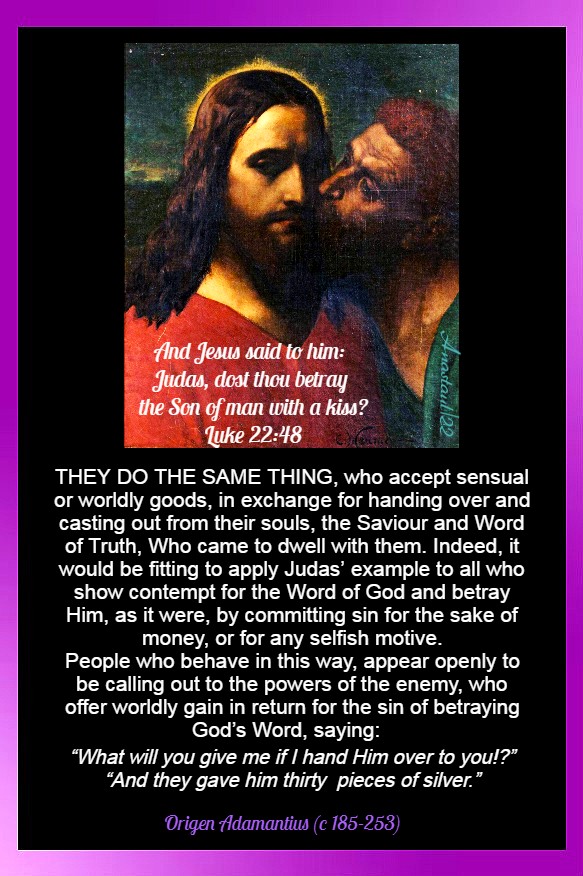
“And Jesus said to him: Judas, dost thou betray the Son of man with a kiss?”
Luke 22:48
“LET US CONSIDER what Judas said to the Jewish priests: “What will you give me if I hand him over to you?” He was willing to take money in exchange for handing over the Word of God!
THEY DO THE SAME THING, who accept sensual or worldly goods, in exchange for handing over and casting out from their souls, the Saviour and Word of Truth, Who came to dwell with them. Indeed, it would be fitting to apply Judas’ example to all who show contempt for the Word of God and betray Him, as it were, by committing sin for the sake of money, or for any selfish motive. People who behave in this way, appear openly to be calling out to the powers of the enemy, who offer worldly gain in return for the sin of betraying God’s Word, saying: “What will you give me if I hand Him over to you!?” “And they gave him thirty pieces of silver.”
THE NUMBER OF COINS they gave Judas, was equivalent, to the number of years the Saviour had sojourned in this world. For at the age of thirty, He was Baptised and began to preach the gospel, like Joseph was thirty years old when he began to gather grain for his brothers. Just as at that time the grain was prepared by God for the sons of Israel but given also to the Egyptians, so also, the gospel was prepared for the saints but preached also to the unfaithful and wicked.” – Origen Adamantius (c 185-253) Priest, Theologian, Exegist, Writer, Apologist, Father (Commentary on Matthew 78)
Quote/s of the Day – 13 April – Spy Wednesday in Holy Week – Isaias 53:1-12, Luke 22:39-71; 23:1-53
“And Jesus said to him: Judas, dost thou betray the Son of man with a kiss?”
Luke 22:48
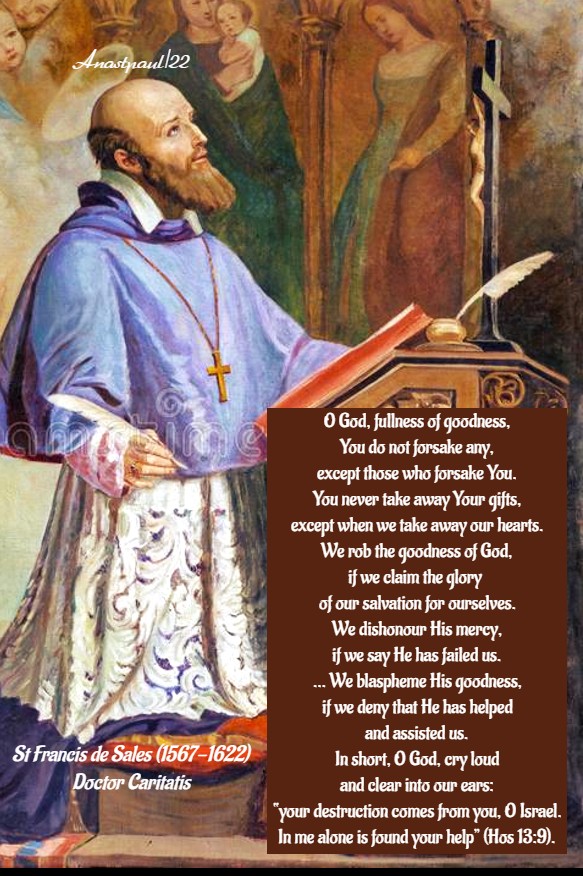
“O God, fullness of goodness, You do not forsake any, except those who forsake You. You never take away Your gifts, except when we take away our hearts. We rob the goodness of God, if we claim the glory of our salvation for ourselves. We dishonour His mercy, if we say He has failed us. … We blaspheme His goodness, if we deny that He has helped and assisted us. In short, O God, cry loud and clear into our ears: “your destruction comes from you, O Israel. In me alone is found your help” (Hos 13:9).
St Francis de Sales (1567-1622) Doctor Caritatis Treatise on the Love of God, Ch 9
“Sacrilegious tongues blaspheme the God who preserves their existence! … you should be damned forever and, instead of thanking Him for His goodness, you, at the very time that He bestows His favours upon you, YOU blaspheme His Holy Name!”
St Alphonsus Maria de Ligouri (1696-1787) Most Zealous Doctor
One Minute Reflection – 13 April – Spy Wednesday in Holy Week – Isaias 53:1-12, Luke 22:39-71; 23:1-53
“And he released unto them, him who for murder and sedition had been cast into prison, whom they had desired. But Jesus he delivered up to their will.” – Luke 23:25
REFLECTION – “Jesus made His way of His own free will towards the sufferings Scripture had foretold. He had frequently predicted them to His disciples and had even severely rebuked Peter, who had received their discovery with indignation (Mt 16:23). Finally, He showed how they were the cause of the world’s salvation. This was why, to the men coming to arrest Him, He referred to Himself as: “I am he whom you are seeking” (cf. Jn 18:5.8) … He was struck, covered with spittle, mocked, tortured, scourged and, in the end crucified. He allowed two outlaws, one at His right and one at His left, to share His suffering. Classed alongside murderers and criminal, He took vinegar and gall, fruits of a bitter vine. He was struck in mockery by a reed, pierced by a lance in His side and, in the end, laid in a tomb.
All this He suffered while working out our salvation … By His thorns He brought an end to the punishment laid on Adam, since the latter, having sinned, received this sentence: “Cursed be the ground because of you! Thorns and thistles shall it bring forth to you” (Gn 3:17-18). With the gall He took to Himself all that is bitter and painful in mortal life and sorrowful to men. With the vinegar He accepted human nature’s decline and bestowed on it, its restoration to a higher state. By the purple he symbolised His royalty; with the reed, He indicated how weak and feeble the devil’s power is. Being slapped, He made known our enfranchisement [just as we do in the case of a slave]. He bore with the abuse, punishment and beating due to us.
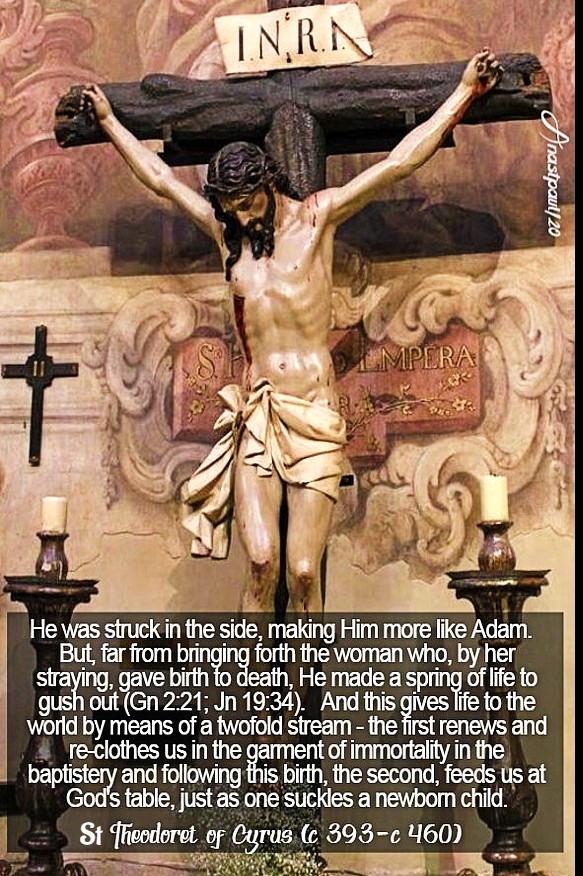
He was struck in the side, making Him more like Adam. But, far from bringing forth the woman, who, by her straying, gave birth to death, He made a spring of life to gush out (Gn 2:21; Jn 19:34). And this gives life to the world by means of a twofold stream – the first renews and re-clothes us in the garment of immortality in the baptistery and following this birth, the second, feeds us at God’s table, just as one suckles a newborn child.” … St Theodoret of Cyrus (c 393-c 460) Bishop (Treatise on the Incarnation, 26-27).
PRAYER – O God, Who to drive far from us, the power of the enemy, didst will that Thy Son should suffer for us on the gibbet of the Cross, grant us Thy servants, that we may obtain the grace of the resurrection. Through the same Jesus Christ, Thy Son, Our Lord, Who lives and reigns with Thee in the unity of the Holy Ghost, God, world without end. Amen (Collect).
Our Morning Offering – 13 April – Wednesday of Holy Week
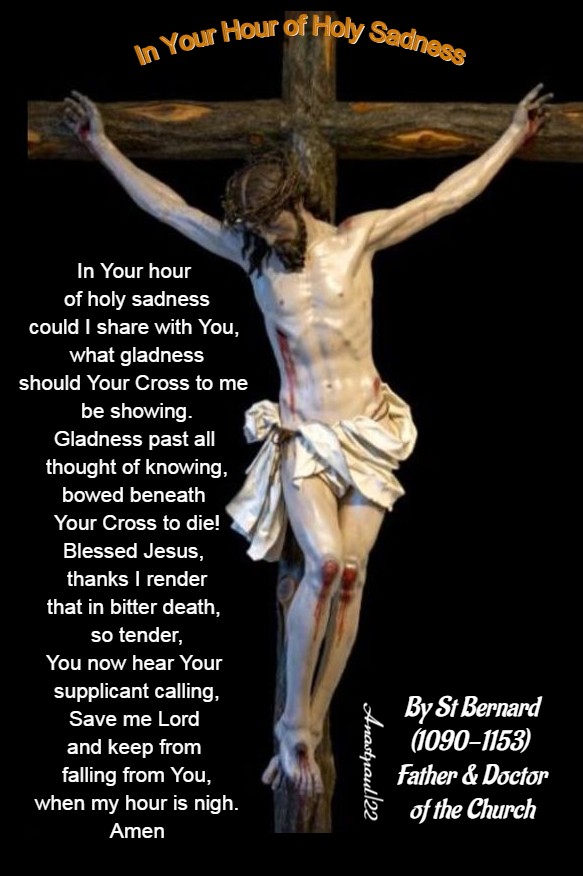
In Your Hour of Holy Sadness By St Bernard (1090-1153) Father & Doctor of the Church
In Your hour of holy sadness could I share with You, what gladness should Your Cross to me be showing. Gladness past all thought of knowing, bowed beneath Your Cross to die! Blessed Jesus, thanks I render that in bitter death, so tender, You now hear Your supplicant calling, Save me Lord and keep from falling from You, when my hour is nigh. Amen.
Saint of the Day – 13 April – Blessed Albertinus of Fonte Avellana OSB (Died 1294) Monk. Prior General, talented Administrator and Peacemaker, not only in his Monastery but also in the greater world outside it. Born in the mid 13th-Century in Montone, Italy and died on 13 April 1294 of natural causes. Also known as – Albertinus of Montone, Albertino.
Albertinus was born between 1216 and 1220 in the Castle of Montone. The historical context of the time was characterised by a cruel conflict which ended with the victory of the Guelfi and subjected Montone to the rule of Perugia. We do not know when Albertinus became a Benedictine Monk nor which his first hermitage was.
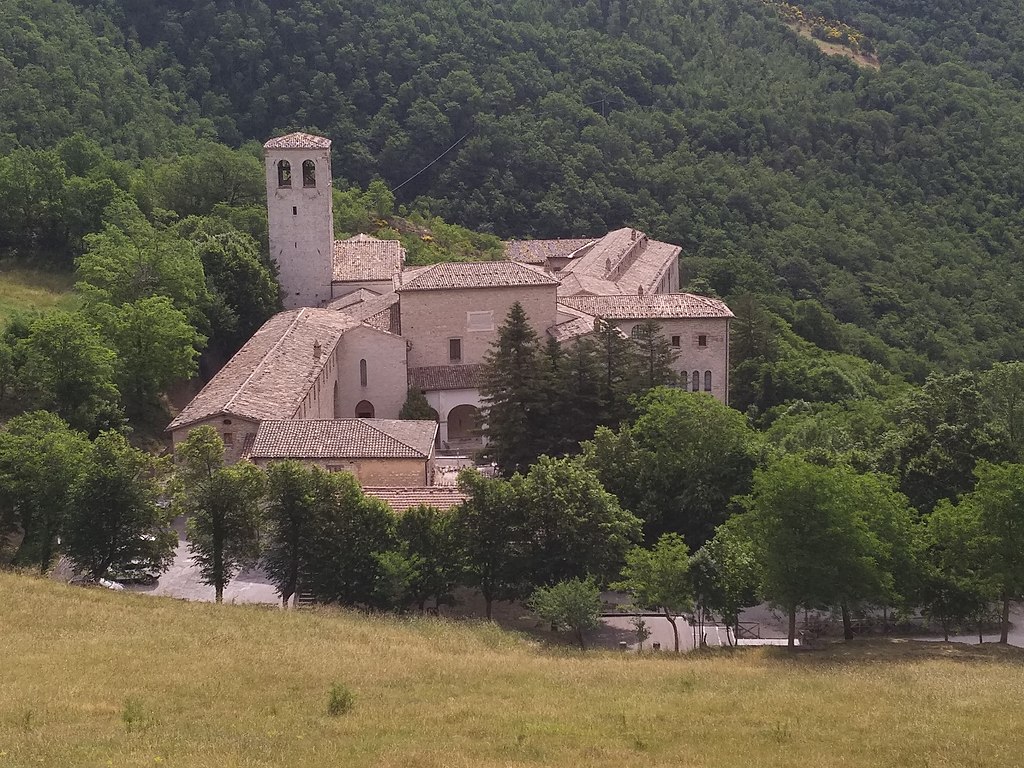
Albertinus was nominated Prior at the Monastery of Fonte Avellana (meaning the Venerable Hermitage of the Holy Cross) in Serra Sant’Abbondio (Marche) when his congregation merged with the Camaldolese in 1270. At that time, the Abbey was going through a serious crisis, despite the fact, that it was also in a phase of great power and expansion. Albertinus, a virtuous young man, was called to solve the problems and restore peace.
Fonte Avellana
The Prior is responsible for the running of the Monastery and for maintaining the Rule, the traditions and institutions, in the absence of the Abbot. Due to his moderation and sanctity, Albertinus succeeded in returning peace to Fonte Avellana.
Albertinus left a collection of “papers” composed of four hundred original documents, elaborated during his thirty-year Priorship. These “papers” indirectly inform us about Prior-general’s innovative ideas and principles which inspired his work.
Throughout Albertinus’ term in office, the lack of recourse to ordinary justice and the search for the settlement of disputes, was a constant in Fonte Avellana. Albertinus always managed to remove the differences and replace them with agreement.s To ensure better economic conditions, for a more dignified existence. Albertinus faced difficult situations, especially conflicts with the neighbouring towns. He understood that establishing good relations with the people counted much more than formal laws and through a spirit of peace and reconciliation, Albertinus was able to establish good relations with the municipalities, which were the new emerging power.
Albertinus died on 13April 1294 and was buried in the Church of Fonte Avellana, where he still rests today. Pope Pius VI Beatified Albertinus.
Spy Wednesday in Holy Week +2022 According to the Calendar of Church, Spy Wednesday marks the last full day of Lent and Holy Week. The Sacred Triduum begins on the evening of the following day, Maundy Thursday.
St Carpus of Pergamus Bl Edward Catherick Bl Francis Dickenson St Guinoc St Hermengild St Ida of Boulogne Bl Ida of Louvain Bl Isabel Calduch Rovira Bl James of Certaldo Bl John Lockwood
Martyrs of Dorostorum – 3 Saints: A lector and two students Martyred together in the persecutions of Diocletian – Dadas, Maximus and Quinctillianus. Beheaded c303 in Dorostorum, Lower Mysia (modern Sillistria, Bulgaria.
Thought for the Day – 12 April – Meditations with Antonio Cardinal Bacci (1881-1971)
The Agony of Jesus
“Jesus suffered willingly and generously for us. First of all, He endured this near-fatal anguish of soul, which caused blood to ooze from the pores of His Body. Then He suffered the cruelest of physical tortures. What must our reaction be?
If we lack the heroic generosity of the Saints and are not prepared to look for suffering by scourging ourselves or by wearing hair-shirts or chains next to our flesh, let us at least accept our inevitable sorrows and trials, with perfect resignation.
Jesus was innocence itself, yet He suffered willingly for us. Why should we, who are unworthy sinners, be unwilling to submit to the punishments due to our sins?
There are many who kiss the Crucifix and claim to love it but, they try as hard as possible, to reject the cross which God has given them. This is an impossible state of affairs!
Let us remember, that if we wish to have a sincere love for the Crucifix, we must love our own cross as well, for this is the cross which God has given us.”
Tuesday of Holy Week – 12 April – Our Lenten Journey with the Great Fathers – Jeremias 11:18-20, Mark 14:32-72; 15, 1-46
“May God have mercy on us and bless us; may He cause the Light of His Countenance to shine upon us and may He have mercy on us.” – Psalm 66:2
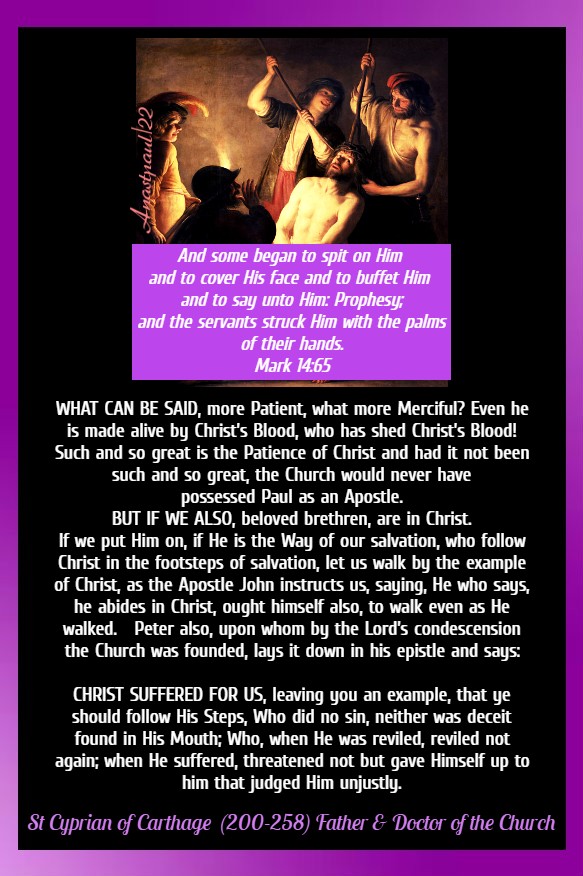
“And some began to spit on Him and to cover His face and to buffet Him and to say unto Him: Prophesy; and the servants struck Him with the palms of their hands.”
Mark 14:65
“HE RECEIVED the spittings of insulters, who with His spittle had a little before made eyes for a blind man. And He in Whose Name the devil and his angels is now scourged by His servants, Himself suffered scourgings! He was crowned with thorns, Who crowns Martyrs with eternal flowers. He was smitten on the Face with palms, Who gives the true palms to those who overcome. He was despoiled of His earthly garment, Who clothes others in the vesture of immortality. He was fed with gall, Who gave heavenly food. He was given to drink of vinegar, Who appointed the cup of salvation. That guiltless, that just One—nay, He who is Innocency itself and Justice itself—is counted among transgressors and Truth is oppressed with false witnesses.
HE, WHO SHALL JUDGE, is judged and the Word of God is led silently to the slaughter. And when, at the Cross, of the Lord the stars are confounded, the elements are disturbed, the earth quakes, night shuts out the day, the sun… He speaks not, nor is moved, nor declares His Majesty even in His very Passion itself. Even to the end, all things are borne perseveringly and constantly, in order that in Christ, a full and perfect patience may be consummated.
AND AFTER ALL THESE THINGS, He still receives His murderers, if they will be converted and come to Him. And with a saving patience, He who is benignant to preserve, closes His Church to none. Those adversaries…, if they repent of their sin, if they acknowledge the crime committed, He receives, not only to the pardon of their sin but to the reward of the Heavenly Kingdom.
WHAT CAN BE SAID, more Patient, what more Merciful? Even he is made alive by Christ’s Blood, who has shed Christ’s Blood! Such and so great is the Patience of Christ and had it not been such and so great, the Church would never have possessed Paul as an Apostle.
BUT IF WE ALSO, beloved brethren, are in Christ. If we put Him on, if He is the Way of our salvation, who follow Christ in the footsteps of salvation, let us walk by the example of Christ, as the Apostle John instructs us, saying, He who says, he abides in Christ, ought himself also, to walk even as He walked. Peter also, upon whom by the Lord’s condescension the Church was founded, lays it down in his epistle and says:
CHRIST SUFFERED FOR US, leaving you an example, that ye should follow His Steps, Who did no sin, neither was deceit found in His Mouth; Who, when He was reviled, reviled not again; when He suffered, threatened not but gave Himself up to him that judged Him unjustly.” – St Cyprian of Carthage (200-258) Bishop of Carthage and Martyr, Father of the Church (On Patience, 7-9).
Quote/s of the Day – 12 April – Tuesday of Holy Week – Jeremias 11:18-20, Mark 14:32-72; 15, 1-46
“And some began to spit on Him and to cover His face and to buffet Him and to say unto Him: Prophesy; and the servants struck Him with the palms of their hands.”
Mark 14:65
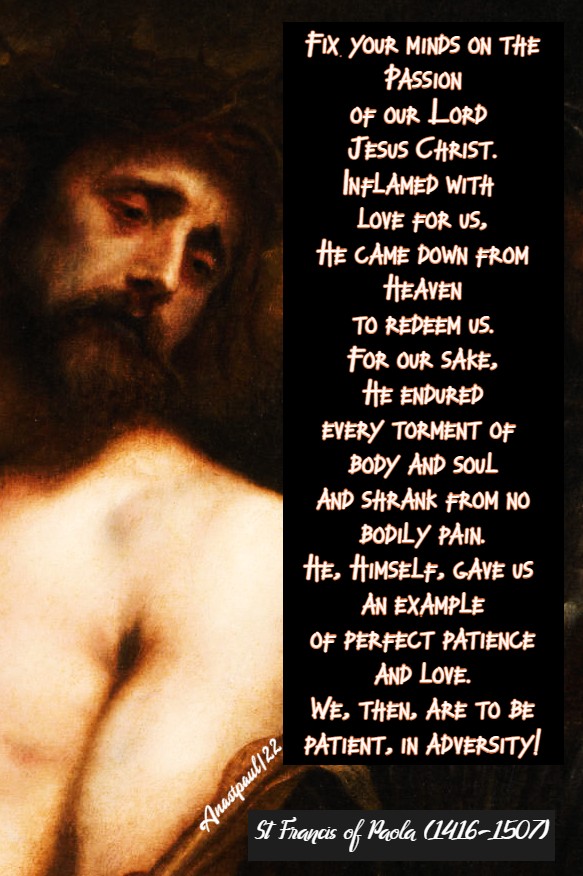
“Fix your minds on the Passion of our Lord Jesus Christ. Inflamed with love for us, He came down from Heaven to redeem us. For our sake, He endured every torment of body and soul and shrank from no bodily pain. He, Himself, gave us an example of perfect patience and love. We, then, are to be patient, in adversity!”
One Minute Reflection – 12 April – Tuesday of Holy Week – Jeremias 11:18-20, Mark 14:32-72; 15, 1-46
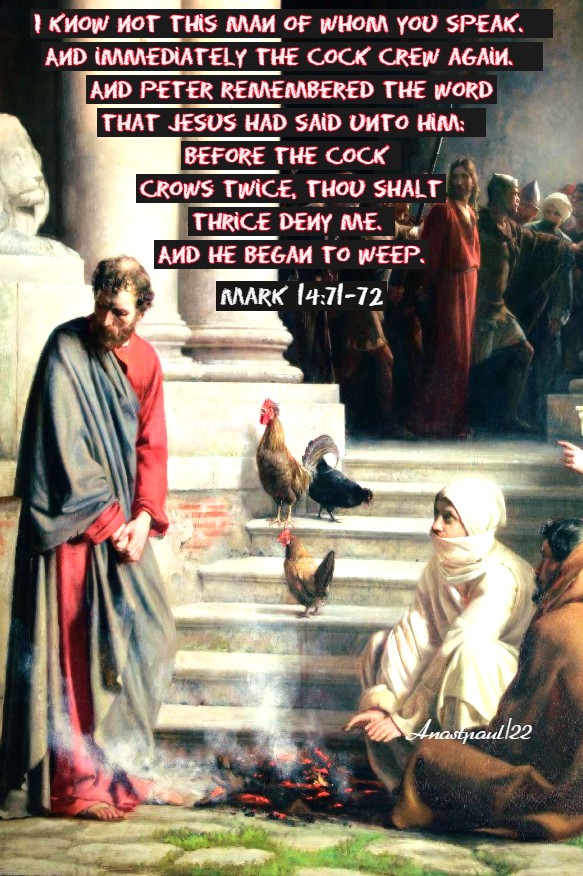
“ I know not this man of whom you speak. And immediately the cock crew again. And Peter remembered the word that Jesus had said unto him: Before the cock crows twice, thou shalt thrice deny me. And he began to weep.” – Mark 14:71-72
REFLECTION – “The first time Peter denied, he did not weep because the Lord had not looked at him. He denied a second time and did not weep because the Lord still did not look at him. He denied a third time; Jesus looked at him and he wept very bitterly (Lk 22:62). Look at us, Lord Jesus, so that we might know how to weep for our sins. This shows us that even the fall of the Saints may be useful to us. Peter’s denial has done me no wrong, on the contrary, I have gained from his repentance – I have learned to be beware of faithless companions. …
So Peter wept and wept bitterly; he wept so hard that he washed away his offence with his tears. And you, too, if you would win pardon, wipe out your guilt with tears. At that very moment, in that same hour, Christ will look at you. If some kind of fall happens to you, then He, the ever-present witness of your intimate life, looks at you to call you back and cause you to confess your lapse. Then do as Peter did, who thrice said: “Lord, you know that I love you” (Jn 21:15). He denied three times and three times he also confessed. But he denied by night; he confessed in broad daylight.
All this has been written, to make us understand, that no-one should be puffed up. If Peter fell for having said: “Though all may have their faith in you shaken, mine will never be” (Mt 26:33), who is there to count on himself? … From whence then, Peter, shall I call you to mind, to teach me your thoughts as you wept? From heaven where you have already taken your place among the choirs of angels, or from the grave? For that death, from which the Lord was raised, did not reject you in your turn. Teach us what use your tears were to you. But you taught it without delay for having fallen before you wept, your tears caused you to be chosen to guide others, you who, to begin with, did not know how to guide yourself.” – St Ambrose (340-397) Bishop of Milan, Father and Doctor of the Church – Commentary on St Luke’s Gospel, 10,89f.
PRAYER – Almighty and eternal God, grant us so to celebrate thy mysteries of our Lord’s Passion, that we may deserve to obtain forgiveness. Through the same Jesus Christ, Thy Son, Our Lord, Who lives and reigns with Thee in the unity of the Holy Ghost, God, world without end. Amen (Collect).
Our Morning Offering – 12 April – Tuesday of Holy Week
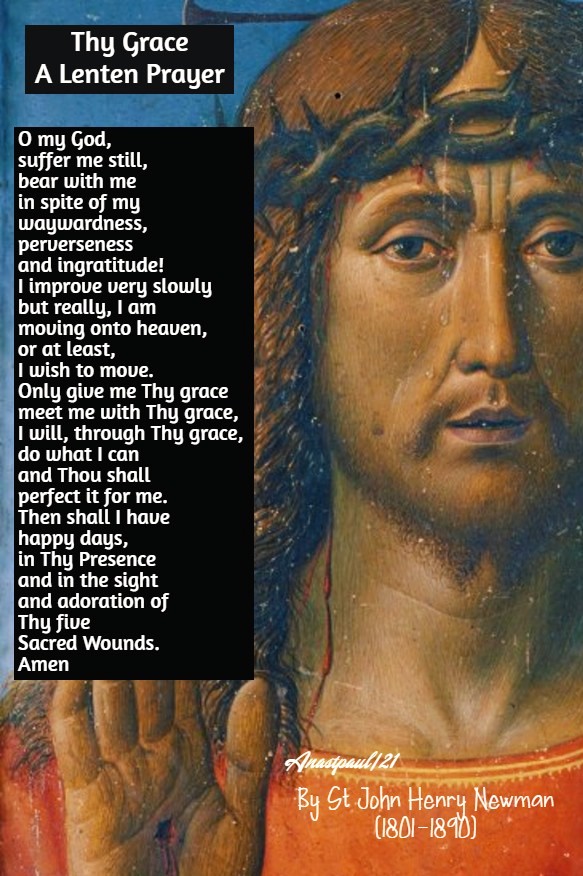
Thy Grace A Lenten Prayer By St John Henry Newman (1801-1890)
O my God, suffer me still, bear with me in spite of my waywardness, perverseness and ingratitude! I improve very slowly but really, I am moving onto Heaven, or at least, I wish to move. Only give me Thy grace meet me with Thy grace, I will, through Thy grace, do what I can and Thou shall perfect it for me. Then shall I have happy days, in Thy Presence and in the sight and adoration of Thy five Sacred Wounds. Amen
Saint of the Day – 12 April – Blessed Andrew of Montereale OSA (c 1403-1479) Priest of the Hermits of St Augustine, renowned Scholar, Preacher, Teacher, Reformer. Confessor and Spiritual Director to the Royal Court of France, Miracle-worker. His life was devoted to teaching, preaching and leading the Augustinians from several positions of leadership. He was hailed, even during his lifetime, as a pious Miracle worker. Born in c 1403 in Mascioni, Campotosto, Italy as Antonio Artesi and died on 18 April 1479 at the Augustinian Monastery of Montereale, Italy of natural causes. Additional Memorial – 18 April (The Augustinians). Patronage – Montereale, Italy.
The Roman Martyrology reads: “In Montereale in Abruzzo, Blessed Andrea, Priest of the Order of the Hermits of St Augustine, who devoted himself to preaching in Italy and France.”
The birthplace of Blessed Andrew is certain – Mascioni, on the shores of Lake Campotosto into a modest household; no less certain is the place of his death: the Augustinian Monastery in Montereale, a short distance from Mascioni, to which the Blessed retired, a few years before his death. His earthly sojourn ended on 18 April 1479.
The sad events of the Avignon Schism had negative effects on the Church and the Augustinian Order, well beyond 1417, the year in which Martin V was elected to the Supreme Pontificate. The quest for unity in the Order, which had been split by the schism and the path of reform, were the most urgent concerns of the General Chapters and the Priors General of the time. Those same events were inevitably echoed in the first part of Blessed Andrew’s life. According to tradition, he had, from childhood, worked as a shepherd. A meeting with Augustinian Father Augustine of Terni, Prior of the Monastery in Montereale, decided Andrew’s entrance into that same Monastery and the beginning of his Novitiate. He was Ordained a Priest at the age of twenty-five and then, in light of his bent for studies, was destined for teaching. To that end he acquired the various academic Degrees of Bachelor, Reader and Master of Theology while attending the general house of studies of the Order in Rimini and in Siena; he appears as Director of studies in the latter place, in 1459.
During these same years, enjoying, as he did, the trust of his superiors and fellow religious, he held Offices in Government. He was Vicar General and visitor of some Monasteries; he was elected Prior Provincial of the Province of the Valley of Spoleto and in that capacity, took part in the General Chapters of Avignon in 1455 and Pamiers (France) in 1465.
In 1459, for reasons we do not know, he resigned from the Priorate and his position as Director of studies in Siena and in 1461, by order of the Prior General, Father William Becchi, a Florentine, he was sent away from the Monastery of Norcia, along with the local Prior, Father Jerome of Cittaducale. This was “at the request of various religious of the Province, in order to avoid scandal and begin the reform of that Monastery.”
In 1468, when William Becchi was still the Prior General, he appointed Blessed Andrew as his Vicar for visiting the Monastery of Amatrice. In 1471, Andrew was again elected Prior Provincial of the Province of the Valley of Spoleto.
Thus far we have the cold facts of his “external” life as a religious. Other sources help us to know more about his interior life.
A few months after the Blessed’s death, his contemporary, Ambrose of Cori, who had been Provincial of the Roman Province and was now Prior General of the Order (1476-1482) listed 36 Blesseds of the Order, in the Chronicle of the Order, which he published in 1481. At the time when Blessed Andrew had been expelled from the Monastery of Norcia, Ambrose was Director of studies in Perugia and, therefore, knew Andrew personally. In the 36th place in his list he put Blessed Andrew of Montereale, “who lived in our time and is made glorious by many signs and miracles. He was very learned in Canon Law, Philosophy and Theology and showed the greatest example of holiness in preaching, helping the poor and enduring abuse and in every kind of patience.”
In a few words Ambrose exalts Blessed Andrew well above even fervent religious, tells us of his reputation for miracles and of his teaching and calls him Blessed, thereby, in all likelihood, expressing the sentiments of the people. In the epitaph engraved beneath the image of the Blessed on the wall of the Choir in the Church of Saint Augustine in Montereale—an epitaph that is now gone but was cited by Riccitelli in 1581 and went back to the end of the fourteenth or the beginning of the fifteenth century—people could read the following:
Here lies the body of Blessed Andrew of the Order of Hermits of Saint Augustine, who worked countless great miracles. Due to his holiness of life, the austerity of his ways and his Catholic teaching, due also to his honeyed preaching and great miracles, he was famous throughout Italy and France.
He is dear to God and humanity and is an honour to the Order, an adornment of his native land and of great advantage to his neighbour. He was and is, a great benefit to the world, having preached the Word of God for fifty years.
His works have not come down to us. At that time an inventory of goods had to be made by Masters of Theology. A copy of the one which the Blessed compiled on the day of his death has survived and therein, is a list of the books he had loaned to brother Friars. Among these was the Decretals, a Gloss on the subject and a “little book,” a term suggesting a work of his own. The other objects listed give a glimpse of the simplicity of his life, for among them are “a little brass jar, four table forks, a little bell and some other little things.”
Augustinians and the Rule
Among the many writers who have spoken of him, mention may be made of Blessed Alonso de Orozco, who, in his Chronicle of the Glorious Saint Augustine, Father and Doctor of the Church (1551), lists Andrew among the blessed and describes him as “a very gifted man and a great preacher; very patient and charitable; – he performed many miracles.”
Although Andrew had the reputation of being a saint, it was only in the years 1756-1757, during the Pontificate of Benedict XIV, that the cause of his Beatification was taken up by the Diocese of Rieti, of which Montereale was a part. During the process, witnesses bore unanimous testimony to Andrew’s commitment to the struggle against schism and heresy, his exercise of the preaching office over several decades, his journeys to France and the role he played at the Court of the King of France, where he was the Queen’s Confessor and Spiritual Director. They also attested that his name was Antonio Artesi. Blessed Andrew was Beatified on 18 February 1764 by Pope Clement XIII (By the Augustinian Friends).
Thought for the Day – 11 April – Meditations with Antonio Cardinal Bacci (1881-1971)
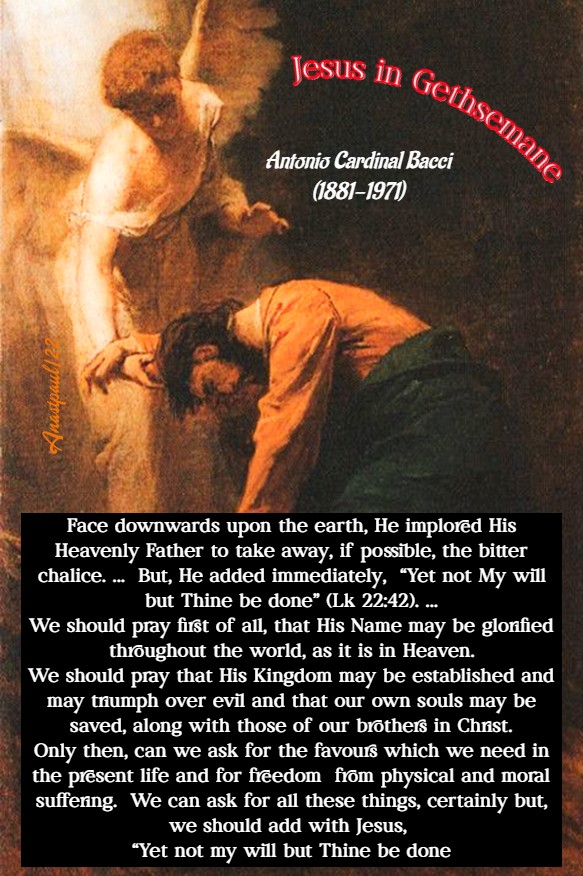
Jesus in Gethsemane
“What was the prayer of Jesus in the moment of anguish when He saw Himself abandoned or betrayed by everyone on this earth and foresaw the terrible sufferings of His Passion and Death, which, despite His infinite love, would prove to be in vain for so many men? Face downwards upon the earth, He implored His Heavenly Father to take away, if possible, the bitter chalice. But, He added immediately, “Yet not My will but Thine be done” (Lk 22:42).
We should pray like Jesus, especially when we are suffering in body and tormented in mind. We should prostrate ourselves before God, with an act of deep humility and of perfect confidence in His infinite goodness. We should pray first of all, that His Name may be glorified throughout the world, as it is in Heaven. We should pray that His Kingdom may be established and may triumph over evil and that our own souls may be saved, along with those of our brothers in Christ. Only then, can we ask for the favours which we need in the present life and for freedom from physical and moral suffering. We can ask for all these things, certainly but, we should add with Jesus, “Yet not my will but Thine be done!” In other words, we should be ready to offer up our sufferings, as a proof of our love for Him. Amen.”
Monday of Holy Week – 11 April – Our Lenten Journey with the Great Fathers – Isaias 50:5-10, John 12:1-9
“Help us, O God, our saviour and for the glory of thy name, O Lord, deliver us and forgive us our sins, for Thy name’s sake” – Psalm 78:9
“He (Judas Iscariot) said this, not because he cared about the poor but because, he was a thief and held the money bag and used to steal the contributions.”
John 12:6
“LOOK NOW AND LEARN that this Judas did not become perverted, only at the time when he yielded to the bribery of the Jews and betrayed his Lord. For not a few, inattentive to the Gospel, suppose, that Judas only perished, when he accepted money from the Jews, to betray the Lord. It was not then that he perished but he was already a thief and a reprobate, when following the Lord;,for it was with his body and not with his heart, that he followed. He made up the apostolic number of twelve but had no part in the apostolic blessedness. He had been made the twelfth in semblance and on his departure and the succession of another, the apostolic reality was completed and the entirety of the number conserved.
WHAT LESSON THEN, my brethren, did our Lord Jesus Christ wish to impress on His Church, when it pleased Him, to have one castaway among the twelve – but this – that we should bear with the wicked and refrain from dividing the body of Christ? Here you have Judas among the saints,- that Judas, mark you! who was a thief, yes – do not overlook it – not a thief of any ordinary type but a thief and a sacrilegis – a robber of money bags,but of such as were the Lord’s; of money bags but of such as were sacred! . … How much more severe ought to be, the sentence on the sacrilegious thief, who has dared to steal, not from places of any ordinary kind but, to steal from the Church!?
HE WHO THIEVES from the Church, stands side by side with the castaway Judas. Such was this man Judas and yet, he went in and out with the eleven holy disciples. With them, he came even to the table of the Lord, he was permitted to have intercourse with them but he could not contaminate them.
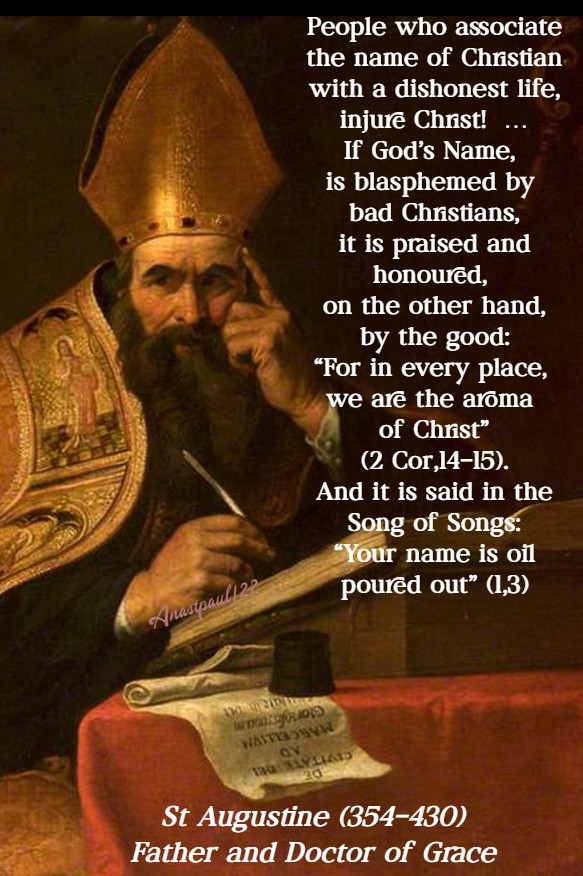
OF ONE BREAD did both Peter and Judas partake and yet, what communion had the believer with the infidel? Peter’s partaking was unto life but that of Judas unto death. For that good bread was just like the sweet savour. For as the sweet savour, so also does the good bread give life to the good and bring death to the wicked. “For he that eateth unworthily, eateth and drinketh judgement to himself:” – “judgment to himself,” not to thee. If, then, it is judgement to himself, not to thee, bear as one that is good, with him that is evil, that you may attain the rewards of the good,and be not hurled into the punishment of the wicked.” – St Augustine (354-430) Bishop of Hippo, Great Western Father and Doctor of the Church (On John 12:1-9 Monday of Holy Week).
Quote/s of the Day – 11 April – Monday of Holy Week – Isaias 50:5-10, John 12:1-9
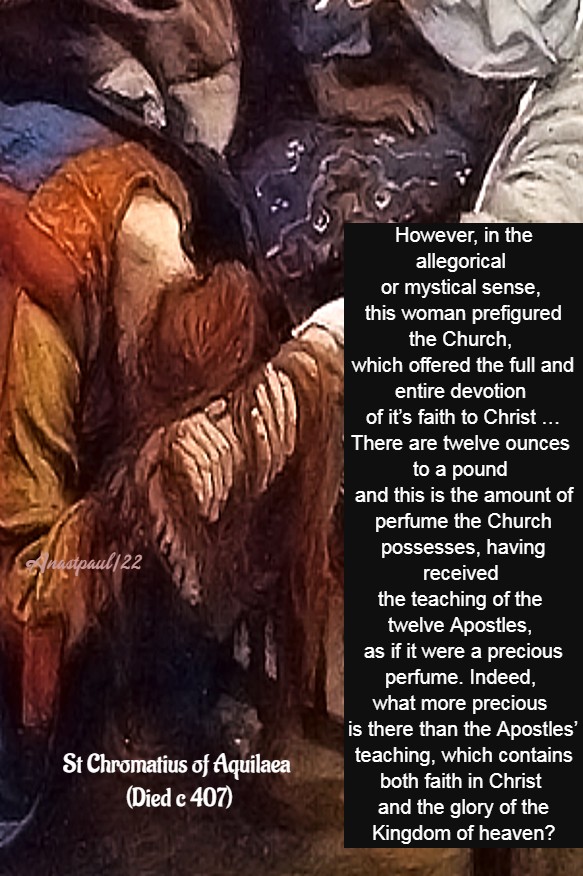
“However, in the allegorical or mystical sense, this woman prefigured the Church, which offered the full and entire devotion of it’s faith to Christ … There are twelve ounces to a pound and this is the amount of perfume the Church possesses, having received the teaching of the twelve Apostles, as if it were a precious perfume. Indeed, what more precious is there than the Apostles’ teaching, which contains both faith in Christ and the glory of the Kingdom of heaven? ”
St Chromatius of Aquilaea (Died c 407)
“People who associate the name of Christian with a dishonest life, injure Christ! … If God’s Name, is blasphemed by bad Christians, it is praised and honoured, on the other hand, by the good: “For in every place, we are the aroma of Christ” (2 Cor,14-15). And it is said in the Song of Songs: “Your name is oil poured out” (1,3).”
One Minute Reflection – 11 April – Monday of Holy Week – Isaias 50:5-10, John 12:1-9
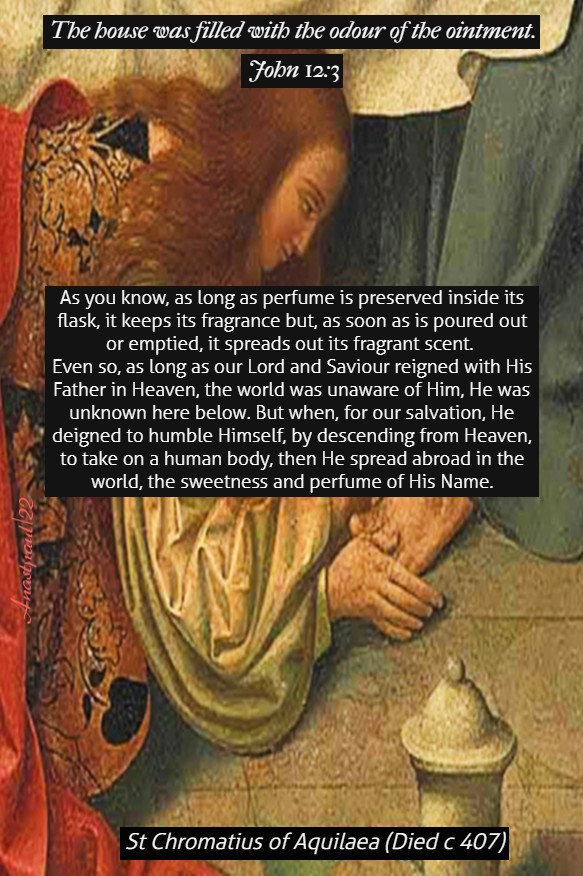
“The house was filled with the odour of the ointment.” – John 12:3
REFLECTION – “When she had anointed the Lord’s feet this woman did not wipe them with a cloth but with her own hair, to show Him greater honour … Like a thirsty person drinking from a fresh waterfall, this holy woman drank in grace full of delights, from the Springs of Holiness, to quench the thirst of her faith.
However, in the allegorical or mystical sense, this woman prefigured the Church, which offered the full and entire devotion of its faith to Christ …There are twelve ounces to a pound and this is the amount of perfume the Church possesses, having received the teaching of the twelve Apostles, as if it were a precious perfume. Indeed, what more precious is there than the Apostles’ teaching, which contains both faith in Christ and the glory of the Kingdom of Heaven? Furthermore, it is related that the whole house was filled with the scent of that perfume because, the whole world has been filled with the Apostles’ teaching. As it is written: “Through all the earth their voice resounds and to the ends of the world, their message” (Ps 19[18]:5).
In the Song of Songs we read the following words addressed through Solomon, to the Church: “Your name spoken is a spreading perfume” (1,2). Not without cause, is the Lord’s Name called a “spreading perfume.” As you know, as long as perfume is preserved inside its flask, it keeps its fragrance but, as soon as is poured out or emptied, it spreads out its fragrant scent. Even so, as long as our Lord and Saviour reigned with His Father in Heaven, the world was unaware of Him, He was unknown here below. But when, for our salvation, He deigned to humble Himself, by descending from Heaven, to take on a human body, then He spread abroad in the world, the sweetness and perfume of His Name.“ – St Chromatius of Aquilaea(Died c 407) – Bishop of Aquileia, Italy, Theologian, Exegete (Sermon 11).
PRAYER – Grant, we beseech thee, almighty God, that we who fail through our weakness, in so many difficulties, may be relieved through the pledging of the Passion of Thy only-begotten Son. Who lives and reigns with God the Father, in the unity of the Holy Spirit, God, world without end. Amen (Collect).
Our Morning Offering – 11 April – Monday of Holy Week
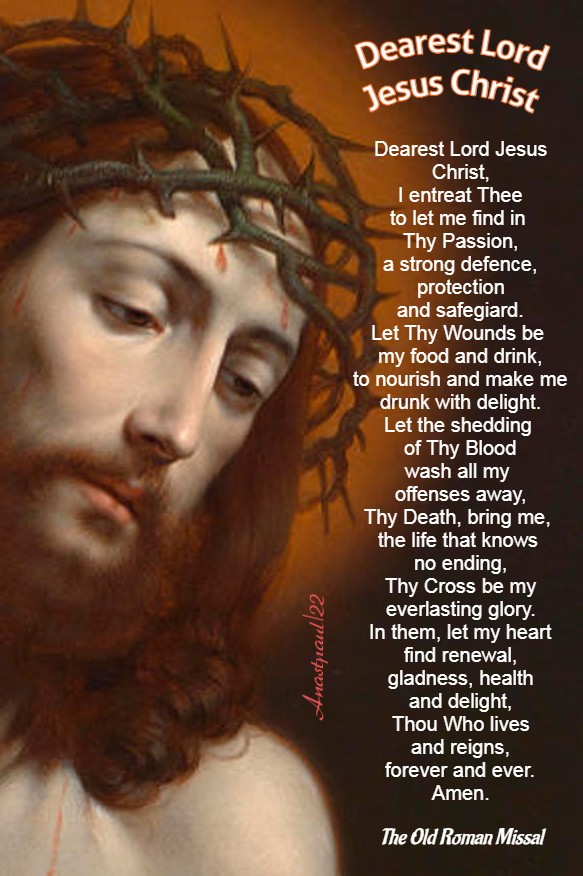
Dearest Lord Jesus Christ The Old Roman Missal
Dearest Lord Jesus Christ, I entreat Thee to let me find in Thy Passion, a strong defence, protection and safegiard. Let Thy Wounds be my food and drink, to nourish and make me drunk with delight. Let the shedding of Thy Blood wash all my offenses away, Thy Death, bring me, the life that knows no ending, Thy Cross be my everlasting glory. In them, let my heart find renewal, gladness, health and delight, Thou Who lives and reigns, forever and ever. Amen.
Saint of the Day – 11 April – Blessed George Gervase OSB (1571–1608) Priest and Martyr, Confessor, Missionary. Born at Boscham, Suffolk, England and died on 11 April, 1608.by being hung, drawn and quartered at Tyburn, London, England. Additional Memorial- 29 October as one of the Martyrs of Douai.
His mother’s name was Shelly and both his father’s and mother’s families had been long established in the County of Suffolk. Losing both parents when he was twelve years old, he was kidnapped by pirates (probably a lieutenant of Drake, who was then buccaneering on the Spanish Main) and carried off to the West Indies with two of his brothers., remaining in captivity for over twelve years.
He lost his religion during that period but, when at last he was able to return to England and found that his brother, Henry had become a voluntary exile in Flanders, in order to be able to practice his faith, George followed him there and was soon reconciled with the Church.
He entered the English College at Douai in 1595 and was Ordained Priest in 1603. He at once went to the English mission. He laboured very successfully for over two years but was arrested in June 1606 and banished with several other clergy. He then made a pilgrimage to Rome and there, endeavoured to enter the Society of Jesus but, not being admitted for some unknown reason, he returned to Douai, where he received the Benedictine habit as a Novice.
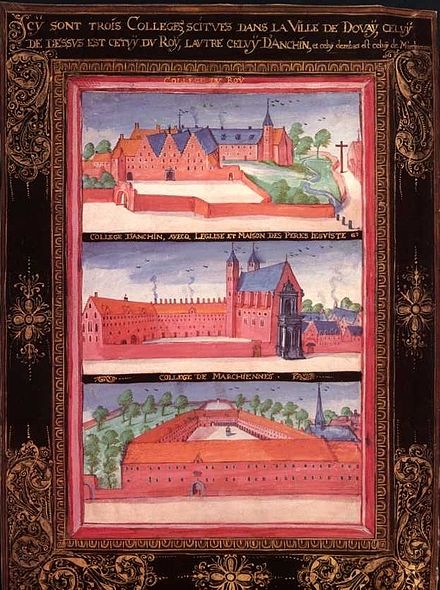
Douai Colleges
His brother Henry, had obtained for him, a comfortable position near Lille, being anxious to preserve him from the persecution then raging in England. But George was determined to preach the Gospel and labour for the conversion of his native land and succeeded in returning to England. He was soon arrested again and incarcerated.
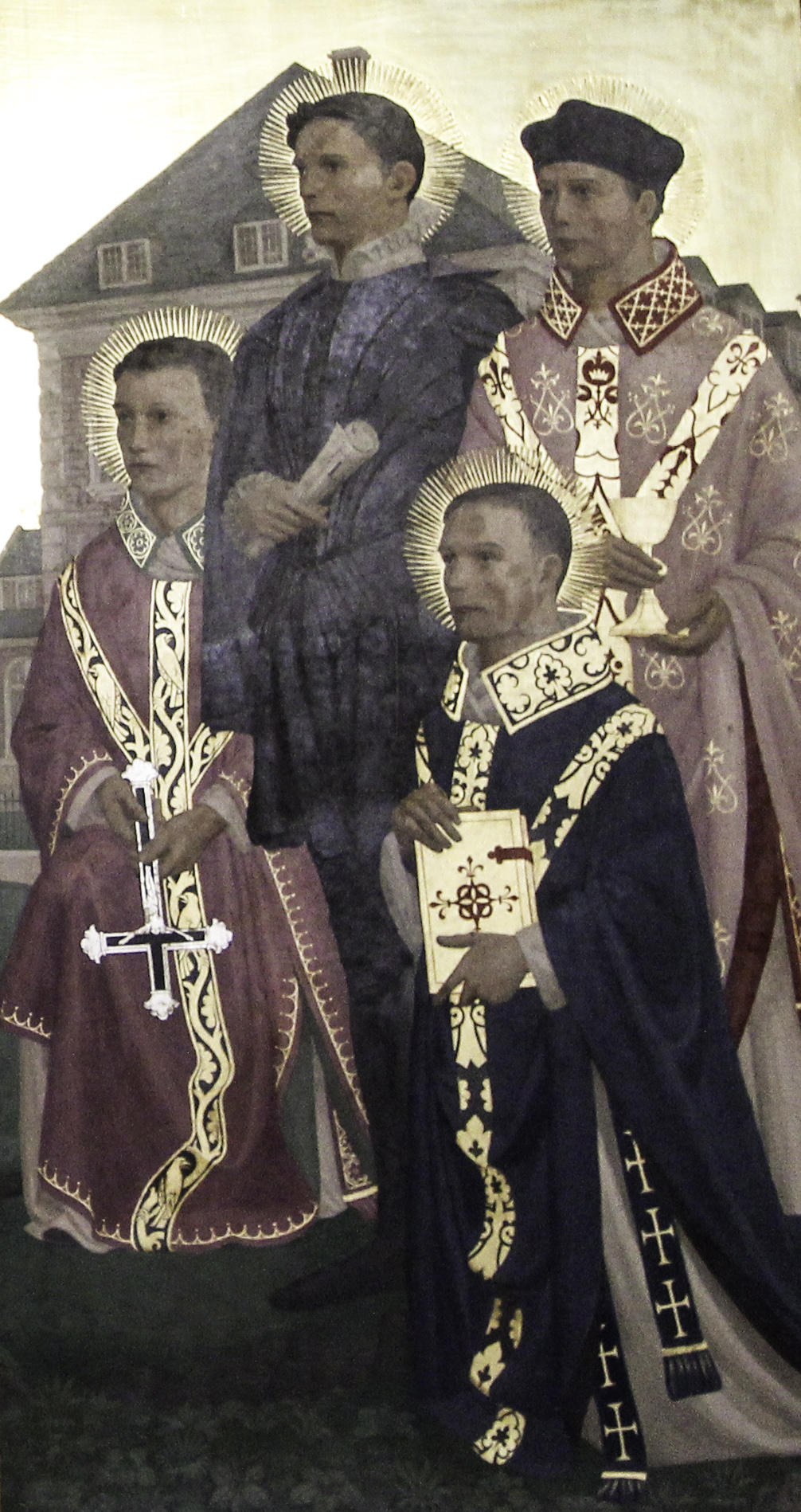
Martys of Douai
Refusing to take the new oath of allegiance to the reigning Monarch, he was tried, convicted of the offence of merely being a Catholic Priest, under the statute 27 of Elizabeth I and was hanged, drawn and quartered at Tyburn.
A short time before his death, George was clothed in the Benedictine Habit by Father Augustine Bradshaw.
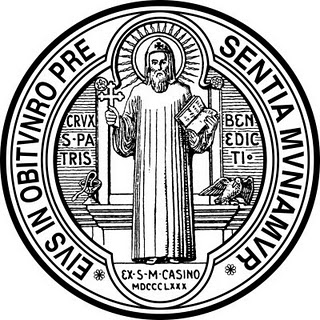
St Benedict Medal
George was Beatified on 15 December 1929 by Pope Pius XI.
Monday of Holy Week +2022 As the most Sacred week of the Liturgical year, the Church does not celebrate the Feast Days of the Saints during Holy Week. However, for chronalogical accuracy, I continue to post the list and the Saint of the Day.
St Hildebrand of Saint-Gilles St Isaac of Monteluco Bl James of Africa Bl John of Cupramontana Bl Lanunio St Machai St Maedhog of Clonmore Bl Mechthild of Lappion Bl Paul of Africa St Philip of Gortyna St Raynerius Inclusus St Stephen of Saint-Gilles Bl Symforian Ducki
Thought for the Day – 10 April – Meditations with Antonio Cardinal Bacci (1881-1971)
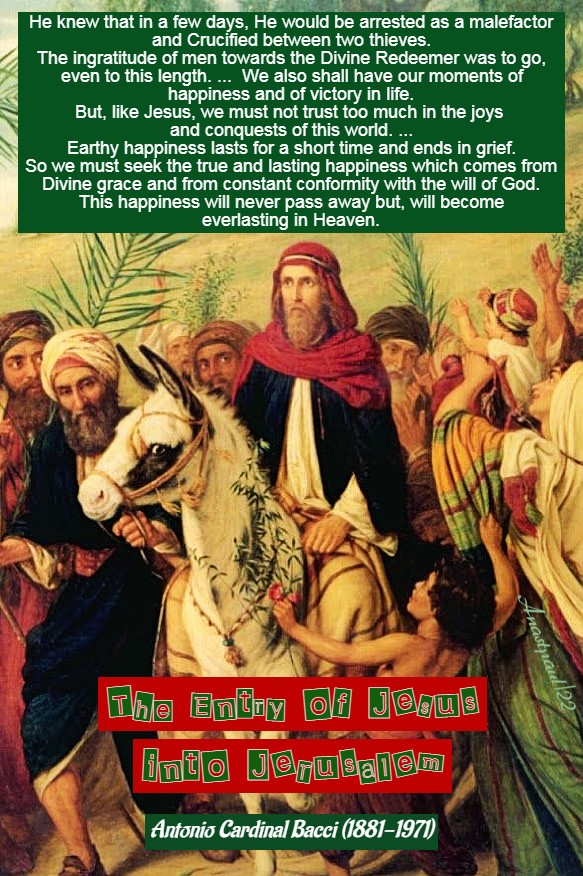
The Entry of Jesus into Jerusalem
“Imagine the joyful and triumphant entry of Jesus into Jerusalem. The cheering crowds line the street along which He approaches, riding upon the foal of an ass. Palm and olive branches are waved aloft, while groups of children cry out: “Hosanna to the Son of David! Blessed is he who comes in the name of the Lord! Hosanna in the highest” (Cf Mt 21:9). In the midst of all this exultation, Jesus appears to be absorbed and detached. In his representation of this scene, a famous artist painted a large cross in the distance, far beyond the cheering crowd. The divine vision of Jesus, certainly saw this cross. He knew that in a few days, He would be arrested as a malefactor and Crucified between two thieves. The ingratitude of men towards the Divine Redeemer was to go, even to this length.
We also shall have our moments of happiness and of victory in life. But, like Jesus, we must not trust too much in the joys and conquests of this world. The warning of the Holy Spirit, that “the end of joy may be sorrow” (Prov 14:13), is unfortunately, only too true. Earthy happiness lasts for a short time and ends in grief. So we must seek the true and lasting happiness which comes from Divine grace and from constant conformity with the will of God. This happiness will never pass away but, will become everlasting in Heaven.”
Palm Sunday – 10 April – Our Lenten Journey with the Great Fathers – Philippians 2:5-11, The Passion of Our Lord Jesus Christ according to Matthew 26:36-75; 27:1-60
“My God, my God, look upon me, why have You forsaken me?” – Psalm 21:2
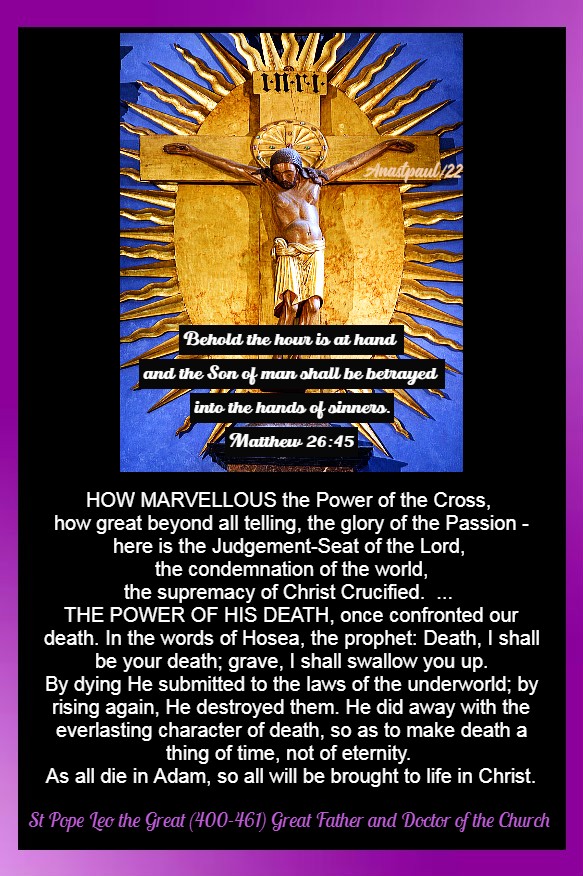
“Behold the hour is at hand and the Son of man shall be betrayed into the hands of sinners.”
Matthew 26:45
“OUR UNDERSTANDING, which is enlightened by the Spirit of Truth, should receive with purity and freedom of heart the glory of the Cross, as it shines in Heaven and on earth. It should see with inner vision. the meaning of the Lord’s Words when He spoke of the imminence of His passion – The hour has come for the Son of Man to be glorified. Afterward He said – Now my soul is troubled and what am I to say? Father, save Me from this hour. But it was for this that I came to this hour. Father, glorify Your Son. When the voice of the Father came from Heaven, saying, I have glorified him, and will glorify Him again, Jesus said in reply to those around Him – It was not for Me that this Voice spoke but for you. Now is the judgement of the world, now will the prince of this world be cast out. And I, if I Am lifted up from the earth, will draw all things to Myself.
HOW MARVELLOUS the Power of the Cross, how great beyond all telling, the glory of the Passion – here is the Judgement-Seat of the Lord, the condemnation of the world, the supremacy of Christ Crucified.LORD, You drew all things to Yourself so that the devotion of all peoples, everywhere, might celebrate, in a Sacrament made perfect and visible, what was carried out in the one temple of Judea, under obscure foreshadowings. …
DEARLY BELOVED, let us then acknowledge what Saint Paul, the teacher of the nations, acknowledged so exultantly: This is a saying worthy of trust, worthy of complete acceptance – Christ Jesus came into this world to save sinners. God’s compassion for us is all the more wonderful because Christ died, not for the righteous, or the holy but for the wicked and the sinful and, although the Divine Nature could not be touched by the sting of death, He took to Himself, through His birth as one of us, something He could offer on our behalf.
THE POWER OF HIS DEATH, once confronted our death. In the words of Hosea, the prophet: Death, I shall be your death; grave, I shall swallow you up. By dying He submitted to the laws of the underworld; by rising again, He destroyed them. He did away with the everlasting character of death, so as to make death a thing of time, not of eternity. As all die in Adam, so all will be brought to life in Christ.” – St Leo the Great (400-461) Great Father and Doctor of the Church (Excerpt from his “On the Lord’s Passion” Sermon 8).
Quote/s of the Day – 10 April – Palm Sunday – Philippians 2:5-11, he Passion of Our Lord Jesus Christ according to Matthew 26:36-75; 27:1-60
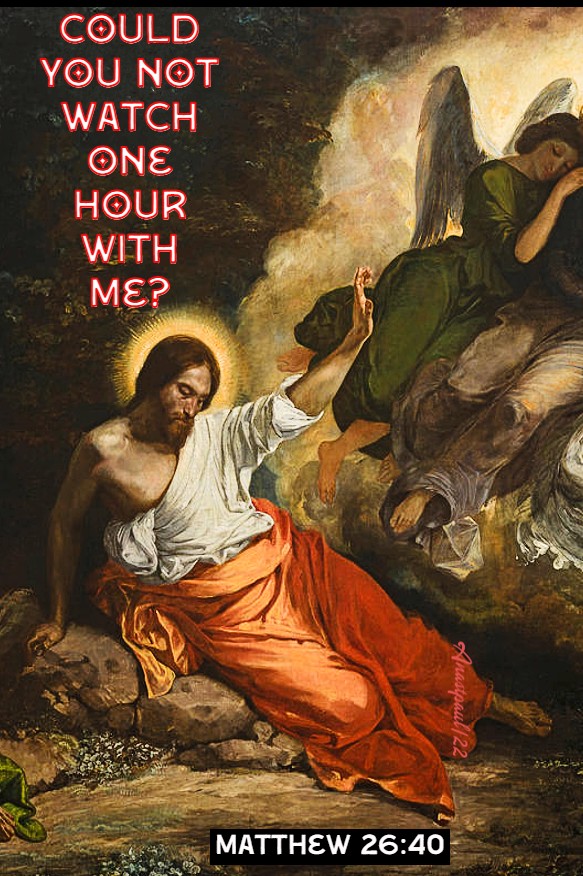
“Could you not watch one hour with Me?”
Matthew 26:40
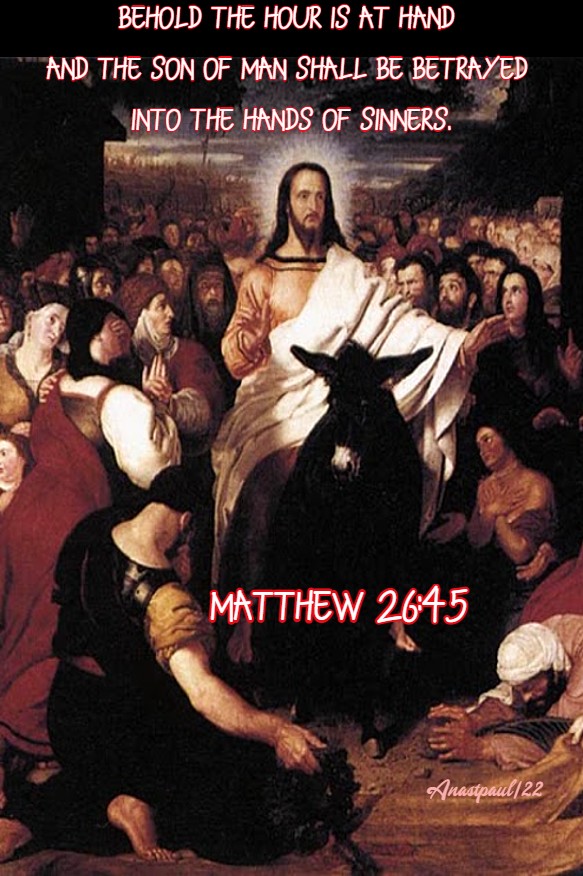
“Behold the hour is at hand and the Son of man shall be betrayed into the hands of sinners.”
Matthew 26:45
“Yesterday, Christ raised Lazarus from the dead; today, He is going to His own death. Yesterday, He tore off the strips of cloth which bound Lazarus; today, He is stretching out His Hand, to those who want to bind Him. Yesterday, He tore that man away from darkness; today, for humankind, He is going down into darkness and the shadow of death. And the Church is celebrating. She is beginning the feast of Feasts, for she is receiving her King as a Spouse, for her King is in her midst.”
St Ephrem (306-373) (Attri) Father ad Doctor of the Church
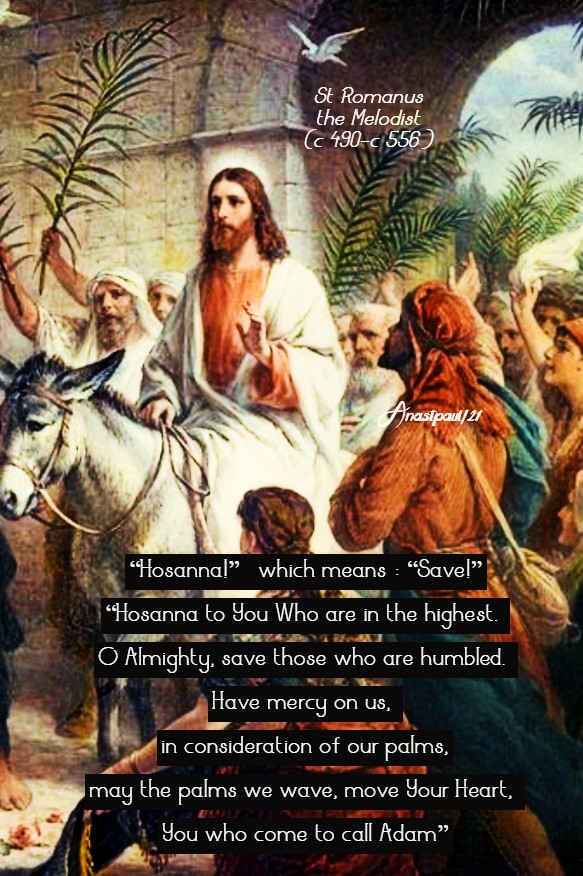
“Hosanna!”—which means : “Save!” “Hosanna to You Who are in the highest. O Almighty, save those who are humbled. Have mercy on us, in consideration of our palms, may the palms we wave move Your Heart, You who come to call Adam”…
One Minute Reflection – 10 April – Palm Sunday – Philippians 2:5-11, The Passion of Our Lord Jesus Christ according to Matthew 26:36-75; 27:1-60
“Behold the hour is at hand and the Son of man shall be betrayed into the hands of sinners.” – Matthew 26:45
REFLECTION – By St Nerses Chnorhali (1102-1173) Armenian Bishop (Jesus, Only Son of the Father, § 708-724)
“Because of sin, O innocent One, You were set before the criminal’s judgement seat; When You return in the Father’s glory Do not judge me together with him.
You were put to scorn with sacrilegious spittle On account of the first created man’s shame; Wipe away the dishonour of the impudent man’s sins, With which my face is covered…
You have put on crimson, Set the scarlet cloak over You As a dishonour and an affront, As Pontius Pilate’s soldiers thought it to be (Mt 27:28).
Remove sin’s shirt of hair from me, Crimson red, colour of blood, Reclothe me in the garment of joy With which You clothed the first man.
Kneeling, they made sport, Acting ridicule, they mocked; When they saw it, Heaven’s armies Worshipped in fear.
This You underwent that You might remove The shame, of being sin’s accomplice, from Adam’s nature in us That, from my soul and my conscience, You might suppress my sorrowing shame…
Following the judge’s verdict, You received the terrible blows of flagellation Over Your whole body And on Your limbs’ every part.
As for me who, from foot to head Suffer unbearable pain: Be pleased to heal me once again As through the grace of Baptism’s fount.
In exchange for the thorns of sin That the curse caused to grow up for us (Gn 3,18) A Crown of Thorns was set on Your Head By the labourers in Jerusalem’s vineyard (Mt 21,33f.).
Pull out the thorns of sin from me, Which my enemy planted within me, And heal in me the bite of the wound That the marks of sin might be erased.”
PRAYER – Almighty, eternal God, Who, to provide mankind an example of humility for it to imitate, willed that the Saviour should assume our flesh and suffer death upon the Cross, mercifully grant that we may be found worthy of the lesson of His endurance and the fellowship of His Resurrection. Through the same Jesus Christ, Thy Son, Our Lord, Who lives and reigns with Thee in the unity of the Holy Ghost, God, world without end. Amen (Collect).
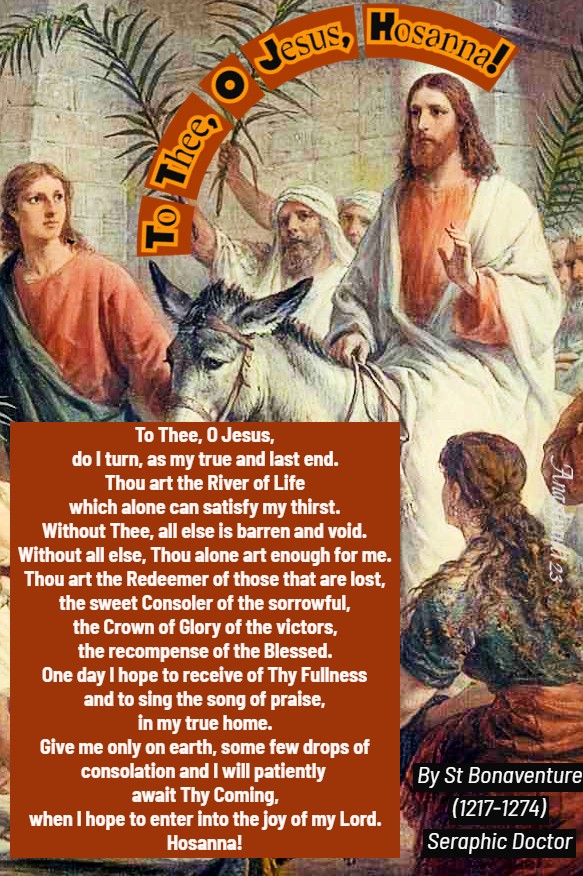
To Thee, O Jesus, Hosanna! By St Bonaventure (1217-1274) Seraphic Doctor of the Church
To Thee, O Jesus, do I turn, as my true and last end. Thou art the River of Life which alone can satisfy my thirst. Without Thee, all else is barren and void. Without all else, Thou alone art enough for me. Thou art the Redeemer of those that are lost, the sweet Consoler of the sorrowful, the Crown of Glory of the victors, the recompense of the Blessed. One day I hope to receive of Thy Fullness and to sing the song of praise, in my true home. Give me only on earth, some few drops of consolation and I will patiently await Thy Coming, when I hope to enter into the joy of my Lord. Hosanna!







































 AnaStpaul
You must be logged in to post a comment.