Passionate Catholic.
Being a Catholic is a way of life - a love affair "Religion must be like the air we breathe..."- St John Bosco
Prayer is what the world needs combined with the example of our lives which testify to the Light of Christ.
This site, which is now using the Traditional Calendar, will mainly concentrate on Daily Prayers, Novenas and the Memorials and Feast Days of our friends in Heaven, the Saints who went before us and the great blessings the Church provides in our Catholic Monthly Devotions.
This Site is placed under the Patronage of my many favourite Saints and especially, St Paul.
"For the Saints are sent to us by God
as so many sermons.
We do not use them, it is they who move us
and lead us, to where we had not expected to go.”
Charles Cardinal Journet (1891-1975)
This site adheres to the pre-Vatican II Catholic Church and all her teachings. .
PLEASE ADVISE ME OF ANY GLARING TYPOS etc - In June 2021 I lost 100% sight in my left eye and sometimes miss errors. Thank you and I pray all those who visit here will be abundantly blessed. Pax et bonum! 🙏
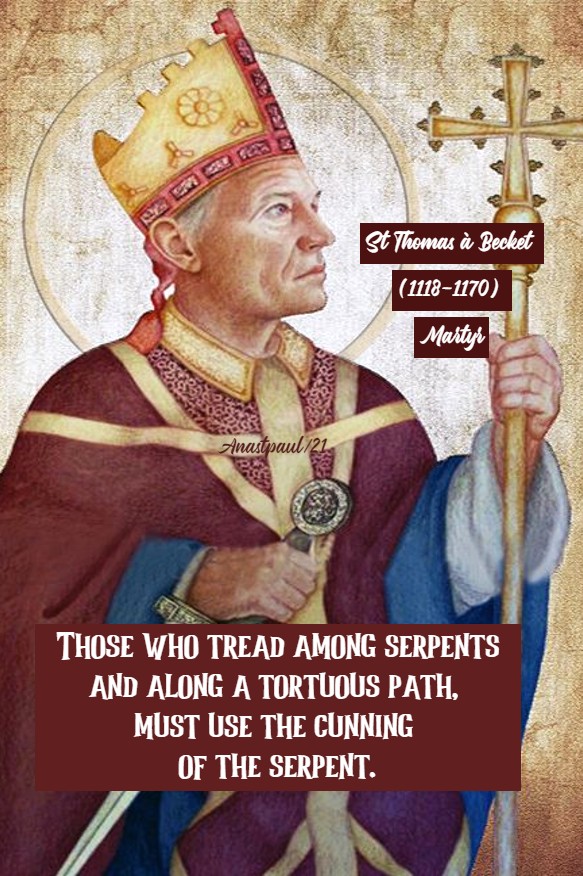
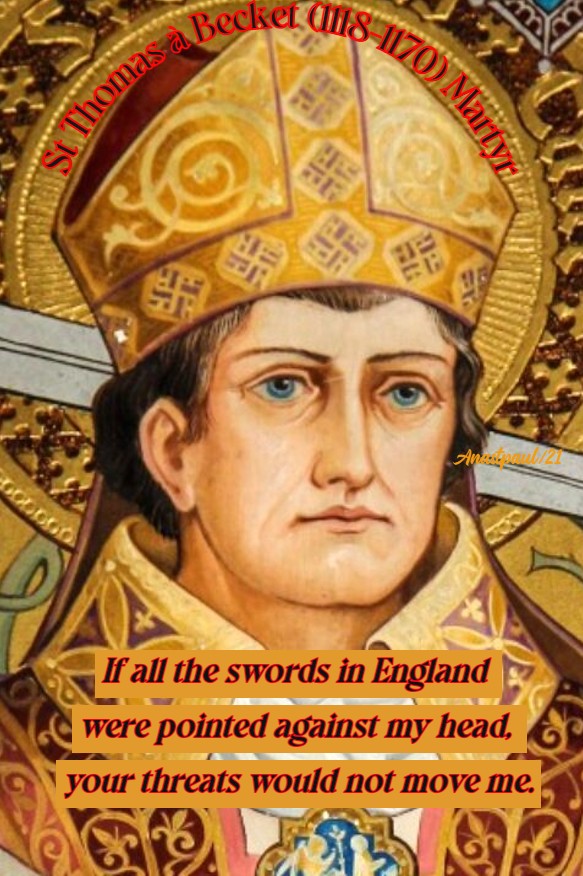
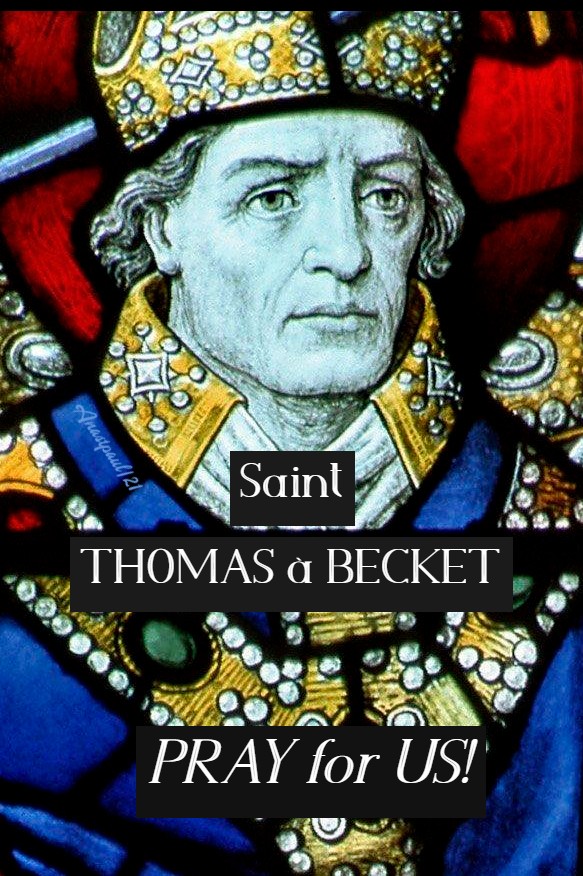
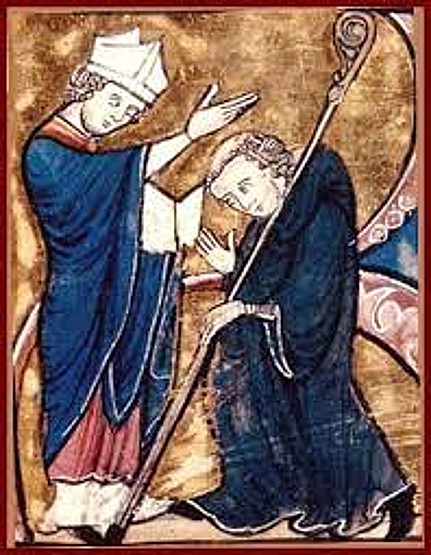
Quote/s of the Day – 29 December – The Fifth Day of the Octave of Christmas and the Memorial of St Thomas à Becket (1118-1170) Martyr, Archbishop of Canterbury
“… No matter who plants or waters, God gives no harvest unless what he plants is the faith of Peter and unless he himself. assents to Peter’s teaching.”
“Those who tread among serpents and along a tortuous path, must use the cunning of the serpent.”
“If all the swords in England were pointed against my head, your threats would not move me.”
St Thomas à Becket (1118-1170) Martyr, Archbishop of Canterbury
One Minute Reflection – 29 December – The Fifth Day of the Octave of Christmas, Readings: 1 John 2:3-11, Psalms 96:1-2, 2b-3, 5-6, Luke 2:22-35 and the Memorial of St Thomas à Becket (1118-1170) Martyr, Archbishop of Canterbury
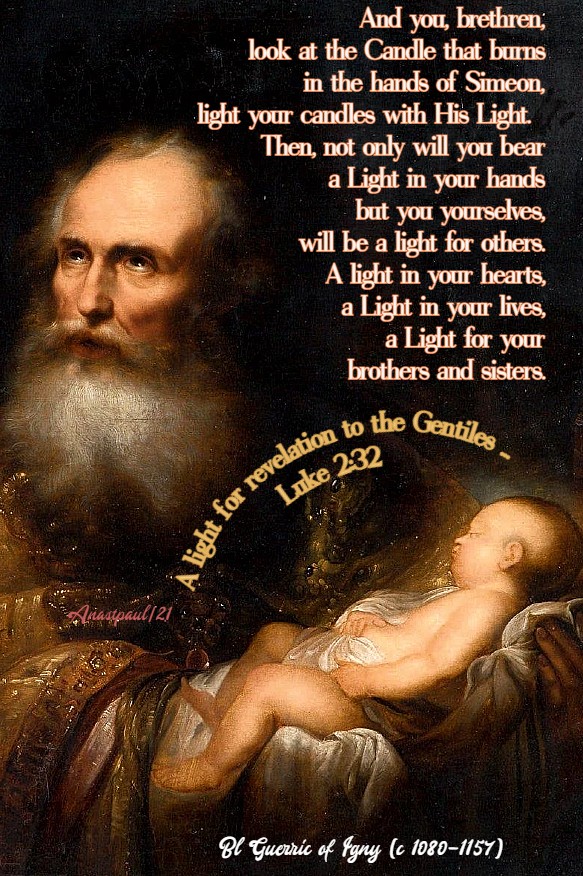
“A light for revelation to the Gentiles” – Luke 2:32
REFLECTION – “Who is there today who, as he holds a lighted candle in his hand, does not immediately think of the old man who today received Jesus in his arms, the Word in the flesh, the Light in the wax and who bore witness ,that He was the Light that shines upon all nations? The old man was himself a burning flame that enlightens and gives witness to the Light, he who, in the Holy Spirit with which he was filled, came to receive, O God, your love within your Temple (Ps 47[48],10) and bear witness, that You are the Love and Light of Your people…
Rejoice, just old man, look now at what you had once foreseen, darkness has disappeared from the world, the nations walk by Your Light (Is 60,3). The whole earth is filled with the glory (Is 6,3) of this Light which, in the past, you used to hide in your heart and which today, illumines your eyes… Embrace the Wisdom of God, O blessed old man and may your youth be renewed (Ps 102[103],5). Receive the mercy of God in your heart and your old age will know the sweetness of mercy. “He will rest in my bosom,” says Scripture (Wsd 1,12). Even when I give Him back to His Mother, He will continue to dwell with me, my heart will be filled with His mercy and, even more, the heart of His Mother… I give thanks and rejoice for you, full of grace, for you gave birth to the Mercy I have received – the Candle which you prepared, I am holding in my hands…
And you, brethren, look at the Candle that burns in the hands of Simeon, light your candles with His Light… Then, not only will you bear a Light in your hands but you yourselves, will be a light for others. A Light in your hearts, a Light in your lives, a Light for your brothers and sisters.” – Bl Guerric of Igny (c 1080-1157), Cistercian Abbot (1st Sermon for the Purification, 2-3).
PRAYER – God our Father, our human nature is the wonderful work of Your hands. Your Son took to Himself our manhood, grant us a share in His Sonship, that as co-heirs with Him, we may strive evermore obediently to gain our final home with the Blessed Virgin, St Thomas à Becket and all Your saints. Through Christ, our Lord, with the Holy Spirit, one God with You, now and for evermore, amen.
Our Morning Offering – 29 December – The Fifth Day of the Christmas Octave
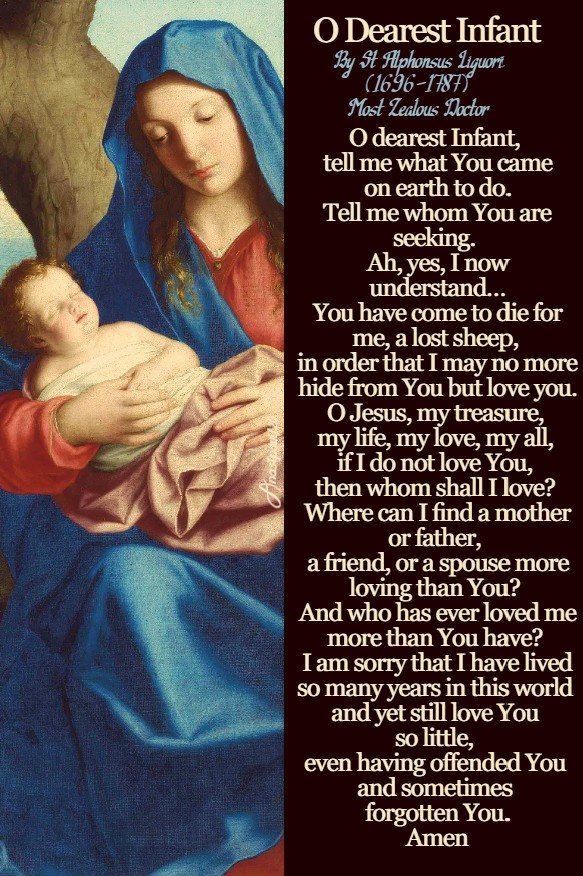
O Dearest Infant By St Alphonsus Liguori (1696-1787) Most Zealous Doctor
O dearest Infant, tell me what You came on earth to do. Tell me whom You are seeking. Ah, yes, I now understand… You have come to die for me, a lost sheep, in order that I may no more hide from You but love You. O Jesus, my treasure, my life, my love, my all, if I do not love You, then whom shall I love? Where can I find a mother or father, a friend, or a spouse more loving than You? And who has ever loved me more than You have? I am sorry that I have lived so many years in this world and yet still love You so little, even having offended You and sometimes forgotten You. Amen
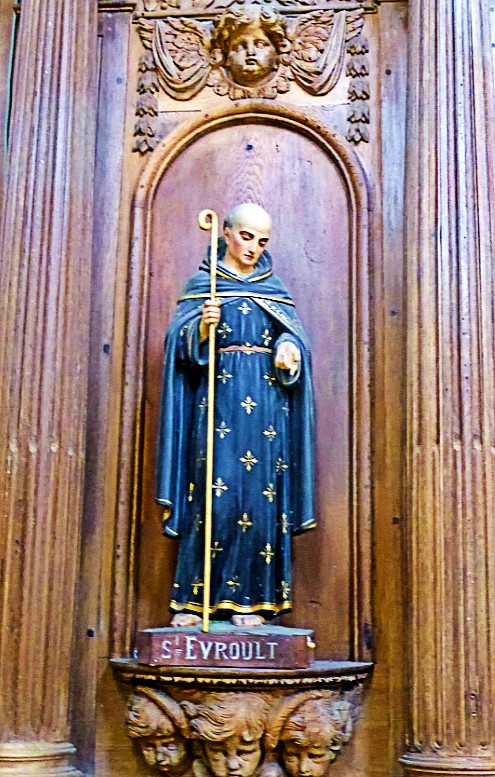
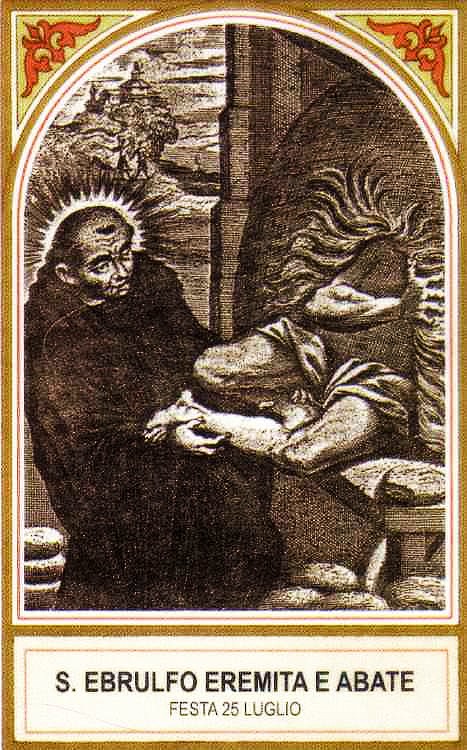
Saint of the Day – 29 December – Saint Ebrulf of Ouche (c 626c -706) Abbot, Hermit. Founder of many Monasteries, Married but separated by mutual agreement, miracle-worker. Born in c 626 in Bayeux, Normandy, France and died in c 706 of natural causes, at the Monastery he had founded. Also known as – Ebrolfo, Ebrulfo, Ebrulfus, Ebrulphus, Evroul, Evroult, éVroult. Additional Memorial – 30 August, in England, where some of his relics are venerated.
Of noble birth, Ebrulf received a careful education and gave proofs of profound virtue.
He became a highly-ranked Official of King Childeric II. Ebrulf was a cup-bearer to the King and an Administrator of the Royal Palace but he desired a life consecrated to God.
It was some time before he was given leave to detach himself from his duties at the Court to become a Monk. As he was married to a woman of his own social rank, the two separated by mutual consent, he to lead a life of greater perfection and she, it is believed, became a Nun.
He joined the Monastery of Deux-Jumeaux (Bayeux) before deciding to become a Hermit at Exmes but there, crowds came to visit him and ask for his advice. He then settled, with some companions, in the forest of Ouche, which was infested with wild beasts and brigands. A legend states, that he converted a robber to Christianity when the robber visited Ebrulf’s the rough settlement which consisted of a hedge enclosure and wattle and daub huts. The robber warned Ebrulf of the dangers of the forest but Ebrulf informed him that he feared no-one. Repenting of his own sins, the robber brought a gift consisting of three loaves baked in ashes and a honeycomb, and asked to be admitted as a Monk.
This settlement became the Abbey of Saint-Evroul. He founded other monastic houses, fifteen in total, all of which placed emphasis on manual labour both as a spiritual and economic exercise. Members of the nobility came to Ebrulf offering him money, land, to build monasteries. He founded, after 560, several Monasteries in the Diocese of Séez; one of them became the important Abbey of St-Martin-de-Séez.
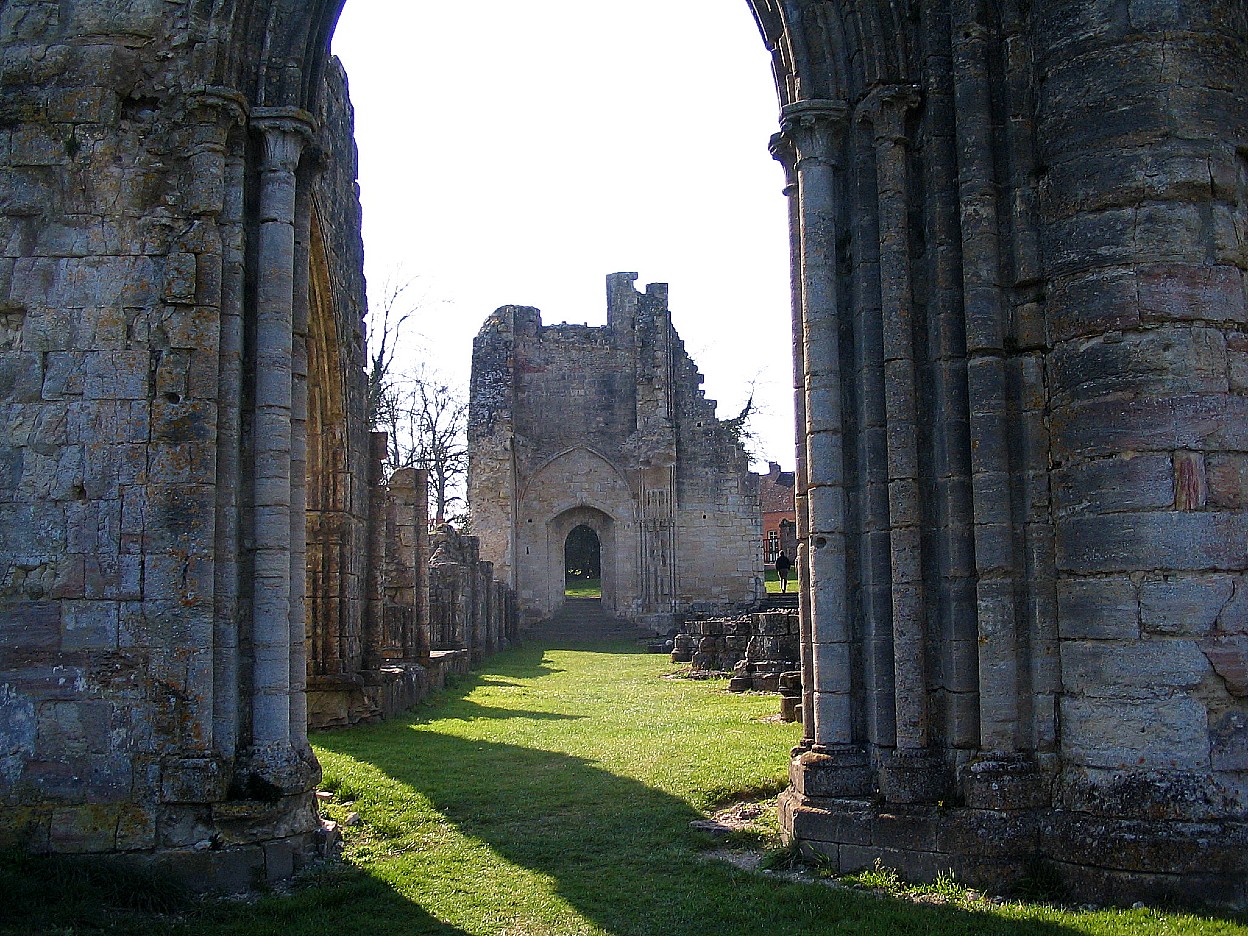
The ruins of St Ebrulf Abbey
The Saint worked numerous miracles and even raised the dead . In the 12th century John of St-Evroult composed a work in verse in his honour and many miracles were worked at his tomb.
During the Norman invasions, his remains were transported to Orleans. Later, an attempt was made to bring them back to the Abbey of Saint- Ebrulf but without success.
He was venerated in England as a result of the Norman invasion and the link between Ebrulf and England was maintained, by the fact, that four Abbots from Saint-Evroul Abbey ruled English Monasteries in the 11th and 12th Centuries. They brought to England some of Ebrulf’s relics. A Feast commemorating the translation of his relics is kept at Deeping Abbey in England on 30 August.
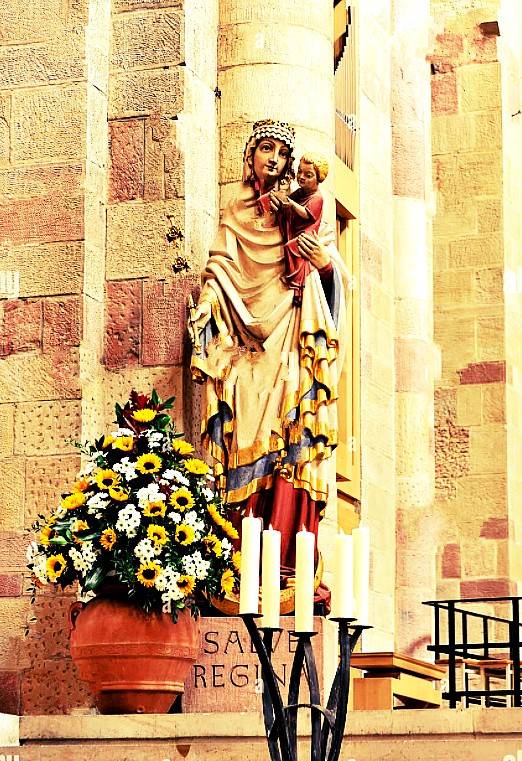
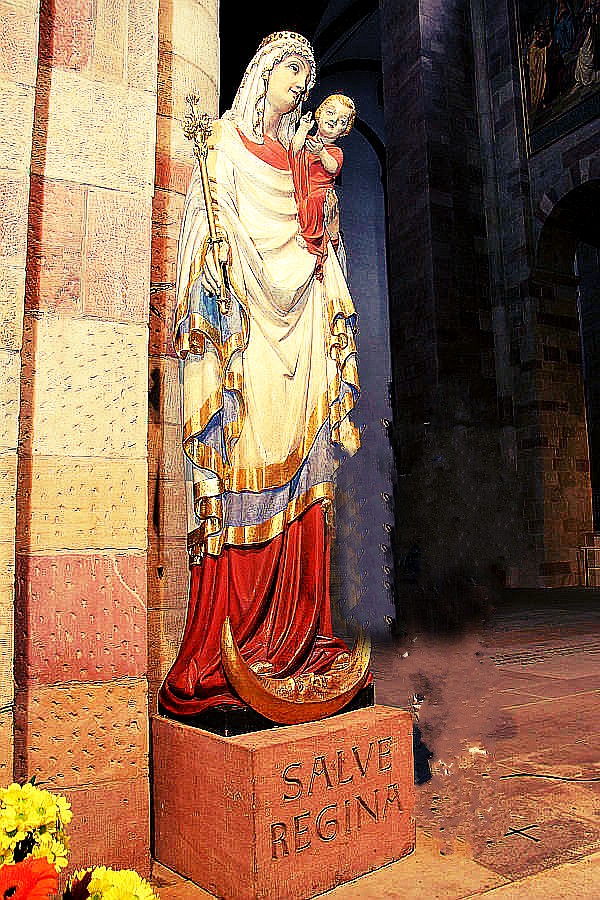
Unsere Liebe Frau vom Speyer / Our Lady of Speyer, Germany Featuring the Salve Regina and St Bernard (1146) – 29 December:
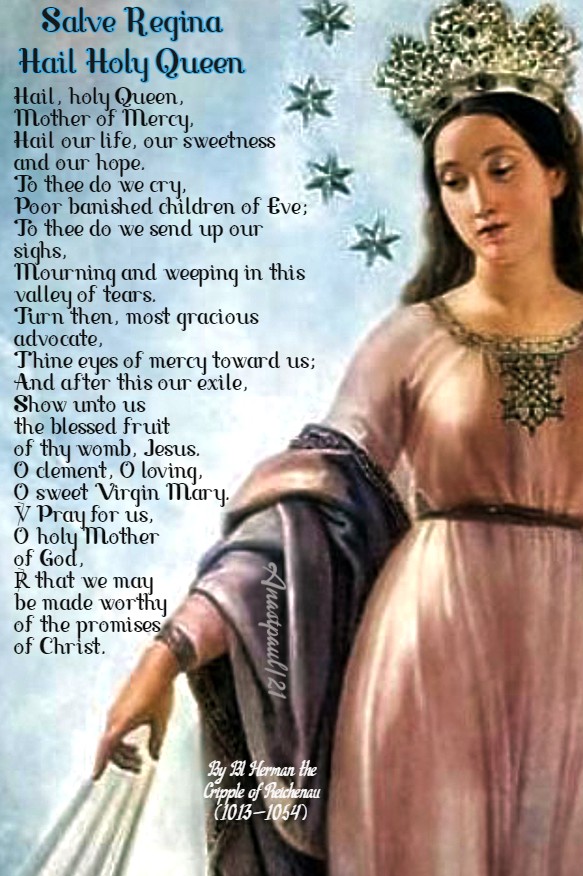
The Abbot Orsini wrote: “Our Lady of Spire (Speyer), in Germany. Saint Bernard, entering this Church on the 29th of December, 1146, was honourably received there by the Canons, who conducted him to the choir, singing the Salve Regina. The antiphon being finished, Saint Bernard saluted the image of the Blessed Virgin in these terms: “O clems, O pia, O dulcis Virgo Maria!” and she answered: “Salve Bernarde!” The words of this Saint to the image are seen engraved in a circle on the pavement of the Church, on the same spot where he pronounced them and they have since been added to the Salve Regina, which was composed in the year 1040, by Herman, surnamed Contractus, a Benedictine monk.” [He is Blessed Herman of Reichenau (often known as Blessed Herman the Cripple OSB (1013–1054) – his Biography here: https://anastpaul.com/2019/09/25/saint-of-the-day-blessed-herman-of-reichenau-the-cripple-osb-1013-1054-the-wonder-of-his-age/ ]
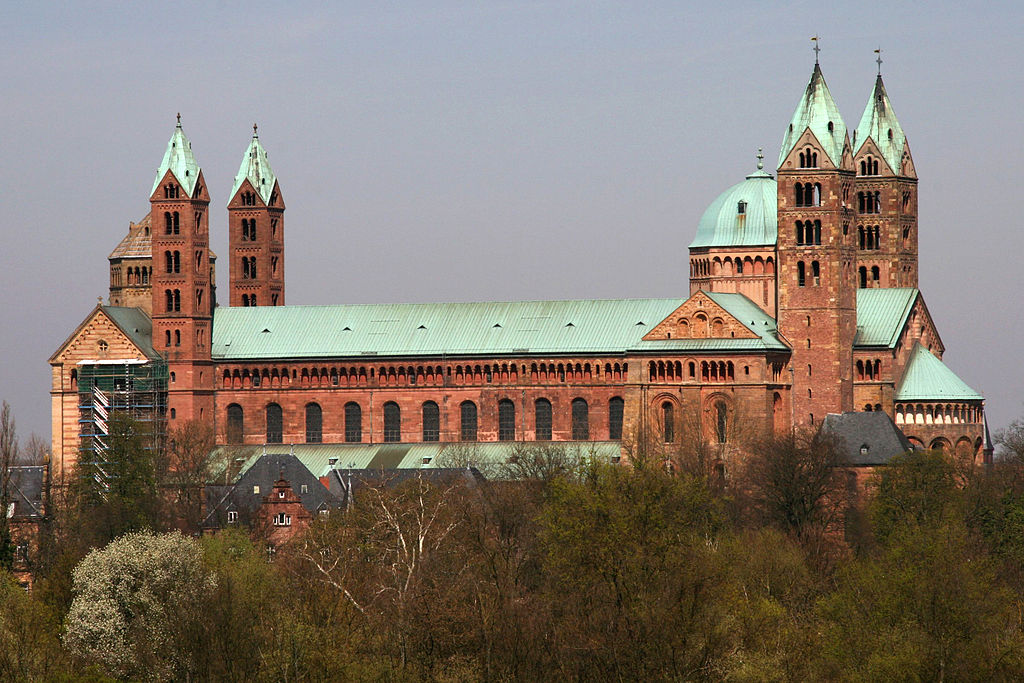
This date on the Marian calendar, Our Lady of Speyer, actually refers to the Cathedral of Speyer, dedicated to the Blessed Virgin Mary and known as Kaiserdom zu Speyer in Germany. Construction began on the Romanesque style Cathedral in the year 1030 and was completed in 1106. It is 134 metres long and 43 metres wide, which made it one of the largest buildings constructed at that time and is now thought to be, the largest surviving Romanesque building in the world.
During the Nine Years’ War the entire Town of Speyer was burned to the ground and the heat from the inferno caused part of the nave to collapse. In 1792 the Town was occupied by the French revolutionary troops and the Church pillaged. It was in that century that the ruins of the Chapel of Saint Bernard were removed. The Cathedral was subsequently used as a warehouse and hospital. In 1957 the Cathedral was restored and, although much of the plaster and 19th century paintings were removed, the scenes of the life of the Blessed Virgin were left undisturbed. n 1981 the Cathedral was added to the World Heritage List of UNESCO.
St Aileran of Clonard St Albert of Gambron St Aproniano de Felipe González St David the King St Ebrulf of Ouche (c 626-c 706) Abbot, Hermit St Enrique Juan Requena St Florent of Bourges Bl Francis Ruiz St Girald of Fontenelle St Jacinto Gutiérrez Terciado Bl José Aparicio Sanz Bl José Perpiñá Nácher St Juan Bautista Ferreres Boluda St Libosus of Vaga St Marcellus the Righteous St Martinian of Milan Bl Paul Mary Bl Peter the Venerable St Quartillosa of Carthage St Thaddeus of Scythia St Trophimus of Arles St Trophimus of Ephesus
Martyrs of North Africa – (8 saints): A group of Christians executed together for their faith. The only details to survive are eight names – Crescentius, Dominic, Honoratus, Lybosus, Primian, Saturninus, Secundus and Victor.
Martyrs of Rome – (3 saints): A group of Christians executed together for their faith. The only details to survive are three names – Boniface, Callistus and Felix.
Martyrs of Seoul – (7 saints): Additional Memorial – 20 September as part of the Martyrs of Korea. A group of seven lay woman in the apostolic vicariate of Korea who were martyred together. • Barbara Cho Chung-I • Barbara Ko Sun-I • Benedicta Hyong Kyong-Nyon • Elisabeth Chong Chong-Hye • Magdalena Han Yong-I • Magdalena Yi Yong-Dok • Petrus Ch’oe Ch’ang-Hub They were born in South Korea and were martyred by beheading on 29 December 1839 at the Small West Gate, Seoul, South Korea. They were Canonised on 6 May 1984 by St Pope John Paul II.
Martyred in the Spanish Civil War: Thousands of people were murdered in the anti-Catholic persecutions of the Spanish Civil War from 1934 to 1939. • Blessed Aproniano de Felipe González • Blessed Enrique Juan Requena • Blessed Jacinto Gutiérrez Terciado • Blessed Juan Bautista Ferreres Boluda
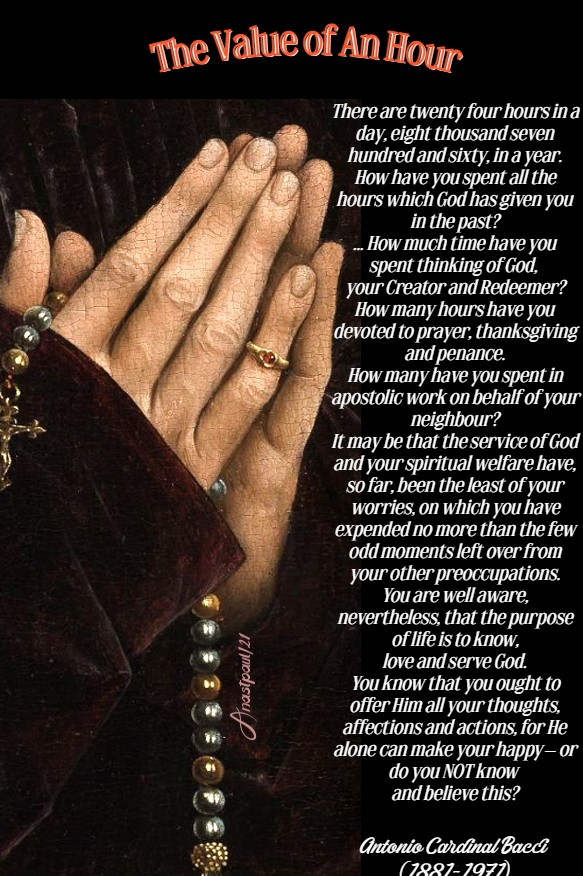
Thought for the Day – 28 December – Meditations with Antonio Cardinal Bacci (1881-1971)
The Value of An Hour
“There are twenty four hours in a day, eight thousand seven hundred and sixty, in a year. How have you spent all the hours which God has given you in the past? How do you intend to use the hours which He will give you in the future?
When you examine the past, you will find much to regret. Perhaps you have spent many hours in sin, in idle gossp, in useless or dangerous pastimes, or in innumerable business transactions, all of which will contribute NOTHING towards your eternal salvation, which should be our main concern in this life.
How much time have you spent thinking of God, your Creator and Redeemer? How many hours have you devoted to prayer, thanksgiving and penance. How many have you spent in apostolic work on behalf of your neighbour? It may be that the service of God and your spiritual welfare have, so far, been the least of your worries, on which you have expended no more than the few odd moments left over from your other preoccupations. You are well aware, nevertheless, that the purpose of life is to know, love and serve God. You know that you ought to offer Him all your thoughts, affections and actions, for He alone can make your happy – or do you NOT know and believe this?”
Quote/s of the Day – 28 December – The Feast of the Holy Innocents – The Fourth Day of the Christmas Octave, Readings: 1 John 1:5-2:2, Psalm 124:2-5, 7-8, Matthew 2:13-18
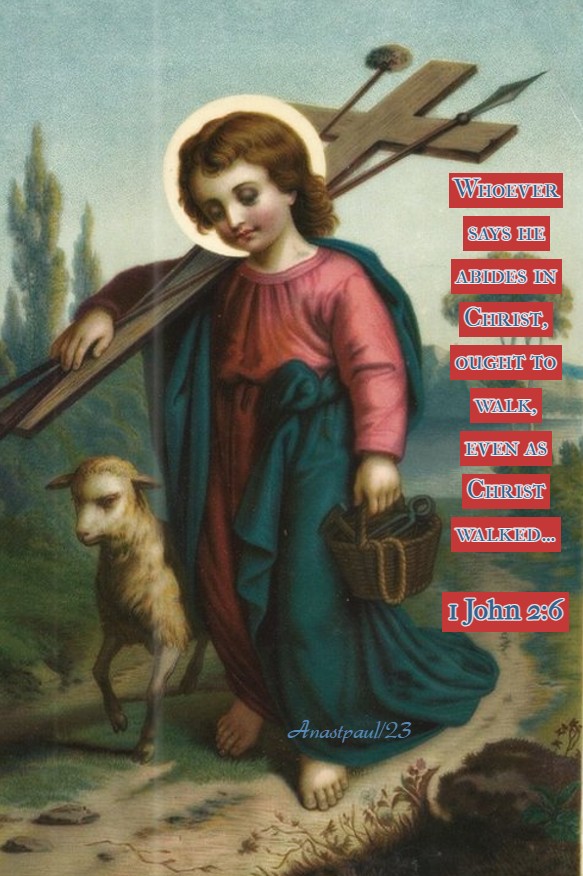
“Whoever says he abides in Christ, ought to walk, even as Christ walked…”
1 John 2:6
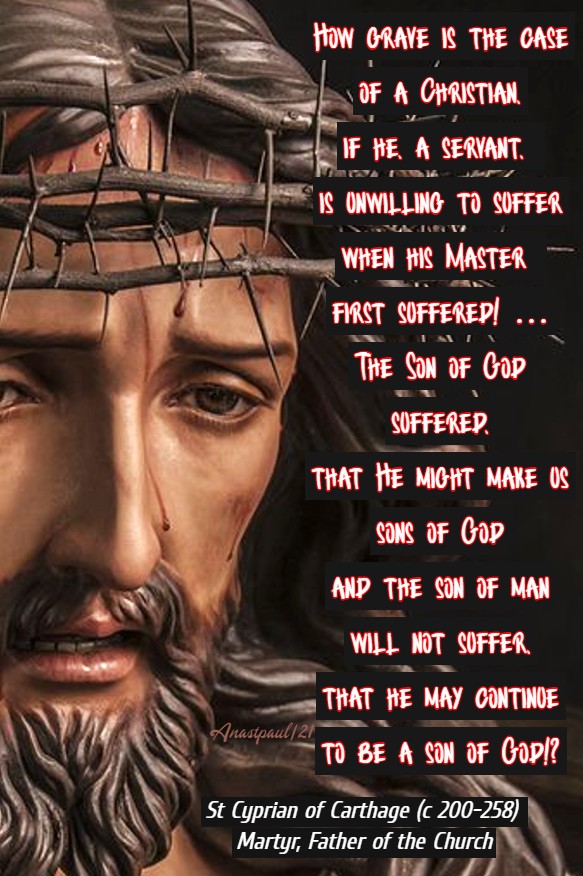
“How grave is the case of a Christian, if he, a servant, is unwilling to suffer when his Master first suffered! … The Son of God suffered, that He might make us sons of God and the son of man will not suffer, that he may continue to be a son of God!?”
St Cyprian of Carthage (c 200-258) Martyr, Father of the Church
Letter 55
“Our pilgrimage on earth cannot be exempt from trial. We progress by means of trial. No-one knows himself except through trial, or receives a crown, except after victory, or strives, except against an enemy or temptations.”
St Augustine (354-430) Father and Doctor of Grace
“He gives according to the love He bears us …, according to the courage He sees in each and the love each has for His Majesty. He will see, that whoever loves Him much, will be able to suffer much for Him; whoever loves Him little, will be capable of little. I myself hold, that the measure for being able to bear, a large or small cross, is love …”
St Teresa of Avila (1515-1582) Doctor of Prayer of the Church
One Minute Reflection – 28 December – The Feast of the Holy Innocents and the Fourth Day of the Christmas Octave, Readings: 1 John 1:5-2:2, Psalm 124:2-5, 7-8, Matthew 2:13-18
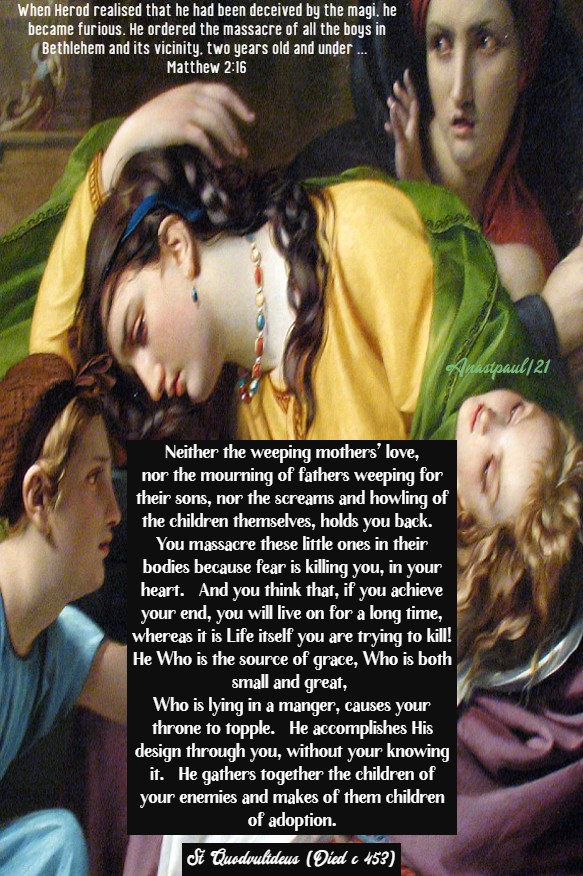
“When Herod realised that he had been deceived by the magi, he became furious. He ordered the massacre of all the boys in Bethlehem and its vicinity, two years old and under, in accordance with the time he had ascertained from the Magi.“” – Matthew 2:16
REFLECTION – “Why, Herod, do you fear when you hear a King is born? He has not come to dethrone you but to overthrow the devil. But you fail to understand, you take fright and fall into a fury. Because you lost the single child you were seeking, you become the cruel murderer of the many. Neither the weeping mothers’ love, nor the mourning of fathers weeping for their sons, nor the screams and howling of the children themselves, holds you back. You massacre these little ones in their bodies because fear is killing you, in your heart. And you think that, if you achieve your end, you will live on for a long time, whereas it is Life itself you are trying to kill! He Who is the source of grace, Who is both small and great, Who is lying in a manger, causes your throne to topple. He accomplishes His design through you, without your knowing it. He gathers together the children of your enemies and makes of them, children of adoption.
These little ones died for Christ without knowing it ; their parents weep for the death of Martyrs. Although they were unable to speak, Christ made them capable of being His Witnesses. See how this King reigns. Already He is setting free and bestowing salvation. But as for you, Herod, you are oblivious of what is happening, you take fright and fall into a rage. And when you get annoyed with a little Child, you are already placing yourself at His service without realising it.
How great the gift of grace is! What are the merits by which these children won the victory? They could not yet speak but already, they are confessing Christ. Their little bodies are as yet unable to engage in combat but already, they are carrying off the Palm of Victory.” – St Quodvultdeus (Died c 453) Father, Bishop at Carthage fromc 437-c 450 (Second sermon on the Creed; PL40, 655).
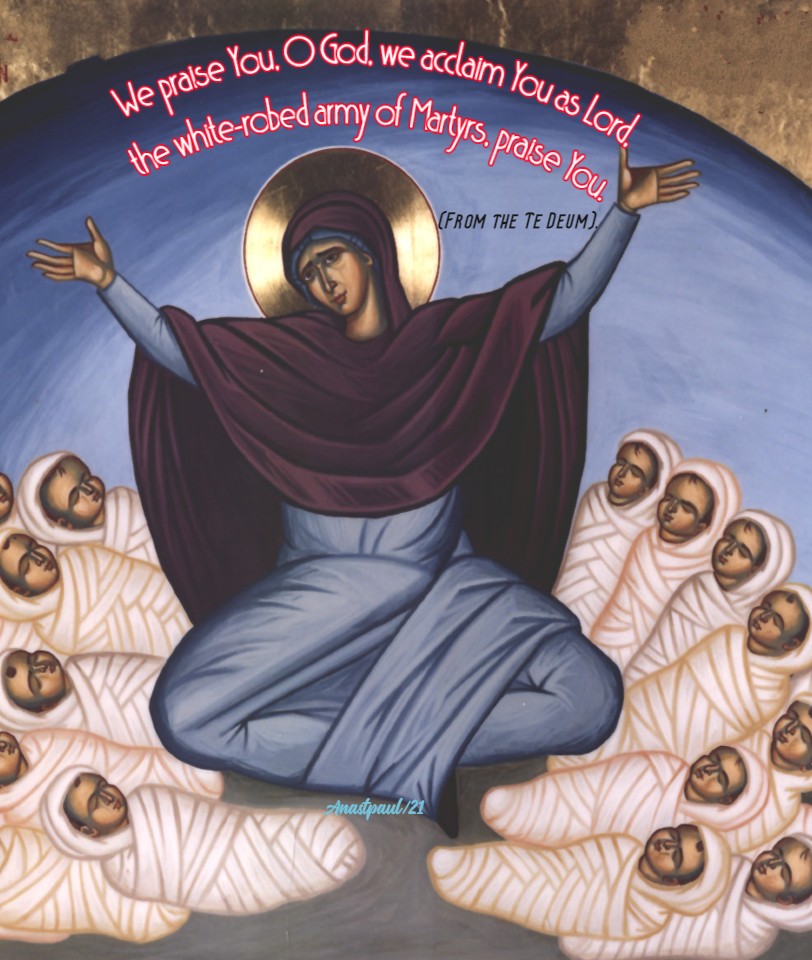
PRAYER – We praise You, O God, we acclaim You as Lord, the white-robed army of Martyrs praise You. (From the Te Deum).
Our Morning Offering – 28 December – The Feast of the Holy Innocents and the Fourth |Day of the Octave of Christmas
O Jesus, Dear Holy Child By St Thérèse of the Child Jesus (1873 – 1897) Doctor of the Church
O Jesus, dear Holy Child, my only treasure, I abandon myself to Thy every whim. I seek no other joy than that of calling forth Thy sweet Smile. Vouchsafe to me, the graces and the virtues of Thy Holy Childhood, so that, on the day of my birth into Heaven, the Angels and Saints may recognise in Thy Spouse, Thérèse of the Child Jesus. Amen
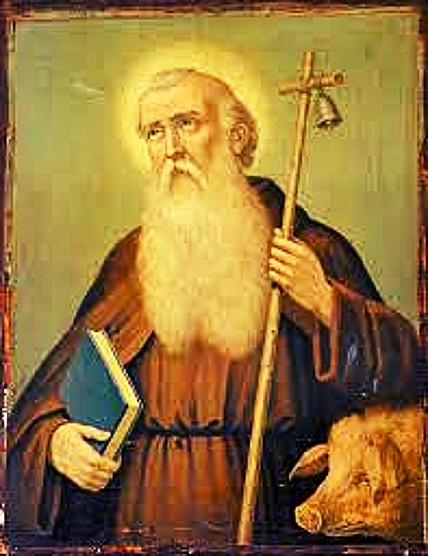
Saint of the Day – 28 December – Saint Anthony of Lérins (c 428-c 520) Monk, Hermit, miracle-worker. Born in c 468 at Valeria, Lower Pannonia (in modern Hungary) and died in c 520 at Lerins, Provence, France of natural causes. Also known as – Antony of Lérins, Anthony the Hermit.
The Roman Martyrology states: “Commemoration of Saint Anthony, a Monk, who, a man distinguished by grace and preparation, after having led a solitary life, retired, by now an old man in the Monastery of Lérins in Provence, where he piously fell asleep in the Lord.”
He was born in the ancient Roman Province of Valeria (now Hungary), then part of the Hunnic Empire. When he was eight years old, his father died and he was entrusted to the care of the holy Abbot Severinus of Noricum, in modern-day Austria. Severinus, however, died when the boy was in his early teens and Anthony moved in with his uncle, Bishop Constantius of Lorsch, Bavaria (in modern Germany).
When he was of age, Anthony entered the monastic life, making himself immediately appreciated for his great humility.
In 488, at about 20 years of age, Anthony moved to Italy to take up an eremitical life with a small group of hermits living on an island in Lake Como. He was eventually joined by numerous disciples seeking to emulate his holiness.
Anthony’s fame, which soon spread to the surrounding areas, caused him a curious accident. A man, who had been sentenced to death for killing his wife in a fit of jealousy, took refuge with Anthony to escape punishment, simulating the desire to become his disciple. But Anthony unmasked the hypocrite and threw him out of his cell to face his crime. Naturally, this episode greatly increased his fame and he, disturbed by numerous visitors, finally crossed the Alps and settled in Lérins, where he found the peace he had always sought
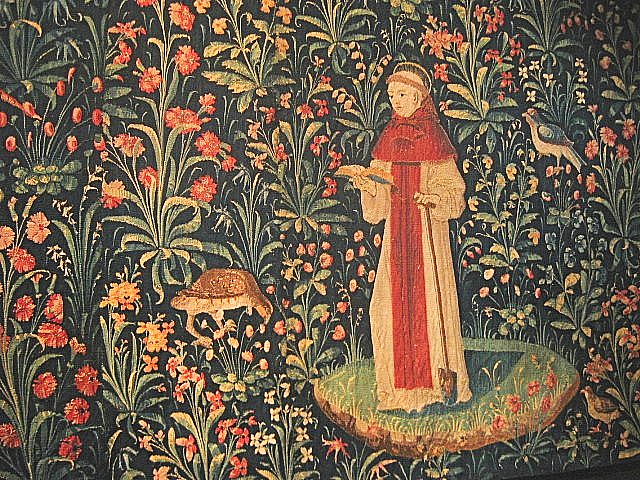
Tapestry of St Anthony
He lived in various solitary places until two years before his death he became a Monk at the Abbey of Lérins, where he again was an icon of piety locally and attracted those seeking spiritual aid. The holiness of his life and the miracles he performed, encourage many to visit him.
Saint Ennodius of Pavia wrote a Life of Saint Anthony.
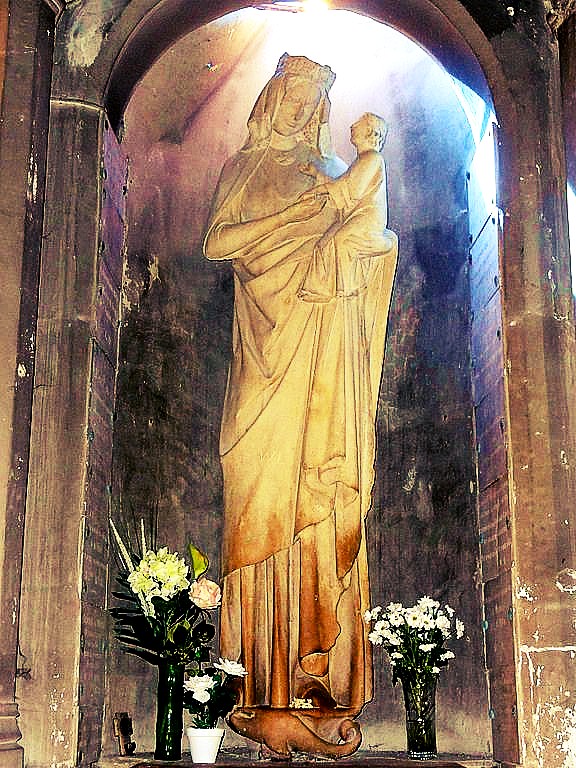
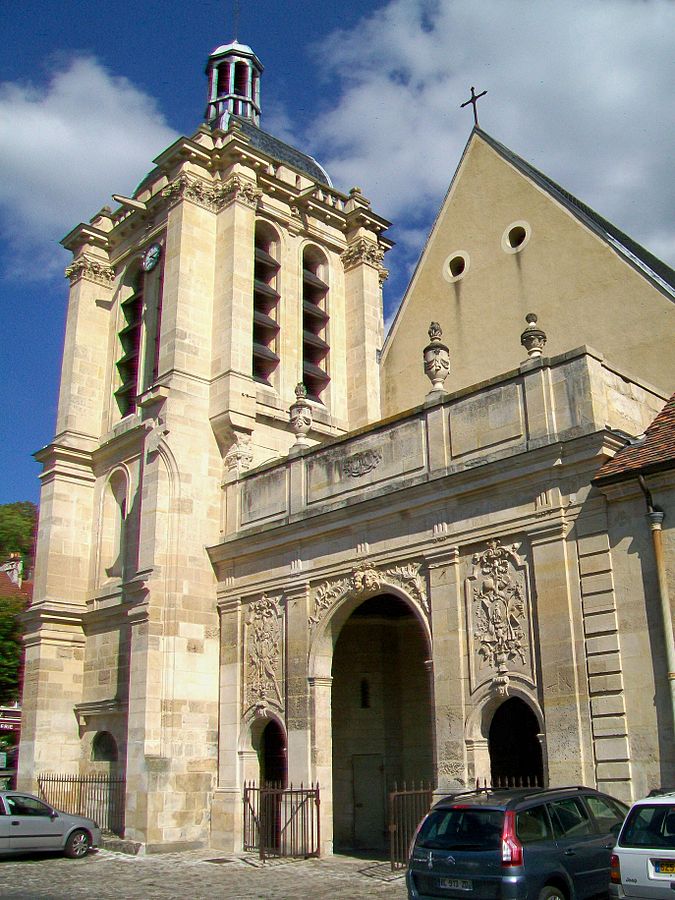
Notre-Dame de Pontoise / Our Lady of Pontoise, France (13th Century) – 28 December:
Pontoise is an old Town built around a bridge across the Oise and its Shrine dates from around the 13th Century, as is evidenced by a charter of donation from the year 1231. Our Lady of Pontoise is about seven leagues from Paris. This image, is celebrated for many miracles which are wrought there. The Statue of Our Lady of Pontoise is of marble and stands over 1,8 metres in height. The Madonna wears a short veil and a dress with long tight sleeves. Our Lady’s face is framed by her hair. The Divine Child lays His hands on an orb that His mother holds. The Statue was, according to tradition, carved by a pious youth in the quarry at Blangis, near Abbeville and brought to Pontoise. In 1226 the Archbishop of Rouen dedicated a Chapel there and in 1249 it was made a Parish Church, and the sSatue was placed outside, over the main entrance. The Church was visited by the Saint-king, Louis IX. In around 1434 the Church was destroyed by the English soldiers fighting in the area. The faithful Catholic, determined to rebuild the Shrined. It was partly finished when the French reconquered the territory. They finished the rebuilding in 1484. During the years of 1580 and 1650, when the plague was destroying the country, people flocked to Our Lady of Pontoise and the danger was averted. Again in 1849 a cholera epidemic was averted through her intercession, so that the Shrine had the name of being powerful against plagues. In Reformation times, a devout Protestant tried to steal the Statue and failing that, knocked off the head of the Infant and threw it into the river. A fisherman had spread his nets just below the bridge and the severed head was saved and returned to the Statue. In 1585 the Church was destroyed again by the English; in 1790 by the revolutionaries. Each time the Statue was saved and returned; the last time by a man who bid on it at an auction-house and kept it until the troubled days were over. The Church was rebuilt in 1800 and a century later was still extant; the yearly thanksgiving procession for Our Lady’s protection from the plague is held annually. The Statue now resides inside the Church. Replicas of the statue were placed over many doorways of the City after the plague of 1640 and some are still there today.
BL Claudia Weinhardt St Conindrus St Domitian the Deacon St Domnio of Rome St Eutychius St Gowan of Wales Bl Gregory of Cahors Bl Hryhorii Khomyshyn St Iolande of Rome Bl Johannes Riedgasser
Bl Nicolas Mello Bl Otto of Heidelberg St Romulus St Simon the Myroblite St Theonas of Alexandria St Theodore of Tabenna St Troadius of Pontus — 20,000 Martyrs of Nicomedia: 20,000 Christians who were murdered during in 303 in Nicomedia, Bithynia (modern Izmit, Turkey) during the persecutions of Diocletian. Many of them were killed en masse when they were ordered, during Christmas Mass, to sacrifice to idols; when they refused, they were locked in the churches and the buildings burned around them. We know some details of a few of them, but most are known only to God. The names we have are – Agape, Anthimos, Domna, Domna, Dorotheus, Esmaragdus, Eugene, Euthymius, Glykerios, Gorgonius, Hilary, Indes, Mardonius, Mardonius, Maximus, Migdonius, Migdonus, Peter, Peter, Theophila, Theophilus and Zeno. 303 in Nicomedia, Bithynia (modern Izmit, Turkey).
Martyrs of Africa – (3 saints): Three Christians murdered together in Africa for their faith. The only details to survive are their names – Castor, Rogatian and Victor.
Thought for the Day – 27 December – Meditations with Antonio Cardinal Bacci (1881-1971)
St John the Apostle and Evangelist
“St John proved himself worthy of His Master’s special favour. He never deserted Christ. He was present at the Agony in Gethsemane. He was in the courtyard of the High Priest, when Peter denied Christ but he remained faithful. He was the only Apostle present at the foot of the Cross on Mount Calvary, where, he was privileged to hear Our Lord’s last words.
After the Resurrection, John was one of the first to hurry to the sepulchre. Like the other Apostles, he proved his undying love for Jesus, by enduring the pains of Martyrdom, although his life was miraculously spared. He spent his long life studying how to love and serve Jesus Christ. Can the same be said for us? We have not been granted the privileges given to St John but, we have received countless favours from God.
Let us learn from the example of this great Apostle, how to co-operate generously with the grace of God, for how many times have we deserted Christ!”
Quote/s of the Day – 27 December – Feast of St John the Apostle and Evangelist and the Third Day of the Christmas Octave
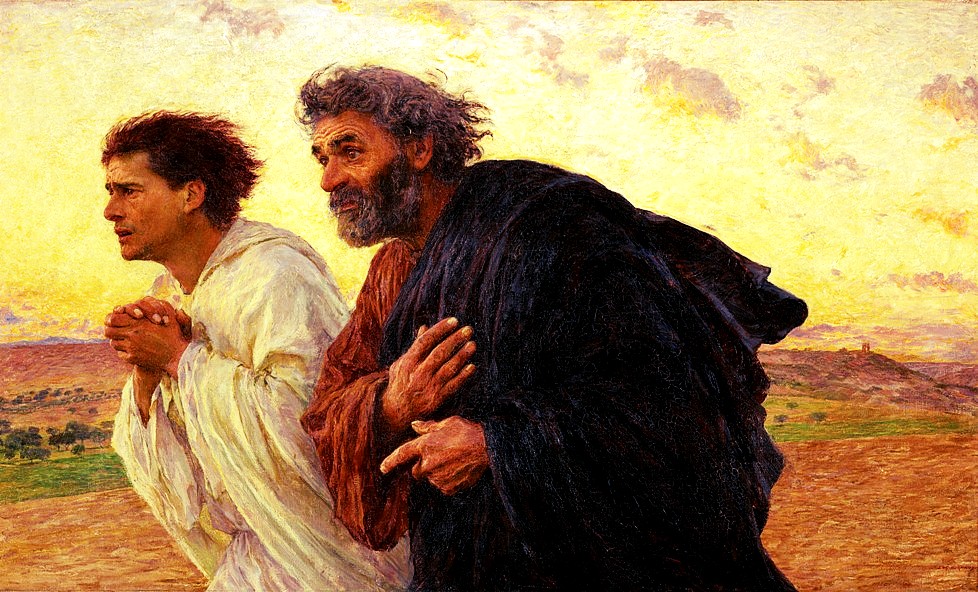
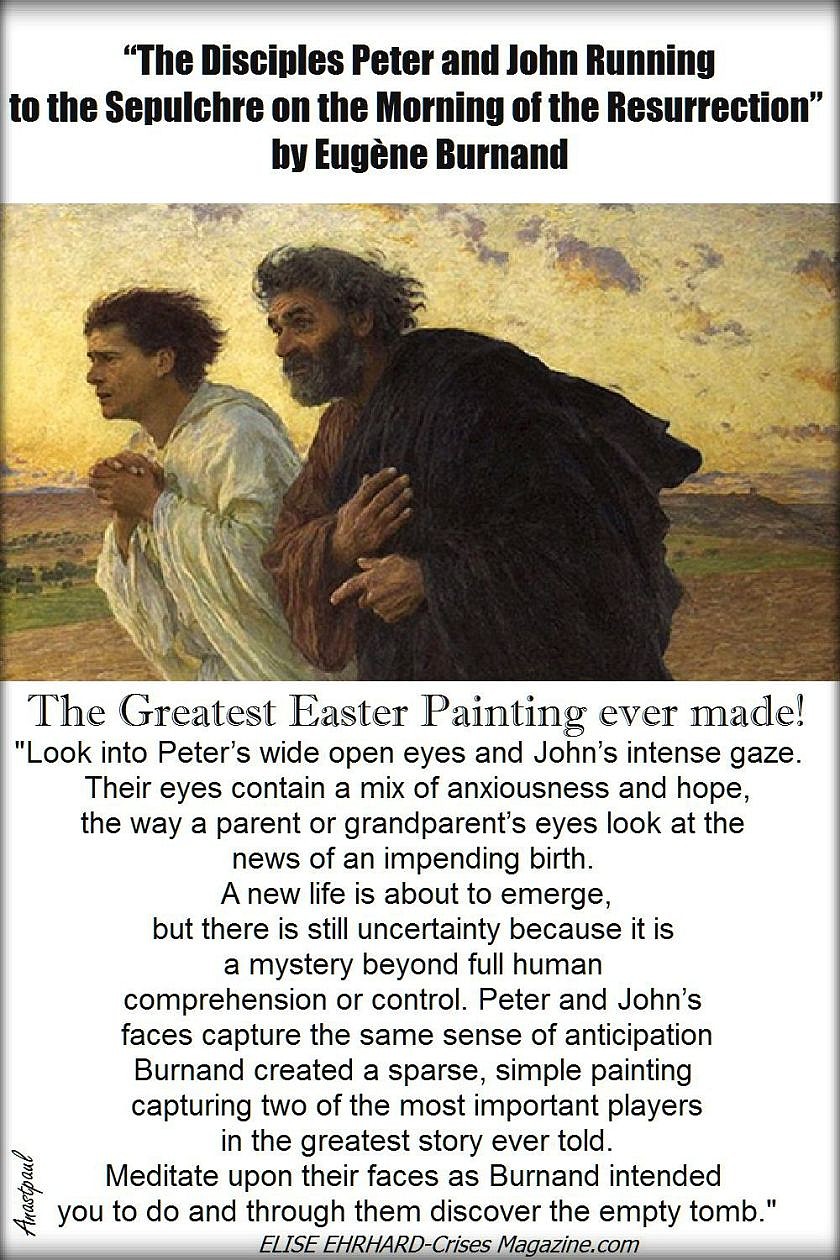
“Look into Peter’s wide open eyes and John’s intense gaze. Their eyes contain a mix of anxiousness and hope, the way a parent or grandparent’s eyes look at the news of an impending birth. A new life is about to emerge but there is still uncertainty because it is a mystery beyond full human comprehension or control. Peter and John’s faces capture the same sense of anticipation.
Burnand created a sparse, simple painting capturing two of the most important players in the greatest story ever told. Meditate upon their faces, as Burnand intended you to do and through them, discover the empty tomb.” (Elisabeth Ehrhard-Crises Magazine).
Oh Teach Me then, Dear Saint! An Invocation of St John, Apostle and Evangelist Unknown Author
Saint of the Sacred Heart, Sweet teacher of the Word, Partner of Mary’s woes And favourite of thy Lord!
Refrain Oh teach me then, dear Saint! The Secrets Christ taught thee; The Beatings of His Heart, And how it beat for me!
We know not all thy gifts But this Christ bids us see, That He Who so loved all, Found more to love in thee. Refrain
When the last evening came, Thy head was on His breast, Pillowed on earth, where now In Heaven the Saints find rest. Refrain
Dear Saint! I stand far off, With vilest sins opprest, Oh may I dare, like thee, To lean upon His Breast? Refrain
His Touch could heal the sick, His Voice could raise the dead, Oh that my soul might be Where He allows thy head. Refrain
The gifts He gave to thee He gave thee to impart And I, too, claim with thee His Mother and His Heart! Refrain
One Minute Reflection – 27 December – Feast of St John tApostle and Evangelist and the Third Day of the Christmas Octave, Readings: 1 John 1:1-4, Psalm 97:1-2, 5-6, 11-12, John 20:2-8
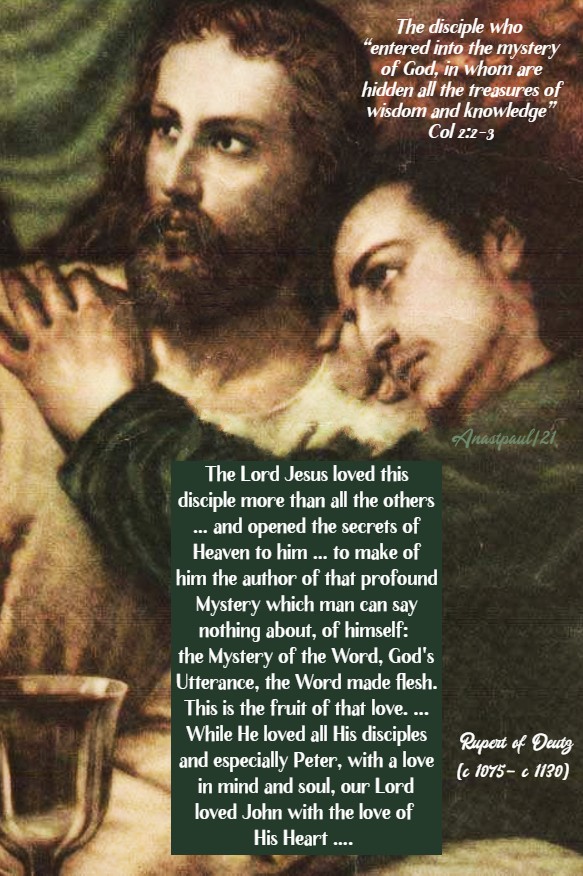
The disciple who “entered into the mystery of God, in whom are hidden all the treasures of wisdom and knowledge …” – Col 2:2-3
REFLECTION – “In proportion to the grace that caused Jesus to love him and enabled him to rest on Jesus’ Breast at the Supper (Jn 13:23), John abundantly received [the Spirit’s gifts] of understanding and wisdom (Is 11:2) – understanding with which to comprehend Scripture, wisdom with which to compose his own books with wonderful skill. As a matter of fact, ,he did not receive this gift right from the time when he rested on our Lord’s Breast,, even if he was subsequently able to draw from that Heart “in which are hidden all the treasures of wisdom and knowledge” (Col 2:3). When he says, that when he went into the tomb “he saw and he believed,” he acknowledges that “they did not yet understand the Scripture that Jesus had to rise from the dead” (Jn 20:9). Like all the other Apostles, John received its fullness, when the Holy Spirit came [at Pentecost] and when grace had been given to each of them “according to the measure of Christ’s gift” (Eph 4:7). …
The Lord Jesus loved this disciple more than all the others … and opened the secrets of Heaven to him … to make of him the author of that profound Mystery which man can say nothing about, of himself: the Mystery of the Word, God’s Utterance, the Word made flesh. This is the fruit of that love. Yet even though He loved him, it was not to him that Jesus said: “You are Peter, and on this rock I shall build my Church” (Mt 16:18) … While He loved all His disciples and especially Peter, with a love in mind and soul, our Lord loved John with the love of His Heart …. In the order of Apostleship, Simon Peter received the first place and the “keys of the Kingdom of heaven” (Mt 16:19) but John, won another inheritance, the spirit of understanding, “a wealth of joy and gladness” (Sir 15:6).” – Rupert of Deutz (c 1075- c 1130) Benedictine Monk, Theologian and Writer (The Works of the Holy Spirit, IV, 10 SC 165)
PRAYER – I am grateful to You for the love You have given me. My dear Jesus, I place this love into Your hands: keep it chaste and bless it, so that it may always be rooted in You. And increase in me my love for You. I know that if I love You, I can never get lost. If I want to be Yours with all my heart, You will never let me stray from You. Amen. May St John the Evangelist, beloved of the Lord and Your Blessed Mother intercede for us that we may love You Lord with all our hearts, minds and souls!
Our Morning Offering – 27 December – Feast of St John the Evangelist and the Third Day of the Christmas Octave
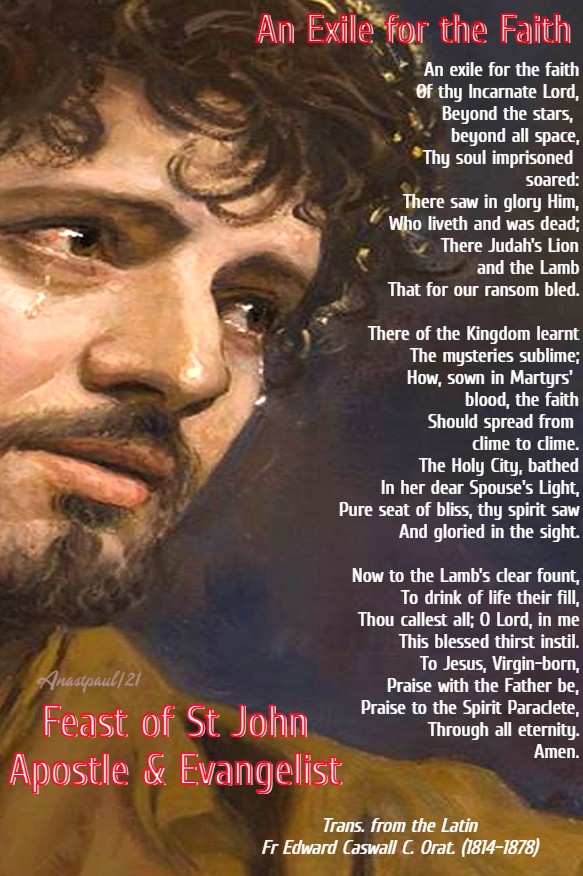
An Exile for the Faith Trans. from the Latin Fr Edward Caswall C. Orat. (1814–1878)
An exile for the faith Of thy Incarnate Lord, Beyond the stars, beyond all space, Thy soul imprisoned soared: There saw in glory Him, Who liveth and was dead; There Judah’s Lion and the Lamb That for our ransom bled.
There of the Kingdom learnt The mysteries sublime; How, sown in Martyrs’ blood, the faith Should spread from clime to clime. The Holy City, bathed In her dear Spouse’s Light, Pure seat of bliss, thy spirit saw And gloried in the sight.
Now to the Lamb’s clear fount, To drink of life their fill, Thou callest all; O Lord, in me This blessed thirst instil. To Jesus, Virgin-born, Praise with the Father be, Praise to the Spirit Paraclete, Through all eternity. Amen.
Saint of the Day – 27 December – 27 December – St John the Apostle and Evangelist. Patronages – • against burns; burn victims• against epilepsy• against foot problems• against hailstorms• against poisoning• art dealers• authors, writers• basket makers• bookbinders• booksellers• butchers• compositors• editors• engravers• friendships• glaziers• government officials• harvests• lithographers• notaries• painters• papermakers• publishers• saddle makers• scholars• sculptors• tanners• theologians• typesetters• vintners• Asia Minor (proclaimed on 26 October 1914 by Pope Benedict XV)• 6 Diocese• 7 Cities.
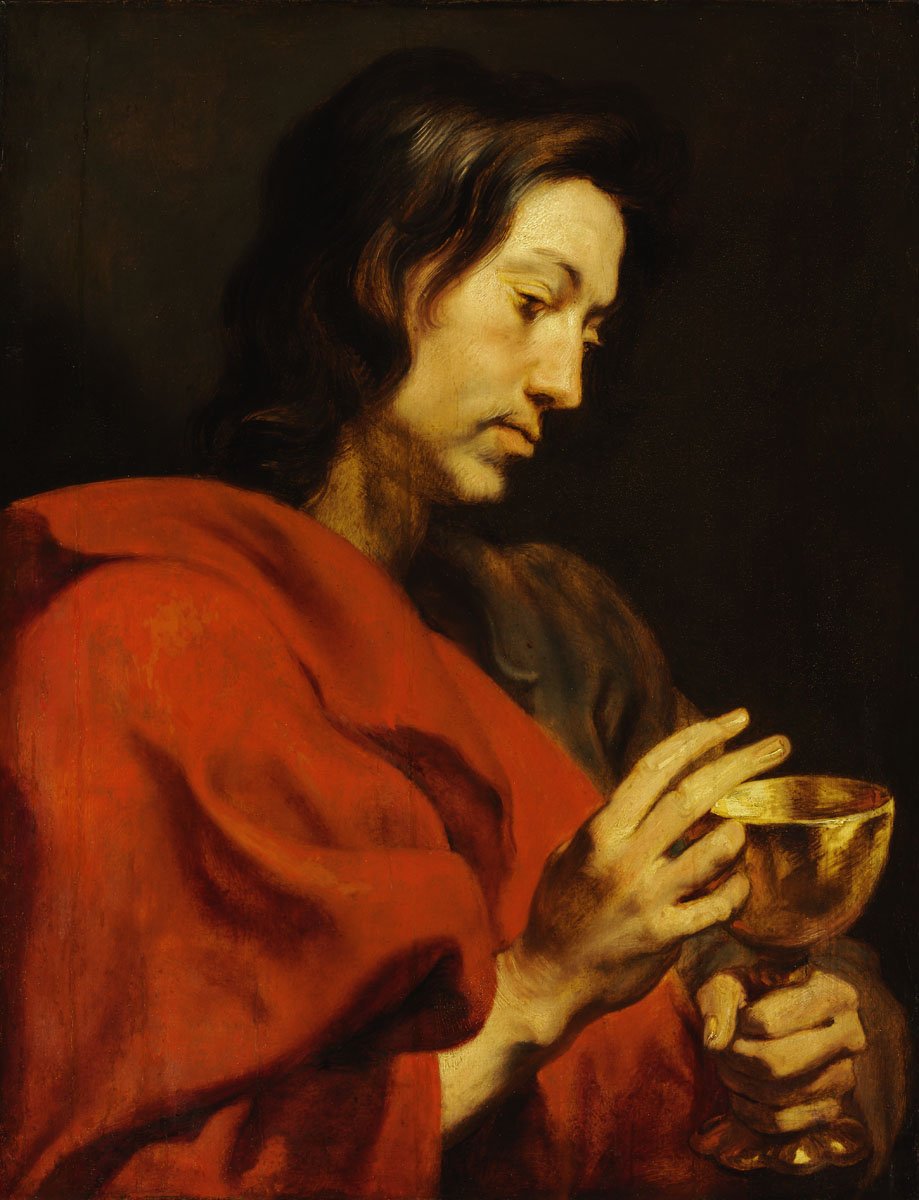
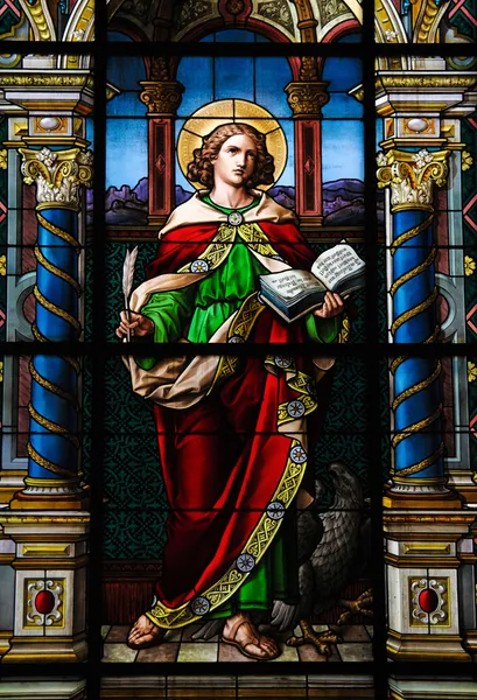
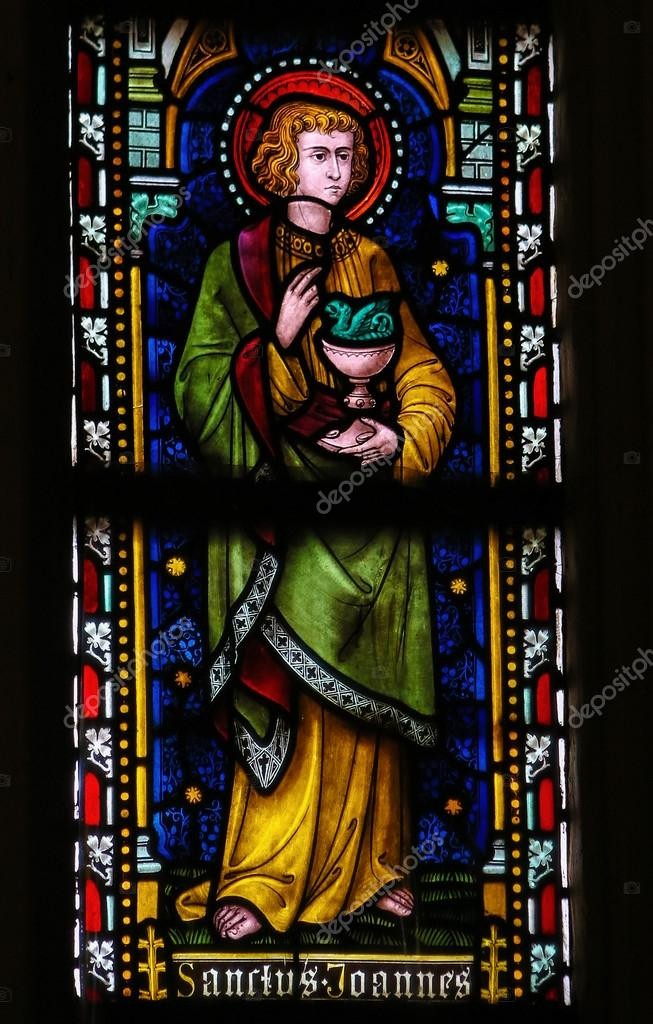
St John, Apostle and Evangelist by Father Francis Xavier Weninger SJ (1805-1888)
St John, Apostle and Evangelist of Jesus Christ, a brother of St James and son of Zebedee and Salome, was born at Bethsaida, a Town in Galilee. Christ, our Lord, called him and his brother James to follow Him, at the time when they were mending their nets in a boat, on the shore of the Sea of Genesareth. John, without delay, left all he possessed, even his own father and, with his brother, followed the Lord. Although the youngest of the Apostles, he was beloved by the Saviour above all the others – whence he is several times mentioned in the Gospel, as “the disciple whom Jesus loved.” The cause of this special love of Jesus for him, was, according to the Holy Fathers, his virginal purity, which he kept undefiled and the tender love he bore to the Lord. “He was more beloved than all the other Apostles,” writes St Thomas Aquinas, “on account of his purity.” “For the same reason,” says St. Anselm, “God revealed more mysteries to him, than to the other Apostles. Justly,” says he, “did Christ the Lord reveal the greatest mysteries to him, because he surpassed all in virginal purity.“
Anthony van Dyck
It is evident from the Gospel, that St John was one of the most intimate of the friends of the Lord, and was, in consequence, sometimes admitted into Christ’s presence, when, except Peter and James, no other Apostle was allowed to be near. Thus, he was with Christ when He healed the mother-in-law of Peter; when He raised the daughter of Jairus from the dead and when He was transfigured on Mount Thabor. He also accompanied Christ when He suffered His Agony in the Garden of Olives. The other two above-named Apostles ,shared these favours with John but none was permitted to lean upon the Saviour’s bosom, at the last supper, save John; none was recommended as son to the divine Mother but John. Only he, of all the Apostles, followed Christ to Mount Calvary,and remained there with Him, until His death. To recompense this love, Christ gave him to His Mother as her son, when He said: “Behold thy Mother!” Christ, who had lived in virginal chastity, would trust His Virgin Mother to no-one else but John, who himself lived in virginal purity. As St.Jerome says: “Christ, a virgin, recommended Mary, a virgin, to John, a virgin.” No greater grace could John have asked of Christ; no more evident proof could he have received of His love. The most precious thing which the Lord possessed on earth, His holy Mother, He commended to His beloved disciple. He took him as brother, by giving Him as son to His Mother. Who cannot see from all this, that Christ loved and honoured St John above all others?
How deeply this beloved disciple must have suffered by seeing his Saviour die, so ignominious a death, is easily to be conceived; and St Chrysostom hesitates not to call him, therefore, a manifold Martyr. After Christ had died on the Cross, had been taken from it, and interred with all possible honours, St John returned home with the divine Mother, who was now also his mother, and waited for the glorious Resurrection of the Lord. When this had taken place, he participated in the many apparitions of the Lord, by which the disciples were comforted and, doubtless received again, particular marks of love from the Saviour. He afterwards assisted, with the divine Mother and the Apostles and other disciples of Christ, at the wonderful Ascension of the Lord. With these, also, he received, after a ten days’ preparation, the Holy Ghost, on the great festival of Pentecost.
Soon after this, he and Peter had, before all others, the grace to suffer for Christ’s sake. For when these two Apostles had, in the name of Christ, miraculously healed a poor cripple who was lying at the door of the temple of Jerusalem and used this opportunity, to show to the assembled people, that Jesus of Nazareth was the true Messiah.
Fresco in the Cappella Brancacci, Florence, attributed to Masolino da Panicale (1383 – c.1447). It is part of the cycle of frescoes painted between 1425 and 1427 depicting the life of St. Peter. It shows the Apostle, accompanied by StJohn, giving his hand to a cripple seeking alms. The cripple is instantly cured.
They were seized, at the instigation of the chief priests,and were cast into prison. On the following day, the priests came together and John and Peter were called before them and asked in whose name and by what power, they had healed the cripple. Peter and John answered fearlessly, that it had been done in the Name of Jesus Christ. The high priest dared not do anything further to them but, setting them free, prohibited them from preaching, in future, the Name of Christ. The two holy Apostles, however, nothing daunted, said: “If it be just in the sight of God to hear you rather than God, judge ye: for we cannot but speak the things which we have seen and heard.“
Anthony van Dyck
St. John remained for some time in Jerusalem after this and, with the other Apostles, was zealous in his endeavors to convert the Jews. When the Apostles separated, to preach the Gospel over all the world, Asia Minor was assigned to St John. Going thither, he began with great zeal his apostolic functions and, by the gift of miracles, he converted many thousands to the Faith of Christ. The many Bishoprics which he instituted in the principal cities sufficiently prove this. In the course of time, he went also to other countries, preaching everywhere the Word of Christ, with equal success..
Anthony van Dyck
oil, oak
64,5 x 50 cm
The Emperor Domitian, who, after the death of the Emperor Nero, again began to persecute the Christians, ordered his officers to apprehend John and bring him to Rome. Hardly had the holy Apostle arrived there, when he was commanded by the Emperor to sacrifice to the gods. As the Saint refused this and fearlessly confessed Christ, the Emperor had him most cruelly scourged and afterwards, cast into a large caldron, filled with boiling oil. The Saint signed himself and the cauldron with the Holy Cross and remained unharmed, when he was cast into it. This gave him an opportunity to announce, with great energy, to the assembled people, the Gospel of Jesus Christ. The tyrant, who could not suffer this, had him taken out of the cauldron, and sentenced him to banishment on the island of Patmos, to work in the mines and perform other hard labour, in company with other Christians. St John had, at that time, reached his ninetieth year but was willing to undergo the unjust sentence.
After his arrival on the island, he had many and wonderful visions, which, by command of God, he put down in writing. The book which contains them, is a part of Holy Writ, called the Apocalypse, or Revelation of St John, a book which,, according to St Jerome, contains almost as many mysteries as words. After the death of Domitian, St John was liberated and returning to Ephesus, remained there until his death. He outlived all the other Apostles, as he reached the age of 100 years. His great labours, wearisome travels and the many hardships he endured, at last enfeebled him to such an extent, that he could not go to the Church without being carried. F
Frequently he repeated, in his exhortations, the words: “My little children, love one another.” Some, annoyed at this, asked him why he so often repeated these words. He answered: “Because it is the commandment of the Lord and if that is done, it suffices.” By this he meant, that if we love each other rightly, we also love God and when we love God and our neighbour, no more is needed to gain salvation – as love to God and to our neighbour contains the keeping of all other commandments.
The holy Apostle, who had suffered and laboured so much for his beloved Master, was, at length, in the year 104, called by Him into heaven to receive his eternal reward.
Besides the Apocalypse, to which we referred above, St John also wrote three Epistles and his Gospel, on account of which, he is called Evangelist. In his Gospel he gives many more facts than the other Evangelists, to prove the Divinity of Jesus Christ; as, at that period, several heretics, as Cerinthus, Ebion and the Nicolaites, fought against this truth. In his Epistles, he exhorts particularly, to love God and our neighbour,and to avoid heretics. In the first, among other things, he explains that love to God consists in keeping the commandments of God, which are not difficult to keep. “For this is the charity of God,” writes he, “that we keep His commandments;and His commandments are not heavy.” Of the love of our neighbour he says, that it must manifest itself in works, that is, we must assist our brethren in their need and, if necessary, give even our lives for them, after the example of Christ. The holy Apostle exemplified his words by his actions.
Several holy Fathers relate the following of him. The Saint had given a youth in charge of a Bishop, with the commendation to instruct him carefully in virtue and sacred sciences. After some years, when the Saint returned to this Bishop and asked for the young man, he heard with deep sorrow, that he had secretly left and had joined the highwaymen and had even become their chief. The holy Apostle set out at once and went, not without danger to his life, into the woods, where the unhappy young man was said, to be. Finding him, he spoke most kindly to him and succeeded in bringing him back. It is touching to read how the holy, man promised to atone for the youth’s sins, if he would repent and lead a better life. The youth followed the Saint’s admonition and did penance with such fervour and zeal, that the Saint hesitated not to give him charge of the Church at Ephesus. (1876)
St John, Pray for Holy Mother Church, Pray for us all!
Nossa Senhora do Rosário / Our Lady of the Rosary (Atibaia, São Paulo, Brazil) (1817) – 27 December:
In 1763, slaves who couldn’t attend St John the Baptist’s, the main Church in Atibaia, began building their own. Completed in 1817, the Church is often called Nossa Senhora do Rosário dos Pretos, Our Lady of the Rosary of the Blacks. This agricultural City is home to the oldest and most active tradition in the region. The five indigenous groups in Atibaia combine African and Portuguese religious practices, centered around devotion to St Benedict and Our Lady of the Rosary. On 27 December, as they have for over 200 years, the locals gather outside Our Lady’s Church at dawn, dressed in brilliant uniforms of scarlet, green, blue, pink, or white and carrying swords, banners and musical instruments.
The day begins with a serenade and ends with fireworks. In between, to the sound of drums, guitars and pealing bells, the faithful process dancing through the City: young, old, male, female, black and white. The festa of Our Lady of the Rosary is part of a Christmas celebration beginning on 25 December with the erection of two towering poles topped with images of the Saints in Rosary Plaza and concluding 28 December with processions and Holy Mass honouring St Benedict.
Bl Adelheidis of Tennenbach Bl Alejo Pan López Bl Alfredo Parte-Saiz Bl Christina Ebner
Bl Francesco Spoto Bl Hesso of Beinwil St José María Corbin-Ferrer St Maximus of Alexandria St Nicarete of Constantinople Bl Odoardo Focherini Bl Raymond de Barellis Bl Roger of Verdun
Thought for the Day – 26 December – Meditations with Antonio Cardinal Bacci (1881-1971)
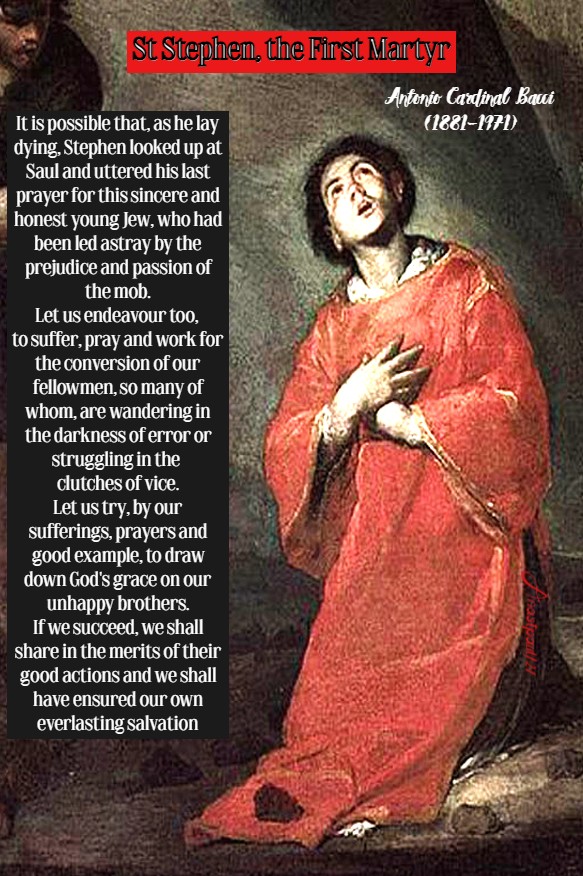
St Stephen, the First Martyr
“Saul was a member of the band which led Stephen to his death. He did not actually take part in the stoning of the saintly Deacod but, he co-operated with the executioners. It is possible that, as he lay dying, Stephen looked up at Saul and uttered his last prayer for this sincere and honest young Jew, who had been led astray by the prejudice and passion of the mob. In God’s plan, the Martyrdom of Stephen was, in some way connected with the conversion of St Paul, who was soon afterward dramatically won over by the grace of God on the road to Damascus.
Let us endeavour too, to suffer, pray and work for the conversion of our fellowmen, so many of whom, are wandering in the darkness of error or struggling in the clutches of vice. Let us try, by our sufferings, prayers and good example, to draw down God’s grace on our unhappy brothers. If we succeed, we shall share in the merits of their good actions and we shall have ensured our own everlasting salvation.”
Quote/s of the Day – 26 December – The Second Day in the Christmas Octave
Christ, the Child
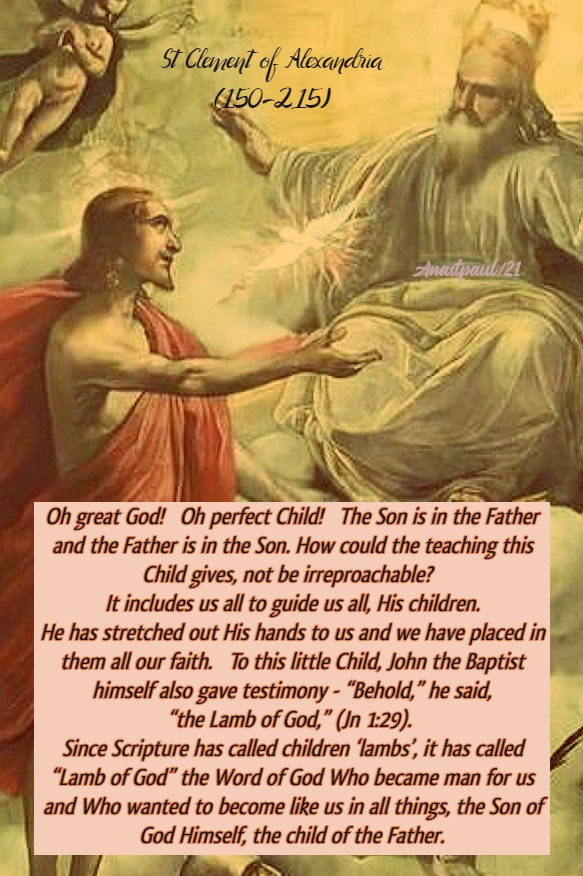
“Oh great God! Oh perfect Child! The Son is in the Father and the Father is in the Son. How could the teaching this Child gives, not be irreproachable? It includes us all to guide us all, His children. He has stretched out His hands to us and we have placed in them all our faith. To this little Child, John the Baptist himself also gave testimony – “Behold,” he said, “the Lamb of God,” (Jn 1:29). Since Scripture has called children ‘lambs,’ it has called “Lamb of God” the Word of God Who became man for us and Who wanted to become like us in all things, the Son of God Himself, the child of the Father.”
St Clement of Alexandria (150-215) Theologian, Father
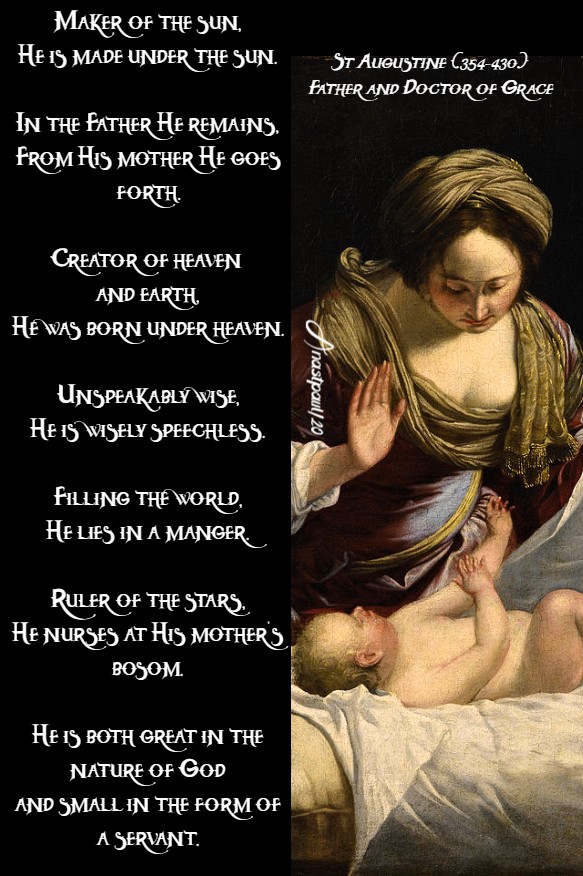
“Maker of the sun, He is made under the sun.
In the Father He remains, From His mother He goes forth.
Creator of heaven and earth, He was born under heaven.
Unspeakably wise, He is wisely speechless.
Filling the world, He lies in a manger.
Ruler of the stars, He nurses at His mother’s bosom.
He is both great in the nature of God and small in the form of a servant.”
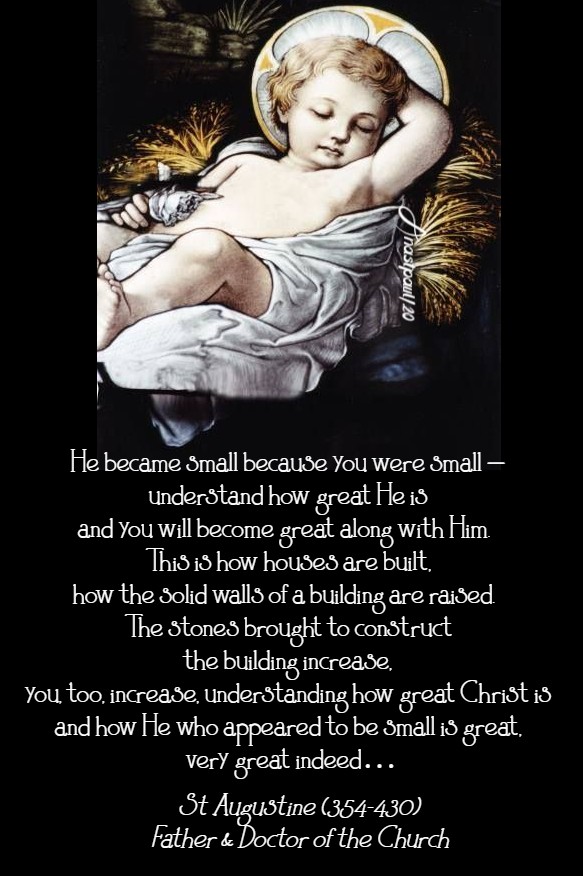
“He became small because you were small – understand how great He is and you will become great along with Him. This is how houses are built, how the solid walls of a building are raised. The stones brought to construct the building increase, you, too, increase, understanding how great Christ is and how He who appeared to be small is great, very great indeed…”
St Augustine (354-430) Father & Doctor of the Church
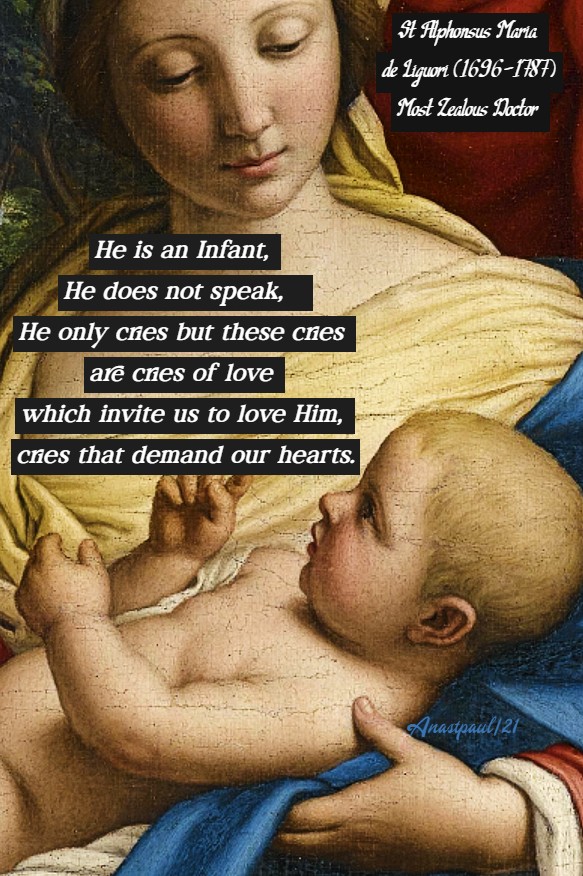
“He is an infant, He does not speak, He only cries but these cries are cries of love which invite us to love Him, cries that demand our hearts.”
St Alphonsus Maria de Liguori (1696-1787) Most Zealous Doctor
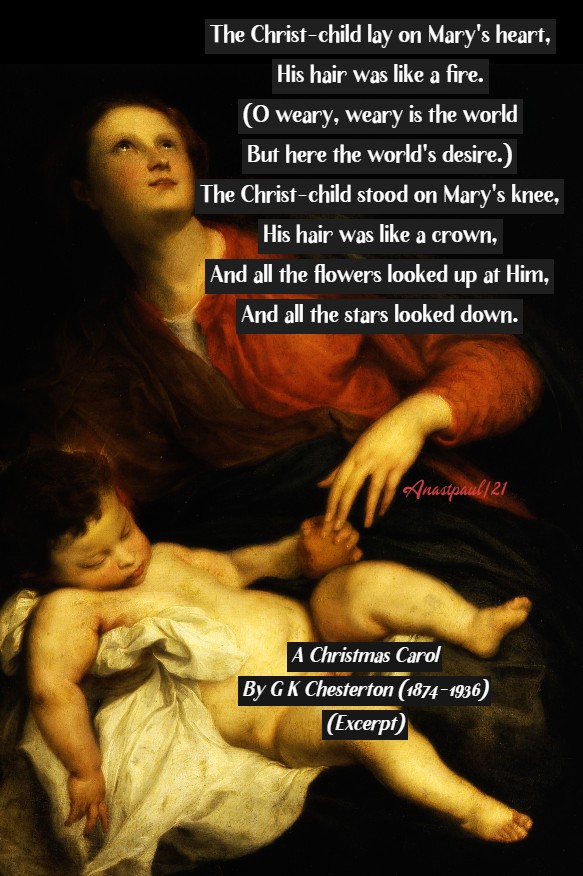
A Christmas Carol By G K Chesterton (1874-1936) English Catholic Convert, Writer, Poet.
The Christ-child lay on Mary’s lap, His hair was like a light. (O weary, weary were the world, But here is all aright.)
The Christ-child lay on Mary’s breast His hair was like a star. (O stern and cunning are the kings But here the true hearts are.)
The Christ-child lay on Mary’s heart, His hair was like a fire. (O weary, weary is the world But here the world’s desire.) The Christ-child stood on Mary’s knee, His hair was like a crown, And all the flowers looked up at Him, And all the stars looked down.
One Minute Reflection – 26 December – Feast of St Stephen the ProtoMartyr and The Second Day in the Christmas Octave, Readings: Acts 6:8-10; 7:54-59, Psalm31:3-4, 6, 8, 16-17, Matthew 10:17-22
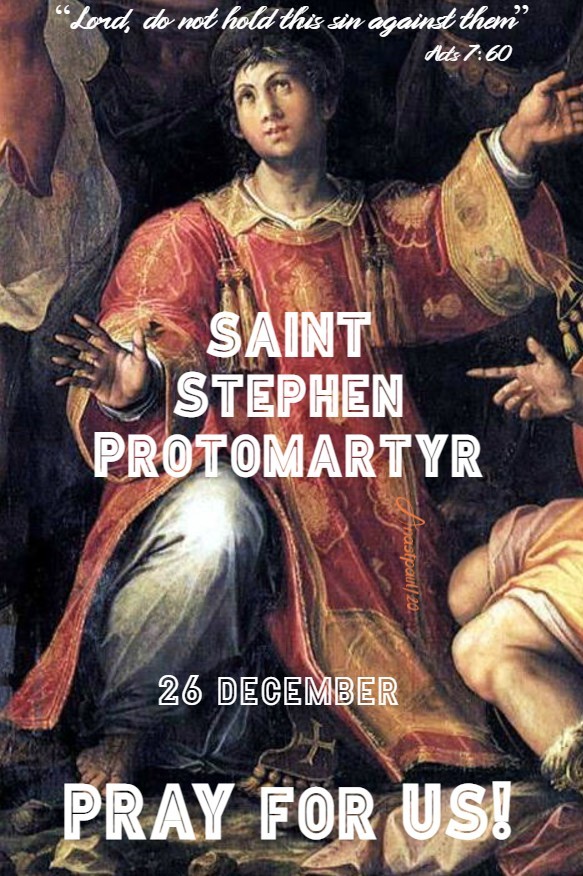
“Lord, do not hold this sin against them” – Acts 7:60
REFLECTION – “Let us imitate our Lord and pray for our enemies … He was Crucified yet, at the same time, prayed to His Father for the sake of those who were crucifying Him. But how could I possibly imitate our Lord, one might ask? If you want to, you can. If you were not able to do it, how could He have said: “Learn from me for I am meek and humble of heart”? (Mt 11:29) …
If you have difficulty in imitating our Lord, at least imitate him who is also His servant, His Deacon – I would speak of Stephen. Just as Christ, in the midst of those crucifying Him, without considering the cross, without considering His own predicament, pleaded with the Father on behalf of His tormentors (Lk 23:34), so His servant, surrounded by those who were stoning him, attacked by all, crushed beneath a hail of stones and, without taking any account of the suffering they were causing him, said: “Lord, do not hold this sin against them” (Acts 7:60). Do you see how the Son spoke and how His servant prayed? The former said: “Father, forgive them for they know not what they do,” and the latter said: “Lord, do not hold this sin against them.” Moreover, to make us realise better the fervour with which he was praying, he did not just pray, as he stood beneath the blows of the stones but, he spoke on his knees with sincerity and compassion …
Christ said: “Father, forgive them for they know not what they do.” Stephen cried out: “Lord, do not hold this sin against them.” Paul, in his turn, said: “I offer up this sacrifice for my brethren, my kin according to race” (cf Rm 9:3). Moses said: “If you would only forgive their sin! And if you will not, then strike me out of the book that you have written!” (Ex 32:32). David said: “May your hand fall on me and my kindred,” (2 Sam 24:17). … What kind of forgiveness do we think we shall receive if we ourselves do the opposite of what is asked of us and pray against our enemies, when the Lord Himself and His servants of both Old and New Testaments, direct us to pray on their behalf?” – St John Chrysostom (345-407) Father and Doctor of the Church – Sermon for Good Friday “The Cross and the bandit”
PRAYER – Grant us Your Grace, Lord God Almighty, to practise what we worship. Teach us to love our enemies and to pray for those who persecute us. As we keep the feast of Saint Stephen, may we learn from him, who learned from You and prayed, even for the men who stoned him to death. Through Christ our Lord, with the Holy Spirit, God now and forever, amen.
Our Morning Offering – 26 December – Feast of St Stephen the ProtoMartyr and The Second Day in the Christmas Octave
Sleep, Holy Babe By Fr Edward Caswell C.Orat. (1814-1878)
Sleep, holy Babe, Upon Your Mother’s breast! Great Lord of earth and sea and sky, How sweet it is to see You lie In such a place of rest! Sleep, holy Babe, Your angels watch around, All bending low with folded wings Before th’incarnate King of kings In rev’rent awe profound! Sleep, holy Babe, While I with Mary gaze In joy upon that face awhile, Upon the loving Infant smile Which there divinely plays. Sleep, holy Babe, And take Your brief repose; Too quickly will Your slumbers break And You to lengthened pains awake, That death alone shall close. Amen
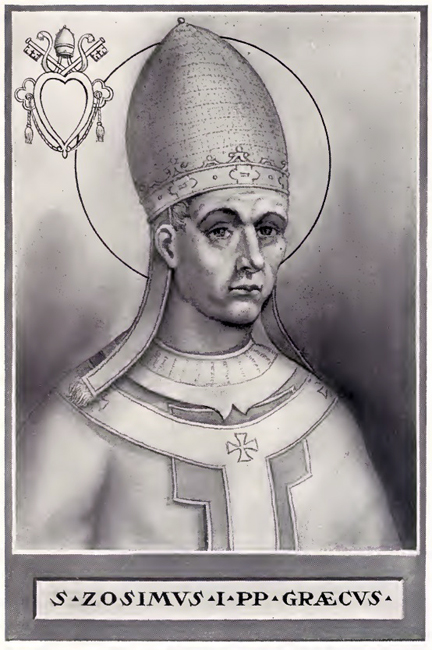
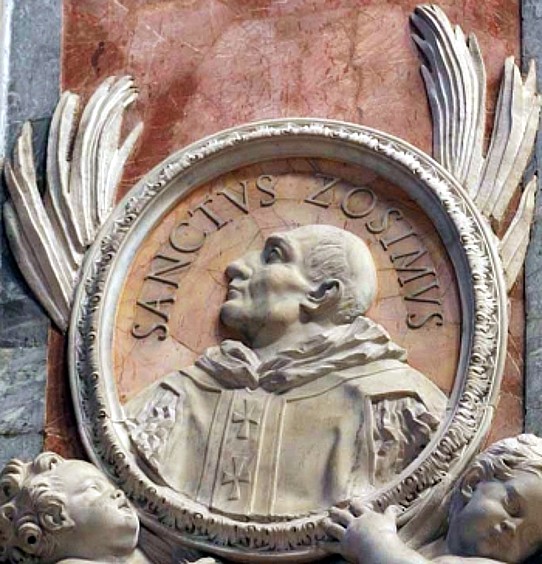
Saint of the Day – Saint Pope Zosimus (Died 418) Bishop of Rome from 18 March 417 to his death, of natural causes, on 26 December 418, Confessor. Greek by birth, his short Pontificate was characterised by serious conflicts with the Bishops of Gaul and those of Africa.
The Roman Martyrology states today: “In Rome on the Via Tiburtina near San Lorenzo, deposition of San Zosimo, Pope and Confessor.”
With the exception of the brief notes reported in the Liber Pontificalis, nothing is known of its history before the election. Zosimo was a Roman Priest at the time of the Pontificate of St Innocent I (401-417), Greek by birth, perhaps descended from a Jewish family, given that his father was called Abraham. He was elected as the successor of Pope Innocent and consecrated on 18 March 417.
Zosimus devoted most of his brief reign to advancing the cause of Papal supremacy, albeit with very little success. Zosimus wrote Episiola Thactaria, condemning Pelagianism.
While personally blameless in his private life, Zosimus did have a tactless and hasty personality, so much so, that he found himself embroiled in various clashes with prelates throughout the Church. In fact he died while preparing to excommunicate a group of troublesome clerics.
In the last months of his life, he also saw an opposition against him arise in Rome, to the point that he turned to complain about it, at the court of Ravenna, he was preparing to fight against this group, when he fell ill, dying on 26 December 418 and being buried. in the Basilica of St Laurence in Rome.
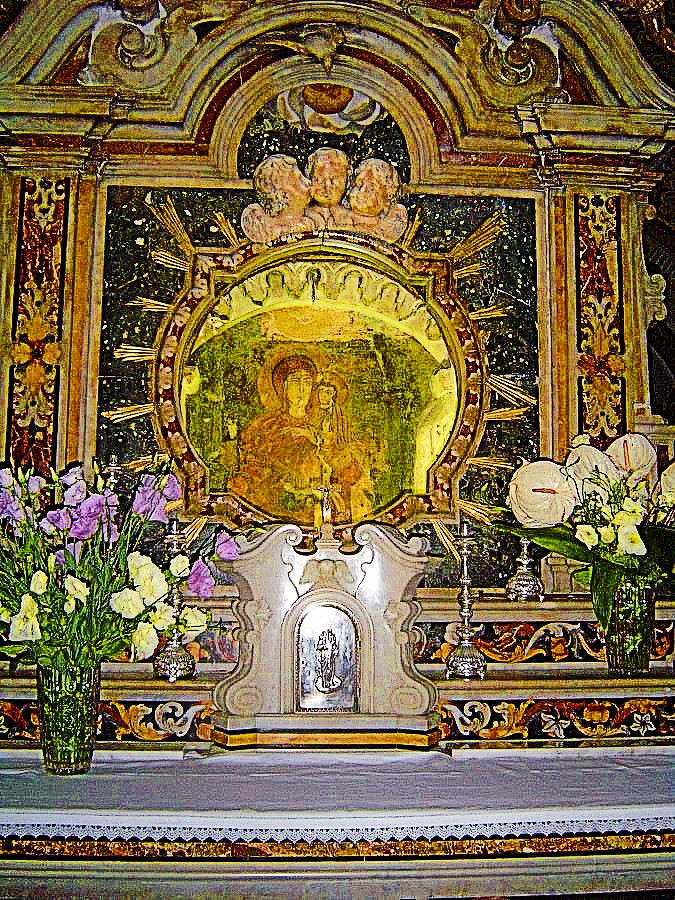
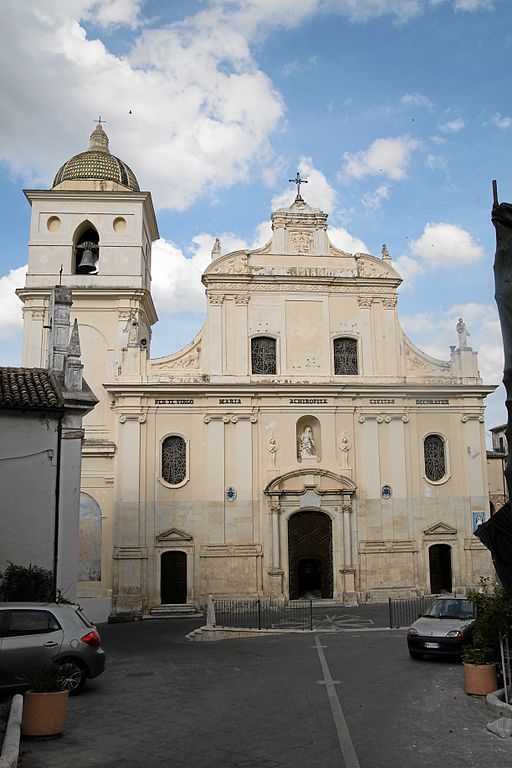
Madonna della Acheropita, Maria Santissima Acheropita / Our Lady of Acheropita, Rossano, Italy (1140) – 26 December:
The Abbot Orsini relates: “Tradition has it that one night, a woman in great brightness appeared to a watchman on duty where a new Church was being built in Rossano, Italy. She asked him to withdraw from the place. The next morning there was seen in the building a picture of the Blessed Virgin, painted but not by the hand of man. For that reason it came to be called “Acheropita,” not made by human hands.”
The latest historical research has established that the image of Acheropita – a fresco on a pillar – was found in a small Chapel near the cave of one of the many hermits who formed the aura of Saint Nicholas of Vallone in the 6th century. It seems a holy hermit named Ephrem was very devoted to the Blessed Virgin Mary. In the year 580, a certain Captain Mauricio, was deflected from his course by the winds and landed near present day Rossano. The hermit Ephrem went to meet him with the strange sounding greeting of: “It was not the winds that brought you here but Our Lady, for once you are appointed emperor, you will build a Church here.” A mere two year later, in the year 582, Mauritius was crowned Emperor and remembering the prophesy, had artists brought to the cave to paint a fitting image of the Blessed Virgin Mary. Although the artists toiled all day, during the night their work always mysteriously disappeared. The Governor, unsure of what was happening, ordered that the cave be guarded at night. That night as the guards went about their duty in front of the cave, a young woman of rare beauty came out of nowhere amidst a bright light wearing a white silk cape. She asked the guard to depart from the site, which they did. Informed the next morning of what had happened, the Governor went to the Church. To everyone’s surprise he observed an image that perplexed him, for painted on the bottom of the inner wall was a beautiful picture of Our Lady, similar to the Byzantine icons he had seen before. It was exactly where his artists had been trying in vain to draw the image. The news of the miracle soon spread throughout the City. The faithful began arriving to the place, shouting in wonder and cheering in tears with songs of praise, “Acheropita! Acheropita!” The image became an object of veneration for the people of Rossano and a new Church had to be built to satisfy popular piety in a more worthy manner. That Church is now known as the Rossano Cathedral, and it was built next to the grotto where the image is still preserved. It is also said, that later, the Saracens attacked, trying to surprise the City of Rossano but they were repulsed by Our Lady, who appeared dressed in purple and holding in her hand a lighted torch. The sight of her majesty terrified the Saracens, who turned and fled. On 26 May 1949, the Diocesan Cathedral was erected at the Shrine. From 16 August to 16 October 1949, a silver Statue of Our Lady was carried on a triumphal pilgrimage through the Archdiocese. 15 August is the annual date for the celebration of the Madonna Acheropita and it is said that during the celebration a wonderful atmosphere envelops the whole of the City, with the festival offering an opportunity for the faithful to demonstrate their love for the Blessed Virgin. On 18 June 1950, Cardinal Micara crowned the image of the Blessed Virgin.
St Abadiu of Antinoë Bl Agata Phutta Bi Bl Agnès Phila St Amaethlu of Anglesey St Archelaus of Mesopotamia Bl Bibiana Khamphai Bl Cecilia Butsi Bl Daniel of Villiers
St Euthymius of Sardis St Evaristo of Constantinople Bl Giovanni Orsini Bl Jean of Hainaut Bl Lucie Khambang St Margaret of Hohenfels Bl Maria Phon Bl Marinus of Rome Bl Paganus of Lecco Bl Pierre Boffet St Tathai of Wales St Theodore the Sacristan
I offer today, special Prayers for you ALL and for all my extended family on WordPress. Most especially, my heart’s deepest thanksgiving for those most generous and loving Benefactors, who, in their generosity have constantly contributed to the upkeep of this site. For those who, in the midst of their manifold duties during this very busy time, have still found time to send Christmas donations and prayers.
Thank you!
“Give, and there will be gifts for you: a full measure, pressed down, shaken togethe and overflowing, will be poured into your lap …”
Luke 6:38
And my wishes for a most Holy and Blessed Christmas May the Divine Babe of Bethlehem fill your hearts with His joy, peace and love! And my Love and Prayers to you and yours. Ana
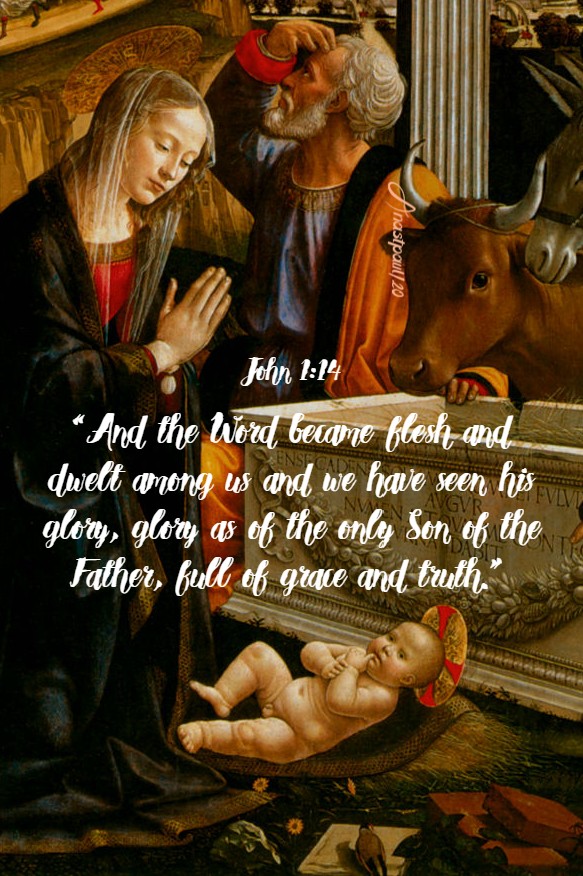
“And the Word became flesh and dwelt among us, full of grace and truth; we have beheld his glory, glory as of the only Son from the Father.”
Thought for the Day – 25 December – Meditations with Antonio Cardinal Bacci (1881-1971)
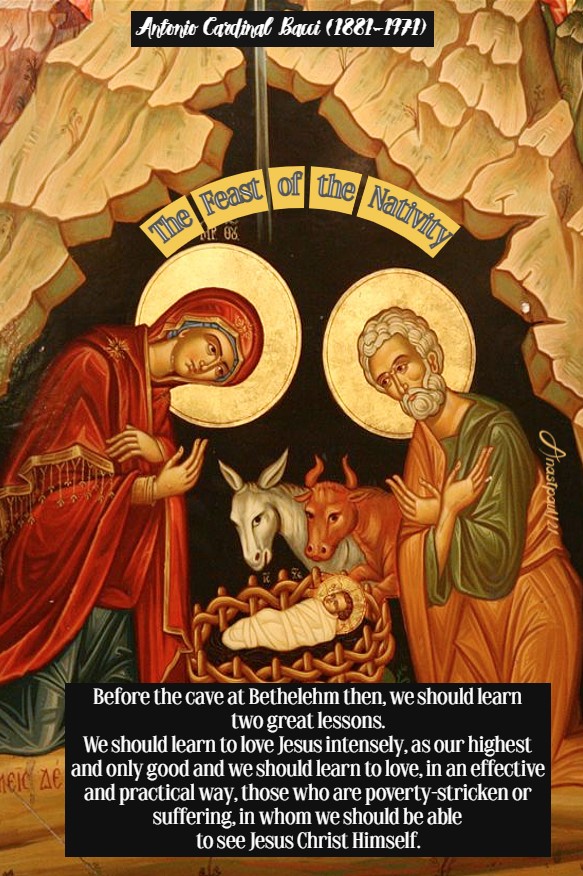
The Feast of the Nativity
“The world ignores the Birth of Jesus. There is no room for Him in the inns of Bethlehem and no room for Mary and Joseph, two poverty-stricken travellers, who are obliged, as a result, to take refuge in a miserable hovel. In the world, it is always so, for men judge one another by external appearances and by financial standards.
How do we behave towards Jesus Christ? How do we behave towards the needy and the afflicted, in whom we should discern the Person of Christ Himself?
If we are prepared to open our hearts to Jesus and to welcome Him as our King and absolute Master, we shall be so transformed, that we shall live His life and act in unison with Him. In short, we shall become saints! But if we are lacking in generosity and are reluctant to welcome Jesus unreservedly into our hearts, we shall never be more than half-Christian, tepid and ungrateful! We should even be prepared to welcome the poor as the representatives of Christ. “As long as you did it for one of these, the least of my brethren,” He has assured us, “you did it for me” (Mt 25-40).
Before the cave at Bethelehm then, we should learn two great lessons. We should learn to love Jesus intensely, as our highest and only good and we should learn to love, in an effective and practical way, those who are poverty-stricken or suffering, in whom we should be able to see Jesus Christ Himself.”
Quote/s of the Day – 25 December – The Solemnity of the Nativity of Our Lord, Jesus Christ
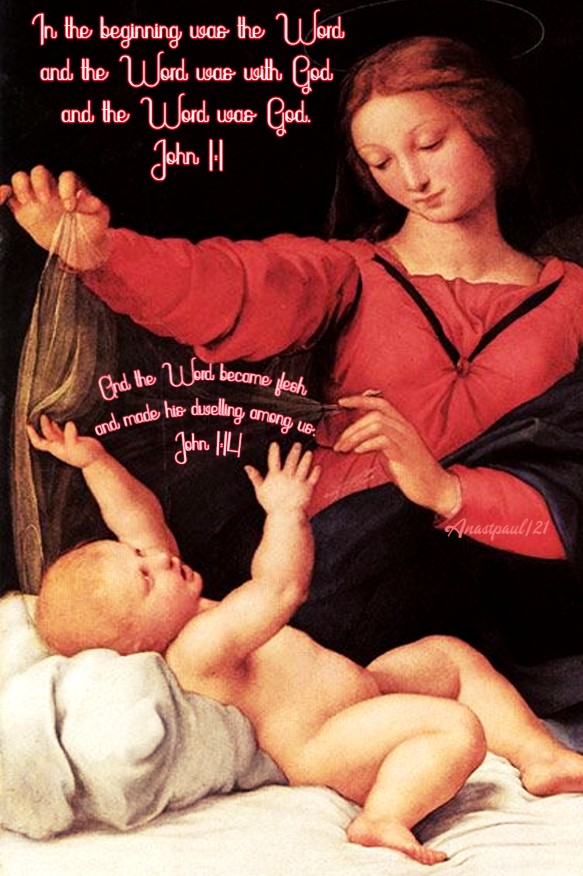
“In the beginning was the Word and the Word was with God and the Word was God.”
John 1:1
“And the Word became flesh and made his dwelling among us and we saw his glory, the glory as of the Father’s only Son, full of grace and truth.”
John 1:14
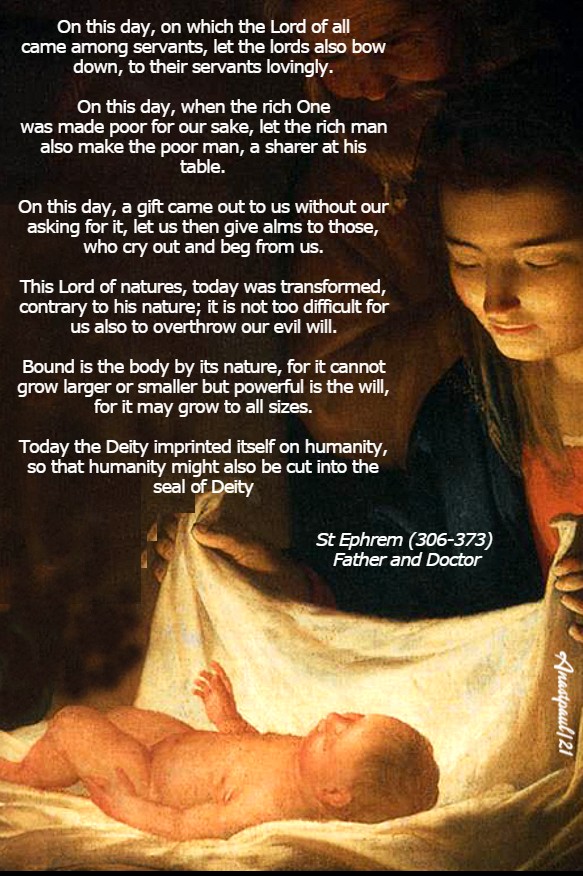
“On this day, on which the Lord of all came among servants, let the lords also bow down, to their servants lovingly.
On this day, when the rich One was made poor for our sake, let the rich man also make the poor man, a sharer at his table.
On this day, a gift came out to us without our asking for it, let us then give alms to those, who cry out and beg from us.
This Lord of natures, today was transformed, contrary to his nature; it is not too difficult for us also to overthrow our evil will.
Bound is the body by its nature, for it cannot grow larger or smaller but powerful is the will, for it may grow to all sizes.
Today the Deity imprinted itself on humanity, so that humanity might also be cut into the seal of Deity.”
St Ephrem (306-373) Father and Doctor
(Homily on Our Lord, 21)
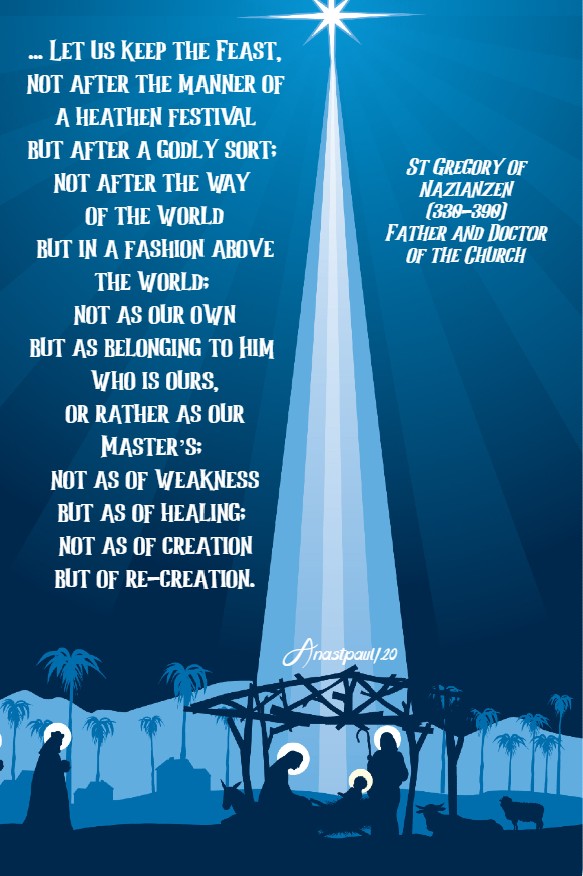
“… Let us keep the Feast, not after the manner of a heathen festival but after a godly sort; not after the way of the world but in a fashion above the world; not as our own but as belonging to Him who is ours, or rather as our Master’s; not as of weakness but as of healing; not as of creation but of re-creation.”
St Gregory of Nazianzen (330-390) Father and Doctor of the Church
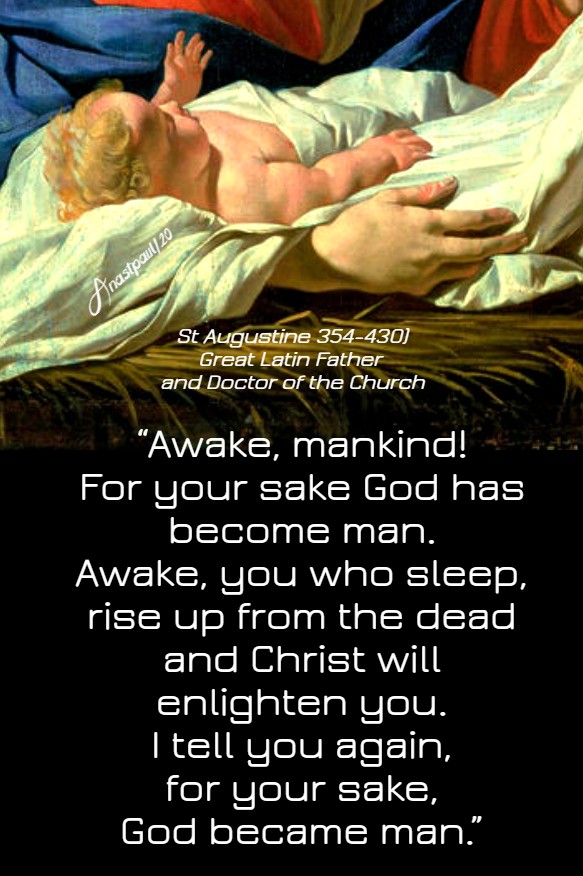
“Awake, mankind! For your sake God has become man. Awake, you who sleep, rise up from the dead and Christ will enlighten you. I tell you again, for your sake, God became man.”
St Augustine 354-430) Great Latin Father and Doctor of the Church
One Minute Reflection – 25 December – The Solemnity of the Nativity of Our Lord, Jesus Christ – Mass during the day – Readings: Isaiah 52:7-10, Psalm 98:1-6, Hebrews 1:1-6, John 1:1-18
Christ has been born for us, come, let us adore Him!
And the Word became flesh and dwelt among us, full of grace and truth; we have beheld his glory, glory as of the only Son from the Father. … John 1:14
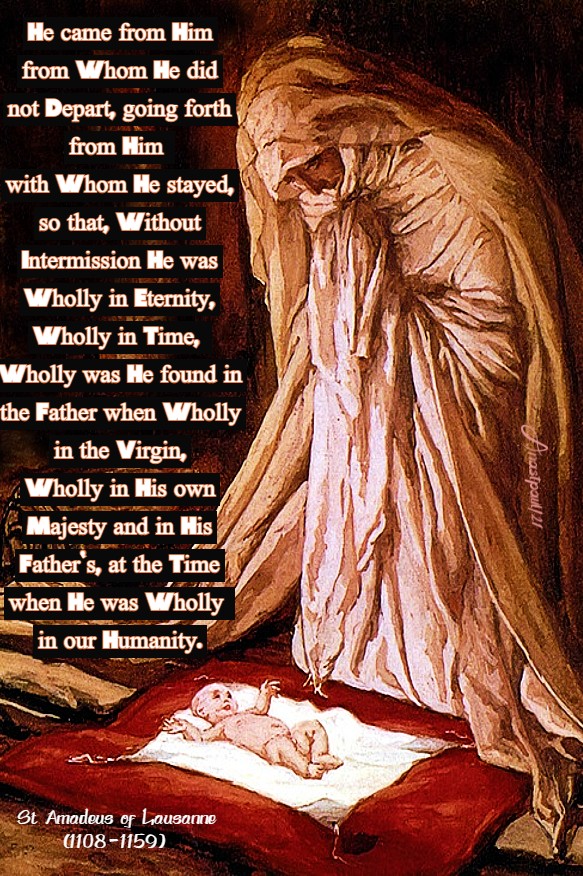
REFLECTION – “Christ has come from the Father, He has come from the Word, He has come from the Holy Spirit, since the whole Trinity accomplished His conception and His incarnation. For to come from the highest Trinity was, no other, than to be conceived and to become, a human being, by the same Trinity. Therefore, it was said: “His going forth is form the highest heaven.” (cf. Ps 18[19]:6) The Only-Begotten … begotten of the Father eternally, begotten in time, He came forth from His Mother, remaining invisibly with the Father and dwelling visibly with us. For to go forth from the Father was this – to enter upon our world, to be seen openly and to become what, from the nature of the Father, He was not. This indeed is wonderful, He came from Him from Whom He did not depart, going forth from Him, with Whom He stayed, so that without intermission, He was wholly in eternity, wholly in time, wholly was He found in the Father, when wholly in the Virgin, wholly in His own Majesty and in His Father’s at the time, when He was wholly in our humanity. If you ask how, gather the truth by means of an illustration. A word conceived in the heart goes forth complete in the voice, so that it comes perfectly to others, yet remains wholly in the heart. So the good Word, spoken forth from the heart of the Father, went forth into the broad plain, yet did not leave the Father.” … St Amadeus of Lausanne (1108-1159) Cistercian Monk and Bishop (On the praises of the Blessed Mary, homily II).
PRAYER – Almighty God, Your incarnate Word fills us with the new light He brought to men. Let the light of faith in our hearts, shine through all that we do and say. We make our prayer through Jesus Christ, our Lord, with the Holy Spirit, God forever, amen.
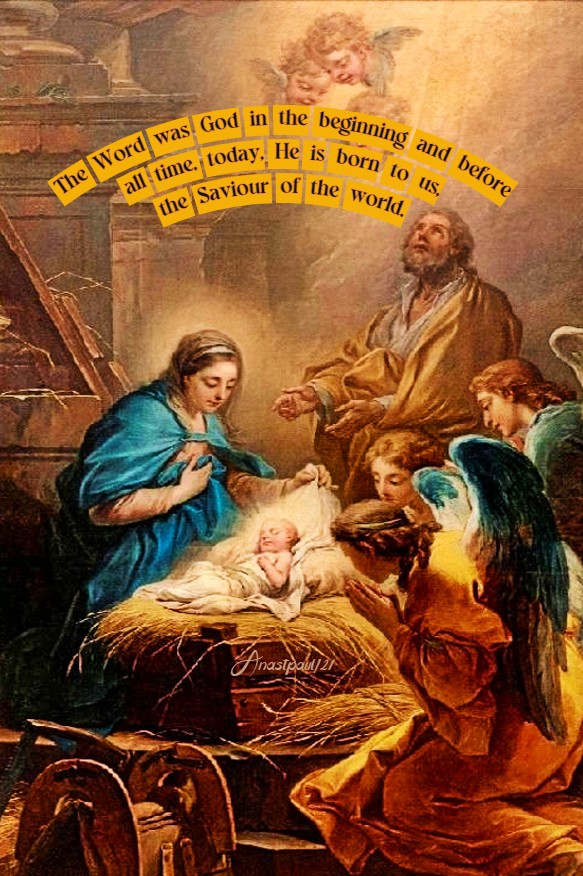
The Word was God in the beginning and before all time, today, He is born to us, the Saviour of the world.
Our Morning Offering – 25 December – The Solemnity of the Nativity of the Lord, Jesus Christ
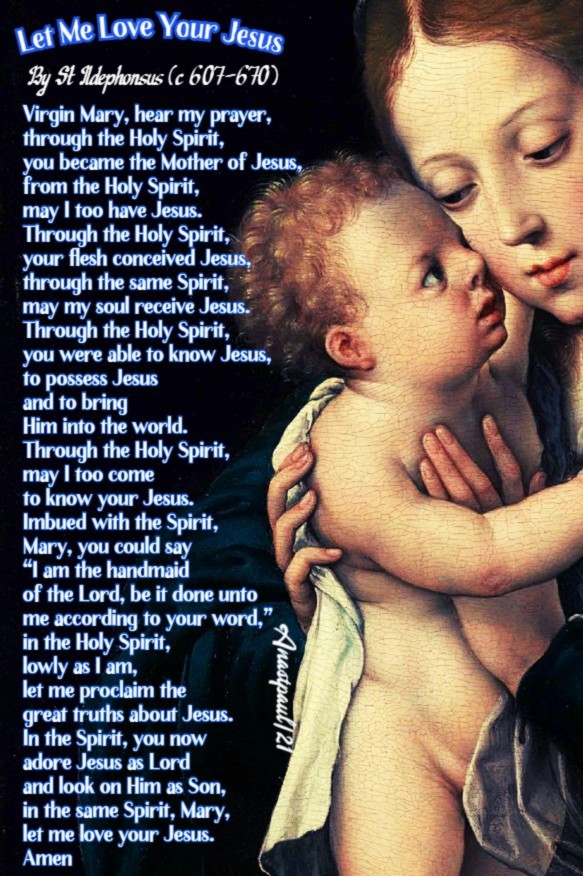
Let Me Love Your Jesus By St Ildephonsus (c 607-670)
Virgin Mary, hear my prayer, through the Holy Spirit, you became the Mother of Jesus, from the Holy Spirit, may I too have Jesus. Through the Holy Spirit, your flesh conceived Jesus, through the same Spirit, may my soul receive Jesus. Through the Holy Spirit, you were able to know Jesus, to possess Jesus and to bring Him into the world. Through the Holy Spirit, may I too come to know your Jesus. Imbued with the Spirit, Mary, you could say “I am the handmaid of the Lord, be it done unto me according to your word,” in the Holy Spirit, lowly as I am, let me proclaim the great truths about Jesus. In the Spirit, you now adore Jesus as Lord and look on Him as Son, in the same Spirit, Mary, let me love your Jesus. Amen
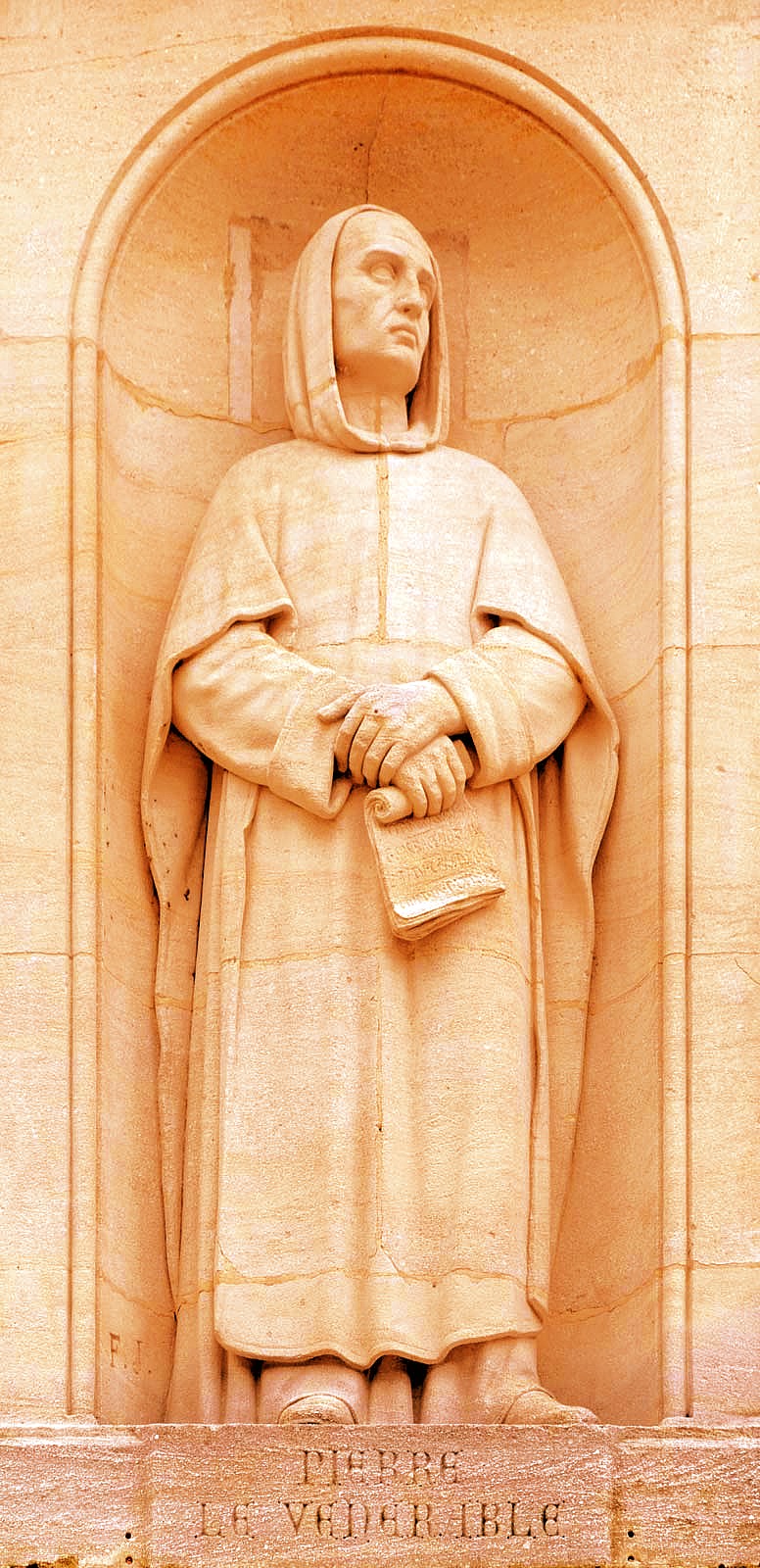
Saint of the Day – 25 December – Blessed Peter the Venerable (c 1092–1156) Eighth Abbot of Cluny, Reformer, Scholar and Writer, Poet. Born in c 1092 in Auvergne, France and died on 25 December 1156 of natural causes. Also known as – Peter of Cluny, Peter of Montboissier. Additional Memorials – 29 April as one of the Abbots of Cluny, 11 May (Benedictine calendar), 29 or 30 December on some calendars.
A descendant of the noble family of Montboissier, Peter was born to Blessed Raingarde in Auvergne, He was “Dedicated to God” at birth and was educated at the Mmonastery at Sauxillanges of the Congregation of Cluny. Peter, aged seventeen, made his profession to his Abbot, St Hugh, shortly before the latter’s death in 1109.. By the age of twenty he gained a professorship and was appointed Prior of the Monastery of Vézelay, before he moved to the Monastery at Domène.
Success at Vézelay and Domène led to his election as General of the Order, aged thirty. After his predecessor, the Abbot Pontius, had been deposed by the Pope, Peter became a tireless reformer of the Cluniac Order, in the face of criticism from other Orders and prominent Monks and theologians, including his great friend, St Bernard of Clairvaux. His defence of his Order against critics and his introduction of radical reforms, earned him the appellation of “venerable”.
Peter making his profession to St Hugh
His interest in the pursuit of studies at Cluny brought about a controversy with his intimate friend, St Bernard, who wished to see the monastic life confined to prayer and manual work. In 1130 Peter supported Pope Innocent II against the antipope Anacletus II, himself a Cluniac Monk and in 1140, he gave shelter to Abelard first at Cluny and later at the priory of St-Marcel-de-Chalon.
Between his numerous journeys, which took him to Spain in 1142, to Germany in 1147, twice to England and ten times to Italy, he frequently retired to a hermitage to devote himself to study and meditation. He was the first to have the Koran translated into Latin (completed 1143) and himself, wrote against the Muslims. His works, among which are treatises against Peter de Bruys and against the Jews (1144–7), a number of sermons and some poems, show comparatively little acquaintance with the Fathers but profound knowledge of the Scriptures and a preference for the literal sense, which causes him to avoid allegorical speculations. His friendship and correspondence with Bishop Henry of Blois of Winchester and Glastonbury, between 1138 and 1142, together with his debating skills, brought wider recognition of his scholarship. And, his moderation and gentleness earned him the veneration of his contemporaries but, in the eyes of posterity, he was overshadowed by the great figure of his illustrious friend, St Bernard.
Peter died a holy death on Christmas Day in 1156. He was in buried in the southern end of the cloister of the Monastery Church of Cluny Abbey. Sadly, his grave was desecrated by the Huguenots in 1562 and most of his relics were destroyed in 1792 in the anti–Catholic excesses of the French Revolution.
Although he has always been honoured as a Saint, he was never canonised and the Martyrologies grants him the title of Blessed. His cult was finally confirmed in 1862 by Blessed Pope Pius IX. and in France and around Europe, he is called “Saint.”
The Solemnity of the Nativity of the Lord, Jesus Christ – Celebration of the anniversary of the Birth of Our Lord. In the earliest days of the Church there was no such Feast, the Saviour’s Birth was commemorated with the Epiphany by the Greek and other Eastern Churches. First mention of the Feast, then kept on 20 May, was made by Clement of Alexandria c 200. The Latin Church began c 300 to observe it on 25 December, though there is no certainty that Our Lord was born on that day. Priests have the privilege of saying three Masses, at midnight, daybreak and morning. This was originally reserved to the Holy Father alone – beginning about the 4th century he celebrated a midnight Mass in the Lateran Basilica (in which according to tradition, the manger of Bethlehem is preserved), a second in the church of Saint Anastasia, whose Feast comes on 25 December and a third at the Vatican Basilica. Many peculiar customs of the day are the outcome of the pagan celebrations of the January calendar. The Christmas tree, of which the first known mention was made in 1605 at Strasbourg, was introduced into France and England in 1840. The feast is a holy day of obligation, preceded by the preparatory season of Advent and by a special Vigil – should it fall on a Friday it abrogates the law of abstinence. Today’s Gospel is the prologue of John.
I know not how, dear Lady love, To offer you my praise, I cannot fashion as I wish The words that I world raise. You stand afar, celestial Queen, The stars are in your crown, They spangle at each gesture’s path And dust upon your gown. Perhaps I might recall the night You knelt beside the crib, The night when doors and casements shut And left a mountain’s rib, Alone, exposed, to hoard you close Beside the new-born Child And seek in Joseph’s kindly eyes For something worldly-mild. To counteract such mundane chill I hereby set my heart, Dim mirror of an Infant’s warmth, Its flaming but a part, A small, sad part of Endless Love That came on Christmas day To show a mother wonder-bright To guide us on our way.
St Adalsindis of Hamay St Alburga of Wilton St Anastasia of Sirmium Bl Artale St Basilée of the Via Latina Bl Bentivoglio de Bonis Bl Diego de Aro St Eugenia of Rome St Fulk of Toulouse
St Jovin of the Via Latina Bl Maria Therese von Wüllenweber Bl Matthew of Albano Bl Michael Nakashima Saburoemon Bl Nera Blessed Peter the Venerable (c 1092–1156) Abbot St Romulus of Berry —
Martyrs of Nicomedia: 20,000 Christians martyred by order of Diocletian. They were reported to have all been in the single basilica to celebrate Christmas. While there unquestionably was an endless series of martyrs under Diocletian, it’s likely the ancient sources exaggerated the numbers of this incident. And as the Christmas holy day was not celebrated in the East in 303, they were probably gathered for another feast. They were burned alive in 303 in the basilica of Nicomedia.



























 AnaStpaul
You must be logged in to post a comment.