Passionate Catholic.
Being a Catholic is a way of life - a love affair "Religion must be like the air we breathe..."- St John Bosco
Prayer is what the world needs combined with the example of our lives which testify to the Light of Christ.
This site, which is now using the Traditional Calendar, will mainly concentrate on Daily Prayers, Novenas and the Memorials and Feast Days of our friends in Heaven, the Saints who went before us and the great blessings the Church provides in our Catholic Monthly Devotions.
This Site is placed under the Patronage of my many favourite Saints and especially, St Paul.
"For the Saints are sent to us by God
as so many sermons.
We do not use them, it is they who move us
and lead us, to where we had not expected to go.”
Charles Cardinal Journet (1891-1975)
This site adheres to the pre-Vatican II Catholic Church and all her teachings. .
PLEASE ADVISE ME OF ANY GLARING TYPOS etc - In June 2021 I lost 100% sight in my left eye and sometimes miss errors. Thank you and I pray all those who visit here will be abundantly blessed. Pax et bonum! 🙏
Thought for the Day – 4 July – Meditations with Fr Richard Frederick Clarke SJ (1839-1900) – “The Month of the Most Precious Blood” – Octave Day of the Sacred Heart of Jesus and the First Friday of July
From “The Devout Year” By Fr Richard Frederick Clarke SJ (1839-1900) The Eating of the Paschal Lamb
Our Blessed Lord , before He suffered , celebrated the Jewish rite which, above all the rest, foreshadowed His own sacred sufferings. The paschal lamb was an exact type of Himself, the Lamb of God, Who taketh away the sins of the world.
+1. The paschal lamb was the means employed by Almighty God to deliver His people from Egypt. It was the sprinkling of its blood on the door-posts which caused the avenging Angel to pass by and leave the inmates unharmed. So the Blood of Jesus Christ sprinkled on our souls, in the Sacraments and when we make an Act of Contrition, saves us from the vengeance which would otherwise fall upon us. O Jesus! sprinkle me with One Drop of Thy Precious Blood and I shall be free from sin.
+2. The paschal lamb had to be drained of the last drop of its blood. So the Lamb of God, shed the last drop of His Precious Blood for us. He was not satisfied with merely giving His Life for us but, He must needs endure all the intense agony, the burning thirst which came of this draining of His whole body for love of us. How can I ever thank Him as I ought?
+3. The lamb suffers uncomplainingly. It never murmurs against its lot, or struggles against those who lead it here and there; unlike the filthy swine which grunt and grumbles at every attempt to control them. None was ever so submissive as the Lamb of God. “Lo, I come to do Thy Will, O my God. I am content to do it.” Can I echo these words?
Quote/s of the Day – 4 July – The Feast of St Andrew of Crete (c660-c740) Bishop, Father of the Church
“Then, let us run with Him as He presses on to His Passion. Let us imitate those who have gone out to meet Him, not scattering olive branches or garments or palms in His path but spreading ourselves before Him as best we can, with humility of soul and upright purpose. So may we welcome the Word as He comes (Jn 1:9); so may God, Who cannot be contained within any bounds, be contained within us. For He is pleased to have shown us this gentleness, He, Who is gentle and who “rides upon the setting sun” (Ps 56:12) which refers to our extreme lowliness. He is pleased to come and live with us and to raise us up or bring us back to Himself.”
“Arise my soul and review your deeds which have preceded you. Scrutinize them closely and shed the rain of your tears, declaring openly to Christ, our thoughts and deeds so that you may be justified.”
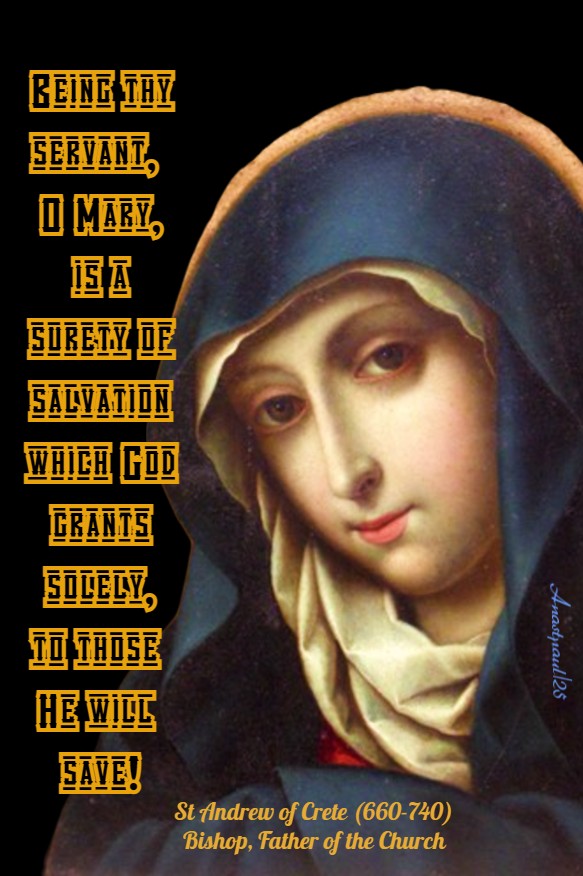
“Being thy servant, O Mary, is a surety of salvation which God grants solely, to those He will save!”
One Minute Reflection – 4 July – “The Month of the Most Precious Blood” – Octave Day of the Sacred Heart of Jesus and the First Friday of July – Within the Octave of Sts Peter and Paul – Ephesians 3:8-12, 14-19 – John 19:31-37 – Scripture search here: https://www.drbo.org/
“But one of the soldiers, with a spear, opened His side and, immediately, there came forth, blood and water. ” – John 19:34
REFLECTION – “Brethren, let us pursue our calling – we are called by Life to the Source of Life and this Source is a source, not just of ‘living water’ (Jn 4:10) but of eternal life, Source of Light and illumination. Indeed, all things flow from it, wisdom, life and eternal light… O Lord, Thou are Thineself this Source Who always exists and is always to be desired and, at where it is always permitted and always necessary for us to draw. ‘Lord Jesus, give us this water always’ that it may also become within us, a spring of water \welling up to eternal life’ (Jn 4:15.14). It is true that I am asking Thee for a great deal, who could deny it? But Thou, O King of glory, know well how to give great things and Thou hast promised them. There is nothing greater than Thou art and, it is Thee Thyself Who give to us, it is Thee Who gave Thyself for us.
Therefore, it is Thee we are asking for … since we desire nothing other than Thee. Thou art our All, our Life, our Light and our Salvation, our Food and our Drink, our God. Breathe into our hearts, I beseech Thee, O our Jesus; with the breath of Thine Spirit, wound our souls with Thy Love that each of us may say in truth – “Show me Him Whom my soul loves” (Sg 3:3) for I have been wounded by Thy Love.
I desire these wounds to be in me, O Lord. Happy the soul who loves wounds in this way – the soul who seeks the Source, who drinks and who, nevertheless, never ceases to thirst even as it drinks, nor to draw continually by desire, nor to continue drinking in its thirst. Thus, it always seeks in loving, for in its wound, it finds healing.” – St Columban (543-615) Father of the Church, Monk, Missionary, Founder of many Monasteries (Spiritual Instructions No 13: 2-3).
PRAYER – God, Who hast consecrated this day to the Martyrdom of Thy Apostles Peter and Paul, give Thy Church a precept to follow them in all things. Through Jesus Christ, Thy Son our Lord, Who lives and reigns with Thee, in the unity of the Holy Ghost, God, world without end. Amen (Collect).
DIVINE Heart of JESUS, convert sinners, save the dying, set free the holy souls in Purgatory.Indulgence 300 Days Everytime – St Pius X, 11 September, 1907.
Our Morning Offering – 4 July – “The Month of the Most Precious Blood” – Octave Day of the Sacred Heart of Jesus and the First Friday of July
Act of Spiritual Communion By St Alphonsus Maria de Liguori (1696-1787) Most Zealous Doctor
I desire, good Jesus, to receive Thee in Holy Communion and since I cannot now receive Thee in the Blessed Sacrament, I beseech Thee to come to me spiritually and to refresh my soul with Thy sweetness. Come, my Lord, my God and my All! Come to me and never let me ever again be separated from Thee by sin. Teach me Thy blessed ways, help me with Thy grace to imitate Thy example, to practise meekness, humility, charity and all the virtues of Thy Sacred Heart. My divine Master, my one desire is to do Thy will and to love Thee, more and more. Help me, that I may be faithful to the end, in Thy service. Bless me in life and in death, that I may praise Thee, forever in heaven, Amen
Saint of the Day – 4 July – St William (c1030- 1091) Abbot of Hirsau Monastery in Germany, Reformer. The date of his birth is unknown but it is known that he was born in the Bavarian City of Regensburg in Germany around the year 1030 and died on 4 or 5 July in 1091at the Monastery in Hirsau the Black Forest. His Body is Incorrupt.
William was soon entrusted, at a tender age, to the Monastery of St Emmeram to be educated .While still young, he took the Benedictine Habit, receiving a solid ascetic, literary, scientific and technical education.
Gifted with great prudence, William knew how to combine rigid personal asceticism with a charming kindness towards others. In 1069 he was called to govern the Monastery of Hirsau in the Black Forest, rebuilt shortly before by Count Adalbert with the help of the Monks of Einsiedeln. The small community numbered only fifteen Religious. William, however, did not want to receive the Abbatial blessing until after the death of Frederick (died in 1071), who had been illegally removed by CountAdalbert.
In order to obtain full exemption for the Monastery, in 1075, William went to Rome to Pope Gregory VII. In Hirsau, William first introduced the customs of St Emmeram, then, imitating those of Cluny, he drew up their rigid and detailed Rules.
The “Hirsau Reform” spread to numerous foundations and of already existing Monasteries throughout Europe, numbering more than one hundred Monasteries. The community of Hirsau itself, grew so vigorously that it soon numbered more than one hundred and fifty Monks, for whom a new building had to be built, dedicated to Sts Peter and Paul. From here, colonies of Monks were sent to elsewhere to encourage and spread the Hirsau Rule and custom of spiritual life.
William also organised the institute of Lay Brothers in the Benedictine monastic community which was then accepted everywhere and gathered around it men and women as ‘oblates.’ In the Investiture Controversy, William was one of the pillars of the Gregorian Reform in Germany which the Monks of Hirsau preached and propagated. He wrote dialogues on Music and Astronomy and had a copy of the Vulgate inscribed for his Monastery.
He died on 4 or 5 July 1091 and was buried in the Church of Saints Peter and Paul, which he himself had built. Around 1500 his Tomb was opened and it was found that both the body and the Abbot’s clothes were still perfectly well preserved. . Until the protestant suppression of Hirsau, he enjoyed public veneration.
Ehemalige Klosteranlage Hirsau, Stadt Calw, Baden-Württemberg
St Carileffo of Anille Bl Cesidio Giacomantonio St Donatus of Libya St Edward Fulthrop St Elias of Jerusalem St Finbar of Wexford St Fiorenzo of Cahors St Flavian of Antioch St Giocondiano St Haggai the Prophet Bl Henry Abbot St Henry of Albano St Hosea the Prophet St Innocent of Sirmium Bl John Carey
Blessed John Cornelius SJ (1557– 1594) Martyr, English Priest of the Society of Jesus, Missionary. Additional Memorials – 29 October as one of the Martyrs of Douai, 1 December as one of the Martyrs of Oxford University. Fr Cornelius and his three companions, the Martyrs of England, were Beatified by Pope Pius XI on 15 December 1929. All their bodies were retrieved and given proper burial by Lady Arundell. His Life and Death: https://anastpaul.com/2021/07/04/saint-of-the-day-4-july-blessed-john-cornelius-sj-1557-1594-martyr/
St Jucundian St Laurian of Seville St Lauriano of Vistin St Namphanion Bl Natalia of Toulouse St Odo the Good Bl Odolric of Lyon Bl Patrick Salmon St Sebastia of Sirmium St Theodore of Cyrene St Theodotus of Libya Bl Thomas Bosgrave Bl Thomas Warcop
St Ulric (c1214-1284) Bishop of Ratzeburg St Valentine of Langres St Valentine of Paris Bl William Andleby St William (c1030-1091) Abbot of Hirsau Monasteryin Germany. His Body is incorrupt.
Thought of the Day – 3 July – Thursday within the Octave of the Sacred Heart and The Feast of the Eucharistic Heart of Jesus
A Forgotten Jewel in the Catholic Crown
“Thy most loving Heart of Jesus, dwells in this Sacrament burning with love for us. It is there, continually performing thousands of good deeds towards us.”
St John Eudes (1601-1680) “Apostle of the Two Holy Hearts”
On this date, we celebrate the Feast of The Eucharistic Heart of Jesus which occurs on the Thursday within the Octave of the Sacred Heart.
On 9 November 1921, Pope Benedict XV instituted the Feast of the Eucharistic Heart of Jesus to be celebrated on the Thursday within the Octave of the Sacred Heart with a Proper Mass and Office. In instituting the Feast, Pope Benedict XV wrote:
“The chief reason for this Feast, is to commemorate the Love of Our Lord Jesus Christ in the Mystery of the Eucharist. By this means the Church wishes, more and more, to excite the faithful to approach this Sacred Mystery with confidence and, to inflame their hearts with that Divine Charity which consumed the Sacred Heart of Jesus, when, in His Infinite Love, He instituted the Most Holy Eucharist, wherein the Divine Heart guards and loves them by living with them, as they live and abide in Him. For, in the Sacrament of the Holy Eucharist, He offers and gives Himself to us as Victim, Companion, Nourishment, Viaticum and Pledge of our future glory!”
O Most Sacred Heart of Jesus! By Pope Benedict XV (1854-1922)
O Most Sacred Heart of Jesus! O Fount of every good! I adore Thee, I love Thee and sincerely repenting of my sins, I present to Thee my poor heart. Give it back to me humble, patient, pure and in everything, conformed to Thy wishes. Make me, O good Jesus, live in Thee and for Thee. Protect me in dangers, comfort me in afflictions, grant me health of body, succour in my temporal needs, Thy blessing in all my works and the grace of a holy death. Amen
Indulgence – 100 days Once a day Pope Benedict XV 4 December 1916
Quote/s of the Day – 3 July – Within the Octave of the Sacred Heart and the Feast of the Eucharistic Heart of Jesus
Give me Thyself, O My God By St Augustine (354-430) Father and Doctor of Grace
Give me Thyself, O my God, give Thyself to me. Behold I love Thee and if my love is too weak a thing, grant me to love Thee more strongly. I cannot measure my love, to know how much it falls short of being sufficient but let my soul hasten to Thine embrace and never be turned away, until it is hidden in the secret shelter of Thine presence. This only do I know, that it is not good for me when Thou art not with me, when Thou art only outside me. I want Thee in my very self. All the plenty in the world which is not my God, is utter want! Amen
“I understand that, each time we contemplate the Host, with desire and devotion, in which is hidden Christ’s Eucharistic Body, we increase our merits in Heaven and secure special joys to be ours later in the Beatific Vision of God.”
“O Sacred Heart of Jesus, Fountain of Eternal Life, Thine Heart is a glowing furnace of Love. Thou art my Refuge and my Sanctuary.”
St Gertrude the Great (1256-1302)
“The faith I have, when I am in the Presence of the Blessed Sacrament, is so strong, I find it impossible to express what I feel… When the time comes to leave, I must force myself to overcome, the inclination to prolong my stay with Jesus.”
One Minute Reflection – 3 July – “The Month of the Most Precious Blood” – St Leo II (611–683) Pope, Confessor – Within the Octave of the Sacred Heart and the Feast of the Eucharistic Heart of Jesus – 1 Peter 5:1-4; 5:10-11 – Matthew 16:13-19 – Scripture search here: https://www.drbo.org/
“Upon this rock I will build My Church” – Matthew 16:18
REFLECTION – “Brothers, when it comes to fulfilling my duties as Bishop, I discover that I am weak and slack, weighed down by the weakness of my own condition, while at the same time, I want to act generously and courageously. However, I draw my strength from the untiring intercession of the Almighty and Eternal Priest, Who, like us but equal to the Father, lowered His divinity to the level of man and raised humankind to the level of God. The decisions He made, give me a just and holy joy. For, when He delegated many shepherds to care for His flock, He did not abandon watching over His beloved sheep. Thanks to that fundamental and eternal assistance, I in turn, have received the protection and support of the Apostle Peter, who also does not abandon his function. This solid foundation, on which the whole of the Church is built, never grows tired of carrying the whole weight, of the building which rests on it.
The firmness of faith, for which the first of the Apostles was praised, never fails. Just as everything which Peter professed in Christ remains, so that which Christ established in Peter, remains… The order willed by God’s Truth remains. Saint Peter perseveres in the solidity which he received; he has not abandoned the governance of the Church which was placed in his hands. That, my brothers, is what that profession of faith, inspired by God the Father, obtained in the heart of the Apostle. He received the solidity of a rock which no assault can shake. In the entire Church, Peter says everyday: “Thou art the Messiah, the Son of the living God.” – St Leo the Great (400-461) Pope, Father and Doctor of the Church (Sermon on the anniversary of his Consecration as Bishop).
PRAYER – Look forgivingly on Thy flock, Eternal Shepherd and keep it in Thy constant protection, by the intercession of blessed Leo Thy Sovereign Pontiff, whom Thou didst constitute Shepherd of the whole Church. Through Jesus Christ, Thy Son our Lord, Who lives and reigns with Thee, in the unity of the Holy Ghost, God, world without end. Amen (Collect).
Our Morning Offering – 3 July – “The Month of the Most Precious Blood of Jesus”
July Morning Offering
Eternal Father, I offer Thee the Precious Blood of Jesus, in satisfaction for my sins and for the wants of Holy Church. Blessed be the Precious Blood of Jesus, which renders bearable the thorns of earth, redeems our souls, purifies them from their iniquities and prepares for them, an eternal crown. Amen.
Saint of the Day – 3 July – St Dathus (Died c190) Bishop and Confessor of Ravenna in Italy during the reign of the Roman Emperor, Commodus. Also known as – Dato, Datus, Dathius.
The Roman Martyrology reads today: “At Ravenna, St Dathus, Bishop and Confessor.”
The renowned Ravenna Cathedral Mosaics
Legend has it that he was elected as the Bishop thanks to the miraculous appearance of a dove flying above his head. He served faithfully during the respite from persecution under the reign of Emperor Commodus.
Bl Andreas Ebersbach Bl Barbara Jeong Sun-mae St Bladus St Byblig St Cillene St Dathus (Died c190) Bishop and Confessor of Ravenna St Eusebius of Laodicea St Firminus St Firmus Bl Gelduin St Giuse Nguyen Ðình Uyen St Gunthiern St Guthagon
St Heliodorus (c332-c390) the first Bishop of Altino in Italy, disciple, close friend and assistant of St Jerome. Scholar, ex-soldier, The Roman Martyrology reads: “At Altino, St Heliodorus, a Bishop, distinguished for holiness and learning.” Holy Heliodorus: https://anastpaul.com/2024/07/03/saint-of-the-day-3-july-st-heliodorus-332-390-bishop/
St Hyacinth of Caesarea St Irenaeus of Chiusi St Maelmuire O’Gorman St Mark of Mesia St Mennone the Centurian St Mucian of Mesia St Paul of Mesia
St Raymond Gayrard(Died 1118) ArchDeacon, Canon of the Lateran Canons Regular at St Sernin Basilica in Toulouse, France. The Roman Martyrology reads: “In Toulouse on the Garonne in France, Saint Raymond Gayrard, who, as a teacher, remained a widower, passionately devoted himself to works of charity, founded a hospice and was finally admitted among the Canons of the Basilica of St Saturnin.” https://anastpaul.com/2023/07/03/saint-of-the-day-3-july-saint-raymond-of-toulouse-died-1118/
Martyrs of Alexandria – 13 Saints: Thirteen Christian companions Marytred together. No details about them have survived but the names – Apricus, Cyrion (2 of), Eulogius, Hemerion, Julian, Julius, Justus, Menelaus, Orestes, Porfyrios and Tryphon (2 of). They martyred in Alexandria, Egypt, date unknown.
Martyrs of Constantinople – 24 Saints: A group of 24 Christians Martyred in the persecutions of Arian Emperor Valens. We know little more than their names – Acacios, Amedinos, Ammonius, Ammus, Cerealis, Cionia, Cionius, Cyrianus, Demetrius, Eulogius (2), Euphemia, Heliodoros, Heraclios, Horestes, Jocundus, Julian, Martyrios, Menelaeus, Sestratus, Strategos, Thomas, Timotheos and Tryphon. They were martyred in c367 in Constantintinople.
Theodotus and Companions – 6 Saints: Six Christians who were imprisoned, tortured and Martyred together in the persecutions of Trajan. Saint Hyacinth ministered to them in prison. We know nothing else about them but their names – Asclepiodotus, Diomedes, Eulampius, Golinduchus, Theodota and Theodotus. They were beheaded in c110, location unknown.
DISCLAIMER: Please note: I cannot control the content of the Advertisements on this Site, or of pop-ups which may appear, The revenue from the Advertisements, however, does provide a little assistance in the support of the Site. I do apologise for any inappropriate content.
Thought for the Day – 2 July – Meditations with Fr Richard Frederick Clarke SJ (1839-1900)
From “The Devout Year” By Fr Richard Frederick Clarke SJ (1839-1900)
The Visitation
+1. The visit of Mary to her cousin St Elizabeth took place a short time after the Annunciation . It had been suggested to her by the Angel’s message, telling her that Elizabeth was to bear a son. St Joseph knew nothing of this, yet, he raised no objection to the journey. He had already conceived such a reverence for his spotless spouse that it was enough for him that she entertained a wish. He knew that she never acted on impulse, or without a due cause and so, when Mary asked his leave to visit her cousin, he at once consented. So we too, should consult, as far as possible, the wishes of others, especially our spouses, seeking to conform our will to others in the spirit of charity.
+2. St Joseph would not allow his young wife to journey alone. He went with her as her escort. What a happiness to him to wait upon her! How tenderly he watches over her How thoughtfully he sees to all her wants! Men often idealise those they love but there was no need to idealise Mary. She was an ideal in herself. And when he approached her, Joseph somehow felt that he was drawing near to God and that God dwelt in her ,in some other way than by His graces and gifts.
+3. Arriving at their journey’s end, St Joseph, in his humility, saw to their material needs and did not hear the words of Elizabeth saluting Mary as the Mother of God and announcing the joy of her unborn babe at His Presence. St Joseph was ignorant and remained in ignorance of the Mystery of the Incarnation. He had to wait – this was to be the law of his life as it is, of the lives of all who are very dear to God.
Quote/s of the Day – 2 July – The Feast of the Feast of the Visitation of the Blessed Virgin Mary
“Mary, having merited to give flesh to the Divine Word and thus, supply the price of our redemption that we might be delivered from eternal death, therefore, she is more powerful than all others, to help us gain eternal life.”
St Augustine (354-430) Father and Doctor of Grace
“She is the eldest daughter of the Great King. If you enjoy her favour, she will introduce you to the Monarch of the Universe. No-one has so great an interest with Him than Mary, who was the occasion of His coming down from Heaven to become man, for the redemption of mankind.”
St John the Merciful (c552-c 616)
“You must know that when you ‘hail’ Mary, she immediately greets you! Do not think that she is one of those rude women of whom there are so many, on the contrary, she is utterly courteous and pleasant. If you greet her, she will answer you right away and converse with you!”
St Bernardine of Siena (1380-1444)
“It seems unbelievable that a man should perish in whose favour Christ said to His Mother: ‘Behold thy son’, provided that he has not turned a deaf ear to the words, which Christ addressed to him: ‘Behold thy Mother!’”
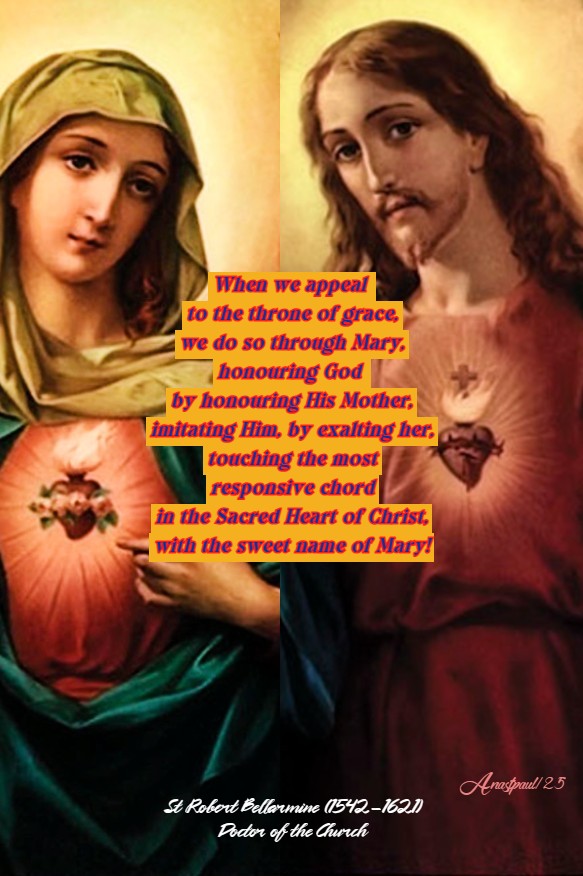
St Robert Bellarmine (1542-1621) Doctor of the Church
One Minute Reflection – 2 July – “The Month of the Most Precious Blood” – The Visitation of the Blessed Virgin Mary – Song 2:8-14 – Luke 1:39-47 – Scripture search here: https://www.drbo.org/
“And whence is this to me that the mother of my Lord should come to me?” – Luke 1:43
REFLECTION – “Behold the King is coming, let us hasten to meet our Saviour” (Advent Liturgy). Solomon put it very well when he said: “As cold water to a thirsty soul, so is good news from a far country” (Prv 25:25). He certainly brings good news who announces the coming of the Saviour, the reconciliation of the world and the good things of the world to come. “How welcome the feet of them who preach peace and bring good tidings!” (Is 52:7)…
Such messengers are waters of refreshment and a draught of saving wisdom to a soul athirst for God. For such a soul, the herald of the Coming and of the other Mysteries of the Saviour, draws and proffers water “with joy from the springs of the Saviour” (Is 12:3). And so, it seems to me, the soul is heard to reply to the messenger … in the words of Elisabeth. It has drunk of the same spirit as she has and says: “And whence is this to me that the mother of my Lord should come to me? For behold, as soon as the voice of thy salutation sounded in my ears, the infant in my womb leaped for joy. And blessed art thou who hast believed because those things shall be accomplished which were spoken to thee by the Lord.”
And really, brethren, we should go to meet the coming Christ with joy in our heart … “O my Saviour and my God! (Ps 42:5) what an honour that Thou should have saluted Thy servants. How much the greater that Thou shouldst have saved them? … Thou hast given us salvation! not only by greeting with the kiss of peace in Thine Incarnation, those Thou had previously saluted with words of peace but,more, by effecting their salvation through Thy death on the Cross.” Let us, therefore, rise up with joyful eagerness and hasten to welcome our Saviour. Let us adore Him and salute Him at a distance, crying out to Him: “Deliverance, Lord, deliverance! Lord, grant us the victory! Blessed is He who comes in the Name of the Lord” (Ps 117:25-26).” – Blessed Guerric of Igny (c1080-1157) Cistercian Abbot (2nd Sermon of Advent).
PRAYER – Bestow upon Thy servants, we beseech Thee, O Lord, the gift of heavenly grace that as the child-bearing of the Blessed Virgin marked the beginning of our salvation, so may the solemn Feast of her Visitation bring us an increase of peace.Through Jesus Christ, Thy Son our Lord, Who lives and reigns with Thee, in the unity of the Holy Ghost, God, world without end. Amen (Collect).
Our Morning Offering – 2 July – The Feast of the Visitation
The Magnificat The Canticle of the Blessed Virgin Mary Luke 1:46-55 Indulgence 100 days
My soul doth magnify the Lord. And my spirit hath rejoiced in God my Saviour. For He hath regarded the humility of His handmaid, for behold, from henceforth, all generations shall call me blessed. For He Who is mighty hath done great things unto me: and holy is His Name. And His mercy is from generation to generation unto thos who fear Him. He hath shown strength with His Arm, He hath scattered the proud in the imagination of their heart. He hath put down the mighty from their seat and hath exalted the humble. He hath filled the hungry with good things and the rich He hath sent empty away. He hath upheld His servant Israel, being mindful of His Mercy. As He spoke unto our fathers, to Abraham and his seed forever.
Glory be to the Father and to the Son and to the Holy Ghost as it was in the beginning, is now and ever shall be, world without end! Amen
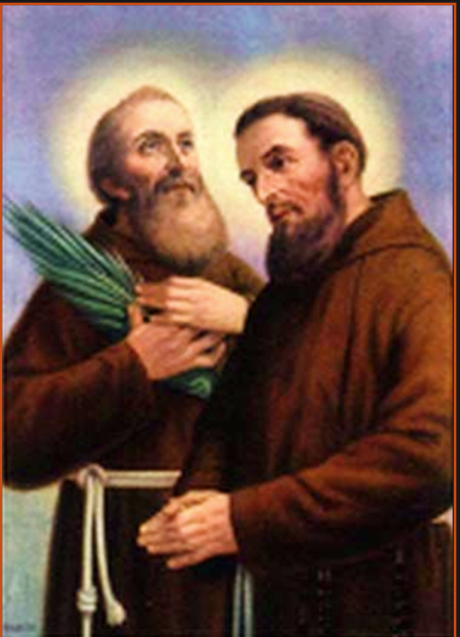
Saint/s of the Day – 2 July – Blessed/s Giovanni (Died c1420) and Pietro da Fabriano Becchetti OSA (Died c1421) Priests and cousins (some sources make them brothers) of the Order of the Hermits of Saint Augustine. Born in the 14th Century in Fabriano, Italy and died in the 15th Century in the their Birth Town. Also known as – John and Peter Becchetti.
In the history of the Order we read: “In Fabriano in the Marches, commemoration of the blesseds Giovanni and Pietro Becchetti, Priests of the Order of the Hermits of St Augustine; united more by the same way of life than by blood ties; they died in 1420 and 1421, respectively.”
Blessed Giovanni Becchetti
Giovanni, who had taught at Rimini, earned his Bachelor’s Degree in Theology in 1385. He then was sent to Oxford, England for further study. There he earned his Master’s in Theology.
He returned to Italy and was appointed as the Director of the Augustinian House of Studies in Perugia.
The date of Giovanni’s death is not known. We know that he was still living in May 1420, as a letter written by him on 7 May of that year is preserved in the Archives of the Order in Rome.
Blessed Pietro Becchetti
Documents show that Pietro was studying for the Degree of Lector in Theology in 1385. He was professor in the Augustinian House of Studies in Rimini in 1388.
While he was in Rimini, the Prior General appointed him Visitator to investigate a complaint which had been made about that House. Later he was professor in Venice.
Greatly devoted to the Passion of Christ, Pietro made a pilgrimage to the Holy Land to follow Our Lord’s Steps and to visit Jesus’ holy Tomb.
The date of Pietro’s death is not known. We know that he was still living in 1421, as there is record of the Prior General having written a letter to him on 20 February of that year.
Both Giovanni and Pietro died at Fabriano. Their remains are preserved at the Church of Saint Augustine there.
Both being distinguished by their scholarly wisdom, personal piety, deep prayer life and preaching, our Blesseds were Beatified in 1835 by Pope Gregory XVI.
Bl Giovanni (Died c1420) and Bl Pietro da Fabriano BecchettiOSA (Died c1421) Priests of the Order of the Hermits of Saint Augustine St Jacques Fermin Bl Jarich of Mariengaarde St Jéroche
Martyred Soldiers of Rome – 3 Saints: Three soldiers who were converted at the Martyrdom of Saint Paul the Apostle. Then they were martyred, as well. We known nothing else about them but their names – Acestes, Longinus and Megistus. Martyred c68 in Rome, Italy
Martyrs in Carthage by Hunneric – 7 Saints: A group of seven Christians tortured and murdered in the persecutions of the Arian Vandal king Hunneric for remaining loyal to the teachings of orthodox Christianity. They were some of the many who died for the faith during a period of active Arian heresy. – Boniface, Liberatus, Maximus, Rogatus, Rusticus, Septimus and Servus.
Martyrs of Campania – 10 Saints: A group of ten Christians Marytred together in the persecutions of Diocletian. The only details about them to have survived are their names – Ariston, Crescention, Eutychian, Felicissimus, Felix, Justus, Marcia, Symphorosa, Urban and Vitalis. Martyred in 284 in Campania, Italy.
1 July The Feast and the Month of the Most Precious Blood of Our Lord Jesus Christ
In his book, The Precious Blood, Father Frederick William Faber CO (1814-1863), calls St Paul ,the Doctor of the Precious Blood owing to his evident fondness of preaching on Ithis subject in his Epistles (Romans 3:25; Ephesians 1:7; Hebrews 9:12 et al).
He recounts that the lives of the Saints are replete with devotion to the Precious Blood making special mention of St John Chrysostom, St Augustine, St Gertrude and St Catherine of Sienna, the last whom he considered the Prophetess of the Precious Blood for putting emphasis on It as the solution to the ills of her times.
Constant Prayer to the Precious Blood of Jesus By St Catherine of Siena (1347-1380)
Precious Blood, Ocean of Divine Mercy, Flow upon us! Precious Blood, Most Pure Offering, Procure us every grace! Precious Blood, Hope and Refuge of sinners, Atone for us! Precious Blood, Delight of holy souls, Draw us! Amen
Father Faber also remarks that the Precious Blood makes us appreciate more,, Christ’s redemption of mankind, His sacrifice and Passion. It makes us comprehend too, the beautiful doctrine and the august realities of the Blessed Sacrament, as we kneel in front of the Tabernacle, in humble adoration.
Over time, the Church gave Her blessing to the devotion by approving societies like the Missionaries of the Precious Blood; enriching confraternities like that of St Nicholas in Carcere, in Rome and that of the London Oratory; attaching Indulgences to prayers and Scapulars in honour of the Precious Blood and instituting commemorative Feasts of the Precious Blood, Friday after the fourth Sunday in Lent and, since Pius IX, the first Sunday of July. St Pius X assigned the date of 1 July to this Feast.
Thought for the Day – 1 July – “The Feast and Month of the Most Precious Blood of Jesus” – Meditations with Antonio Cardinal Bacci (1881-1971)
The Passion of Our Lord
“Meditation on the Passion of Jesus” writes St Albert the Great, “is more profitable than fasting on bread and water or than scourging ourselves.”
This is because, when we meditate with love and gratitude on the Passion of our Redeemer, we have the experience of being transformed and set aglow with charity. We realise the truth of St Paul’s words, “The sufferings of the present time are not worthy to be compared with the glory to come, that will be revealed in us” (Rom 8:18)).
Let us cast ourselves, therefore, into the merciful arms of God and be prepared to suffer everything, even death, for the love of Jesus.”
Quote/s of the Day – 1 July – “The Feast and Month of the Most Precious Blood of Jesus”
“Carry me, O Christ, on Thy Cross which is salvation to the wanderer, rest for the wearied and, in which alone, is Life for those who die.”
St Ambrose (340-397) Father and Doctor of the Church
“Look on thy God, Christ hidden in our flesh. A bitter word, the Cross and bitter sight – Hard rind without, to hold the Heart of Heaven. Yet, sweet it is, for God upon that tree Did offer His Life upon that rood – My Life hung, that my Life might stand in God. Christ, what am I to give Thee for my life? Unless, take from Thy Hands, the cup they hold, To cleanse me with the precious draught of death. What shall I do? My body to be burned? Make myself vile? The debt is not paid out yet. Whate’er I do, it is but I and Thee And still do I come short, still must Thou pay My debts, O Christ, for debts Thyself had’st none! What love may balance Thine? My Lord was found In fashion like a slave that so His slave Might find himself in fashion like his Lord. Think you the bargain’s hard, to have exchanged The transient for the eternal, to have sold Earth to buy Heaven? More dearly God bought me!”
St Paulinus of Nola (c354-431) Father of the Church
“Embrace, then, Jesus Crucified, raising to Him the eyes of your desire! Consider His burning love for you which made Jesus pour out His Blood from every part of His body! Embrace Jesus Crucified, loving and beloved and in Him, you will find true life because He is God made Man. Let your heart and your soul burn with the fire of love drawn from Jesus on the Cross! … You will have no other desire than to follow Jesus! Run, … do not stay asleep because time flies and does not wait one moment! Dwell in God’s sweet love!”
St Catherine of Sienna (1347-1380)
“O souls! Seek a refuge, like pure doves, in the shadow of the Crucifix. There, mourn the Passion of your Divine Spouse and drawing from your hearts, flames of love and rivers of tears, make of them a precious balm with which to anoint the Wounds of your Saviour.”
One Minute Reflection – 1 July – “The Feast and Month of the Most Precious Blood” – The Octabe Day of the Nativity of St John the Baptist– Hebrews 9:11-15 – John 19:30-35 – Scripture search here: https://www.drbo.org/
“But one of the soldiers opened His side with a lance and immediately there came forth, Blood and water.” – John 19:34
REFLECTION – “The lovers of this world display their generosity by giving money, clothes and various gifts but not one of them gives his own blood. Christ gives His! In this way, He demonstrates the tenderness He feels for us and His ardent Love. Under the Old Law, … God consented to receive the blood of sacrifices but this was just to prevent His people from offering it to false gods and already, this was proof of a very great Love. But Christ transformed this rite … there is no longer the same sacrificial victim, it is Himself He offers in sacrifice!
“The bread we break, is it not a communion in the Body of Christ?” (1 Cor 10:16) … What is this bread? The Body of Christ. What becomes of those who communicate in it? The Body of Christ – not a large number of bodies but just One Body. Just as this bread, made up of so many wheat grains, makes only one loaf into which the grains disappear – foreven though the grains remain in it, yet it is impossible to distinguish them in such a closely compacted mass – so all of us, together with Christ, make up a single whole … Now, if we all share in the same bread and are united to the same Christ, why do we not show the same love for each other? Why do we not become one in this case too?
This is what was seen at the beginning: “The community of believers was of one heart and mind” (Acts 4:32) … Christ came in search of you who were far away from Him to unite Himself to you but you, do not wish to become one with your brother? … You violently separate yourself from him after winning from the Lord so great a proof of His Love – and life! For He did not only give His Body but, just as our flesh, drawn from the earth, had lost its life and died through sin, so He has introduced, so to speak, another substance like a leaven – this is His Body, the Body sharing the same nature as ours but free from sin and abounding in Life. And He has given it to all of us, so that, fed with this Banquet of this new food … we might enter immortal life.” – St John Chrysostom (347-407) Bishop of Constantinople, Father and Doctor of the Church (Excerpt from 24th Sermon on the 1st letter to the Corinthians).
PRAYER – Almighty, eternal God, Who made Thine Only-begotten Son the Redeemer of the world and, willed to be reconciled by His Blood, grant us, we beseech Thee, so to worship in this Sacred rite the price of our salvation and to be so protected, by its power against the evils of the present life on earth, that we may enjoy its everlasting fruit in Heaven. Through the same Jesus Christ, Thy Son our Lord, Who lives and reigns with Thee, in the unity of the Holy Ghost, God, world without end. Amen (Collect).
Aspiration:Precious Blood, ocean of Divine Mercy, Flow upon us.
Our Morning Offering – 1 July – “The Feast and Month of the Most Precious Blood of Jesus”
Salvete Christi Vulnera Hail, Holy Wounds of Jesus, Hail! Anonymous Latin Hymn, 17th Century
Hail, holy Wounds of Jesus, hail, Sweet pledges of the saving Rood, Whence flow the streams that never fail, The purple streams of His dear Blood.
Brighter than brightest stars ye show, Than sweetest rose your scent more rare, No Indian gem may match Your glow, No honeys taste with Yours compare.
Portals ye are to that dear home Wherein our wearied souls may hide, Whereto no angry foe can come, The Heart of Jesus crucified.
What countless stripes our Jesus bore, All naked left in Pilates hall! From His torn flesh flow red a shower Did round His sacred person fall!
His beauteous brow, oh, shame and grief, By the sharp thorny crown is riven; Through hands and feet, without relief, The cruel nails are rudely driven.
But when for our poor sakes He died, A willing Priest by love subdued, The soldiers lance transfixed His side, Forth flowed the Water and the Blood.
In full atonement of our guilt, Careless of self, the Saviour trod Een till His Hearts best Blood was spilt The wine-press of the wrath of God.
Come, bathe you in the healing flood, All ye who mourn, by sin opprest; Your only hope is Jesus Blood, His Sacred Heart your only rest.
All praise to Him, the Eternal Son, At Gods right hand enthroned above, Whose Blood our full redemption won, Whose Spirit seals the gift of love.
Office Hymn at Lauds on the Feast of the Most Precious Blood. (The Hymn is also used for Lauds on the Friday after the Fourth Sunday in Lent, for the Office of the Instruments of the Passion.) Translated by – Henry Nutcombe Oxenham (1829-1888) for whom I find little information.
Saint of the Day – 1 July – St Simeon Salus (Died c570) Confessor, Monk, Hermit, Apostle of the poor and needy, Miracle-worker known as “The Holy Fool”
The Roman Martyrology reads today: “At Emesa, St Simeon, surnamed Salus, Confessor, who feigned to be an idiot for Christ but God manifested His high Wisdom by great miracles,”
Born in Syria, at the age of 30 Simeon entered the Monastery of Abbot Gerasimus in Syria. He spent the next 29 years in a desert near the Dead Sea. He felt inspired to move to Emesa to help the poor of that City without any formal recognition.
He came to learn that the best way to be humble was to love humiliation, so he took it upon himself to act foolishly. Only the truly wise could see Simeon’s sanctity.
By simulating simplicity, he saved many souls and brought them to Christ. He was also able to heal many possessed people by his prayer, fed the hungry, preached the Gospel,and helped the poor and needy of the Town. Most of Simeon’s good deeds were done secretly.
Simeon did not play a fool with his friend John, Deacon of the Church in Emesa. Simeon once saved John from being executed when he was falsely accused. Shortly before his death, Simeon told John:
“I beg you, never disregard a single soul, especially when it happens to be a Monk or a beggar. For your charity knows that His place is among the beggars, especially among the blind, people made as pure as the sun through their patience and distress …Show love of your neighbour through almsgiving. For this virtue, above all,, will help us on the Day of Judgment.”
Simeon died in c570 and was buried by the City’s poor in a potter’s field. While the Saint’s body was carried there, people heard a choir singing though none could be found anywhere.
St Aaron of Caerleon St Aaron the Patriarch St Arnulf of Mainz St Calais of Anisole St Carilephus St Castus of Sinuessa St Cewydd St Concordius of Toledo St Cuimmein of Nendrum
St Domitian (c347-440) Abbot, who had been the first Hermit of the surrounding region in France, Founder of a Monastery which became the foundation of the spiritual, cultural and social teachings of its region and day. Born in c347 in Rome and died in 440 at the Saint Rambert de Joux Abbey in the Diocese of Lyons in France. The Roman Martyrology reads: “In the Diocese of Lyons, the decease of St Domitian, Abbot, who was the first to lead there, an eremitical life. After having assembled, in that place, many servants of God and gained great renown for virtues and miracles, he was gathered to his fathers at an advanced age.” His Devoted Life: https://anastpaul.com/2024/07/01/saint-of-the-day-1-july-st-domitian-c347-440-abbot/
Bl Elisabeth de Vans St Eparchius of Perigord St Eutychius of Umbria St Esther the Queen
St Gall of Clermont St Golvinus of Leon St Gwenyth of Cornwall Bl Huailu Zhang St Julius of Caerleon St Justino Orona Madrigal St Juthware St Leonorious of Brittany St Leontius of Autun St Martin of Vienne St Nicasius of Jerusalem
St Secundinus of Sinuessa St Servan of Culross St Simeon Salus (Died c570) Confessor, Monk, Hermit known as “The Holy Fool”
St Theobald of Vicenza St Theodoric of Mont d’Or St Veep
Martyrs of Rome – 6 Saints: Six Christians who were Martyred together. No details have survived except their names – Esicius, Antonius, Processus, Marina, Serenus and Victor. They were martyred i
Thought for the Day – 30 June – Meditations with Antonio Cardinal Bacci (1881-1971)
The Worship of the Sacred Heart in Relation to the Love of God and of Our Neighbour
“There is nothing sentimental about having devotion to the Sacred Heart of Jesus. Neither does this devotion consist only in prayers and pious practices. It is much deeper than this. It should flood our whole being, enkindle the fire of divine love in our hearts and transform our lives in accordance with the commands of Jesus. A love which is not active cannot be genuine, it is only a passing emotion.
Our love for the Sacred Heart of Jesus should be real and effective. As far as possible, it should change us into living replicas of Jesus Christ.
“You are My friends,” He said, “if you do the things I command you” (Jn 15:14). Which commands does He mean? All of them, of course. “Learn from Me, for I am meek and humble of heart” (Mt 11:29). “If anyone wishes to come after Me, let him deny himself, take up his cross and follow Me” (Mt 16:24). “Thy shalt love the Lord thy God, with they whole heart and with they whole soul” (Mt 22:37).
Anyone who practises these precepts and all others which are contained in the Gospel, is sincerely devoted to the Sacred Heart. If anyone neglects to put them into practice but is satisfied with prayers, aspirations and the performance of spiritual exercises, his devotion is empty and has no foundation.
These prayers, aspirations and pious practices have their value, insofar, as they can attract God’s grace. But, we must co-operate with God’s grace by our good actions. Then our devotion to the Sacred Heart of Jesus, will be sincere and effective.”
Quote of the Day – 30 June – The Commemoration of St Paul, Apostle and Martyr
“And now, who will grant me to prostrate myself at Paul’s sepulchre, to contemplate the ashes of that body which, suffering for us, filled up what was wanting of the sufferings of Christ? The dust of that mouth which spoke boldly before kings and, showing what Paul was, revealed the Lord of Paul? The dust of that heart, truly the heart of the world, more lofty than the heavens, more vast than the universe, as much the heart of Christ, as of Paul and wherein might be read, the book of grace, graven by the Holy Spirit? Oh! that I might see the remains of the hands, which wrote those Epistles; of the eyes, which were struck with blindness and recovered their sight for our salvation; of the feet which traversed the whole earth! Yes. I would fain contemplate the tomb where repose these instruments of justice and of light, these members of Christ, this temple of the Holy Ghost. O venerable body, which, together with that of Peter, protects Rome more securely, than all ramparts!”
One Minute Reflection – 30 June – “The Month of the Most Sacred Heart of Jesus” – The Commemoration of St Paul, Apostle and Martyr – Galatians 1:11-20 – Matthew 10:16-22 – Scripture search here: https://www.drbo.org/
“Behold, I send you as sheep in the midst of wolves, therefore, be wise as serpents and simple as doves.” – Matthew 10:16
REFLECTION – “I urge you, in the grace in which you are clothed, to press on in your race and urge everyone to be saved. Assert your office with all the diligence of flesh and spirit. Give your attention to unity, for there is nothing better. Carry your brethren as the Lord also carries you. Patiently bear with them all in love, as indeed you do bear with them. Devote yourself to unceasing prayer. Ask for greater understanding than you have. Be watchful, possessing a wakeful spirit. Speak to each one individually concerning God’s way. “Bear the infirmities” (cf. Mt 8:17) of each as a perfect athlete. Where there is more toil, there is greater gain.
If you only love the good disciples, this wins you no advantage. Rather, subdue by meekness, the more annoying. Not every wound is cured by the same salve. Ease sharp pains with a hot compress. In everything “be wise as serpents” and always “harmless as doves”. You who are of flesh and spirit, humour those things visibly present before you but pray, too, that what is invisible may be manifested to you, so that you may lack nothing and may abound in every spiritual gift.
As pilots invoke the winds and tempest-tossed mariners, call for haven, this season invites you to return to God. Be temperate, as God’s athlete. The prize is incorruption and life eternal …. It is the part of a great athlete to suffer blows and to conquer. It is above all, for God’s sake, we ought to endure all things which He too, may endure for us. Become more zealous than you are. Consider the times. Look for Him Who is above all times, Who is timelss, invisible but made visible for our sakes – He Who, beyond the touch of our hands, beyond suffering, yet knew the Passion for our sakes and endured every suffering!” – St Ignatius of Antioch (c35-c108) Bishop Martyr, Apostolic Father of the Church [Letter to Saint Polycarp (69-155)]
PRAYER – O God, Who taught vast numbers of the Gentiles by the preaching of the blessed Apostle Paul, grant we beseech Thee that, by honouring his memory, we may enjoy the benefit of his patronal intercession. Through Jesus Christ, Thy Son our Lord, Who lives and reigns with Thee, in the unity of the Holy Ghost, God, world without end. Amen (Collect).
SACRED Heart of JESUS, I trust in Thee. 300 Days Indulgence Once a Day – Plenary, Once a month. Raccolta 175 – St Pius X, 19 August 1905 and 27 June 1906.
Our Morning Offering – 30 June – The Last Day of the Month of the Sacred Heart of Jesus
O Adorable Heart of my Jesus! By St Alphonsus Maria de Liguori (1696-1787) Most Zealous Doctor
O Adorable Heart of my Jesus, Heart yearning expressly. for the love of men! Until now, I have shown towards Thee only ingratitude. Pardon me, O my Jesus. Heart of my Jesus, Abyss of Love and of Mercy, how is it possible, hat I do not die of sorrow, when I reflect on Thy Goodness to me and my ingratitude to Thee? Thou, my Creator, after having created me, hast given Thy Blood and Thy Life for me and, not content with this, Thou hast invented a means of offering Thyself everyday for me, in the Holy Eucharist, exposing Thyself to a thousand insults and outrages! Ah, Jesus, do Thou wound my heart with a great contrition for my sins and a lively love for Thee. Through Thy Tears and Thy Blood, give me the grace of perseverance in Thy fervent love, until I breathe my last sigh. Amen.
Saint of the Day – 30 June – Saint Ostian (6th Century) Priest, Confessor and Hermit in Viviers, France, Miracle-worker. Patronages – Viviers, France, for rain (most especially in Viviers). Also known as – Ostianus, Ostiane, Ostiano, Hostien.
The Roman Martyrology reads today: “In the territory of Viviers, St Ostian, Priest and Confessor.”
“Living in the 6th Century, Ostian first evangelised the Dioceses of Viviers and Le Puy. He was then a Hermit near Viviers. The 16th Century handwritten Martyrology mentions him in these terms: ‘in the territory of Viviers, in the Church of St Martin of the Couspié valley, one mile north of the City, at the foot of the mountain of the Tour St Martin, the body of the blessed Ostian, Priest, rests to this day.’ His Relics were solemnly brought to the Cathedral on 19 August 1880. He is the Patron of the City of Viviers.” ( Diocese of Viviers: Consecrated life. He is celebrated on 30 June in the Calendar of the Diocese of Viviers).
We have very limited information of our Saint Ostian. He is believed to have been a relative of Sigismund, the King of Burgundy.
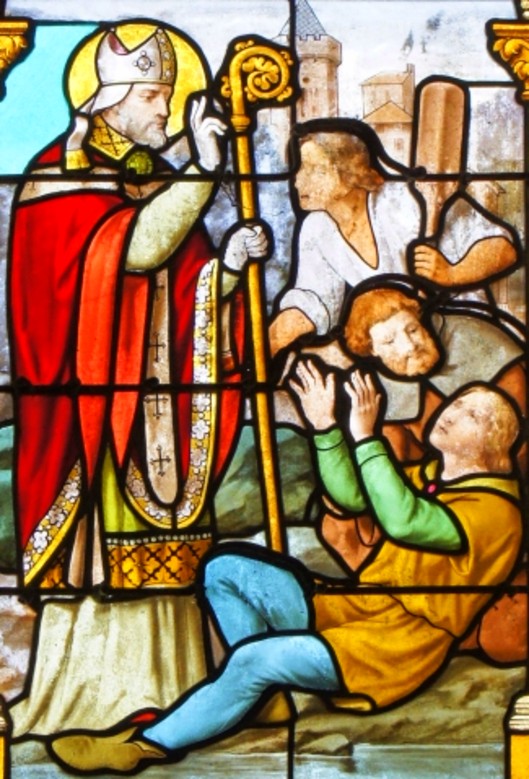
After distributing all his possessions, Ostian is said to have followed the King’s son, Saint Venantius, who was the Bishop of Viviers. The Bishop, wanting to fulfill Ostian’s wish, is said to have granted him ownership of a piece of land in the Couspier valley, at the foot of Mount Bayna, where the Saint lived for 15 years. During these 15 years, it is believed he performed various miracles, including the cures of some blind people. Below is his little stone Chapel where he lived and preached and spread the Gospel, evangelising the region and confessing Christ to all who had ears to hear.
In the 9th Century, Bishop Bernoin (851-874) made a first survey of the Relics of Saint Ostian. And, in the 18th Century, it was believed that his body was in the Church of St Martin di Couspiè. In 1711, in the annotations of the resolutions of the City Council, was presented that the “request for a Procession and Solemn Mass at the Church of Saint-Martin to put an end to the drought, in honour of Sant’Ostian.”
The stone Sarcophagus containing his bones was found in 1869. After these Relics were declared authentic, on 19 August 1880, some bones were transferred to the Cathedral of Viviers and deposited in the Chapel of the Holy Relics. The rest of the Relics had been left in the original restored crypt of the Chapel of Saint-Ostian in San Martin.
The inhabitants of Viviers traditionally invoke Saint Ostian to obtain rain in times of drought. Although the first to introduce the name of this saint in a martyrology was Usvardo, while in Vivers, in some Liturgical records of the 14th and 15th Centuries, his memory was remembered. Currently, Saint Ostian, Priest and Confessor, is remembered and celebrated today, 30 June.
The Town called Saint-Hostien (Sant Ostian in Occitan) is part of the Saint Régis en Mézenc-Meygal Parish complex of the Diocese of Puy.
You must be logged in to post a comment.