Passionate Catholic.
Being a Catholic is a way of life - a love affair "Religion must be like the air we breathe..."- St John Bosco
Prayer is what the world needs combined with the example of our lives which testify to the Light of Christ.
This site, which is now using the Traditional Calendar, will mainly concentrate on Daily Prayers, Novenas and the Memorials and Feast Days of our friends in Heaven, the Saints who went before us and the great blessings the Church provides in our Catholic Monthly Devotions.
This Site is placed under the Patronage of my many favourite Saints and especially, St Paul.
"For the Saints are sent to us by God
as so many sermons.
We do not use them, it is they who move us
and lead us, to where we had not expected to go.”
Charles Cardinal Journet (1891-1975)
This site adheres to the pre-Vatican II Catholic Church and all her teachings. .
PLEASE ADVISE ME OF ANY GLARING TYPOS etc - In June 2021 I lost 100% sight in my left eye and sometimes miss errors. Thank you and I pray all those who visit here will be abundantly blessed. Pax et bonum! 🙏
One Minute Reflection – 26 November – “The Month of The Holy Souls in Purgatory” – St Sylvester Gozzolini OSB Silv. (1177– 1267) Priest, Abbot – Ecclesiasticus 45:1-6 – Matthew 19:27-29 – Scripture search here: https://www.drbo.org/
“… Shall receive a hundredfold and shall possess life everlasting.” – Matthew 19:29
REFLECTION – “The possessions which we have, are not our own: God has given them to us to cultivate and He wishes us to render them fruitful and profitable … Always deprive yourself, therefore, of some part of your means, giving them to the poor with a willing heart … It is true that God will return it to you, not only in the next world but also in this, for there is nothing which makes a person prosper, in temporal matters, so much, as almsgiving. But until such time as God shall repay it, you will always be impoverished to that extent. Oh! how holy and rich is the impoverishment which is caused by almsgiving.
Love the poor and poverty, for by this love you will become truly poor, since, as Scripture says: “We become like the things that we love” (cf Hos 9:10). Love makes those who love, equal to one another: “Who is weak and I am not weak?” says St Paul (2 Cor 11:29). He might have said: “Who is poor, with whom I am not poor?” For love made him become, such as those whom he loved. If, then, you love the poor, you will be truly participating in their poverty and poor like them. Now, if you love the poor, be often among them; be pleased to see them in your house and to visit them in theirs; associate willingly with them; be glad that they are near you in the Churches, in the streets and elsewhere. Be poor in speech with them, speaking to them as their equal but be rich in deed, giving them of your goods, as one who possesses more abundantly.
Will you do even more? … Become a servant of the poor; go to serve them … with your own hands … and at your own expense. This service has more glory in it than a throne!” – St Francis de Sales (1567-1622) Bishop of Geneva and Doctor of the Church (Introduction to the devout life, Part three Ch 15).
PRAYER – Most merciful God, Who when the holy Abbot Sylvester was devoutly meditating upon the vanity of this world beside an open grave, graciously willed to call him into the desert and enrich him with unusual merits, we humbly pray that, following his example, despising the things of earth, we may thoroughly enjoy Thy everlasting presence. Through Jesus Christ, Thy Son our Lord, Who lives and reigns with Thee, in the unity of the Holy Ghost, God, world without end. Amen (Collect).
Our Morning Offering – 26 November – “The Month of The Holy Souls in Purgatory”
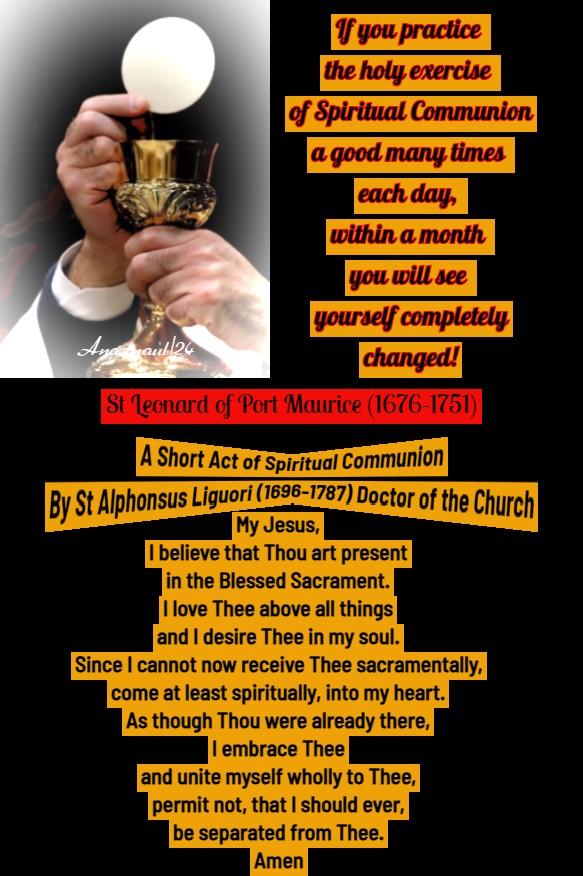
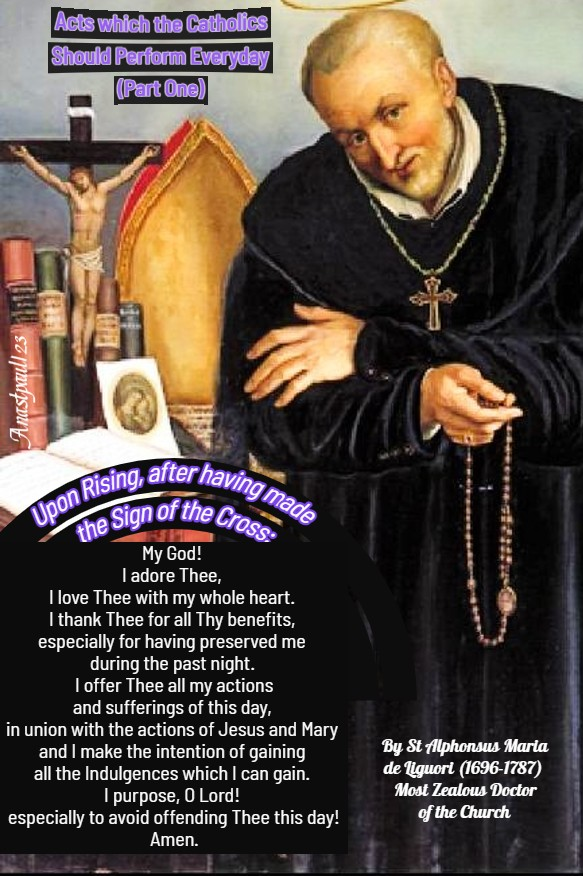
A Short Act of Spiritual Communion By St Alphonsus Liguori (1696-1787) Doctor of the Church
My Jesus, I believe that Thou art present in the Blessed Sacrament. I love Thee above all things and I desire Thee in my soul. Since I cannot now receive Thee sacramentally, come at least spiritually, into my heart. As though Thou were already there, I embrace Thee and unite myself wholly to Thee, permit not, that I should ever, be separated from Thee. Amen
Saint of the Day – 26 November – St Amator (3rd Century) Bishop of Autun, France. Also known as – Amatore, Amatoris.
The Roman Martyrology reads today: “At Autun, St Amator, Bishop.”
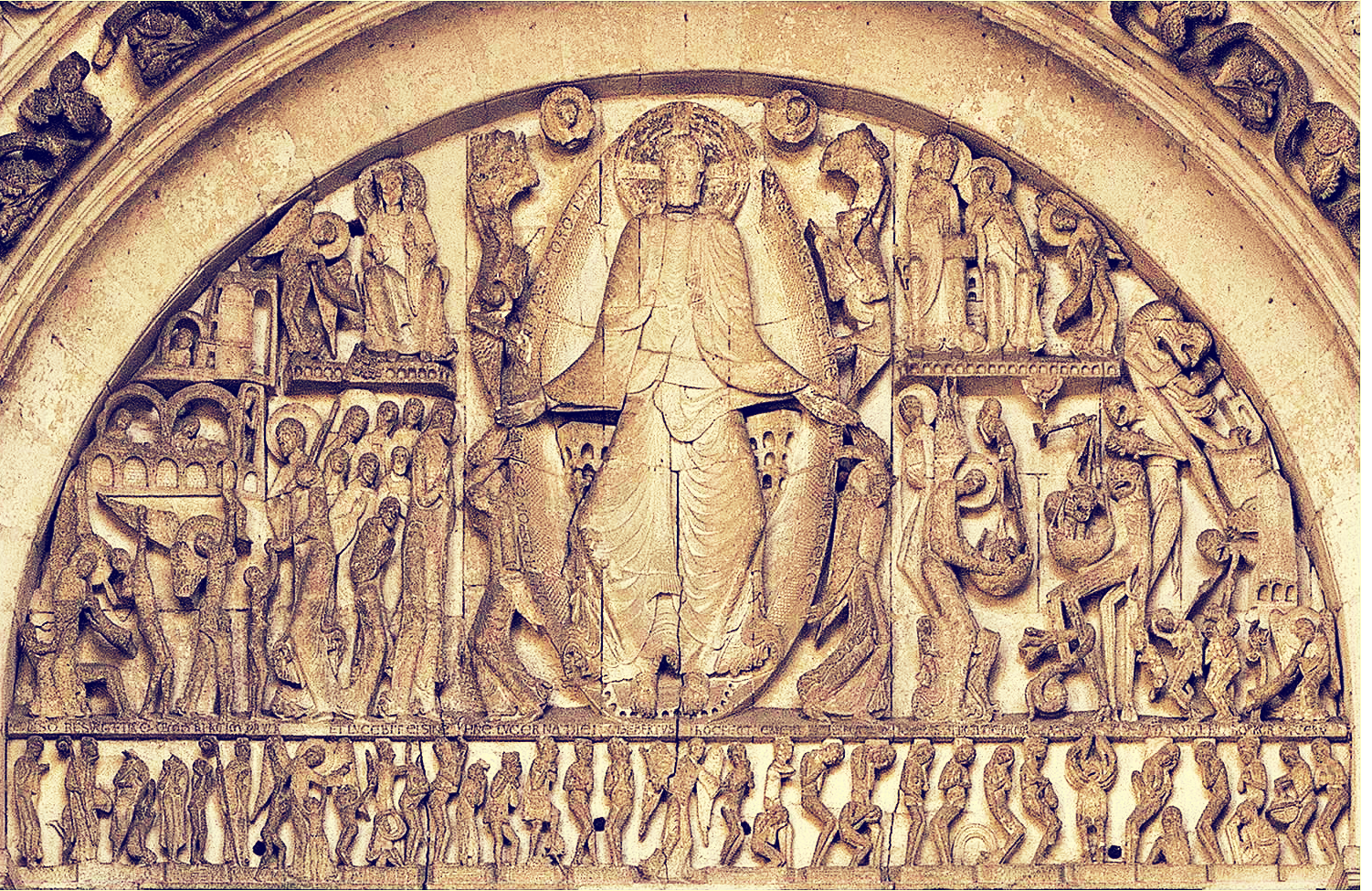
The Last Judgement at Autun Cathedral
St Jerome’s Martyrology commigrates ‘the death of Saint Amatoris Bishop’ in Autun on 26 November and the same ‘death of Saint Amatoris Bishop’ in Auxerre on 1 May. Since the word ‘Bishop‘ is omitted in the Epternacense Codex in the commemoration of 26 November and the Martyrology appears misleading, the Bollandists, in their commentary on the Roman Martyrology, express the opinion that Amator, the Bishop of Autun, never existed and the Diocese was erroneously inserted instead of Auxerre. Baronius also shows little belief in the existence of this Bishop of Autun. Furthermore, the records of his correspondence with Pope Silverius (536-537) is legendary.
St Leonard of Port Maurice OFM (1676-1751) Confessor, Priest and Friar of the Friars Minor, Preacher – in particular Parish Mission, Ascetic Writer, Spiritual Director. St Leonard founded many pious apostolates, societies and confraternities and exerted himself to spread devotion to the Sacred Heart of Jesus, the Perpetual Adoration of the Most Blessed Sacrament, the Blessed Virgin Mary and the Passion of Christ. He was among the few to insist that the concept of the Immaculate Conception of Mary be defined as a Dogma of the Faith. He was Beatified on 19 June 1796 by Pope Pius VI and Canonised on 29 June 1867 by Pope Pius IX. Biography: https://anastpaul.com/2018/11/27/saint-of-the-day-27-november-st-leonard-of-port-maurice-ofm-1676-1751/
Blessed Delphina of Glandèves TOSF (1283-1360) Virgin, Virgin Laywoman, Married in Chastity to St Elzear (below) Widow, Recluse, Apostle of the Poor and needy. Sometimes regarded as ‘Saint’ – the anniversary of her death and birthday into Heaven is today, 28 November. After the Vatican II Council, her Feast day was moved to 27 September: Blessed Delphina’s Chaste Life: https://anastpaul.com/2022/09/27/saint-of-the-day-27-september-saint-delphina-tosf-1283-1360-virgin/
St Egelwine of Athelney St Ida of Cologne St James the Hermit St Magnance of Ste-Magnance St Marcellus of Nicomedia St Martin of Arades St Nicon of Sparta
Blessed Pontius of Faucigny (c1100-c1178) Abbot, Founder and the 1st Abbot of the Monastery of Faucigny. At a very young age he entered the Abbey of the Canons Regular of Abondance, of which he revised the Constitutions, harmonising them with the original Augustinian Rule. His Holy Life: https://anastpaul.com/2024/11/24/saint-of-the-day-24-november-saint-protasius-died-c352-bishop/
St Sabaudus of Trier
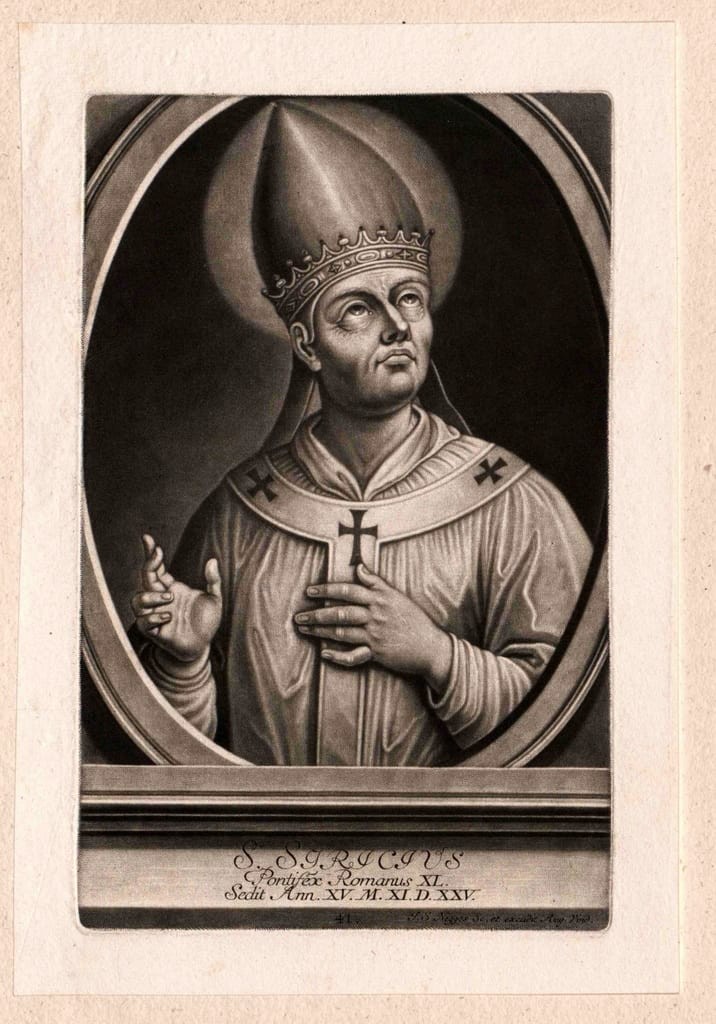
St Siricius, Pope (c334-399) Confessor, Bishop of Rome from December 384, Confessor, Defender of the Faith against heresies, Reformer of clerical discipline, Born in Rome and died there of natural causes aged around 64. In response to inquiries from Bishop Himerius of Tarragona, Siricius issued the Directa Decretal, containing Decrees of Baptism, Church discipline and other matters. His are the oldest completely preserved Papal Decrees. He is sometimes said to have been the first Bishop of Rome to call himself “Pope or Papa” – the word derived from the Greek, Papa, meaning Father. The Roman Martyrology reads today: “At Rome, St Siricius, Pope and Confessor, celebrated for his learning, piety and zeal for religion, who condemned various heretics and published salutary laws concerning Ecclesiastical discipline.” A True Shepherd.: https://anastpaul.com/2023/11/26/saint-of-the-day-26-november-st-pope-siricius-c334-399-confessor/
St Stylinus St Vacz – 11th Century Hermit in Visegrád, Hungary. No further information is available.
Martyrs of Alexandria – 650+- Saints: A group of approximately 650 Christian Priests, Bishops and Laity Martyred together in the persecution of Maximian Galerius. We have the names and a few details only seven of them – Ammonius, Didius, Faustus, Hesychius, Pachomius, Phileas and Theodore. The were born in Egypt and were martyred there in c 311 in Alexandria, Egypt.
Martyrs of Capua – 7 Saints: A group of seven Christians Martyred together. The only details about them to survive are the names – Ammonius, Cassianus, Felicissimus, Nicander, Romana, Saturnin and Serenus. They were martyred in Capua, Campania, Italy, date unknown.
Martyrs of Nicomedia – 6 Saints: A group of six Christians Martyred by Arians. Few details have survived except their names – Marcellus, Melisus, Numerius, Peter, Serenusa and Victorinus. Martyred in 349 in Nicomedia, Bithynia, Asia Minor (modern Izmit, Turkey).
November is a month of Birthdays and Anniversaries for me and as I have a few commitments approaching shortly, including my own Birthday 🎂 I am taking some time off.
God willing, I will be back before Advent.
In the interim be holy and blessed 🙏💖
Love, gratitude and wishing you all abundant blessings. Ana
Thought for the Day – 9 November – Meditations with Antonio Cardinal Bacci (1881-1971)
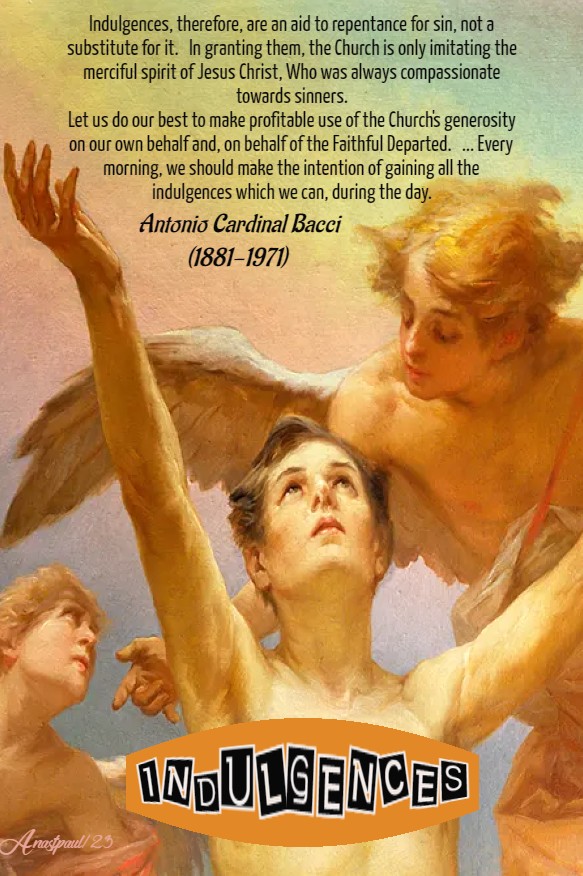
INDULGENCES
“Indulgences, therefore, are an aid to repentance for sin, not a substitute for it. In granting them, the Church is only imitating the merciful spirit of Jesus Christ, Who was always compassionate towards sinners.
Let us do our best to make profitable use of the Church’s generosity on our own behalf and, on behalf of the Faithful Departed. Let us observe the necessary conditions in order to gain as many Indulgences as possible.
Every morning, we should make the intention of gaining all the indulgences which we can, during the day.”
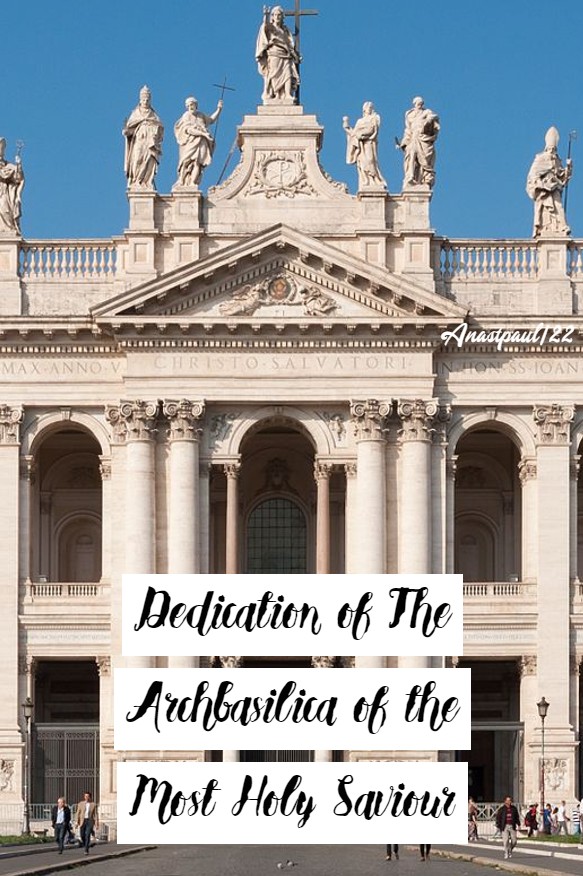
Quote/s of the Day – 9 November – Dedication of The Archbasilica of the Most Holy Saviour
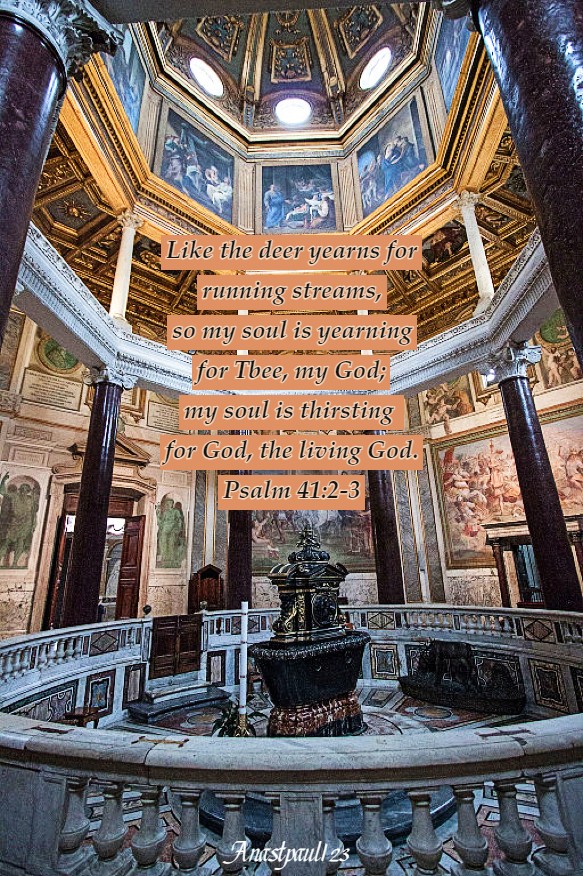
“Like the deer yearns for running streams, so my soul is yearning for Tbee, my God; my soul is thirsting for God, the living God.”
Psalm 41:2-3
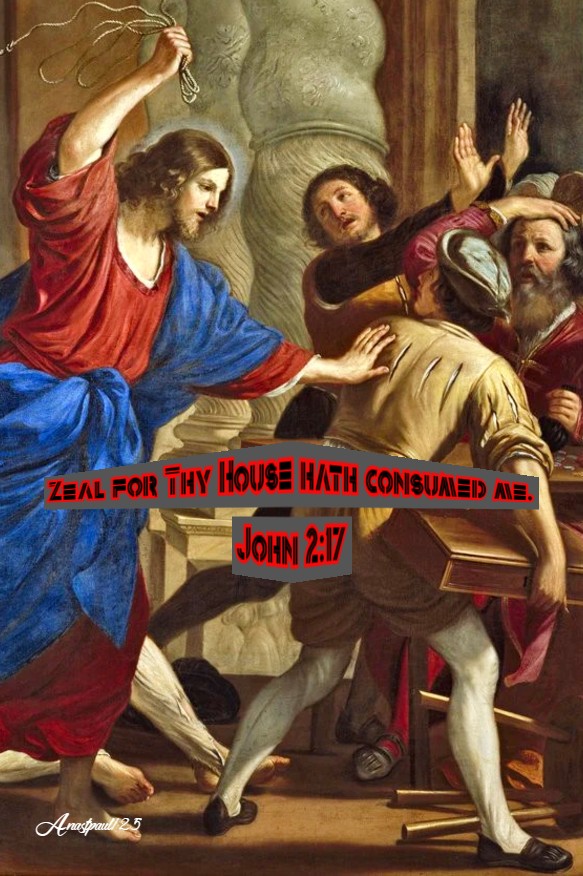
“Zeal for Thy House hath consumed me.”
John 2:17
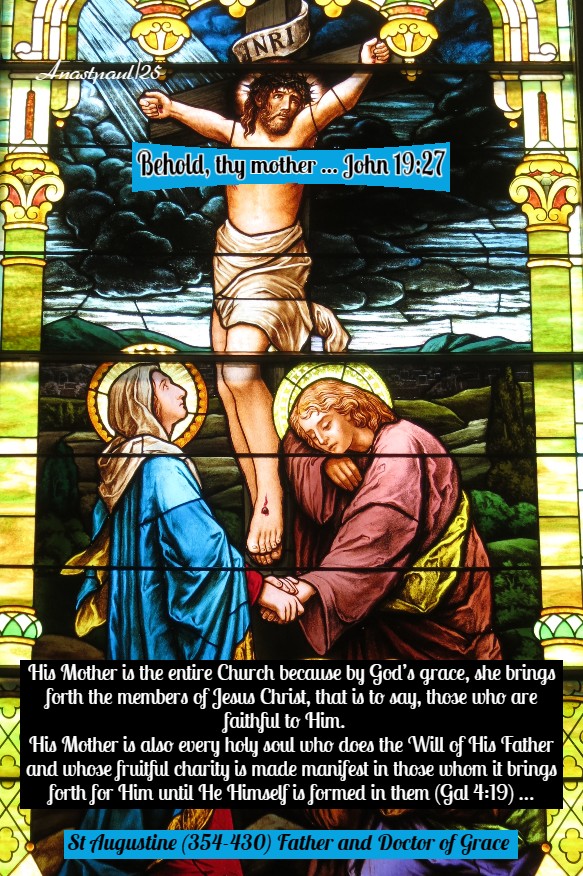
“Behold, thy mother” John 19:27
“His Mother is the entire Church because by God’s grace, she brings forth the members of Jesus Christ, that is to say, those who are faithful to Him. His Mother is also every holy soul who does the Will of His Father and whose fruitful charity is made manifest in those whom it brings forth for Him until He Himself is formed in them (Gal 4:19)…”
St Augustine (354-430) Father and Doctor of Grace
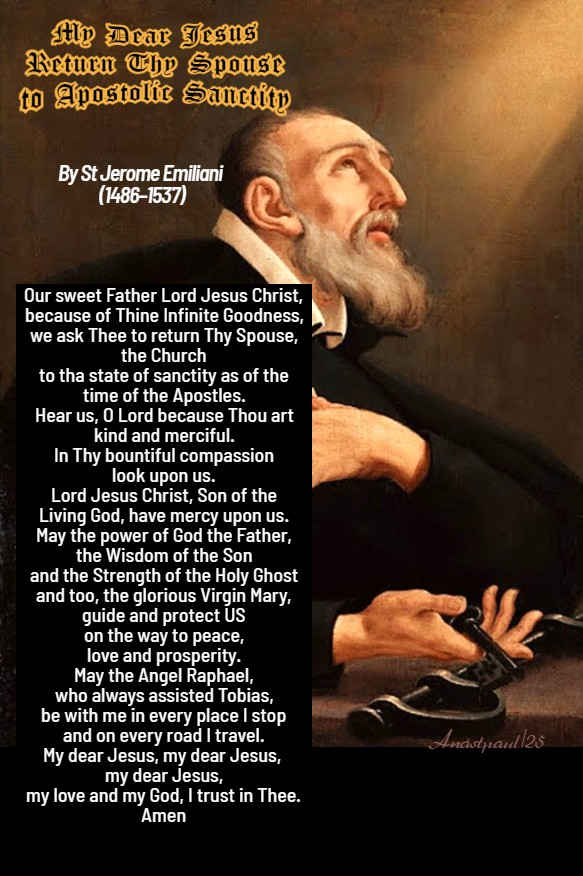
My Dear Jesus Return Thy Spouse to Apostolic Sanctity By St Jerome Emiliani (1486–1537)
Our sweet Father Lord Jesus Christ, because of Thine Infinite Goodness, we ask Thee to return Thy Spouse, the Church to tha state of sanctity as of the time of the Apostles. Hear us, O Lord because Thou art kind and merciful. In Thy bountiful compassion look upon us. Lord Jesus Christ, Son of the Living God, have mercy upon us. May the power of God the Father, the Wisdom of the Son and the Strength of the Holy Ghost and too, the glorious Virgin Mary, guide and protect us on the way to peace, love and prosperity. May the Angel Raphael, who always assisted Tobias, be with me in every place I stop and on every road I travel. My dear Jesus, my dear Jesus, my dear Jesus, my love and my God, I trust in Thee. Amen
St Jerome Emiliani (1486–1537)
“The Church alone, being the Bride of Christ and having all things in common with her Divine Spouse, is the depository of the Truth.”
One Minute Reflection – 9 November – “The Month of the Holy Souls in Purgatory” – Dedication of The Archbasilica of the Most Holy Saviour – Apocalypse 21:2-5 – Luke 19:1-10 – Scripture search here: https://www.drbo.org/
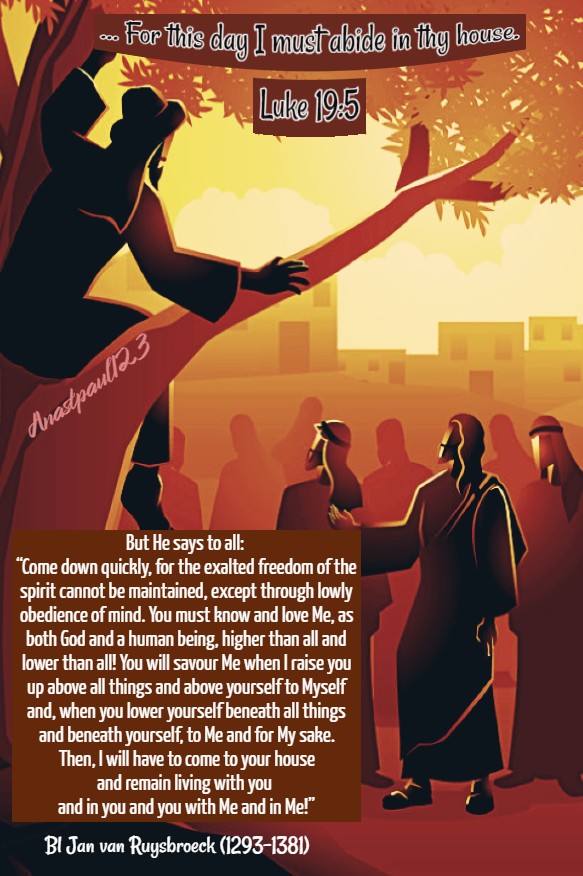
“… For this day, I must abide in thy house.” – Luke 19:5
REFLECTION – “Some people are very like Zacchaeus. They desire to see Jesus as He is. All power of reason and all natural light, are too short and small for this, so they run ahead of all crowds and all the multiplicity of creatures. Through faith and love, they climb up to the highest part of their mind, where their spirit lives in its freedom, devoid of images and obstacles . It is there that Jesus is seen, known and loved in His Divinity, for there, He is always present, to the free and exalted spirit which has risen above itself in love of Him. Jesus there flows forth with a fullness of grace and favours.
But He says to all: “Come down quickly, for the exalted freedom of the spirit cannot be maintained, except through lowly obedience of mind. You must know and love Me, as both God and a human being, higher than all and lower than all! You will savour Me when I raise you up above all things and above yourself to Myself and, when you lower yourself beneath all things and beneath yourself, to Me and for My sake. Then, I will have to come to your house and remain living with you and in you and you with Me and in Me!”
When these persons know, taste and feel this, they come down quickly in great disdain of themselves and, with a humble heart and true displeasure, regarding their life and all their works, they say: “Lord, I am not worthy – but I am truly unworthy – that I should receive Thine glorious body in the blessed Sacrament, into the sinful house of my body and soul. But be gracious to me, Lord and have mercy upn my poor life and all my transgressions.” – Blessed Jan van Ruysbroeck (1293-1381) Canon Regular (A Mirror of Eternal Blessedness).
PRAYER – O God, Who for us bring each year the recurrence of the Consecration day of this Thy holy temple and always bring us back safely to the Sacred Rites, hear the prayers of Thy people and grant that, whoever enters this temple to pray for blessings., may rejoice in having obtained whatever he sought. Through Jesus Christ, Thy Son our Lord, Who lives and reigns with Thee, in the unity of the Holy Ghost, God, world without end. Amen (Collect).
Our Morning Offering – 9 November – “The Month of The Holy Souls in Purgatory”
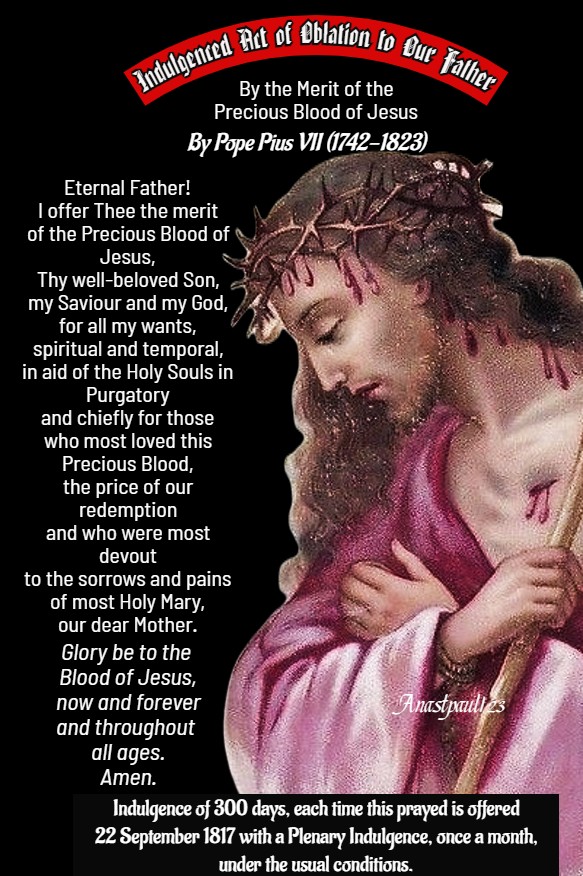
By the Merit of the Precious Blood of Jesus By Pope Pius VII (1742-1823) Papacy from 1800 to 1823 Indulgenced Act of Oblation to Our Father
Eternal Father! I offer Thee the merit of the Precious Blood of Jesus, Thy well-beloved Son, my Saviour and my God, for all my wants, spiritual and temporal, in aid of the Holy Souls in Purgatory and chiefly for those who most loved this Precious Blood, the price of our redemption and who were most devout to the sorrows and pains of most Holy Mary, our dear Mother.
Glory be to the Blood of Jesus, now and forever and throughout all ages. Amen.
Indulgence of 300 days, each time this prayed is offered 22 September 1817 with a Plenary Indulgence, once a month, under the usual conditions.
Note: On 15 August 1811 – the Feast of the Assumption – it is recorded that the Pope. Pius VII, celebrated Mass and was said to have entered a trance and began to levitate in a manner which drew him to the Altar. This particular episode aroused great wonder and awe among participants which included the French Soldiers guarding him, who were ingreat amazement and awed disbelief, at the miraculous incident which had occurred. Pope Pius VII has since been elected as the Patron of the Diocese of Savona and the
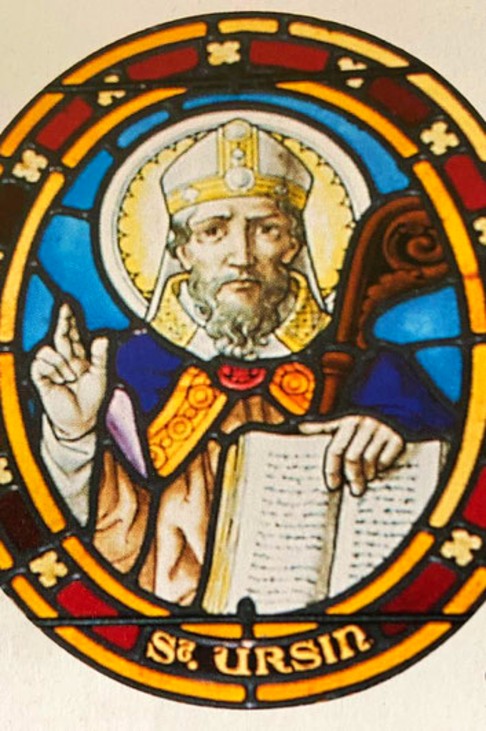
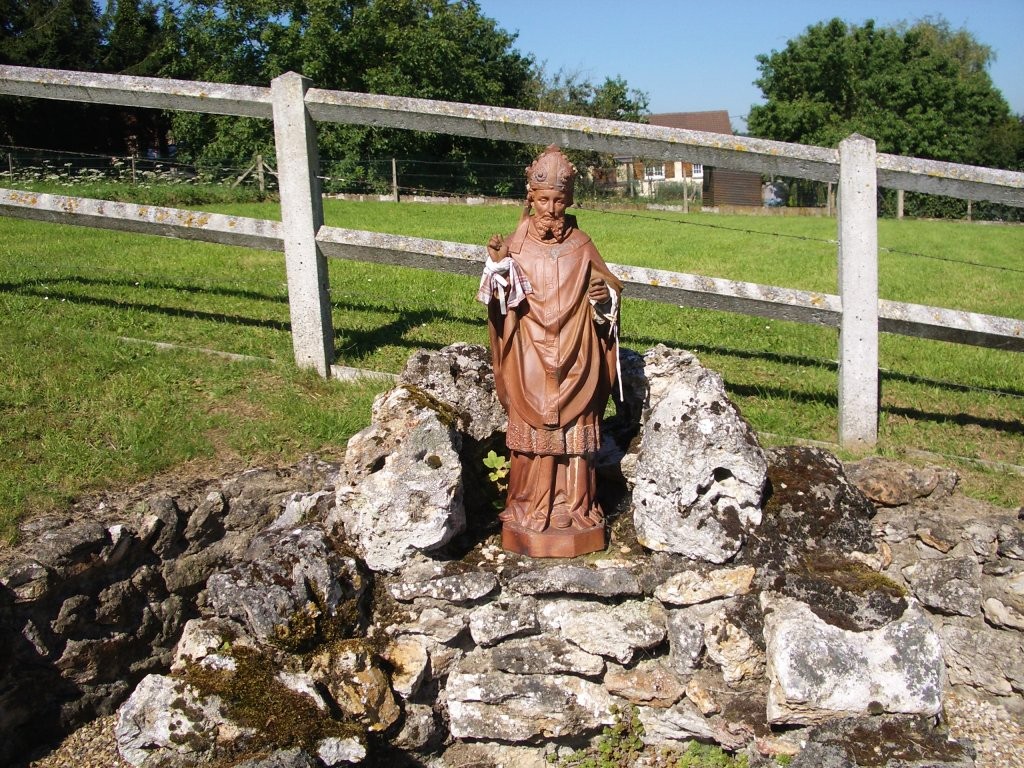
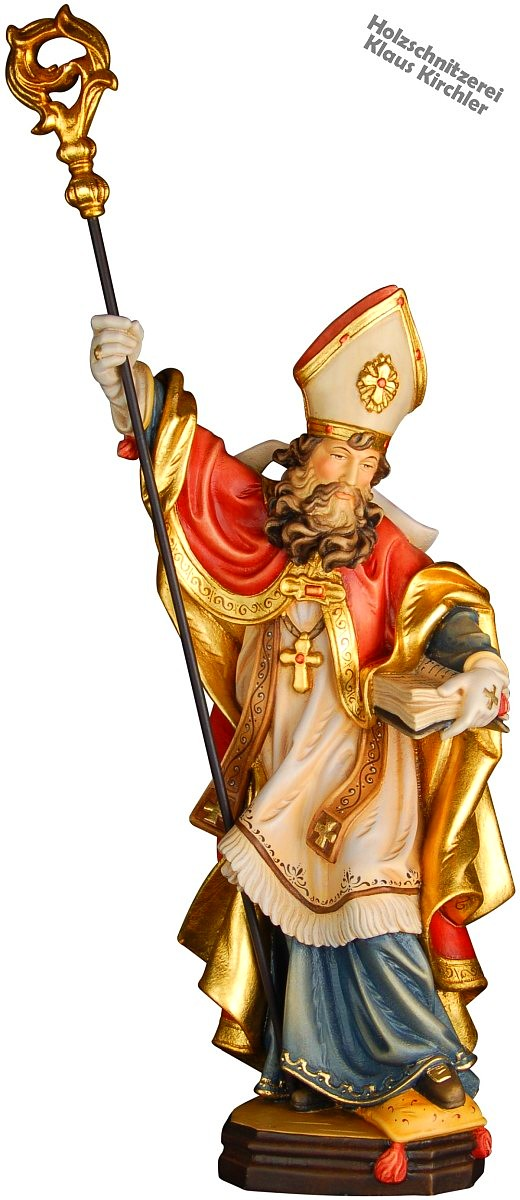
Saint of the Day – 9 November – St Ursinus (Died c280) Confessor and the 1st Bishop of Bourges, France from 251 to 280, Patronage – of the City and Diocese of Bourges. Also known as – Ursinnus, Ursin, Ursino, Orsino.
The Roman Martyrology reads today: “At Bourges, St Irsinus, Confessor who was Ordained in Rome by the successors of the Apostles and appointed the first Bishop of that City.”
Various ‘Lives’ have been written over time, of the holy Bishop which, are largely legendary. Here we stick to the text of the great Bishop and Historian, St Gregory of Tours (538-594), who in his “Historia Francorum” describes Ursinus as having been sent to France (Gaul) with the first seven Bishops.
In another work, “De Gloria Confessorum” chapters 79 and 90, St Gregory says that Ursinus was one of the 72 Disciples of the Apostles, specifying that he was present at the Last Supper, serving as a reader at the table. This last version is very popular in the Berry region, where tradition adds that Ursinus was present at the Passion, followed the Apostles until Pentecost and also received the Holy Ghost with them. He later accompanied St Stephen, collecting his blood when he was Martyred. It was Pope Clement (88-97) who sent him to Gaul.
In reality, this entire version is legendary, especially given the historical period; because following the version in the “Historia Francorum” Ursinus, having arrived in Berry, after having preached, converted and Baptised a large part of the population, especially the poorest, wanted to build the first Church in the region in Bourges; he built it on the property of a rich converted pagan, the Senator, St Leocadius († early 4th Century), a member of the family of St Vettius Epagatus, Martyred in Lyon.
After Consecrating the Church, Ursinus placed the Relic of the blood of St Stephen the Protomartyr there. Ursinus governing the Church of Bourges for 27 years and died on 29 December an unspecified year in the second half of the 3rd Century.
These few chronological details, such as the death of St. Leocadius and the establishm of the first Church in Bourges in around 250, credibly indicate that St Ursinus lived in the 3rd Century, while other accounts, which have also passed into popular tradition, erroneously place him in the 1st Century, during the Apostolic period.
St Gregory of Tours continues the tale, recounting the miraculous discovery of the Saint’s Sarcophagus, beneath a vineyard in an ancient cemetery, duing the Episcopate of Probianus, sometime between 558 and 573. The Relics were brought to the Basilica of St Symphorianus which later took the name of St Ursinus.
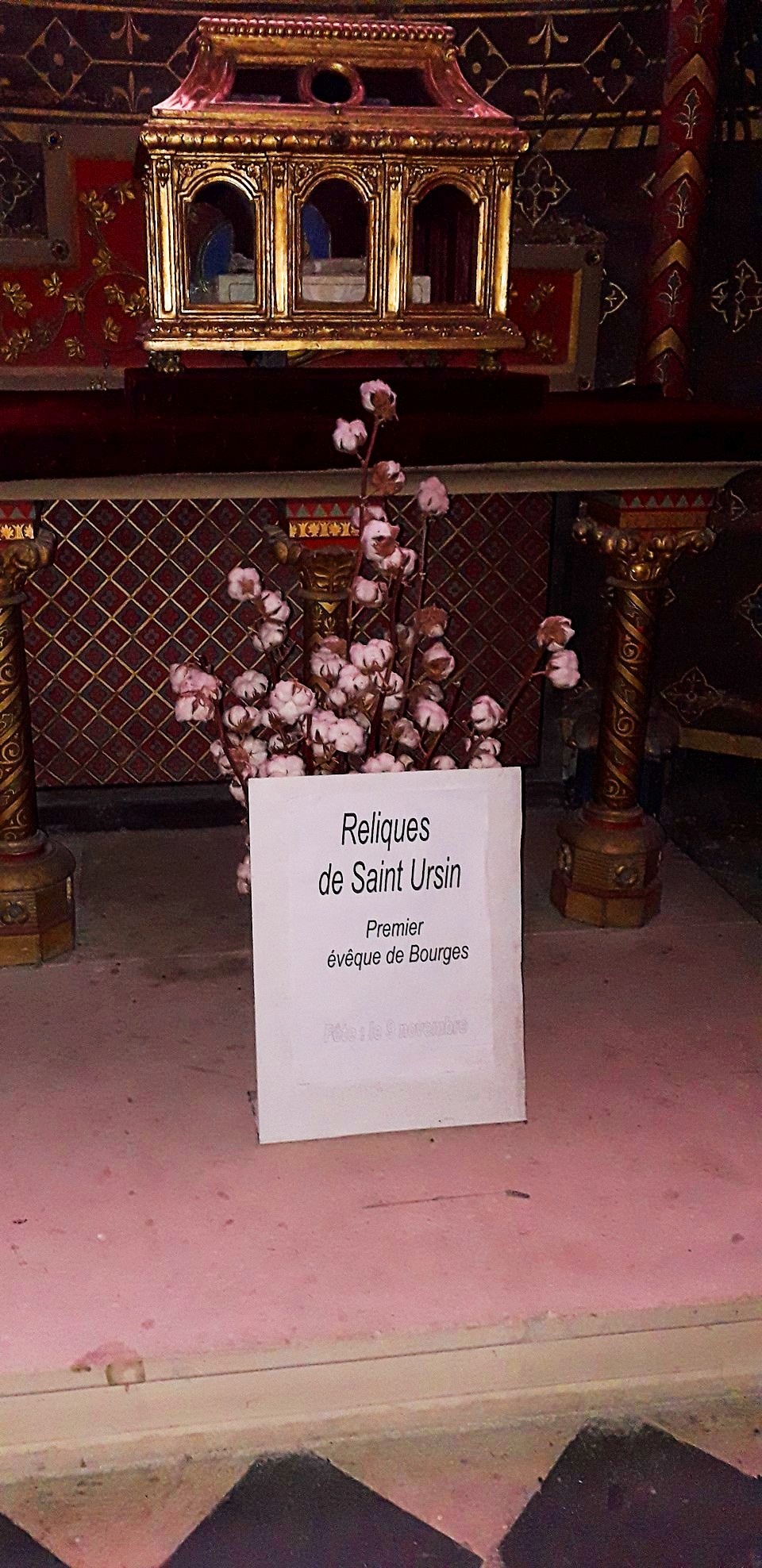
In 1055, Hugh, the Bishop of Lisieux, requested and obtained, some Relics of St Ursinus, which were the subject of canonical recognitions in 1399 and in the 17th and 18th Centuries, further Relics were preserved in Chaussée-Saint-Victor.
A Religuary and Shrine to St Ursinus in Saint-André Church in Châteauroux .
The cult of the holy Bishop, in addition to Bourges, is widespread in Normandy, in the Dioceses of Lisieux, Bayeux, Rouen and Blois.
Bourges Cathedral is the greatest testimony to the profound cult that binds the City to its holy Founder Bishop, St Ursinus. The works of art and religious devotion there are a testament to devotion to their Patron Saint. One of the most famous 13th Century stained-glass windows and the 15th Century sculptures of the Saint-Ursinus Gate, which narrate the culminating episodes of the saintly evangeliser of Berry, are dedicated to him. Other works of art housed in the Bourges Museum and in the Church of Lisieux, reproduce scenes from the legend of Ursinus, who witnessed Jesus’ Last Supper with the Apostles.
Blessed Gabriel Ferretti OFM (1385-1456) Priest, Friar of the Order of Friars Minor, Provincial Superior, Mystic. renowned missionary Preacher. He was zealous in the restoration and establishment of new Convents. He was an ancestor to both Cardinal Gabriele Ferretti and Pope Pius IX, having been descended from a long noble lineage. Patronage – Ancona. His body is incorrupt. He was Beatified on 19 September 1753 by Pope Benedict XIV. Zealous and Devoted Gabriel: https://anastpaul.com/2021/11/09/saint-of-the-day-9-november-blessed-gabriel-ferretti-ofm-1385-1456/
Blessed George Napper (1550-1610) Priest Martyr Beatified by Pope Pius XI on 15 December 1929
St Pabo St Sopatra St Theodore Stratelates St Ursinus (Died c280) Bishop and Confessor of Bourges St Vitonus of Verdun
Martyrs of Constantinople – 3 Saints: A group of ten Christians who tried to defend an image of Jesus over the Brazen Gate of Constantinople from an attack by Iconoclasts during the persecutions of Emperor Leo the Isaurian. The group of was seized by soldiers, condemned by judges for opposing the emperor, and Martyred. The only details that have survived are three of their names – Julian, Marcian and Maria. They were martyred in 730 at Constantinople (modern Istanbul, Turkey).
Thought for the Day – 8 November – Meditations with Antonio Cardinal Bacci (1881-1971)
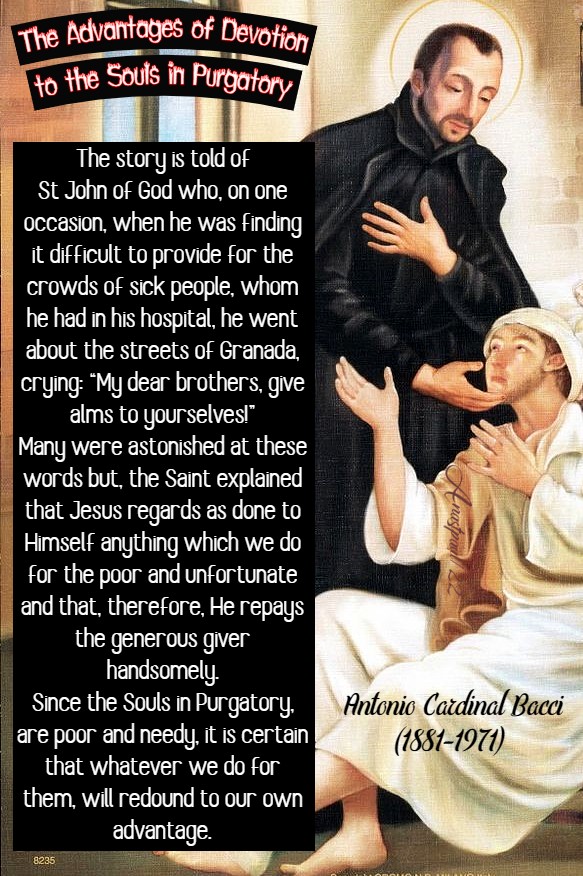
The Advantages of Devotion to the Souls in Purgatory
“The story is told of St John of God who, on one occasion, when he was finding it difficult to provide for the crowds of sick people, whom he had in his hospital, he went about the streets of Granada, crying: “My dear brothers, give alms to yourselves!” Many were astonished at these words but, the Saint explained that Jesus regards, as done to Himself, anything which we do for the poor and unfortunate and that, therefore, He repays the generous giver handsomely. Since the Souls in Purgatory, are poor and needy, it is certain that, whatever we do for them, will redound to our own advantage.
St Margaret of Cortona had a keen devotion to the Faithful Departed. It is related of her that when she was dying, she saw a band of blessed spirits descending from above, in order to escort her into Heaven. These were the countless souls whom her prayers had rescued from the pains of Purgatory.
“If only everyone realised,” the Cure d’Ars once said to a fellow Priest, “what great influence with God, the Holy Souls in Purgatory possess and, the vast number of favours which we obtain through their intercession, they certainly would not be forgotten. Let us pray earnestly for them and they will intercede strongly for us!”
“Whenever I wish to obtain some favour from our Heavenly Father,” said St Catherine of Bologna, “I have recourse to the Souls in Purgatory. I beseech them to present my petition to the Divine Majesty, in their name and through their intercession, my request is granted.”
Quote/s of the Day – 8 November – “The Month of The Holy Souls in Purgatory” – The Octave Day of All Saints – Apocalypse 7:2-12; Matthew 5:1-12 – Scripture search here: https://www.drbo.org/
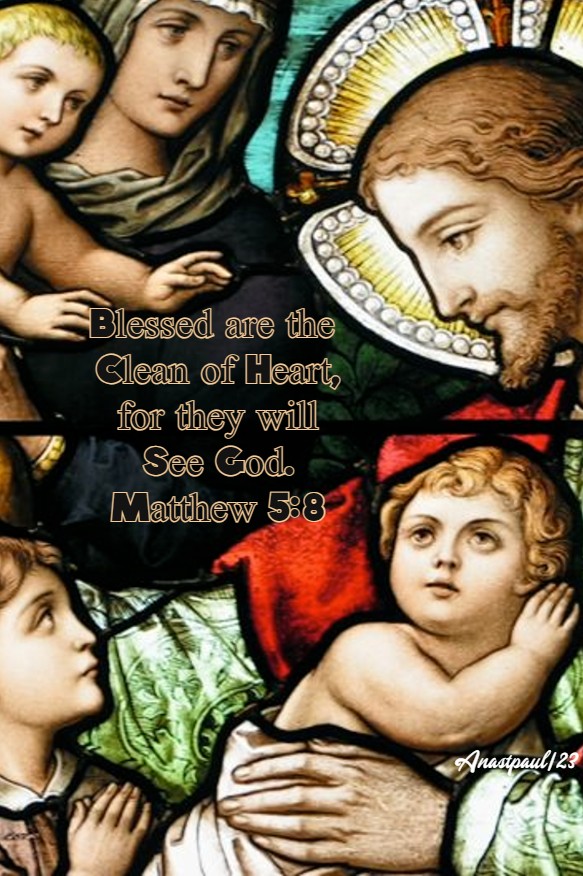
“Blessed are the clean of heart, for they will see God.”
Matthew 5:8
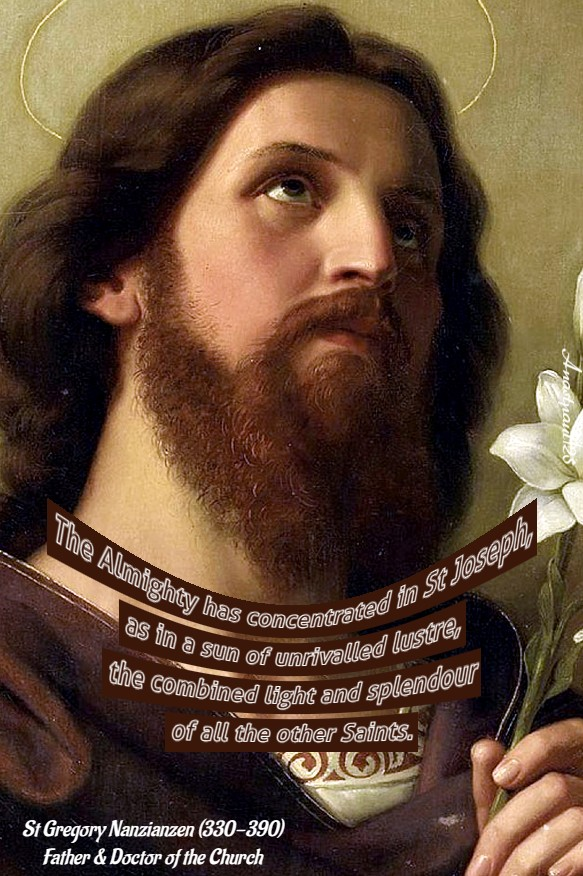
“The Almighty has concentrated in St Joseph, as in a sun of unrivalled lustre, the combined light and splendour of all the other Saints.”
St Gregory Nanzianzen (330-390) Father & Doctor of the Church
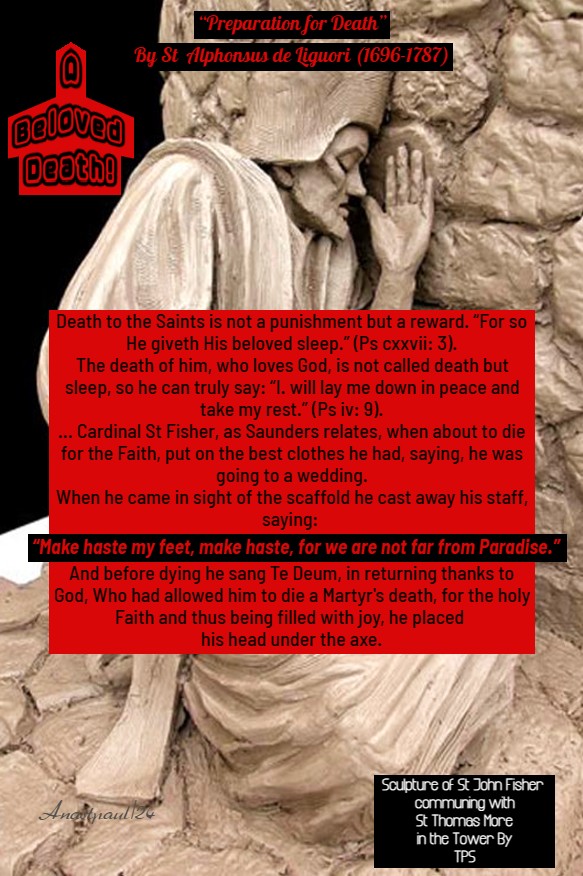
“Death to the Saints is not a punishment but a reward. “For so He giveth His beloved sleep.” (Ps cxxvii: 3). The death of him, who loves God, is not called death but sleep, so he can truly say: “I will lay me down in peace and take my rest.” (Ps iv: 9).
Cardinal St Fisher, as Saunders relates, when about to die for the Faith, put on the best clothes he had, saying, he was going to a wedding. When he came in sight of the scaffold he cast away his staff, saying: “Make haste my feet, make haste, for we are not far from Paradise.” And before dying he sang Te Deum, in returning thanks to God, Who had allowed him to die a Martyr’s death, for the holy Faith and thus being filled with joy, he placed his head under the axe.”
St John Fisher (1469-1535) Bishop, Martyr, Cardinal
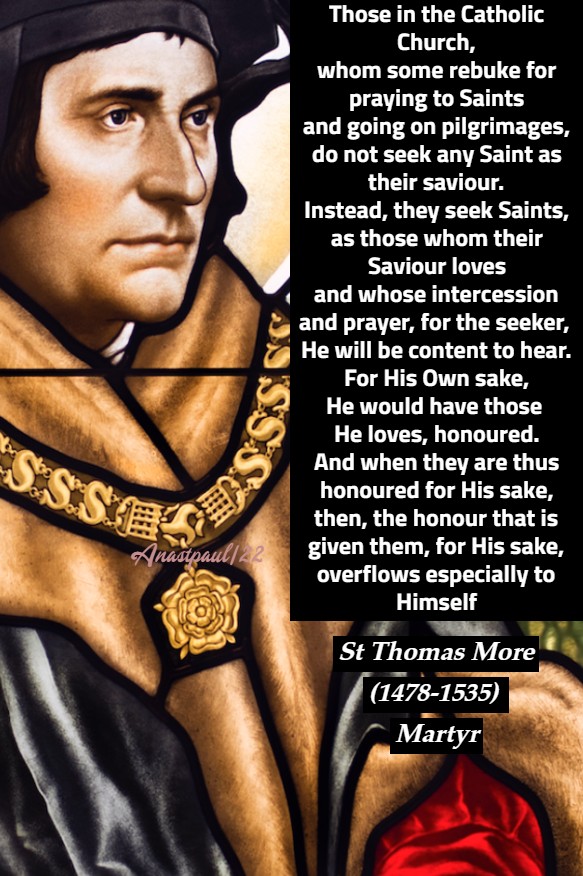
“Those in the Catholic Church, whom some rebuke for praying to Saints and going on pilgrimages, do not seek any Saint as their saviour. Instead, they seek Saints, as those whom their Saviour loves and whose intercession and prayer, for the seeker, He will be content to hear. For His Own sake, He would have those He loves, honoured. And when they are thus honoured for His sake, then, the honour that is given them, for His sake, overflows especially to Himself.”
St Thomas More (1478-1535) Martyr, Confessor
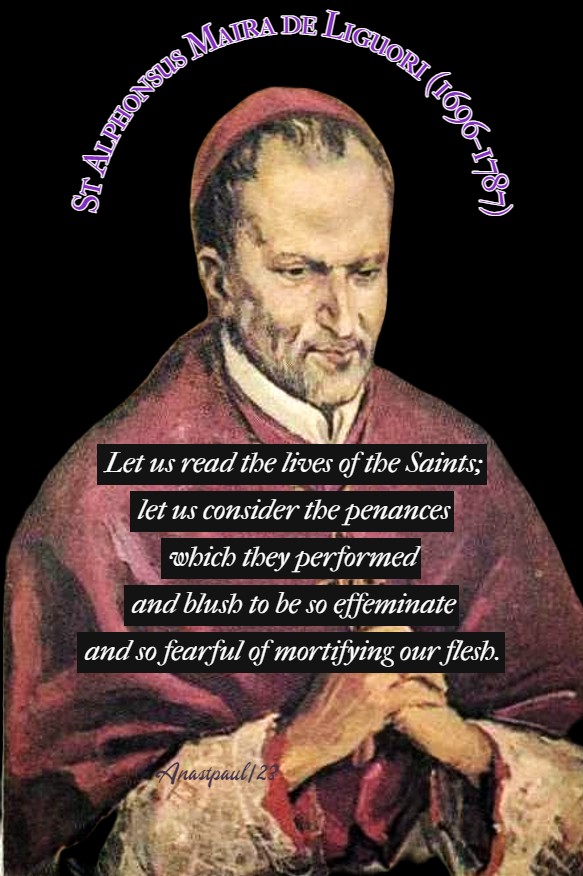
“Let us read the lives of the Saints; let us consider the penances which they performed and blush to be so effeminate and so fearful of mortifying our flesh.”
St Alphonsus Maria de Liguori (1696-1787)
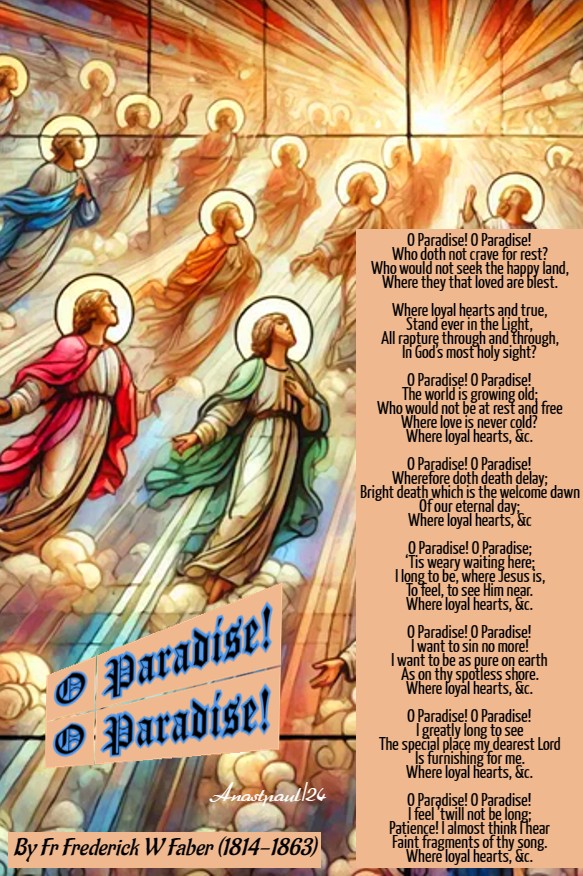
O Paradise! O Paradise! By Fr Frederick William Faber CO (1814-1863) Written in 1854
O Paradise! O Paradise! Who doth not crave for rest? Who would not seek the happy land, Where they that loved are blest.
Where loyal hearts and true, Stand ever in the Light, All rapture through and through, In God’s most holy sight?
O Paradise! O Paradise! The world is growing old; Who would not be at rest and free Where love is never cold? Where loyal hearts, &c.
O Paradise! O Paradise! Wherefore doth death delay; Bright death which is the welcome dawn Of our eternal day; Where loyal hearts, &c
O Paradise! O Paradise; ‘Tis weary waiting here; I long to be, where Jesus is, To feel, to see Him near. Where loyal hearts, &c.
O Paradise! O Paradise! I want to sin no more! I want to be as pure on earth As on thy spotless shore. Where loyal hearts, &c.
O Paradise! O Paradise! I greatly long to see The special place my dearest Lord Is furnishing for me. Where loyal hearts, &c.
O Paradise! O Paradise! I feel ’twill not be long; Patience! I almost think I hear Faint fragments of thy song. Where loyal hearts, &c.
One Minute Reflection – 8 November – “The Month of the Holy Souls in Purgatory” – The Octave Day of All Saints – Apocalypse 7:2-12; Matthew 5:1-12 – Scripture search here: https://www.drbo.org/
“Be glad and rejoice for your reward is very great in Heaven.” – Matthew 5:12
REFLECTION – “Dearly beloved, let us anxiously attend to all which concerns the profession of our common life, “keeping the unity of the spirit in the bond of peace,” by “the grace of our Lord Jesus Christ and the love of God and the communication of the Holy Ghost”(Eph 4:3; 2 Cor 13:13). From the love of God comes the unity of the spirit; from the grace of our Lord Jesus Christ comes the bond of peace; from the imparting of the Holy Ghost, comes that communion which is necessary to those who live in common. …
“I believe, 0 Lord, in the Holy Ghost, the holy Catholic Church, the Communion of Saints” (Credo). This is my hope, this is my trust, this is my confidence, this is the whole of my security in the professing of my faith. … If I am allowed, O Lord, to “love Thee and love my neighbour,” (Mt 22:37-39) although my merits are small and few, yet will my hopes reach beyond them. I am confident that the merits of the Saints will help me by the communion of charity, so that the Communion of Saints will make up for my insufficiency and imperfection. … Let charity expand our hope, as far as the Communion of Saints, in the sharing of merits and rewards but the sharing of the latter belongs to the future, for it is the sharing in the glory which shall be revealed in us.
Since, then, there are three communions – the first of nature, which includes the sharing of guilt …; the second of grace and the third, of glory. By the communion of grace, that of nature begins to be remade and the sharing of guilt to be excluded but by the communion of glory, that of nature will be perfectly restored and the communion of anger, will be entirely excluded, when “God will wipe away every tearfrom the eyes” of the Saints (Is 25:8; Apoc21:4). Then, among all the Saints, there will be “one heart and one soul” and “all things will be in common”when God will be “all in all” (Acts 4:2; 1 Cor 15:28). That we may all arrive at this communion and that we all may be one, “the grace of our Lord Jesus Christ and the love of God, and the communication of the Holy Ghost be with us all forever. Amen.” – Baldwin of Forde O.Cist ( c 1125–1190) Cistercian Abbot, Bishop, then Archbishop of Canterbury (Treatise on the common life).
PRAYER – Almighty, eternal God, Who granted us to honour the merits of all Thy Saints in a single solemn festival, bestow on us, we beseech Thee, through their manifold intercession, that abundance of Thymercy for which we yearn. Through Jesus Christ, Thy Son our Lord, Who lives and reigns with Thee, in the unity of the Holy Ghost, God, world without end. Amen (Collect).
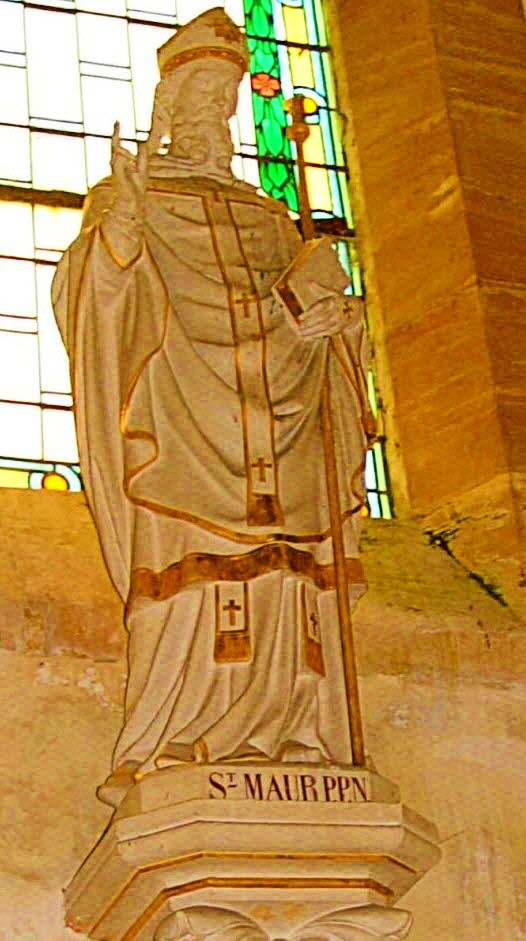
Saint of the Day – 8 November – Saint Maurus (Died 383) the 2nd Bishop and Confessor of Verdun, France, serving his See for 27 years. Born probably in France and died in Verdun on 10 November 383. Also known as – Maur, Maurius.
The Roman Martyrology reads today: “At Verdun. Maurus, Bishop and Confessor.”
Maurus was the 2nd Bishop of Verdun. In the chronology of the Bishops of the Diocese, he appears after St Sanctinus (c270-356), the 1st Bishop and before Salvinus.
Maurus was a disciple of St Sanctinus and was the first Priest to be Ordained in the Diocese of Verdun. Before dying, Bishop Sanctinud urged the inhabitants of Verdun to choose out Saint Maurus as their next Bishop.
Upon St Sanctinus’ death, the faithful of Verdun duly searched for Maurus for three years without discovering his whereabouts, hoping to have him appointed as their Bishop. But Maurus, not seeking worldly honours or responsibilities, did not wish to abandon his life of prayer and fasting, nor did he wish to desert gus disciples.
Finally, his location was discovered and he relented after the constant requests from the faithful of Verdun. He became the Bishop in 356, was Consecrated in the Church of Saints Peter and Paul by Author, Bishop of Metz and governed the Diocese for approximately 27 years.
Chronicles report that Saint Maurus died on 10 November 383 but he is celebrated today, 8 November.
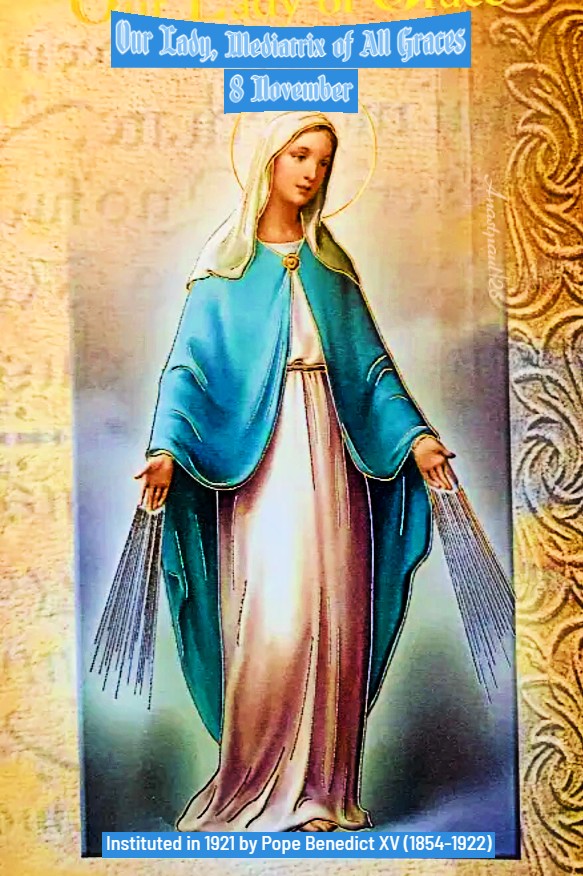
Our Lady Mediatrix of All Graces (1921): In 1921 Pope Benedict XV instituted 8 November as the Feast Day of Our Lady Mediatrix of All Graces. A text by St Louis Grignion de Montfort expresses this truth admirably: “Only Mary found grace before God (Luke 1:30) without the help of any other creature. And after her, all those who found grace before God, found it only through her. Mary was full of grace when the Archangel Gabriel saluted her (Luke 1:28) and was filled with grace when the Holy Ghost so mysteriously overshadowed her (Luke 1:35). From day to day, from moment to moment, she increased, so much. this twofold plenitude that she attained an immense and inconceivable degree of grace. So much so, that the Almighty made of her, the sole custodian of His treasures and sole dispenser of all His graces, so that she might ennoble, exalt and enrich all she chooses. She can lead them along the narrow path to Heaven and guide them through the narrow gate to Life. She can give a royal throne, scepter and crown to whomever she wishes. Jesus is always and everywhere, the Fruit and Son of Mary, and Mary is everywhere, the true tree who bears the Fruit of Life, the true Mother, who bears that Son!” – St Louis Marie Grignion de Montfort (1673-1716) (True Devotion to Mary No 44)
Four Holy Crowned Martyrs: Saint Castorus, Saint Claudius, Saint Nicostratus and Saint Simpronian. Skilled stone carvers in the 3rd century quarries. Martyred when they refused to carve an idol of Aesculapius for Diocletian. They were drowned in the River Sava in 305. Patronages – against fever, cattle, sculptors, stone masons, stonecutters.
All Deceased Dominicans All Saints of Bologna, Italy All Saints of Wales Augustinian Martyrs of Spain
All Saints of the Diocese of Evry: A regional memorial of all the Saints and Beati of the calendar who have a connection to the Diocese of Evry-Corbeil-Essonnes, France:
Blessed Isabella of France, founded the Longchamp monastery
Blessed Nicolas Gaudreau, pastor of Vert-le-Petit
Blessed Pierre Bonse, pastor of Massy
Our Lady of Good Guard, patron saint of the diocese, venerated in Longpont-sur-Orge, France
Saint Corbinian, born in Saint-Germain-lès-Arpajon
Saint Denis of Paris, evangelizer of part of Essonne and revered ni Longpont-sur-Orge
Saint Eloi, who lived in Chilly-Mazarin
Saint Germain of Paris
Saint William of Bourges, son of Count Baldwin IV of Corbeil
Saint William of Aebelholt, pastor of Brunoy
Saint Wulfran of Sens, born in Milly-la-Forêt
Blessed Nativelle, vicar of Longjumeau
Blessed René Le Bris, pastor of Bris-sous-Forges
Saint Spire of Bayeux, whose relics are in Corbeil in the cathedral that bears his name
Thought for the Day – 7 November – Meditations with Antonio Cardinal Bacci (1881-1971)
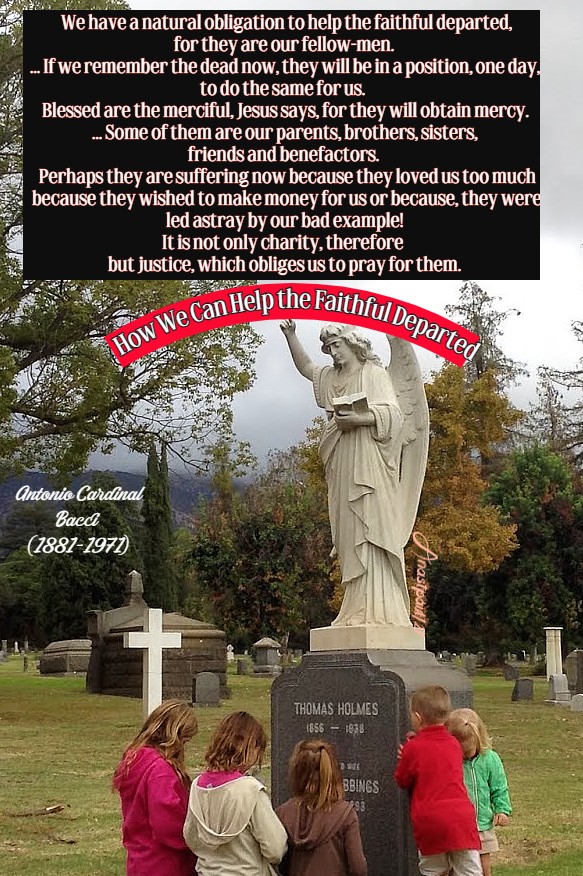
How We Can Help the Faithful Departed
“We have a natural obligation to help the faithful departed, for they are our fellow-men. Are we capable of watching another human being in agony, without feeling pity for him? If there is some way in which we can help him, moreover, ought we not to do so? The Holy Souls are in agony, however, they are on fire with the love of God, yet cannot be united to Him. We have a means of helping them through our prayers and good works.
There is a further obligation on us, arising from our religion. They have been redeemed, like ourselves, by the Blood of Christ and God has told us that the same degree of mercy, will one day be shown to us, which we have shown to others. The time will come when we also shall find ourselves in Purgatory and shall be in need of prayer. If we remember the dead now, they will be in a position, one day, to do the same for us. Blessed are the merciful, Jesus says, for they will obtain mercy.
When we appear before the judgement seat of God in order to account for the way in which we have spent our lives, He will count as done to Himself, whatever we have done to the poor, hungry and ill-clad. Only if we have been merciful towards them, will He receive us into the Kingdom of Heaven. Otherwise, He will send us away, accursed, for all eternity. Now the Souls in Purgatory are more unfortunate than those who are poor, hungry and homeless in this world. They hunger for God, they are full of regret for the sins which they have committed and they languish far from the eternal home, to which they belong.
Finally, we have a duty in justice, to help their souls. Some of them are our parents, brothers, sisters, friends and benefactors. Perhaps they are suffering now because they loved us too much because they wished to make money for us or because, they were led astray by our bad example! It is not only charity, therefore but justice, which obliges us to pray for them.”
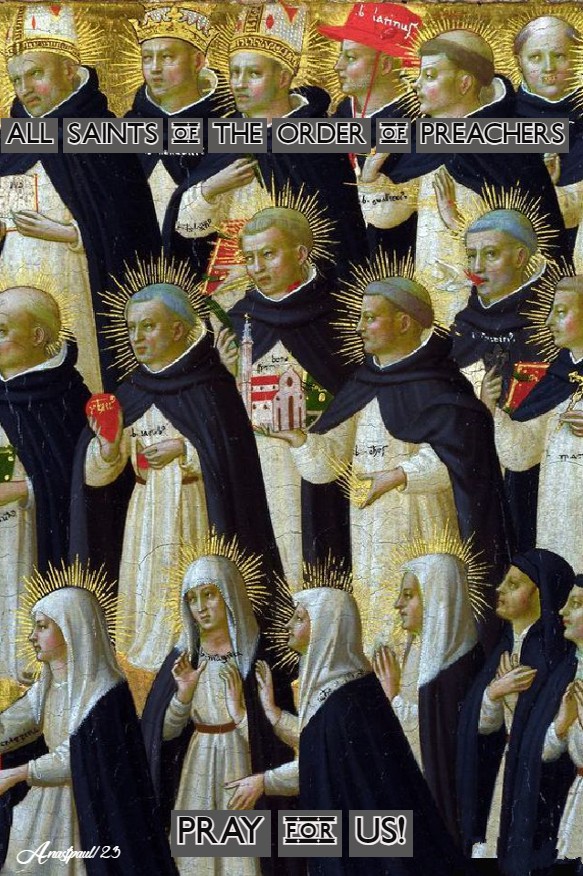
Quote/s of the Day – 7 November – The Feast of All Saints of the Order of Preachers
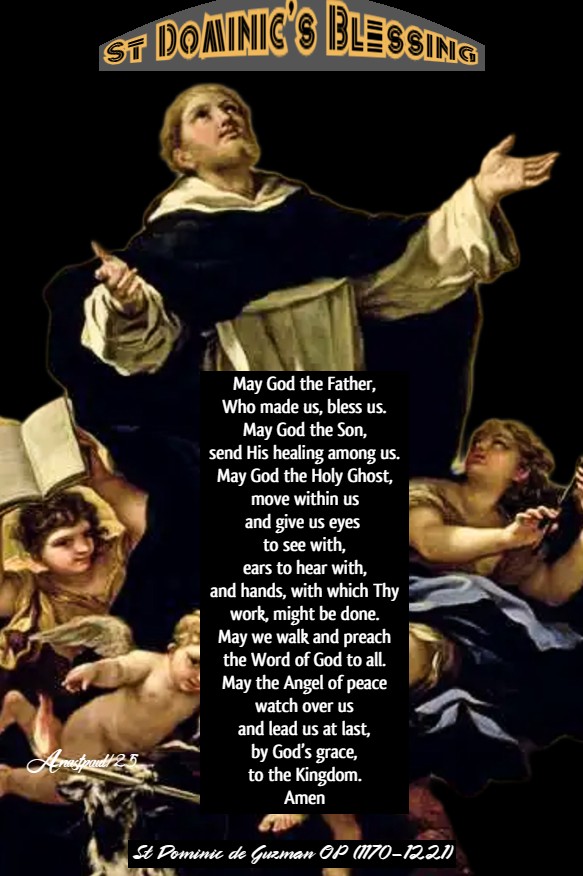
St Dominic’s Blessing By St Dominic de Guzman OP (1170-1221)
May God the Father, Who made us, bless us. May God the Son, send His healing among us. May God the Holy Ghost, move within us and give us eyes to see with, ears to hear with, and hands, with which Thy work, might be done. May we walk and preach the Word of God to all. May the Angel of peace watch over us and lead us at last, by God’s grace, to the Kingdom. Amen
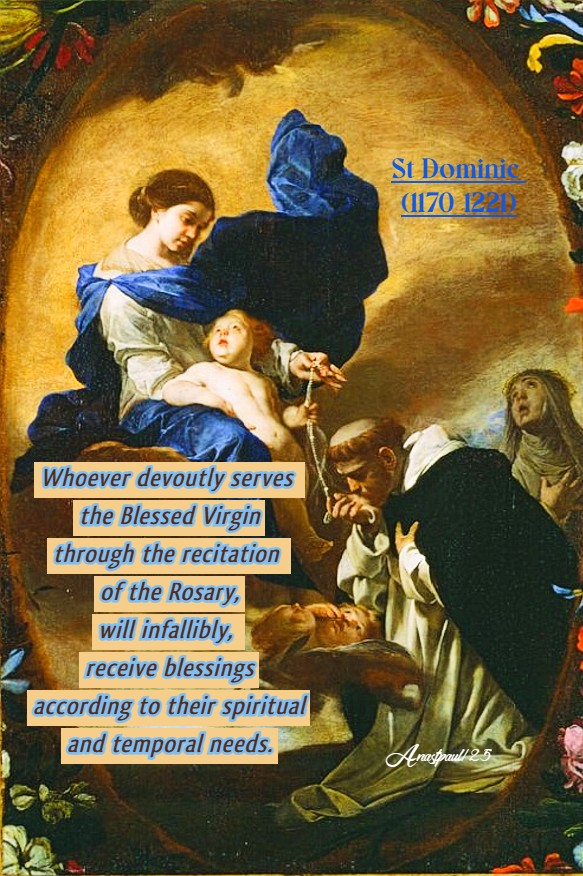
“Whoever devoutly serves the Blessed Virgin through the recitation of the Rosary, will infallibly, receive blessings according to their spiritual and temporal needs.”
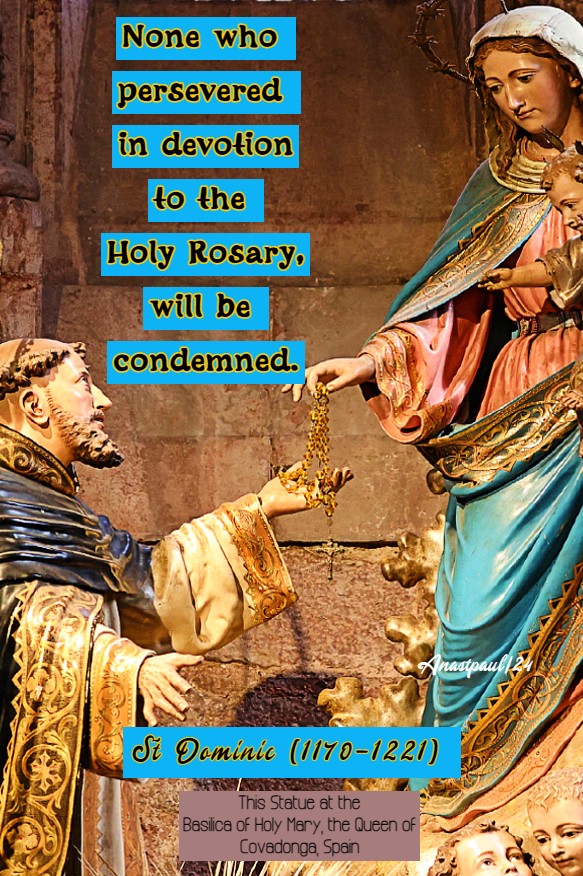
“None who persevered in devotion to the Holy Rosary, will be condemned.”
St Dominic OP (1170-1221)
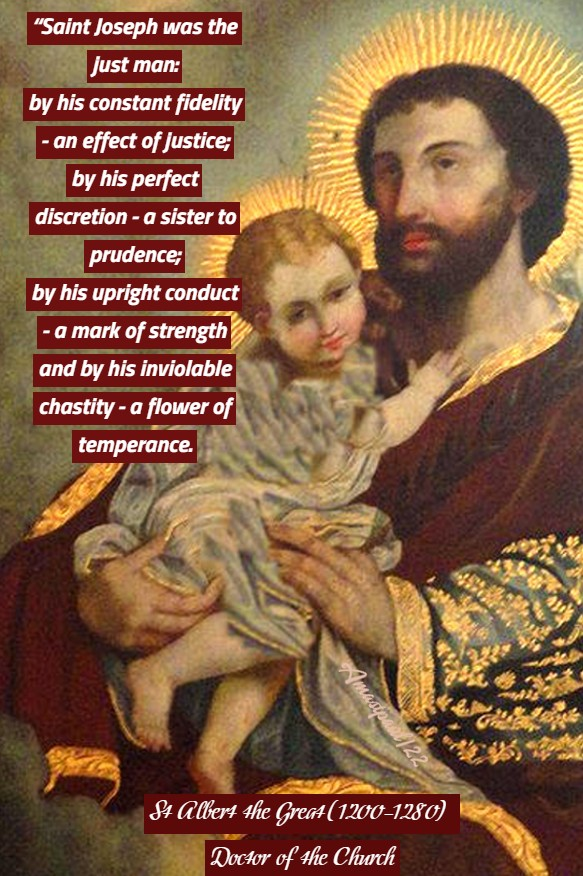
“Saint Joseph was the just man: by his constant fidelity -an effect of justice; by his perfect discretion – a sister to prudence; by his upright conduct – a mark of strength and by his inviolable chastity – a flower of temperance.”
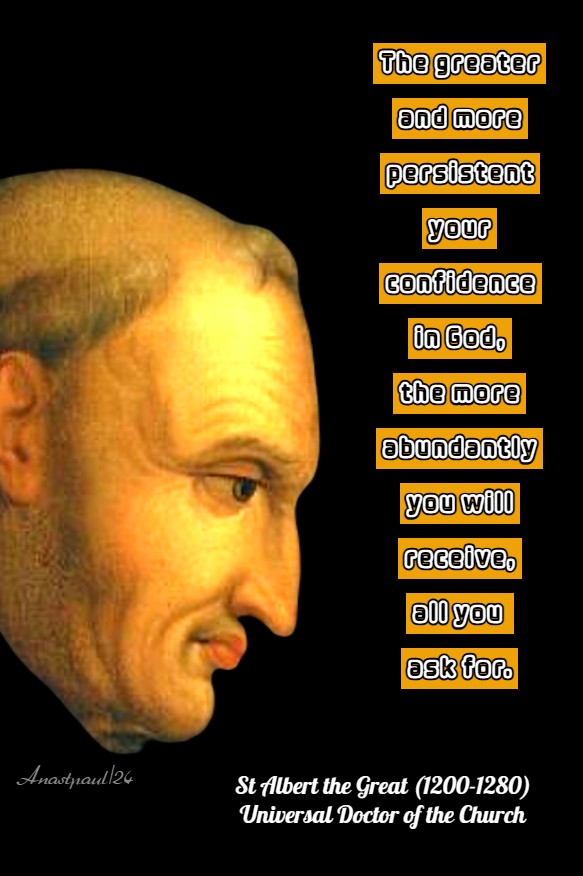
“The greater and more persistent your confidence in God, the more abundantly you will receive, all you ask for.”
St Albert the Great OP (1200-1280) Universal Doctor of the Church
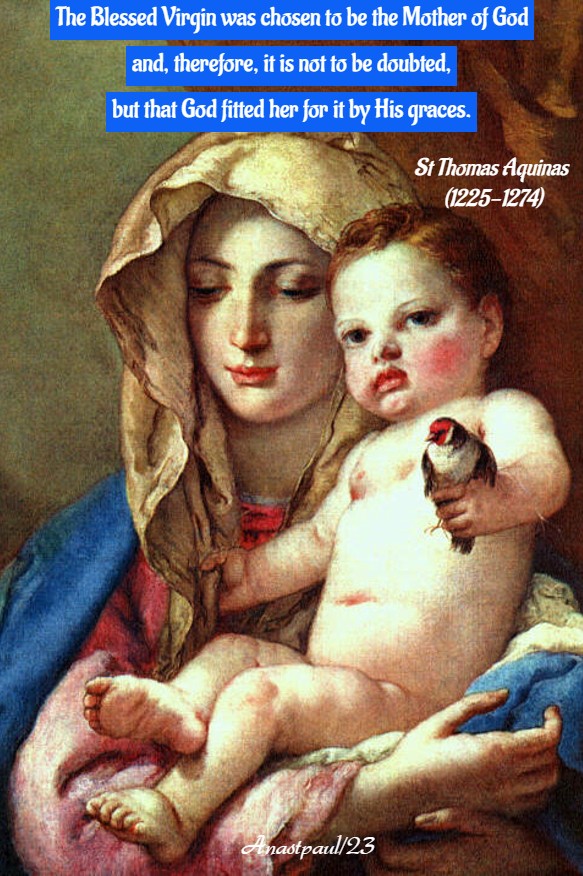
“The Blessed Virgin was chosen to be the Mother of God and, therefore, it is not to be doubted, but that God fitted her for it by His graces.”
St Thomas Aquinas OP (1225-1274) Doctor Angelicus / Doctor Communis
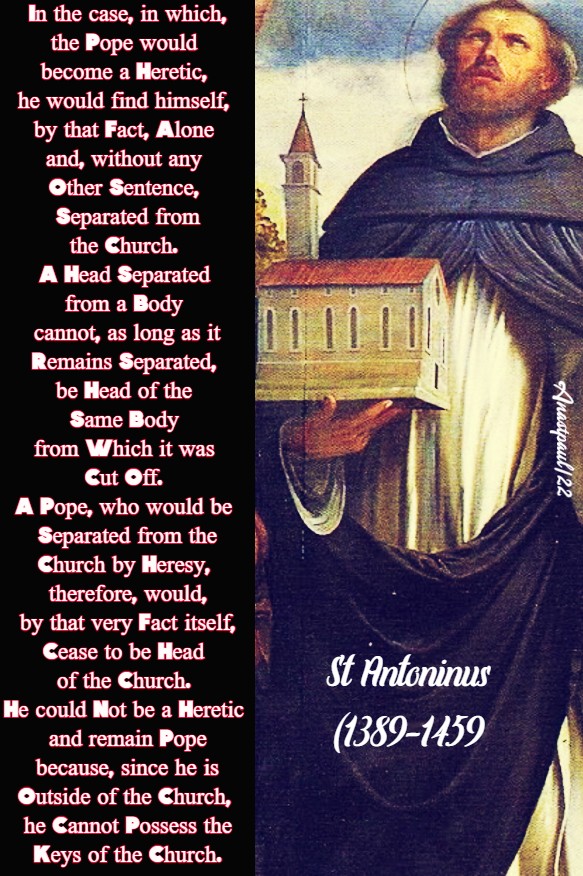
“In the case, in which, the Pope would become a heretic, he would find himself, by that fact, alone and, without any other sentence, separated from the Church. A head separated from a body cannot, as long as it remains separated, be head of the same body from which it was cut off. A Pope, who would be separated from the Church by heresy, therefore, would, by that very fact itself, cease to be head of the Church. He could not be a heretic and remain Pope because, since he is outside of the Church, he cannot possess the keys of the Church.”
St Antoninus OP (1389-1459)
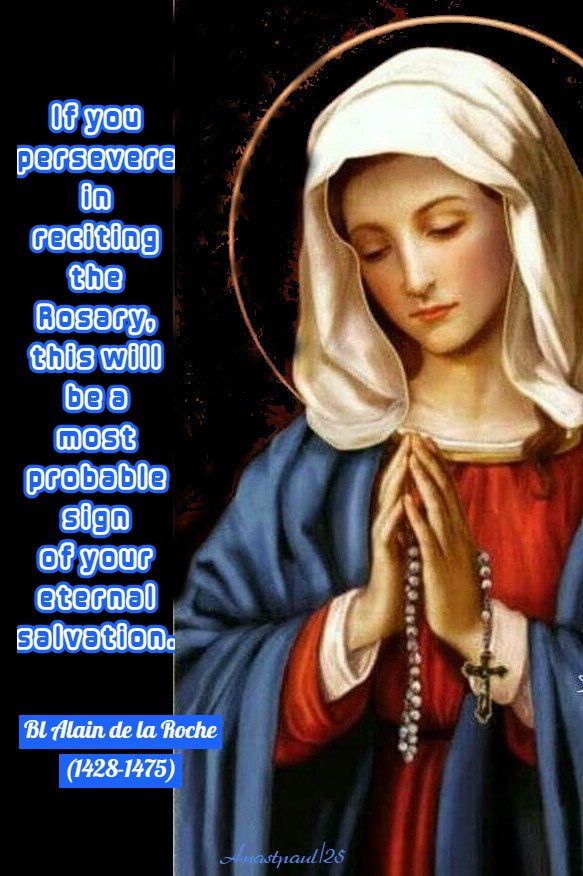
“If you persevere in reciting the Rosary, this will be a most probable sign of your eternal salvation.”
One Minute Reflection – 7 November – “The Month of The Holy Souls in Purgatory” – First Friday – Within the All Saints Octave and the Feast of all the Dominican Saints – Apocalypse 7:2-12 – Matthew 5:1-12 – Scripture search here: https://www.drbo.org/
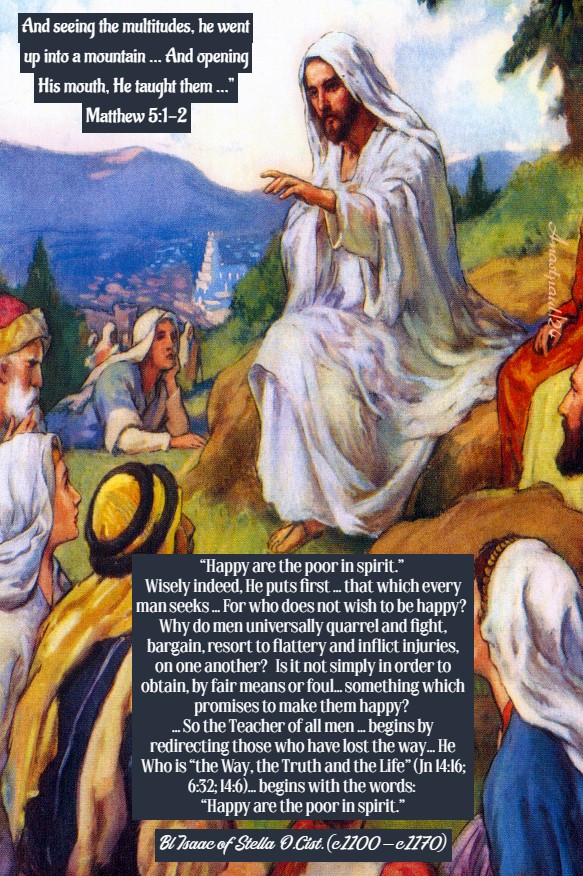
“And seeing the multitudes, he went up into a mountain… And opening His mouth, He taught them …” – Matthew 5:1-2
REFLECTION – “May it be granted me to sit with Jesus, to sit at His feet on the mountain side and partake of His instruction! When He is in the crowd, He is standing and walking, occupied and wearied and so hard -pressed, that neither He, nor His disciples are, as it were, allowed to eat bread, “the bread of life and understanding”,(Mk 6:31) and to drink “the water of wisdom” (Jn 6:35). For this water can only be drunk in a time of leisure and, it is drawn by those who have little to do. For “the well is deep”(Sir 15:3; 38:24) …
Opening His mouth, Jesus speaks to the heart of Jerusalem, talking to her in solitude, or on the mountain and this is what He says: “Happy are the poor in spirit.” He, Who is Happiness speaks of happiness, He Who became poor, of poverty, speaks of repletion, Mercy of mercifulness, He Who is the Purity of hearts speaks of purification of heart, the truly Peaceful of peace-making, the Son by nature speaks of sonship …
“Happy are the poor in spirit.” Wisely indeed, He puts first … that which every man seeks … For who does not wish to be happy? Why do men universally quarrel and fight, bargain, resort to flattery and inflict injuries, on one another? Is it not simply in order to obtain, by fair means or foul… something which promises to make them happy? … So the Teacher of all men … begins by redirecting those who have lost the way… He Who is “the Way, the Truth and the Life” (Jn 14:16; 6:32; 14:6)… begins with the words: “Happy are the poor in spirit.” – Blessed Isaac of Stella O.Cist. (c1100 – c1170) Cistercian Abbot, Theologian, Philosopher (Sermon 1, for the Feast of All Saints).
PRAYER – Almighty, eternal God, Who granted us to honour the merits of all Thy Saints in a single solemn festival, bestow on us, we beseech Thee, through their manifold intercession, that abundance of Thy mercy for which we yearn. Through Jesus Christ, Thy Son our Lord, Who lives and reigns with Thee, in the unity of the Holy Ghost, God, world without end. Amen (Collect).
Our Morning Offering – 7 Novemer – “The Month of The Holy Souls in Purgatory” and the First Friday of November
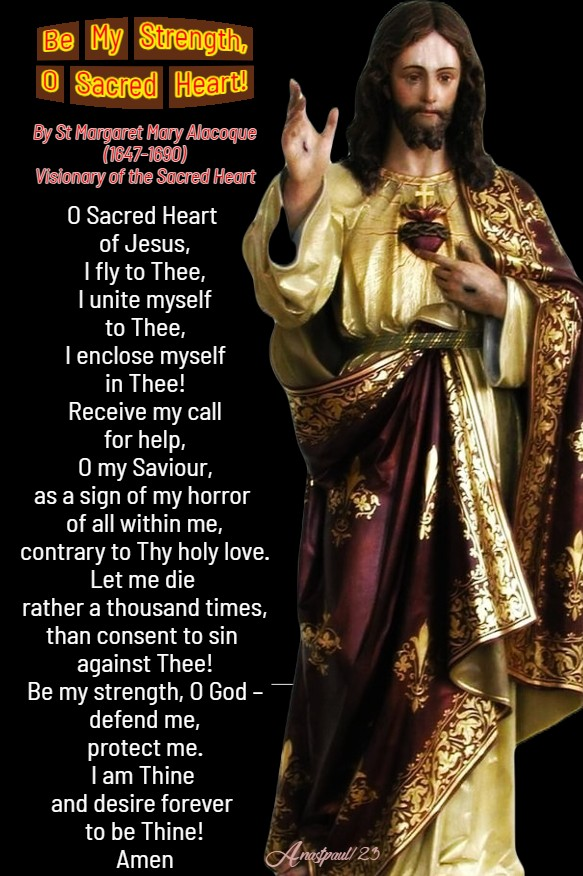
Be My Strength, O Sacred Heart! By St Margaret Mary Alacoque (1647-1690) Visionary of the Sacred Heart
O Sacred Heart of Jesus, I fly to Thee, I unite myself to Thee, I enclose myself in Thee! Receive my call for help, O my Saviour, as a sign of my horror, of all within me contrary to Thy holy love. Let me die rather a thousand times, than consent to sin against Thee! Be my strength, O God – defend me, protect me. I am Thine and desire forever to be Thine! Amen
Saint of the Day – 7 November – St Prosdocimus (2nd Century) the 1st Bishop and Confessor of Padua, Evangeliser, Miracle-worker. Patronage – of the City and Diocese of Padua, of Ascolo, Cittadella all in Italy. Also knowthe as – Prosdecimus, Prosdocimo.
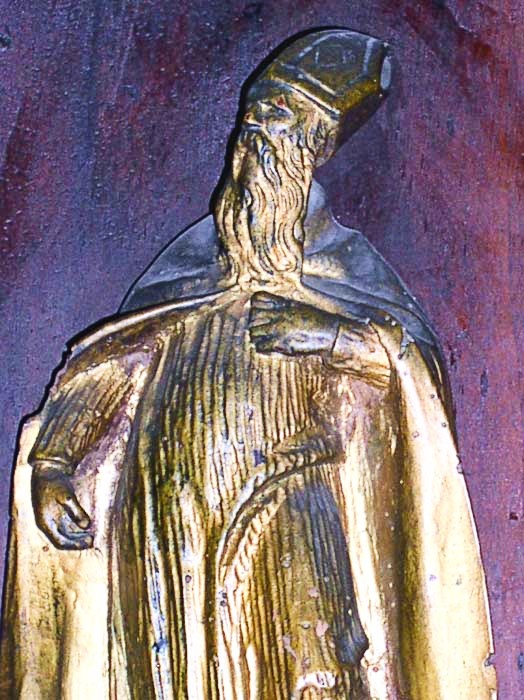
The name Prosdocimo, although uncommon in Italy today, immediately suggests a Venetian origin, specifically Paduan. The Saint is honoured as the 1st Bishop of Padua, the Patron Saint of the City and too, according to various scholars, the likely evangeliser of all western Venice.
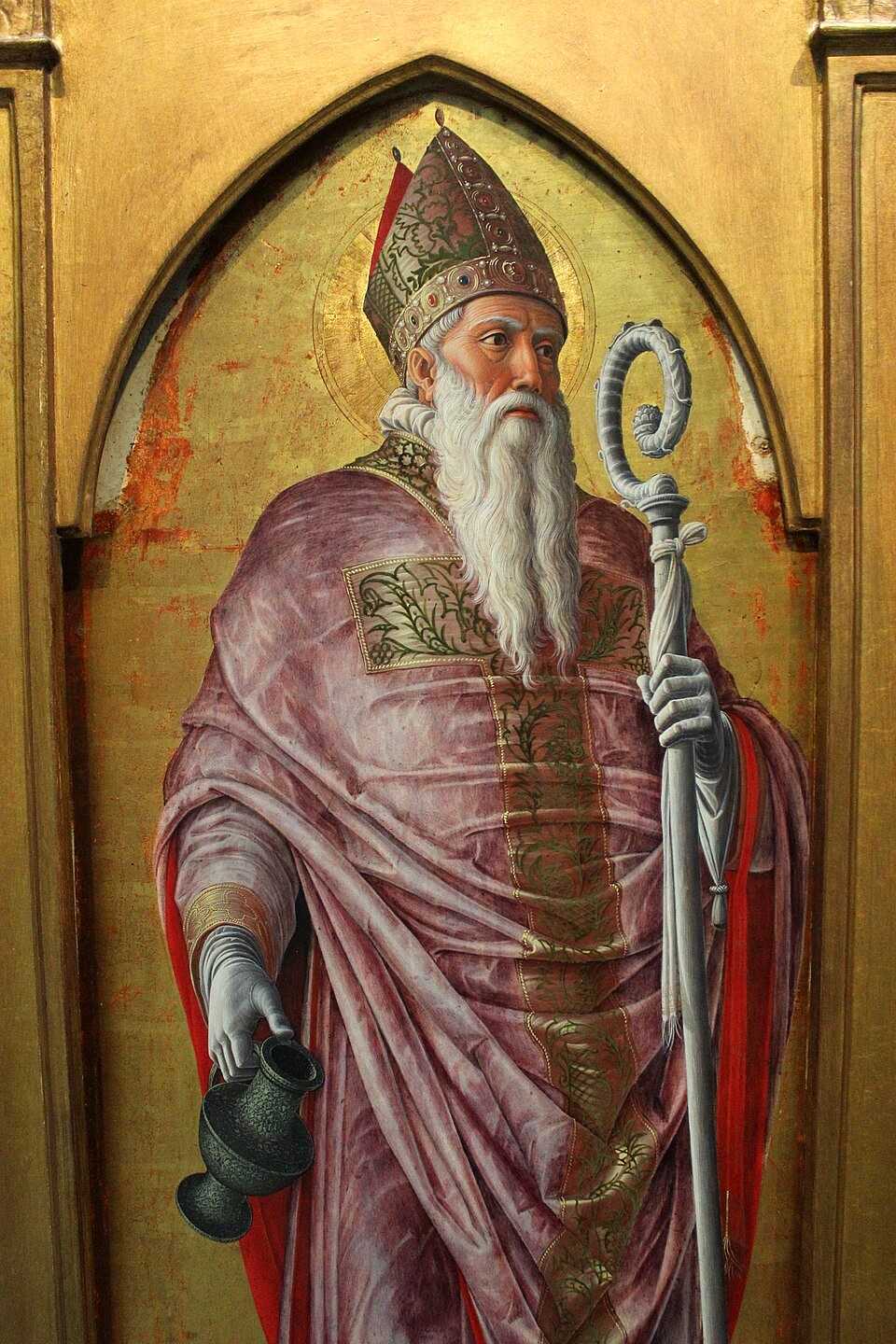
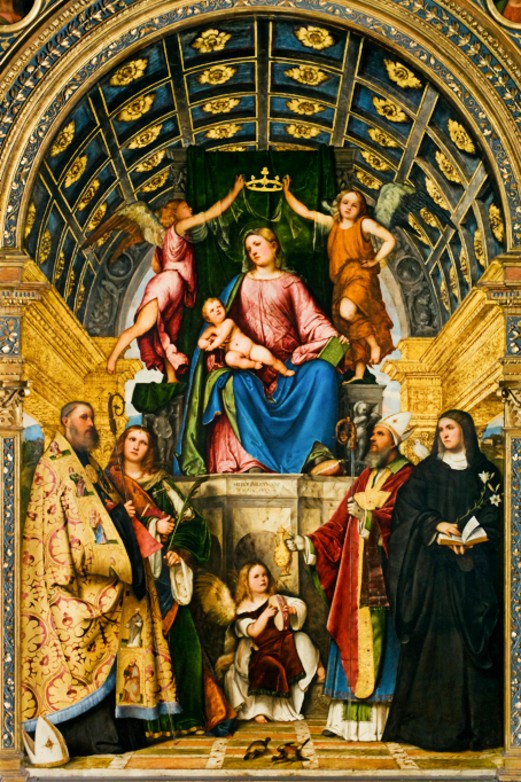
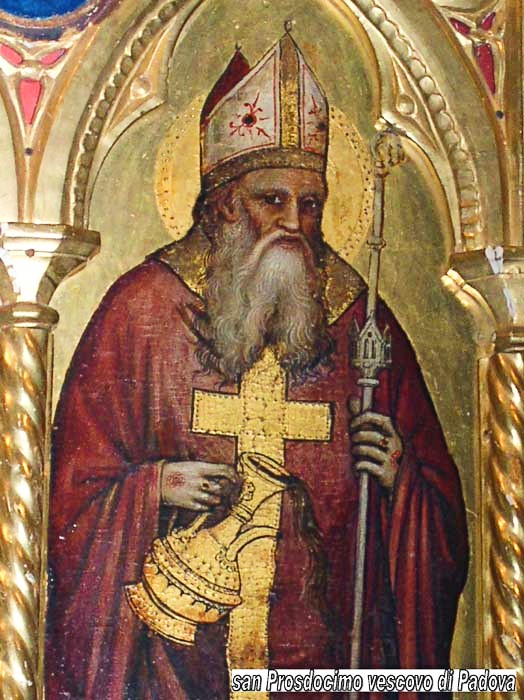
Even the most beautiful image of Prosdocimus was painted by a Paduan, the great 15th Century Painter, Andrea Mantegna. It is part of a polyptych dedicated to Saint Justina another famous Saint and Martyr of Padua. In this painting, Saint Prosdocimus appears with his characteristic attribute of a jug, a symbol of his tireless work as an evangeliser and work of Baptising.
St Prosdocimus and St Justina
The etymological meaning of the name Prosdocimus is very beautiful, as in Greek it means ‘the awaited one.’ It can be said that Saint Prosdocimus, the 1st Bishop of Padua, was truly awaited by that still pagan City, to which he was sent by Saint Peter himself after his Episcopal Consecration. In the gentle countryside, Prosdocimus is said to have performed prodigies and miracles.
Fortunately, a certain naiveté often lends a touch of poetry to even the most tired texts. Sometimes, however, scant documents are more eloquent than redundant legends. This is the case of Prosdocimus, for whom, after his death, an Ecclesia Sancti Prosdocimi, later known as the Basilica of Santa Giustina, one of the most beautiful in the City, is mentioned outside the walls of Padua.
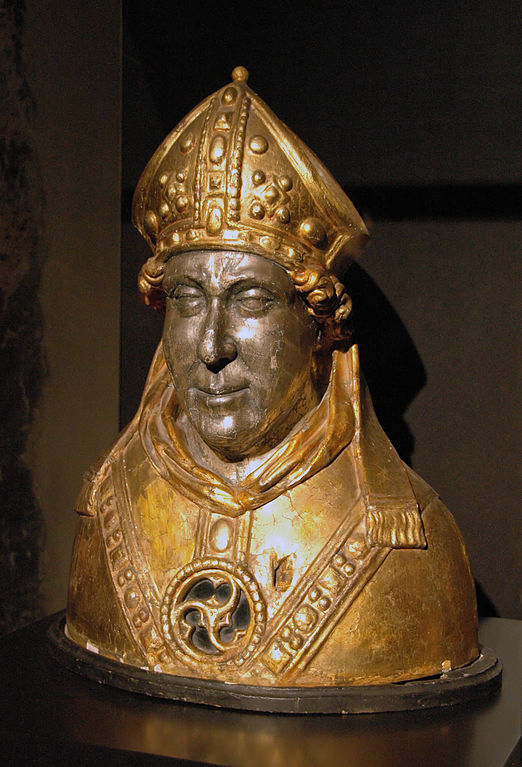
St Prosdocimus with his jug
Saint Prosdocimus’ glory was, in fact, Saint Justina, whose Feast Day is 7 October. Prosdocimus converted her and she kept her faith intact, facing Martyrdom during Nero’s persecution.
The Bishop of Padua, however, was spared, no-one knows exactly how or why. He reached the natural end of his life, laden with merit and years, loved as a father, venerated as a Saint: Saint Prosdocimus which, in Greek means ‘the awaited one.’
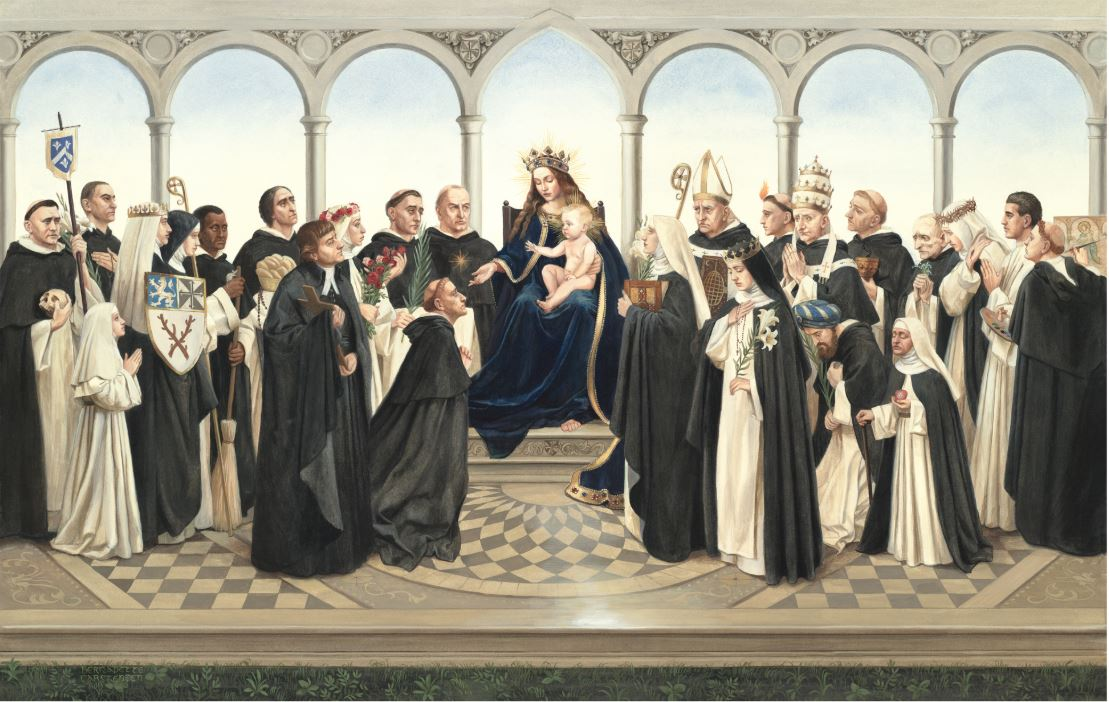
The Feast of All Saints of the Order of Preachers: “Fountain of all holiness, You stirred up in our holy brothers and sisters an extraordinary love of truth, conformity to Christ Crucified and a thirst for the salvation of souls: may we imitate them in offering You thanksgiving on account of the way of life they gave us.” — From the Intercessions at Lauds for the Feast of All Saints of the Order of Preachers. HERE: https://anastpaul.com/2019/11/07/thought-for-the-day-7-november-feast-of-all-dominican-saints/
St Achillas (Died 313) Bishop of Alexandria, Egypt, Confessor, Scholar particularly in Philosophy and Theology. Bishop St Theonas had Ordained him to the Priesthood and appointed Achillas as the Head of the Catechetical School of Alexandria upon the departure of St Pierius, for Rome, who we celebrated on 4 November. Born in Alexandria, Egypt and died there in 313 of natural causes. The Roman Martyrology states of him today: “At Alexandria, blessed Achillas, a Bishop renowned for erudition, faith and purity of life.” His Holy Life: https://anastpaul.com/2023/11/07/saint-of-the-day-7-november-saint-achillas-died-313-bishop-confessor/
St Amarand St Amaranthus
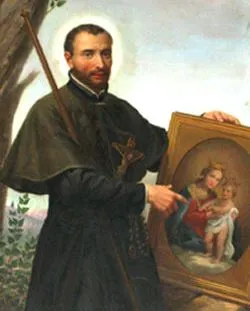
Blessed Anthony Baldinucci SJ (1665-1717) Priest of the Society of Jesus, Preacher, Writer and Missionary. Fr Baldinucci was Beatified by Pope Leo XIII on 25 March 1893. His Zealous Life: tps://anastpaul.wordpress.com/2017/11/07/saint-of-the-day-blessed-anthony-baldinucci-s-j-1665-1717/
St Athenodorus of Neo-Caesarea St Auctus of Amphipolis St Baud of Tours St Blinlivet St Congar
St Gebetrude A(Died c680)bbess of Remiremont St Herculanus of Perugia St Hesychius of Mytilene St Hieron of Mytilene Bl Hyacinth Castañeda Puchasons St Lazarus the Stylite
St Nicander of Mytilene Bl Peter Ou St Prosdocimus (2nd Century) Bishop and Confessor of Padua St Prosdocimus of Rieti St Raverranus of Séez St Rufus Bishop and Confessor of Metz St Taurion of Amphipolis St Thessalonica of Amphipolis St Tremorus of Brittany
Thought for the Day – 6 November – Meditations with Antonio Cardinal Bacci (1881-1971)
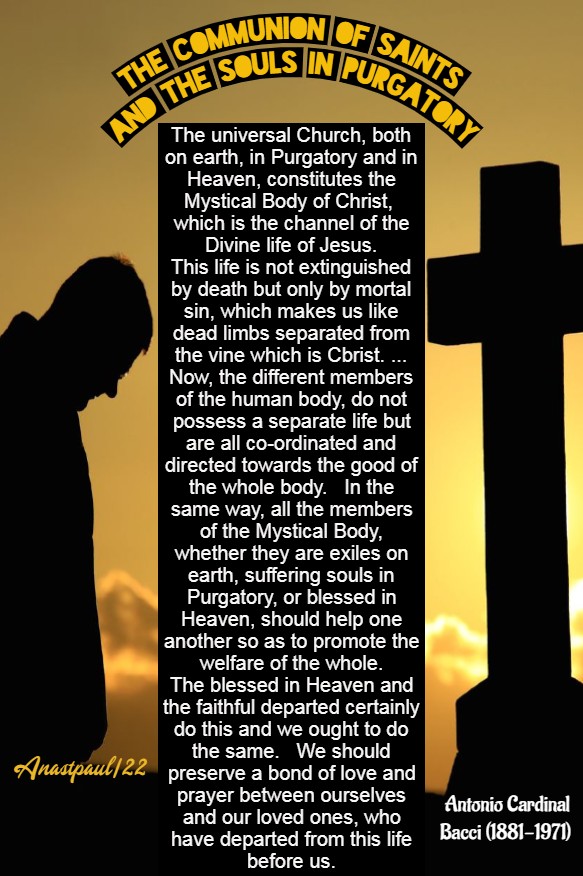
The Communion of Saints and the Souls in Purgatory
“The consoling Doctrine of the Communion of Saints, is the foundation of devotion towards the faithful departed. The universal Church, both on earth, in Purgatory and in Heaven, constitutes the Mystical Body of Christ, which is the channel of the Divine life of Jesus.
This life is not extinguished by death but only by mortal sin, which makes us like dead limbs separated from the vine which is Cbrist. The souls of those belonging to us who have died in the state of grace, therefore, are living members of the Mystical Body of Christ. Now, the different members of the human body, do not possess a separate life but are all co-ordinated and directed towards the good of the whole body. In the same way, all the members of the Mystical Body, whether they are exiles on earth, suffering souls in Purgatory, or blessed in Heaven, should help one another so as to promote the welfare of the whole.
The blessed in Heaven and the faithful departed certainly do this and we ought to do the same. We should preserve a bond of love and prayer between ourselves and our loved ones, who have departed from this life before us.”
Quote/s of the Day – 6 Novemer – Within the All Saints Octave – Apocalypse 7:2-12; Matthew 5:1-12 – Scripture search here: https://www.drbo.org/
“Rejoice and be glad, for your reward will be great in Heaven.”
Matthew 5:12
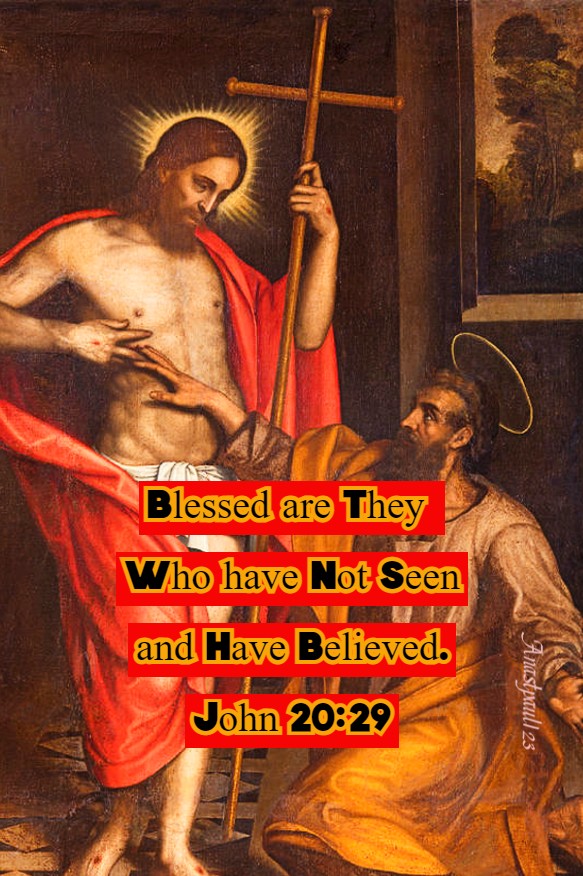
“ Blessed are they who have not seen and have believed.”
John 20:29
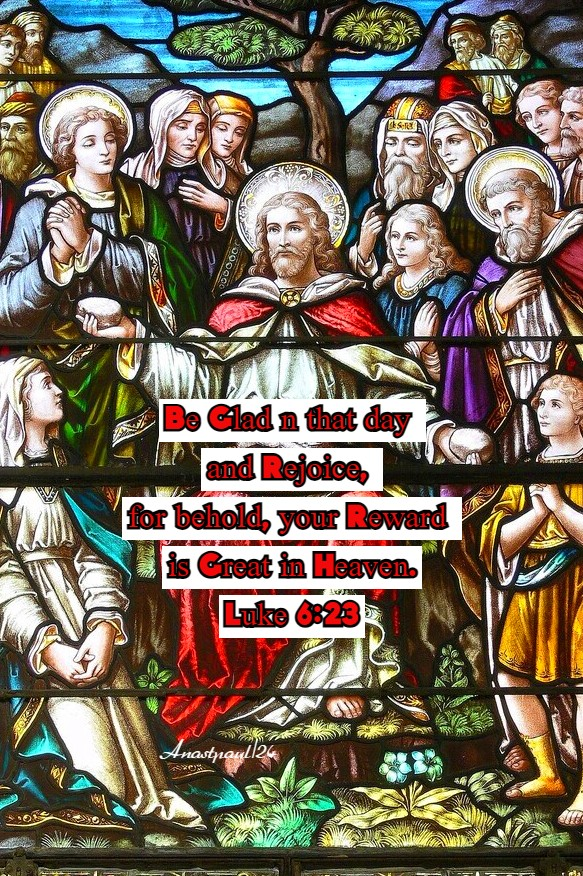
“Be glad in that day and rejoice, for behold, your reward is great in Heaven,”
Luke 6:23
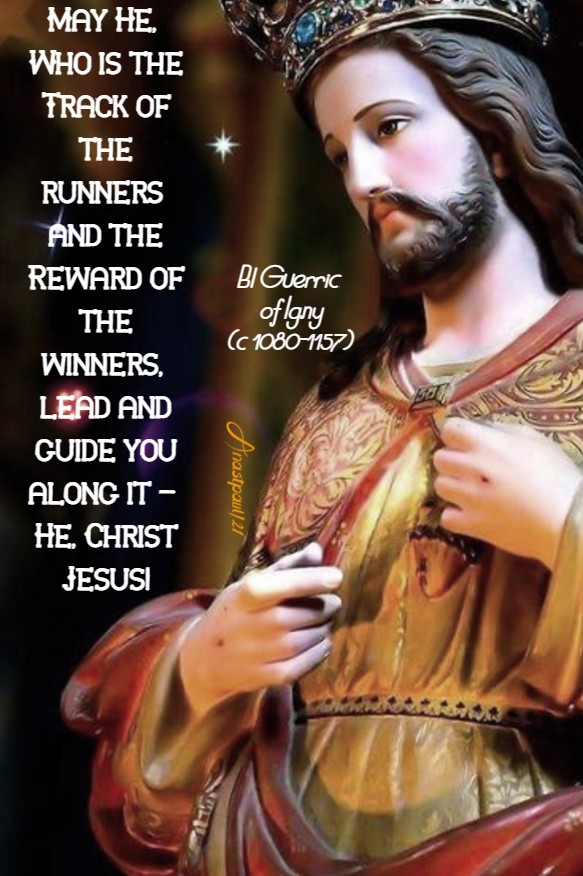
“May He, Who is the Track of the runners and the Reward of the winners, lead and guide you along it – He, Christ Jesus!”
Bl Guerric of Igny O.Cist (c1080-1157)
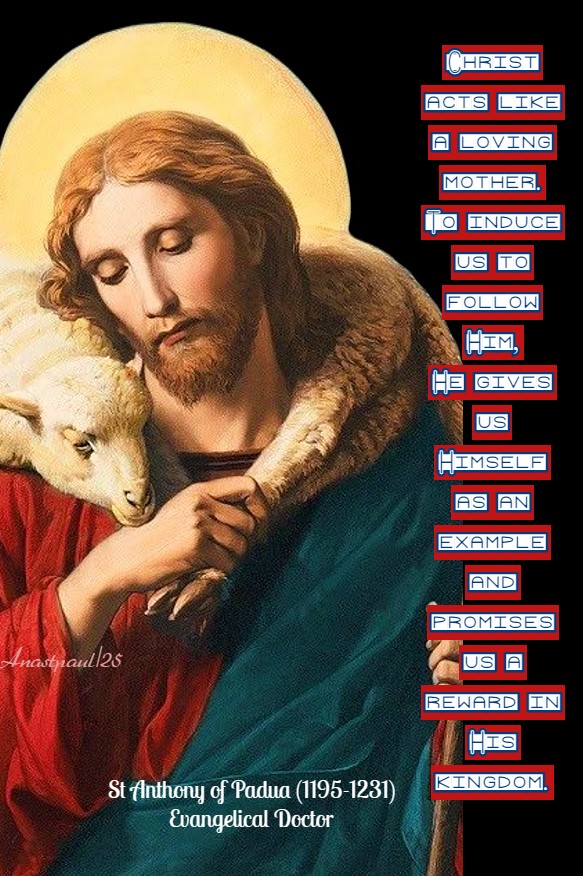
“Christ acts like a loving mother. To induce us to follow Him, He gives us Himself as an example and promises us a reward in His kingdom.”
St Anthony of Padua (1195-1231) Evangelical Doctor
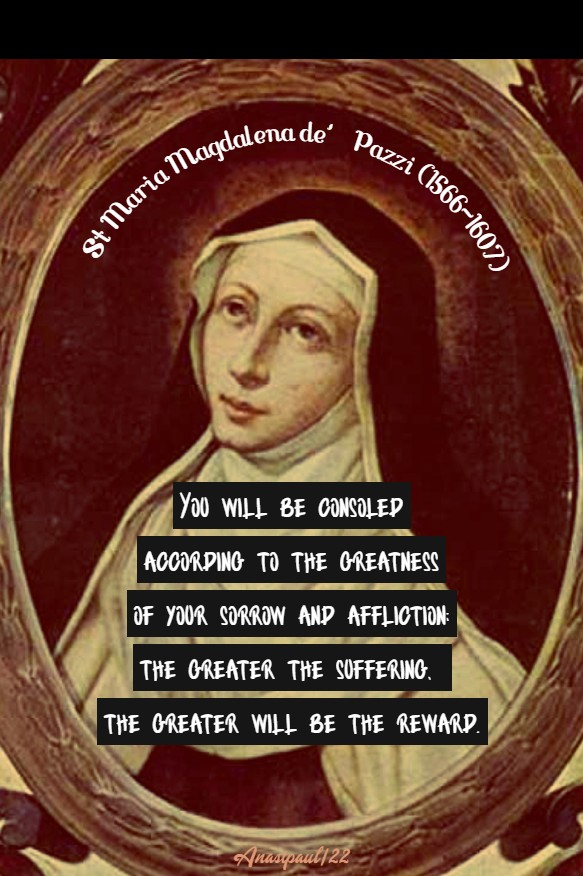
“You will be consoled according to the greatness of your sorrow and affliction; the greater the suffering, the greater will be the reward.”
St Maria Magdalena de’ Pazzi (1566-1607)
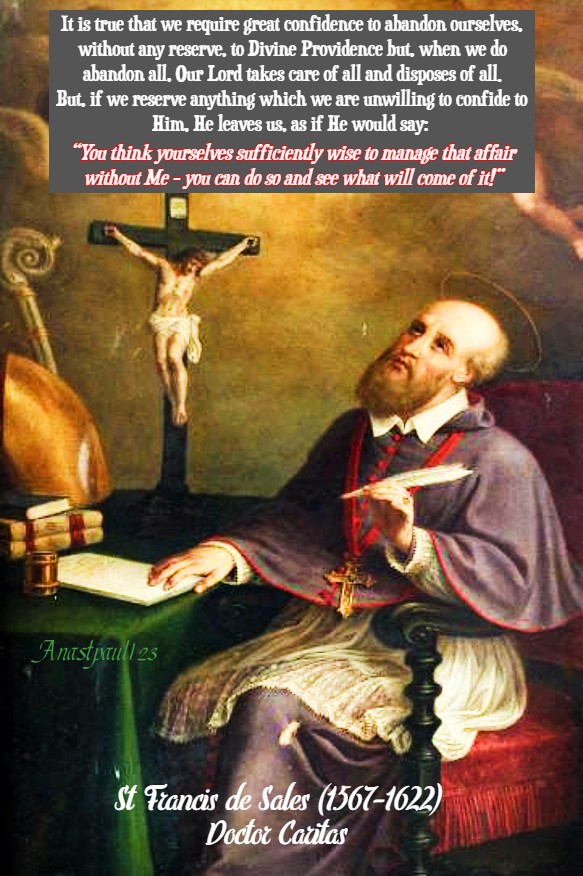
“It is true that we require great confidence to abandon ourselves, without any reserve, to Divine Providence but, when we do abandon all, Our Lord takes care of all and disposes of all. But, if we reserve anything which we are unwilling to confide to Him, He leaves us, as if He would say: “You think yourselves sufficiently wise to manage that affair without Me – you can do so and see what will come of it!”
One Minute Reflection – 6 Novemer – “The Month of The Holy Souls in Purgatory” – Within the All Saints Octave – Apocalypse 7:2-12 – Matthew 5:1-12 – Scripture search here: https://www.drbo.org/
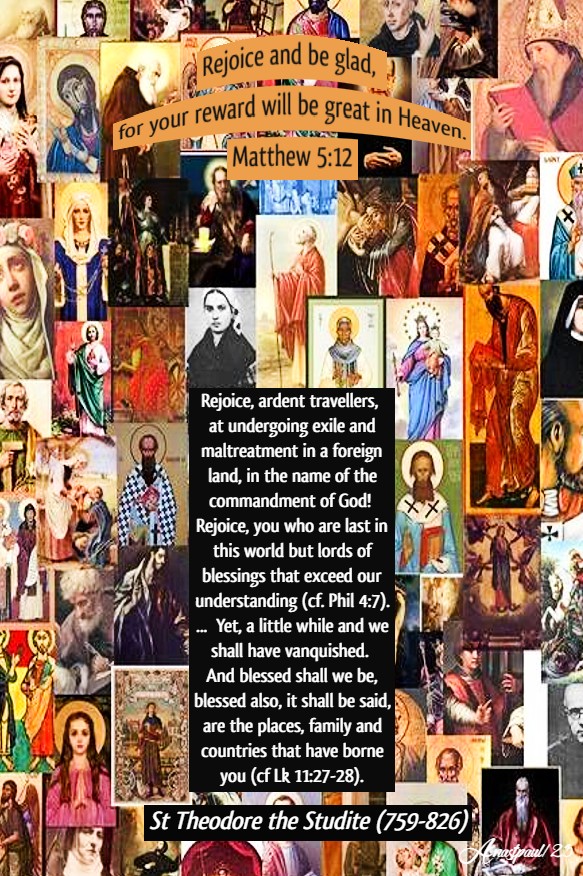
“Rejoice and be glad, for your reward will be great in Heaven.” – Matthew 5:12
REFLECTION – “Rejoice in the Lord without ceasing (cf. Phil 4:4), my dear children. I beg you rejoice, citizens of Heaven but exiles on earth, inhabitants of the Jerusalem on high (cf Gal 4:26) but banished from affairs here below, inheritors of the Kingdom of Heaven but disinherited from taking any part at all, in earthly pleasures! Rejoice, ardent travellers, at undergoing exile and maltreatment in a foreign land in the name of the commandment of God! Rejoice, you who are last in this world but lords of blessings that exceed our understanding (cf. Phil 4:7). Rejoice, noble company, brought together by God, assembly united in heart and soul, who give life to filial and fraternal love, a replica on earth of the host of Angels! … Rejoice, God’s workers, apostolic men. … Rejoice, you who set your joy in each other, each making his own the reputation of his brother, you in whom is found neither jealousy, rivalry nor envy but, in their place, peace and charity and life in common. In truth, I do not say that we are not attacked – indeed, who is crowned if not the one who struggles and fights, who exchanges thrusts and wounds with his assailants? – but I say that we should not let ourselves be brought down by the machinations of Satan.
Yes, my children, assembly of God, nourish yourselves with the food of the Spirit and drink the water given by the Lord: whoever comes to possess this water will never thirst again but it will become, in Him, a spring of living water welling up to eternal life (cf. Jn 4:14). … Yet, a little while and we shall have vanquished. And blessed shall we be, blessed also, it shall be said, are the places, family and countries that have borne you (cf Lk 11:27-28).” – St Theodore the Studite (759-826) – Catechesis 47 (The Great Catecheses)
PRAYER – Almighty, eternal God, Who granted us to honour the merits of all Thy Saints in a single solemn festival, bestow on us, we beseech Thee, through their manifold intercession that abundance of Thy mercy for which we yearn. Through Jesus Christ, Thy Son our Lord, Who lives and reigns with Thee, in the unity of the Holy Ghost, God, world without end. Amen (Collect).
Our Morning Offering – 6 Novemer – “The Month of The Holy Souls in Purgatory”
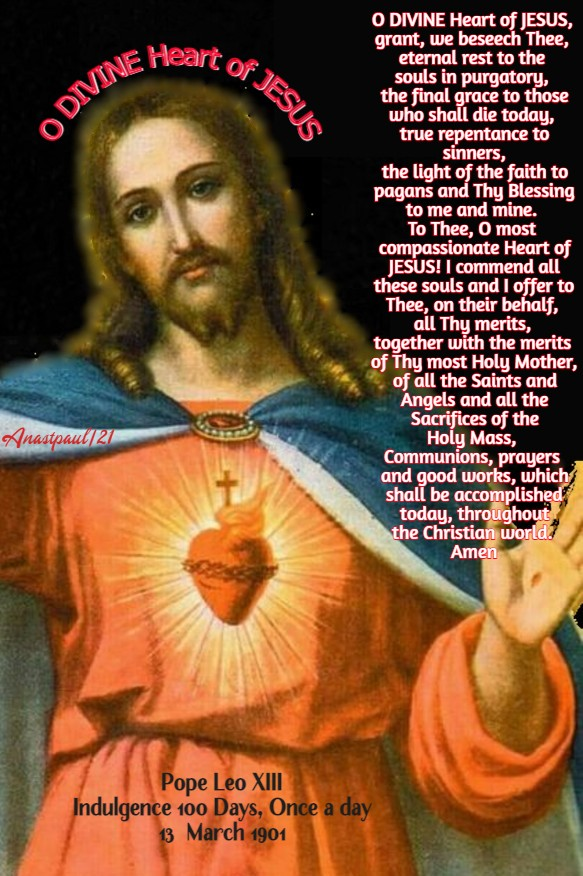
O DIVINE Heart of JESUS Pope Leo XIII Indulgence 100 Days, Once a day Raccolta 167 13 March 1901.
O DIVINE Heart of JESUS, grant, we beseech Thee, eternal rest to the souls in purgatory, the final grace to those who shall die today, true repentance to sinners, the light of the faith to pagans and Thy Blessing to me and mine. To Thee, O most compassionate Heart of JESUS! I commend all these souls and I offer to Thee, on their behalf, all Thy merits, together with the merits of Thy most Holy Mother and of all the Saints, Angels and all the Sacrifices of the Holy Mass, Communions, prayers and good works, which shall be accomplished today, throughout the Christian world. Amen
Saint of the Day – 6 November – St Severus (Died c633) Bishop and Martyr of Barcelona, Spain. Patronage – of Barcelona. Also known as – Severo.
The Roman Martyrology reads today: “At Barce;ona, St Severus, Bishop and Martyr, who had his head pierced with a nail and thus received the crown of Martyrdom for the Faith.”
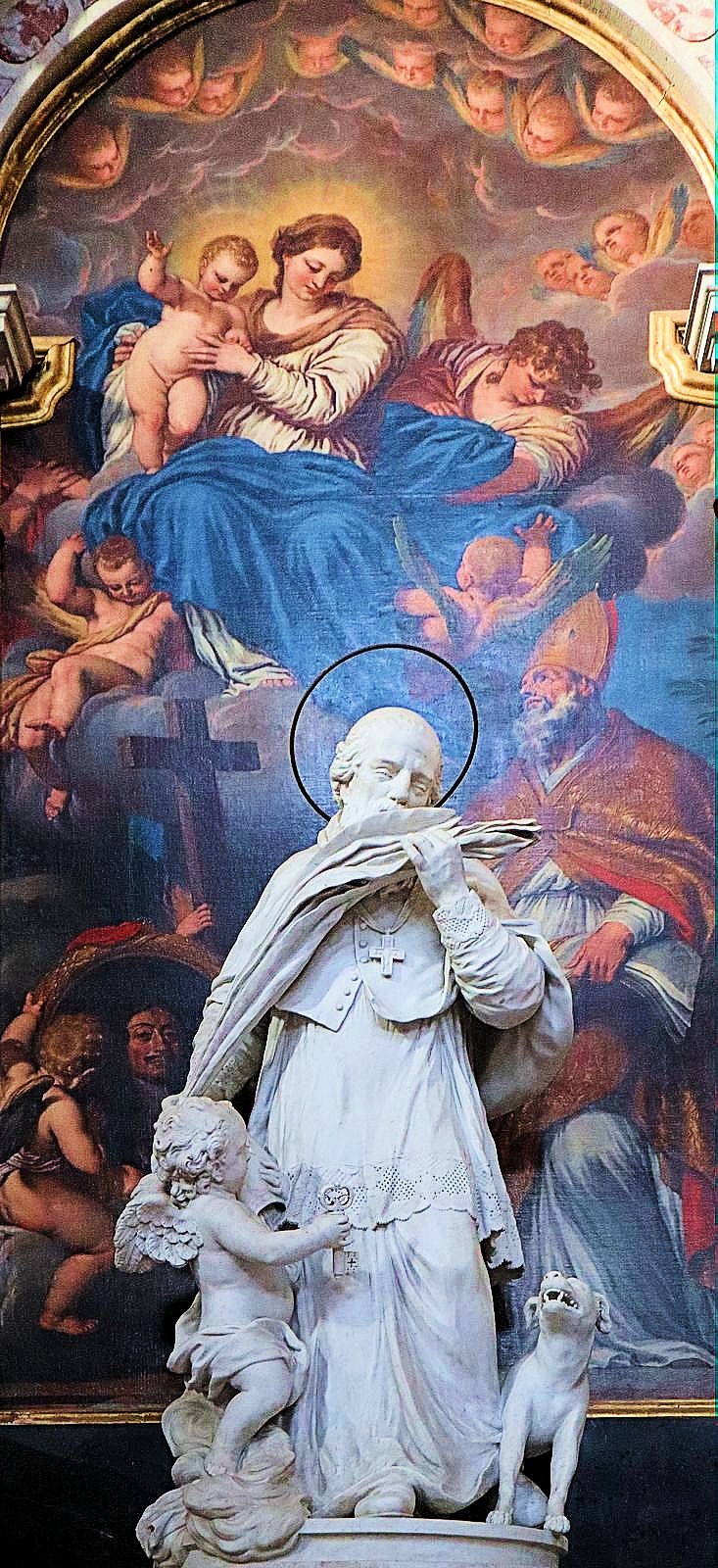
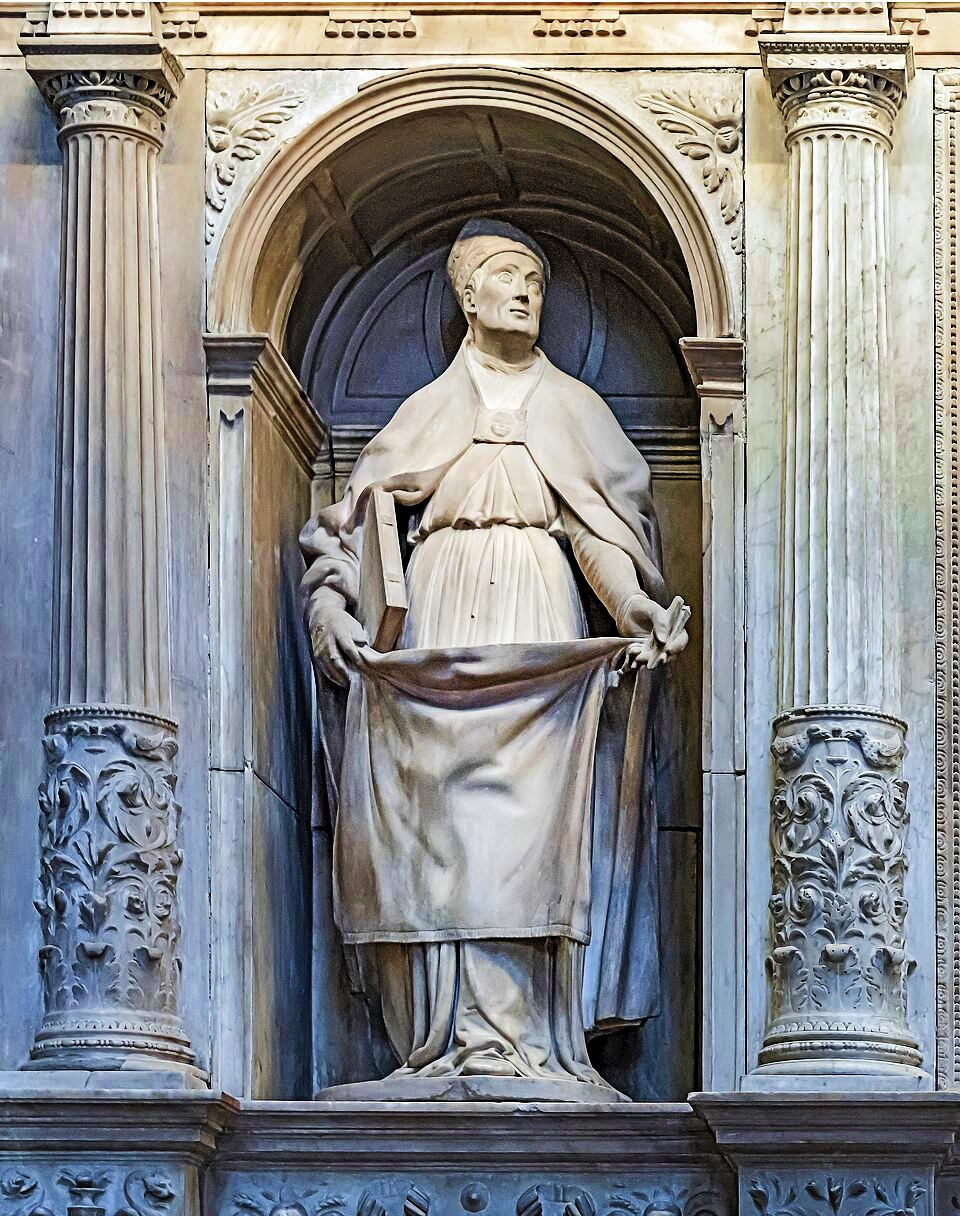
St Severus Statue in Barcelona
Severus, Bishop of Barcelona, was mentioned in 633. In some cases, he is considered the 11th Bishop of the Diocese, although his existence as a Bishop and Martyr is shrouded in doubt.
A ‘Passio’ dating to the 13th-14th Century is extant. This text, states that Severus was Martyred during the persecution of Diocletian and Maximian. The period of this persecution, however, does not correspond to the period in which Saint Severus was mentioned as the Bishop of Barcelona.
However, the tale states that Saint Severus, urged to worship idols, managed to escape. When a Christian named Emeterio, accused of concealing his escape, was captured, Severus then presented himself voluntarily to the Governor. Imprisoned, he was tortured along with four Clerics accompanying him.
All six received the Crown of Martyrdom and the locals buried them in the village Church.
Our only verified information regarding our Saint is that he is mentioned as the Bishop of Barcelona om around 633. His first mention occurs in the 17th Century and later in the Roman Martyrology. His Feast is celebrated in Barcelona, on 9 August, the date of the translation of his Relics in 1405.
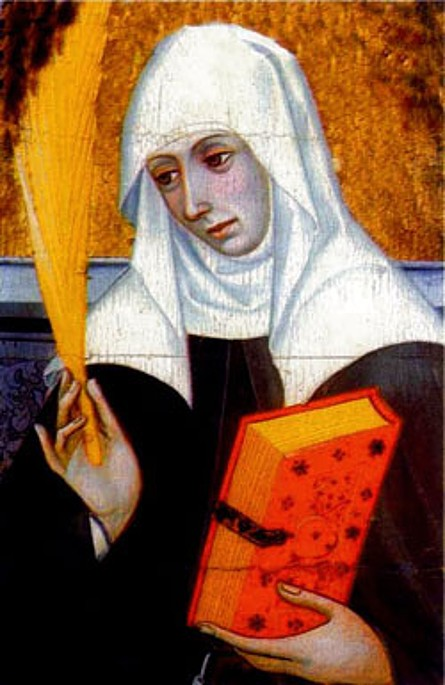
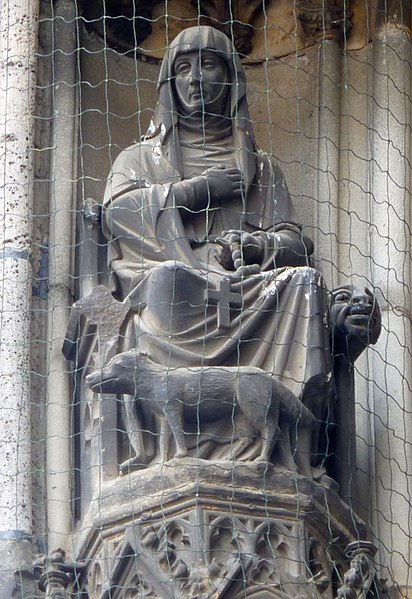
Statue of Blessed Christina von Stommeln (northern portal Cologne Cathedral)
St Demetrian of Cyprus St Edwen of Northumbria St Efflam of Brittany St Emilian of Faenza St Erlafrid of Hirschau St Felix (6th Century) Abbot of Fondi Monastery St Felix of Genoa St Felix of Thynissa St Illtyd
St Melaine (Died c535) Bishop of Rennes in Brittany, France, Confessor, previously a Monk and Abbot, Royal Advisor, Miracle-worker. The Roman Martyrology reds: “At Rennes, in France, St Melanius, Bishop and Confessor, who displayed innumerable virtues and with his thoughts ever fixed on Heaven, passed from the world in glory.” His Life of Holiness: https://anastpaul.com/2023/11/06/saint-of-the-day-6-november-saint-melaine-of-rennes-died-c535-bishop-confessor/
St Paul of Constantinople St Pinnock St Protasius of Lausanne St Severus (Died c633) Bishop and Martyr of Barcelona St Simon of Aulne St Stephen of Apt St Theobald of Dorat St Valentine of Genoa
Martyrs of Antioch – 10 Saints: Ten Christians murdered together by Arabs after their seizure of Antioch, Syria. No names or other details about them have come down to us. 637 in Antioch, Syria.
Martyrs of Gaza – 9 Saints: A group of Christian soldiers who were captured by Saracens invading the area of Gaza in Palestine. When the men continued to profess their Christianity, they were executed. We know the names of some of the Martyrs – Himerius, John (2 of them), Kallinikos (Callinoco), Paul, Peter, Stephen and Theodore (2 of them). They were beheaded in Gaza, Palestine.
Thought for the Day – 5 November – Meditations with Antonio Cardinal Bacci (1881-1971)
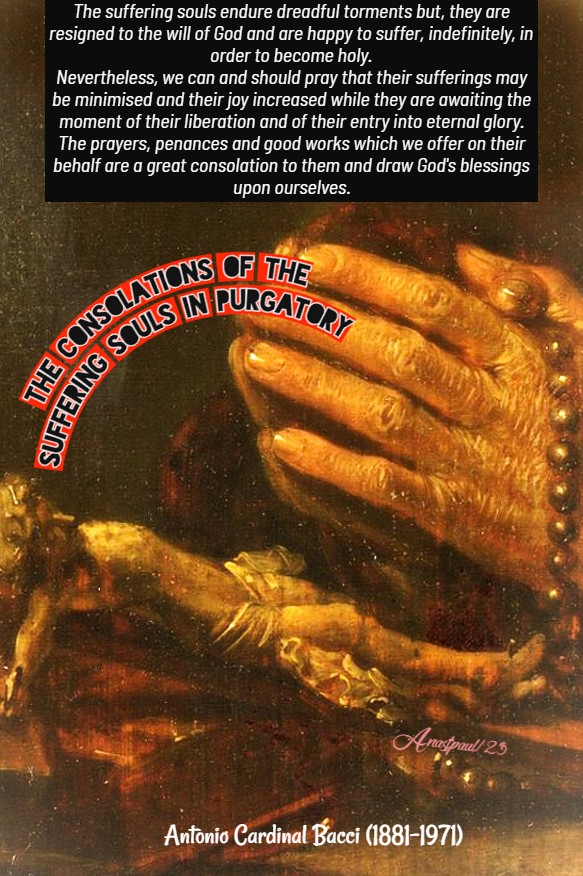
The Consolations of the Suffering Souls in Purgatory
“That is the way it is in Purgatory. The suffering souls endure dreadful torments but, they are resigned to the will of God and are happy to suffer, indefinitely, in order to become holy. Nevertheless, we can and should pray that their sufferings may be minimised and their joy increased while they are awaiting the moment of their liberation and of their entry into eternal glory. The prayers, penances and good works which we offer, on their behalf, are a great consolation to them and draw God’s blessings upon ourselves.”



















 AnaStpaul
You must be logged in to post a comment.