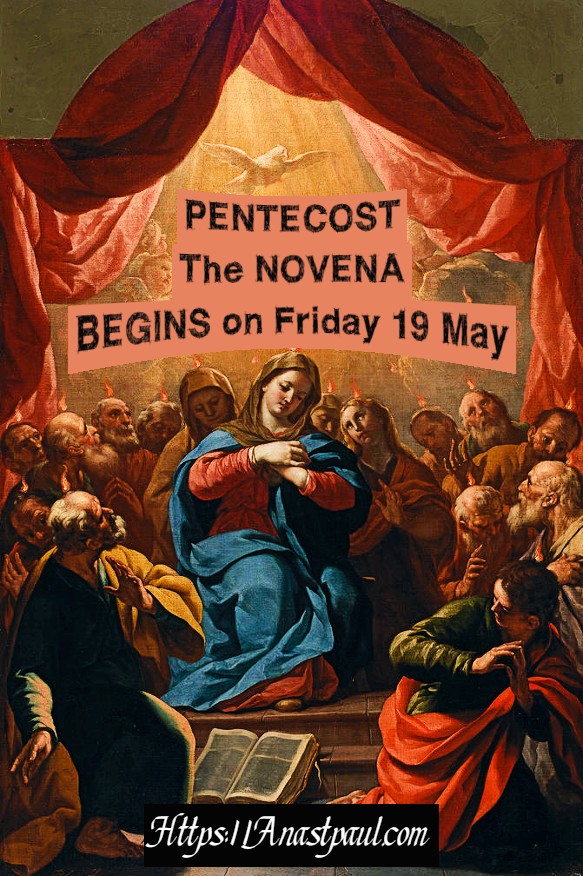
Pentecost Novena to the Holy Spirit for the Seven Gifts
Foreword
The Novena in honour of the Holy Ghost is the oldest of all Novenas, since it was first made at the direction of Our Lord Himself, when He sent His Apostles back to Jerusalem to await the coming of the Holy Ghost on the first Pentecost. Addressed to the Third Person of the Blessed Trinity, it is a powerful plea for the light and strength and love, so sorely needed by every Catholic today. To encourage devotion to the Holy Spirit, the Church has granted the following indulgences:
“The faithful who devoutly assist at the public Novena in honour of the Holy Spirit, immediately preceding the Solemn Feast of Pentecost, may gain a Partial Indulgence for themselves or, as an offering for the intentions of the faithful departed.”
An Indulgence of 10 years on any (and every) day of the Novena.
A Plenary Indulgence, if they take part in at least five of the exercises and go to Confession, receive Holy Communion and pray for the Holy Father’s intentions.
“Those who make a private Novena in honour of the Holy Spirit, either before the Solemn Feast of Pentecost or at any other time in the year, may also gain a Partial Indulgence for themselves or, as an offering for the intentions of the faithful departed.”
An Indulgence of 7 years on any (and every) day of the Novena.
A Plenary Indulgence under the usual conditions but, if a public Novena is held, this Indulgence is available only to those who are lawfully hindered from being part of the same.
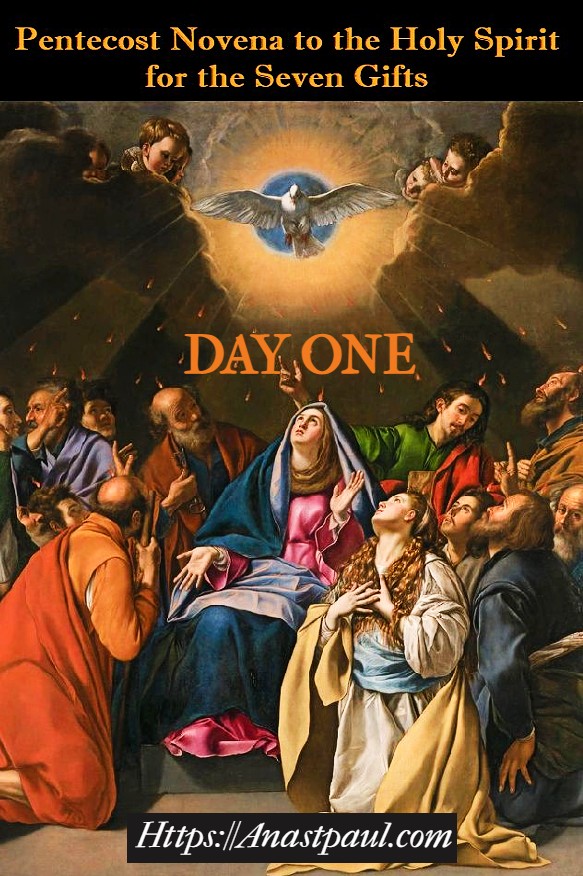
FIRST DAY (Friday after Ascension)
Holy Spirit! Lord of Light! From Your clear celestial height, Your pure beaming radiance give!
The Holy Spirit
Only one thing is important — eternal salvation. Only one thing, therefore, is to be feared–sin. Sin is the result of ignorance, weakness and indifference. The Holy Spirit is the Spirit of Light, of Strength and of Love. With His sevenfold gifts He enlightens the mind, strengthens the will and inflames the heart with love of God. To ensure our salvation we ought to invoke the Divine Spirit daily, for “The Spirit helpeth our infirmity. We know not what we should pray for as we ought. But the Spirit Himself asketh for us.”
Prayer
Almighty and eternal God, Who hast vouchsafed to regenerate us by water and the Holy Spirit and hast given us forgiveness of all sins, vouchsafe to send forth upon us from Heaven, Your sevenfold Spirit, the Spirit of Wisdom and Understanding, the Spirit of Counsel and Fortitude, the Spirit of Knowledge and Piety and fill us with the Spirit of Holy Fear. Amen.
Our Father and Hail Mary – ONCE. Glory be to the Father – SEVEN TIMES.
ACT OF CONSECRATION TO THE HOLY SPIRIT To be recited daily during the Novena
On my knees, I, before the great multitude of heavenly witnesses, offer myself, soul and body to You, Eternal Spirit of God. I adore the brightness of Your purity, the unerring keenness of Your justice and the might of Your love. You are the Strength and Light of my soul. In You I live and move and am. I desire never to grieve You by unfaithfulness to grace and I pray with all my heart to be kept from the smallest sin against You. Mercifully guard my every thought and grant that I may always watch for Your light, listen to Your Voice and follow Your gracious inspirations. I cling to You and give myself to You and ask You, by Your compassion, to watch over me in my weakness. Holding the pierced Feet of Jesus, looking at His Five Wounds and trusting in His Precious Blood and adoring His opened Side and stricken Heart, I implore You, Adorable Spirit, Helper of my infirmity, t o keep me in Your grace, that I may never sin against You. Give me grace O Holy Spirit, Spirit of the Father and the Son, to say to You always and everywhere, “Speak Lord for Your servant hears.” Amen.
Thought for the Day – 19 May – Meditations with Antonio Cardinal Bacci (1881-1971)
“The Month of the Blessed Virgin Mary” Mary, the Source of Peace
“If we wish to possess this true peace, which only God can give, we must control and regulate the movements of our passions when they rebel against the soul. In other words, as St Augustine says, our lower appetites must obey our reason and this, in its turn, must be subject to its author, God! (De Serm. Domini, 1,2). Real peace can only come to us as the result of the hard and constant labour of subordinating our passions to right reason and our reason to God. “And this is the peace,” Augustine writes, “which God gives on earth, to men of goodwill; this is the most perfect wisdom ” (Ibid).
We have found, from sad experience, that sin and the free play of the passions, cannot give us real peace because “there is no peace for the wicked” (Is 48:22). When, by the grace of God and the assistance of Our Lady, we have subdued our rebellious inclinations, it is necessary for us to go further and abandon ourselves completely into the hands of God, asking Him for a spirit of absolute conformity to Hs Will on all occasions. This is the price which we must pay to enjoy the peace which the world cannot give and which God gives only to those who do His Holy Will in all things (Cf Jn 14:27).
It may seem that the way to acquire this peace is very difficult but, there is no other way. Let us pray to Our Lady. She has won peace and victory for the Church on many occasions; for example, against the Turks at Lepanto in 1571 and at Vienna in 1683. In the same way, she will obtain for us, her children, interior peace of soul, the greatest treasure which we can possess on earth!”
Quote/s of the Day –19 May – The Memorial of St Alcuin of York (c735-804) “The Schoolmaster of Europe.” Deacon, Confessor
“You should not agree to have anything to do with weapons of war. Throw yourself upon Christ’s mercy, crying: ‘My Love and my Stronghold, my Protector and Liberator, in Whom my heart has put its hope.”
(St Alcuin, writing to the Monks in Mayo, Ireland).
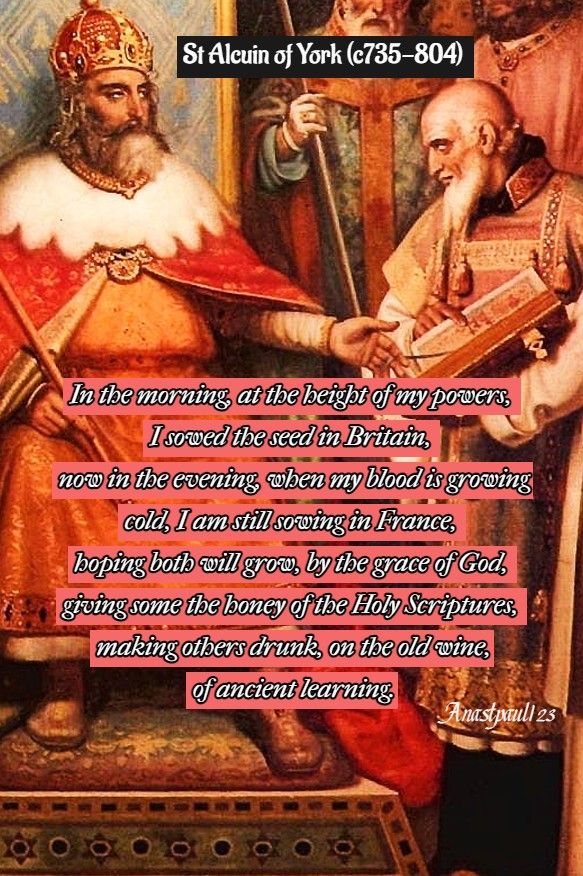
“In the morning, at the height of my powers, I sowed the seed in Britain, now in the evening, when my blood is growing cold, I am still sowing in France, hoping both will grow, by the grace of God, giving some the honey of the Holy Scriptures, making others drunk, on the old wine, of ancient learning.”
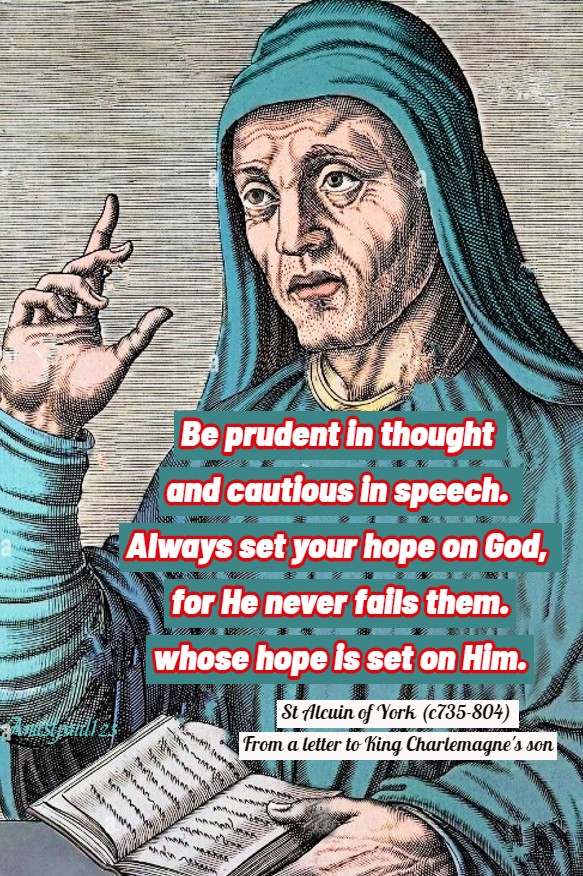
“Be prudent in thought and cautious in speech. Always set your hope on God, for He never fails them whose hope is set on Him.”
(From a letter to King Charlemagne’s son).
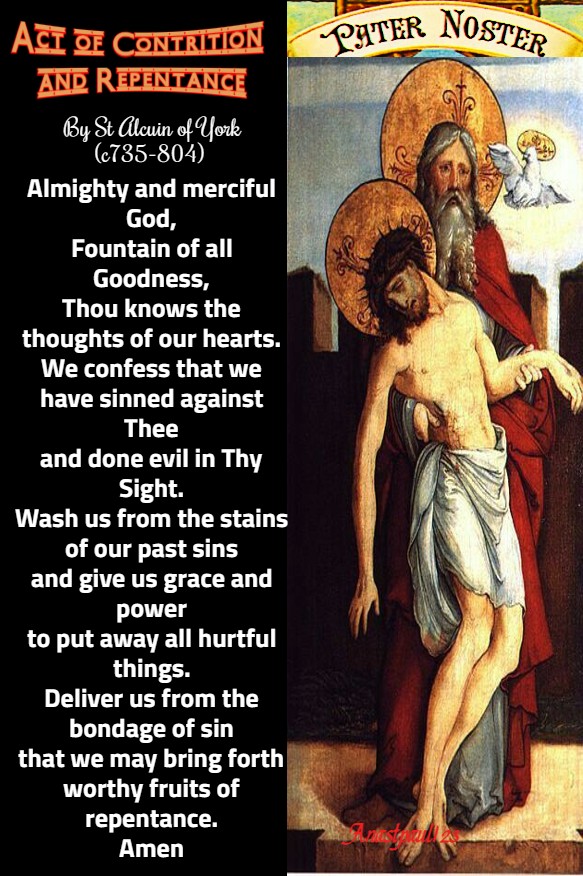
Act of Contrition and Repentance
Almighty and merciful God, Fountain of all Goodness, Thou knows the thoughts of our hearts. We confess that we have sinned against Thee and done evil in Thy Sight. Wash us from the stains of our past sins and give us grace and power to put away all hurtful things. Deliver us from the bondage of sin that we may bring forth worthy fruits of repentance.
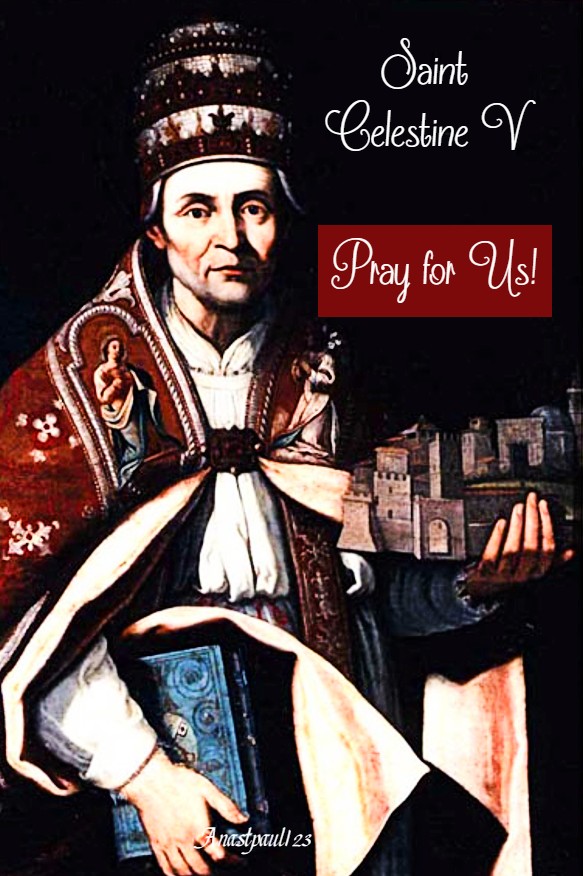
One Minute Reflection – 19 May – The Memorial of St Pope Celestine V (1210-1296) – 1 Peter 5:1-4; 5:10-11, Matthew 16:13-19 – Scripture search here: https://www.drbo.org/
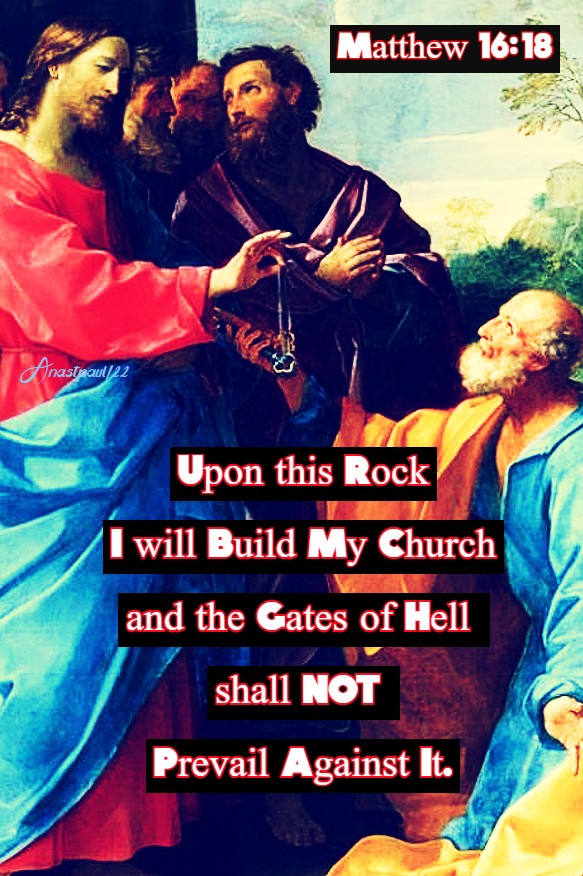
“Upon this rock I will build My Church and the gates of hell shall not prevail against it. I will give you the keys of the Kingdom of Heaven and whatever you bind on earth shall be bound in Heaven and, whatever you loose on earth, shall be loosed in Heaven.” … Matthew 16:18-19
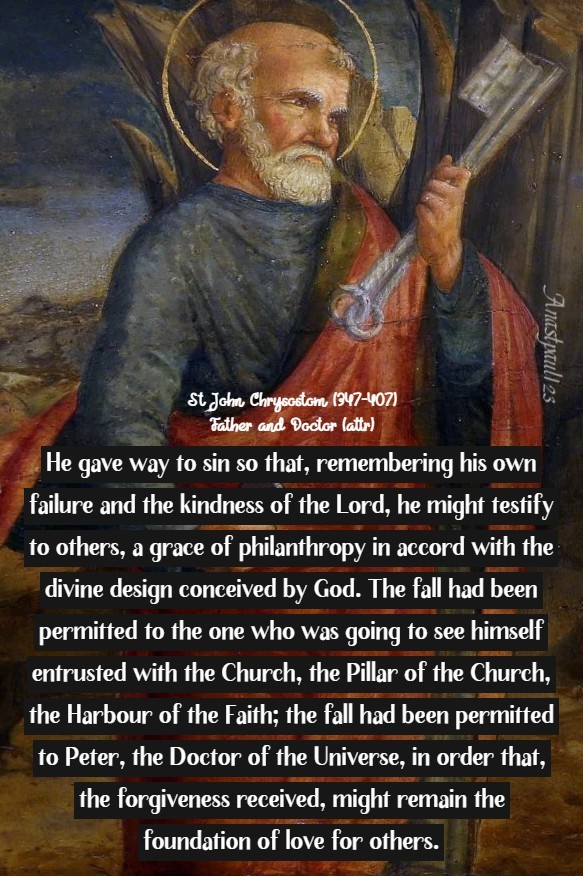
REFLECTION – “Peter was to receive on deposit, the keys of the Church, or rather the keys of Heaven and, he should see himself entrusted with the numerous people. What did the Lord actually say to him? “Whatever you bind on earth shall be bound in Heaven and whatever you loose on earth shall be loosed in Heaven” (Mt 16:19). For Peter had a somewhat abrupt character; if he had been without sin what sort of forgiveness would the disciples have received from him? This is why Divine Grace allowed him to fall into a certain fault, in order that his own trial should make him benevolent towards others. Do you see how God can let someone fall into sin; this Peter, the leader of the Apostles, the unshakable foundation, indestructible rock, first in the Church, impregnable harbour, unshakable tower — this same Peter, who had said to Christ: “Even though I should have to die with Thee, I will not deny Thee” (Mt 26:35), Peter who, by a divine revelation, had confessed the truth: “Thou are the Christ, the Son of the Living God” (Mt 16:16). … But as I said, God arranged it in this way and allowed Peter to sin because He had it in mind, to confer numerous people upon him and He feared, that his roughness, joined to his impeccability, might make him unsympathetic towards his brothers. He gave way to sin so that, remembering his own failure and the kindness of the Lord, he might testify to others, a grace of philanthropy in accord with the divine design conceived by God. The fall had been permitted to the one who was going to see himself entrusted with the Church, the Pillar of the Church, the Harbour of the Faith; the fall had been permitted to Peter, the Doctor of the Universe, in order that, the forgiveness received, might remain the foundation of love for others.” – (Attr) St John Chrysostom (347-407) Bishop of Constantinople, Father and Doctor of the Church (On the Apostle Peter and the Prophet Elijah).
PRAYER – O God, Who raised blessed Peter Celestine to the lofty dignity of Supreme Pontiff and taught him to prefer self-abasement instead; mercifully grant that by his example, we may look upon all worldly things as naught and may be worthy to reap, in joy, the rewards promised to the humble.Through the same Jesus Christ, Thy Son our Lord, Who lives and reigns with Thee, in the unity of the Holy Ghost, God, world without end. Amen (Collect).
Our Morning Offering – 19 May – The Memorial of St Alcuin of York (c735-804) “The Schoolmaster of Europe.” Deacon, Confessor
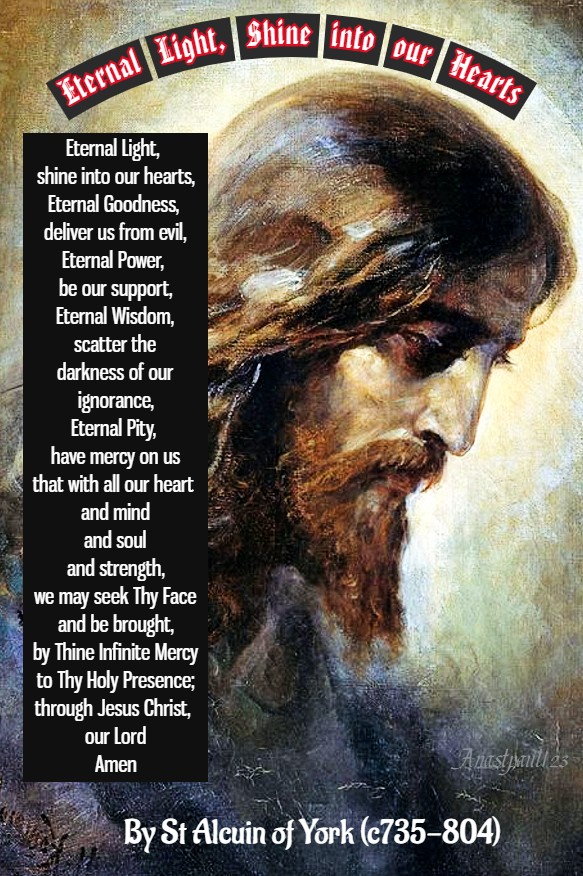
Eternal Light, Shine into our Hearts By St Alcuin of York (c735-804)
Eternal Light, shine into our hearts, Eternal Goodness, deliver us from evil, Eternal Power, be our support, Eternal Wisdom, scatter the darkness of our ignorance, Eternal Pity, have mercy on us that with all our heart and mind and soul and strength, we may seek Thy Face and be brought, by Thine Infinite Mercy to Thy Holy Presence; through Jesus Christ, our Lord Amen
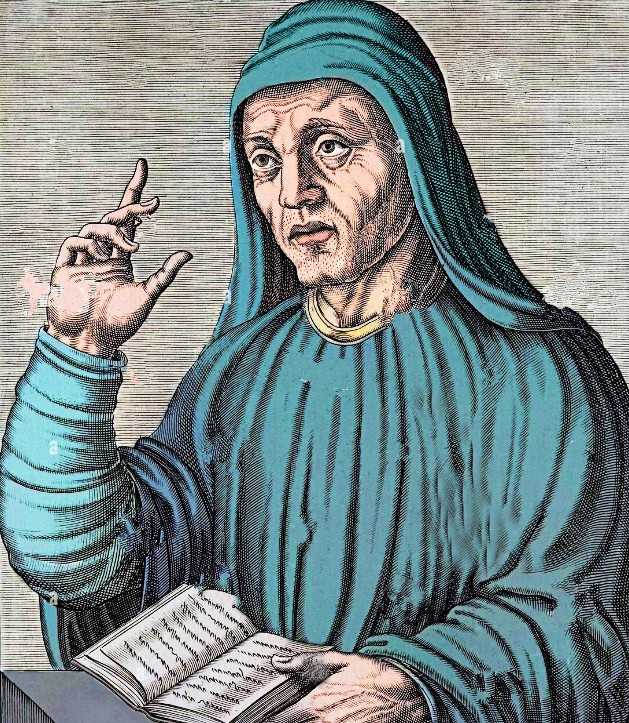
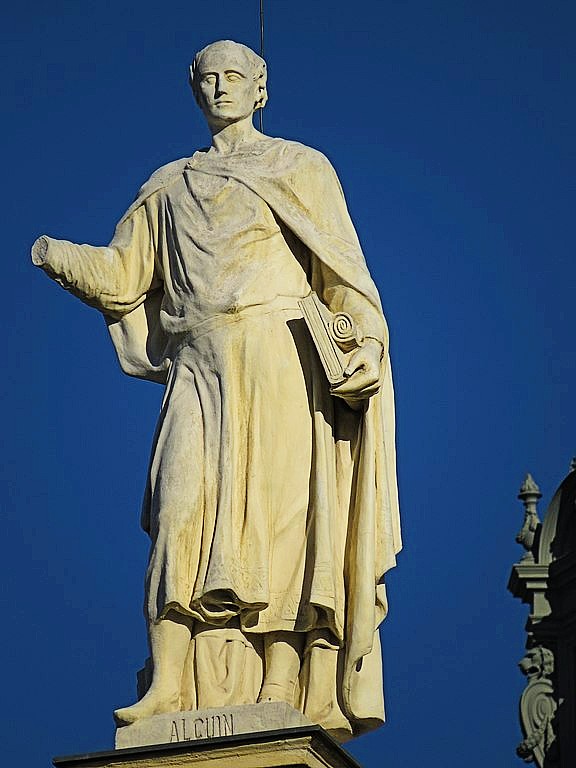
Saint of the Day – 19 May – Saint Alcuin of York (c735-804) “The Schoolmaster of Europe.” Deacon, Confessor, Scholar, Teacher, Reformer, Defender of Catholic Doctrine, Founder of educational institutions in Monasteries and Cathedral Chapters, renowned Poet, Theologian and Writer. Accrdited with the the invention of cursive script, Alcuin established Scriptoria dedicated to copying and preserving ancient manuscripts, both pagan and Christian- that we have as much as we do, of the writings of classical Roman authors, is largely due to Alcuin and his scribes. Alcuin a;so revised and organised the Latin liturgy, preserved ancient prayers and helped develop plain chant. He advocated the Doctrine that the Holy Ghost proceeds from the Father and the Son jointly. Unfortunately, the East resented Blessed Charlemagne‘s assumption of the title of Holy Roman Emperor; this hardened their opposition to the Doctrine and contributed to the rift between East and West. Born in c735 at York, England and died on 19 May 804 at Tours, France of natural causes.
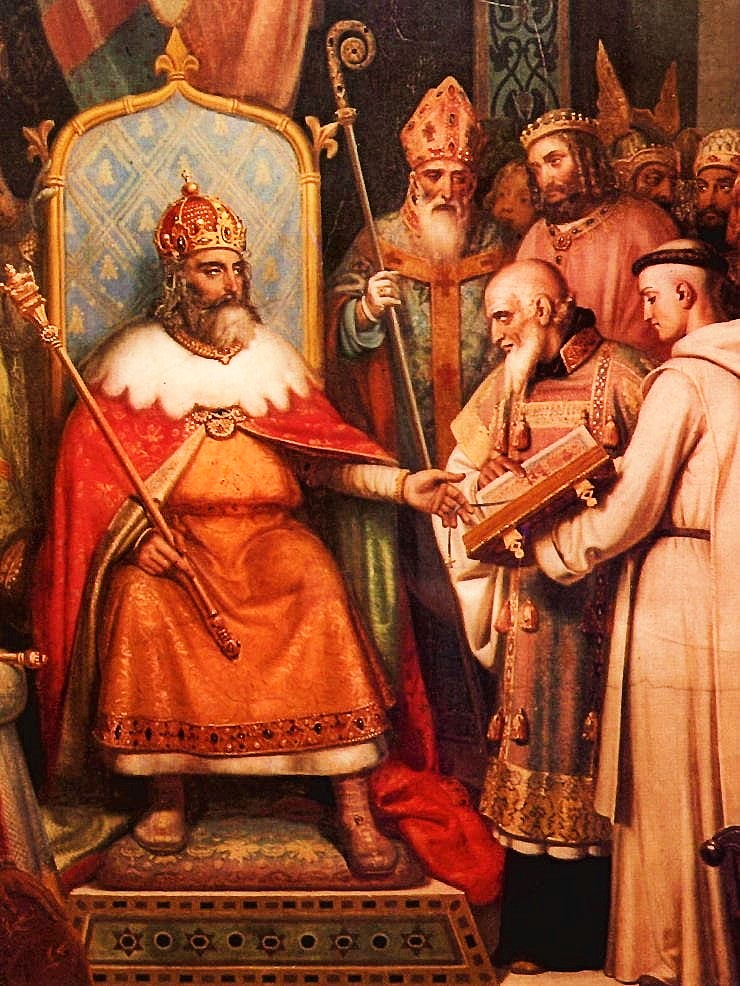
St Alcuin and King Charlemagne
At the invitation of the Blessed Charlemagne, he became a leading scholar and teacher at the Carolingian Court, where he remained a figure in the 780s and 790s. Before that, he was also a Court Chancellor in Aachen.
“The most learned man anywhere to be found,”according to Einhard’s Life of Charlemagne. This bold statement from Einhard, the Frankish scholar and Courtier to Charlemagne, is a touching assessment of Alcuin of York’s reach academically, spiritually and culturally. Alcuin is considered among the most important intellectual architects of the Carolingian Renaissance. Among his pupils were many of the dominant intellectuals of the era.
In the last half of the eighth century, Charlemagne presided over a revival of learning in the Frankish empire. Alcuin of York, a scholar Saint, was largely responsible for generating this cultural renewal – now called the Carolingian Renaissance. In 767, Alcuin became the Rector of the Minster school at York, where he had studied. An innovative educator, he improved the school, made its library one of England’s best and attracted outstanding students.
St Alcuin conferring with Charlemagne
Charlemagne brought Alcuin to Aachen in 781 and appointed him as his Ecclesiastical and Educational Adviser. Later, although Alcuin was not a Priest and probably was not a Monk, Charlemagne installed him as the Abbot of the Monastery of St Martin at Tours. As Head of the Palace school, Alcuin elevated the culture at Court and sponsored educational enterprises throughout the realm. And, under his guidance, the Abbey at Tours became famous as a centre of learning. Alcuin also won his reputation as a Theologian and Liturgist. He wrote and spoke against the Adoptionists, heretics who claimed that Jesus was God’s adopted son. And Alcuin conducted a Liturgical reform which left its mark on the Roman style of worship. He revised the Roman Lectionary, the book of readings used in worship and put together a new Sacramentary, the book of formulas for Baptism and the other Sacraments.
He also wrote verse, textbooks and innumerable letters. As Adviser to Charlemagne, he played a special role in the education of the Royal family. As the following letter to one of Charlemagne’s sons shows, he held his heirs to a high Christian ideal:
“I rejoice my dearest son, in your devoted goodwill regarding both your generous almsgiving and your gentle rule. All this surely pleases God and deserves the mercy of His perpetual blessing. Always work to the utmost for the honour of God Almighty. In goodness and piety, follow the example of your most excellent father, so that by Christ’s Divine Clemency, you may inherit is blessings.
Listen faithfully to the poor and judge their cause with absolute justice. Do not permit the judges under you to judge for presents and gifts. For Holy Scripture says, gifts blind the hearts of the wise and subvert the words of the just. Hold in honour those who are true servants of God, for some come in sheep’s clothing but inwardly, are ravening wolves. Be prudent in thought and cautious in speech. Always set your hope on God, for He never fails them whose hope is set on Him. ”
St Alcuin with Emperor Charlemagne
Many of the ideas discussed within the Court found themselves in Alcuin’s correspondence to Charlemagne, to other members of the Court and those he maintained contact with in England. His letters express his interest in a range of pressing Theological and social issues of the day. In total, he left behind around 300 Latin letters which are invaluable as a source for this early medieval period. In one particular correspondence he discusses his discovery of the sad fate of Lindisfarne’s status as a cultural and religious sanctuary, altered forever by the Viking raid in 793. He expressed his great sorrow and analysed the event as God’s punishment for the behaviour of the people of Northumbria.
For his vast efforts as an educational reformer, history recognises Alcuin as “The Schoolmaster of Europe.” He died at the Abbey of Tours in 804, some 10 years before the Emperor and was buried at St Martin’s Church under an Epitaph which partly read:
“Dust, worms and ashes now … Alcuin my name, Wisdom I always loved, Pray, reader, for my soul.”
St Alcuin of York (c735-804) Deacon, Confessor, Teacher, Founder of educational institutions in Monasteries and Cathedral Chapters. Accredited with the the invention of cursive script.
St Calocerus of Rome St Crispin of Viterbo St Cyriaca of Nicomedia and Companions St Cyril of Trèves St Dunstan of Canterbury St Evonio of Auvergne St Hadulph of Saint-Vaast Bl Humiliana de’ Cerchi
Thought for the Day – 18 May – Meditations with Antonio Cardinal Bacci (1881-1971)
The Ascension of Jesus
“After His glorious Resurrection from the dead, Jesus appeared to His Apostles. For forty days He instructed them concerning the Kingdom of God. When He had announced to His followers, that He would send the Holy Spirit to give them the enlightenment and courage to preach the Gospel, they gathered together on the Mount of Olives and saw Him rise upwards until a bright cloud hid Him from their view. The Mystery of the Ascension contains a lesson for us. We must be detached from the world and brought closer to Heaven, which is our true home. We are so attached to earthly things because money, reputation and pleasure are closer to our hearts than the thought of God or of eternity. We shall have to leave all these things behind soon enough, however. When death comes, the world will slip away from us and the soul will stand alone before God.
Let us begin to detach ourselves from worldly affairs and to make Heaven the object of our desires. Why should we be sorry or afraid, or both, to leave this earth? Remember the teaching of St Paul “Here we no permanent city but we seek for the city that is to come” (Heb 13:14). “For me to live is Christ,” he said, “and to die is gain” (Phil 1:21). “desiring to depart and to be with Christ, a lot by far the better” (Phil 1:23).
Let us pray in the beautiful words of the Church: “Lord, grant that while we are living in this changing world, we may aspire to the true happiness of Heaven, so that in the midst of earthly vicissitudes, our hearts maybe content in this ambition.” (Roman Breviary).
Let us not be afraid of death, for it is only the Gate of Heaven!”
Quote/s of the Day –18 May – The Ascension of the Lord
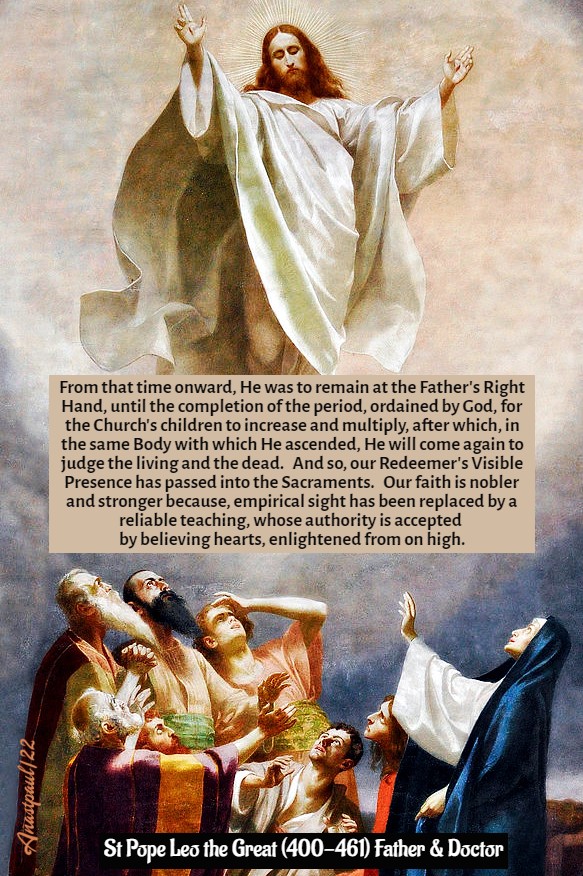
“From that time onward, He was to remain at the Father’s Right Hand, until the completion of the period, ordained by God, for the Church’s children to increase and multiply, after which, in the same Body with which He ascended, He will come again to judge the living and the dead. And so, our Redeemer’s Visible Presence has passed into the Sacraments. Our faith is nobler and stronger because, empirical sight has been replaced by a reliable teaching, whose authority is accepted by believing hearts, enlightened from on high.”
St Leo the Great (400-461) Pope , Great Father and Doctor of the Church
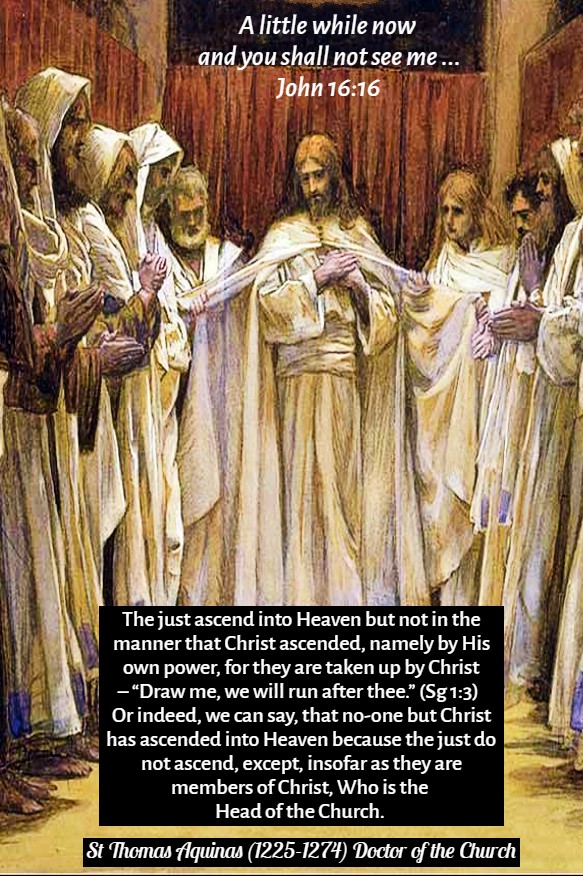
“… The just ascend into Heaven but not in the manner that Christ ascended, namely by His own power, for they are taken up by Christ – “Draw me, we will run after thee.” (Sg 1:3) Or indeed, we can say, that no-one but Christ has ascended into Heaven because the just do not ascend, except, insofar as they are members of Christ, Who is the Head of the Church. … ”
St Thomas Aquinas (1225-1274) Doctor Angelicus/Doctor Communis
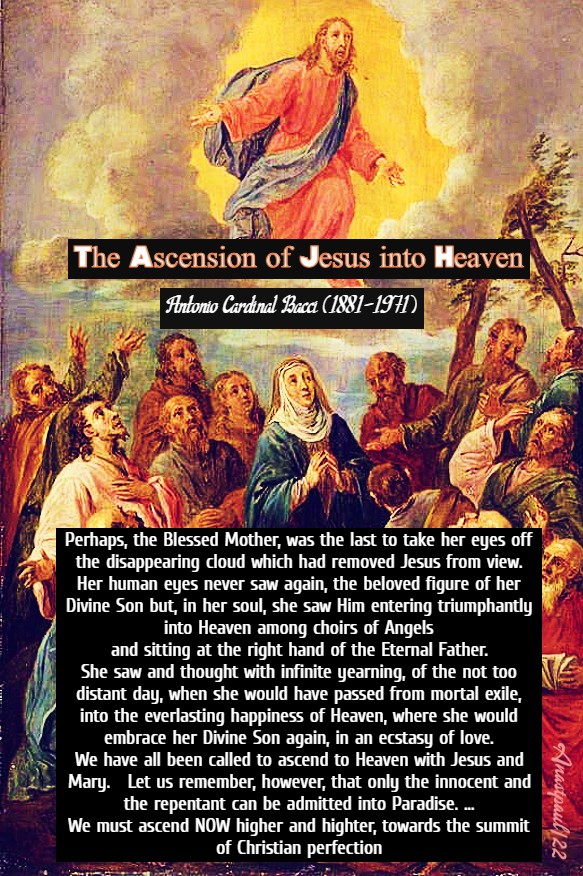
“Perhaps, the Blessed Mother, was the last to take her eyes off the disappearing cloud which had removed Jesus from view. Her human eyes never saw again, the beloved figure of her Divine Son but, in her soul, she saw Him entering triumphantly into Heaven among choirs of Angels and sitting at the right hand of the Eternal Father. She saw and thought with infinite yearning, of the not too distant day, when she would have passed from mortal exile, into the everlasting happiness of Heaven, where she would embrace her Divine Son again, in an ecstasy of love.
We have all been called to ascend to Heaven with Jesus and Mary. Let us remember, however, that only the innocent and the repentant can be admitted into Paradise!”
One Minute Reflection – 18 May – The Ascension of the Lord – Acts 1:1-11, Mark 16:14-20 – Scripture search here: https://www.drbo.org/
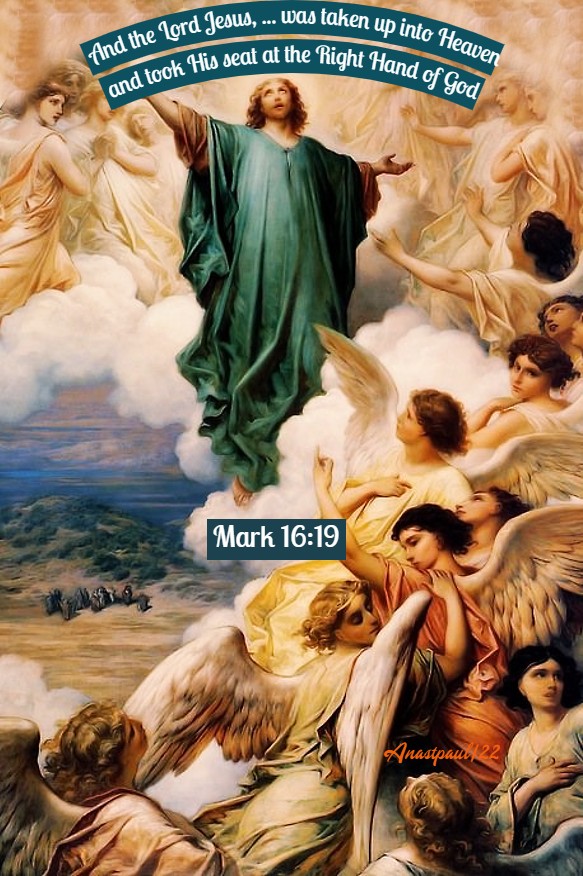
“And the Lord Jesus, after He spoke to them, was taken up into Heaven and took His seat at the Right Hand of God.” – Mark 16:19
REFLECTION – “Father, all those Thou gave Me, I would have in My company where I Am, to see this glory of Mine.” (Jn 17:24) Happy are they who now have, as their Advocate before God, their Judge in person; happy are they, who have interceding for them, the One Whom we must adore, equally with the Father, to Whom He Himself addresses this prayer. The Father cannot refuse to grant this desire which His Lips expressed (Ps 21:3), for He is united with Him in His Will, in His Power, since He is One and the Same God… “All those Thou gave Me I would have in My company where I Am.” What assurance for those who have faith, what confidence for the believers! … The saints, whose “youth is renewed like the eagle’s” (Ps 103:5) “soar as with eagles’ wings.” (Isa 40:31) …
On that day, Christ “was lifted up before the eyes of the disciples in a cloud which took him from their sight.” (Acts 1:9) … He strove to draw their hearts to follow Him, by making Himself loved by them and He promised them, through the example of His Body that their body could be lifted up in the same way… Today, Christ in truth “mounted a cherub and flew, borne on the wings of the wind,” (Ps 18:11) which is to say, He goes beyond the power of the Angels. And yet, in His condescendence before your weakness, “as an eagle… hovering over its brood,” He wants to “receive you and to bear you up on His pinions.” (Deut 32:11) … Some people fly with Christ by means of contemplation; for you, let it at least be through love!
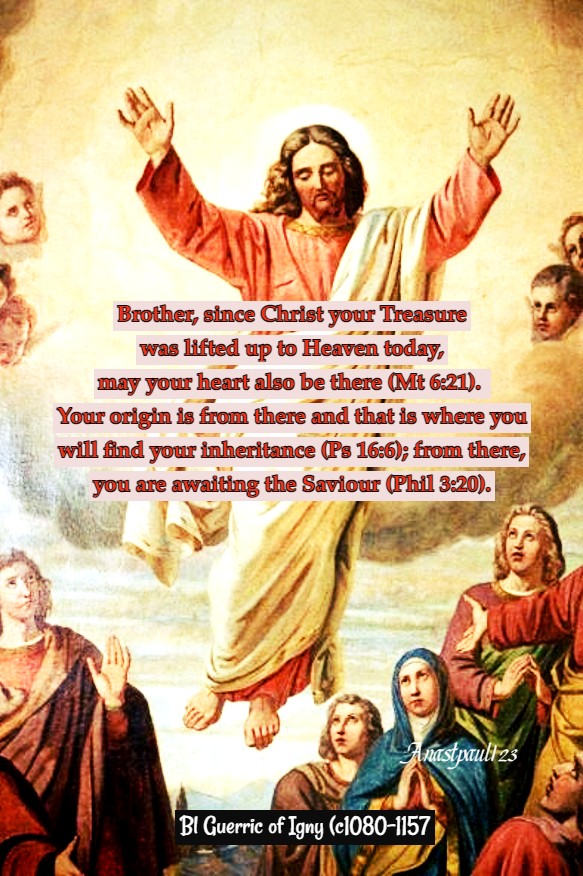
Brother, since Christ your Treasure was lifted up to Heaven today, may your heart also be there (Mt 6:21). Your origin is from there and that is where you will find your inheritance (Ps 16:6); from there, you are awaiting the Saviour (Phil 3:20).” – Blessed Guerric of Igny (c1080-1157) Cistercian Abbot (Sermon for the Ascension).
PRAYER – Grant, we beseech Thee, Almighty God, that as we do believe Thine Only-Begotten Son, our Saviour to have this day ascended into the heavens, so we may also in heart and mind, ascend and with Him continually dwell. Through the same Jesus Christ, Thy Son our Lord, Who lives and reigns with Thee, in the unity of the Holy Ghost, God, world without end. Amen (Collect).
Our Morning Offering – 18 May – The Ascension of the Lord
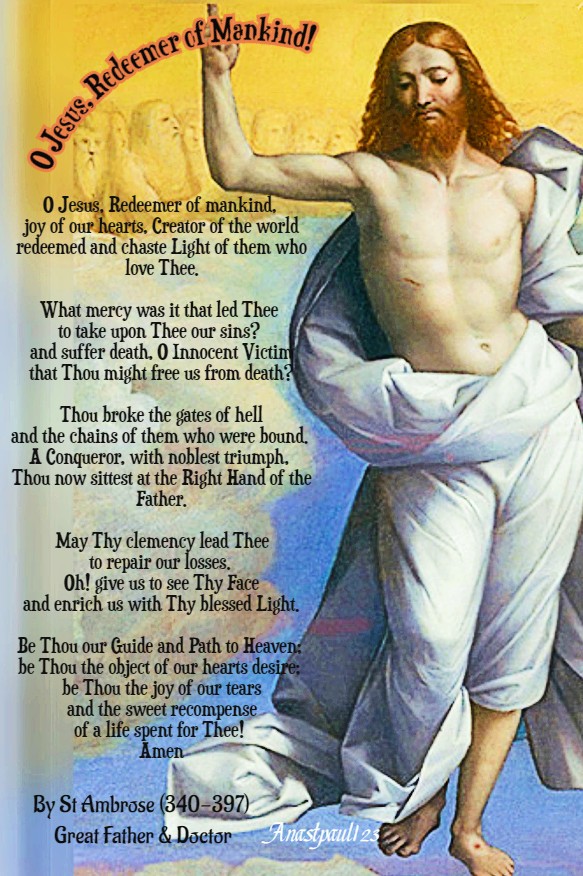
O Jesus, Redeemer of Mankind! By St Ambrose (340-397) Great Father & Doctor
O Jesus, Redeemer of mankind, joy of our hearts, Creator of the world redeemed and chaste Light of them who love Thee.
What mercy was it that led Thee to take upon Thee our sins? and suffer death, O Innocent Victim that Thou might free us from death?
Thou broke the gates of hell and the chains of them who were bound. A Conqueror, with noblest triumph, Thou now sittest at the Right Hand of the Father.
May Thy clemency lead Thee to repair our losses. Oh! give us to see Thy Face and enrich us with Thy blessed Light.
Be Thou our Guide and Path to Heaven; be Thou the object of our hearts desire; be Thou the joy of our tears and the sweet recompense of a life spent for Thee! Amen
Saint of the Day – 18 May – Blessed Nicholas Denise of Beuzeville OFM (Died 1509) Priest, renowned Preacher and Friar of the Order of Friars Minor, Vicar General if tge Diocese of Coutance, France. The Blessed Father Nicholas became a noted preacher in the region, and many of his sermons and theological writings have survived.
We have no information of Nicholas’ early life besides knowing that he had received a very good education. He became a Canon of the Cathedral of Coutance and then was appointed as the Vicar General ar of Bishop Goffred.
Finding himself increasingly drawn to the life of St Francis, he abandoned his role under Bishop of Coutance in order to follow in the footsteps of Saint Francis, wearing the Habit of the Minor Friars, in the Convent of Valognes.
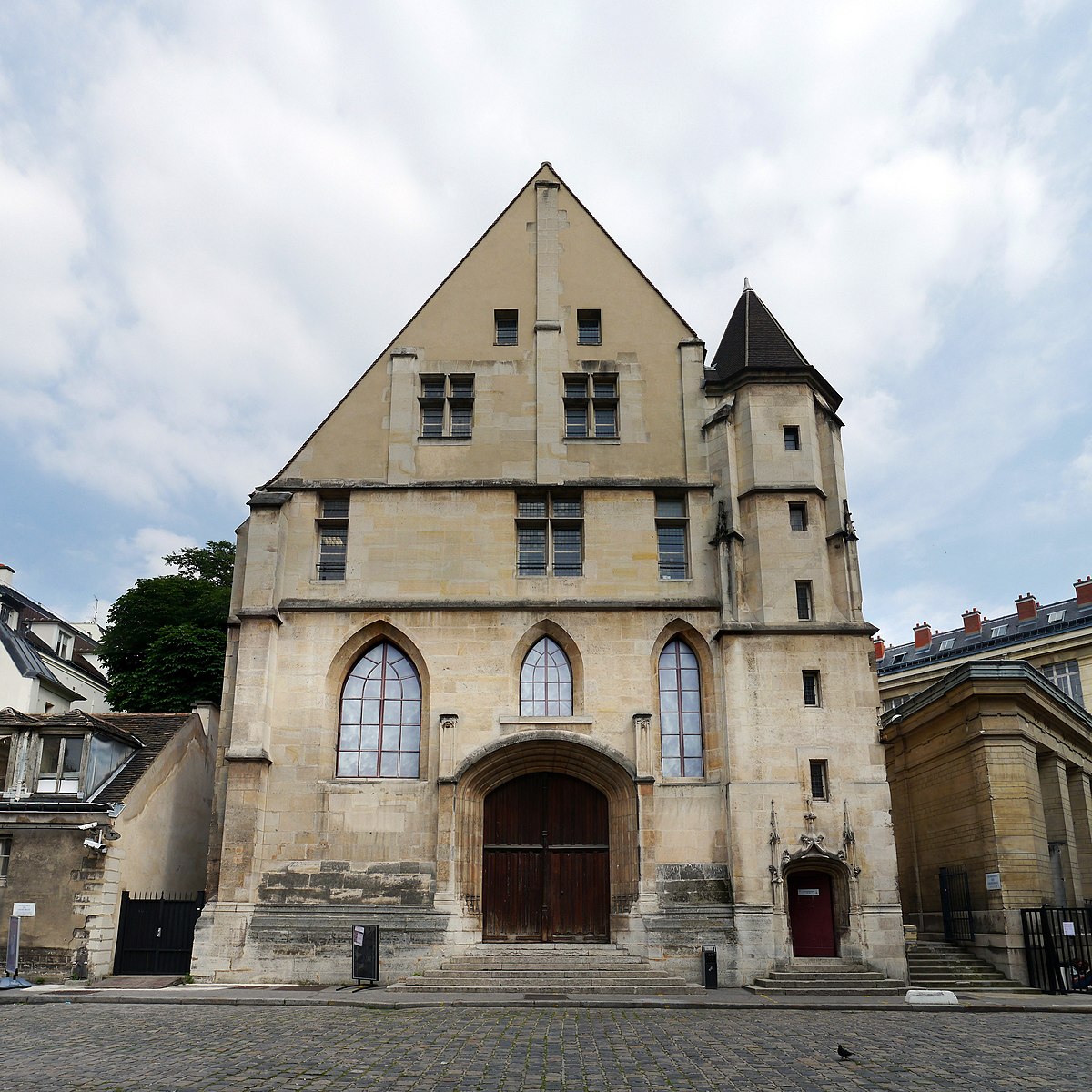
A Franciscan Convent in Paris
In the congregation he became the Vicar-Provincial of the Parisian Province and did not support General Egidius Delphin, in his questionable project of re-unification of the Franciscan Order.
An educated man and a famous preacher, he was considered a saint by all. He died in 1509, while holding the position of Guardian of the Convent of Rouen. Upon his death, his tomb became the object of great demonstrations of popular veneration.
Various sermons and various theological works by Blessed Nicholas are preserved. In the Franciscan Martyrologies, the feast and remembrance for Father Nicola Denise of Beuzeville is fixed for today, 18 May.
St Felix of Spoleto St Feredarius of Iona St Merililaun Blessed Nicholas Denise of Beuzeville OFM (Died 1509) St Ortasio of Alexandria St Potamon of Heraclea St Serapione of Alexandria
Martyrs of Ancyra – 8 Saints: Seven nuns Martyred in the persecutions of Diocletian and the innkeeper who was executed for giving them a Christian burial: Alexandria, Claudia, Euphrasia, Julitta, Matrona, Phaina, Thecusa and Theodatus. c.304 in Ancyra, Galatia (in modern Turkey).
“We ought to pray and invoke the Holy Spirit, for each one of us greatly needs His protection and His help. The more we are lacking in wisdom, weak in strength, burdened with trouble, prone to sin, the more we should turn to Him, Who is the never-ceasing Fount of Light, Strength, Consolation and Holiness.”
St Pope Leo the Great (400-461) Father and Doctor of the Church
Thought for the Day – 17 May– Meditations with Antonio Cardinal Bacci (1881-1971)
Living in the Presence of God
“The masters of the spiritual life advise us to the best way to cultivate an awareness of the presence of God (Cf St Alphonsus Liguori, Al Divino Servizio, III, 3). This may be done by employing the intellect to form the concept of God’s nearness and by using the will, to offer to Him, ourselves and everything around us, with acts of humility, adoration and love. The intellect, enlightened by faith, tells us that God is everywhere, “Do not I fill heaven and earth? said the Lord” (er 23:24). We should see Him in all His creations which reflect His eternal glory. “Learn to love the Creator in the creature” says St Augustine, “so that you may not become attached to created things and so lose Him by Whom, you yourself were created” (In Px 18).
When we wish to revive, in our minds, a sense of the presence of God, we should not picture Him as a distant Being but, as our own God, Who condescended to dwell within us. We should then listen to His inspirations and humbly venerate His Divine Majesty, which resides in our souls. “Do you not know,” says St Paul, “that you are the temple of God and that the Spirit of God dwells in you?” (1 Cor 3:16). God is everywhere but He dwells in a special manner, in our souls. It is difficult for us, however, to live with our minds constantly concentrated on Him. If we were able to do so, this would be an anticipation of the happiness of the Blessed in Heaven. But, we should have a habitual intention, which we should renew as often as possible, of living in the presence of God and of offering Him all our desires and actions. Then, our whole life will be a continual prayer of great value in the sight of God.
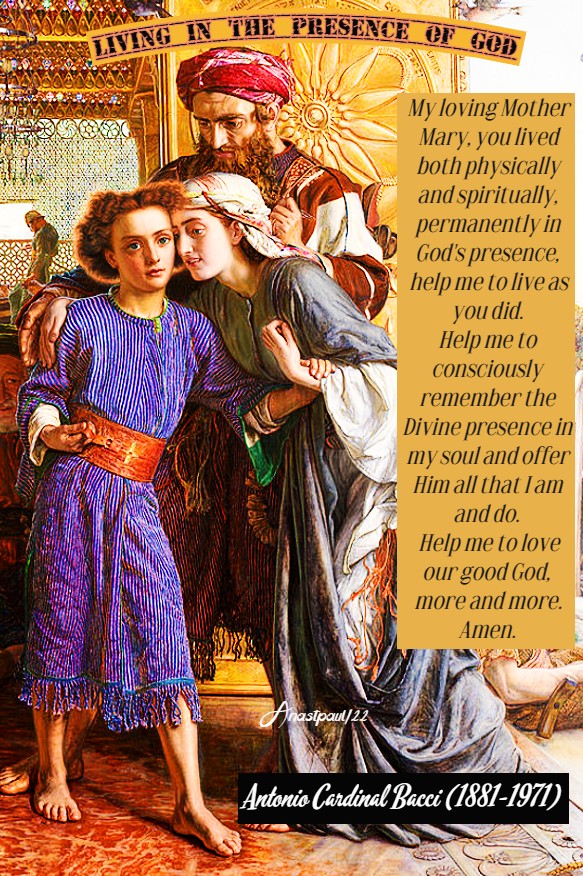
My loving Mother Mary, you lived both physically and spiritually, permanently in God’s presence, help me to live as you did. Help me to consciously remember the Divine presence in my soul and offer Him all that I am and do. Help me to love our good God, more and more. Amen.”
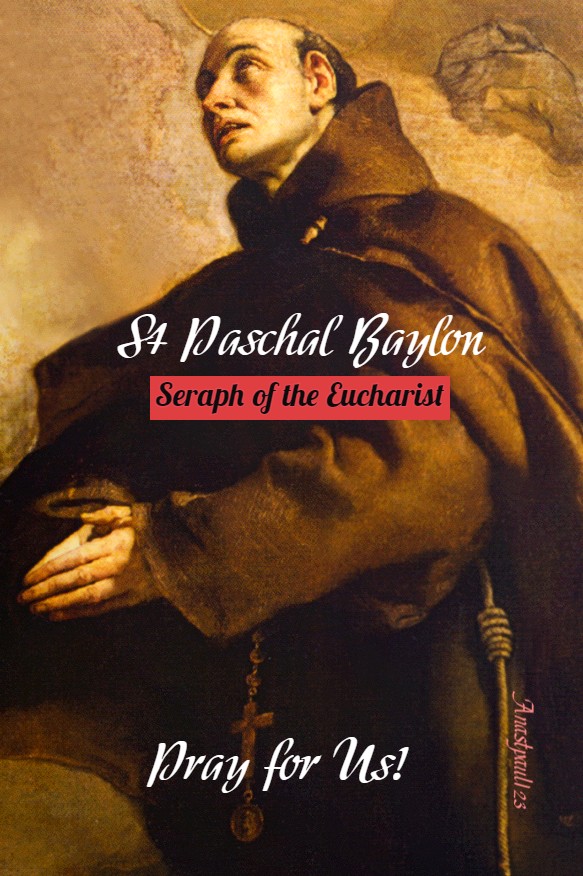
Quote/s of the Day – 17 May – The Memorial of St Paschal Baylon OFM (1540-1592) Confessor, “Seraph of the Eucharist,” “Saint of the Blessed Sacrament,” “Servant of the Blessed Sacrament.” Franciscan Lay Brother.
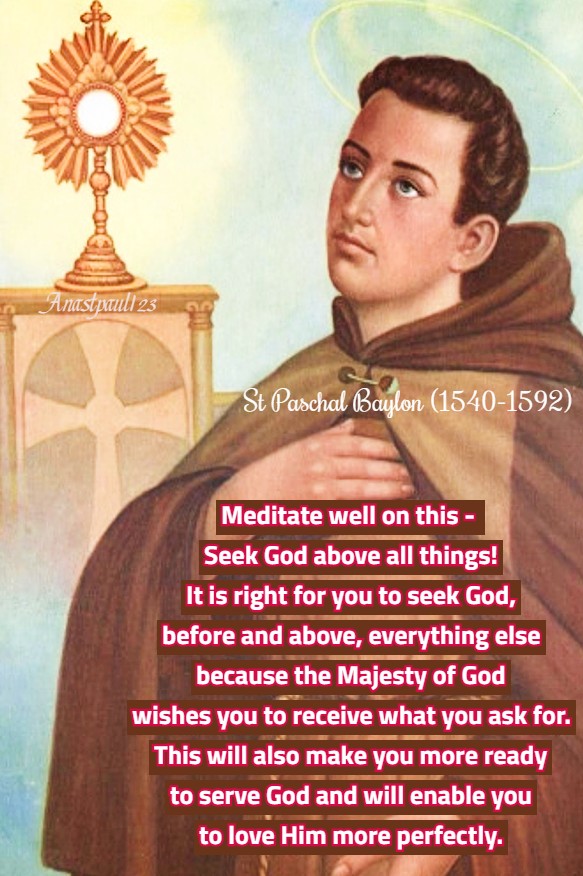
“Meditate well on this – Seek God above all things! It is right for you to seek God, before and above, everything else because the Majesty of God wishes you to receive what you ask for. This will also make you more ready to serve God and will enable you to love Him more perfectly.”
One Minute Reflection – 17 May – The Vigil of Ascension and the Memorial of St Paschal Baylon OFM (1540-1592) Confessor – Sirach 31:8-11, Luke 12:35-40 – Scripture search here: https://www.drbo.org/
“Stay dressed for action and keep your lamps burning and be like men who are waiting for their master to come home from the wedding feast, so that they may open the door to him at once when he comes and knocks.” – Luke 12:35-36
REFLECTION – “God, the Word, stirs up the lazy and arouses the sleeper. For indeed, someone who comes knocking at the door is always wanting to come in. But it depends on us, if He does not always enter, or always remain. May your door be open to Him Who comes; open your soul, enlarge your spiritual capacities, that you may discover the riches of simplicity, the treasures of peace and sweetness of grace. Expand your heart; run to meet the Sun of that Eternal Light that “enlightens everyone” (Jn 1,9). It is certain that this true Light shines for all but, if anyone shuts their windows, then they themselves shut themselves off from this Eternal Light.
So, even Christ remains outside, if you shut the door of your soul. It is true that He could enter but He does not want to use force, He does not put those who refuse under pressure. Descended from the Virgin, born from her womb, He shines throughout the universe to give Light to all. Those who long to receive the Light, which shines with an everlasting brightness, open up to Him. No night comes to intervene. Indeed, the sun we see each day gives way to night’s darkness but the Sun of Justice (Mal 3,20) knows no setting for Wisdom is not overcome by evil.” – St Ambrose (340-397) Bishop of Milan and Father and Doctor of the Church – 12th Sermon on Psalm 118
PRAYER – O God, Who endowed blessed Paschal, Your Confessor, with a wondrous love for the Sacred Mysteries of Your Body and Blood, mercifully grant that we may be found worthy to share in the same spiritual abundance, which he received in this Divine Banquet. Who lives and reigns with God the Father, in the unity of the Holy Ghost, God, world without end. Amen (Collect).
Our Morning Offering – 17 May – The Vigil of the Ascension
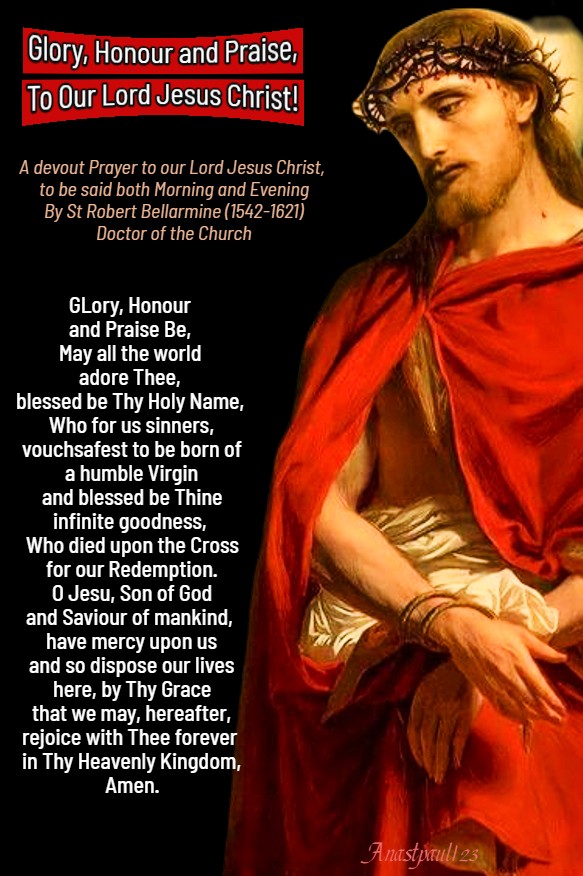
Glory, Honour and Praise, To Our Lord Jesus Christ! A devout Prayer to our Lord Jesus Christ, to be said both Morning and Evening By St Robert Bellarmine (1542-1621) Doctor of the Church (From His “A Brief Christian Doctrine”)
GLory, Honour and Praise Be, May all the world adore Thee, blessed be Thy Holy Name, Who for us sinners, vouchsafest to be born of a humble Virgin and blessed be Thine infinite goodness, Who died upon the Cross for our Redemption. O Jesu, Son of God and Saviour of mankind, have mercy upon us and so dispose our lives here, by Thy Grace that we may, hereafter, rejoice with Thee forever in Thy Heavenly Kingdom, Amen.
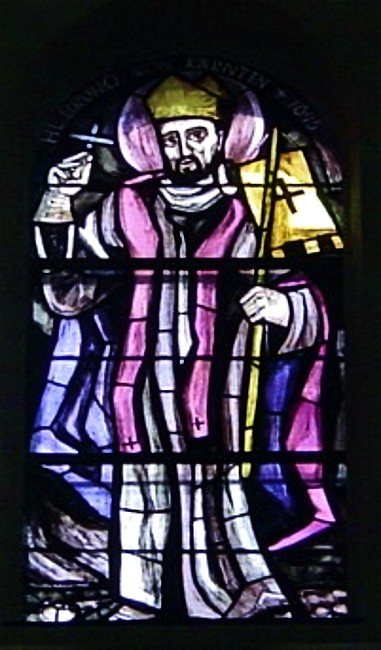
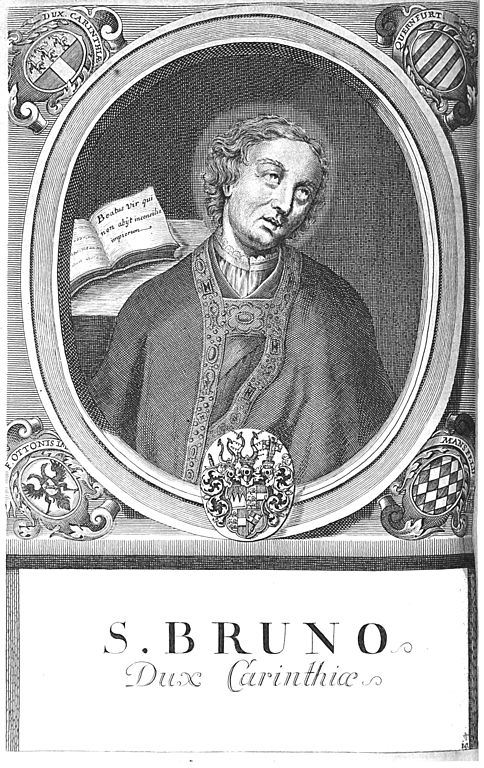
Saint of the Day – 17 May – St Bruno of Würzburg (c1005-1045) Bishop and Confessor, Prince, Imperial Chancellor of Italy from 1027 to 1034.
Bruno, son of Conrad I of Carinthia and cousin of Emperor Conrad II, was probably educated in Salzburg. He was a member of the Royal Chapel, the Imperial Chancellor of Italy and an intimate adviser of Conrad II and Emperor Henry III, before being elected Bishop of Würzburg. He also accompanied Henry on his second Hungarian Campaign.
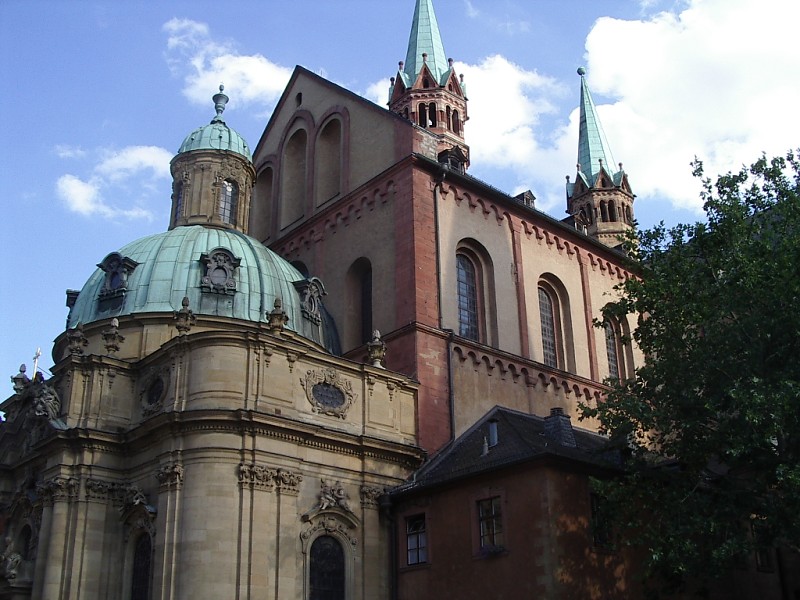
Bruno rebuilt the existing Cathedral, constructed many new churches and improved education, to which purpose he composed a well-known exegesis on the Psalms to which he appended an analysis of ten Biblical hymns, consisting of extracts from the writings of the Church Fathers. Under his direction the Cathedral school flourished.
In 1040 Bruno began the construction of Würzburg Cathedral. The Consecration of the Cathedral on 16 June 1045 was combined with his burial. Bruno died accidentally, en route to Hungary with Henry III and was buried in Würzburg Cathedral crypt. Below is the interior and exterior of the Cathedral.
His cult spread in Germany, and though never formally Canonised, he appears in the Roman Martyrology of 1616.
St Madron of Cornwall St Maildulf of Malmesbury St Maw
St Paul of Noviodunum Bl Peter Lieou St Rasso of Grafrath St Restituta of Carthage St Silaus of Lucca St Solochanus of Chalcedon St Thethmar St Victor Roma
Martyrs of Alexandria – 3 Saints: Three Christians Martyred together; no details about them have survived except their names: Adrio, Basilla and Victor. 4th century Alexandria, Egypt.
Martyrs of Nyon: A group of Christians Martyred together in the persecutions of Diocletian. We know little more than three of their names: Aquilinus, Heradius and Paul. 303 at Noyon, Switzerland.
My little rest and battery charging plans were certainly not meant to be, for within a day of signing off and waving you all goodbye, I became ill with a horrid cold which turned into a bronchial episode. Then the rest of the family too fell victim to this violent ‘change-of-season’ cold.
And now, it is nearly Ascension Thursday and I am still struggling to regain full strength. BUT, I will be back shortly (by Wednesday or Thursday), God willing and with the help of your prayers, for which I thank and bless you 🙏🤗
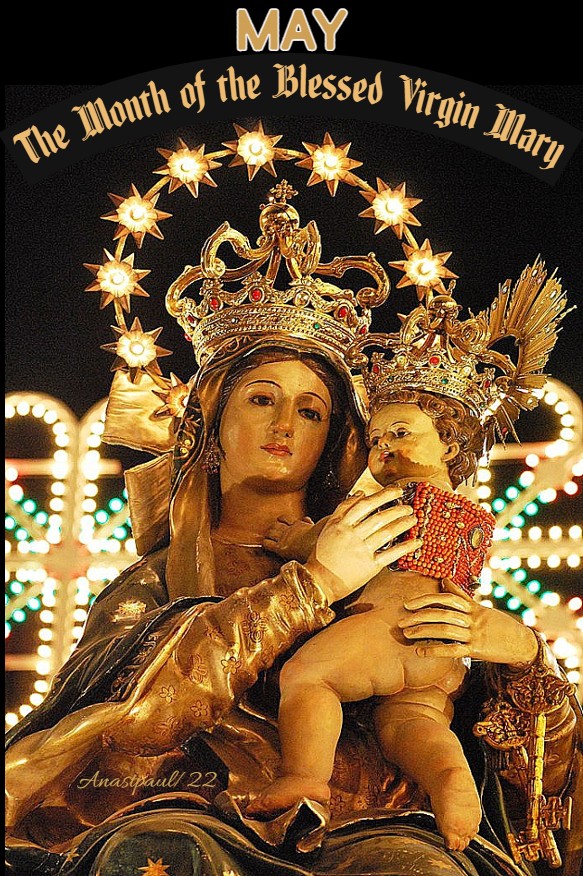
It’s 1 May Let us Rejoice in our Mother Mary! The Month of the Blessed Virgin Mary
“Bright Mother of our Maker, Hail! Thou Virgin ever blest, the Ocean’s Star by which we sail and gain the port of rest!” (Anonymous 8th Century Latin Hymn)
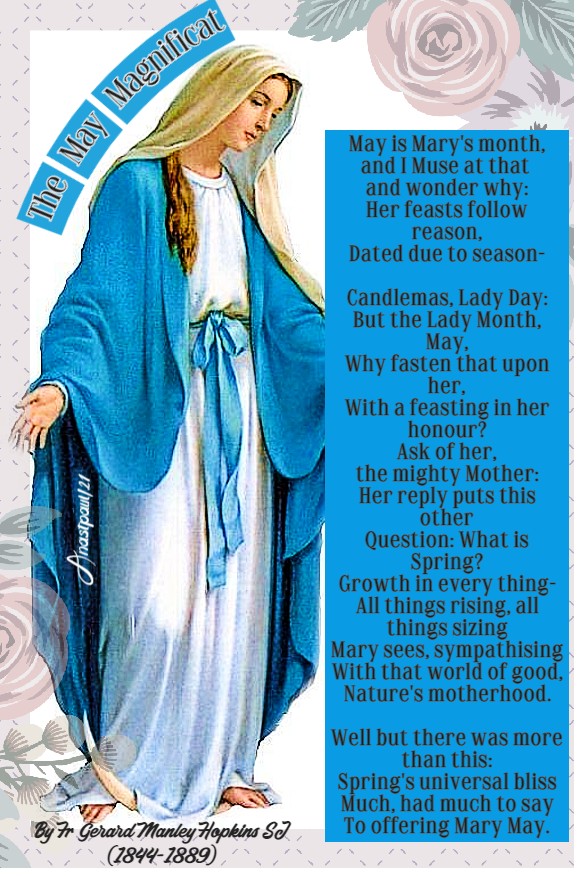
The May Magnificat By Gerard Manley Hopkins SJ (1844-1889)
May is Mary’s month and I Muse at that and wonder why: Her feasts follow reason, Dated due to season-
Candlemas, Lady Day: But the Lady Month, May, Why fasten that upon her, With a feasting in her honour? Ask of her, the mighty Mother: Her reply puts this other Question: What is Spring? Growth in everything- All things rising, all things sizing Mary sees, sympathising With that world of good, Nature’s motherhood.
Well but there was more than this: Spring’s universal bliss Much, had much to say To offering Mary May.
Visits to the Altar of Our Lady On the Love of Mary for Her Children (Imprimatur, 1867)
Mary loves us because we are her children. A loving and tender Mother is never wearied by the importunities of her little ones and Mary, who is the most loving and tender of all mothers, will never weary of hearing and answering our petitions. The one great thing that she desires, for all her children is that they should become like her Son Jesus. He is the only Child who never disobeyed her or grieved her. It is for His love that she loves us. How great must be His love for us, when He inspires Mary with such a love! The best return we can make Him is to have a perfect trust and confidence in His Blessed Mother. Those who are not devout to Mary cannot really understand the great Mystery of the Incarnation and do not love Jesus as they should – for, if they loved Him, they would love His Mother too, even a tiny bit as much as He loves her.
Let us try, then, during this Month of May, to become more like Jesus. Let us consider what spiritual grace we need most, in order to attain this great end and let us ask it with confidence everyday. Let us also try to induce others, to honour Mary, by special devotion to her during this most beautiful month.
Let Me Love Your Jesus By St Ildephonsus (c 607-670)
Virgin Mary, hear my prayer, through the Holy Spirit, you became the Mother of Jesus, from the Holy Spirit, may I too have Jesus. Through the Holy Spirit, your flesh conceived Jesus, through the same Spirit, may my soul receive Jesus. Through the Holy Spirit, you were able to know Jesus, to possess Jesus and to bring Him into the world. Through the Holy Spirit, may I too come to know your Jesus. Imbued with the Spirit, Mary, you could say “I am the handmaid of the Lord, be it done unto me according to your word,” in the Holy Spirit, lowly as I am, let me proclaim the great truths about Jesus. In the Spirit, you now adore Jesus as Lord and look on Him as Son, in the same Spirit, Mary, let me love your Jesus. Amen
Thought for the Day – 30 April – Meditations with Antonio Cardinal Bacci (1881-1971)
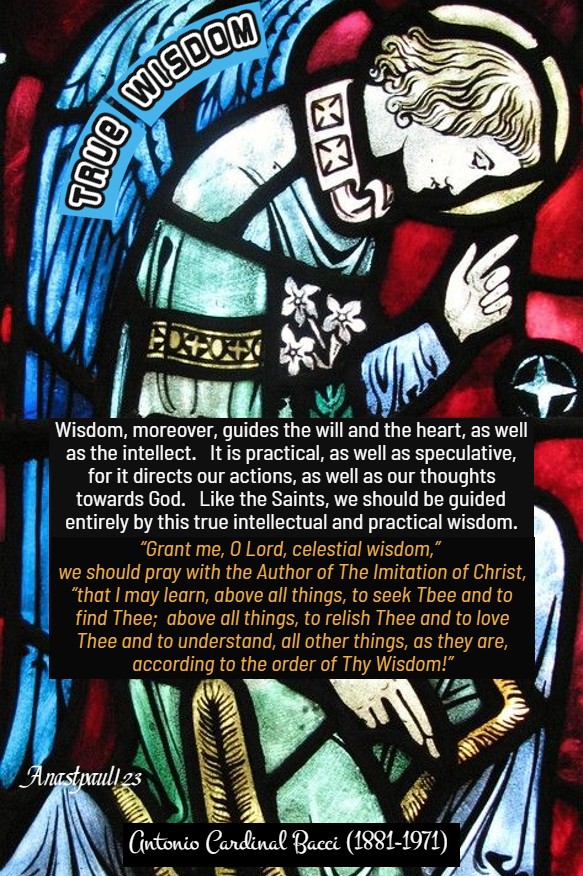
TRUE WISDOM
“According to Christian teaching, both knowledge and wisdom, properly understood, are gifts of the Holy Spirit. Only the Light and Grace of the Holy Spirit, can enable us to comprehend the Truth which, in its plenitude, is God Himself and to appreciate the vanity of human things, as long as they are not ordained to their final end which is God and the everlasting life of happiness.
St Thomas Aquinas holds that human and earthly things are the proper object of science, insofar however, as they ought to be directed towards God. “The man who has a correct approach to science, regards creatures as ordained to God, does not value them for more than they are worth and does not permit them to constitute the purpose of his life” (Summa Theologiae II-II q9 a4). “All creatures are ordained to God and to His glory,” he writes elsewhere, “in that they manifest the Divine Goodness in themselves; they are, moreover, the means to everlasting happiness” (Quaestiones disputate, De Caritate q1 a7).
Nature maybe said to be a sacrament which enables us to gain experience of God (Summa Theologiae III q60 a2 ad1). This is how knowledge becomes wisdom which is not content merely to have a proper estimation of human objects but, proceeds to penetrate, with the assistance of Revelation and of Grace, into the transcendent Mysteries of the Divinity. Wisdom, moreover, guides the will and the heart, as well as the intellect. It is practical, as well as speculative, for it directs our actions, as well as our thoughts towards God. Like the Saints, we should be guided entirely by this true intellectual and practical wisdom. “Grant me, O Lord, celestial wisdom,” we should pray with the Author of The Imitation of Christ, “that I may learn, above all things, to seek Tbee and to find Thee; above all things, to relish Thee and to love Thee and to understand, all other things, as they are, according to the order of Thy Wisdom!” (Bk III c27).”
Quote/s of the Day –30 April – Prayers by St Catherine of Siena (1347-1380)
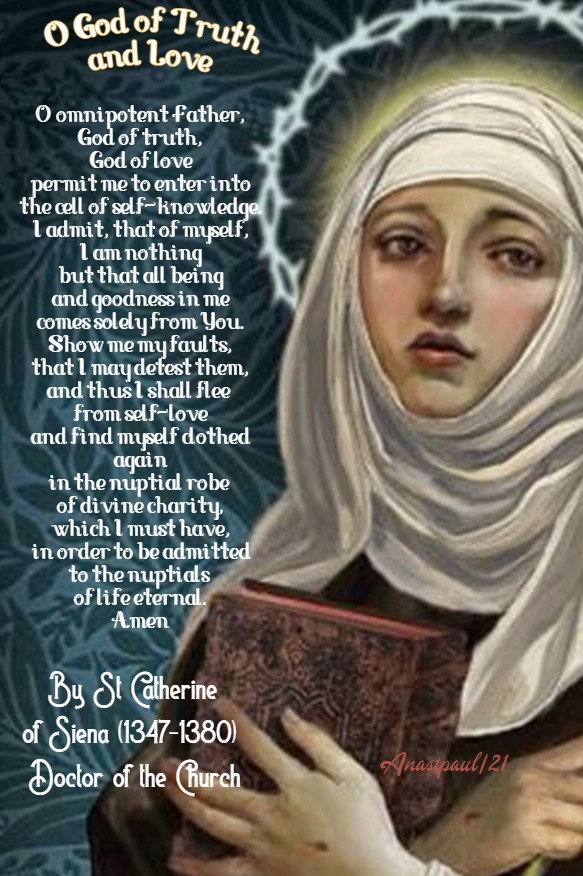
O God of Truth and Love
O omnipotent Father, God of truth, God of love permit me to enter into the cell of self-knowledge. I admit, that of myself, I am nothing but that all being and goodness in me comes solely from You. Show me my faults, that I may detest them, and thus I shall flee from self-love and find myself clothed again in the nuptial robe of divine charity, which I must have, in order to be admitted to the nuptials of life eternal. Amen
Holy Trinity, Holy Love
Holy Spirit, come into my heart; draw it to Thee by Thy power, O my God, and grant me charity with filial fear. Preserve me, O beautiful love, from every evil thought, warm me, inflame me with Thy dear love and every pain will seem light to me. My Father, my sweet Lord, help me in all my actions. Jesus, love, Jesus, love. Amen.
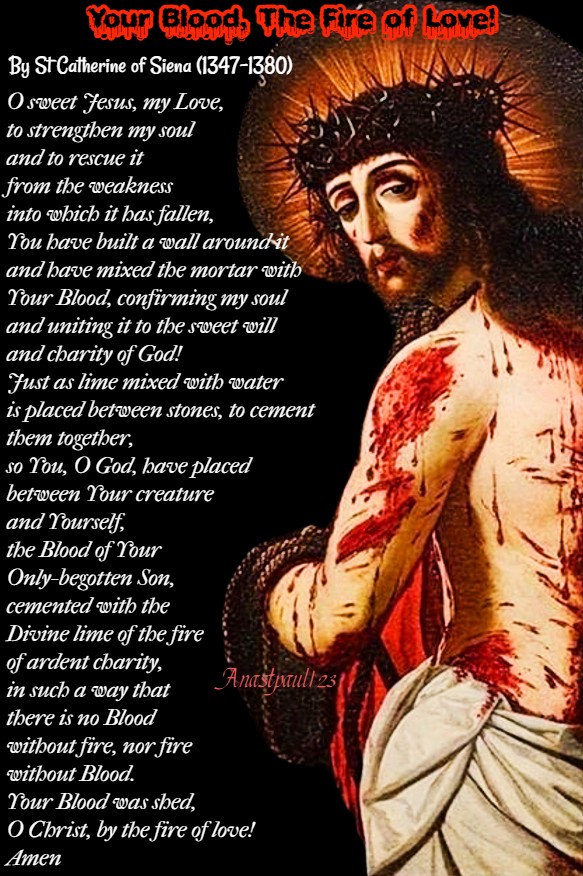
Your Blood, The Fire of Love!
O sweet Jesus, my Love, to strengthen my soul and to rescue it from the weakness into which it has fallen, You have built a wall around it and have mixed the mortar with Your Blood, confirming my soul and uniting it to the sweet will and charity of God! Just as lime mixed with water is placed between stones, to cement them together, so You, O God, have placed between Your creature and Yourself, the Blood of Your Only-begotten Son, cemented with the Divine lime of the fire of ardent charity, in such a way that there is no Blood without fire, nor fire without Blood. Your Blood was shed, O Christ, by the fire of love! Amen
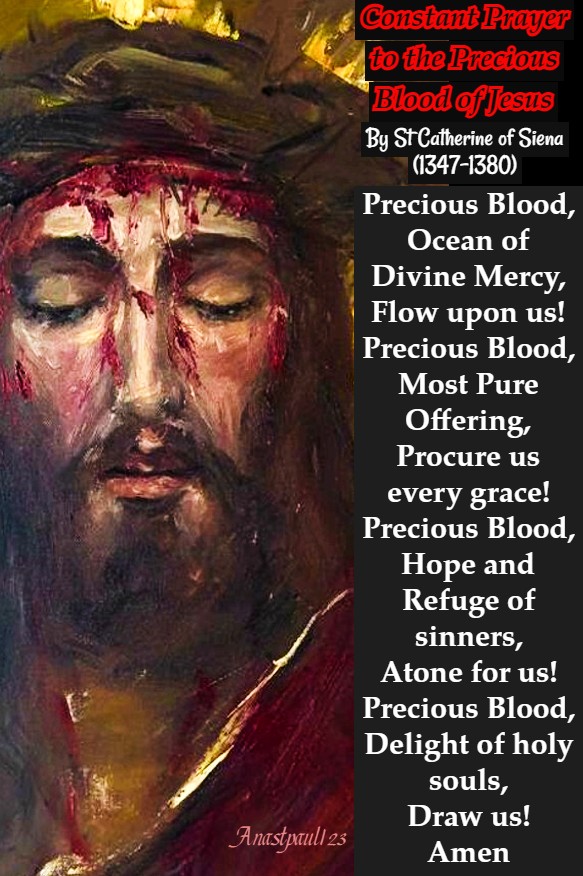
Constant Prayer to the Precious Blood of Jesus
Precious Blood, Ocean of Divine Mercy, Flow upon us! Precious Blood, Most Pure Offering, Procure us every grace! Precious Blood, Hope and Refuge of sinners, Atone for us! Precious Blood, Delight of holy souls, Draw us! Amen
One Minute Reflection – 30 April – EASTER III – St Catherine of Siena OP (1347-1380) Virgin – 1 Peter 2:11-19, John 16:16-22 – Scripture search here: https://www.drbo.org/
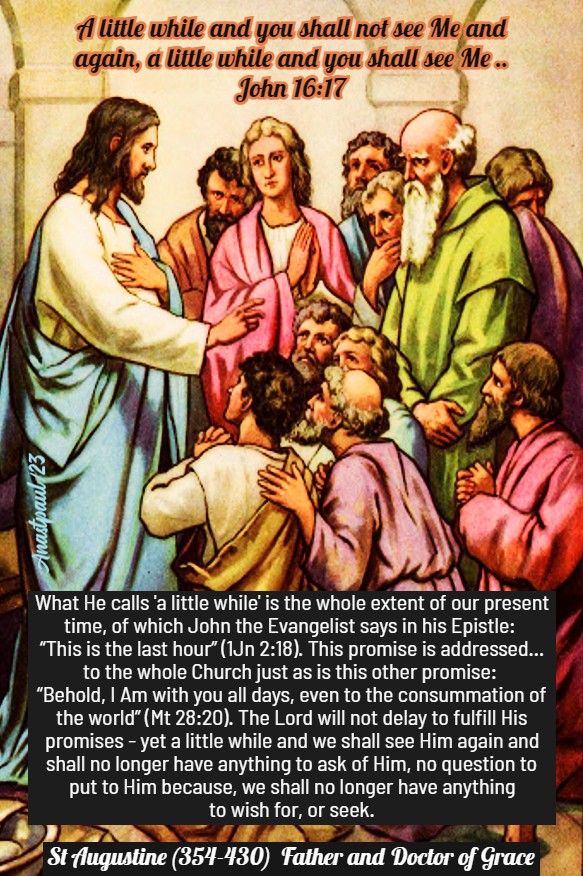
“A little while and you shall not see Me and again, a little while and you shall see Me …” – John 16:17
REFLECTION – “The Lord said: “A little while and you shall not see Me and again a little while and you shall see Me” (Jn 16:16). What He calls ‘a little while’ is the whole extent of our present time, of which John the Evangelist says in his Epistle: “This is the last hour” (1Jn 2:18). This promise is addressed… to the whole Church just as is this other promise: “Behold, I Am with you all days, even to the consummation of the world” (Mt 28:20). The Lord will not delay to fulfill His promises – yet a little while and we shall see Him again and shall no longer have anything to ask of Him, no question to put to Him because, we shall no longer have anything to wish for, or seek.
This “little while” seems long to us because it is still in process of taking place. But when it has come to an end, then we shall feel how short it was. So let our joy differ from that of the world, of which it is said that: “The world will rejoice.” In the birth pangs of this longing, let us not be without joy. Yet, as the Apostle Paul says: “Rejoice in hope, endure in affliction” (Rom 12:12). For the woman giving birth – to whom the Lord compares us – takes far more joy in the child she is about to bring into the world,than she feels sorrow at her own suffering.” – St Augustine (354-430) Bishop, Father and Doctor of Grace (Sermons on Saint John’s Gospel No 101).
PRAYER – Grant, we beseech Thee, O Almighty God, that we which do keep the birthday of Thy blessed Virgin Catherine and do year by year renew her memorial with solemn gladness in Thy presence, may likewise be conformed to the pattern of her saintly walk with Thee. Through Jesus Christ, Thy Son our Lord, Who lives and reigns with Thee, in the unity of the Holy Ghost, God, world without end. Amen (Collect).
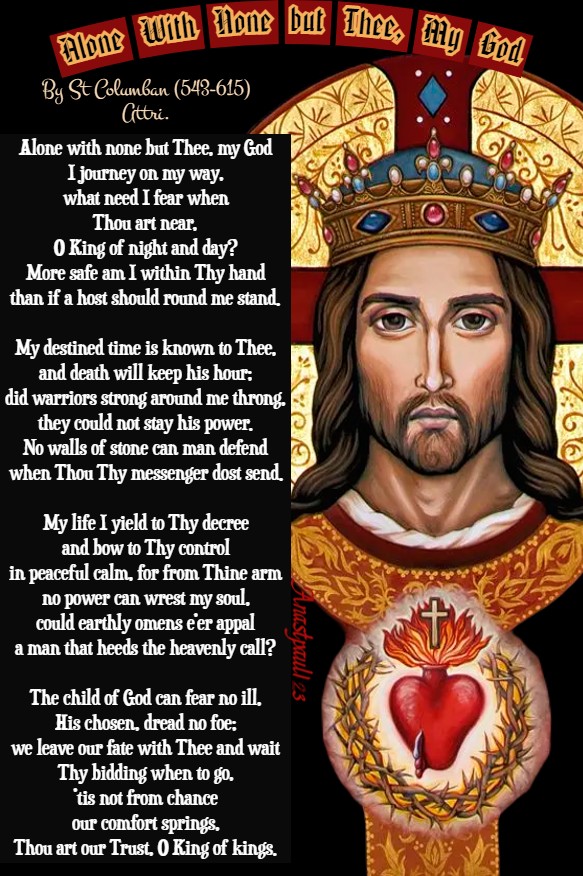
Alone With None but Thee, My God Attri. St Columban (543-615)
Alone with none but Thee, my God I journey on my way, what need I fear when Thou art near, O King of night and day? More safe am I within Thy hand than if a host should round me stand.
My destined time is known to Thee, and death will keep his hour; did warriors strong around me throng, they could not stay his power. No walls of stone can man defend when Thou Thy messenger dost send.
My life I yield to Thy decree and bow to Thy control in peaceful calm, for from Thine arm no power can wrest my soul, could earthly omens e’er appal a man that heeds the heavenly call?
The child of God can fear no ill, His chosen, dread no foe; we leave our fate with Thee and wait Thy bidding when to go, ’tis not from chance our comfort springs, Thou art our Trust, O King of kings.
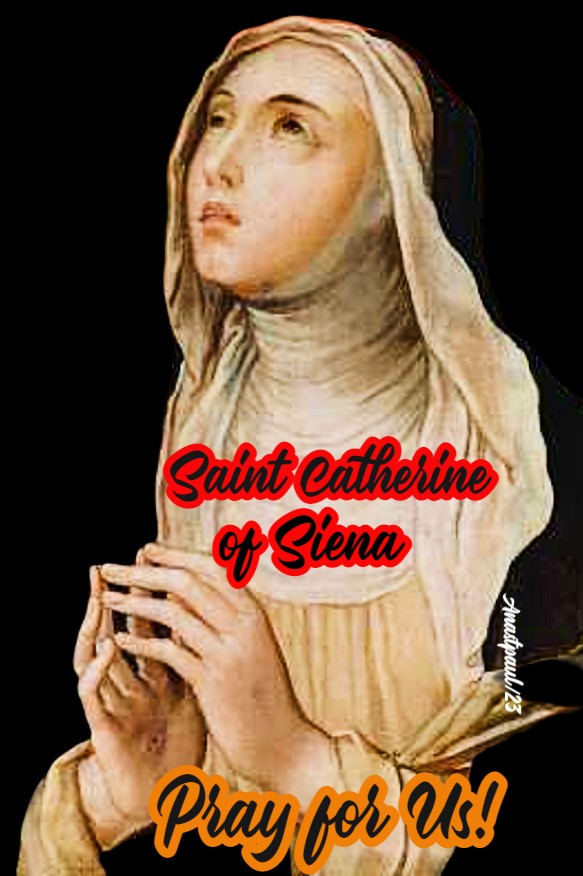
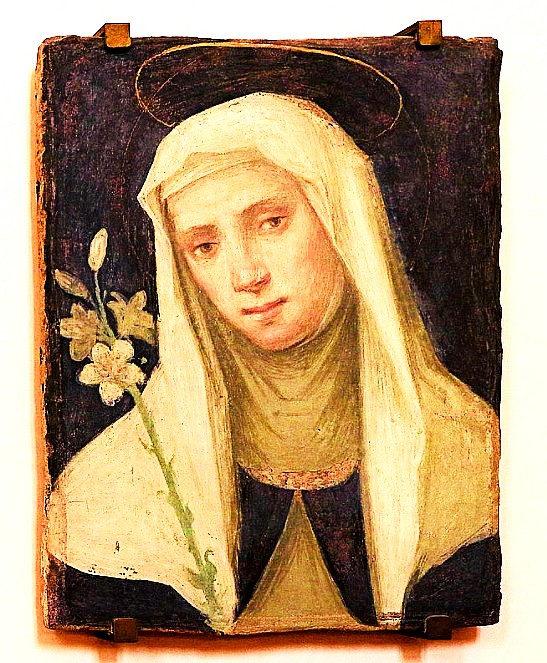
Saint of the Day – 30 April – St Catherine of Siena OP (1347-1380) Virgin. Revisiting St Catherine with Fr Weninger.
St Catherine of Sienna, Virgin By Fr Francis Xavier Weninger SJ (1805-1888)
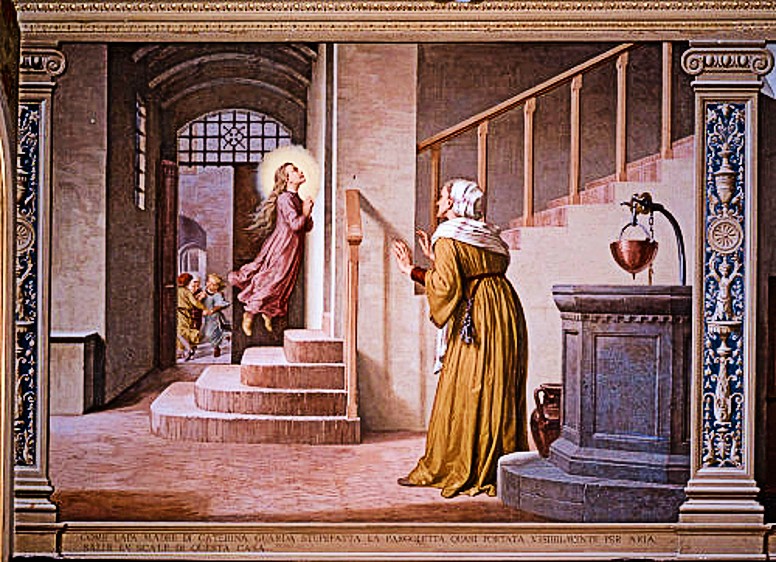
Sienna, in the Tuscan District, is the favoured place where, in 1347, Caterina / Catherine, first saw the light of this world. Her life from her childhood, was a continual exercise of the choicest virtues but, at the same time, a perpetual communication of Divine Grace. When scarcely five years of age, she was called “the little Saint” on account of her quietness and her love of prayer. Already, at that time, she greeted the Virgin Mother upon every step of the staircase with the words of the Angels: “Ave Maria!” When six years old, our Lord appeared to her with the Apostles Peter, Paul and John, together with St Dominic, looked tenderly at her and gave His blessing. This was the beginning of many and extraordinary visions with which the holy virgin was graced until her death. Her heart from this time was filled with intense love of God. She read most carefully the lives of the Saints and endeavoured to follow their example. In her seventh year she Consecrated her virginity to God. Her only pleasure was solitude, prayer, work and self-immolation.
Catherine’s Mother Sees Her Daughter Climbing the Stairs Suspended in the Air, by Alessandro Franchi and Gaetano Marinelli
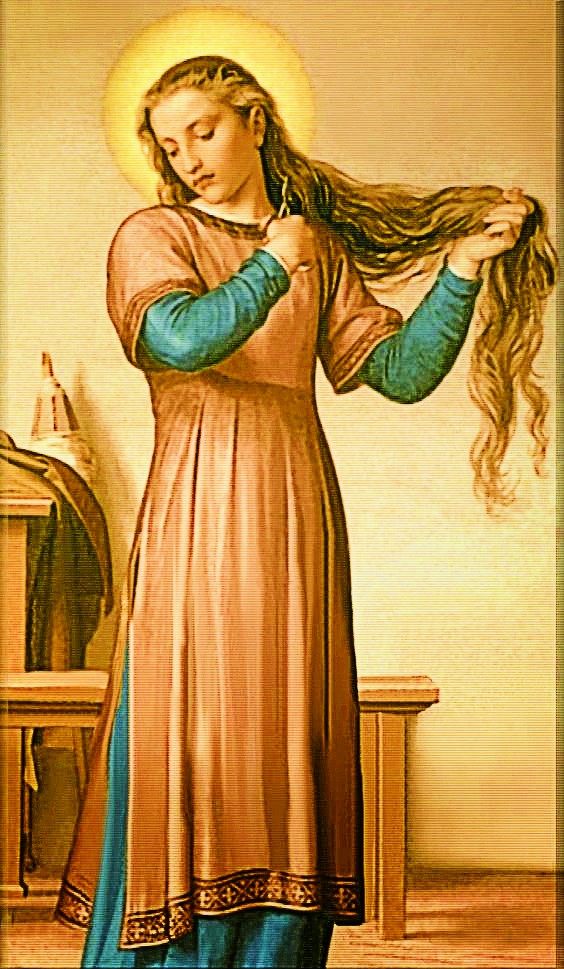
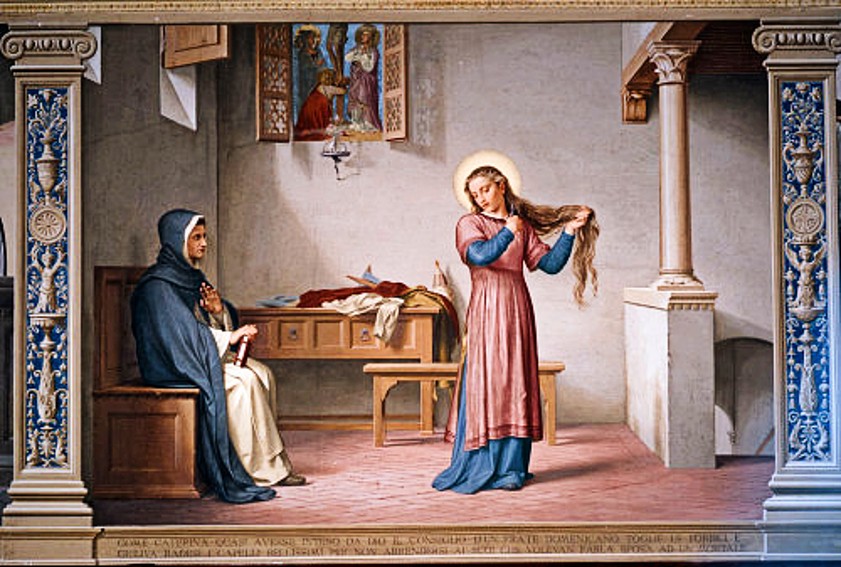
Persuaded by her sister, she once began to pay more attention to her dresses and to curl her hair after the prevailing fashion of the world. This lasted, however, only a short while, for she became aware, during her prayers, how much God was displeased with such vanities and how long her pious sister would have to suffer, on account of it in purgatory. Hencfprward, she refrained from it and repented of her folly, as long as she lived. Her parents desired her to marry but she replied: “I am already wedded to a most noble Spouse and shall never bestow my love on a human being” and cutting off her hair, she covered her head with a veil.
Catherine Cutting Off her Long Hair, by Alessandro Franchi and Gaetano Marinelli
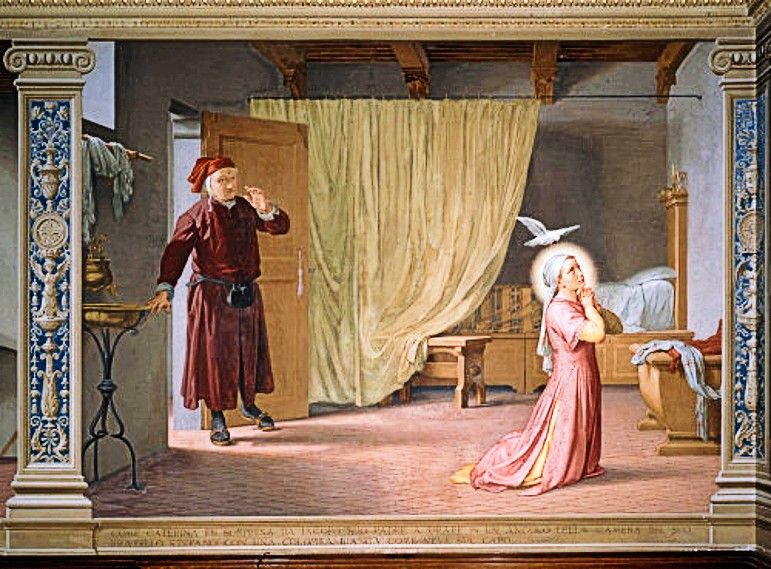
To drive all thoughts of entering a Convent out of her mind, her parents burdened her with the entire care of the house, as well as the most difficult work, so that no leisure was left her, either for prayer, or devotional reading. This was at first a sore trial to her,but she was told by Chris, to build a cell in her heart, where, in the midst of her employments, she might pray, namely, by offering her work to God and by pious ejaculations. Following these directions of Christ, her soul became filled with sweet consolation and she manifested, under the greatest drudgery, a most extraordinary happiness. This caused her parents to change their resolution and they permitted her to live according to her vocation. Hence, she now began to live in a more retired manner and with more austerity than before.
Catherine’s Father Finds Her Praying with the Dove of the Holy Ghost Above her Head,by Alessandro Franchi and Gaetano Marinelli
Bread, herbs and water were her only nourishment, two bare boards her bed. She was girded by a pointed chain which she continued to wear until a few hours before her death, when at the instance of her Confessor, she laid it aside. She only allowed herself one or two hours of sleep during the nigh,; the remainder she employed in prayer or in the contemplation of the Divine Mysteries. She scourged herself three times daily, sometimes until she drew blood. These austerities she observed from her eighteenth year until her death. After she had been received into the Third Order of St Dominic, she aspired most fervently after sanctification but Satan endeavoured, with the most loathsome imaginings and temptations, to trouble the repose of her soul and pervert her thoughts. Catherine, however, increasing her penance and her prayers, withstood him bravely but still, without feeling more relieved or more quiet. At length, when, one day, Christ appeared to her, she said: “O Lord, why hast Thou forsaken me?” “I was in thy heart,” answered the Saviour. “What” said she, “hast Thou been in my heart which was filled with such abominable thoughts? Hast thou then consented to them?!” “Hast thou been pleased with them?” asked Christ. “Oh, no!” replied Catherine, “it was most painful to me to be afflicted with them.” “And this was thy merit” said Christ “I have seen how thou hast battled and I have assisted thee.“ Thus ended her temptations which were succeeded by the most comforting visions of our Lord, His Blessed Mother and other Saints, the number of which is known only to God.
She frequently saw Christ as a lovely little Child in the holy Sacrament, for which Divine Mystery she entertained the most fervent devotion. She partook of it almost daily but always with renewed piety and shedding a flood of tears. It was very remarkable that the receiving of it preserved also her temporal life, for it is a fact that one year she partook of nothing else but the Blessed Eucharist from Ash Wednesday until Ascension day. When she was required, as an act of obedience, to take some food, she suffered so greatly by so doing that the request was not repeated.
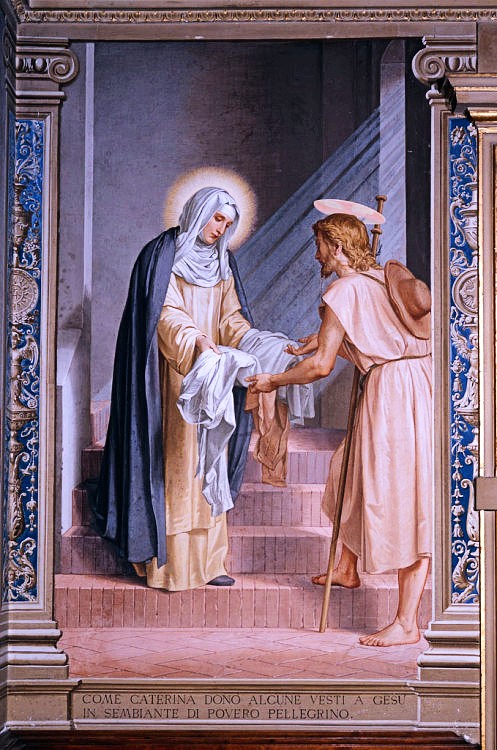
After some time, Christ commanded her to be kind and charitable to her neighbours and she began to nurse the sick with an indescribable loving care. Among others, she attended to two women, of whom one was afflicted with leprosy, the other with cancer. In nursing them, she evinced the most perfect self-control. She pressed the offensive matter out of the sores and cleansed them with water. Feeling disgust, she drank the purulent matter which she had kept in a vessel mixed with water, saying to her Confessor that she had never tasted anything more agreeable. Christ appeared to her on the following night, praised her self-mortification and rewarded her with great interior peace and tranquillity.
Catherine Gives her Cloak to Jesus in the Guise of a Poor Man, by Alessandro Franchi and Gaetano Marinelli
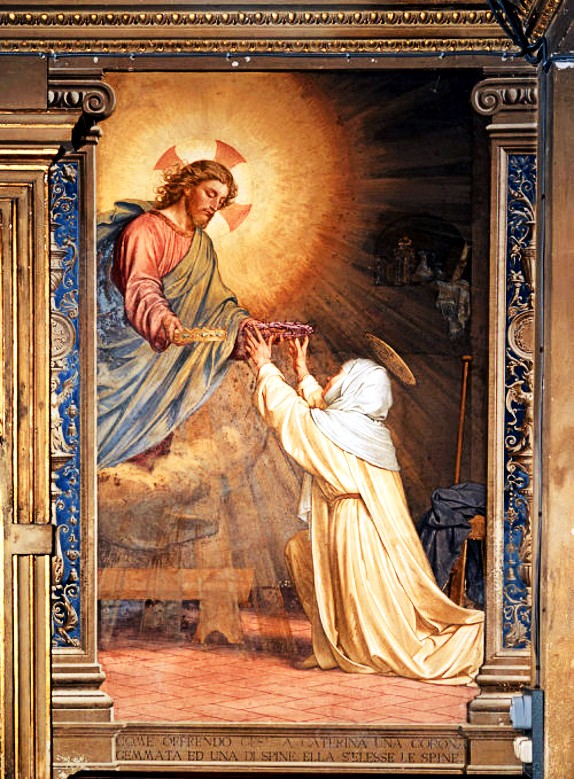
It was an awful cross for her to bear, when this very woman, whom she had so tenderly nursed, instigated by Satan, not only complained of her but slandered her in the whole City. But Christ visited her and presenting to her two crowns, one of gold, the other of thorns, said: “Which of these two do you desire?” Catherine answered: “Lord, I desire to resemble Thee in this life and it is a joy to me to suffer as Thou didst:” and with these words she took the crown of thorns and pressed it upon her head. Christ, upon this, commanded her to continue her charity towards the sick which she did with unprecedented patience and kindness.
Jesus Offering Catherine a Crown of Gold and a Crown of Thorns, by Alessandro Franchi and Gaetano Marinelli
Her love towards those whose souls were diseased, was still more tender and she offered for such, her prayers and many penances, through which means, she obtained from God, the conversion of many sinners, who otherwise would have gone to destruction. She prayed three whole days for a certain woman who was dangerously ill and, who hated the Saint most bitterly. At last, she said to Christ: “I will not move from this place until Thou givest me this soul.” He graciously complied with her request by converting the woman and giving her a happy death.
She was also gifted by God with the grace of reading the inmost thoughts of those who approached her, hence, her exhortations were always addressed to their weakest spot. If a lascivious person came near her, she always perceived so terrible an odour that she had to cover her nose and mouth. Many other graces God had bestowed upon her, to relate all of which would take too much space.
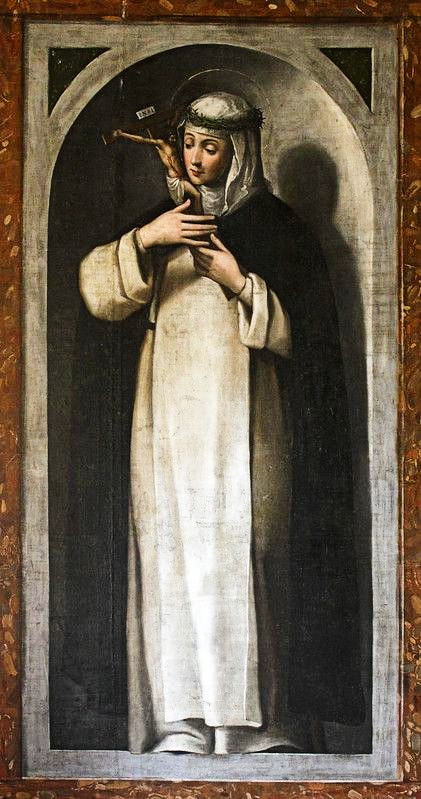
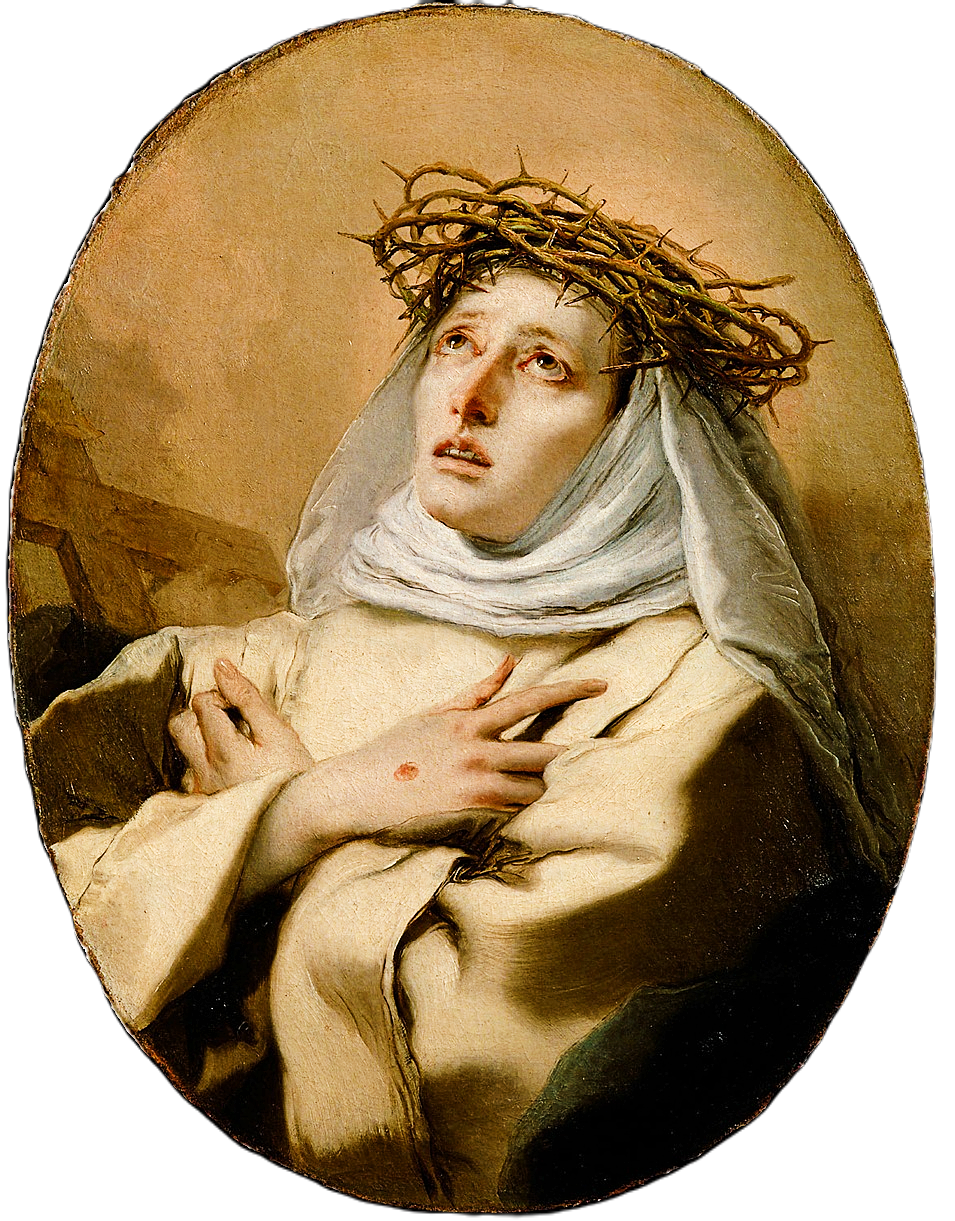
One of the most remarkable of these was, that Christ had impressed the marks of His Five Holy Wounds upon her but in such a manner that, exteriorly, nothing was to be seen, while she suffered all their pains. She had prayed to Christ for this grace in order that it might remain unknown to the world. The many miracles which she performed on the sick and possessed and the heavenly wisdom with which she was filled, secured her, not only the highest regard of the people but also of the prelates of the Church, as well as of worldly princes. She was even sent in times of strife and contention, as a messenger of peace and the effect of her wonderful talents, more than surpassed all expectations.
By Giovanni Battista Tiepolo
At Rome, whither she had been called by the Pope, she became dangerously sick and during four months, she suffered excruciating pain. She ceased not, however, praising and giving thanks to God. The Almighty, whose judgement, although inscrutable, is always just, sent her a last bitter trial after she had received the holy Sacrament – Satan reproached her that in her actions and ecstasies, she had only sought her own aggrandisement. But she overcame the enemy of her peace and, after this anguish of soul, she had a most consoling and tender discourse with Christ, Who visibly appeared to her and into Whose Hands she breathed her chaste soul, in the thirty-third year of her life. Her last words were: “Lord, into Thy Hands I commend my spirit.“
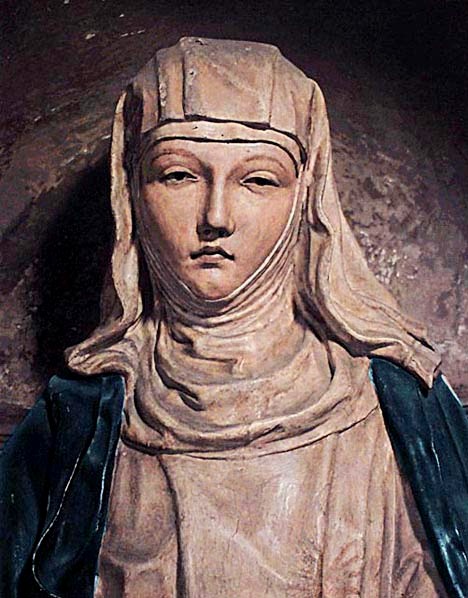
Statuette by Neroccio di Bartolomeo de’ Landi,(1475)
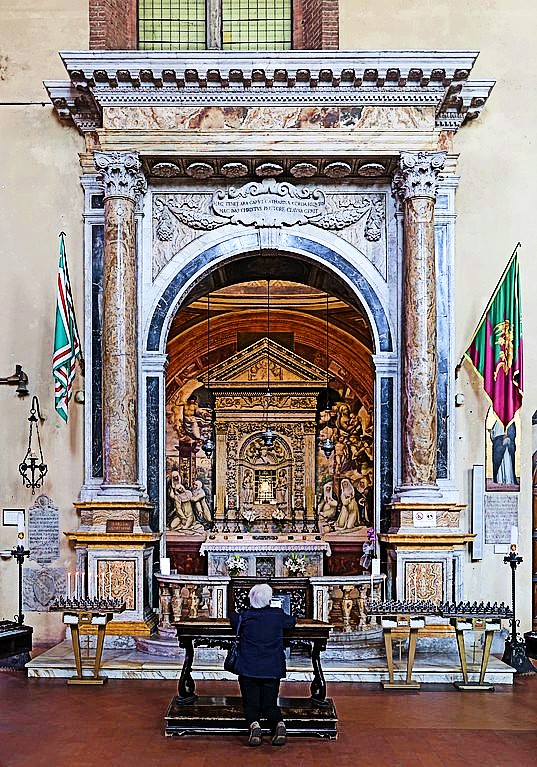
The Chapel of Saint Catherine, Basilica of San Domenico in Siena
Bl Hildegard the Empress St Lawrence of Novara St Louis of Córdoba St Mariano of Acerenza St Maximus of Ephesus St Mercurialis of Forlì St Peter of Córdoba St Pomponius of Naples St Quirinus of Rome St Rodopiano of Aphrodisias St Sophia of Fermo St Swithbert the Younger Bl Ventura of Spello
Martyrs of Montpellier: A group of 70 Mercedarian Friars, led by Blessed Luigi Puell, who were Martyred by Huguenots for trying to bring people back to the Catholic Church. They were Martyred in 1567 in Montpellier, France.
Thought for the Day – 29 April – Meditations with Antonio Cardinal Bacci (1881-1971)
Knowledge and Learning
“What is the purpose of our studies and our quest for knowledge? It is interesting to read what St Bernard has to say on this subject.
“There are those who wish to learn for learning’s sake – these are simply curious and come to no serious conclusions. There are those, moreover, who study in order to be better known – these are vain men. Others acquire knowledge in order to sell it and to make money, or in order to gain honours – these are merchants of science and culture. There are others, however, who cultivate science as an instrument to be used in the service of their neighbour – such men are motivated by charity. There are also some, who study in order to sanctify themselves – and this is true WISDOM!” (Serm 35).”

























 AnaStpaul
You must be logged in to post a comment.