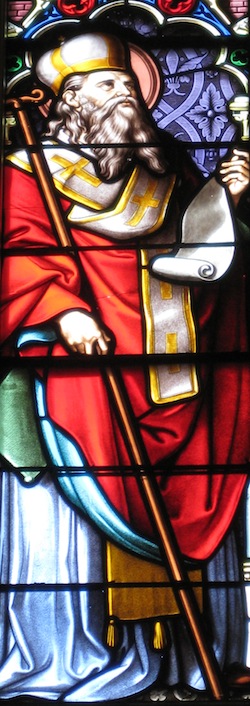
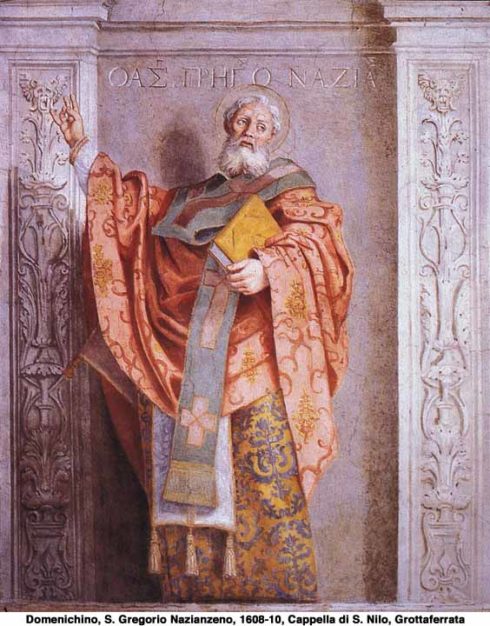
Saint/s of the Day – 2 January – St Basil the Great (329-379) and St Gregory of Nazianzen (330-390) Fathers and Doctors of the Church – two bodies one spirit!
L to R: St. Basil, St. Gregory of Nazianzus, St. John Chrysostom, Painting (Icon) by Viktor Vasnetsov
St Basil was born in 329 at Caesarea, Asia Minor (modern Turkey) and he died on 1 January 379 at Caesarea, Asia Minor (modern Turkey) of natural causes. He is known as the Father of Eastern Monasticism, was a Monk, Bishop, Confessor, Theologian, Reformer, Apostle of Charity, Lawyer, Teacher, Writer and Doctor of the Church. Patronages – Russia, Cappadocia, Hospital administrators, Reformers, Monks, Education, Exorcism, Liturgists.
St Gregory was born in 330 at Arianzus, Cappadocia, Asia Minor and he died on 25 January 390 of natural causes. He is known as “The Theologian” was a Monk, Bishop, Confessor, Theologian (because of his outstanding teaching and eloquence), Orator, Rhetorician, Philosopher, Writer, Poet, Reformer and Doctor of the Church. Patronages – • for harvests• poets.
St Basil the Great, was born of a noble Christian family at Caesarea in Cappadocia in 330. His was a pious family – his mother, father and four of his nine siblings were canonised, including Saint Gregory of Nyssa. He was the Grandson of Saint Macrina the Elder. As a youth Basil was noted for organising famine relief and for working in the kitchens himself, quite unusual for a young noble. He studied in Constantinople and Athens with his friend Saint Gregory Nazianus. He then ran a school of oratory and law in Caesarea. Basil was so successful, so sought after as a speaker, that he was tempted by pride. His life changed radically after he encountered Eustathius of Sebaste, a charismatic bishop and ascetic. Abandoning his legal and teaching career, Basil devoted his life to God. A letter described his spiritual awakening: “I had wasted much time on follies and spent nearly all of my youth in vain labors, and devotion to the teachings of a wisdom that God had made foolish. Suddenly, I awoke as out of a deep sleep. I beheld the wonderful light of the Gospel truth and I recognised the nothingness of the wisdom of the princes of this world.”
He sold all that he had, gave away the money and became a priest and monk together with his best friend St Gregory of Nazianzen.
He founded monasteries and drew up rules for monks living in the desert; he is considered as key to the founding of eastern monasticism as Saint Benedict of Nursia was to the west. He became the Bishop and Archbishop of Caesarea. Conducted Mass and preached to the crowds twice each day. He fought Arianism and assisted St Gregory at the council of Constantinople, which completed the Nicene Creed. He is considered a Father of the Church and is one of the original four Doctors of the Eastern Church.
[#Beginning of Shooting Data Section]Nikon D2002009/12/18 16:07:37.9JPEG (8-bit) NormalImage Size: Large (2592 x 3872)ColorLens: 55-200mm F/4-5.6 GFocal Length: 155mmExposure Mode: Aperture PriorityMetering Mode: Multi-Pattern1/3 sec – F/14Exposure Comp.: +1.3 EVSensitivity: ISO 160Optimize Image: NormalWhite Balance: Direct sunlightAF Mode: AF-CFlash Sync Mode: Flash Mode: Auto Flash Comp: Color Mode: Mode I (sRGB)Tone Comp.: AutoHue Adjustment: 0°Saturation: AutoSharpening: AutoImage Comment: Long Exposure NR: OffHigh ISO NR: Off[#End of Shooting Data Section]
St Gregory of Nazianzen was the best friend of St Basil the Great. After studying together in Athens, they returned to their native Cappadocia (now Eastern Turkey) to serve the Lord. It was during the time of the Arian heresy which contested the full divinity of Christ and orthodox bishops were sorely needed who could teach the true doctrine of the Church with clarity and depth. Gregory, who admirably met these requirements, was made the bishop of the small town of Nazianzen but later was elevated to the highest ecclesiastical see after Rome, becoming the Patriarch of Constantinople. As such, he presided over the First Ecumenical Council of Constantinople in 381 which completed the creed that we commonly call the Nicene Creed, recited in Sunday worship by Catholics and Orthodox Christians.
St Gregory’s teaching was so profound and accurate that he is one of the few teachers in the history of the Church known as “the theologian.”
Basil and Gregory were defining figures as the early Church which sought to figure out just how to describe Jesus as fully human and fully divine. They helped the Church articulate this mystery and refute persistent strains of thought that would emphasise one aspect of Jesus’ nature over another. Both were largely responsible for safeguarding the faith that has guided the Church for thousands of years. Their doctrinal contributions are codified in the Nicene Creed we recite at Mass.
Both Basil and Gregory were declared doctors of the Church, a title given to 36 saints who are known for elucidating the faith by their words or example. Their relics rest in the reliquary chapel in the Basilica, and their images are captured in stained glass windows there.
Sts. Basil the Great and Gregory Nazianzen, friends and scholars who defended the faith, pray for us!
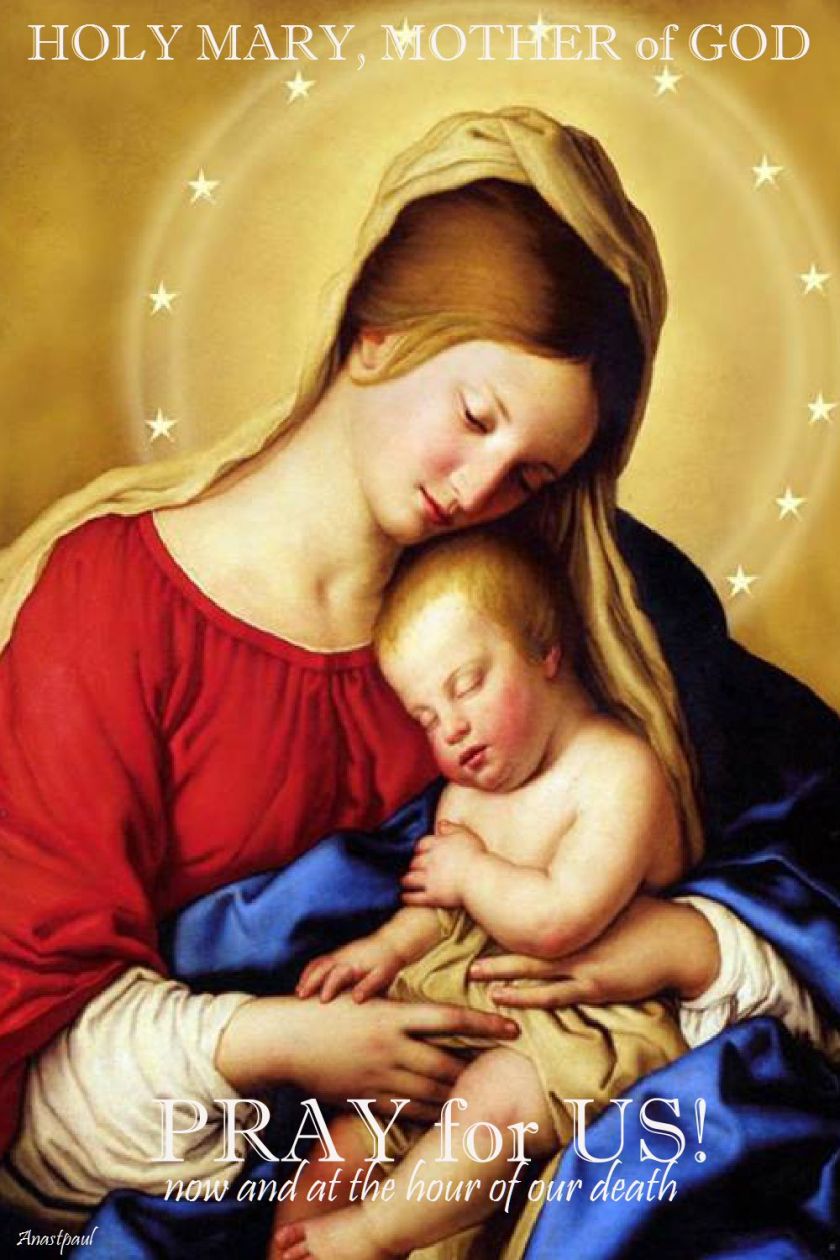
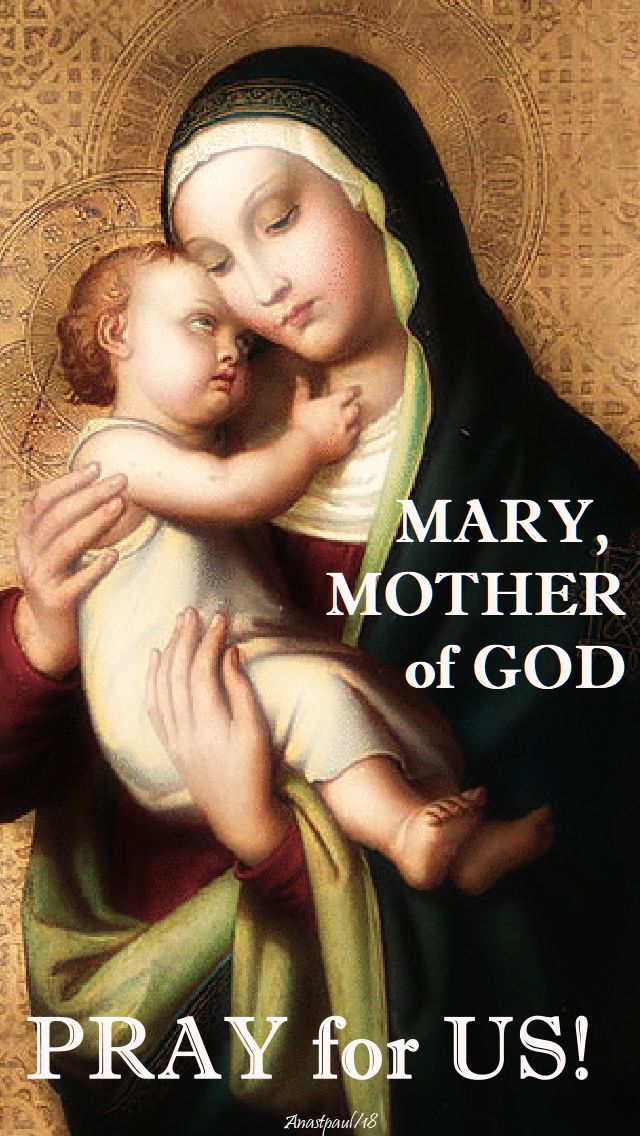
Thought for the Day – 1 January 2018 – The Solemnity of Mary, Mother of God and the Octave Day of the Nativity of Our Lord
Reflect on this.
Jesus, Who is God, is the only natural-born son who chose His mother.
He had a plan for her life and she accepted it with her fiat, her yes given to the Archangel Gabriel at the Annunciation.
For that we are eternally grateful and indebted to Mary, who was given to us to be our mother by her Son from the Cross.
And if anyone ever suggests to you that you love Mary too much, answer,
“Oh no, I could not possibly love Mary too much
because I could never love her as much as she is loved by her son!”
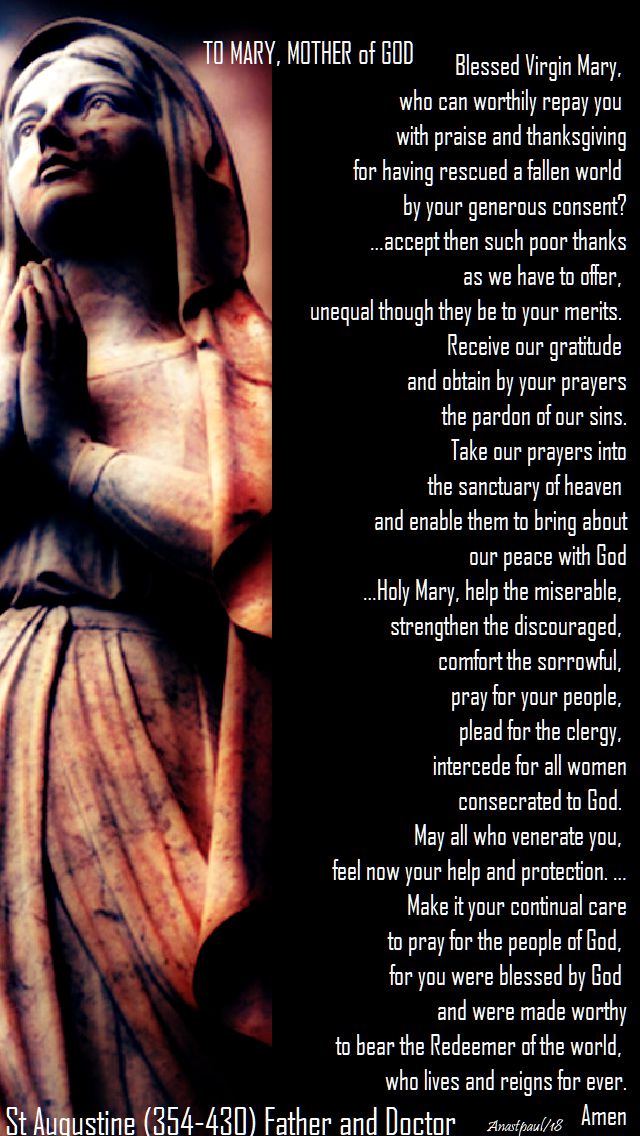
Blessed Virgin Mary, who can worthily repay you with praise and thanksgiving for having rescued a fallen world by your generous consent? …accept then such poor thanks as we have to offer, unequal though they be to your merits. Receive our gratitude and obtain by your prayers the pardon of our sins. Take our prayers into the sanctuary of heaven and enable them to bring about our peace with God …Holy Mary, help the miserable, strengthen the discouraged, comfort the sorrowful, pray for your people, plead for the clergy, intercede for all women consecrated to God. May all who venerate you, feel now your help and protection. … Make it your continual care to pray for the people of God, for you were blessed by God and were made worthy to bear the Redeemer of the world, who lives and reigns for ever. Amen
Quote/s of the Day – 1 January 2018 – The Solemnity of Mary, Mother of God and the Octave Day of the Nativity of Our Lord
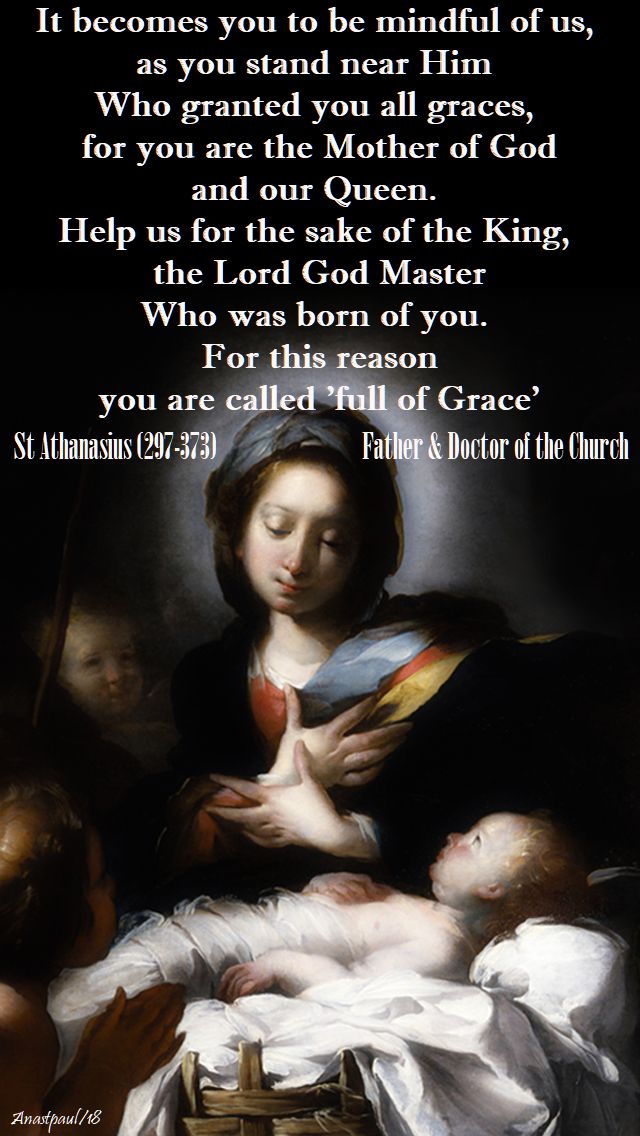
“It becomes you to be mindful of us, as you stand near Him Who granted you all graces, for you are the Mother of God and our Queen. Help us for the sake of the King, the Lord God Master Who was born of you. For this reason you are called ‘full of Grace’…”
St Athanasius (297-373) Father & Doctor of the Church
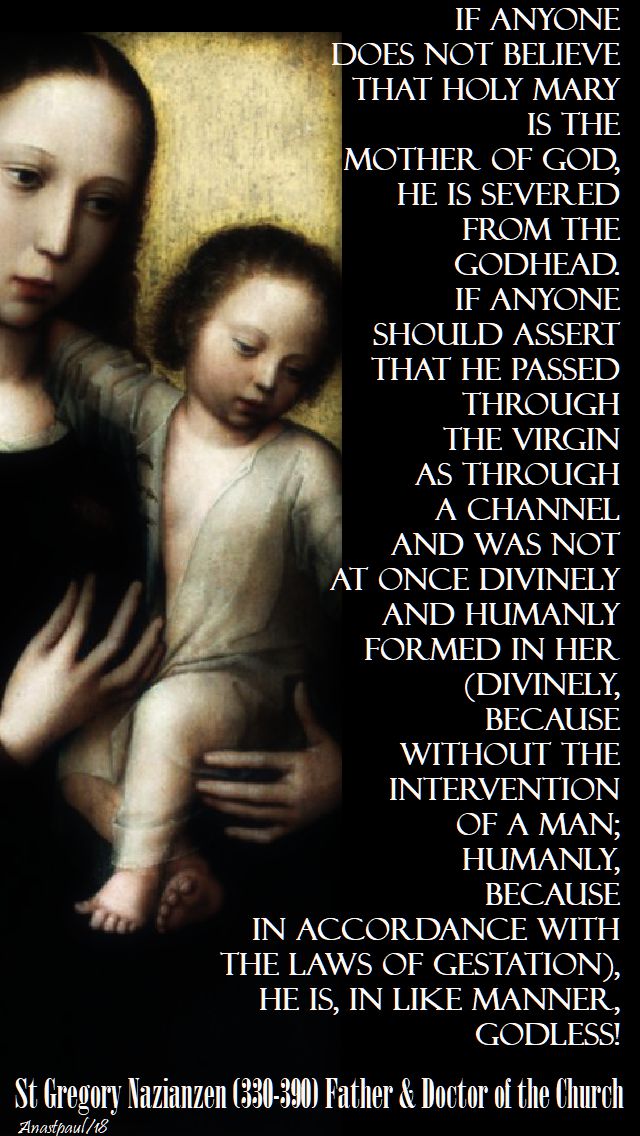
“If anyone does not believe that Holy Mary is the Mother of God, he is severed from the Godhead. If anyone should assert that He passed through the Virgin as through a channel and was not at once divinely and humanly formed in her (divinely, because without the intervention of a man; humanly, because in accordance with the laws of gestation), he is in like manner godless.”
St Gregory Nazianzen (330-390) Father & Doctor of the Church
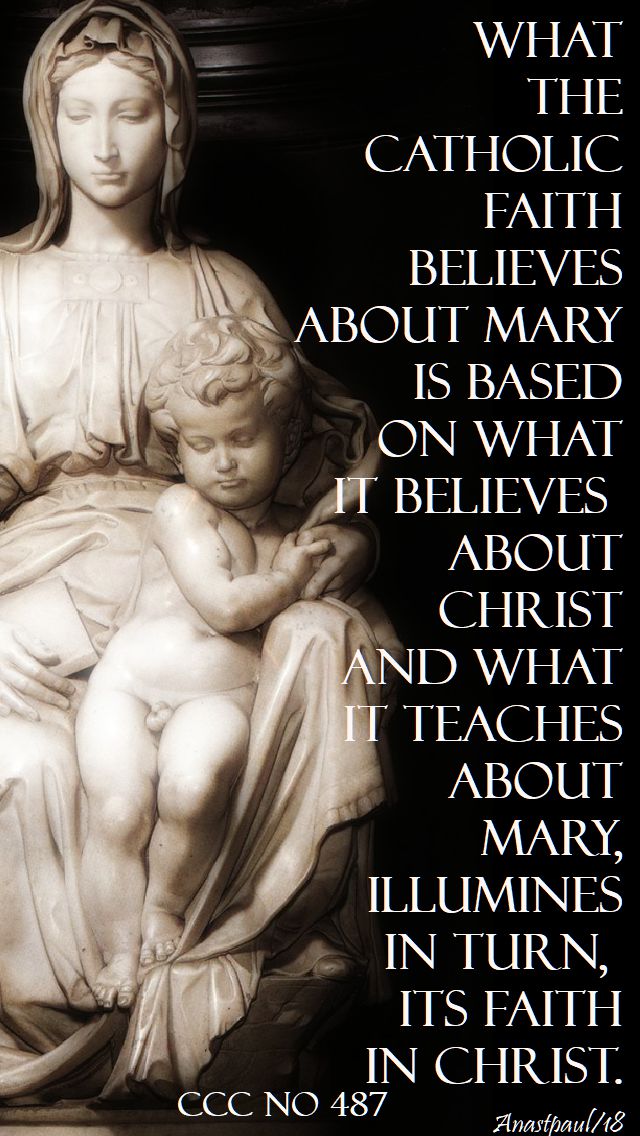
“What the Catholic faith believes about Mary is based on what it believes about Christ and what it teaches about Mary, illumines in turn, its faith in Christ”
One Minute Reflection – 1 January 2018 – The Solemnity of Mary, Mother of God, the Octave Day of the Nativity of Our Lord and the first day of the Month of the Most Holy Name of Jesus
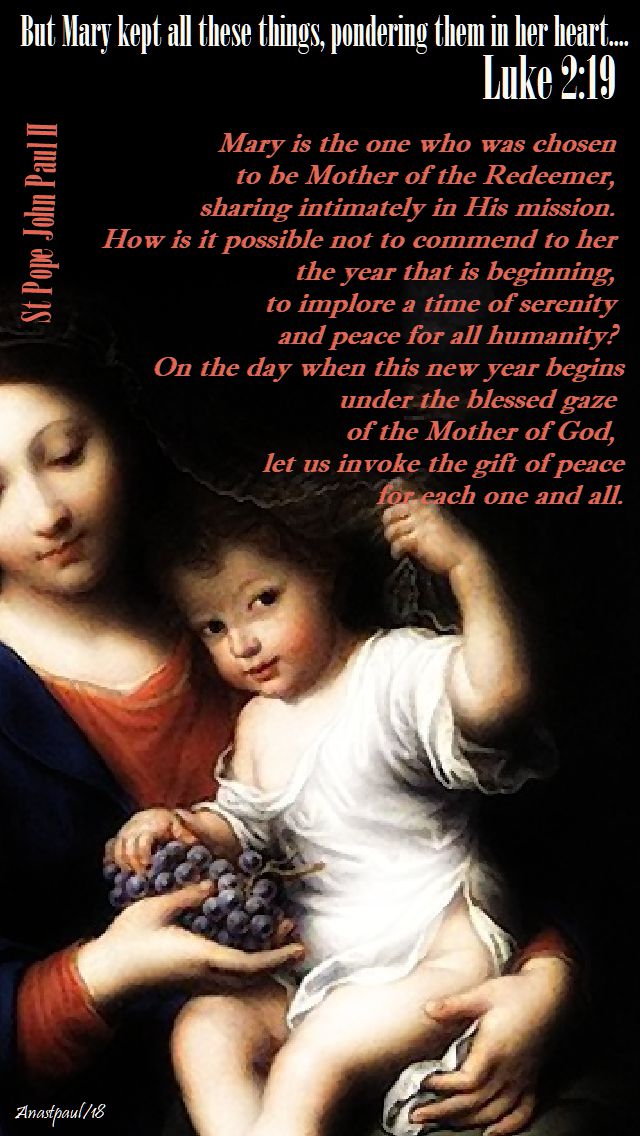
But Mary kept all these things, pondering them in her heart.…Luke 2:19
REFLECTIONS – “Today’s liturgy celebrates the solemnity of the Mother of God.
Mary is the one who was chosen to be Mother of the Redeemer, sharing intimately in his mission.
In the light of Christmas, the mystery of her divine motherhood is illumined.
Mary, Mother of Jesus who was born in the Bethlehem cave,
is also the Mother of every man and woman who comes into the world.
How is it possible not to commend to her the year that is beginning,
to implore a time of serenity and peace for all humanity?
On the day when this new year begins under the blessed gaze of the Mother of God,
let us invoke the gift of peace for each one and all.”…St Pope John Paul – 1997
PRAYER – God, our Father, since You gave mankind a saviour through blessed Mary, virgin and mother, grant that we may feel the power of her intercession when she pleads for us with Jesus Christ, Your Son, the author of life, who lives and reigns with You and the Holy Spirit, God forever and ever, amen.
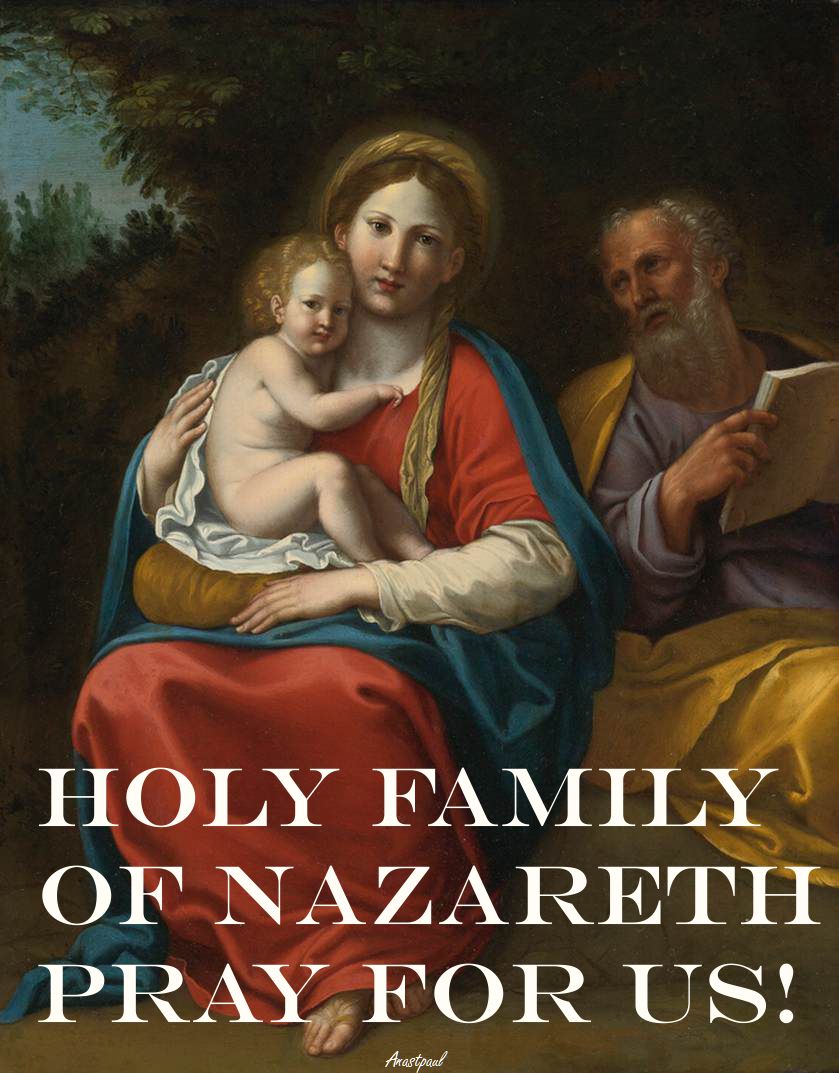
Sunday Reflection – 31 December – Feast of the Holy Family and the Seventh Day of the Octave
While they were eating, He took some bread, and after a blessing He broke it, and gave it to them, and said, “Take it; this is My body.” And when He had taken a cup and given thanks, He gave it to them and they all drank from it. And He said to them, “This is My blood of the covenant, which is poured out for many..…Mark 14:22-24
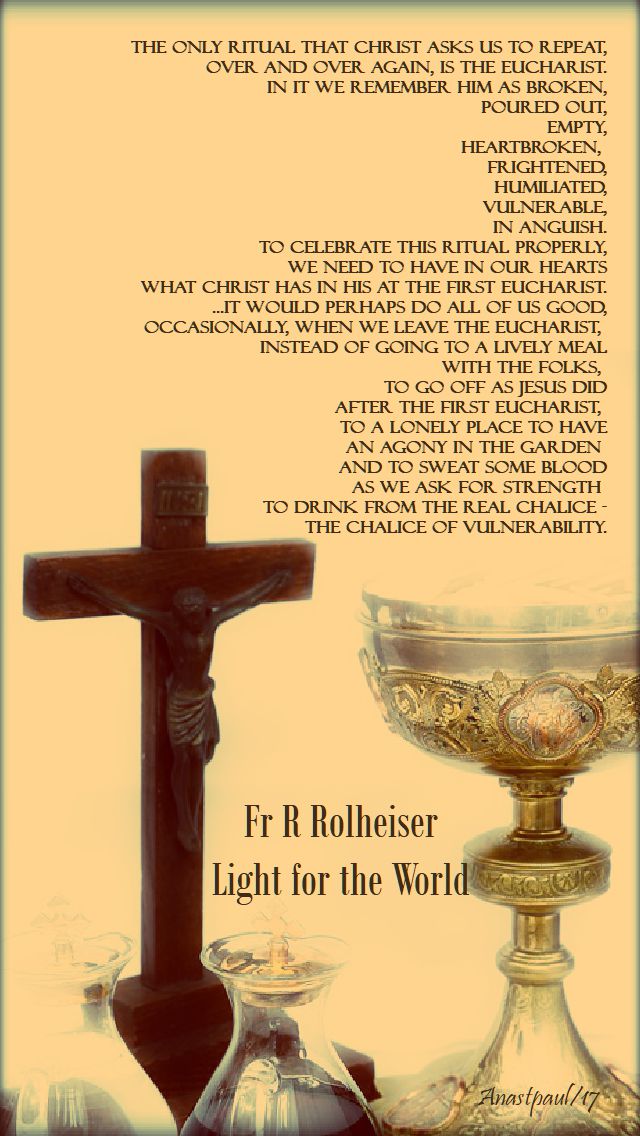
The only ritual that Christ asks us to repeat, over and over again, is the Eucharist. In it we remember Him as broken, poured out, empty, heartbroken, frightened, humiliated, vulnerable, in anguish. To celebrate this ritual properly, we need to have in our hearts what Christ has in His at the first Eucharist.
What was He feeling then?
Joy and thanksgiving. Yes. LOVE for those at the table with Him. Surely. But beyond this, His heart felt anguish, deep longing and fear at the prospect of the pain that was now a certainty before intimacy and community could be achieved.
It would perhaps do all of us good, occasionally when we leave the Eucharist, instead of going to a lively meal with the folks, to go off as Jesus did after the first Eucharist, to a lonely place to have an agony in the garden and to sweat some blood as we ask for strength to drink from the real chalice – the chalice of vulnerability.
Occasionally, when St Augustine handed the Eucharist to a communicant, instead of saying, “the Body of Christ”, he would say, “Receive what you are.”
Augustine had perceived, for whatever reason, that the words of consecration, “this is my body, this is my blood”, are intended more to change the people present, than to change bread and wine.
(Fr R Rolheiser – Light for the World)
Lord Jesus Christ we pray…thank You for abiding with us. May we always reverence the Holy Eucharist, as Your Real Presence amongst us. Amen
Quote of the Day – 31 December – Feast of the Holy Family and the Seventh Day of the Octave
“God, to Whom Angels submit themselves and Who Principalities and Powers obey, was subject to Mary; and not only to Mary but Joseph too, for Mary’s sake [….]. God obeyed a human creature; this is humility without precedent. A human creature commands God! it is sublime beyond measure.“
One Minute Reflection – 31 December – Feast of the Holy Family and the Seventh Day of the Octave
Certainly sons are a gift from the Lord, the fruit of the womb, a reward. Like arrows in the hand of a warrior are the sons born in one’s youth. Blessed is the man who has filled his quiver with them. He will never be shamed.…Psalm 127:3-5
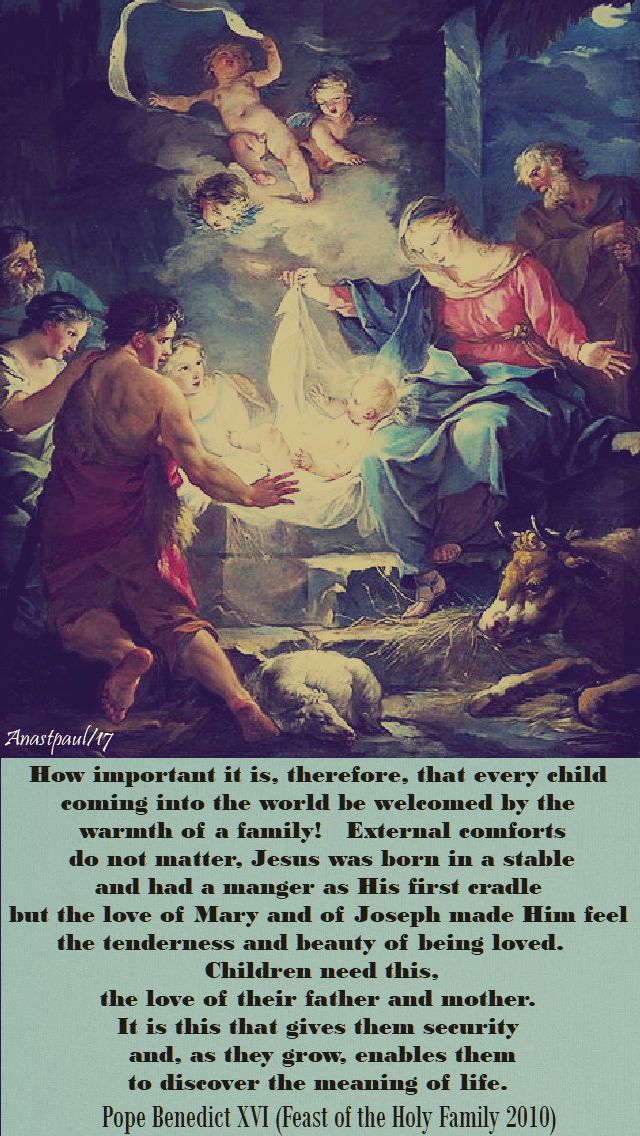
REFLECTION – “How important it is, therefore, that every child coming into the world be welcomed by the warmth of a family! External comforts do not matter, Jesus was born in a stable and had a manger as His first cradle but the love of Mary and of Joseph made Him feel the tenderness and beauty of being loved. Children need this, the love of their father and mother. It is this that gives them security and, as they grow, enables them to discover the meaning of life. The Holy Family of Nazareth went through many trials …. Yet, trusting in divine Providence, they found their stability and guaranteed Jesus a serene childhood and a sound upbringing.”…Pope Benedict XVI (Feast of the Holy Family 2010)
PRAYER – Holy Father, trusting in the motherly intercession of Mary Most Holy, Queen of Families and under the powerful protection of St Joseph, her spouse, grant we pray, that we may dedicate ourselves tirelessly to this beautiful mission which You have placed in our hands, as mothers and fathers of Your children. Strengthen us to protect and guide them in Your ways. Through the prayers of our Holy Mother and the Guardian of Your divine Son and of His Church, in union with Jesus Christ our Lord and the Holy Spirit, amen.
Thought for the Day – 29 December – Fifth Day of the Octave and the Memorial of St Thomas a Becket
I think we know that the twentieth century is probably the century of the greatest flowering of Christian martyrs: across Nazi Germany, the Soviet Union, Vietnam, in communist regimes in Latin America and other places too. Now the twenty-first century is following a similar pattern in other parts of the world: the Middle East, parts of Africa, Pakistan. This moment of prominence for St Thomas a Becket helps us to remember and focus on this fruitfulness of courage and faith which is always the seed of the Church.
For some, Thomas died a traitor, betraying the loyalty they believe he owed to the King. For others he died a martyr, put to death for his defence of the things of the Lord, in this case the honour and rights of the Church.
We know that this relationship between the role and powers of the state on the one hand and the role and commitment of the Church on the other, is never an easy one. It is always a point of tension, a daily struggle in conscience and in public debate. But Thomas’ martyrdom reminds us what can happen when the state seeks to dominate religious belief and reshape it to its own ends, to its own selection of values. When observance of those particular values becomes absolute requirement then we are on a path of confrontation. The example of Thomas a Becket stands before us as a reminder to every age that the point may come where there is no longer any space left for that religious freedom, such a basic human right, which permits the holding and expressing of religious belief in word and action in the public forum.
The tensions that can lead to that point were well delineated in the speech given by Pope Benedict XVI in 2010 when he spoke in Westminster Hall. He said:
‘Each generation, as it seeks to advance the common good, must ask anew: what are the requirements that governments may reasonably impose upon citizens, and how far do they extend? By appeal to what authorities can moral dilemmas be resolved. These questions take us directly to the ethical foundations of civil discourse. If the moral principles underpinning the democratic process are themselves determined by nothing more solid than social consensus, then the fragility of the process becomes all too evident – herein lies the real challenge for democracy.’ Pope Benedict called modern democracies, including our own, to engage in constructive dialogue which brings together faith and reason, affirming that ‘religion is not a problem for legislators to solve, but a vital contributor to national conversation.’
I have only to think of another Thomas, four hundred years after Becket, whose dilemma and heroism echoes that of the earlier Thomas. Thomas More was also asked to show where his fundamental loyalty lay and he too, lacking support from his fellow clergy, stood alone, an uncompromising figure, yet never seeking conflict or confrontation. What was well summed up of him, in words beautifully attributed to him, can also be applied to Thomas a Becket. ‘I am indeed the King’s good servant, but God’s first.’
Excerpt from the Archbishop of Westminister at the Symposium on St Thomas a Becket at Lambeth Palace on 27 May 2016.
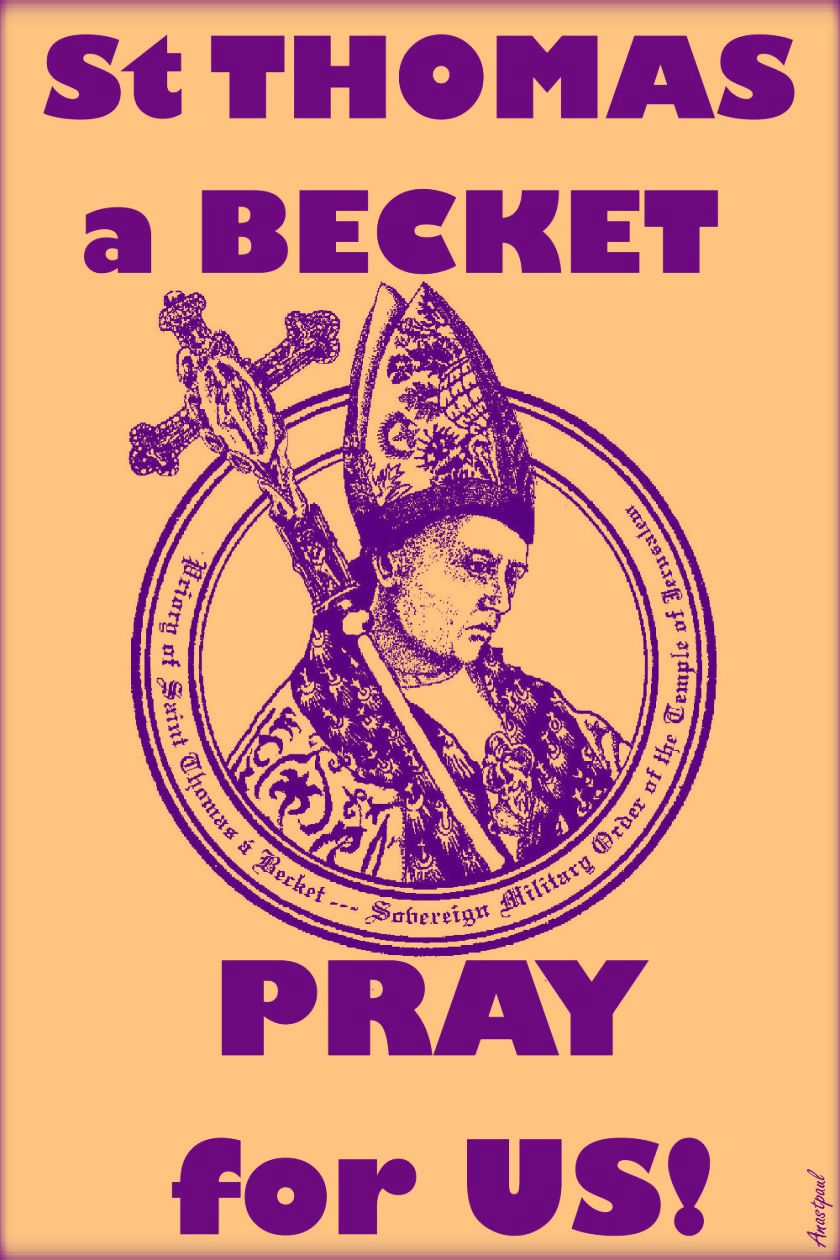
St Thomas a Becket, God’s good servant, pray for us!
Quote/s of the Day – 29 December – Fifth Day of the Octave and the Memorial of St Thomas a Becket
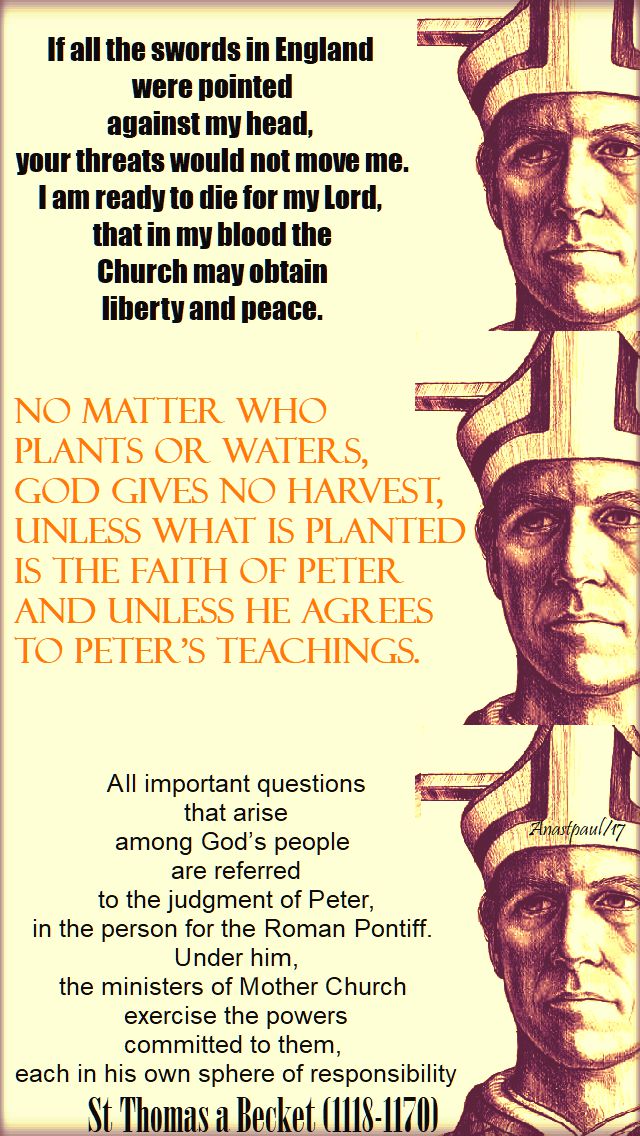
“If all the swords in England were pointed against my head, your threats would not move me. I am ready to die for my Lord, that in my blood the Church may obtain liberty and peace.”
“Many are needed to plant and water what has been planted now, that the faith has spread so far and there are so many people… No matter who plants or waters, God gives no harvest, unless what is planted is the faith of Peter and unless he agrees to Peter’s teachings.”
“All important questions that arise among God’s people are referred to the judgment of Peter, in the person for the Roman Pontiff. Under him the ministers of Mother Church exercise the powers committed to them, each in his own sphere of responsibility.”
“Hereafter, I want you to tell me, candidly and in secret, what people are saying about me. And if you see anything in me, that you regard as a fault, feel free to tell me in private. For from now on, people will talk about me but not to me. It is dangerous for men in power, if no-one dares to tell them, when they go wrong.” (St Thomas to a friend on his ordination)
One Minute Reflection – 29 December – Fifth Day of the Octave and the Memorial of St Thomas a Becket
I have fought the good fight, I have finished the course, I have kept the faith. From now on a merited crown awaits me….2 Timothy 4:7
REFLECTION – “Remember then how our fathers worked out their salvation; remember the sufferings through which the Church has grown and the storms the ship of Peter has weathered because it has Christ on board. Remember how the crown was attained by those whose sufferings gave new radiance to their faith. The whole company of saints bears witness to the unfailing truth, that without real effort no-one wins the crown.”……….St Thomas a Becket (1118-1170)
PRAYER – Almighty God, you enable st Thomas a Becket to lay down his life with undaunted spirit for the rights of Your Church. May his prayer help us to deny ourselves for Christ in this life and so find our true life in heaven. Through our Lord Jesus Christ, in union with the Holy Spirit, one God forever and ever, amen.
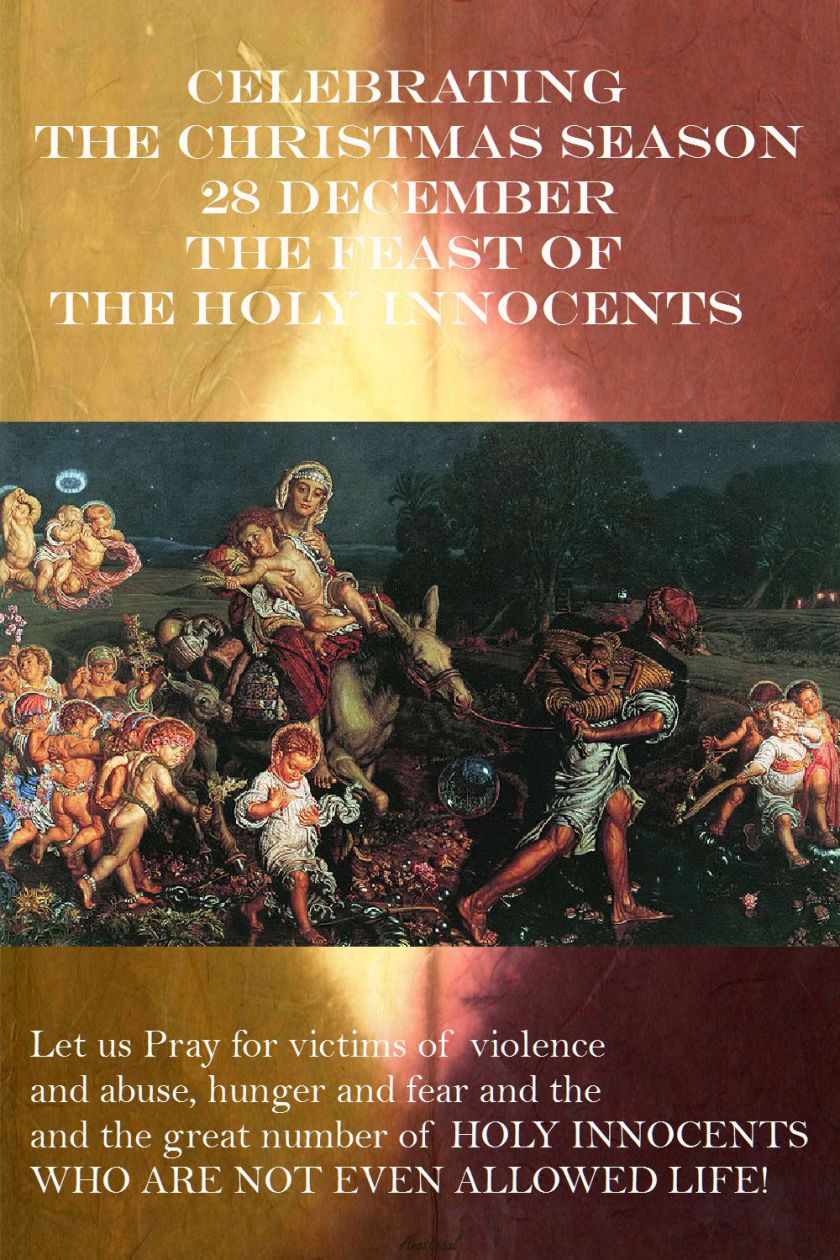
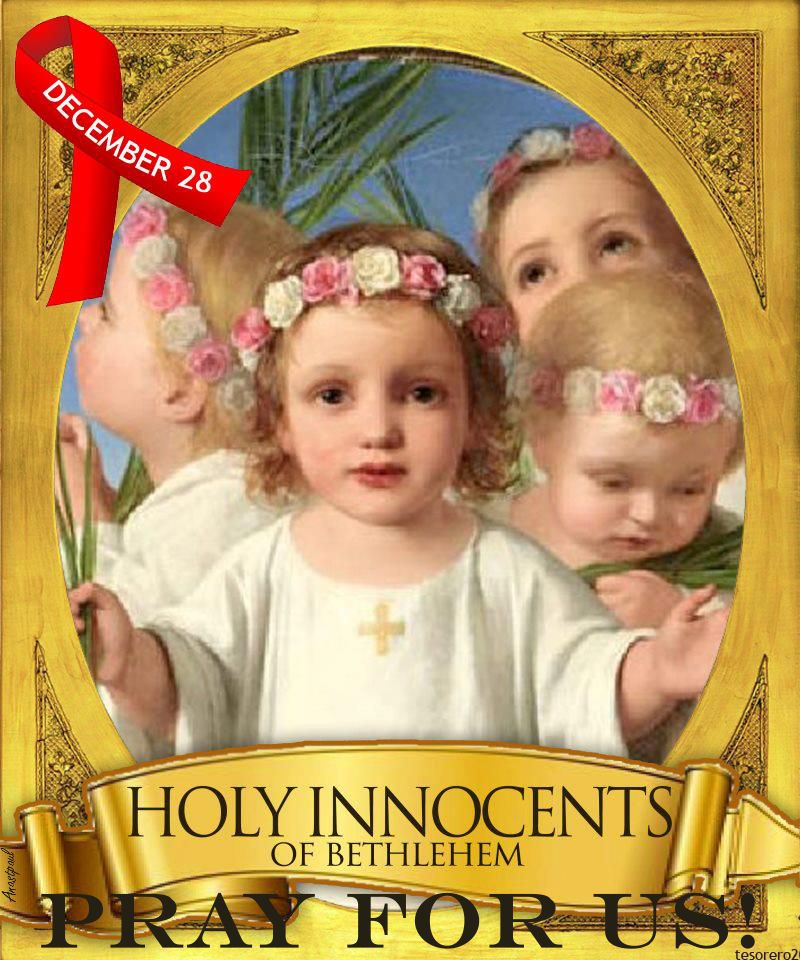
Thought for the Day – 28 December – The Feast of the Holy Innocents – The 4th Octave Day of Christmas
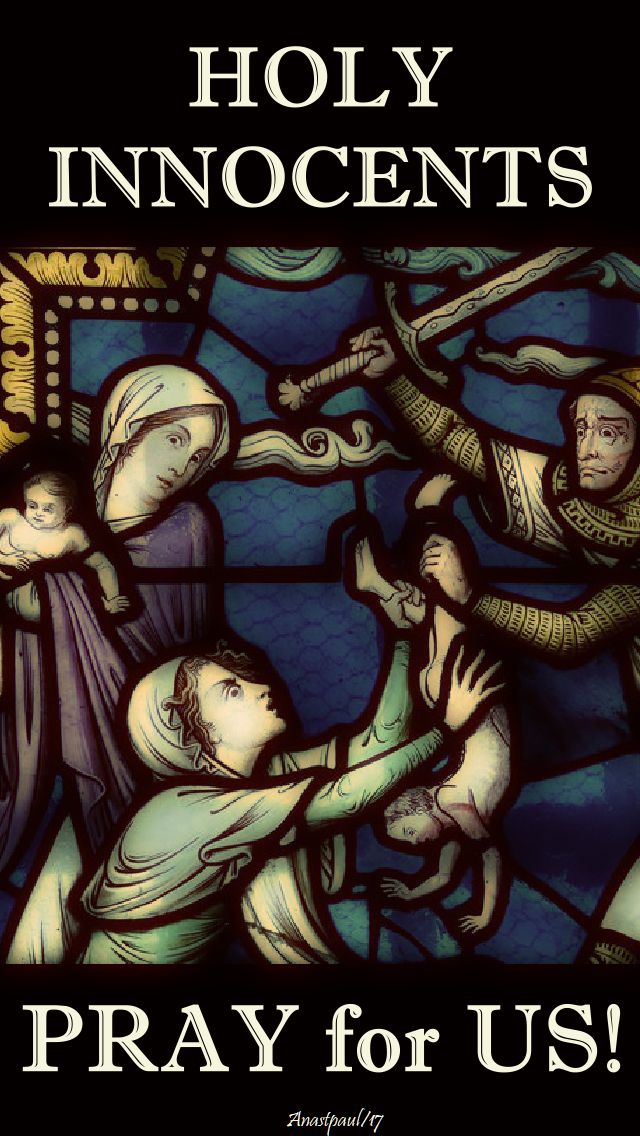
An angel of the Lord appeared to Joseph in a dream and said, “Rise, take the child and his mother and flee to Egypt and remain there till I tell you, for Herod is about to search for the child, to destroy him.” And he rose and took the child and his mother by night and departed to Egypt… Then Herod, when he saw that he had been tricked by the wise men, was in a furious rage and he sent and killed all the male children in Bethlehem and in all that region, who were two years old or under, according to the time which he had ascertained from the wise men….Matthew 2:13-18
We call martyrs those saints who chose to give their lives for Jesus Christ. These innocent children also gave their lives but they didn’t choose to . They were chosen for martyrdom. For centuries innocent lives have been taken and people can’t help asking ‘why?’ The suffering of innocent children is still a scandal for our human hearts. That happened during WWII in a concentration camp. The Nazi guards decided one day to hang a child in front of thousands of prisoners in formation. Elie Wiesel, who writes the story, explains that the child was so light that he hanged, struggling to gasp, for more than half an hour. ‘Where is God now?’ asked one of those prisoners forced to contemplate the suffering of the child. “Behind me,” writes Wiesel, “I heard the same man asking: ‘For God’s sake, where is God?’ And from within me, I heard a voice answer- ‘Where is He? This is where – hanging here from this gallows…’”
God’s agony didn’t finish on Calvary. When innocent children cry, God mixes His Tears with theirs, when they bleed, God’s Heart bleeds with them. If they ask you ‘where is God?’, tell them that God is on Calvary still, dying every day in the womb of some mothers, He is the Victim of famines, of epidemics, of wars, of abuses, of bullying, of mafias, of trafficking, of abandonment, of persecution, of terrorism, of injustice of any kind. God is still in agony in the suffering of innocents.
But we are with you, Mary, Mother of all Innocents, helping Jesus to bear His Cross, comforting Him with our prayer and reminding Him with our love that all that He suffers for us is worthwhile, and asking God for the end of all this injustice.
Fr George Boronat M.D. S.T.D is a Catholic priest from the Prelature of Opus Dei,
working in the Archdiocese of Southwark in London.
Quote of the Day – 28 December – The Feast of the Holy Innocents – The 4th Octave Day of Christmas
”The precious death of any martyr deserves high praise because of his heroic confession; the death of these children is precious in the sight of God because of the beatitude they gained so quickly. For already, at the beginning of their lives, they pass on. The end of the present life is for them the beginning of glory.”
St Augustine (354-430) Father & Doctor of the Church
One Minute Reflection – 28 December – The Feast of the Holy Innocents – The 4th Octave Day of Christmas
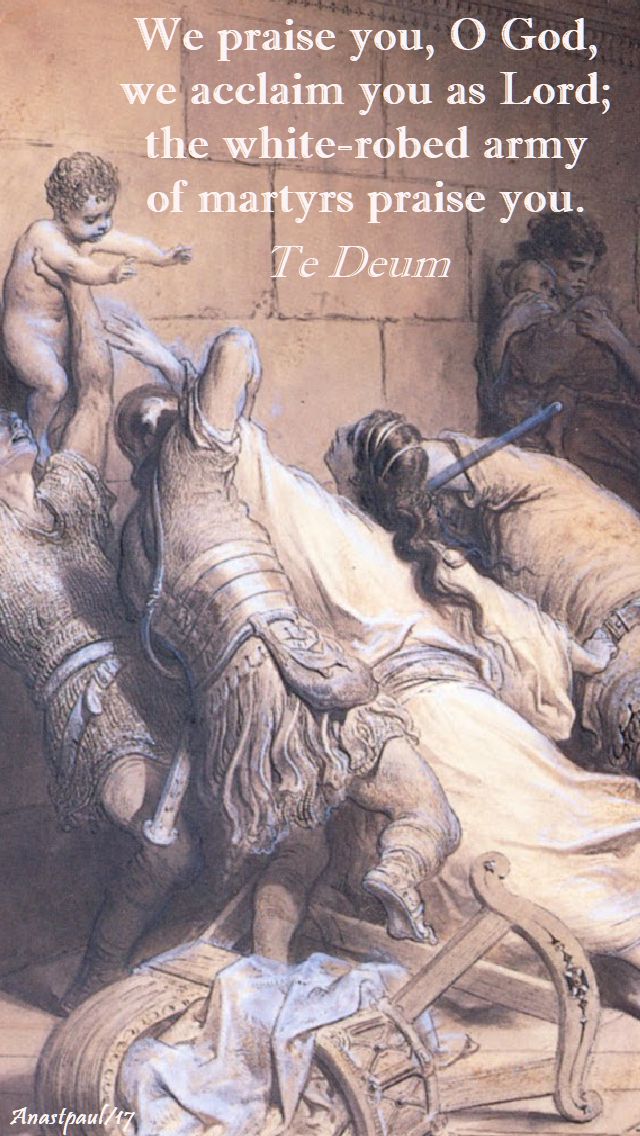
We praise you, O God, we acclaim you as Lord; the white-robed army of martyrs praise you. (from the Te Deum)
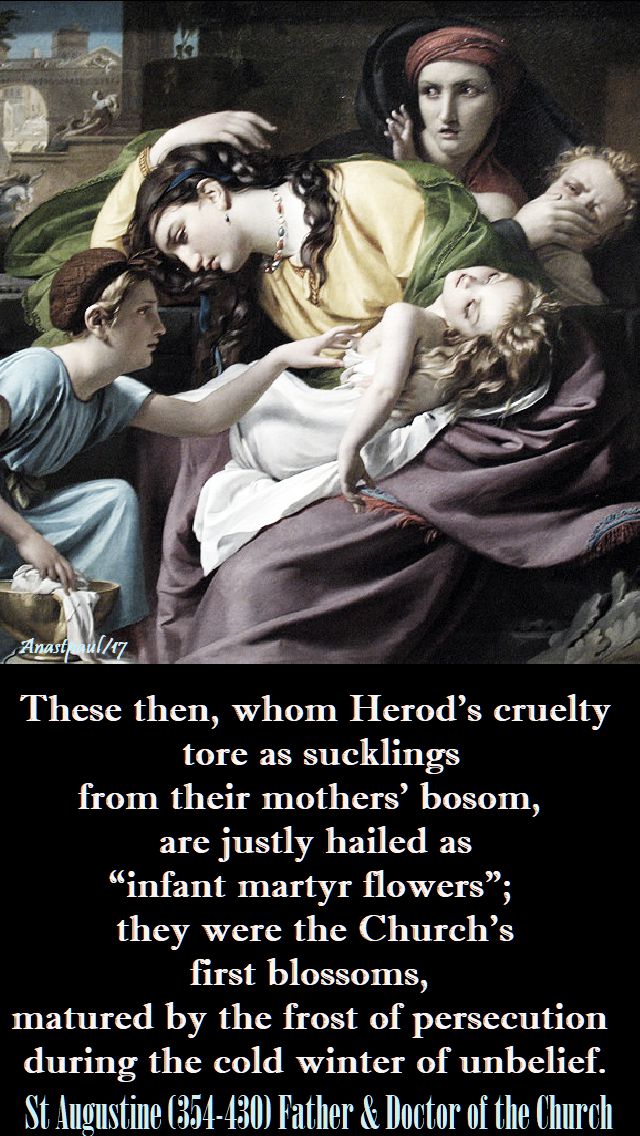
REFLECTION – “These then, whom Herod’s cruelty tore as sucklings from their mothers’ bosom, are justly hailed as “infant martyr flowers”; they were the Church’s first blossoms, matured by the frost of persecution during the cold winter of unbelief.”… St Augustine (354-430) Father & Doctor of the Church
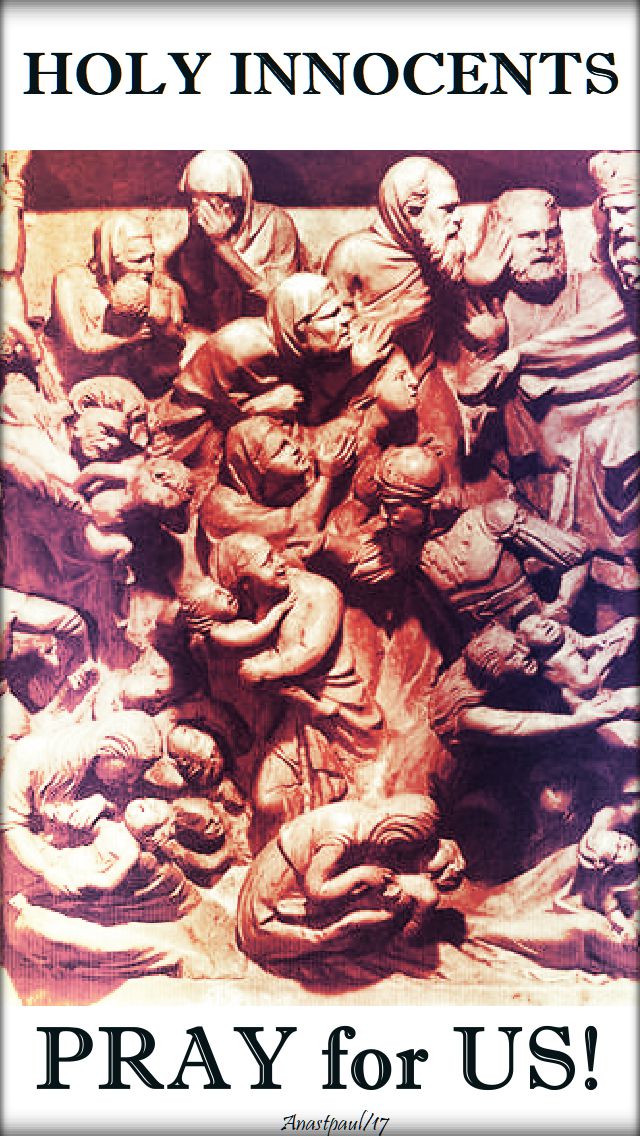
PRAYER – O God, whom the Holy Innocents confessed and proclaimed on this day, not by speaking but by dying, grant, we pray, that the faith in You which we confess with our lips may also speak through our manner of life. Through our Lord Jesus Christ, your Son, who lives and reigns with you in the unity of the Holy Spirit, one God, for ever and ever. Holy Innocents Pray for us! amen
Our Morning Offering – 28 December – The Feast of the Holy Innocents – The 4th Octave Day of Christmas. When you think about the slaughter of these innocent children and the continuing slaughter of the unborn through the horrors of abortion, it becomes clear that they come from the same supreme act of selfishness. Even though Herod heard the message coming from the prophets of his own people, he had no desire to align his heart with the purposes of God.
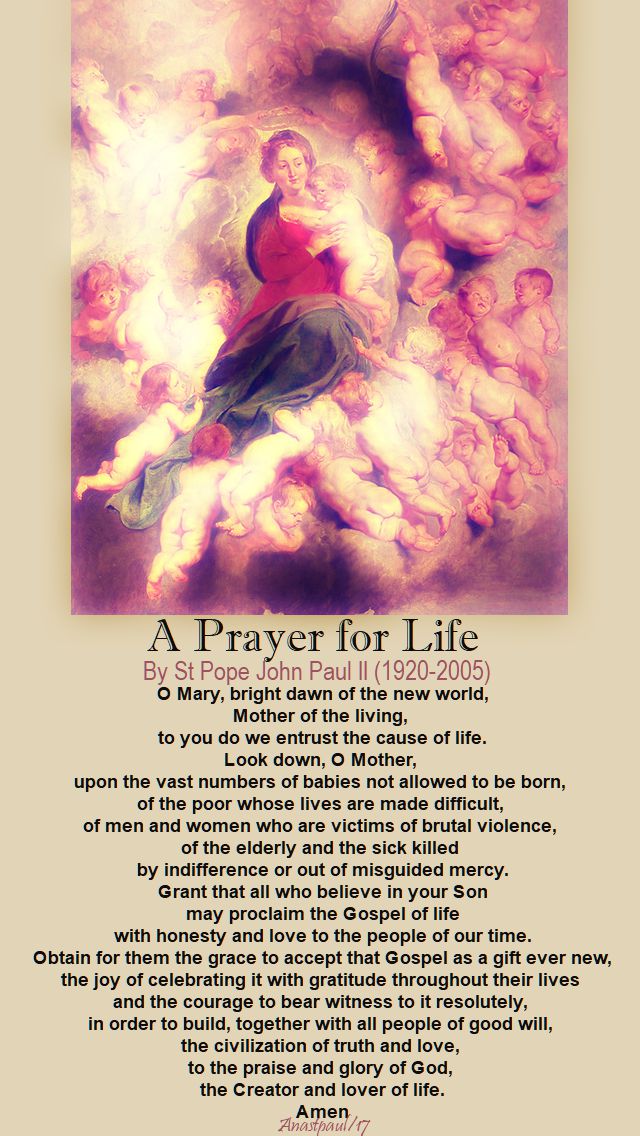
A Prayer for Life
By St Pope John Paul II (1920-2005)
O Mary,
bright dawn of the new world,
Mother of the living,
to you do we entrust the cause of life.
Look down, O Mother,
upon the vast numbers of babies
not allowed to be born,
of the poor whose lives are made difficult,
of men and women
who are victims of brutal violence,
of the elderly and the sick killed
by indifference or out of misguided mercy.
Grant that all who believe in your Son
may proclaim the Gospel of life
with honesty and love to the people of our time.
Obtain for them the grace to accept that Gospel
as a gift ever new,
the joy of celebrating it with gratitude
throughout their lives
and the courage to bear witness to it resolutely,
in order to build,
together with all people of good will,
the civilization of truth and love,
to the praise and glory of God,
the Creator and lover of life.
Amen
Taken from Pope John Paul II’s 1995 encyclical, “The Gospel of Life” (www.vatican.va)
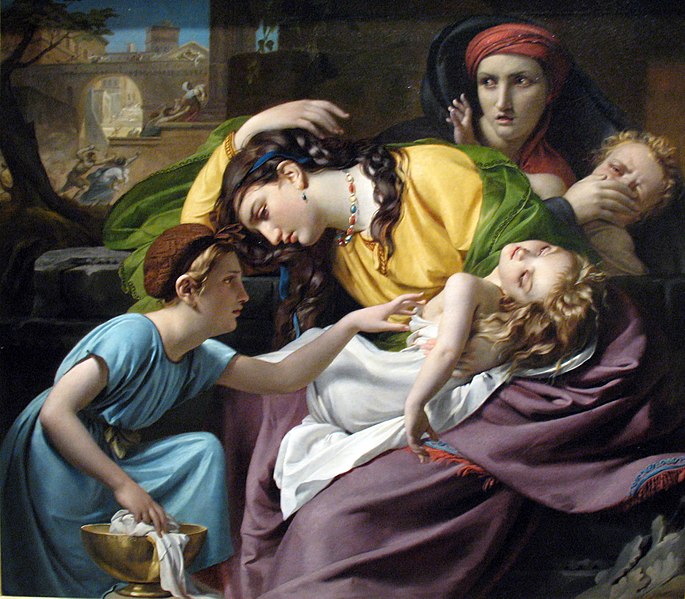
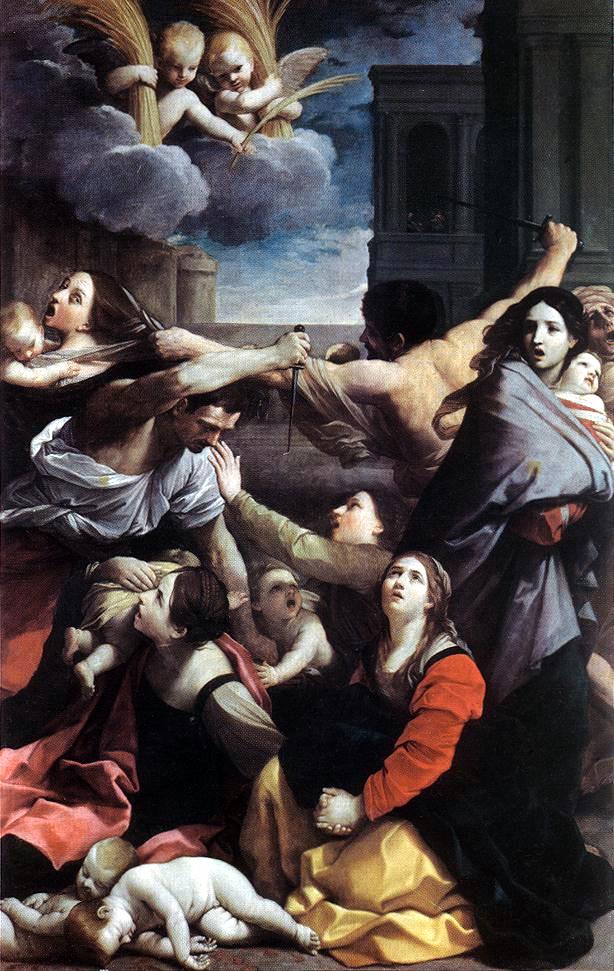
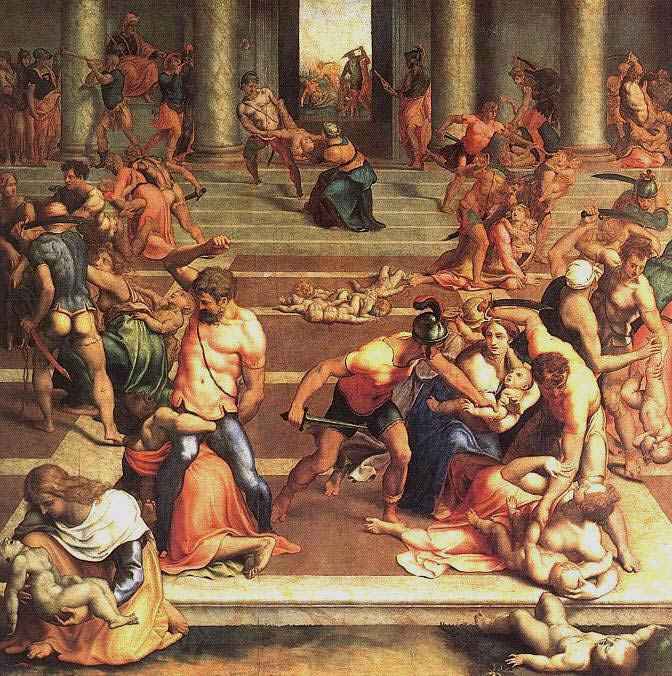
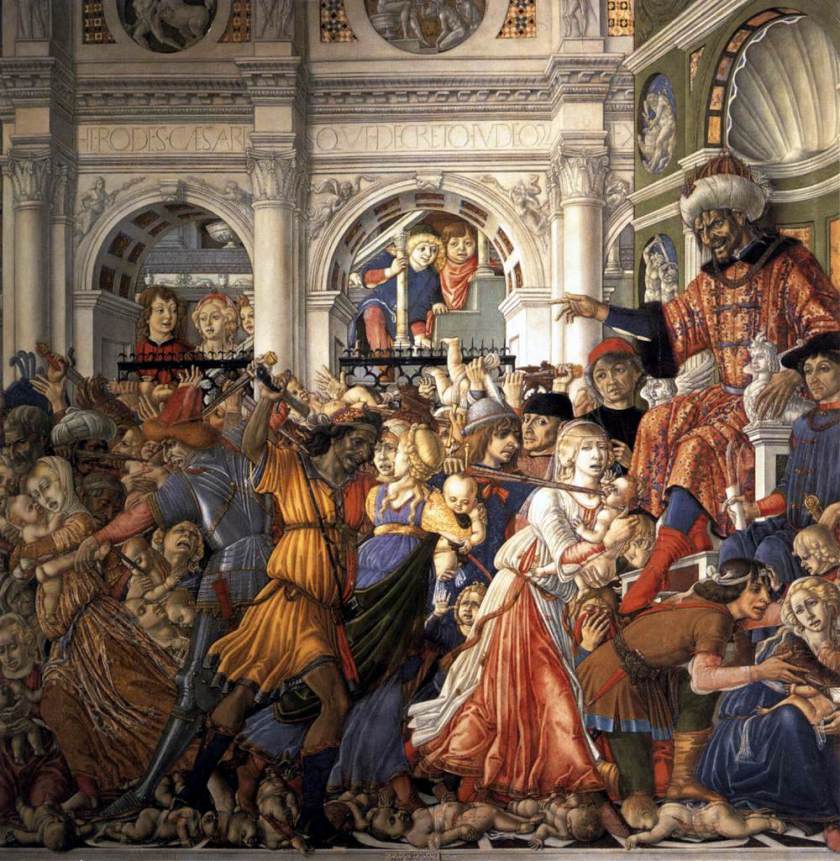
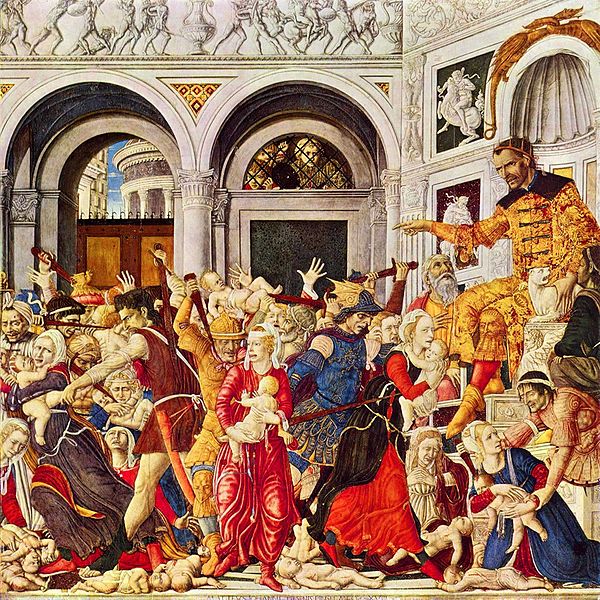
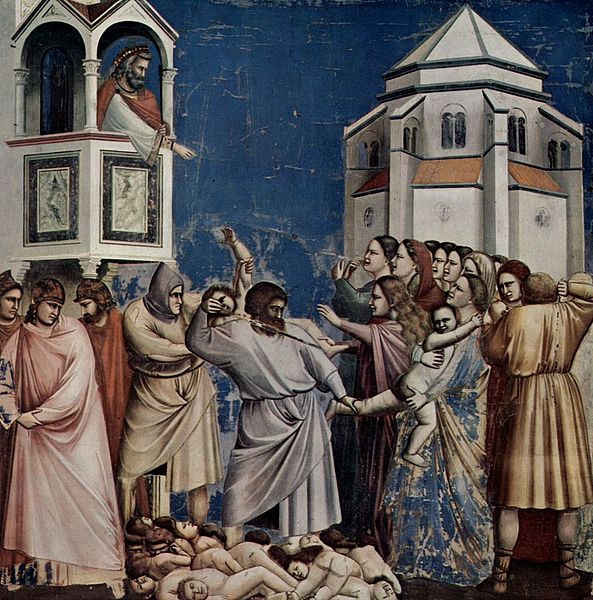
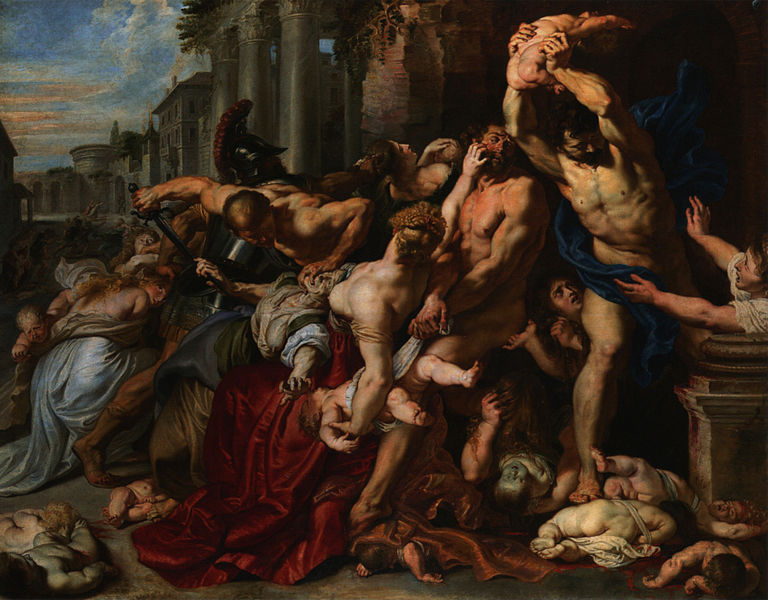
Saints of the Day – Feast of the Holy Innocents – 28 December – 4th Day of the Christmas Octave – Patronages – • against ambition•against jealousy• altar servers•babies•children• children’s choir• choir boys• foundlings• students. The Massacre of the Innocents is the biblical account of infanticide by Herod the Great, the Roman-appointed King of the Jews. According to the Gospel of Matthew, Herod ordered the execution of all young male children in the vicinity of Bethlehem, so as to avoid the loss of his throne to a newborn King of the Jews whose birth had been announced to him by the Magi. In typical Matthean style, it is understood as the fulfilment of an Old Testament prophecy:
Then was fulfilled that which was spoken through Jeremiah the prophet, saying, A voice is heard in Ramah, mourning and great weeping, Rachel weeping for her children and refusing to be comforted because her children are no more.’
The number of infants killed is not stated. The Holy Innocents, although Jewish, have been claimed as martyrs for Christianity and the Feast of the Holy Innocents has long been celebrated.
Taken from THE LITURGICAL YEAR, Christmas II, by Abbot Dom Guéranger. 1 A.D.
THE feast of the beloved Disciple, St John is followed by that of the Holy Innocents. The Crib of Jesus, where we have already met and venerated the Prince of Martyrs and the Eagle of Patmos, has today standing round it a lovely choir of little Children, clad in snow-white robes and holding green branches in their hands. The Divine Babe smiles upon them: He is their King and these Innocents are smiling upon the Church of God. Courage and Fidelity first led us to the Crib; Innocence now comes and bids us tarry there.
Herod intended to include the Son of God amongst the murdered Babes of Bethlehem. The Daughters of Rachel wept over their little ones and the land streamed with blood but the Tyrant’s policy can do no more, it cannot reach Jesus and its whole plot ends in recruiting an immense army of Martyrs for Heaven. These Children were not capable of knowing what an honour it was for them to be made victims for the sake of the Saviour of the world but the very first instant after their immolation, all was revealed to them, they had gone through this world without knowing it and now that they know it, they possess an infinitely better. God showed here the riches of His mercy, He asks of them but a momentary suffering and that over, they wake up in Abraham’s Bosom, no further trial awaits them, they are in spotless innocence and the glory due to a soldier who died to save the life of his Prince belongs eternally to them.
They died for Jesus’ sake, therefore, their death was a real Martyrdom and the Church calls them by the beautiful name of the Flowers of the Martyrs because of their tender age and their innocence. Justly then does the ecclesiastical Cycle bring them before us today, immediately after the two valiant Champions of Christ, Stephen and John. The connection of these three Feasts is thus admirably explained by St Bernard- “In St Stephen, we have both the act and the desire of Martyrdom; in St John, we have but the desire; in the Holy Innocents, we have but the act. . . . Will anyone doubt whether a crown was given to these Innocents?. . . If you ask me what merit could they have that God should crown them? Let me ask you what was the fault for which Herod slew them? What! is the mercy of Jesus less than the cruelty of Herod and whilst Herod could put these Babes to death, who had done him no injury, Jesus may not crown them for dying for Him?”
Stephen, therefore, is a Martyr by a Martyrdom of which men can judge, for he gave this evident proof of his sufferings being felt and accepted, that, at the very moment of his death, his solicitude both for his own soul and for those of his persecutors increased; the pangs of his bodily passion were less intense than the affection of his soul’s compassion, which made him weep more for their sins than for his own wounds. John was a Martyr, by a Martyrdom which only Angels could see, for the proofs of his sacrifice being spiritual, only spiritual creatures could ken them. But the Innocents were Martyrs, to none other eye save Thine, O God! Man could find no merit, Angel could find no merit, the extraordinary prerogative of Thy grace is the more boldly brought out. From the mouth of the Infants and the Sucklings Thou hast perfected praise. The praise the Angels give Thee is- Glory be to God in the highest and peace on earth to men of good will it is a magnificent praise, but I make bold to say that it is not perfect till He cometh Who will say: “Suffer little Children to come unto me, for of such is the kingdom of Heaven.”
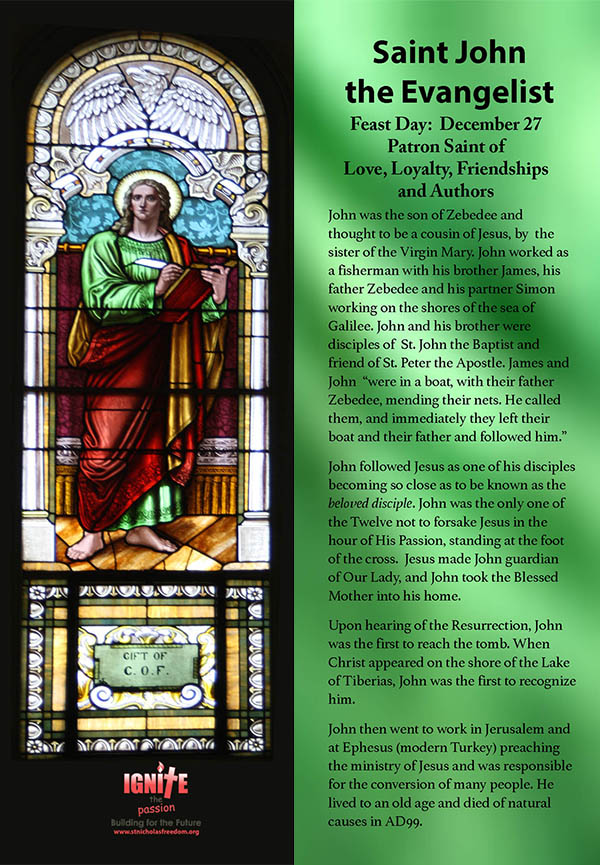
Thought for the Day – 27 December – the Feast of St John the Apostle and Evangelist “The Disciple whom Jesus Loved” and the 3rd Octave Day
Taken From THE LITURGICAL YEAR, Abbot Dom Guéranger OSB, Book II
NEAREST to Jesus’ Crib, after Stephen, stands John, the Apostle and Evangelist. It was only right that the first place should be assigned to him, who so loved his God that he shed his blood in his service; for, as this God Himself declares, greater love than this hath no man, that he lay down his life for his friends, [St. John xv 13] and Martyrdom has ever been counted by the Church as the greatest act of love and as having, consequently, the power of remitting sins, like a second Baptism. But next to the sacrifice of Blood, the noblest, the bravest sacrifice and that which most wins the heart of Him Who is the Spouse of souls, is the sacrifice of Virginity. Now just as St Stephen is looked upon as the type of Martyrs, St John is honoured as the Prince of Virgins. Martyrdom won for Stephen the Crown and palm; Virginity merited for John most singular prerogatives, which, while they show how dear to God is holy Chastity, put this Disciple among those who by their dignity and influence are above the rest of men.
St John was of the family of David, as was our Blessed Lady. He was consequently a relation of Jesus. This same honour belonged to St James the Greater, his brother; as also to St James the Less and St Jude, both sons of Alpheub. When our Saint was in the prime of his youth, he left not only his boat and nets, not only his Father Zebedee but even his betrothed, when everything was prepared for the marriage. He followed Jesus, and never once looked back. Hence the special love which our Lord bore him. Others were Disciples or Apostles, John was the Friend of Jesus. The cause of this our Lord’s partiality was, as the Church tells us in the Liturgy, that John had offered his Virginity to the Man-God. Let us, on this his Feast, enumerate the graces and privileges that came to St. John from his being the Disciple whom Jesus loved.
This very expression of the Gospel, which the Evangelist repeats several times—–The Disciple whom Jesus loved [St. John xiii 23; xix 26; xxi 7; xxi 20]—–says more than any commentary could do. St Peter, it is true, was chosen by our Divine Lord to be the Head of the Apostolic College and the Rock whereon the Church was to be built: he, then, was honoured most; but St John was loved most. Peter was bid to love more than the rest loved and he was able to say, in answer to Jesus’ thrice repeated question, that he did love Him in this highest way: and yet, notwithstanding, John was more loved by Jesus than was Peter himself, because his Virginity deserved this special mark of honour.
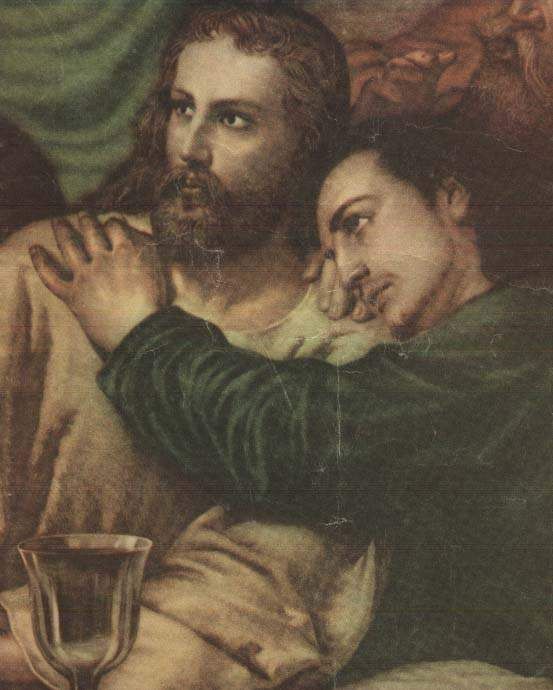
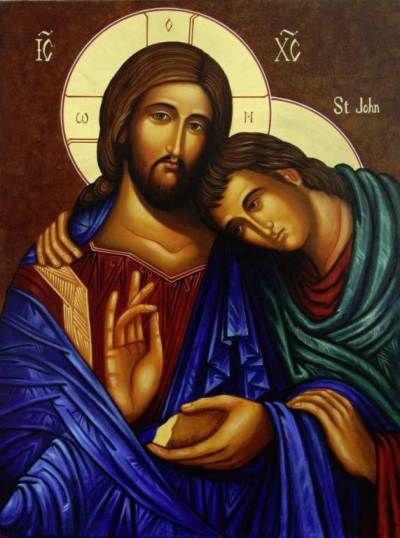
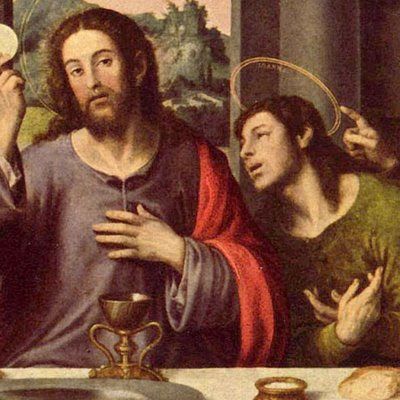
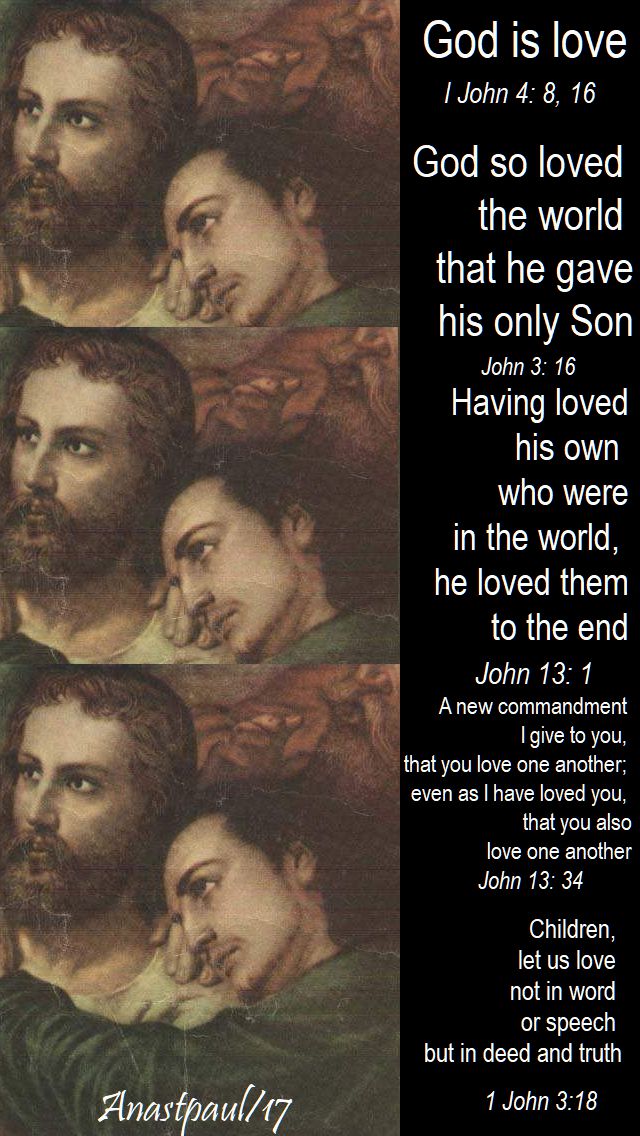
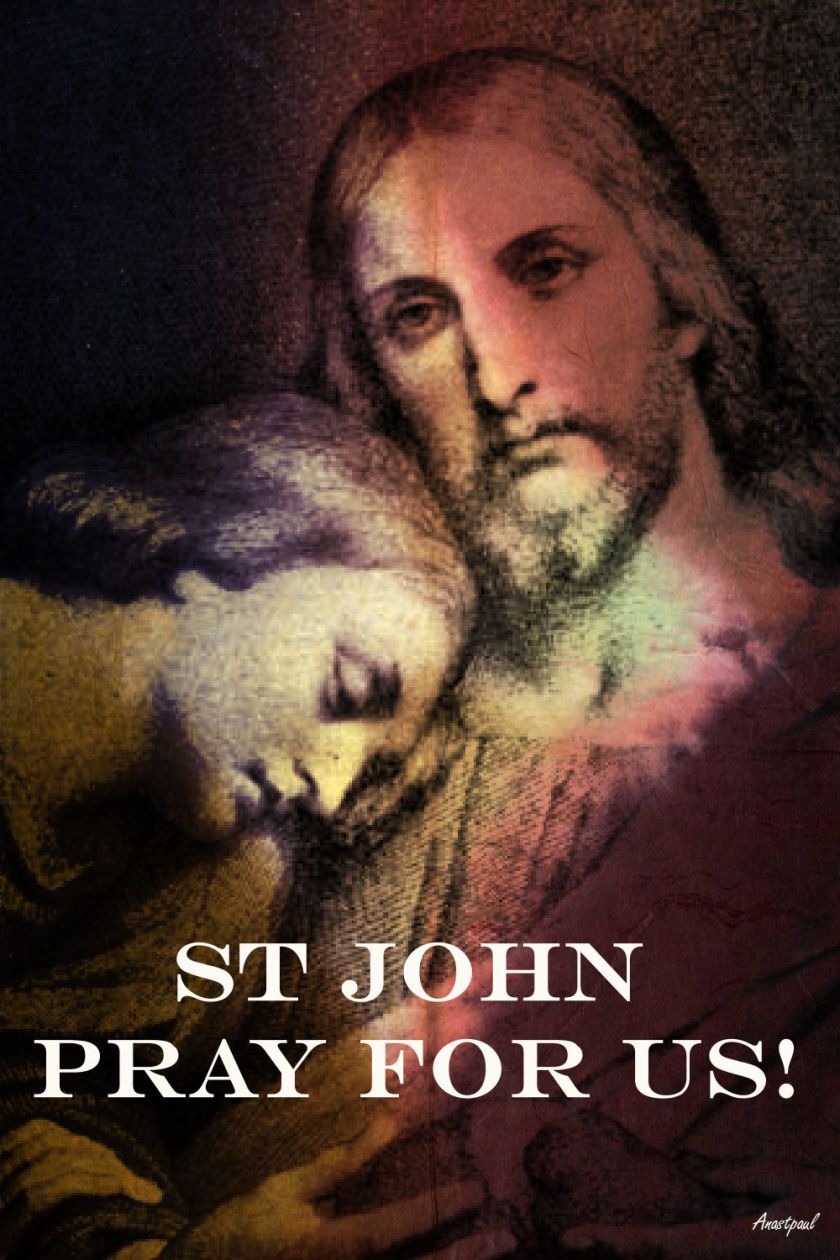
Chastity of soul and body brings him who possesses it into a sacred nearness and intimacy with God. Hence it was that at the Last Supper—–that Supper which was to be renewed on our Altars to the end of the world, in order to cure our spiritual infirmities and give life to our souls—–John was placed near to Jesus, nay, was permitted, as the tenderly loved Disciple, to lean his head upon the Breast of the Man-God. Then it was that he was filled, from their very Fountain, with Light and Love: it was both a recompense and a favour and became the source of two signal graces, which make St John an object of special reverence to the whole Church.
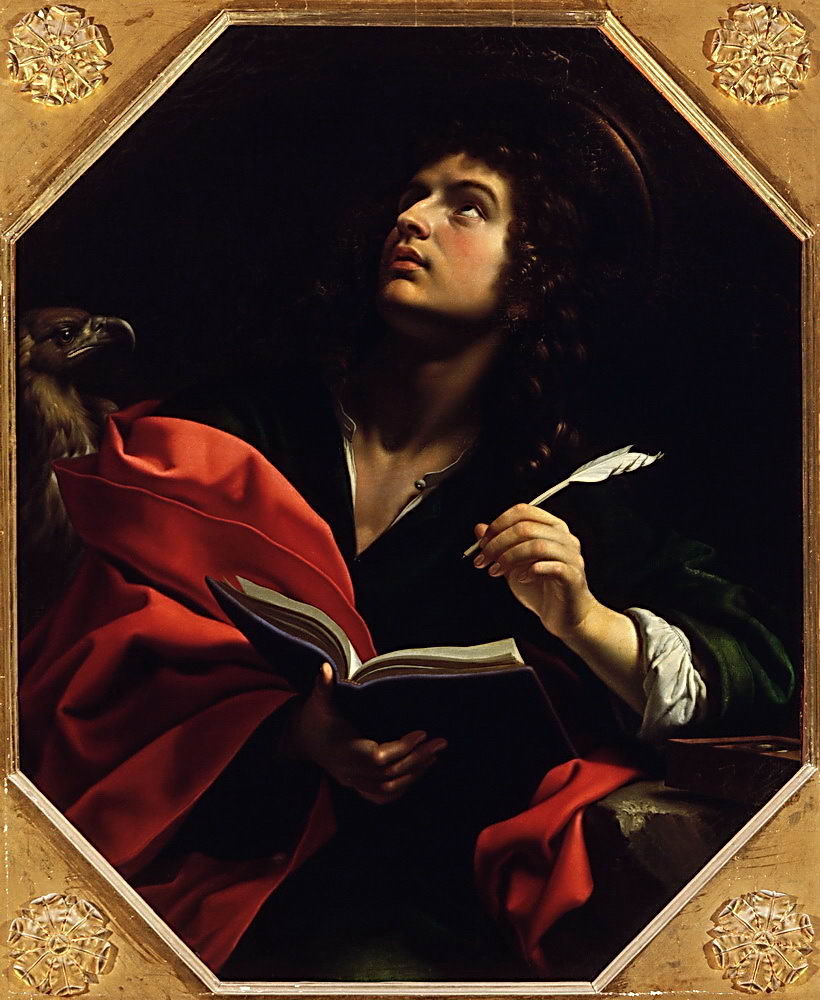
Divine wisdom wishing to make known to the world the Mystery of the Word and commit to Scripture those profound secrets which, so far, no pen of mortal had been permitted to write, the task was put upon John. Peter had been crucified, Paul had been beheaded and the rest of the Apostles had laid down their lives in testimony of the Truths they had been sent to preach to the world; John was the only one left in the Church. Heresy had already begun its blasphemies against the Apostolic Teachings; it refused to admit the Incarnate Word as the Son of God, Consubstantial to the Father. John was asked by the Churches to speak and he did so in language heavenly above measure. His Divine Master had reserved to this His Virgin-Disciple the honour of writing those sublime Mysteries which the other Apostles had been commissioned only to teach—–THE WORD WAS GOD, and this WORD WAS MADE FLESH for the salvation of mankind. Thus did our Evangelist soar, like the Eagle, up to the Divine Sun and gaze upon Him with undazzled eye, because his heart and senses were pure and therefore fitted for such vision of the uncreated Light. If Moses, after having conversed with God in the cloud, came from the Divine interview with rays of miraculous light encircling his head: how radiant must have been the face of St John, which had rested on the very Heart of Jesus, in Whom are hid all the treasures of wisdom and knowledge [Col. ii 3] how sublime his writings! how Divine his teaching! Hence the symbol of the Eagle, shown to the Prophet Ezechiel, [Ezech. i 10; x 14] and to St John himself in his Revelations, [Apoc. iv 7] has been assigned to him by the Church: and to this title of The Eagle has been added, by universal tradition, the other beautiful name of Theologian.
This was the first recompense given by Jesus to His Beloved John—–a profound penetration into Divine Mysteries. The second was the imparting to him of a most ardent charity, which was equally a grace consequent upon his angelic purity, for purity unburdens the soul from grovelling egotistic affections and raises it to a chaste and generous love. John had treasured up in his heart the Discourses of his Master: he made them known to the Church, and especially that Divine one of the Last Supper, wherein Jesus had poured forth His whole Soul to His Own, whom He had always tenderly loved but most so at the end. [1 St. John xiii 1] He wrote his Epistles and Charity is his subject: God is Charity—–he that loveth not, knoweth not God—–perfect Charity casts out fear—–and so on throughout, always on Love. During the rest of his life, even when so enfeebled by old age as not to be able to walk, he was for ever insisting upon all men loving each other, after the example of God, Who had loved them and so loved them! Thus, he that had announced more clearly than the rest of the Apostles the Divinity of the Incarnate Word, was par excellence the Apostle of that Divine Charity which Jesus came to enkindle upon the earth.
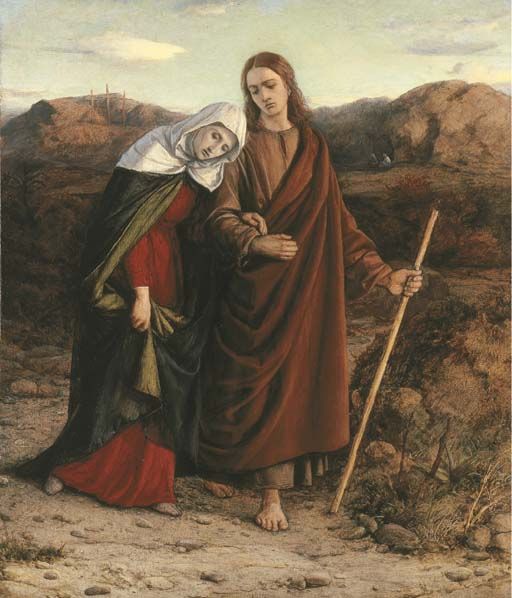
But our Lord had a further gift to bestow and it was sweetly appropriate to the Virgin-Disciple. When dying on his Cross, Jesus left Mary upon this earth. Joseph had been dead now some years. Who then shall watch over His Mother? Who is there worthy of the charge? Will Jesus send His Angels to protect and console her? For, surely, what man could ever merit to be to her as a second Joseph? Looking down, He sees the Virgin-Disciple standing at the foot of the Cross: we know the rest, John is to be Mary’s Son: Mary is to be John’s Mother. Oh! wonderful Chastity, that wins from Jesus such an inheritance as this! Peter, says St Peter Damian, shall have left to him the Church, the Mother of men; but John shall receive Mary, the Mother of God, whom he will love as his own dearest Treasur, and to whom he will stand in Jesus’ stead; whilst Mary will tenderly love John, her Jesus’ Friend, as her Son.
Can we be surprised after this, that St John is looked upon by the Church as one of her greatest glories? He is a Relative of Jesus in the flesh; he is an Apostle, a Virgin, the Friend of the Divine Spouse, the Eagle, the Theologian, the Son of Mary; he is an Evangelist, by the history he has given of the Life of his Divine Master and Friend; he is a Sacred Writer, by the three Epistles he wrote under the inspiration of the Holy Ghost; he is a Prophet, by his mysterious Apocalypse, wherein are treasured the secrets of time and eternity. But is he a Martyr? Yes, for if he did not complete his sacrifice, he drank the Chalice of Jesus, [St. Matt. xx 22] when, after being cruelly scourged, he was thrown into a caldron of boiling oil before the Latin Gate at Rome. He was therefore a Martyr in desire and intention, though not in fact. If our Lord, wishing to prolong a life so dear to the Church, as well as to show how he loves and honours Virginity, miraculously stayed the effects of the frightful punishment, St John had, on his part, unreservedly accepted Martyrdom.
Such is the companion of Stephen at the Crib, wherein lies our Infant Jesus. If the Protomartyr dazzles us with the robes he wears of the bright scarlet of his own blood; is not the virginal whiteness of John’s vestment fairer than the untrod snow? The spotless beauty of the Lilies of Mary’s adopted Son and the bright vermilion of Stephen’s Roses——what is there more lovely than their union? Glory, then, be to our New-Born King, Whose court is tapestried with such heaven-made colours as these! Yes, Bethlehem’s Stable is a very Heaven on earth and we have seen its transformation. First we saw Mary and Joseph alone there: they were adoring Jesus in His Crib; then, immediately, there descended a heavenly host of Angels singing the wonderful Hymn; the Shepherds soon followed, the humble, simple-hearted Shepherds; after these entered Stephen the Crowned and John the Beloved Disciple; and even before there enters the pageant of the devout Magi, we shall have others coming in, and there will be each day grander glory in the Cave, and gladder joy in our hearts. Oh! this birth of our Jesus! Humble as it seems, yet how Divine! What King or Emperor ever received in his gilded cradle, honours like these shown to the Babe of Bethlehem? Let us unite our homage with that given Him by these the favoured inmates of His court. Yesterday the sight of the Palm in Stephen’s hand animated us and we offered to our Jesus the promise of a stronger Faith: today the Wreath that decks the brow of the Beloved Disciple breathes upon the Church the heavenly fragrance of Virginity: an intenser love of Purity must be our resolution, and our tribute to the Lamb.
Beloved Disciple of the Babe of Bethlehem! how great is thy happiness! how wonderful is the reward given to thy love and thy purity! In thee was fulfilled that word of thy Master: Blessed are the clean of heart; for they shall see God. Not only didst thou see this God-Man: thou wast His Friend and on His Bosom didst rest thy head. John the Baptist trembles at having to bend the head of Jesus under the water of Jordan; Magdalen, though assured by his own lips that her pardon was perfect as her love, yet dares not raise her head, but keeps clinging to his feet; Thomas scarce presumes to obey Him when He bids him put his finger into His wounded Side; and thou, in the presence of all the Apostles, sittest close to Him, leaning thy head upon His Breast! Nor is it only Jesus in his Humanity that thou seest and possessest; but, because thy heart is pure, thou soarest like an eagle up to the Sun of Justice and fixest thine eye upon Him in the light inaccessible wherein He dwells eternally with the Father and the Holy Ghost.
Thus was rewarded the fidelity wherewith thou didst keep intact for Jesus the precious treasure of thy Purity. And now, O worthy favourite of the great King! forget not us poor sinners. We believe and confess the Divinity of the Incarnate Word Whom thou hast evangelised unto us; but we desire to draw nigh to Him during this holy season, now that He shows himself so desirous of our company, so humble, so full of love, so dear a Child, and so poor! Alas! our sins keep us back; our heart is not pure like thine; we have need of a Patron to introduce us to our Master’s crib. [Isa. i 3] Thou, O Beloved Disciple of Emmanuel! Thou must procure us this happiness. Thou hast shown us the Divinity of the Word in the bosom of the Eternal Father; lead us now to this same Word made flesh. Under thy patronage Jesus will permit us to enter into the Stable, to stand near His Crib, to see with our eyes and touch with our hands [1 St. John i 1] this sweet Fruit of eternal Life. May it be granted us to contemplate the sweet Face of Him that is our Saviour and thy Friend; to feel the throbs of that Heart which loves both thee and us, which thou didst see wounded by the Spear, on Calvary. It is good for us to fix ourselves here near the Crib of our Jesus and share in the graces He there lavishes and learn, as thou didst, the grand lesson of this Child’s simplicity: thy prayers must procure all this for us.
Then too, as Son and Guardian of Mary, thou hast to present us to thine own and our Mother. Ask her to give us somewhat of the tender love wherewith she watches over the Crib of her Divine Son; to see in us the Brothers of that Child she bore; and to admit us to a share of the maternal affection she had for thee, the favoured confidant of the secrets of her Jesus.
We also pray to thee, O holy Apostle! for the Church of God. She was planted and watered by thy labours, embalmed with the celestial fragrance of thy virtues and illumined by thy sublime teachings; pray now that these graces may bring forth their fruit, and that to the end of her pilgrimage faith may be firm, the love of Jesus fervent, and Christian morals pure and holy. Thou has told us in thy Gospel of a saying of thy Divine Master: I will not now call you my Servants but my Friends: [St. John xv 15] pray, dear Saint, that there may come to this, from our hearts and lips, a response of love and courage, telling our Emmanuel that, like thyself, we will follow Him whithersoever He leads us.
Let us, on this second day after our Divine Infant’s Birth, meditate upon the Sleep He deigns to take. Let us consider how this God of all goodness, Who has come down from Heaven to invite His creature man to come to Him and seek rest for his soul, seeks rest Himself in our earthly home and sanctifies by His Own Divine sleep that rest which to us is a necessity. We have just been dwelling with delighted devotion on the thought of His offering His Breast as a resting-place for the Beloved Disciple and for all souls that imitate John in his love and devotedness: now let us look at this our God, sweetly sleeping in His humble Crib, or on His Mother’s lap.
One Minute Reflection – 27 December – the Feast of St John the Apostle and Evangelist “The Disciple whom Jesus Loved” and the 3rd Octave Day
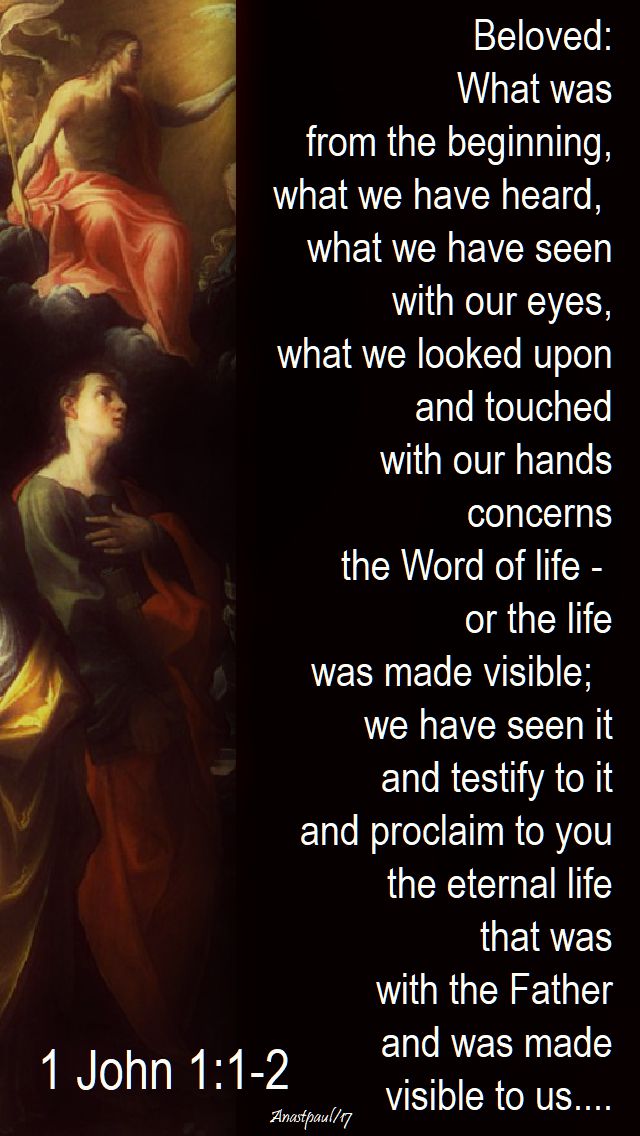
Beloved: What was from the beginning, what we have heard, what we have seen with our eyes, what we looked upon and touched with our hands concerns the Word of life (for the life was made visible; we have seen it and testify to it and proclaim to you the eternal life that was with the Father and was made visible to us.…1 John 1:1-2
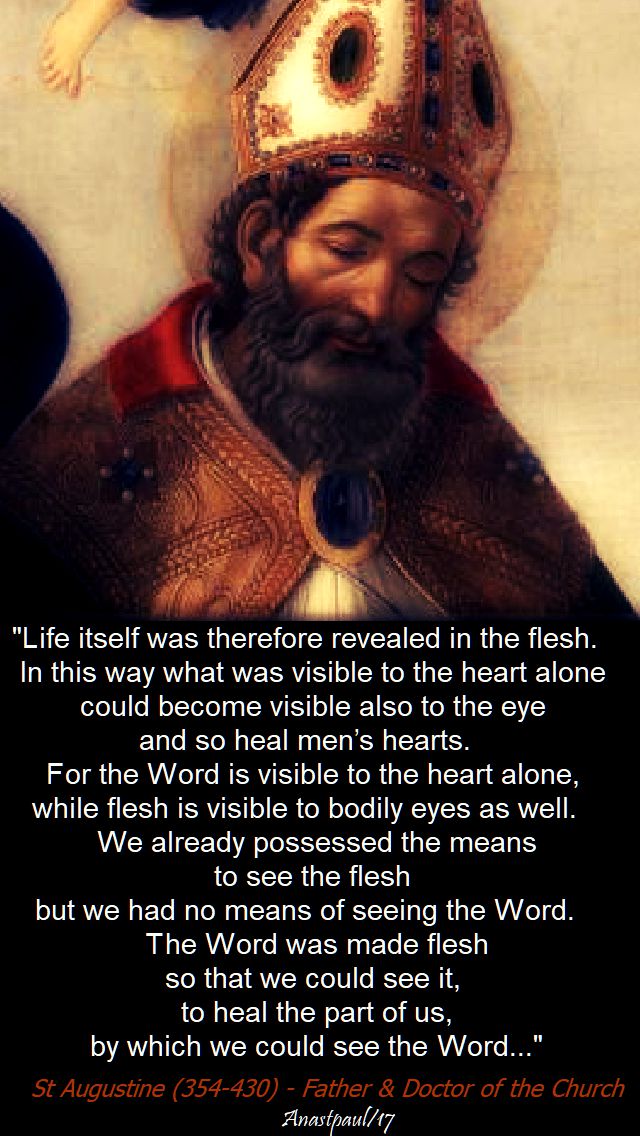
REFLECTION – “Life itself was therefore revealed in the flesh. In this way what was visible to the heart alone could become visible also to the eye and so heal men’s hearts. For the Word is visible to the heart alone, while flesh is visible to bodily eyes as well. We already possessed the means to see the flesh but we had no means of seeing the Word. The Word was made flesh so that we could see it, to heal the part of us, by which we could see the Word…”…St Augustine (354-430) – Father & Doctor of the Church
PRAYER – Almighty God, who through Your Apostle John, unlocked for us the hidden treasures of Your Word, grant that we may grasp with fuller understanding, the message he so admirably proclaimed. Through our Lord Jesus Christ, in union with the Holy Spirit, one God forever and ever, amen.
Thought for the Day – 26 December – The Memorial of St Stephen the First Martyr and the Second Day in the Octave of Christmas
Today the Church remembers the witness of Saint Stephen, the first of the Church’s martyrs. The cruelty of his death is recorded in the Acts of the Apostles, as is the manner in which he died, transforming the violence that took his life into an occasion to give witness to an authority greater than those fallen powers who would rule us by fear and threats.
That the Church remembers Saint Stephen today is no accident. Strip away the sentimentality that obscures the story of Christ’s Nativity and one realises that Christ came into this world and from the first instant He showed His infant face, He was opposed. Recall yesterday’s excerpt from the magnificent prologue to the Gospel of John which testifies that Christ came to His own (us) and His own (again, that means us) “knew him not.” But worse than this- we refused Him.
And many still do.
The Holy Child came ready for this fight and the world was willing to fight Him. However, the world discovered that it was outmatched and the fallen powers of this world turned against those whom the Holy Child loves. Unable to harm the Body of His human nature any longer, the world strikes at His Body, the Church.
Therefore, when the Church remembers its martyrs, like Saint Stephen, it is not merely out of a concern that the faithful become conversant in the details of Church history. Instead it is to keep us honest- not only about the past but also about the present. It has never been easy to be a Christian and being a Christian has always been counter-cultural. If lived authentically, it is lived in defiance against the fallen powers of the world.
This means that like our Saviour we have to be ready. We have to learn the strategy that He used to defeat the fallen powers of this world and how He claimed victory when it seemed that these fallen powers could not be defeated. We must learn His strategy- enacted in the witness of Saint Stephen and all the Church’s martyrs, past and present- lest in our opposition to the powers of this world, we become just like them. (Fr Steve Grunow)
Grant, Lord we pray,
that we may imitate what we worship,
and so learn to love even our enemies,
for we celebrate the heavenly birthday
of Saint Stephen, who knew how to pray for his persecutors.
Through our Lord Jesus Christ your Son,
who lives and reigns with you in the unity of the Holy Spirit,
one God, for ever and ever.
Amen.
Quote/s of the Day – 26 December – The Memorial of St Stephen the First Martyr and the Second Day in the Octave of Christmas
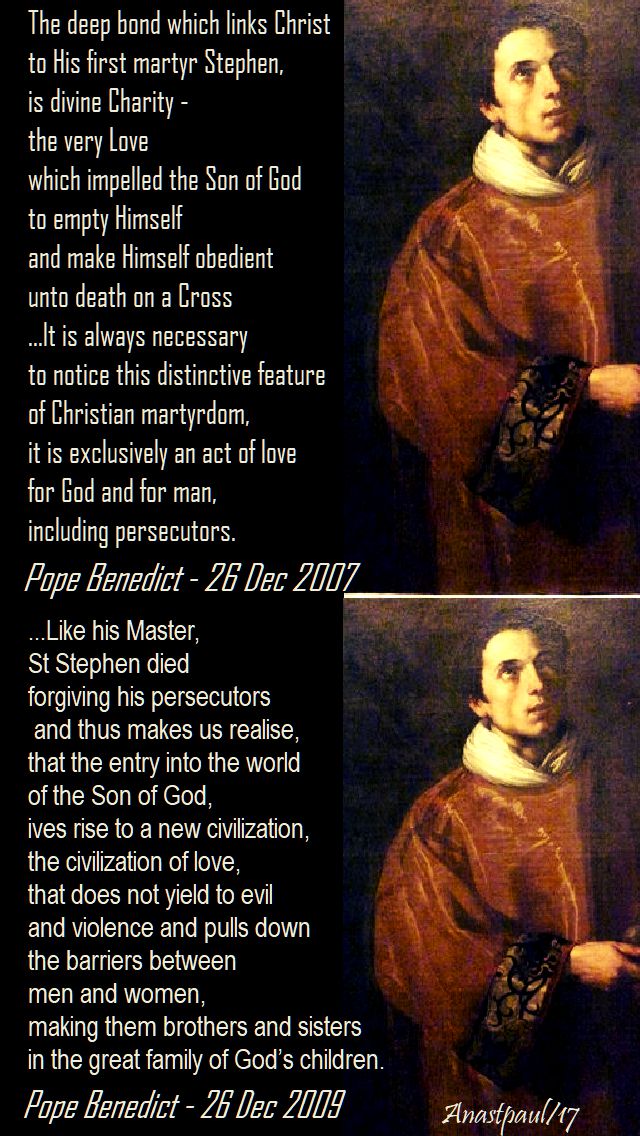
“The deep bond which links Christ to His first martyr Stephen, is divine Charity – the very Love which impelled the Son of God to empty Himself and make Himself obedient unto death on a Cross …It is always necessary to notice this distinctive feature of Christian martyrdom, it is exclusively an act of love for God and for man, including persecutors.”
Pope Benedict XVI – 26 December 2007
” …Like his Master, St Stephen died forgiving his persecutors and thus makes us realise that the entry into the world of the Son of God gives rise to a new civilisation, the civilisation of love that does not yield to evil and violence and pulls down the barriers between men and women, making them brothers and sisters in the great family of God’s children.”
Quote/s of the Day – 25 December – The Solemnity of the Nativity of the Lord
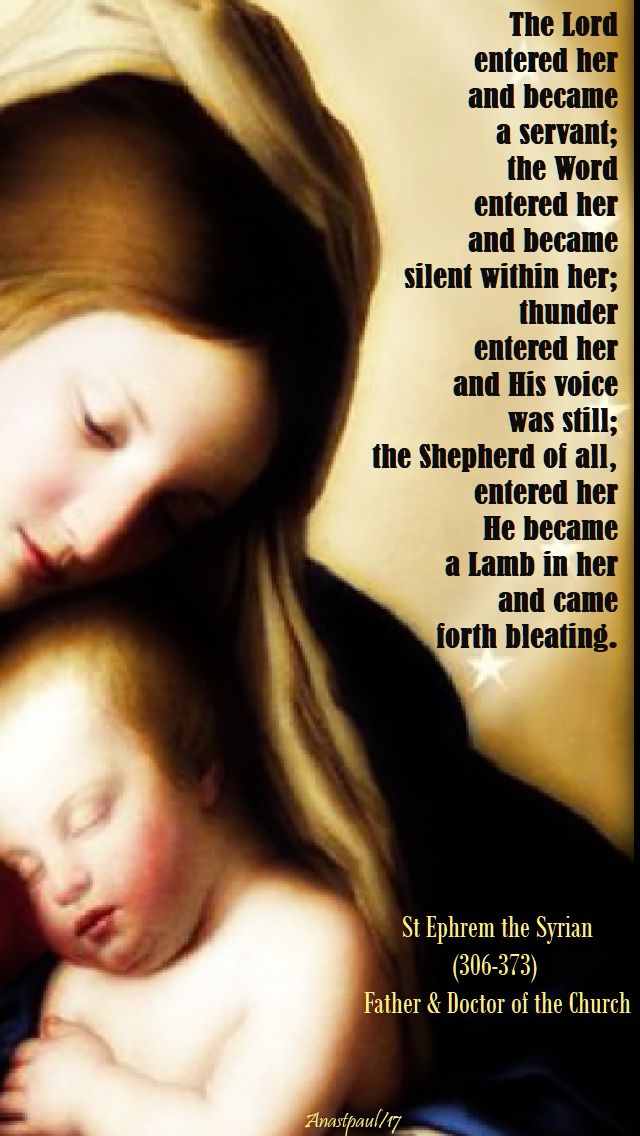
“The Lord entered her and became a servant; the Word entered her and became silent within her; thunder entered her and His voice was still; the Shepherd of all, entered her He became a Lamb in her and came forth bleating.”
St Ephrem the Syrian (306-373) Father & Doctor of the Church
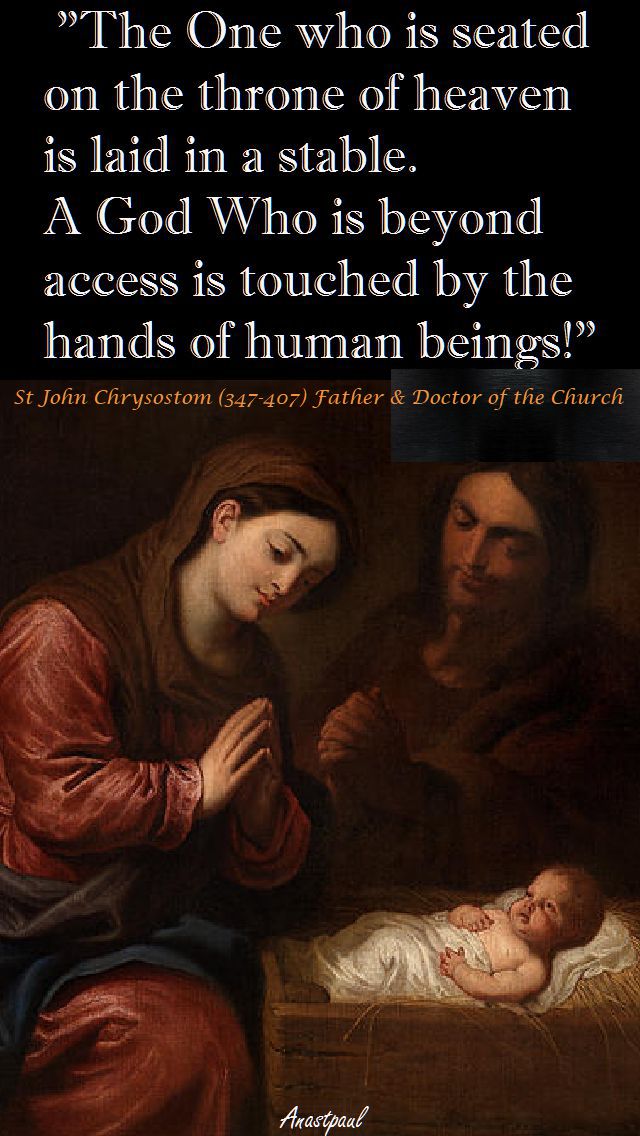
“The One who is seated on the throne of heaven is laid in a stable. A God Who is beyond access is touched by the hands of human beings!”
St John Chrysostom (347-407) Father & Doctor of the Church
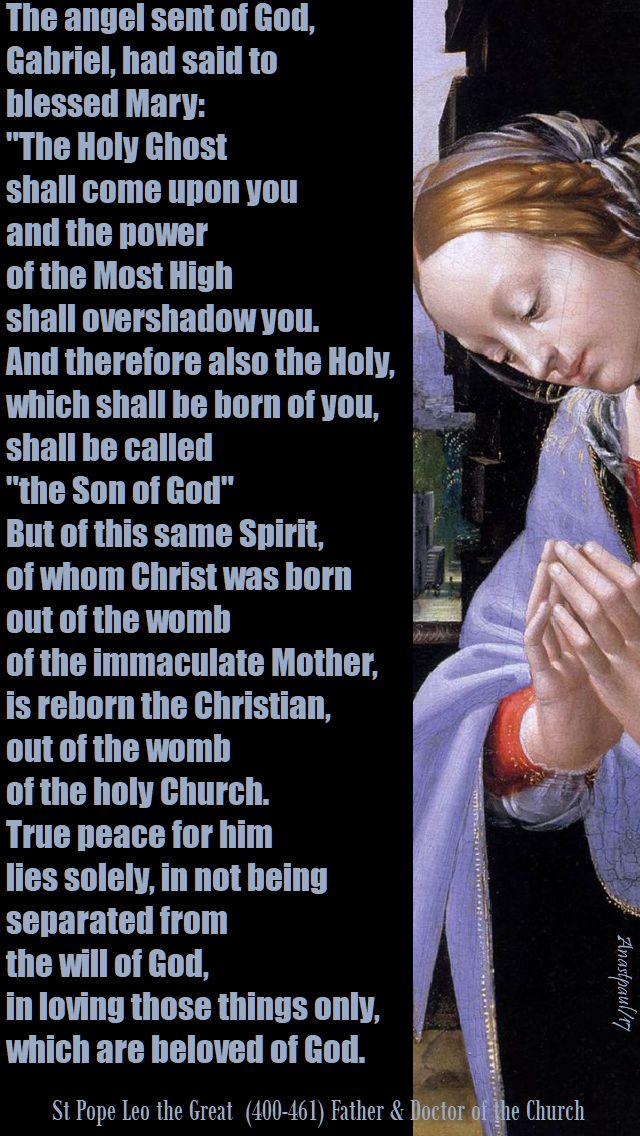
“The angel sent of God, Gabriel, had said to blessed Mary: “The Holy Ghost shall come upon you and the power of the Most High shall overshadow you. And therefore also the Holy, which shall be born of you, shall be called the Son of God” (Luke 1:35). But of this same Spirit, of whom Christ was born out of the womb of the immaculate Mother, is reborn the Christian, out of the womb of holy Church. True peace for him lies solely, in not being separated from the will of God, in loving those things only, which are beloved of God.”
St Pope Leo the Great (400-461) Father & Doctor of the Church
One Minute Reflection – 25 December – The Solemnity of the Nativity of the Lord
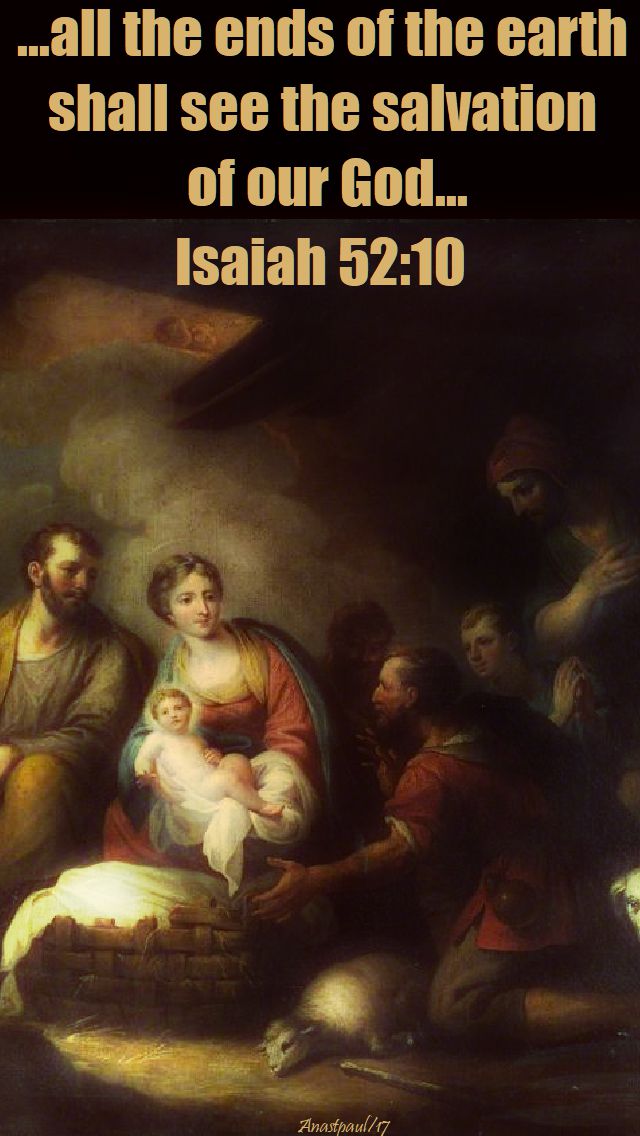
The Lord has bared his holy arm before the eyes of all the nations; and all the ends of the earth shall see the salvation of our God…Isaiah 52:10
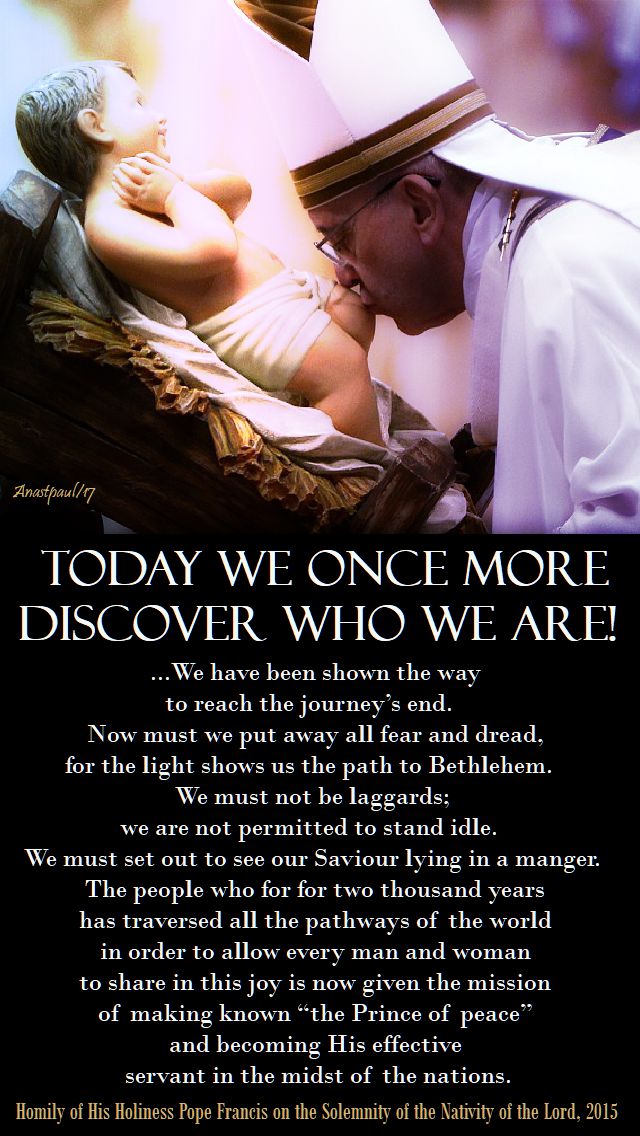
REFLECTION – “Today, the Son of God is born and everything changes. The Saviour of the world comes to partake of our human nature; no longer are we alone and forsaken. The Virgin offers us her Son as the beginning of a new life. The true light has come to illumine our lives so often beset by the darkness of sin. Today we once more discover who we are! Tonight we have been shown the way to reach the journey’s end. Now must we put away all fear and dread, for the light shows us the path to Bethlehem. We must not be laggards; we are not permitted to stand idle. We must set out to see our Saviour lying in a manger. This is the reason for our joy and gladness: this Child has been “born to us”; he was “given to us”, as Isaiah proclaims (cf. 9:5). The people who for for two thousand years has traversed all the pathways of the world in order to allow every man and woman to share in this joy is now given the mission of making known “the Prince of peace” and becoming His effective servant in the midst of the nations.”…HOMILY OF HIS HOLINESS POPE FRANCIS on the Solemnity of the Nativity of the Lord, 2015
PRAYER – Almighty God, Your incarnate Word fills us with the new light He brought to men. Let the light of faith in our hearts shine through all the ages, to bring Your light to all nations. Come, come, let us adore our Holy Babe of Bethlehem, through whom we pray, in unity with the Holy Spirit, one God, forever and ever amen.
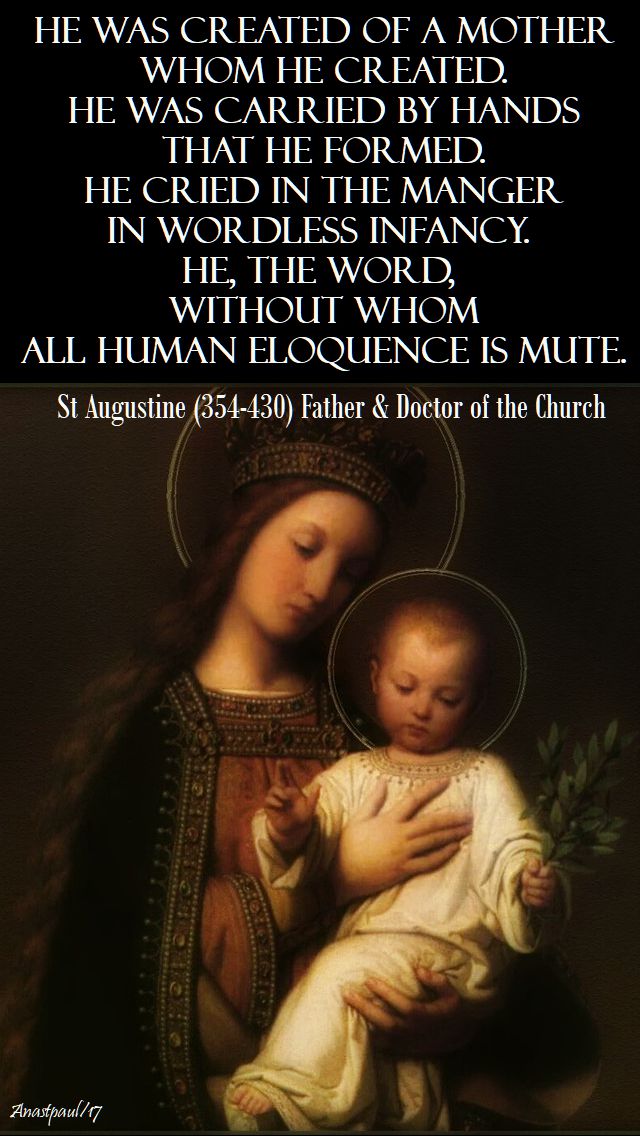
“He was created of a mother whom He created. He was carried by hands that He formed. He cried in the manger in wordless infancy. He, the Word, without whom all human eloquence is mute.”
St Augustine (354-430) Father & Doctor of the Church
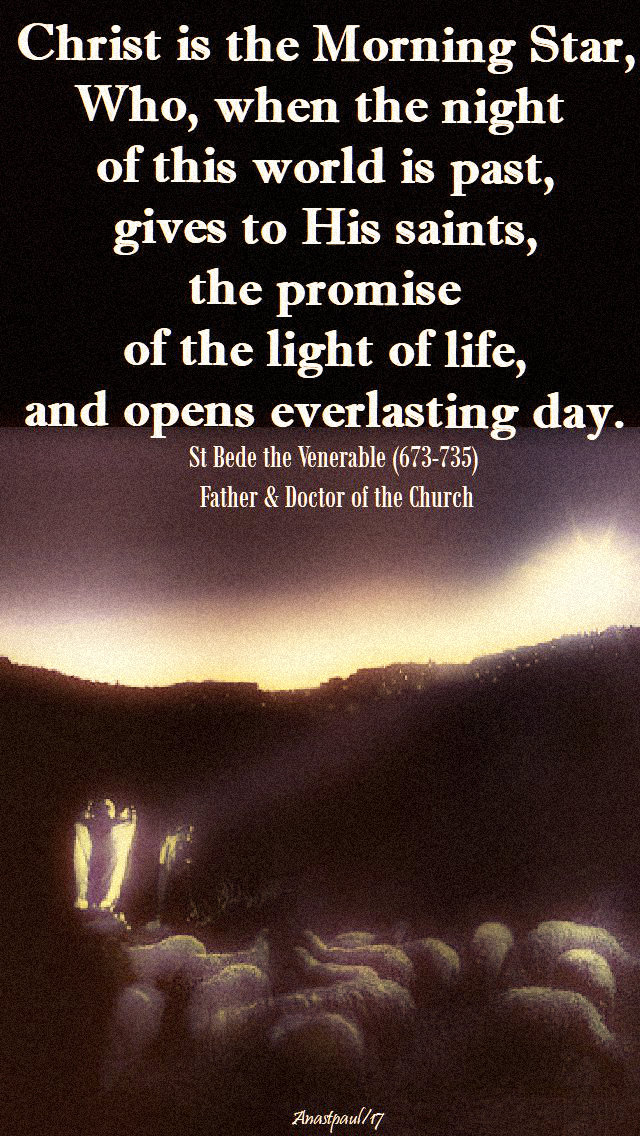
“Christ is the Morning Star, Who, when the night of this world is past, gives to His saints, the promise of the light of life, and opens everlasting day.”
St Bede the Venerable (673-735) Father & Doctor of the Church
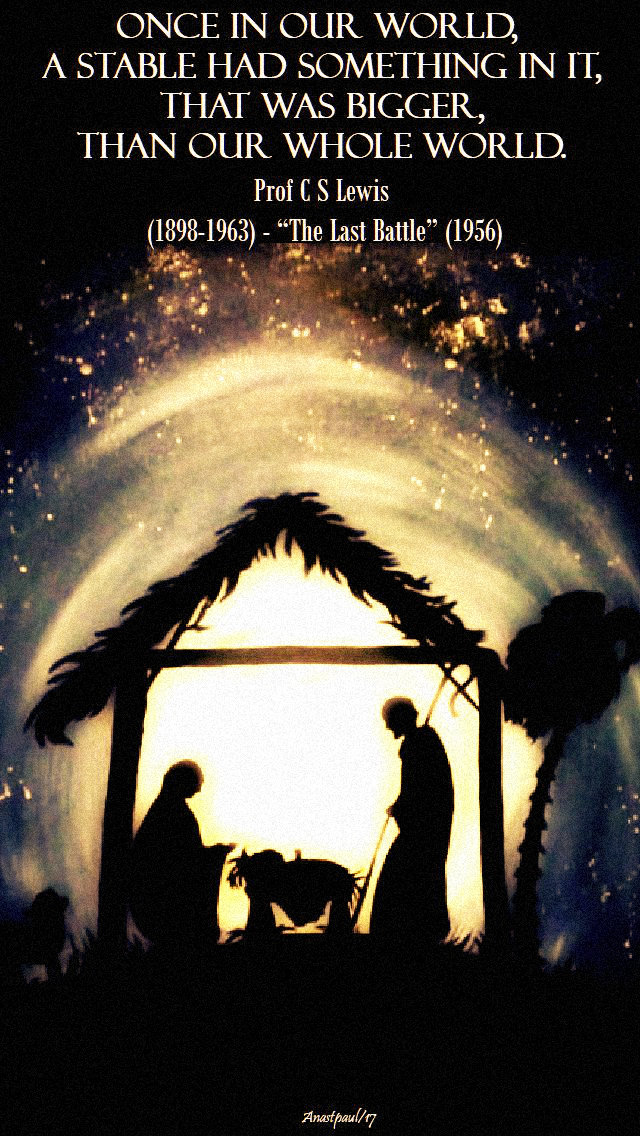
“Once in our world, a stable had something in it, that was bigger, than our whole world.”
C S Lewis (1898-1963) – “The Last Battle” (1956)
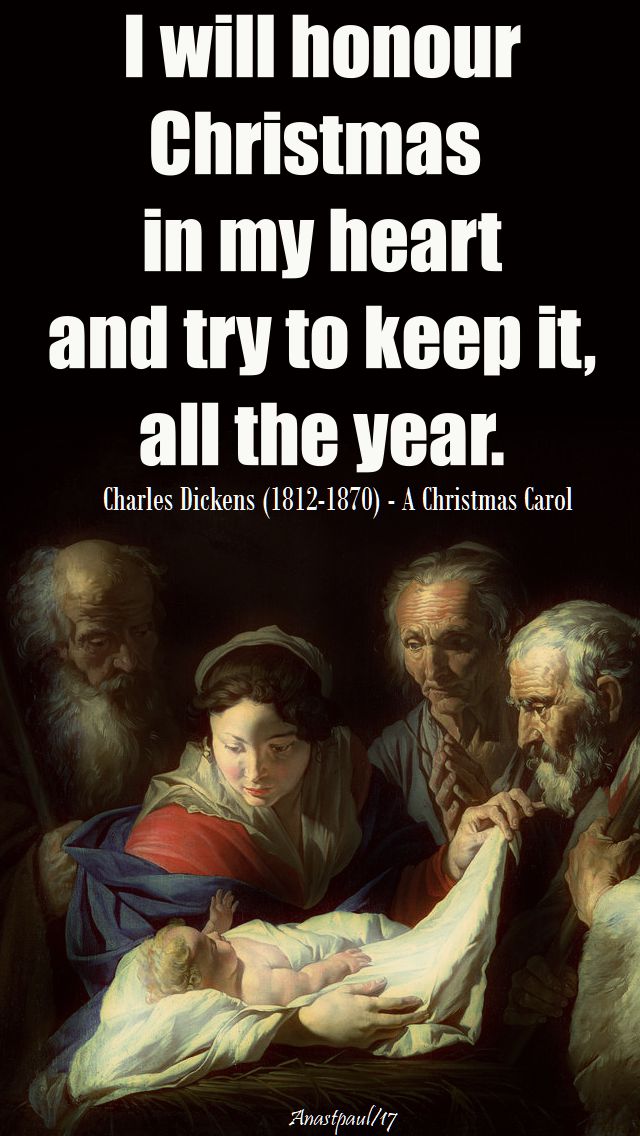
“I will honour Christmas in my heart and try to keep it all the year.”
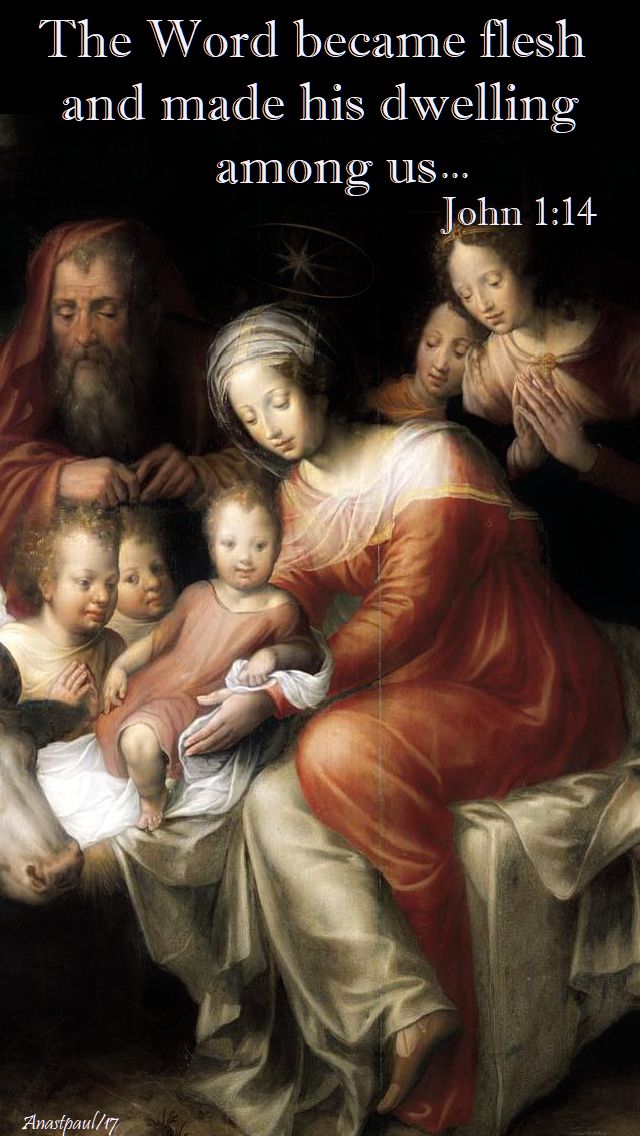
The Word became flesh and made his dwelling among us……..John 1:14
REFLECTION: Indeed, let us rejoice that we are unequal to the task
of giving due praise to so great a sacrament of mercy
(that is, the Nativity);
and if we are unable to express the sublimity
of the manner of our redemption,
let us know that it is good for us to be so helpless.
For none approaches more closely
to the knowledge of the truth than he who realises
that in matters divine there ever remains,
far more to attain,
no matter how far he progresses…St Pope Saint Leo the Great (400-461) Father & Doctor of the Church
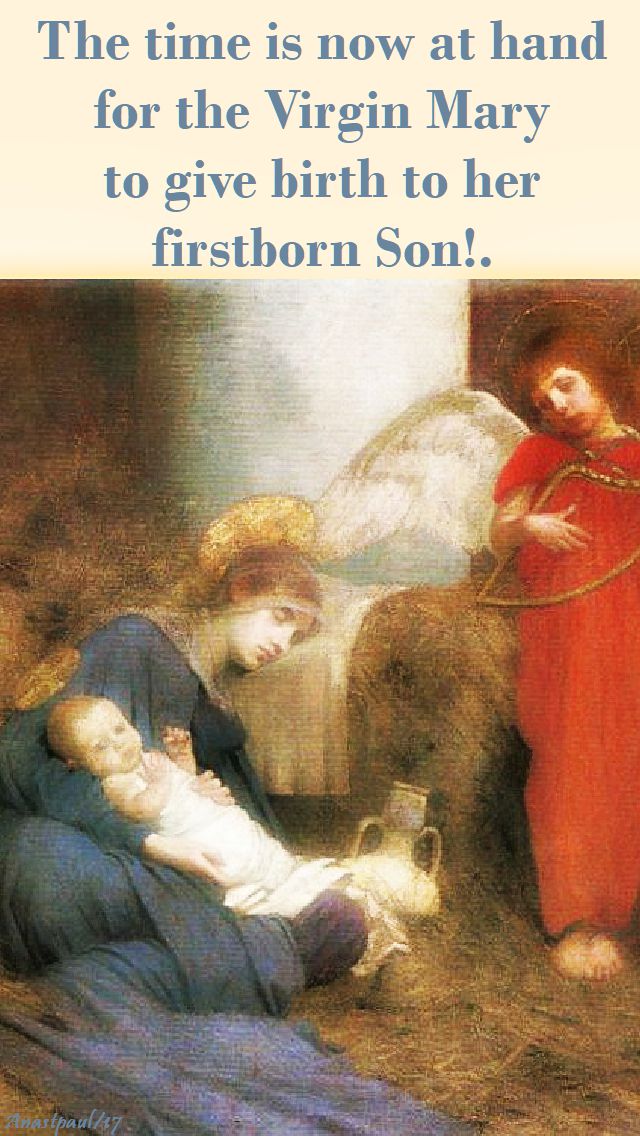
PRAYER – Come Lord Jesus, come soon. In this time of Your coming, support and console us who trust in Your love. We welcome Him with joy as our Redeemer; year by year renew our joy as we await the fulfilment of our redemption. The time is now at hand for the Virgin Mary to give birth to her firstborn Son! Through Jesus Christ our Lord, in union with the Holy Spirit, one God forever and ever, amen.
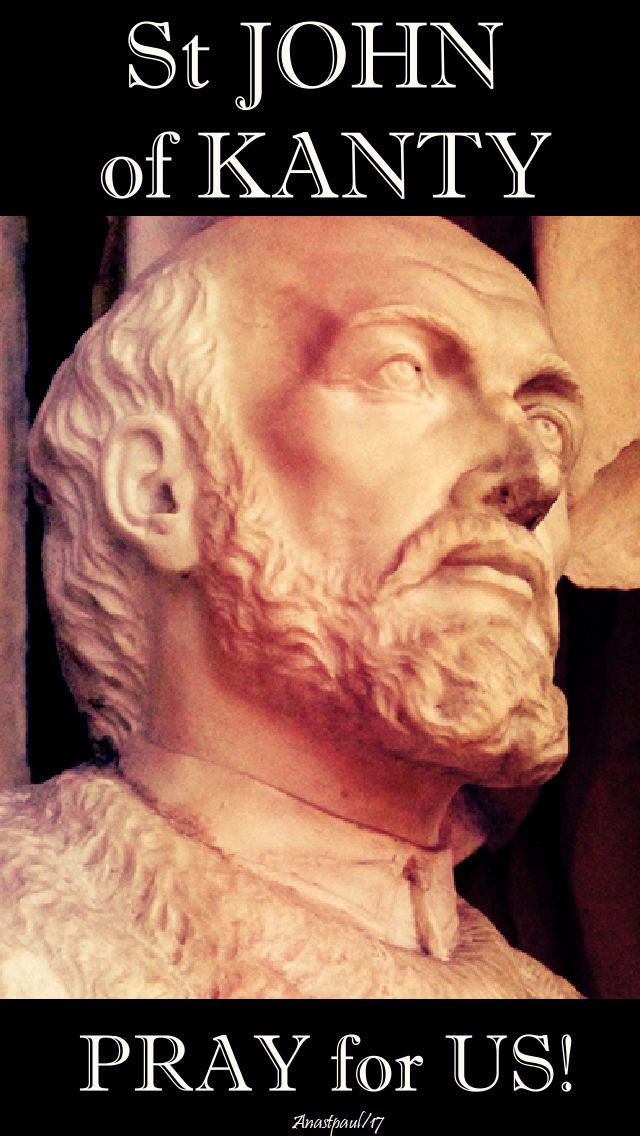
Quote of the Day – 23 December – The Memorial of St John of Kanty (1390-1473)
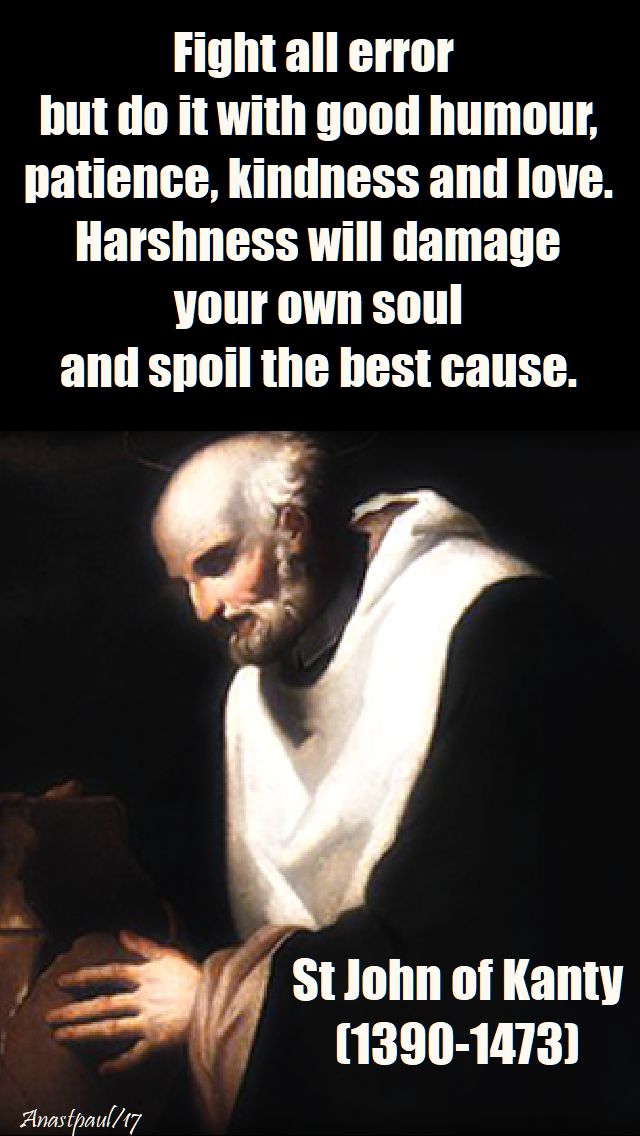
“Fight all error but do it with good humour, patience, kindness and love. Harshness will damage your own soul and spoil the best cause.”
St John of Kanty (1390-1473)
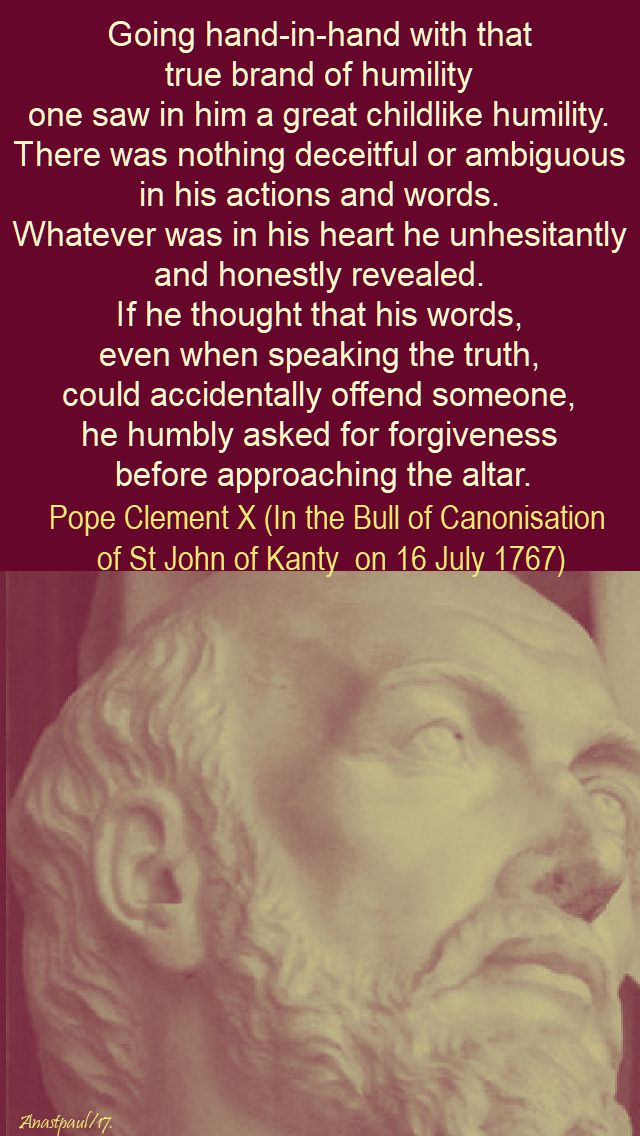
“Going hand-in-hand with that true brand of humility one saw in him a great childlike humility. There was nothing deceitful or ambiguous in his actions and words. Whatever was in his heart he unhesitantly and honestly revealed. If he thought that his words, even when speaking the truth, could accidentally offend someone, he humbly asked for forgiveness before approaching the altar.”
Pope Clement X (In the Bull of Canonisation of St John of Kanty on 16 July 1767)
One Minute Reflection – 23 December – Saturday of the Third Week of Advent and the Memorial of St John of Kanty (1390-1473)
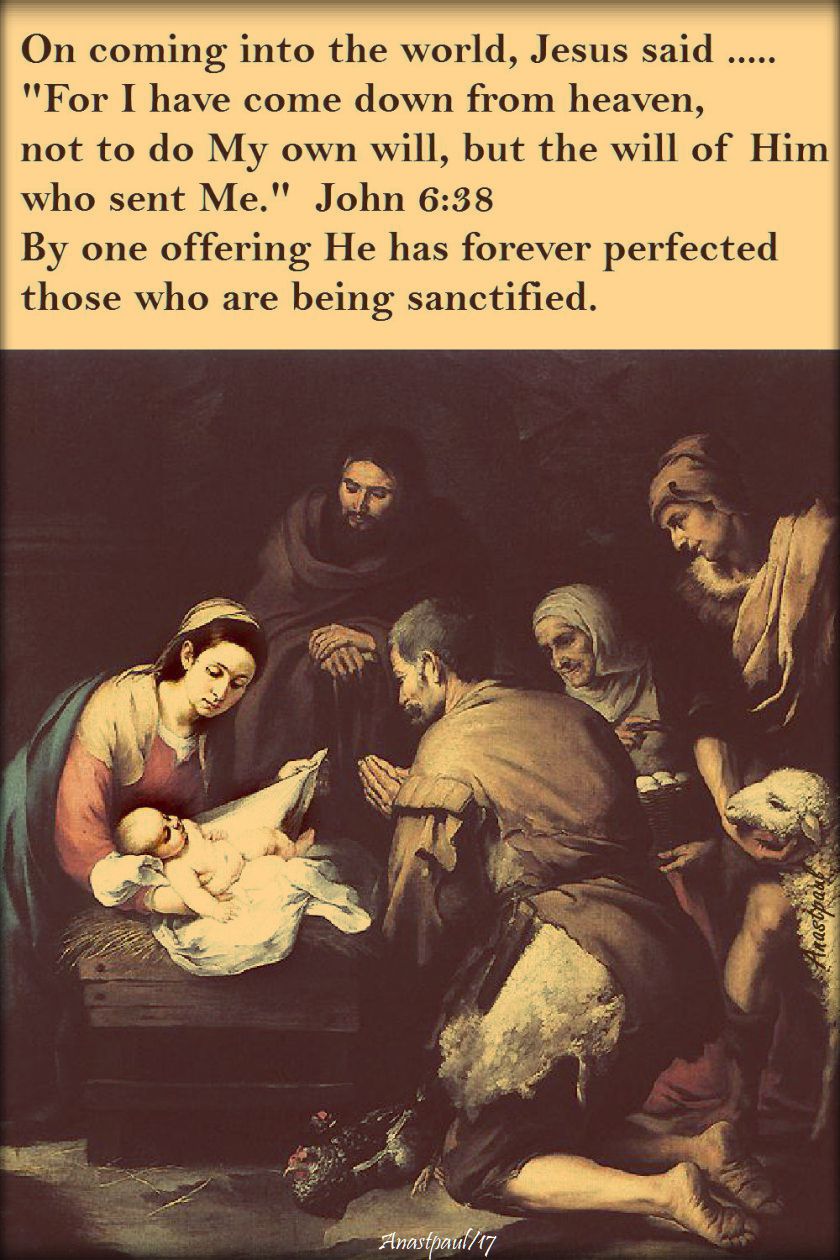
On coming into the world, Jesus said …..”For I have come down from heaven, not to do My own will but the will of Him who sent Me” (John 6:38). By one offering He has forever perfected those who are being sanctified.
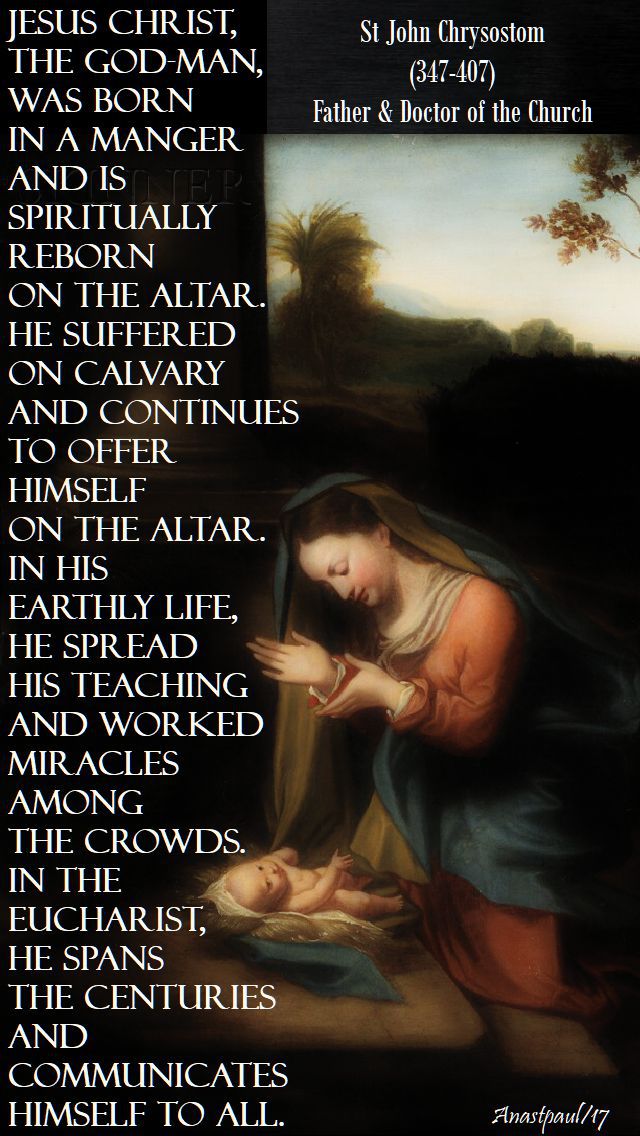
REFLECTION – “Jesus Christ, the God-Man, was born in a manger and is spiritually reborn on the altar. He suffered on Calvary and continues to offer Himself on the altar. In His earthly life, He spread His teaching and worked miracles among the crowds. In the Eucharist, He spans the centuries and communicates Himself to all.”…St John Chrysostom (347-407) Father & Doctor of the Church
PRAYER – Heavenly Father, in contemplating the birth of Your Son in time and in the Eucharist, may I ever attain a new birth. May I through love of You, give my all to my neighbour in true charity. Help me to learn from St John of Kanty to live in humility, true poverty of spirit and charity and of whom we ask for intercession. St John of Kanty, pray for us! Amen
Quote of the Day – 22 December – Friday of the Third Week of Advent
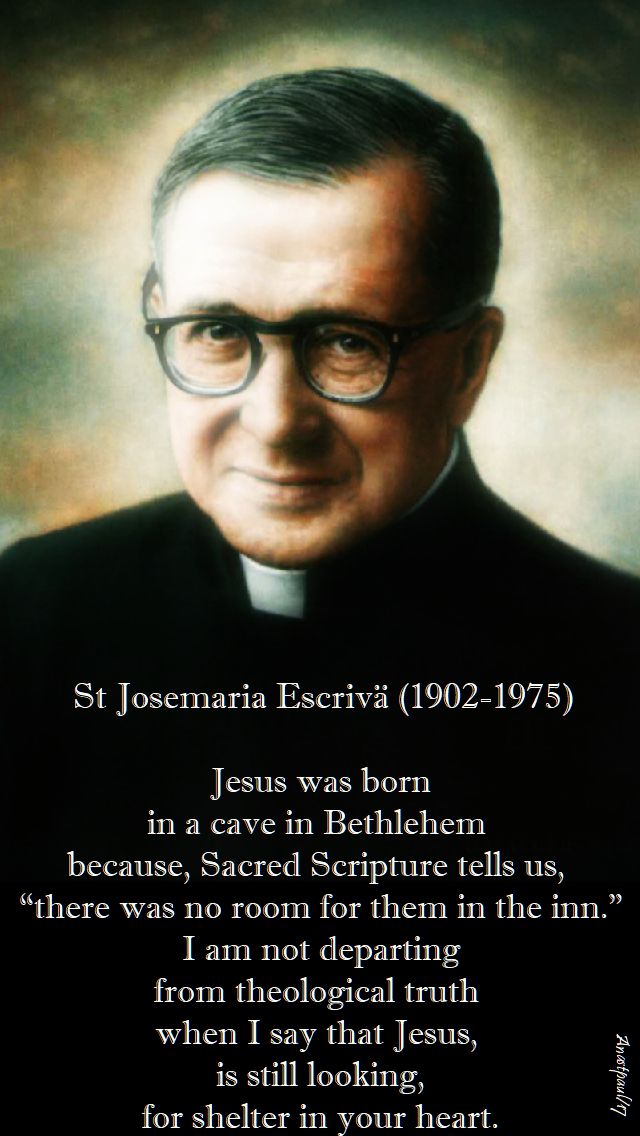
“Jesus was born in a cave in Bethlehem because, Sacred Scripture tells us, “there was no room for them in the inn.” I am not departing from theological truth when I say that Jesus, is still looking, for shelter in your heart.”
One Minute Reflection – 22 December – Friday of the Third Week of Advent
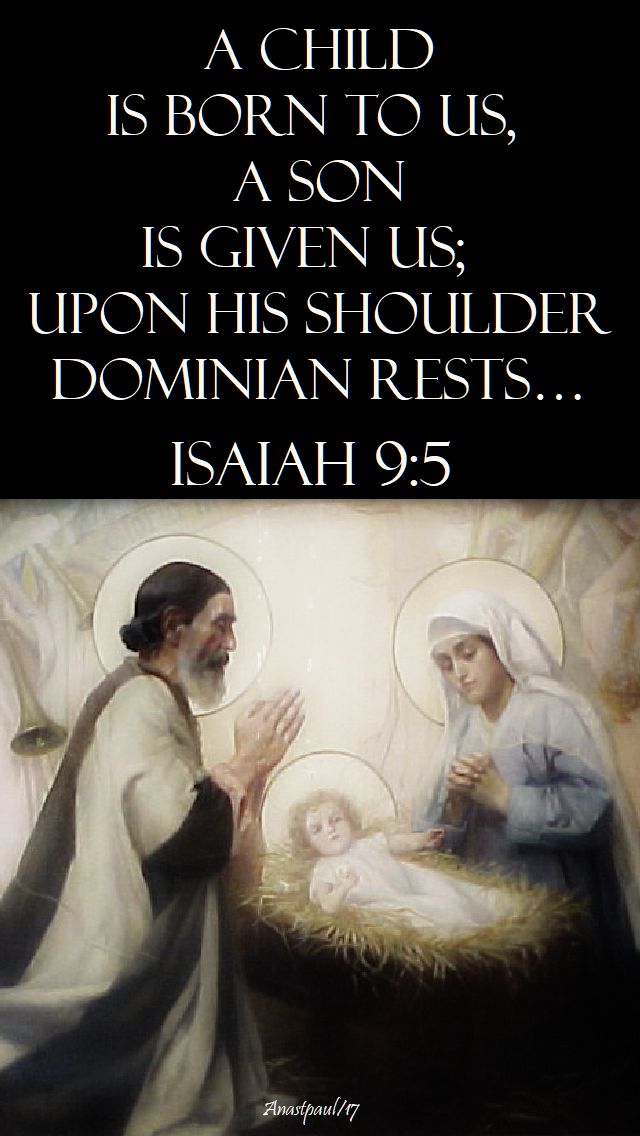
A child is born to us, a son is given us; upon his shoulder dominian rests……Isaiah 9:5
REFLECTION – “In adoring our Saviour’s birth, it is our origin that we celebrate. Christ’s temporal generation is the source of the Christian people, the birth of His Mystical Body. All of us encounter in this Mystery a new birth in Christ.”…St Pope Leo the Great (400-461) Father & Doctor of the Church
PRAYER – Heavenly Father, in celebrating the birth of Your Son on earth, let me also celebrate my birth in His Mystical Body. Grant that I may thus be brought closer to You in union with Your only Son. St Frances Xavier Cabrini, you who lived in union with our Lord and Saviour, striving always to be a light to all, pray for us! Amen
Quote/s of the Day – 21 December – The Memorial of St Peter Canisius (1521-1597) Doctor of the Church
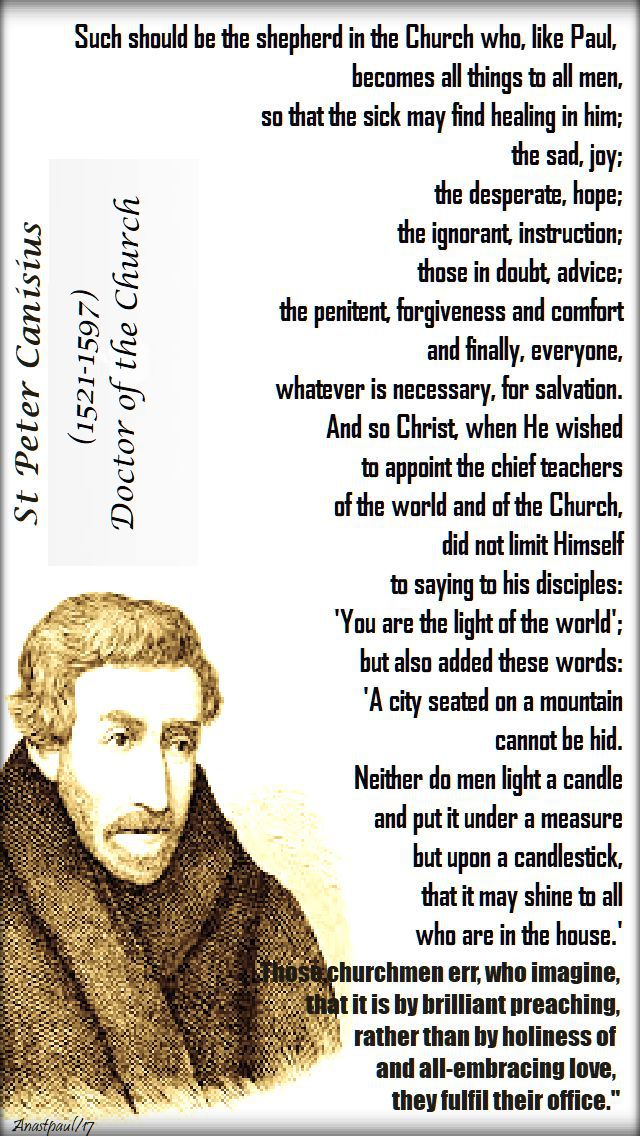
“Such should be the shepherd
in the Church who, like Paul,
becomes all things to all men,
so that the sick may find healing in him;
the sad, joy;
the desperate, hope;
the ignorant, instruction;
those in doubt, advice;
the penitent, forgiveness and comfort
and finally, everyone,
whatever is necessary, for salvation.
And so Christ, when He wished
to appoint the chief teachers
of the world and of the Church,
did not limit Himself to saying to his disciples:
‘You are the light of the world’;
but also added these words:
‘A city seated on a mountain cannot be hid.
Neither do men light a candle
and put it under a measure but upon a candlestick,
that it may shine to all who are in the house.’
Those churchmen err, who imagine,
that it is by brilliant preaching,
rather than by holiness of and all-embracing love,
they fulfil their office.“
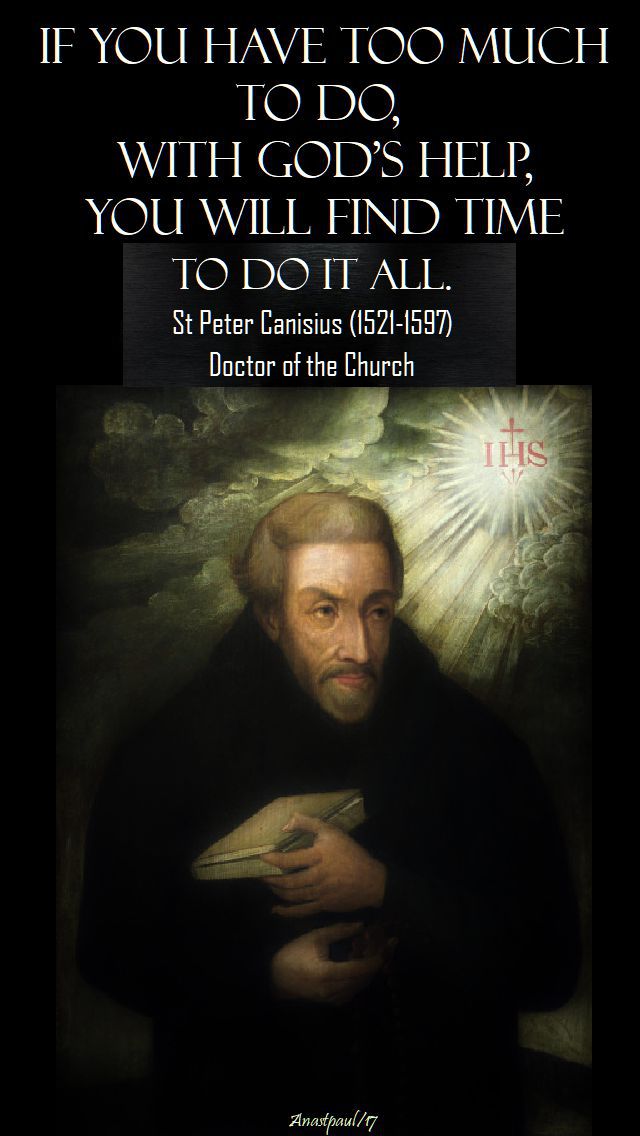
“If you have too much to do, with God’s help, you will find time to do it all.”
St Peter Canisius (1521-1597) Doctor of the Church
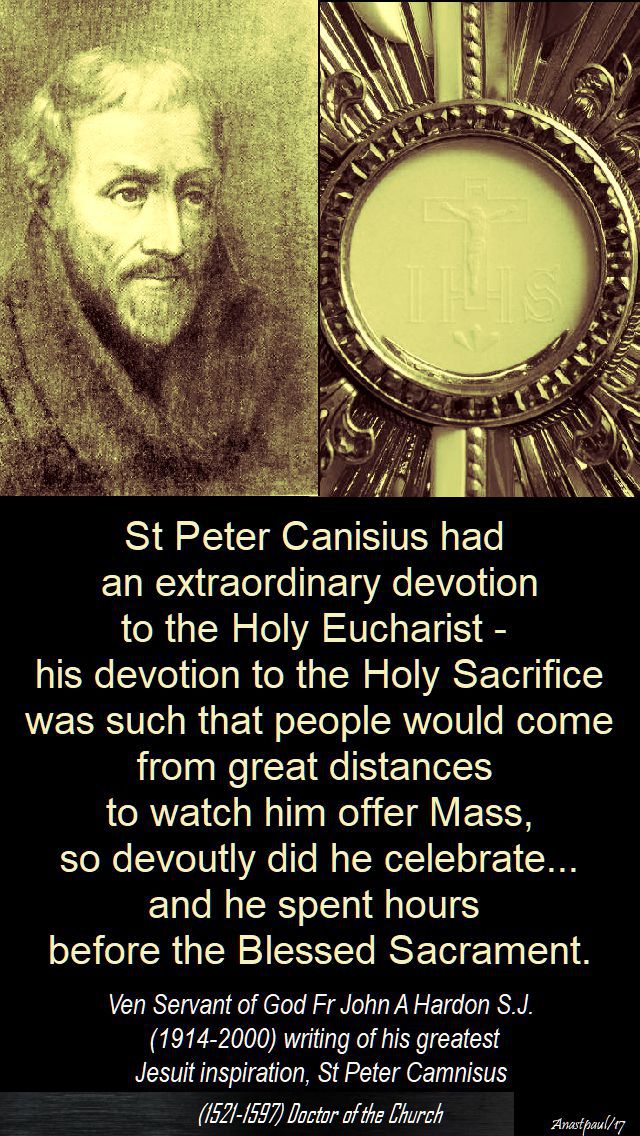
“Among the Jesuit saints, it is Peter Canisius that brought me into the Society of Jesus… as we go on, you will see, what influence St Peter has had on this sinner. “
“(St Peter Canisius had) an extraordinary devotion to the Holy Eucharist – his devotion to the Holy Sacrifice were such that people would come from great distances to watch him offer Mass, so devoutly did he celebrate. He was one of the people that urged frequent Communion at the Council of Trent and was one of those who got the Council of Trent to pass a little known decree, little known because it took almost three hundred years for that decree to really come to life. The Council of Trent, mind you, sixteenth century, encouraged daily Communion – you would never guess it, would you? Peter Canisius was one of those who, under instructions from Ignatius, made sure that the Council passed that decree and he spent hours before the Blessed Sacrament.”
Ven Servant of God Fr John A Hardon S.J. (1914-2000)
One Minute Reflection – 21 December – The Memorial of St Peter Canisius (1521-1597) Doctor of the Church
God who is mighty, has done great things for me, holy is his name…….Luke 1:49
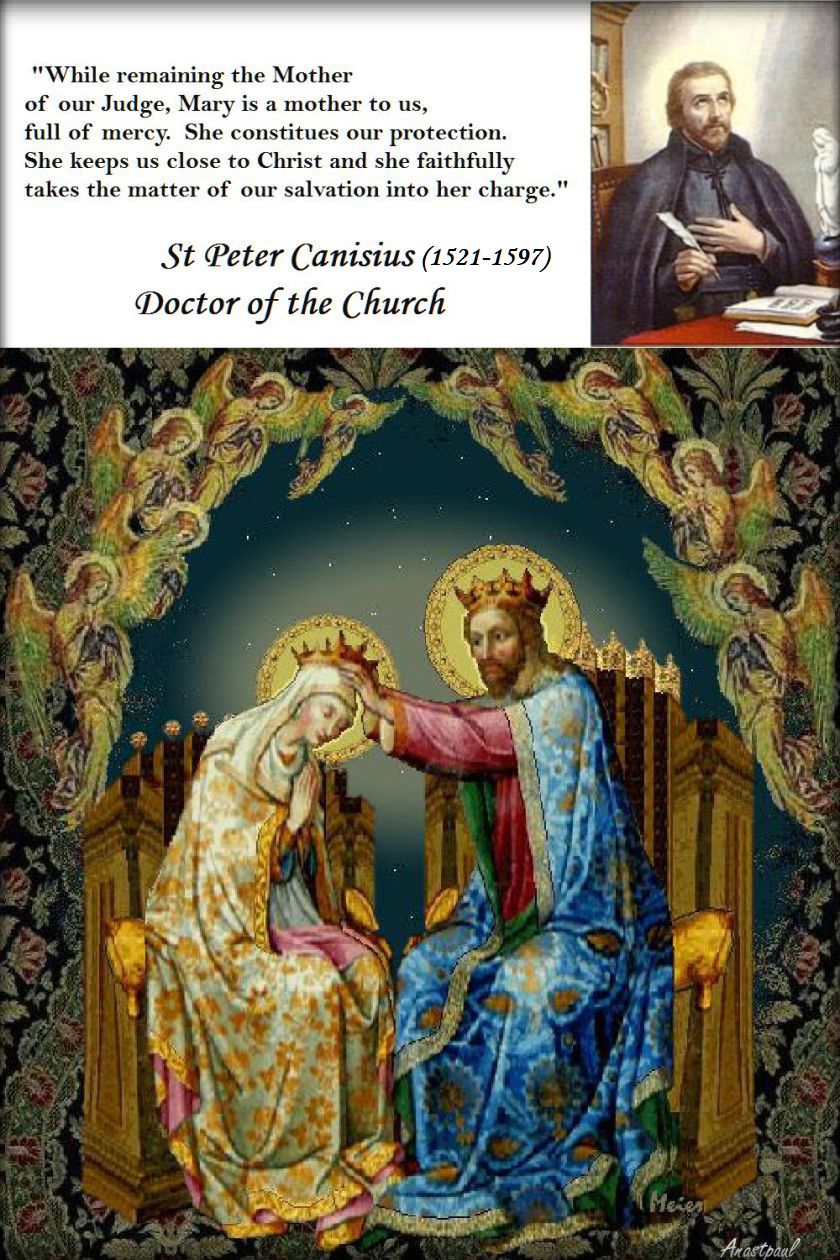
REFLECTION – “While remaining the Mother of our Judge, Mary is a mother to us, full of mercy. She constitutes our protection. She keeps us close to Christ and she faithfully takes the matter of our salvation into her charge.”……………….St Peter Canisius
PRAYER – Heavenly Father, You have filled Mary with grace and made her a Co-Meaditrix with Christ Your Son. Grant that I may have constant recourse to her and attain the salvation she helped win for the world. St Peter Canisius, you lived a life of total and full dedication to our Father, to His divine Son and his holy and most blessed mother and in complete openness to the inspiration of the Holy Spirit. Please pray for us that as you were strengthened in sanctity and doctrine for the defence and growth of the Catholic faith, every seeker of truth may have the joy of finding our God and that all Catholics may persevere and grow in love and zeal for the one true faith. amen.





![[#Beginning of Shooting Data Section]Nikon D2002009/12/18 16:07:37.9JPEG (8-bit) NormalImage Size: Large (2592 x 3872)ColorLens: 55-200mm F/4-5.6 GFocal Length: 155mmExposure Mode: Aperture PriorityMetering Mode: Multi-Pattern1/3 sec - F/14Exposure Comp.: +1.3 EVSensitivity: ISO 160Optimize Image: NormalWhite Balance: Direct sunlightAF Mode: AF-CFlash Sync Mode: Flash Mode: Auto Flash Comp: Color Mode: Mode I (sRGB)Tone Comp.: AutoHue Adjustment: 0°Saturation: AutoSharpening: AutoImage Comment: Long Exposure NR: OffHigh ISO NR: Off[#End of Shooting Data Section]](https://i0.wp.com/anastpaul.com/wp-content/uploads/2018/01/basil-and-gregory-1.jpg?w=263&h=392&ssl=1 "basil and gregory (1)")













![St. Stephen [Large]](https://anastpaul.com/wp-content/uploads/2017/12/st-stephen-large.jpg)




 AnaStpaul
You must be logged in to post a comment.