Quote/s of the Day – 26 August – The Memorial of Saint Jeanne Elisabeth des Bichier des Anges FC (1773-1838) and St Mary of Jesus Crucified OCD (1846-1878)
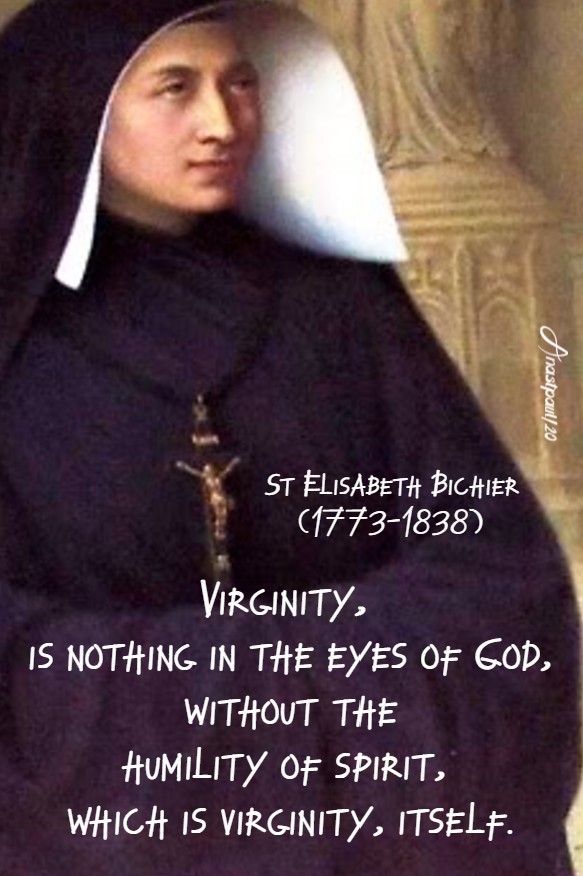
“Virginity, is nothing in the eyes of God, without the humility of spirit, which is virginity, itself.”
“What! She would say, as if exasperated, can we offer in the Holy Sacrifice the death and humiliations of God-made-Man and be unwilling to be humble! To want to be esteemed while He is being humiliated! To want to be something in the eyes of the world, where as He remains hidden under the Eucharistic veils! To love one’s independence, whereas His love for us keeps Him a Prisoner in the Tabernacle! Oh! How such differences should cover us with shame, fill us with self-loathing, with a hatred of our pride and our folly!”
St Elisabeth Bichier (1773-1838)
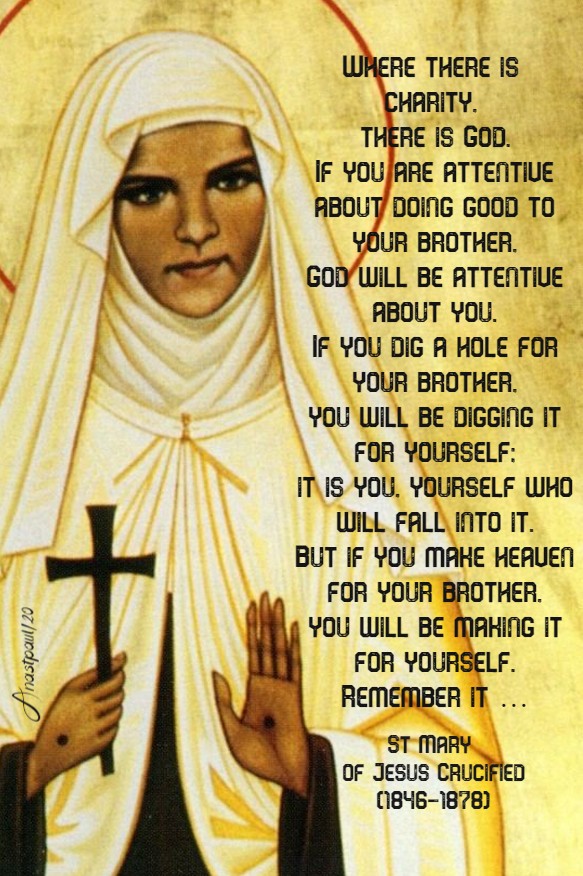
“Where there is charity, there is God. If you are attentive about doing good to your brother, God will be attentive about you. If you dig a hole for your brother, you will be digging it for yourself; it is you, yourself who will fall into it. But if you make heaven for your brother, you will be making it for yourself. Remember it …”
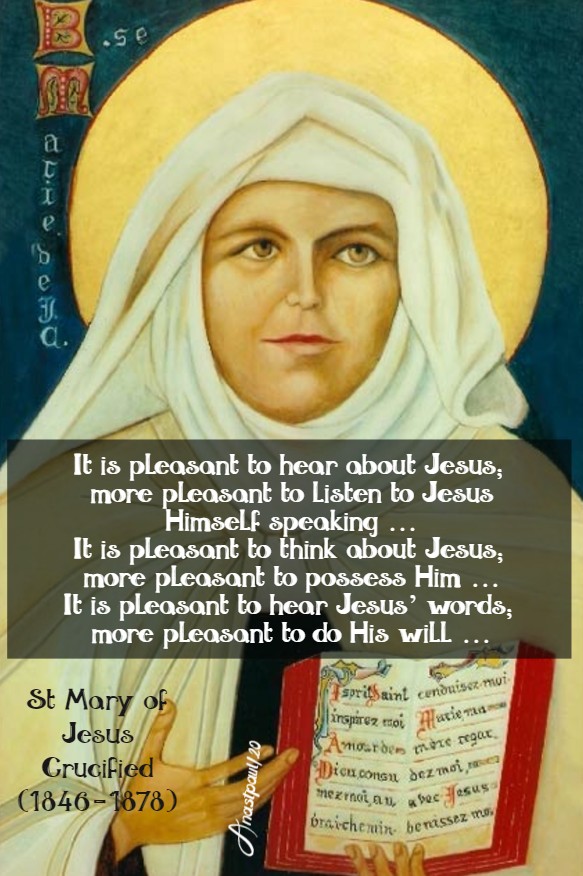
“It is pleasant to hear about Jesus; more pleasant to listen to Jesus Himself speaking … It is pleasant to think about Jesus; more pleasant to possess Him … It is pleasant to hear Jesus’ words; more pleasant to do His will …”
“Nathanael said to him, “How do you know me?” Jesus answered and said to him, “Before Philip called you, I saw you under the fig tree.” … John 1:48
REFLECTION – “Now Jacob had been called in Scripture a man without guile. Jacob himself, as you know, was surnamed Israel. That is why in the Gospel, when the Lord saw Nathanael, he said, “Behold, an Israelite indeed in whom there is no guile.” And that Israelite, not yet knowing who was speaking to him, replied, “How do you know me?” And the Lord said to him, “While you were under the fig tree I saw you,” as though to say, “While you were under the shadow of sin, I predestined you.” And Nathanael, remembering he had been under the fig tree where the Lord had not been, recognised the divinity in Him and answered, “You are the Son of God, you are the king of Israel.” Though he was under the fig tree, he did not become a withered fig tree – he acknowledged Christ. And the Lord said to him, “Because I said, While you were under the fig tree I saw you, is that why you believe? You shall see greater things than that.”
What are these greater things? “Amen, I tell you.” Because that man is an Israelite in whom there is no guile, look back to Jacob, in whom there is no guile and recollect, when Jesus tells you, the stone at his head, the vision in his sleep, the stairs from earth to heaven, the beings coming down and going up and then see, what the Lord says to the Israelite without guile: “You shall see heaven opened”—listen, guileless Nathanael, to what guileless Jacob saw—“and angels going up and coming down”—to whom?—“to the Son of man.”” … St Augustine (354-430) Father and Doctor of Grace – Sermon 89
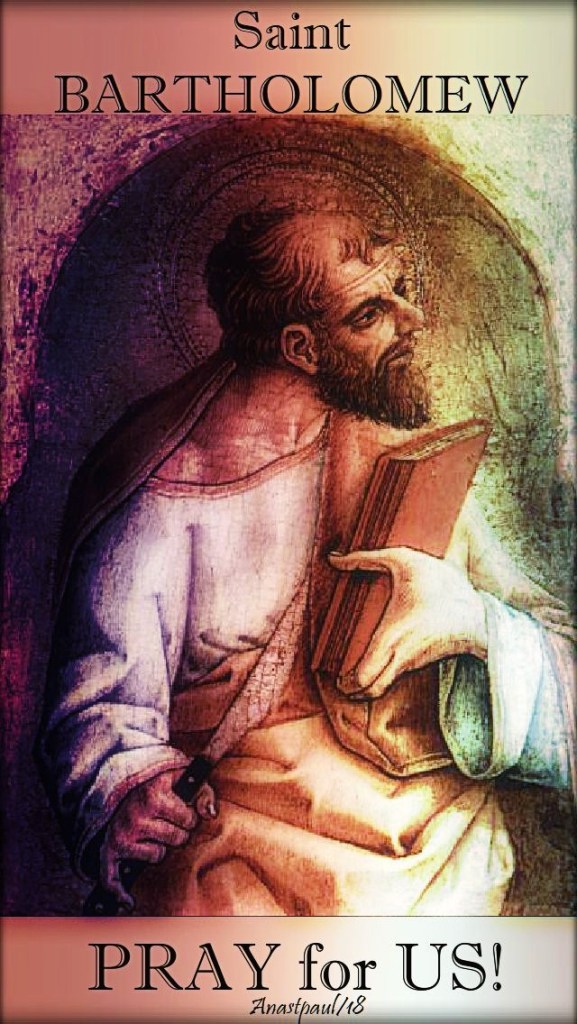
PRAYER – Collect: Strengthen in us, O Lord, the faith, by which the blessed Apostle Bartholomew clung wholeheartedly to Your Son, and grant that through the help of his prayers Your Church may become for all the nations, the sacrament of salvation. Through our Lord Jesus Christ, your Son, Who lives and reigns with You in the unity of the Holy Spirit, one God, for ever and ever. Amen
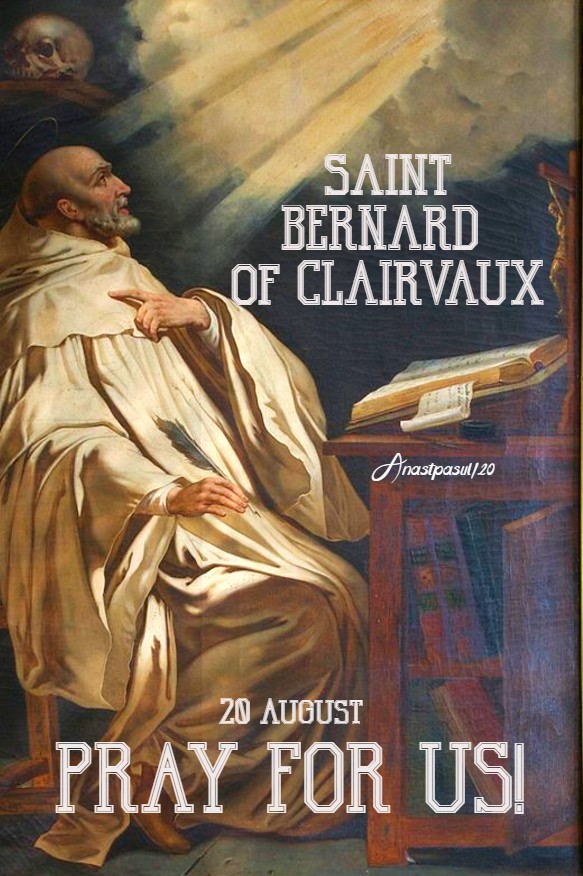
One Minute Reflection – 20 August – “Month of the Immaculate Heart of Mary” – Thursday of the Twentieth week in Ordinary Time, Readings: Ezekiel 36: 23-28, Psalms 51:12-13, 14-15, 18-19, Matthew 22:1-14 and the Memorial of St Bernard of Clairvaux (1090-1153) “Doctor of Light”
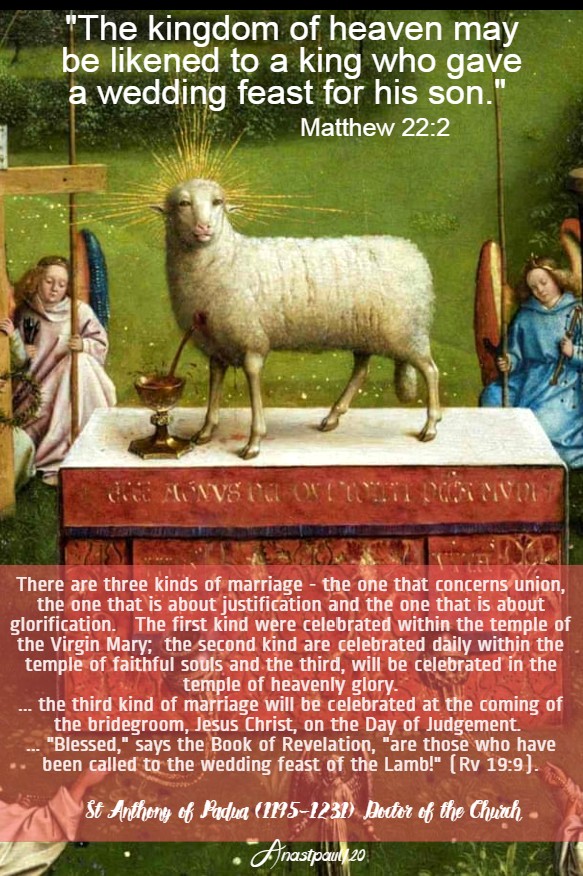
“The kingdom of heaven may be likened to a king who gave a wedding feast for his son.” – Matthew 22:2
REFLECTION – “There are three kinds of marriage – the one that concerns union, the one that is about justification and the one that is about glorification. The first kind were celebrated within the temple of the Virgin Mary; the second kind are celebrated daily within the temple of faithful souls and the third, will be celebrated in the temple of heavenly glory. The purpose of a wedding is to unite two people, the bridegroom and the bride. If two families are against each other, marriage usually unites them, when a man from one side marries a woman from the other. Between ourselves and God, there used to be a great division – to wipe it out and establish peace, the Son of God had to take His bride from someone of our lineage. To realise this marriage, numerous intermediaries and peacemakers intervened who, through their insistent prayers, were able to win it, at great cost. Finally, the Father Himself gave His consent and sent His Son, who joined Himself to our nature in the marriage chamber of the Virgin Mary’s womb. Thus the Father “gave a marriage feast for his Son.” In the same way, the second kind of marriage is celebrated when the grace of the Holy Spirit intervenes and the soul is converted (…) The grace of the Holy Spirit is the bridegroom of the soul. When He calls it to repentance with His interior inspiration, all appeal from the vices is without effect. Finally, the third kind of marriage will be celebrated at the coming of the bridegroom, Jesus Christ, on the Day of Judgement. Of Him it is written: “Behold, the bridegroom is coming! Go out to meet him” (Mt 25:6). He will take the Church itself as bride, as John says in the Book of Revelation: “Come here. I will show you the Bride, Jerusalem, coming down out of heaven from God, gleaming with the splendour of God” (cf. Rv 21:9-11). The Church of the Faithful comes down from heaven, from beside God, for it has obtained from God that it’s dwelling should be in the heavens. And so, at present, it lives by faith and hope but very soon it will celebrate it’s espousals with it’s bridegroom: “Blessed,” says the Book of Revelation, “are those who have been called to the wedding feast of the Lamb!” (Rv 19:9).” … St Anthony of Padua OFM (1195-1231) Doctor of the Church
PRAYER – All-knowing God, let me be able to stand in Your presence with a good conscience. Send Your Holy Spirit to fill my soul with the enlightenment of repentance and then to guide my steps towards the wedding feast You have prepared for Your Son. You made St Bernard burn with zeal for Your house and gave him the grace to enkindle and enlighten others in Your Church. Grant that by his prayer, we may be filled with the same spirit and always live as children of the Light. Through Christ our Lord, in the unity of the Holy Spirit, God forever, amen.
One Minute Reflection – 4 August – “Month of the Immaculate Heart” – Tuesday of the Eighteenth week in Ordinary Time, Readings: Jeremiah 30:1-2, 12-15, 18-22, Psalm 102:16-21, 29, 22-23, Matthew 15:1-2,10-14 and The Memorial of St John Vianney (1786-1859)
“Let them alone; they are blind guides [of the blind]. If a blind person leads a blind person, both will fall into a pit.” … Matthew 15:14
REFLECTION – “When, in these last days, the Word of God was born of Mary, clothed in flesh and revealed to the world, what was seen of Him was something other than the mind could discern. The appearance of His body was clear to all but knowledge of His divinity was only granted to some. Similarly, when the Word of God speaks to us through the Old Law and the prophets, He shows Himself beneath the veil of the appropriate garments.
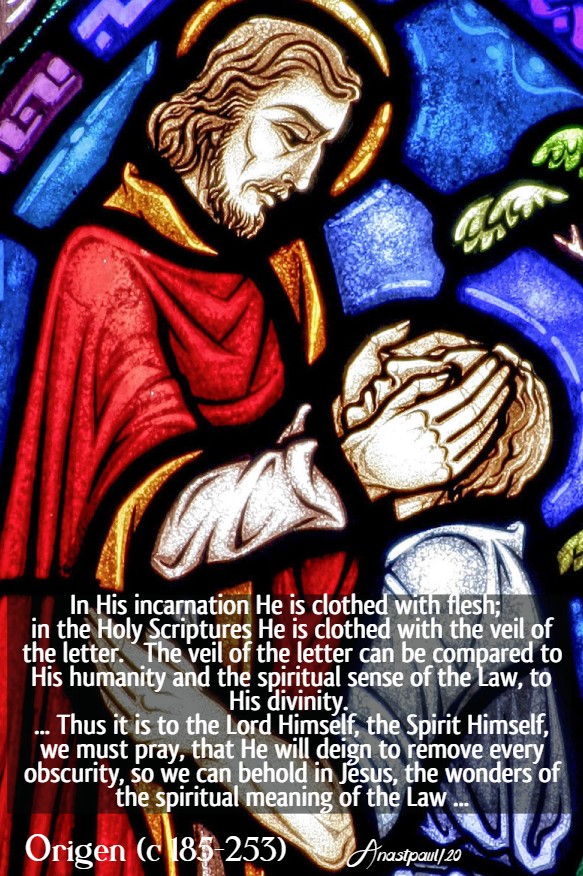
In His incarnation He is clothed with flesh; in the Holy Scriptures He is clothed with the veil of the letter. The veil of the letter can be compared to His humanity and the spiritual sense of the Law, to His divinity. In the book of Leviticus we find the rites of sacrifice, the various sacrificial animals, the priestly liturgical service … blessed the eyes that discern the divine Spirit hidden beneath the veil …
“Whenever a person turns to the Lord the veil is removed … and, where the Spirit of the Lord is, there is freedom,” says the Apostle Paul (2 Cor 3:16-17). Thus it is to the Lord Himself, the Spirit Himself, we must pray, that He will deign to remove every obscurity, so we can behold in Jesus, the wonders of the spiritual meaning of the Law, like the man who said: “Open my eyes that I may see the wonders of your Law (Ps 119[118]:18).” … Origen (c 185-253) Priest and Theologian, Church Father – Homily 1 on Leviticus
PRAYER – Lord God, light of the faithful and shepherd of souls, who gave blessed John Vianney to Your Church to feed Your flock by his teaching and form them by his example, grant that by his intercession, we may keep the faith which he taught and follow in the way he walked, through our Lord Jesus Christ, in union with the Holy Spirit. St John Vianney, pray for us, amen.
One Minute Reflection – 25 July – “Month of the Most Precious Blood” – The Memorial of St James the Greater, Apostle of Christ, Readings: 2 Corinthians 4:7-15, Psalm 126, Matthew 20:20-28
INTERNET PROBLEMS – CANNOT UPLOAD IMAGES!
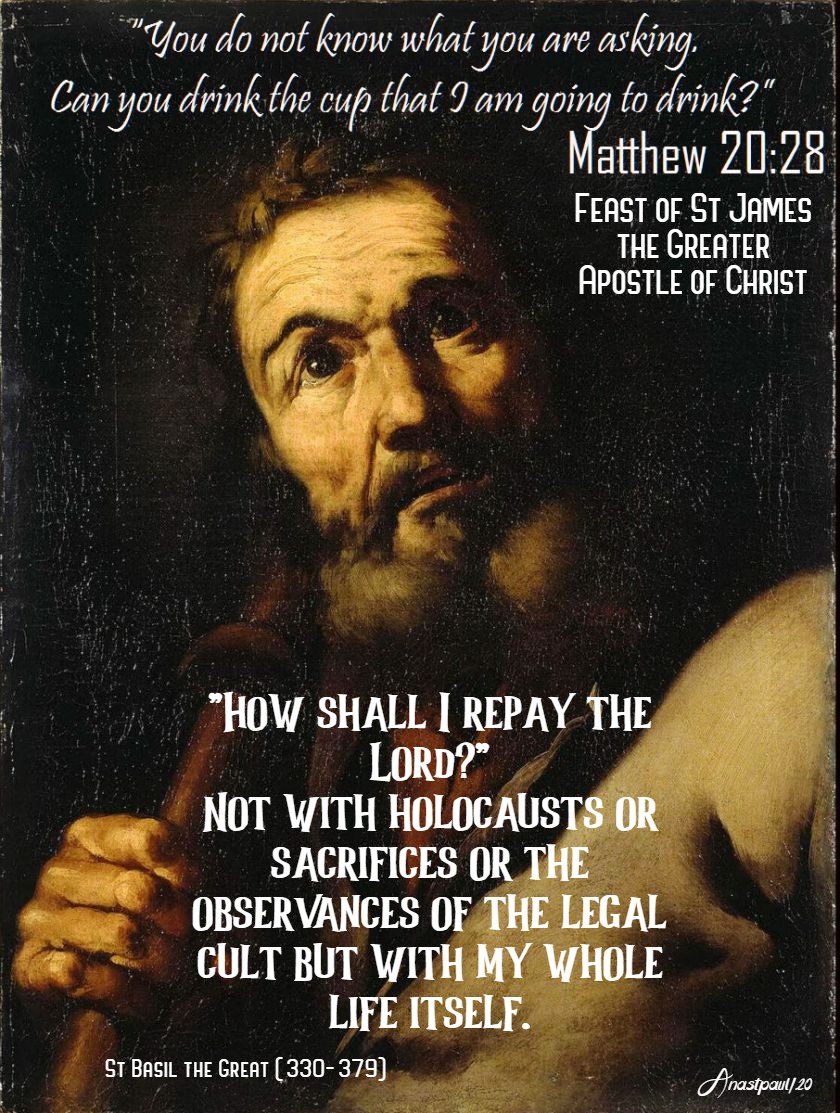
“Can you drink the cup that I am going to drink?” … Matthew 20:28
REFLECTION – “How shall I repay the Lord?” (Ps 115[116B],12) Not with holocausts or sacrifices or the observances of the legal cult but with my whole life itself. And this is why, says the psalmist, “The cup of salvation I will take” (v.13). The labour he underwent in the struggles of his filial devotion to God and the constancy with which he resisted sin even to death – this is what the psalmist calls his cup.
It was concerning this cup that our Lord Himself expressed Himself in the Gospels : “My Father, if it is possible, let this cup pass from me” (Mt 26:39). And again, to His disciples: “Can you drink the cup that I shall drink?” He intended to speak of that death He desired to suffer, for the salvation of the world. Therefore, He says: “The cup of salvation I will take up,” namely, my whole being is reaching out, parched, towards the consummation of martyrdom, even to the point of holding the torments endured, in the struggles of filial love as rest and not as suffering, for soul and body. I too, He says, will offer Myself to the Lord as a sacrifice and oblation. … And I am ready to pay these vows before all the people, for: “My vows to the Lord I will pay in the presence of all his people!” (v.14).” … St Basil the Great (330-379) Monk and Bishop of Caesarea in Cappadocia, Father & Doctor of the Church
PRAYER – Lord our God, You accepted the sacrifice of St James, the first of Your Apostles to give his life for Your sake. May Your Church find strength in his martyrdom and support in his constant prayer. Through our Lord Jesus Christ, your Son, who lives and reigns with you in the unity of the Holy Spirit, one God, for ever and ever. St James the Greater, Apostle of Christ, Pray for us! Amen
Quote/s of the Day – 24 July – Friday of the Sixteenth week in Ordinary Time, Year A, Readings: Jeremiah 3:14-17, Responsorial psalm Jeremiah 31:10-13, Matthew 13:18-23
“Good Soil”
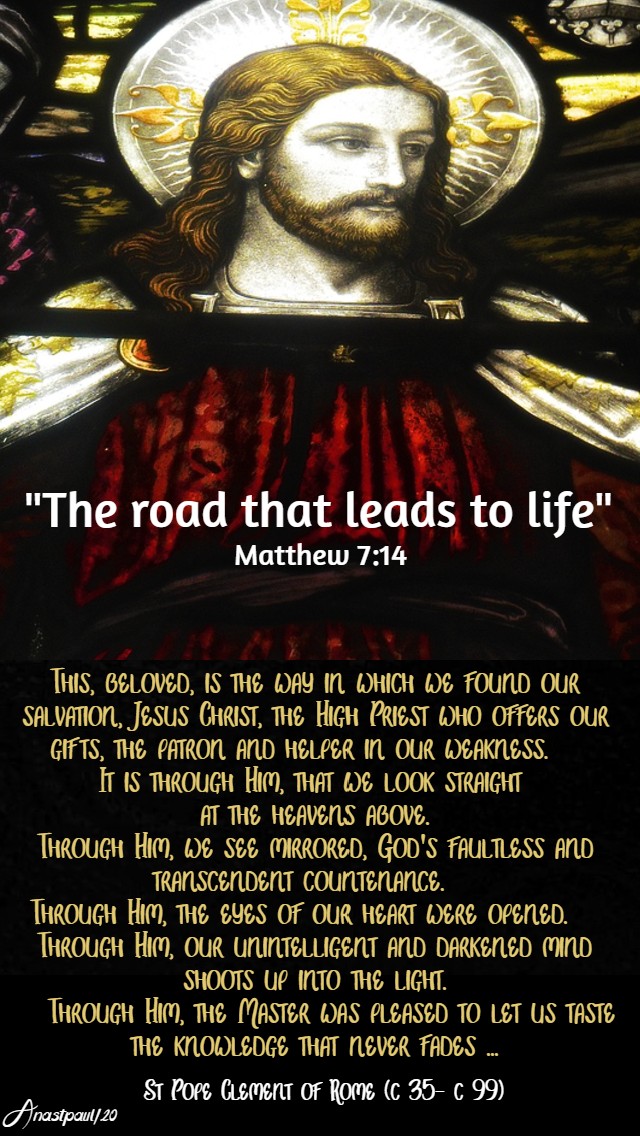
“This, beloved, is the way in which we found our salvation, Jesus Christ, the High Priest who offers our gifts, the patron and helper in our weakness (Heb 10:20; 7:27; 4:15). It is through Him, that we look straight at the heavens above. Through Him, we see mirrored, God’s faultless and transcendent countenance. Through Him, the eyes of our heart were opened. Through Him, our unintelligent and darkened mind shoots up into the light. Through Him, the Master was pleased to let us taste the knowledge that never fades, He who is “the radiance of His splendour, who towers as much above the angels, as the title He has inherited, is superior to theirs.”
St Pope Clement I (c 35 – c 99)
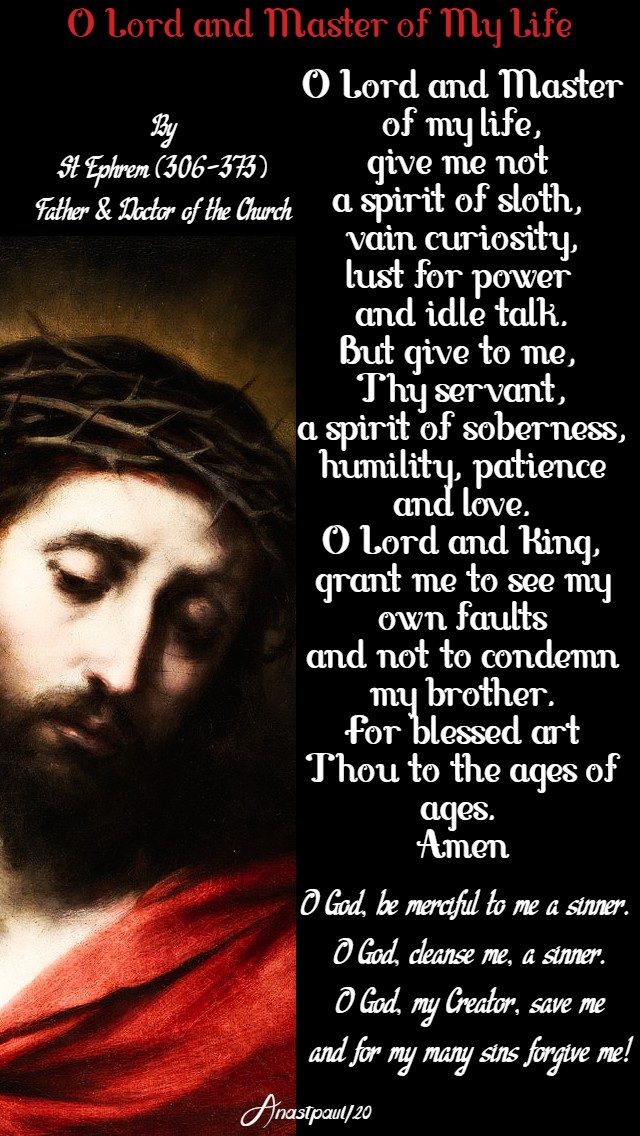
O Lord and Master of My Life Prayer of Saint Ephrem the Syrian (306-373) Father & Doctor of the Church
O Lord and Master of my life, give me not a spirit of sloth, vain curiosity, lust for power and idle talk. But give to me, Thy servant, a spirit of soberness, humility, patience and love. O Lord and King, grant me to see my own faults and not to condemn my brother. For blessed art Thou to the ages of ages. Amen O God, be merciful to me a sinner. O God, cleanse me, a sinner. O God, my Creator, save me and for my many sins forgive me!
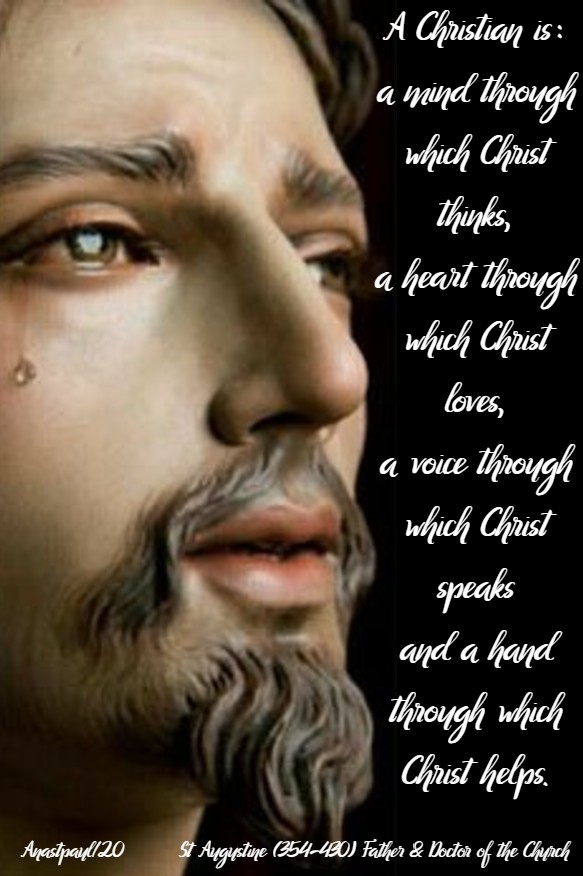
“A Christian is: a mind through which Christ thinks, a heart through which Christ loves, a voice through which Christ speaks and a hand through which Christ helps.”
St Augustine (354-430)
Father & Doctor of the Church
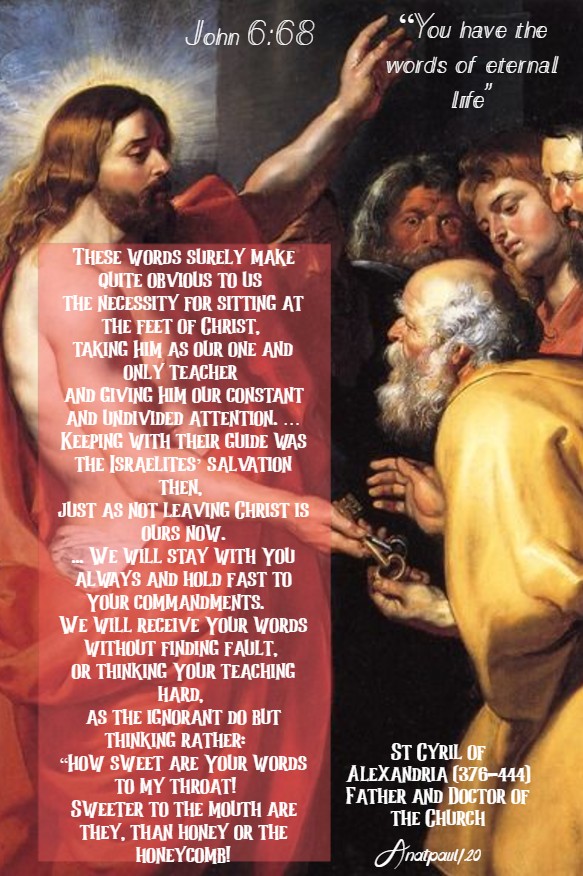
“You have the words of eternal life”
John 6:68
“These words surely make quite obvious to us the necessity for sitting at the feet of Christ, taking Him as our one and only teacher and giving Him our constant and undivided attention. … Keeping with their guide was the Israelites’ salvation then, just as not leaving Christ is ours now. … We will stay with You always and hold fast to Your commandments. We will receive Your words without finding fault, or thinking Your teaching hard, as the ignorant do but thinking rather: “How sweet are Your words to my throat! Sweeter to the mouth are they, than honey or the honeycomb!”
St Cyril of Alexandria (376-444)
Father and Doctor of the Church
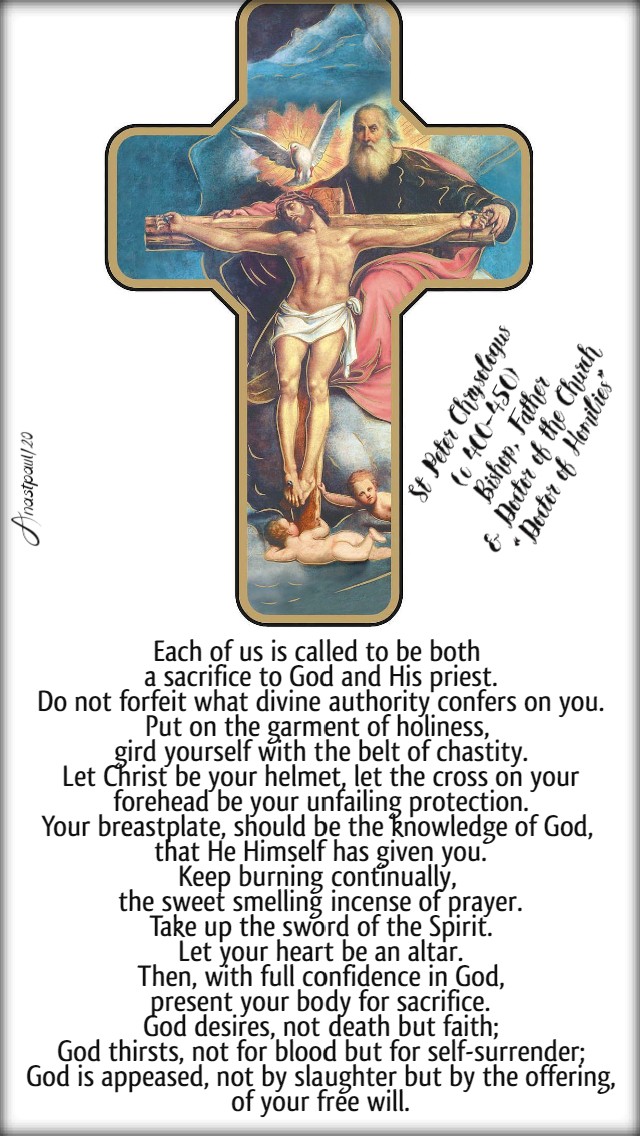
“Paul says: I appeal to you by the mercy of God, to present your bodies as a sacrifice, living and holy. The prophet said the same thing: Sacrifice and offering you did not desire but you have prepared a body for me. Each of us is called to be both a sacrifice to God and His priest. Do not forfeit what divine authority confers on you. Put on the garment of holiness, gird yourself with the belt of chastity. Let Christ be your helmet, let the cross on your forehead be your unfailing protection. Your breastplate, should be the knowledge of God, that He Himself has given you. Keep burning continually, the sweet smelling incense of prayer. Take up the sword of the Spirit. Let your heart be an altar. Then, with full confidence in God, present your body for sacrifice. God desires, not death but faith; God thirsts, not for blood but for self-surrender; God is appeased, not by slaughter but by the offering, of your free will.”
St Peter Chrysologus (c 400-450)
Bishop, Father & Doctor of the Church
“Doctor of Homilies”
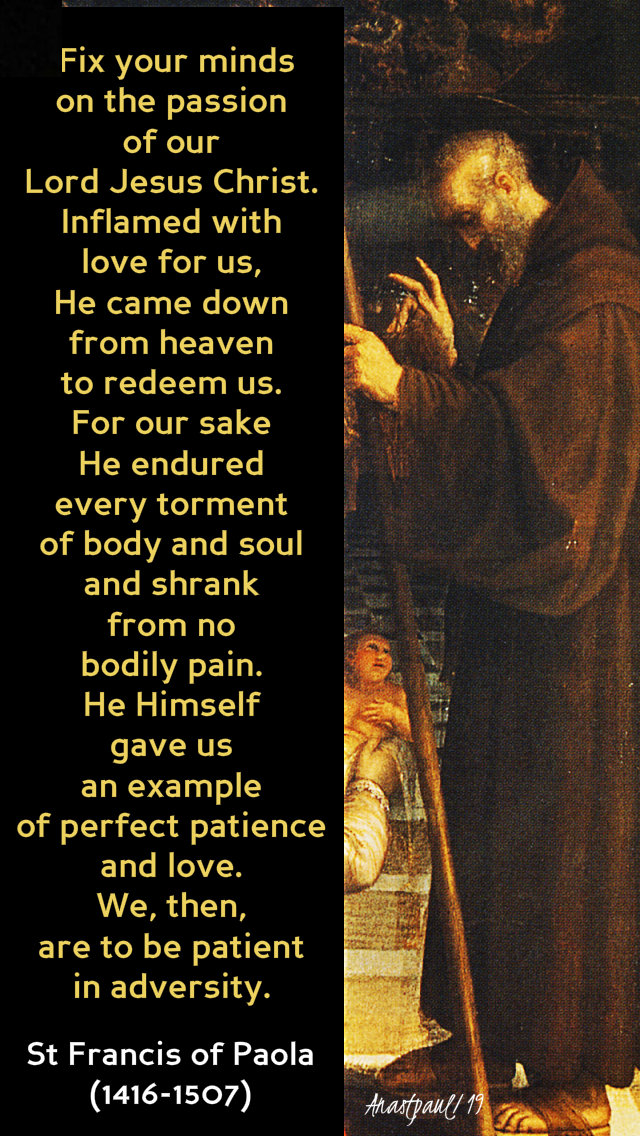
“Fix your minds on the passion of our Lord Jesus Christ. Inflamed with love for us, He came down from heaven to redeem us. For our sake He endured every torment of body and soul and shrank from no bodily pain. He Himself gave us an example of perfect patience and love. We, then, are to be patient in adversity.”
St Francis of Paola OM (1416-1507)
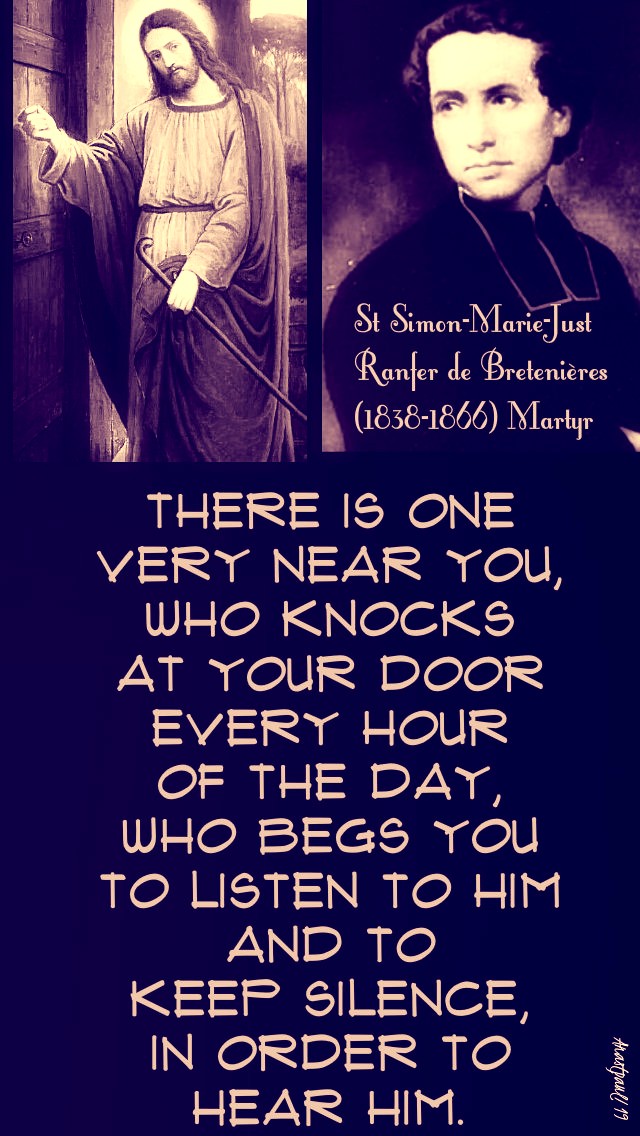
“There is One very near you Who knocks at your door every hour of the day, Who begs you to listen to Him and to keep silence in order to hear Him.”
St Simon-Marie-Just Ranfer de Bretenières (1838-1866)
Martyr
One Minute Reflection – 24 July – Friday of the Sixteenth week in Ordinary Time, Year A, Readings: Jeremiah 3:14-17, Responsorial psalm Jeremiah 31:10-13, Matthew 13:18-23 and the Memorial of St Charbel Makhluf (1828-1898)
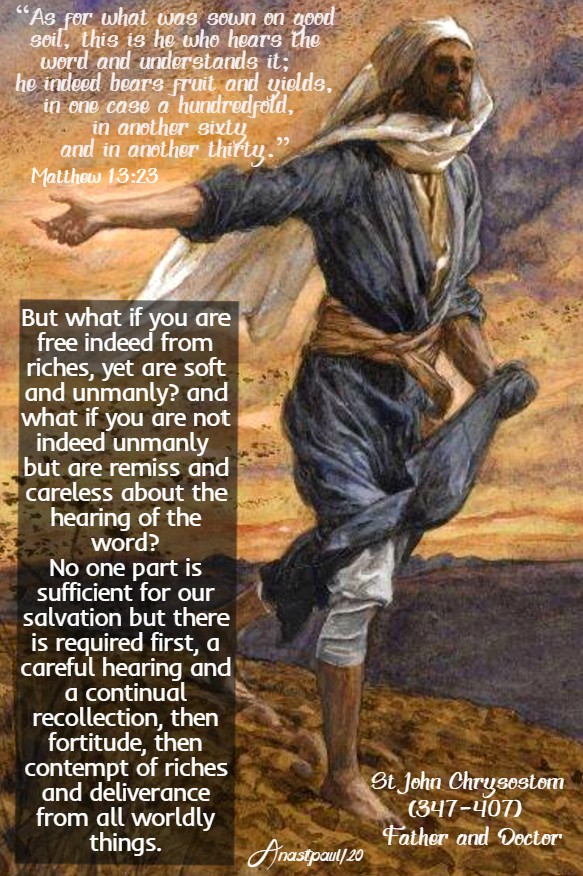
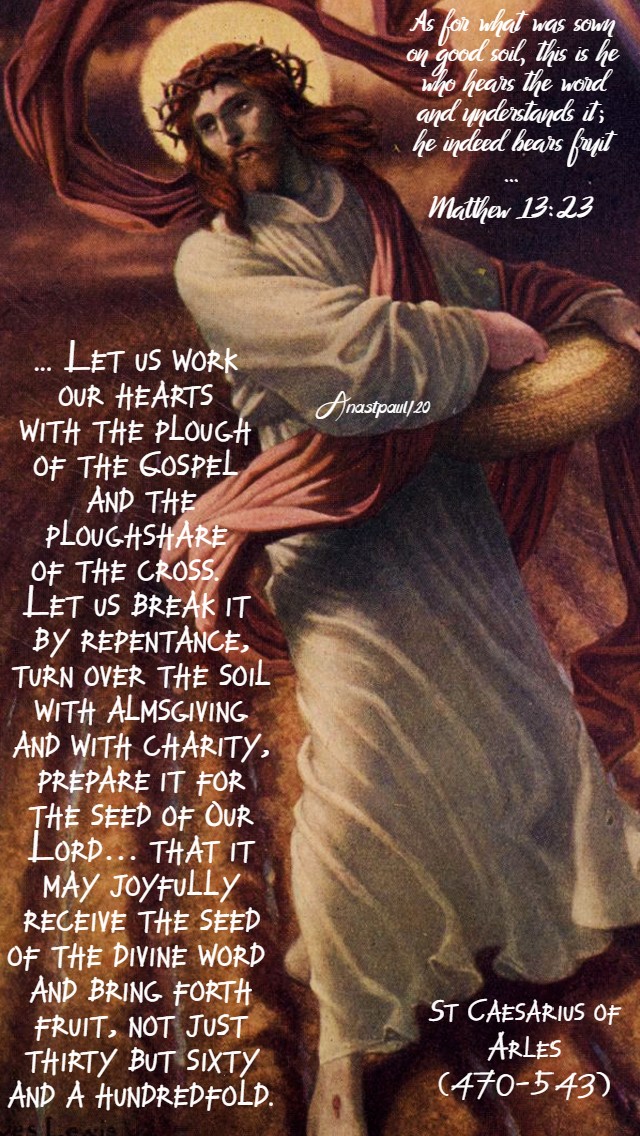
“As for what was sown on good soil, this is he who hears the word and understands it; he indeed bears fruit and yields, in one case a hundredfold, in another sixty and in another thirty.”...Matthew 13:23
REFLECTION – “And yet, if both the land be good and the Sower one and the seed the same, wherefore did one bear a hundred, one sixty, one thirty?
Here again the difference is from the nature of the ground, for even where the ground is good, great even therein, is the difference.
Understand that not the Sower is to be blamed, nor the seed but the land that receives it? not for its nature but, for its disposition.
And herein too, great is His mercy to man, that He does not require one measure of virtue.
… And these things He says, lest they that followed Him should suppose that hearing is sufficient for salvation.
… Yes, both vainglory and all the rest belong to this world and to the deceitfulness of riches, such as pleasure and gluttony and envy and vainglory and all the like.
But He added also the “way” and the “rock,” signifying that it is not enough to be freed from riches only, but we must cultivate also the other parts of virtue.
But what if you are free indeed from riches, yet are soft and unmanly? and what if you are not indeed unmanly but are remiss and careless about the hearing of the word?
No one part is sufficient for our salvation but there is required first, a careful hearing and a continual recollection, then fortitude, then contempt of riches and deliverance from all worldly things.” … St John Chrysostom (347-407) Father and Doctor
PRAYER – A pure heart create for me O God, put a steadfast spirit within me! (Ps 50[51]) Lord God, bestow a full measure of Your grace to us. Keep us within in the path of Your commandments, help us to work on the earth of our souls, rooting out the weeds and casting forth the stones of malice. Grant that by the prayers of St Charbel Makhluf, who by Your grace triumphed in all virtues, we may succeed in attaining sanctity. Through Christ, our Lord, in union with the Holy Spirit, one God, forever, amen.
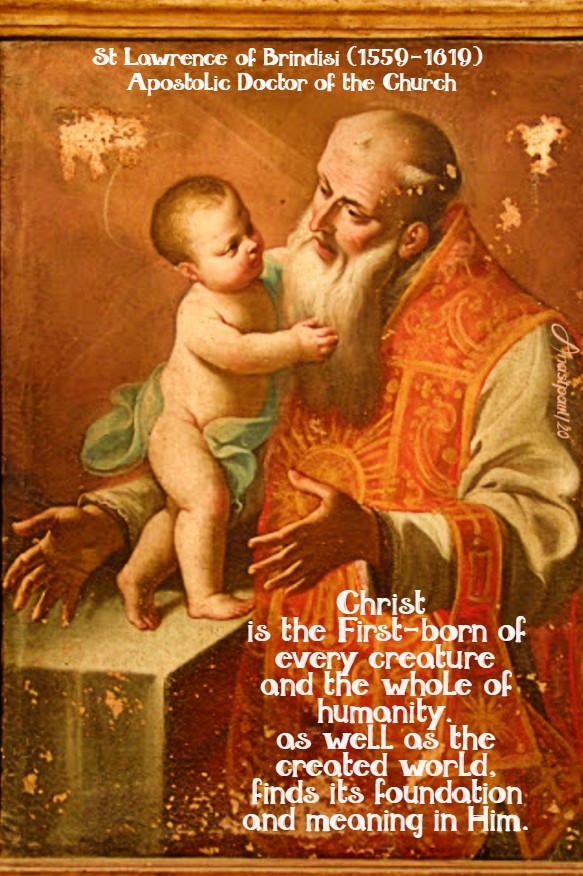
Quote/s of the Day – 21 July – The Memorial of St Lawrence of Brindisi OFM Cap (1559-1619) Doctor of the Church
“God is love and all His operations proceed from LOVE…”
“For Him all things were created and to Him all things must be subject and God loves all creature, in and because of Christ.”
“Christ is the first-born of every creature and the whole of humanity. as well as the created world, finds its foundation and meaning in Him.”
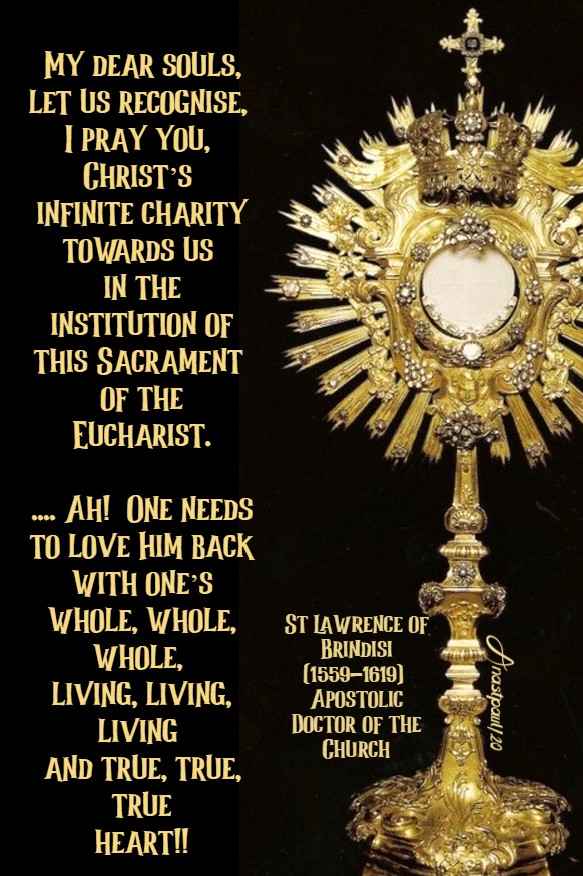
“My dear souls, let us recognise, I pray you, Christ’s infinite charity towards us in the institution of this Sacrament of the Eucharist. In order that our love be a spiritual love, He wills a new heart, a new love, a new spirit for us. It is not with a carnal heart but with a spiritual one, that Christ has loved us with a gratuitous love, a supreme and most ardent love, by way of pure grace and charity. Ah! One needs to love Him back with one’s whole, whole, whole, living, living, living and true, true, true heart!!”
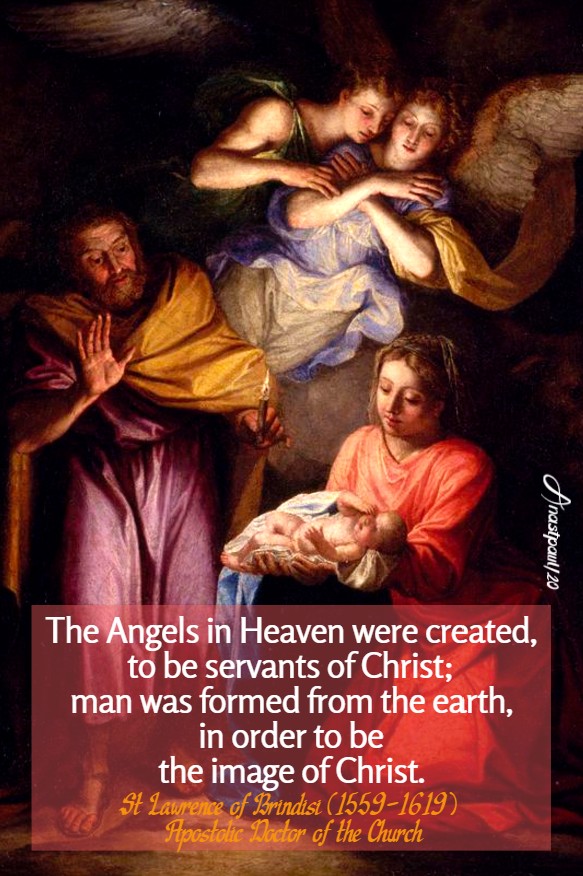
“The Angels in Heaven were created, to be servants of Christ; man was formed from the earth, in order to be the image of Christ.”
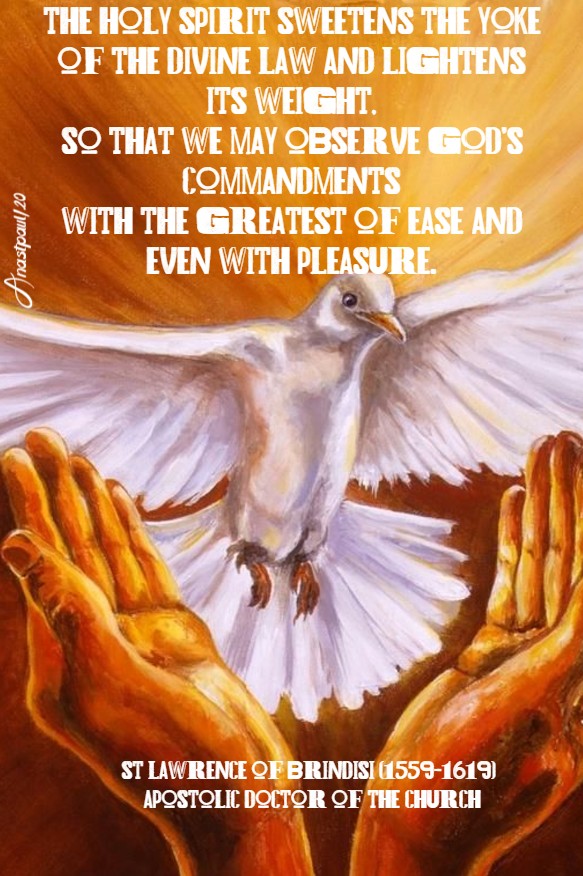
“The Holy Spirit sweetens the yoke of the divine law and lightens its weight, so that we may observe God’s commandments with the greatest of ease and even with pleasure.”
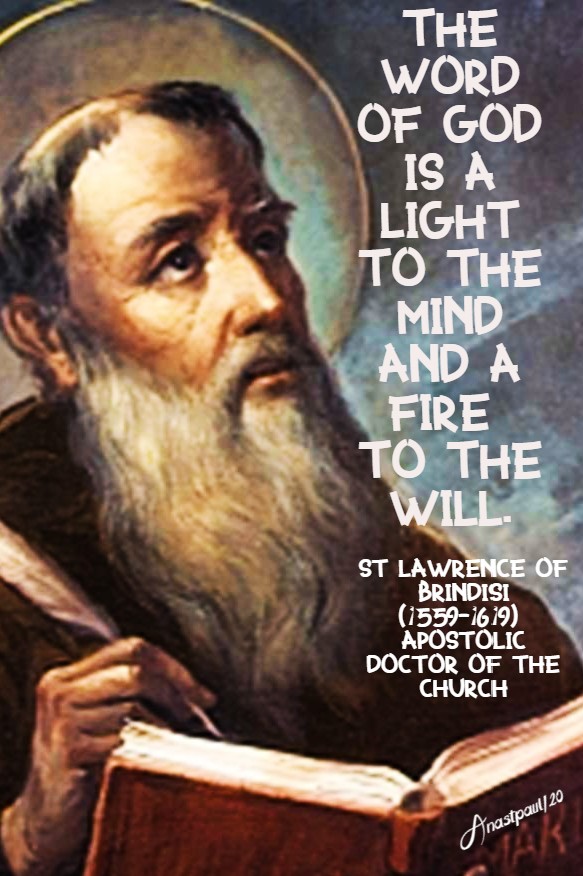
“…The word of God is a light to the mind and a fire to the will.”
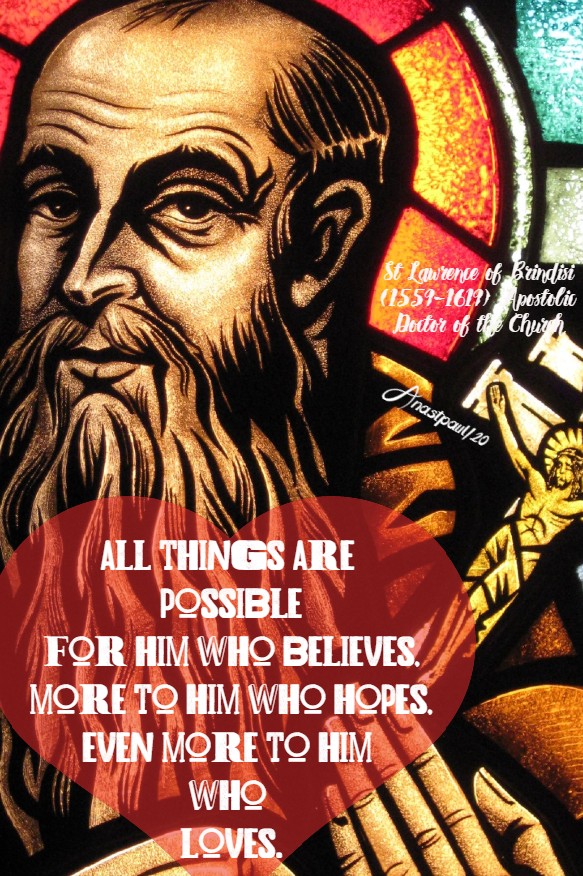
“All things are possible for him who believes, more to him who hopes, even more to him who loves.”
Quote/s of the Day – 12 July – “Month of the Most Precious Blood” – The Fifteenth Sunday of the Year in Ordinary Time, Year A, Readings: Isaiah 55:10-11, Psalm 65:10-14, Romans 8:18-23, Matthew 13:1-23
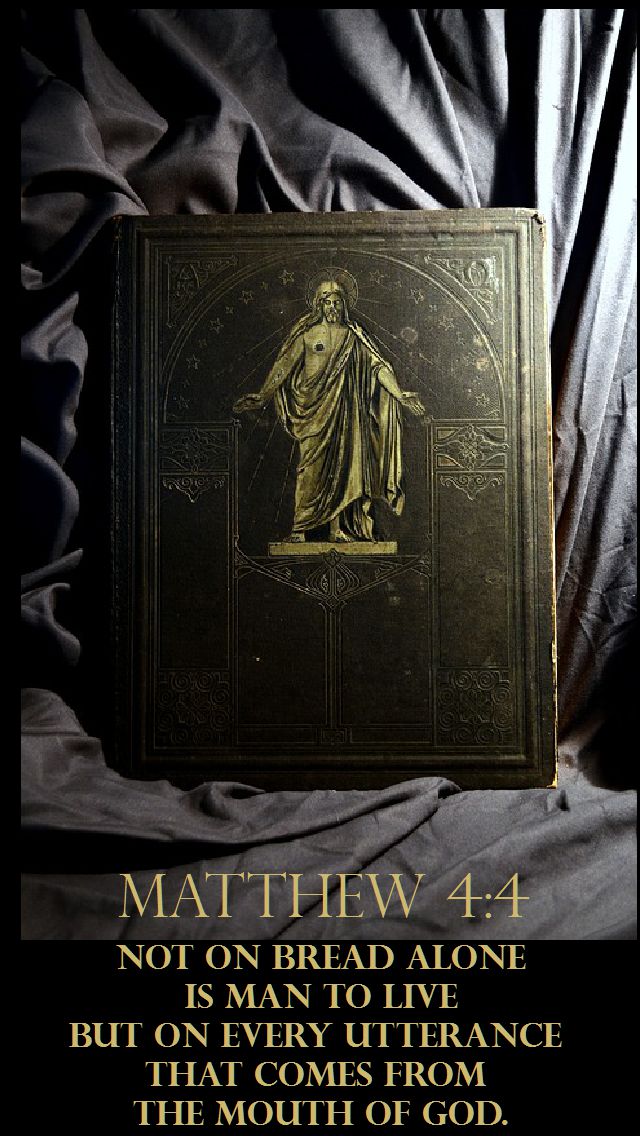
“Not on bread alone is man to live but on every utterance that comes from the mouth of God.”
Matthew 4:4
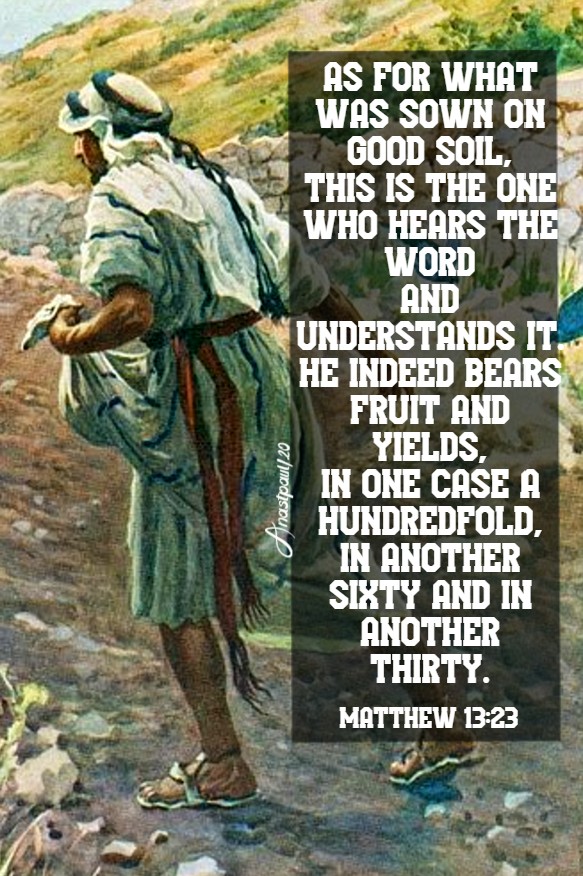
“As for what was sown on good soil, this is the one who hears the word and understands it. He indeed bears fruit and yields, in one case a hundredfold, in another sixty and in another thirty.”
Matthew 13:23
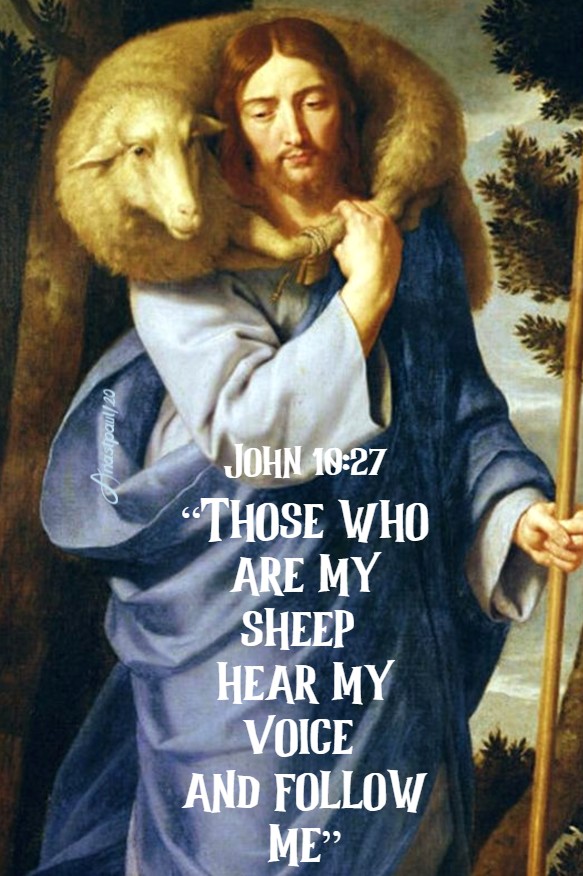
“Those who are my sheep hear my voice and follow me”
John 10:27
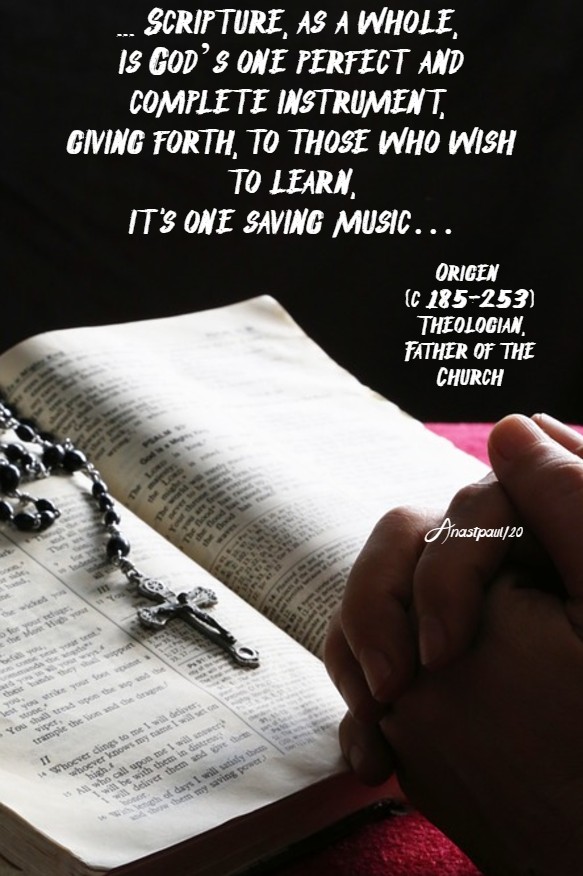
“For he knows that Scripture, as a whole, is God’s one perfect and complete instrument, giving forth, to those who wish to learn, it’s one saving music…”
Origen (c 185-253)
Theologian, Father of the Church
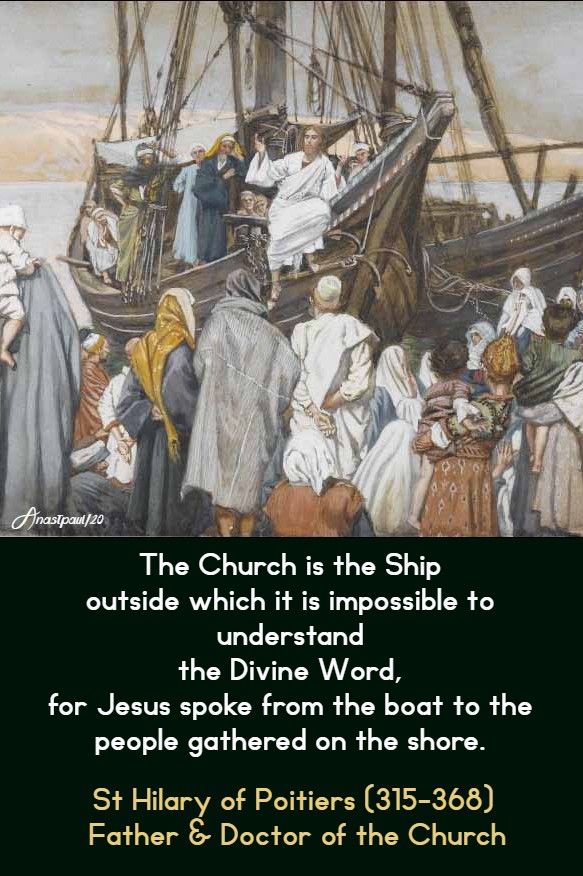
“The Church is the Ship outside which it is impossible to understand the Divine Word, for Jesus spoke from the boat to the people gathered on the shore.”
St Hilary of Poitiers
(315-368)
Father & Doctor of the Church
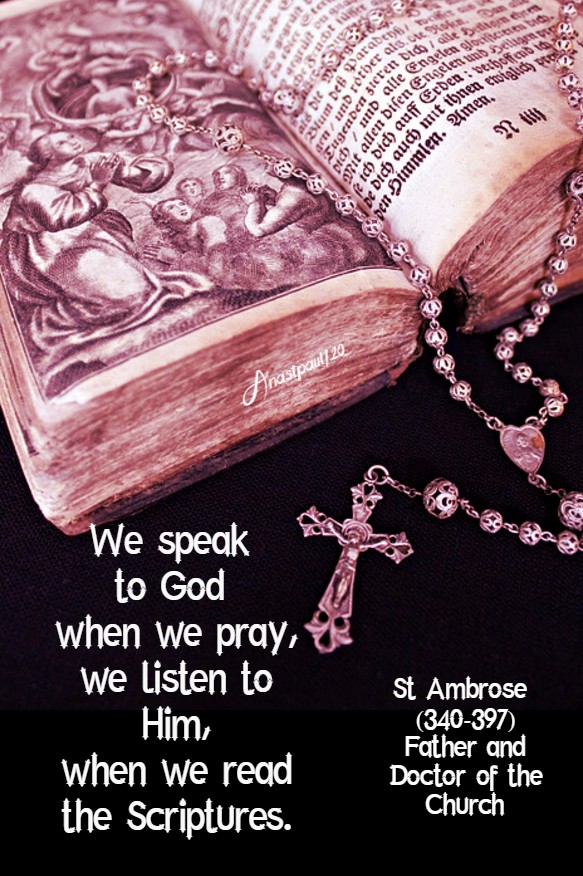
“We speak to God when we pray, we listen to Him, when we read the Scriptures.”
St Ambrose (340-397)
Father and Doctor of the Church
“Ignorance of Scripture is ignorance of Christ.”
“Let sleep find you holding your Bible and when your head nods, let it be resting on the sacred page.”
St Jerome (343-420)
Father and Doctor of the Church
“We truly seize Christ if our minds grasp the Word.”
St Augustine (354-430)
Father & Doctor of the Church
Sermons on the Gospel of John, no 48, 9-11
“The Holy Bible is like a mirror before our mind’s eye. In it we see our inner face. From the Scriptures we can learn our spiritual deformities and beauties. And there too we discover the progress we are making and how far we are from perfection.”
St Pope Gregory the Great (540-604)
Father and Doctor of the Church
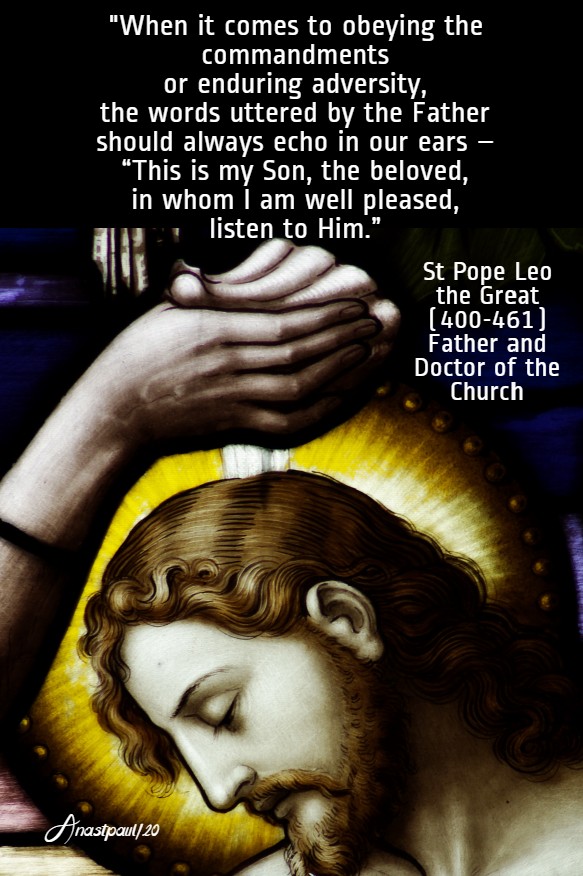
“When it comes to obeying the commandments or enduring adversity, the words uttered by the Father should always echo in our ears – “This is my Son, the beloved, in whom I am well pleased, listen to Him.”
St Pope Leo the Great (400-461)
Father and Doctor of the Church
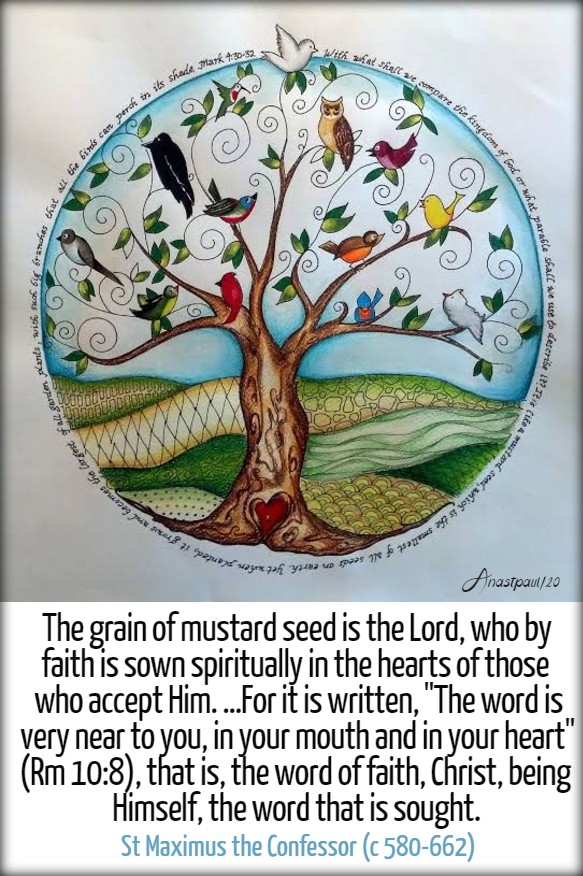
“The grain of mustard seed is the Lord, who by faith is sown spiritually in the hearts of those who accept Him. … For it is written, “The word is very near to you, in your mouth and in your heart” (Rm 10:8), that is, the word of faith, Christ, being Himself, the word that is sought.”
St Maximus the Confessor (c 580-662)
Monk and Theologian
Second Century on Theology, nos. 10-11, 35
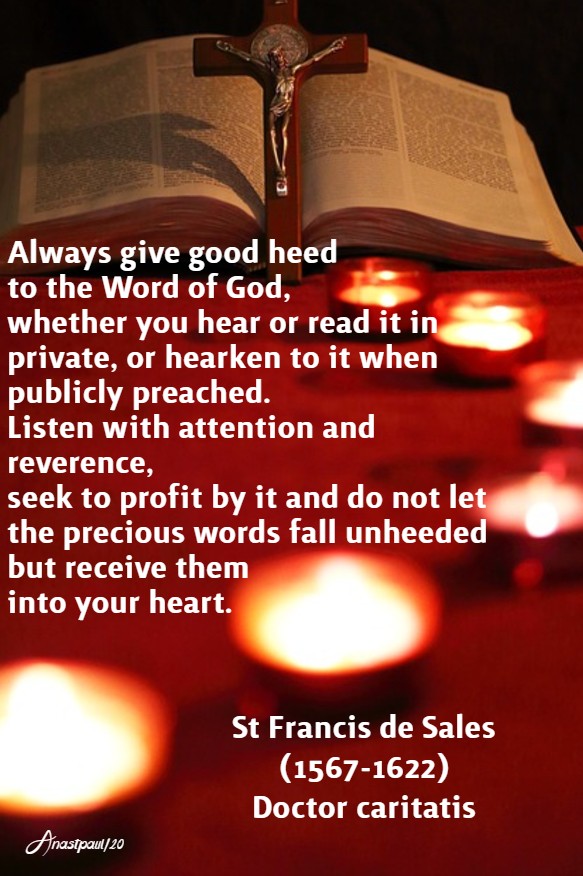
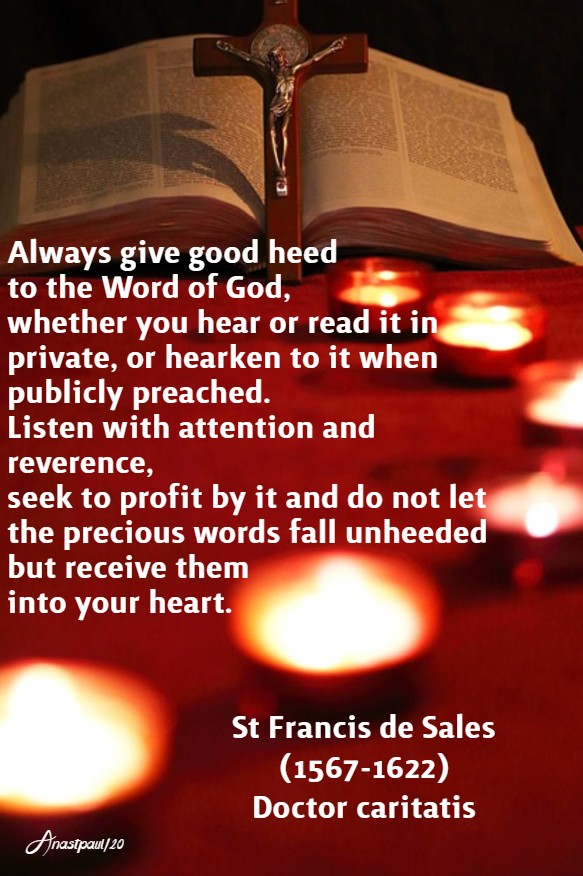
“Always give good heed to the Word of God, whether you hear or read it in private, or hearken to it when publicly preached. Listen with attention and reverence, seek to profit by it and do not let the precious words fall unheeded but receive them into your heart.”
St Francis de Sales (1567-1622)
Doctor caritatis
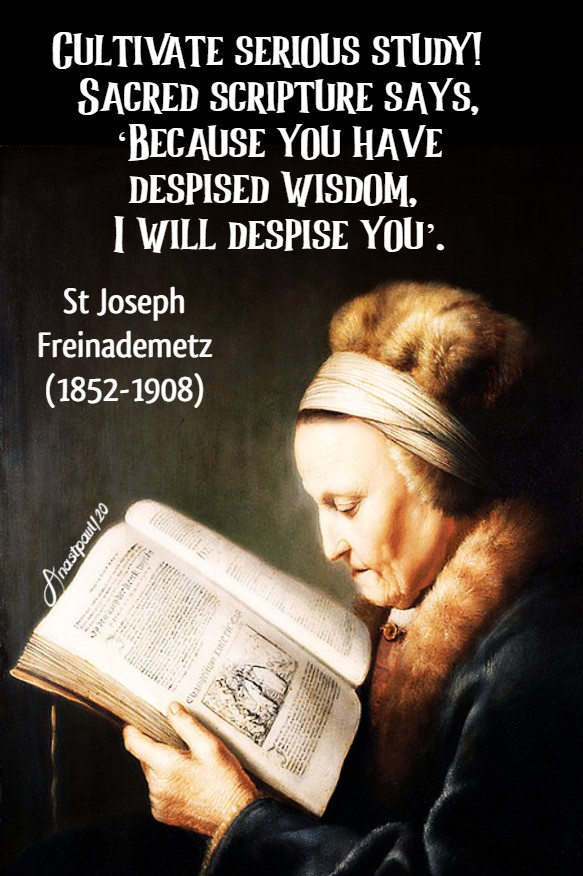
“Cultivate serious study! Sacred scripture says, ‘Because you have despised wisdom, I will despise you’.”
“As for what was sown on good soil, this is he who hears the word and understands it; he indeed bears fruit and yields, in one case a hundredfold, in another sixty, and in another thirty.”…Matthew 13:23
REFLECTION – “Indeed, you all know how land is cultivated. First of all you pull out the weeds and throw away the stones, then you work the ground itself. You do it again a second time, a third time and finally… you sow. Oh, let it be like this in our souls! First of all let us uproot the weeds, that is to say our evil thoughts; then take out the stones, in other words all our malice and obstinacy. Finally, let us work our hearts with the plough of the Gospel and the ploughshare of the cross. Let us break it by repentance, turn over the soil with almsgiving and with charity, prepare it for the seed of Our Lord… that it may joyfully receive the seed of the divine word and bring forth fruit, not just thirty but sixty and a hundredfold.”… St Caesarius of Arles (470-543) Monk & Bishop (Sermons to the people, no.6 passim ; SC 175)
PRAYER – A pure heart create for me O God, put a steadfast spirit within me! (Ps 50[51]) Lord God, bestow a full measure of Your grace to us. Keep us within in the path of Your commandments, help us to work on the earth of our souls, rooting out the weeds and casting forth the stones of malice. Grant that by the intercession of the Mother of Your Son and our Mother too, we may succeed in attaining sanctity. Through Christ, our Lord, in union with the Holy Spirit, one God, forever, amen.
Quote/s of the Day – 22 June – The Memorial of St John Fisher (1469-1535) Bishop, Martyr
“I reckon in this realm, no one man, in wisdom, learning and long approved virtue together, meet to be matched and compared with him.”
St Thomas More speaking of St John Fisher
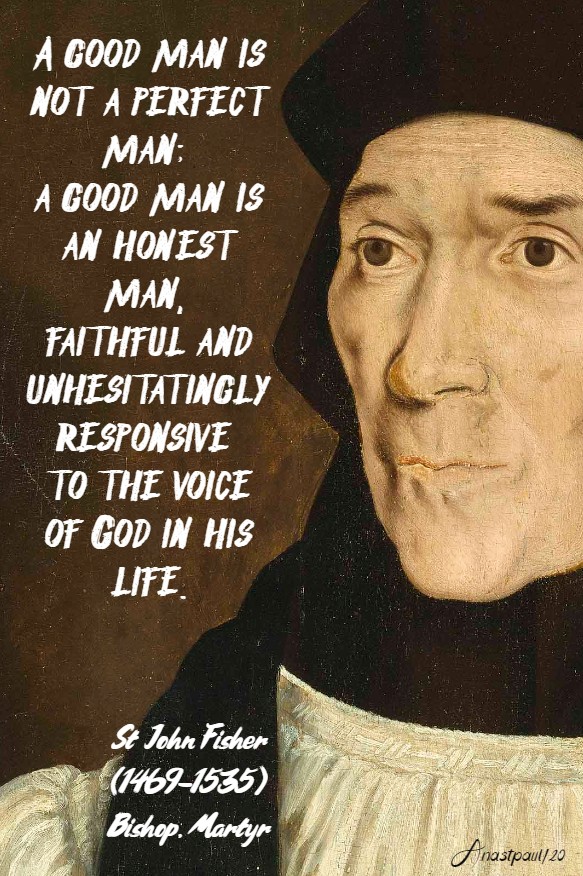
“A good man is not a perfect man; a good man is an honest man, faithful and unhesitatingly responsive to the voice of God in his life.”
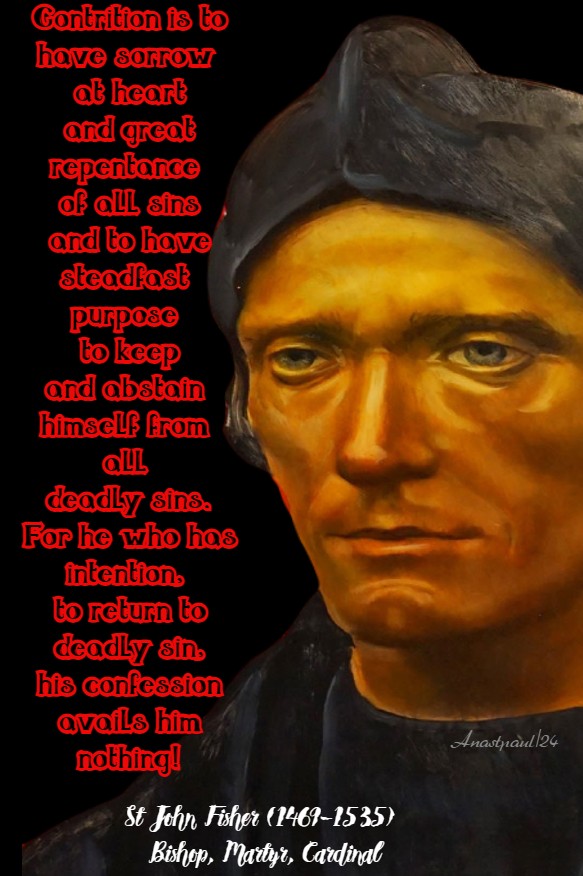
“Contrition is to have sorrow at heart and great repentance of all his sins and to have steadfast purpose to keep and abstain him from all deadly sins. For who has intention to return him to deadly sin, his confession avails him nothing!”
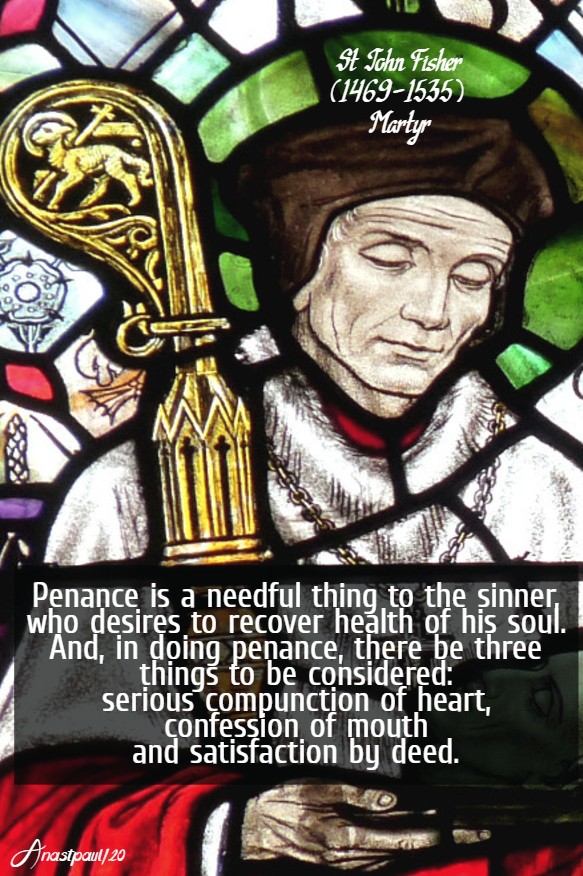
“Penance is a needful thing to the sinner, who desires to recover health of his soul. And, in doing penance, there be three things to be considered: serious compunction of heart, confession of mouth and satisfaction by deed.”
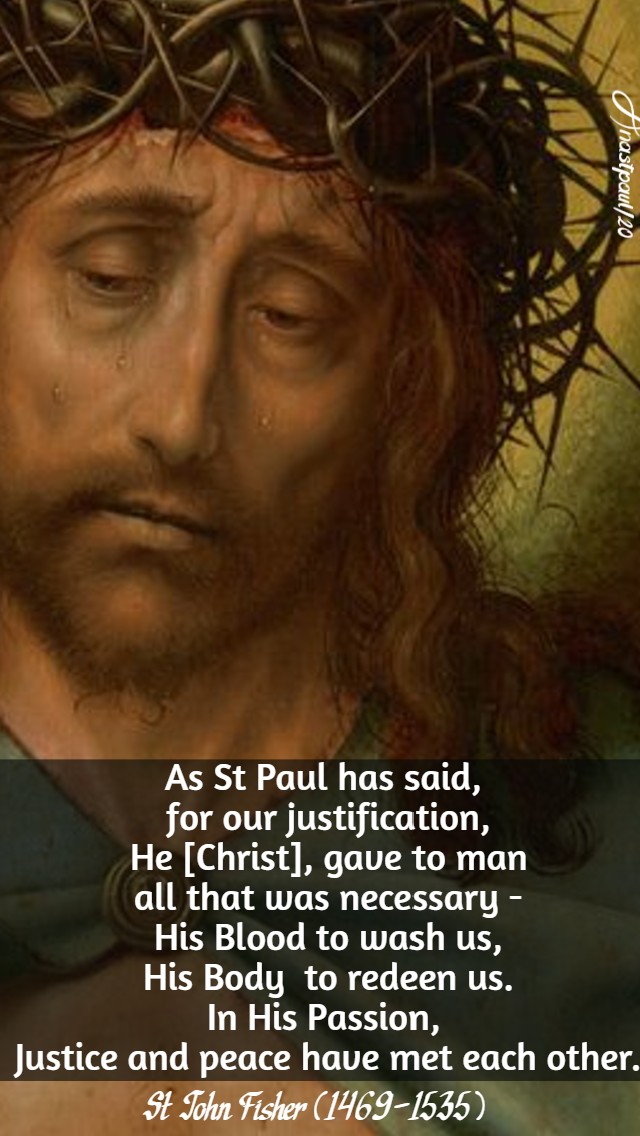
“As St Paul has said, for our justification, He [Christ], gave to man all that was necessary – His Blood to wash us, His Body to redeem us. In His Passion, Justice and peace have met each other.”
“Beware of those prophets who speak unto you and deceive you! They prophecy nothing but the imaginations and forgings of their own minds and not the truth of Holy Scripture!”
Quote/s of the Day – 10 June – “Month of the Sacred Heart” – Wednesday of the Tenth week in Ordinary Time, Year A, Readings: 1 Kings 18:20-39, Psalm 16:1-2, 4-5, 8, 11, Matthew 5:17-19
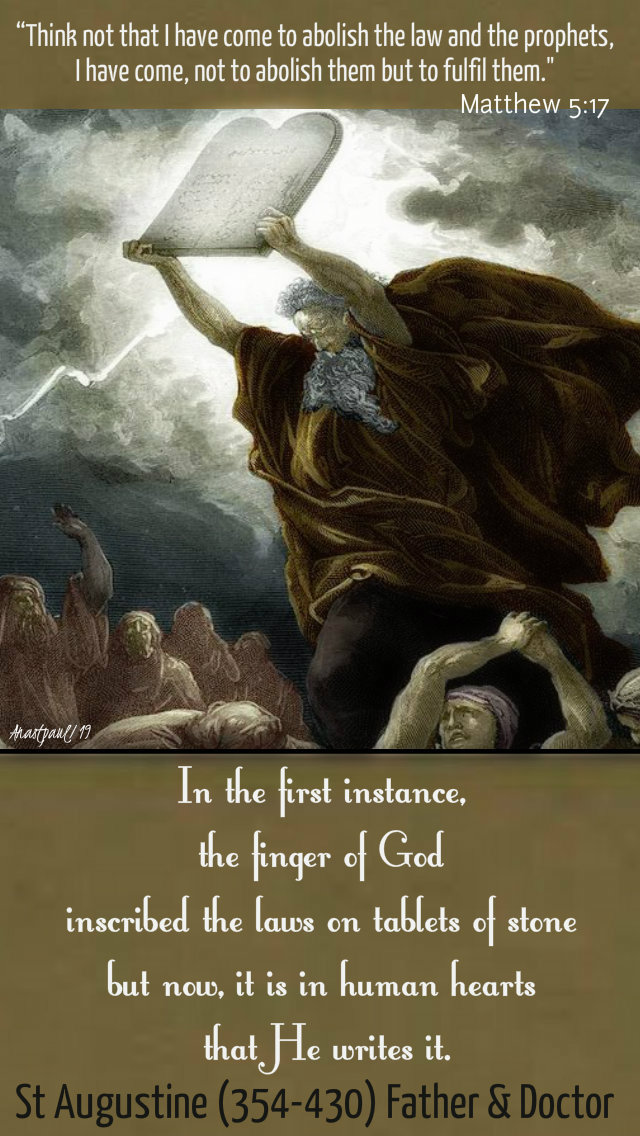
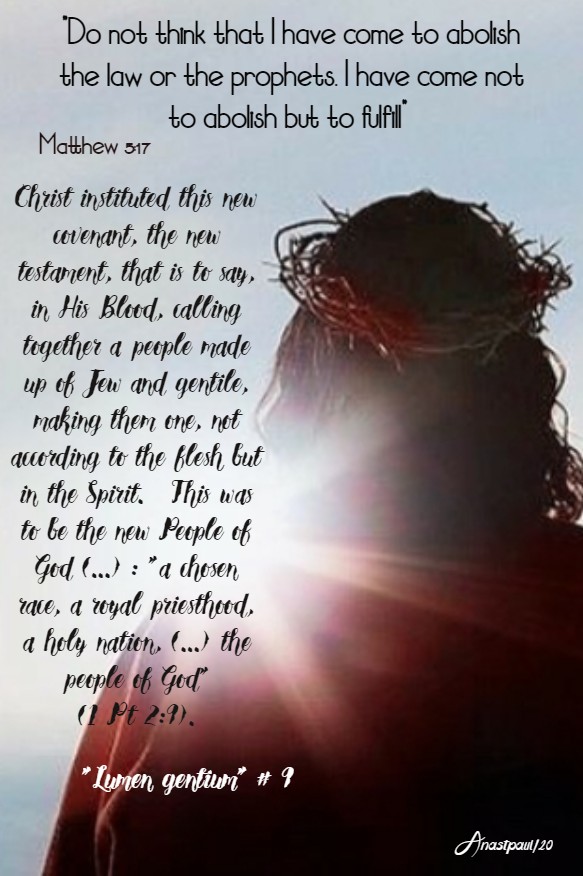
“I have come not to abolish but to fulfil.”
Matthew 5:17
“In the first instance, the finger of God inscribed the laws on tablets of stone but now, it is in human hearts, that He writes it (Ex 31:18; 2 Cor 3:3).“
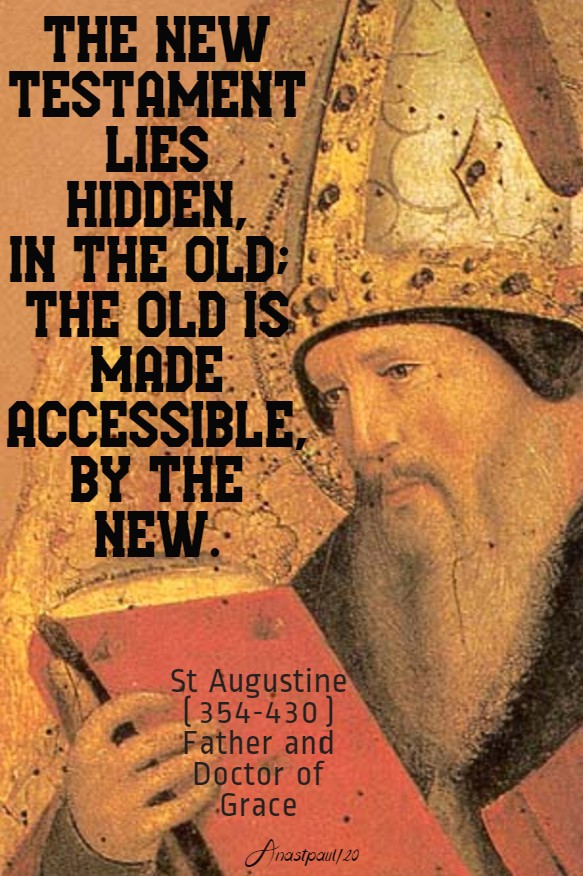
“The New Testament lies hidden, in the Old; the Old is made accessible, by the New.”
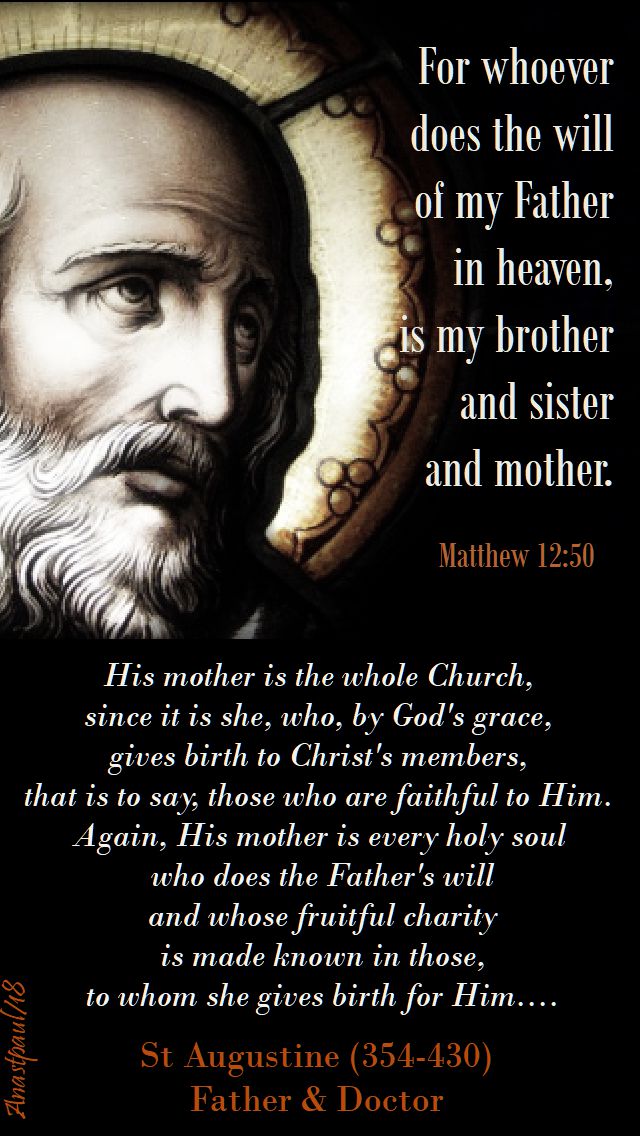
“His mother is the whole Church, since it is she, who, by God’s grace, gives birth to Christ’s members, that is to say, those who are faithful to Him. Again, His mother is every holy soul who does the Father’s will and whose fruitful charity is made known in those, to whom she gives birth for Him, “until he has been formed in them” (cf Gal 4:19)”
St Augustine (354-430)
Father and Doctor of Grace
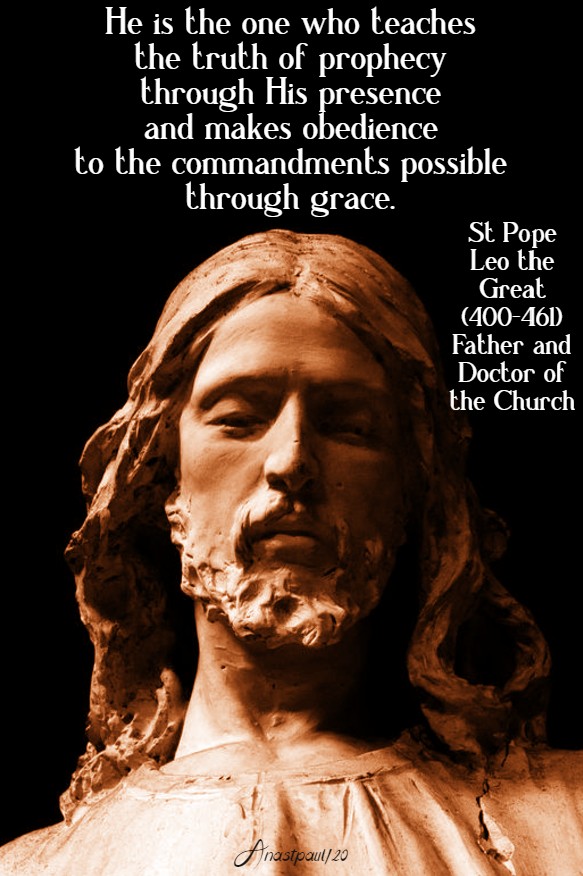
“He is the one who teaches the truth of prophecy through His presence and makes obedience to the commandments possible through grace.”
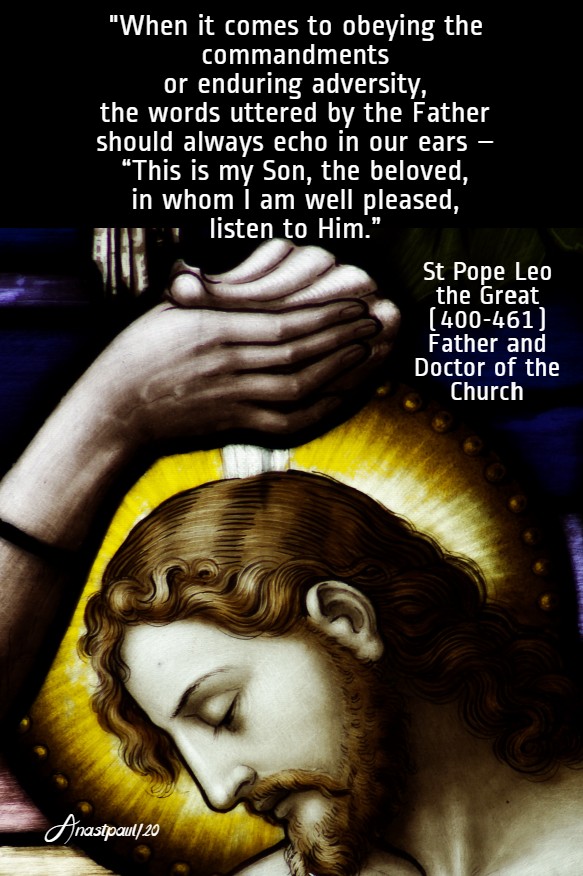
“When it comes to obeying the commandments or enduring adversity, the words uttered by the Father should always echo in our ears – “This is my Son, the beloved, in whom I am well pleased, listen to Him.”
St Pope Leo the Great (400-461)
Father and Doctor of the Church
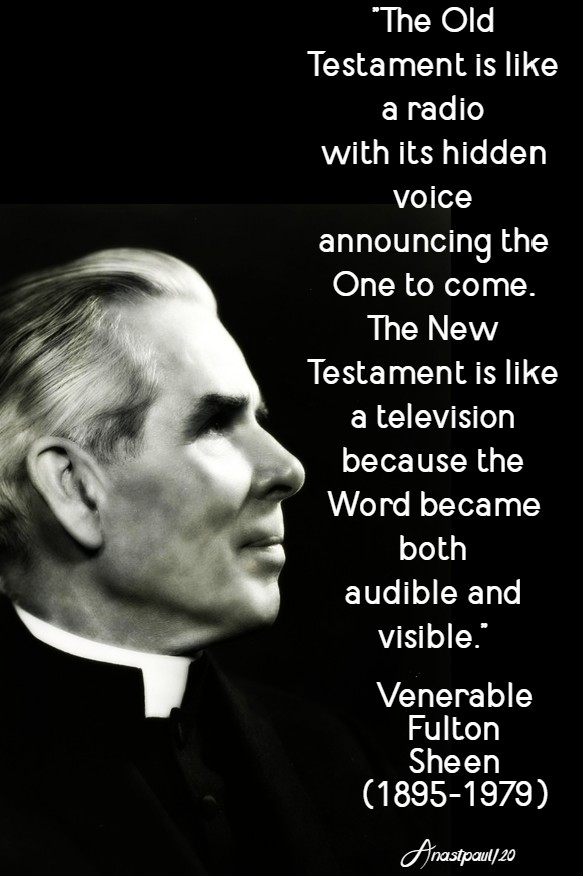
“The Old Testament is like a radio with its hidden voice announcing the One to come. The New Testament is like a television because the Word became both audible and visible.”
Venerable Fulton Sheen (1895-1979)
” Christ instituted this new covenant, the new testament, that is to say, in His Blood, (1 Cor 11:25) c alling together a people made up of Jew and gentile, making them one, not according to the flesh but in the Spirit. This was to be the new People of God … : “a chosen race, a royal priesthood, a holy nation, … the people of God” (1 Pt 2:9).”
Vatican Council II –
Constitution on the Church “Lumen gentium” # 9
One Minute Reflection – 10 June – “Month of the Sacred Heart” – Wednesday of the Tenth week in Ordinary Time, Year A, Readings: 1 Kings 18:20-39, Psalm 16:1-2, 4-5, 8, 11, Matthew 5:17-19
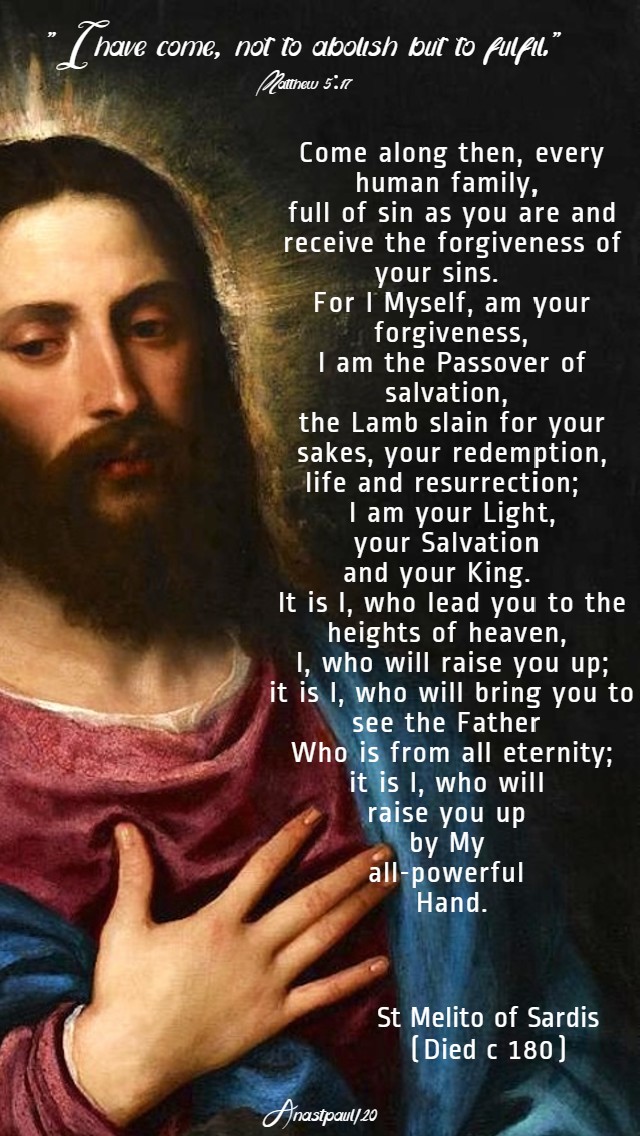
“I have come, not to abolish but to fulfil.” … Matthew 5:17
REFLECTION – “The sacrifice of the lamb, the Passover rite and the letter of the Law, have reached their term in Jesus Christ, in view of Whom, everything in the ancient Law took place – and, even more so, in the new dispensation. For the Law became the Word; from being old it became new … the commandments have been transformed into Grace and the foreshadowing into truth; the lamb has become the Son, the sheep has become man and man has become God. …
God though He was, the Lord put on our humanity; He suffered for him who was suffering, was bound for him who was captive, was judged for the guilty, was buried for him who was buried. He was raised from the dead and cried out in a loud voice: “If anyone wishes to oppose me, let us appear together” (Is 50,8). It is I who delivered the condemned man; I who restored life to the dead; I who raised up those in the grave. “Who disputes my right?” It is I, He says, I, who am the Christ, I, who destroyed death, who triumphed over the enemy, who bound the mighty enemy and carried off man to the heights of heaven; it is I, He says, who am the Christ.
Come along then, every human family, full of sin as you are and receive the forgiveness of your sins. For I Myself, am your forgiveness, I am the Passover of salvation, the Lamb slain for your sakes, your redemption, life and resurrection; I am your Light, your Salvation and your King. It is I, who lead you to the heights of heaven, I, who will raise you up; it is I, who will bring you to see the Father who is from all eternity; it is I, who will raise you up by My all-powerful Hand.” … St Melito of Sardis (Died c 180) Bishop, Apologist – Paschal Homily
PRAYER – Shed your clear light on our hearts, Lord, so that walking continually in the way of Your commandments, we may never be deceived or misled. May your Angels and Saints, pray for us. May the Mother of Our God and our Mother, be at our side and guide our way. We make our prayer through our Lord Jesus Christ in the unity of the Holy Spirit, one God forever and ever, amen.
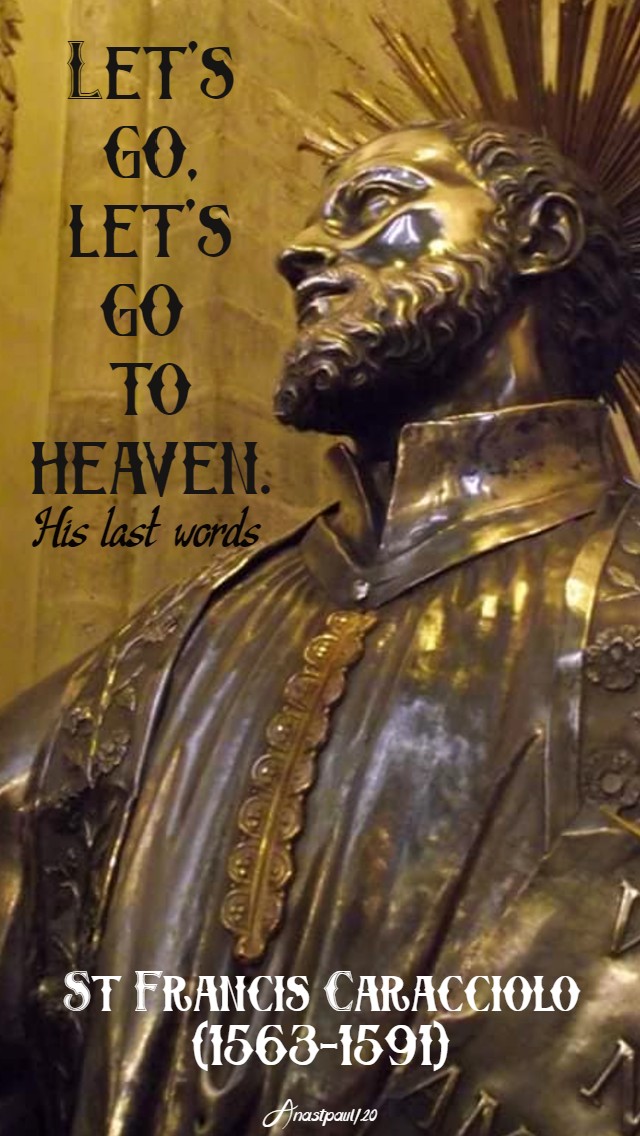
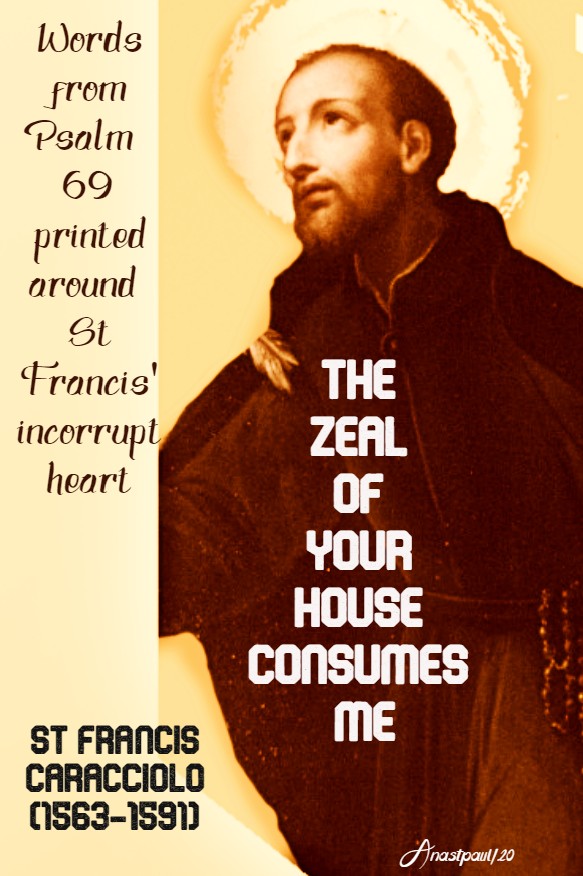
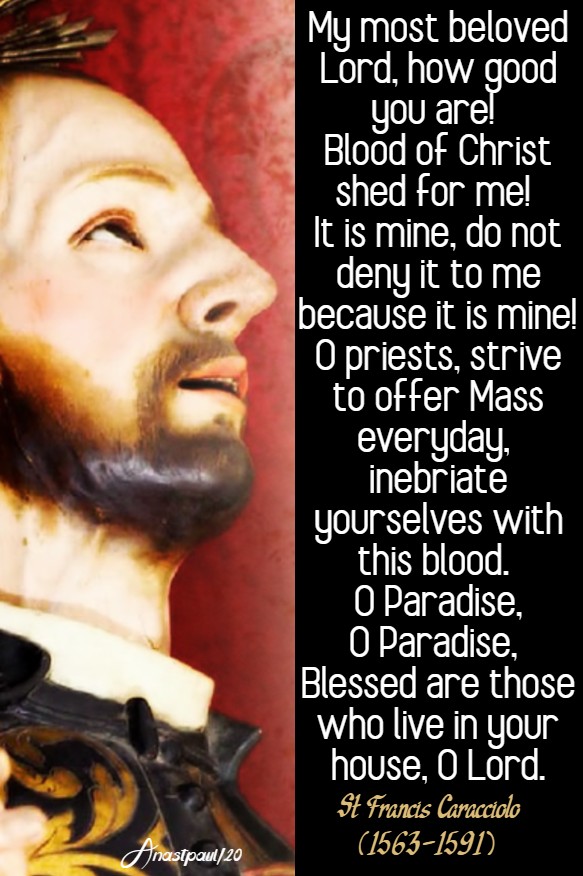
Quote/s of the Day – 4 June – “Month of the Sacred Heart” – The Memorial of St Francis Caracciolo CRM (1563-1591) Priest, Founder
“Let’s go, let’s go to heaven.”
His last words
“The zeal of your house consumes me”
(Ps 69:10)
“My most beloved Lord, how good you are! Blood of Christ shed for me! It is mine, do not deny it to me because it is mine! O priests, strive to offer Mass everyday, inebriate yourselves with this blood. O Paradise, O Paradise, Blessed are those who live in your house, O Lord.”
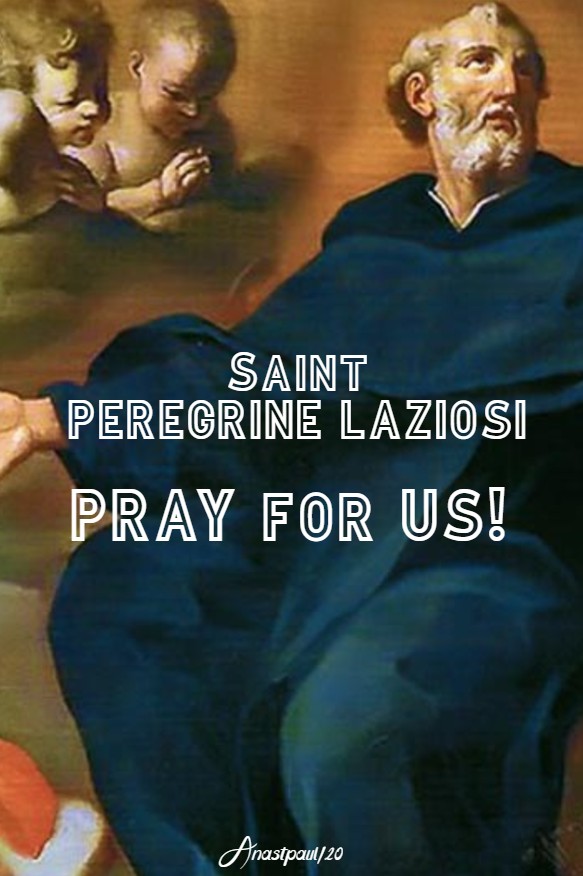
One Minute Reflection – 1 May – Friday of the Third Week of Easter, Readings: Acts 9:1-20, Psalm 117:1-2, John 6:52-59 and the Memorial of St Peregine Laziosi OSM (1260-1345)
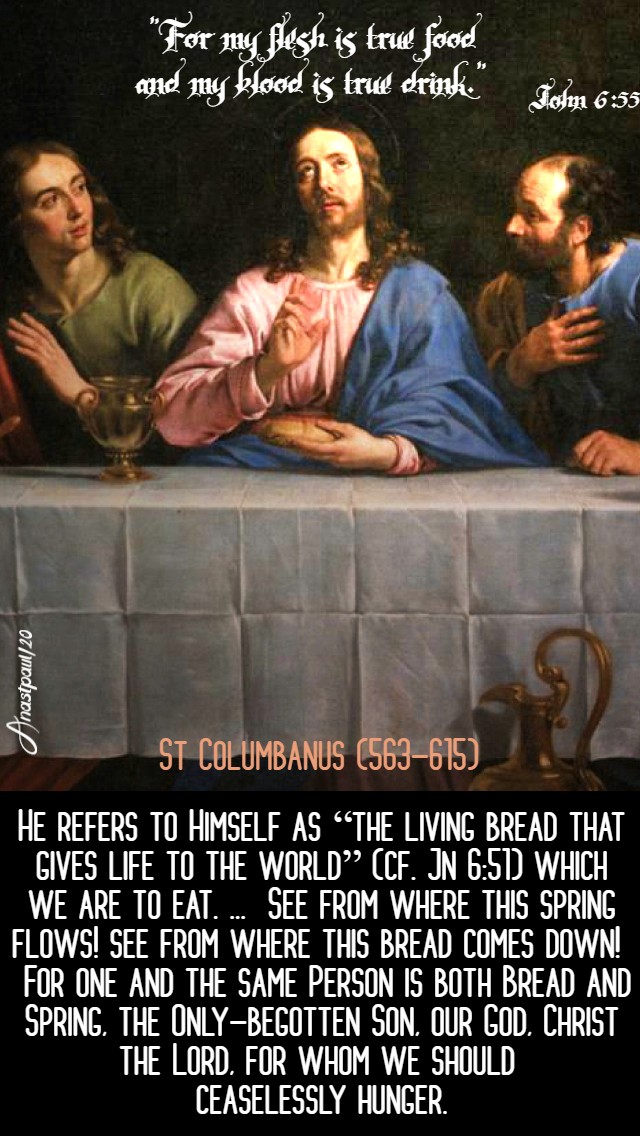
“For my flesh is true food and my blood is true drink.” … John 6:55
REFLECTION – “Beloved brethren, quench your thirst at the waters of that divine spring we want to tell you about, quench it but don’t extinguish it, drink but don’t become satisfied. The living spring, the source of life calls us and says: “Let anyone who thirsts come to me and drink” (Jn 7:37). Understand what it is you are drinking. Let the prophet tell you and let the source itself tell you: “Listen to the word of the Lord, they have forsaken me the source of living water” (Jer 2:13). So the Lord our God Himself, Jesus Christ, is He who is that source of life and that is why He invites us, to come to Him so that we might drink Him. Whoever loves Him, drinks Him, whoever feeds on the Word of God, drinks Him. … Drink, therefore, from this source that others have forsaken.
That we might eat of this bread and drink from this spring (…) He refers to Himself as “the living bread that gives life to the world” (cf. Jn 6:51) which we are to eat. … See from where this spring flows! see from where this bread comes down! For one and the same Person is both Bread and Spring, the Only-begotten Son, our God, Christ the Lord, for whom we should ceaselessly hunger.
It is our love that gives Him as food to us, our desire that makes us eat Him and when we have been satisfied, we desire Him still. Let us go to Him as to a fountain and drink of Him in our overflowing love, let us drink Him always with ever-new desire, finding our joy in the sweetness of His love. The Lord is gentle and good. We eat and drink Him without ceasing to hunger and thirst for Him, for we cannot exhaust this food and drink. We eat of this bread yet do not run out of it, we drink at this spring yet it does not run dry. This bread is eternal, this stream flows without end.” … St Columbanus (563-615) – Spiritual instructions 12, 2, 3
PRAYER – Almighty God, You sent Your Son and we have now come to know the grace of His Resurrection. Through Him we live and move and have our being. As we follow Him, He walks with us and leads us to You. Grant we pray, that His mother and ours, may guide our way to Him and may the prayers of St Peregrine, who followed closely behind the Lord, be a solace in our trials. Through Christ our Lord, with the Holy Spirit, God now and forever, amen.
Thought for the Day – 28 April – Meditations with Antonio Cardinal Bacci (1881-1971)
The Word of God
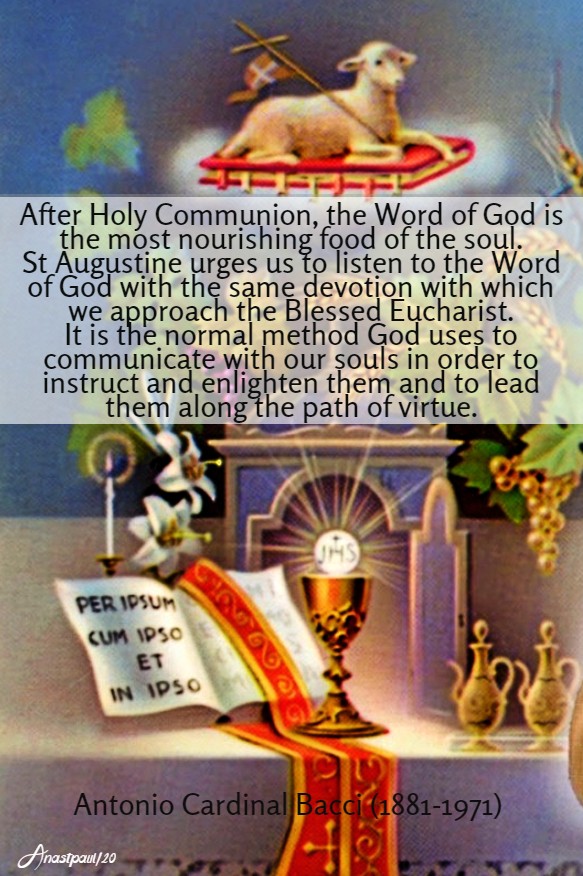
“After Holy Communion, the Word of God is the most nourishing food of the soul.
St Augustine urges us to listen to the Word of God with the same devotion with which we approach the Blessed Eucharist.
It is the normal method God uses to communicate with our souls in order to instruct and enlighten them and to lead them along the path of virtue.
It is true, that God sometimes makes direct contact with us by means of good inspirations or extraordinary graces but, the ordinary way in which He calls us to eternal life, is by His divine Word, whether it is proclaimed by His ministers, read in Sacred Scripture, illustrated in the lives of the Saints, or, outlined by masters of the spiritual life.
Most important of all, is the living word of the lawful representatives of God.
Jesus did not specifically command His Apostles to write but to preach.
“He who believes and is baptised,” He added, “shall be saved but he who does not believe, shall be condemned” (Cf Mk 16:16).
Mary Magdalen was converted by the preaching of Jesus and wept for her sins.
The sermons of St John the Baptist called upon the Jewish people to do penance.
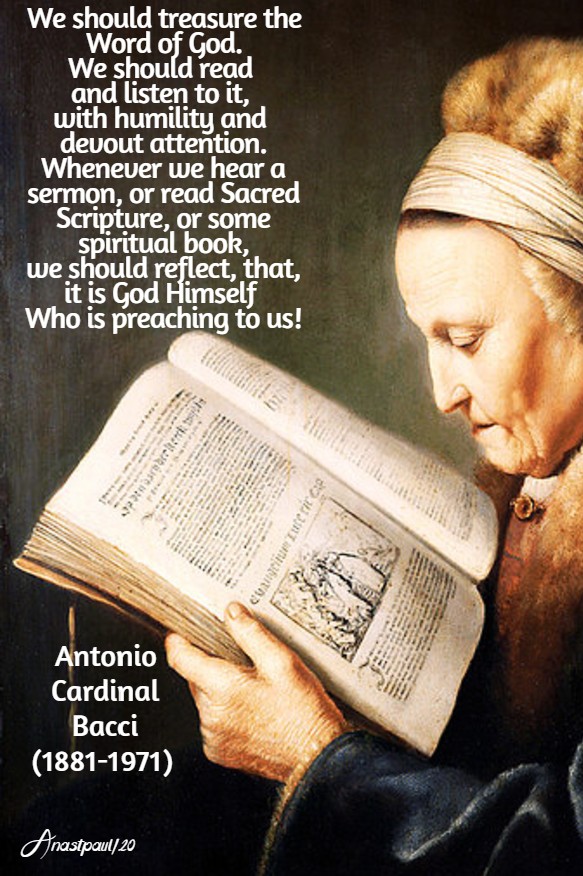
Centuries earlier, the prophet Nathan had converted David by means of the inspired Word of God and the prophet Jonah, had roused the Ninivites to repentance. We should treasure the Word of God. We should read and listen to it, with humility and devout attention. Whenever we hear a sermon, or read Sacred Scripture, or some spiritual book, we should reflect, that, it is God Himself Who is preaching to us!
We should not be guided merely by a spirit of curiosity, desire for knowledge, or love of eloquence or literary style but, by the determination to apply such instruction to ourselves and to put it into practice.”
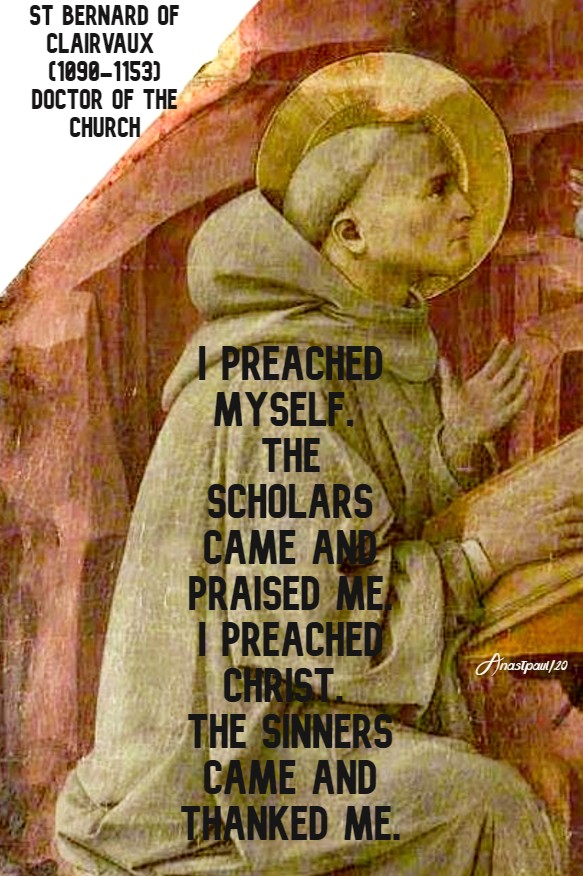
“I preached myself, the scholars came and praised me. I preached Christ, the sinners came and thanked me.”
St Bernard of Clairvaux (1090-1153)
Doctor of the Church
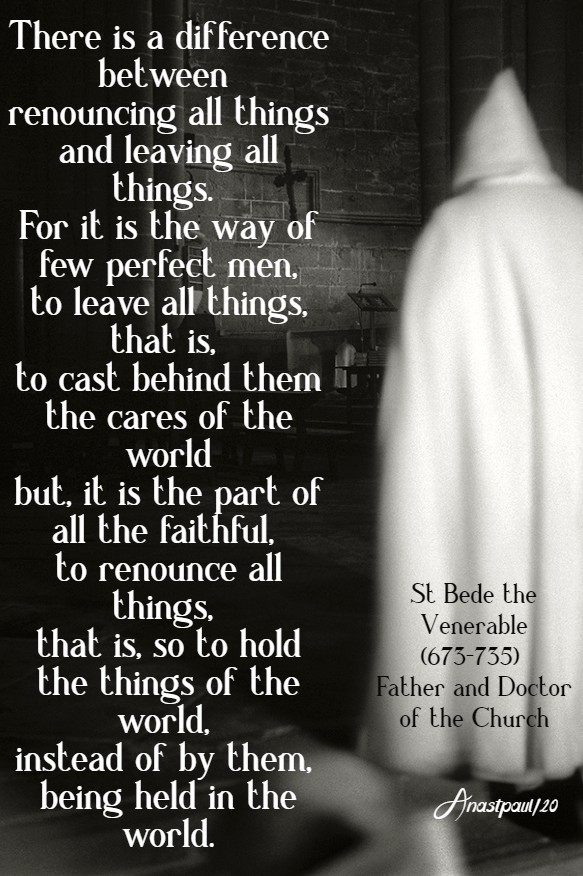
“There is a difference between renouncing all things and leaving all things. For it is the way of few perfect men, to leave all things, that is, to cast behind them the cares of the world but, it is the part of all the faithful, to renounce all things, that is, so to hold the things of the world, instead of by them, being held in the world.”
St Bede the Venerable (673-735)
Father and Doctor of the Church
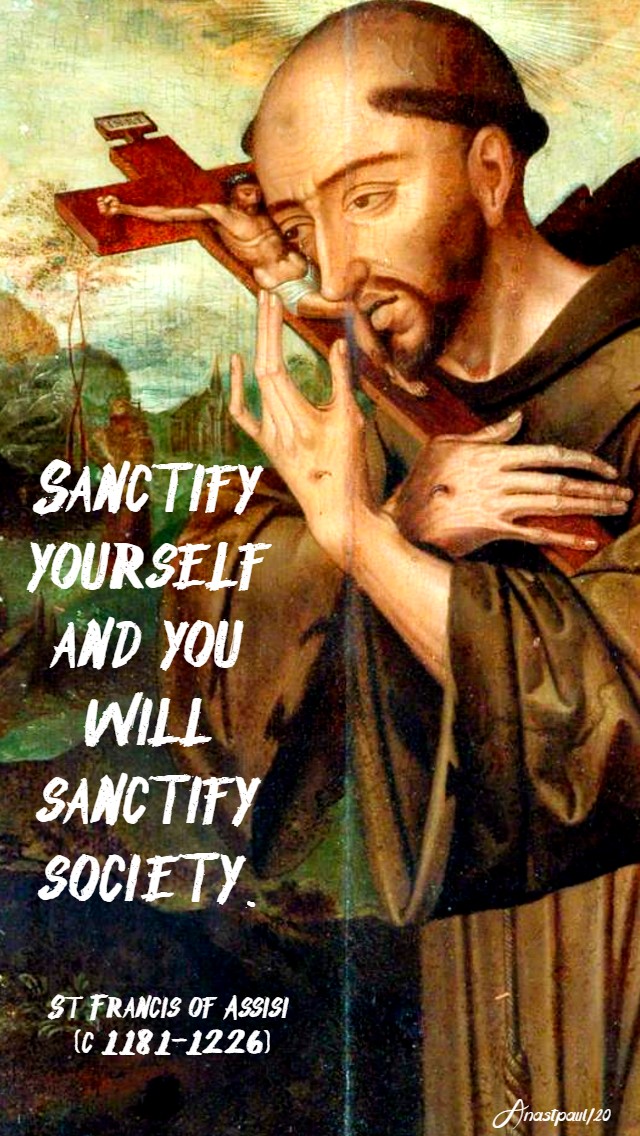
“Sanctify yourself and you will sanctify society.”
St Francis of Assisi (c 1181-1226)
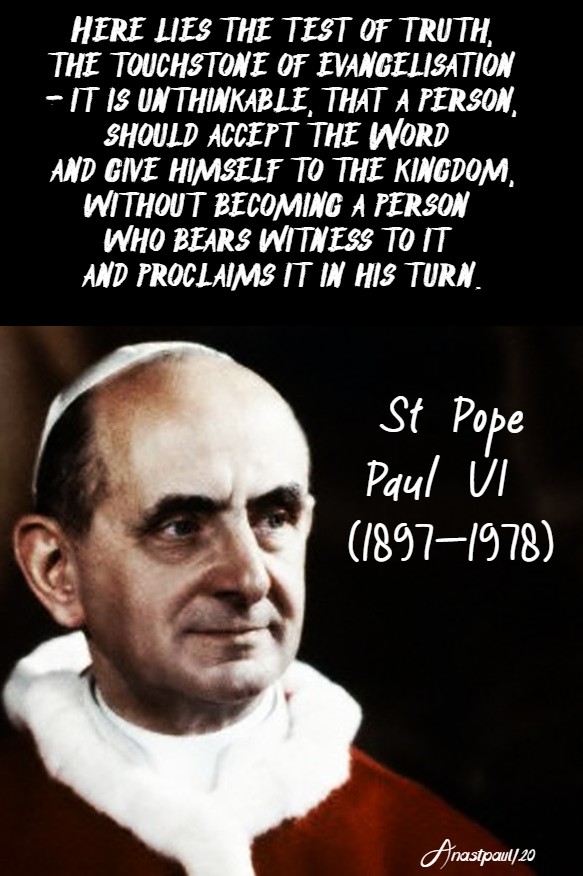
“Here lies the test of truth, the touchstone of evangelisation – it is unthinkable, that a person, should accept the Word and give himself to the kingdom, without becoming a person who bears witness to it and proclaims it in his turn.”
St Pope Paul VI (1897-1978)
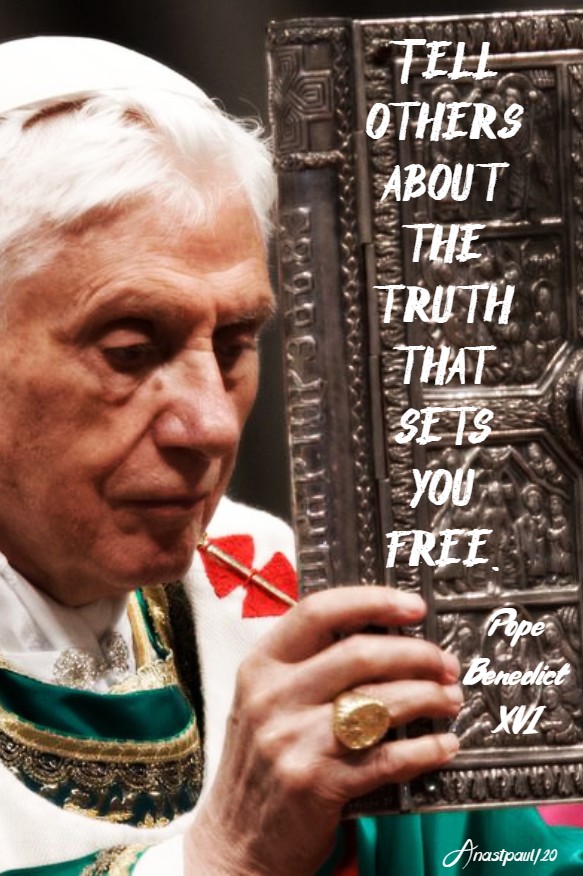
“Tell others about the truth that sets you free.”
Pope Benedict XVI
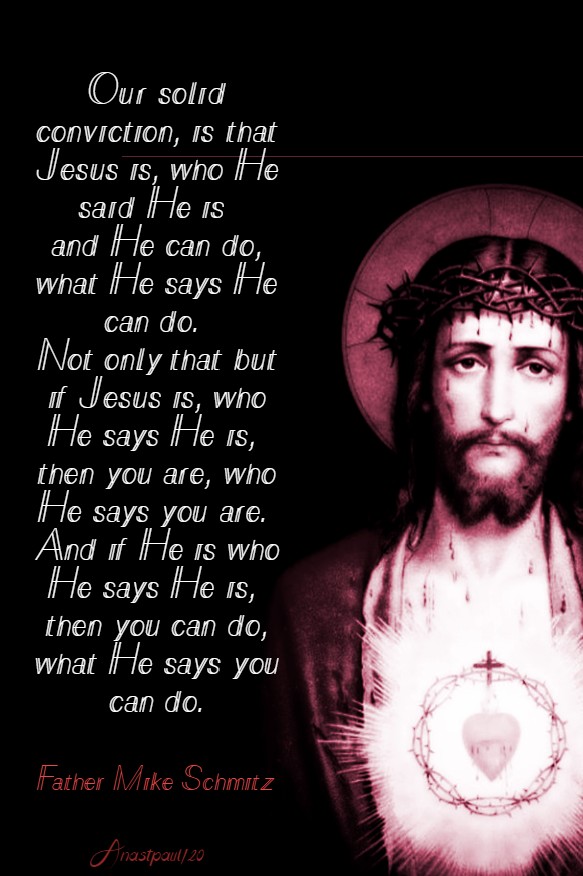
“Our solid conviction, is that Jesus is, who He said He is and He can do, what He says He can do. Not only that but if Jesus is, who He says He is, then you are, who He says you are. And if He is who He says He is, then you can do, what He says you can do.”
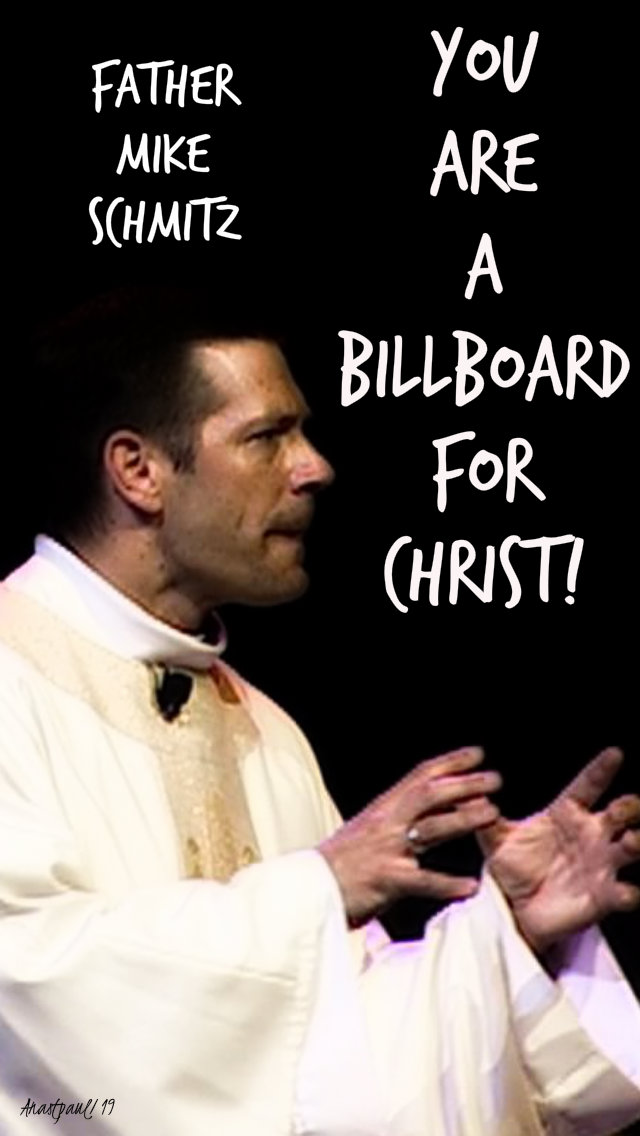
“You are a billboard for Christ!”
Father Mike Schmitz
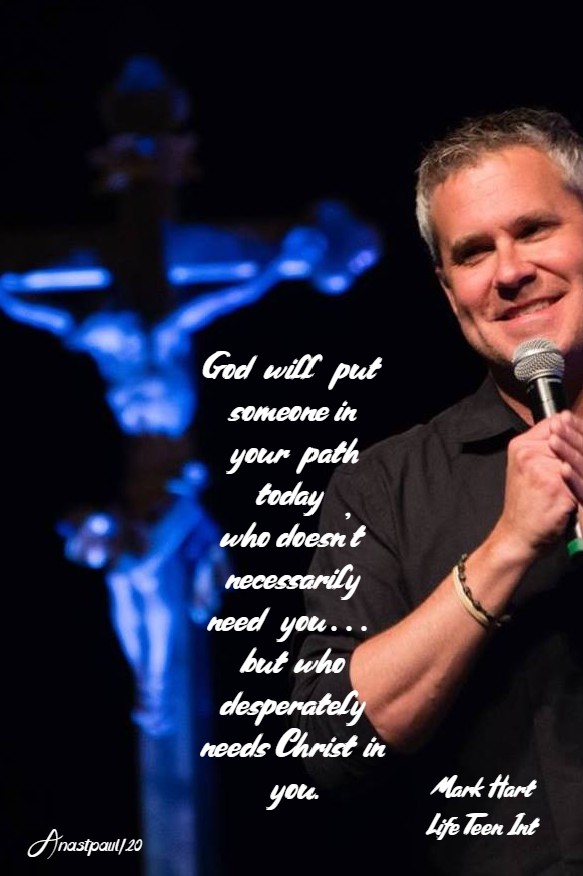
“God will put someone in your path today who doesn’t necessarily need you… but who desperately needs Christ in you.”
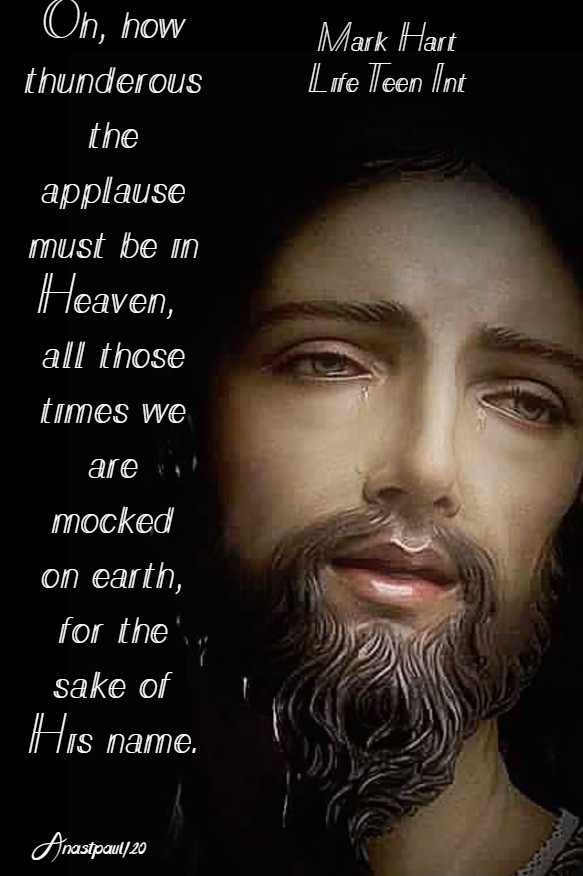
“Oh, how thunderous the applause must be in Heaven, all those times we are mocked on earth for the sake of His name.”
Mark Hart
Mark Hart serves as Executive Vice President for Life Teen International. A graduate from the University of Notre Dame, Mark is a best-selling and award-winning author (or co-author) of over a dozen books. His wildly popular DVD Bible Study Series,”T3″ is revolutionizing Catholic youth/young adult Scripture Study. He is the “Bible Geek.”
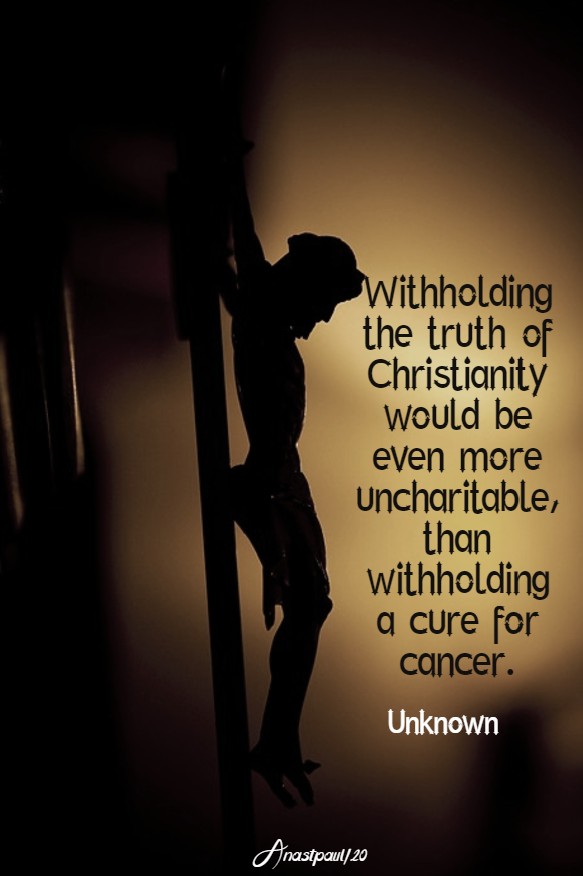
“Withholding the truth of Christianity would be even more uncharitable, than withholding a cure for cancer.”
One Minute Reflection – 3 April – Friday of the Fifth Week of Lent, Readings: Jeremiah 20:10-13, Psalm 18:2-7, John 10:31-42
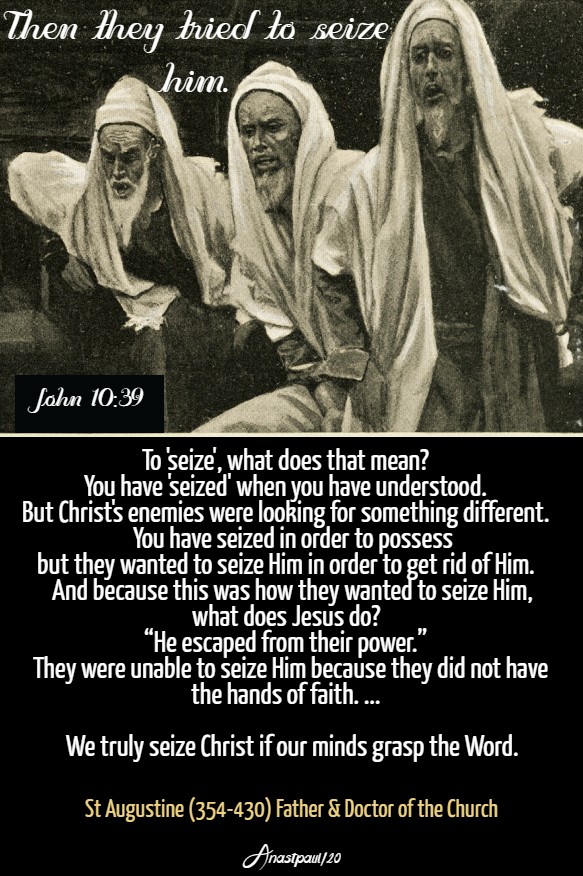
“Then they tried to seize him.” … John 10:39
REFLECTION – “If the Law calls them gods to whom the word of God came and scripture cannot be set aside,how can you say that the one whom the Father has consecrated and sent into the world blasphemes because I said, ‘I am the Son of God’?” Yes indeed, if God has spoken to us so that we might be called ‘gods,’ how could the Word of God, the Word that is in God, not be God? If we have been made sharers in His nature and have become gods because God speaks to us, how could this Word, through which this gift comes to us, not be God? … As for you, you approach the Light and receive it and are counted among the children of God but if you draw back, you become dark and are counted among the children of darkness (cf. 1 Thes 5:5). …
“Believe the works, so that you may realise and understand, that the Father is in me and I in the Father.” The Son of God does not say “the Father is in me and I in the Father” in the same sense as we are able to do. In effect, if our thoughts are good, we are in God; if our lives are holy, God is in us. When we are sharers in His grace and enlightened by His light then we are in Him and He in us. But … recognise what is proper to the Lord and what is a gift made to His servant. What is proper to the Lord is His equality with the Father but the gift granted to His servant, is to participate in the Saviour.
“Then they tried to seize him.” If only they had seized Him! But by faith and intellect, not so as to mock and put him to death! At this very moment, as I speak to you …, all of us, both you and I, are wanting to seize Christ. To ‘seize’, what does that mean? You have ‘seized’ when you have understood. But Christ’s enemies were looking for something different. You have seized in order to possess but they wanted to seize Him in order to get rid of Him. And because this was how they wanted to seize Him, what does Jesus do? “He escaped from their power.” They were unable to seize Him because they did not have the hands of faith. … We truly seize Christ if our minds grasp the Word.” … St Augustine (354-430) Father & Doctor of the Church – Sermons on the Gospel of John, no 48, 9-11
PRAYER – Holy Father, our Father, help us to lay down the stones of hate and embrace Your Son who stands before us in need. Give us the hands of faith and minds to grasp the Word, teach us to see His Face in those who cry out to us. Teach us compassion and love. Mary, your Immaculate Heart is our school. We make our prayer through Christ our Lord, with the Holy Spirit, one God for all eternity, amen.
Lenten Reflection – 26 March – Thursday of the Fourth Week of Lent, Readings: Exodus 32:7-14, Psalms 106:19-23, John 5:31-47
“Lord, open my lips, and my mouth shall declare your praise.”
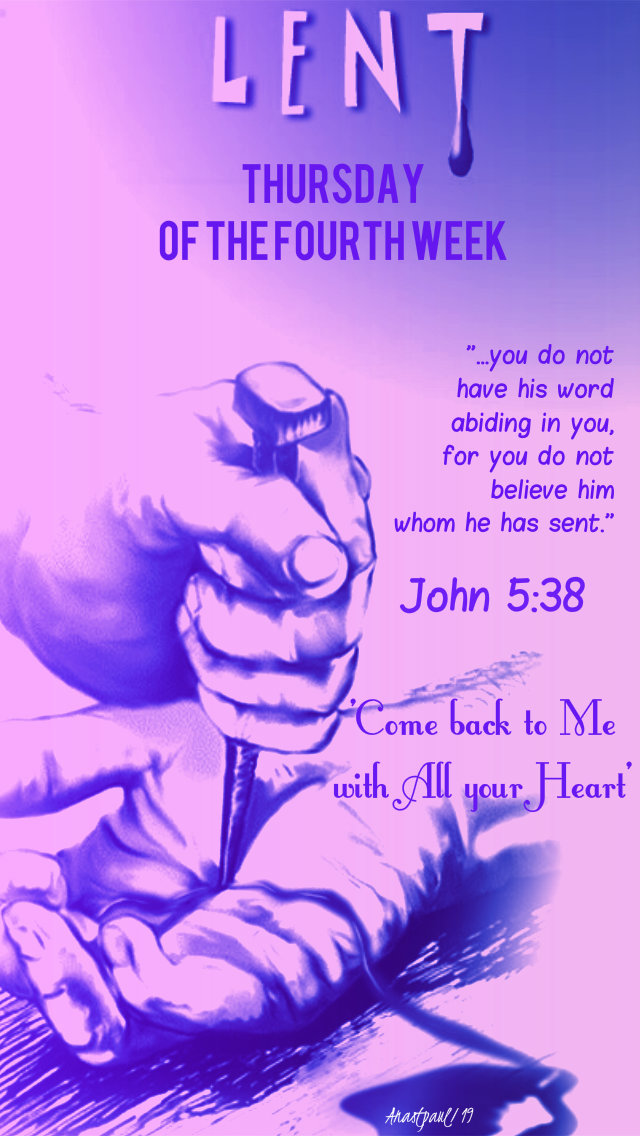
“…you do not have his word abiding in you, for you do not believe him whom he has sent.” … John 5:38
Daily Meditation:
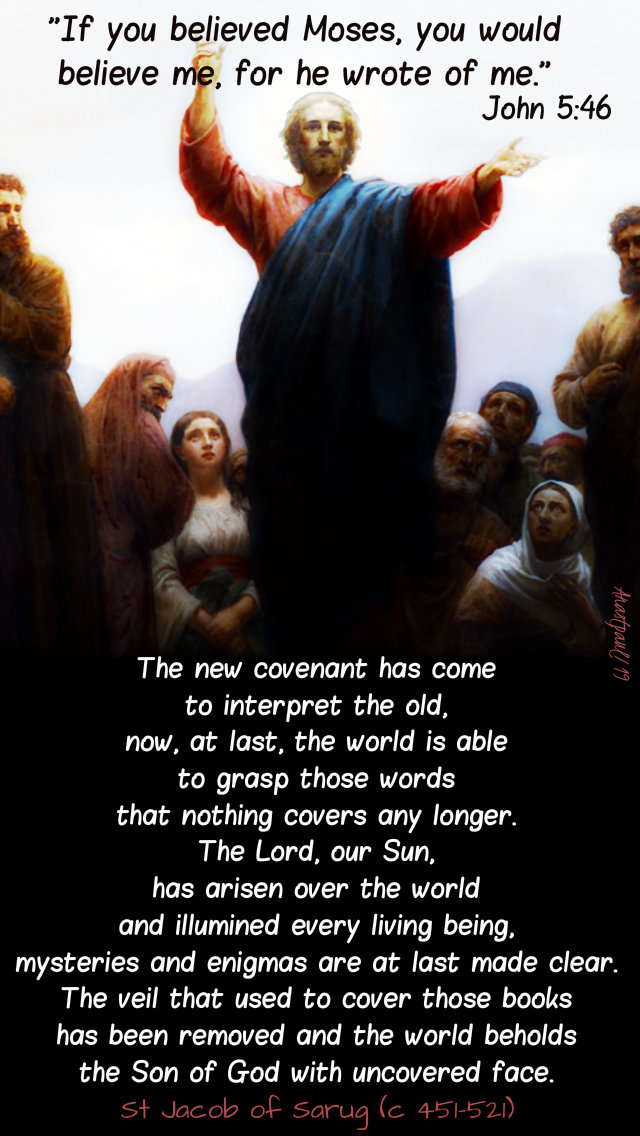
The new covenant has come to interpret the old, now, at last, the world is able to grasp those words that nothing covers any longer. The Lord, our Sun, has arisen over the world and illumined every living being, mysteries and enigmas are at last made clear. The veil that used to cover those books has been removed and the world beholds the Son of God with uncovered face.”…St Jacob of Sarug (c 451-521) Syrian Bishop and Monk
Therefore he said he would destroy them— had not Moses, his chosen one, stood in the breach before him, to turn away his wrath from destroying them.
Psalm 106:23
Intercessions:
God has revealed Himself in Christ.
Let us praise His goodness
and ask Him from our hearts:
Remember us, Lord, for we are Your children.
Teach us to enter more deeply into the mystery of the Church,
– that it may be more effective for ourselves
and for the world as the sacrament of salvation.
Lover of mankind, inspire us to work for human progress,
– seeking to spread Your kingdom in all we do.
May our hearts thirst for Christ,
– the fountain of living water.
Forgive us our sins,
– and direct our steps into the ways of justice and sincerity.
Closing Prayer:
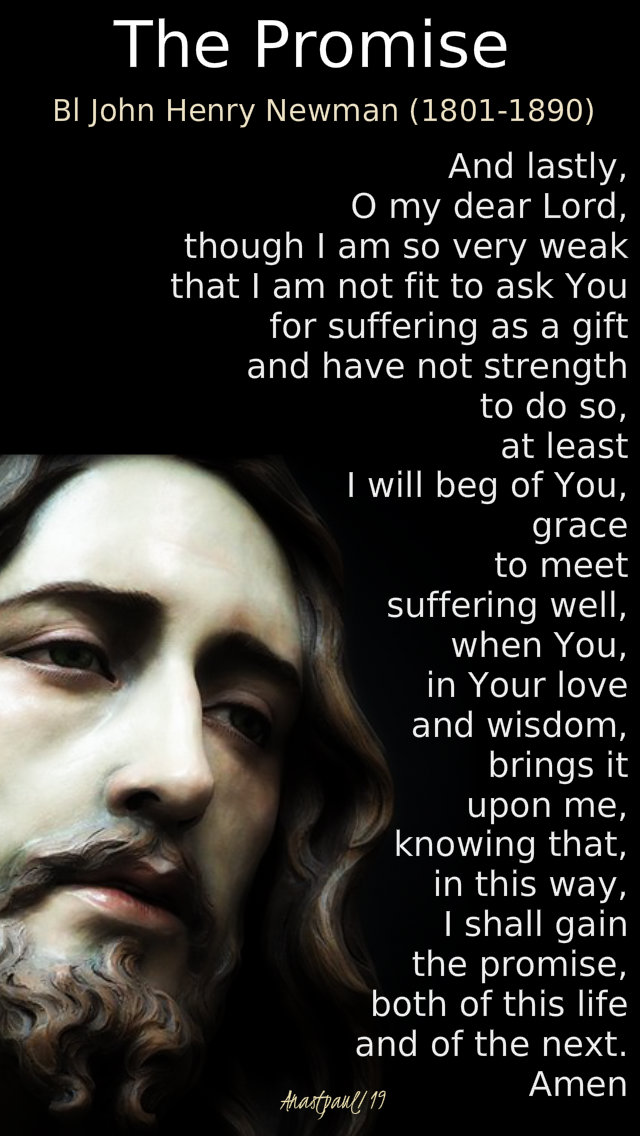
The Promise St John Henry Newman (1801-1890)
And lastly, O my dear Lord,
though I am so very weak
that I am not fit to ask You
for suffering as a gift
and have not strength to do so,
at least I will beg of You,
grace to meet suffering well,
when You, in Your love and wisdom,
brings it upon me,
knowing that in this way,
I shall gain the promise,
both of this life and of the next.
Amen
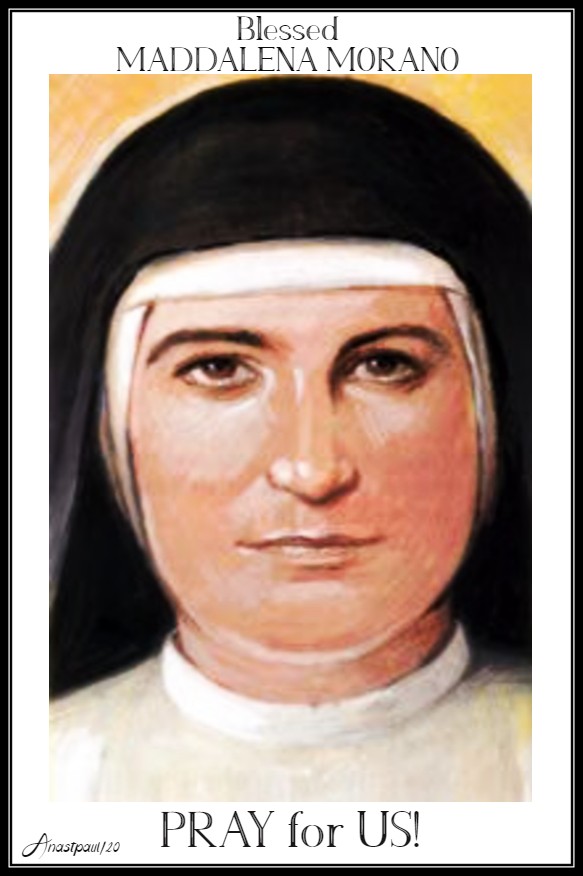
One Minute Reflection – 26 March – Thursday of the Fourth Week of Lent, Readings: Exodus 32:7-14, Psalms 106:19-23, John 5:31-47 and the Blessed Maddalena Caterina Morano (1847-1908)
“If you believed Moses, you would believe me, for he wrote of me. But if you do not believe his writings, how will you believe my words?”… John 5:46-47
REFLECTION – “In the beginning, the Lord, who had created humankind, used to talk to man Himself, in such a way, that man could hear Him. That is how He used to talk to Adam (…) and, later, with Noah and Abraham. So too, even when humankind had thrown itself into the abyss of sin, God did not break His relationship with them, even though it was, necessarily, less familiar since they had made themselves unworthy of it. He consented to renew His kindly feelings towards them, although, as by letters, as with an absent friend. Thus, in His goodness, He could bind all humankind to Himself again. Moses was he, who was the bearer of the letters God sent us.
Let us open these letters – what are their first words? “In the beginning God created the heaven and the earth.” Isn’t that wonderful? … Moses, who came into the world many centuries afterwards, was truly inspired from above, to give us an account of the wonders God made at the world’s creation…. Doesn’t he appear to tell us clearly: “Did men teach me what I’m about to make known? Not at all. The Creator alone, who wrought all these marvels, is the One who guides my tongue, to teach you them. From now on, I beg you, put to silence every argument of human reasoning. Don’t just listen to this account as though it were only Moses’ word. It is God Himself who speaks to you, Moses is only His interpreter.” …
So, brethren, let us receive the Word of God with thankful and humble hearts. … For God is He, who created all things, He it is, who prepares everything and sets it wisely in order. … He it is, who leads man by what can be seen, to a knowledge of the Creator of the universe. He it is, who teaches man to contemplate the supreme Worker in His works, in such a way, that He might be able to worship His Creator.” … Saint John Chrysostom (347-407) – Priest at Antioch then Bishop of Constantinople, Father & Doctor of the Church – 2nd Homily on Genesis
PRAYER – Father almighty, grant us Your good grace to trust completely in the Word made Flesh whom You sent to lead us to our heavenly home and save us from our evil ways. As we proceed by penance and prayer, grant us now, perseverance in listening to Him and learning from Him. May the prayers of Bl Maddalena, assist us on our journey. We make our prayer through Christ our Lord, in the unity of the Holy Spirit, one God with You, now and forever, amen.
Quote/s of the Day – 16 February – The Sixth Sunday in Ordinary Time, Year A
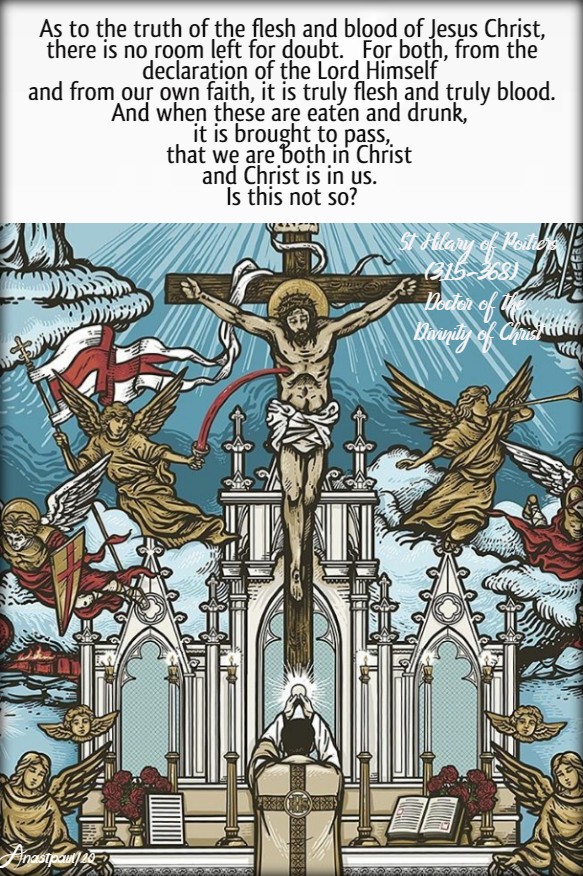
“As to the truth of the flesh and blood of Jesus Christ, there is no room left for doubt. For both, from the declaration of the Lord Himself and from our own faith, it is truly flesh and truly blood. And when these are eaten and drunk, it is brought to pass, that we are both in Christ and Christ is in us. Is this not so?”
St Hilary of Poitiers (315-368)
Doctor of the Divinity of Christ
“Always give good heed to the Word of God, whether you hear or read it in private, or hearken to it when publicly preached. Listen with attention and reverence, seek to profit by it and do not let the precious words fall unheeded but receive them into your heart.”
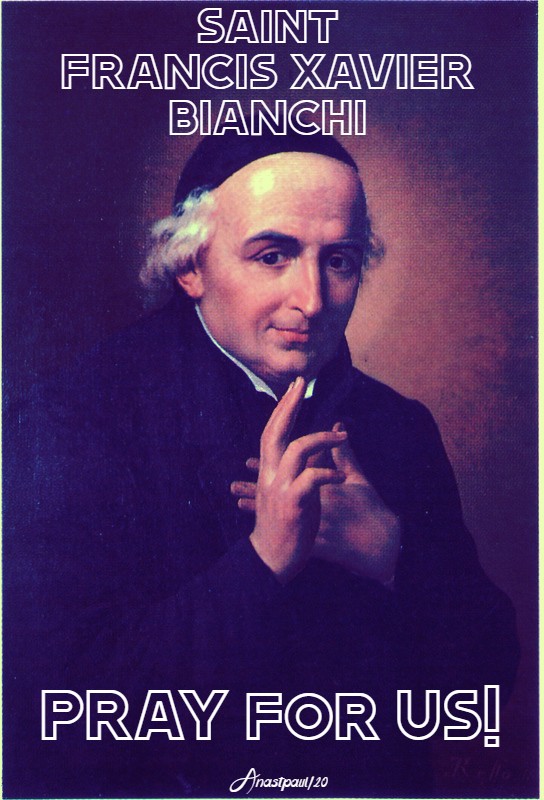
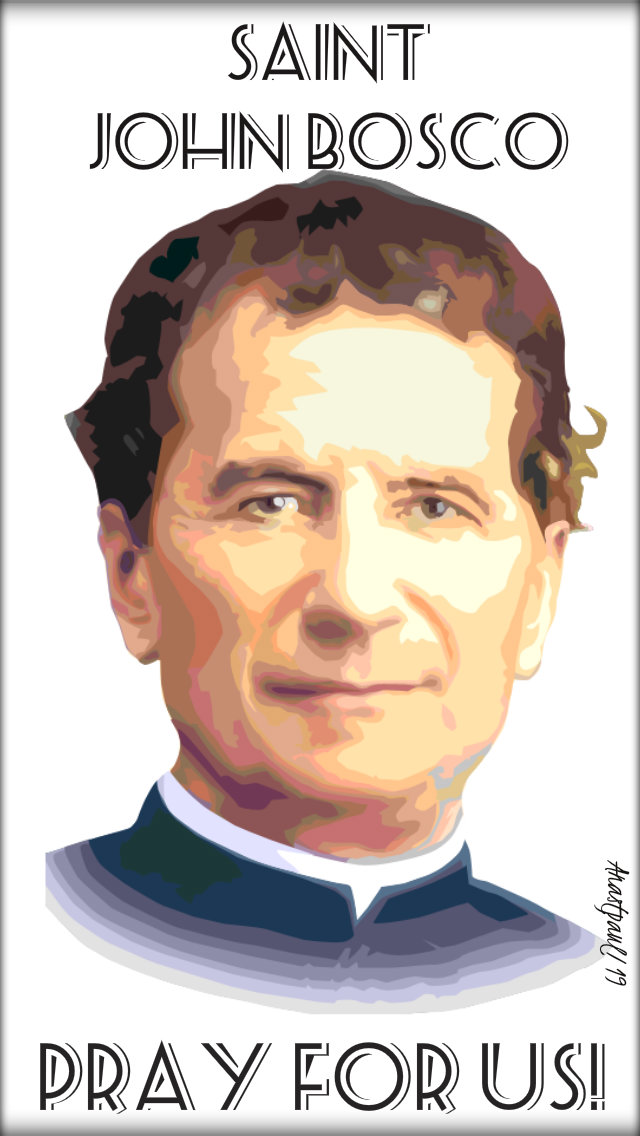
One Minute Reflection – 31 January – Friday of the Third Week in Ordinary Time, Year A, Readings: 2 Samuel 11:1-10, 13-17, Psalm 51:3-7, 10-11, Mark 4:26-34 and the Memorial of Saint Francis Xavier Bianchi CRSP (1743-1815) “Apostle of Naples” and St John Bosco (1815-1888)
“To what shall we compare the kingdom of God, or what parable can we use for it? It is like a mustard seed…” … Mark 4:30-31
REFLECTION – “The Word of God is like a grain of mustard seed, before cultivation it looks extremely small. But when it is cultivated in the right way, it grows so large, that the highest principles of both sensible and intelligible creation, come like birds to revive themselves in it. For the principles – or inner essences of all things, are embraced by the Word but the Word is not embraced by anything. Hence, the Lord has said, that whoever has faith like a grain of mustard seed, can move a mountain by a word of command (cf. Mt 17:20), that is, he can destroy the devil’s dominion over us and remove it from its foundation.
The grain of mustard seed is the Lord, who by faith is sown spiritually in the hearts of those who accept Him. Whoever diligently cultivates the seed by practising the virtues, moves the mountain of earthbound pride and, through the power thus gained, expels the obdurate habit of sin. In this way, the activity of the principles and qualities, or divine powers, present in the commandments, is revived as though they were birds. (…) Those who seek the Lord should not look for him outside themselves. On the contrary, they must seek Him, within themselves, through faith made manifest in action.
For it is written, “The word is very near to you, in your mouth and in your heart” (Rm 10:8), that is, the word of faith, Christ, being Himself, the word that is sought.” … Saint Maximus the Confessor (c 580-662) Monk and Theologian – Second Century on Theology, nos. 10-11, 35
PRAYER – Almighty Father, we bless You Lord of life, through whom all living things tend. You are the source of all, our first beginning and our end! Grant holy Father, that we may allow the Word to enter our hearts and grow by Your grace, so that we may always live for Your glory. May the intercession of St Francis Xavier Bianchi and St John Bosco, who consistently tended Your seed, grant us strength and zeal. Through Jesus Christ, our Lord with the Holy Spirit, God forever, amen.
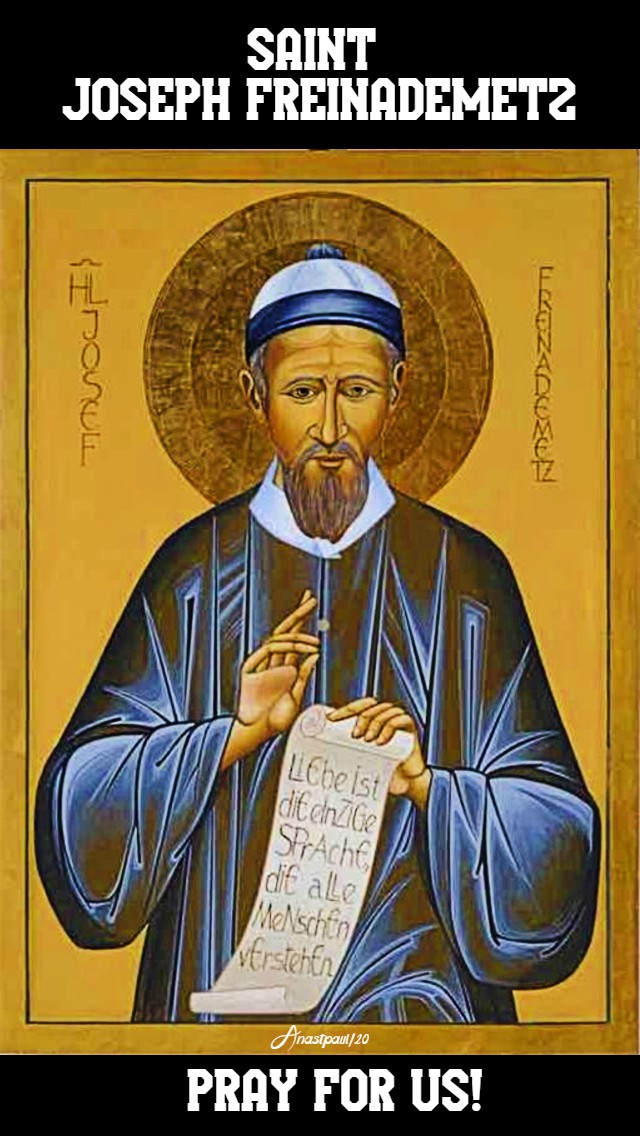
Second Thought for the Day – 28 January – The Memorial of St Joseph Freinademetz SVD (1852-1908) “Fu Shenfu” – Lucky Priest
Man of Prayer
Freinademetz was what one would call a ‘great man of prayer’ and a ‘spiritual’ person. In his preparatory work for the first diocesan synod of South Shandong, his fundamental attitude became clear in the synod paper on “The Clergy.” “Do you imagine you can become holy without meditation, something no saint was able to do? Meditation is a waste of time? The very opposite is true. Without meditation life is lost. Furthermore, set aside one day a month for prayer and meditation. Such days, are among life’s most beautiful and enriching. On such days the Holy Spirit has promised to speak to our hearts.”
Just to see him at prayer was edifying for many – “Mostly he knelt in the sanctuary of the church and for us, it was an extraordinary experience, to see him at prayer. The image of that kneeling priest is indelibly impressed in my memory. You got the impression that nothing could disturb him . He was a great man of prayer. His piety was open and aroused fervour” (Cardinal Tien).
Henninghaus states straight out, that “Prayer” was his “life element and life’s joy,” it was the “source from which he lived.” Even when he had to work until late at night, he still took time for prayer and spiritual reading. In summer, Freinademetz often began his working day at 3 a.m., with prayer and meditation. He preferred to pray the breviary kneeling, mainly very erect without any support. He may often have recalled his childhood when the whole family knelt every day on the hard boards of the living room, praying the rosary before the house altar.
He celebrated holy Mass “in a dignified and devout manner, without haste but without irritating slowness” (Henninghaus). The man from Tyrol obviously did not wish to be importunate in these things either.
The official name of the Steyl missionaries, ‘Society of the Divine Word’, fitted as if tailored made for him: “Daily spiritual reading. Do not let even a single day pass without meditating on sacred scripture which has been called the Priest’s Book. Woe to you if the well-springs of devotion in you run dry!” he exhorted in one of the synod papers.
He himself knew the Bible inside out. He frequently quoted scripture, mostly in Latin, and above all he was always able to find suitable comparisons for current situations – i.e. he had truly internalised the Bible. It was not a dead letter for him, not ‘dry’ but full of life, a well from which he knew how to draw water.
With the same intensity he challenged his confreres to continue to update themselves – “Cultivate serious study! Sacred scripture says, ‘Because you have despised wisdom, I will despise you’.” That, too, is an example of the way in which he could quote the Bible.
The cross of Christ, the Eucharist and contemplation of God’s Word were the central pillars of the missionary life of Joseph Freinademetz, may they be our central pillars too!
Prayer to St Joseph for Missionaries
Heavenly Father,
You have given us your graces
and blessings through the saints.
We thank You for choosing St Joseph Freinademetz,
a zealous missionary to China, to be our model.
He was a man of prayer who prayed without growing weary.
Prayer was the air he breathed and the joy of his life.
Prayer nourished his missionary vocation,
his love of neighbour,
his enthusiasm and readiness for sacrifice
and his profound faith.
Through the intercession of St Joseph
we implore You to shower Your graces on all missionaries
so that they become persons of prayer
and adopt the culture of the people they are sent to.
Enlighten them to discover the road
You want them to travel
and the plan You have mapped out for them.
May they have courage like St Joseph to keep going,
in spite of many trials and hardships in their mission work
and to live out their vocation faithfully.
We ask this through Christ our Lord.
Amen.
Sunday of the Word of God – 26 January
Making the Scriptures
Part of our Everyday Lives
What is the Word of God?
We often identify the Bible as the Word of God. This is not wrong but God speaks to our hearts in many different ways. For instance, He speaks to us in prayer and through our conscience and often through other people. Hence, the Word of God covers much more than a printed book. Nevertheless, the Bible is the privileged collection of communications between God and His people. These stories and poems have nourished the lives of the people of Israel and the Christian Church, right through the centuries and they continue to nourish us today. They tell the story of God’s love and our salvation from ancient times onwards. The scriptural texts offer us both challenge and encouragement for our lives and are especially valuable to us through the hope they offer us at dark moments.
The Holy Spirit and the Scriptures
The Holy Spirit was at work in the whole process of the formation of the Scriptures. This is why, even though many people across different times and places contributed to the writing, we believe that the Scriptures are divinely inspired. But the Holy Spirit’s work does not come to an end with the writing of the text. The Holy Spirit, who dwells in us by virtue of our baptism, is also at work in us as we listen to the text. Therefore, through the Spirit’s inspiration, the words of Scripture can become a living Word of the Lord to us here and now.
Opening the Law and the Prophets (see Luke 4:17) – On Reading the Old Testament as Christians
When Saint Luke, in his Gospel, portrays the beginning of Jesus’ ministry, he does so in the following way:
“Jesus came to Nazareth, where he had been brought up; and he went to the synagogue, as his custom was, on the Sabbath day. And he stood up to read; and there was given to him the book of the prophet Isaiah. He opened the book and found the place where it was written: The Spirit of the Lord is upon me, because he has anointed me to preach good news to the poor. He has sent me to proclaim release to the captives and recovering of sight to the blind, to set at liberty those who are oppressed, to proclaim the acceptable year of the Lord.”(4:16–18).
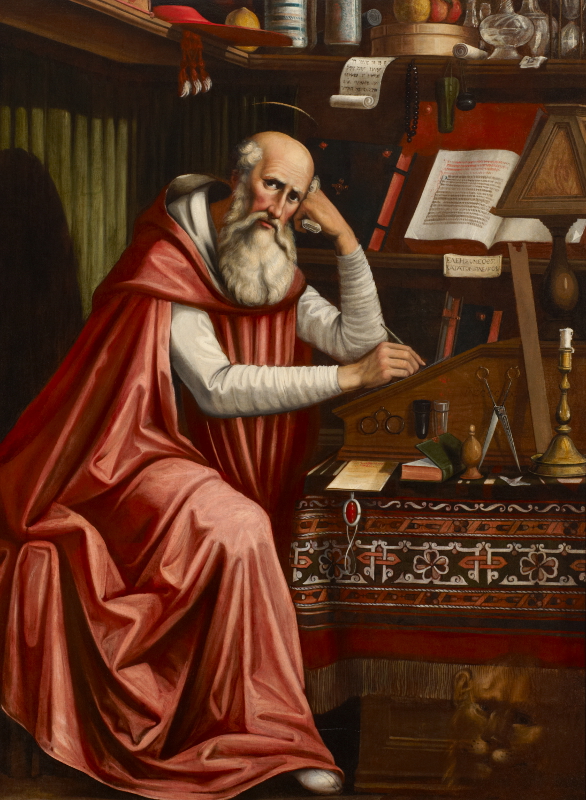
St Jerome
For Luke, the one in whom Christians place their trust as their Lord and Saviour, who is—in the words of the Nicene Creed—God from God, Light from Light and who sits at the right hand of the Father, was, is and remains, a Jewish male from Galilee. Our Saviour is a Jew from Galilee. To lose sight of His essential and enduring Jewishness is to distort Jesus, it is to divorce Him from His people, and to blind us to the reality and power of the Word made flesh (see John 1:14).
Jesus, the Galilean Jew, began His “public” life with words from His Scriptures. His life ended with word from His Scriptures—in His anguish of the cross, He prays the beginning of Psalm 21 (22): “My God, my God, why have you forsaken me?” To express what He’s about and to say who He is, Jesus proclaims His Scriptures—what Christians call the Old Testament. Today also, truly to understand what God is doing in Christ (see 2 Cor 5:19), the followers of Christ are called to read and pray the Old Testament so that we may come to a sense of the mysteries that are veiled in all our lives and revealed in Christ (see St Augustine, On the Spirit and the Letter § 27).
Because the Old Testament communicates the mysteries of God’s life and ours, to come to know God’s word in the Old Testament is to know the power of God. This is why St Jerome famously says that ignorance of Scripture is ignorance of Christ: – it is not that we gain “information” about Christ that is otherwise inaccessible, rather, to have one’s heart opened by the word of God is to come to know the one in whom the “the power and wisdom of God” has taken flesh. It is to know “Christ—the power of God and the wisdom of God” (1 Cor 1:24).
This means that Christians are called to read the Old Testament like Christ read it – in a way that opens the heart, that recognises the faithfulness of God to His people and to the everlasting covenant made with them, that sees in the words of the Law, the Prophets and the writings, the threshold of the Word of God.
To read like Christ is to see the Law not as a burden but as the revelation of God’s will. To read like Christ is to see in the Psalms the most wonderful school of prayer. To read like Christ is to submit oneself to the prophets’ call to justice and their witness to the power of God. To read like Christ is to read as one who is “last of all and servant of all” (Mark 9:35), who avoids all haughtiness and refuses to put the other in the wrong.
Such a person resists the distortions of history which have caused so much suffering to God’s chosen people, the brothers and sisters of our Lord.
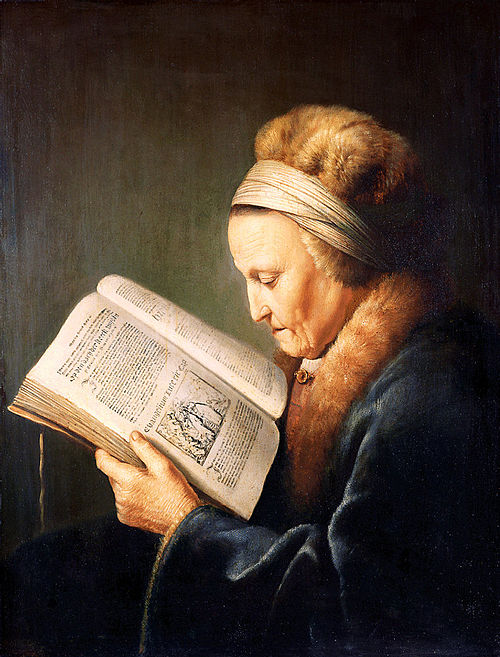
Portrait of Rembrandt’s mother reading a lectionary, ca. 1630 (Rijksmuseum, Amsterdam). The painting has more recently been attributed to Gerrit Dou.
…The Proclaimed Word is a Word not just in the past but a Word here and now, given to this liturgical assembly to shape, challenge and sustain their ongoing following of the Lord. Every time a Christian community gathers, it is making a bold statement about where they have come from, who they are and where they hope one day to be. The Scriptures nourish the boldness of the community, once more today, we are urged to allow the Word of God to nourish us as both individuals and communities.
Jesus also calls to Himself a group of disciples in today’s gospel account. He invites them to come and walk in His ways. Through their response, they set out on a path of discipleship leaving all behind them, it is a way that will lead some of His followers to martyrdom and others to betrayal: words of fidelity and words of treachery. The Scriptures nurture the path of the disciples in their following of Jesus and walking in His ways, by taking the word and allowing it to shape and mould our identity as Christians. The Word proclaimed every Sunday in our Eucharistic celebration, the Word heard in the very ordinary circumstances of our daily lives, the words that we speak every moment, let all of them be, for us, moments of salvation and gifts to others….Catholic Bishops of Ireland
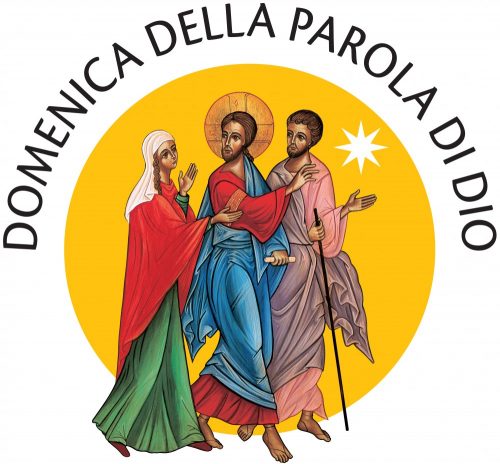
Official logo for the Sunday of the Word of God unveiled at Vatican
An icon of the encounter with Jesus on the road to Emmaus was chosen as the official logo for the worldwide celebration of the Sunday of the Word of God.
The colourful logo is based on an icon written by the late-Benedictine Sr Marie-Paul Farran, a member of the Our Lady of Calvary Congregation, who lived and worked at its monastery on the Mount of Olives in Jerusalem.
The logo was presented to the press at a Vatican news conference on 17th January, ahead of the newly established Sunday of the Word of God, which is being celebrated on 26th January this year.
The logo was presented to the press at a Vatican news conference on 17th January, ahead of the newly established Sunday of the Word of God, which is being celebrated on 26th January this year.
The logo shows the Resurrected Christ holding in his left hand a scroll, which is “the sacred Scripture that found its fulfilment in his person,” Archbishop Rino Fisichella, president of the Pontifical Council for Promoting New Evangelization, told reporters.
By his side are two disciples: Clopas and his wife, Mary. They both fix their gaze on Christ while Clopas holds a stick to indicate “a pilgrimage,” the archbishop said.
Mary is holding one hand upward and with her other hand seems to be touching the Lord, reaffirming that he has fulfilled the ancient promises and is the living Word that must be proclaimed to the world, he said.
Holding the stick in one hand, Clopas’ free hand is pointing the road ahead, which all disciples are called to take in order to bring the Good News to everyone, Archbishop Fisichella said.
There is a star overhead symbolising evangelisation and the “permanent light” that guides their journey and shows them the way, he added.
It is also important, he said, to notice the feet of all three are depicted as being in motion, representing that the proclamation of the Risen Christ cannot be accomplished by “tired or lazy disciples” but only by those who are “dynamic” and ready to find new ways to speak so that sacred Scripture may become the living guide of the life of the church and its people.
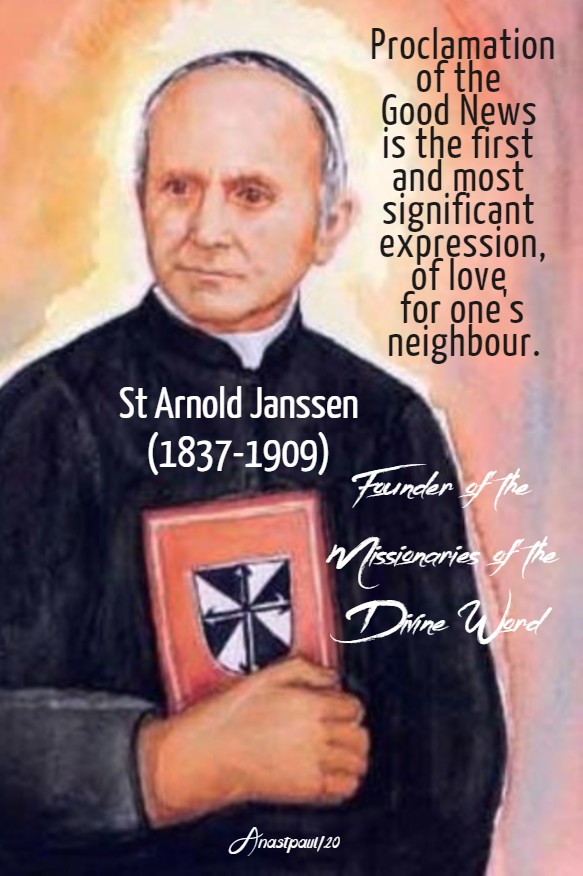
Quote/s of the Day – 15 January – Wednesday of the First week in Ordinary Time, Year A – The Memorial of St Arnold Janssen SVD (1837-1909)
“Proclamation of the Good News is the first and most significant expression, of love for one’s neighbour.”
Quarter-Hour Prayer
St Arnold, in his youth, invented a means of personally keeping in contact with God. To do so, he prayed the acts of faith, hope and charity every quarter hour at the signal of the church tower clock or the chime of the clock at home or in school. He would pray:
O God, eternal truth, I believe in You. O God, our strength and salvation, I trust in You. O God, infinite goodness, I love You with my whole heart.
St Arnold Janssen (1837-1909)
Founder of the Missionaries of the Divine Word Missionary Sisters Servants of the Holy Spirit Holy Spirit Adoration Sisters
Quote/s of the Day – 13 January – Monday of the First week in Ordinary Time, Year A and the Memorial of St Hilary of Poitiers (315-368) Father and Doctor of the Church
“The privilege of our Church is such that it is never stronger, than when it is attacked, never better known, than when it is accused, never more powerful, than when it appears forsaken.”
(Treatise on the Trinity)
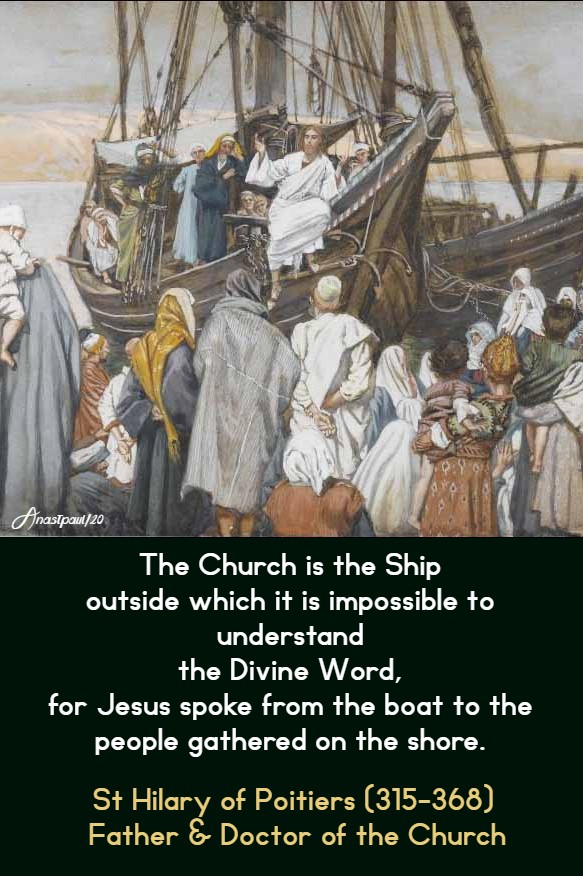
“The Church is the Ship outside which it is impossible to understand the Divine Word, for Jesus spoke from the boat to the people gathered on the shore.”
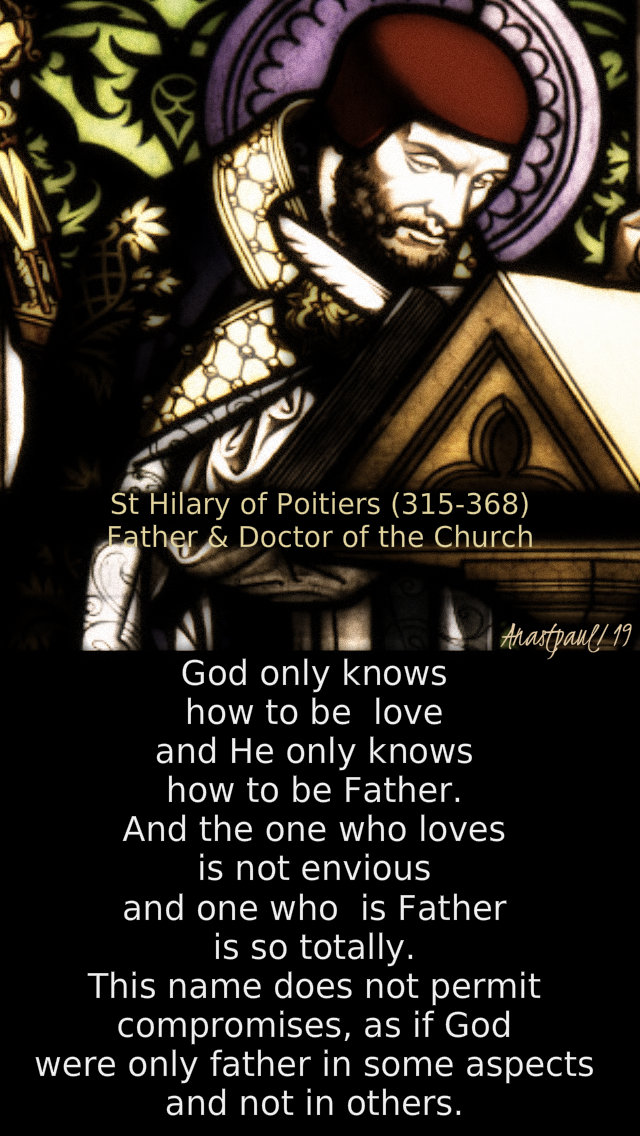
“God only knows, how to be love and He only knows, how to be Father. And the one who loves is not envious and one who is Father is so totally. This name does not permit compromises, as if God were only father in some aspects and not in others.”
St Hilary of Poitiers
(315-368)
Father & Doctor of the Church
Thought for the Day – 28 November – It’s time to Hope! Advent is nearly upon us
This year, as before, I will post daily Advent Reflections drawn from diverse Saints and Holy people – please join me in prayer and in awakening our souls to hope.
Memory Awakens Hope
By Joseph Cardinal Ratzinger
(Pope Benedict XVI)
In one of his Christmas stories Charles Dickens tells of a man who lost his emotional memory, that is, he lost the whole chain of feelings and thoughts he had acquired in the encounter with human suffering. This extinction of the memory of love is presented to him as liberation from the burden of the past but it becomes clear, immediately, that the whole person has been changed, now, when he meets with suffering, no memories of kindness are stirred within him… Since his memory has dried up, the source of kindness within him has also disappeared. He has become cold and spreads coldness around him.
Goethe deals with the same ideas as Dickens, in his account of the first celebration of the feast of Saint Roch in Bingen, after the long interruption caused by the Napoleonic wars. He observes the people as they press, tightly packed, through the church past the image of the saint and he watches their faces – the faces of the children and the adults are shining, mirroring the joy of the festal day. But with the young people, Goethe reports, it was otherwise. They went past unmoved, indifferent, bored. And he gives an illuminating explanation – they were born in evil times, had nothing good to remember and consequently had nothing to hope for. In other words, it is only the person who has memories who can hope. The person who has never experienced goodness and kindness simply does not know what such things are.
Recently a counsellor who spends much of his time talking with people on the verge of despair, was speaking in similar terms about his own work, if his client succeeds in recalling a memory of some good experience, he may once again be able to believe in goodness and thus relearn hope, then there is a way out of despair. Memory and hope are inseparable. To poison the past does not give hope, it destroys its emotional foundations.
Sometimes Charles Dickens’ story strikes me as a vision of contemporary experience. This man who let himself be robbed of the heart’s memory by the delusion of a false liberation — do we not find him with us today, in a generation whose past has been poisoned by a particular program of liberation that has stifled hope? When we read of the pessimism with which our young people look toward the future, we ask ourselves, Why? Is it that, in the midst of material affluence, they have no memory of human goodness that would allow them to hope? By outlawing the emotions, by satirising joy, have we not trampled on the root of hope?
These reflections bring us straight to the significance of the Christian season of Advent. For Advent is concerned with that very connection between memory and hope which is so necessary to man. Advent’s intention is to awaken the most profound and basic emotional memory within us, namely, the memory of the God Who became a Child. This is a healing memory, it brings hope. The purpose of the Church’s year is continually to rehearse her great history of memories, to awaken the heart’s memory so that it can discern the star of hope. All the feasts in the Church’s calendar are events of remembrance and hence events of hope. These events, of such great significance for mankind, which are preserved and opened up by faith’s calendar, are intended to become personal memories of our own life history, through the celebration of holy seasons by means of liturgy and custom. Our personal memories are nourished by mankind’s great memories, in turn, it is only by translating them into personal term,s that these great memories are kept alive. Man’s ability to believe always depends in part on faith having become dear on the path of life, on the humanity of God having manifested itself through the humanity of men. No doubt each of us could tell his own story here as to what the various memories of Christmas, Easter or other festivals mean in his life.
It is the beautiful task of Advent, to awaken in all of us, memories of goodness and thus to open doors of hope.
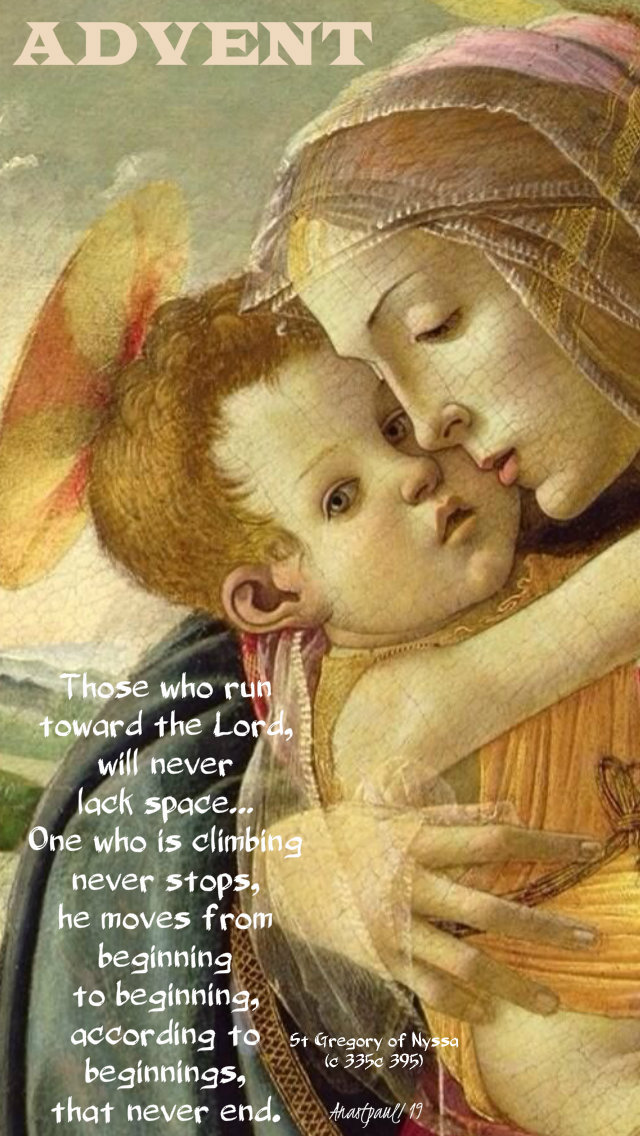
“Those who run toward the Lord, will never lack space… One who is climbing never stops, he moves from beginning to beginning, according to beginnings, that never end.”
St Gregory of Nyssa (c 335–c 395)
Brother of St Basil the Great
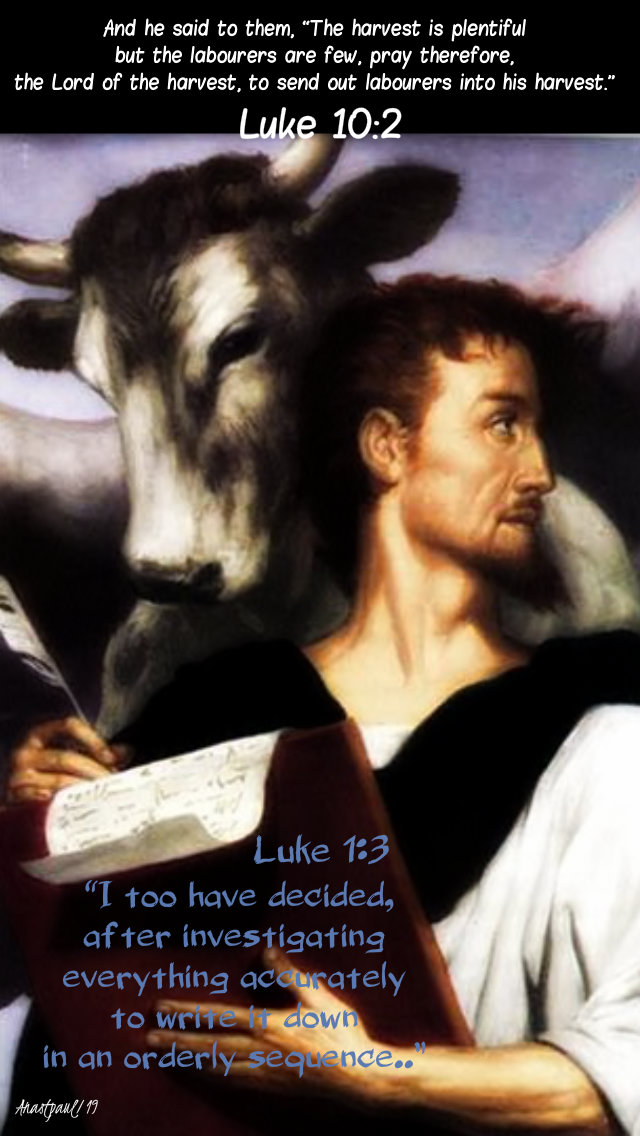
One Minute Reflection – 18 October – The Feast of St Luke the Evangelist, Gospel: Luke 10:1-9
And he said to them, “The harvest is plentiful but the labourers are few, pray therefore, the Lord of the harvest, to send out labourers into his harvest.” … Luke 10:2
Saint Luke’s testimony – “I too have decided, after investigating everything accurately to write it down in an orderly sequence” (Luke 1:3)
REFLECTION – “Among all the Scriptures, even those of the New Testament, the Gospels have a special pre-eminence and rightly so, for they are the principal witness for the life and teaching of the incarnate Word, our Saviour. The Church has always and everywhere, held and continues to hold, that the four Gospels are of apostolic origin. For what the Apostles preached in fulfilment of the commission of Christ, afterwards, they themselves and apostolic men, under the inspiration of the divine Spirit, handed on to us in writing – the foundation of faith, namely, the fourfold Gospel, according to Matthew, Mark, Luke and John.
Holy Mother Church has firmly and with absolute constancy, held and continues to hold, that the four Gospels just named, whose historical character the Church unhesitatingly asserts, faithfully hand on what Jesus Christ, while living among men, really did and taught for their eternal salvation until the day He was taken up into heaven (Acts 1:1-2). Indeed, after the Ascension of the Lord the Apostles handed on to their hearers what He had said and done. This they did with that clearer understanding which they enjoyed after they had been instructed by the glorious events of Christ’s life and taught by the light of the Spirit of truth (Jn 14:26).
The sacred authors wrote the four Gospels, selecting some things from the many which had been handed on by word of mouth or in writing, reducing some of them to a synthesis, explaining some things in view of the situation of their churches and preserving the form of proclamation but always, in such fashion, that they told us the honest truth about Jesus. For their intention in writing, was that either from their own memory and recollections, or from the witness of those who “themselves from the beginning were eyewitnesses and ministers of the Word” we might know “the truth concerning those matters about which we have been instructed” (Lk 1, 1-4). … Vatican Council II – Dogmatic Constitution on Revelation “ Dei Verbum ” # 18-19
PRAYER – Lord God, You chose St Luke to reveal the mystery of Your love in his preaching and his writings. Grant, we pray, that we may grow in love for the Holy Face of Christ, His words and His directions, revealed to us in the Gospels, in the example of your saints. Today, on his feast, we especially look to St Luke, to guide, teach and pray for us. We make our prayer through our Lord Jesus Christ, with the Holy Spirit, one God with You, forever and ever, amen.
Quote/s of the Day – 15 October – Monday of the Twenty Eighth week in Ordinary Time, Year C, Gospel: Luke 11:29–32
“Our Saviour’s words are not of a nature to be heard once and no more but that to understand them, we must feed upon them and live in them, as if by, little and little, growing into their meaning.”
Saint John Henry Newman (1801-1890)
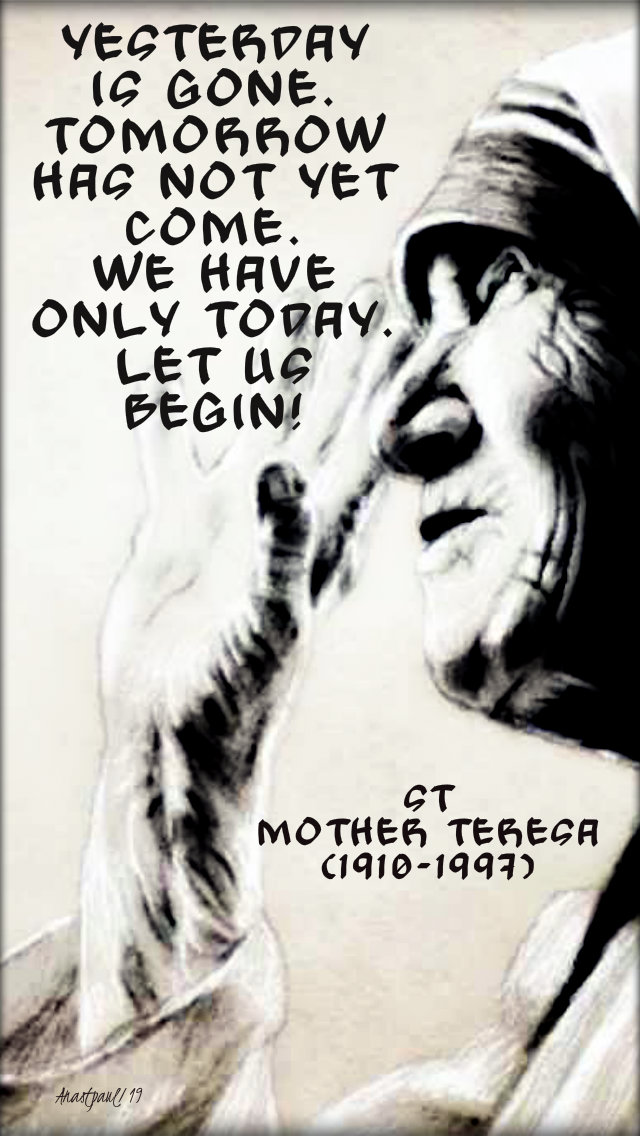
“Yesterday is gone. Tomorrow has not yet come. We have only today. Let us begin.”
Quotes of the Day – 30 September – The Memorial of Saint Jerome (347-419), Priest, Father and Doctor of the Church
St Jerome – Speaking of Holy Scripture
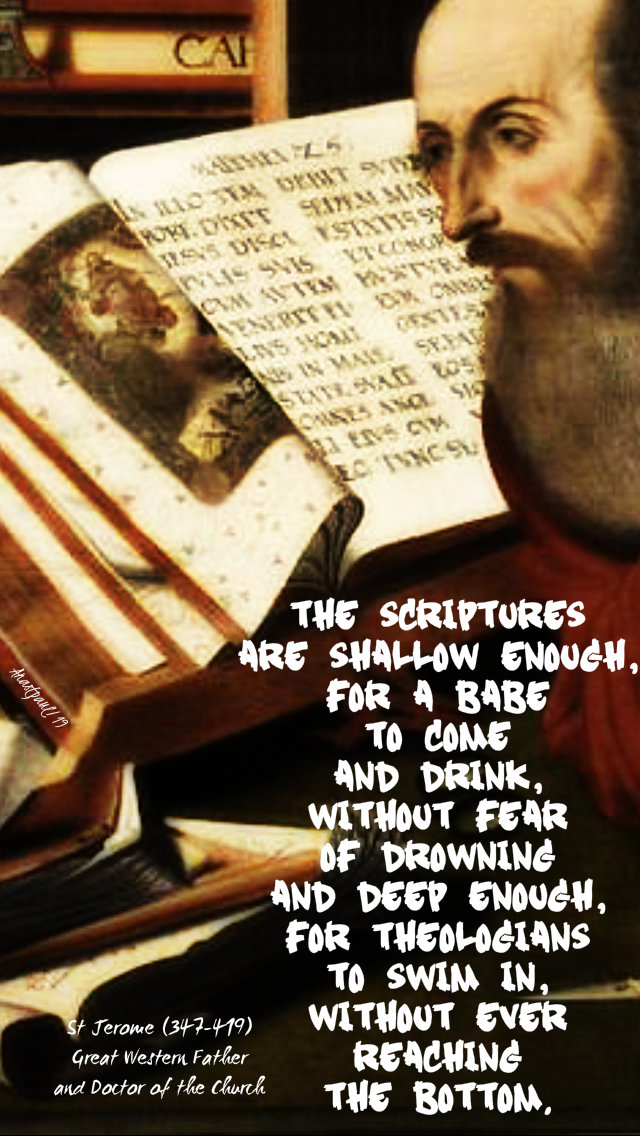
“The Scriptures are shallow enough, for a babe to come and drink, without fear of drowning and deep enough, for theologians to swim in, without ever reaching the bottom.”
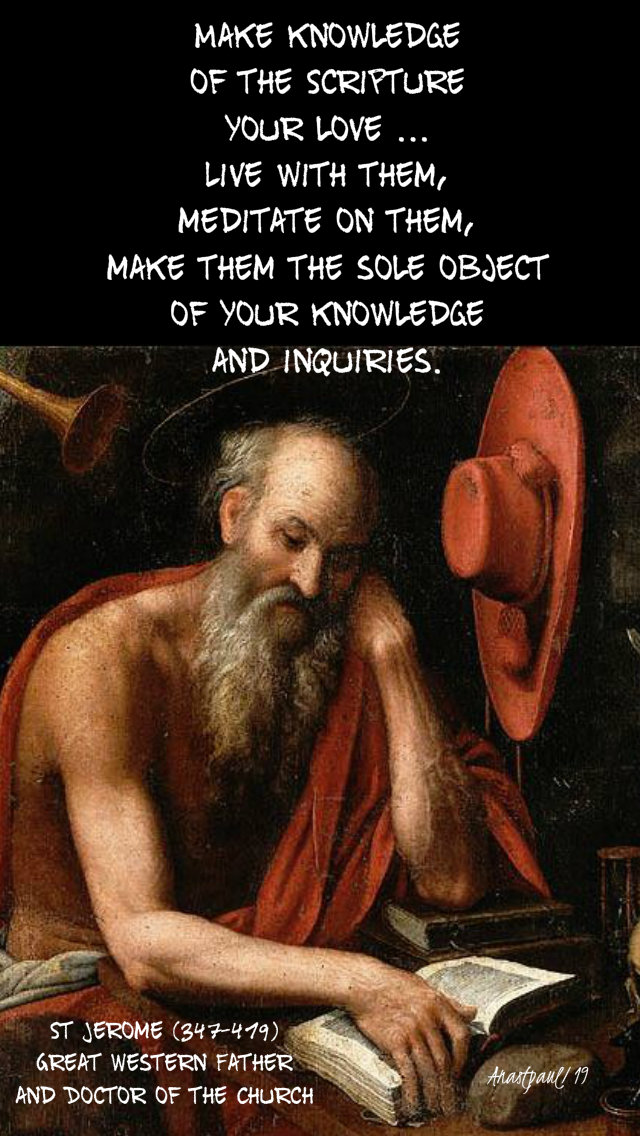
“Make knowledge of the Scripture your love … Live with them, meditate on them, make them the sole object of your knowledge and inquiries.”
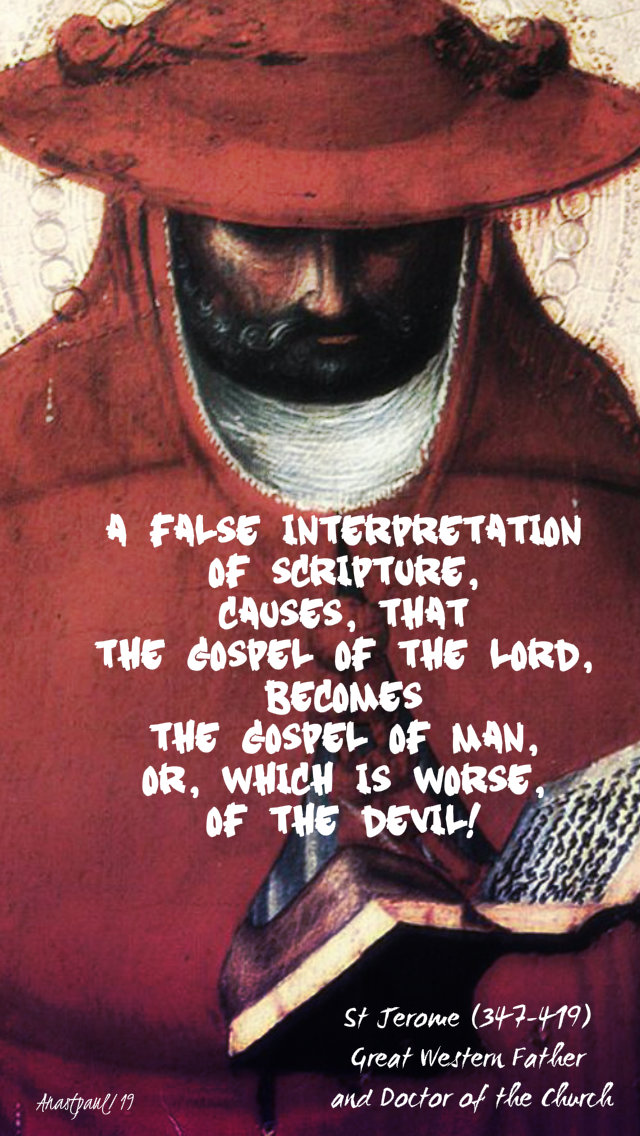
“A false interpretation of Scripture, causes, that the Gospel of the Lord, becomes the gospel of man, or, which is worse, of the devil!”
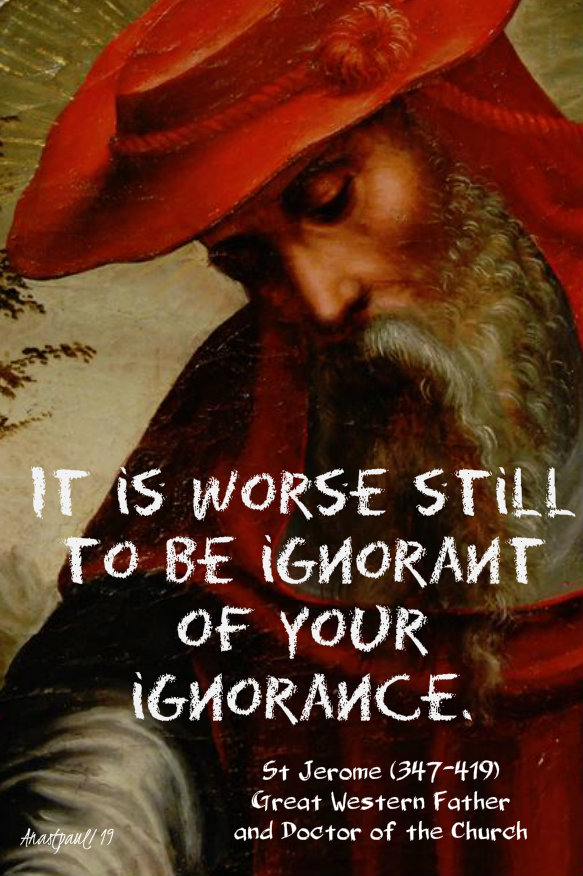
“It is worse still to be ignorant of your ignorance.”
St Jerome (347-419)
Great Western Father and Doctor of the Church














 AnaStpaul
You must be logged in to post a comment.