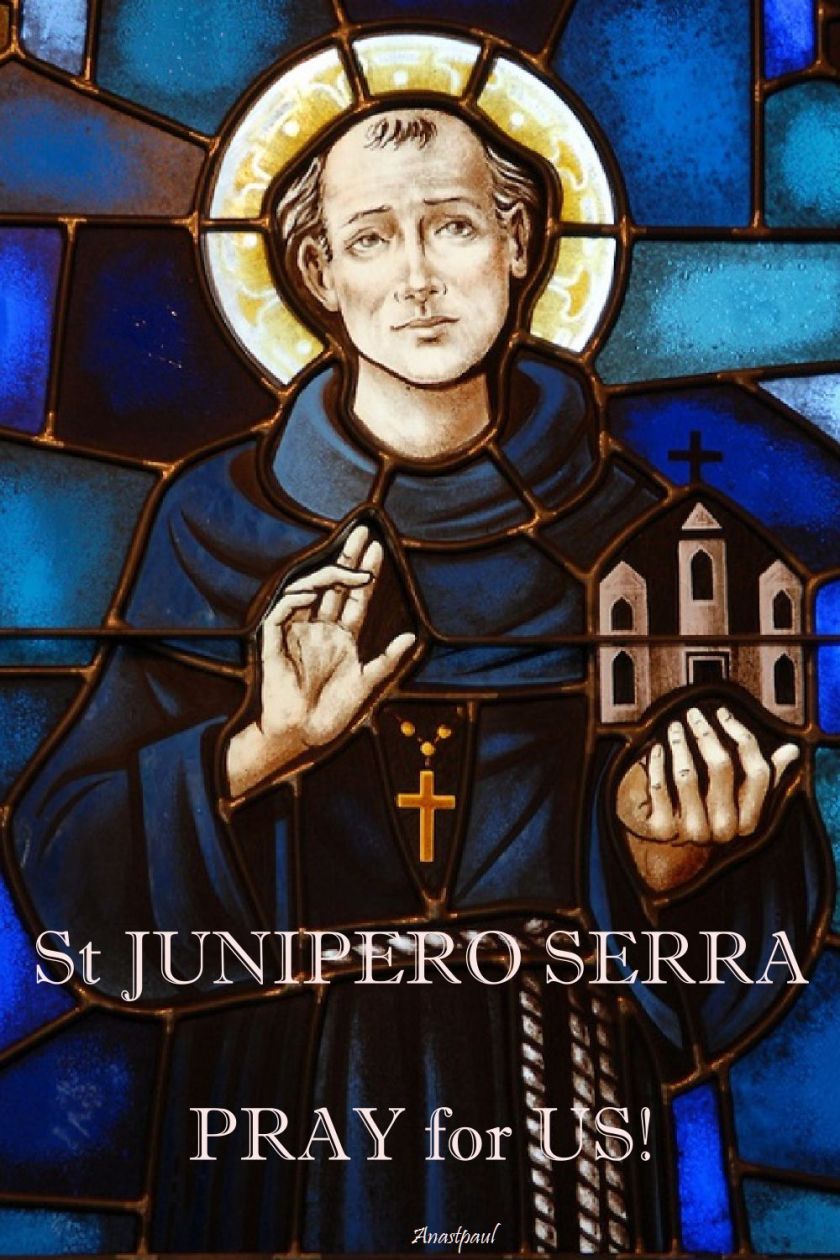
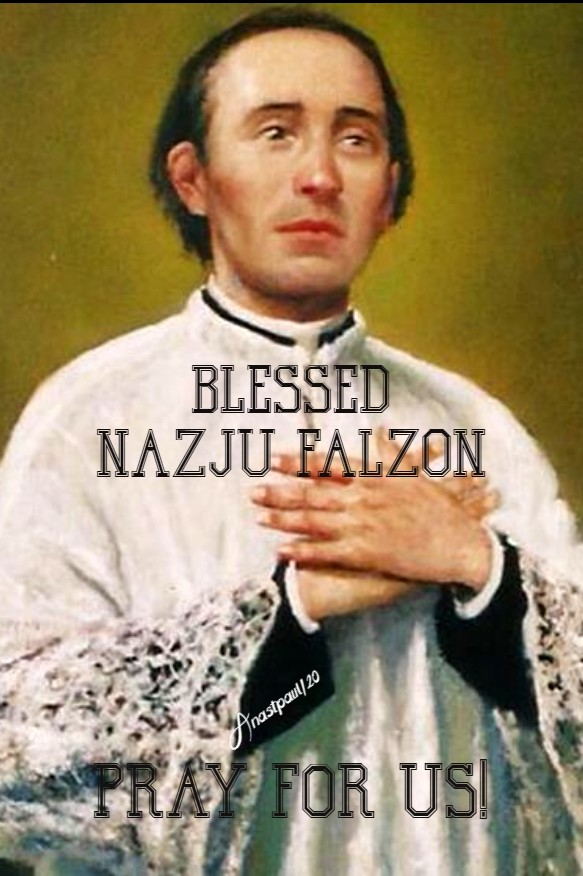
One Minute Reflection – 1 July – “Month of the Most Precious Blood” – Wednesday of the Thirteenth week in Ordinary Time, Year A, Readings: Amos 5: 14-15, 21-24, Psalm 50: 7, 8-9, 10-11, 12-13, 16bc-17, Matthew 8: 28-34 and the Memorial of St Junipero Serra (1713-1784) and Blessed Ignatius “Nazju” Falzon OFS (1813-1865)
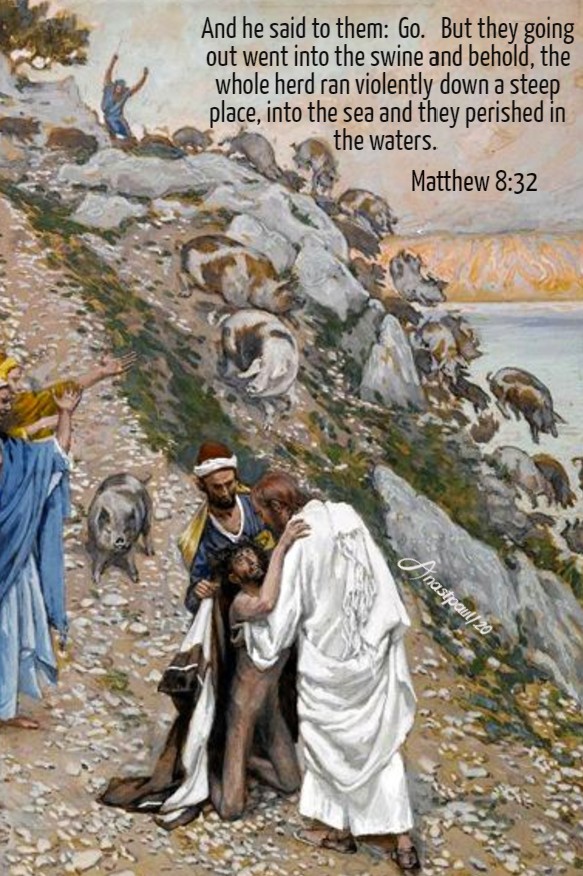
And he said to them: Go. But they going out went into the swine and behold, the whole herd ran violently down a steep place, into the sea and they perished in the waters. And behold the whole city went out to meet Jesus and when they saw him, they besought him, that he would depart from their coasts.. … Matthew 8:32,34… Matthew 8:32-34
REFLECTION – “Dear Lord, what we are capable of when we are left to ourselves! There are some who, in their own words, are envious of the saints who did great penances. They believe that they could do as well. When we read the lives of some of the martyrs, we would, we think, be ready to suffer all that they suffered for God, the moment is short lived, we say, for an eternity of reward. But what does God do to teach us to know ourselves or, rather, to know that we are nothing? This is all He does – He allows the Devil to come a little closer to us. Look at this Christian who a moment ago was quite envious of the hermit who lived solely on roots and herbs and who made the stern resolution to treat his body as harshly. Alas! A slight headache, a prick of a pin, makes him, as big and strong is he is, sorry for himself. He is very upset. He cries with pain. A moment ago he would have been willing to do all the penances of the anchorites — and the merest trifle makes him despair!
Look at this other one, who seems to want to give his whole life for God, whose ardour all the torments there are cannot damp. A tiny bit of scandalmongering …. a word of calumny …. even a slightly cold reception or a small injustice done to him …. a kindness returned by ingratitude …. immediately gives birth in him to feelings of hatred, of revenge, of dislike, to the point, often, of his never wishing to see his neighbour again, or at least. of treating him coldly with an air which shows very plainly what is going on in his heart. And how many times is this his waking thought, just as it was the thought that almost prevented him from sleeping? Alas, my dear brethren, we are poor stuff and we should count very little upon our good resolutions!” … St John Marie Baptiste Vianney (1786-1859)
PRAYER – All-powerful God, to serve You is to reign. Your love gave St Juniperro Serra and Blessed Nazju Falzon, the courage to proclaim the truth of Christ and to preach and live in the light of the Kingdom. Grant that by their prayers, our lives may bear witness to the faith we profess and our love bring others, to the peace and joy of Your gospel. Through our Lord Jesus Christ, Your Son, who lives and reigns with You in the unity of the Holy Spirit, one God, forever and ever. Amen
Quote/s of the Day – 28 June – “Month of the Sacred Heart” – The Memorial of Blessed Paolo Giustiniani ECMC (1476-1528) – Monk, Hermit and Founder of the Congregation of the Camaldolese Hermits of Monte Corona
“The supreme goal to which the monk tends, the summit of the perfection of his heart, is indeed the union of his heart with his Lord.”
St John Cassian (c 360-435)
Monk, Father of the Church and Founder of Monasteries Disciple of St John Chrysostom
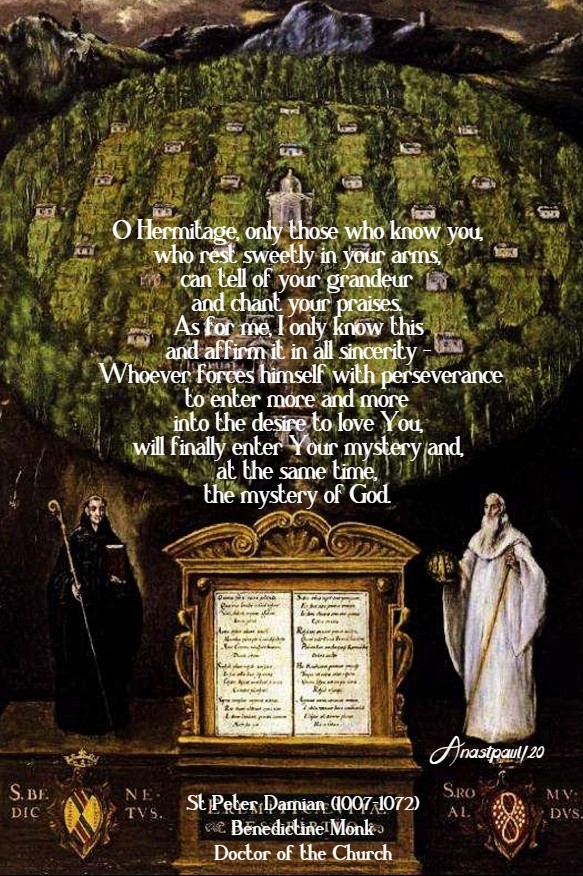
“O Hermitage, only those who know you, who rest sweetly in your arms, can tell of your grandeur and chant your praises. As for me, I only know this and affirm it in all sincerity – Whoever forces himself with perseverance to enter more and more into the desire to love You, will finally enter Your mystery and, at the same time, the mystery of God.”
St Peter Damian (1007-1072)
Benedictine Monk
Doctor of the Church
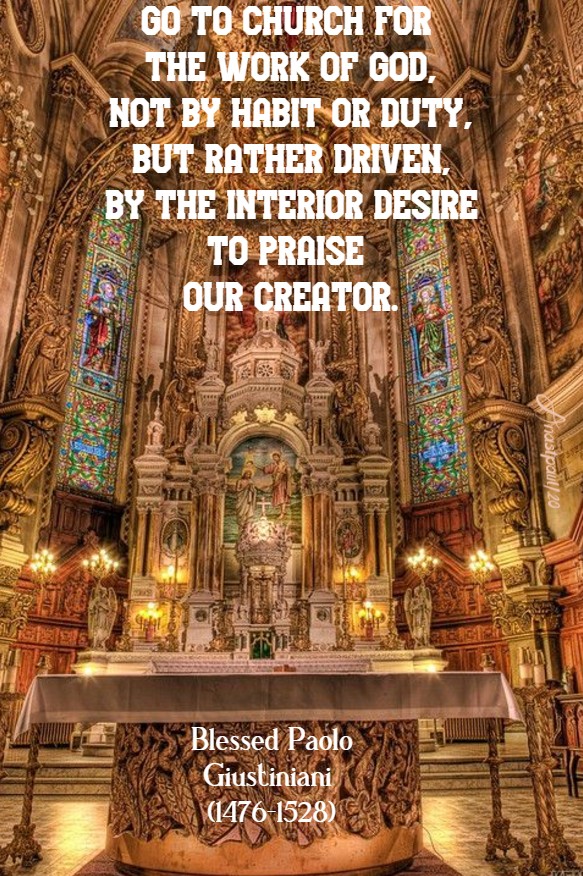
“Go to Church for the work of God, not by habit or duty, but rather driven, by the interior desire to praise our Creator.”
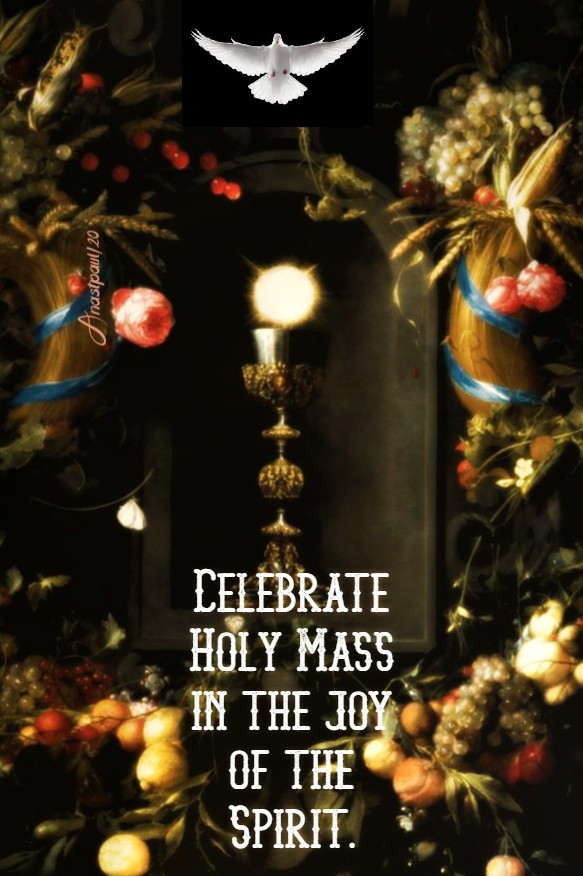
“Celebrate holy Mass in the joy of the Spirit.”
“I desire to serve my Lord Jesus Christ. However, I blindly entrust the manner of service to His decision – in action or in contemplation, in peace and quiet or in suffering and tribulation, in the quiet of the cell or else in wearisome wanderings. So long as I am serving Him, I have no preference or taste of my own.”
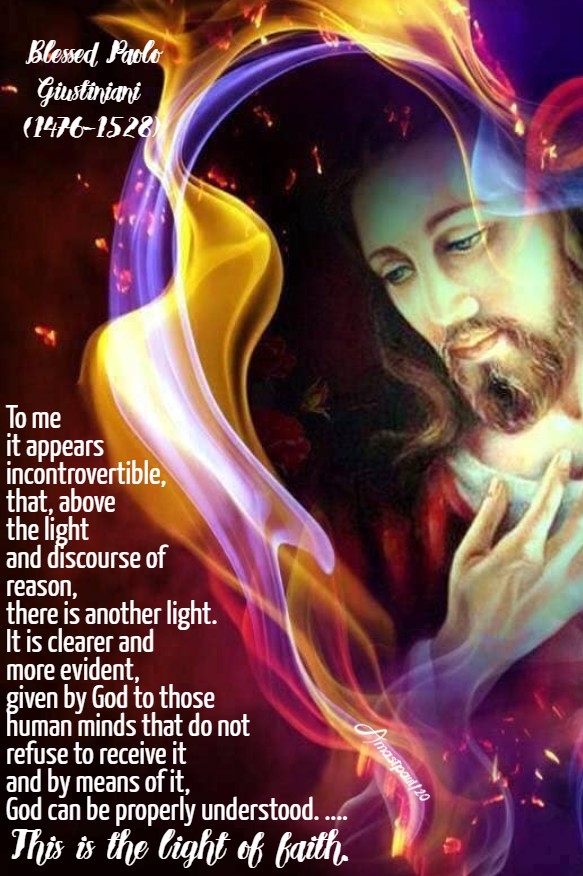
“To me it appears incontrovertible, that, above the light and discourse of reason, there is another light. It is clearer and more evident, given by God to those human minds that do not refuse to receive it and by means of it, God can be properly understood. …. This is the light of faith.“
Prayer of Blessed Paolo Giustiniani “Lord, I dare not say to You: “Show me the light that I may believe in Your Light” but it is enough for me, that You make me see my darkness … Bring me back to myself. In my misery I have distanced myself not only from You but from myself, becoming a stranger to myself. Make me know my darkness, that then I may look at the light. Yes, I tell You and repeat to You incessantly, Show me to myself, so that I may know my sins.”
“Until I was alone I never really lived. Until I was alone, I was not with myself. Until I was alone, I never drew near to my creator.”
Quote/s of the Day – 27 June – “Month of the Sacred Heart” – Memorial of St Cyril of Alexandria (376-444) and Blessed Louise-Thérèse de Montaignac de Chauvance OSHJ (1820-1885) “Apostle of the Sacred Heart”
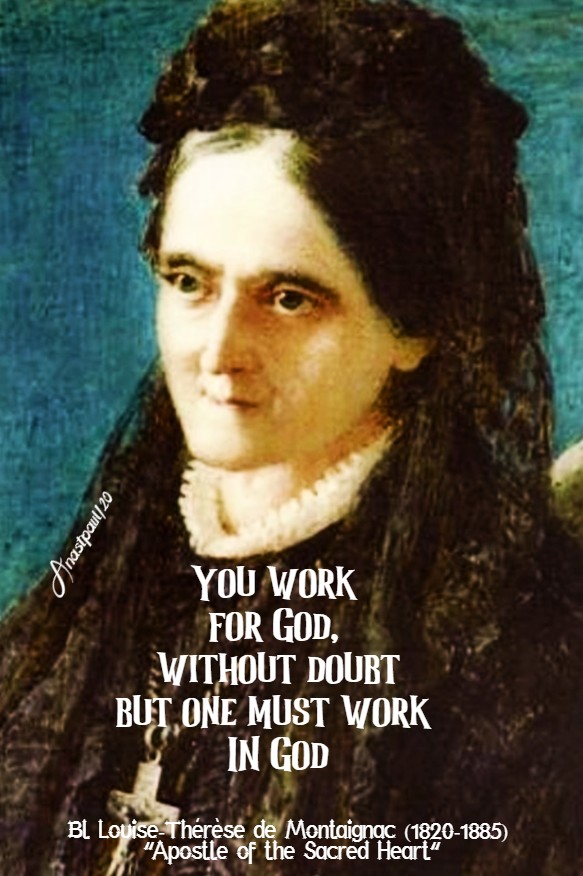
“You work for God, without doubt but one must work IN God.”
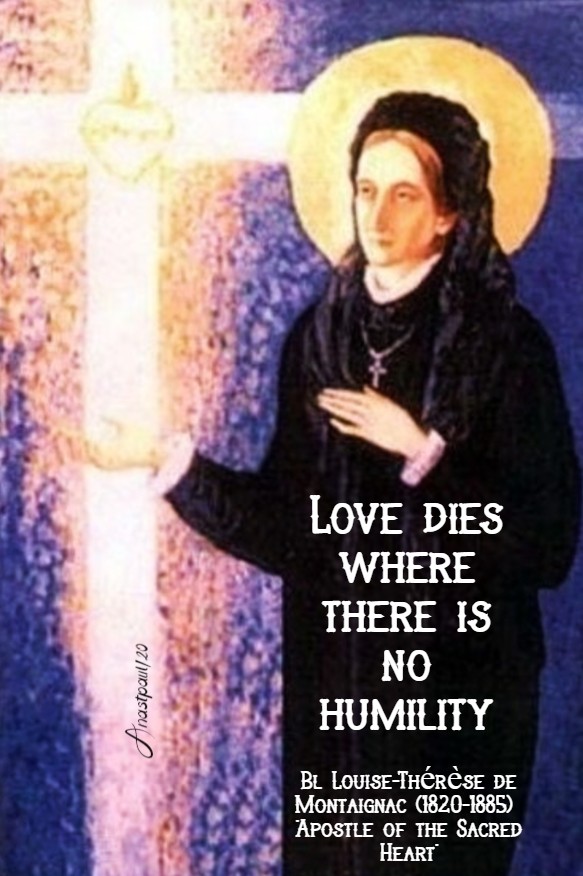
“Love dies where there is no humility.”
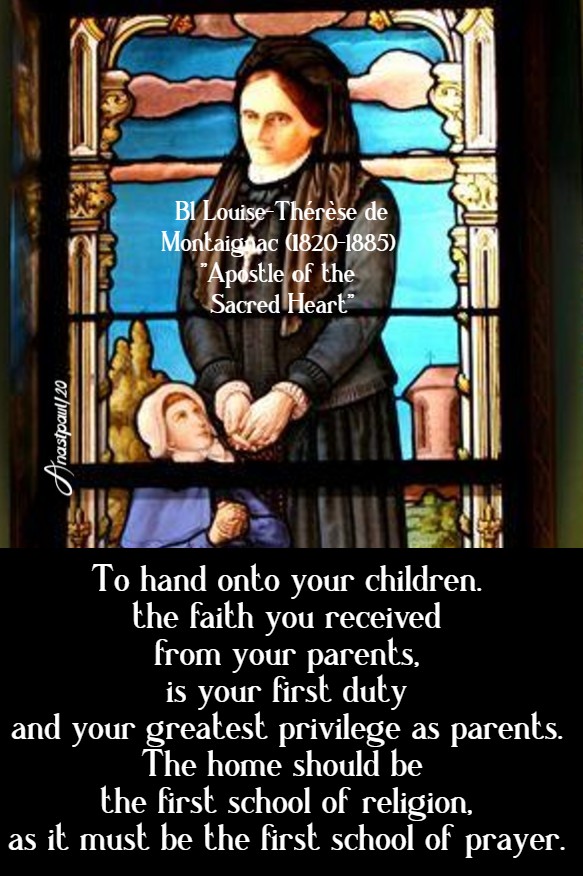
“To hand onto your children.
the faith you received from your parents,
is your first duty
and your greatest privilege as parents.
The home should be the first school of religion,
as it must be the first school of prayer.”
Prayer of Bl Louise-Thérèse “O Jesus, Eternal Life in the womb of the Father, Life of souls made in Your likeness, In the name of Your Love, make Your Heart known and revealed.”
Blessed Louise-Thérèse de Montaignac de Chauvance (1820-1885)
“Apostle of the Sacred Heart”
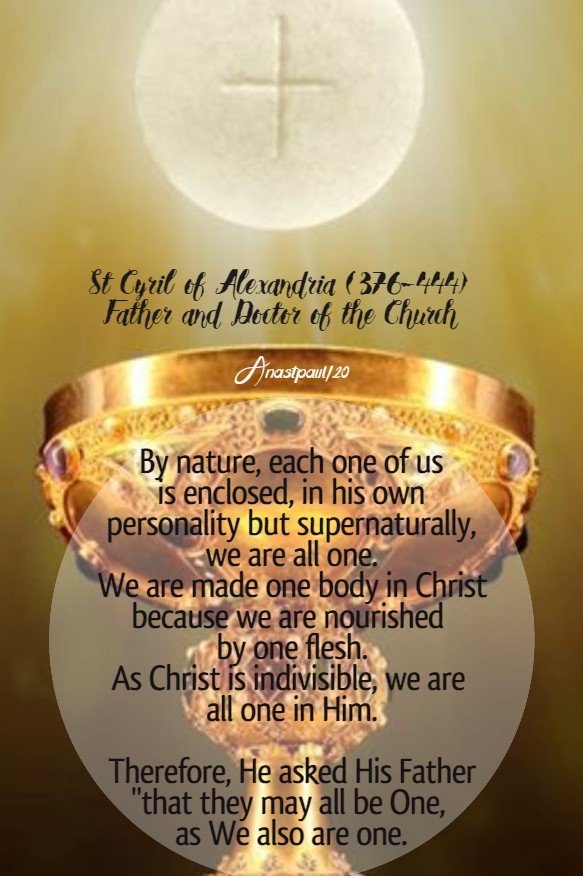
“By nature, each one of us is enclosed, in his own personality but supernaturally, we are all one. We are made one body in Christ because we are nourished by one flesh. As Christ is indivisible, we are all one in Him. Therefore, He asked His Father “that they may all be One, as We also are one.”
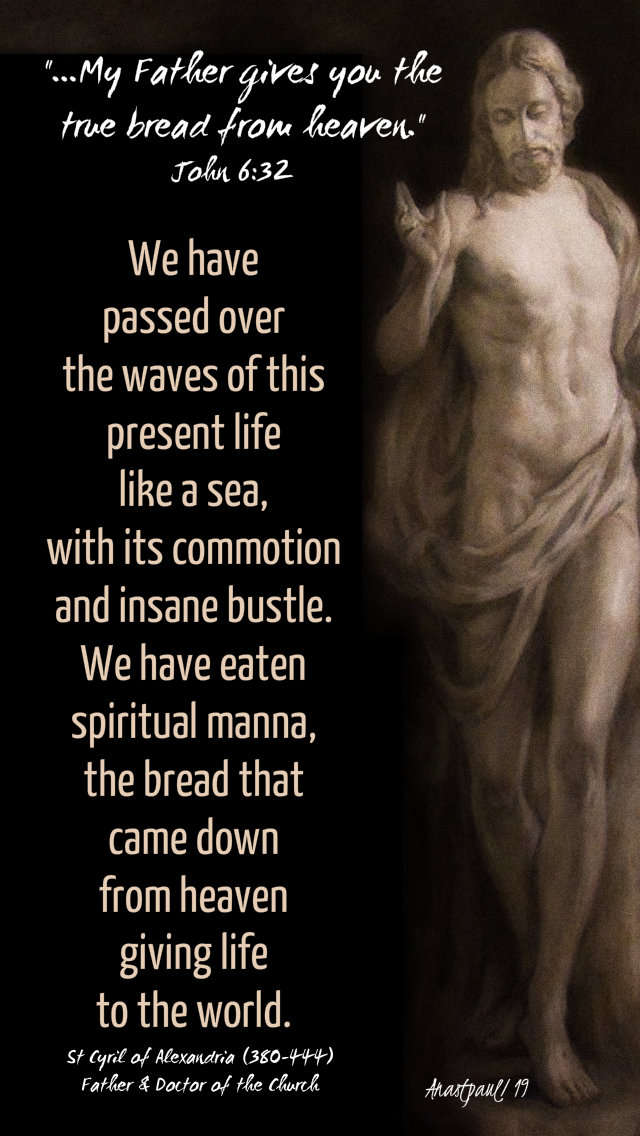
“We have passed over the waves of this present life like a sea, with its commotion and insane bustle. We have eaten spiritual manna, the bread that came down from heaven giving life to the world.”
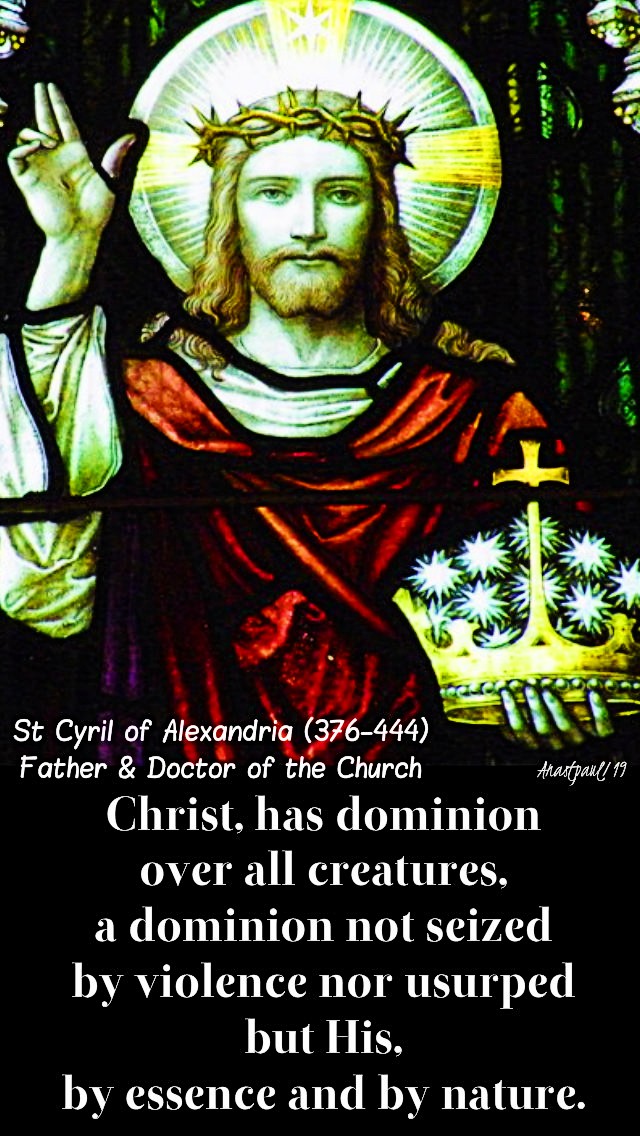
“Christ, has dominion over all creatures, a dominion not seized by violence nor usurped but His, by essence and by nature.
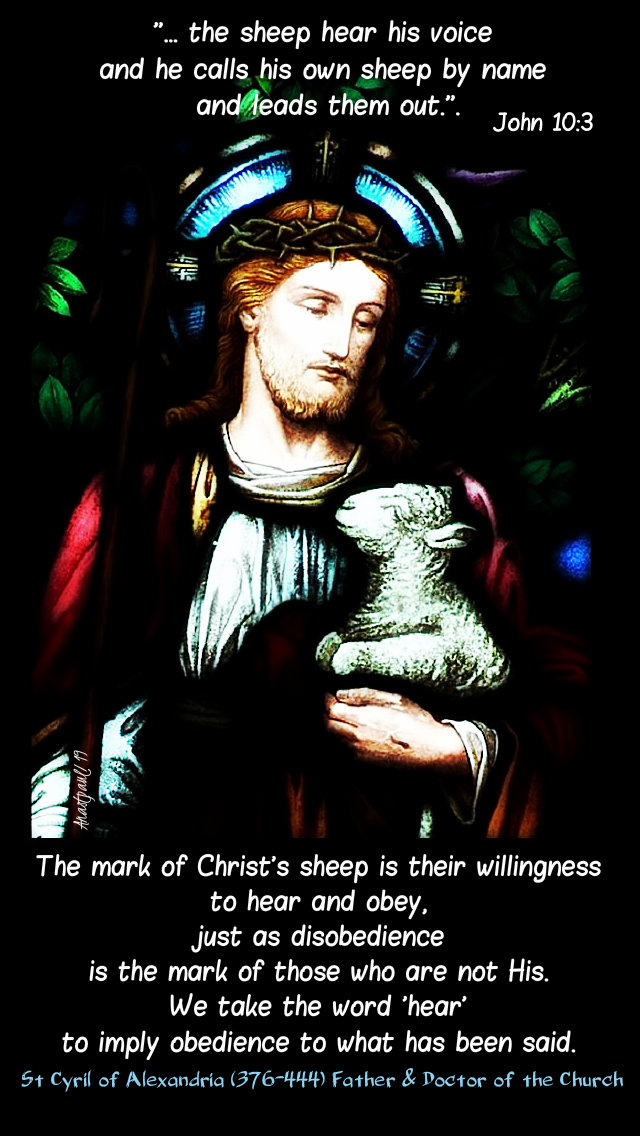
“The mark of Christ’s sheep is their willingness to hear and obey, just as disobedience is the mark of those who are not His. We take the word ‘hear’ to imply obedience to what has been said.”
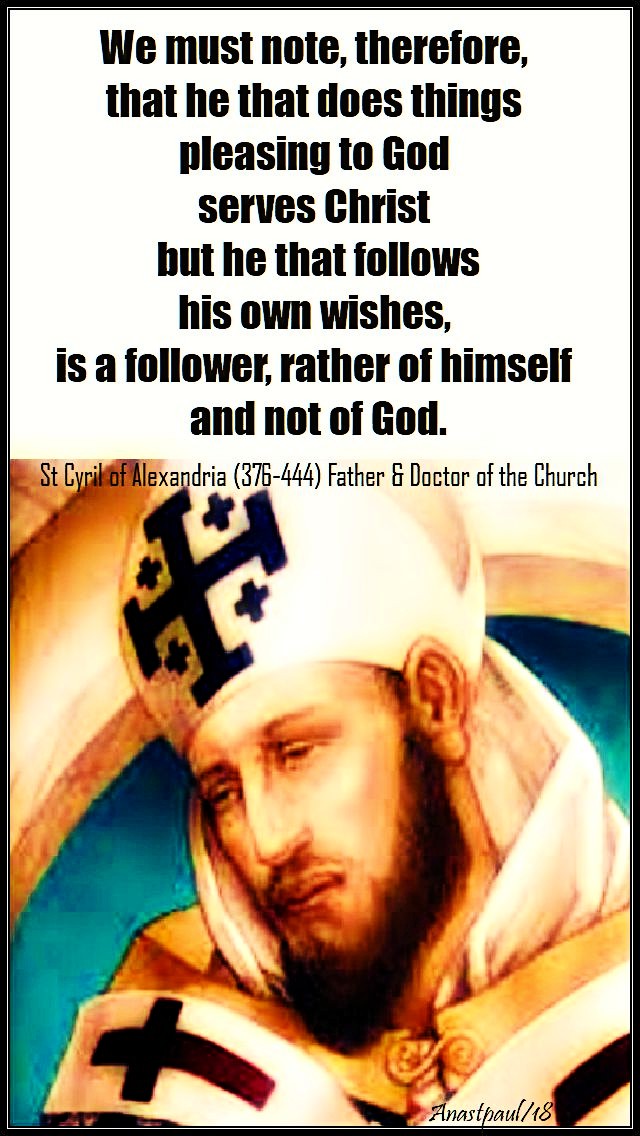
“We must note, therefore, that he that does things pleasing to God, serves Christ but he that follows his own wishes, is a follower, rather of himself and not of God.”
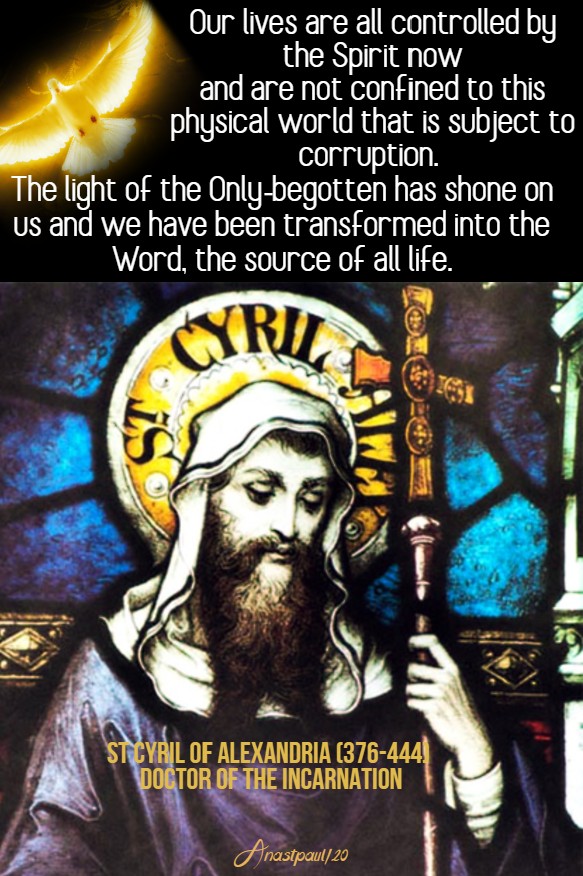
“Our lives are all controlled by the Spirit now and are not confined to this physical world that is subject to corruption. The light of the Only-begotten has shone on us and we have been transformed into the Word, the source of all life.”
St Cyril of Alexandria (376-444)
Father and Doctor of the Incarnation
One Minute Reflection – 23 June – “Month of the Sacred Heart” – Tuesday of the Twelfth week in Ordinary Time, Year A, Readings: 2 Kings 19:9-11, 14-21, 31-36, Psalm 48:2-4, 10-11, Matthew 7:6, 12-14
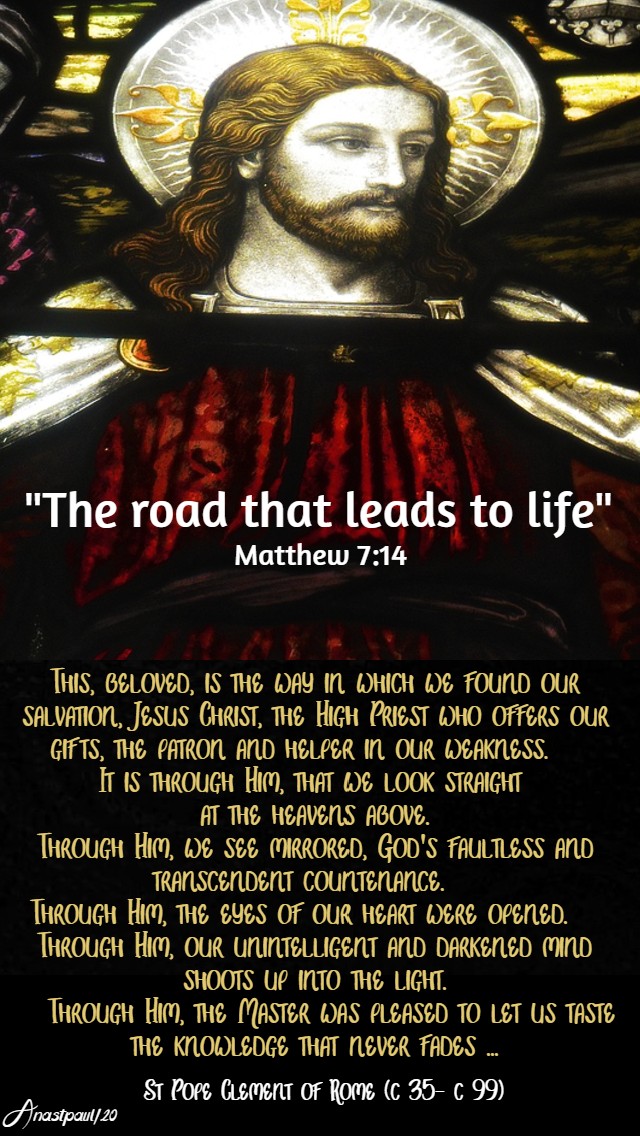
“The road that leads to life” … Matthew 7:14
REFLECTION – “This, beloved, is the way in which we found our salvation, Jesus Christ, the High Priest who offers our gifts, the patron and helper in our weakness (Heb 10:20; 7:27; 4:15). It is through Him, that we look straight at the heavens above. Through Him, we see mirrored, God’s faultless and transcendent countenance. Through Him, the eyes of our heart were opened. Through Him, our unintelligent and darkened mind shoots up into the light. Through Him, the Master was pleased to let us taste the knowledge that never fades, He who is “the radiance of His splendour, who towers as much above the angels, as the title He has inherited, is superior to theirs” (He 1:3-4) (…)
Let us take our body. The head is nothing without the feet and the feet are nothing without the head. The smallest organs of our body are necessary and valuable to the whole body, in fact, all parts conspire and yield the same obedience, toward maintaining the whole of the body (cf.1 Co 12:12f.).
Therefore, let the whole of our body be maintained in Christ Jesus and let each submit to their neighbour’s rights in the measure determined by the special gift bestowed on them. Let the strong care for the weak and the weak respect the strong; let the rich support the poor and the poor render thanks to God for giving them the means of supplying their needs; let the wise show their wisdom, not in words but in active help; the humble must not testify to themselves but leave it to another to testify in their behalf. Those who are continent must not boast, knowing that it is another who confers on them the ability to remain continent.
Let us, therefore reflect, brethren, of what clay we were made, what and who we were when we entered the world, out of what grave and darkness, our Maker and Creator has brought us into the world, where He has prepared His benefits before our birth. Since, then, we owe all these blessings to Him, we are obliged to thank Him in every way.” … St Pope Clement I (c 35 – c 99)- Pope from c 90 to c 99 – Letter to the Corinthians, § 36-38
PRAYER – The Elder Brother’s Prayer
Teach me, my Lord,
to be sweet and gentle in all the events of life,
in disappointments,
in the thoughtlessness of those I trusted,
in the unfaithfulness of those on whom I relied.
Let me put myself aside,
to think of the happiness of others,
to hide my little pains and heartaches,
so that I may be the only one to suffer from them.
Teach me to profit by the suffering
that comes across my path.
Let me so use it that it may make me
patient, not irritable.
That it may make me broad in my forgiveness,
not narrow, haughty and overbearing.
May no one be less good
for having come within my influence.
No one less pure, less true, less kind,
less noble for having been a fellow traveller
in our journey toward Eternal Life.
As I go my rounds from one distraction to another,
let me whisper from time to time,
a word of love to Thee.
May my life be lived in the supernatural,
full of power for good,
and strong in its purpose of sanctity.
Amen
One Minute Reflection – 17 June – “Month of the Sacred Heart” – Wednesday of the Eleventh Week in Ordinary Time, Year A, Readings: 2 Kings 2:1, 6-14, Psalm 31:20, 21, 24, Matthew 6:1-6, 16-18
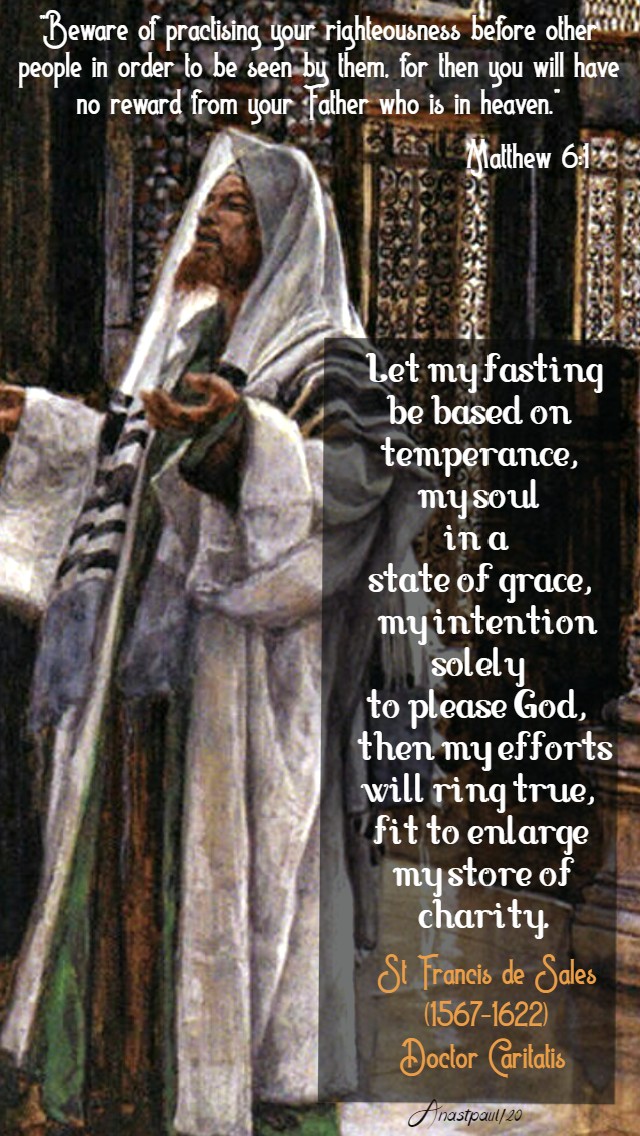
“Beware of practising your righteousness before other people in order to be seen by them, for then you will have no reward from your Father who is in heaven.” … Matthew 6:1
REFLECTION – “Our Lord, so the early Fathers say, used to tell His disciples to be well-proved bankers, proving all things, holding fast what is of value. No coin finds acceptance commercially if the gold is below standard, underweight, of it the piece is illegally struck; nor can our actions have any value spiritually, unless they are suitable, graced with charity and have a pious motive.
Take fasting, for instance – if I fast simply for the purpose of slimming, my fasting is for debased spiritual coinage; if temperance underlies it but I am not in a state of grace, it is still deficient, for charity alone gives weight to what we do; if I do it merely out of courtesy for the company in which I find myself, it lacks the stamp of right intention. Let my fasting be based on temperance, my soul in a state of grace, my intention solely to please God, then my efforts will ring true, fit to enlarge my store of charity.
Given utmost purity of intention and a firm resolve to please God, little actions are well done. In these circumstances they lead to great holiness. Some people, in spite of eating all they can, remain only skin and bone, weak, listless, their powers of digestion are poor. Others may eat next to nothing yet be fit as fiddles, full of energy — nothing is wrong with their digestion! Some folk there are, in the same way, who do many good things, yet have little extra charity to show for it – coldness and carelessness, or instinct and inclination rather than grace or zeal, is where the blame lies. On the other hand, there are those who accomplish little but to perfect is their will, their intention, however, that their growth in charity is great. They have only a little talent but they make such careful use of what they have that the Lord rewards them for it generously.” … St Francis de Sales (1567-1622) Bishop of Geneva, Doctor Caritatis
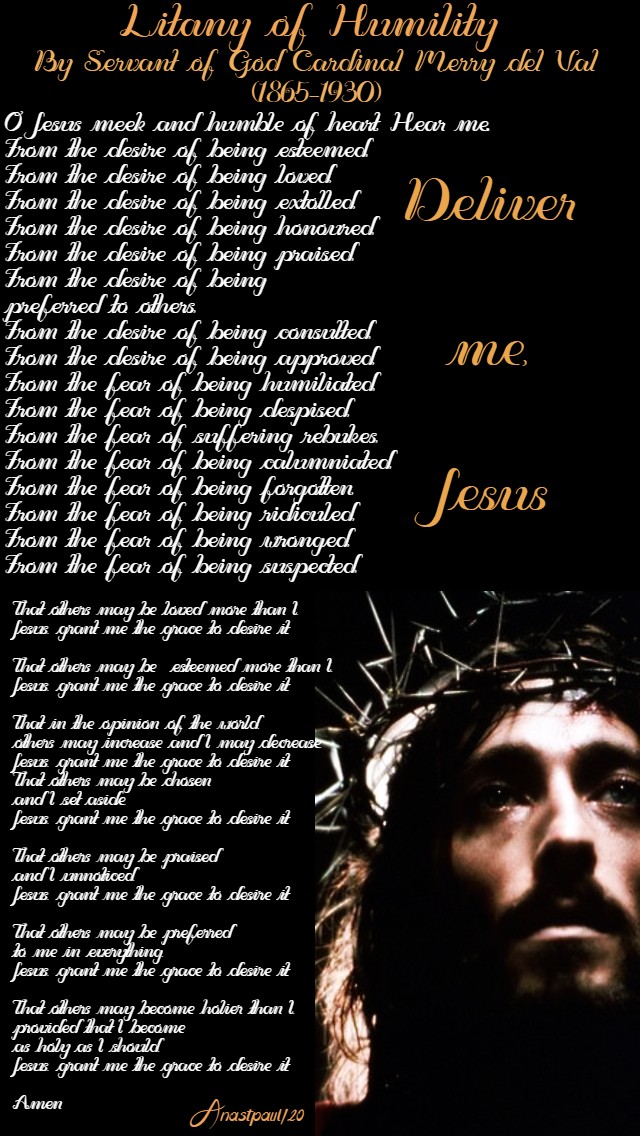
PRAYER – Litany of Humility
By Servant of God Cardinal Merry del Val (1865-1930) – who was accustomed to recite this prayer daily after the celebration of Holy Mass.
O Jesus meek and humble of heart, Hear me.
From the desire of being esteemed, Deliver me, Jesus.
From the desire of being loved, Deliver me, Jesus.
From the desire of being extolled, Deliver me, Jesus.
From the desire of being honoured, Deliver me, Jesus.
From the desire of being praised, Deliver me, Jesus.
From the desire of being preferred to others, Deliver me Jesus.
From the desire of being consulted, Deliver me, Jesus.
From the desire of being approved, Deliver me, Jesus.
From the fear of being humiliated, Deliver me, Jesus.
From the fear of being despised, Deliver me, Jesus.
From the fear of suffering rebukes, Deliver me, Jesus.
From the fear of being calumniated, Deliver, me, Jesus.
From the fear of being forgotten, Deliver me, Jesus.
From the fear of being ridiculed, Deliver me, Jesus.
From the fear of being wronged, Deliver me, Jesus.
From the fear of being suspected, Deliver me, Jesus.
That others may be loved more than I,
Jesus, grant me the grace to desire it.
That others may be esteemed more than I,
Jesus, grant me the grace to desire it.
That in the opinion of the world, others may increase
and I may decrease,
Jesus, grant me the grace to desire it.
That others may be chosen and I set aside,
Jesus, grant me the grace to desire it.
That others may be praised and I unnoticed,
Jesus, grant me the grace to desire it.
That others may be preferred to me in everything,
Jesus, grant me the grace to desire it.
That others may become holier than I,
provided that I become as holy as I should,
Jesus, grant me the grace to desire it.
Amen
Quote/s of the Day – 16 June – “Month of the Sacred Heart” – Tuesday of the Eleventh week in Ordinary Time, Year A, Readings: 1 Kings 21:17-29, Psalm 51:3-6, 11, 16, Matthew 5:43-48
“You shall not hate your brother in your heart but you shall reason with your neighbour, lest you bear sin because of him. You shall not take vengeance or bear any grudge against the sons of your own people but, you shall love your neighbour as yourself: I am the Lord”
Leviticus 19:17-18
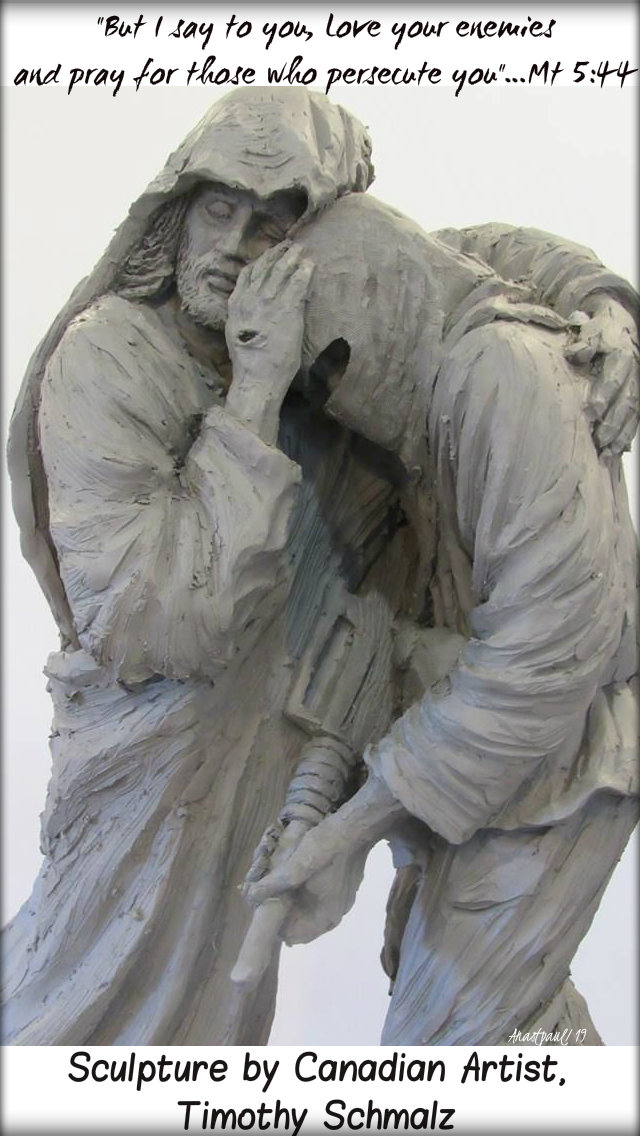
“But I say to you, love your enemies and pray for those who persecute you…”
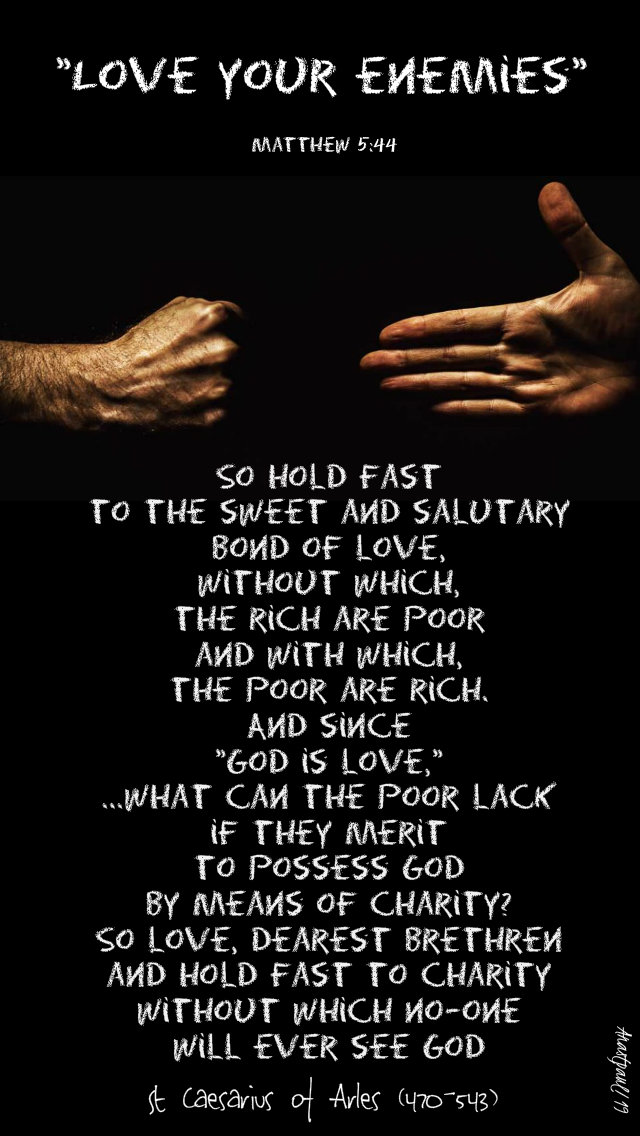
Matthew 5:44
“So hold fast to the sweet and salutary bond of love, without which, the rich are poor and with which the poor are rich. What do the rich possess if not charity? … And since “God is love,” (1 Jn 4:8) as John the evangelist says, what can the poor lack, if they merit to possess God by means of charity? … So love, dearest brethren and hold fast to charity without which, no-one will ever see God.”
St Caesarius of Arles (470-543)
Monk and Bishop
Sermons addressed to the people, no. 23, 3
“We must show love for those who do evil to us and pray for them. Nothing is dearer or more pleasing to God than this.”
St Bridget of Sweden (c 1303-1373)
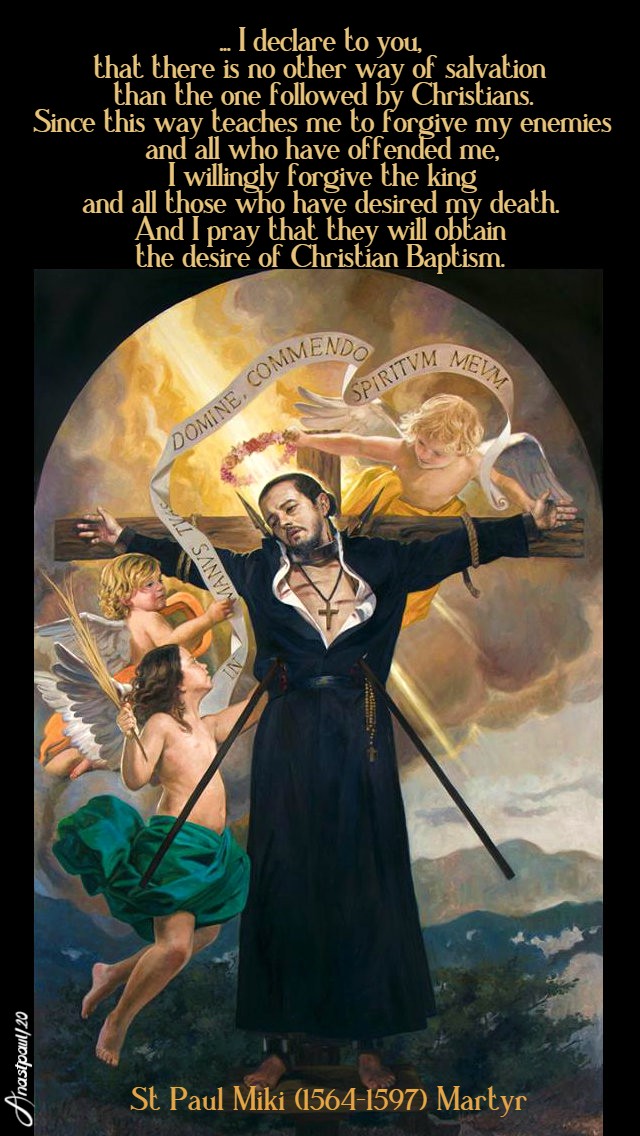
“… I declare to you, that there is no other way of salvation than the one followed by Christians. Since this way teaches me to forgive my enemies and all who have offended me, I willingly forgive the king and all those who have desired my death. And I pray that they will obtain the desire of Christian Baptism.”
St Paul Miki SJ (1564-1597) Martyr
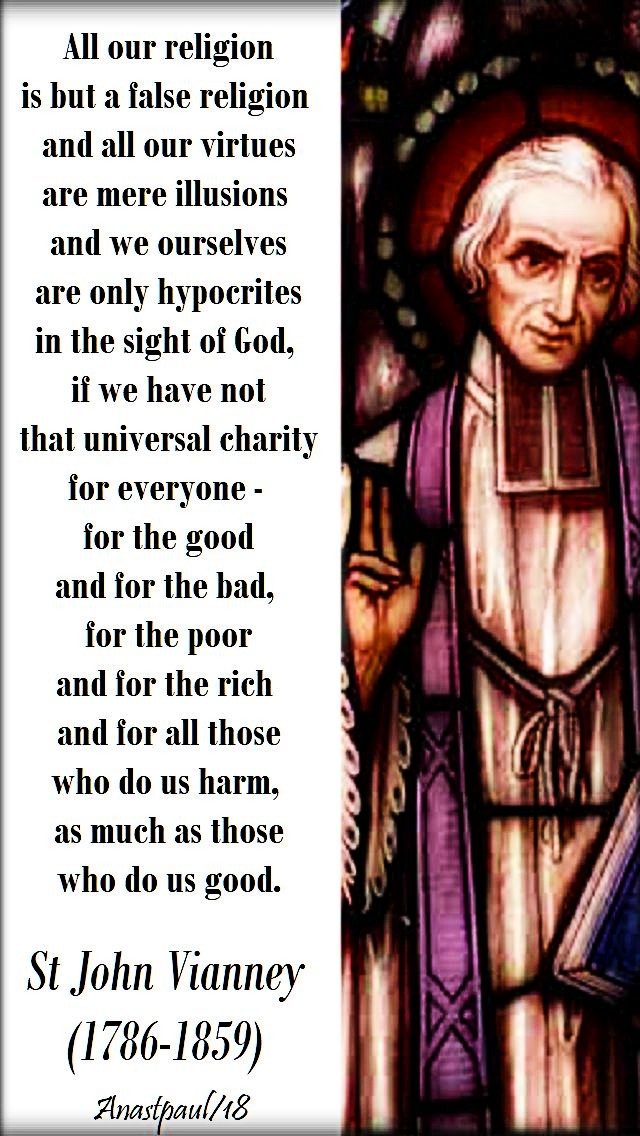
“All our religion is but a false religion and all our virtues are mere illusions and we ourselves are only hypocrites in the sight of God, if we have not that universal charity for everyone – for the good and for the bad, for the poor and for the rich and for all those who do us harm, as much as those who do us good.”
St John Vianney (1786-1859)
“When we talk about the coming of the Kingdom and pray for its coming, we are not thinking of a discrimination according to race or blood but of the brotherhood of all, for all men are our brothers – not excluding even those who hate and attack us – in a close bond with the One, who causes the sun to rise on the good and the bad alike (Mt 5:45).”
Blessed Titus Brandsma (1881-1942) Martyr
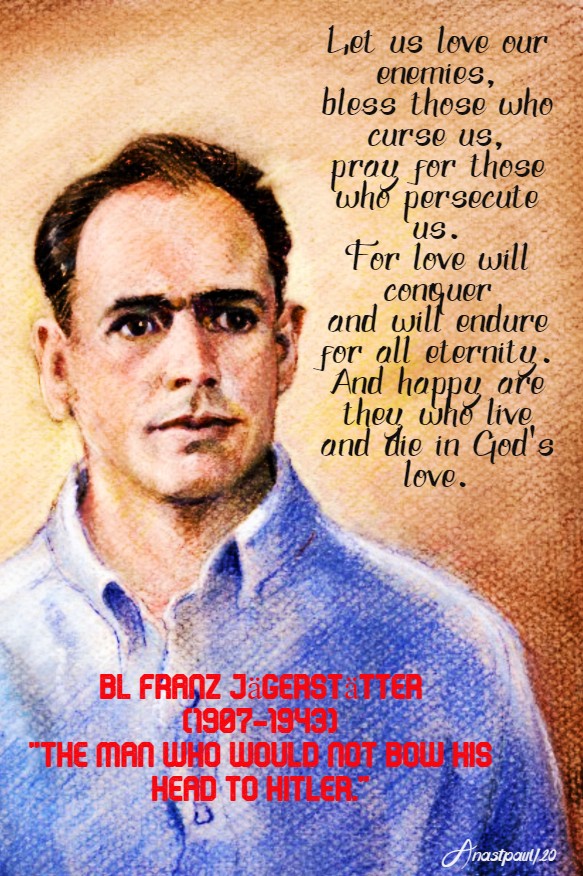
“Let us love our enemies, bless those who curse us, pray for Those who persecute us. For love will conquer and will endure for all eternity. And happy are they who live and die in God’s love.”
Blessed Franz Jägerstätter (1907-1943)
“Called-up to a Higher Order”
Martyr of Conscientious Objection
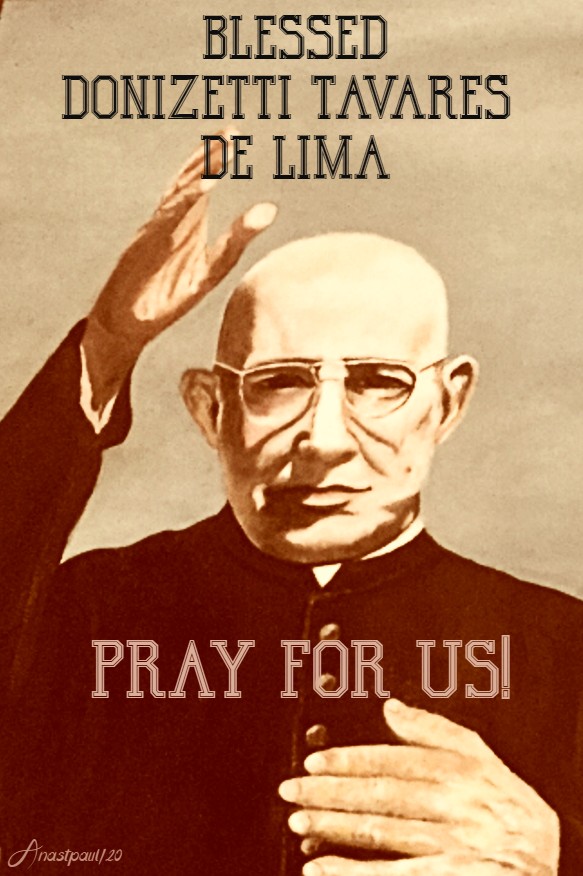
One Minute Reflection – 16 June – “Month of the Sacred Heart” – Tuesday of the Eleventh week in Ordinary Time, Year A, Readings: 1 Kings 21:17-29, Psalm 51:3-6, 11, 16, Matthew 5:43-48 and the Memorial of Bl Donizetti Tavares de Lima (1882-1961)
“But I say to you, love your enemies and pray for those who persecute you… For if you love those who love you, what recompense will you have?” … Matthew 5:44,46
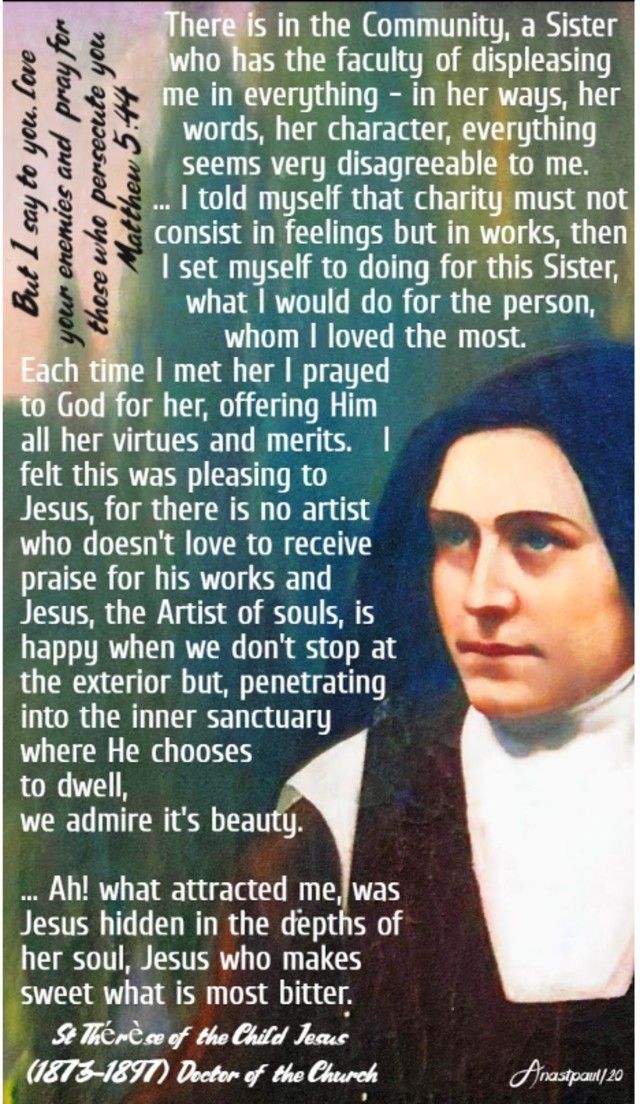
REFLECTION – “There is in the Community, a Sister who has the faculty of displeasing me in everything – in her ways, her words, her character, everything seems very disagreeable to me. And still, she is a holy religious who must be very pleasing to God. Not wishing to give into the natural antipathy I was experiencing, I told myself that charity must not consist in feelings but in works, then I set myself to doing for this Sister, what I would do for the person, whom I loved the most. Each time I met her I prayed to God for her, offering Him all her virtues and merits. I felt this was pleasing to Jesus, for there is no artist who doesn’t love to receive praise for his works and Jesus, the Artist of souls, is happy when we don’t stop at the exterior but, penetrating into the inner sanctuary where He chooses to dwell, we admire it’s beauty.
I wasn’t content simply with praying very much for this Sister, who gave me so many struggles but I took care to render her all the services possible and when I was tempted to answer her back in a disagreeable manner, I was content with giving her my most friendly smile and with changing the subject of the conversation. … Frequently, when… I had occasion to work with this Sister, I used to run away like a deserter, whenever my struggles became too violent. As she was absolutely unaware of my feelings for her, never did she suspect the motives for my conduct and she remained convinced that her character was very pleasing to me. One day, at recreation, she asked in almost these words: “Would you tell me, Sister Therese of the Child Jesus, what attracts you so much toward me, every time you look at me, I see you smile?” Ah! what attracted me, was Jesus hidden in the depths of her soul, Jesus who makes sweet what is most bitter.” … St Thérèse of the Child Jesus (1873-1897) Doctor of the Church
PRAYER – Almighty God, to whom this world, with all it’s goodness and beauty belongs, give us grace joyfully, to begin this day for Christ Your Son, in Him and with Him and to fill it, with an active love for all Your children, even those who may not like or who do us harm. Help us to love as You do, so that we may become like You. Bl Donizetti Tavares de Lima, you who spread your charity far and wide, pray for us. Through Christ our Lord, with the Holy Spirit, one God, forever, amen.
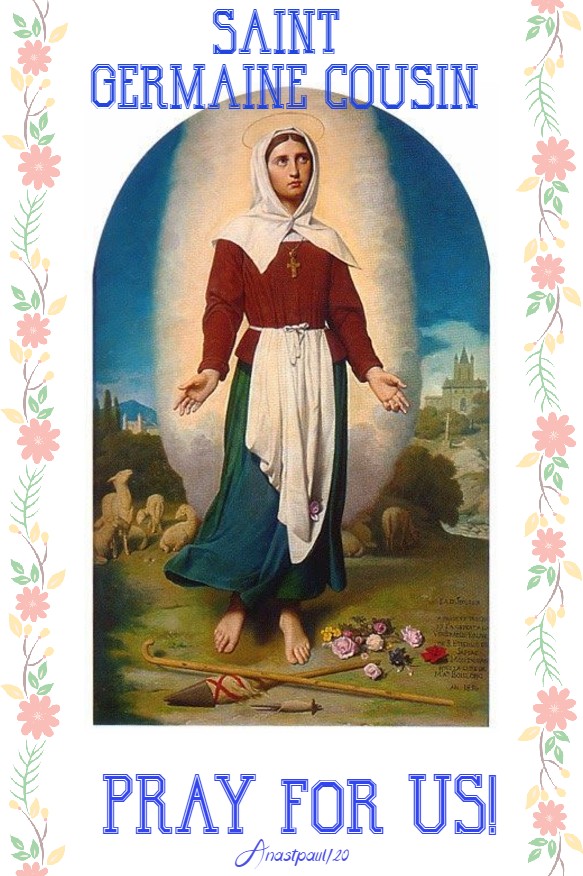
One Minute Reflection – 15 June – “Month of the Sacred Heart” – Monday of the Eleventh Week of Ordinary Time, Year A, Readings: 1 Kings 21:1-16, Psalm 5:2-3, 4-7, Matthew5:38-42 and the Memorial of St Germaine Cousin (1579–1601)
“Should anyone press you into service for one mile, go with him for two miles.” … Matthew 5:41
REFLECTION – “Do you grasp the excellence of a Christian disposition? After you give your coat and your cloak, even if your enemy should wish to subject your naked body to hardships and labours, not even then, Jesus says, must you forbid him. For He would have us possess all things in common, both our bodies and our goods, as with them that are in need, so with them that insult us. For the latter response comes from a courageous spirit, the former from mercy. Because of this, Jesus said, “If any one shall compel you to go one mile, go with him two.” Again He leads you to higher ground and commands you to manifest the same type of aspiration. For if the lesser things He spoke of at the beginning receive such great blessings, consider what sort of reward awaits those who duly perform these and what they become even before we hear of receiving rewards. You are winning full freedom from unworthy passions in a human and passible body.” … St John Chrysostom (347-407) Bishop, Father & Doctor (The Gospel of Matthew: Homily 18)
PRAYER – King of heaven and earth, Lord God, rule over or hearts and bodies this day. Sanctify us and guide our every thought, word and deed according to the commandments of Your law, so that now and forever, Your grace may free and save us. Teach us Lord to walk in the ways of the Cross of Your Son, our Saviour, as St Germaine Cousin so lovingly and willingly inspires us to do. Through Christ our Lord, with the Holy Spirit, God, forever, amen
Thought for the Day – 13 June – Meditations with Antonio Cardinal Bacci (1881-1971)
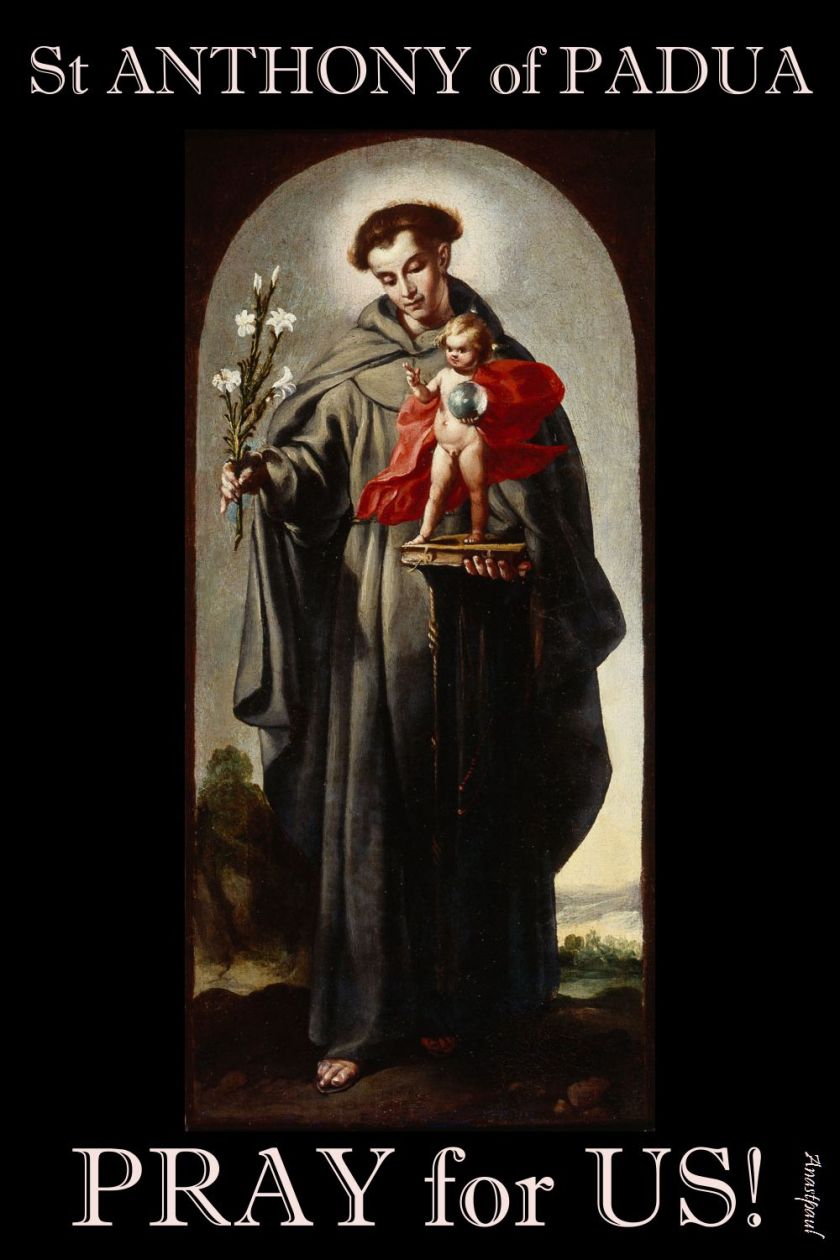
St Anthony
“St Anthony of Padua was not born a saint but he became one as the result of prayer, self-denial and penance, which attracted to him, God’s many graces.
On a summer evening in the year 1219, five mendicant friars arrived at the gate of the ancient Abbey of Coimbra, asking for hospitality from the Canons Regular of St Augustine.
They received a whole-hearted welcome.
When they had refreshed themselves, they revealed that they belonged to the new Religious Family founded by St Francis of Assisi.
They said that they hoped to reach Morocco, in order to convert the Saracens and, if it was God’s pleasure, to receive the palm of Martyrdom.
Amongst the Canons Regular, who were listening to them, was the youthful Anthony, who had already consecrated his life to God.
Not long afterwards, this little band of Franciscan Missionaries, was cut down by the scimitars of the infidels and became a glorious band of Martyrs.
Their bodies were brought back in triumph to the Abbey which they had visited and there they were buried with great honour.
When they were going away, Anthony had listened enthusiastically to all that they had said and felt a noble envy.
Now that he was in the presence of their hallowed remains, he experienced an urge to follow in their footsteps.
St Anthony joined the Franciscan Order and joyfully set off for the coast of Morocco in search of Missionary labour and of Martyrdom.
But, when he landed on African soil, he was struck down by a serious attack of malaria, which compelled him to return to his native land.
There is no foreseeing the designs of Divine Providence.
The boat in which Anthony was travelling was battered by a tempest and had to go ashore in Italy.
Henceforward, Italy was Anthony’s second fatherland.
It was here, that he conducted his remarkable and fruitful apostolate and slowly accomplished his Martyrdom, by the daily struggle for perfection.
This, is a headline for us!
We may not have been called to go and spread the faith amongst the infidels, at the risk of Martyrdom.
But, we have all been called to a state of holiness.
Perfection, moreover, is a gradual Martyrdom.
The heroic daily effort which is required to abstain from sin and to overcome the wayward tendencies of our nature, can fairly be said, to be, no less difficult, than a bloody Martyrdom.
This is the kind of Martyrdom which we must all endure.
St Anthony of Padua, will obtain for us the grace, to undergo it with the same generosity and constancy, which he displayed.”
One Minute Reflection – 12 June – “Month of the Sacred Heart” – Friday of the Tenth Week of Ordinary Time, Year A, Readings: 1 Kings 19:9, 11-16, Psalm 27:7-9, 13-14, Matthew 5:27-32
“If your right eye causes you to sin, tear it out and throw it away. It is better for you to lose one of your members than to have your whole body thrown into Gehenna.” … Matthew 5:29
REFLECTION – “As the degree of innocence increases, faith becomes more advanced. For we are advised to be free, not only from our own particular faults but also from those things, which affect us outwardly. For is it not because of sin, that the bodily members were condemned in the first place? The right eye is no less sinister than the left. It is pointless to chastise a foot that is unaware of lust and thus involves no grounds for punishment. But our members indeed do differ from each other while we are all one body. We are here being advised to pluck out inordinate loves or friendships, if they are the occasion that leads us further into wrongdoing. We would do well, to not even have the benefit of a member, like an eye or a foot, if it furnishes the avenue, by which one is drawn by excessive affections into a partnership with hell. Even the cutting away of a member might be beneficial, if the heart (figuratively speaking), were also able to be cut away. But, if the impulse of the heart is left unchanged, the cutting away of a member would be pointless.” … St Hilary of Poitiers (315-368) Father and Doctor of the Divinity of Christ – On Matthew, Ch 4
PRAYER – Yours is the day and Yours, the night, Lord God and we are Your children. Grant we pray, that the weakness of our humanity, the drive of our emotions and flesh may not overpower us. Lead us Lord, through the dangers of our day, give us strength and true love, wishing only, our final home, for those who share our lives, especially our spouse. Mary, pray for us, that we may imitate your faithfulness in all things. We make our prayer through Christ our Lord, in the unity of the Holy Spirit, one God forever, amen.
Thought for the Day – 6 June – “Month of the Sacred Heart” – Meditations with Antonio Cardinal Bacci (1881-1971)
The Worship of the Sacred Heart
in Relation to the Love of God and of Our Neighbour
“There is nothing sentimental about having devotion to the Sacred Heart of Jesus.
Neither does this devotion consist only in prayers and pious practices.
It is much deeper than this.
It should flood our whole being, enkindle the fire of divine love in our hearts and transform our lives in accordance with the commands of Jesus.
A love which is not active cannot be genuine, it is only a passing emotion.
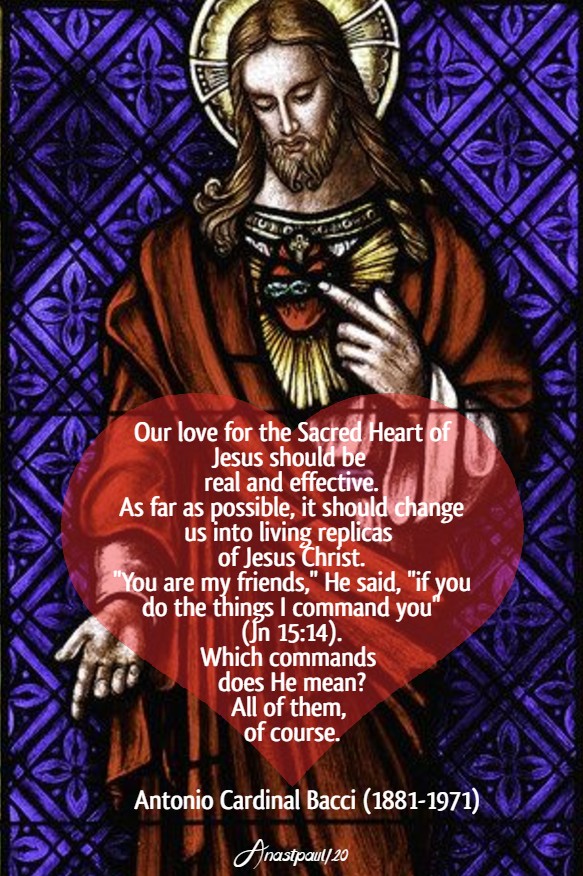
Our love for the Sacred Heart of Jesus should be real and effective.
As far as possible, it should change us into living replicas of Jesus Christ.
“You are my friends,” He said, “if you do the things I command you” (Jn 15:14).
Which commands does He mean?
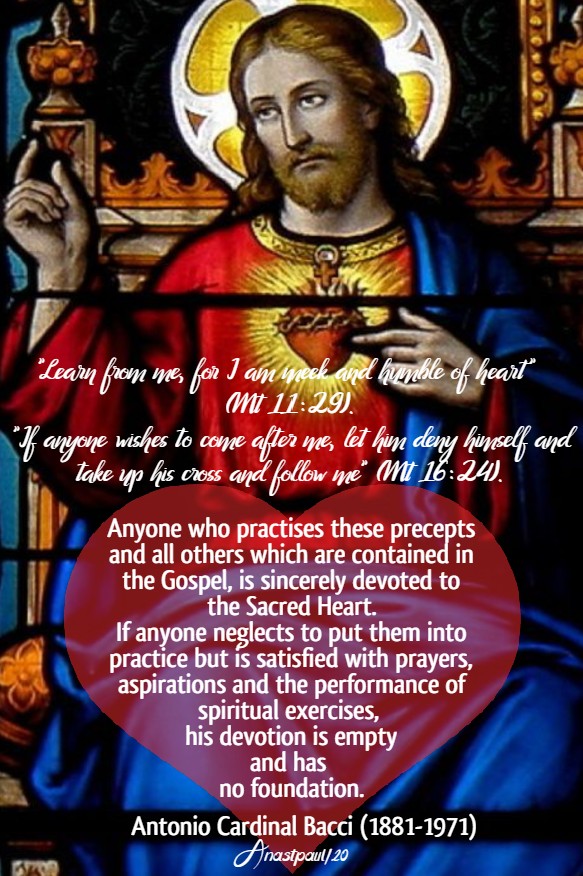
All of them, of course. “Learn from me, for I am meek and humble of heart” (Mt 11:29). “If anyone wishes to come after me, let him deny himself and take up his cross and follow me” (Mt 16:24). “Thy shalt love the Lord thy God, with they whole heart and with they whole soul” (Mt 22:37).
Anyone who practises these precepts and all others which are contained in the Gospel, is sincerely devoted to the Sacred Heart.
If anyone neglects to put them into practice but is satisfied with prayers, aspirations and the performance of spiritual exercises, his devotion is empty and has no foundation.
These prayers, aspirations and pious practices have their value, insofar, as they can attract God’s grace.
But, we must co-operate with God’s grace by our good actions.
Then our devotion to the Sacred Heart of Jesus, will be sincere and effective.”
Quote/s of the Day – 2 June – “Month of the Sacred Heart” – Tuesday of the Ninth week in Ordinary Time, Year A, Readings: 2 Peter 3:12-15, 17-18, Psalm 90:2-4, 10, 14, 16, Mark 12:13-17
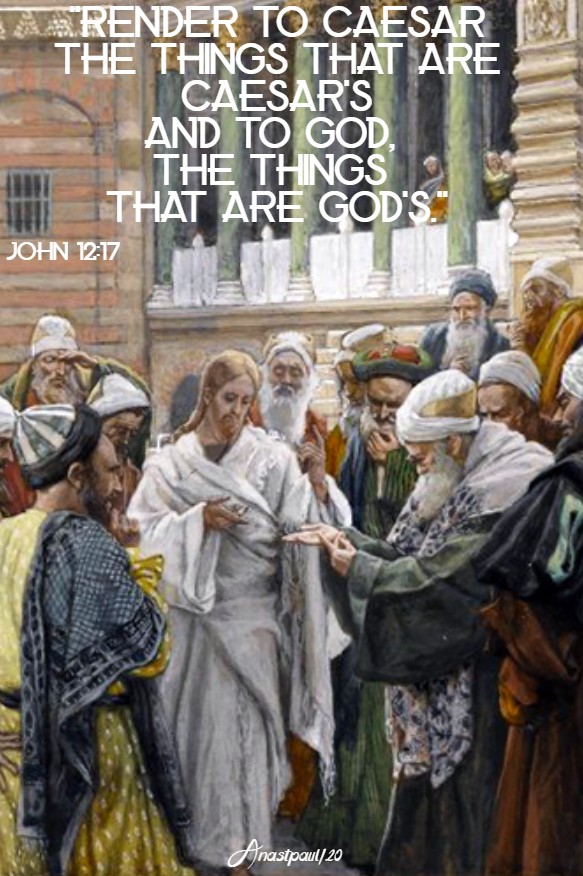
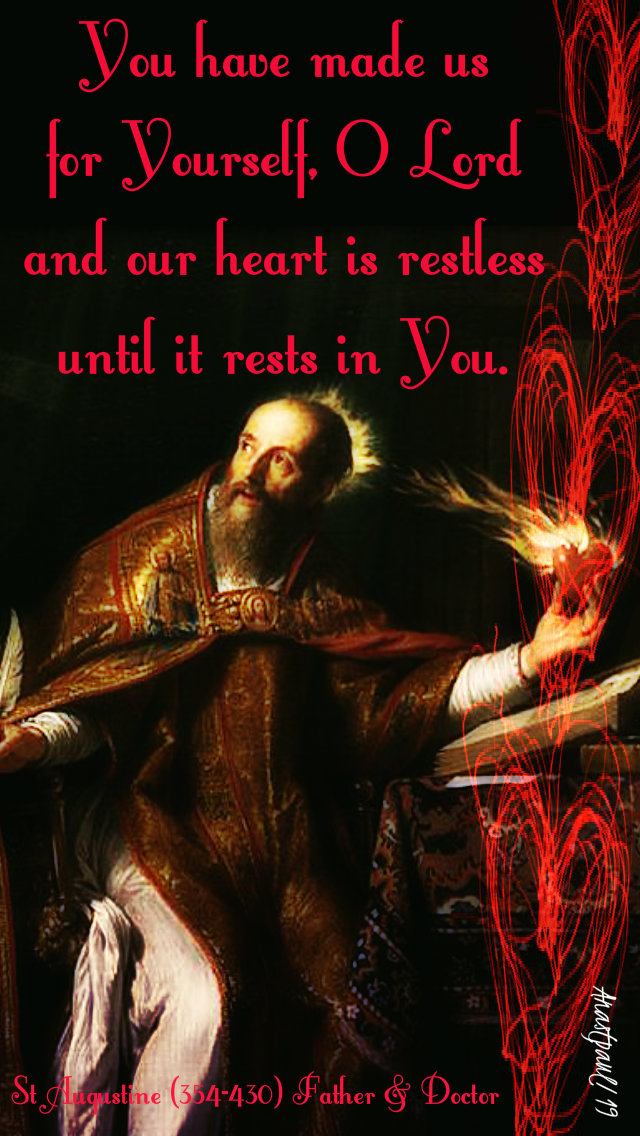
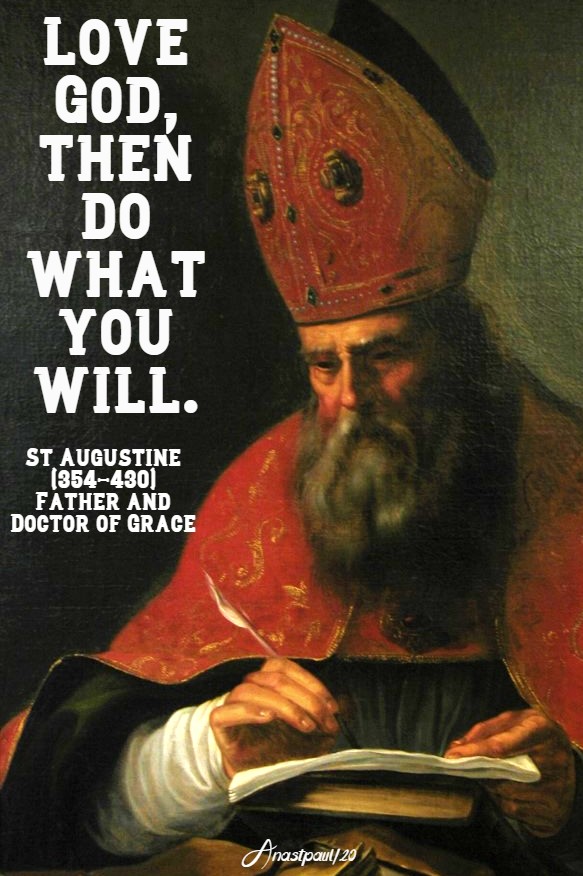
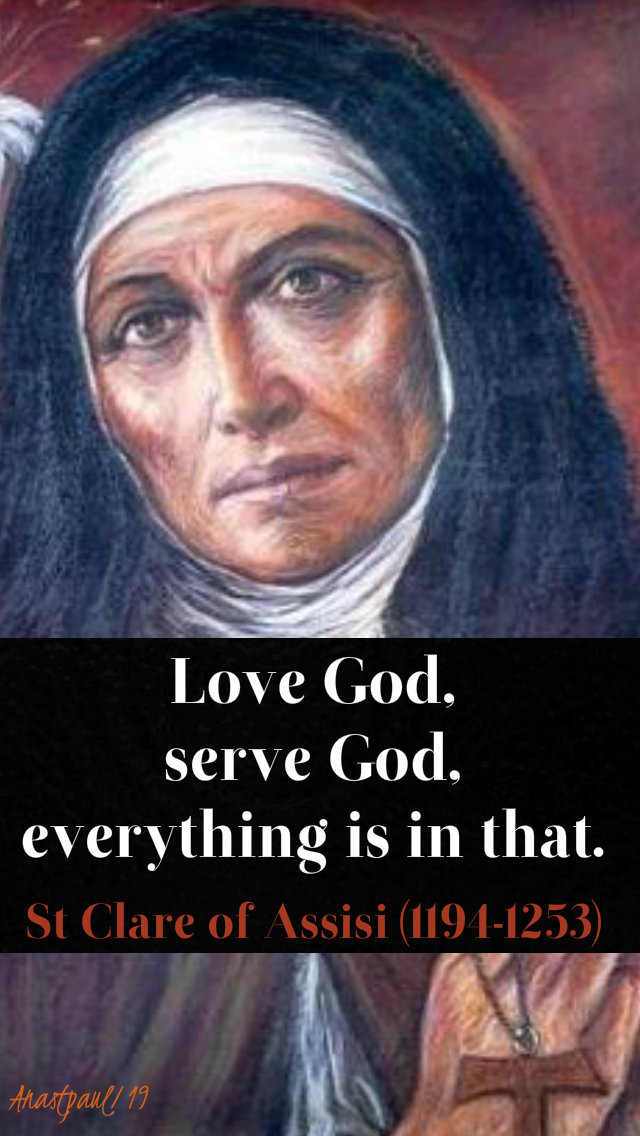
Speaking of: Belonging to God
“Render to Caesar the things that are Caesar’s and to God, the things that are God’s.”
Jesus
John 12:17
“You have made us for Yourself, O Lord and our hearts are restless until they rest in You.”
“Love God, then do what you will.”
St Augustine (354-430)
Father and Doctor of Grace
“Love God, serve God, everything is in that.”
St Clare of Assisi (1194-1253)
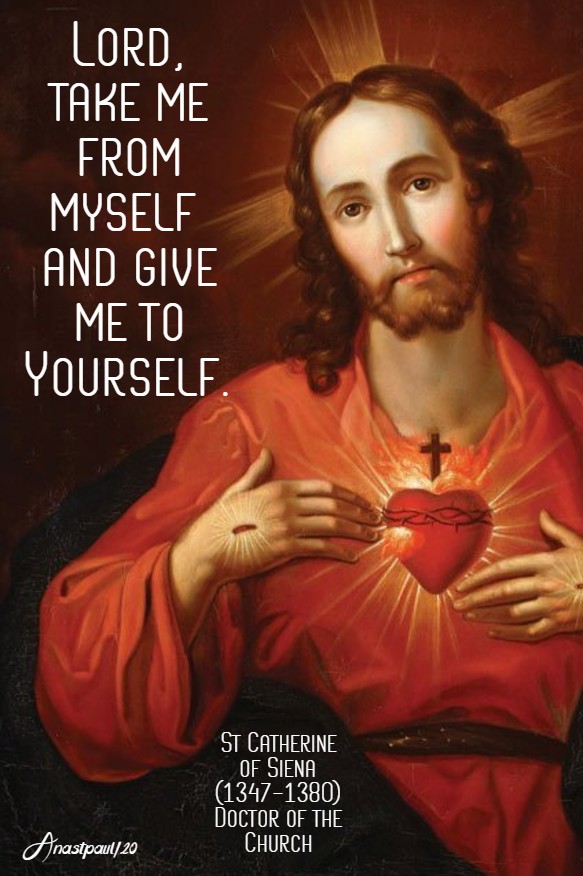
“Lord, take me from myself and give me to Yourself.”
St Catherine of Siena (1347-1380)
Doctorof the Church
“If you wish to enter into life, keep My commandments. If you will know the truth, believe in Me. If you will be perfect, sell all. If you will be My disciple, deny yourself. If you will possess the blessed life, despise this present life. If you will be exalted in heaven, humble yourself on earth. If you wish to reign with Me, carry the Cross with Me. For only the servants of the Cross find the life of blessedness and of true light.”
Thomas à Kempis (1380-1471)
The Imitation of Christ Chapter 56
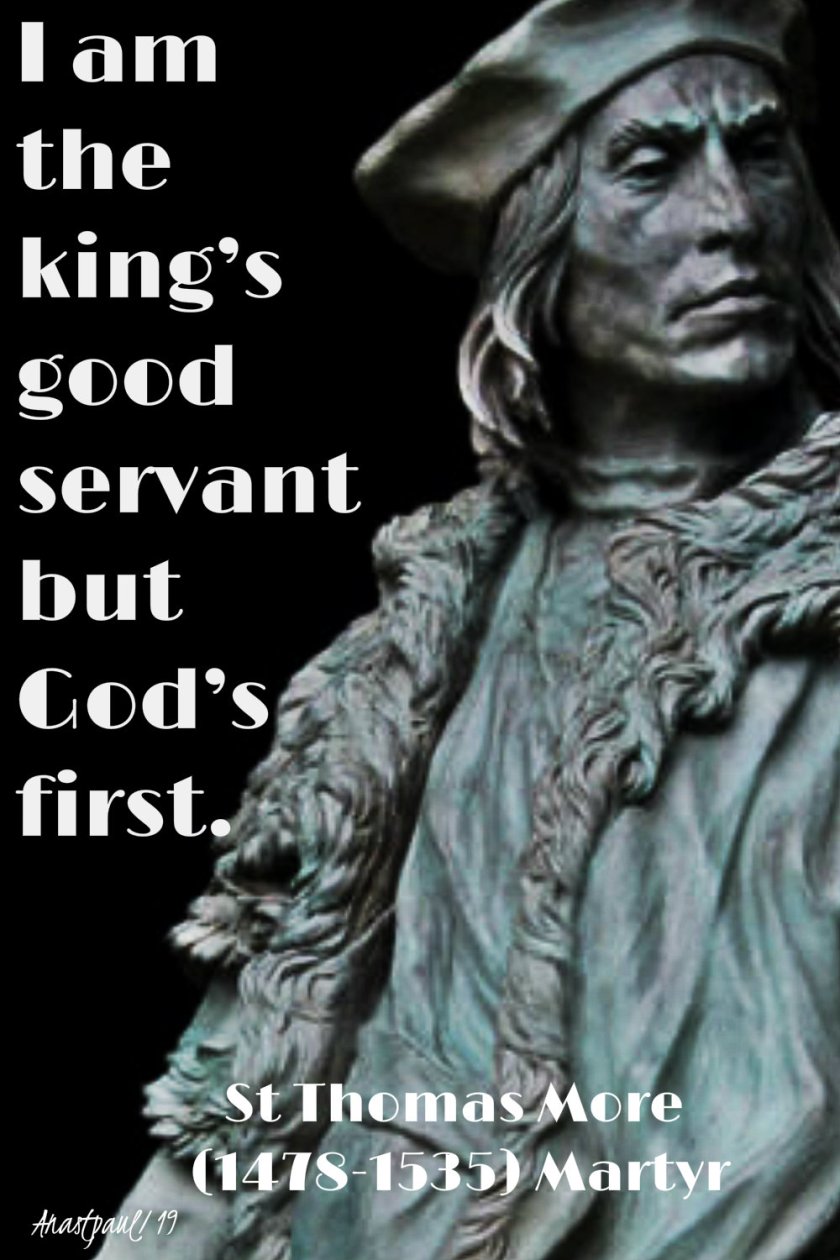
“I am the king’s good servant but God’s first.”
St Thomas More (1478-1535)
Martyr
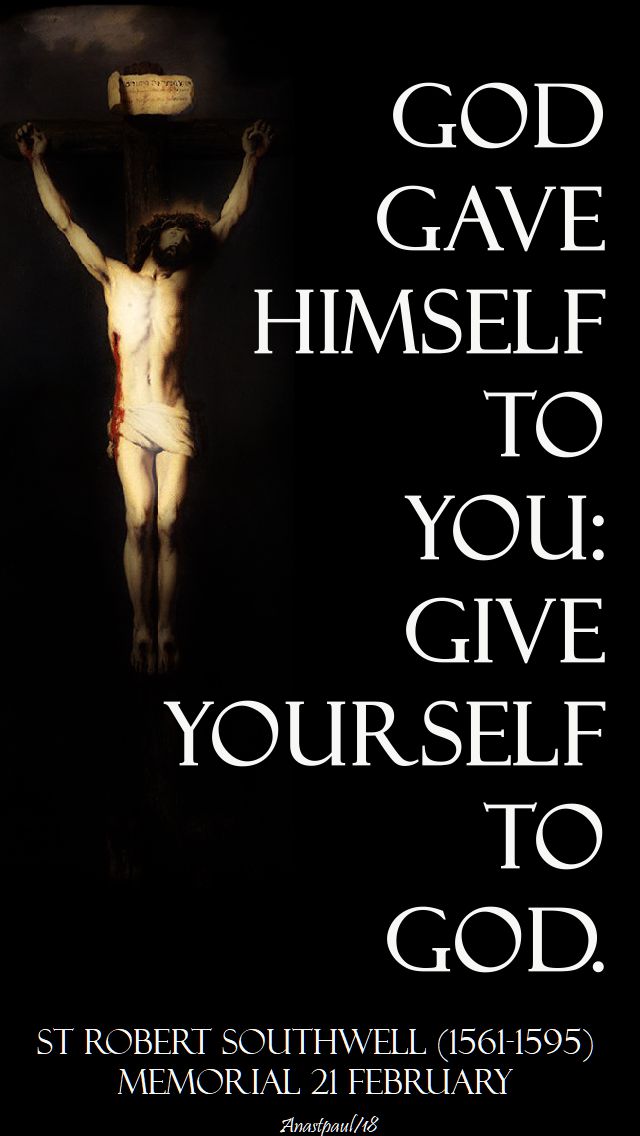
“God gave Himself to you, now give yourself to God.”
St Robert Southwell SJ (1561-1595)
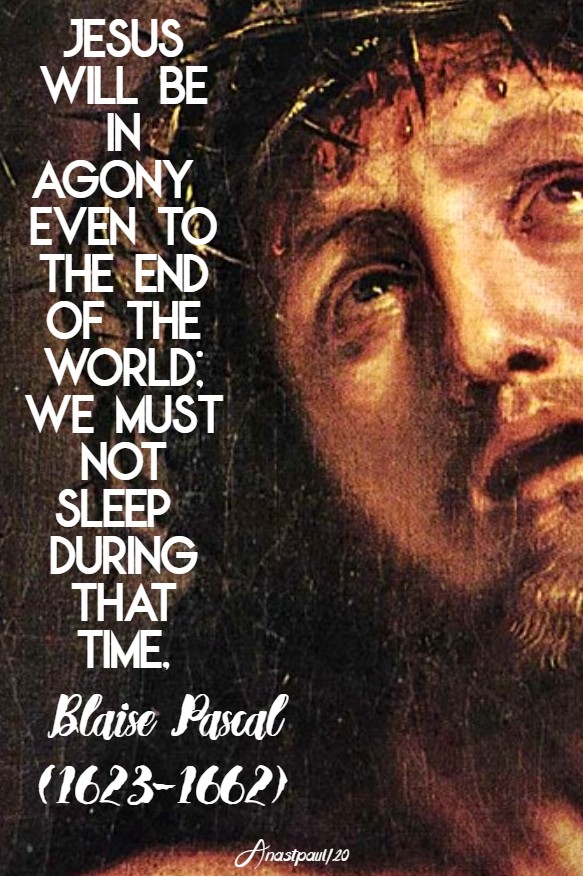
“Jesus will be in agony even to the end of the world; we must not sleep during that time”
Blaise Pascal (1623-1662)
(Pensées, 553)
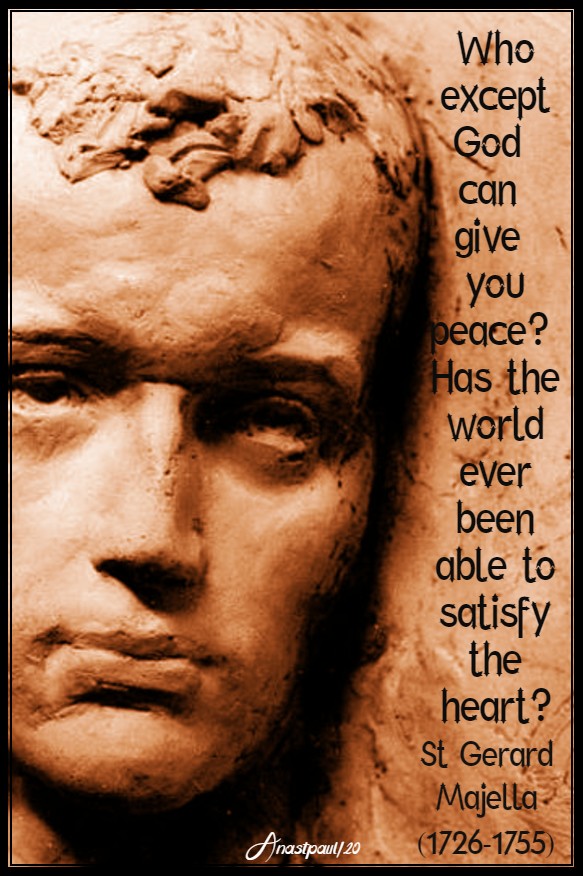
“Who except God can give you peace? Has the world ever been able to satisfy the heart?”
St Gerard Majella C.Ss.R. (1726-1755)
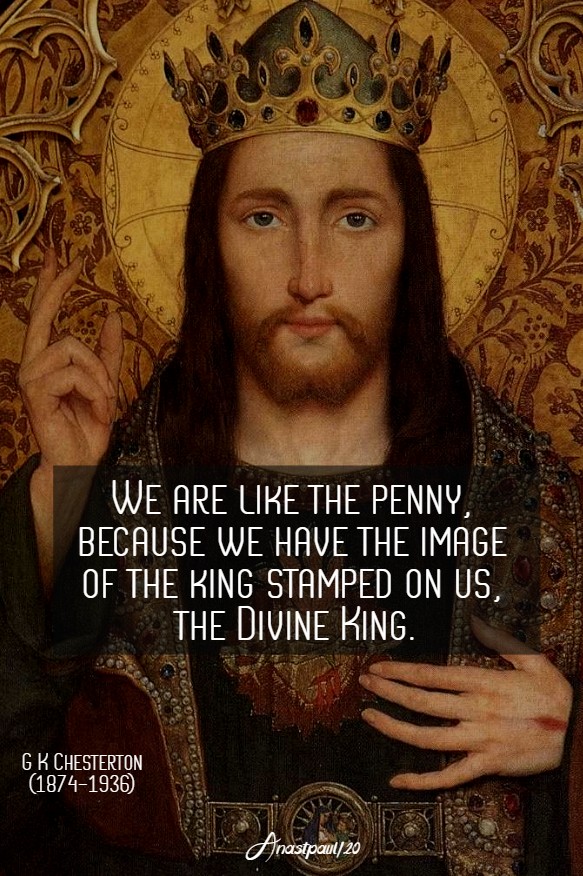
“We are like the penny, because we have the image of the king stamped on us, the divine King.”
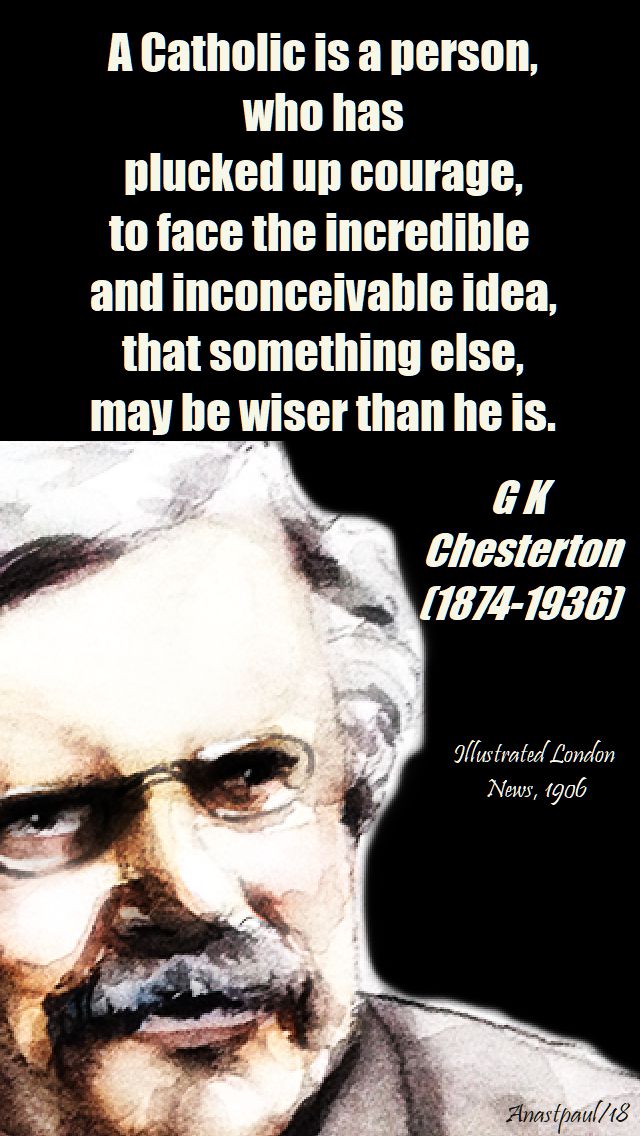
“A Catholic is a person, who has plucked up courage, to face the incredible and inconceivable idea, that something else may be wiser than he is.”
G K Chesterton (1874-1936)
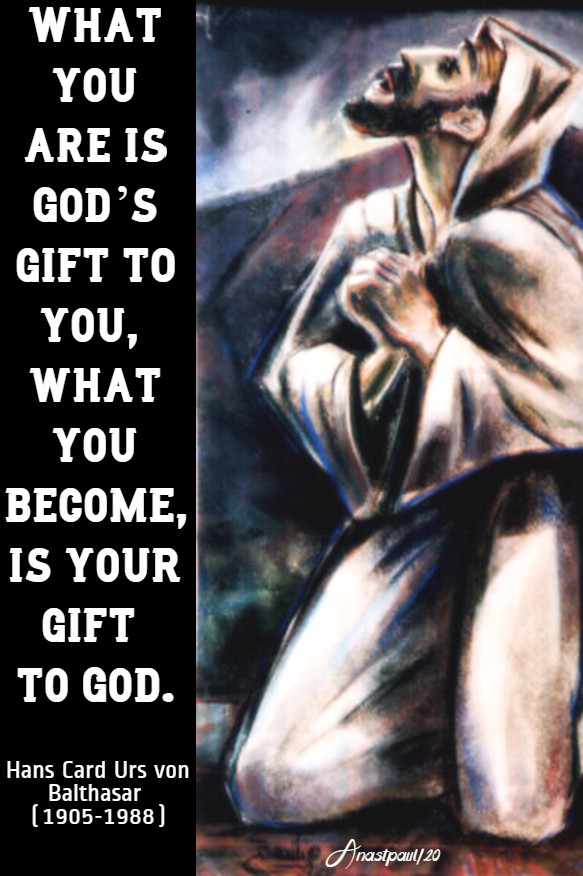
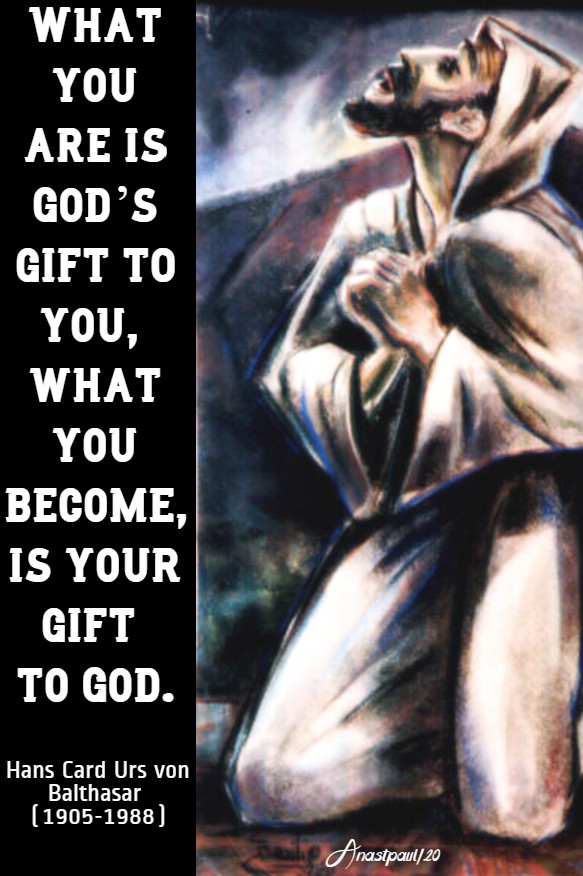
“What you are is God’s gift to you, what you become, is your gift to God.”
Hans Urs von Balthasar (1905-1988)
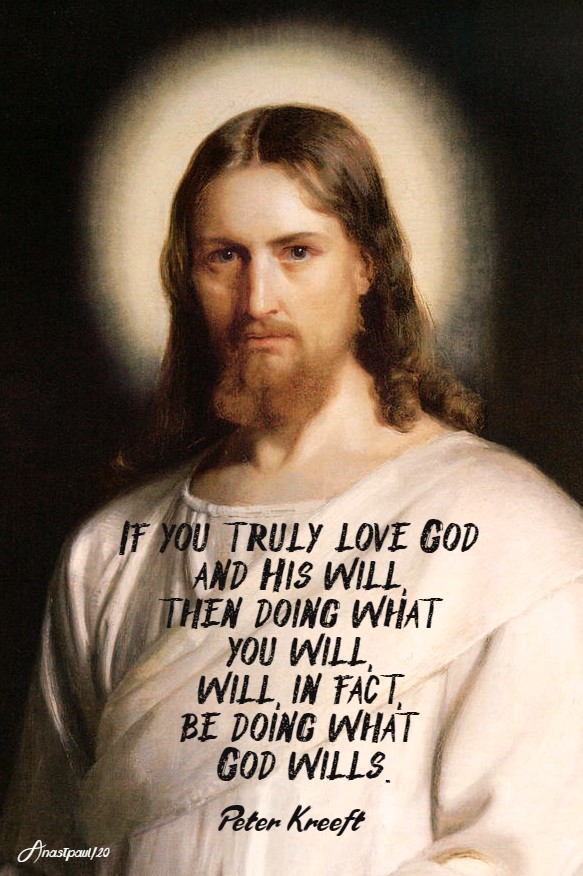
“If you truly love God and His will, then doing what you will, will, in fact, be doing what God wills.”
Thought for the Day – 30 May – “Mary’s Month” – Meditations with Antonio Cardinal Bacci (1881-1971)
The Ascension of Jesus
“When we meditate on the Ascension, we should humbly ask God, to give us the grace, to strip ourselves of our sins and defects. Then we shall be able to fly towards Him with love and hope in this life and, when our soul has been set free from the body which imprisons it on earth, we shall be able to set out on our last joyful flight into His presence. These are the reflections which should be in our minds around the feast of the Ascension. These are the desires which we should foster and the resolutions which we should form. Let us ask Our Lord, to bless them.
O Mary, my most holy Mother, implore your divine Son Jesus, now ascended into Heaven, that I may be more detached from the useless and passing goods of this earth. Ask Him to purify my soul from every stain of sin and to strengthen my will, in it’s good resolutions. Ask Him that my heart may rise nearer to God and to you, through it’s desire for perfection. Amen.”
One Minute Reflection – 25 May – “Mary’s Month” – Monday of the Seventh week of Easter, Readings: Acts 19:1-8, Psalm 68:2-7, John 16:29-33 and the Memorial of St Maria Magdalena de’ Pazzi O.Carm (1566-1607)
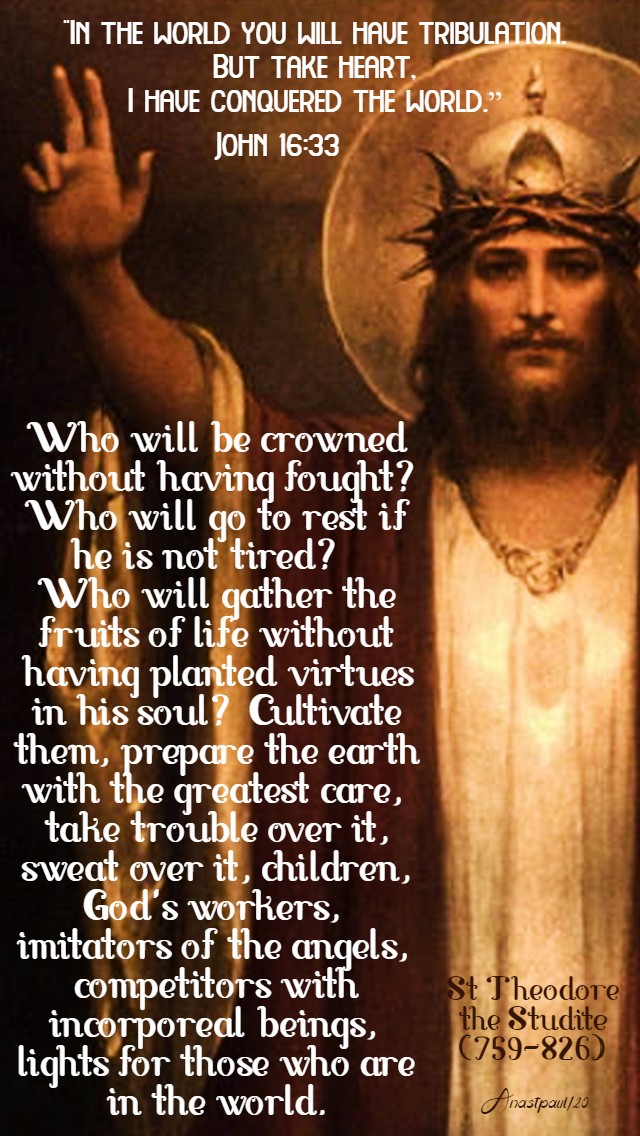
“In the world you will have tribulation. But take heart, I have conquered the world.” ... John 16:33
REFLECTION – “Let nothing intervene to hinder the progress of any who travel alongside each other, in this evangelical life but let us walk with agile step though the road be rough and hard, let us show a brave and manly spirit, overcome obstacles, pass along from pathway to pathway, from hill to hill, until we climb onto the mountain of the Lord and make a home for ourselves in the holy place of His impassibility.
Now, companions assist each other on the way; so then, my brothers, as the apostle says: “Bear one another’s burdens” (Gal 6:2) and make up for whatever is lacking to others (cf. 2 Cor 8:14 ; Phil 2:30). To the negligence that perhaps holds sway today, noble courage will succeed tomorrow, now one is in gloom and then suddenly one rises to the surface and discovers joy again, at one moment our passions rise up but soon God comes to help us, they are broken and calm returns. For you will only be seen like this yesterday and the day before but, dear friend, you will not always remain the same but the grace of God will draw near you, the Lord will fight for you and perhaps, like the great Antony, you will say: “Where were you just now?” and he will answer: “I wanted to see your combat.”
For now, let us persevere, children, dear children, let us be patient for a little, brothers, dear brothers.… Who will be crowned without having fought? Who will go to rest if he is not tired (cf. 2 Tim 2:5-6)? Who will gather the fruits of life without having planted virtues in his soul? Cultivate them, prepare the earth with the greatest care, take trouble over it, sweat over it, children, God’s workers, imitators of the angels, competitors with incorporeal beings, lights for those who are in the world (cf. Phil 2:15)!” … St Theodore the Studite (759-826) Monk – Catechesis 28
PRAYER – Lord God, as You brought joy to the world, through the resurrection of Lord Jesus Christ, Your Son, grant that through His Virgin Mother, we may constantly seek and recognise our Lord and Saviour and turn to Him in complete trust and love. May we ever live in confidence and share our joy with our neighbour. St Maria Magdalena de’ Pazzi, pray that we may know the courage of our Saviour. Through Jesus Christ our Lord, with You and the Holy Spirit, one God forever, amen.
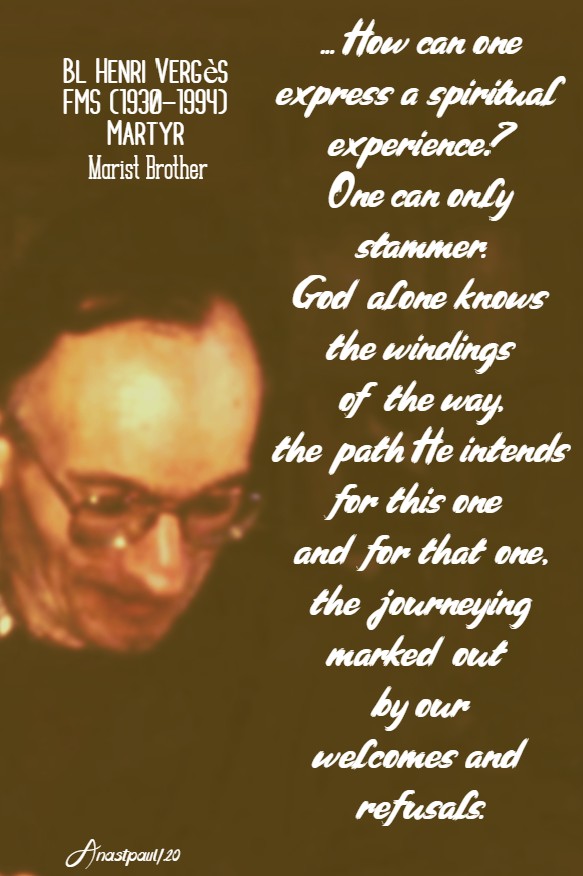
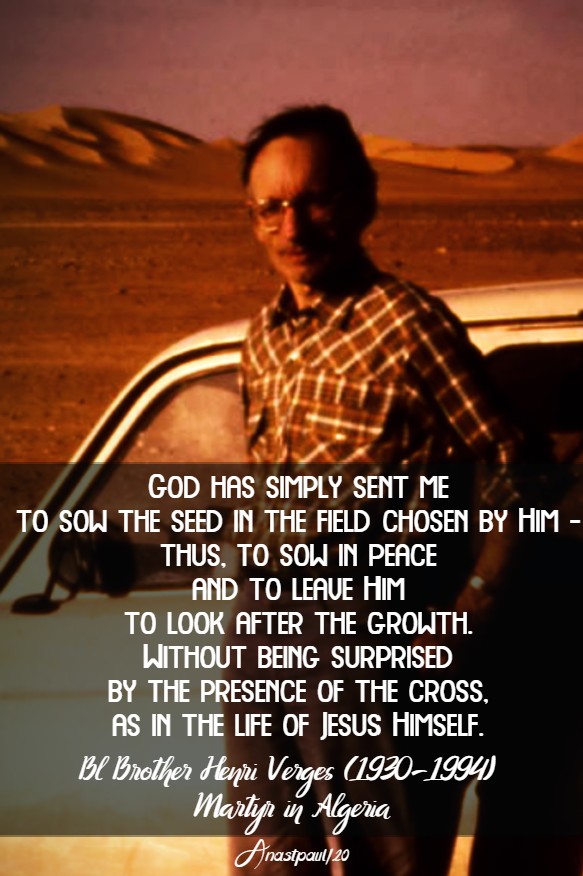
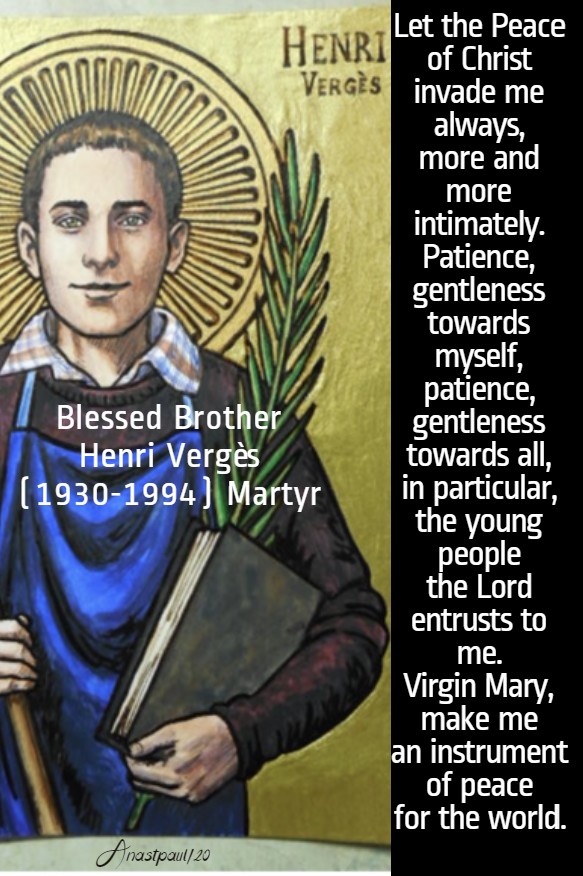
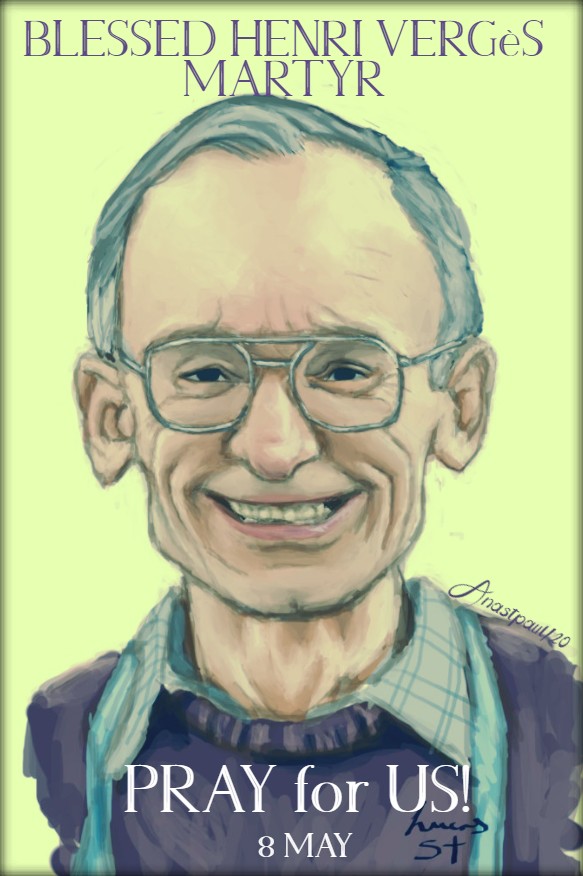
Quote/s of the Day – 8 May – The Memorial of Blessed Henri Vergès FMS (1930-1994) Martyr, Marist Brothers Missionary and one of the 19 Algerian Martyrs
“… How can one express a spiritual experience? One can only stammer. God alone knows the windings of the way, the path He intends for this one and for that one, the journeying marked out by our welcomes and refusals.”
“God has simply sent me to sow the seed in the field chosen by Him – thus, to sow in peace and to leave Him to look after the growth. Without being surprised by the presence of the cross, as in the life of Jesus Himself.”
“Let the Peace of Christ invade me always, more and more intimately. Patience, gentleness towards myself, patience, gentleness towards all, in particular, the young people the Lord entrusts to me. Virgin Mary, make me an instrument of peace for the world.”
One Minute Reflection – 8 May – “Mary’s Month” – Friday of the Fourth Week of Easter, Readings: Acts 13:26-33, Psalm 2:6-11, John 14:1-6 and the Memorial of Blessed Henri Vergès FMS (1930-1994) Martyr
Jesus said to him, “I am the way and the truth and the life. No-one comes to the Father except through me.” … John 14:6
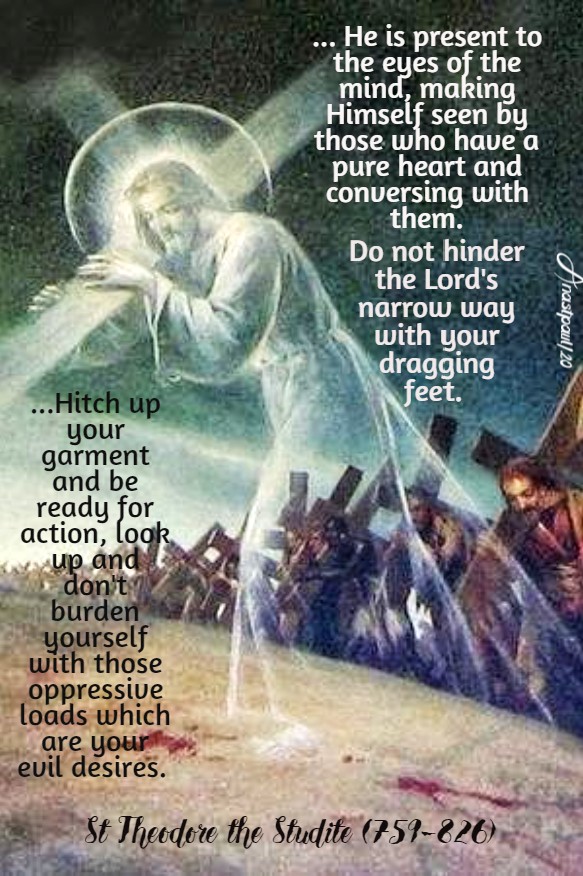
REFLECTION – “Day by day follow God’s path, keeping Him closely attached to you by His promise. In fact, He Himself said, through the mediation of His apostles, to all those who seek His will and His testimonies (Ps 118[119]:31 LXX), that He would be with them until the end of the world (Mt 28:20) where paths and footsteps will be unknown (cf, Ps 76:20), as the divine David said in his songs. Yet, in an invisible way, He is present to the eyes of the mind, making Himself seen by those who have a pure heart and conversing with them. So pursue your path ….
Take the wings of the love of God to fly like the clouds (cf. Is 60:8), raised above the obstacles of this earth. Anoint your feet with the oil of joy (cf. Ps 44:8) and temperance. Do not hinder the Lord’s narrow way with your dragging feet. If you are thirsty in your pusillanimity, drink the water of patience (cf. Sir 15:3), if you are hungry in your spiritual sluggishness, eat the bread that nourishes and strengthens the heart of man (cf. Ps 103[104]:15), a word of wisdom and courage. Hitch up your garment and be ready for action, look up and don’t burden yourself with those oppressive loads which are your evil desires. For anyone who is accomplishing the journey from earth to heaven, it is enough to diligently pursue one’s path without assuming extra weight. …
Be strong in the Lord; go up to the mountain of God, to His holy house (Is 2:3) with Isaiah the cantor, the prophet with such a powerful voice. Let none remain behind, none sit down; help one another, everyone rooted in a firm charity.” … St Theodore the Studite (759-826) Monk and Theologian at Constantinople – Catechesis 11
PRAYER – “[Lord God] I believe in You, increase my faith. All my hopes are in You, secure my trust. I love You, teach me to love You more each day… I adore You as my first beginning, I long for You as my final end. I praise You as my constant helper and call on You as my loving protector. Guide me by Your Wisdom, correct me with Your Justice, comfort me with Your Mercy, protect me by Your Power… Lord, enlighten my understanding, enflame my will, purify my heart, sanctify my soul. Help me to repent of my past sins and to rise above my human weaknesses and to grow stronger as a Christian…” (from the Universal Prayer by Pope Clement XI (1649-1721) Mary, Mother of our Lord, pray for us! Blessed Henri Vergès (1930-1994) Martyr, pray for us!
Quote/s of the Day – 7 May – Thursday Fourth week of Easter, Readings: Acts 13:13-25, Psalm 89:2-3, 21-22, 25, 27, John 13:16-20
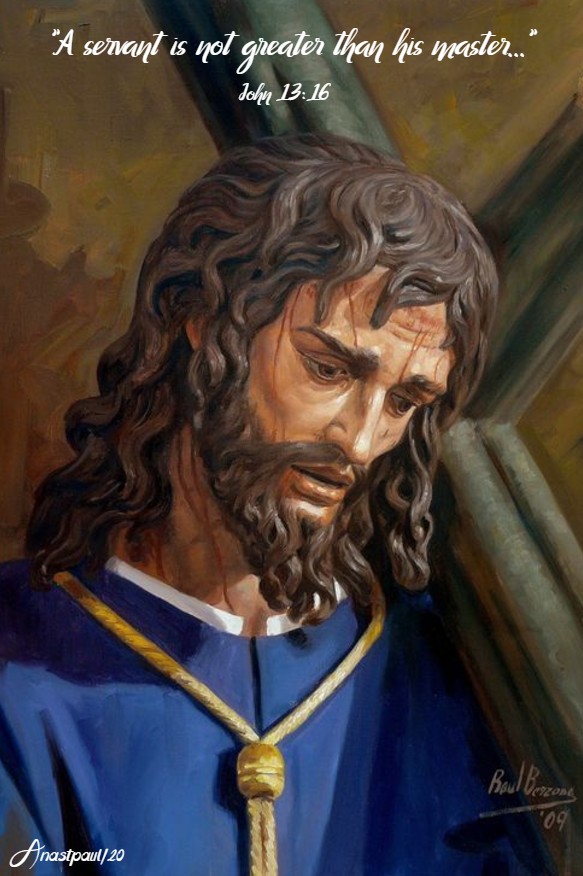
“A servant is not greater than his master…”
John 13:16
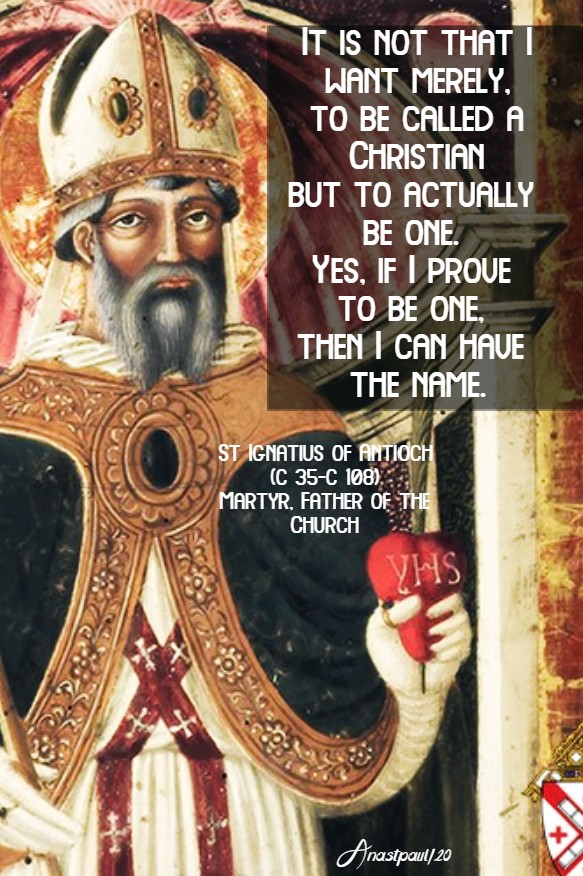
“It is not that I want merely, to be called a Christian but to actually be one. Yes, if I prove to be one, then I can have the name.”
St Ignatius of Antioch (c 35-c 108)
Martyr, Father of the Church
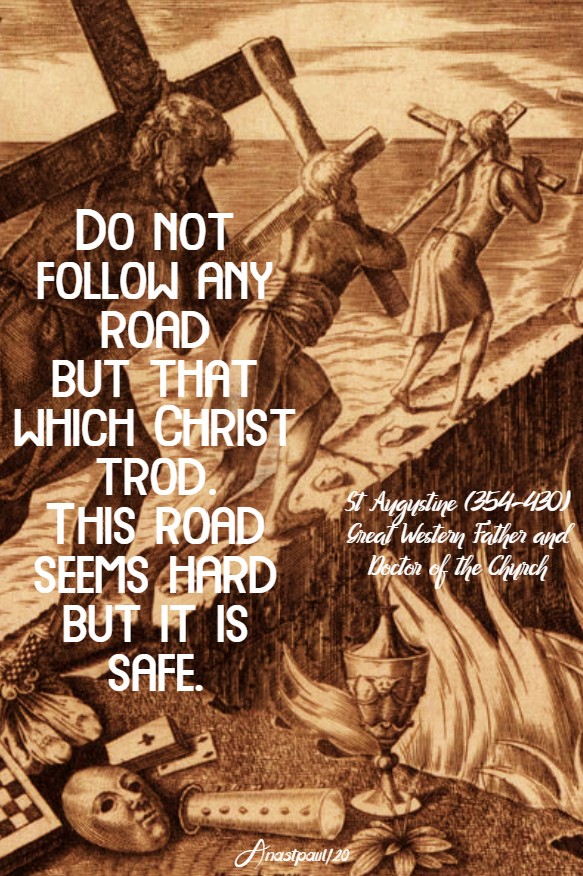
“Do not follow any road but that which Christ trod. This road seems hard but it is safe.”
St Augustine (354-430)
Great Western Father and Doctor of the Church
“There is a difference between renouncing all things and leaving all things. For it is the way of few perfect men to leave all things, that is, to cast behind them the cares of the world but it is the part of all the faithful, to renounce all things, that is, so to hold the things of the world instead of by them being held in the world.”
St Bede the Venerable (673-735)
Father and Doctor of the Church
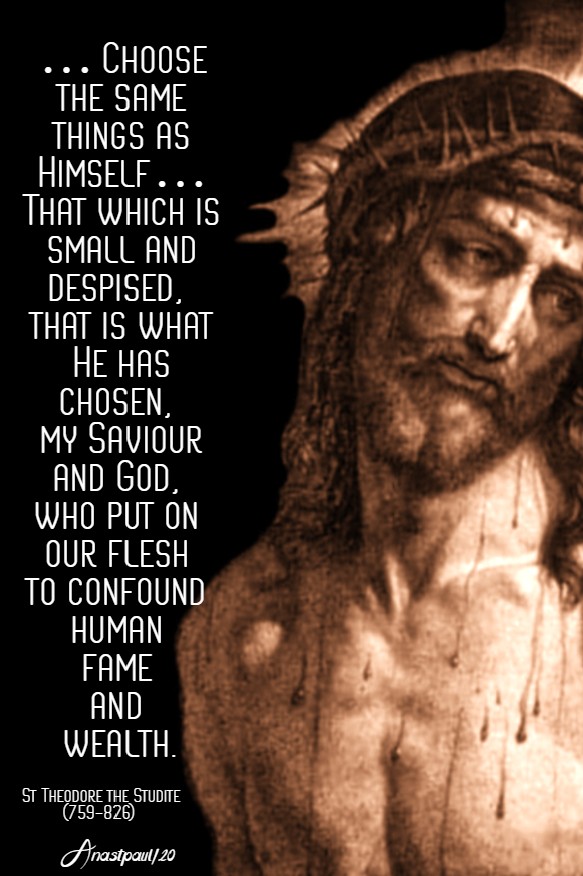
“‘… Choose the same things as Himself…” That which is small and despised, that is what He has chosen, my Saviour and God, who put on our flesh to confound human fame and wealth.”
St Theodore the Studite (759-826)
Monk and Theologian at Constantinople
Catechesis 78
“When it comes to following Jesus, it’s usually not more information that we need but more guts.”
One Minute Reflection -– 7 May – “Mary’s Month” – Thursday Fourth week of Easter, Readings: Acts 13:13-25, Psalm 89:2-3, 21-22, 25, 27, John 13:16-20 and the Memorial of Nlessed Alberto of Bergamo OP (1214-1279)
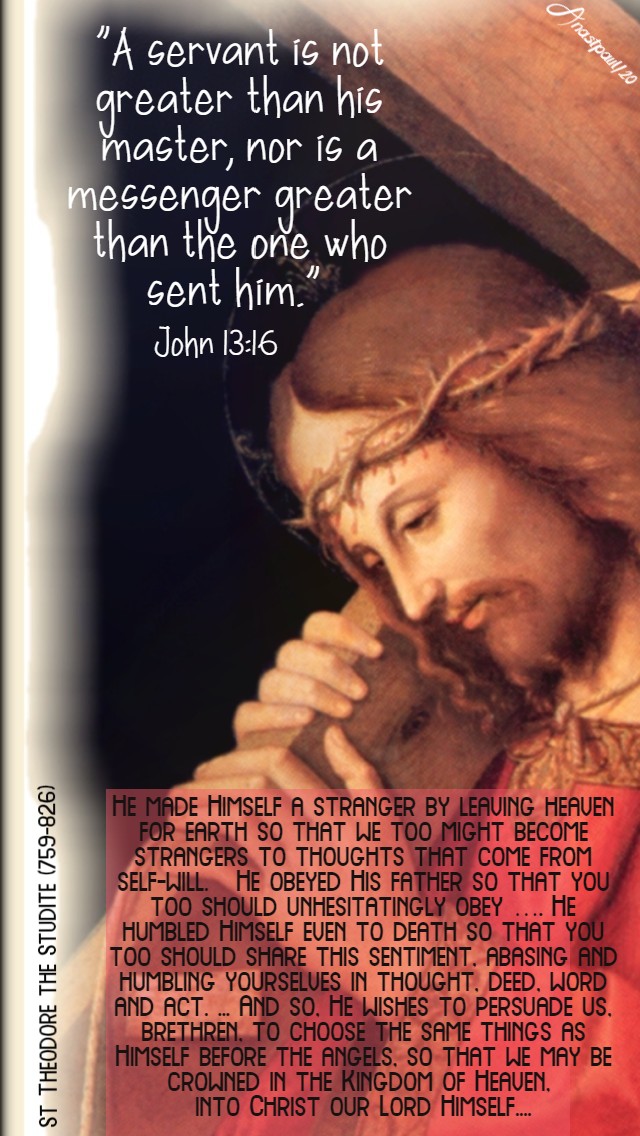
“A servant is not greater than his master, nor is a messenger greater than the one who sent him.” … John 13:16
REFLECTION – “Remember the wonders He has done for us (Ps 104[105]:5) in the past and those he does still. … In response to what He has done for us let us do even more and return what we owe Him, most venerable brethren. And what He wants from us is surely that we should fear Him, love Him with all our heart and all our mind (cf. Mt 22:37) and imitate His life in the flesh insofar as we can?
He made Himself a stranger by leaving heaven for earth so that we too might become strangers to thoughts that come from self-will. He obeyed His father so that you too should unhesitatingly obey …. He humbled Himself even to death (cf. Phil 2:8) so that you too should share this sentiment, abasing and humbling yourselves in thought, deed, word and act. Where is divine and true glory to be found, if not in becoming, without glory amongst men for God’s sake? … That which is small and despised, that is what He has chosen, my Saviour and God, who put on our flesh to confound (1 Cor 1:27-28) human fame and wealth.
This is why He was born in a cave, was laid in a manger, was called the son of a carpenter, called a Nazarene. He was clothed in one poor tunic and a single cloak; He went by foot, suffered, was stoned by the Jews (cf. Jn 10:31), insulted, arrested, crucified, pierced with a lance, placed in the tomb, after which He rose again. And so, He wishes to persuade us, brethren, to choose the same things as Himself before the angels, so that we may be crowned in the Kingdom of Heaven, into Christ our Lord Himself, to whom belongs glory and power, together with the Father and Holy Spirit, now and forever. Amen.” … St Theodore the Studite (759-826) Monk and Theologian at Constantinople – Catechesis 78
PRAYER – Lord God, stand by us in Your saving work and stay with us in Your gifts of grace. You have rescued us from the darkness, keep us ever in Your light. May the ways of truth and life which Jesus Christ Your Son taught us, be our anchor and our light. We ask that You hear the intercession of Mary, the Blessed Virgin Mother and Bl Alberto of Bergamo, whom we beseech for help as we work to reach our heavenly home. Through Christ our Lord, with the Holy Spirit, God forever, amen
The Immaculate Virgin – the Purple Flower of Sacrifice
Moments with Saint Pope John XXIII (1881-1963)
She who was preserved from original sin through the merits of her Son the Redeemer, was granted this privilege because she was predestined for the sublime mission of being the Mother of God.
She, who was to clothe in mortal flesh, the eternal Word of the Father, could not be contaminated, even for an instant, by the shadow of sin.
So, she is immaculate through the power of Christ, because all that was granted to the Mother, was granted through her Son.
The blooming of this snow white flower on our soil, is a sure pledge of the reconciliation of mankind with God.
How apt are the words of the liturgy that we sin on the Feast of the Nativity of the Virgin – “Thy nativity, O Virgin Mother of God, was the herald of joy to the whole world.”
But this joy is also a purple flower of sacrifice – the sacrifice of the Blessed Mother of Jesus who, when she gave her consent: “Be it unto me …” accepted her share in the destines of her Son, from the poverty of Bethlehem, to the self-denials of the secluded life in Nazareth and the martyrdom of Calvary.
So we may not consider ourselves, the beloved children of Our Lord and of His Mother, if our life is without sacrifice and self-denial.
May this reference to the requirement of sacrifice, be then a loving and thoughtful reminder of the strong and solid Christian virtues of self-denial, patience and penitence. Amen
Quote/s of the Day – 5 May – Tuesday of the Fourth Week of Easter, Readings: Acts11:19-26, Psalm 87:1-7, John 10:22-30
“I and the Father are one.”
John 10:30
Christians are baptised “in the name of the Father and of the Son and of the Holy Spirit” (Mt 28:30). Before receiving the sacrament, they respond to a three-part question when asked to confess the Father, the Son and the Spirit: “I do.” “The faith of all Christians rests on the Trinity”( St Caesarius of Arles). Christians are baptised “in the name” of the Father and of the Son and of the Holy Spirit – not “in their names,, for there is only one God, the almighty Father, His only Son and the Holy Spirit – the Most Holy Trinity.
The mystery of the Most Holy Trinity is the central mystery of Christian faith and life. It is the mystery of God in Himself. It is, therefore, the source of all the other mysteries of faith, the light that enlightens them. It is the most fundamental and essential teaching in the hierarchy of the truths of faith. The whole history of salvation is identical with the history of the way and the means, by which the one true God, Father, Son and Holy Spirit, reveals Himself to men and reconciles and unites with Himself, those who turn away from sin. …
The Trinity is a mystery of faith in the strict sense, one of the mysteries that are hidden in God, which can never be known unless they are revealed by God. To be sure, God has left traces of His Trinitarian Being in His work of creation and in His Revelation throughout the Old Testament. But His inmost Being, as Holy Trinity, is a mystery that is inaccessible to reason alone, or even to Israel’s faith before the Incarnation of God’s Son and the sending of the Holy Spirit.
CCC – Catechism of the Catholic Church
# 232-234, 237
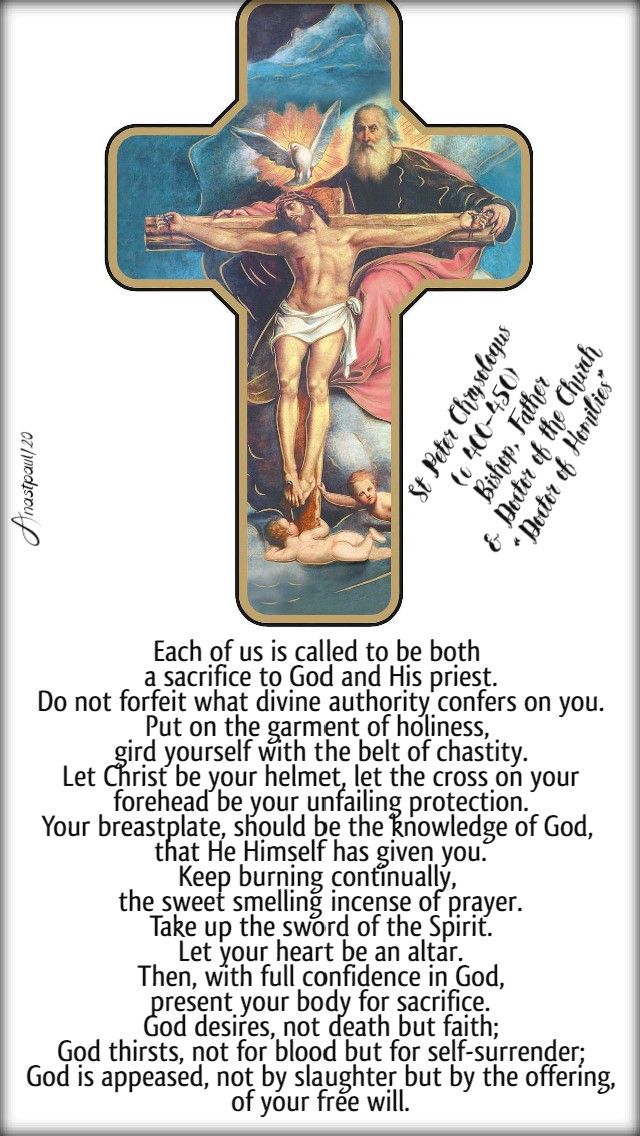
“Paul says: I appeal to you by the mercy of God, to present your bodies as a sacrifice, living and holy. The prophet said the same thing: Sacrifice and offering you did not desire but you have prepared a body for me. Each of us is called to be both a sacrifice to God and His priest. Do not forfeit what divine authority confers on you. Put on the garment of holiness, gird yourself with the belt of chastity. Let Christ be your helmet, let the cross on your forehead be your unfailing protection. Your breastplate, should be the knowledge of God, that He Himself has given you. Keep burning continually, the sweet smelling incense of prayer. Take up the sword of the Spirit. Let your heart be an altar. Then, with full confidence in God, present your body for sacrifice. God desires, not death but faith; God thirsts, not for blood but for self-surrender; God is appeased, not by slaughter but by the offering, of your free will.”
St Peter Chrysologus (c 400-450)
Bishop, Father & Doctor of the Church
“Doctor of Homilies”
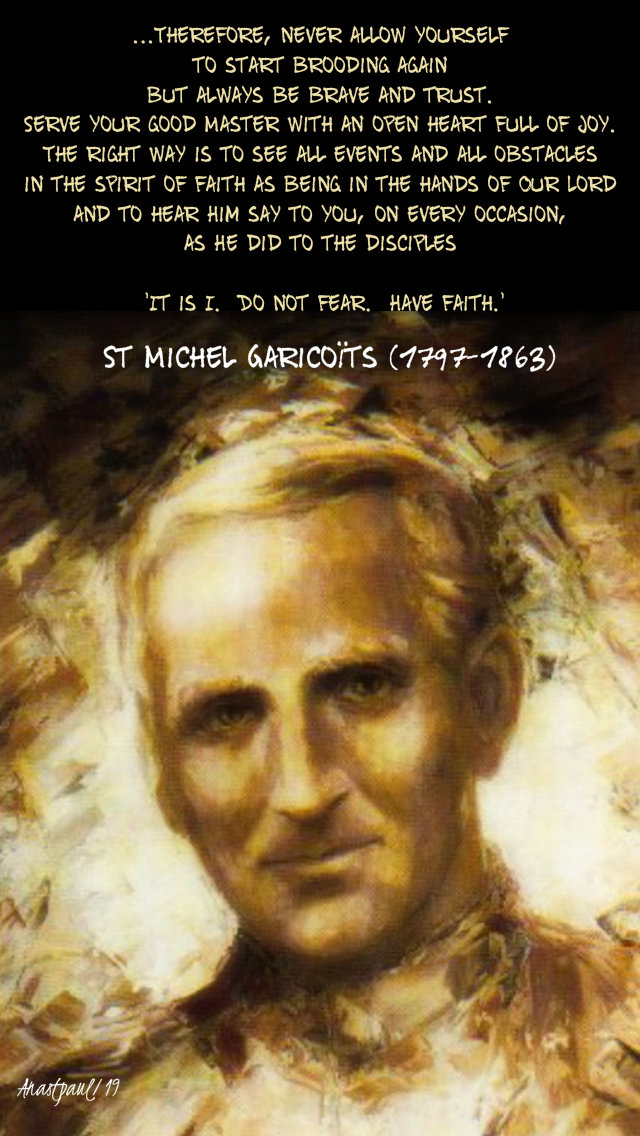
“…Therefore, never allow yourself to start brooding again but always be brave and trust. Serve your good Master with an open heart full of joy. The right way is to see all events and all obstacles in the spirit of faith as being in the hands of Our Lord and to hear Him say to you, on every occasion, as He did to the disciples ‘It is I. Do not fear. Have faith.’”
Quote/s of the Day – 29 April – Wednesday of the Third Week of Easter, Readings: Acts 8:1-8, Psalm 66:1-7, John 6:35-40 and the Memorial of St Catherine of Siena (1347-1380) Doctor of the Church and Bl Mary Magdalene of the Incarnation FSPA (1770-1824)
“I am the bread of life; he who comes to me, shall not hunger and he who believes in me, shall never thirst.”
John 6:35
“He will provide the way and the means, such as you could never have imagined. Leave it all to Him, let go of yourself, lose yourself on the Cross and you will find yourself entirely.”
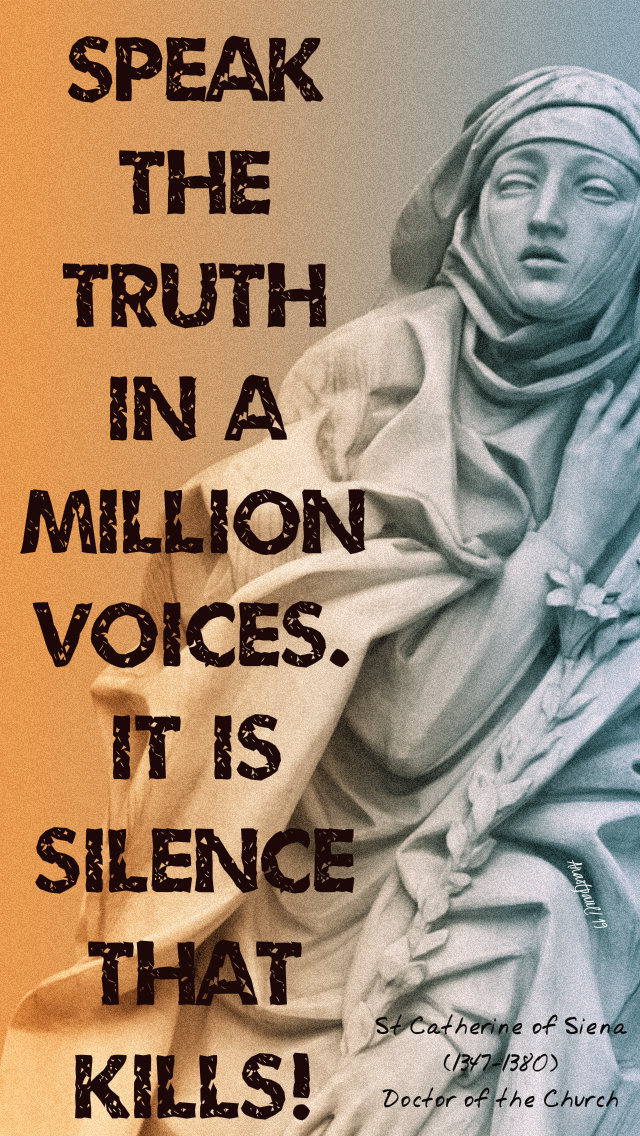
“Speak the truth in a million voices. It is silence that kills!”
St Catherine of Siena (1347-1380) Doctor of the Church
“May Jesus be known, loved and adored by all and be, in every moment, the receiver of thanksgiving, in the most holy and most divine Sacrament.”
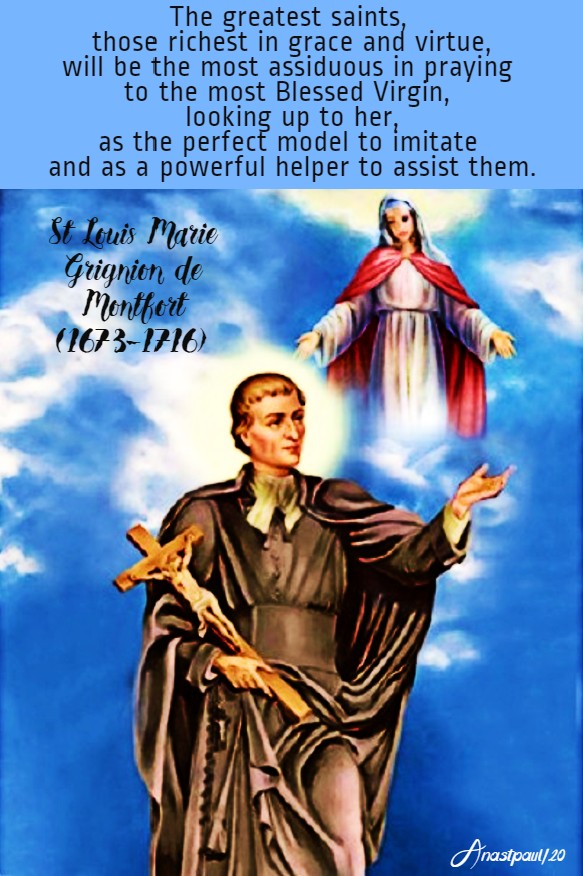
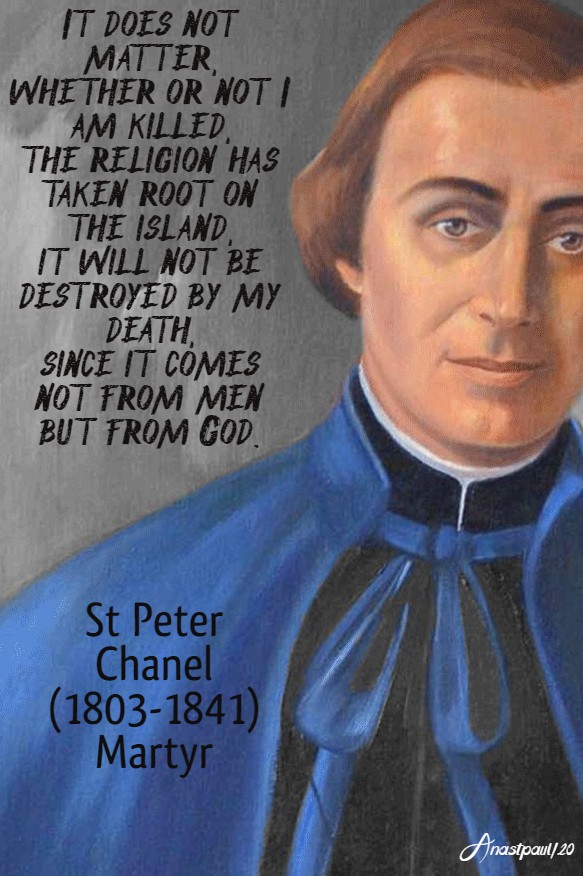
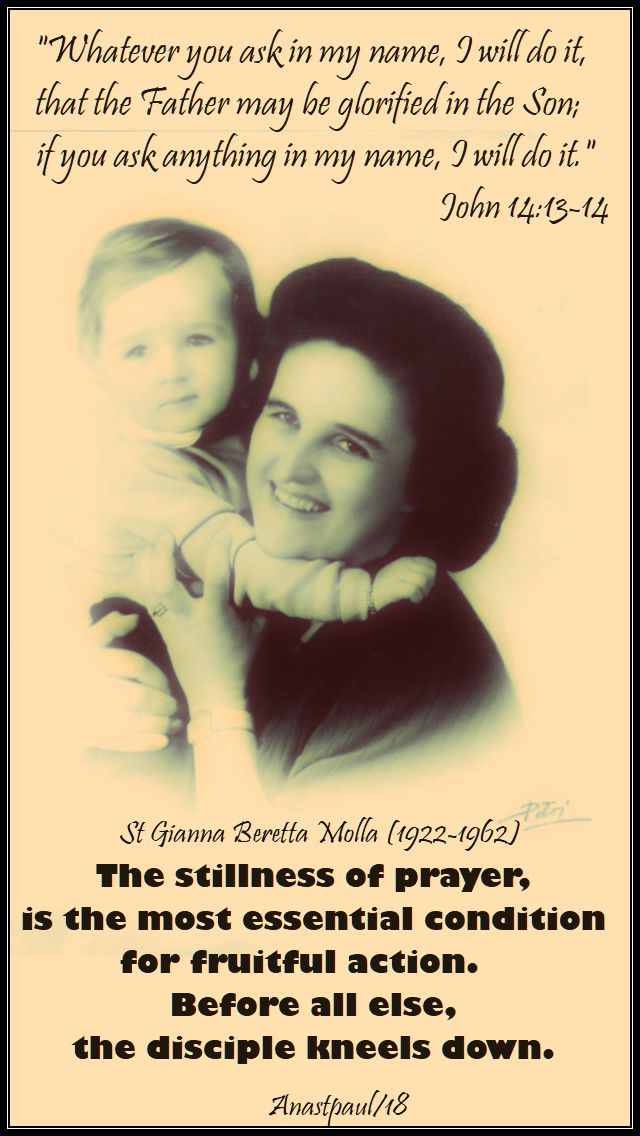
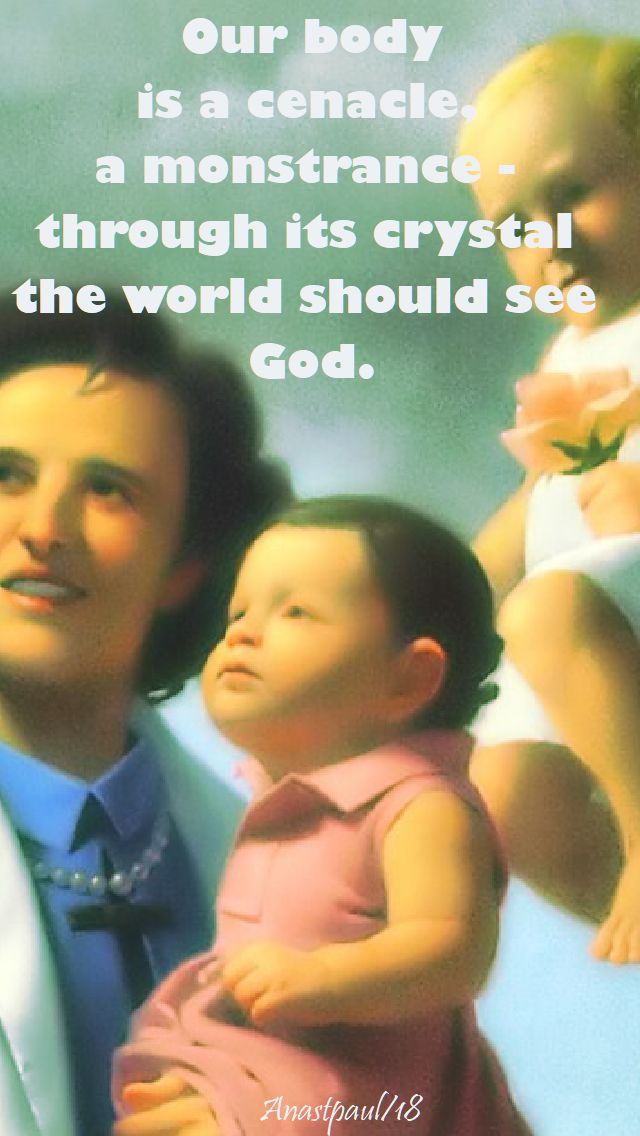
Quote/s of the Day – 28 May – Tuesday of the Third Week of Easter and the Memorial of St Louis Marie Grignion de Montfort (1673-1716), St Peter Chanel (1803-1841) Priest and Martyr, St Gianna Beretta Molla (1922-1962), Blessed María Felicia of Jesus in the Blessed Sacrament OCD (1925-1959)
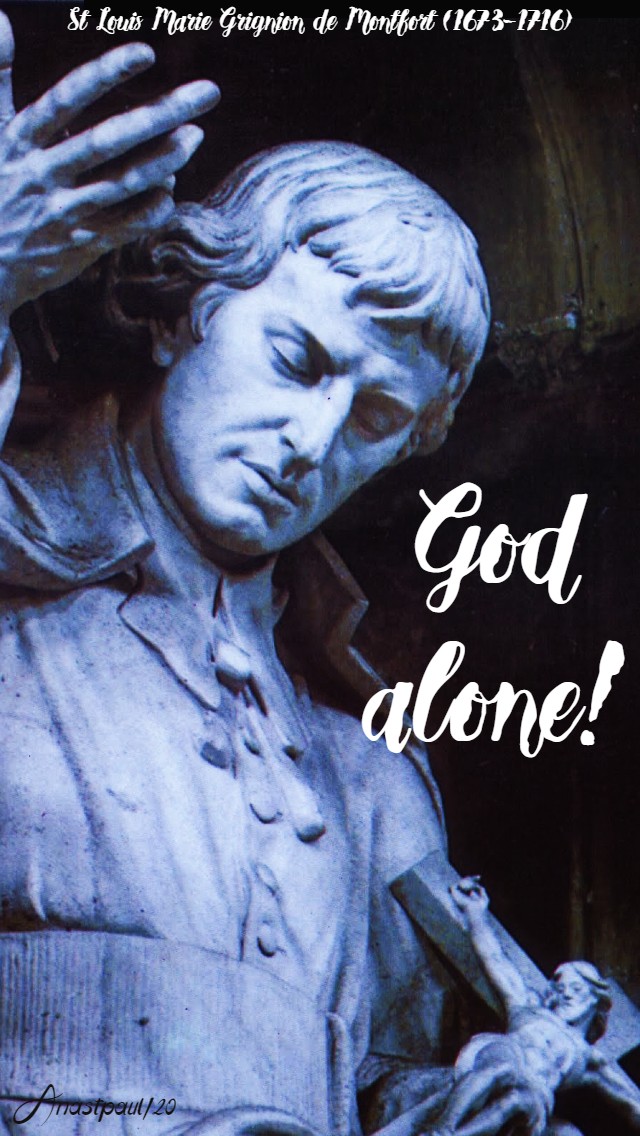
“God alone!”
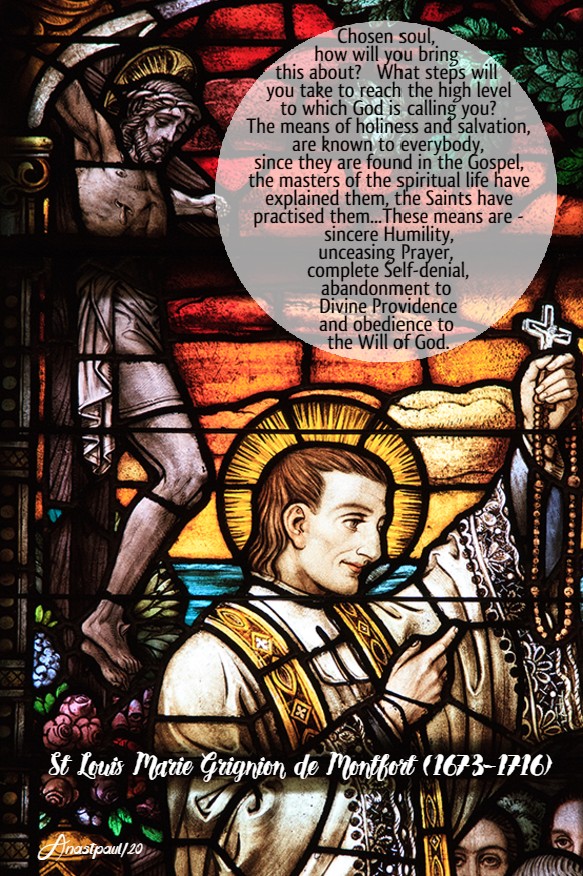
“Chosen soul, how will you bring this about? What steps will you take to reach the high level to which God is calling you? The means of holiness and salvation, are known to everybody, since they are found in the Gospel, the masters of the spiritual life have explained them, the Saints have practised them… These means are – sincere Humility, unceasing Prayer, complete Self-denial, abandonment to Divine Providence and obedience to the Will of God.”
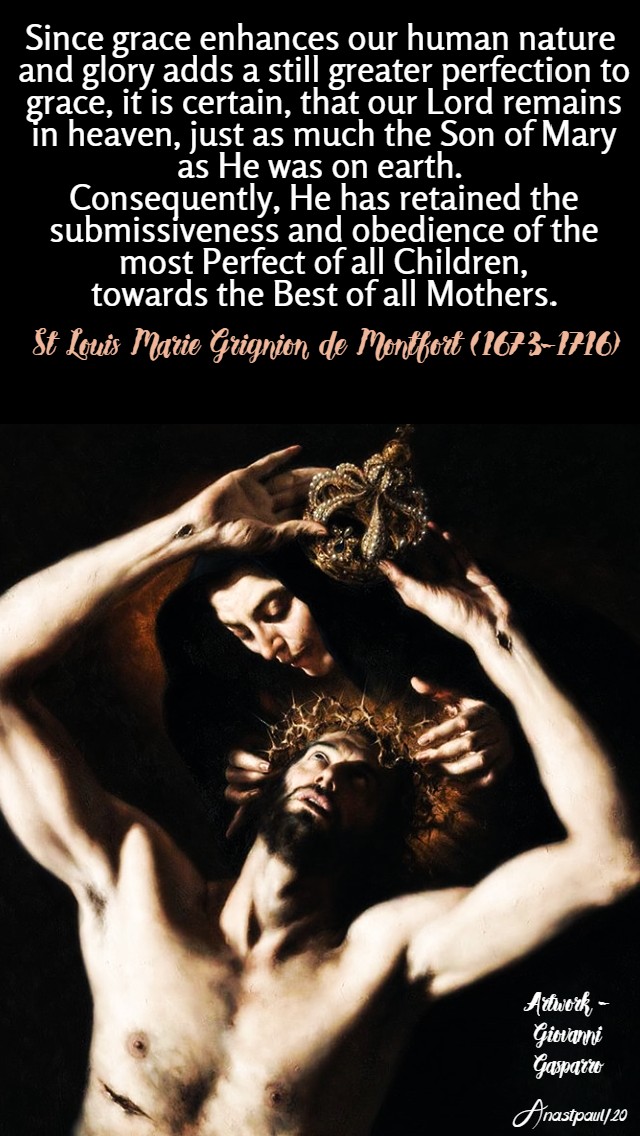
“Since grace enhances our human nature and glory adds a still greater perfection to grace, it is certain, that our Lord remains in heaven, just as much the Son of Mary as He was on earth. Consequently, He has retained the submissiveness and obedience of the most Perfect of all Children, towards the Best of all Mothers.”
True Devotion to the Blessed Virgin, #27
“The greatest saints, those richest in grace and virtue, will be the most assiduous in praying to the most Blessed Virgin, looking up to her, as the perfect model to imitate and as a powerful helper to assist them. “
St Louis Marie Grignion de Montfort (1673-1716)
“It does not matter, whether or not I am killed, the religion has taken root on the island, it will not be destroyed by my death, since it comes not from men but from God.”
St Peter Chanel (1803-1841) Priest and Martyr
“The stillness of prayer is the most essential condition for fruitful action. Before all else, the disciple kneels down.”
“Our body is a cenacle, a monstrance – through its crystal, the world should see God.”
St Gianna Beretta Molla (1922-1962)
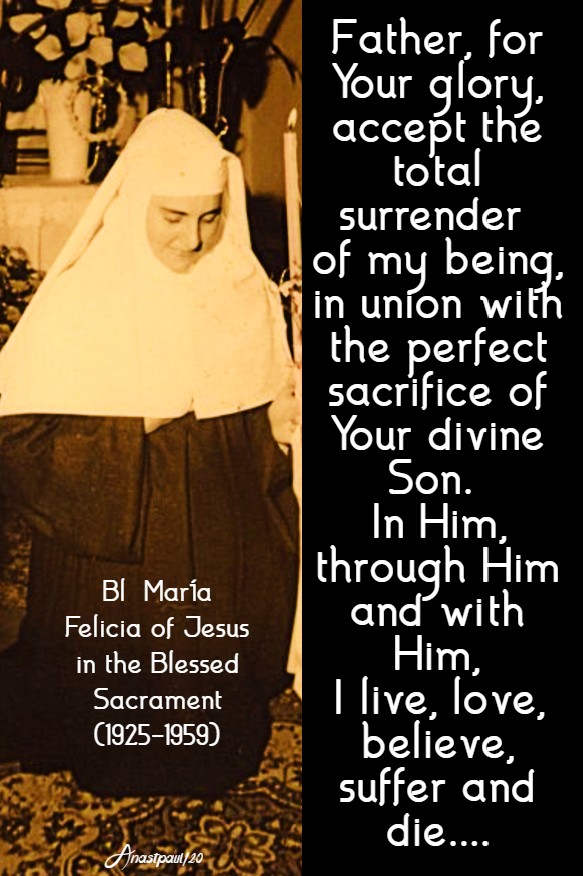
“Father, for Your glory, accept the total surrender of my being, in union with the perfect sacrifice of Your divine Son. In Him, through Him and with Him, I live, love, believe, suffer and die….”
Blessed María Felicia of Jesus in the Blessed Sacrament (1925-1959)
Quote/s of the Day – 20 April – Monday of the Second week of Easter, Readings: Acts 4:23-31, Psalm 2:1-9, John 3:1-8
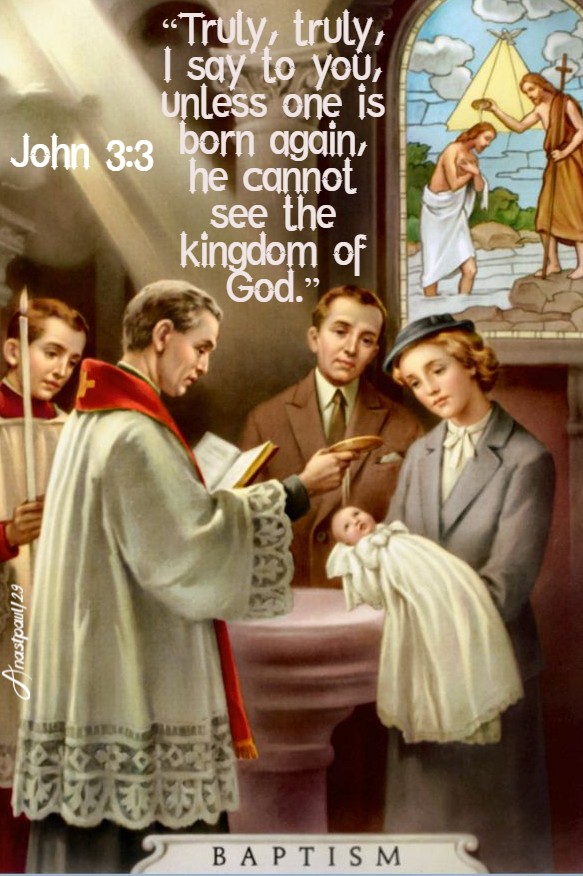
“Truly, truly, I say to you, unless one is born again, he cannot see the kingdom of God.”
John 3:3
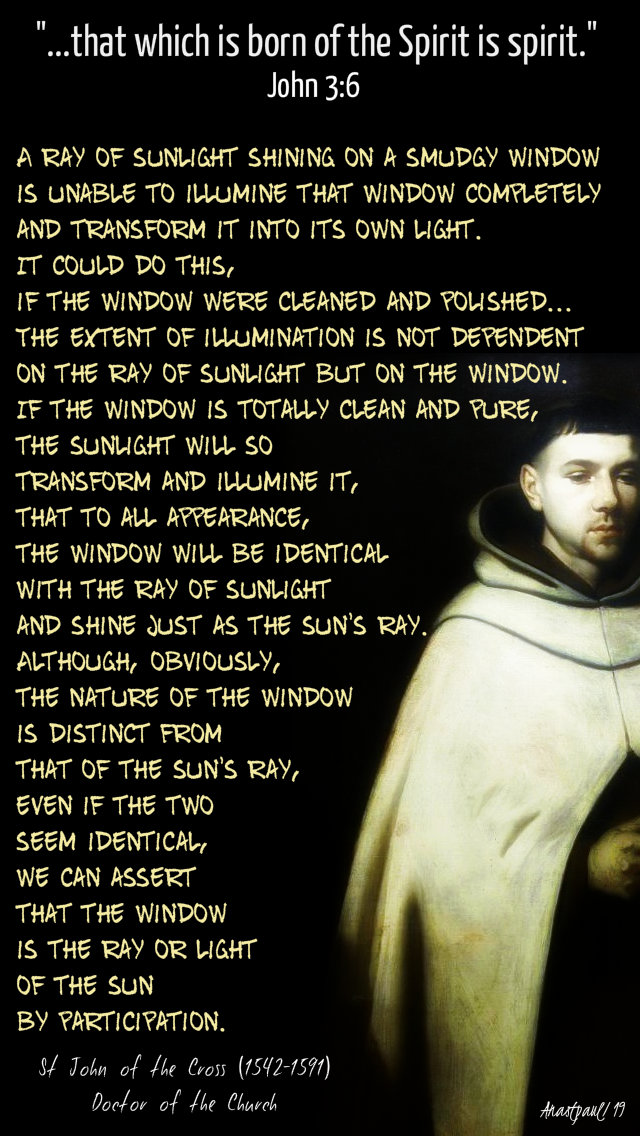
“We read in Saint John – No-one can enter the Kingdom of God without being born of water and Spirit. To be reborn in the Holy Spirit during this life is to become most like God in purity, without any mixture of imperfection. Accordingly, pure transformation can be effected – although not essentially – through the participation of union.
Here is an example that will provide a better understanding of this explanation. A ray of sunlight shining on a smudgy window, is unable to illumine that window completely and transform it into its own light. It could do this, if the window were cleaned and polished… The extent of illumination is not dependent on the ray of sunlight but on the window. If the window is totally clean and pure, the sunlight will so transform and illumine it, that to all appearances the window will be identical with the ray of sunlight and shine just as the sun’s ray. Although, obviously, the nature of the window is distinct from that of the sun’s ray, even if the two seem identical, we can assert, that the window is the ray or light of the sun by participation.
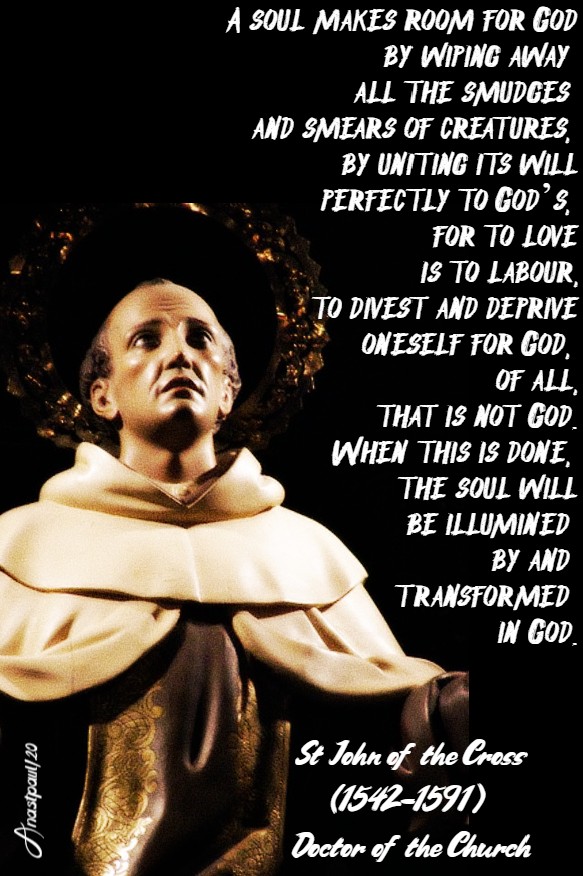
The soul on which the divine light of God’s being is ever shining, or better, in which it is ever dwelling by nature, is like this window. A soul makes room for God by wiping away all the smudges and smears of creatures, by uniting its will perfectly to God’s, for to love is to labour, to divest and deprive oneself for God, of all that is not God When this is done, the soul will be illumined by and transformed in God.”
St John of the Cross (1542-1591)
Doctor of the Church
“What you are is God’s gift to you, what you become, is your gift to God.”
Hans Cardinal Urs von Balthasar (1905-1988)
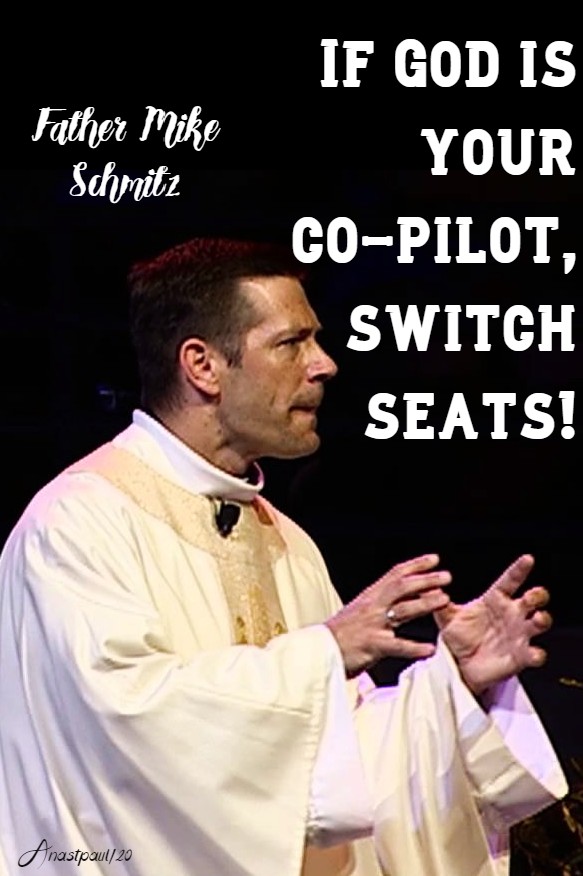
“If God is your co-pilot, switch seats!”
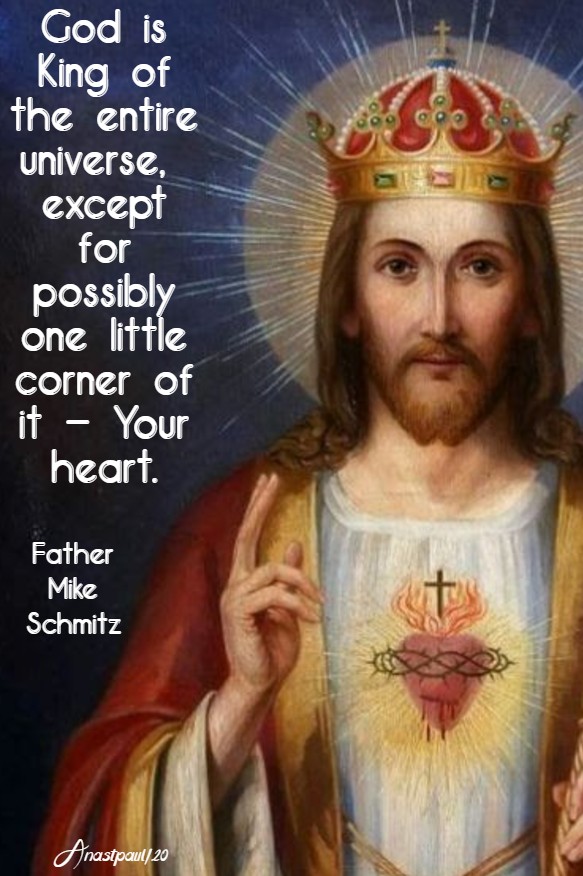
“God is King of the entire universe, except for possibly one little corner of it – Your heart.”
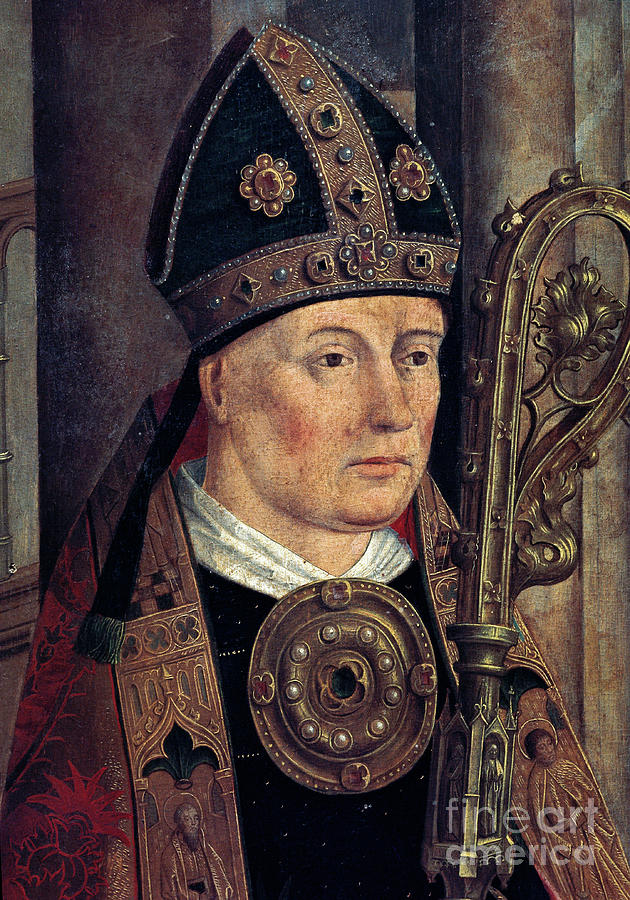
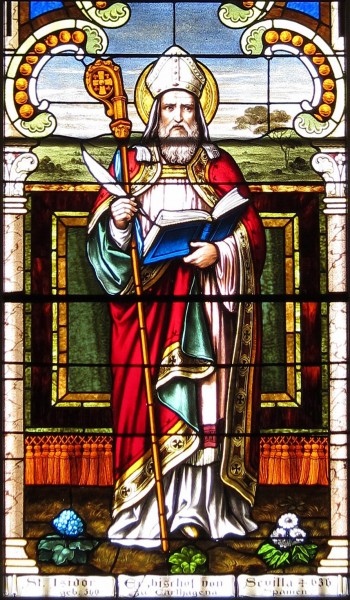
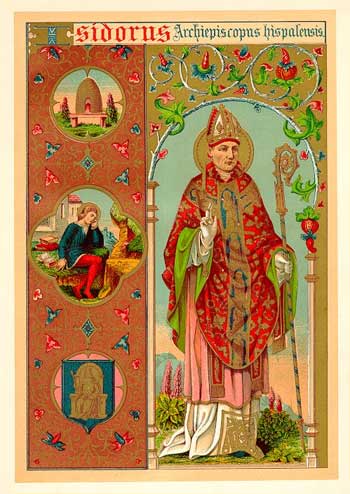
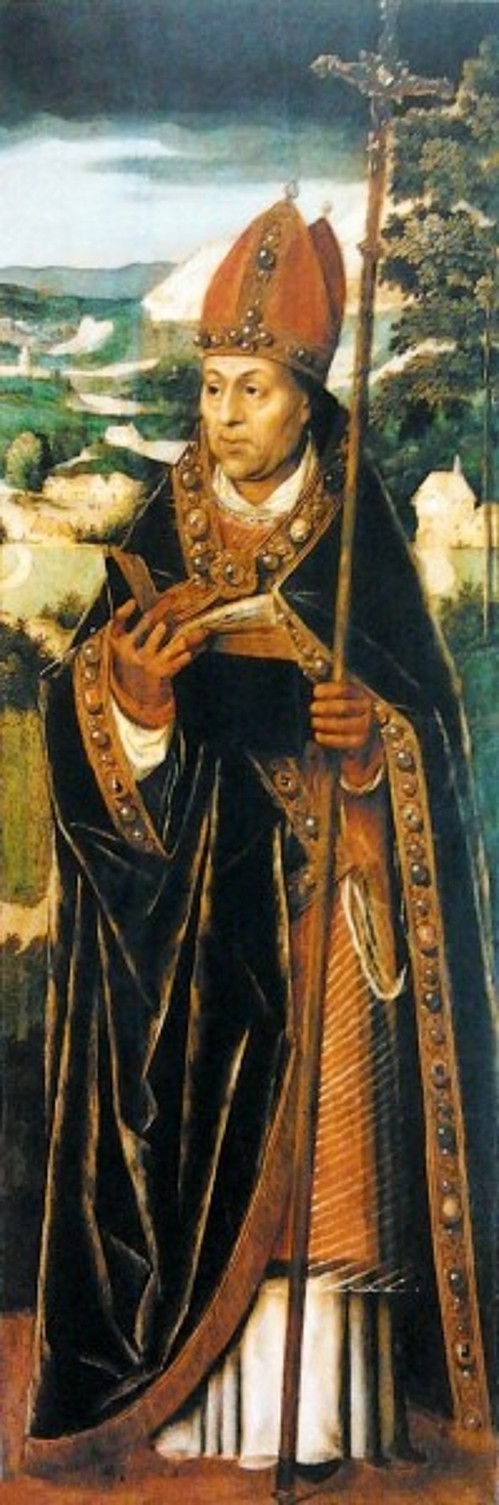
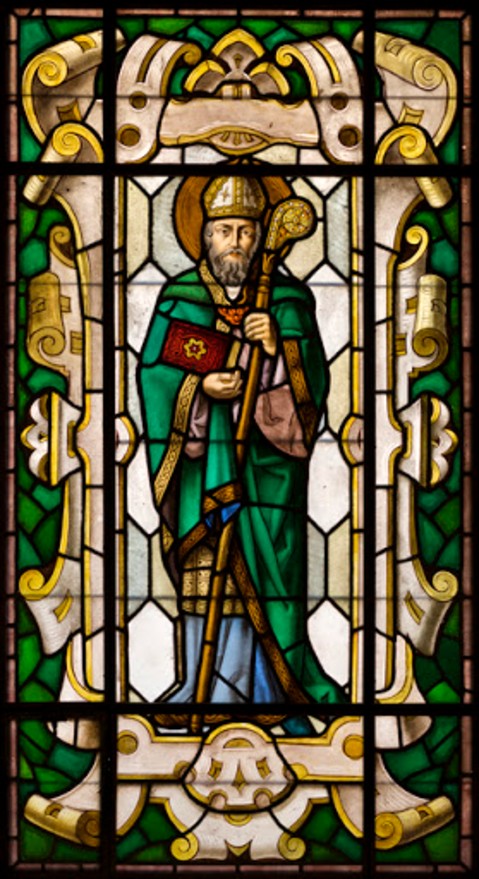
Saint of the Day – 4 April – St Isidore of Seville (c 560-636) Father & Doctor of the Church, Creator of the first encyclopedia – often called “The Last Scholar of the Ancient World” and “The Schoolmaster of the Middle Ages.” His most well known Patronage is of Computers and the Internet (although not officially so_ – his full story with Patronages is here: https://anastpaul.wordpress.com/2017/04/04/saint-of-the-day-4-april-st-isidore-of-seville-father-and-doctor-of-the-church/ but today we will follow his life with Pope Benedict XVI during his Catechetical audiences on the Doctors of the Church. This was given at St Peter’s on Wednesday, 18 June 2008.
He was a younger brother of St Leander (c 534-c 600) memorial 13 March, Archbishop of Seville and a great friend of St Pope Gregory the Great. Pointing this out is important, because it enables us, to bear in mind, a cultural and spiritual approach, that is indispensable for understanding Isidore’s personality. Indeed, he owed much to Leander, an exacting, studious and austere person who created around his younger brother a family context, marked by the ascetic requirements proper to a monk and from the work pace demanded, by a serious dedication to study. Furthermore, Leander was concerned to have the wherewithal to confront the political and social situation of that time – in those decades in fact, the Visigoths, barbarians and Arians, had invaded the Iberian Peninsula and taken possession of territories that belonged to the Roman Empire. It was essential to regain them for the Roman world and for Catholicism. Leander and Isidore’s home was furnished with a library richly endowed with classical, pagan and Christian works. Isidore, who felt simultaneously attracted to both, was, therefore, taught under the responsibility of his elder brother, to develop a very strong discipline, in devoting himself to study with discretion and discernment.
Thus, a calm and open atmosphere prevailed in the episcopal residence in Seville. We can deduce this from Isidore’s cultural and spiritual interests, as they emerge from his works themselves, which include an encyclopaedic knowledge of pagan classical culture and a thorough knowledge of Christian culture. This explains the eclecticism characteristic of Isidore’s literary opus, who glided with the greatest of ease from Martial to Augustine, or from Cicero to Gregory the Great. The inner strife that the young Isidore had to contend with, having succeeded his brother Leander on the episcopal throne of Seville in 599, was by no means unimportant. The impression of excessive voluntarism that strikes one, on reading the works of this great author, considered to be the last of the Christian Fathers of antiquity, may, perhaps, actually be due to this constant struggle with himself. A few years after his death in 636, the Council of Toledo in 653 described him as “an illustrious teacher of our time and the glory of the Catholic Church.”
Isidore was, without a doubt, a man of accentuated dialectic antitheses. Moreover, he experienced a permanent inner conflict in his personal life, similar to that which Gregory the Great and St Augustine had experienced earlier, between a desire for solitud, to dedicate himself solely to meditation on the word of God and, the demands of charity to his brethren, for whose salvation, as Bishop, he felt responsible. He wrote, for example, with regard to Church leaders: “The man responsible for a Church (vir ecclesiasticus) must on the one hand allow himself to be crucified to the world, with the mortification of his flesh and, on the other, accept the decision of the ecclesiastical order – when it comes from God’s will – to devote himself humbly to government, even if he does not wish to”(Sententiarum liber III, 33, 1: PL 83, col 705 B). Just a paragraph later he adds: “Men of God, (sancti viri), do not in fact desire to dedicate themselves to things of the world and groan when by some mysterious design of God they are charged with certain responsibilities…. They do their utmost to avoid them bu,t accept what they would like to shun and do what they would have preferred to avoid. Indeed, they enter into the secrecy of the heart and seek there to understand what God’s mysterious will is asking of them. And when they realise that they must submit to God’s plans, they bend their hearts to the yoke of the divine decision” (Sententiarum liber III, 33, 3: PL 83, coll. 705-706).
To understand Isidore better, it is first of all, necessary, to recall the complexity of the political situations in his time to which I have already referred – during the years of his boyhood he was obliged to experience the bitterness of exile. He was, nevertheless, pervaded with apostolic enthusiasm. He experienced the rapture of contributing to the formation of a people, that was at last, rediscovering its unity, both political and religious, with the providential conversion of Hermenegild, the heir to the Visigoth throne, from Arianism to the Catholic faith. Yet we must not underestimate the enormous difficulty of coming to grips with such very serious problems as were the relations with heretics and with the Jews. There was a whole series of problems which appear very concrete to us today too, especially if we consider what is happening in certain region, in which we seem almost to be witnessing the recurrence of situations, very similar to those, that existed on the Iberian Peninsular, in that sixth century. The wealth of cultural knowledge that Isidore had assimilated, enabled him to constantly compare the Christian newness with the Greco-Roman cultural heritage, however, rather than the precious gift of synthesis, it would seem that he possessed the gift of collatio, that is, of collecting, which he expressed in an extraordinary personal erudition, although it was not always ordered as might have been desired.
In any case, his nagging worry not to overlook anything, that human experience had produced, in the history of his homeland and of the whole world, is admirable. Isidore did not want to lose anything that man had acquired, in the epochs of antiquity, regardless of whether they had been pagan, Jewish or Christian. Hence, it should not come as a surprise if, in pursuing this goal, he did not always manage to filter the knowledge he possessed sufficiently, in the purifying waters of the Christian faith as he would have wished. The point is, however, that in Isidore’s intentions, the proposals he made, were always in tune with the Catholic faith, which he staunchly upheld. In the discussion of the various theological problems, he showed, that he perceived their complexity and often astutely suggested solutions, that summarise and express, the complete Christian truth. This has enabled believers through the ages and to our times, to profit, with gratitude, from his definitions. A significant example of this is offered by Isidore’s teaching on the relations between active and contemplative life. He wrote: “Those who seek to attain repose in contemplation must first train in the stadium of active life and then, free from the dross of sin, they will be able to display that pure heart which alone makes the vision of God possible”(Differentiarum Lib. II, 34, 133: PL 83, col 91A). Nonetheless, the realism of a true pastor, convinced him of the risk the faithful run, of reducing themselves to one dimension. He therefore added: “The middle way, consisting of both of these forms of life, normally turns out to be more useful in resolving those tensions, which are often aggravated, by the choice of a single way of life and are instead better tempered, by an alternation of the two forms” (op. cit. 134; ibid., col 91B).
Isidore sought in Christ’s example the definitive confirmation of a just orientation of life and said: “The Saviour Jesus offers us the example of active life, when during the day He devoted Himself to working signs and miracles in the town but, He showed the contemplative life, when He withdrew to the mountain and spent the night in prayer”(op. cit. 134: ibid.). In the light of this example of the divine Teacher, Isidore can conclude with this precise moral teaching: “Therefore let the servant of God, imitating Christ, dedicate himself to contemplation without denying himself active life. Behaving otherwise, would not be right. Indeed, just as we must love God in contemplation, so we must love our neighbour with action. It is therefore impossible to live without the presence of both the one and the other form of life, nor can we live without experiencing both the one and the other”(op. cit., 135; ibid. col 91C). I consider that this is the synthesis of a life that seeks contemplation of God, dialogue with God in prayer and in the reading of Sacred Scripture, as well as action at the service of the human community and of our neighbour. This synthesis, is the lesson that the great Bishop of Seville has bequeathed to us, Christians of today, called to witness to Christ at the beginning of a new millennium. Amen … Vatican.va
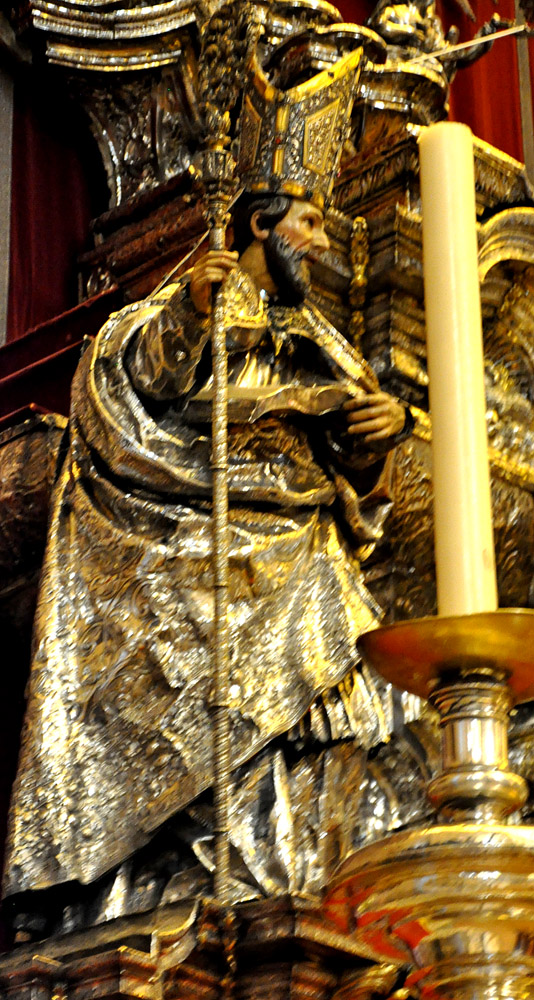
St Isidore at Seville Cathedral
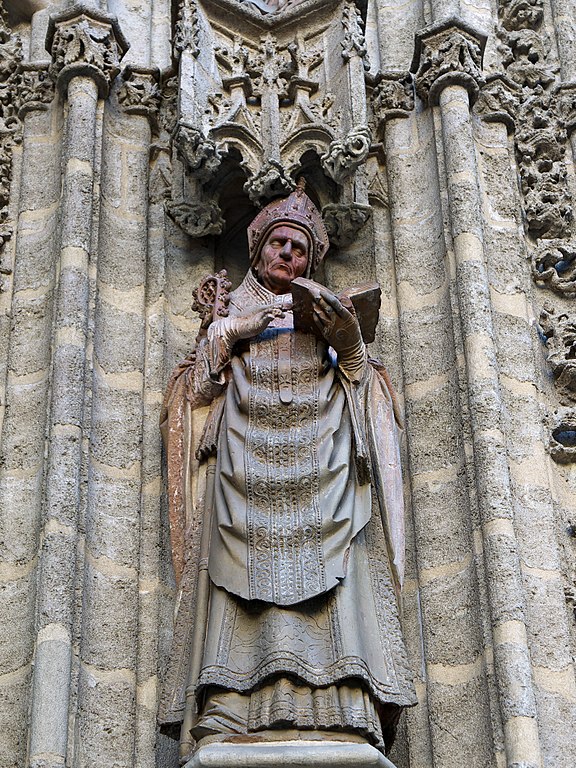
St Isidore on the Facade of Seville Cathedral
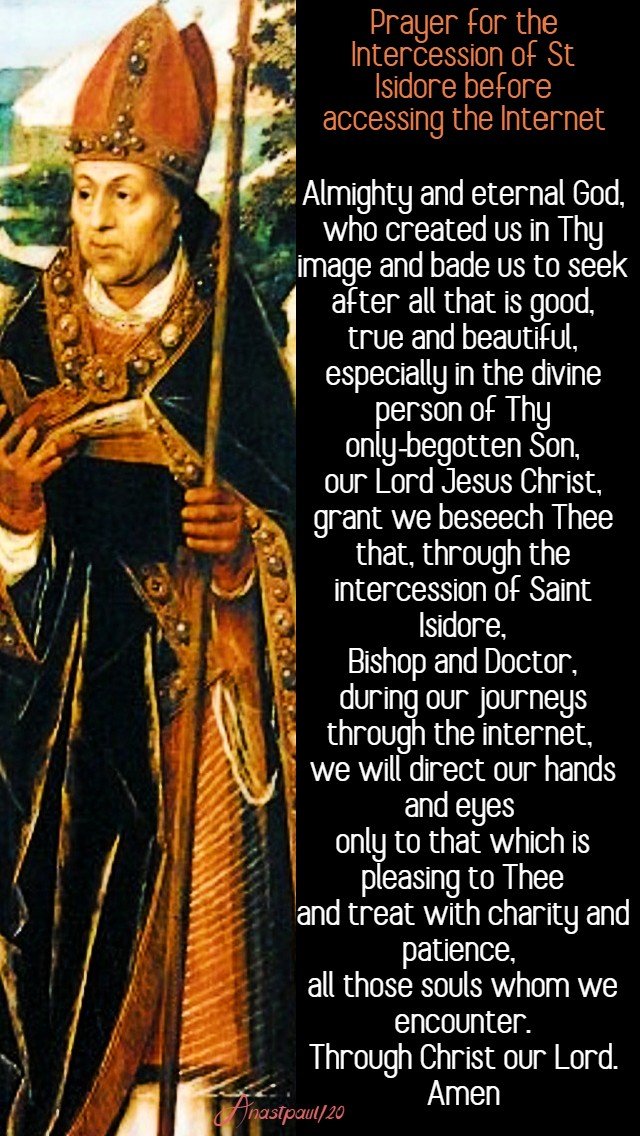
Prayer for the Intercession of St Isidore before accessing the Internet
Almighty and eternal God,
who created us in Thy image
and bade us to seek after all that is good,
true and beautiful,
especially in the divine person
of Thy only-begotten Son,
our Lord Jesus Christ,
grant we beseech Thee that,
through the intercession of Saint Isidore,
Bishop and Doctor,
during our journeys through the internet,
we will direct our hands and eyes
only to that which is pleasing to Thee
and treat with charity and patience,
all those souls whom we encounter.
Through Christ our Lord.
Amen
Orátio ante colligatiónem in interrete:
*Omnípotens aetérne Deus,
qui secúndum imáginem Tuam nos plasmásti
et omnia bona, vera, et pulchra,
praesértim in divína persóna Unigéniti Fílii Tui
Dómini nostri Iesu Chrísti, quaérere iussísti,
praesta, quaésumus,
ut, per intercessiónem Sancti Isidóri, Epíscopi et Doctóris,
in peregrinatiónibus per interrete,
et manus oculísque ad quae Tibi sunt plácita intendámus
et omnes quos convenímus cum caritáte ac patiéntia accipiámus.
Per Christum Dóminum nostrum.
Amen
Thought for the Day – 3 April – Meditations with Antonio Cardinal Bacci (1881-1971)
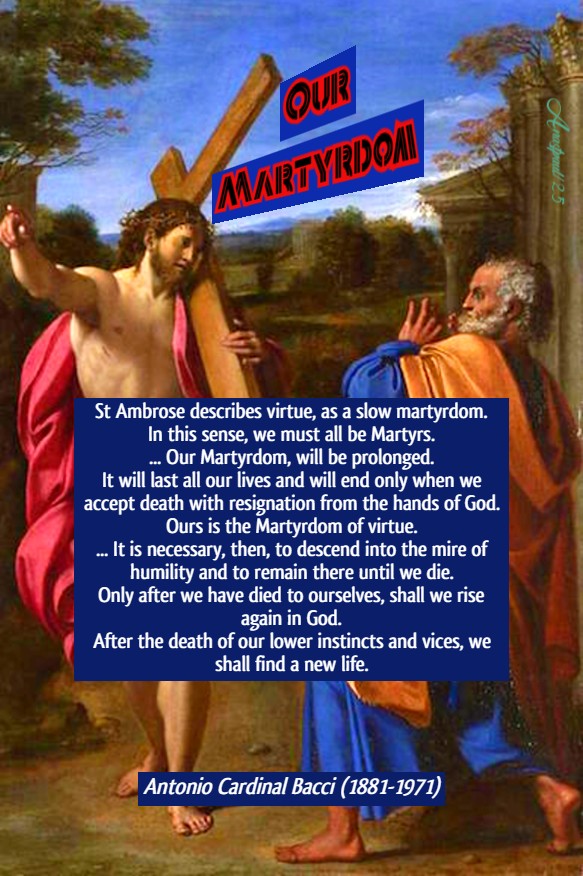
Our Martyrdom
“St Ambrose describes virtue, as a slow martyrdom. In this sense, we must all be martyrs. There is only one difference. The Martyrs of the Church shed their blood and gave up their lives for Jesus, within one hour or one day and gained their reward immediately. Our martyrdom, on the other hand, will be prolonged. It will last all our lives and will end only when we accept death with resignation from the hands of God. Ours is the martyrdom of virtue. Let us clearly understand, that solid Christian virtue is a slow and continual martyrdom, which will end with death. It is not a flower, which springs up spontaneously in the garden of the soul. It is like a seed which is thrown on the damp earth and must die there slowly, so that it can generate young shoots, which will produce the ears of corn. “Unless the grain of wheat falls into the ground and dies, it remains alone. But, if it dies, it brings forth much fruit” (Jn 12:24-25). It is necessary, then, to descend into the mire of humility and to remain there until we die. Only after we have died to ourselves, shall we rise again in God (Cf ibid). After the death of our lower instincts and vices, we shall find a new life.”
Quote of the Day – 28 March – Saturday of the Fourth week of Lent
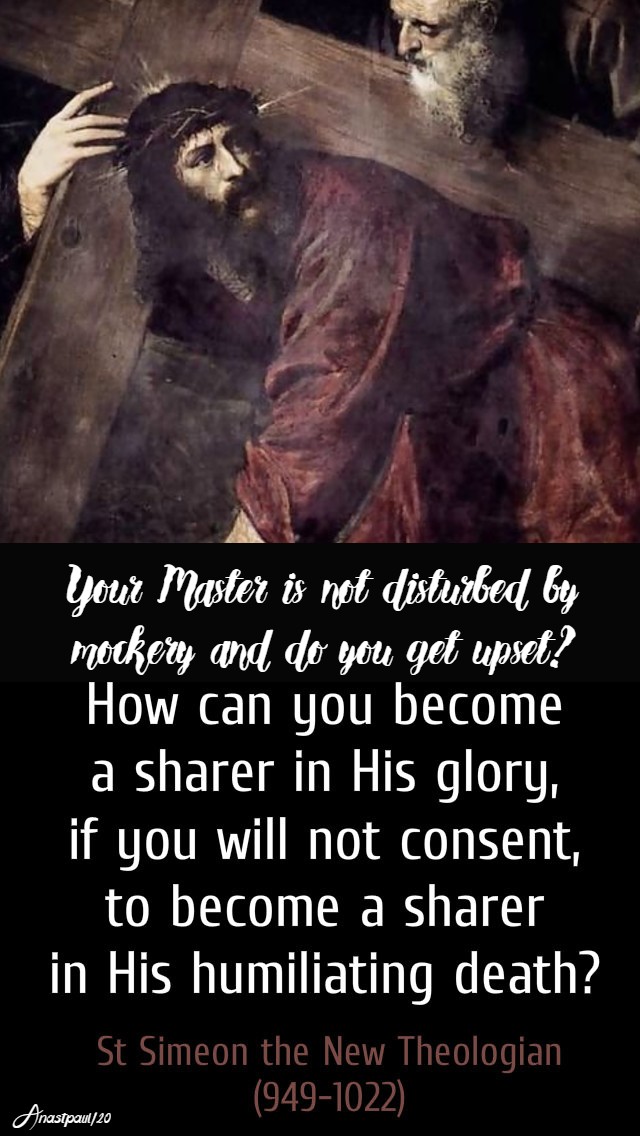
“Your Master is not disturbed by mockery and do you get upset? He bears spittle, blows, strokes of the lash and can you not take a harsh word? He accepts the cross, a humiliating death, the torture of the nails and can you not undertake to carry out the lowliest of tasks? How can you become a sharer in His glory (1 Pt 5:1) if you will not consent to become a sharer in His humiliating death?”
Thought for the Day – 25 March – Meditations with Antonio Cardinal Bacci (1881-1971)
Mortification and Penance
“In Christian teaching, death is the beginning of life. “Unless the grain of wheat falls into the ground and dies,” Jesus said, “it remains alone. But if it dies, it brings forth much fruit. He who loves his life, loses it and he, who hates his life in this world, keeps it unto life everlasting” (Jn 12:24-25). This paradox of dying to this life in order to live in Heaven, was enacted in a wonderful way in the lives of Jesus and of the Saints. It must be put into effect in our lives also, if we are to be genuine Christians. Jesus shed His precious blood for us and His death was the beginning of His triumph. The Apostles, Martyrs and Saints, gave their lives for Christ and received, as their reward, the happy and eternal life of Heaven. By dying to our own ego and to our passions, we shall find the true life of Christ. We must die to ourselves, so that Christ may live in us, as He lived in St Paul. We must die to pride, so that Christian humility may live in us; we must die to anger, so that patience may live in us; we must die to lust, so that purity and innocence may live in us and, we must die to selfishness, so that charity may live in us.”
Thought for the Day – 23 March – Meditations with Antonio Cardinal Bacci (1881-1971)
The Christian Formation of Character
“Our temperament is often a burden to ourselves and can, at times, be the source of annoyance to others.
If we do nothing about it, it can be the cause of failings or of extremes of behaviour on our part, which we bitterly regret afterwards.
It is necessary, therefore, to form character in accordance with Christian principles.
We are in no danger of losing our individuality, by training our character in this way.
God’s grace does not change nature but elevates and improves it.
It is like a shoot, which we plant in the uncultivated soil of our own being.
The first fruits may be sour but after a while, they grow sweeter, while still preserving the essential taste and aroma of the mother-plant.
St Jerome was a headstrong and austere character and he continued to be so, even after the grace of God had transformed him and made him holy.
But his rugged nature was, at the same time, softened and strengthened by divine grace.
St Augustine had a great intellect and a great heart.
When he abandoned philosophical sophistry and worldly vanity, in order to dedicate these gifts to the service of God, he achieved a profundity of thought, never before attained by Christian wisdom.
We should behave in the same manner.
If we are hot-tempered, we should convert this tendency to anger, into hatred for sin.
If we are enthusiastic by nature, we should turn our enthusiasm into love for God and for our neighbour.
If we are high-spirited and energetic, we should devote ourselves to good works, for our own salvation and to the apostolate of souls.
How far have we advanced in the Christian transformation of our character?
Let us examine our progress and resolve to do better.”



























 AnaStpaul
You must be logged in to post a comment.