Thought for the Day – 21 June – Meditations with Antonio Cardinal Bacci (1881-1971)
The Eucharistic Life
“The Eucharistic life which is the life of union with Jesus, especially by means of daily Communion, transforms us and makes us holy. It preserves and increases in us, the grace which is the supernatural life of the soul. The Eucharist, of itself, does not bestow grace because, it is a Sacrament of the living. It is our food and food is not given to the dead but, to the living. For this reason, we should receive Holy Communion free from the stain of sin. The Eucharist, moreover, remits venial sin, strengthens us in our resolution and increases our charity. Venial sin, is a sickness of the soul. Just as natural food banishes listlessness and vulnerability to disease, our Eucharistic nourishment has the same effect on our spiritual life.
It is because the Blessed Eucharist increases our love for Jesus, that it weakens our evil inclinations. The Eucharist and sin, are mutually exclusive of one another because, the Eucharist is Jesus and sin is the devil. Our Eucharistic food, moreover, produces, in our souls, a spiritual consolation which is a foretaste of the happiness of Heaven.
Let us listen to Jesus living within us. He will enable us to forget our worldly cares and will raise us to a higher plane where, by God’s Infinite Goodness, we shall continue to grow in virtue.”
Thought for the Day – 19 February – Meditations with Fr Richard Frederick Clarke SJ (1839-1900)
Meditations on “The Great Truths” From “The Devout Year” By Fr Richard Frederick Clarke SJ (1839-1900)
19th Day – The Punishment of Venial Sin
Thou shalt not go out from thence until thou repay the last farthing. (St Matthew v:26)
Venial Sin is the great evil in the world next to mortal sin and, therefore, it deserves a punishment greater than all the miseries of earth. God has taught us what sort of an evil it is, by one or two instances of the way in which He visits it in this life.
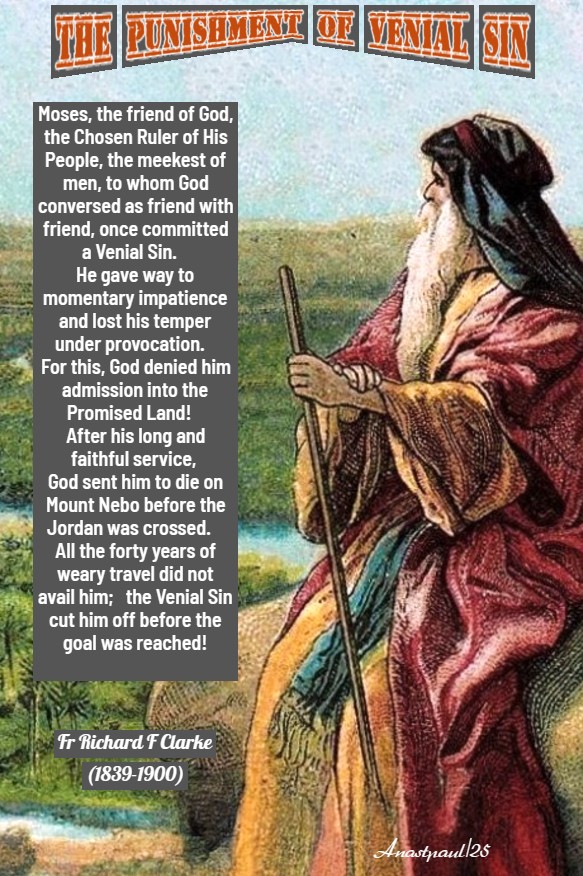
+1. Moses, the friend of God, the Chosen Ruler of His People, the meekest of men, to whom God conversed as friend with friend, once committed a Venial Sin. He gave way to momentary impatience and lost his temper under provocation. For this, God denied him admission into the Promised Land! After his long and faithful service, God sent him to die on Mount Nebo before the Jordan was crossed. All the forty years of weary travel did not avail him; the Venial Sin cut him off before the goal was reached!
+2. David , the man after God’s Own Heart, in a moment of vanity, determined to number the people, boastfully priding himself on the strength of his fighting men. In punishment of this, God sent a pestilence which, in less than three days, destroyed seventy thousand Israelites. Jerusalem itself, would have been decimated, had not David entreated God to avert His destroying Hand. How God must hate Venial Sin!
+3. After death, there will remain for most, a debt still to be paid for Venial Sin. It is in Purgatory where we shall see its true character. No earthly agony even approaches the agony of the Purgatorial Fire. The souls God loves, must be tormented there until they have paid the last farthing. Alas! what do I still owe? Am I doing my best to pay the debt and avoid adding to it? Beg for an intense dread of Venial Sin .
Thought for the Day – 18 February – Meditations with Fr Richard Frederick Clarke SJ (1839-1900)
Meditations on “The Great Truths” From “The Devout Year” By Fr Richard Frederick Clarke SJ (1839-1900)
18th Day – Venial Sin
With these [ wounds ] I was wounded in the house of them who loved me (Zach xiii:6)
+1. Venial sin does not, like mortal sin, kill the soul and make us the enemies of God but, it is a disease which disfigures the soul and renders it unfit for union with Him, until it has been purged away. It is the path which leads to hell by paving the way, little-by-little, for the entrance of mortal sin. It is an unkindness which destroys the warmth of our love and creates a coldness towards God.
+2. Venial sin is small as compared with mortal sin but, it is small only, as ten thousand years are small, compared with eternity. It is the greatest evil in the whole world, with the exception of mortal sin. It is committed against an Infinite God. It can only be expiated by the Infinite Merits of Jesus Christ; it will add to the sufferings of the lost, for all eternity!
+3. Venial sin is of two kinds – (1) Deliberate, when knowing that which I am about to do, will give pain to the Sacred Heart of Jesus, I nevertheless, do it to gratify myself This is the worst kind and the guilt of it is sometimes very great. (2) Indeliberate, or semi-deliberate – when on impulse or without thinking, I do that which is faulty. Yet, I might have foreseen the danger and been more vigilant! Ask God to help you to appreciate, the grave evil of one venial sin.
Thought for the Day – 10 February – Meditations with Fr Richard Frederick Clarke SJ (1839-1900)
Meditations on “The Great Truths” From “The Devout Year” By Fr Richard Frederick Clarke SJ (1839-1900)
10th Day – The Cause of Our Failure
He who shall sin, shall hate his own soul. (Prov viii:36)
Hitherto, we have been speaking of the means of reaching the End, for which we were created and, in which alone, we shall find true and lasting satisfaction. We now come to the cause of our failure and the obstacles in our way.
+I. There is only one obstacle in our way, only one real hindrance to our progress towards happiness and peace, only one barrier between ourselves and God. This obstacle is sin. As long as it remains, it is an insuperable obstacle. A single mortal sin, unrepented of, will, forever shut me out from the Presence of God. A single venial sin, unredeemed, will prevent me from attaining to happiness until the debt has been paid!
+2. What do we mean by sin? We mean any conscious violation of the law of God. Whenever we do that which God has declared to be a serious offence against Him, we become the enemies of God, we forfeit all hope of Heaven, except as far as God, of His gratuitous compassion, may afterwards give us the grace to repent and be forgiven. Have I ever thus lost sight of God and of Heaven? And if so, am I sure that I have regained His Love?
+3. Why is sin so terrible Because it is an outrage to a God of Infinite Holiness, of Infinite Majesty. Because it is an act of ingratitude, to One Who has laden us with benefits, Who Loves us with a Love which surpasses all bound or measure because, it is a deliberate rejection of the Divine Friendship and, as far as we are concerned, forever! Pray for a hatred and detestation of all sin!.
Quote/s of the Day – 16 January – 1 Peter 5:1-4, 10-11; Matthew 16:13-19 – Scripture search here: https://www.drbo.org/
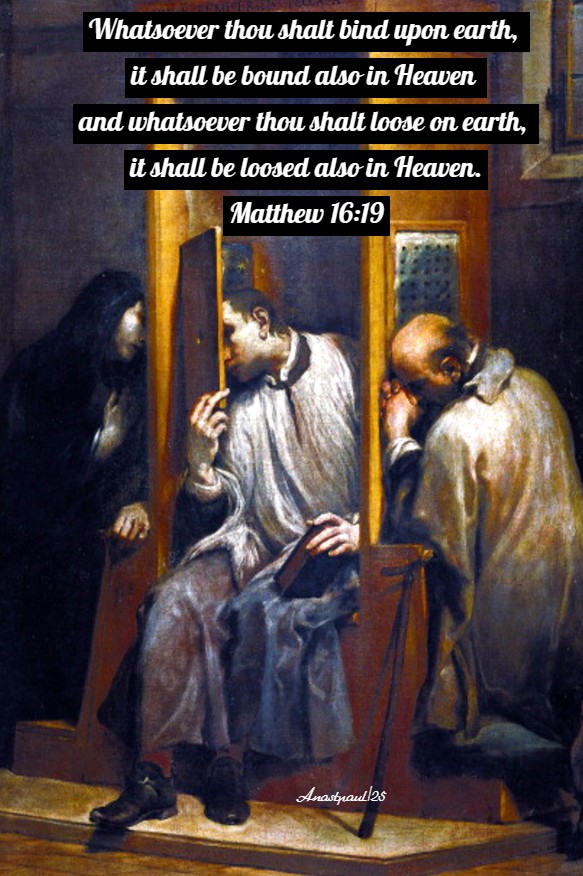
“Whatsoever thou shalt bind upon earth, it shall be bound also in Heaven and whatsoever thou shalt loose on earth, it shall be loosed also in Heaven.”
Matthew 16:19
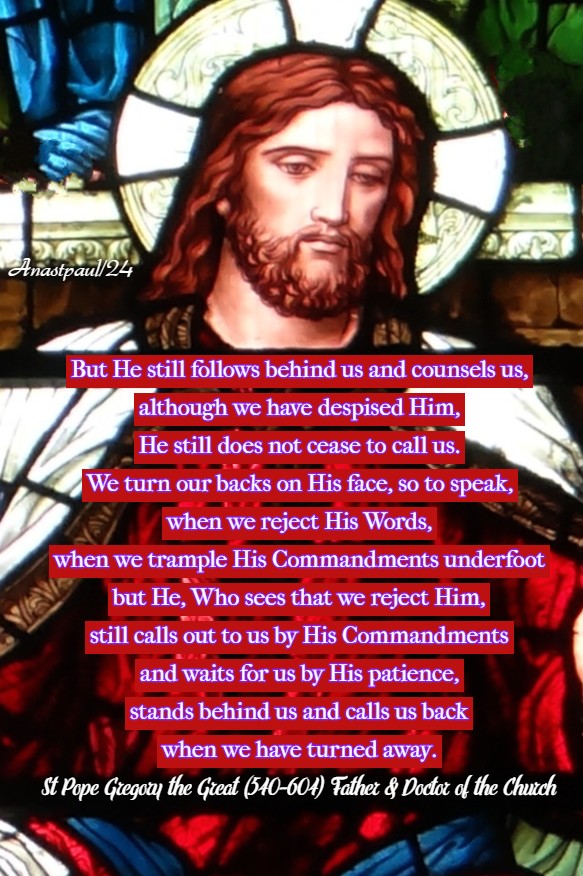
“But He still follows behind us and counsels us, although we have despised Him, He still does not cease to call us. We turn our backs on His face, so to speak, when we reject His Words, when we trample His Commandments underfoot but He, Who sees that we reject Him, still calls out to us by His Commandments and waits for us by His patience, stands behind us and calls us back when we have turned away.”
St Pope Gregory the Great (540-604) Father & Doctor of the Church
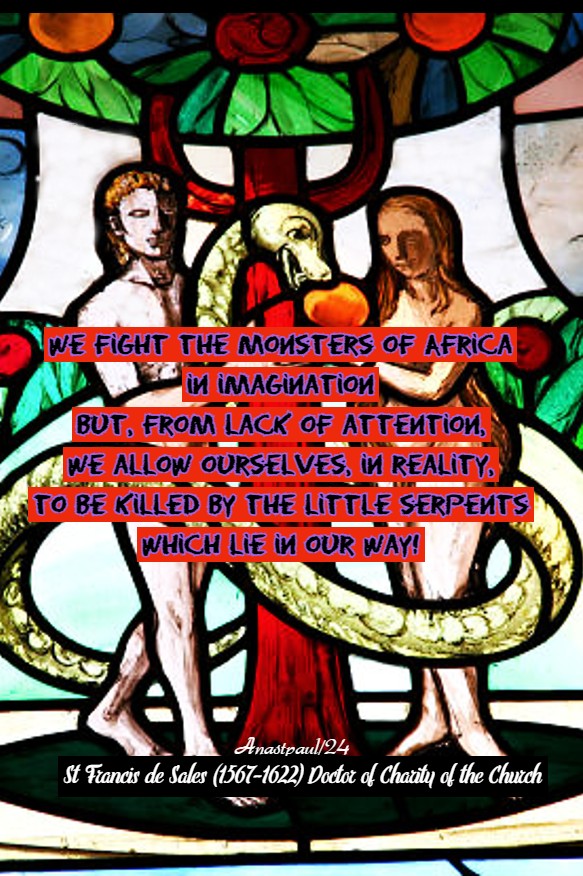
“We fight the monsters of Africa in imagination but, from lack of attention, we allow ourselves, in reality, to be killed by the little serpents which lie in our way!”
(Intro to the Devout Life III:37)
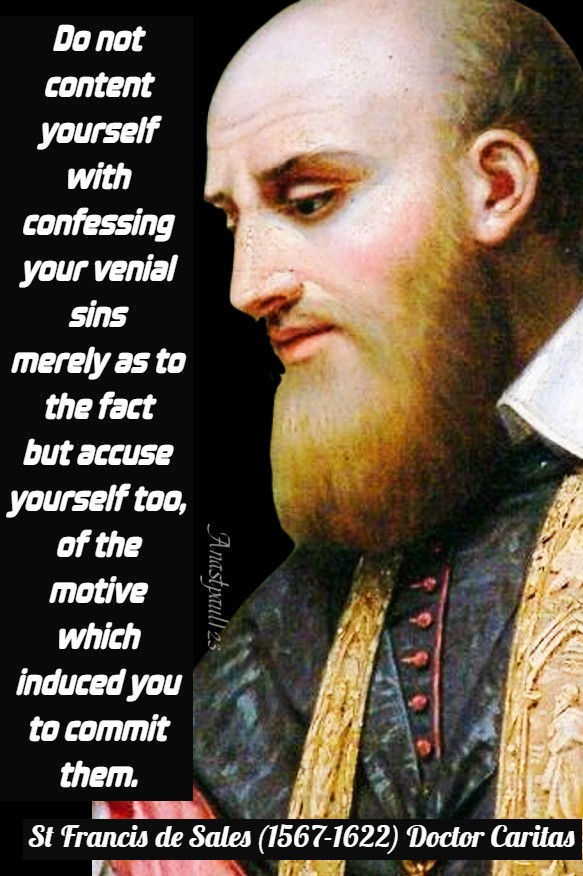
“Do not content yourself with confessing your venial sins merely as to the fact but accuse yourself too, of the motive which induced you to commit them.”
(Introduction to the Devout Life, Part II, Chapter 19).
St Francis de Sales (1567-1622) Doctor Caritatis
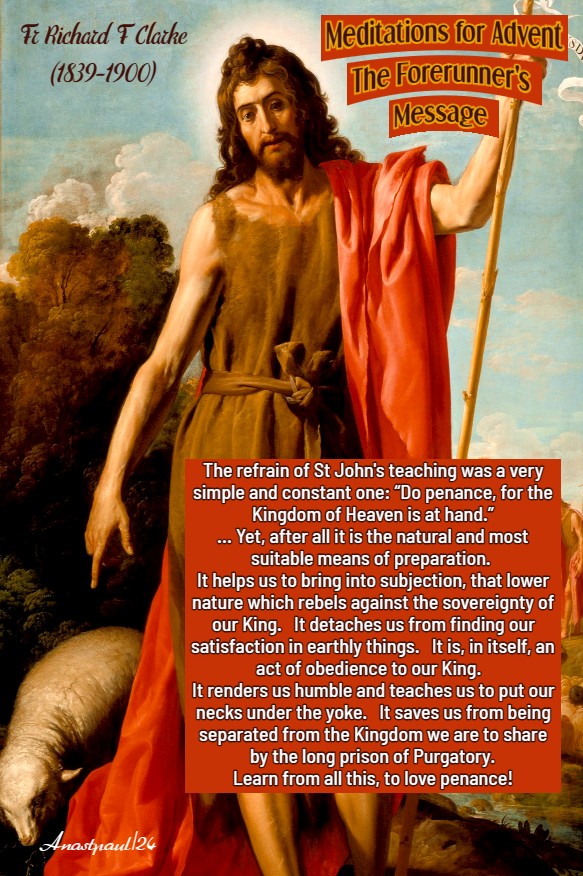
“Yet, after all it is the natural and most suitable means of preparation. It helps us to bring into subjection, that lower nature which rebels against the sovereignty of our King. It detaches us from finding our satisfaction in earthly things. It is, in itself, an act of obedience to our King. It renders us humble and teaches us to put our necks under the yoke. It saves us from being separated from the Kingdom we are to share by the long prison of Purgatory. Learn from all this, to love penance!”
Quote/s of the Day – 11 December – Advent Preparation and Penance
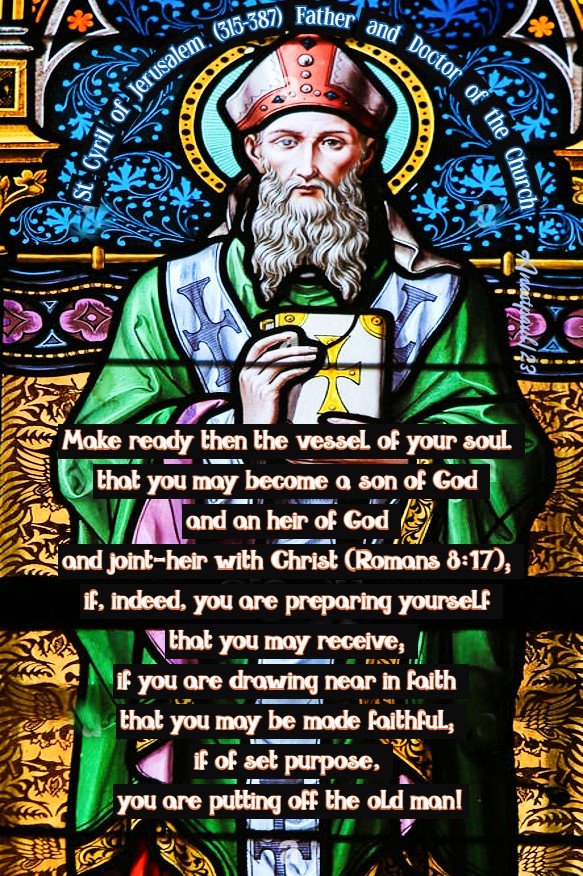
“Make ready then the vessel of your soul that you may become a son of God and an heir of God and joint-heir with Christ (Romans 8:17); if, indeed, you are preparing yourself that you may receive; if you are drawing near in faith that you may be made faithful; if of set purpose, you are putting off the old man!”
St Cyril of Jerusalem (315-387) Father and Doctor of the Church
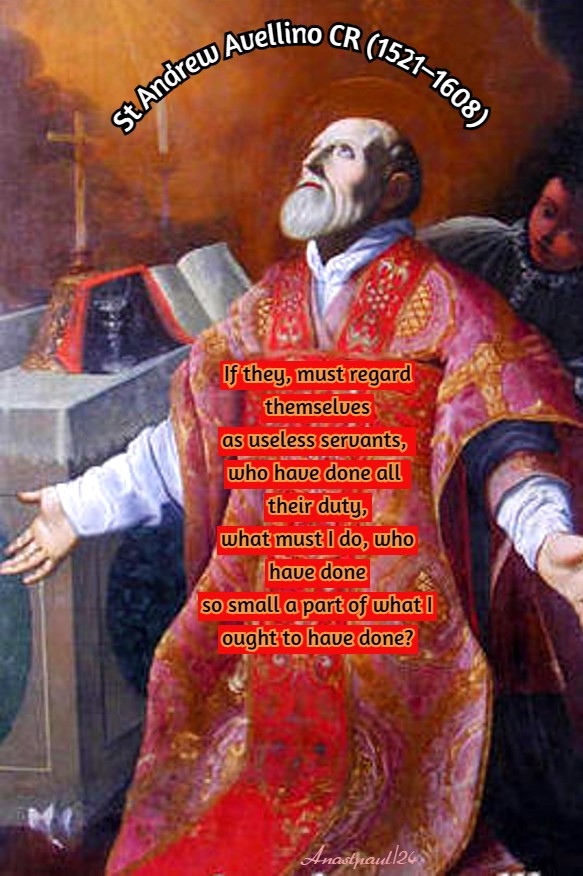
“If they, must regard themselves as useless servants, who have done all their duty, what must I do, who have done so small a part of what I ought to have done?”
St Andrew Avellino CR (1521–1608)
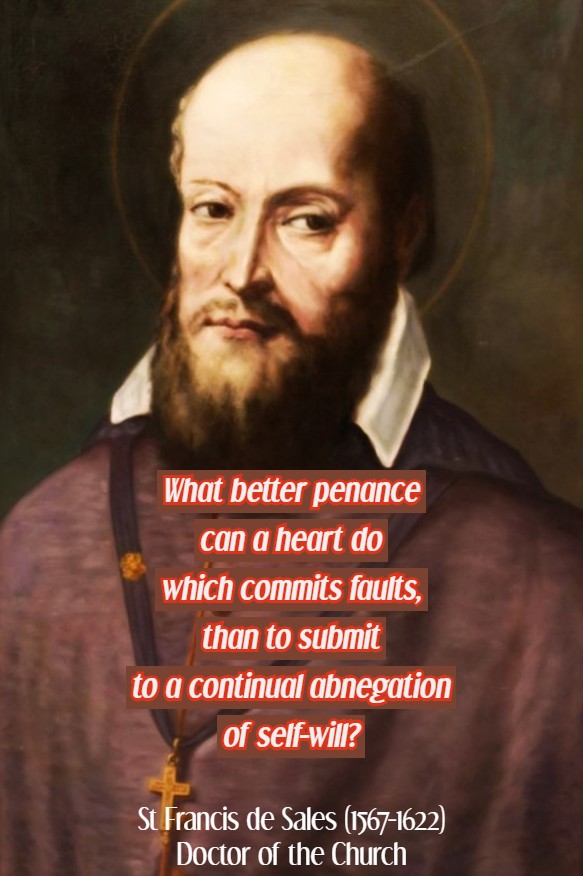
“What better penance can a heart do which commits faults, than to submit to a continual abnegation of self-will?”
St Francis de Sales (1567-1622) Doctor of the Church
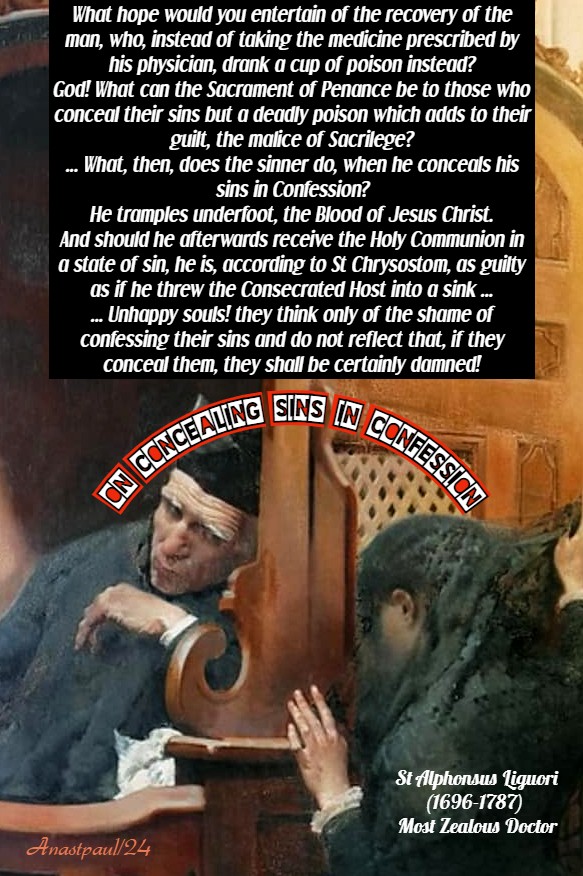
“What hope would you entertain of the recovery of the man, who, instead of taking the medicine prescribed by his physician, drank a cup of poison instead? God! What can the Sacrament of Penance be to those who conceal their sins but a deadly poison which adds to their guilt, the malice of Sacrilege? What, then, does the sinner do, when he conceals his sins in Confession? He tramples underfoot, the Blood of Jesus Christ. And should he afterwards receive the Holy Communion in a state of sin, he is, according to St Chrysostom, as guilty as if he threw the Consecrated Host into a sink … Accursed shame! how many poor souls do you bring to hell? … Unhappy souls! they think only of the shame of confessing their sins and do not reflect that, if they conceal them, they shall be certainly damned!”
St Alphonsus Maria de Liguori (1696-1787) Most Zealous Doctor
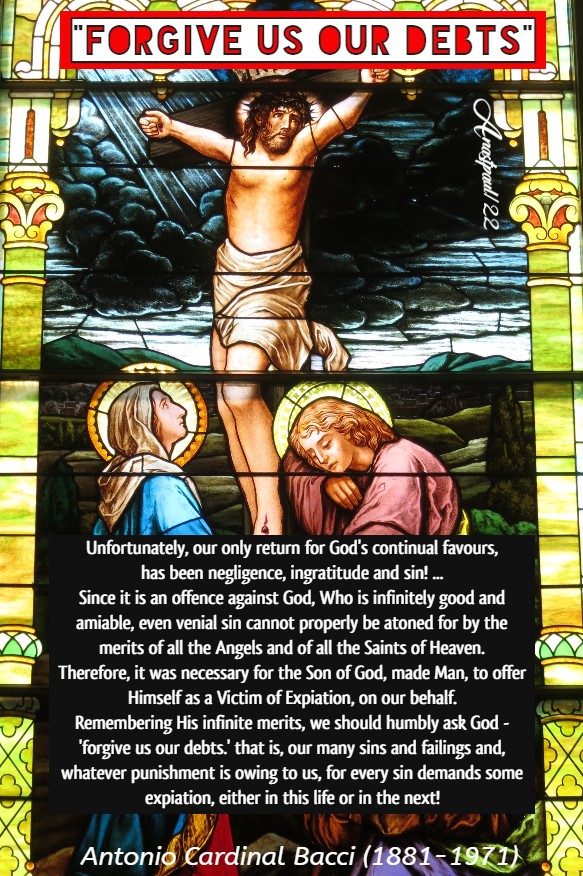
“Unfortunately, our only return for God’s continual favours, has been negligence, ingratitude and sin! Since it is an offence against God, Who is infinitely good and amiable, even venial sin cannot properly be atoned for by the merits of all the Angels and of all the Saints of Heaven. Therefore, it was necessary for the Son of God, made Man, to offer Himself as a Victim of Expiation, on our behalf. Remembering His Infinite Merits, we should humbly ask God – ‘forgive us our debts.‘ that is, our many sins and failings and, whatever punishment is owing to us, for every sin demands some expiation, either in this life or in the next!”
Quote/s of the Day – 1 September – Pentecost XV – Galatians 5:25-26; 6:1-10; Luke 7:11-16 – Scripture search here: https://www.drbo.org/
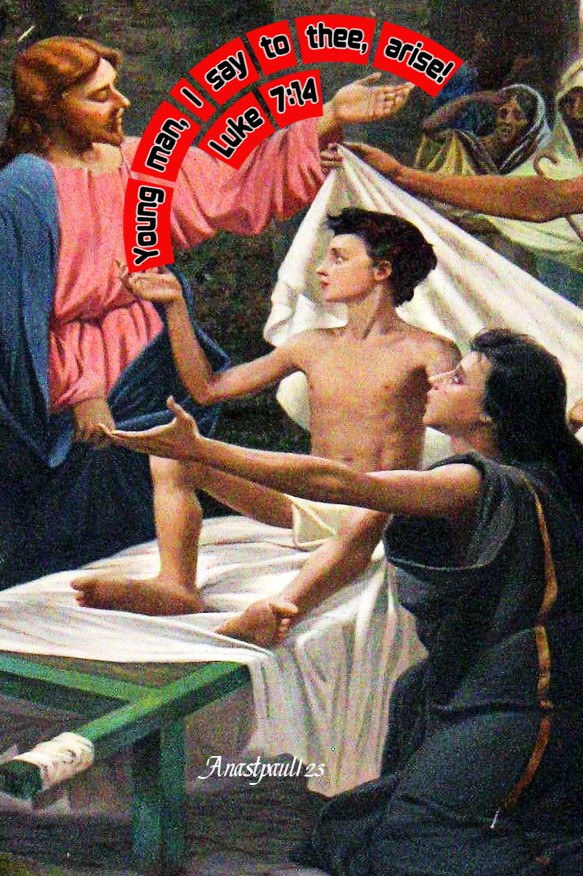
“Young man, I say to thee, arise!”
Luke 7:14
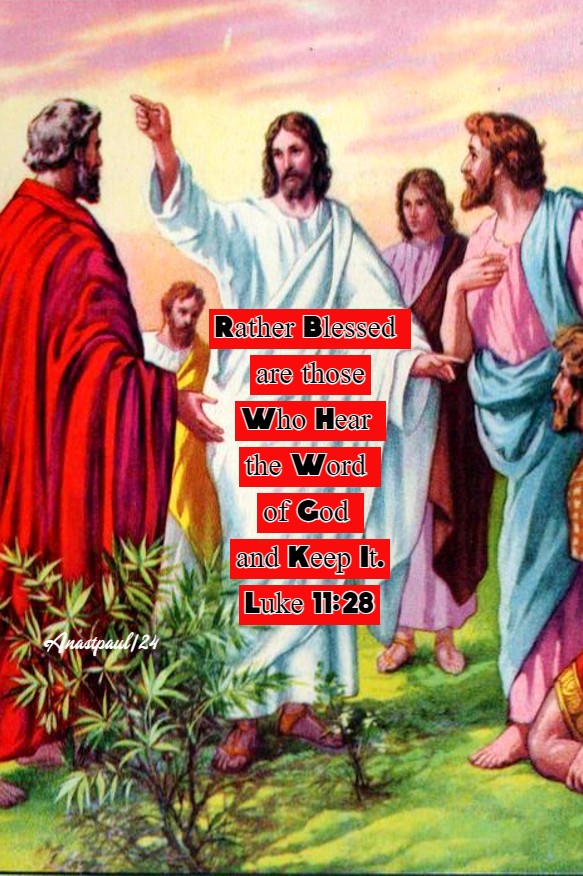
“Rather blessed are those who hear the Word of God and keep it.’”
Luke 11:28
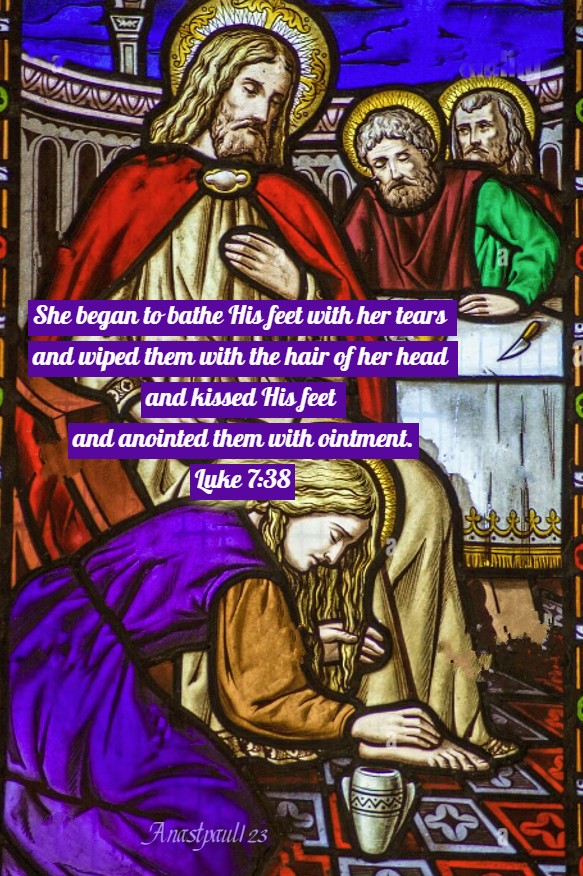
“She began to bathe His feet with her tears and wiped them with the hair of her head and kissed His feet and anointed them with ointment.”
Luke 7:38
“Make ready then the vessel of your soul that you may become a son of God and an heir of God and joint-heir with Christ (Romans 8:17); if, indeed, you are preparing yourself that you may receive; if you are drawing near in faith that you may be made faithful; if of set purpose, you are putting off the old man!”
St Cyril of Jerusalem (315-387) Father and Doctor of the Church
“Do not content yourself with confessing your venial sins merely as to the fact but accuse yourself too, of the motive which induced you to commit them.”
(Introduction to the Devout Life, Part II, Chapter 19).
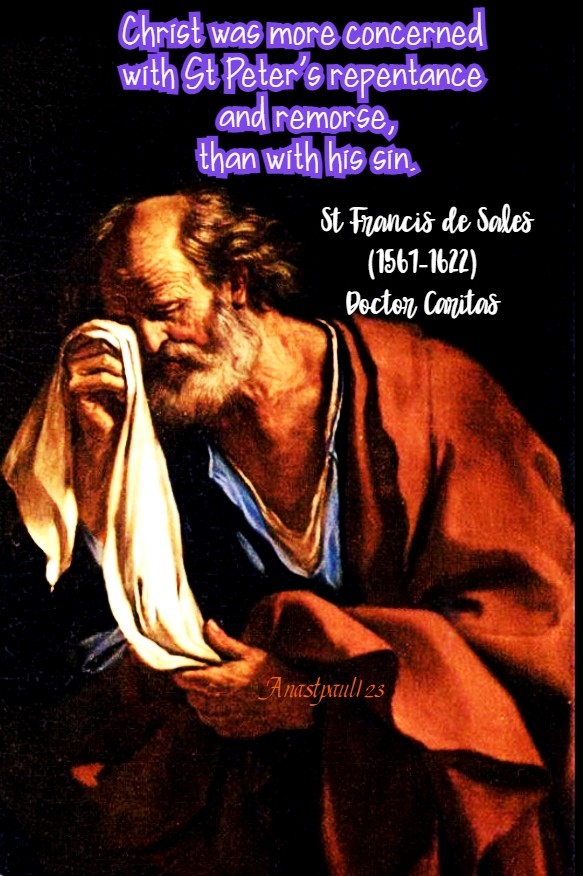
“Christ was more concerned with St. Peter’s repentance and remorse, than with his sin.”
Thought for the Day – 15 October – Meditations with Antonio Cardinal Bacci (1881-1971)
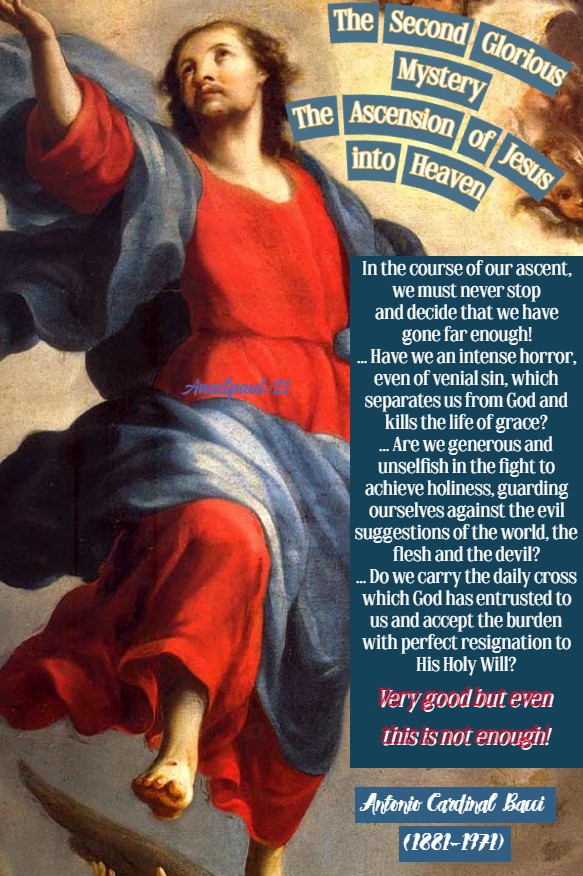
“Month of the Holy Rosary” The Second Glorious Mystery The Ascension of Jesus into Heaven
“In the course of our ascent, we must never stop and decide that we have gone far enough! To stop would inevitably mean going backward. Jesus and Mary are inviting and encouraging us to go higher and higher.
Have we been purified of sin, the defiler of the soul and the destroyer of human dignity? Have we an intense horror, even of venial sin, which separates us from God and kills the life of grace? It is still not enough – we must go higher.
Are we generous and unselfish in the fight to achieve holiness, guarding ourselves against the evil suggestions of the world, the flesh and the devil? It is still not enough – we must continue to advance.
Do we carry the daily cross which God has entrusted to us and accept the burden with perfect resignation to His Holy Will? Very good but even this is not enough!”
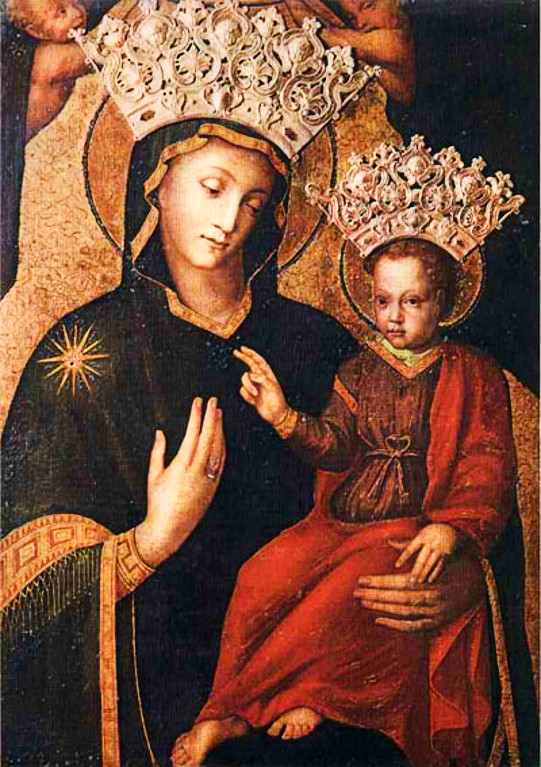
26 August – Feast of Salus Infirmorum / Our Lady, Health of the Sick – Saturday before the last Sunday in August:
Salus Infirmorum / Our Lady, Health of the Sick By Cardinal Alexis Henri Marie Lepicier OSM (1863-1936) Prefect of the Sacred Congregation for Religious
“And I perfumed my dwelling as storax and galbanum and onyx and aloes and as the frankincense not cut and my odour is, as the purest balsam.“” (Ecclus 24:21)
Salus Infirmorum
The sin of our first parents not only deprived man of original justice and of all the gifts consequent thereon; it reduced him, furthermore, to a state of great weakness, so that it is impossible for us to accomplish works of supernatural value, without a special grace. Fallen man is like one sick, who has no relish for any nourishment, whatever. He is deficient in vital energy and his actions are wanting, in that vigour which naturally belongs to a healthy person. He is strongly inclined to vice and finds the practice of virtue tedious and difficult!
This natural incapacity regarding the performance of good works, is further increased, by actual sin, whether mortal or venial. The former, by depriving the soul of divine grace which is the principle of spiritual life, hinders man from doing anything pleasing to God, so as to merit eternal happiness. The latter, venial sin, by diminishing the fervour of charity, makes the practice of virtue labourious, since charity has for its effect, precisely to facilitate the performanc, of what is good. Sin is, therefore, a great evil because, if mortal, it saps altogetherthe spiritual energy of the soul and if venial, it notably weakens it. If, from individuals we pass onto nations, we perceive that sin, like a subtle poison, eats into the heart of them, weakening and preparing their ruin.
Divine bounty, which for bodily ailments, has procured us efficacious remedies, is not less industrious in providing the means to heal our spiritual maladies. With the Sacraments instituted by Jesus Christ, to restore our souls to grace or to augment it within us, God has also been pleased to grant us, in Mary’s aid, a potent remedy for our spiritual infirmities. In fact, Our Lady has not only given us Jesus Christ, the Shepherd and Physician of our souls but, furthermore, she watches over us as a tender mother does, by the cradle of an ailing child.
Besides this, Our Lady’s example encourages us in our conflict with the devil. For she is the Immaculate Virgin, who never was defiled by sin. Her sweet soul was always filled with the perfume of the noblest virtues.
Mary never ceases also to hearken to the voice of our supplications and to present them before the throne of God, often anticipating our requests and obtaining for us, through her own merits and those of Jesus Christ, all the helps necessary to us in our spiritual needs.
And what Our Lady does for individuals, she also does for whole nations. As a pity-full Queen, she succours them in their distress; she raises them from their bed of sickness and is, for them, a bulwark of defence (Cant. 8:10).
Our Lady’s power and motherly care not only embrace spiritual miseries: they also extend to the ills of the body. How often do we see Our Lady restoring health to the sick, who have recourse to her with filial confidence!
In Our Lady’s readiness to alleviate bodily ailments, shines forth, most splendidly, God’s love for her. It seems as if the Most High had placed no limit to the efficacy of His Mother’s intercession. While other saints are invoked only in particular cases of corporal infirmity, Our Lady’s power, on the other hand, is exercised over every kind of malady. Hence, we may say that, at her word, as once at the word of Jesus, the blind see, the lame walk, the lepers are cleansed and the deaf hear (Mt 11:5). The sole difference is that Jesus Christ, being God, wrought these miracles of His own personal authority, while Our Lady, obtains for us, of the Divine Clemency, the graces she asks, by virtue of the efficacy of her intercession with God.
However, although Our Lady is so powerful in curing all bodily ailments, yet, she does not always deliver her clients from every such trial because, God sees best to exercise them in patience that they may, thereby, win the reward prepared for them in Heaven. But when Our Lady does not restore bodily health, yet, for all that, she never ceases to act the part of a tender Mother toward us, watching over us and obtaining for us, in place of bodily strength, resignation to the divine will and interior peace – two sovereign means of sanctification and salvation!
Thought for the Day – 25 August – Meditations with Antonio Cardinal Bacci (1881-1971)
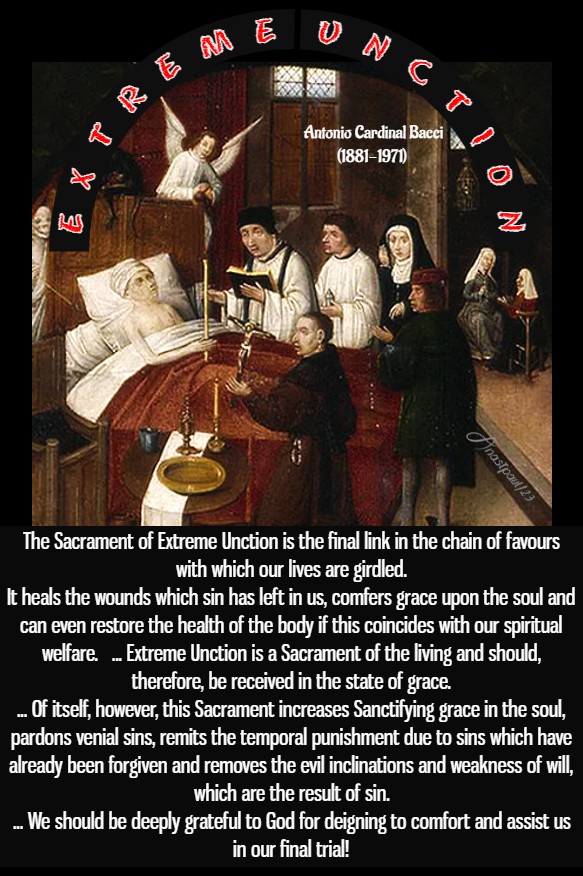
EXTREME UNCTION
“The Sacrament of Extreme Unction is the final link in the chain of favours with which our lives are girdled. It heals the wounds which sin has left in us, comfers grace upon the soul and can even restore the health of the body if this coincides with our spiritual welfare. “Is anyone among you sick?” asks St James. “Let him bring in the presbyters of the Church and let them pray over him, anointing him with oil in the Name of the Lord. And the prayer of faith will save the sick man and the Lord will raise him up and if he be in sins, they shall be forgiven him.” (Js 5:14-15).
Extreme Unction is a Sacrament of the living and should, therefore, be received in the state of grace. If, for some grave reason, however, it is impossible for the sick man to make his confession, he can make, as far as is possible, an act of perfect contrition and receive this Sacrament, thereafter. In this case, Extreme Unction can remit even the mortal sins which he is unable to confess.
Of itself, however, this Sacrament increases Sanctifying grace in the soul, pardons venial sins, remits the temporal punishment due to sins which have already been forgiven and removes the evil inclinations and weakness of will, which are the result of sin. It enables the soul, moreover, to endure suffering and temptation and to await death with calmness and resignation. We should be deeply grateful to God for deigning to comfort and assist us in our final trial!”
Quote/s of the Day – 30 March – Thursday in Passion Week – Daniel 3:25, 34-45, Luke 7:36-50 – Scripture search here: https://www.drbo.org/
“She began to bathe His feet with her tears and wiped them with the hair of her head and kissed His feet and anointed them with ointment.”
Luke 7:38
“Do not content yourself with confessing your venial sins merely as to the fact but accuse yourself too, of the motive which induced you to commit them.” (Introduction to the Devout Life, Part II, Chapter 19).
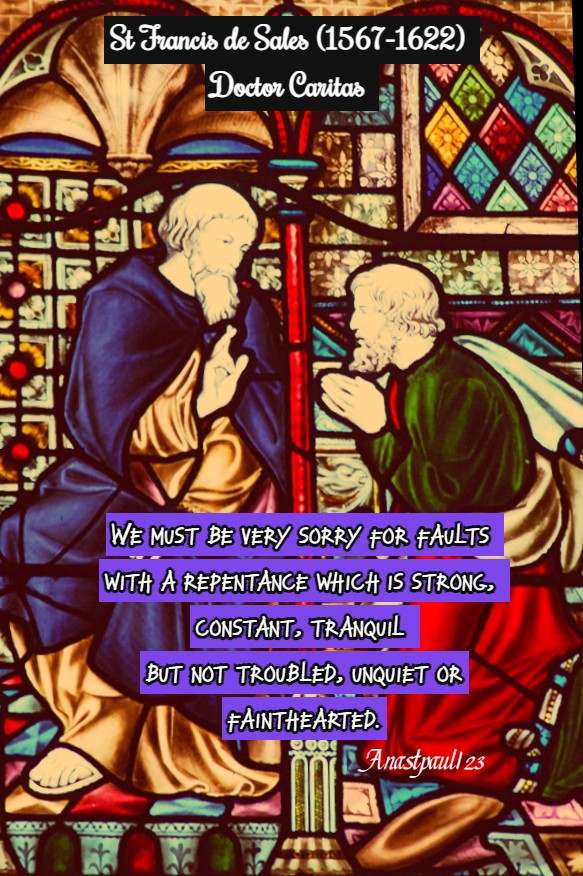
“We must be very sorry for faults with a repentance which is strong, constant, tranquil but not troubled, unquiet or fainthearted.” (Treatise on the Love of God, Book 9, Chapter 7).
“Christ was more concerned with St. Peter’s repentance and remorse, than with his sin.” (The Spirit of St. François de Sales, VII, 8)
Thought for the Day – 24 February – Meditations with Antonio Cardinal Bacci (1881-1971)
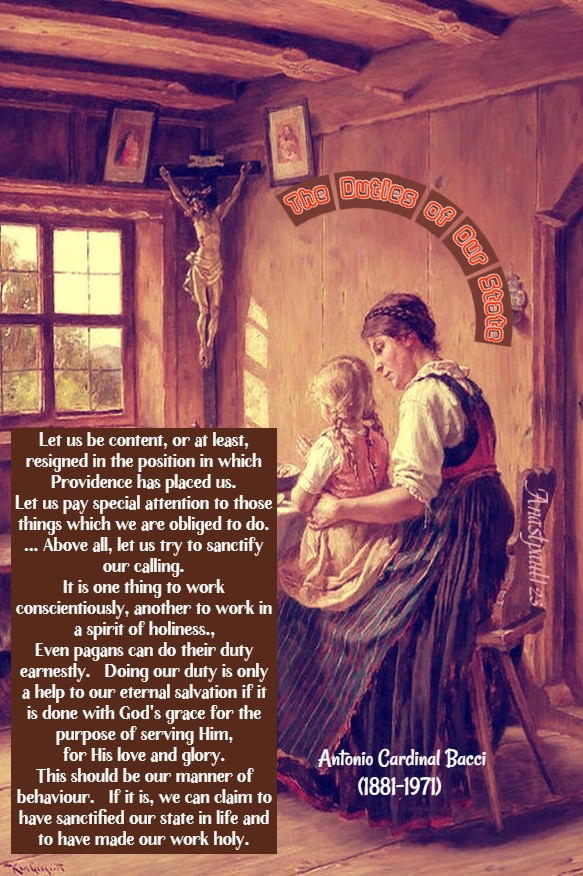
The Duties of Our State
“Let us be content, or at least, resigned in the position in which Providence has placed us. Let us pay special attention to those things which we are obliged to do. Anything which is not necessary should be left until later, even if it is more pleasant or seems more worthwhile in itself. Let us never become involved in business which is incompatible with our state or dangerous to our eternal welfare. Let us not make light of minor offences against the duties of our state. Smaller transgressions gradually become greater. Above all, let us try to sanctify our calling. It is one thing to work conscientiously, another to work in a spirit of holiness., Even pagans can do their duty earnestly. Doing our duty is only a help to our eternal salvation if it is done with God’s grace for the purpose of serving Him, for His love and glory. This should be our manner of behaviour. If it is, we can claim to have sanctified our state in life and to have made our work holy.”
Thought for the Day – 5 February – Meditations with Antonio Cardinal Bacci (1881-1971)
IDLENESS
“There is another weighty reason which should prevent us from living in idleness. The Holy Spirit warns us that: “Idleness is an apt teacher of mischief” (Ecclus 33:29) and “he who follows idle pursuits, is a fool” (Prov 12:11). In other words, sloth is a great studity and is the father of the vices. If anyone is inactive, he learns nothing. Since our bodily and spiritual faculties were made for action, it necessarily follows that when they are not working for a good or useful purpose, they find an outlet in other directions, which lead to disorder and sin. Without work and prayer, there is only inactivity which leads to sin. It is fatal to remain idle. God warns us that we must render an account of every idle work (Mt 12:36).
St Thomas Aquinas notes that an idle word is usually a venial sin but can also be a mortal sin (Summa Theologiae II-II, q 72, a 5). What should be said then of those who live in idleness, while there is so much work to be done for the glory of God, for our own good and for the good of others? Anyone who loves God is never idle, says St Jerome. The love of God works wonderful things – if it does not, it cannot be called love!”
Thought for the Day – 5 January– Meditations with Antonio Cardinal Bacci (1881-1971)
Venial Sin
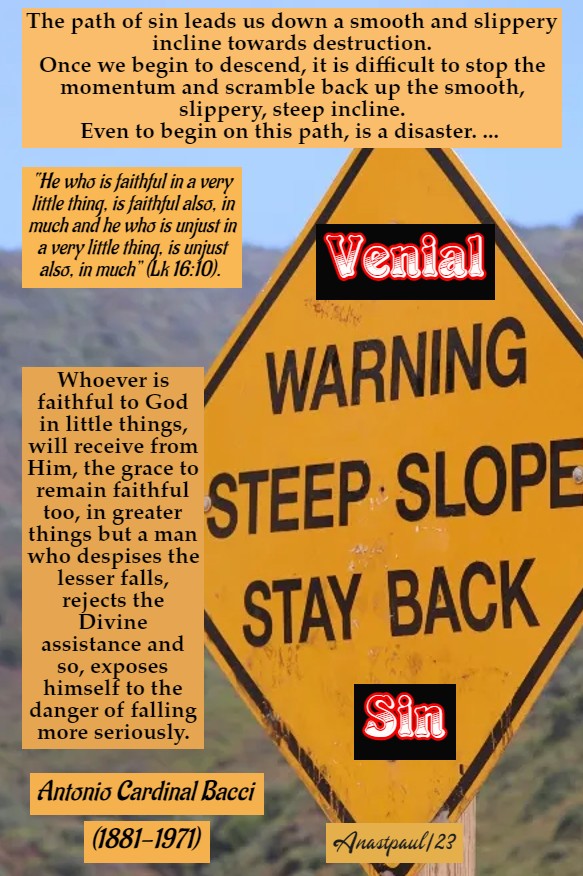
“There is another motive too, which obliges us to carefully avoid even commiting a venial sin. The path of sin leads us down a smooth and slippery incline towards destruction. Once we begin to descend, it is difficult to stop the momentum and scramble back up the smooth, slippery, steep incline. Even to begin on this path, is a disaster.
“He who wastes the little he has, will be stripped bare” (Eccles 19:1).
“He who is faithful in a very little thing, is faithful also, in much and he who is unjust in a very little thing, is unjust also, in much” (Lk 16:10).
Whoever is faithful to God in little things, will receive from Him, the grace to remain faithful too, in greater things but a man who despises the lesser falls, rejects the Divine assistance and so, exposes himself to the danger of falling more seriously.
If we reflect on such dangers, we shall have a real fear of venial sin and shall be always on our guard against it.”
Thought for the Day – 4 November – Meditations with Antonio Cardinal Bacci (1881-1971)
More About the Sufferings of Purgatory
“The vision of Purgatory accorded to St Frances of Rome, is well known. She saw Purgatory divided into three separate sections.
(1) The firs was the part furthest from Heaven and bordering, as it were, on Hell. In it two kinds of people were suffering terrible torments, namely, lay folk who had committed grave sins and postponed their conversion until the moment of death; and – men and women who had dedicated their lives to God but on account of venial sins, neglect of duty, tepidity and lack of gratitude for their great vocations, had heavy debt to pay to Divine Justice.
(2) The second place, was the most crowded. Here, the physical pain was still unimaginably severe, while the desire to be purified and to b with God was the cause of intense spiritual anguish. The souls in this region, however, were not only resigned to their lot but, even longed for greater sufferings which would finally wash away the imperfections which kept them apart from God.
(3) The Third section was the nearest to Heaven and was the abode of purer and more perfect souls. These did not have to endure much sensible pain but, their yearning for God was so insistent that, every moment of separation, seemed like an eternity.”
Thought for the Day – 2 Novemer – Meditations with Antonio Cardinal Bacci (1881-1971)
“Purgatory”
“The clear testimony of the New Testament may also be invoked in support of this teaching. Jesus refers to sins which cannot be forgiven, either in this life or in the next, (Cf Mt 12:31-32) from which, the Fathers deduce that there are sins, namely those of a venial nature, which can be forgiven after death.
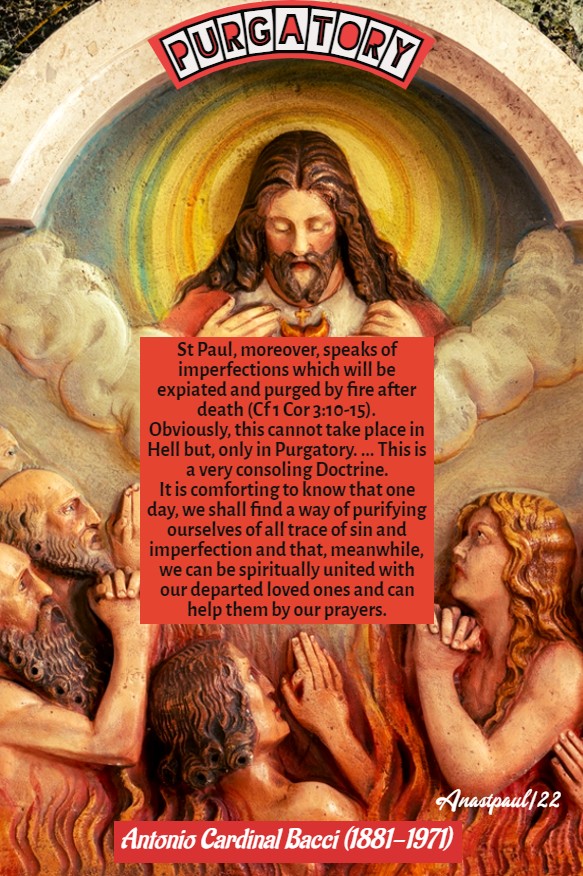
St Paul, moreover, speaks of imperfections which will be expiated and purged by fire after death (Cf 1 Cor 3:10-15). Obviously, this cannot take place in Hell but, only in Purgatory. It would be impossible to cite here, all the testamoies of the Fathers and of theological writers. No-one, can deny, that they exist, however, for they combine to build up a tradition which the Council of Trent (Sess XXV) gathered together, when proclaiming the existence of Purgatory and the obligation of the faithful to pray for the dead, who are expiating their sins there.
This is a very consoling Doctrine. It is comforting to know that one day, we shall find a way of purifying ourselves of all trace of sin and imperfection and that, meanwhile, we can be spiritually united with our departed loved ones and can help them by our prayers.”
Quote/s of the Day – 24 July – “The Month of the Precious Blood” – St Christina of Bolsena (3rd Century) Virgin Martyr – Romans 6:19-23, Matthew 7:15-21
“Not everyone who says to me, ‘Lord, Lord,’ will enter the Kingdom of Heaven but only the one who does the will of my Father in Heaven.”
Matthew 7:21
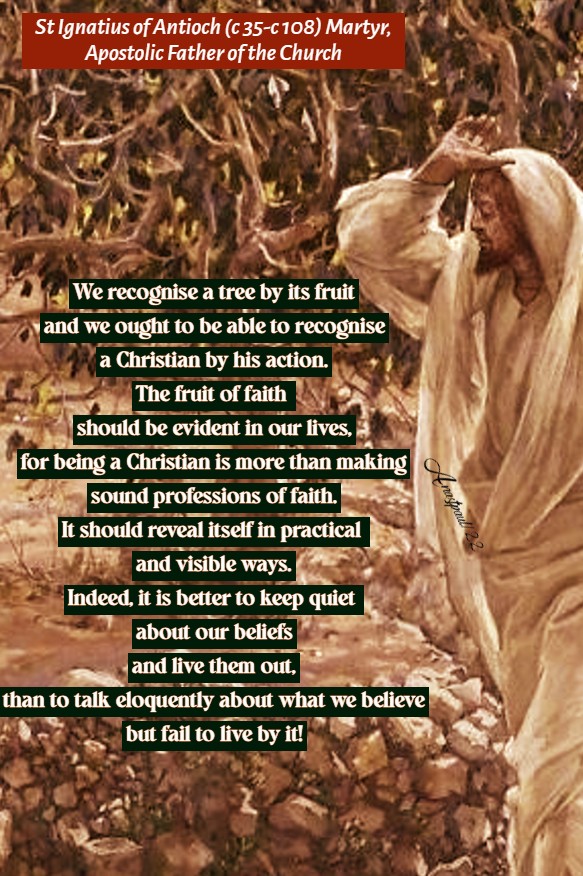
“We recognise a tree by its fruit and we ought to be able to recognise a Christian by his action. The fruit of faith should be evident in our lives, for being a Christian is more than making sound professions of faith. It should reveal itself in practical and visible ways. Indeed, it is better to keep quiet about our beliefs and live them out, than to talk eloquently about what we believe but fail to live by it!”
St Ignatius of Antioch (c 35-c 108) Martyr Apostolic Father of the Church
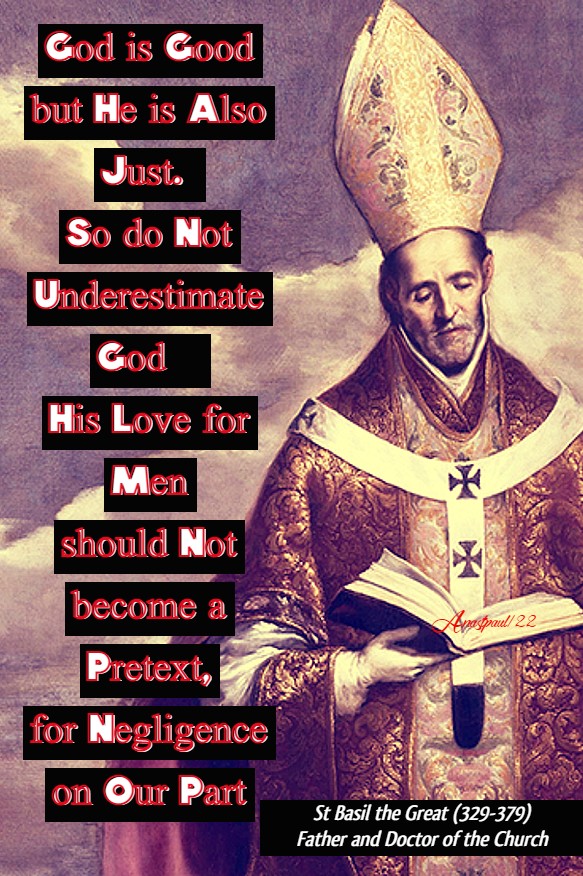
“God is Good but He is also Just… So do not underestimate God – His love for men should not become a pretext, for negligence on our part.”
St Basil the Great (329-379) Father and Doctor of the Church
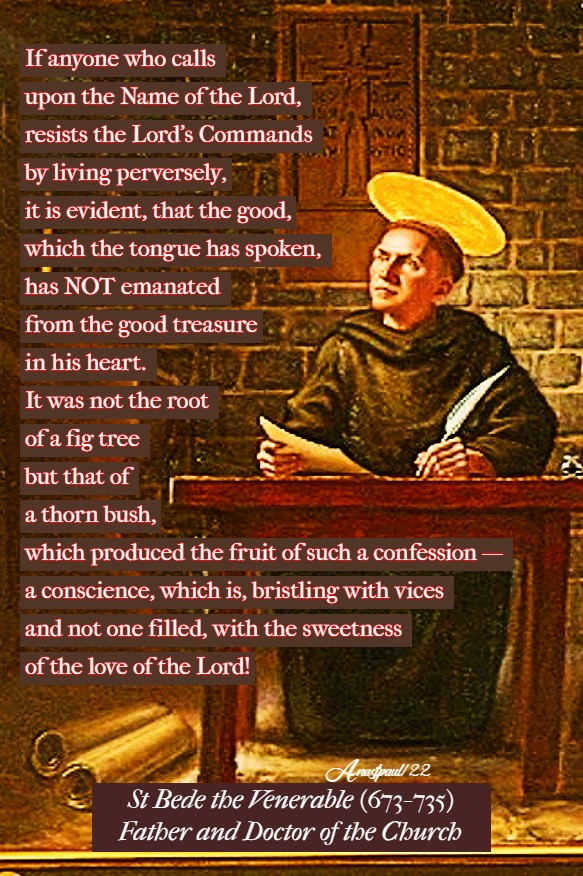
“If anyone who calls upon the Name of the Lord, resists the Lord’s Commands by living perversely, it is evident, that the good, which the tongue has spoken, has NOT emanated from the good treasure in his heart. It was not the root of a fig tree but that of a thorn bush, which produced the fruit of such a confession — a conscience, which is, bristling with vices and not one filled, with the sweetness of the love of the Lord!”
St Bede the Venerable (673-735) Father and Doctor of the Church
Thought for the Day – 22 June – Meditations with Antonio Cardinal Bacci (1881-1971)
Frequent Communion
“For the practice of daily Communion, however, we should have the approval of our Confessor. We should be fully determined to preserve ourselves free from every sin, especially from grave sin, for otherwise, we could not approach the Eucharistic banquet (if anyone receives Jesus with mortal sin on his soul, he commits a terrible sacrilege). This practice, moreover, should help us to avoid every deliberate imperfection and venial sin and should inspire in us, a lively spirit of Christian charity. “Receive Communion everyday,” said St Augustine, “because it will help you everyday … but you must live in a manner which will entitle you to communicate daily” (De Verbo Domini – Sermon 28).
Frequent Communion, therefore, will enable us to set out upon the road to perfection, without relaxing in our resolution and without any false scruples. “Two kinds of people,” wrote st Francis de Sales, “should receive Communion frequently – the perfect and the imperfect; the perfect in order to preserve their holiness; the imperfect, in order to reach perfection.” (Introduction to the Devout Life c 2).
Let us ask the advice of our regular Confessor. We shall be fortunate if we can approach the Sacred Banquet everyday, or at least very often, for we shall be sure that we are on the path to holiness.”
Thought for the Day – 20 June – Meditations with Antonio Cardinal Bacci (1881-1971)
The Eucharistic Life
“The Eucharistic life, which is the life of union with Jesus, especially by means of daily Communion, transforms us and makes us holy. It preserves and increases in us, the grace which is the supernatural life of the soul. The Eucharist, of itself, does not bestow grace because, it is a Sacrament of the living. It is our food and food is not given to the dead but, to the living. For this reason, we should receive Holy Communion free from the stain of sin. The Eucharist, moreover, remits venial sin, strengthens us in our resolution and increases our charity. Venial sin, is a sickness of the soul. Just as natural food banishes listlessness and vulnerability to disease, our Eucharistic nourishment has the same effect on our spiritual life.
It is because the Blessed Eucharist increases our love for Jesus, that it weakens our evil inclinations. The Eucharist and sin, are mutually exclusive of one another because, the Eucharist is Jesus and sin is the devil. Our Eucharistic food, moreover, produces, in our souls, a spiritual consolation which is a foretaste of the happiness of Heaven.
Let us listen to Jesus living within us. He will enable us to forget our worldly cares and will raise us to a higher plane where, by God’s Infinite Goodness, we shall continue to grow in virtue.”
Thought for the Day – 5 January – Meditations with Antonio Cardinal Bacci (1881-1971)
Venial Sin
“Next to mortal sin, the greatest of all evils is venial sin. Sin is always an offence against the God of goodness, When we sin, we place our own will above His and put Him in a position secondary to ourselves. If mortal sin is spiritual suicide because it extinguishes, in us, the divine life of grace, venial sin is an injury, more or less grave, to the soul. The former completely separates us from God; the latter moves us further away from Him. Mortal sin means the death of the soul. Venial sin is a disease of the soul which reduces its supernatural powers and leaves it more open to the ever–increasing attraction of evil.
We cannot speak of small sins, as if sin could be a triviality. Sin is always something great and terrible because, it is an offence against our Creator and Redeemer, Whom we should love, honour and serve with every impulse of our heart and with the whole strength of our will. It is the height of ingratitude because, in order to offend God, we make use of the gifts He has given us – our eyes, ears, speech and all our powers of soul and body.
Let us think seriously about this. We must firmly resolve to be more vigilant so that, with the grace of God, we may avoid ever committing a deliberate venial sin.
The Gospel tells us that we must render an account of every idle word and that nothing tarnished can be admitted into the splendour of Paradise. In the terrible torments of Purgatory, we must pay the full price for all our faults, even the slightest!”















 AnaStpaul
You must be logged in to post a comment.