Posted in ADVENT, DOCTORS of the Church, JESUIT SJ, MORNING Prayers, QUOTES of the SAINTS, QUOTES on SANCTITY, SAINT of the DAY, Uncategorized

Quote/s of the Day – 21 December – The Memorial of St Peter Canisius (1521-1597) Doctor of the Church

Quote/s of the Day – 21 December – The Memorial of St Peter Canisius (1521-1597) Doctor of the Church

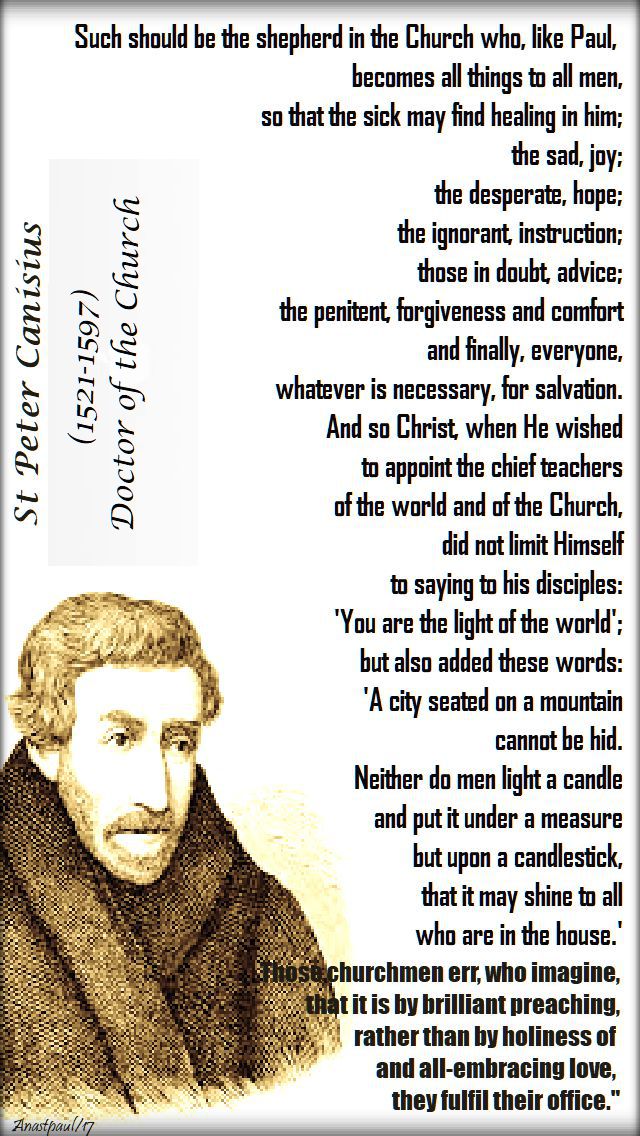
“Such should be the shepherd
in the Church who, like Paul,
becomes all things to all men,
so that the sick may find healing in him;
the sad, joy;
the desperate, hope;
the ignorant, instruction;
those in doubt, advice;
the penitent, forgiveness and comfort
and finally, everyone,
whatever is necessary, for salvation.
And so Christ, when He wished
to appoint the chief teachers
of the world and of the Church,
did not limit Himself to saying to his disciples:
‘You are the light of the world’;
but also added these words:
‘A city seated on a mountain cannot be hid.
Neither do men light a candle
and put it under a measure but upon a candlestick,
that it may shine to all who are in the house.’
Those churchmen err, who imagine,
that it is by brilliant preaching,
rather than by holiness of and all-embracing love,
they fulfil their office.
such should be - st peter canisius - 21 dec 2017

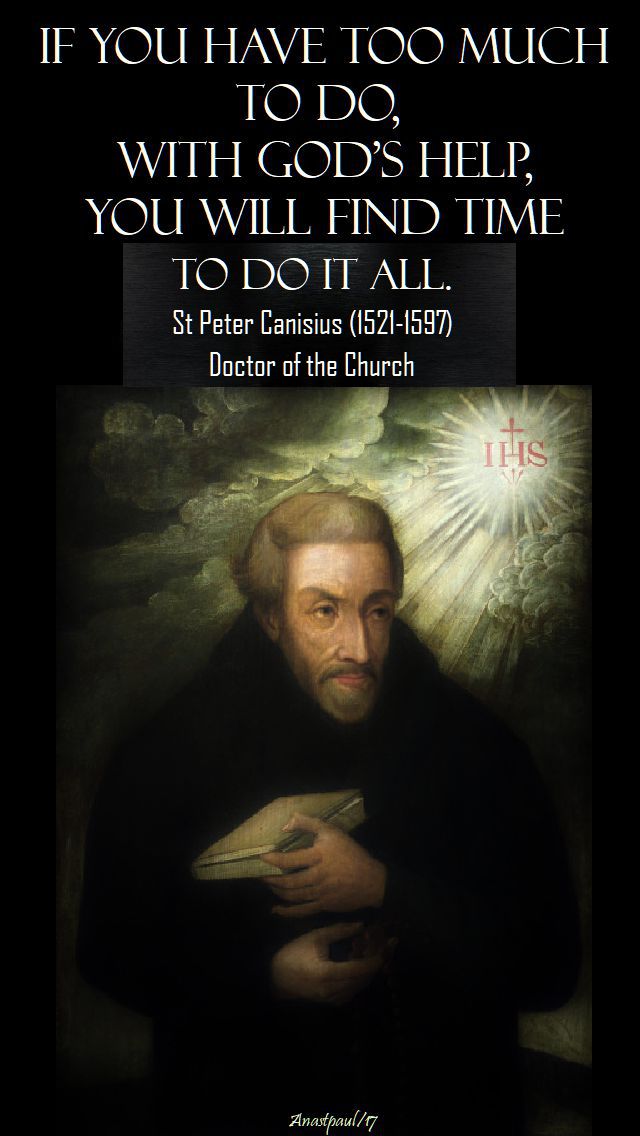
“If you have too much to do, with God’s help, you will find time to do it all.”

St Peter Canisius (1521-1597) Doctor of the Churchif you have too much to do - st peter canisius - 21 dec

“Among the Jesuit saints, it is Peter Canisius
that brought me into the Society of Jesus…
as we go on, you will see, what influence
St Peter has had on this sinner. “

“(St Peter Canisius had) an extraordinary devotion
to the Holy Eucharist – his devotion to the Holy Sacrifice
were such that people would come from great distances
to watch him offer Mass, so devoutly did he celebrate.
He was one of the people that urged frequent Communion
at the Council of Trent and was one of those who got
the Council of Trent to pass a little known decree,
little known because it took almost three hundred years
for that decree to really come to life.
The Council of Trent, mind you, sixteenth century,
encouraged daily Communion – you would never guess it, would you?
Peter Canisius was one of those who, under instructions from Ignatius,
made sure that the Council passed that decree
and he spent hours before the Blessed Sacrament.”

Ven Servant of God Fr John A Hardon S.J. (1914-2000)st peter canisus had an - fr john a hardon - 21 dec 2017

Posted in ADVENT, DOCTORS of the Church, JESUIT SJ, MARIAN QUOTES, MORNING Prayers, QUOTES of the SAINTS, SAINT of the DAY

One Minute Reflection – 21 December – The Memorial of St Peter Canisius (1521-1597) Doctor of the Church

One Minute Reflection – 21 December – The Memorial of St Peter Canisius (1521-1597) Doctor of the Church

God who is mighty,
has done great things for me,
holy is his name…….Luke 1:49Luke 1 - 49

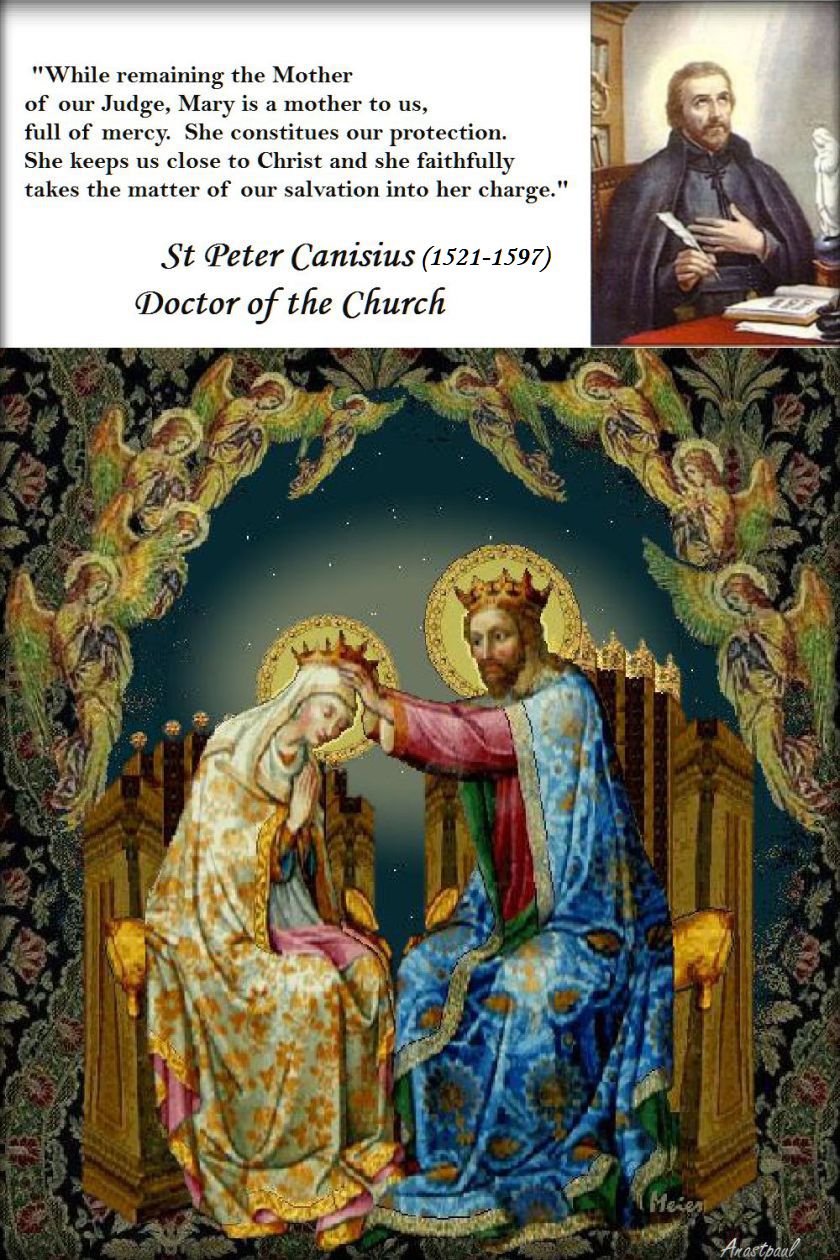
REFLECTION – “While remaining the Mother of our Judge, Mary is a mother to us, full of mercy.   She constitutes our protection.   She keeps us close to Christ and she faithfully takes the matter of our salvation into her charge.”……………….St Peter Canisiuswhile remaining the mother of our judge - st peter canisius - 2016 image

PRAYER – Heavenly Father, You have filled Mary with grace and made her a Co-Meaditrix with Christ Your Son.   Grant that I may have constant recourse to her and attain the salvation she helped win for the world.   St Peter Canisius, you lived a life of total and full dedication to our Father, to His divine Son and his holy and most blessed mother and in complete openness to the inspiration of the Holy Spirit.   Please pray for us that as you were strengthened in sanctity and doctrine for the defence and growth of the Catholic faith, every seeker of truth may have the joy of finding our God and that all Catholics may persevere and grow in love and zeal for the one true faith. amen.canisius-pray-for-us - 2016

Posted in CATHOLIC PRESS, DOCTORS of the Church, JESUIT SJ, Of Catechists, SAINT of the DAY

Saint of the Day – 21 December – St Peter Canisius SJ (1521-1597) – Confessor, Doctor of the Church

Saint of the Day – 21 December – St Peter Canisius SJ (1521-1597) – Confessor, Priest, Religious, Doctor of the Church, Reformer, Teacher,  Writer, Apostle of Charity –  (Born as Pieter Kanis on 8 May 1521 at Niemguen, Netherlands – 21 December 1597 at Fribourg, Switzerland of natural causes).   Patronages – Catholic Press, Germany, Catechists.   Known as the Hammer of Protestantism and the Second Apostle of Germany.   St Peter  became known for his strong support for the Catholic faith during the Protestant Reformation in Germany, Austria, Bohemia, Moravia and Switzerland.   The restoration of the Catholic Church in Germany after the Protestant Reformation is largely attributed to the work there of the Society of Jesus, which he led.   “Peter Canisius was the first publisher, the first author, the first editor of the Society of Jesus.   By now, Jesuits have followed in his footsteps to the tune of having published in 400 years, thousands of books.   From the time of Canisius, and his name is first in the bibliography of Jesuit writers, from Peter Canisius to the end of the l9th century, that is to 1900, there are about twenty volumes of bibliography, each volume about two inches thick, stands about eighteen inches high, filled just with authors and titles, thousands and thousands and thousands, no other religious institute in the Church publishes as much as members of the Society.   It was all started by Peter Canisius.” (Ven Servan of God Fr John A Hardon S.J.)

canisius - large

St Peter Canisius was born in 1521 in what is now the Netherlands.   His father was the local mayor and his mother died shortly of his birth.  Peter studied at the University of Cologne and earned a Master’s degree in 1540 at the age of 19.   While there, he met St Peter Faber, one of the first Jesuits.   Through him, Canisius became the first Dutchman to join the Society of Jesus in 1543.   St Peter Canisius’ preaching and writings, led him to become one of the most influential Catholics of his time.   He supervised the founding and maintenance of the first German-speaking Jesuit colleges and was known as the Second Apostle of Germany.

If you have too much to do, with God’s help you will find time to do it all – St Peter Canisius

For a half-century he led the Catholic Reformation in Austria, Bavaria and Bohemia.   For that reason he is reckoned an apostle to Germany, second only to St. Boniface.   With stupendous energy he preached and taught in parishes, reformed and founded universities, wrote many books including popular catechisms, restored lapsed Catholics, converted Protestants, preached retreats and found time to care for the sick.   In his last 30 years travelling more than 20,000 miles on foot or horseback, St Peter Canisius spearheaded the renewal of the Catholic faith in southern Germany.Saint_Petrus_Canisius

Peter Canisius revitalised Catholic life and teaching at universities in Ingolstadt and Augsburg.   He founded new ones at Prague and Fribourg.   In all four cities his preaching and catechising won the hearts of Catholics and attracted nominal Protestants to the church.   In Vienna his personal care for plague victims made him a most popular figure.  Thus, when appointed diocesan administrator, he was in a position to revive the city’s long decadent Catholic community.

After 1555, Peter Canisius published his famous Summary of Christian Doctrine and two smaller catechisms.   These books generated the Catholic Reformation as Luther’s catechism had spread Protestantism.   Canisius’s catechisms also helped launch the Catholic press.    The Three Catechisms he compiled between 1555 and 1558.   The first Catechism was addressed to students who could grasp the elementary notions of theology;  the second, to young people of the populace for an initial religious instruction;  the third, to youth with a scholastic formation of middle and high school levels.   He explained Catholic doctrine with questions and answers, concisely, in biblical terms, with great clarity and with no polemical overtones.   “There were at least 200 editions of this Catechism in his lifetime alone, translated into 15 languages!   And hundreds of editions succeeded one another until the 20th century.   So it was that still in my father’s generation people in Germany were calling the Catechism simply “the Canisius”.   He really was the Catechist of Germany for centuries, he formed people’s faith for centuries.” (Pope Benedict XVI).

He was offered the post of Bishop of Vienna in 1554 but declined in to continue his travelling and teachings.

canisius2

In the late 16th century, when open hostility typified relations between Catholics and Protestants, Peter Canisius advised charity and moderation. He opposed theological debates with Protestant leaders and in general, discouraged discussion of Catholic distinctives such as indulgences, purgatory and monastic vows with Protestants.   He believed such efforts only heightened division and embittered relations.   He articulated his views in this letter to his Jesuit superior:

“It is plainly wrong to meet non-Catholics with bitterness or to treat them with discourtesy.   For this is nothing else than the reverse of Christ’s example because it breaks the bruised reed and quenches the smoking flax.   We ought to instruct with meekness those whom heresy has made bitter and suspicious and has estranged from orthodox Catholics, especially from our fellow Jesuits.   Thus, by whole-hearted charity and good will we may win them over to us in the Lord.

Again, it is a mistaken policy to behave in a contentious fashion and to start disputes about matters of belief with argumentative people who are disposed by their very natures to wrangling.   Indeed, the fact of their being so constituted is a reason the more why such people should be attracted and won to the simplicity of the faith as much by example as by argument.”

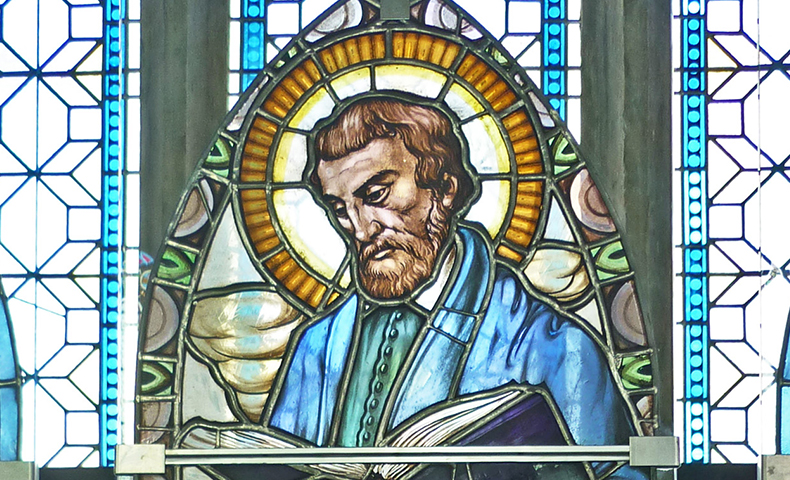
In 1591, Peter Canisius suffered a stroke that nearly killed him.   But he recovered and devoted himself to writing for six more years until his death in 1597.   His body was interred before the high altar of the Church of Saint Nicholas in Fribourg and his relics were translated to the Church of Saint Michael at the Jesuit College in Fribourg in 1625. He was Canonised 21 May 1925 by Pope Pius XI and was added to the now 36 Doctors of the Church, by Pope Pius XI in 1925.SOD-1221-SaintPeterCanisius-790x480Petrus Canisius / Gemaelde - Petrus Canisius / Painting -

Posted in ADVENT, CHRISTMASTIDE!, DOCTORS of the Church, MORNING Prayers, QUOTES of the SAINTS, The CHRIST CHILD

Quote of the Day – 20 December – Wednesday of the Third Week of Advent

Quote of the Day – 20 December – Wednesday of the Third Week of Advent

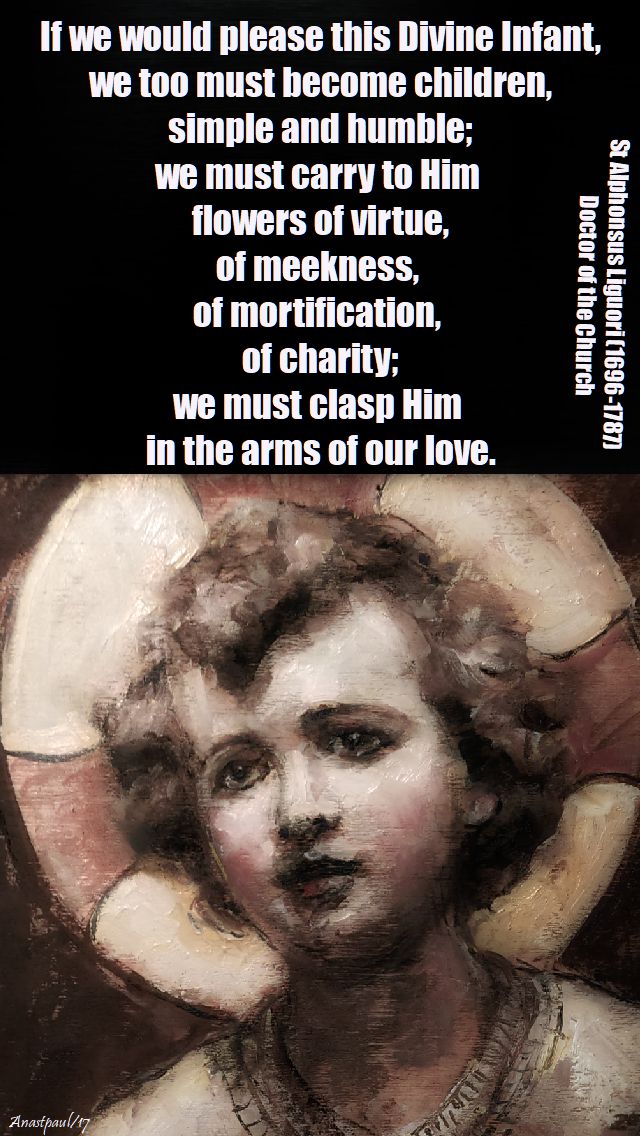
“If we would please this Divine Infant,
we too must become children,
simple and humble;
we must carry to Him flowers of virtue,
of meekness, of mortification, of charity;
we must clasp Him in the arms of our love.”

St Alphonsus Liguori (1696-1787) Doctor of the Churchif we would please this divine infant - st alphonsus - 20 dec 2017

Posted in ADVENT, DOCTORS of the Church, MORNING Prayers, QUOTES of the SAINTS, SAINT of the DAY

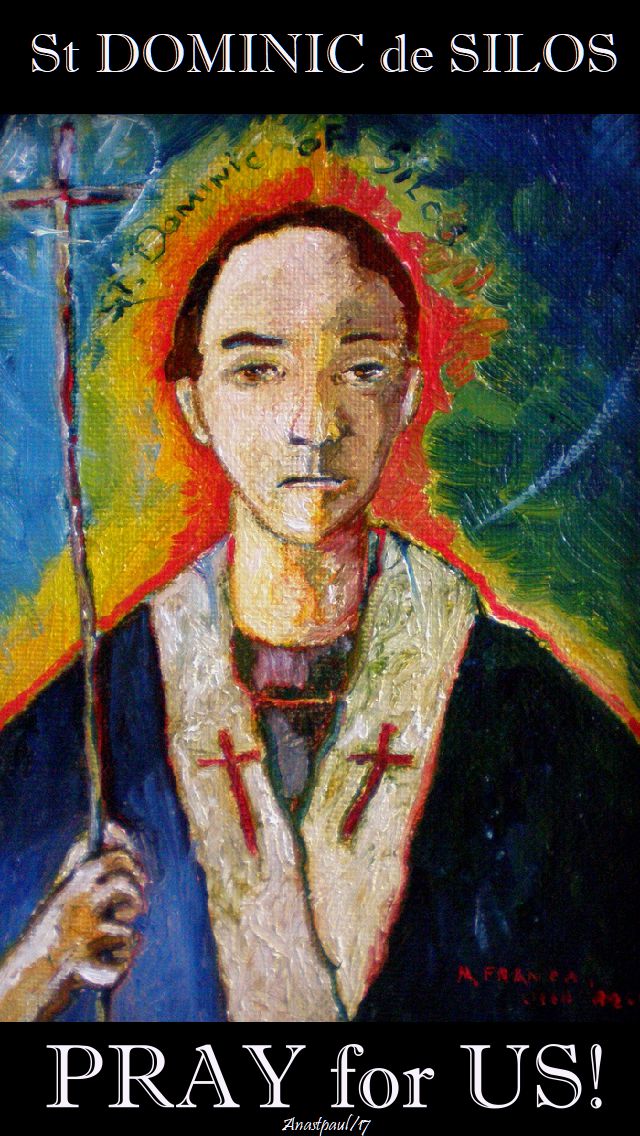
One Minute Reflection – 20 December – The Memorial of St Dominic de Silos (1000-1073)

One Minute Reflection – 20 December – The Memorial of St Dominic de Silos (1000-1073)

You, O God, are my stronghold, my gracious God!………..Psalm 59:18psalm-59-18

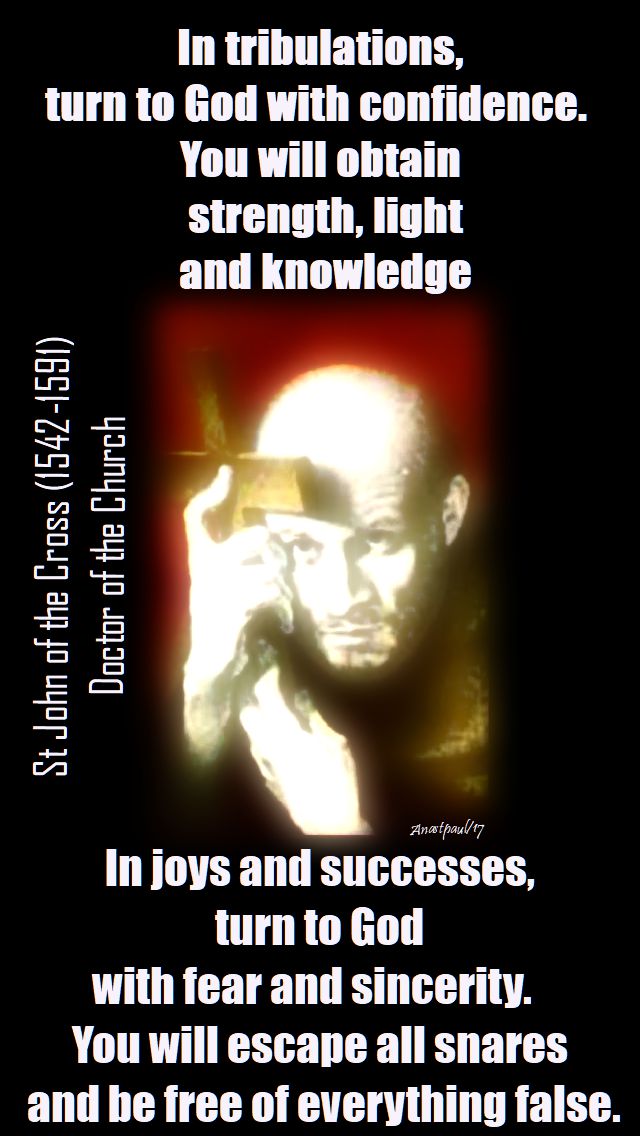
REFLECTION – “In tribulations, turn to God with confidence.   You will obtain strength, light and knowledge.
In joys and successes, turn to God with fear and sincerity.   You will escape all snares and be free of everything false.”..St John of the Crossin tribulations - st john of the cross - 20 dec 2017

PRAYER – Heavenly Father, let me turn to You in good times and in bad. Grant that I may always remain in loving union with You no matter what adversity or goodness should befall me. As St Dominic de Silos lived his life, when he was exiled, he found another way to give You honour and through this adversity You filled his work with miracles. So too may it be in my life. St Dominic de Silos Pray for us! Amenst dominic de silos pray for us - 20 dec 2017

Posted in ADVENT, DOCTORS of the Church, FATHERS of the Church, MORNING Prayers, QUOTES of the SAINTS, QUOTES on CHARITY, QUOTES on LOVE, SAINT of the DAY

Quote/s of the Day – 18 December – The Memorial of Bl Giulia Nemesia Valle (1847-1916) – Called “the Angel of Charity”

Quote/s of the Day – 18 December – The Memorial of Bl Giulia Nemesia Valle (1847-1916) – Called “the Angel of Charity”

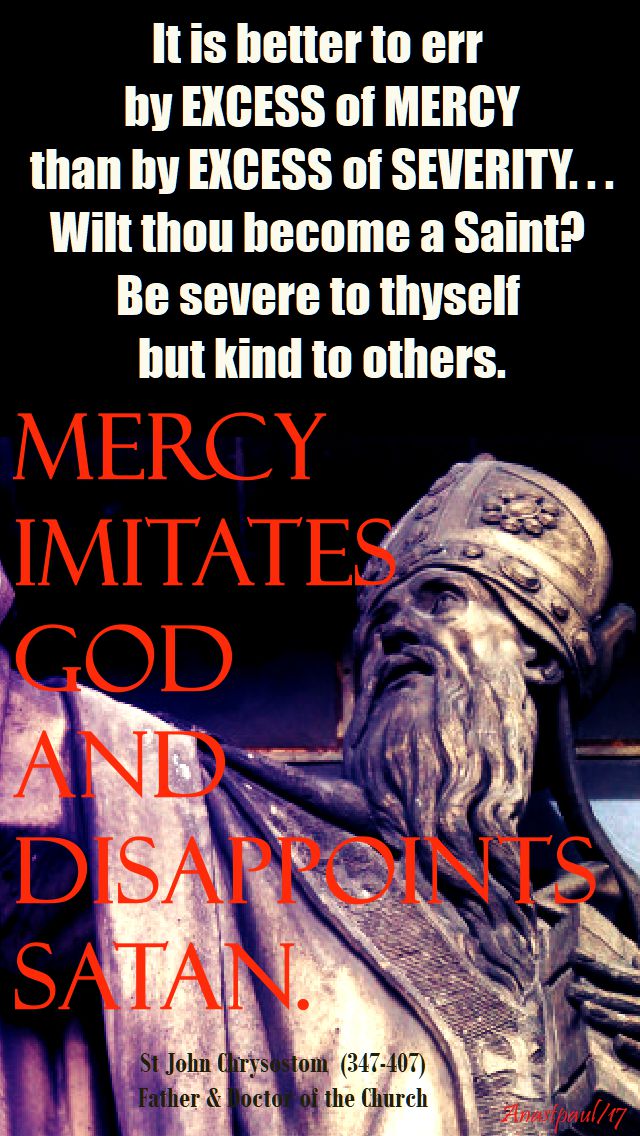
“It is better to err by excess of mercy
than by excess of severity. . .
Wilt thou become a Saint?
Be severe to thyself but kind to others.”

“Mercy imitates God and disappoints Satan.”

St John Chrysostom (347-407) Father & Doctor of the Churchmercy-imitates-god-st-john-chrysostom-17-nov-2017

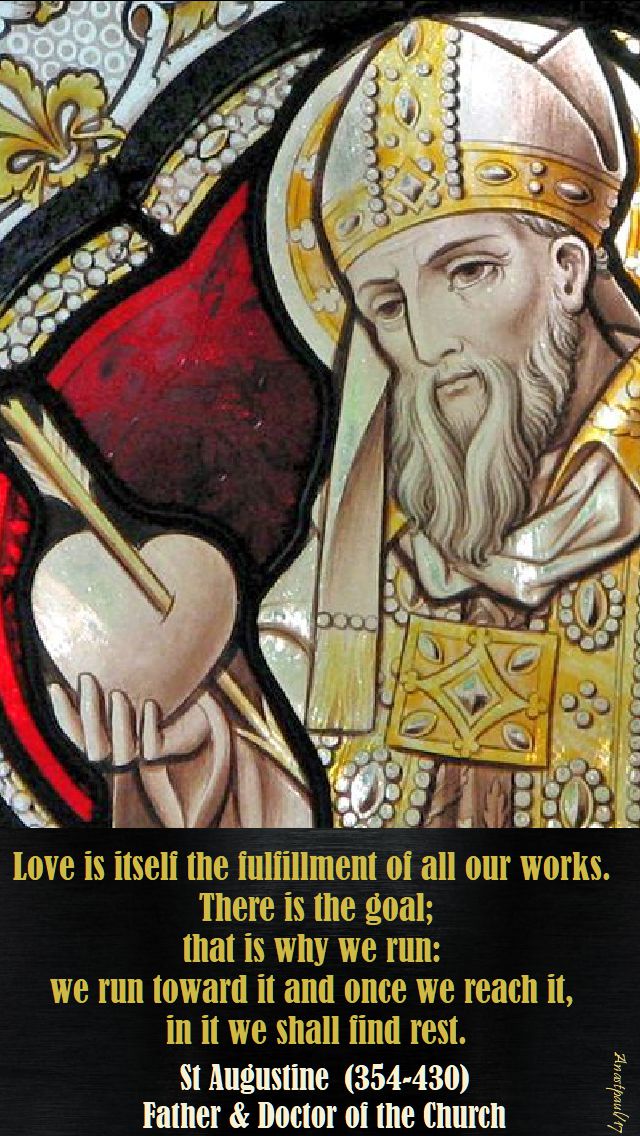
” Love is itself the fulfillment of all our works.
There is the goal;
that is why we run:
we run toward it and once we reach it,
in it we shall find rest.

St Augustine (354-430) Father & Doctor of the Churchlove-is-itself-st-augustine-17-nov-2017

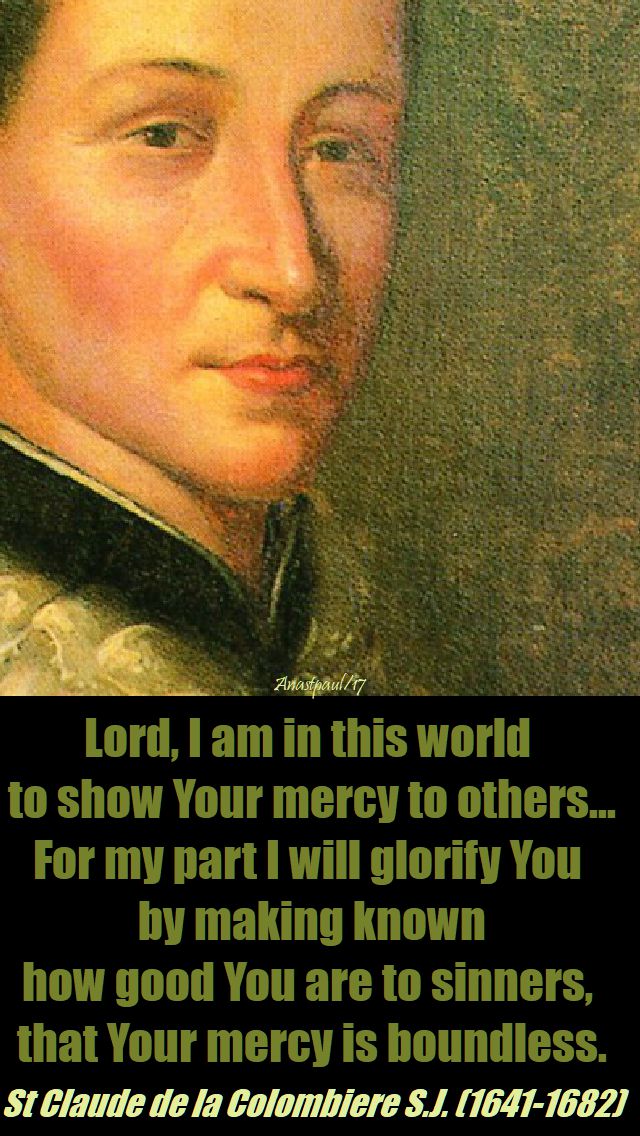
“Lord, I am in this world to show Your mercy to others…
For my part I will glorify You by making known
how good You are to sinners, that Your mercy is boundless.”

St Claude de la Colombiere S.J. (1641-1682)lord-i-am-in-this-world-st-claude-de-la-colombiere-17-nov-2017

Posted in ADVENT, DOCTORS of the Church, FATHERS of the Church, MORNING Prayers, QUOTES of the SAINTS, The CHRIST CHILD, The INCARNATION, The WORD

Quote/s of the Day – 17 December – Gaudete Sunday

Quote/s of the Day – 17 December – Gaudete Sunday

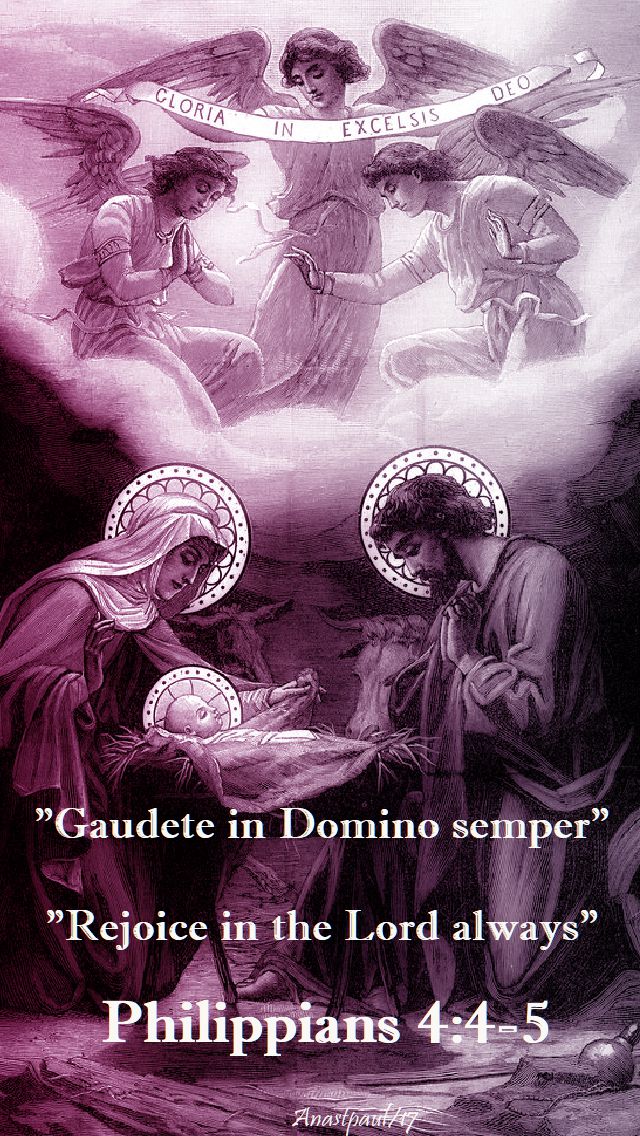
“Gaudete in Domino semper”

“Rejoice in the Lord always”

Philippians 4:4-5philippians 4 4-5

“The very Son of God,
older than the ages,
the invisible,
the incomprehensible,
the incorporeal,
the beginning of beginning,
the light of light,
the fountain of life and immortality,
the image of the archetype,
the immovable seal,
the perfect likeness,
the definition and word of the Father:
He it is who comes to His own image
and takes our nature for the good of our nature
and unites Himself to an intelligent soul
for the good of my soul,
to purify like by like.”

St Gregory of Nazianzen (330-390) Father and Doctor of the Churchthe very son of god - st gregory of naziazen

Posted in ADVENT, DOCTORS of the Church, FATHERS of the Church, MORNING Prayers, QUOTES of the SAINTS, The CHRIST CHILD

One Minute Reflection – 15 December – Friday of the Second Week of Advent

One Minute Reflection – 15 December – Friday of the Second Week of Advent

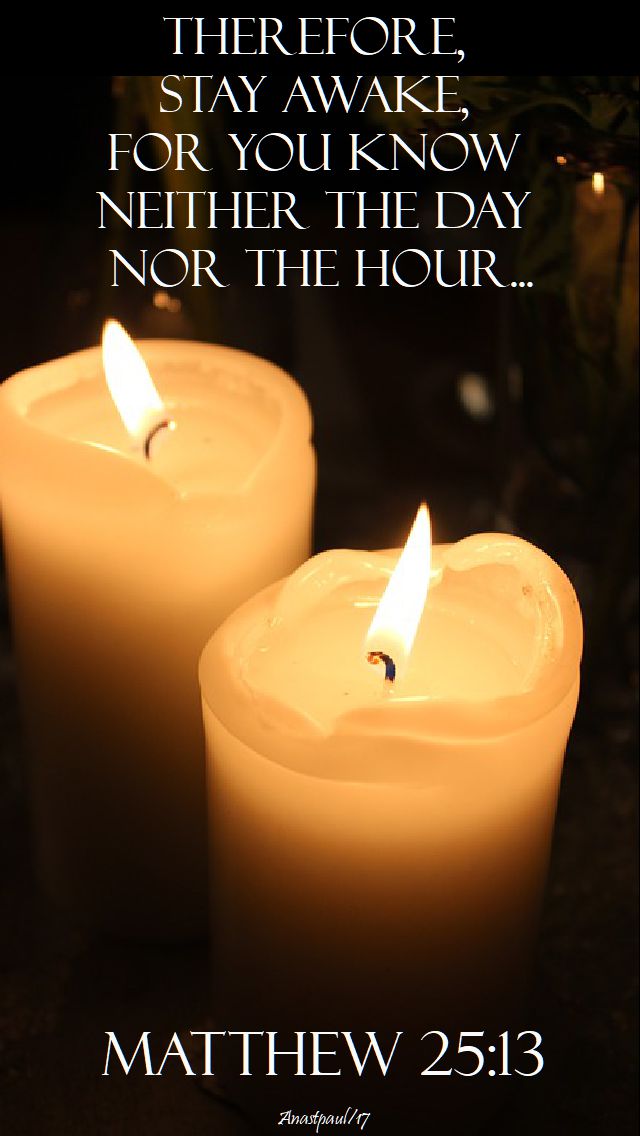
Therefore, stay awake, for you know neither the day nor the hour...Matthew 25:13matthew 25 13 - 15 dec 2017

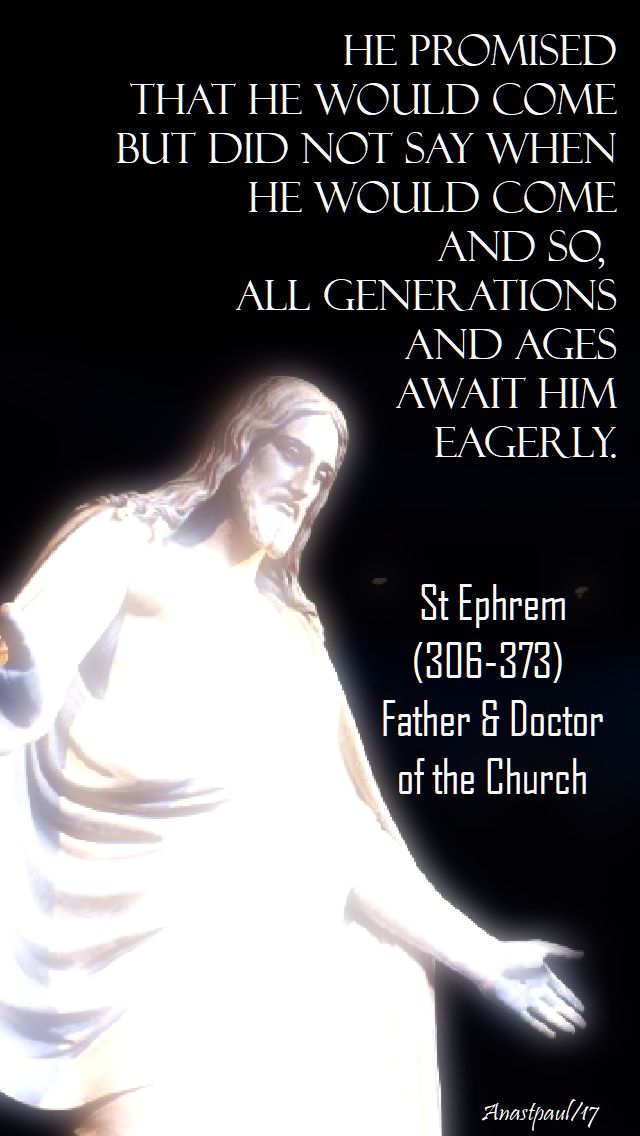
REFLECTION – “To prevent His disciples from asking the time of His coming, Christ said: About that hour no one knows, neither the angels nor the Son.   It is not for you to know times or moments.   He has kept those things hidden so that we may keep watch, each of us thinking that He will come in our own day. If He had revealed the time of His coming, His coming would have lost its savour:  it would no longer be an object of yearning for the nations and the age in which it will be revealed.   He promised that He would come but did not say when He would come and so, all generations and ages await Him eagerly.”…St Ephrem (306-373) Father & Doctor of the Churchhe promised that he would come - st ephrem - 15 dec 2017

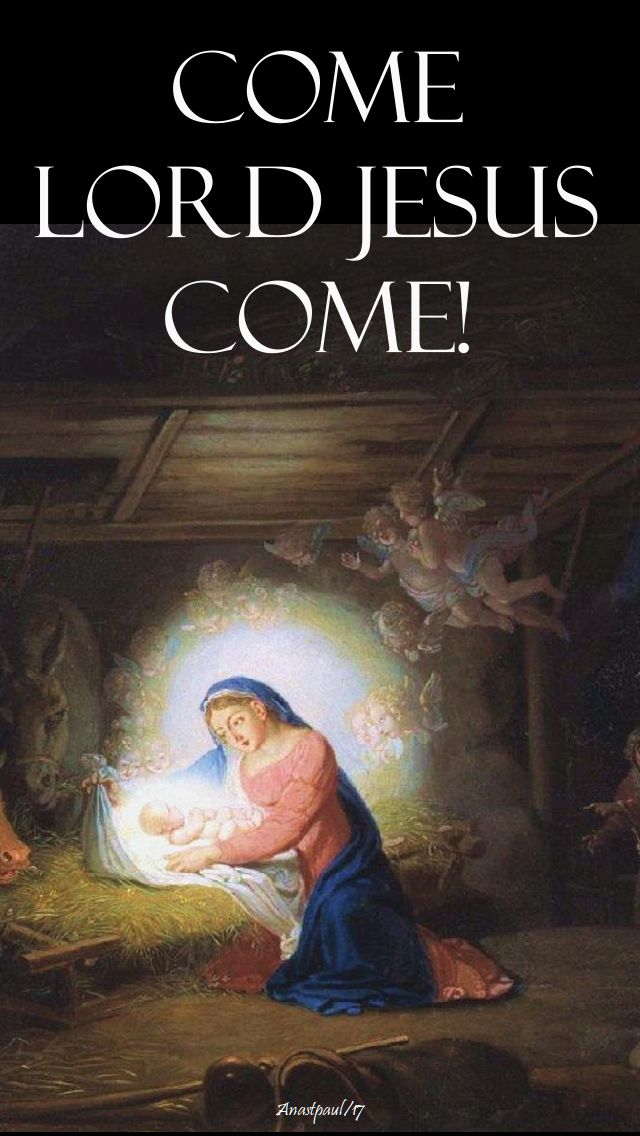
PRAYER – Holy God, keep us ever alert and watchful, making straight the paths of Your Son, as we await His coming.   It is within our hearts that we need to straighten all things, for if all hearts are ready, our Lord will find His people waiting in hope, peace, joy and love.   Come, Lord Jesus, come. Amencome lord jesus - 15 dec 2017

Posted in ADVENT, DOCTORS of the Church, FATHERS of the Church, HYMNS, MORNING Prayers, POETRY, PRAYERS of the SAINTS, The CHRIST CHILD

Our Morning Offering – 15 December – Friday of the Second Week of Advent

Our Morning Offering – 15 December – Friday of the Second Week of Advent

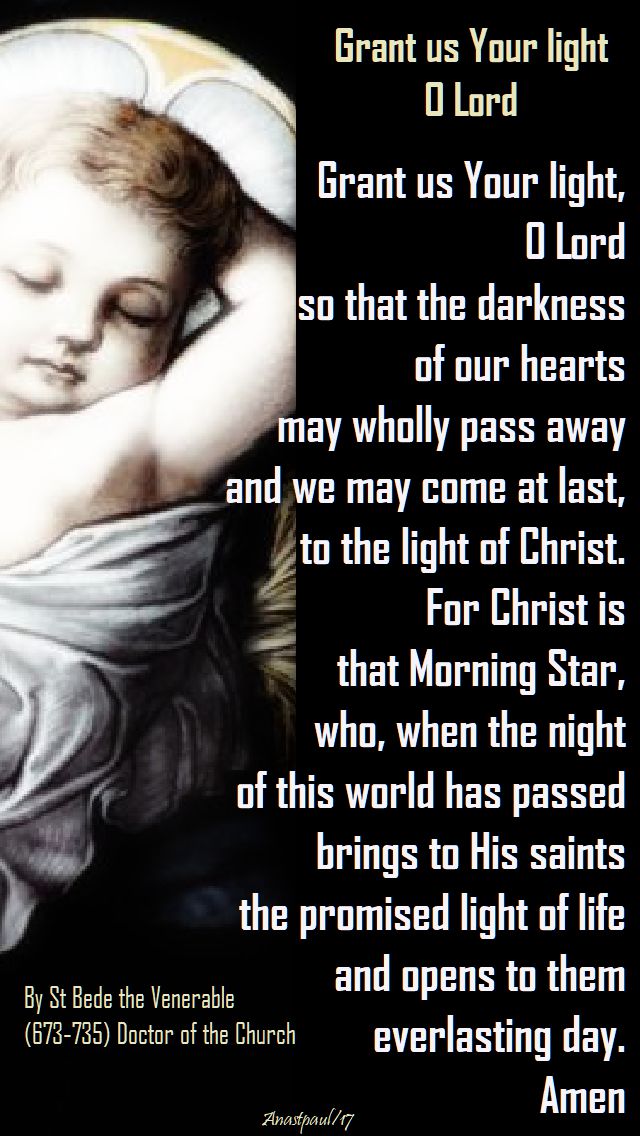
Grant us Your light O Lord
By St Bede the Venerable (673-735) Doctor of the Church

Grant us Your light O Lord
so that the darkness of our hearts
may wholly pass away
and we may come at last,
to the light of Christ.
For Christ is that Morning Star,
who, when the night
of this world has passed
brings to His saints
the promised light of life
and opens to them everlasting day.
Amen

grant us your light o lord - st bede - 15 dec 2017

Posted in ADVENT, CARMELITES, DOCTORS of the Church, MORNING Prayers, SAINT of the DAY, The HOLY CROSS

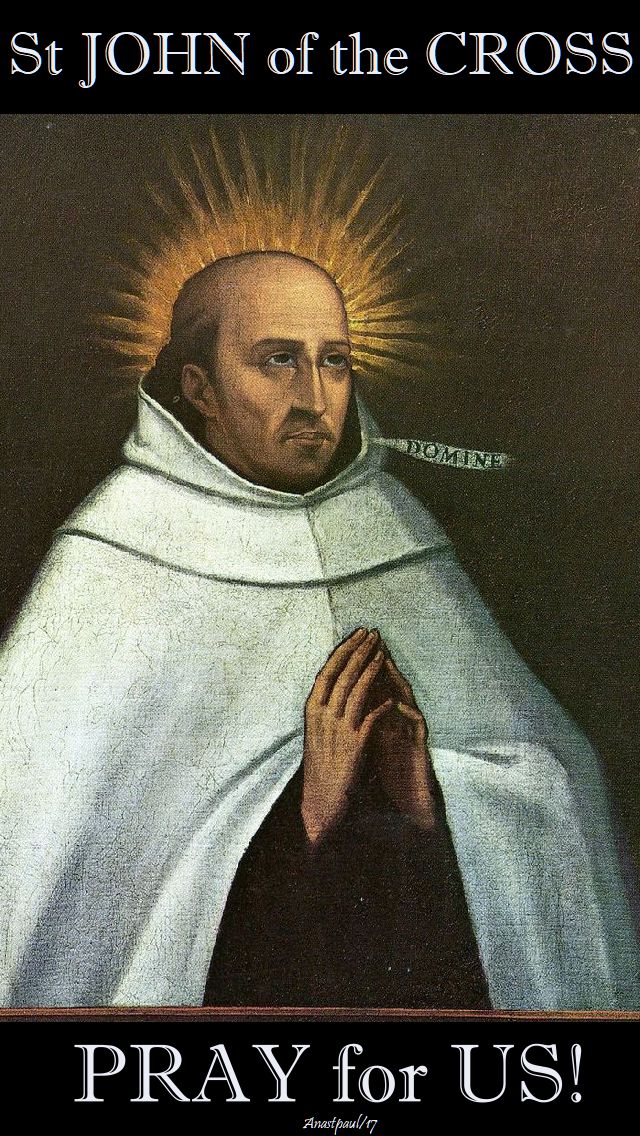
Thought for the Day – 14 December – The Memorial of St John of the Cross (1542-1591) Doctor of the Church

Thought for the Day – 14 December – The Memorial of St John of the Cross (1542-1591) Doctor of the Church

In his life and writings, John of the Cross has a crucial word for us today.   We tend to be rich, soft, comfortable.   We shrink even from words like self-denial, mortification, purification, asceticism, discipline.   We run from the cross.   John’s message—like the gospel—is loud and clear:   Don’t—if you really want to live! (Fr Don Miller OFM)

St John of the Cross – pray for us!ST J OF THE CROSS - PRAY FOR US - 14 DEC 2017

Posted in ADVENT, CARMELITES, DOCTORS of the Church, MORNING Prayers, POETRY, PRAYERS of the SAINTS, SAINT of the DAY

‘Song of the soul that is glad to know God by faith’

‘Song of the soul that is glad to know God by faith’

14 December – The Memorial of St John of the Cross (1542-1591) Doctor of the Church

There have been a number of translations into English of the works of St John of the Cross.   One of the translations which has been considered one of the best is that by the Anglo-South African convert poet Roy Campbell (2 October 1901 – 22 April 1957).

In October 2009, Roger Scruton wrote about Roy Campbell in his article “A Dark Horse” published in The American Spectator. He was hated by the English “left establishment” especially because of his position on The Spanish Civil War.

The Wikipedia entry says of Roy Campbell that he “was considered by T. S. Eliot, Edith Sitwell and Dylan Thomas to have been one of the best poets of the period between the First and Second World wars but he is seldom found in anthologies today.”

Campbell’s translations of the poetry by St John of the Cross were lavishly praised by Argentine writer Jorge Luis Borges

For more about Campbell`s work, R J Dent has published an essay on Roy Campbell and his work entitled: Violence and exquisite beauty – the aesthetics of Roy Campbell.

Here is a poem of St John of the Cross with the translations by the late Roy Campbell.

‘Song of the soul that is glad to know God by faith’

How well I know that fountain’s rushing flow
Although by night

Its deathless spring is hidden. Even so
Full well I guess from whence its source flow
Though it be night.

Its origin (since it has none) none knows:
But that all origin from it arose
Although by night.

I know there is no other thing so fair
And earth and heaven drink refreshment there
Although by night.

Full well I know the depth no man can sound
And that no ford to cross it can be found
Though it be night

Its clarity unclouded still shall be:
Out of it comes the light by which we see
Though it be night.

Flush with its banks the stream so proudly swells;
I know it waters nations, heavens, and hells
Though it be night.

The current that is nourished by this source
I know to be omnipotent in force
Although by night.song of the soul that is glad to know god by faith - st j of the cross - 14 dec 2017

After the beatification of St John of the Cross on 25 January 1675, the Carmelite convent of Nuestra Señora de los Remedios near Seville commissioned this life-sized statue from the young Sevillian sculptor, Francisco Antonio Gijón, then only 21.
The figure of the saint holds a quill pen in his right hand and, in the left, a book with a model of a mountain surmounted by a cross, which refers to his mystic commentary, “The Ascent of Mount Carmel.”

Francisco Antonio Gijón (1653–c. 1721) and unknown painter (possibly Domingo Mejías)
Saint John of the Cross
c 1675
Painted and gilded wood
168 cm (66 1/8 in.)


Posted in ADVENT, CARMELITES, DOCTORS of the Church, MORNING Prayers, QUOTES of the SAINTS, QUOTES on LOVE, SAINT of the DAY, The HOLY CROSS

Quotes of the Day – 14 December – The Memorial of St John of the Cross (1542-1591) Doctor of the Church

Quotes of the Day – 14 December – The Memorial of St John of the Cross (1542-1591) Doctor of the Church

“In giving us His Son, His only Word,
He spoke everything to us at once
in this sole Word – and He has no more to say…
because what He spoke before to the prophets in parts,
He has now spoken all at once by giving us
the ALL Who is His Son.”in giving us his son - st john of the cross - 14 dec 2016

“If a man wishes to be sure of the road
he treads on, he must close his eyes
and walk in the dark.”if a man wishes to be sure of the road - st john of the cross - 14 dec 2017

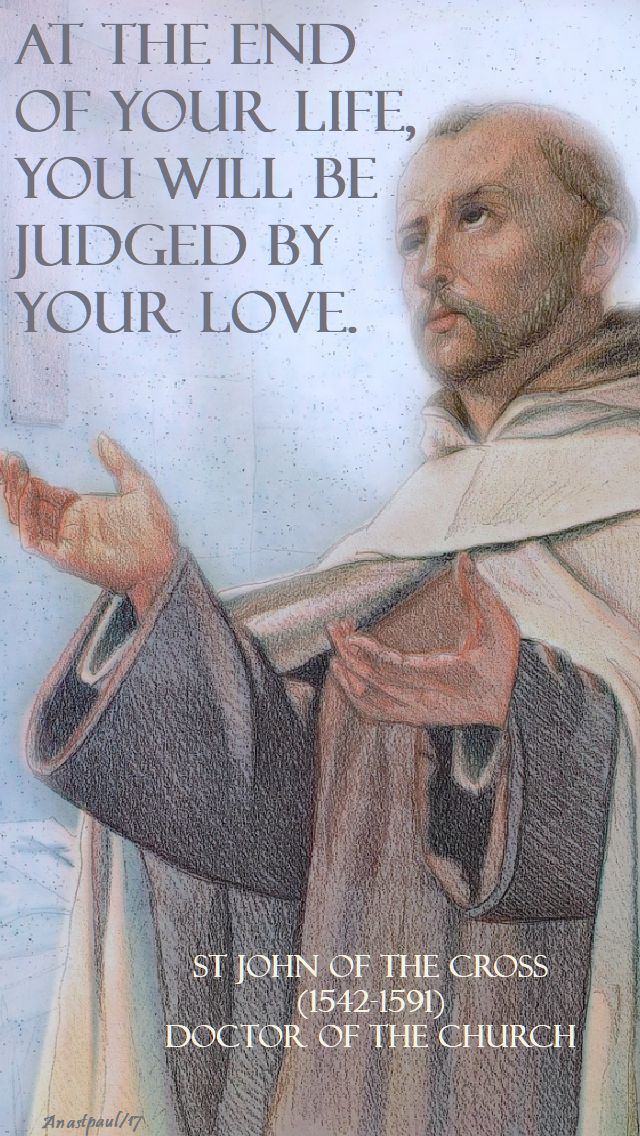
“At the end of your life,
you will be judged by your love.”

St John of the Cross (1542-1591) Doctor of the Churchat the end of your life - st j of the cross = 14 dec 2017


Posted in ADVENT, CARMELITES, DOCTORS of the Church, MORNING Prayers, QUOTES on SUFFERING, SAINT of the DAY, The WORD

One Minute Reflection – 14 December – The Memorial of St John of the Cross (1542-1591) Doctor of the Church

One Minute Reflection – 14 December – The Memorial of St John of the Cross (1542-1591) Doctor of the Church

In all truth I tell you, unless a grain of wheat
falls into the earth and dies,
it remains only a single grain;
but if it dies it yields a rich harvest…John 12:24john 12 - 24

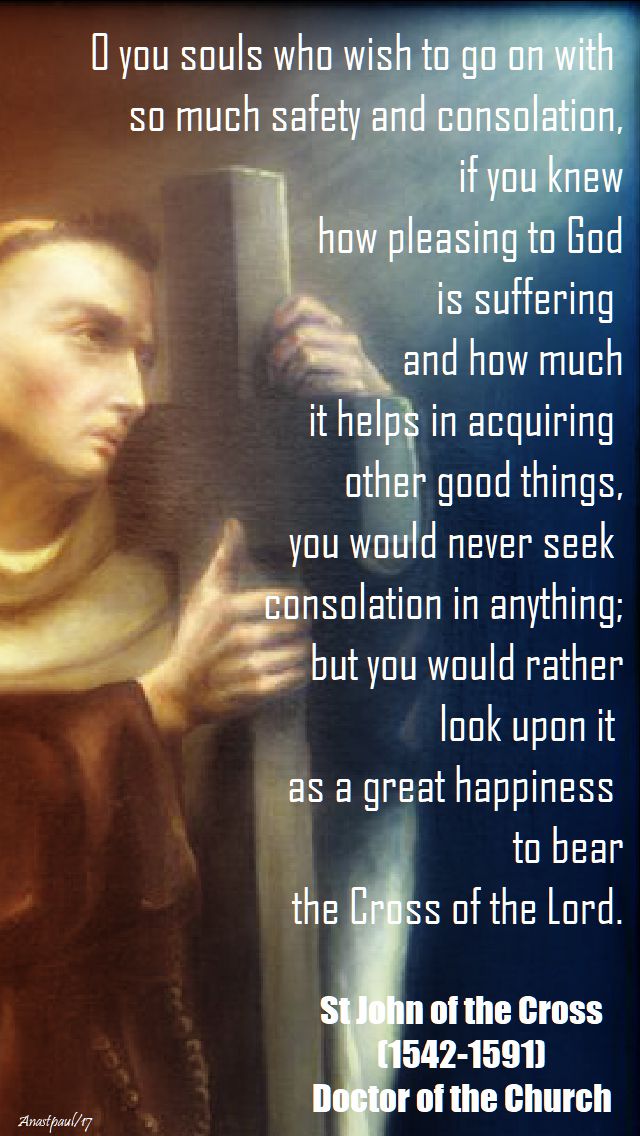
REFLECTION – “O you souls who wish to go on with so much safety and consolation, if you knew how pleasing to God is suffering and how much it helps in acquiring other good things, you would never seek consolation in anything; but you would rather look upon it as a great happiness to bear the Cross of the Lord.”…Saint John of the Crosso you souls - st john of the cross - 14 dec 2017

PRAYER – Lord God, You gave St John of the Cross, the grace of complete self-denial and an ardent love for the Cross of Christ. Grant that by following always in the footsteps of Christ and by the prayers of St John of the Cross on our behalf, we may come to the eternal vision of Your glory. Through our Lord Jesus Christ, in unity with the Holy Spirit, one God forever, amen.st john of the cross pray for us - 14 dec 2017

Posted in ADVENT, CARMELITES, DOCTORS of the Church, MORNING Prayers, PRAYERS of the SAINTS, SAINT of the DAY, Uncategorized

Our Morning Offering – 14 December – The Memorial of St John of the Cross (1542-1591) Doctor of the Church

Our Morning Offering – 14 December – The Memorial of St John of the Cross (1542-1591) Doctor of the Church

O King of Gentleness
By St John of the Cross

O blessed Jesus,
give me stillness of soul in You.
Let Your mighty calmness reign in me.
Rule me, O King of Gentleness,
King of Peace.o king of gentleness - o blessed jesus give me - st john of the cross - 14 dec 2017

Posted in ADVENT, CARMELITES, CONTEMPLATIVE Prayer, DOCTORS of the Church, SAINT of the DAY

Saint of the Day – 14 December – (1542-1591) Doctor of the Church

Saint of the Day – 14 December – (1542-1591) Doctor of the Church – Carmelite monk and Priest, Religious Founder, Writer, Poet, Mystic, Apostle of Contemplative Prayer.   Also known as • Doctor of Mystical Theology • John della Croce • John de la Croix • John de la Cruz.   Patronages – • contemplative life, contemplatives• mystical theology, mystics• Spanish poets• World Youth Day 2011• Segovia, Spain• Ta’ Xbiex, Malta.   Attributes – eagle, Crucifix, Cross, Carmelite habit.    John of the Cross is known for his writings.   Both his poetry and his studies on the growth of the soul are considered the summit of mystical Spanish literature and one of the peaks of all Spanish literature.   He was canonised as a saint in 1726 by Pope Benedict XIII.   He is one of the thirty-six Doctors of the Church, added by Pope Pius XI in 1926.   His works are • Ascent of Mount Carmel• Dark Night of the Soul, Book 1 • Dark Night of the Soul, Book 2 • A Spiritual Canticle of the Soul and the Bridegroom Christ.st john of the cross - infost john cross LARGE

St John was born Juan de Yepes y Álvarez into a converso family (descendents of Jewish converts to Christianity) in Fontiveros, near Ávila, a town of around 2,000 people.  John’s father had been disowned by his wealthy Spanish family when he married a poor weaver rather than a woman of equal economic status.   Living in poverty proved to be too much for him and he died shortly after John was born.   John spent much of his youth in an orphanage, where he was clothed, fed and given an elementary education.   At the age of 17, he found a job in a hospital and was accepted into a Jesuit college.   In 1563 he entered the Carmelite Order.   Eventually he enrolled in another university, where he did so well that he was asked to teach a class and to help settle disputes.

Ordained a Carmelite priest in 1567 at age 25, John met Teresa of Avila and, like her, vowed himself to the primitive Rule of the Carmelites.   As partner with Teresa and in his own right, John engaged in the work of reform and came to experience the price of reform:  increasing opposition, misunderstanding, persecution, imprisonment.    John was caught up in a misunderstanding and imprisoned at Toledo, Spain.   During those months of darkness in that little cell, John could have become bitter, revengeful, or filled with despair.   But instead, he kept himself open to God’s action, for no prison could separate him from God’s all-embracing love.   During this time he had many beautiful experiences and encounters with God in prayer.   He came to know the cross acutely—to experience the dying of Jesus—as he sat month after month in his dark, damp, narrow cell with only his God.Zurbarán_St._John_of_the_Cross. - large

Yet, the paradox!   In this dying of imprisonment John came to life, uttering poetry.   In the darkness of the dungeon, John’s spirit came into the Light.   There are many mystics, many poets-  John is unique as mystic-poet, expressing in his prison-cross the ecstasy of mystical union with God in the Spiritual Canticle.the blessed St John of the Cross


But as agony leads to ecstasy, so John had his Ascent to Mt Carmel, as he named it in his prose masterpiece.   As man-Christian-Carmelite, he experienced in himself this purifying ascent;  as spiritual director, he sensed it in others;  as psychologist-theologian, he described and analysed it in his prose writings.   His prose works are outstanding in underscoring the cost of discipleship, the path of union with God:  rigorous discipline, abandonment, purification.   Uniquely and strongly John underlines the gospel paradox: The cross leads to resurrection, agony to ecstasy, darkness to light, abandonment to possession, denial to self to union with God.   If you want to save your life, you must lose it.   John is truly “of the Cross.”   He died at 49—a life short, but full.    AND his reforms of the “Discalced” Carmelites revitalised the Order.   He was proclaimed a Doctor of the Church by Pope Pius XI on 24 August 1926.

496px-diego_de_sanabria_-_saint_john_of_the_cross_-_google_art_project
Diego de Sanabria – Saint John of the Cross
535px-el_greco_-_view_of_toledo_-_google_art_project
Image above – El Greco‘s landscape of Toledo depicts the priory in which John was held captive, just below the old Muslim alcázar and perched on the banks of the Tajo on high cliffs
Posted in DOCTORS of the Church, MORNING Prayers, QUOTES of the SAINTS, QUOTES on SUFFERING, SAINT of the DAY

Quote/s of the Day – 13 December

Quote/s of the Day – 13 December

“If you want to honour the body of Christ,
do not scorn it when it is naked;
do not honour the Eucharistic Christ
with silk vestments and then,
leaving the church, neglect the other Christ
suffering from cold and nakedness”

St John Chrysostom (347-407)

Father and Doctor of the Church – (Hom. in Matthaeum, 50.3: PG 58)if-you-want-to-honour-the-body-of-christ-st-john-chrysostom-19-nov-2017

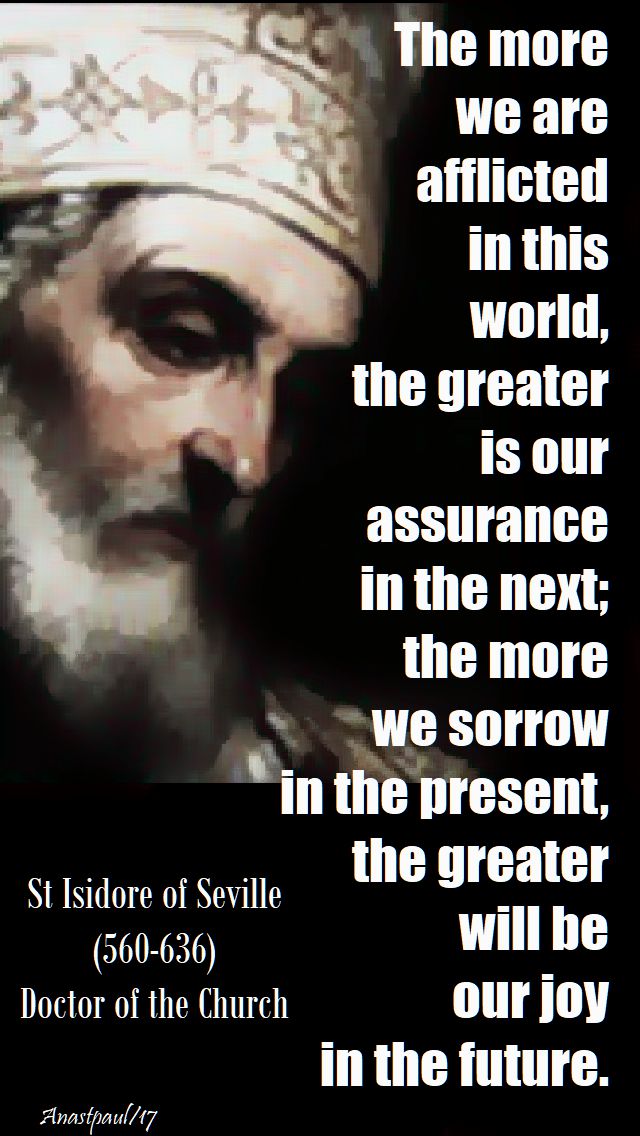
“The more we are afflicted in this world,
the greater is our assurance in the next;
the more we sorrow in the present,
the greater will be our joy in the future.”

St Isidore of Seville (560-636) Doctor of the Churchthe more we are afflicted - st isidore of seville - 13 dec 2017

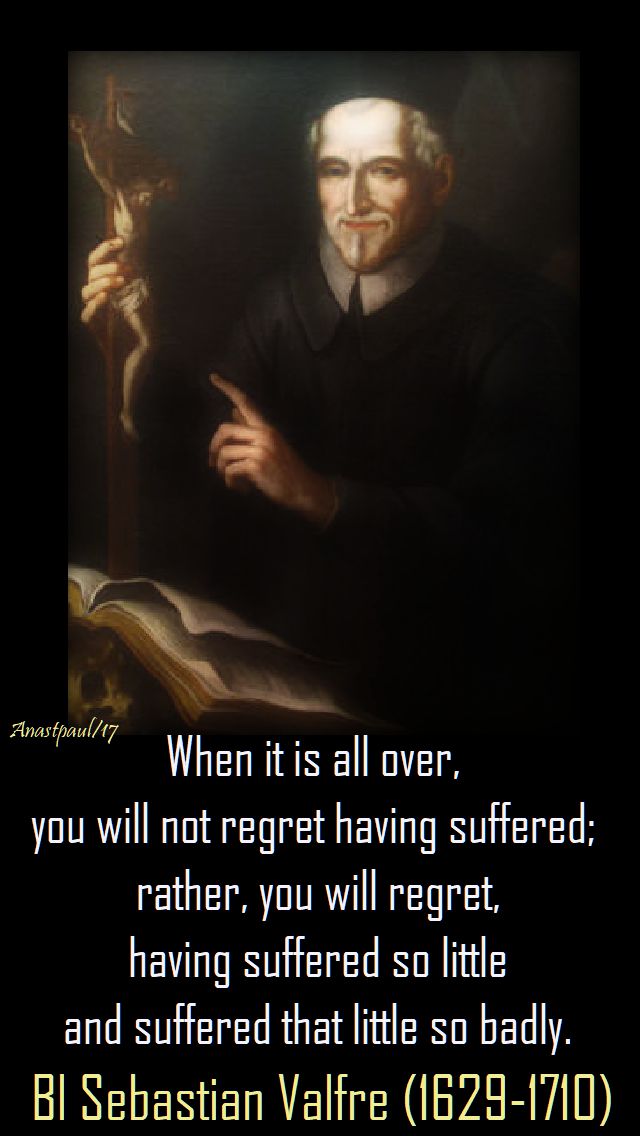
“When it is all over, you will not regret having suffered;
rather, you will regret, having suffered so little
and suffered that little so badly.”

Bl Sebastian Valfre (1629-1710)when it is all over - bl sebastian valfre - 13 dec 2017

Posted in ADVENT, DOCTORS of the Church, FATHERS of the Church, QUOTES of the SAINTS, SAINT of the DAY

Saint of the Day – 11 December – St Pope Damasus I (c 305-384)

Saint of the Day – 11 December – St Pope Damasus I (c 305-384) Priest and Pope – ( c 305 in Rome, Italy –  11 December 384 in Rome, Italy of natural causes).  Patronage – archeologists.   He was buried in the Mark and Marcellianus catacombs in Rome
and his bones re-buried in the church of San Lorenzo in Damaso.Dec. 11 - Pope St. Damasus

The son of a Roman priest, possibly of Spanish extraction, Damasus started as a deacon in his father’s church and served as a priest in what later became the basilica of San Lorenzo in Rome.    He served Pope Liberius (352-366) and followed him into exile.

When Liberius died, Damasus was elected bishop of Rome; but a minority elected and consecrated another deacon, Ursinus, as pope.   The controversy between Damasus and the antipope resulted in violent battles in two basilicas, scandalising the bishops of Italy. At the synod that Damasus called on the occasion of his birthday, he asked them to approve his actions.   The bishops’ reply was curt:  “We assembled for a birthday, not to condemn a man unheard.”   Supporters of the antipope even managed to get Damasus accused of a grave crime—probably sexual—as late as 378.   He had to clear himself before both a civil court and a Church synod.

As pope, his lifestyle was simple in contrast to other ecclesiastics of Rome and he was fierce in his denunciation of Arianism and other heresies.   A misunderstanding of the Trinitarian terminology used by Rome threatened amicable relations with the Eastern Church and Damasus was only moderately successful in dealing with that challenge.

He appointed St Jerome as his confidential secretary.   Invited to Rome originally to a synod of 382 convened to end the schism of Antioch, Jerome made himself indispensable to the pope and took a prominent place in his councils.   Jerome spent three years (382–385) in Rome in close intercourse with Pope Damasus and the leading Christians.   Writing in 409, Jerome remarked, “A great many years ago when I was helping Damasus, bishop of Rome with his ecclesiastical correspondence, I was also helping to write his answers to the questions referred to him by the councils of the east and west…”

Sts Jerome and Damasus

In order to put an end to the marked divergences in the western texts of that period, Damasus encouraged the highly respected scholar Jerome to revise the available Old Latin versions of the Bible into a more accurate Latin on the basis of the Greek New Testament and the Septuagint, resulting in the Vulgate.   Jerome devoted a very brief notice to Damasus in his De Viris Illustribus, written after Damasus’ death:  “he had a fine talent for making verses and published many brief works in heroic metre. He died in the reign of the emperor Theodosius at the age of almost eighty”.

The letters from Jerome to Damasus are examples of the primacy of the See of Peter:

Yet, though your greatness terrifies me, your kindness attracts me.   From the priest I demand the safe-keeping of the victim, from the shepherd the protection due to the sheep.   Away with all that is overweening;  let the state of Roman majesty withdraw.   My words are spoken to the successor of the fisherman, to the disciple of the cross.   As I follow no leader save Christ, so I communicate with none but your blessedness, that is with the chair of Peter.   For this, I know, is the rock on which the church is built!   This is the house where alone the paschal lamb can be rightly eaten.   This is the ark of Noah and he who is not found in it shall perish when the flood prevails.   But since by reason of my sins I have betaken myself to this desert which lies between Syria and the uncivilised waste, I cannot, owing to the great distance between us, always ask of your sanctity the holy thing of the Lord.   Consequently I here follow the Egyptian confessors who share your faith and anchor my frail craft under the shadow of their great argosies. I know nothing of Vitalis;  I reject Meletius;  I have nothing to do with Paulinus.   He that gathers not with you scatters;  he that is not of Christ is of Antichrist!”

During his pontificate, Christianity was declared the official religion of the Roman state, and Latin became the principal liturgical language as part of the Pope’s reforms.   His encouragement of Saint Jerome’s biblical studies led to the Vulgate, the Latin translation of Scripture which 12 centuries later the Council of Trent declared to be “authentic in public readings, disputations, preaching.”

san_damaso_i_b
Posted in ADVENT, DOCTORS of the Church, MARIAN QUOTES, MARIAN TITLES, MIRACLES, MORNING Prayers, QUOTES of the SAINTS, SAINT of the DAY, The BLESSED VIRGIN MARY, The WORD

One Minute Reflection – 10 December- The Memorial of Our Lady and the Holy House of Loreto

One Minute Reflection – 10 December- The Memorial of Our Lady and the Holy House of Loreto

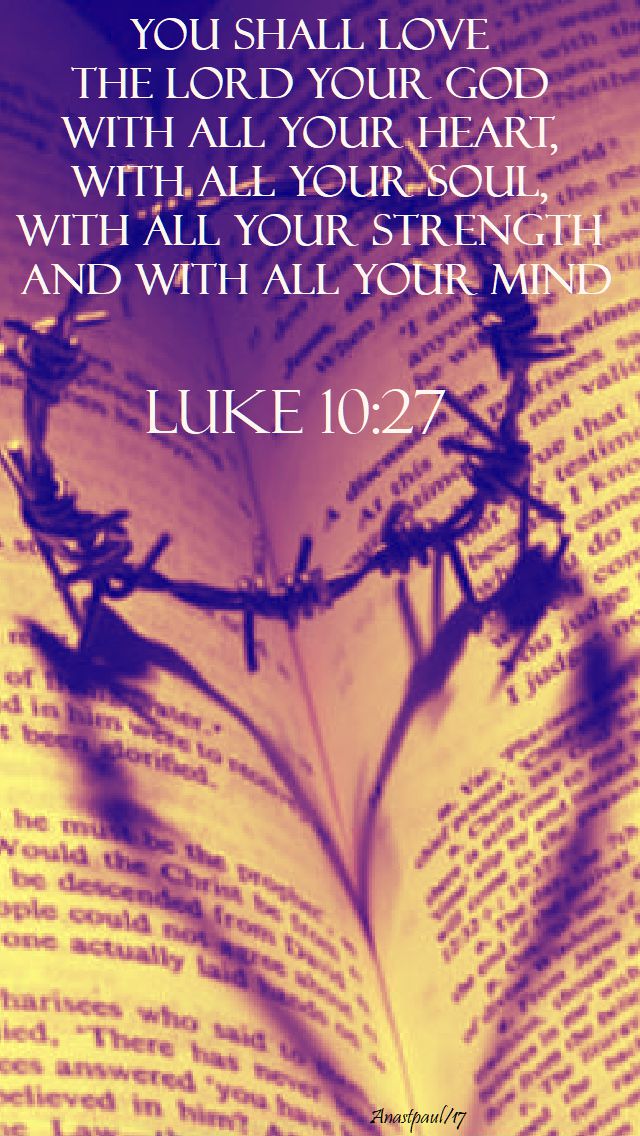
You shall love the Lord your God with all your heart, with all your soul, with all your strength and with all your mind………..Luke 10:27luke 10 27

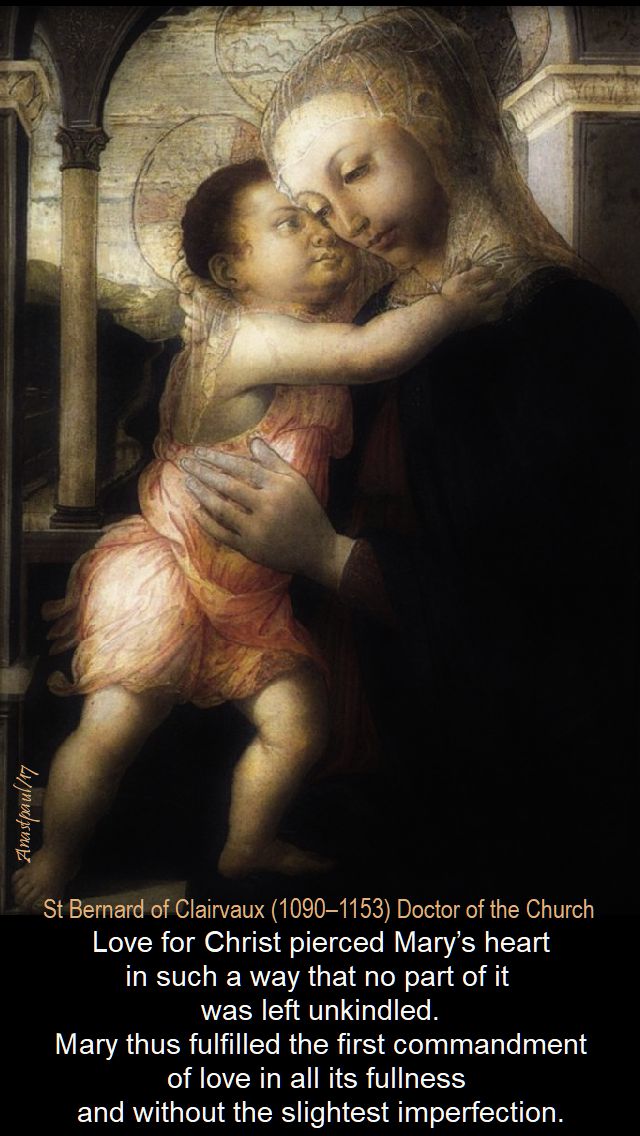
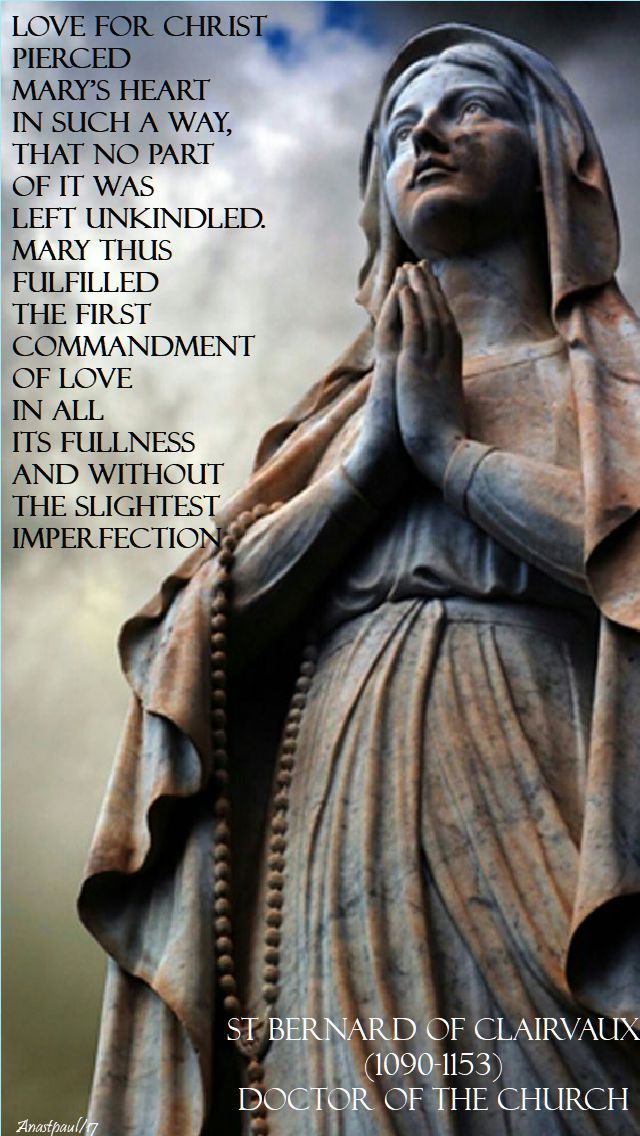
REFLECTION – “Love for Christ pierced Mary’s heart in such a way that no part of it was left unkindled.   Mary thus fulfilled the first commandment of love in all its fullness
and without the slightest imperfection.”….St Bernard of Clairvaux (1090–1153) Doctor of the Churchlove for christ - st bernard - 10 dec 2917

PRAYER – O Mother! You, who carried the Divine Saviour in your immaculate womb and lived with Him in the Holy House that we venerate on the Loreto Hill, grant us the grace to seek Him and imitate His example, He who leads us to salvation.    Our Lady of Loreto work miracles in us all! Amenour lady of loreto pray for us - 10 dec 2017

Posted in ADVENT, BREVIARY Prayers, CATHOLIC-PRAYERS OF THE CHURCH, CHRISTMASTIDE!, DOCTORS of the Church, HYMNS, MARIAN PRAYERS, MARIAN TITLES, MORNING Prayers, POETRY, PRAYERS of the CHURCH, QUOTES - J R R Tolkien and MORE, SAINT of the DAY, The BLESSED VIRGIN MARY

Our Morning Offering – 10 December – The Second Sunday of Advent and the Memorial of Our Lady and the Holy House of Loreto

Our Morning Offering – 10 December – The Second Sunday of Advent and the Memorial of Our Lady and the Holy House of Loreto

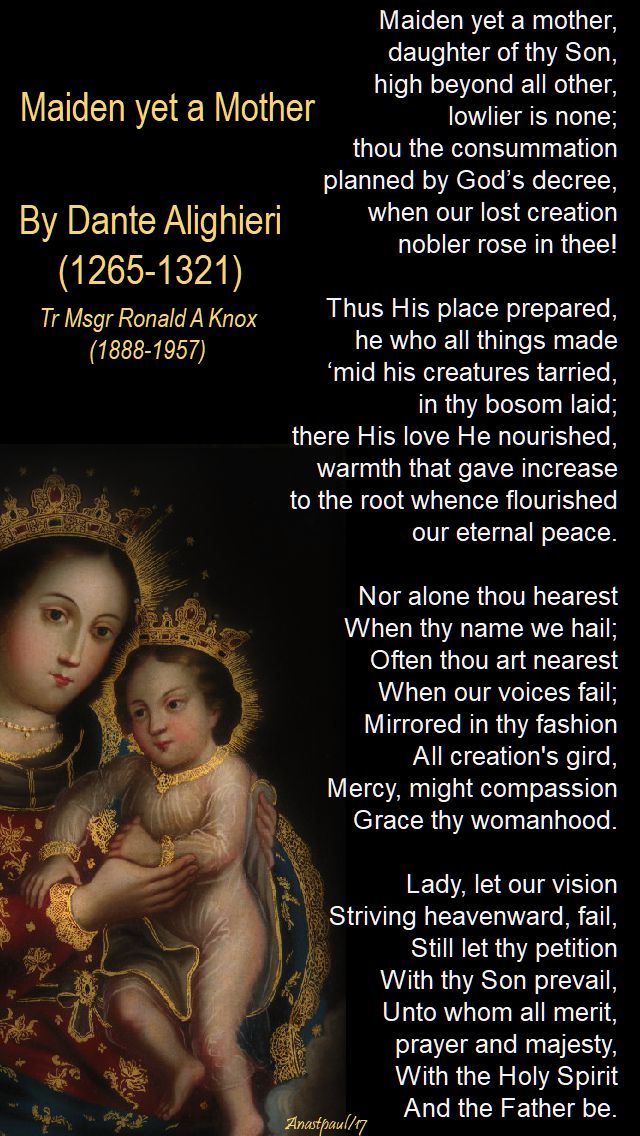
Maiden yet a Mother
By Dante Alighieri (1265-1321)
Tr Msgr Ronald A Knox (1888-1957)

Maiden yet a mother,
daughter of thy Son,
high beyond all other,
lowlier is none;
thou the consummation
planned by God’s decree,
when our lost creation
nobler rose in thee!

Thus His place prepared,
he who all things made
‘mid his creatures tarried,
in thy bosom laid;
there His love He nourished,
warmth that gave increase
to the root whence flourished
our eternal peace.

Nor alone thou hearest
When thy name we hail;
Often thou art nearest
When our voices fail;
Mirrored in thy fashion
All creation’s gird,
Mercy, might compassion
Grace thy womanhood.

Lady, let our vision
Striving heavenward, fail,
Still let thy petition
With thy Son prevail,
Unto whom all merit,
prayer and majesty,
With the Holy Spirit
And the Father be.

Maiden Yet A Mother is a translation of a poem by Durante (Dante) degli Alighieri (c 1265–1321).    It is based upon the opening verses of Canto 33 of the Paradiso from his Divine Comedy in which St Bernard of Clairvaux (1090–1153) praises and prays to the Virgin Mother on behalf of Dante.   It was translated from the original Italian into English by the Catholic convert, Monsignior Ronald A Knox (1888-1957).maiden yet a mother - dante - 10 dec 2017

Posted in ADVENT, DOCTORS of the Church, FATHERS of the Church, MORNING Prayers, QUOTES of the SAINTS, SAINT of the DAY, The WORD

One Minute Reflection – – 9 December 2017- Saturday of the First Week of Advent

One Minute Reflection – – 9 December 2017- Saturday of the First Week of Advent

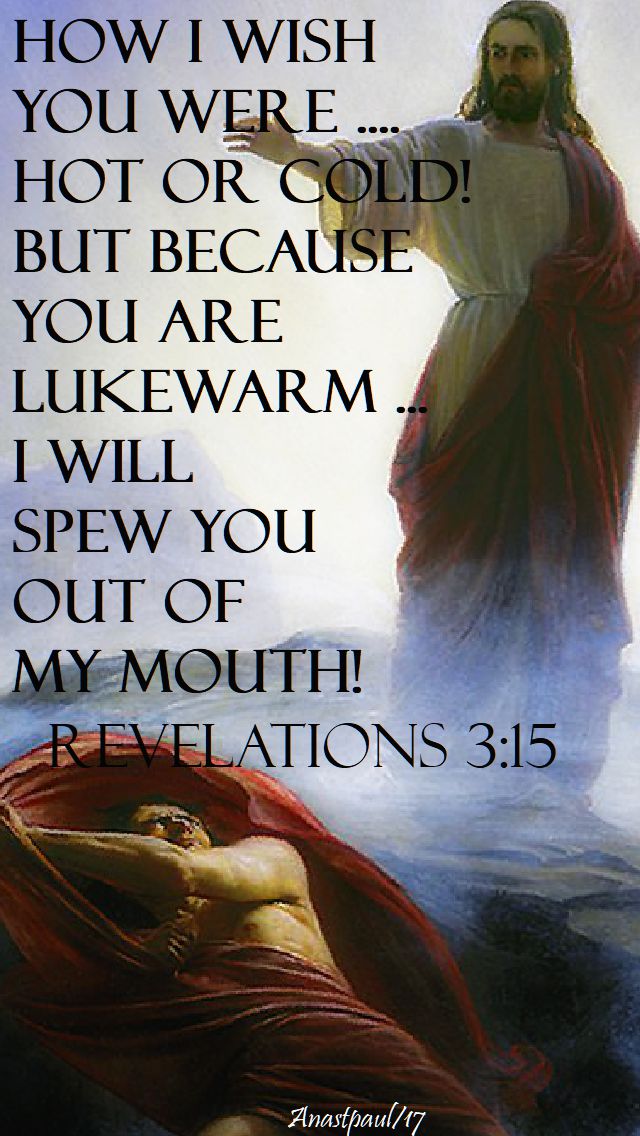
How I wish you were ….hot or cold!   But because you are lukewarm … I will spew you out of my mouth!….Revelations 3:15revelations 3-15

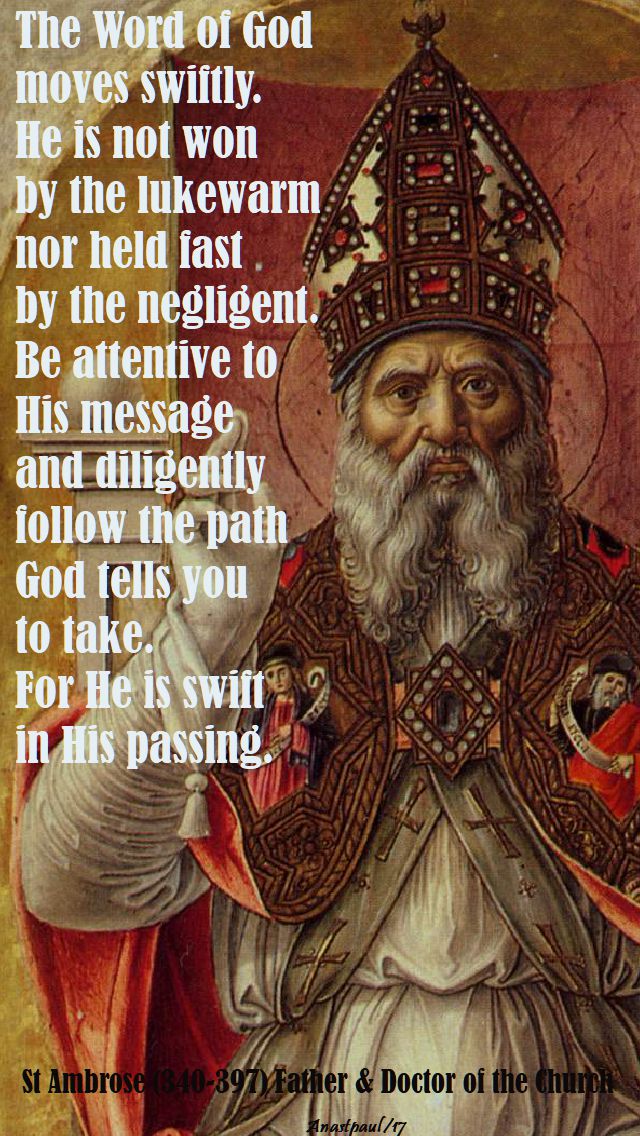
REFLECTION – The Word of God moves swiftly.   He is not won by the lukewarm nor held fast by the negligent. Be attentive to His message and diligently follow the path God tells you to take.   For He is swift in His passing…..St Ambrose (340-397) Father & Doctor of the Churchthe word of god - st ambrose - 9 dec 2017

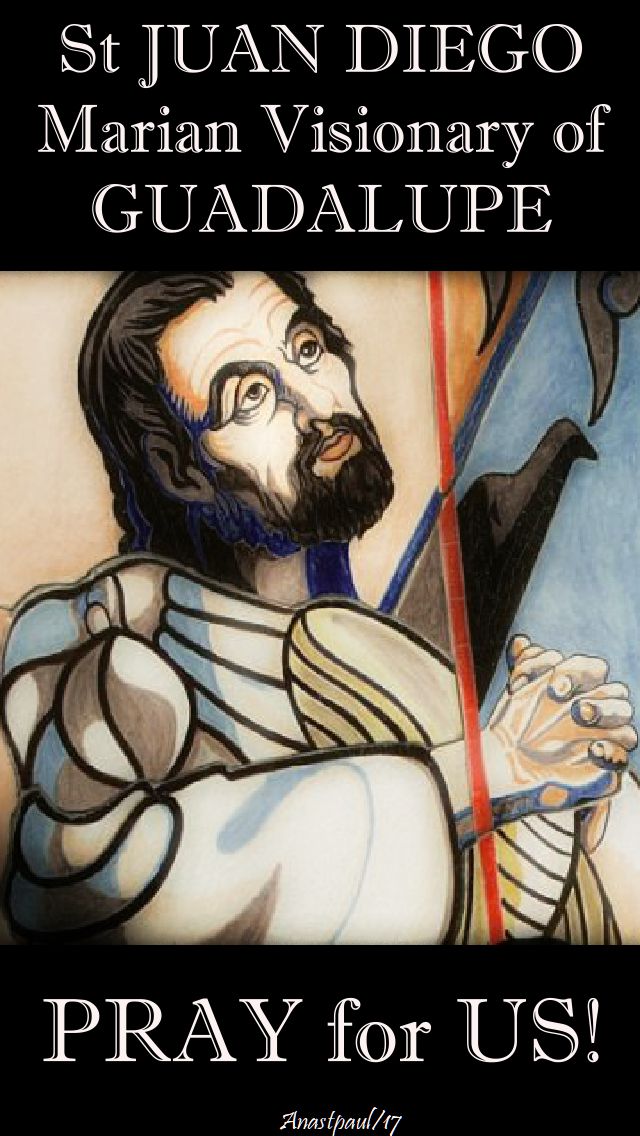
PRAYER – Lord Jesus, my Lord and Saviour, help me to avoid this lukewarmness in my spiritual growth.   Allow me, this Advent, to use the time well to prepare for Your swift passing.   Grant me an ardent faith, hope and love so that I may be ready for Your coming, every watchful and zealous in following You.   May the great love and prayers of St Juan Diego, whose feast we celebrate today, be acceptable to You on our behalf, amen.st juan diego pray for us

Posted in CATHOLIC DEVOTIONS of the Month, DOCTORS of the Church, DOGMA, FATHERS of the Church, FEASTS and SOLEMNITIES, MARIAN QUOTES, MARIAN TITLES, PAPAL ENCYLICALS, PAPAL MESSAGES, QUOTES of the SAINTS, SAINT of the DAY, The BLESSED VIRGIN MARY

Quote/s of the Day – 8 December – The Solemnity of the Immaculate Conception

Quote/s of the Day – 8 December – The Solemnity of the Immaculate Conception

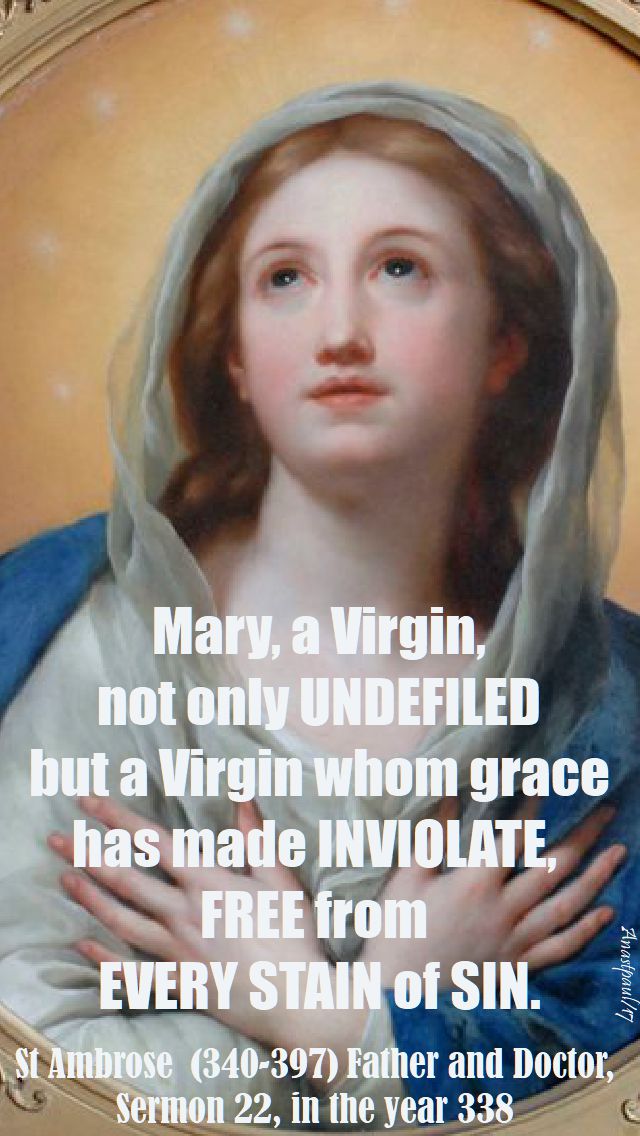
“Mary, a Virgin,
not only not only UNDEFILED
but a Virgin whom grace
has made INVIOLATE,
FREE from EVERY STAIN of SIN.”

St Ambrose (340-397) Father and Doctor, Sermon 22, in the year 338mary a virgin - st ambrose - 8 dec 2017

The Apostolic Constitution «Ineffabilis Deus», published on 8th December 1854, more 150 years ago, by Blessed Pope Pius IX on the theology regarding the privilege of the Immaculate Conception, in the following solemn proclamation of this Dogma of Catholic faith:

“To the honour of the holy and undivided Trinity, to the worthiness and splendid beauty of the Virgin Mother of God, to the upholding of the Catholic faith and to the furthering of the Christian religion, with the authority of Our Lord Jesus Christ, with that of the holy Apostles Peter and Paul and with Our own authority, we declare, we pronounce and we define the doctrine which holds that the most Blessed Virgin Mary, in the very first moments of her Conception, through the singular grace of Almighty God and through the foresight of the merits of Christ Jesus, Saviour of the human race, was preserved immune from all stains of original sin.   We furthermore declare, pronounce and define that this doctrine has been revealed by God and, therefore, has to be strongly and always believed by all the faithful.”  Blessed Pope Pius IX

“As soon as she [Mary] had the use of reason, that is, from the first moment of her Immaculate Conception in the womb of St Anne, from that time she began with all her powers to love her God and thus she continued to do, ever advancing more in perfection and love through her whole life.   All her thoughts, her desires, her affections, were wholly given to God.   Not a word, not a motion, not a glance of the eye, not a breath of hers that was not for God and for His glory, never departing one step, nor separating herself for one moment from the divine love.”…Saint Alphonsus Ligouri  (1696-1787) Doctor of the Church

Posted in ADVENT, CATHOLIC DEVOTIONS of the Month, DOCTORS of the Church, FEASTS and SOLEMNITIES, MARIAN QUOTES, MARIAN TITLES, MORNING Prayers, QUOTES of the SAINTS, The WORD

One Minute Reflection – 8 December  – The Solemnity of the Immaculate Conception

One Minute Reflection – 8 December  – The Solemnity of the Immaculate Conception

You shall love the Lord your God with all your heart, with all your soul,
with all your strength and with all your mind ………………Luke 10:22luke 10 - 22

REFLECTION – Love for Christ pierced Mary’s heart in such a way that no part
of it was left unkindled.   Mary thus fulfilled the first commandment of love
in all its fullness and without the slightest imperfection…………St Bernardlove for christ - st bernard - 8 dec 2017

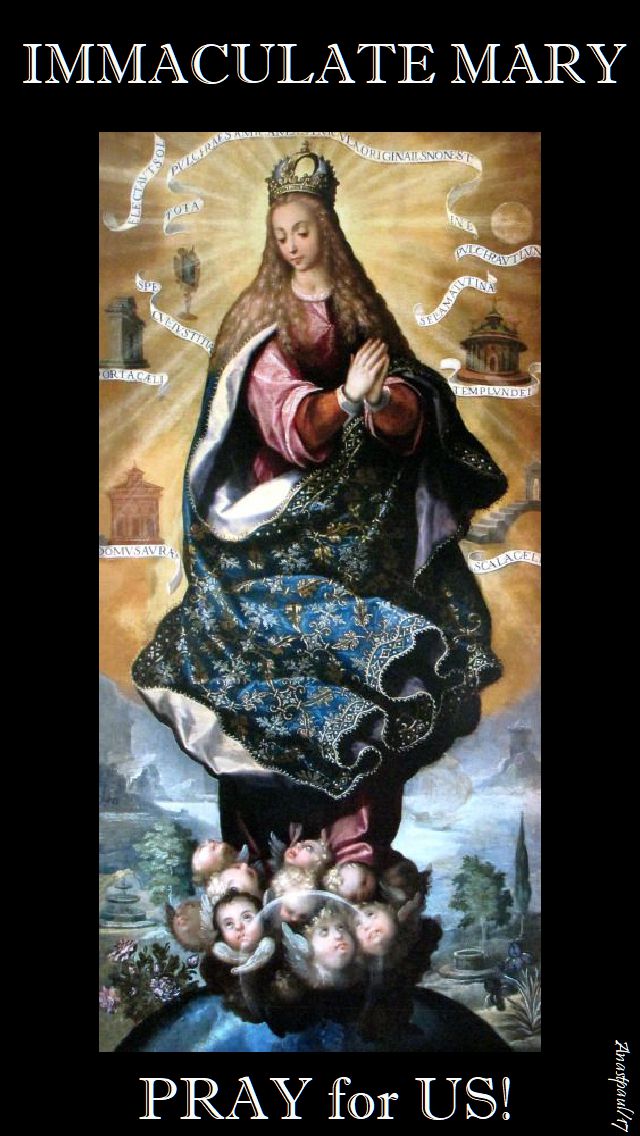
PRAYER – Heavenly Father, help us to imitate Your Immaculate Daughter Mary in her love for You.   Grant us the grace to love You as much as she, all our lives and grant, that through her help and her prayers, we ourselves may come to You , cleansed from our sins. O Mary Immaculate, mother of our Lord, Pray for us! Amenimmaculate mary - pray for us

Posted in ADVENT, DOCTORS of the Church, FATHERS of the Church, MORNING Prayers, SAINT of the DAY, The WORD

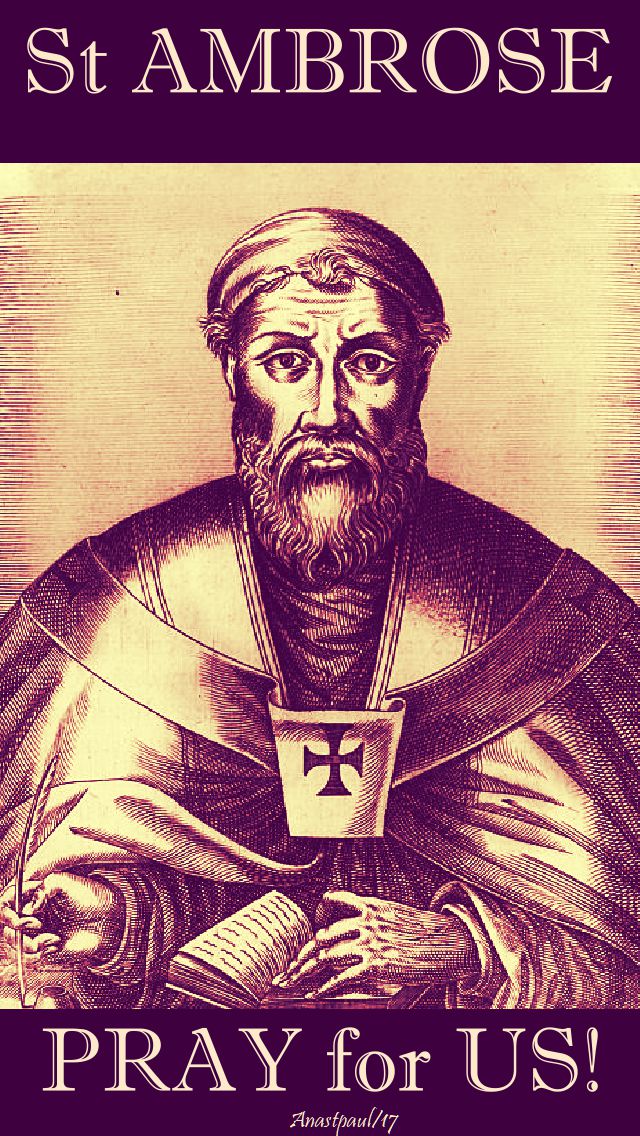
Thought for the Day – 7 December – The Memorial of St Ambrose (c 340-397)- Father and Doctor of the Church

Thought for the Day – 7 December – The Memorial of St Ambrose (c 340-397)- Father and Doctor of the Church

St Ambrose exemplifies for us the truly catholic character of Christianity.

He is a man steeped in the learning, law and culture of the ancients and of his contemporaries.   Yet, in the midst of active involvement in this world, this thought runs through Ambrose’ life and preaching – the hidden meaning of the Scriptures calls our spirit to rise to another world.

It is all for HIM, all for the WORD made flesh, all for GOD that we live!

St Ambrose Pray for us!st ambrose - pray for us 2

Posted in ADVENT, CATECHESIS, DOCTORS of the Church, EUCHARISTIC Adoration, FATHERS of the Church, MORNING Prayers, QUOTES of the SAINTS, QUOTES on CHARITY, The HOLY EUCHARIST / The HOLY MASS

Quote/s of the Day – 7 December – The Memorial of St Ambrose (c 340-397)- Father and Doctor of the Church

Quote/s of the Day – 7 December – The Memorial of St Ambrose (c 340-397)- Father and Doctor of the Church

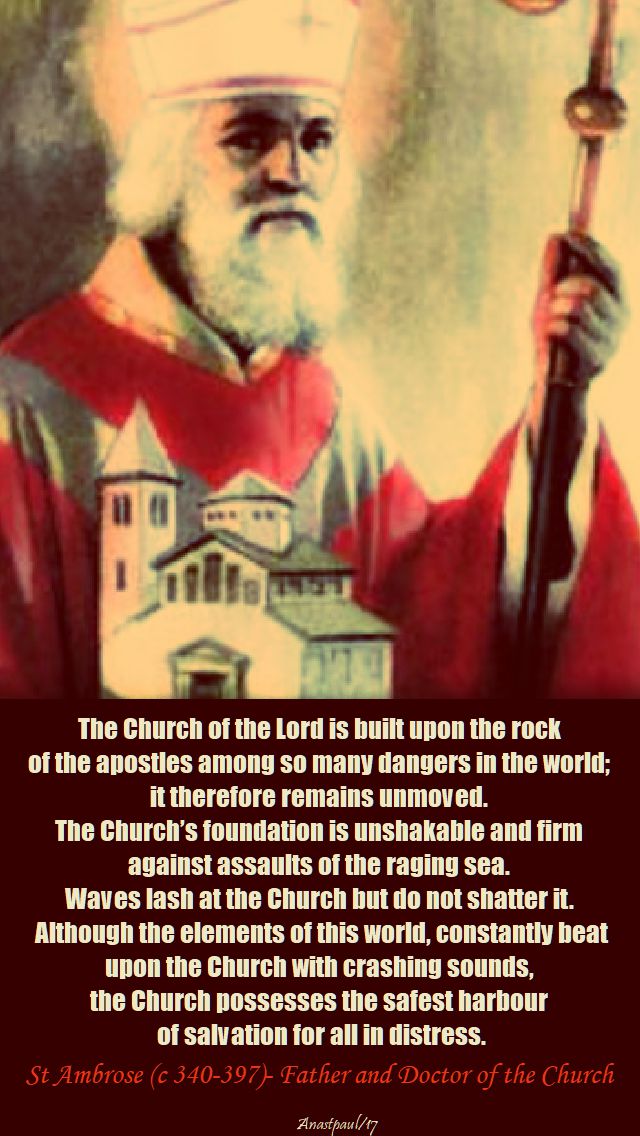
“The Church of the Lord is built upon the rock
of the apostles among so many dangers in the world;
it therefore remains unmoved.
The Church’s foundation is unshakable and firm
against assaults of the raging sea.
Waves lash at the Church but do not shatter it.
Although the elements of this world, constantly beat
upon the Church with crashing sounds,
the Church possesses the safest harbour
of salvation for all in distress.”

the church of the lord - st ambrose - 7 dec 2017

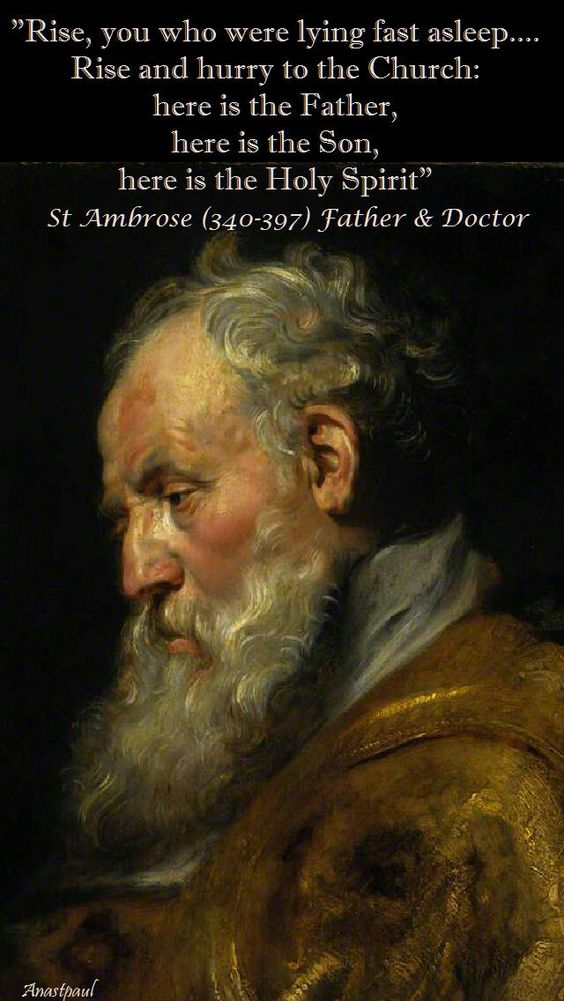
“Rise, you who were lying fast asleep…
Rise and hurry to the Church:
here is the Father,
here is the Son,
here is the Holy Spirit.”

rise you who were lying fast asleep - st ambrose - my pic 2017

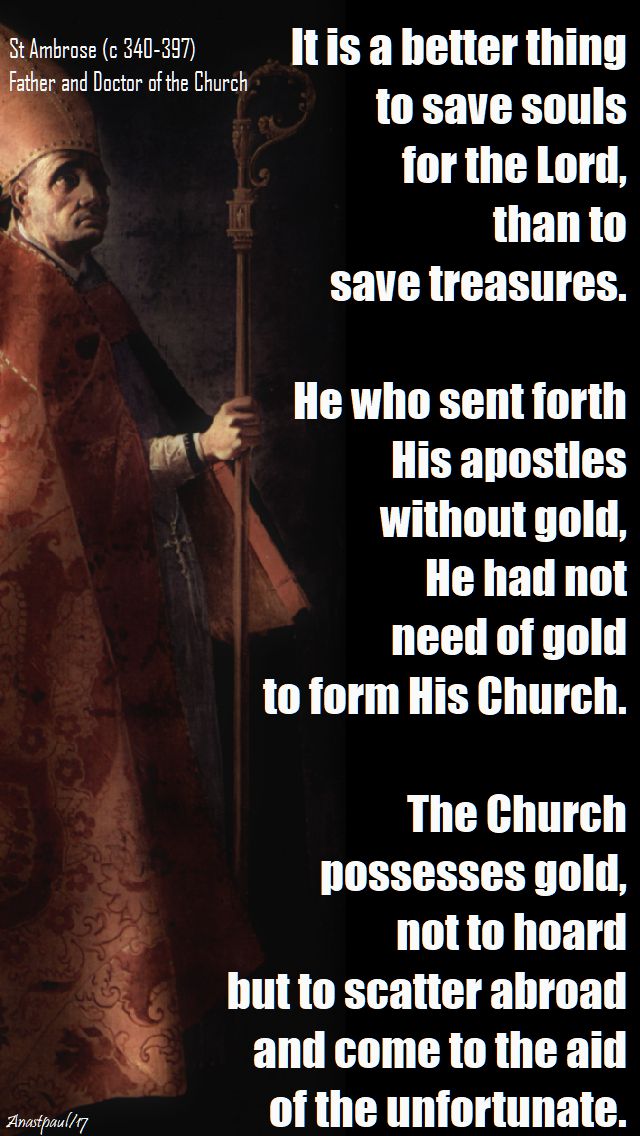
“It is a better thing
to save souls for the Lord,
than to save treasures.
He who sent forth
His apostles without gold,
He had not need of gold
to form His Church.
The Church possesses gold,
not to hoard
but to scatter abroad
and come to the aid
of the unfortunate.”

it is a better thing - st ambrose - 7 dec 2017

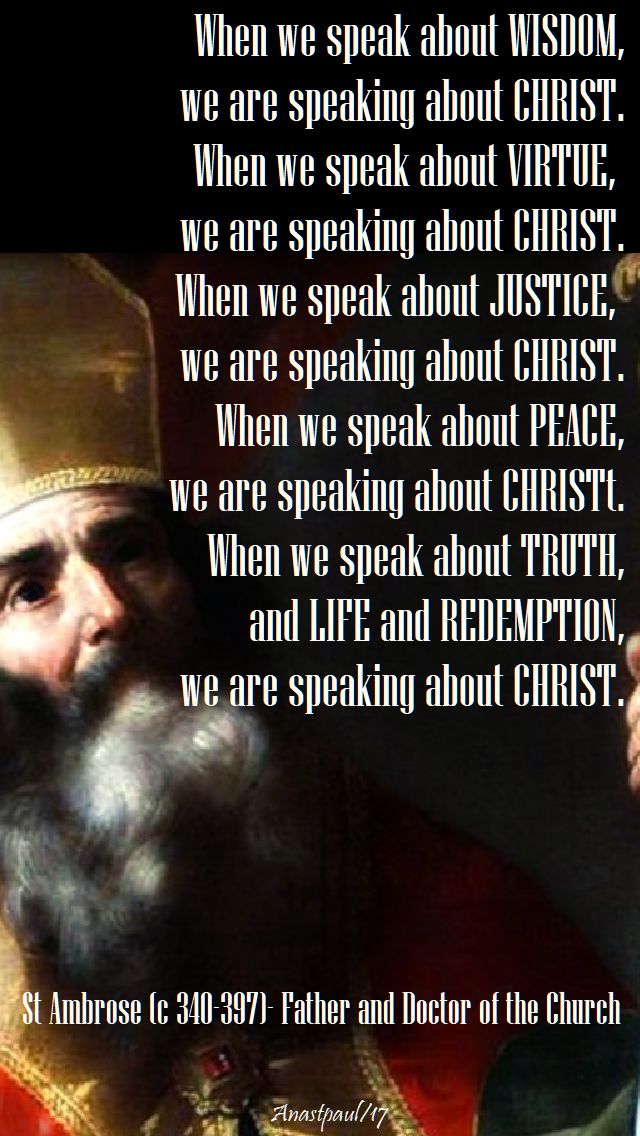
“When we speak about WISDOM,
we are speaking about CHRIST.
When we speak about VIRTUE,
we are speaking about CHRIST.
When we speak about JUSTICE,
we are speaking about CHRIST.
When we speak about PEACE,
we are speaking about CHRISTt.
When we speak about TRUTH,
and LIFE and REDEMPTION,
we are speaking about CHRIST.”

when we speak - st ambrose - 7 dec 2017

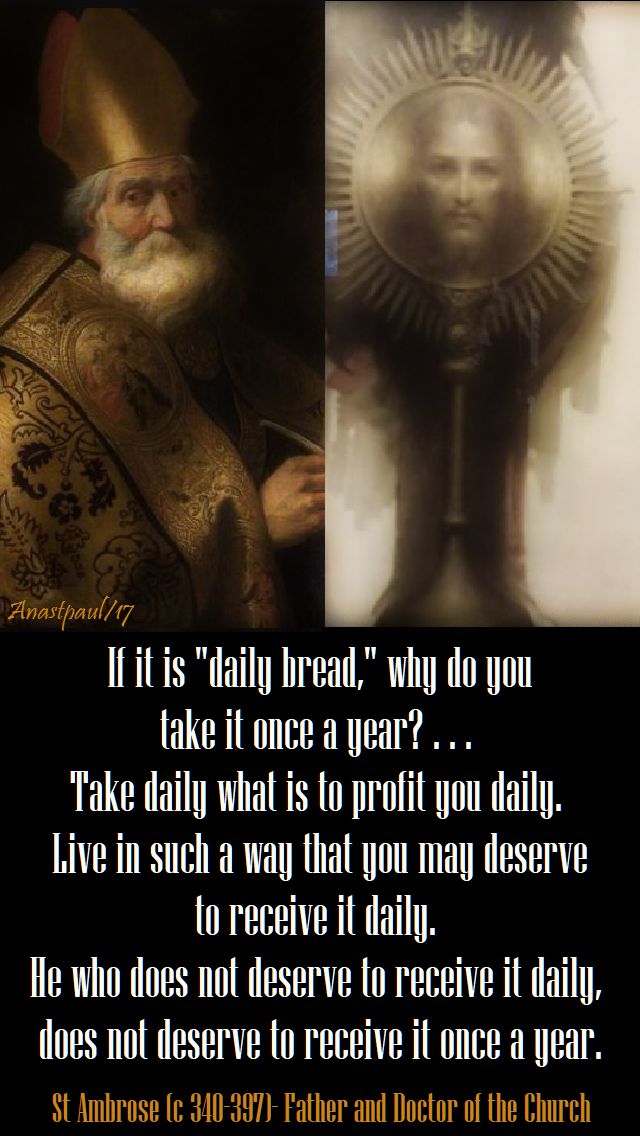
“If it is “daily bread,” why do you take it once a year? . . .
Take daily what is to profit you daily.
Live in such a way that you may deserve
to receive it daily.
He who does not deserve to receive it daily,
does not deserve to receive it once a year.”

if it ias daily - st ambrose - 7 dec 2017

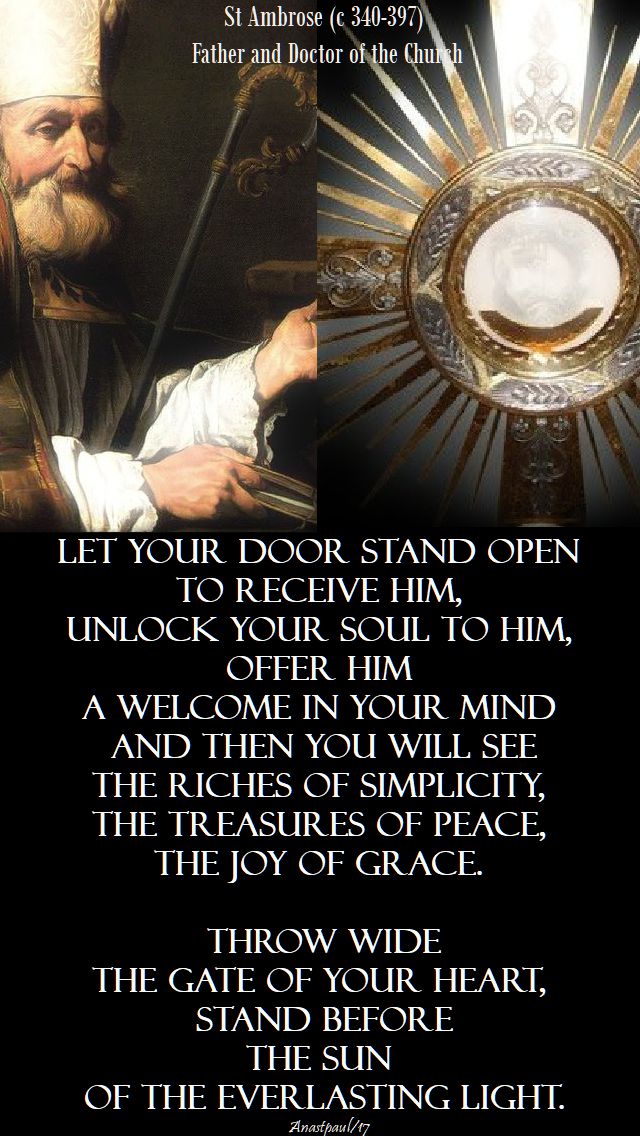
“Let your door stand open
to receive Him,
unlock your soul to Him,
offer Him a welcome in your mind
and then you will see
the riches of simplicity,
the treasures of peace,
the joy of grace.
Throw wide the gate of your heart,
stand before the sun of the everlasting light.”

let your door stand open - st ambrose - 7 dec 2017

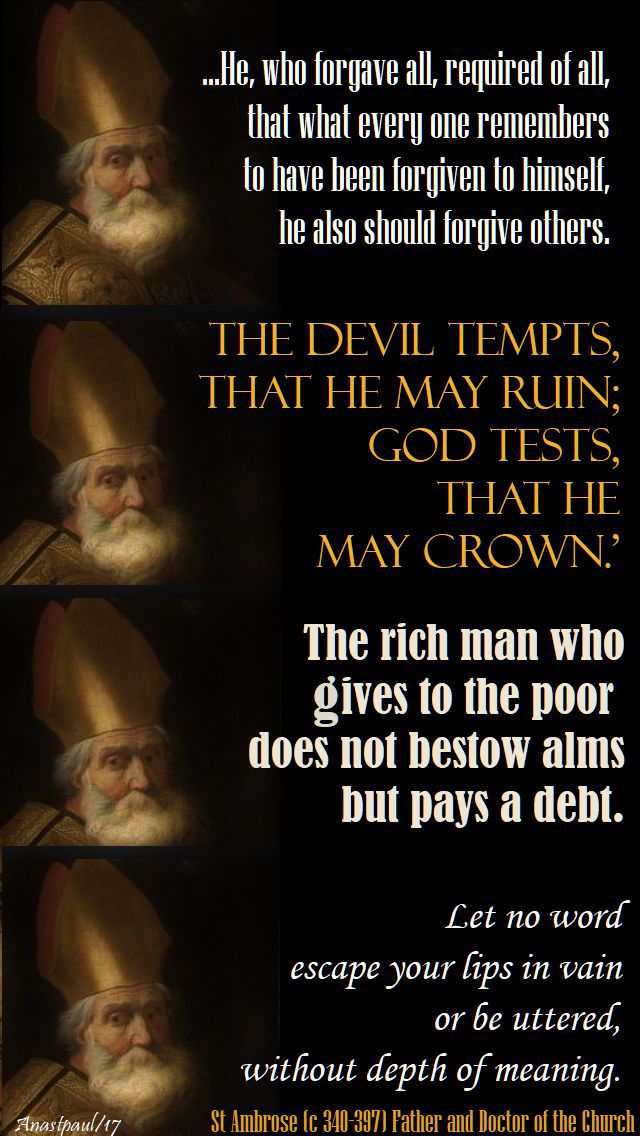
“…He, who forgave all, required of all,
that what every one remembers
to have been forgiven to himself,
he also should forgive others.”

“The devil tempts, that he may ruin;
God tests, that He may crown.”

“The rich man who gives to the poor
does not bestow alms but pays a debt.”

“Therefore, let your words be rivers, clean and limpid,
so that you may charm the ears of people.
And by the grace of your words win them over
to follow your leadership.
…. That is, let the meaning of your words shine forth,
let understanding blaze out.
Let no word escape your lips in vain or be uttered,
without depth of meaning.”  from a letter by Saint Ambrose

St Ambrose (c 340-397)- Father and Doctor of the Church

he, who forgave all - st ambrose - 7 dec 2017

Posted in ADVENT, DOCTORS of the Church, FATHERS of the Church, MORNING Prayers, QUOTES of the SAINTS, SAINT of the DAY, The WORD

One Minute Reflection – 7 December – The Memorial of St Ambrose (c 340-397)- Father and Doctor of the Church

One Minute Reflection – 7 December – The Memorial of St Ambrose (c 340-397)- Father and Doctor of the Church

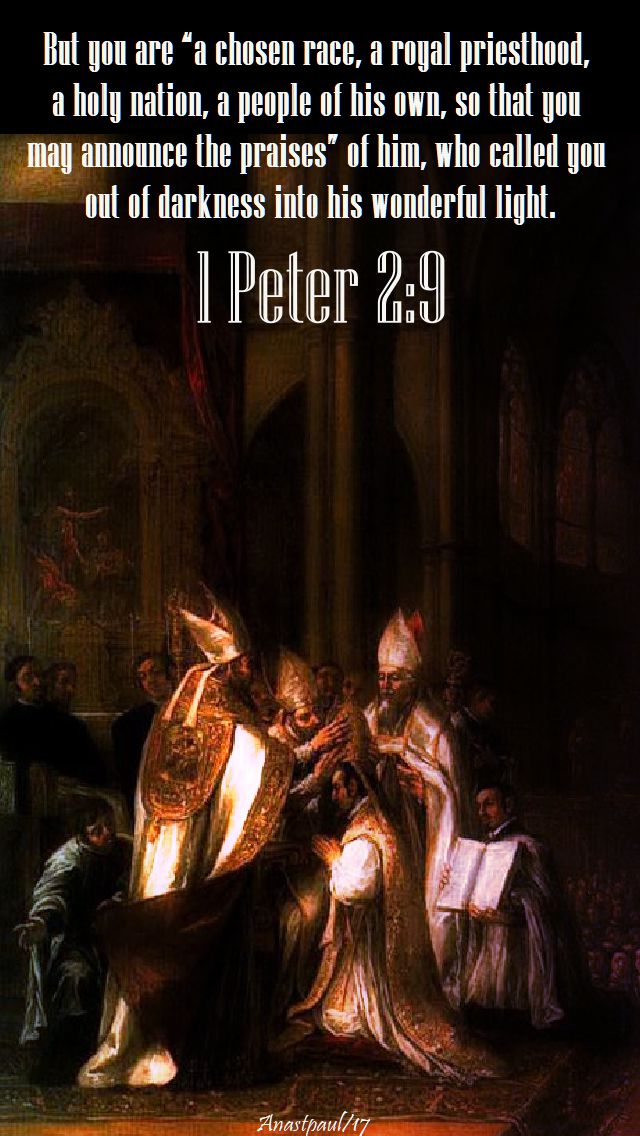
But you are “a chosen race, a royal priesthood, a holy nation, a people of his own, so that you may announce the praises” of him who called you out of darkness into his wonderful light…1 Peter 2:91 peter 2-9 - 7 dec 2017

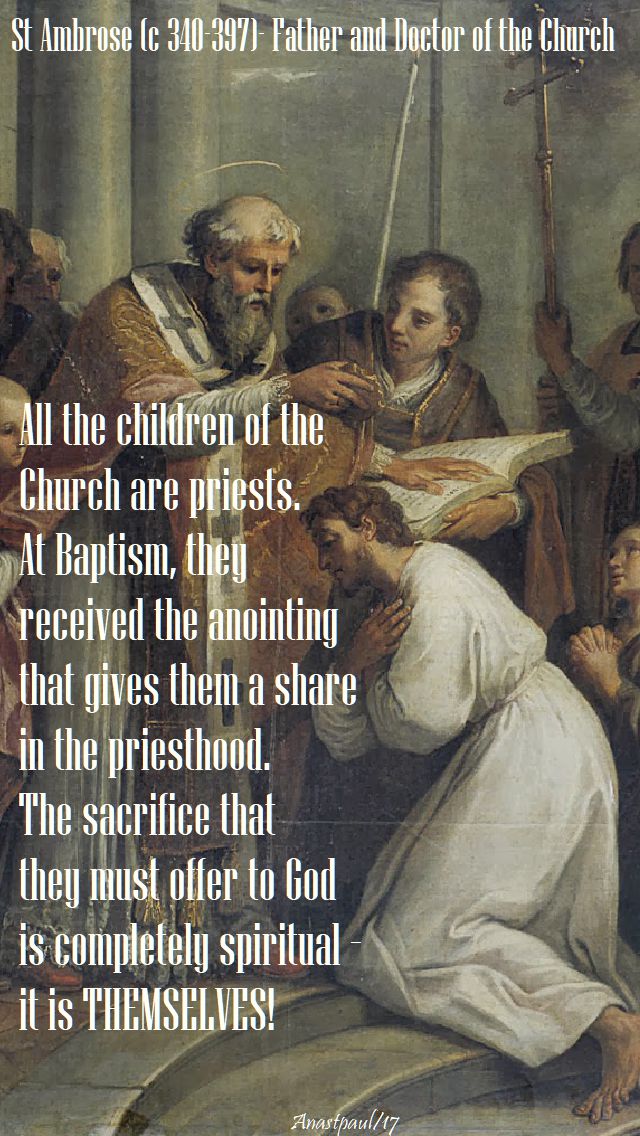
REFLECTION – “All the children of the Church are priests. At Baptism, they received the anointing that gives them a share in the priesthood. The sacrifice that they must offer to God is completely spiritual – it is themselves.”…St Ambroseall the children of the church - st ambrose - 7 dec 2017

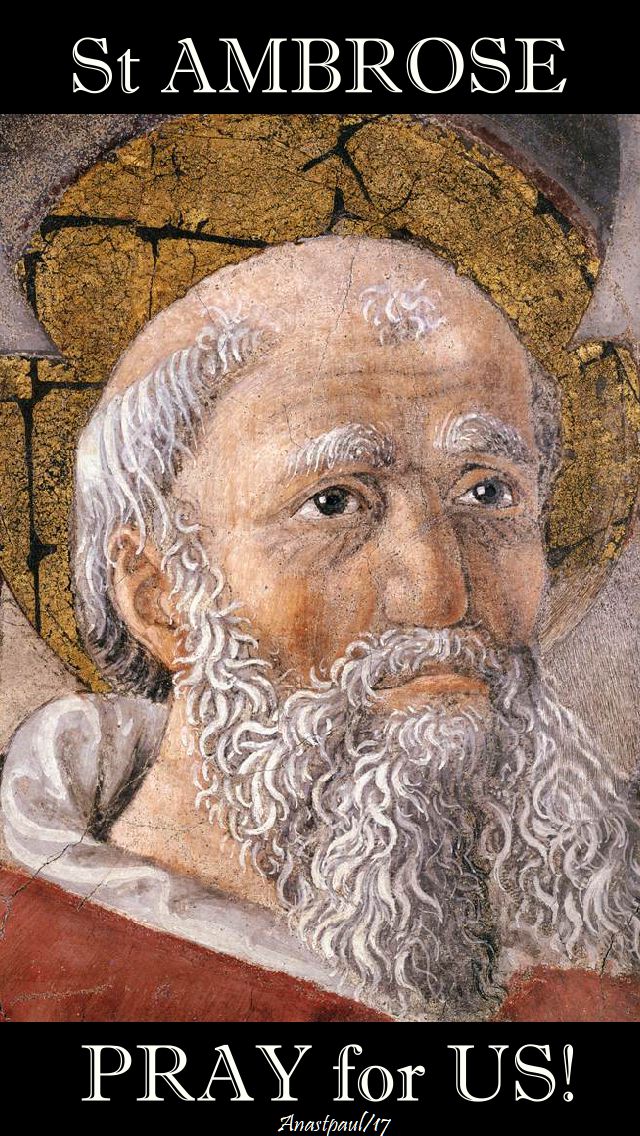
PRAYER – Holy Father, teach me to offer myself to You with all my thoughts, words and actions. Let me also exercise my “common priesthood” by faithful participation at Holy Mass and in all my encounters with my neighbour. St Ambrose, holy father, teacher of the saints, pray for us! Amenst ambrose pray for us - 7 dec 2017

Posted in ADVENT, CHRISTMASTIDE!, DOCTORS of the Church, FATHERS of the Church, HYMNS, MORNING Prayers, PRAYERS of the SAINTS, SAINT of the DAY, The CHRIST CHILD

Our Morning Offering – 7 December – The Memorial of St Ambrose (c 340-397)- Father and Doctor of the Church

Our Morning Offering – 7 December – The Memorial of St Ambrose (c 340-397)- Father and Doctor of the Church

Veni Redemptor gentium
Saviour of the Nations, Come
St Ambrose’s Advent Hymn

Saviour of the nations, come;
Virgin’s Son, here make Thy home!
Marvel now, O heaven and earth,
That the Lord chose such a birth.

Not by human flesh and blood;
By the Spirit of our God
Was the Word of God made flesh,
Woman’s offspring, pure and fresh.

Wondrous birth! O wondrous Child
Of the virgin undefiled!
Though by all the world disowned,
Still to be in heaven enthroned.

From the Father forth He came
And returneth to the same,
Captive leading death and hell
High the song of triumph swell!

Thou, the Father’s only Son,
Hast over sin the victory won.
Boundless shall Thy kingdom be;
When shall we its glories see?

Brightly doth Thy manger shine,
Glorious is its light divine.
Let not sin o’ercloud this light;
Ever be our faith thus bright.

Praise to God the Father sing,
Praise to God the Son, our King,
Praise to God the Spirit be
Ever and eternally.

Translated from Latin to German by Martin Luther, 1523;
translated from German to English by William M Reynolds, 1851veni redemptor gentium - st ambrose advent him saviour of the nations, come - 7 dec 2017

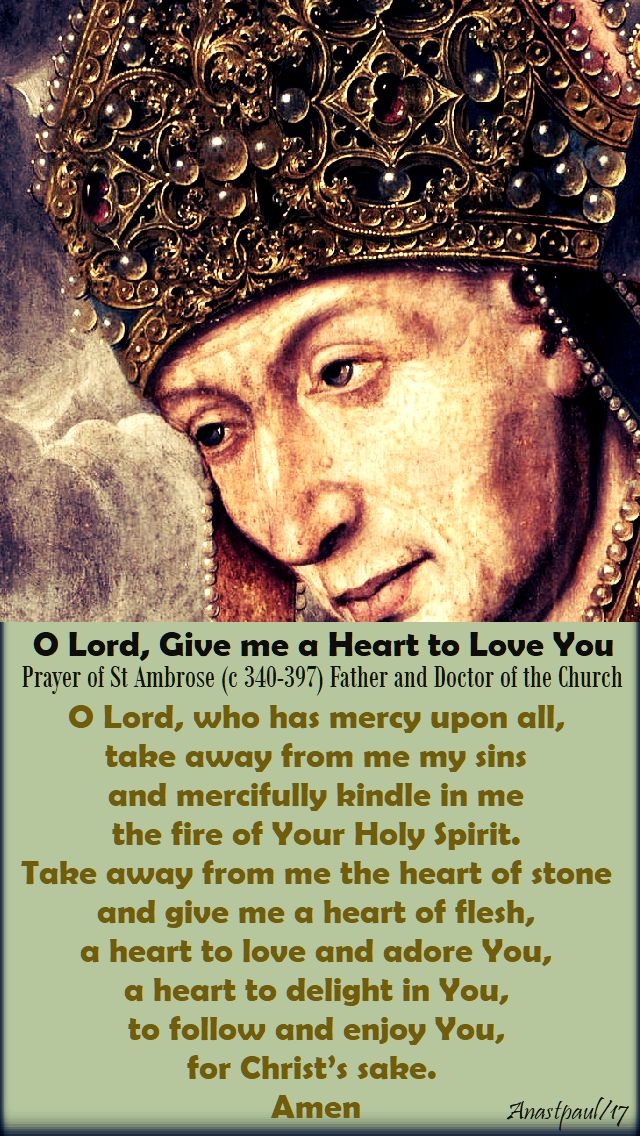
O Lord, Give me a Heart to Love You
Prayer of St Ambrose (c 340-397) Father and Doctor of the Church

O Lord, who has mercy upon all,
take away from me my sins
and mercifully kindle in me
the fire of Your Holy Spirit.
Take away from me the heart of stone
and give me a heart of flesh,
a heart to love and adore You,
a heart to delight in You,
to follow and enjoy You,
for Christ’s sake. Ameno lord give me a heart to love you - prayer of st ambrose - 7 dec 2017

Posted in ADVENT, DOCTORS of the Church, DOMESTIC ANIMALS, FATHERS of the Church, Of BISHOPS, Of Catholic Education, Students, Schools, Colleges etc, SAINT of the DAY

More on today’s Saint – 7 December – St Ambrose (c340-397) Confessor, Bishop, Father and Doctor of the Church

More on today’s Saint – St Ambrose (c 340-397)Confessor, Bishop, Father and Doctor of the Church –  Theologian, Apostle of Charity, Writer, Musician, Preacher, Reformer and protector – all-in-all a brilliant, charismatic, vibrant man.  Patronages – • bee keepers• bees• Bishops• candle makers• chandlers• domestic animals• French Commissariat• geese• honey cake bakers• learning• livestock• police officers • students, school-children• security personnel• starlings• wax melters• wax refiners• Archdiocese of Milan, Italy• 8 Cities.

Traditionally, Ambrose is credited with promoting “antiphonal chant”, a style of chanting in which one side of the choir responds alternately to the other, as well as with composing Veni redemptor gentium, an Advent hymn.   Ambrose is one of the four original Doctors of the Church and is the Patron saint of Milan.   He is notable for his influence on St Augustine, whom he Baptised.

This politician-turned churchman was profoundly aware of his lack of preparation for this great responsibility as Bishop and so set himself immediately to prayer and the study of Scripture.    His deep spirituality and love of God’s Word married together with the oratorical skill acquired in law and politics made St Ambrose one of the greatest preachers of the early church.

His feast day in the Roman calendar is 7 December, the day he was Ordained Bishop. From the Roman liturgy for the Feast of St. Ambrose:   “Lord, you made Saint Ambrose an outstanding teacher of the Catholic faith and gave him the courage of an apostle.   Raise up in your Church more leaders after your own heart, to guide us with courage and wisdom.   We ask this through our Lord Jesus Christ, Your Son, who lives and reigns with you and the Holy Spirit, one God forever and ever. Amen.”  

Here is Jimmy Akin’s article “St Ambrose: Strangest Life Story Ever?”
1) Who was St Ambrose?

St Ambrose of Milan was born around A.D. 338 and died in 397.
He was the bishop of Milan, Italy.

2) What makes is his life story so strange?

Originally, he was a government official, he became bishop in a most extraordinary way.
After the death of the local bishop, the Catholics and Arians got into a vehement conflict about who should be the new bishop.
Ambrose was trying to keep the peace and settle the two groups down when someone—allegedly a small boy—began chanting “Ambrose, bishop!”
Soon the two groups began chanting together that Ambrose should be the new bishop.
(The Arians, apparently, felt that although Ambrose was Catholic in belief he would be a kinder bishop than they otherwise would likely get.)
This set of circumstances is extraordinary enough, but what’s even more extraordinary is that Ambrose wasn’t even a Christian yet. He was an unbaptised catechumen!

3) Can it get any stranger?

Ambrose did not want to be bishop and so he went into hiding.
The Emperor Valentinian then got word of all this and declared severe penalties on anyone who would give Ambrose shelter.
He was thus forced to come out of hiding and accept his ordination as bishop.
They quickly ran him through the preliminary grades of orders and he was consecrated a bishop about a week later.

4) How did he do as bishop?

He was great!   That’s part of why he ended up as a doctor of the Church.
He left many wonderful writings.   He helped convert St Augustine.   And he combated heresy.
He also introduced a practice into the West that has remained with us to this day.

5) What practice was that?

Lectio Divina. Pope Benedict XVI explained:
Culturally well-educated but at the same time ignorant of the Scriptures, the new Bishop briskly began to study them.
From the works of Origen, the indisputable master of the “Alexandrian School”, he learned to know and to comment on the Bible.
Thus, Ambrose transferred to the Latin environment the meditation on the Scriptures which Origen had begun, introducing in the West the practice of lectio divina.
The method of lectio served to guide all of Ambrose’s preaching and writings, which stemmed precisely from prayerful listening to the Word of God.

6) How did Ambrose help with Augustine’s conversion?

That also involved a rather dramatic story, in which Ambrose stood up to the emperor at the risk of his own life.
Pope Benedict explained:
A passage from St Augustine’s Confessions is relevant.
He had come to Milan as a teacher of rhetoric;   he was a sceptic and not Christian.  He was seeking the Christian truth but was not capable of truly finding it.
What moved the heart of the young African rhetorician, sceptic and downhearted and what impelled him to definitive conversion was not above all Ambrose’s splendid homilies (although he deeply appreciated them).
It was rather the testimony of the Bishop and his Milanese Church that prayed and sang as one intact body.
It was a Church that could resist the tyrannical ploys of the Emperor and his mother, who in early 386 again demanded a church building for the Arians’ celebrations.
In the building that was to be requisitioned, Augustine relates, “the devout people watched, ready to die with their Bishop”.
This testimony of the Confessions is precious because it points out that something was moving in Augustine, who continues: “We too, although spiritually tepid, shared in the excitement of the whole people” (Confessions 9, 7).

7) Was Ambrose remarkable in other ways?

He was remarkable in many ways, one of them we today would find quite surprising.
Pope Benedict explained:
[Augustine] writes in his text that whenever he went to see the Bishop of Milan, he would regularly find him taken up with catervae [Latin, “crowd”]of people full of problems for whose needs he did his utmost.
There was always a long queue waiting to talk to Ambrose, seeking in him consolation and hope.
When Ambrose was not with them, with the people (and this happened for the space of the briefest of moments), he was either restoring his body with the necessary food or nourishing his spirit with reading.
Here Augustine marvels because Ambrose read the Scriptures with his mouth shut, only with his eyes (cf. Confessions, 6, 3).
Indeed, in the early Christian centuries reading was conceived of strictly for proclamation and reading aloud also facilitated the reader’s understanding.
That Ambrose could scan the pages with his eyes alone suggested to the admiring Augustine a rare ability for reading and familiarity with the Scriptures.

Got that?

Ambrose was known for the ability to read with his mouth shut, not using his voice or moving his lips.
We’re all taught to do this today, but it was rare in the ancient world! Back then, if you even could read, you usually had to at least move your lips.
Ambrose also passed on to Augustine a very famous piece of advice, that many people quote today without even knowing where it comes from.

8) What advice was that?

Augustine noted that the liturgical customs in Rome were different than those used in other places and Ambrose told him something we still quote today.

We paraphrase it in English, but it’s the same thought: “When in Rome, do as the Romans do.”Some-Advice-On-Prayer-2-saint-ambrose-of-milan-1St_AmbroseSome-Advice-On-Prayer-2-St.-Ambrose-Stained-Glass
Posted in ADVENT, DOCTORS of the Church, FATHERS of the Church, Re-BLOGS, SAINT of the DAY

Saint of the Day – 7 December – St Ambrose (c 340-397) Father and Doctor of the Church

via Saint of the Day – 7 December

Posted in ADVENT, DOCTORS of the Church, FATHERS of the Church, QUOTES of the SAINTS

Thought for the Day – Tuesday of the First Week of Advent – 5 December 2017

Thought for the Day – Tuesday of the First Week of Advent – 5 December 2017

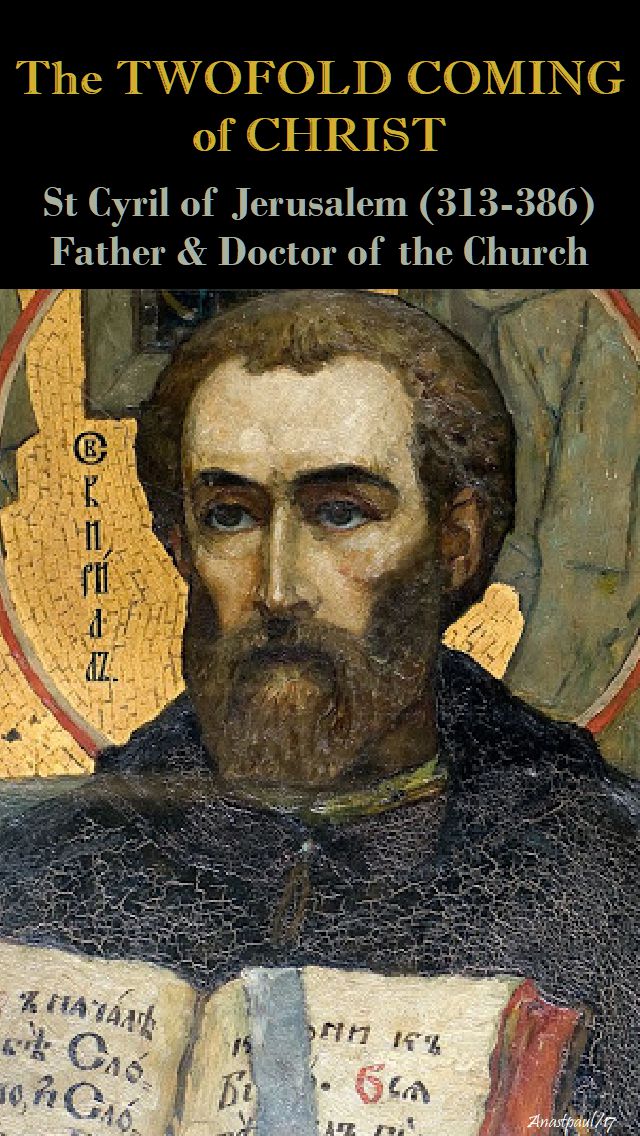
THE TWOFOLD COMING OF CHRIST
St CYRIL OF JERUSALEM (313-386)  Father & Doctor of the Church

We do not preach only one coming of Christ but a second as well, much more glorious than the first.   The first coming was marked by patience;  the second will bring the crown of a divine kingdom.

In general, whatever relates to our Lord Jesus Christ has two aspects.   There is a birth from God before the ages and a birth from a virgin at the fullness of time.   There is a hidden coming, like that of rain on fleece and a coming before all eyes, still in the future.

At the first coming He was wrapped in swaddling clothes in a manger.   At His second coming He will be clothed in light as in a garment.   In the first coming He endured the cross, despising the shame;  in the second coming He will be in glory, escorted by an army of angels.

We look then beyond the first coming and await the second.   At the first coming we said: Blessed is He who comes in the name of the Lord.   At the second we shall say it again;  we shall go out with the angels to meet the Lord and cry out in adoration:  Blessed is He who comes in the name of the Lord.

The Saviour will not come to be judged again but to judge those by whom He was judged. At His own judgement He was silent;  then He will address those who committed the outrages against Him when they crucified Him and will remind them:  You did these things and I was silent.

His first coming was to fulfil His plan of love, to teach men by gentle persuasion.   This time, whether men like it or not, they will be subjects of His kingdom by necessity.

The prophet Malachi speaks of the two comings.   And the Lord whom you seek will come suddenly to His temple: that is one coming.

Again he says of another coming:   Look, the Lord almighty will comeand who will endure the day of His entry, or who will stand in His sight?   Because He comes like a refiner’s fire, a fuller’s herb and He will sit refining and cleansing.

These two comings are also referred to by Paul in writing to Titus:   The grace of God the Saviour has appeared to all men, instructing us to put aside impiety and worldly desires and live temperately, uprightly and religiously in this present age, waiting for the joyful hope, the appearance of the glory of our great God and Saviour, Jesus Christ.   Notice how he speaks of a first coming for which he gives thanks and a second, the one we still await.

That is why the faith we profess has been handed on to you in these words:  He ascended into heaven and is seated at the right hand of the Father, and He will come again in glory to judge the living and the dead and His kingdom will have no end.

Our Lord Jesus Christ will therefore come from heaven.   He will come at the end of the world, in glory, at the last day.   For there will be an end to this world and the created world will be made new.

“Maranatha, Come Lord Jesus.”the twofold coming of christ - st cyril of jerusalem - 5 dec 2017

Posted in CATHOLIC Quotes, DEVOTIO, DOCTORS of the Church, EUCHARISTIC Adoration, FATHERS of the Church, MORNING Prayers, ON the SAINTS, QUOTES of the SAINTS, SAINT of the DAY, The HOLY EUCHARIST / The HOLY MASS, The LISTS of the CHURCH, The MOST HOLY & BLESSED TRINITY

Quote/s of the Day – 4 December – The Memorial of St John Damascene (676-749) – Father and Doctor of the Church

Quote/s of the Day – 4 December – The Memorial of St John Damascene (676-749) – Father and Doctor of the Church

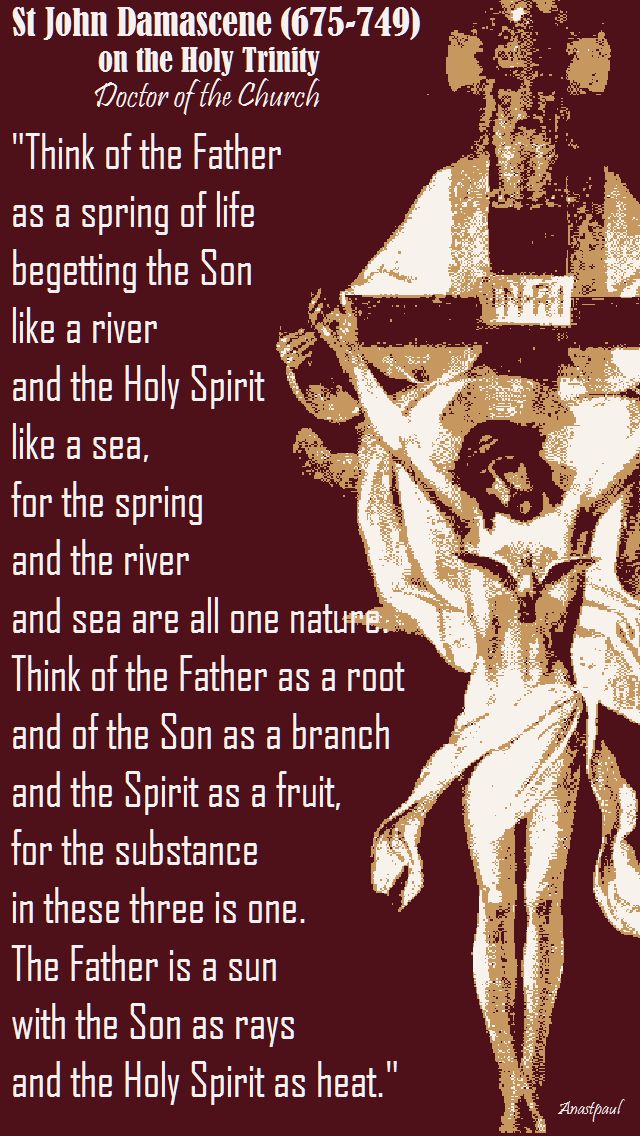
“Think of the Father as a spring of life begetting the Son,
like a river and the Holy Ghost like a sea,
for the spring and the river and sea are all one nature.
Think of the Father as a root and of the Son as a branch
and the Spirit as a fruit, for the substance in these three is one.
The Father is a sun with the Son as rays and the Holy Ghost as heat.”ST JOHN DAMASCENE ON THE HOLY TRINITY

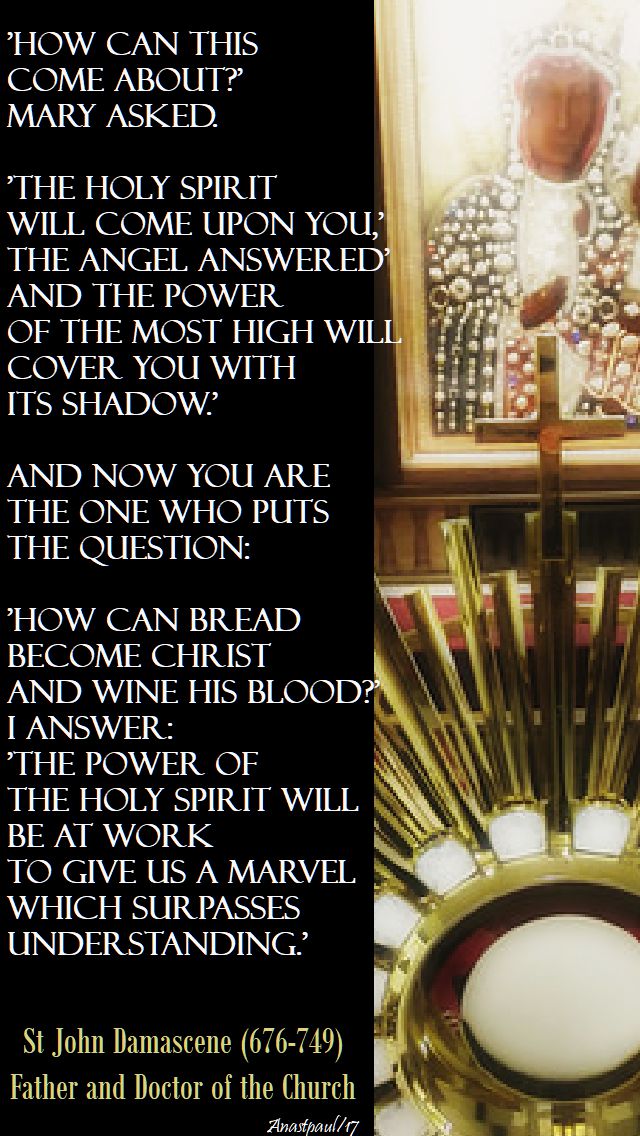
“‘How can this come about?’ Mary asked.
‘The Holy Spirit will come upon you,’ the angel answered’
and the power of the Most High will cover you with its shadow.’
And now you are the one who puts the question:
‘How can bread become Christ and wine His Blood?’
I answer:
‘The power of the Holy Spirit will be at work
to give us a marvel which surpasses understanding.'”how can this come about - st john damascene - 4 dec 2017

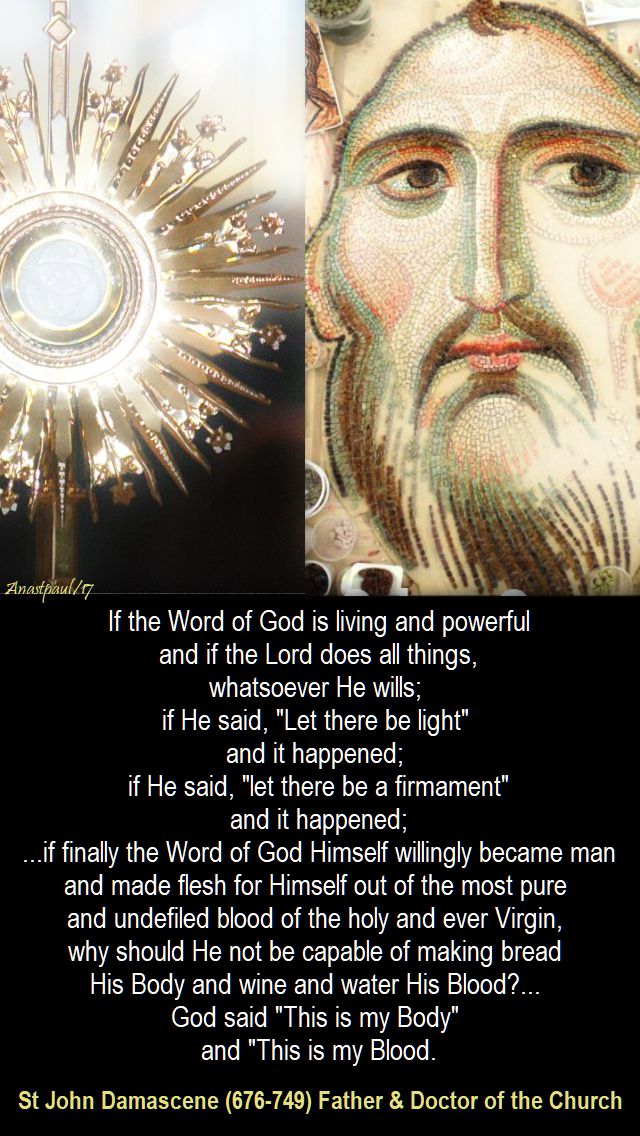
“If the Word of God is living and powerful
and if the Lord does all things whatsoever he wills;
if he said, “Let there be light” and it happened;
if he said, “let there be a firmament” and it happened;
…if finally the Word of God Himself willingly became man
and made flesh for Himself out of the most pure
and undefiled blood of the holy and ever Virgin,
why should He not be capable of making bread
His Body and wine and water His Blood?…
God said “This is my Body” and “This is my Blood.”if the word of god - st john damascene - 4 dec 2017

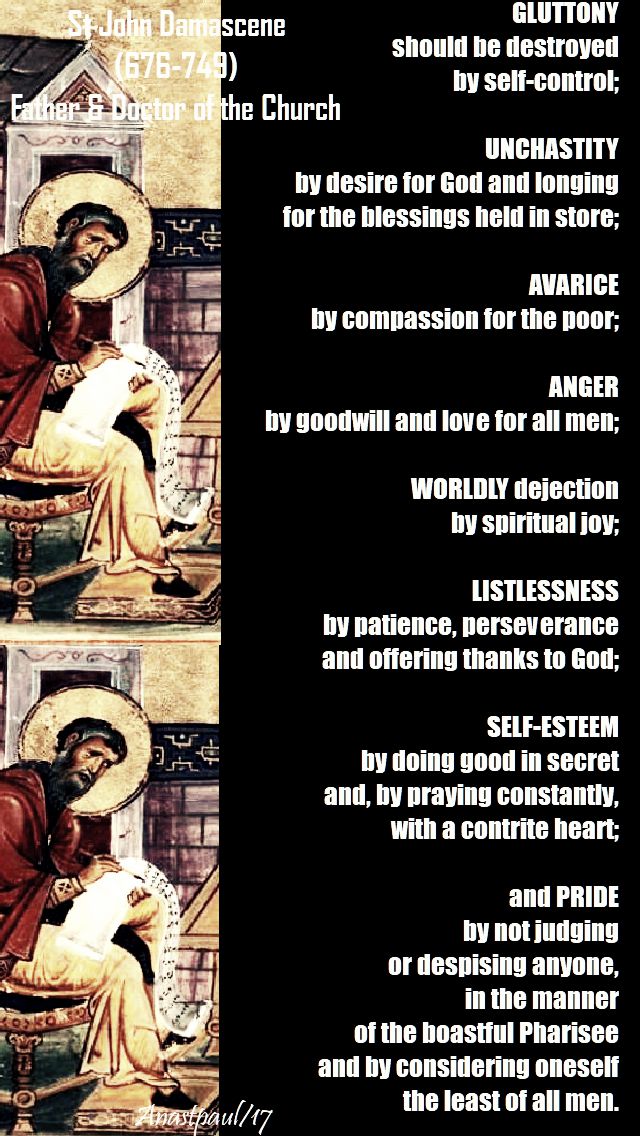
“”GLUTTONY should be destroyed by self-control;

UNCHASTITY by desire for God and longing for the blessings held in store;

AVARICE by compassion for the poor;

ANGER by goodwill and love for all men;

WORLDLY dejection by spiritual joy;

LISTLESSNESS by patience, perseverance and offering thanks to God;

SELF-ESTEEM by doing good in secret and, by praying constantly,with a contrite heart;

and PRIDE by not judging or despising anyone, in the manner of the boastful Pharisee
and by considering oneself the least of all men.”GLUTTONY - ST JOHN DAMASCENE - 4 DEC 2017 - no 2.

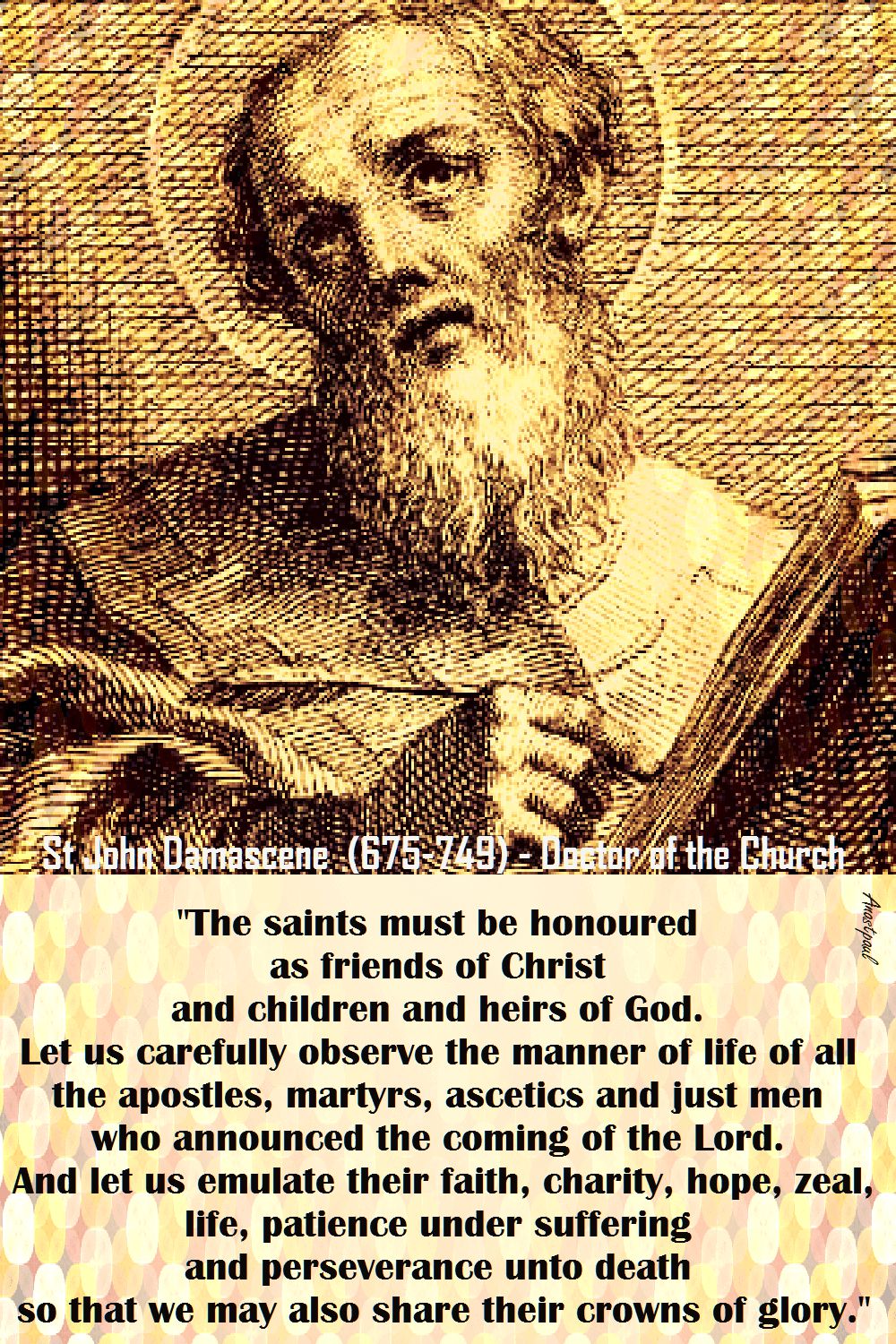
“The saints must be honoured as friends of Christ
and children and heirs of God. Let us carefully
observe the manner of life of all the apostles,
martyrs, ascetics and just men who announced
the coming of the Lord. And let us emulate their
faith, charity, hope, zeal, life, patience under suffering
and perseverance unto death so that we may also
share their crowns of glory.”the saints must be honoured-st john damascene doctor of the church (675-749)

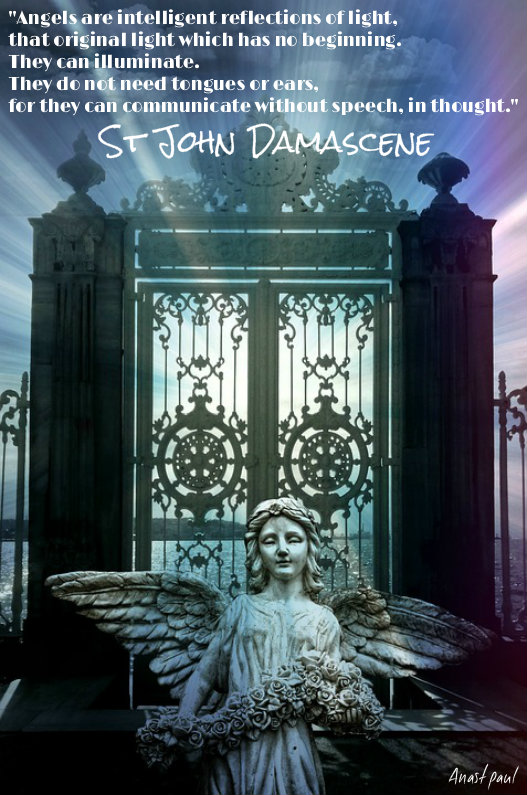
“Angels are intelligent reflections of light,
that original light which has no beginning.
They can illuminate.
They do not need tongues or ears,
for they can communicate without speech, in thought.”angels are intelligent reflections of light - st john damascene - 4 dec 2016

St John Damascene (676-749) – Father and Doctor of the Church