Posted in DOCTORS of the Church, FATHERS of the Church, QUOTES of the SAINTS, SAINT of the DAY

Saint of the Day – 21 October – St Hilarion of Gaza (c 291-371)

Saint of the Day – 21 October – St Hilarion of Gaza (c 291-371) Hermit and Miracle-Worker.

St Hilarion spent most of his life in the desert according to the example of Anthony the Great.

Shortly after St Hilarion’s death, St Jerome wrote about the life of this hermit who had introduced monasticism into Palestine.   Jerome told of Hilarion’s lifelong pursuit of solitude, where he could encounter God in prayer.

Hilarion was born in Thabatha, south of Gaza in Syria Palaestina of pagan parents. He successfully studied rhetoric with a Grammarian in Alexandria.   It seems that he was converted to Christianity in Alexandria.   After that, he shunned the pleasures of his day—theatre, circus and arena—and spent his time attending church.   According to St Jerome, he was a thin and delicate youth of fragile health.

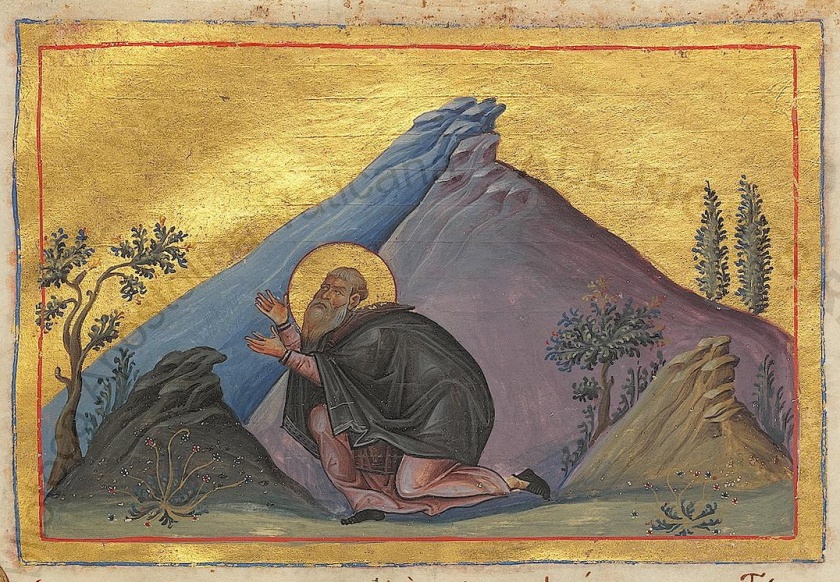
After hearing of Saint Anthony, whose name (according to St.erome), “was in the mouth of all the races of Egypt” Hilarion, at the age of fifteen, went to live with him in the desert for two months.   As Anthony’s hermitage was busy with visitors seeking cures for diseases or demonic affliction, Hilarion returned home along with some monks.   At Thabatha, his parents having died in the meantime, he gave his inheritance to his brothers and the poor and left for the wilderness.Hilarion_the_Great_(Menologion_of_Basil_II)

St Jerome wrote about the divine irony of the fame that denied it to him because his miracles attracted so many people. In this brief excerpt, Jerome describes Hilarion’s faith and a typical miracle:

Once . . . when he was eighteen years old, brigands tried to find him at night.   Either they believed that he had something to steal or they thought he would scorn them if they didn’t intimidate him. . . . From evening till dawn, they hunted in every direction but couldn’t find him.   In the broad daylight, however, they came upon him and apparently as a joke asked him:  “What would you do if robbers attacked you?”   He answered:   “A naked person does not fear robbers.”   “You could be killed.”   “I could,” he said.   “But I am not afraid of robbers because I am ready to die.”   Admiring his faith, they confessed their folly of the night before and their blindness and promised to reform their lives…

A woman of Eleutheropolis, despised by her husband of fifteen years because of her sterility, . . . was the first who dared to intrude upon blessed Hilarion’s solitude.   While he was still unaware of her approach, she suddenly threw herself at his knees saying:  “Forgive my boldness. . . ., he asked her why she had come and why she was weeping.   When he learned the cause of her grief, raising his eyes to heaven, he commanded her to have faith and to believe.   He followed her departure with tears.   When a year had gone by, he saw her with her son.

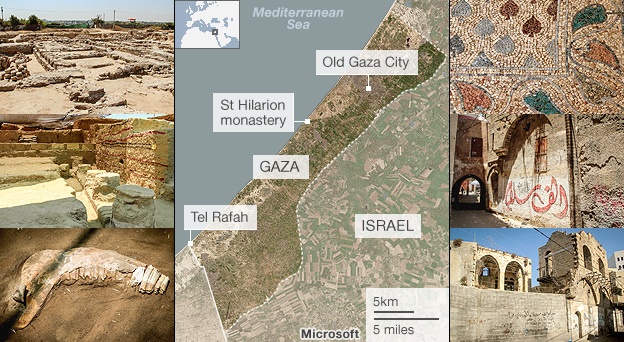
Like Anthony, Hilarion took only a little food once a day at sunset.   When tempted sexually, he ate even less.  “I’ll see to it, you jackass,” he said, “that you shall not kick.”  He never bathed nor changed his tunic until it wore out.   He said, “It is idle to expect cleanliness in a hair shirt.”   Jerome relates that even though Hilarion suffered extreme dryness of spirit, he persevered in prayer and cured many people of sickness and demon possession.   The parade of petitioners and would-be disciples drove Hilarion to retire to more remote locations.   But they followed him everywhere.   First he visited Anthony’s retreat in Egypt.   Then he withdrew to Sicily, later to Dalmatia and finally to Cyprus. He died there in 371.hilarion monastery

Posted in DOCTORS of the Church, MORNING Prayers, PRAYERS of the SAINTS

Our Morning Offering – 17 October

Our Morning Offering – 17 October

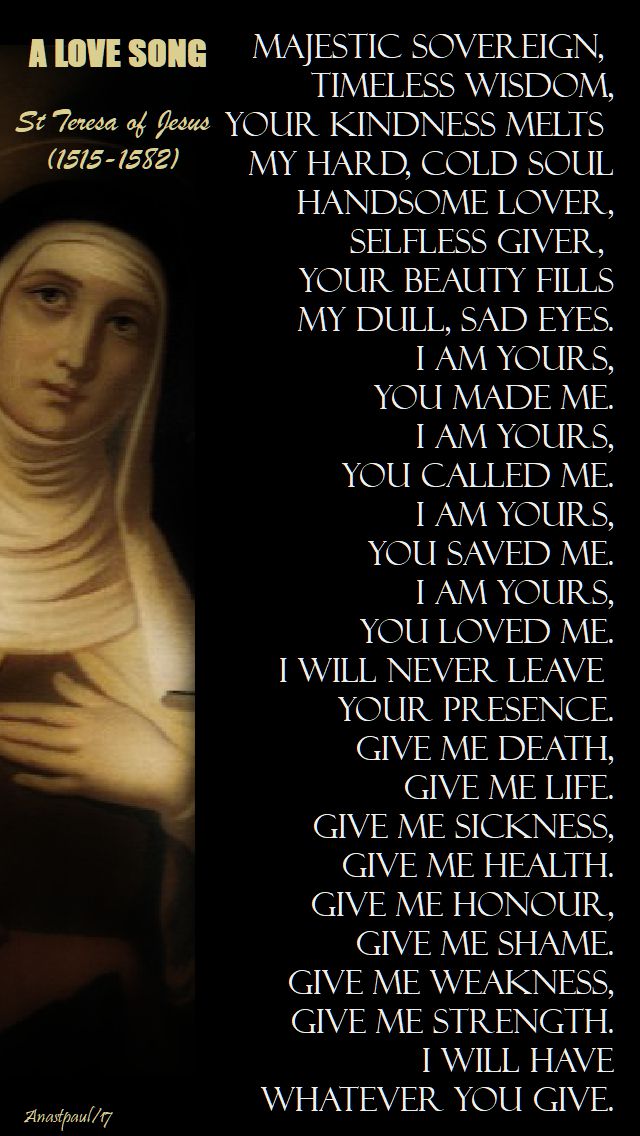
A Love Song
By St Teresa of Jesus

Majestic Sovereign, timeless Wisdom,
Your kindness melts my hard, cold soul.
Handsome Lover, selfless Giver,
Your beauty fills my dull, sad eyes.
I am Yours, You made me.
I am Yours, You called me.
I am Yours, You saved me.
I am Yours, You loved me.
I will never leave Your presence.
Give me death, give me life.
Give me sickness, give me health.
Give me honour, give me shame.
Give me weakness, give me strength.
I will have whatever You give.
AmenA LOVE SONG BY ST TERESA OF JESUS - 17 OCT 2017

Posted in CARMELITES, DOCTORS of the Church, MORNING Prayers, QUOTES of the SAINTS, SAINT of the DAY

Thought for the Day – – 15 October – The Memorial of St Teresa of Jesus/Avila (1515-1582) Doctor of the Church

Thought for the Day – – 15 October – The Memorial of St Teresa of Jesus/Avila (1515-1582) Doctor of the Church

Since her encounter with Jesus, St Teresa lived “another life”; she become a tireless communicator of the Gospel (cf. Life, 23, 1).   Eager to serve the Church and in the face of serious problems of her time, she did not limit herself to being a spectator of the reality around her.   In her position as a woman and with her health difficulties, she decided, she said, “to do what little depended on me … that is to follow the evangelical counsels as perfectly as possible and to ensure that these few nuns who are here do the same” (The Way, 1, 2).   Thus began the Teresian reform, in which she asked her sisters not to lose time negotiating with God “interests of little importance,” while “the world is in flames” (ibid., 1, 5).   This missionary and ecclesial dimension has always marked the Carmelites and Discalced Carmelites.

As she did then, even today the saint opens new horizons for us, she calls us to a great undertaking, to see the world with the eyes of Christ, to seek what He seeks and to love what He loves. (Pope Francis in a letter to to Carmelite Father Xavier Cannistrà)

Ours is a time of turmoil, a time of reform, and a time of liberation. Modern women have in Teresa a challenging example.   Promoters of renewal, promoters of prayer, all have in Teresa a woman to reckon with, one whom they can admire and imitate.

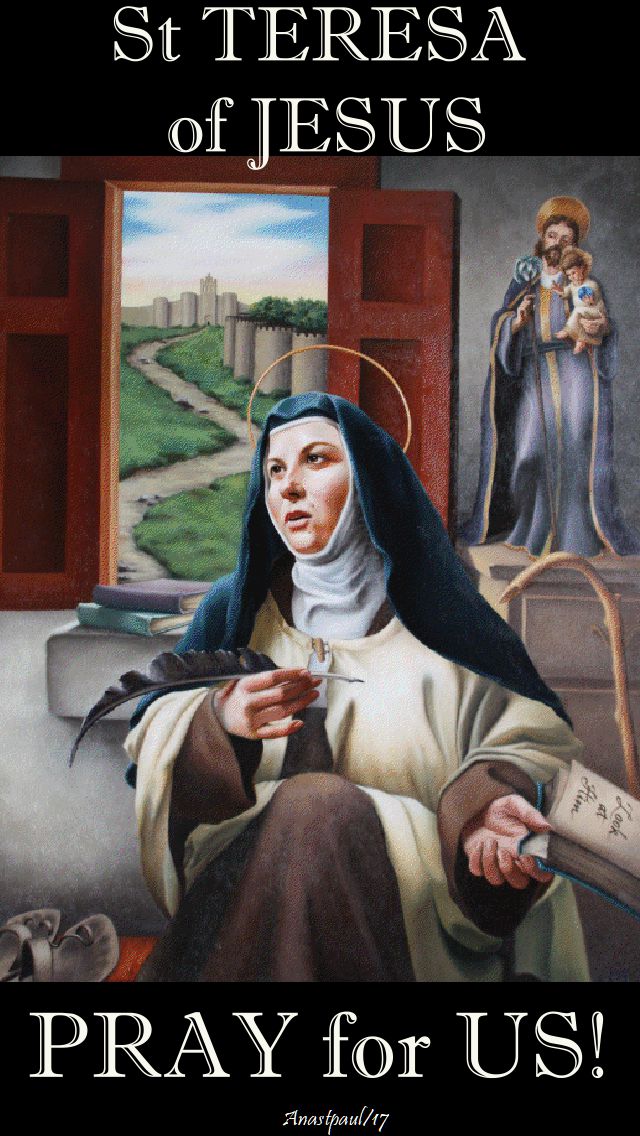
St Teresa of Jesus, Pray for us!st teresa of jesus- pray for us 2

Posted in CARMELITES, DOCTORS of the Church, MORNING Prayers, QUOTES of the SAINTS, SAINT of the DAY

Quotes of the Day – 15 October – The Memorial of St Teresa of Jesus/Avila (1515-1582) Doctor of the Church

Quotes of the Day – 15 October – The Memorial of St Teresa of Jesus/Avila (1515-1582) Doctor of the Church

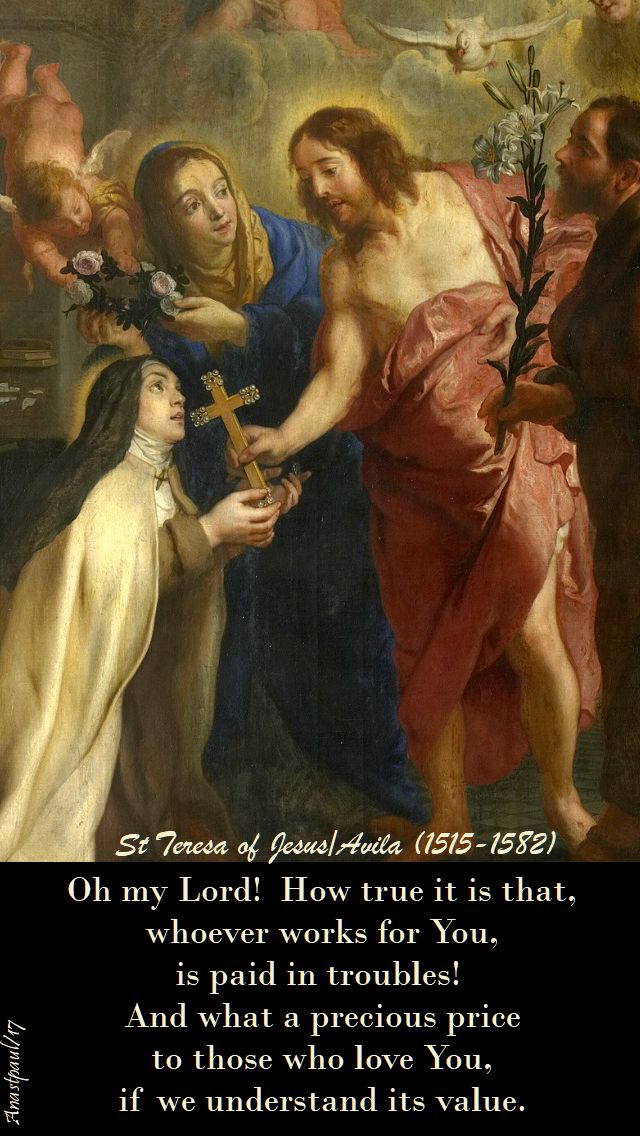
“Oh my Lord!
How true it is that,
whoever works for You,
is paid in troubles!
And what a precious price
to those who love You,
if we understand its value.”oh my lord - st teresa of jesus - 15 oct 2017

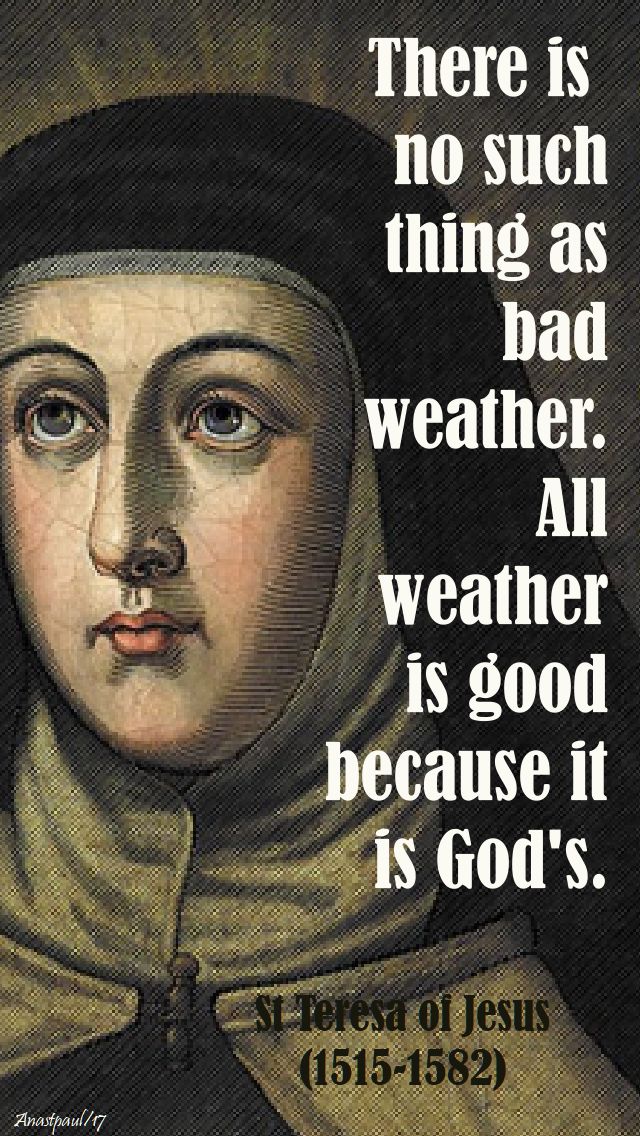
“There is no such thing as bad weather.
All weather is good because it is God’s.”there is no such thing - st teresa of jesus - 15 oct 2017

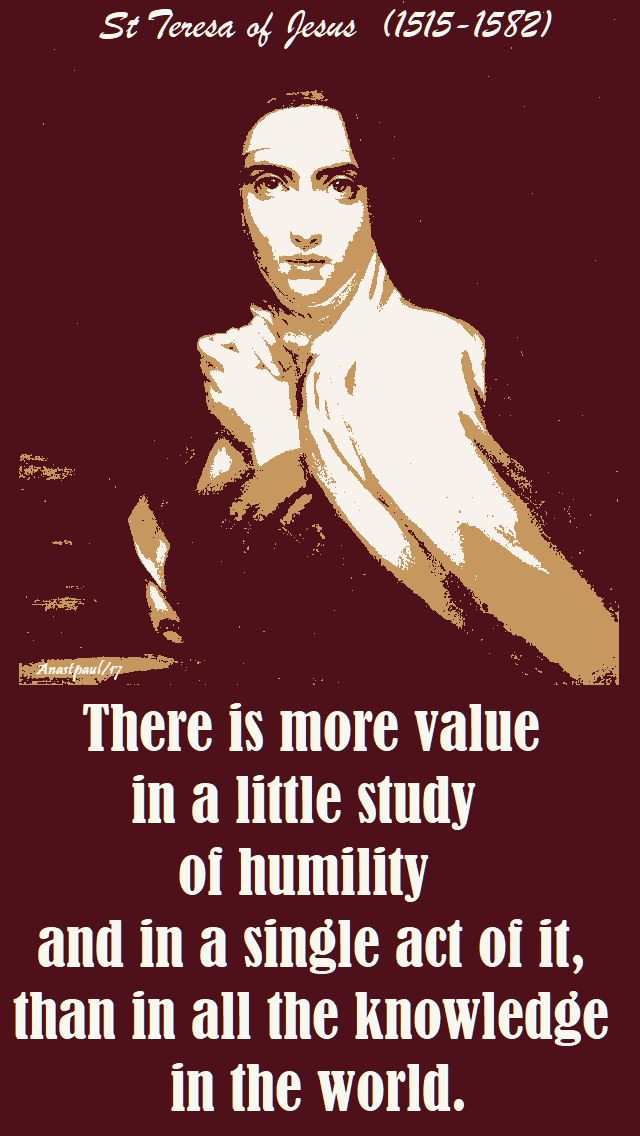
“There is more value in a little study of humility
and in a single act of it,
than in all the knowledge in the world.”there is more value - st theresa of jesus - 15 oct 2017

“We need no wings to go in search of Him
but have only to look upon Him,
present within us.”we need no wings - st teresa of jesus - 15 oct 2017

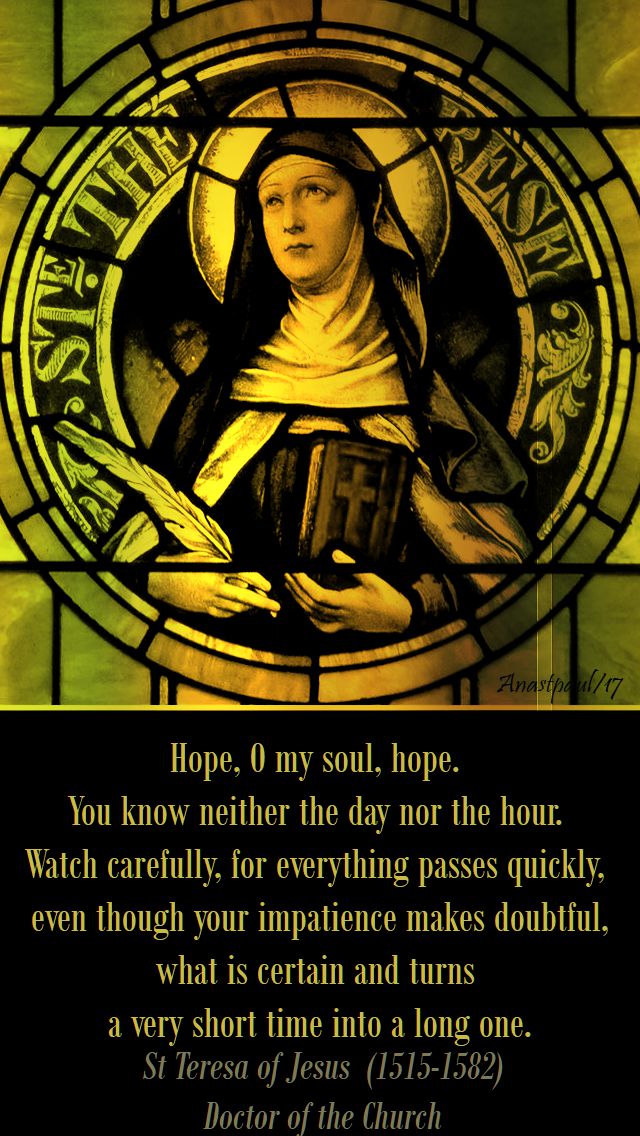
“Hope, O my soul, hope.
You know neither the day nor the hour.
Watch carefully, for everything passes quickly,
even though your impatience makes doubtful,
what is certain and turns
a very short time into a long one.”

St Teresa of Jesus (1515-1582)hope o my soul hope - st teresa - 15 october 2017

Posted in CARMELITES, DOCTORS of the Church, MORNING Prayers, PRAYERS of the SAINTS, SAINT of the DAY

Our Morning Offering – 15 October – The Memorial of St Teresa of Jesus/Avila (1515-1582)

Our Morning Offering – 15 October – The Memorial of St Teresa of Jesus (1515-1582)

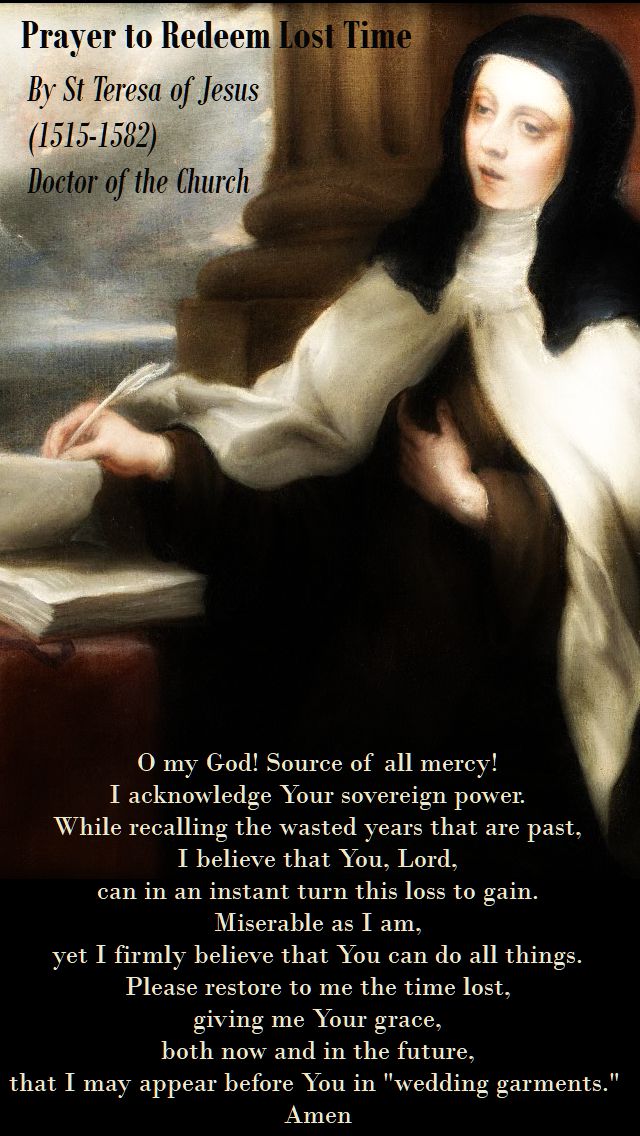
To Redeem Lost Time
By St Teresa of Jesus
(1515-1582) Doctor of the Church

O my God! Source of all mercy!
I acknowledge Your sovereign power.
While recalling the wasted years that are past,
I believe that You, Lord,
can in an instant turn this loss to gain.
Miserable as I am,
yet I firmly believe that You can do all things.
Please restore to me the time lost,
giving me Your grace,
both now and in the future,
that I may appear before You in “wedding garments.”
Amenprayer to redeem lost time by st teresa of jesus - 15 oct 2017

Posted in CARMELITES, DOCTORS of the Church, MORNING Prayers, QUOTES of the SAINTS, SAINT of the DAY, The WORD

One Minute Reflection – 15 October – The Memorial of St Teresa of Jesus/Avila (1515-1582) Doctor of the Church

One Minute Reflection – 15 October – The Memorial of St Teresa of Jesus/Avila (1515-1582) Doctor of the Church

If we have died with him
we shall also live with him;
if we persevere
we shall also reign with him.
But if we deny him
he will deny us.
If we are unfaithful
he is always faithful,
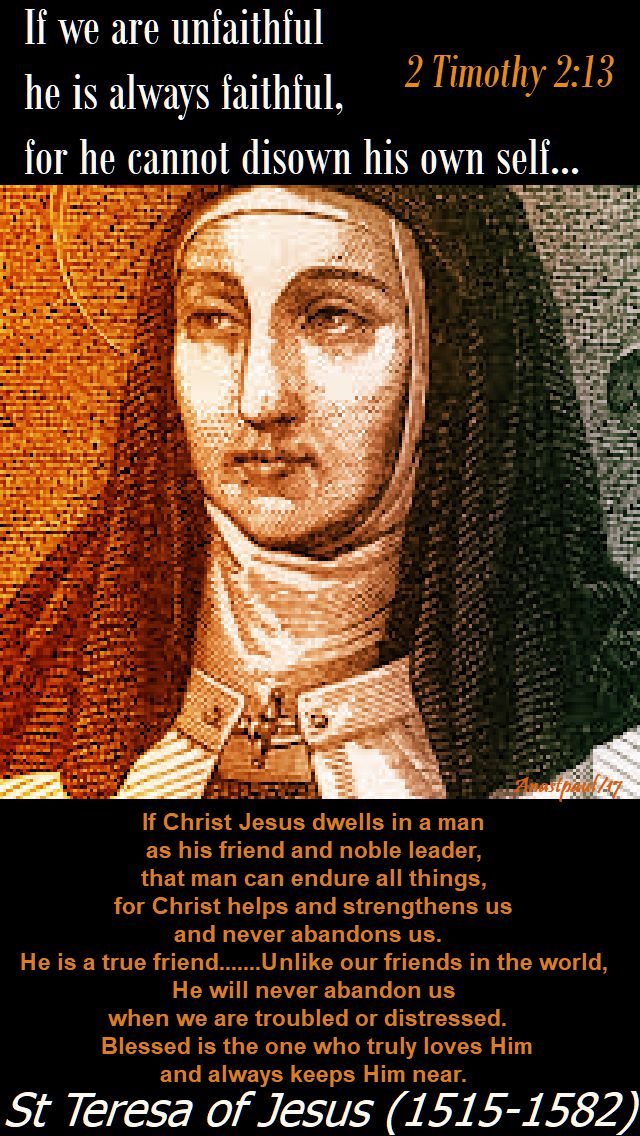
for he cannot disown his own self..…2 Timothy 2:11-13

REFLECTION – “If Christ Jesus dwells in a man as his friend and noble leader, that man can endure all things, for Christ helps and strengthens us and never abandons us.   He is a true friend.   And I clearly see that is we expect to please Him and receive an abundance of His graces, God desires that these graces must come to us from the hands of Christ, through His most sacred humanity, in which God takes delight.   All blessings come to us through our Lord.   He will teach us, for in beholding His life we find that He is the best example.   What more do we desire from such a good friend at our side? Unlike our friends in the world, He will never abandon us when we are troubled or distressed.   Blessed is the one who truly loves Him and always keeps Him near. Whenever we think of Christ we should recall the love that led Him to bestow on us so many graces and favours and also the great love God showed in giving us in Christ a pledge of His love;  for love calls for love in return.   Let us strive to keep this always before our eyes and to rouse ourselves to love Him.   For if at some time the Lord should grant us the grace of impressing His love on our hearts, all will become easy for us and we shall accomplish great things quickly and without effort.” – Saint Teresa of Jesusif christ jesus dwells in a man - st teresa of jesus - 15 oct 2017

PRAYER – Almighty God, our Father, You sent St Teresa of Jesus to be a witness in the Church to the way of perfection.   Sustain us by her spiritual doctrine and kindle in us, the longing for true holiness.   Through Christ, our Lord, in union with the Holy Spirit.   St Teresa pray for us, amenst teresa of jesus - pray for us

Posted in CARMELITES, DOCTORS of the Church, Of the SICK, the INFIRM, All ILLNESS, PATRONAGE - HEADACHES, QUOTES of the SAINTS, SAINT of the DAY

Saint of the Day – 15 October – St Teresa of Jesus/of Avila (1515-1582) Doctor of the Church

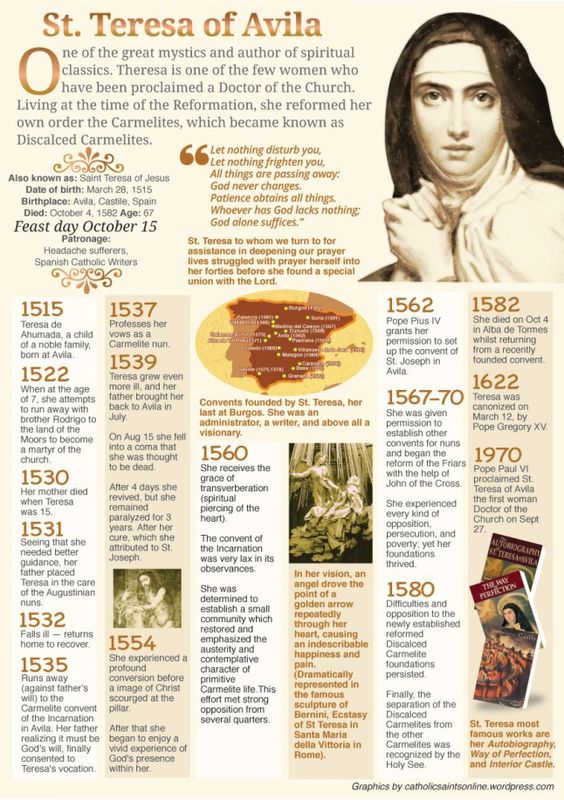
Saint of the Day – 15 October – St Teresa of Jesus/of Avila (1515-1582) Virgin, Mystic, Ecstatic, Reformer, Apostle of Prayer, Writer, Doctor of the Church.    Born as Teresa Sanchez Cepeda Davila y Ahumada  at Avila, Old Castile, on 28 March 1515 –  died at Alba de Tormes, 4 October 1582 of natural causes in the arms of her secretary and close friend Blessed Anne of Saint Bartholomew.  Her relics are preserved at Alba – her heart shows signs of Transverberation (piercing of the heart), and is displayed, too.   Her Body is incorrupt.  Patronages: • sick people; against bodily ills or sickness • against headaches • against the death of parents • lace makers or lace workers • people in need of grace • people in religious orders • people ridiculed for their piety • World Youth Day 2011 • Amos, Canada, diocese of • Avellaneda-Lanús, Argentina, diocese of • Berzano di Tortona, Italy • Pozega, Croatia • Spain.   Attributes –   Habit of the Discalced Carmelites, Book and Quill, arrow-pierced heart.   St Teresa was Beatified on 24 April 1614 by Pope Paul V and Canonised on 12 March 1622, only forty years after her death, by Pope Gregory XV.   Tradition associate Saint Teresa with the Infant Jesus of Prague with claims of former ownership and devotion.   On 27 September 1970 St Teresa, was named a Doctor of the Church by Pope Paul VI.   Her books, which include her autobiography (The Life of Teresa of Jesus) and her seminal work El Castillo Interior (trans.: The Interior Castle), are an integral part of Spanish Renaissance literature as well as Christian mysticism and Christian meditation practices.   She also wrote Camino de Perfección (trans.: The Way of Perfection).

original portait by Fray Juan de la Miseria in 1576
Original Portrait by Frei Jual de la Miseria in 1576

st teresa info

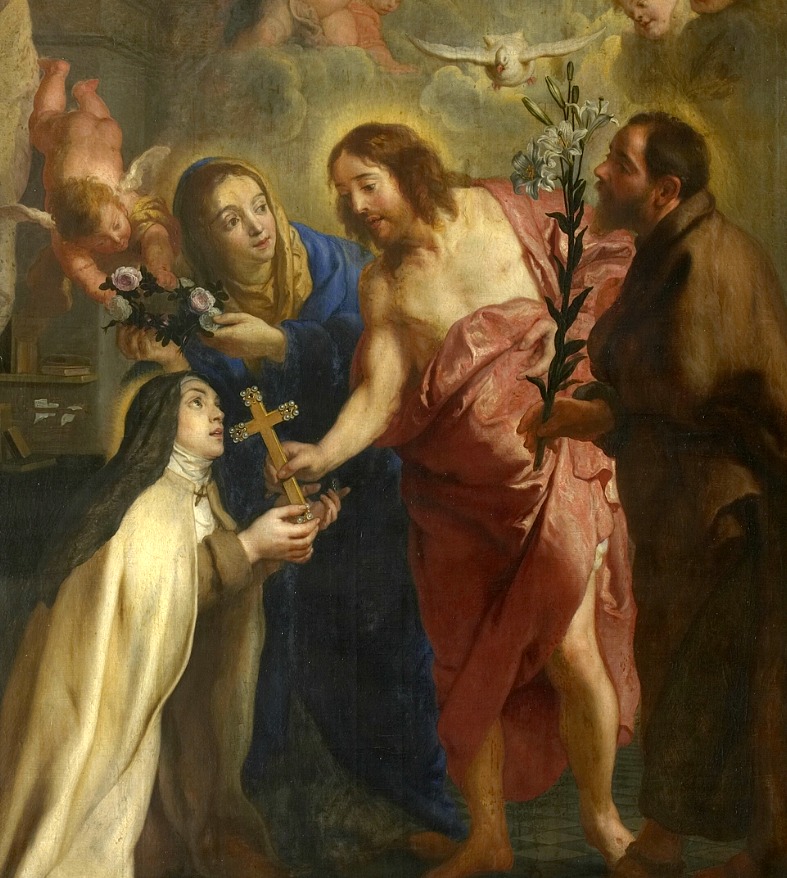
The third child of Don Alonso Sanchez de Cepeda by his second wife, Doña Beatriz Davila y Ahumada, who died when the Teresa was in her fourteenth year, Teresa was brought up by her saintly father, a lover of serious books and a tender and pious mother.   After her death and the marriage of her eldest sister, Teresa was sent for her to the Augustinian nuns at Avila but owing to illness she left at the end of eighteen months and for some years remained with her father and occasionally with other relatives, notably an uncle who made her acquainted with the Letters of St Jerome, which determined her to adopt the religious life, not so much through any attraction towards it, as through a desire of choosing the safest course.   Unable to obtain her father’s consent she left his house unknown to him to enter the Carmelite Convent of the Incarnation at Avila, which then counted 140 nuns.   The wrench from her family caused her a pain which she ever afterwards compared to that of death. However, her father at once yielded and Teresa took the habit.St. Teresa of Avila Receives the Veil and Necklace from the Virgin and

Teresa lived in an age of exploration as well as political, social and religious upheaval.   It was the 16th century, a time of turmoil and reform.   She was born before the Protestant Reformation and died almost 20 years after the closing of the Council of Trent.

The gift of God to Teresa in and through which she became holy and left her mark on the Church and the world is threefold:   she was a woman;   she was a contemplative;   she was an active reformer.

As a woman, Teresa stood on her own two feet, even in the man’s world of her time.   She was “her own woman,” entering the Carmelites despite strong opposition from her father.   She is a person wrapped not so much in silence as in mystery.   Beautiful, talented, outgoing, adaptable, affectionate, courageous, enthusiastic, she was totally human.   Like Jesus, she was a mystery of paradoxes:  wise, yet practical;  intelligent, yet much in tune with her experience;  a mystic, yet an energetic reformer;  a holy woman, a womanly woman.

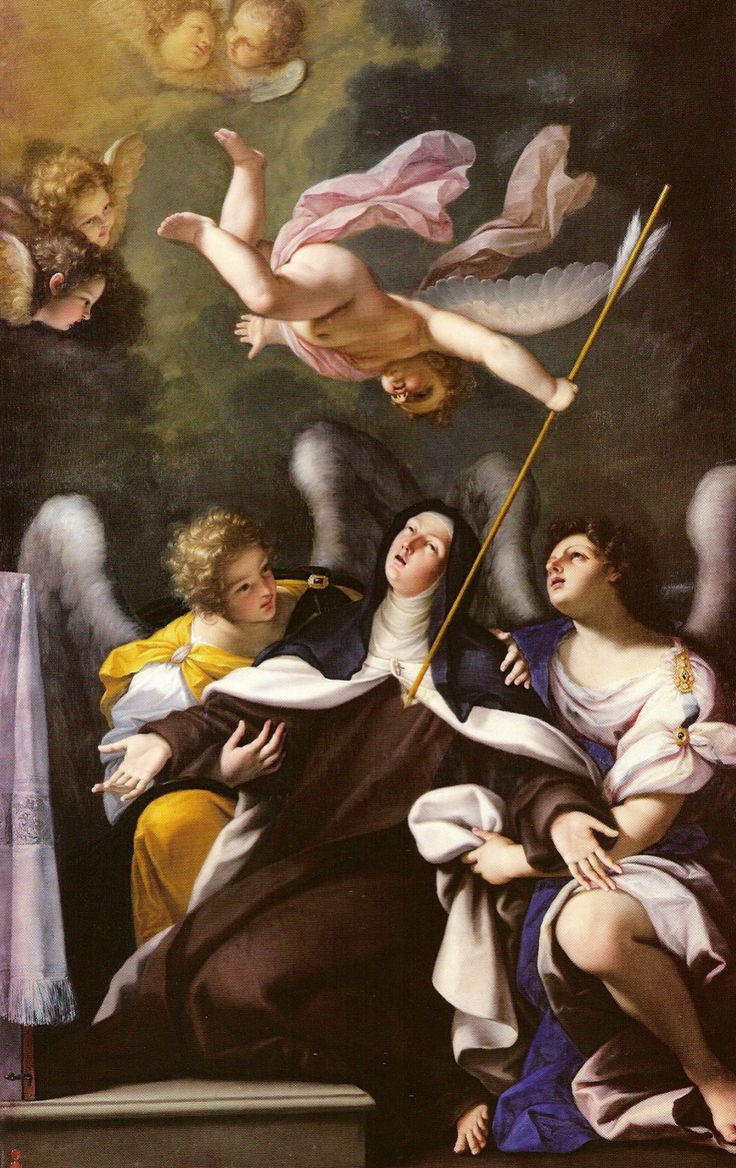
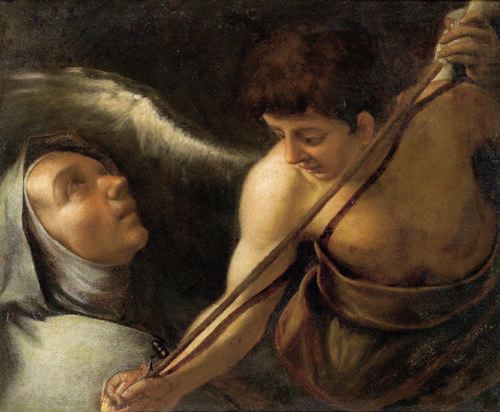
On St Peter’s Day in 1559, Teresa became firmly convinced that Jesus Christ presented Himself to her in bodily form, though invisible.   These visions lasted almost uninterrupted for more than two years.   In another vision, a seraph drove the fiery point of a golden lance repeatedly through her heart, causing an ineffable spiritual-bodily pain.st teresa avila Gaspar_de_Crayer_-_The_vision_of_St_Theresa_of_Avila

I saw in his hand a long spear of gold and at the point there seemed to be a little fire.   He appeared to me to be thrusting it at times into my heart and to pierce my very entrails;   when he drew it out, he seemed to draw them out also and to leave me all on fire with a great love of God.   The pain was so great, that it made me moan;  and yet so surpassing was the sweetness of this excessive pain, that I could not wish to be rid of it…avila - ecstasy

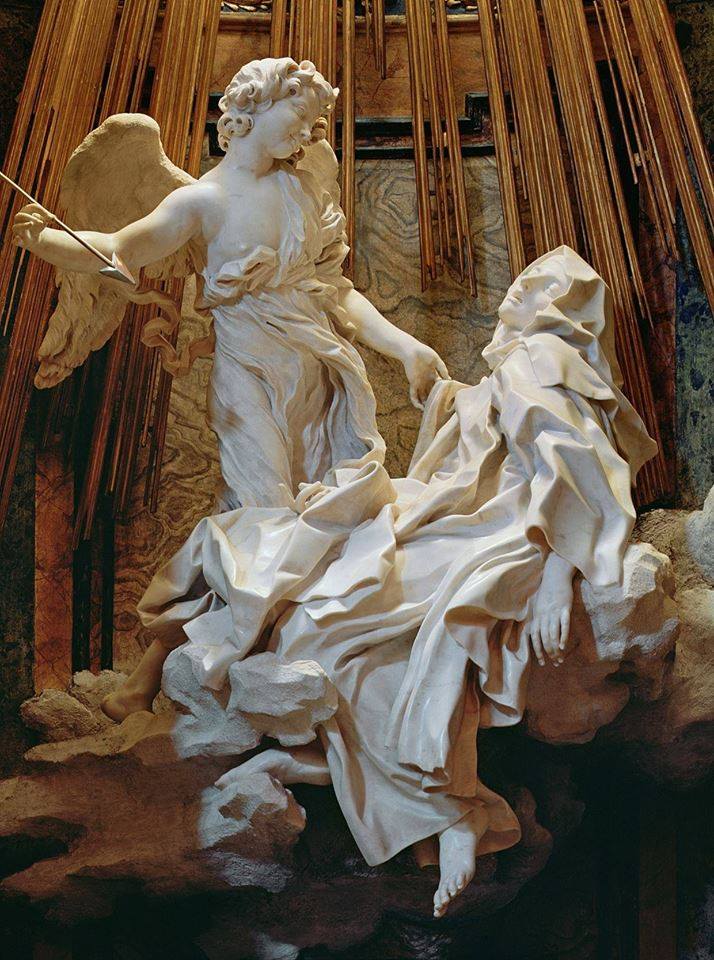
This vision was the inspiration for one of Bernini’s most famous works, the Ecstasy of Saint Teresa at Santa Maria della Vittoria in Rome.avila - berniniavila - bernini altar

The memory of this episode served as an inspiration throughout the rest of her life and motivated her lifelong imitation of the life and suffering of Jesus, epitomised in the motto usually associated with her:  Lord, either let me suffer or let me die.St.-Teresa-of-AvilaGiuseppe_Bazzani_-_The_Ecstasy_of_St_Therese_-_WGA01527

Teresa was a woman “for God,” a woman of prayer, discipline and compassion.   Her heart belonged to God.   Her ongoing conversion was an arduous lifelong struggle, involving ongoing purification and suffering.   She was misunderstood, misjudged and opposed in her efforts at reform.   Yet she struggled on, courageous and faithful;  she struggled with her own mediocrity, her illness, her opposition.   And in the midst of all this she clung to God in life and in prayer.   Her writings on prayer and contemplation are drawn from her experience:  powerful, practical and graceful.   She was a woman of prayer;  a woman for God.

Teresa was a woman “for others.”   Though a contemplative, she spent much of her time and energy seeking to reform herself and the Carmelites, to lead them back to the full observance of the primitive Rule.   She founded over a half-dozen new monasteries.   She traveled, wrote, fought—always to renew, to reform.   In her self, in her prayer, in her life, in her efforts to reform, in all the people she touched, she was a woman for others, a woman who inspired and gave life.

Her final illness overtook her on one of her journeys from Burgos to Alba de Tormes.   She died in 1582, just as Catholic nations were making the switch from the Julian to the Gregorian calendar, which required the removal of 5–14 October from the calendar.   She died either before midnight of 4 October or early in the morning of 15 October which is celebrated as her feast day.   Her last words were:  “My Lord, it is time to move on. Well then, may your will be done. O my Lord and my Spouse, the hour that I have longed for has come.  It is time to meet one another.”

Her writings, especially the Way of Perfection and The Interior Castle, have helped generations of believers.   She and St Catherine of Siena were the first women so honoured as Doctors of the Church.

Interesting fact – her Spiritual Director was St Francis Borgia whose Feast Day we celebrated on 10 October.

Posted in DOCTORS of the Church, FATHERS of the Church, MORNING Prayers, QUOTES of the SAINTS, QUOTES on SUFFERING, SAINT of the DAY, The WORD

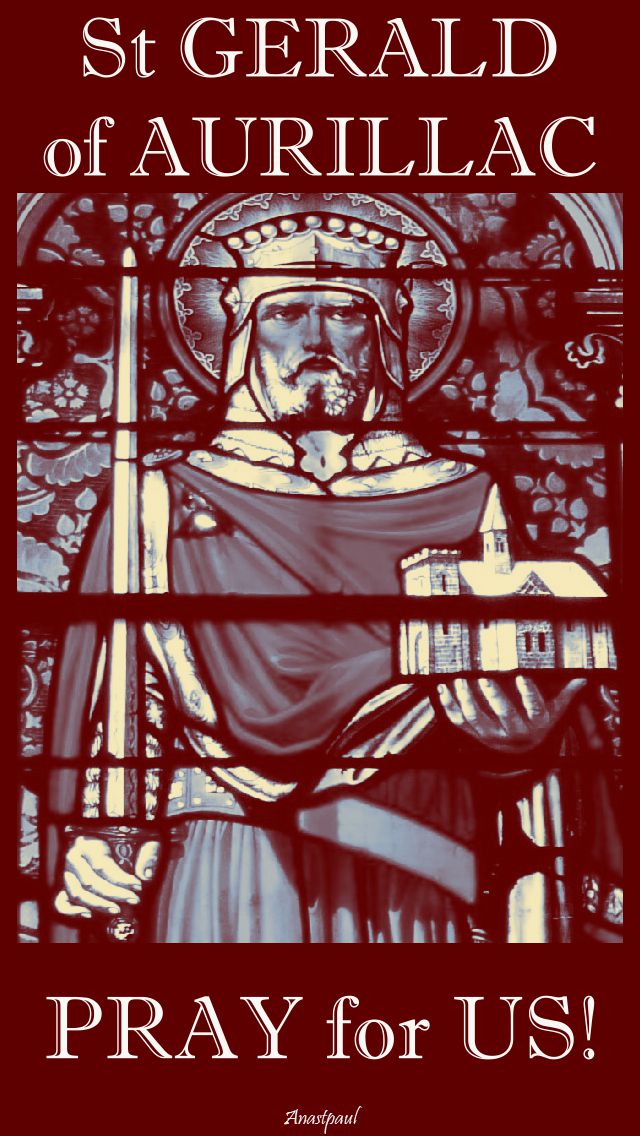
One Minute Reflection – 13 October – The Memorial of St Gerald of Aurillac

One Minute Reflection – 13 October – The Memorial of St Gerald of Aurillac

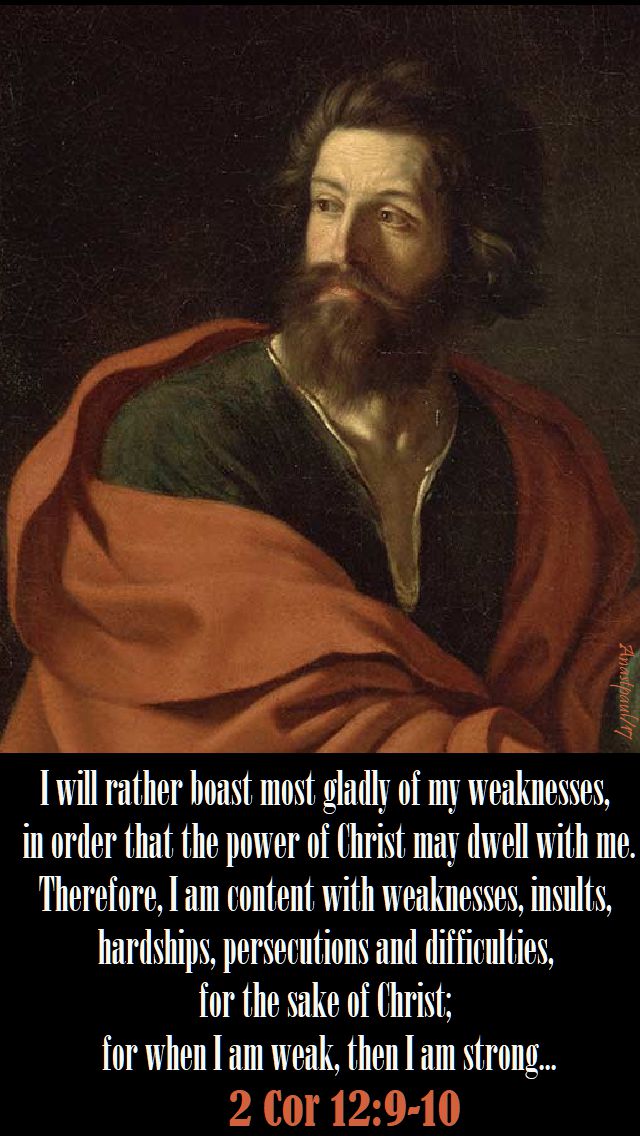
I will rather boast most gladly of my weaknesses, in order that the power of Christ may dwell with me.
Therefore, I am content with weaknesses, insults, hardships, persecutions and difficulties, for the sake of Christ;  for when I am weak, then I am strong….2 Cor 12:9-102 cor 12 - 9,10

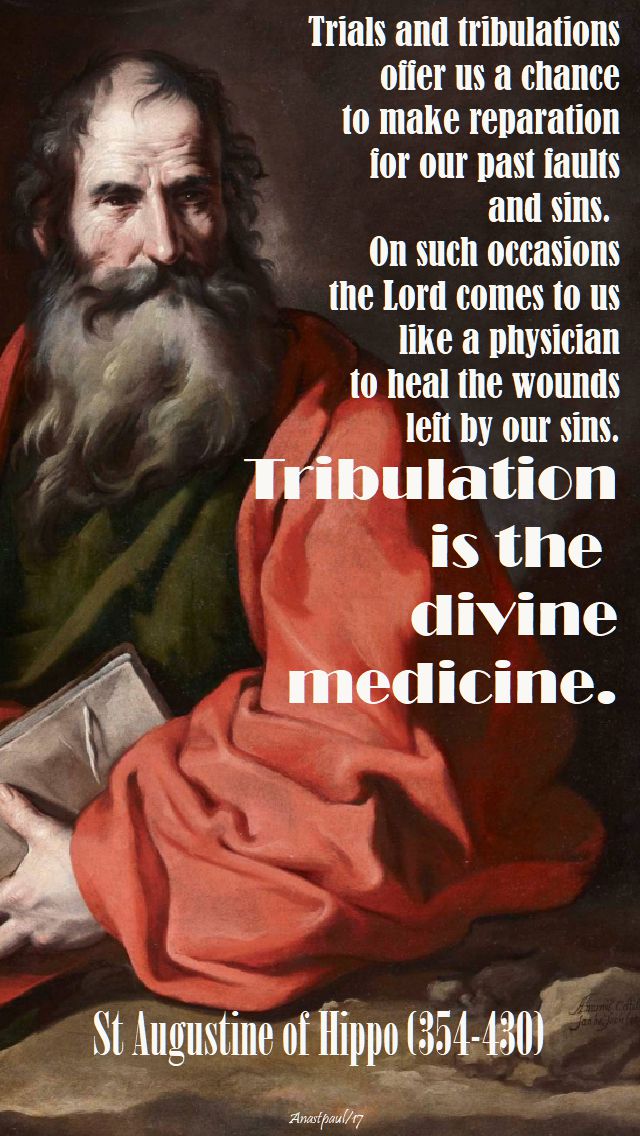
REFLECTION – “Trials and tribulations offer us a chance to make reparation for our past faults and sins.
On such occasions the Lord comes to us like a physician to heal the wounds left by our sins.  Tribulation is the divine medicine.”…St Augustine of Hippo (354-430)trials and tribulations-staugustine-13 oct 2017

PRAYER – Almighty Father, let Your light so penetrate our minds, that walking by Your commandments, we may always follow You, our leader and our Guide in the path of Him who suffered and died for our love.   St Gerald of Aurillac, you consecrated yourself and gave up your riches to the poor to follow the way of the Lord, please pray for us.  Through Jesus Christ, our Lord in union with the Holy Spirit, one God forever and ever. Amenst gerald of aurillac pray for us - 13 oct 2017

Posted in DOCTORS of the Church, MARIAN PRAYERS, MORNING Prayers, PRAYERS of the SAINTS

Our Morning Offering – 6 October

Our Morning Offering – 6 October

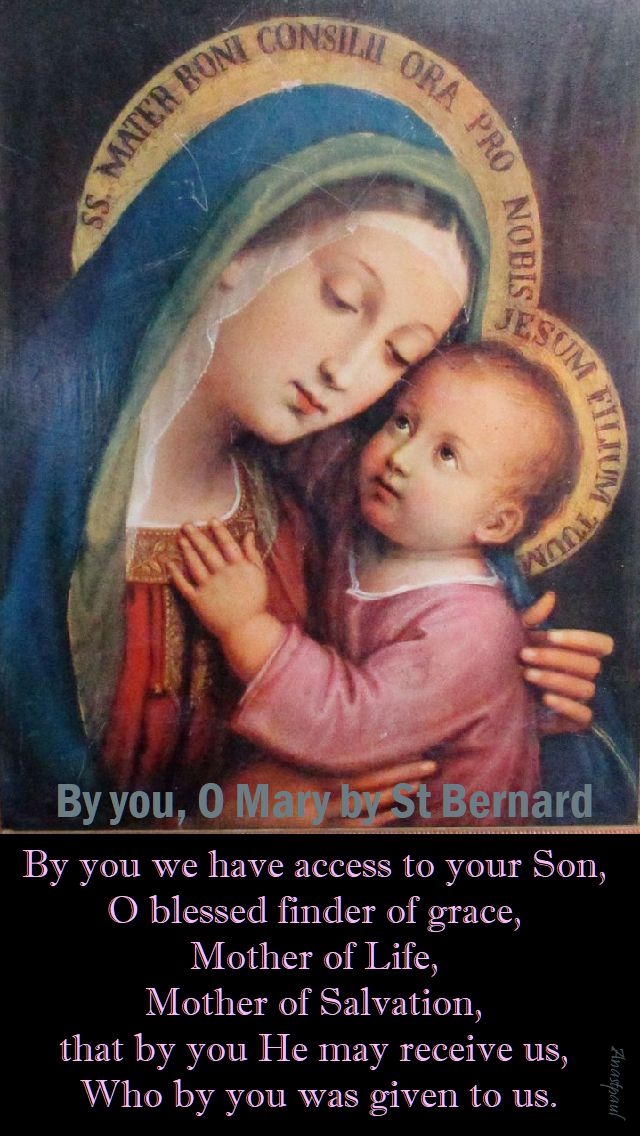
By you, O Mary
St Bernard of Clairvaux (1090-1153)

By you we have access to your Son,
O blessed finder of grace,
Mother of Life,
Mother of Salvation,
that by you He may receive us,
Who by you was given to us.
Amenby you O Mary by St Bernard

Posted in ArchAngels and Angels, CATHOLIC Quotes, DOCTORS of the Church, MORNING Prayers, QUOTES of the SAINTS, SAINT of the DAY

Quote/s of the Day – 2 October – The Memorial of the Holy Guardian Angels

Quote/s of the Day – 2 October – The Memorial of the Holy Guardian Angels

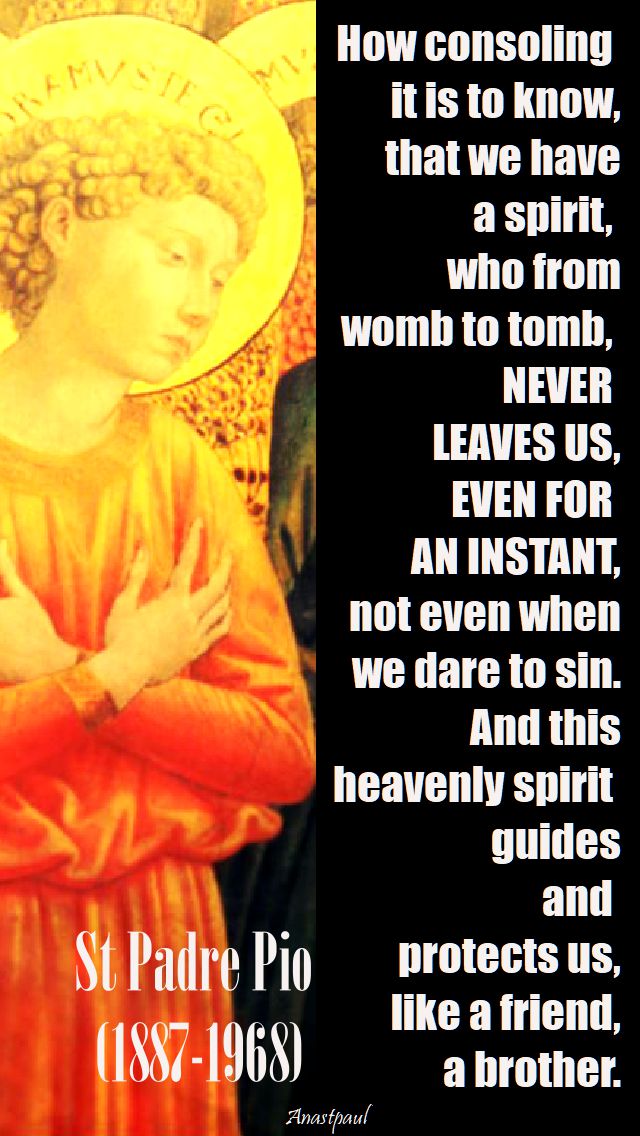
“How consoling it is to know , that we have a spirit, who from womb to tomb, NEVER LEAVES US, EVEN FOR AN INSTANT, not even when we dare to sin.   And this heavenly spirit guides and protects us, like a friend, a brother.”

St Padre Pio (1887-1968)how consoling - st padre pio - 2 oct 2017

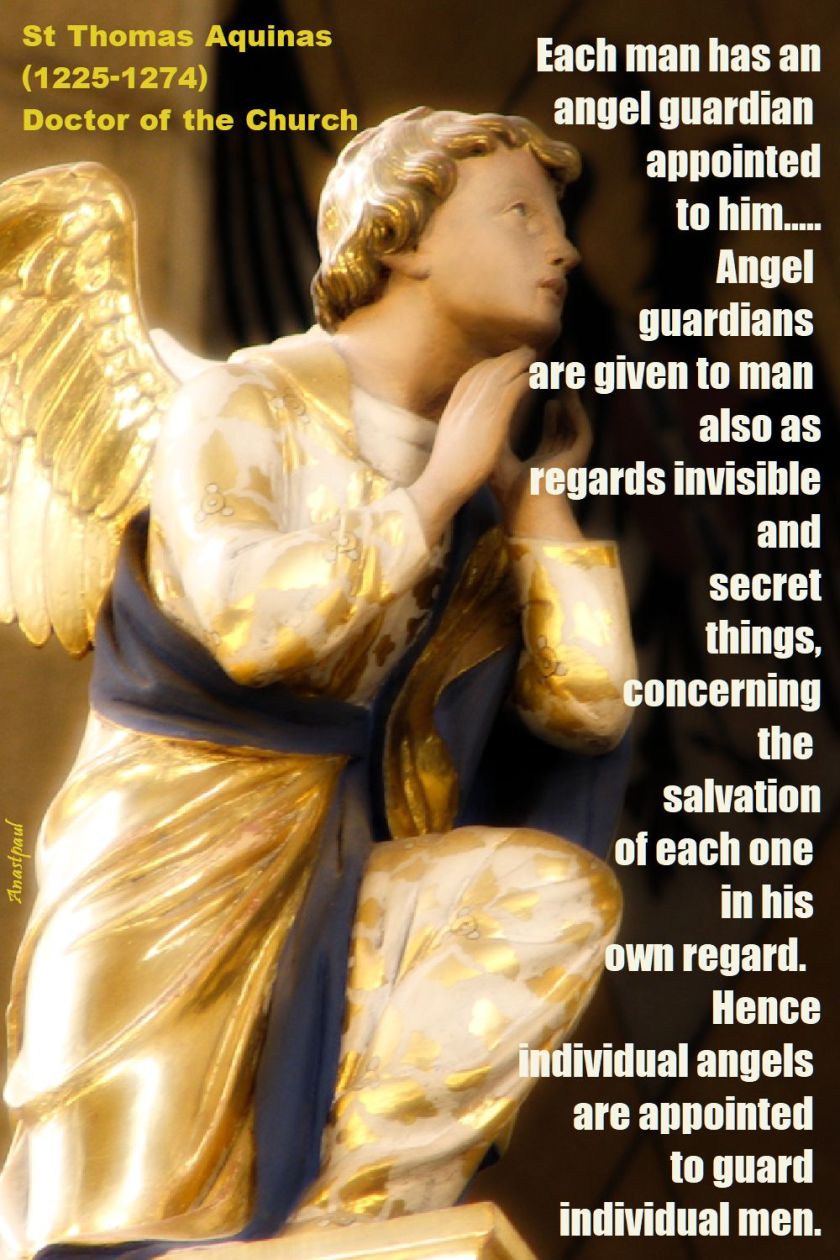
“Each man has an angel guardian appointed to him….Angel guardians are given to man also as regards invisible and secret things, concerning the salvation of each one in his own regard.   Hence individual angels are appointed to guard individual men.”

St Thomas Aquinas  (1225-1274) Doctoreach mans has an - st thomas aquinas 2 oct 207

“When tempted, invoke your Angel. He is more eager to help you than you are to be helped!   Ignore the devil and do not be afraid of him:  He trembles and flees at the sight of your Guardian Angel.”

St John Bosco (1815-1888)when tempted - st john bosco - 2 oct 2017

“We should show our affection for the angels, for one day they will be our co-heirs just as here below they are our guardians and trustees appointed and set over us by the Father.”

St Bernard of Clairvaux (1090-1153) Doctorwe should show our affection - St Bernard of Clairvaux (1090-1153) Doctor of the Church 2 oct 2017

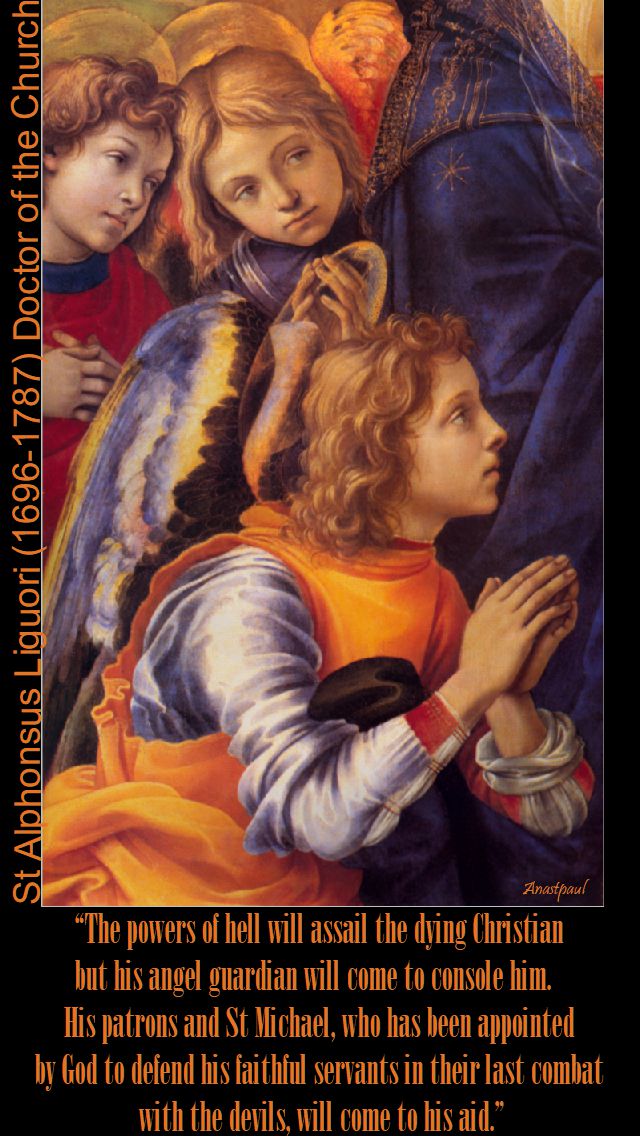
“The powers of hell will assail the dying Christian but his angel guardian will come to console him.   His patrons and St. Michael, who has been appointed by God to defend his faithful servants in their last combat with the devils, will come to his aid.”

St Alphonsus Liguori (1696-1787) Doctorthe powers of hell - st alphonsus - 2 oct 2017

Posted in DOCTORS of the Church, MORNING Prayers, QUOTES of the SAINTS, SAINT of the DAY

Quote/s of the Day – 1 October – The Memorial of St Thérèse of the Child Jesus (1873-1897) Doctor of the Church

Quote/s of the Day – 1 October – The Memorial of St Thérèse of the Child Jesus (1873-1897) Doctor of the Church

“Jesus set the book of nature before me and I saw
that all the flowers He has created are lovely.
The splendour of the rose and the whiteness of the lily
do not rob the little violet of its scent nor the daisy of its simple charm.
I realised that, if every tiny flower wanted to be a rose,
spring would lose its loveliness and there would be no wildflowers
to make the meadows gay.
It is just the same in the world of souls – which is the garden of Jesus.
He has created the great saints, who are like the lilies and the roses
but He has also created much lesser saints and they must be content
to be the daisies or the violets which rejoice His eyes,
whenever He glances down.
Perfection consists in doing His will,
in being that which He wants us to be.
Jesus, help me to simplify my life by learning what you want me to be –
and becoming that person.”

St Thérèse – (Story of a Soul)i realised that - st therese - 1 oct 2017

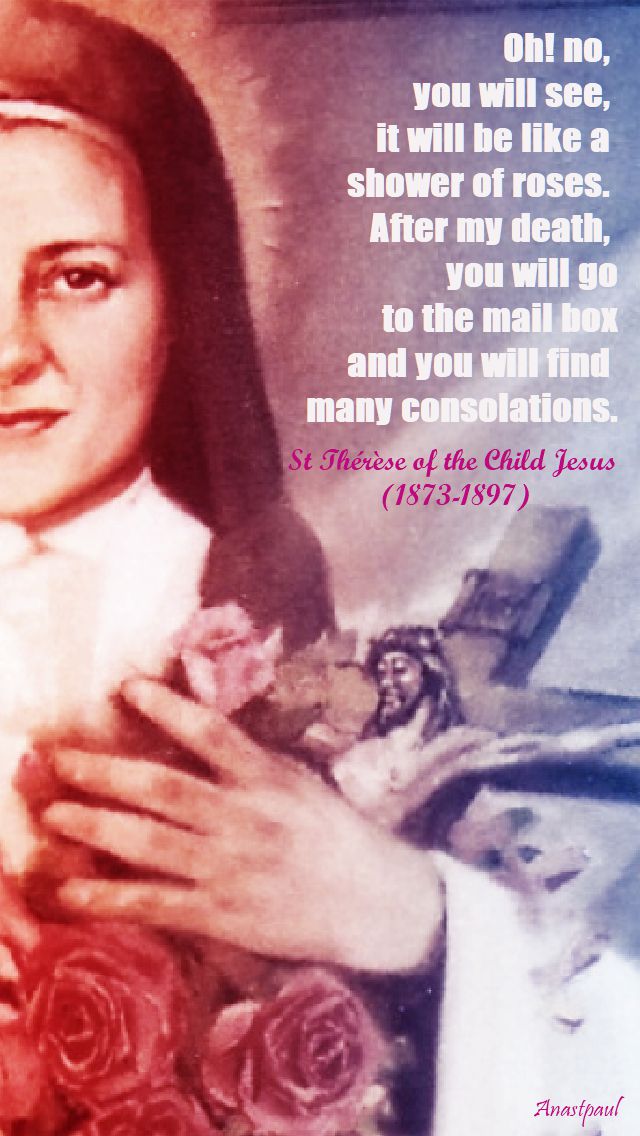
“Oh! no, you will see, it will be like a shower of roses.
After my death, you will go to the mail box
and you will find many consolations.”

St Thérèse of the Child Jesus (1873-1897)oh no you will see - St Thérèse of the Child Jesus (1873-1897) - 1 oct 2017

Posted in CARMELITES, DOCTORS of the Church, MORNING Prayers, PRAYERS of the SAINTS, SAINT of the DAY

Our Morning Offering – 1 October – The Memorial of St Thérèse of Lisieux (1873-1897) Doctor of the Church

Our Morning Offering – 1 October – The Memorial of St Thérèse of Lisieux (1873-1897) Doctor of the Church

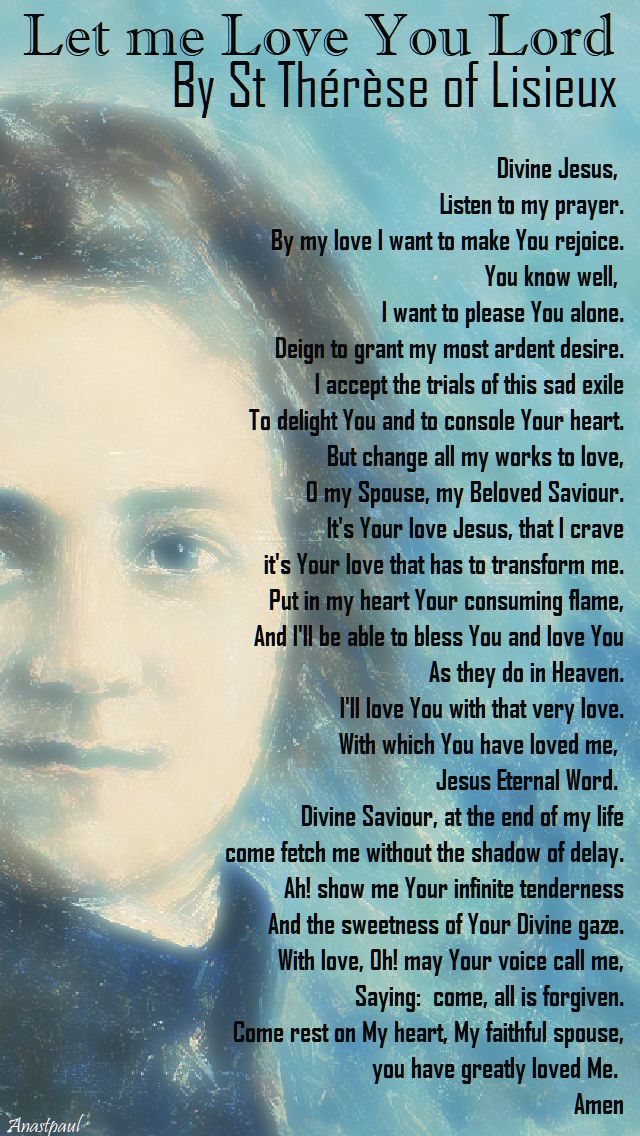
Let me Love You Lord
By St Thérèse of Lisieux

Divine Jesus,
Listen to my prayer.
By my love I want to make You rejoice.
You know well,
I want to please You alone.
Deign to grant my most ardent desire.
I accept the trials of this sad exile
To delight You and to console Your heart.
But change all my works to love,
O my Spouse, my Beloved Saviour.
It’s Your love Jesus, that I crave
it’s Your love that has to transform me.
Put in my heart Your consuming flame,
And I’ll be able to bless You and love You
As they do in Heaven.
I’ll love You with that very love.
With which You have loved me,
Jesus Eternal Word.
Divine Saviour, at the end of my life
come fetch me without the shadow of delay.
Ah! show me Your infinite tenderness
And the sweetness of Your Divine gaze.
With love, Oh! may Your voice call me,
Saying: come, all is forgiven.
Come rest on My heart, My faithful spouse,
you have greatly loved Me.
Amenlet me love you Lord - By St Thérèse of Lisieux 1 oct 2017

Posted in DOCTORS of the Church, FATHERS of the Church, MORNING Prayers, SAINT of the DAY

Thought for the Day – 30 September The Memorial of St Jerome (347-419) Father and Doctor of the Church

Thought for the Day – 30 September The Memorial of St Jerome (347-419) Father and Doctor of the Church

This is a saint of explosive likes and dislikes, of tremendous zeal and passion.

As a young man, he made friendships which lasted a lifetime but his thunderous invectives against his enemies, against heretics and critics are just as famous.    Thus, he is seen to be the most ‘human’ of saints but still (and this is of huge encouragement to us) one of the most powerful forces for good in the entire history of the Church.

He was, as someone has said, no admirer of moderation whether in virtue or against evil.
He was swift to anger but also swift to feel remorse, even more severe on his own shortcomings than on those of others.
The mortifications he inflicted on himself are legend – even a tiny bit of these would do us well in tempering our own sins.

I, personally, feel less worried about my leanings to explosive anger when I look at Jerome for he is an example to us of learning control, of fighting evil, of doing penance but also of growing in sanctity, of loving the Church and the Holy Scriptures and thus becoming master of tendencies to lose control!

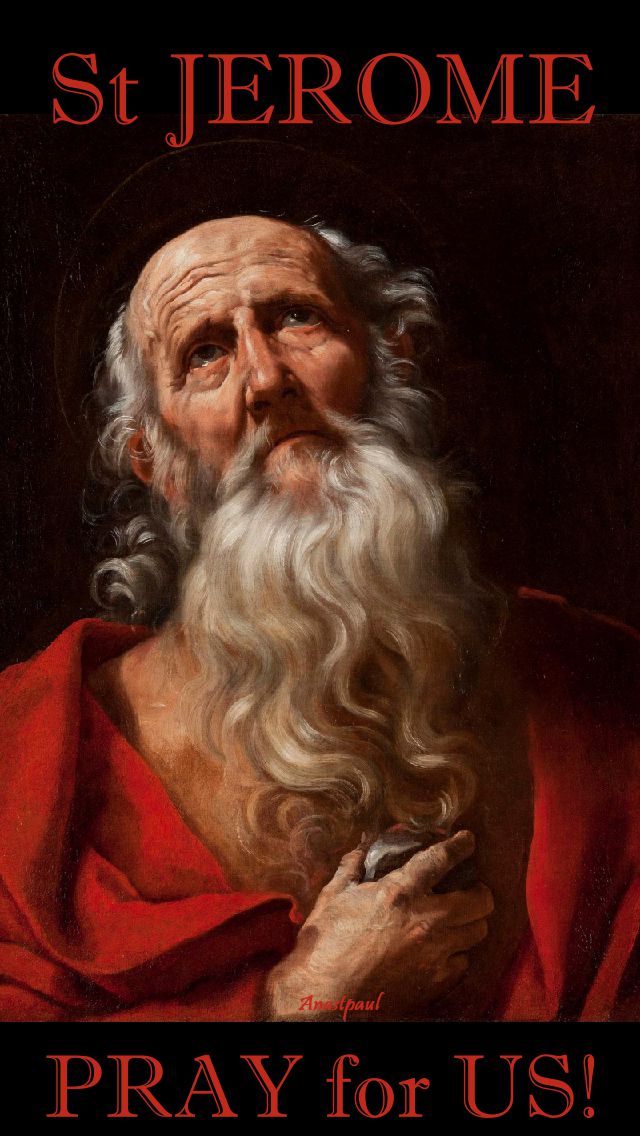
St Jerome, please pray for us!

st jerome pray for us 2.

Posted in DOCTORS of the Church, FATHERS of the Church, MORNING Prayers, QUOTES of the SAINTS, SAINT of the DAY

Quote/s of the Day – 30 September – The Memorial of St Jerome (347-419) Father and Doctor

Quote/s of the Day – 30 September
The Memorial of St Jerome (347-419) Father and Doctor

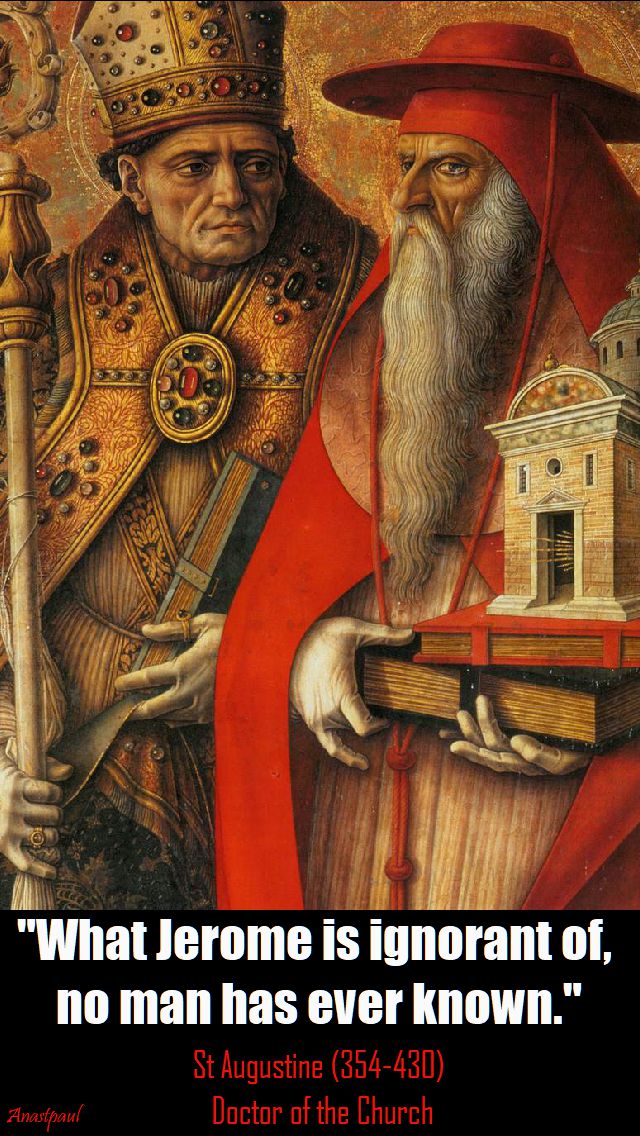
“What Jerome is ignorant of,
no man has ever known.”

St Augustine of Hippowhat jerome is ignorant of - st augustine - 30 sept 2017

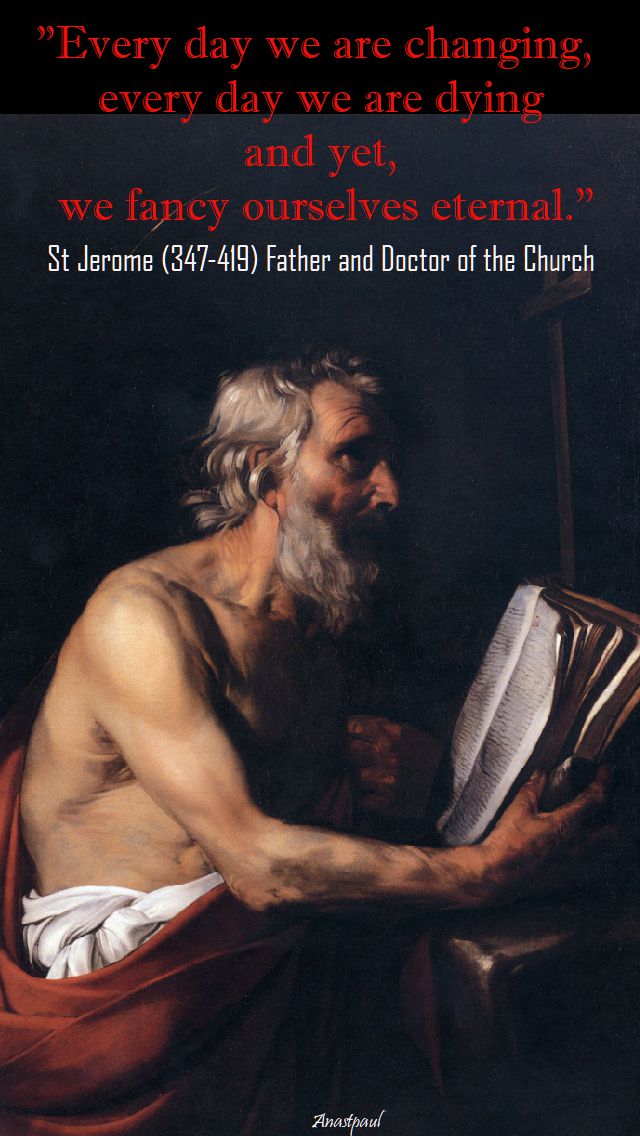
“Every day we are changing,
every day we are dying
and yet we fancy ourselves eternal.”every day we are changing - st jerome - 30 sept 2017

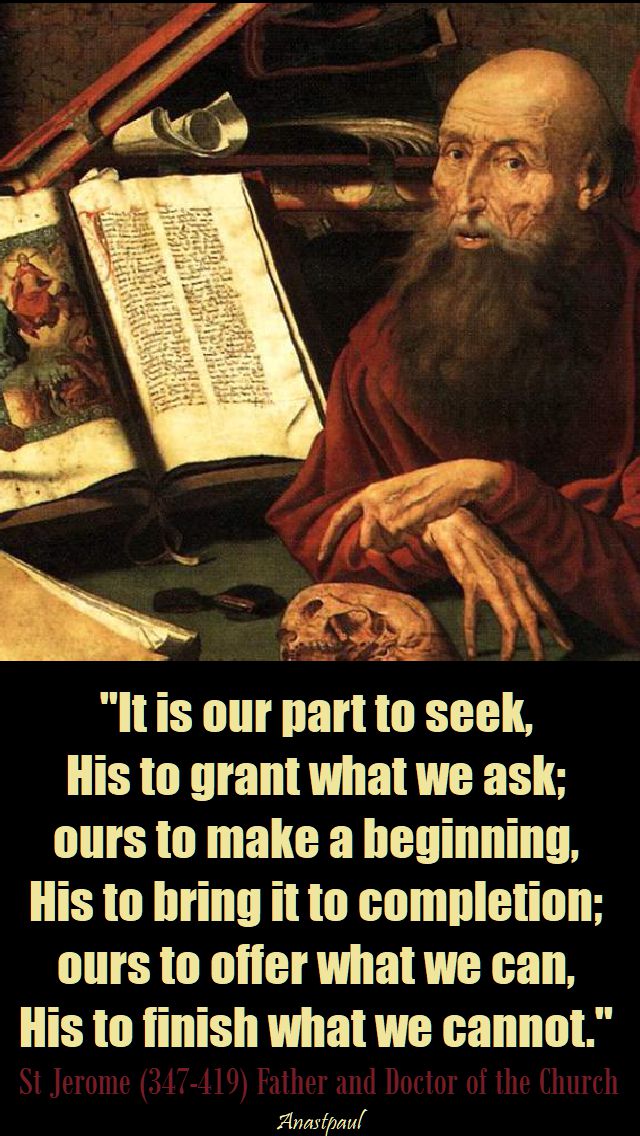
“It is our part to seek,
His to grant what we ask;
ours to make a beginning,
His to bring it to completion;
ours to offer what we can,
His to finish what we cannot.”it is our part to seek - st jerome - 30 sept 2017

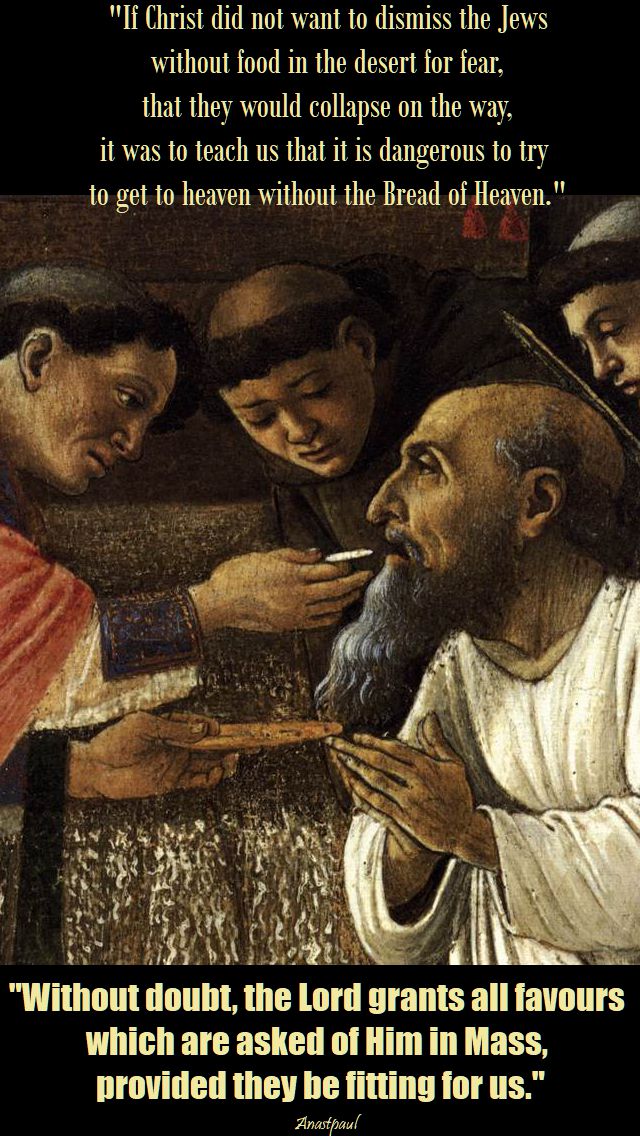
“If Christ did not want to dismiss the Jews
without food in the desert for fear,
that they would collapse on the way,
it was to teach us that it is dangerous to try
to get to heaven without the Bread of Heaven.”

“Without doubt, the Lord grants all favours
which are asked of Him in Mass,
provided they be fitting for us.”if christ did not want to dismiss the jews - st jerome - 30 sept 2017

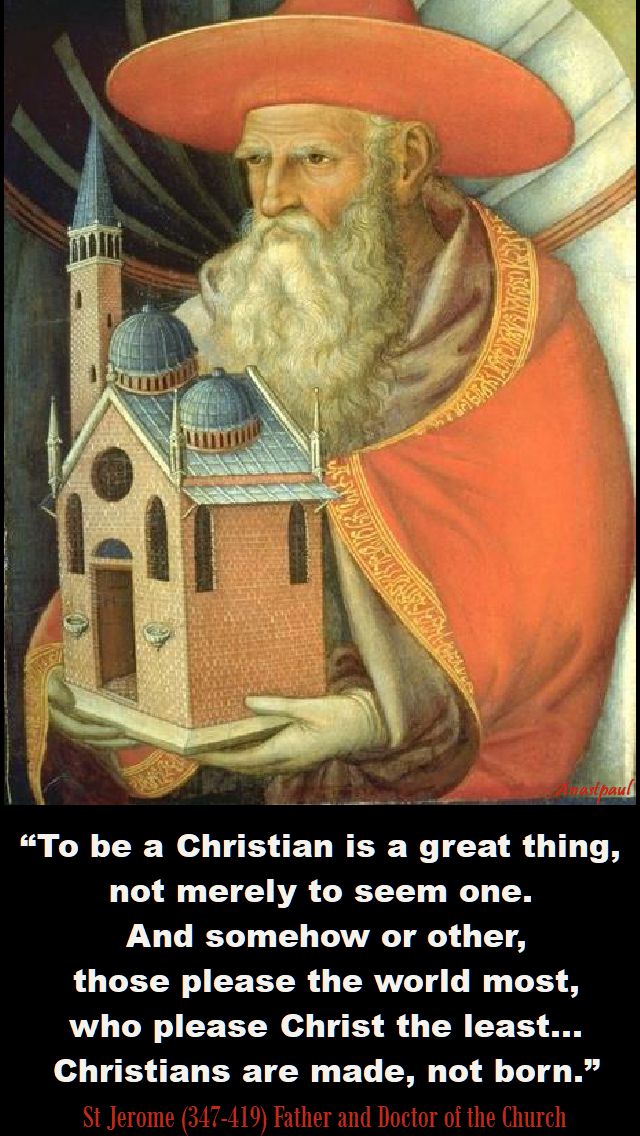
“To be a Christian is a great thing,
not merely to seem one.
And somehow or other, those please the world most,
who please Christ the least…
Christians are made, not born.”to be a christian - st jerome - 30 sept 2017

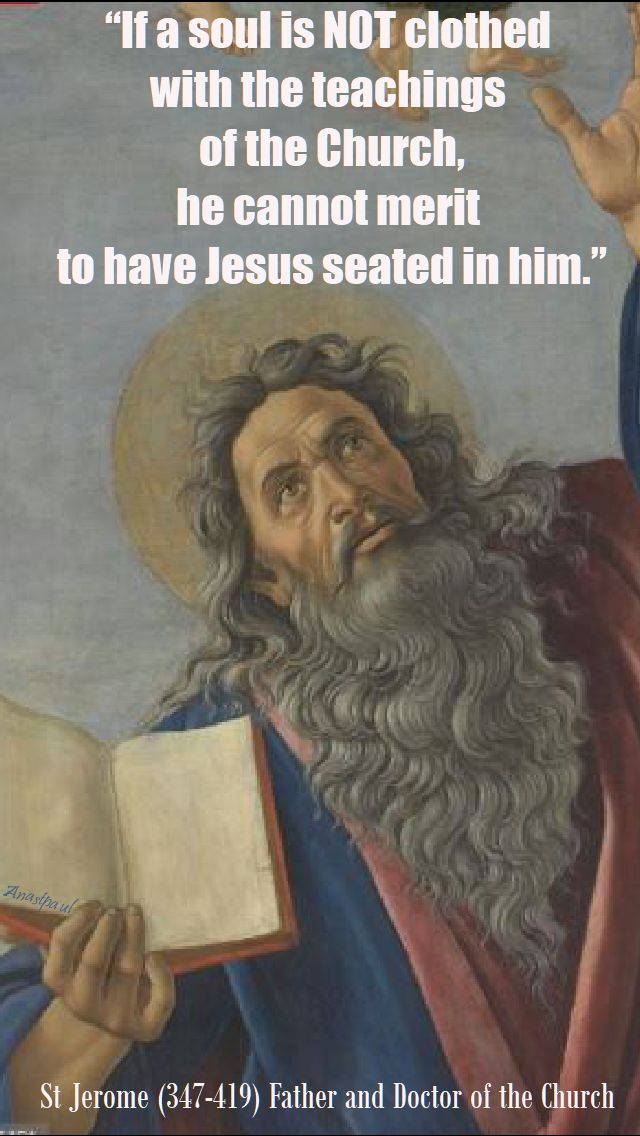
“If a soul is not clothed with the teachings of the Church.
he cannot merit to have Jesus seated in him.”if a soul is not clothed - st jerome - 30 sept 2017

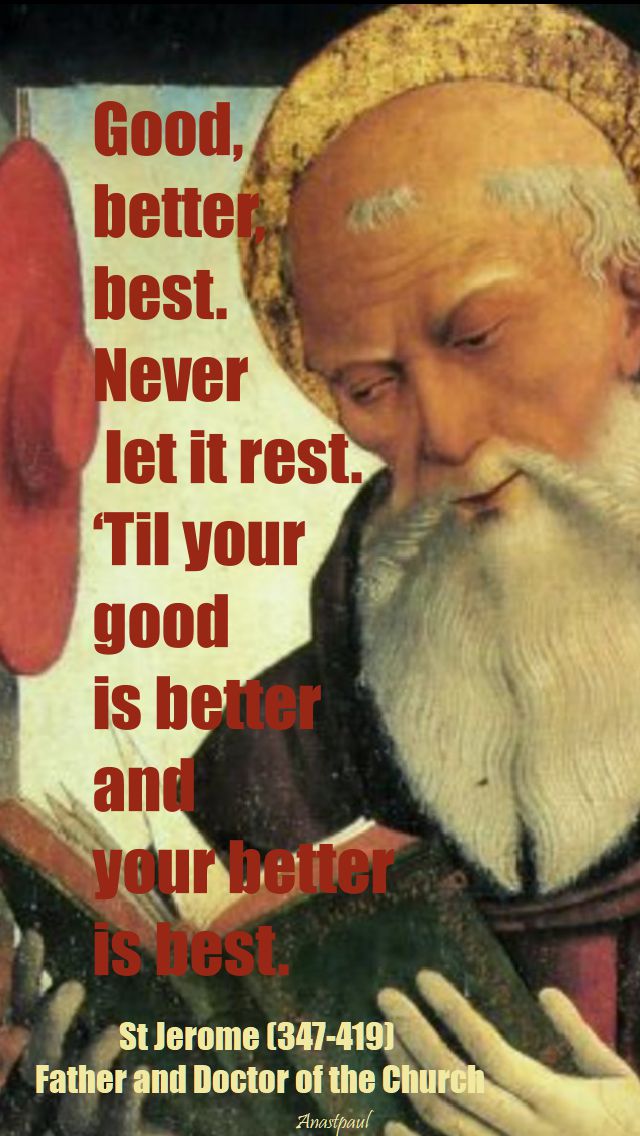
“Good, better, best.
Never let it rest.
‘Til your good is better
and your better is best.”good better best - st jerome - 30 sept 2017

St Jerome (347-419)

Posted in DOCTORS of the Church, FATHERS of the Church, MORNING Prayers, PRAYERS of the SAINTS, SAINT of the DAY

Our Morning Offering – 30 September – Memorial of St Jerome (347-419) Father and Doctor

Our Morning Offering – 30 September – Memorial of St Jerome (347-419) Father and Doctor

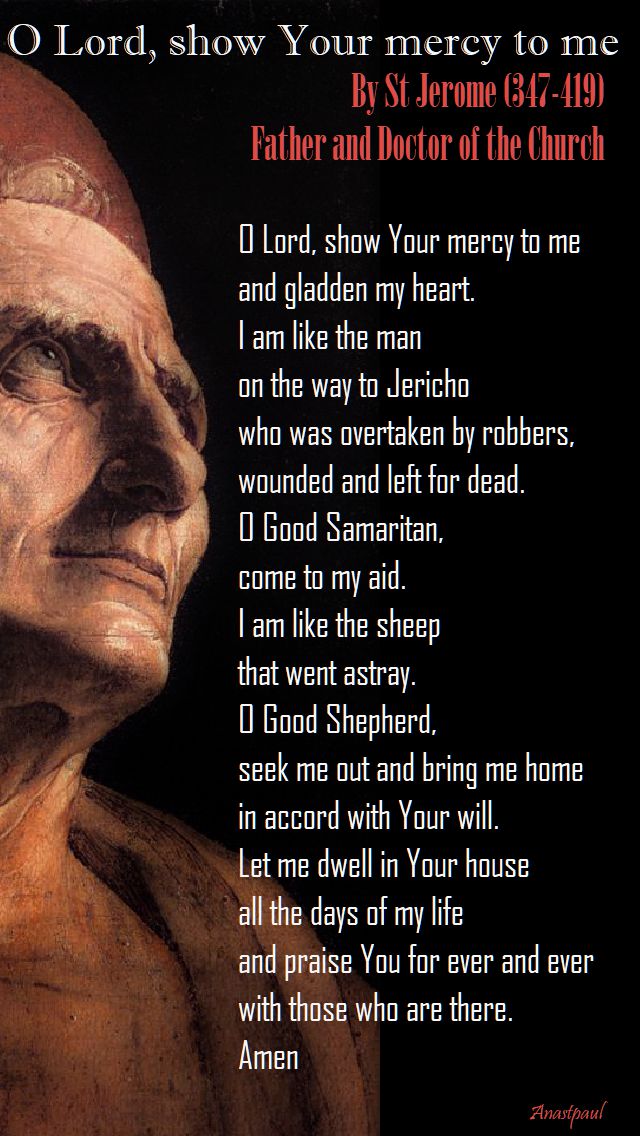
O Lord, show Your mercy to me
By St Jerome 

O Lord, show Your mercy to me
and gladden my heart.
I am like the man on the way to Jericho
who was overtaken by robbers,
wounded and left for dead.
O Good Samaritan,
come to my aid.
I am like the sheep that went astray.
O Good Shepherd,
seek me out and bring me home
in accord with Your will.
Let me dwell in Your house
all the days of my life
and praise You for ever and ever
with those who are there. Ameno lord, show your mercy to me - st jerome - 30 sept 2017

Posted in DOCTORS of the Church, FATHERS of the Church, MORNING Prayers, QUOTES of the SAINTS, SAINT of the DAY, The WORD

One Minute Reflection – 30 September – The Memorial of St Jerome (347-419) Father and Doctor

One Minute Reflection – 30 September – The Memorial of St Jerome (347-419) Father and Doctor

In your fight against sin, you have not yet resisted to the point of shedding blood…..Hebrews 12:4

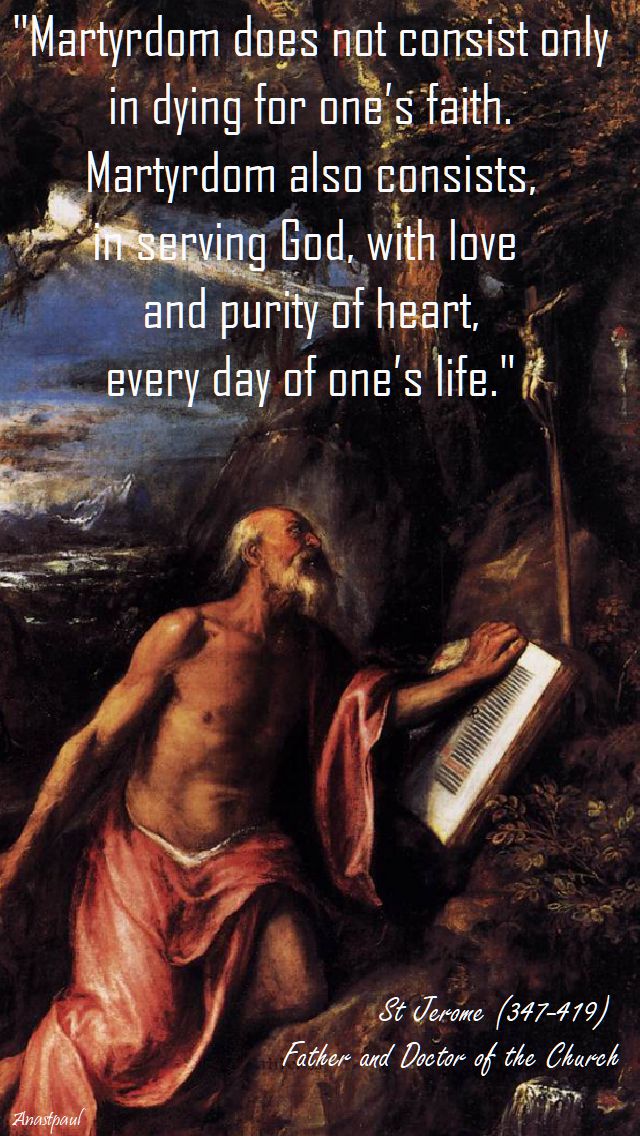
REFLECTION – “Martyrdom does not consist only in dying for one’s faith.
Martyrdom also consists, in serving God, with love and purity of heart,
every day of one’s life.”…St Jeromemartyrdom does not - st jerome - 30 sept 2017

PRAYER – Dear and Holy God, let me offer You all my daily struggles against sin and evil.
Grant me the strength to resist even to the shedding of blood, if it should be required of me.
Sustain me ever more with Your word and help me to find in it, the source of life.
St Jerome Pray for us. Amenst jerome pray for us - 30 sept 2017

Posted in DOCTORS of the Church, FATHERS of the Church, Of Catholic Education, Students, Schools, Colleges etc, PATRONAGE - LIBRARIES/LIBRARIANS/ARCHIVISTS, QUOTES of the SAINTS, SAINT of the DAY

Saint of the Day – 30 September – St Jerome (347-419) Father and Doctor of the Church

Saint of the Day – 30 September – St Jerome (347-419) Father and Doctor of the Church – Priest, Confessor, Theologian, Historian, Hermit, Mystic – born Eusebius Hieronymus Sophronius also known as Girolamo, Hieronymus, Jerom and the Man of the Bible – (347 at Strido, Dalmatia – 419 of natural causes).  His body was interred in Bethlehem and his relics are now enshrined at the Basilica of Saint Mary Major in Rome, Italy.   Patronages – Archeologist, archivists, Scripture scholars, librarians and libraries, schoolchildren; students, translators, Saint-Jérôme, Québec, City of, Saint-Jérôme, Québec, Diocese of, Taos Indian Pueblo.   Attributes – • cardinal’s hat, often on the ground or behind him, indicating that he turned his back on the pomp of ecclesiastical life• lion, referring to the lion who befriended him after he pulled a thorn from the creature’s paw• man beating himself in the chest with a stone• aged monk in desert• aged monk with Bible• aged monk writing • old man with a lion• skull• hourglass.

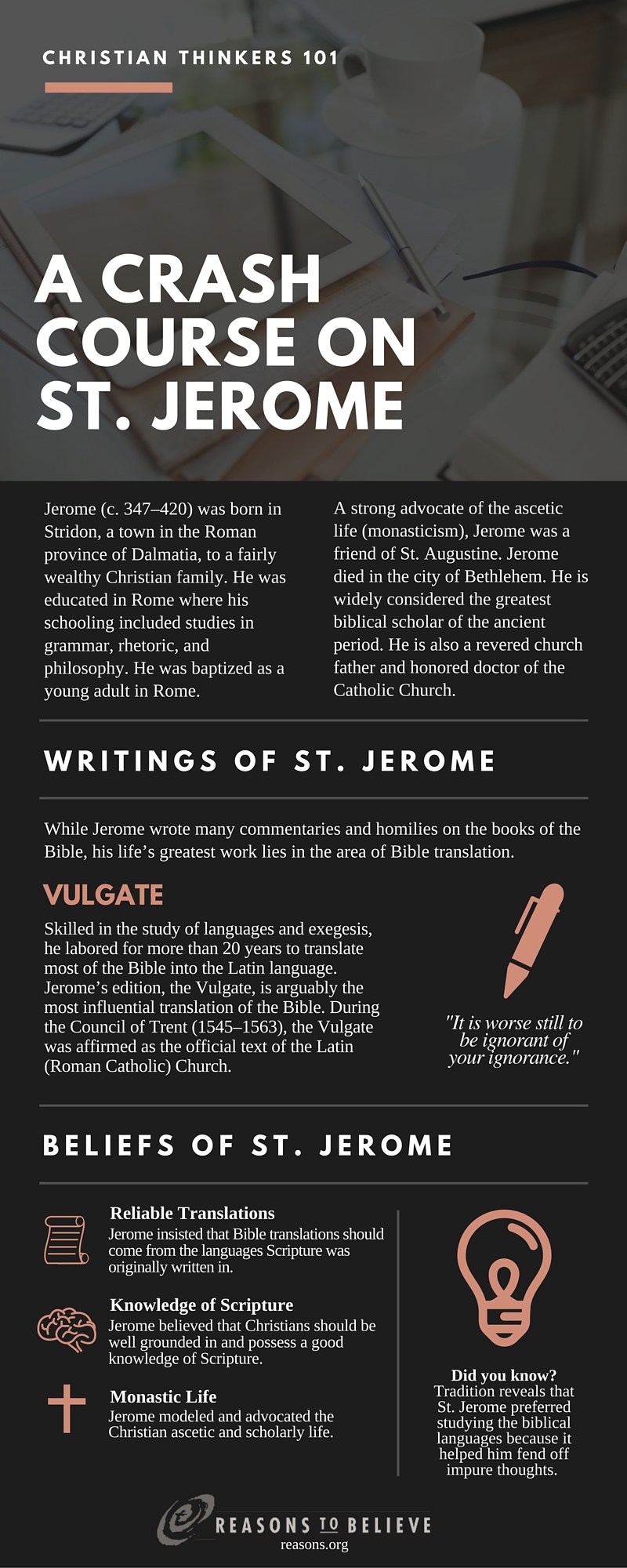
CRASH-COURSE-JEROME

St Jerome was a man of extremes.   He lived to age 91 even though he undertook extreme penances.   Jerome had a fierce temper but an equally intense love of Christ.   This brilliant saint was born in Eastern Europe around 345. His Christian family sent him to Rome at age 12 for a good education.   He studied there until he was 20.   Then he and his friends lived in a small monastery for three years, until the group dissolved.   Jerome set out for Palestine but when he reached Antioch, he fell seriously ill. He dreamed one night that he was taken before the judgment seat of God and condemned for being a heretic.   This dream made a deep impression on him.

He is best known for his translation of the Bible into Latin mainly from the Hebrew (the translation that became known as the Vulgate) and his commentaries on the Gospels.  His list of writings is extensive.   Jerome was strong willed.   His writings, especially those opposing what he considered heresy, were sometimes explosive.   His temperament helped him do difficult tasks but it also made him enemies.   Jerome was named a Doctor of the Church for the Vulgate, his commentaries on Scripture, his writings on monastic life and his belief that during a controversy on theological opinions, the See of Rome was where the matter should be settled.

In order to be able to do such work, Jerome prepared himself well.   He was a master of Latin, Greek, Hebrew and Chaldaic.   He began his studies at his birthplace, Stridon in Dalmatia.   After his preliminary education, he went to Rome, the center of learning at that time and thence to Trier, Germany, where the scholar was very much in evidence. He spent several years in each place, always trying to find the very best teachers. He once served as private secretary to Pope Damasus.

Skilled in the study of languages and exegesis, he laboured for more than 20 years to translate most of the Bible into the Latin language.   Jerome’s edition, the Vulgate, is arguably the most influential translation of the Bible.   During the Council of Trent (1545–1563), the Vulgate was affirmed as the official text of the Church.  He is still considered the Church’s greatest Doctor of Scriptures.

He conferred this praise upon St. Augustine:  “As I have done, you applied all your energy to make the enemies of the Church your personal enemies.”   This eulogy is consistent with the counsel of St. Augustine:  “You must hate the evil, but love the one who errs.”

Regarding St. Jerome the Roman Breviary says:  “He pummeled the heretics with his most harsh writings.” 

St Jerome was orthodox in his theology and was a defender of historic Christianity. However, his greatest contributions to the faith came in terms of biblical studies and translation.

  1. Jerome insisted that Bible translations should come from the languages Scripture was originally written in.   For example, instead of relying on the popular Greek translation of the Hebrew Scriptures of the time (the Septuagint), Jerome utilized ancient Hebrew copies that he considered more reliable.
  2. Jerome believed that Christians should be well grounded in and possess a good knowledge of Scripture.   In his commentary on Isaiah, Jerome stated: “Ignorance of Scripture is ignorance of Christ.”
  3. Jerome modeled and advocated the Christian ascetic and scholarly life.   The life of a monk seems well suited for a Bible translator.

After these preparatory studies, he traveled extensively in Palestine, marking each spot of Christ’s life with an outpouring of devotion.   Mystic that he was, he spent five years in the desert of Chalcis so that he might give himself up to prayer, penance and study. Finally, he settled in Bethlehem, where he lived in the cave believed to have been the birthplace of Christ.   Jerome died in Bethlehem and the remains of his body now lie buried in the Basilica of St Mary Major in Rome.

“When the Latin Fathers are represented in a group, Saint Jerome is sometimes in a cardinal’s dress and hat,
although cardinals were not known until three centuries later than his time but as the other Fathers held exalted positions in the Church
and were represented in ecclesiastical costumes and as Saint Jerome held a dignified office in the court of Pope Dalmasius,
it seemed fitting to picture him as a cardinal.
The Venetian painters frequently represented him in a full scarlet robe, with a hood thrown over the head. When thus habited, his symbol was a church in his hand, emblematic of his importance to the universal Church.

Saint Jerome is also seen as a penitent, or again, with a book and pen, attended by a lion.
As a penitent, he is a wretched old man, scantily clothed, with a bald head and neglected beard, a most unattractive figure.

When he is represented as translating the Scriptures, he is in a cell or a cave, clothed in a sombre coloured robe and is writing, or gazing upward for inspiration. In a few instances, an angel is dictating to him. – from Saints in Art, by Clara Irskine Clement

Posted in DOCTORS of the Church, FATHERS of the Church, SAINT of the DAY

Memorials of the Saints – 30 September

St Jerome (Memorial) (347-419) Father and Doctor

St Amatus of Nusco
St Antoninus of Piacenza
St Castus of Piacenza
St Colman of Clontibret
Bl Conrad of Urach
St Desiderius of Piacenza
St Enghenedl of Anglesey
St Eusebia of Marseilles
Bl Frederick Albert
St Honoratus of Canterbury
St Ismidone of Die
Bl ean-Nicolas Cordier
St Laurus
St Leopardus the Slave
Bl Ludwik Gietyngier
St Midan of Anglesey
St Simon of Crépy
St Ursus the Theban
St Victor the Theban

Martyrs of Valsery Abbey: An unknown number of Premonstratensian monks at the Abbey of Notre-Dame de Valsery, Picardie, France who were martyred by Calvinists. They were martyred in 1567 at Valsery, Pircardy, France

Posted in ArchAngels and Angels, CATECHESIS, DOCTORS of the Church, FEASTS and SOLEMNITIES, MORNING Prayers, SAINT of the DAY, The WORD, Uncategorized

Thought for the Day – 29 September – The Feast of Sts Michael, Gabriel and Raphael

Thought for the Day – 29 September – The Feast of Sts Michael, Gabriel and Raphael

We are celebrating the Feast of the three Archangels who are mentioned by name in Scripture: Michael, Gabriel and Raphael.   But what is an Angel?   Sacred Scripture and the Church’s tradition enable us to discern two aspects.

On the one hand, the Angel is a creature who stands before God, oriented to God with his whole being.   All three names of the Archangels end with the word “El”, which means “God”.   God is inscribed in their names, in their nature.
Their true nature is existing in His sight and for Him.   In this very way the second aspect that characterizes Angels is also explained:  they are God’s messengers.   They bring God to men, they open heaven and thus open earth.  Precisely because they are with God, they can also be very close to man.

Like an angel to others
Indeed, God is closer to each one of us than we ourselves are.   The Angels speak to man of what constitutes his true being, of what in his life is so often concealed and buried. They bring him back to himself, touching him on God’s behalf.   In this sense, we human beings must also always return to being angels to one another – angels who turn people away from erroneous ways and direct them always, ever anew, to God.
If the ancient Church called Bishops “Angels” of their Church, she meant precisely this: Bishops themselves must be men of God, they must live oriented to God. “Multum orat pro populo” – “Let them say many prayers for the people”, the Breviary of the Church says of holy Bishops.   The Bishop must be a man of prayer, one who intercedes with God for human beings.   The more he does so, the more he also understands the people who are entrusted to him and can become an angel for them – a messenger of God who helps them to find their true nature by themselves, and to live the idea that God has of them.

St Michael:  making a space for God in the world
All this becomes even clearer if we now look at the figures of the three Archangels whose Feast the Church is celebrating today.  First of all there is Michael.   We find him in Sacred Scripture above all in the Book of Daniel, in the Letter of the Apostle St Jude Thaddeus and in the Book of Revelation.

Two of this Archangel’s roles become obvious in these texts.   He defends the cause of God’s oneness against the presumption of the dragon, the “ancient serpent”, as John calls it.   The serpent’s continuous effort is to make men believe that God must disappear so that they themselves may become important;   that God impedes our freedom and, therefore, that we must rid ourselves of him.

However, the dragon does not only accuse God.   The Book of Revelation also calls it “the accuser of our brethren…, who accuses them day and night before our God” (12: 10). Those who cast God aside do not make man great but divest him of his dignity.   Man then becomes a failed product of evolution.   Those who accuse God also accuse man. Faith in God defends man in all his frailty and short-comings:  God’s brightness shines on every individual.   It is the duty of the Bishop and of every christian, as a man of God, to make room in the world for God, to counter the denials of Him and thus to defend man’s greatness.   And what more could one say and think about man than the fact that God Himself was made man?   Michael’s other role, according to Scripture, is that of protector of the People of God (cf. Dn 10: 21; 12: 1).
Dear friends, be true “guardian angels” of the Church which will be entrusted to you! Help the People of God whom you must lead in its pilgrimage to find the joy of faith and to learn to discern the spirits: to accept good and reject evil, to remain and increasingly to become, by virtue of the hope of faith, people who love in communion with God-Love.

St Gabriel: God who calls
We meet the Archangel Gabriel especially in the precious account of the annunciation to Mary of the Incarnation of God, as Luke tells it to us (1: 26-38).   Gabriel is the messenger of God’s Incarnation.   He knocks at Mary’s door and, through him, God himself asks Mary for her “yes” to the proposal to become the Mother of the Redeemer, of giving her human flesh to the eternal Word of God, to the Son of God.   The Lord knocks again and again at the door of the human heart.   In the Book of Revelation He says to the “angel” of the Church of Laodicea and, through him, to the people of all times:  “Behold, I stand at the door and knock; if any one hears my voice and opens the door, I will come in to him and eat with him, and he with me” (3: 20).   The Lord is at the door – at the door of the world and at the door of every individual heart.   He knocks to be let in, the Incarnation of God, His taking flesh, must continue until the end of time.  All must be reunited in Christ in one body –  the great hymns on Christ in the Letters to the Ephesians and to the Colossians tell us this. Christ knocks.   Today too He needs people who, so to speak, make their own flesh available to Him, give Him the matter of the world and of their lives, thus serving the unification between God and the world, until the reconciliation of the universe.   Dear friends, it is your task to knock at people’s hearts in Christ’s Name.   By entering into union with Christ yourselves, you will also be able to assume Gabriel’s role: to bring Christ’s call to men.

St Raphael: recovering sight
St Raphael is presented to us, above all in the Book of Tobit, as the Angel to whom is entrusted the task of healing.   When Jesus sends His disciples out on a mission, the task of proclaiming the Gospel is always linked with that of healing.   The Good Samaritan, in accepting and healing the injured person lying by the wayside, becomes without words a witness of God’s love.   We are all this injured man, in need of being healed.   Proclaiming the Gospel itself already means healing in itself, because man is in need of truth and love above all things.

The Book of Tobit refers to two of the Archangel Raphael’s emblematic tasks of healing. He heals the disturbed communion between a man and a woman.  He heals their love. He drives out the demons who over and over again exhaust and destroy their love.   He purifies the atmosphere between the two and gives them the ability to accept each other for ever.   In Tobit’s account, this healing is recounted with legendary images.

In the New Testament, the order of marriage established in creation and threatened in many ways by sin, is healed through Christ’s acceptance of it in His redeeming love.   He makes marriage a sacrament:  His love, put on a cross for us, is the healing power which in all forms of chaos offers the capacity for reconciliation, purifies the atmosphere and mends the wounds.   The priest is entrusted with the task of leading men and women ever anew to the reconciling power of Christ’s love.  He must be the healing “angel” who helps them to anchor their love to the sacrament and to live it with an ever renewed commitment based upon it.

Secondly, the Book of Tobit speaks of the healing of sightless eyes. We all know how threatened we are today by blindness to God.   How great is the danger that with all we know of material things and can do with them, we become blind to God’s light.   Healing this blindness through the message of faith and the witness of love is Raphael’s service, entrusted day after day to the priest and in a special way to the Bishop.   Thus, we are prompted spontaneously also to think of the Sacrament of Reconciliation, the Sacrament of Penance which in the deepest sense of the word is a sacrament of healing.   The real wound in the soul, in fact, the reason for all our other injuries, is sin.   And only if forgiveness exists, by virtue of God’s power, by virtue of Christ’s love, can we be healed, can we be redeemed.

“Abide in my love”, the Lord says to us today in the Gospel (Jn 15: 9).   At the moment of your Episcopal Ordination he says so particularly to you, dear friends.   Abide in His love!   Abide in that friendship with Him, full of love, which He is giving you anew at this moment!   Then your lives will bear fruit, fruit that abides (cf. Jn 15: 16).   Let us all pray for you at this time, dear Brothers, so that this may be granted to you. Amen.

Benedict XVI, fragments of a homily (to Bishops) given on September 29, 2007

Sts Michael, Gabriel and Raphael, pray for us!

holy archangels - pray for us.2

Posted in ArchAngels and Angels, DOCTORS of the Church, FATHERS of the Church, FEASTS and SOLEMNITIES, MORNING Prayers, QUOTES of the SAINTS, SAINT of the DAY

Quote of the Day – 29 September – – The Feast of Sts Michael, Gabriel and Raphael

Quote of the Day – 29 September – – The Feast of Sts Michael, Gabriel and Raphael

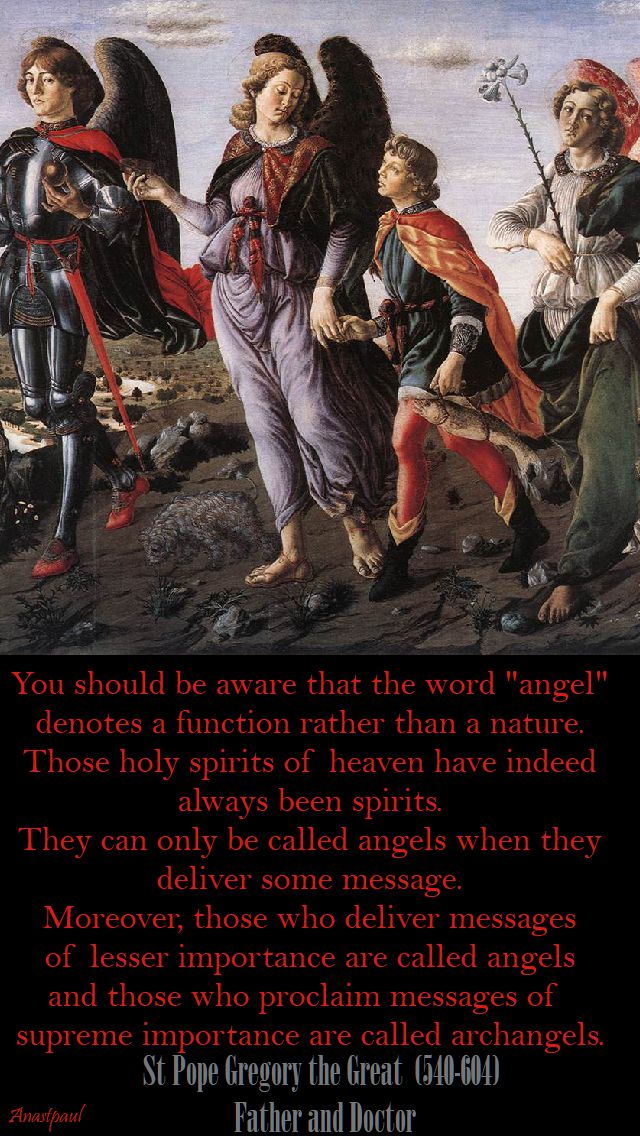
St Gregory the Great teaches us about the Archangels and why they are distinct from angels.

You should be aware that the word “angel” denotes a function rather than a nature.
Those holy spirits of heaven have indeed always been spirits.
They can only be called angels when they deliver some message.

ANGELS & ARCHANGELS
Moreover, those who deliver messages of lesser importance are called angels;  and those who proclaim messages of supreme importance are called archangels.   And so it was that not merely an angel but the archangel Gabriel was sent to the Virgin Mary.   It was only fitting that the highest angel should come to announce the greatest of all messages.you should be aware - st gregory the great - 29 sept 2017

Some angels are given proper names to denote the service they are empowered to perform.   In that holy city, where perfect knowledge flows from the vision of almighty God, those who have no names may easily be known.   But personal names are assigned to some, not because they could not be known without them but rather to denote their ministry when they came among us.   Thus, Michael means “Who is like God”  Gabriel is “The Strength of God” and Raphael is “God’s Remedy.”

ST MICHAEL
Whenever some act of wondrous power must be performed, Michael is sent, so that his action and his name may make it clear that no one can do what God does by his superior power.   So also our ancient foe desired in his pride to be like God, saying:  I will ascend into heaven;  I will exalt my throne above the stars of heaven;  I will be like the Most High.   He will be allowed to remain in power until the end of the world when he will be destroyed in the final punishment.   Then, he will fight with the archangel Michael, as we are told by John:   A battle was fought with Michael the archangel.

GABRIEL & RAPHAEL
So too Gabriel, who is called God’s strength, was sent to Mary.   He came to announce the One who appeared as a humble man to quell the cosmic powers.   Thus God’s strength announced the coming of the Lord of the heavenly powers, mighty in battle.   [Luke 1:11-38]

Raphael means, as I have said, God’s remedy, for when he touched Tobit’s eyes in order to cure him, he banished the darkness of his blindness.   Thus, since he is to heal, he is rightly called God’s remedy.

This post on the archangels is an excerpt from a homily on the Gospels (Hom. 32, 8-9: PL 76, 1250-1251) by St Gregory the Great is used in the Roman Catholic Office of Readings for the Feast of the Archangels Michael, Gabriel and Raphael today.

Posted in ArchAngels and Angels, DOCTORS of the Church, FEASTS and SOLEMNITIES, MARIAN QUOTES, MORNING Prayers, QUOTES of the SAINTS, SAINT of the DAY, The WORD

One Minute Reflection – 29 September – The Feast of Sts Michael, Gabriel and Raphael

One Minute Reflection – 29 September – The Feast of Sts Michael, Gabriel and Raphael

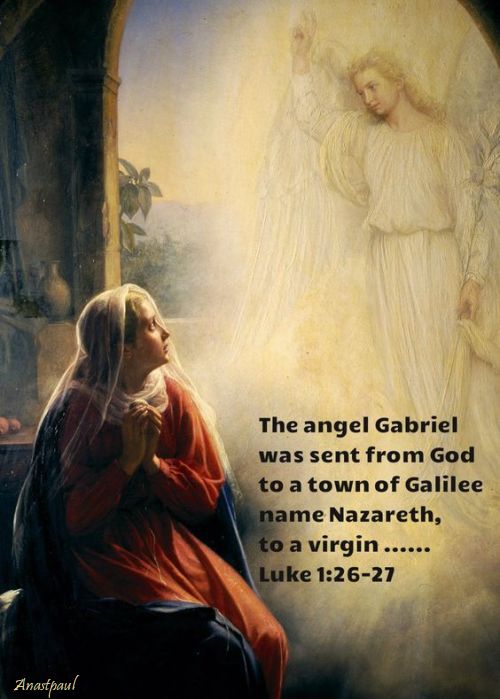
The angel Gabriel was sent from God to a town of Galilee name Nazareth, to a virgin ….Luke 1:26-27

luke 1 26-27

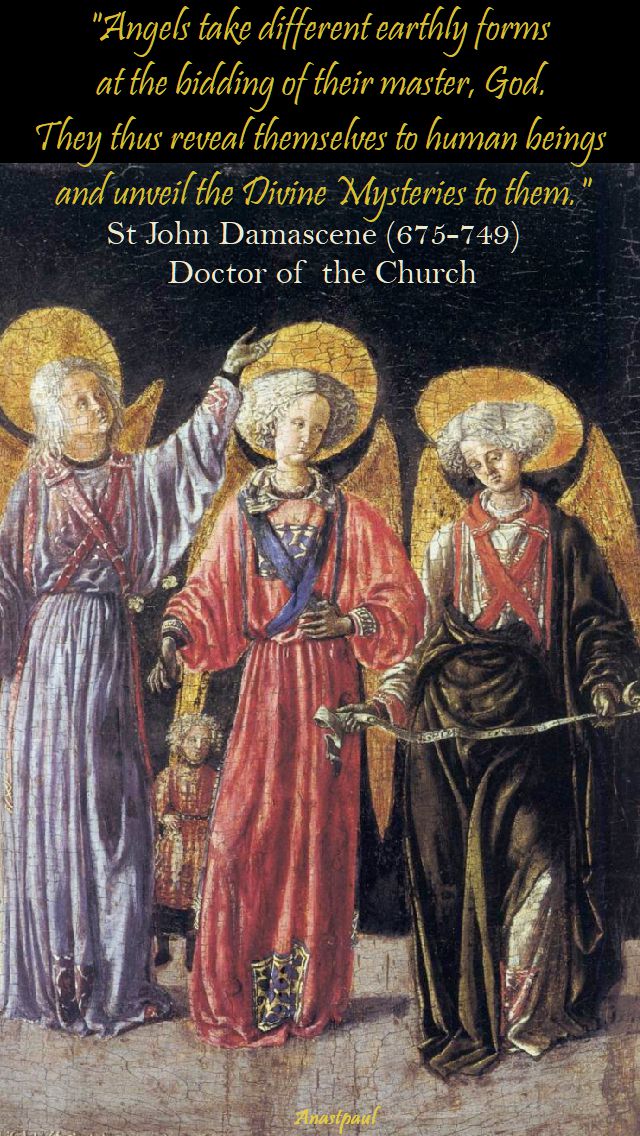
REFLECTION – Angels take different earthly forms at the bidding of their master, God.
They thus reveal themselves to human beings and unveil the Divine Mysteries to them……St John Damasceneangels take different forms - st john damascene - 29 sept 2017

PRAYER – God of all Wisdom, You direct the ministry of angels and of human beings. Grant that the angels who always minister to You in heaven may defend us during our life on earth and protect us from evil.   Grant this, through our Lord Jesus Christ, Your Son, in union with the Holy Spirit, one God forever and ever.   Amenholy archangels - pray for us

Posted in DOCTORS of the Church, FATHERS of the Church, MORNING Prayers, QUOTES of the SAINTS, SAINT of the DAY, The WORD

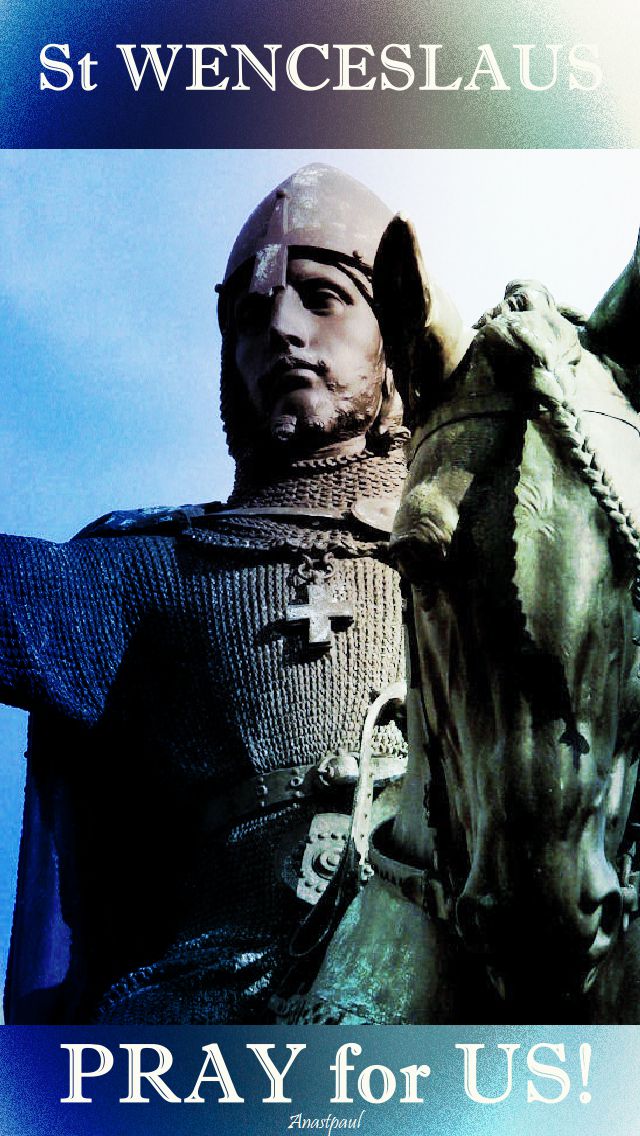
One Minute Reflection – 28 September – The Memorial of St Wenceslaus

One Minute Reflection – 28 September – The Memorial of St Wenceslaus

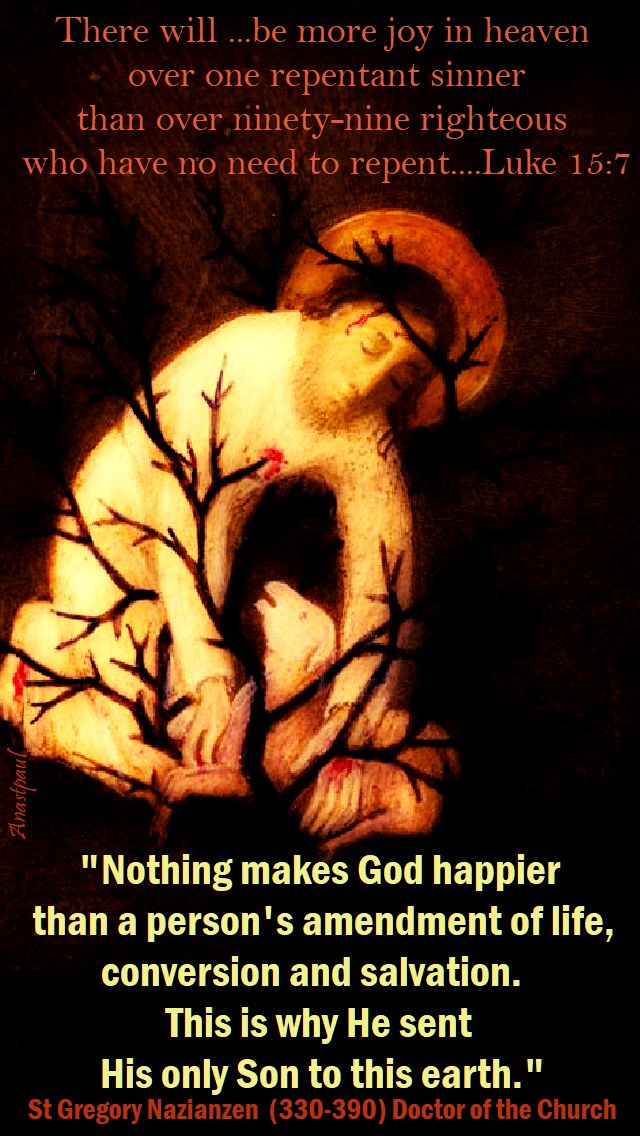
There will …be more joy in heaven over one repentant sinner
than over ninety-nine righteous who have no need to repent.…Luke 15:7

REFLECTION – “Nothing makes God happier than a person’s amendment of life,
conversion and salvation.
This is why He sent His only Son to this earth.”…St Gregory Nazianzen (330-390) Doctor of the Churchnothing makes god happier - st gregory nazianzen - doctor - 28 sept feast of st wenceslaus

PRAYER – Holy God, help me to amend my life constantly and be sincerely converted to You.   Let me seek Your interests rather than my own and be ever more closely united with You.
St Wenceslaus, who was assassinated by his own brother but who, by his holiness opened his brother’s eyes to repentance, please pray for us, that we may always seek the forgiveness of God. Amen

st wenceslaus pray for us

Posted in DOCTORS of the Church, FATHERS of the Church, MORNING Prayers, QUOTES of the SAINTS, SAINT of the DAY, The HOLY CROSS

Quote/s of the Day – 25 September

Quote/s of the Day – 25 September

As they were looking on,
so we too gaze on His wounds as He hangs.
We see His blood as he dies.
We see the price
offered by the Redeemer,
touch the scars of His Resurrection.
He bows His head,
as if to kiss you.
His heart is made bare open,
as it were, in love to you.
His arms are extended
that He may embrace you.
His whole body is displayed
for your redemption.
Ponder how great these things are.
Let all this be rightly weighed in your mind:
as He was once fixed to the Cross
in every part of His body for you,
so He may now be fixed
in every part of your soul.

St Augustine (354-430) Father & Doctor

as they were looking on - st augustine - 25 sept 2017

There is no evil to be faced,
that Christ does not face with us.
There is no enemy, that Christ
has not already conquered.
There is no cross to bear,
that Christ has not already borne for us
and does not now bear with us.
And on the far side of every cross we find
the newness of life in the Holy Spirit,
that new life, which will reach its fulfillment,
in the Resurrection.
This is our faith.
This is our witness before the world.there is no evil to be faced - st john paul - 25 sept 2017

St John Paul (1920-2005)

Posted in DOCTORS of the Church, FATHERS of the Church, FEASTS and SOLEMNITIES, MORNING Prayers, QUOTES of the SAINTS, SAINT of the DAY, The APOSTLES & EVANGELISTS

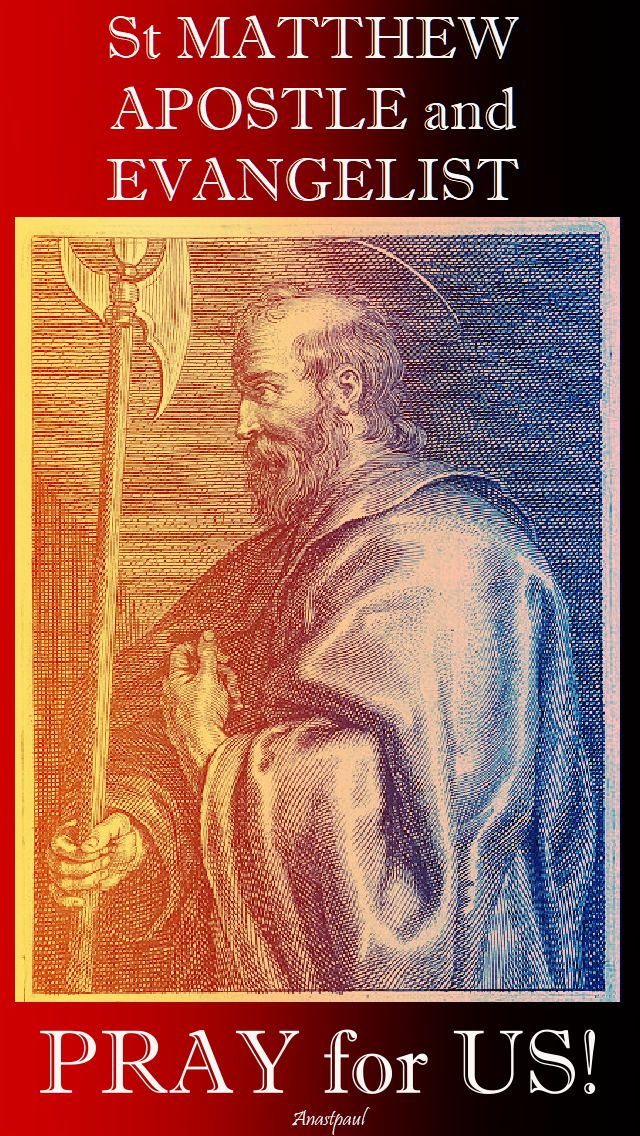
Quote/s of the Day – 21 September – The Feast of St Matthew, Apostle and Evangelist

Quote/s of the Day – 21 September – The Feast of St Matthew, Apostle and Evangelist

“On hearing Christ’s voice, we open the door to receive Him,
as it were, when we freely assent to His promptings
and when we give ourselves over to doing what must be done.
Christ, since He dwells in the hearts of His chosen ones
through the grace of His love, enters so that He might eat with us
and we with Him. He ever refreshes us by the light of His presence
insofar as we progress in our devotion to and longing for the things of heaven.
He Himself is delighted by such a pleasing banquet.”

St Bede the Venerable (673-735) Doctor of the Churchon hearing christ's voice - st bede the venerable - 21 sept 2017

“That gaze overtook him completely, it changed his life.
We say he was converted. He Changed his life.
As soon as he felt that gaze in his heart, he got up and followed Him.
This is true: Jesus’ gaze always lifts us up.
It is a look that always lifts us up and never leaves you in your place,
never lets us down, never humiliates. It invites you to get up –
a look that brings you to grow, to move forward, that encourages you,
because the One who looks upon you loves you.
The gaze makes you feel that He loves you.
This gives the courage to follow Him: ‘and he got up and followed Him.'”

Pope Francis 21 September 2013that gaze overtook him completely-pope francis

Posted in DOCTORS of the Church, FATHERS of the Church, FEASTS and SOLEMNITIES, MORNING Prayers, QUOTES of the SAINTS, SAINT of the DAY, The WORD

One Minute Reflection – 21 September – The Feast of St Matthew, Apostle and Evangelist

One Minute Reflection – 21 September – The Feast of St Matthew, Apostle and Evangelist

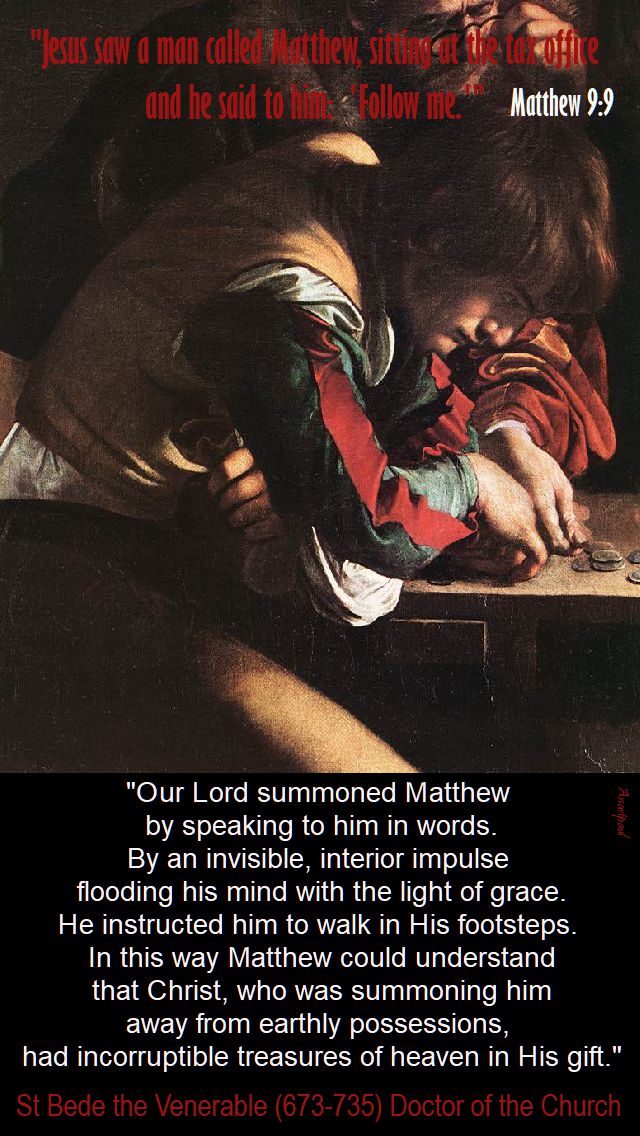
“Jesus saw a man called Matthew sitting at the tax office, and he said to him: Follow me.“…
Matthew 9:9

REFLECTION – “Jesus saw Matthew, not merely in the usual sense, but more significantly with His merciful understanding of men.”
He saw the tax collector and, because He saw him through the eyes of mercy and chose him, He said to him: “Follow me.”
This following meant imitating the pattern of His life – not just walking after Him.
Saint John tells us: “Whoever says he abides in Christ ought to walk in the same way in which he walked.”
“And he rose and followed him.”
There is no reason for surprise that the tax collector abandoned earthly wealth as soon as the Lord commanded him.
Nor should one be amazed that neglecting his wealth, he joined a band of men whose leader had, on Matthew’s assessment, no riches at all. Our Lord summoned Matthew by speaking to him in words.
By an invisible, interior impulse flooding his mind with the light of grace, He instructed him to walk in his footsteps.
In this way Matthew could understand that Christ, who was summoning him away from earthly possessions, had incorruptible treasures of heaven in His gift.” – from a homily by St Bede the Venerable (673-735) Doctor of the Churchour lord summoned matthew by speaking - st bede - 21 sept 2017

PRAYER – Lord, You showed Your great mercy to Matthew the tax-gatherer,by calling him to become Your Apostle,supported by his prayer and example, may we always answer Your call and live in close union with You.
We make our prayer, in union with God our Father and the Holy Spirit, one God forever and ever.   St Matthew, Apostle of Christ, pray for us, amen.st matthew - pray for us - 21 sept 2017

Posted in DOCTORS of the Church, MIRACLES, QUOTES of the SAINTS, SAINT of the DAY

Saint of the Day – 19 September – St Januarius (Died c 304)

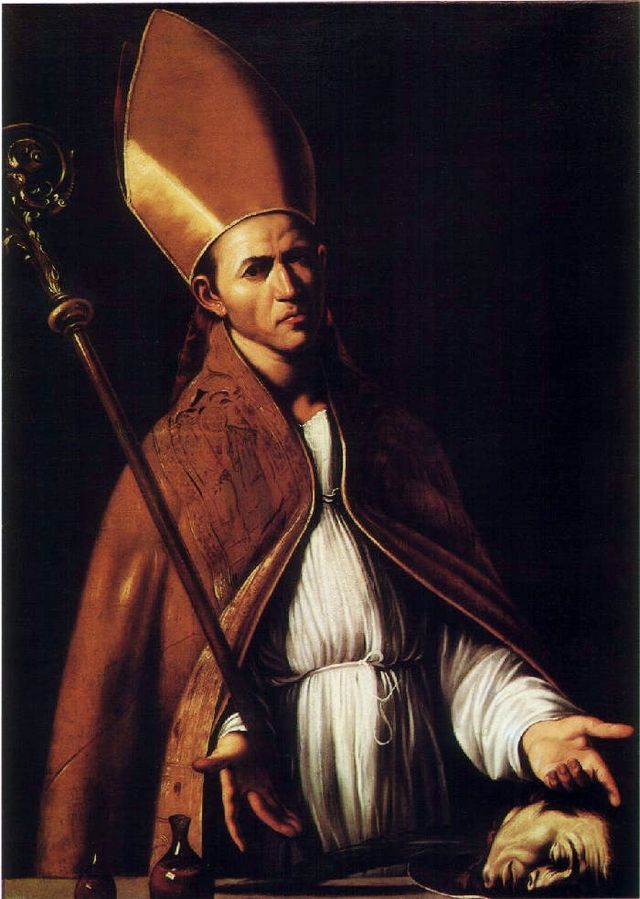
Saint of the Day – 19 September – St Januarius (Died c 304) (San Gennaro of Naples) – Martyr, Bishop (Fourth century –  Martyred c 304 at Naples, Italy or Pozzuoli, Italy ).   Patronages – against volcanic eruptions• blood banks• Benevento, Italy, diocese of• Naples, Italy, archdiocese of• Naples, Italy, city of.

HEADER stjanuariusblood

Saint Januarius, was born in Benevento to a rich patrician family  At a young age of 15—based upon his piety and faithfulness– he became the local Priest of his Parish in Benevento, which at the time was relatively pagan.   When Januarius was 20, he was elevated to Bishop of Naples.   At the onset of the persecution of Christians by Emperors Diocletian and Maximian, he worked tirelessly to hide and protect his fellow Christians, succeeding for approximately 1 ½ years.

However, he was eventually arrested, taken to Nola and brought before Timotheus, governor of Campania, on account of his profession of the Christian religion.   Upon refusing to recant his faith, and his constant assertion of the truth of the Gospel, Januarius and his companions were sentenced to be cast into the fiery furnace.   The flames, however, caused him no harm and the following day, he was led into the coliseum to be mauled by wild animals.  The beasts, however, laid themselves down in tame submission at his feet.

Governor Timotheus, enraged and again pronouncing sentence of death, was struck with blindness at his sentencing but Januarius healed him—a miracle which led to the miraculous conversion of 5,000 present.   The ungrateful judge, further inflamed with anger, ordered the saintly bishop beheaded, which occurred immediately.   St Januarius’ body was removed by faithful Christians, placed in the Cathedral of Naples and is said to have miraculously protected Naples from both the plague and the dangerous eruptions of nearby Mount Vesuvius.

You can read the full story here:  https://sourcebooks.fordham.edu/basis/januarius.asp – ACTS OF THE HIEROMARTYR JANUARIUS, BISHOP OF BENEVENTO

The Blood Miracle of Saint Januarius (Gennaro) -A miracle of the Church that is still occuring today

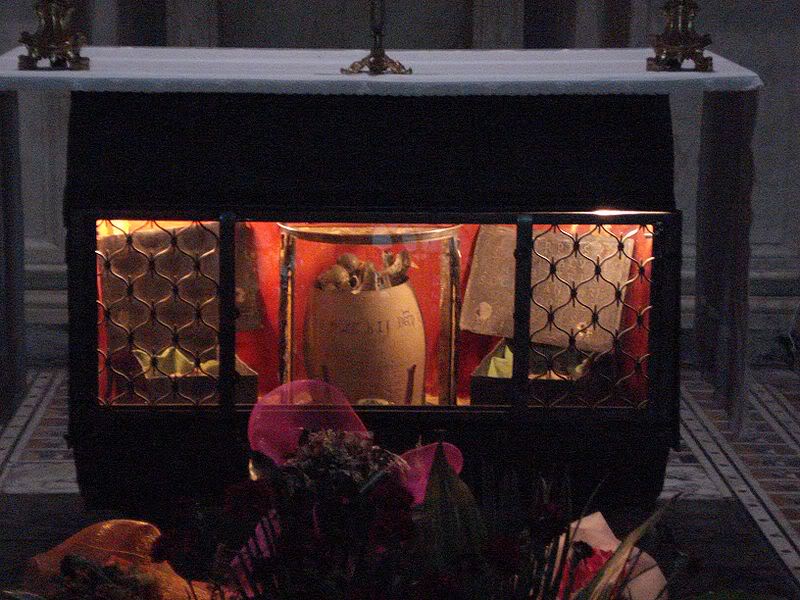
relics
Relics of St Januarius

The liquefaction (becoming liquid) of the blood of St Januarius is an extraordinary miracle of the Church that has been occurring up to 18 times each year for the past 600 years.  It is only one of a number of blood miracles that have taken place and in the case of St Januarius and others, are still taking place with blood that was collected soon after the death of certain martyrs.   There is a well-documented history of these samples of blood liquefying at various times of the year, especially on the Saints’ feast days.

This practice of gathering blood for relics, admittedly a somewhat surprising religious practice, nevertheless was a common practice beginning in the days of persecution when the early Christians soaked cloths in the blood shed by martyrs or, if possible, actually collected the liquid in flasks to keep as devotional items.   In the catacombs these flasks were buried with the dead, their discovery indicating that the person had died a martyr. Throughout the centuries, blood has been collected from holy persons recently deceased, especially martyrs for the faith, with the specimens being carefully kept with devotion and veneration.   These samples have been known to liquefy under various circumstances, at different seasons of the year, in various countries and in varied ways. Many samples still display wonderful reactions in our day, one of which, that of St Januarius we will here consider.

While it is scientifically known that blood once removed from the body soon coagulates and eventually spoils and since this natural reaction was common knowledge among the medical faculty of the Middle Ages, a claim made by them of remarkable liquefaction can hardly be ignored and would seem to indicate a transcendence of their experience.   And in our own day, the specimens that are still active are no less scientifically inexplicable than they were centuries ago, even amidst intense scientific investigation.

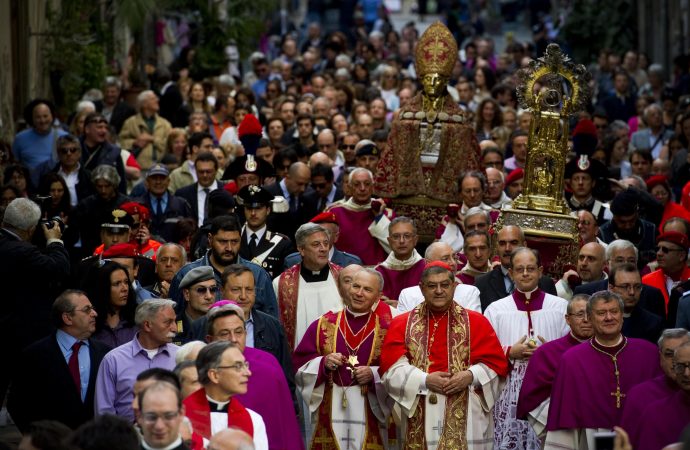
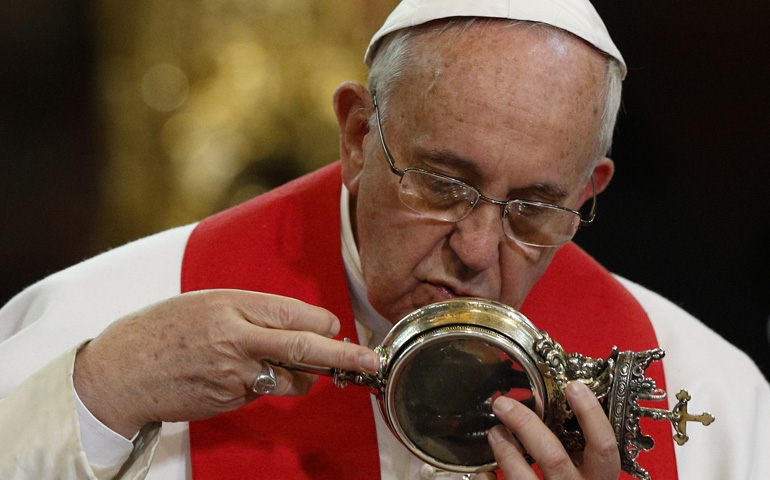
The best known and most intensely studied is the yearly blood miracle of St Januarius that occurs is Naples each year.  The recurring miracle of the liquefaction of his blood 18 times a year is often reported in the secular as well as the religious press and is the occasion of great gatherings in the Cathedral of Naples.   Here the people pray fervently while the resident cardinal, who usually presides over the ceremony, holds the vials of blood.   The miracle occurs when the bust reliquary containing the head of the saint is brought near.   When the liquefaction is accomplished in full view of the spectators, the cardinal announces, “The miracle has happened,” words that cause great rejoicing and the chanting of the Te Deum.

A scene from the procession on the feast of San Gennaro in Naples in 2015.FrancisNuns2

St Alphonsus Liguori wrote regarding Saint Januarius:

“The Neapolitans honour this saint as the principal patron of their city and nation and the Lord himself has continued to honour him, by allowing many miracles to be wrought through his intercession, particularly when the frightful eruptions of Mount Vesuvius have threatened the city of Naples with utter destruction.   While the relics of St Januarius were being brought in procession towards this terrific volcano, the torrents of lava and liquid fire which it emitted have ceased, or turned their course from the city.   But the most stupendous miracle and that which is greatly celebrated in the church, is the liquefying and boiling up of this blessed martyr’s blood whenever the vials are brought in sight of his head. This miracle is renewed many times in the year, in presence of all who desire to witness it; yet some heretics have endeavoured to throw a doubt upon its genuineness, by frivolous and incoherent explanations;  but no one can deny the effect to be miraculous, unless he be prepared to question the evidence of his senses.”IGNORE THE SMALL VERSION - st januarius

Posted in DOCTORS of the Church, JESUIT SJ, MORNING Prayers, QUOTES of the SAINTS, SAINT of the DAY

Thought for the Day – 17 September – The Memorial of St Robert Bellarmine (1542-1621) Doctor of the Church

Thought for the Day – 17 September – The Memorial of St Robert Bellarmine (1542-1621) Doctor of the Church

It is said that Robert Bellarmine was so short that he used to stand on a stool to be seen over the high pulpits of Europe.
But he was a giant in many other ways. He devoted his life to the study of Scripture and Catholic doctrine.  His writings help us understand that the real source of our faith is not merely a set of doctrines but rather the person of Jesus still living in the Church today.

When it comes down to it, what matters is Christ and Him Crucified, what matters is He who is love.

“Sweet Lord, you are meek and merciful.”   Who would not give himself wholeheartedly to your service, if he began to taste even a little of your fatherly rule?   What command, Lord, do you give Your servants?   “Take my yoke upon you,” You say.  And what is this yoke of Yours like?   “My yoke,” You say, “is easy and my burden light.”  Who would not be glad to bear a yoke that does no press hard but caresses?   Who would not be glad for a burden that does not weigh heavy but refreshes?   And so You were right to add:  “And you will find rest for your souls.”  And what is this yoke of Yours that does not weary, but gives rest?   It is, of course, that first and greatest commandment:  “You shall love the Lord your God with all your heart.”   What is easier, sweeter, more pleasant, than to love goodness, beauty and love, the fullness of which You are, O Lord, my God?”   Is it not true that You promise those who keep your commandments a reward more desirable than great wealth and sweeter than honey?   You promise a most abundant reward, for as Your apostle James says:  “The Lord has prepared a crown of life for those who love him.” What is this crown of life?   It is surely a greater good than we can conceive of or desire, as Saint Paul says, quoting Isaiah:  “Eye has not seen, ear has not heard, nor has it so much as dawned on man what God has prepared for those who love him.” – from On the Ascent of the Mind to God by Saint Robert Bellarmine

St Robert Bellarmine, pray for us

st robert bellarmine pray for us 17 sept 2017 no 2

Posted in DOCTORS of the Church, JESUIT SJ, MORNING Prayers, QUOTES of the SAINTS, SAINT of the DAY

Quotes of the Day – 17 September – The Memorial of St Robert Bellarmine (1542-1621) Doctor of the Church

Quotes of the Day – 17 September – The Memorial of St Robert Bellarmine (1542-1621) Doctor of the Church

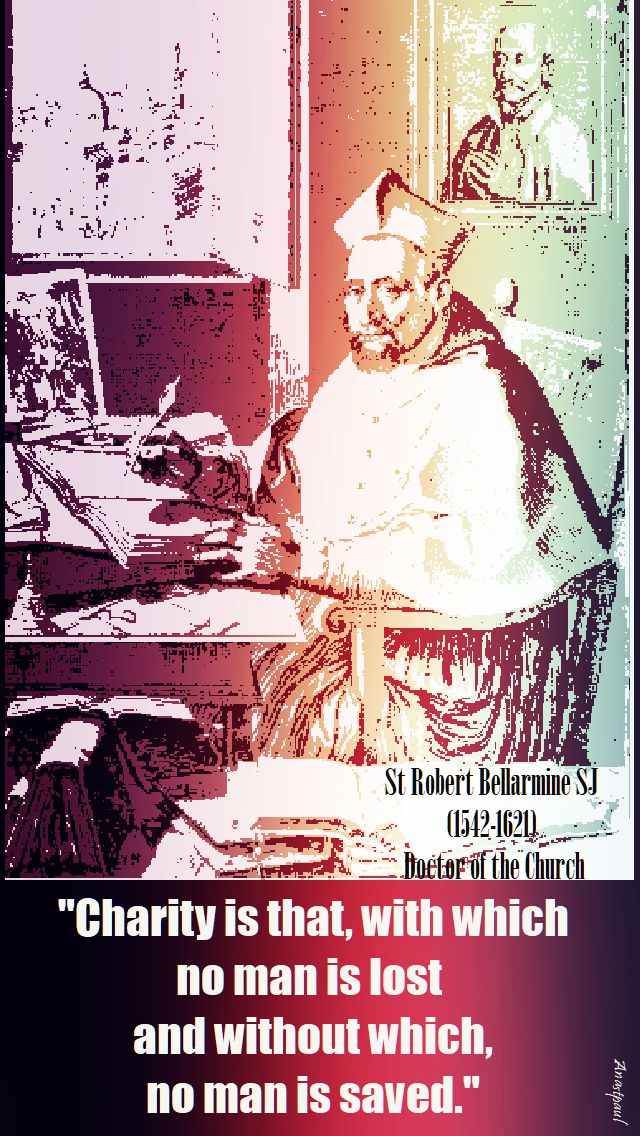
“Charity is that, with which no man is lost
and without which, no man is saved.”charity is that - st robert bellarmine - 17 sept 2017.2

“When we appeal to the throne of grace,
we do so through Mary,
honouring God by honouring His Mother,
imitating Him by exalting her,
touching the most responsive chord
in the Sacred Heart of Christ,
with the sweet name of Mary.”when we appeal - st robert bellarmine - 17 sept 2017

“The school of Christ,
is the school of love.
In the last day,
when the general examination takes place…
Love will be the whole syllabus.”the school of christ - st robert bellarmine - 17 sept 2017

“LOVE is a marvellous
and heavenly thing.
It never tires
and it never thinks
it has done enough!”

St Robert Bellarmine (1542-1621) Doctor of the ChurchLOVE IS A MARVELLOUS THING - ST ROBERT BELLARMINE 17 SEPT 2017

Posted in DOCTORS of the Church, JESUIT SJ, Of Catechists, SAINT of the DAY

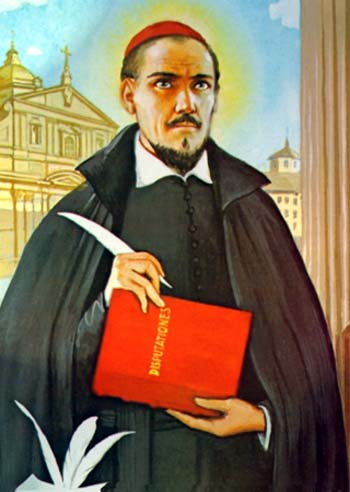
Saint of the Day – 17 September – St Robert Bellarmine SJ (1542-1621) Confessor, Doctor of the Church

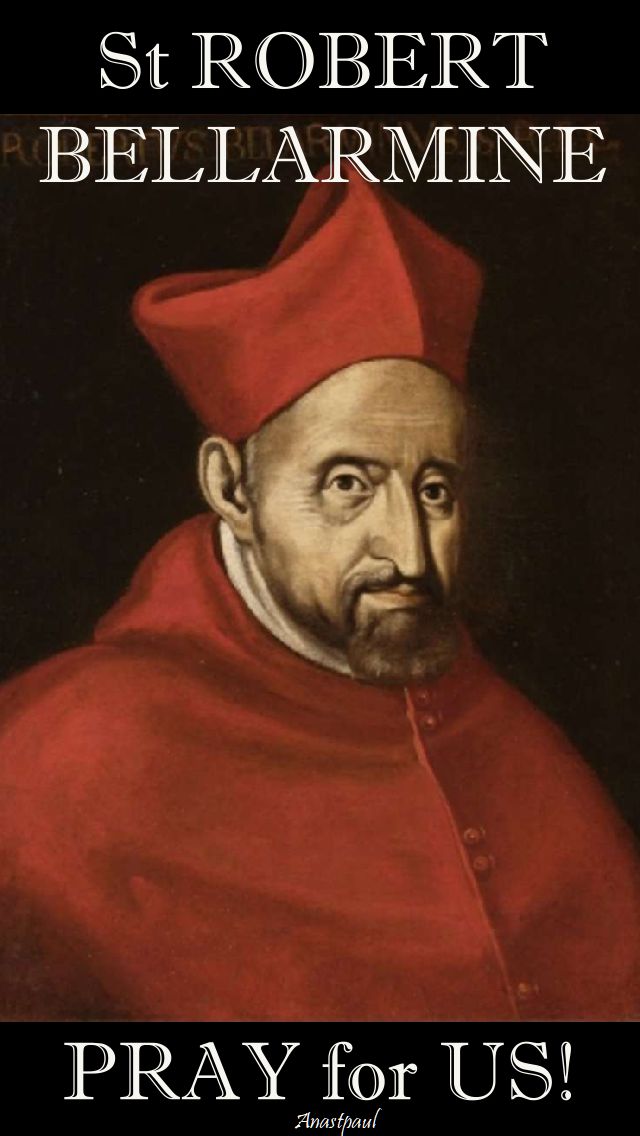
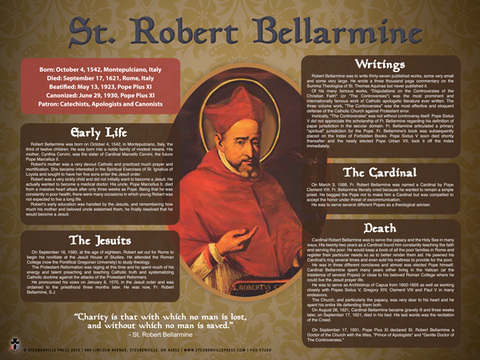
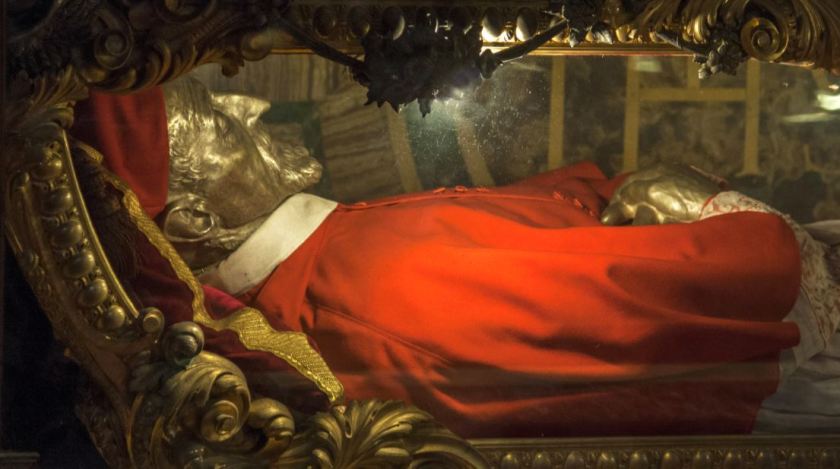
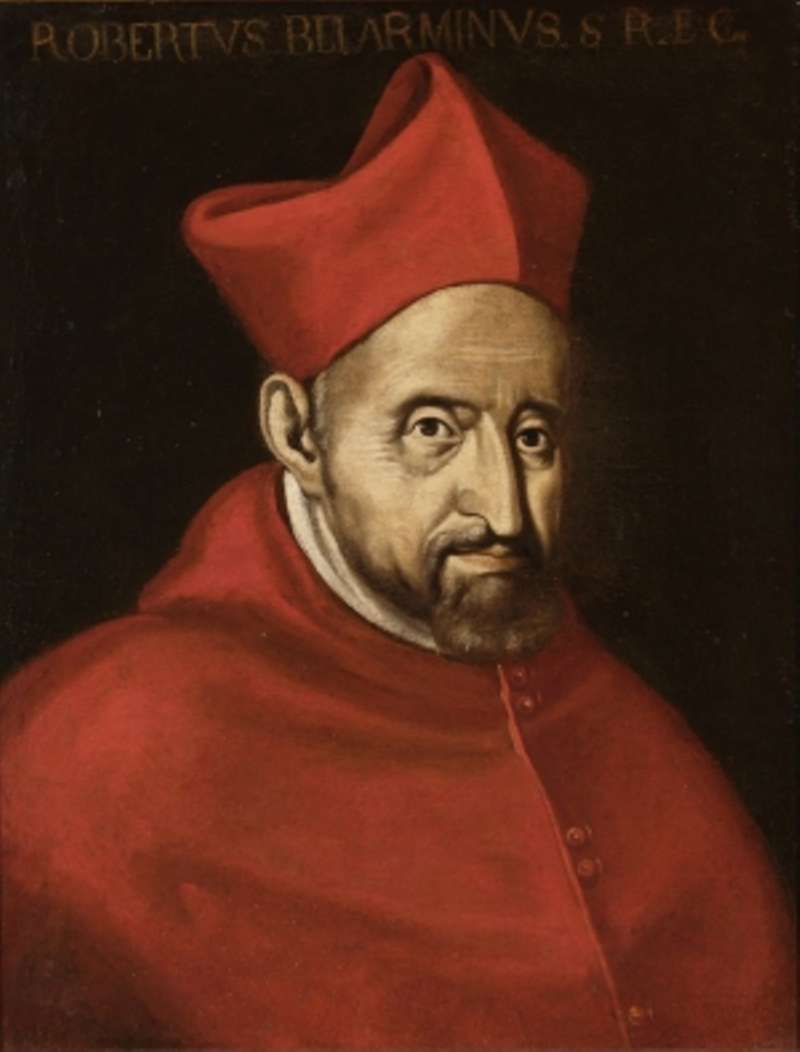
Saint of the Day – 17 September – St Robert Bellarmine SJ (1542-1621) Priest of the Society of Jesus, Bishop, Confessor, Cardinal, Theologian, Professor, Writer, Preacher, Mediator, Doctor of the Church.   Born as Roberto Francesco Romolo Bellarmino on 4 October 1542 at Montepulciano, Tuscany, Italy and died on the morning of 17 September 1621 at Rome, Italy of natural causes.      He was buried in Rome and his relics were translated to the Church of Saint Ignatius, Rome on 21 June 1923.    Patronages – Canon lawyer, Catechists, Catechumens, Cincinnati, Ohio Archdiocese of,  Bellarmine University, Fairfield University, Bellarmine College and School.  He was Beatified on 13 May 1923, Rome by Pope Pius XI and Canonised 29 June 1930, Rome by Pope Pius XI – he was named a Doctor of the Church by the same Pope a year later.  He is remembered as one of the most important Cardinals of the Catholic Counter Reformation.st robert bellarmine infoThis is his relic, lying enshrined beneath an altar in the church of Sant' Ignazio in Rome.

Robert Bellarmine was born to an impoverished noble Italian family.   His early intellectual accomplishments gave his father hope that Bellarmine would restore the family’s fortunes through a political career.   His mother’s wish that he enter the Society of Jesus prevailed.   The young Bellarmine, a very small, frail but lively fellow excelled in his studies, especially Latin and Italian poetry.   It didn’t take long for it to become obvious that he wished to join the Society of Jesus.   The rector of the college described him as “the best of our school and not far from the kingdom of heaven.”   On completion of his studies, Bellarmine taught first at the University of Louvain in Belgium.   In 1576 he accepted the invitation of Pope Gregory XIII (1572-1585) to teach polemical theology at the new Roman College.   When he was ordained in 1570, the study of Church history and the fathers of the Church was in a sad state of neglect.  He devoted his energy to these two subjects, as well as to Scripture, in order to systematise Church doctrine against the attacks of the Protestant Reformers.   He was the first Jesuit to become a professor at Louvain.

Robert Bellarmine spent the next 11 years teaching and writing his monumental Disputations on the Controversies of the Christian Faith., a three-volume defence of the Catholic faith against the arguments of the Protestant reformers.  Particularly noteworthy are the sections on the temporal power of the pope and the role of the laity.   To this day, it is considered one of the most important texts of Catholic theology ever written.   Three hundred years after its publication, it was called “the most complete defence of the Catholic teaching”.  A confidant to the Popes, Bellarmine held a number of positions, including rector of the Roman College, examiner of bishops, Cardinal Inquisitor, Archbishop of Capua, and Bishop of Montepulciano.st robert bellarmine - young

Through his writings Bellarmine was involved in the political, religious and social issues of the time.  Bellarmine incurred the anger of monarchists in England and France by showing the divine-right-of-kings theory untenable.   He developed the theory of the indirect power of the Pope in temporal affairs;  although he was defending the pope against the Scottish philosopher Barclay, he also incurred the ire of Pope Sixtus V.  He argued with King James I of England and was a judge at the trial of Giordano Bruno.   Bellarmine also communicated the decree of condemning the Copernican doctrine of the movements of the earth and sun, issued by Congregation of the Index to Galileo Galilei in 1616.   Among many activities, Bellarmine became theologian to Pope Clement VIII, preparing two catechisms which have had great influence in the Church.

Much to the amazement of all, at the height of his career, at the age of 60, Pope Clement VIII appointed Robert Bellarmine the Archbishop of Capua.   Bellarmine had never been in pastoral ministry.   Nevertheless, he began a new dimension of his Priesthood with his usual enthusiasm.   He would spend the next three years introducing the reforms of the Council of Trent in his Archdiocese.   He travelled everywhere, preaching to the people.  He visited his clergy as well as religious men and women to encourage them to renew the Church.   He won the love of everyone.

The last major controversy of Bellarmine’s life came in 1616 when he had to admonish his friend Galileo, whom he admired.   He delivered the admonition on behalf of the Holy Office, which had decided that the heliocentric theory of Copernicus was contrary to Scripture.   The admonition amounted to a caution against putting forward—other than as a hypothesis—theories not yet fully proven.

Although he was one of the most powerful men in Rome and was made a cardinal by Pope Clement VIII on the grounds that “he had not his equal for learning.”   While he occupied apartments in the Vatican, Bellarmine relaxed none of his former austerities.  He limited his household expenses to what was barely essential, eating only the food available to the poor.   He was known to have ransomed a soldier who had deserted from the army and gave most of his money to the poor.   Once he gave the tapestries from his living quarters to the poor, saying that the walls wouldn’t catch cold.   While he took little regard for his own comforts, he always saw to it that his servants and aides had everything they needed.

Robert Bellarmine died at Rome on 17 September 1621 at the age of 79.   If his early career featured brilliant polemics and his middle years gentle, loving, pastoral life, his final years brought him transcendent peace.   His writings turned spiritual.   He wrote several works, the classics being “The Ascent of the Mind to God” and “The Art of Dying.”   He wrote that this was his way of preparing for death and to move closer to his God.   The process for his Canonisation was begun in 1627 but was delayed until 1930 for political reasons, stemming from his writings.   In 1930, Pope Pius XI Canonised him and the next year declared him a Doctor of the Church.

Robert-Bellarmine_portrait-large

Posted in DOCTORS of the Church, FATHERS of the Church, MORNING Prayers, QUOTES of the SAINTS, SAINT of the DAY

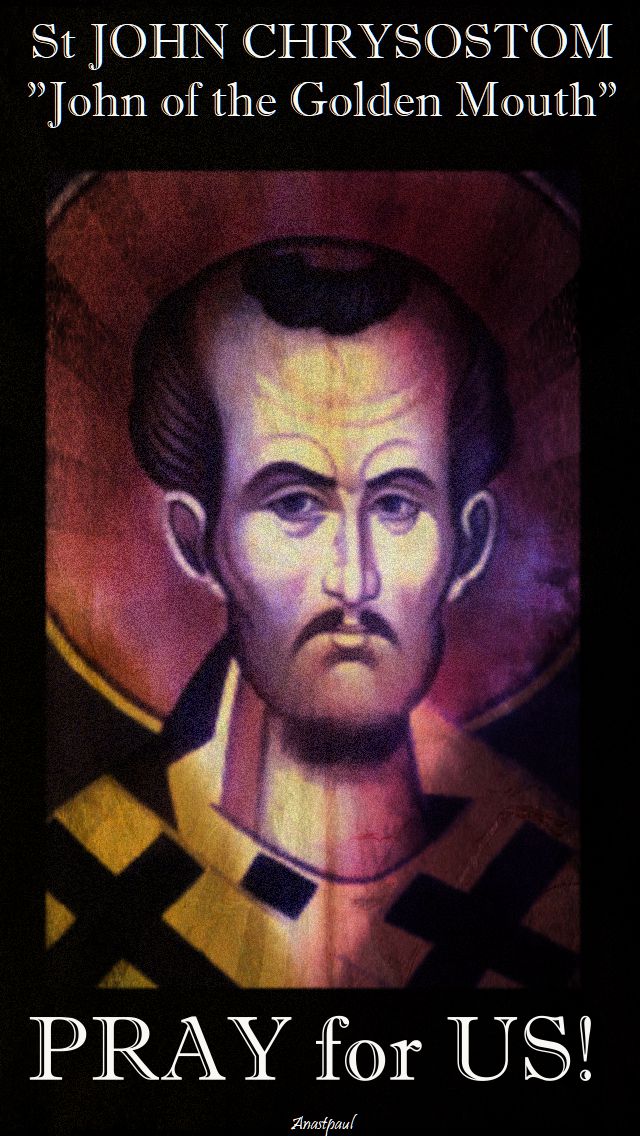
Thought for the Day – 13 September – 13 September – St John Chrysostom (347-407) Doctor – “John of the Golden Mouth”

Thought for the Day – 13 September – 13 September – St John Chrysostom (347-407) Doctor – “John of the Golden Mouth”

What I find interesting is that some people in the Church think Pope Francis is a liberal who is over concerned with social justice issues.   Some of these same people would then hold Chrysostom in high regard, especially being a Doctor of the Church.   Both of these sons of the Church share much in common.

Chrysostom had just as much concern about the relationship of the bishops and priests to the laity as Pope Francis does.   Each showing concern over the laity being treated with respect and dignity, Chrysostom asked,  “How should the church be governed?   Should the patriarchs act like emperors, issuing decrees…Should bishops see themselves as local governors, demanding unquestioning submission of the people?”   Pope Francis has told priests they must be “shepherds living with the smell of the sheep.”   Chrysostom reminded those in authority that they are not rulers but preachers and pastors.  He also stressed that “each individual is answerable not to a priest, bishop, or patriarch but to God.”

Pope Francis has caused quite a stir regarding some of his statements about finances; frankly Chrysostom would not disagree with him.  Actually, I have found Chrysostom to be even more frank then Pope Francis.   He does not mince words when saying, “Lift up and stretch out your hands, not to heaven, but to the poor…if you lift up your hands in prayer without sharing with the poor, it is worth nothing.”   And Pope Francis twice quoted Chrysostom in Evangelii Gaudium, he said, “Ethics — a non-ideological ethics — would make it possible to bring about balance and a more humane social order. With this in mind, I encourage financial experts and political leaders to ponder the words of one of the sages of antiquity: ‘Not to share one’s wealth with the poor is to steal from them and to take away their livelihood.  It is not our own goods which we hold, but theirs.’”   The second quote expressed that we need look at money in a different way, basically through the eyes of Christ.

Both men have a great concern for the poor.   Chrysostom even said if we wish to honour Christ’s body we must first clothe and feed him in our brother. Then, with what we have left, adorn the altar with gold chalices.   He believed “feeding the hungry is a greater work than raising the dead.”   Pope Francis has urged us to not waste food, that throwing it away is like stealing from the poor.   He has also warned us to not, “become starched Christians, those over-educated Christians who speak of theological matters as they calmly sip their tea. No!”   Like Chrysostom, Pope Francis wants us to go out and “care for the flesh of Christ” to seek Him out in the poor.

With great pastoral care they each speak about everyday sins we all need to combat. They do not hesitate to speak out against the pharisaical behavior of keeping rules and laws while not loving our neighbour.   Chrysostom asks us, “For what does it profit if we abstain from fish and fowl and yet bite and devour our brothers and sisters?” Pope Francis tells us we are murdering Christians when we speak badly of them with others.   Reminding us, “There is no such thing as innocent slander.”

I am sure most of us occasionally have moments of “elder brother syndrome.” (Luke 11:32)   We can benefit from a reminder from both men that the Church is a hospital where anyone seeking God can come to be healed.   Chrysostom said the Church is “not a courtroom, for souls. She does not condemn on behalf of sins but grants remission of sins.”

Pope Francis sees the Church as a field hospital after battle.   Saying it is “useless to ask a seriously injured person if he has high cholesterol and about the level of his blood sugars! You have to heal his wounds. Then we can talk about everything else.”   Of course, we are all wounded sinners needing the medicine of the sacraments.   Chrysostom reminds us to not be ashamed when we repent but to have a change of heart and seek God’s love and mercy.   Mercy is a favourite topic of Pope Francis, “there is no limit to the divine mercy, which is offered to everyone…The Lord is always ready to roll away the tombstone of our sins, which separate us from Him, the light of the living.”

These are a few examples showing the similarities between both men.   I believe this shows how Chrysostom’s words are relevant for us today and that there’s nothing novel about Pope Francis’s approach.   Both men challenge us, make us uncomfortable and do not seek to please men with their words but lead them to truth.   The fact that they have so many similar things to say is ultimately a testament of the timelessness of the gospel message itself.   And proof that God is with us and working through his shepherds.”

St John Chrysostom, Pray for the Church, Pray for Pope Francis, Pray for us all!st john chrysostom pray for us.2

(JESSICA ARCHULETA)