Quote/s of the Day – 29 November – Monday of the First Week of Advent – Readings: Isaiah 2: 1-5; Psalms 122: 1-9; Matthew 8: 5-11
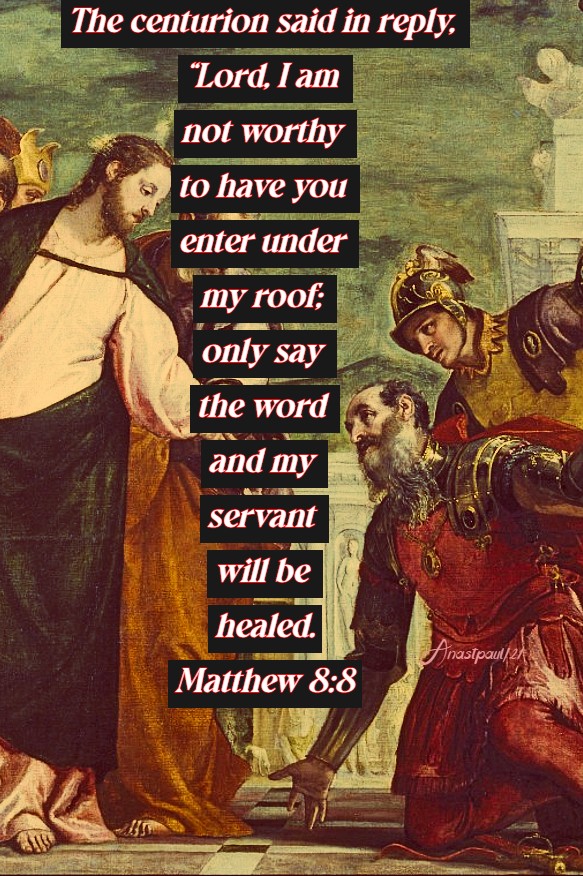
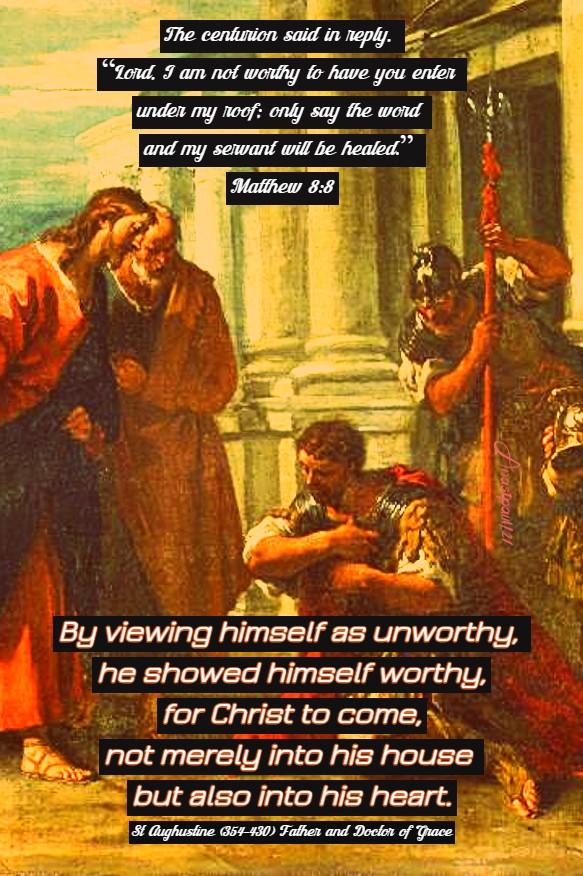
“The centurion said in reply, “Lord, I am not worthy to have you enter under my roof; only say the word and my servant will be healed.”
Matthew 8:8
“By viewing himself as unworthy, he showed himself worthy, for Christ to come, not merely into his house but also into his heart.”
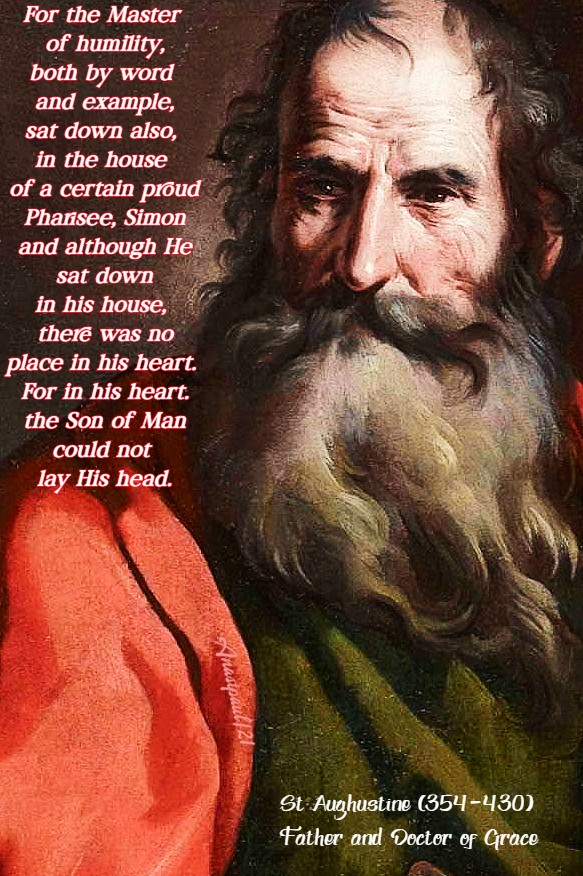
“For the Master of humility, both by word and example, sat down also, in the house of a certain proud Pharisee, Simon and although He sat down in his house, there was no place in his heart. For in his heart. the Son of Man could not lay His head.”
St Aughustine (354-430) Father and Doctor of Grace
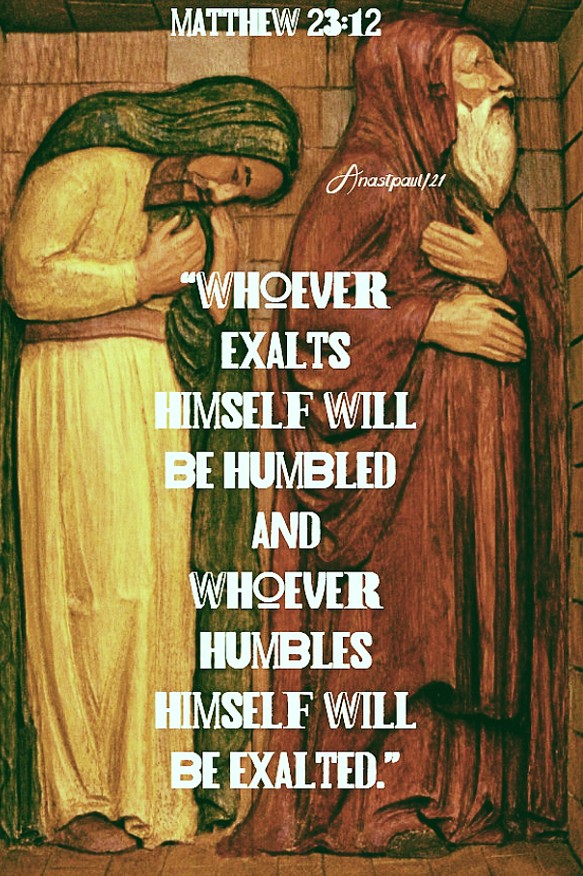
“Whoever exalts himself will be humbled and whoever humbles himself will be exalted.”
Matthew 23:12
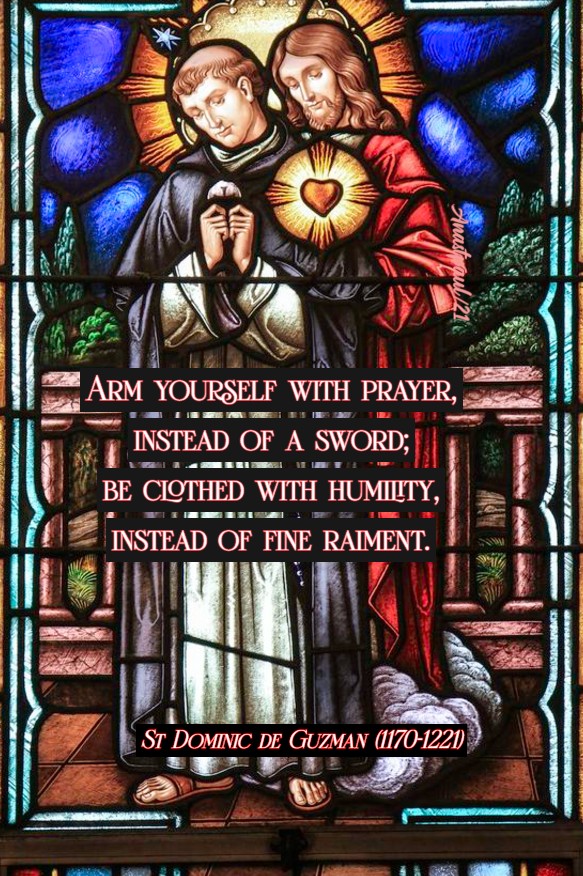
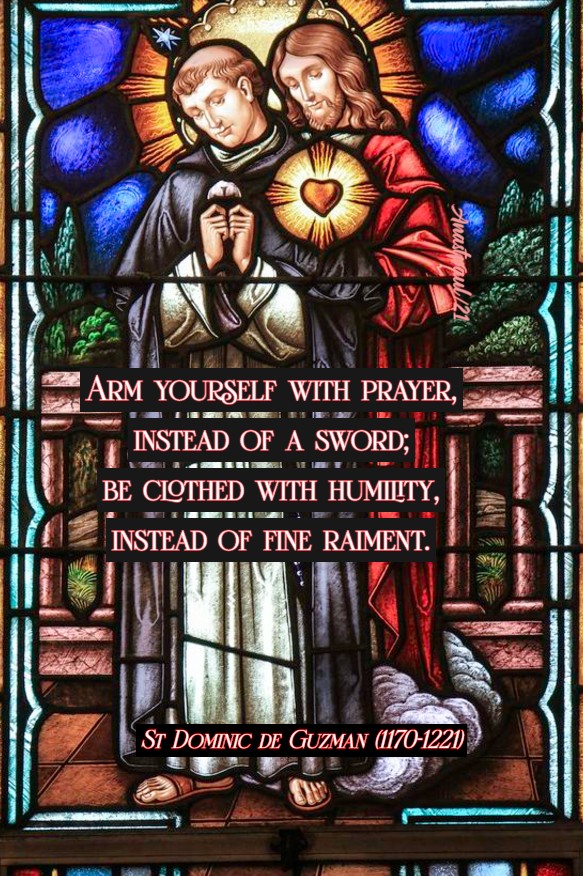
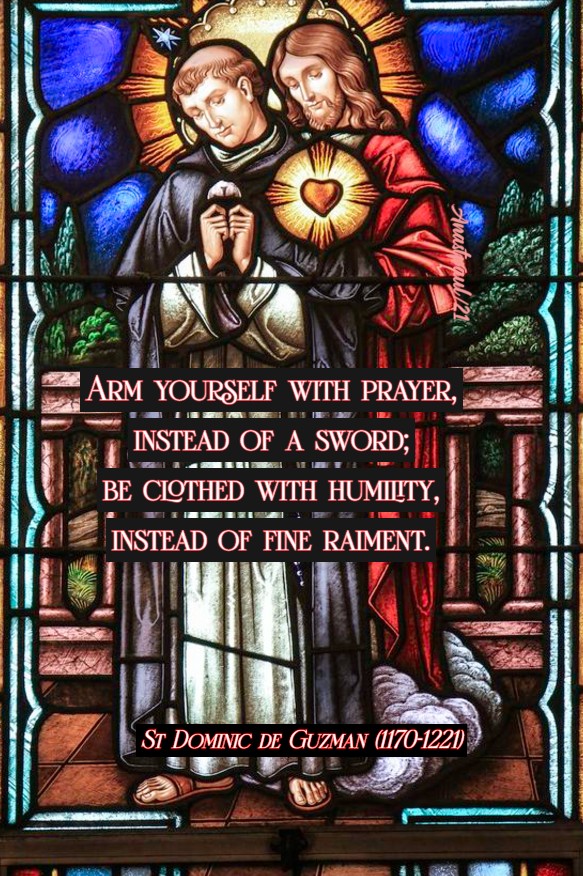
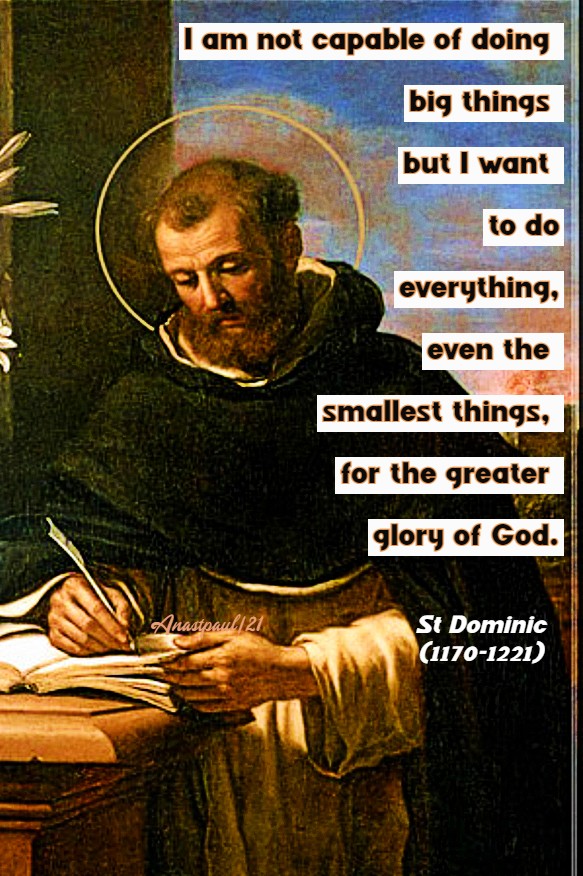
“Arm yourself with prayer, instead of a sword; be clothed with humility, instead of fine raiment.”
St Dominic de Guzman OP (1170-1221)
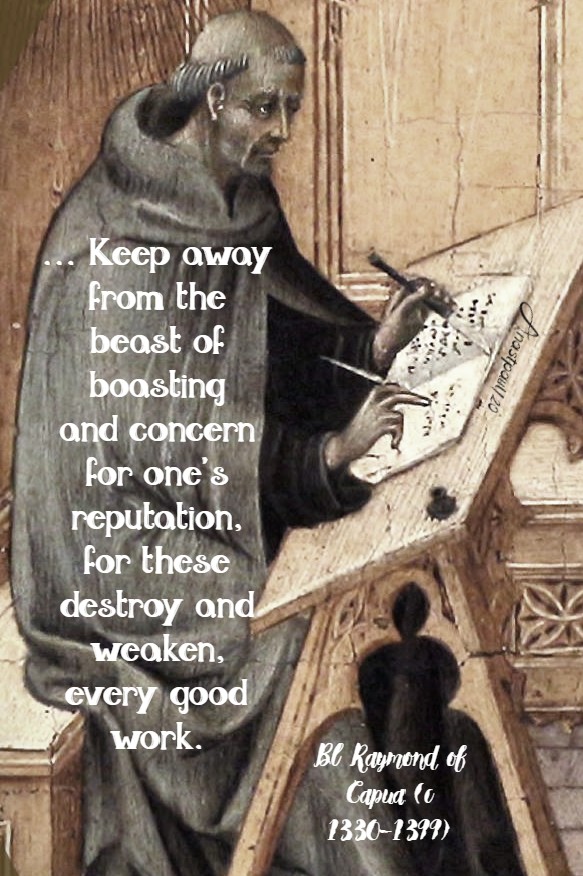
“My brothers, keep away from the beast of boasting and concern for one’s reputation, for these destroy and weaken, every good work.”
Bl Raymond of Capua (c 1330-1399)
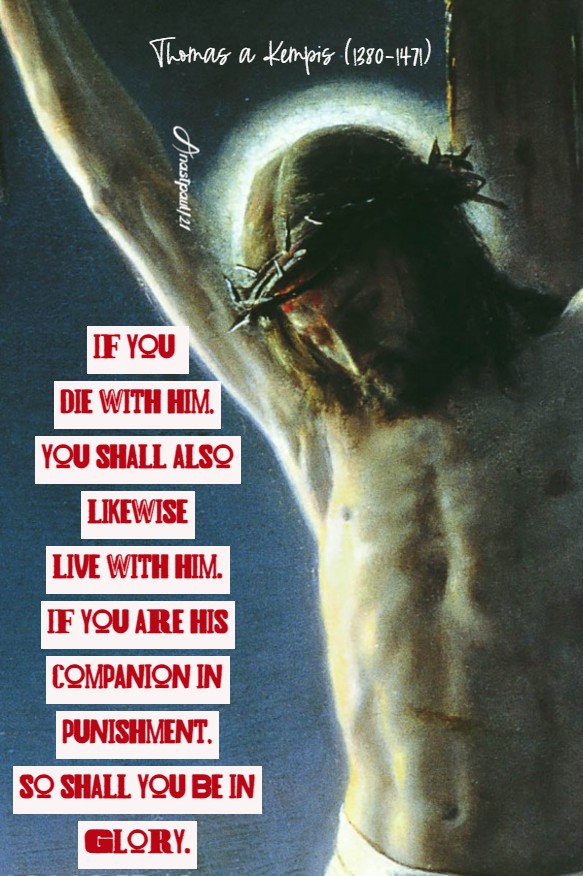
“ … If you die with Him, you shall also likewise live with Him. If you are His companion in punishment, so shall you be in glory.”
Thomas à Kempis (1380-1471)
“Humility and charity are the two master chords – one, the lowest; the other, the highest; all the others are dependent on them. Therefore, it is necessary, above all. to maintain ourselves in these two virtues, for observe well, that the preservation of the whole edifice depends on the foundation and the roof!”
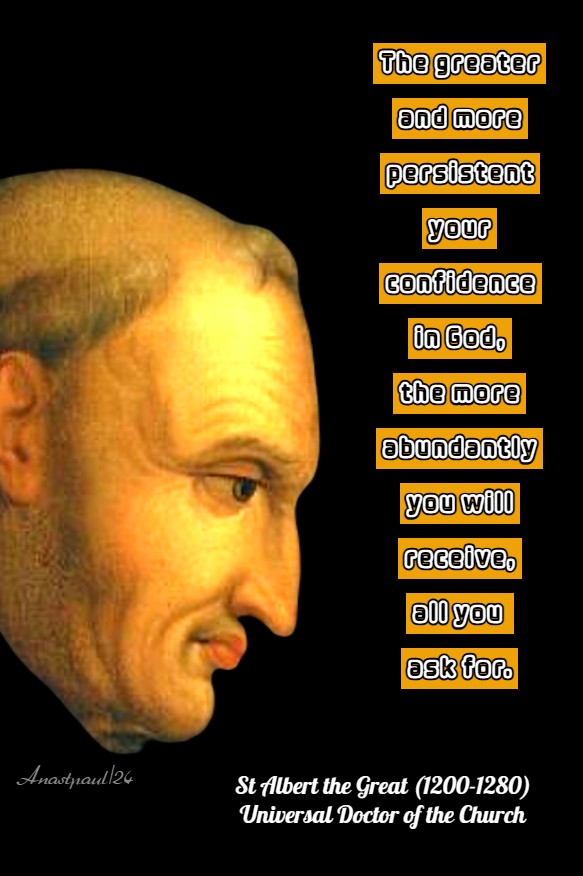
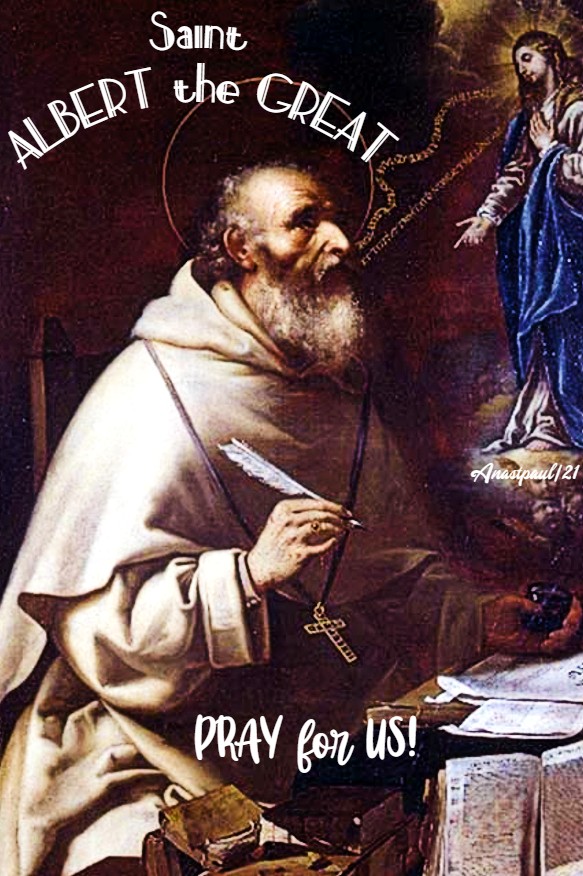
Quote/s of the Day – 15 November – The Memorial of St Albert the Great (1200-1280) Universal Doctor
“Eternal life flows from this Sacrament because God, with all sweetness, pours Himself out upon the blessed.”
“The greater and more persistent your confidence in God, the more abundantly you will receive, all you ask for.”
“Above all, one should accept everything, in general and individually, in oneself or in others, agreeable or disagreeable, with a prompt and confident spirit, as coming from the Hand of His infallible Providence or the order He has arranged.”
One Minute Reflection – 15 November – Readings: First Maccabees 1: 10-15, 41-43, 54-57, 62-63; Psalm 119: 53, 61, 134, 150, 155, 158; Luke 18: 35-43 and the Memorial of St Albert the Great OP (1200-1280) Doctor of the Church
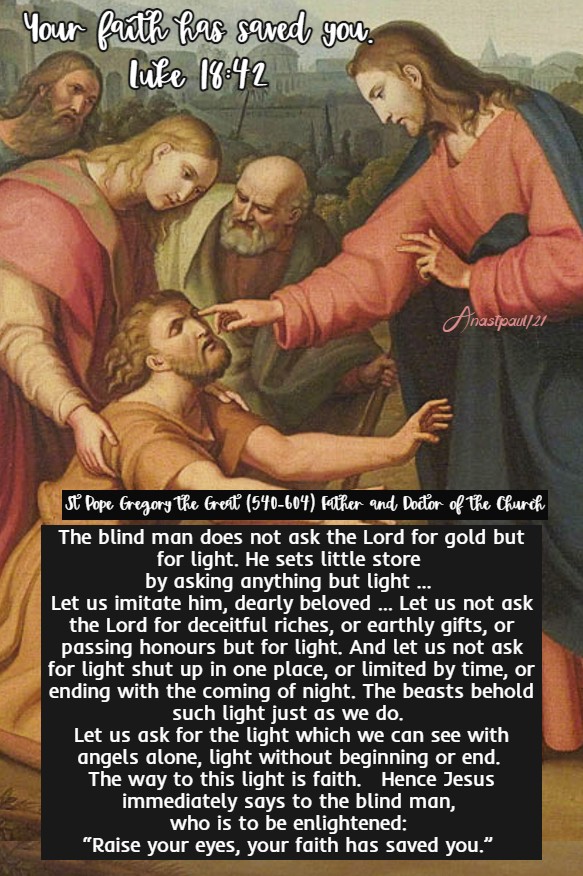
“Your faith has saved you.” – Luke 18:42
REFLECTION – “We must now look at what He said to the blind man as He came near: “What do you want me to do for you?” Was One who could restore light, ignorant of what the blind man wanted? But He wants to be asked, for what He already knows; we shall request and He shall grant. He counsels us to be untiring in our prayers and yet, he says: “For Your Father knows what you need before you ask him” (Mt 6:8). And so He questions that we may ask Him, He questions to rouse our hearts to prayer. …
The blind man does not ask the Lord for gold but for light. He sets little store by asking anything but light … Let us imitate him, dearly beloved … Let us not ask the Lord for deceitful riches, or earthly gifts, or passing honours but for light. And let us not ask for light shut up in one place, or limited by time, or ending with the coming of night. The beasts behold such light just as we do. Let us ask for the light which we can see with angels alone, light without beginning or end. The way to this light is faith. Hence Jesus immediately says to the blind man, who is to be enlightened: “Raise your eyes, your faith has saved you.” – St Pope Gregory the Great (540-604) Father and Doctor of the Church [Homilies on the Gospel, no 2 (Migne) ; PL 76, 1081(trans. Cistercian Fathers]
PRAYER – Lord God, You made St Albert great by his gift for reconciling human wisdom with divine faith. Help us so to follow his teaching that every advance in science may lead us to a deeper knowledge and love of You. May his prayers on our behalf be a succour to us all. Through our Lord Jesus Christ with the Holy Spirit, one God for all eternity, amen.
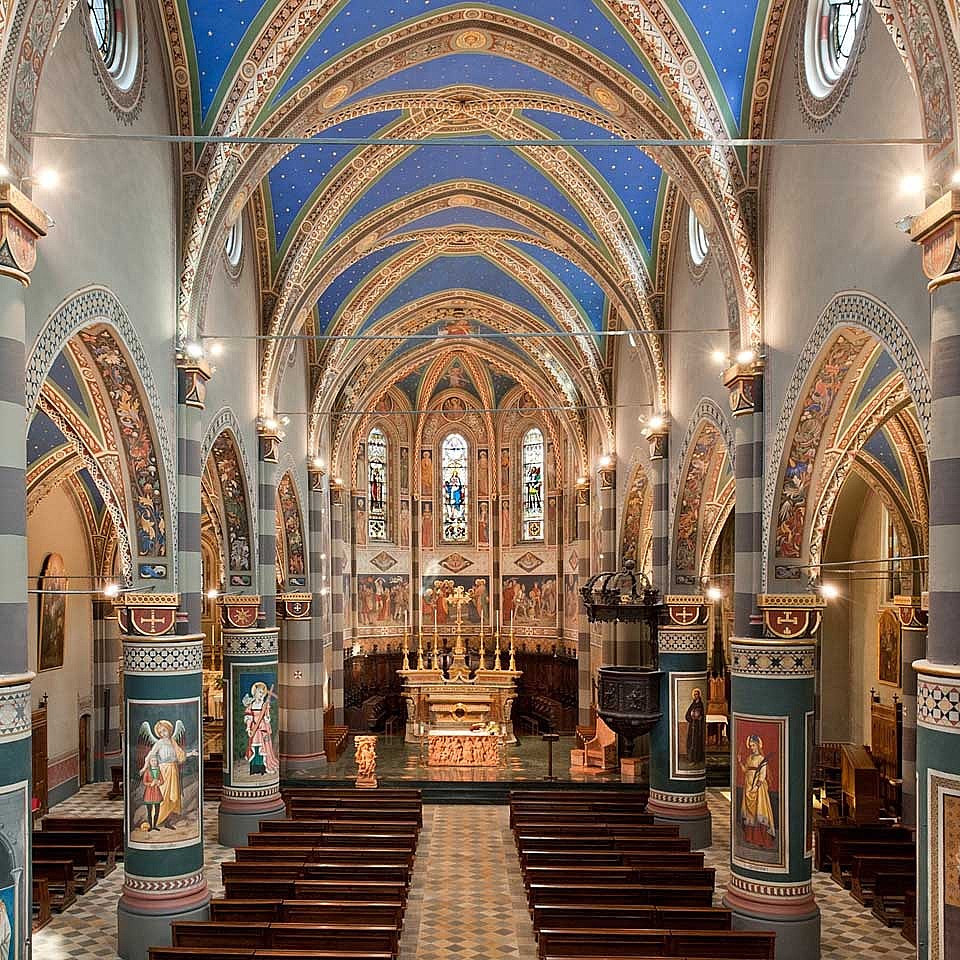
Notre-Dame de Piedmont / Our Lady of Pignerol, Savoy, France (1098) – 15 November:
Our Lady of Pignerol, is also known as Our Lady of Pinerolo, Notre-Dame de Piedmont and Madonna delle Grazie di Pinerolo. The Shrine was built in honour of the Assumption of the Blessed Virgin in the year 1098, by Adelaide, Countess of Savoy. It is a National Shrine of Savoy. Pinerolo is a Town in northern Italy near Turin in a region historically known as Savoy, which was annexed to France. The Town itself began just over 1,000 years ago, due to its central location along a trade route that ran between France and Italy. The pious and far-seeing Countess anticipated, by almost one thousand years, the Dogma of the Assumption of Our Lady. Mary was publicly honoured under this beloved title and frequently repaid the generosity of her devout Adelaide, by answering the pleas of her children, crying to her for help in every need. Answering their prayers, curing their ills and obtaining miracles for the faithful, where human aid was despaired of,but where faith always conquered. When the Assumption of Our Lady was proclaimed a Dogma, the rejoicing at the Pignerolo Shrine was indescribable. Venerable Pope Pius XII, on 1 November 1950, solemnly proclaimed:
“By the authority of Our Lord Jesus Christ, of the Blessed Apostles Peter and Paul and by our own authority, we pronounce, declare and define it to be a divinely revealed Dogma: that the Immaculate Mother of God, the ever Virgin Mary, having completed the course of her earthly life, was assumed body and soul into heavenly glory.”
Although this declaration of Pope Pius XII was made “ex cathedra,” belief in the Assumption of the Blessed Virgin Mary was a commonly held belief among early Catholics and the Fathers of the Church. In the Apocalypse of Saint John, Chapter 12, the woman mentioned is said to be an allusion to both the Church and our Blessed Mother:
“And a great sign appeared in heaven – A woman clothed with the sun,and the moon under her feet and on her head a crown of twelve stars; and being with child, she cried travailing in birth and was in pain to be delivered.”
This passage is generally interpreted as the Church being clothed with the Son, or Son of God, while Our Lady has the moon beneath her feet, representing the things of the material world. She is crowned with 12 stars, the Apostles and is in labour to bring forth the children of God, amidst a world full of affliction and misery.
The Shrine celebrates Our Lady annually on 15 November.
St Anianus of Wilparting St Arnulf of Toul Bl Caius of Korea St Desiderius of Cahors St Eugene of Toledo St Felix of Nola St Findan St Fintan the Missionary St Gurias of Edessa Bl Hugh Faringdon Bl John Eynon Bl John Rugg Bl John Thorne St Joseph Mukasa
Bl Miguel Díaz Sánchez St Paduinus of Le Mans Bl Richard Whiting Bl Roger James St Shamuna of Edessa St Sidonius of Saint-Saens — Martyrs of Hippo – 20 saints: 20 Christians martyred together and celebrated by Saint Augustine. The only details about them to survive are three of the names – Fidenziano, Valerian and Victoria. Hippo, Numidia (in north Africa).
Martyrs of North Africa – 3 saints: A group of Christians murdered for their faith in imperial Roman north Africa. The only details that have survived are the names of three of them – Fidentian, Secundus and Varicus.
The Twenty Fifth Sunday after Pentecost Thirty Third Sunday in Ordinary Time
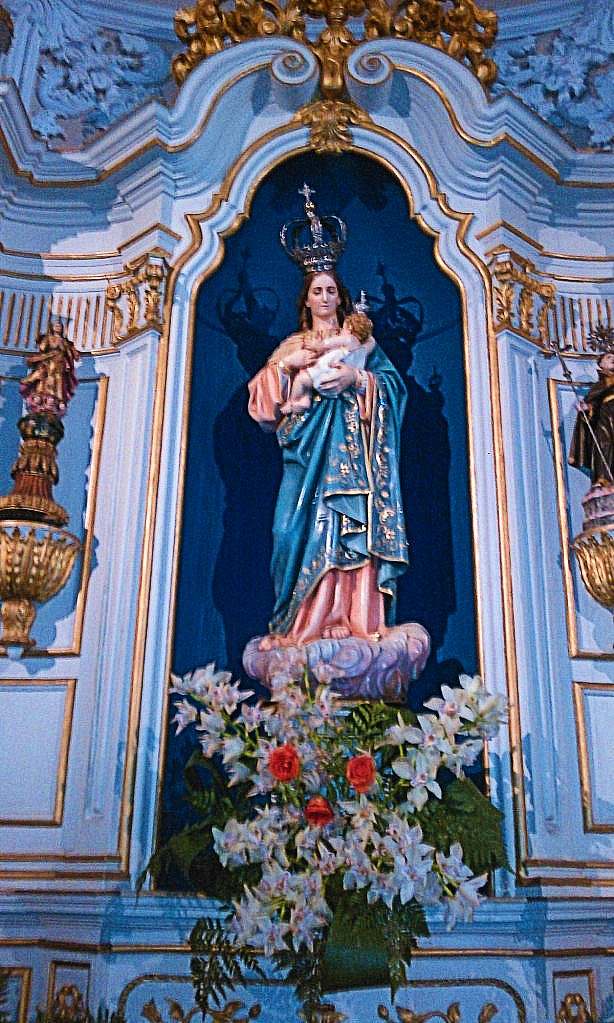
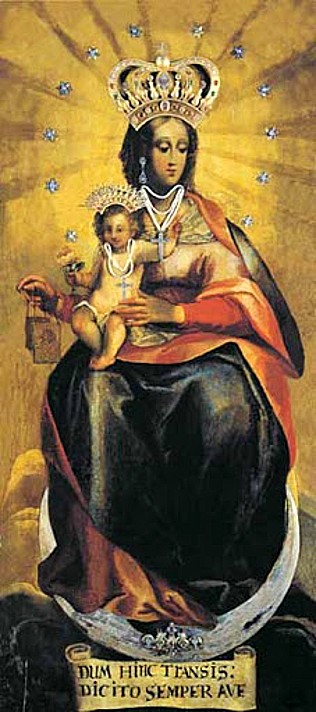
Nossa Senhora dos Remédios / Our Lady of Remedies, (Lamego, Portugal) 6th Century) Also known as – Nossa Senhora da Gruta / Our Lady of the Grotto – 14 November:
The Abbot Orsini wrote: “Our Lady of the Grotto, in the Diocese of Lamego, in Portugal. This Chapel was cut in the rock, in the same place where an image of the Blessed Virgin had been found.”
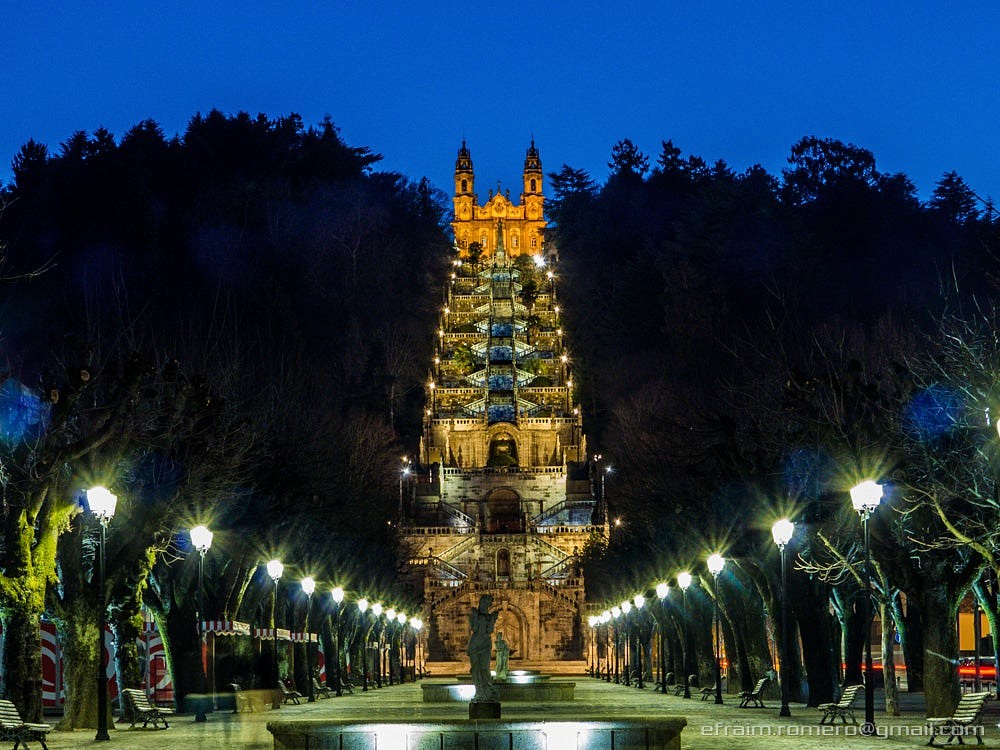
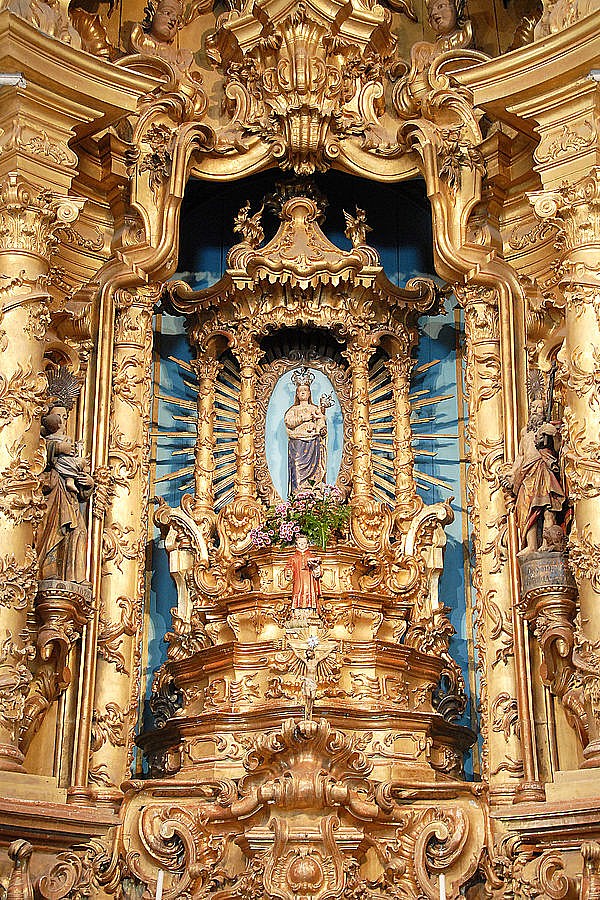
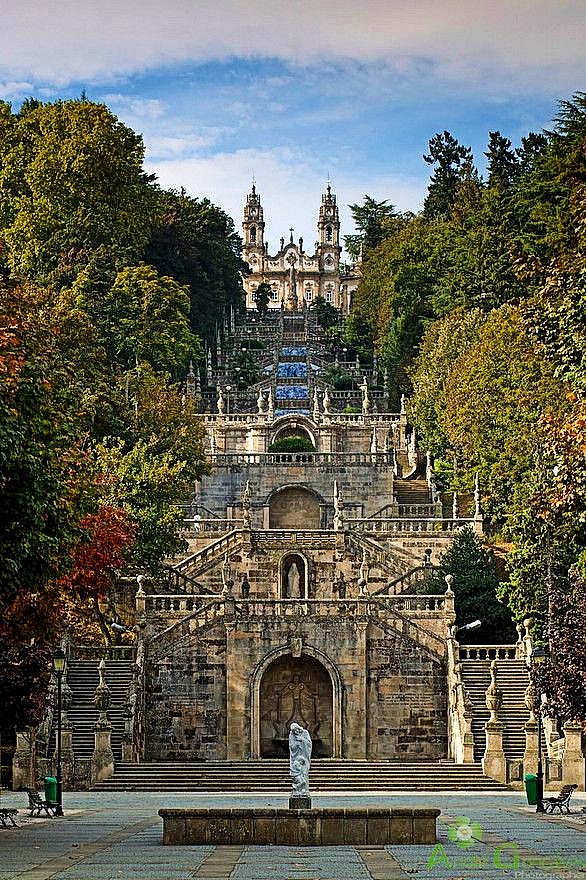
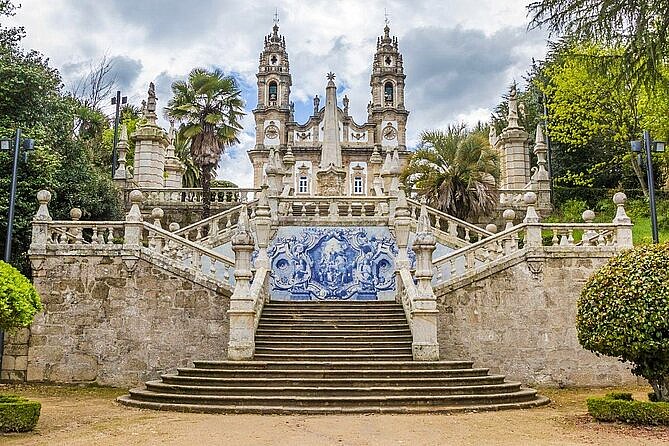
Lamego is both a Municipality and a City in northern Portugal, the City having a total of less than 9,000 inhabitants. The City is an ancient one, as the Roman’s came to settle the area in about the year 500 BC. The people became Catholic when Ricardo I, the Visigothic King, converted to Christianity late in the 6th century. The Sanctuary of Nossa Senhora dos Remedios, or Our Lady of Remedies, is in the location of Our Lady of the Grotto. It is in the Town of Lamego, district of Viseu, Portugal and is located atop the hill of Saint Stephen. This site begins as an old hermitage that was dedicated to Saint Stephen (Santo Estevao) constructed in 1361, so Catholic devotion here goes well back into the Middle Ages. By the 16th century, the old hermitage was at risk of collapsing and so was demolished, to make way for the construction of a new hermitage in the same spot. The Bishop of Lamego placed an image of the Virgin and Child there and thus over time, Marian devotion eclipsed devotion to Saint Stephen. Miraculous cures, especially of diseases, brought more pilgrims and the name for the image as Our Lady of Remedies. The Marian Shrine that can be seen there today, however, was built during the 18th through the 20th centuries, from 1750 to 1905 when it was completed. 8 September the Feast of the Nativity of the Blessed Virgin, is the date when there are feasts in honor of Our Lady of Remedies. The celebration in September includes fireworks, musicals, sporting events and recreational activities that take place in amid the trees in a grove of a nearby park. There is a parade known as the Procession of the Triumph, who’s participants are richly dressed, that is the highpoint of the celebration. Inside the Church there is an Altar above which the image of Nossa Senhora dos Remedios rests. It is carved in wood and is surrounded by stained glass windows having images of Our Lady of the Immaculate Conception, the Sacred Heart of Jesus and the Annunciation. Two side Altars are dedicated to the parents of the Blessed Virgin, Joachim and Saint Anna.
There is also a famous Baroque staircase, having 686 steps, that leads to the Sanctuary. There are several levels, decorated with sculptures of kings and eight fountains. There is also a “Court of the Kings” where eighteen Kings of Israel, all belonging to the family tree of the Blessed Virgin and Mother of God, can be seen.
St Adeltrude of Aurillac St Alberic of Utrecht St Antigius of Langres St Dubricius of Wales St Etienne-Théodore Cuenot St Hypatius of Gangra Bl Jean of Tufara
Bl Maria Louise Merkert Bl Maria Teresa of Jesus St Modanic St Ruf of Avignon St Serapion of Alexandria St Serapion of Algiers OdeM (c 1179–1240) Priest Martyr St Siard St Venerando the Centurian St Venerandus of Troyes — Holy Fathers of Merida
Martyrs of Emesa: Group of Christian women tortured and executed for their faith in the persecutions of the Arab chieftain Mady. They died in Emesa (modern Homs, Syria).
Martyrs of Heraclea – (3 saints): Group of Christians murdered together for their faith. The only details we have are three of their names – Clementinus, Philomenus and Theodotus. They were martyred in Heraclea, Thrace.
Martyrs of the Jaffa Gate: • Blessed Déodat of Rodez • Blessed Nikola Tavelic • Blessed Pierre of Narbonne • Blessed Stefano of Cuneo
Our Morning Offering – 9 November – Feast Dedication of The Archbasilica of the Most Holy Saviour in the Lateran
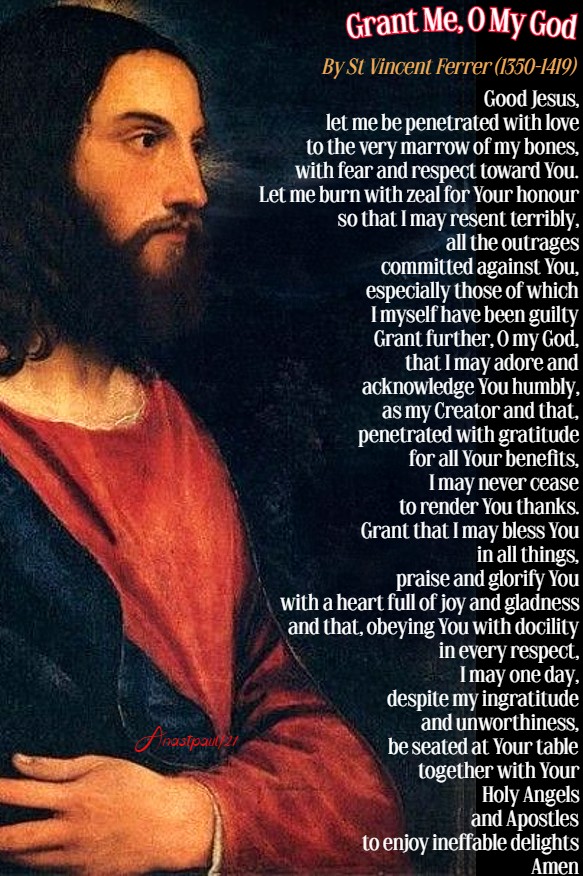
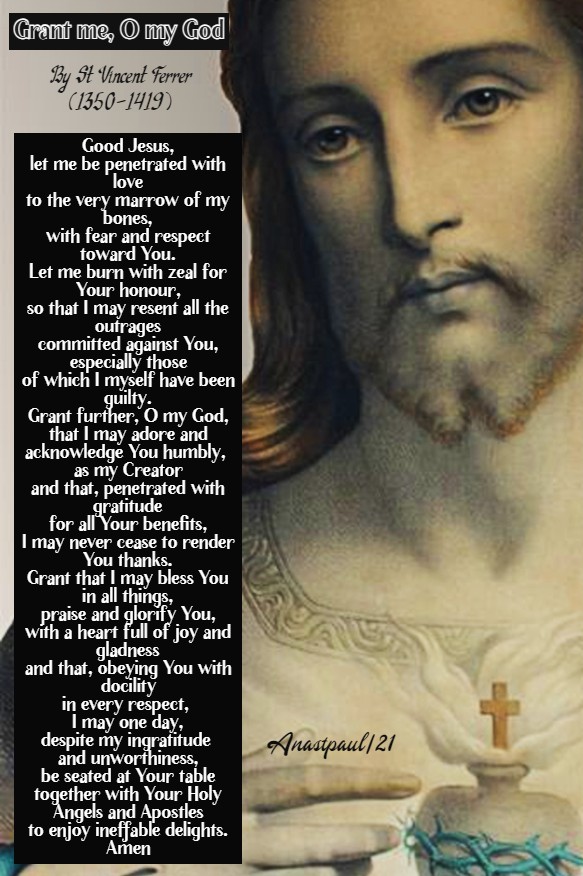
Grant me, O my God By St Vincent Ferrer OP (1350-1419)
Good Jesus, let me be penetrated with love to the very marrow of my bones, with fear and respect toward You. Let me burn with zeal for Your honour, so that I may resent terribly, all the outrages committed against You, especially those of which I myself have been guilty. Grant further, O my God, that I may adore and acknowledge You humbly, as my Creator and that, penetrated with gratitude for all Your benefits, I may never cease to render You thanks. Grant that I may bless You in all things, praise and glorify You with a heart full of joy and gladness and that, obeying You with docility in every respect, I may one day, despite my ingratitude and unworthiness, be seated at Your table together with Your Holy Angels and Apostles to enjoy ineffable delights. Amen
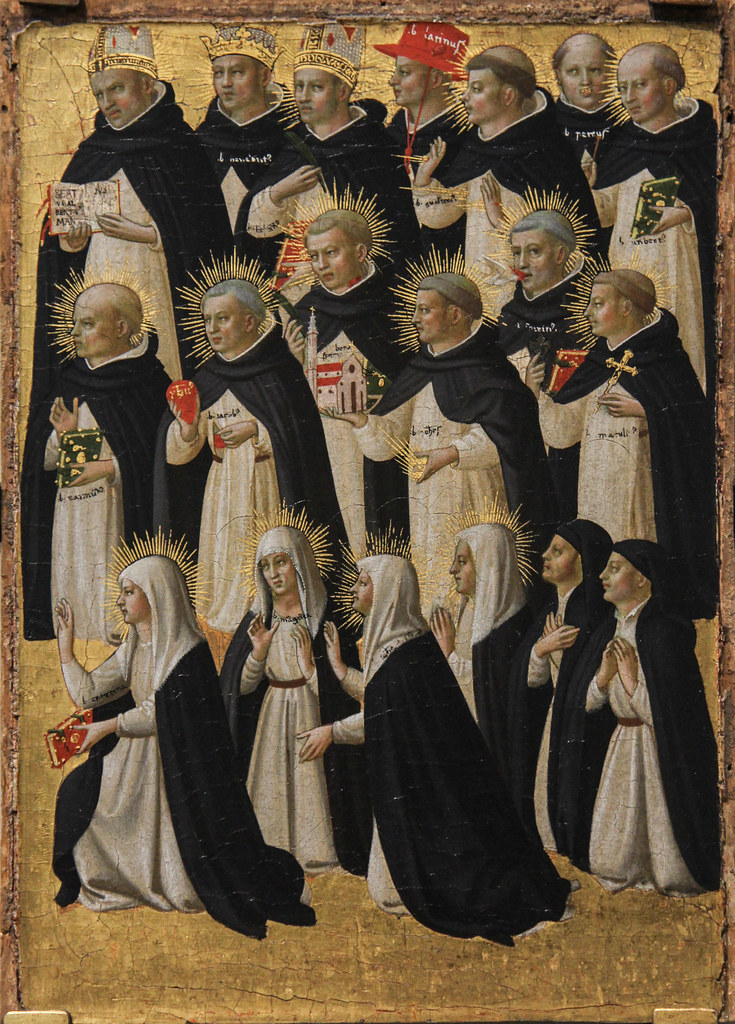
Quote/s of the Day – 7 November – The Memorial of All Saints of the Order of Preachers
“Arm yourself with prayer, instead of a sword; be clothed with humility, instead of fine raiment.”
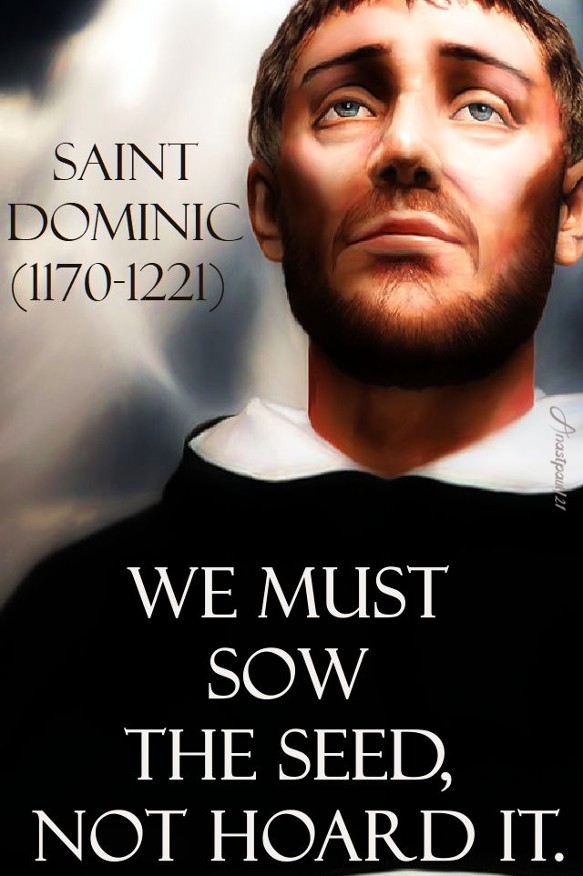
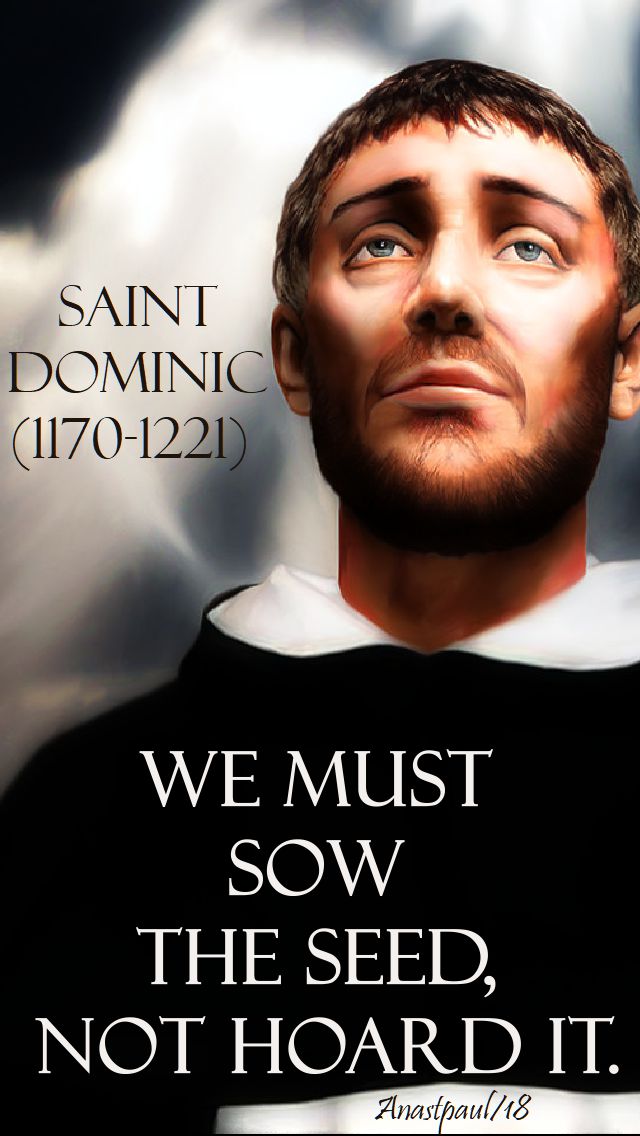
“We must sow the seed, Not hoard it.”
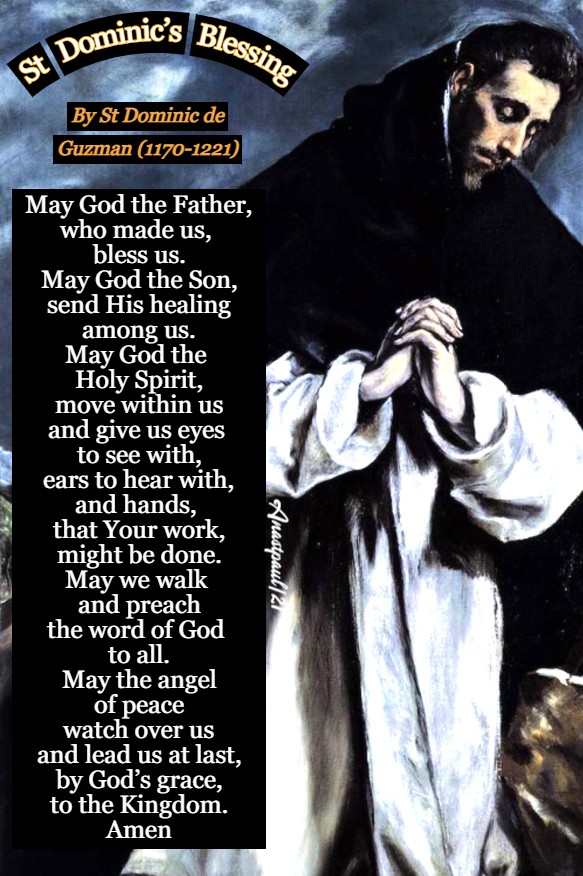
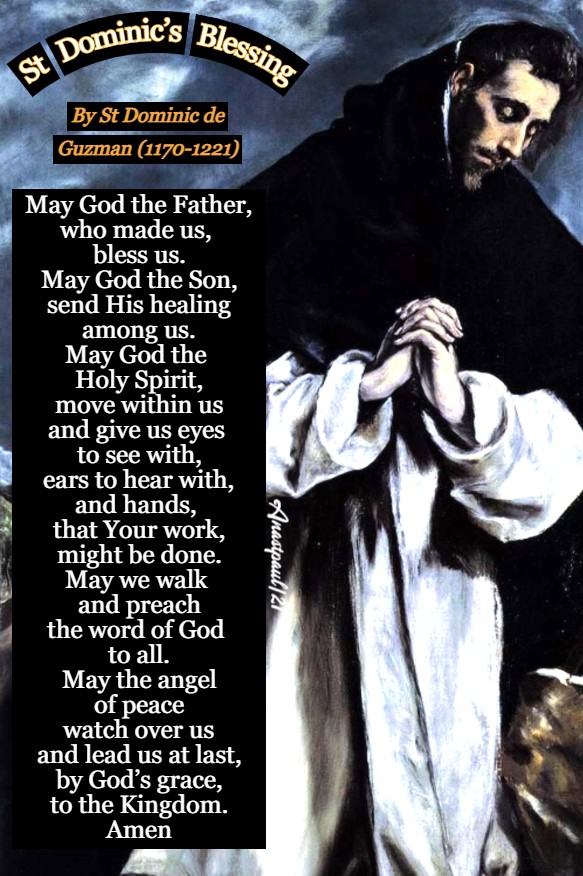
St Dominic’s Blessing By St Dominic de Guzman (1170-1221)
May God the Father, who made us, bless us. May God the Son, send His healing among us. May God the Holy Spirit, move within us and give us eyes to see with, ears to hear with, and hands, that Your work, might be done. May we walk and preach the word of God to all. May the angel of peace watch over us and lead us at last, by God’s grace, to the Kingdom. Amen
St Dominic de Guzman OP (1170-1221)
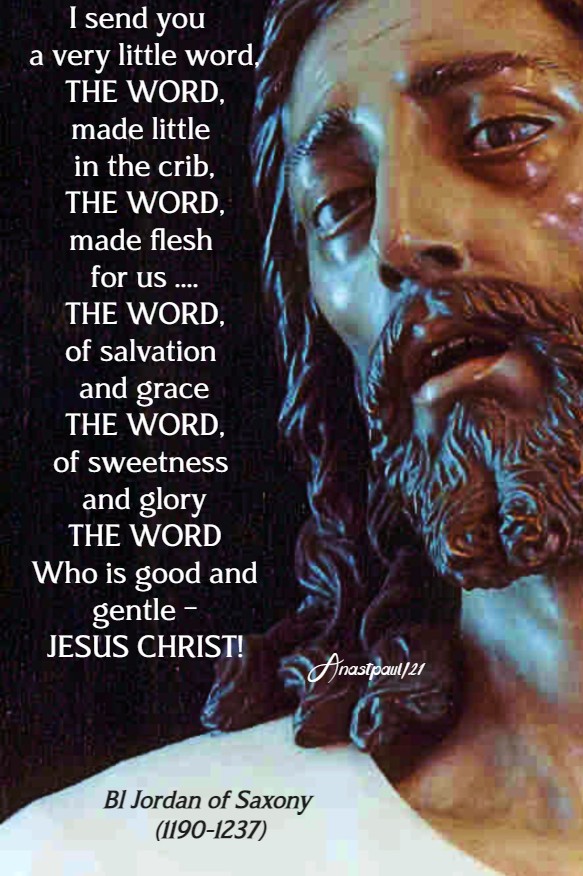
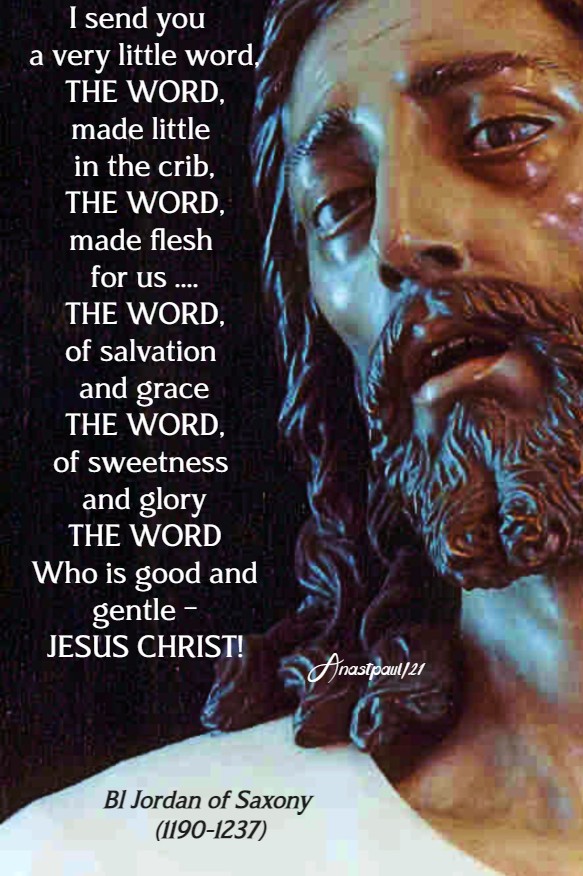
“I send you a very little word, THE WORD, made little in the crib, THE WORD, made flesh for us …. THE WORD, of salvation and grace THE WORD, of sweetness and glory THE WORD Who is good and gentle – JESUS CHRIST!”
Blessed Jordan of Saxony OP (1190-1237)
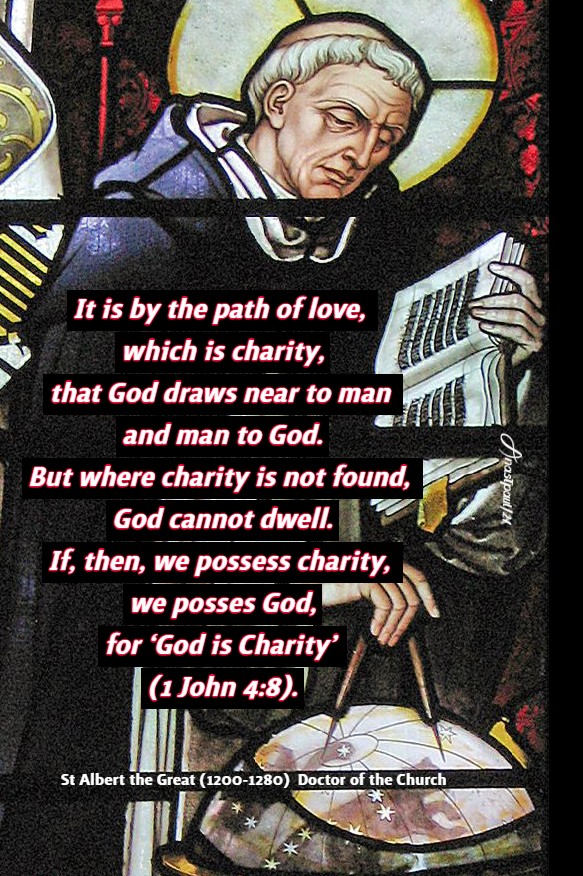
“It is by the path of love, which is charity, that God draws near to man and man to God. But where charity is not found, God cannot dwell. If, then, we possess charity, we posses God, for ‘God is Charity’ (1 John 4:8).”
St Albert the Great OP (1200-1280) Doctor of the Church
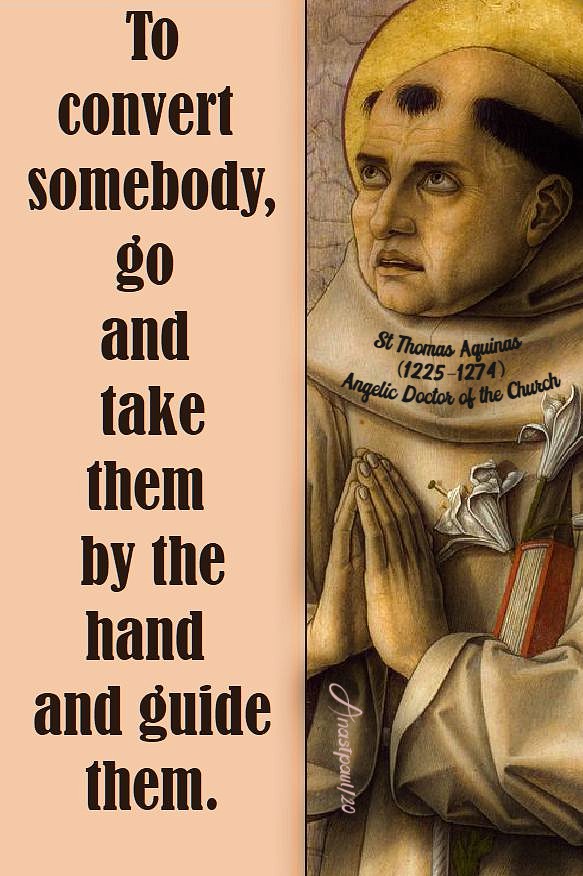
“To convert somebody, go and take them by the hand and guide them.”
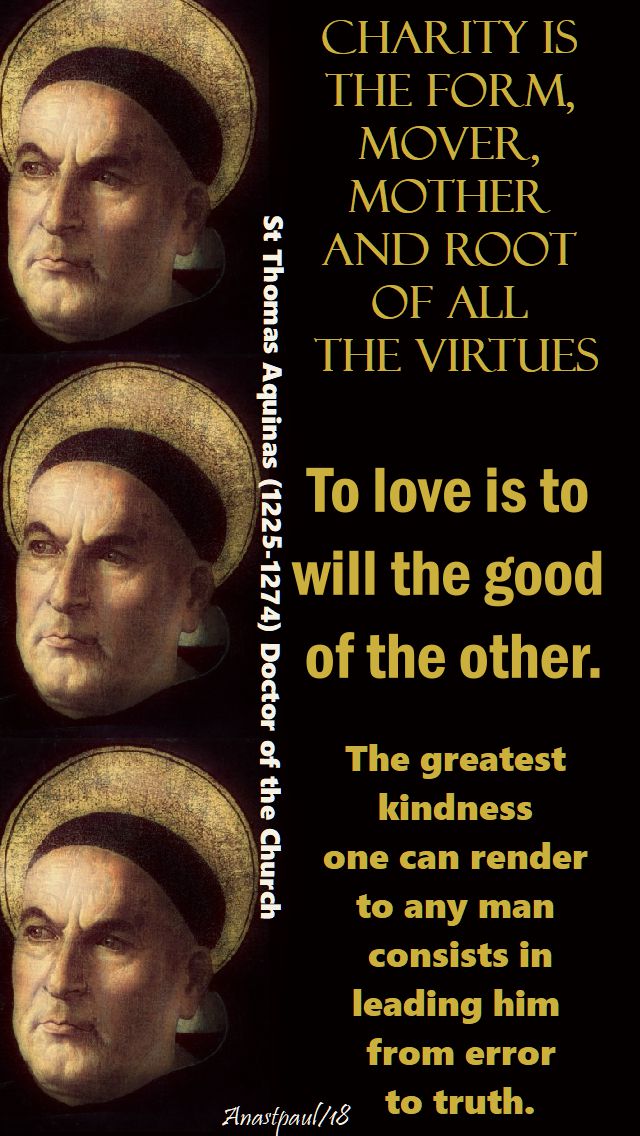
“Charity is the form, mover, mother and root of all the virtues.”
“To love is to will the good of the other.”
“The greatest kindness one can render to any man consists in leading him from error to truth.”
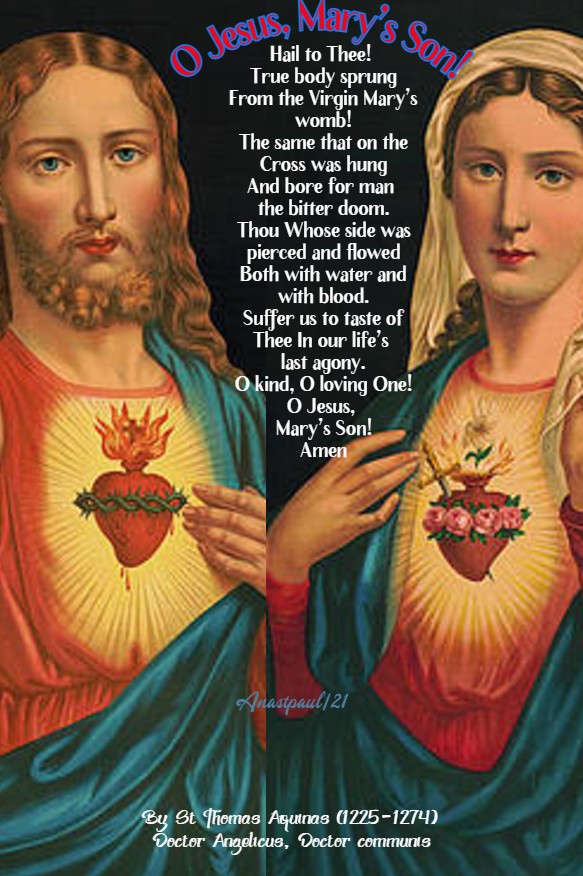
O Jesus, Mary’s Son! By St Thomas Aquinas OP (1225-1274) Doctor Angelicus, Doctor communis
Hail to Thee! True body sprung From the Virgin Mary’s womb! The same that on the cross was hung And bore for man the bitter doom. Thou Whose side was pierced and flowed Both with water and with blood. Suffer us to taste of Thee In our life’s last agony. O kind, O loving One! O Jesus, Mary’s Son! Amen
St Thomas Aquinas OP (1225-1274)
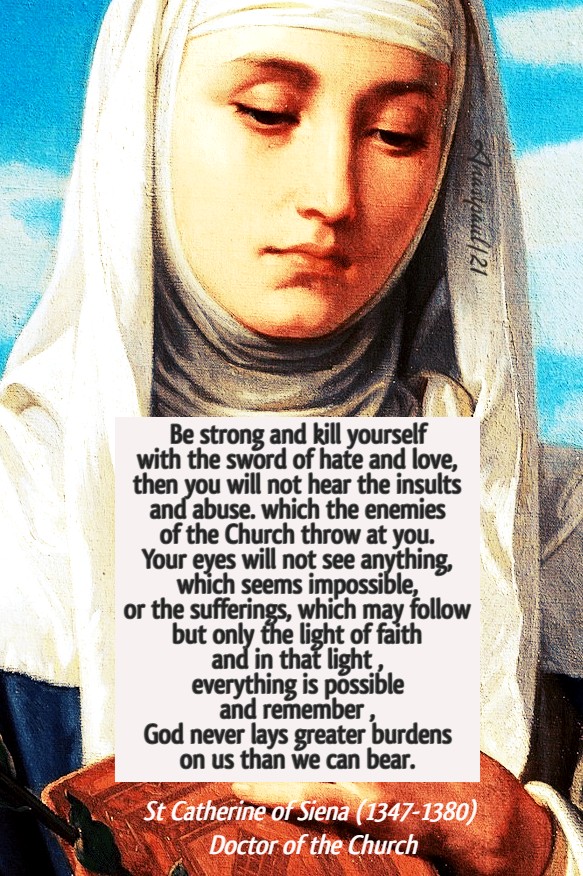
“Be strong and kill yourself with the sword of hate and love, then you will not hear the insults and abuse. which the enemies of the Church throw at you. Your eyes will not see anything, which seems impossible, or the sufferings, which may follow but only the light of faith and in that light , everything is possible and remember , God never lays greater burdens on us than we can bear.”
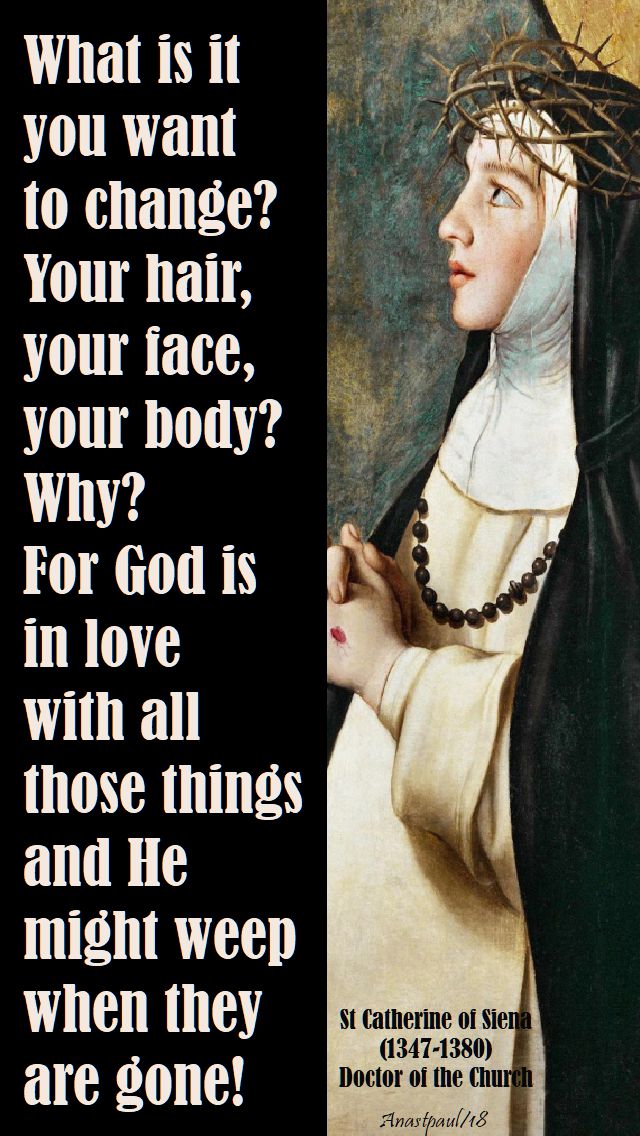
“What is it you want to change? Your hair, your face, your body? Why? For God is in love with all those things and He might weep when they are gone!”
St Catherine of Siena OP (1347-1380) Doctor of the Church
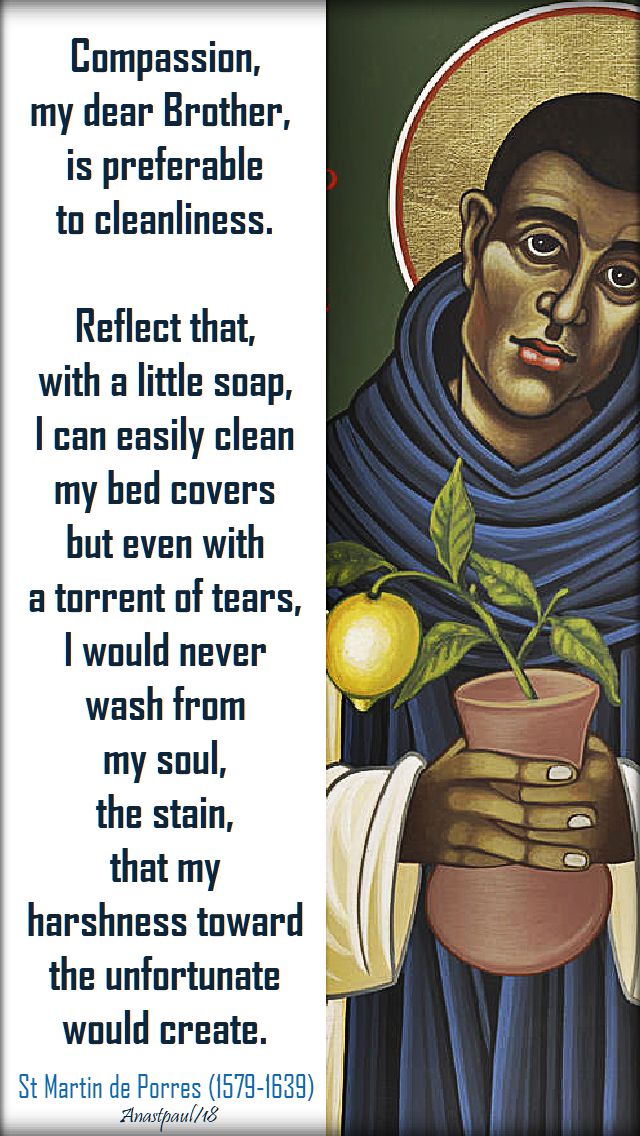
“Compassion, my dear Brother, is preferable to cleanliness. Reflect that with a little soap, I can easily clean my bed covers but even with a torrent of tears, I would never wash from my soul, the stain, that my harshness toward the unfortunate would create.”
St Martin de Porres OP (1579-1639)
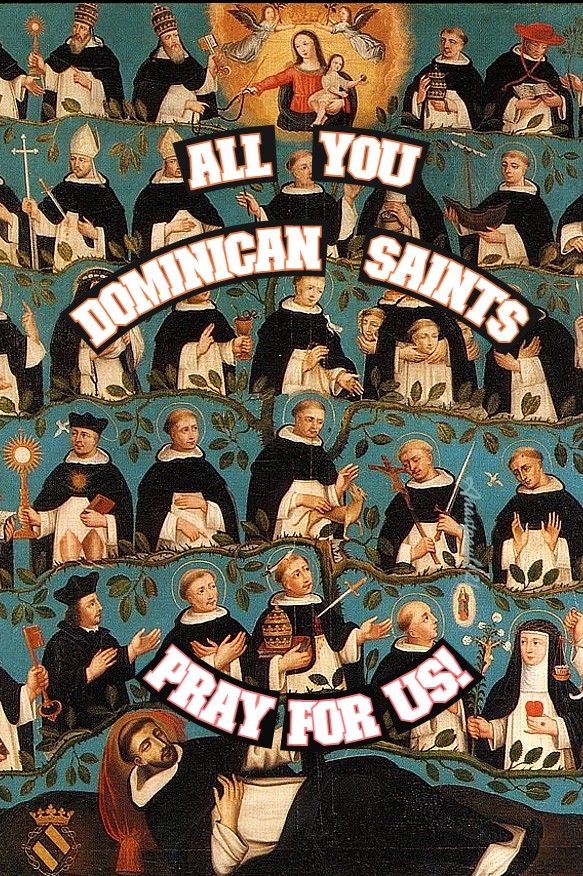
Just a few of the great Dominicans – Ana OP – with Love
One Minute Reflection – 7 November – Readings: Kings 17: 10-16; Psalm 146: 7-10; Hebrews 9: 24-28; Mark 12: 38-44
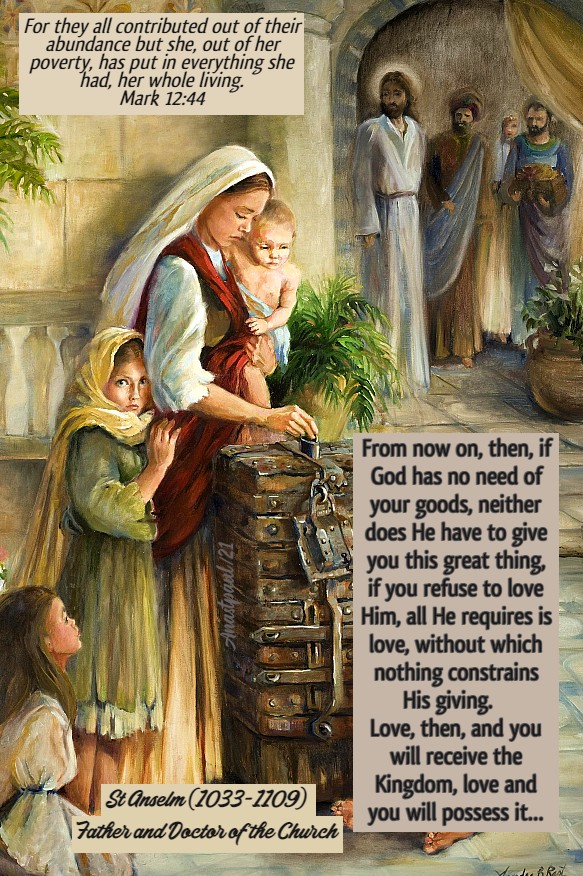
“For they all contributed out of their abundance but she, out of her poverty, has put in everything she had, her whole living.” – Mark 12:44
REFLECTION – “Now, if someone is wondering what the cost is, here is their answer – He does not give it to someone who does not value it. For indeed, nobody gives away something they hold dear without placing some kind of value on it. From now on, then, if God has no need of your goods, neither does He have to give you this great thing, if you refuse to love Him, all He requires is love, without which nothing constrains His giving. Love, then, and you will receive the Kingdom, love and you will possess it… Love God more than yourself and already, you begin to have what it is you desire to possess fully, in heaven.”… St Anselm (1033-1109) Father and Doctor of the Church
PRAYER – Lord God, Your Son has shown us the way. As we follow in His steps, may we never wander from the path that leads to life. Renew the wonders of Your grace in our hearts so that neither death nor life may separate us from Your love. Holy Father, as You were glorified by the life and death of all the Dominican Saints and Blesseds, grant that by their prayers, we may receive Your grace to give first to You and then to our neighbour in complete love and service. Through our Lord, Jesus Christ, with You in union with the Holy Spirit, one God for all eternity, amen.
Our Morning Offering – 3 November – “Month of the Holy Souls in Purgatory”
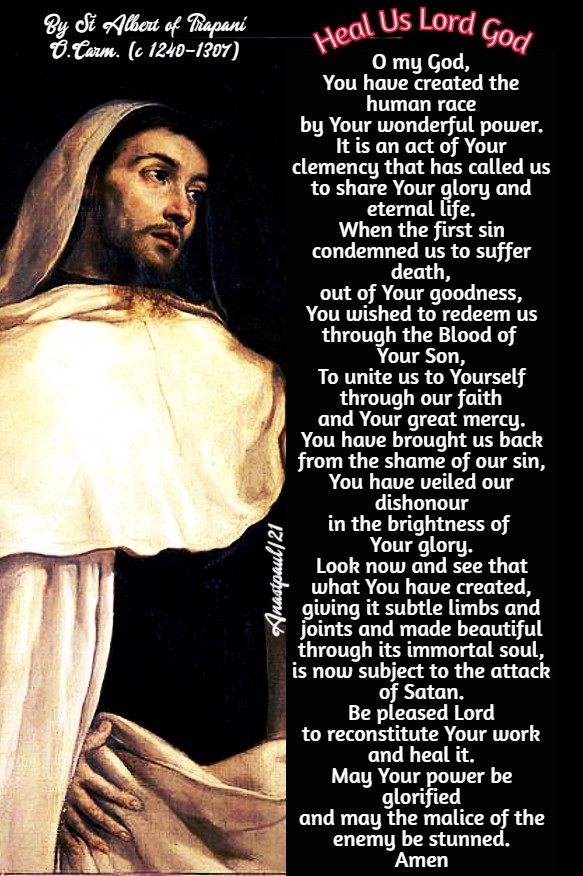
Heal Us Lord God By St Albert of Trapani O.Carm. (c 1240-1307)
O my God, You have created the human race by Your wonderful power. It is an act of Your clemency that has called us to share Your glory and eternal life. When the first sin condemned us to suffer death, out of Your goodness, You wished to redeem us through the Blood of Your Son, To unite us to Yourself through our faith and Your great mercy. You have brought us back from the shame of our sin, You have veiled our dishonour in the brightness of Your glory. Look now and see that what You have created, giving it subtle limbs and joints and made beautiful through its immortal soul, is now subject to the attack of Satan. Be pleased Lord to reconstitute Your work and heal it. May Your power be glorified and may the malice of the enemy be stunned. Amen
Saint of the Day – 22 October – Blessed Lucia Bartolini Rucellai (Died 1520) Widow, Tertiary of the Order of Preachers, Penitent, Prioress, Born in the 15th Century in Florence as Camila Bartolini and died in 1520 of natural causes.
Lucia was born in Florence, Italy, in the 15th century; She was a member of the noble Bartolini family and was Baptised with the name of Camila. When she was a teenager, she married Rodolfo Rucellai and went to live in the splendid Albertino Palace.
At thirty, however, Savonarola’s words took her out of worldly concerns, enkindling i her the fire of the deepest and most painful spirituality. Even Rudolfo, her husband, was shaken by the prophetic prayers of the preacher and decided, somewhat hastily, to part from his wife, who had no children, to wear the Dominican habit at San Marco.
Camila accepted her husband’s decision and became a tertiary of Saint Dominic. After a few months, Rodolfo Rucellai, more impulsive but less strong than his wife, got tired of the religious state and wanted to return to the world, trying to convince his wife to do the same. But then she was the one who objected with unexpected tenacity and indeed, Lucia, after painful work, had found in the new state, a spiritual wealth in comparison with which, all the flattery of the world seemed empty and doomed.
Rodolfo died shortly after and Camila became a nun with the name of Lucia, she remained in the Convent of the Dominican tertiaries, becoming the promoter of a new foundation, dedicated to Saint Catherine of Siena . After the tragic end of Savonarola, hanged and burned as a heretic, in the Piazza della Signoria, in May 1498, Lucia Bartolini was a wise and rigorous guide to the Florentine Convent of Santa Catalina, as Prioress, obtaining permission for her tertiaries to issue three vows and then wear the habit of the nuns of the Second Order.
Lucia was a mortified, penitent and very strict with herself,. She prayed with such fervour that, it was said, the Convent of Santa Catalina appeared crowned with flames, at the times when she was in prayer. And as soon as he died, in 1520, after a serenely accepted illness, her halo as a Blessed came to embellish the glory of the very wealthy Rucellai family, showering them with the glory of Heavenly riches.
Saint of the Day – 21 September – Blessed Mark Scalabrini of Modena OP (c 1420-1498) Priest and Friar of the Order of Preachers, Prior, miracle-worker. Born in c 1420 in Mocogna, Modena, Emilia-Romagna, Italy and died on 21 September 1498 in Pesaro, Italy of natural causes.
Mark was born in Modena and entered the Convent of the Dominican Order there in young manhood. He observed the Rules with great fidelity and became noted, both for his learning and his holiness. However, when we recall the times in which he lived , it becomes clearer to us that anyone who kept the Dominican Rule in its entirety, is truly deserving of our notice . The abuses which stirred Savonarola to thundering speech in the pulpits of Ferrara and Florence could not have been absent from all of Italy. It took solid virtue to hold out against the opulent worldliness of the times and Mark of Modena apparently did a thorough job of it, since he has been Beatified.
Mark was made Prior of the Convent of Pesaro and the only miracle we have on record (he is believed to have performed many) took place at his convent. A little boy had died and the mother pleaded with Mark to restore the child’s life. After praying for awhile, Mark turned to her and said, “Madam, your young boy is in paradise. Do not try to get him back again, for his second loss will be worse than this one.” However, she insisted on his working the miracle and he did so. The child returned to life and, ten years later, covered with disgrace and public censure arising from shameful conduct, died a second time, leaving his mother in more sorrowful grief than ever.
Mark of Modena died in 1498, the year that the City of Florence burned Savonarola at the stake. It was a time of terrible happenings in Italy and all Europe. The people of Modena mourned the death of Mark and went to pray at his tomb. Many of their needs were answered there and a number of miracles were reported and again when his relics were translated to the Rosary Chapel of the Church. His relics were again transferred in 1949, to the Dominican Church in Modena. The bells were said to have rung by themselves and sweet perfume filled the air. His relics are still exposed annually for veneration during the week of Pentecost. Blessed Mark was Beatified on 10 September 1857 by Pope Blessed Pius IX.
Our Morning Offering – 4 August – The Memorial of St Dominic de Guzman OP (1170-1221)
St Dominic’s Blessing By St Dominic de Guzman (1170-1221)
May God the Father, who made us, bless us. May God the Son, send His healing among us. May God the Holy Spirit, move within us and give us eyes to see with, ears to hear with, and hands, that Your work, might be done. May we walk and preach the word of God to all. May the angel of peace watch over us and lead us at last, by God’s grace, to the Kingdom. Amen
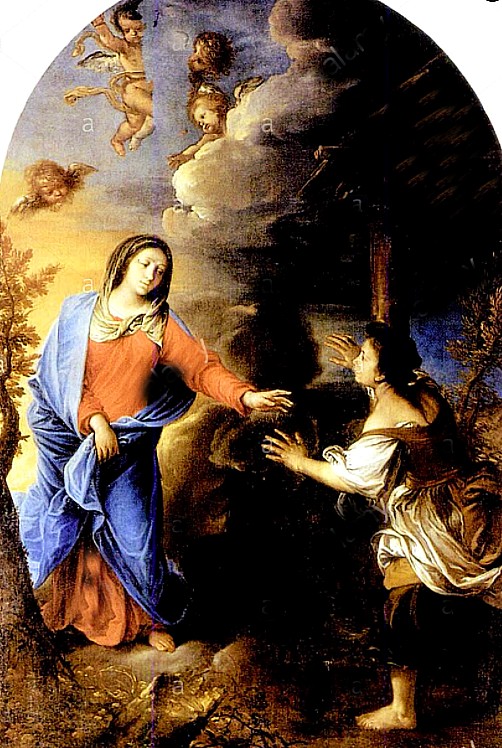
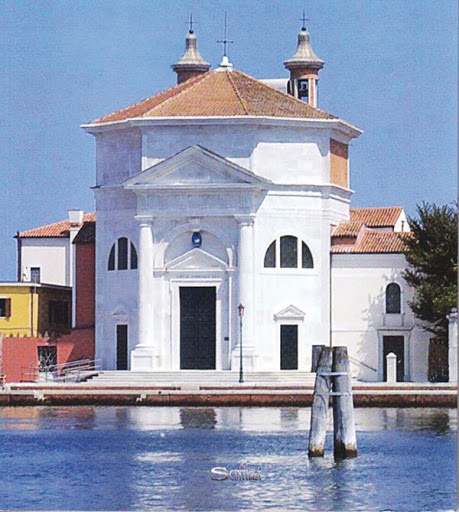
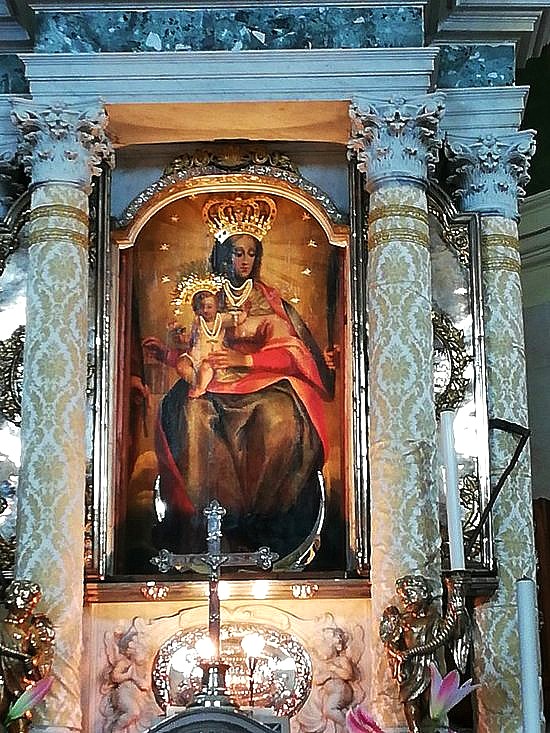
Madonna dell’Apparizione / Our Lady of the Apparition, Pellestrina, Italy (1716) – 4 August:
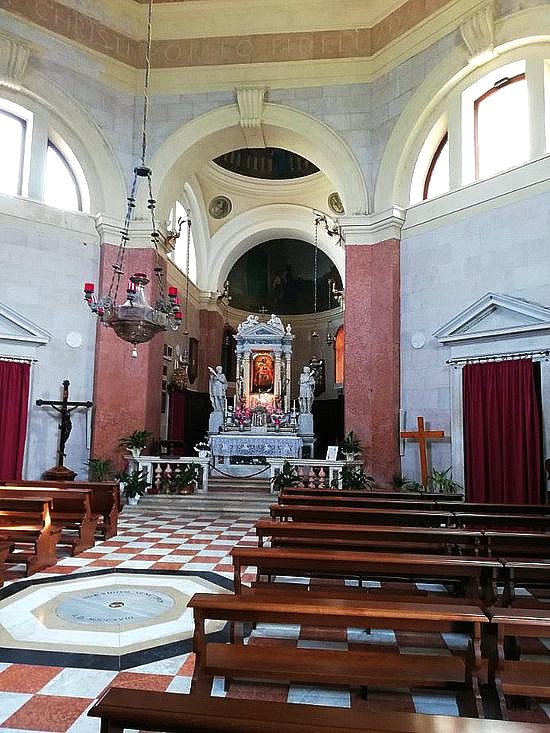
The Sanctuary of Madonna dell’Apparizione in Pellestrina was built in July 1717, a year after the appearance of the Madonna on the island. The event of 4 August 1716, the Feast day of St Dominic, was in fact confirmed true by canonical process: – a young boy from Pellestrina met a woman who advised him to tell the Parish Priest to celebrate Mass and to pray for the salvation of Venice, which, at that time, was besieged by the Turks. The following day, at the same hour of the Apparition, the Venetians won the Battle of Petrovaradin against the Turks.
Throughout the entire year the Sanctuary is a destination for many pilgrims and devotees in search of grace and even today, on 4 August in Pellestrina, the Madonna dell’Apparizione and the victory of Venice is celebrated over three days.
St Dominic de Guzman OP (1170-1221) (Memorial) Founder of the Dominican Order of Preachers – Priest, Founder, Confessor, Teacher, Preacher, Mystic, Miracle-Worker, Apostle of the Holy Rosary. At Dominic’s baptism, Blessed Joan, his Mother, saw a star shining from his chest, which became another of his symbols in art, and led to his patronage of astronomy. The Roman Martyrology states today: “At Bologna, St Dominic, Confessor, Founder of the Order of Friars Preachers, most renowned for sanctity and learning. He preserved his chastity unsullied to the end of his life and by his great merits, raised three persons from the dead. After having repressed heresies by his preaching and instructed many in the religious and Godly life, he rested in peace on the 6th of this month. His Feast, however, is celebrated on thsi day by decree of Pope Paul IV.” https://anastpaul.wordpress.com/2017/08/08/saint-of-the-day-8-august-st-dominic-de-guzman-founder-of-the-dominican-order-of-preachers/
St Agabius of Verona St Aristarchus of Thessalonica (1st Century) St Crescentio of Rome St Eleutherius of Bithynia St Epiphanes of Besançon St Euphronius of Tours (c 530-573) Bishop St Francesc Mercader Rendé
St Hyacinth of Rome St Ia of Persia St Isidore of Besançon St Lua of Limerick St Onofrio of Panaia St Perpetua of Rome St Protasius of Cologne St Rainerio of Split St Sithney (Died c 529) St Tertullinus of Rome Bl William Horne
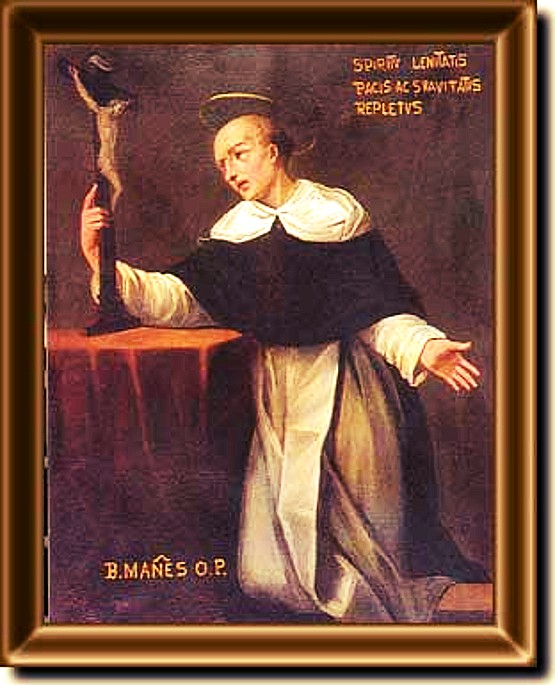
Saint of the Day – 30 July – Blessed Manés de Guzmán OP (c 1168-1235) Dominican Priest and Frair, older Brother of Saint Dominic (1170-1221- born as Manés de Guzmán y Aza in c 1168 at Caleruega, Castile (in modern Burgos, Spain) and died in 1234 in the Monastery of San Pedro de Gumeil, Izan, Castile (in modern Burgos, Spain) of natural causes. Also known as – Mamerto, Mamés, Manez, Mannus. According to an early source he was “a contemplative and holy man, meek and humble, joyful and kind and a zealous preacher.”
Blessed Manés on the left and Saint Dominic on the right
Manés was the second son of Félix Núñez de Guzmán and Juana de Aza . His younger brother was Dominic de Guzmán , Founder of the Order of Preachers and whom Manés helped in his reforming goals throughout his life. His older brother was Antonio de Guzmán, who became a Diocesan Priest in a hospice and devoted himself unreservedly, to works of mercy in the service of the poor. He received the first teachings from his Parents and his Uncle, Archpriest Gonzalo de Aza in Gumiel de Izán. Initially, in 1183, he joined the Cistercians in the San Pedro Monastery in Gumiel de Izan.
In 1215, Dominic established himself, with six followers, in a house given by Peter Seila, a rich resident of Toulouse. Dominic saw the need for a new type of Order to address the spiritual needs of the growing Cities of the era, one that would combine dedication and systematic education, with more flexibility than either Monastic Orders or the secular Clergy. He subjected himself and his companions to the Monastic Rules of prayer and penance; -Bishop Foulques gave them written authority to preach throughout the territory of Toulouse. Pope Honorius II approved the the Ordo Praedicatorum (“Order of Preachers”) in the same year.
On 15 August 1217, Manés, having left the Cistercian Monastery, joined his brother as one of the first 15 Dominican. He placed himself under his brother’s guidance from the foundation of the Dominican Order.
In the same year, he helped establish the Priory of St Jacques in Paris and his brother arranged ,that, accompanied by Friar Miguel de Fabra, he make a trip to Spain in order to consolidate and strengthen the new houses of the Order in their Country of origin. In 1219 , he was entrusted, by his brother, with the care of the Dominican nuns of the Madrid Convent. .
After the Canonisation of his brother ( 3 July 1234 ), he marched to Caleruega to propose the construction of a Church in the place where St Dominic and himself were born in honour of the new Saint. Just a couple of weeks later, he died in the Monastery of San Pedro de Gumiel de Izán and was buried there, where some members of his family were lying, including his mother, Juana de Aza. Having a reputation for holiness, he was buried with all kinds of honours. When they began to venerate and pray at his tomb, his relics were transferred from his family’s crypt to the main Altar, there they were exposed for public veneration.
In the personality of Manés we can guess at common traits with Dominic: austerity, sobriety and the manners of the Castilian male. His spirit of service and attachment to the founding principals of his brother’s Order, shows that he had a gregarious spirit and the humility of obedience in service.
Likewise, Manés reveals a community spirit, obedient and based on the mission that was presented to him. His way of being and his way of doing shows a Dominican spark: – “making oneself while making the community” and vice versa, “making the community while making oneself.”
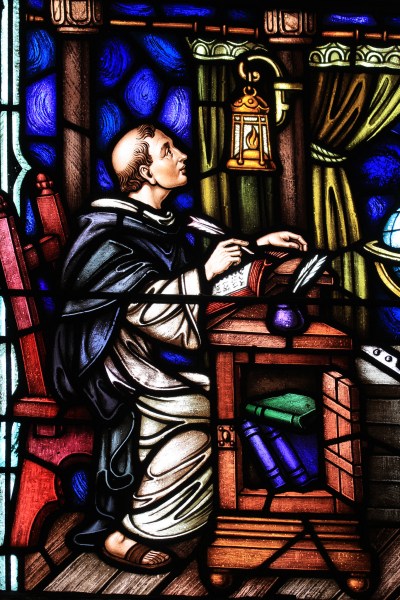
Blessed Manés’ in a Stained glass window from St Dominic’s Church in Washington, D.C. Photo by Fr Lawrence Lew, O.P.
Being Dominic’s brother does not hide Manés’ importance as Dominic’s partner, not only in his childhood in Caleruega but also throughout their time together in the new Order. Over time, Manésy showed himself as a brother by blood but also as a brother in faith and in the hope of saving souls. Domingo felt him by his side and trusted him. The results of the orders carried out by Manés, speak for themselves.
Blessed Mané is one of the most beloved figures in the Dominican family, as the blood brother of St Dominc and his companion in the founding of the Order. His contemporary Friars said of him:
“He was a contemplative and holy man” – Friar Gerardo de Frachet “Gentle, humble, jovial and benign and ardent preacher” – Friar Rodrigo Cerrato ….. Ana OP
Saint of the Day – 23 July – Blessed Giovanna of Orvieto OP (c 1264-1306) Virgin, Tertiary of the Order of Preachers, Mystic, Stigmatist , miracle-worker. Born in c 1264 at Carnaiola, Italy and died on 23 July 1306, aged 42, of natural causes. She was known for her wise intellect and for her intense devotion to serving the will of God while being noted for the charism of prophecy and visions. Patronages – embroiderers, seamstresses, Italian working women (chosen in 1926). Also known as Jane and Vanna of Orvieto.
The Roman Martyrology states of her today: “In Orvieto in Umbria, Blessed Giovanna, Virgin, Sister of Penance of Saint Domenic, distinguished for charity and patience.”
Giovanna was born near Orvieto, in 1264 of humble peasant parents who both died when she was very young. Moved by a celestial instinct, she entrusted herself entirely to the custody of the Angels, whose loving protection she was deeply aware of.
At the age of ten, she consecrated herself to Jesus and was already yearning for a life of complete dedication to Him. In the meantime she grew beautiful and graceful, while the plan to enter the Third Order of St Dominic, then in bloom, was maturing in her heart. members publicly wore the habit and led religious life, without however, leaving their respective homes.
Realising her decision, the relatives, with whom Giovanna lived, and who had already promised her to a rich young man of the area, showed themselves highly indignant at her decision and began to hinder her in every way.
The young girl then, left Carnaiada and took refuge in nearby Orvieto, where other relatives assisted her, offering her a solitary room and the freedom to serve God. Giovanna, who was only 14 years old at the time, was thus able to receive the white habit of the Order.
Her life was an admirable ascent in the most heroic ways of love. Encouraged by very high contemplation, she entered with so much tenderness in the mysteries of the Passion of Jesus, that she deserved a painful participation in it.
In the last ten years of her life, every Friday, when she entered into ecstasy, she looked like a living crucifix and her bones dislocated with so much clatter, as if they were shattered. To her fellow citizens she was a mirror and teacher of Christian life.
After her death, which took place on 23 July 1306 in Orvieto, from the wound in her side, living blood flowed and God honoured her with many miracles. Her body rests in the Town Church of St Domenic. In 1926 she was elected Patroness of Italy for female workers, seamstresses and embroiderers.
The year after her death, her body was transferred to the Chapel of the Three Kings and many miracles occurred, giving impetus to the process of Beatification, which, however, was not completed for more than 400 years
Giovanna was Beatified on 11 September 1754 by Pope Benedict XIV (cultus confirmed).
Our Morning Offering – 20 July – “Month of the Most Precious Blood”
Our Lord, King of all! By St Albert the Great (1200-1280) Doctor of the Church
We pray to You, O Lord, who are the supreme Truth, and all truth is from You. We beseech You, O Lord, who are the highest Wisdom, and all the wise depend on You for their wisdom. You are the supreme Joy, and all who are happy owe it to You. You are the Light of minds and all receive their understanding from You. We love, we love You above all. We seek You, we follow You, and we are ready to serve You. We desire to dwell under Your power for You are the King of all. Amen.
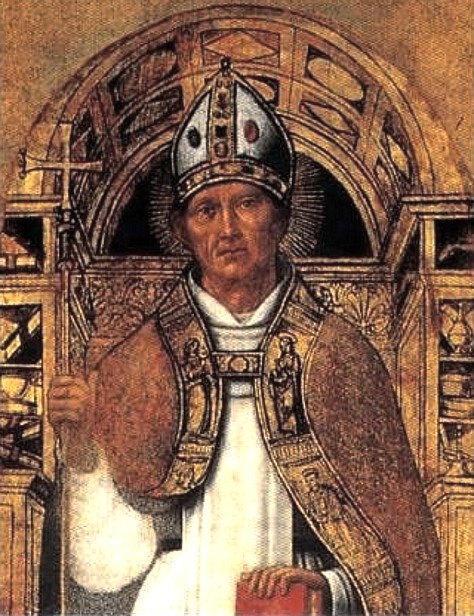
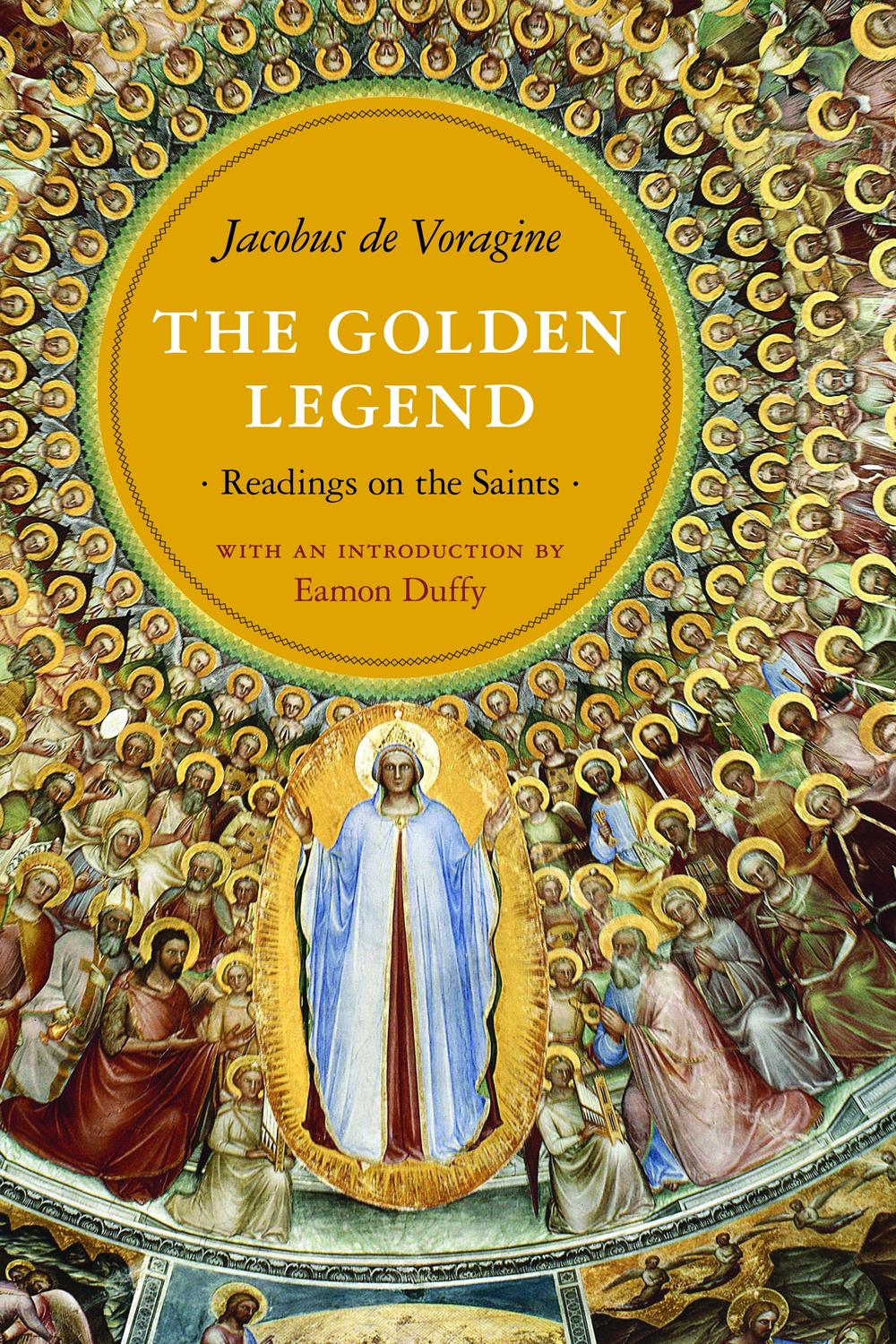
Saint of the Day – 13 July – Blessed James of Voragine OP (c 1226 – 13 or 16 July 1298) Archbishop of Genoa, Author of the ‘Golden Legend’ (a collection of lives of Saints and treatises on Christian festivals, one of the most popular religious works of the Middle Ages and is still published and referred to today – completed 1265), Priest and Friar of the Order of Preachers of St Dominic, Writer, Scholar of great genius, Prior and Provincial General of the Order. Born as Giacomo da Varazze in c 1226 at Varazze (modern Voragine), Diocese of Savona, Italy (near Genoa) and died on either 13 July or 16 1298 in Genoa, Italy of natural causes. Also known as – James of Varazze, James of Viraggio, James of Genoa, Giacomo, Jacob, Jacobus, Jacopo.
James of Voragine has been Beatified by the Church for the sanctity of his life. He lives in secular history for quite a different reason – he was a creative genius of his age. His Golden Legends, which has enjoyed a circulation of nearly seven centuries, is only one of several projects which in his time, as in ours, are a tribute to the versatility of the man and the zeal of a Saint.
Little is recorded of the childhood of James. He entered the Order of Preachers in Genoa and soon was known, both for his virtue and for a singularly alert and practical mind. Tradition says that James was the first to translate the Bible into Italian. Whether this is true or not, it is ample evidence that he was a true scholar.
As Prior, provincial,and later Archbishop, James gained a reputation for strict observance, heroic charity and sound good sense. He was a builder where war had wrecked, a peace maker where others sowed trouble. He must of had a contagious zeal, for the wealthy gave to him as readily as the poor begged from him and under his hand, ruined Churches and hospitals were restored, the sick and poor were cared for, and good practices and devotion reignited. He was a genius at getting things done and, fortunately, his whole heart was bent on doing good for the glory of God.
Like others of his calling and training, James was first of all a Preacher. For those many who could not read, one of the chief means of instruction was via sermons, which took their key note from the feast of the day. The Saints, the stories of their live and examples of their virtues became as much part of a Christians life as the people around him. The collection of stories – later called The Golden Legend – started as a series of sermons prepared by James for the various festival of the Saints. Since he preached in Italian, rather than in Latin, his sermons had immense popular appeal and they were rapidly copied by other Preachers into all the languages of Europe. The Golden Legend was , next to the Bible, the most popular book of the Middle Ages.
James was rigorous in his observance of the Dominican Rule, which, is of itself, enough to canonise him. He had also the good sense to make use of changing trends to further the work of God. Today he would be using the digital world, the press, the movies, and television – then ,he used what his century had to offer – sermons in the vernacular, religious drama and music. How much present day drama and music owed to him, it would be impossible to say.
There is an amusing story told of his efforts to fight fire with fire. He organised a troop of jugglers and acrobats from the student Novices of San Eustorgio, in Milan, who were to mingle entertainment with doctrine in staging ‘plays’ to teach and in an effort to combat the indecency of the secular theatre. This was one scheme which left no lasting effect but it does serve to show, that James was a man of his times, alert to the changing needs of a fast-moving world and whole-heartedly determined to win the world to the truth of the One Holy Catholic Faith by any honest means that came to hand.
Purity, poverty and charity were the outstanding virtues of this man whom the Church has seemed fit to enroll among Her blesseds. He will always be recognised in Dominican history as a man of many and peculiar gifts, who consecrated his talents to God and, in trading with them , gained heaven. Blessed James was Beatified on 11 May 1816 by Pope Pius VII.
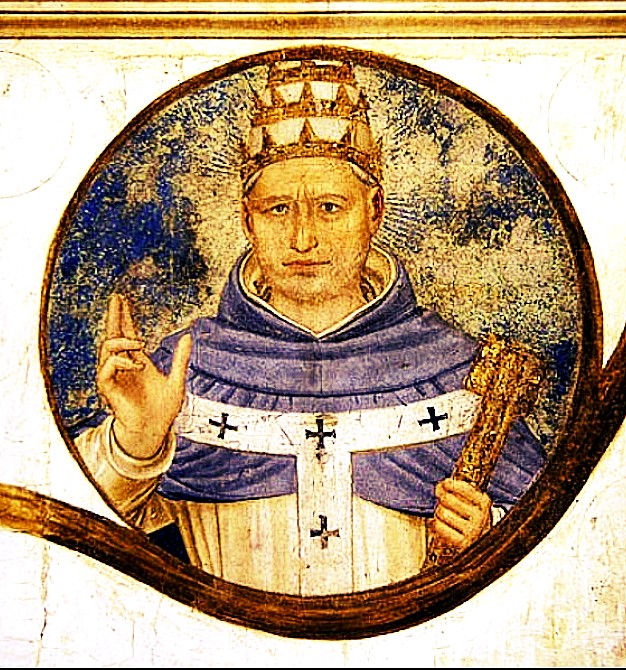
Saint of the Day – 22 June – Blessed Pope Innocent V OP (c 1225-1275) Bishop of Rome and Ruler of the Papal States from 21 January to 22 June 1276 (the date of his death), Friar of the Order of Preachers, Theologian, renowned Preacher, Scholar, Writer, Dominican Office bearer, disciple of St Albert the Great and collaborator and friend of St Thomas Aquinas.and St Bonaventure. He acquired a reputation as an effective preacher. He held one of the two “Dominican Chairs” at the University of Paris, the other being held by St Albert the Great and was instrumental in helping with the compilation of the “program of studies” for the Order. In 1269, Peter of Tarentaise was Provincial of the French Province of Dominicans. He was a close collaborator of Blessed Pope Gregory X, who named him Bishop of Ostia and raised him to Cardinal in 1273. Upon the death of Gregory in 1276, Peter was elected Pope, taking the name Innocent V. He died about five months later but during his brief tenure facilitated a peace between Genoa and King Charles I of Sicily. Innocent V was Beatified on 9 March 1898 by Pope Leo XIII. Born in c 1225 at Tarentaise, Burgundy, France as Petrus a Tarentasia and died on 22 June 1276 at Rome, Italy of natural causes. Also known as – Doctor famosissimus, Petrus a Tarentasia, Peter of Tarentaise.
The Roman Martyrology states of him today: “At Rome, Blessed Innocent V, Pope who laboured with mildness and prudence, to maintain liberty for the Church and harmony among Christians. The veneration paid to him. Pope Leo XIII approved and confirmed.”
Petrus a Tarentasia, was barely 10 years old when he was admitted to the Dominican Order by Blessed Jordan of Saxony as a boy-novice and sent to Paris to study. Like Saint Thomas Aquinas, Blessed Ambrose of Siena and other luminaries of the 13th century, he fell under the masterly tutelage of Saint Albert the Great. He received his Master’s Degree in theology in 1259, then he taught for some years in Paris, where he contributed a great deal to the Order’s reputation for learning. He wrote a number of commentaries on Scripture and the Commentary on the Sentences of Peter Lombard but he devoted most of his time to the classroom. He soon became famous as a preacher and theologian, and in 1259, with a committee including his friend Thomas Aquinas, composed a plan of study that is still the basis of Dominican teaching.
At age 37, Peter began the long years of responsibility in the various offices he was to hold in his lifetime as Prior Provincial of France. He visited ,on foot, all Dominican houses under his care and was then sent to Paris to replace Thomas Aquinas at the University of Paris. Twice Provincial, he was chosen Archbishop of Lyons in 1272 and administered the affairs of the Diocese for some time, though he was never actually Consecrated for that See.
The next year Peter was appointed Cardinal-Archbishop of Ostia, Italy, while still administering the See of Lyons. With the great Franciscan, Saint Bonaventure, he assumed much of the labour of the Council of Lyons, to which Saint Thomas was hastening at the time of his death. To the problems of clerical reform and the healing of the Greek schism the two gifted Friars devoted their finest talents. Before the Council was over, Bonaventure died, and Peter of Tarentaise preached the funeral panegyric.
In January 1276, Peter was with Blessed Pope Gregory X when the latter died at Arezzo. The conclave was held in the following month. On 21 January, 1276, Peter of Tarentaise received every vote except his own. With a sad heart, he left the seclusion of his religious home to ascend the Fisherman’s Throne as Pope Innocent V.
The reign of the new Pope, which promised so much to a harassed people, was to be very brief. But, imbued with the spirit of the Apostles, he crowded a lifetime into the short space given him.
He instigated a new crusade against the Saracens and began reforms in the matter of regular observance. He actually succeeded in solving many of the questions of the Greek schism and in establishing a short-lived truce. He struggled to reconcile the Guelphs and Ghibellines, restored peace between Pisa and Lucca and acted as mediator between Rudolph of Hapsburg and Charles of Anjou. He restored the custom of personally assisting at choral functions with the canons of the Lateran and he inspired all, with the love that animated his heart.
Had the measures begun by Innocent V had time to be fully realised, he might have accomplished great good for the Church; he did at least open the way for those who were to follow him.
Death stopped the hand of the zealous Pope when he had reigned only five months. Like his friends Saint Thomas and Saint Bonaventure, he was untouched by the honours and dignity with which he had been favoured and death found him exactly what he had been for more than 40 years–a simple, humble Friar.
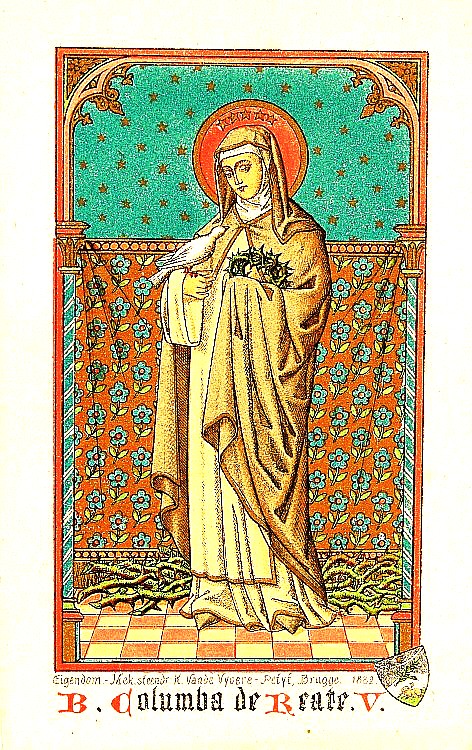
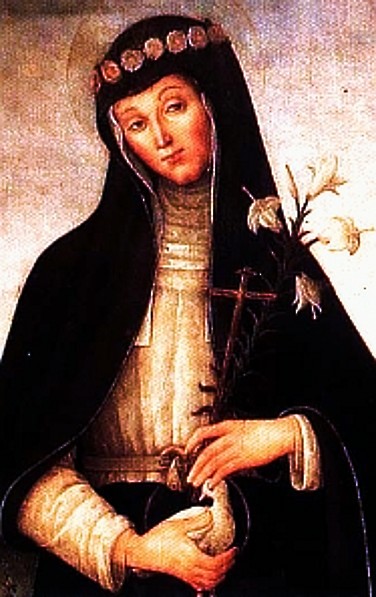
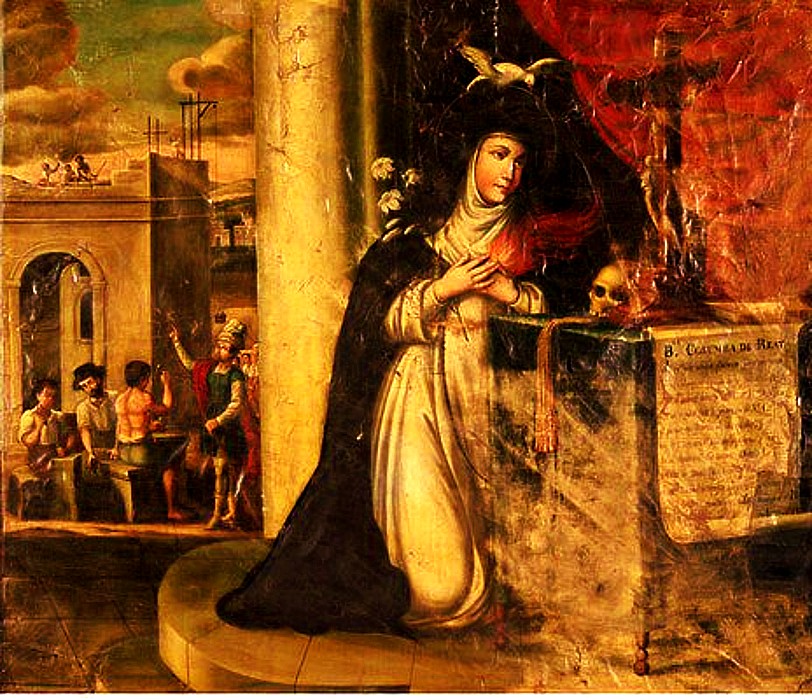
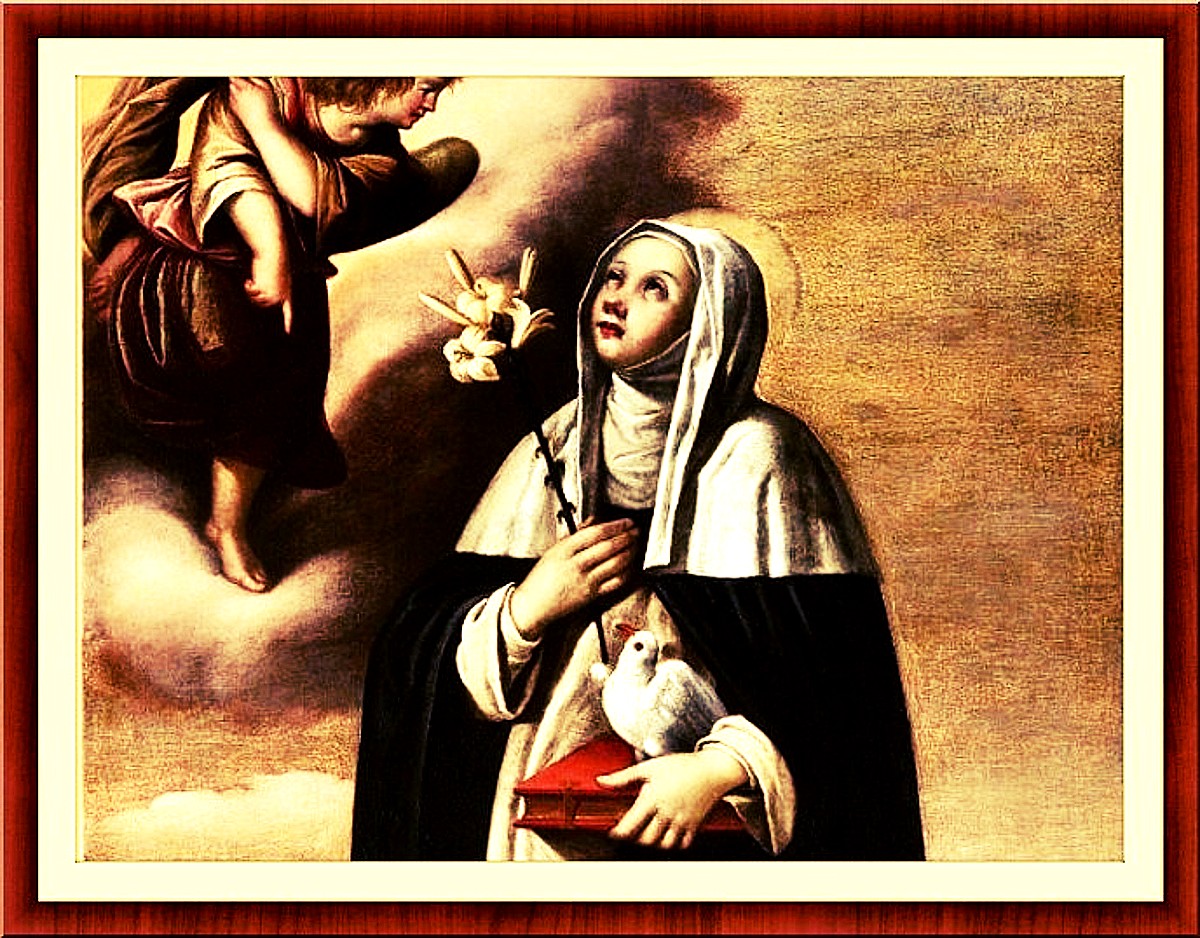
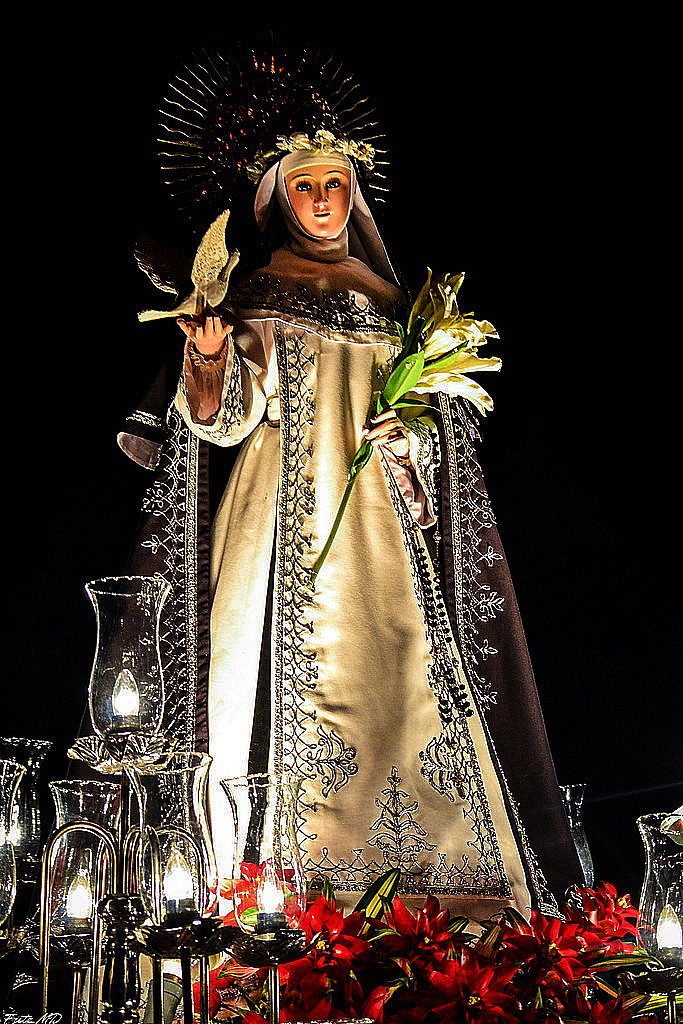
Saint of the Day – 20 May – Blessed Columba of Rieti OP (1467- 1501) religious Sister of the Third Order of St Dominic, Mystic, Apostle of the poor, renowned for her spiritual counsel, devotion to the Blessed Sacrament and fantastic miracles were attributed to her. Born on 2 February 1467 at Rieti, Umbria, Italy as Angelella Guardagnoli and died on 20 May 1501 at Perugia, Italy of natural causes. Patronages – Against sorcery, against temptation, Perugia, Italy. Also known as – Angelella Guardagnoli, Colomba of Rieti.
Columba was the daughter of a poor family in the Umbrian city of Rieti. When she was born, angels gathered around her house, singing and during her Baptism, a dove flew down to the font. From then on, no-one referred to her as Angelella but as Columba , which means “dove”.
From infancy Columba led a supernatural life. She strewed her little bed with thorns and from an old sieve ,plaited a hair-shirt. As a small girl, Columba learned to spin and sew, repairing the clothes of the local Dominican Friars. She was educated by Dominican nuns. The Holy Eucharist formed her one desire and almost her sole nourishment. Hunger, thirst, sleep and the other needs of nature, not only never tormented her but she lived unconscious of them.
As a teenager, she prayed to discern her vocation in life and received a vision of Christ on a Throne surrounded by Saints. She took this as a sign to dedicate herself to God and so, she made a private vow of chastity and spent her time in prayer. When it was revealed that her parents had arranged a marriage for her, she cut off her hair and sent it to her suitor as a way of letting him know, where her real interest lay.
Columba became a Dominican Tertiary at age 19. She was given to ecstasies, during one of which, her spirit toured the Holy Land. She was much sought after as a spiritual counselor. Citizens from the City of Narni, tried to kidnap her so she could be their miracle worker but she escaped.
Upon an interior prompting that she should leave Rieti, Columba wandered away, having no concept of where she was going. Along the way she was arrested in Foligno as a vagrant. The Bishop there ordered her to go to Perugia and to found a Third Order Convent, which she did but only against the strong objections of the citizens of Foligno and Rieti, who wanted her for their own needs.
She worked with the poor extensively in Perugia, so much so, that her sanctity reportedly incensed Lucrezia Borgia for years. At one point Borgia had even issued a complaint accusing Columba of practising magic. On the other hand, Pope Alexander VI, Lucrezia’s father, held Columba in high regard. He consulted her and she ordered him to repent of his sins.
If Columba’s reception of Holy Communion was delayed by but one hour, she fainted from exhaustion and her life seemed in danger. Her Confessor, fearing some delusion, asked her how she was able to live on the Blessed Sacrament alone. “When I receive this heavenly food,” she replied, “I feel so satisfied in soul and body that all desire for earthly food vanishes and I have a horror of it. I hope that before this year is over, God will give you a sign which will remove your doubts.” On Christmas-day, as this Priest finished his first Mass, he felt an unknown refreshment of soul. When he had said his third Mass, this heavenly love had reached such a height, that he felt it impossible to touch food and so remained fasting throughout the day. This was revealed to Columba, who said, “I rejoice, Father, that you have received my heavenly food and now know, by experience, how I can be satisfied by the Bread of angels alone!”
Columba spent eleven years as Prioress in Perugia, dying on 2 May 1501, at the age of 34. At the moment of her death, her friend and fellow Dominican Tertiary, Blessed Osanna of Mantua (1493-1565), saw Columba’s soul as a “radiance rising to heaven.”
The whole City attended her funeral, which was paid for by the City administrators.
She was Beatified on 25 February 1625 by Pope Urban VIII and her Feast day is celebrated within the Dominican Order on the anniversary of her death. As Patron of Perugia, she is highly venerated and Statues of her abound in the region.
Our Morning Offering – 10 May – “Mary’s Month” Monday of the Sixth Week of Easter
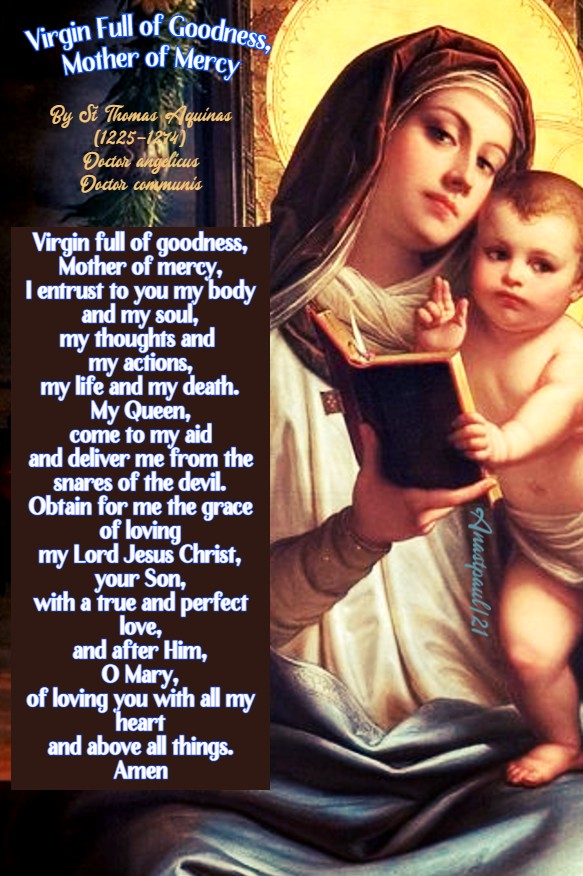
Virgin Full of Goodness, Mother of Mercy By St Thomas Aquinas (1225-1274) Doctor angelicus Doctor communis
Virgin full of goodness, Mother of mercy, I entrust to you my body and my soul, my thoughts and my actions, my life and my death. My Queen, come to my aid and deliver me from the snares of the devil. Obtain for me the grace of loving my Lord Jesus Christ, your Son, with a true and perfect love, and after Him, O Mary, of loving you with all my heart and above all things. Amen
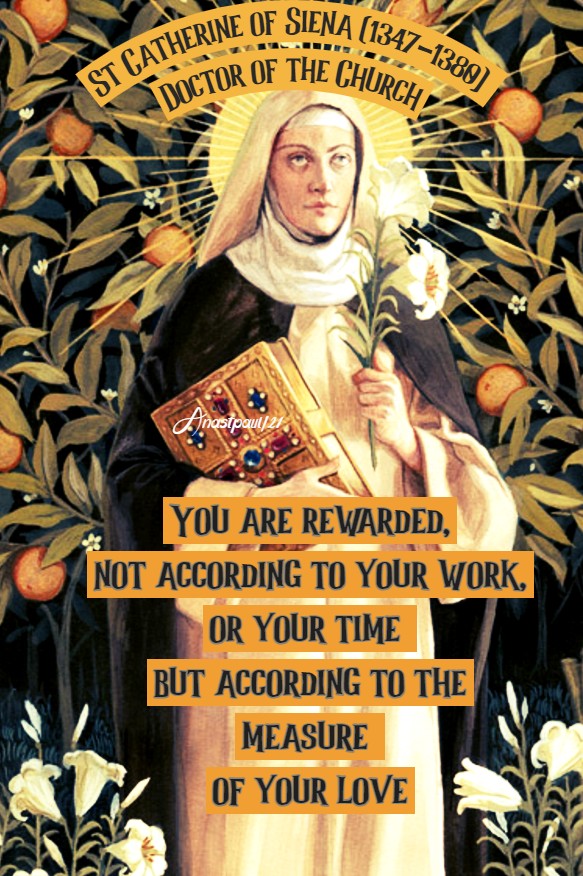
Quote/s of the Day – 29 April – The Memorial of St Catherine of Siena (1347-1380) Doctor of the Church
“Speak the truth in a million voices. It is silence that kills!”
“Be strong and kill yourself with the sword of hate and love, then you will not hear the insults and abuse. which the enemies of the Church throw at you. Your eyes will not see anything, which seems impossible, or the sufferings, which may follow but only the light of faith and in that light , everything is possible and remember , God never lays greater burdens on us than we can bear.”
“You are rewarded, not according to your work, or your time but according to the measure of your love.”
St Catherine of Siena (1347-1380) Doctor of the Church
Saint of the Day – 27 April – Blessed Osanna of Cattaro OP (1493-1565) Virgin, Mystic, Anchoress., Tertiary of the Order of St Dominic, spiritual guide. Born on 25 November 1493 at Kumano, Montenegro as Catherine Cosie and died on 27 April 1565 in Kotor, Montenegro of natural causes, aged 71. Patronage – Kotor, Montenegro. Also known as – Catherine Cosie, Catherine Kosic, Catherine of Montenegro, Hosanna of Kotor, Ossana of Cattaro, Ozana Kotorska, “Teacher of Mysticism,” “Angel of Peace,” “Virgin Reconciler”and “Trumpet of the Holy Spirit.” Her Body is incorrupt.
Over the course of her life, the people of Kotor came to call her “the trumpet of the Holy Spirit” and the “teacher of mysticism.” People from all walks of life came to her for advice and she interceded particularly ,for peace in the town and among feuding families. Therefore, she was also called “the Virgin Reconciler” and the “Angel of Peace.”
The life of this Blessed has a very special charm. Born in 1493 to very humble Orthodox parents in Kebeza, during the heart of the Greek schism, she was given the name of Catherine at her baptism.
This little shepherdess, enraptured by the beauty of the magnificent views of her Montenegro, she fell in love with the Creator of so many wonders and, with unusual ardour, sheasked Him to show Himself to her. And there, in the solitude of the mountains, Jesus appeared to her first, a tender child and then Crucified, imprinting an indelible seal on her virgin heart.
When she was a little older, she was placed in Kotor as a servant in the family of a Senator, an excellent Catholic. Here, she was able to educate herself in the true faith and to receive the Sacraments. Having known the Dominicans, at the age of twenty-two, she made a heroic decision: -to become a recluse forever, taking up the habit and the Rule of the Third Order of St Dominic.
And so, walled up in a cell next to the Church of St Paolo, run by the Dominicans, she lived in the contemplation of the pains of Jesus and in the complete immolation of herself. She was also a teacher of holiness to countless souls but above all she was the guardian angel of Kotor. Although she lived alone, there was nothing selfish about Osanna’s spirituality. A group of her Dominican sisters, who considered her their leader, consulted her frequently and sought her prayers. A convent of sisters founded at Cattaro, regarded her as their foundress,because of her spiritual guidance and prayers, although she never saw the place. When the City was attacked by the Turks, the people ran to her for help and they credited their deliverance to her prayers. Another time, her prayers saved them from the plague.
She died on 27 April 1565. Her body rests in the Church of Santa Maria in Kotor.
The incorrupt body of Osanna was kept in the Church of St Paul until 1807, when the French Army converted the church into a warehouse. Her body was then brought to the Church of St Mary. The people of Kotor venerated her as a saint. In 1905, the process for her Beatification began in Kotor and was successfully completed in Rome. On 21 December 1927, Pope Pius XI approved her cultus, invoking its intercession for Christian unity and in 1934, he formally Beatified her.
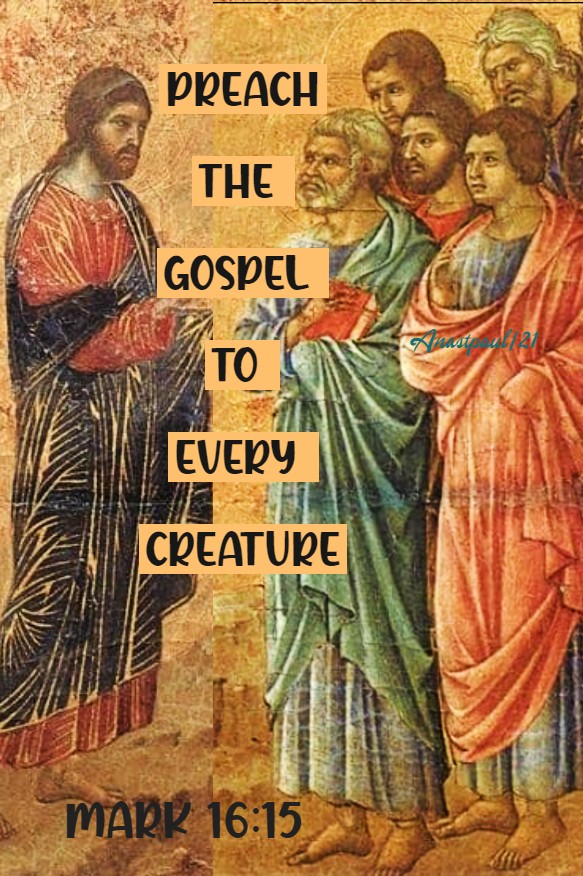
Quote/s of the Day – 10 April – Easter Saturday, Readings: First: Acts 4: 13-21, Psalm: Psalms 118: 1 and 14-15ab, 16-18, 19-21, Gospel: Mark 16: 9-15
“Preach the gospel to every creature”
Mark 16:15
“I send you a very little word, THE WORD, made little in the crib, THE WORD, made flesh for us …. THE WORD, of salvation and grace THE WORD, of sweetness and glory THE WORD Who is good and gentle – JESUS CHRIST!”
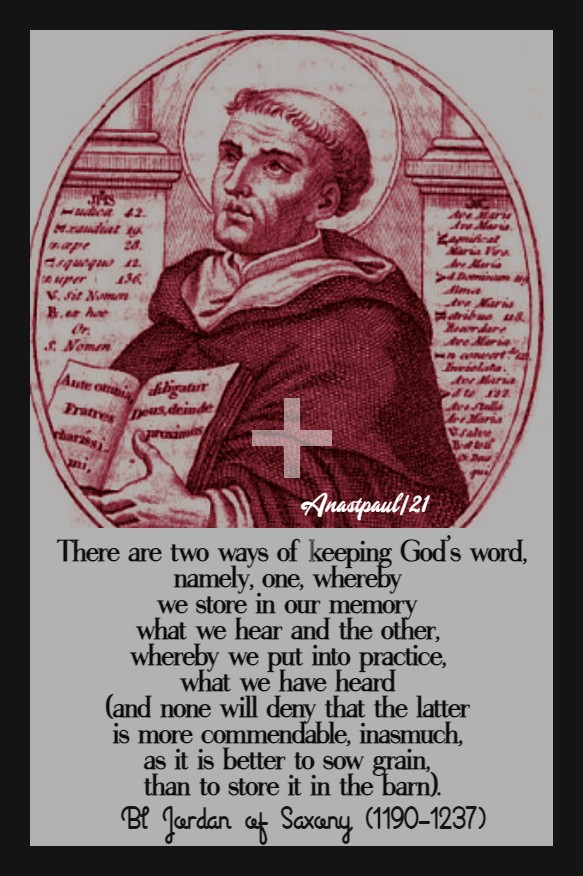
“There are two ways of keeping God’s word, namely, one, whereby we store in our memory what we hear and the other, whereby we put into practice, what we have heard (and none will deny that the latter is more commendable, inasmuch, as it is better to sow grain, than to store it in the barn).”
Our Morning Offering – 5 April – Easter Monday and the Memorial of St Vincent Ferrer OP (1350-1419)
Grant me, O my God By St Vincent Ferrer (1350-1419)
Good Jesus, let me be penetrated with love to the very marrow of my bones, with fear and respect toward You. Let me burn with zeal for Your honour, so that I may resent all the outrages committed against You, especially those of which I myself have been guilty. Grant further, O my God, that I may adore and acknowledge You humbly, as my Creator and that, penetrated with gratitude for all Your benefits, I may never cease to render You thanks. Grant that I may bless You in all things, praise and glorify You, with a heart full of joy and gladness and that, obeying You with docility in every respect, I may one day, despite my ingratitude and unworthiness, be seated at Your table together with Your Holy Angels and Apostles to enjoy ineffable delights. Amen
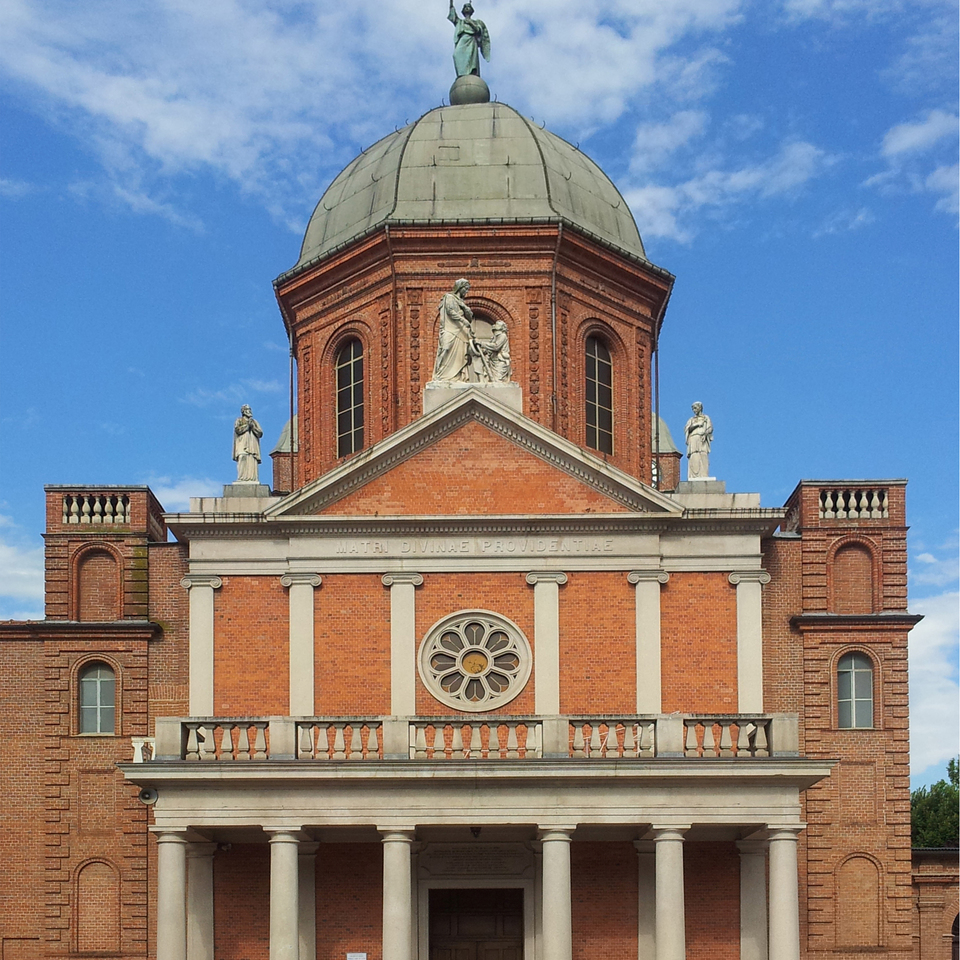
Santuario Madonna della Divina Provvidenza / Our Lady of Divine Providence, Cussanio, Italy (1521) – 5 April:
In the locality where the Sanctuary now stands, a poor deaf-mute of vulgar appearance and short stature, dressed in a rough habit, used to lead the animals to pasture. Nobody cared about him but on 8 May 1521 Bartholomew Coppa saw a Lady dressed in white coming to meet him, who approached him with maternal affection and blessed him with the word. He then told him to go to Fossano to announce the justice of God and to warn, that there would be great scourges without doing penance.
Having said this, the Lady disappeared and Bartolomeo ran to tell the story. His acquaintances hearing him speak were shocked and the kindest pushed him to carry out the mission that had been entrusted to him. So Bartholomew went through the streets of the City to become a proclaimer of penance and to send Christians to leave the way of sin, threatening the punishments of God. But he was not listened to and he was disheartened, tired and hungry after three days, he returned to the place. of the prodigy and here he fell asleep on the ground. And it is here that a new miracle took place. The Lady, who does not abandon her faithful, appeared to him a second time, no longer dressed in white but dressed in blue, gave him bread, repeated the command of the first time and disappeared. Bartholomew waking up, found food and gave thanks to the divine benefactress. He brought some of the bread to his master and those in the neighbourhood and reminded them of the Lord’s threats. But again it was not believed. After just six months, in October of the same year, a horrendous plague broke out in Fossano and its surroundings. Thousands of victims and desolation, death and sadness reminded the people of Fossano the words of poor Bartolomeo, who had foretold these punishments. They then decided to follow his words and the plague subsided. Then in memory of the prodigious event they had a small Chapel built on the site of the Apparition of the Madonna, dedicating it to the Queen of Heaven.
In 1600 the Augustinian Brothers of the Congregation of Genoa came to Cussanio and the friars built the great Monastery complex next to the Sanctuary. During the French Revolution the Convent and Church were suppressed and the buildings forcibly abandoned.
Then, in the year 1872, the Bishop, Emiliano Manacorda, a personal friend of Saint Don Bosco, arrived at the Diocese and claimed ownership of the Monastery which had been wrongfully confiscated by the state and proceeded upon the complete renovation of the Sanctuary. Work began shortly after 1875 and continued for about twenty years and included the elevation of the majestic dome and the reconstruction of the entire façade. The nave was extended, two aisles built and the interior was adorned with Altars, sculptures and paintings. Two of the paintings, attributed to the painter Giuseppe Barotto, depict the two scenes mentioned above and are now preserved in the Church.
St Albert of Montecorvino Bl Antonius Fuster St Becan Bl Blasius of Auvergne St Catherine of Palma OSA (1533–1574) Nun St Claudius of Mesopotamia St Derferl Gadarn St Gerald of Sauve-Majeure St Irene of Thessalonica St Maria Crescentia Hoss
Martyrs of North-West Africa: Large group of Christians murdered while celebrating Easter Mass during the persecutions of Genseric, the Arian king of the Vandals. They were martyred in 459 at Arbal (in modern Algeria).
Martyrs of Seleucia: 120 saints – One-hundred and eleven (111) men and nine (9) women who, because they were Christians, were dragged to Seleucia and martyred for refusing to worship the sun or fire or other pagan idols during the persecutions of King Shapur II. They were burned alive in 344 in Seleucia, Persia.
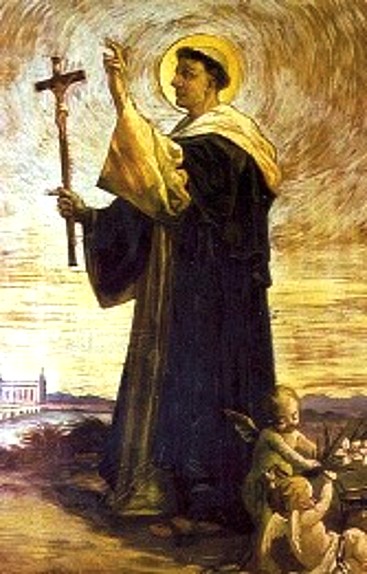
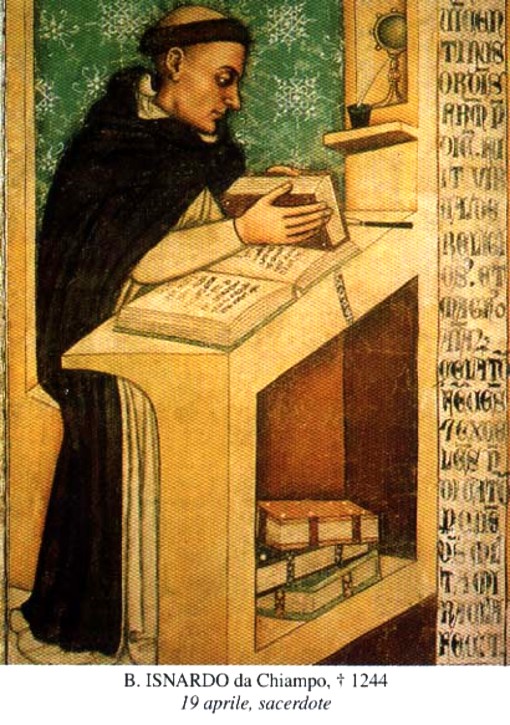
Saint of the Day – 19 March – Blessed Isnard de Chiampo OP (Died 1244) Priest of the Order of Preachers, known as the “Apostle of Pavia,” Confessor, miracle-worker, Founder of Convents. Isnard had a profound devotion to the Mother of God. He perpetually preached her protection over the faithful. In every way he propagated love and veneration for her.Born at Chiampo, Diocese of Vicenza, Italy and died on 19 March 1244 of natural causes. Patronage – Chiampo, City and Diocese. Additional Memorial – 22 March in Chiampo. He is also known as Isnardo, Isnard of Vicenza, the “Apostle of Pavia.”
Blessed Isnard is another very distinguished and saintly first disciple of Saint Dominic. Of Isnard’s life up to the time he entered the Order, practically nothing is known with certainty. Chiampo, a small town not far from Vicenza, Italy, was most likely the place of his birth; yet there are those who give the latter city this honor. Some think he was born of poor parents and spent his youth in poverty. Others suggest that he belonged to a wealthy family by the name of Isnardi, which has been long extinct.
It is beyond doubt that the future wonder-worker received the habit in Bologna, from Saint Dominic himself, in 1219; for this is a point on which nearly all the early authors are in accord. This truth seems certainly to prove that he was a student at the university there and far advanced in his studies, At that time only such applicants were accepted; and this fact is a strong proof that his parents were well-to-do, for only the sons of this kind were given a higher education. Without exception, the writers tell us of his singular purity of heart and religious disposition. His mind had been carefully guarded against the evils of the day and in Bologna, he proved faithful to the lessons of his earlier youth. Association with the holy man from Caleruega, St Domiic, quickened his efforts for holiness of life and the salvation of souls.
For ten years after he entered the Order of Saint Dominic, we have no positive knowledge of where Isnard made his home. Yet the indications are that he spent this time between Bologna and Milan. In which case, of course, he labored energetically in those parts of Italy. Although a quite corpulent man, we are told, he was endowed with extraordinary energy and was very gracious in action, as well as, in word. St Eustorgio, Milan, was most likely his Convent for the greater part of this decade.
In more than one of our sketches but especially in that of Saint Peter of Verona, we have seen how the Albigenses and kindred sects overran northern Italy at that date. Milan was one of the centres of Dominican activity against them and it was from Milan that the Convent of the Order in Pavia was founded. The City was also a stronghold of Frederic II, whose Ghibellines, always opposed to the Holy See, constantly persecuted those who favoured the authority of the Church. When, in 1230, zealous Rodobald Cipolla became Bishop of Pavia, he found religion in a sad plight in his Diocese and began at once to seek means for a reformation.
Blessed Isnard’s reputation for holiness of life, zeal, eloquence, power over the souls of others and fearlessness, was broadcast. Most likely he had already preached in the Diocese of Pavia — perhaps many times; for the Friars Preacher of Milan, carried their work in every direction. Possibly, too, he and Bishop Cipolla, himself an energetic character, had become friends at a prior date. Anyway, one of the new Prelate’s first steps for the spiritual betterment of his flock was to invite Isnard from Milan, that he might establish a house of the Order at Pavia. This was in 1231 and before the close of the year, we find the Fathers actively engaged in their apostolate under the leadership of the man of God, Isnard.
The Convent, which the Bishop generously helped to erect, stood in the little village of Ticino, a short distance outside the walls of Pavia and was given the name of Saint Mary of Nazareth. Throughout Italy the Friars Preacher were known as an effective aid to the hierarchy against the evils of the day. Thus Bishop Cipolla felt that, at least under Isnard, they would be an immense help to him in putting an end to the inroads of the enemy and ,in freeing his Diocese from the many ills in which it was enmeshed. He had not long to wait before he saw that his choice of assistants, was no mistake.
However, the task proved difficult, trying and full of danger. On the one hand, the faithful, through long bad associations, had become so cold, careless and wayward in the practice of their religious duties, that it was difficult to arouse them to a sense of their obligations.
Isnard’ssuccess began with the poor and the labouring classes. For these, he had a special love. He gathered them around him at the conventual Church, instructed them in their religion and inspired them with a love of its practice. Although he met with much opposition at first, it was not long before he had completely changed their lives. Reports of the good thus effected, soon spread near and far. Meanwhile, he and his confrères preached throughout the City of Pavia and its environments — in Churches, public squares, market places, or wherever they could find a space large enough for an audience. Gradually the wealthier Guelfs and even not a few of the Ghibellines, began to harken to the call of grace and to receive the Sacraments.
Among the little band of missioners, Isnard shone with special brilliance for his saintliness, zeal and eloquence. The influence which he soon began to wield over the people, caused the leaders of the heretics to single him out for their hatred. They mocked and ridiculed him, publicly spurned him, laughed at his corpulent figure, defamed him, threatened him, did everything in their power either to bring him into disrepute or to make him desist from his tireless apostolate. All was in vain. His sermons were incessant. He challenged his enemies wherever he met them. If they undertook to answer him, his inexorable logic put them to shame, or reduced them to silence. Never was he known to be ill natured, or to lose his patience, yet he showed the fire of divine love that glowed within his breast.
No doubt as much to demonstrate the holiness of His faithful servant as for the benefit of those to whom he preached, God blessed Isnard with the gift of miracles. The early writers mention many wrought by him both before and after his death. These, quite naturally, quickened and strengthened the faith of the Catholics. They also gradually undermined the influence and broke the spirit of the heretics, many of whom were brought into the Church. By the time of the holy man’s death, the Diocese of Pavia was free from attacks by Albigenses, Catharists, and similar sects. They bad gone to other parts, been converted, or held their peace. No-one could be found who would profess their principles. It was a glorious apostolate brought to a successful termination.
Despite the turbulence and the anti-ecclesiastical spirit of the day, the holy Friar Preacher from Chiampo, effected untold good even among this class of citizens. Documents which have escaped the ravages of time show that some, who deferred conversion until on their deathbeds, made him the instrument of their restitution. Others entrusted him with their charity and benefactions. Historians call him an “Apostle of Pavia,” and largely attribute the preservation of the faith in the City, to his zeal.
Another proof of the respect and confidence which Isnard enjoyed among all classes, as well as of his reputation abroad, is found in the incident which we have now to tell. From early times the Diocese of Tours, France, possessed landed estates in and around Pavia. Because of the political disturbances and the Ghibelline spirit, the Canons of the Tours Cathedral, found it impossible to collect their rents. In this dilemma, they appointed our saint their agent; for they felt that he was the only man in northern Italy, who either could obtain their dues for them, or would dare undertake the task. This was in 1240, the year after the historic excommunication of Frederic 11 by Gregory IX. The affair shows bow wisely Isnard steered his course, how all venerated him at home and how well his courage and prudence, were known even in France.
Like a number of the early disciples of Saint Dominic whose lives we have outlined, the apostle and reformer of Pavia did not feel that he had done his all for the benefit of religion until he established a community of Dominican Sisters. These he placed in the immediate vicinity of his own Convent, that he might the better look after their spiritual welfare. Their house bore the same name as that of the fathers — Saint Mary of Nazareth.The dowries of many of these sisters indicate that he founded them, in part, so that wealthy worldly dames, whom he had converted, might have a place in which they could more completely give themselves to the service of God.When, some years after our blessed’s death, the fathers moved into the city proper, the original Saint Mary of Nazareth was turned over to the sisters.
Isnard laboured zealously on, almost to the very last breathe. At least the Lives of the Brethren (Vitae Fratrum) say his final sickness was a matter of only a few days. The manuscript annals, or chronicles, of the old Friar-Preacher convent at Pavia, tell us that he surrendered his pure soul to God on 19 March 1244. He knew that the end was near, prepared for it and died as holily as he had lived.
We have no account of the funeral of the man of God. Yet the great love and admiration in which he was held justify one, in the belief, that the Pavians attended it in immense numbers. Perhaps the sad event plunged the City in no less grief, than his own community. He was buried in the Church of Saint Mary of Nazareth, where his tomb became, at once, a place of pilgrimage for the City and Province of Pavia. Not a few miracles were wrought in answer to prayers to him. The name, Isnard, was often given to children at their Baptism.
In 1850 portions of his relies were given to Chiampo and Vicenza. Old paintings of him here and there, which represented him as a saint, also helped the cause. In 1907 the Diocesan authorities of Pavia, approved of his cult and requested the Holy See to accept their decision. Pope Benedict XV, after a thorough investigation, Beatufied Isnard on 12 March 1919 and granted his Office and Mass to the Friars Preacher and the Diocese of Pavia with 22 March appointed as his feast day in Pavia.
Isnard, is the last of the original disciples of Dominic to be accorded the honours of the altar.
Solemnity of St Joseph, Spouse of the Blessed Virgin Mary – 19 March:
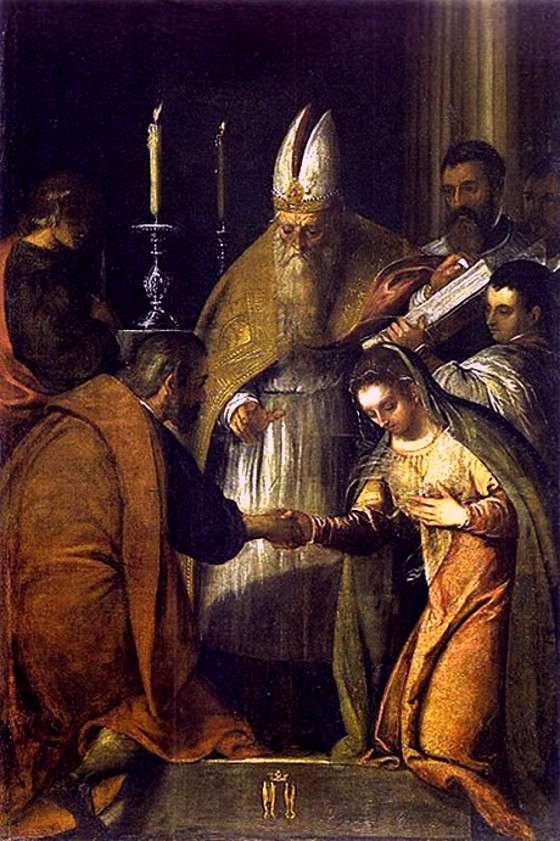
“All the unmarried men gathered in the temple and prayed to the Lord conjointly with the Priests, in order to be governed by the Holy Spirit in what they were about to do. The Most High spoke to the heart of the High Priest, inspiring him to place into the hands of each one of the young men, a dry stick, with the command that each ask his Majesty with a lively faith, to single out the one, whom He had chosen as the spouse of Mary. And as the sweet odour of her virtue and nobility, the fame of her beauty, her possessions and her modesty and her position as being the firstborn in her family, was known to all of them, each one coveted the happiness of meriting her as a spouse. Among them all, only the humble and most upright Joseph, thought himself unworthy of such a great blessing and remembering the vow of chastity, which he had made and resolving anew its perpetual observance, he resigned himself to God’s will, leaving it all to His disposal and being filled at the same time, with a veneration and esteem greater than that of any of the others, for the most noble maiden Mary. While they were thus engaged in prayer, the staff which Joseph held was seen to blossom and at the same time, a dove of purest white and resplendent with admirable light, was seen to descend and rest upon the head of the saint, while, in the interior of his heart, God spoke:
“Joseph, my servant, Mary shall be thy Spouse; accept Her with attentive reverence, for She is acceptable in my eyes, just and most pure in soul and body and thou, shalt do all that She shall say to Thee.”
At this manifestation and token from heaven, the Priests declared Saint Joseph as the Spouse selected by God Himself for the maiden Mary. Calling Her forth for her espousal, the chosen one issued forth like the sun, more resplendent than the moon, and She entered into the presence of all, with a countenance more beautiful than that of an angel, incomparable in the charm of her beauty, nobility and grace and the Priests espoused Her to the most chaste and holy of man, Saint Joseph.”
*From The City of God by Ven. Mary of Jesus of Agreda OIC (1602-1665) (a Franciscan abbess and spiritual writer, known especially for her extensive correspondence with King Philip IV of Spain and reports of her bilocation between Spain and its colonies in New Spain. She was a noted mystic of her era. A member of the Order of the Immaculate Conception, also known as Conceptionists, Mary of Jesus wrote 14 books, including a series of revelations about the life of the Blessed Virgin Mary. Ven Mary of Jesus’ body is incorrupt. Less than ten years after her death, Mary of Jesus was declared Venerable by Pope Clement X, in honour of her “heroic life of virtue.” Although the process of beatification was opened in 1673, it has not as yet been completed.)
St Adrian of Maastricht St Alkmund of Northumbria St Amantius of Wintershoven Bl Andrea Gallerani St Apollonius of Braga St Auxilius of Ireland Bl Clement of Dunblane St Colocer of Saint-Brieuc St Corbasius of Quimperlé St Cuthbert of Brittany St Gemus Blessed Isnard de Chiampo OP (Died 1244) Priest, known as the “Apostle of Pavia” Bl Jan Turchan St John the Syrian of Pinna St Lactali of Freshford St Landoald of Maastricht St Leontinus of Braga St Leontinus of Saintes Blessed Marcel Callo (1921-1945) Martyr Biography: https://anastpaul.com/2019/03/19/saint-of-the-day-19-march-blessed-marcel-callo-1921-1945-aged-23-martyr/
Bl Mark of Montegallo St Pancharius of Nicomedia Blessed Sibyllina Biscossi OP (1287-1367) Her Life: https://anastpaul.com/2020/03/19/saint-of-the-day-19-march-blessed-sibyllina-biscossi-op-1287-1367/ — Martyrs of Sorrento: A group of three sisters and a brother who were martyred together. We have little more than their names – Mark, Quartilla, Quintilla and Quintius. They were martyred in Sorrento, Italy, date unknown. Mark Quartilla Quintilla Quintius
Martyred in the Spanish Civil War • Blessed Alberto Linares de La Pinta • Blessed Jaume Trilla Lastra
Our Morning Offering – 15 March – Monday of the Fourth week of Lent
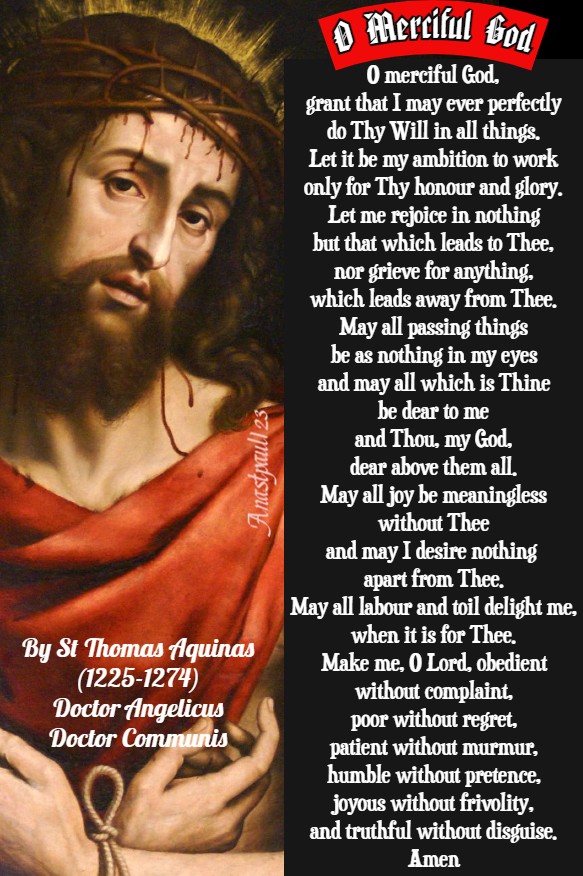
O Merciful God By St Thomas Aquinas (1225-1274) Doctor Angelicus Doctor Communis
O merciful God, grant that I may ever perfectly do Thy Will in all things. Let it be my ambition to work only for Thy honour and glory. Let me rejoice in nothing but that which leads to Thee, nor grieve for anything, which leads away from Thee. May all passing things be as nothing in my eyes and may all which is Thine be dear to me and Thou, my God, dear above them all. May all joy be meaningless without Thee and may I desire nothing apart from Thee. May all labour and toil delight me, when it is for Thee. Make me, O Lord, obedient without complaint, poor without regret, patient without murmur, humble without pretence, joyous without frivolity, and truthful without disguise. Amen
Saint of the Day – 3 March – Blessed Pietro de Geremia OP (1381-1452) Dominican Priest and Friar, renowned and brilliant Preacher, miracle-worker. In addition to his many miracles and conversions of sinners, he founded the University of Catania and help establish several Dominican Monasteries. Born in 1381 at Palermo, Sicily and died on 3 March 1452 in the Convent of Santa Zita, Palermo, Sicily of natural causes. He is also known as Peter Geremia. Patronages – Palermo, Preachers.
Pietro Geremia was born in Palermo on 10 August 1399 to aristocrats. ad He studied at the Bologna college and was perceived to be an excellent law student and his own pride led him to believe this.
One night in 1422 as he meditated on his vain success and what his future would bring, a recently deceased relative knocked on his third floor window. Pietro sat upright and asked who was there. The relative told him that his constant seeking after worldly glory had caused him to be eternally lost. He warned Pietro not to repeat the fatal errors of sin and pride and thus lose his eternal salvation!
The shaken Geremia purchased an iron chain to wear in mortification and began to seriously pray for guidance in his vocation. He received a sign that he was to enter the Order of Preachers.
His enraged father came to Bologna to stop him but saw how changed Pietro was and the peace and happiness which he emanated. He began his novitiate in Fiesole and was Ordained to the Priesthood in 1424. He made his vows in 1423 and returned to Palermo in 1433, where his superiors appointed him Prior at the Convent of Santa Cita in Palermo, Sicily.
His fame as a Preacher caught the attention of St Vincent Ferrer who once visited him and the two discussed spiritual matters at great lengths. Pietro was seen as one of the finest Preachers on the island and preached in the open often because the Churches never could hold the vast number of people who flocked to hear him.
On one particular occasion there was no food for the people and he asked a fisherman for a donation but the fisherman refused him in a rude manner. So he got into a boat and rowed out to sea and made a sign to the fish who broke the nets in the water and followed him back to the shore. The fisherman apologised and so he made another sign to the fish who returned to the nets in the sea. In 1444 he was preaching on repentance in Catania, when Mount Etna erupted. The people begged him to save them and he went to the Saint Agatha Shrine and removed the Saint’s veil. He held the veil towards the flow of lava heading towards the town and the eruption and lava flow ceased.
These and countless other miracles he performed which caused him to be revered as a saint. He raised the dead to life, healed the crippled and the blind and brought obstinate sinners to the feet of God.
Pope Eugene IV (1431-47) had a great appreciation for his skills and during the Council of Florence (1431-45), which briefly reconciled the Orthodox and Catholic Churches, the Pontiff relied on Pietro to help mediate between the two sides.
He died on 3 March 1452 in the Santa Zita Convent in Palermo and was Beatified on 12 May 1784 by Pope Pius VI.
























 AnaStpaul
You must be logged in to post a comment.