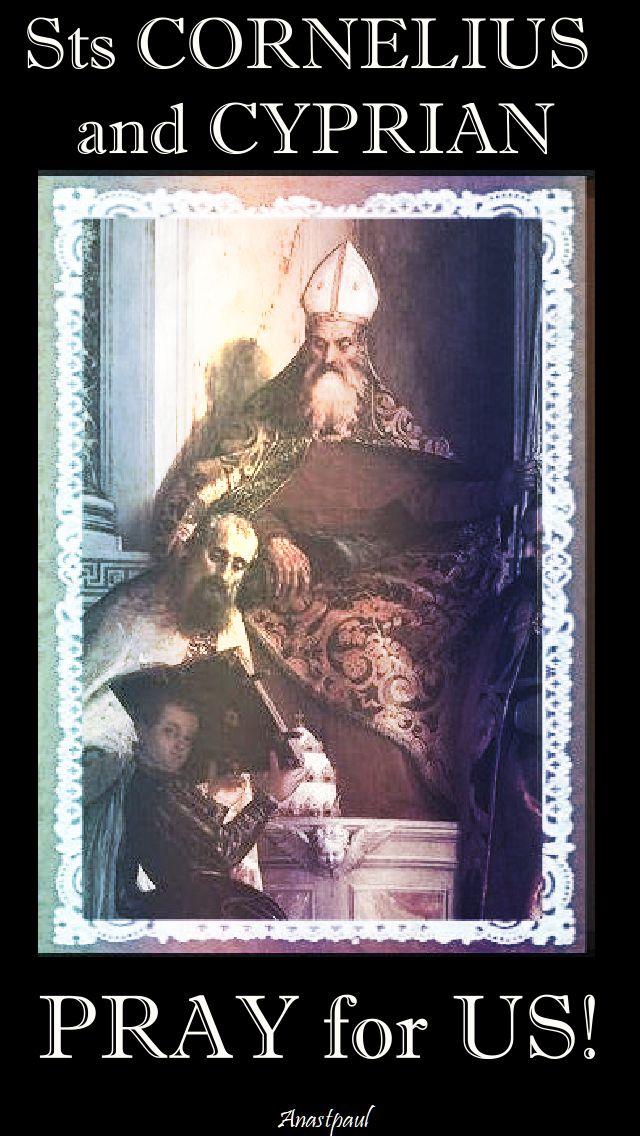
Quote/s of the Day – 16 September – The Memorial of Sts Cornelius & Cyprian
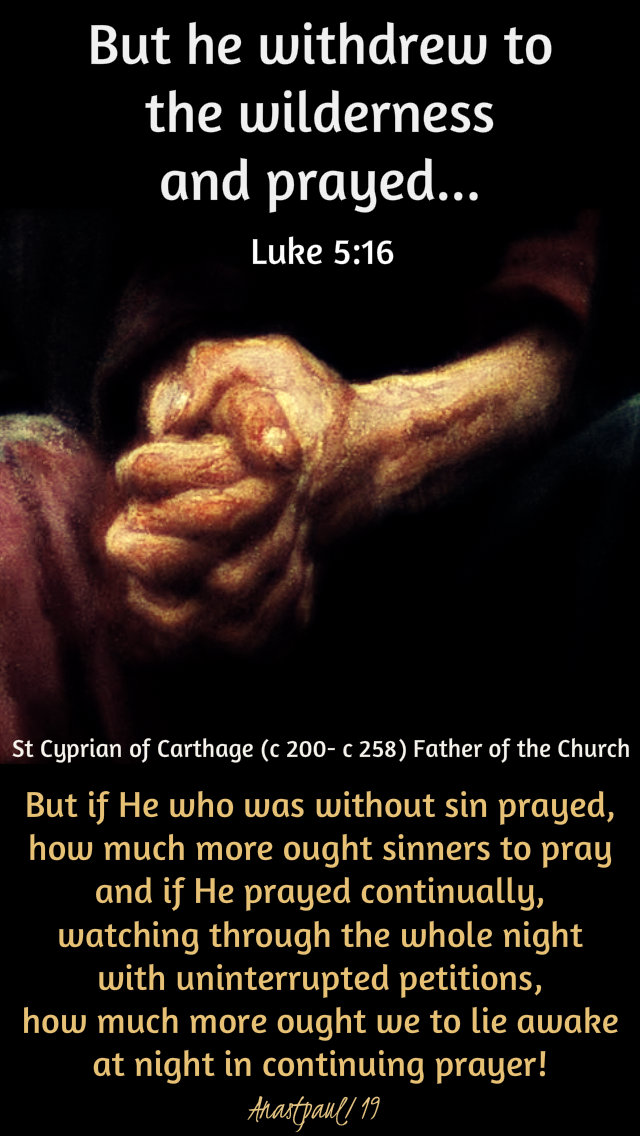
“Not by words alone but also by deeds, has God taught us to pray. He Himself prayed frequently and demonstrated what we ought to do, by the testimony of His own example. As it is written: “But he himself was in retirement in the desert and in prayer” and again, “He went out into the mountain to pray and continued all night in prayer to God.” But if He who was without sin prayed, how much more ought sinners to pray and if He prayed continually, watching through the whole night with uninterrupted petitions, how much more ought we to lie awake at night in continuing prayer!”
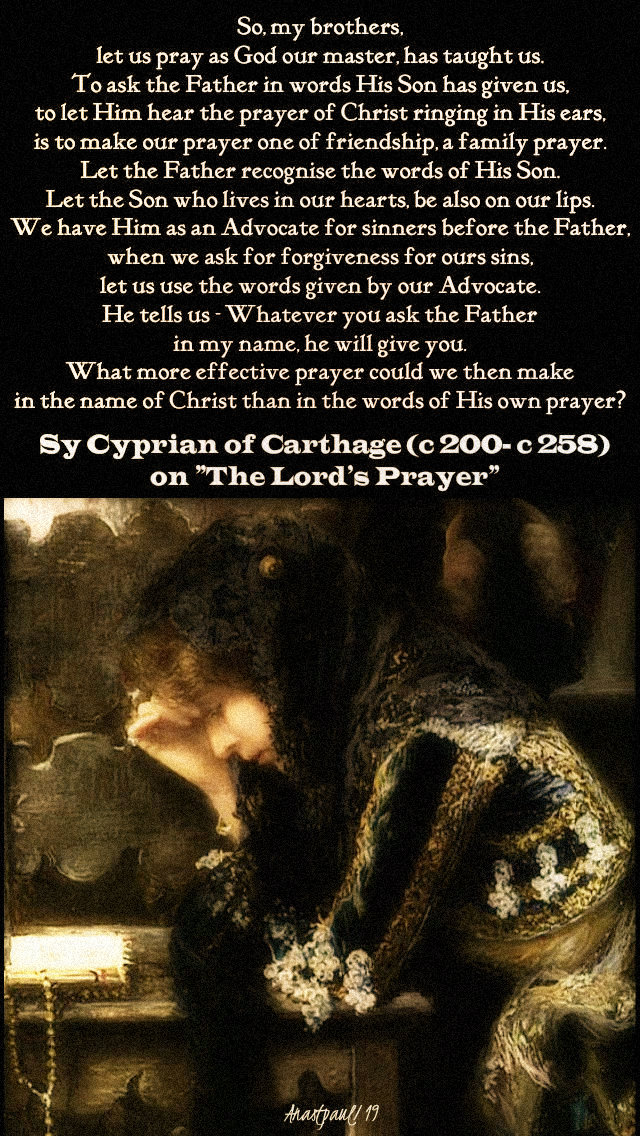
“So, my brothers, let us pray as God our master has taught us. To ask the Father in words His Son has given us, to let Him hear the prayer of Christ ringing in His ears, is to make our prayer one of friendship, a family prayer. Let the Father recognise the words of His Son. Let the Son who lives in our hearts, be also on our lips. We have Him as an Advocate for sinners, before the Father, when we ask for forgiveness for ours sins, let us use the words given by our Advocate. He tells us – Whatever you ask the Father in my name, He will give you. What more effective prayer could we then make, in the name of Christ, than in the words of His own prayer?”
An excerpt from his “On the Lord’s Prayer”
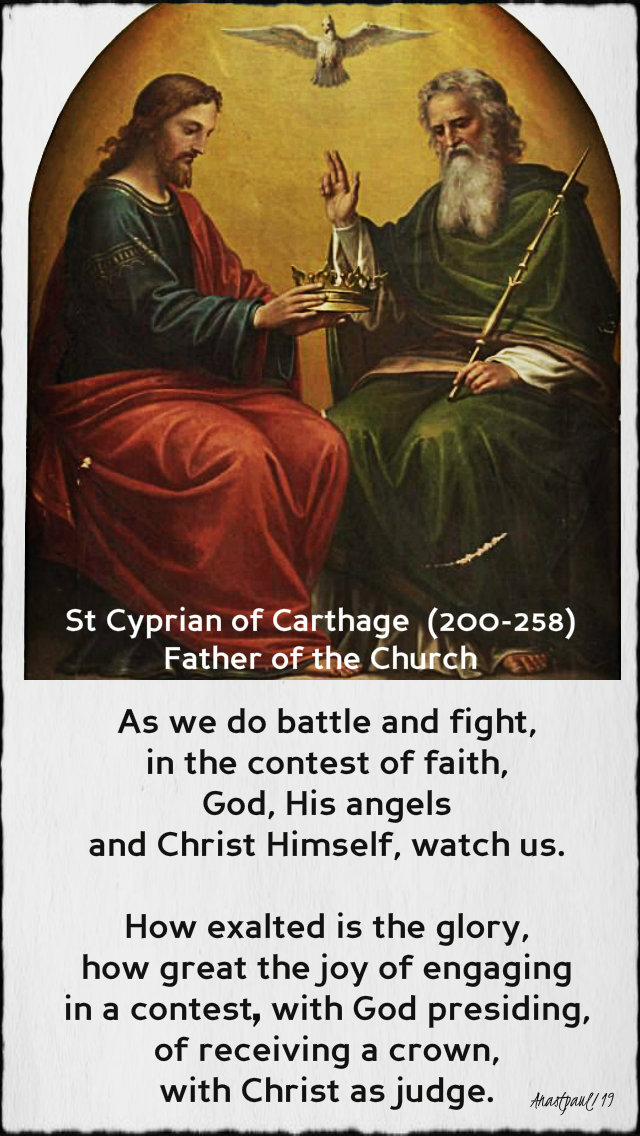
“As we do battle and fight, in the contest of faith, God, His angels and Christ Himself, watch us. How exalted is the glory, how great the joy of engaging in a contest with God presiding, of receiving a crown, with Christ as judge.” An excerpt from his Letter 58
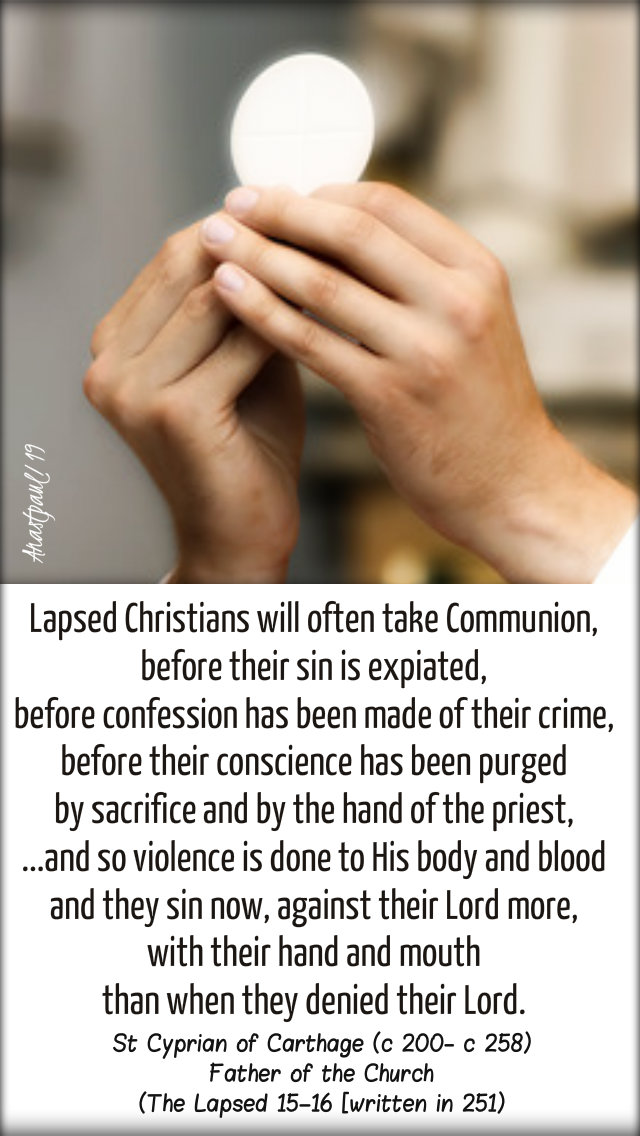
“{Lapsed Christians} will often take Communion before their sin is expiated, before confession has been made of their crime, before their conscience has been purged by sacrifice and by the hand of the priest, before the offence of an angry and threatening Lord has been appeased, [and so] violence is done to His body and blood and they sin now, against their Lord, more with their hand and mouth than when they denied their Lord.” (The Lapsed 15–16 [written in 251])
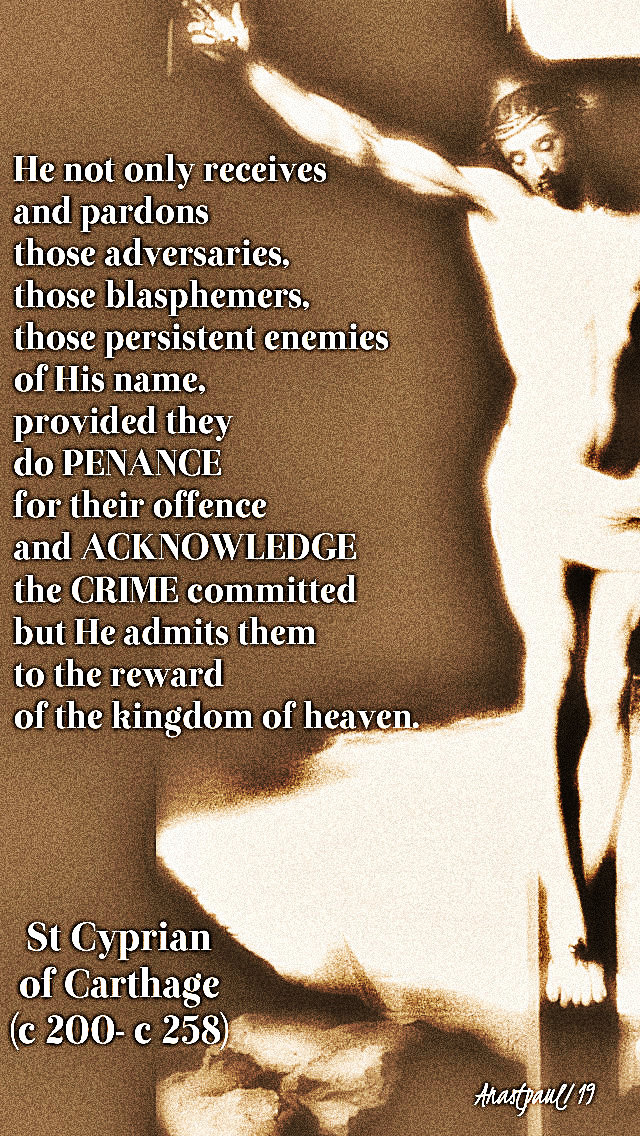
“He not only receives and pardons those adversaries, those blasphemers, those persistent enemies of His name, provided they do penance for their offence and acknowledge the crime committed but He admits them to the reward of the kingdom of heaven.”
“Whatever a man prefers to God, that, he makes, a god to himself.”
St Cyprian of Carthage (c 200-258)
Bishop and Martyr, Father of the Church
One Minute Reflection – 16 September – Monday of the Twenty-fourth week in Ordinary Time, Year C, Gospel: Luke 7:1-10 and the Memorial of St Pope Cornelius and St Cyprian of Carthage, Martyrs
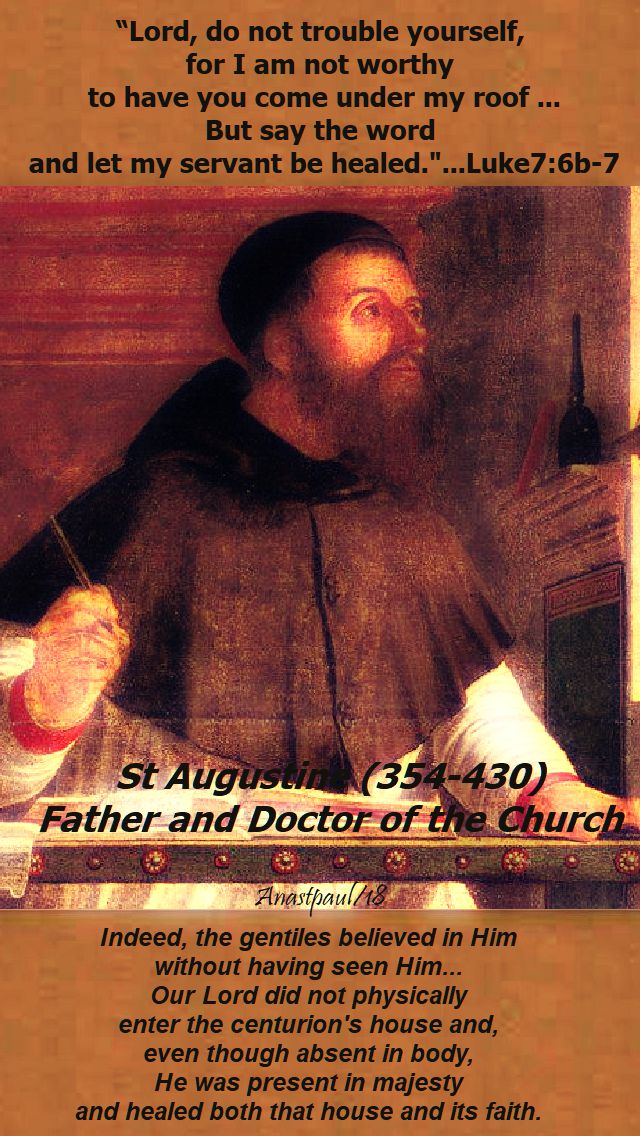
“Lord, do not trouble yourself, for I am not worthy to have you come under my roof, therefore, I did not presume to come to you. But say the word and let my servant be healed.”…Luke7:6b-7
REFLECTION – “This man was a pagan, for the Jewish people were occupied by the Imperial Roman army at that time. So it was as a centurion in Judaea that he was commanding his soldiers…
But our Lord, although he was in the midst of the people of Judaea, was already talking about the Church being spread all over the earth wherever His apostles were to be sent (Mt 8:11). Indeed, the gentiles believed in Him without having see Him… Our Lord did not physically enter the centurion’s house and, even though absent in body, He was present in majesty and healed both that house and its faith. Similarly, our Lord stood physically only amongst the people of Judaea – other peoples did not see His being born of a virgin, or suffering, or walking, or subject to the condition of human nature, or carrying out divine miracles. None of these things were done amongst the gentiles and yet it was amongst them that what was said about Him was fulfilled: “A people I did not know have served me.” In what way did they serve Him? The Psalm continues: “As soon as they heard me, they obeyed me” (Ps 18[17]:44-45).”…St Augustine (354-430) Father and Doctor of the Church
PRAYER – Lord God and holy Father, guard our faith we pray and grace us with Your mercy. Keep us every faithful to Your precepts and bring us to Your home, to look upon Your Face. May the prayers of Your saints assist us on our journey. In your untiring life of trust in God, Sts Cornelius and Cyprian, you sought to make Him the goal of all and the love of all, please pray that we may imitate your zeal and love. We ask all this through Christ, our Lord with the Holy Spirit, one God forever, amen.
One Minute Reflection – 15 September – Twenty Fourth Sunday in Ordinary Time, Year C, Gospel: Luke 15:1–32 and the Memorial of Our Lady of Sorrows
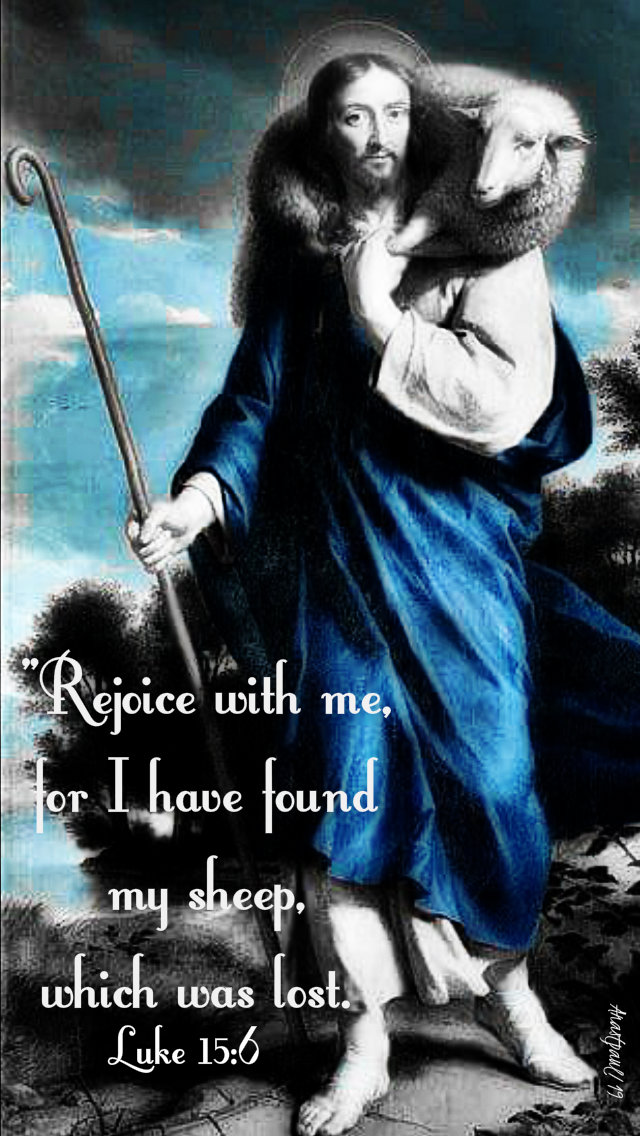
‘Rejoice with me, for I have found my sheep which was lost.’ ... Luke 15:6
REFLECTION – “Since man’s weakness is incapable of maintaining a firm step in this changing world, the good doctor shows you a remedy against going astray and the merciful judge does not withhold hope of forgiveness. It is not without reason that Saint Luke put forward three parables in succession – the sheep who strayed and was found again; the coin that was lost and found; the son who died and came back to life. This is so that this threefold remedy will urge us to take care of our wounds… The weary sheep is brought back by the shepherd, the lost coin is found, the son turns back and returns to his father, repenting of his waywardness…
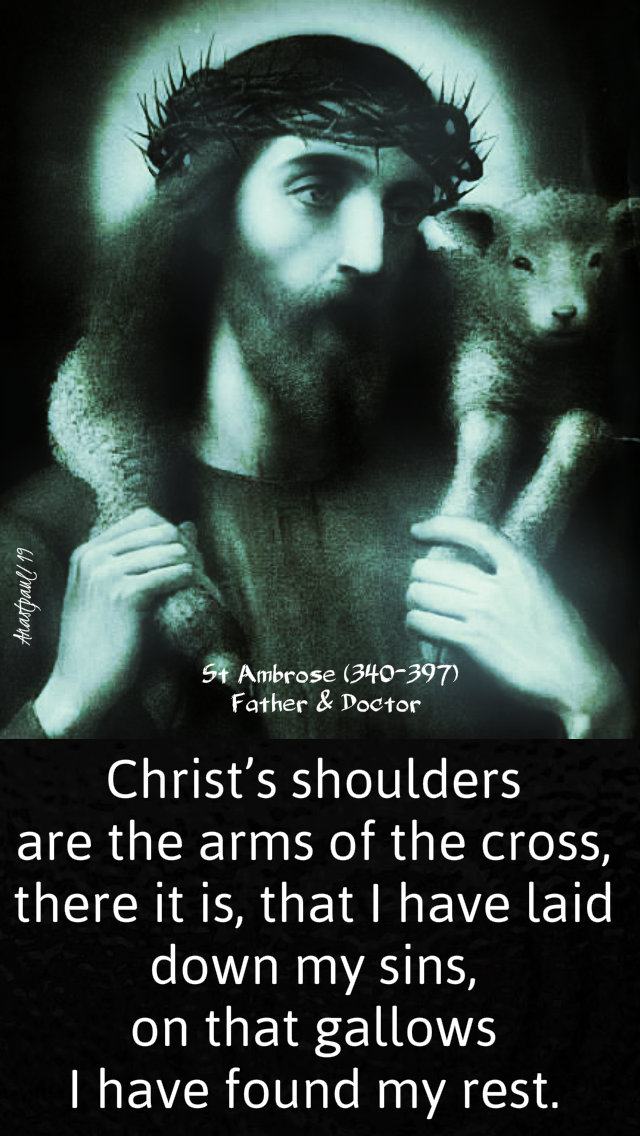
Let us rejoice, then, in that this sheep, which went astray in Adam, has been raised up again in Christ. Christ’s shoulders are the arms of the cross, there it is that I have laid down my sins, on that gallows I have found my rest. This “sheep” is one according to its nature but not in personality, since all form a single body composed of many in members. That is why it is written: “You are Christ’s body and individually parts of it,” (1Cor 12:27). “The Son of Man has come to save what was lost” (Lk 19:10), that is to say everyone, since “just as in Adam all die, so too in Christ shall all be brought to life” (1Cor 15:22)…
Nor, is it irrelevant, that the woman rejoices to have found her coin – it is no small thing, this coin on which is portrayed the image of a prince. In the same way, the good of the Church is the image of the King. We are sheep, let us then pray the Lord to lead us to restful waters (Ps 22[23]:2). We are sheep, let us ask for pasture. We are the coin, let us keep our value. We are sons, let us run to the Father.” … St Ambrose (340-397) – Bishop of Milan, Father & Doctor of the Church – On St Luke’s Gospel, 7, 207 (SC 52)
PRAYER – Look upon us Lord, creator and ruler of the whole world, grant us the grace to serve You with all our heart, that we may come to know, the power of Your forgiveness and love. Our Father, when Jesus Your Son, was raised up on the Cross, it was Your will that Mary, His Mother, should stand there and suffer with Him in her heart. Grant that in union with her, the Church may share in the passion of Christ and so be brought to the glory of His Resurrection. Be our intercessor and our consolation, Our Lady of Sorrows! We make our prayer through Christ our Lord, with the Holy Spirit, one God forever and ever, amen.
Quote/s of the Day – 14 September – Feast of the Exaltation of the Holy Cross, Gospel: John 3:13–17
The message of the cross is foolishness to those who are perishing but to us, who are being saved, it is the power of God…
1 Corinthians 1:18
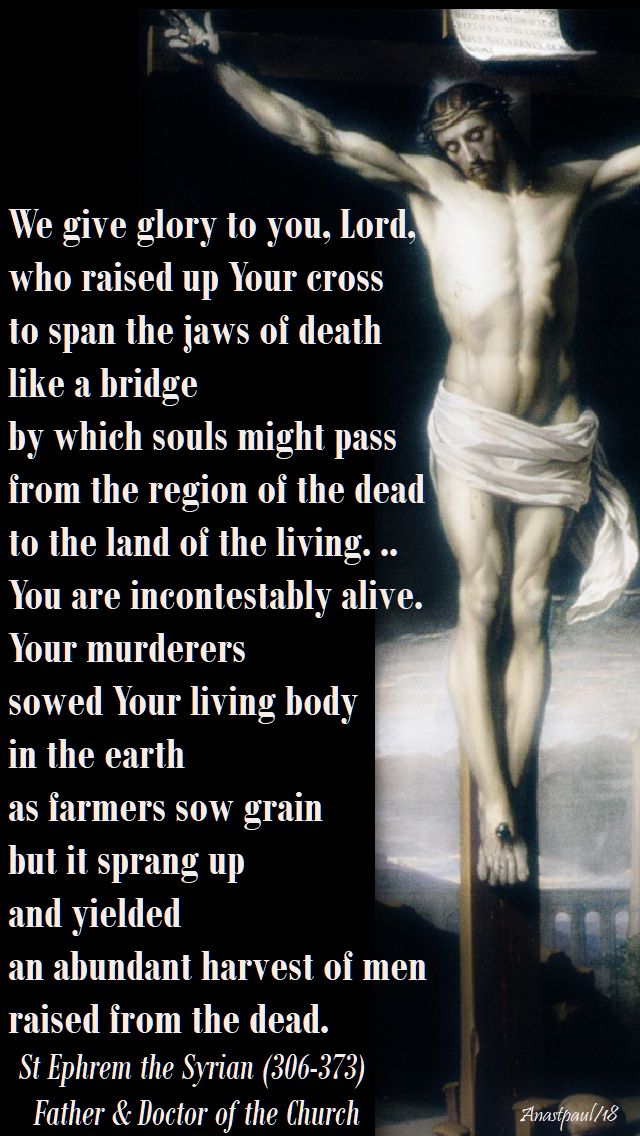
“We give glory to You, Lord, who raised up Your Cross to span the jaws of death like a bridge by which souls might pass from the region of the dead to the land of the living. .. You are incontestably alive. Your murderers sowed Your living body in the earth as farmers sow grain but it sprang up and yielded an abundant harvest of men raised from the dead.”
St Ephrem the Syrian (306-373) Father & Doctor of the Church
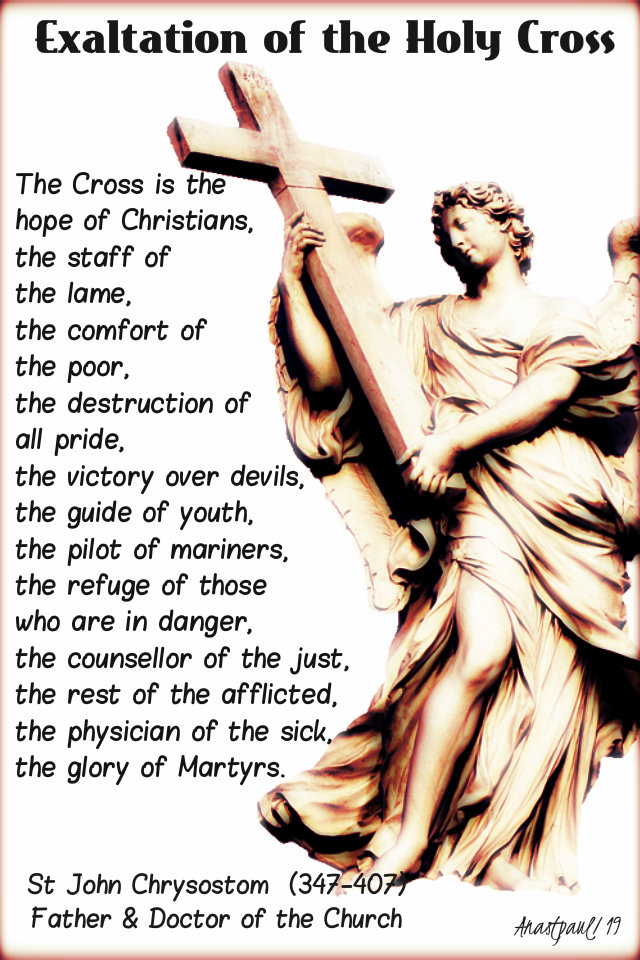
“The Cross is the hope of Christians, the staff of the lame, the comfort of the poor, the destruction of all pride, the victory over devils, the guide of youth, the pilot of mariners, the refuge of those who are in danger, the counsellor of the just, the rest of the afflicted, the physician of the sick, the glory of Martyrs.”
St John Chrysostom (347-407)
Father & Doctor of the Church
“Christ, who is your life, is hanging before you, so that you may look at the Cross, as in a mirror. There you will be able to know, how mortal were your wounds, that no medicine other than. the Blood of the Son of God, could heal. If you look closely, you will be able to realise, how great your human dignity and your value are…. Nowhere other than looking at himself, in the mirror of the Cross, can man better understand how much he is worth”
St Anthony of Padua OFM (1195-1231) Doctor of the Church
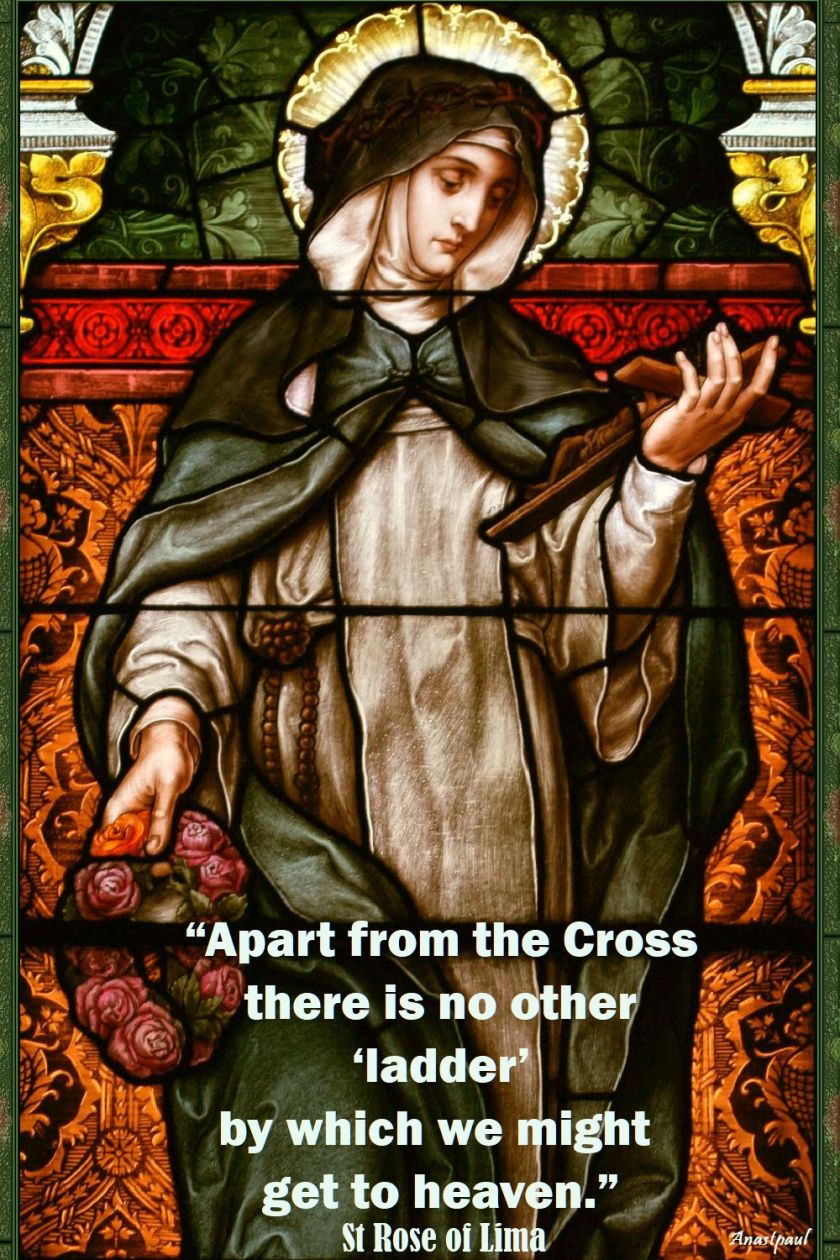
“Apart from the cross there is no other ladder by which we may get to heaven.“
St Rose of Lima (1586-1617)
We have always seen, that those who were closest to Christ our Lord, were those with the greatest trials. Let us look at what His glorious Mother suffered and the glorious apostles. Take up the Cross of Jesus. Help your Spouse to carry the burden that weighs Him down and pay no attention to what they may say about you. If you should happen to stumble and fall like your Spouse, do not withdraw from the Cross or abandon it. No matter how great your trials may be, you will see, that they are quite small, in comparison to His.
Blessed Teresa Maria of the Cross OCD (1846–1910)
“One ounce of a Cross is much better than a ton of books of prayer.”
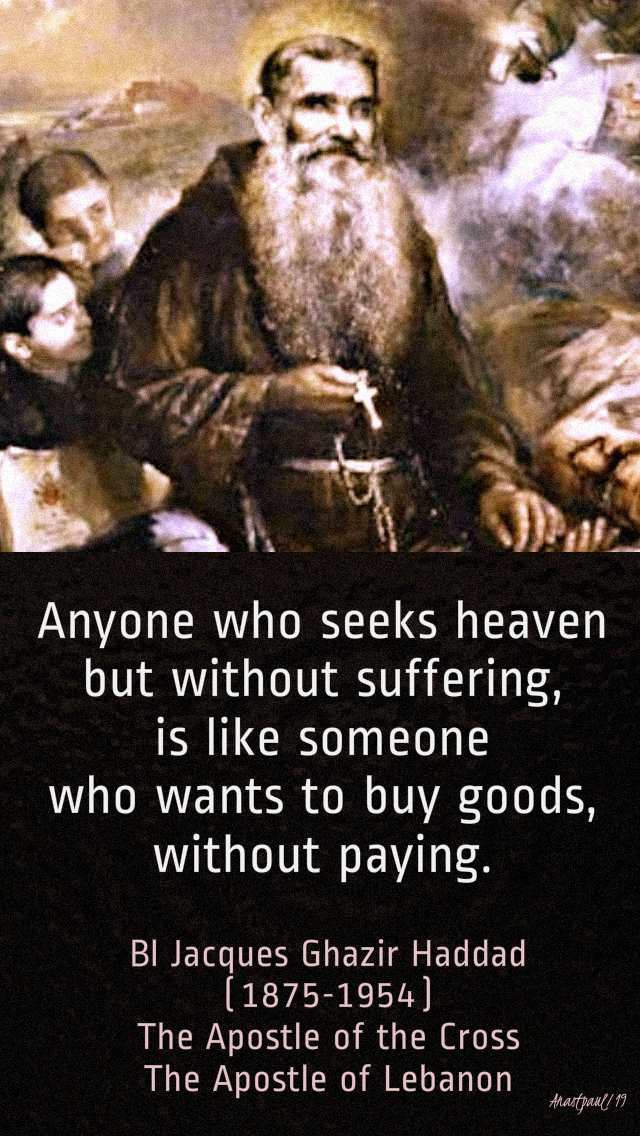
“Anyone who seeks heaven but without suffering, is like someone who wants to buy goods, without paying.”
Blessed Jacques Ghazir Haddad (1875-1954)
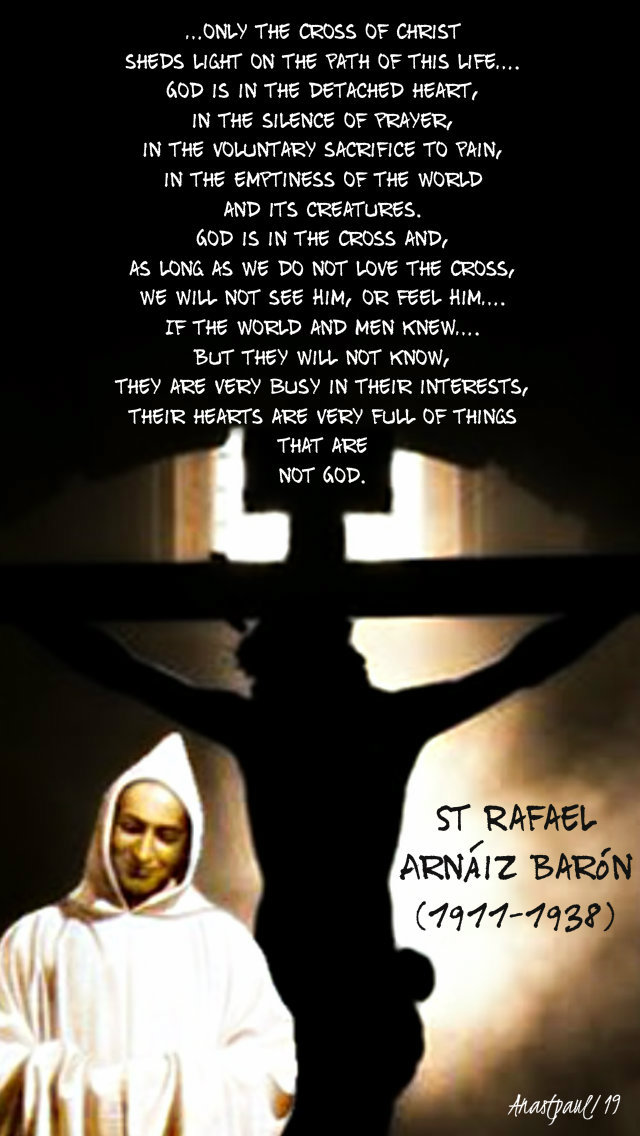
“…only the Cross of Christ sheds light on the path of this life…. God is in the detached heart, in the silence of prayer, in the voluntary sacrifice to pain, in the emptiness of the world and its creatures. God is in the Cross and, as long as we do not love the Cross, we will not see Him, or feel Him…. If the world and men knew…. But they will not know, they are very busy in their interests, their hearts are very full of things that are not God.”
St Rafael Arnáiz Barón (1911-1938)
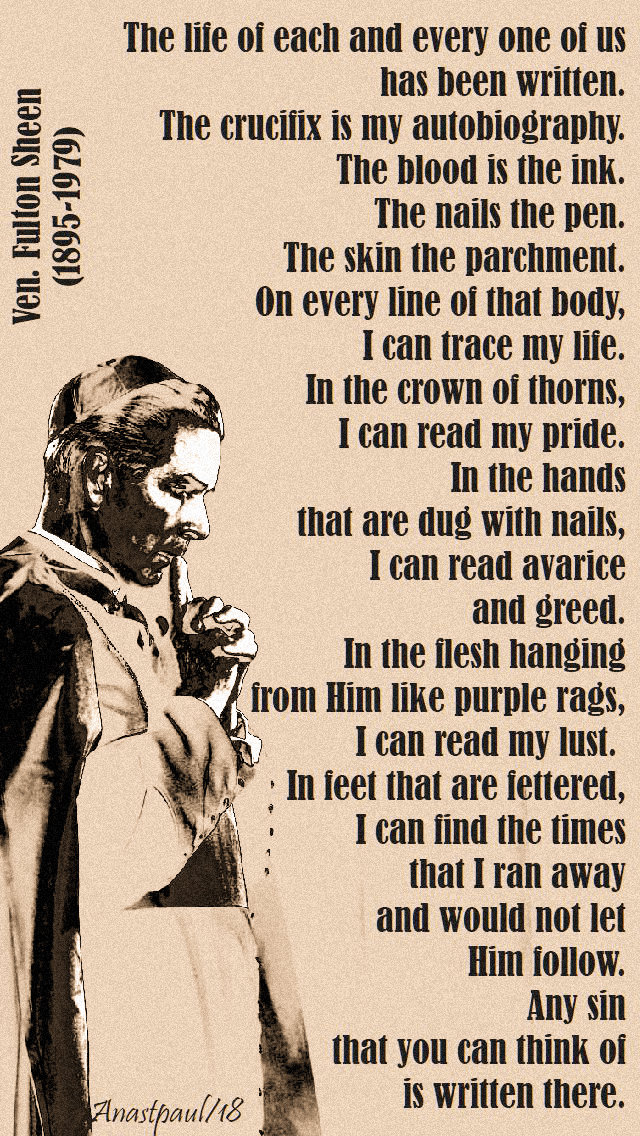
“The life of each and every one of us has been written. The crucifix is my autobiography. The blood is the ink. The nails the pen. The skin the parchment. On every line of that body, I can trace my life. In the crown of thorns I can read my pride.In the hands that are dug with nails, I can read avarice and greed. In the flesh hanging from him like purple rags, I can read my lust. In feet that are fettered, I can find the times that I ran away and would not let Him follow. Any sin that you can think of is written there.”
One Minute Reflection – 14 September – Feast of the Exaltation of the Holy Cross, Gospel: John 3:13–17
“…And as Moses lifted up the serpent in the wilderness, so must the Son of man be lifted up, that whoever believes in him may have eternal life.”…John 3:14-15
REFLECTION – “We are celebrating the feast of the cross which drove away darkness and brought in the light… Had there been no cross, Christ could not have been crucified. Had there been no cross, Life Itself could not have been nailed to the tree. And if Life had not been nailed to it, they would be no streams of immortality pouring from Christ’s side, blood and water for the world’s cleansing. The legal bond of our sin would not be cancelled, we should not have obtained our freedom, we should not have enjoyed the fruit of the tree of life and the gates of paradise would not stand open. Had there been no cross, death would not have been trodden underfoot, nor hell despoiled… The cross is called Christ’s glory, it is saluted as His triumph.”….St Andrew of Crete (650-740)
PRAYER – O God, who willed that Your Only Begotten Son should undergo the Cross to save the human race, grant, we pray, that we, who have known His mystery on earth, may merit the grace of His redemption in heaven. For You placed the salvation of the human race on the wood of the Cross, so that, where death arose, life might again spring forth and the evil one, who conquered on a tree, might likewise on a tree be conquered through Christ. O cross, You are the glorious sign of victory. Through your power may we share in the triumph of Christ Jesus. We adore you Christ and we praise you, for by your holy Cross you have redeemed the world. Amen
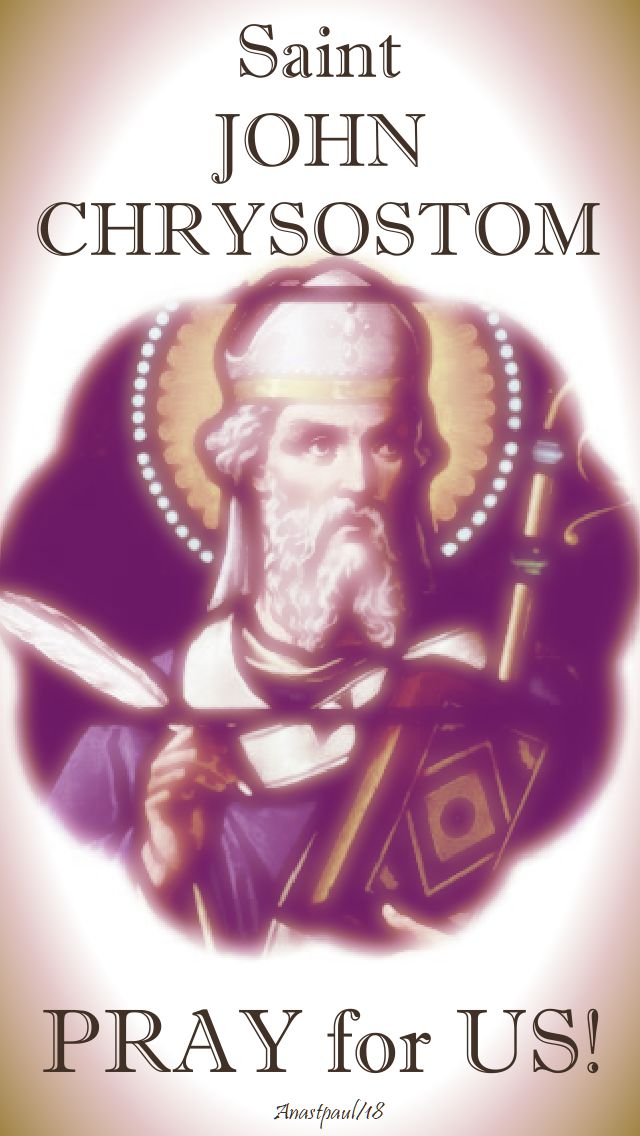
Thought for the Day – 13 September – the Memorial of St John Chrysostom (347-407) Father & Doctor of the Church
Life to Me, means Christ
and Death, is Gain
Saint John Chrysostom
An excerpt from his Sermon, Before the Exile
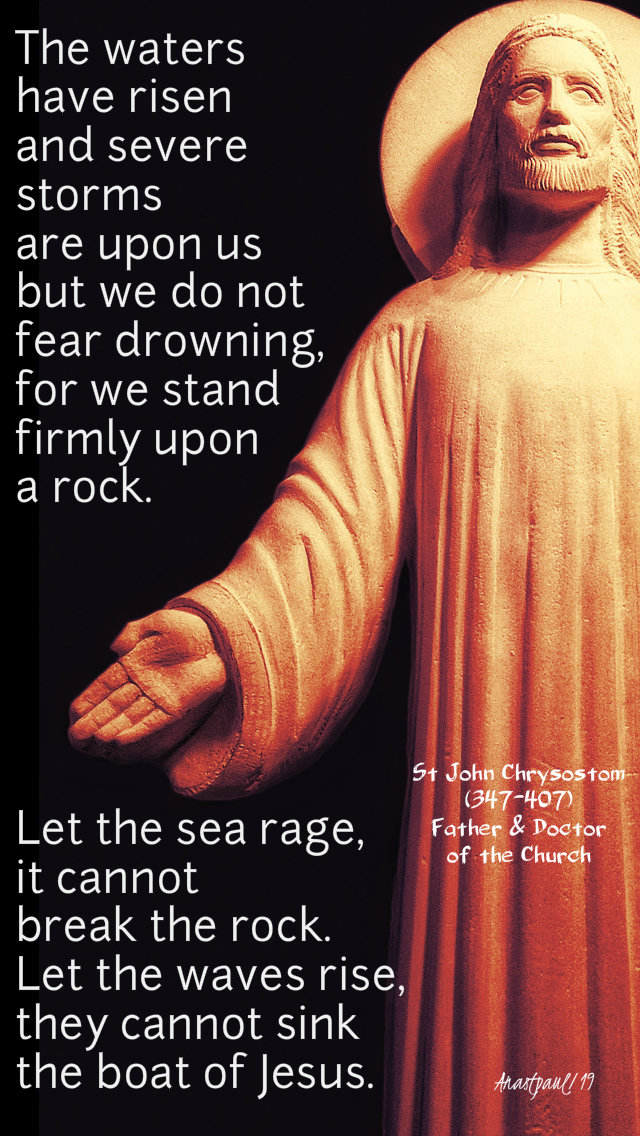
“The waters have risen and severe storms are upon us but we do not fear drowning, for we stand firmly upon a rock. Let the sea rage, it cannot break the rock. Let the waves rise, they cannot sink the boat of Jesus. What are we to fear? Death? Life to me means Christ, and death is gain. Exile? The earth and its fullness belong to the Lord. The confiscation of goods? We brought nothing into this world and we shall surely take nothing from it. I have only contempt for the world’s threats, I find its blessings laughable. I have no fear of poverty, no desire for wealth. I am not afraid of death nor do I long to live, except for your good. I concentrate, therefore, on the present situation and I urge you, my friends, to have confidence.
Do you not hear the Lord saying – Where two or three are gathered in my name, there am I in their midst? Will He be absent, then, when so many people united in love are gathered together? I have His promise; I am surely not going to rely on my own strength! I have what He has written – that is my staff, my security, my peaceful harbour. Let the world be in upheaval. I hold to His promise and read His message, that is my protecting wall and garrison. What message? Know that I am with you always, until the end of the world!
If Christ is with me, whom shall I fear? Though the waves and the sea and the anger of princes are roused against me, they are less to me than a spider’s web . Indeed, unless you, my brothers, had detained me, I would have left this very day. For I always say: Lord, Your will be done; not what this fellow or that would have me do but what You want me to do. That is my strong tower, my immovable rock, my staff that never gives way. If God wants something, let it be done! If He wants me to stay here, I am grateful. But wherever He wants me to be, I am no less grateful.
Yet where I am, there you are too and where you are, I am. For we are a single body and the body cannot be separated from the head nor the head from the body. Distance separates u, but love unites us and death itself cannot divide us. For though my body die, my soul will live and be mindful of my people.
You are my fellow citizens, my fathers, my brothers, my sons, my limbs, my body. You are my light, sweeter to me than the visible light . For what can the rays of the sun bestow on me that is comparable to your love? The sun’s light is useful in my earthly life but your love is fashioning a crown for me in the life to come.
It is evident, then, that if they had not seen Him risen and had proof of His power, they would not have risked so much.”
Quote/s of the Day – 13 September – the Memorial of St John Chrysostom (347-407) Father & Doctor of the Church
“Are we in poverty? Let us give thanks.
Are we in sickness? Let us give thanks.
Are we falsely accused? Let us give thanks.
When we suffer affliction, let us give thanks.
This brings us near to God.“
“What prayer, could be more true before God the Father, than that which the Son, who is Truth, uttered with His own lips?”
“You can call happy those who saw Him. But, come to the altar and you will see Him, you will touch Him, you will give to Him holy kisses, you will wash Him with your tears, you will carry Him within you like Mary Most Holy.”
“Since we are talking about the Body,
know that we, as many of us as partake of the Body,
as many as partake of that Blood,
we partake of something which is in no way different
or separate from that which is enthroned on high,
which is adored by the angels,
which is next to Uncorrupt Power.”
“Do you understand, then, how Christ has united His bride to Himself and what food He gives us all to eat? By one and the same food, we are both brought into being and nourished. As a woman nourishes her child with her own blood and milk, so does Christ unceasingly nourish with His own blood those to whom He himself has given life.’”
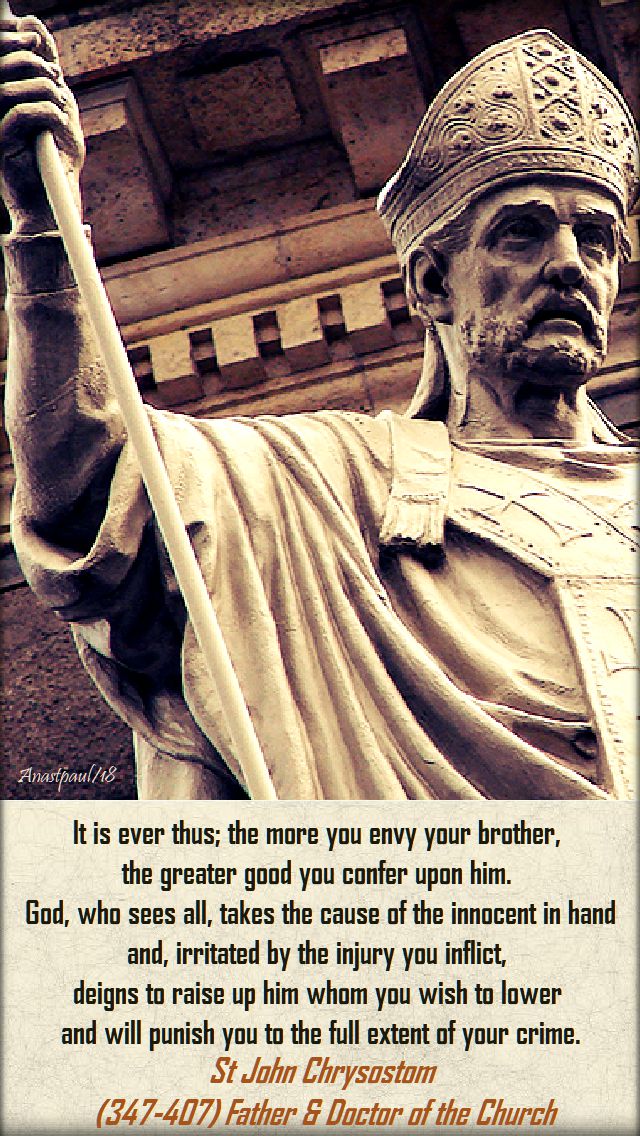
” …It is ever thus; the more you envy your brother, the greater good you confer upon him. God, who sees all, takes the cause of the innocent in hand and, irritated by the injury you inflict, deigns to raise up him whom you wish to lower and will punish you to the full extent of your crime. If God usually punishes those who rejoice at the misfortunes of their enemies, how much more will He punish those who, excited by envy, seek to do an injury to those who have never injured them?”
One Minute Reflection – 13 September – Friday of the Twenty third week in Ordinary Time, Year C, Gospel: Luke 6:39–42 and the Memorial of St John Chrysostom (347-407) Father & Doctor of the Church
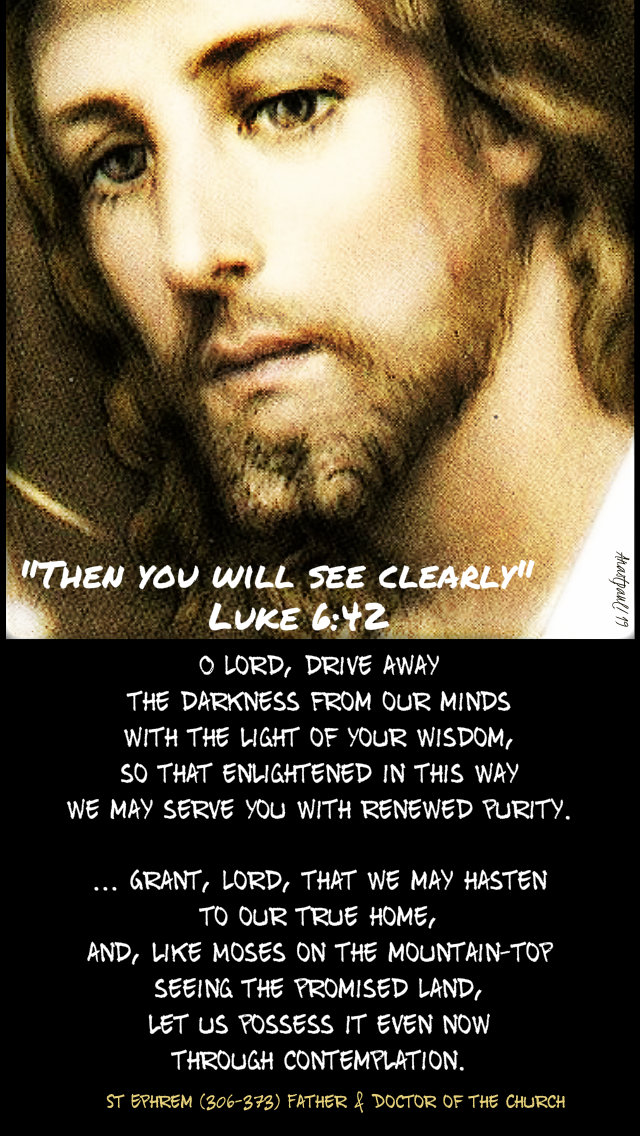
“Then you will see clearly” … Luke 6:42
REFLECTION –
“O Lord, drive away the darkness from our minds
with the light of Your wisdom,
so that enlightened in this way
we may serve You with renewed purity.
The beginning of the sun’s passage through the sky
marks the beginning of the working-day for us mortals,
we ask You, Lord, to prepare in our minds
a place where the day that knows no end may give its light.
Grant that we may have within us, this light,
the life of the resurrection,
and that nothing may take away our delight in You.
Mark us with the sign of that day that does not begin
with the movement and the course of the sun,
by keeping our minds fixed on You.
In your sacraments we welcome You every day
and receive You in our bodies.
Make us worthy to experience within us
the resurrection for which we hope.
Be the wings for our thoughts, O Lord,
Drawing us lightly to the heights
And bearing us up to our true home.
By the grace of baptism we conceal within our bodies
the treasure of Your divine life…
Let us appreciate the great beauty that is ours
through the spiritual beauty that Your immortal will
arouses in our mortal nature…
May Your Resurrection, Jesus,
cause the spiritual man to grow in us (cf Eph 3:16)
and may the contemplation of Your mysteries
become the mirror in which we come to recognise you (1Cor 13:12).
Grant, Lord, that we may hasten to our true home,
and, like Moses on the mountain-top
seeing the promised Land, (Dt 34:1)
let us possess it even now through contemplation.” Saint Ephrem (306-373)
Father & Doctor of the Church
PRAYER – Lord God, strength of those who hope in You, by Your will, St John Chrysostom became renowned in the Church, for his astounding eloquence and his forbearance in persecution. Grant that we may be enriched by his teaching and thus grow in sanctity, to follow the commandments You set forth in Your Word, Your Son who is our Saviour and Redeemer. By the prayers of St John Chrysostom, may we attain the place You have prepared for us. We make our prayer through Jesus Christ with the Holy Spirit, one God, forever amen.
Dedication of the Basilicas of Jerusalem: Commemoration of the dedications of the basilicas built on Mount Calvary and the Church of the Holy Sepulchre in Jerusalem.
—
St Aigulf
St Amatus
St Amatus of Sion
St Barsenorius
Bl Claude Dumonet
St Columbinus of Lure
St Emiliano of Valence
St Evantius of Autun
St Gordian of Pontus
Bl Hedwig of Hreford
St Julian of Ankyra
St Ligorius
St Litorius of Tours
St Macrobius
St Marcellinus of Carthage
Bl María López de Rivas Martínez St Maurilius of Angers (c 336 426)
St Nectarius of Autun
St Notburga (c 1265-1313)
St Philip of Rome
St Venerius of Tino
—
Martyrs of Ireland:
• Blessed Edward Stapleton
• Blessed Elizabeth Kearney
• Blessed James Saul
• Blessed Margaret of Cashel
• Blessed Richard Barry
• Blessed Richard Butler
• Blessed Theobald Stapleton
• Blessed Thomas Morrissey
• Blessed William Boyton
Martyred in the Spanish Civil War including the Martyrs of Pozo de Cantavieja – 11 beati:
• Blessed Bienvenido Villalón Acebrón
• Blessed Emilio Antequera Lupiáñez
• Blessed Florencio Arnáiz Cejudo
• Blessed Francisco Rodríguez Martínez
• Blessed Joaquín Gisbert Aguilera
• Blessed José Álvarez-Benavides de La Torre
• Blessed José Cano García
• Blessed José Román García González
• Blessed Juan Capel Segura
• Blessed Juan Ibáñez Martín
• Blessed Luis Eduardo López Gascón
• Blessed Manuel Alvarez y Alvarez
• Blessed Manuel Martínez Giménez
• Blessed Pío Navarro Moreno
• Blessed Ramiro Argüelles Hevia
• Blessed Sabino Ayastuy Errasti
• Blessed Teófilo Montes Calvo
One Minute Reflection – 9 September – Monday of the Twenty-third week in Ordinary Time, Year C, Gospel: Luke 6:6-11 and the Memorial of St Peter Claver SJ (1581-1654) “slave of the slaves” and Blessed Frédéric Ozanam (1813–1853) “Servant to the Poor”
“On another sabbath, he went into the synagogue and taught and there was a man there whose right hand was withered.” … Luke 6:6
REFLECTION – “Are you angry at me because I have healed the whole man on the sabbath day?” In this place he revivified, with the salutary strength of good works, the hand which Adam stretched out to pluck the fruit of the forbidden tree. The hand which had withered through a crime, was healed by good deeds. Christ thereby rebuked the Jews who violated the precepts of the law with evil interpretations. They thought that they should rest even from good works on the sabbath, since the law prefigured in the present, the form of the future, in which indeed the days of rest from evils, not from blessings, would come.
Then you heard the words of the Lord, saying, “Stretch forth your hand.” That is the common and universal remedy. You, who think that you have a healthy hand, beware lest it is withered by greed or by sacrilege. Hold it out often. Hold it out to the poor person who begs you. Hold it out to help your neighbour, to give protection to a widow, to snatch from harm one whom you see subjected to unjust insult. Hold it out to God for your sins. The hand is stretched forth, then it is healed. Jeroboam’s hand withered when he sacrificed to idols, then it stretched out when he entreated God” … St Ambrose(340-397)- One of the 4 original Doctors of the Latin Church – Exposition on the Gospel of Luke, 5
PRAYER – God of mercy and love, You offer all peoples the dignity of sharing in your life. Rule over our hearts and bodies this day. Sanctify us and guide our every thought, word and deed, my our hands be held out to our neighbour in imitation of Your love and mercy. By the example and prayers of St Peter Claver and Bl Frederic Ozanam, strengthen us to overcome all racial hatreds and to love each other as brothers and sisters. We ask this through our Lord Jesus Christ, your Son, who lives and reigns with you and the Holy Spirit, one God, for ever and ever amen.
Thought for the Day – 8 September – Twenty-third Sunday in Ordinary Time, Year C, Luke 14:25–33
“If anyone comes to me without hating his father and mother, wife and children, brothers and sisters and even his own life, he cannot be my disciple.”… Luke 14:26
Saint Augustine comments on this verse from the Gospel proclaimed during today’s Mass:
“The Lord gives the signal for us to stand guard in camp and to build the tower from which we may recognise and ward off the enemy of our eternal life. The heavenly trumpet of Christ urges the soldier to battle and his mother holds him back.
What does she say or what argument does she give? Perhaps is it those ten months when you lay in her womb and the pangs of birth and the burden of rearing you? You must kill this with the sword of salvation. You must destroy this in your mother that you may find her in life eternal. Remember, you must hate this in her if you love her, if you are a recruit of Christ and have laid the foundations of the tower. Passers-by may not say, “This man began to build and was not able to finish.” That is earthly affection. It still has the ring of the “old man.” Christian warfare invites us to destroy this earthly affection both in ourselves and in our relatives. Of course, no one should be ungrateful to his parents or mock the list of their services to him, since by them he was brought into this life, cherished and fed. A man should always pay his family duty but let these things keep their place where higher duties do not call.
Mother church is also the mother of your mother. She conceived you both, in Christ. Know that, her Spouse took human flesh, that you might not be attached to fleshly things. Know that, all the things for which your mother scolds you were undertaken by the eternal Word, that you might not be subject to the weakness of flesh. Ponder his humiliations, scourging and death, even the death of the cross.” (Letter 243)
Lord Jesus Christ, Son of God, Have mercy on me a sinner!
Quote/s of the Day – 3 September – The Memorial of Saint Pope Gregory the Great (540-604) “Father of the Fathers” and Blessed Brigida of Jesus Morello (1610-1679)
“Holy Scripture presents a kind of mirror to the eyes of the mind, so that our inner face may be seen in it. There we learn our own ugliness, there our own beauty. And there too we discover the progress we are making and how far we are from perfection.”
“When we attend to the needs of those in want, we give them what is theirs, not ours. More than performing works of mercy, we are paying a debt of justice.”
St Pope Gregory the Great (540-604)
Father & Doctor of the Church
“Father of the Fathers”
Our Morning Offering – 3 September – Tuesday of the Twenty-second week in Ordinary Time, Year C and the Memorial of St Pope Gregory the Great (540-604) – Father & Doctor of the Church
Acclaim To The Suffering Christ By St Pope Gregory the Great (540-604) Father & Doctor of the Church
O Lord, You received affronts
without number from Your blasphemers,
yet each day You free captive souls
from the grip of the ancient enemy.
You did not avert Your face
from the spittle of perfidy,
yet You wash souls in saving waters.
You accepted Your scourging without murmur,
yet through Your meditation
You deliver us from endless chastisements.
You endured ill-treatment of all kinds,
yet You want to give us a share
in the choirs of angels in glory everlasting.
You did not refuse to be crowned with thorns,
yet You save us from the wounds of sin.
In your thirst You accepted the bitterness of gall,
yet You prepare Yourself to fill us with eternal delights.
You kept silence under the derisive homage
rendered You by Your executioners,
yet You petition the Father for us
although You are his equal in Divinity.
You came to taste death,
yet You were the Life
and had come to bring it to the dead.
Amen
St Aigulphus of Lérins
St Ambrose of Sens
St Ammon of Heraclea
Bl Andrew Dotti
St Auxanus
St Balin
St Basilissa of Nicomedia Bl Brigida of Jesus Morello (1610-1679)
St Chariton
St Chrodegang of Séez
St Frugentius the Martyr
Bl Guala of Brescia
St Hereswitha
Bl Herman of Heidelberg
St Macanisius
St Mansuetus of Toul
St Marinus (Died c 366)
St Martiniano of Como
St Natalis of Casale
St Phoebe
St Regulus of Rheims
St Remaclus
St Sandila of Cordoba
—
Martyrs of Aquileia – 4 saints: Four young women, variously sisters and cousins, who were born to the nobility, the daughters of the pagans Valentinianus of Aquileia and Valentius of Aquileia. Each woman converted and made private vows, dedicating themselves to God. They were arrested, tortured and martyred by order of Valentius for becoming a Christian. We know little else but their names – Dorothy, Erasma, Euphemia and Thecla. They were martyred by beheaded in the 1st century in Aquileia, Italy and their bodies were thrown into a nearby river.
Martyrs of Nagasaki – 6 beati: A group of priests and clerics, native and foreign, murdered together in the anti-Christian persecutions in Japan. They were scalded in boiling water and then burned alive on 3 September 1632 in Nishizaka, Nagasaki, Japan and Beatified on 7 May 1867 by Pope Pius IX.
• Anthony Ishida
• Bartolomé Gutiérrez Rodríguez
• Francisco Terrero de Ortega Pérez
• Gabriel Tarazona Rodríguez
• Jerome of the Cross de Torres
• Vicente Simões de Carvalho
Martyrs of Seoul – 6 saints: A group of Christian lay people martyred together in the persecutions in Korea. They were beheaded on 3 September 1839 at the Small West Gate, Seoul, South Korea and Canonised on 6 May 1984 by Pope John Paul II.
• Agnes Kim Hyo-Ch’u
• Barbara Kwon Hui
• Barbara Yi Chong-hui
• Ioannes Pak Hu-jae
• Maria Pak K’Un-agi
• Maria Yi Yon-hui
Martyred in the Spanish Civil War:
• Blessed Andrea Calle González
• Blessed Concepción Pérez Giral
• Blessed Dolores Úrsula Caro Martín
• Blessed Joaquim Balcells Bosch
• Blessed Pius Salvans Corominas
Sunday Reflection – 1 September – Twenty-second Sunday in Ordinary Time, Year C
“When you see (the Most Blessed Sacrament) exposed, say to yourself –
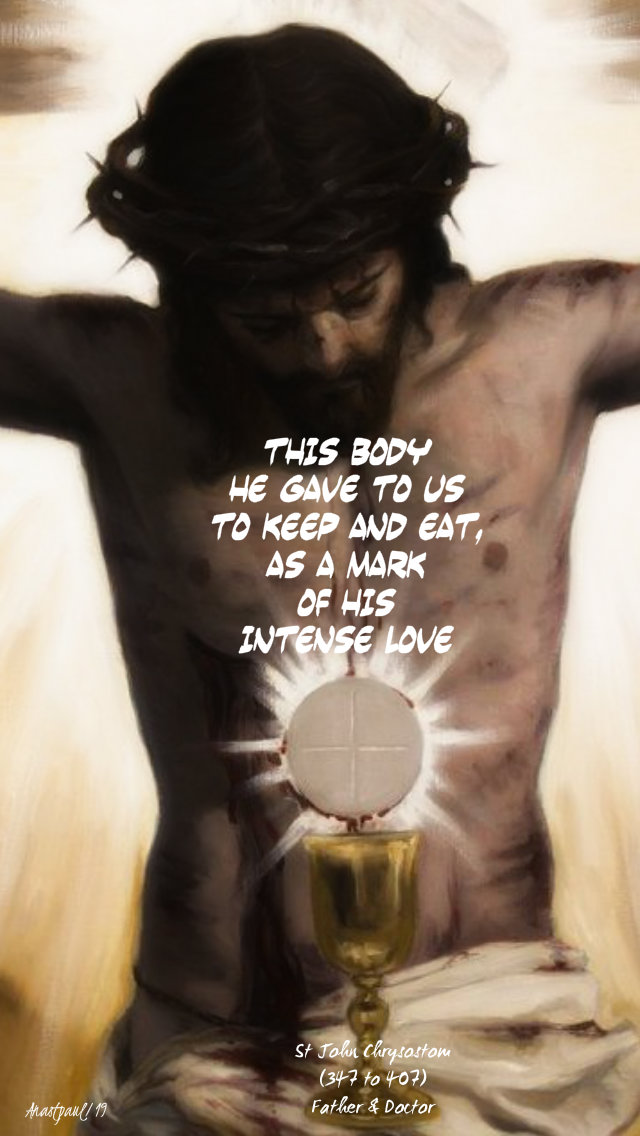
‘Thanks to this Body, I am no longer dust and ashes, I am no more a captive but a freeman, hence, I hope to obtain heaven and the good things that are there in store for me… eternal life, the heritage of the angels, companionship with Christ; death has not destroyed this Body which was pierced by nails and scourged . . . this is that Body which was once covered with blood, pierced by a lance, from which issued saving fountains upon the world, one of blood and the other of water. . . This Body He gave to us to keep and eat, as a mark of His intense love’.”
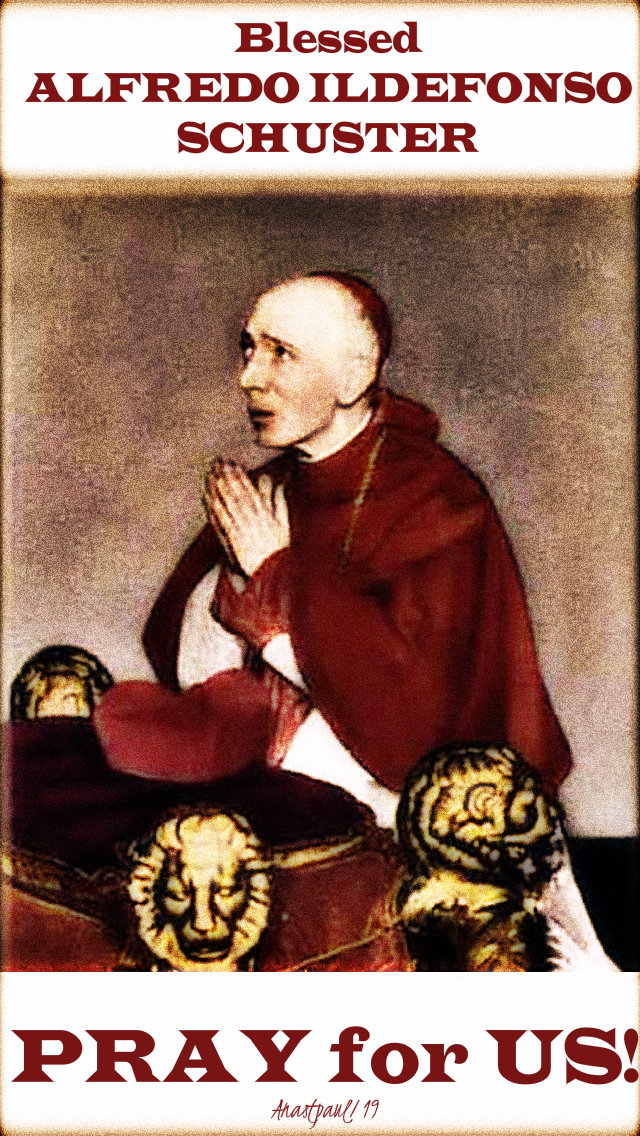
One Minute Reflection – 30 August – Friday of the Twenty-first week in Ordinary Time, Year C, Gospel: Matthew 25:1–13 and the Memorial of Blessed Alfredo Ildefonso Schuster OSB (1880-1954)
“The foolish ones, when taking their lamps, brought no oil with them but the wise brought flasks of oil with their lamps.” … Matthew 25:3-4
REFLECTION – “It is some great thing, some exceedingly great thing, that this oil signifies. Do you think it might be charity? If we try out this hypothesis, we hazard no precipitate judgement. I will tell you why charity seems to be signified by the oil. The apostle says, “I will show you a still more excellent way.” “If I speak with the tongue of mortals and of angels but do not have love, I am a noisy gong or a clanging cymbal.” This is charity. It is “that way above the rest,” which is with good reason signified by the oil. For oil swims above all liquids. Pour in water and pour in oil upon it, the oil will swim above. If you keep the usual order, it will be uppermost, if you change the order, it will be uppermost. “Charity never fails.” … St Augustine (354-430) Father & Doctor – Sermon 93
PRAYER – God our Saviour, through the grace of Baptism you made us children of light. Hear our prayer, that we may always walk in that light and work for truth, love and charity, as Your witnesses before men. Dispel from our hearts the darkness of sin and keep us ever watchful for the true light, Christ Your Son, who lives and reigns with You and the Holy Spirit, God forever. Blessed Alfredo Schuster, you lived a life of total charity ever watchful to the needs of your neighbour, please pray for us, amen.
Thought for the Day – 29 August – The Beheading of St John the Baptist
Precursor of Christ in Birth and Death
Saint Bede (673-735)
Priest, Father and Doctor of the Church
An excerpt from Homily 23
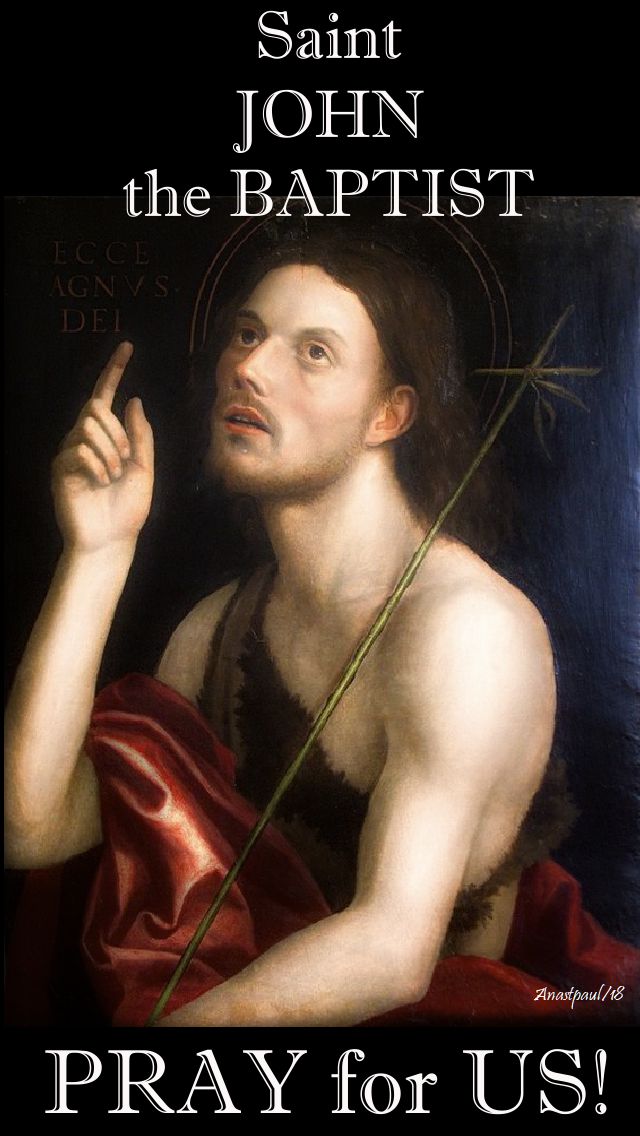
As forerunner of our Lord’s birth, preaching and death, the blessed John showed in his struggle, a goodness worthy of the sight of heaven. In the words of Scripture: Though in the sight of men he suffered torments, his hope is full of immortality. We justly commemorate the day of his birth with a joyful celebration, a day which he himself made festive for us through his suffering and which he adorned with the crimson splendour of his own blood. We do rightly revere his memory with joyful hearts, for he stamped with the seal of martyrdom, the testimony, which he delivered, on behalf of our Lord.
There is no doubt that blessed John suffered imprisonment and chains as a witness to our Redeemer, whose forerunner he was and gave his life for Him. His persecutor had demanded, not that he should deny Christ but only, that he should keep silent about the truth. Nevertheless, he died for Christ. Does Christ not say – I am the truth?Therefore, because John shed his blood for the truth, he surely died for Christ.
Through his birth, preaching and baptising, he bore witness to the coming birth, preaching and baptism of Christ and by his own suffering, he showed, that Christ also would suffer.
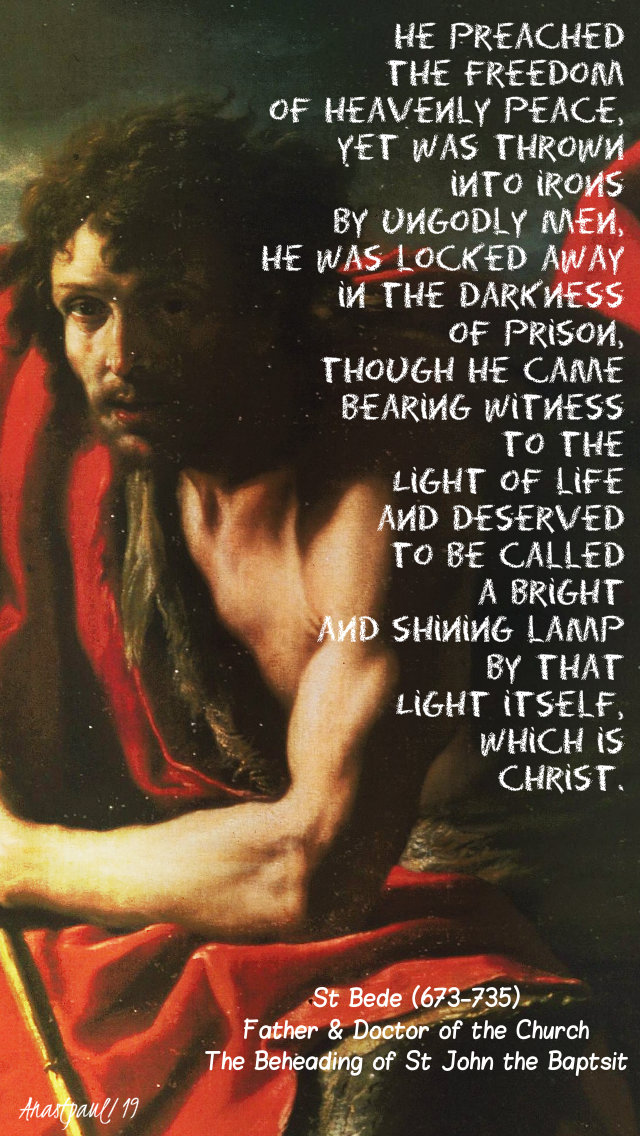
Such was the quality and strength of the man who accepted the end of this present life by shedding his blood after the long imprisonment. He preached the freedom of heavenly peace, yet was thrown into irons by ungodly men, he was locked away in the darkness of prison, though he came bearing witness to the Light of life and deserved to be called a bright and shining lamp by that Light itself, which is Christ. John was baptised in his own blood, though he had been privileged to baptise the Redeemer of the world, to hear the voice of the Father above him and to see the grace of the Holy Spirit descending upon him. But to endure temporal agonies for the sake of the truth was not a heavy burden for such men as John, rather it was easily borne and even desirable, for he knew eternal joy would be his reward.
Since death was ever near at hand through the inescapable necessity of nature, such men considered it a blessing to embrace it and thus gain the reward of eternal life by acknowledging Christ’s name. Hence the apostle Paul rightly says: You have been granted the privilege, not only to believe in Christ but also to suffer for his sake. He tells us why it is Christ’s gift that his chosen ones should suffer for Him: The sufferings of this present time, are not worthy, to be compared with the glory that is to be revealed in us.
Quote/s of the Day – 29 August – The Beheading of St John the Baptist and the Memorial of Blessed Sancja Szymkowiak CMBB (1910-1942)
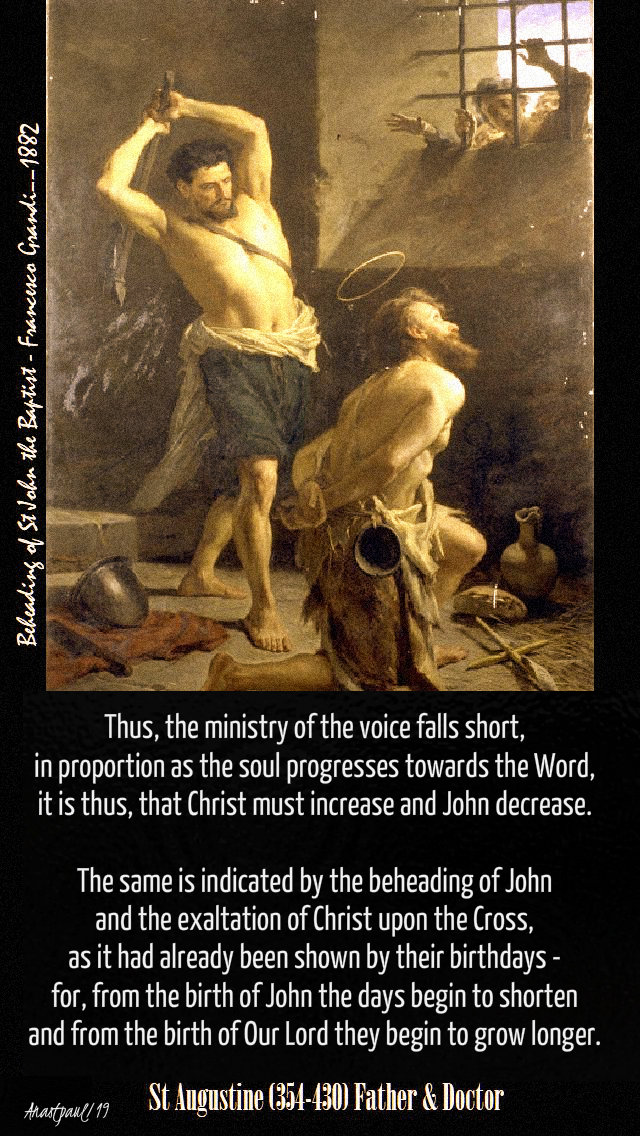
“O great and admirable mystery! He must increase but I must decrease, said John, said the voice which personified all the voices that had gone before announcing the Father’s Word Incarnate in His Christ…. But He is said to grow in us, when we grow in Him. To him, then, who draws near to Christ, to him who makes progress in the contemplation of wisdom, words are of little use, of necessity they tend to fail altogether. Thus, the ministry of the voice falls short, in proportion as the soul progresses towards the Word, it is thus, that Christ must increase and John decrease. The same is indicated by the beheading of John and the exaltation of Christ upon the Cross, as it had already been shown by their birthdays – for, from the birth of John the days begin to shorten and from the birth of Our Lord they begin to grow longer.”
St Augustine (354-420)
Father & Doctor
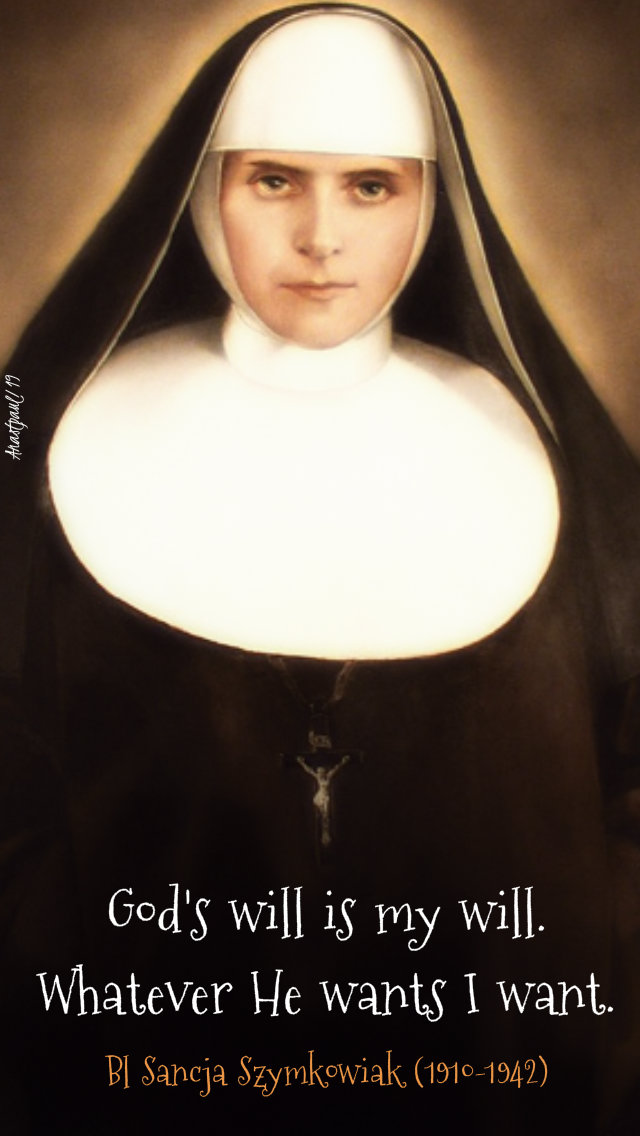
“God’s will is my will. Whatever He wants I want.”
Thought for the day – 28 August – The Memorial of St Augustine (354-430)
Father and Doctor of Grace
O Eternal Truth, True Love and Beloved Eternity
Saint Augustine of Hippo
Bishop and Great Western Father of the Church
An excerpt from his treatise, The Confessions
Urged to reflect upon myself, I entered under Your guidance into the inmost depth of my soul. I was able to do so, because You were my helper. On entering into myself I saw, as it were with the eye of the soul, what was beyond the eye of the soul, beyond my spirit: Your immutable light. It was not the ordinary light perceptible to all flesh, nor was it merely something of greater magnitude but still essentially akin, shining more clearly and diffusing itself everywhere by its intensity. No it was something entirely distinct, something altogether different from all these things and it did not rest above my mind as oil on the surface of water, nor was it above me as Heaven is above the Earth. This light was above me because it has made me, I was below it because I was created by it. He who has come to know the truth knows this light.
O Eternal truth, true love and beloved eternity. You are my God. To You do I sigh day and night. When I first came to know You, You drew me to Yourself, so that I might see that there were things for me to see but that I myself was not yet ready to see them. Meanwhile, You overcame the weakness of my vision, sending forth most strongly, the beams of Your light, and I trembled at once with love and dread. I learned that I was in a region unlike Yours and far distant from You and I thought I heard Your voice from on high: “I am the food of grown men, grow then and you will feed on Me. Nor will you change me into yourself like bodily food but you will be changed into Me.”
I sought a way to gain the strength which I needed to enjoy You. But I did not find it until I embraced the mediator between God and men, the man Christ Jesus, who is above all, God blessed for ever. He was calling me and saying – I am the way of truth, I am the life. He was offering the food which I lacked the strength to take, the food He had mingled with our flesh. For the Word became flesh, that Your wisdom, by which You created all things, might provide milk for us children.
Late have I loved You, O Beauty ever ancient, ever new, late have I loved You! You were within me but I was outside and it was there that I searched for You. In my unloveliness I plunged into the lovely things which You created. You were with me but I was not with You. Created things kept me from You, yet if they had not been in You they would not have been at all. You called, You shouted and You broke through my deafness. You flashed, You shone and You dispelled my blindness. You breathed Your fragrance on me, I drew in breath and now I pant for You. I have tasted You, now I hunger and thirst for more. You touched me and I burned for Your peace.
Quote/s of the Day – 28 August – The Memorial of St Augustine (354-430)
Father and Doctor of Grace
“God in his omnipotence could not give more, in His wisdom – He knew not how to give more, in His riches: – He had not more to give, than the EUCHARIST!”
“I will suggest a means whereby you can praise God all day long, if you wish. Whatever you do, do it well and you have praised God.”
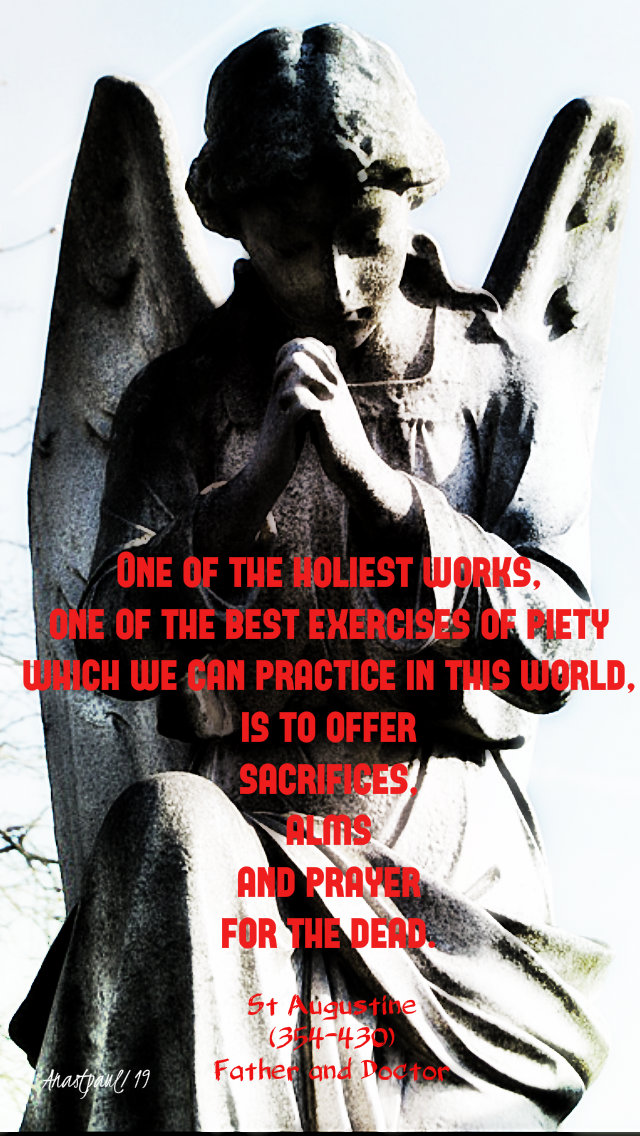
“One of the holiest works, one of the best exercises of piety which we can practice in this world, is to offer sacrifices, alms and prayer for the dead.”
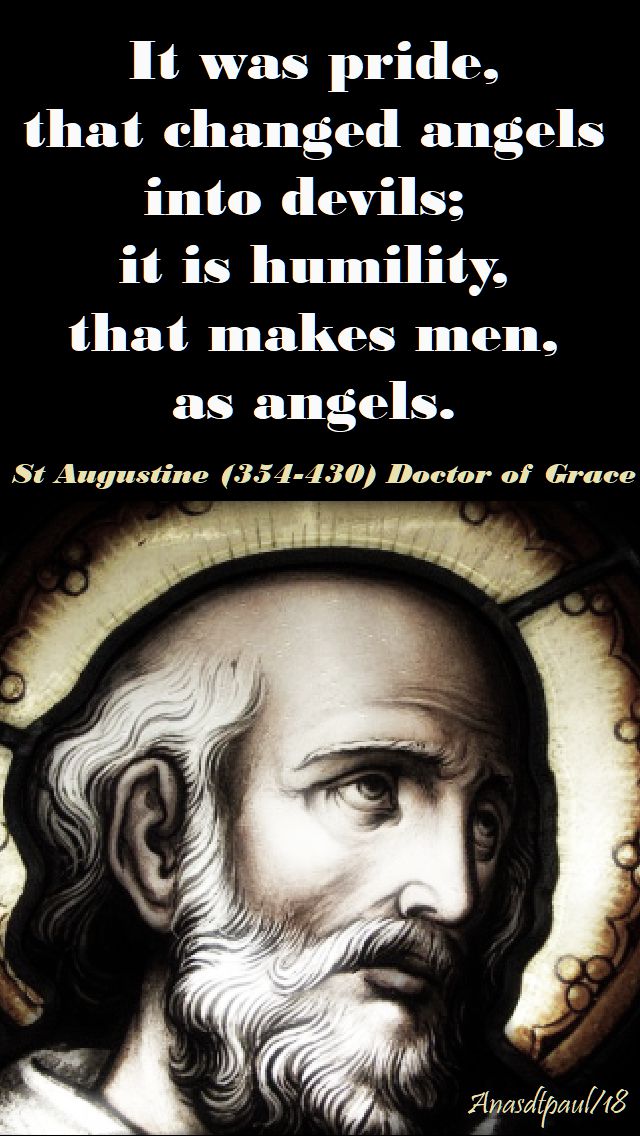
“It was pride, that changed angels into devils; it is humility that makes men as angels.”
“
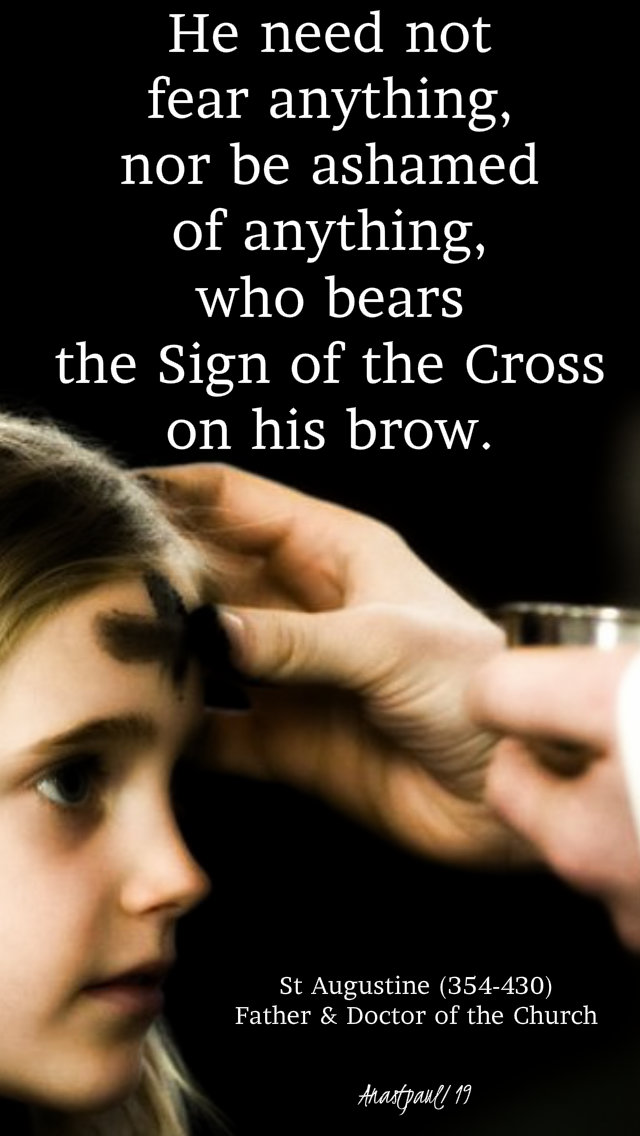
“He need not fear anything nor be ashamed of anything, who bears the Sign of the Cross on his brow.”
One Minute Reflection – 28 August – Wednesday of the Twenty-first week in Ordinary Time, Year C, Gospel: Matthew 23:27–32 and The Memorial of St Augustine of Hippo (354-430) – Doctor of Grace
“Woe to you, scribes and Pharisees, hypocrites! for you are like whitewashed tombs, which outwardly appear beautiful but within they are full of dead men’s bones and all uncleanness.” … Matthew 23:27
REFLECTION – “You are before God. Question your heart, see what you have done and what you have been yearning for there—your salvation or the windy praise of men. Look within, for a person cannot judge one whom he cannot see. If we are assuring our heart, let us assure it in His presence.
“Because if our heart thinks badly”—that is, if it accuses us within, because we aren’t acting with the spirit with which we should be acting —“God is greater than our heart, and he knows all things” (v.20).
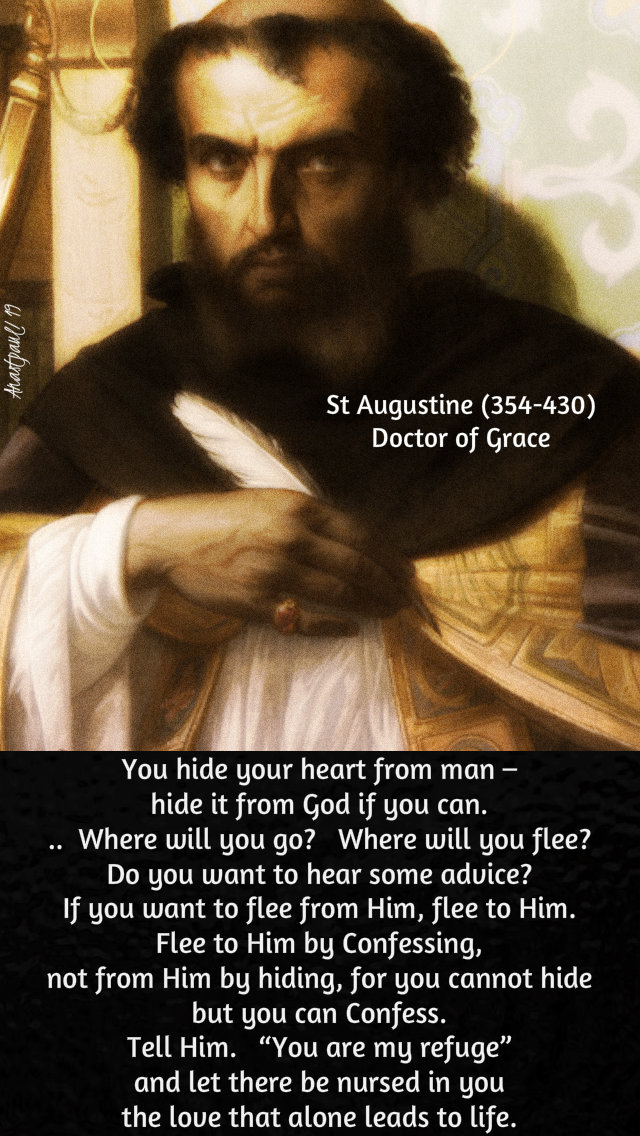
You hide your heart from man – hide it from God if you can. How will you hide it from Him to whom it was said by a certain sinner in fear and confession: “Where shall 1 go from your spirit, and where shed! I flee from your face?”… For where does God not exist? “If,” he said, “I go up to heaven, you are there; if I go down to hell, you are present” (Ps 139[138]:7-8). Where will you go? Where will you flee? Do you want to hear some advice? If you want to flee from Him, flee to Him. Flee to Him by Confessing, not from Him by hiding, for you cannot hide but you can Confess. Tell Him. “You are my refuge” (Ps 32[31]:7) and let there be nursed in you the love that alone leads to life.”…St Augustine (354-430) – Doctor of Grace
PRAYER – Renew in Your Church, we pray , O Lord, the spirit with which You endowed Your Bishop Saint Augustine, that, filled with the same spirit, we may thirst for You, the sole fount of true wisdom and seek You, the author of heavenly love. Through our Lord Jesus Christ, Your Son, who lives and reigns with You in the unity of the Holy Spirit, one God, forever and ever. St Augustine, pray for us! Amen
Our Morning Offering – 28 August – Wednesday of the Twenty-first week in Ordinary Time, Year C and The Memorial of St Augustine of Hippo (354-430) – Doctor of Grace and one of the original Four Fathers & Doctors of the Latin Church
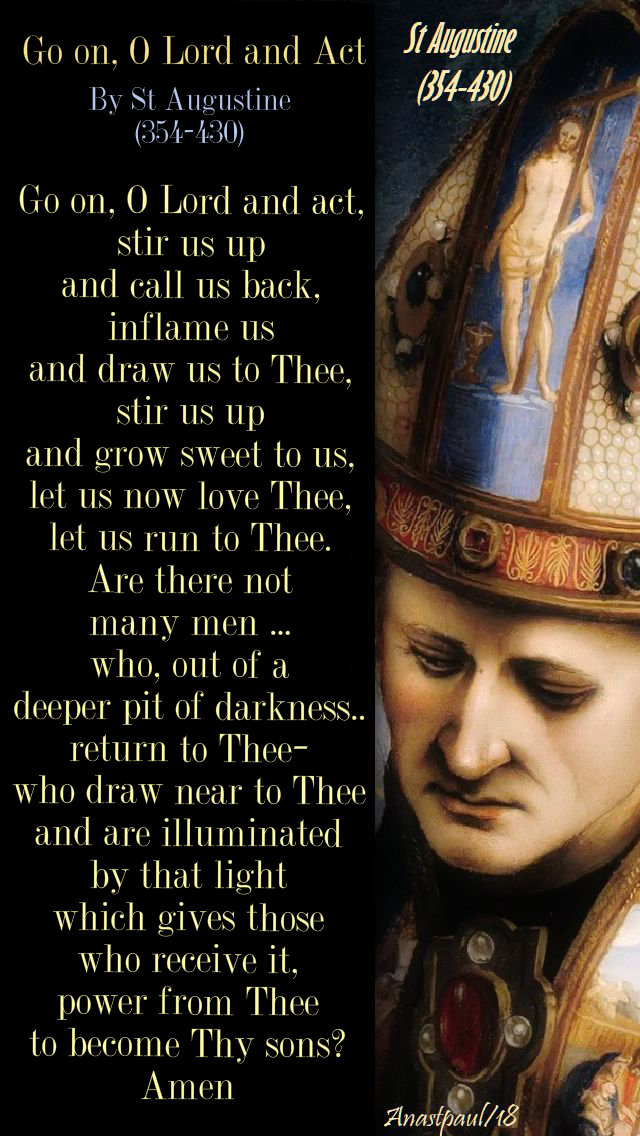
Go on, O Lord and Act By St Augustine (354-430) Father and Doctor of Grace
Go on, O Lord and act,
stir us up and call us back,
inflame us and draw us to Thee,
stir us up and grow sweet to us,
let us now love Thee,
let us run to Thee.
Are there not many men …
who, out of a deeper pit of darkness..
return to Thee–who draw near to Thee
and are illuminated by that light
which gives those
who receive it power from Thee
to become Thy sons?
Amen
St Facundinus of Taino
St Felix of Venosa
St Fortunatus of Salerno
St Gaius of Salerno
St Gorman of Schleswig
Bl Henry Webley
St Hermes of Rome
Bl Hugh More
Bl James Claxton
St Januarius of Venosa
St Joaquina Vedruna de Mas
St Julian of Auvergne
St Moses the Black
St Pelagius of Istria
St Restitutus of Carthage
St Rumwold the Prince
St Septiminus of Venosa St Vicinius/of Sarsina (Died 330)
St Vivian of Saintes
Bl William Dean
—
Martyred in the Spanish Civil War:
Martyrs of Griñon – 10 beati
Martyrs of Tarragona – 6 beati
• Blessed Agustín Bermejo Miranda
• Blessed Alejandro Iñiguez De Heredia Alzola
• Blessed Andrés Merino Báscones
• Blessed Antonio Solá Garriga
• Blessed Arturo Ros Montalt
• Blessed Aurelio da Vinalesa
• Blessed Celestino Ruiz Alegre
• Blessed Cesáreo España Ortiz
• Blessed Eladi Peres Bori
• Blessed Evencio Castellanos López
• Blessed Francisco López Navarette
• Blessed Germán Arribas y Arribas
• Blessed Graciliano Ortega Narganes
• Blessed Isidre Fábregas Gils
• Blessed Jaume Tarragó Iglesias
• Blessed Javier Pradas Vidal
• Blessed Joan Tomás Gibert
• Blessed Joaquim Oliveras Puljarás
• Blessed José Gorastazu Labayen
• Blessed Josep Camprubí Corrubí
• Blessed Juan Bautista Faubel Cano
• Blessed Lázaro Ruiz Peral
• Blessed Manoel José Sousa de Sousa
• Blessed Modest Godo Buscato
• Blessed Modest Pamplona Falguera
• Blessed Nicolás Rueda Barriocanal
• Blessed Serviliano Solá Jiménez
• Blessed Teodoro Pérez Gómez
Quote/s of the Day – 27 August – The Memorial of St Caesarius of Arles (470-542) Father of the Church
“What sort of people are we? When God gives, we want to receive, when He asks, we refuse to give? When a poor man is hungry, Christ is in need, as He said Himself: “I was hungry and you gave me no food” (v. 42). Take care not to despise the hardship of the poor, if you would hope, without fear, to have your sins forgiven… What He receives on earth, He returns in heaven!”
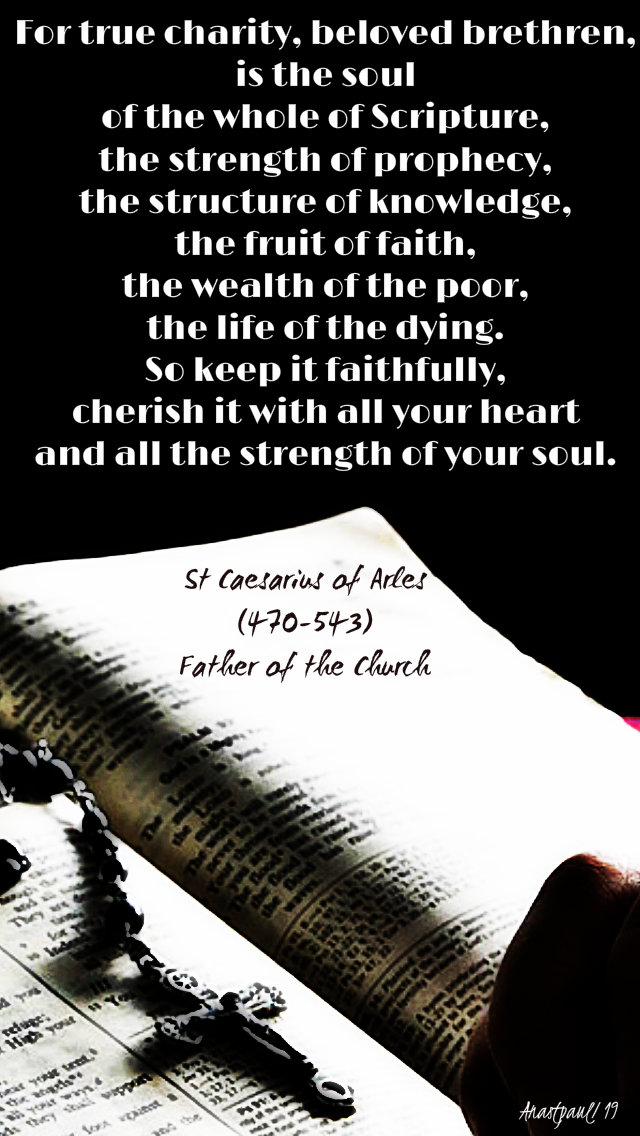
” For true charity, beloved brethren, is the soul of the whole of Scripture, the strength of prophecy, the structure of knowledge, the fruit of faith, the wealth of the poor, the life of the dying. So keep it faithfully, cherish it with all your heart and all the strength of your soul.”
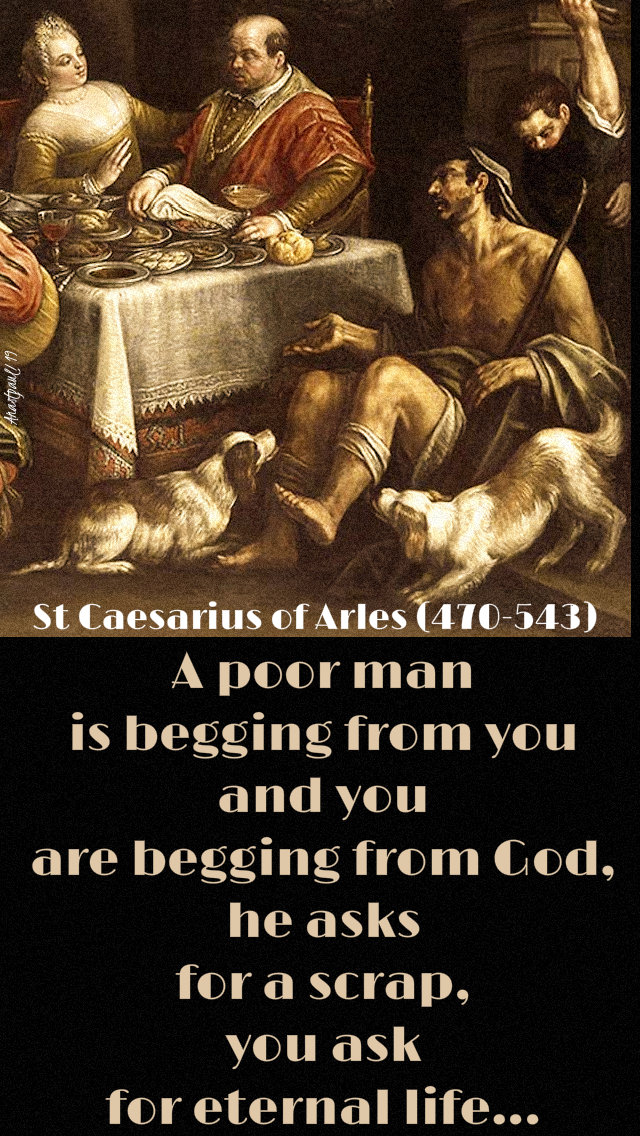
“I put you this question, dearly beloved – what is it you want, what is it you are looking for, when you come to church? What indeed if not mercy? Show mercy on earth and you will receive mercy in heaven. A poor man is begging from you and you are begging from God, he asks for a scrap, you ask for eternal life… And so when you come to church give whatever alms you can to the poor in accordance with your means.”
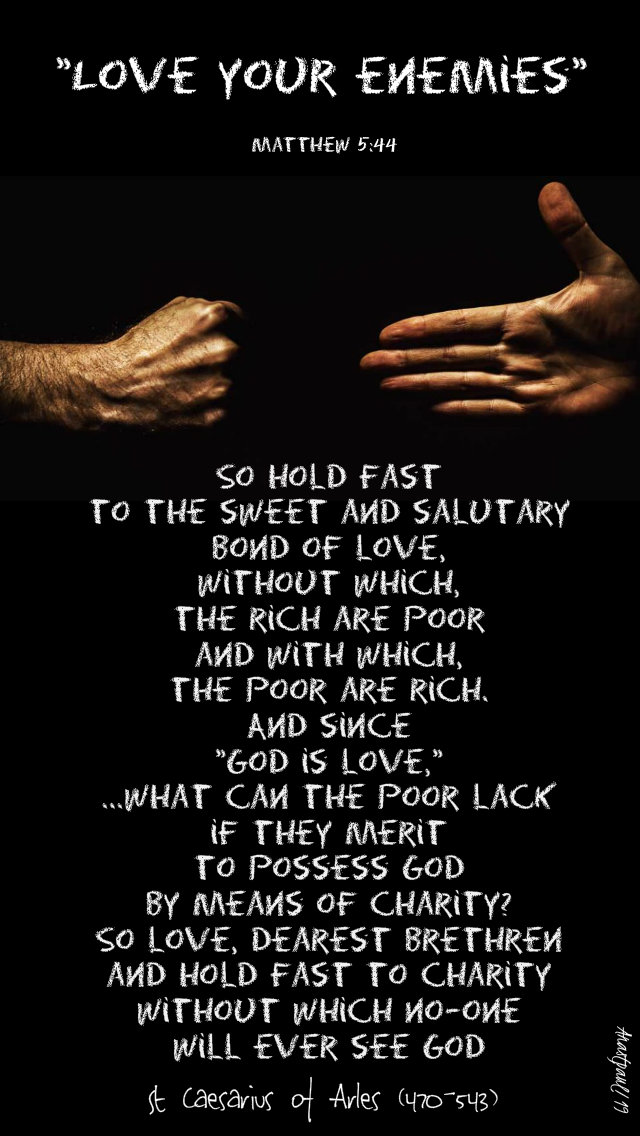
“So hold fast to the sweet and salutary bond of love, without which, the rich are poor and with which the poor are rich. What do the rich possess if not charity? (…) And since “God is love,” (1 Jn 4:8) as John the evangelist says, what can the poor lack, if they merit to possess God by means of charity? (…) So love, dearest brethren and hold fast to charity without which no-one will ever see God.”
One Minute Reflection – 27 August – Tuesday of the Twenty-first week in Ordinary Time, Year C, Gospel: Matthew 23:23–26 and The Memorial of St Caesarius of Arles (470-542) Father of the Church
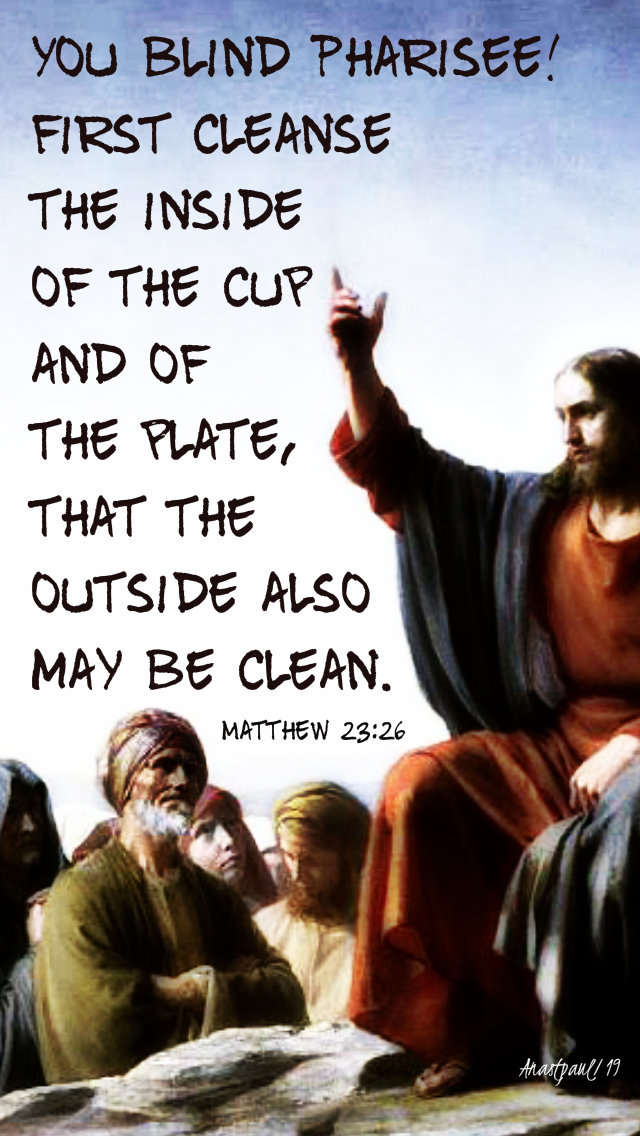
“You blind Pharisee! first cleanse the inside of the cup and of the plate, that the outside also may be clean.”…Matthew 23:26
REFLECTION – “And so, dearly beloved brethren, let us each examine his conscience and when he sees that he has been wounded by some sin, let him first strive to cleanse his conscience by prayer, fasting, almsgiving and so dare to approach the Eucharist. If he recognises his guilt and is reluctant to approach the holy altar, he will be quickly pardoned by the Divine Mercy, “for whoever exalts himself will be humbled and whoever humbles himself will be exalted” (Mt 23:12). If then, as I have said, a man conscious of his sins, humbly decides to stay away from the altar until he reforms his life, he will not be afraid of being completely excluded from the eternal banquet of heaven.
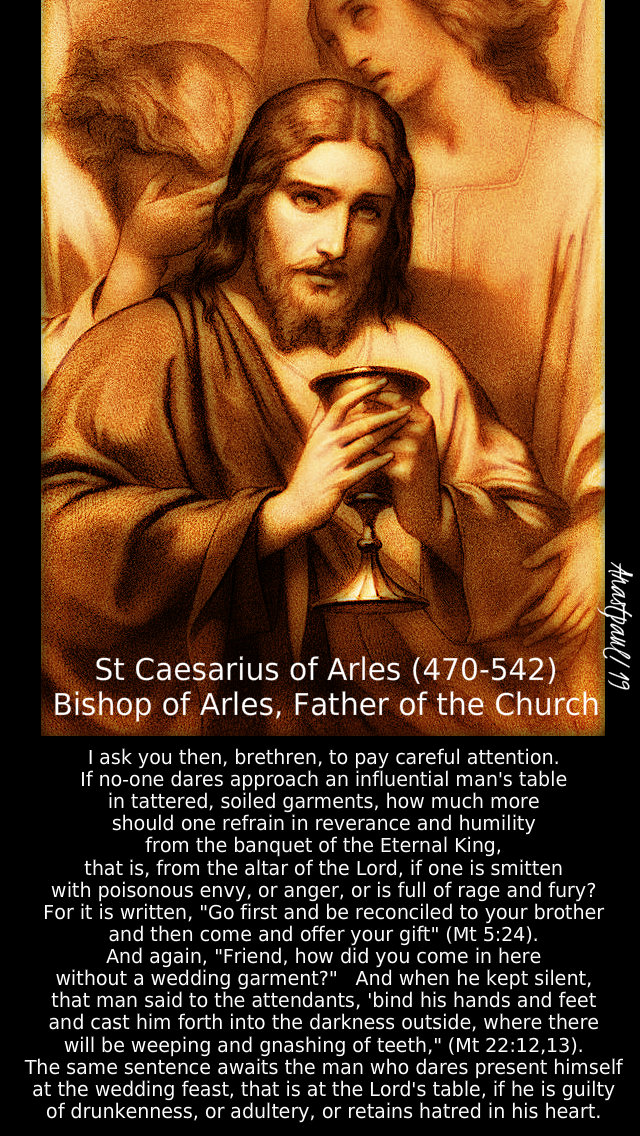
I ask you then, brethren, to pay careful attention. If no-one dares approach an influential man’s table in tattered, soiled garments, how much more should one refrain in reverence and humility from the banquet of the Eternal King, that is, from the altar of the Lord, if one is smitten with poisonous envy, or anger, or is full of rage and fury? For it is written, “Go first and be reconciled to your brother and then come and offer your gift” (Mt 5:24). And again, “Friend, how did you come in here without a wedding garment?” And when he kept silent, that man said to the attendants, ‘bind his hands and feet and cast him forth into the darkness outside, where there will be weeping and gnashing of teeth,” (Mt 22:12,13). The same sentence awaits the man who dares present himself at the wedding feast, that is at the Lord’s table, if he is guilty of drunkenness, or adultery, or retains hatred in his heart.” … St Caesarius of Arles (470-542) Bishop of Arles, Father of the Church
PRAYER – Lord God, renew Your Church with the Spirit of wisdom and love which You gave to St Caesarius. Lead us by that same Spirit, to seek You, the only fountain of true wisdom and the source of everlasting love. May we turn to You in sorrow and true repentance when we fail and strive always and everywhere to live in Your truth and Your love for all. Through our Lord Jesus Christ, Your Son, in union with the Spirit, one God, forever and ever. St Caesarius, pray for the Church and for us all, amen.
Our Morning Offering – 27 August – Tuesday of the Twenty-first week in Ordinary Time, Year C and The Memorial of St Monica (322-387)
Late Have I Loved You By St Augustine (354-430) Father & Doctor
Late have I loved You,
Beauty so ancient and so new,
late have I loved You!
Lo, you were within,
but I outside, seeking there for You
and upon the shapely things You have made
I rushed headlong – I, misshapen.
You were with me but I was not with You.
They held me back far from You,
those things which would have no being,
were they not in You.
You called, shouted, broke through my deafness.
You flared, blazed, banished my blindness.
You lavished Your fragrance, I gasped
and now I pant for You.
I tasted You and now I hunger and thirst;
You touched me and I burned for Your peace.
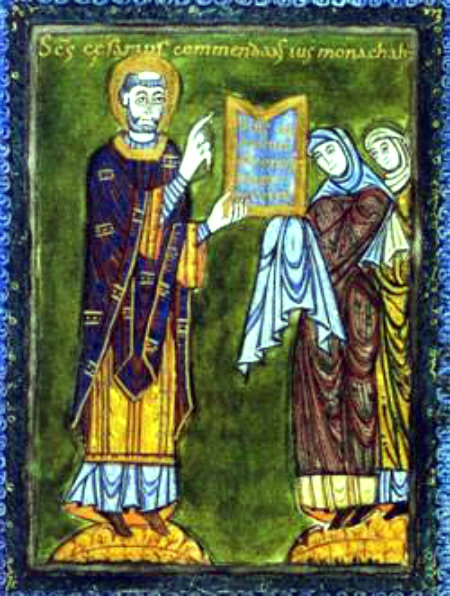
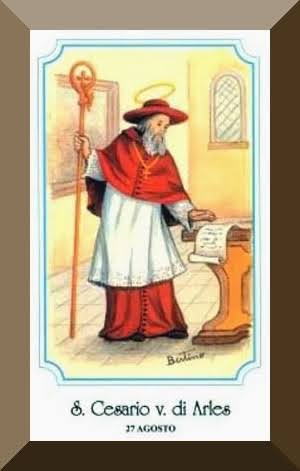
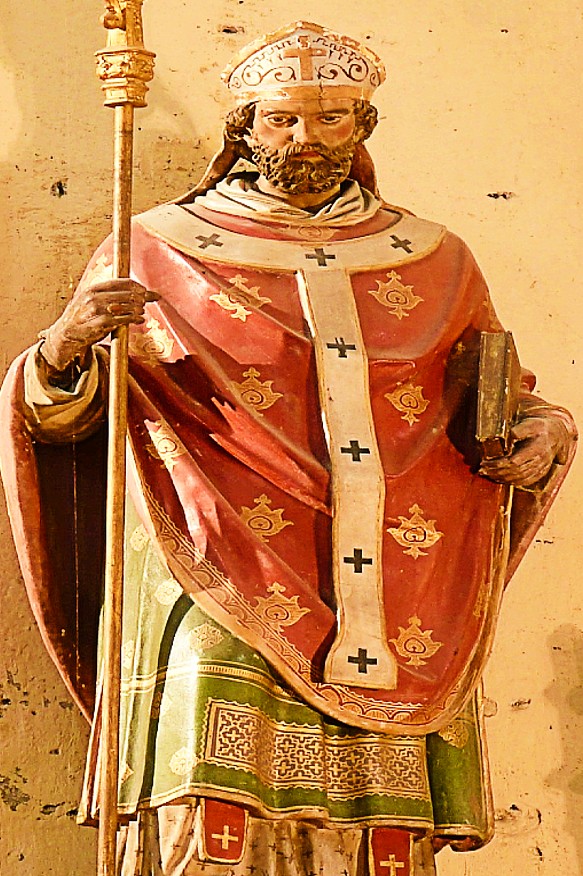
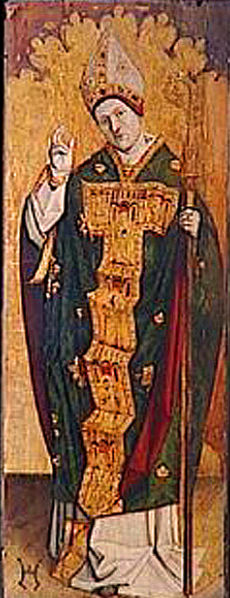
Saint of the Day – 27 August – Saint Caesarius of Arles (470-543) – Archbishop and Church Father, Theologian, Preacher, Apostle of charity, Legislator, Administrator, Writer, Reformer – sometimes known as Caesarius of Chalon due to his birthplace, born in 470 at Châlons, Burgundy, Gaul (modern France) and died on 27 August 543 at Saint John’s Convent, ArleS. Patronages – against fire.
Caesarius was born at what is now Chalon-sur-Saône, to Roman-Burgundian parents in the last years of the Western Empire. His sister, St Caesaria, to whom he addressed his “Regula ad Virgines” (Rule for Virgins), presided over the convent he had founded. Unlike his parents, Caesarius was born with a very strong and intense feeling for religion which alienated him from his family for the majority of his adolescence.
He entered the monastery of Lérins when quite young but his health being affected, the abbot sent him to Arles in order to recuperate. The Monastic community he joined there nursed him back to health and he was soon popularly elected as their bishop. By middle age, he had “become and was to remain the leading ecclesiastical statesman and spiritual force of his age.” His concern for the poor and sick was famous throughout and beyond Gaul as he regularly provided ransom for prisoners and aided the sick and the poor. Upon arriving in the city, the Vita Caesarii Life of Caesarius, says that Caesarius discovered, completely to his surprise, that the bishop of Arles – Aeonius – was a kinsman from Chalon (concivis pariter et propinquus – “at once a fellow citizen and a relative”. Aeonius later ordained his young relative as deacon and then Priest. For three years he presided over a monastery in Arles but of this building, no vestige is now left.
On the death of the bishop Caesarius was unanimously chosen his successor. He ruled the See of Arles for forty years with apostolic courage and prudence and stands out in the history of that unhappy period as the foremost bishop of Gaul. His episcopal city, near the mouth of the Rhone and close to Marseilles, retained yet its ancient importance in the social, commercial, and industrial life of Gaul and the Mediterranean world generally. As Bishop, Caesarius suffered much political hardship and attacks from many sides but he consistently remained true to his role as Bishop of the faith.
Caesarius, is, however, best known in his own day and is still best remembered, as a popular preacher, the first great ‘peoples’ preacher’ of the Christians, whose sermons have come down to us. As a preacher, Caesarius displayed great knowledge of Scripture and was eminently practical in his exhortations. Besides reproving ordinary vices of humanity, he had often to contend against lingering pagan practices, as auguries, or heathen rites.
Caesarius also has the reputation of being the faithful champion of Augustine of Hippo in the early middle ages. Thus Augustine’s writings are seen to have profoundly shaped Caesarius’ vision of human community, both inside and outside the cloister and Caesarius’ prowess as a popular preacher, is understood to follow from his close attention to the example of the Bishop of Hippo. A certain number of these discourses, forty more or less, deal with Old Testament subjects and follow the prevalent typology made popular by St Augustine.
Caesarius has over 250 surviving sermons in his corpus. His sermons reveal him as a pastor dedicated to the formation of the clergy and the moral education of the laity. He preached on Christian beliefs, values and practices against pagan syncretism. He emphasises the life of a Christian as well as the love of God, reading the scriptures, asceticism, psalmody, love for one’s neighbour and the judgement that would come. His works travelled to all parts of the Christian West, spreading his medieval sermon tradition and its topics. His writings were used by monks in Germany, repeated in Anglo-Saxon poetry and turned up in the important works of Gatianus of Tours and Thomas Aquinas.
As the occupant of an important see, the bishop of Arles exercised considerable official, as well as personal, influence. Caesarius was liberal in the loan of sermons and sent suggestions for discourses to priests and even bishops living in Spain, Italy, and elsewhere in Gaul. The great doctrinal question of his age and country was that of semi-Pelagianism. Caesarius, though evidently a disciple of St Augustine, displayed in this respect, considerable independence of thought.
Caesarius instituted many reforms, was the first to introduce in his cathedral the Divine Office, Hours of Terce, Sext and None and he also enriched with hymns, the Psalmody of every Hour. On a visit to Rome, Pope St Symmachus gave him the Pallium and made him the apostolic delegate to France. St Caesarius was the first in western Europe to receive the Pallium, thus being a forebear of this custom, which now is a rite of the Church.
St Caesarius published the Brevarium Alarici, an adaptation of Roman law which became the civil law of all Gaul. Following the fall of Arles by the Franks in 536, Caesarius moved his offices and residence to Saint John’s convent where he lived out his last seven years, spending much of his time in prayer.
Caesarius was a perfect monk in the episcopal chair and as such, his contemporaries revered him. He was a pious and a peaceful shepherd amid barbarism and war, generous and charitable to a fault, a great benefactor of his Church, mindful of the helpless, tactful in dealing with the powerful and rich, in all his life a model of Catholic speech and action.
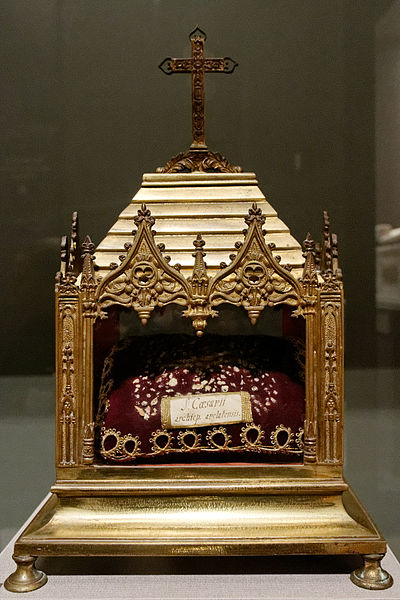
19th-century reliquary of St Caesarius, Church of S. Trophime in Arles
St Ebbo of Sens
St Etherius of Lyons
St Euthalia of Leontini
St Fortunatus of Potenza
Bl Gabriel Mary
St Gebhard of Constance
St Giovanni of Pavia
St Honoratus of Potenza
Bl Jean Baptiste Guillaume
Bl Jean-Baptiste Souzy
St John of Pavia
St Licerius of Couserans
St Malrubius of Merns
Bl Maria del Pilar Izquierdo Albero
St Narnus of Bergamo
St Phanurius
St Poemen
Bl Roger Cadwallador
St Rufus of Capua
St Sabinian of Potenza
St Syagrius of Autun
—
Martyrs of Tomi – 5 saints: A group of 17 Christians imprisoned and excuted for their faith during the persecutions of Diocletian. They miraculously were unburned by fire and untouched by wild animals. We know the names and a few details on five of them – John, Mannea, Marcellinus, Peter and Serapion. They were tied to stakes and burned alive; they emerged unharmed – thrown to wild animals in the amphitheatre; the animals ignored them; they were beheaded in 304 in Tomi, Mesia (modern Costanza, Romania).
Martyred in the Spanish Civil War:
• Blessed Buenaventura Gabika-Etxebarria Gerrikabeitia
• Blessed Esteban Barrenechea Arriaga
• Blessed Fernando González Añon
• Blessed Francisco Euba Gorroño
• Blessed Hermenegildo Iza Aregita
• Blessed José María López Carrillo
• Blessed Juan Antonio Salútregui Iribarren
• Blessed Pedro Ibáñez Alonso
• Blessed Pelayo José Granado Prieto
• Blessed Plácido Camino Fernández
• Blessed Quirino Díez del Blanco
• Blessed Ramón Martí Soriano
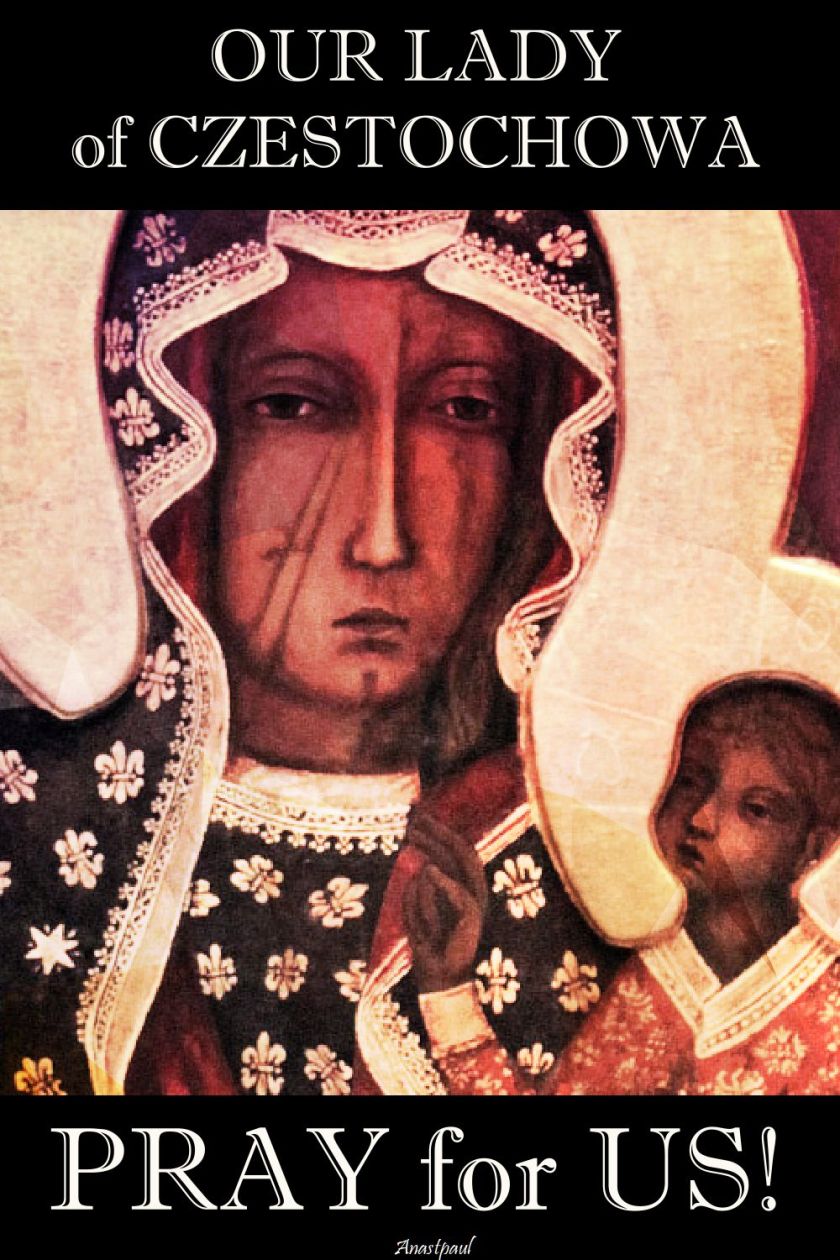
One Minute Reflection – 26 August – Monday of the Year in Ordinary Time, Year C, Gospel: Matthew 23:13–22 and The Feast of Our Lady of Czestochowa
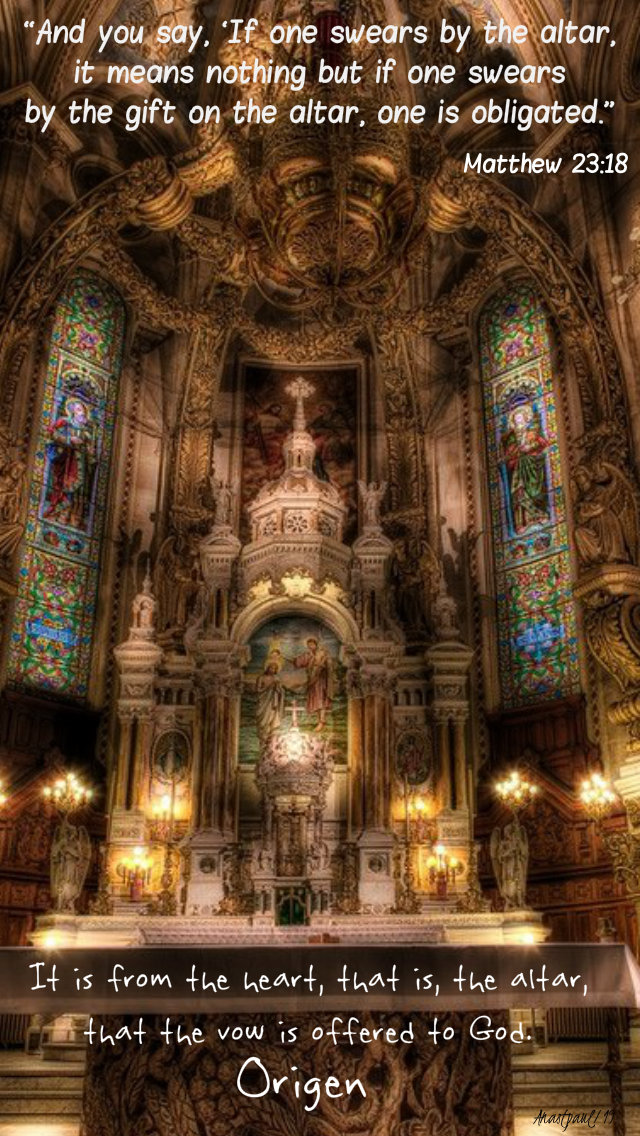
“And you say, ‘If one swears by the altar, it means nothing but if one swears by the gift on the altar, one is obligated.” … Matthew 23:18
REFLECTION – “Consider this analogy. Think of the altar as the heart and the temple as the whole of Scripture. The temple of God’s glory, spiritually understood, is the divinely inspired Scripture. The gold refers to the meanings it conveys. To swear is to witness to the Scriptures, as a validation and confirmation of the word we speak. Therefore, we ought to profess the whole sense of Scripture, as a confirmation of the sense which we invoke, in all of our words.
…The temple, that is, the reading of the Scriptures, makes a great and venerable sense, just as consecrated gold is valuable. So we ought not to swear by our own intellects to confirm our beliefs, as if we were creating witnesses that could judge according to the truth. But let us explore further the analogy of the temple, the gold and the altar. The altar is the place where a vow is sanctified. The altar in this passage is the heart of a man. What happens in the heart happens deeply within a person. Vows and gifts placed on the altar are clearly those placed upon the human heart. When you begin to pray, you place the vow of your prayer upon your heart, as if you had placed something upon the altar, so that you might offer your prayer to God.
Suppose you are ready to place an offering of psalms upon your heart, so as to offer to God an offering of psalms, accompanying yourself with a harp. Or suppose you are ready to give alms. You make an offering of alms upon your heart, just as if you had placed something on the altar, as you would offer your alms to God . Suppose you have proposed to fast, in order to make an offering of your fasting upon your heart, as if you had placed something upon the altar.
In this way the heart of a man makes vows in a holy and venerable way. It is from the heart, that is, the altar, that the vow is offered to God. Therefore, it is not possible for the offering of a man to be more honourable than his heart, from which the offering is sent up.” … Origen (c 185-253) (Commentary on Matthew, 2)
PRAYER – Lord, be the beginning and the end of all that we do and say. Prompt our actions with Your grace and complete them with Your all-powerful help. Fill us with the grace of Your true love, that our hearts may be made of flesh and not of stone. May our hearts, minds and souls belong to You alone. May the guiding hand of the Mother of Your Son lead us, with unfailing tenderness, to You. Through our Lord, Jesus Christ, in union with the Holy Spirit, ‘totus tuus’ Maria – please pray for us, amen.
Our Morning Offering – 26 August – Monday of the Twenty-first week in Ordinary Time
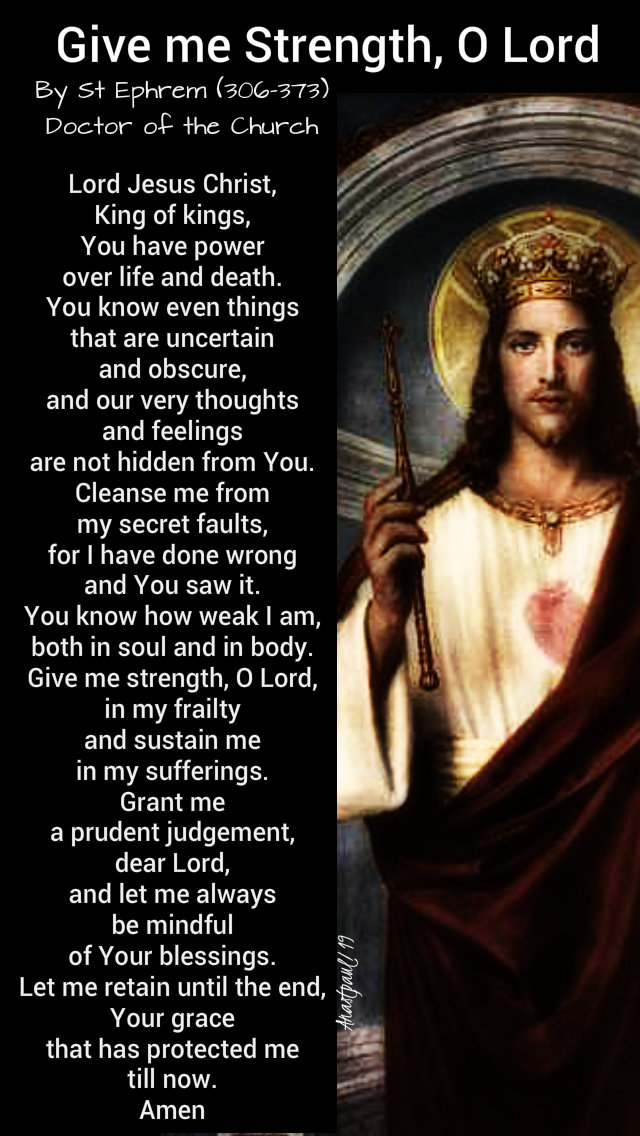
Give me Strength, O Lord By St Ephrem of Syria (306-373) Father & Doctor of the Church
Lord Jesus Christ,
King of kings,
You have power over life and death.
You know even things that are uncertain and obscure,
and our very thoughts and feelings are not hidden from You.
Cleanse me from my secret faults,
for I have done wrong and You saw it.
You know how weak I am,
both in soul and in body.
Give me strength, O Lord,
in my frailty and sustain me in my sufferings.
Grant me a prudent judgement, dear Lord,
and let me always be mindful of Your blessings.
Let me retain until the end, Your grace
that has protected me till now.
Amen





















 AnaStpaul
You must be logged in to post a comment.