Our Morning Offering – 24 January – Feast of Saint Timothy, Bishop and Martyr
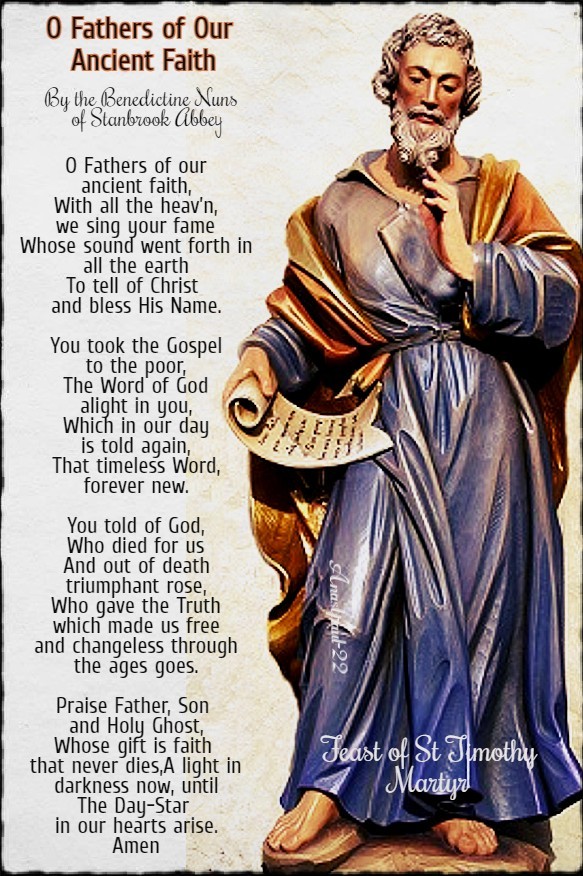
O Fathers of Our Ancient Faith
O Fathers of our ancient faith, With all the heav’n, we sing your fame Whose sound went forth in all the earth To tell of Christ and bless His Name.
You took the Gospel to the poor, The Word of God alight in you, Which in our day is told again, That timeless Word, forever new.
You told of God, Who died for us And out of death triumphant rose, Who gave the Truth which made us free and changeless through the ages goes.
Praise Father, Son and Holy Spirit, Whose gift is faith that never dies, A light in darkness now, until The Day-Star in our hearts arise.
O Fathers of Our Ancient Faith is written by the Benedictine Nuns of Stanbrook Abbey. In the Divine Office it is sung at Morning Prayer in the Common of Apostles. It is set to the anonymous tune associated with the 7th century Latin hymn, Creator Alme Siderum.
Quote/s of the Day – 18 January – Feast of the Chair of the Apostle, St Peter at Rome – 1 Peter 1:1-7, Matthew 16:13-19 – Scripture search here: https://www.drbo.org/
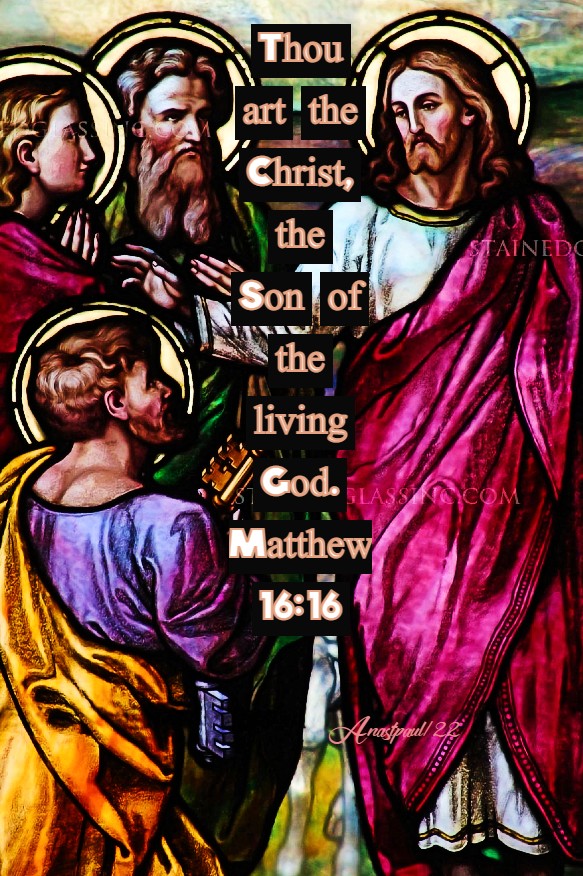
“Thou art the Christ, the Son of the living God.”
Matthew 16:16
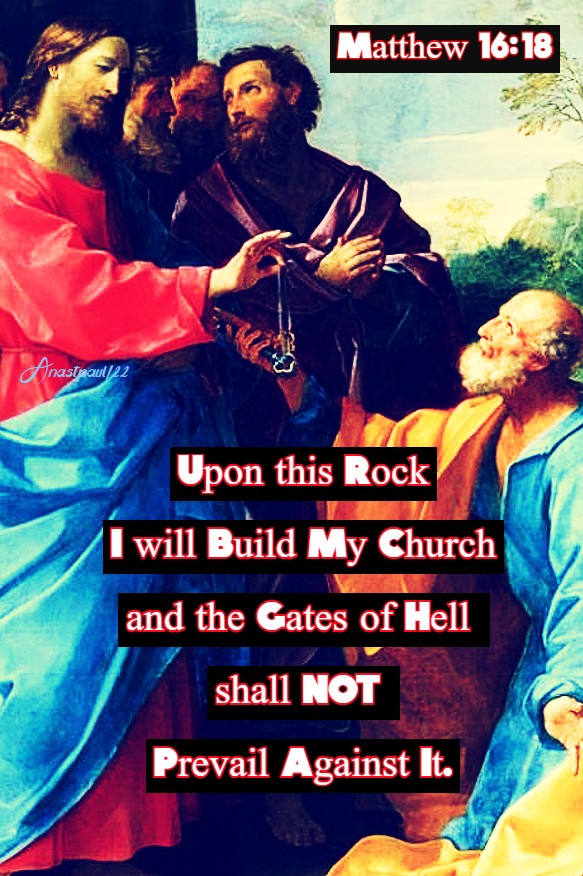
“Upon this rock I will build My Church”
Matthew 16:18
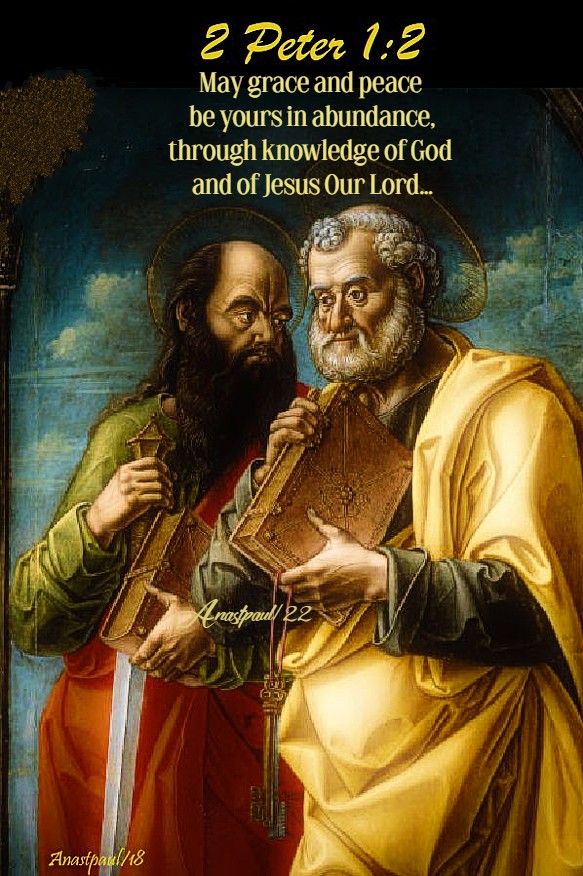
“… May grace and peace be yours in abundance, through knowledge of God and of Jesus Our Lord…”
2 Peter 1:2
“So Peter wept and wept bitterly; he wept so hard that he washed away his offence with his tears. And you, too, if you would win pardon, wipe out your guilt with tears. At that very moment, in that same hour, Christ will look at you. If some kind of fall happens to you, then He, the ever-present witness of your intimate life, looks at you to call you back and cause you to confess your lapse. Then do as Peter did, who thrice said: “Lord, you know that I love you” (Jn 21:15). He denied three times and three times he also confessed. But he denied by night; he confessed in broad daylight.”
St Ambrose (340-397) Father and Doctor of the Church
“Yes, the Apostle chosen to be His co-worker, merited to share, the same Name as Christ. They built the same Building together – Peter does the planting, the Lord gives the increase and it is the Lord, too, Who sends those, who will do the watering (cf 1 Cor 3:6f).”
St Augustine (354-430) Father & Doctor of the Church
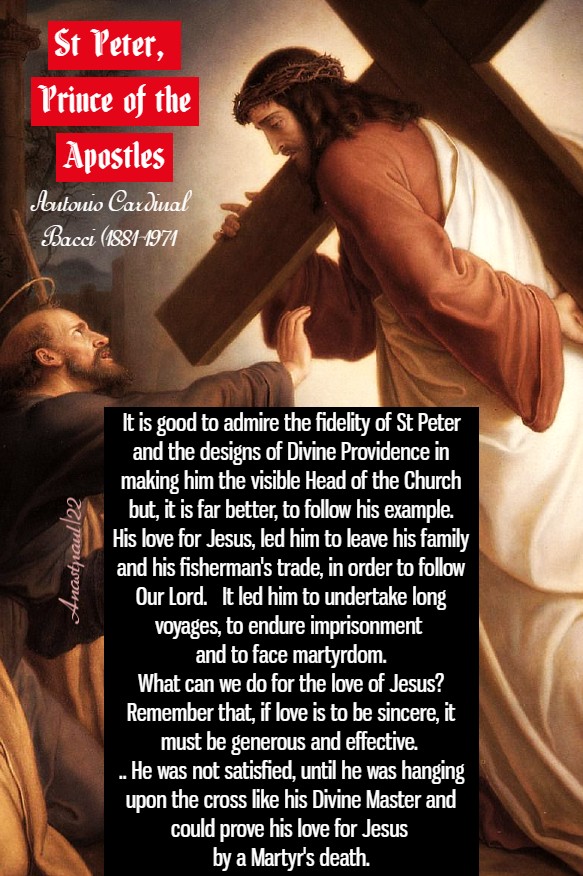
“It is good to admire the fidelity of St Peter and the designs of Divine Providence in making him the visible Head of the Church but, it is far better, to follow his example. His love for Jesus, led him to leave his family and his fisherman’s trade, in order to follow Our Lord. It led him to undertake long voyages, to endure imprisonment and to face Martyrdom. What can we do for the love of Jesus? Remember that, if love is to be sincere, it must be generous and effective. … He was not satisfied, until he was hanging upon the cross like his Divine Master and could prove his love for Jesus by a Martyr’s death.”
Our Morning Offering – 18 January – Feast of the Chair of the Apostle, St Peter at Rome
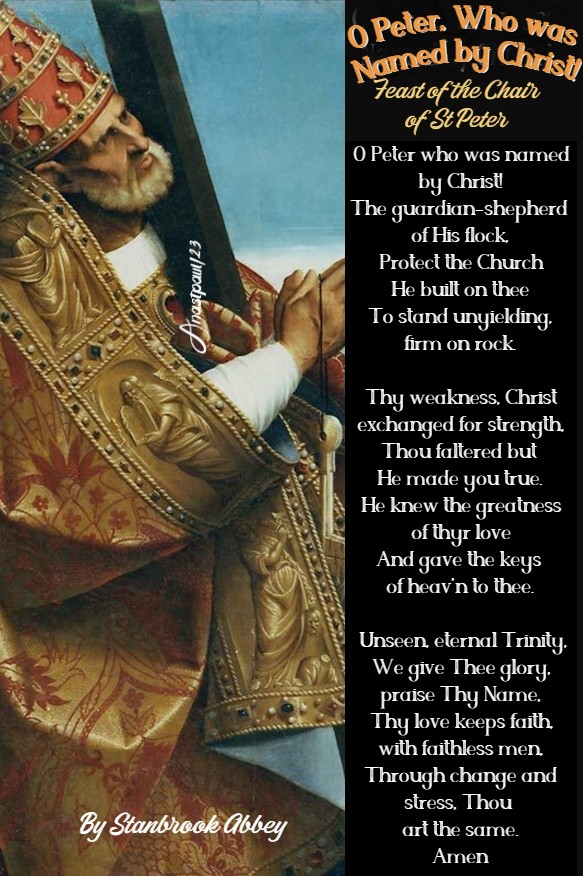
O Peter, Who was Named by Christ! By Stanbrook Abbey For the Feast of the Chair of St Peter
O Peter who was named by Christ! The guardian-shepherd of His flock, Protect the Church He built on thee To stand unyielding, firm on rock.
Thy weakness, Christ exchanged for strength, Thou faltered but He made thee true. He knew the greatness of thy love And gave the keys of heav’n to thee.
Unseen, eternal Trinity, We give Thee glory, praise Thy Name, Thy love keeps faith, with faithless men, Through change and stress, Thou art the same. Amen
One Minute Reflection – 4 January – “The Month of the Most Holy Name of Jesus” – Octave of the Holy Innocents – Apocalypse 14:1-5 , Matthew 2:13-18 –Scripture search here: https://www.drbo.org/
“For it will come to pass that Herod will seek the Child, to destroy Him.” – Matthew 2:14
REFLECTION – “The Apostle John said: “Whoever says he abides in Christ, ought to walk even as Christ walked” (1 Jn 2:6). Moreover, the blessed Apostle Paul exhorts and teaches us, saying: “We are God’s children but if children, then heirs of God and joint-heirs with Christ; if so be that we suffer with him that we may also be glorified together” (Rm 8:16f.) … Let us, beloved brethren, imitate righteous Abel, who initiated Martyrdom, he being the first to be slain for righteousness’s sake (Gn 4:8) … let us imitate the three children Ananias, Azarias and Misael, who … overcame the king by the power of faith (Dn 3) … What of the prophets whom the Holy Spirit quickened to a foreknowledge of future events? What of the Apostles whom the Lord chose? Since these righteous men were slain for righteousness’ sake, have they not taught us also to die?
The nativity of Christ at once witnessed the Martyrdom of infants, so that they, who were two years old and under were slain for His Name’s sake. An age, not yet fitted for the battle, appeared fit for the crown. That it might be manifest that they, who are slain for Christ’s sake, are innocent, innocent infancy was put to death for His Name’s sake … How grave is the case of a Christian, if he, a servant, is unwilling to suffer when his Master first suffered! … The Son of God suffered that He might make us sons of God and the son of man will not suffer that he may continue to be a son of God!? … The Maker and Lord of the world also warns us, saying: “If the world hates you, remember that it hated Me before you. If you were of the world, the world would love its own but because you are not of the world but I have chosen you out of the world ”… remember the word that I said to you: “The servant is not greater than his Lord” (Jn 15:18-20).” – St Cyprian of Carthage (c 200-258) Martyr, Bishop of Carthage, Father of the Church – Letter 55
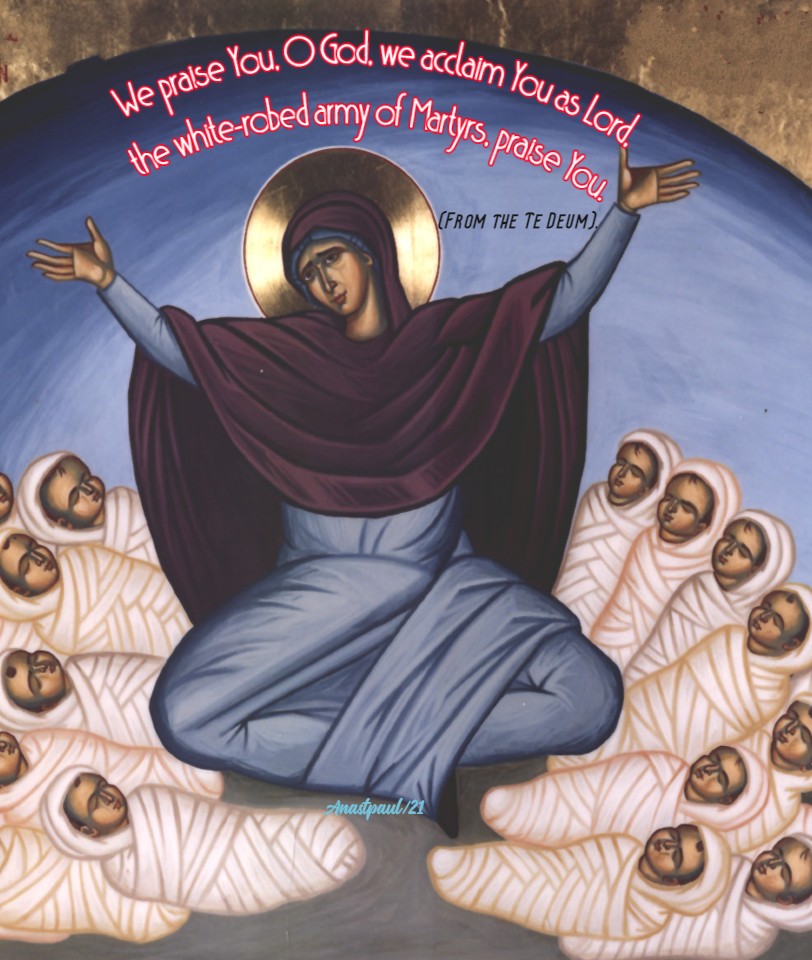
PRAYER – O God, Whose praise the Innocents, Thy Martyrs, this day proclaimed, not by speaking but by dying, put to death in us all the wickedness of sin, so that Thy faith which our tongue professes, may be proclaimed also by our life. Through Jesus Christ, Thy Son our Lord, Who lives and reigns with Thee, in the unity of the Holy Ghost, God, world without end. Amen (Collect).
Our Morning Offering – 4 January – Octave of the Holy Innocents – “The Month of the Most Holy Name of Jesus”
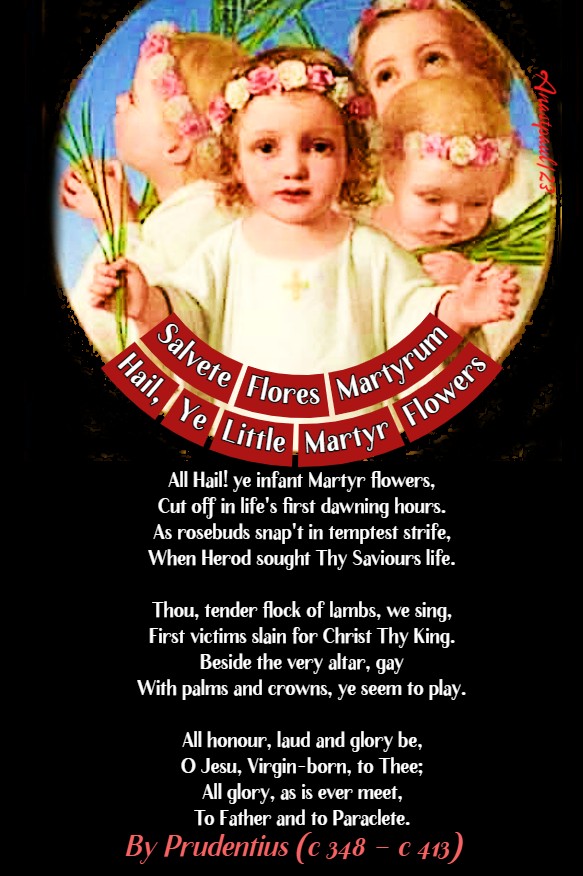
Salvete Flores Martyrum Hail, Ye Little Martyr Flowers By Prudentius (c 348 – c 413) (Aurelius Prudentius Clemens) The Renowned Poet
All Hail! ye infant Martyr flowers, Cut off in life’s first dawning hours. As rosebuds snap’t in temptest strife, When Herod sought Thy Saviours life.
Thou, tender flock of lambs, we sing, First victims slain for Christ Thy King. Beside the very altar, gay With palms and crowns, ye seem to play.
All honour, laud and glory be, O Jesu, Virgin-born, to Thee; All glory, as is ever meet, To Father and to Paraclete.
Salvete Flores Martyrum is the Office Hymn for Lauds on the Feast of the Holy Innocents (28 Dec). Its stanzas are drawn from Prudentius’ Epiphany Hymn, Cathemerinon and were first assembled in the 1568 Breviary of Pope Pius V.
Our Morning Offering – 2 January – Feast and Month of the Most Holy Name of Jesus
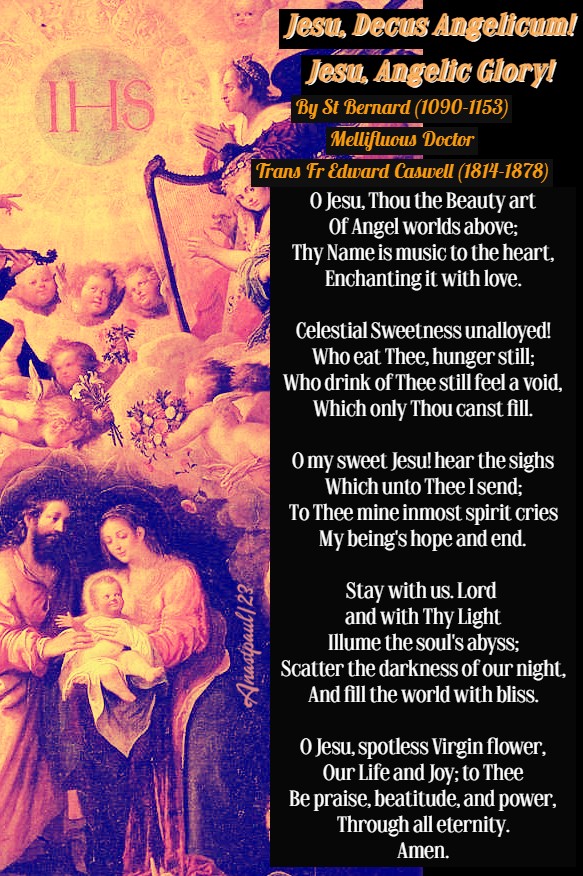
Jesu, Decus Angelicum! Jesu, Angelic Glory! By St Bernard of Clairvaux (1090-1153) Mellifluous Doctor Trans Fr Edward Caswell C.Orat. (1814-1878)
O Jesu, Thou the Beauty art Of Angel worlds above; Thy Name is music to the heart, Enchanting it with love.
Celestial Sweetness unalloyed! Who eat Thee, hunger still; Who drink of Thee still feel a void, Which only Thou canst fill.
O my sweet Jesu! hear the sighs Which unto Thee I send; To Thee mine inmost spirit cries My being’s hope and end.
Stay with us. Lord and with Thy Light Illume the soul’s abyss; Scatter the darkness of our night, And fill the world with bliss.
O Jesu, spotless Virgin flower, Our Life and Joy; to Thee Be praise, beatitude, and power, Through all eternity. Amen.
As noted yesterday, Jesu, Dulcis Memoria is a celebrated 12th century prayer/hymn by St Bernard of Clairvaux (1090-1153), Doctor Mellifluous. The entire hymn has some 42 to 53 stanzas. Parts of this hymn are used for the Feast of the Holy Name of Jesus. So the above are the stanzas used today for the Feast of the Holy Name.
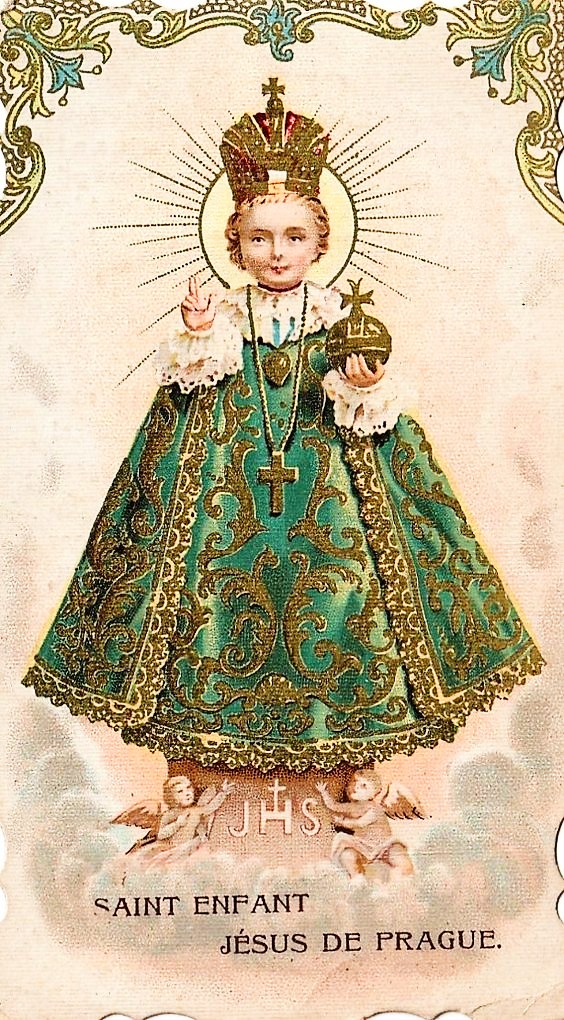
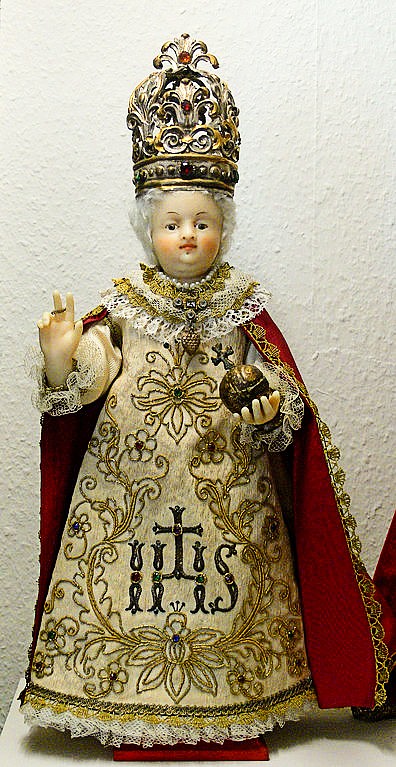
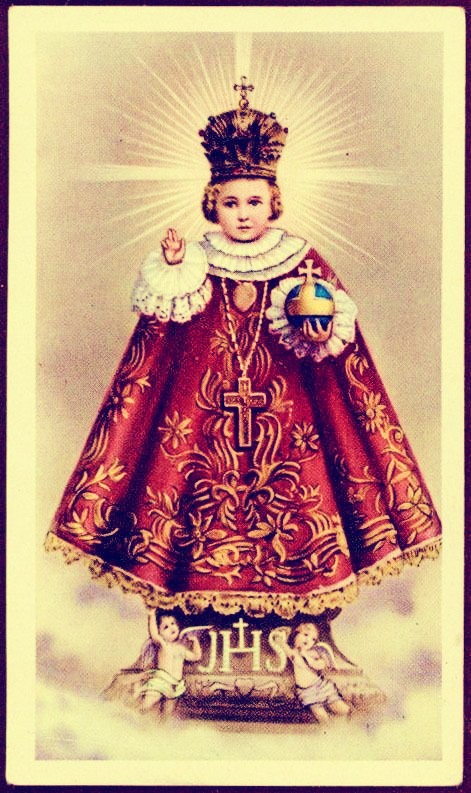
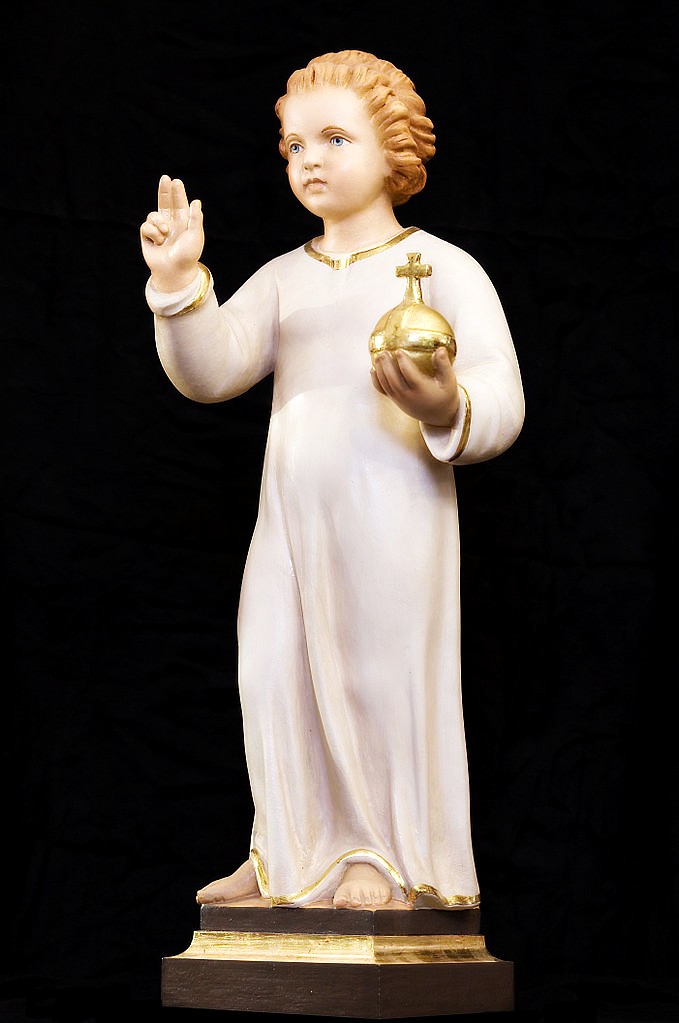
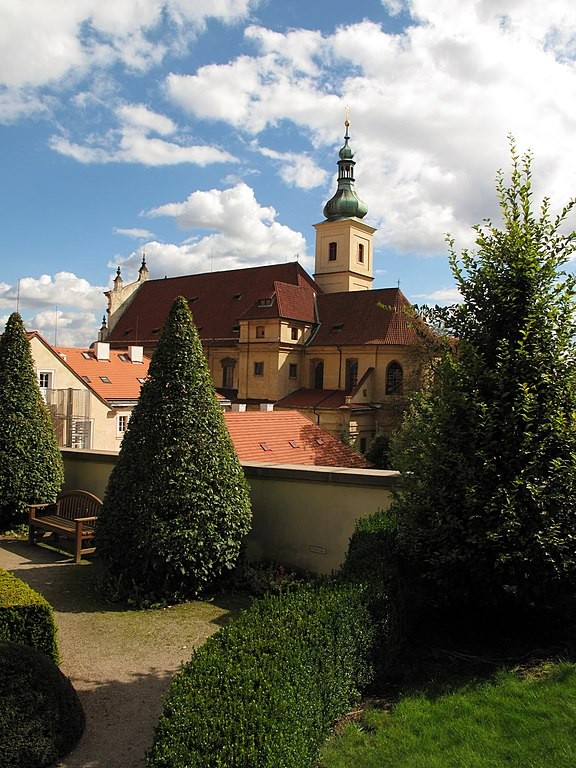
Saint of the Day – 2 January – Feast of the Infant Jesus of Prague – the 16th Century wax-coated wooden Statue of the Child Jesus, holding a globus cruciger (the Orb and Cross) with the right hand being raised in benediction, is of Spanish origin and is just under half a metre in height. It is now located in the Discalced Carmelite Church of Our Lady of Victories in Malá Strana, Prague, Czech Republic, see the Church at the bottom (one where I have been immensely blessed to attend Holy Mass before the Infant each day for a week some years ago). The Statue is venerated on 2 January, on 14 January and on the first Sunday of May.
The Infant above the Altar at Our Lady of Victories in Malá Strana, Prague
In 1556, pious legends claim that the Statue once belonged to St Teresa of Ávila and was donated to the Carmelite Friars by Princess Polyxena of Lobkowicz in 1628 upon her marriage to Czech nobleman.
The image is routinely clothed by the Carmelite Nuns in luxurious fabrics often in the Liturgical Vestment colours relevant to the Seasons and with imperial regalia and a golden crown. In thanksgiving for the numerous graces and cures received, the miraculous Statue at Prague , was solemnly crowned when Pope Leo XII signed and granted its first Pontifical Decree of Canonical Coronation on 24 September 1824. St Pius X granted authorisation via the Decree “Significat Nobis” to erect a namesake Confraternity.
Disturbances in Bohemia due to the Thirty Years’ War brought an end to the special devotions and on 15 November 1631 the army of King Gustavus Adolphus of Sweden took possession of Bohemia’s Capital City. The Carmelite Friary was plundered and the image of the Infant of Prague was thrown into a pile of rubbish behind the Altar. Here it lay forgotten for seven years, its hands broken off, until in 1637, it was found again by Father Cyrillus and placed in the Church’s oratory. One day, while praying before the Statue, Cyrillus heard a voice say, “Have pity on Me and I will have pity on you. Give Me my hands and I will give you peace. The more you honour Me, the more I will bless you.”
A German copy of the Statue, with a white wig instead of the traditional blonde hair, circa. 1870
Copies of the Infant Jesus arrived in Poland in 1680 and it has been popular in Polish homes and Bohemia in general, where the copies are typically placed in glass-enclosed cases. After the start of the Counter-Reformation era of the 17th Century, the Statue spread among Catholics all over the world, with particular devotion developing in South Africa, Australia, Caribbean, Thailand and Sri Lanka.
So many graces have been received by those who invoke the Divine Child before the original Statue that it has been called “The Miraculous Infant Jesus of Prague.” We read the following in an old book printed in Kempt: “All who approach the miraculous Statue and pray there with confidence, receive assistance in danger, consolation in sorrows, aid in poverty, comfort in anxiety, light in spiritual darkness, streams of grace in dryness of soul, health in sickness and hope in despair.”
The Infant in it’s bare format
From small beginnings, this devotion has grown to great proportions. The Divine Child attracts an ever increasing number of clients, who appeal to Him in every need.
The Church of Our Lady Victorious, in Malá Strana, Prague, Czech Republic.
Bl Airaldus of Maurienne St Alverius of Agaunum St Asclepius of Limoges St Aspasius of Auch St Baudimius of Auvergne St Blidulf of Bobbio St Dietmar of Prague Bl Guillaume Répin Bl Guillermo de Loarte St Hortulana of Assisi St Isidore of Antioch St Isidore of Nitri St John Camillus the Good St Macarius of Rome
St Mark the Mute St Maximus of Vienne St Munchin of Limerick Bl Odino of Rot St Paracodius of Vienne St Sebastian of Agaunum St Seiriol Bl Stephana de Quinzanis Bl Sylvester of Troina St Telesphorus, Pope St Theodota St Theopistus St Vincentian of Tulle St Viance of Anjou
Many Martyrs Who Suffered in Rome: There were many Martyrs who suffered in the persecutions of Diocletian for refusing to surrender the holy books. Though we know these atrocities occurred, we do not know the names of the Saints and we honour them as a group. c 303 in Rome, Italy.
Martyrs of Antioch – 5 Saints: A group of Christian soldiers Martyred together for their faith. We know the names of five – Albanus, Macarius, Possessor, Starus and Stratonicus. They were born in Greece and were Martyred in Antioch (modern Antakya, Turkey).
Many Martyrs of Britain: The Christians of Britain appear to have escaped unharmed in the earlier persecutions which afflicted the Church but the cruel edicts of Diocletian were enforced in every corner of the Roman Empire and the faithful inhabitants of this land, whether native Britons or Roman colonists, were called upon to furnish their full number of holy Martyrs and Confessors. The names of few are on record but the British historian, Saint Gildas, after relating the Martyrdom of Saint Alban, tells us, that many others were seized, some put to the most unheard-of tortures and others immediately executed, while not a few hid themselves in forests and the caves of the earth, where they endured a prolonged death until God called them to their reward. The same writer attributes it to the subsequent invasion of the English, then a pagan people, that the recollection of the places, sanctified by these Martyrdoms, has been lost and so little honour paid to their memory. It may be added, that, according to one tradition, a thousand of these Christians were overtaken in their flight near Lichfield and cruelly massacred and that the name of Lichfield, or Field of the Dead, is derived from them.
Martyrs of Ethiopia – 3 Saints: A group of Christians Martyred together for their faith. We know the names of three – Auriga, Claudia and Rutile.
Martyrs of Jerusalem – 2 Saints: A group of Christians Martyred together for their faith. We know the names of two – Stephen and Vitalis.
Martyrs of Lichfield: Many Christians suffered at Lichfield (aka Lyke-field, meaning field of dead bodies), England in the persecutions of Diocletian. Though we know these atrocities occurred, we do not know the names of the Saints and we honour them as a group. Their Martyrdom occurred in 304 at Lichfield, England.
Martyrs of Piacenza: A group of Christians who died together for their faith in the persecutions of Diocletian. No details about them have survived. They were Martyred on the site of Church of Madonna di Campagna, Piacenza, Italy.
Martyrs of Puy – 4 Saints: Missionaries, sent by Saint Fronto of Périgueux to the area of Puy, France. Tortured and Martyred by local pagans. We know the names – Frontasius, Severinus, Severian and Silanus. They were beheaded in Puy (modern Puy-en-Velay), France and buried together in the Church of Notre Dame, Puy-en-Velay by Saint Fronto, their bodies laid out to form a cross.
Martyrs of Syrmium – 7 Saints: Group of Christians Martyred together, date unknown. We know the names of seven – Acutus, Artaxus, Eugenda, Maximianus, Timothy, Tobias and Vitus – but very little else. This occurred in the 3rd or 4th century at Syrmium, Pannonia (modern Sremska Mitrovica, Serbia).
Martyrs of Tomi – 3 Saints: Three brothers, all Christian soldiers, in the Imperial Roman army and all three Martyred in the persecutions of Emperor Licinius Licinianus. We know their names – Argeus, Marcellinus and Narcissus – but little else. They were Martyred in 320 at Tomi, Exinius Pontus, Moesia (modern Constanta, Romania).
One Minute Reflection – 1 January – “The Month of the Most Holy Name of Jesus” – Feast of the Circumcision of the Lord – Titus 2:11-15, Luke 2:21 – Scripture search here: https://www.drbo.org/
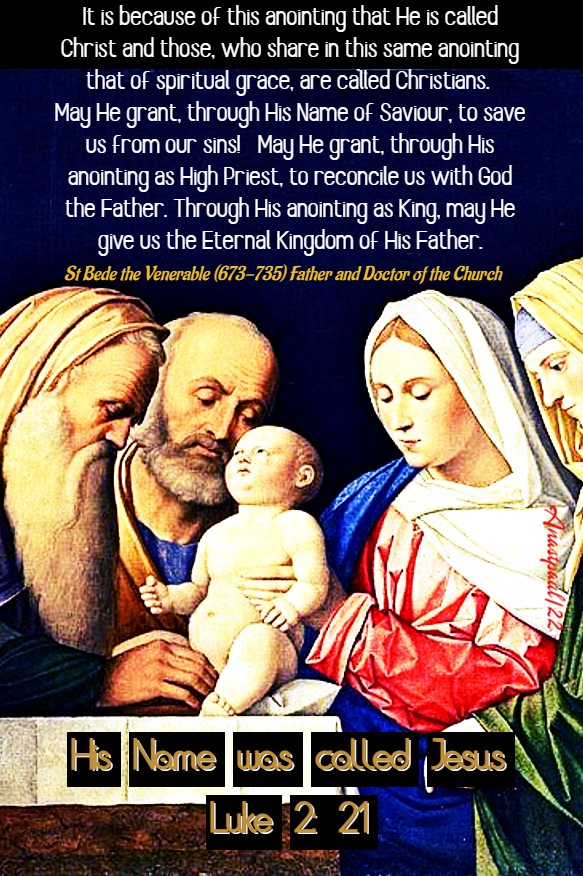
“His Name was called Jesus” – Luke 2:21
REFLECTION – “The Name “Jesus” in Hebrew means “salvation” or “Saviour.” It is a Name that for the prophets, referred to a very specific vocation . From whence came these words, sung with great desire to see Him: “My heart will rejoice in Thy salvation and will be joyful because of His salvation; my soul pines for Thy salvation” (Ps 12:6 ;34:9 ;118:81). “Yet will I rejoice in the Lord and exult in my saving God” (Hab 3:18). And especially: “O God, by Thy Name save me” (Ps 53:3). It is as though one were to say: “O Thou Who are called ‘Saviour,’ by saving me, manifest the glory of Thy Name.” And so the Name of the Son, born of the Virgin Mary, is Jesus, according to the Angel’s explanation: “He shall save His people from their sins”…
As for the word “Christ,” this designates priestly or royal status. Priests and Kings were in fact “chrismated” that is to say, anointed with holy oil. By this means, they became signs of Him Who, appearing in the world as true King and High Priest, received the anointing of “the oil of gladness above Thy fellows” (Ps 44:8). It is because of this anointing that He is called Christ and those, who share in this same anointing that of spiritual grace, are called Christians. May He grant, through His Name of Saviour, to save us from our sins! May He grant, through His anointing as High Priest, to reconcile us with God the Father. Through His anointing as King, may He give us the Eternal Kingdom of His Father.” – St Bede the Venerable (673-735) Father and Doctor of the Church (Homily 5; CCL 122,36).
PRAYER – O God, Thou Who by the fruitful virginity of blessed Mary, have bestowed upon mankind the rewards of eternal salvation, grant, we beseech Thee, that we may enjoy the intercession of her, through whom we have been found worthy to receive among us, the Author of Life, our Lord Jesus Christ Thy Son. Who lives and reigns with Thee, in the unity of the Holy Ghost, God, world without end. Amen (Collect).
Saint of the Day – 1 January – Feast of the Circumcision of the Lord
“At that time, after eight days were accomplished that the Child should be circumcised; His Name was called Jesus, which was called by the Angel, before He was conceived in the womb.” – Luke 2:21
Excerpt from the Catechism of the Council of Trent, (Part IV – “Hallowed be Thy Name“”)
In the Old Law (Gen. 17:12), it was required that every male child should, on the eighth day after his birth, be circumcised and thus admitted among God’s chosen people. The rite of circumcision in the Old Law corresponded to the Sacrament of Baptism in the New Law and was the means of remitting original sin. Our Lord, although free from every sin, submitted to this rite, in order to show that He was a true Son of Abraham, to manifest respect and obedience to the established law and, to prove that He had a real human body. At the time of circumcision, a name was given to the child. Our Lord was called Jesus, which signified His office as Saviour. On this Feast of the Circumcision, therefore, it is most appropriate that we should meditate on the first petition of the Lord’s prayer, “hallowed be thy name.”
I. The first petition of the Lord’s Prayer. In the opening words of the Lord’s Prayer we ask that God’s Name may be honoured, which shows that God’s glory should be our chief desire. This petition does not mean that God’s essential glory or perfection should be increased, nor that the honour given Him on earth, should be equal to that shown Him in Heaven.
II. The objects of this petition. We ask: That we may praise God with our hearts and lips; That those in error may be brought to recognise and revere His Church; That sinners may be converted to His service; That men may learn to refer all blessings to Him as to their Author and source.
CONCLUSION. Our conduct should be in conformity with this petition. Catholics must not cause the Name of God or of His Church, to be profaned by their own evil words and actions. On the contrary, by clean speech and good example, Catholics ought to excite others to exalt the Name of God, to respect the Faith of Christ, and to honour His Church. Good resolutions for the New Year!
Quote/s of the Day – 30 December –The Sixth Day of the Octave of Christma – “The Month of the Divine Infant and the Immaculate Conception”
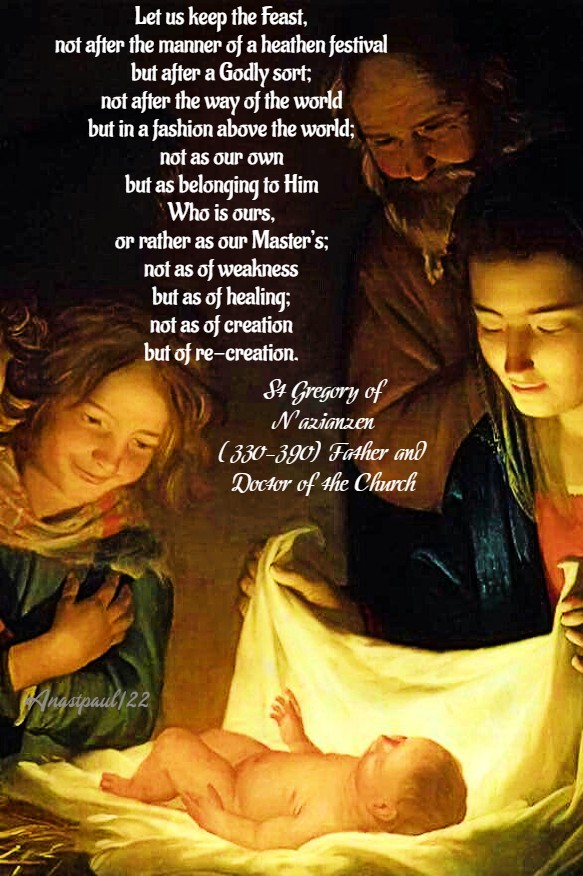
“… Let us keep the Feast, not after the manner of a heathen festival but after a Godly sort; not after the way of the world but in a fashion above the world; not as our own but as belonging to Him Who is ours, or rather as our Master’s; not as of weakness but as of healing; not as of creation but of re-creation.”
St Gregory of Nazianzen (330-390) Archbishop of Constantinople Father and Doctor of the Church
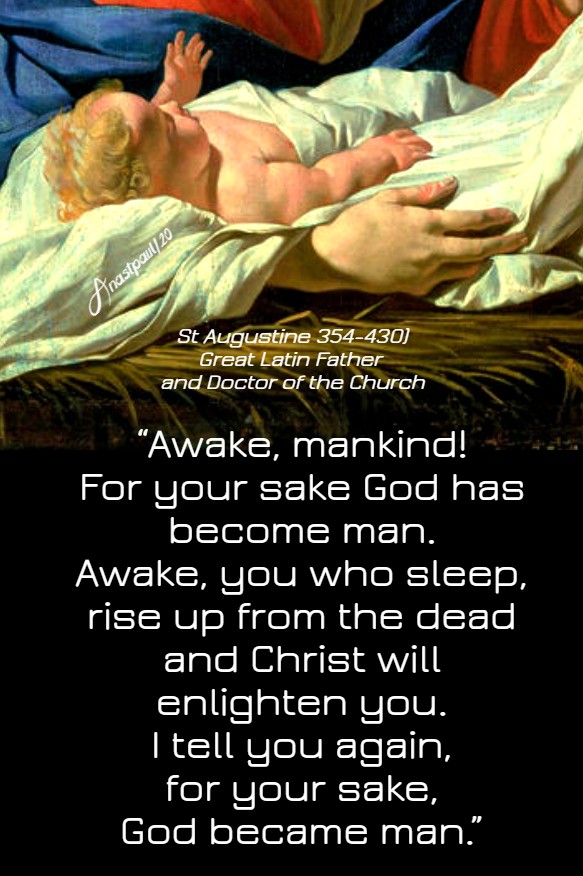
“Awake, mankind! For your sake God has become man. Awake, you who sleep, rise up from the dead and Christ will enlighten you. I tell you again, for your sake, God became man.”
St Augustine 354-430) Great Latin Father and Doctor of the Church
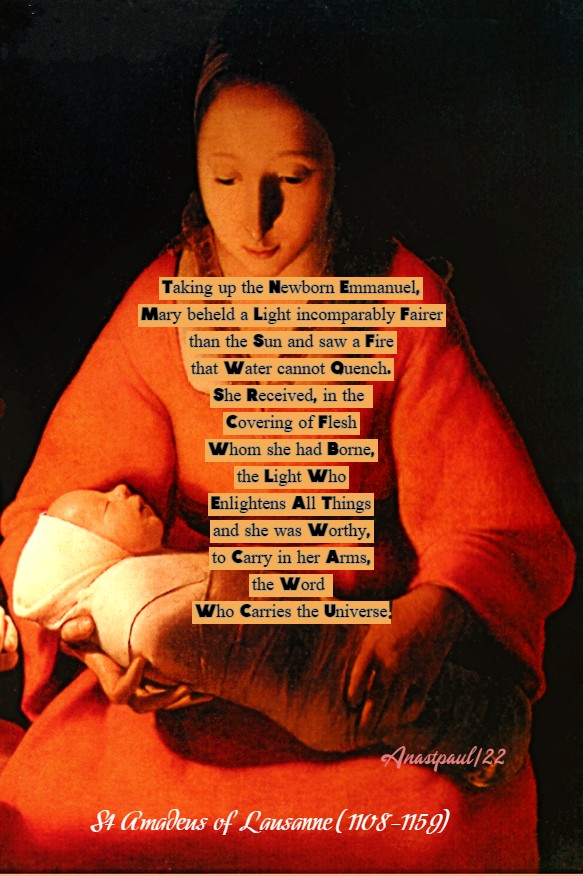
“Taking up the newborn Emmanuel, Mary beheld a Light incomparably fairer than the sun and saw a Fire that water cannot quench. She received, in the covering of flesh Whom she had borne, the Light Who enlightens all things and she was worthy, to carry in her arms, the Word Who carries the universe!” ”
St Amadeus of Lausanne (1108-1159) Bishop, Cistercian Monk
(Homilies in praise of the Blessed Virgin Mary, IV, SC 72)
Quote/s of the Day – 28 December – “The Month of the Divine Infant and the Immaculate Conception” – The Holy Innocents, Martyrs – Apocalypse 14:1-5, Matthew 2:13-18 – Scripture search here: https://www.drbo.org/
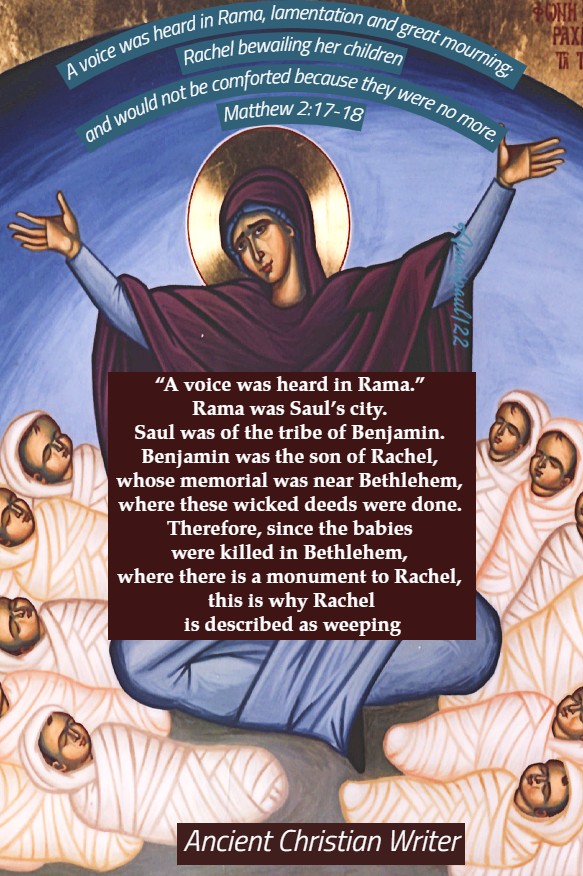
“Then was fulfilled that which was spoken by Jeremias the prophet, saying: a voice was heard in Rama, lamentation and great mourning; Rachel bewailing her children and would not be comforted because they were no more.”
Matthew 2:17-18
“A voice was heard in Rama.” Rama was Saul’s city. Saul was of the tribe of Benjamin. Benjamin was the son of Rachel, whose memorial was near Bethlehem, where these wicked deeds were done. Therefore, since the babies were killed in Bethlehem, where there is a monument to Rachel, this is why Rachel is described as weeping.”
From the work known as the “Incomplete Work on Matthew,” by an Anonymous Ancient Christian Writer (ACW)
“These then, whom Herod’s cruelty tore as sucklings from their mothers’ bosom, are justly hailed as “Infant Martyr Flowers”- they were the Church’s first blossoms, matured by the frost of persecution, during the cold winter of unbelief.”
St Augustine (354-430) Father & Doctor of the Church
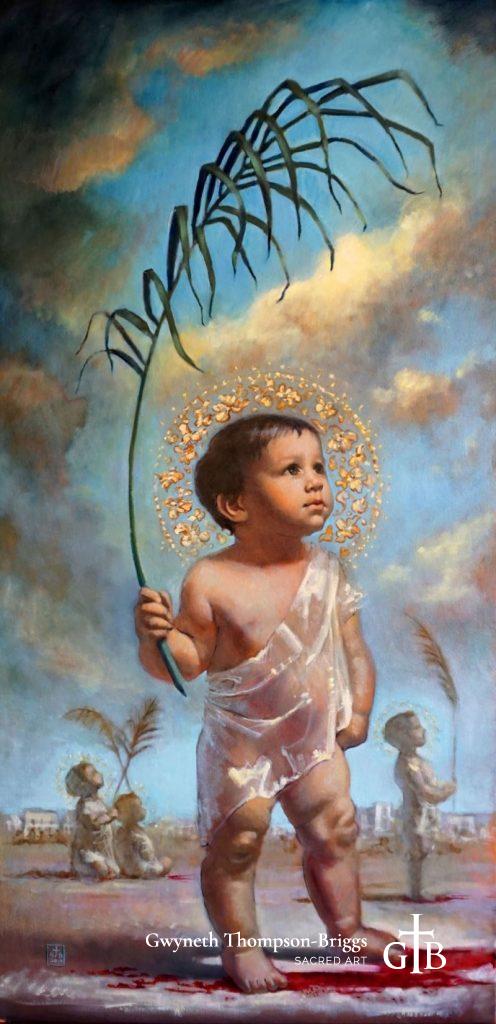
“They could not yet speak but already, they are confessing Christ. Their little bodies are, as yet, unable to engage in combat but already, they are carrying off the Palm of Victory.”
One Minute Reflection – 28 December – “The Month of the Divine Infant and the Immaculate Conception” – The Holy Innocents, Martyrs – Apocalypse 14:1-5, Matthew 2:13-18 – Scripture search here: https://www.drbo.org/
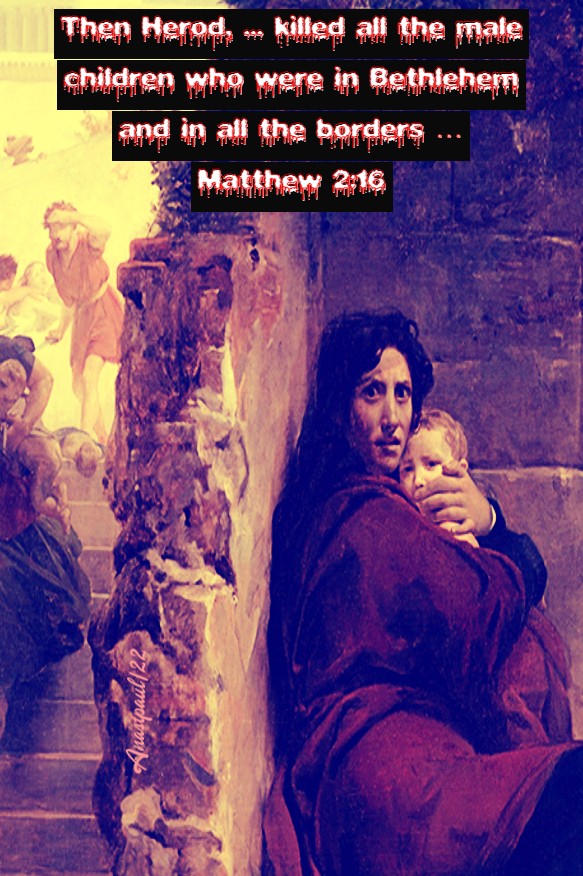
“Then Herod, perceiving that he was deluded by the wise men, was exceeding angry and sending, killed all the male children who were in Bethlehem and in all the borders …” – Matthew 2:16
REFLECTION – “Where does this jealousy lead?… The crime committed today shows us. Fear of a rival to his earthly kingdom fills Herod with anxiety, he plots to suppress “the newborn King” (Mt 2:2), the Eternal King; he fights against his Creator and puts innocent children to death… As for those children, what fault had they committed? Their tongues were dumb, their eyes had seen nothing, their ears heard nothing, their hands done nothing. They accepted death who had not known life. … Christ reads the future and knows the secrets of the heart, He weighs our thoughts and probes our intentions (cf. Ps 138[139]): why did He forsake them? … Why did the newborn heavenly King abandon these companions in innocence, forget the sentinels watching around His crib, to such an extent that the foe, who wanted to get at the King, ravaged His whole army?
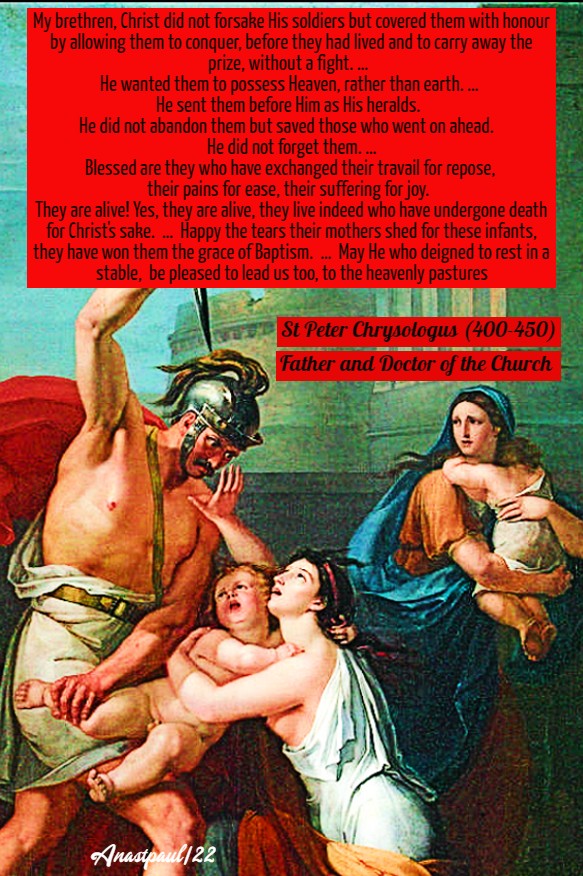
My brethren, Christ did not forsake His soldiers but covered them with honour, by allowing them to conquer, before they had lived and to carry away the prize, without a fight. … He wanted them to possess Heaven, rather than earth. … He sent them before Him as His heralds. He did not abandon them but saved those who went on ahead. He did not forget them. …
Blessed are they who have exchanged their travail for repose, their pains for ease, their suffering for joy. They are alive! Yes, they are alive, they live indeed who have undergone death for Christ’s sake. … Happy the tears their mothers shed for these infants, they have won them the grace of Baptism. … May He who deigned to rest in a stable, be pleased to lead us too, to the heavenly pastures.”– St Peter Chrysologus (400-450) Bishop of Ravenna, Father and Doctor of the Church (Sermon 152 PL 52, 604).
PRAYER – O God, Whose praise the Innocents, Thy Martyrs, this day proclaimed, not by speaking but by dying, put to death in us all the wickedness of sin, so that the faith which our tongue professes, may be proclaimed also by our life. Through Jesus Christ, Thy Son our Lord, Who lives and reigns with Thee, in the unity of the Holy Ghost, God, world without end. Amen (Collect).
Saint of the Day – 28 December – The Holy Innocents. Patronages – • against ambition•against jealousy• altar servers•babies•children• children’s choir• choir boys• orphans• students.
The Feast of the Holy Innocents By Father Francis Xavier Weninger SJ (1805-1888)
By the Holy Innocents, who are honoured as Martyrs today by the Catholic Church, we understand those happy infants, who, by the command of King Herod, were put to death, for no other cause, than that the new-born King of the Jews might be deprived of life.
When Christ was born, Herod, well known for his cruelty, reigned at Jerusalem. He was not of the Jewish nation but a foreigner and was, therefore, hated by the Jews. Herod knew this well; hence, he feared that they would dethrone him and he had several illustrious persons executed, whom he suspected of aspiring to the throne.
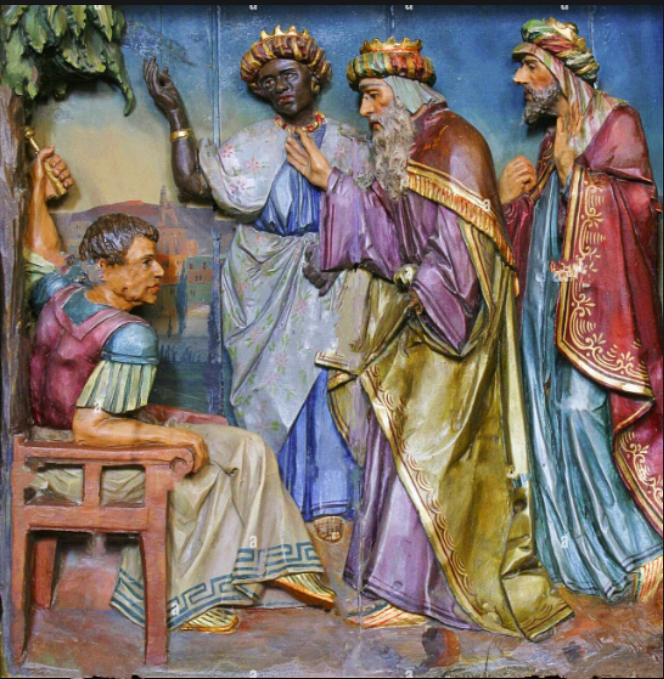
Meanwhile, it happened, that the three Magi or Kings from the East came to Jerusalem, to find and adore the new-born King, Who had been announced to them by a star. They doubted not that they would learn more of Him in the capital of Judea and they, therefore, asked without hesitation: “Where is He that is born King of the Jews? For we have seen His star in the East and have come to adore Him.”
This question seemed very strange to the Jews and the news of it spread through the whole City, until it reached the King. His fear can hardly be described, for he already believed his crown and sceptre lost. To escape the danger in which he supposed himself, he called the chief priests and scribes together,and inquired of them, where the Messiah should be born. They answered: “In Bethlehem, according to the Prophets.” Satisfied with this answer, Herod had the three wise men brought to court and speaking very confidentially with them, he asked diligently when and where the star had appeared to them. After this, he advised them to go to Bethlehem and inquire after the new-born Child and when they had found and adored Him, to return and inform Herod, as he wished to go and adore the Child too. These words of the king, who was not less cunning than cruel, were only a deceit, as he had already resolved to kill the new-born Babe.
Meanwhile, the Magi followed the advice of the king and, guided by the star, which again appeared to them when they had left Jerusalem, went to Bethlehem, found and adored the Divine Child and offered gold, frankincense and myrrh, as we read in Holy Writ. Having finished their devotion, they intended, in accordance with king Herod’s wish, to bring him word that they had happily found the Child. An Angel, however, appeared to them in their sleep and admonished them not to return to Jerusalem but to go into their own country by another way which they accordingly did.
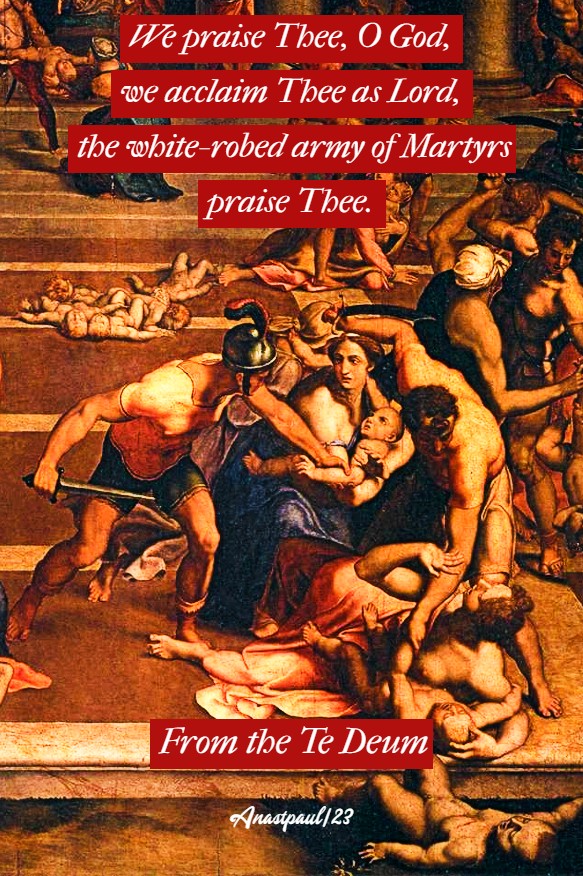
The Massacre of the Innocents / Angelo Visconti
When Herod perceived that they had deluded him, it was too late and his rage was boundless. Hearing of what had taken place in the temple, at the Purification of Mary that the venerable Simeon had pronounced a Child which he had taken into his arms, the true Messiah, the Herod’s heart was filled with inexpressible fear and anxiety. The danger in which he was, as he imagined, of losing his crown, left him no peace day or night. He secretly gave orders to search for this Child but all was of no avail, He could not be found.
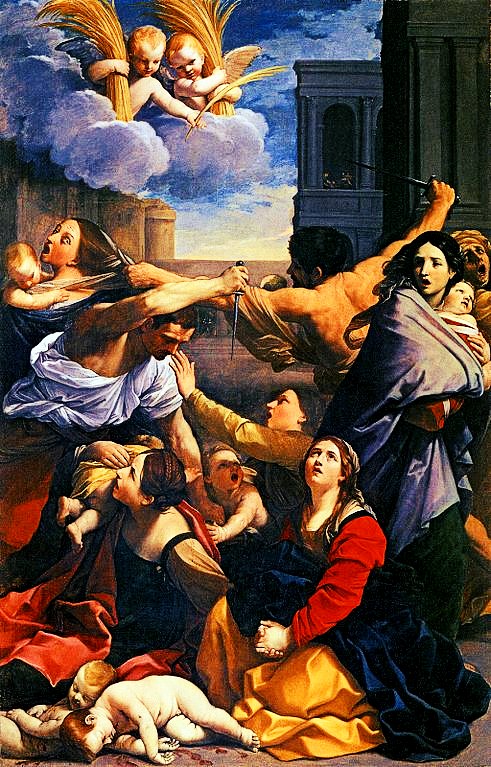
After long pondering how he might escape the danger, his unbounded ambition led him to an act of cruelty unprecedented in history. He determined to murder all the male children, in and around Bethlehem, who were not over two years of age, as he thought that thus, he could not fail to take the life of the Child so dangerous to him. This fearful design was executed amidst the despairing shrieks of the parents, especially the mothers.
How many children were thus inhumanly slaughtered is not known but the number must have been very large. Yet, the tyrant gained not his end for, the Divine Child was already in security. The Gospel tells us that an Angel appeared during the night to St Joseph, saying to him: “Arise, take the Child and His Mother and fly into Egypt and remain there until I tell thee. For, it will come to pass that Herod will seek the Child to destroy Him.” St Joseph delayed not to obey, and fled, the same night, with the Child and His Mother, into the land indicated to the Angel.
Guido Reni: Massacre of the Innocents
As this had happened before Herod executed his cruel determination, God thus frustrated the plot. Herod soon after, received his just punishment. Several terrible maladies suddenly seized him, as Josephus, the Jewish historian, relates. An internal fever consumed him and all his limbs were covered with abominable ulcers, breeding vermin. His feet were swollen, his neck, shoulders and arms drawn together, and his breast so burdened, that the unfortunate man could hardly breathe, while his whole body exhaled, so offensive an odour, that neither he nor others, could endure it. Hence, in despair, he frequently cried for a knife or a sword that he might end his own life. In this miserable condition, he ceased not his cruelties and only five days before his death, he had his son, Antipater, put to death.
As he had good reason to believe that the entire people would rejoice at his death, he wished at least, to take to the grave, the thought that many should grieve, if not for him, at least for their friends and relatives. Hence, he had the chief men of the nobility imprisoned and gave orders to his sister Salome that, as soon as he had closed his eyes, they were all to be murdered. This order, however, was not executed by Salome, who justly loathed its cruelty. In this lamentable condition, the cruel tyrant ended his life but began one in eternity, whose pains and torments were still more unendurable and from which he cannot hope ever to be released!
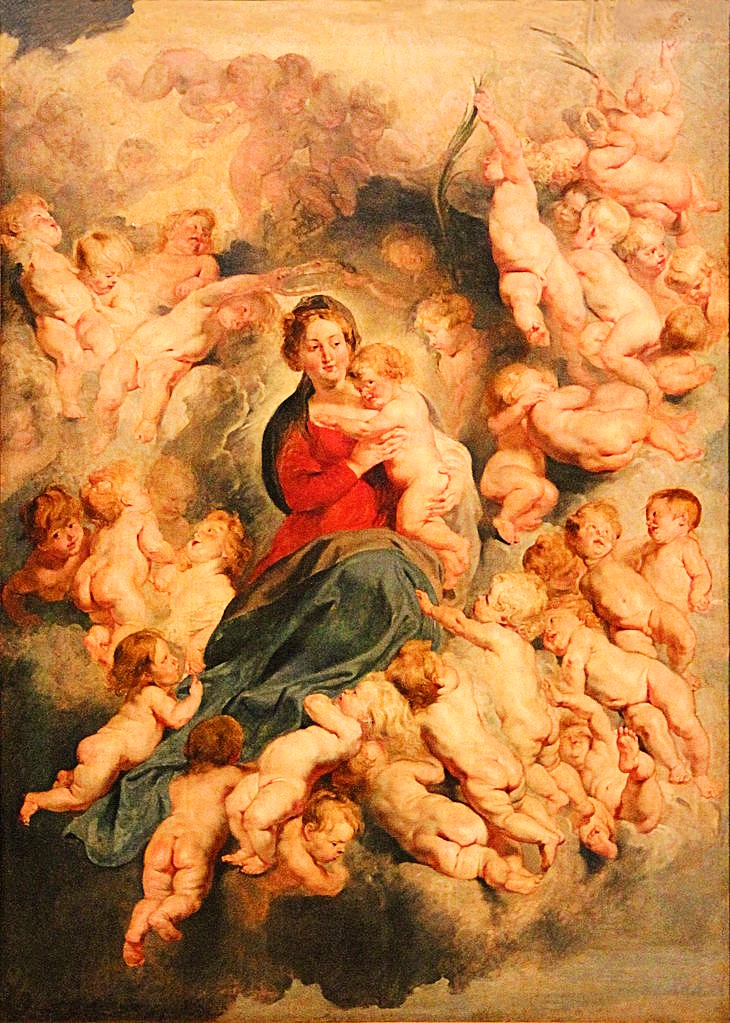
While the innocent children massacred by him, rejoice for all eternity in the glories of Heaven, giving humble thanks to God for having thus admitted them into His presence. The Catholic Church has always honoured them as Martyrs; because, although not confessing Christ with their lips, as many thousands of others have done, yet, they confessed Him with their death, by losing their lives for His sake. Amen.
St Anthony of Lérins (c 428-c 520) Monk, Hermit, Miracle-worker. The Roman Martyrology states: “Commemoration of Saint Anthony, a Monk, who, a man distinguished by grace and preparation, after having led a solitary life, retired, by now an old man in the Monastery of Lérins in Provence, where he piously fell asleep in the Lord.” Biography: https://anastpaul.com/2021/12/28/saint-of-the-day-28-december-saint-anthony-of-lerins-c-428-c-520/
BL Claudia Weinhardt St Conindrus St Domitian the Deacon St Domnio of Rome St Eutychius Bl Gregory of Cahors St Iolande of Rome Bl Johannes Riedgasse
Bl Nicolas Mello Bl Otto of Heidelberg St Romulus St Simon the Myroblite St Theonas of Alexandria St Theodore of Tabenna St Troadius of Pontus
Martyrs of Africa – 3 Saints: Three Christians murdered together in Africa for their faith. The only details to survive are their names – Castor, Rogatian and Victor.
One Minute Reflection – 27 December – “The Month of the Divine Infant and the Immaculate Conception” – St John the Apostle and Evangelist, the Beloved – Ecclesiasticus 15:1-6, John 21:19-24 – Scripture search here: https://www.drbo.org/
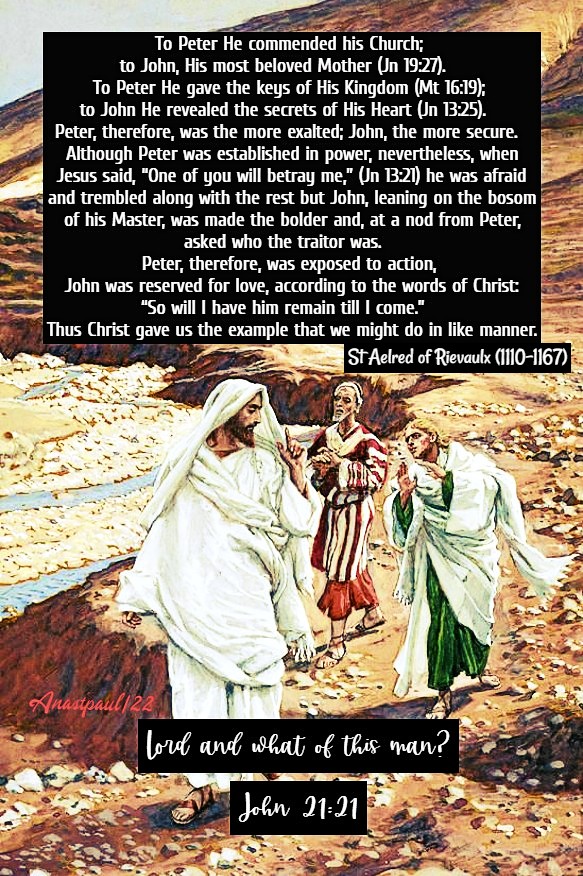
“Peter saw following them, the disciple whom Jesus loved, the one who, at the supper, had leaned back upon His breast … Peter, therefore, seeing him, said to Jesus, Lord and what of this man?” – John 21:20-21
REFLECTION – “There are some persons who think they are not loved because they cannot be promoted and who allege that they are despised, if they are not entrusted with responsibilities and offices. We know that as a result of this type of thinking, no small discord has sprung up, among those who were considered friends, so that estrangement followed upon indignation and railings upon estrangement …
Let no-one say that he is held in contempt, for the reason that he is not promoted, since the Lord Jesus preferred Peter to John in this respect; nor did He, on that account, lessen His affection for John because He had given Peter the leadership. To Peter He commended his Church; to John, His most beloved Mother (Jn 19:27). To Peter He gave the keys of His Kingdom (Mt 16:19); to John He revealed the secrets of His Heart (Jn 13:25). Peter, therefore, was the more exalted; John, the more secure. Although Peter was established in power, nevertheless, when Jesus said, “One of you will betray me,” (Jn 13:21) he was afraid and trembled along with the rest but John, leaning on the bosom of his Master, was made the bolder and, at a nod from Peter, asked who the traitor was. Peter, therefore, was exposed to action, John was reserved for love, according to the words of Christ: “So will I have him remain until I come.” Thus Christ gave us the example that we might do in like manner.” – St Aelred of Rievaulx (1110-1167) Cistercian Monk (Spiritual Friendship, III, 115, 117).
PRAYER – O Lord, graciously shed light upon Thy Church, so that, enlightened by the teachings of blessed John, ThyApostle and Evangelist, she may gain YThy everlasting rewards.Through Jesus Christ, Thy Son our Lord, Who lives and reigns with Thee, in the unity of the Holy Ghost, God, world without end. Amen (Collect).
Our Morning Offering – 27 December – St John the Apostle and Evangelist, the Beloved – “The Month of the Divine Infant and the Immaculate Conception”
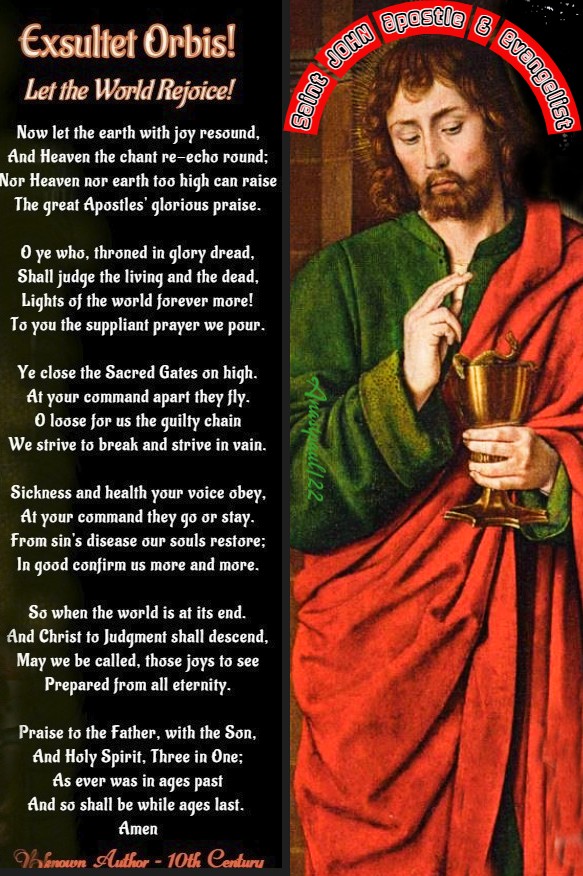
Exsultet Orbis! Let the World Rejoice! Unknown Author
Now let the earth with joy resound, And Heaven the chant re-echo round; Nor Heaven nor earth too high can raise The great Apostles’ glorious praise.
O ye who, throned in glory dread, Shall judge the living and the dead, Lights of the world forever more! To you the suppliant prayer we pour.
Ye close the Sacred Gates on high. At your command apart they fly. O loose for us the guilty chain We strive to break and strive in vain.
Sickness and health your voice obey, At your command they go or stay. From sin’s disease our souls restore; In good confirm us more and more.
So when the world is at its end. And Christ to Judgment shall descend, May we be called, those joys to see Prepared from all eternity.
Praise to the Father, with the Son, And Holy Spirit, Three in One; As ever was in ages past And so shall be while ages last. Amen
(Roman Breviary for the Common of Apostles) An Office Hymn that was traditionally prescribed for Vespers and Lauds on the Feasts of Apostles and Evangelists outside Easter time. The Hymn is found as early as the tenth century in a hymnal of Moissac Abbey.
The Nativity of Our Lord, Christmas Day! Celebration of the Anniversary of the Birth of Our Lord. In the earliest days of the Church there was no such Feast, the Saviour’s Birth was commemorated with the Epiphany by the Greek and other Eastern Churches. First mention of the Feast, then kept on 20 May, was made by Clement of Alexandria c 200. The Latin Church began in c 300 to observe it on 25 December, though there is no certainty that Our Lord was born on that day. Today, Priests have the privilege of saying three Masses, at midnight, daybreak and morning. This was originally reserved to the Holy Father alone – beginning about the 4th century he celebrated a midnight Mass in the Lateran Basilica (in which according to tradition, the manger of Bethlehem is preserved), a second in the Church of Saint Anastasia, whose Feast comes on 25 December and a third at the Vatican Basilica. Many peculiar customs of the day are the outcome of the pagan celebrations of the January calendar. The Christmas tree, of which the first known mention was made in 1605 at Strasbourg, was introduced into France and England in 1840. The Feast is a Holy Day of Obligation, preceded by the preparatory season of Advent and by a special Vigil – should it fall on a Friday it abrogates the law of abstinence. Of course, Christmas attracts an Octave, when this wonderful Mystery and Miracle is celebrated for eight days. https://anastpaul.com/2019/12/25/the-solemnity-of-the-nativity-of-our-lord-jesus-christ-25-december-2/ AND: https://anastpaul.com/2018/12/25/the-solemnity-of-the-nativity-of-our-lord-jesus-christ-25-december/ AND: https://anastpaul.wordpress.com/2017/12/25/25-december-the-solemnity-of-the-birth-of-our-lord-jesus-christ-2/
St Adalsindis of Hamay St Alburga of Wilton St Anastasia of Sirmium
Bl Artale St Basilée of the Via Latina Blessed Bentivoglio de Bonis OFM (1188-1232) Confessor, Priest and Friar of the Friars’ Minor of St Francis, Noted preachers, Miracle worker and visionary. One of Saint Francis of Assisi’s earliest disciples and one of first Franciscans. Bl Diego de Aro St Eugenia of Rome St Fulk of Toulouse
Martyrs of Nicomedia: 20,000 Christians Martyred by order of Diocletian. They were reported to have all been in the single Basilica to celebrate Christmas. As the Christmas holy day was not celebrated in the East in 303, they were probably gathered for another feast. They were burned alive in 303 in the Basilica of Nicomedia.
One Minute Reflection – 21 December – Feast of St Thomas, Apostle of Christ, Martyr – Ephesians 2:19-22, John 20:24-29 – Scripture search here: https://www.drbo.org/
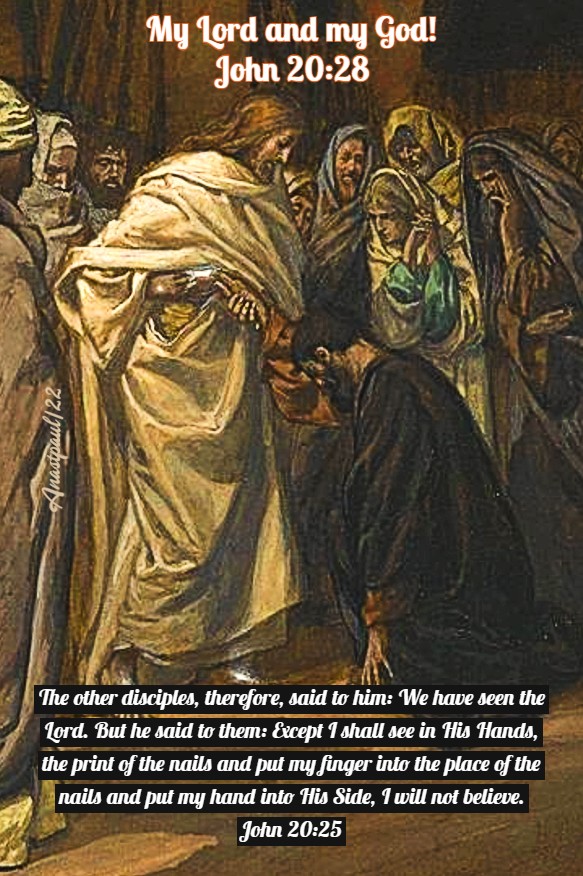
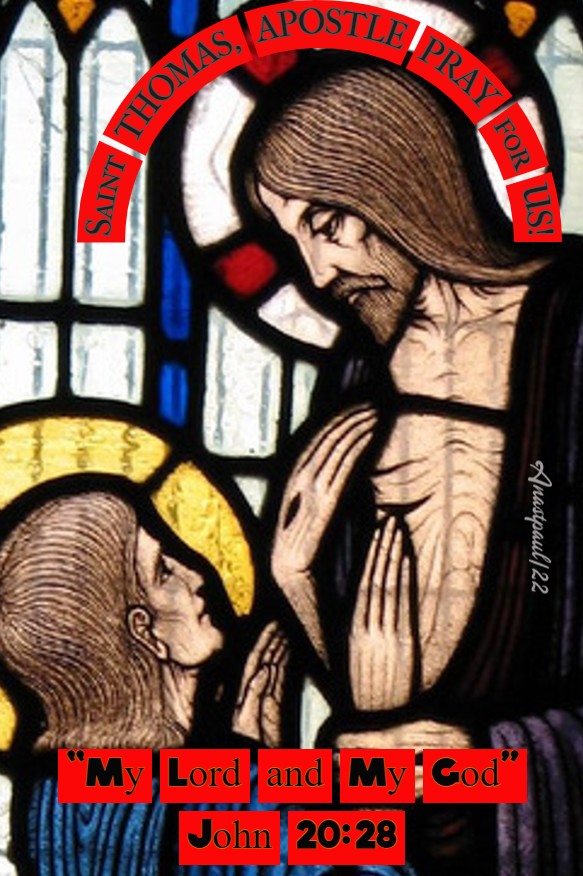
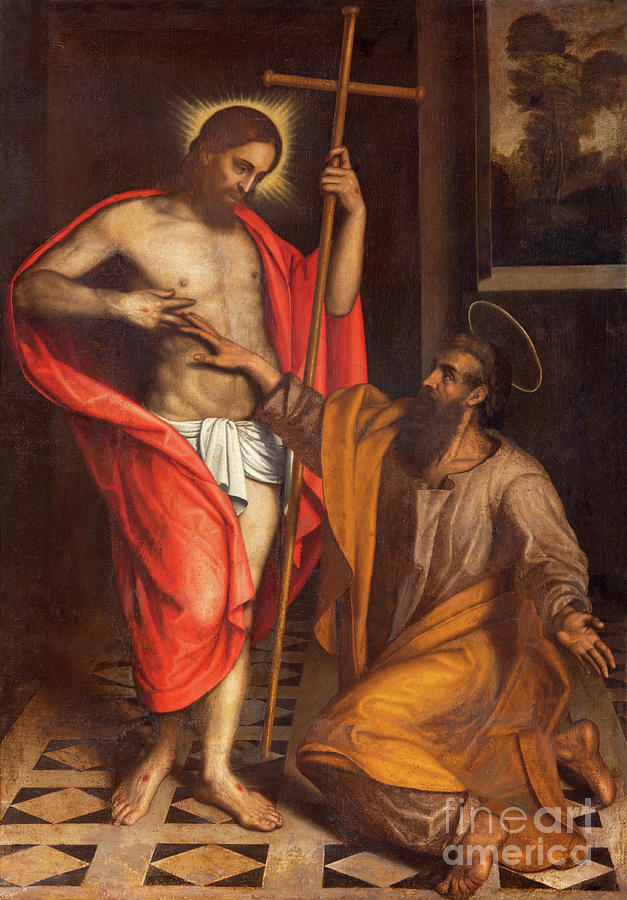
“The other disciples, therefore, said to him: We have seen the Lord. But he said to them: Except I shall see in His Hands, the print of the nails and put my finger into the place of the nails and put my hand into His Side, I will not believe.” – John 20:25
REFLECTION – “What, dearest brethren do you notice in this passage? Do you think that it happened by chance that this chosen disciple was absent at that time and afterwards coming, heard the news and hearing, doubted that doubting, he touched and touching, he believed? This did not happen by chance but by Divine dispensation. For the Divine clemency brought it about, in a wonderful way that the doubting disciple, while touching the wounds in his Master’s flesh, should thereby heal the wounds of our unbelief. The unbelief of Thomas is more to our faith, than the faith of the believing disciples. While he is brought back to faith by touching, our minds are set free from doubt and established in the faith.
So the Lord indeed, after His Resurrection permitted His disciple to doubt but He did not leave him in unbelief; just as before His birth, He wished Mary to have a spouse, who, however, never attained to the married state. The disciple who doubted and touched his Risen Lord, thus became, a witness to the truth of the Resurrection, just as the spouse of His Mother was the guardian of her inviolate Virginity. Thomas touched and cried out: My Lord and my God. Jesus said to him – Because you have seen me, you have believed. But since the Apostle Paul says – Now faith is the substance of things to be hoped for, the evidence of things which appear not; it is certainly clear that faith is the evidence, of those things which cannot appear. The things which appear are the object, not of faith but of knowledge.
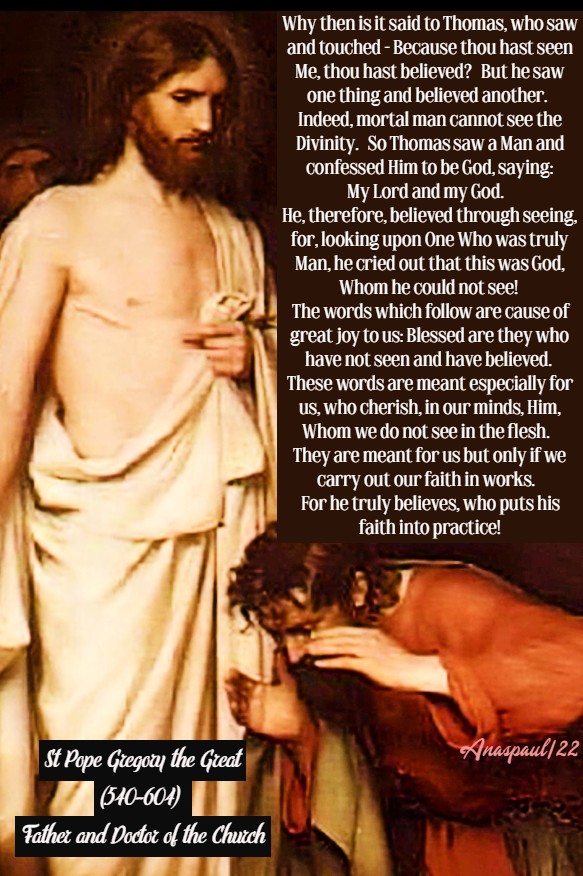
Why then is it said to Thomas, who saw and touched – Because thou hast seen Me, thou hast believed? But he saw one thing and believed another. Indeed, mortal man cannot see the Divinity. So Thomas saw a Man and confessed Him to be God, saying: My Lord and my God. He, therefore, believed through seeing, for, looking upon One Who was truly Man, he cried out that this was God, Whom he could not see! The words which follow are cause of great joy to us: Blessed are they who have not seen and have believed. These words are meant especially for us, who cherish, in our minds, Him, Whom we do not see in the flesh. They are meant for us but only if we carry out our faith in works. For he truly believes, who puts his faith into practice!” – St Gregory the Great (540-604) Pope. Father and one of the original four Doctors of the Latin Church (Sermon on the Feast of St Thomas).
PRAYER – O Lord, grant us, we beseech Thee, to glory in the Feast-day of blessed Thomas, Thy Apostle, that we maybe helped continually by his patronage and imitate his faith with a devotion like his. .Through Jesus Christ, Thy Son our Lord, Who lives and reigns with Thee, in the unity of the Holy Ghost, God, world without end. Amen (Collect).
Our Morning Offering – 21 December – St Thomas Apostle
Exsultet Orbis! Let the World Rejoice! Unknown Author
Now let the earth with joy resound, And Heaven the chant re-echo round; Nor Heaven nor earth too high can raise The great Apostles’ glorious praise.
O ye who, throned in glory dread, Shall judge the living and the dead, Lights of the world forever more! To you the suppliant prayer we pour.
Ye close the Sacred Gates on high. At your command apart they fly. O loose for us the guilty chain We strive to break and strive in vain.
Sickness and health your voice obey, At your command they go or stay. From sin’s disease our souls restore; In good confirm us more and more.
So when the world is at its end. And Christ to Judgment shall descend, May we be called, those joys to see Prepared from all eternity.
Praise to the Father, with the Son, And Holy Spirit, Three in One; As ever was in ages past And so shall be while ages last. Amen
(Roman Breviary for the Common of Apostles) An Office Hymn that was traditionally prescribed for Vespers and Lauds on the Feasts of Apostles and Evangelists outside Easter time. The Hymn is found as early as the tenth century in a hymnal of Moissac Abbey.
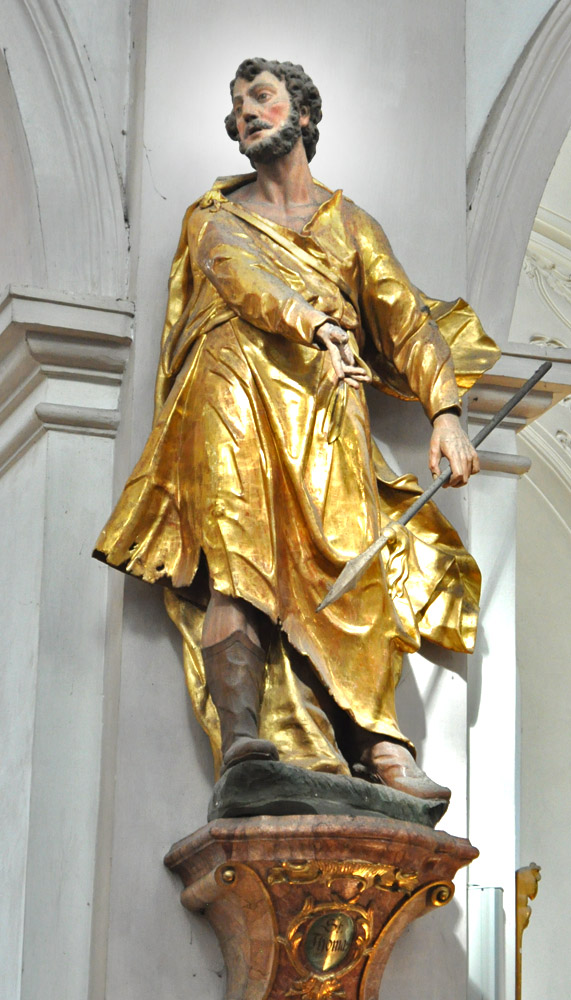
Saint of the Day – 21 December – Feast of St Thomas, Apostle of Christ, Martyr. His Patronages are:• people in doubt; against doubt• architects• blind people and against blindness• builders• construction workers• geometricians• stone masons and stone cutters• surveyors• theologians• Ceylon• East Indies• India• Indonesia• Malaysia • Pakistan• Singapore• Sri Lanka• Diocese of Bathery, India• Castelfranco di Sopra, Italy• Certaldo, Italy• Ortona, Italy.
St Thomas, Apostle From the Liturgical Year, 1870
This is the last Feast the Church keeps before the great one of the Nativity of her Lord and Spouse. She interrupts the Greater Ferias, in order to pay her tribute of honour to Thomas, the Apostle of Christ, whose glorious Martyrdom has consecrated this twenty first day of December and has procured, for the Christian people, a powerful patron that will introduce them to the Divine Babe of Bethlehem.
To none of the Apostles could this day have been so fittingly assigned, as to St Thomas. It was St Thomas whom we needed; St. Thomas, whose festal patronage would aid us to believe and hope, in that God, Whom we see not and Who comes to us in silence and humility, in order to try our Faith.
St Thomas was once guilty of doubting, when he ought to have believed and only learned the necessity of Faith by the sad experience of incredulity. He comes then most appropriately to defend us, by the power of his example and prayers, against the temptations which proud human reason might excite within us.
Let us pray to him with confidence. In that Heaven of Light and Vision, where his repentance and love have placed him, he will intercede for us,and gain for us that docility of mind and heart, which will enable us to see and recognise Him, Who is the Expected of Nations and Who, though the King of the world, will give no other signs of His Majesty, than the swaddling-clothes and tears of a Babe.
St Gunthildis of Ohrdruf Bl Johanna of Cáceres St Macarius of Alexandria St Marin Shkurti St Patapius St Rafael Román Donaire St Romaric (Died 653) Married Layman, Abbot St Sofronius of Cyprus
Quote/s of the Day – 30 November – The Feast of St Andrew, Apostle of Christ, Martyr on the Cross for Christ
“He found first, his brother Simon and said to him: We have found the Messias.”
John 1:41
This is what the Apostle is claimed to have said, on the occasion of St Andrew’s Martyrdom, according to an ancient account (which dates to the beginning of the sixth century), entitled –
The Passion of Andrew:
“Hail, O Cross, inaugurated by the Body of Christ and adorned with His limbs as though they were precious pearls. Before the Lord mounted you, you inspired an earthly fear. Now, instead, endowed with heavenly love, you are accepted as a gift.
Believers know of the great joy that you possess and of the multitude of gifts you have prepared. I come to you, therefore, confident and joyful, so that you too may receive me, exultant as a disciple of the One Who was hung upon you….
O blessed Cross, clothed in the majesty and beauty of the Lord’s limbs!…
Take me, carry me far from men and restore me to my Teacher, so that, through you, the One who redeemed me by you, may receive me.
Our Morning Offering – 30 November – Feast of St Andrew Apostle and Martyr
Exsultet Orbis! Let the World Rejoice! Unknown Author
Now let the earth with joy resound, And Heaven the chant re-echo round; Nor Heaven nor earth too high can raise The great Apostles’ glorious praise.
O ye who, throned in glory dread, Shall judge the living and the dead, Lights of the world forever more! To you the suppliant prayer we pour.
Ye close the Sacred Gates on high. At your command apart they fly. O loose for us the guilty chain We strive to break and strive in vain.
Sickness and health your voice obey, At your command they go or stay. From sin’s disease our souls restore; In good confirm us more and more.
So when the world is at its end. And Christ to Judgment shall descend, May we be called, those joys to see Prepared from all eternity.
Praise to the Father, with the Son, And Holy Spirit, Three in One; As ever was in ages past And so shall be while ages last. Amen
(Roman Breviary for the Common of Apostles) An Office Hymn that was traditionally prescribed for Vespers and Lauds on the Feasts of Apostles and Evangelists outside Easter time. The Hymn is found as early as the tenth century in a hymnal of Moissac Abbey.
St Abraham of Persia St Anders of Slagelse Bl Andrew of Antioch Bl Arnold of Gemblours St Castulus of Rome St Constantius of Rome St Crider of Cornwall Blessed Cuthbert Mayne (1544-1577) Priest Martyr St Domninus of Antioch St Euprepis of Rome Bl Everard of Stahleck
Bl Joscius Roseus St Justina of Constantinople St Mahanes the Persian St Maura of Constantinople St Merola of Antioch St Mirocles of Milan St Sapor St Simeon of Persia St Trojan St Tudwal of Tréguier Bl William de Paulo Zosimus the Wonder Worker
Martyrs of Saxony – 6 Saints: Missionaries who worked with Saint Willehad of Bremen. Martyrs. – Attroban, Benjamin, Emmingen, Folkard, Gerwald and Grisold. They were martyred on 30 November 782 at River Weser, Lawer Saxony, Germany.
Quote/s of the Day – 21 November – The Presentation of the Blessed Virgin Mary
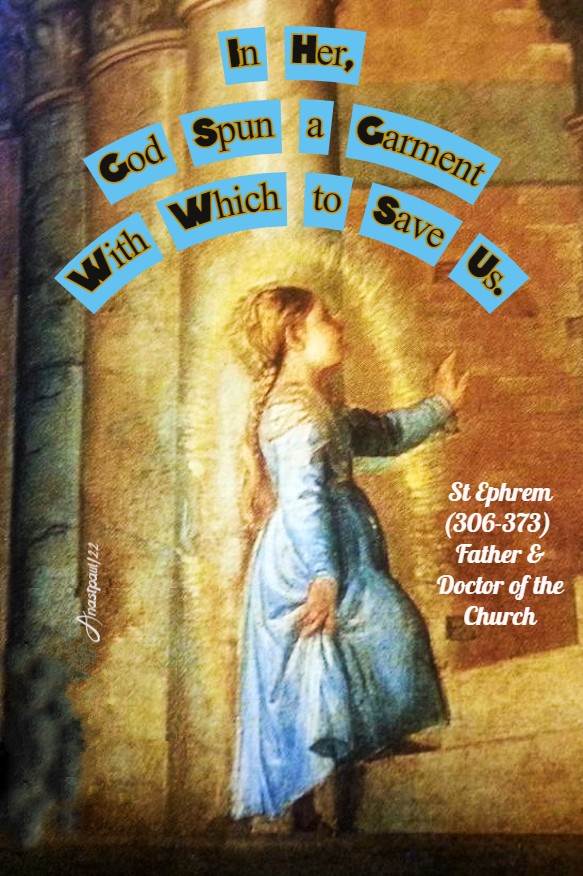
“In her, God spun a garment with which to save us.”
Saint Ephrem (306-373) Father & Doctor of the Church
“Hail, holy throne of God, divine sanctuary, house of glory, jewel most fair, chosen treasure house and mercy seat for the whole world, heaven showing forth the glory of God.
Purest Virgin, worthy of all praise, sanctuary dedicated to God and raised above all human condition, virgin soil, unploughed field, flourishing vine, fountain pouring out waters, virgin bearing a child, mother without knowing man, hidden treasure of innocence, ornament of sanctity, by your most acceptable prayers, strong with the authority of motherhood, to our Lord and God, Creator of all, your Son, Who was born of you without a father, steer the ship of the Church and bring it to a quiet harbour.”
St Germanus (378-448)
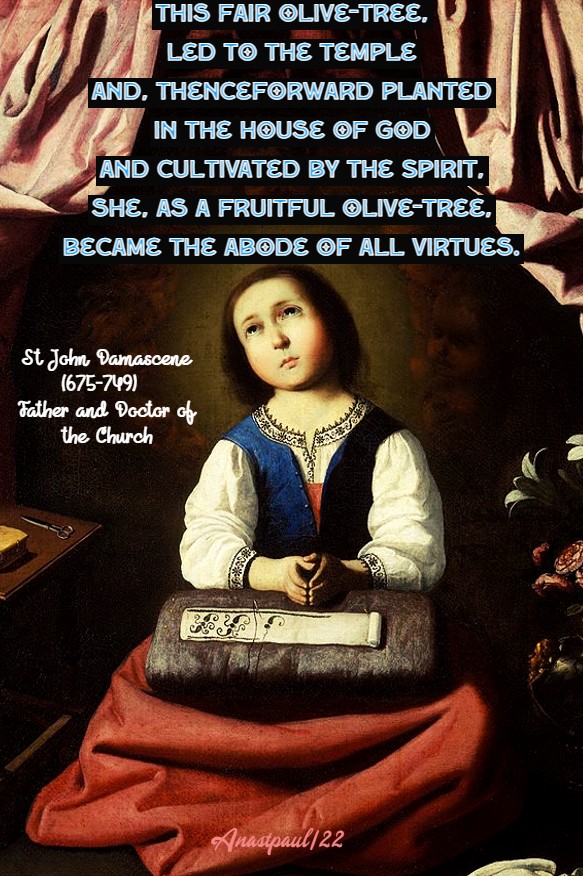
“This fair olive-tree, led to the temple and, thenceforward planted in the House of God and cultivated by the Spirit, she, as a fruitful olive-tree, became the abode of all virtues.”
St John Damascene (675-749) Father and Doctor of the Church
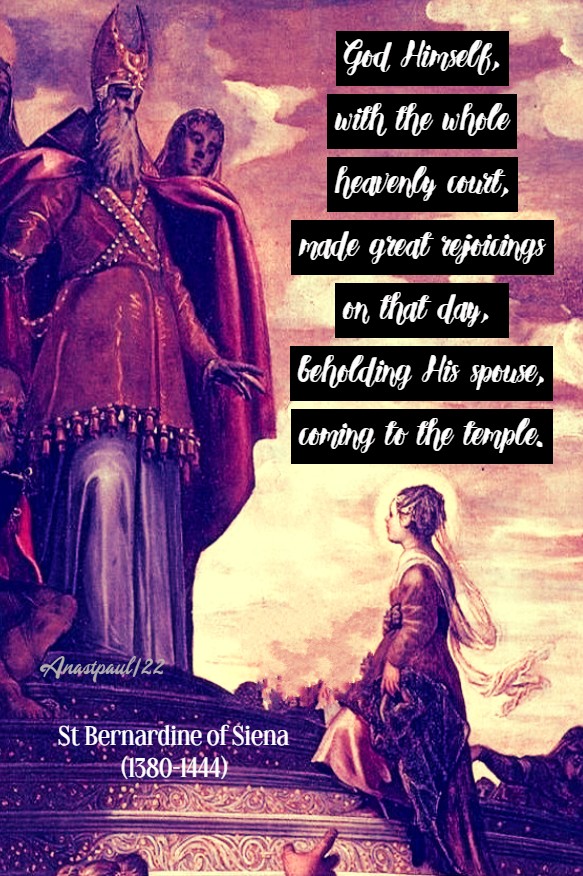
“God Himself, with the whole heavenly court, made great rejoicings on that day, beholding His spouse, coming to the temple.”
St Bernardine of Siena OFM (1380-1444)
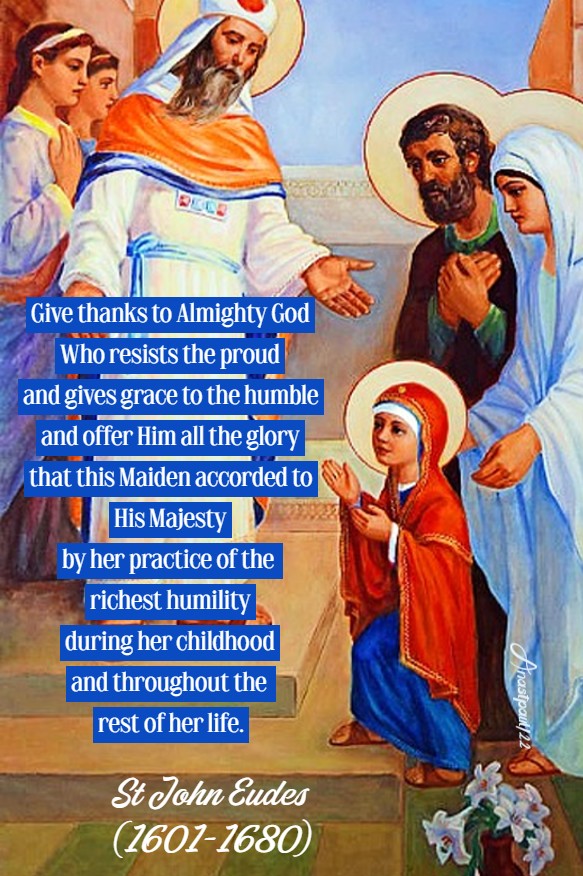
“Give thanks to Almighty God Who resists the proud and gives grace to the humble and offer Him all the glory that this Maiden accorded to His majesty by her practice of the richest humility during her childhood and throughout the rest of her life.”
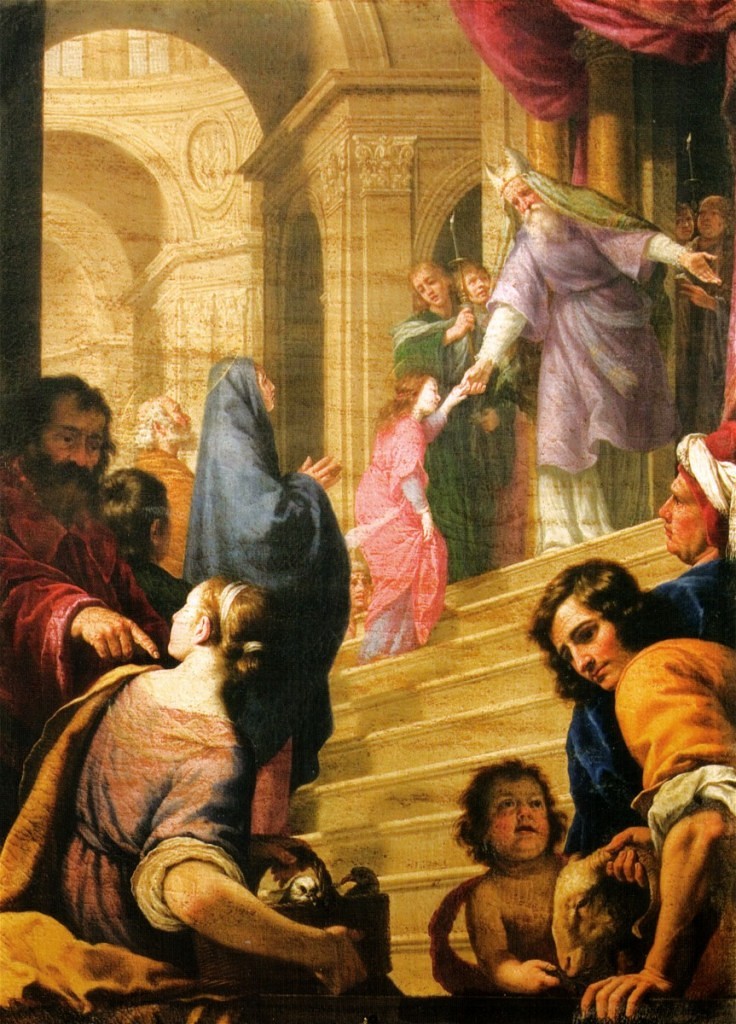
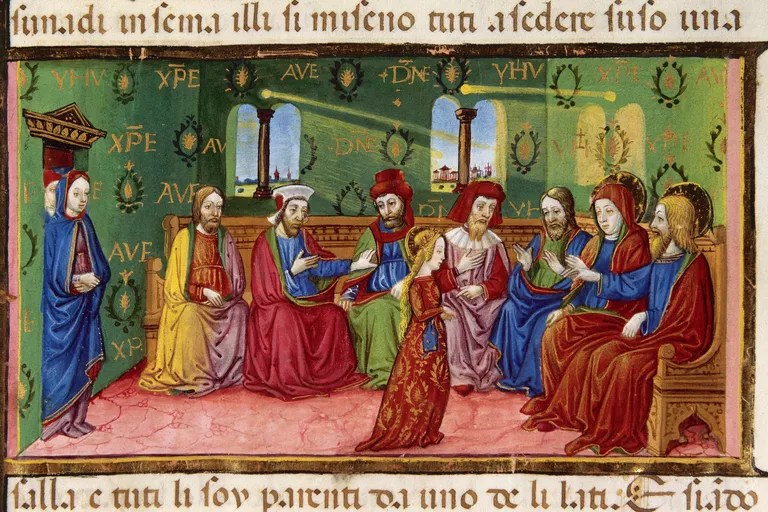
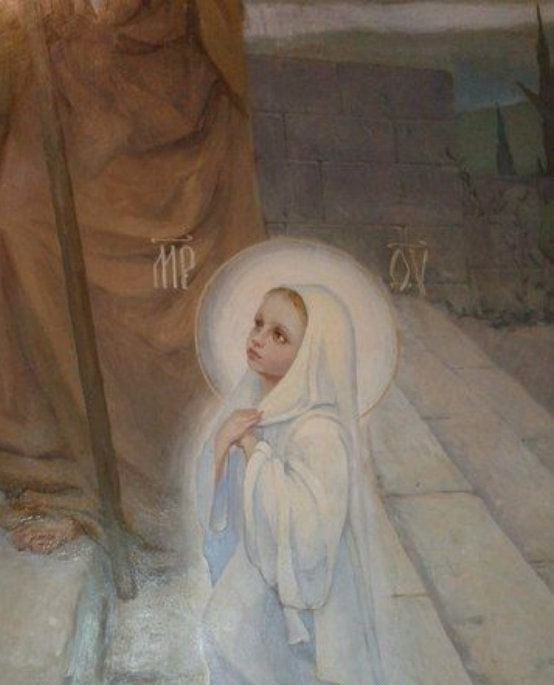
The Presentation of the Blessed Virgin Mary By Fr Francis Xavier Weninger SJ (1805-1888) (Excrrpt)
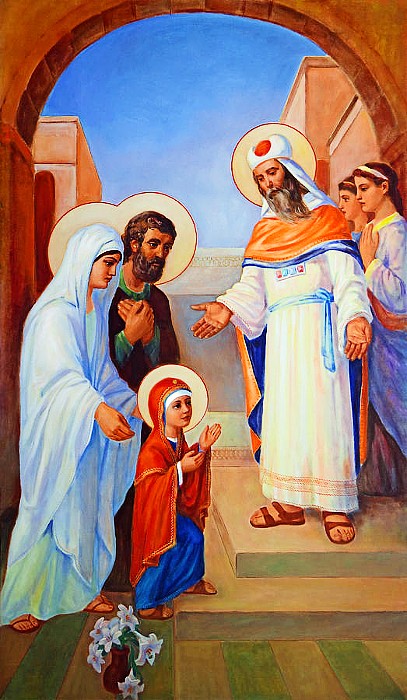
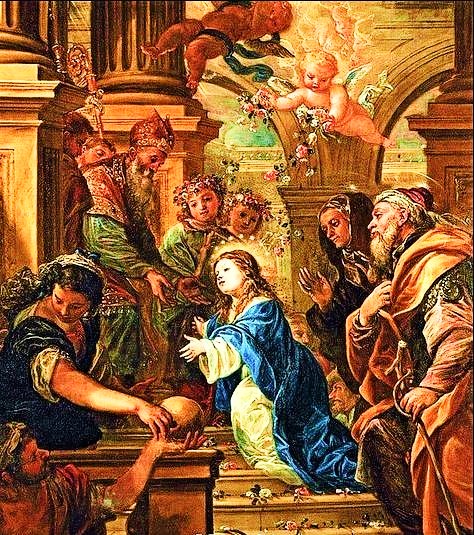
Today’s Festival is called the Presentation of Mary, because on this day, Joachim and Anna, the holy parents of the Blessed Virgin, Consecrated their little daughter to the Divine service in the temple at Jerusalem and Mary Consecrated herself to the Almighty.
At that time, there were two ways of Consecrating children – one was ordained by the law, which required every male child to be offered to God, forty days and every female child, eighty days after its birth. This ceremony was called the Consecration of the child and the purification of the mother.
The second kind of Consecration was a voluntary self-oblation by which some persons devoted themselves to the Almighty. There were also many parents who, either before, or immediately after their child’s birth, Consecrated it to the service of the Lord, sometimes for a few years, sometimes for life. To this end, several separate dwellings had been erected near the Temple, for men, women, youths and maidens, where they remained for the time which had been fixed by themselves or their parents.
Their occupations consisted in decorating the temple and in making the garments which the priests and levites wore during their sacred functions. Thus we read in the first book of Kings, that Anne the spouse of Elkana, made a vow that if she gave birth to a male child, she would Consecrate him to the Lord. The Lord blessed her and she brought forth a son, whom she named Samuel and afterwards, Consecrated to the Most High, through the hands of the High Priest, Heli. In the second book of the Maccabees, we find mention of virgins, who lived and were educated in the Temple, that is, in a building annexed to it.
t is the belief of several holy Fathers, that Joachim and Anna, being already advanced in years and having no issue, made a vow to God that if He would bless them with a child and thus, take from them, the dishonour of being barren, they would Consecrate their offspring to His service in the Temple.
God heard their prayer and blessed them so greatly that they became the parents of the most holy of all human beings, Mary, the ever Blessed Virgin. For three years they kept this sacred treasure at home, after which time, although Mary was their only comfort, they resigned her with pious fortitude, in fulfilment of their vow. Hence they went, with their daughter, to Jerusalem, presented her to the priest in the Temple and Consecrated her, through his hands, to the service of the Almighty.
Practical Considerations of this Feast:
In the third year of her life, Mary, the Blessed Virgin, consecrated herself to the service of the Almighty and this, not for days or years only but forever, for, as long as she lived, she ceased not to serve the Lord.
How is it with you? Did you also begin in your tender years to serve the Lord. Or to whom did you dedicate the years of your life? Ah! confess it with weeping eyes and repentant heart, not to the Lord but to the world, to the flesh, to Satan, you gave the years of your youth and, perhaps you have not even made the resolution to serve your God. Or it maybe, you think it will be time enough, when you are old, although it is unknown to you, whether you will ever count many years. But even had you been assured of this, tell me, do you not deserve to be disowned by the Almighty as a second Cain, since like him, you sacrificed only what was of less value and not, like the pious Abel, what was the best? God cursed him who took from his flock the meanest for his offering. This Curse you also deserve, for not having given to the Lord, your first and best years but reserving your old age for Him. Oh! truly you have reason to weep over this wickedness as long as you live. Humbly beg God to pardon you and resolve, at the same time, to serve Him from this hour most fervently and without ceasing, until your end, as the Blessed Virgin did. You have perhaps but a short time more, hence employ every moment in the service of God. The benefit will be yours and will last through all eternity.
In Consecrating herself to the Almighty, the Blessed Virgin gave herself entirely to Him without any reservation. Soul and body, every power of her soul, every member of her body, her whole heart and life, all was given forevermore to the service of the Most High. Doubtless you resolve today to serve your Lord most fervently for the future. Consecrate yourself, then, today to His service but without any reservation, your whole heart, your entire life, your soul with all its powers, your entire body with all its members, sacrifice all willingly and for vermore to the Lord. God Who desires the whole heart and not a part of it, wishes also your whole soul, your whole body, your entire life.
Do you wish to divide your heart and to give one part of it to the Almighty the other to the world and Satan? To serve God with one member of your body, and to offend Him with another? Do you wish to employ your memory to honour God with good thoughts but to soil your will with wicked desires? Oh! then do not imagine that your sacrifice will be acceptable to God. It will rather be a horror in the eyes of Him Who commands us to serve Him alone, and to sacrifice everythying to His service. Make today, a perfect sacrifice, so that you may, at least in something, follow the Blessed Virgin. And take care that you do not, after the lapse of some time, retract your sacrifice.
You Consecrate, today, your eyes, your tongue,and your hands, with the intention to use them only in God’s service. Guard yourself, lest, after some hours or days, you misuse them in offending the Lord, for, this would be as much robbing the Altar of what you have given to the Most High. Mary did not act thus. It is written: “I am the Lord that hate robbery in a holocaust,” (Isa lxi.)
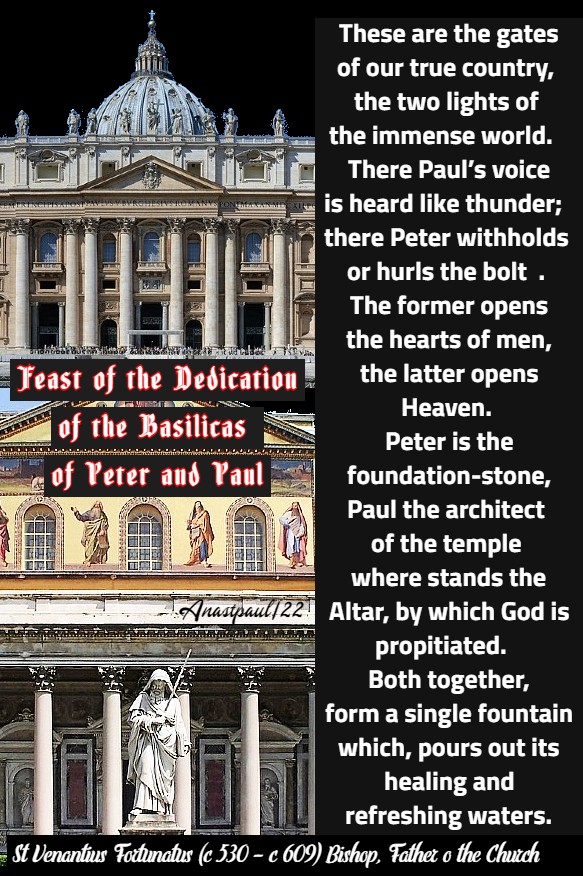
Quote/s of the Day – 18 November – Feast of the Dedication of the Basilicas of Peter and Paul
“The present Feast, therefore, deserves to be more than a local solemnity, its extension to the Universal Church, is a subject for the world’s gratitude. Thanks to this Feast, we can all make together in spirit today, the pilgrimage, which our ancestors performed with such fatigue and danger, yet never thought they purchased, at too high a price, its holy joys and blessings. “Heavenly mountains, glittering heights of the new Sion!” These are the gates of our true country, the two lights of the immense world. There Paul’s voice is heard like thunder; there Peter withholds or hurls the bolt . The former opens the hearts of men, the latter opens Heaven. Peter is the foundation-stone, Paul the architect of the temple where stands the Altar, by which God is propitiated. Both together, form a single fountain which, pours out its healing and refreshing waters”
St Venantius Fortunatus (c 530 – c 609) Bishop, Father o the Church
Our Morning Offering – 18 November – Feast of the Dedication of the Basilicas of Peter and Paul
Æterna Cæli Gloria Eternal Glory of Heaven By St Ambrose (340–397) Father and Doctor of the Churh Trans. John Mason Neale, (1818-1866)
Eternal glory of the sky, Blest hope of frail humanity, The Father’s Sole-begotten One, Yet born a spotless Virgin’s Son!
Uplift us with Thine arm of might, And let our hearts rise pure and bright And, ardent in God’s praises, pay The thanks we owe Him everyday.
The Day-star’s rays are glittering clear And tell that day itself is near: The shadows of the night depart; Thou, holy Light, illume the heart!
Within our senses ever dwell, And worldly darkness thence expel; Long as the days of life endure, Preserve our souls devout and pure.
The faith that first must be possessed, Root deep within our inmost breast; And joyous hope in second place, Then charity, Thy greatest grace.
All laud to God the Father be, All praise, eternal Son, to Thee; All glory, as is ever meet, To God the Holy Paraclete.
Beloved Saint Ambrose was a Roman citizen, son of a Roman prefect in Gallia Narbonensis. At age 33 or 34, (374) he was appointed governor of northern Italy. In the same year, Ambrose was selected as Bishop of Milan by popular acclaim. His Hymns first came to widespread notice during a public altercation between St Ambrose and Empress Justina, who had sent soldiers to arrest him. Ambrose and his faithful flock stayed in the Sanctuary of the Church for days, singing and praying. The Empress lost the test of wills and Ambrose’ Hymns have lived for millennia. Alleluia!
Dedication of the Basilicas of Peter and Paul: From the twelfth century the Dedications of the Vatican Basilica of St Peter and the Basilica of St Paul on the Via Ostiense, have been celebrated on this day, as the anniversary of their dedication by St Pope Silvester and St Pope Siricius in the fourth century. In more recent times, this feast has been extended to the whole Roman Rite. As the anniversary of the Dedication of the Basilica of St Mary Major (5 August) honours the motherhood of Our Lady, so this Feast honours the memory of the two Princes of the Apostles. About this Feast: https://anastpaul.wordpress.com/2017/11/18/feast-of-the-dedication-of-the-basilicas-of-sts-peter-and-paul-at-rome-18-november/
St Amandus of Lérins Bl Andreas Murayama Tokuan St Anselm of Lérins St Augusto Cordero Fernández St Barulas St Constant Bl Cosmas Takeya Sozaburo Bl Domingos Jorge St Emiliano Martínez de La Pera Alava St Esteban Anuncibay Letona St Francisco Marco Alemán St Germán García y García Bl Guilminus Bl Ioannes Yoshida Shoun St José María Cánovas Martínez St Keverne Bl Leonard Kimura St Mawes St Maximus of Mainz St Modesto Sáez Manzanares St Mummolus of Lagny St Nazarius of Lérins St Noah the Patriarch
St Oriculus St Patroclus of Colombier St Romfarius of Coutances St Romanus of Antioch (Died c 303) Deacon Martyr St Teofredo of Vellaicum St Thomas of Antioch St Vidal Luis Gómara
























 AnaStpaul
You must be logged in to post a comment.