Our Morning Offering – 16 June – Corpus Christ, The Most Holy Body and Blood of our Lord Jesus Christ
Lauda Sion Salvatorem Sion, Lift Up thy Voice and Sing (Excerpt) By St Thomas Aquinas (1225-1274) Doctor Angelicus / Doctor Communis
Sion, lift thy voice and sing, Praise thy Saviour and thy King, Praise with hymns thy Shepherd true, Dare thy most to praise Him well, For He doth all praise excel, None can ever reach His due.
Special theme of praise is Thine, That true living Bread divine, That life-giving flesh adored, Which the brethren twelve received, As most faithfully believed, At the Supper of the Lord.
Let the chant be loud and high, Sweet and tranquil be the joy Felt to-day in every breast; On this festival divine Which recounts the origin Of the glorious Eucharist.
St Thomas Aquinas wrote the Liturgy for Corpus Christi when Pope Urban IV added the Solemnity to the universal Church’s Liturgical calendar in 1264. He provided a great sequence, one of the great poems chanted or recited before the proclamation of the Gospel. Lauda Sion is one of only four medieval sequences which were preserved in the Roman Missal published in 1570 following the Council of Trent (1545–1563)—the others being Victimae Paschali Laudes (Easter), Veni Sancte Spiritus (Pentecost) and Dies irae (requiem masses). (A fifth, Stabat Mater, would later be added in 1727.) Before Trent, many feasts had their own sequences. The existing versions were unified in the Roman Missal promulgated in 1570. The Lauda Sion is still sung today as solemn Eucharistic hymn, though its use is optional in the post-Vatican II Ordinary form. As with St Thomas’s other three Eucharistic Hymns, the last few stanzas of the Lauda Sion are often used alone, in this case, to form the “Ecce Panis Angelorum”.
By Fr Francis Xavier Weninger, SJ (1805-1888) (Excerpt)
The same reason which caused the Festival of the Holy Trinity, induced the Catholic Church to institute the Feast of Corpus Christi, which we celebrate today. She requires that we shall confess and renew today, the faith which we have in the Blessed Eucharist and that we bestow, all possible honours, upon the Most Holy Sacrament and give due thanks to our Saviour for its institution. In order that this just requirement of the Church may be more fully complied with, we shall here give some explanation of the above reasons.
In regard to the first reason, the following are the facts, which the Church especially desires to call to our memory by this joyous festival. Our dear Saviour, on the same evening when His bitter suffering for the Redemption of man began, instituted the Blessed Eucharist, out of His immeasurable love for us. In it, He is truly and substantially present with Body and Doul, with Flesh and Blood, as God and Man, under the form of bread and wine. Under the form of bread, not only His Holy Body but also, His Holy bBood is present – because a living body cannot exist without blood. Hence he receives it, who partakes of Holy Communion only in th,e form of bread, not less than he who receives it in two forms, as the pPriests, when they say Holy Mass. The latter partake of Holy Communion under two forms, in order that the Passion and Death of our Saviour, during which His Blood flowed from His wounds, might be more vividly represented.
From the moment that the Priest speaks the prescribed holy words, in the name of Christ, over the bread and wine, the Lord is present in the Holy Sacrament. Bread and wine change their substance, miraculously, into the true Body and Blood of the Saviour, in such a manner, that all that remains of the bread and wine, is their form, colour and taste. The Presence of Christ lasts as long as the bread and the wine are unconsumed. It is further to be considered, that our Lord is present in a small host as well as in a large one, as well in a portion of a Host, as in a whole one. Hence, he who receives an entire host, has no more than he who receives only a part of one, the latter has just as much as the former. The same is the case with those, who by inadvertence, receive more than one Host, while others receive only one. It is only to be remarked that in case a Consecrated Host is broken or divided, the Holy Body of the Saviour, is not broken nor divided but, the form of the bread only: even as Christ will not again die, so His Holy Body can neither be broken nor divided. All these points are Articles of Faith in the Catholic Church and are explained in sermons, in religious instructions and in many books and are especially demonstrated, by the Word of God. All true Catholics believe this without any doubt, as the Almighty, Who is Eternal and Infallible Truth, has revealed it and, as that Church assures us, which, on account of the Assistance of the Holy Ghost, promised to her by Christ, cannot err.
Those who are not Catholics teach in many points quite differently. They especially reject the Real Presence of Christ in the form of bread and wine and also, the Transubstantiation of these latter, into the Real Body and Blood of the Lord. They maintain it to be impossible, that bread and wine can be changed into the Body and Blood of Christ, or that Christ can be Really Present at the same time, in so many different places, in so small a compass, as the Holy Host. If we ask them why they consider it impossible, they answer: “because we cannot conceive, cannot comprehend, how it can be possible.” But if they believe impossible all which they cannot understand, they must, besides many other Articles of Faith, reject the creation of the world; the Humanity and Resurrection of Christ; the Holy Trinity; because all these are just as inconceivable for the mind of man, as the Transubstantiation of the bread and wine and the substantial Presence of the Lord in the Blessed Sacrament. It matters not, in Articles of Faith, whether we are able to comprehend them or not, so long as they are revealed by God.
That which the Almighty has revealed must be true, whether I can understand it or not – for He is Omniscient, hence Infallible and cannot be deceived, while our understanding, can as easily be deceived, as our senses. God is Truth, therefore, cannot deceive. He is Omnipotent, hence, He can do more than the human mind can comprehend. “With God all things are possible,” said Christ Himself. “Let us admit that God can do more than we are able to fathom,” says St Augustine, while St Cyril of Alexandria writes; “The Lord says by the prophet Isaias: ‘My counsel is not like yours, neither are my ways like your ways: for as the heaven is above the earth, so are my ways above your ways and my thoughts above your thoughts.’ Cannot, therefore, the Works of Him, Who stands so high above us in Wisdom and Power, exceed in their Greatness the limits of our understanding?”
The same is taught by all the Holy Fathers. They also refer to many occurrences in nature, which, although we cannot comprehend them, nevertheless, take place. They speak of the creation of the world and say, if we believe that God created a whole world out of nothing, how can we hesitate to believe that He can change bread and wine, or that He can be Present in that form? The water at Cana was changed into wine – why then should He not possess the Power to transform bread and wine into His Holy Body and Blood? Truly, whoever believes that God is Omnipotent, Infallible and Infinite, cannot doubt this Article of Faith. We Catholics believe so and hence, we cannot doubt any of the abovementioned points of the True Faith. This faith we this day renew and confess publicly. The Catholic Church requires it and has, for this reason, instituted today’s Festival. She further demands that we unanimously, bestow today all possible honour upon the Blessed Sacrament and that we praise and glorify, with all the powers of our soul, the Saviour therein concealed. And is not this justly demanded of us? of us who firmly believe that our Lord is Present in His double nature, as God and as Man, in the Blessed Sacrament? All honour, all praise belongs to the true God! …
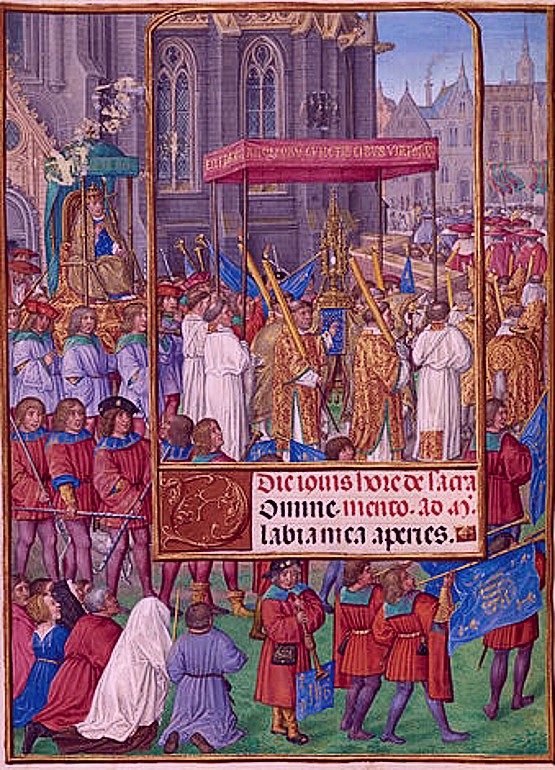
Everything connected with this ceremony, is intended to honour our Lord in every possible manner. The Church tries, by this public manifestation, to atone somewhat for the many and great wrongs to which the Blessed Sacrament is so frequently subjected, by heretics as well as by Catholics.
One cannot, without horror, think how this Sacred Mystery has been assailed and dishonoured in Centuries gone by and down to our days. A pious Christian dares not even relate the wrongs done to it, which are great enough to deserve hell! And what does our Saviour, concealed in the Blessed Sacrament, suffer from those who believe in His Presence? The irreverence and levity with which many Catholics conduct themselves, in the Presence of the Blessed Eucharist, tend to dishonour and disgrace our Saviour. The unworthy Communions which unhappily take place, offend Him in a most grievous manner. The misuse of the Body, especially of the tongue and mouth, which are so often sanctified by partaking of the True Body and Blood of Christ, cannot but excite the wrath of the Lord. For these, as well as other wrongs done to the Blessed Sacrament, the Church of Christ seeks to make amends by these Solemn Processions and by all the other pious exercises she has ordained for this festival and during the whole Octave. Hence, every pious Christian should be solicitous, to conform to the ordinances of the Church and not only assist in the Procession and all other devout exercises but also, endeavour to contribute to render them, what the Church desires.
Those who are not Catholics disapprove of everything that we do today in honour of the Blessed Sacrament and accuse us of idolatry, as we, according to them, worship bread. They say also that all that we do in this regard, cannot be agreeable to God because it was not ordained by Him. We, Catholics, are, however, not disturbed by this, for we know that we do not worship bread but Him Whom Three Wise Men worshipped in the Manger, namely, Jesus Christ, true God and Man. We know also, that although what we do this day in honour of the Blessed Sacrament is not, especially and expressly ordained in Holy Writ, still we are assured that a voluntary worship of it, is in accordance with reason and the laws of God, pleasing and agreeable to His Majesty. And this is made clear to us from the above-mentioned example of the three Wise Men and from the acts with which King David honoured the Most High, on the solemn return of the Ark of the Covenant; not to mention that Christ gave us a general Command to worship God, in the words: “The Lord Thy God shalt thou adore and Him only, shalt thou serve.” (Matth. iv.) This Command we fulfil today by our actions, as they all aim at one end, namely, the honour of the Lord, Who is concealed in the Blessed Sacrament. The more we are blamed and derided by the heretics for our adoration of the Holy Eucharist, the more fervent should we become in our zeal. When King David was derided by Michol, on account of his devotion at the return of the Ark of the Covenant, he said: “Before the Lord who chose me . . . . I will both play and make myself meaner than I have done and I will be little in my own eyes.” (II. Kings vi.)
We will still add in a few words, what the True Church further demands of us. We today give humble thanks to the Lord for the institution of the Blessed Eucharist. This is no more than our duty, for if we are obliged to thank God for the smallest benefit He confers upon us, we are surely under much greater obligation, when the benefit is great and of especial importance.
Who can tell, who can comprehend, the greatness of the benefit, which Christ Our Saviour and Lord bestowed upon us by the institution of the Blessed Eucharist. It is as great as it is unfathomable: great as He Who devised it; as Christ our Lord, true God and Man, the King of all Kings, the Lord of all, Who reigns. Great and inconceivable is the miracle by which the substance of bread and wine is changed into the substance of the Body and Blood of Christ and the Miraculous Presence of the Lord in the form of bread and wine. St Thomas de Aquin, calls the Blessed Sacrament a miracle and the greatest that Christ ever wrought! Amen Amen Alleluia, Praise be Thee Lord Jesus Christ in the Most Blessed and Life-giving Sacrament!
St Berthaldus St Ceccardus of Luni St Cettin of Oran St Colman McRhoi St Crescentius of Antioch St Cunigunde of Rapperswil St Curig of Wales St Cyriacus of Iconium (c 301-c 304) Child Martyr
Blessed Donizetti Tavares de Lima (1882-1961) Priest, Apostle of the poor, the elderly and the sick, miracle-worker, known to bilocate. A prophecy related to Vatican II: “No, no, Archbishop! We won’t see this disgrace (prophesying that they both would die soon) but it will come! This was not just a dream, nor a nightmare! The darkness will fall over this world! I beg you: don’t let them destroy the Altars!” An amazing life: https://anastpaul.com/2020/06/16/saint-of-the-day-16-june-blessed-donizetti-tavares-de-lima-1882-1961/
St Elidan St Felix of San Felice St Ferreolus of Besançon St Ferrutio of Besançon Bl Gaspare Burgherre St Graecina of Volterra St Ismael of Wales
St Maurus of San Felice St Palerio of Telese St Similian of Nantes Bl Thomas Redyng St Tycho of Amathus
Martyrs of Africa: A group of five Christians Martyred together. We know nothing else but the names – Cyriacus, Diogenes, Marcia, Mica, Valeria. They were martyred in an unknown location in Africa, date unknown.
St Amphion of Nicomedia Bl Antonio de Pietra St Arsenius of Konev St Christian O’Morgair of Clogher St Chrodobald of Marchiennes St Cominus Bl Conrad of Maleville St Cunera St Cuniald St Cyrinus of Antwerp St Eskil St Galen of Armenia St Gerebald of Châlons-sur-Seine St Geslar Blessed Guy Vignotelli of Cortona OFM (c 1185-1245) Priest of the Friars Minor, Hermit, Miracle-worker.
St Pope Leo III (c 750-816) Bishop of Rome and Ruler of the Papal States from 26 December 795 to his death. Defender of the City ad peoples of Rome and of the Church. Peacemaker and restorer of Churches and Monasteries, Patron of the Arts and Apostle of the poor. Know as “Charlemagne’s Pope” His Life: https://anastpaul.com/2021/06/12/saint-of-the-day-12-june-st-pope-leo-iii-c-750-816/
Bl Mercedes Maria of Jesus St Odulf of Utrecht St Olympius of AEnos St Onuphrius of Egypt Bl Pelagia Leonti of Milazzo St Peter of Mount Athos St Placid of Val d’Ocre Bl Stanislaw Kubista Bl Stefan Grelewski Bl Stefan Kielman St Ternan of Culross St Valerius of Armenia
Martyrs of Bologna: Three Christians who were martyred at different times and places, but whose relics have been collected and enshrined together – Celsus, Dionysius, and Marcellinus. Their relics were enshrined in churches in Bologna and Rome in Italy.
Martyrs of Rome: Four members of the Imperial Roman nobility. They were all soldiers, one or more may have been officers, and all were Martyred in the persecutions of Diocletian – Basilides, Cyrinus, Nabor and Nazarius. They were martyred in 304 outside Rome, Italy and buried along the Aurelian Way.
Three Holy Exiles: Three Christian men who became Benedictine Monks at the Saint James Abbey in Regensburg, Germany, then Hermits at Griestatten and whose lives and piety are celebrated together. – Marinus, Vimius and Zimius.
Our Morning Offering – 5 June – Pentecost Sunday, Alleluia!
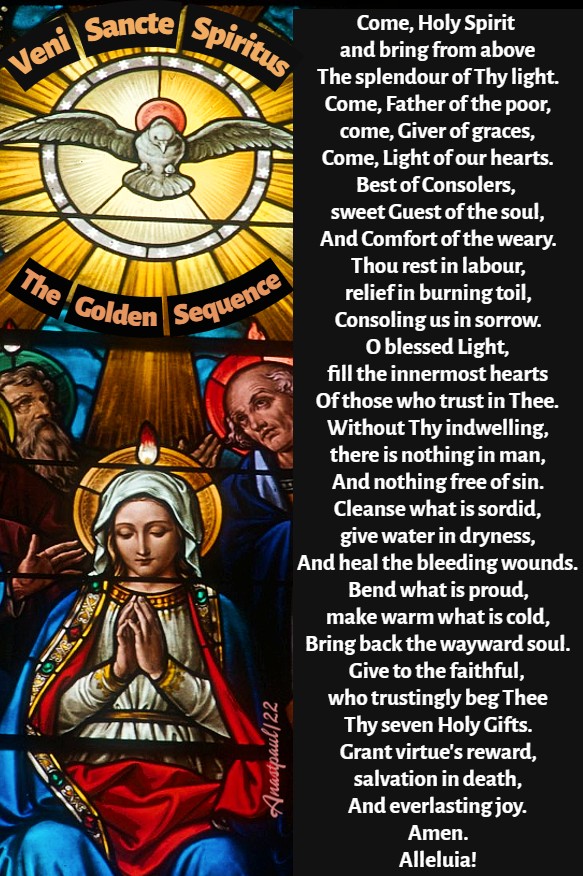
Veni Sancte Spiritus The Golden Sequence
Come, Holy Spirit and bring from above The splendour of Thy light. Come, Father of the poor, come, Giver of graces, Come, Light of our hearts. Best of Consolers, sweet Guest of the soul, And Comfort of the weary. Thou rest in labour, relief in burning toil, Consoling us in sorrow. O blessed Light, fill the innermost hearts Of those who trust in Thee. Without Thy indwelling, there is nothing in man, And nothing free of sin. Cleanse what is sordid, give water in dryness, And heal the bleeding wounds. Bend what is proud, make warm what is cold, Bring back the wayward soul. Give to the faithful, who trustingly beg Thee Thy seven Holy Gifts. Grant virtue’s reward, salvation in death, And everlasting joy. Amen. Alleluia!
“Veni Sancte Spiritus,” the “Golden Sequence”, is a sequence prescribed in the Roman Liturgy for the Masses of Pentecost and its octave, exclusive of the following Trinity Sunday. It is usually attributed to either the thirteenth-century Pope Innocent III (c 1160 – 1216) or to the Archbishop of Canterbury, Cardinal Stephen Langton (c 1150 – 1228).
By Servant of God Abbot Prosper Guéranger OSB (1805-1875) – Excerpt Abbot of Saint-Pierre de Solesmes, France.
Come, O Holy Spirit, fill the hearts of Thy faithful and enkindle within them, the fire of Thy Love.
The great day, which consummates the work that God had undertaken for the human race, has, at last, shone upon the world. The days of Pentecost, as St Luke says, are accomplished (Acts. ii. 1). We have had seven weeks since the Pasch and now, comes the day, which opens the mysterious number of Fifty. This day is the Sunday, already made holy by the Creation of the Light and by the Resurrection of Jesus – it is about to receive its final consecration and bring us the fullness of God (Eph. iii. 19).
In the Old and figurative Law, God foreshadowed the glory that was to belong, at a future period, to the Fiftieth Day. Israel had passed the waters of the Red Sea, thanks to the protecting power of His Paschal Lamb! Seven weeks were spent in the Desert, which was to lead to the Promised Land and the very morrow of those seven weeks, was the day, whereon was made the alliance between God and His people. The Pentecost (the Fiftieth Day) was honoured by the promulgation of the Ten Commandments of the Divine Law and every following year, the Israelites celebrated the great event by a solemn Festival. But their Pentecost was figurative, like their Pasch, there was to be a second Pentecost for all people, as there was to be a second Pasch for the Redemption of the whole world. The Pasch, with all its triumphant joys, belongs to the Son of God, the Conqueror of death: Pentecost belongs to the Holy Ghost, for it is the day whereon He began His mission into this world, which, henceforward, was to be under His Law.
But, how different are the two Pentecosts! The one, on the rugged rocks of Arabia, amidst thunder and lightning, promulgates a Law that is written on Tablets of Stone; the second is in Jerusalem, on which God’s anger has not as yet been manifested because it still contains, within its walls, the first-fruits of that new people, over whom the Spirit of love is to reign.
In this second Pentecost, the heavens are not overcast, nor is the roar of thunder heard; the hearts of men are not stricken with fear, as when God spake on Sinai; repentance and gratitude, these are the sentiments which are now uppermost. A Divine Fire burns within their souls and will spread throughout the whole world. Our Lord Jesus had said: ‘I am come to cast fire on the earth and what will I, but that it be kindled’ (St. Luke, xii. 49). The hour for the fulfillment of this Word is come: the Spirit of Love, the Holy Ghost, the eternal uncreated Flame, is about to descend from Heaven and realise the merciful design of our Redeemer.
Jerusalem is filled with pilgrims, who have flocked there from every country of the Gentile world: they feel a strange mysterious expectation working in their souls. They are Jews and are come from every foreign land where Israel has founded a Synagogue; they are come to keep the feasts of Pasch and Pentecost. Asia, Africa, and even Rome, have here their representatives. Amidst these Jews, properly so called, are to be seen many Gentiles, who, from a desire to serve God more faithfully, have embraced the Mosaic law and observances; they are called Proselytes. This influx of strangers, who have come to Jerusalem out of a desire to observe the Law, gives the City a Babel-like appearance, for each nation has its own language. They are not, however, under the influence of pride and prejudice, as are the inhabitants of Judea; neither have they, like these latter, known and rejected the Messias, nor blasphemed His Works, whereby He gave testimony of His Divine Character. It may be that they took part with the other Jews in clamouring for Jesus’ death but they were led to it by the Chief Priests and Magistrates of the Jerusalem, which they reverenced as the holy City of God and to which nothing but religious motives have brought them.
It is the hour of Tierce, the third hour of the day (Our nine o’clock. Acts, ii. 15), fixed from all eternity, for the accomplishment of a Divine Decree. It was at the hour of midnight, that the Father sent into this world, that He might take flesh in Mary’s womb, the Son, eternally begotten of Himself: so now, at this hour of Tierce, the Father and Son, send upon the earth the Holy Spirit, Who proceeds from them both. He is sent to form the Church, the Spouse and Kingdom of Christ; He is to assist and maintain her; He is to save and sanctify the souls of men and this, His Mission, is to continue unto the end of time. Suddenly is heard, coming from heaven, the sound of a violent wind: it startles the people in the City, it fills the Cenacle with its mighty breath. A crowd is soon round the house that stands on Mount Sion; the hundred and twenty Disciples that are within the building, feel that mysterious emotion within them, of which their Master once said: The Spirit breatheth where He will, and thou hearest His voice (St. John, iii. 8). Like that strange invisible creature, which probes the very depth of the sea and makes the waves heave mountains high, this Breath from heaven will traverse the world from end to end, breaking down every barrier that would stay its course.
The holy assembly have been days in fervent expectation; the Divine Spirit gives them this warning of His coming, and they, in the passiveness of extatic longing, await his will. As to them that are outside the Cenacle, and have responded to the appeal thus given, let us, for the moment, forget them. A silent shower falls in the House; it is a shower of Fire, which, as holy Church says, “burns not, but enlightens, consumes not, but shines (Responsory for the Thursday within the Octave).” Flakes of fire, in the shape of tongues, rest on the heads of the hundred and twenty Disciples: it is the Holy Ghost taking possession of all and each. The Church is now, not only in Mary but also in these hundred and twenty Disciples. All belong now to the Spirit that has descended upon them; His Kingdom is begun, it is manifested, its conquests will be speedy and glorious.
But let us consider the symbol chosen to designate this Divine change. He Who showed Himself under the endearing form of a Dove, on the occasion of Jesus’ Baptism in the Jordan, now appears under that of Fire. He is the Spirit of Love and love is not only gentle and tender, it is, also, ardent as fire. Now, therefore, that the world is under the influence of the Holy Ghost, it must needs be on fire and the fire shall not be checked. And why this form of Tongues? To show that the Heavenly Fire is to be spread by the word, by speech. These hundred and twenty Disciples need but to speak of the Son of God, made Man and our Redeemer; of the Holy Ghost, Who renews our souls; of the Heavenly Father, Who loves and adopts us as His children; their word will find thousands to believe and welcome it. Those that receive it, shall all be united in one faith; they shall be called the Catholic Church, that is, universal, existing in all places and times. Jesus had said – ‘Go, teach all nations ‘ (St. Matth xxviii. 19)!–the Holy Ghost brings from Heaven, both the tongue that is to teach and the fire, (the love of God and mankind,) which is to give warmth and efficacy to the teaching. This Tongue and Fire are now given to these first Disciples, who, by the assistance of the Holy Spirit, will transmit them to others: so will it be to the end of time!
But, in the crowd, there are some who are shocked at witnessing this heavenly enthusiasm of the Apostles. These men, say they, are full of new wine! It is the language of rationalism, explaining away mystery by reason. These Galileans, these drunken men, are, however, to conquer the whole world to Christ, and give the Holy Ghost, with His inebriating unction, to all mankind. The holy Apostles feel that it is time to proclaim the new Pentecost; yes, this anniversary of the Old is a fitting day for the New to be declared. But, in this proclamation of the law of mercy and love, which is to supersede the law of justice and fear, who is to be the Moses? Our Emmanuel, before ascending into heaven, had selected one of the Twelve for the glorious office: it is Peter, the Rock on whom is built the Church. It is time for the Shepherd to show himself, and speak, for the Flock is now to be formed. Let us hearken to the Holy Ghost, Who is about to speak, by his chief organ, to this wondering and attentive multitude. The Apostle, though he speaks in one tongue, is understood by each of his audience, no matter what his country and language may be. The discourse is, of its own-self, a guarantee of the truth and divine origin of the new law.
St Adalar of Erfurt Bl Adalbert Radiouski Bl Adam Arakawa St Austrebertus of Vienne St Claudius of Egypt and Companions St Ðaminh Huyen St Ðaminh Toai St Dorotheus of Tyre St Elleher St Eoban of Utrecht St Eutichius of Como St Evasius of Africa St Felix of Fritzlar
Blessed Ferdinand of Portugal (1402-1443) “The Holy Prince.” Blessed Ferdinand spent as much time as he could in adoration of the Most Blessed Sacrament especially during the Easter Triduum when his habit was to be constantly in adoration, from Holy Thursday to Easter. He was the youngest of the “Illustrious Generation” of 15th-century Portuguese Princes of the House of Aviz and lay Master of the Knightly Order of Aviz. About Blessed Ferdinand: https://anastpaul.com/2021/06/05/saint-of-the-day-5-june-blessed-ferdinand-of-portugal-1402-1443-the-holy-prince/
St Franco of Assergi St Genesius, Count of Clermont St Gregory of Lilybaeum St Gundekar St Hadulph St Luke Loan Bl Meinwerk of Paderborn St Privatus of Africa St Sanctius of Córdoba St Tudno of Caernarvon St Waccar
Martyrs of Caesarea: A group of Christians who converted together, were imprisoned together, tortured together, and martyred together. We know nothing more about them but their names – Cyria, Marcia, Valeria and Zenaides. Died Caesarea, Palestine, date unknown.
Martyrs of Egypt: A group of Christians martyred together in the persecutions of Galerius Maximian. The only other information was have is three of their names – Apollonius, Marcian and Nicanor. Died in Egypt, date unknown.
Martyrs of Perugia: A group of Christians Martyred together in the persecutions of Decius. We know little more than their names – Cyriacus, Faustinus, Florentius, Julian and Marcellinus. Died beheaded in 250 in Perugia, Italy
Martyrs of Rome: 26 Christians Martyred together. We have no details about them but their names – Candida, Castula, Fappa, Felician, Felicitas (2 of), Felicula, Fortunatus, Gagus, Gregor, Hilarius, Ingenuus, Juliana, Martialis, Maurus, Mustilus, Nicander, Prima, Rogata, Rutianus, Sacrinus, Saturnin, Secundian, Secundus, Urbicus, Victurus. Died • Rome, Italy, date unknown • relics transferred to Antwerp, Belgium, date unknown.
Feast of St John the Apostle and Evangelist before the Latin Gate: The Roman Martyrology states of this Feast today: At Rome, the feast of St John before the Latin Gate. Being bound and brought to Rome from Ephesus by the order of Domitian, he was condemned by the Senate to be cast, near the said gate, into a vessel of boiling oil, from which he came out more healthy nd vigorous than before! About this wondrous Miracle: https://anastpaul.com/2021/05/06/saint-of-the-day-6-may-st-john-the-evangelist-before-the-latin-gate/
Bl Anthony Middleton Blessed Bartolomeo Pucci-Franceschi OFM (Died 1330) Priest of the Friars Minor after having been a husband and father of 4. Confessor, Mystic and Miracle-worker.
St Benedicta of Rome St Colman Mac Ui Cluasigh of Cork St Colman of Loch Eichin St Dominic Savio St Edbert of Lindisfarne Bl Edward Jones St Evodius of Antioch
St Marianus of Lambesa Bl Peter de Tornamira St Petronax of Monte Cassino St Protogenes of Syria Bl Prudence Castori St Theodotus of Kyrenia St Venerius of Milan St Venustus of Africa St Venustus of Milan Bl William Tandi
The Solemnity of Saint Joseph – 4 May: Between 1870 and 1955, an additional Feast was celebrated in honour of Saint Joseph as Spouse of the Blessed Virgin Mary and Patron of the Universal Church, the latter title having been given to him by Pope Pius IX. Originally celebrated on the third Sunday after Easter with an octave, after Divino Afflatu of Saint Pius X (see Reform of the Roman Breviary by Pope Pius X), it was moved to the preceding Wednesday (because Wednesday is the day of the week specifically dedicated to St Joseph, St John the Baptist and local Patrons). The Feast was also retitled The Solemnity of Saint Joseph. This celebration and its accompanying Octave were abolished during the modernisation of rubrics under Pope Pius XII in 1955.
St Albian of Albée Bl Angela Bartolomea dei Ranzi Bl Angela Isabella dei Ranzi St Antonia of Constantinople St Antonina of Nicaea St Antonia of Nicomedia St Antonius of Rocher St Arbeo of Freising St Augustine Webster St Cunegund of Regensburg St Curcodomus of Auxerre St Cyriacus of Ancona St Enéour St Ethelred of Bardney St Florian of Lorch Bl Hilsindis
Blessed Jean-Martin Moyë (1730-1793) French Priest, Missionary to China, Founder of the Sisters of the Congregation of Divine Providence – the first expression of consecrated life among the women of China. Writer, Teacher, Innovator, Evangelist. Beatified on 21 November 1954 by Pope Pius XII. Biography: https://anastpaul.wordpress.com/2018/05/04/saint-of-the-day-4-may-blessed-jean-martin-moye-1730-1793/
Blessed Ladislas of Gielniów OFM Cap (c 1440-1505) “The Apostle of Lithuania,” Priest of the Order of Friars Minor Capuchin, zealous and tireless Evangelist, renowned Preacher, Poet and Hymnist, disciple of St Bernardine of Siena and his Apostolate of the Most Holy Name of Jesus and a devotee of the Passio of Christ. Ladislas served his Order in various capacities which included both a Doorkeeper and as its Provincial! He travelled across Poland to evangelise and was a noted preacher. About Blessed Ladislas: https://anastpaul.com/2021/05/04/saint-of-the-day-4-may-blessed-ladislas-of-gielniow-ofm-cap-c-1440-1505/
St Luca da Toro
Bl Marco Ongaro of Conegliano OFM Bl Margareta Kratz Bl Michal Giedroyc St Nepotian of Altino Bl Paolino Bigazzini St Paulinus of Cologne St Paulinus of Senigallia St Pelagia of Tarsus St Porphyrius of Camerino Rino St Richard Reynolds OSsS (c 1492-1535) Martyr, Monk of the Bridgettine Order (the Order of the Most Holy Saviour (Ordo Sanctissimi Salvatoris; abbreviated OSsS).
Carthusian Martyrs of England: A group of Carthusian Monks who were hanged, drawn and quartered between 19 June 1535 and 20 September 1537 for refusing to acknowledge the English royalty as head of the Church: • Blessed Humphrey Middlemore • Blessed James Walworth • Blessed John Davy • Blessed John Rochester • Blessed Richard Bere • Blessed Robert Salt • Blessed Sebastian Newdigate • Blessed Thomas Green • Blessed Thomas Johnson • Blessed Thomas Redyng • Blessed Thomas Scryven • Blessed Walter Pierson • Blessed William Exmew • Blessed William Greenwood • Blessed William Horne • Saint Augustine Webster • Saint John Houghton • Saint Robert Lawrence
Martyrs of Cirta: Also known as • Martyrs of Cirtha • Martyrs of Tzirta A group of clergy and laity Martyred together in Cirta, Numidia (in modern Tunisia) in the persecutions of Valerian. They were – Agapius, Antonia, Emilian, Secundinus and Tertula, along with a woman and her twin children whose names have not come down to us.
Martyrs of England: 85 English, Scottish and Welsh Catholics who were Martyred during the persecutions by Protestants in the 16th and 17th centuries. They are commemorated together on 22 November. • Blessed Alexander Blake • Blessed Alexander Crow • Blessed Antony Page • Blessed Arthur Bell • Blessed Charles Meehan • Blessed Christopher Robinson • Blessed Christopher Wharton • Blessed Edmund Duke • Blessed Edmund Sykes • Blessed Edward Bamber • Blessed Edward Burden • Blessed Edward Osbaldeston • Blessed Edward Thwing • Blessed Francis Ingleby • Blessed George Beesley • Blessed George Douglas • Blessed George Errington • Blessed George Haydock • Blessed George Nichols • Blessed Henry Heath • Blessed Henry Webley • Blessed Hugh Taylor • Blessed Humphrey Pritchard • Blessed John Adams • Blessed John Bretton • Blessed John Fingley • Blessed John Hambley • Blessed John Hogg • Blessed John Lowe • Blessed John Norton • Blessed John Sandys • Blessed John Sugar • Blessed John Talbot • Blessed John Thules • Blessed John Woodcock • Blessed Joseph Lambton • Blessed Marmaduke Bowes • Blessed Matthew Flathers • Blessed Montfort Scott • Blessed Nicholas Garlick • Blessed Nicholas Horner • Blessed Nicholas Postgate • Blessed Nicholas Woodfen • Blessed Peter Snow • Blessed Ralph Grimston • Blessed Richard Flower • Blessed Richard Hill • Blessed Richard Holiday • Blessed Richard Sergeant • Blessed Richard Simpson • Blessed Richard Yaxley • Blessed Robert Bickerdike • Blessed Robert Dibdale • Blessed Robert Drury • Blessed Robert Grissold • Blessed Robert Hardesty • Blessed Robert Ludlam • Blessed Robert Middleton • Blessed Robert Nutter • Blessed Robert Sutton • Blessed Robert Sutton • Blessed Robert Thorpe • Blessed Roger Cadwallador • Blessed Roger Filcock • Blessed Roger Wrenno • Blessed Stephen Rowsham • Blessed Thomas Atkinson • Blessed Thomas Belson • Blessed Thomas Bullaker • Blessed Thomas Hunt • Blessed Thomas Palaser • Blessed Thomas Pilcher • Blessed Thomas Pormort • Blessed Thomas Sprott • Blessed Thomas Watkinson • Blessed Thomas Whitaker • Blessed Thurstan Hunt • Blessed William Carter • Blessed William Davies • Blessed William Gibson • Blessed William Knight • Blessed William Lampley • Blessed William Pike • Blessed William Southerne • Blessed William Spenser • Blessed William Thomson • They were Beatified on 22 November 1987 by Pope John Paul II.
Martyrs of Novellara: A Bishop and several his flock who were Martyred together in the persecutions of Diocletian and whose relics were kept and enshrined together. We know nothing else about them but the names – Apollo, Bono, Cassiano, Castoro, Damiano, Dionisio, Leonida, Lucilla, Poliano, Tecla, Teodora and Vespasiano. They were Martyred on 26 March 303. Their relics were enshrined in the parish of Saint Stephen in Novellara, Italy in 1603.
Quote/s of the Day – 3 April – the Feast of the Finding of the Holy Cross
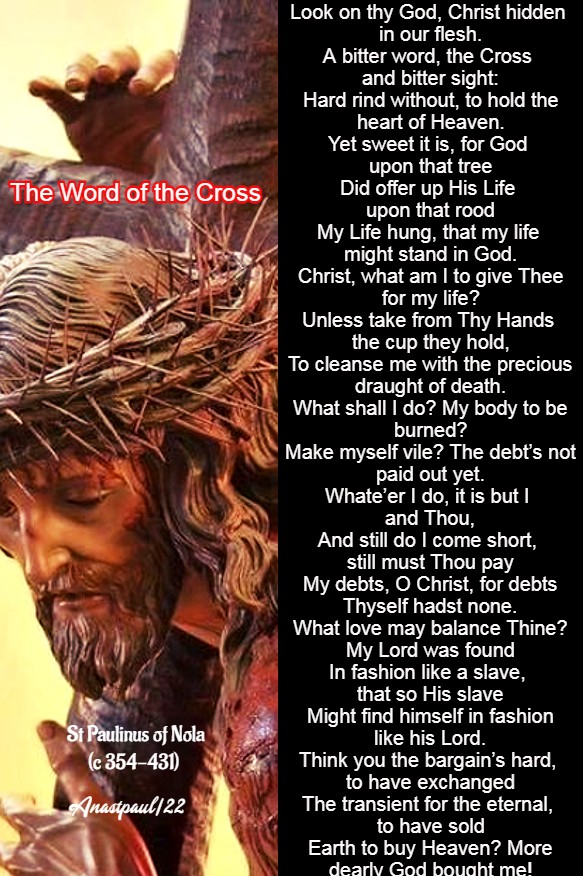
The Word of the Cross Look on thy God, Christ hidden in our flesh. A bitter word, the Cross and bitter sight: Hard rind without, to hold the heart of Heaven. Yet sweet it is, for God upon that tree Did offer up His Life upon that rood My Life hung, that my Life might stand in God. Christ, what am I to give Thee for my life? Unless take from Thy Hands the cup they hold, To cleanse me with the precious draught of death. What shall I do? My body to be burned? Make myself vile? The debt’s not paid out yet. Whate’er I do, it is but I and Thou, And still do I come short, still must Thou pay My debts, O Christ, for debts Thyself hadst none. What love may balance Thine? My Lord was found In fashion like a slave, that so His slave Might find himself in fashion like his Lord. Think you the bargain’s hard, to have exchanged The transient for the eternal, to have sold Earth to buy Heaven? More dearly God bought me!
St Paulinus of Nola (c 354-431) Father of the Church
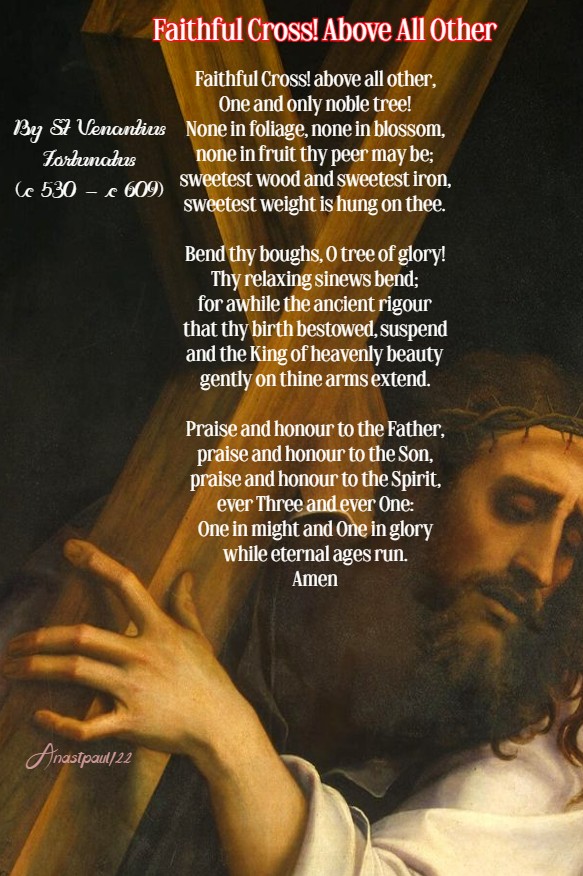
Faithful Cross! Above All Other By St Venantius Fortunatus (c 530 – c 609)
Faithful Cross! above all other, one and only noble tree! None in foliage, none in blossom, none in fruit thy peer may be; sweetest wood and sweetest iron, sweetest weight is hung on thee.
Bend thy boughs, O tree of glory! Thy relaxing sinews bend; for awhile the ancient rigour that thy birth bestowed, suspend and the King of heavenly beauty gently on thine arms extend.
Praise and honour to the Father, praise and honour to the Son, praise and honour to the Spirit, ever Three and ever One: One in might and One in glory while eternal ages run.
The Liturgical Year by Abbot Prosper Guéranger OSB (1805-1875)
“It was most just that our Divine King should show Himself to us with the sceptre of His power, to the end, that nothing might be wanting to the majesty of His empire. This sceptre is the Cross; and Paschal Time was to be the Season, for its being offered to Him in glad homage. A few weeks back and the Cross was shown to us, as the instrument of our Emmanuel’s humiliation and as the bed of suffering, whereon He died but, has He not, since then, conquered Death? and what is His Cross now but a trophy of His victory? Let it then be brought forth to our gaze and let every knee bend before this Sacred Wood, whereby our Jesus won the honour and praise we now give Him!
On the day of His Birth at Bethlehem, we sang these words of the Prophet Isaias: A Child is born unto us and a Son is given unto us and His government is upon His Shoulder (Is. ix. 6. The Introit of the Third Mass for Christmas Day). We have seen Him carrying this Cross upon His Shoulder, as Isaac carried the wood for his own immolation but now, it is no longer a heavy burthen. It is shining with a brightness that ravishes the eyes of the Angels and, after having received the veneration of man, as long as the world lasts, it will suddenly appear in the clouds of heaven, near the Judge of the living and the dead, a consolation to them that have loved it but a reproach to such as have treated it with contempt or forgetfulness.
St Helena and St Macarius and the discovery of the True Cross
Our Saviour did not think the time between His Resurrection and Ascensio,n a fitting one for glorifying the Instrument of His Victory. The Cross was not to be brought into notice, until it had subjected the world to Him, Whose glory it so eloquently proclaimed. Jesus was three days in the tomb; His Cross is to lie buried unknown to men, for three centuries but it is to have its Resurrection and the Church celebrates this Resurrection today. Jesus would, in His own good time, add to the joy of Easter by miraculously revealing to us, this Sacred Monument of His love for mankind. He entrusts it to our keeping, it is to be our consolation, as long as this world lasts – is it not just, that we should love and venerate it?
Never had Satan’s pride met with a humiliation like that of his seeing the instrument of our perdition, made the instrument of our salvation. As the Church expresses it in her Preface for Passiontide: “he that overcame mankind by a Tree, was overcome by a Tree.” Thus foiled, he vented his fury upon this saving Wood, which so bitterly reminded him, both of the irresistible power of his Conqueror and of the dignity of man, who had been redeemed at so great a price. He would fain have annihilated the Cross but knowing that this was beyond his power, he endeavoured to profane it and hide it from view. He, therefore, instigated the Jews to bury it. At the foot of Calvary, not far from the Sepulchre, was a deep hole. Into this was the Cross thrown, together with those of the two Thieves, the Nails, the Crown of Thorns and the Inscription, or Title, written by Pilate . The hole was then filled up with rubbish and earth and the Sanhedrim exulted in the thought of its having effaced the memory of the Nazarene, Who could not save Himself from the ignominious death of the Cross.
Forty years after this, Jerusalem was destroyed by the Romans, the instruments of God’s vengeance. The Holy Places were desecrated by the idolaters. A small temple to Venus was erected on Calvary and another to Jupiter over the Holy Sepulchre. By this, the pagans intended derision; whereas, they were perpetuating the knowledge of two spots of most sacred interest. When peace was restored under Constantine, the Christians had but to remove these pagan monuments and their eyes beheld the holy ground that had been bedewed with the Blood of Jesus and the glorious Sepulchre.
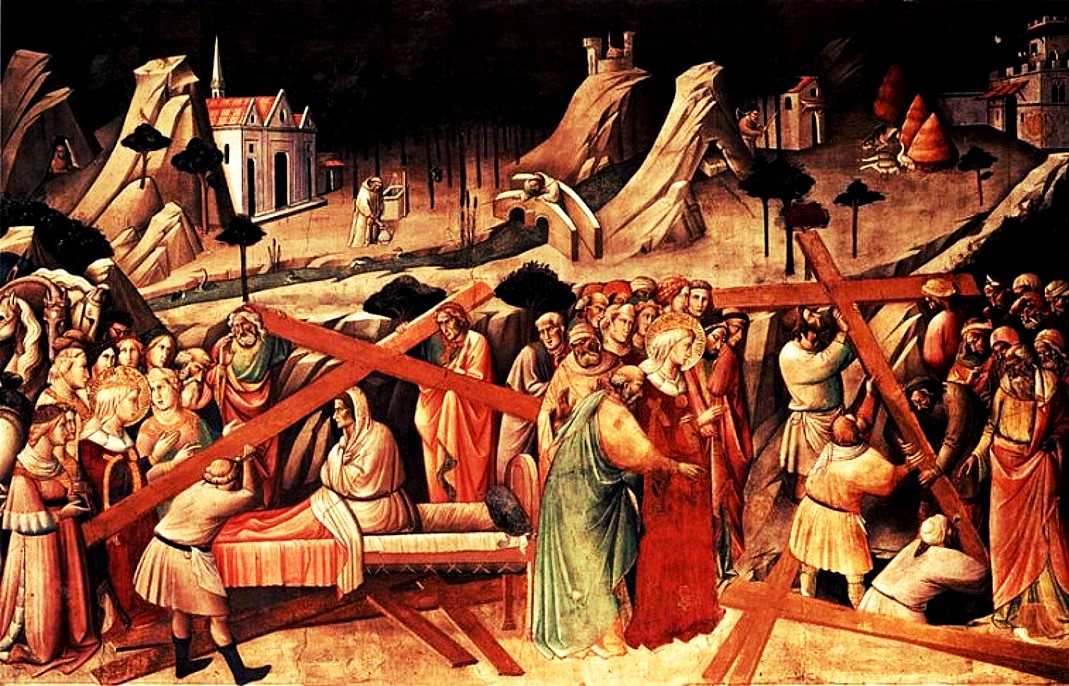
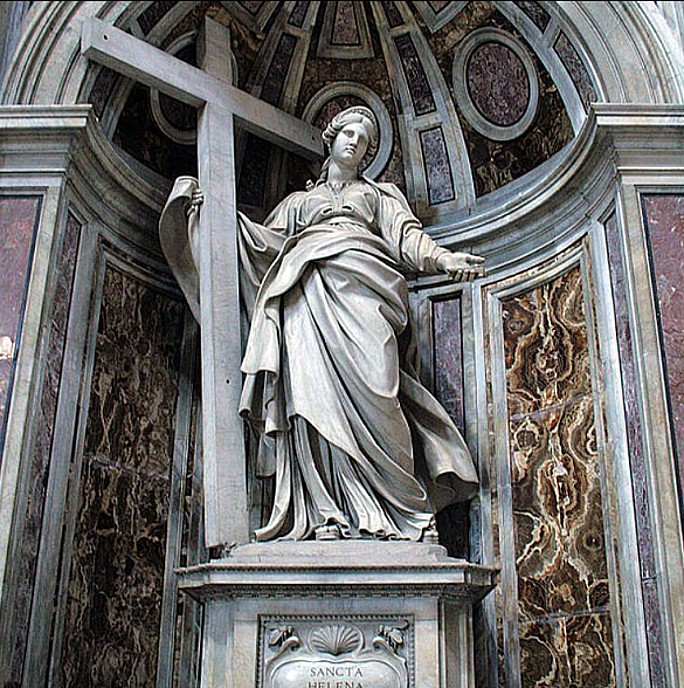
As to the Cross, it was not so easily found. The sceptre of our Divine King was to be raised up from its tomb by a royal hand. The saintly Empress Helena, Constantine’s Mother, was chosen by heaven to pay to Jesu, and that, too, on the very spot where He had received His greatest humiliations, the honours which are due to Him as the King of the world. Before laying the foundations of the Basilica of the Resurrection, this worthy follower of Magdalene and the other holy women of the Sepulchre, was anxious to discover the Instrument of our Salvation. The Jews had kept up the tradition of the site where it had been buried, the Empress had the excavations made accordingly. With what holy impatience must she not have watched the works! and with what ecstasy of joy did she not behold the Redeeming Wood, which, though not, at first, distinguishable, was certainly one of the three Crosses that were found! She addressed a fervent prayer to the Saviour, Who alone could reveal to her which was the trophy of His Victory – the Bishop, St Macarius, united his prayers with hers and their faith was rewarded by a miracle, that left them no doubt as to which was the true Cross.
The Finding of the True Cross (Giandomenico Tiepolo), where Bishop Macarius blesses the sick with the True Cross
The glorious work was accomplished and the Church was put in possession of the instrument of the world’s Redemption. Both East and West were filled with joy at the news of this precious discovery, which Heaven had set on foot and which gave the last finish to the triumph of Christianity. Christ completed His Victory over the Pagan world, by raising thus His Standard, not a figurative one but His own real Standard, His Cross, which, up to that time, had been a stumbling-block to the Jews and foolishness to the Gentiles;but before which every Christian is, henceforth, to bend his knee.
Helena placed the Holy Cross in the Basilica that had been built by her orders and which the same St Macarius, Bishop of Jerusalem oversaw and which covered both the glorious Sepulchre and the hill of the Crucifixion. Another Church was erected on the site, where the Cross had lain concealed for three hundred years and the faithful are enabled, by long flights of steps, to go down into the deep grotto, which had been its tomb. Pilgrims came, from every part of the world, to visit the hallowed places, where our Redemption had been wrought and to venerate the Sacred Wood of the Cross. But God’s merciful providence willed, not that the precious pledge of Jesus’ love for mankind should be confined to one only Sanctuary, however venerable it might be. Immediately after its discovery, Helena had a very large piece cut from the Cross and this fragment she destined for Rome, the new Jerusalem. The precious gift was enshrined in the Basilica built by her son Constantine in the Sessorian garden,and which was afterwards called the Basilica of Holy Cross in Jerusalem.
By degrees, other places were honoured by the presence of the Wood of the Holy Cross. As far back as the 4th Century, we have St Cyril of Jerusalem attesting that many of the Pilgrims used to obtain small pieces of it, and thus carried the precious Treasure into their respective countries and St. Paulinus of Nola, who lived in the same century, assures us that these many gifts lessened not the size of the original Relic. In the 6th century, the holy Queen, St Radegonde, obtained from the Emperor Justin 2nd a large piece from the fragment that was in the imperial treasury of Constantinople . It was for the reception of this piece of the True Cross into France, that St Venantius Fortunatus composed the , that beautiful Hymn which the Church uses in her Liturgy, as often as she celebrates the praises of the Holy Cross.
After several times losing and regaining it, Jerusalem was, at length, forever deprived of the precious Relic. Constantinople was a gainer by Jerusalem’s loss. From Constantinople, especially during the Crusades, many Churches of the West procured large pieces. These again supplied other places; until, at length the Wood of the Cross was to be found in almost every town of any importance.
There is scarcely to be found a Catholic, who, some time or other in his life, has not had the happiness of seeing and venerating a portion of this sacred object. How many acts of love and gratitude have not been occasioned by this? And who could fail to recognise, in this successive profusion of our Jesus’s Cross, a plan of divine providence for exciting us to an appreciation of our Redemption, on which rest all our hopes of eternal happiness?
How dear, then, to us should not this day be, which blends together the recollection of the Holy Cross and the joys of the Resurrection of that Jesus, Who, by the Cross, has won the throne to which we shall soon see Him ascend|! Let us thank our Heavenly Father for His having restored to mankind a treasure so immensely precious as is the Cross. Until the day comes for its appearing, with Himself, in the clouds of heaven, Jesus has intrusted it to His Spouse, as a pledge of His Second Coming. On that day, He, by His divine power, will collect together all the fragments and the Tree of Life will, then, gladden the Elect with its dazzling beauty and invite them to eternal rest beneath its refreshing shade”. – Abbot Prosper Guéranger OSB (1805-1875)
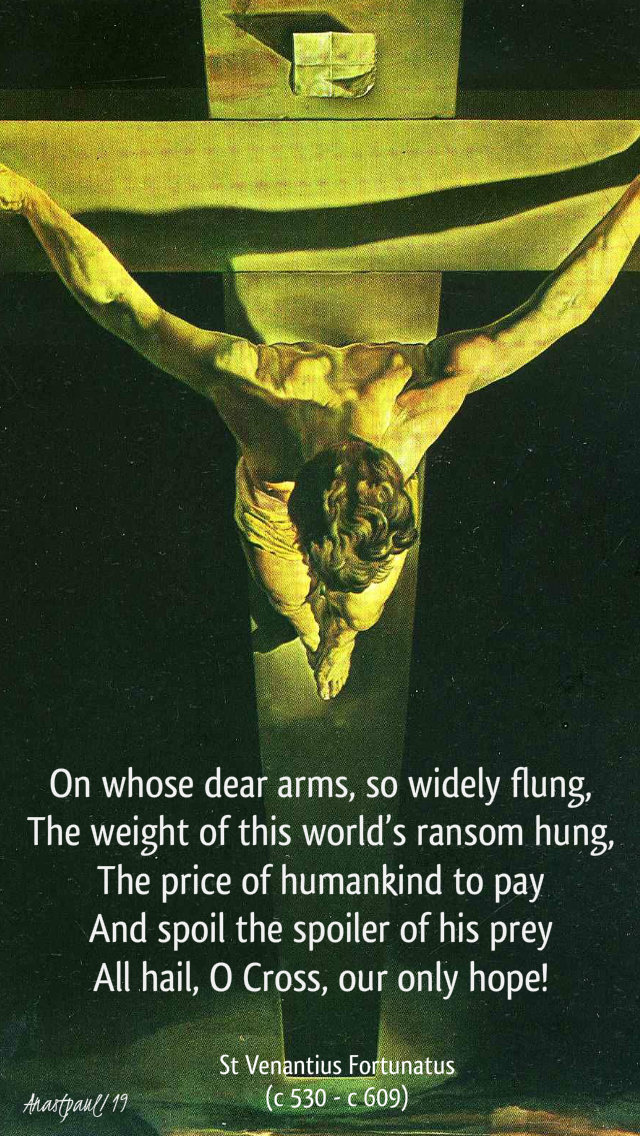
“On whose dear arms, so widely flung, The weight of this world’s ransom hung, The price of humankind to pay And spoil the spoiler of his prey All hail, O Cross, our only hope!” [From the Hymn Vexilla Regis by St Venantius Fortunatus (c 530 – c 609)]
Virgen de la Carrasca / Our Lady of Carrasca, Bordón, Teruel, Aragón, Spain (1212) – 3 May, Commemorated on First Monday of May:
In 1212, a herder found an image of the Virgin in a holm oak (carrasca) in the rocky countryside of Aragón in Spaon. There are several stories about what happened then, all of them ending with a Shrine in Bordón. Templars carried the Statue to Castellote, 12 miles north but the next day the image was back in the oak, the Virgin made those carrying her to Castellote keep turning toward Bordón and springs arose at each turn.
The original Statue
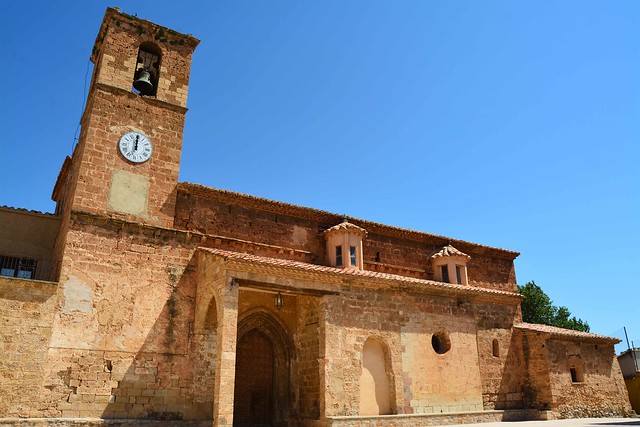
In the place where it was found, a hermitage was built to house it, which would later be replaced by the building that today is the Parish Church of Bordón, built in 1306 by the Templar Order (The Order was dissolved by Pope Clement V in 1312 ).
Although its exterior hardly stands out, its interior is magical and fascinating, a place full of mystery. In one of the Chapels inside, the Templar novices who previously made a pilgrimage on foot from Castellote, capital of the Templar Commandery, performed initiation rites to become Knights of the Order.
In the 18th century, the interior of the Church was covered with marvellous frescoes, which have been recently restored. Unfortunately, the venerated carving of the Black Virgin of the Carrasca was lost during the Civil War, along with another very famous Romanesque carving with a reputation for miraculously calming storms, the Virgin of the Spider, only a series of photographs being preserved, which allowed the making a replica.
Replica Statue
On the first Monday in May, the faithful from the three towns to the south—Tronchón, Olocau del Rey and Mirambel—conduct a processional pilgrimage to the Virgin de la Carrasca. They have done this “from time immemorial,” according to a document of 1390 in the Parish archives of Tronchón.
St Adalsindis of Bèze Bl Adam of Cantalupo in Sabina St Ahmed the Calligrapher St Aldwine of Peartney St Pope Alexander I St Alexander of Constantinople Bl Alexander of Foigny St Alexander of Rome Bl Alexander Vincioli
St Ethelwin of Lindsey St Eventius of Rome St Fumac St Gabriel Gowdel St Juvenal of Narni Bl Maria Leonia Paradis St Maura of Antinoe St Peter of Argos St Philip of Zell Bl Ramon Oromí Sullà St Rhodopianus the Deacon St Scannal of Cell-Coleraine Bl Sostenaeus
Bl Antonio Vallesio St Apollonius of Alexandria Bl Archangelus Piacentini St Bademus St Bede the Younger St Beocca of Chertsey Bl Boniface Zukowski Bl Eberwin of Helfenstein St Ethor of Chertsey St Ezekiel the Prophet
St Malchus of Waterford Bl Marco Mattia Blessed Marcus Fantuzzi OFM (c 1405-1479) Priest
St Miguel de Sanctis O.SS.T (1591-1625) Priest of the Order of the Most Holy Trinity and of the Captives also known as the Trinitarian Order or the Trinitarians, Mystic, Penitent, Ecstatic, Apostle of prayer, mortification, of the poor and the sick, he had a special devotion to the Blessed Sacrament and would fall into ecstatic prayer during the Consecration at Holy Mass, so much so, that he became known as “El Extático”, “The Ecstatic.” Pope Pius IX Canonised Miguel on 8 June 1862. About St Miguel: https://anastpaul.com/2020/04/10/saint-of-the-day-10-april-st-miguel-de-sanctis-o-ss-t-1591-1625/
St Palladius of Auxerre St Paternus the Scot
Martyrs of Carthage – 50 Saints: A group of 50 Christians who were imprisoned in a pen of snakes and scorpions and then Martyred, all during the persecutions of Decius. Only six of their names have come down to us – Africanus, Alessandro, Massimo, Pompeius, Terence and Teodoro. Beheaded in 250 at Carthage.
Martyrs of Georgia: Approximately 6,000 Christian Monks and lay people Martyred in Georgia in 1616 for their faith by a Muslim army led by Shah Abbas I of Persia.
Martyrs of Ostia: A group of criminals who were brought to the faith by Pope Saint Alexander I while he was in prison with them. Drowned by being taken off shore from Ostia, Italy, in a boat which was then scuttled, c 115.
Quote/s of the Day – 25 March – The Annunciation – Isaias 7:10-15, Luke 1:26-38
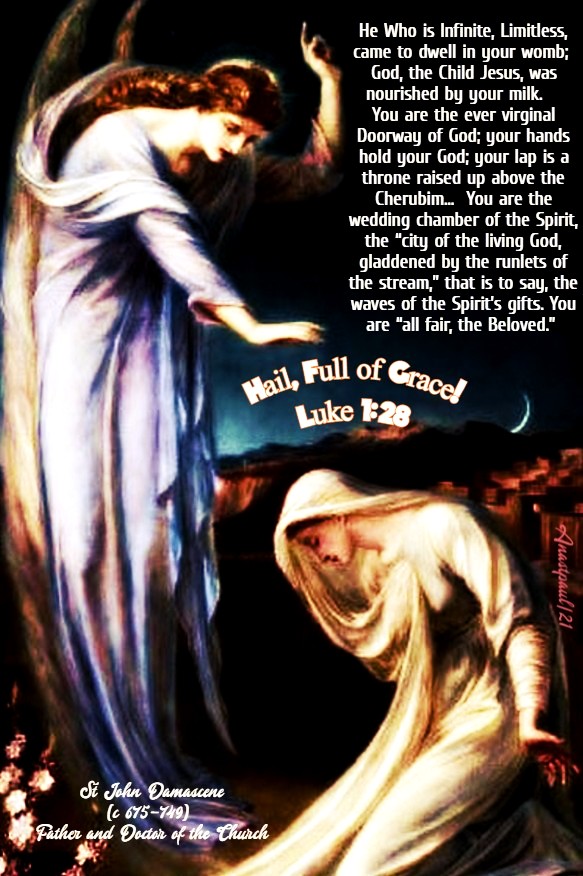
“He Who is Infinite, Limitless, came to dwell in your womb; God, the Child Jesus, was nourished by your milk. You are the ever virginal Doorway of God; your hands hold your God; your lap is a throne raised up above the Cherubim… You are the wedding chamber of the Spirit, the “city of the living God, gladdened by the runlets of the stream,” that is to say, the waves of the Spirit’s gifts. You are “all fair, the Beloved” of God.”
St John Damascene (675-749) Father and Doctor of the Church
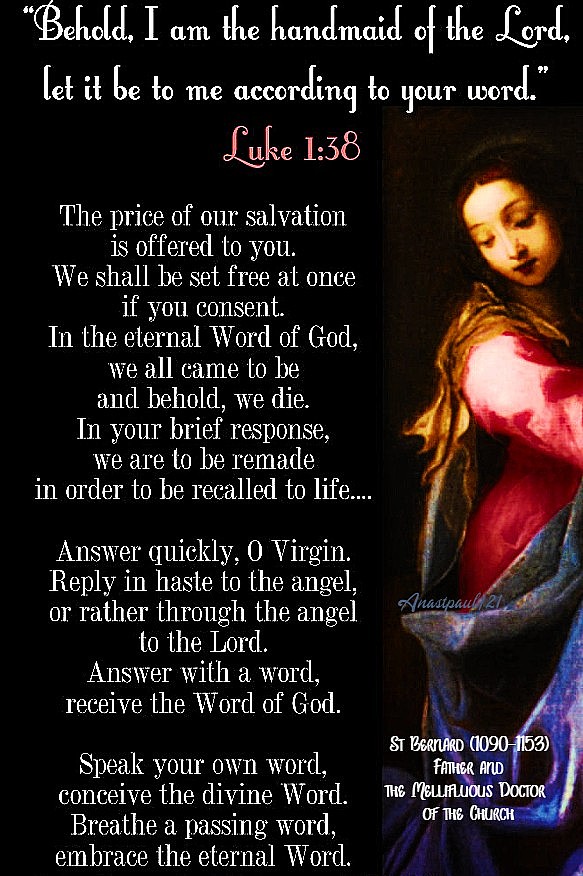
“And Mary said, ‘Behold, I am the handmaid of the Lord. May it be to me according to your word.’”
Luke 1:38
“The price of our salvation is offered to you. We shall be set free at once, if you consent. In the eternal Word of God, we all came to be and behold, we die. In your brief response, we are to be remade. in order to be recalled to life.
… Answer quickly, O Virgin. Reply in haste to the Angel, or rather, through the Angel to the Lord. Answer with a word, receive the Word of God. Speak your own word, conceive the Divine Word. Breathe a passing word, embrace the Eternal Word!”
St Bernard of Clairvaux (1090-1153) The Last Father and the Mellifluous Doctor of the Church
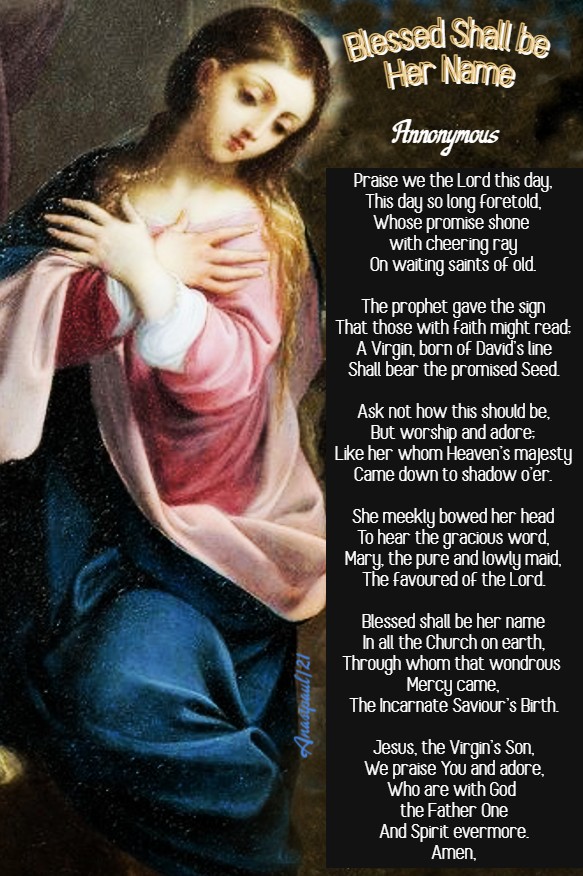
Blessed Shall be Her Name Anonymous Author
Praise we the Lord this day, This day so long foretold, Whose promise shone with cheering ray On waiting saints of old.
The prophet gave the sign That those with faith might read; A Virgin, born of David’s line Shall bear the promised Seed.
Ask not how this should be, But worship and adore; Like her whom Heaven’s majesty Came down to shadow o’er.
She meekly bowed her head To hear the gracious word, Mary, the pure and lowly maid, The favoured of the Lord.
Blessed shall be her name In all the Church on earth, Through whom that wondrous Mercy came, The Incarnate Saviour’s Birth.
Jesus, the Virgin’s Son, We praise You and adore, Who are with God the Father One And Spirit evermore. Amen
Our Morning Offering – 25 March – The Annunciation
O Mary, My Hope! By St John Damascene (675-749) Father and Doctor of the Church
I salute you, O Mary! you are the hope of Christians. Receive the prayer of a sinner, who loves you tenderly, honours you in a special manner and places in you the whole hope of his salvation. From you I have my life. You reinstate me in the grace of your Son: you are the sure pledge of my salvation. I beseech of you, therefore, to deliver me from the burden of my sins, dispel the darkness of my mind, banish from my heart the love of the world, repress the temptations of my enemies and so rule my whole life, that by your means and under your guidance, I may obtain everlasting happiness in heaven. Amen
Bl Everard of Nellenburg Bl Herman of Zahringen St Hermenland St Humbert of Pelagius Bl James Bird Bl Josaphata Mykhailyna Hordashevska St Kennocha of Fife St Lucia Filippini (1672-1732) Religious Sister, Founder.
St Matrona of Barcelona St Matrona of Thessaloniki St Mona of Milan St Ndre Zadeja St Nicodemus of Mammola Bl Pawel Januszewski St Pelagius of Laodicea Bl Placido Riccardi St Procopius St Quirinus of Rome Bl Tommaso of Costacciaro
262 Martyrs of Rome: A group 262 ChristiansMmartyred together in Rome. We know nothing else about them, not even their names.
St Adrian of Maastricht St Alkmund of Northumbria St Amantius of Wintershoven Blessed Andrea Gallerani (Died 1251) Layman, Penitent. St Apollonius of Braga St Auxilius of Ireland Bl Clement of Dunblane St Colocer of Saint-Brieuc St Corbasius of Quimperlé St Cuthbert of Brittany St Gemus
Martyrs of Sorrento: A group of three sisters and a brother who were Martyred together. We have little more than their names – Mark, Quartilla, Quintilla and Quintius. They were martyred in Sorrento, Italy, date unknown. Mark Quartilla Quintilla Quintius
Martyred in the Spanish Civil War: • Blessed Alberto Linares de La Pinta • Blessed Jaume Trilla Lastra
One Minute Reflection – 12 March – Ember Saturday in Lent – 1 Thess. 5:14-23, Matthew 17:1-9 and the Memorial of St Pope Gregory the Great (540-604) – Confessor, Father & Doctor
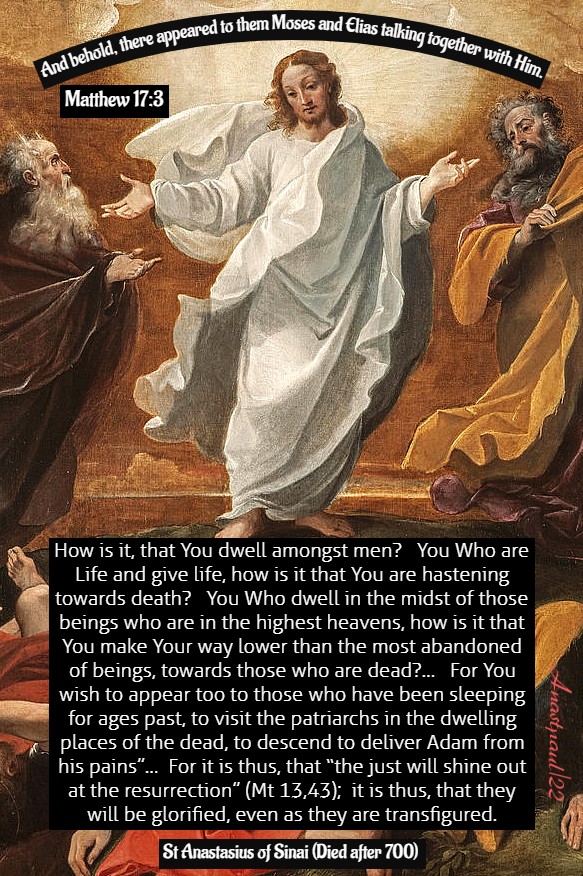
“And behold, there appeared to them Moses and Elias talking together with Him.” – Matthew 17:3
REFLECTION – “Today our Lord truly appeared on the mountain. Today, human nature, which was previously created in the form of God but obscured by the formless figures of idols, has been transfigured into man’s former beauty, created “in the image and likeness of God” (Gn 1,26)… Today man, who had been dressed in garments of skin, plain and dark (Gn 3,21), has put on divine clothing on the mountain, “clothed in light as in a robe” (Ps 103[104],2)…
Moses looked a second time at the fire that did not consume the bush (Ex 3,2) but gives life to all flesh…, and he said : Now I see You : You Who really are and Who exist eternally; You Who are with the Father and have said to me: ‘I am who am’ (v.14)… Now I see You Whom I longed to see before, saying: ‘Let me see your glory’ (Ex 33,18). No longer do I see Your back while hidden in the cleft of the rock (v.23) but I see You, O God, lover of humankind, hidden in human form. No longer do You shelter me with Your right hand (v.22) but You are the Right Hand of the Most High, Who has been revealed to the world. You are the Mediator of both the Old and the New Covenants, O God from of old, New Man…
You Who said to me on Sinai: ‘No-one can see me and live’ (v.20): how is it that You can now be contemplated face-to-face on earth, in the flesh? How is it, that You dwell amongst men? You Who are Life and give life, how is it that You are hastening towards death? You Who dwell in the midst of those beings who are in the highest heavens, how is it that You make Your way lower than the most abandoned of beings, towards those who are dead?…For You wish to appear too to those who have been sleeping for ages past, to visit the patriarchs in the dwelling places of the dead, to descend to deliver Adam from his pains”… For it is thus, that “the just will shine out at the resurrection” (Mt 13,43); it is thus, that they will be glorified, even as they are transfigured.” – St Anastasius of Sinai (Died after 700) Monk (Sermon for the Feast of the Transfiguration).
PRAYER – God our Father, Your rule is a rule of love, Your providence is full of mercy for Your people. Through the intercession of St Gregory, grant the spirit of wisdom and understanding in Your Word through Your Son Jesus Christ. Grant that by the light of His Resurrection we may know our eternal home and strive to attain eternal joy there with You. Through Jesus Christ our Lord, with the Holy Spirit, one God forever, amen.
Our Morning Offering – 1 March – Feast of the Holy Face
The Golden Arrow
May the Most Holy, Most Sacred, Most Adorable, Most Mysterious and Unutterable Name of God be always praised, blessed, loved, adored and glorified in Heaven. on earth and under the earth, by all the creatures of God and by the Sacred Heart of our Lord Jesus Christ in the most Holy Sacrament of the Altar. Amen
This prayer was revealed by Jesus Himself to a Carmelite Nun of Tours in 1843 as a reparation for blasphemy. “This Golden Arrow will wound My Heart delightfully” He said “and heal the wounds, inflicted by blasphemy.”
In the 19th Century Jesus expressed His wishes to Sister Mary of St Peter (1816-1848), a Carmelite Nun in Tours, France, that there be an actual Devotion to his Holy Face. Our Lord wanted this in reparation for blasphemies against Him and His Holy Name as well, as for the profanation of Sunday (when people engage unnecessarily in commerce and other such labours and chores on Sunday, a day meant for rest and reflection on God). In August of 1843 He dictated to her the well-known Golden Arrow Prayer. He also gave her Promises for those who would honour His Holy Face.
Soon afterwards, Venerable Leo Dupont, known as the “Holy Man of Tours” helped to publicise this Devotion and through a number of miraculous cures attributed to an image of our Lord’s Holy Face, in his possession.
In 1885 Pope Leo XIII gave Ecclesiastical approval of the Devotion to the Holy Face and established an Archconfraternity for it.
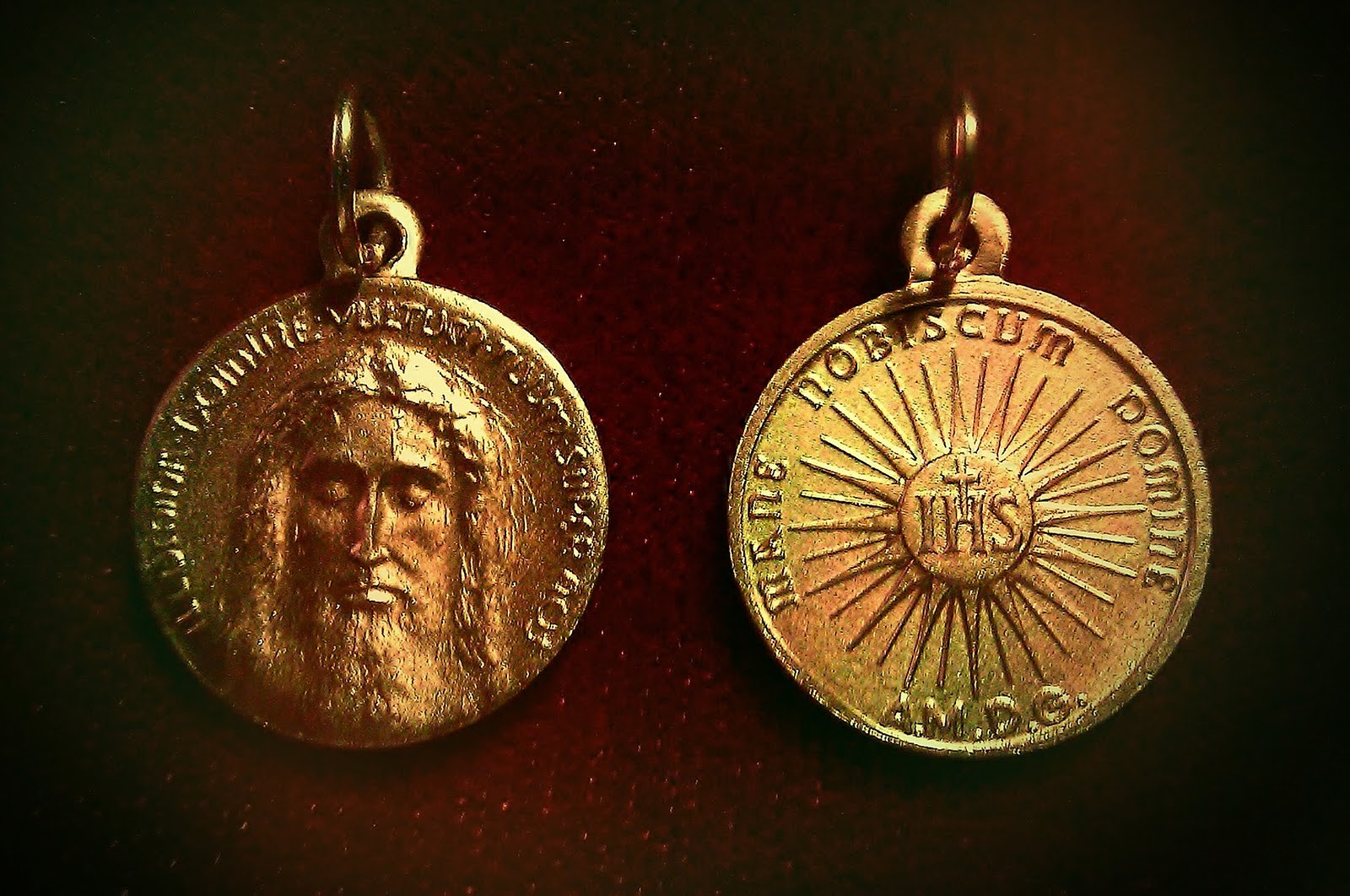
The first Holy Medal of the Holy Face was given to Ven Pope Pius XII, who approved the Devotion and the Medal. In 1958 he formally declared the Feast of the Holy Face of Jesus as Shrove Tuesday for all Catholics.
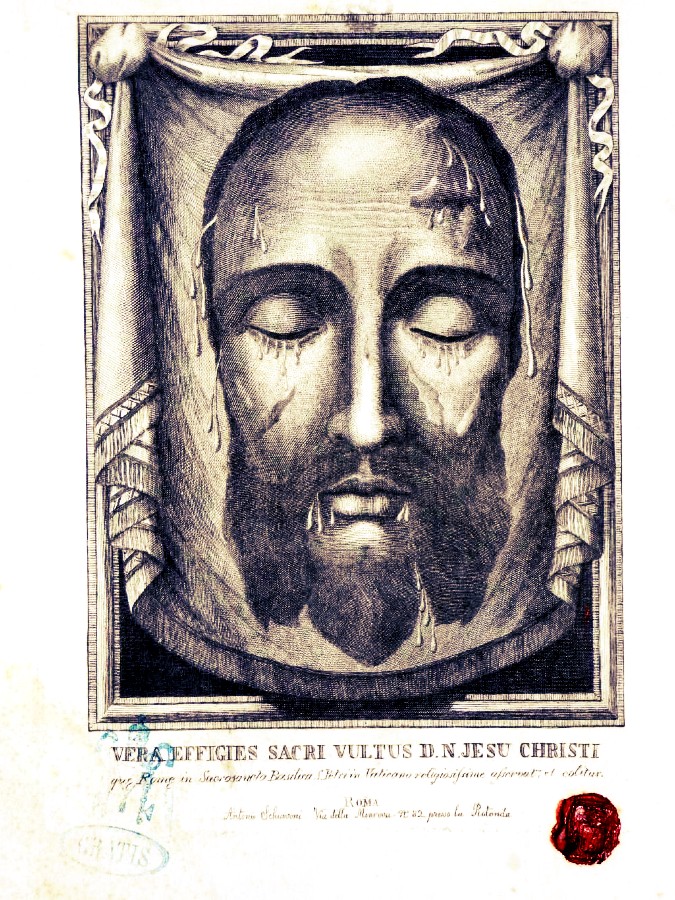
Tuesday Devotion to the Holy Face The Lord also requested that His Holy Face be honoured each Tuesday and especially on Shrove Tuesday, the Tuesday before Ash Wednesday, which marks the start of Lent. Requesting this Devotion, Jesus appeared covered with blood and very sadly said to Blessed Pierina:
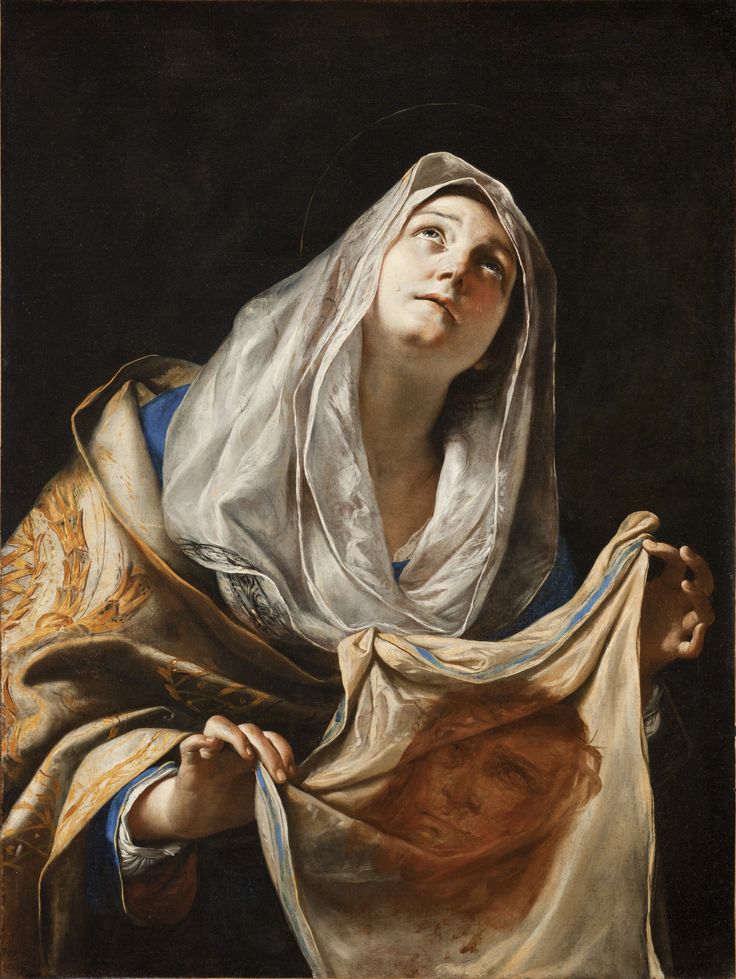
Veronica’s veil, by Claude Mellan (c. 1649).
“Do you see how I suffer? Yet, very few understand Me. Those who say they love Me are very ungrateful! I have given My Heart as the sensible object of My great love to men and I give My Face as the sensible object of My sorrow for all the sins of men. I wish that it be venerated by a special Feast on Tuesday, the day before Ash Wednesday. I wish that the Feast be preceded by a Novena in which the faithful make reparation with Me, joining together and sharing in My sorrow.”
As part of the preparations for Lent, it is appropriate to celebrate the Feast of the Holy Face by spending some time before the Blessed Sacrament and reciting the prayers of reparation. In addition, the repetition of this Devotion each Tuesday in Lent may be a means of drawing closer to Our Lord during this time of more intense prayer and conversion.
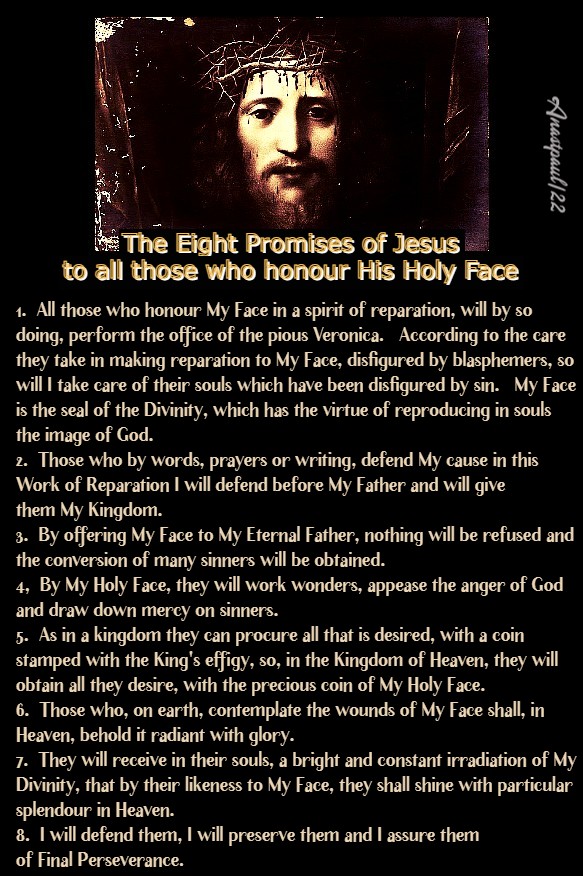
The Eight Promises of Jesus:
All those who honour My Face in a spirit of reparation, will by so doing, perform the office of the pious Veronica. According to the care they take in making reparation to My Face, disfigured by blasphemers, so will I take care of their souls which have been disfigured by sin. My Face is the seal of the Divinity, which has the virtue of reproducing in souls the image of God.
Those who by words, prayers or writing, defend My cause in this Work of Reparation I will defend before My Father and will give them My Kingdom.
By offering My Face to My Eternal Father, nothing will be refused and the conversion of many sinners will be obtained.
By My Holy Face, they will work wonders, appease the anger of God and draw down mercy on sinners.
As in a kingdom they can procure all that is desired, with a coin stamped with the King’s effigy, so, in the Kingdom of Heaven, they will obtain all they desire, with the precious coin of My Holy Face.
Those who, on earth, contemplate the wounds of My Face shall, in Heaven, behold it radiant with glory.
They will receive in their souls, a bright and constant irradiation of My Divinity, that by their likeness to My Face, they shall shine with particular splendour in Heaven.
I will defend them, I will preserve them and I assure them of Final Perseverance.
Quote/s of the Day – 24 February – Feast of St Matthias, Apostle and Martyr – Acts 1:15-26, Matthew 11:25-30
“You did not choose me but I chose you and appointed you that you should go and bear fruit and that your fruit should abide”
John 15:16
“They spoke with such confidence because someone had to be appointed. They did not say “choose” but “make known to us” the chosen one; “the one you choose,” they said, fully aware, that everything was being preordained by God.”
Quote/s of the Day – 22 February – The Feast of the Chair of Saint Peter,at Antioch
“He gave way to sin so that, remembering his own failure and the kindness of the Lord, he might testify to others, a grace of philanthropy in accord with the divine design conceived by God. The fall had been permitted to the one who was going to see himself entrusted with the Church, the Pillar of the Church, the Harbour of the Faith; the fall had been permitted to Peter, the Doctor of the Universe, in order that, the forgiveness received, might remain the foundation of love for others.”
St John Chrysostom (347-407) Father and Doctor of the Church
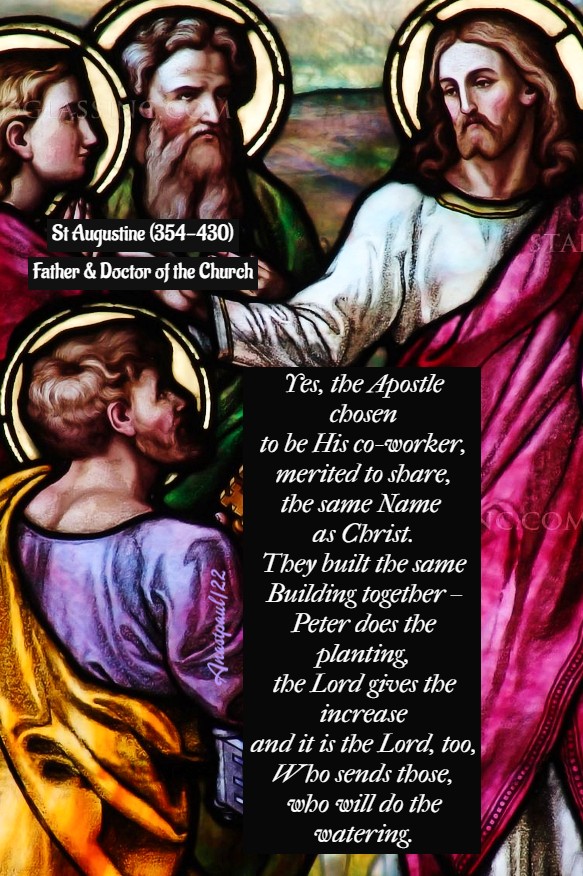
“Yes, the Apostle chosen to be His co-worker, merited to share, the same Name as Christ. They built the same Building together – Peter does the planting, the Lord gives the increase and it is the Lord, too, Who sends those, who will do the watering (cf 1 Cor 3:6f).”
St Augustine (354-430) Father & Doctor of the Church
“Nothing escaped the Wisdom and Power of Christ, the elements of nature lay at His service, spirits obeyed Him, Angels served Him. … And yet, out of all the world, Peter alone was chosen to stand at the head, for the calling of all the peoples and the oversight of all the Apostles and Fathers of the Church.”
Saint Pope Leo the Great (400-461) Father and Doctor of the Church
One Minute Reflection – 22 February – The Feast of the Chair of Saint Peter,at Antioch – Readings: 1 Peter 1-7, Matthew 16:13-19.
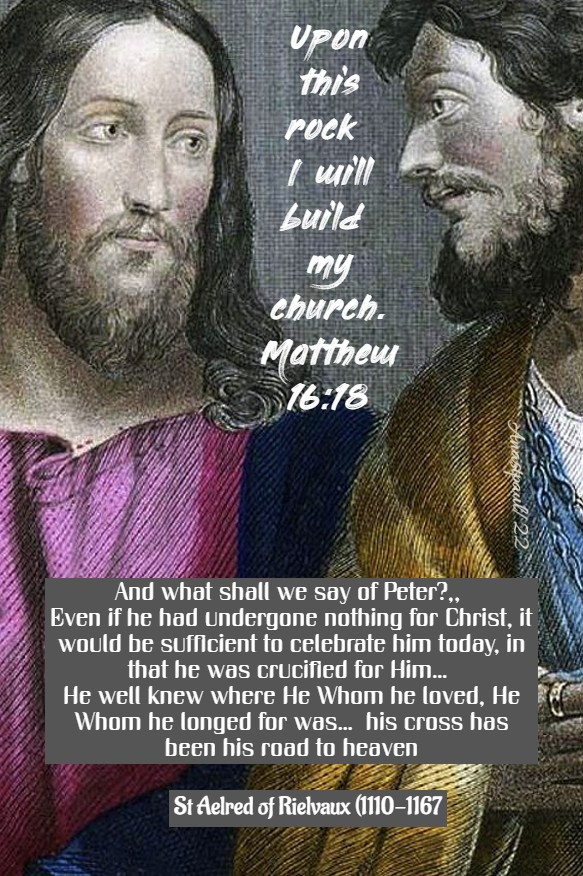
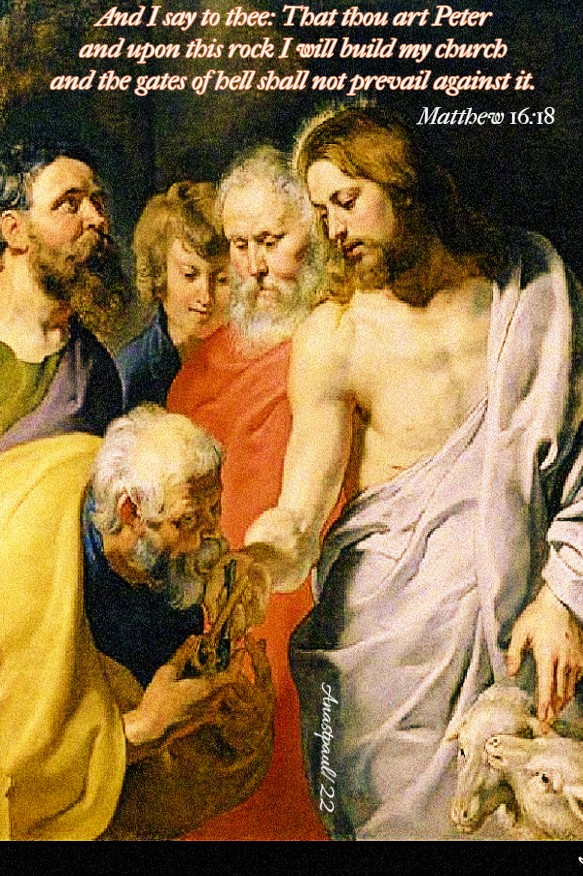
“Upon this rock I will build my church” – Matthew 16:18
REFLECTION – “Though the earth and all who dwell in it quake, I have set firm its pillars” (Ps 74[75],40). All the Apostles are pillars of the earth but, at their head, the two whose feast we are celebrating. They are the two pillars who support the Church with their teaching, their prayer and the example of their steadfastness. The Lord himself strengthened these pillars. For at first they were weak, completely incapable of supporting either themselves or others. And in this the Lord’s great design appears – if they had always been strong, people could have thought their strength came from themselves. That is why the Lord wanted to show ,what they were capable of before strengthening them, so that all might know their strength came from God… Peter was thrown to the ground by the voice of a mere servant… and the other pillar was very weak too: “I was once a blasphemer and persecutor and an arrogant man” (1Tm 1,13)…
Hence we must ought to praise these Saints with all our heart – our fathers who bore such trials for the Lord’s sake and who persevered with such determination. It is nothing to persevere in joy, happiness and peace. But this is what is great: to be stoned, scourged, struck for Christ (2Cor 11,25) and in all this, to persevere with Christ. With Paul, it is a great thing to be cursed and to bless, to be persecuted and to endure, to be slandered and to console, to be like the world’s rubbish and to draw glory from it (1Cor 4,12-13)…, And what shall we say of Peter?,, Even if he had undergone nothing for Christ, it would be sufficient to celebrate him today, in that he was crucified for Him… He well knew where He Whom he loved, He Whom he longed for was… his cross has been his road to heaven.” – St Aelred of Rielvaux (1110-1167) Cistercian Monk (Sermon 18, for the Feast of Saints Peter and Paul PL 195, 298).
PRAYER – O God, Who when giving blessed Peter, Your Apostle, the keys of the heavenly Kingdom, bestowed on him the power of binding and loosing, grant that by the help of his intercession we may be delivered from the bonds of our sins. Through Jesus Christ, Thy Son our Lord, Who lives and reigns with Thee, in the unity of the Holy Ghost, God, world without end. Amen (Collect).
Our Morning Offering – 22 February – Feast of the Chair of St Peter at Antioch
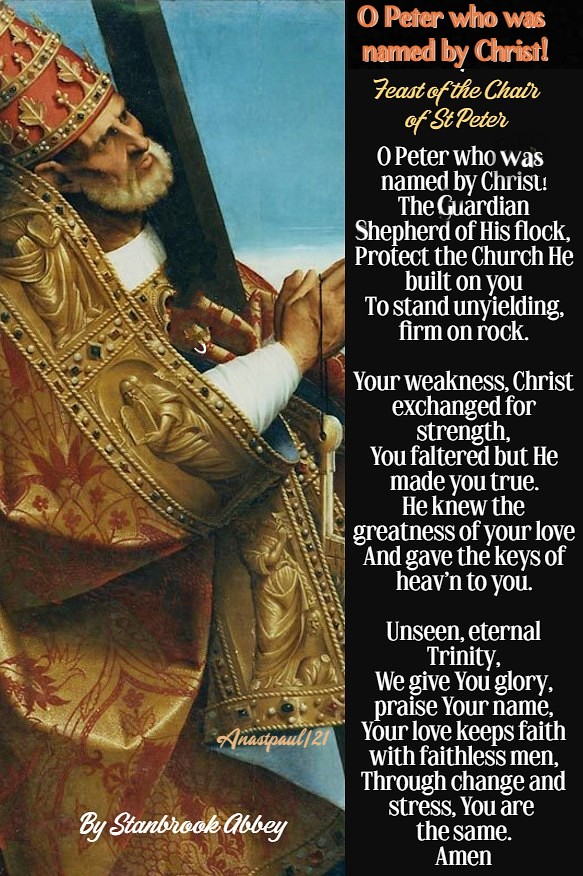
O Peter, who was Named by Christ! By Stanbrook Abbey For the Feast of the Chair of St Peter
O Peter who was named by Christ! The Guardian-Shepherd of His flock, Protect the Church He built on you To stand unyielding, firm on rock.
Your weakness, Christ exchanged for strength, You faltered but He made you true. He knew the greatness of your love And gave the keys of heav’n to you.
Unseen, eternal Trinity, We give You glory, praise Your name, Your love keeps faith with faithless men, Through change and stress, You are the same. Amen
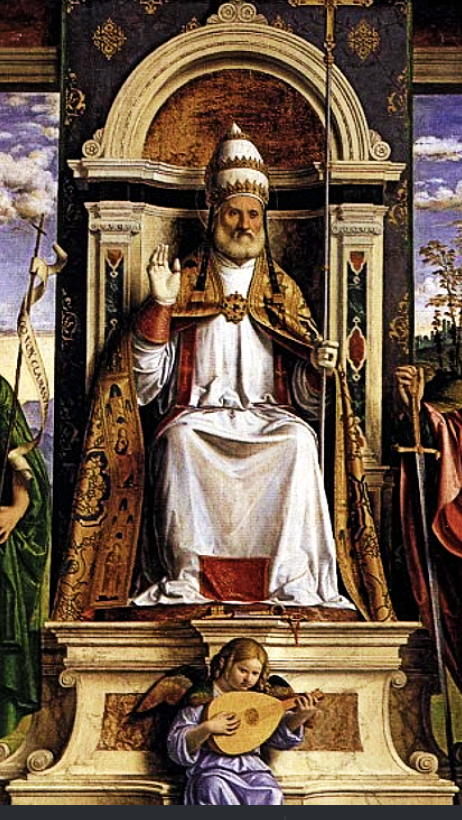
The Feast of the Chair of Saint Peter at Antioch, where the disciples were first entitled “Christians.” The Chair/Throne or Cathedra itself is a relic conserved in St Peter’s Basilica although it seems not to be the original Chair. The Chair which was enclosed in a sculpted gilt bronze casing designed by Gian Lorenzo Bernini and constructed between 1647 and 1653 is a later Chair.
Saint Peter, before he went to Rome, founded the See of Antioch is attested by Eusebius, Origen, St Clemnt, St Jerome, St Innocent, Pope Gelasius, in his Roman Council, St John Chrysostom and others.
It was right and just that the Prince of the Apostles should take this City under his particular care and inspection, which was then the Capital of the East and in which, the Faith took roots, so early and so deeply, as to give birth in it, to the name of Christians.
St Chrysostom says, that St Peter made there a long stay while St Gregory the Great says, that St Peter was the Bishop of Antioch for seven years – not that he resided there permanently but only that he had a particular care over that Church. If he sat for twenty-five years at Rome, the date of his establishing his Chair at Antioch. must be within three years after our Saviour’s Ascension; for in that supposition, he must have gone to Rome in the second year of Claudius.
The festival of St Peter’s Chair in general, Natale Petri de Cathedrâ, is marked on this day in the most ancient calendar extant, made in the time of Pope Liberius, about the year 354. It also occurs in Gregory’s Sacramentary and in all the Martyrologies. It was kept in France in the sixth century, as appears from the Council of Tours and from that of Le Conte.
In the first ages ,it was customary, especially in the East, for every Christian to keep the Anniversary of his Baptism, on which he renewed his Baptismal Vows and gave thanks to God for his Heavenly Adoption: this they called their spiritual Birth-day – worthy indeed of renewal in our times! The Bishop,s in like manner, kept the Anniversary of their own Consecration, as appears from four sermons of St Leo on the Anniversary of his accession or assumption to the Pontifical dignity and this was frequently continued by the people after their decease, out of respect and love for their memory. St Leo says, we ought to celebrate the Chair of St Peter with no less joy than the day of his Martyrdom, for, as in this, he was exalted to a Throne of glory in Heaven, so, by the former, he was installed as Head of the Church on earth.
On this festival we are especially bound to adore and thank the Divine Goodness for the establishment and propagation of His Church and earnestly to pray, that in His Mercy, He may preserve the same, that His Name may be glorified by all nations and by all hearts, to the boundaries of the earth, for His Divine honour and the salvation of souls, framed to His Divine Image and the price of his adorable Blood.
The Church of Christ is His spiritual Kingdom – He is not only the Architect and Founder but continues to govern it and by His Spirit, to animate its members to the end of the world, as its invisible Head: although He has left in St Peter and his successors, a Vicar, or lieutenant, as a visible head, with an established hierarchy for its exterior government.
If we love Him and desire His honour, can we cease weeping and praying, that by His sweet Omnipotent grace, He may subdue all the enemies of His Church, both inside it and without it, converting to it all infidels and apostates? In its very bosom, sinners fight against Him! Although these continue as His members, they are dead members because He lives not in them by His grace and charity, reigns not in their hearts, animates them not with His Spirit. He will indeed always live by grace and sanctity in many members of His Mystical Body, fighting against the heretics and apostates who seek the destruction of His Church.
Let us pray that by the destruction of the tyranny of sin, all souls may subject themselves to the reign of His Holy Love.
Good Jesus! for Your mercy’s sake, hear us in this prayer, above all other petitions, never suffer us to be separated from You by forfeiting your holy love: may we remain always rooted and grounded in Your charity, as is the will of Your Father. Amen.
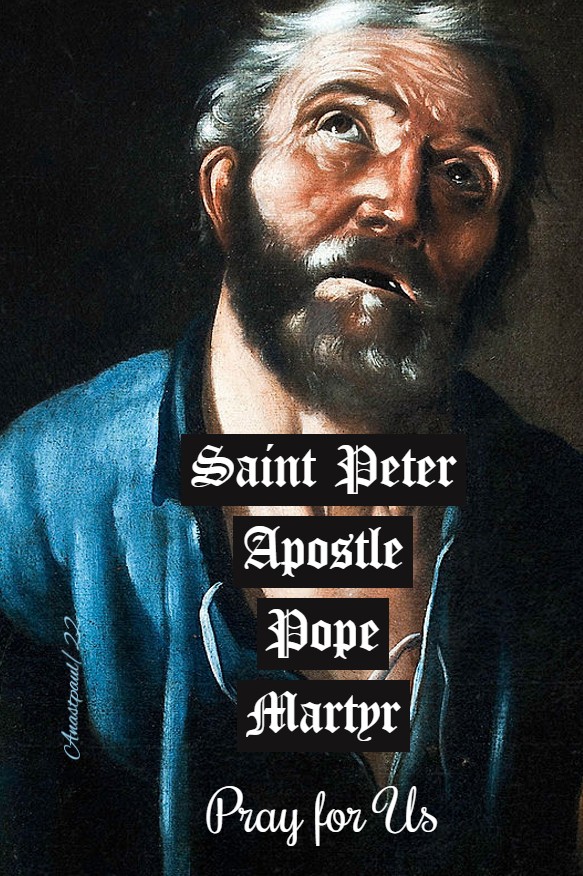
St Peter, Pray for Holy Mother Church and for us all!
St Maximian of Ravenna St Miguel Facerías Garcés St Mohammed Abdalla St Papias of Heirapolis St Paschasius of Vienne St Raynerius of Beaulieu St Thalassius
Martyrs of Arabia – A memorial for all the unnamed Christians Martyred in the desert and mountainous areas south of the Dead Sea during the persecutions of Emperor Valerius Maximianus Galerius.
Thought for the Day – 2 February – Meditations with Antonio Cardinal Bacci (1881-1971)
The Purification of Our Lady
“In the Gospel narrative of St Luke (Cf 2:22-31), another character also appears. He intrudes upon the scene without any apparent right to be there but, he had been inspired by God. This is the old and saintly Simeon. He was not a priest. He was an upright man, careful in the observance of the law, who was waiting longingly for the coming of the promises Redeemer. The Holy Spirit dwelt in him and had revealed, that he would not die until he had seen the Saviour. He was inspired to go to the Temple, where he saw Jesus. He took Him in his arms and was overcome with joy. Then he blessed God and declared that he was now prepared to accept death, as he had been able to see and embrace the Saviour, as God had promised. “Now thou dost dismiss thy servant, O Lord, according to thy word, in peace” (Lk 2:29). It was a beautiful way to meet death, to be able to hold Jesus close to his heart and see his long life of hope and expectation rewarded by the loving embrace of his Lord.
Let us try and live like Simeon, with our minds and hearts turned towards Jesus. Let us think chiefly of Him, love Him, above everything else and work only for Him. Then our death will be as beautiful as his. In fact, we shall be even more fortunate, for we can go further than receiving Jesus into our arms. We shall be able to receive Him into out hearts. He will be at hand to give us the supernatural strength which we shall need on our great journey into eternity.”
Quote/s of the Day – 2 February – The Feast of the Purification of the Blessed Virgin
“The day will come when this Child will no longer be offered in the Temple, nor in Simeon’s arms but outside the City in the arms of the Cross. The day will come when He will not be redeemed by the blood of a sacrifice but redeem others , with His own Blood. …” That will be the evening sacrifice; this is the morning sacrifice; this one is the happiest but that one is the most complete; for this one was offered at the time of birth and that one will be offered in the fullness of time,..”
“But what shall we offer, brothers, what shall we give Him for all the benefits He has given us? He offered the most precious Victim He possessed for our sake; in truth, He could not have had anything more precious. So let up, too, do what we can, let us offer Him the best we have, that is to say, ourselves! He offered Himself, so who are you, to hesitate to offer yourself?”
St Bernard (1091-1153) Mellifluous Doctor of the Church
One Minute Reflection – 2 February – The Feast of the Purification of the Blessed Virgin, Candlemas – Mal 3:1-4, Luke 2:22-32
“And inspired by the Spirit he came into the temple and when the parents brought in the child Jesus, to do for him according to the custom of the law, he took him up in his arms and blessed God …” – Luke 2:27-28
REFLECTION – “Your lamps must be burning in your hands” (Lk 12:35). By this outward sign let us remind ourselves of the joy of Simeon, carrying the Light in his hands … We must be burning with love and radiant with good deeds and so, take up Christ in our hands with Simeon … Let us discuss this charming custom of the Church of bearing lights aloft on this feast day … Could anyone hold up a lighted candle in his hands on this day, without at once remembering that old man, who on this same day, took up in his arms, Jesus, God’s Word, clothed in flesh like a candle-flame clothed in wax and affirmed Him to be “the Light which would be a beacon for the Gentiles.” Surely he was that “burning and radiant lamp” (Jn 5:35; 1,7) which bore witness to the Light. For this purpose he came in the Spirit, who had filled him, into the temple, that he might “receive, O God, your loving-kindness in the midst of your temple” (Ps 48[47]:10) and declare him to be loving-kindness indeed and the light of your own people.
Truly, O holy Simeon, in the quiet contentment of old age, you carried this Light not simply in your hands but in the very dispositions of your heart. You were like a lamp-standard, seeing so clearly how much the Gentiles would one day be lit up, while reflecting … the bright rays of our faith. Old, yet still sincere, you can now be happy, in that, you really see what once you but foresaw. Gone is the world’s gloom, “the Gentiles bask in this light of yours,” “the whole earth is full of his glory” (Is 60:3; 6:3).” … Blessed Guerric of Igny O.Cist. (c 1080-1157) Cistercian Abbot
PRAYER – Almighty, eternal God, we humbly beseech Your majesty that, as Your only-begotten Son was this day presented in the temple in the nature of our flesh, so may You grant us to be presented to You, with purified minds. Through Jesus Christ, Thy Son our Lord, Who lives and reigns with Thee, in the unity of the Holy Ghost, God, world without end. Amen (Collect).
Our Morning Offering – 2 February – The Feast of the Purification of the Blessed Virgin. Candlemas
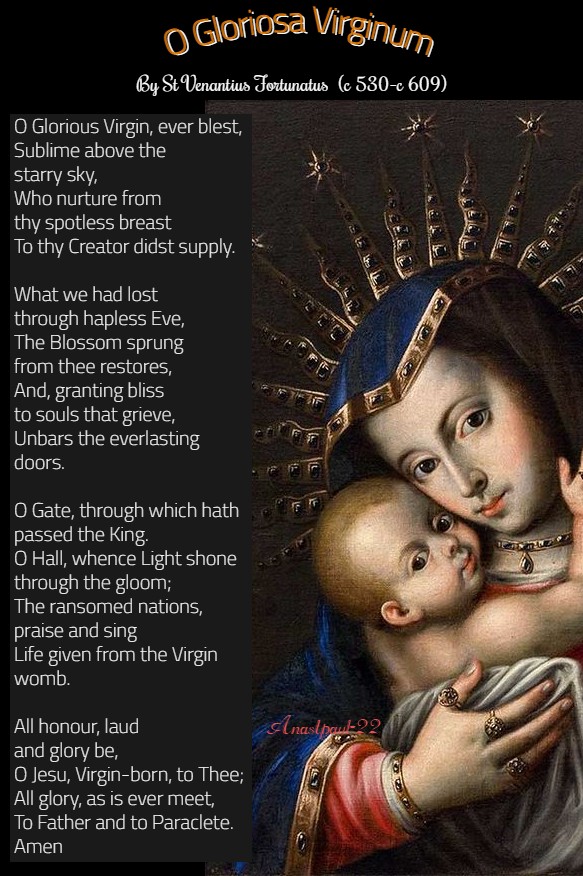
O Gloriosa Virginum By St Venantius Fortunatus (c 530 – c 609)
O Glorious Virgin, ever blest, Sublime above the starry sky, Who nurture from thy spotless breast To thy Creator didst supply.
What we had lost through hapless Eve, The Blossom sprung from these restores, And, granting bliss to souls that grieve, Unbars the everlasting doors.
O Gate, through which hath passed the King. O Hall, whence Light shone through the gloom; The ransomed nations, praise and sing Life given from the Virgin womb.
All honour, laud and glory be, O Jesu, Virgin-born, to Thee; All glory, as is ever meet, To Father and to Paraclete. Amen
O Gloriosa Domina is the second half of the hymn: Quem Terra, Pontus, Aethera. It was composed by St Venantius Fortunatus (c 530 – c 609) the Bishop of Poitiers. In 1632, in accordance with revisions made to the hymns of the Divine Office by Pope Urban VIII (1568-1644), it was altered and changed to O Gloriósa Vírginum. It is sung in the Common of the Blessed Virgin Mary of the Roman Breviary. It is said that St Anthony of Padua (1195-1231) was always singing this hymn. His mother sang it to him as a baby,and even on his death bed after receiving Extreme Unction, he intoned the hymn.




























 AnaStpaul
You must be logged in to post a comment.