Our Morning Offering – 27 December – Feast of St John the Evangelist and the Third Day of the Christmas Octave
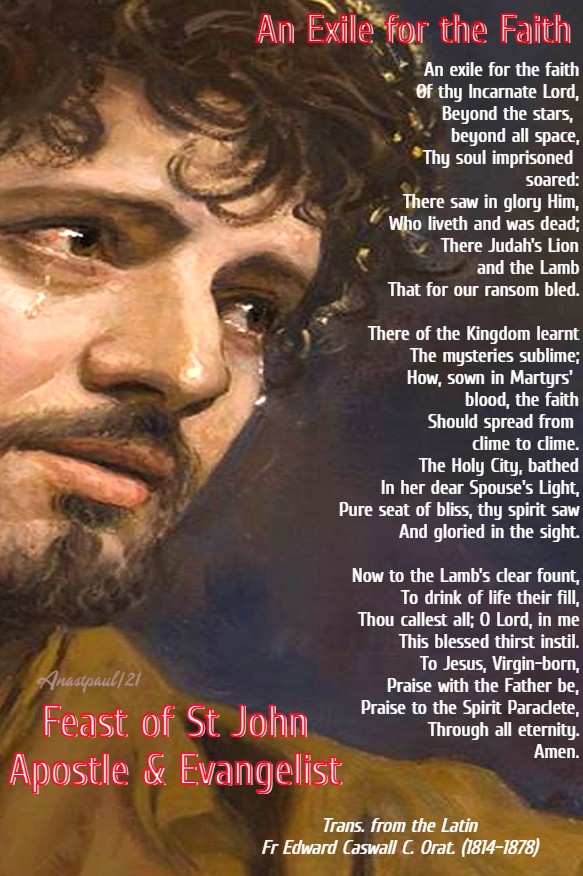
An Exile for the Faith Trans. from the Latin Fr Edward Caswall C. Orat. (1814–1878)
An exile for the faith Of thy Incarnate Lord, Beyond the stars, beyond all space, Thy soul imprisoned soared: There saw in glory Him, Who liveth and was dead; There Judah’s Lion and the Lamb That for our ransom bled.
There of the Kingdom learnt The mysteries sublime; How, sown in Martyrs’ blood, the faith Should spread from clime to clime. The Holy City, bathed In her dear Spouse’s Light, Pure seat of bliss, thy spirit saw And gloried in the sight.
Now to the Lamb’s clear fount, To drink of life their fill, Thou callest all; O Lord, in me This blessed thirst instil. To Jesus, Virgin-born, Praise with the Father be, Praise to the Spirit Paraclete, Through all eternity. Amen.
Saint of the Day – 27 December – 27 December – St John the Apostle and Evangelist. Patronages – • against burns; burn victims• against epilepsy• against foot problems• against hailstorms• against poisoning• art dealers• authors, writers• basket makers• bookbinders• booksellers• butchers• compositors• editors• engravers• friendships• glaziers• government officials• harvests• lithographers• notaries• painters• papermakers• publishers• saddle makers• scholars• sculptors• tanners• theologians• typesetters• vintners• Asia Minor (proclaimed on 26 October 1914 by Pope Benedict XV)• 6 Diocese• 7 Cities.
St John, Apostle and Evangelist by Father Francis Xavier Weninger SJ (1805-1888)
St John, Apostle and Evangelist of Jesus Christ, a brother of St James and son of Zebedee and Salome, was born at Bethsaida, a Town in Galilee. Christ, our Lord, called him and his brother James to follow Him, at the time when they were mending their nets in a boat, on the shore of the Sea of Genesareth. John, without delay, left all he possessed, even his own father and, with his brother, followed the Lord. Although the youngest of the Apostles, he was beloved by the Saviour above all the others – whence he is several times mentioned in the Gospel, as “the disciple whom Jesus loved.” The cause of this special love of Jesus for him, was, according to the Holy Fathers, his virginal purity, which he kept undefiled and the tender love he bore to the Lord. “He was more beloved than all the other Apostles,” writes St Thomas Aquinas, “on account of his purity.” “For the same reason,” says St. Anselm, “God revealed more mysteries to him, than to the other Apostles. Justly,” says he, “did Christ the Lord reveal the greatest mysteries to him, because he surpassed all in virginal purity.“
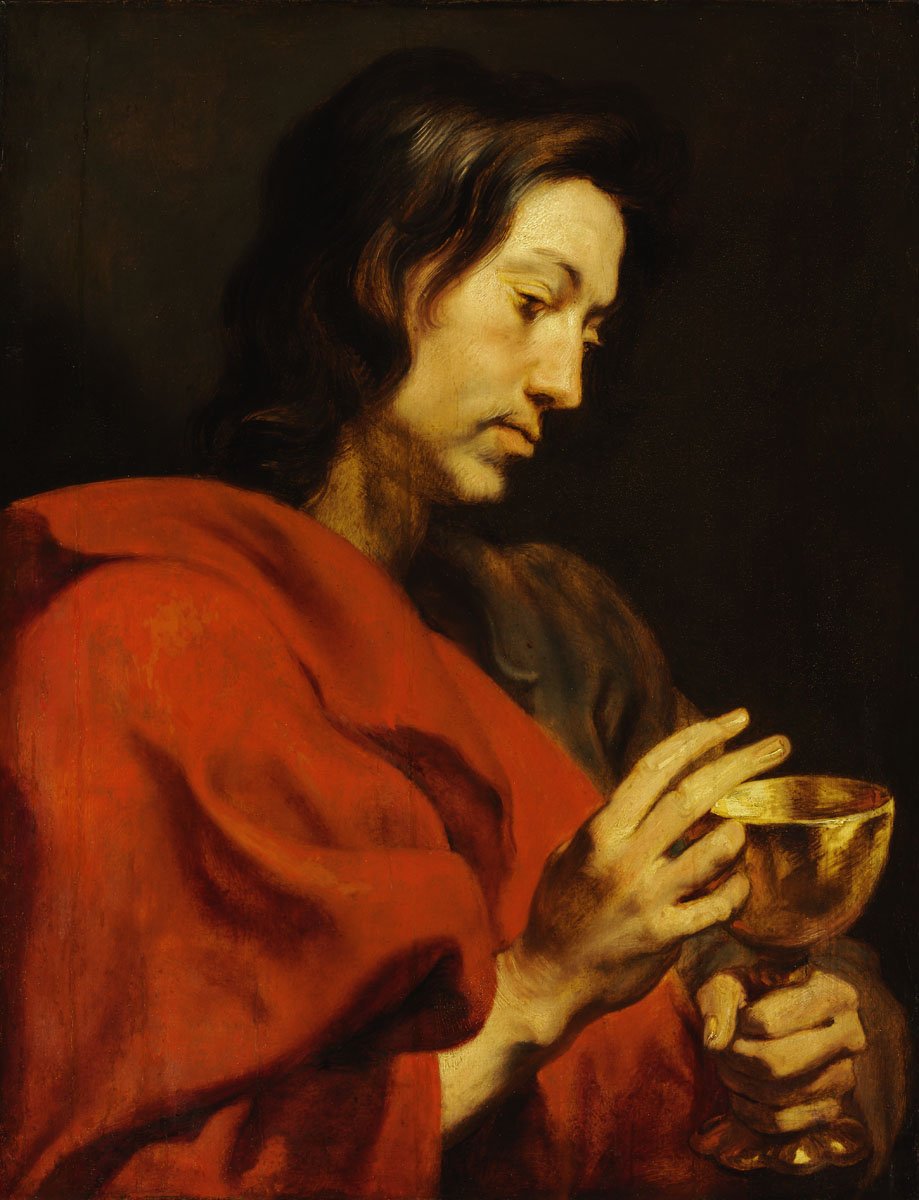
Anthony van Dyck
It is evident from the Gospel, that St John was one of the most intimate of the friends of the Lord, and was, in consequence, sometimes admitted into Christ’s presence, when, except Peter and James, no other Apostle was allowed to be near. Thus, he was with Christ when He healed the mother-in-law of Peter; when He raised the daughter of Jairus from the dead and when He was transfigured on Mount Thabor. He also accompanied Christ when He suffered His Agony in the Garden of Olives. The other two above-named Apostles ,shared these favours with John but none was permitted to lean upon the Saviour’s bosom, at the last supper, save John; none was recommended as son to the divine Mother but John. Only he, of all the Apostles, followed Christ to Mount Calvary,and remained there with Him, until His death. To recompense this love, Christ gave him to His Mother as her son, when He said: “Behold thy Mother!” Christ, who had lived in virginal chastity, would trust His Virgin Mother to no-one else but John, who himself lived in virginal purity. As St.Jerome says: “Christ, a virgin, recommended Mary, a virgin, to John, a virgin.” No greater grace could John have asked of Christ; no more evident proof could he have received of His love. The most precious thing which the Lord possessed on earth, His holy Mother, He commended to His beloved disciple. He took him as brother, by giving Him as son to His Mother. Who cannot see from all this, that Christ loved and honoured St John above all others?
How deeply this beloved disciple must have suffered by seeing his Saviour die, so ignominious a death, is easily to be conceived; and St Chrysostom hesitates not to call him, therefore, a manifold Martyr. After Christ had died on the Cross, had been taken from it, and interred with all possible honours, St John returned home with the divine Mother, who was now also his mother, and waited for the glorious Resurrection of the Lord. When this had taken place, he participated in the many apparitions of the Lord, by which the disciples were comforted and, doubtless received again, particular marks of love from the Saviour. He afterwards assisted, with the divine Mother and the Apostles and other disciples of Christ, at the wonderful Ascension of the Lord. With these, also, he received, after a ten days’ preparation, the Holy Ghost, on the great festival of Pentecost.
Soon after this, he and Peter had, before all others, the grace to suffer for Christ’s sake. For when these two Apostles had, in the name of Christ, miraculously healed a poor cripple who was lying at the door of the temple of Jerusalem and used this opportunity, to show to the assembled people, that Jesus of Nazareth was the true Messiah.
Fresco in the Cappella Brancacci, Florence, attributed to Masolino da Panicale (1383 – c.1447). It is part of the cycle of frescoes painted between 1425 and 1427 depicting the life of St. Peter. It shows the Apostle, accompanied by StJohn, giving his hand to a cripple seeking alms. The cripple is instantly cured.
They were seized, at the instigation of the chief priests,and were cast into prison. On the following day, the priests came together and John and Peter were called before them and asked in whose name and by what power, they had healed the cripple. Peter and John answered fearlessly, that it had been done in the Name of Jesus Christ. The high priest dared not do anything further to them but, setting them free, prohibited them from preaching, in future, the Name of Christ. The two holy Apostles, however, nothing daunted, said: “If it be just in the sight of God to hear you rather than God, judge ye: for we cannot but speak the things which we have seen and heard.“
Anthony van Dyck
St. John remained for some time in Jerusalem after this and, with the other Apostles, was zealous in his endeavors to convert the Jews. When the Apostles separated, to preach the Gospel over all the world, Asia Minor was assigned to St John. Going thither, he began with great zeal his apostolic functions and, by the gift of miracles, he converted many thousands to the Faith of Christ. The many Bishoprics which he instituted in the principal cities sufficiently prove this. In the course of time, he went also to other countries, preaching everywhere the Word of Christ, with equal success..
Anthony van Dyck
oil, oak
64,5 x 50 cm
The Emperor Domitian, who, after the death of the Emperor Nero, again began to persecute the Christians, ordered his officers to apprehend John and bring him to Rome. Hardly had the holy Apostle arrived there, when he was commanded by the Emperor to sacrifice to the gods. As the Saint refused this and fearlessly confessed Christ, the Emperor had him most cruelly scourged and afterwards, cast into a large caldron, filled with boiling oil. The Saint signed himself and the cauldron with the Holy Cross and remained unharmed, when he was cast into it. This gave him an opportunity to announce, with great energy, to the assembled people, the Gospel of Jesus Christ. The tyrant, who could not suffer this, had him taken out of the cauldron, and sentenced him to banishment on the island of Patmos, to work in the mines and perform other hard labour, in company with other Christians. St John had, at that time, reached his ninetieth year but was willing to undergo the unjust sentence.
After his arrival on the island, he had many and wonderful visions, which, by command of God, he put down in writing. The book which contains them, is a part of Holy Writ, called the Apocalypse, or Revelation of St John, a book which,, according to St Jerome, contains almost as many mysteries as words. After the death of Domitian, St John was liberated and returning to Ephesus, remained there until his death. He outlived all the other Apostles, as he reached the age of 100 years. His great labours, wearisome travels and the many hardships he endured, at last enfeebled him to such an extent, that he could not go to the Church without being carried. F
Frequently he repeated, in his exhortations, the words: “My little children, love one another.” Some, annoyed at this, asked him why he so often repeated these words. He answered: “Because it is the commandment of the Lord and if that is done, it suffices.” By this he meant, that if we love each other rightly, we also love God and when we love God and our neighbour, no more is needed to gain salvation – as love to God and to our neighbour contains the keeping of all other commandments.
The holy Apostle, who had suffered and laboured so much for his beloved Master, was, at length, in the year 104, called by Him into heaven to receive his eternal reward.
Besides the Apocalypse, to which we referred above, St John also wrote three Epistles and his Gospel, on account of which, he is called Evangelist. In his Gospel he gives many more facts than the other Evangelists, to prove the Divinity of Jesus Christ; as, at that period, several heretics, as Cerinthus, Ebion and the Nicolaites, fought against this truth. In his Epistles, he exhorts particularly, to love God and our neighbour,and to avoid heretics. In the first, among other things, he explains that love to God consists in keeping the commandments of God, which are not difficult to keep. “For this is the charity of God,” writes he, “that we keep His commandments;and His commandments are not heavy.” Of the love of our neighbour he says, that it must manifest itself in works, that is, we must assist our brethren in their need and, if necessary, give even our lives for them, after the example of Christ. The holy Apostle exemplified his words by his actions.
Several holy Fathers relate the following of him. The Saint had given a youth in charge of a Bishop, with the commendation to instruct him carefully in virtue and sacred sciences. After some years, when the Saint returned to this Bishop and asked for the young man, he heard with deep sorrow, that he had secretly left and had joined the highwaymen and had even become their chief. The holy Apostle set out at once and went, not without danger to his life, into the woods, where the unhappy young man was said, to be. Finding him, he spoke most kindly to him and succeeded in bringing him back. It is touching to read how the holy, man promised to atone for the youth’s sins, if he would repent and lead a better life. The youth followed the Saint’s admonition and did penance with such fervour and zeal, that the Saint hesitated not to give him charge of the Church at Ephesus. (1876)
St John, Pray for Holy Mother Church, Pray for us all!
Nossa Senhora do Rosário / Our Lady of the Rosary (Atibaia, São Paulo, Brazil) (1817) – 27 December:
In 1763, slaves who couldn’t attend St John the Baptist’s, the main Church in Atibaia, began building their own. Completed in 1817, the Church is often called Nossa Senhora do Rosário dos Pretos, Our Lady of the Rosary of the Blacks. This agricultural City is home to the oldest and most active tradition in the region. The five indigenous groups in Atibaia combine African and Portuguese religious practices, centered around devotion to St Benedict and Our Lady of the Rosary. On 27 December, as they have for over 200 years, the locals gather outside Our Lady’s Church at dawn, dressed in brilliant uniforms of scarlet, green, blue, pink, or white and carrying swords, banners and musical instruments.
The day begins with a serenade and ends with fireworks. In between, to the sound of drums, guitars and pealing bells, the faithful process dancing through the City: young, old, male, female, black and white. The festa of Our Lady of the Rosary is part of a Christmas celebration beginning on 25 December with the erection of two towering poles topped with images of the Saints in Rosary Plaza and concluding 28 December with processions and Holy Mass honouring St Benedict.
Bl Adelheidis of Tennenbach Bl Alejo Pan López Bl Alfredo Parte-Saiz Bl Christina Ebner
Bl Francesco Spoto Bl Hesso of Beinwil St José María Corbin-Ferrer St Maximus of Alexandria St Nicarete of Constantinople Bl Odoardo Focherini Bl Raymond de Barellis Bl Roger of Verdun
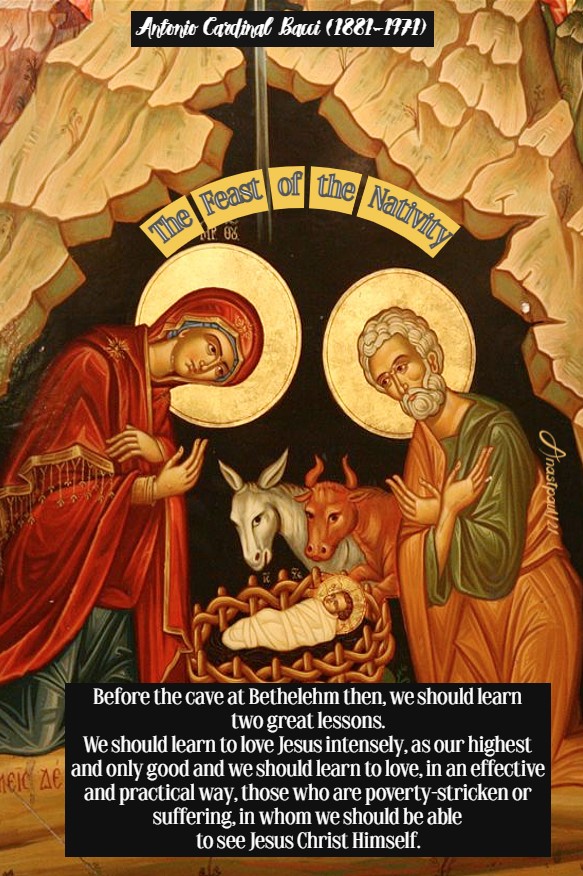
Thought for the Day – 25 December – Meditations with Antonio Cardinal Bacci (1881-1971)
The Feast of the Nativity
“The world ignores the Birth of Jesus. There is no room for Him in the inns of Bethlehem and no room for Mary and Joseph, two poverty-stricken travellers, who are obliged, as a result, to take refuge in a miserable hovel. In the world, it is always so, for men judge one another by external appearances and by financial standards.
How do we behave towards Jesus Christ? How do we behave towards the needy and the afflicted, in whom we should discern the Person of Christ Himself?
If we are prepared to open our hearts to Jesus and to welcome Him as our King and absolute Master, we shall be so transformed, that we shall live His life and act in unison with Him. In short, we shall become saints! But if we are lacking in generosity and are reluctant to welcome Jesus unreservedly into our hearts, we shall never be more than half-Christian, tepid and ungrateful! We should even be prepared to welcome the poor as the representatives of Christ. “As long as you did it for one of these, the least of my brethren,” He has assured us, “you did it for me” (Mt 25-40).
Before the cave at Bethelehm then, we should learn two great lessons. We should learn to love Jesus intensely, as our highest and only good and we should learn to love, in an effective and practical way, those who are poverty-stricken or suffering, in whom we should be able to see Jesus Christ Himself.”
The Solemnity of the Nativity of the Lord, Jesus Christ – Celebration of the anniversary of the Birth of Our Lord. In the earliest days of the Church there was no such Feast, the Saviour’s Birth was commemorated with the Epiphany by the Greek and other Eastern Churches. First mention of the Feast, then kept on 20 May, was made by Clement of Alexandria c 200. The Latin Church began c 300 to observe it on 25 December, though there is no certainty that Our Lord was born on that day. Priests have the privilege of saying three Masses, at midnight, daybreak and morning. This was originally reserved to the Holy Father alone – beginning about the 4th century he celebrated a midnight Mass in the Lateran Basilica (in which according to tradition, the manger of Bethlehem is preserved), a second in the church of Saint Anastasia, whose Feast comes on 25 December and a third at the Vatican Basilica. Many peculiar customs of the day are the outcome of the pagan celebrations of the January calendar. The Christmas tree, of which the first known mention was made in 1605 at Strasbourg, was introduced into France and England in 1840. The feast is a holy day of obligation, preceded by the preparatory season of Advent and by a special Vigil – should it fall on a Friday it abrogates the law of abstinence. Today’s Gospel is the prologue of John.
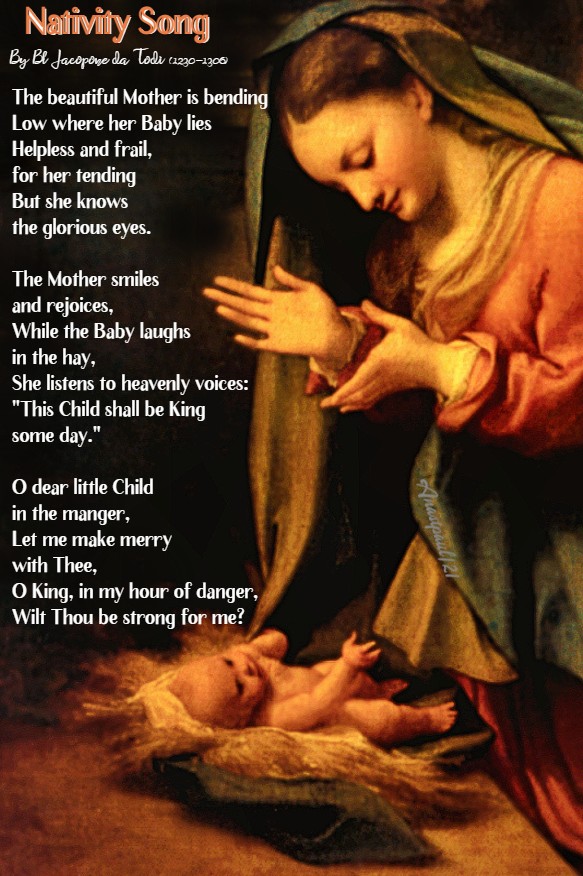
I know not how, dear Lady love, To offer you my praise, I cannot fashion as I wish The words that I world raise. You stand afar, celestial Queen, The stars are in your crown, They spangle at each gesture’s path And dust upon your gown. Perhaps I might recall the night You knelt beside the crib, The night when doors and casements shut And left a mountain’s rib, Alone, exposed, to hoard you close Beside the new-born Child And seek in Joseph’s kindly eyes For something worldly-mild. To counteract such mundane chill I hereby set my heart, Dim mirror of an Infant’s warmth, Its flaming but a part, A small, sad part of Endless Love That came on Christmas day To show a mother wonder-bright To guide us on our way.
St Adalsindis of Hamay St Alburga of Wilton St Anastasia of Sirmium Bl Artale St Basilée of the Via Latina Bl Bentivoglio de Bonis Bl Diego de Aro St Eugenia of Rome St Fulk of Toulouse
St Jovin of the Via Latina Bl Maria Therese von Wüllenweber Bl Matthew of Albano Bl Michael Nakashima Saburoemon Bl Nera Blessed Peter the Venerable (c 1092–1156) Abbot St Romulus of Berry —
Martyrs of Nicomedia: 20,000 Christians martyred by order of Diocletian. They were reported to have all been in the single basilica to celebrate Christmas. While there unquestionably was an endless series of martyrs under Diocletian, it’s likely the ancient sources exaggerated the numbers of this incident. And as the Christmas holy day was not celebrated in the East in 303, they were probably gathered for another feast. They were burned alive in 303 in the basilica of Nicomedia.
24 December – Vigil of the Nativity of the Lord/Mass at Midnight Midnight Mass is the first liturgy of Christmastide that is celebrated on the night of Christmas Eve, traditionally beginning at midnight when Christmas Eve gives way to Christmas Day. This popular Christmas custom is a jubilant celebration of the Mass in honour of the Nativity of Jesus Christ.
Saint Thomas Aquinas wrote a commentary on these words and explained in his Summa Theologiae, “And from this ,the Mass derives its name … the deacon on festival days ‘dismisses’ the people at the end of the Mass, by saying: ‘Ite, missa est,’ that is, the victim [Jesus] has been sent to God through the angel, so that it may be accepted by God.”
St Adam the Patriarch St Adela of Pfalzel Bl Alberic of Gladbach Bl Brocard of Strasbourg St Bruno of Ottobeuren St Caran of Scotland St Delphinus of Bordeaux
Bl Peter de Solanes Bl Venerandus of Clermont — • Blessed Dionysius Roneo • Blessed Philip Claro • Blessed Giulio Pons • Blessed Peter of Valladolid
Blessed Mercedarian Sisters – (6 beati): Six cloistered Mercedarian nuns at the convent of Vera Cruz in Berriz, Spain. Noted for their devotion to the rules of the Order and for their deep prayer lives. • Blessed Anna Maria Prieto • Blessed Anna de Arrano • Blessed Orsola de Larisgoizia • Blessed Maguna Mary • Blessed Margaret • Blessed Mary of the Assumption Sarria
Martyred Maidens of Antioch – (40 saints): A group of forty virgins martyred in the persecutions of Decius. None of their names have come down to us. They were martyred in 250 in Antioch, Syria.
Martyrs of Tripoli – (6 saints): A group of Christians martyred together, date unknown. The only details that have survived are six of the names – Drusus, Lucian, Metrobius, Paul, Theotimus and Zenobius. They were martyred in Tripoli, Libya.
Thought for the Day – 8 December – Meditations with Antonio Cardinal Bacci (1881-1971)
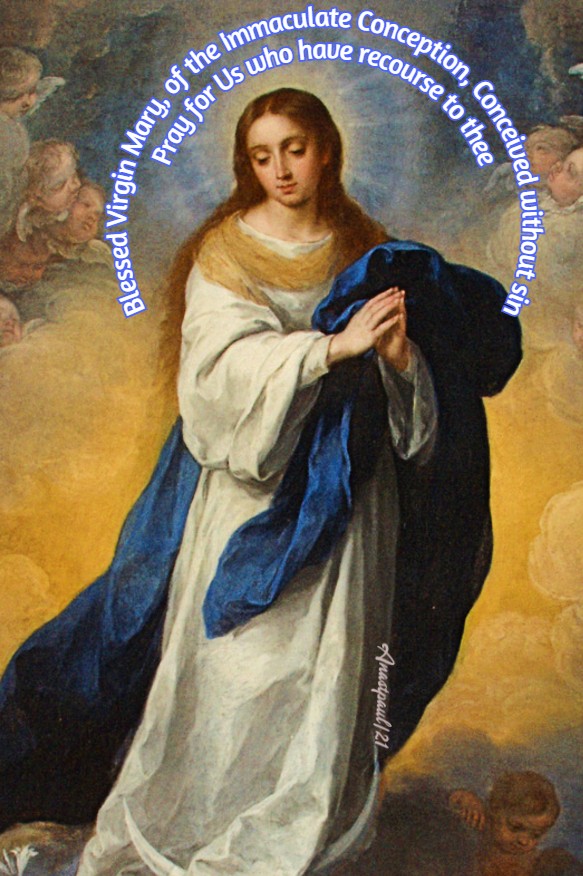
The IMMACULATE CONCEPTION
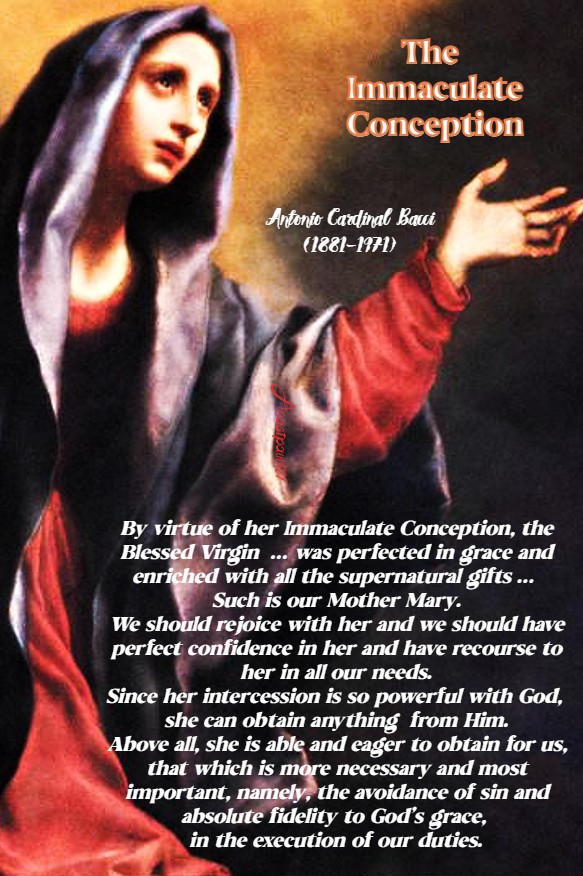
“By virtue of her Immaculate Conception, the Blessed Virgin obtained four distinct privileges. (1) She was preserved free from the stain of original sin. (2) She never experienced the rebellion of the passion against the spirit. (3) She was confirmed in grace, so that, in the words of St Augustine, (De natura er gratia, c 361), one could not mention sin and the name of Mary in one breath. (4) She was perfected in grace and enriched with all the supernatural gifts, to a degree far higher than any of the Saints and than the Angels themselves.
Such is our Mother Mary. We should rejoice with her and we should have perfect confidence in her and have recourse to her in all our needs. Since her intercession is so powerful with God, she can obtain anything from Him. Above all, she is able and eager to obtain for us, that which is more necessary and most important, namely, the avoidance of sin and absolute fidelity to God’s grace, in the execution of our duties.”
One Minute Reflection – 8 December on the Solemnity of the Immaculate Conception – Readings: Genesis 3:9-15, 20, Psalm 98:1-4, Ephesians 1:3-6, 11-12, Luke 1:26-38
And behold, you will conceive in your womb and bear a son and you shall call his name Jesus.
And Mary said, “Behold, I am the handmaid of the Lord, let it be done to me according to your word.” … Luke 1:38
REFLECTION – “Son of God, grant me Your own admirable Gift, that I may celebrate the wondrous beauty of Your beloved Mother! The Virgin gave birth to a Son while preserving her virginity, she suckled Him who gives nourishment to the peoples, in her Immaculate breast she bore Him who carries the whole world in His Hands. She is Virgin and Mother, what will she not be hereafter? Holy in body, all beautiful in soul, pure of mind, upright in intelligence, perfect in feeling, chaste and faithful, pure of heart and filled with virtue.
May the hearts of virgins rejoice in Mary, since of her was born the One Who set humankind free from dreadful slavery. May the old Adam, wounded by the serpent, rejoice in Mary; it is Mary who gives Adam a posterity that allows him to crush the accursed serpent and who cures him of his mortal wound (Gen 3:15). Let Priests rejoice in the blessed Virgin; she has brought the High Priest into the world, Who gave Himself as a victim, putting an end to the sacrifices of the Old Covenant. … Let the Prophets rejoice in Mary, since in her, were fulfilled their visions, in her were realised their prophecies, in her were confirmed their oracles. Let all the Patriarchs rejoice in Mary since she received the blessing promised to them, she, who, in her Son, has brought them to completion. …
Mary is the new Tree of Life, who, instead of the bitter fruit picked by Eve, gives to mankind that Sweet Fruit on which the whole world is fed.” – St Ephrem (306-373) Deacon in Syria, Father and Doctor of the Church (Marian hymn).
PRAYER –O Mary, My Hope! By St John Damascene (675-749) Father and Doctor of the Church I salute you, O Mary! you are the hope of Christians. Receive the prayer of a sinner, who loves you tenderly, honours you in a special manner and places in you the whole hope of his salvation. From you I have my life. You reinstate me in the grace of your Son: you are the sure pledge of my salvation. I beseech of you, therefore, to deliver me from the burden of my sins, dispel the darkness of my mind, banish from my heart the love of the world, repress the temptations of my enemies and so rule my whole life, that by your means and under your guidance, I may obtain everlasting happiness in heaven. Amen
The Solemnity of the Immaculate Conception of the Blessed Virgin Mary – 8 December. Patronages – barrel makers, coopers, cloth makers, cloth workers, soldiers of the United States, Spanish infantry, tapestry workers, upholsterers, Argentina, Brazil, Congo, Equatorial Guinea, Guam, Nicaragua, Panama, Portugal, Tanzania, Tunisia, United States, 68 Diocese, 8 Cities.
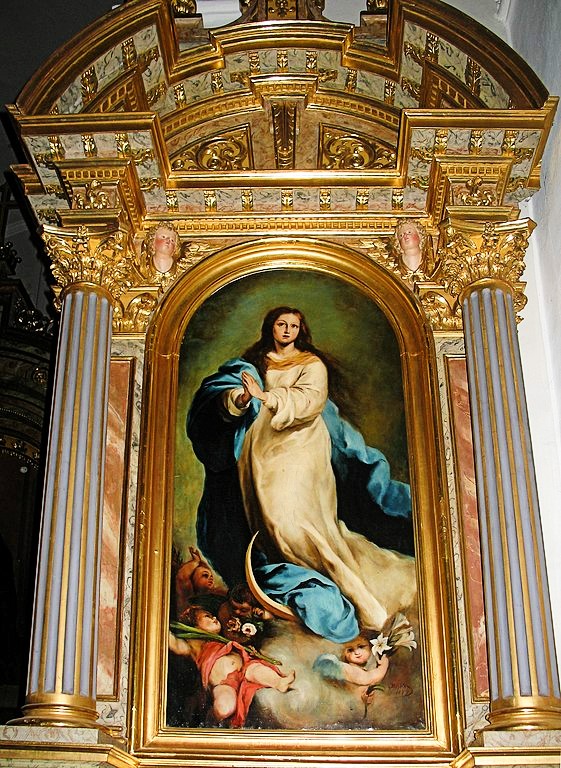
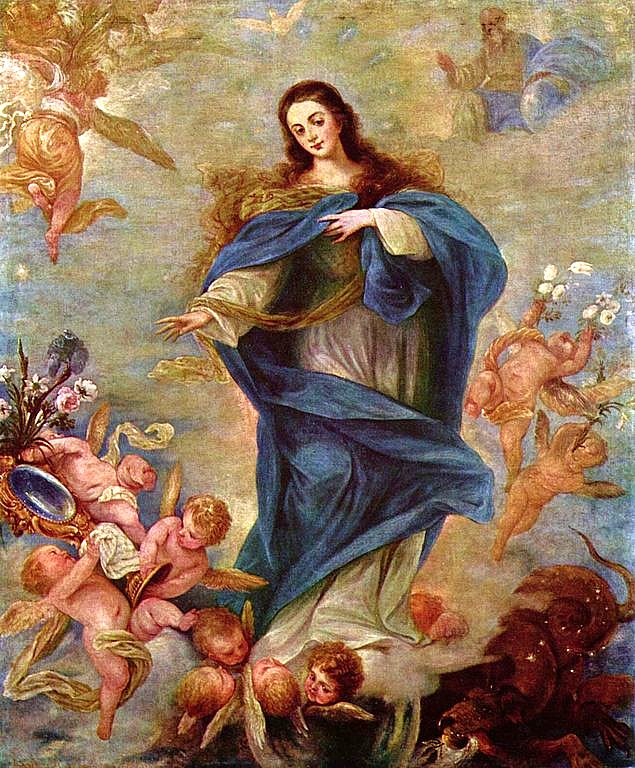
Altar of the Immaculata by Joseph Lusenberg, 1876. Saint Antony’s Church, Urtijëi, Italy.
Today we celebrate the Solemnity of the Immaculate Conception, nine months before the Feast of the Nativity of Mary, which is celebrated on 8 September. I wish you all a Blessed and Holy Feast Day!
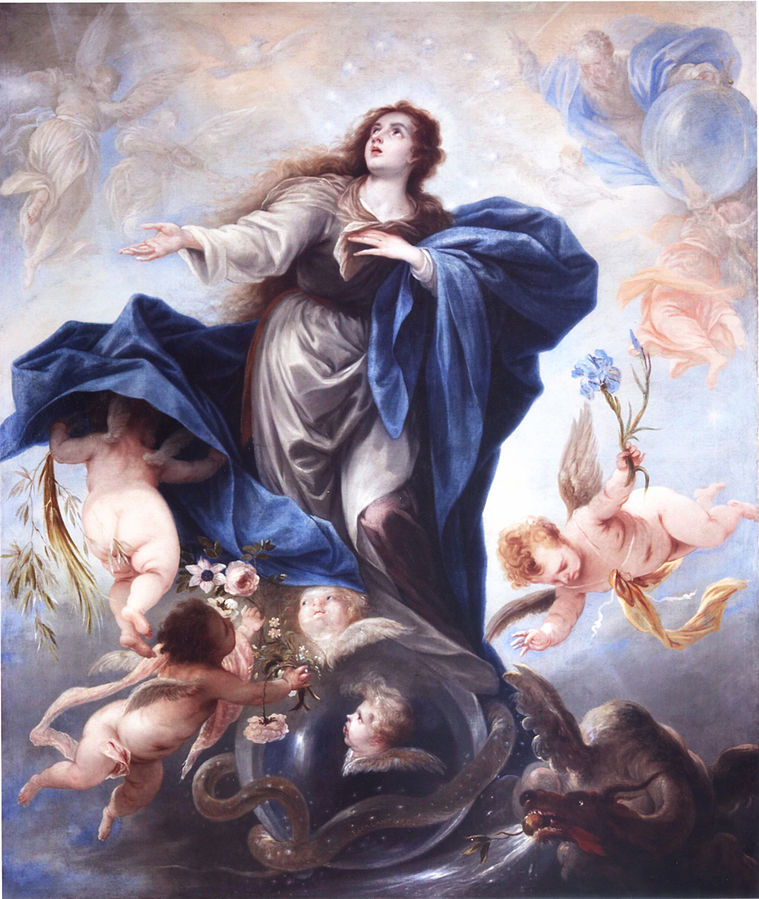
Juan Antonio Escalante, Spanish, 17th century
This festival began in the East, in the 8th Century, since mention is made of it by Saint John Damascen, who lived n 721. It was instituted in England in the year 1100 by Saint Anselm, Archbishop of Canterbury. Afterwards in the Diocese of Lyons in the year 1145. Pope Sixtus IV commanded, in the year 1576, the celebration of it throughout Christendom.
At the very first moment of conception in the womb of Saint Ann, Mary’s soul was flooded with the fullness of grace: “all fair, all beautiful.” The laws of man and of nature did not apply to Mary. Her soul was flooded with light so that she could make her acceptance of the Mystical Marriage with her God.
“You have ravished my heart, my sister, my spouse, you have wounded my heart…My sister, my Bride is a garden enclosed, a fountain sealed up…Thou art beautiful, O my Love, sweet and comely; terrible as an army set in array…One is my Dove; My perfect one is but one; she is the holy one of her mother, the chosen of her that bore her. How beautiful art thou, by dearest delights!…Put me as a seal upon they heart, as a seal upon thy arm, for love is strong as death…” – thus God speaks to her in the “Canticle of Canticles,” and Mary replies: “I found Him Whom my soul loved…”
Juan Antonio Escalante, Spanish, 17th century
Mary’s Suscipe – the most perfect act of surrender a creature ever made, an oblation which would have a permanent re-echo every moment of her life, her bridal consecration, her mystical union with God was spoken at the very first moment of her being. Fiat – Be is done to me…
There was never a questioning of God’s will in the life of Mary but it was always perfect acceptance of whatever He planned and wanted of her. Therein lies sanctity – doing God’s will, not ours, regardless. Yes, even the Motherhood of Mary as the “Mater Dei” depended on this, for Christ in the Gospels says:
“Who are My Mother and My Brethren? If anyone does the will of My Father, he is My Mother and My Brethren.”
You, who love the Blessed Mother so intimately should certainly desire, with all your heart, to imitate Mary’s Fiat in every instance of life. Strive for this initial complete consecration to the Will of God in everything, regardless. At the root, foundation of every life lived for God, there must be a “Suscipe” “Take O Lord, and receive all my liberty, my will…” and a Fiat in deepest love and conformity to God’s Holy Will. In return God will favour you with peace, joy of service but, also, as He did His own dear Mother, with suffering but, always, He will give you the grace to say with Mary, “Behold the Handmaid of the Lord, be it done unto me according to Thy Will.”
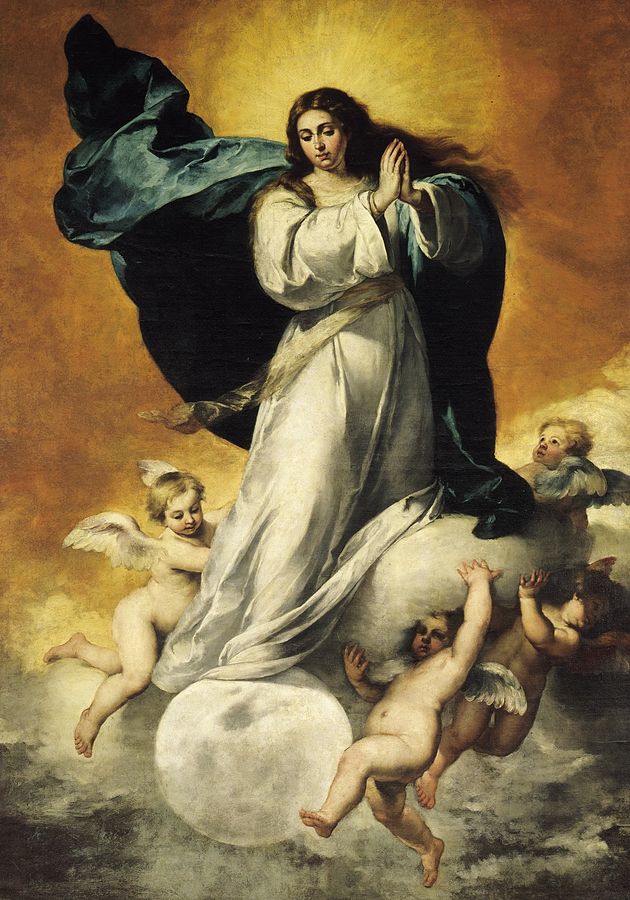
Murillo, Immaculate Conception, 1650
Mary is “our tainted nature’s solitary boast” and we are her children. Should not a daughter try to resemble her Mother in everything? Mary is the Treasure-house of God’s graces, she will give whatever we ask of her, if it be the divine Will.
“Holy Mary, Mother of God, Immaculate One, pray for us!”
St Gunthildis of Ohrdruf Bl Jacob Gwon Sang-yeon Bl Johanna of Cáceres Bl José María Zabal Blasco St Macarius of Alexandria St Marin Shkurti St Patapius Bl Paul Yun Ji-chung St Rafael Román Donaire St Romaric of Remiremont St Sofronius of Cyprus
One Minute Reflection – 30 November – The Feast of St Andrew, Apostle of Christ – Readings: Romans 10: 9-18; Psalms 19: 8,-11; Matthew 4: 18-22
“At once they left their nets and followed him.” – Matthew 4:20
REFLECTION – “After Andrew had remained with Jesus (Jn 1:39) and had learned what he did learn, he did not keep his treasure concealed for himself but hastened to run quickly to his brother, Simon Peter, to share with him, the good things that he had received. Consider what he told his brother: “We have found the Messiah (which interpreted is Christ)” (Jn 1:41). Do you perceive, in these words, the fruit of what he had learned in such a short time? It shows, at once, the authority of the Teacher who taught His disciples and their own enthusiasm and will to learn from Him, since the very beginning.
Indeed Andrew’s eagerness, his zeal in wanting to spread immediately such a good news, supposes a soul who was longing to see the accomplishment of the many prophecies concerning Christ. It is a mark of brotherly kindness, of loving kinship, of genuine goodwill, to hasten to stretch out a helping hand to one another in spiritual matters. … ”We have found the Messiah”, he says; not any messiah but “the Messiah,” the one Christ they were awaiting.” – St John Chrysostom (347-407) Father and Doctor of the Church (Homely on the Gospel of Saint John, 19,1).
PRAYER – Lord, in Your kindness hear our petitions. You called Andrew the Apostle, to preach the Gospel and guide Your Church in faith. May he always be our friend in Your Presence, to help us with his prayers. We ask this through our Lord Jesus Christ, Your Son, who lives and reigns with You and the Holy Spirit, one God, forever and ever. Amen.
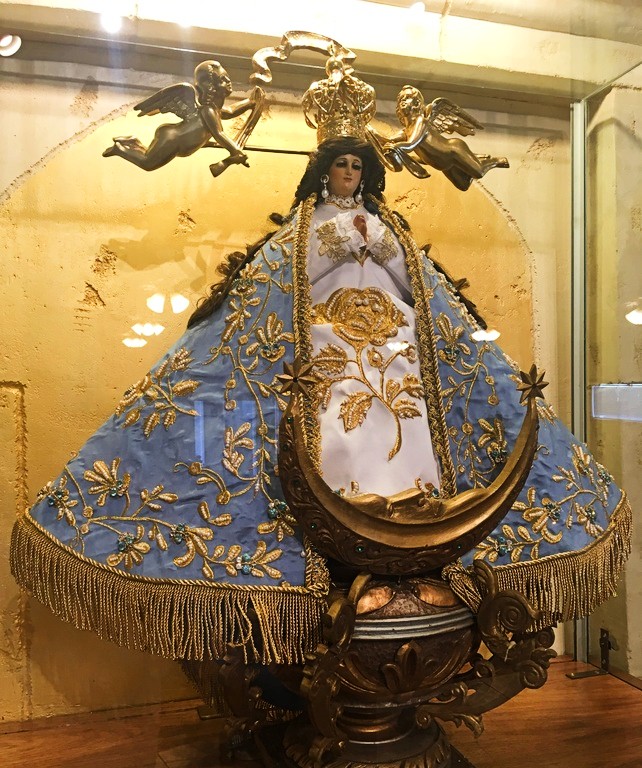
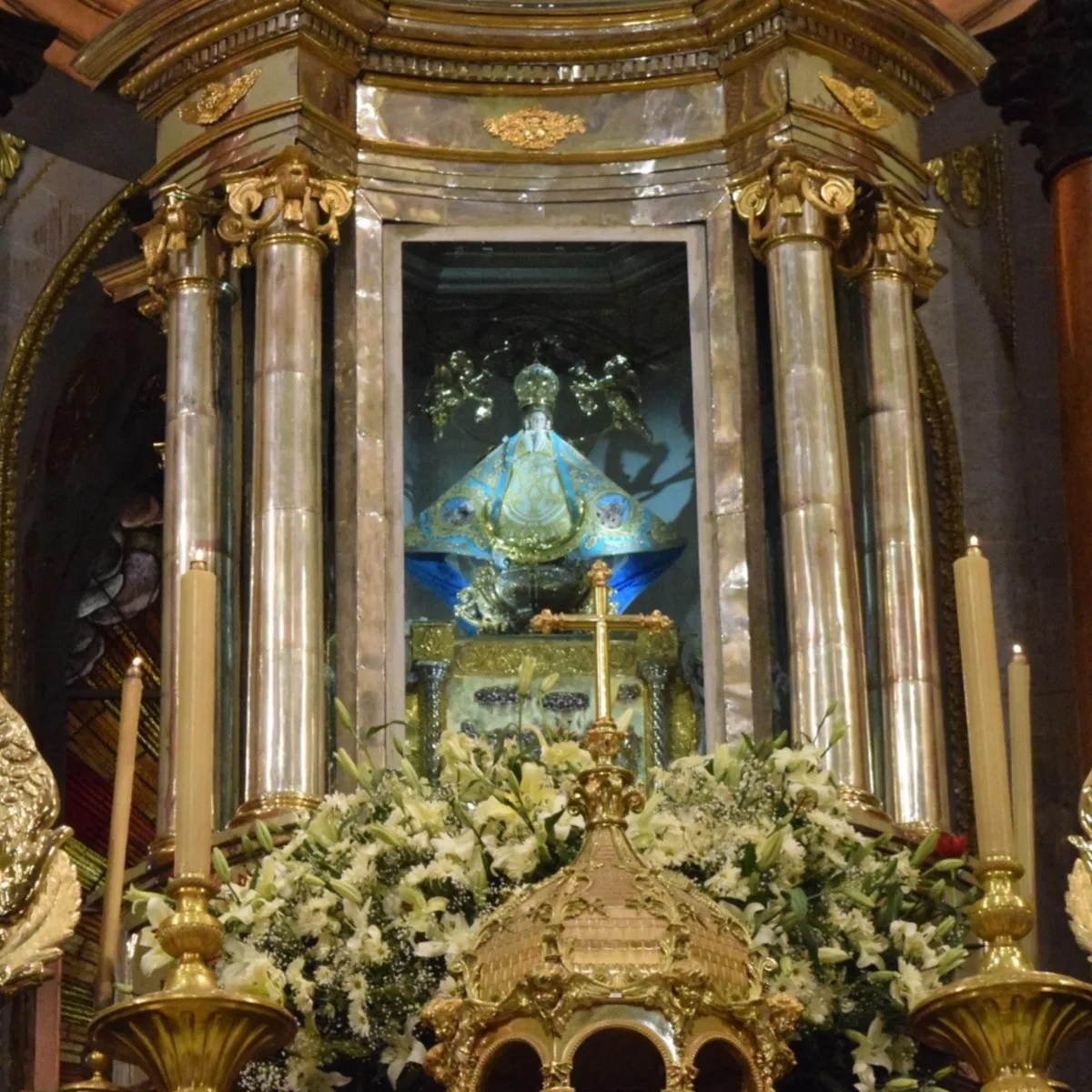
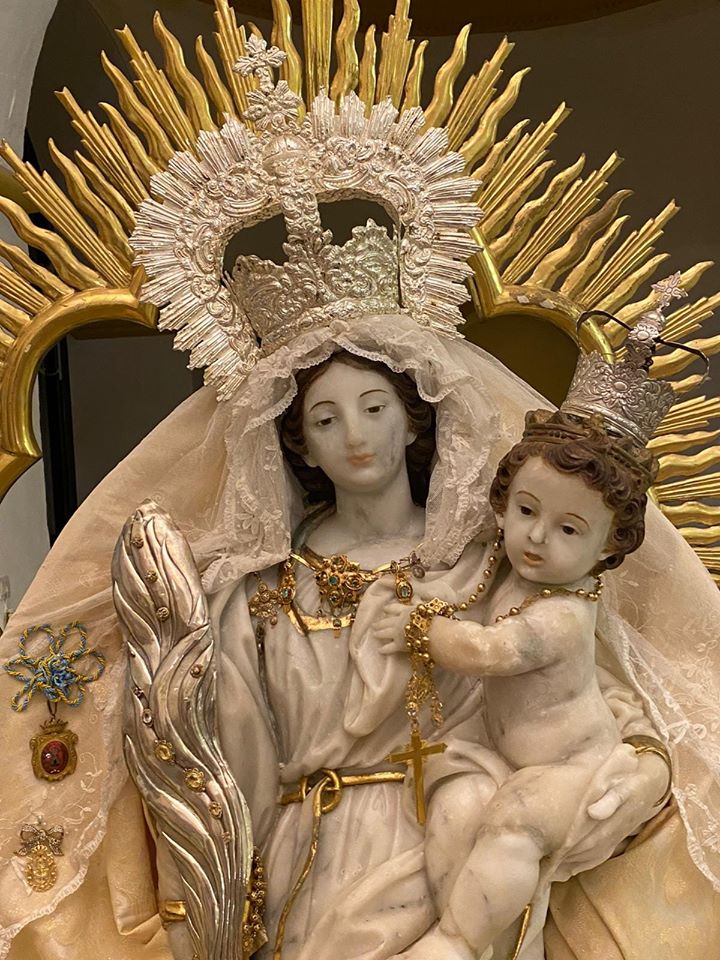
Virgen de la Concepción, San Juan de los Lagos / Mary Immaculate of Saint John of the Lakes, Mexico) (1524) – 30 November, 2 February, 24 June, 15 August, 8 December:
Fray Miguel de Bolonia, of the Spanish Netherlands, was one of the first Franciscans to enter Mexico in 1524. A saintly missionary who learned the native languages and stood up for natives when Spanish rulers threatened them, he travelled through Mexico, teaching and building, until his death in 1580. In 1542, he founded the village of San Juan Bautista de Mezquititlán (land of mesquite trees), where he built a hospital and Chapel in which he placed a half metre tall Statue of Mary Immaculate. In 1623, some trapeze artists brought the body of their daughter to the San Juan Chapel for burial. The young acrobat had fallen during practice onto some upright blades, buried blade side upward, in the earth to ensure the show was more dangerous and exciting. The chapel caretaker, an old woman named Ana Lucia put the Virgin’s Statue on the girl’s breast and the child revived. The grateful father took the fragile Statue, made of cornstalks and glue, to Guadalajara for restoration. From then on, the Shrine’s fame and miracles multiplied.
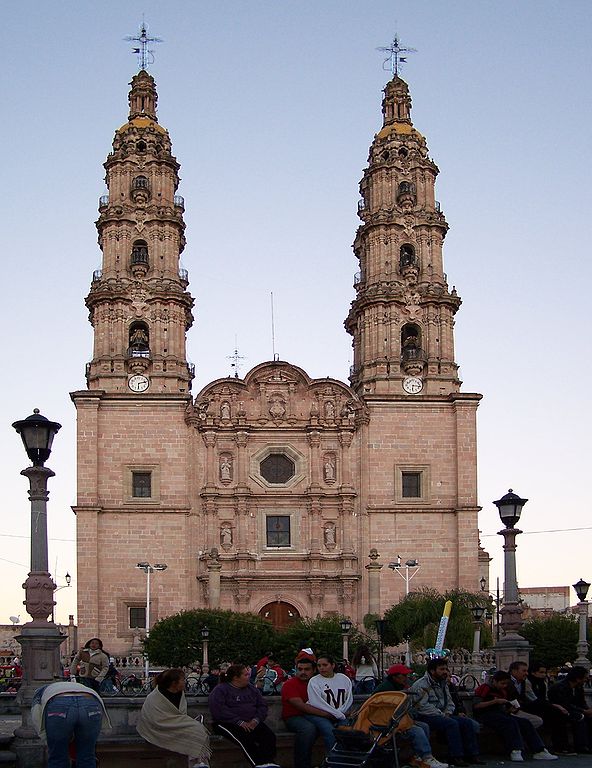
Meanwhile, the Town grew, changing its name to San Juan de los Lagos (St. John of the Lakes). A new Church was built and then another–each larger, more splendid, more worthy of the Immaculate Virgin. On 30 November, 1769, the Statue was installed in the third Church which is now a Basilica.
San Juan de los Lagos began holding a market fair in commemoration, annually around 30 November with festivities extending to the Feast of the Immaculate Conception, 8 December. The celebration eventually became so rowdy that the hierarchy decided to move the feast of the Virgen de San Juan de los Lagos to 2 February (Candlemas). The Candelaria fiesta has evolved into a month-long, mass pilgrimage to the Shrine from all over Mexico but 8 December is still observed, as well as 15 August (Feast of the Assumption). The beauty of the Sanctuary that hosts the Virgin, has become the main promoter of tourism in the region. After Our Lady of Guadalupe, it is the most visited Shrine in Mexico.
St Abraham of Persia Bl Alexander Crow St Anders of Slagelse Bl Andrew of Antioch Bl Arnold of Gemblours St Castulus of Rome St Constantius of Rome St Crider of Cornwall St Cuthbert Mayne St Domninus of Antioch St Euprepis of Rome Bl Everard of Stahleck Blessed Frederick of Regensburg OSA (Died 1329) Lay Friar of the Order of St Augustine St Galganus St Isaac of Beth Seleucia
Bl Joscius Roseus St Joseph Marchand St Justina of Constantinople Bl Ludwik Gietyngier St Mahanes the Persian St Maura of Constantinople St Merola of Antioch St Mirocles of Milan St Sapor St Simeon of Persia St Thaddeus Liu Ruiting St Trojan St Tudwal of Tréguier Bl William de Paulo Zosimus the Wonder Worker — Martyrs of Saxony – 6 saints: Missionaries who worked with Saint Willehad of Bremen. Martyrs. – Attroban, Benjamin, Emmingen, Folkard, Gerwald and Grisold. They were martyred on 30 November 782 at River Weser, Lawer Saxony, Germany.
Martyred in the Spanish Civil War – Martyred Augustinians of Madrid – 51 beati and Martyred Hospitallers of Madrid – 7 beati – Thousands of people were murdered in the anti-Catholic persecutions of the Spanish Civil War from 1934 to 1939.
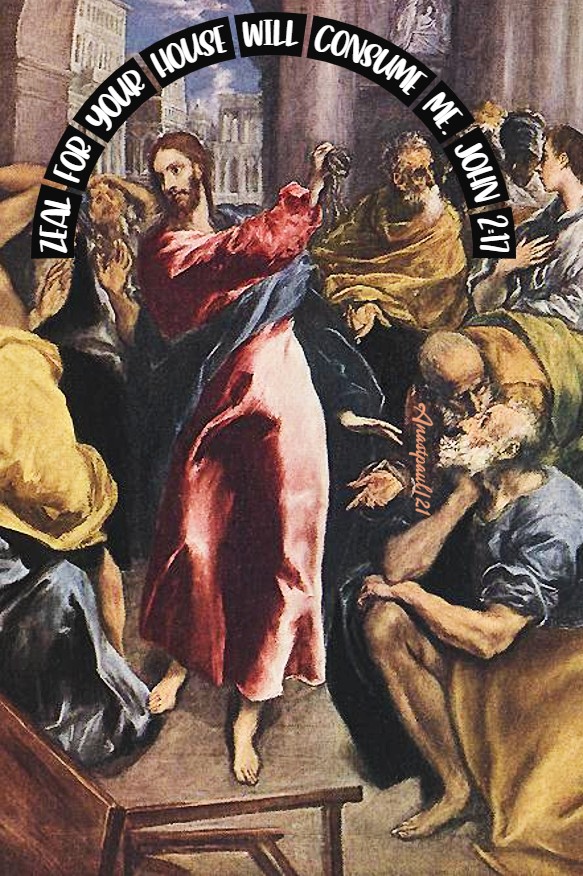
Quote/s of the Day – 9 November – Feast Dedication of The Archbasilica of the Most Holy Saviour in the Lateran – Gospel: John 2:13-22
“Zeal for your house will consume me.”
John 2:17
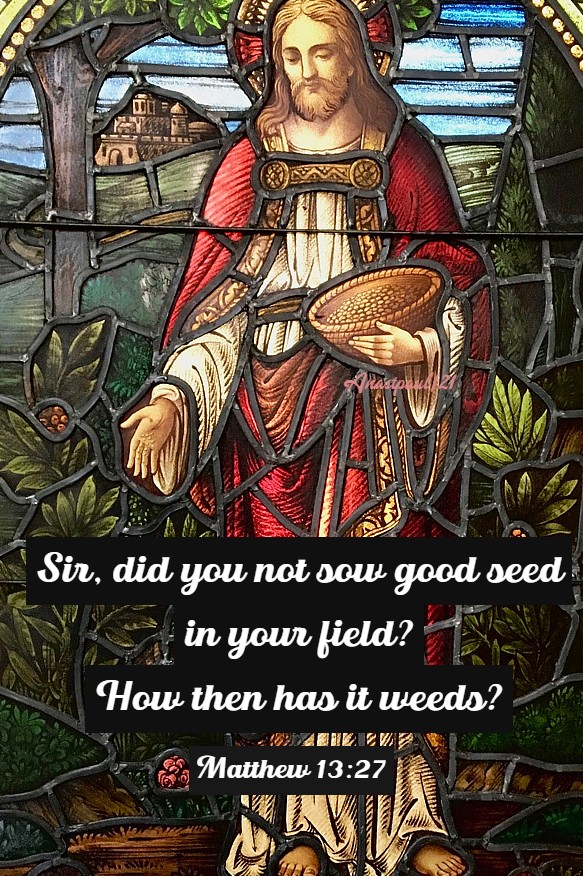
“Sir, did you not sow good seed in your field? How then has it weeds?”
Matthew 13:27
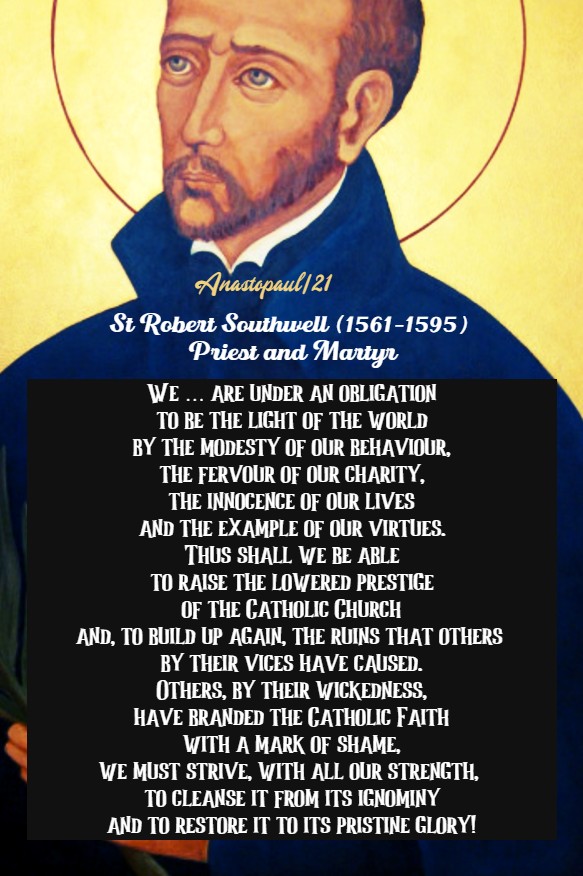
“We … are under an obligation to be the light of the world by the modesty of our behaviour, the fervour of our charity, the innocence of our lives and the example of our virtues. Thus shall we be able to raise the lowered prestige of the Catholic Church and, to build up again, the ruins that others by their vices have caused. Others, by their wickedness, have branded the Catholic Faith with a mark of shame, we must strive, with all our strength, to cleanse it from its ignominy and to restore it to its pristine glory!”
St Robert Southwell SJ (1561-1595) Priest and Martyr
“…The great movement of apostasy being organised in every country for the establishment of a One-World Church which shall have neither dogmas, nor hierarchy, neither discipline for the mind, nor curb for the passions and which, under the pretext of freedom and human dignity, would bring back to the world (if such a Church could overcome) the reign of legalised cunning and force and the oppression of the weak and of all those who toil and suffer. […] Indeed, the true friends of the people are neither revolutionaries, nor innovators – they are traditionalists.”
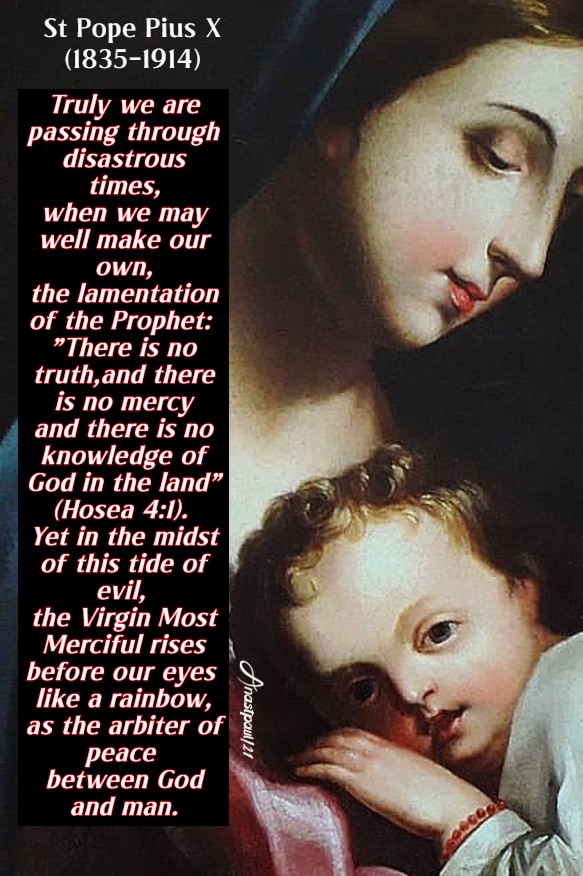
“Truly we are passing through disastrous times, when we may well make our own, the lamentation of the Prophet: “There is no truth,and there is no mercy and there is no knowledge of God in the land” (Hosea 4:1). Yet in the midst of this tide of evil, the Virgin Most Merciful rises before our eyes like a rainbow, as the arbiter of peace between God and man.”
One Minute Reflection – 9 November – “Month of the Holy Souls in Purgatory” –Feast Dedication of The Archbasilica of the Most Holy Saviour in the Lateran and the Memorial of Blessed Gabriel Ferretti OFM (1385-1456) – Gospel: John 2:13-22
“He made a whip out of cords and drove them all out of the temple area… ” – John 2:15
REFLECTION – “The Apostle Paul says: “The Temple of God, which you are, is holy” (1 Cor 3:17), that is to say – all you who believe in Christ, believing even to loving. … All who thus believe are the living stones of which God’s temple is built (1 Pt 2:5), they are like the imperishable wood of which the Ark was built that the flood could not overwhelm (Gn 6:14). This temple – the people of God, human persons themselves – is the place where God answers those who pray. People who pray to God outside this temple cannot have their prayers, for the peace of the Jerusalem above answered, even though they are answered regarding particular material things that God grants, even to pagans. … But it is an altogether different thing to have one’s prayers answered in the matter of eternal life. This is only granted to those who pray inside God’s temple.
For someone who prays within God’s Temple prays within the peace of the Church, in the unity of Christ’s Body, since the Body of Christ is built up of the multitude of believers spread over all the world. … And someone who prays in the peace of the Church, prays “in spirit and in truth” (Jn 4:23) of which the former Temple was only a symbol.
In fact, it was for our instruction that our Lord cast out of the temple those men who were only seeking their own interest and who only went there to buy and sell. If that first temple had to undergo this purification, then it is clear, that the Body of Christ too, the true Temple, also contains buyers and sellers among those who pray there, that is to say, people only seeking “their own interests and not those of Jesus Christ” (Phil 2,21). … But the time will come when the Lord will cast out all those sinners.” – St Augustine (354-430) Bishop of Hippo, North Africa, Father and Doctor of Grace of the Church (Sermon on Psalm 130, # 1-2)
PRAYER – Almighty God, as we recall with joy, the Dedication of this house of Yours on each recurring anniversary, listen to Your people’s prayer and grant that our worship here may be a sincere and holy service, honouring Your Name and bringing us the fullness of redemption. Through Jesus Christ, our Lord, in union with the Holy Spirit, one God for all eternity, amen.
Dedication of The Archbasilica of the Most Holy Saviour and of Saints John the Baptist and John the Evangelist in the Lateran (Feast):
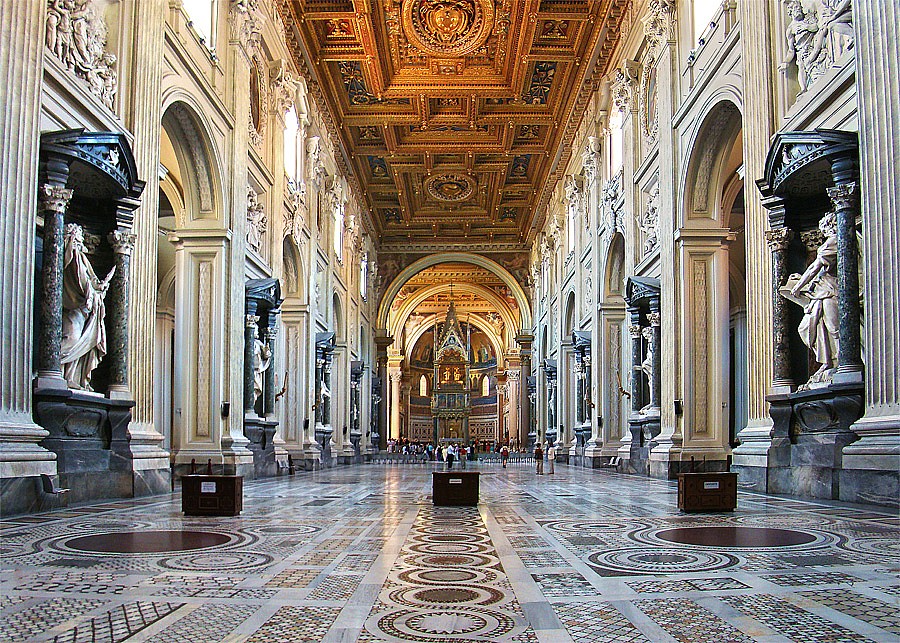
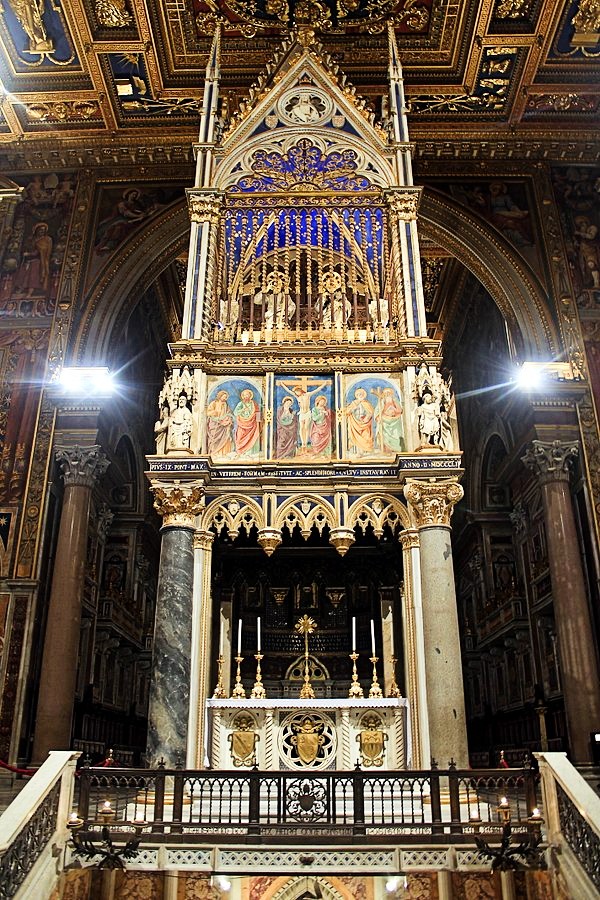
The oldest and first in rank of the four Basilicas of Rome. The name is derived from the Laterani family, on the site of whose Palace the Basilica stands. King Constantine presented this Palace to the Church. Its annual celebration throughout the Latin Church is a sign of love and unity with the Papacy and Pope. The original Church building, probably adapted from the hall of the palace, was dedicated to the Saviour and from its splendour was known as the Basilica Aurea. Though several times destroyed and rebuilt, the Basilica retained its ancient form, being divided by rows of columns into aisles and having an atrium with colonnades. The restoration of the 17th century changed its appearance. A Monastery was formerly between the Basilica and the City wall of which the cloister still remains. The original apse survived until 1878, when it was destroyed and a deeper apse built. The ancient mosaics have been preserved The high Altar, which is of wood and is believed to have been used by Saint Peter, is now encased in marble. In the upper part of the baldachinum are the heads of the Apostles, Peter and Paul. The Baptistery is an octagonal edifice with porphyry columns. The font is of green basalt. This Basilica has been the Cathedral of Rome since the 4th century.
Santa Maria la Real de la Almudena / Our Lady of Almudena, Madrid, Spain (712) – 9 Novemnber:
The Virgin of Almudena is a medieval icon of the Virgin Mary, Mother of God. The image is the advocation of the Virgin that serves as a Patroness of Madrid, Spain. Intriguingly, however, its name derives from the Arabic term of Al Mudayna, or the citadel. There are various legends regarding the Statue. One of the historical legends is that in 712, prior to the capture of the Town by the advancing Muslim forces, the inhabitants of the Town secreted the image of the Virgin, for its own protection, inside the walls surrounding the town. In the 11th century, when Madrid was reconquered by the King Alfonso VI of Castile, the Christian soldiers endeavoured to find the Statue. After days of prayer, the spot on the wall hiding the icon crumbled, revealing the Statue. Another legend is that as Christian soldiers approached the Town, they had a vision of Mary imploring them to allow her to lead them into the City. Again the miraculous crumbling of the wall occurred, with the Statue showing an entry route through the walls. The Cathedral of Madrid is dedicated to this advocation of the Virgin and her feast day, 9 November, is a major holiday in Madrid. Below is this beautiful Cathedral.
St Agrippinus of Naples St Alexander of Salonica St Aurelius of Riditio St Benignus of Armagh St Eustolia St Francisco José Marín López de Arroyave Blessed Gabriel Ferretti OFM (1385-1456) Priest Bl George Napper Bl Gratia of Cattaro Bl Helen of Hungary Bl Henryk Hlebowicz St Jane of Segna
St Justo Juanes Santos St Luigi Beltrame Quattrocchi St Luis Morbioli St María de la Salud Baldoví Trull Bl María del Carmen of the Child Jesus St Pabo St Sopatra St Theodore Stratelates St Ursinus of Bourges St Valentín Gil Arribas St Vitonus of Verdun — Martyrs of Constantinople – 3 saints: A group of ten Catholic Christians who tried to defend an image of Jesus over the Brazen Gate of Constantinople from an attack by Iconoclasts during the persecutions of emperor Leo the Isaurian. The group of was seized by soldiers, condemned by judges for opposing the emperor, and martyred. The only details that have survived are three of their names – Julian, Marcian and Maria. They were martyred in 730 at Constantinople (modern Istanbul, Turkey).
Martyred in the Spanish Civil War: • Blessed Anastasio Garzón González • Blessed Francisco José Marín López de Arroyave • Blessed Justo Juanes Santos • Blessed María de la Salud Baldoví Trull • Blessed Valentín Gil Arribas
Thought for the Day – 1 November – Meditations with Antonio Cardinal Bacci (1881-1971)
The Feast of All Saints
“God addressed the same command to all of us. “You shalt make and keep yourselves holy because I am holy” (Lev 11:44); 1 Peter 1:16). “You are to be perfect, even as your heavenly Father is perfect” (Mt 5:44).
We are all obliged to strive to become holy, to work hard towards this end and to ask for the grace to sustain us in our efforts. We should not say that sanctity is impossible for us because, everything is possible with God’s help, Let us imagine that we are in Heaven and can behold the innumerable choirs of the Blessed enjoying the unlimited and unending happiness of God’s company. Nevertheless, they were once people, like ourselves, with the same passions, failings and temptations. They fought valiantly, with the same passions, failings and temptations. They fought valiantly, supported by the grace of God; they conquered and were awarded the palm of victory. Now they enjoy everlasting happiness.
Let us remember the words of St Augustine: “If others, why not I?” If they succeeded in becoming holy, why cannot I do likewise?”
Quote/s of the Day – 1 November – The Solemnity of All the Saints
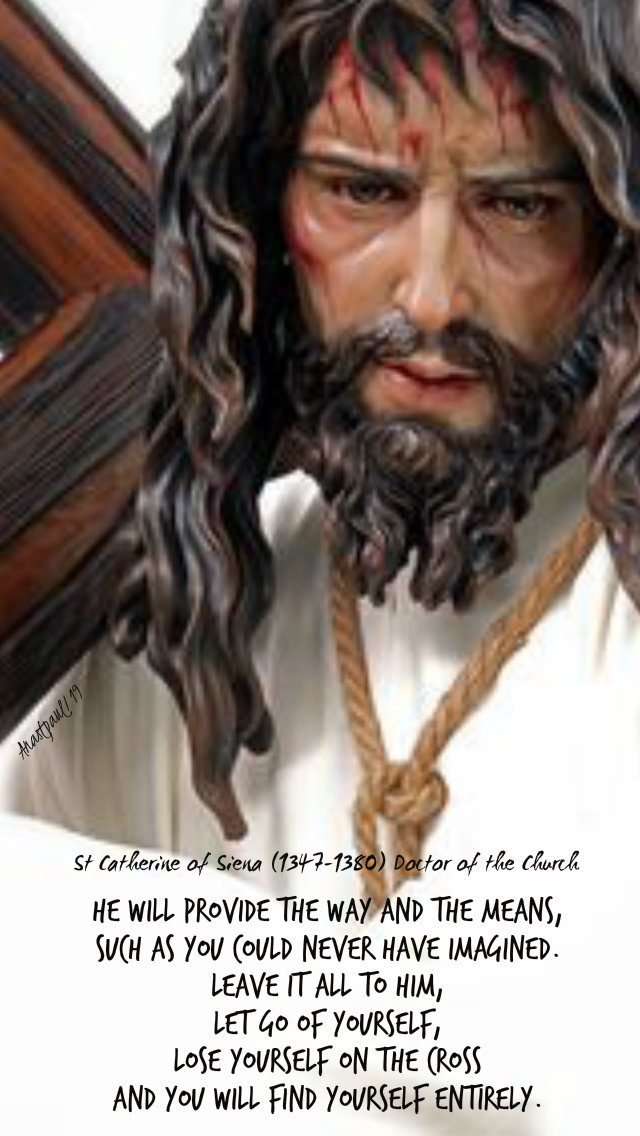
“He will provide the way and the means, such as you could never have imagined. Leave it all to Him, let go of yourself, lose yourself on the Cross and you will find yourself entirely.”
St Catherine of Siena (1347-1380) Doctor of the Church
“Teach Us Good Lord” By St Ignatius Loyola (1491-1556)
Teach us, good Lord, to serve You as You deserve; to give and not to count the cost, to fight and not to heed the wounds, to toil and not to seek for rest, to labour and not to ask for reward, except that of knowing that we are doing Your will. Amen
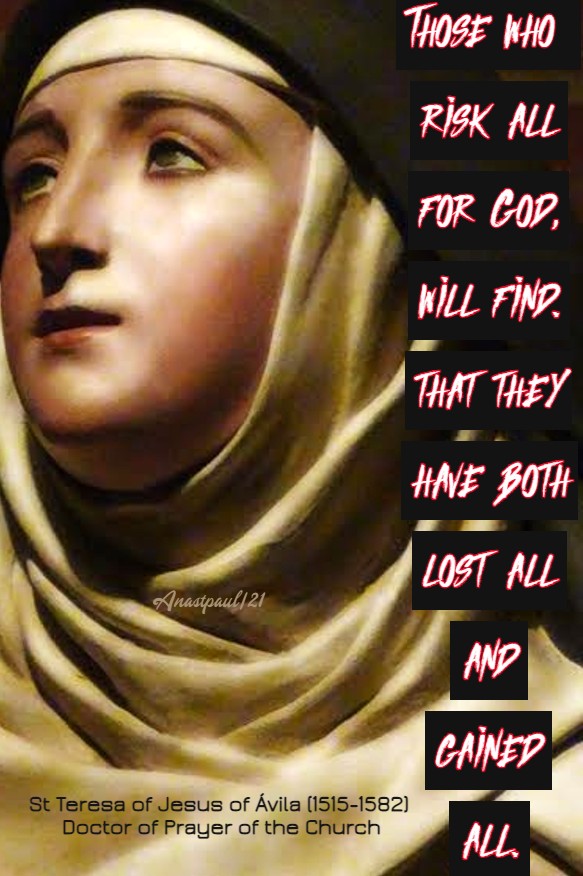
“Those who risk all for God, will find. that they have both lost all and gained all.”
St Teresa of Jesus of Ávila (1515-1582) Doctor of Prayer of the Church
“The Lord delights in every little step you take.”
St Francis de Sales (1567-1622) Doctor of Charity of the Church
“There is no more evident sign that anyone is a saint and of the number of the elect, than to see him leading a good life and, at the same time, a prey to desolation, suffering and trials.”
St Aloysius de Gonzaga (1568-1591)
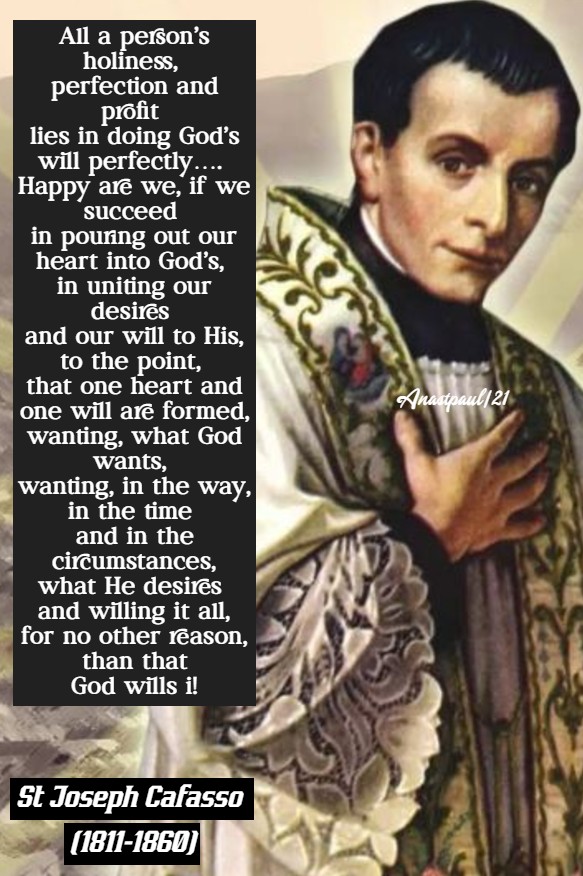
“All a person’s holiness, perfection and profit lies in doing God’s will perfectly…. Happy are we, if we succeed in pouring out our heart into God’s, in uniting our desires and our will to His, to the point, that one heart and one will are formed, wanting, what God wants, wanting, in the way, in the time and in the circumstances, what He desires and willing it all, for no other reason, than that God wills it.”
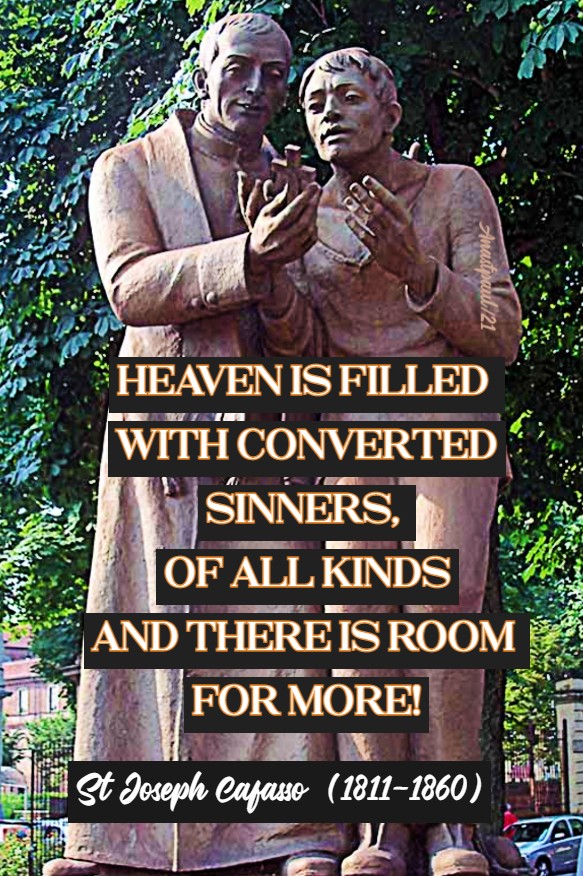
“Heaven is filled with converted sinners , of all kinds and there is room for more!”
St Joseph Cafasso (1811-1860)
“You cannot be half a saint. You must be a whole saint or no saint at all.”
St Thérèse of the Child Jesus and the Holy Face of Lisieux (1873-1897) Doctor of the Church
One Minute Reflection – 1 November – The Solemnity of All Saints, Readings: Apocalypse 7:2-4, 9-14, Psalms 24:1-6, 1 John 3:1-3, Matthew 5:1-12
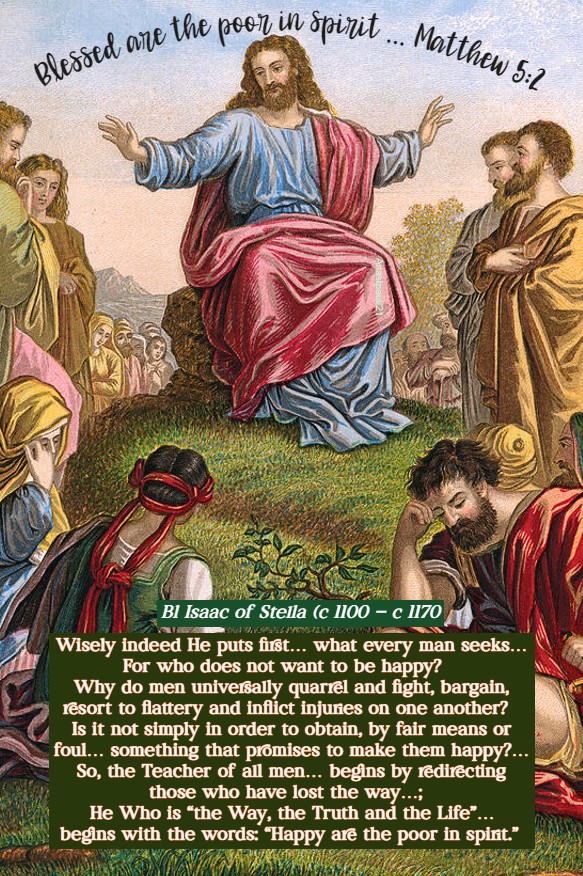
“Blessed are the poor in spirit” – Matthew 5:2
REFLECTION – “And when he had sat down, he opened his mouth.” (Mk 6,31). May it be granted me to sit with Jesus, to sit at His feet on the mountainside and partake of His instruction! When He is in the crowd, He is standing and walking, occupied and wearied, and so hard-pressed, that neither He, nor His disciples are, as it were, allowed to eat bread, “the bread of life and understanding” (Jn 6,35) and to drink “the water of wisdom” (Sir 15,3). For this water can only be drunk in a time of leisure and it is drawn by those who have little to do. For “the well is deep”(Sir 38,24) …
Opening His mouth Jesus speaks to the heart of Jerusalem, talking to her in solitude or on the mountain and this is what He says: “Happy are the poor in spirit.” ( Jn 4,11). He Who is Happiness, speaks of happiness, He Who became poor, of poverty, Bread speaks of repletion, Mercy of mercifulness, He Who is the Purity of hearts, speaks of purification of heart, the truly Peaceful of peace-making, the Son by nature, speaks of sonship…
“Blessed are the poor in spirit.” Wisely indeed He puts first… what every man seeks… For who does not want to be happy? Why do men universally quarrel and fight, bargain, resort to flattery and inflict injuries on one another? Is it not simply in order to obtain, by fair means or foul… something that promises to make them happy?… So, the Teacher of all men… begins by redirecting those who have lost the way…; He Who is “the Way, the Truth and the Life”… (Jn 14,16; 6,32;4,6) begins with the words: “Happy are the poor in spirit.” – Blessed Isaac of Stella O.Cist. (c 1100 – c 1170) Cistercian Monk, Abbot, Theologian, Philosopher (Sermon 1, for the Feast of All Saints ; SC 130).
PRAYER – Father, All-Powerful and ever-living God, today we rejoice in the holy men and women of every time and place. May their prayers bring us your forgiveness and love. Blessed Virgin, Mother of God, our trusted guide and loving mother and all you holy Saints of the Church Triumphant, pray for us! We make our prayer through Christ our Lord, in union with the Holy Spirit, God forever, amen.
Our Morning Offering – 1 November – The Solemnity of All Saints
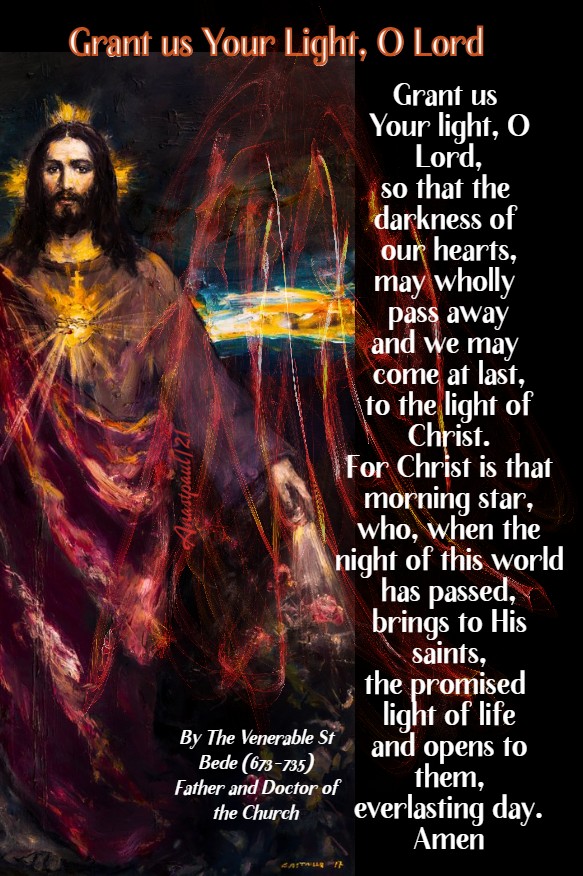
Grant us Your Light, O Lord By The Venerable St Bede (673-735) Father and Doctor of the Church
Grant us Your light, O Lord, so that the darkness of our hearts, may wholly pass away and we may come at last, to the Light of Christ. For Christ is that morning star, who, when the night of this world has passed, brings to His saints, the promised light of life and opens to them, everlasting day. Amen
All Saints Day (Solemnity) – (a Holy Day of Obligation) Instituted to honour all the saints, known and unknown. It owes its origin in the Western Church to the dedication of the Roman Pantheon in honour of the Blessed Virgin Mary and all the Martyrs by Pope Saint Boniface IV in 609, the anniversary of which was celebrated at Rome on 13 May. Pope Saint Gregory III Consecrated a Chapel in the Vatican Basilica in honour of All Saints, designating 1 November as their feast. Pope Gregory IV extended its observance to the whole Church. It has a Vigil and Octave and is a Holy Day of Obligation – the eve is popularly celebrated as Hallowe’en. Patronage – Arzignano, Italy.
Virgen de la Palma / Our Lady of the Palm, Algeciras, Spain (1755) – 1 November:
The Church of Our Lady of the Palm preceded by many years, the miracle which made it famous. The miracle for which it is best remembered, took place during an earthquake and a tidal wave on the 1November, 1755. There had been an extremely strong earthquake on that day that was reported to have been felt throughout all of Europe. Algeciras is a seaport of Spain exposed to the Atlantic Ocean in the Province of Cadiz and was directly in the path of the tidal wave, said to be more than 90 feet high. The recently reported tsunamis in Asia pales in comparison to that wave. Lisbon, with 275,000 inhabitants, lost 90,000 people and had 85% of its buildings destroyed by the wave. The water penetrated as much as 8 kilometers inland, mainly striking Portugal, Spain, and Africa. The townspeople of Algeciras were in terror and were on the point of abandoning the Town when two unidentified men – thought later to be the Patron Saints of the City – closed the water gates and urged the people to go to the Capuchin Church of Our Lady of the Palm. Here a Mass was in progress. The Priest calmly finished the Mass, seized a banner with a picture of Our Lady on it and went out into the street where the wall of water was already advancing upon them. He planted the banner in the street almost in the shadow of the great wave and called out in a loud voice, “Thus far, my Mother.” The water advanced as far as the banner and then miraculously stopped its forward progression, even though, up until that point, it had destroyed everything in its path. Then, as the Priest walked boldly forward toward the wall of water with the banner in his upraised hand, that gigantic wave receded from him and turned away from the face of Mary to return placidly to the ocean. An anniversary procession was established, along with a confraternity of Our Lady of the Palm. With the exception of 1837, when there was a Civil War, the procession is held annually. The Rosary is recited along the route of the tidal wave and prayers of thanksgiving said. Many years after the first miracle, another storm caused the people to remember Our Lady of the Palm. Ships were wrecked in the harbour and the ocean was violently disturbed. The people demanded a procession of Our Lady of the Palm and when the procession was finished, the storm abated. Hail Glorious and Blessed Mother, where is our faith today!
St Amabilis of Auvergne St Austremonius St Benignus of Dijon St Cadfan St Caesarius of Africa St Caesarius of Damascus St Ceitho St Cledwyn of Wales Bl Clemens Kyuemon St Cyrenia of Tarsus St Dacius of Damascus St Deborah the Prophetess St Dingad Bl Dionysius Fugixima St Floribert of Ghent St Gal of Clermont St Genesius of Lyon St Germanus of Montfort St Harold the King St James of Persia St Jerome Hermosilla St John of Persia St Julian of Africa St Juliana of Tarsus St Lluís Estruch Vives St Marcel of Paris St Mary the Slave St Mathurin St Meigan St Nichole St Pabiali of Wales St Pere Josep Almató Ribera Auras St Peter Absalon Bl Peter Paul Navarra Bl Petrus Onizuka Sadayu St Rachel the Matriarch Blessed Ranieri Rasini OFM (c 1250-1304 Lay Friar of the Order of Friars Minor St Ruth the Matriarch St Salaun of Leseven St Severinus of Tivoli St Valentin Faustino Berri Ochoa St Vigor of Bayeux
Our Morning Offering – 31 October – Christ the King
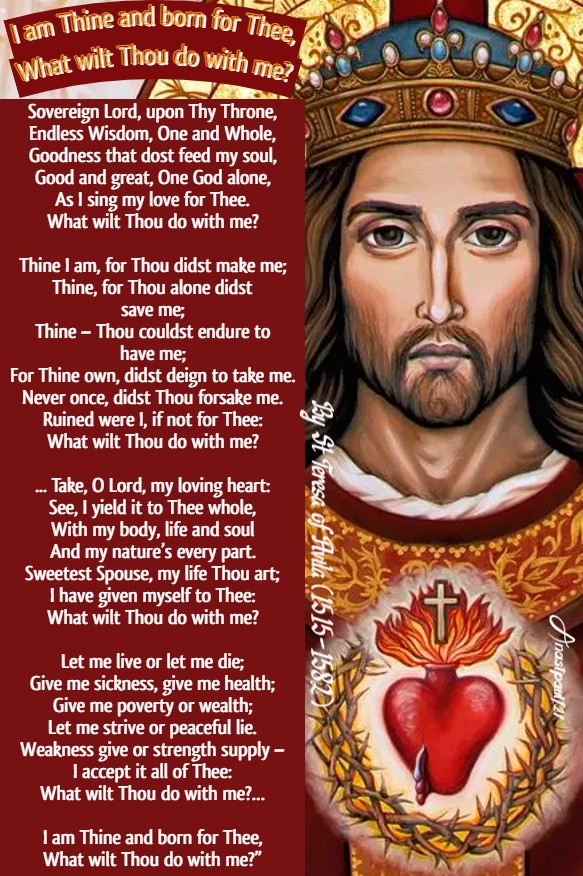
I am Thine and born for Thee, What wilt Thou do with me? By St Teresa of Avila (1515-1582) Doctor of Prayer of the Church
Sovereign Lord, upon Thy Throne, Endless Wisdom, One and Whole, Goodness that dost feed my soul, Good and great, One God alone, As I sing my love for Thee. What wilt Thou do with me?
Thine I am, for Thou didst make me; Thine, for Thou alone didst save me; Thine – Thou couldst endure to have me; For Thine own, didst deign to take me. Never once, didst Thou forsake me. Ruined were I, if not for Thee: What wilt Thou do with me?
What, O good and loving Lord, What wilt Thou have this creature do? This Thy slave, a sinner too, Waiting till she hears Thy word? With Thy will in close accord, Sweetest Love, I come to Thee: What wilt Thou do with me?
Take, O Lord, my loving heart: See, I yield it to Thee whole, With my body, life and soul And my nature’s every part. Sweetest Spouse, my life Thou art; I have given myself to Thee: What wilt Thou do with me?
Let me live or let me die; Give me sickness, give me health; Give me poverty or wealth; Let me strive or peaceful lie. Weakness give or strength supply – I accept it all of Thee: What wilt Thou do with me?…
I am Thine and born for Thee, What wilt Thou do with me?
Poem – I am Yours, for You I was born – “Vuestra Soy, para Vos nací ” (trans. E Allison Peers)
Vigil of All Saints Day or All Hallow’s Eve: Eve of the Feast of All Hallows, that is, All Saints Day. Halloween is a day on which many quaint customs are revived. It is popular in the United States and Scotland and in the US has become the second largest secular holiday of the year.
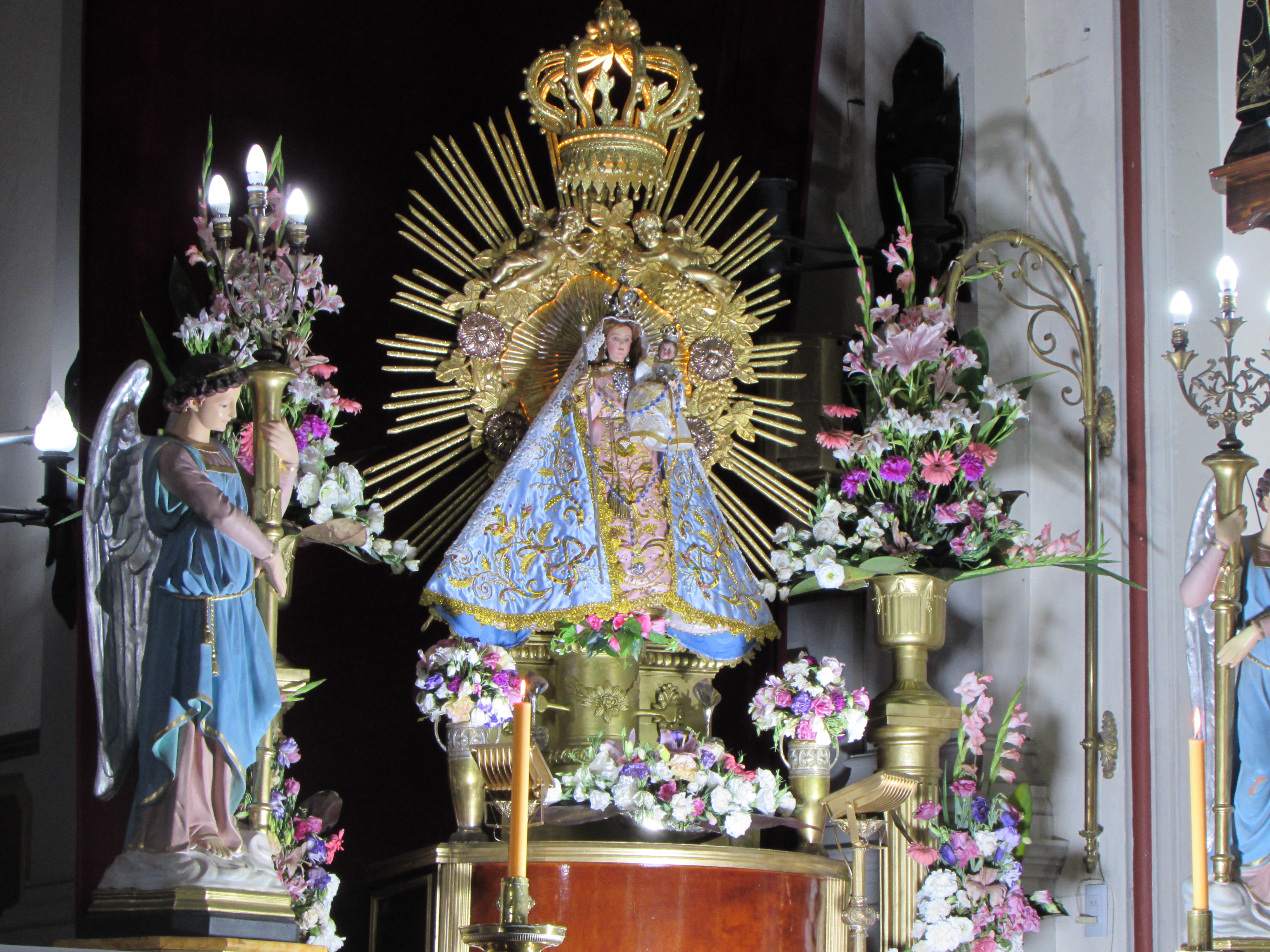
Nuestra Señora del Rosario de Río Blanco y Paypaya de Jujuy / Our Lady of the Rosary of Rio Blanco (of the White River) and Paypaya, Argentina , 17th Century – 31 October:
In the Province of Jujuy, Our Lady of the Rosary is the main Patron, who was added the title of “Paypaya and White River.” Local tradition tells that the Virgin defended the City from attacks by the Indians. The most beautiful devotion is the procession which takes place on 31 October, the day on which the image is removed from its precious altar next to the nave of the Cathedral of Jujuy and is taken to the Sanctuary of the White River…The people displaying their deep religious faith, expressed in their great devotion to the Virgin “Our Lady of the Rosary of White River and Paypaya,” the history refers to the colonial era of the mid-seventeenth century. Entering through the side entrance of the court, located next to the Cathedral of San Salvador de Jujuy, in the centre of the long nave, is the Chapel of Our Lady of the Rosary of White River and Paypaya, a clothed image 60 cm. height. There is another Statue is in the Chapel of the City of Rio Blanco.
St Ampliatus St Antoninus of Milan St Apelles of Eraclea Sintica St Arnulf of Novalesa St Begu of Hackness Bl Christopher of Romagna Bl Dominic Collins St Epimachus of Melusio St Erth of Cornwall St Foillan of Fosses (Died 655) Bishop Martyr, Missionary, Abbot Bl Irene Stefani St Jesús Miquel Girbau Bl Leon Nowakowski St Lucilla of Rome Bl Maria de Requesens Bl Modesta Moro Briz St Narcissus St Notburga of Cologne St Quentin Bl Pilar Isabel Sánchez Suárez St Stachys of Constantinople
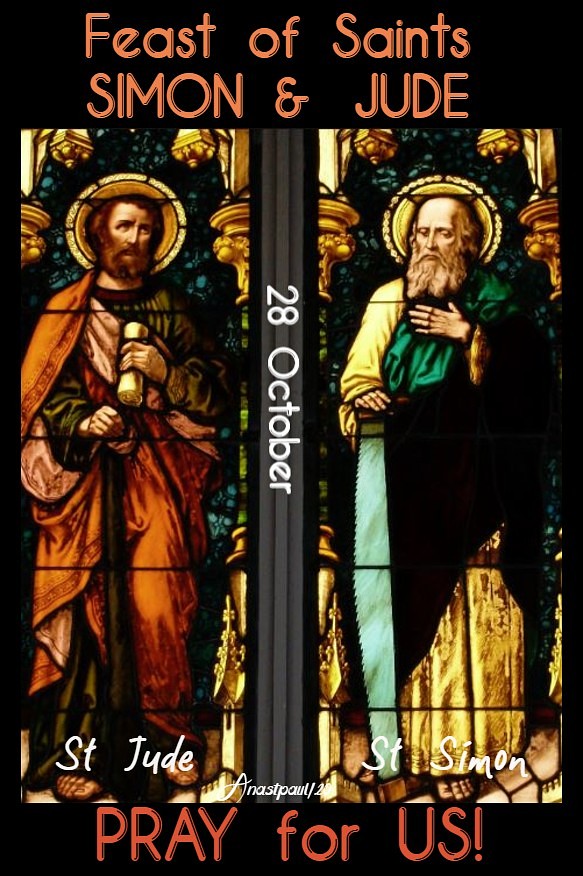
One Minute Reflection – 28 October – Feast of Saints Simon and Jude, Apostles and Martyrs – Readings: Ephesians 2: 19-22; Psalm 19: 2-5; Luke 6: 12-16
“When day came, he called his disciples to himself and from them, he chose Twelve, whom he also named Apostles…” – Luke 6:13
REFLECTION – “Our Lord Jesus Christ has appointed certain men to be guides and teachers of the world and stewards of His Divine Mysteries. Now He bids them to shine out like lamps and to cast out their light, not only over the land of the Jews but over every country under the sun and over people, scattered in all directions and settled in distant lands. That man has spoken truly who said – ‘No-one takes honour upon himself, except the one who is called by God,’ for it was our Lord Jesus Christ who called His own disciples before all others, to a most glorious apostolate. These holy men became the pillar and mainstay of the Truth and Jesus said, that He was sending them, just as the Father had sent Him.
… Accordingly, in affirming that they are sent by Him just as He was sent by the Father, Christ sums up in a few words the approach they themselves should take to their ministry. From what He said they would gather that it was their vocation to call sinners to repentance, to heal those who were sick whether in body or spirit, to seek in all their dealings never to do their own will but the will of Him who sent them and as far as possible, to save the world by their teaching.
Surely, it is in all these respects, that we find His holy disciples striving to excel. To ascertain this is no great labour, a single reading of the Acts of the Apostles or of Saint Paul’s writings is enough.” – St Cyril of Alexandria (376-444) Bishop, Fther & Doctor of the Church (An excerpt from his Commentary on the Gospel of John)
PRAYER – Lord God, You taught us to call upon Your name, through the preaching of the Apostles. Open our eyes each day, grant that we may see Jesus Your Son at our side, open our ears that we may hear His voice, open our mouths, that we may beg forgiveness and proclaim the good news, as we follow the way Your Son carved out for us. At the intercession of Sts Simon and Jude, may Your Church continue to grow and to hope in Your love. We make our prayer through Jesus our Lord, with the Holy Spirit, God forever, amen.
Our Morning Offering – 28 October – Feast of Saints Simon and Jude Apostles
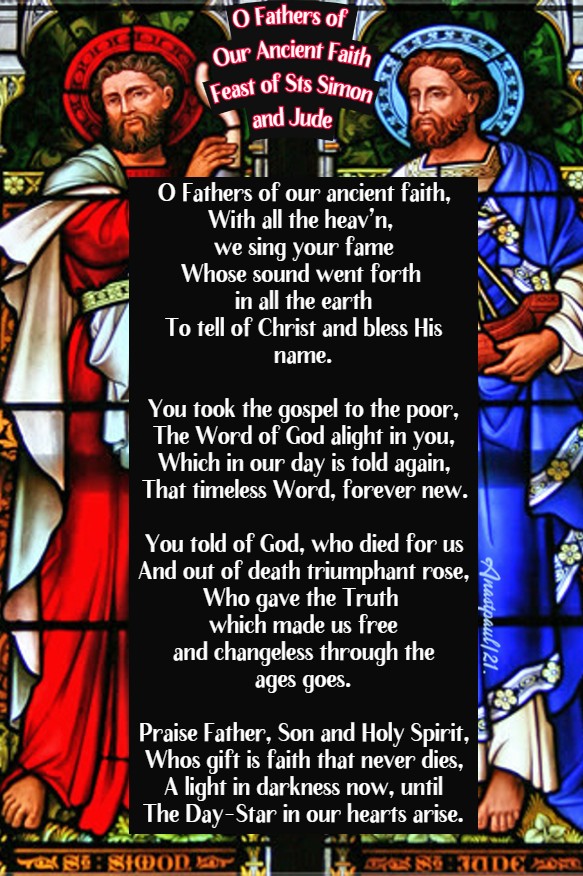
O Fathers of Our Ancient Faith
O Fathers of our ancient faith, With all the heav’n, we sing your fame Whose sound went forth in all the earth To tell of Christ and bless His name.
You took the gospel to the poor, The Word of God alight in you, Which in our day is told again, That timeless Word, forever new.
You told of God, who died for us And out of death triumphant rose, Who gave the Truth which made us free and changeless through the ages goes.
Praise Father, Son and Holy Spirit, Whos gift is faith that never dies, A light in darkness now, until The Day-Star in our hearts arise.
O Fathers of Our Ancient Faith is written by the Benedictine Nuns of Stanbrook Abbey. In the Divine Office (1974) it is sung at Morning Prayer in the Common of Apostles. It is set to the anonymous tune associated with the 7th century Latin hymn, Creator Alme Siderum.
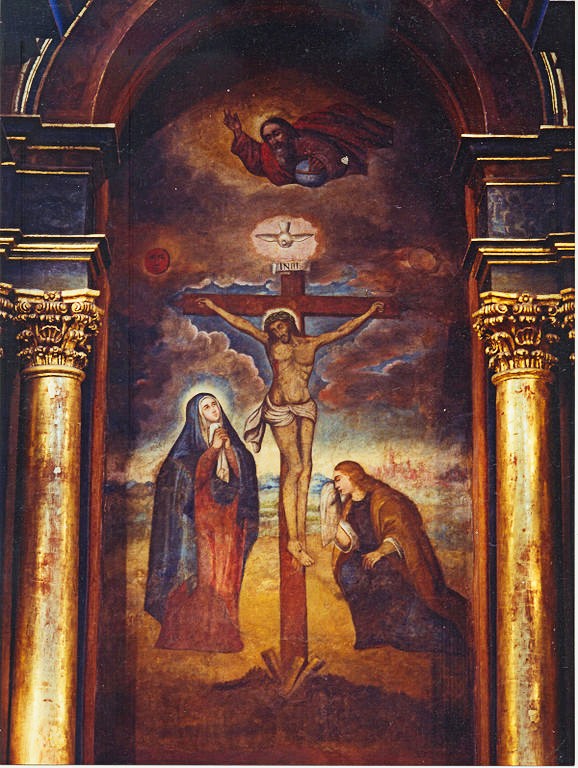
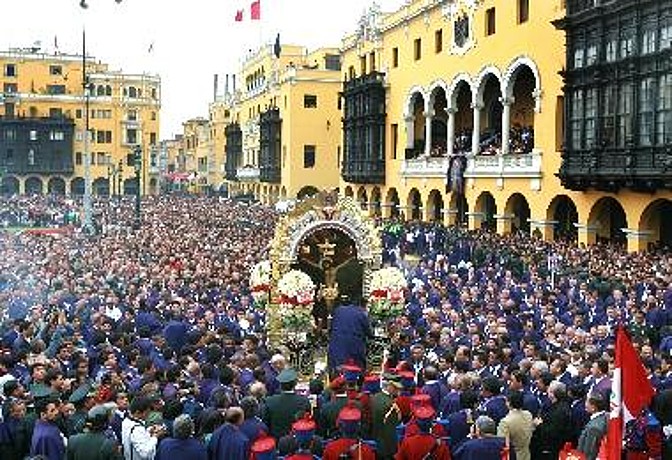
Lord of Miracles/Señor de los Milagros de Nazarenas – A mid-17th-century painting of the Crucifixion that is venerated in Lima, Peru and its celebration involves one of the largest processions in the world.
It was painted by an unnamed African taken to Peru as a slave from what is now Angola. Above the Cross is the Holy Spirit and God the Father. Below and to the right of Jesus, is His mother, the Virgin Mary with her heart pierced by a sword of sorrow. Kneeling and weeping at the foot of the cross is St Mary Magdalene.
The name originated on 13 November 1655 when everything around it was destroyed in an earthquake that left the painting standing and undamaged. Christ is shown enduring the pain of Crucifixion. Every year in October, hundreds of thousands of devotees from all races and economic backgrounds participate in a procession honouring the image through the streets of Lima. Boulevards are decorated in purple on 18,19 and the final Feast 28 October to celebrate the Lord of Miracles.
Notre-Dame de Vivonne / Our Lady of Vivonne, Savoy, France – 28 October:
The Abbot Mathieu Orsini wrote: “Our Lady of Vivonne, in Savoy, where a miraculous image is venerated, which was found by a ploughman while preparing his field for the spring planting.”
Vivonne is a village in France having a population of somewhat less than 5,000 inhabitants and located about 20 kilometers south of Poitiers. It is situated on a rocky height looking down upon the three rivers that flow through the region. There are apparently two Churches in the village, the better known church being the Church of Saint George, on which construction began in the twelfth century. The other Church is Our Lady of Sais-les-Vivonne. According to tradition, a farmer was ploughing his field when he overturned something peculiar in the sod. To his great surprise, the man found the object was a Statue of the Blessed Virgin Mary. The good farmer took the Statue, now known as Our Lady of Vivonne, or Notre-Dame de Vivonne, to his home. After lovingly cleaning the debris from the Statue, the farmer took it to the local Church and gave it to the Parish Priest. The Priest immediately placed the Statue in the Church later that same day. The next morning when he returned to the Church, he found that the Statue was missing. After much inquiry and searching the farmer found the Statue was once again in his field. The man returned it to the Church but once again it disappeared from its place, only to be found again in the field. This occurred a total of three times before it was decided to build a Shrine where it had been found. The strange phenomenon brought people from near and far to the Shrine. Soon the image proved to be miraculous and pilgrimages began. The Church which was built to honour the image of Our Lady was given to the Carmelite Order. I can find no images of this Church online.
St Abdias of Babylon St Abraham of Ephesus St Alberic of Stavelot St Anastasia the Elder St Anglinus of Stavelot St Cyril of Rome St Cyrilla of Rome St Diomedes the Younger St Dorbhene of Iona St Eadsin of Canterbury (Died 1050) Archbishop of Canterbury St Elius of Lyon St Faro of Meaux
St Genesius of Thiers St Gioan Dat St Godwin of Stavelot St Maria Ascuncion St Remigius of Lyons St Rodrigo Aguilar Aleman St Salvius of Amiens — Martyrs of Avila – 3 saints: Two sisters and a brother who, during a period of persecution, fled Talavera de la Reina, Spain, were caught and executed. Martyrs: Christeta, Sabina and Vincent. 303 in Avila, Spain.
Martyred in the Spanish Civil War: • Blessed Claudio Julían García San Román • Blessed Maria Asuncion
One Minute Reflection – 24 October – “Month of the Holy Rosary” – Jeremiah 31: 7-9; Psalm 126: 1-6; Hebrews 5: 1-6; Mark 10: 46-52 and the Feast of Saint Raphael the Archangel
“And immediately he received his sight and followed him on the way” .…Mark 10:52
REFLECTION – “[Moses said to the Lord on Mount Sinai]: “Let me see your glory!” He answered: “I will make all my beauty pass before you … but my face you cannot see” (Ex 33:18 f).] Such an experience seems to me to belong to the soul which loves what is beautiful. Hope always draws the soul from the beauty which is seen, to what is beyond … And the bold request which goes up the mountains of desire, asks this – to enjoy the Beauty, not in mirrors and reflections but face-to-face. The divine Voice granted what was requested in what was denied … – the munificence of God assented to the fulfilment of the desire but did not promise any cessation or satiety of the desire … The true sight of God consists in this, that the one who looks up to God never ceases in that desire. For He says: “You cannot see my face and live” …
But when the Lord who spoke to Moses came to fulfil His own law, He likewise gave a clear explanation to His disciples, laying bare the meaning of what had previously been said in a figure, when He said: “If anyone wants to be a follower of mine “ (Lk 9:23) and not “If any man will go before me.” And to the one asking about eternal life, He proposes the same thing, for He says: “Come, follow me” (Lk 18:22). Now, he who follows, sees the back. So Moses, who eagerly seeks to behold God, is now taught how he can behold Him – to follow God wherever he might lead, is to behold God (…).
Someone who does not know the way, cannot complete his journey safely in any other way, than by following behind his guide. He who leads, then, by His guidance shows the way to the one following. He who follows, will not turn aside from the right way, if he always keeps the back of his leader in view. For he who moves to one side or brings himself to face his guide, assumes another direction for himself, than the one his guide shows him. Therefore, God says to the one who is led: “My face is not to be seen”, that is, “Do not face your guide”. If he does so, his course will certainly be in the opposite direction …. to follow God wherever He might lead, is to behold God! No longer does any offence which comes about through evil, withstand the one who thus follows Him.” – St Gregory of Nyssa (c.335-395) Bishop, Father (Brother of St Basil the Great) – The Life of Moses, II.
PRAYER – Lord God of Hosts, in Your all-wise Providenc, You assign to Angels and to men, the services they have to render You. Grant that the Angels who adore You in Heaven, may protect and guid us here on earth. We make our prayer through Jesus Christ in the unity of the Holy Ghost, God now and for all eternity, amen.
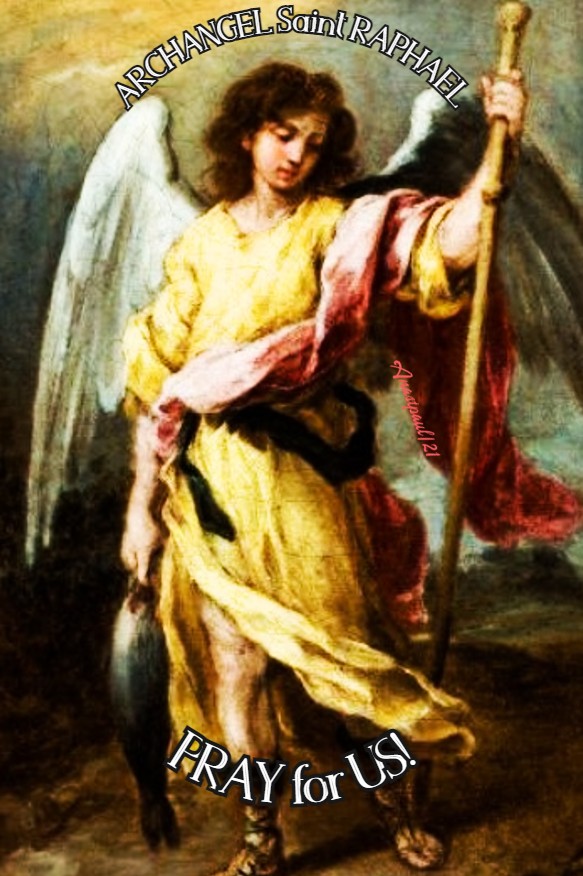
Saint of the Day – 24 October – St Raphael the Archangel. Patronages – the blind, travellers, happy meetings, nurses, physicians, medical workers, matchmakers, Catholic Marriage and Catholic studies.The Feast day of Saint Raphael was included for the first time in the General Roman Calendar in 1921, for celebration on 24 October. With the 1969 revision of the General Roman Calendar, the Feast was transferred to 29 September for celebration together with the Archangels, Saints Michael and Gabriel.
O God, Who gave Blessed Raphael the Archangel to Tobias as his travelling companion, grant to us Thy servants, that we also may be guarded by his care and receive the protection of his assistance. Through Our Lord Jesus Christ. Amen
St Raphael, Archangel By Father Francis Xavier Weninger, 1876
The two youths then set out on their journey. After the first day’s march, Tobias rested on the bank of the river Tigris and when he went to wash his feet in this river, an immense fish came suddenly up to devour him. When he called to his companion for help, Raphael told him to seize the fish courageously and draw him to land. Tobias did so, after which, Raphael told him to open the fish, take out the entrails and keep the heart, liver and gall, as useful medicines. They continued their journey,and took lodgings in the house of Raguel, who was of the same tribe as Tobias and who had an only daughter, named Sara, whom Raphael advised Tobias to take as wife. Tobias feared to do this, as he had heard that Sara had already been given in marriage to seven husbands, all of whom had been killed by the devil. Raphael, however, said: “Hear me and I will tell thee who they are, over whom the devil can prevail. It is they who in such manner receive matrimony, as to shut out God from their heart and mind.”
Tobias exactly followed the directions of his holy companion and remained unharmed. From how many evils would persons about to be married be saved, if they had first received and followed suitable instructions from their pastors who, in regard to them, take the place of Raphael, advising them what they should do in order to enter the state of holy matrimony properly prepared. They should purify their heart by a good general confession and be married, not like heathens in the darkness of night but at Mass receiving the blessing of the Priest at the Altar. After marriage, they should live as becomes the marriage state, faithfully fulfilling the admonition of St Paul, sanctifying each other and taking care, that their children shall become, without delay, children of God through Baptism. Indeed, how much displeased must be the Guardian Angels of new-born children at seeing them, through the neglect of their parents, to have them Baptised in time, left in the power of the devil, in original sin and in danger of eternal perdition. While Tobias remained at the house of Raguel, his heavenly companion went to Rages, demanded and received, without any hesitation, the borrowed money from Gabelus, returned to Raguel and having made a short stay there, accompanied Tobias back to his home at Ninive.
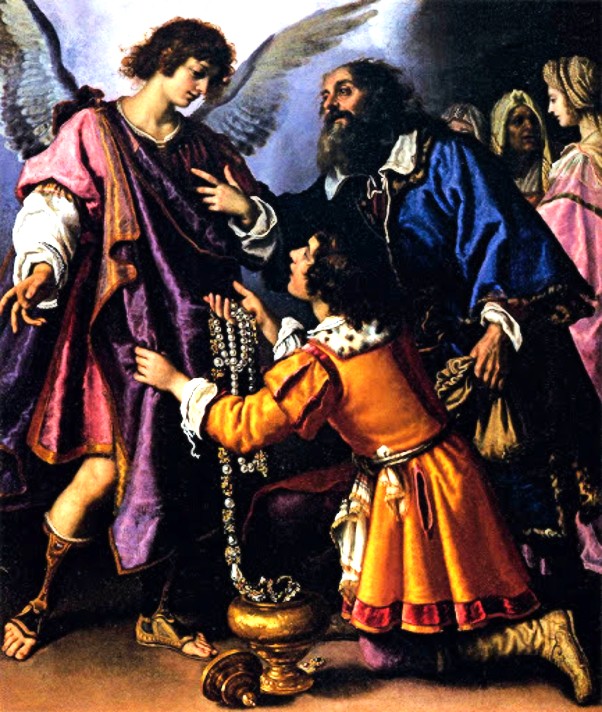
Anna, Tobias’ mother, had meanwhile, grieved very much at the long absence of her son. She daily went to a high mountain and looked into the distance, to see whether her son was approaching and, when, on the day of his return, she saw him from afar, she ran to her husband and informed him of his son’s approach. Being blind, Tobias gave his hand to a servant and went to meet his son, as also did Anna. Both fell on his neck, kissed him and wept for joy. Having all entered their house, they adored the Almighty and gave due thanks to Him for the happy issue of the journey. Tobias, the son, then took some of the gall of the fish, and anointed his father’s eyes, as the Angel Raphael had told him to do, before they had reached the house and immediately, the blind father recovered his sight. Indescribably great ,was the joy of the father, the mother, the whole household and neighbourhood. Having given humble thanks to God for this new grace, Tobias told his parents how many benefits he had received from his travelling companion. “He conducted me and brought me safely back again,” said he; “he received the money from Gabelus, he caused me to obtain my wife and he chased from her the evil spirits and gave joy to her parents. Myself, he delivered from being devoured by the fish, thee also, father hath he made to see the light of heaven and we are filled with all good things through him. What can we give him sufficient for all these?“
Before his father could answer, he begged him to give so faithful a companion, as recompense, one-half of all the things they had brought. Tobias acceded to this proposal of his son without hesitation and calling the Angel, they both begged him to accept one-half of all the things they had brought, as a recompense for his services. But the Angel said to them: “Bless ye the God of heaven, give glory to Him in the sight of all that live because he hath showed mercy to you. For it is good to hide the secret of a king but honourable to confess and reveal the works of God. Prayer is good with fasting and alms, more than to lay up treasures of gold; for alms delivereth from death and the same is that which purgeth away sin and maketh us to find mercy and life everlasting. But they that commit sin and iniquity, are enemies to their own soul. When thou didst pray with tears and didst bury the dead and didst leave thy dinner and hide the dead by day in thy house and bury them by night, I offered thy prayers to the Lord. And because thou wast acceptable to God, it was necessary that temptation should prove thee. And now the Lord hath sent me to heal thee and to deliver Sara thy son’s wife from the devil. For I am the Angel Raphael, one of the seven who stand before the Lord.”
Having thus spoken, the Holy Archangel was silent but Tobias and his son were seized with fear and fell trembling, with their faces to the ground. The Angel cheered them, with the words: “Peace be to you, fear not. For when I was with you, it was by the will of God: bless ye Him and sing praises unto Him. It is time now that I return to Him that sent me but bless ye God and publish all His wonderful works.” Having said these words, he vanished from their sight. They, however, lay prostrate on the ground for three hours, partly from fear, partly in wonder at the great goodness of God who had sent so high a Prince of Heaven to protect, comfort and help them. At length, having overcome their awe they repeated their thanks to God and announced everywhere, the benefits He had bestowed upon them. The beautiful hymn of praise which Tobias composed on that occasion is to be found in Holy Writ. From this event, as true as it is wonderful, several historians, not without reason, conclude that the intercession of St Raphael ought to be invoked by those who are either troubled or tempted by the Evil One, who are blind, or otherwise infirm, or who go on a journey. The name, Raphael, means “the remedy, or the physician of God” and shows ,that this Holy Angel assists, particularly those who are sick, either in soul or body. The true Church teaches those who intend to undertake a journey to pray: “May the Angel Raphael be with us on our way!” from which we infer, that he is the especial patron of all travellers.
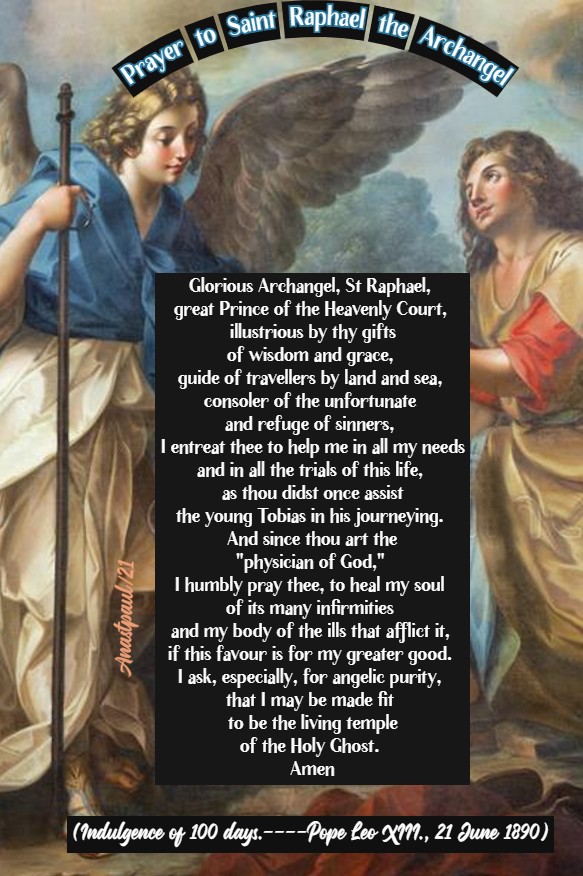
Prayer to Saint Raphael the Archangel
Glorious Archangel, St Raphael, great Prince of the Heavenly Court, illustrious by thy gifts of wisdom and grace, guide of travellers by land and sea, consoler of the unfortunate and refuge of sinners, I entreat thee to help me in all my needs and in all the trials of this life, as thou didst once assist the young Tobias in his journeying. And since thou art the “Physician of God,” I humbly pray thee to heal my soul of its many infirmities and my body of the ills that afflict it, if this favour is for my greater good. I ask, especially, for angelic purity, that I may be made fit to be the living temple of the Holy Ghost. Amen
(Indulgence of 100 days.—-Pope Leo XIII., 21 June 1890)
Twenty Second Sunday after Pentecost Thirtieth Sunday in Ordinary Time
Saint Raphael the Archangel The Feast day of Saint Raphael was included for the first time in the General Roman Calendar in 1921, for celebration on 24 October. With the 1969 revision of the General Roman Calendar, the Feast was transferred to September 29 for celebration together with Archangels Saints Michael and Gabriel.
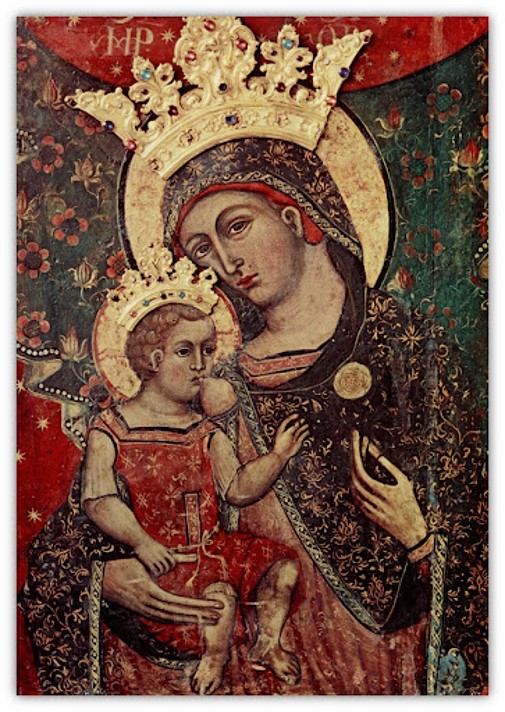
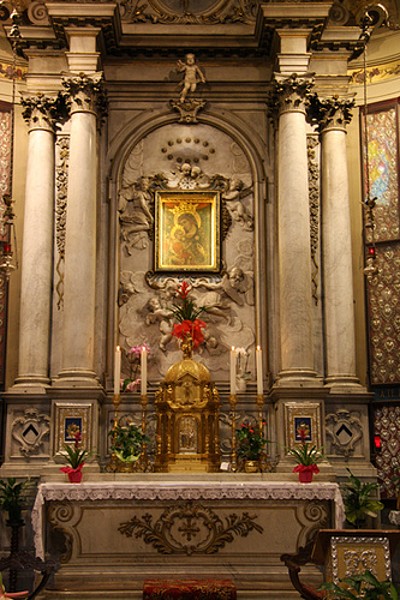
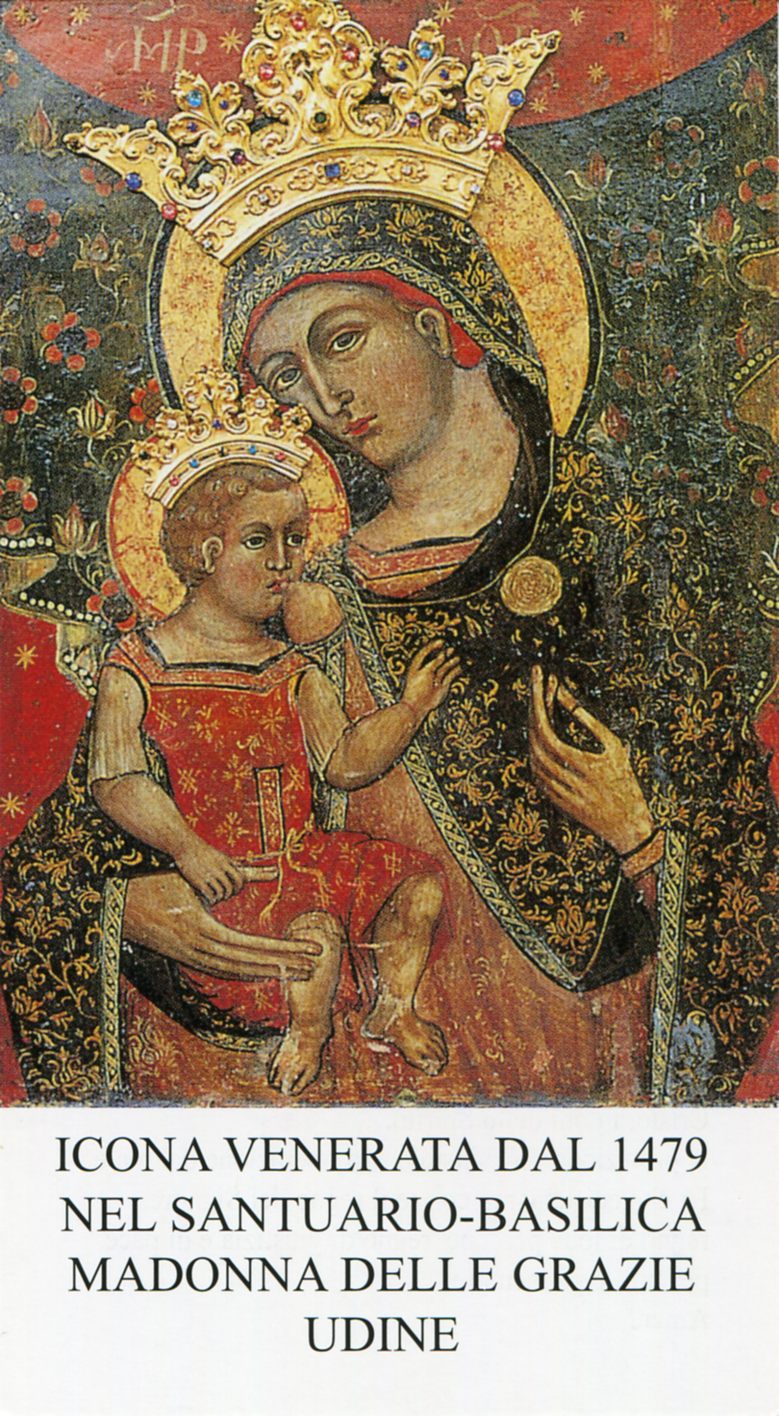
Beata Vergine delle Grazie / The Blessed Virgin of Grace, Udine, Friuli-Venezia Giulia, Italy (1479) – Fourth Sunday of October:
When Sir John Emo was serving as Venetian Ambassador to Constantinople, Sultan Mohammed II gave him a Byzantine-style icon of the Virgin nursing the Child. In 1479, Sir Emo became Lieutenant of Udine, a City in northeast Italy then under the Republic of Venice, bringing the icon with him to the governor’s castle. Not long afterward, one of the palace cooks nearly lost a hand in the kitchen but it healed when touched to the image. News of the miracle inspired popular devotion, so Sir Emo decided to move the image to the Church of Sts. Gervais and Protasius, where it entered in procession on 8 September 1479. By 1495, the Church was too small for all the pilgrims and a new Sanctuary was begun, consecrated to Our Lady of Graces and run by the Servants of Mary. On 6 September 1870 the Church Crowned the icon; in 1922, it named the Shrine a Minor Basilica.
On the fourth Sunday of October, the City both fulfills and renews, a vow made during the plague of 1555. The Beata Verginedelle Grazie is also credited with saving the region from the plague of 1599, the cholera of 1836 and the bombardment of the war in1944.
St Anthony Mary Claret CMF (1807-1870) Known as “The Spiritual Father of Cuba.” In the first years, records show, that he Confirmed 100,000 people and performed 9,000 Sacramental Marriages.Archbishop of Cuba, one of the Fathers of the First Vatican Council,Confessor to the Queen of Spain, Missionary, Founder of the Congregation of Missionary Sons of the Immaculate Heart of Mary, commonly called the Claretians, Confessor, Mystic, Social Reformer, Spiritual Director, Writer, Publisher, Preacher, Apostle of Charity. He was declared venerable by Pope Leo XIII in 1899. He was Beatified in 1934 and in 1950, Canonised by Pope Pius XII. His heart is incorrupt. The 1969 revision of the calendar moved St Anthony Feast to the day of his death, 24 October (from the 23rd) which had been the Feast of Saint Raphael the Archangel since 1921. (Optional Memorial) About St Anthony Mary here: https://anastpaul.wordpress.com/2017/10/24/saint-of-the-day-24-october-st-anthony-mary-claret-1807-1870-cmf/
Bl Amado García Sánchez St Audactus of Thibiuca St Cadfarch St Ciriacus of Hierapolis St Claudian of Hierapolis St Ebregislus of Cologne St Felix of Thibiuca St Fortunatus of Thibiuca St Fromundus of Coutances St Giuse Lê Dang Thi
St Luigi Guanella (1842-1915) “Servant of Charity,” Priest, Founder the Daughters of Saint Mary of Providence (1890) and the Servants of Charity (24 March 1908) alongside his friends Fr David Albertario (1846-1902) and Blessed Giuseppe Toniolo (1845-1918). Apostle of Charity, Marian devotee, Eucharistic Adorer and passionate promoter. Guanella also founded the Pious Union of Saint Joseph (1914) with his supporter and first member St Pope Pius X. St Luigi’s Life: https://anastpaul.com/2018/10/24/saint-of-the-day-24-october-st-luigi-guanella-1842-1915-servant-of-charity/
St Maglorius of Wales St Marcius of Monte Cassino St Martin of Vertou
St Senoch St Senócus of Tours St Septimus of Thibiuca — Martyrs of Ephesus – 3 saints: Three Christians martyred together. All we know about them are the names Mark, Sotericus and Valentina. They were stoned to death near Ephesus, Asia Minor (in modern Turkey). Their relics are enshrined on the island of Tasos.
Feast of the Most Holy Redeemer – The Feast of the Most Holy Redeemer was a Catholic liturgical feast. It is celebrated in Venice as the Festa del Redentore. It is also celebrated by the Redemptorists and was celebrated in the City of Rome. The feast is found only in the special calendar of some Diocese and religious Orders and is celebrated with proper Mass and Office either on the third Sunday of July or on 23 October. https://anastpaul.com/2019/10/23/the-feast-of-the-most-holy-redeemer-23-october/
St John of Capistrano OFM (1386-1456) “The Soldier Saint.” Franciscan Friar and Priest, Confessor and Preacher. Famous as a preacher, theologian and inquisitor, trained lawyer, he earned himself the nickname ‘the Soldier Saint’ when in 1456 at age 70 he led a crusade against the invading Ottoman Empire at the siege of Belgrade with the Hungarian military commander John Hunyadi, called the Athleta Christi (“Christ’s Champion”) by Pope Pius II. (Optional Memorial) St John’s Story here: https://anastpaul.wordpress.com/2017/10/23/saint-of-the-day-23-october-st-john-capistrano-ofm-1386-1456-the-soldier-saint/
Bl John Buoni St John of Syracuse St Oda of Aquitaine St Phaolô Tong Viet Buong St Romanus of Rouen St Severinus of Cologne St Syra of Faremoutiers St Theodoret of Antioch Bl Thomas Thwing St Verus of Salerno — Martyrs of Cadiz – 2 saints Germanus Servandus Martyrs of Hadrianopolis – 2 saints Dorotheus Severus Martyrs of Nicaea – 3 saints Euerotas Socrates Theodota
Martyrs of Valenciennes – 6 beati: A group of Urusuline and Briggittine nuns murdered together in the anti-Christian excesses of the French Revolution. They were guillotined on 23 October 1794 in Valenciennes, Nord, France and Beatified on 13 June 1920 by Pope Benedict XV. • Anne-Joseph Leroux • Clotilde-Joseph Paillot • Jeanne-Louise Barré • Marie-Augustine Erraux • Marie-Liévine Lacroix • Marie-Marguerite-Joseph Leroux
Martyred in the Spanish Civil War including Martyrs of Manzanares (7 beati): • Agapit Gorgues Manresa • Agustín Nogal Tobar • Andrés Navarro Sierra • César Elexgaray Otazua • Cristóbal González Carcedo • Dorinda Sotelo Rodríguez • Eduardo Valverde Rodríguez • Felipe Basauri Altube • José María Fernández Sánchez • Juan Nuñez Orcajo • Leonardo Olivera Buera • Manuel Navarro Martínez • Roque Guillén Garcés • Toribia Marticorena Sola






































 AnaStpaul
You must be logged in to post a comment.