Quote of the Day – 29 September – The Feast of Sts Michael, Gabriel and Raphael
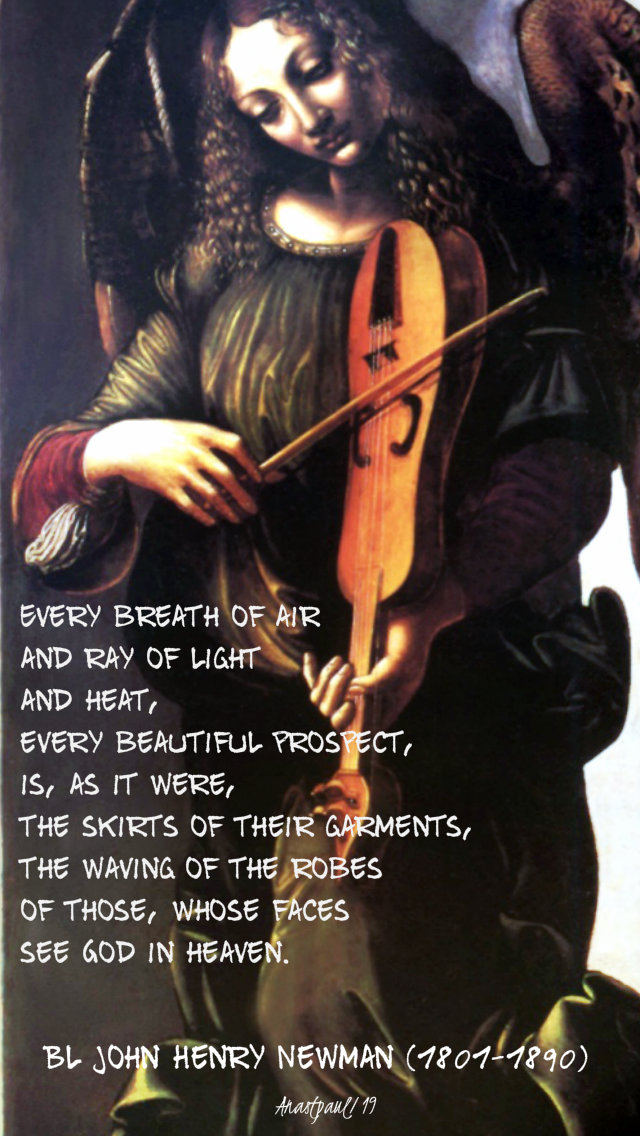
“As our souls move our bodies … so there are Spiritual Intelligences which move those wonderful and vast portions of the natural world which seem to be inanimate and, as the gestures, speech and expressive countenances of our friends around us, enable us to hold intercourse with them, so, in the motions of universal Nature, in the interchange of day and night, summer and winter, wind and storm, fulfilling His word, we are reminded of the blessed and dutiful Angels …. Every breath of air and ray of light and heat, every beautiful prospect, is, as it were, the skirts of their garments, the waving of the robes of those, whose faces see God in heaven.”
Bl Alericus
St Anno of Eichstätt
St Casdoe of Persia
St Catholdus of Eichstätt
Bl Charles of Blois
St Dadas of Persia
St Diethardus of Eichstätt
St Fraternus of Auxerre
St Gabdelas of Persia
St Grimoaldus of Pontecorvo
St Gudelia
St Guillermo Courtet Bl Jean de Montmirail / Baron de Montmirail, O. Cist. (1165 – 1217)
Bl John of Ghent
St Lazaro of Kyoto
St Liutwin of Trier Bl Luigi Monza (1898 – 1954) Biography:
St Miguel de Aozaraza
St Quiriacus of Palestine
St Rene Goupil
St Rhipsime
Bl Richard Rolle
St Sapor of Persia
St Theodota of Thrace
St Vicente Shiwozuka de la Cruz
—
Martyrs of Thrace – 3 saints: Three Christian men murdered in Thrace for their faith. They are – Eutychius, Heracleas and Plautus.
Martyred in the Spanish Civil War:
• Blessed Antonio Arribas Hortigüela
• Blessed Antonio Martínez López
• Blessed Dario Hernández Morató
• Blessed Francesc de Paula Castelló Aleu
• Blessed Francisco Edreira Mosquera
• Blessed José Villanova Tormo
• Blessed Pau Bori Puig
• Blessed Vicente Sales Genovés
• Blessed Virgilio Edreira Mosquera
Saint of the Day – 21 September – Feast of St Matthew, Apostle and Evangelist
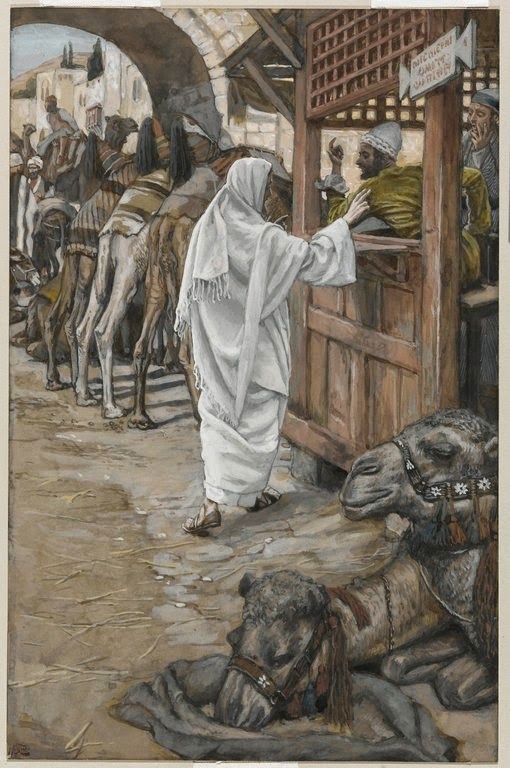
One day, as our Lord was walking by the Sea of Galilee, He saw, sitting at the receipt of custom, Matthew the publican, whose business it was to collect the taxes from the people for their Roman masters. Jesus said to him, “Follow Me” and leaving all, Matthew arose and followed Him.
Now the publicans were abhorred by the Jews as enemies of their country, outcasts and notorious sinners, who enriched themselves by extortion and fraud. No Pharisee would sit with one at table. Our Saviour alone had compassion for them. So St Matthew made a great feast, to which he invited Jesus and His disciples, with a number of these publicans, who henceforth began eagerly to listen to Him. It was then, in answer to the murmurs of the Pharisees, that He said, “They that are in health need not the physician. I have not come to call the just, but sinners to penance.”
The Calling of Matthew – James Tissot
After the Ascension, St Matthew remained some years in Judæa and there wrote his Gospel, to teach his countrymen that Jesus was their true Lord and King, foretold by the prophets. St Matthew afterward preached the Faith far and wide and is said to have finished his course in Parthia.
Obey all inspirations of Our Lord as promptly as St Matthew, who, at a single word, “laid down,” says St Bridget, “the heavy burden of the world to put on the light and sweet yoke of Christ.”
St Alexander of the Via Claudia
Bl Diego Hompanera París
St Eusebius of Phoenicia
St Francisco Pastor Garrido
St François Jaccard
St Gerulph
St Herminio García Pampliega
St Iphigenia
St Isaac of Cyprus
Bl Jacinto Martínez Ayuela
St Jacques Honoré Chastán
St Johannes Ri
St Jonah the Prophet
Bl José María Azurmendi Mugarza
Bl Josep Vila Barri
Bl Manuel Torró García
Bl Mark Scalabrini
St Maura of Troyes
St Meletius of Cyprus
Bl Nicolás de Mier Francisco
St Pamphilus of Rome
St Pierre Philibert Maubant
St Tôma Tran Van Thien
Bl Vicente Galbis Gironés
Bl Vicente Pelufo Orts
—
Martyrs of Gaza – 3 saints: Three brothers, Eusebius, Nestulus and Zeno, who were seized, dragged through the street, beaten and murdered by a pagan mob celebrating the renunciation of Christianity by Julian the Apostate. They were burned to death in 362 on a village garbage heap in Gaza, Palestine.
Martyred in the Spanish Civil War:
• Blessed Diego Hompanera París
• Blessed Jacinto Martínez Ayuela
• Blessed José María Azurmendi Mugarza
• Blessed Josep Vila Barri
• Blessed Manuel Torró García
• Blessed Nicolás de Mier Francisco
• Blessed Vicente Galbis Gironés
• Blessed Vicente Pelufo Orts
Thought for the Day – 14 September – Feast of the Exaltation of the Holy Cross
“Exalt – glorify, extol, praise, acclaim, pay homage to, pay tribute to, revere, reverence, venerate, worship, raise on high”
The one symbol most often identified with Jesus and His Church is the Cross.
Today we celebrate The Exaltation of the Holy Cross. This feast traces its beginning to Jerusalem and the dedication of the church built on the site of Mount Calvary in 335. But the meaning of the Cross is deeper than any city, any celebration, any building. The Cross is a sign of suffering, a sign of human cruelty at its worst. But by Christ’s love shown in the Paschal Mystery, it has become the sign of triumph and victory, the sign of God, who is love itself.
Believers have always looked to the Cross in times of suffering. People in concentration camps, in prisons, in hospitals, in any place of suffering and loneliness, have been known to draw, trace, or form crosses and focus their eyes and hearts on them. The Cross does not explain pain and misery. It does not give us any easy answers. But it does help us to see our lives united with Christ’s.
We often make the Sign of the Cross over ourselves. We make it before prayer to help fix our minds and hearts on God. We make it after prayer, hoping to stay close to God. In trials and temptations, the Cross is a sign of strength and protection. The Cross is the sign of the fullness of life that is ours. At Baptism, too, the Sign of the Cross is used, the priest, parents, and godparents make the sign on the forehead of the child. A sign made on the forehead is a sign of belonging. By the Sign of the Cross in Baptism, Jesus takes us as His own in a unique way. Today, let us look to the Cross often. Let us make the Sign of the Cross and realise we bring our whole selves to God—our minds, souls, bodies, wills, thoughts, hearts—everything we are and will become.
O cross, you are the glorious sign of our victory.
Through your power may we share in the triumph of Christ Jesus.
O Wisdom, what a game you bring to perfection, what a joke you play on my Jesus. You lay bare the King of Glory, making Him a spectacle of abuse. You affix to the trunk of a tree the price of the entire world. You alone weigh and mark out how much value this mystery has in paying the debt for all transgressions From the earth you lift up on the Cross the life of all that He, drawing everything to Himself in His death, (cf Jn 12:32) might make them live.
O wise Love, what a remedy you prepare so that universal ruin be filled. Oh, what a plaster you apply to cure the wound of all. O Love, your counsel is help for those who are lost. You condemn the blameless man to save the miserable culprit. You pour out innocent blood to be able to placate enraged justice and to ransom the motto is relief for those who are miserable. You plead the cause of peace. You heed the importuning mercy. By your prudent counsel you bring help for the anxiety of all through the most gracious will of your clemency. You impose an end to universal misery through the glorious work of your mercy. O Love, what you have devised is the opportunity for salvation for those who are lost.
Behold, O Wisdom, your pantry full of loving-kindness is already open. Ah, look upon me, the culprit, standing outside the door of your charity. Ah, fill the little cloak of my poverty with the blessing of your gentleness. Behold, before you is the empty little cup of my desire.” (cf Ps 37[38]:10) Ah, lay the latch of your fullness open.… Ah, do not treat me according to my sins nor repay me according to my iniquities (Ps 102[103]:10), my Jesus. Ah, just as You have truly been favourable to me with Your blood, so also by virtue of Your precious Cross, make restitution to me for all the wastefulness of my life.
Quote/s of the Day – 14 September – Feast of the Exaltation of the Holy Cross, Gospel: John 3:13–17
The message of the cross is foolishness to those who are perishing but to us, who are being saved, it is the power of God…
1 Corinthians 1:18
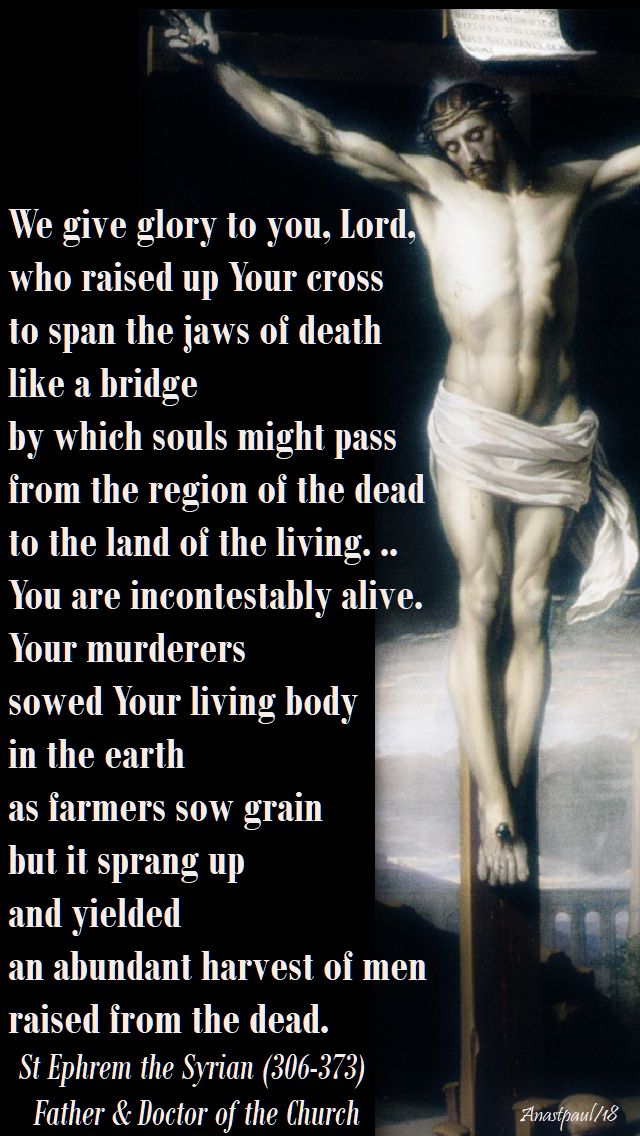
“We give glory to You, Lord, who raised up Your Cross to span the jaws of death like a bridge by which souls might pass from the region of the dead to the land of the living. .. You are incontestably alive. Your murderers sowed Your living body in the earth as farmers sow grain but it sprang up and yielded an abundant harvest of men raised from the dead.”
St Ephrem the Syrian (306-373) Father & Doctor of the Church
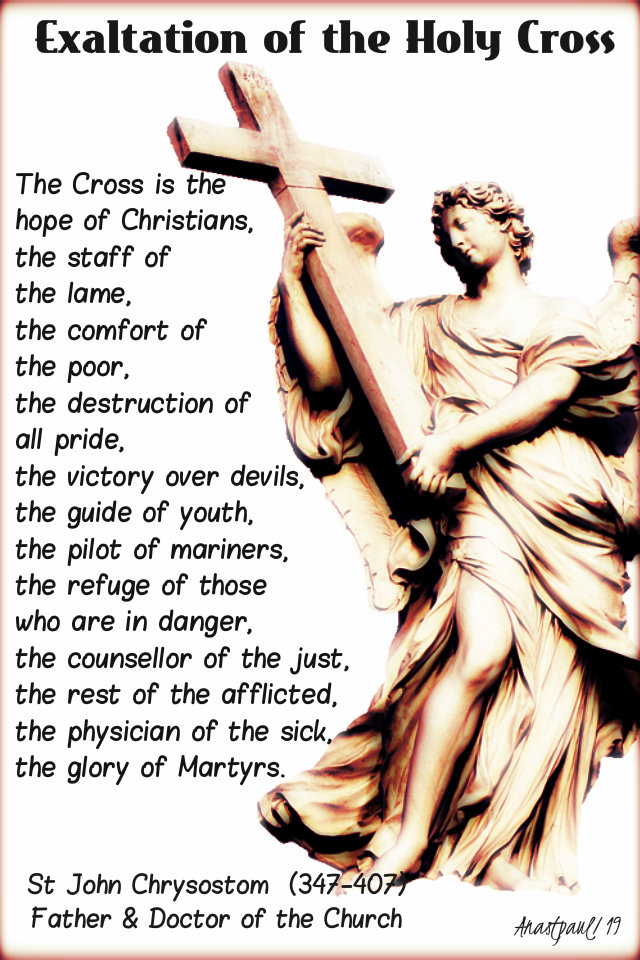
“The Cross is the hope of Christians, the staff of the lame, the comfort of the poor, the destruction of all pride, the victory over devils, the guide of youth, the pilot of mariners, the refuge of those who are in danger, the counsellor of the just, the rest of the afflicted, the physician of the sick, the glory of Martyrs.”
St John Chrysostom (347-407)
Father & Doctor of the Church
“Christ, who is your life, is hanging before you, so that you may look at the Cross, as in a mirror. There you will be able to know, how mortal were your wounds, that no medicine other than. the Blood of the Son of God, could heal. If you look closely, you will be able to realise, how great your human dignity and your value are…. Nowhere other than looking at himself, in the mirror of the Cross, can man better understand how much he is worth”
St Anthony of Padua OFM (1195-1231) Doctor of the Church
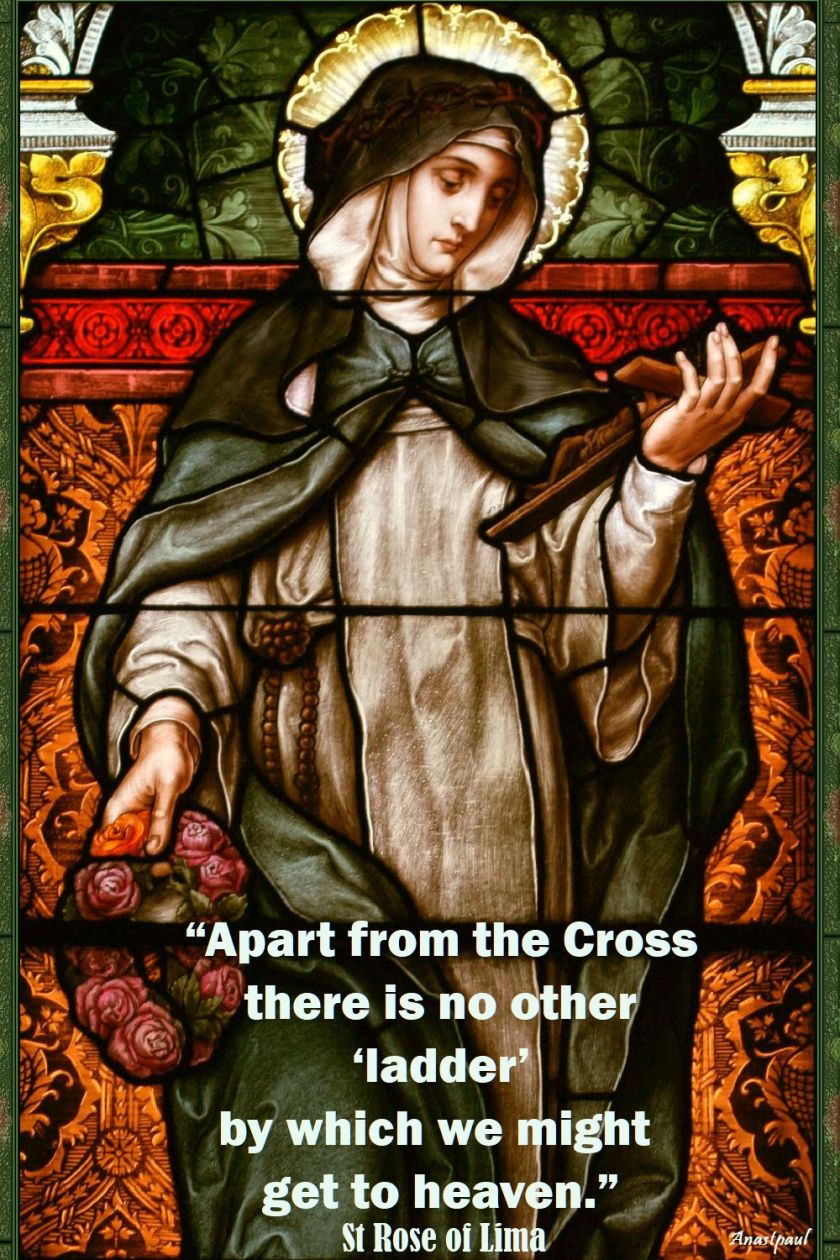
“Apart from the cross there is no other ladder by which we may get to heaven.“
St Rose of Lima (1586-1617)
We have always seen, that those who were closest to Christ our Lord, were those with the greatest trials. Let us look at what His glorious Mother suffered and the glorious apostles. Take up the Cross of Jesus. Help your Spouse to carry the burden that weighs Him down and pay no attention to what they may say about you. If you should happen to stumble and fall like your Spouse, do not withdraw from the Cross or abandon it. No matter how great your trials may be, you will see, that they are quite small, in comparison to His.
Blessed Teresa Maria of the Cross OCD (1846–1910)
“One ounce of a Cross is much better than a ton of books of prayer.”
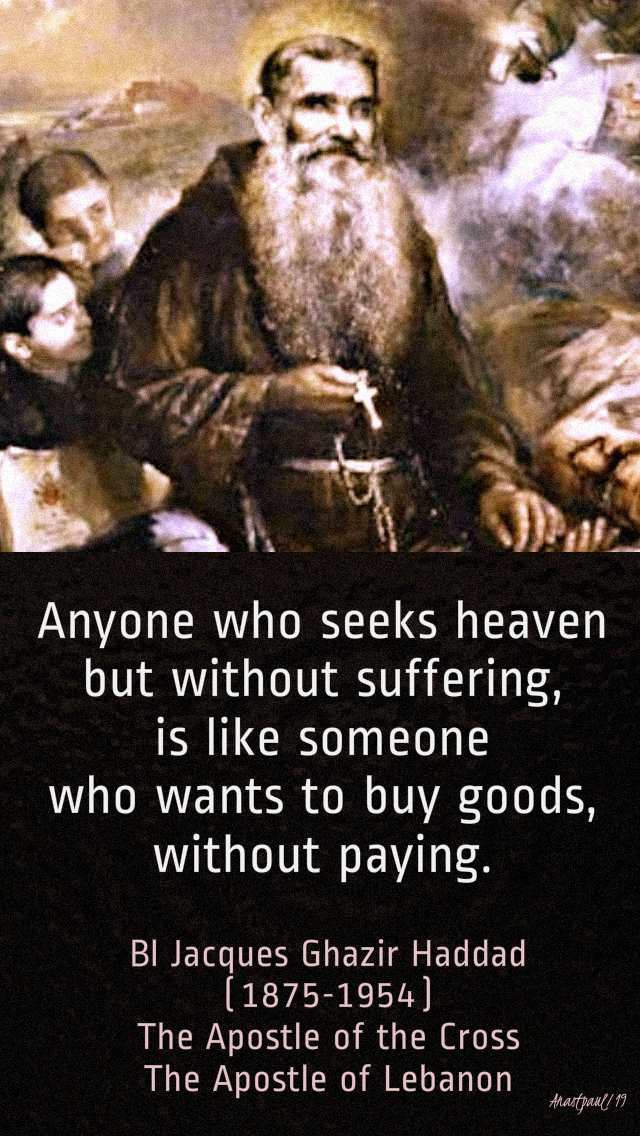
“Anyone who seeks heaven but without suffering, is like someone who wants to buy goods, without paying.”
Blessed Jacques Ghazir Haddad (1875-1954)
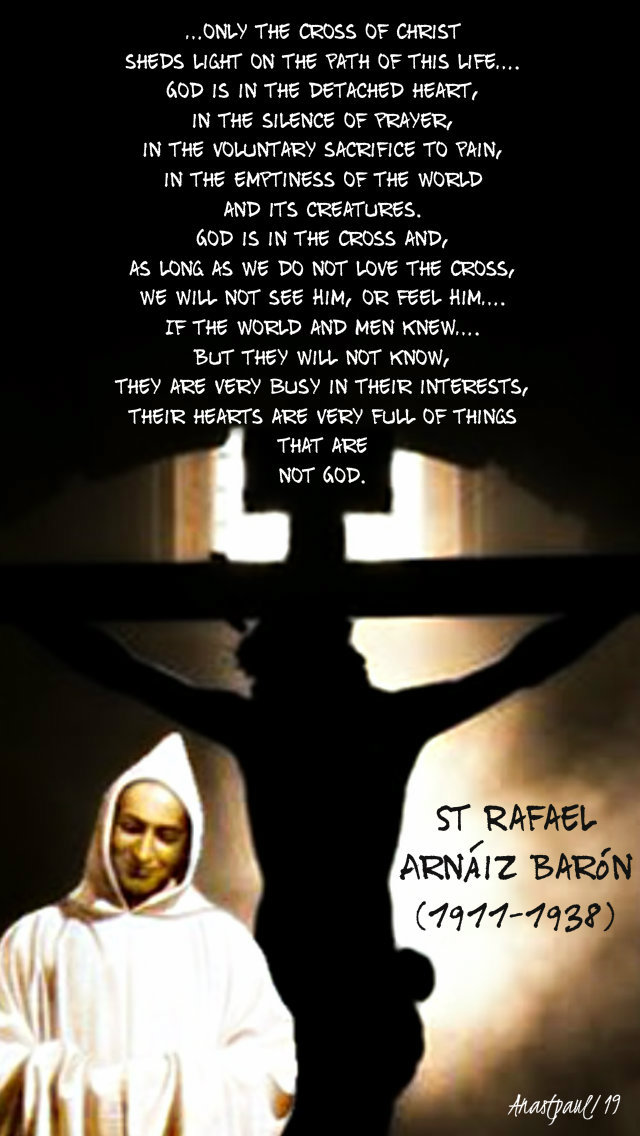
“…only the Cross of Christ sheds light on the path of this life…. God is in the detached heart, in the silence of prayer, in the voluntary sacrifice to pain, in the emptiness of the world and its creatures. God is in the Cross and, as long as we do not love the Cross, we will not see Him, or feel Him…. If the world and men knew…. But they will not know, they are very busy in their interests, their hearts are very full of things that are not God.”
St Rafael Arnáiz Barón (1911-1938)
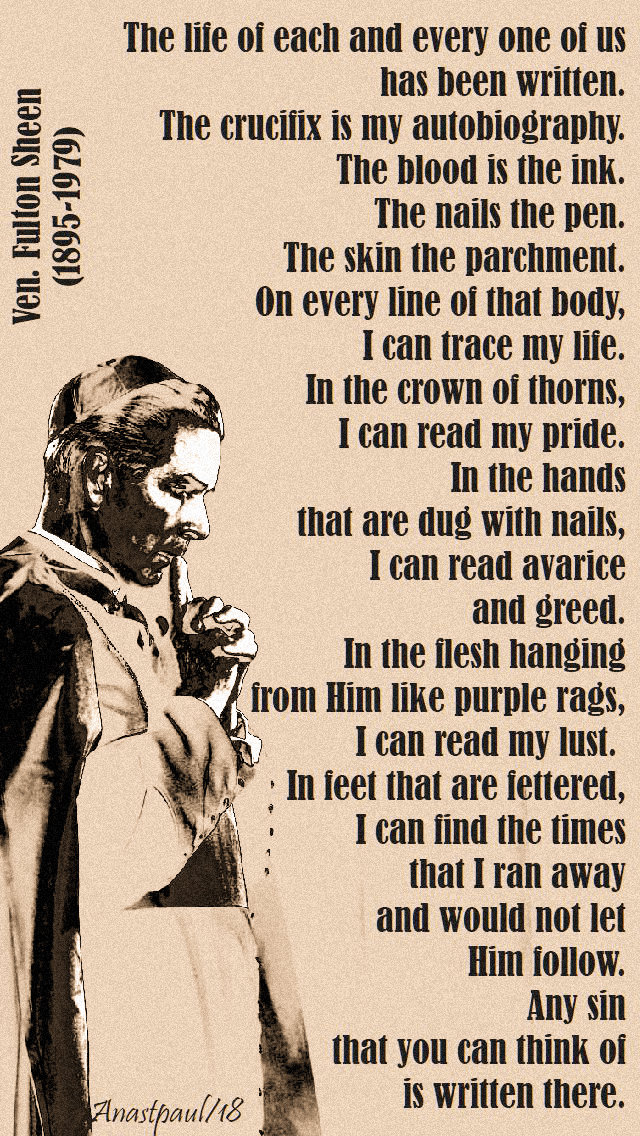
“The life of each and every one of us has been written. The crucifix is my autobiography. The blood is the ink. The nails the pen. The skin the parchment. On every line of that body, I can trace my life. In the crown of thorns I can read my pride.In the hands that are dug with nails, I can read avarice and greed. In the flesh hanging from him like purple rags, I can read my lust. In feet that are fettered, I can find the times that I ran away and would not let Him follow. Any sin that you can think of is written there.”
One Minute Reflection – 14 September – Feast of the Exaltation of the Holy Cross, Gospel: John 3:13–17
“…And as Moses lifted up the serpent in the wilderness, so must the Son of man be lifted up, that whoever believes in him may have eternal life.”…John 3:14-15
REFLECTION – “We are celebrating the feast of the cross which drove away darkness and brought in the light… Had there been no cross, Christ could not have been crucified. Had there been no cross, Life Itself could not have been nailed to the tree. And if Life had not been nailed to it, they would be no streams of immortality pouring from Christ’s side, blood and water for the world’s cleansing. The legal bond of our sin would not be cancelled, we should not have obtained our freedom, we should not have enjoyed the fruit of the tree of life and the gates of paradise would not stand open. Had there been no cross, death would not have been trodden underfoot, nor hell despoiled… The cross is called Christ’s glory, it is saluted as His triumph.”….St Andrew of Crete (650-740)
PRAYER – O God, who willed that Your Only Begotten Son should undergo the Cross to save the human race, grant, we pray, that we, who have known His mystery on earth, may merit the grace of His redemption in heaven. For You placed the salvation of the human race on the wood of the Cross, so that, where death arose, life might again spring forth and the evil one, who conquered on a tree, might likewise on a tree be conquered through Christ. O cross, You are the glorious sign of victory. Through your power may we share in the triumph of Christ Jesus. We adore you Christ and we praise you, for by your holy Cross you have redeemed the world. Amen
Our Morning Offering – 14 September – Feast The Exaltation of the Holy Cross – Feast and A Marian Saturday within the Month of Our Lady of Sorrows
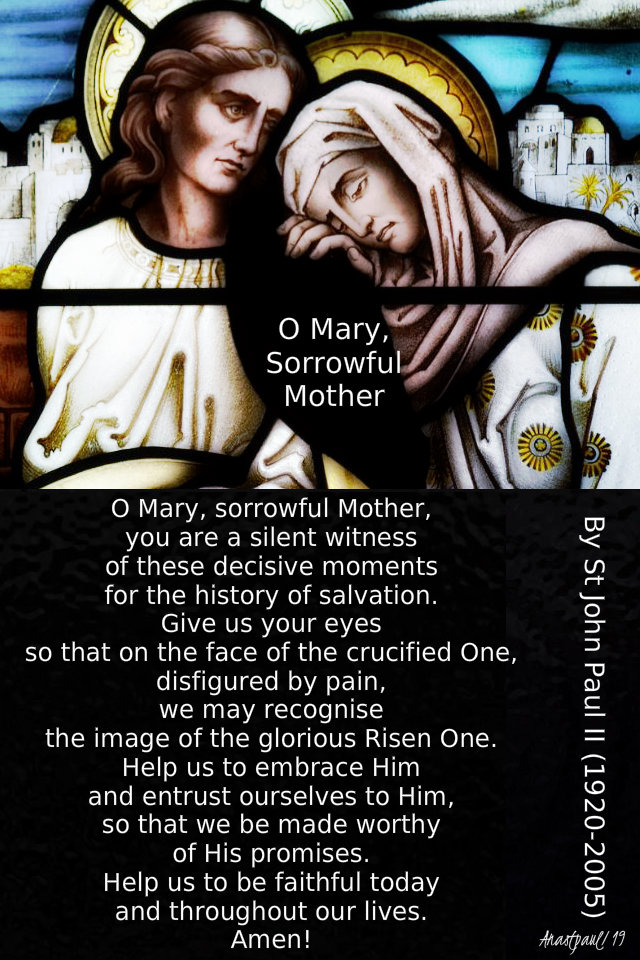
O Mary, Sorrowful Mother By St John Paul II (1920-2005)
O Mary, sorrowful Mother,
you are a silent witness
of these decisive moments
for the history of salvation.
Give us your eyes
so that on the face of the crucified One,
disfigured by pain,
we may recognise
the image of the glorious Risen One.
Help us to embrace Him
and entrust ourselves to Him,
so that we be made worthy
of His promises.
Help us to be faithful today
and throughout our lives.
Amen!
St Pope John Paul prayed this prayer on the Conclusion of the Palm Sunday homily, 13 April 2003 during the Eighteenth World Youth Day.
St Caerealis
Bl Claude Laplace
St Cormac of Cashel
St Crescentian of Carthage
St Crescentius of Rome
St Generalis of Carthage
St Giulia Crostarosa
St Jean Gabriel Taurin du Fresse
St Maternus of Cologne Saint Peter of Tarentaise O.Cist (1102-1174)
Bl Pedro Bruch Cotacáns
St Rosula of Carthage
St Sallustia
St Victor of Carthage
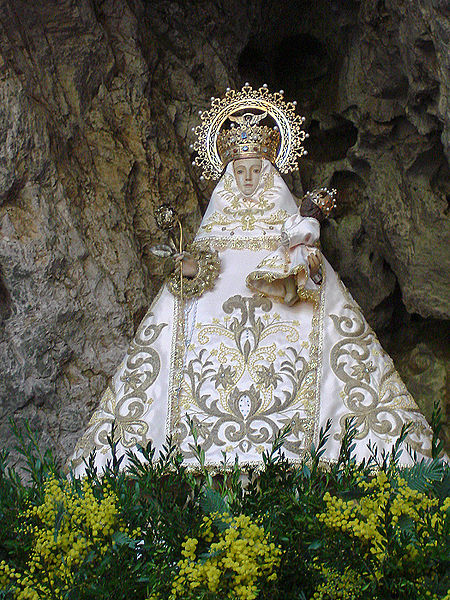
Our Lady of Covadonga: is a title of the Blessed Virgin Mary and the name of a Marian shrine devoted to her at Covadonga, Asturias. The shrine in northwestern Spain rose to prominence following the Battle of Covadonga in about 720, which was the first defeat of the Moors during their invasion of Spain. A statue of the Virgin Mary, secretly hidden in one of the caves, was believed to have miraculously aided the Christian victory.
Our Lady of Covadonga is the patron of Asturias, and a basilica was built to house the current statue. St Pope John Paul II visited the shrine to honour Our Lady of Covadonga to honour, whose feast day is 8 September.
Our Lady of Health of Vailankanni: This is the title given to the Blessed Virgin Mary by people as she twice appeared in the town of Velankanni, Tamil Nadu, India, in the 16th to 17th centuries. The Feast of the Nativity of Mary, is also commemorated as the feast of Our Lady of Good Health. The celebration starts on 29 August and ends on the day of the feast. The feast day prayers are said in Tamil, Marathi, East Indian, Malayalam, Telugu, Kannada, Konkani, Hindi and English.
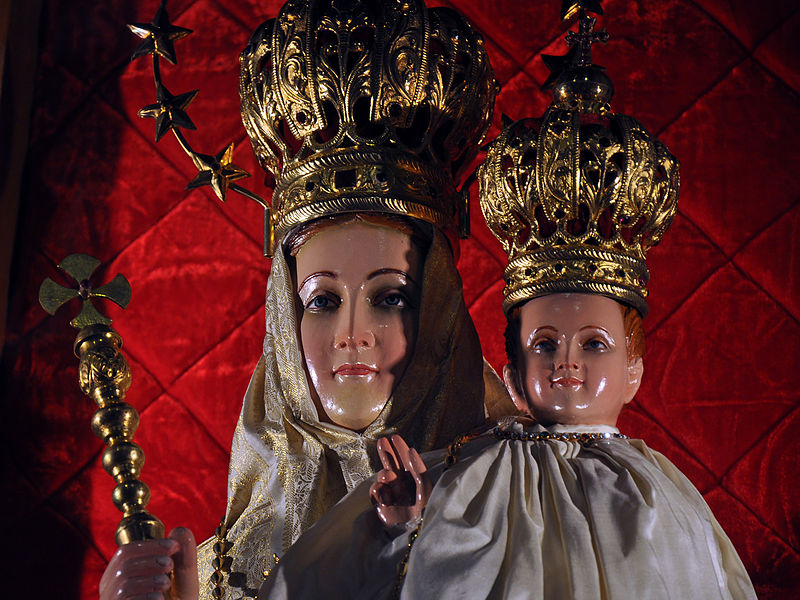
Our Lady of Meritxell: This is an Andorran Roman statue depicting an apparition of the Virgin Mary. Our Lady of Meritxell is the patron saint of Andorra. One 6 January in the late 12th century, villagers from Meritxell, Andorra were going to Mass in Canillo. Though it was winter, they found a wild rose in bloom by the roadside. At its base was a statue of the Virgin and Child. They placed the statue in a chapel in the church in Canillo. The next day the statue was found sitting under the wild rose again. Villagers from Encamp took the statue to their church but the next day the statue had returned to the rose bush. Though it was snowing, an area the size of a chapel was completely bare and the villagers of Meritxell took this to mean that they should build a chapel to house the statue and so they did. On 8-9 September 1972 the chapel burned down and the statue was destroyed, a copy now resides in the new Meritxell Chapel.
The feast day of Our Lady of Meritxell is 8 September and the Andorran National Day.
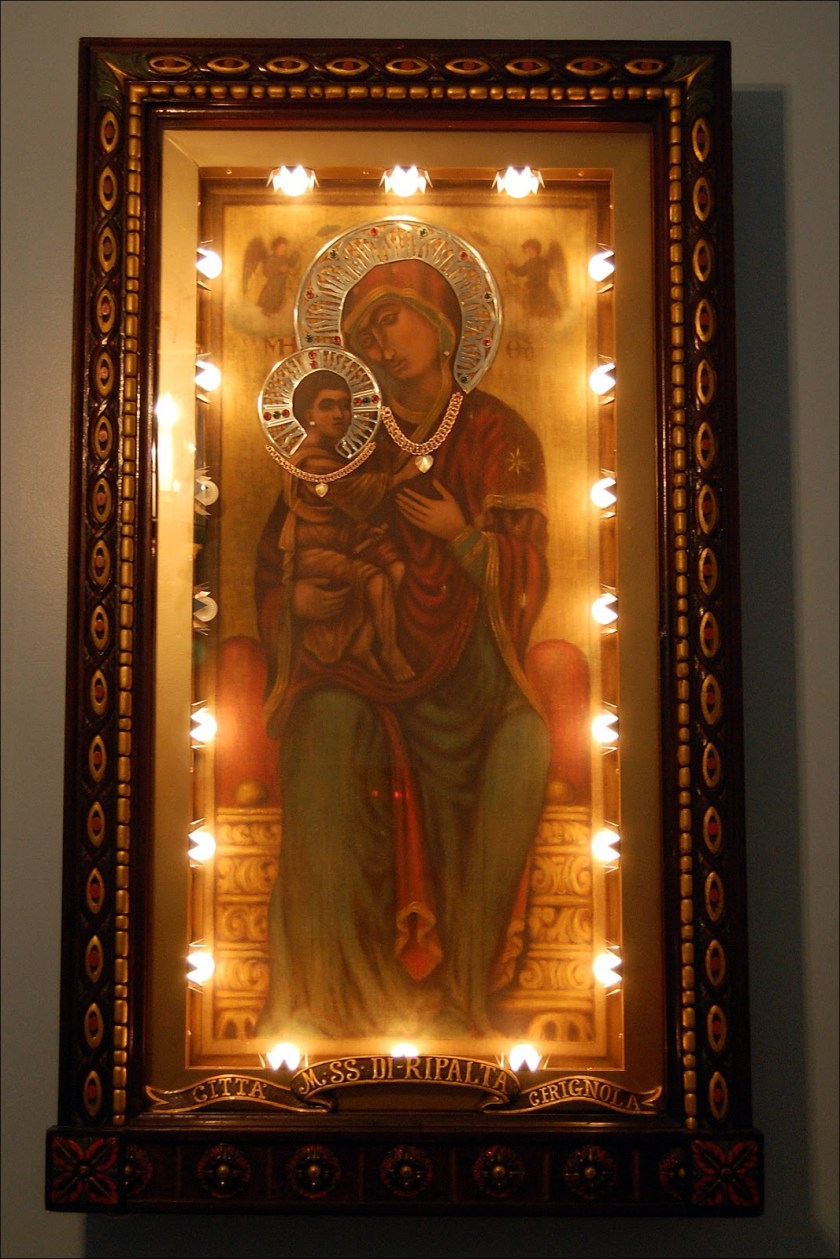
Our Lady of Ripalta: Patroness of Cerignola, Foggia in Puglia.
___
St Adam Bargielski
St Adela of Messines
Bl Alanus de Rupe
St Corbinian
St Disibod of Disenberg
St Ethelburgh of Kent
St Faustus of Antioch
St Isaac the Great
St István Pongrácz
St Kingsmark
St Peter of Chavanon
Bl Seraphina Sforza
St Pope Sergius I
St Timothy of Antioch
Bl Wladyslaw Bladzinski
—
Martyrs of Alexandria – (5 saints)
A group of Christians martyred together in the persecutions of Diocletian – Ammon, Dio, Faustus, Neoterius and Theophilus. Martyred in Alexandria, Egypt.
Martyrs of Japan – (21 beati):
A group of 21 missionaries and converts who were executed together for their faith.
• Antonio of Saint Bonaventure
• Antonio of Saint Dominic
• Dominicus Nihachi
• Dominicus of Saint Francis
• Dominicus Tomachi
• Francisco Castellet Vinale
• Franciscus Nihachi
• Ioannes Imamura
• Ioannes Tomachi
• Laurentius Yamada
• Leo Aibara
• Lucia Ludovica
• Ludovicus Nihachi
• Matthaeus Alvarez Anjin
• Michaël Tomachi
• Michaël Yamada Kasahashi
• Paulus Aibara Sandayu
• Paulus Tomachi
• Romanus Aibara
• Thomas of Saint Hyacinth
• Thomas Tomachi
Died on 8 September 1628 in Nagasaki, Japan
Beatified on 7 May 1867 by Pope Pius XI
Martyred in England:
Bl John Norton
Bl Thomas Palaser
Martyred in the Spanish Civil War:
• Blessed Adrián Saiz y Saiz
• Blessed Apolonia Lizárraga Ochoa de Zabalegui
• Blessed Bonifacio Rodríguez González
• Blessed Dolores Puig Bonany
• Blessed Eusebio Alonso Uyarra
• Blessed Ismael Escrihuela Esteve
• Blessed Josefa Ruano García
• Blessed Josep Padrell Navarro
• Blessed Mamerto Carchano y Carchano
• Blessed Marino Blanes Giner
• Blessed Miguel Beato Sánchez
• Blessed Pascual Fortuño Almela
• Blessed Segimon Sagalés Vilá
• Blessed Tomàs Capdevila Miquel
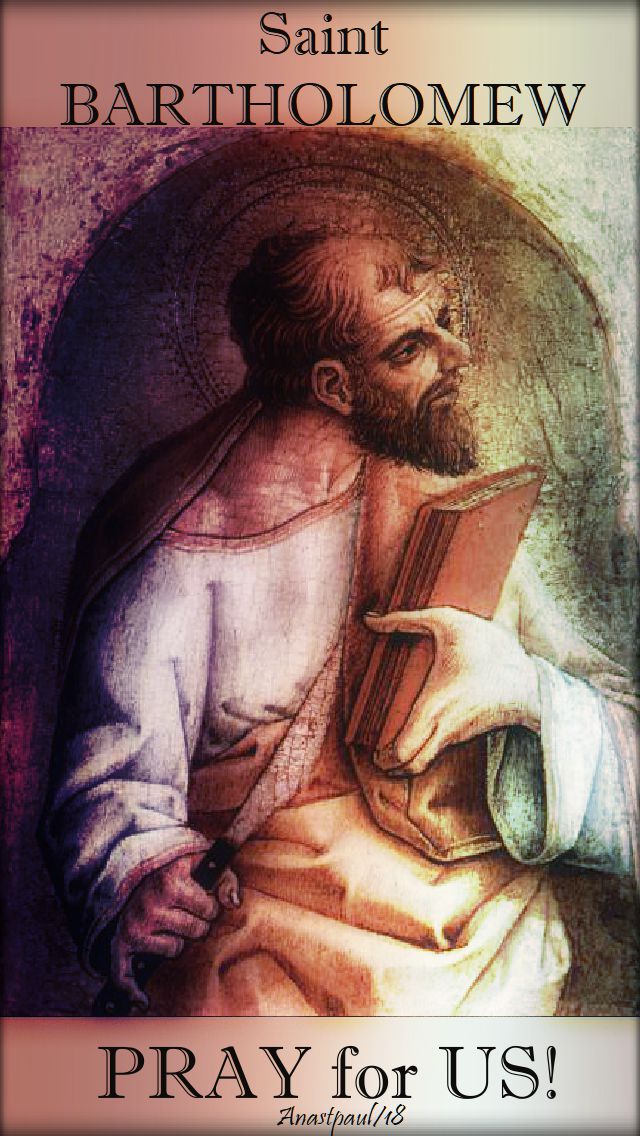
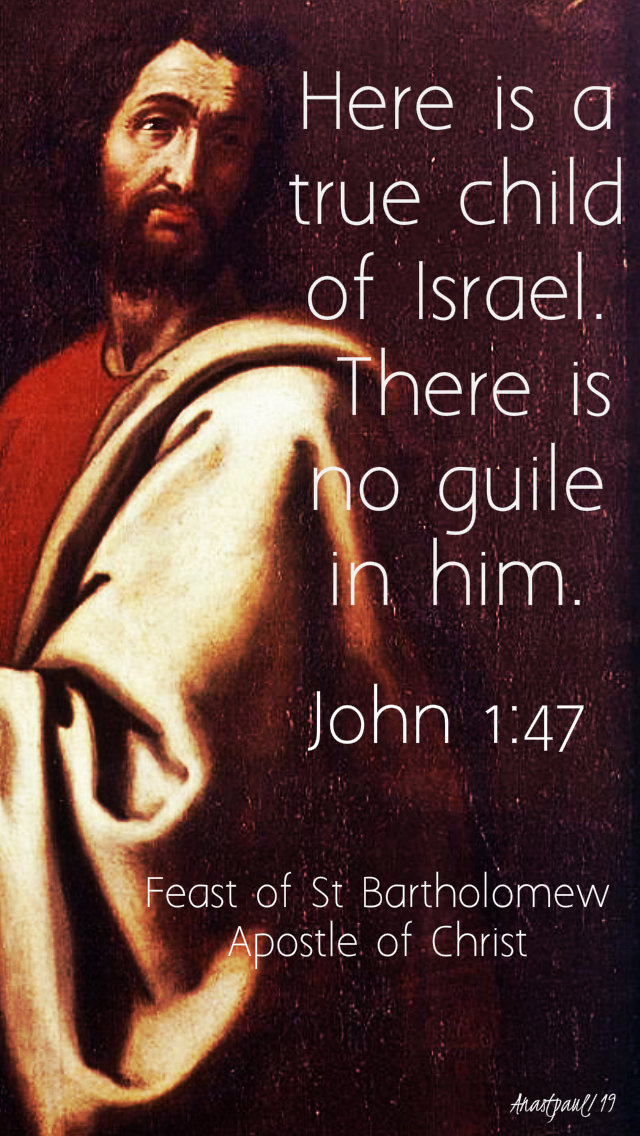
Thought for the Day – 24 August – The Feast of St Bartholomew, Apostle of Christ – Today’s Gospel: John 1:45–51
The name “Nathanael” means “God has given”
“The apostles’ glory is so indistinguishable and so bonded together by the cement of so many graces that in celebrating the feast of one of them the common greatness of all is called to our interior attention. For they share together the same authority of supreme judge, the same honourable rank and they hold the same power to bind and loose (Mt 19:28; 18:18). They are those precious pearls that Saint John tells us he beheld in the Book of Revelation out of which are constructed the gates of the heavenly Jerusalem (Rv 21:21.14)… And indeed, whenever the apostles beam divine light through their signs or miracles, they open up the heavenly glory of Jerusalem, to all those peoples who have been converted to the christian faith…
Of them, too, the prophet says: “Who are these who fly along like clouds?” (Is 60:8)… God raises the minds of His preachers to contemplation of truths on high… so that they can abundantly pour down the rain of God’s word into our hearts. Thus they drink water from the spring, so as to give drink to us too.
Saint Bartholomew drew from the fullness of this spring, when the Holy Spirit came upon him, as on the other apostles, in the form of tongues of fire (Acts 2:3).”
St Peter Damian (1007-1072) – Bishop, Doctor of the Church (Sermon 42, 2nd for Saint Bartholomew, PL 144, 726)
One Minute Reflection – 24 August – The Feast of St Bartholomew, Apostle of Christ – Today’s Gospel: John 1:45–51
Philip said to him, “Come and see.” … John 1:46
REFLECTION – “Nathanael’s reaction suggests another thought to us – in our relationship with Jesus we must not be satisfied with words alone. In his answer, Philip offers Nathanael a meaningful invitation: “Come and see!” (Jn 1: 46). Our knowledge of Jesus needs above all a first-hand experience – someone else’s testimony is, of course important, for normally the whole of our Christian life begins with the proclamation handed down to us by one or more witnesse, but afterwards, we, ourselves, have to become personally committed, in a deep and intimate relationship with Jesus.” … Pope Benedict XVI – General Audience, 4 November 2006
PRAYER – Almighty Lord and Father, strengthen in us that faith with which St Bartholomew gave himself wholeheartedly to Christ Your Son. Grant, at his intercession, that Your Church may become the Sacrament of salvation, for all the nations of the earth. We make our prayer through Jesus, our Lord and Christ, in the unity of the Holy Spirit, one God, forever, amen.
=========================
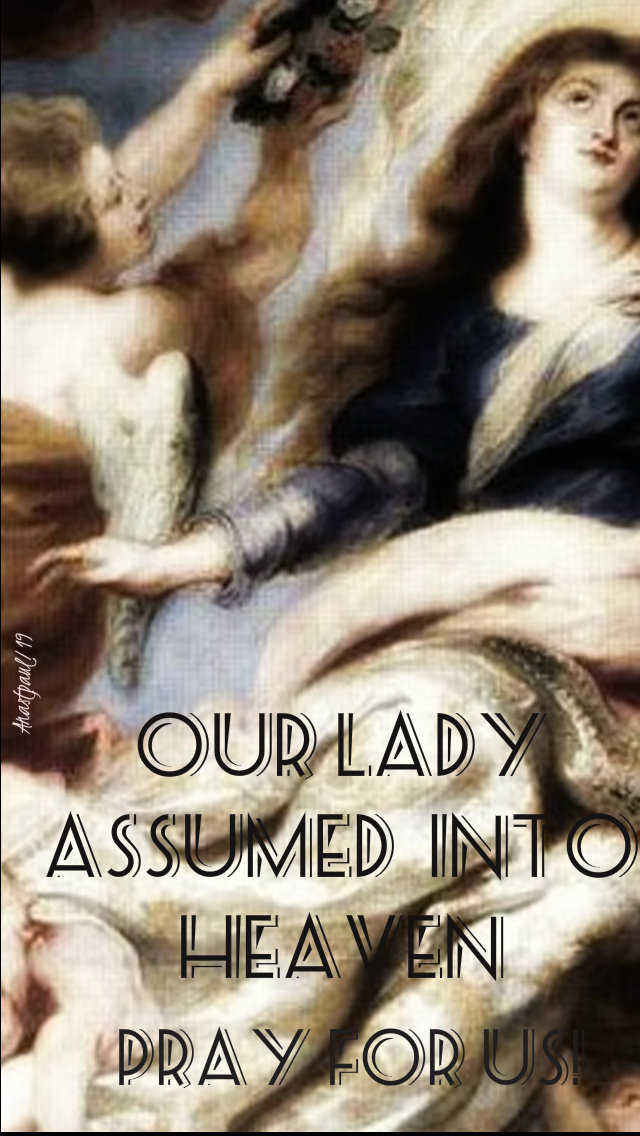
Thought for the Day – 15 August – Solemnity of the Assumption of the Blessed Virgin Mary into Heaven
You have Borne for us the Clothing of Immortality
Saint John Damascene (675-749)
Priest and Father and Doctor of the Church
An excerpt from his Homily 9 – On the Dormition of the Blessed Virgin Mary
“Once indeed God ejected the mortals and first parents of the human race from the paradise of Eden, when they had drunk deeply, from the wine of disobedience and had become so affected by the hangover of sin, through the intoxication of that transgression, which led to the sleepiness of the mind’s eye. Now, however, shall not paradise receive her who repelled the onslaught of all sin, producing the seed of obedience to God and Father and bringing forth life, for all races of mortal men? How can death devour this truly blessed woman, who gave birth to the whole person of the Word of God through union with God? How can hell receive her? When Christ, who is the way and the truth, said Where I am, there will my servant be also, why would there not be a dwelling for His own mother with Him with an even greater justification? It is well said that precious in the sight of the Lord God of Hosts, is the death of His saints but even more precious, is the passing of the Mother of God from this life.
Then Adam and Eve, the founders of our race, exclaimed with a loud voice in great rejoicing: “Blessed are you, O daughter, who bore for us the penalties of the commands that had been broken. When you had gained a mortal body from us, you gave birth to a covering of immortality for us. You repaid us so that it might be well with us, since you received birth from our loins. From beyond the grave you have called us back to our ancient seat, we closed paradise for ourselves but you made open the way of the tree of life. Through our actions, sadness came forth from happiness, through you even more joyful things have returned from sorrow. In what possible way could you be acceptable to death, O Immaculate one? You are the bridge of life and the ladder to heaven, you are a boat over the sea of death reaching to immortality.”
But the woman herself, as she did not shrink from the truth, said: “Into Your hands, my Son, I commend my spirit. Receive this soul which is dear to You, which You have preserved free from any sin. I hand over my body, not to the earth but to You. Take me to Yourself, that where You are, You, the child of my womb, so there I also may be Your companion. I am hastening to You, who have often come to me on this side of that long distance.”
When she had said this, she heard in reply: “Come to my rest, my blessed Mother, arise, come, my beloved, most blessed among all women. Behold, the winter is ended. You are all fair, my beloved and there is no spot of stain found in you, the odour of your ointments are more precious than all other aromas.”
++++++++++
There is an invocation in a Litany to Our Lord in which we ask: ut ad celestia desideria erigas, te rogamus, audi nos – that our souls be raised to the desire for celestial things, we pray Thee, hear us. This invocation should be the conclusion of our meditation on the Assumption of Our Lady. We should ask, that we may love the celestial happiness of Our Lady, to give her glory and that we may one day be with her in Paradise. We should also love and meditate on her joys, as a way to accept with peace and resignation the sorrows and sufferings God sends us, so that we might prove our love for Him.
Quote of the Day – 15 August – Solemnity of the Assumption of the Blessed Virgin Mary into Heaven
“In the bodily and spiritual glory which she possesses in heaven, the Mother of Jesus, continues in this present world as the image and first flowering of the Church, as she is to be perfected in the world to come. Likewise, Mary shines forth on earth, until the day of the Lord shall come (cf 2 Peter 3:10), as a sign of certain hope and comfort for the pilgrim People of God.”
Lumen Gentium
Dogmatic Constitution on the Church #68.
“While she lived on this earth she could only be close to a few people. Being in God, who is close to us, actually, “within” all of us, Mary shares in this closeness of God. Being in God and with God, she is close to each one of us, knows our hearts, can hear our prayers, can help us with her motherly kindness and has been given to us, as the Lord said, precisely as a “mother” to whom we can turn at every moment.”
Pope Benedict XVI
“As soon as we apprehend by faith, the great fundamental truth, that Mary is the Mother of God, other wonderful truths follow in its train and one of these, is that, she was exempt from the ordinary lot of mortals, which is not only to die but to become earth to earth, ashes to ashes, dust to dust.”
One Minute Reflection – 15 August – Solemnity of the Assumption of the Blessed Virgin Mary into Heaven, Gospel: Luke 1:39–56
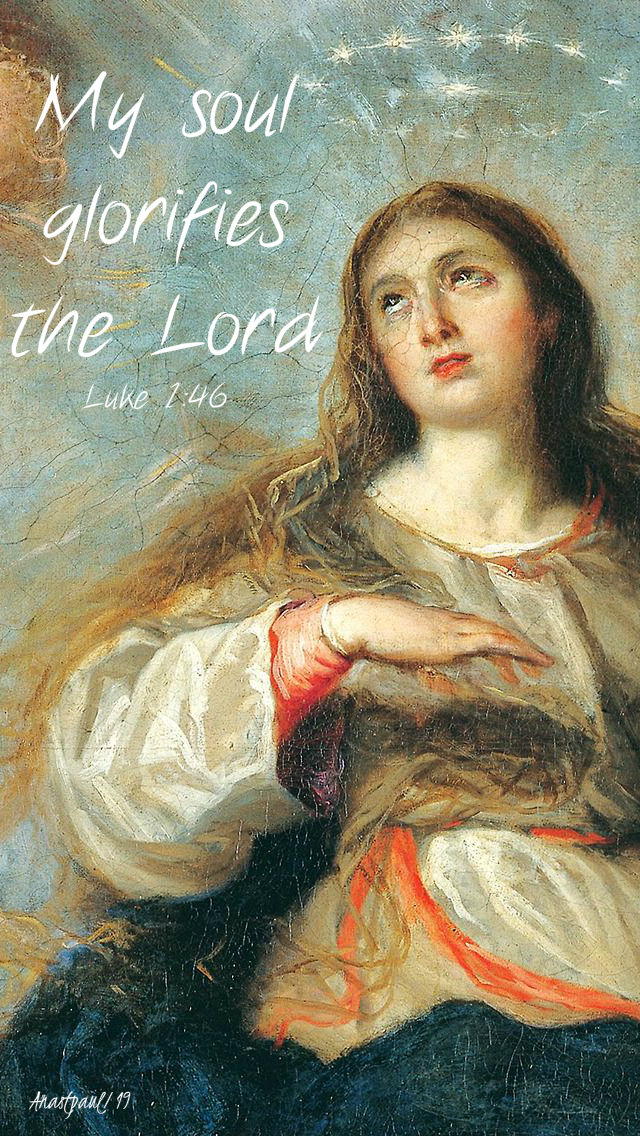
My soul glorifies the Lord ... Luke 1:46
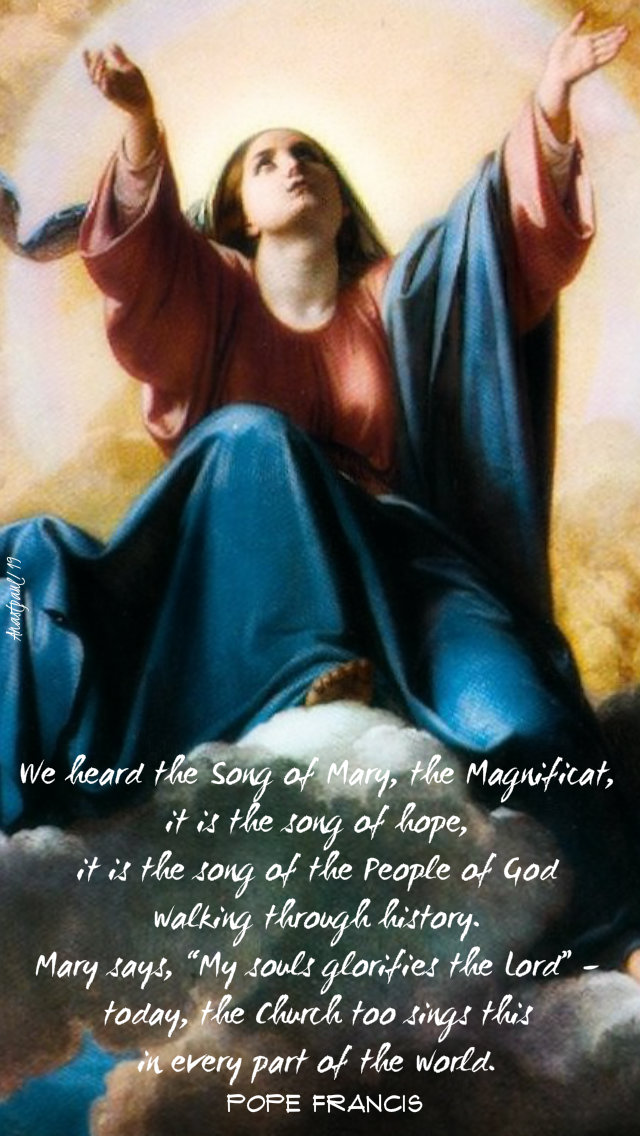
REFLECTION – “We heard the Song of Mary, the Magnificat – it is the song of hope, it is the song of the People of God walking through history. It is the song many saints, men and women, some famous and very many others unknown to us but known to God, mums, dads, catechists, missionaries, priests, sisters, young people, even children and grandparents – these have faced the struggle of life while carrying in their heart the hope of the little and the humble. Mary says, “My souls glorifies the Lord” – today, the Church too sings this in every part of the world.” … Pope Francis (Holy Mass on the Solemnity of the Assumption of the Blessed Virgin Mary, 15 August 2013)
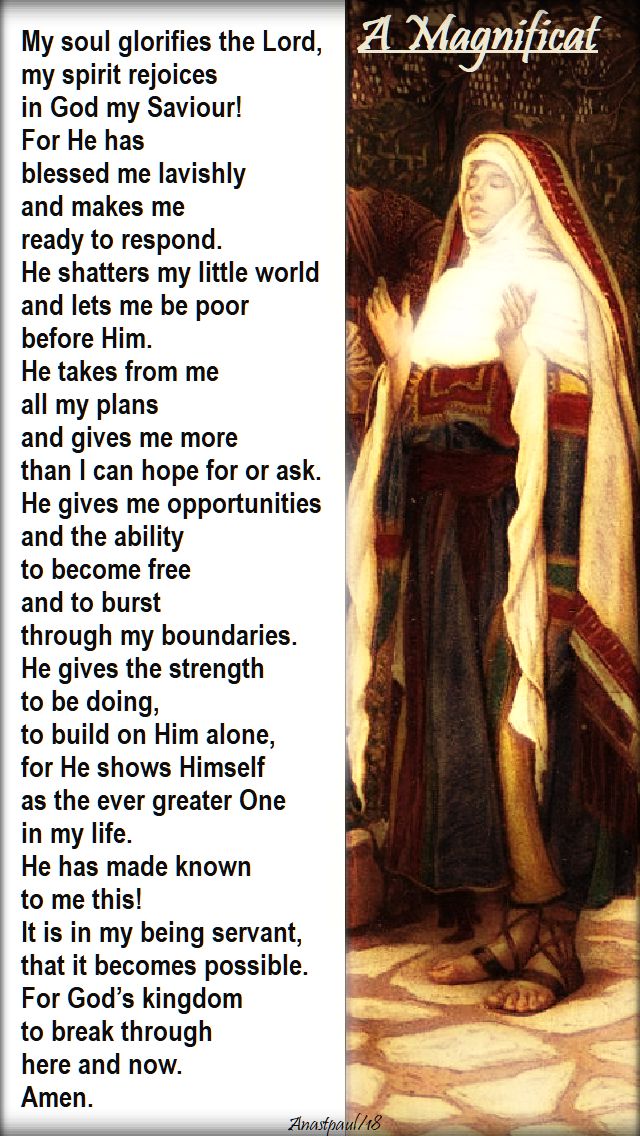
PRAYER – My soul glorifies the Lord,
my spirit rejoices in God my Saviour!
For He has blessed me lavishly
and makes me ready to respond.
He shatters my little world
and lets me be poor before Him.
He takes from me all my plans
and gives me more than I can hope for or ask.
He gives me opportunities
and the ability to become free
and to burst through my boundaries.
He gives the strength to be doing,
to build on Him alone,
for He shows Himself
as the ever greater One in my life.
He has made known to me this!
It is in my being servant that it becomes possible.
For God’s kingdom to break through
here and now.
Amen. A Magnificat Translated from the German by Olga Warnke of the Institute of the Blessed Virgin Mary
Our Morning Offering – 15 August – Solemnity of the Assumption of the Blessed Virgin Mary into Heaven
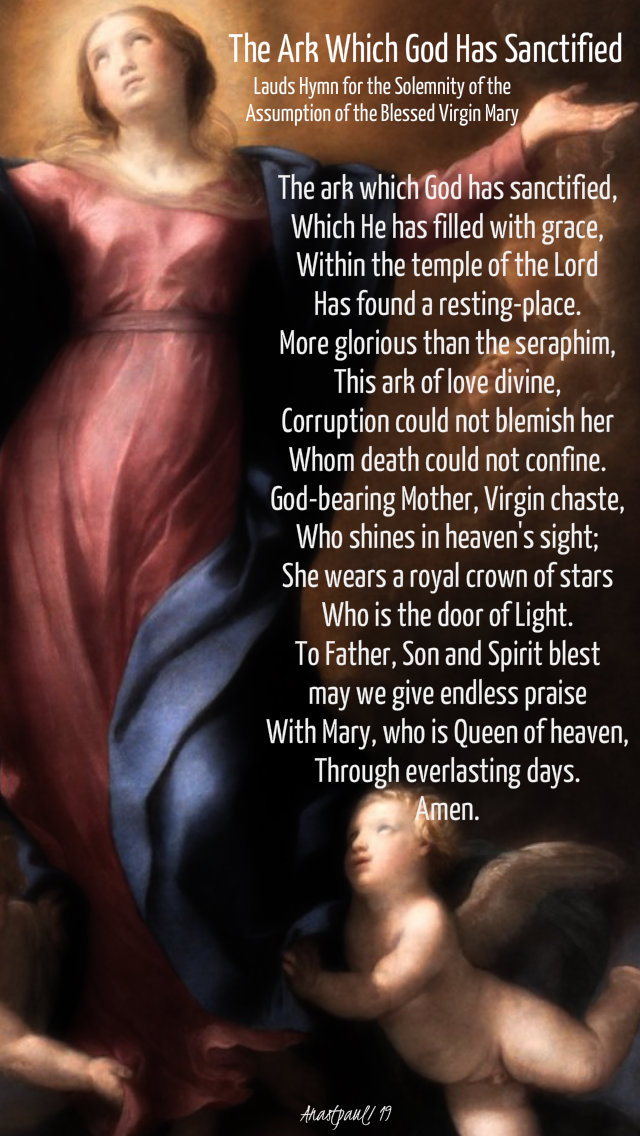
The Ark Which God Has Sanctified
The ark which God has sanctified,
Which He has filled with grace,
Within the temple of the Lord
Has found a resting-place.
More glorious than the seraphim,
This ark of love divine,
Corruption could not blemish her
Whom death could not confine.
God-bearing Mother, Virgin chaste,
Who shines in heaven’s sight;
She wears a royal crown of stars
Who is the door of Light.
To Father, Son and Spirit blest
may we give endless praise
With Mary, who is Queen of heaven,
Through everlasting days.
Amen.
The Ark Which God Has Sanctified is written by the Benedictine Nuns of Stanbrook Abbey. In the Divine Office (1974) it is sung with Morning Prayer on 15 August, the Solemnity of the Assumption of the Blessed Virgin Mary. It is set to the 1836 tune – St Peter (Reinagle) by Alexander Robert Reinagle (1799-1877).
Solemnity of the Assumption of the Blessed Virgin Mary (in the US, however, in most countries of Africa, the Solemnity will celebrated on the Sunday following the 15th). The feast celebrates the assumption of the body of the Blessed Virgin Mary into heaven upon her death. According to Pope Benedict XIV, it is a probable opinion, which it is impious to deny, though not an article of faith but has since in 1950 has been raised to a DOGMA of the Faith. The origin of the feast day is not known but it was celebrated in Palestine before the year 500. It is a holy day of obligation, its vigil being a fast day, in many English-speaking countries. Among the many masters who have painted the subject of the Assumption are Fra Angelico, Ghirlandajo, Rubens, Del Sarto and Titian.
Patronages: Acadians, Cajuns, Cistercian Order, Cistercians, fish dealers, fish-mongers, French air crews, harness makers, France, Guatemala, India, Jamaica, Malta, Paraguay, Slovakia, east Africa (region of east Africa which includes diverse countries, proclaimed on 15 March 1952 by Pope Pius XII) South Africa (this is not a region but a country) and the Assumption is, therefore, the Patronal Feast of the Country of South Africa – proclaimed on 15 March 1952 by Pope Pius XII), 24 dioceses, 38 cities.
St Alipius of Tagaste
Bl Alfred of Hildesheim
Bl Agustín Hurtado Soler
St Arduinus of Rimini
Bl Claudio Granzotto
Bl George Halley Bl Isidore Bakanja (c 1887-1909) Martyr
St Napoleon of Alexandria
Bl Pio Alberto del Corona St Simplician (c 320-c 401) Bishop and Successor of St Ambrose (340-397) Doctor of the Church in the Archdiocese of Milan. Details of the life of St Simplician here:https://anastpaul.wordpress.com/2017/08/15/saint-of-the-day-15-august-st-simplician-of-milan/ St Tarcisius (3rd century) Martyr About St Tarcisius:
Martyrs of Nicomedia – 3 saints: Three Christians martyred together. No details survive but the names – Eutychian, Philip and Straton. They were martyred in Nicomedia, Bithynia (in modern Turkey).
Martyred in the Mexican Revolution: 4 Saints –
St David Roldán Lara
St Luis Batiz Sainz
St Manuel Moralez
St Salvador Lara Puente
Martyred in the Spanish Civil War: Thousands of people were murdered in the anti-Catholic persecutions of the Spanish Civil War from 1934 to 1939.
• Blessed Agustì Ibarra Angüela
• Blessed Carmelo Sastre y Sastre
• Blessed Clemente Vea Balaguer
• Blessed Francisco Míguez Fernández
• Blessed Ildefonso Alberto Flos
• Blessed Jaume Bonet Nadal
• Blessed Joan Ceró Cedó
• Blessed Josep Santonja Pinsach
• Blessed Juan Francisco Barahona Martín
• Blessed Juan Mesonero Huerta
• Blessed Luis Ros Ezcurra
• Blessed Manuel Formigo Giráldez
• Blessed Miguel Alberto Flos
• Blessed Sebastià Balcells Tonijuan
• Blessed Severiano Montes Fernández
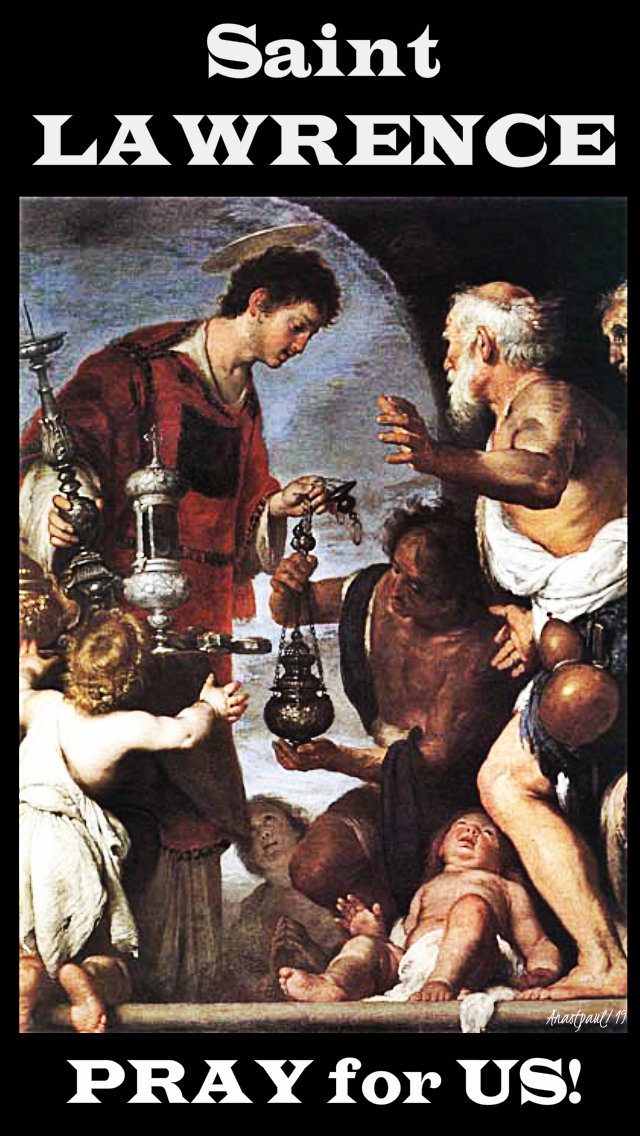
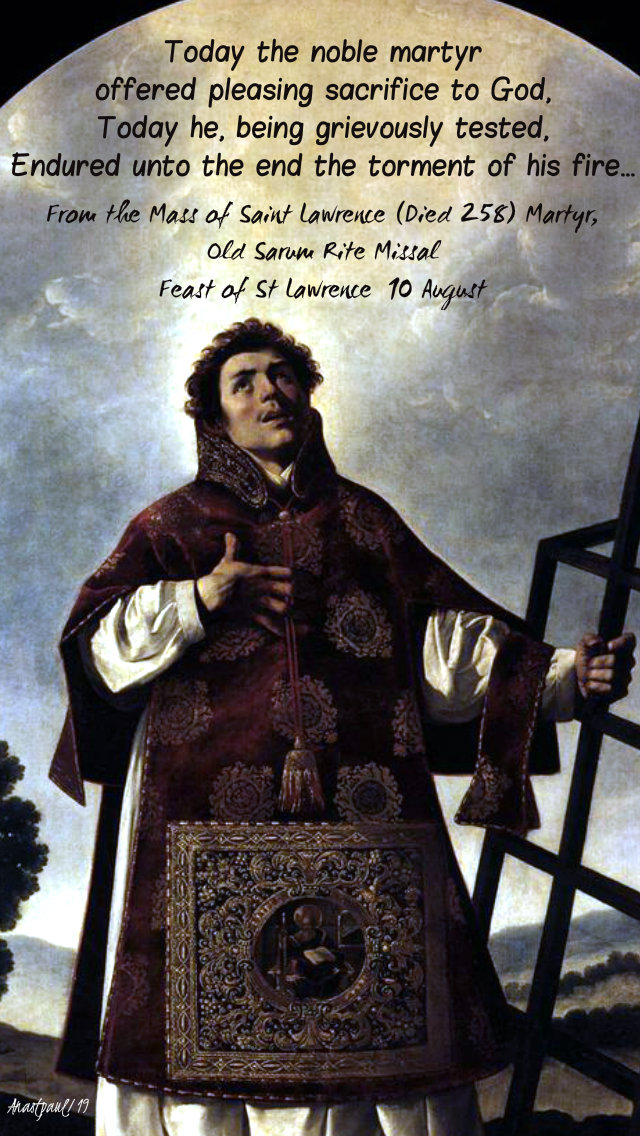
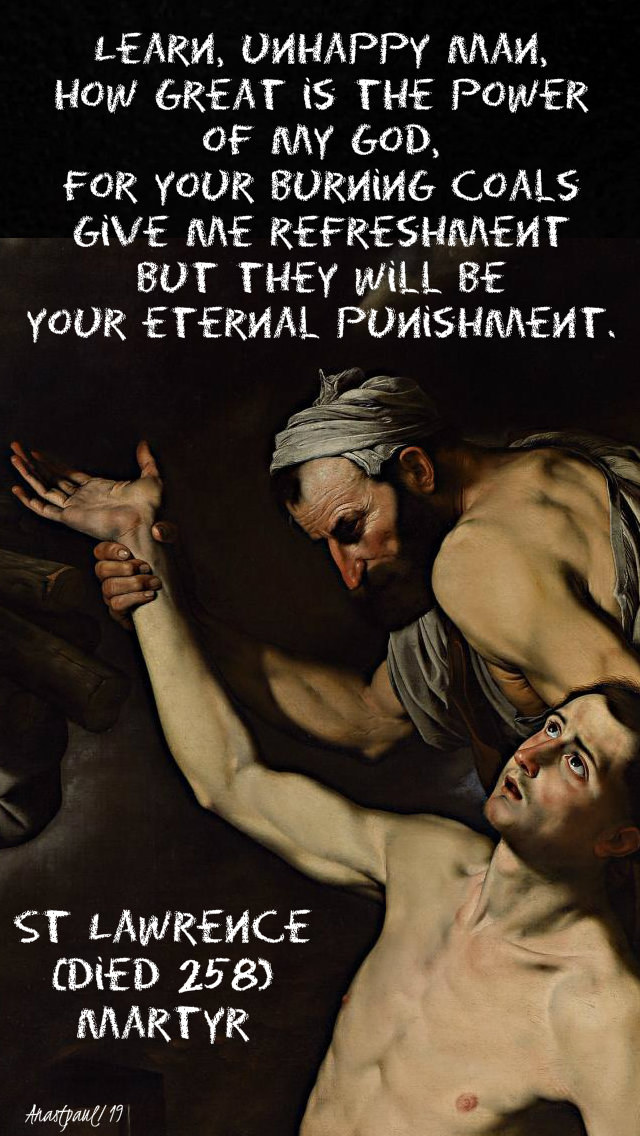
Thought for the Day – 10 August – Feast of St Lawrence, Martyr (Died 258)
When the archdeacon returned, instead of bringing vessels of gold and silver, he brought the poor of the city, saying, “Behold, these choice pearls, these sparkling gems that adorn the temple, these sacred virgins, I mean, and these widows who refuse second marriage…. Behold then, all our riches.”
“Come. You have my Father’s blessing! Inherit the kingdom prepared for you”
The faithful watched there for three days to mourn their holy Archdeacon who had been so good to them. God, by the glory of this holy martyr, demonstrates the value He sets upon love for the poor. Innumerable prayers were offered at his tomb. Saint Lawrence continued from his throne in heaven his charity to those in need, granting them, as Saint Augustine says, the smaller graces which they sought, and leading them to the desire of better gifts.
Our Lord appears before us in the persons of the poor. Charity to them is a great sign of predestination. It is almost impossible, the holy Fathers assure us, for any one who is charitable to the poor, above all for Christ’s sake, to perish.
St Agathonica of Carthage
St Agilberta of Jouarre Bl Amadeus of Portugal O.F.M. (1420–1482) Biography: https://anastpaul.com/2018/08/10/saint-of-the-day-blessed-amadeus-of-portugal-o-f-m-1420-1482/
St Aredius of Lyon
St Asteria of Bergamo
Bl Augustine Ota
St Bassa of Carthage
St Bessus
St Bettelin St Blane (Died 590)
Bl Claude-Joseph Jouffret de Bonnefont
St Deusdedit the Cobbler
Bl Edward Grzymala
Bl Franciszek Drzewiecki
Bl Francois François
St Gerontius
Bl Hugh of Montaigu
Bl Lazare Tiersot
St Paula of Carthage
St Thiento of Wessobrunn
—
Martyrs of Alexandria – 260+ saints: A large number of Christians who died in Alexandria, Egypt between 260 and 267 in the persecutions of Decius and Valerian, whose names have not come down to us and who are commemorated together.
Martyrs of Rome – 165 saints: Group of 165 Christians martyred in the persecutions of Aurelian. 274 in Rome, Italy.
Martyred in the Spanish Civil War:
• Blessed Antonio González Penín
• Blessed José Toledo Pellicer
• Blessed José Xavier Gorosterratzu Jaunarena
• Blessed Juan Martorell Soria
• Blessed Pedro Mesonero Rodríguez
• Blessed Victoriano Calvo Lozano
Thought for the Day – 6 August – Feast of the Transfiguration of the Lord – Today’s Gospel: Luke 9:28b-36
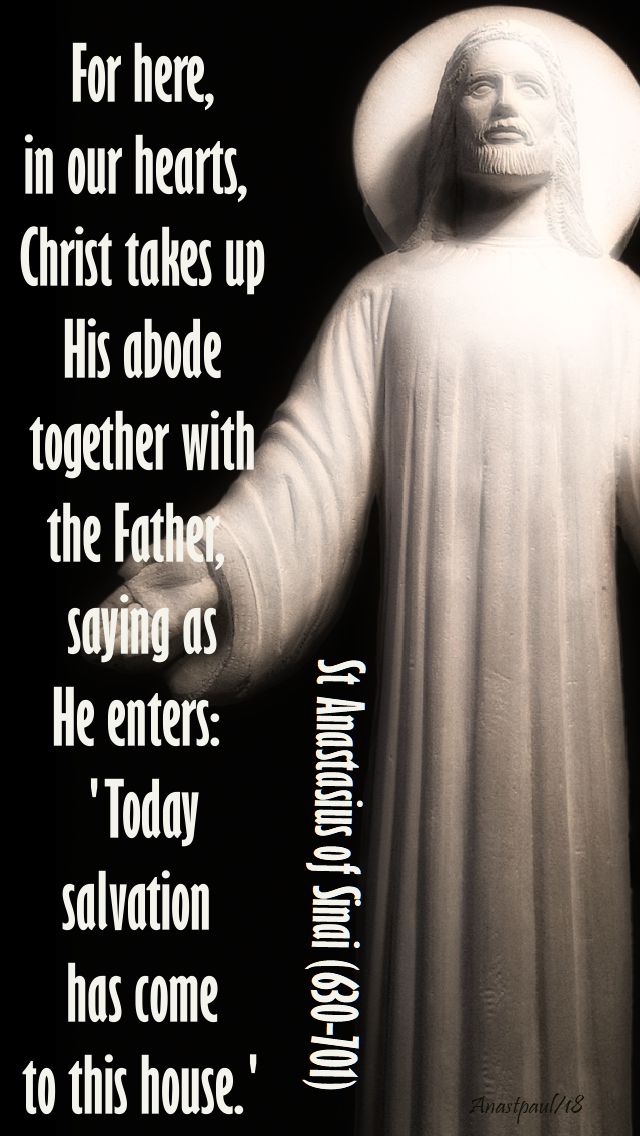
It is indeed good to be here, as you have said, Peter. It is good to be with Jesus and to remain here forever. What greater happiness or higher honour could we have than to be with God, to be made like Him and to live in His light?
Therefore, since each of us possesses God in his heart and is being transformed into His divine image, we also should cry out with joy: It is good for us to be here – here where all things shine with divine radiance, where there is joy and gladness and exultation, where there is nothing in our hearts but peace, serenity and stillness, where God is seen.
For here, in our hearts, Christ takes up His abode together with the Father, saying as
He enters – Today salvation has come to this house.
With Christ, our hearts receive all the wealth of His eternal blessings and there where they are stored up for us in Him, we see reflected as in a mirror both the first fruits and the whole of the world to come.
St Anastasius of Sinai (630-701)
Fr James Kubicki SJ of the Apostleship of Prayer, shares his own personal experience as a pilgrim, journeying up Mt Tabor, the location traditionally identified with the Feast of the Transfiguration.
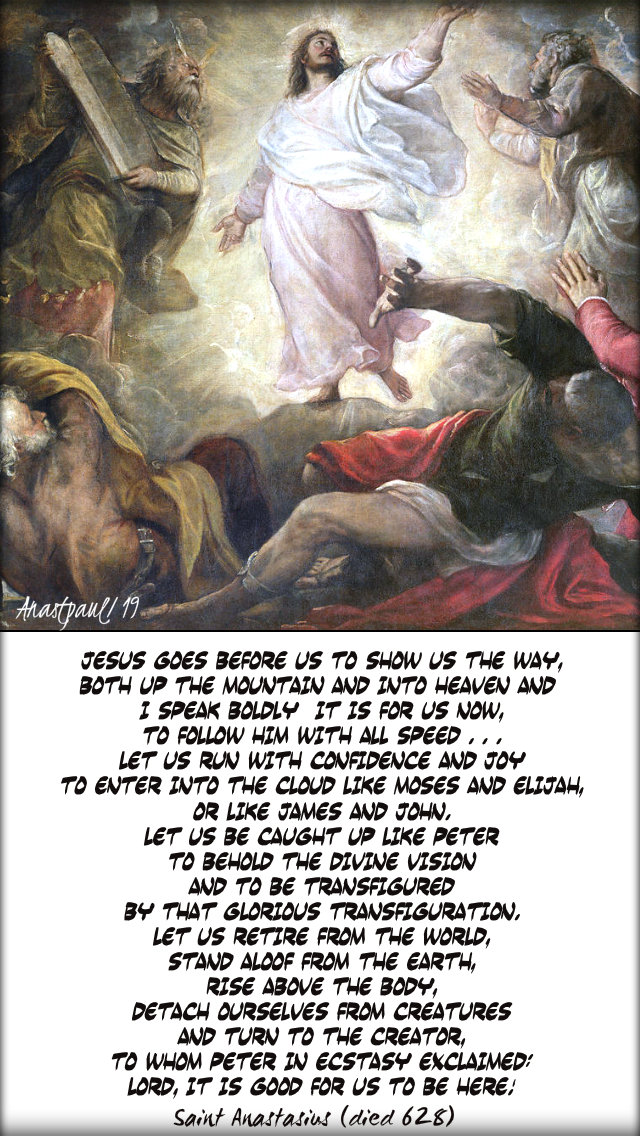
Quote of the Day – 6 August – Feast of the Transfiguration of the Lord – Today’s Gospel: Luke 9:28b-36
“Jesus goes before us to show us the way, both up the mountain and into heaven and — I speak boldly — it is for us now, to follow him with all speed . . . Let us run with confidence and joy to enter into the cloud like Moses and Elijah, or like James and John. Let us be caught up like Peter to behold the divine vision and to be transfigured by that glorious transfiguration. Let us retire from the world, stand aloof from the earth, rise above the body, detach ourselves from creatures and turn to the Creator, to whom Peter in ecstasy exclaimed: ‘Lord, it is good for us to be here.’”
One Minute Reflection – 6 August – Feast of the Transfiguration of the Lord – Today’s Gospel: Luke 9:28-36
“This is my beloved Son. listen to him.”...Luke 9:35
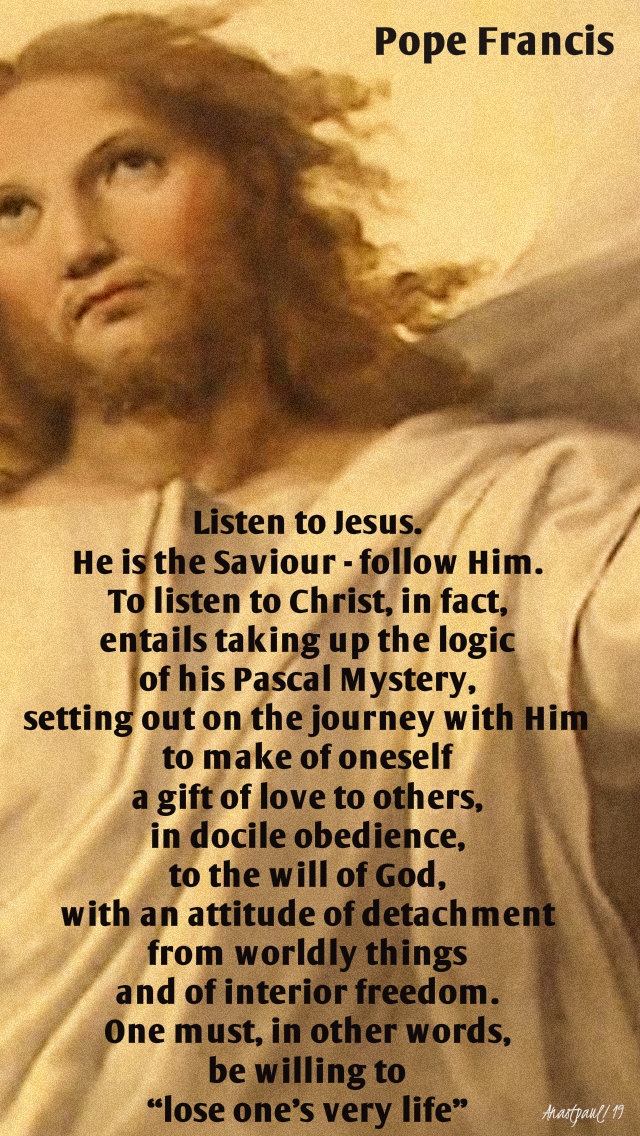
REFLECTION – “Jesus is the Son-made-Servant, sent into the world to save us all through the Cross, fulfilling the plan of salvation. His full adherence to God’s will renders His humanity transparent to the glory of God, who is love. He is the fulfilment of revelation, that is why, beside Him appear transfigured, Moses and Elijah appear, they represent the Law and the Prophets, so as to signify that everything finishes and begins in Jesus. Their instructions for the disciples and for us, is this: “Listen to Him!”.
Listen to Jesus. He is the Saviour – follow Him.
To listen to Christ, in fact, entails taking up the logic of his Pascal Mystery, setting out on the journey with Him to make of oneself a gift of love to others, in docile obedience to the will of God, with an attitude of detachment from worldly things and of interior freedom. One must, in other words, be willing to “lose one’s very life” (cf. Mk 8:35), by giving it up so that all men might be saved, thus, we will meet in eternal happiness. The path to Jesus always leads us to happiness, don’t forget it!” … Pope Francis (Angelus, 1 March 2015)
PRAYER – Father, at the Transfiguration in glory of Your only-begotten Son, You confirmed the mysteries of faith by the witness to Jesus of the prophets Moses and Elijah. You foreshadowed what we shall be when You bring our sonship to its perfection. Grant that by listening to the voice of Jesus, we may become heirs with Him, who lives and reigns with You and the Holy Spirit, God forever and may Mary, our tender and caring Mother, help us to be bright rays of the saving light of her Son Jesus. Amen
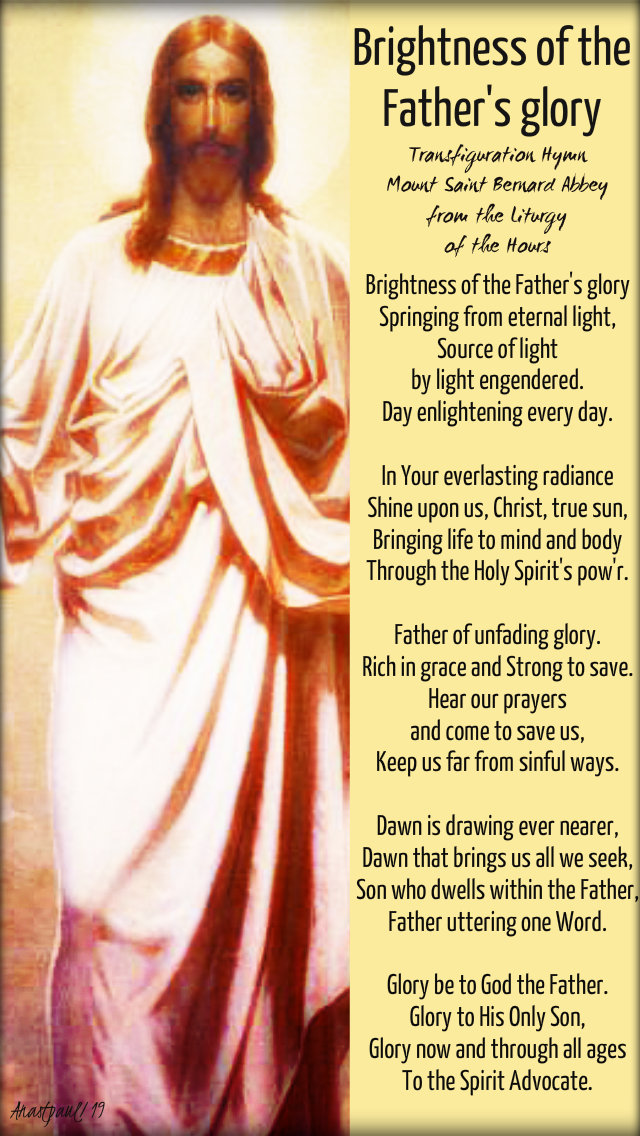
Our Morning Offering – 6 August – Feast of the Transfiguration of the Lord
Brightness of the Father’s glory Transfiguration Hymn Mount Saint Bernard Abbey from the Liturgy of the Hours
Brightness of the Father’s glory
Springing from eternal light,
Source of light by light engendered.
Day enlightening every day.
In Your everlasting radiance
Shine upon us, Christ, true sun,
Bringing life to mind and body
Through the Holy Spirit’s pow’r.
Father of unfading glory.
Rich in grace and Strong to save.
Hear our prayers and come to save us,
Keep us far from sinful ways.
Dawn is drawing ever nearer,
Dawn that brings us all we seek,
Son who dwells within the Father,
Father uttering one Word.
Glory be to God the Father.
Glory to His Only Son,
Glory now and through all ages
To the Spirit Advocate.
Brightness of the Father’s Glory uses William Boyce’s tune Halton Holgate with new words by Mount Saint Bernard Abbey. Mount Saint Bernard Abbey is a Cistercian (Trappist) Monastery in Leicestershire, UK founded in 1835. In 1998, Nigerian born Cyprian Tansi was beatified by John Paul II. Blessed Cyprian had been a monk at Mount Saint Bernard for 14 years, from 1950, until his death, in 1964. In the Liturgy of the Hours, Brightness of the Father’s Glory is used during Ordinary Time for Morning Prayer.
Bl Gezelin of Schlebusch
St Gislain of Luxemburg
St Glisente of Brescia
Bl Goderanno
Bl Guillermo Sanz
St Hardulf of Breedon St Pope Hormisdas (c 450-523)
St James the Syrian
St Justus of Alcala
Bl Maria Francesca Rubatto
Bl Octavian of Savona
St Pastor of Alcala
St Stephen of Cardeña
Bl Tadeusz Dulny
Bl William of Altavilla
—
Martyrs of Cardeña: Two hundred Benedictine monks at the Saint Peter of Cardegna monastery, Burgos, Spain who were martyred in the 8th century by invading Saracens. They were buried by local Christians in a nearby churchyard in Burgos, Spain and Beatified in 1603 by Pope Clement VIII (cultus confirmed).
Martyred in the Spanish Civil War: 10 Beati
• Blessed Alejandro Casare Menéndez
• Blessed Andrés Soto Carrera
• Blessed José González Ramos Campos
• Blessed José María Recalde Magúregui
• Blessed Juan Silverio Pérez Ruano
• Blessed Saturnino Ortega Montealegre
Thought for the Day – 1 August – Thursday of the Seventeenth week in Ordinary Time, Year C and the Feast of St Peter in Chains
Homily of St Augustine
Peter alone among the Apostles was accounted worthy to hear – A – men I say to thee, that thou art Peter and upon this rock I will build my Church. Worthy indeed was he, to be the foundation-stone, the supporting pillar, the key to the kingdom, in building up the peoples into the house of God. Concerning this, the divine word says – And they laid, it says, their sick, that when Peter passed by, his shadow at the least might fall on them. If at that time the shadow of his body could give aid, how much more now can the fullness of his power? If a mere breath of air from him, as he passed by, was of such benefit to suppliants, how much more his favour now that he remains steadfast? With good reason is the iron of those Penal chains held throughout all the churches of Christ to be more precious than gold.
If the shadow of him who visited was so potent to cure, how much more the chains of him who binds? If even the mere appearance of an empty image could have the force of healing in it, how much more healthfulness should the chains, with which he suffered, whose iron weight had pressed upon his sacred members, deserve to draw forth from his body? If he was so mighty to help his suppliants before his martyrdom, how much more must he avail after his triumph?
Happy those bonds, which by touching the Apostle rendered him a Martyr and so from manacles and fetters themselves were changed into a crown! Happy chains, which brought their prisoner even unto the cross of Christ, not so much for condemnation as for consecration!
Jesus said to His disciples – Who do men say that the Son of Man is? Peter answered and said – Thou art Christ, the son of the living God. And I say to thee – that thou art Peter and upon this rock I will build my Church!
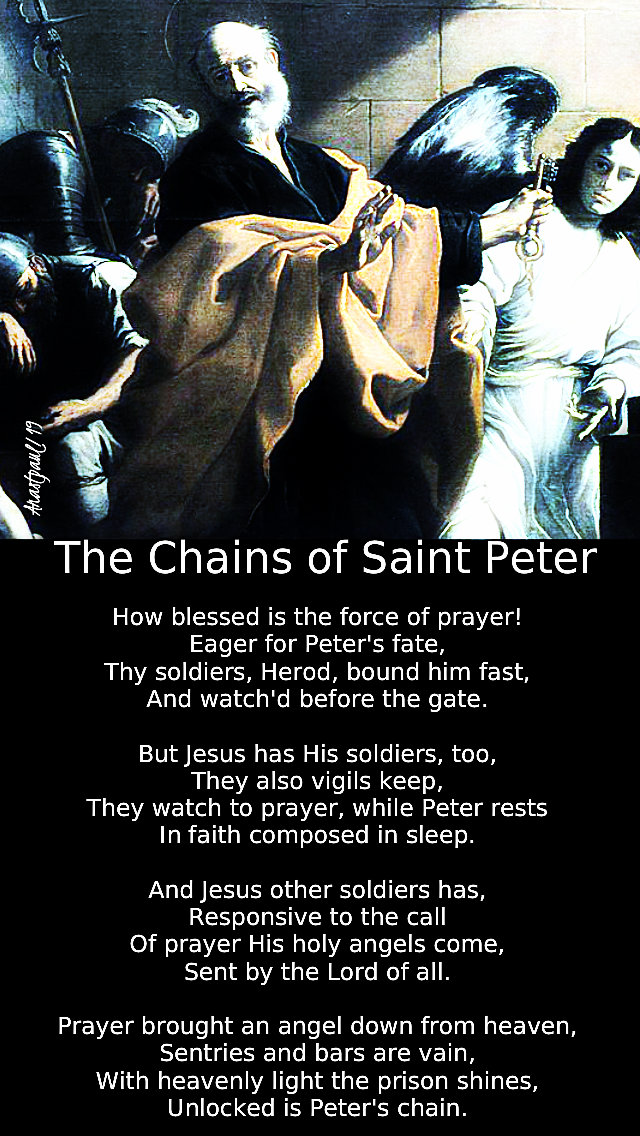
Hymn The Chains of Saint Peter
How blessed is the force of prayer!
Eager for Peter’s fate,
Thy soldiers, Herod, bound him fast,
And watch’d before the gate.
But Jesus has His soldiers, too,
They also vigils keep,
They watch to prayer, while Peter rests
In faith composed in sleep.
And Jesus other soldiers has,
Responsive to the call
Of prayer His holy angels come,
Sent by the Lord of all.
Prayer brought an angel down from heaven,
Sentries and bars are vain,
With heavenly light the prison shines,
Unlocked is Peter’s chain.
1 August – The Feast of Saint Peter in Chains
The feast was originally kept in Rome, Italy to commemorate the dedication of the Church of Saint Peter on the Esquiline Hill built by Eudoxia Licinia in 442 and rebuilt by Adrian I in the 8th century. When the chains which Saint Peter had worn in prison and from which he was freed by angelic intervention were later venerated there, the feast received its present name.
The date when these chains were brought from Jerusalem is disputed – some claim they were brought in 116 by travellers sent in search of them by Saint Balbina and her father Saint Quirinus, while others think Saint Eudoxia brought them in 439. St Pope Leo the Great united them to the chains with which Saint Peter had been fettered in the Mamertine Prison, forming a chain about two yards long which is preserved in a bronze safe and guarded by a special confraternity. Patronages – diocese of Annecy, France, Donnas, Italy.
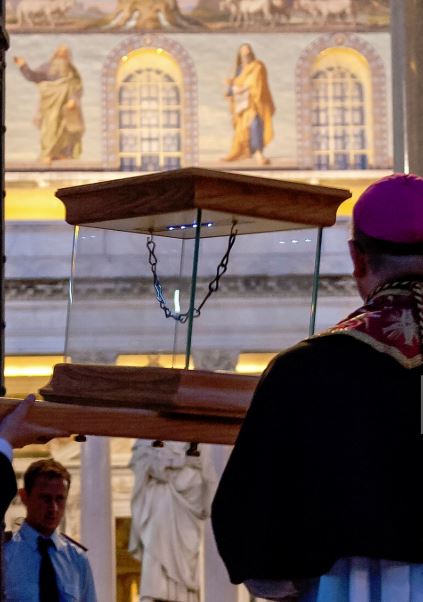
The Feast was removed from the Liturgical Calendar as a separate feast in 1962 but is celebrated together with the Feast of Sts Peter and Paul on 29 June. See the Getty image below.
ROME, ITALY – 29 JUNE 2018: The faithful carry in procession the relic of the chains of St Paul on the occasion of the Feast of Saints Peter and Paul, around the Basilica of Paul Outside the Walls on 29 June 2018 in Rome, Italy. The surviving links of the chain that held St Paul prisoner in Rome, between 61 and 63 are displayed in an illuminated theca, near the tomb of the saint inside the Basilica of St Paul Outside the Walls. St Peter’s Chains are not carried in a similar way, being permanently protected.
St Peter in Chains
by Father Francis Xavier Weninger, 1876
The Holy Church, today, celebrates a special feast in commemoration of the great benefit which God bestowed upon His people by miraculously delivering St Peter, the visible head of the church, from prison. The entire event is described in the Acts of the Apostles, by St Luke. Herod Agrippa, a son of Aristobulus, favored by the Roman Emperor Claudius, ruled over Judaea, with the title of king. To give more stability to his reign, he endeavoured to make himself beloved by the Jews, for which there was no easier way than to persecute the Christians, especially those who fearlessly proclaimed the Gospel of Christ, as did the holy Apostles. He had, therefore, apprehended and soon after beheaded, James the Great, brother of St John, which bloody deed gave the Jews great satisfaction. To increase this, Herod commanded them to seize St Peter, intending to make away with him in the same manner. His command was executed, Peter was taken prisoner, chained and locked in a narrow dungeon, which was guarded so vigilantly, that he could not escape. It was then near the Easter Festival, after which St Peter was to be beheaded. The Christians, in deep distress, were praying day and night, that the Almighty would not permit His flock to be so soon deprived of its shepherd.
There was no human power to save him but God, hearing the prayer of His people, delivered him by a miracle. On the eve of the day on which he was to be executed, God sent an Angel to set him free. Although heavily laden with chains, the holy Apostle slept peacefully, guarded by the soldiers. The Angel, who by his brightness, illumined the dungeon, struck him on the side and awakened him, saying: “Arise quickly. Gird thyself; put on thy sandals and cloak and follow me.” The Apostle, whose chains had fallen from his hands and who thought it all a dream, obeyed and followed the Angel. They passed the first and second watches without attracting their attention and reached the iron gate which led into the street. The gate opened without the aid of human hands.
After having conducted St Peter through one street, the Angel vanished and was seen no more. Not until then did the holy Apostle realise that his deliverance was not a dream but a reality. Hence he began to praise the Almighty, exclaiming: “Now I know truly that the Lord has sent his Angel and delivered me out of the hands of Herod and from all the expectation of the people of Judaea.” He proceeded immediately to the house of Mary, the mother of John Mark, where the faithful were assembled in prayer.
When he knocked at the door, a servant, named Rhode, came and asked who was there. Judging by the voice that it was Peter, she was so greatly startled with joy and astonishment, that, without opening the door, she ran back to announce the news. They all believed that she was insane but as she reiterated her words, some said that it must be his guardian Angel. Meanwhile, the Saint repeated his knocking at the door. They opened it and perceived, with amazement, their beloved shepherd safe and free from chains. Their joy on beholding him was as great as had been their grief when he was taken prisoner. Having given the sign for silence, St Peter related all that had happened to him. They all gave thanks to Divine Providence when he had ended and learned to trust in future to the heavenly power and mercy.
Among the sermons of St Chrysostom, there is one in which he asserts, that the chains by which St Peter had been bound to the ground, came into the possession of the Christians soon after his deliverance and were held by them in great honour. Eudoxia, wife of the emperor Theodosius the Younger, received them as a present from the patriarch Juvenal, when on a visit to the holy places and sent one of them to the Church at Constantinople. The other she gave to her daughter Eudoxia, who married the Emperor Valentinian III. Eudoxia showed the chain to Pope Sixtus III., who, on his part, showed her the one with which St Peter had been bound, before the Emperor Nero sentenced him to die. No sooner had the two chains been held together, than they suddenly united as if they had been but one chain and forged by the same hand. This miracle increased the veneration in which these chains were held and actuated Eudoxia to build a special church at Rome for their keeping, where they can still be seen. Many sick were healed by their touch and many possessed were delivered, among the latter was a Count of the court of the Emperor Otho, who, in the year 969, was sent to Rome to be freed from the Evil Spirit. Pope John XIII had hardly touched the count’s neck with the holy chains, when he was relieved and his torments were ended.
St Gregory the Great, writes that it was considered a great happiness to possess a few particles filed off from these chains and that many persons devoutly wore them enclosed in golden crosses and lockets around their necks. Experience has shown that the touch of these crosses or lockets has restored health to many a sick person. A nobleman, who scoffed at this and, in derision, dared to break one of these crosses, was severely chastised. He was instantly possessed by the Evil One and became so enraged that he took his own life, as St Gregory relates. St Augustine states that the iron of these precious chains is justly esteemed far above gold. Blessed are those fetters which touched the apostle and made him a martyr. “The touch of the blessed limbs of St Peter has sanctified the instruments of torture.” In another place the same Saint says: “If the shadow of St Peter possessed a healing virtue, how much greater power must the chains of his sufferings have derived from him.”
Portiuncula Indulgence: An indulgence which may be gained in any church so designated by the bishop, by all the faithful who after Confession and Holy Communion, visit such churches between noon of 1 August and midnight of 2 August, or on the Sunday following. The indulgence is toties quoties and is applicable to the souls in Purgatory.
Feast Saint Peter in Chains
—
St Adela Mardosewicz
Bl Aleksy Sobaszek
St Alexander of Perga
St Almedha
St Arcadius
St Attius of Perga
St Buono
St Brogan
St Charity
St Ethelwold of Winchester
St Exuperius of Bayeux
St Faith
St Faustus
St Felix of Gerona
St Friard
Bl Giovanni Bufalari
St Hope
St Jadwiga Karolina Zak
St Jonatus
St Justin of Paris
St Kenneth of Wales
St Leontius of Perga
St Maur
St Nemesius of Lisieux
Bl Orlando of Vallombrosa
St Peregrinus of Modena
St Rioch
Bl Rudolph
St Secundel
St Secundus of Palestrina
St Sophia
St Verus of Vienne
—
Holy Maccabees: Jewish dynasty which began with the rebellion of Mathathias and his five sons against the Syrian king, Antiochus IV (168 BC) and ruled the fortunes of Israel until the advent of Herod the Great. Syrian attempts to force Greek paganism on the Jews, the profanation of the Temple at Jerusalem and the massacre which followed, brought the nation to arms under Mathathias, a priest of the sons of Joarib. At the death of Mathathias, Judas Machabeus, his third son, drove the Syrians and Hellenists out of Jerusalem, rededicated the Temple and began an offensive and defensive alliance with the Romans. Before the treaty was concluded, however, Judas, with 800 men, risked battle at Laisa with an overwhelming army of Syrians under Bacchides, and was slain. He was succeeded in command by his youngest brother, Jonathan (161 BC). Jonathan defeated Bacchides, revenged the death of his brother and made peace with Alexander who had usurped the throne of Demetrius, the successor to Antiochus. A period of peace followed in which Jonathan ruled as high priest in Jerusalem but Tryphon, who was plotting for the throne of Asia, treacherously captured him at ptolemais and later put him to death. The captaincy of the armies of Israel then fell to Simon, the second son of Mathathias. Under him the land of Juda flourished exceedingly. He obtained the complete independence of the country and a grateful people bestowed upon him the hereditary kingship of the nation. His rule marked five years of uninterrupted peace. He was treacherously slain by his son-in-law, Ptolemy, about the year 135 BC After Simon the race of the Machabees quickly degenerated. In 63 BC the Romans thought it necessary to interfere in the fratricidal war between Hyrcanus II and Aristobulus II. With this interference and the advent of Herod the Great the sceptre passed forever from the land of Juda. The story of the Machabees is written in the two books of the Old Testament which bear that name.
Saints Faith, Hope and Charity: The daughters of Saint Sophia. While still children, they were tortured and martyred for their faith in the persecutions of Hadrian. They were scourged, thrown into a fire, and then beheaded.
Martyrs of Nowogrodek – 11 beati: A group of eleven Holy Family of Nazareth nuns who were murdered by the Nazi Gestapo in exchange for 120 condemned citizens of Nowogrodek, Belarus who were scheduled for revenge killings. They are –
• Adela Mardosewicz
• Anna Kukolowicz
• Eleonora Aniela Józwik
• Eugenia Mackiewicz
• Helena Cierpka
• Jadwiga Karolina Zak
• Józefa Chrobot
• Julia Rapiej
• Leokadia Matuszewska
• Paulina Borowik
• Weronika Narmontowicz
They were machine-gunned by firing squad on 1 August 1943 by the Gestapo about three miles outside Novogrudok (Nowogródek), Hrodzyenskaya voblasts’, in Nazi occupied Belarus and buried on the site of the execution in a common grave. One of their surviving sisters, Maria Malgorzata Banas, located the grave on 19 March 1945 and tended to it until her death in 1966. Their relics have since been re-interred in a common sarcophagus in the chapel of the Novograd Farny Church (the Church of the Transfiguration, also known as Biala Fara or the White Church). They were Beatified on
5 March 2000 by St Pope John Paul II in Rome, Italy.
Quote of the Day – 25 July – Feast of St James, Apostle
“…we can learn much from St James – promptness in accepting the Lord’s call even when He asks us to leave the “boat” of our human securities, enthusiasm in following Him on the paths that He indicates to us over and above any deceptive presumption of our own, readiness to witness to Him with courage, if necessary to the point of making the supreme sacrifice of life.
Thus James the Greater stands before us as an eloquent example of generous adherence to Christ. He, who initially had requested, through his mother, to be seated with his brother next to the Master in His Kingdom, was precisely the first to drink the chalice of the passion and to share martyrdom with the Apostles.
And, in the end, summarising everything, we can say that the journey, not only exterior but above all interior, from the mount of the Transfiguration to the mount of the Agony, symbolises the entire pilgrimage of Christian life, among the persecutions of the world and the consolations of God, as the Second Vatican Council says. In following Jesus, like St James, we know that even in difficulties we are on the right path.”




















 AnaStpaul
You must be logged in to post a comment.