Thought for the Day – 14 September – Meditations with Antonio Cardinal Bacci (1881-1971)
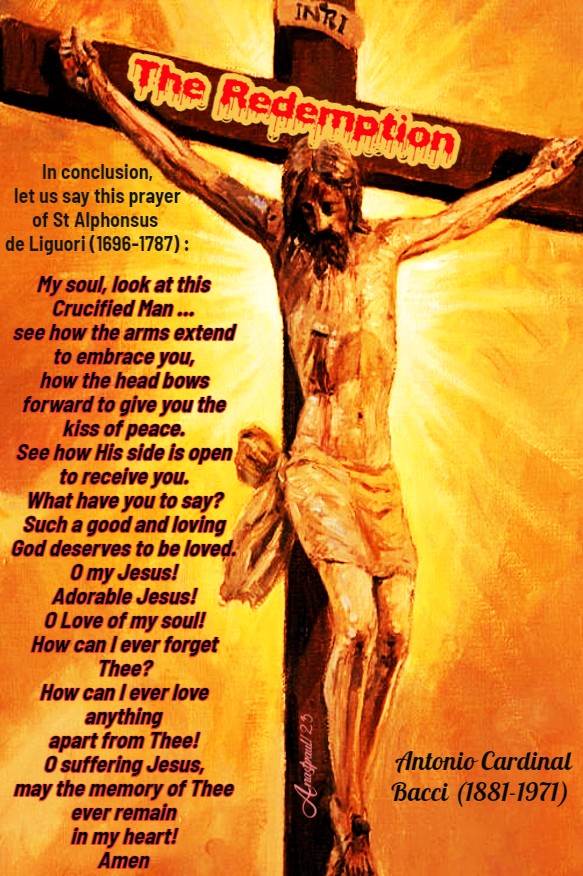
The Redemption
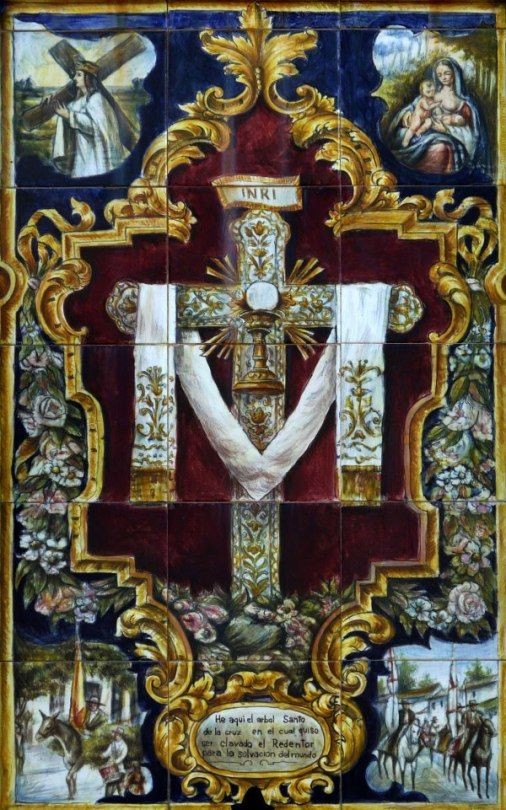
“In conclusion, let us say this prayer of St Alphonsus de Liguori (1696-1787): “My soul, look at this Crucified Man … see how the arms extend to embrace you, how the head bows forward to give you the kiss of peace. See how His side is open to receive you. What have you to say? Such a good and loving God deserves to be loved. O my Jesus! Adorable Jesus! O Love of my soul! How can I ever forget Thee? How can I ever love anything apart from Thee! O suffering Jesus, may the memory of Thee ever remain in my heart!”
Quote/s of the Day – 14 September – “Month of The Seven Sorrows of the Blessed Virgin Mary and The Holy Cross” – Exaltation of the Holy Cross –Philippians 2:5-11, John 12:31-36 – Scripture search here: https://www.drbo.org/
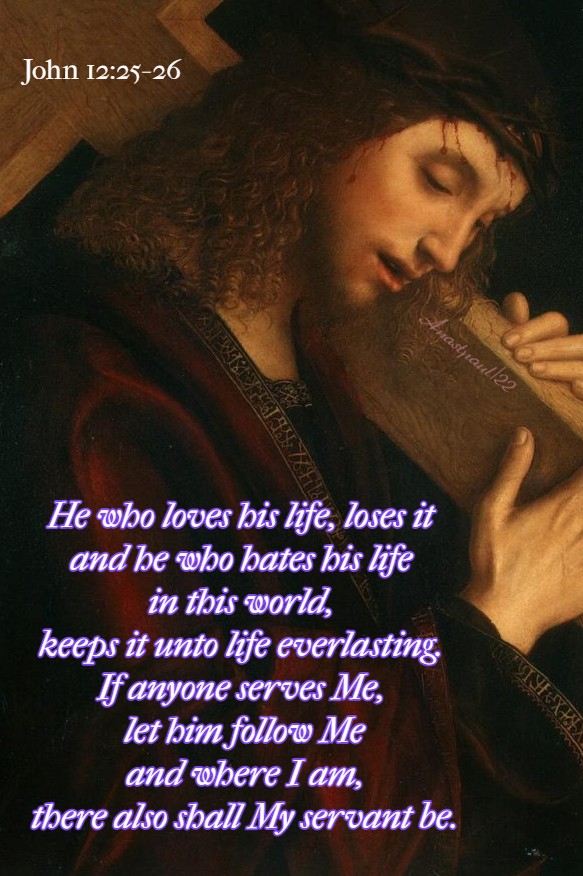
“If anyone serves Me, let him follow Me and where I am, there also shall My servant be.”
John 12:25-26
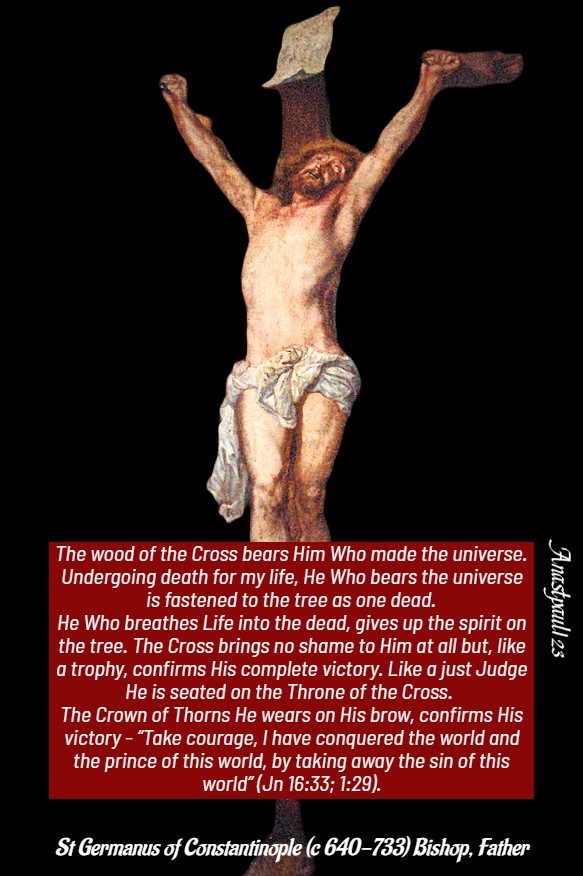
“The wood of the Cross bears Him Who made the universe. Undergoing death for my life, He Who bears the universe is fastened to the tree, as one dead. He Who breathes Life into the dead, gives up the spirit on the tree. The Cross brings no shame to Him at all but, like a trophy, confirms His complete victory. Like a just Judge, He is seated on the Throne of the Cross. The Crown of Thorns. He wears on His brow, confirms His victory “Take courage, I have conquered the world and the prince of this world, by taking away the sin of this world” (Jn 16:33; 1:29).”
St Germanus of Constantinople (c640-733) Bishop, Father of the Church
Hail, Most Precious and Life-Giving Cross of the Lord!
Let God arise and let His enemies be scattered and let those, who hate Him, flee from His Presence. As smoke vanishes, let them vanish and as wax melts by the presence of fire, so let the demons perish by the presence of those who love God and who sign themselves with the Sign of the Cross and say in gladness: Hail, Most Precious and Life-Giving Cross of the Lord, for Thou drives away the demons by the power of our Lord Jesus Christ Crucified on thee, Who went down to hell and trampled on the power of the devil and gave us thee, His venerable Cross, for driving away all enemies. O Most Precious and Life-Giving Cross of the Lord, help me with our holy Lady, the Virgin Mother of God and with all the Saints throughout the ages. Amen.
St John Damascene (675-749) Father and Doctor of the Church
(Part of the Night Prayers by St John Damascene)
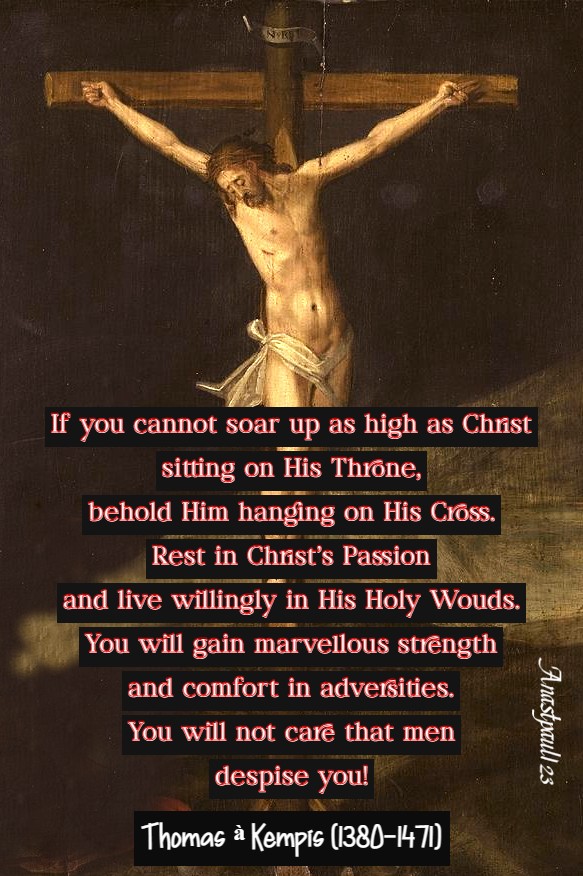
“If you cannot soar up as high as Christ sitting on His Throne, behold Him hanging on His Cross. Rest in Christ’s Passion and live willingly in His Holy Wounds. You will gain marvellous strength and comfort in adversities. You will not care that men despise you!”
Thomas à Kempis CRSA (1380-1471)
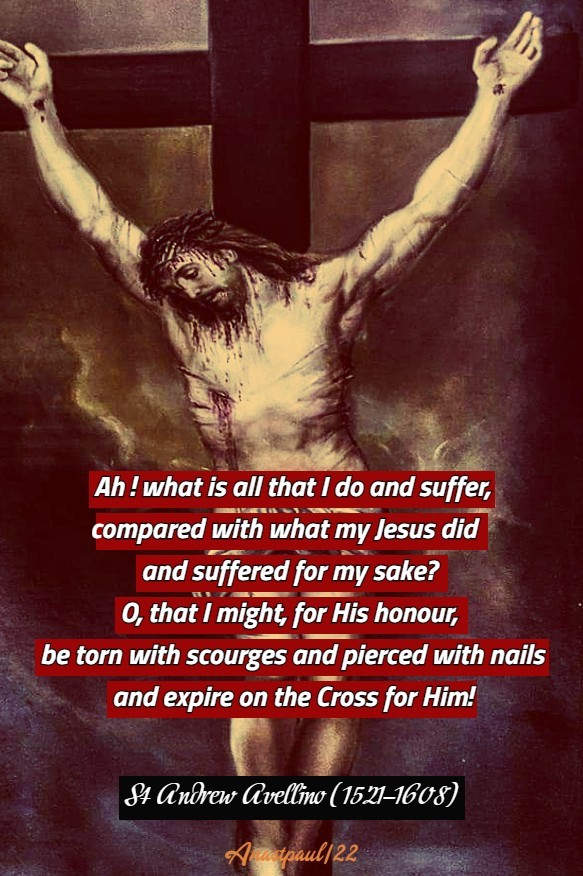
“Ah ! what is all that I do and suffer, compared with what my Jesus did and suffered for my sake? O, that I might, for His honour, be torn with scourges and pierced with nails and expire on the Cross for Him!”
St Andrew Avellino (1521–1608)
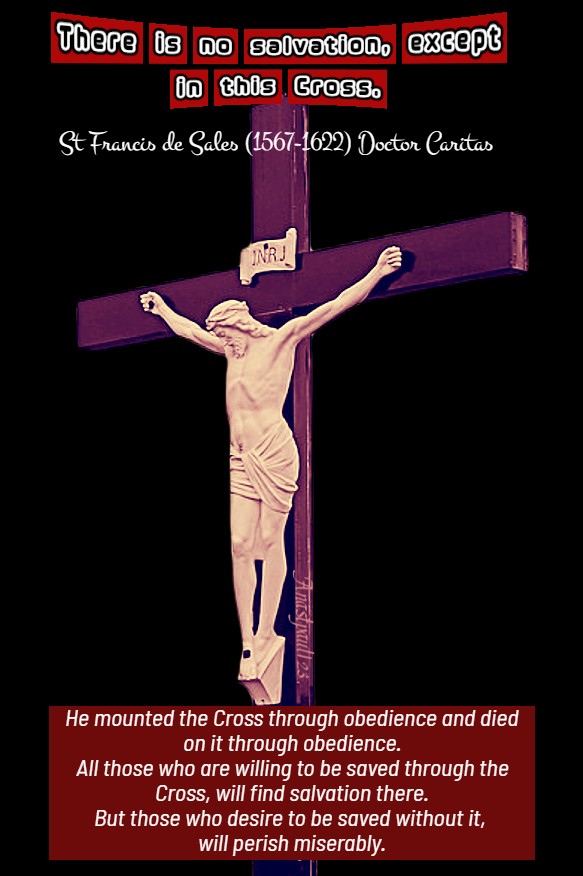
“He mounted the Cross through obedience and died on it through obedience. All those who are willing to be saved through the Cross, will find salvation there. But those, who desire to be saved without it, will perish miserably. There is no salvation, except in this Cross.”
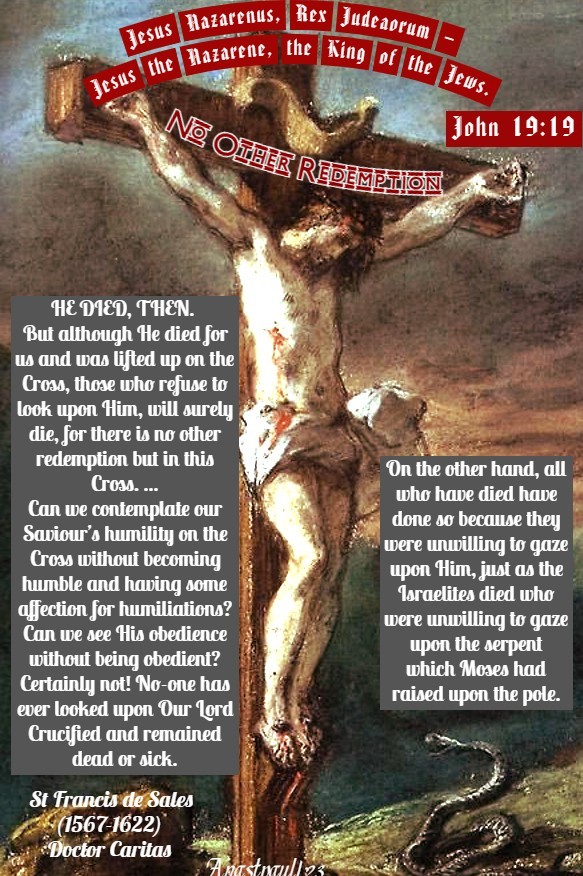
“Jesus Nazarenus, Rex Judeaorum – Jesus the Nazarene, the King of the Jews.” John 19:19
“HE DIED, THEN But although He died for us and was lifted up on the Cross, those who refuse to look upon Him, will surely die, for there is no other redemption but in this Cross.
O God, how spiritually beneficial and profitable is a consideration of Thy Cross and Passion! Can we contemplate our Saviour’s humility on the Cross, without becoming humble and, having some affection for humiliations? Can we see His obedience, without being obedient? Certainly not! No-one has ever looked upon Our Lord Crucified and remained dead or sick. On the other hand, all who have died, have done so because. they were unwilling to gaze upon Him, just as the Israelites died. who were unwilling to gaze upon the serpent which Moses had raised upon the pole.”
One Minute Reflection – 14 September – “Month of The Seven Sorrows of the Blessed Virgin Mary and The Holy Cross” – Exaltation of the Holy Cross –Philippians 2:5-11, John 12:31-36 – Scripture search here: https://www.drbo.org/
“He who loves his life, loses it and he who hates his life in this world, keeps it unto life everlasting. If anyone serves Me, let him follow Me and where I Am ,there also shall My servant be.” – John 12:25-26
REFLECTION – “… We are being towed along by a world which passes away, forgetting the world to come. We are greedy for present things but, do not take into account, the coming judgement. We will not run to meet the Lord as He comes!…
Let us turn back, brethren, let us turn back… By the very fact of His delay, of His still waiting, our Lord proves His desire to see us come back to Him, His desire that we should not perish. In His great goodness, He continues addressing these words to us: “I take no pleasure in the death of the wicked but, would rather, he would change his ways and live ”(Ez 33:11). So let us turn back to Him, brethren, not fearing that time is running short. The time that belongs to time’s Author cannot be shortened. The proof of it lies in the criminal in the Gospel, who, at the moment of dying on the cross, got away with his pardon, grabbed hold of life and, breaking into paradise like a burglar, managed to make his way into the Kingdom (cf. Lk 23,43)!” – St Peter Chrysologus (c 400-450) Bishop of Ravenna, Father and “Doctor of Sermons” of the Church (Excerpt from Sermon 167).
PRAYER – O God, Who gladden us this day by the annual feast of the Exaltation of the Holy Cross, grant, we beseech Thee, that we, who know on earth, the mysteries of Christ, may be found worthy to obtain, in heaven, the rewards of His Redemption. Through the same Jesus Christ, Thy Son our Lord, Who lives and reigns with Thee, in the unity of the Holy Ghost, God, world without end. Amen (Collect).
St Caerealis Bl Claude Laplace St Cormac of Cashel (c836-908) Bishop, King St Crescentian of Carthage St Crescentius of Rome St Generalis of Carthage St Giulia Crostarosa St Jean Gabriel Taurin du Fresse
St Maternus of Cologne (Died c 325) Bishop, the first Bishop of Cologne and Founder of the Diocese of Tongeren, Germany. In Cologne and in his hometown of Trier, the faithful began to venerate him as a Saint. A popular cult of which the splendid 13th century stained glass windows in the Cathedral Chapel dedicated to his name, also testify. He was buried in the Cathedral of Cologne but the Cathedral of St Peter in Trier boasts a large Reliquary, which became and remains, a pilgrimage site. Biography; https://anastpaul.com/2021/09/14/saint-of-the-day-14-september-saint-maternus-of-cologne-died-c-325/
St Peter of Tarentaise O.Cist (1102-1174) Cistercian Monk, Archbishop of Tarentaise from 1141 until his death, Abbot, Apostle of Charity, Miracle-worker. There are two Saints named Saint Peter of Tarentaise who lived one Century apart. The Saint we honour today, is the younger Peter, born in France in the early part of the 12th Century. The other Saint Peter if Tarentaise, became Pope Innocent V. His Life: https://anastpaul.com/2019/09/14/saint-of-the-day-14-september-saint-peter-of-tarentaise-o-cist-1102-1174/
Bl Pedro Bruch Cotacáns St Rosula of Carthage St Sallustia St Victor of Carthage
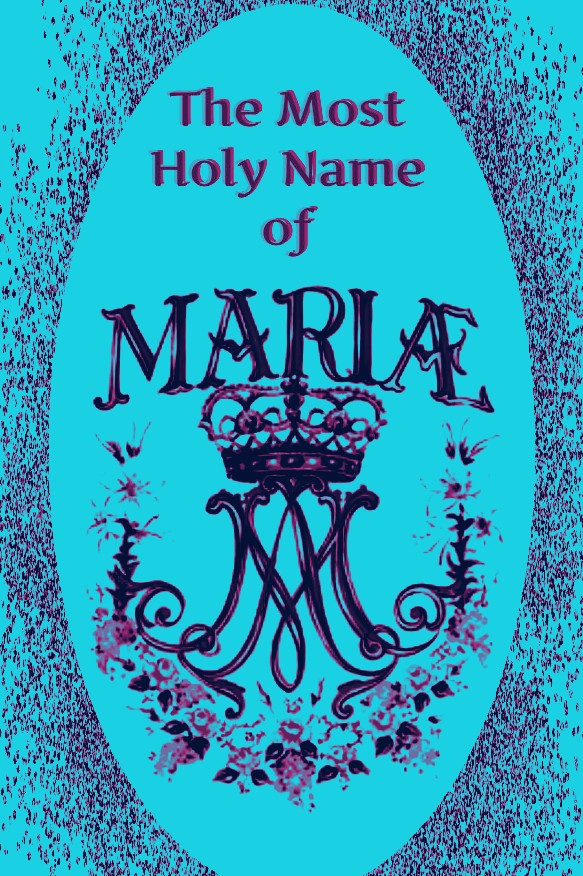
Quote/s of the Day – 12 September – The Feast of the Holy Name of Mary
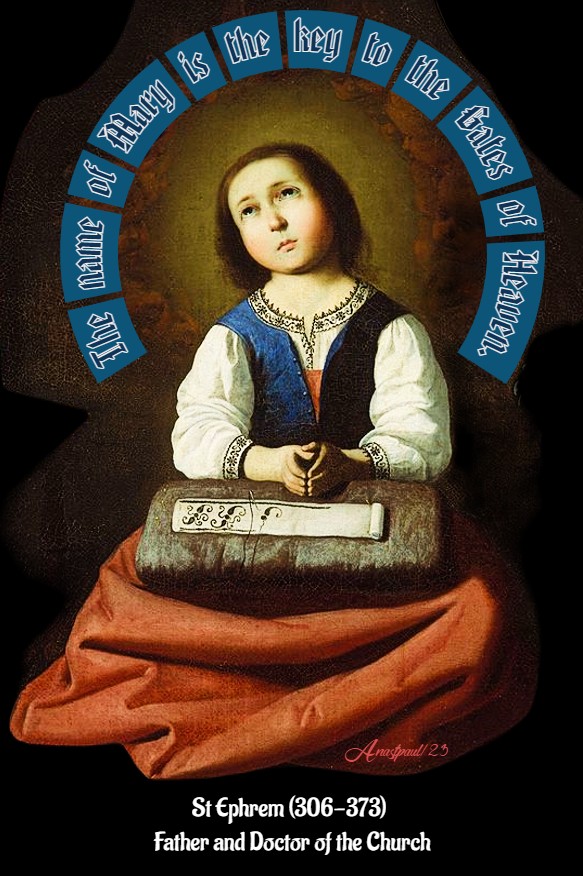
“The name of Mary is the key to the Gates of Heaven.”
St Ephrem (306-373) Father and Doctor of the Church
“O most Holy Virgin Mary! Thy name is so sweet and amiable that it cannot be pronounced, without inflaming those, who do so, with love towards thee and God.”
St Bernard (1090-1153) Mellifluous Doctor of the Church
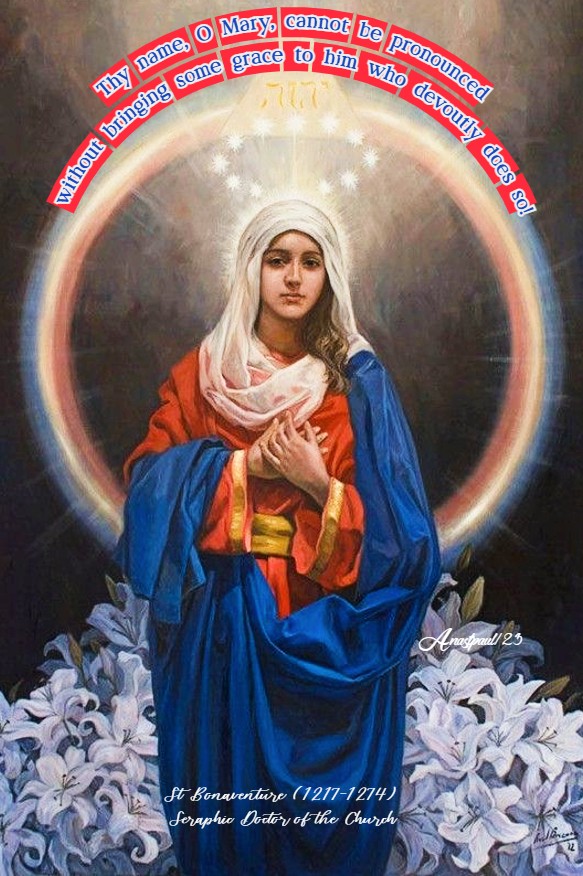
“Thy name, O Mary, cannot be pronounced without bringing some grace to him who devoutly does so!”
St Bonaventure (1217-1274) Seraphic Doctor of the Church
“The devils fear the Queen of Heaven, to such a degree that only on hearing her great name pronounced, they fly from him who does so, as from a burning fire!”
Our Morning Offering – 12 September – Feast of the Most Holy Name of Mary
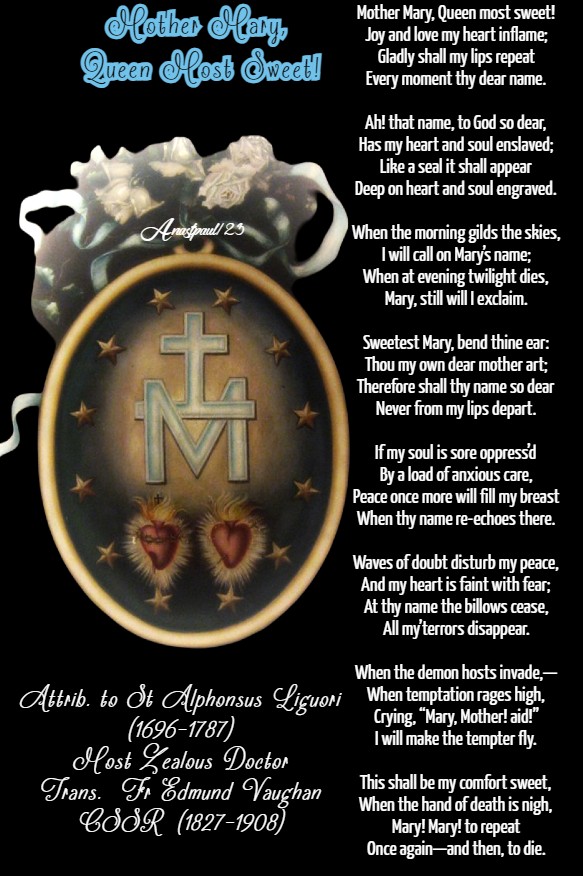
Mother Mary, Queen Most Sweet! Attrib. to St Alphonsus Liguori (1696-1787) Most Zealous Doctor Italian Hymn Trans. Fr Edmund Vaughan CSSR (1827-1908)
Mother Mary, Queen most sweet! Joy and love my heart inflame; Gladly shall my lips repeat Every moment thy dear name.
Ah! that name, to God so dear, Has my heart and soul enslaved; Like a seal it shall appear Deep on heart and soul engraved.
When the morning gilds the skies, I will call on Mary’s name; When at evening twilight dies, Mary, still will I exclaim.
Sweetest Mary, bend thine ear: Thou my own dear mother art; Therefore, shall thy name so dear Never from my lips depart.
If my soul is sore oppress’d By a load of anxious care, Peace once more will fill my breast When thy name re-echoes there.
Waves of doubt disturb my peace, And my heart is faint with fear; At thy name the billows cease, All my’terrors disappear.
When the demon hosts invade,— When temptation rages high, Crying, “Mary, Mother! aid!” I will make the tempter fly.
This shall be my comfort sweet, When the hand of death is nigh, Mary! Mary! to repeat Once again—and then, to die.
This Hymn is an Anonymous Hymn belonging to the Redemptorist tradition but Hymnary.org attributes it to St Alphonsus Liguori. “Hymns and Verses on Spiritual Subjects” (1863) notes that this is one of two Hymns, translated in that book, mentioned above, which come from a Neapolitan published collection of Mission Hymns which are attributed to St Alphonsus.
Saint of the Day – 12 September – The Feast of the Holy Name of Mary (1683 ) from the Liturgical Year, 1903
“And the Virgin’s name was Mary (St Luke 1:27).’ Let us speak a little about this name, which signifies Star of the Sea and which, so well befits the Virgin Mother. Sightly is she likened to a star – for as a star emits its ray without being spoilt, so the Virgin, brought forth her Son, without receiving any injury – the ray takes nought from the brightness of the Star, nor the Son from His Mother’s integrity. This is the noble Star risen out of Jacob, whose ray illumines the whole world, whose splendour shines in the heavens, penetrates the abyss,and traversing the whole earth, gives warmth, rather to souls than to bodies, cherishing virtues, withering vices. Mary, I say, is that bright and incomparable Star, whom we need to see raised above this vast sea and shining by her merits, giving us light by her example.
‘O whosoever thou art, that seest thyself, amid the tides of this world, tossed about by storms and tempests, rather than walking on the land, turn not thine eyes away from the shining of this Star, if thou wouldst not be overwhelmed by the hurricane. If squalls of temptations arise, or thou fall upon the rocks of tribulation, look to the Star, call upon Mary. If thou art tossed by the waves of pride or ambition, detraction or envy, look to the Star, call upon Mary. If anger or avarice or the desires of the flesh dash against the ship of thy soul, turn thine eyes towards Mary. If, troubled by the enormity of thy crimes, ashamed of thy guilty conscience, terrified by dread of the judgement, thou beginnest to sink into the gulf of sadness, or the abyss of despair, think of Mary. In dangers, in anguish, in doubt, think of Mary, call upon Mary.’ … (St Bernard)
St Peter Chrysologus adds … “Mary, in Hebrew, signifies Lady or Sovereign and truly, the authority of her Son, Who is the Lord of the world, constituted her Queen, both in fact and in name, from her very birth ”(Petr. Chrys. Sermo cxlii, de Annuntiat. Homily of the 3rd Nocturn).”
Our Lady – such is the title which befits her in every way, as that of Our Lord beseems her Son – it is the doctrinal basis of that worship of hyperdulia which belongs to her alone. She is below her Son, Whom she adores as we do but above all God’s servants, both Angels and men, inasmuch as she is His Mother. At the Name of Jesus every knee is bent; at the Name of Mary, every head is bowed. And although, the former is the only Name whereby we may be saved; yet, as the Son can never be separated from His Mother, Heaven unites their two Names in its Hymns of praise, earth in its confidence, hell in its fear and hatred!
It was, therefore, in the order of Divine Providence that devotion to the most Holy Name of Mary should spread, simultaneously with the cultus of the adorable Name of Jesus, of which St Bernadine of Siena was the Apostle in the 15th Century. In 1513 the Church of Cuenca in Spain was the first to celebrate, with the approbation of the Holy See, a special Feast in honour of the Name of Mary; while the Franciscan Order had not yet succeeded in obtaining a like privilege for the Adorable Name of Jesus. The reason for this, is that the memory of that Sacred Name included in the Feast of the Circumcision, seemed to the prudence of the Pontiffs to suffice. From the same motive we find the Feast of the Most Holy Name of Mary extended to the universal Church in the year 1683 and, that of the Most Holy Name of Jesus not until 1721.
Our Lady justifies her beautiful title by partaking in the warlike exploits of the King of kings, her Son. The City of Vienna, having been delivered by her from the power of the Crescent, contrary to all hope, the venerable Innocent XI. made this Feast the memorial of universal gratitude to the liberatrix of the West.
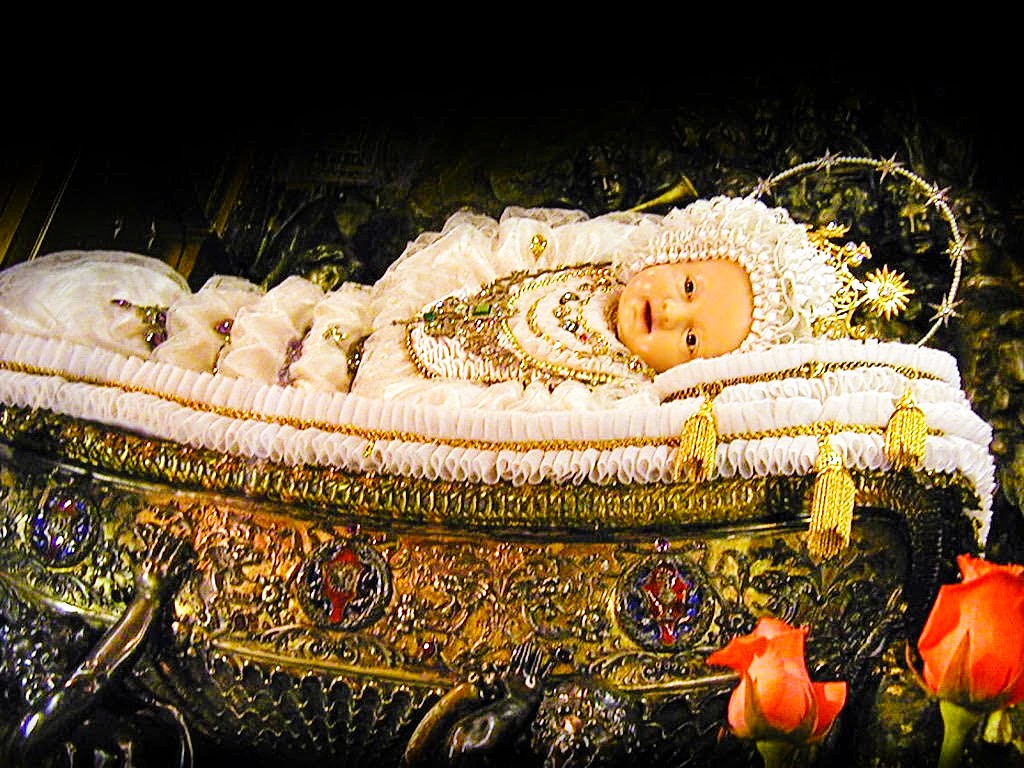
The Name of Mary, which is the joy of Angels and the terror of demons, protects man against countless evils and supports him on his way to Heaven. All the delight of Heaven, all the hopes of earth, are centred on the cradle where Mary sleeps, while her heart is watching before God.
Wisdom praises her own self – by the blessed daughter of Anne and Joachim, the loving preference shown by that Divine Wisdom from the beginning of the world, is already justified. Forevermore, it will be her delight to be with the children of men. The chosen vine, the vine of the Peaceful One is before us, announcing, by its fragrant blossom, the divine grape, whose juice, pressed out in the wine-press of the Cross, will give fruitfulness to every soul and will inebriate earth and Heaven.”
Feast of the Holy Name of Mary (1683 ) – 12 September: This Feast was first observed at Cuenca, Spain in 1513, then extended to the Universal Church and assigned to its present place and rank by Pope Innocent XI in 1683, in thanksgiving to God and the Blessed Virgin, for the liberation of Vienna, France and the signal victory over the Turks on 12 September 1683. It is the Titular Feast of the Society of Mary (Marianists) and of the Congregation of the Oblates of Mary Immaculate.
St Juventius of Pavia St Mancius of Saint Thomas St Paul of Saint Clare St Sacerdos of Lyon St Silvinus of Verona St Tomás de Zumárraga Lazcano
Martyrs of Alexandria – 6 Saints: A group of Christians Martyred in the persecutions of Diocletian. We know little more than their names – Hieronides, Leontius, Sarapion, Seleusius, Straton and Valerian. They were drowned c 300 at Alexandria, Egypt.
Martyrs of Phrygia – 3 Saints: Three Christians who were Martyred for destroying pagan idols. We know little more than their names – Macedonius, Tatian and Theodolus. They were burned to death in 362 in Phrygia (modern Turkey).
St Salvius of Albi St Sosthenes of Chalcedon St Theodard of Maastricht St Victor of Chalcedon
Martyrs of Bithynia – 3 Sister Saints: Three young Christian sisters Martyred in the persecutions of Emperor Maximian and governor Fronto: Menodora, Metrodora, Nymphodora. They were Martyred in 306 in Bithynia, Asia Minor (in modern Turkey).
Martyrs of Japan – 205 Beati: A unified feast to memorialise 205 Missionaries and native Japanese known to have been murdered for their Faith between 1617 and 1637.
Martyrs of Sigum – 8 Saints: A group of Nicomedian Martyrs, condemned for their faith to be worked to death in the marble quarries of Sigum. There were Priests, Bishops and Laity in the group but only a few names have come down to us: Dativus, Felix, Jader, Litteus, Lucius, Nemesian, Polyanus, Victor. They were worked to death c 257 in Sigum.
Our Morning Offering – 8 September – The Nativity of the Most Blessed and Ever-Virgin Mary, Mother of God (If anyone has more information regarding Sister Francis Marie please comment below.)
The Birthday of Our Queen By Sister Francis Marie (Hymn published in 1948).
All hail, O new world! Come and see Here in a cradle lies our Queen, Mother of God, one day to be, O come and see this heavenly scene.
A beauteous, fragrant rose-bud, Immaculate! God’s own flower, His masterpiece of royal blood Who came to earth this midnight hour!
Thousands of Angels stand to guard This mystical counterpart of God And Seraphs play sweet lullabies Upon their harps, as Cherubs laud.
Hail holy babe! Hail full of grace! With wee hands clasped, with eyelids closed She talks with God – face to face! Amen
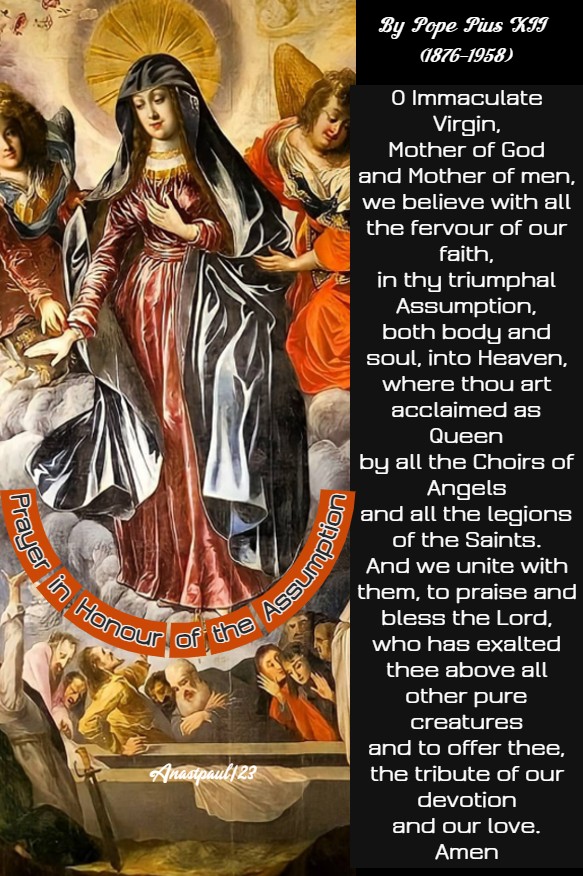
“The Month of the Immaculate Heart of Mary” – The Assumption of the Blessed Virgin Mary
Prayer in Honour of the Assumption of the Blessed Virgin Mary By Pope Pius XII (1876-1958)
O Immaculate Virgin, Mother of God and Mother of men, we believe with all the fervour of our faith, in thy triumphal Assumption, both body and soul, into Heaven, where thou art acclaimed as Queen by all the Choirs of Angels and all the legions of the Saints. And we unite with them, to praise and bless the Lord, who has exalted thee above all other pure creatures and to offer thee, the tribute of our devotion and our love. Amen
Our Morning Offering – 6 August – The Feast of the Transgiuration of the Lord
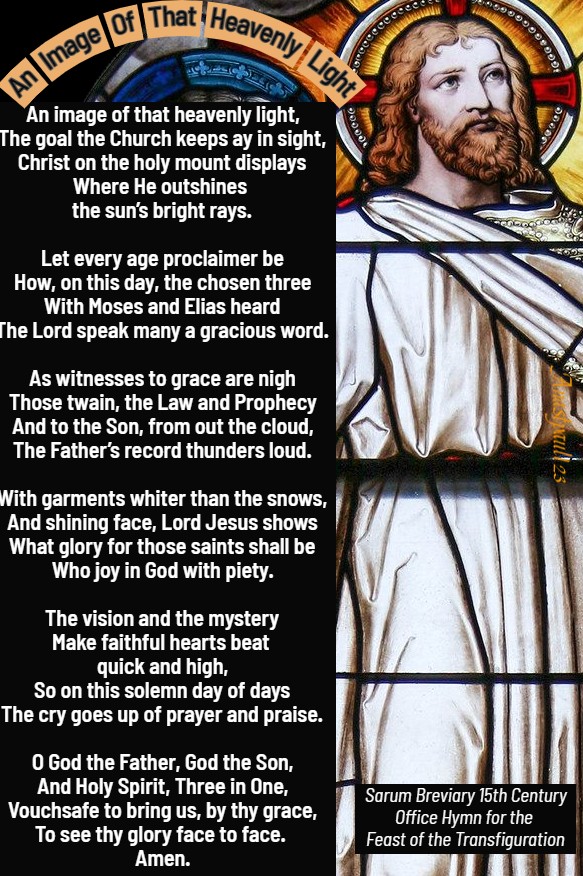
An Image of that Heavenly Light Sarum Breviary 15th Century Office Hymn for the Feast of the Transfiguration
An image of that heavenly light, The goal the Church keeps ay in sight, Christ on the holy mount displays Where He outshines the sun’s bright rays.
Let every age proclaimer be How, on this day, the chosen three With Moses and Elias heard The Lord speak many a gracious word.
As witnesses to grace are nigh Those twain, the Law and Prophecy And to the Son, from out the cloud, The Father’s record thunders loud.
With garments whiter than the snows, And shining face, Lord Jesus shows What glory for those saints shall be Who joy in God with piety.
The vision and the mystery Make faithful hearts beat quick and high, So on this solemn day of days The cry goes up of prayer and praise.
O God the Father, God the Son, And Holy Spirit, Three in One, Vouchsafe to bring us, by thy grace, To see thy glory face to face. Amen.
Words: Sarum Breviary, 15th Century Trans Richard E Roberts (1874-1945), 1906 This Hymn is used for Vespers I on the Feast of the Transfiguration of the Lord in the Sarum Breviary. This is the original text as it appears in The English Hymnal (1906).
St Pope Sixtus II/ Xystus (Died 258) Pope and Martyr, Philosopher. 25th Pope from St Peter. Papal Ascension 30 August 257. He was Martyred along with seven deacons, (St Lawrence of Rome a few days later) during the persecutions of Christianity by Emperor Valerian. This is the St Sixtus who is commemorated in the Roman Canon Eucharistic Prayer. His Life and Death: https://anastpaul.com/2021/08/06/saint-of-the-day-6-august-saint-sixtus-ii-died-258-pope-and-martyr/
St Gezelin of Schlebusch O.Cist. (Died 1149) Lay Brother of the Cistercian Order, Hermit. St Gislain of Luxemburg St Glisente of Brescia Bl Goderanno Bl Guillermo Sanz St Hardulf of Breedon
Bl Octavian of Savona St Stephen of Cardeña Bl William of Altavilla
Martyrs of Cardeña: Two hundred Benedictine Monks at the Saint Peter of Cardegna monastery, Burgos, Spain who were Martyred in the 8th century by invading Saracens. They were buried by local Christians in a nearby churchyard in Burgos, Spain and Beatified in 1603 by Pope Clement VIII (cultus confirmed).
August – The Month of the Immaculate Heart of Mary
The Church never disassociates the Mother from her Divine Son, in the festivals which she celebrates in His honour. If she celebrates the Mysteries of the Saviour, from His Incarnation to His Ascension, she celebrates, likewise, all the Mysteries of Mary, from her Conceptions to her Assumption. The Feast of the Sacred Heart of Mary (Immaculate Heart of Mary) is, therefore but the natural consequence of the Feast of the Sacred Heart of Jesus.
It is customary with many pious persons, to dedicate the Five First Saturdays of the month to the particular honour of the Immaculate Heart of Mary, as the Nine First Friday are devoted to the Sacred Heart of Jesus.
The Blessed Virgin, the Mother of Our Lord and Saviour Jesus Christ and our Mother Mary, is honoured in the first Month of the year, together with her Divine Son and Redeemer and her husband, St Joseph – January being the Month of the Holy Family.
Then, in May, we run to our Holy Mother everyday and in October we honour her again in our daily recitation of the Holy Rosary, with September being dedicated to the Seven Sorrows of Mary together with the Holy Cross. In December, we remember the Immaculate Conception and the most appropriate devotion to the Divine Infancy of Our Lord.
That then leaves August – the Month of her Most Immaculate Heart which gives the Virgin Mary a total of 6 months of dedication.
In 1944, Pope Pius XII set the Feast of the Immaculate Heart of Mary to be celebrated on 22 August as the Octave of the Feast of the Assumption of the Blessed Virgin on 15 August. Two years earlier, on the 25th Anniversary of the Fatima apparitions, Pope Pius XII, Consecrated the Catholic family and whole human race, to the Immaculate Heart of Mary.
August also celebrates the Marian Feast of Our Lady of the Snows (St Mary Major on 5 August, Our Lady Refuge of Sinners on 13 August, Our Lady of Knock on 21 August, Our Lady of Czestochowa and Our Lady Health of the Sick on 26 August.
Feast of The Humility of the Blessed Virgin Mary or the Madonna of Humility: The Feast of the Humility of the Blessed Virgin Mary is celebrated on 17 July. It was included in the General Roman Calendar of 1954 among the feasts ‘pro aliquibus locis’ (in some places) but was removed from the General Roman Calendar of 1960. However, many Diocese worldwide still celebrate this beautiful Feast as do all Traditional Catholics. https://anastpaul.com/2022/07/17/saint-of-the-day-17-july-the-humility-of-mary-by-st-alphonsus/
Martyrs of Compiegne (16 Carmelite Beati): Sixteen Blessed Teresian Martyrs of Compiègne. Eleven Discalced Carmelite nuns, three lay sisters and two lay women servants who were Martyred together in the French Revolution. They were the earliest Martyrs of the French Revolution that have been recognised. They were: Angelique Roussel • Anne Pelras • Anne-Marie-Madeleine Thouret • Catherine Soiron • élisabeth-Julitte Vérolot • Marie Dufour • Marie Hanniset • Marie-Anne Piedcourt • Marie-Anne-Françoise Brideau • Marie-Claude-Cyprienne Brard • Marie-Françoise de Croissy • Marie-Gabrielle Trezel • Marie-Geneviève Meunier • Marie-Madeleine-Claudine Lidoine • Rose-Chretien de Neuville • Thérèse Soiron. They were guillotined on 17 July 1794 at the Place du Trône Renversé (modern Place de la Nation) in Paris, France. The 16 Martyrs Story: https://anastpaul.com/2017/07/17/saints-of-the-day-17-july-the-carmelite-martyrs-of-compiegne-o-c-d/
Bl Arnold of Himmerod Bl Bénigne Bl Biagio of the Incarnation
Bl Carlos de Dios Murias OFM Conv (1945-1976) Priest Martyr St Clement of Ohrid St Cynllo St Ennodius of Pavia St Fredegand of Kerkelodor St Generosus St Gorazd St Hyacinth of Amastris St Kenelm St Pope Leo IV St Marcellina (c330-c398) Consecrated Virgin, sister of St Ambrose. St Nerses Lambronazi Bl Sebastian of the Holy Spirit Bl Tarsykia Matskiv St Theodosius of Auxerre St Theodota of Constantinople St Turninus
Martyrs of Scillium (12 Saints): A group of twelve Christians Martyred together, the final deaths in the persecutions of Emperor Marcus Aurelius. Upon their conviction for the crime of being Christians, the group was offered 30 days to reconsider their allegiance to the faith; they all declined. Their official Acta still exist. Their names : • Acyllinus • Cythinus • Donata • Felix • Generosa • Januaria • Laetantius • Narzales • Secunda • Speratus • Vestina • Veturius They were beheaded on 17 July 180 in Scillium, Numidia (in North Africa).
Saint or Feast of the Day – 15 July – The Feast of the the “Divisio Apostolorum – the Division of the Apostles” also known as (‘Dispersion’) a Feast which was very popular in the Middle Ages and continued into the Tridentine period on many local calendars but was never on the General Calendar. It is the Liturgical commemoration of an ancient tradition that some time after the Ascension, the Apostles cast lots for which part of the world each one of them would go, spreading out from Jerusalem. to preach the Gospel to all the ends of the earth.
The Common Office of the Apostles refers to this idea repeatedly, as, for example, in the first Antiphon of Matins, taken from Psalm 18. “Their sound hath gone forth into all the earth and their words unto the ends of the world” and, likewise, the third Antiphon from Psalm 44, “Thou shalt make them princes over all the earth; they shall remember Thy Name, O Lord.” …
The earliest reference to this Feast is a sequence which was well-known and widely used in the Middle Ages, written by one Godeschalk, a Monk of Limburg Abbey in Western Germany, who died in 1098.
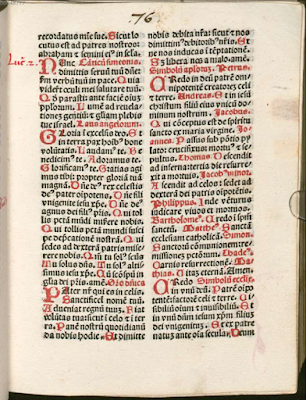
There is a tradition known from the 4th Century, which declares that the Baptismal Creed, now called the Apostles’ Creed, was composed as a rule of the Faith by the Twelve before this dispersal, with each one of them contributing an one of the Aarticles of our Faith. … It is seen here in a Carthusian Breviary c1490, (starting near the top of the right column), in which the name of an Apostle is printed in red before each Article of the Creed.
Quote/s of the Day – 2 July – The Visitation of the Blessed Virgin Mary
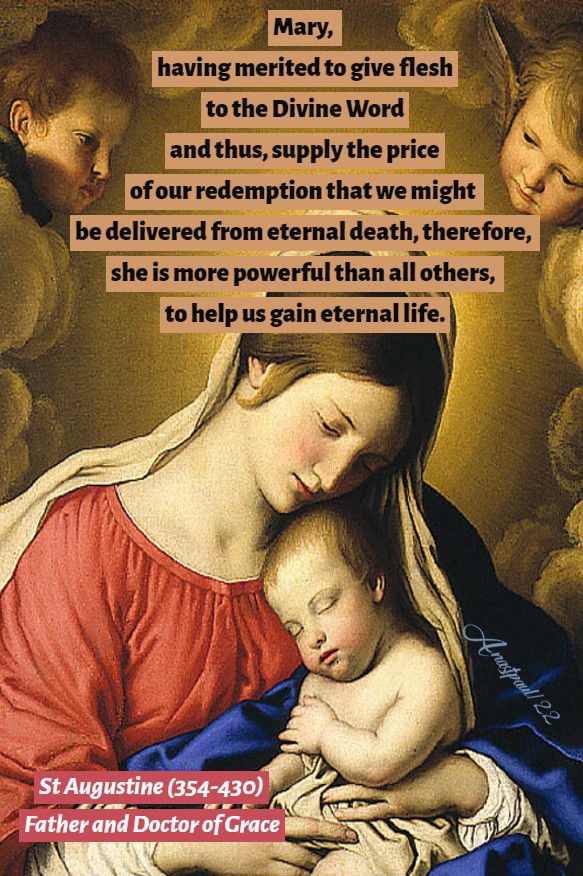
“Mary, having merited to give flesh to the Divine Word and thus, supply the price of our redemption that we might be delivered from eternal death, therefore, she is more powerful than all others, to help us gain eternal life.”
St Augustine (354-430) Father and Doctor of Grace
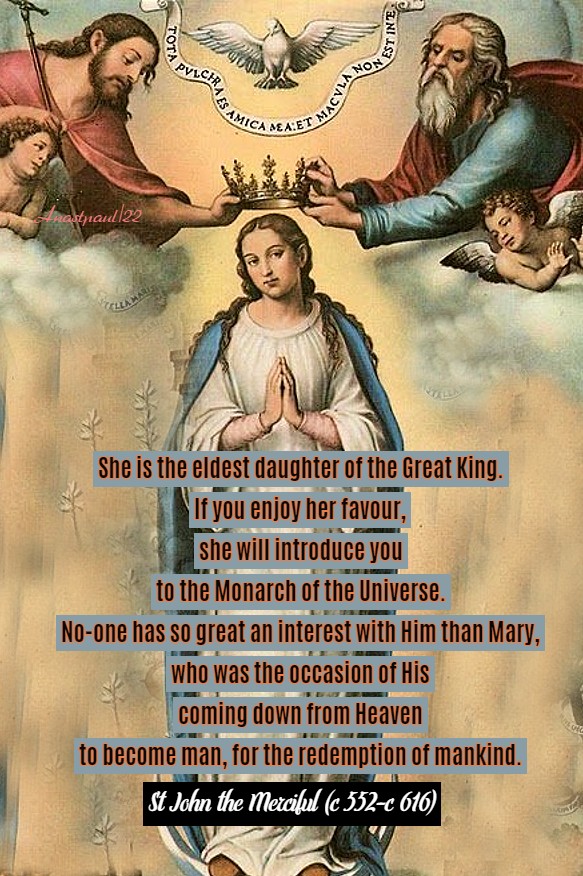
“She is the eldest daughter of the Great King. If you enjoy her favour, she will introduce you to the Monarch of the Universe. No-one has so great an interest with Him than Mary, who was the occasion of His coming down from Heaven to become man, for the redemption of mankind.”
St John the Merciful (c 552-c 616)
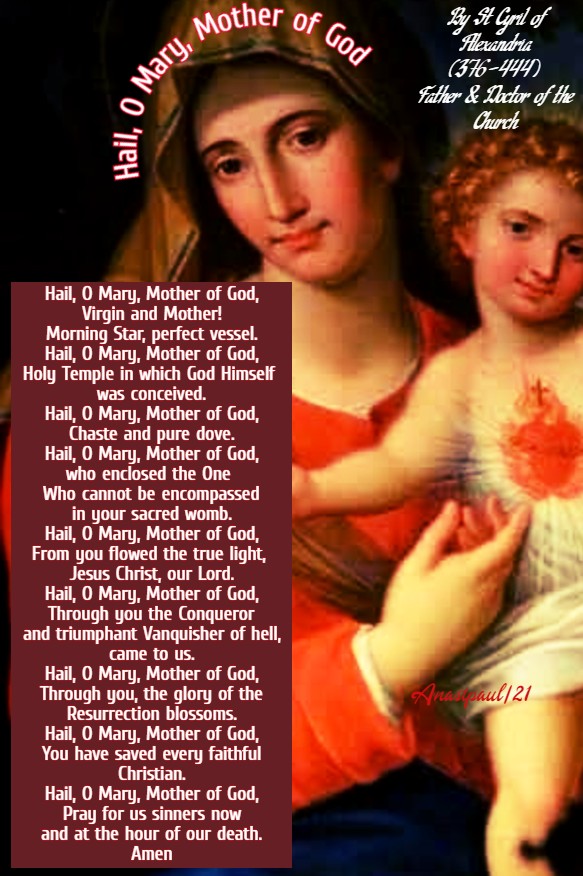
Hail, O Mary, Mother of God By St Cyril of Alexandria (376-444) Father & Doctor of the Church
Hail, O Mary, Mother of God, Virgin and Mother! Morning Star, perfect vessel. Hail, O Mary, Mother of God, Holy Temple in which God Himself was conceived. Hail, O Mary, Mother of God, Chaste and pure dove. Hail, O Mary, Mother of God, who enclosed the One Who cannot be encompassed in your sacred womb. Hail, O Mary, Mother of God, From you flowed the true light, Jesus Christ, our Lord. Hail, O Mary, Mother of God, Through you the Conqueror and triumphant Vanquisher of hell, came to us. Hail, O Mary, Mother of God, Through you, the glory of the Resurrection blossoms. Hail, O Mary, Mother of God, You have saved every faithful Christian. Hail, O Mary, Mother of God, Pray for us sinners now and at the hour of our death. Amen
Adapted from a sermon preached by St Cyril, Archbishop of Alexandria (444), presiding as representative of the Holy See at the Ecumenical Council of Ephesus, in 431. In refuting Nestorianism, he is called “Doctor of the Incarnation.
“O daughter of King David and Mother of God, the universal King. O Divine and living object whose beauty has charmed God the Creator; your whole soul is completely open to God’s action and attentive to God alone. … Your womb will be the abode of the one whom no place can contain. Your milk will provide nourishment for God, in the little Infant Jesus. Your hands will carry God and your knees will serve as a throne for Him that is more noble than the throne of the Cherubim. … You are the temple of the Holy Spirit, the city of the living God, made joyous by abundant flowers, the sacred flowers of Divine grace. You are all-beautiful and very close to God, above the Cherubim and higher than the Seraphim, right near God Himself! Amen”
St John Damascene (675-749) Father and Doctor of the Church
One Minute Reflection – 2 July – “The Month of the Most Precious Blood of Jesus” – The Visitation of the Blessed Virgin Mary – Song 2:8-14, Luke 1:39-47 – Scripture search here: https://www.drbo.org/
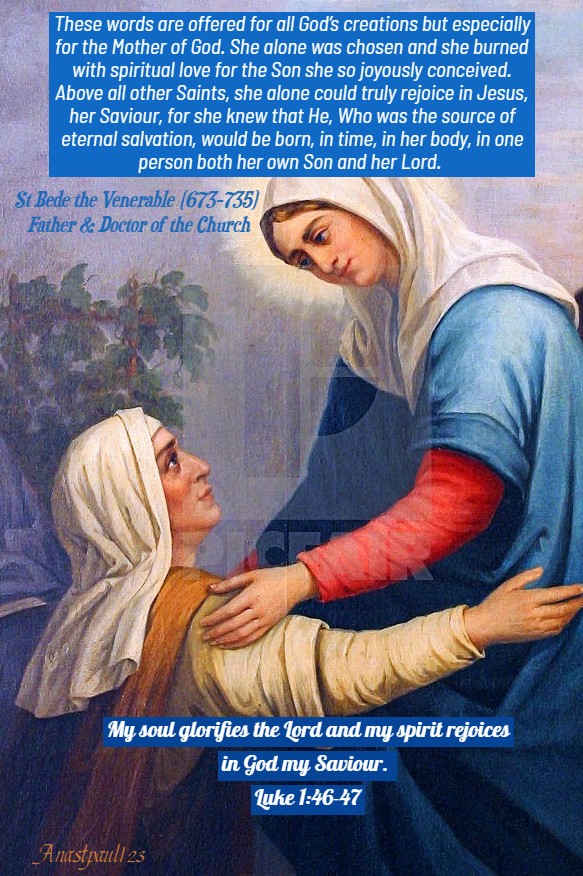
“My soul glorifies the Lord and my spirit rejoices in God my Saviour.”- Luke 1:46-47
REFLECTION – “When a man devotes all his thoughts to the praise and service of the Lord, he proclaims God’s greatness. His observance of God’s commands, moreover, shows that he has God’s power and greatness always at heart. His spirit rejoices in God his Saviour and delights in the mere recollection of his Creator Who gives him hope for eternal salvation.
These words are offered for all God’s creations but especially for the Mother of God. She alone was chosen and she burned with spiritual love for the Son she so joyously conceived. Above all other Saints, she alone could truly rejoice in Jesus, her Saviour, for she knew that He, Who was the source of eternal salvation, would be born, in time, in her body, in one person both her own Son and her Lord.
Therefore, it is an excellent and fruitful custom of holy Church that we should sing Mary’s hymn at the time of evening prayer. By meditating upon the Incarnation, our devotion is kindled and by remembering the example of God’s Mother, we are encouraged to lead a life of virtue. Such virtues are best achieved in the evening. We are weary after the day’s work and worn out by our distractions. The time for rest is near and our minds are ready for contemplation.” – St Bede the Venerable (673-735) Father & Doctor of the Church
PRAYER – Bestow upon Thy servants, we beseech Thee, O Lord, the gift of heavenly grace that as the child-bearing of the Blessed Virgin marked the beginning of our salvation, so may the solemn Feast of her Visitation bring us an increase of peace.Through Jesus Christ, Thy Son our Lord, Who lives and reigns with Thee, in the unity of the Holy Ghost, God, world without end. Amen (Collect).
Our Morning Offering – 2 July – The Solemnity of Saints Peter and Paul, Apostles and Martyrs
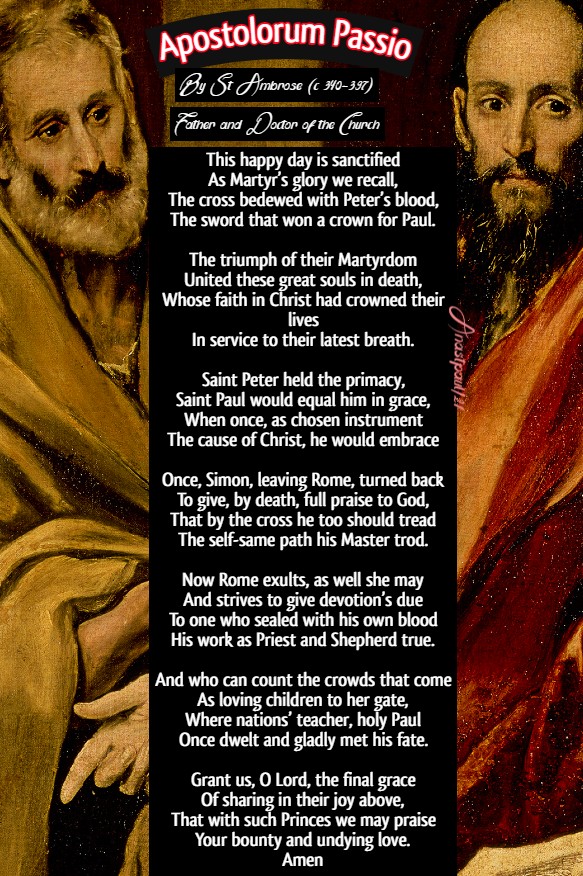
Apostolorum Passio By St Ambrose (c 340-397) Father and Doctor of the Church
This happy day is sanctified As Martyr’s glory we recall, The cross bedewed with Peter’s blood, The sword that won a crown for Paul.
The triumph of their Martyrdom United these great souls in death, Whose faith in Christ had crowned their lives In service to their latest breath.
Saint Peter held the primacy, Saint Paul would equal him in grace, When once, as chosen instrument The cause of Christ, he would embrace
Once, Simon, leaving Rome, turned back To give, by death, full praise to God, That by the cross he too should tread The self-same path his Master trod.
Now Rome exults, as well she may And strives to give devotion’s due To one who sealed with his own blood His work as Priest and Shepherd true.
And who can count the crowds that come As loving children to her gate, Where nations’ teacher, holy Paul Once dwelt and gladly met his fate.
Grant us, O Lord, the final grace Of sharing in their joy above, That with such Princes we may praise Your bounty and undying love. Amen
Trans: The Benedictines of St Cecilia’s Abbey, Ryde, UK
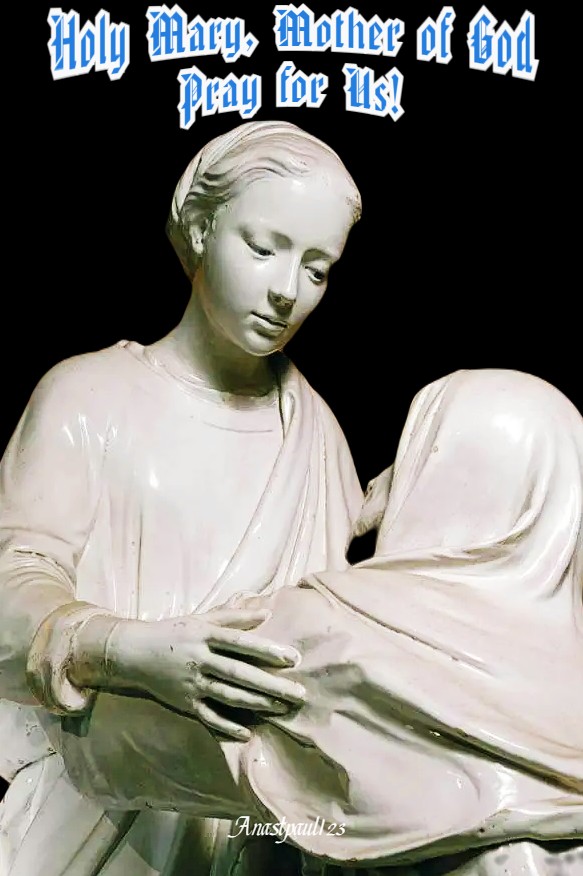
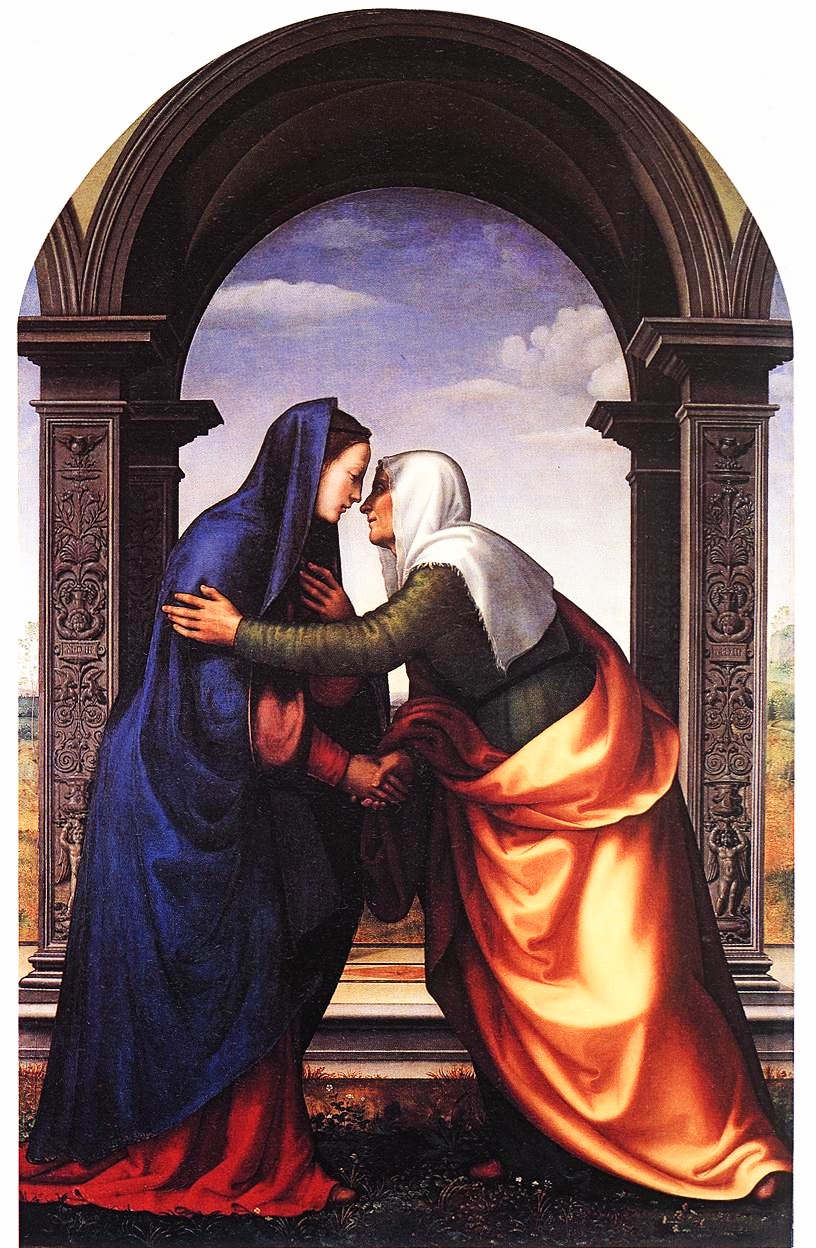
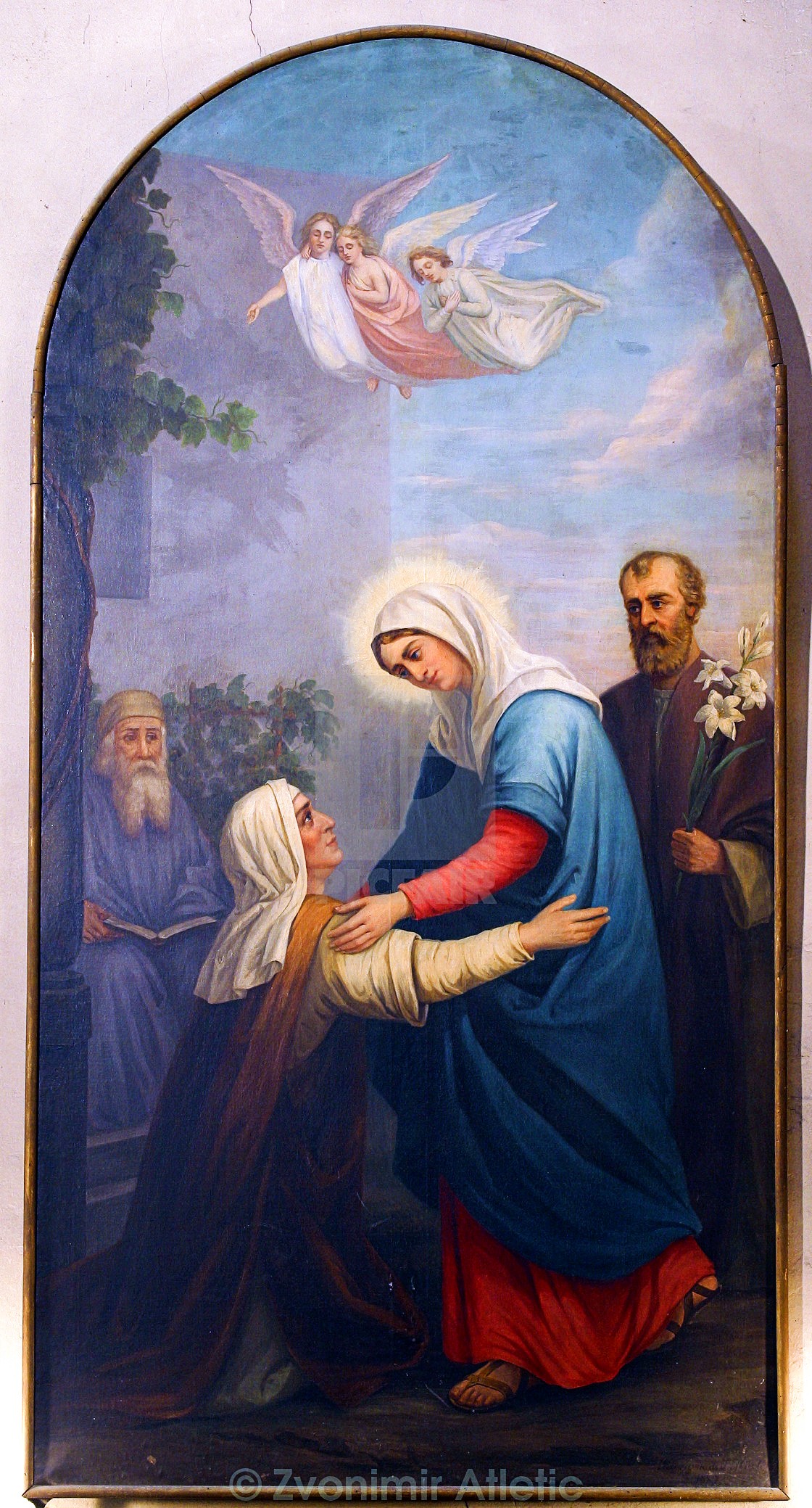
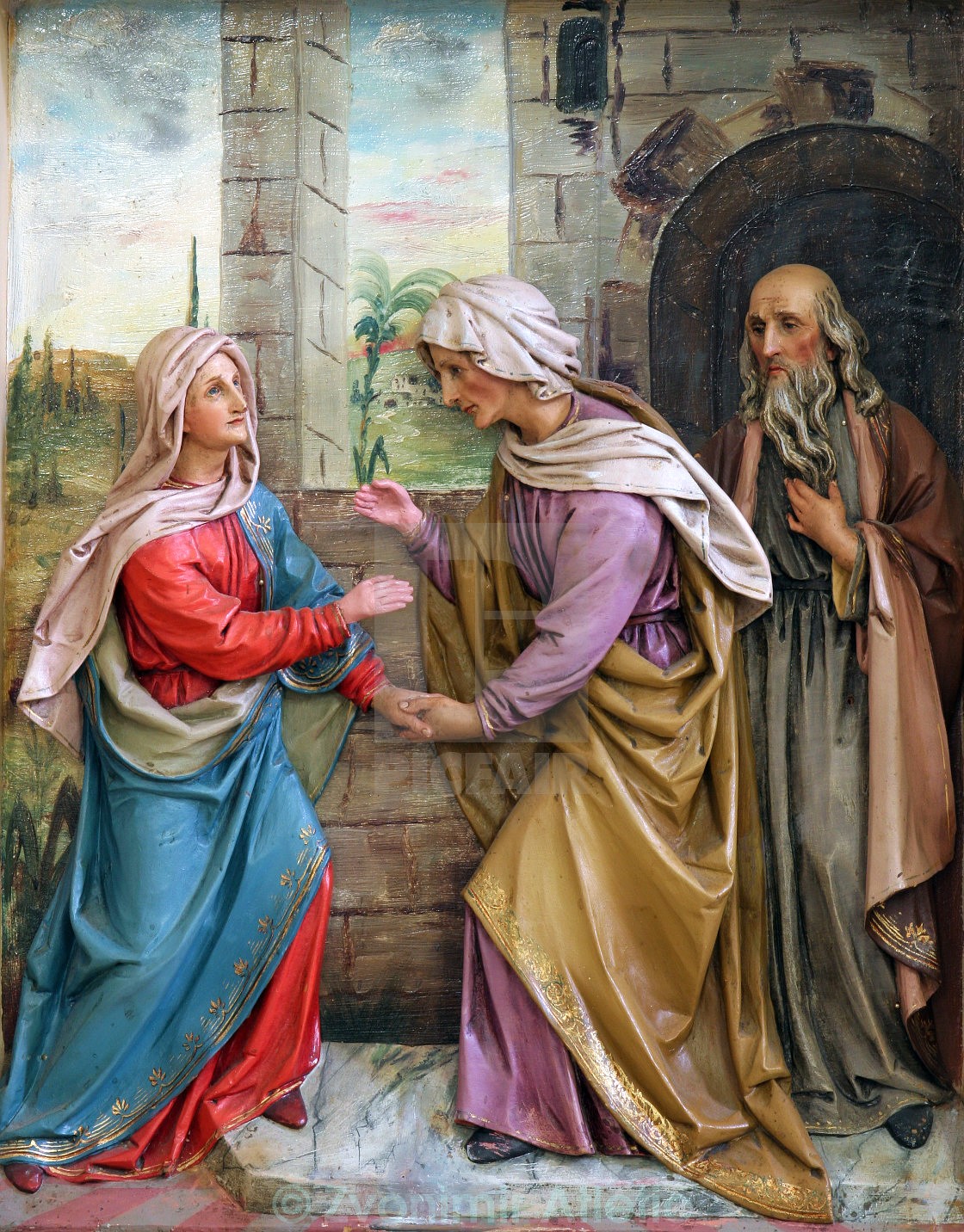
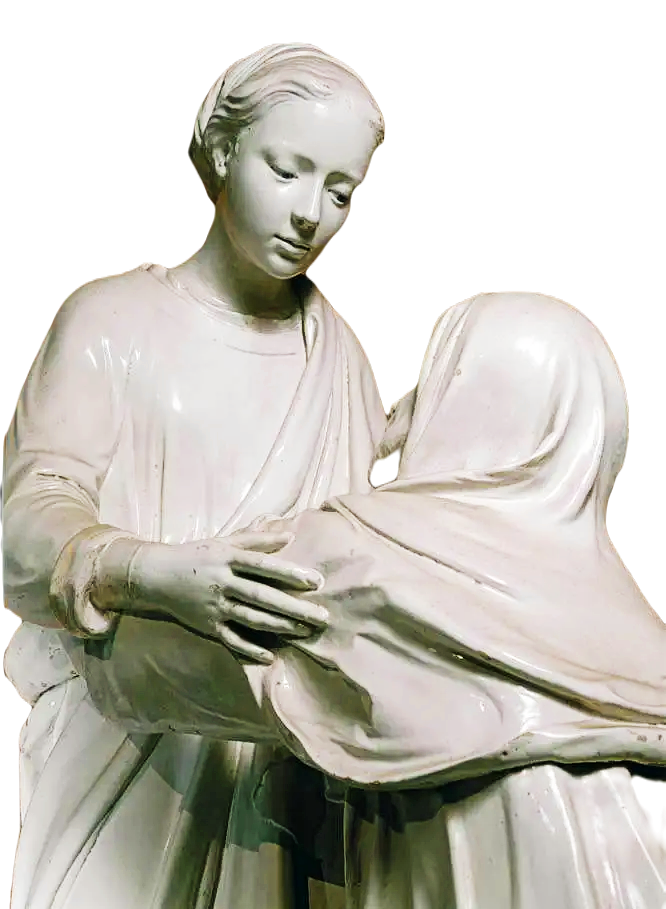
The Feast of the Visitation of Our Lady, instituted in 1385 by Pope Urban IV – 2 July.
Mary’s first thought after the Archangel’s visit was to hasten to the little Town of Ain Kharin and congratulate her cousin, Elizabeth on the wonderful event about to take place. As Mary hastened along, those who met her, little realised that she bore the Son of God – humble, sweet and gracious, to all.
So the young girl from Nazareth, passed unobserved upon her way. But as she raised her voice in loving salutation to Elizabeth, when entering the house, a marvelous thing occurred, for the unborn infant in Elizabeth’s womb, leapt for joy, as he heard the voice of God’s Mother sounding in his ears. Elizabeth, stricken with amazement, cried out:
“Blessed art thou among women and blessed is the fruit of thy womb. And whence is this to me, that the mother of my Lord should come to me? For behold, as soon as the voice of thy salutation sounded in my ears, the infant in my womb leapt for joy. And blessed art thou that hast believed because those things shall be accomplished which were spoken to thee by the Lord.”
In that instant Elizabeth knew that she was standing in the presence of God; she knew that the young girl standing before her was God’s Mother; knew all that had taken place at Nazareth; knew of Mary’s fiat.
Then Mary lifted up her voice in high thanksgiving and gave forth the marvelous canticle:
“My soul doth magnify the Lord. And my spirit hath rejoiced in God my Saviour. Because He hath regarded the humility of His handmaid; for behold, from henceforth, all generations shall call me blessed. Because He that is mighty, hath done great things for me and holy is His name. And His mercy is from generation unto generations, to them that fear Him. He hath shewed might in His arm; He hath scattered the proud in the conceit of their heart. He hath put down the mighty from their seat and hath exalted the humble. He hath filled the hungry with good things and the rich He hath sent empty away. He hath received Israel His servant, being mindful of His mercy, as He spoke to our fathers, to Abraham and to his seed forever.”
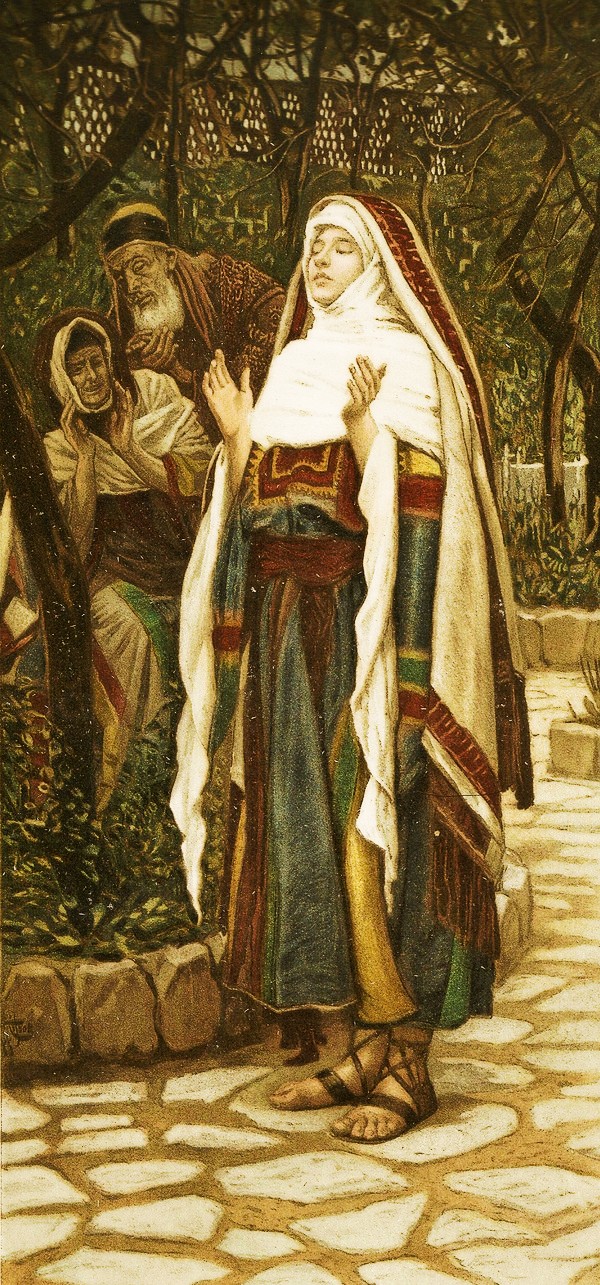
The Magnificat nbby James Tissot
In this Magnificat of the humble young girl of Nazareth, there is an intense personal note; she sees why it is that she is exalted – her humility. She prophesies and foretells her future glory. Then she says that God’s mercy follows those who fear Him; she sings of God’s might; she returns to the thought of God’s mercy and with this mercy in mind, the young virgin ends her triumphant song.
For three months Mary and Elizabeth rejoiced in each other’s company and gave thanks to God for all the wonderful mercy He had bestowed upon them – one, the mother of the Herald of God, the other, the Mother of God Himself. Yet these months saw nothing outwardly extraordinary; it was just the quiet outwardly ordinary daily round, such as might be seen in any family.
After those three months the Virgin set out on her way home to Nazareth and her return was as little noted as her going. She came full of joy and she returned full of joy, for no hint of coming sorrow cast a shadow upon her.
This Feast of the Visitation of Our Lady was instituted by Pope Urban IV, in the year 1385 and confirmed by Pope Boniface IX, in the year 1389.
Bl Giovanni da Fabriano Becchetti St Jacques Fermin Bl Jarich of Mariengaarde St Jéroche St Lidanus of Sezze St Martinian of Rome * (Died c67) Martyr, Layman
Martyred Soldiers of Rome – 3 Saints: Three soldiers who were converted at the Martyrdom of Saint Paul the Apostle. Then they were martyred, as well. We known nothing else about them but their names – Acestes, Longinus and Megistus. Martyred c68 in Rome, Italy
Martyrs in Carthage by Hunneric – 7 Saints: A group of seven Christians tortured and murdered in the persecutions of the Arian Vandal king Hunneric for remaining loyal to the teachings of orthodox Christianity. They were some of the many who died for the faith during a period of active Arian heresy. – Boniface, Liberatus, Maximus, Rogatus, Rusticus, Septimus and Servus.
Martyrs of Campania – 10 Saints: A group of ten Christians Marytred together in the persecutions of Diocletian. The only details about them to have survived are their names – Ariston, Crescention, Eutychian, Felicissimus, Felix, Justus, Marcia, Symphorosa, Urban and Vitalis. Martyred in 284 in Campania, Italy.
St Aaron of Caerleon St Aaron the Patriarch St Arnulf of Mainz St Calais of Anisole St Carilephus St Castus of Sinuessa St Cewydd St Concordius of Toledo St Cuimmein of Nendrum St Domitian of Lerins Bl Elisabeth de Vans St Eparchius of Perigord St Eutychius of Umbria St Esther the Queen Saint Fleuret (Died c621) Bishop of Auvergne, France St Gall of Clermont St Golvinus of Leon St Gwenyth of Cornwall Bl Huailu Zhang St Julius of Caerleon St Justino Orona Madrigal St Juthware St Leonorious of Brittany St Leontius of Autun St Martin of Vienne St Nicasius of Jerusalem
St Secundinus of Sinuessa St Servan of Culross St Theobald of Vicenza St Theodoric of Mont d’Or St Veep
Martyrs of Rome – 6 Saints: Six Christians who were Martyred together. No details have survived except their names – Esicius, Antonius, Processus, Marina, Serenus and Victor. They were martyred in Rome, Italy, date unknown.
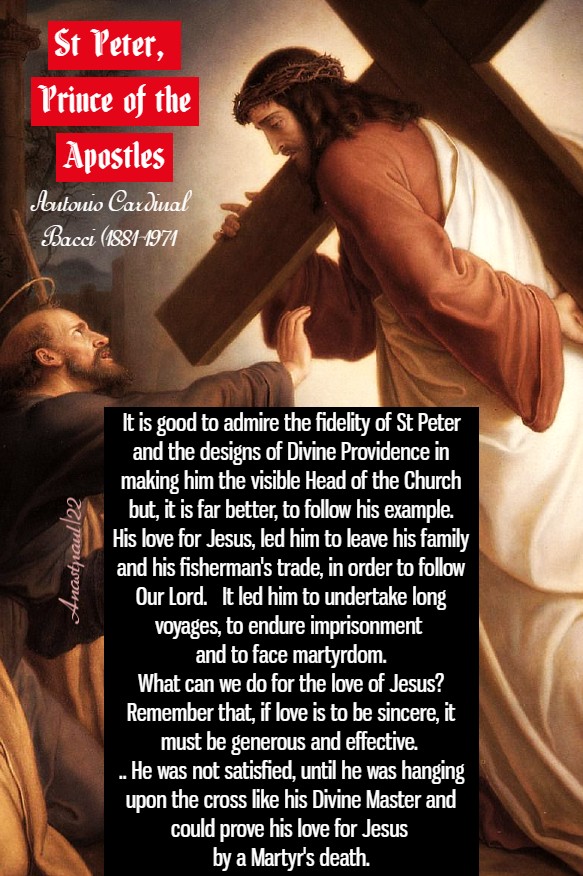
Thought for the Day – 29 June – Meditations with Antonio Cardinal Bacci (1881-1971)
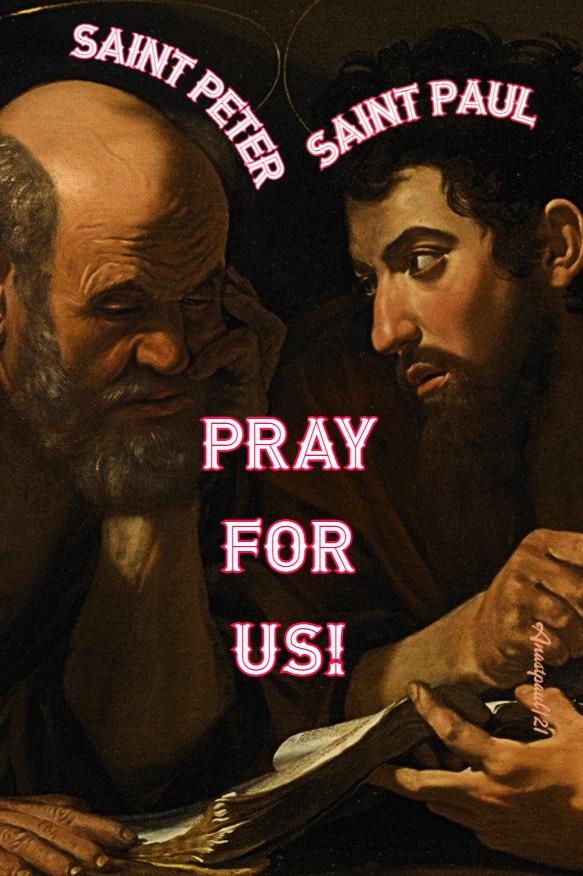
St Peter, Prince of the Apostles St Paul, the Apostle to the Gentiles
“It is good to admire the fidelity of St Peter and the designs of Divine Providence in making him the visible Head of the Church but, it is far better, to follow his example. His love for Jesus, led him to leave his family and his fisherman’s trade, in order to follow Our Lord. It led him to undertake long voyages, to endure imprisonment and to face martyrdom. What can we do for the love of Jesus? Remember that, if love is to be sincere, it must be generous and effective.
Secondly let us meditate on and imitate, the ardent and fearless faith of St Peter. He was not afraid to preach the teaching of Christ before the Sanhedrin. He was not afraid of Herod, who cast him into prison.
He was not afraid of the Roman Emperor, who caused him to be crucified. Our faith should be steadfast and lively, like his!
Finally, let us imitate Peter in his repentance. Although he loved Jesus very much and had such great faith in Him, in a moment of weakness and of imprudence, he denied Him three times. All his life, however, be wept bitterly for this sin. Whenever he heard a cock crowing, it was as if an arrow had pierced his heart. He was not satisfied, until he was hanging upon the cross like his Divine Master and could prove his love for Jesus by a Martyr’s death.”
St Paul, the Apostle to the Gentiles
We can learn many other virtues from St Paul, besides his zealous love for God and for his fellowmen. We can also learn from him, the virtues of humility and of apostolic fervour. The Apostle of the Gentiles reached such heights of sanctity, as to feel himself transformed into Christ Himself and to deserve to be taken up into the third Heaven, where he enjoyed a foretaste of eternal happiness. Nevertheless, he considered himself unworthy to be called an Apostle and he realised, that all his gifts came to him from God. “Not that we are sufficient of ourselves, to think anything as from ourselves but our sufficiency, is from God” (2 Cor 3:5). Whenever we succeed in any project, we should think on the same lines because, it is only when we are humble and depend on the grace of God, that the success of our actions will redound to the glory of our Creator. If the cancer of ambition or of self-love, should corrupt our purity of intention, our work would not be blessed by God and would not make us worthy of everlasting life. Let us repeat often: “All for You, with You and in You, my God.”
Quote/s of the Day – 29 June – Saints Peter and Paul, Apostles
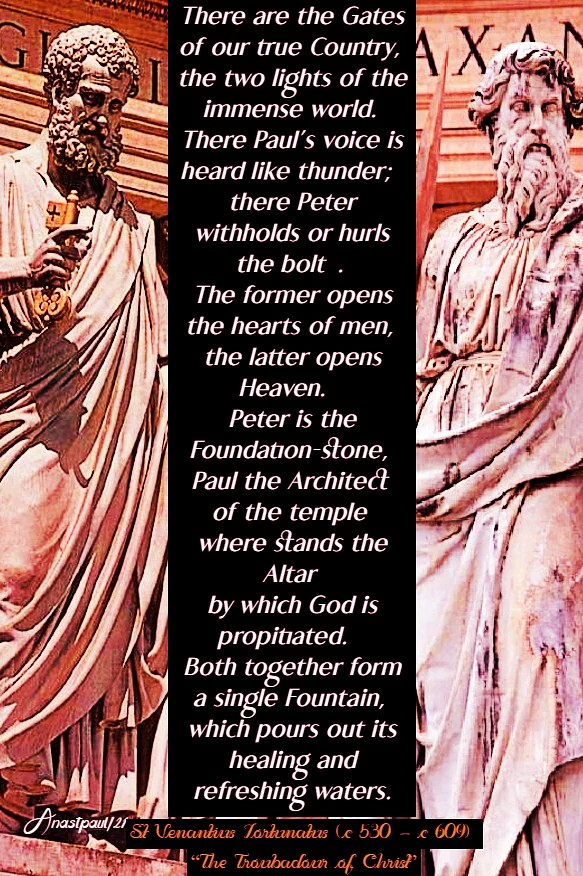
“There are the gates of our true country, the two lights of the immense world. There Paul’s voice is heard like thunder; there Peter withholds or hurls the bolt . The former opens the hearts of men, the latter opens Heaven. Peter is the Foundation-stone, Paul the Architect of the temple where stands the Altar by which God is propitiated. Both together form a single Fountain, which pours out its healing and refreshing waters.”
St Venantius Fortunatus (c 530 – c 609) “The Troubadour of Christ”
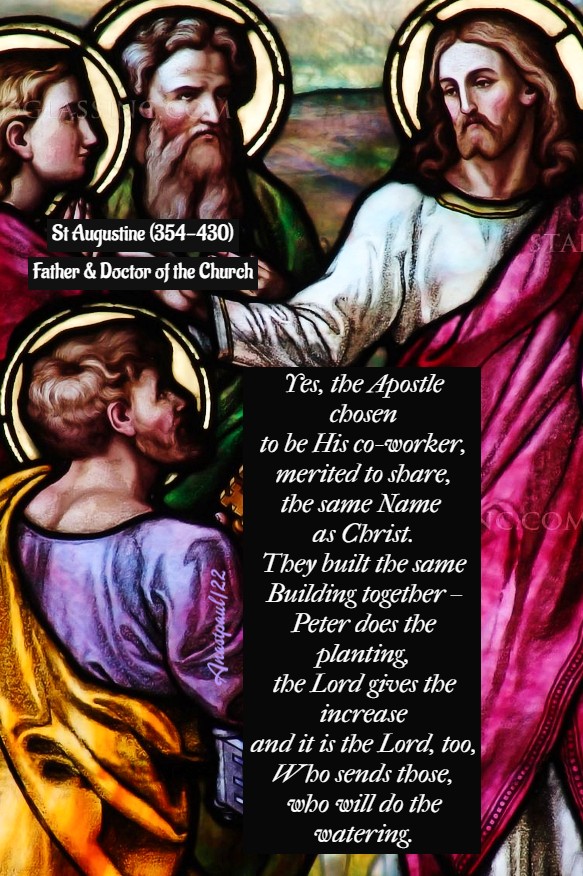
“Yes, the Apostle chosen to be His co-worker, merited to share, the same Name as Christ. They built the same Building together – Peter does the planting, the Lord gives the increase and it is the Lord, too, Who sends those, who will do the watering (cf 1 Cor 3:6f).”
St Augustine (354-430) Father & Doctor of the Church
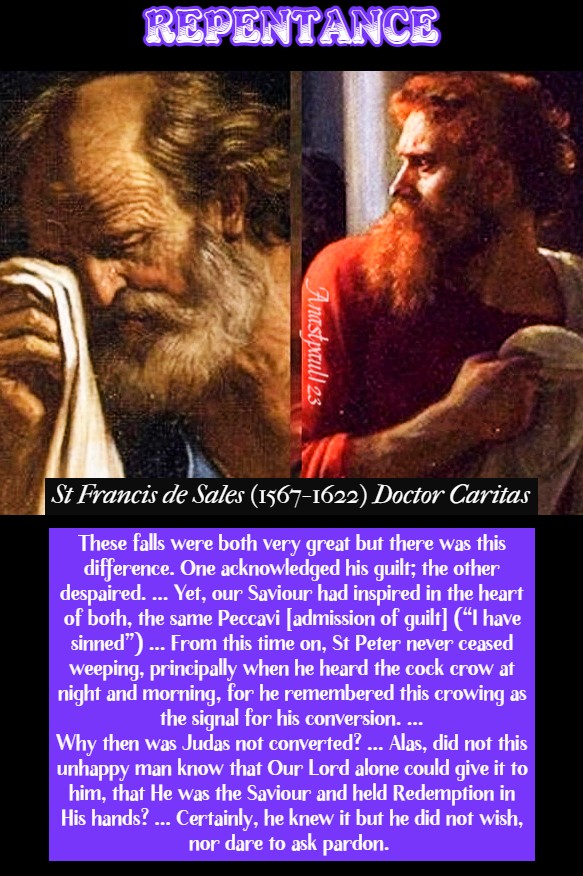
“These falls were both very great but there was this difference. One acknowledged his guilt; the other despaired. Yet, our Saviour had inspired in the heart of both, the same Peccavi [admission of guilt] (“I have sinned”) … From this time on, St Peter never ceased weeping, principally when he heard the cock crow at night and morning, for he remembered this crowing as the signal for his conversion. … Why then was Judas not converted? … Alas, did not this unhappy man know that Our Lord alone could give it to him, that He was the Saviour and held Redemption in His hands? … Certainly, he knew it but he did not wish, nor dare to ask pardon. ”
St Francis de Sales (1567-1622) Doctor Caritas
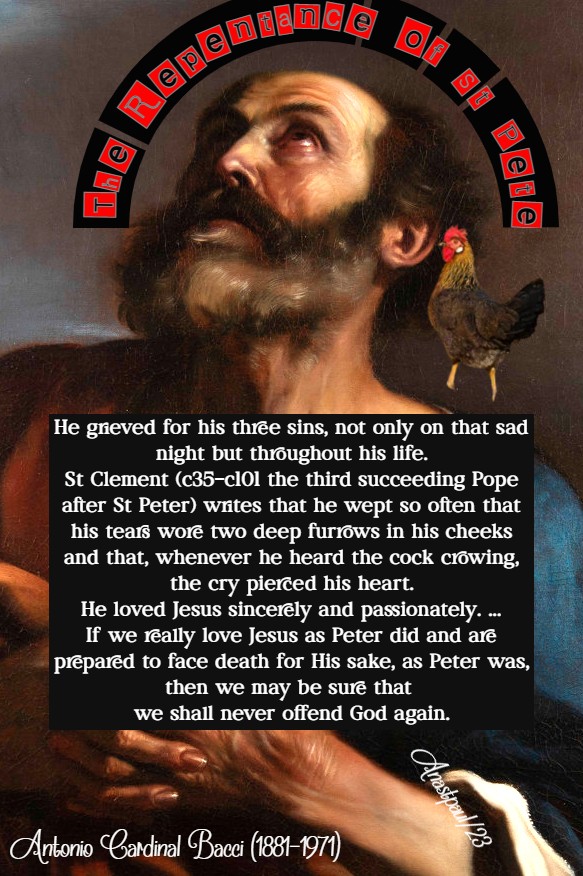
“He grieved for his three sins, not only on that sad night but throughout his life. St Clement (c35-c101 the third succeeding Pope after St Peter) writes that he wept so often that his tears wore two deep furrows in his cheeks and that, whenever he heard the cock crowing, the cry pierced his heart. He loved Jesus sincerely and passionately. If we really love Jesus as Peter did and are prepared to face death for His sake, as Peter was, then we may be sure that we shall never offend God again.”
Antonio Cardinal Bacci (1881-1971)
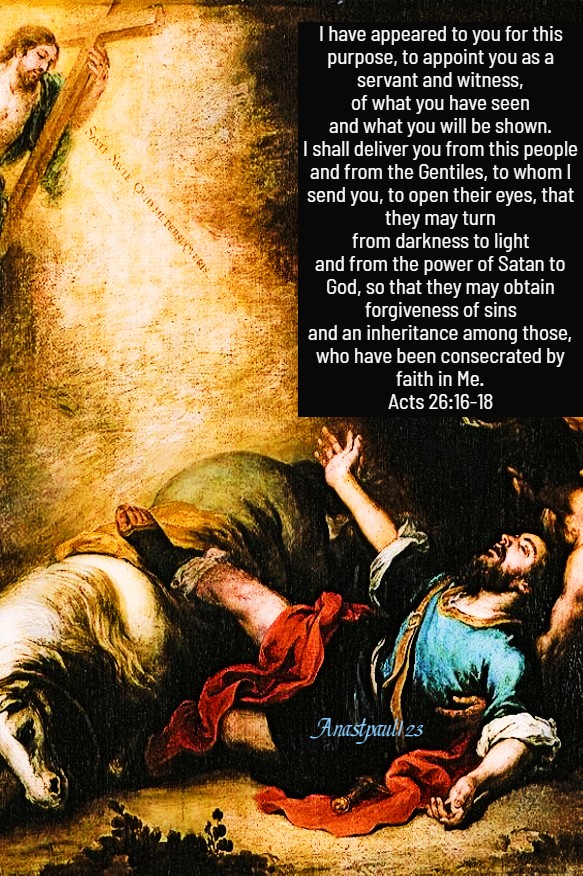
“I have appeared to you for this purpose, to appoint you as a servant and witness, of what you have seen and what you will be shown. I shall deliver you from this people and from the Gentiles, to whom I send you, to open their eyes, that they may turn from darkness to light and from the power of Satan to God, so that they may obtain forgiveness of sins and an inheritance among those, who have been consecrated by faith in Me.”
Acts 26:16-18
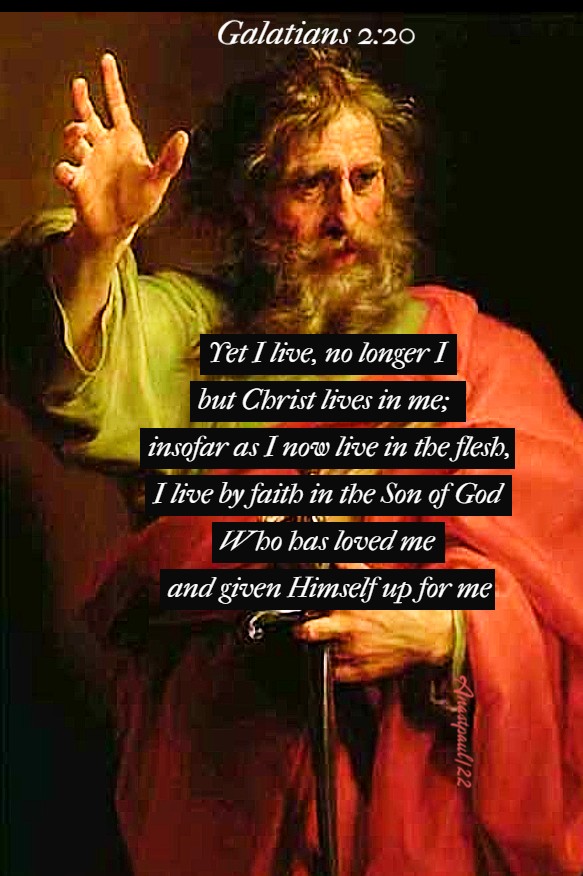
“Yet I live, no longer I but Christ lives in me; insofar as I now live in the flesh, I live by faith in the Son of God, Who has loved me and given himself up for me.”
One Minute Reflection – 29 June – “The Month of the Sacred Heart of Jesus” – Saints Peter and Paul, Apostles – Acts 12:1-11, Matthew 16:13-19 – Scripture search here: https://www.drbo.org/
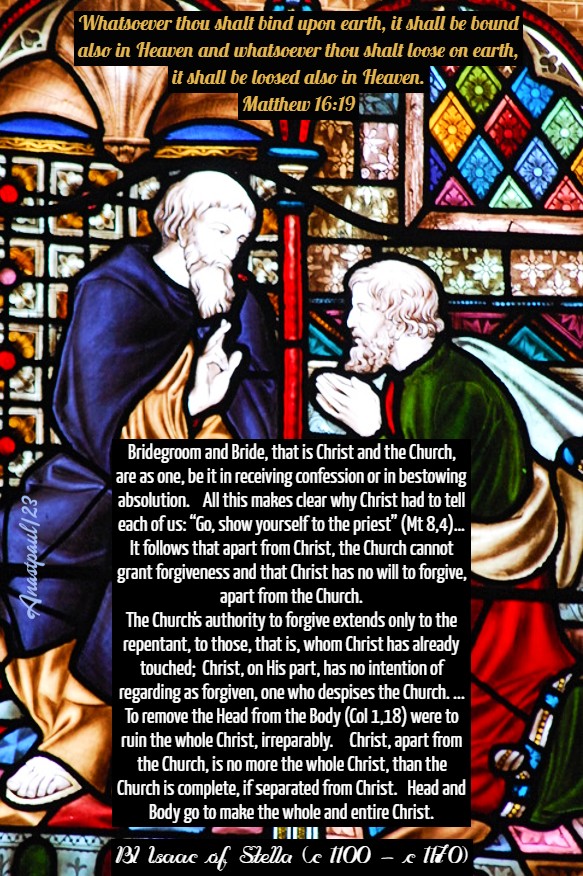
“Whatsoever thou shalt bind upon earth, it shall be bound also in Heaven and whatsoever thou shalt loose on earth, it shall be loosed also in Heaven.” – Matthew 16:19
REFLECTION – “Bridegroom and Bride, that is Christ and the Church, are as one, be it in receiving confession or in bestowing absolution. All this makes clear why Christ had to tell each of us: “Go, show yourself to the priest” (Mt 8,4)… It follows that apart from Christ, the Church cannot grant forgiveness and that Christ has no will to forgive, apart from the Church. The Church’s authority to forgive extends only to the repentant, to those, that is, whom Christ has already touched; Christ, on His part, has no intention of regarding as forgiven, one who despises the Church.
Doubtless, Christ need accept no restraints to His power of Baptising, Consecrating the Eucharist, Ordaining Priests, forgiving sins and the like but, the humble and faithful Bridegroom, prefers to confer such blessings, with the co-operation of His Bride. “What God,” then, “has joined, let no man put asunder” (Mt 19,6). “I say this is a great mystery and refers to Christ and the Church” (Eph 5,32)… To remove the Head from the Body (Col 1,18) were to ruin the whole Christ, irreparably. Christ, apart from the Church, is no more the whole Christ, than the Church is complete, if separated from Christ. Head and Body go to make the whole and entire Christ.” – Bl Isaac of Stella (c 1100 – c 1170) Cistercian Monk, Abbot, Theologian, Philosopher (Sermon 11, §11-814).
PRAYER – O God, Who made this day holy by the Martyrdom of Thy Apostles Peter and Paul, grant Thy Church to follow in all things the teaching of those from whom she first received the faith. Through Jesus Christ, Thy Son our Lord, Who lives and reigns with Thee, in the unity of the Holy Ghost, God, world without end. Amen (Collect).
ALL PRAISE, honour and glory to the Divine Heart of JESUS.Indulgenced– 50 Days, once a day. 168 Pope Leo XIII, 14 June 1901.
Our Morning Offering – 29 June – Saints Peter and Paul, Apostles
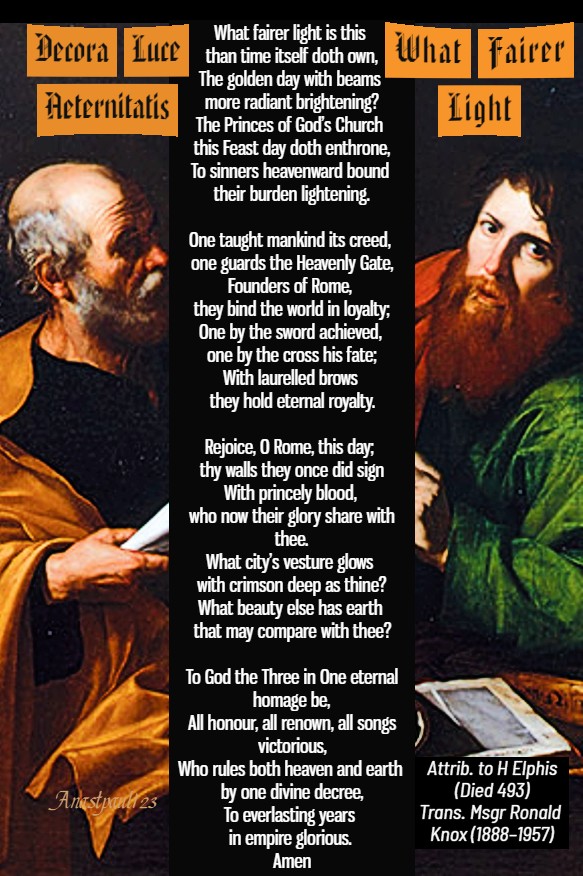
Decora Luce Aeternitatis What Fairer Light Attrib. to H Elphis (Died 493) Wife of Boethius c 477– 524) Trans. Msgr Ronald Knox (1888–1957)
What fairer light is this than time itself doth own, The golden day with beams more radiant brightening? The Princes of God’s Church this Feast day doth enthrone, To sinners heavenward bound their burden lightening.
One taught mankind its creed, one guards the Heavenly Gate, Founders of Rome, they bind the world in loyalty; One by the sword achieved, one by the cross his fate; With laurelled brows they hold eternal royalty.
Rejoice, O Rome, this day; thy walls they once did sign With princely blood, who now their glory share with thee. What city’s vesture glows with crimson deep as thine? What beauty else has earth that may compare with thee?
To God the Three in One eternal homage be, All honour, all renown, all songs victorious, Who rules both heaven and earth by one divine decree, To everlasting years in empire glorious. Amen
5th century Latin Hymn “Aurea Luce” attributed to H Elphis (Died 493), first wife of the Roman philosopher-poet Boethius (c475–c525). He would eventually be Martyred for his defence of the Faith against the Arian ruler: Theodoric. Msgr Knox, a convert from Anglicanism, was a noted Scholar, Author, Hymnist and Translator, becoming the Secretary to St Pius X. Under direction of his religious superiors, he re-translated the Latin Vulgate Bible into English from Hebrew and Greek sources. What Fairer Light is set to the tune, Decora Lux by the English Catholic Composer, Samuel Webbe (1740–1816).
In 1632, in accord with changes called for by the Council of Trent, Pope Urban VIII (1568-1644) revised the original text of Aurea Luce and divided it into two new Hymns for Lauds and Vespers: Decora Lux and Beate Pastor Petre. In the Liturgy of the Hours, What Fairer Light is used on 29 June, the Solemnity of Sts Peter and Paul, Apostles. The above is the Older version.
St Anastasius of Bourges St Benedicta of Sens St Cassius (Died 558) Bishop of Narni, Italy St Ciwg ap Arawn St Cocha St Ilud Ferch Brychan St Judith of Niederaltaich St Marcellus of Bourges St Mary, the Mother of John Mark St Salome of Niederaltaich St Syrus of Genoa Bl William of Sann
Quote/s of the Day – 24 June – The Feast of the Nativity of St John the Baptist – Isaias 49:1-3, 5-7, Luke 1:57-68 – Scripture search here: https://www.drbo.org/
“At my birth, I took away my mother’s barrenness and while still an infant, I healed my father’s dumbness, for You gave me in childhood, the gift of working miracles.”
St Gregory the Illuminator (c 213-270)
“John is a voice for a time but Christ is the eternal Word, from the beginning.”
St Augustine (354-430) Bishop, Father, Doctor of Grace
One Minute Reflection – 24 June – “The Month of the Sacred Heart of Jesus” and the Feast of the Nativity of St John the Baptist – Isaias 49:1-3, 5-7, Luke 1:57-68 – Scripture search here: https://www.drbo.org/
“What then will this child be?” – Luke 1:66
REFLECTION – “What will the glory of the Judge be, if the glory of the hero is so great? What will He be who comes as the Way (Jn 14:6), if such is the one, who prepares the way? . . . We are celebrating John’s birthday, we also celebrate the birthday of Christ . . . John was born of a woman who was too old for childbearing; Christ was born of a young virgin. John’s birth occurred in spite of the age of his parents; Christ’s birth occurred without the union of sexes. One was predicted by an Angel, the other was conceived by the voice of the Angel…The news of John’s birth was met with incredulity and his father was struck dumb; Mary believes in Christ’s birth and conceives Him through faith…
John, then, appears as the boundary between two covenants, the old and the new. That he is a sort of boundary the Lord Himself bears witness, when He speaks of the law and prophets lasting until John the Baptist: “The law and the prophets lasted until John” (Lk 16:16). Thus John represents the time that is past and, at the same time, he is the herald of the new era to come. Because he represents the past, he is born of aged parents; as herald of the new era, he is declared to be the prophet while still in his mother’s womb (Lk 1:41) . . . It was revealed that he was to be Christ’s precursor even before they had ever seen one another. These are Divine happenings surpassing the limits of our human frailty.
In due course he is born, he receives his name, his father’s tongue is loosened. One must read these events in the light of their deeper symbolic meaning.” – St Augustine (354-430) Father and Doctor of Grace (6th Sermon for the Nativity of John the Baptist, No 293:1)
PRAYER – O God, Who made this a day most worthy of our celebration because of blessed John; grant Thy people the grace of spiritual joys and direct the minds of all the faithful into the path of eternal salvation. T hrough Jesus Christ, thy Son our Lord, Who liveth and reigneth with thee, in the unity of the Holy Ghost, God, world without end. Amen (Collect).
OUR Lady of the Sacred Heart, Pray for Us! – Indulgence 100 Days. Everytime – Raccolta 174 St Pius X, 9 July 1904.

























 AnaStpaul
You must be logged in to post a comment.