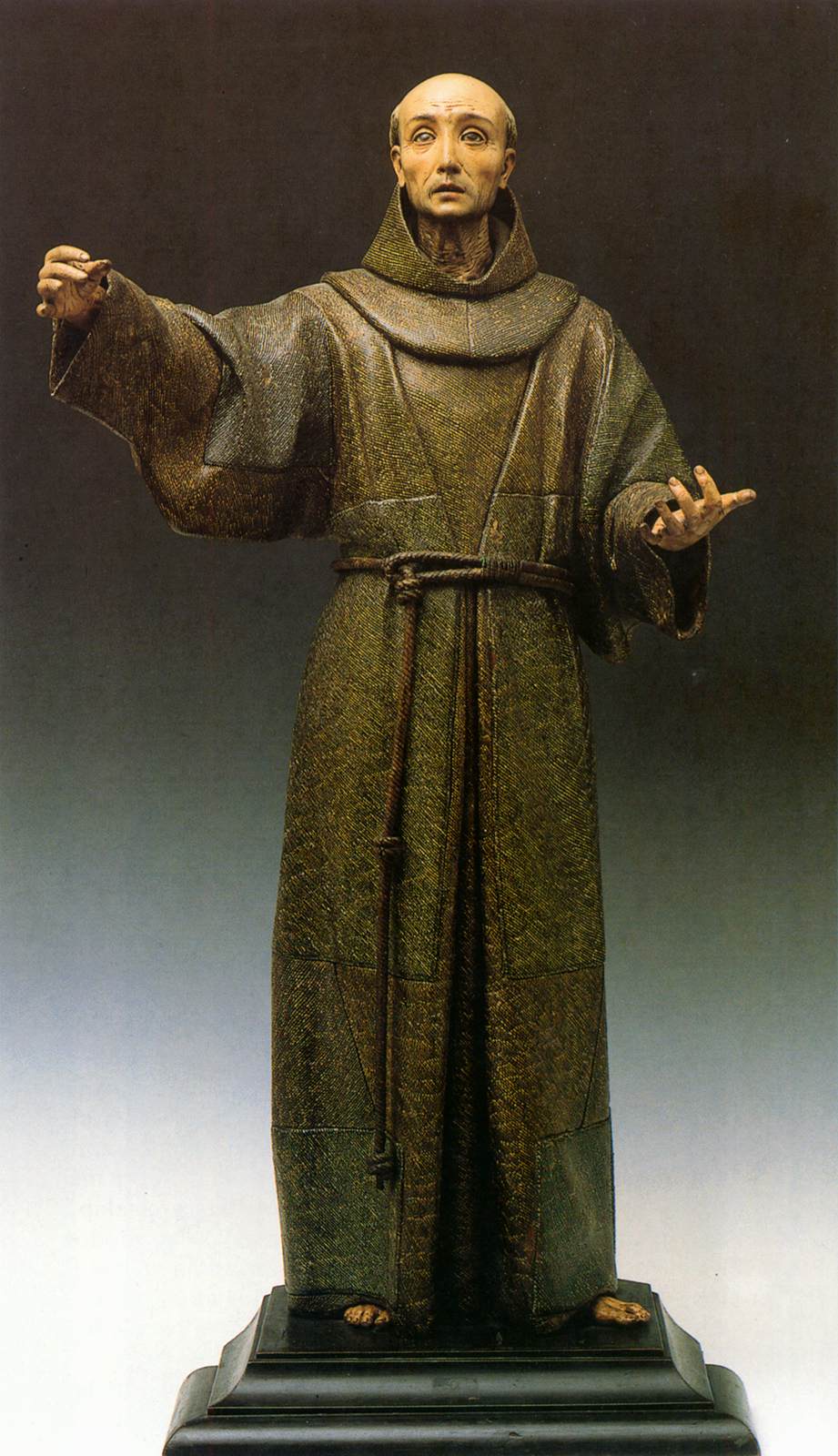
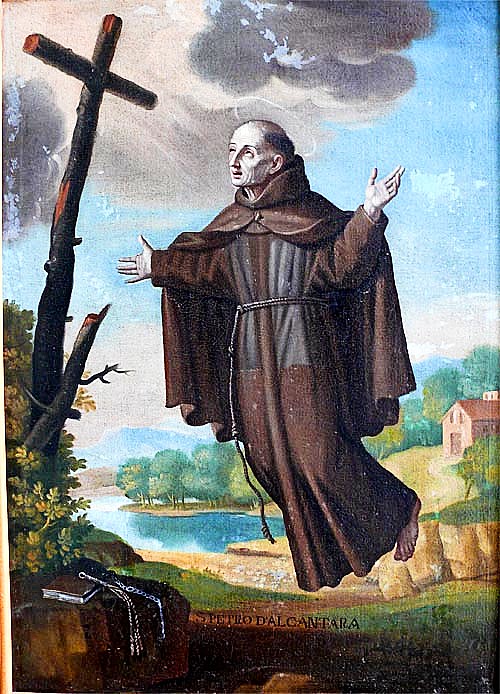
Our Morning Offering – 19 October – St Peter of Alcantara OFM (1499-1562) Confessor
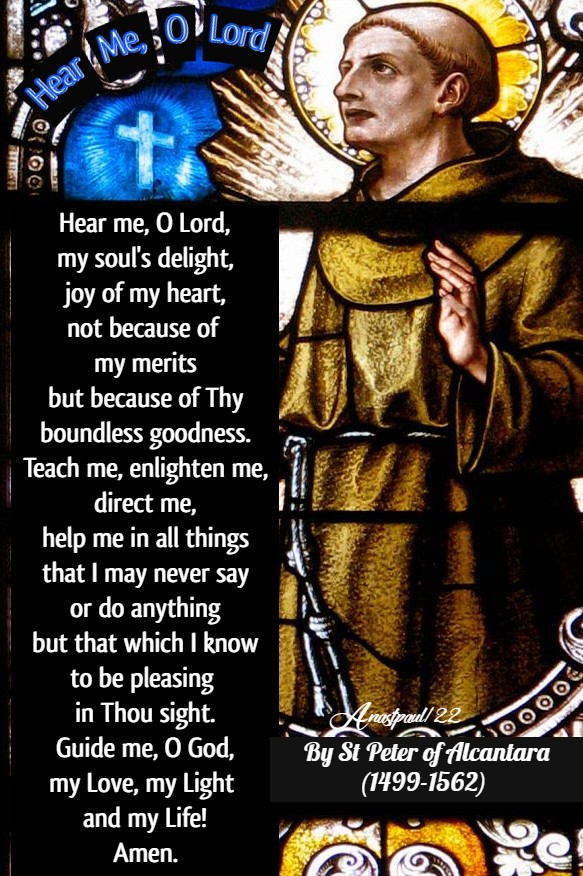
Hear Me, O Lord By St Peter of Alcantara (1499-1562)
Hear me, O Lord, my soul’s delight, joy of my heart, not because of my merits but because of Thy boundless goodness. Teach me, enlighten me, direct me, help me in all things that I may never say or do anything but that which I know to be pleasing in Thou sight. Guide me, O God, my Love, my Light and my Life! Amen.
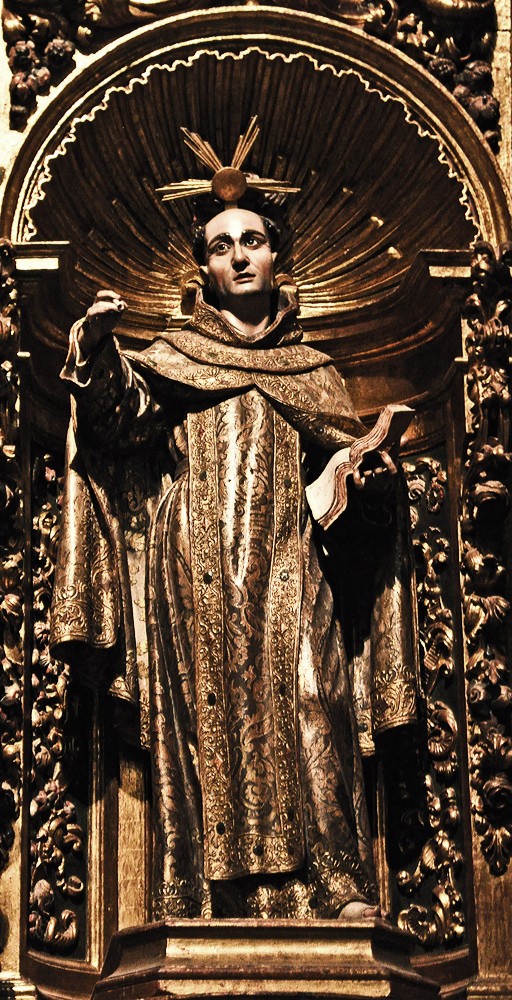
Saint of the Day – 19 October – St Peter of Alcantara OFM (1499-1562) Confessor, Franciscan Friar and Priest, Mystic, Ecstatic, Writer, Preacher, Reformer, Hermit, Apostle of Prayer, Eucharistic Adoration, the Passion and Charity, Miracle-worker. Patronages – Nocturnal Adoration of the Blessed Sacrament, Brazil (named by Pope Pius IX in 1862), Estremadura Spain, night watchmen.
St Peter of Alcantara, Confessor By Father Francis Xavier Weninger (1860-1946)
St Peter was born in the year 1499, at Alcantara, in Spain. He became celebrated for his great piety and the austerity of his life and in order to distinguish him from other Saints of the same name, received the surname, “of Alcantara.”
Besides other signs of future holiness, Peter, when only seven years of age, evinced so great a love for prayer that he sometimes forgot to eat and drink. During the time of his studies, he kept his innocence unspotted in the midst of many dangers, by making prayer, the holy Sacraments and penances, its guardians. When hardly sixteen years old, he secretly left his father’s house and entered the Franciscan Order, in which he soon became a model of all virtues. After having finished his novitiate, he was charged with different functions, all of which he discharged most successfully. The office of preacher was the most agreeable to him. An incredible number of hardened sinners were converted by his sermons, in which he treated of penance and a reform of life.
The fame of his virtues and holiness gave additional weight to every word he uttered. Especially admirable, were the untiring zeal with which he practised all manner of bodily austerities and his continual communion with God in prayer. His whole life was one of extraordinary and almost unexampled mortification. He guarded his eyes so closely that he not only never looked on a woman’s face but knew his brethren only by their voices and, after a long sojourn in the Monastery, could not tell whether the choir and the dormitory were vaulted or covered with boards.
The cell he chose for his dwelling was so narrow that it was more like a tomb than the abode of a living human being and so low that he could not stand upright in it. He kept an almost continual fast and hardly partook, every third day, of some undressed herbs, bread and water. It even happened that during eight days he took no food whatever. He scourged himself twice daily with iron chains. He wore, day and night, a penitential instrument made of tin, pierced like a grater. For forty years, he allowed himself only one hour and a half of sleep at night and this, not lying down but kneeling, or standing with his head leaning against a board. The remainder of the night he occupied in prayer and meditation. As long as he lived in the order, he went barefoot and bareheaded, even in the coldest season. His clothing consisted of his habit and a short cloak, made of rough sack-cloth. He seemed to have made a comtract with his body, never in this world, to allow it any peace or comfort.
His union with God in prayer had reached so high a degree that he was often seen in ecstacy, or raised high in the air and surrounded by a heavenly brightness. The power of his holy prayers was experienced, not only by many hardened sinners but also by many sick, for whom he obtained health and strength. The inhabitants of the City of Albuquerque, ascribed to him their deliverance from the pestilence, for, as soon as Peter had called upon the Divine Mercy, the pestilence, which had most fearfully ravaged the City, disappeared.
The love of God, which filled the heart of the Saint, manifested itself in his intercourse and conversation with men, whom he endeavoured to inflame with the same love. This appeared in all his actions but especially, at the time of Holy Mass, when he stood like a Seraph before the Altar, his face burning and tears streaming from his eyes. When meditating on the Passion and Death of our Saviour, he was frequently so deeply touched, in his inmost heart that for hours, he was like one dead. His devotion to God would sometimes burn his heart so intensely, that to moderate his emotion, he would go into the fields to breathe more freely.
Having reached his fortieth year, he was chosen Provincial but endeavoured to refuse the dignity and when compelled by obedience to accept it, he regarded it as an opportunity to do good to those under his charge. God admonished him to restore the primitive observance in the Order, according to the Rule and spirit of St Francis. Although he could not but foresee, the many and great difficulties which he would encounter in this undertaking, still, trusting in God, he went courageously to work after having obtained the sanction of the Pope.
The Almighty visibly aided His faithful servant, for, in six years, the Saint had founded nine Monasteries, in which the mortification and the perfect poverty, which St Francis especially cherished, were observed in all the rigour of the first Rule. In the course of time, this renewed Order was disseminated throughout all Spain, to the great joy of the Saint. This and other labours which he performed, to the honoir and glory of God, made him greatly esteemed by everyone.
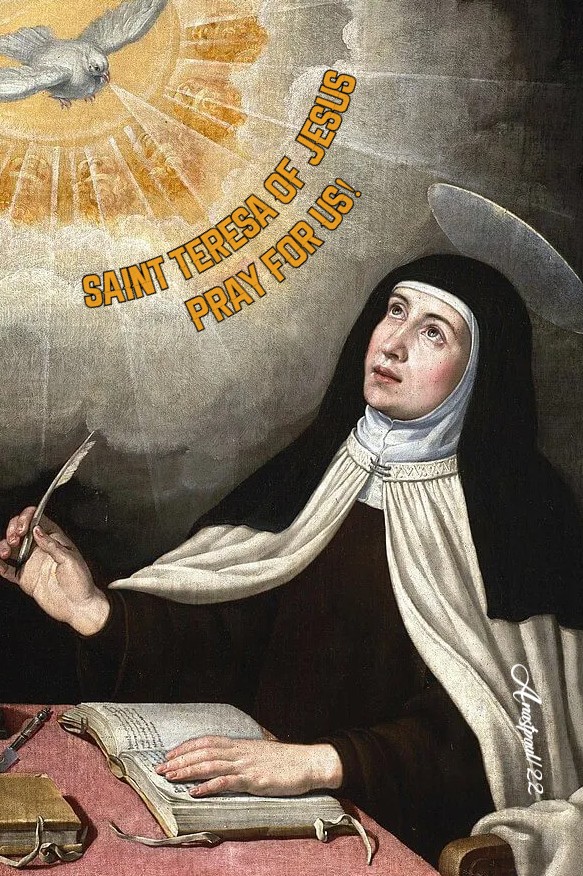
St Teresa, who lived at that period, asked his advice in her cares and doubts, whenever she had occasion and called him a Saint while he was yet upon earth. St Francis Borgia entertained great friendship for him and the praise of his great virtues resounded throughout all Spain. The Emperor Charles V. desired to make him his Confessor but the humble servant of the Almighty knew how to say so much of his incapacity for this office, that the Emperor abandoned the idea, to the Saint’s great joy. This became a new incentive for him to devote himself entirely to the service of God and the welfare of those in his care.
St Teresa of Jesus with St Peter of Alcantara
He had reached his 63rd year, more by a miracle than in a natural way, when he was visited by Providence with a severe illness, which soon left no hope of his recovery, as his body was entirely wasted away by the severity of his life, his painful journeys and his uninterrupted labours. He himself, was informed from on high, of his approaching end and he received the last Sacraments, with so deep a devotion that the eyes of all present were filled with tears. After this he fell into a rapture, in which the Divine Mother and St John the Evangelist, appeared to him and assured him of his salvation. Hence, regaining consciousness, he cheerfully recited the words of the Psalmist: “I have rejoiced in those things which have been said to me; We shall go into the house of the Lord.” Having said this, he calmly gave his soul into the keeping of his Creator, in the year of Our Lord 1562.
St Teresa, who has written much in his praise, says among other things: “He died as he had lived, a Saint and I have, after his death, received many graces from God, through his intercession. I have often seen him in great glory and when I saw him the first time, he said to me: ‘O happy penance, which has obtained so great a glory for me!‘” The Roman Breviary testifies that, St Teresa, although, at the time of his death, far from him, saw his soul gloriously ascend into Heaven.
The biographers of St Peter, relate many and great miracles which he wrought, while he was still living. In the Breviary, we read, among other things, the following. “He crossed rapid rivers with dry feet. In times of great poverty, he fed his brethren with food which he received from Heaven. The staff which he placed in the ground, immediately became a budding fig-tree. Once, in the night-time, when he sought shelter from a snow-storm in a roofless house, the snow remained hanging in the air, above it and thus, formed a roof to protect him from being buried in the snow.” St Peter of Alcantara, pray for Holy Mother Church and for all her faithful Amen, amen!
One Minute Reflection – 15 October – St Teresa of Jesus of Avila OCD (1515-1582) Virgin and Doctor of the Church – 2 Corinthians 10:17-18; 11:1-2, Matthew 25:1-13 – Scripture search here: https://www.drbo.org/
“But at midnight there was a cry, ‘Behold, the bridegroom! Come out to meet him.” – Matthew 25:6
REFLECTION – “The souls’ husband is the Holy Spirit, by His grace. When His interior inspiration calls the soul to repentance, then every enticement of vice is in vain. The pride that wants command, the greed and lust that consumes everything: this was the master that used to control and ravage the soul. Their very names have been removed from the repentant sinner’s mouth… When grace is poured into the soul and gives it light, God makes a covenant with sinners. He is reconciled with them… Then is celebrated the wedding of the Bridegroom with His bride, in the peace of a pure conscience.” – St Anthony of Padua (1195-1231) Doctor of the Church
PRAYER – Graciously hear us, O God, our Saviour that as we rejoice on the feast-day of blessed Teresa, Thy Virgin, we may be so nourished by the food of her heavenly teaching, as to learn how to serve Thee.T hrough the same Jesus Christ, Thy Son our Lord, Who lives and reigns with Thee, in the unity of the Holy Ghost, God, world without end. Amen (Collect).
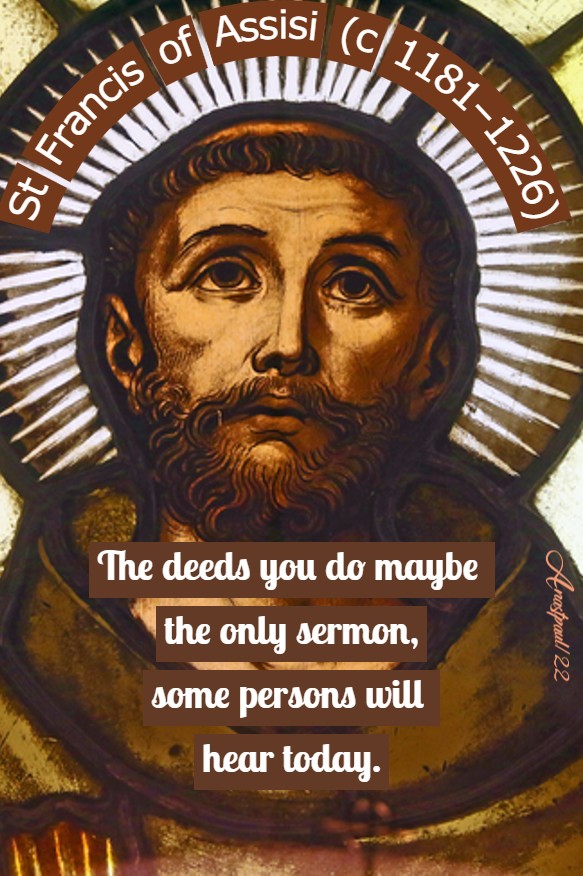
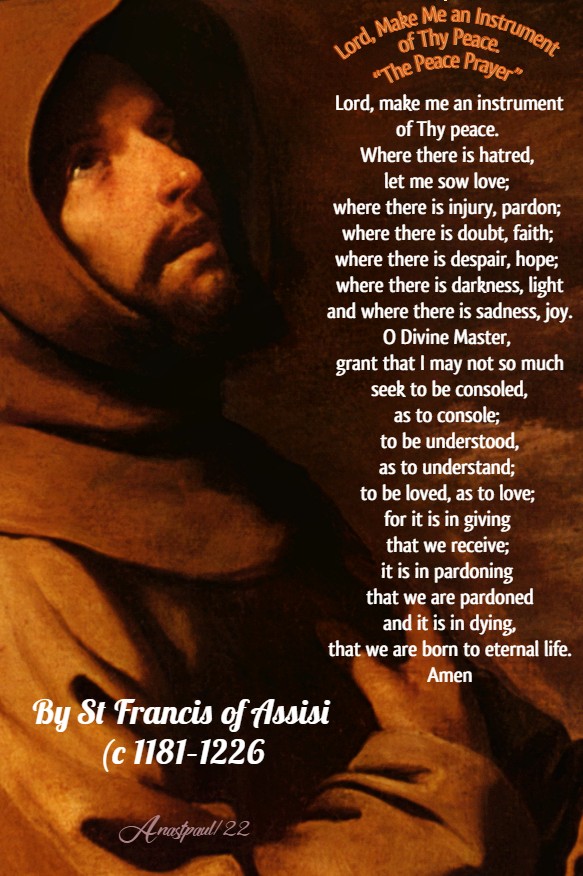
Our Morning Offering – 4 October – St Francis of Assisi OFM (c 1181–1226) Confessor, Founder
Lord, Make Me an Instrument of Thy Peace. “The Peace Prayer” By St Francis of Assisi (c 1181–1226
Lord, make me an instrument of Thy peace. Where there is hatred, let me sow love; where there is injury, pardon; where there is doubt, faith; where there is despair, hope; where there is darkness, light and where there is sadness, joy. O Divine Master, grant that I may not so much seek to be consoled, as to console; to be understood, as to understand; to be loved, as to love; for it is in giving that we receive; it is in pardoning that we are pardoned and it is in dying, that we are born to eternal life. Amen
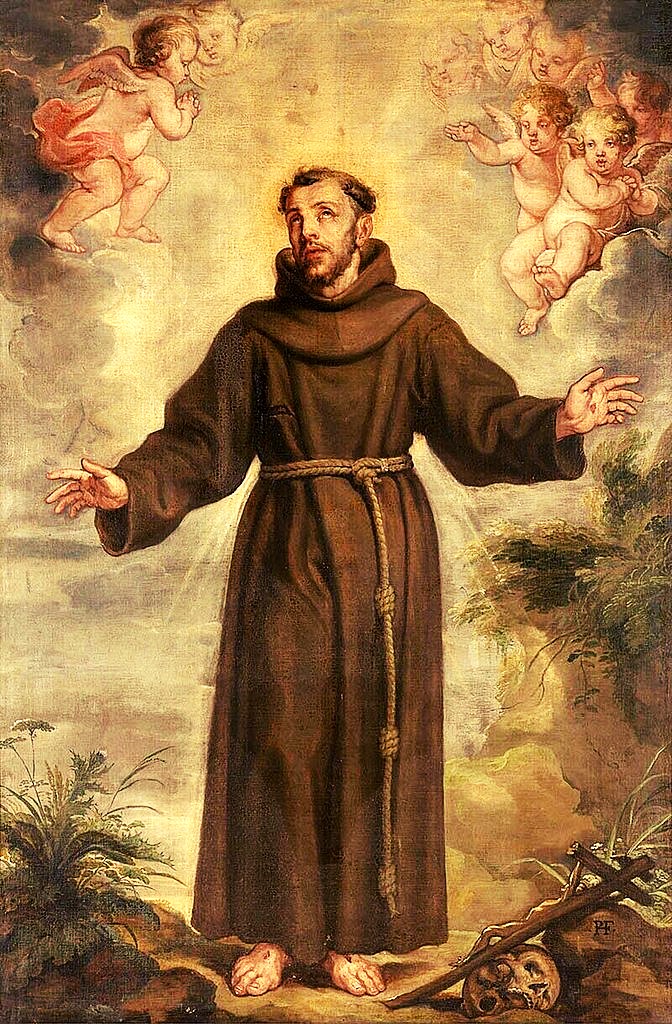
Saint of the Day – 4 October – St Francis of Assisi OFM (c 1181–1226)
An Excerpt from The Little Flowers of St Francis of Assisi Translated from the 14th Century Fioretti (1905)
“In this book are contained certain little Flowers, namely, miracles and devout examples of the glorious poor Little One of Christ, St Francis and of some of his holy companions, to the praise of Jesus Christ. Amen.
In the first place, let us consider how the glorious St Francis, in all the acts of his life, was conformed to the life of that blessed Christ; that, as Christ in the beginning of His preaching elected twelve Apostles that they should despise every worldly thing and follow Him in poverty and in all virtues, so St Francis, for the founding of his Order, elected, in the beginning, twelve companions, who were to be possessors of nothing but an entire poverty.
And, as one of the twelve Apostles of Christ, rejected by God for his infidelity, finally strangled himself, so also, one of the twelve companions of St Francis, who was called Brother John della Capella, apostatised and finally, hanged himself in like manner. And this is to the elect, a great warning and a matter of humility and of fear, to cause them to remember that no-one is certain, to persevere to the end, in the grace of God.
As the blessed Apostles were wholly marvellous for sanctity and humility and full of the Holy Ghost, so the blessed companions of St Francis were men of such great sanctity that, since the time of the Apostles, the world had not seen the like; since one of them, like St Paul, was taken up into the third heaven and this was Brother Giles; another of them, namely Brother Filippo Longo, was touched on the lips by an angel, like the Prophet Isaias, with a coal of fire; another of them and this was Brother Silvester, spoke with God, as one friend with another, after the manner of Moses; another, by the purity of his soul, flew up to the light of the Divine Wisdom, like the eagle, St John the Evangelist and this was the most humble Brother Bernard, who explained, most profoundly, Holy Writ and another was sanctified by God and canonised in Heaven whilst still living on earth and this was Brother Ruffino, who was a gentleman of Assisi. And so were they all privileged with remarkable signs of holiness, as will be declared in the sequel . . .” –page 1 – 2
St Aurea St Berenice St Caius of Corinth St Callisthene of Ephesus St Crispus of Corinth St Damaris of Athens St Diogenes of Milan St Domnina St Hierotheus Bl Julian Majali St Lucius of Alexandria St Peter of Damascus
Martyrs of Alexandria: A group of Christians, men and women, young and old, murdered together for their faith. The only names that have come down to us are the brothers Mark and Marcian.
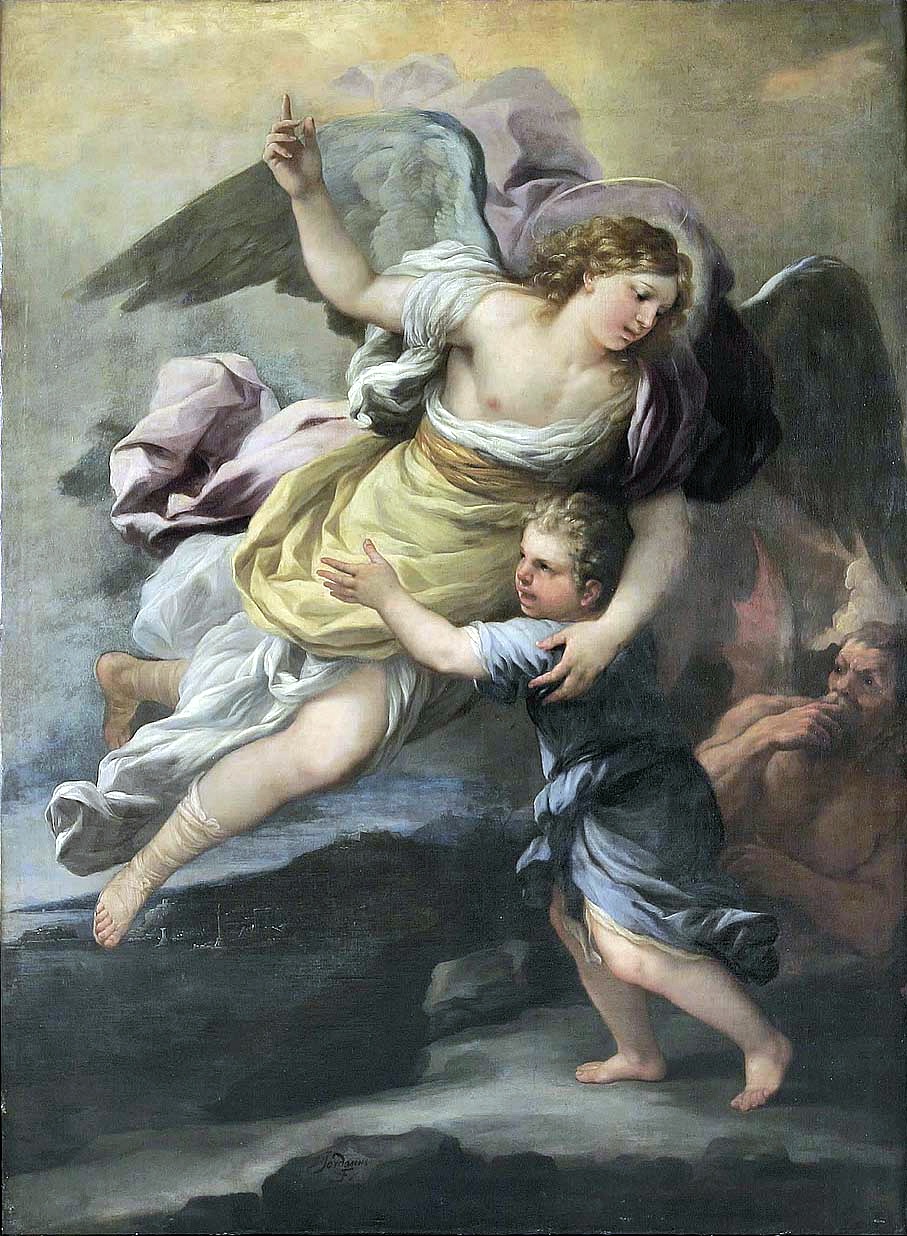
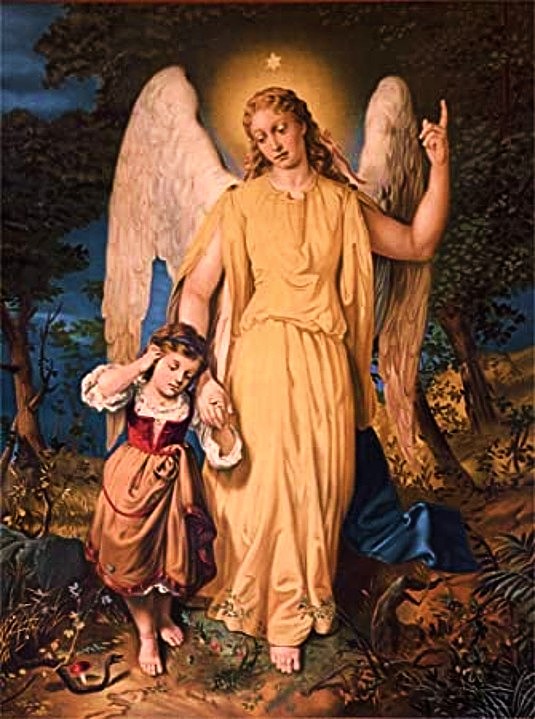
Saints of the Day – 2 October – The Holy Guardian Angels
The Twelve Works of our Guardian Angel By St Bonaventure of Bagnoregio OFM (1217-1274) Confessor, Cardinal Bishop of Albano, Theologian, Franciscan Minister General Doctor of the Church
According to Sacred Scripture there are twelve works of charity which our guardian Angel does for us.
THE FIRST is to rebuke us for our faults. According to the Book of Judges, Chapter 2, verse 1 – The Angel of the Lord ascends from Galgala to the place of those weeping and says: “I have led you forth from the land of Egypt . . . And you have not heard my voice.“
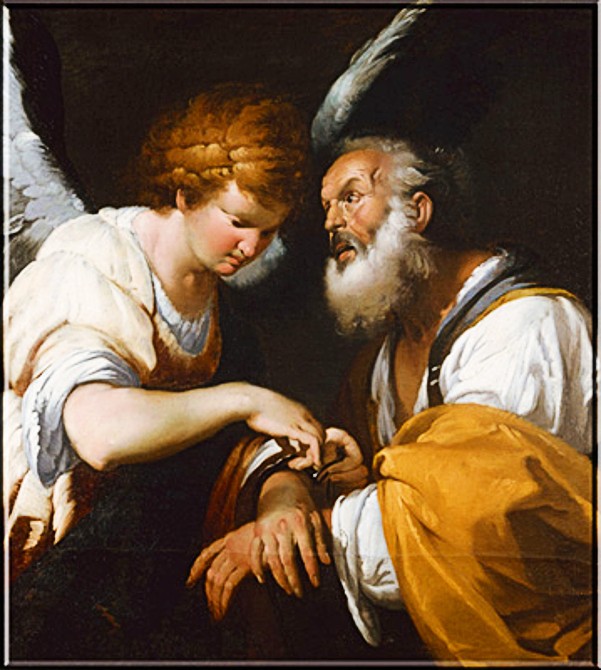
THE SECOND is to absolve us from the bonds of our sins. According to Book of Acts, Chapter 12, verse 7 – The Angel stood by . . . and the chains fell from his hands; yet this must be understood as disposing this to happen.
THE THIRD is to take away from us, those things impeding our progress in goodness, which is signified in the Book of Exodus, Chapter 12, verse 12 – where the Angel struck the first born of Egypt.
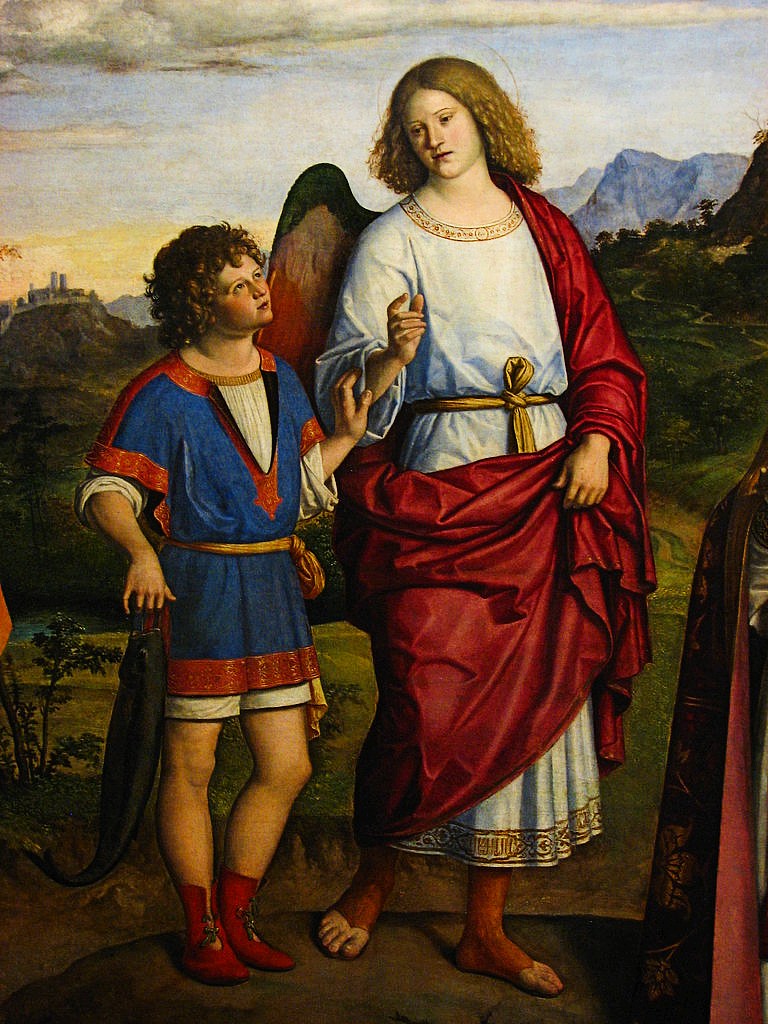
THE FOURTH is to constrain those demons afflicting us, according to the Book of Tobias, Chapter 12, verse 3 – “He chased the demon from my wife,” says Tobias of the Archangel St. Raphael.
THE FIFTH is to teach us, according to the Book of Daniel, Chapter 9, verse 22: – Now I have entered, to teach you and so that you might understand.
THE SIXTH is to reveal secrets, for according to the Book of Genesis, Chapter 18, verse 17 – the three Angels expressed the Mystery of the Trinity and Unity, after which God said: Can I conceal from Abraham what I am about to do?
THE SEVENTH is to console, according to the Book of Tobias, Chapter 5, verse 13 – Be of a strong spirit, it is nigh, that you are to be cured by God etc..
THE EIGHTH is to comfort us on the way to God, according to Third Book of Kings, Chapter 19, verse 7 – Rise and eat, for a grand way remains for you.
THE NINTH is to lead us forth on this way and to conduct us back to God, according to the Book of Tobias, Chapter 5, verse 15 – I shall lead and I shall lead him back etc..
THE TENTH is to cast down our enemies, according to the Book of Isaiah, Chapter 37, verse 36 – Having entered, the Angel of the Lord struck upon the camps of the Assyrians etc..
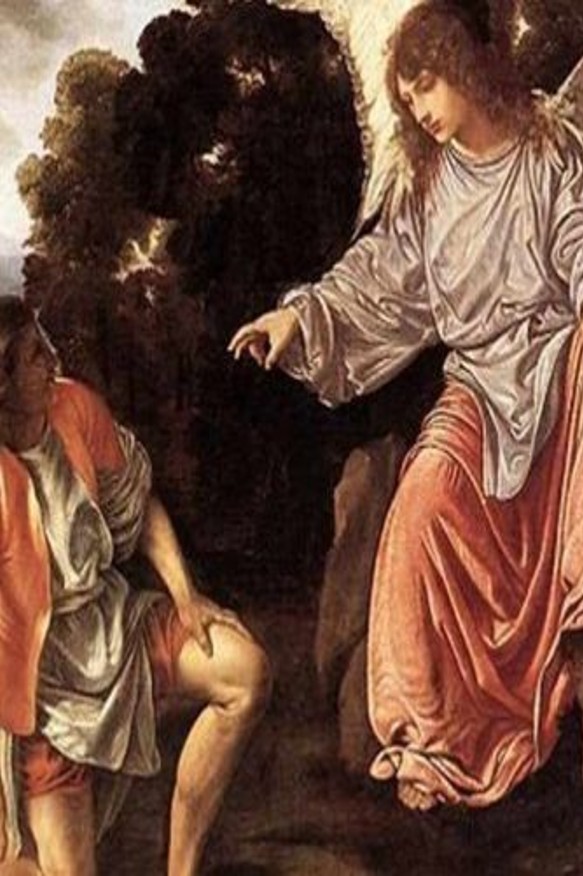
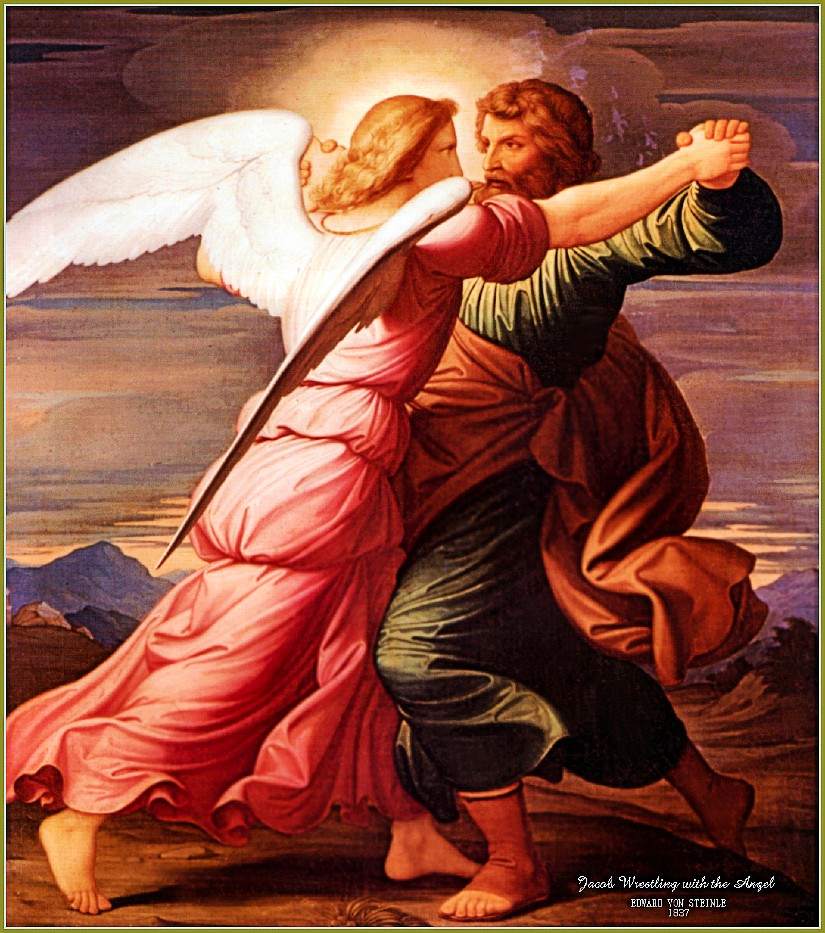
THE ELEVENTH to mitigate our temptations; and this is signified in the Book of Genesis, Chapter 32, verse 24 – where Jacob wrestled with the Angel and was comforted after the match, having accepted his blessing, the nerve of his femur withered up.
THE TWELFTH is to pray for us and to carry our prayers to God, according to the Book of Tobias, Chapter 12, verse 12 – When you were praying with tears . . . I offered your prayer etc.. All of these are the effects of our Guardian Angel’s care of us, on account of which, we ought to be submissive and grateful both to God and the Holy Angels.
Bl Aaron of Auxerre St Alodius of Auxerre St Annemond of Lyons St Bardomianus
Blessed Bernardine of Feltre OFM (1439-1494) Franciscan Priest and Friar, Missionary Preacher, Poet, peace-maker, Civil protestor against the practice of usury, defender of the poor. He was a true ‘child prodigy’ – by the time he was 12 he was fluent in Latin and at the age of 15 he composed a poem and read it in the Town Square to celebrate a local peace treaty. He is remembered most especially, in connection with the “Monti di Pietà” “Mount of Piety” of which he was the reorganiser and, in a certain sense, the Founder, together with the Blessed Michele Carcano. On 13 April 1654, Pope Innocent X confirmed the cultus of Blessed Bernardine and he was formally Beatified in 1728 by Pope Benedict XIII. Biography: https://anastpaul.com/2020/09/28/saint-of-the-day-28-september-blessed-bernardine-of-feltre-ofm-1439-1494/
St Chariton of Palestine Bl Christian Franco St Conval of Strathclyde St Eucarpus St Eustochium St Exuperius of Toulouse (Died 411) Bishop St Faustus of Riez
Blessed Francesco Piani of Caldarola OFM (1424-1507) Francisan Friar, renowned Preacher and Peacemaker, a collaborator in the fight against usury by the institution of the “Mount of Piety,” (a type of pawn shop), social activist and protector of the struggling rural communities. He was Beatified by Pope Urban VII in 1634 – his cult was reaffirmed on 1 September 1843 by Pope Gregory XVI. His Amazing Life: https://anastpaul.com/2021/09/28/saint-of-the-day-28-september-blessed-francesco-piani-of-caldarola-ofm-1424-1507/
St John of Dukla St Laurence of North Africa St Lioba of Bischofsheim St Machan St Martial of North Africa St Martin of Moyenmoutier St Paternus of Auch St Privatus of Rome St Salonius of Geneva St Silvinus of Brescia
St Solomon of Genoa St Stacteus St Tetta of Wimborne Bl Thiemo St Willigod of Moyenmoutier St Zama of Bologna
Augustinian Martyrs of Japan: The first Augustinian Missionaries arrived in Japan in 1602 and met with immediate success; many were brought to the faith; many of them became Augustinians and many of them were Martyred in the periodic persecutions of Christians. This memorial commemorates all of them, whether they have a sanctioned Cause for Canonisation or not. They include: • Blessed Bartolomé Gutiérrez Rodríguez • Blessed Ferdinand Ayala • Blessed Francisco Terrero de Ortega Pérez • Blessed Ioannes Mukuno Chozaburo • Blessed Laurentius Kaida Hachizo • Blessed Mancius Yukimoto Ichizaemon • Blessed Martín Lumbreras Peralta • Blessed Melchor Sánchez Pérez • Blessed Michaël Ichinose Sukezaemon • Blessed Pedro de Zúñiga • Blessed Petrus Sawaguchi Kuhyoe • Blessed Thomas Jihyoe of Saint Augustine • Blessed Thomas Terai Kahyoe • Blessed Vicente Simões de Carvalho • Saint Magdalena of Nagasaki
Martyrs of Antioch – 37 Saints: A group of 30 soldiers and 7 civilians who were murdered together for their faith. The names that have come down to us are – Alexander, Alphinus, Heliodorus, Mark, Neon, Nicon and Zosumus. c 303 at Antioch, Pisidia (in modern Turkey).
Saint of the Day – 27 September – Saint Delphina TOSF (1283-1360) Virgin Laywoman, Married in Chastity to St Elzear (below) Widow, Recluse, Apostle of the Poor and needy. Born in 1283 at the Chateau-Puimichel in Languedoc (modern Puy-en-Velay, France) and died on 26 November 1360 of natural cause, having lived as a Franciscan tertiary for most of her life. Patronages – • Brides, Tertiaries, Diocese of Ariano Irpino-Lacedonia, Italy. Also known as – Delphine, Delphine of Glandèves, Delphina/e of Sabran.
Delphine was the daughter and heiress of the Count of Puy-Michel. Left an orphan in her infancy, she was placed under the guardianship of her uncles and was brought up under the direction of her Aunt, who was the Abbess of the Convent of St Catherine of Sorps, at Bauduen. As a young girl, she took a vow of virginity which she kept to the end of her life.
Despite her vow, at the age of twelve she was espoused to the ten-year-old Elzéar, Count of Sabran. They were married three years later at the Castle of Puy-Michel. Having grown up together, they regarded each other as brother and sister, rather than husband and wife. Inspired by her example, her husband also took a vow of celibacy, which both honoured throughout their married life. The couple, having both received the habit of the Third Order of St Francis, lived together at their Castle in Ansouis, in the practice of prayer, penance andgood works towards the poor. After seven years, they moved to Puy-Michel. When Elzéar had to go to Naples to see to some inherited property, they kept up a regular correspondence. Elzéar died in 1323.
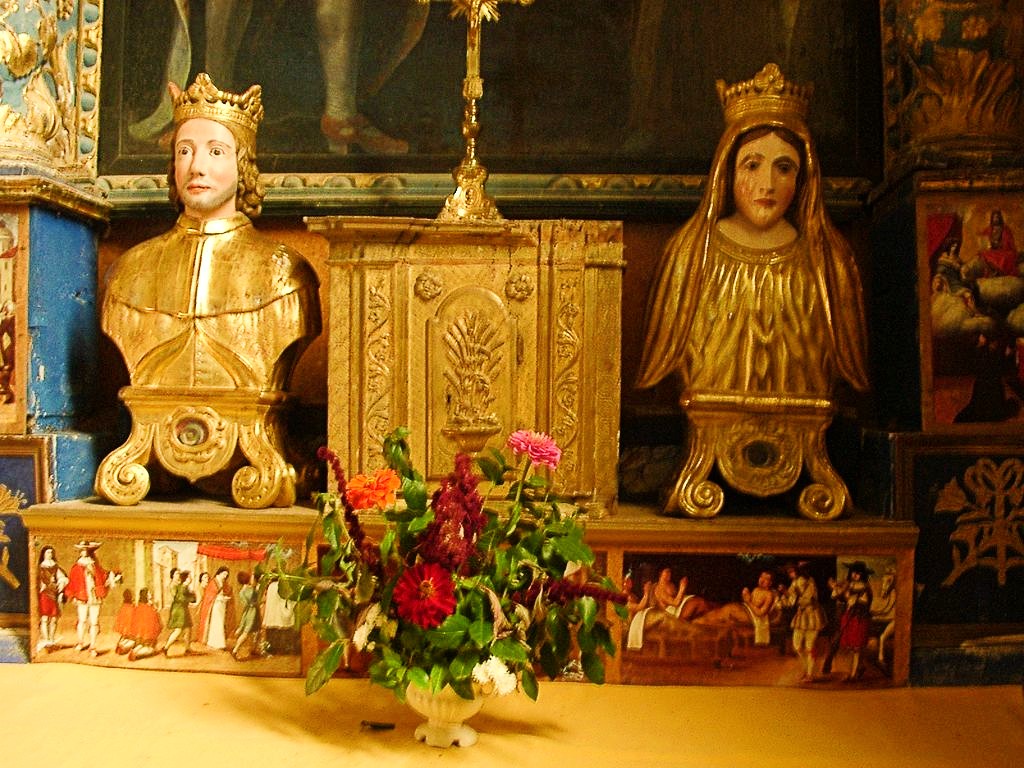
Reliquaries of Sts Elzéar and Delphina in the Franciscan Church of Ansouis, France
After the death of her husband, Delphina sold all her possessions for the benefit of the poor and retired first to Naples and then to Cabrières, which was the location of the Castle where her husband had been born. She finally returned to Apt where her husband had been buried. Upon her death, she was buried with him in the church of the Friars Minor there, wearing the habit of the Order.
The veneration that had begun to be given to Delphina was confirmed by Pope Urban V, godson of Elzéar, who Canonised Elzéar and Delphina in 1694. Her feast day is not the date of her death, 26 November but today, 26 September, sharing this day with the remembrance of her husband.
Saint/s of the Day – 29 August – Blessed John of PerugiaOFM (Died 1231) Priest and Blessed Peter of Sassoferrato OFM (Died 1231) Lay Brother, Martyrs, Confessors, Friars of the Friars Minor. Both were beheaded in 1231 in Valencia, Spain. We have no artworks of the two Saints, those below are generic Franciscans.
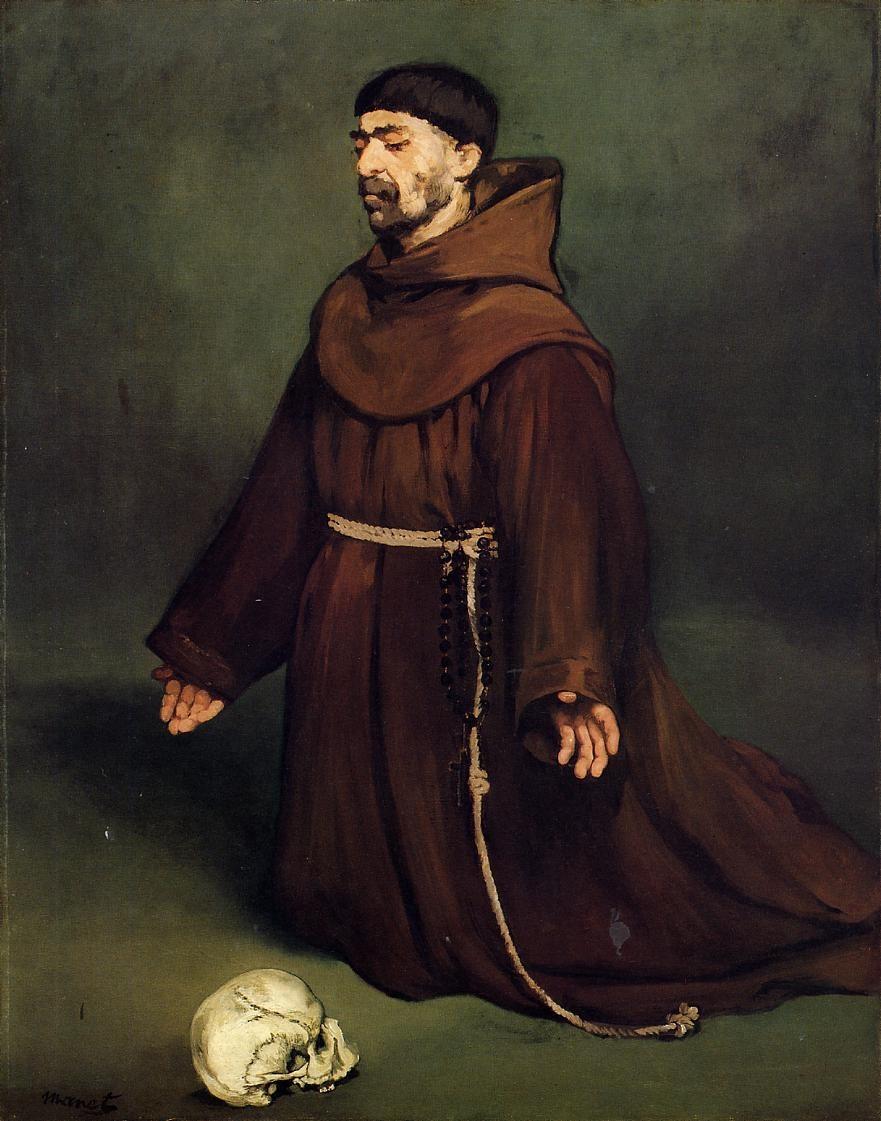
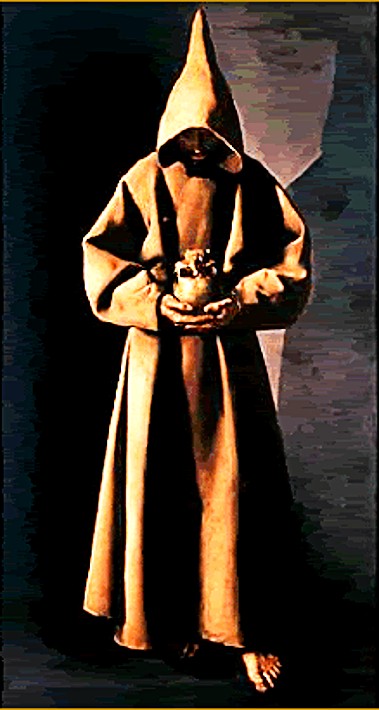
A Franciscan Friar
The two Friars Minor, Blessed John of Perugia, a Priest, and Peter of Sassoferrato, a lay brother, were sent to Spain with a large number of Friars by St Francis himself. There, they were assigned to the kingdom of Aragon, where they built a small Convent in the little town of Teruel and reaped much fruit, by their holy lives, their prayers and their sermons on penance.
Their longing for the conversion of the infidels and the hope of obtaining the Palm of Martyrdom urged Friars John and Peter to go to the larger city of Valencia, which was governed, at that time, by the Moorish King Azotus. The Friars began to preach in public that Jesus Christ is the true Son of God and that only through Him, can we be saved. Azotus was a bitter enemy of the Christians.
Hearing of the activities of the Friars, he had them seized and cast into prison. He used every possible means to force them to apostatise. But when promises and threats alike, failed to shake their constancy, he condemned them to be beheaded. The Friars thanked the King,, praying fervently to God to enlighten their persecutor and in His mercy, to grant him the grace of conversion to the true Faith. Then, Blessed John of Perugia and Peter of Sassoferrato were beheaded. This occurred in the year 1231.
A few years later, James I, the Catholic King of Aragon, made war on Valencia. His army defeated the army of Azotus, who by this ill fortune and by the grace which the holy Martyrs had won for him from God, recognised Mohammed as a false prophet and Christ as the Saviour of the world. King James rejoiced exceedingly when Azotus asked to be Baptised. After his Baptism, Azotus offered the Friars Minor, his former palace for a Convent.
“When I was still an infidel,” he told them, “I caused your brethren to be executed at Teruel. I sincerely regret this crime and desire to make reparation for it. Accept my palace, in which the blood of many holy Martyrs has been shed and convert it into a convent.”
The palace was remodeled into a Convent and, next to it, a Church was erected in honour of the two Martyrs. On 11 September 1704, Pope Clement XI approved the public veneration which was paid to them and in 1783, Pope Pius VI again honoured them by confirming their cultus.
Blessed John of Perugia`OFM (Died 1231) Martyr, Friar of the Friars Minor AND Blessed Peter of Sassoferrato OFM (Died 1231) Martyr, Friar of the Friars Minor
St Adelphus St Adausia of Rome St Alberic of Bagno de Romagna St Basilia of Sirmium Bl Bronislava St Candida of Rome St Edwold the Hermit St Euthymius of Perugia St Maximian of Vercelli St Medericus St Nicaeus of Antioch St Paul of Antioch St Repositus of Velleianum Bl Richard Herst St Sabina of Troyes St Sator of Velleianum St Sebbe of Essex St Velleicus St Victor of La Chambon St Vitalis of Velleianum
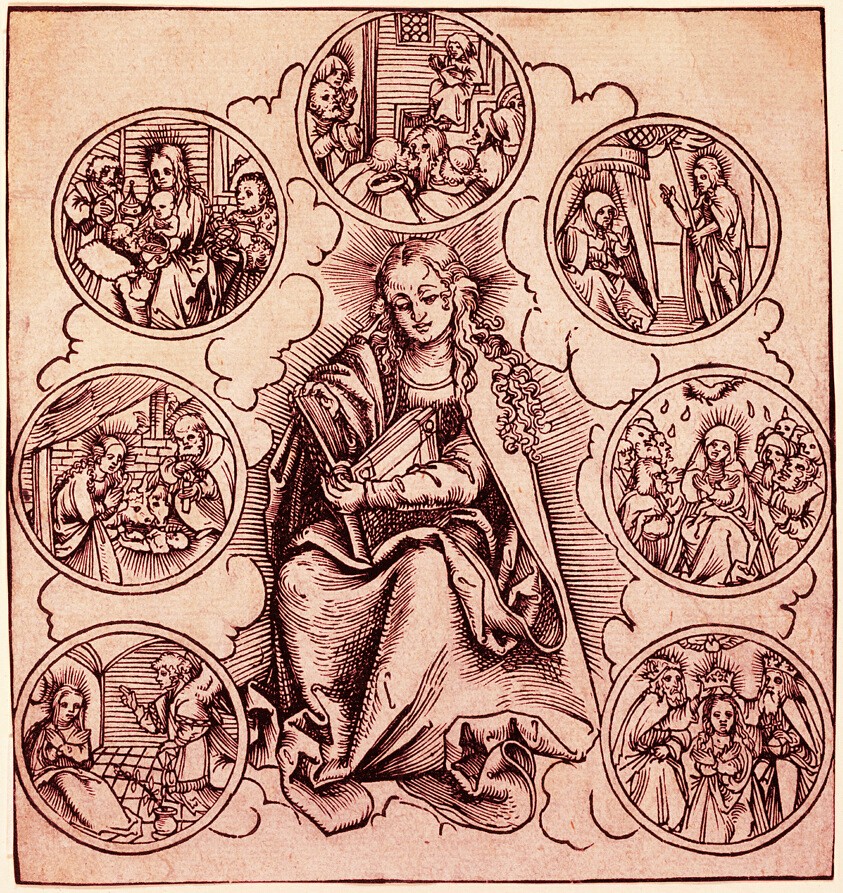
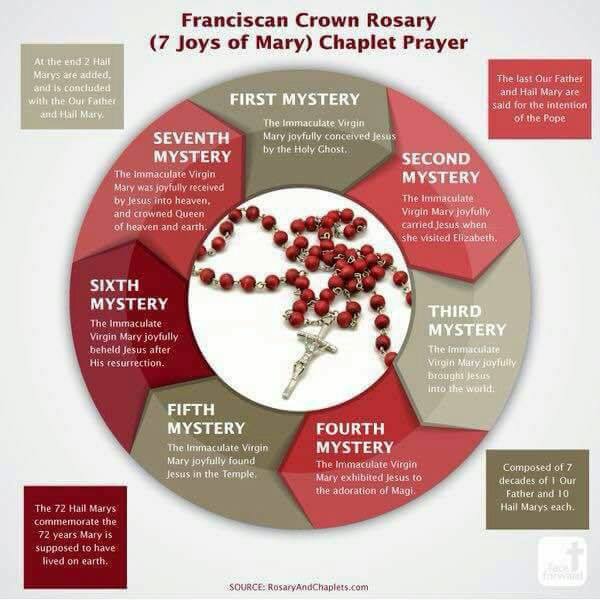
Saint of the Day – 27 August – Feast of the Seven Joys of Our Lady. This Feast is also known as “The Franciscan Crown,” The Seven Joys of the Virgin. Today was kept by the Franciscans as the Feast of the Seven Joys of the Virgin Mary. As an expression of the Seraphic Order’s devotional life, it corresponds to the Feast of the Holy Rosary, which began among the Dominicans and the observance on 15 September of the Seven Sorrows of the Virgin,
The devotion to the Seven Joys in and of itself, however,is much older; the story of its origin is told thus in the Manual for Franciscan Tertiaries.
About the year 1420, a young man, deeply devoted to Our Lady, took the habit of St Francis. Before joining the Order, he had, among other practices, been accustomed daily, to make a Chaplet of flowers,and with it, to Crown a Statue of the Blessed Virgin. Having in his novitiate no longer an opportunity of making this Crown for his Most Beloved Queen, he, in his simplicity, thought that she would withdraw her affection from him; this temptation of the devil disturbed his vocation. He resolved to abandon the cloister. The merciful mother appeared to him and gently rebuking him, strengthened him in his vocation by telling him to offer her, instead of the Chaplet of Flowers, a Crown much more pleasing to her, composed of seventy two Ave Marias and a Pater after each decade of Ave Marias. Our Lady instructed him to meditate at each decade upon the seven joys she had experienced, during years of her exile upon the earth.
The novice immediately commenced reciting the new Crown or Chaplet and derived, therefrom, many spiritual and temporal graces.
This pious practice spread quickly through the whole Order, and even throughout the world… St Bernardin of Siena used to say that it was by the Crown of the Seven Joys that he had obtained all the graces which Heaven has heaped upon him.
The Seven Joys listed in the Manual are the Annunciation, the Visitation, the Birth of Christ, the Adoration of the Magi, the Finding of the Christ Child in the Temple, the Resurrection and the Assumption but other version of the list may be found. Two more Aves are added to make the number seventy-two mentioned above and another Pater and Ave for the intentions of the Pope. The recitation concludes with a versicle and response and with the Collect of the Immaculate Conception.
Praying The Franciscan Crown
Using beads for the Franciscan Crown (seven decades), announce the First Mystery and pray the Our Father on the single bead just before the medallion.
Pray one Hail Mary for each of the ten beads. (It seems most fitting to proceed around the beads in a clockwise direction.)
On the single bead between the decades, announce the next Mystery and then pray the Our Father. Continue as in Step 2 for the remaining Mysteries.
After the last Mystery, pray one Hail Mary each on the fourth and third beads from the Cross to complete 72 years of Mary’s Joy.
Pray the Our Father and the Glory Be to the Father (Gloria Patri), for the intention of the Holy Father on the 2nd bead from the Cross.
Pray a Hail Mary on the single bead closest to the Cross.
The recitation concludes with a versicle and response and with the Collect of the Immaculate Conception.
V. In thy Conception, o Virgin, thou wast immaculate. R. Pray for us to the Father, whose Son thou didst bear. Let us pray. O God, Who by the Immaculate Conception of the Virgin, prepared a worthy dwelling place for Thy Son; we beseech Thee, that, as by the foreseen death of Thy sam, Son, Thou preserved her from every stain, so Thou may grant us also, through Her intercession, to come to Thee with pure hearts. Through the same Christ our Lord. R. Amen.
Quote/s of the Day – 14 August – The 10th Sunday after Pentecost – 1 Cor.inthians 12:2-11, Luke 18:9-14
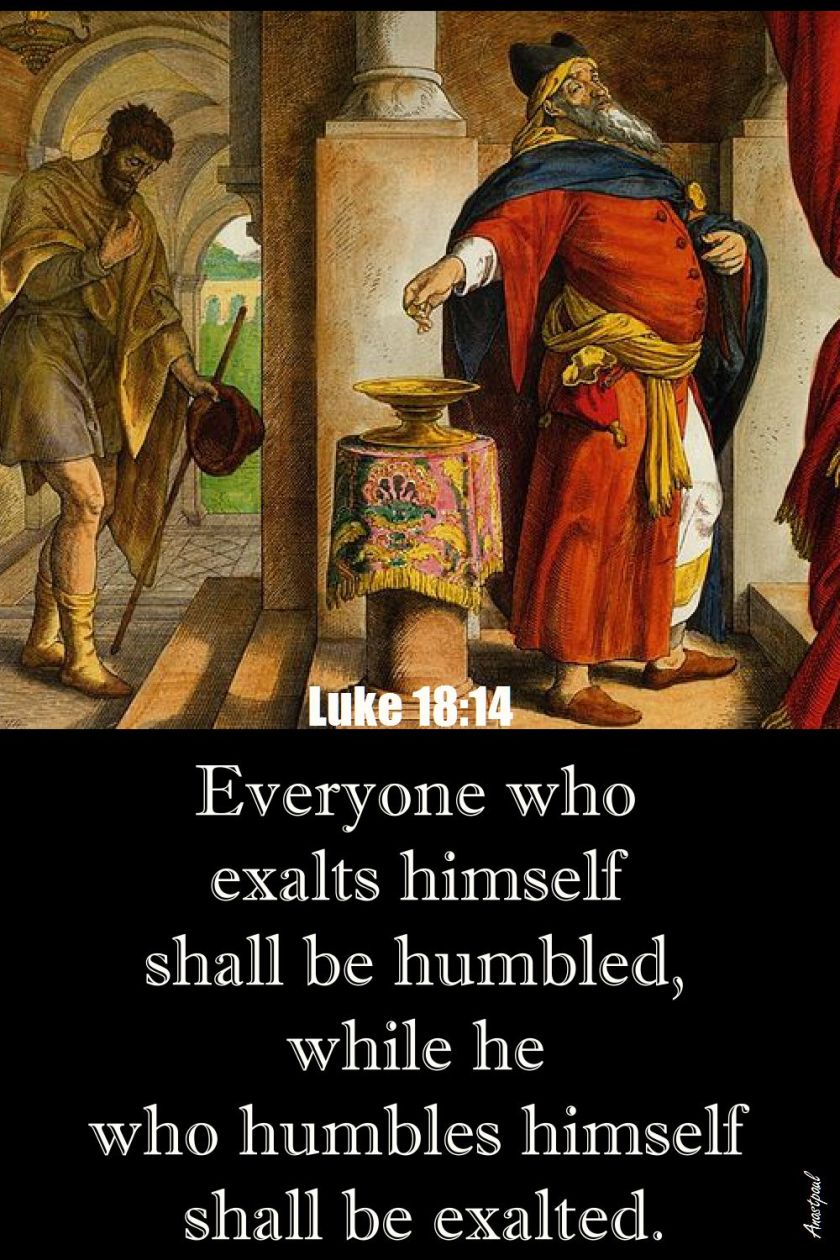
“… For everyone who exalts himself shall be humbled and he who humbles himself shall be exalted.”
Luke 18:14
“Let him who is greatest among you, become as the youngest and he who is the leader, as the servant.”
Luke 22:25
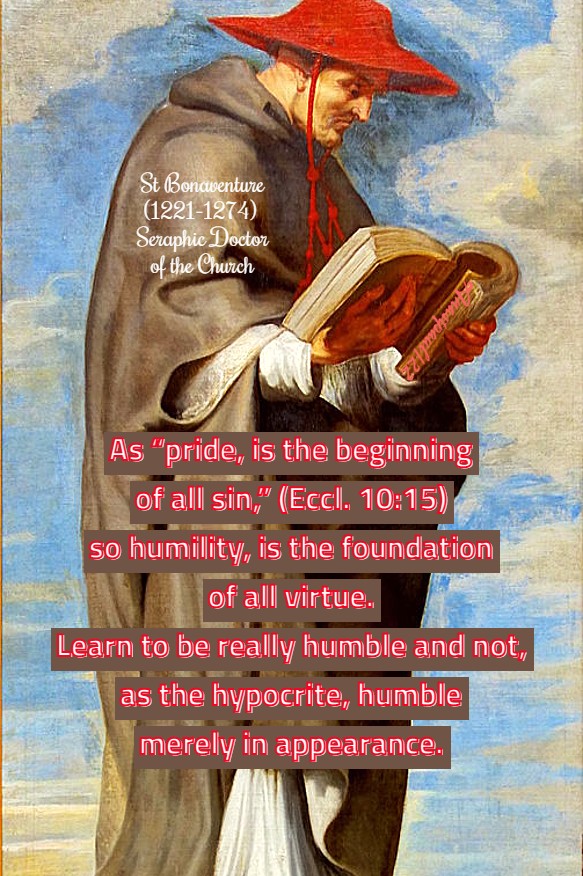
“As “pride, is the beginning of all sin,” (Eccl. 10:15) so humility, is the foundation of all virtue. Learn to be really humble and not, as the hypocrite, humble merely in appearance.”
St Bonaventure (1221-1274) Seraphic Doctor of the Church
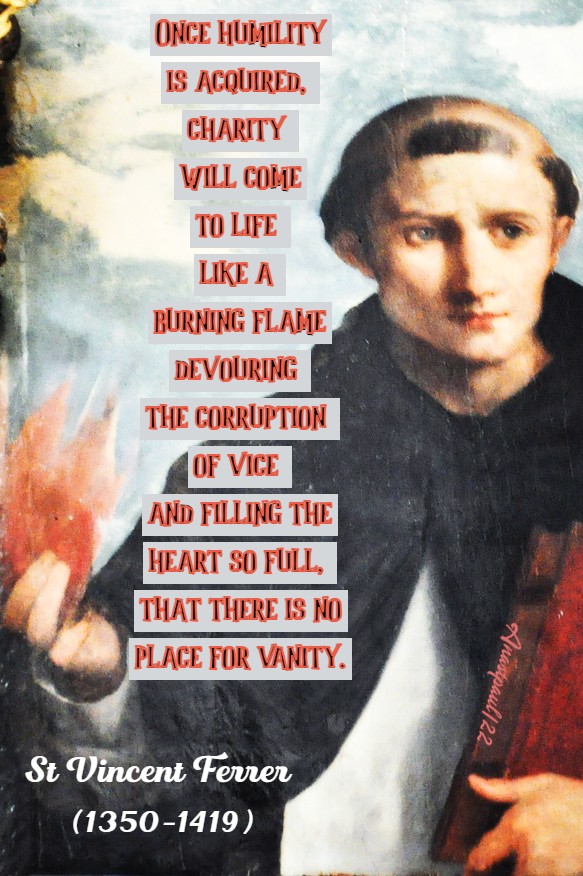
“Once humility is acquired, charity will come to life like a burning flame devouring the corruption of vice and filling the heart so full, that there is no place for vanity.”
St Vincent Ferrer (1350-1419)
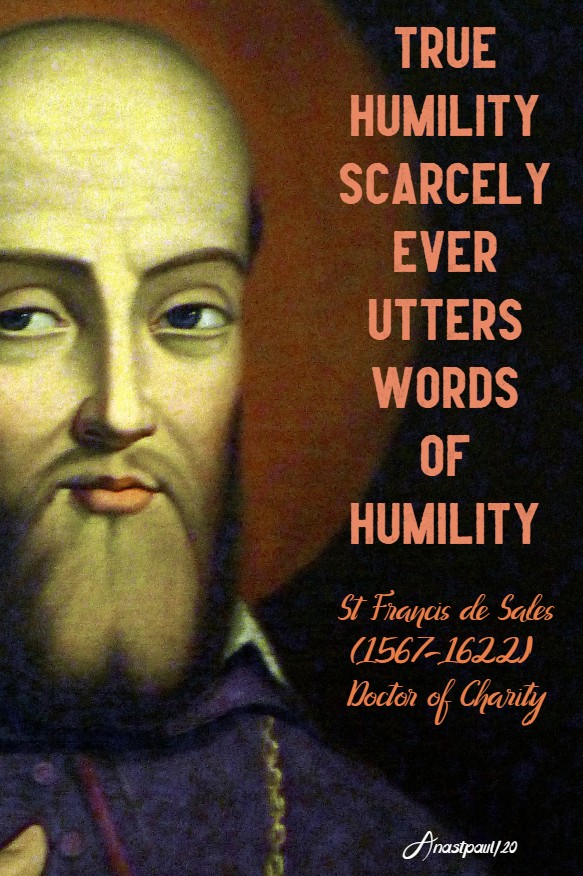
“True humility scarcely ever utters words of humility.”
Quote/s of the Day – 12 August – St Clare of Assisi (1194-1253) Virgin
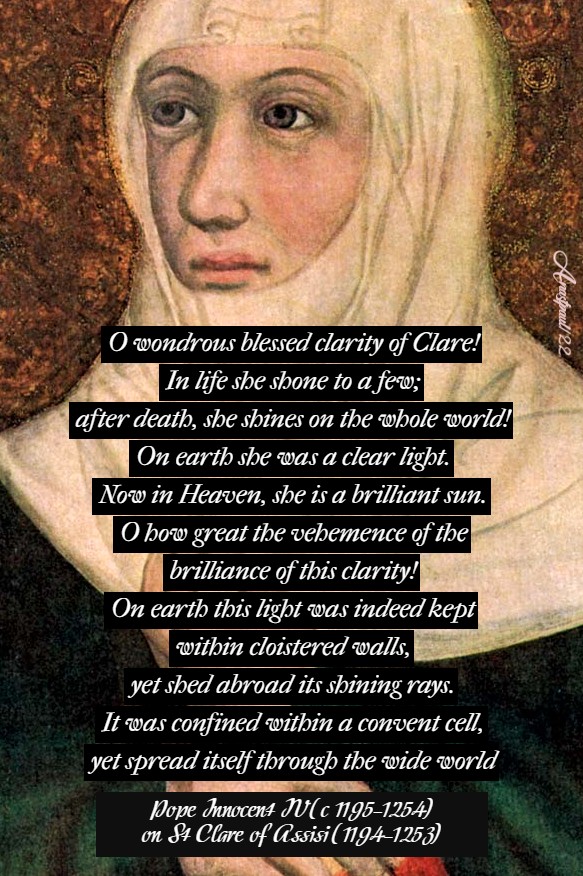
“O wondrous blessed clarity of Clare! In life she shone to a few; after death, she shines on the whole world! On earth she was a clear light. Now in Heaven, she is a brilliant sun. O how great the vehemence of the brilliance of this clarity! On earth this light was indeed kept within cloistered walls, yet shed abroad its shining rays. It was confined within a convent cell, yet spread itself through the wide world.”
Pope Innocent IV (c 1195-1254) Papal reign 25 June 1243-1254
Our Morning Offering – 12 August – St Clare of Assisi (1194-1253) Virgin
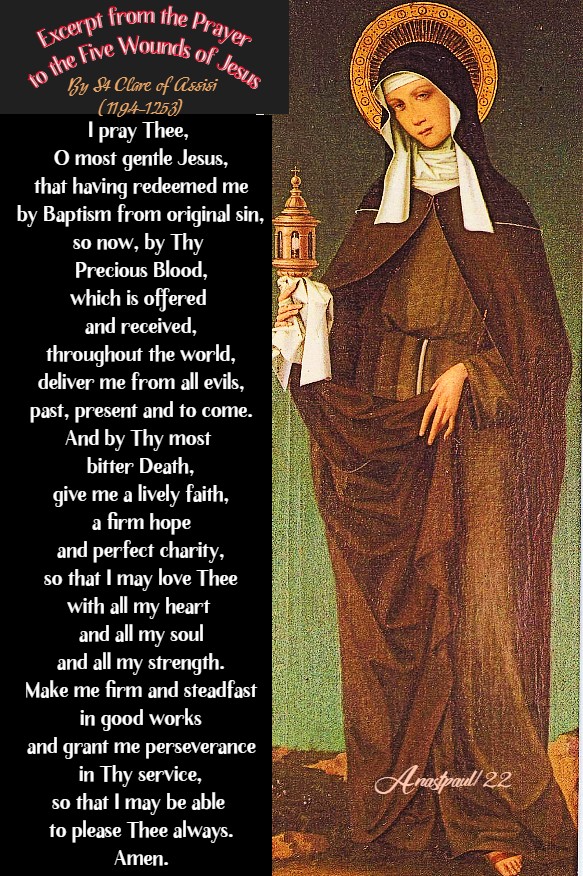
Excerpt from the Prayer to the Five Wounds of Jesus By St Clare of Assisi (1194-1253)
I pray Thee, O most gentle Jesus, that having redeemed me by Baptism from original sin, so now, by Thy Precious Blood, which is offered and received, throughout the world, deliver me from all evils, past, present and to come. And by Thy most bitter Death, give me a lively faith, a firm hope and perfect charity, so that I may love Thee with all my heart and all my soul and all my strength. Make me firm and steadfast in good works and grant me perseverance in Thy service, so that I may be able to please Thee always. Amen.
Saint of the Day – 12 August – St Clare of Assisi (1194-1253) Virgin. Patronages – embroiderers, needle workers, eyes, against eye disease, for good weather, gilders, gold workers, goldsmiths, laundry workers, television (proclaimed on 14 February 1958 by Pope Pius XII because when St Clare was too ill to attend the Holy Mass, she had been able to see and hear it, on the wall of her room.), television writers, Poor Clares, Assisi, Italy, Santa Clara Indian Pueblo.
The Roman Martyrology reads today: “At Assisi, in Umbria. Italy, St Clare, Virgin, the first of the poor woman of the Order of Minors. Being celebrated for holiness of life and miracles. she was placed among holy virgins, by Alexander IV.”
St Clare, Virgin, Founder, Mystic, Miracle-worker By Fr Francis Xavier Weninger SJ (1805-1888) (Excerpt)
St.Clare, Founder of the Order which bears her name, was born of rich and pious parents, at Assisi, in the district of Umbria, in Italy. She received the name of Clare, which means “clear or bright,” for the following reason. While her mother Hortulana, was kneeling before a Crucifix, praying that God might aid her in her hour of delivery, she heard the words: “Do not fear. You will give birth to a light which shall illumine the whole world.”
From her earliest childhood, prayer was Clare’s only delight. She gave to the poor all the presents which she received from her parents. She despised all costly garments, all worldly pleasures. Beneath the fine clothes she was obliged to wear, she wore a rough hair-girdle. She partook of so little food that it seemed as if she wished to observe a continual fast.
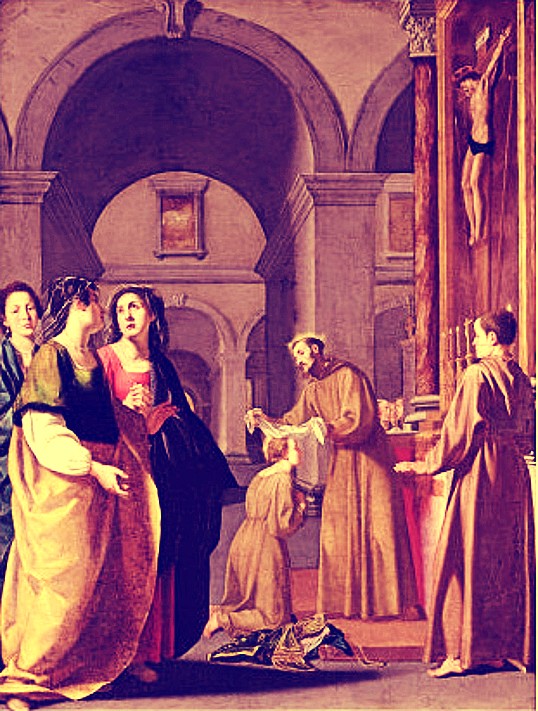
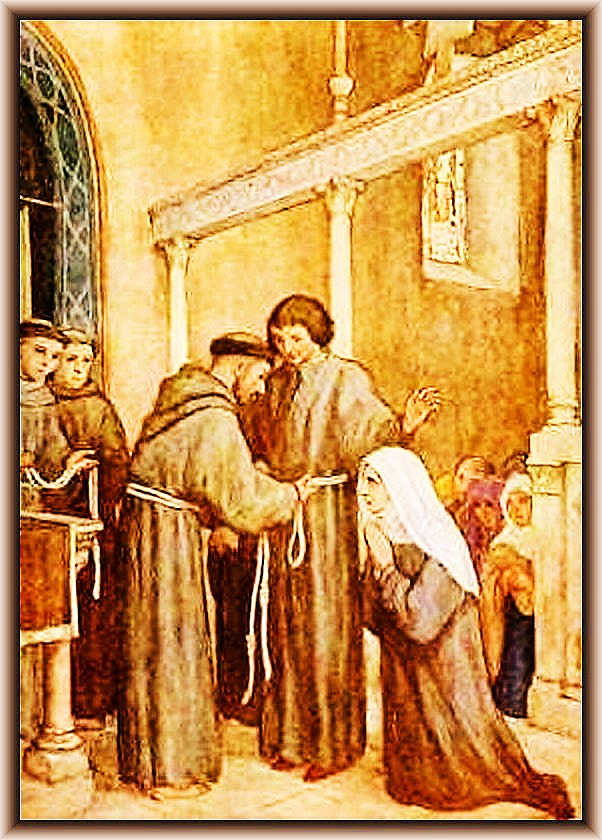
During this same period lived St Francis, surnamed “the Seraphic,” on account of his great virtues. Clare frequently went to him and confided to him, her desire to renounce the world and to consecrate her virginity to God and to lead a perfect life in the most abject poverty. St Francis who saw that besides other gifts and graces, she was filled with the most ardent love of God, possessing great innocence of heart and despising the world, strengthened her in her holy desire, while at the same time, he tested her constancy. Being sufficiently convinced that her desires were inspired by Heaven, he advised Clare to leave her home, which she did on Palm Sunday, going to the Church of the Portiuncula, where she had her hair cut off, as a sign that she would enter a religious life. She divested herself of all feminine ornament, and attired in a penitential garb, tied around her with a cord, she was placed. by St Francis in a vacant Benedictine Convent. She was at that time just eighteen years of age.
When her parents heard of what she had done, they hastened to the Convent, to take Clare home, declaring that this choice of a state of life was only a childish whim, or that she had been persuaded to it by others. Clare, however, after opposing their arguments, fled into the Church, and clinging to the Altar with one hand, with the other she showed her head shorn of its hair, exclaiming: “Know all, that I desire no other bridegroom but Jesus Christ. Understanding well what I was doing, I chose Him and I will never leave Him.” Astonished at this answer, all returned home, admiring her virtue and piety. Clare thanked God for this victory and was, on account of it, all the more strengthened in her resolution.
Clare had a sister younger than herself, named Agnes. A few days later she, too, fled from her parents’ roof and going to Clare, wished to be invested in the same habit and to serve God in the same manner. St Clare received her joyfully but as all her relatives were provoked beyond measure that she, too, had entered a Convent, twelve of them went and forcibly tore her from her sister’s arms. Clare took refuge in prayer and, as if inspired by the Almighty, ran after her sister, loudly calling her by name. God assisted her by a miracle. Agnes suddenly became immovable, as if rooted to the ground and no-one possessed strength enough to drag her from where she stood. Recognising in this, the powerful hand of God, they opposed her no longer but allowed her to return to the Convent.
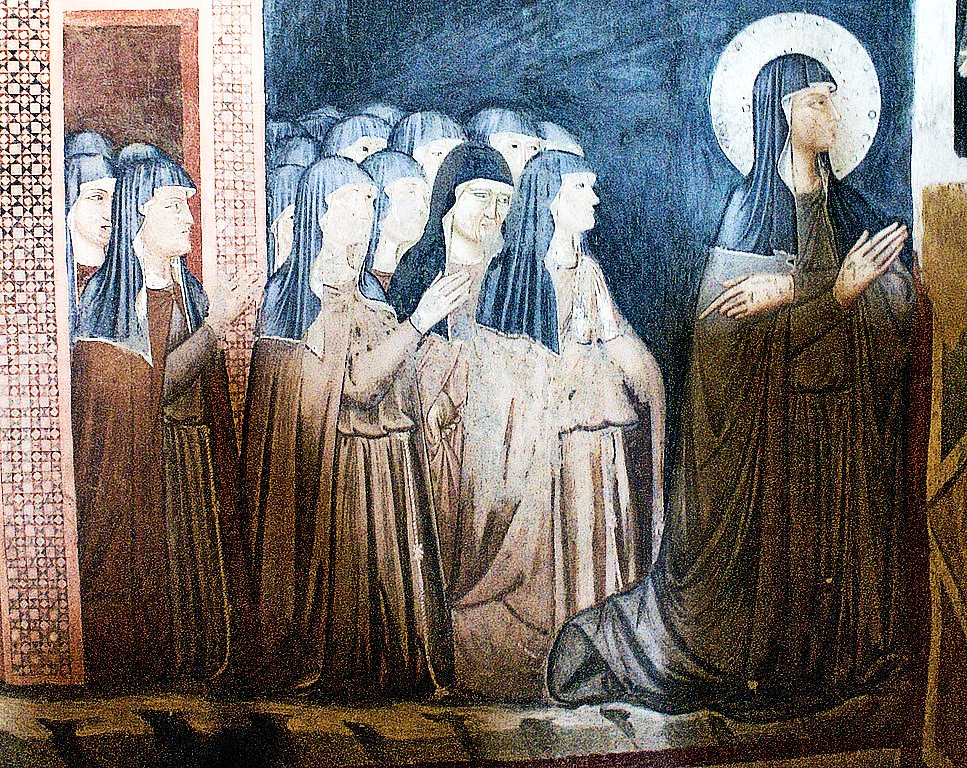
Meanwhile, St Francis had rebuilt the old Church of St Damiano and had bought the neighbouring house. Into this house he placed his first two religious daughters, Clare and Agnes, who were speedily joined by others, desirous of conforming themselves to the rule of life which St Francis had given to Clare. This was the beginning of the Order of Poor Clares, which has since given to the world, so many shining examples of virtue and holiness, to the salvation of many thousands of souls.
St Clare was appointed Abbess by St Francis and filled the office for forty two years with wonderful wisdom and holiness. Her mother too, together with her youngest daughter, took the habit and submitted to the government of St Clare.
She was, to all in her charge, a bright example of poverty. In austerity towards herself, she was more to be admired than imitated. The floor or a bundle of straw was her bed, a piece of wood, her pillow. Twice during the year she kept a forty days’ fast on bread and water. Besides this, three days of the week, she tasted no food and so little on the others that it is marvellous that she could sustain life with it. The greater part of the night, she spent in prayer and her desire for mortification was so great that St. Francis compelled her to moderate her austerities.
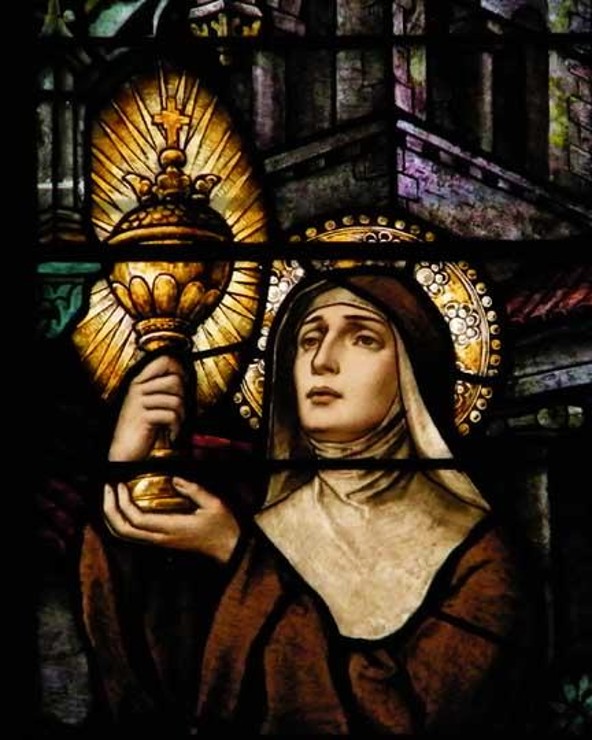
She nursed the sick with the greatest pleasure, as in this work of charity, she found almost constant opportunity to mortify and overcome herself. Besides all her other virtues, she was especially remarkable for her devotion to the Blessed Sacrament. She sometimes remained whole hours immovable before the Tabernacle and was often seen in ecstacy, so great was her love for the Saviour it concealed. She sought her comfort in Him alone in all her trials, amidst all her persecutions and how great were the graces she thereby received, the following event will sufficiently illustrate.
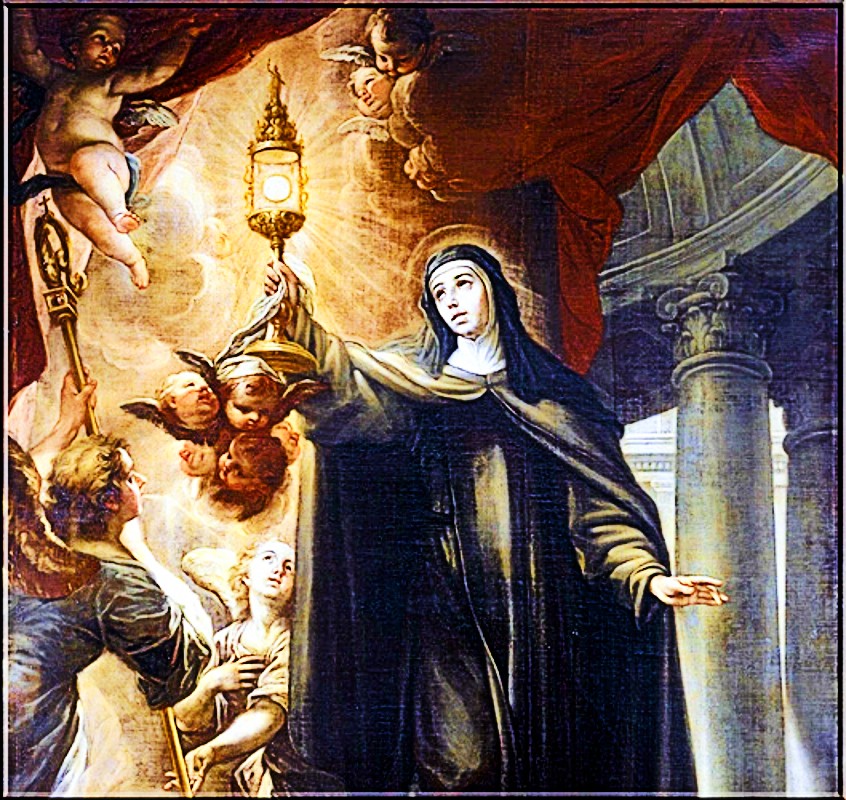
The Saracens besieged Assisi and made preparations to scale the walls of the Convent. St Clare, who was sick at the time, had herself carried to the gates of the Convent, where, with the Ciborium, containing the Blessed Sacrament, in her hands, prostrating herself in company with all her religious, she cried aloud: “O Lord, do not give into the hands of the infidels, the souls of those who acknowledge and praise Thee. Protect and preserve Thy handmaidens whom Thou hast redeemed with Thy Precious Blood.” A voice was distinctly heard, saying: “I will protect you always.”
The result proved that this was the Voice of Heaven. The Saracens, seized with a sudden fear, betook themselves to flight, those who had already scaled the walls, became blind and flung themselves down. Thus were St Clare and her religious protected and the whole City preserved from utter devastation, by the piety and devotion of the Saint to the Blessed Sacrament. We must omit many miracles which God wrought through His faithful servant.
[When St Clare] … had reached the age of sixty years, during twenty-eight of which, she had suffered from various painful maladies, although she had not been confined to her bed, or rather, her bundle of straw. Her patience while suffering was remarkable and she was never heard to complain.
The hour of her death drew near and she saw a great many white-robed virgins come to meet her, among whom was one who surpassed all the rest in beauty. She followed them and they led her to see the Almighty face-to face. Several who had read in the depths of her heart, said that she died more from the fervour of her love for God, than from the effects of her sickness. Her holy death took place in 1253. The great number of miracles wrought after her death, through her intercession and the heroic virtues which made her so remarkable, induced Pope Alexander IV., only two years later, to place her in the number of Saints.
St Porcarius of Lerins St Simplicio of Vercelli St Ust
Martyrs of Augsburg – 4 Saints: The mother, Hilaria,and three friends of of Saint Afra ofAugsburg. While visiting the tomb of Saint Afra who were seized by the authorities and Martyred when they visited Afra’s tomb – Digna, Eunomia, Euprepia and Hilaria. They were burned alive c 304.
Martyrs of Rome – 5 Saints: A group of Christians Martyred together in the persecutions of Diocletian. We know little more than their names – Crescentian, Juliana, Largio, Nimmia and Quiriacus. • c.304 in Rome, Italy • buried on the Ostian Way outside Rome.
Quote/s of the Day – 5 August – “The Month of the Immaculate Heart of Mary” – Santa Mariæ ad Nives, Dedication of the Basilica of Our Lady of the Snows
“Mary, Mother of Grace, it becomes you to be mindful of us, as you stand near Him who granted you all graces, for you are the Mother of God and our Queen. Help us for the sake of the King, the Lord God and Master, Who was born of you.”
St Athanasius (297-373) Father & Doctor of the Church
“Mary was placed by God in the centre of history and we can say that everything was made through her and with her and in her.”
St Bernard (1090-1153) Mellifluous Doctor of the Church
“Mary is the divine Page on which God the Father wrote the Word of God, His Son. Let us draw near to her and read her!”
St Albert the Great (1200-1280) Doctor of the Church
“Mary seeks for those who approach her devoutly and with reverence, for such she loves, nourishes, and adopts as her children. ”
St Bonaventure (1221-1274) Seraphic Doctor of the Church
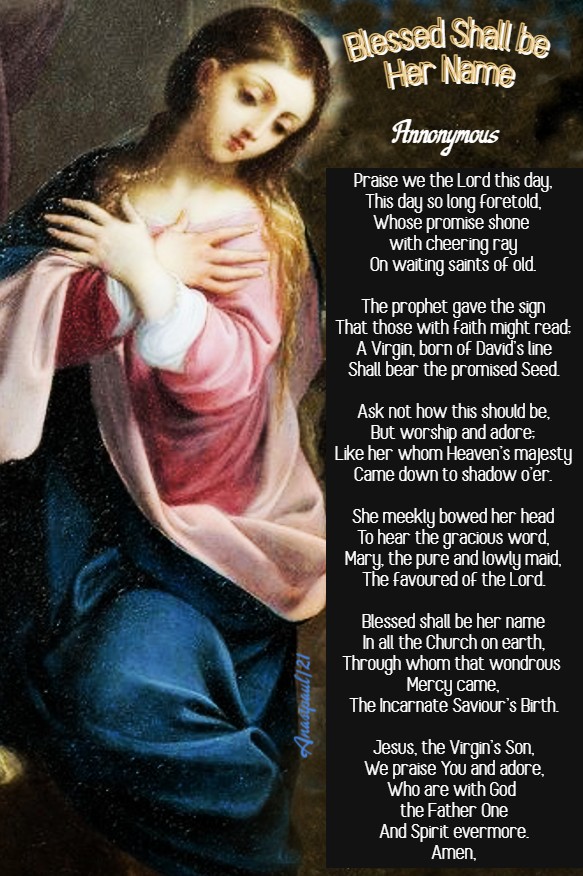
Blessed Shall be Her Name Anonymous Author
Praise we the Lord this day, This day so long foretold, Whose promise shone with cheering ray On waiting saints of old.
The prophet gave the sign That those with faith might read; A Virgin, born of David’s line Shall bear the promised Seed.
Ask not how this should be, But worship and adore; Like her whom Heaven’s majesty Came down to shadow o’er.
She meekly bowed her head To hear the gracious word, Mary, the pure and lowly maid, The favoured of the Lord.
Blessed shall be her name In all the Church on earth, Through whom that wondrous Mercy came, The Incarnate Saviour’s Birth.
Jesus, the Virgin’s Son, We praise You and adore, Who are with God the Father One And Spirit evermore. Amen
Portiuncula Indulgence: An Indulgence which may be gained in any Church so designated by the Bishop, by all the faithful who, after Confession and Holy Communion, visit such Churches between noon of 1 August and midnight of 2 August, or on the Sunday following. The Indulgence is toties quoties and is applicable to the souls in Purgatory.
St Exuperius of Bayeux St Faith St Faustus St Felix of Gerona St Friard Blessed Giovanni Bufalari OSA (c 1318-c 1350) St Hope St Jadwiga Karolina Zak St Jonatus St Justin of Paris St Kenneth of Wales St Leontius of Perga St Maur St Nemesius of Lisieux Bl Orlando of Vallombrosa St Peregrinus of Modena St Rioch Bl Rudolph St Secundel St Secundus of Palestrina St Sophia St Verus of Vienne
Seven Holy Machabees – 8 Saints: “At Antioch, the Martyrdom of the Seven Holy Brothers, the Machabees and thei mother, who suffered under King Antiochus Epiphanes. Their relics were transferred to Rome and placed in the Church of St Peter in Chains.”
Saints Faith, Hope and Charity: The daughters of Saint Sophia. While still children, they were tortured and Martyred for their faith in the persecutions of Hadrian. They were scourged, thrown into a fire, and then beheaded.
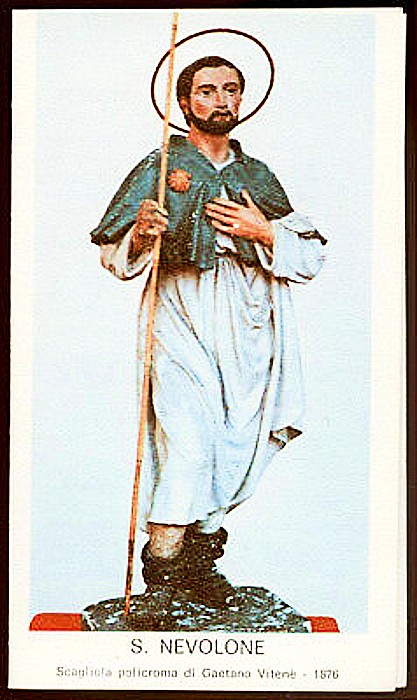
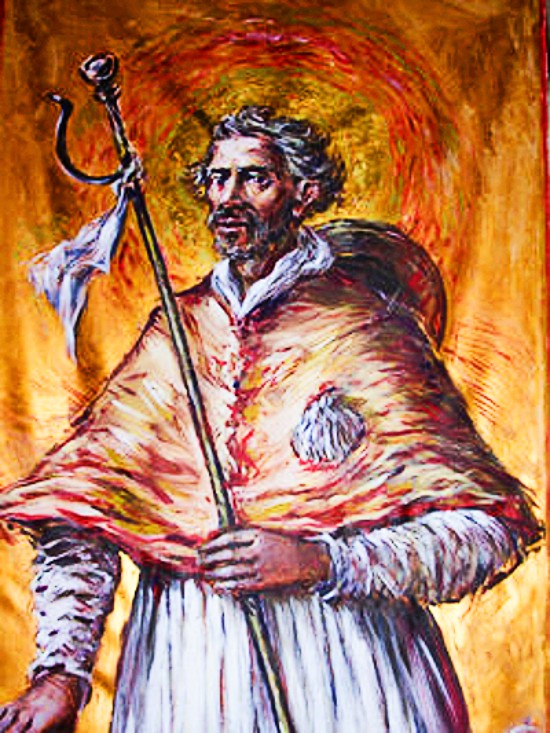
Saint of the Day – 27 July – Blessed Nevolone of Faenza OFM (Died 1280) Penitent, Pilgrim, Widower, Lay Friar of the Order of Friars Minor, then a Camaldolese Hermit, Apostle of the poor and sick, worked as a Cobbler / Shoemaker.. Born in the 13th Century Faenza, Italy and died on 27 July 1280 in Faenza, Italy of natural causes. Patronage – Faenza, cobblers, shoemakers, shoe repairers (chosen by the cobblers of Rimini, Italy in 1331). Also known as – Nevolo of Tavensia, Nevolone, Novellone, Nevolonius. Beatified on 4 June 1817 by Pope Pius VII.
In the great family of Saints the shoemaker stands next to the king’s son and the penitent who has atoned for the errors of his earlier life, may associate with the innocent man who has never lost the grace of God.
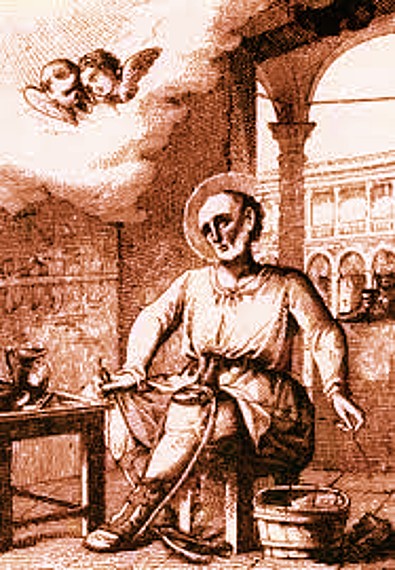
Born of devout parents at Faenza, Italy, Nevellon learned the trade of a shoemaker but his bad conduct caused great grief to them, especially to his good mother. He married when he was quite young and it was hoped, that now at least, he would change his ways but he continued in the same bad habits, inflicting still greater pain on his family. His mother, however, prayed and sighed without ceasing that the good Lord, Who consoled the widow of Naim by raising her son to life, would also raise her son from a spiritual death to a new life.
The prayers and tears of the mother did not remain unanswered. Almighty God caused Nevellon to become seriously ill. The nearness of death opened his eyes; he reflected on his past years, grace touched his heart and with bitter tears of true contrition, he vowed that if he recovered, he would lead a penitential life. He also resolved to make a pilgrimage to the tombs of the Holy Apostles Peter and Paul at Rome and to the tomb of St James at Compostela.
A few days later Nevellon recovered his health as if by a miracle . He was then only twenty four years old but he remained faithful to his promise all the rest of the days of his life, even up to an advanced age.
From that time on, prayer and work were his daily occupation. He became a Franciscan tertiary and converted his wife to an active faith. His charity to the poor nearly ruined his business.Mindful of the words, “Alms purge away sins” (Tob. 12,9), Blessed Nevellon retained only so much of his wages, as was necessary for he and his wife’s support and the remainder he divided among the poor and the sick. In the beginning, his wife, who was somewhat anxious over their temporalities, was much vexed at this liberality but when she saw the great blessings that attended her husband’s charity, she gave full consent.
Nevellon severely chastised his body for the sins of his past life and amid great hardships, undertook the pilgrimages he had promised, including several trips to Compostela. When his wife died, Nevelone became a Franciscan Lay Brother. But seeking greater unity with God in prayer and mortification he became a Camaldolese Hermit at the Monastery of San Maglorio in Faenza, Italy where his reputation for piety and wisdom continued to grow, leading many to emulate his spiritual ascent.
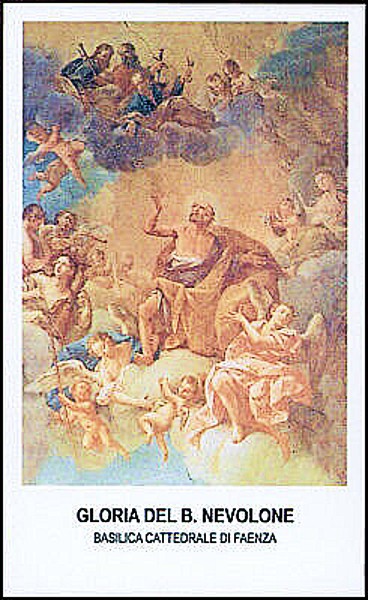
After giving the most edifying example of penance and many holy virtues for a space of fifty-six years, holy Nevellon died peacefully in the Lord in 1280. God glorified him in life and in death by miracles. His remains were interred in the Cathedral of San Pietro in Faenza. By 1282, 2 years after his death, there were so many pilgrims to his tomb that guards had to be posted to maintain order. With the approval of the Pope his native town celebrates his feast and shoemakers have chosen him for their special Patron.
Quote/s of the Day – 14 July – “The Month of the Precious Blood” – The Memorial of St Bonaventure OFM (1221-1274) Seraphic Doctor of the Church (No images until later. We are being subjected to constant Power Cuts again – they can be up to 8 hours per day.)
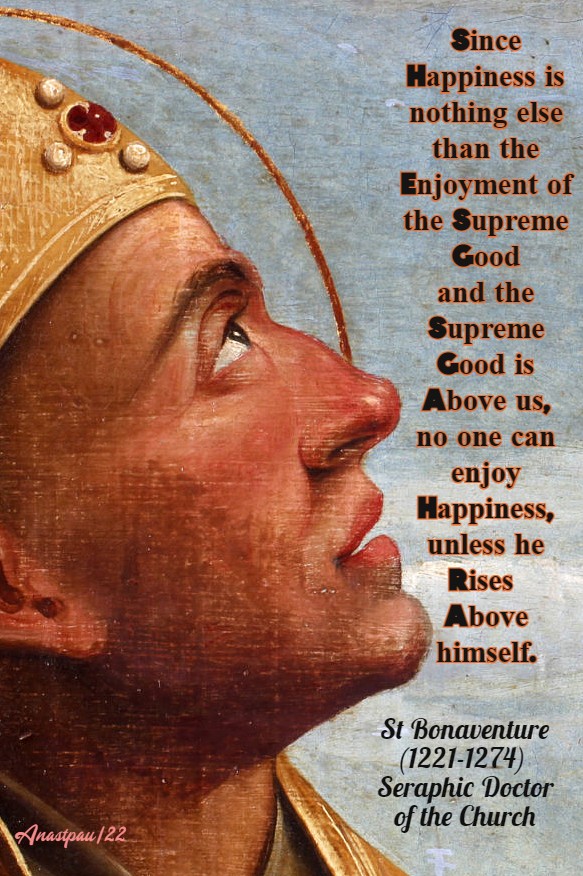
“Since happiness is nothing else than the enjoyment of the Supreme Good and the Supreme Good is above us, no-one can enjoy happiness, unless he rises above himself.”
“As “pride, is the beginning of all sin,” (Eccl. 10:15) so humility, is the foundation of all virtue. Learn to be really humble and not, as the hypocrite, humble merely in appearance.”
Our Morning Offering – 14 July – “The Month of the Most Precious Blood” and the Memorial of St Bonaventure OFM (1221-1274) Seraphic Doctor of the Church
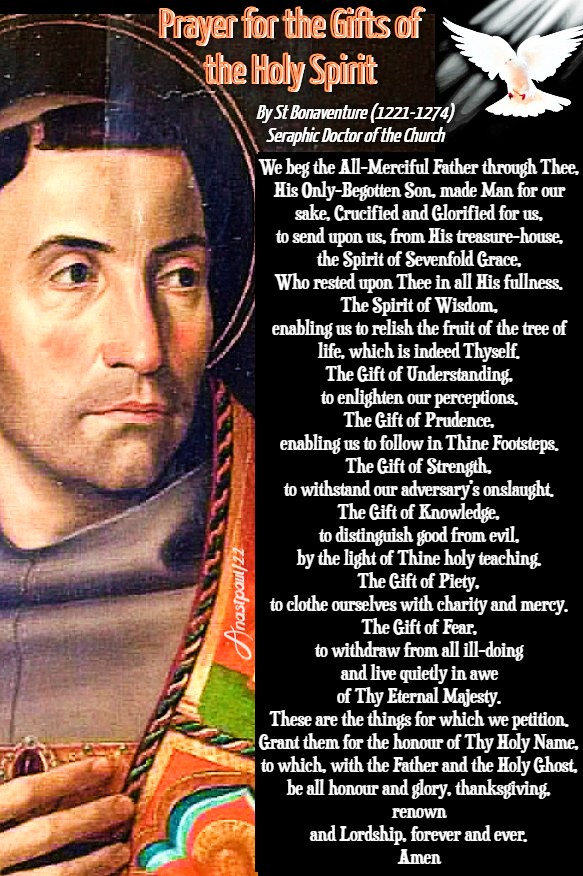
Prayer for the Gifts of the Holy Spirit By St Bonaventure (1221-1274) Seraphic Doctor of the Church
We beg the All-Merciful Father through Thee, His Only-Begotten Son, made Man for our sake, Crucified and Glorified for us, to send upon us, from His treasure-house, the Spirit of Sevenfold Grace, Who rested upon Thee in all His fullness.
The Spirit of Wisdom, enabling us to relish the fruit of the tree of life, which is indeed Thyself. The Gift of Understanding, to enlighten our perceptions. The Gift of Prudence, enabling us to follow in Thine Footsteps. The Gift of Strength, to withstand our adversary’s onslaught. The Gift of Knowledge, to distinguish good from evil, by the light of Thine holy teaching. The Gift of Piety, to clothe ourselves with charity and mercy. The Gift of Fear, to withdraw from all ill-doing and live quietly in awe of Thy Eternal Majesty.
These are the things for which we petition. Grant them for the honour of Thy Holy Name, to which, with the Father and the Holy Ghost, be all honour and glory, thanksgiving, renown and Lordship, forever and ever. Amen
One Minute Reflection – 10 July – “The Month of the Precious Blood” – The Fifth Sunday after Pentecost and the Solemnity of the Most Precious Blood – Hebrews 9:11-15, John 19:30-35
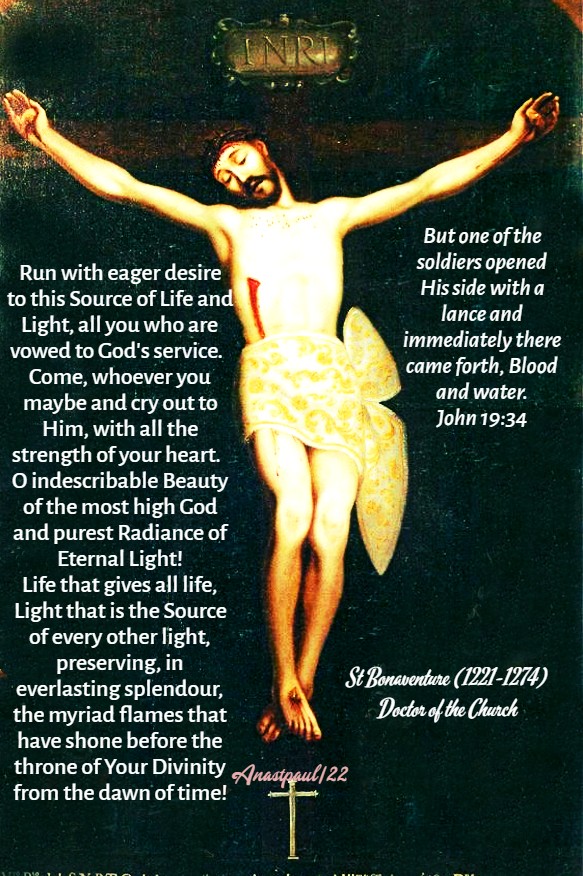
“But one of the soldiers opened His side with a lance and immediately there came forth, Blood and water.” – John 19:34
REFLECTION – “Take thought now, redeemed man and consider how great and worthy is He, Who hangs on the Cross for you… Arise, then, beloved of Christ! Imitate the dove ‘that nests in a hole in the cliff’ (Jr 48:28), keeping watch at the entrance ‘like the sparrow that finds a home’(Ps 84:4). There, like the turtledove, hide your little ones, the fruit of your chaste love. Press your lips to the Fountain, draw water from the wells of your Saviour; for this is the spring flowing out of the middle of paradise, dividing into four rivers, inundating devout hearts, watering the whole earth and making it fertile.
Run with eager desire to this Source of Life and Light, all you who are vowed to God’s service. Come, whoever you maybe and cry out to Him, with all the strength of your heart. O indescribable Beauty of the most high God and purest Radiance of Eternal Light! Life that gives all life, Light that is the Source of every other light, preserving, in everlasting splendour, the myriad flames that have shone before the throne of Your Divinity from the dawn of time!
Eternal and inaccessible Fountain, clear and sweet stream, flowing from a hidden spring, unseen by mortal eye! None can fathom Your depths nor survey Your boundaries, none can measure Your breadth, nothing can sully Your purity. From You flows ‘the river which gladdens the city of God’ (Ps 46:5) and makes us cry out with joy and thanksgiving, in hymns of praise to You, for we know, by our own experience, that ‘with You is the Source of Life and in Your Light we see light’ (Ps 36:10).” – St Bonaventure (1221-1274) Doctor of the Church (The Tree of Life, 29-30, 47, – Breviary)
PRAYER – Almighty, eternal God, Who made Thy Only Begotten Son the Redeemer of the world and willed to be reconciled by His Blood, grant us, we beseech Thee, so to worship in this Sacred rite the price of our salvation and to be so protected by its power against the evils of the present life on earth, that we may enjoy its everlasting fruit in Heaven. Through the same Jesus Christ, Thy Son our Lord, Who lives and reigns with Thee, in the unity of the Holy Ghost, God, world without end. Amen (Collect). Aspiration:Precious Blood, ocean of Divine Mercy, Flow upon us.
Quote/s of the Day – 7 July – The Memorial of St Lawrence of Brindisi OFM Cap (1559-1619) Confessor, The “Franciscan Renaissance Man,” Priest
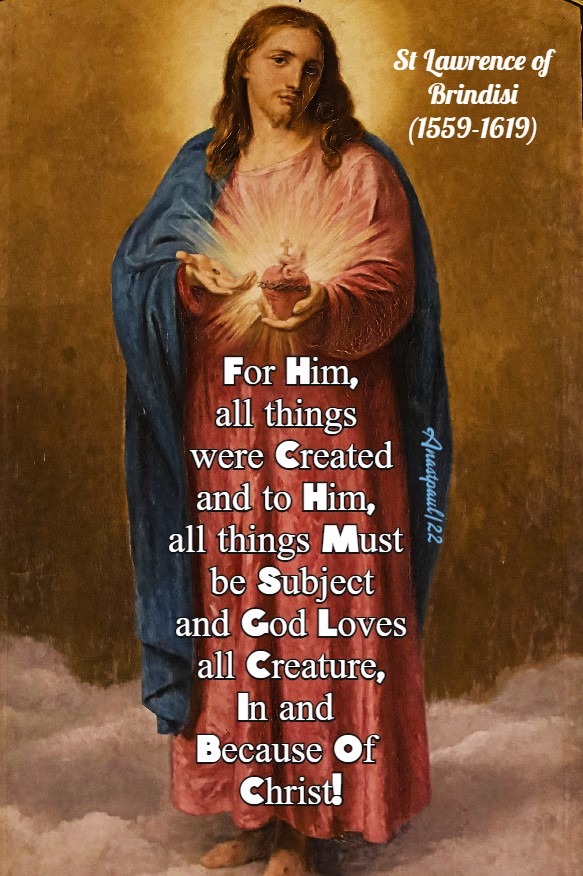
“For Him all things were created and to Him, all things must be subject and God loves all creature, in and because of Christ.”
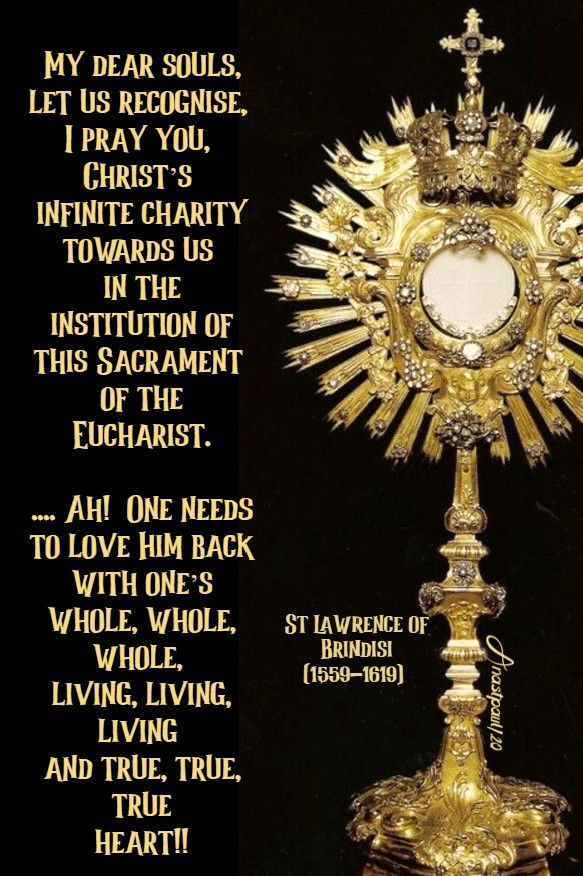
“My dear souls, let us recognise, I pray you, Christ’s infinite charity towards us in the institution of this Sacrament of the Eucharist. In order that our love be a spiritual love, He wills a new heart, a new love, a new spirit for us. It is not with a carnal heart but with a spiritual one, that Christ has loved us with a gratuitous love, a supreme and most ardent love, by way of pure grace and charity. Ah! One needs to love Him back with one’s whole, whole, whole, living, living, living and true, true, true heart!”
Saint Cyril (827-869) Saint Methodius (826-885) “Apostles to the Slavs,” Sibling Brother Bishops, Confessors, Theologians, Missionaries, Writers, Preachers, Patrons of Europe. Creators of the Glagolitic alphabet, the first alphabet used to transcribe Old Church Slavonic and Cyrillac Alphabet, which was developed from it. Their Feast Day is 7 July (moved in 1969). The great Saints Cyril & Methodius: https://anastpaul.wordpress.com/2018/02/14/saints-of-the-day-14-february-sts-cyril-827-869-methodius-826-885/
St Lawrence of Brindisi OFM Cap (1559-1619) Confessor, The “Franciscan Renaissance Man,” Priest and Friar of the Friars Minor Capuchin, Theologian, Vicar General of the Franciscans, Language scholar, Humanist, Philosopher, Biblicist, Preacher, Missionary, Professor, International Administrator, Confidant of Popes, Emperors, Kings and Princes, Diplomatic envoy, Army Chaplain, Military Strategist and Morale builder, Polemicist, Prolific writer. He was Beatified on 1 June 1783 by Pope Pius VI and Canonised on 8 December 1881 by Pope Leo XIII. His Zealous Life: https://anastpaul.com/2017/07/21/saint-of-the-day-21-july-st-lawrence-of-brindisi-o-f-m-cap-doctor-of-the-church/
St Alexander St Angelelmus of Auxerre St Apollonius of Brescia
Blessed Pope Benedict XI OP (1240-1303) Cardinal-Priest of St Sabina, Bishop of Ostia then of Rome, Dominican Friar, Prior Provincial of Lombardy prior to becoming the Master of the Order in 1296, Apostolic Papal Legate to Hungary and France, Teacher, Preacher, Writer and renowned Scholar with special emphasis on Biblical commentary. His Papacy began on 22 Ocober 1303 and ended at his death on 7 July 1304. His Life: https://anastpaul.com/2020/07/07/saint-of-the-day-7-july-blessed-pope-benedict-xi-1240-1303/
Bl Bodard of Poitiers St Bonitus of Monte Cassino St Carissima of Rauzeille St Eoaldus of Vienne St Ethelburga of Faremoutier St Hedda of Wessex St Maelruan Bl Marie-Gabrielle-Françoise-Suzanne de Gaillard de Lavaldène St Medran St Merryn Bl Oddino Barrotti St Odo of Urgell St Odran St Palladius of Ireland St Pantaenus of Alexandria
St Pantænus (Died c 216) Father of the Church, Theologian, Philosopher, Teacher, Confessor and Defender of the Faith, Writer and interpreter of the Bible, the Trinity and Christology, |Missionary. Convert ofthe disciples of the Apostles. Head of the Alexandrian School of Learning – a famous pupil was St Clement of Alexandria. Biography: https://anastpaul.com/2019/07/07/saint-of-the-day-7-july-st-pantaenus-father-of-the-church-died-c-216/
St Prosper of Aquitaine (c 390-c 436) Theologian, Married Layman, Writer, disciple abd friend of St Augustine. St Syrus of Genoa St They
Martyrs of Durres – 7 Saints: Also known as – Martyrs of Dyrrachium/Martyrs of Durazzo. A group of seven Italian Christians who fled Italy to escape the persecutions of Emperor Hadrian. Arrived in Dyrrachium, Macedonia to find Saint Astius tied to a cross, covered in honey, laid in the sun and left to be tortured by biting and stinging insects. When they expressed sympathy for Astius, they were accused of being Christians, arrested, chained, weighted down, taken off shore and drowned. We know little more about each of them than their names – Germaus, Hesychius, Lucian, Papius, Peregrinus, Pompeius and Saturninus. They were born in Italy and were martyred at sea c117 off the coast of Dyrrachium (Durazzo), Macedonia (modern Durres, Albania).
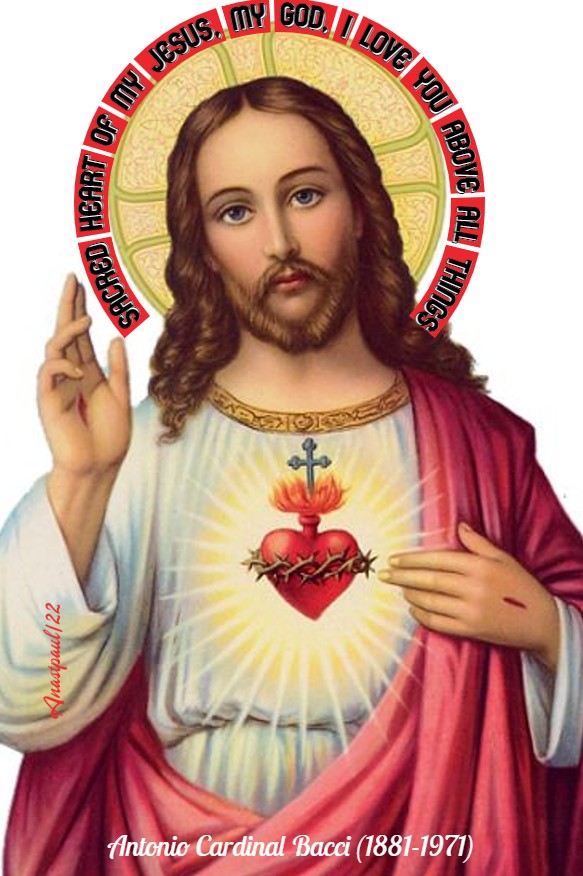
Thought for the Day – 13 June – Meditations with Antonio Cardinal Bacci (1881-1971)
St Anthony
“St Anthony joined the Franciscan Order and joyfully set off for the coast of Morocco in search of Missionary labour and of Martyrdom. But, when he landed on African soil, he was struck down by a serious attack of malaria, which compelled him to return to his native land.
There is no foreseeing the designs of Divine Providence. The boat in which Anthony was travelling was battered by a tempest and had to go ashore in Italy. Henceforward, Italy was Anthony’s second fatherland. It was here, that he conducted his remarkable and fruitful apostolate and slowly accomplished his Martyrdom, by the daily struggle for perfection.
… We have all been called to a state of holiness. Perfection, moreover, is a gradual Martyrdom. … (Cf Pt 1)
Aspiration: Sacred Heart of my Jesus, my God, I love You above all things.”
Quote/s of the Day – 13 June – The Memorial of St Anthony of Padua (1195-1231) Evangelical Doctor of the Church
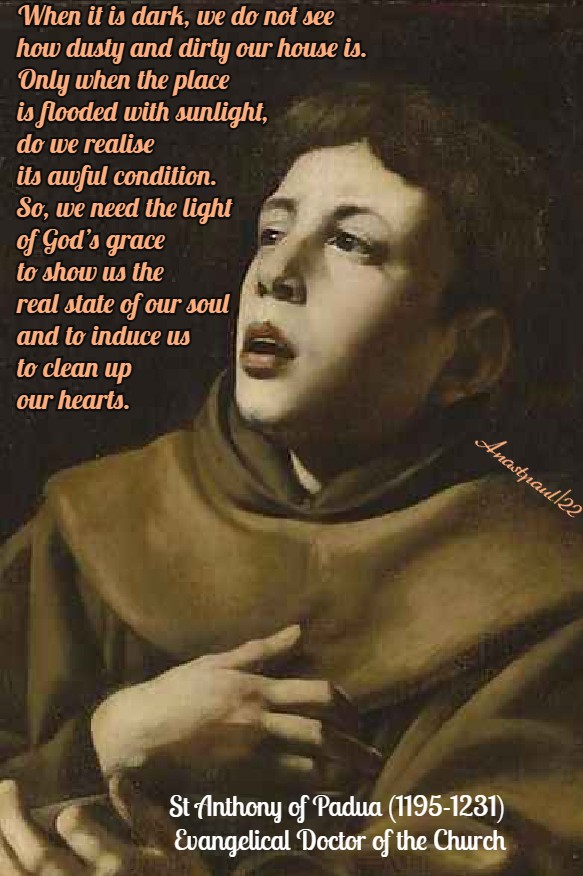
“When it is dark, we do not see how dusty and dirty our house is. Only when the place is flooded with sunlight, do we realise its awful condition. So, we need the light of God’s grace to show us the real state of our soul and to induce us to clean up our hearts!”
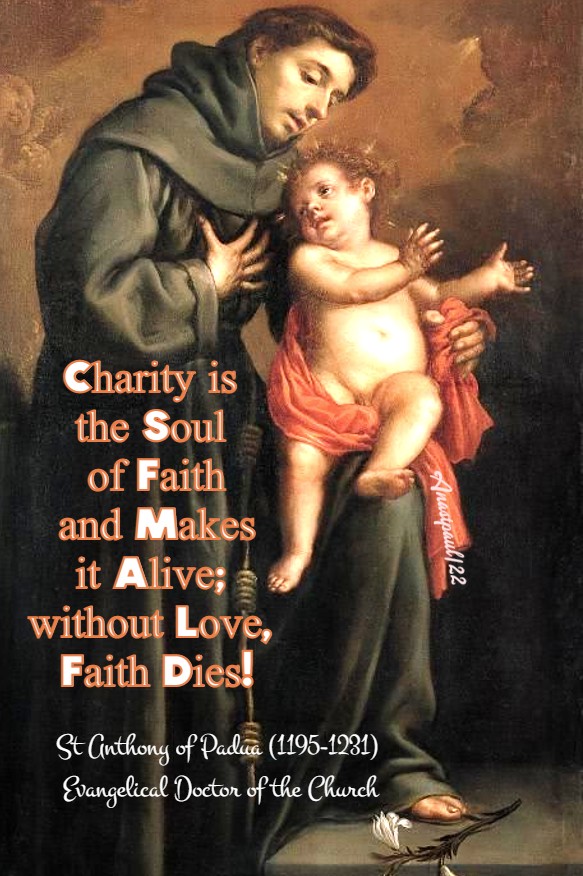
“Charity is the soul of faith and makes it alive; without love, faith dies!”
“Christ acts like a loving mother. To induce us to follow Him, He gives us Himself as an example and promises us a reward in His kingdom.”
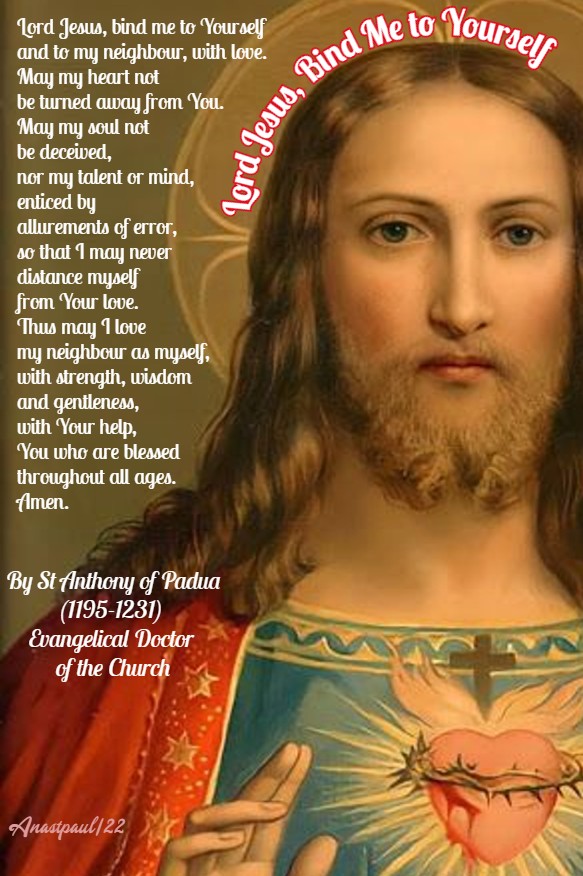
Lord Jesus, Bind Me to Yourself
Lord Jesus, bind me to Yourself and to my neighbour, with love. May my heart not be turned away from You. May my soul not be deceived, nor my talent or mind, enticed by allurements of error, so that I may never distance myself from Your love. Thus may I love my neighbour as myself, with strength, wisdom and gentleness, with Your help, You who are blessed throughout all ages. Amen.
St Anthony of Padua (1195-1231) Evangelical Doctor of the Church
Our Morning Offering – 13 June – The Memorial of St Anthony of Padua (1195-1231) Evangelical Doctor of the Church
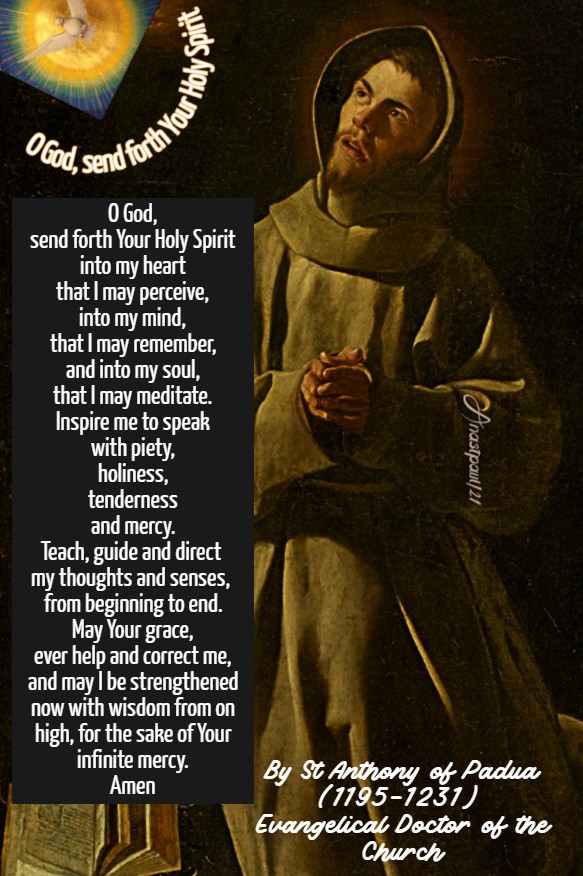
O God, Send Forth Your Holy Spirit By St Anthony of Padua (1195-1231) Doctor of the Church
O God, send forth Your Holy Spirit into my heart that I may perceive, into my mind, that I may remember, and into my soul, that I may meditate. Inspire me to speak with piety, holiness, tenderness and mercy. Teach, guide and direct my thoughts and senses, from beginning to end. May Your grace, ever help and correct me, and may I be strengthened now with wisdom from on high, for the sake of Your infinite mercy. Amen
Quote/s of the Day – 7 June – Pentecost Tuesday – Acts 8:14-17, John 10:1-10.
“… He goes before them and the sheep follow Him because they know His Voice.”
John 10:4
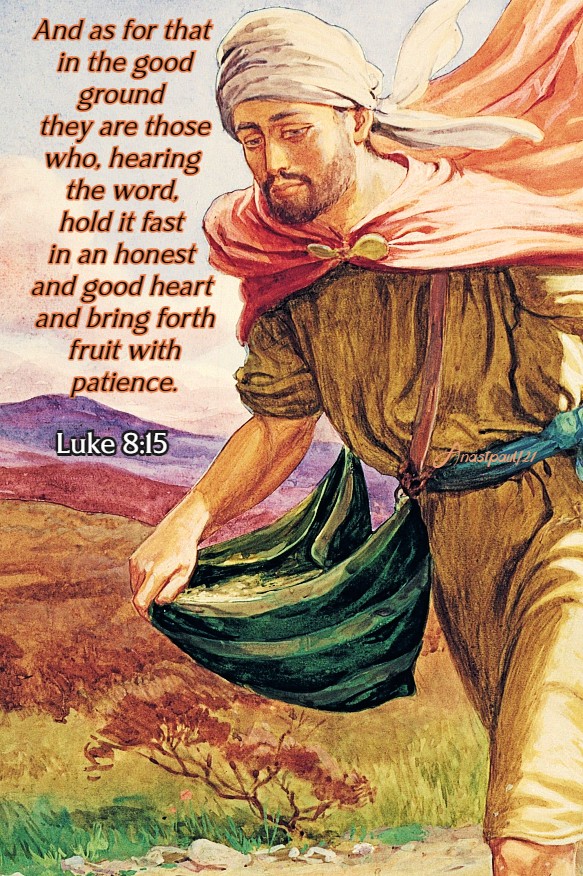
“And as for that in the good ground they are those who, hearing the word, hold it fast in an honest and good heart and bring forth fruit with patience.”
Luke 8:15
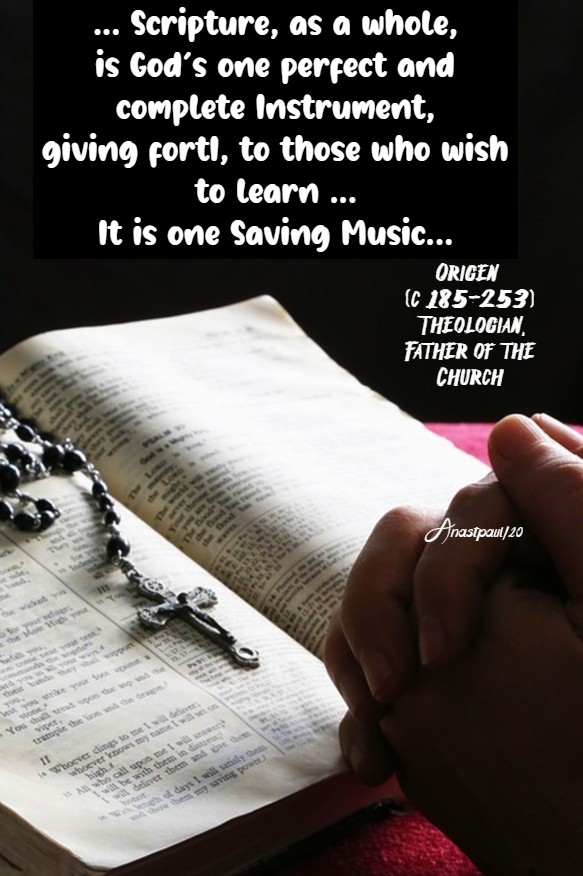
“… Scripture, as a whole, is God’s one perfect and complete instrument, giving forth, to those who wish to learn … It is one Saving Music…”
Origen (c 185-253) Theologian, Father of the Church
“If you believe what you like in the Gospels and reject what you don’t like, it is not the Gospel you believe but yourself.”
St Augustine (354-430) Father and Doctor of Grace
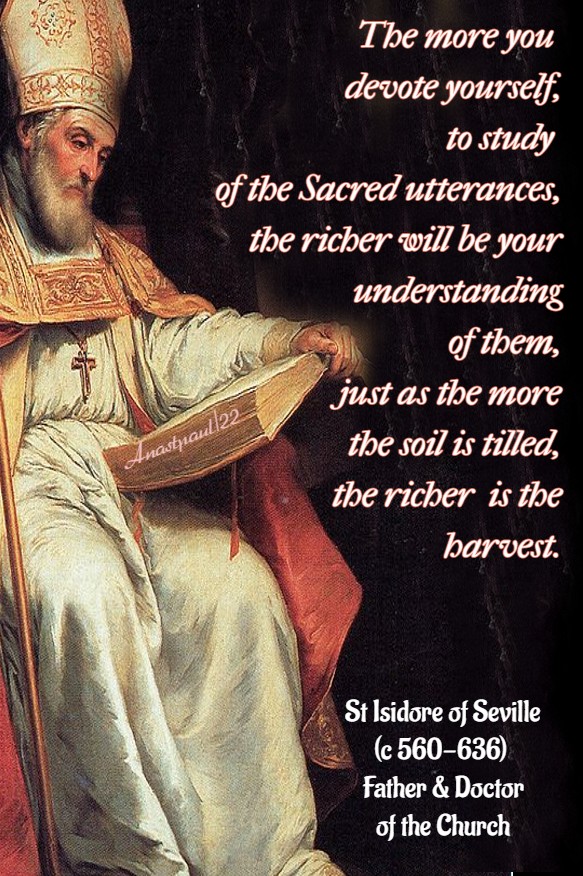
“The more you devote yourself, to study of the Sacred utterances, the richer will be your understanding of them, just as the more the soil is tilled,, the richer is the harvest.”
St Isidore of Seville (c 560-636) Father & Doctor of the Church
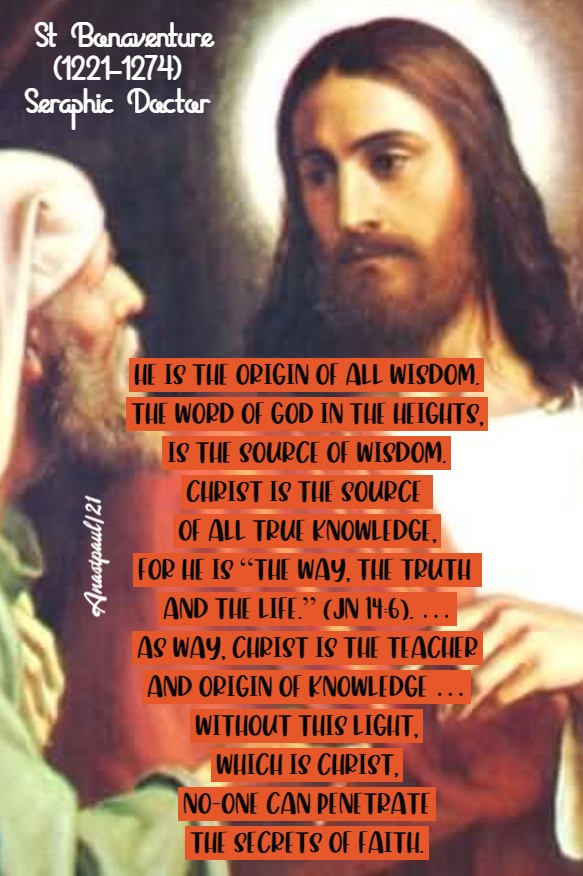
“He is the origin of all wisdom. The Word of God in the heights, is the source of wisdom. Christ is the source of all true knowledge, for He is “the way, the truth and the life.” (Jn 14:6). … As way, Christ is the teacher and origin of knowledge … Without this Light, which is Christ, no-one can penetrate the secrets of faith.”
























 AnaStpaul
You must be logged in to post a comment.