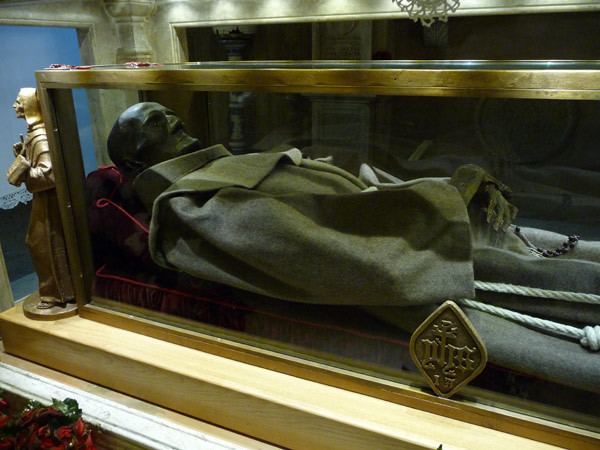
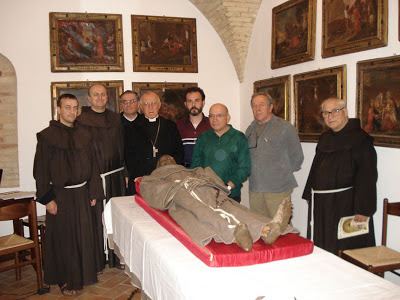
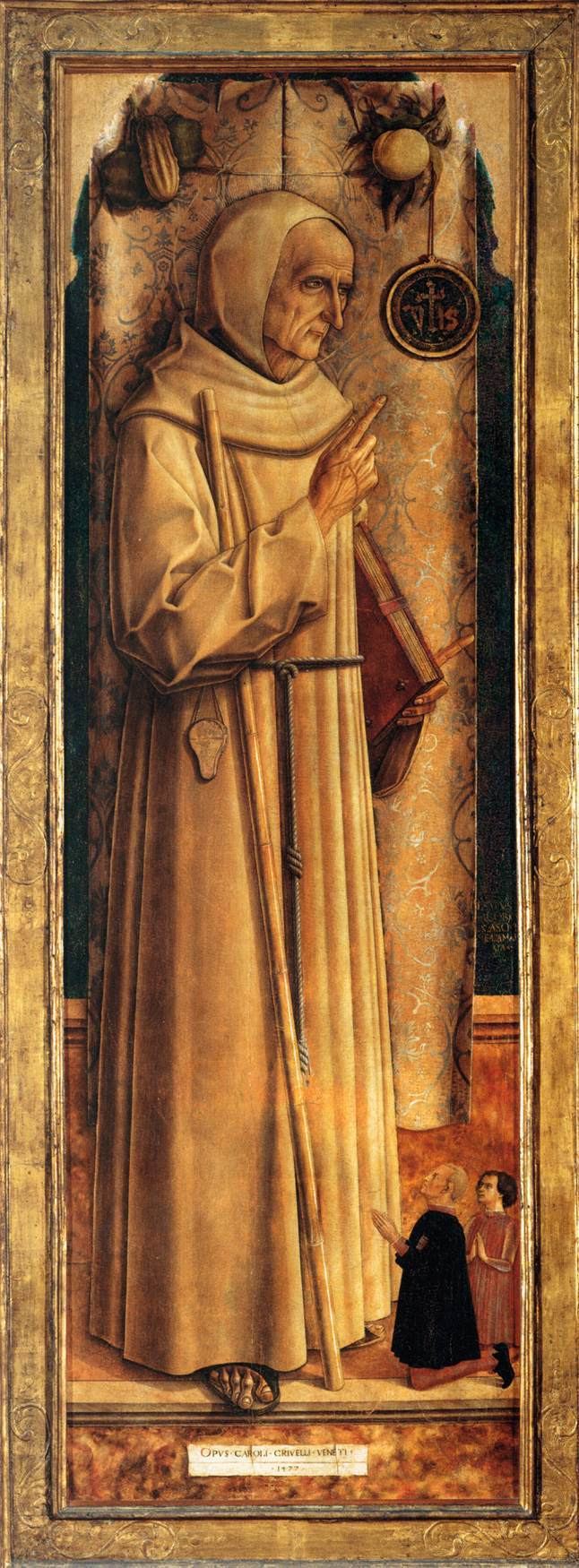
Posted in EASTER, franciscan OFM, I BELIEVE!, ONE Minute REFLECTION, PRAYERS of the SAINTS, QUOTES of the SAINTS, QUOTES on FAITH, The HOLY EUCHARIST / The HOLY MASS, The RESURRECTION, The WORD

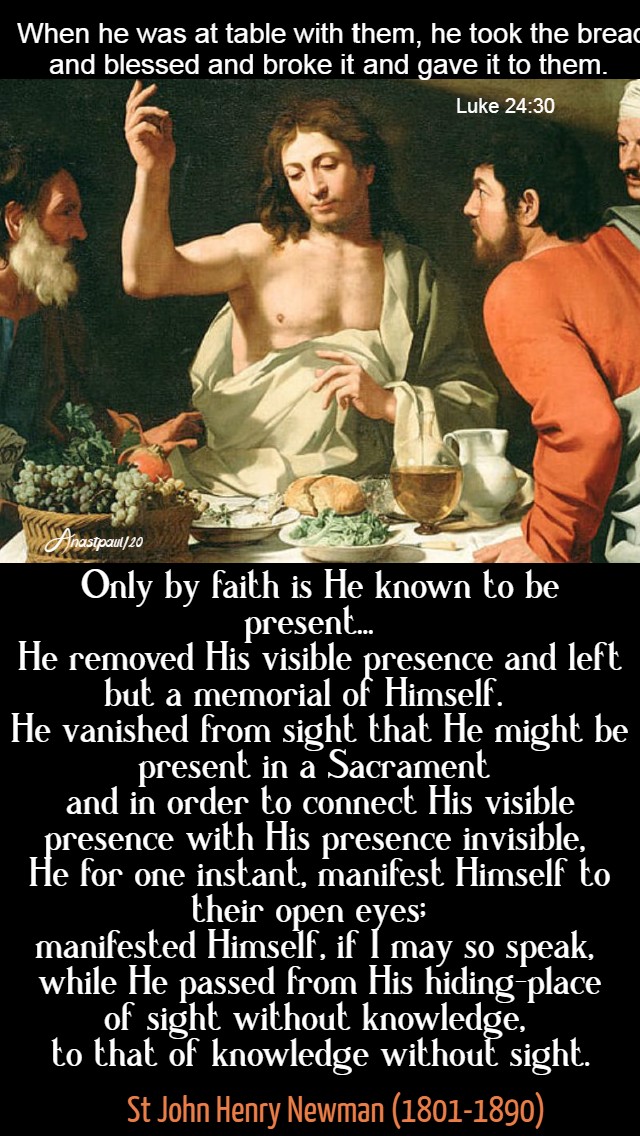
One Minute Reflection – 15 April – Only by faith is He known to be present… 

One Minute Reflection – 15 April – Easter Wednesday, Readings: Acts 3:1-10, Psalm 105:1-4, 6-9, Luke 24:13-35

“Did not our hearts burn within us while he talked to us on the road, while he opened to us the Scriptures?” … Luke 24:32luke 24 32 did not our hearts burn within us -15 april 2020 easter wed

REFLECTION – “Brethren, let us turn to the account of Christ’s appearances to His disciples after the Resurrection, which are most important, first, as showing that such an unconscious communion with Him is possible;  next, that it is likely to be the sort of communion now granted to us, from the circumstance that in that period of forty days after the Resurrection, He began to be, in that relation towards His Church, in which He is still and probably intended, to intimate to us thereby, what His presence with us is now.
Now observe what was the nature of His presence in the Church after His Resurrection. It was this, that He came and went as He pleased, that material substances, such as the fastened doors, were no impediments to His coming and that, when He was present His disciples did not, as a matter of course, know Him. …  The two disciples on the way to Emmaus do not seem to have been conscious of this at the time but on looking back, they recollected that, as having been, which did not strike them while it was.   “Did not,” they say, “did not our heart burn within us?”
Let us observe, too, when it was that their eyes were opened… when He consecrated and broke the Bread.   There is evidently a stress laid on this in the gospel…  for so it was ordained, that Christ should not be both seen and known at once, first He was seen, then He was known.   Only by faith is He known to be present…  He removed His visible presence and left but a memorial of Himself.   He vanished from sight that He might be present in a Sacrament and in order to connect His visible presence with His presence invisible, He for one instant, manifest Himself to their open eyes;  manifested Himself, if I may so speak, while He passed from His hiding-place of sight without knowledge, to that of knowledge without sight.” … St John Henry Newman (1801-1890) – Cardinal, Founder of the Oratory in England, Theologian, Poet, Writer, Hymnest – PPS 6, 10

luke 24 30 broke the bread- only by faith-knowledge without sight - st john henry newman 15 apil 2020

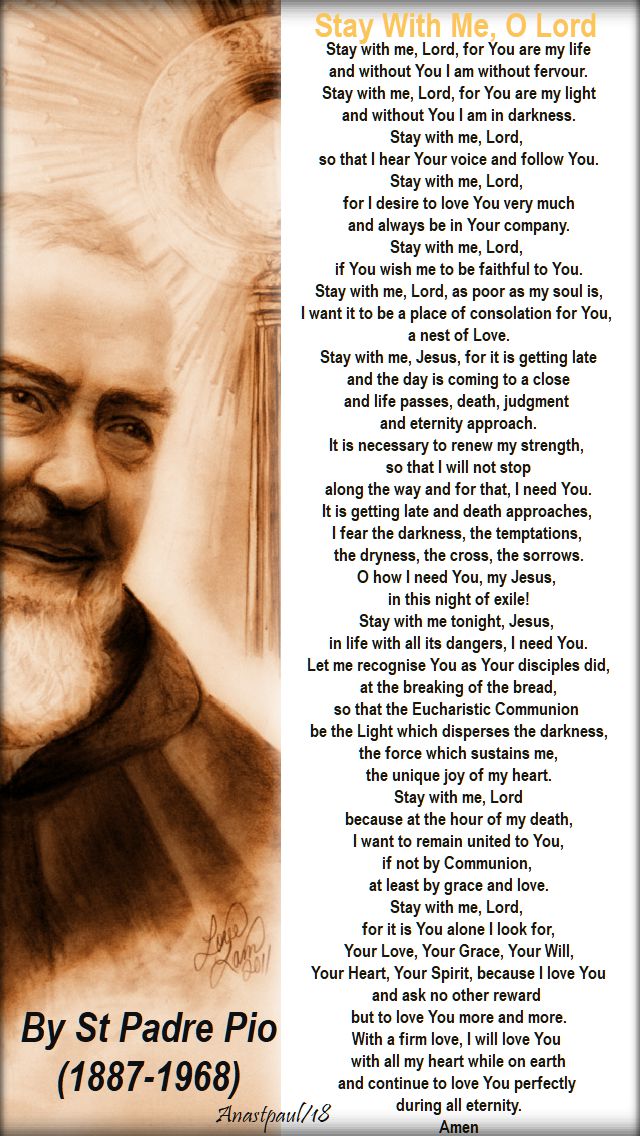
PRAYER – Stay with me, Lord, for it is necessary to have You present so that I do not forget You.   You know how easily I abandon You.
Stay with me Lord, because I am weak and I need Your strength, so that I may not fall so often.
Stay with me Lord, for You are my life and without You, I am without fervour.
Stay with me Lord, for You are my light and without you, I am in darkness.
Stay with me Lord, to show me Your will.
Stay with me Lord, so that I may hear Your voice and follow You…. St Padre Pio of Pietrelcina (1887-1968) (Stay with Me, Lord – Excerpt)
And grant holy Father, that the prayers of Our Lord’s Mother and ours, the Blessed Virgin, may assist us on our way.   Through Christ, our Lord, with the Holy Spirit, one God with You, forever, amen.stay-with-me-o-lord-st-padre-pio-23-sept-2018 and 22 sept 2019 2

Posted in DOCTORS of the Church, FATHERS of the Church, franciscan OFM, SAINT of the DAY

Memorials of the Saints – 4 April

St Isidore of Seville (c 560-636) Father & Doctor of the Church (Optional Memorial)
St Isidore’s life:
https://anastpaul.wordpress.com/2017/04/04/saint-of-the-day-4-april-st-isidore-of-seville-father-and-doctor-of-the-church/

Bl Abraham of Strelna
St Agathopus of Thessalonica
St Aleth of Dijon
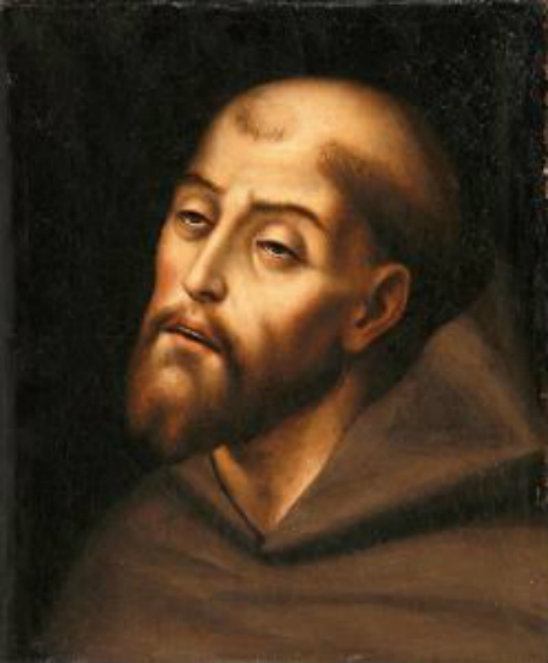
St Benedict of Sicily OFM (1526-1589)
About St Benedict:
https://anastpaul.wordpress.com/2018/04/04/saint-of-the-day-4-april-st-benedict-of-sicily-o-f-m-1526-1589/

Bl Giuseppe Benedetto Dusmet OSB (1818-1894)
Biography:
https://anastpaul.com/2019/04/04/saint-of-the-day-4-april-blessed-giuseppe-cardinal-benedetto-dusmet-osb-1818-1894/
St Gwerir of Liskeard
St Henry of Gheest
St Hildebert of Ghent
St Peter of Poitiers
St Plato
St Theodulus of Thessalonica
St Theonas of Egypt
St Tigernach of Clogher
St Zosimus of Palestine

Posted in franciscan OFM, SAINT of the DAY

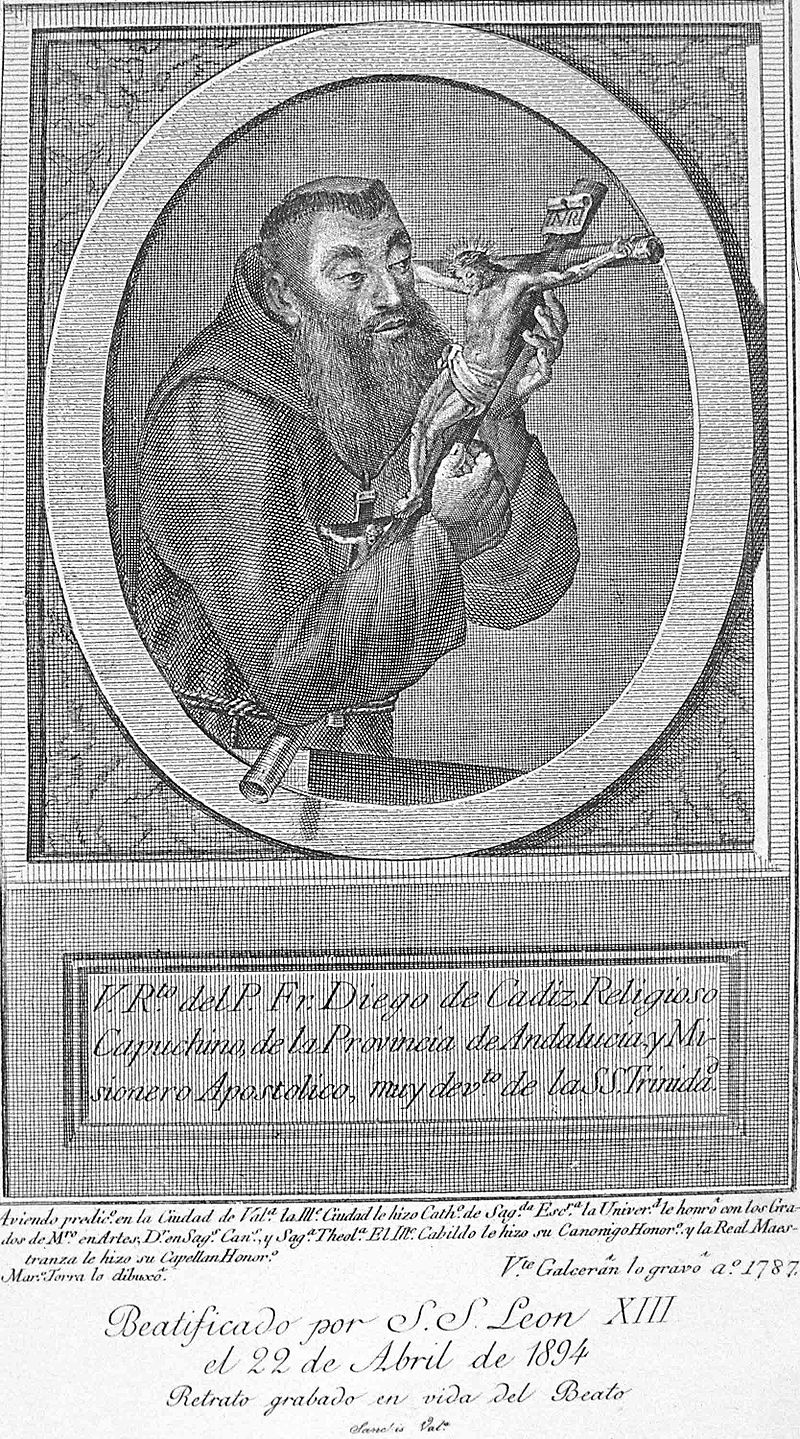
Saint of the Day – 24 March – Blessed Didacus Joseph of Cadiz OFM Cap (1743–1801)

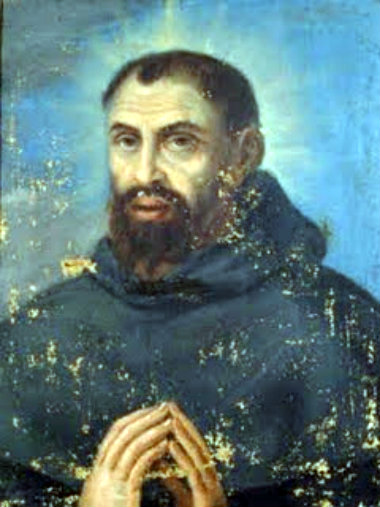
Saint of the Day – 24 March – Blessed Didacus Joseph of Cadiz OFM Cap (1743–1801) Spanish Capuchin Priest Friar, renowned Preacher, Missionary – Known as the “Apostle of Our Lady, the Mother of the Good Shepherd” and the “Apostle of the Blessed Trinity,” Miracle-worker – born as José Francisco López-Caamaño y García Pérez on 30 March 1747 in Cádiz, Seville, Spain and died on 24 March 1801 in Ronda, Malaga, Spain of natural causes.Blessed-Diego-Josef-of-Cadiz

José Francisco López-Caamaño y García Pérez was born in Cádiz in 1743.   His lineage dated from the Visigoth kings.   His mother died when he was 9 years old.   Later, his father moved the family to the city of Grazalema, where he entered the local school run by the Dominican Order.   Though of noble ancestry, as a youth, Joseph could make no progress at school, receiving the nickname of the “dunce of Cadiz”.   A classmate, a Dominican friar named Antonio Querero, testified how difficult study had been for him.

Initially rejected by the Observant Franciscan friars due to this perceived limitation of intellect, López-Caamaño was later accepted by the Capuchin friars and, at the age of 15, entered their novitiate in Seville, at which time he was given the name Didacus Joseph. He was professed as a member of the Order on 31 March 1759.   He was Ordained to the Priesthood in Carmona in 1766, for which he prepared himself by an extremely ascetic life.

In 1771, after further training in homiletics, he was assigned to one of the teams of friars who would preach Parish Missions to residents of isolated, rural villages, which was a major focus of the Capuchins of that era.   His biographers stated that the congregations marvelled at the tender love he displayed to the Crucifix he would hold while preaching and the singular power of his words, which swayed his audiences and left an impression on their lives.   He wandered throughout the entire peninsula on foot, preaching in this way to the various communities he encountered on the road.bl Didacus Joseph

Spain was undergoing changes in its intellectual climate, as the influence of the Enlightenment began to spread in the upper classes of the country.   Didacus became a major force in promoting the traditional devotions and beliefs of Catholicism as part of the identity of the nation and is seen, as an early integrist in the development of Spanish culture, opposing Liberal Catholicism.   He also was a strong critic of the policy of consumerism, being promoted in the universities and some government circles.   For this teaching, he was denounced to the Spanish Inquisition for attacking royal prerogatives  . In turn, he accused the proponents of new economic policies and the secularisation of Spanish society of heresy.   He preached at the Royal Court in 1783 but found that he had no effect on the nobility.   Leaving Madrid in disappointment, he later wrote:  “I do not want the royal couple to remember me”.

Didacus was appointed an official of the Inquisition, the synodal examiner for almost all Spanish dioceses and an honourary canon.   The University of Granada conferred upon him the honourary degrees of Master of Arts and Doctorates in Theology and Canon Law. A collection of his sermons numbers 3,000.

Didacus died in 1801, apparently as a result of yellow fever, at the age of 58, in Ronda, Málaga.   His remains are kept for veneration in an urn in the small, simple chapel of Our Lady of Peace in Ronda where he died, on the square now named in the friar’s honor.

He was Beatified by Pope Leo XIII on 22 April 1894.800px-bl Diego_de_Cádiz

This unlearned man became a celebrated preacher in Spain and an honourary Doctor of Theology and Canon law!   During his sermon one day, a child shouted aloud in the church:  “Mother, mother, see the dove resting on the shoulder of Father Didacus!   I could preach like that too if a dove told me all that I should say!”   Didacus prayed devotedly before his sermons, even scourging himself to the point of blood, in order to draw down God’s mercy upon the people.

Once when his superior chided him because of the austerity of his life, Didacus Joseph replied:   “Ah, Father, my sins and the sins of the people compel me to do it.   Those who have been charged with the conversion of sinners must remember that the Lord has imposed upon them the sins of all their clients.   By means of our penances we should atone for the sins of our fellowmen and thus preserve ourselves and them from eternal death.   It would hardly be too much if we shed the last drop of our blood for their conversion.”

Many miraculous events are recorded of his life, these three all took place in the main square of Cadiz.   In one, he was able to save the life of a builder who had fallen off a roof, stopping his fall with one hand.   On another occasion, a priest passed him while en route to administer the Last Sacraments to a dying person.   When the acolyte accompanying the priest pointed out to the friar, that he had not removed his hood (the customary form of reverence to the Blessed Sacrament which the Priest would be carrying), Didacus told him, “Tell the priest that the ciborium is empty.”  This turned out to be the case.   On yet another occasion, a heavy rainstorm hit the city.   The square, where Didacus happened to preaching at the time, was the only spot on which no rain fell.

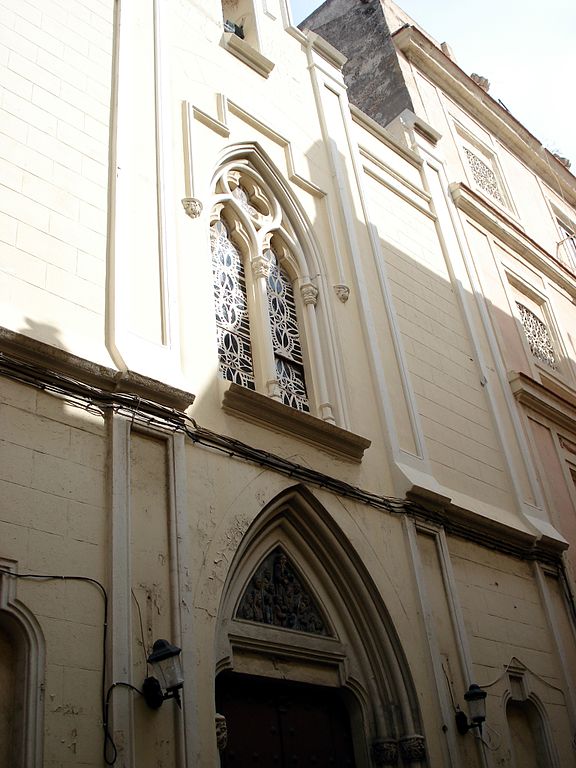
576px-bl didacus Iglesia-Cádiz
The Chapel of Blessed Didacus, located on the site of his birthplace and family home in Cadiz
Posted in franciscan OFM, SAINT of the DAY

The 28th Day of Missionary Martyrs + 2020 “In Love and Alive” and Memorials of the Saints – 24 March

The 28th Day of Missionary Martyrs + 2020 “In Love and Alive”
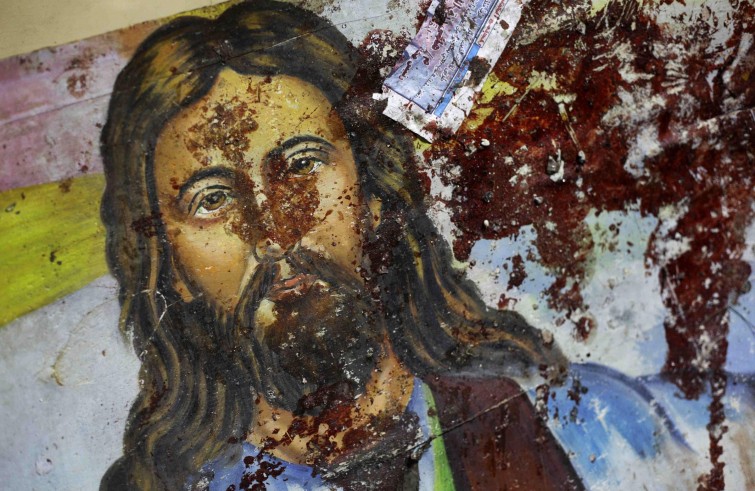
A day of prayer and fasting in memory of the missionary Martyrs of the Faith.blood spattered icon of christ jesus martyrs

The day in which Msgr Oscar Arnulfo Romero, Archbishop of San Salvador was assassinated in 1980, was chosen 28 years ago by the then Missionary Youth Movement of the Pontifical Mission Societies of Italy, to celebrate annually the “Day of Prayer and Fasting in memory of the Missionary Martyrs.”
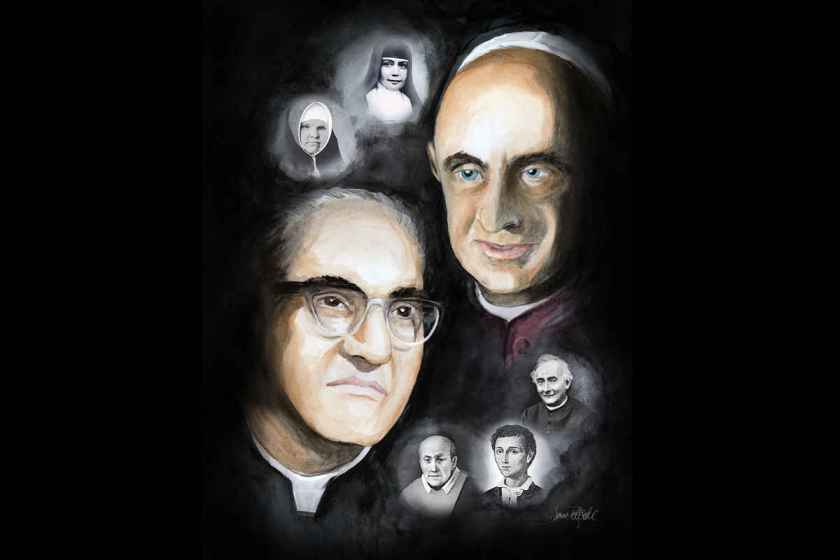
The Archbishop, assassinated while celebrating Mass, was Beatified on 23 May 2015 and Canonised by Pope Francis on 14 October 2018, together with St Paul VI and 5 others.“Holiness wears many faces” oct 14 canonisations st paul vi st oscar romero st francesco spinelli st nunzio sulprizio st theresa maria st vincenzo romano
The Bishops’ Conference of El Salvador, on the occasion of the 40 years since his Martyrdom, had announced a “Jubilee Year of the Martyrs,” to celebrate the National Martyrs – Fr Rutilio Grande, Msgr. Oscar Arnulfo Romero, Fr Cosme Spessotto.
However, this year, the coronavirus emergency has forced the Bishops to suspend all celebrations and gatherings, so this Day in 2020 will not see public initiatives.
The slogan of the 2020 Day is “In Love and Alive” informs Giovanni Rocca, national secretary of Missio Giovani.   “A message that holds two meanings within itself.   The first, in the qualifying meaning, fully describes those who ardent of love for God the Father and His creatures invested all their time to take care of them.   The second is a real imperative, the legacy that the Martyrs received from our Lord by transmitting it to us today.   Only those who fall in love are willing to abandon the superfluous, in order to grasp the essence of life.   This promise is not only hope for the future but above all a guarantee for the present.”   Then an invitation:  “Convinced that each of us is a worker in the vineyard of the Lord, on 24 March we join in prayer and fasting in memory of the sisters and brothers who by giving their lives continue to be ‘In love and alive.'”
Various aids are available on the Missio Italia website that were prepared to deepen the theme of the day and proposals for concrete initiatives of prayer and solidarity. Following the directives of the Italian government, Missio Giovani has suspended the scheduled events and offers through its social channels – Facebook and Instagram – contents and moments of confrontation to live this time together. (SL) (The Vatican Missionary Agency – Agenzia Fides, 23/3/2020)

St Agapitus of Synnada
St Aldemar the Wise
St Bernulf of Mondovi
Bl Bertha de’Alberti of Cavriglia
Bl Bertrada of Laon
Bl Brian O’Carolan
St Caimin of Lough Derg
St Cairlon of Cashel
St Catherine of Sweden (1331-1381)
Biography:
https://anastpaul.com/2019/03/24/saint-of-the-day-24-march-st-catherine-of-sweden-1331-1381/
Blessed Diego José of Cádiz/Blessed Didacus Joseph of Cadiz OFM Cap (1743–1801)

St Domangard of Maghera
St Epicharis of Rome
St Epigmenius of Rome
St Hildelith of Barking
Bl John del Bastone
St Latinus of Brescia
St Macartan of Clogher
Bl Maria Serafina of the Sacred Heart
St Mark of Rome
Bl Óscar Arnulfo Romero y Galdámez (1917–1980)
Before he was a Saint (Canonised on 14 Oct 2018): https://anastpaul.wordpress.com/2018/03/24/saint-of-the-day-24-march-blessed-oscar-arnulfo-romero-y-galdamez-1917-1980-martyr/

St Pigmenius of Rome
St Romulus of North Africa
St Secundus of North Africa
St Seleucus of Syria
St Severo of Catania
St Timothy of Rome

Martyrs of Africa – 9 saints: A group of Christians murdered for their faith in Africa, date unknown. The only details about their that survive are the names – Aprilis, Autus, Catula, Coliondola, Joseph, Rogatus, Salitor, Saturninus and Victorinus. .

Martyrs of Caesarea – 6 saints: A group of Christians martyred together in the persecutions of Diocletian. We know little else but six of their names – Agapius, Alexander, Dionysius, Pausis, Romulus and Timolaus. They were martyred by beheading in 303 at Caesarea, Palestine.

Posted in FEASTS and SOLEMNITIES, franciscan OFM, ONE Minute REFLECTION, PRAYERS of the SAINTS, QUOTES of the SAINTS, SAINT of the DAY, St JOSEPH, The WORD

One Minute Reflection – 19 March – ‘Blessed Joseph, remember us …’

One Minute Reflection – 19 March – The Solemnity of the Feast of St Joseph, Spouse of the Blessed Virgin Mary and Patron of the Universal Church, Readings: 2 Samuel 7:4-5, 12-14, 16, Psalm 89:2-5, 27, 29, Romans 4:13, 16-18, 22, Matthew 1:16, 18-21, 24

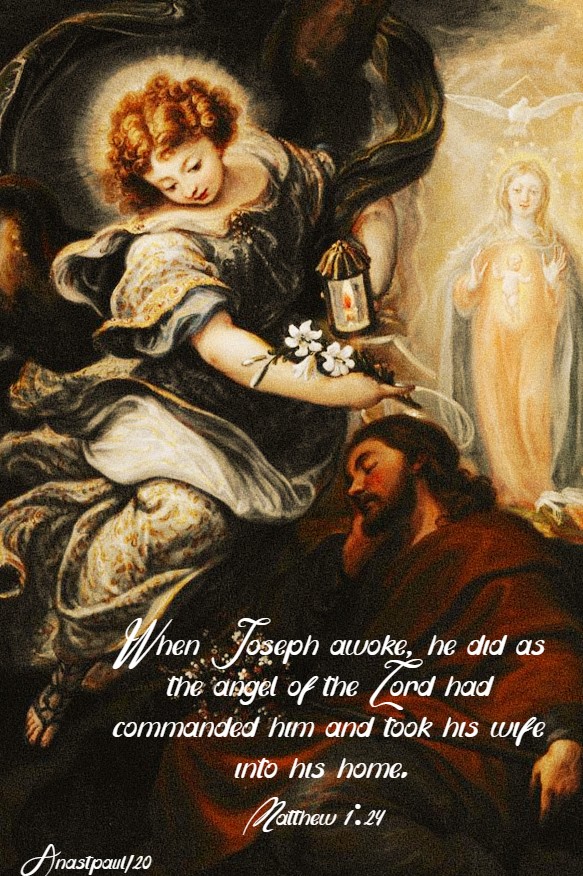
When Joseph awoke, he did as the angel of the Lord had commanded him and took his wife into his home … Matthew 1:24matthew 1 24 when joseph awoke he did as the angel commanded him - 19 march 2020

REFLECTION – “When the divine goodness chooses someone to receive a special grace, it gives him all the charisms he needs, which greatly increases his spiritual beauty.   This is wholly confirmed in the case of Saint Joseph, legal father of our Lord Jesus Christ and rightful husband of she, who is Queen of the world and Sovereign of angels.   The eternal Father chose him to be provider and faithful guardian to his chiefest treasures, namely His Son and His bride – a function he faithfully fulfilled  . That is why the Lord said: “Good and faithful servant, come, share your master’s joy” (Mt 25,21).
If you compare Joseph with all the rest of Christ’s Church, is he not the one who has been specially chosen, through whom Christ came into the world in regular and respectable fashion?   So, if the whole of holy Church is indebted to the Virgin Mary, because it was she who enabled it to welcome Christ, after her it is to Saint Joseph that it owes a recognition and honour without compare.
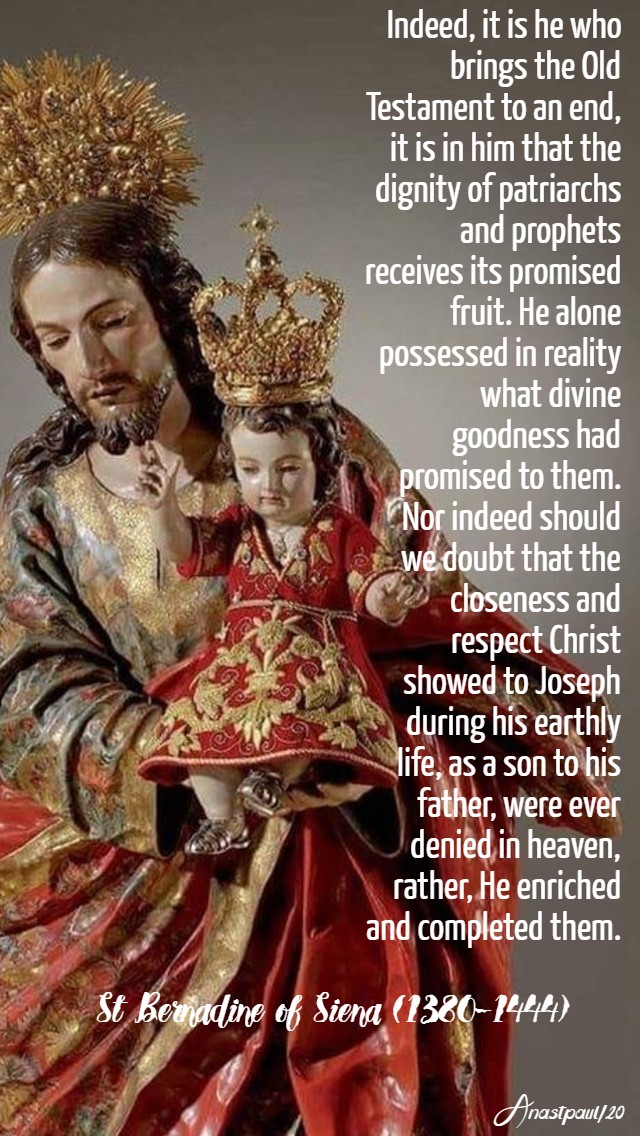
Indeed, it is he who brings the Old Testament to an end, it is in him that the dignity of patriarchs and prophets receives its promised fruit.   He alone possessed in reality what divine goodness had promised to them.   Nor indeed should we doubt that the closeness and respect Christ showed to Joseph during His earthly life, as a son to His father, were ever denied in heaven, rather, He enriched and completed them.   So, with reason, the Lord adds: “Enter into your master’s joy”.indeed it is he who brings the old testament to an end - st bernardine of siena sermon on st joseph - 19 march 2020
PRAYER – Blessed Joseph, remember us, intercede with the help of your prayers to your adopted Son and may you likewise make the blessed Virgin, your spouse, to be favourable towards us, for she is the mother of Him, who, with the Father and the Holy Spirit, lives and reigns world without end.” … St Bernadine of Siena (1380-1444) – Sermon on Saint Josephblessed joseph remember us - st bernardine of siena 19 march 2020

Posted in franciscan OFM, QUOTES of the SAINTS, QUOTES on COURAGE, QUOTES on DEATH, QUOTES on DISCIPLESHIP, QUOTES on FAITH, QUOTES on LOVE, QUOTES on SACRIFICE, The WORD

Quote/s of the Day – 19 February – ‘Keep a clear eye toward life’s end.’

Quote/s of the Day – 19 February – The Memorial of St Conrad of Piacenza TOSF (c 1290-1351), Today’s Gospel: Mark 8:22-26

Then again he laid his hands upon his eyes
and he looked intently
and was restored and saw everything clearly.

Mark 8: 25mark 8 25 then again he laid his hands upon his eyes - 19 feb 2020

“Keep a clear eye toward life’s end.
Do not forget your purpose
and destiny as God’s creature.
What you are in His sight,
is what you are and nothing more.
Remember that when you leave this earth,
you can take nothing that you have received…
but only what you have given – a full heart
enriched by honest service, love, sacrifice and courage.”

St Francis of Assisi (c 1181-1226)keep-a-clear-eye-st-francis-of-assisi - 19 feb 2017 and 19 feb 2020

Posted in franciscan OFM, SAINT of the DAY

Saint of the Day – 19 February – St Conrad of Piacenza TOSF (c 1290-1351)

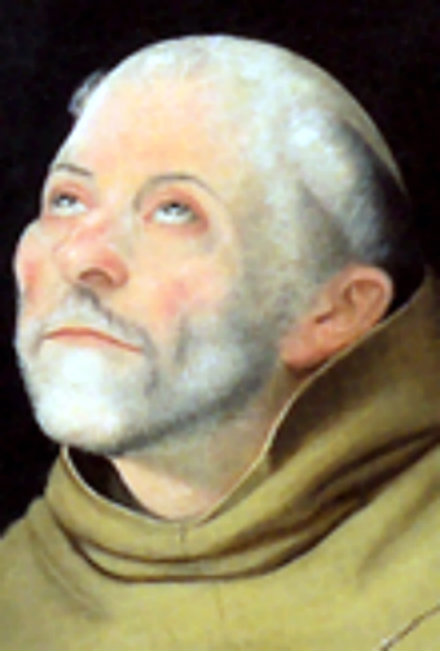
Saint of the Day – 19 February – St Conrad of Piacenza TOSF (c 1290-1351) Hermit, Pilgrim and Penitent, Member of the Third Order of St Francis, born Corrado Confalonieri in c 1290 at Piacenza, Italy and died on 19 February 1351 at Noto, Sicily of natural causes while kneeling before a crucifix.   Patronages – cure of hernias, Calendasco and Noto.   His body is incorrupt.st conrad piacenza close up

He was a member of one of the noblest families of Piacenza, in the town of Calendasco, a fiefdom of his family.   The date of his birth is uncertain.   He married an aristocratic young woman named Ephrosyne when he was quite young.   Though pious, he led the normal way of life for a man of his station.

One day, as he was engaged in his usual pastime of hunting within his family’s domain, he ordered his attendants to set fire to some brushwood in which game had taken refuge. The prevailing wind caused the flames to spread rapidly to the surrounding fields and forest.   A peasant who happened to be found near where the fire began was accused of starting the blaze and was imprisoned, tortured to confess and condemned to death.   As the man was being led to execution, a remorseful Conrad publicly admitted his guilt to the Signoria of the city.   As punishment and reparation for the damages he had caused, the city seized all his assets, only sparing his life due to his noble status

Thus reduced to poverty and seeking penance for his act of cowardice, Conrad and his wife saw the hand of God in this event.   As a result, in 1315 they agreed to separate and Conrad retired to a hermitage near the town of Calendasco, joining a community of hermits, who were Franciscan tertiaries, while his wife became a nun of the Order of Poor Clares at their monastery in the city.

Conrad soon developed a reputation for holiness and the flow of visitors left him unable to keep the solitude he sought.   He then embarked on the life of a pilgrim, going to Rome and from there to the Holy Land and Malta and, about 1340, to Palermo in Sicily, where he was directed to an isolated site in the Val di Noto.   After many years of an itinerant life, he settled there in a grotto now named for him and for the rest of his life spent a most austere and penitential life of solitude, working numerous miracles and gifted with prophecy.st conrad piacenza

In 1343 Conrad felt called by God to serve the local people more directly and in 1343 went to the city of Netum, where he cared for the sick at the Hospital of St Martin there for the next two years.   He lived in a hermitage attached to the Church of the Crucified Christ occupied by the Blessed William Buccheri, a former equerry to King Frederick III of Sicily, who had also taken up a life of solitude and prayer.   Conrad would regularly return to his grotto for silent prayer.   His fame was such that in 1348 the Bishop of Syracuse, Giacomo Guidone de Franchis, went to his hermitage to beg his prayers for the relief of a famine afflicting the island.ST CONRAD LG

Conrad died while in prayer, kneeling before a crucifix, on 19 February 1351, the day he had predicted.   At his request, his body was buried at the Church of St Nicholas, the principal one of the city.   After the city was destroyed in an earthquake in the 1690s, it was transferred to the new church of the same name, built in the relocated city, now called Noto, which has since been elevated to the statues of the Cathedral of the region.Saint-Conrad-of-Piacenza

Numerous miracles have been attributed to him while he lived and subsequently at his tomb in Noto, Italy.    Holy legend records, for example, that when the Bishop of Syracuse visited him, the he asked Saint Conrad if he had anything to offer guests.    Conrad said he would check in his cell and returned moments later carrying newly baked bread and cakes, which the bishop accepted as a miracle.    Saint Conrad was also reported to have travelled surrounded by a cloud of fluttering birds, keeping him company.

Conrad is especially invoked for the cure of hernia. This comes from miracles attributed to him.    He was visited at his hermitage by a former friend and companion in arms, Antonio da Stessa, from Daverio.    His friend was suffering from the pain of a hernia he had developed.    Seeing the pain his old comrade was suffering, Conrad was moved to pity and prayed for him.    Stessa was immediately cured of the hernia.   The same outcome was accomplished for a local tailor, who suffered severely from several hernias.

The miracle for which Conrad is best known is the “Miracle of the Bread”.    This developed during the aforementioned famine which afflicted Sicily as a result of a severe outbreak of the bubonic plague on the island during 1348-49.    During that catastrophe, anyone who approached the hermit for help was given a loaf of bread, still warm, which, it was said, he had received from the angels.Saint_Conrad_of_Piacenza

Pope Leo X Beatified Conrad on 12 July 1515 and permitted the town of Noto to celebrate his feast day.    On 30 October 1544, Pope Paul III extended permission to the whole island.    On 2 June 1625, he was Canonised by Cardinal Odoardo Farnese, who was the Duke of Parma and Piacenza in a solemn ceremony at the cathedral of Piacenza, where it was declared an obligatory feast.    On 12 September of that same year, permission was granted to the Franciscan Order by Pope Urban VIII for a distinct text for the Divine Office and Mass to be used for his feast, today, it is celebrated solely by the Third Order of St Francis to which he belonged.   In Vietnam there is a popular devotion to Conrad.

On his feast day, the Parish Church of San Corrado in Noto commemorates him by the distribution of blessed bread.19Feb-St-Conrad-of-Piacenza-2

Posted in franciscan OFM, JESUIT SJ, SAINT of the DAY

Memorials of the Saints -18 February

Bl Alvarez of Cordova
St Auxibius
St Baoithin
St Barbatus of Benevento (c 610-682)
About St Barbatus:
https://anastpaul.com/2019/02/19/saint-of-the-day-19-february-st-barbatus-of-benevento-c-610-682-apostle-of-the-south/
St Beatus
St Belina
St Boniface of Lausanne
St Conon of Alexandria
St Conrad of Piacenza TOSF (c 1290-1351)

Bl Elizabeth of Mantua
St Gabinus
St George of Lodeve

Bl John Sullivan SJ (1861-1933)

His life:
https://anastpaul.wordpress.com/2018/02/19/saint-of-the-day-19-february-blessed-john-sullivan-s-j-1861-1933/

Bl Józef Zaplata
St Lucia Yi Zhenmei
St Mansuetus of Milan
St Odran
St Proclus of Bisignano
St Quodvultdeus
St Valerius of Antibes
St Zambdas of Jerusalem

Posted in DOCTORS of the Church, franciscan OFM, Our MORNING Offering, PRAYERS of the SAINTS

Our Morning Offering – 18 February – Jesus, Pierce My Soul with Your Love

Our Morning Offering – 18 February – Tuesday of the Sixth Week in Ordinary Time, Year A

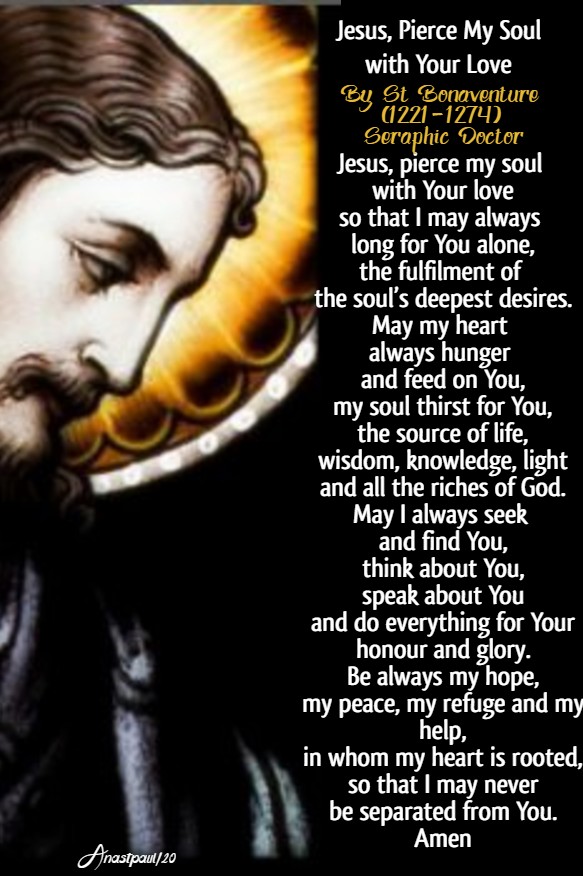
Jesus, Pierce My Soul with Your Love
By St Bonaventure OFM (1221-1274)
The Seraphic Doctor

Jesus, pierce my soul with Your love
so that I may always long for You alone,
the fulfilment of the soul’s deepest desires.
May my heart always hunger and feed on You,
my soul thirst for You,
the source of life,
wisdom, knowledge, light
and all the riches of God.
May I always seek and find You,
think about You,
speak about You
and do everything for Your honour and glory.
Be always my hope,
my peace, my refuge and my help,
in whom my heart is rooted,
so that I may never
be separated from You.
Amenjesus pierce my soul with your love st bonaventure 18 feb 2020

Posted in CHRIST, the WAY,TRUTH,LIFE, franciscan OFM, ONE Minute REFLECTION, QUOTES of the SAINTS, QUOTES on DESPAIR, QUOTES on FAITH, QUOTES on HAPPINESS, QUOTES on HOPE, QUOTES on LOVE of GOD, QUOTES on TRUST and complete CONFIDENCE in GOD, SAINT of the DAY, The WORD

One Minute Reflection – 17 February – ‘…Don’t wait for Tabor to “see” God’

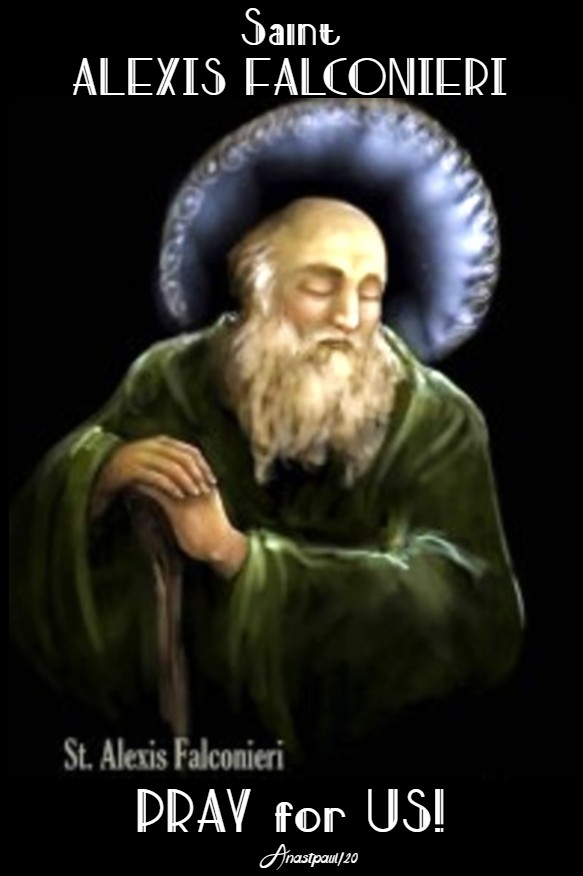
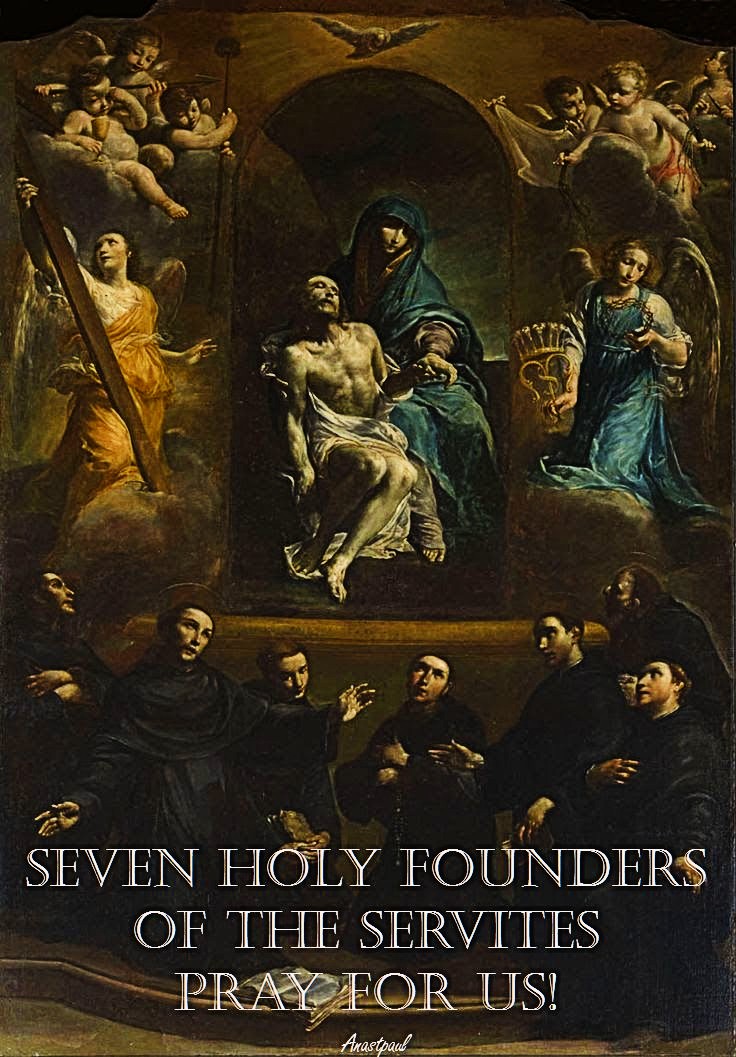
One Minute Reflection – 17 February – Monday of the Sixth week in Ordinary Time, Year A, Readings: James 1:1-11, Psalm 119:67-68, 71-72,75-76, Mark 8:11-13 and the Memorial of St Alexis Falconieri (13th century –1310) Priest, One of Seven Founders of the Servites

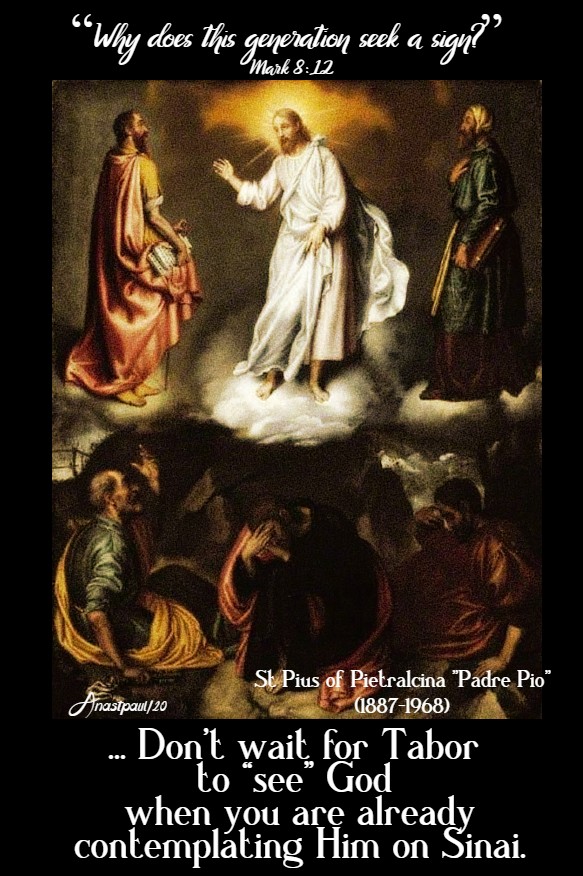
“Why does this generation seek a sign?” … Mark 8:12

REFLECTION – “Believing even in darkness – The Holy Spirit tells us:  Do not let your mind succumb to temptation and sorrow, for joy of the heart is life for the soul.   Sorrow is no good for anything and causes our spiritual death.

It happens sometimes that the darkness of trial overwhelms your soul’s heaven but this darkness is light!
Thanks to it, you believe even in darkness, the mind feels lost, it fears no longer being able to see, no longer understanding anything.   But this is the moment when the Lord speaks and makes Himself present to the soul and the soul listens, understands and loves in the fear of God.   So don’t wait for Tabor to “see” God when you are already contemplating Him on Sinai.

Progress in the joy of a sincere heart, that is wide open.   And if it is impossible for you to keep that happiness, at least don’t lose courage and keep all your trust in God.” … Saint Pius of Pietralcina “Padre Pio” (1887-1968)mark 8 12 why does this generation seek a sign - dont wait for tabor - st padre pio 17 feb 2020

PRAYER – Almighty Lord and God, protect us by Your power throughout the course of this day, even as You have enabled us to begin it.   Your grace is all that we need to see the loving kindness of Your Son, our Lord Jesus in all we meet.   Do not let us turn aside from His path but by the faith You have granted us, let us find meaning in all, which is the sign of Your glory.   Do not let us turn aside to sin and may the intercession of St Alexis Falconieri and the Seven Holy Founders of the Servites, grant us courage and peace.   Through Jesus Christ, our Saviour, with the Holy Spirit, God now and forever, amen.st alexis falconieri 7 holy founders servites 17 feb 2020 pray for us 17 feb 2020

seven-holy-founders-pray-for-us-17-feb-2017 and 2020

Posted in CHRIST, the WAY,TRUTH,LIFE, franciscan OFM, Lady POVERTY, ONE Minute REFLECTION, QUOTES of the SAINTS, QUOTES on DISCIPLESHIP, QUOTES on DIVINE PROVIDENCE, QUOTES on HUMILITY, QUOTES on MISSION, QUOTES on TRUST and complete CONFIDENCE in GOD, SAINT of the DAY, The WORD

One Minute Reflection – 6 February – ‘Follow the humility and the poverty of our Lord Jesus’

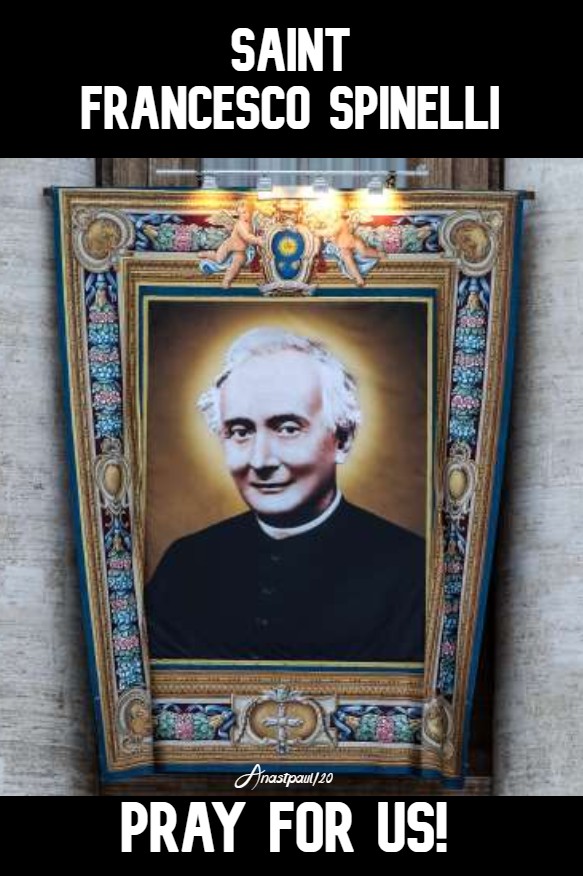
One Minute Reflection – 6 February – Thursday of the Fourth Week of Ordinary Time, Year A, Readings: 1 Kings 2:1-4, 10-12, Responsorial psalm 1 Chronicles 29:10-12, Mark 6:7-13 and the Memorial of St Francesco Spinelli (1853-1913)

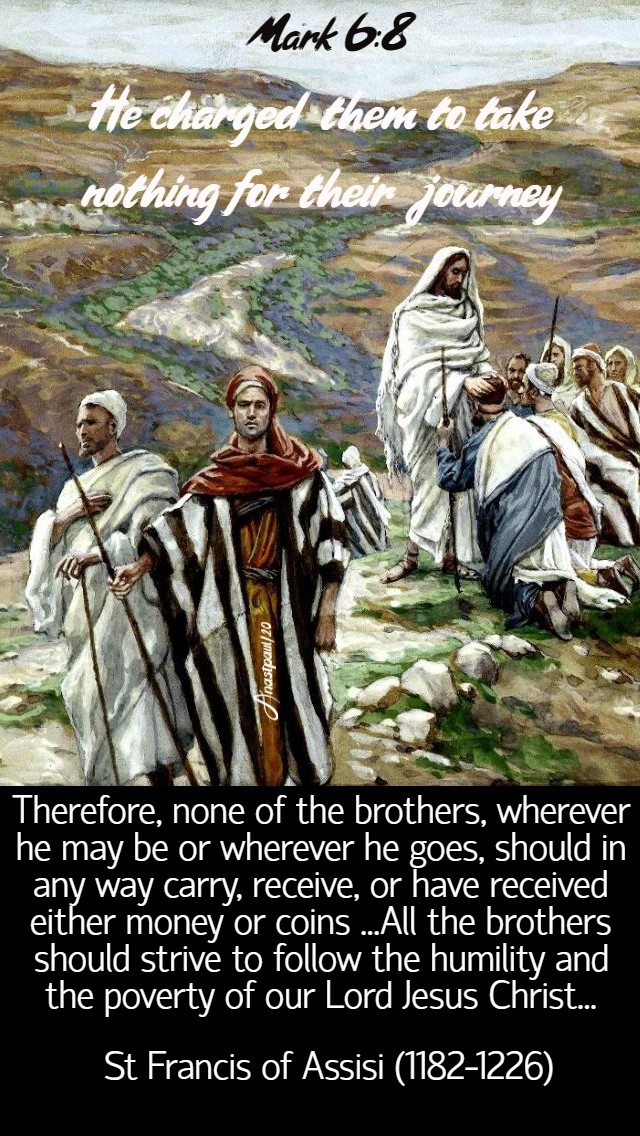
He charged them to take nothing for their journey...Mark 6:8

REFLECTION – The Lord commands us in the Gospel: “Watch, be on your guard against all malice and greed” (cf. Lk 12:15).   “Guard yourselves against the preoccupations of this world and the cares of this life” (cf. Mt 6:25; Lk 21:34).   Therefore, none of the brothers, wherever he may be, or wherever he goes, should in any way carry, receive, or have received either money or coins, whether for clothing or books or payment for any work-indeed, for no reason-unless it is for the evident need of the sick brothers, for we must not suppose that money or coins have any greater value than stones.   And the devil would like to blind those who desire it or consider it better than stones.   Therefore, let us who have left all things behind, take care, that we do not lose the kingdom of heaven for so little (cf. Mt 19:27; Mk 10:24.28).   And if we were to find coins in any place, let us give them no more thought than the dust which we crush with our feet, for all this is “vanity of vanities and all is vanity” (Eccl 1:2).

All the brothers should strive to follow the humility and the poverty of our Lord Jesus Christ (…).   And they must rejoice when they live among people who are considered to be of little worth and who are looked down upon, among the poor and the powerless, the sick and the lepers and the beggars by the wayside.   And when it may be necessary, let them go for alms.   And they should not be ashamed but rather, recall that our Lord Jesus Christ, the Son of the living and all-powerful God (…) was a poor man and a transient and lived on alms, He and the Blessed Virgin and His disciples.” … St Francis of Assisi (1182-1226) – Founder of the Friars Minor – Earlier Rule, §8-9he charged them to take nothing for the journey - therefore none of the brothers - st francis of assisi 6 feb 2020

PRAYER – Grant us Lord, a true knowledge of salvation so that, freed from fear and from the power of our foes, we may serve You, unhampered by any worldly ties, trusting only in Your loving and guiding hand. Help us to give our hearts, minds, bodies, our all to You, serving faithfully all the days of our life. May the prayers of St Francesco Spinelli, Your faithful servant, give us strength. We make our prayer, through our Lord Jesus with the Holy Spirit, God forever, amen.st francesco spinelli pray for us 6 feb 2020

Posted in DOCTORS of the Church, FATHERS of the Church, franciscan OFM, QUOTES of the SAINTS, QUOTES on COURAGE, QUOTES on DEATH, QUOTES on JOY, QUOTES on MARTYRDOM, SAINT of the DAY, The WORD

Quote/s of the Day – 5 February – ‘…The Lord’s cup’

Quote/s of the Day – 5 February – The Memorial of St Philip of Jesus (1572-1597) Martyr, Patron of Mexico City

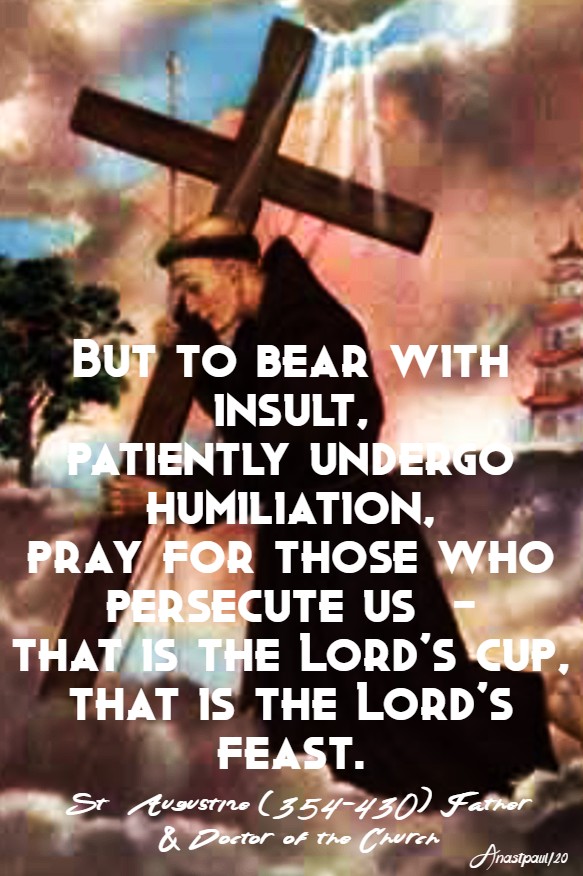
“But to bear with insult,
patiently undergo humiliation,
pray for those who persecute us (Mt 5,39.44) –
that is the Lord’s cup,
that is the Lord’s feast.“

Saint Augustine (354-430) Father & Doctor of the Churchbut to bear with insult - st augustine - martyrdom-5 feb 2020 st philip of jesus

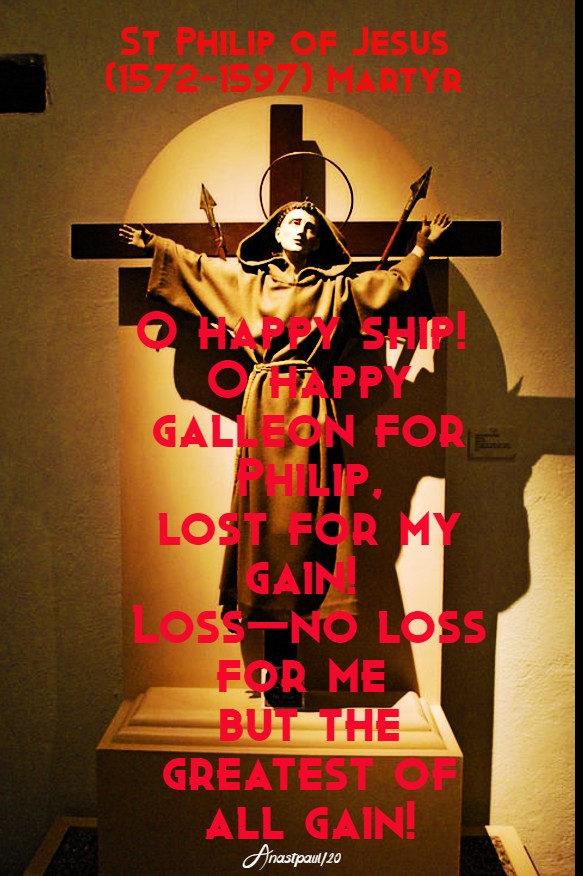
“O happy ship!
O happy galleon for Philip,
lost for my gain!
Loss—no loss for me
but the greatest of all gain!”

St Philip of Jesus (1572-1597) Martyr,

Patron of Mexico Cityo happy ship - st philip of jesus 5 feb 2020

“So everyone who acknowledges me before men,
I also will acknowledge before my Father,
who is in heaven…”

Matthew 10:32matthew-10-32-so-everyone-who-acknowledges-me-13-july-2019-and-27-nov-2019 and 5 feb 2020

Posted in franciscan OFM, SAINT of the DAY

Saint of the Day – 5 February – St Philip of Jesus (1572-1597)

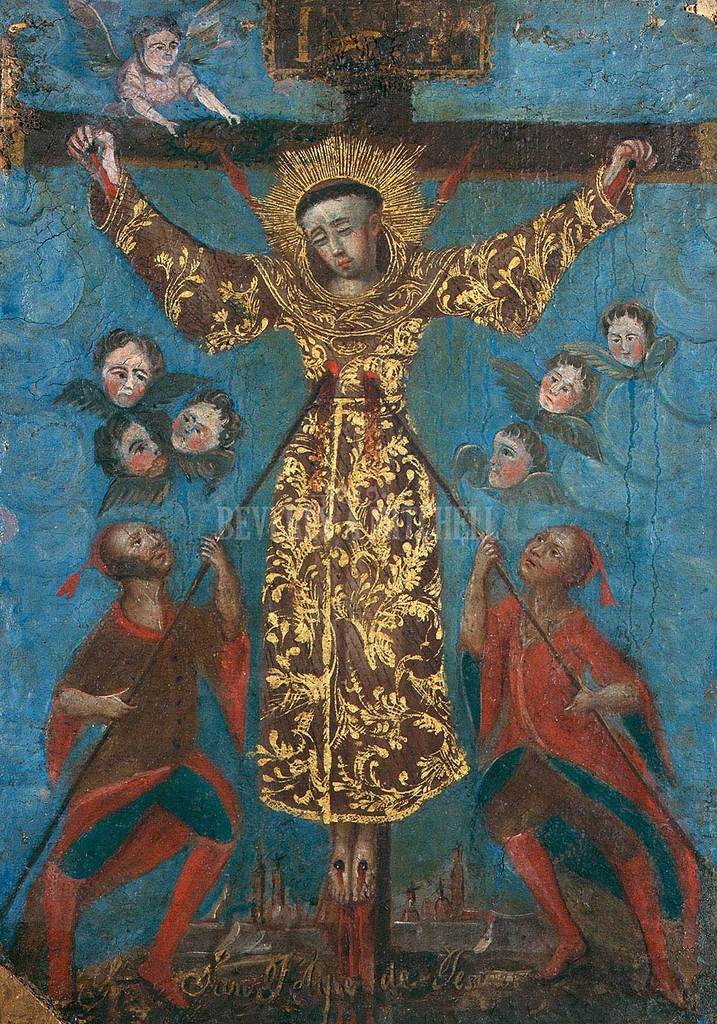
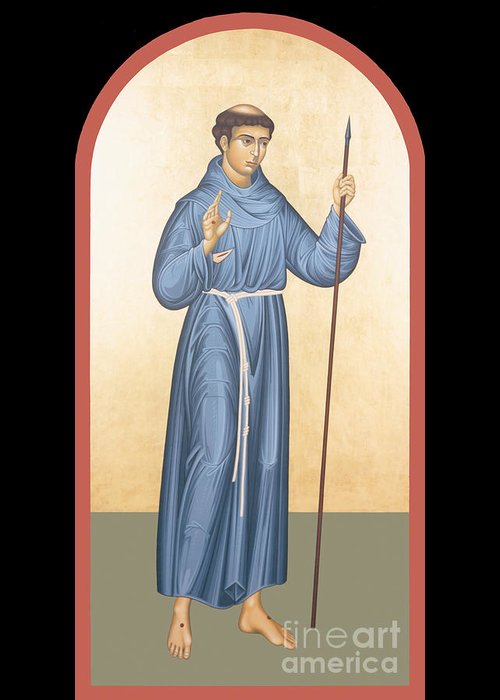
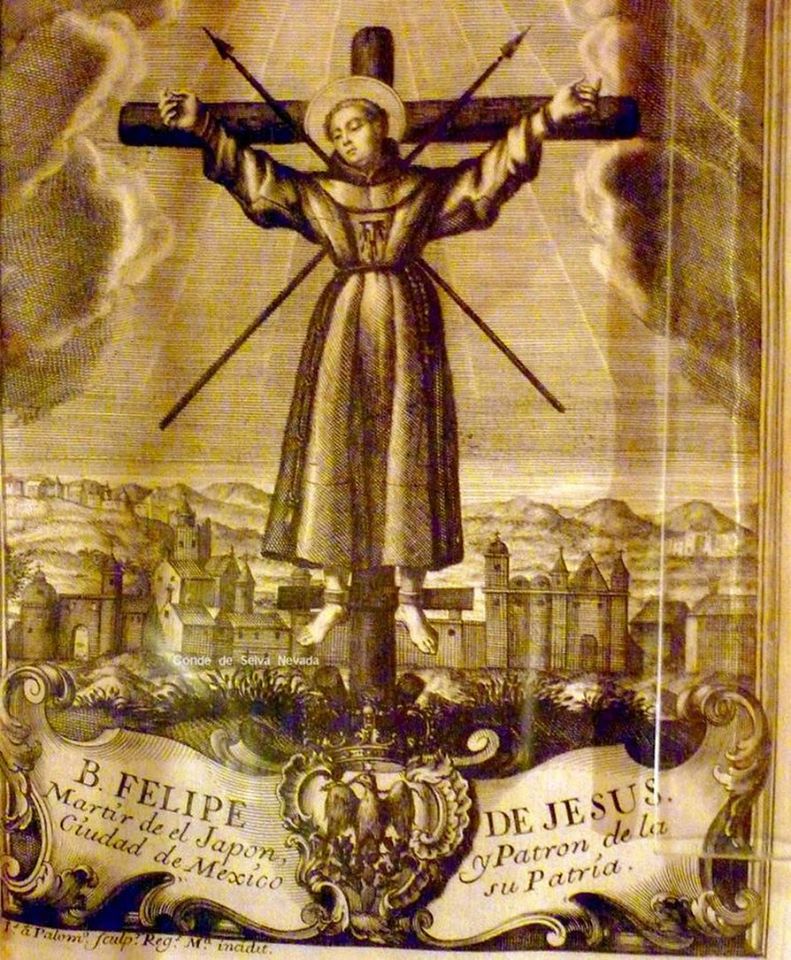
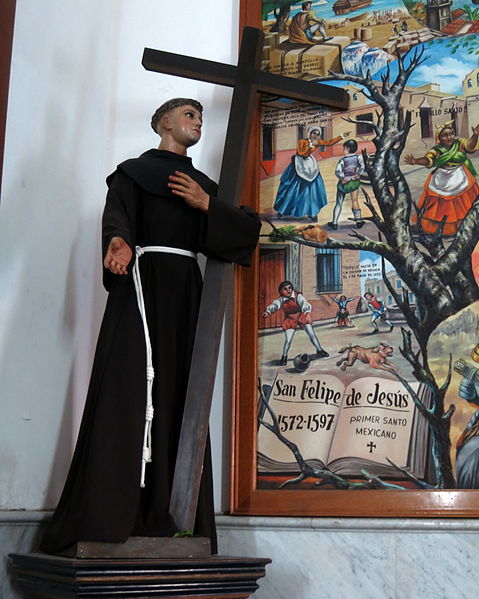
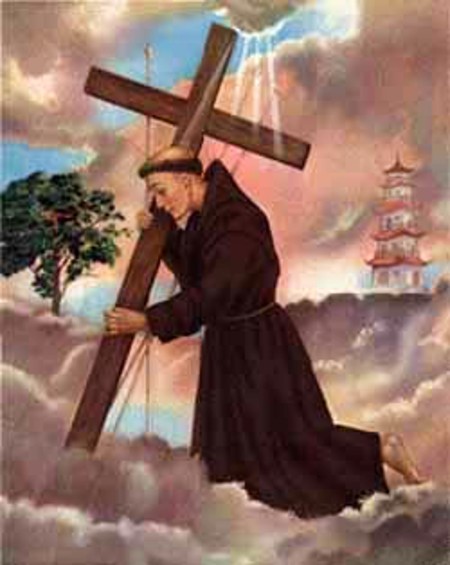
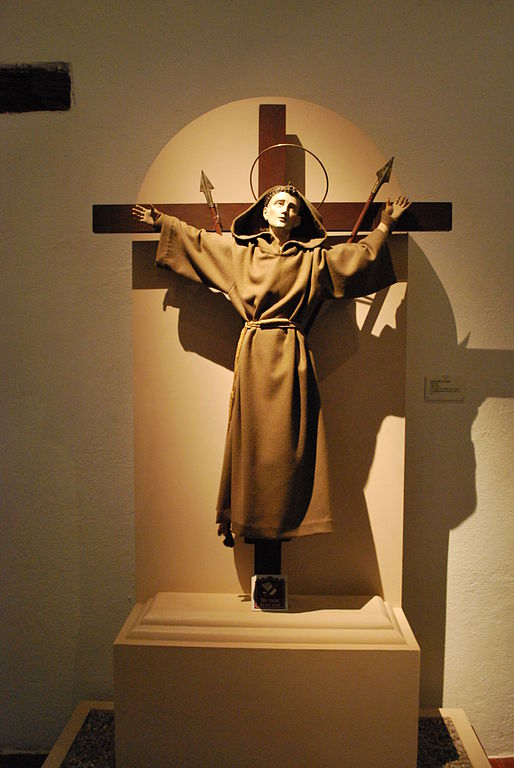
Saint of the Day – 5 February – St Philip of Jesus (1572-1597) Martyr, Missionary, Discalced Friar of the Reformed Franciscans of the Province of St Didacus, founded in Mexico by St Peter Baptista, with whom he suffered martyrdom later.   He was born Felipe de las Casas in Mexico and died on 5 February 1597 aged 24-25 in Nagasaki, Japan by being bound upon a cross and then pierced to death with spears.   Patronage – Mexico City.   He became the Protomartyr and Saint of Mexico.   St Philip is also honoured on 6 February amongst the Holy Martyrs of Japan.the-martyrdom-of-saint-philip-of-jesus_unknown--18cy__08470__62508.1565900694

Philip de las Casas was born in the city of Mexico to businessman Alsonso de las Casas and his wife.   Although he was brought up piously, Philip at first showed little care for the pious teaching of his parents but at last resolved to enter the Reformed Franciscan Convent of Santa Barbara at Pueblo.

But he was not yet weaned from the world and soon left the novitiate.   Grieved at the inconstancy of his son, his father sent him to the Philippine Islands on a business errand. There, in vain Philip sought to satisfy his heart with pleasure.   But of course, he was constantly unhappy and felt that God was calling him to a religious life.   Gaining courage by prayer, he entered the Franciscan Convent of Our Lady of the Angels at Manila and persevered, taking his vows in 1594.   The richest cargo that he could have sent to Mexico would not have gratified his pious father as much as the tidings that Philip was a professed friar.st-philip-of-jesus-rlpoj-br-robert-lentz-ofm

His father, Alonso de las Casas obtained from the abbot of the Order, directions that Philip could be sent to Mexico.  He embarked in July, 1596, with other religious.   Storms drove the vessel to the coast of Japan and it was wrecked while endeavouring to enter a port.   Amid the storm Philip saw over Japan a white cross, in the shape used in that country, which after a time became blood-red and remained so for some time.   It was an omen of his coming victory.

The commander of the vessel sent our Saint and two other religious to the emperor to solicit permission to continue their voyage but they could not obtain an audience.   He then proceeded to Macao, to a house of his Order, to seek the influence of the Fathers there but the pilot of the vessel by idle boasts had excited the emperor’s fears of the Christians and the heathen ruler resolved to exterminate the Catholic missionaries.

In December, officers seized a number of the Franciscan Fathers, three Jesuits and several of their young pupils.   St Philip was one of those arrested and heard with holy joy that sentence of death had been passed on them all.   His left ear was cut off and he offered this first-fruit of his blood to God for the salvation of that heathen land.st philip of jesus traditional etching

The martyrs were taken to Nagasaki, where crosses had been erected on a high hill. When St Philip was led to that on which he was to die, he knelt down and clasped it, exclaiming:  “O happy ship!   O happy galleon for Philip, lost for my gain!   Loss—no loss for me but the greatest of all gain!”   He was bound to the cross but the structure under him gave way, so that he was strangled by the cords.   While repeating the holy name of Jesus, he was the first of the happy band to receive the death-stroke.
Miracles attested the power before God of these first martyrs of Japan.   Pope Urban VIII Beatified him with his companions, on 14 September 1627 and granted permission to say an Office and Mass in their honour and Pope Pius IX formally Canonised them on 8 June 1862.

In 1949 a Mexican film Philip of Jesus portrayed his life and death.Basílica_de_Nuestra_Señora_de_Zapopan_(Jalisco,_Mexico)_-_statue,_St._Philip_of_Jesus

There is a wonderful miracle related to St Philip’s Mother’s maid, Dominica – it is as follows:san_felipe_de_jesus
Philip’s mother, when told of his misbehaviour, would exclaim, “God make thee a saint, Felipe “  and old Dominica’s usual answer was:  ” Felipillo a saint!   He will be one when the old fig-tree grows green again.”   Now the fig-tree Dominica spoke of so often, was indeed far off from growing green, there it stood in a corner of the court, dry, dead for many years and for some reason allowed to remain in the corner it once shaded with its thick foliage.   One morning Dominica, now an aged woman, went into the court, to her amazement she saw the old dead fig-tree covered with luxuriant green foliage.   Scarcely able to believe her own eyes she called to her mistress,  “Come, come, Felipillo is a saint; the fig-tree has again become green.”   And, sure enough, months after this amazing event, news reached his native city that Felipe had received a martyr’s death in Japan in a mountain near Nagasaki city, “Mount of the Martyrs.”st philip of jesus

Posted in franciscan OFM, JESUIT SJ, SAINT of the DAY

Memorials of the Saints – 4 February

Bl Dionisio de Vilaregut
St Donatus of Fossombrone
St Eutychius of Rome
St Filoromus of Alexandria
St Firmus of Genoa
Bl Frederick of Hallum
St Gelasius of Fossombrone
St Geminus of Fossombrone
St Gilbert of Sempringham
St Isidore of Pelusium
St Jane de Valois O.Ann.M and TOSF(1464-1505)
Biography:  https://anastpaul.wordpress.com/2018/02/04/saint-of-the-day-4-february-saint-jane-of-valois-o-ann-m-1464-1505/

St John de Britto SJ (1647-1693) Martyr
Biography:
https://anastpaul.com/2019/02/04/saint-of-the-day-4-february-st-john-de-britto-sj-1647-1693-martyr/

St John of Irenopolis
Bl John Speed
St Joseph of Leonissa OFM (Cap) (1556-1612)
Biography:  https://anastpaul.wordpress.com/2017/02/04/saint-of-the-day-4-february-st-joseph-of-leonissa/

St Liephard of Cambrai
St Magnus of Fossombrone
St Modan
St Nicholas Studites
St Nithard
St Obitius
St Phileas of Alexandria
Blessed Rabanus Maurus OSB (776-856)
St Rembert
St Themoius
St Theophilus the Penitent
St Vincent of Troyes
St Vulgis of Lobbes

Jesuit Martyrs of Japan: A collective memorial of all members of the Jesuits who have died as martyrs for the faith in Japan.

Martyrs of Perga – 4 saints: A group of shepherds martyred in the persecutions of Decius. The only details we have about them are the names – Claudian, Conon, Diodorus and Papias. They were martyred in c 250 in Perga, Asia Minor (in modern Turkey).

Posted in franciscan OFM, PATRONAGE - HAPPY MARRIAGES, of MARRIED COUPLES, PATRONAGE - SPOUSAL ABUSE / DIFFICULT MARRIAGES / VICTIMS OF ABUSE, SAINT of the DAY, WIDOWS and WIDOWERS

Saint of the Day – 24 January – Blessed Paola Gambara Costa TOSF (1463-1515)

Saint of the Day – 24 January – Blessed Paola Gambara Costa TOSF (1463-1515) a Countess and member of the Third Order of St Francis, Laywoman, mother, widow, apostle of the poor and sick – born on 3 March 1463 in Verola Alghise (modern Verolanuova), Brescia, Duchy of Milan (in modern Lombardy, Italy) and died on 24 January 1515 in Binaco, Duchy of Milan (in modern Lombardy, Italy) of a fever.   Patronages – Widows, Married couples, Franciscan tertiaries, difficult marriages, victims of adultery.   Additional memorial – 23 January in Brescia.bl paola vision

Paola Gambara Costa was born on 3 March 1463 in Brescia as the first of seven children to the nobles Giampaolo Gambara and Taddea Caterina Martinengo.

In her childhood she delighted in spiritual reading and reflection on the Gospel and harboured an ardent desire to become a nun later in life.   But this dream was cut short when her parents decided to arrange her marriage to Count Lodovico Antonio Costa – the Lord of Benasco – and she saw this as the will of God manifesting itself and so complied with the wishes of her parents.   The marriage came about after Count Bongiovanni Costa visited her parents and was struck with her virtue and so wanted her as his nephew Lodovico Antonio’s wife.   Her decision to become a nun worried the count who sent her to Blessed Angelo Carletti – a Franciscan priest – who persuaded her that marriage was a call from God to embrace a different kind of life still in accordance with Christian values.

The pair married in autumn 1485 and the pair travelled to the small Benasco province for the ensuring celebrations.   She endured her new husband’s expensive tastes, seeing it as her role to be faithful to him, even if she did not live the excessively luxurious life herself.bl paola costs

Her confessor around this time was Father Crescenzio Morra from Bene though she later reconnected with Carletti who became her friend and spiritual advisor as well as a confessor.   Carletti kept her on the path of virtue and advised her to enrol in the Third Order of Saint Francis, while learning to appreciate the poor and to detest the lavishness of the secular world.   She joined in 1491 with the permission of her husband.   Gambara often deprived herself of food in order to bring it to the sick and on one occasion took off her shoes and gave it to an old woman who was struggling barefoot through the snow.

In 1488 she gave birth to her sole child Giovanni Francesco and named him in honour of Saint Francis of Assisi.   To mark this occasion, she managed to persuade her husband to distribute large amounts of food to the poor of their area.bl paola costs almsgiving

But her excessive charitable works and almsgiving soon vexed her husband, who reproached her for her conduct and ridiculed her in front of their servants and the servants followed their master’s example and joined in ridiculing their mistress.

Costa soon acquired a mistress – the daughter of the Podestà of Carrù – and he allowed her to live in the castle in 1494 even though Paola resided there.   In 1495 her son left for Chieri for his education and Father Carletti died on 11 April 1495.   She attended his funeral in Cuneo – he had died at the convent of Sant’Antonio where he had fallen ill.

In 1500 she reunited with her parents and siblings when she returned to her hometown on a brief visit.   In 1504 her late husband’s mistress fell ill with abdominal pains and it was Paola who comforted her and forgave her as she died.   Also in 1504 her son – now a page – returned to his home.

Her husband later repented and approved her good works and also consented to her wearing the habit of her order in public.   Costa became ill in 1504 and she began to tend to him.   The two travelled to Cuneo to ask for the intercession of her former confessor Carletti and when her husband was healed, attributed the healing to him – Costa celebrated a banquet in commemoration of this and undertook a pilgrimage to the priest’s grave in thanksgiving with his wife at his side.   This conversion was short-lived however, for her husband died not long after in 1504.bl paola costs and mary

On 14 January 1515 she was struck with an extreme fever that caused her great pain and she died on 24 January 1515 in the town of Binasco in Milan after having confessed and received the Eucharist for the final time.

Blessed Paola was buried in a church outside the walls of convent of Rocchetta that she had helped re-build.  When the church was destroyed in 1536 during a war between Francis I and Charles V, Paola’s body was re-interred in the nearby castle and later enshrined in a chapel built by the Counts of Costa in the Franciscan monastery of Bene Vagienna.bl paola body

Her Beatification received formal ratification on 14 August 1845 once Pope Gregory XVI issued a decree that recognised that there existed an enduring and longstanding local ‘cultus’.

Posted in DOMINICAN OP, franciscan OFM, MARIAN DEVOTIONS, SAINT of the DAY

Memorials of the Saints -23 January

St Marianne Cope TOSF (1838-1918)
Biography:
https://anastpaul.wordpress.com/2017/01/23/saint-of-the-day-23-january-st-marianne-cope/

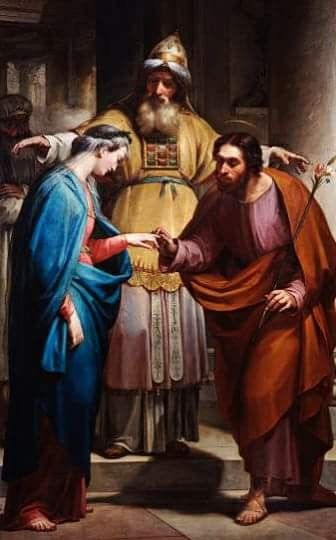
Espousal of the Blessed Virgin Mary – 23 January: Feast in honour of the Blessed Virgin’s espousal to Saint Joseph. It is certain that a real matrimony was contracted by Joseph and Mary.   Still Mary is called “espoused” to Joseph (“his mother Mary was espoused to Joseph”, Matthew 1:18) because the matrimony was never consummated. The term spouse is applied to married people until their marriage is consummated.   This feast dates from 1517 when it was granted to the nuns of the Annunciation by Pope Leo X with nine other Masses in honour of Our Lady.   Adopted by many religious orders and dioceses, it was observed for a time by nearly the whole Church but is no longer in the Calendar.mary and joseph - espousal

St Abel the Patriarch
St Agathangelus
St Amasius of Teano
St Andreas Chong Hwa-Gyong
St Aquila the Martyr
St Asclas of Antinoe
Blessed Benedetta Bianchi Porro (1936-1964)
St Clement of Ancyra
St Colman of Lismore
St Dositheus of Gaza
St Emerentiana
St Eusebius of Mount Coryphe
Blessed Henry Suso OP (1295-1366)
Blessed Henry’s Life:
https://anastpaul.com/2019/01/23/saint-of-the-day-blessed-henry-suso-op-1295-1366/
St Ildephonsus (506-667)
Biography:
https://anastpaul.wordpress.com/2018/01/23/saint-of-the-day-23-january-st-ildephonsus-607-667/

Bl Joan Font Taulat
St John the Almoner/the Merciful (Died c 620)
Bl Juan Infante
St Jurmin
St Lufthild
St Maimbod
Bl Margaret of Ravenna
Martyrius of Valeria
St Messalina of Foligno
St Ormond of Mairé
St Parmenas the Deacon
St Severian the Martyr

Posted in franciscan OFM, INCORRUPTIBLES

Saint of the Day – 20 January – St Eustochia Smeraldo Calafato OSC (1434-1485)

Saint of the Day – 20 January – St Eustochia Smeraldo Calafato OSC (1434-1485) Nun of the Second Franciscan Order of the Poor Clares, Reformer, Founder of a reformed Monastery, Abbess, Ascetic born of her devotion to the Passion of Christ and the Holy Eucharist  – born on 25 March (Good Friday) 1434 at Annunziata, Messina, Italy as Smerelda Colonna and died on 20 January 1491 at Messina, Sicily, Italy.   Patronage – Messina, Italy.  Additional commemoration – 22 August in Messina.

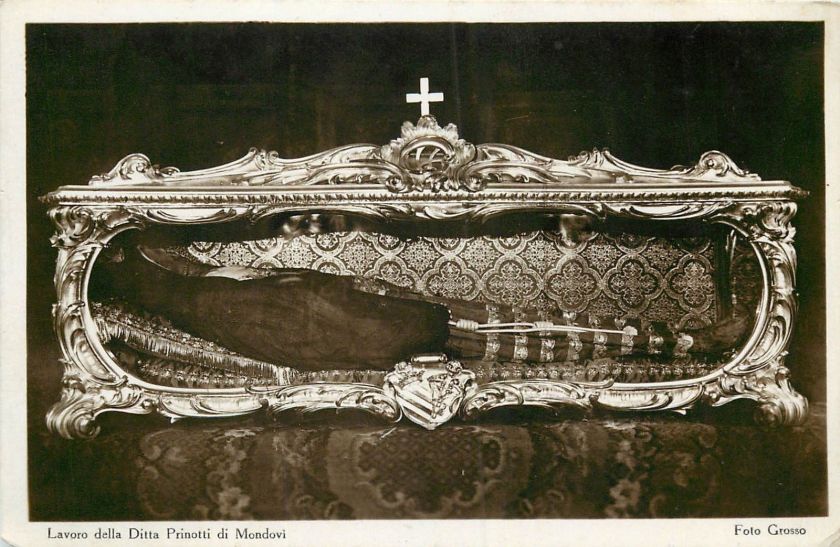
In Messina, in the ancient monumental Church of the Monastery of Montevergine, lies the body of Santa Eustochia Smeralda.   Her body has remained incorrupt by a miracle of the Lord, for five centuries, burnished by time, with her right hand with her fingers contracted in perpetual blessing, she watches over the city and the flourishing monastery you founded.corpo-mummificato-santa-eustochia-smeralda-calafato-messinac-clarissa-incorrotto
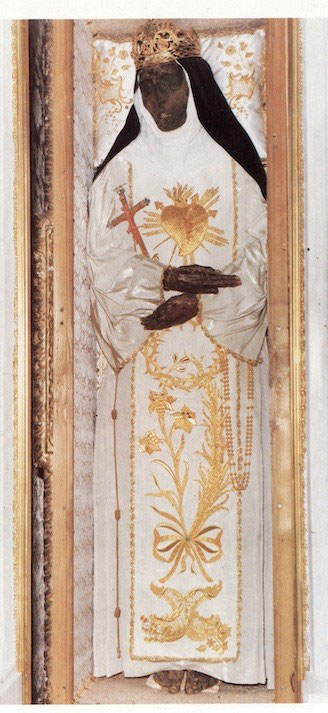
Saint Eustochia was born with the name “Smeralda” (or ‘Esmeralda’ which means ‘emerald’) on 25 March 1434 in Messina, Italy.   She was the fourth of six children. Smeralda’s mother was a fervent Christian and enthusiastic admirer of the Franciscan religious order, particularly of the reformers who insisted on following closely the life of St Francis, especially by embracing poverty.

The reform’s first monastery was established in Messina by Blessed Matthew of Agrigento.   He inspired a renewal of faith in the people of Messina by his ardent preaching and way of life.   Smeralda’s mother had attended one of Blessed Matthew’s sermon’s as an eighteen-year-old bride and devoted her life to prayer, penance and helping those in need.   Thus, Smeralda was raised from childhood to exercise Christian piety and virtue, eventually exceeding her mother’s greatest hopes and expectations for her daughter.st _eustochia_smeraldo_calafato
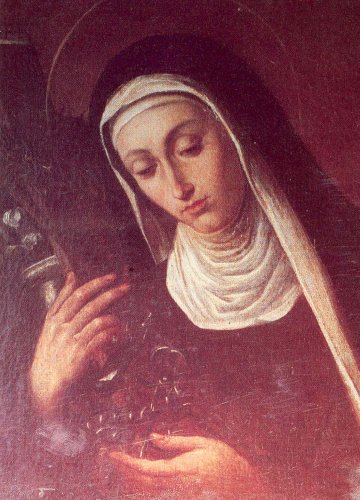
Smeralda was beautiful both inside and out, she is thought to be the model for the painting The Virgin of the Annunciation by Antonello da Messina (seen here on the below).   When she was fourteen years old, Smeralda wanted to become a Poor Clare nun but her father arranged marriage for her to an older, wealthy widower.   Smeralda kept her hope in religious life and the widower died before the wedding.   Her father again arranged a marriage for his daughter but that man also died, followed by Smeralda’s father himself.   When she entered the convent of Santa Maria di Basico, her brothers threatened to burn it down if she did not return home, which she did.   But seeing her great desire, they experienced a change of heart.   She finally entered and took her vows, with the name Eustochia, at fifteen-and-a-half years old.Antonello_da_Messina_-_Virgin_Annunciate_-_Galleria_Regionale_della_Sicilia,_Palermo

Unfortunately, Eustochia came to discover that the convent had drifted away from the poverty lived by their foundress, St Clare of Assisi.   For more than a decade, Eustochia struggled to be an authentic Franciscan in the materialistic atmosphere.   She received papal permission to establish a new convent but found resistance to her reforms.    Some friars refused to say Mass at the convent, believing that the sisters’ lifestyle was too strict. Eustochia appealed directly to Church authorities in Rome, who approved of Mother Eustochia’s renewal of Franciscan asceticism and poverty.   The friars who had refused to assist at the convent were threatened with excommunication should they continue to resist.

Eustochia’s holiness drew many women to her community – so many that they soon outgrew the building and moved to Montevergine, near Messina, where their convent still stands.   The local people considered Eustochia their patron and protector and the cloister to be a place of refuge—especially during the earthquakes that rocked the area.

Eustochia was a spiritual mother to her daughters, instructing, educating and training them in the Franciscan life, encouraging them to meditate on the Passion of Christ.   She often led them in two-hour Scripture study sessions.   Eustochia conveyed to her nuns the fruits of asceticism and lovingly infused into their hearts the virtues which she herself practised with admirable constancy and heroism. She taught them to permeate their whole lives with a simple and generous Franciscan spirituality, focusing on their Beloved Suffering Christ, to devote themselves to the Eucharist and to draw all necessary strength and nourishment for daily meditation from an intense, liturgical life.st eustochia undoctored
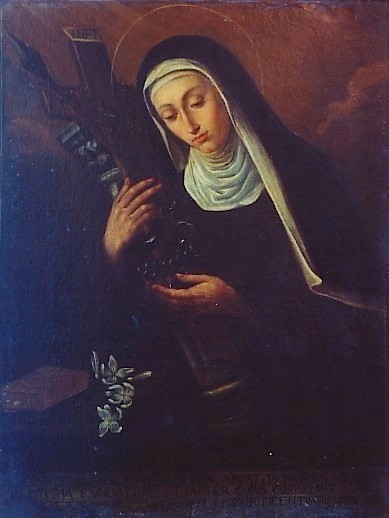
Eustochia’s love of Jesus in poverty and penance was outstanding.   She wrote a treatise on the Passion, which, unfortunately, is now lost.   Though she never visited the Holy Land, Eustochia had a devotion to the holy places that is reminiscent of Saint Bridget of Sweden  . In fact, she had one of the first sets of the Stations of the Cross (as we know them today) constructed within her convent.

As she lay on her deathbed, Eustochia spoke to her daughters, who had gathered around her, about the Passion of Christ.   She spoke for an hour before passing to her final rest on 20 January 1485.

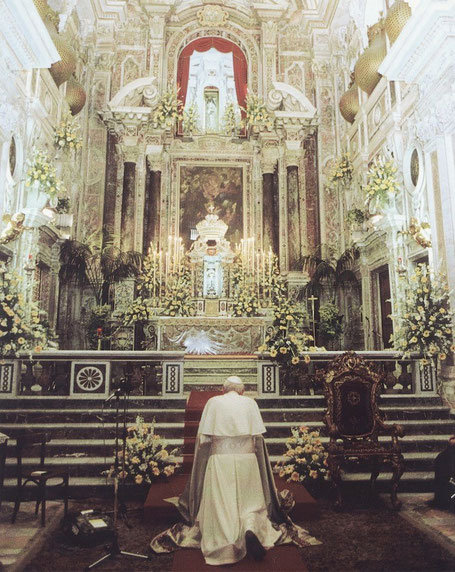
A few days after her burial, Eustochia’s tomb and body manifested extraordinary phenomena and many people received powerful graces through her intercession.   The sisters wrote a biography of their revered mother and founder.   She was Beatified on 22 June 1987 and Canonised on 11 June 1988 by St Pope John Paul II.canonisation st eustochia

Her incorrupt body rests in the Sanctuary of Montevergine in Messina, the monastery which she established and can be visited twice a week.

In his homily, John Paul II said of St Eustochia:

“Learning assiduously in the school of Christ Crucified, she grew in knowledge of Him and, meditating on the splendid mysteries of grace, she conceived a faithful love for Him.   For our saint, the cloistered life was not a mere flight from the world in order to take refuge in God.   Through the severe penance which she imposed upon herself, she certainly wanted to be united to Christ, gradually eliminating whatever in her, as in every human person, was fallen, at the same time, she felt united to all.   From her cell in the monastery of Montevergine she extended her prayer and the value of her penances to the whole world.   In such a way she wanted to be near to each brother and sister, alleviate every suffering, ask pardon for the sins of all.”

The Body of the Holy Founder is venerated by crowds of devotees, who rely on her intercession to obtain the graces they dream of, while the valid protection of the Saint for the city, especially during public calamities, is officially recognised.   The highest city authorities, still today, in fact, meet in the Church of Montevergine on the occasion of the festivities of 22 August of each year, in fulfilment of an ancient vote of the Senate of Messina, to attend the Divine Sacrifice, pay homage to the illustrious Eustachia.papa-giovanni-paolo-ii-santo-beato-santa-eustochia-calafato-smeralda-messina-1988-canonizzazione-chiesa-barocca-terremoto
One of the miracles in the history of the Saint is linked to this particular protection.   It was the year 1615 and the city was struck, night and day, by appalling earthquakes, so much so that the authorities and the people implored the intercession of the Saint in Montevergine, inviting the nuns to pray for this purpose.   The Poor Clares removed the Body from the oratory, where they keep it and placed it in the choir, in its old stall.

As the evening prayers were about to begin, the body which has been incorrupt for almost two centuries suddenly parted its lips, intoning the first line of a psalm from the Office, which the nuns, terrified and moved, continued crying, especially when the body intoned the “Gloria Patri.”   From that moment the earthquakes ended.

To the constant protection of the city, is added her uninterrupted presence among her spiritual Daughters, who receive clear and unequivocal signs, with which the Saint manifests her will, warns them about what is about to happen.   So it can be said that, even after her death, she continues to be the abbess of the monastery.

Posted in DOMINICAN OP, franciscan OFM, SAINT of the DAY

Memorials of the Saints – 16 January

St Berard and Companions (Peter, Adjute, Accurs, Odo and Vitalis)
St Dana of Leuca
St Dunchaid O’Braoin
St Fulgentius of Ecija
St Fursey of Peronne
Blessed Gonzalo de Amarante OP (1187-1259)
Blessed Giuseppe Tovini OFS (1841-1897)
Blessed Giuseppe’s Life:
https://anastpaul.com/2019/01/16/saint-of-the-day-16-january-blessed-giuseppe-tovini-ofs-1841-1897/
St Henry of Coquet
St Honoratus of Arles
St Honoratus of Fondi
Bl James of Luino
St James of Tarentaise
Bl Joan of Bagno di Romagna

St Joseph Vaz CO (1651-1711) Apostle of Sri Lanka
About St Joseph:
https://anastpaul.wordpress.com/2018/01/16/saint-of-the-day-16-january-st-joseph-vaz-c-o-1651-1711-apostle-of-sri-lanka/

St Juana Maria Condesa Lluch
Bl Konrad II of Mondsee
St Leobazio
St Liberata of Pavia
St Pope Marcellus I
St Melas of Rhinocolura
St Priscilla of Rome
St Sigeberht of East Anglia
St Titian of Oderzo
St Triverius
St Valerius of Sorrento

Posted in FEASTS and SOLEMNITIES, franciscan OFM, SAINT of the DAY

The Solemnity of the Epiphany of the Lord and Memorials of the Saints – 6 January

The Solemnity of the Epiphany of the Lord – Epiphany celebrates the visit of the three kings or wise men to the Christ Child, signifying the extension of salvation to the Gentiles. The date of Epiphany, one of the oldest Christian feasts, is 6 January the 12th day after Christmas. However, in most countries, the celebration of Epiphany is transferred to the Sunday that falls between January 2 and January 8 (inclusive). Greece, Ireland, Italy and Poland continue to observe Epiphany on 6 January as do some dioceses in Germany.
Because Epiphany is one of the most important Christian feasts, it is a Holy Day of Obligation in most countries.

Epiphany 2018:
https://anastpaul.wordpress.com/2018/01/07/the-solemnity-of-the-epiphany-of-our-lord-jesus-christ-7-january-god-reveals-himself-to-us/
Epiphany 2019:
https://anastpaul.com/2019/01/06/the-solemnity-of-the-epiphany-of-the-lord-6-january/

St Andre Bessette CSC (1845-1937) (7 January in Canada)

St Andrew Corsini
St Antoninus
St Basillisa of Antinoë
St Charles of Sezze OFM (1613-1670)

About St Charles:

https://anastpaul.wordpress.com/2018/01/06/saint-of-the-day-6-january-st-charles-of-sezze-o-f-m-1613-1670/

St Demetrius of Philadelphia
St Diman Dubh of Connor
St Edeyrn
St Eigrad
St Erminold of Prüfening
St Felix of Nantes
Bl Frederick of Saint-Vanne
Bl Gertrud of Traunkirchen
Bl Gertrude van Oosten
St Guarinus of Sion
St Guy of Auxerre
St Honorius
St Hywyn of Aberdaron
St John de Ribera
St Julian of Antinoë
St Julius
Bl Luc of Roucy
Bl Macarius the Scot
St Macra of Rheims
St Merinus
St Nilammon of Geris
St St Petran of Landévennec
St Peter of Canterbury
Bl Peter Thomas
St Pia of Quedlinburg
St Pompejanus
St Rafaela Porras y Ayllón
Bl Raymond de Blanes
Bl Rita Amada de Jesus
St Schotin
St Wiltrudis of Bergen

Martyrs in Africa: Unknown number of Christian men and women who were martyred in the persecutions of Septimus Severus. They were burned to death c 210.

Martyrs of Sirmium – 8 saints: A group of Christians martyred together for their faith. The only surviving details are the names of eight of them – Anastasius VIII, Florianus, Florus, Jucundus, Peter, Ratites, Tatia and Tilis. They were martyred in the 4th century at Syrmium, Pannonia (modern Sremska Mitrovica, Vojvodina, Serbia).

Twelve Apostles Saints of Ireland: Twelve 6th century Irish monks who studied under Saint Finian at Clonard Abbey and then spread the faith throughout Ireland. Each has his own commemoration but on this day they and their good work are considered and celebrated together. Though Saint Finian is sometimes included, most ancient writers list them as –
• Brendan of Birr
• Brendan the Navigator
• Columba of Iona
• Columba of Terryglass
• Keiran of Saighir
• Kieran of Clonmacnois
• Canice of Aghaboe
• Lasserian of Leighlin
• Mobhí of Glasnevin
• Ninnidh the Saintly of Loch Erne
• Ruadh´n of Lorrha
• Senan of Iniscathay

Posted in franciscan OFM, SAINT of the DAY

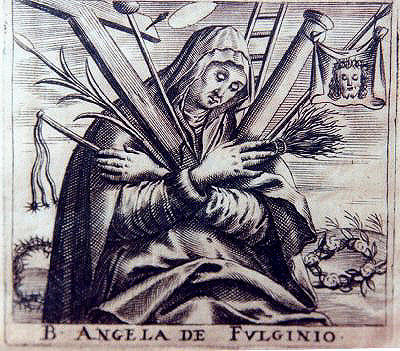
Saint of the Day – 4 January – Saint Angela of Foligno TOSF (1248-1309)

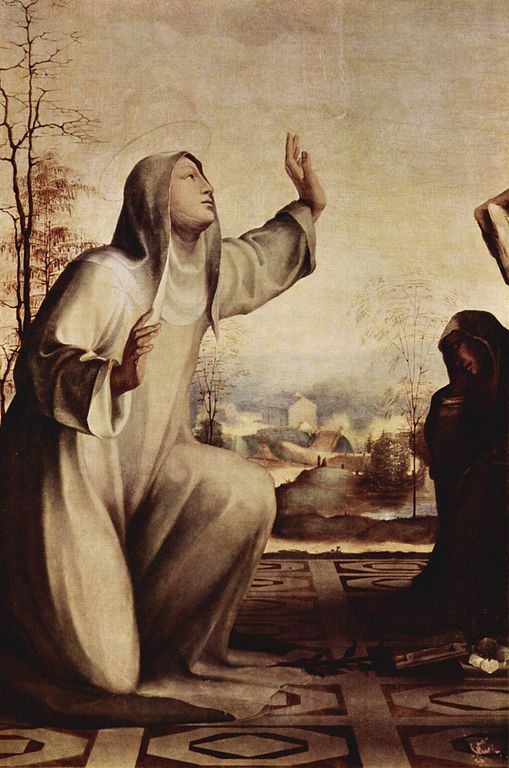
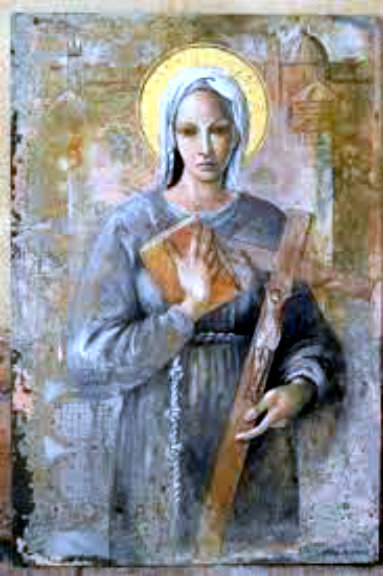
Saint of the Day – 4 January – Saint Angela of Foligno TOSF (1248-1309) known as the “Mistress of Theologians” – Wife, Mother, Widow, Religious, Mystic, Writer, Third Order Franciscan, Foundress of a religious community, which refused to become an enclosed religious order, so that it might continue her vision of caring for those in need.   It is still active.  Patronages – against sexual temptation, against temptations, assistance with the death of children, people ridiculed for their piety, widows.509px st angela foligno-Domenico_Beccafumi_026.jpg

Angela’s birth date, which is not known with certainty, is often listed as 1248.   She was born into a wealthy family at Foligno, in Umbria.   Married, perhaps at an early age, she had several children.   Angela reports that she loved the world and its pleasures.   Around the age of 40, she reportedly had a vision of St Francis and recognised the emptiness of her life.   From that time, she began to lead a life devoted to higher perfection.

Angela of Foligno is a model for people who want to simplify their lifestyle. As a young adult she reveled in luxury and sensuality. She married a rich man of Foligno, Italy, and used his wealth to indulge herself in possessions. And her impetuous temperament nudged her into sinful behaviour.

However in 1285, Angela experienced a surprising conversion.  st Angela_of_Foligno_1One day she wept bitterly and confessed a serious sin to a friar, who absolved her.   Then she embarked on a life of prayer and penance.   Over the next six years, step-by-step she divested herself of her attachments to people and things.

In 1288 her mother, husband and sons died of a plague.   As a widow, Angela was free to concentrate on her pursuit of holiness  . She modelled herself on St Francis of Assisi and joined the Franciscan Third Order in 1291.   Like Francis, Angela expected to meet Christ in the poor.   For instance, on Holy Thursday, 1292, she and a companion went to care for lepers at the hospital in Foligno.   After they had washed a man who was badly decomposed, they drank some of the bathwater.   The experience so moved Angela that she says all the way home she felt “as if we had received Holy Communion.”

Angela of Foligno was a visionary who, like St Catherine of Siena, regularly fell into  trances.   From 1292 to 1296 she dictated her revelations to Brother Arnold, her confessor.   Angela recorded 30 steps of her tortured spiritual journey, which always seemed to blend awareness and absence of God, certitude and doubt and joy and agony.st angela-of-foligno.jpg

A small band of disciples gathered around the saint.   She led them wisely, instructing them in basic Christian living.   This excerpt from her Instructions, advocates prayer and meditation on Scripture:

“No-one can be saved without divine light.   Divine light causes us to begin and to make progress and it leads us to the summit of perfection.   Therefore, if you want to begin and to receive this divine light, pray.   If you have begun to make progress, pray.   And if you have reached the summit of perfection and want to be super-illumined so as to remain in that state, pray.   If you want faith, pray.   If you want hope, pray.   If you want charity, pray.   If you want poverty, pray.   If you want obedience, pray.   If you want chastity, pray. If you want humility, pray.   If you want meekness, pray.   If you want fortitude, pray.   If you want any virtue, pray.”

And pray in this fashion – always reading the Book of Life, that is, the life of the God-man, Jesus Christ, whose life consisted of poverty, pain, contempt and true obedience.st angela of foligno.jpg

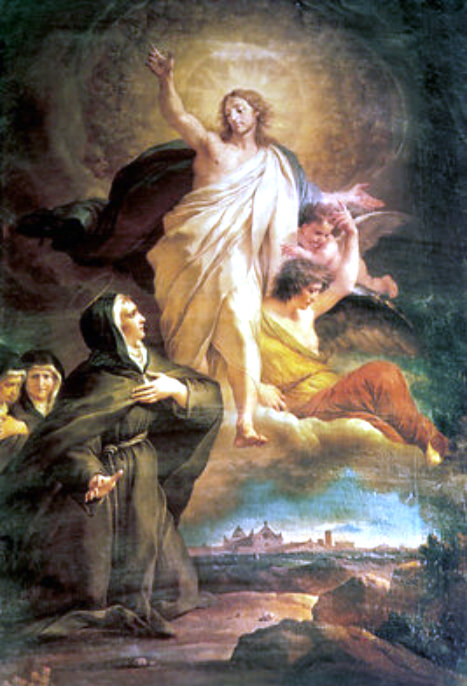
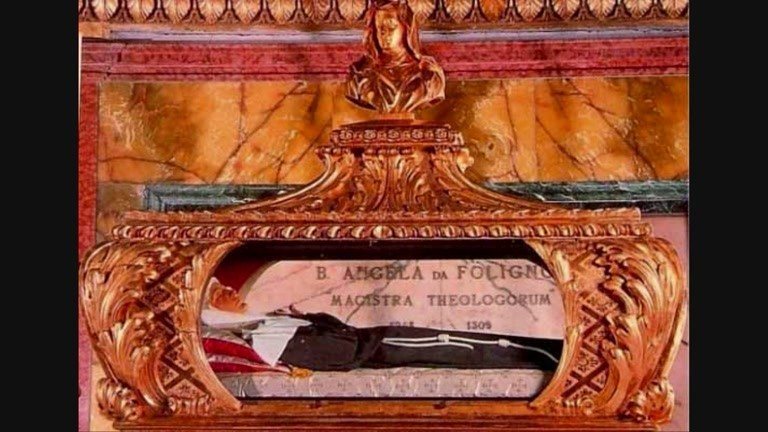
At Christmas, 1308, Angela told her companions she would die shortly.   A few days later Christ appeared to her, promising to come personally to take her to heaven.   She died in her sleep on 3 January 1309, surrounded by her community.   Her remains repose in the Church of St Francis at Foligno and many miracles have been recorded there.shrine st angela foligno.jpg

Considered a “great medieval mystic,” Angela is said to have received mystical revelations, which she dictated to a scribe in the late 13th century.   These accounts are contained in a compilation of two works, her Book of Visions and Instructions.

Pope Clement XI approved the veneration paid to her over the centuries in his Beatification of her on 11 July 1701 and Pope Francis extended the veneration to all the Church on 9 October 2013, declaring her a saint by equipollent Canonisation, recognising the validity of the long-standing veneration of her.

Her feast day is celebrated by the Third Order of Saint Francis, both Secular and Regular, on 4 January (7 January in the United States).   Although the community she founded was not recognised as a religious institute until the 20th-century, she is honoured as a religious.st angela foligno statue.jpg

Posted in CATHOLIC-PRAYERS OF THE CHURCH, FEASTS and SOLEMNITIES, franciscan OFM, PAPAL SERMONS, PRACTISING CATHOLIC, PRAYERS for VARIOUS NEEDS, PRAYERS of the CHURCH, THE HOLY FAMILY - FAMILIAE SANCTAE

Thought for the Day – 29 December – Bless Your Children!

Thought for the Day – 29 December – Feast of the Holy Family of Jesus, Mary and Joseph and the Fifth Day of the Christmas Octave

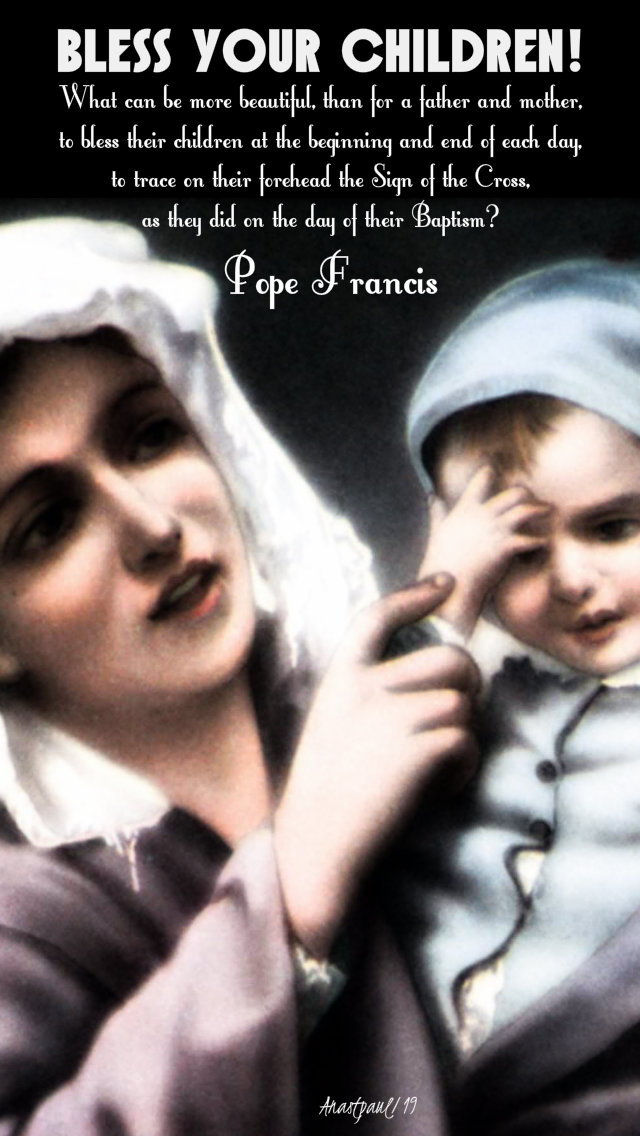
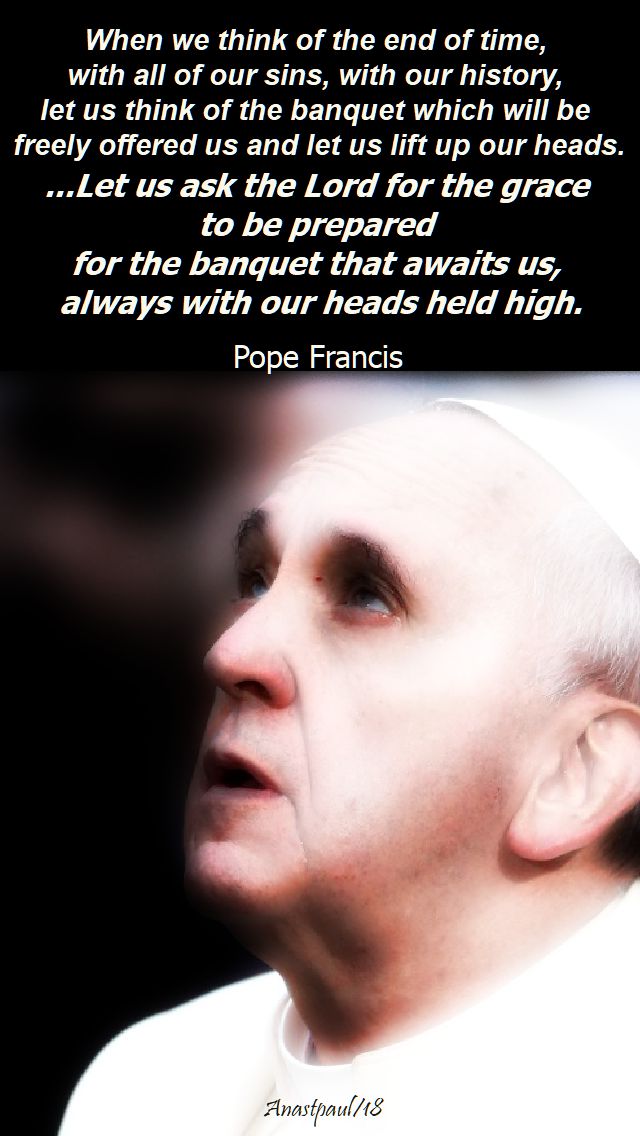
I am most grateful for my upbringing in a truly Catholic family, not one exit was made by the children without a blessing by our parents.   This is such an important and vital element in our daily lives as Catholic families.   And you too, parents, as you exit and enter your homes, bless yourselves with the Sign of the Cross – have a Holy Water Font at your doors – habits are formed by action – start today!bless your children - pope francis - 29 dec 2019.jpg

Bless Your Children
Pope Francis

Feast of the Holy Family of Jesus, Mary and Joseph
27 December 2015

“How important it is for our families to journey together towards a single goal!   We know that we have a road to travel together, a road along which we encounter difficulties but also enjoy moments of joy and consolation.   And on this pilgrimage of life we also share in moments of prayer.

What can be more beautiful, than for a father and mother, to bless their children at the beginning and end of each day, to trace on their forehead the Sign of the Cross, as they did on the day of their Baptism?   Is this not the simplest prayer which parents can offer for their children?   To bless them, that is, to entrust them to the Lord, just like Elkanah and Anna, Joseph and Mary, so that He can be their protection and support throughout the day.

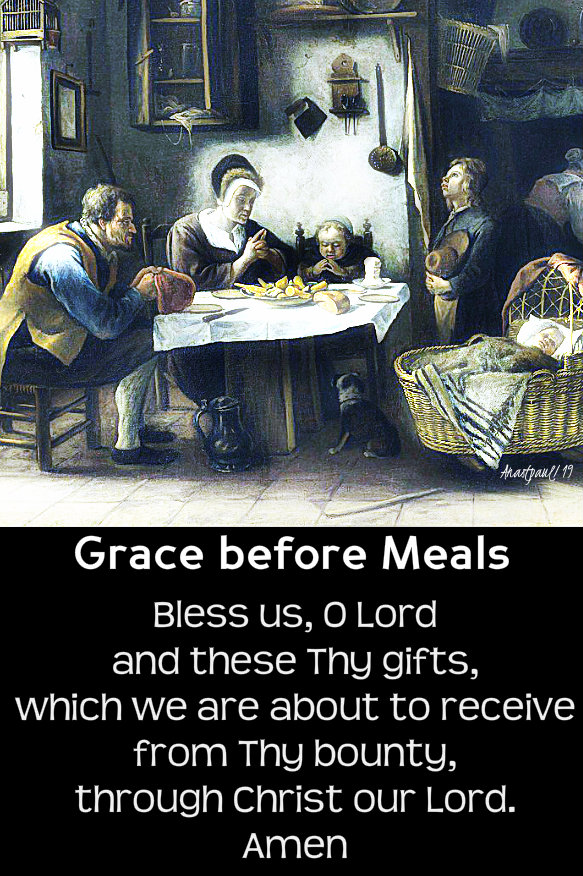
In the same way, it is important for families to join in a brief prayer before meals, in order to thank the Lord for these gifts and to learn how to share what we have received with those in greater need.   These are all little gestures, yet they point to the great formative role played by the family in the pilgrimage of everyday life.”

grace before meals - 29 dec 2019 - holy family feast .jpg

The Grace before Meals

Bless us, O Lord
and these Thy gifts,
which we are about to receive
from Thy bounty,
through Christ our Lord.
Amen

grace after meals - 29 dec 2019 - holy family feast.jpg

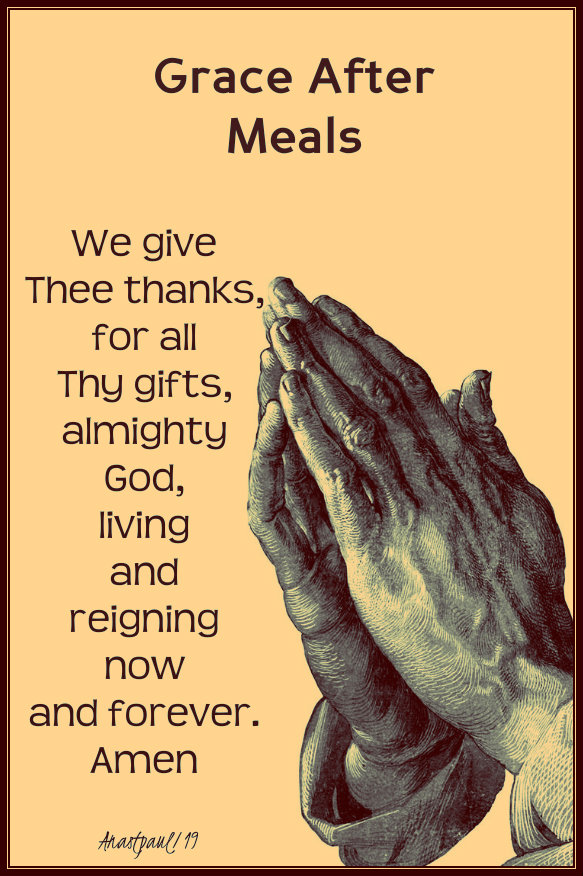
The Grace After Meals

We give Thee thanks,
Almighty God,
for all Thy gifts,
almighty God,
living and reigning
now and forever.
Amen

I learnt this Capuchin Grace Before a Meal from Fr Raneiro Cantalamessa, the Preacher to the Papal Household:

Lord, bless this food
that we are about to receive
from Your bounty.
Help us to provide
for those who do not have any
and make us partakers one day
in Your heavenly banquet,
through Christ, our Lord,
amen.

Posted in franciscan OFM, SAINT of the DAY

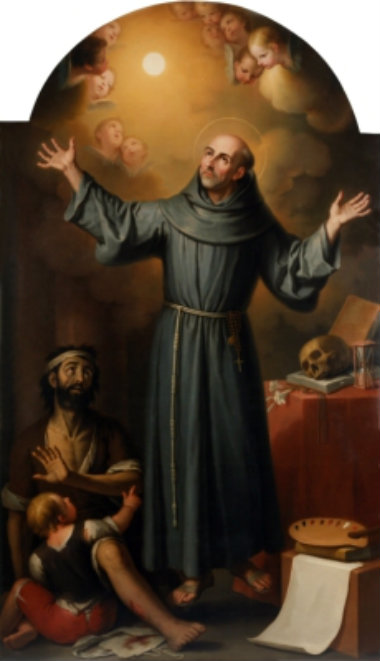
Saint of the Day – 23 December – Blessed Nicolás Factor-Estaña OFM (1520-1583)

Saint of the Day – 23 December – Blessed Nicolás Factor-Estaña OFM (1520-1583) commonly known as Nicolas Factor – Franciscan Priest, Painter, Preacher, Ascestic, Spiritual Director – born in 1520 in Valencia, Spain and died in 1583 of natural causes. His body is incorrupt.st nicholas FactorNicolau.jpg

Nicolás Factor was born in Valencia in Spain on 29 June 1520 as one of five children to a poor tailor.

In his childhood he fasted three times a week and donated all of his untouched food to the poor and also tended to the ill, including lepers.   His Moorish maid was so affected by this love that she learnt about the faith and converted to Roman Catholicism.

His father wanted him to follow his career as a tailor but Nicolas wanted to become a priest and a religious.

He entered the Order of Friars Minor on 30 November 1537 and was sometime later ordained as a priest, where he developed his talents as a painter via a range of devotional images.

Although Nicolas wanted be sent to missionary lands, he was instead sent to preach across his own region and became much sought-after, his homilies teaching and converting many.   He was known for undergoing rather severe self-mortifications before he gave each sermon.img-st-Nicholas-Factor.jpg

He also served as the spiritual director of the Santa Clara convent in Madrid at the request of the Princess of Portugal, Joan of Habsburg.   In April 1582 he relocated to the Santa Caterina convent in Onda and that November moved to another convent in Barcelona.

Blessed Nicolas died after a period of illness on 23 December 1583 after having just returned to Valencia.  st nicholas Factor sml.jpgIn 1586 his remains were exhumed for King Philip II – who wished to view them and his body was found to be incorrupt.
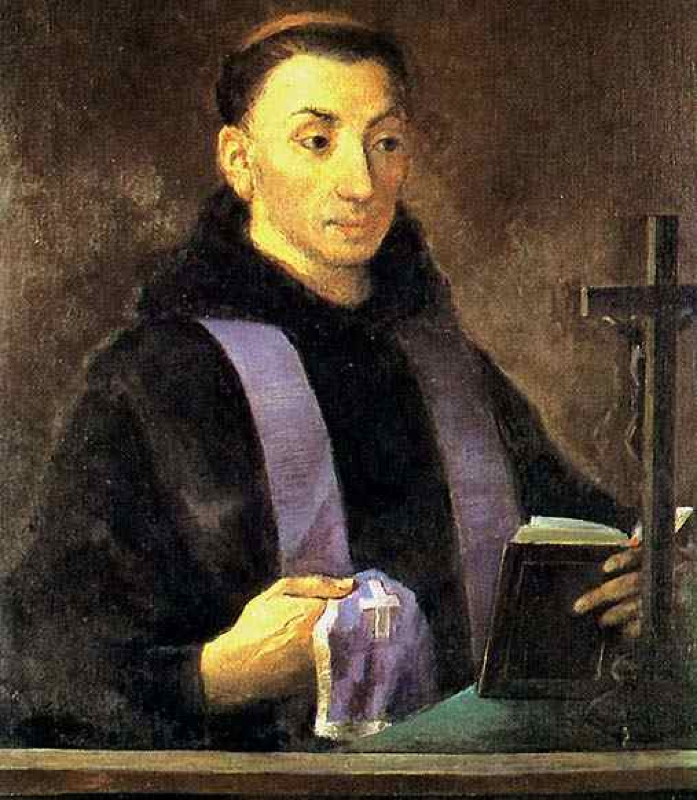
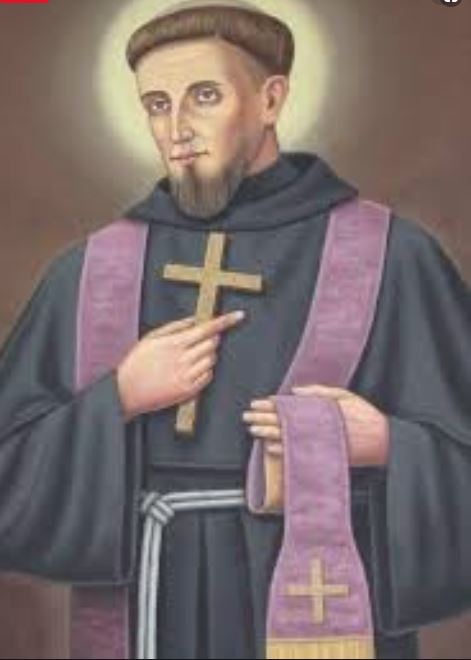
Pope Pius VI Beatified Blessed Nicolas on 27 August 1786.   The Beatification process saw three friends of Blessed Nicolas summoned to provide witness testimonies and the tribunal called upon Saint Pascal Baylon OFM, Saint Louis Betrand OP and Saint Juan de Ribera (whom Factor served as his Archbishop).

Posted in franciscan OFM, SAINT of the DAY

Memorials of the Saints – 23 December

St John of Kanty/Cantius (1390-1473) (Optional Memorial)
Full Biography:
https://anastpaul.wordpress.com/2017/12/23/saint-of-the-day-23-december-st-john-of-kanty-cantius-1390-1473/

AND more:
https://anastpaul.com/2018/12/23/saint-of-the-day-23-december-st-john-of-kanty-1390-1473-patron-of-poland-and-lithuania/

St Besa of Egypt
Bl Bincema
St Dagobert II of Austrasia
Bl Epifanio Gómez Alvaro
St Frithbert of Hexham
Bl Hartmann of Brixen
Bl Herman of Scheda
Bl James Aymerich
St John Cirita
St John Stone
St Joseph Cho Yun-ho
St Mardonius of Rome
St Mazota of Abernethy
St Migdonius of Rome
Blessed Nicolás Factor-Estaña OFM (1520-1583)
St Servulus of Rome
St Thorlac Thorhallsson
St Victoria
St Vintila of Orensee

Martyred Dominicans of Santander – (9 beati) – Martyred in the Spanish Civil War:
• Blessed Bernardino Irurzun Otermín
• Blessed Eleuterio Marne Mansilla
• Blessed Eliseo Miguel Lagro
• Blessed Enrique Cañal Gómez
• Blessed Enrique Izquierdo Palacios
• Blessed Epifanio Gómez Alvaro
• Blessed José María García Tabar
• Blessed Manuel Gutiérrez Ceballos
• Blessed Miguel Rodríguez González
• Blessed Pedro Luís y Luís

Martyrs of Crete – (10 saints): A group of ten Christians who died in the persecutions of Decius. They were –
• Agathopus
• Basilides
• Cleomenes
• Eunician
• Euporus
• Evaristus
• Gelasius
• Saturninus
• Theodulus
• Zeticus
They were martyred in 250 on the island of Crete

Posted in CATHOLIC DEVOTIONS of the Month, franciscan OFM, MARIAN PRAYERS, MARIAN QUOTES, MARIAN REFLECTIONS, MARIAN TITLES, NOVENAS, PRAYERS of the SAINTS, QUOTES of the SAINTS, The HOLY GHOST, The IMMACULATE CONCEPTION

Novena in Preparation for the Solemnity of the Immaculate Conception Day Two – 2 December

Novena in Preparation for the Solemnity of the Immaculate Conception
Day Two – 2 December

By St Maximillian Kolbe OFM (1894-1941) Martyr

OPENING PRAYER

How fair you are, 0 Mary!
The original stain is not in you.
You are the boast of Jerusalem,
You are the joy of Israel.
You are the pride of our people.
You are the advocate of sinners.
0 Mary!
You are the wisest of virgins.
You are the kindest of mothers.
Pray for us.
Intercede for us with our Lord Jesus Christ.
Holy Virgin, you were spotless
from the very moment of your conception.
Because you bore His Son, pray to the Father for us.
Through the spotless conception of the Virgin, 0 God,
You made ready a dwelling place worthy of Your Son.
In anticipation of Your Son’s death,
You preserved her from every stain.
Please purify us by her intercession,
so that we might find our way to You.
We ask this through Christ our lord.
Amen

Daily Readings and Meditations for each day of the Novena are given here, followed by two closing Novena Prayers for each day.

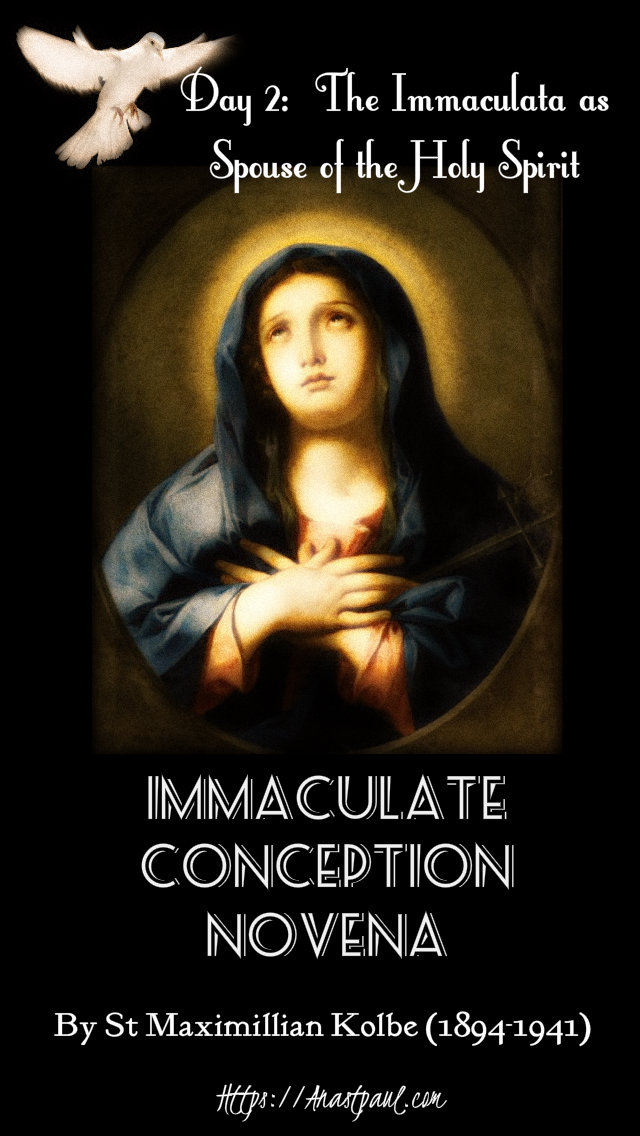
Day 2:   The Immaculata as Spouse of the Holy Spiritday 2 imm conception novena 2 dec 2019.jpg

Reading:
United to the Holy Spirit as His Spouse, the Immaculata is one with God in an incomparably more perfect way than can be predicated of any other creature.  What sort of union is this?   It is above all an interior union, a union of her essence with the “essence” of the Holy Spirit.   The Holy Spirit dwells in her, lives in her.   This was true from the first instant of her existence.   It was always true, it will always be true.

In what does this life of the Spirit in Mary consist?   He himself is uncreated Love in her, the Love of the Father and of the Son, the Love by which God loves Himself, the very love of the most Holy Trinity.   He is a fruitful love, a “Conception.”   Among creatures made in God’s image the union brought about by married love is the most intimate of all (cf. Mt 19:6).   In a much more precise, more interior, more essential manner, the Holy Spirit lives in the soul of the Immaculata, in the depths of her very being.   He makes her fruitful, from the very first instant of her existence, all during her life and for all eternity (“Sketches for a book,” 17 February 1941).

Meditation:
To grow in daily awareness of the Holy Spirit’s presence within us is a constant challenge that God gives to each and all of us.   May the Immaculata’s perfect life in the Holy Spirit, cause a sharpening, of our own attentiveness, to His presence at the core of our inner selves.

Closing prayers:

Novena Prayer to the Immaculata

I greet you, ever-blessed Virgin,
Mother of God throne of grace,
miracle of almighty power!
I greet you, sanctuary of the most Holy Trinity
and Queen of the universe,
Mother of mercy and refuge of sinners!
Most loving Mother,
attracted by your beauty and sweetness
and by your tender compassion,
I confidently turn to you
and beg of you, to obtain for me of your dear Son
the favour I request in this novena
………………………… (here mention you request).
Obtain for me also, Queen of Heaven,
the most lively contrition for my many sins
and the grace to imitate closely,
those virtues which you practised so faithfully,
especially humility, purity and obedience.
Above all I beg you to be my mother
and protectress,
to receive me into the number of your devoted children
and to guide me from your high throne of glory.
Do not reject my petitions, Mother of mercy!
Have pity on me and do not abandon me
during life or at the moment of my death.

Daughter of the Eternal Father,
Mother of the Eternal Son,
Spouse of the Holy Spirit,
Temple of the adorable Trinity,
pray for me.
Immaculate and tender Heart of Mary,
refuge of the needy and hope of sinners,
filled with the most lively respect, love and gratitude,
I devote myself forever to your service
and I offer you my heart,
with all that I am and all that belongs to me.
Accept this offering,
sweet Queen of Heaven and earth
and obtain for me of your dear Son, Jesus Christ,
the favours I ask, through your intercession in this novena.
Obtain for me also a tender, generous, constant love of God,
perfect submission to His adorable will,
the true spirit of a Christian
and the grace of final perseverance.
Amen

Closing Prayer of Identification with the Immaculata

O Immaculate Conception, Mary, my Mother,
live in me, act in me, speak in and through me.
Think your thoughts in my mind,
love through my heart.
Give me your own dispositions and feelings.
Teach, lead and guide me to Jesus.
Correct, enlighten and expand my entire personality and life.
Replace me with yourself.
Incline me to constant adoration and thanksgiving,
pray in and through me.
Let me live in you
and keep me in this union always.
Amen

Posted in franciscan OFM, SAINT of the DAY

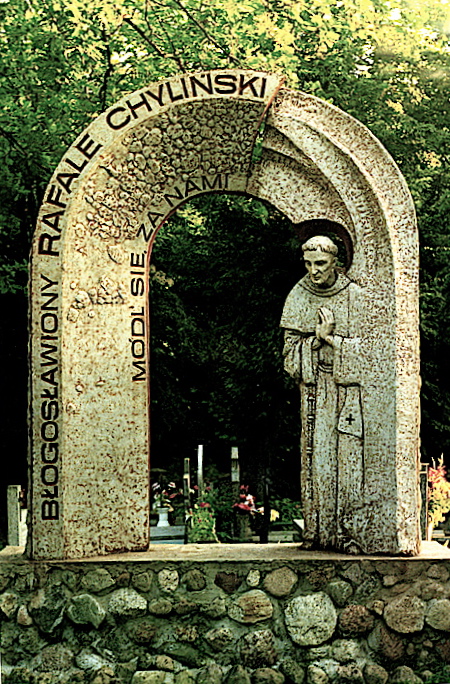
Saint of the Day – 2 December – Blessed Rafal Chylinski OFM Conv. (1694-1741)

Saint of the Day – 2 December – Blessed Rafal Chylinski OFM Conv. (1694-1741) aged 47 Franciscan Priest, Preacher, Apostle of Charity, Musician – born on 8 January 1694 at Buk, Poznan, Poland as Melchior Chylinski and died on 2 December 1741 at Lagiewniki, Lodzkie, Poland.bl rafal chylinski 2.jpg

Blessed Rafal was born near Buk in the Poznan region of Poland,   He showed early signs of religious devotion, so much so, that his family members nicknamed him “the little monk.”    After completing his studies at the Jesuit college in Poznan, Melchior joined the cavalry and was promoted to officer rank within three years.

In 1715, against the please of his military comrades, Melchior joined the Conventual Franciscans in Krakow.   Receiving the name Rafal, he was ordained two years later. After pastoral assignments in nine cities, he came to Lagiewniki, where he spent the last 13 years of his life, except for 20 months ministering to flood and epidemic victims in Warsaw.   In all these places, Rafal was known for his simple and candid sermons, for his generosity, as well as for his ministry in the confessional.   People of all levels of society were drawn to the self-sacrificing way he lived out his religious profession and priestly ministry.bl rafal chylinski snip.JPG

Rafal played the harp, lute and mandolin to accompany liturgical hymns.   In Lagiewniki he distributed food, supplies and clothing to the poor.   After his death, the Conventual church in that city became a place of pilgrimage for people throughout Poland.   He was Beatified in Warsaw in 1991 by St Pope John II after approval of a miracle.

His shrine is still a place of pilgrimage and prayer.

The sermons preached by Rafal were powerfully reinforced by the living sermon of his life.   The Sacrament of Reconciliation can help us bring our daily choices into harmony with our words about Jesus’ influence in our lives.bl rafal chylinski 3.jpg

May Blessed Rafal reminds us that everyone of us, even though we are sinners, has been called to love and to holiness. – St Pope John Paul IIŁódź-bł._Rafal_Chyliński_cm._ŁagiewnickiSOD-1202-BlessedRafalChylinski-790x480

Posted in franciscan OFM, MARIAN TITLES, SAINT of the DAY

Feast of Our Lady of Liesse and Memorials of the Saints – 2 December

Our Lady of Liesse/Our Lady, Cause of our Joy:  2 December – An ancient statue of the Madonna and Child.   It was brought from Egypt to France during the Crusades by three Knights of Malta who had been briefly captured by Saracens.   It was enshrined at Liesse, diocese of Soissons.   The original statue was destroyed during the French Revolution. A duplicate was installed and crowned in 1857.   Patronage – Diocese of Soissons, France.

St Athanasius of the Caves
St Avitas of Rouen
St Bibiana (4th century died c 361) Martyr
Biography here:
https://anastpaul.wordpress.com/2016/12/02/saint-of-the-day-2-december/

St Chromatius of Aquileia
St Evasius of Brescia
Bl Francisco del Valle Villar
St Habakkuk the Prophet
Bl Ivan Sleziuk
Bl John Amero
Bl John van Ruysbroeck (c 1293-1382)
About Blessed Jan:
https://anastpaul.com/2018/12/02/saint-of-the-day-2-december-blessed-john-van-ruysbroeck/
St Lupus of Verona
Bl Maria Angela Astorch
St Nonnus of Edessa
St Oderisius de Marsi
St Pimenio in Rome
St Pontian
Bl Rafal Chylinski OFM Conv (1694-1741)

Bl Robert of Matallana
St Silvanus
St Pope Silverio

Greek Martyrs of Rome – (9 saints): Several Greek Christians martyred in the persecutions of Valerian – Adria, Aurelia, Eusebius, Hippolytus, Marcellus, Mary Martana, Maximus, Neon and Paulina. They were martyred by various means between 254 and 259 in Rome, Italy and are buried in the Callistus catacombs, Rome.

Martyrs of Africa – (4 saints): Four Christians martyred in Africa in the persecutions of Arian Vandals – Januarius, Securus, Severus and Victorinus.

Posted in franciscan OFM, MARIAN TITLES, SAINT of the DAY

Our Lady of Beauraing and Memorials of the Saints – 29 November

All Saints of the Seraphic Order (Franciscan):   the Church celebrates the many Franciscan saints who followed in the footsteps of St Francis. It is a special day for all Franciscans to celebrate the feast of ‘All the Saints of the Seraphic Order.’all saints of the Franciscan order - 29 nov

St Francis of Assisi prayed the following prayer:
“O Lord Jesus Christ, two favours I beg of You before I die.   The first is that I may, as far as it is possible, feel in my soul and in my body the suffering in which You, O gentle Jesus, sustained in Your bitter passion.   And the second favour is that I, as far as it is possible, may receive in my heart that excessive charity by which You, the Son of God, were inflamed and which actuated You willingly to suffer so much for us sinners.”
In response to his earnest prayer, the Lord appeared in the form of a seraph, or a six-winged angel (They are usually considered the highest order of angelic beings, immediately above the Cherubim and their special duty is to love God).
Then Jesus bestowed on St Francis the wounds of His suffering.   St Francis had been marked with the love of Christ, the stigmata.   St Francis died two years later in 1226, leaving the world the Franciscan Order, which became synonymous with the Seraphic Order.   To this day, seraph wings and seraphs are symbolic of the Franciscan Order.
The final Rule of life for Franciscan friars was also approved on this day in 1223.   To commemorate this and all the saintly examples produced in the Franciscan Order, on this day all the saints of the Seraphic order are remembered at Franciscan churches.

Our Lady of Beauraing/Our Lady of the Golden Heart:
Appeared multiple occasions between 29 November 1932 and 3 January 1933 On 2 February 1943, Bishop Andre Marie Charue authorised public devotion to Our Lady of Beauraing.   On 2 July 1949 the Bishop declared that the Queen of Heaven had truly appeared to the children.   Pilgrims flock to the small town of Beauraing, province of Namur (Belgium) and many cures are claimed.   She is celebrated under this title on 29 November.our lady of beauraing belgium - of the golden heart - 29 nov.jpg

Bl Alfredo Simón Colomina
Bl Bernardo Francisco de Hoyos Seña SJ (1711-1735)
St Blaise of Veroli
St Brendan of Birr
St Demetrius of Veroli
Bl Denis of the Nativity
Bl Edward Burden
St Francesco Antonio Fasani OFM Conv (1681 – 1742)
His story:
https://anastpaul.com/2018/11/29/saint-of-the-day-29-november-st-francesco-antonio-fasani-1681-1742-29-november/

Bl Frederick of Ratisbon
Bl George Errington
St Hardoin of Brittany
St Illuminata of Todi
St James of Saroug
Bl Jutta of Heiligenthal
St Paphnutius of Heracleopolis
St Paramon
St Philomenus of Ancyra
St Radbod of Utrecht
Bl Redemptorus of the Cross
St Sadwen of Wales
St Saturninus of Rome
St Saturninus of Toulouse
St Sisinius of Rome
St Walderic of Murrhardt
Bl William Gibson
Bl William Knight

Posted in franciscan OFM, ONE Minute REFLECTION, SAINT of the DAY, The LAST THINGS, The WORD

One Minute Reflection – 28 November – ‘…Let us lift up our heads.’

One Minute Reflection – 28 November – Thursday of the Thirty Fourth week in Ordinary Time, Year C, Gospel: Luke 21:20–28

“Now when these things begin to take place, look up and raise your heads, because your redemption is drawing near.”…Luke 21:28now-when-these-things-begin-to-take-place-luke-21-28-29nov2018 and 28 nov 2019.jpg

REFLECTION – “When we think of the end of time, with all of our sins, with our history, let us think of the banquet which will be freely offered us and let us lift up our heads.  Do not give way to depression.  Hope! Reality is ugly.   There are many, many people, cities and people, so many people who are suffering;  many wars, so much hatred, so much envy, so much spiritual worldliness and so much corruption.   Yes, it’s true!   All of this will fall!
Let us ask the Lord for the grace to be prepared for the banquet that awaits us, always with our heads held high.”…Pope Francis – Santa Marta, 27 November 2014when-we-think-of-the-end-of-times-pope-francis-29-nov-2018 and 28 nov 2018.jpg

PRAYER – Lord God, creator of all Light and creator of all good, grant that we may look up to You always and know that by Your Light and your goodness we are safe in this world of corruption.   May the Light of our Lord Jesus, make the path He has set out bright and clear and may the prayers of St James of the Marches be a help in our struggle.   Lead us, Lord, in Your kindness and mercy to the banquet which awaits us.  We make our prayer through Christ our Lord, with the Holy Spirit, God forever, amen.st james of the marches pray for us 28 nov 2019.jpg

Posted in franciscan OFM, Our MORNING Offering, PRAYERS of the SAINTS, SAINT of the DAY

Our Morning Offering – 28 November – Beloved and Most Holy Word of God

Our Morning Offering – 28 November – The Memorial of St James of the Marches OFM Conv (1391-1476)

Beloved and Most Holy
Word of God
By St James of the Marches (1391-1476)

Beloved and most holy Word of God!
You enlighten the hearts of the faithful,
You satisfy the hungry,
console the afflicted.
You make the souls of all,
productive of good
and cause all virtues to blossom.
You snatch souls
from the devil’s jaw.
You make the wretched holy
and men of earth,
citizens of heaven!
Amenbeloved and most holy word of god by st jjames of the marches - 28 nov 2019.jpg

Posted in franciscan OFM, SAINT of the DAY

Saint of the Day – 28 November – Saint James of the Marches OFM (1391-1476)

Saint of the Day – 28 November – Saint James of the Marches OFM Conv. (1391-1476) Franciscan Priest, brilliant Preacher, Penitent, Reformer, Writer, Papal legate, Inquisitor, founder of several monasteries in Bohemia, Hungary and Austria – born on 1 September 1391 at Monteprandone, March of Ancona, Italy as Domenico meaning “of the Lord” (from Latin, Dominus) Gangala and died on 28 November 1476 at Naples, Italy.    Patronages – Monteprandone, co-patron of Naples, Italy, of children. His body is incorrupt.Saint James of the Marches

Domenico was born into an extremely poor family at Montebrandone (in the Marche of Ancona), in central Italy along the Adriatic Sea.   Unfortunately, his cruel father abused him and James left home as a boy.   He placed himself under the care of his uncle, a priest.   Through the generosity of his uncle, Domenico was educated in nearby towns of Ascoli and Offida.

At the University of Perugia he took the degree of Doctor of Canon and Civil Law.   He began his career in Florence as tutor in a noble family and as judge.   On one occasion, while travelling to Assisi for his work, he went to pray in the church of the Portiuncula, St Mary of the Angels.   Inspired by the friars he witnessed there and by the example of St Francis, Domenico decided to enter the Franciscan Order.   In 1416, at 23 years of age, he became a novice, taking the religious name of James.P. 0520 - James, of the Marches, Saint

Studying under Saint Bernardino of Siena (1380-1444), James was widely recognised for his oratory, delivering both forceful and effective sermons and converting thousands of souls.   Ordained at age twenty seven, James was sent on mission with Saint John Capistrano (1603-1663), travelling throughout Italy, German, Bohemia, Poland, and Hungary.Francisco_de_Zurbaran_James_of_the_Marches

Noting his orthodoxy, Pope Saint Martin V appointed him inquisitor to root out heretical sects that were growing in power throughout Italy.   He continued his travels, preaching, working against heresy and attempting to reconcile various branches of the Franciscan Order.   He attended the Council of Florence in 1438, working diligently to reconcile the Eastern and Latin Churches, with little success.st james of the marches - maybe murillo

Elected Bishop of Milan, James humbly declined the position, preferring to continue his itinerant lifestyle, travelling, preaching and confirming the truth of Church doctrine. Saint James preached every day for 40 years, beginning on the date of his ordination and ending on the date of his death.   He preached a message of penance, which he also put into practice.   James slept only three hours each evening and fasted nine months of the year.   Thinly dressed, always in the same tattered brown robe, he always wore underneath his habit either a rough hair shirt or an iron coat of mail armed with short sharp spikes.and susceptible to illness, Saint James ate little, giving all he had to the needy.   As he grew older and his health began to observably fail, Pope Martin V ordered him to eat regularly, as a public service, so that he could continue his ministry. Charitable, Saint James instituted several montes pietatis, (literally, “mountains of money”) which provided low-interest loans to all who needed them.st james of the marches preaching snip getty

James took his vows seriously.   Due to his promise of poverty, he travelled on foot everywhere he went.   He pulled a small wagon by hand, which contained all his possessions – a bible, a prayer book, some theological works, liturgical vestments and vessels.   He personally hand-copied most of the few books he owned and he wore just his threadbare habit. He took the practice of obedience very seriously, as well.   In fact, on one occasion, he received an order from his superior to go abroad while lifting a cup to his mouth to drink.   He immediately set it down and left without drinking, as he was afraid of losing the merit of obedience by the least delay.james-of-the-marches-a7841781-3ceb-45df-b994-bd90440be75-resize-750

Under Pope Callistus III, in 1455, he was appointed an arbiter on the questions at issue between the Conventuals and Observants.   His decision was published 2 February 1456 in a papal bull, which pleased neither part.

In 1462, James became the subject of the Inquisition.   In a sermon, he preached his theological opinion on the Blood of Christ, stating that the blood shed during Christ’s passion was not hypostatically united to the divinity of Christ during the three days of his burial.   The case was controversial, and James was summoned to appear before the Dominican inquisitor, which he refused. Eventually, James appealed to the Holy See, after which a silence was imposed upon both the Dominican inquisitors and the Franciscans.   No decision was ever reached.james-of-the-marches-1fa8bce8-3dd2-4cc3-aca9-b83ca1ad580-resize-750

Saint James spent the last three years of his life at Naples and died there on 28 November 1476.   His funeral was attended by the Pope, the king of Naples, the royal court, many clergy and countless laypersons.   James’s body remained in the Franciscan church of Santa Maria la Nova in Naples for over five centuries until 2001 when it was finally transferred to his birthplace of Monteprandone.   There his incorrupt body remains exposed for the faithful to venerate.  james-of-the-marches-6fd911fe-4bd5-4671-aff9-a8788304c99-resize-750james-of-the-marches-b2fab1e5-fd2d-41dd-9fde-63d49dc729f-resize-750

Pope Urban VIII Beatified him on 12 August 1624, and St James of the Marches was Canonised on 10 December 1726 by Pope Benedict XIII.st james of the marches snip two

He is generally represented as a Franciscan holding a chalice and a veil.   His emblem is a chalice from which a snake is escaping – an allusion to the endeavours of certain heretics to poison him.   Numerous miracles have been reported through his intercession, both while he lived and subsequent to his death.james-of-the-marches-0d48f6af-a17b-4ab5-893c-0f5320e3d8d-resize-750