Posted in franciscan OFM, SAINT of the DAY

Memorials of the Saints – 4 August

St John Mary Vianney (1786-1859) (Memorial)
Biography:

Saint of the Day – 9 August – St John Mary Vianney (1786-1859) the Curé d’Ars, Confessor


AND:
https://anastpaul.wordpress.com/2017/08/04/saint-of-the-day-4-august-st-jean-baptiste-marie-vianney-t-o-s-f-the-cure-of-ars/

St Agabius of Verona
St Aristarchus of Thessalonica (1st Century) Convert and spiritual student of Saint Paul the Apostle, first Bishop of Thessalonica. Martyr.
St Crescentio of Rome
St Eleutherius of Bithynia
St Epiphanes of Besançon
St Euphronius of Tours
St Francesc Mercader Rendé
Blessed Frédéric Janssoone OFM (1838-1916) “God’s Pedlar” “Good Father Frédéric”
His Life:

Saint of the Day – 4 August – Blessed Frédéric Janssoone OFM (1838-1916) “God’s Pedlar”, “Good Fr Frederic”

St Hyacinth of Rome
St Ia of Persia
St Isidore of Besançon
St Lua of Limerick
St Onofrio of Panaia
St Perpetua of Rome
St Protasius of Cologne
St Rainerio of Split
St Sithney
St Tertullinus of Rome
Bl William Horne

Posted in franciscan OFM, SAINT of the DAY

Saint of the Day – 25 July – Blessed Pietro Corradini OFM (1435–1490) Priest

Saint of the Day – 25 July – Blessed Pietro Corradini OFM (1435–1490) Priest of the Franciscan Friars Minor, Confessor, Preacher, Spiritual Director – born 1435 in Mogliano, Macerata, Italy and died during the night of 24 to 25 July 1490, aged 55, near Fermo, Italy after a brief illness.   Pietro and a great devotion to the Holy Mother and constantly taught love of her.   Fr Pietro served in several leadership positions within his Order which bought him into contact with the likes of St James of the Marches (his life: https://anastpaul.com/2019/11/28/saint-of-the-day-28-november-saint-james-of-the-marches-ofm-1391-1476/ ) and St Camilla Battista da Varano – (her life here: https://anastpaul.com/2020/05/31/saint-of-the-day-31-may-saint-camilla-battista-da-varano-osc-1458-1524/ ).-Blessed-Pietro-Corradini-of-Mogliano

Pietro Corradini was born in 1435 in Macerata into a prominent household.   When he was only thirteen years old he was graced with a vision.   God showed Peter the whole world in ruins.   Then God showed him that the world would be rescued by a single monk.  The vision is reminiscent of Christ’s request to St Francis: “Francis, rebuild my Church.”    How can a single man or a small group of men and women have such an impact?    It defies common sense and the ways of the world.

Perhaps Blessed Peter was mindful of this, or perhaps his well-off family pushed him into university but in either event, Peter’s life took a more practical turn and he achieved his doctorate in law.    He seemed poised to become a successful man of the world until he experienced a deep conversion upon listening to the sermon of a visiting Franciscan.    Pietro immediately approached the Preacher and asked to be admitted as a Franciscan.

He joined the Order of Friars Minor in 1467 and was later Ordained to the Priesthood.   He became a travelling Preacher in the Marche region, perhaps always zealously aiming to be the monk of his dream and save the world.   He preached with immense power of his love for Christ and His Church and the dire need of the conversion of soul.

Much later he sent to Crete where he served as a Commissioner for the entire Order and advisor and collaborator of St James of the Marches who selected Corradini to be his protégé.

Fr Pietro was also a friend, as well as, both the Confessor and the Spiritual Director of St Camilla Battista da Varano and to to her father. Fr Pietro preached a Crusade against the Ottoman Empire and on three occasions served s the as the Franciscan Provincial for the Marche region.   His first period of administration was in 1477 followed with appointments in 1483 and 1489.   He also served as a Franciscan Representative to Rome in 1474.

He became ill in Camerino and immediately requested the Viaticum before he died, which occurred just after midnight on 25 July 1490.

The bells for the Te Deum during the midnight office rung when he died.   St Camilla Da Varano presented a eulogy at the graveyard.

The Beatification process commenced not too long after Fr Pietro’s death and culminated on 10 August 1760 after Pope Clement XIII issued a formal decree that approved Corradini’s local ‘cultus’ thus naming him Blessed.

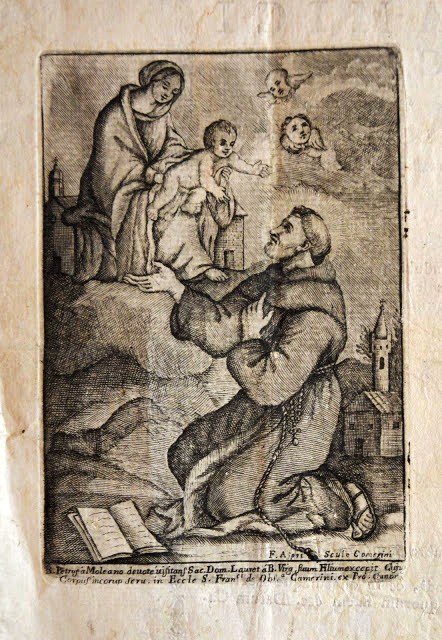
The image below is of Blessed Peter at the Holy House of Loreto, communing with the Blessed Virgin and the Christ Child.bl pietro coradini

Posted in FEASTS and SOLEMNITIES, franciscan OFM, SAINT of the DAY, The APOSTLES & EVANGELISTS

Feast of St James the Greater and Memorials of the Saints – 25 July

St James the Greater (Feast) – Son of Zebedee and Salome, brother of Saint John the Apostle.   He is called “the Greater” simply because he became an Apostle before Saint James the Lesser.

St James:
https://anastpaul.wordpress.com/2017/07/25/saint-of-the-day-25-july-feast-of-st-james-the-greater-apostle-of-christ/

Bl Alexius Worstius
Blessed Antonio Lucci OFM.Conv. (1682-1752) Bishop of Bovino

Blessed Antonio’s Biography:
https://anastpaul.com/2018/07/25/saint-of-the-day-25-july-blessed-antonio-lucci-o-f-m-conv-1682-1752/

Bl Antonio of Olmedo
St Bantu of Trier
St Beatus of Trier
St Christopher (died c 251) Martyr
St Christopher!
https://anastpaul.com/2019/07/25/saint-of-the-day-25-july-saint-christopher-died-c-251-martyr/
St Christopher is one of the Fourteen Holy Helpers – read more about them here:
https://anastpaul.com/2018/07/25/thought-for-the-day-25-july-the-memorial-of-st-christopher-died-c-251-one-of-the-fourteen-holy-helpers/

St Cugat del Valles
Bl Darío Acosta Zurita
St Ebrulfus
St Euphrasia
St Fagildo of Santiago
St Felix of Furcona
St Florentius of Furcona
St Glodesind of Metz
St Magnericus of Trier
Bl Michel-Louis Brulard
Bl Mieczyslawa Kowalska
St Mordeyren
St Nissen of Wexford
St Olympiad of Constantinople
St Paul of Palestine
Blessed Pietro Corradini OFM (1435–1490) Priest
St Theodemir of Cordoba

Martyrs of Caesarea – 3 saints: Three Christians martyred together in the pesecutions of emperor Maximilian and governor Firmilian – Paul, Tea and Valentina. 309 in Caesarea, Palestine.

Martyrs of Cuncolim – 20 saints: On 15 July 1583 the group met at the church of Orlim, and hiked to Cuncolim to erect a cross and choose land for a new church. Local anti-Christian pagans, seeing the unarmed Christians, gathered their weapons and marched on them. One of the parishioners, a Portuguese emigre named Gonçalo Rodrigues, carried a firearm, but Father Alphonsus Pacheco stopped him from using it. The pagans then fell upon them, and killed them all without mercy. They were –
• Alphonsus Pacheco
• Alphonsus the altar boy
• Anthony Francis
• Dominic of Cuncolim
• Francis Aranha
• Francis Rodrigues
• Gonçalo Rodrigues
• Paul da Costa
• Peter Berno
• Rudolph Acquaviva
• ten other native Christian converts whose names have not come down to us
They were martyred on Monday 25 July 1583 at the village of Cuncolim, district of Salcete, territory of Goa, India. Beatified on 30 April 1893 by Pope Leo XIII.

Martyrs of Motril – 5 beati: Four priests and a brother, all members of the Augustinian Recollects, who were martyred together in the Spanish Civil War:
• Deogracias Palacios del Río
• José Rada Royo
• José Ricardo Díez Rodríguez
• Julián Benigno Moreno y Moreno
• León Inchausti Minteguía
They were shot on 25 July 1936 in Motril, Granada, Spain and Beatified on 7 March 1999 by Pope John Paul II.

Martyrs of Toledo – 4 beati: Four brothers and a priest, all members of the Hospitallers of Saint John of God, and all martyred together in the Spanish Civil War.
• Carlos Rubio álvarez
• Eloy Francisco Felipe Delgado Pastor
• Jerónimo Ochoa Urdangarín
• Primo Martínez De San Vicente Castillo
25 July 1936 in Talavera de la Reina, Toledo, Spain. They were Beatified on 25 October 1992 by Pope John Paul II.

Martyrs of Urda – 3 beati: Three members of the Passionists who were martyred together in the Spanish Civil War.
• Benito Solana Ruiz
• Felix Ugalde Irurzun
• Pedro Largo Redondo
They were shot on 25 July 1936 in Urdá, Toledo, Spain and Beatified on 1 October 1989 by Pope John Paul II.

Posted in CHRIST the WORD and WISDOM, DOCTORS of the Church, EUCHARISTIC Adoration, franciscan OFM, QUOTES for CHRIST, QUOTES of the SAINTS, QUOTES on ANGELS, QUOTES on CHARITY, QUOTES on FAITH, QUOTES on HOPE, QUOTES on HUMAN DIGNITY, QUOTES on LOVE of GOD, QUOTES on OBEDIENCE, QUOTES on SACRED SCRIPTURE, QUOTES on SANCTITY, SAINT of the DAY, The HOLY EUCHARIST / The HOLY MASS, The HOLY GHOST, The TEN COMMANDMENTS

Quote/s of the Day – 21 July – St Lawrence of Brindisi

Quote/s of the Day – 21 July – The Memorial of St Lawrence of Brindisi OFM Cap (1559-1619) Doctor of the Church

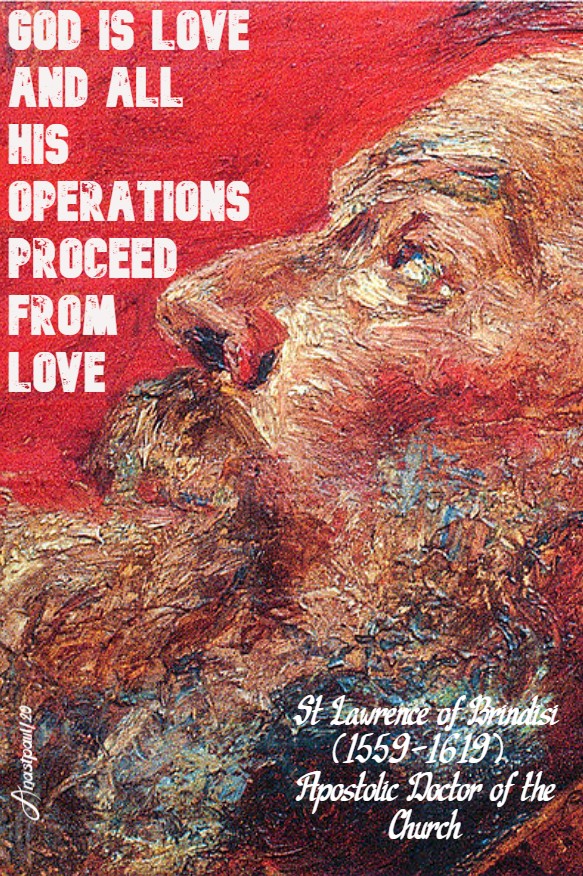
“God is love
and all His operations
proceed
from
LOVE…”

god is love and all his operations proceed from love - st lawrence of brindisi 21 july 2020

“For Him all things were created
and to Him all things must be subject
and God loves all creature,
in and because of Christ.”

for-him-all-things-were-created-and-in-him-st-lawrence-of-brindisi-21-july-2018 and 21 July 2020

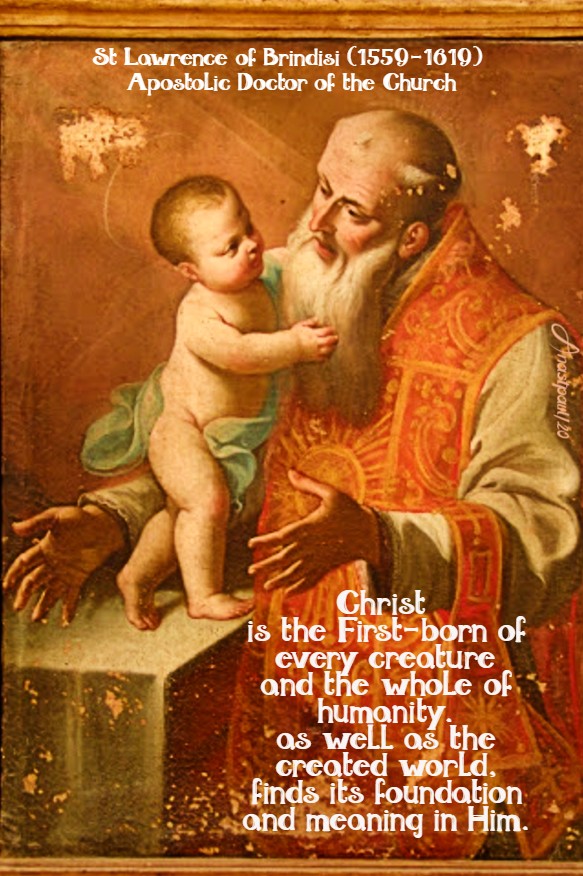
“Christ is the first-born of every creature
and the whole of humanity.
as well as the created world,
finds its foundation and meaning in Him.”

christ is the first born of every creature -st lawrence of brindisi 21 july 2020

“My dear souls, let us recognise, I pray you,
Christ’s infinite charity towards us
in the institution of this Sacrament of the Eucharist.
In order that our love be a spiritual love,
He wills a new heart, a new love, a new spirit for us.
It is not with a carnal heart but with a spiritual one,
that Christ has loved us with a gratuitous love,
a supreme and most ardent love,
by way of pure grace and charity.
Ah! One needs to love Him back
with one’s whole, whole, whole,
living, living, living and true, true, true heart!!”

my dear souls let us recognise i pray you - st lawrence of brindisi 21 july 2020

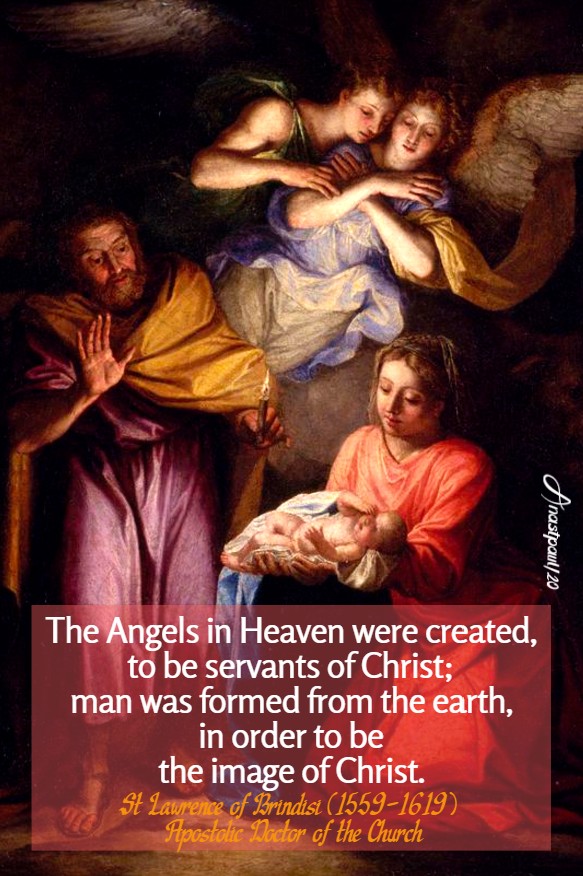
“The Angels in Heaven were created,
to be servants of Christ;
man was formed from the earth,
in order to be the image of Christ.”

the angels in heaven - st lawrence of brindisi 21 july 2020

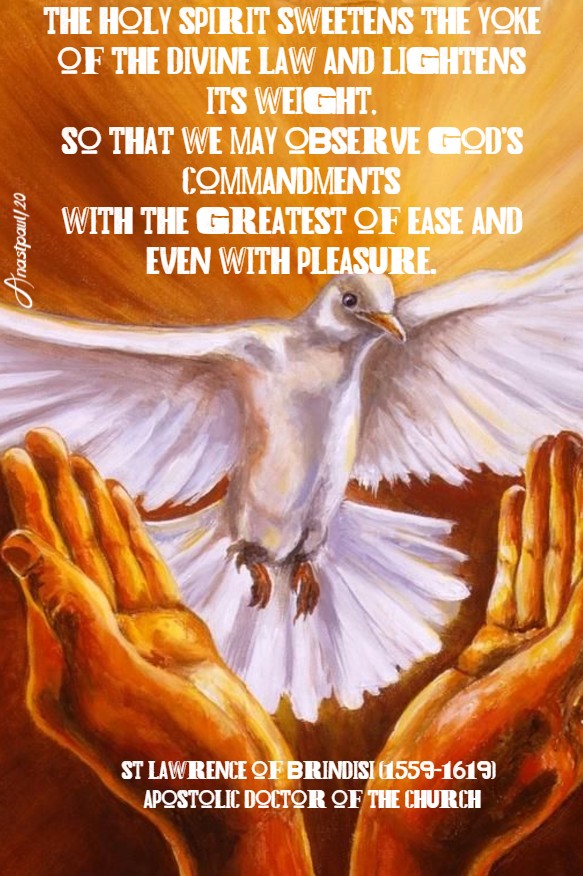
“The Holy Spirit sweetens the yoke
of the divine law and lightens its weight,
so that we may observe God’s commandments
with the greatest of ease and even with pleasure.”

the holy spirit - st lawrence of brindisi 21 july 2020

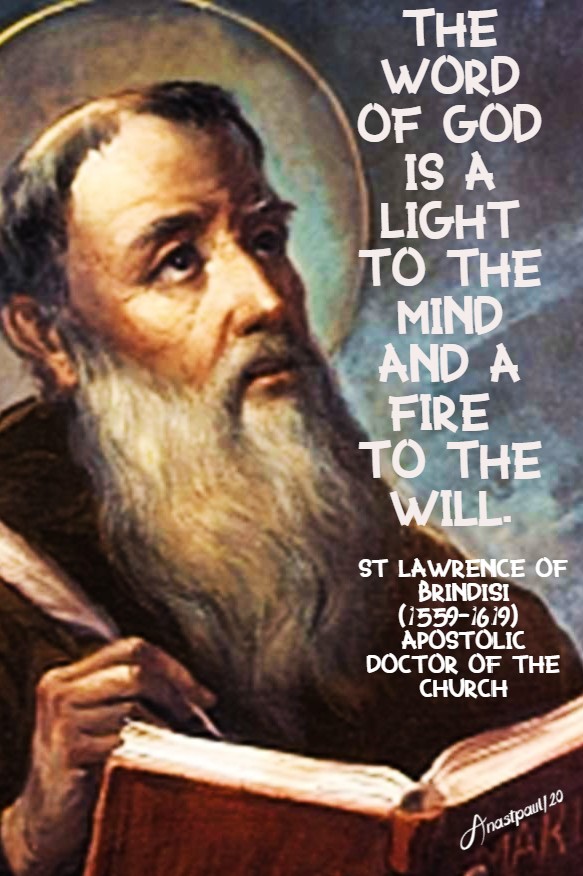
“…The word of God
is a light to the mind
and a fire to the will.”

the word of god is a light to the mind and a fire to the will - st lawrence of brindisi 21 july 2020

“All things are possible for him who believes,
more to him who hopes,
even more to him who loves.”

St Lawrence of Brindisi(1559-1619)

Apostolic Doctor of the Church

all things are possible - st lawrence of brindisi 21 july 2020

Posted in franciscan OFM, SAINT of the DAY

Saint of the Day – 21 July – Blessed Angelina of Marsciano TOR (1357-1435)

Saint of the Day – 21 July – Blessed Angelina of Marsciano TOR (1357-1435) – Foundress and Abbess, childless, Widow, Apostle of the poor, sick and children – also known as Angelina of Montegiove or of Corbara. Born in 1357 in Montegiove, Umbria, Italy and died on 14 July 1435 in Foligno, Umbria.    Patronage – the Franciscan Sisters of Blessed Angelina.

She founded a Congregation of Religious Sisters of the Franciscan Third Order Regular, known today as the Franciscan Sisters of Blessed Angelina.   She is generally credited with the founding of the Third Order Regular for women, as her religious Congregation marked the establishment of the first Franciscan community of women living under the Rule of the Third Order Regular authorised by Pope Nicholas V.   Unlike the Second Order of the Franciscan movement, the Poor Clare nuns, they were not an enclosed religious order but have been active in serving the poor around them, for much of their history.    She is commemorated by the Franciscans on 4 June.   Her liturgical feast is today though post 1969 the date was moved to 13 June.BL Angelina_corbara_marsciano SML

In 1357, Angelina was born in her ancestral Castle of Montegiove, some 40 kilometers from Orvieto, in Umbria, then part of the Papal States. She was the daughter of Jacopo Angioballi, the Count of Marsciano and of Anna, the daughter of the Count of Corbara, which is why sometimes she is also referred to as Angelina of Corbara.

Left orphaned and alone, except for one sister, by the age of six, she was raised by her grandparents.   Angelina was married at age 15 to Giovanni da Terni, the Count of Civitella del Tronto, in the Abruzzo region, within the Kingdom of Naples but he died only two years later, leaving her a childless widow.   His death left Angelina in charge of his castle and estate.

It was then that Angelina made the decision to dedicate her life to God (it would appear that she had considered being a nun before she was married).   She was clothed as a Franciscan tertiary and, with several companions, began an apostolic mission around the countryside of the kingdom, preaching the values of repentance and virginity, as well as service to those in need.bl angelina

Angelina’s progress was arrested by the disturbance she caused in the communities, where she called for young women to adopt religious life.   She was doubly charged with sorcery, the imagined origin of her sway over women andof heresy, because of her allegedly Manichean opposition to marriage.   Angelina defended herself before Ladislas, the King of Naples, who dismissed the charges but expelled her and her companions from the kingdom, in order to avoid further complaints.

Angelina then went to Assisi, where she stopped to rest and to pray at the Basilica of Santa Maria degli Angeli, the cradle of the Franciscan Order.   There, she experienced a vision, wherein God instructed her to found a cloistered Monastery under the Rule of the Third Order of Saint Francis in Foligno.   The local Bishop approved the plans with little hesitation, as they meant an end to her troublesome active ministry.   She settled in Foligno about 1394.   She soon joined the Monastery of St Anna, a small community of women Franciscan tertiaries, which had been founded in 1388 by the Blessed Paoluccio Trinci (died 1390), a Franciscan friar who had been related to her sister through marriage.   Known as the “Monastery of the Countesses”—due to the social standing of most of its members, he had established it out of his vision of having these noble women of the city, serve as an evangelising force in their society.   The women lived ascetic lives in the Monastery and, not being nuns, followed a very informal structure, free to come and go as they wished, that they might be able to serve the poor and sick of the region.

Angelina took a leadership role in the small group and began to organise their lives into a more regular form.   By 1397 she was considered the leader of the twelve founding members.   In 1403 she was able to obtain a Papal Bull from Pope Boniface IX which formally recognised the status of the house as a Monastery.   The reputation of the community in Foligno was so successful, that quickly communities of Franciscan tertiary women throughout the region sought to affiliate with them.   Communities under her authority were soon established in Florence, Spoleto, Assisi and Viterbo, along with eleven others, before Angelina’s death in 1435.

The diverse communities were recognised as a Congregation by Pope Martin V in 1428.   This decree also allowed them to elect a Minister General (a title since reserved for the head of the friars) who would have the right of canonical visitation of the other communities.   The Congregation held its first general elections in 1430, in which Angela was elected their first Minister General.   In this office, she developed the Statutes for the Congregation, to be followed by all its houses.

This degree of independence was not welcomed by the Friars Minor, who had been granted complete authority over the tertiaries that same year.   The Minister General of the Friars, Guglielmo da Casala, demanded that the Third Order Sisters of the Congregation be confirmed under obedience to him.   Angelina had to submit and, in a public ceremony held in the Friars’ church in Foligno on 5 November 1430, vowed obedience to the local Minister Provincial.

This act of obedience, however, was repudiated by the chapter of the community at Santa Anna, saying that it was invalid due to having been forced under duress and without their approval.   The Holy See confirmed their autonomy the following year.   To avoid the potential for future repetition of this conflict, the Congregation put themselves under the obedience of their local Bishops, with their spiritual direction to come from the Friars of the Third Order Regular of St Francis of Penance.

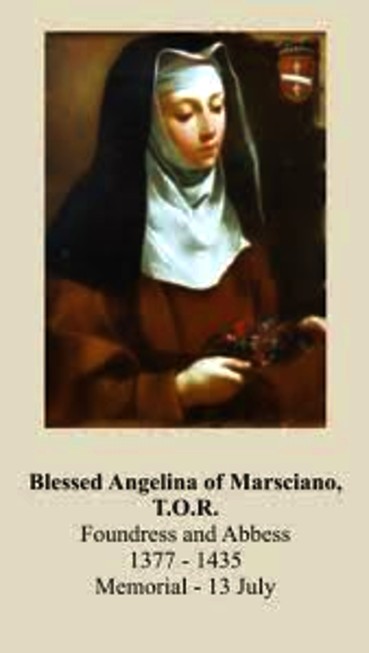
Angeline died on 14 July 1435 and was interred in the Church of St Francis in Foligno.   Her remains were removed to a grander shrine in 1492.   Her cultus was approved and Beatification granted on 8 March 1825 by Pope Leo XII.bl angelina oprayer card

Due to the requirement of keeping their communities small and simple, Angelina’s Congregation gained greatest popularity in the 15th and 16th centuries.   In 1428, they had been put briefly by Pope Martin V under the jurisdiction of the Friars Minor, with a specific mandate for the education and instruction of young girls.   Even so, their work was fairly apostolic until they were required to become an enclosed religious order in 1617, having taken solemn vows with a strict separation from the affairs of the external world, limited to the education of girls within the cloister.   With a 1903 lift of papal enclosure, a wider apostolate was again permitted and the Congregation became known as the Franciscan Sisters of Blessed Angelina.   As of 1750, they consisted of 11 houses and 80 members.

As of the year 2000, they have houses in Brazil, Madagascar and Switzerland, as well as in Italy.

Posted in DOCTORS of the Church, franciscan OFM, MARIAN TITLES, SAINT of the DAY

Feast of Our Lady of Kazan and Memorials of the Saints -21 July

St Lawrence of Brindisi OFM Cap (1559-1619) Doctor of the Church (Optional Memorial)
Biography:
https://anastpaul.com/2018/07/21/saint-of-the-day-21-july-st-lawrence-of-brindisi-ofm-cap-1559-1619-doctor-of-the-church-the-franciscan-renaissance-man/

Our Lady of Kazan:
This miraculous icon, also known as the Theotokos of Kazan, is thought to have originated in Constantinople in the 13th century before it was taken to Russia.   When the Turks took Kazan in 1438, the icon may have been hidden.   Ivan the Terrible liberated Kazan in 1552 and the town was destroyed by fire in 1579.
The icon was eventually found in the ruins of a burnt-out house at Kazan on the River Volga on 8 July in 1579.   According to tradition, the location of the icon was revealed during a dream by the Blessed Virgin Mary to a ten year old girl named Matrona.   Matrona told the local Bishop of her dream, but he did not believe her.   There were two more similar dreams, after which Matrona and her mother went to the place indicated by the Blessed Virgin and dug in the ruins what had been a house until the uncovered the icon.   It appeared untouched by the flames, with the colours as vivid and brilliant as if it were new.  Kazan_moscowThe Bishop took the icon to the Church of Saint Nicholas and immediately there was a miracle of a blind man’s sight being restored to him.   A Monastery was built over the place where the icon had been found.
Known as the Holy Protectress of Russia, the icon was stolen on 29 June 1904.   The thieves were later caught and claimed that they had destroyed the icon after taking the gold frame and jewels attached to the image.   In any event, the original has never been found, though there are many copies in existence, thanks to the popularity of the icon.   Many of the copies are known to be miracle working.
In 1993 a copy of the icon was given to Pope John Paul II, who kept it in his personal study before it was given to representatives of the Russian Orthodox Church in 2004.

Bl Agrícola Rodríguez García de Los Huertos
St Alberic Crescitelli
Blessed Angelina of Marsciano TOR (1357-1435) – Foundress and Abbess

St Arbogast of Strasbourg
St Barhadbescialas
St Benignus of Moyenmoutier
Bl Claudius of Avignon
St Claudius of Troyes
St Corona of Marceille
Bl Cristóbal López de Valladolid Orea
Bl Daniel Molini
St Daniel the Prophet
St Eleutherius of Marseille
St Eternus of Evreaux
Bl Gabriel Pergaud
St Iosephus Wang Yumei
St John of Edessa
St John of Moyenmoutier
Bl Juan de Las Varillas
Bl Juan de Zambrana
St Jucundinus of Troyes
St Julia of Troyes
St Justus of Troyes
Bl Parthenius of Thessaly
St Praxides of Rome
St Simeon Salus
St Victor (of Marseilles) (3rd century) Martyr
His Story:
https://anastpaul.com/2019/07/21/saint-of-the-day-21-july-st-victor-3rd-century-martyr/

St Wastrada
St Zoticus of Comana

Martyrs of Africa – 6 saints: Six Christians who were martyred together. We know no other details about them but the names – Emilian, Hugal, Motanus, Saphus, Stercorius and Victor. They were martyred in an unknown location in Africa, date unknown.

Posted in franciscan OFM, SAINT of the DAY

Saint of the Day – 19 July – St Peter Crisci of Foligno TOSF (c 1243-1323)

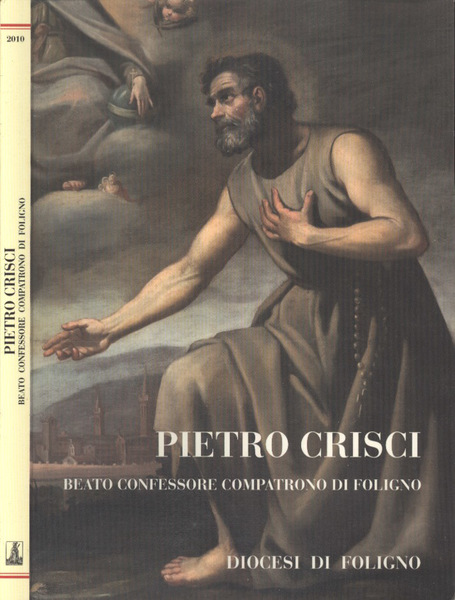
Saint of the Day – 19 July – St Peter Crisci of Foligno TOSF (c 1243-1323) Franciscan Tertiary, Penitent, Hermit, Pilgrim, Beggar, Preacher – called a “Fool for Christ” – born in c 1243 in Foligno and died on 19 July 1323 in the Cathedral of Foligno, Umbria, Italy of natural causes.st pietro-crisci-beato-confessore-compatrono-foligno-

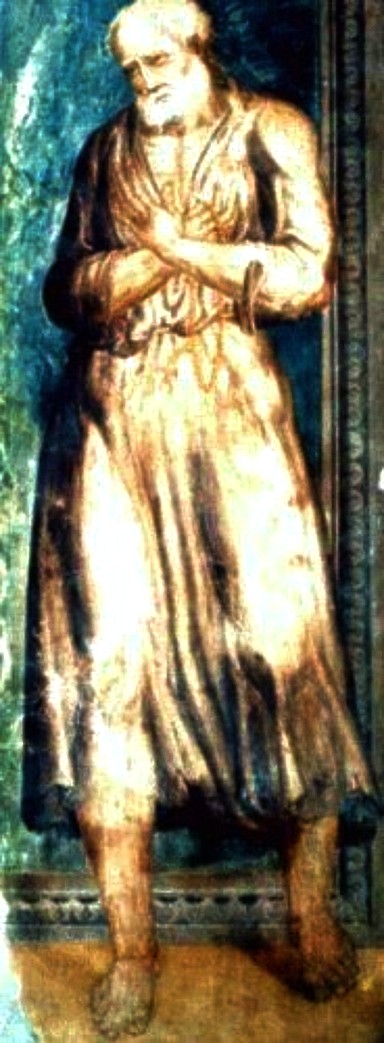
Peter Crisci, who was born in c 1243 in Foligno of a good family, sold his inheritance when he was about 30 and gave the proceeds to the poor.   From this point, he dressed in sacking and lived as a Hermit in a cell in the campanile of the Cathedral (now the Cell of St Peter Crisci). He regularly preached in the Cathedral and became highly venerated.st peter crisci tiny

He was regarded as a madman in some quarters.   While saintly laymen like St Francis had been acceptable in the 13th century, they were generally only accepted in the 14th century when they had the patronage of the mendicant orders.   Peter therefore received the attentions of the Inquisition but he was judged to be orthodox.   Not all of his compatriots treated him kindly, for example, St Angela of Foligno records that, before her conversion (in 1285), “I used to make fun of a certain Petruccio but now I could not do otherwise than follow his example.”Saint-Peter-Crisci-of-Foligno

Peter died in his cell in 1323 and was buried in the Cathedral.

Bishop Giovanni Angeletti (1364-92) commissioned a life of the Blessed Peter Crisci from the Dominican Brother Giovanni Gorini di San Geminiano.   The first indication that a cult dedicated to the Blessed Peter Crisci emerged in Foligno dates to 1381, when the existence of a fair held on the anniversary of his death was first documented.

Fst peter crisci ol-Duomo-Crisci-Tomb
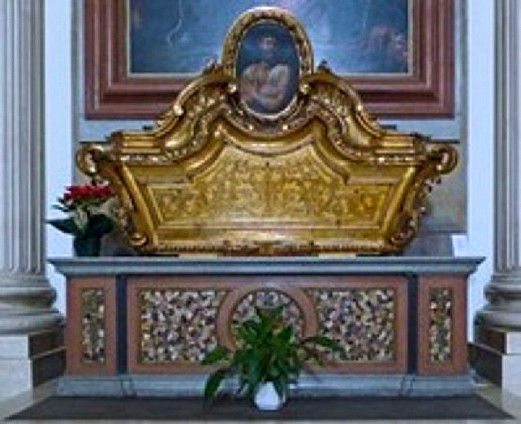
Tomb of St Peter

The cult seems to have been encouraged by Ugolino III Trinci (1386-1415) and it was probably at his instigation, that Pope Boniface IX granted indulgences (in either 1391 or 1400, according to different readings of the damaged document) to those praying before the relics “in festo sancti Petri”.   (Boniface IX granted similar indulgences in respect of Blessed James of Bevagna, despite the fact that neither of these men had been Canonised.)

It is likely that pilgrims attracted by these relics would also have visited the Cell of St Peter in the campanile.   The frescoes there are dated on stylistic grounds to the decade in which the indulgences were granted. The kneeling donor depicted in the fresco of the mystic marriage of St Catherine at the back o the arch in which Peter Crisci slept may well be Ugolino III Trinci.   (The cell now forms part of the Museo Diocesano).st pietro-crisci-beato-confessore-compatrono-foligno-.smljpeg

Posted in "Follow Me", CHRIST, the WAY,TRUTH,LIFE, DOCTORS of the Church, FATHERS of the Church, franciscan OFM, QUOTES for CHRIST, QUOTES of the SAINTS, QUOTES on DISCIPLESHIP, QUOTES on LOVE of GOD, The WORD, Thomas a Kempis, Uncategorized

Quote/s of the Day – 7 July – ‘Take Christ’

Quote/s of the Day – 7 July – “Month of the Most Precious Blood” – Friday of the Fifteenth Week in Ordinary Time, Year A, Readings: Isaiah 38:1-6, 21-22, 7-8, Responsorial psalm Isaiah 38:10-12, 16, Matthew 12:1-8

‘Take Christ’

“Fear not, for I have redeemed you,
I have called you by name, you are mine.”

Isaiah 43:1

isaiah 43 1 fear not for i have redeemed you i have called you by name you are mine 14 april 2020 easter tuesday

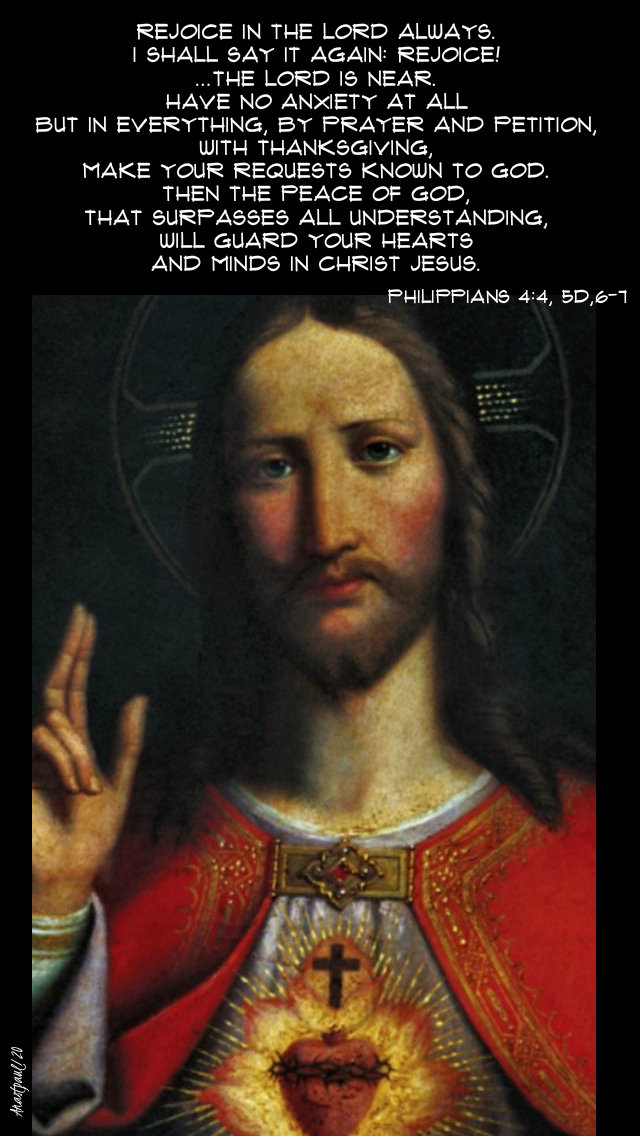
Rejoice in the Lord always.
I shall say it again: rejoice!
…The Lord is near.
Have no anxiety at all
but in everything, by prayer and petition,
with thanksgiving,
make your requests known to God.
Then the peace of God,
that surpasses all understanding,
will guard your hearts
and minds in Christ Jesus.

Philippians 4:4, 5d,6-7

philippians-4-4-5d-6-7-1-jan-2020 and 17 july 2020

“The Christian should be an
‘alleluia’
from head to foot.

St Augustine (354-430)
Father & Doctor of the Church

the-christian-should-be-an-alleluia-st-augustine-10-april-2018-speaking-of-evangelisation

“May Christ be heard in our language,
may Christ be seen in our life,
may He be perceived in our hearts”

St Peter Damian (1007-1072)
Doctor of the Church

(Sermo VIII, 5)

may-christ-be-heard-st-peter-damian-21-feb-2019 and 17 july 2020

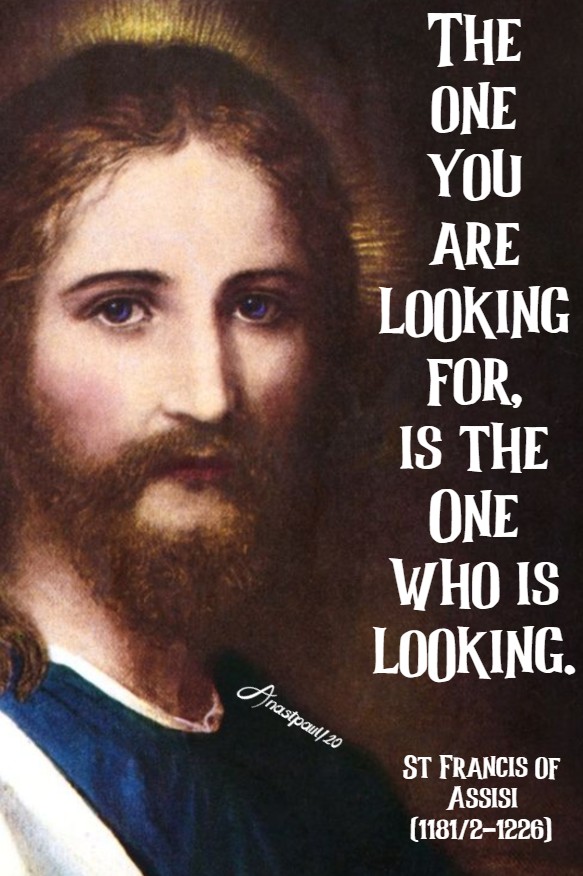
“The one you are looking for,
is the One who is looking.”

the one you are looking for is the one who is looking - st francis assisi 17 july 2020

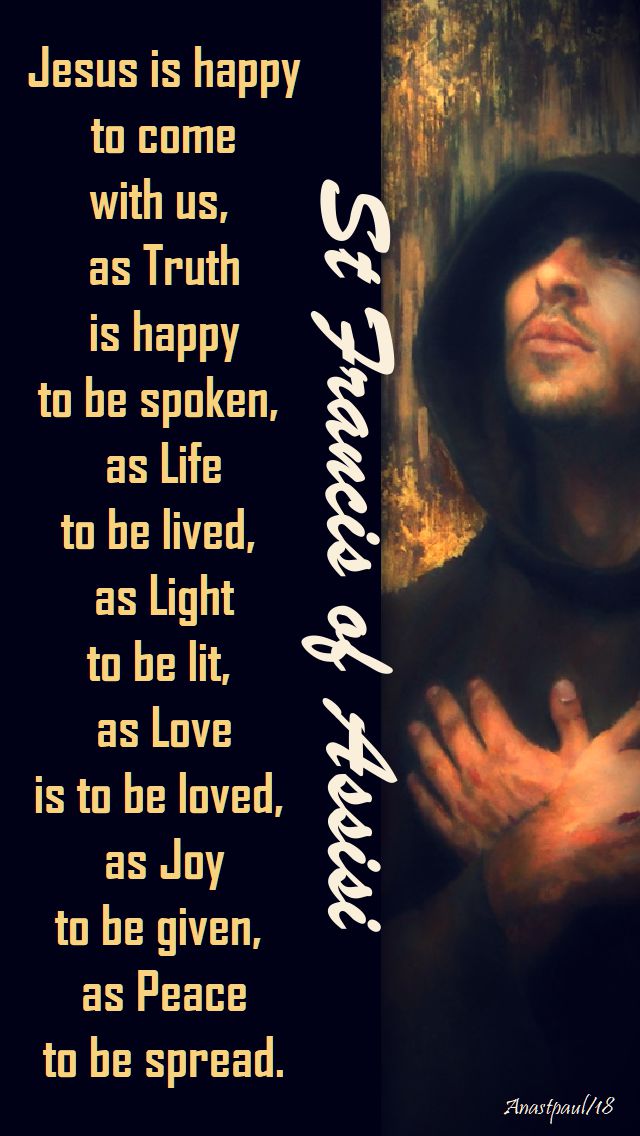
“Jesus is happy to come with us,
as Truth is happy to be spoken,
as Life to be lived,
as Light to be lit,
as Love is to be loved,
as Joy to be given,
as Peace to be spread.”

St Francis of Assisi (1181/2–1226)

jesus-is-happy-to-come-with-us-st-francis-of-assisi-4-oct-2018 and 17 july 2020

“Love God, serve God,
everything is in that.”

love-god-serve-god-everything-is-in-that-st-clare-1-jan-2019 and 2020

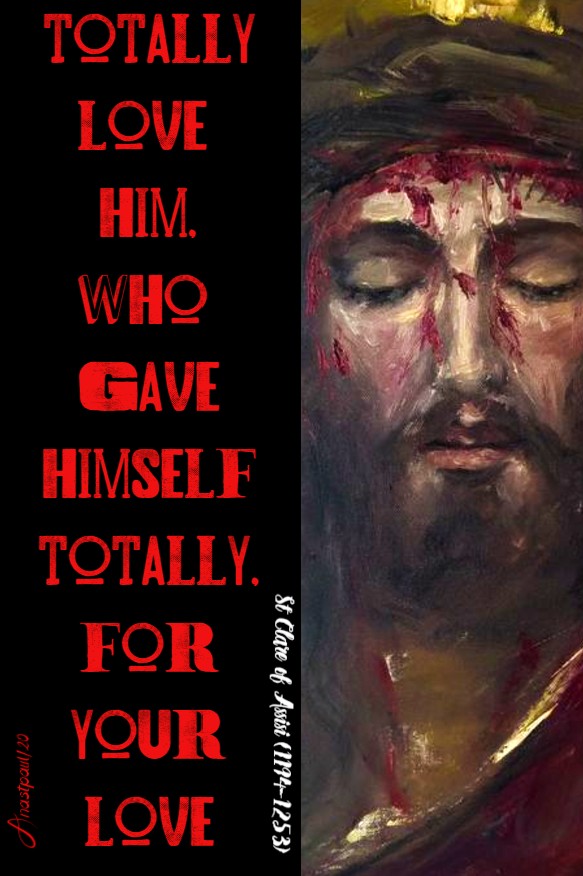
“Totally love Him,
who gave Himself totally,
for your love.”

St Clare of Assisi (1194-1253)

totally loe hm who game hmself totally for your love - st clare of assisi 17 july 2020

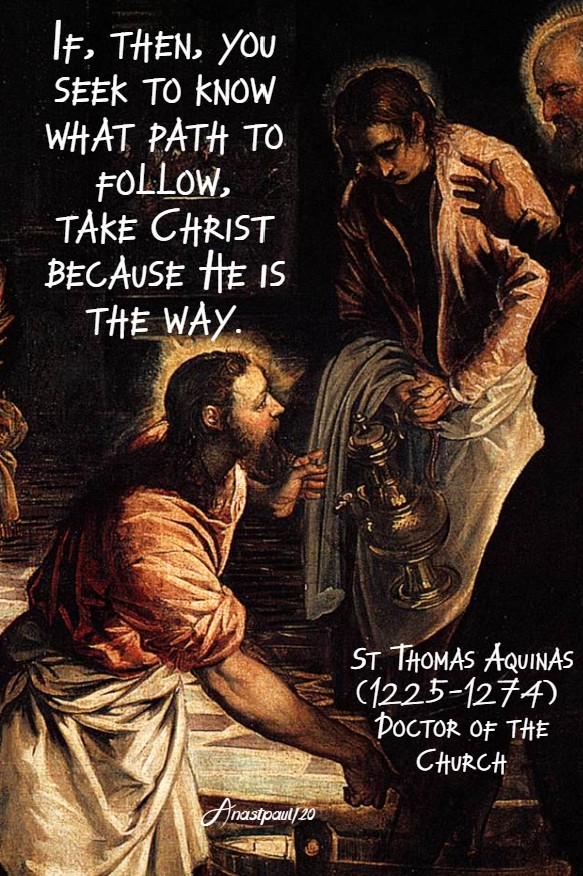
“If, then, you seek to know what path to follow,
take Christ because He is the way.”

St Thomas Aquinas (1225-1274)
Doctor of the Church

if the you seek to know what path to follow take christ - st thomas aquinas 17 july 2020

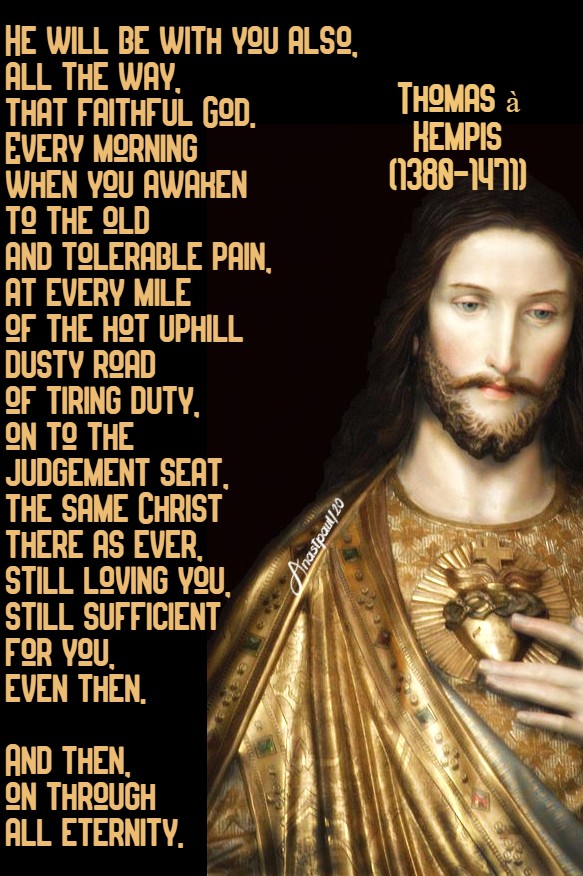
“He will be with you also, all the way, that faithful God.
Every morning when you awaken to the old and tolerable pain,
at every mile of the hot uphill dusty road of tiring duty,
on to the judgement seat, the same Christ there as ever,
still loving you, still sufficient for you, even then.
And then, on through all eternity.”

Thomas à Kempis (1380-1471)

he will e with you also - thomas a kempis 17 july 2020 new

“Every Christian must be a living book
wherein one can read the teaching of the gospel.
This is what St Paul says to the Corinthians.
Our heart is the parchment;
through my ministry
the Holy Spirit is the writer because
‘my tongue is like the pen of a ready scribe’
(Psalm 45:1).”

St Joseph of Leonissa OFM CAP (1556-1612)

every-christian-must-be-a-living-book-st-joseph-of-leonissa-4-feb-2018 17 july 2020

Posted in DOCTORS of the Church, franciscan OFM, GOD ALONE!, GOD the FATHER, JUNE-THE SACRED HEART, MARIAN QUOTES, QUOTES for CHRIST, QUOTES of the SAINTS, QUOTES on FAITH, QUOTES on HELL, QUOTES on HUMAN DIGNITY, QUOTES on NATURE - GOD'S CREATION, QUOTES on PRAYER, QUOTES on the DEVIL/EVIL, QUOTES on TRUTH, SAINT of the DAY

Quote/s of the Day – 15 July – St Bonaventure

Quote/s of the Day – 15 July – The Memorial of St Bonaventure (1221-1274) Doctor of the Church

“Bonaventure so united holiness and theological knowledge that he rose to the heights of mysticism, while remaining a very active preacher and teacher, one beloved by all who met him.  To know him was to love him; to read him is still for us today to meet a true Franciscan and a gentleman.”

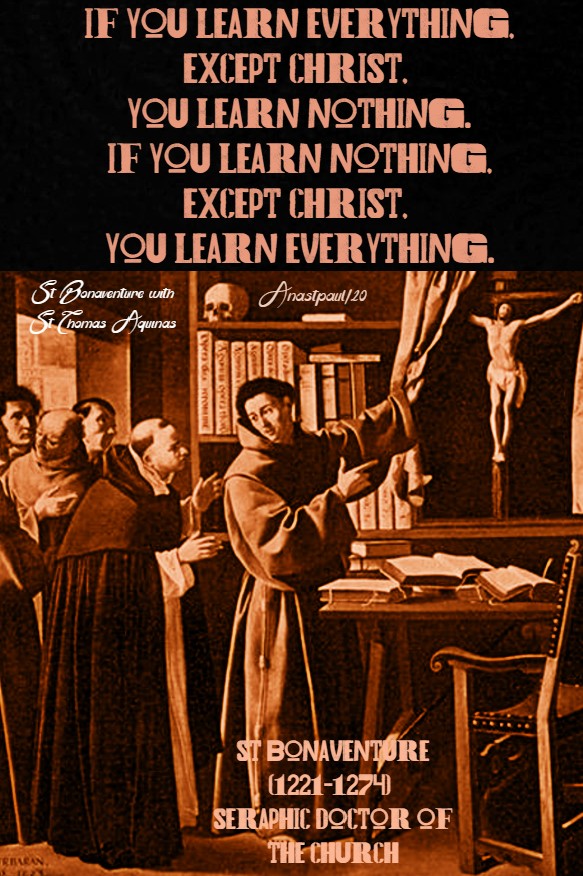
“If you learn everything, except Christ, you learn nothing.
If you learn nothing, except Christ, you learn everything.”

if you learn everything except christ you learn nothing - st bonaventure 15 july 29020

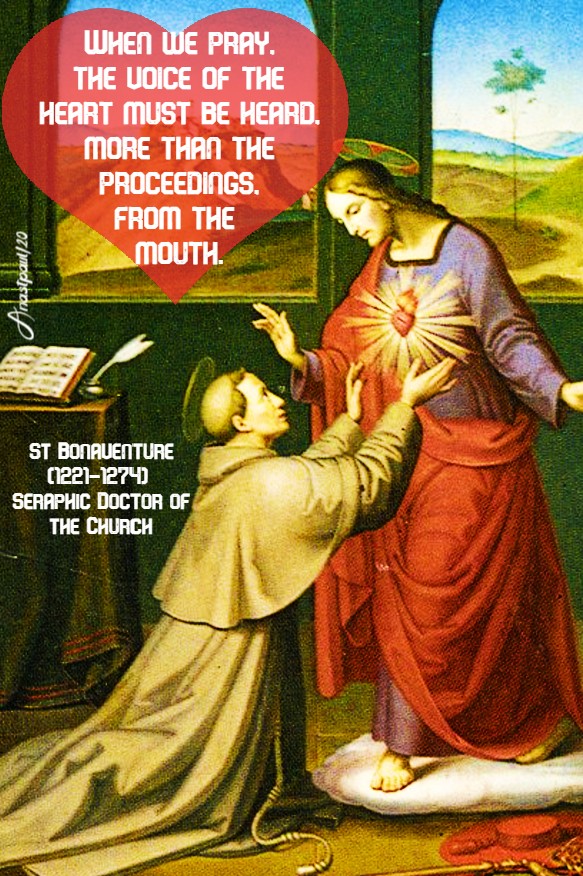
“When we pray,
the voice of the heart must be heard,
more than the proceedings,
from the mouth.”

when we pray - st bonaventure 15 july 2020

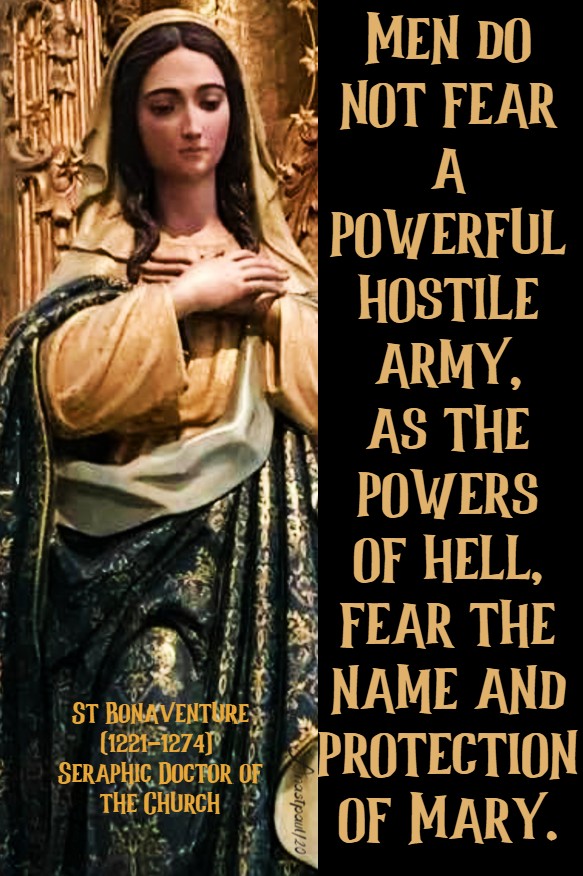
“Men do not fear a powerful hostile army,
as the powers of hell,
fear the name and protection of Mary.”

men do not fear a powerful hostile army - st bonaventure 15 july 2020

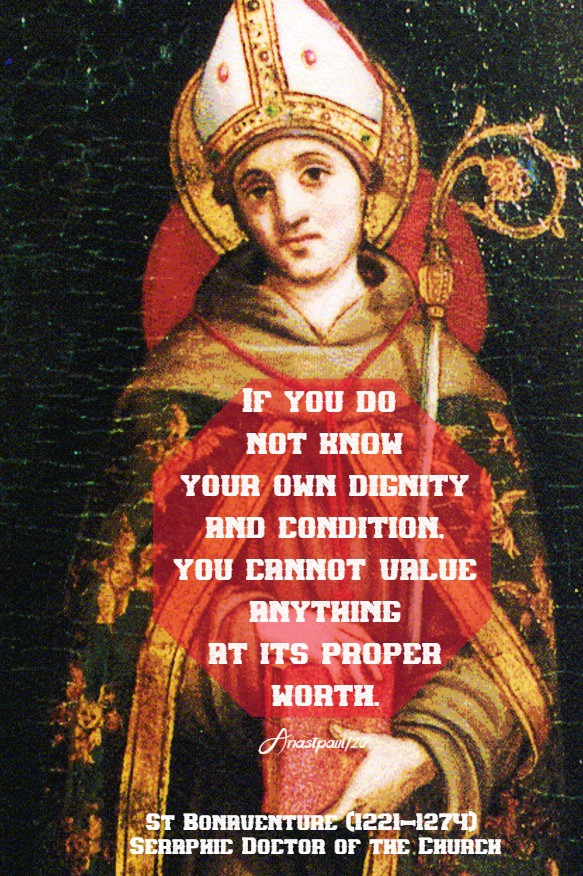
“If you do not know
your own dignity and condition,
you cannot value anything
at its proper worth.”

if you do not know your own dignity - st bonaventure - 15 july 2020

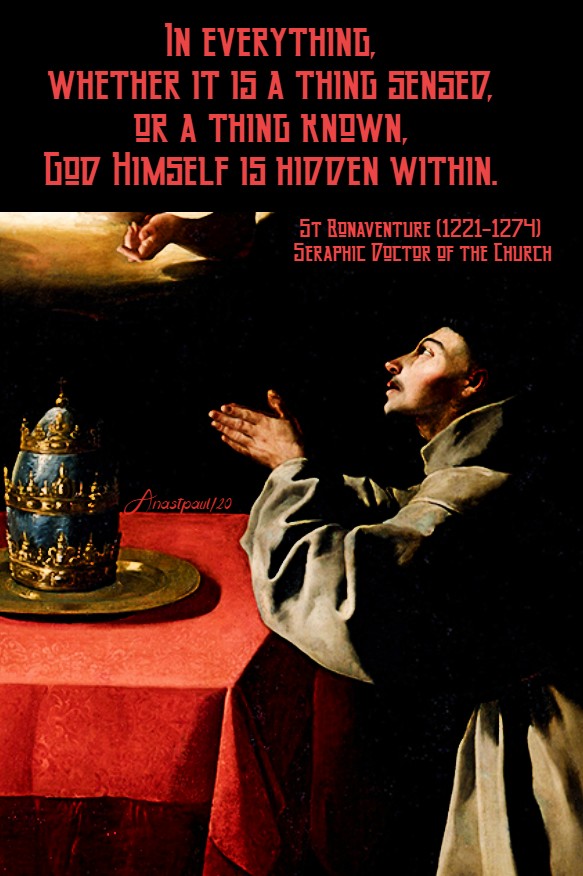
“In everything,
whether it is a thing sensed,
or a thing known,
God Himself is hidden within.”

St Bonaventure (1221-1274)
Seraphic Doctor of the Church

More here:
https://anastpaul.com/2019/07/15/quote-s-of-the-day-15-july-the-wisdom-of-st-bonaventure/

in everything whether it is a thing sensed - st bonaventure 15 july 2020

Posted in DOCTORS of the Church, franciscan OFM, SAINT of the DAY

Memorials of the Saints – 15 July

St Bonaventure of Bagnoregio OFM (1221-1274)Seraphic Doctor of the Church – (Memorial)
St Bonaventure!
https://anastpaul.com/2018/07/15/saint-of-the-day-15-july-st-bonaventure-o-f-m-1221-1274-doctor-of-the-church/
AND:
https://anastpaul.com/2017/07/15/saint-of-the-day-15-july-st-bonaventure-seraphic-doctor/

Dispersion of the Apostles:  Commemorates the missionary work of the Twelve Apostles. It was first mentioned in the 11th century and was celebrated in the northern countries of Europe during the Middle Ages. It is now observed in Germany, Poland and some dioceses of England, France and the United States.

St Abundantia of Spoleto
St Abudemius of Bozcaada
St Adalard the Younger
St Anrê Nguyen Kim Thông
Blessed Anne-Mary Javouhey (1779-1851)
Her Life:
https://anastpaul.com/2019/07/15/saint-of-the-day-15-july-blessed-anne-mary-javouhey-1779-1851/
Bl Antoni Beszta-Borowski
St Apronia
St Athanasius of Naples
St Antiochus of Sebaste
St Benedict of Angers
Bl Bernard of Baden
St David of Sweden
St Donivald
St Eberhard of Luzy
St Edith of Tamworth
St Eternus
St Felix of Pavia
St Gumbert of Ansbach
St Haruch of Werden
St Jacob of Nisibis
St Joseph Studita of Thessalonica
Bl Michel-Bernard Marchand
Bl Peter Aymillo
St Phêrô Nguyen Bá Tuan
St Plechelm of Guelderland
Bl Roland of Chézery
St Valentina of Nevers
St Vladimir I the Great of Kiev (c 956-1015)

Martyred Jesuit Missionaries of Brazil – 40 beati: A band of forty Spanish, Portugese and French Jesuit missionaries martyred by the Huguenot pirate Jacques Sourie while en route to Brazil. They are –
• Aleixo Delgado • Alonso de Baena • álvaro Borralho Mendes • Amaro Vaz • André Gonçalves • António Correia • Antônio Fernandes • António Soares • Bento de Castro • Brás Ribeiro • Diogo de Andrade • Diogo Pires Mimoso • Domingos Fernandes • Esteban Zuraire • Fernando Sánchez • Francisco Alvares • Francisco de Magalhães • Francisco Pérez Godoy • Gaspar Alvares • Gonçalo Henriques • Gregorio Escribano • Ignatius de Azevedo • Iõao • João Fernandes • João Fernandes • Juan de Mayorga • Juan de San Martín • Juan de Zafra • Luís Correia • Luís Rodrigues • Manuel Alvares • Manuel Fernandes • Manuel Pacheco • Manuel Rodrigues • Marcos Caldeira • Nicolau Dinis • Pedro de Fontoura • Pedro Nunes • Simão da Costa • Simão Lopes •
They were martyed on 15 and 16 July 1570 on the ship Santiago near Palma, Canary Islands. They were beatified on 11 May 1854 by Pope Pius IX.

Martyrs of Alexandria – 13 saints: Thirteen Christians who were martyred together. We know the names of three, no details about them and the other ten were all children. – Narseus, Philip and Zeno. Martyred in the early 4th-century in Alexandria, Egypt.

Martyrs of Carthage – 9 saints: A group of nine Christians who were martyred together. We know nothing else but their names – Adautto, Catulinus, Felice, Florentius, Fortunanziano, Januarius, Julia, Justa and Settimino. They were martyred in Carthaginian and their relics at the basilica of Fausta at Carthage.

Martyrs of Pannonia – 5 saints: Five 4th-century martyrs killed together. No information about them has survived except the names – Agrippinus, Fortunatus, Martialis, Maximus and Secundinus.

Posted in Against STORMS, EARTHQUAKES, THUNDER & LIGHTENING, FIRES, DROUGHT / NATURAL DISASTERS, DYING / LAST WORDS, franciscan OFM, SAINT of the DAY

Saint of the Day – 14 July – Saint Francisco Solano OFM (1549 – 1610) “The Wonder Worker of the New World,”

Saint of the Day – 14 July – Saint Francisco Solano OFM (1549 – 1610) “The Wonder Worker of the New World,” Priest, Friar of the Order of Friars Minor, Missionary, Musician, Preacher, Miracle worker, Apostle of the Blessed Sacrament, the Holy Virgin Mother and of Prayer, Polyglot – born on 10 March 1549 at Montilla, Diocese of Cordova, Andalusia, Spain and died on 14 July 1610 at Lima, Peru of natural causes.   He is also known as Francis Solanus.   Patronages – Argentina, Bolivia, Chile, Paraguay, Peru, against earthquakes, Diocese of Añatuya, Argentina.KRACKER_Johann_Lucas_St_Francis_Of_Solano_Baptizing_Indians header
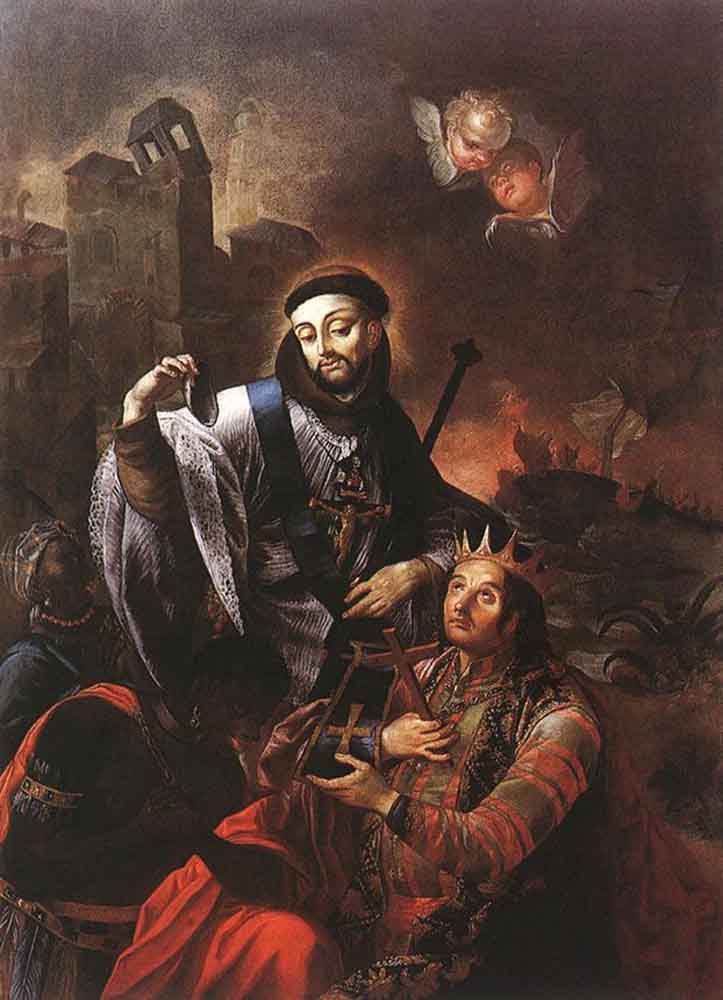
Frncisco was born on 10 March 1549 in Montilla, the third child of Mateo Sánchez Solano and Ana Jiménez.  When she was pregnant with the future saint, Ana consecrated him to Saint Francis of Assisi, after whom he was named.   Francisco Solano’s parents gave him an entirely Catholic formation, which he finished at the Jesuit school in his city.   He was a splendid conversationalist and possessed a good bearing, beautiful voice and rare musical sense.   At the age of twenty, he joined the Order of Friars Minor at Montilla, entering the novitiate at St Lawrence Friary, which was located in a place of great natural beauty.   The community there belonged to the Reformed observance within the Order, following a very strict routine of prayer, silence and fasting.   Francisco followed this regimen rigorously, always going barefoot, abstaining from meat, and wearing a hairshirt throughout that entire year.   As a result, however, his health was permanently affected, leaving him sick and fatigued.

Francisco was solemnly professed in 1569.   He was then sent to the Friary of Our Lady of Loreto in Seville for his seminary studies.   There he learned not only philosophy and theology but developed his musical talents.   He was Ordained in 1576, a ceremony his mother was unable to attend due to her poor health.    st francisco solanus old imageShortly after his Ordination he was named Master of Ceremonies for the community.   Still a lover of simplicity, Francis made a small cell for himself adjacent to the Chapel of the Friary, made of clay and reeds.

After completing his final theological studies, Fr Francisco was assigned as an itinerant preacher to the surrounding villages of the region.   He was eventually given a licence as a confessor.   During this period, he requested that he might be allowed to go to North Africa, with the hope of achieving Martyrdom for preaching the Catholic faith. He was denied this request.

After the death of his father, he returned to his hometown of Montilla to care for his mother.   During that time, he gained the reputation of a Wonder worker, as a number of people were cured of their afflictions through his intercession.   In 1583, A pestilence having broken out at Granada, he tended the sick and dying.San_Francisco_Solano_(1549_-1610)
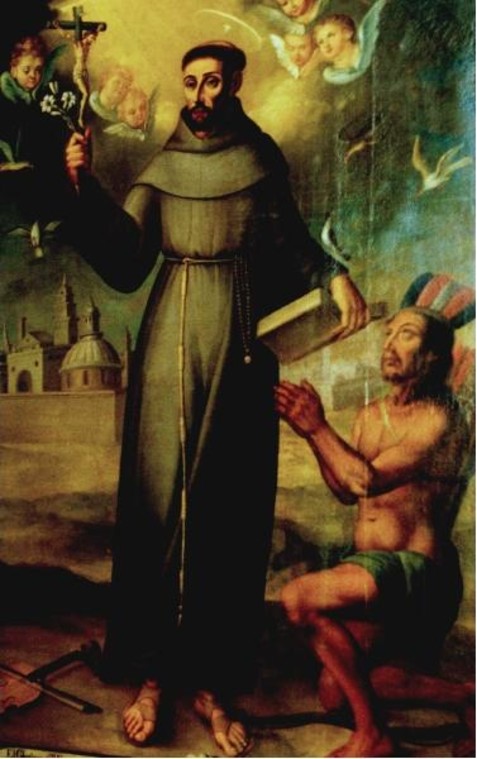
Fr Francisco always had a remarkable joy when he was in the presence of the Blessed Sacrament or an image of Our Lady holding the Child Jesus.   He would become so ecstatic at seeing the Child Jesus cared for in the arms of Our Lady, that sometimes, he would call all the priests in the Monastery together and say:  “Father come look, does this not make you happy?   Look at how well treated the Child Jesus is in the arms of Our Lady.   That is how He lived on earth!   Let’s be happy!”  He would play the violin, sing and dance before the statue, or even before the Blessed Sacrament.st francisco solanus
King Philip II requested the Franciscans to send Missionaries to preach the Gospel in the Americas.   In 1589 Fr Francisco sailed from Spain to the New World and having landed at Panama, crossed the isthmus and embarked on a vessel that was to convey him to Peru.    During the journey, a storm at sea crashed his ship against the rocks not far from Peru.   The crew and the passengers abandoned the ship but Francis stayed with the slaves that were on board.   After three days, they were rescued.

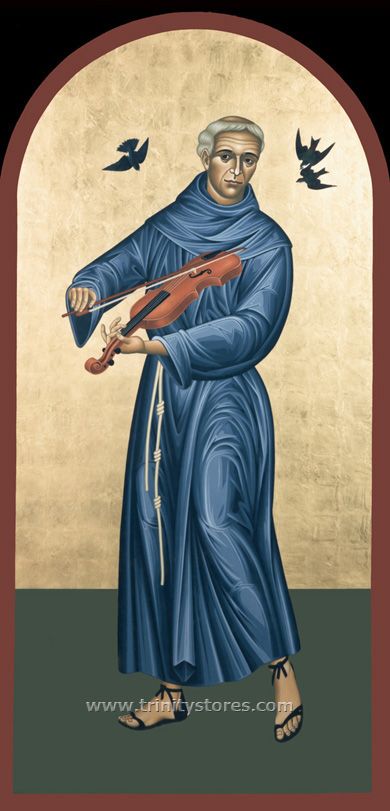
For twenty years Fr Francisco worked at evangelising the vast regions of Tucuman (present day northwestern Argentina) and Paraguay.   He had a skill for languages and succeeded at learning many of the regions’ native tongues in a fairly short period.   It is believed that he could also address tribes of different tongues in one language yet be understood by them all.   Being a musician as well, Solano also played the violin frequently for the natives.   He is often depicted playing this instrument.   Francisco exuded joy wherever he carried out his apostolate.   He was always happy and enthusiastic, whether fighting spiritual battles, suffering or contemplating.   This wonderful joy was infectious, the local tribes all grew to love him and through him, the Lord of our life whom he brought to them.
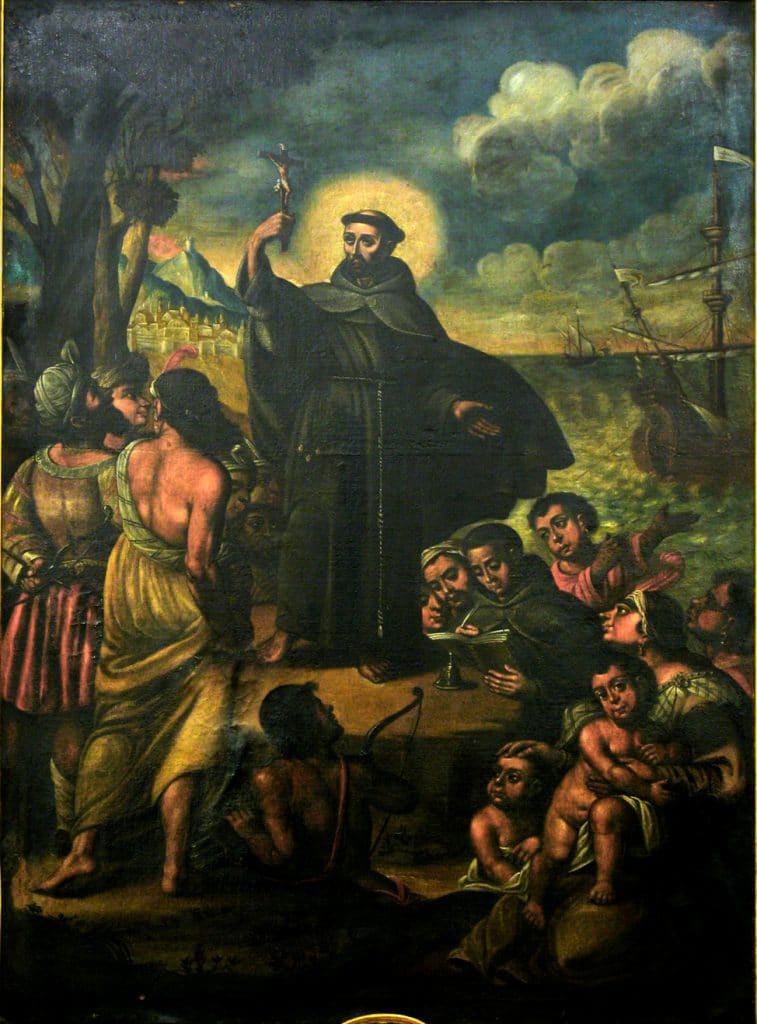
san-francisco-solano-santo-del-dia-18-de-abril-2-757x1024

At this time, Fr Francisco was appointment as Guardian of the Franciscan Friary in Lima, Peru and at the same time, he filled the same Office for the Friaries of his Order in Tucuman and Paraguay.

Around 1601 he was called to Lima, Peru, where he worked hard to recall the Spanish colonists to their Baptismal integrity.    Francisco predicted the devastating 1619 earthquake of Trujillo, Peru.   He died at Lima.

Solanus was Beatified by Pope Clement X in 1675 and Canonised by Pope Benedict XIII in 1726.   His feast is kept throughout the Franciscan Order on 24 July and in the Universal Calendar until post-Vatican II when it was altered to 14 July.st francisco solano drk
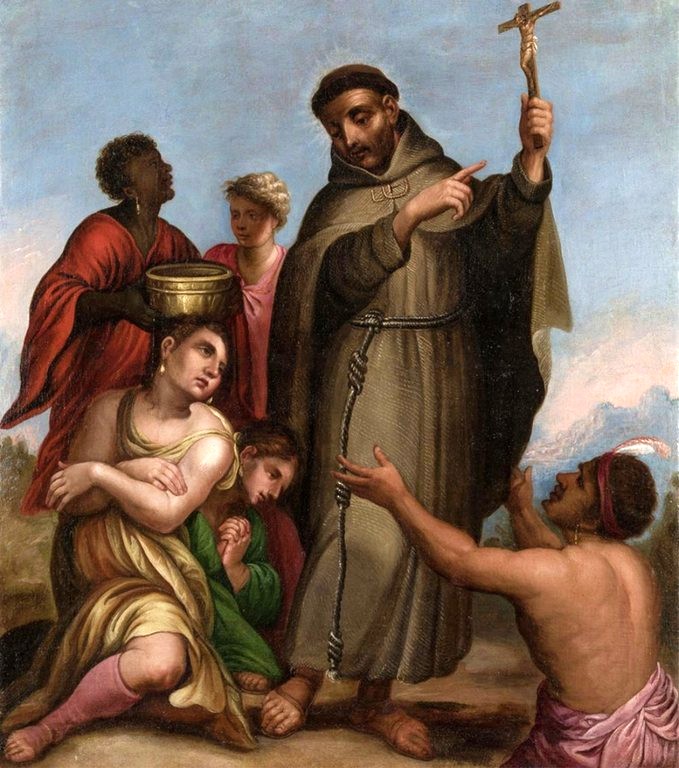
Still today, most wondrously, in Humahuaca, everyday at precisely 12 noon, on the City Hall bell-tower, heavy copper doors slowly open and a life-sized animated wooden, dramatic-looking Statue of St Francisco Solano appears for about two minutes and gives his Benediction to the silent crowd amassed on the village plaza.st Francis Solano header
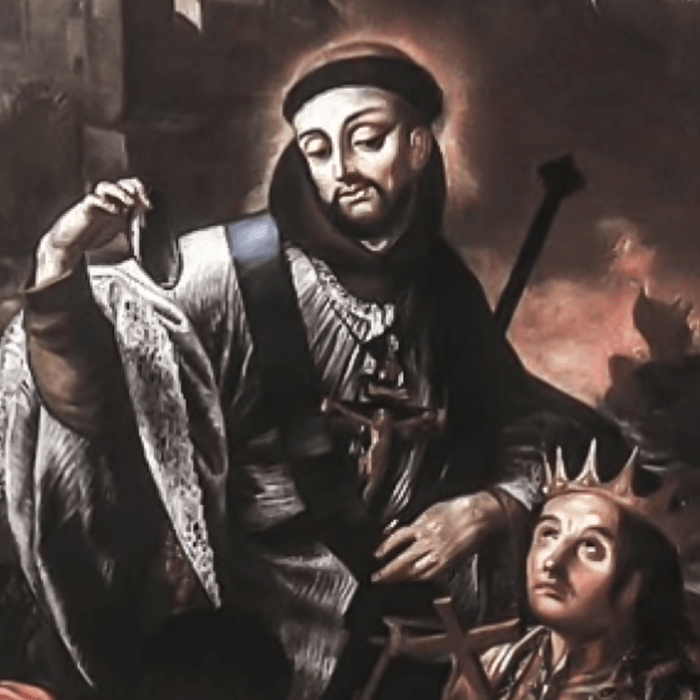
The whole life of Saint Francis Solano was Martyrdom and crucifixion; still, during his last two months on earth he was given the opportunity of winning God’s promised reward for suffering patiently as a Christian.   Very severe pains and a raging fever forced him to take to his bed for good.   But no illness could keep him from praying and during his last days the gift of contemplation was at work in him, to such an extent, that he seemed to be living all the time in the company of the angels.

He was so forgetful of his bodily wants that his ability to go on living seemed to be a miracle, even in the opinion of eminent doctors.   He kept on repeating with great feeling his favourite aspiration:  “God be glorified,” or some similar one.   Sometimes he asked that the Psalms “Bless the Lord, my soul” and “My soul, give thanks to the Lord” should be recited and these caused his heart to melt.   He even wanted to read Saint John’s Gospel for himself, beginning at the passage “It was before the festival of the Passover.”   The story of the Crucifixion especially affected him deeply and he would begin to speak of the suffering of Christ, giving Him thanks and praising the goodness and mercy shown to a sinner like him at such great cost.   Hymns in honour of Our Lady often helped him to feel better and he was filled with happiness and joy at the thought of her.   On one occasion he said to his confessor: “Father, help me to speak the praises of God,” immediately adding, “0 God, my Creator, my King and my Father, You are all my delight, you are everything to me.”   At this, the flame of divine love burned so fiercely that his soul was turned to inward things and was wholly occupied with spiritual joys, leaving him immobile, his senses numbed, his body like marble.

Five days before he died he said to the infirmarian, Brother John Gomez:  “Brother, have you noticed God’s great mercy to me in giving me the strength to overcome the enemy?”   Two days later he turned to the friar who looked after him and exclaimed with tears and sighs:  “How is it, my Lord Jesus, that You were Crucified while I have Your servants to care for me;   You were naked while I am clothed;  You were struck with blows and crowned with thorns, while I have everything I need to satisfy my wants and give me consolation?”   On the following day in the presence of many of the friars he cried out:   “God of my life, may You be glorified!   What honour You heap on me.   I rejoice, my Lord, that You are God, the source of all my joy!”

The night before he passed away he was rapt in ecstasy so that everyone thought he had died.   But he came to himself again and exclaimed:  “I rejoiced when I heard them say:  ‘Let us go to God’s house.”’   From then until the end, his face was suffused with an expression of overflowing joy, eagerness and beauty.   His soul exulted at the thought of the good things promised him and so broke out in these signs of joy.   A friar said to him:  “Father, after God has taken you to heaven, be mindful of me when you reach the eternal kingdom,” and Saint Francisco replied:  “It is true that I am going to Heaven but on the strength of Christ’s Passion and Death;  for myself, I am the greatest of sinners.   But I will be a good friend to you when I reach my home in Heaven.” … Acta Sanctorum July V Paris 1860 pages 884-6 – God of my life, Source of all joy:  glory to You.

Prayer

Father,
through Saint Francisco Solano
you led many inhabitants of South America
into the community of the Church.
By his merits and prayers
join our hearts to You in love
and lead non-believers to know and reverence Your name.
We ask this through our Lord Jesus Christ, Your Son,
who lives and reigns with You and the Holy Spirit,
one God, forever and ever.   AmenSt. Francis Solano
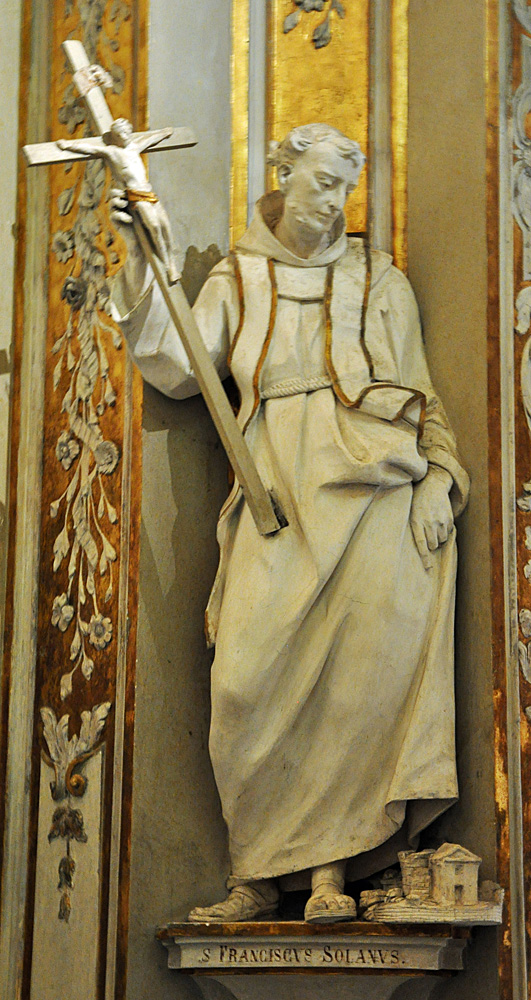
Posted in franciscan OFM, SAINT of the DAY

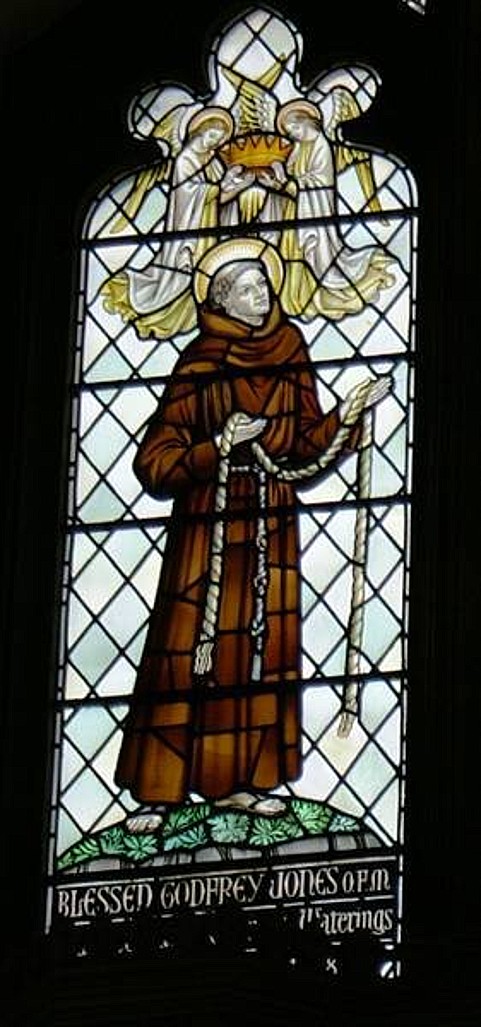
Saint of the Day – 12 July – Saint John Jones OFM (c 1574 – 1598) Priest and Martyr

Saint of the Day – 12 July – Saint John Jones OFM (c 1574 – 1598) Priest and Martyr, Franciscan Friar, Missionary – Born as Griffith Jones c 1574 in Clynog-Fawr, Carnarvonshire, Wales and died by being hanged, drawn and quartered in the early morning of 12 July 1598 at London, England.   He is one of the Forty Martyrs of England and Wales who are celebrated on 25 October.st john jones martyr
His real name was Griffith Jones but he was variously known as John Jones, John Buckley, John Griffith or Godfrey Maurice Jones.   He was born in the ancient parish of Clynnog into a staunch and recusant Welsh Catholic family who stayed true to their faith after the Protestant Reformation.

He entered the Observant Franciscan Convent at Greenwich as a youth. On the accession of Queen Elizabeth in 1558, Catholicism was banned so he went to the Continent and was Ordained at the Franciscan Monastery at Pontoise, France.   He studied at the English College at Douai.   After his Ordination at Rheims in 1585 he returned to the English mission but was captured and imprisoned in Wisbech Castle. He either escaped or was released and about 1592 made his profession as a Franciscan at the Convent of Ara Coeli in Rome, taking the name Godfrey.

His ‘Mission to England’ was approved by Pope Clement VIII and he returned in 1592, fully aware of the gruesome punishments inflicted on Catholic priests.

After two years he was arrested in Staffordshire.   In 1596 the priest-catcher Topcliffe had been informed by a spy that John Jones had visited two Catholics and said Mass in their house but it was afterwards shown that these people were in prison when the alleged offence took place.   However, he was promptly arrested and severely tortured.   He was also cruelly scourged and Topcliffe took him to his house and practised unspeakable barbarities upon him, all of which he endured with great fortitude.   He was then imprisoned for nearly two years in the Marshalsea Prison and on 3 July 1598, was tried on the charge of “going over the seas in the first year of Her Majesty’s reign (1558) and there being made a priest by the authority from Rome and then returning to England contrary to statute” (27 Eliz. c. 2) and sentenced to be hanged, drawn and quartered.
He was executed on 12 July 1598, some two miles outside of London.  By this time, the people had grown tired of these hateful spectacles and as the authorities were keen to avoid a riot, the execution was arranged for the early morning.   Despite this, a large crowd gathered. The executioner, called untimely from his bed, forgot his ropes.  During the delay while he went for them, the condemned man preached to the crowd and explained he was being martyred for his faith, not for disloyalty to his country.   The place was St Thomas’s Watering, in what is now the Old Kent Road, at the site of the junction of the old Roman road to London with the main line of Watling Street.

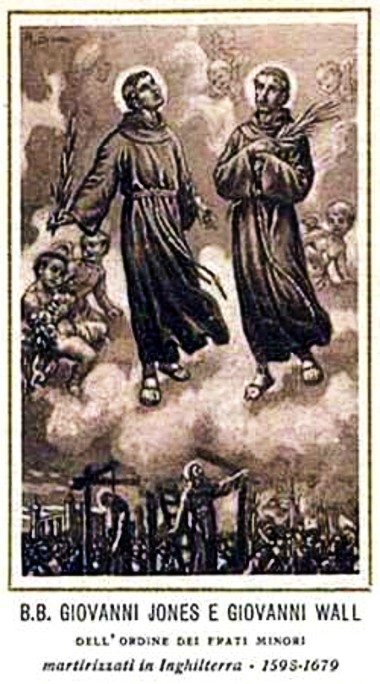
st john jones and john wall
Sts John Jones and St John Wall – Martyrs

The usual atrocities were carried out;  his dismembered remains were fixed on the poles on the roads to Newington and Lambeth (now represented by Tabard Street and Lambeth Road respectively);  some were removed by young Catholics, one of whom suffered long imprisonment for this.   One of these relics eventually reached the Monastery of Pontoise, where the Martyr had been ordained.

He was declared Venerable by Pope Leo XIII, Beatified in 1929 by Pope Pius XI and Canonised on 25 October 1970 by Pope Paul VI.

Posted in CHRIST, the WAY,TRUTH,LIFE, franciscan OFM, HOLY COMMUNION, I BELIEVE!, QUOTES of the SAINTS, SUNDAY REFLECTIONS, The HOLY EUCHARIST / The HOLY MASS

Sunday Reflection – 5 July – The Body of the Lord – St Francis of Assisi

Sunday Reflection – 5 July – “Month of the Most Precious Blood” – Fourteenth Sunday in Ordinary Time

Saint Francis of Assisi (c 1181-1226)
First Admonition

The Body of the Lord

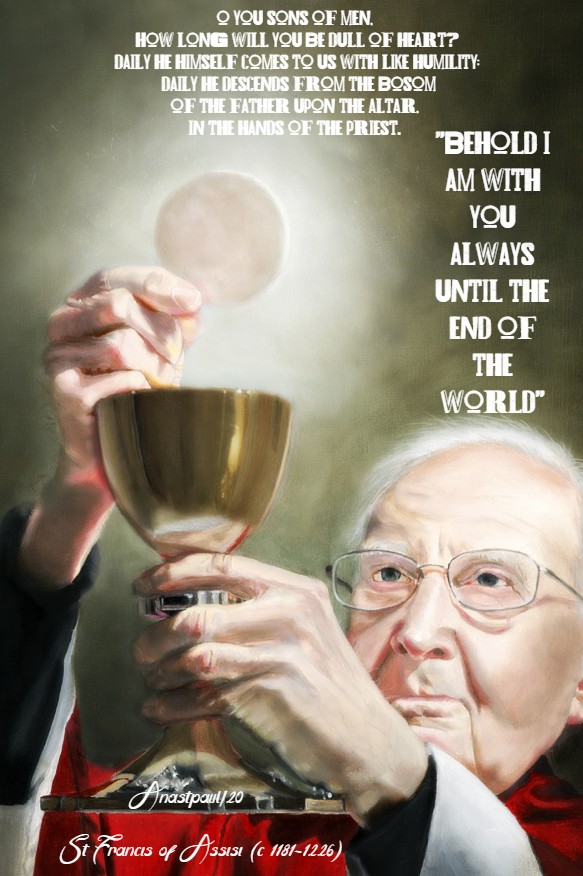
o you sons of men how longwill you be dull of heart - st francis 5 july 2020 sun reflection

“The Lord Jesus says to His disciples:   “I am the way, the truth and the life;  no-one comes to the Father but through me.   If you had known me, you would have known my Father also and from now on, you shall know him and have seen him.”    Philip says to him:  “Lord, show us the Father and it is enough for us.”  Jesus says to him:  “Am I with you so long a time and still you do not know me? Philip, he who sees me sees my Father also” (Jn 14:6-9).   The Father dwells in unapproachable light (1 Tim 6:16) and God is spirit (Jo 4:24) and no-one has ever seen God (Jo 1,18). Hence only in spirit can He be seen, for it is the spirit that gives life;  the flesh has nothing to offer (Jo 6:63).   Yet, neither is the Son, inasmuch as He is equal to the Father, seen by anyone other than by the Father, other than by the Holy Spirit.

Wherefore, all those who saw the Lord Jesus according to humanity and did not see and believe, according to the spirit and the divinity, that He is the true Son of God, were condemned.   So also now, all those who behold the Sacrament which is sanctified by the words of the Lord upon the altar, at the hand of the priest, in the form of bread and wine and do not see and believe according to the spirit and divinity, that it is truly the most Holy Body and Blood of our Lord Jesus Christ, are condemned.   This the Most High Himself attests, who says:  “This is my body and the blood of my New Testament” (Mk 14:22-24) and:  “who feeds on my Flesh and drinks my Blood will have everlasting life” (Jn 6:55).   Wherefore, the Spirit of the Lord, who dwells in His faithful ones, He it is who receives the most Holy Body and Blood of the Lord. All others who do not share of that Spirit and presume to receive Him eat and drink judgement to themselves (1Cor 11:29).

Wherefore, O you sons of men, how long will you be dull of heart? (Ps 4:3).   Why do you not recognise the truth and believe in the Son of God (Jo 9,35)?   Behold – daily He humbles Himself (Phil 2:8) as when from heaven’s royal throne (Wisd 18:15) He came down into the womb of the Virgin.    Daily He Himself comes to us with like humility;  daily He descends from the bosom of the Father ( Jo 1:18; 6,38) upon the altar, in the hands of the priest.   And, as He appeared to the Apostles in true flesh, so now also he shows himself to us in the Sacred Bread.   And, as they by their bodily sight saw only His flesh, yet contemplating Him with the eyes of the spirit, believed Him to be very God, so we also, as we see our bodily eyes the bread and wine, are to see and firmly believe, that it is His most holy body and blood living and true.   And in this way the Lord is always with His faithful, as He Himself says: “Behold I am with you always until the end of the world” (Mt 28:20).”

St Francis of Assisi

Posted in franciscan OFM, SAINT of the DAY

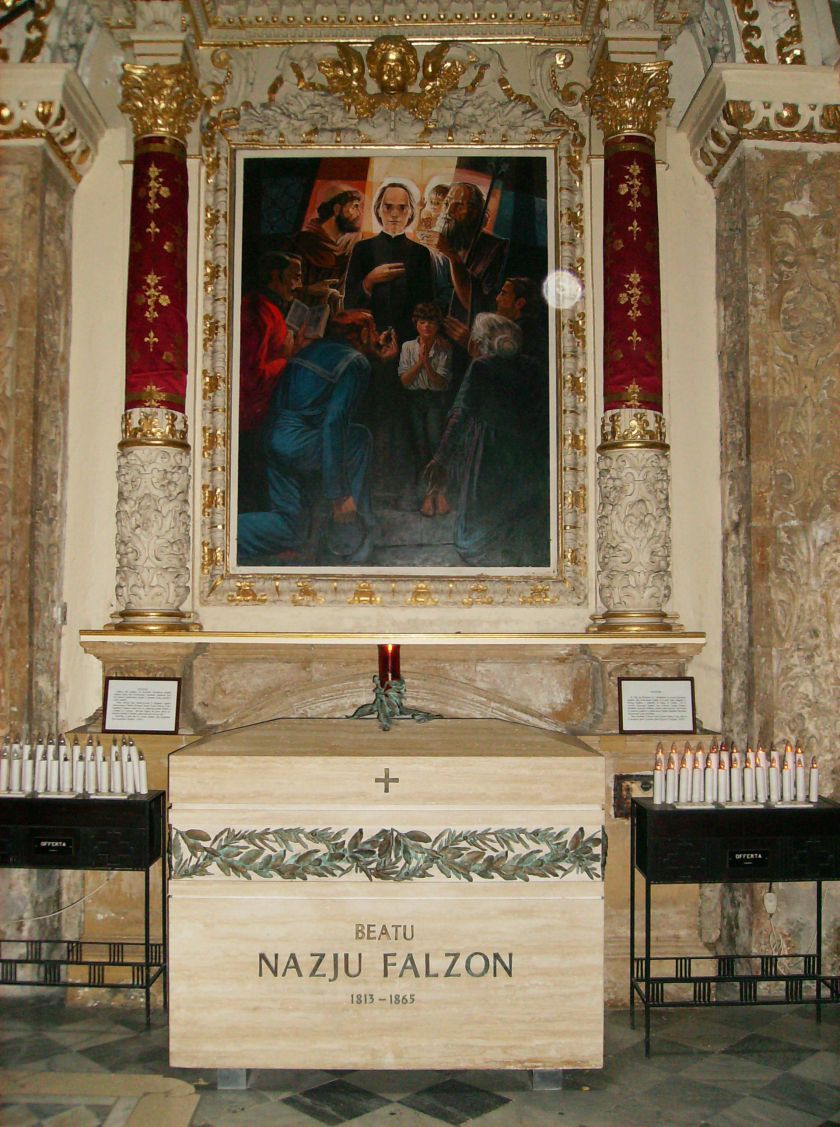
Saint of the Day – 1 July – Blessed Ignatius “Nazju” Falzon OFS (1813-1865)

Saint of the Day – 1 July – Blessed Ignatius “Nazju” Falzon OFS (1813-1865) Catechist, Confessor, Evangelist, Apostle of seamen, the poor and the marginalised, Apostle of the Passion of Our Lord and of the Blessed Virgi Mary,  Doctor of Civil and Canon Law, Writer.  He spread devotion to both the Stations of the Cross and the Holy Rosary in all his works – born on 1 July 1813 at Valletta, Malta and died on 1 July 1865, Valletta, Malta, aged 52.    Nazju was baptised on 2 July in the Church of Porto Salvo with the names of “Rocco Angelo Sebastiano Vincenzo Naju Rosario Falzon.”   Patronage – Catechists.bl Nazju_Falzon

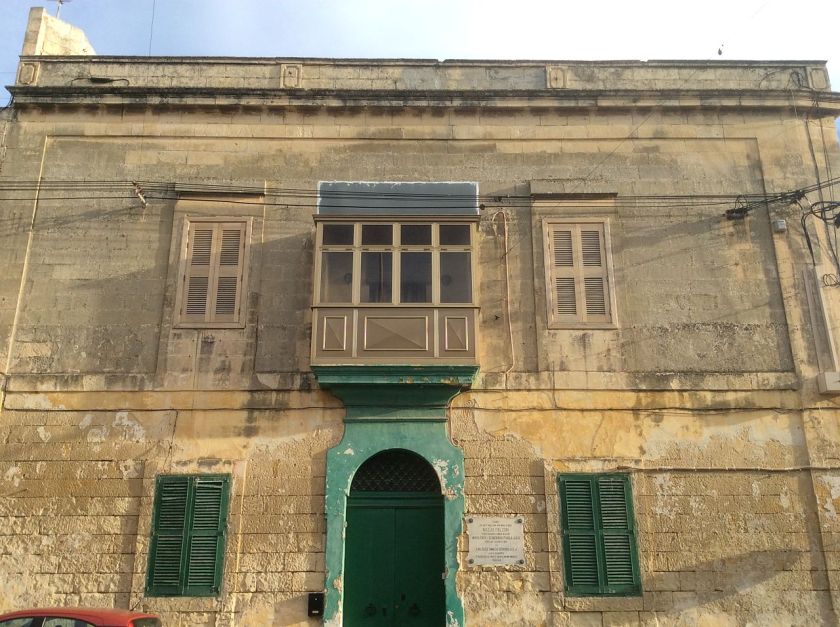
Blessed Nazju Falzon was born at 49, Strait Street, Valletta, the capital city of Malta.   His parents were Giuseppe Francesco Falzon, a doctor of laws and Maria Teresa Debono, the daughter of a Judge.

bl Nazju_Falzon_Palace._His_house
Bl Nazju’s Birth home

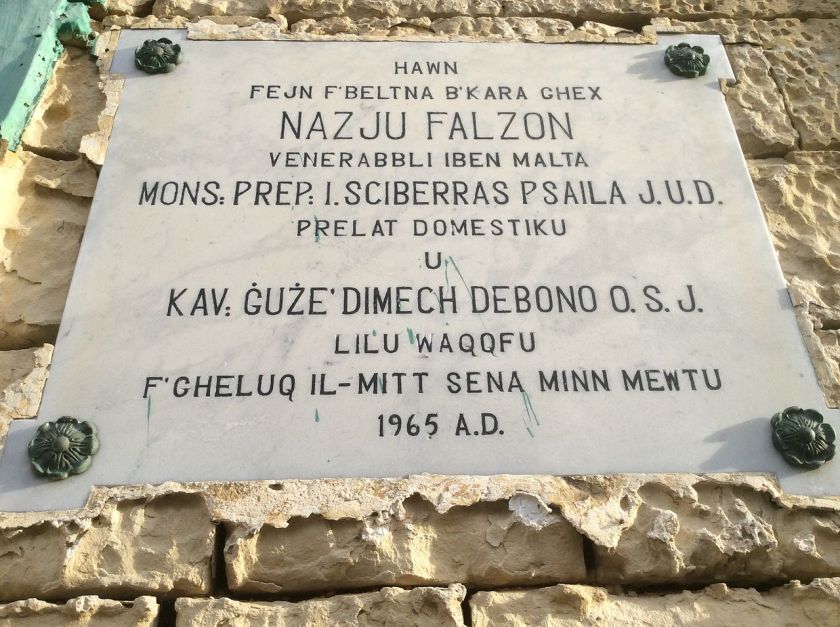
bl Nazju_Falzon_Plaque_on_his_palace.jpeg plaque

Nazju had three brothers – all four boys became lawyers and two of the brothers entered the Priesthood.   His brother Anthony became a lawyer and married, while his two brothers Kalcidon and Francis, became Priests.

Nazju was instituted a cleric when he was only 15, receiving three years later the Minor Orders from Bishop Publius M Sant OFM. Cap, at the Jesuit church in Valletta but he did not wish to be Ordained as a Priest, as he felt a deep sense of unworthiness, despite the local Bishop’s fervent encouragement.   At the age of 20, Nazju graduated as a Doctor of Civil and Canon Law from the University of Malta.   He became a lawyer to obey his father and to be able to help the poor who needed his advice, free of charge.

At the time of Nazju, poverty in Malta was rampant after being plagued several times by cholera.   Nazju’s love for the poor knew no bounds. He collected the rentals of the many fields his family owned, in different parts of Malta, to be able to help the poor.    His love towards the poor knew no limits.   His charity was so great, that on one occasion his brothers chided him, saying that his prodigality was ruining the family.   However, he took great pains to conceal all his good deeds from the eyes of the people, because he was careful not to yield to the temptation of pride.   And although he came from a well-to-do family and of a high social standing, he always manifested poverty. Nazju Falzon led a rather secluded life, shunned all vanities and performed acts of mortification.   He blushed whenever he was shown appreciation or was praised by others.   He affirmed he was a poor sinner and he attributed to God all his good qualities.

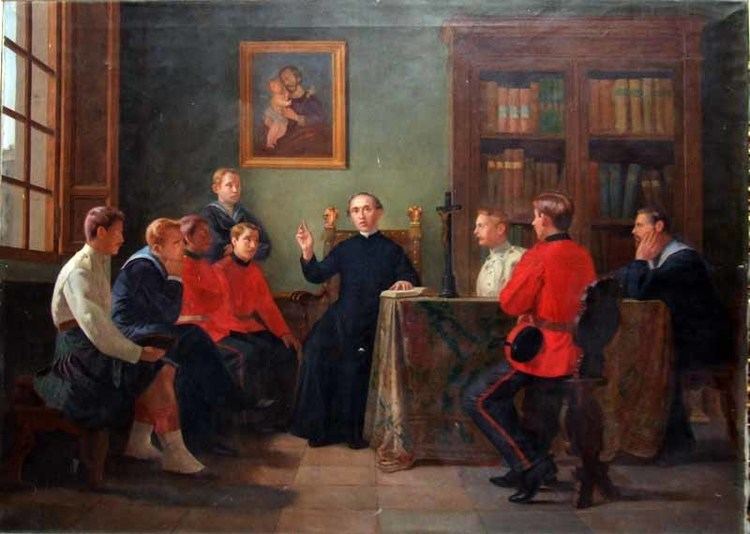
His apostleship consisted in teaching the Christian Catechism to boys and girls in Valletta.   Nazju was in fact a pioneer in the teaching of Catechism to the poor children of Valletta.   His love for the teaching of Catechism was demonstrated by the fact, that when his family went to Birkirkara. to their summer residence at 284, St Julian’s Road, he went to but primarily to teach Catechism to children at St Helen’s Basilica.bl nazju-falzon--resize-750

Another branch of his apostolate was the teaching of religion to British servicemen.   At the time of the Crimean War, their number amounted to about 20,000.  Those who were interested were brought to his own home for lessons and prayer.   More grew interested in this and it forced him to move and he soon found a new home for his work, at a Jesuit church in the capital of Valletta.   The soldiers would leave their valuables with him if they had to go to the battlefield, in the knowledge, that he would pass them on to their loved ones if killed or missing.   Nazju converted 656 Protestants, 4 Arabs and 2 Jews to the Catholic Faith.

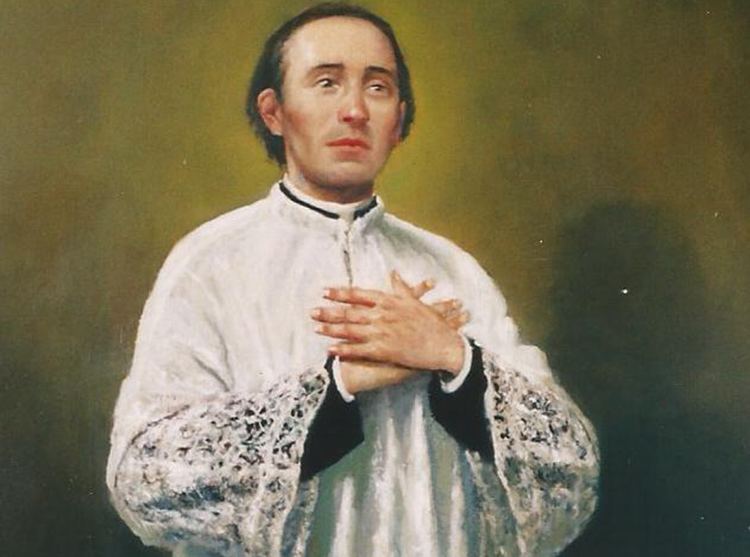
Nazju derived his energy for his apostolate from his love for the Eucharist.   He received Holy Communion daily and spent quite a long time giving thanks.   Nazju used to help Marianna Agius, the family servant in her work to enable her to go to Church to hear Mass and receive Holy Communion daily.bl nazju falzon in surplice

He was a great devotee of the Passion of Our Lord and prayed the way of the cross daily.   More than once he was seen elevated from the ground lost in ecstasy.

He had an immense devotion to the Blessed Virgin Mary too and recited the little office of Our Lady daily, together with more than fifteen decades of the Holy Rosary.

Nazju had also a great love for St Joseph.   He helped, financially, towards the building of the Parish Church of Mesida which was to be the first Church in Malta, to be dedicated to St Joseph.   He died embracing a picture of St Joseph.   His love for St Raphael, the Angel guide inspired his guidance of the children, the seaman and the poor and St Joseph Benedict Labre, was his inspiration for poverty of life.

A long time sufferer of heart spasms, he died on the 1 July 1865, as he had foretold, the day of his 52nd birthday.   The Funeral Service was held the following day in Ta’ Ġieżu Church in Valletta, where he was also buried in the family vault in the Chapel of the Immaculate Conception in the Church of the Franciscan Minors, Mary of Jesus in Valletta.

The Beatification miracle involved the 1981 cure of a man stricken with cancer, who was totally cured.   He was Beatified by St Pope John Paul II on 9 May 2001, in Malta, when he said:

“The Servant of God Ignatius Falzon also had a great passion for preaching the Gospel and teaching the Catholic faith.   He too, put his many talents and his intellectual training at the service of Catechetical work.   The Apostle Paul wrote that “each one must do as he has made up his mind, not reluctantly or under compulsion, for God loves a cheerful giver” (2 Cor 9:7).   Blessed Nazju was one who gave abundantly and cheerfully and people saw in him, not only boundless energy but also deep peace and joy.

He renounced the worldly success for which his background had prepared him, in order to serve the spiritual good of others, including the many British soldiers and sailors stationed in Malta at the time.   In his approach to them, few of whom were Catholic, he anticipated the ecumenical spirit of respect and dialogue, which is familiar to us today but which was not always prevalent at that time.

Ignatius Falzon drew his strength and inspiration from the Eucharist, prayer before the Tabernacle, devotion to Mary and the Rosary and imitation of Saint Joseph.   These are fountains of grace from which all Christians may drink.   Holiness and zeal for God’s Kingdom flourish especially where parishes and communities encourage prayer and devotion to the Blessed Sacrament.   I urge you, therefore, to cherish your Maltese traditions of piety, purifying them where necessary and strengthening them with sound instruction and Catechesis.   There would be no better way of honouring the memory of Blessed Nazju Falzon.  Amen.”

bl nazju falzon footer
Shrine to Blessed Nazju in the Church of Mary of Jesus in Valletta, where his relics also lie.
Posted in DOCTORS of the Church, franciscan OFM, MEDITATIONS - ANTONIO CARD BACCI, QUOTES - J R R Tolkien and MORE, QUOTES on DISCIPLESHIP, QUOTES on DIVINE PROVIDENCE, QUOTES on GRACE, QUOTES on MARTYRDOM, QUOTES on MISSION, QUOTES on PERSEVERANCE, QUOTES on PRAYER, QUOTES on SANCTITY, QUOTES on SELF-DENIAL, QUOTES on TEMPTATION, SAINT of the DAY

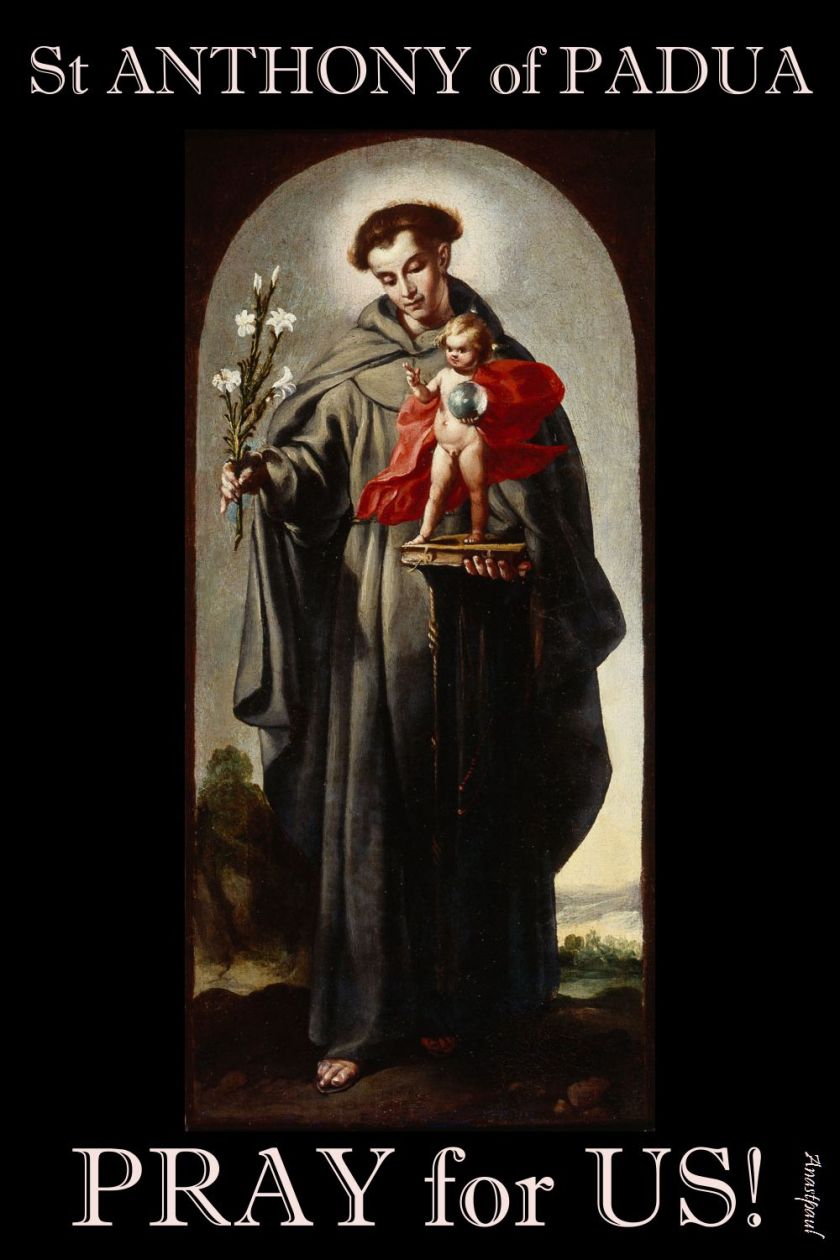
Thought for the Day – 13 June – St Anthony

Thought for the Day – 13 June – Meditations with Antonio Cardinal Bacci (1881-1971)

St Anthony

henceforward italy was st anthony second fatherland - bacci - gradual martyrdom 13 june 2020

“St Anthony of Padua was not born a saint but he became one as the result of prayer, self-denial and penance, which attracted to him, God’s many graces.

On a summer evening in the year 1219, five mendicant friars arrived at the gate of the ancient Abbey of Coimbra, asking for hospitality from the Canons Regular of St Augustine.
They received a whole-hearted welcome.
When they had refreshed themselves, they revealed that they belonged to the new Religious Family founded by St Francis of Assisi.
They said that they hoped to reach Morocco, in order to convert the Saracens and, if it was God’s pleasure, to receive the palm of Martyrdom.
Amongst the Canons Regular, who were listening to them, was the youthful Anthony, who had already consecrated his life to God.

Not long afterwards, this little band of Franciscan Missionaries, was cut down by the scimitars of the infidels and became a glorious band of Martyrs.
Their bodies were brought back in triumph to the Abbey which they had visited and there they were buried with great honour.
When they were going away, Anthony had listened enthusiastically to all that they had said and felt a noble envy.
Now that he was in the presence of their hallowed remains, he experienced an urge to follow in their footsteps.

St Anthony joined the Franciscan Order and joyfully set off for the coast of Morocco in search of Missionary labour and of Martyrdom.
But, when he landed on African soil, he was struck down by a serious attack of malaria, which compelled him to return to his native land.

There is no foreseeing the designs of Divine Providence.
The boat in which Anthony was travelling was battered by a tempest and had to go ashore in Italy.
Henceforward, Italy was Anthony’s second fatherland.
It was here, that he conducted his remarkable and fruitful apostolate and slowly accomplished his Martyrdom, by the daily struggle for perfection.

This, is a headline for us!
We may not have been called to go and spread the faith amongst the infidels, at the risk of Martyrdom.
But, we have all been called to a state of holiness.
Perfection, moreover, is a gradual Martyrdom.
The heroic daily effort which is required to abstain from sin and to overcome the wayward tendencies of our nature, can fairly be said, to be, no less difficult, than a bloody Martyrdom.
This is the kind of Martyrdom which we must all endure.
St Anthony of Padua, will obtain for us the grace, to undergo it with the same generosity and constancy, which he displayed.”

St Anthony of Padua, Pray for Us all! Amen.

Antonio Cardinal Bacci

ST ANTHONY OF PADUA PRAY FOR US 3

Posted in DOCTORS of the Church, franciscan OFM, MARIAN TITLES, SAINT of the DAY

13 June 1917 – The Second Apparition of our Lady of Fatima and Memorials of the Saints – 13 June

13 June 1917 – The Second Apparition of our Lady of Fatima

St Anthony of Padua OFM (1195-1231) (Memorial) (1195-1231) Doctor of the Church
St Anthony:
https://anastpaul.com/2017/06/13/saint-of-the-day-13-june-st-anthony-of-paduao-f-m-evangelical-doctor-hammer-of-heretics-professor-of-miracles-wonder-worker-ark-of-the-covenant/
AND:
https://anastpaul.com/2018/06/13/saint-of-the-day-13-june-st-anthony-of-padua-o-f-m-evangelical-doctor-hammer-of-heretics-professor-of-miracles-wonder-worker-ark-of-the-tes/
AND A SERMON BY ST ANTHONY:
Actions Speak Louder than Words:  https://anastpaul.com/2019/06/13/thought-for-the-day-13-june-actions-speak-louder-than-words/


Bl Achilleo of Alexandria
Bl Alfonso Gomez de Encinas
Bl Anthony of Ilbenstadt
St Aquilina of Syria
St Augustine Phan Viet Huy
St Aventino of Arbusto
St Damhnade
St Diodorus of Emesa
St Eulogius of Alexandria
St Fandilas of Penamelaria
St Felicula of Rome
St Fortunatus of North Africa

Bl Gerard of Clairvaux – was the brother of Saint Bernard of Clairvaux.   He was a Soldier.   When he was wounded in combat at the siege of Grancy, Gerard resolved to become a monk.   He became a Benedictine Cistercian monk at Citeaux.   He worked with Saint Bernard at Clairvaux and became his closest confidant.    He died in 1138 of natural causes.

St Lucian of North Africa
St Mac Nissi of Clonmacno

Blessed Marianna Biernacka (1888-1943) Martyr of the Nazi Regime

Below is a video I believe features Anna herself.   I, of course, do not know Polish, but another website had a picture of Anna and it was the same woman, so I believe I am correct in this supposition.   It’s in Polish and throughout much of the video she is singing a song.   It’s quite beautiful.   If any of you know Polish I’d be grateful for information about what’s she’s saying and singing or if it is in fact Anna.

St Maximus of Cravagliana
St Nicolas Bùi Ðuc The
St Peregrinus of Amiterno
St Rambert
St Salmodio
Bl Servatius Scharff
St Thecla
St Tryphillius of Leucosia
St Victorinus of Assisi
St Wilicarius of Vienne

Posted in franciscan OFM, SAINT of the DAY

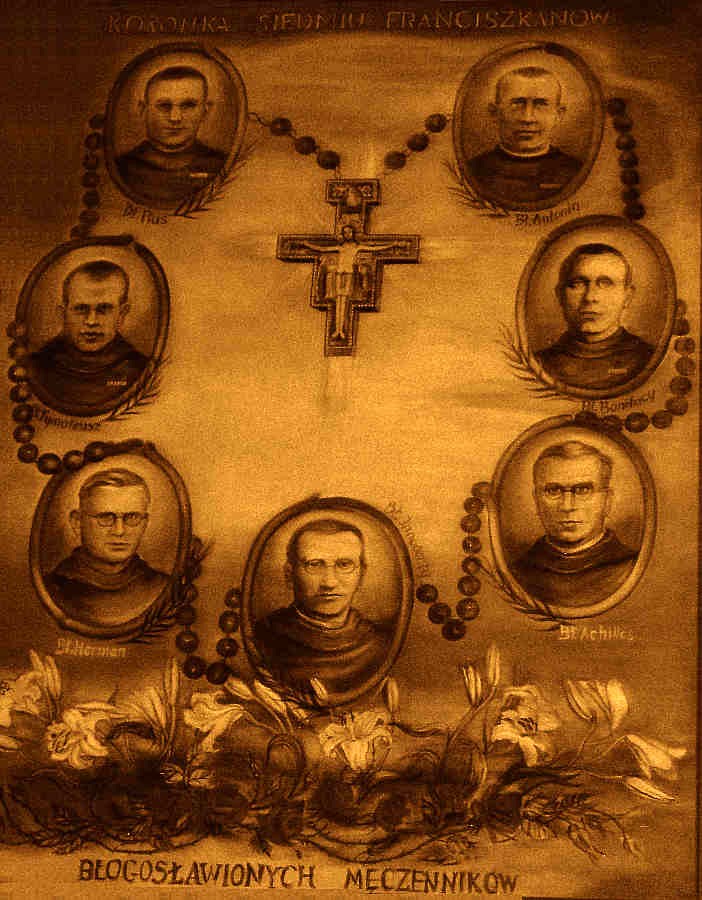
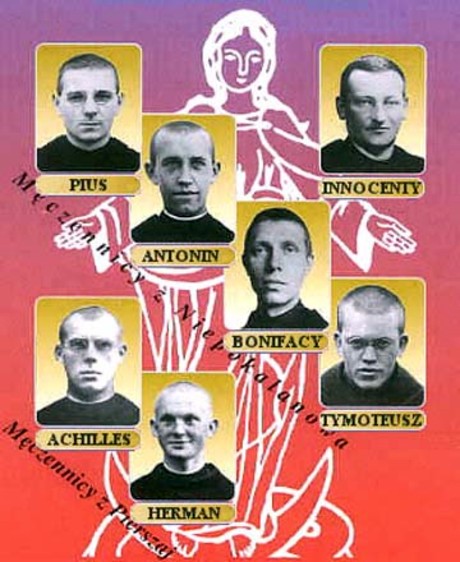
Saint of the Day – 6 June – Blessed Innocenty Józef Wojciech Guz OFM (1890-1940) Priest and Martyr

Saint of the Day – 6 June – Blessed Innocenty Józef Wojciech Guz OFM (1890-1940) Priest of the Franciscan Conventual and Martyr of the Nazi Regime – born as Józef Adalbert Guz on 8 March 1890 in n Lemberg, Austria (present-day Poland) and died from trauma resulting from having a charged fire hose stuffed down his throat on 6 June 1940 in the prison camp at Sachsenhausen-Oranienburg, Oberhavel, Germany.   He was 50 years old.   Additional Memorial – 12 June as one of the 108 Polish Martyrs of World War II.Blessed-Józef-Wojciech-Guz

After high school Jozef tried to join the Jesuits but was turned down. On 25 August 1908 be joined the Franciscans, taking the name Innocenty.   He studied philosophy and theology in Krakow, Poland and was ordained on 2 June 1914.   He served as a Parish Priest in a number of cities and worked with Saint Maximilian Kolbe.

He was a confessor to a Franciscan monastery at Niepokalanów, Poland from 1933 to 1936, vice-master of clerics and singing teacher in the minor seminary and Parish Priest in Grodno, Poland.

He was imprisoned by invading Russia troops on 21 March 1940 for the crime of being a Polish Priest but he managed to escape and went to the German zone, where he was arrested by the Gestapo.   He was sent to several prisons before finally ending at the concentration camp at Sachsenhausen where he was severely beaten and put to forced labour.   When he could not work, owing to a broken leg, he was nearly drowned and finally murdered.bl j-zef-innocenty-guz-4_orig

He was Beatified on 13 June 1999 by St Pope John Paul II at Warsaw, Poland.   Below are the Franciscan Martyrs of the World War II.bl j-zef-innocenty-guz-5_origbl j-zef-innocenty-guz-6_orig

Posted in franciscan OFM, SAINT of the DAY

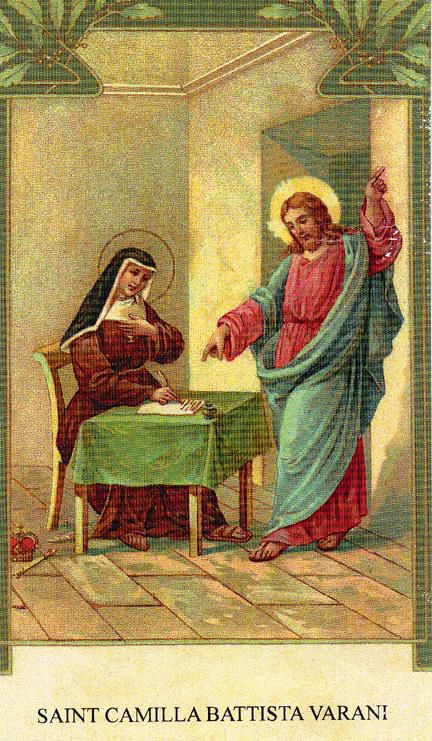
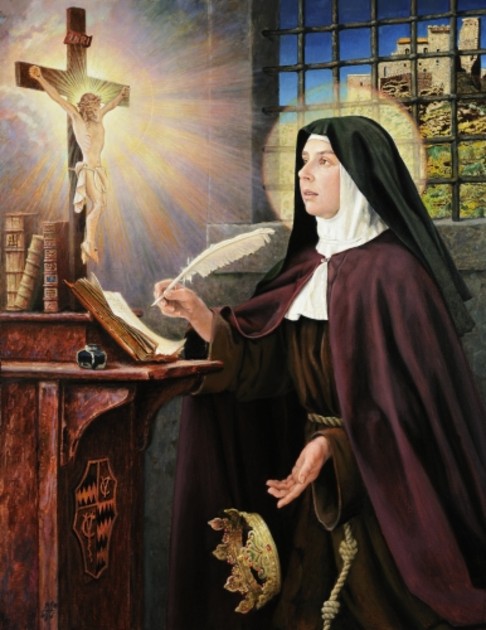
Saint of the Day – 31 May – Saint Camilla Battista da Varano OSC (1458-1524)

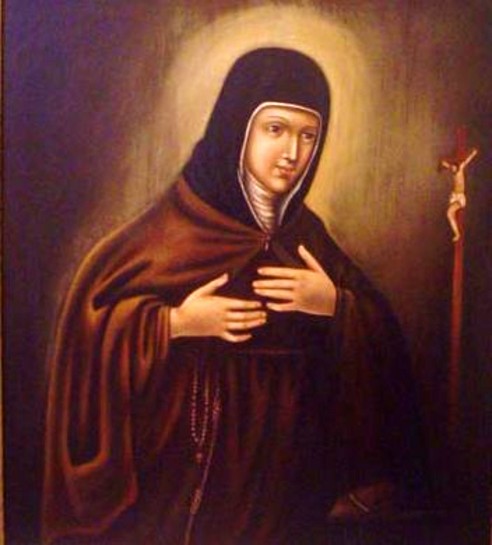
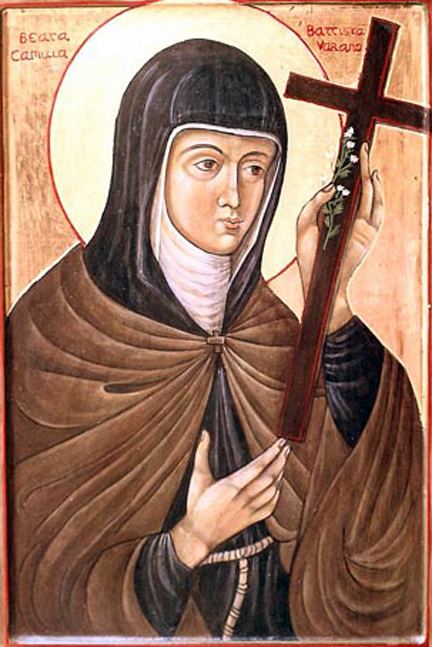
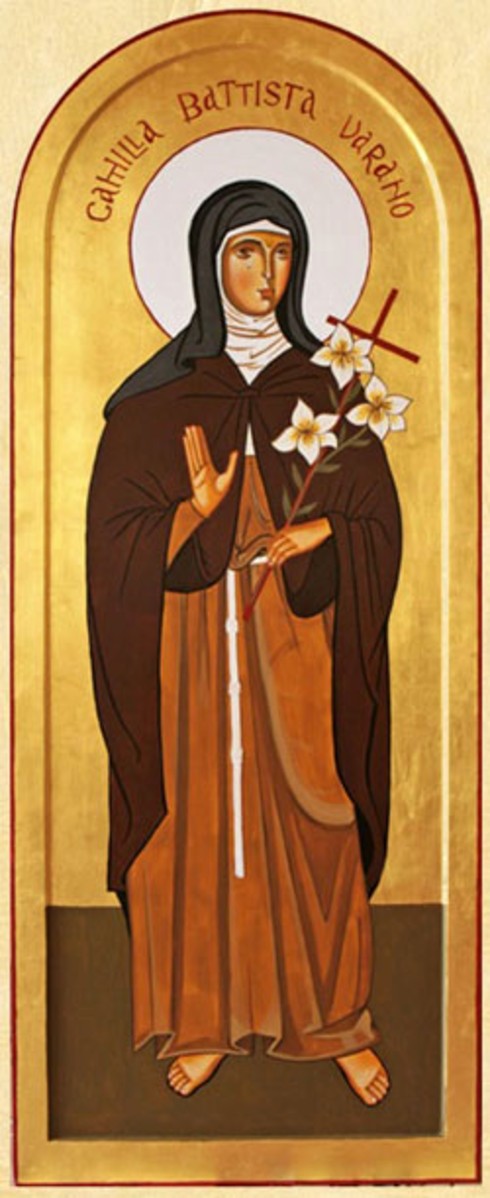
Saint of the Day – 31 May – Saint Camilla Battista da Varano OSC (1458-1524) Italian Princess, Virgin, Poor Clare Nun and Abbess, Mystic, Spiritual Writer, Stigmatist – born on 9 April 1458 in Camerino, Macerata, Italy and died on 31 May 1524 in Camerino, Macerata, Italy of natural causes.st Camilla varano

Camilla Battista was born into nobility in Camerino, Italy on 9 April 1458.   As a Princess in the home of her father Duke Giulio Cesare da Varano she grew up in the court and received a good education.

1024px-st camilla's family home
Palace of Blessed Camilla’s father, the Duke of Camerino

Around the age of 9 she listened to a sermon on Good Friday preached by Domenico of Leonessa, a Franciscan friar who later became one of her confessors.   He ended his sermon by encouraging his listeners to shed one teardrop for the Passion of Christ.   She resolved to show her love for Jesus by shedding a tear each Friday.   Though not initially drawn to the spiritual life, she persevered in her vow and would squeeze out a tear before running off to play.   She found a booklet that contained a meditation on the Passion of Christ divided into 15 parts to be prayed like a rosary.   She began to pray this devotion each Friday while on her knees before a Crucifix.   Other spiritual practices like fasting and night vigils began to attract her even though she continued to spend time in the youthful pursuits of court life.

During Lent of 1479 a sermon she heard touched her deeply, inspiring her to take a private vow of chastity.   Her father initially opposed her desire to enter religious life as he wanted her to marry.   She wanted to enter the Poor Clare Monastery in Urbino.   Her spiritual life deepened during the few years before she actually entered the Monastery. She wrote Lauda (Praises) during this time – a work in which she expressed the joy she felt in knowing that Jesus loved her.st camilla holy card

On 24 November 1481 she entered the Poor Clare Monastery in Urbino and made her profession in 1483.   Early in 1484, she transferred to the new Monastery of Santa Maria Nuova at Camerino which was close to her father’s castle.   Her father had made arrangements with the Pope and the Vicar General of the Friars to have her moved there. She was reluctant to do so and went only under obedience.Saint-Camilla-Battista-Varano

While living in the Monastery in Urbino, she experienced visions and composed several other spiritual works.   She was elected Abbess in 1500.   The following year, due to political disagreements, her father and her brothers were killed and she was forced to flee to the Abruzzo region until 1503 when she felt safe to return to Camerino.   She founded a Monastery in Fermo and trained a group of nuns in San Severino Marche who adopted the Rule of St Clare.

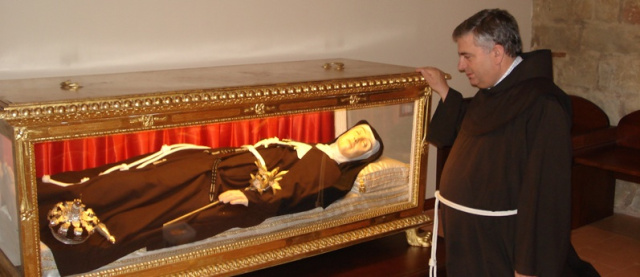
She died in her Monastery in Camerino during a plague on 31 March 1524, on the Feast of Corpus Christi, at the age of 66.   Her remains were placed to rest in the crypt of the Monastery of the Poor Clares of Camerino.st camilla body

St Camilla wrote with equal facility in Latin and Italian and who was accounted one of the most accomplished scholars of her day.   The Major Works of St Camilla Battista da Varano are:
Praises of the Visions of Christ, 1479 – 1481
Remembrances of Jesus, 1483
Treatise on the Mental Sufferings of Jesus Christ our Lord, 1488
The Spiritual Life, 1491 (Autobiography)
Her Autobiography from 1466-1491 which is considered a “jewel of art” and of the spiritual life.   In this work, she describes how two Seraphim with wings of gold, appeared to her because they were assigned to help her understand the mysterious working of unitive love.

“Two angels came to me, dressed in resplendent white garments which I have seen only worn by Jesus. They had wings of gold. One of them took my soul from the right side, the other from the left side and they elevated it in the air, laying it down near the crucified feet of the Son of God made Man. This state lasted about two months almost continually, I seem to walk, to speak and do what I wished, deprived however of my soul. It remained there where the two Angels had placed it but they never abandoned it.

…They (the celestial spirits) declared to me, that they were so intimate with God that God is not ever separated from them. They also explained to me, that the Seraphim were likewise united to the Cherubim, in that none of them could ever go without the other to a soul.” – Camilla Varano, The Spiritual Lifest camilla-battista-da-varano icon

Both Saint Philip Neri and St Alphonsus Liguori recorded their admiration for her.

On 8 April 1821 Pope Leo XIII approved the acts of the process for her Canonisation. She was Beatified by Pope Gregory XVI on 7 April 1843, following recognition of her long-standing public cult.   On 4 February 1893 her writings were also approved.   On 17 October 2010 Pope Benedict XVI Canonised her, along with five others.

Prayer for the Intercession of
St Camilla Battista da Varano

Holy and Blessed Trinity,
You granted Camilla Battista the ability
to live as a true daughter of the Father,
to adhere to the Gospel of our Lord Jesus Christ,
and to allow herself to be moulded
by the fire of the Holy Spirit.
Grant me the grace to imitate her example
and to make, of my life,
a reflection of her beauty
and of her sanctity.
Grant me, I pray,
through the intercession of Saint Camilla Battista,
this grace that I ask
…………………………………………..
(here state the favour you are requesting)  Amen
Our Father, Hail Mary, Glory be…
==============================================st camilla-battista full icon

Posted in "Follow Me", CHRIST, the WAY,TRUTH,LIFE, DOCTORS of the Church, franciscan OFM, QUOTES of the SAINTS, QUOTES on DISCIPLESHIP, QUOTES on ETERNAL LIFE, QUOTES on EVANGELISATION, QUOTES on HEAVEN, QUOTES on LOVE of GOD, QUOTES on the CHURCH, SAINT of the DAY, The WORD

One Minute Reflection – 30 May –  ‘Jesus loves the one who follows Him.’

One Minute Reflection – 30 May – “Mary’s Month” – Saturday of the Seventh Week of Easter, Readings: Acts 28:16-20, 30-31, Psalm 11:4-5, 7, John 21:20-25 and the Memorial of St Ferdinand III King (1199-1252)

Peter turned and saw the disciple following whom Jesus loved, the one who had also reclined upon his chest during the supper”  … John 21:20

REFLECTION – “The love of Jesus for His faithful disciple is shown by the words:  “Peter turned and saw the disciple following whom Jesus loved, the one who had also reclined upon his chest during the supper” (Jn 21:20).

Someone who truly follows the Lord wants everyone to follow Him, which is why He turns to his neighbour with kind attentions, prayers and proclamation of the Gospel. Peter’s turning around, signifies all those things.   In the book of Revelation we find the same idea:  “The bridegroom and the bride – Christ and the Church – say:  ‘Come!’   Let him who hears say: ‘Come!'” (Rv 22:17).   Christ, through interior inspiration and the Church, by preaching, say:  “Come!”   And whoever hears these words says to his neighbour: “Come!” which is to say:  “Follow Jesus!”   Then Peter, turning round, saw the disciple whom Jesus loved following after.   Jesus loves the one who follows Him.

Although his name is not mentioned, John stands out from the others, not because Jesus only loved him but because He loved him more than the others.   He loved all the others but this man was closer to Him. …  It was he who “reclined upon His chest during the supper” (Jn 21:20).   This was a great sign of love, the fact that he alone could have leaned on the chest of Jesus, “in whom are hidden all the treasures of wisdom and knowledge” (Col 2:3). …

And so, during the Supper in heaven, we shall be satisfied for eternity, we shall take our rest together with John on the chest of Jesus.   The heart is in the chest;  love is in the heart.   We shall rest in His love because, we shall love Him with all our heart and all our soul and shall discover in Him all the treasures of wisdom and knowledge. … So to Him be the praise and the glory for endless ages. Amen. … St Anthony of Padua (1195-1231) Evangelical Doctorjohn 21 20 - peter turned and saw the disciple following whom jesus loved-someone who truly follows the lord - st anthony of padua 30 may 2020

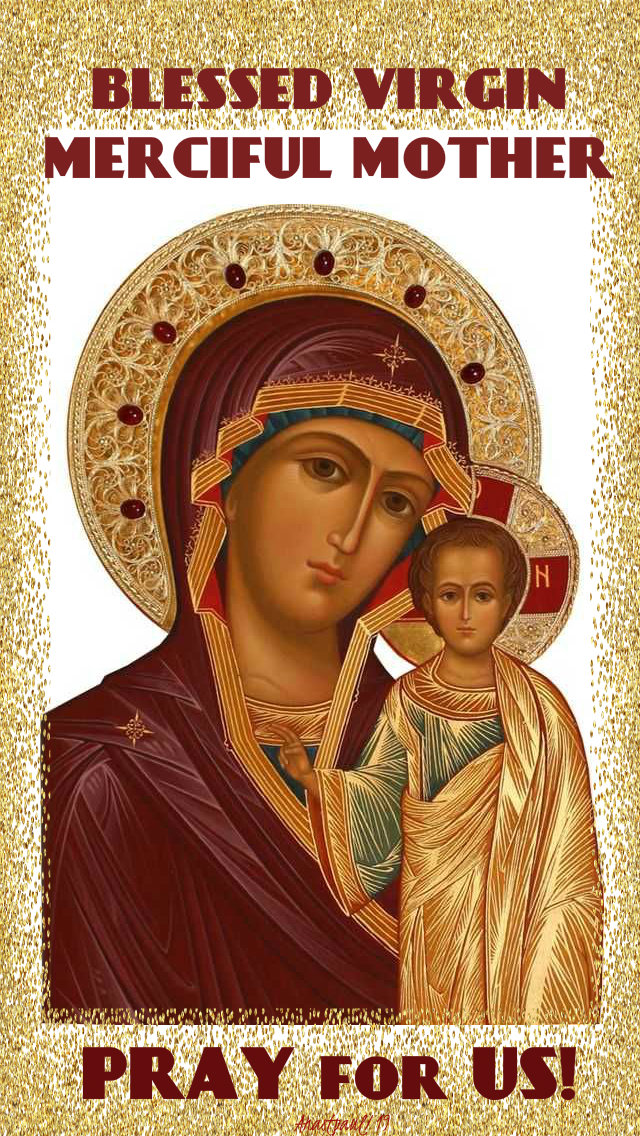
PRAYER – Almighty God and Father, Your ways are not our ways, teach us to willingly agree to them, for You know which way we should go.   Help us to say “yes” always to Your plan and to render ourselves, as a sacrament of Your divine love to all we meet.   Fill us with the grace to be your tools, to bring glory to Your kingdom.   Our Father, who art in heaven, may Your Will be done on earth, as it is in heaven.   Mary Mother of God, pray for us!   St Ferdinand, you who with the earthly power which rested on you, showed forth only the Love, Power and Will of God, Pray for Us!   Through our Our Lord Jesus Christ with You, in the union of the Holy Spirit, one God forever, amen.blessed virgin merciful mother pray for us 30 oct 2019

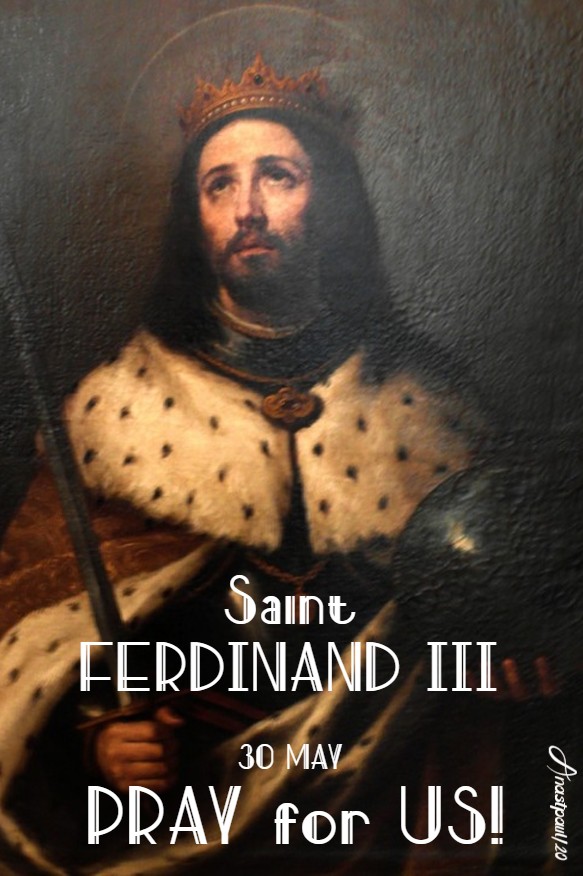
st ferdinand III pray for us 30 may 2020

Posted in franciscan OFM, INCORRUPTIBLES, MYSTICS, SAINT of the DAY

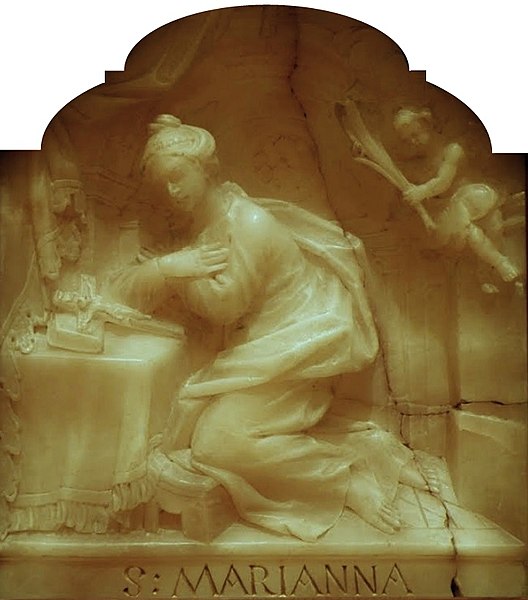
Saint of the Day – 26 May – Saint Mariana de Jesus de Paredes OFS (1618-1645) “The Lily of Quito”

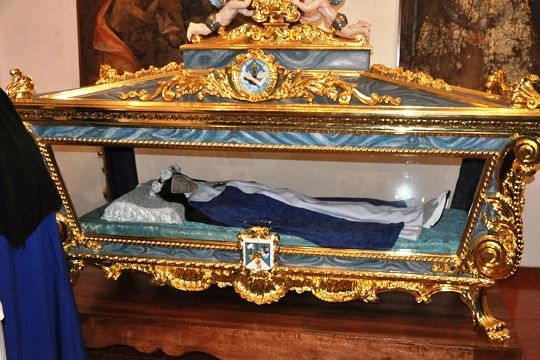
Saint of the Day – 26 May – Saint Mariana de Jesus de Paredes OFS (1618-1645) “The Lily of Quito,”Third Order Franciscan, Hermit, Penitent, Mystic, Ecstatic, miracle-worker. She was endowed with the charism of prophecy.   Born as María Ana de Jesús de Paredes y Flores on 31 October 1618 at Quito, Ecuador and died on 26 May 1645 at Quito, Ecuador, aged 26.   St Mariana is first Canonised Saint of Ecuador and she has been declared a National Herione.   Patronages – Ecuador, Americas, bodily ills, loss of parents, people rejected by religious orders, sick people, sickness.   Her Incorrupt body is enshrined in the Cathedral of La Iglesia de la Compañía de Jesús.st mariana de jesus header

Mariana de Jesus de Paredes was born in the city of Quito, in the New Kingdom of Granada (modern-day Ecuador).    She was born of aristocratic parents on both sides of her family, her father was Don Girolamo Flores Zenel de Paredes, a nobleman of Toledo, Spain and her mother was Doña Mariana Cranobles de Xaramilo, a descendant of one of the best Spanish families.   Mariana was the youngest of eight children and it is claimed her birth was accompanied by most unusual phenomena in the heavens, clearly connected with the child and juridically attested at the time of the process of her Beatification.  St.-Mariana

She was orphaned at a very young age and, thereafter, she was raised by her older sister, Jerónima de Paredes and the latter’s husband, Cosme de Caso.    Mariana was drawn to a spiritual life, her sister and brother-in-law allowed her to live in seclusion in their house, living “the life of an uncloistered beata,” similar to Rose of Lima to whom she is often compared.   She was refused entry into a convent, despite supplication by her brother-in-law and surrogate father, Cosme de Caso.   She subjected herself to bodily mortification, with the aid of her Indian servant.   She did not live in total seclusion but rather focused her spiritual life on the nearby Jesuit church, where she participated in a number of apostolates.

Her spiritual life was closely connected to the Jesuits and her religious name “de Jesús” was no doubt intentional.   Following her death in 1645, her funeral and burial were in the Jesuit church.   The funeral sermon that the priest Fr Alonso de Rojas preached emphasised her bodily mortification and renunciation of the flesh and put her forward as a model for females in Quito to emulate.   “Learn girls of Quito, from your fellow countrywoman, [to prefer] holiness over beauty, virtues over ostentation.”  The sermon became a key document in the long process to establish her saintliness, Beatification (1853) and final Canonisation (1950).st mariana de jesus v lg

The Franciscans claimed de Paredes as a holy person.   She did wear the Franciscan scapulary and sash but her seventeenth-century Jesuit hagiographer, Jacinto Morán de Butrón, confirmed that the Jesuits nurtured her spiritual life.   Soon after Mariana’s 1645 death, the Franciscan province of Peru, based in Lima, included a biography of Mariana in the history of the province citing the Jesuit funeral sermon as a source.   She received the habit of the Third Order from the Franciscans in her native town of Quito.   ccording to her Jesuit hagiographer, Mariana did not go to the Franciscan church to receive the garments but sent someone else.

It is reported that the fast which she kept was so strict that she took scarcely an ounce of dry bread every eight or ten days.   The food which miraculously sustained her life, as in the case of Catherine of Siena and Rose of Lima, was, according to the sworn testimony of many witnesses, the Eucharist alone, which she received every morning in Holy Communion.st mariana de jesus graphic

Mariana possessed an ecstatic gift of prayer and is said to have been able to predict the future, see distant events as if they were passing before her, read the secrets of hearts, cure diseases by a mere sign of the Cross or by sprinkling the sufferer with holy water and at least once restored a dead person to life.    During the 1645 earthquakes and subsequent epidemics in Quito, she publicly offered herself as a victim for the city and died shortly thereafter.st mariana de jesus statue

It is also reported that, on the day she died, her sanctity was revealed in a wonderful manner –  immediately after her death, a pure white lily sprang up from her blood, blossomed and bloomed, a miracle which has given her the title of “The Lily of Quito.”   The Republic of Ecuador has declared her a national heroine.528px-Fesinger_Saint_Mary_Ann_de_Paredes footer statue

St Mariana was Beatified on 10 November 1853, Rome by Pope Pius IX and
was Canonised on 9 July 1950 Rome, by Pope Pius XII.

St Mariana’s incorrupt body is exposed and venerated at her shrine at the Cathedral of La Iglesia de la Compañía de Jesús, known colloquially as La Compañía, is a Jesuit Cathedral in Quito, Ecuador. st mariaa de jesus incorrupt body

576px-Quito-La_Compania-01

588px-Iglesia_de_La_Compañía,_Quito,_Ecuador,_2015-07-22,_DD_125-127_HDR

Posted in CHRIST, the WAY,TRUTH,LIFE, franciscan OFM, QUOTES of the SAINTS, QUOTES on CONSCIENCE, QUOTES on COURAGE, QUOTES on DEATH, QUOTES on DISCIPLESHIP, QUOTES on GRACE, QUOTES on HEAVEN, QUOTES on JUSTICE, QUOTES on MARTYRDOM, QUOTES on PERSECUTION, QUOTES on PRAYER, QUOTES on SACRIFICE, QUOTES on SANCTITY, QUOTES on SILENCE, QUOTES on the CHURCH, QUOTES on the DEVIL/EVIL, QUOTES on TRUTH, SAINT of the DAY

Quote/s of the Day – 21 May – Blessed Franz Jägerstätter (1907-1943) Layman Martyr “A Saint for our Times!”

Quote/s of the Day – 21 May – Thursday of the Sixth Week of Easter and the Memorial of Blessed Franz Jägerstätter OFS (1907-1943) Layman Martyr “The Man Who Would Not Bow His Head to Hitler.”

“If the Church stays silent
in the face of what is happening,
what difference would it make,
if no church were ever opened again?”

if the church stays silent - bl franz jagerstatter 21 may 2020

His sacrifice was uniformly regarded as foolish by his neighbours and his story almost forgotten but for a book written by an American, Gordon Zahn, who heard of Jagerstatter when researching the subject of German Catholics’ response to Hitler.
This book, In Solitary Witness, influenced Daniel Ellsberg’s decision to stand against the Vietnam War by bringing the Pentagon Papers to public attention.   The following quote, taken from one of Jagerstatter’s last letters while in prison.

“Just as the man who thinks only of this world, does everything possible to make life here easier and better, so must we, too, who believe in the eternal Kingdom, risk everything in order to receive a great reward there.
Just as those who believe in National Socialism tell themselves that their struggle is for survival, so must we, too, convince ourselves that our struggle is for the eternal Kingdom.
But with this difference – we need no rifles or pistols for our battle but instead, spiritual weapons – and the foremost among these is prayer…. Through prayer, we continually implore new grace from God, since without God’s help and grace it would be impossible for us to preserve the Faith and be true to His commandments….”

we need no rifles or pistols for our battle - bl franz jagerstatter 21 may 2020

“Let us love our enemies,
bless those who curse us,
pray for Those who persecute us.
For love will conquer
and will endure for all eternity.
And happy are they who live
and die in God’s love.”

let us love our enemies - bl franz jagerstatter 21 may 2020

“I can say from my own experience
how painful life often is,
when one lives as a halfway Christian-
it is more like vegetating than living.”

halfway christian more like vegetatin gthan living bl franz jagerstatter 21 may 2020

“We are not dealing with a small matter
but the great (apocalyptic)
life and death struggle has already begun.
Yet in the midst of it, there are many,
who still go on living their lives
as though nothing had changed … “

we are not dealing with a small matter - bl franz jagerstatter 21 may 2020

“I am convinced that it is still best
that I speak the truth,
even though it costs me my life.
For you will not find it written
in any of the commandments of God
or of the Church,
that a man is obliged under pain of sin,
to take an oath committing him to obey
whatever might be commanded him by his secular ruler. “

i am convinced that it is still best that I speak the truth - bl franz jagerstattr 21 may 2020

“Since the death of Christ,
almost every century has seen the persecution of Christians,
there have always been heroes
and martyrs who gave their lives –
often in horrible ways –
for Christ and their faith.
If we hope to reach our goal some day,
then we, too, must become heroes of the faith.”

if we hope to reach our goal some day then we too must become heroes of the faith - bl franz jagerstatter 21 may 2020

“I cannot believe that,
just because one has a wife and children,
a man is free to offend God.”

i cannot believe that juse because - bl franz jagerstatter 21 may 2020

“I believe it is better to sacrifice one’s life right away,
than to place oneself in the grave danger
of committing sin and then dying.”

Blessed Franz Jägerstätter (1907-1943)

“Called-up to a Higher Order”
Martyr of Conscientious Objection

i believe it is better to sacrifice one's life - rather than commit sin - bl franz jagerstatter 21 may 2020

Posted in franciscan OFM, SAINT of the DAY

Memorials of the Saints – 20 May

St Bernadine of Siena OFM (1380-1444) (Optional Memorial)
Biography:
https://anastpaul.com/2017/05/20/saint-of-the-day-20-may-st-bernardine-of-siena/

St Abercius
Bl Albert of Bologna
St Alexander of Edessa
St Althryda
St Anastasius of Brescia
St Aquila of Egypt
Bl Arnaldo Serra and Companions
St Asterius of Edessa
St Austregisilus of Bourges
St Basilla of Rome
St Baudelius of Nîmes
St Codrato
Bl Columba of Rieti
St Ethelbert of East Anglia (Died 794) Martyr
His Life:
https://anastpaul.com/2019/05/20/saint-of-the-day-20-may-saint-ethelbert-died-794-martyr/
Bl Guy de Gherardesca
St Helena
St Hilary of Toulouse
St José Pérez Fernández
St Lucifer of Caglieri
St Marcello
Blessed Maria Crescencia / Angelica Perez FMH (1897-1932)
St Plautilla of Rome
St Protasius Chong Kuk-bo
St Rafaél García Torres
St Talaleo of Egea
St Thalalaeus of Edessa
St Theodore of Pavia
St Tomás Valera González

Posted in CHRIST, the WAY,TRUTH,LIFE, FATHERS of the Church, franciscan OFM, ONE Minute REFLECTION, QUOTES of the SAINTS, QUOTES on COURAGE, QUOTES on DISCIPLESHIP, QUOTES on FAITH, QUOTES on MISSION, QUOTES on SACRIFICE, QUOTES on TRUST and complete CONFIDENCE in GOD, SAINT of the DAY, SOLDIERS/ARMOUR of CHRIST, The WORD

One Minute Reflection – 16 May – God watches us

One Minute Reflection – 16 May – “Mary’s Month” – Saturday of the Fifth Week of Easter, Readings: Acts 16:1-10, Psalm 100:1-3, 5, John 15:18-21 and the Memorial of St Margaret of Cortona TOSF (1247-1297)

“If the world hates you, know that it has hated me first.   If you were of the world, the world would love you as its own but because you are not of the world but I chose you out of the world, therefore, the world hates you.” … John 15:18-19

REFLECTION – “Our Lord’s will is that we should rejoice and leap for joy when we are persecuted (Mt 5:12) because, when persecutions come, it is then, that crowns are given for faith (cf. Jas 1:12), it is then, that Christ’s soldiers prove themselves, then that the heavens open to their witness.
We aren’t employed in God’s force only to think of quiet, running away from service when the Teacher of humility, patience and suffering has Himself provided the same service before us.   What He taught, He first of all, carried out and, if He exhorts us to stand firm, it is because He Himself suffered before us and on our behalf.

If we are to take part in competitions in the stadium, we exercise and train ourselves and think ourselves highly honoured if, before the eyes of the crowd, we have the happiness of receiving the prize.
But here is a trial that is both noble and outstanding in another way, in which God watches us – we, His children – take part in the combat and Himself gives us a heavenly crown ( 1Cor 9:25).   The angels watch us too and Christ comes to our aid.
So let us arm ourselves with all our might, let us fight the good fight, with brave hearts and solid faith.” … St Cyprian of Carthage (c 200- c 258) Bishop and Martyr, Father of the Church

john 15 12 if the world hates you - but here is a trial that is both noble - st cyprian of carthage 16 may 2020

PRAYER – Almighty God, grant that Your faithful, who rejoice in the protection of the Blessed Virgin Mary, may be delivered from every evil here on earth, put on the armour of Your Son and fight the good faith bearing His standard.   Through her prayer and the prayers of Your Saints and St Margaret of Cortona, may we come to the enduring joys of heaven.   We make our prayer through her Son, our Lord Jesus Christ, one God with You, in the union of the Holy Spirit, forever amen.blessed-virgin-mary-mother-of-god-pray-for-us-26-nov-2018 and 26 nov 2019

ST MARGARET OF CORTONA 16 MAY 202 PRAY FOR US

Posted in franciscan OFM, SAINT of the DAY

Saint of the Day – 16 May – Saint Margaret of Cortona TOSF (1247-1297)

Saint of the Day – 16 May – Saint Margaret of Cortona TOSF (1247-1297) “The Mary Magdalene of the Franciscan Order,” Third Order Franciscan, Penitent, Mystic, Founder of a Third Order Franciscan Apostalate the  “Le Poverelle” (Italian for “The Little Poor Ones”) who worked in the Hospital for the homeless, the sick and the poor that St Margaret had founded – born in 1247 at Laviano, near Perugia, Italy and died on 22 February 1297 (aged 49–50) at Cortona, Italy.   Patronages -against temptations, falsely accused people, homeless people, insanity, loss of parents, mental illness, mentally ill people, midwives, penitent women, single mothers, people ridiculed for their piety, reformed prostitutes, sexual temptation, single laywomen, third children.   Her body is incorrupt.st margaret of cortona

Margaret was born of farming parents, in Laviano, a little town in the diocese of Chiusi.  At the age of seven, Margaret’s mother died and her father remarried.    Sadly, the Stepmother and stepdaughter did not like each other.   As she grew older, Margaret became more wilful and reckless and her reputation in the town suffered.   At the age of 17 she met a young man, according to some accounts, the son of Gugliemo di Pecora, lord of Valiano and she ran away with him.   Soon Margaret found herself installed in the castle, not as her master’s wife, for convention would never allow that but, as his mistress, which was more easily condoned.   For ten years, she lived with him near Montepulciano and bore him a son.ubaldo-gandolfi-the-ecstasy-of-saint-margaret-of-cortona

When her lover failed to return home from a journey one day, Margaret became concerned.   The unaccompanied return of his favourite hound alarmed Margaret.    The hound led her into the forest to his murdered body.   That crime shocked Margaret deeply, she began to be burdened with a great sorrow for the life of sin which she had accompanied him into and for the final destination of his soul.   She resolved to enter into a life of prayer and penance.   Margaret returned to his family all the gifts he had given her and left his home.   With her child, she returned to her father’s house but her stepmother would not have her.   Margaret and her son then went to the Franciscan Friars at Cortona, where her son eventually became a friar.   She fasted, avoided meat, and subsisted on bread and vegetables.Saint_Margaret_of_Cortona_with angel

In 1277, after three years of probation, Margaret joined the Third Order of Saint Francis and chose to live in poverty.   Following the example of St Francis of Assisi, she begged for sustenance and bread.   She pursued a life of prayer and penance at Cortona and there established a hospital for the sick, homeless and impoverished.   To secure nurses for the hospital, she instituted a congregation of Tertiary Sisters, known as “Le Poverelle” (Italian for “The Little Poor Ones”).st margaret of cortona sml

While in prayer, Margaret recounted hearing the words, “What is your wish, poverella?” (“little poor one?”), and she replied, “I neither seek nor wish for anything but You, my Lord Jesus.”[citation needed] She also established an order devoted to Our Lady of Mercy and the members bound themselves to support the hospital and to help the needy.Saint-Margarget-of-Cortona

On several occasions, Margaret participated in public affairs. Twice, claiming divine command, she challenged the Bishop of Arezzo, Guglielmo Ubertini Pazzi, in whose diocese Cortona lay, because he lived and warred like a prince. She moved to the ruined church of Basil of Caesarea, now Santa Margherita and spent her remaining years there; she died on 22 February 1297.Giovanni_Lanfranco_-_Ecstasy_of_St_Margaret_of_Cortona_-_WGA12453

After her death, the Church of Santa Margherita in Cortona was rebuilt in her honour. Her incorrupt body is preserved in a silver casket inside the church. Hundreds of reports of miracles, both physical and spiritual, are still reported by those who come here to venerate her. Margaret was Canonised by Pope Benedict XIII on 16 May 1728.Santa-Margarita-de-Cortona incorrupt body

Posted in CARMELITES, franciscan OFM, JESUIT SJ, SAINT of the DAY

Memorials of the Saints – 16 May

St Abdas of Cascar
Bl Adam of Adami
Bl Adam of San Sabine
St Andrew Bobola SJ (1591-1657) Martyr
Biography:
https://anastpaul.wordpress.com/2017/05/16/saint-of-the-day-16-may-st-andrew-bobola-sj/

St Annobert of Séez
St Aquilinus of Isauria
St Brendan the Navigator (c 484–c 577)
His wonderful life:

Saint of the Day – 16 May – St Brendan the Navigator (c 484–c 577)

St Carantac
St Carantoc
St Diocletian of Osimo
St Felix of Uzalis
St Fidolus of Aumont
St Fiorenzo of Osimo
St Fort of Bordeaux
St Francoveus
St Gennadius of Uzalis
St Germerius of Toulouse
St Hilary of Pavia
St Honorius of Amiens
Bl Louis of Mercy
St Margaret of Cortona TOSF (1247-1297)  (This is a very good homily – listen if you can).

St Maxima of Fréjus
Bl Michal Wozniak
St Peregrinus of Auxerre
St Peregrinus of Terni
St Possidius of Calama
St Primael of Quimper
St Simon Stock OCD (1165-1265)
About St Simon:
https://anastpaul.wordpress.com/2018/05/16/saint-of-the-day-16-may-st-simon-stock-1165-1265/

St Ubaldus Baldassini
St Victorian of Isauria
Bl Valdimir Ghika

Martyrs of Saint Sabas: A group of monks, whose names have not come down to us, who were massacred by Moors at the monastery of Saint Sabas in Palestine.

Posted in franciscan OFM, SAINT of the DAY

Saint of the Day – 6 May – Blessed Maria Catalina of Saint Rose Troiani (1813-1997)

Saint of the Day – 6 May – Blessed Maria Catalina of Saint Rose Troiani (1813-1997) Virgin, Nun, Missionary, Founder of the Franciscan Missionaries of the Immaculate Heart of Mary, Third Order Franciscan, Apostle of the poor, especially children, teacher – born on 19 January 1813 in Giuliano di Roma, Italy and died on 6 May 1887 in Cairo, Egypt of natural causes.   Patronage – the Franciscan Missionaries of the Immaculate Heart of Mary.bl María Catalina Troiani

Maria Caterina Troiani was born in Giuliano di Roma in 1813 as the third of four children.   She was born in the Napoleonic period.

She approached the Bishop of Ferentino and asked him if she could be received into a convent as a nun.   She lived and learned the Franciscan path with Saint Francis of Assisi as a guide and dedicated herself – with her fellow noviates – to education and the care of girls.

On 8 December 1829 she took the religious habit of the institute and changed her name to “Maria Teresa of Saint Rose” in honour of Saint Rose of Viterbo.

Sr Maria had a great desire for Missionary work, especially in Africa.   In 1852 the Apostolic Vicar of Egypt requested that a Franciscan institute be opened in Cairo with the aim of providing education and vocational training to poor girls.

She and four others left on 25 August 1859, first to Rome, where they met with Pope Pius IX 4 September who blessed them before their departure.   The five embarked at Civitavecchia and Father Giuseppe Modena accompanied them.   The group arrived in Malta to learn that the Apostolic Vicar of Egypt had suddenly died.   On 14 September the group entered Cairo.Beata_Caterina_Troiani_A

In 1868 various agreements between the Order of Friars Minor and the Congregation of Propaganda Fide ensured that the institution she established in Cairo was named as the Third Order Franciscan Sisters of Cairo.   It was later renamed the Franciscan Missionary Sisters of Egypt, only to be changed in 1950 to its current name.   She was it’s Mother Superior until her death.

She died in 1887 and was buried in Cairo.   Her remains were exhumed and moved to Rome on 3 November 1967.   Pope Leo XIII had held her in high esteem and wished her to be reinterred in her home country.

St Pope John Paul II Beatified her on 14 April 1985 at St Peter’s.   The cause of Canonisation continues, with a second miracle under investigation at present.

Posted in franciscan OFM, SAINT of the DAY

Saint of the Day – 4 May – Blessed Tommaso da Olera OFM Cap (1563-1631)

Saint of the Day – 4 May – Blessed Tommaso da Olera OFM Cap (1563-1631) Lay Brother of the the Order of Friars Minor Capuchin, Spiritual Advisor, Confessor, Apostle of Charity, Writer, Mystic, Penitent and Ascetic.   He was born Tommaso Acerbis in 1563 in Olera, Bergamo, Milan and died on 3 May 1631 in Innsbruck, Austria.   Blessed Tommaso lived as a Franciscan porter and alms-seeker and as a religious who provided Spiritual advice and consolation to many nobility that included Leopold V and his wife.576px-Fra_Tommaso_da_Olera_01

Of the time of his birth at the end 1563 in Olera, a small village at the mouth of the Serio river and of his childhood, we do not know much.   The child of peasants and shepherds, until age seventeen he was a peasant and shepherd himself, helping his parents in their work.   Illiterate because the small village lacked schools, he wanted to become a Capuchin Friar and was received on 12 September 1580 at the friary of Santa Croce di Cittadella in Verona, becoming a lay friar of the Province of Venice.   There he sought and obtained, although a lay friar, to learn to read and write.   Living in the school and the choir with great intensity, his remarkable qualities and above all his virtues came to light during the three years of formation.

Tommaso flourished in his vocation and advanced quickly in the spiritual life.  He made his religious profession on 5 July 1584 and was charged with the delicate and essential service of alms-seeking in Verona.    He carried this out until 1605 when he was transferred to Vicenza with the same assignment.   There he remained until 1612 before being in Rovereto from 1613 to 1617.   The humble friar’s daily tasks included washing pots, collecting alms and visiting the sick but he also joyfully shared the Gospel with everyone he met.   His reputation for holiness spread quickly and in 1619 Archduke Leopold V of Austria requested Tommaso’s assistance in confronting the spread of Lutheranism.   Barely literate, Tommaso avoided disputation.   Instead, with great success, he simply witnessed to Christ’s impassioned love for His Church.   At the time Austria was the ‘bridgehead’ for the Catholic reform and above all the ‘Catholic reconquest’ of the German lands.bl VI-IT-ART-18720-fra_tommasoOK

Obedience and humility made him the ‘begging brother’ for almost fifty years, love for souls made him a ‘tireless apostle’ in proclaiming the Gospel.   With everyone, believer or not, he spoke of the love of God revealed in Jesus Christ.   He taught the faith to all, the little and the great.   He asked everyone, the great and the humble, to commit themselves to love.   A true apostle, many “were astounded and it seemed humanly impossible that a simple lay friar should speak, as he spoke, in such an elevated way about God.”   His commitment was a fire of love.   “Everywhere he spoke of the things of God with such spirit and devotion that everyone was put in awe and wonder.”   At the same time, he invited and urged peacemaking and forgiveness, he visited and comforted the sick, he listened to and encouraged the poor;  reading consciences, he denounced evil and facilitated conversions.   In order to obtain from God what he envisaged for those he met, he stayed awake at night in prayer, scourging his body, imposing fasts and austerities on himself for the salvation of others.

Br Thomas was also a promoter of vocations to consecrated life.   In Vicenza he sponsored the erection of the Monastery of the Capuchin Poor Clares, built at Porta Nuova in 1612-13.   At Rovereto he sought from the commissioners of the city a Poor Clare monastery, which was then built in 1642.   There he met and guided the thirteen-year old Bernardina Floriani, who would become the mystic Venerable Giovanna Maria della Croce.bl tommaso da olera

In Tyrol he was the spiritual guide of the poor of the Inn Valley, catechist and promoter and defender of the Tridentine decrees for a true Catholic reform.

From 1617 he was friend and spiritual director to the scientist Ippolito Guarinoni of Hall,
Court Physician in Innsbruck.   There are also many letters written to the Archduchesses Maria Cristina of Habsburg and Eleonora, sister of Leopold V, as there were also many personal encounters with them.   Br Thomas was Spiritual Guide to Leopold and to his wife Claudia de’ Medici, with frequent meetings at the palace and many letters.

To all he taught that “high wisdom of love” that “one learns from the precious wounds of Christ,” urging them to take refuge in “happiness in suffering.”   He also counselled Archbishop Paris von Lodron, Prince of Salzburg and Spiritual Director of Emperor Ferdinand II, staying at his side during the Thirty Years’ War (1618-48).   During his stay in Vienna (1620-1621), Br Thomas assisted the conversion to the Catholic faith of Eva Maria Rettinger, widow of George Fleicher, count of Lerchenberg, who then entered Nonnberg Abbey as a Benedictine nun and became Abbess.   Still at Vienna, in 1620, he drafted the “moral concepts against the heretics,” published posthumously in Fire of Love.   Here the source from which his writing was drawn is revealed:  “I have never read a syllable of books but I strive to read the suffering Christ.” bl tommaso da olera ...  

Despite the studies completed with fervour and diligence during the years of the novitiate in Verona, his Italian remained elementary and ungrammatical.   And yet, his writings reveal a surprising spiritual profundity and doctrinal exactness.   A fellow friar, Ilarione from Mantova, noted in this regard:  “I saw him many times after communion retire to his cell and write meditational pieces on the life and passion of the Lord and, having sometimes read me these spiritual works of his after having written them, he confidently affirmed [….] that he could not himself understand how he could have put those things on paper.”  This book was among St Pope John XXIII’s favourite spiritual works, speaking of Bl Tommaso as“a saint and a true master of the spirit” and the Pontiff had portions of it read to him on his death bed.   St Pope Paul VI also spoke of him with high esteem.bl tommaso-da olera acerbis

Love for Our Lady in his writings recognises, among other things, her Immaculate Conception (Dogma 1854) and Assumption (Dogma 1950), hundreds of years before these Dogmas were promulgated.   He made pilgrimage to the Holy House of Loreto three times (1623, 1625, 1629), recalling that “arriving at the that Holy House, I seemed to be in paradise.”

To his friend Ippolito Guarinoni, he pointed out a location near Hall, at the Volders bridge on the Inn river, such that a church dedicated to the Immaculate Conception should be built there.   In 1620 the foundations were laid and, many criticisms and difficulties having been overcome, the church was completed in 1654.   It was the first church on German-speaking land dedicated to the Immaculate Conception and St Charles Borromeo.   Even today it is considered an Austrian national monument.

Many who were present at his death, which came on 3 May 1631, considered it a ‘death of love.’   He was buried on Sunday, 5 May in the crypt of the chapel of Our Lady in the Capuchin church in Innsbruck.

bl tommaso - 5
Bl Tommaso’s Shrine in Innsbruck

It took another 356 years before St Pope John Paul II proclaimed the friar Venerable in 1987.   Pope Benedict XVI authorised Tommaso’s Beatification in 2012 and the Beatification Mass was finally celebrated by Cardinal Angelo Amato on behalf of Pope Francis in 2013.

Franciscans observe Bl Tommaso’s feast today too, 4 May.

bl 266px-Olera_statua_Tommaso_Acerbis
Statue in Olera
Posted in EUCHARISTIC Adoration, franciscan OFM, SAINT of the DAY

Saint of the Day – 29 April – Blessed Mary Magdalene of the Incarnation FSPA (1770-1824)

Saint of the Day – 29 April – Blessed Mary Magdalene of the Incarnation FSPA (1770-1824) Religious Sister and Founder of the Sisters of Perpetual Adoration, Mystic – born as Caterina Soderini on 16 April 1770 in Porto Santo Stefano, Grosseto, Italy and died on 29 November 1824 in Rome, aged 54.   She is also known as Blessed Caterina Soderini.    Patronage – the Sisters of Perpetual Adoration.  The Order falls under the Franciscans as the St Francis Sisters of Perpetual Adoration – FSPA.bl María-Magdalena-de-la-Encarnación-Catalina-Sordini

Caterina Sordini was born on 16 April 1770 at Grosseto, Italy, the fourth of nine children born into a deeply Catholic family.   When she was 17 her father arranged for her to marry a maritime merchant.   At first she was against it but later complied with her father’s wishes.   The young man gave her a casket of jewels and, having adorned herself, turned to admire her reflection in the mirror but saw the image of the Crucified Christ who asked:  “Do you want to leave me for another?”.

She took the question seriously and in February 1788 visited the Franciscan Tertiary Monastery in Ischia di Castro.   Caterina entered then and there, thus shocking her father who had thought it was merely a visit.   She was clothed six months later, taking the name of Sr Mary Magdalene of the Incarnation.

On 19 February 1789, she fell into ecstasy and saw a vision of “Jesus seated on a throne of grace in the Blessed Sacrament, surrounded by virgins adoring him” and heard Him telling her:   “I have chosen you to establish the work of perpetual adorers who, day and night, will offer me their humble adoration…”   Thus, she was called to become a foundress and to spend her life adoring Jesus in the Eucharist.   In that turbulent period for the Church, she set an example to all.beata_maria_maddalena_dellincarnazione-caterina_sordini-b

She was elected Abbess on 20 April 1802.   The period of her governance was accompanied by extraordinary phenomena and an increasingly fervent spiritual life, and the abbey thrived.   With the consent of her spiritual director and the local Bishop she drafted the rules of the new Institute and set out for Rome on 31 May 1807.

On 8 July that year, she and a few Sisters moved into Sts Joachim and Anne convent, near the Trevi Fountain.   Under the French occupation it was confiscated and the Napoleonic laws suppressed her Order.   She was exiled to Tuscany.

There she formed a new group of Adorers.   On 19 March 1814, when they could return to Rome they settled at Sant’Anna al Quirinale.   On 13 February 1818, Pope Pius VII approved the Institute dedicated to perpetual, solemn, public exposition of the Most Blessed Sacrament.bl mary magdalen sml

In 1824, Mother Mary Magdalene predicted she would die in the autumn, despite the fact, that she was not taken at her word.   She died at 11:00 pm on 29 November 1824. She was buried at Sant’Anna al Quirinale and in 1839 her remains were translated to the Church of Santa Maria Magdalena, the new generalate of the Perpetual Adorers in Rome.  St Pope John Paul II decreed her heroic virtues in 2001 and in 2007, Benedict XVI recognised a miracle attributed to her intercession. … Vatican.va

She was Beatified on 3 May 2008, Basilica of Saint John Lateran, Rome, Italy by Cardinal José Saraiva Martins on behalf of Pope Benedict XVI.

The order now operates across Europe, the Americas, as well as in Africa and has more than ninety monasteries scattered around the world.   The Order locates its Monasteries in cities, in order to provide people access to the Blessed Sacrament for veneration.   So, the Monastery’s Chapel is usually open to the public every day, from 7 a.m. to 9 p.m., for Eucharistic Adoration.   Visitors kneel adoring Christ in the consecrated host, exposed in a large, golden monstrance, while in another section of the chapel, the nuns take turns in Adoration from behind the cloister grille.

But even while performing daily chores or praying elsewhere in the Monastery the nuns strive to continually focus on the Blessed Sacrament.blessed-m magdalene

Posted in franciscan OFM, SAINT of the DAY

Saint of the Day – 25 April – Saint Pedro de San Jose de Betancur OFB (1626-1667) c – “St Francis of Assisi of the Americas”

Saint of the Day – 25 April – Saint Pedro de San Jose de Betancur OFB (1626-1667) called “St Francis of Assisi of the Americas” and “Apostle of Guatemala,” Religious Tertiary of the Franciscan Order and Founder of the Order of Our Lady of Bethlehem “the Bethlemites” – which belongs to the Franciscan community,” Missionary, Apostle of Mercy, of the sick, of the poor, prisoners, Catechist – born as Pedro de Betancur y Gonzáles, on 16 May 1619 at Villaflores, Tenerife Island, Canary Islands, Spain and died on 25 April 1667 at Guatemala City, Guatemala of natural causes, just before his 48th birthday.   Patronages – Canary Islands, Guatemala, Central America, Catechists of Guatemala, Honorary Mayor of Municipalities in the south of Tenerife and Honorary Mayor of Antigua Guatemala, of the homeless.   Although his Feast is today, it is sometimes moved to the 24 April to accommodate the Feast of St Mark on the 25th.   In Tenerife his memory is celebrated on 29 June.   He is also known under the names of Santo Hermano Pedro ( Saint Brother Peter ) and San Pedro de Vilaflor ( Saint Peter of Vilaflor ) Peter de Betancurt.st pedro header

St Pedro de Betancur was born on 19 March 1626 at Chasna de Vilaflor on Tenerife in the Canary Islands.   He died on 25 April 1667 in Guatemala City, Guatemala.   His life, marked by a heroic holiness, is a shining testimony of faithfulness to the Gospel.   Pedro was a descendant of Juan de Betancurt, one of the Norman conquerors of the Canary Islands.   His immediate family, he was one of the five children, however, was very poor and he started work as the shepherd of the small family flock.   His parents raised him soundly in the faith and his contact with nature nurtured his deeply contemplative soul. As a young boy, Pedro learned to see God in everything around him.St_ Pedro de San Jose Betancur sml

When Pedro heard about the miserable living conditions of the people of the “West Indies” (present-day America), he felt called to take the Christian message to this land.   In 1650 when he was 23 years old, he left for Guatemala where a relative had already gone to become secretary of the Governor General.   His funds ran out in Havana so Pedro had to pay for his passage from that point, by working on a ship which docked at Honduras from where he walked to Guatemala City.

Pedro was now so poor that he had to stand in line for his daily bread at the Franciscan friary and it was here, that he met Friar Fernando Espino, a famous missionary, who befriended him and remained his lifelong counsellor.   He found Pedro a job in a local textile factory.   In 1653 Pedro realised his ambition to enter the local Jesuit college in the hope of becoming a priest.   He showed little aptitude for study, however, which led him to withdraw.   Here Providence once again helped him as he met Fr Manuel Lobo, SJ, who became his confessor.    San Pedro de San José Betancur-4After holding the position of Sacristan for a while in a church dedicated to the Blessed Virgin, he rented a house in a suburb of the city called Calvary and there taught reading and Catechism to poor children.

Friar Fernando invited Pedro to join the Franciscan Order as a lay brother but Pedro felt that God wanted him to remain in the world and in 1655, he joined the Third Order of St Francis.   From then on, Pedro dedicated his time to alleviating the sufferings of the less fortunate in the midst of inexpressible toil and difficulty.   He became the Apostle to African-American slaves, the Indios subjected to inhuman labour, the emigrants and abandoned children, with ever-expanding generosity and deep humility, in total abandonment to God’s will.   Inspired by the charity of Christ, he became everything to everyone  . In 1658 Pedro was given a hut which he converted into a hospital for the poor who had been discharged from the city hospital but still needed to convalesce.

It was called “Our Lady of Bethlehem.”   He also founded a hostel for the homeless, a school for poor and abandoned children and an oratory.   Pedro received help for these foundations from both the civil and religious authorities.   He begged for alms to endow the Masses celebrated by poor priests and also endowed Masses, to be celebrated in the early hours, so that the poor might not miss Mass.  st pedro betancurt

He had small chapels erected in the poor sectors, where instruction was also given to children.  Prisoners also excited Pedro’s compassion.    Every Thursday he begged for them through the city and visited them in their cells.  Every year, on 18 August, he would gather the children and sing the Seven Joys of the Franciscan Rosary in honour of the Blessed Mother, a custom still continued today in Guatemala.  The neglected souls in purgatory were also the objects of his solicitude.   He would travel the streets at night, ringing a bell and recommending these souls to be prayed for.st pedro reworked

He was joined by men and women, who became the Bethlemite Brothers and the Bethlemite Sisters and formulated a Rule that included the active apostolate of working with the poor, the sick and the less fortunate, based on a life rich in prayer, fasting and penance.   The Bethlemite Congregation was thus established.

Pedro died on 25 April 1667, at 47 years of age exhausted by labour and penance.   At the request of the Capuchin Friars he was buried in their church in Antigua, Guatemala, where, ever since, his remains are held in veneration.

1024px-2010.05.13.172409_Iglesia_San_Francisco_Antigua_Guatemala
The resting place of St Pedro in the Franciscan Church in Antigua,Guatemala
SP-teneriffa-vilaflor-kloster-altar
St Pedro’s Shrine in Tenerife, in the Sanctuary of the Santo Hermano Pedro, which is built on his birthplace in Vilaflor.

Throughout his life, the Child of Bethlehem was the focus of Pedro’s spiritual meditation.   He was always able to see in the poor the face of “the Child Jesus,” and to serve them devoutly.   He is known as the “St Francis of the Americas.” … Vatican.va

Pedro is considered the great evangelist of the Guatemala.   His dedication to the social problems of his time are comparable to that effected, centuries later, by St Mother Teresa in Calcutta, serving the most vulnerable and needy.

He is credited with introducing to the Americas, the Christmas Eve Novena ‘posadas’ procession, in which people representing Mary and Joseph, seek a night’s lodging from their neighbours.   The custom soon spread to Mexico and other Central American countries.st pedro 332

Pedro was known to work miracles also, including healing the sick.   Among other facets of his life, his defence of the Immaculate Conception stands out – two centuries before the declaration of the Dogma.   His great devotion to prayer for the Souls in Purgatory and the penance he practised, for the sins of the world.st pedro de san jose betancurt

St Pedro de Betancur was distinguished by the humble spirit and austere life with which he practised mercy.    He was Beatified on 22 June 1980, at St Peter’s Basilica, Vatican City by St Pope John Paul II and Canonised on 30 July 2002, in Guatemala City, Guatemala by St Pope John Paul II.

During his homily at the Canonisation St John Paul called Pedro the “first Tenerifean and Guatemalan saint” and he “… personifies “a heritage which must not be lost;  we should always be thankful for it and we should renew our resolve to imitate it”San Pedro de San José Betancur-5Awith st john paulst pedro betancurt headerGuatemala-394-Betancur-1-6-64_zpsbkeg0jv9 stamp

st pedro statue pic

Posted in franciscan OFM, SAINT of the DAY

Saint of the Day – 22 April – Blessed Francis of Fabriano OFM (1251-1322) Priest

Saint of the Day – 22 April – Blessed Francis of Fabriano OFM (1251-1322) Priest of the Order of the Friars Minor, Theologian, Spiritual Writer, renowned Preacher  – born as Francesco Venimbeni on 2 September 1251 in Fabriano, Ancona, Italy and died on 22 April 1322 of natural causes, aged 70.   Patronage – of Fabriano.Blessed-Francis-Venimbeni resized and coloured

Francis was born in the year 1251 in the city of Fabriano.   His father was a physician in that city and highly esteemed, not only because of his medical ability but still more, because of his love for the poor and afflicted and his sincere piety.   Daily, little Francis  recited the Divine Office and he was proficient in Latin before he was ten.   To the great joy of his parents, Francis gave evidence of the finest talents, an alert understanding, and a meek and devout temperament.

As a boy Blessed Francis of Fabriano had a very serious illness which brought him to death’s door.   Then the pious mother vowed to make a pilgrimage to the grave of St Francis of Assisi and at once, the illness took a turn for the better.

In Assisi the venerable Brother Angelo, one of the first associates of St Francis, saw the lovely boy and foretold to the mother, that he would later be his companion in the order. In consequence, Francis won the commitment and love of his parents more and more.

The boy’s desire for learning and his great progress were especially pleasing to his father.   When he had reached his seventeenth year, he experienced a strong impulse to consecrate himself to God in the Order of St Francis and his pious parents gave their consent.xFranciscan.gif.

In 1267, he completed his humanities and philosophical studies before Francis entered the Franciscan convent at Fabriano and there, under the excellent direction of Father Gratian, later minister general of the entire order, Blessed Francis of Fabriano was instructed in all the conventual virtues.  He applied himself to theological studies and purchased – with his father’s own funds – a handsome scale of books and other publications for the convent.  He loved to call it the “best workshop in the convent” and its catalogue contains works of the Church Fathers as well as mathematicians and preachers.   There was also works of theological and biblical commentators.   Mark of Lisbon OFM (died 1622) Franciscan Historian and the Bishop of Porto in Portugal, dubbed the friar as a “most learned man and renowned preacher.”franciscan-monks-painting-32

In order to gain the Portiuncula indulgence he went to Assisi and there, he heard from the trusted companion of St Francis, Brother Leo, who was still living, how this popular indulgence had been given and also how the Stigmata had been bestowed.   Concerning both these facts Francis later wrote a book, which still serves as evidence.

Saint-Francis-of-Assisi-panel-oil-Stigmata
The Stigmata of St Francis

Blessed Francis died on 22 April 1322 and had predicted the date of his own death.   He is buried in Fabriano.

The Beatification for the late friar was celebrated on 1 April 1755 after Pope Pius VI approved the late friar’s “cultus.”

franciscan saints
The Blessed Virgin Mary and Franciscan Saints