Posted in franciscan OFM, SAINT of the DAY, St Louis-Marie Grignion de MONTFORT

Memorials of the Saints – 1 February

Baptism of St Louis de Montfort /Eve of the Purification of Our Lady, Paris: 1 February
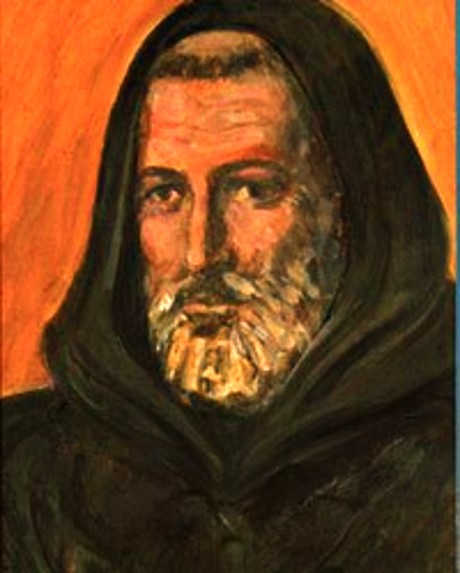
Saint Louis-Marie Grignion de Montfort was born on 31 January 1673. He was a Missionary Priest but it was his devotion to the Blessed Virgin Mary and his ‘Total Consecration’ for which he is now most famous.
Baptism is recalled as part of the vow of consecration: “I…renew in all sincerity the promises I solemnly made at the time of my holy Baptism.”
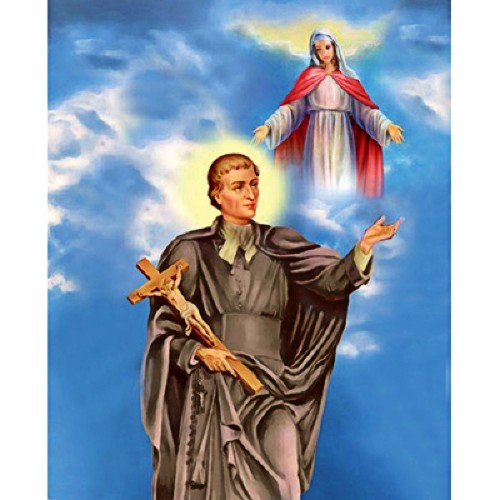
The saints see things very differently than most men. In his Consecration to Mary, St Louis states, “You are truly blessed if the world persecutes you, opposing your plans though they are good, thinking evil of your intentions, calumniating your conduct and taking away unjustly your reputation or your possessions.”
“My son, beware of complaining to others, rather than to Me, of the bad treatment you receive, and do not seek ways of justifying yourself, particularly when you are the only one to suffer from it. On the contrary, pray for those who procure for you the blessings of persecution.
Thank Me for treating you as I Myself was treated on earth, a sign of contradiction.
Never be discouraged in your plans because you meet with opposition, it is a pledge of future victory. A good work which is not opposed, which is not marked by the sign of the cross, has no great value before Me and will soon be destroyed.
Regard as your best friends those who persecute you because they procure for you, great merit on earth and great glory in heaven.
Regard as unfortunate those who live in luxury, who feast sumptuously, who frequent the world of fashion, who make their way in the world, who succeed in business and who spend their lives in pleasures and amusements.
Never do anything, either good or evil, out of human respect to avoid any blame, insult, mockery, or praise.
When through your own fault some loss or disgrace befalls you, do not be disturbed by it but rather humble yourself before God and accept it from His hands as punishment for your fault.”

Saint Louis de Montfort had a difficult life in which he was often unjustly persecuted and where he faced unexpected challenges in his desire to promote love and devotion to the Blessed Virgin Mary. In some ways and by worldly standards, he often appeared a failure and his motives were misunderstood. Nothing was wasted, for all his work was truly for the glory of God and for the honour of the Mother of God and his devotion to her has borne great fruit! Amen!
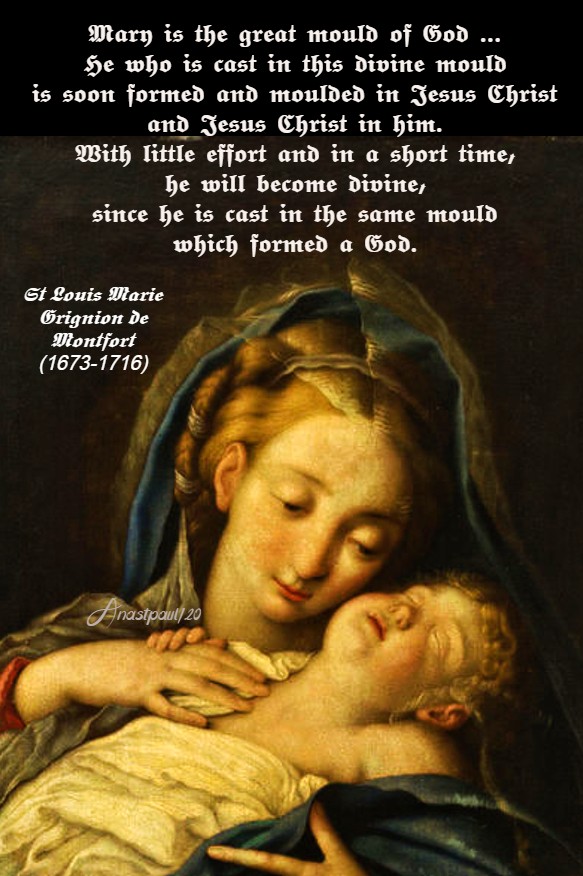
St Agrepe
Blessed Andrew of Segni OFM (1240-1302) Priest
Bl Anthony Manzoni
St Asclepiades
St Autbert of Landevenec
St Barbara Ch’oe Yong-i
Blessed Benedict Daswa (1946-1990) – Martyr
The first South African Blessed:

https://anastpaul.wordpress.com/2018/02/01/saint-of-the-day-1-february-blessed-benedict-daswa-1946-1990-martyr/

St Brigid of Fiesole
St Brigid of Ireland/Kildare (c 453-523)
St Brigid’ Story:

https://anastpaul.com/2019/02/01/saint-of-the-day-st-brigid-of-ireland-kildare-c-453-523/
St Cecilius of Granada
St Cinnia of Ulster
St Clarus of Seligenstadt
Bl Conor O’Devany
St Crewenna
St Darlaugdach of Kildare
St Henry Morse
St Ioannes Yi Mun-u
St Jarlath
Bl John of the Grating
St Kinnia
Blessed Luigi Variara SDB (1875-1923)
Biography:

https://anastpaul.com/2020/02/01/saint-of-the-day-blessed-blessed-luigi-variara-sdb-1875-1923/
Bl Patrick O’Lougham
St Paul of Trois-Châteaux
St Paulus Hong Yong-ju
St Raymond of Fitero
St Sabinus
St Severus of Avranches
St Severus of Ravenna
St Sigebert III of Austrasia
St Tryphon of Lampsacus
St Ursus of Aosta
St Veridiana

Martyrs of Avrillé – 47 beati: Forty-seven Christians executed together for their faith in the anti-Catholic persecution of the French Revolution.
• Anne-François de Villeneuve• Anne Hamard• Catherine Cottenceau• Charlotte Davy• François Bellanger• François Bonneau• François Michau• François Pagis epouse Railleau• Gabrielle Androuin• Jacquine Monnier• Jeanne Bourigault
• Jeanne Fouchard épouse Chalonneau• Jeanne Gruget veuve Doly• Jeanne-Marie Sailland d’Epinatz• Louise-Aimée Dean de Luigné• Louise-Olympe Rallier de la Tertinière veuve Déan de Luigné• Madeleine Blond• Madeleine Perrotin veuve Rousseau• Madeleine Sailland d’Epinatz• Marguerite Rivière epouse Huau• Marie Anne Pichery épouse Delahaye• Marie-Anne Vaillot• Marie Cassin épouse Moreau• Marie Fausseuse épouse Banchereau• Marie Gallard épouse Quesson• Marie Gasnier épouse Mercier• Marie Grillard• Marie-Jeanne Chauvigné épouse Rorteau• Marie Lenée épouse Lepage de Varancé• Marie Leroy• Marie Leroy épouse Brevet• Marie Roualt épouse Bouju• Odilia Baumgarten• Perrine Androuin• Perrine Besson• Perrine-Charlotte Phelippeaux épouse Sailland d’Epinatz• Perrine Grille• Perrine Ledoyen• Perrine Sailland d’Epinatz• Renée Cailleau épouse Girault• Renée Grillard• Renée Martin épouse Martin• Renée Valin• Rose Quenion• Simone Chauvigné veuve Charbonneau
• Suzanne Androuin• Victoire Bauduceau epouse Réveillère.
They were martyred on 1 February 1794 in Avrillé, Maine-et-Loire, France and Beatified on 19 February 1984 by St Pope John Paul II at Rome, Italy.

Martyrs of Korea: Thousands of people were murdered in the anti-Catholic persecutions in Korea. Today we celebrate and honour:
• Saint Barbara Ch’oe Yong-i
• Saint Ioannes Yi Mun-u
• Saint Paulus Hong Yong-ju
Posted in CHRIST the WORD and WISDOM, CHRIST, the WAY,TRUTH,LIFE, DOCTORS of the Church, franciscan OFM, ONE Minute REFLECTION, QUOTES for CHRIST, QUOTES on WISDOM, The WORD

One Minute Reflection – 31 January – “What is this? A new teaching with authority!” – Mark 1:27

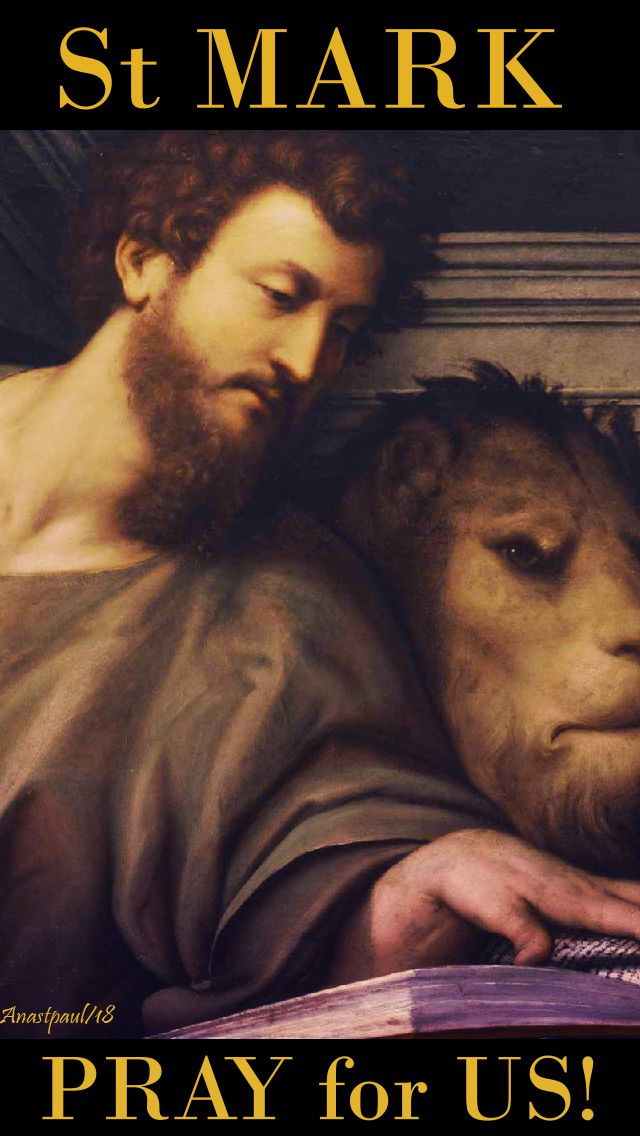
One Minute Reflection – 31 January – The Fourth Sunday in Ordinary Time, Readings: Deuteronomy 18:15-20, Psalms 95:1-2, 6-7, 7-9, 1 Corinthians 7:32-35, Mark 1:21-28 and the Feast of the Translation of the Relics of the St Mark the Evangelist to Venice

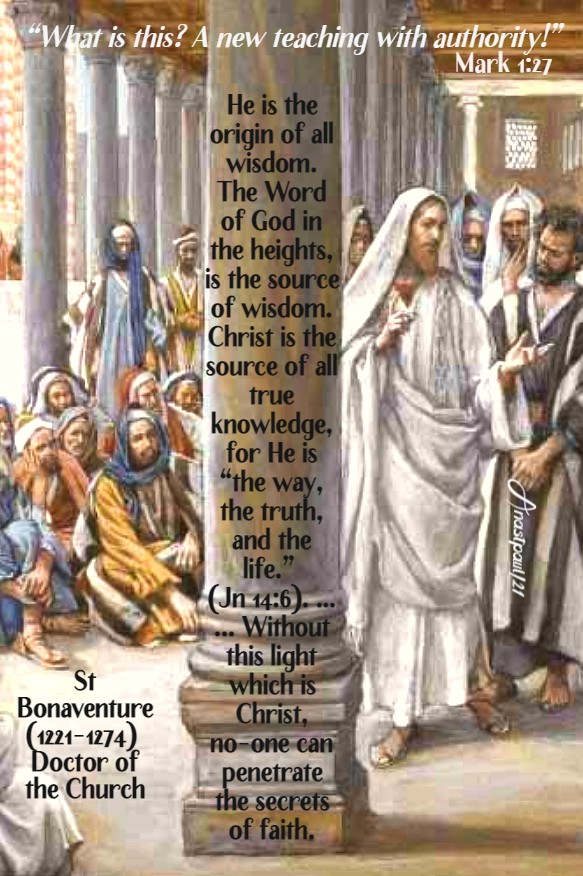
“What is this? A new teaching with authority!” – Mark 1:27

REFLECTION“Only one is your teacher, the Messiah.” (Mt 23:10). … For Christ is “the reflection of the Father’s glory, the exact representation of the Father’s being and he sustains all things by his powerful word.” (Heb 1:3)
He is the origin of all wisdom.
The Word of God in the heights, is the source of wisdom.
Christ is the source of all true knowledge, for He is “the way, the truth, and the life.” (Jn 14:6). …
As way, Christ is the teacher and origin of knowledge according to faith. … That is why Peter teaches in his second letter: “We possess the prophetic message as something altogether reliable. Keep your attention closely fixed on it, as you would on a lamp shining in a dark place.” (1:19). … For through His coming in the spirit, Christ is the origin of all revelation and through His coming in the flesh, He is the strengthening of all authority.

He comes first in the spirit as the revealing light of every prophetic vision. According to Daniel: “He reveals deep and hidden things and knows what is in the darkness, for the light dwells with him.” (2:22)
This is the light of divine wisdom, which is in Christ.
According to John, Christ said: “I am the light of the world. No follower of mine shall ever walk in darkness” (8:12) and “While you have the light, keep faith in the light, thus you will become children of light.” (12:36). …
Without this light which is Christ, no-one can penetrate the secrets of faith. And that is why we read in the Book of Wisdom: “O God, send forth that Wisdom from your holy heavens and from your glorious throne, dispatch her that she may be with me and work with me, that I may know what is your pleasure … For what man knows God’s counsel, or who can conceive what the Lord intends?” (9:10-13)
No-one can come to the certainty of revealed faith, except through Christ’s coming in the spirit and the flesh.” – St Bonaventure (1221-1274) Doctor of the Church Sermon ‘Christus unus omnium magister’

PRAYER – King of heaven and earth, Lord God, rule over our hearts and bodies this day. Sanctify us and guide our every thought, word and deed, according to the commandments of Your law, so that now and forever, Your grace may free and save us. Sanctify our hearts, minds and actions with Your power, that all we are may speak of Your Light. May the prayers of our Mother, Queen of Heaven and Earth and glorious St Mark the Evangelist, who so diligently followed You in the darkness around him, bring us to peace and confidence. We make our prayer through Your Son, our Lord Jesus, in union with the Holy Spirit, one God for all eternity, amen.

Posted in "Follow Me", DOCTORS of the Church, DOMINICAN OP, franciscan OFM, GOD ALONE!, ONE Minute REFLECTION, QUOTES of the SAINTS, QUOTES on HUMILITY, QUOTES on SELF-DENIAL, SAINT of the DAY, The WORD

One Minute Reflection – 28 January – Blessed is the servant ….

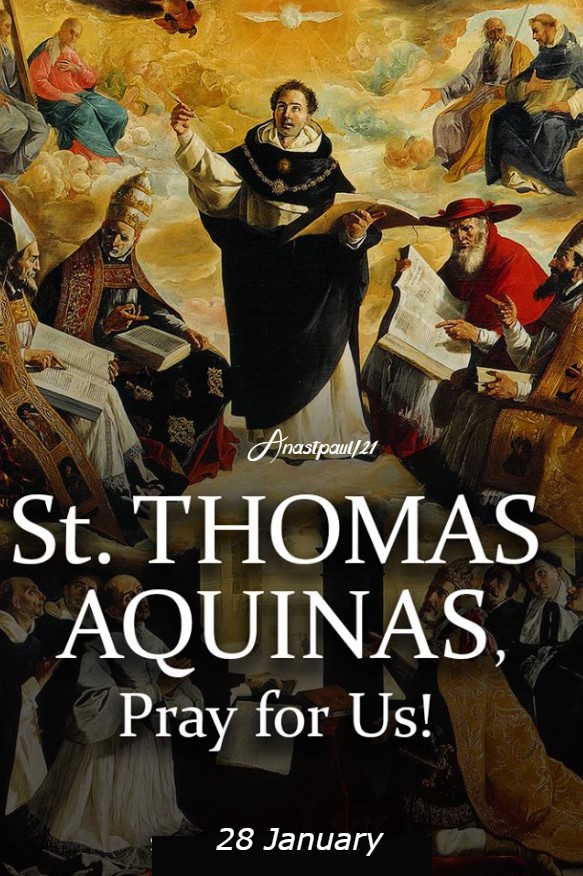
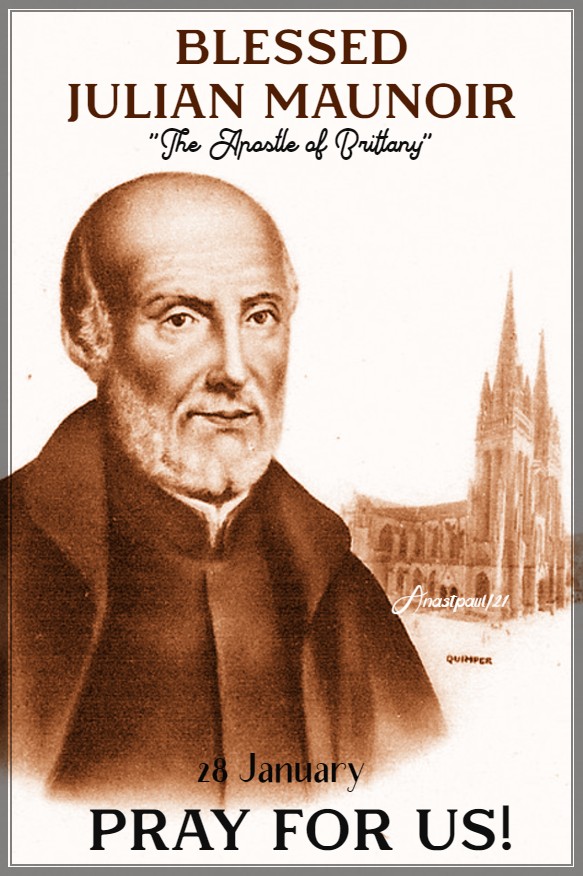
One Minute Reflection – 28 January – Thursday of the Third week in Ordinary Time, Readings: Hebrews 10:19-25, Psalms 24:1-2, 3-4, 5-6, Mark 4:21-25 and the Memorial of St Thomas Aquinas OP (1225-1274) and Blessed Julian Maunoir SJ (1606-1683)

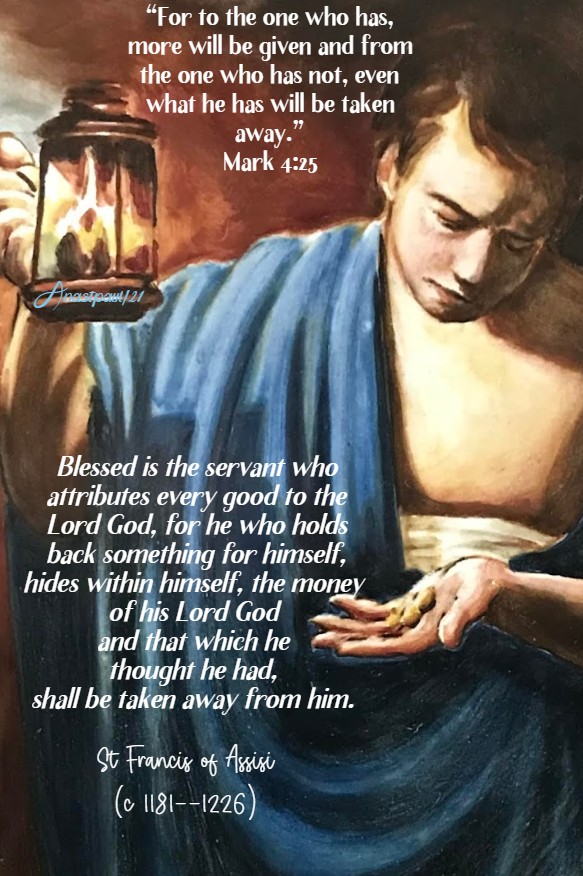
“For to the one who has, more will be given and from the one who has not, even what he has will be taken away.” – Mark 4:25

REFLECTION – “Blessed is the servant who attributes every good to the Lord God, for he who holds back something for himself, hides within himself, the money of his Lord God (Mt 25:18) and that which he thought he had, shall be taken away from him (Mt 25:18.28; Lk 8:18).

Blessed is the servant who esteems himself, no better when he is praised and exalted by people, than when he is considered worthless, simple and despicable; for what a man is before God, that he is and nothing more. …

Blessed is that religious, who takes no pleasure and joy except in the most holy words and deeds of the Lord and with these, leads people to the love of God in joy and gladness … Blessed is the servant who, when he speaks, does not reveal everything about himself in the hope of receiving a reward and, who is not quick to speak but wisely weighs what he should say and how he should reply.
Woe to that religious, who does not keep in his heart, the good things the Lord reveals to him and who does not manifest them to others, by his actions but, rather seeks to make such good things known by his words. He, thereby, receives his reward while those who listen to him, carry away but little fruit. …

Blessed is that servant who stores up in heaven (Mt 6,20) the good things which the Lord has revealed to him and does not desire to reveal them to others, in the hope of profiting thereby. For the Most High will manifest his deeds to whomever he wishes. Blessed is the servant who keeps the secrets of the Lord in his heart.” – St Francis of Assisi (c 1181–1226) Founder of the Friars Minor – Admonitions, 19-22.28

PRAYER – Lord, our God, since it was by Your gift that St Thomas became so great a Saint and theologian, give us grace to understand his teaching and follow his way of life. May his great love for Jesus Crucified and His pure adoration of the Blessed Sacrament, be our guide to follow in Your Son’s footsteps and take up our cross and follow Him. Grant that by the prayers of St Thomas, we may grow in love and sanctity, amen.

Posted in franciscan OFM, Our MORNING Offering, PRAYERS of the SAINTS

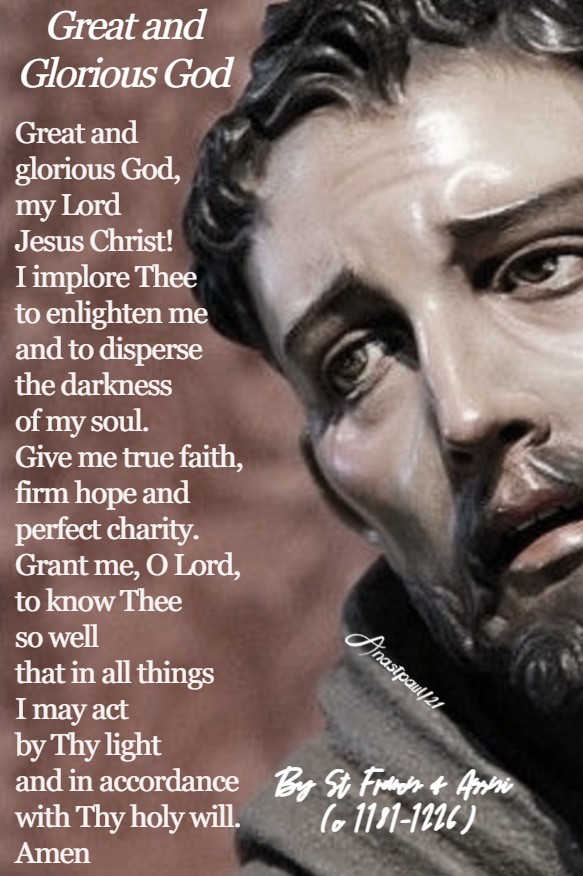
Our Morning Offering – 25 January – Great and Glorious God By St Francis

Our Morning Offering – 25 January – Feast of the Conversion of St Paul

Great and Glorious God
By St Francis of Assisi (c 1181-1226)

Great and glorious God,
my Lord Jesus Christ!
I implore Thee to enlighten me
and to disperse the darkness of my soul.
Give me true faith, firm hope and perfect charity.
Grant me, O Lord, to know Thee so well
that in all things I may act by Thy light
and in accordance with Thy holy will.
Amen

Posted in "Follow Me", CHRIST, the WAY,TRUTH,LIFE, DOCTORS of the Church, franciscan OFM, ONE Minute REFLECTION, The WORD

One Minute Reflection – 24 January – “Follow me!” Mark 1:17-18

One Minute Reflection – 24 January – Third Sunday in Ordinary Time, Readins: Jonah 3: 1-5, 10, Psalms 25:4-5, 6-7,8-9, 1 Corinthians 7:29-31, Mark 1: 14-20 and the Memorial of St Francis de Sales (1567-1622) Doctor of the Church: Doctor caritatis (Doctor of Charity)

And Jesus said to them, “Follow me and I will make you fishers of men.” And immediately they left their nets and followed him…Mark 1:17-18

REFLECTION “Follow me!” Jesus says these words … to every Christian. Follow me, naked as I am naked, free from every hindrance as I myself am. Jeremiah said: “You will call me ‘My Father’ and never turn away from me” (Jer 3:19). So follow Me and put down the burdens you are bearing. For, laden as you are, you cannot follow Me who am running ahead. “I ran in thirst” says the psalmist about me (Ps 61:5 LXX), the thirst to save humanity. And where is He running? To the Cross. You too, run after Him. As He bore His Cross for you, take up your own for your good. From whence these words of Saint Luke’s gospel: “If anyone wishes to come after me, he must deny himself” by renouncing his own will, “take up his cross” by mortifying his passions, “daily,” that is all the time, “and follow me.” (Lk 9:23) …

Jesus speaks to us like a mother who, wanting to teach her child to walk, shows him apiece of bread or an apple and says to him: “Come with me and I’ll give it to you.” And when the child is so close that he can almost catch hold of it, she draws away a little, showing the thing to him and repeating: “Follow me if you want it.” Some kinds of birds lead their little ones out of their nest and, by flying, teach them to fly and to follow them. Jesus does the same. He shows Himself as an example and promises us His reward in the kingdom so that we might follow Him.

So “follow me” for I know the right way and will guide you. We read in the book of Proverbs: “I will show you the way of wisdom; I will lead you by the ways of equity. When you have entered, your steps will not be constrained and when you run you shall not meet a stumbling block” (cf. Prv 4:11-12 LXX). … Therefore, “follow me”.” … St Anthony of Padua (1195-1231) Franciscan, Doctor of the Church – Sermon for the feast of Saint John the Evangelist

PRAYER – Grant Lord, that in the service of our fellowmen, we may always reflect Your own gentleness and love and so imitate St Francis de Sales, whom You made all things to all men, for the saving of souls. Grant that his prayers on our behalf may assist us in our daily struggles in traversing our pilgrim way. Through Jesus Christ our Lord, in union with the Holy Spirit, one God forever and ever, amen.

Posted in DOMINICAN OP, franciscan OFM, MARIAN DEVOTIONS, MARIAN TITLES, SAINT of the DAY

Feast of the Espousal of the Blessed Virgin Mary (1546) and Memorials of the Saints

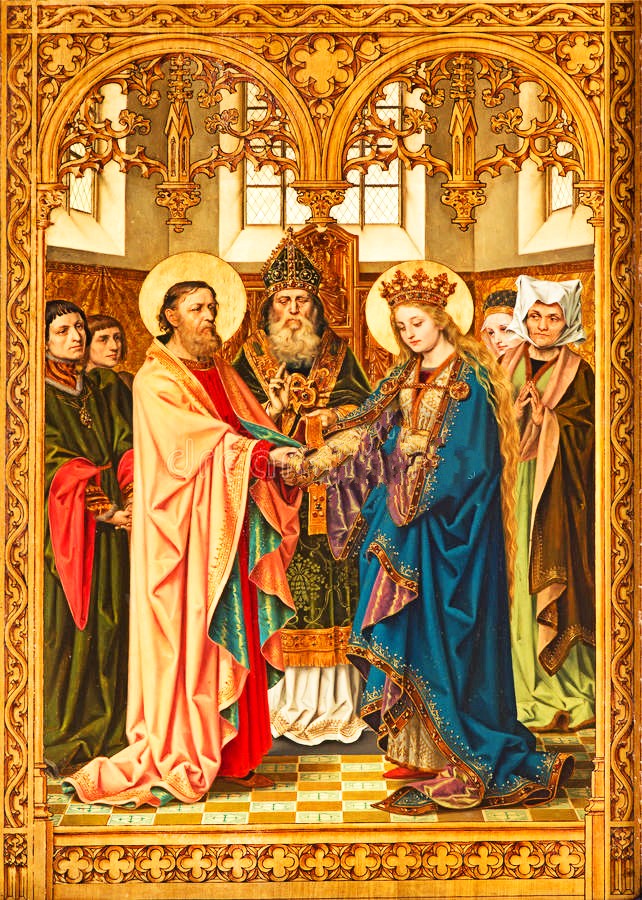
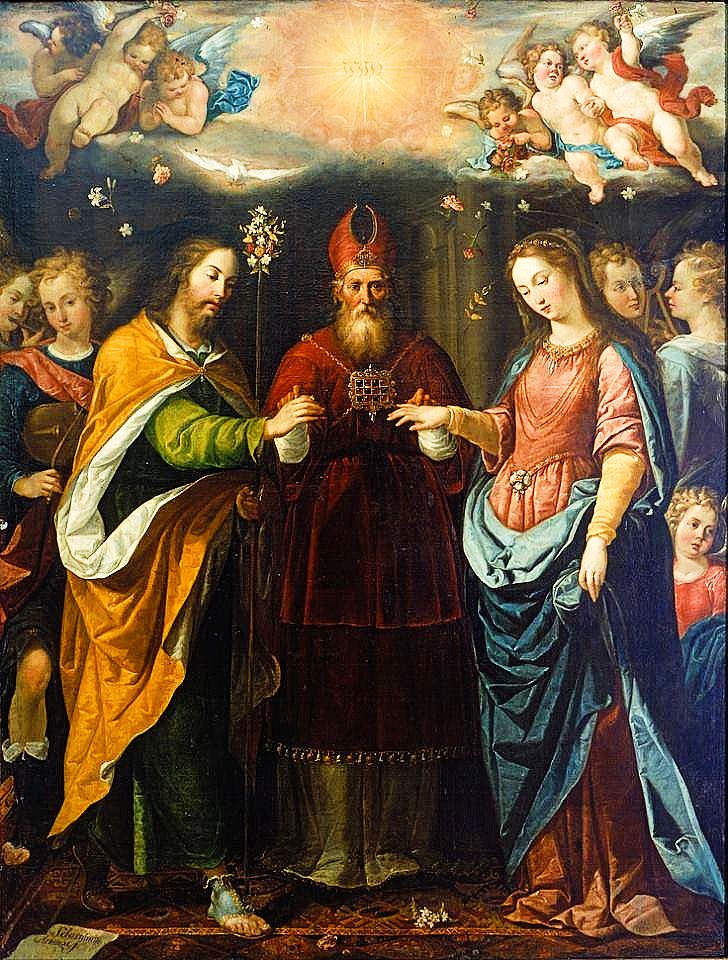
Espousal of the Blessed Virgin Mary, approved by Pope Paul III (1546) – 23 January:

Feast in honour of the Blessed Virgin’s Espousal to Saint Joseph. It is certain that a real Matrimony was contracted by Joseph and Mary. Still Mary is called “espoused” to Joseph (“his mother Mary was espoused to Joseph”, Matthew 1:18) because the matrimony was never consummated. The term, ‘spouse’ is applied to married people until their marriage is consummated.

The first definite knowledge of a Feast in honour or the Espousals of Mary dates from 29 August1517, when it was granted by Pope Leo X to the Nuns of the Annunciation. It was celebrated on 22 October. It appears in the Missal of the Franciscans, to whom it was granted on 21 August 1537, for 7 March, while the Servites obtained the Feast for 8 March. Although the Feast of the Espousal has never been extended to the Universal Church ,it is observed in nearly the entire Latin Church on 23 January and in the Spanish-speaking countries on 26 November.

St Marianne Cope TOSF (1838-1918)
Biography:

https://anastpaul.wordpress.com/2017/01/23/saint-of-the-day-23-january-st-marianne-cope/

St Abel the Patriarch
St Agathangelus
St Amasius of Teano
St Andreas Chong Hwa-Gyong
St Aquila the Martyr
St Asclas of Antinoe
Blessed Benedetta Bianchi Porro (1936-1964)
Her Life:

https://anastpaul.com/2020/01/23/saint-of-the-day-23-january-blessed-benedetta-bianchi-porro-1936-1964/
St Clement of Ancyra
St Colman of Lismore
St Dositheus of Gaza
St Emerentiana
St Eusebius of Mount Coryphe
Blessed Henry Suso OP (1295-1366)
Blessed Henry’s Life:

https://anastpaul.com/2019/01/23/saint-of-the-day-blessed-henry-suso-op-1295-1366/
St Ildephonsus (506-667)
Biography:

https://anastpaul.wordpress.com/2018/01/23/saint-of-the-day-23-january-st-ildephonsus-607-667/

Bl Joan Font Taulat
St John the Almoner (Died c 620) Bishop of Alexandria
Bl Juan Infante
St Jurmin
St Lufthild
St Maimbod
Bl Margaret of Ravenna
Martyrius of Valeria
St Messalina of Foligno
St Ormond of Mairé
St Parmenas the Deacon
St Severian the Martyr

Posted in FEASTS and SOLEMNITIES, franciscan OFM, SAINT of the DAY, THE EPIPHANY of the LORD

The Solemnity of the Epiphany of the Lord and Memorials of the Saints – 6 Epiphany

The Solemnity of the Epiphany of the Lord – Epiphany celebrates the visit of the three kings or wise men to the Christ Child, signifying the extension of salvation to the Gentiles. The date of Epiphany, one of the oldest Christian feasts, is 6 January the 12th day after Christmas. However, in most countries, the celebration of Epiphany is transferred to the Sunday that falls between 2 January and 8 January (inclusive). Greece, Ireland, Italy and Poland continue to observe Epiphany on 6 January as do some dioceses in Germany.
Because Epiphany is one of the most important Christian feasts, it is a Holy Day of Obligation in most countries.

Epiphany:
https://anastpaul.wordpress.com/2018/01/07/the-solemnity-of-the-epiphany-of-our-lord-jesus-christ-7-january-god-reveals-himself-to-us/
AND:
https://anastpaul.com/2019/01/06/the-solemnity-of-the-epiphany-of-the-lord-6-january/

St Andre Bessette CSC (1845-1937) (7 January in Canada)
About St Andre:

https://anastpaul.com/2020/01/06/saint-of-the-day-6-january-saint-andre-bessette-csc-1845-1937-gods-doorkeeper/

St Antoninus
St Basillisa of Antinoë
St Charles of Sezze OFM (1613-1670)
About St Charles:

https://anastpaul.wordpress.com/2018/01/06/saint-of-the-day-6-january-st-charles-of-sezze-o-f-m-1613-1670/

St Demetrius of Philadelphia
St Diman Dubh of Connor
St Edeyrn
St Eigrad
St Erminold of Prüfening
St Felix of Nantes
Bl Frederick of Saint-Vanne
Bl Gertrud of Traunkirchen
Bl Gertrude van Oosten
St Guarinus of Sion
St Guy of Auxerre
St Honorius
St Hywyn of Aberdaron
St Juan de Ribera (1532-1611) Bishop
St Julian of Antinoë
St Julius
Bl Luc of Roucy
Bl Macarius the Scot
St Macra of Rheims
St Merinus
St Nilammon of Geris
St St Petran of Landévennec
St Peter of Canterbury
St Pia of Quedlinburg
St Pompejanus
St Rafaela Porras y Ayllón
Bl Raymond de Blanes
Bl Rita Amada de Jesus
St Schotin
St Wiltrudis of Bergen

Martyrs in Africa: Unknown number of Christian men and women who were martyred in the persecutions of Septimus Severus. They were burned to death c 210.

Martyrs of Sirmium – 8 saints: A group of Christians martyred together for their faith. The only surviving details are the names of eight of them – Anastasius VIII, Florianus, Florus, Jucundus, Peter, Ratites, Tatia and Tilis. They were martyred in the 4th century at Syrmium, Pannonia (modern Sremska Mitrovica, Vojvodina, Serbia).

Twelve Apostles – Saints of Ireland: Twelve 6th century Irish monks who studied under Saint Finian at Clonard Abbey and then spread the faith throughout Ireland. Each has his own commemoration but on this day they and their good work are considered and celebrated together. Though Saint Finian is sometimes included, most ancient writers list them as –
• Brendan of Birr
• Brendan the Navigator
• Columba of Iona
• Columba of Terryglass
• Keiran of Saighir
• Kieran of Clonmacnois
• Canice of Aghaboe
• Lasserian of Leighlin
• Mobhí of Glasnevin
• Ninnidh the Saintly of Loch Erne
• Ruadh´n of Lorrha
• Senan of Iniscathay

Posted in CHRISTMASTIDE!, franciscan OFM, HYMNS, LENT, MARIAN PRAYERS, POETRY, PRAYERS for SEASONS, PRAYERS of the CHURCH, PRAYERS of the SAINTS, SAINT of the DAY

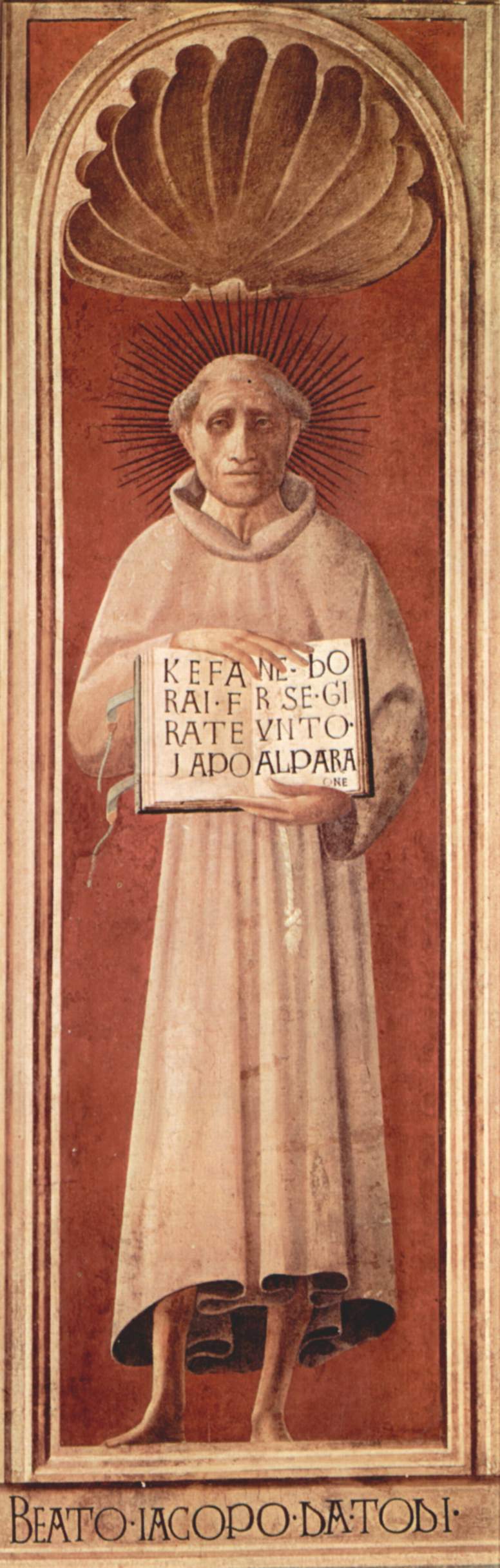
Saint of the Day – 25 December – Blessed Jacopone da Todi OFM (1230-1306)

Saint of the Day – 25 December – Blessed Jacopone da Todi OFM (1230-1306) Franciscan Friar, Confessor, Hymnist, Poet, Mystic, Lawyer, – an Italian from Umbria in the 13th century. He wrote several laude (songs in praise of the Lord) in the local vernacular. He was an early pioneer in Italian theatre, being one of the earliest scholars who dramatised Gospel subjects. Born in c 1230 at Todi, Italy as Jacopo Benedetti and died on 25 December 1306 at Collazzone, Italy of natural causes, as the Priest intoned the Gloria from midnight Mass. He is also known as Jacomo da Todi, Jacopo Benedetti, Jacopo Benedicti, Jacopone Benedetti da Todi, Jacopone of Todi, James da Todi.

Jacomo, was born a noble member of the Benedetti family in the northern Italian city of Todi. He became a successful lawyer and married a pious, generous lady named Vanna.

His young wife took it upon herself to do penance for the worldly excesses of her husband. One day Vanna, at the insistence of Jacomo, attended a public tournament. She was sitting in the stands with the other noble ladies when the stands collapsed. Vanna was killed. Her shaken husband was even more disturbed when he realised that the penitential girdle she wore was for his sinfulness. On the spot, he vowed to radically change his life.

Jacomo divided his possessions among the poor and entered the Secular Franciscan Order. Often dressed in penitential rags, he was mocked as a fool and called Jacopone, or “Crazy Jim,” by his former associates. The name became dear to him.

After 10 years of such humiliation, Jacopone asked to be received into the Order of Friars Minor. Because of his reputation, his request was initially refused. He composed a beautiful poem on the vanities of the world, an act that eventually led to his admission into the Order in 1278. He continued to lead a life of strict penance, declining to be ordained a priest. Meanwhile, he was writing popular hymns in the vernacular.

Jacopone suddenly found himself a leader in a disturbing religious movement among the Franciscans. The Spirituals, as they were called, wanted a return to the strict poverty of Francis. They had on their side two cardinals of the Church and Pope Celestine V. These two cardinals though, opposed Celestine’s successor, Boniface VIII. At the age of 68, Jacopone was excommunicated and imprisoned. Although he acknowledged his mistake, Jacopone was not absolved and released until Benedict XI became Pope five years later. He had accepted his imprisonment as penance. He spent the final three years of his life more spiritual than ever, weeping “because Love is not loved.” During this time he wrote the famous Latin hymn, Stabat Mater.

On Christmas Eve in 1306 Jacopone felt that his end was near. He was in a convent of the Poor Clares with his friend, Blessed John of La Verna. Like Francis, Jacopone welcomed “Sister Death” with one of his favorite songs. It is said that he finished the song and died as the Priest intoned the “Gloria” from the midnight Mass at Christmas. From the time of his death, Brother Jacopone has been venerated as a saint, both within and outside of the Franciscan Order, although never formally Canonised.

Here lie the bones of Blessed Jacopone dei Benedetti da Todi, Friar Minor, who, having gone mad with love of Christ, by a new artifice deceived the world and took Heaven by violence. – from the tomb of Blessed Jacopone

Stabat Mater Dolorosa is a fine example of religious lyric in the Franciscan tradition. It was inserted into the Roman Missal and Breviary in 1727 for the Feast of the Seven Sorrows of the Blessed Virgin Mary, celebrated on the Friday before Good Friday. Following changes by Pope Pius XII, it now appears on the Feast of Our Lady’s Sorrows celebrated on 15 September. Many composers have set it to music

His contemporaries called Jacopone, “Crazy Jim.” We might well echo their taunt, for what else can you say about a man who broke into song in the midst of all his troubles? We still sing Jacopone’s saddest song, the Stabat Mater, but we Christians claim another song as our own, even when the daily headlines resound with discordant notes. Jacopone’s whole life rang out our song: “Alleluia!” May he inspire us to keep singing.

Posted in CHRISTMASTIDE!, franciscan OFM, SAINT of the DAY, The NATIVITY of JESUS

The Solemnity of the Nativity of Our Lord Jesus Christ

The Nativity of the Lord, Jesus Christ (Solemnity)
Celebration of the anniversary of the birth of Our Lord. In the earliest days of the Church there was no such feast, the Saviour’s birth was commemorated with the Epiphany by the Greek and other Eastern Churches. First mention of the feast, then kept on 20 May, was made by Clement of Alexandria c 200. The Latin Church began c 300 to observe it on 25 December, though there is no certainty that Our Lord was born on that day. Priests have the privilege of saying three Masses, at midnight, daybreak and morning. This was originally reserved to the Holy Father alone – beginning about the 4th century he celebrated a midnight Mass in the Lateran Basilica (in which according to tradition, the manger of Bethlehem is preserved), a second in the church of Saint Anastasia, whose feast comes on 25 December and a third at the Vatican Basilica. Many peculiar customs of the day are the outcome of the pagan celebrations of the January calender. The Christmas tree, of which the first known mention was made in 1605 at Strasbourg, was introduced into France and England in 1840. The feast is a holy day of obligation, preceded by the preparatory season of Advent and by a special vigil – should it fall on a Friday it abrogates the law of abstinence. Today’s Gospel is the prologue of John.

https://anastpaul.com/2019/12/25/the-solemnity-of-the-nativity-of-our-lord-jesus-christ-25-december-2/

https://anastpaul.com/2018/12/25/the-solemnity-of-the-nativity-of-our-lord-jesus-christ-25-december/

https://anastpaul.wordpress.com/2017/12/25/25-december-the-solemnity-of-the-birth-of-our-lord-jesus-christ-2/

St Adalsindis of Hamay
St Alburga of Wilton
St Anastasia of Sirmium
Bl Artale
St Basilée of the Via Latina
Bl Bentivoglio de Bonis
Bl Diego de Aro
St Eugenia of Rome
St Fulk of Toulouse
Blessed Jacopone da Todi OFM (1230-1306) Franciscan Friar, Author of the “Stabat Mater”
St Jovin of the Via Latina
Bl Maria Therese von Wüllenweber
Bl Matthew of Albano
Bl Michael Nakashima Saburoemon
Bl Nera
St Romulus of Berry

Martyrs of Nicomedia: 20,000 Christians martyred by order of Diocletian. They were reported to have all been in the single basilica to celebrate Christmas. While there unquestionably was an endless series of martyrs under Diocletian, it’s likely the ancient sources exaggerated the numbers of this incident. And as the Christmas holy day was not celebrated in the East in 303, they were probably gathered for another feast. They were burned alive in 303 in the basilica of Nicomedia.

Posted in franciscan OFM, MISSIONS, MISSIONARIES, PATRONAGE - PENITENTS, SAINT of the DAY

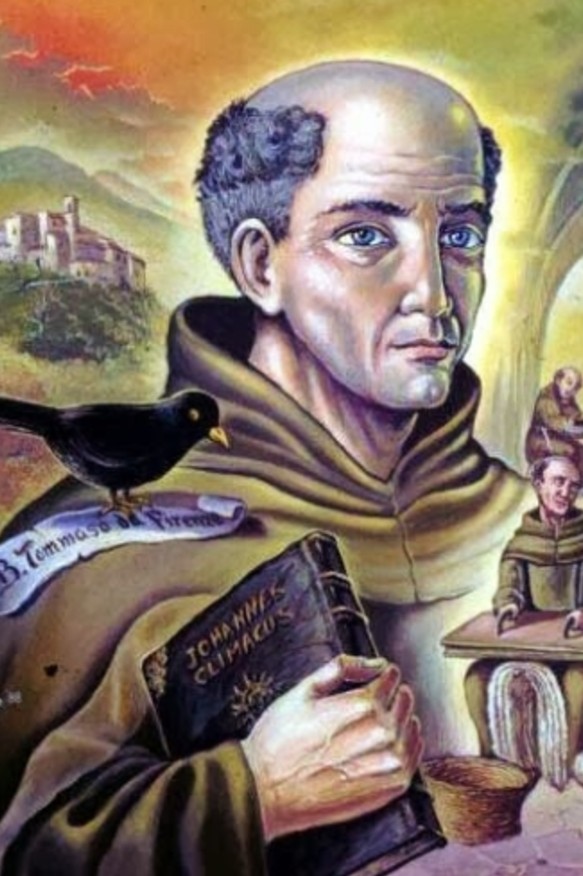
Saint of the Day – 31 October – Blessed Thomas Bellacci TOSF (1370-1447)

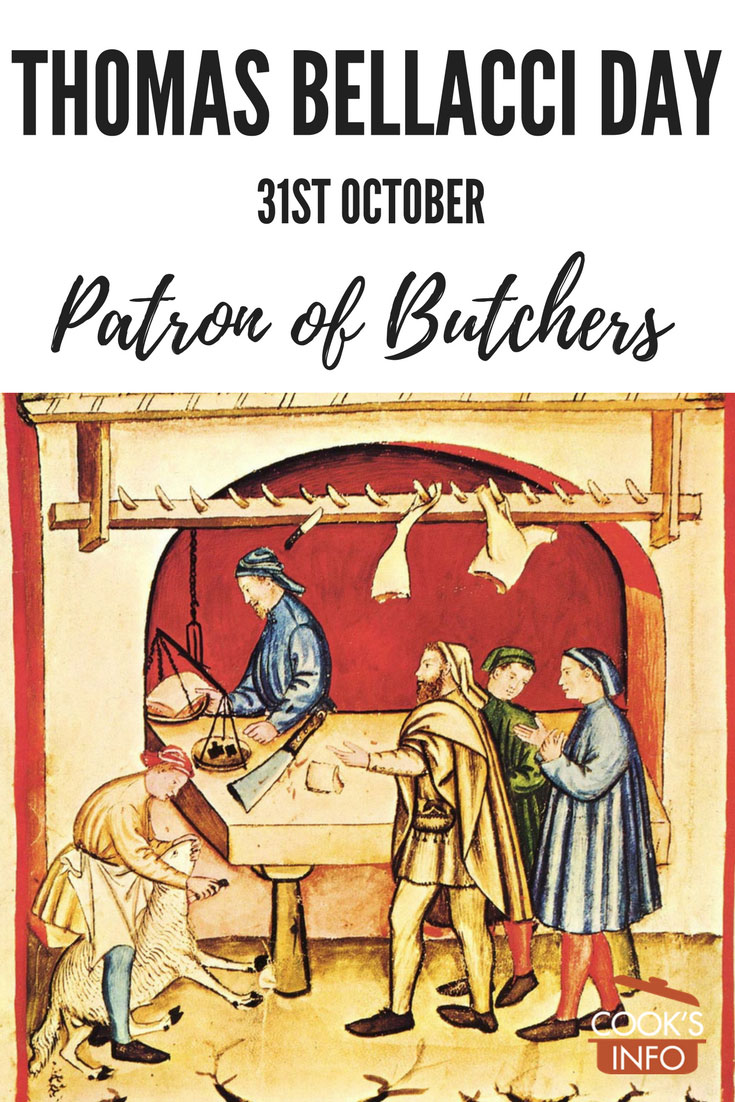
Saint of the Day – 31 October – Blessed Thomas Bellacci TOSF (1370-1447) Lay Friar of the Third Order of St Francis, Penitent, Confessor, renowned Missionary Preacher, Papal legate – born as Tommaso in 1370 at Florence, Italy and died on 31 October 1447 in Rieti, Italy of natural causes. Patronages – butchers, penitents, missionaries. He is also known as Thomas of Florence, Tommaso Bellacci. Blessed Thomas is venerated by the Franciscans on 25 October.

Bellacci was a butcher and became a religious after turning his life around from one of sin to one of penance and servitude to God. He travelled across the Middle East and the Italian peninsula to preach the Gospel and against heresies. He drew many young men to follow in his path of penitence.

Tommaso Bellacci was born in Florence in 1370 in the neighbourhood of the Ponte alle Grazie. His parents came from Castello di Linari in Val d’Elsa. His father was a butcher. He got into a good deal of trouble on various occasions during his youth and led such a wild and dissolute life as an adolescent, that parents warned their sons to keep their distance from him. Persuaded by a friend to change his ways, he tried to enter some religious order but found strong resistance to being accepted. He became a butcher like his father.

Bellacci was accused of having committed a serious crime in 1400, which, in fact he had not committed and so, he wandered the streets of Florence in great turmoil and fear, until he met a Priest who listened to his story, took him in and helped clear his name. The incident shocked him so much – coupled with his great gratitude to the Priest – that he shed his life of sin and decided to live a life of total penance and service to God. He joined the Third Order of Saint Francis in Fiesole under the spiritual guidance of Friar Giovanni da Stronconio. He entered as a lay brother Friar and became noted for keeping vigils and fasting. He was known for his diet of water and vegetables.

So great was Thomas’ adherence to the literal interpretation and implementation of the Franciscan Rule, that he was made the Novice Master, despite the fact that he was not a Priest. In this role, he led by example. He became part of the Observant reform and in 1414 accompanied another Friar to Naples to introduce the Observant practice in the Franciscan houses there. He remained in Naples for six years, preaching and helping to spread the reform.

After his sojourn and work in Naples, Thomas founded Monasteries in Corscia. Pope Martin V called him to preach in the northern cities against the “Fraticelli” who were a group of heretical Franciscans and was also made Vicar General at the Pope’s behest. In 1438, he and Albert Berdini of Sarteano were sent to the Middle East to cities such as Damascus and Cairo in order to promote the reunification of the Eastern and Western Churches when he was over 70. Alberto had to return home due to his ill health which left Bellacci to continue the mission alone.

He attempted to travel to Ethiopia but the Turks captured him three times. The Florentine merchants helped to secure his release twice. The third time he was again captured and suffered enslavement and persecution for several years, by now, he was perhaps in his eighties. Pope Eugene IV helped secure his release. He returned home in 1444 and spent his time in a Convent in Abruzzo until he died in 1446.

Nevertheless, Thomas still wished to return to the Orient but he died in Rieti while on a visit to Rome to request the Pope’s permission to return there.

Thomas was Beatified by Pope Clement XIV in 1771.

Posted in franciscan OFM, SAINT of the DAY

Saint of the Day – 17 October – Blessed Balthassar of Chiavari OFM (1420–1492)

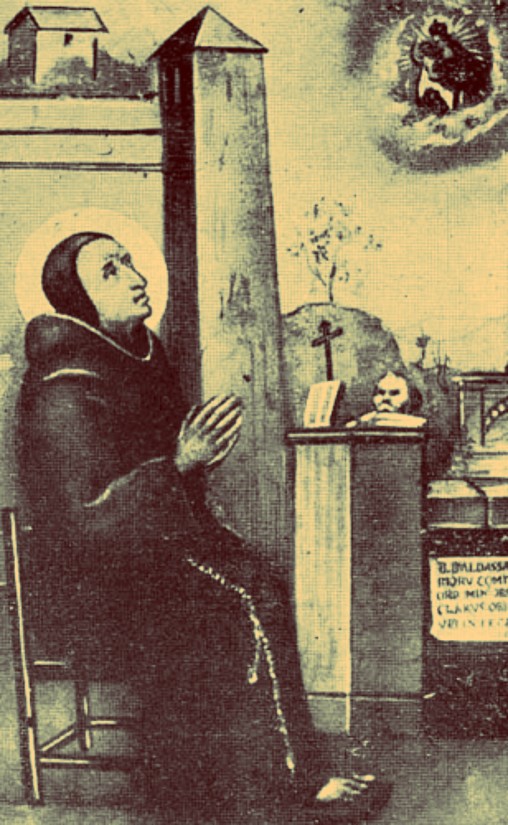
Saint of the Day – 17 October – Blessed Balthassar of Chiavari OFM (1420–1492) Religious Priest of the Order of Friars Minor of the strict observance, Confessor, renowned Preacher, Professor of Theology, Superior General. Born in 1420 in Chiavari, Genoa, Italy as Baldassare Ravaschieri and died on 17 October 1492 in Binasco, Milan, Italy of natural causes. Patronages – Chiavari, against gout.

He was a great friend of Blessed Bernardine of Feltre (1439-1494) and he enthusiastically and successfully joined his preaching campaigns. (Blessed Bernardine’s life here: https://anastpaul.com/2020/09/28/saint-of-the-day-28-september-blessed-bernardine-of-feltre-ofm-1439-1494/

After his Ordination and his work in the Seminary as a Lecturer of Theology, he was appointed as the Guardian (Superior) of the Monastery of Chiavari and Provincial General of the province of Genoa. Unfortunately, his work was interrupted by his ever-deteriorating health after he developed gout but this did not stop his pastoral activities completely. When he was too ill to walk, he made sure that he was carried into the Church so that he could assist at Mass and the Office and he developed a special service in the confessional. Large crowds flocked to the city to confess to him and to receive spiritual guidance.

To gain some time and peace for his own spiritual needs, he used to be carried out into the nearby forests, where he stayed for periods of meditation and reading. During one of these periods, he was granted a vision of the Virgin Mary and it was said that he was miraculously sheltered from a dangerous snowfall, the spot he was sitting in, remained free of snow.

He distinguished himself in all the virtues of a good religious, practiced the greatest personal severities, fasted much and considered it a real pleasure to be accounted the last among his brethren.

After he had completed his term in office, Blessed Balthassar of Chiavari withdrew to the Convent at Binasco. There he devoted himself entirely to the contemplation of heavenly things and to the salvation of immortal souls.

We can also labour for souls by our good example. While Balthassar was a Superior in the Order, he set a good example to his brother friars. Words stir people but example carries them away, says a Latin proverb. Hence, St Paul says to Timothy: “Be an example to the faithful in word, in conversation.” (I Tim 4,12).

He died on 17 October 1492, aged 73, in Binasco between Milan and Pavia in northern Italy. His mortal remains were moved from there to Pavia in 1805. A local cult developed very quickly and it has continued ever since. He was Beatified on 8 January 1930 by his cult being confirmed by Pope Pius XI. Blessed Balthassar is honoured in the Diocese of Pavia on 25 October.

Posted in EUCHARISTIC Adoration, franciscan OFM, QUOTES of the SAINTS, QUOTES on ALMS, QUOTES on CHARITY, QUOTES on GREED, WEALTH, QUOTES on HEAVEN, QUOTES on POVERTY, QUOTES on SANCTITY, QUOTES on SELF-DENIAL, QUOTES on SIN, SAINT of the DAY, The HOLY EUCHARIST / The HOLY MASS

Quote/s of the Day – 4 October – Beloved St Francis of Assisi

Quote/s of the Day – 4 October – The Memorial of St Francis of Assisi (c 1181–1226)

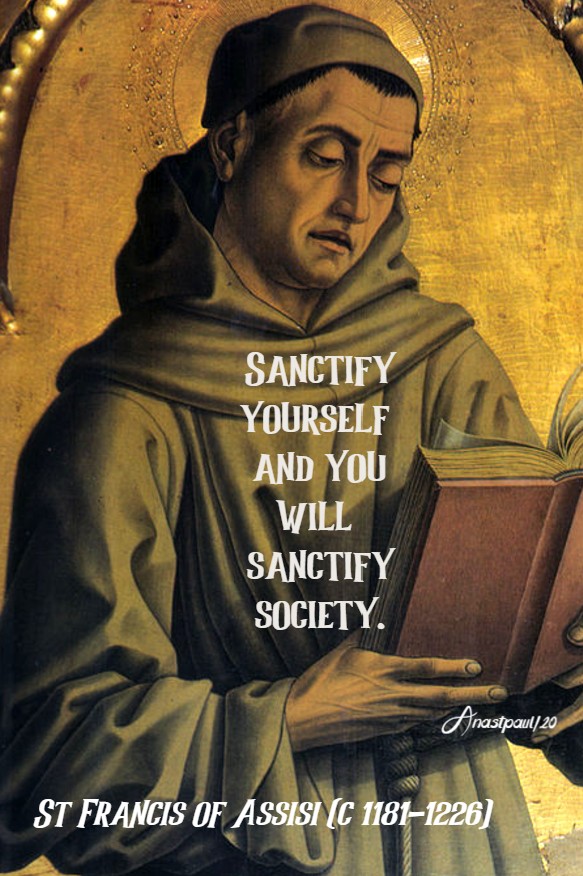
“Sanctify yourself
and you will
sanctify society.”

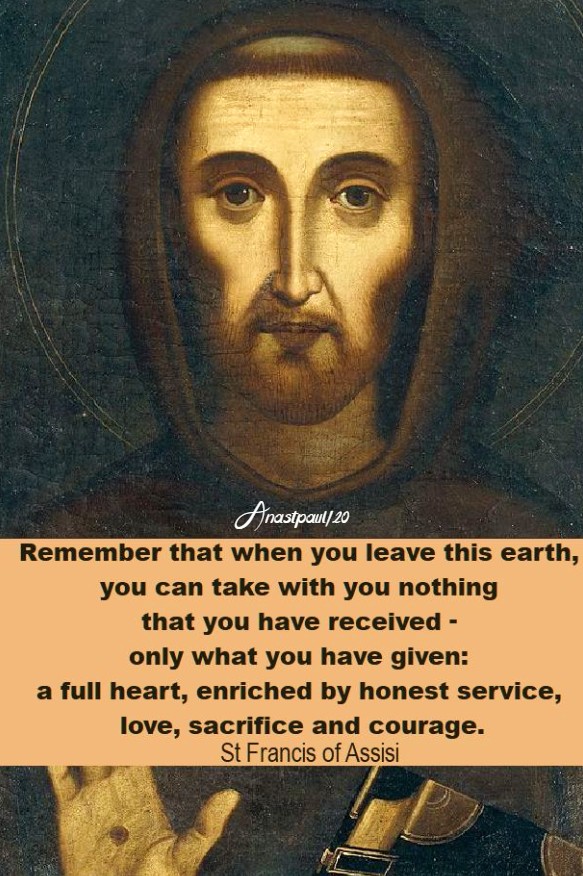
“Remember that when you leave this earth,
you can take with you,
nothing that you have received—
only what you have given –
a full heart,
enriched by honest service,
love, sacrifice and courage.”

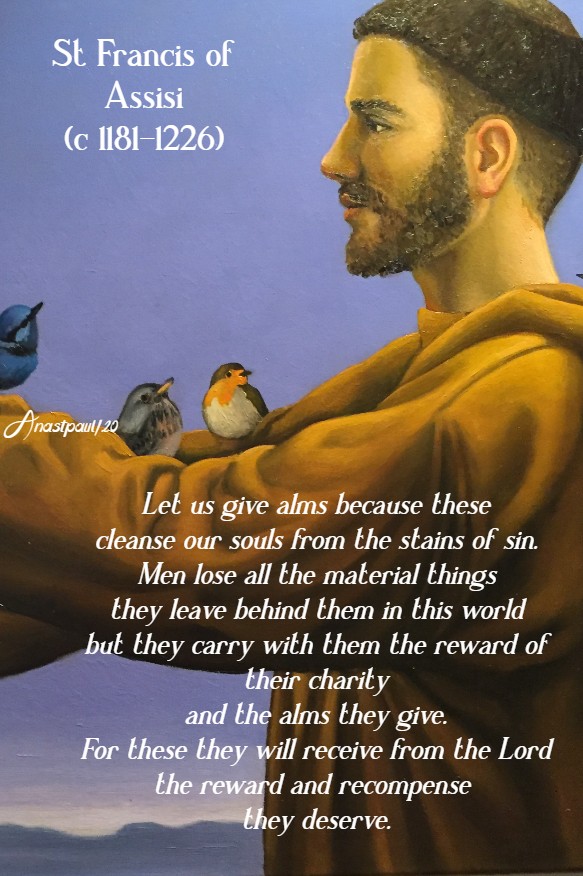
“Let us give alms because these
cleanse our souls from the stains of sin.
Men lose all the material things
they leave behind them in this world
but they carry with them the reward of their charity
and the alms they give.
For these they will receive from the Lord
the reward and recompense they deserve.”

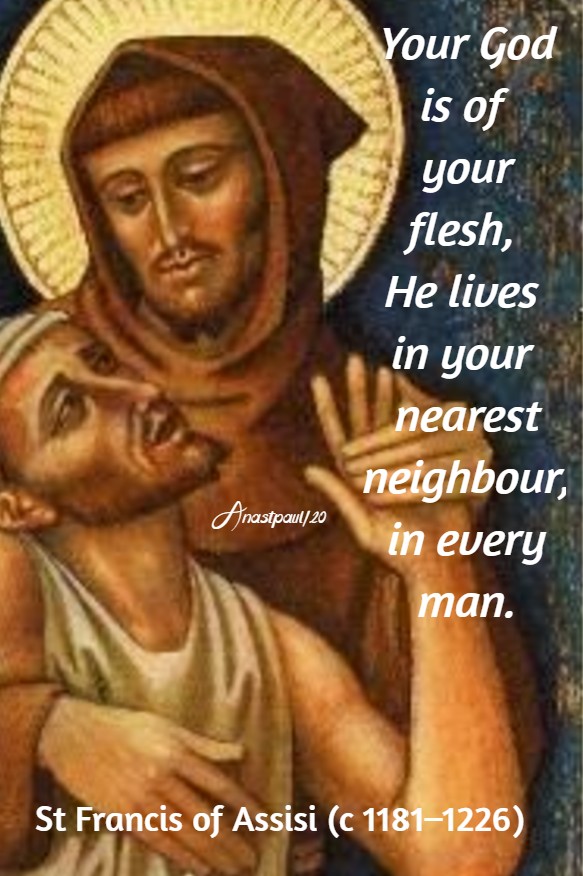
“Your God is of your flesh,
He lives in your nearest neighbour,
in every man.”

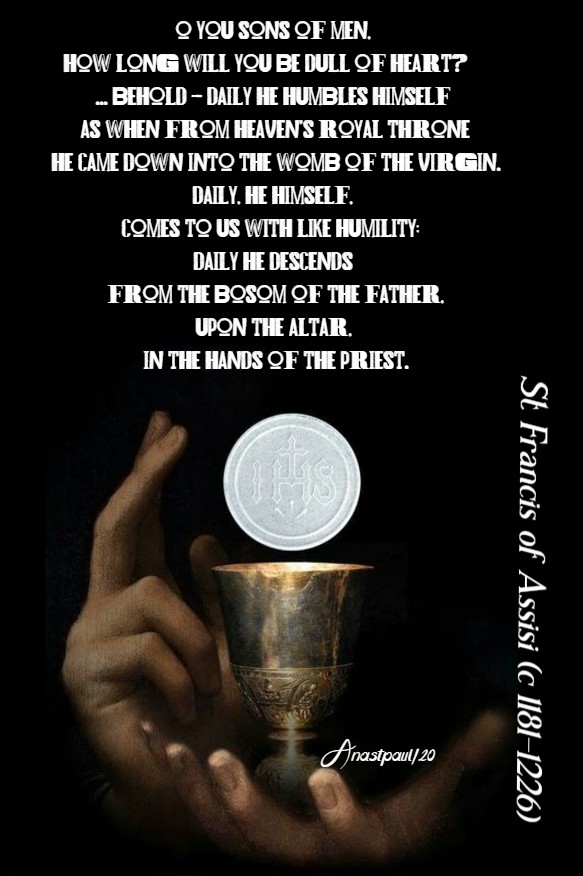
“O you sons of men,
how long will you be dull of heart?
… Behold – daily He humbles Himself
as when from heaven’s royal throne
He came down into the womb of the Virgin.
Daily, He Himself,
comes to us with like humility;
daily He descends
from the bosom of the Father,
upon the altar,
in the hands of the priest.”

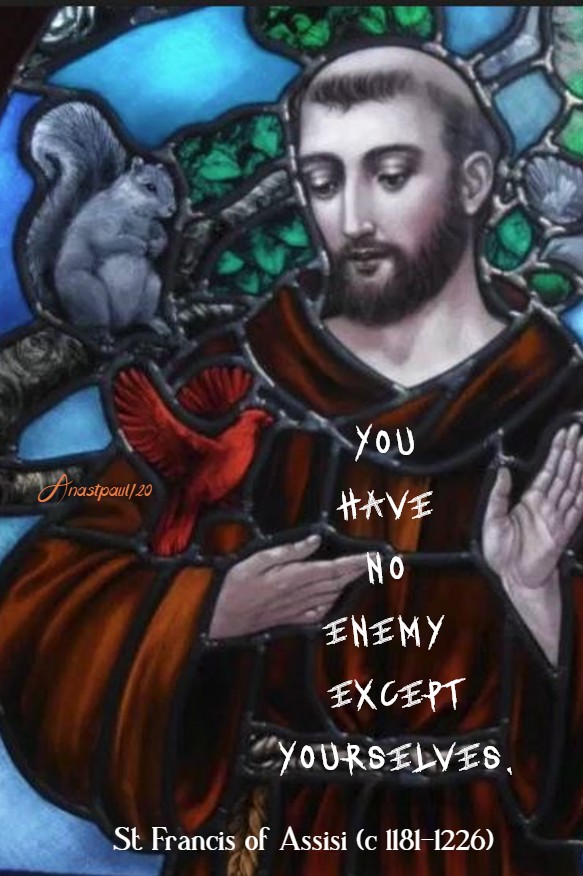
“You have no enemy except yourselves.”

More here:
https://anastpaul.com/2018/10/04/quote-s-of-the-day-4-october-the-memorial-of-st-francis-of-assisi-1181-2-1226/

St Francis of Assisi (c 1181–1226)

Posted in CONFESSION/PENANCE, DOCTORS of the Church, FATHERS of the Church, franciscan OFM, GOD the FATHER, ONE Minute REFLECTION, PRAYERS of the SAINTS, QUOTES of the SAINTS, QUOTES on CONVERSION, QUOTES on FORGIVENESS, QUOTES on LOVE of GOD, QUOTES on REPENTANCE, SAINT of the DAY, The WORD

One Minute Reflection – 4 October – ‘… What love!’ – Matthew 21:42

One Minute Reflection – 4 October – Twenty Seventh Sunday in Ordinary Time, Readings: Isaiah 5:1-7Psalms 80:91213-1415-1619-20Philippians 4:6-9Matthew 21:33-43 and the Memorial of St Francis of Assisi OFM (c 1181–1226)

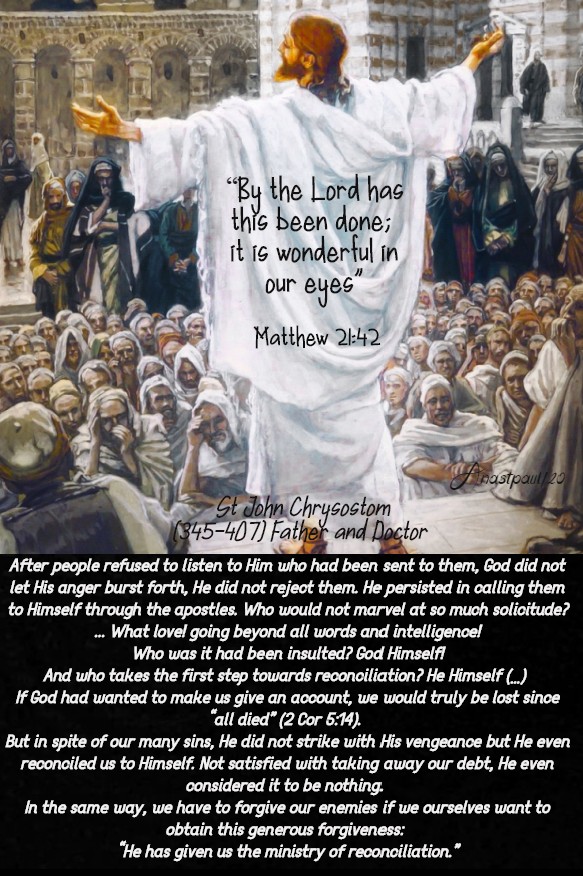
“By the Lord has this been done; it is wonderful in our eyes” … Matthew 21:42

REFLECTION “Christ has given us the ministry of reconciliation.” (2 Cor 5:18) Saint Paul thus brings out the greatness of the apostles, by showing us the ministry that was entrusted to them and at the same time, he shows us the love with which God loved us. After people refused to listen to Him who had been sent to them, God did not let His anger burst forth, He did not reject them. He persisted in calling them to Himself through the apostles. Who would not marvel at so much solicitude?

They killed the Son who had come to reconcile them, who was the only Son and of the same nature as the Father. The Father did not turn away from the murderers, He did not say: “I sent them my Son, and they, not satisfied with not having listened to Him, put Him to death and crucified Him. So now, it is only just that I abandon them.” He did the opposite. And after Christ had left earth, it is we, His ministers, who have the responsibility to replace Him. “He has given us the ministry of reconciliation. I mean that God, in Christ, was reconciling the world to himself, not counting men’s transgressions against them.”

What love! going beyond all words and intelligence! Who was it had been insulted? God Himself! And who takes the first step towards reconciliation? He Himself (…) If God had wanted to make us give an account, we would truly be lost since “all died” (2 Cor 5:14). But in spite of our many sins, He did not strike with His vengeance but He even reconciled us to Himself. Not satisfied with taking away our debt, He even considered it to be nothing. In the same way, we have to forgive our enemies if we ourselves want to obtain this generous forgiveness: “He has given us the ministry of reconciliation.”St John Chrysostom (345-407) Father and Doctor – Homily 11 on the Second Letter to the Corinthians, 4-5

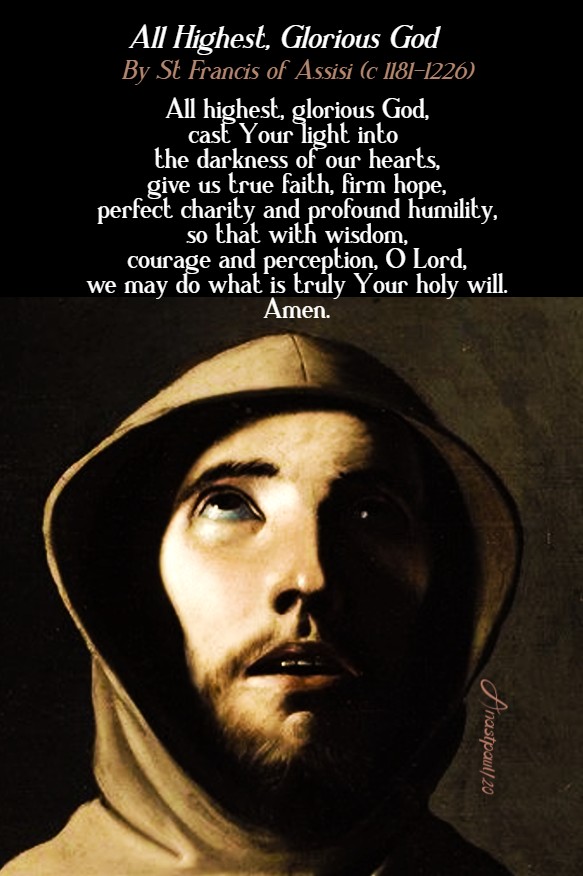
PRAYER – All highest, glorious God,
cast Your light into the darkness of our hearts,
give us true faith, firm hope,
perfect charity and profound humility,
so that with wisdom,
courage and perception, O Lord,
we may do what is truly Your holy will.
Amen. By St Francis of Assisi

Posted in franciscan OFM, SAINT of the DAY

Saint of the Day – 4 October – St Francis of Assisi OFM (c 1181–1226)

Saint of the Day – 4 October – St Francis of Assisi OFM (c 1181–1226)- Founder of the Franciscan Order, Confessor of the Faith, Stigmatist. Francis set out to imitate Christ and literally carry out His work. This is vital in understanding Francis’ character, his affinity for the Eucharist and respect for the priests who carried out the sacrament. He preached: “Your God is of your flesh, He lives in your nearest neighbour, in every man.”

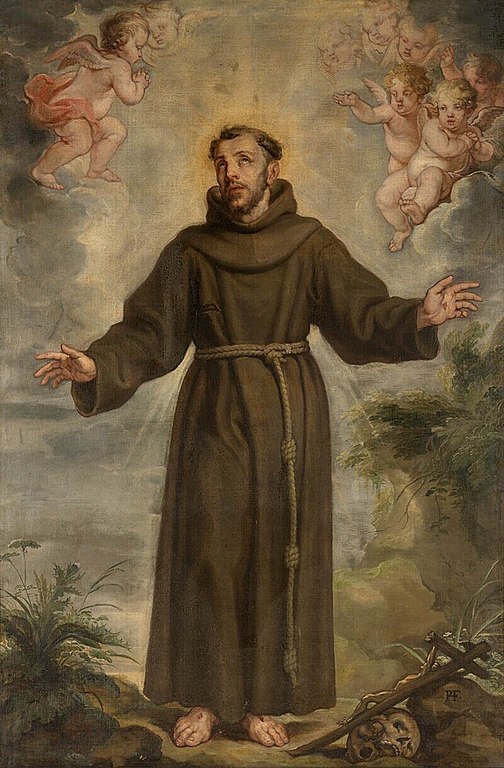
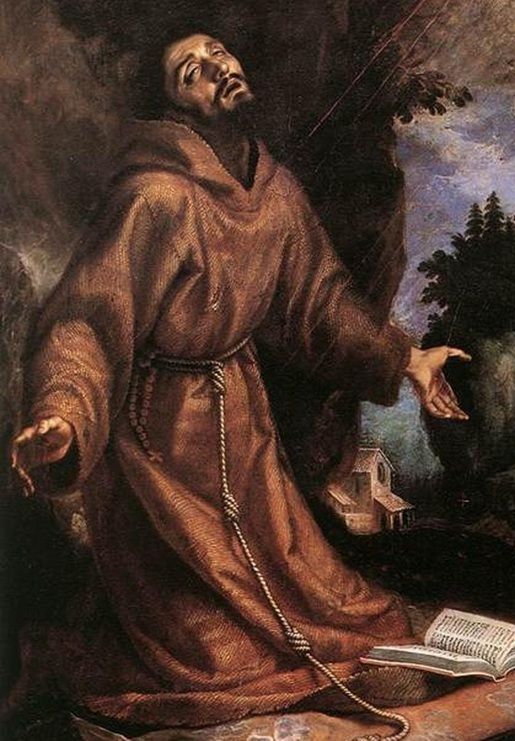
Saint Francis by Philip Fruytiers 17 century

He and his followers celebrated and even venerated poverty, which was so central to his character that in his last written work, the Testament, he said, that absolute personal and corporate poverty was the essential lifestyle for the members of his order.

St Francis of Assisi was the living embodiment of Jesus Christ. He left home, riches and family to be with the poor and the destitute. In all creation he saw the image of God. In imitating Jesus Christ, his self-denial led to the foundation of orders and movements of evangelical poverty. Not to mention, his love was so total that – when he had nothing left to give – but gave more, he received the stigmata.

St Francis was the son of a cloth merchant. His worldly successes culminated in a career as a soldier. While preparing for a second campaign, St Francis received a vision. The moment was life-changing in that he realised he had been called apart. Climbing to the “Mount Tabor” of prayer to discern the will of God, he received another prompting; whereupon the once affluent man began to imitate the poor so that he might preach to them. When, at last, he took his father’s cloth to sell for alms that the Church of San Damiano may be restored, his father took him to court for relieving him of his possessions. In that moment, in the presence of the Bishop, St Francis went all in; doubling down on his mission by stripping off his garments and declaring that now he had no possessions.

Fully committed to imitating Jesus by administering to them exactly as He had done, St Francis preached to the poor – going barefoot and quite literally “(taking) no gold, nor silver, nor money in your belts, no bag for your journey, nor two tunics, nor sandals, nor a staff…” Submitting to papal authority since Tradition was handed to the Apostles by Jesus, St Francis encountered an obstruction in Pope Innocent III but the latter gave consent for St Francis’ Order after seeing, in a dream, St Francis holding up the Church of San Giovanni in Laterano. The rule of poverty and preaching Friars raised up altars where churches once lay abandoned. The order of the Poor Clares and Franciscan lay movements, also stemmed from St Francis’ apostolate. He refined his rule to include complete poverty and self-denial to live and be with Christ.

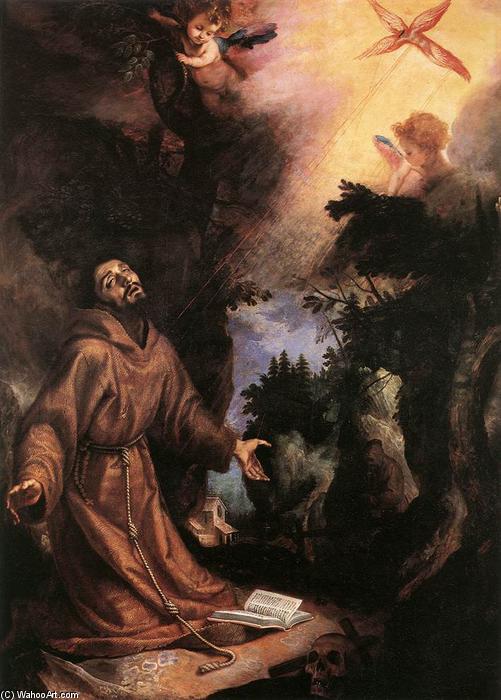
St Francis’ missions even brought him to Egypt, where an audience with the Sultan during the Crusades resulted in the Franciscan order gaining privileged access to Jerusalem. St Francis was a tireless worker; practicing prayer, penance, mortification and works to the extreme that Christ would go. Jesus fell asleep in the stern of a boat while the storm was raging – so exhausted was He. Then in 1224, while preparing for the feast of the Exaltation of the Cross, St Francis asked in prayer how to best please God. In that moment, as recorded by St Francis’ biographers and those he was with, he saw a vision of a man coming down from heaven, with 2 wings above his head, 2 outstretched in fligh, and 2 covering his body; whose face was beautiful beyond earthly description and who smiled gently upon St Francis; making him see, that not in bodily martyrdom but in mind and heart he should conform to Christ. The brilliance of that vision never left St. Francis. Brimming with life, he received the stigmata.

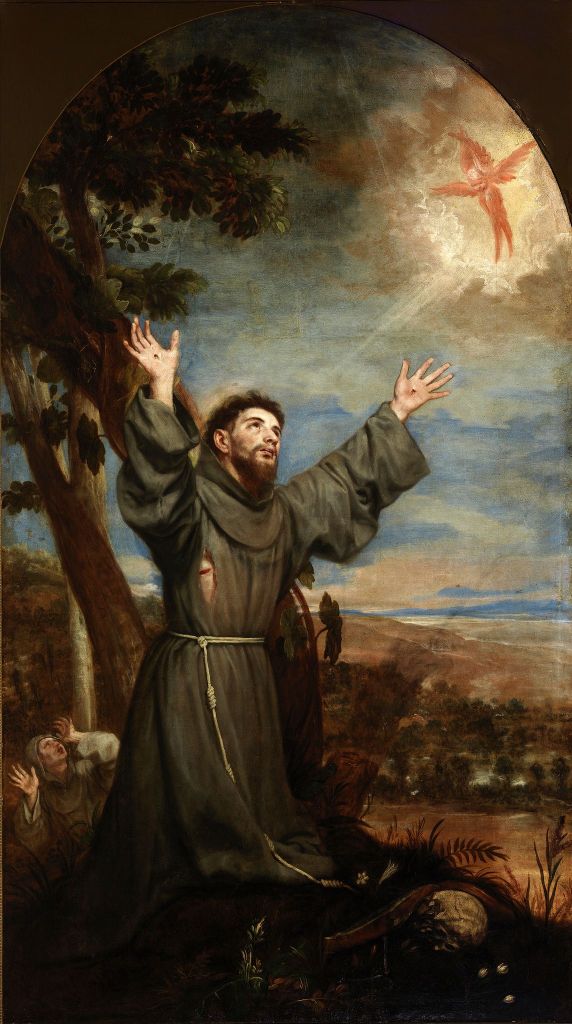
St Francis receives the Stigmata – detail – Cigoli

At the time St Francis received the stigmata, he was feeble and blind. He sought to give more when he had absolutely nothing. Honouring him by not creating needs for ourselves, being humbled by others and bearing it for Christ, rejecting hedonism and conforming our will and intellect to that of the Divine, is how we can celebrate this mystic who forever rejoices by the side of and in-step with Jesus Christ.

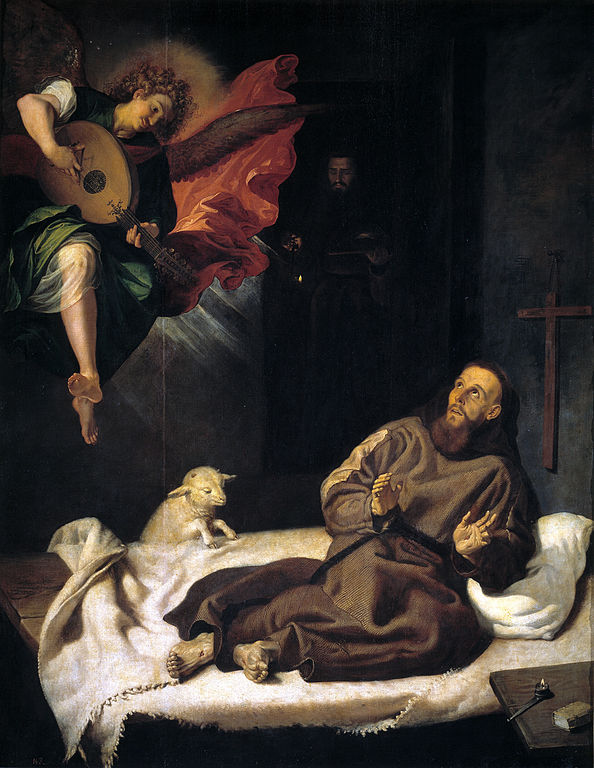
Francis Serenaded by an Angel – Francisco Ribalta (1565–1628)

On 18 June 1939, Pope Pius XII named Francis a joint Patron Saint of Italy along with Saint Catherine of Siena with the apostolic letter “Licet Commissa.”

St Francis is the patron of animals, merchants and ecology. He is also considered the patron saint against dying alone; patron saint against fire; patron saint of the Franciscan Order and Catholic Action; patron saint of families, peace, and needleworkers. He is the patron saint of many dioceses and other locations around the world, including – Italy; San Pawl il-Bahar, Malta; Freising, Germany; Lancaster, England; Kottapuram, India; San Francisco de Malabon, Philippines (General Trias City); San Francisco, California; Santa Fe, New Mexico; Colorado; Salina, Kansas; Metuchen, New Jersey and Quibdó, Colombia.

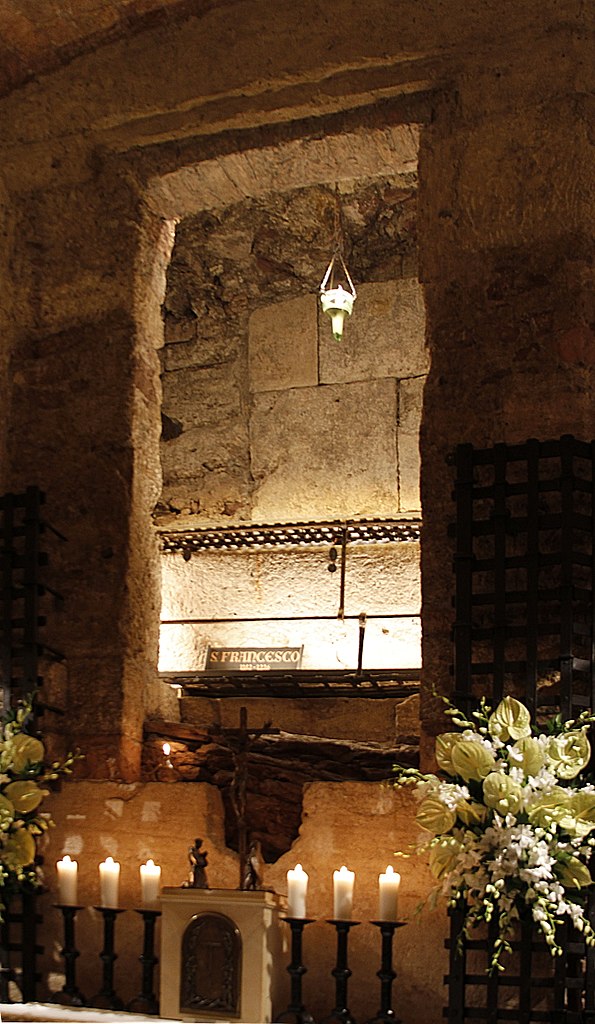
Tomb of St Francis, Assisi
Posted in franciscan OFM, SAINT of the DAY

Memorials of the Saints – 4 October

Twenty Seventh Sunday in Ordinary Time
Eighteenth Sunday after Pentecost (Traditional Calendar)

St Francis of Assisi OFM (c 1181–1226) (Memorial)
St Francis!:
https://anastpaul.wordpress.com/2017/10/04/saint-of-the-day-4-october-st-francis-of-assisi-o-f-m-1181-1226/
AND:
https://anastpaul.com/2018/10/04/saint-of-the-day-4-october-st-francis-of-assisi-ofm-1181-2-1226-the-brother-of-jesus/

St Adauctus of Ephesus
Bl Alfonso Tabela
St Aurea
St Berenice
St Caius of Corinth
St Callisthene of Ephesus
St Crispus of Corinth
St Damaris of Athens
St Diogenes of Milan
St Domnina
St Hierotheus
Bl Julian Majali
St Lucius of Alexandria
St Peter of Damascus
St Petronius (Died c 450)
About St Petronius:

https://anastpaul.com/2019/10/04/saint-of-the-day-4-october-saint-petronius-died-c-450/
St Prosdoce
St Quintius of Tours

Martyrs of Alexandria – 2+ saints: A group of Christians, men and women, young and old, murdered together for their faith. The only names that have come down to us are the brothers Mark and Marcian.

Martyred in the Spanish Civil War:
• Blessed Alfredo Pellicer Muñoz
• Blessed Avelí Martínez de Arenzana Candela
• Blessed Dionisio Ibáñez López
• Blessed Francisco Martínez Granero
• Blessed Fulgencio Martínez García
• Blessed José Aloy Doménech
• Blessed José Gafo Muñiz
• Blessed José Miguel Peñarroya Dolz
• Blessed Juan de Francisco Pío
• Blessed Juan José Orayen Aizcorbe
• Blessed Martina Vázquez Gordo
• Blessed Publio Fernández González
• Blessed Tomás Barrios Pérez

Posted in franciscan OFM, Of BANKERS, SAINT of the DAY

Saint of the Day – 28 September – Blessed Bernardine of Feltre OFM (1439-1494

Saint of the Day – 28 September – Blessed Bernardine of Feltre OFM (1439-1494) Priest, Franciscan Friar, Missionary Preacher, Poet, peace-maker, Civil protestor against the practice of usury, defender of the poor. He was a true ‘child prodigy’ – by the time he was 12 he was fluent in Latin and at the age of 15 he composed a poem and read it in the Town Square to celebrate a local peace treaty. He is remembered most especially, in connection with the “Monti di Pietà” “Mount of Piety” of which he was the reorganiser and, in a certain sense, the Founder, together with the Blesseds Francisco Piani and Michele Carcano. Born as Martin Tomitani in 1439 at Feltre, Italy and died on 28 September 1494 of natural causes. Patronages – bankers, pawnbrokers. He is also sometimes known as Bernardino of Feltre or Martin Tomitani.

A “Mount of Piety” is an institutional pawnbroker run as a charity in Europe from Renaissance times until today. Similar institutions were established in the colonies of Catholic countries; the Mexican Nacional Monte de Piedad is still in operation. It gave poor people access to loans with reasonable interest rates. It used funds from charitable donors as capital and made loans to the poor so they could avoid going to exploitative lenders. Borrowers offered valuables as collateral, making the Mount of Piety more like a pawn shop than a bank. The Monte di Pietà was developed on the principle of charity. It was designed to aid less fortunate people by providing an alternative to the socially unaccepted Jewish money lending system.

Obligation of the Monte di Pietà della Citta di Firenze, issued 21 October 1719

Martin Tomitani was born to the noble family of Tomitano and was the eldest of nine children. He achieved acclaim in his studies and to please his father he proceeded to study law. In 1456, while a law student in Padua, he heard St James of the Marches preach the Lenten course and was inspired to enter the Franciscan order. St James of the Marches himself, gave him the name Bernardine, after St Bernardine of Siena.

In May that year he joined the “Observantine” Franciscans, an austere branch of the Franciscan friars. He completed successfully his studies at Mantua and was Ordained Priest in 1463. He was small, shy and stammered but his superiors assigned him to preach home-missions. Cured of an impediment in his speech, Bernardine began his apostolate up and down the Italian peninsula. Every city of note and every province from Lombardy in the north to Sardinia and the provinces of the south became successively the scene of his missionary labours.

He was an extremely popular preacher because he spoke simply and powerfully against the vanity, ambition and greed rife at the time. The crowds that flocked to hear him were too large for the local churches, so he addressed them in the city squares and the fields. Like many other missionaries of his century, he had made a vast outdoor bonfire called “burning the Devil’s stronghold.” The crowds were asked to throw into the fire all objects of vanity and sin such as playing cards, dice, pornographic books and pictures, jewelry, wigs, superstitious charms, cosmetics and so forth.

Bernardine was able to reconcile warring communities. He also sought civic legislation to correct public injustices such as usury, the charging of excessive interest for loans, which was especially onerous on the poor.

In 1484, Bernardine established the charitable credit organisation, “Monti di Pietà” “Mount of Piety,” run by a joint committee of clergy and laymen. The institution was founded as an alternative to the high interest loans of the money lenders and Lombard travelling bankers of the Middle Ages.

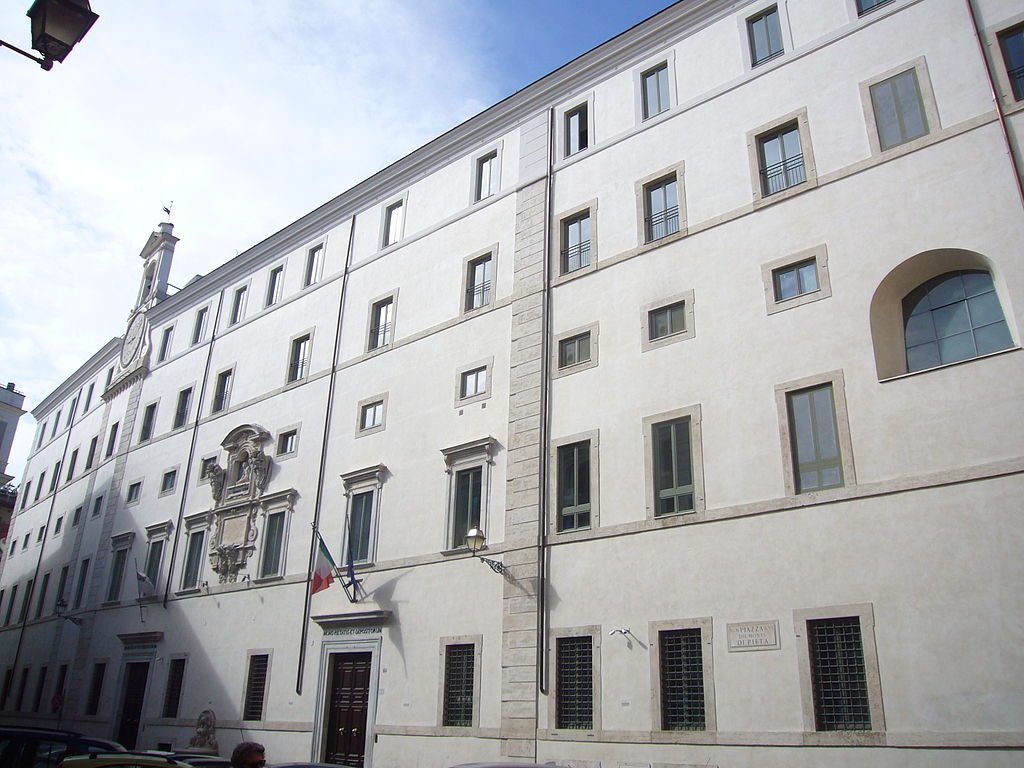
Monte di Pietà Offices in Rome

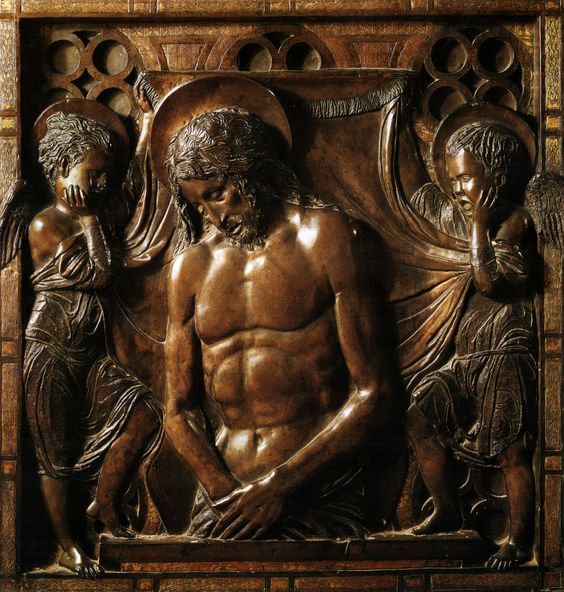
His fund raising drives were generally preceded with a procession featuring an image of either the Man of Sorrows or Pietà to encourage charitable donations. His insistence on charging a low interest to protect the institution’s permanency raised a controversy among the theologians who thought it promoted the continuance of usury. (In 1515, Pope Leo X declared the institution meritorious and it spread rapidly throughout France, Italy and Spain.)

Donatello (Italian, 1386–1466), “The Dead Christ Supported by Angels,” 1446–50. Bronze relief, 58 × 56 cm. Basilica di Sant’Antonio, Padua, Italy. Carved for the high altar. Includes two wings, not shown. https://www.pinterest.com/pin/467248530063361702/

In 1491, Bernardine was expelled from Milan by Ludovico Sforza for contesting with the Duke’s astrologer.

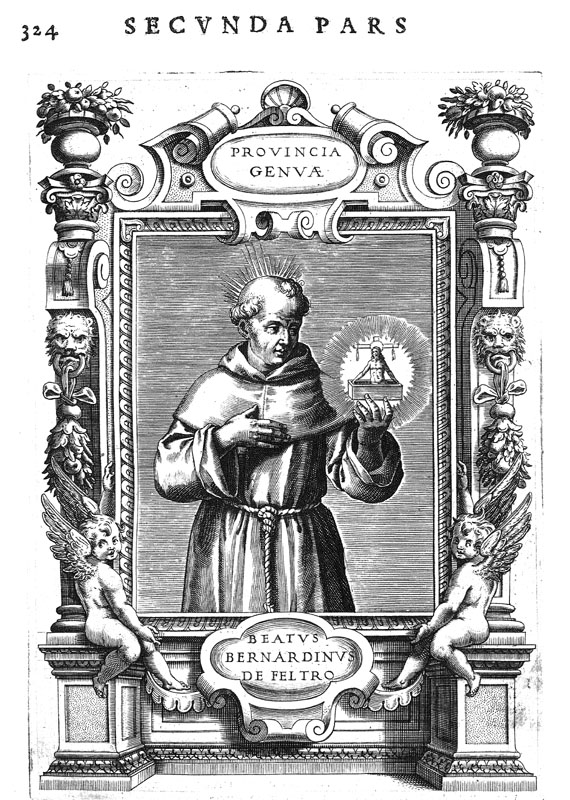
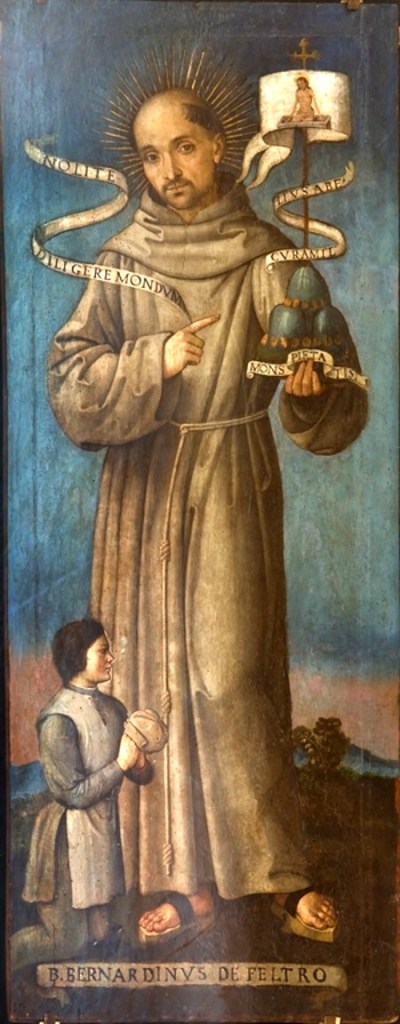
Bernardine is generally represented in iconography as carrying in his hand a Monti di Pietà, that is, a little green hill composed of three mounds and on the top either a cross or a standard with the inscription Curam illius habe ‘Take care of’ (a snippet from the Vulgate translation of the Gospel of Luke’s Parable of the Good Samaritan).

The authorship of the well-known Anima Christi has as often as not been ascribed to Bernardine of Feltre. The fact, however, that the Anima Christi was composed sometime before 1439 disproves any claim that he might have of being its author, though much like St Ignatius of Loyola, Bernardine made frequent use of it and recommended it to his brethren.

On  13 April 1654, Pope Innocent X confirmed the culktus of Blessed Bernardine and he was formally Beatified in 1728 by Pope Benedict XIII.

Posted in franciscan OFM, SAINT of the DAY

Saint of the Day – 18 September – Blessed Ambrosio María de Torrent (Salvador Chuliá Ferrandis) TC (1866-1936) Priest and Martyr

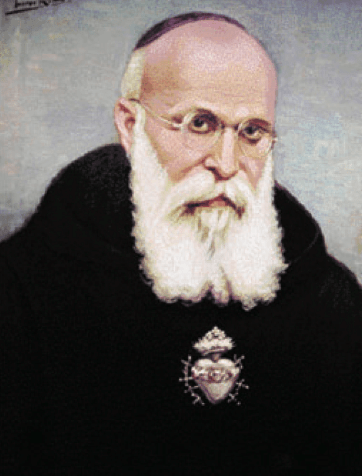
Saint of the Day – 18 September – Blessed Ambrosio María de Torrent (Salvador Chuliá Ferrandis) TC (1866-1936) Priest and Martyr of the Spanish civil War. Blessed Ambrosio was a religious Friar and Priest of The Amigonian Friars. He was a man of deep piety, a devotee of the Eucharist, a great apostle of the confessional and a competent director of souls. Born on 16 April 1866 in Torrent, Valencia, Spain and died by being shot at dawn on 18 September 1936 in Torrent, Valencia, Spain.

The Amigonian Friars and Sisters, are a religious institute of religious founded in Spain during the 19th century which specialises in working with young boys facing issues of juvenile delinquency and drug addiction. They follow the Rule of the Third Order Regular of St Francis. The Friars follow a spirituality based on the vision of St Francis of Assisi, given to them by their founder, a Capuchin Friar Minor. They also model themselves on the role of Our Lady of Sorrows, who stood at the foot of the Cross, sharing her Son’s agony and love for the world. She is a model to the Friars, of the generosity, mercy, strength and tenderness needed in the mission of serving their charges.

Salvador Chuliá Ferrandis , which was his civil name, was born in Torrent (Valencia) on 16 April 1866. He studied ecclesiastical studies at the Conciliar Seminary of Valencia but, once he received the diaconate, he entered the Capuchin Tertiary. On 4 April 1892, he was Ordained a Priest, making his perpetual religious vows on 5 July 1898, taking the name Ambrosio María de Torrent.

A man of broad culture but rather gentle in character and of little authority, he was always more inclined to exercise obedience than to command. In his pastoral ministry, he manifested himself as a man of council and spiritual director of the fraternity, confessor of religious and students.

Captured in his father’s house on 21 August 1936, he was taken to La Torre prison, in his hometown. In that prison, Father Ambrosio and nine other Capuchin Tertiaries practically led community life. From the street, you could hear them sing the Sorrows of the Virgin and the wounds of Saint Francis.

In the early hours of 18 September 1936, he was executed in the area of La Mantellina, Torrent, along with seven other Priests and Friars. Father Ambrosio, despite his shyness, was the one who bravely faced Martyrdom and encouraged his companions by raising, at the final moment, his hands to bless and forgive the executioners.

When trying to delineate his spiritual silhouette, the various biographers agree that Father Ambrosio was a little Franciscan flower – simple, humble, conciliatory, poor, obedient, silent, sparing in words, that he did not speak ill of anyone and that he always looked to find the good in all. Likewise, they define him as a man of deep piety, a devotee of the Eucharist, a great apostle of the confessional and a competent director of souls.

His mortal remains rest in the Chapel of Los Mártires, in the parish of Nuestra Señora de Monte Sión de Torrent (Valencia), where they are frequently visited.

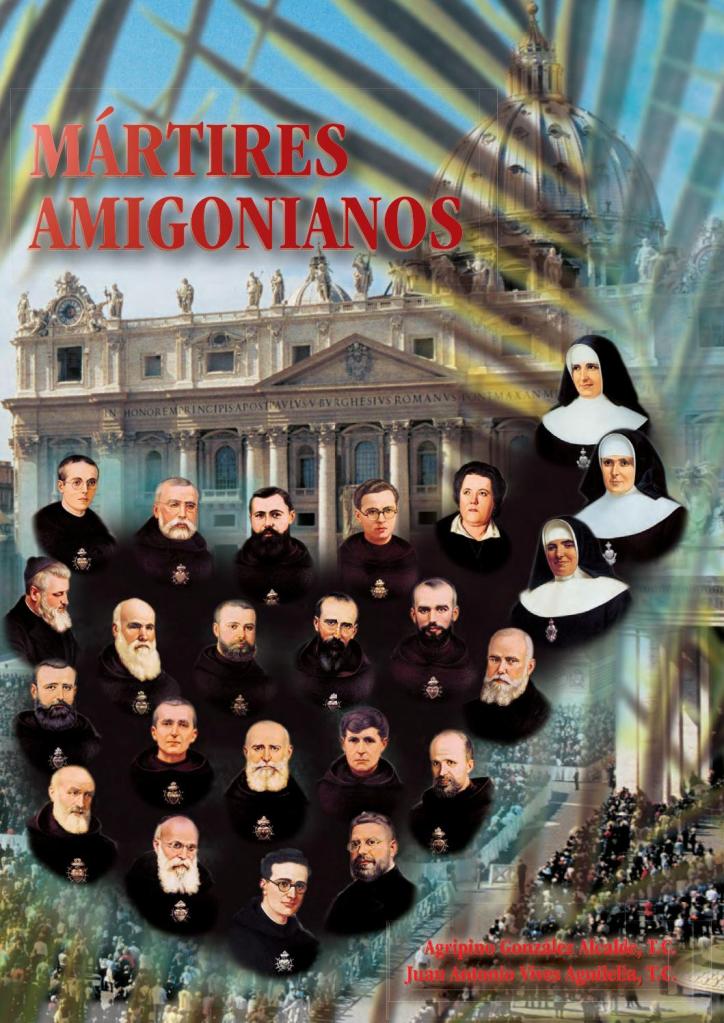
Blessed Ambrosio was Beatified by Pope John Paul II togther with 232 others who were Martyred during the Spanish Civil War. The Image below shows the Martyrs of the Amigonian Orders.

Posted in DOCTORS of the Church, franciscan OFM, SAINT of the DAY

Memorials of the Saints – 17 September

St Robert Bellarmine SJ (1542-1621) Doctor of the Church (Optional Memorial)

St Robert’s life here:
https://anastpaul.wordpress.com/2017/09/17/saint-of-the-day-17-september-st-robert-bellarmine-s-j-doctor-of-the-church/

Stigmata of St Francis of Assisi:
Two years before the great Saint Francis of Assisi died and when he was forty-two years old — one year after he had built the first crib in honour of Our Lord — he went off to a lonely mountain called Mount Alvernia, to prepare himself by forty days of fasting and prayer for the feast of Saint Michael, the greatest of God’s angels, whose feast day is 29 September. On the feast of the Exaltation of the Holy Cross on 14 September, Saint Francis received in his hands, feet and side the Sacred Wounds from Our Lord’s own body.

Never was a saint more beautifully loved by Jesus than Saint Francis of Assisi. The wounds Jesus gave him stayed in his hands, feet and side and continually bled for two more years, until he died in 1226. The day on which Saint Francis received the Five Wounds of Our Lord was 14 September but so, that this beautiful event might have a feast day for itself, the Stigmata of Saint Francis is commemorated today, on 17 September. The simple liturgy of this holy saint’s life might be put this way – the crib in 1223 and the Cross in 1224.

St Agathoclia
St Brogan of Ross Tuirc
St Columba of Cordova
St Crescentio of Rome
St Emmanuel Nguyen Van Trieu
St Flocellus
St Hildegard von Bingen OSB (1098-1179) Doctor of the Church
Biography:

https://anastpaul.com/2018/09/17/saint-of-the-day-17-september-st-hildegard-von-bingen-osb-1098-1179-doctor-of-the-church/

St Justin of Rome
St Lambert (c 635-c 700) Bishop & Martyr
St Narcissus of Rome
St Peter Arbues
St Rodingus
St Satyrus of Milan
St Socrates
Bl Stanislaus of Jesus and Mary
St Stephen
St Theodora
St Uni of Bremen
St Zygmunt Sajna
St Zygmunt Szcesny Felinski TOSF (1822-1895)
His Life:

https://anastpaul.com/2019/09/17/saint-of-the-day-17-september-saint-zygmunt-szcesny-felinski-1822-1895/

Martyred in the Spanish Civil War
• Blessed Álvaro Santos Cejudo Moreno Chocano
• Blessed Juan Ventura Solsona
• Blessed Timoteo Valero Pérez

Posted in DOCTORS of the Church, EUCHARISTIC, franciscan OFM, Our MORNING Offering, PRAYERS of the SAINTS, The HOLY EUCHARIST / The HOLY MASS

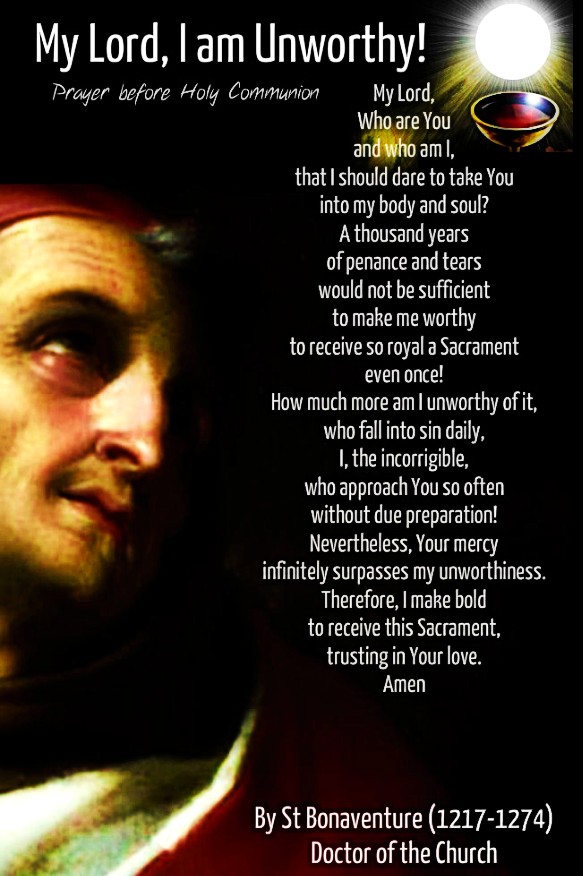
Our Morning Offering – 13 September – My Lord, I am Unworthy! by St Bonaventure

Our Morning Offering – 13 September – Twenty Fourth Sunday in Ordinary Time

My Lord, I am Unworthy!
Prayer before Holy Communion
By St Bonaventure (1217-1274)
Doctor of the Church

My Lord,
Who are You
and who am I,
that I should dare to take You
into my body and soul?
A thousand years
of penance and tears
would not be sufficient
to make me worthy
to receive so royal a Sacrament even once!
How much more am I unworthy of it,
who fall into sin daily,
I, the incorrigible,
who approach You so often
without due preparation!
Nevertheless, Your mercy
infinitely surpasses my unworthiness.
Therefore, I make bold
to receive this Sacrament,
trusting in Your love.
Amen

Posted in DOCTORS of the Church, franciscan OFM, MARIAN PRAYERS, MARIAN Saturdays, MATER DOLOROSA - Mother of SORROWS, PRAYERS of the SAINTS, SEPTEMBER-The SEVEN SORROWS of MARY and The HOLY CROSS

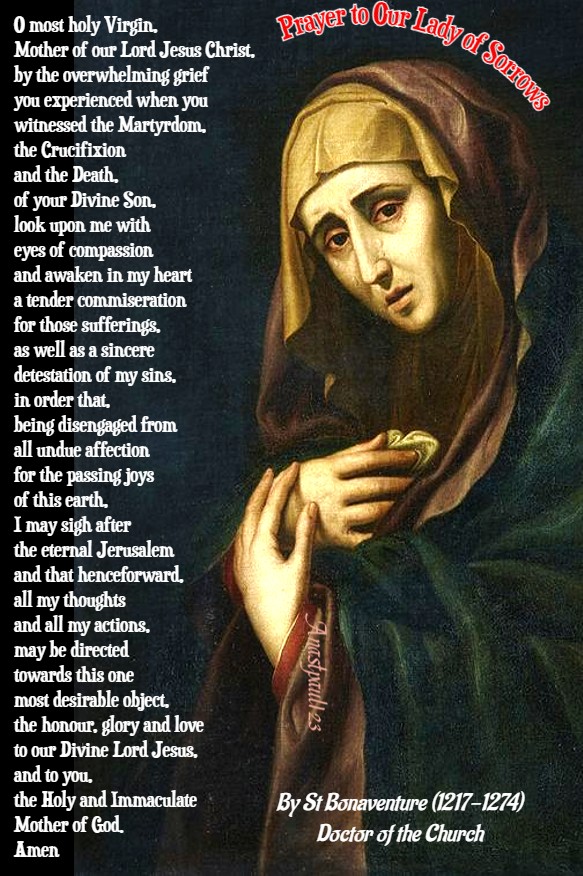
Our Morning Offering – 5 September – Prayer to our Lady of Sorrows By St Bonaventure

Our Morning Offering – 5 September – “Month of the Seven Sorrows of the Blessed Virgin Mary”and a Marian Saturday – Saturday of the Twenty Second week in Ordinary Time

Prayer to our Lady of Sorrows
By St Bonaventure (1217-1274)
Doctor of the Church

O most holy Virgin,
Mother of our Lord Jesus Christ,
by the overwhelming grief you experienced
when you witnessed the Martyrdom,
the Crucifixion
and the Death,
of your Divine Son,
look upon me with eyes of compassion
and awaken in my heart a tender
commiseration for those sufferings,
as well as a sincere detestation of my sins,
in order that,
being disengaged from all undue affection
for the passing joys of this earth,
I may sigh after the eternal Jerusalem
and that henceforward, all my thoughts
and all my actions, may be directed
towards this one most desirable object,
the honour, glory and love
to our Divine Lord Jesus,
and to you,
the Holy and Immaculate
Mother of God.
Amen

Posted in DOCTORS of the Church, franciscan OFM, MARIAN PRAYERS, MATER DOLOROSA - Mother of SORROWS, PRAYERS of the SAINTS, SEPTEMBER-The SEVEN SORROWS of MARY and The HOLY CROSS

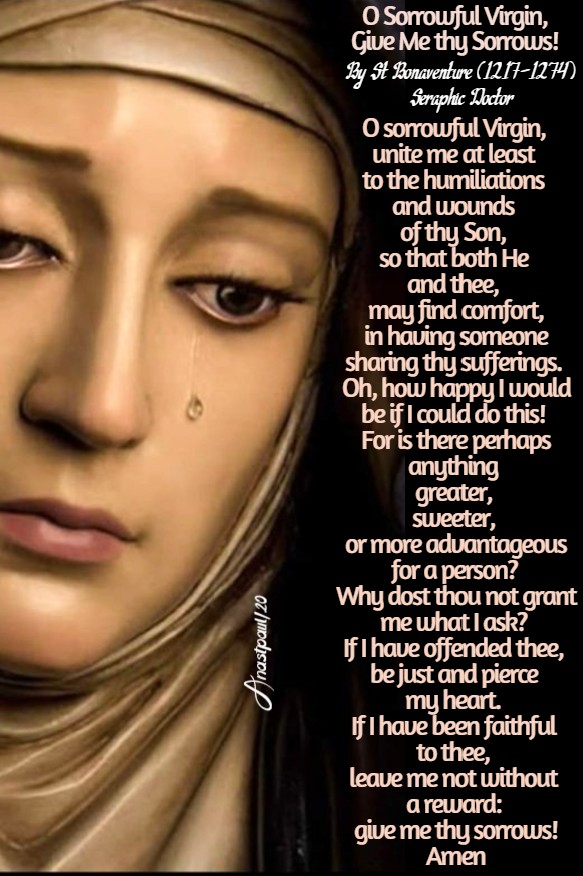
Our Morning Offering – 1 September – O Sorrowful Virgin, Give Me thy Sorrows!

Our Morning Offering – 1 September – “Month of the Seven Sorrows of Mary” – Tuesday of the Twenty Second week in Ordinary Time

As we enter the Month of our Sorrowful Mother, let us unite ourselves to her and offer her our meagre consolation.

O Sorrowful Virgin,
Give Me thy Sorrows!
By St Bonaventure (1217-1274)
Seraphic Doctor

O sorrowful Virgin,
unite me at least
to the humiliations and wounds of thy Son,
so that both He and thee,
may find comfort,
in having someone sharing thy sufferings.
Oh, how happy I would be if I could do this!
For is there perhaps anything
greater,
sweeter,
or more advantageous for a person?
Why dost thou not grant me what I ask?
If I have offended thee,
be just and pierce my heart.
If I have been faithful to thee,
leave me not without a reward:
give me thy sorrows!
Amen

Posted in franciscan OFM, SAINT of the DAY

Saint of the Day – 28 August – Blessed Angelo da Pesche d’Isernia TOR (c 1400-1460)

Saint of the Day – 28 August – Blessed Angelo da Pesche d’Isernia TOR (c 1400-1460) Lay Franciscan Tertiary, Holy Beggar, gifted with the charism of levitation, apostle of the poor, spiritual adviser – born in c 1400 in Pesche d’Isernia, Italy and died in 1460 in the Franciscan monastery in Lucera, Foggia, Italy of natural causes.

The blessed is named in the ‘Franciscan Martyrology’ on 28 August, he was born in Pesche d’Isernia around the year 1400, of his life it is known that he was a layman, gardener and beggar of the Franciscan Order, in various Convents in Southern Italy.

Blessed Angelo he had a great spirit of prayer and union with God, which he did not lose even in carrying out the most humble and material works.

It is said that having been called to the house of the Countess of Ariano, wife of Count Innico, he arrived when a concert was being given in the palace in the presence of the Count. Upon hearing that fifteenth-century music, his thoughts went to the celestial choirs and this gave him an ecstasy, rising from the ground for a while.

And like so many other humble friars and holy men in past centuries, thanks to their simplicity and discernment in reading people’s hearts, they were sought out and consulted for advice and guidance, Blessed Angelo da Pesche d’Isernia was also consulted and followed in his simple but profound advice from princes and nobles of the Aragonese kingdom of the Two Sicilies.

He died in the Franciscan Convent of Lucera (Foggia) in 1460, his body rests in this Apulian city.

Posted in franciscan OFM, INCORRUPTIBLES

Saint of the Day – 22 August – Blessed Timoteo da Monticchio OFM (1444-1503)

Saint of the Day – 22 August – Blessed Timoteo da Monticchio OFM (1444-1503) Priest and Friar of the Franciscan Order,he ws endowed with mystical gifts, especially of the Blessed Virgin and of St Francis of Assisi – born in 1444 in Monticchio, L’Aquila and died on 22 August 1504 in the San Angelo convent in Ocra, L’Aquila, Abruzzo, Italy of natural causes. He was distinguished for his austerity of life, his visions and his fervour of prayer. His body is incorrupt.

Blessed Timoteo was born in 1444 in Monticchio, therefore, in a period of great affirmation of the Franciscan Order, so much so, that in the same L’Aquila, not far away, the reformer St Bernardine of Siena, the great Franciscan preacher, preached and lived.

He was born into a peasant family and while growing up poor, he was completely absorbed by the spirit of prayer. As a young man he entered the Franciscan Order of Friars Minor, where he studied and was Ordained a Priest.

After his Ordination he was sent to Campli in the province of Teramo as the Master of Novices. His life was a succession of mystical phenomena – he had frequent visions of the Blessed Virgin and the holy founder Francis of Assisi. It was said that Timoteo’s life was more celestial than earthly.

He faithfully adhered to the spirit of those Franciscan saints, who restored observance in the Order, such as the aforementioned St Bernardine of Siena, St Giacomo della Marca, St John da Capestrano and the Blessed Bernardino da Fossa.

From Campli, he was transferred to the small Convent of St Angelo d’Ocre, here too, he led a life interwoven with prayer and contemplation, becoming for his brothers an example of the active and contemplative Priesthood and of heroic fidelity to the Franciscan Rule.

He died holy in the latter convent on 22 August 1504. For his reputation for holiness, already known in life and continued after his death, in the lands of Abruzzo, especially in the Aquila and Teramo area, he was given a cult of blessed, which continued uninterruptedly over the centuries, until on 10 March 1870, his Beatification was confirmed by Pope Pius IX. His feast is celebrated today, 22 August.

Posted in CATECHESIS, DOCTORS of the Church, franciscan OFM, QUOTES of the SAINTS, QUOTES on CONVERSION, QUOTES on DEATH, QUOTES on ETERNAL LIFE, QUOTES on FAITH, QUOTES on GRACE, QUOTES on MARRIAGE, MARRIED LOVE, QUOTES on SACRED SCRIPTURE, SAINT of the DAY, The FAITHFUL on PILGRIMAGE, The HOLY GHOST, The LAST THINGS, The WORD

One Minute Reflection – 20 August – “Blessed are those who have been called to the wedding feast of the Lamb!”

One Minute Reflection – 20 August – “Month of the Immaculate Heart of Mary” – Thursday of the Twentieth week in Ordinary Time, Readings: Ezekiel 36: 23-28Psalms 51:12-1314-1518-19Matthew 22:1-14 and the Memorial of St Bernard of Clairvaux (1090-1153) “Doctor of Light”

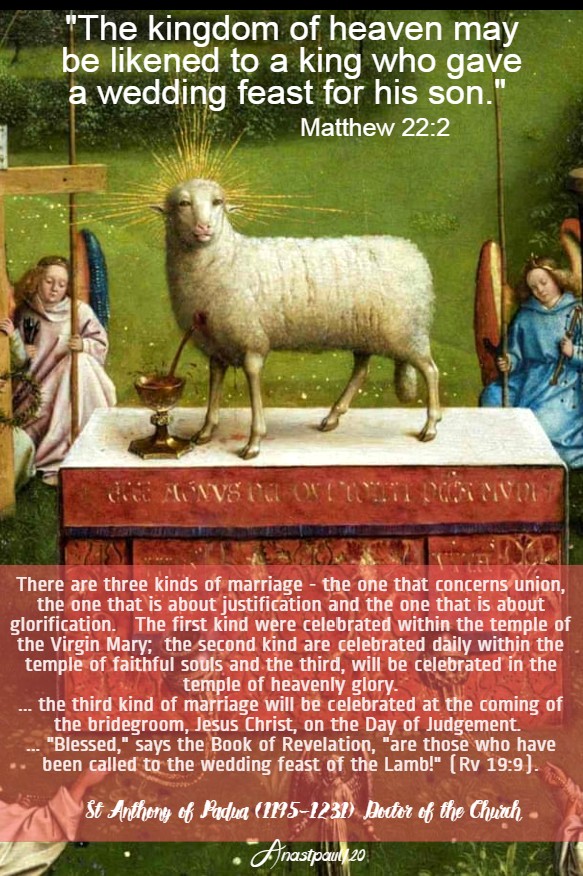
“The kingdom of heaven may be likened to a king who gave a wedding feast for his son.” – Matthew 22:2

REFLECTION – “There are three kinds of marriage – the one that concerns union, the one that is about justification and the one that is about glorification. The first kind were celebrated within the temple of the Virgin Mary; the second kind are celebrated daily within the temple of faithful souls and the third, will be celebrated in the temple of heavenly glory.
The purpose of a wedding is to unite two people, the bridegroom and the bride. If two families are against each other, marriage usually unites them, when a man from one side marries a woman from the other. Between ourselves and God, there used to be a great division – to wipe it out and establish peace, the Son of God had to take His bride from someone of our lineage. To realise this marriage, numerous intermediaries and peacemakers intervened who, through their insistent prayers, were able to win it, at great cost. Finally, the Father Himself gave His consent and sent His Son, who joined Himself to our nature in the marriage chamber of the Virgin Mary’s womb. Thus the Father “gave a marriage feast for his Son.”
In the same way, the second kind of marriage is celebrated when the grace of the Holy Spirit intervenes and the soul is converted (…) The grace of the Holy Spirit is the bridegroom of the soul. When He calls it to repentance with His interior inspiration, all appeal from the vices is without effect.
Finally, the third kind of marriage will be celebrated at the coming of the bridegroom, Jesus Christ, on the Day of Judgement. Of Him it is written: “Behold, the bridegroom is coming! Go out to meet him” (Mt 25:6). He will take the Church itself as bride, as John says in the Book of Revelation: “Come here. I will show you the Bride, Jerusalem, coming down out of heaven from God, gleaming with the splendour of God” (cf. Rv 21:9-11). The Church of the Faithful comes down from heaven, from beside God, for it has obtained from God that it’s dwelling should be in the heavens.
And so, at present, it lives by faith and hope but very soon it will celebrate it’s espousals with it’s bridegroom: “Blessed,” says the Book of Revelation, “are those who have been called to the wedding feast of the Lamb!” (Rv 19:9).” … St Anthony of Padua OFM (1195-1231) Doctor of the Church

PRAYER – All-knowing God, let me be able to stand in Your presence with a good conscience. Send Your Holy Spirit to fill my soul with the enlightenment of repentance and then to guide my steps towards the wedding feast You have prepared for Your Son. You made St Bernard burn with zeal for Your house and gave him the grace to enkindle and enlighten others in Your Church. Grant that by his prayer, we may be filled with the same spirit and always live as children of the Light. Through Christ our Lord, in the unity of the Holy Spirit, God forever, amen.

Posted in EUCHARISTIC Adoration, franciscan OFM, MARIAN QUOTES, QUOTES of the SAINTS, QUOTES on ANGELS, QUOTES on LOVE, QUOTES on LOVE of GOD, QUOTES on SUFFERING, QUOTES on the DEVIL/EVIL, SAINT of the DAY

Quote/s of the Day – 14 August – St Maximillian Kolbe

Quote/s of the Day – 14 August – The Memorial of Blessed St Maximillian Kolbe OFM Conv (1894 -1941)

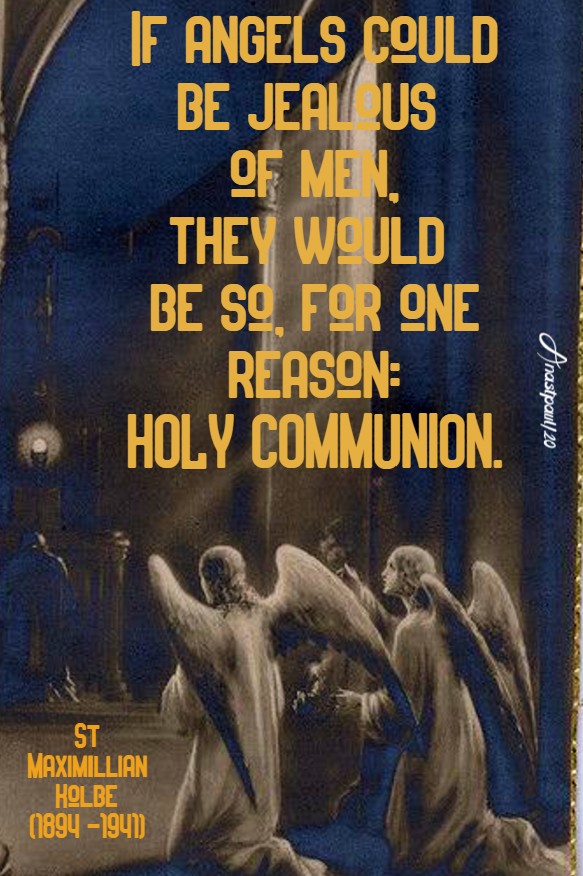
“If angels could be jealous of men,
they would be so, for one reason:
HOLY COMMUNION.”

if angels could be jealous of men - st max 14 aug 2020

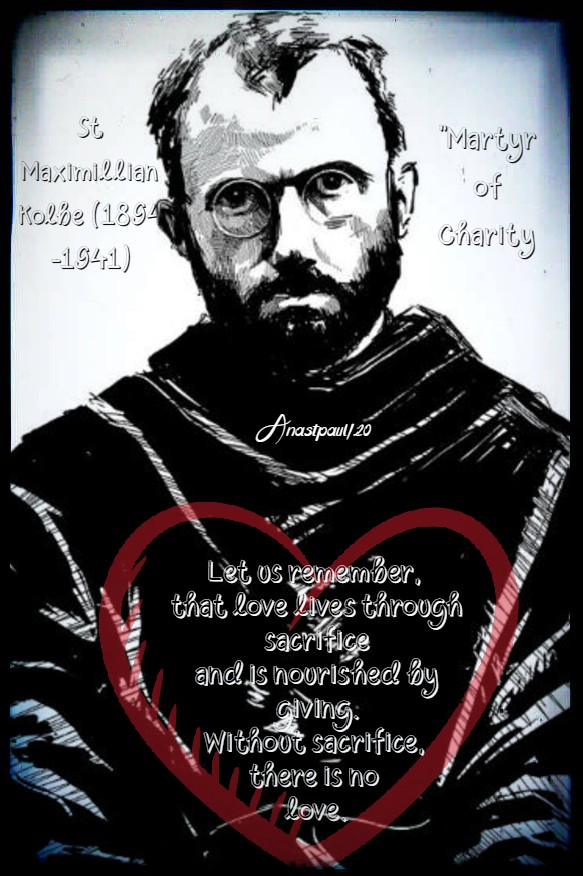
“Let us remember,
that love lives through sacrifice
and is nourished by giving.
Without sacrifice, there is no love.”

let us remember that love lives through sacrifice - st max 14 aug 2020STD

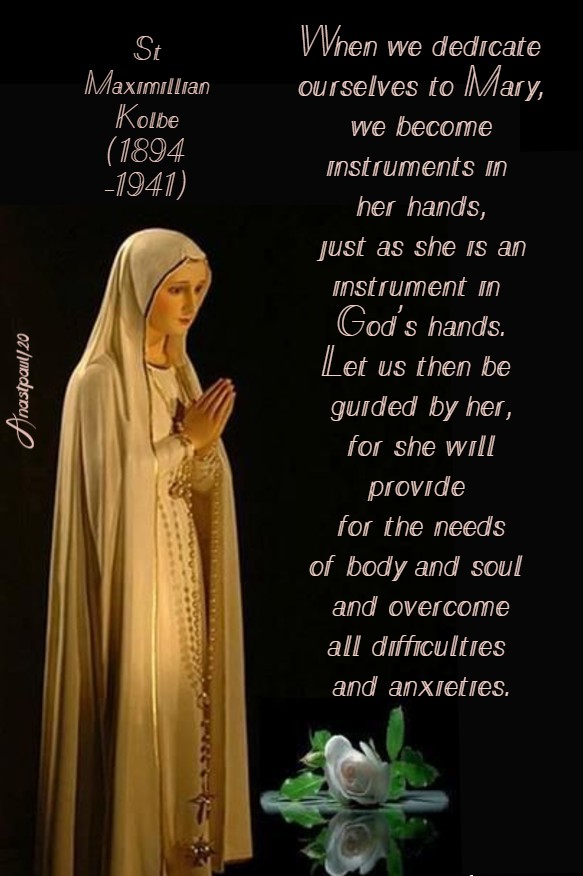
“When we dedicate ourselves to Mary,
we become instruments in her hands,
just as she is an instrument in God’s hands.
Let us then be guided by her,
for she will provide for the needs
of body and soul and overcome
all difficulties and anxieties.”

when we dedicate ourselves to mary - st max 14 aug 2020

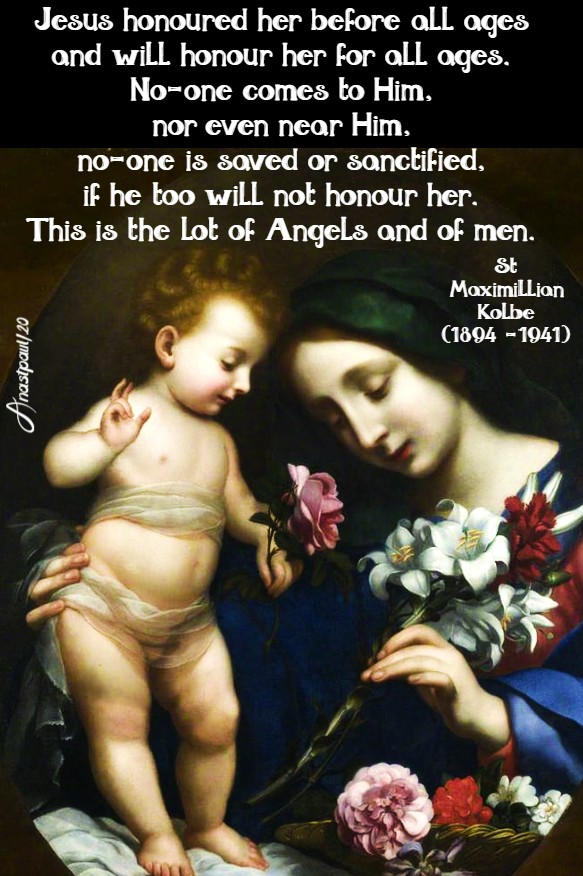
“Jesus honoured her before all ages
and will honour her for all ages.
No-one comes to Him,
nor even near Him,
no-one is saved or sanctified,
if he too will not honour her.
This is the lot of Angels and of men.”

jesus honoured her - st max 14 aug 2020

“Modern times are dominated by Satan
and will be more so in the future.
The conflict with hell cannot be engaged by men,
even the most clever.
The Immaculata alone, has from God,
the promise of victory over Satan.
However, assumed into Heaven,
the Mother of God now requires our co-operation.
She seeks souls, who will consecrate themselves entirely to her,
who will become in her hands effective instruments
for the defeat of Satan
and the spreading of God’s kingdom upon earth.”

More here:
https://anastpaul.com/2019/08/14/quote-s-of-the-day-14-august-st-maximillian-kolbe/

St Maximillian Kolbe (1894 -1941)

modern times are dominated by satan - st max 14 aug 2020

Posted in CHRIST, the WAY,TRUTH,LIFE, franciscan OFM, GOD ALONE!, INCORRUPTIBLES, Lady POVERTY, QUOTES for CHRIST, QUOTES of the SAINTS, QUOTES on DEATH, QUOTES on ETERNAL LIFE, QUOTES on FAITH, QUOTES on HEAVEN, QUOTES on LOVE, QUOTES on LOVE of GOD, QUOTES on SUFFERING, QUOTES on TEMPTATION, QUOTES on WORK/LABOUR

Quote/s of the Day – 11 August – St Clare of Assisi

Quote/s of the Day – 11 August – The Memorial of St Clare of Assisi (1194-1253)

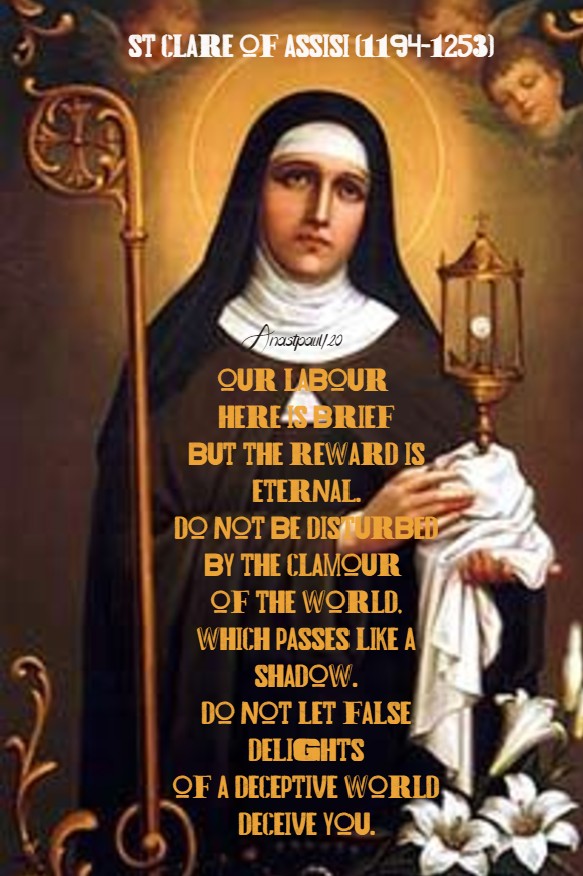
“Our labour here is brief
but the reward is eternal.
Do not be disturbed
by the clamour of the world,
which passes like a shadow.
Do not let false delights
of a deceptive world deceive you.”

our labour here is brief - st clare of assisi 11 aug 2020

“Love God, serve God,
everything is in that.”

love-god-serve-god-everything-is-in-that-st-clare-1-jan-2019 and 2020

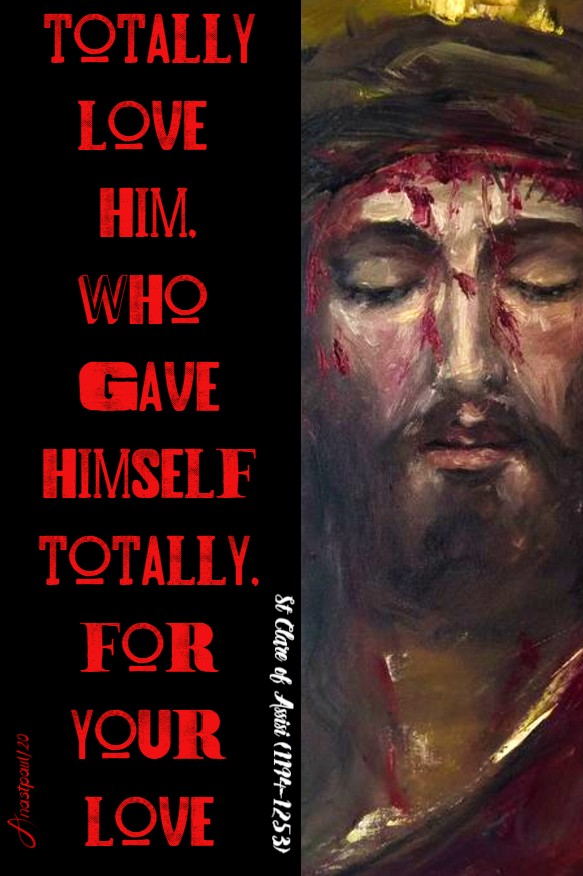
“Totally love Him,
who gave Himself totally,
for your love.”

totally loe hm who game hmself totally for your love - st clare of assisi 17 july 2020

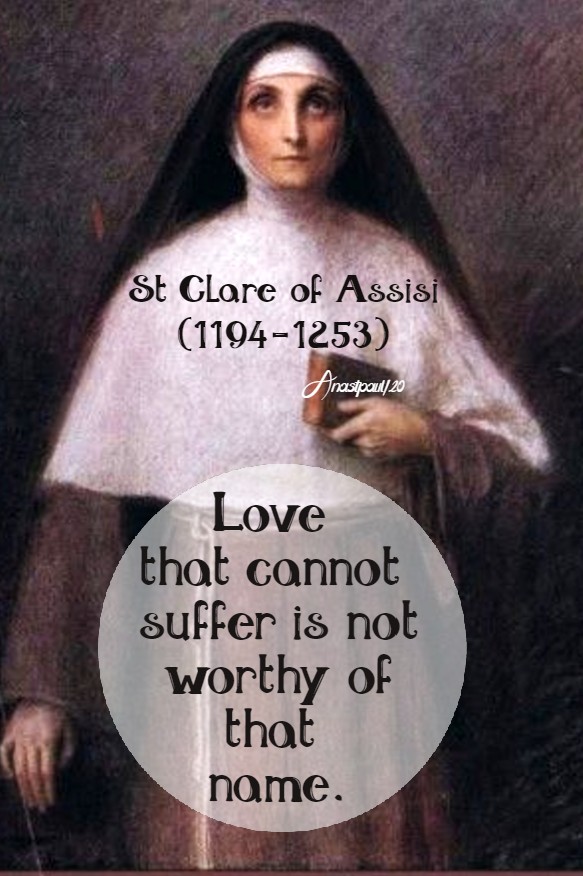
“Love that cannot suffer
is not worthy of that name.”

love that cannot suffer is not worthy of that name - st clare of assisi 11 aug 2020

“Happy the soul to whom it is given
to attain this life with Christ …
For He is the Brightness of eternal glory,
the Splendour of eternal light,
the Mirror without spot.”

happy the soul - st clare of assisi 11 aug 2020

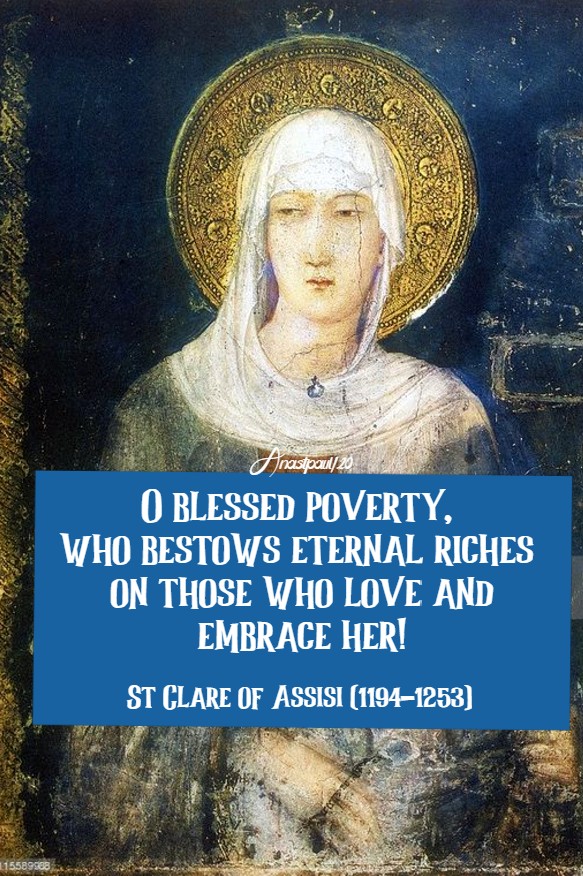
“O blessed poverty,
who bestows eternal riches
on those who love and embrace her!”

o blesed poverty - st clare of assisi 11 aug 2020

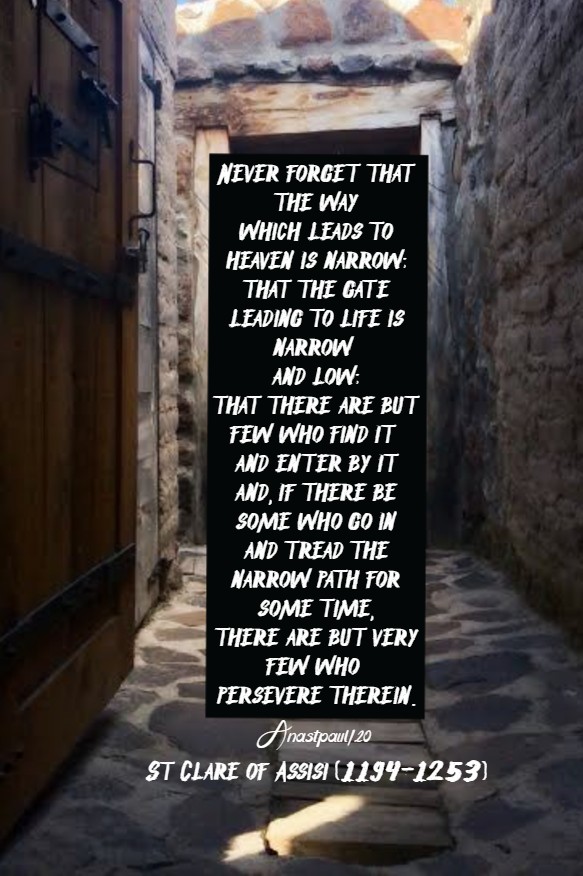
“Never forget that the way
which leads to heaven is narrow;
that the gate leading to life is narrow and low;
that there are but few who find it and enter by it
and, if there be some who go in
and tread the narrow path for some time,
there are but very few who persevere therein.”

More here:
https://anastpaul.com/2018/08/11/quote-s-of-the-day-11-august-the-memorial-of-st-clare-of-assisi-1194-1253/

St Clare of Assisi (1194-1253)

never forget that the way which leads to heaven - st clare of assisi 11 aug 2020

Posted in EUCHARISTIC Adoration, franciscan OFM, INCORRUPTIBLES, Our MORNING Offering, PRAYERS of the SAINTS, The HOLY EUCHARIST / The HOLY MASS

Our Morning Offering – 11 August – I Come, O Lord By St Clare

Our Morning Offering – 11 August – Tuesday of the Nineteenth week in Ordinary Time and The Memorial of St Clare of Assisi(1194-1253)

I Come, O Lord
By St Clare of Assisi (1194-1253)

I come, O Lord,
unto Thy sanctuary
to see the life and food of my soul.
As I hope in Thee, O Lord,
inspire me with that confidence
which brings me to Thy holy mountain.
Permit me, Divine Jesus,
to come closer to Thee,
that my whole soul may do homage
to the greatness of Thy majesty,
that my heart,
with its tenderest affections,
may acknowledge Thy infinite love,
that my memory may dwell
on the admirable mysteries
here renewed everyday
and that the sacrifice,
of my whole being,
may accompany Thine.
Ameni come o lord by st clare of assisi 11 aug 2020

Posted in franciscan OFM, SAINT of the DAY

Saint of the Day – 10 August – Blessed Arcangelo Placenza da Calatafimi OFM (c 1390-1460)

Saint of the Day – 10 August – Blessed Arcangelo Placenza da Calatafimi OFM (c 1390-1460), Franciscan Friar, Priest, Hermit, Mystic, Penitent – born in c 1390 in Calatafimi, Sicily, Italy and died on 10 August 1460 in Alcamo, Sicily, Italy of natural causes. Also known as Archangelus Piacentini.bl arcangel-calatafino

Arcangelo was born at Calatafimi, (province and Diocese of Trapani), in about 1390 to the local noble family of the Placenza.

He was known as a quiet and pious child and thus, it was no surprise, when he left his paternal home and went to live as a hermit in a cave near the Church of Santa Maria dei Giubino in Sicily.   Here, he experienced frequent apparitions of the Virgin, who would appear him over a cypress while he was praying.bl archangelo

After the news of the apparitions and miracles spread, the place became increasingly frequented by believers and relatives tried to persuade him to give up his solitary life.   But his reputation for holiness spread far and wide and the young hermit attracted would-be spiritual students. In search of peace and tranquillity to focus his soul on meditation, Arcangelo moved to Alcamo, Sicily.

We can run but we always have to take ourselves with us and thus his reputation went with him and he was asked to assist in the restoration of the neglected old hospital of Sant’Antonio.   He did and then spent much of his time there caring for the sick.   The rest of his time was spent in a cave near the present Church of Holy Mary of Jesus (Alcamo) to pray and do penitence.

However, Pope Martin V, working to restore Papal authority, decreed that all hermits in Sicily should join approved religious orders and so Arcanglo joined the Franciscans in Palermo, receiving the habit from Blessed Matthew of Girgenti.xFranciscan.gif.

After becoming a Priest, the Blessed Matteo Guimerà from Agrigento, his immediate superior, gave him the right to open new Convents. Arcangelo returned to the hospital of sant’Antonio in Alcamo, to open a Convent.   He was also was elected provincial Vicar of his Order and devoted himself to preaching.

He led both his brothers and the faithful by his example, supported Franciscans throughout Sicily, the Bishopric in Alcamo and spent his last days helping Blessed Matteo.

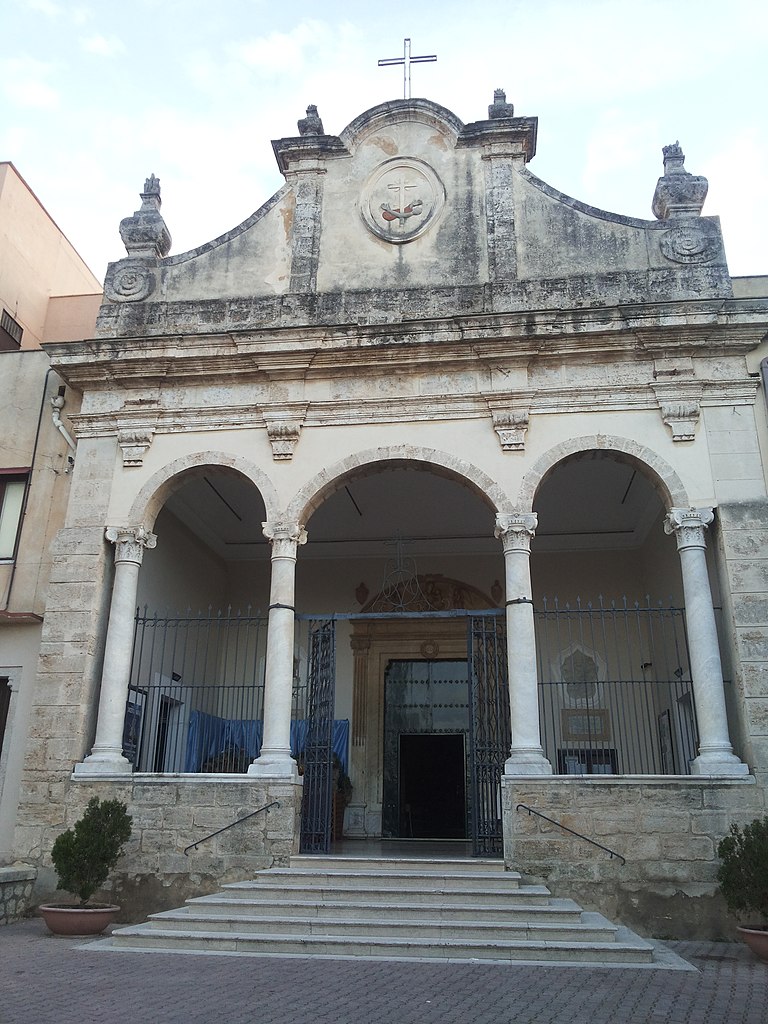
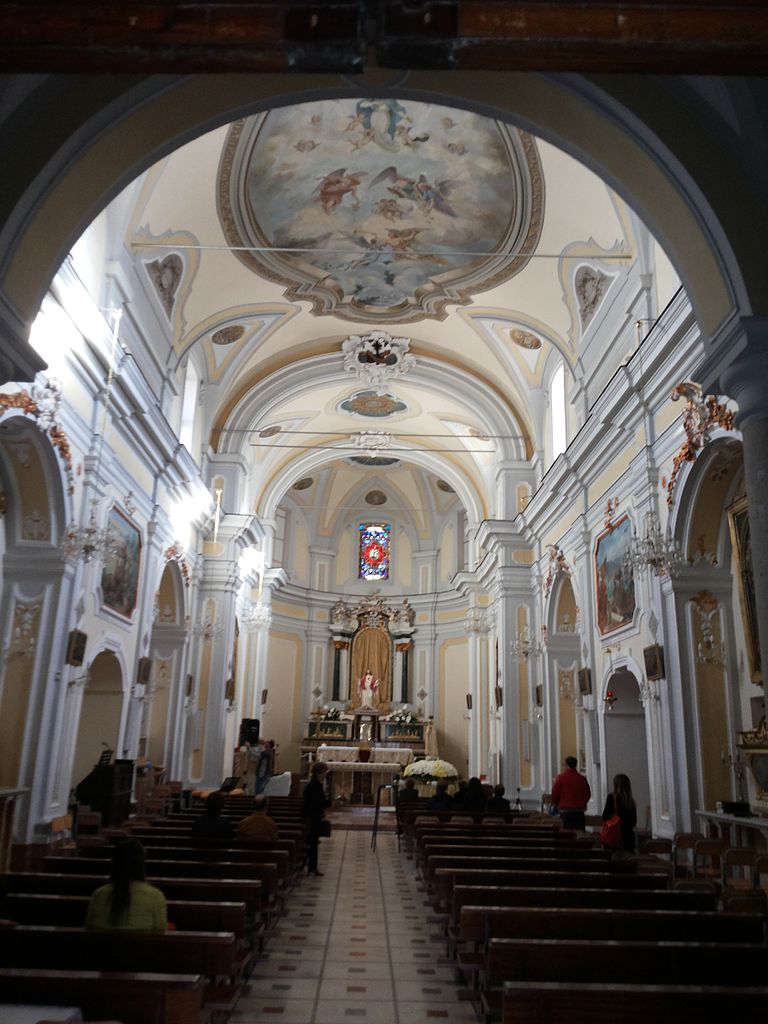
He lived in the convent of Santa Maria di Gesù in Alcamo (see below) until his death in 1460. 768px-Chiesa_Santa_Maria_del_Gesù_(Alcamo)_02Interno_della_chiesa_di_Santa_Maria_di_Gesù_(Alcamo)_002


His body is kept in an ebony urn placed above the Altar of Saint Conrad, in the Chiesa di Santa Maria di Gesù.

Urna_con_il_Beato_Arcangelo_Placenza_da_Calatafimi_-_Chiesa_di_Santa_Maria_di_Gesù_(Alcamo)
Urn with the mortal remains of the Blessed Arcangelo Placenza from Calatafimi, kept inside the Church of Saint Mary of Jesus in Alcamo.

Pope Gregory XVI proclaimed him blessed, thanks to the many miracles attributed to him, on 9 September 1836.

The figure of Arcangelo Piacentini from Calatafimi is still very much evident and revered in our days, especially in the western areas of ​​Sicily.

Beato_Arcangelo_Placenza_da_Calatafimi_-_Chiesa_di_Santa_Maria_di_Gesù_(Alcamo)
The Blessed Arcangelo’s tombstone

Posted in FEASTS and SOLEMNITIES, franciscan OFM, SAINT of the DAY

Feast of St Lawrence and Memorials of the Saints – 10 August

St Lawrence (Died 258) Martyr (Feast)

St Lawrence here:
https://anastpaul.wordpress.com/2017/08/10/saint-of-the-day-feast-of-st-lawrence-of-rome-martyr/

St Agathonica of Carthage
St Agilberta of Jouarre
Bl Amadeus of Portugal OFM (1420–1482)
Biography:
https://anastpaul.com/2018/08/10/saint-of-the-day-blessed-amadeus-of-portugal-o-f-m-1420-1482/
Blessed Arcangelo Placenza da Calatafimi OFM (c 1390-1460)
St Aredius of Lyon
St Asteria of Bergamo
Bl Augustine Ota
St Bassa of Carthage
St Bessus
St Bettelin
St Blane (Died 590)
His Life:
https://anastpaul.com/2019/08/10/saint-of-the-day-10-august-st-blane-died-590/
Bl Claude-Joseph Jouffret de Bonnefont
St Deusdedit the Cobbler
Bl Edward Grzymala
Bl Franciszek Drzewiecki
Bl Francois François
St Gerontius
Bl Hugh of Montaigu
Bl Lazare Tiersot
St Paula of Carthage
St Thiento of Wessobrunn

Martyrs of Alexandria – 260+ saints: A large number of Christians who died in Alexandria, Egypt between 260 and 267 in the persecutions of Decius and Valerian, whose names have not come down to us and who are commemorated together.

Martyrs of Rome – 165 saints: Group of 165 Christians martyred in the persecutions of Aurelian. 274 in Rome, Italy.

Martyred in the Spanish Civil War:
• Blessed Antonio González Penín
• Blessed José Toledo Pellicer
• Blessed José Xavier Gorosterratzu Jaunarena
• Blessed Juan Martorell Soria
• Blessed Pedro Mesonero Rodríguez
• Blessed Victoriano Calvo Lozano

Posted in DOMINICAN OP, franciscan OFM, SAINT of the DAY

Memorials of the Saints – 8 August

St Dominic de Guzman OP (1170-1221) (Memorial)
St Dominic!
https://anastpaul.wordpress.com/2017/08/08/saint-of-the-day-8-august-st-dominic-de-guzman-founder-of-the-dominican-order-of-preachers/

St Aemilian of Cyzicus
St Altman of Passau
Ven Antonio/Margil of Jesus OFM (1657-1726)
About Venerable Antonio:

Saint of the Day – 8 August – Venerable Antonio Margil of Jesus OFM (1657-1726) the “Flying Father”


St Cyriacus/Cyriac the Martyr, Deacon (Died c 303) One of the Fourteen Holy Helpers
St Eleutherius of Constantinople
St Ellidius
St Famianus of Compostela
St Gedeon of Besancon
St Hormisdas of Persia
Bl John Felton
Bl John Fingley
St Largus
St Leobald of Fleury
St Leonidas of Constantinople
St Marinus of Anzarba
St Mary of the Cross/ Mary MacKillop (1842-1909) – the first Australian born Saint
Biography:

Saint of the Day – 8 August – St Mary of the Cross (1842-1909)

St Mummolus of Fleury
St Myron the Wonder Worker
St Paulus Ge Tingzhu
St Rathard of Diessen
St Severus of Vienne
St Sigrada
St Smaragdus
St Ternatius of Besançon
St Ultan of Crayke
Bl William of Castellammare di Stabia
Bl Wlodzimierz Laskowski

Martyrs of Albano – 4 saints: Four Christians who were martyred together, and about we today know little more than their names – Carpóforo, Secondo, Severiano and Vittorino. They were martyred in Albano, Italy – their remains are interred in the San Senator cemetery, on the Appian Way, 15 miles from Rome, Italy.

Martyrs of Rome – 5 saints: Five Christians martyred together; we know nothing else about them but the names – Ciriaco, Crescenziano, Giuliana, Memmia and Smaragdus. They were martyred at the 7 mile marker, on the Via Ostia, Rome, Italy.

Martyred in the Spanish Civil War – Martyrs of El Saler – 5 beati: Five nuns, all members of the Sisters of the Pious Schools, all teachers, and all martyred together in the Spanish Civil War.
• Antonia Riba Mestres
• Maria Baldillou Bullit
• María Luisa Girón Romera
• Nazaria Gómez Lezaun
• Pascuala Gallén Martí
They were martyred on 8 August 1936 in El Saler, Valencia, Spain and Beatified on 11 March 2001 by Pope John Paul II.

Martyred in the Spanish Civil War:
Bl Cruz Laplana Laguna
Bl Fernando Español Berdie
Bl Leoncio López Ramos
Bl Manuel Aranda Espejo
Bl Mariano Pina Turón
Bl Pedro Álvarez Pérez