Posted in Uncategorized

Notre-Dame-de-la-Carole / Our Lady of la Carole, Paris (1418) and Memorials of the Saints – 3 July

Notre-Dame-de-la-Carole / Our Lady of la Carole, Paris (1418) – 3 July:
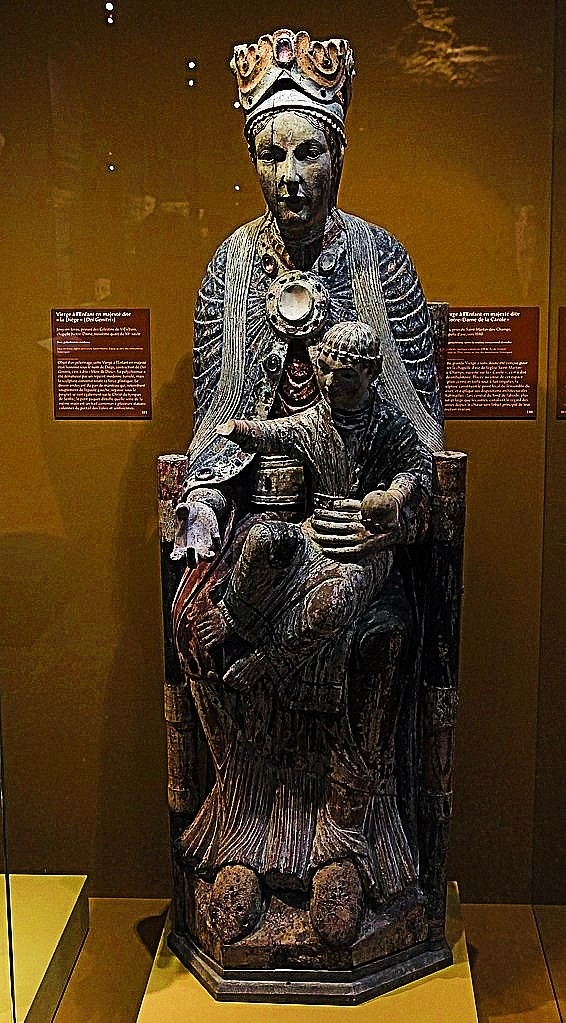
Roadside Shrines can still be seen in places all over Europe, though it is nothing like it used to be in the Middle Ages when these Shrines were extremely prevalent. They were public reminders of God and His Saints and were meant for the good of the general public, who would come upon the Shrine and pause for a moment to pray. They could be simple or somewhat elaborate, ranging from unadorned crosses to free standing towers or even small Chapels.

On 3 July in the year 1418, a Swiss soldier committed a sacrilege upon a Statue of the Blessed Virgin known as Our Lady of la Carole, or Our Lady of Carole. It was located at the corner of the Rue aux Ours, which was built in the 13th century and terminated at the hospital of Saint John, which is no longer in existence. The Rue aux Ours is now a short street that begins at Rue Saint-Martin and ends at the Boulevard Sebastopol in Paris, France.
The soldier of the Duke of Burgandy’s troops, said to be a Swiss soldier, came upon the Shrine of the Blessed Virgin after having left a tavern where he had gambled away his money. He was probably intoxicated when he drew his sword and repeatedly struck the Statue of the Blessed Virgin with the weapon. The Statue of Our Lady of Carole then began to bleed profusely, as if made of flesh and blood and WAS wounded by the blows.

The citizens who had observed the sacrilege were outraged and followed the soldier as he fled from the scene of his crime. The man was eventually caught and apprehended and then brought before the Chancellor where he was sentenced to death for the outrage.
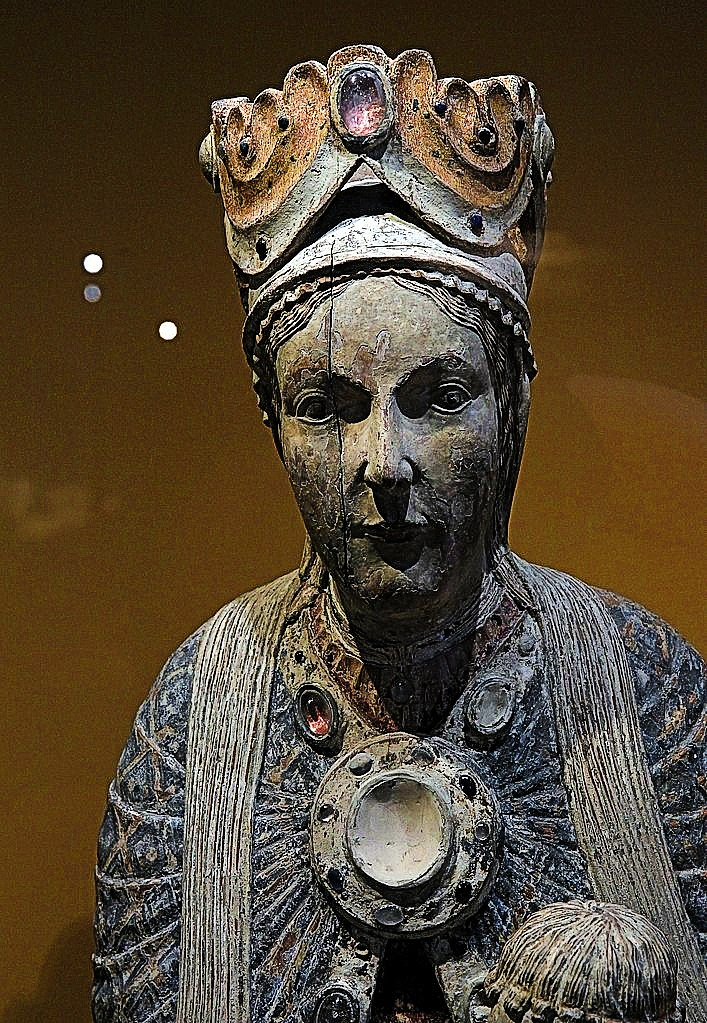
In remembrance of this incident and in expiation for the crime, there was a popular feast that took place on the Rue aux Ours every year. There were fireworks and a wax figure representing the sacrilegious wretch who had struck the image of the Blessed Virgin was set ablaze. This festival continued until the French Revolution brought an end to the traditional observance.

St Anatolius of Alexandria (Died 283) Bishop, Scholar, Scientiest, Philosoper, Conputist, Mathematian, Writer .
Biography:

https://anastpaul.com/2020/07/03/saint-of-the-day-3-july-st-anatolius-of-alexandria-died-283-bishop/

St Anatolius of Constantinople (Diedc 458) Bishop
Bl Andreas Ebersbach
Bl Barbara Jeong Sun-mae
St Bladus
St Byblig
St Cillene
St Dathus of Ravenna
St Eusebius of Laodicea
St Firminus
St Firmus
Bl Gelduin
St Giuse Nguyen Ðình Uyen
St Gunthiern
St Guthagon
St Heliodorus of Altinum
St Hyacinth of Caesarea
St Ioannes Baptista Zhao Mingxi
St Irenaeus of Chiusi

St Pope Leo II (611–683) Bishop of Rome from 17 August 682 to 28 June 683, the day of his death. He is one of the Popes of the Byzantine Papacy.
Biography:

https://anastpaul.com/2019/07/03/saint-of-the-day-3-july-st-pope-leo-ii-611-683/

St Maelmuire O’Gorman
St Mark of Mesia
St Mennone the Centurian
St Mucian of Mesia
St Paul of Mesia
St Petrus Zhao Mingzhen
St Philiphê Phan Van Minh
St Raymond of Toulouse (Died 1118) Layman

Martyrs of Alexandria – 13 saints: Thirteen Christian companions marytred together. No details about them have survived but the names – Apricus, Cyrion (2 of), Eulogius, Hemerion, Julian, Julius, Justus, Menelaus, Orestes, Porfyrios and Tryphon (2 of). They martyred in Alexandria, Egypt, date unknown.

Martyrs of Constantinople – 24 saints: A group of 24 Christians martyred in the persecutions of Arian emperor Valens. We know little more than their names – Acacios, Amedinos, Ammonius, Ammus, Cerealis, Cionia, Cionius, Cyrianus, Demetrius, Eulogius (2), Euphemia, Heliodoros, Heraclios, Horestes, Jocundus, Julian, Martyrios, Menelaeus, Sestratus, Strategos, Thomas, Timotheos and Tryphon. They were martyred in c367 in Constantinople.

Theodotus and Companions – 6 saints: Six Christians who were imprisoned, tortured and martyred together in the persecutions of Trajan. Saint Hyacinth ministered to them in prison. We know nothing else about them but their names – Asclepiodotus, Diomedes, Eulampius, Golinduchus, Theodota and Theodotus. They were beheaded in c110, location unknown.
Posted in SAINT of the DAY

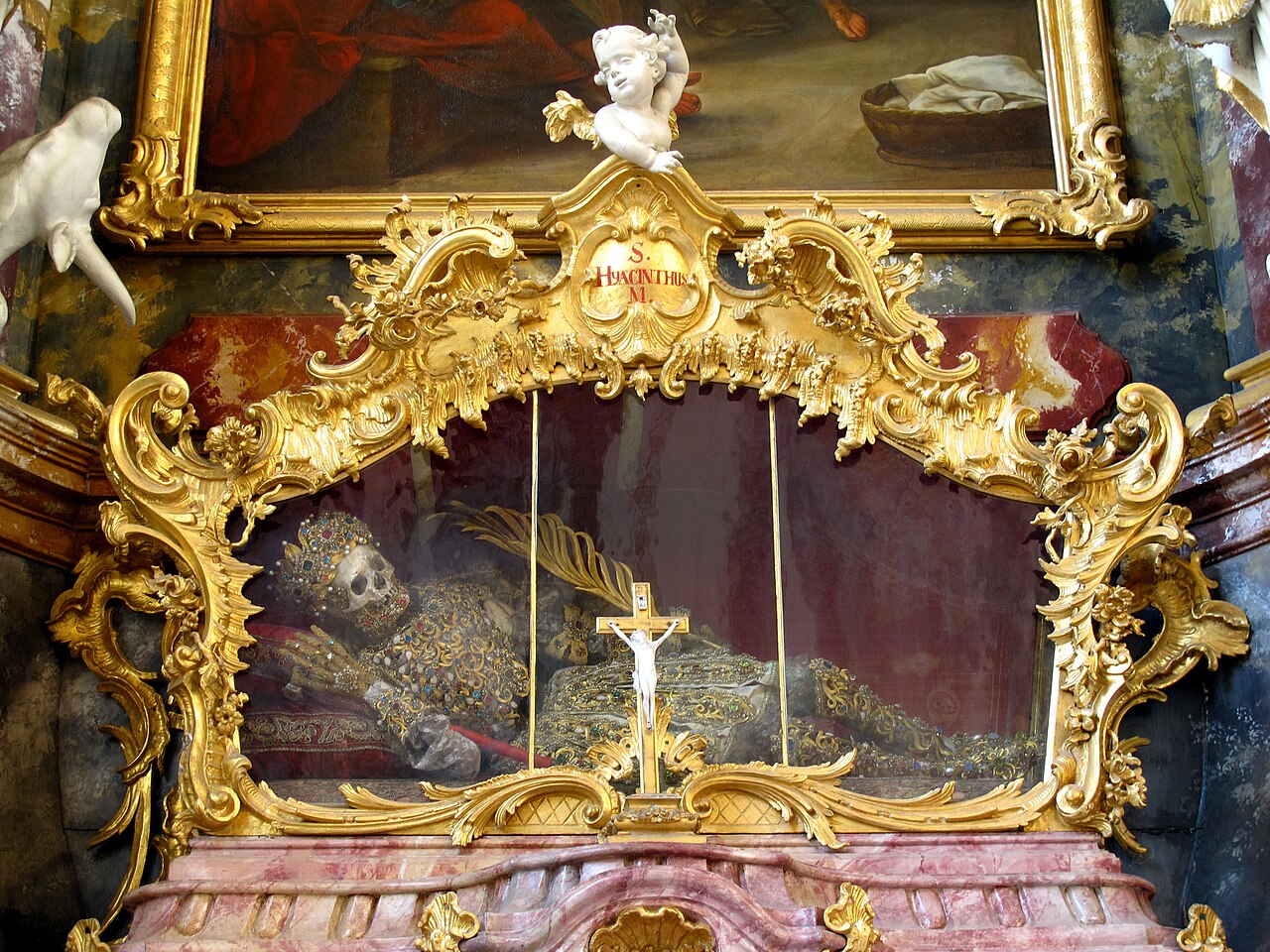
Saint of the Day – 3 July – St Hyacinth of Caesarea

Hyacinth was a native of Caesarea in Cappadocia, and a member of a Christian family. As a boy, he was appointed to serve as an assistant to the chamberlain to the Emperor Trajan. His failure to participate in the sacrifices to the official Roman gods soon came to be noticed by other members of the Imperial household. One day, while the emperor and his entourage were offering sacrifice to idols, Hyacinth remained at the palace, shut himself up in a small room, and prayed fervently to the Lord Jesus Christ. One of the servants overheard him praying and denounced him to the emperor.

When he was denounced as a Christian, Hyacinth proclaimed his faith. He was brought to trial before Trajan, who tried to persuade him to deny Christ and sacrifice to idols, but the young boy refused. As a result, he was imprisoned and underwent numerous scourgings and tortures. He was deliberately served only food which had been blessed for sacrifice to the gods, the eating of which was banned to Christians. Thus, he starved to death after thirty-eight days, dying at the age of twelve. Just before his death, his jailers saw him being comforted by a pair of angels, one who covered him with his own robe, the other who bestowed a crown on him.

Hyacinth died in the city of Rome. Later, his relics were transferred to Caesarea.

Posted in JULY - The MOST PRECIOUS BLOOD

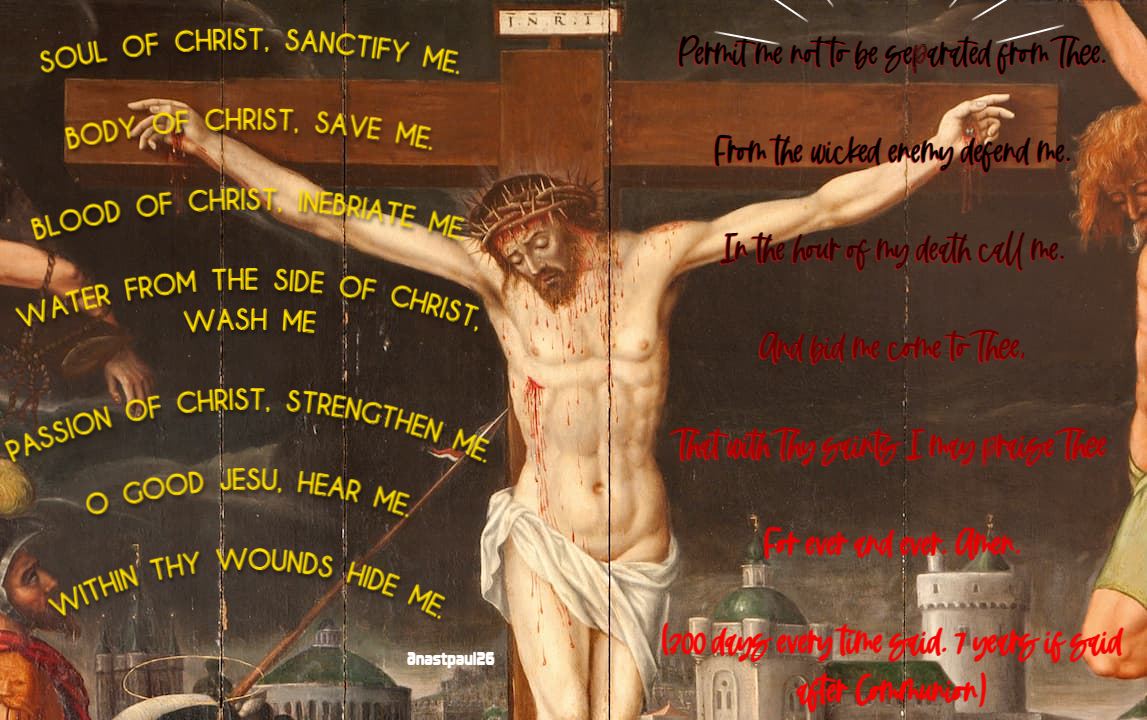
Our Morning Offering – 3 July – Soul of Christ, sanctify me

Soul of Christ, sanctify me.

Body of Christ, save me.

Blood of Christ, inebriate me.

Water from the side of Christ, wash me

Passion of Christ, strengthen me.

O good Jesu, hear me.

Within Thy wounds hide me.

Permit me not to be separated from Thee.

From the wicked enemy defend me.

In the hour of my death call me.

And bid me come to Thee,

That with Thy saints I may praise Thee

For ever and ever. Amen.

(300 days every time said. 7 years if said after Communion)

Posted in The APOSTLES & EVANGELISTS

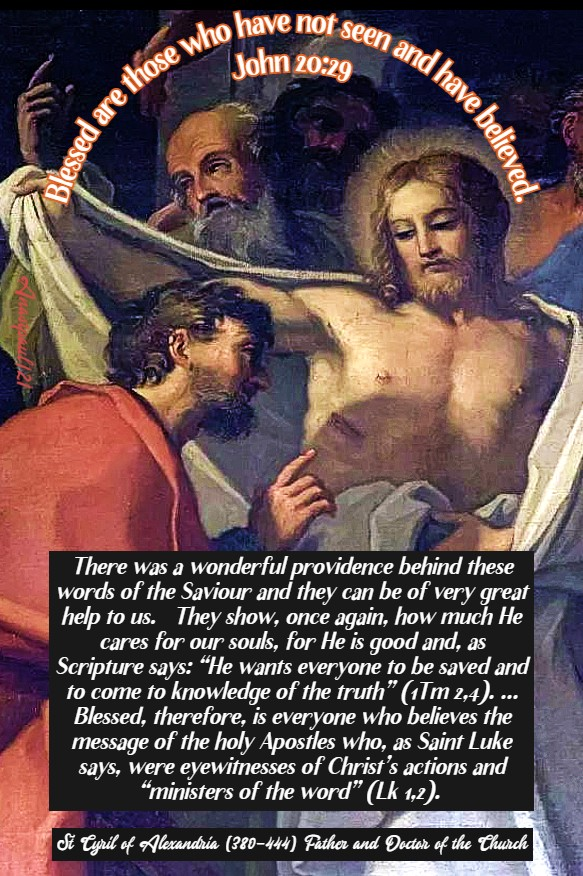
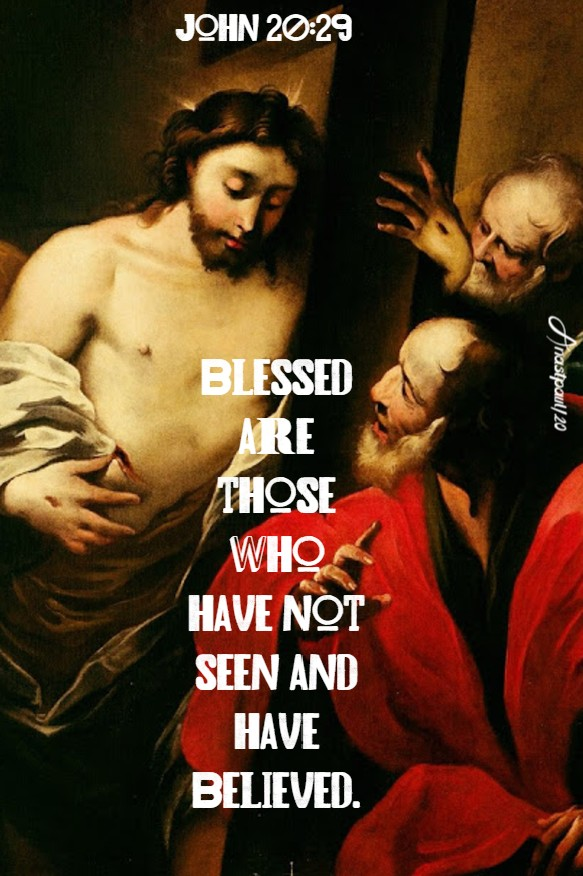
One Minute Reflection – 3 July – “Blessed are those who have not seen and have believed.” – John 20:29

One Minute Reflection – 3 July – Feast of St Thomas Apostle – Readings: Ephesians 2: 19-22, Psalms 117: 1bc, 2, John 20: 24-29

Blessed are those who have not seen and have believed.” – John 20:29

REFLECTION – “There was a wonderful providence behind these words of the Saviour and they can be of very great help to us. They show, once again, how much He cares for our souls, for He is good and as Scripture says: “He wants everyone to be saved and to come to knowledge of the truth” (1Tm 2,4).

Even so, this saying of His may surprise us. As always, Christ had to be patient with Thomas, when he said he would not believe and, with the other disciples too, when they thought they were seeing a ghost! Because of His desire to convince the whole world, He most willingly showed them the marks of the nails and the wound in His side; – because He wished those, who sought this evidence, as a support for their faith, to have no possible reason for doubt – He even took food, although He had no need for it (Lk 24,41)…

But when anyone accepts what he has not seen, believing on the word of his teacher, the faith, by which he honours the One his teacher proclaims to him, is worthy of great praise. Blessed, therefore, is everyone who believes the message of the holy Apostles who, as Saint Luke says, were eyewitnesses of Christ’s actions and “ministers of the word” (Lk 1,2). If we desire eternal life and long for a dwelling place in heaven, we must listen to them.” – St Cyril of Alexandria (380-444), Bishop, Father and Doctor of the Church – Commentary on Saint John’s gospel, 12, 22

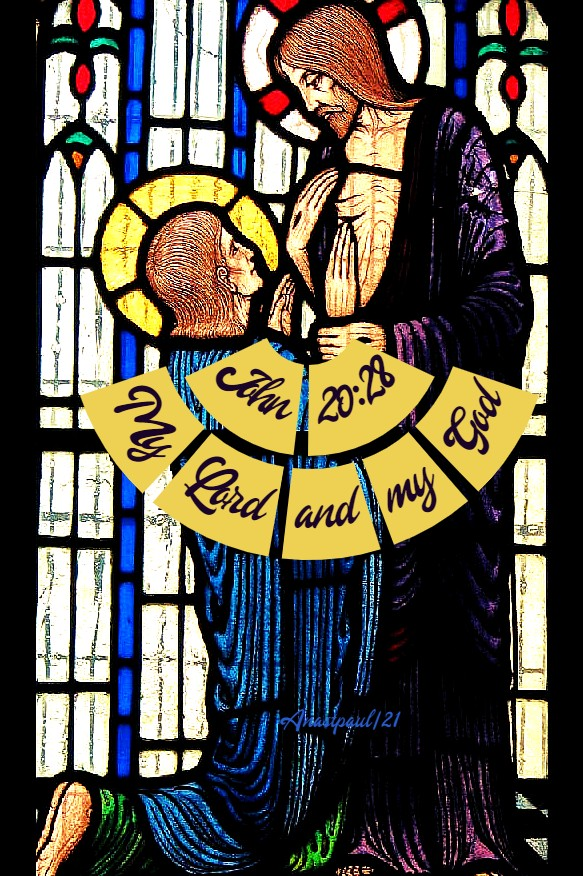
PRAYER – Father, let our celebration on the feast of Saint Thomas the Apostle, be the source of his unfailing help and protection. Fill us with Your life-giving grace through our faith in Your Son, Jesus the Christ, whom Thomas acknowledged to be his Lord and his God. We make our prayer, through our Lord Jesus in union with the Holy Spirit, one God with You, forever and ever, amen.

Posted in QUOTES on FAITH

Quote/s of the Day – 3 July – I believe!

Quote/s of the Day – 3 July – Feast of St Thomas Apostle – Readings: Ephesians 2: 19-22, Psalms 117: 1bc, 2, John 20: 24-29

Jesus said to him,
“Have you come to believe because you have seen me?
Blessed are those who have not seen and have believed.”

John 20:28-29

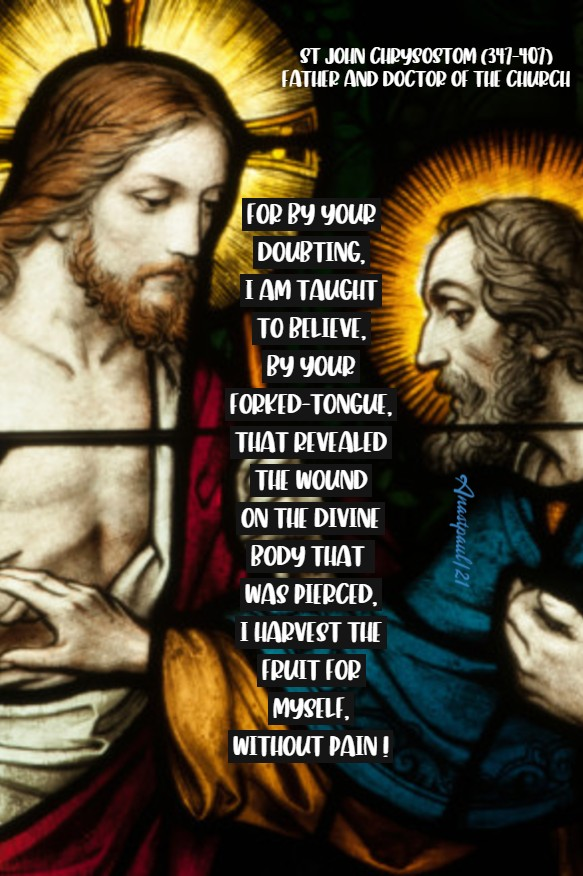
“For by your doubting,
I am taught to believe,
by your forked-tongue,
that revealed the Wound
on the Divine Body that was pierced,
I harvest the fruit for myself, without pain!”

St John Chrysostom (347-407)
Father and Doctor

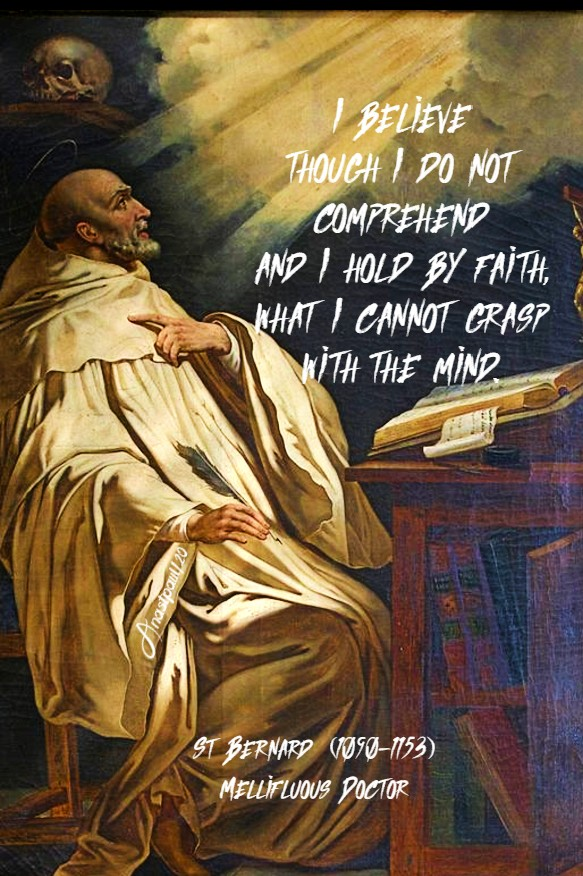
“I believe
though I do not comprehend
and I hold by faith,
what I cannot grasp
with the mind.”

St Bernard (1090-1153)
Mellifluous Doctor

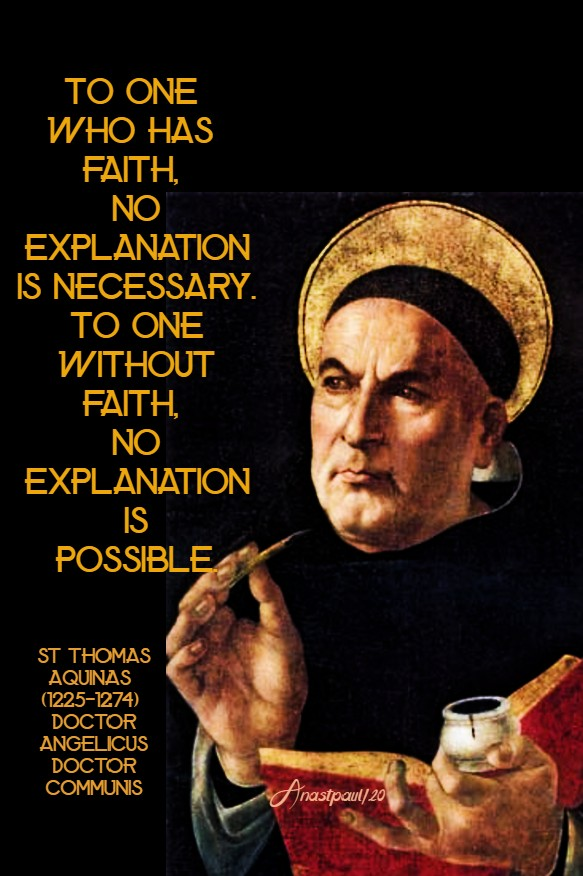
“To one who has faith,
no explanation is necessary.
To one without faith,
no explanation is possible.”

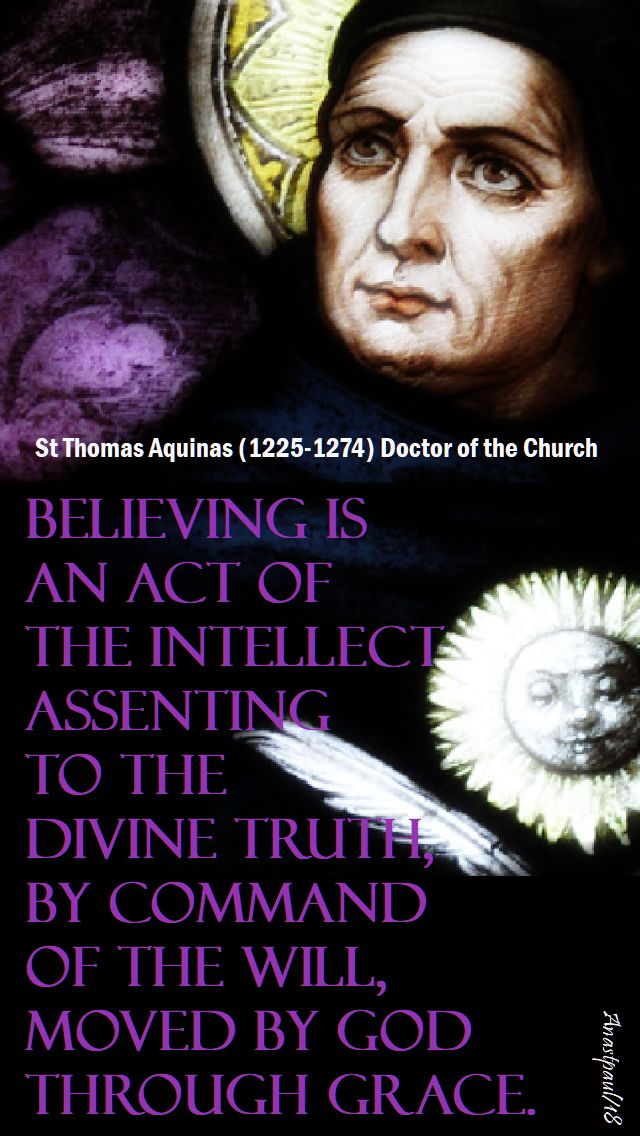
“Believing is
an act of the intellect
assenting to the divine truth,
by command of the will,
moved by God through grace.”

St Thomas Aquinas (1225-1274)
Doctor Angelicus/Doctor Communis

Posted in JULY - The MOST PRECIOUS BLOOD, The MOST PRECIOUS BLOOD

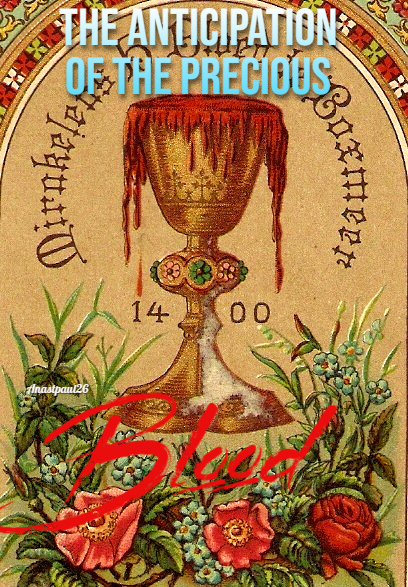
Thought for the Day – 3 July – The Anticipation of the Precious Blood

The Precious Blood – Short Meditations for July

By Rev. Richard F. Clarke

3rd Day – The Anticipation of the Precious Blood

When the promise of the Redeemer to come was made to our first parents in the Garden of Eden after their fall, the shadow of the Precious Blood fell upon the world and reconciled it with God. The curse that had been incurred lost its fatal power to destroy. The anger of God had been appeased and He looked upon the earth through the medium of the Blood of His only-begotten Son, that was to be shed for sin, and for its sake offered forgiveness and mercy to the sinners who repented of their sin. So may He extend to me the forgiveness and mercy that I need far more than did Adam and Eve, for I have sinned far more deeply and often than they.

As the ages rolled on, the same shadow, sheltering men from God’s fierce anger, still rested on the earth. In its sweet shade rested Abraham and all the patriarchs, Samuel and all the prophets, through its influence sinners found mercy and saints obtained graces innumerable. If it did so much for the heathen world, what must it not do for Catholics! Grant, O Lord, that now and ever I may sit under His shadow Whom I have desired!

All through the four thousand years before Christ came, the tradition of the necessity of the shedding of blood for the forgiveness of sins was almost universal. The Jewish sacrifices were expressly ordained to keep up the memory of it. In heathen countries the blood of victims was almost everywhere offered. God never leaves Himself without a witness even among those who have departed far from Him. Admire His goodness in so doing.