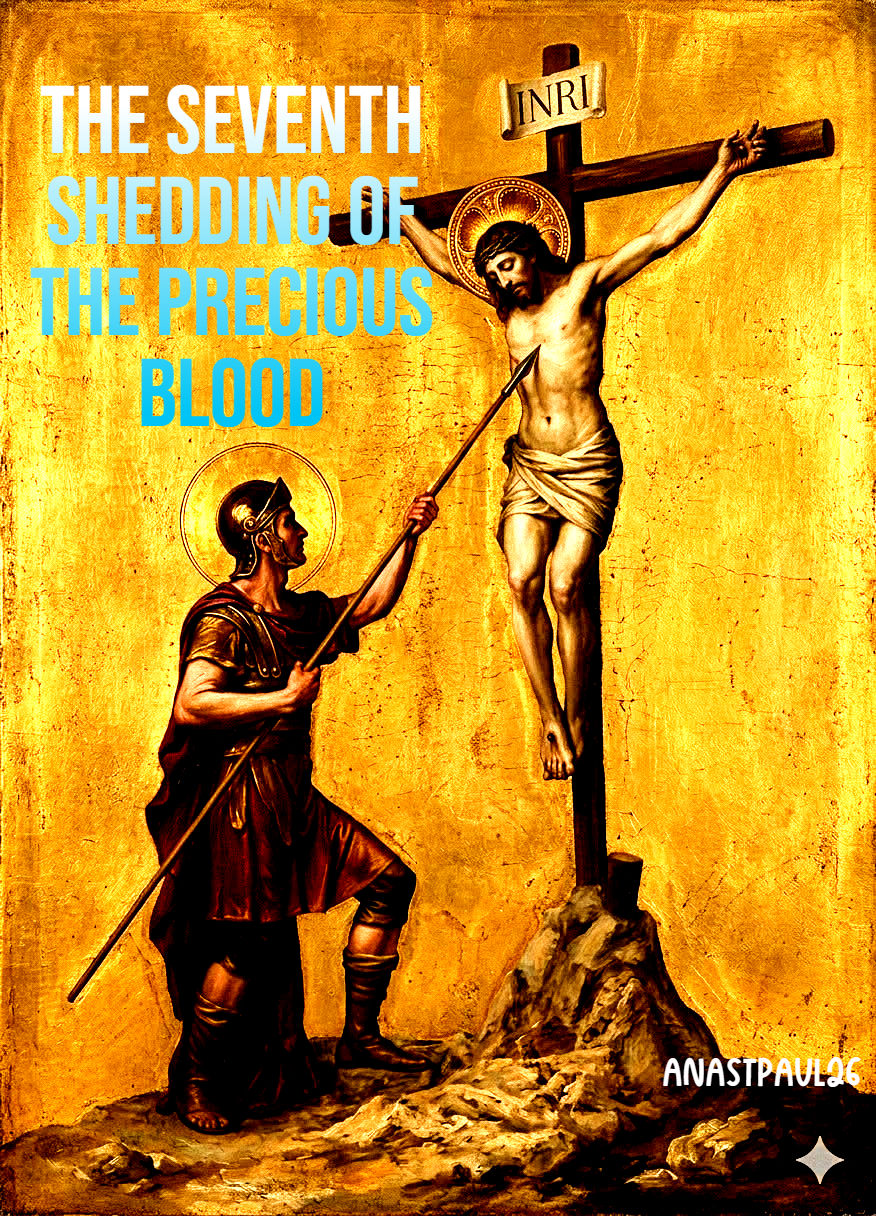
27th Day – The Seventh Shedding of the Precious Blood
Even when the work of redemption was consummated, and Jesus had breathed forth His soul into His Father’s hands, He shed once more His Precious Blood for man. It was to mark the completeness of His sacrifice that He thus poured forth, as it were, the last drop that still lingered in His Sacred Heart. It was a sign that He kept nothing in reserve. He proved His inexhaustible love to man by this last act by which He bequeathed to man the last trace of life that still remained. Oh, undying, unwavering love of Jesus, that loved us with an extremity of love unto the very end!
The water and the blood that issued from Our Lord’s side were the symbols of the two chief sacraments: the water of holy Baptism, and the blood of the Blessed Eucharist. Thus it was that Christ is said, by this piercing of His side, to have laid the foundations of the Church, amd as Eve, the spouse of Adam was formed from the side of Adam, so the Church, the sacred Spouse of Christ, was formed from His side when the spear of the centurion pierced it. Pray for an intense love of holy Church, on account of the love that Christ bears to His own true spouse.
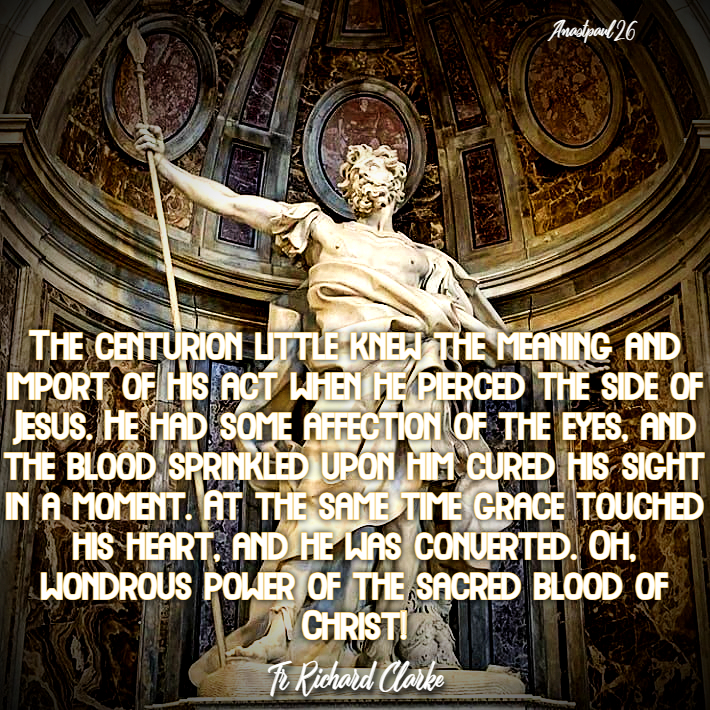
The centurion little knew the meaning and import of his act when he pierced the side of Jesus. He had some affection of the eyes, and the blood sprinkled upon him cured his sight in a moment. At the same time grace touched his heart, and he was converted. Oh, wondrous power of the sacred blood of Christ!
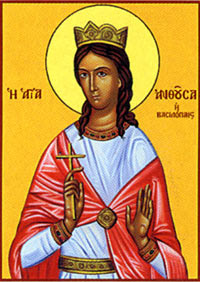
Saint Anthusa of Mantinea or the Confessor. She is easily confused with Saint Anthusa the daughter of the iconoclast emperor Constantine V, but it was Saint Anthusa of Mantinea whom he summoned to ask for prayers for the labouring mother of Saint Anthusa of Constantinople, the infant daughter who was subsequently named after her.
She was an anchoress and abbess in Constantinople during the 8th century.
After the death of her parents while still very young, the saint distributed her inheritance, left her family home, and withdrew to a cave. Ninety virgins gathered around her, entrusted themselves to her guidance, and followed her example. She founded two monasteries, one for men and the other for women, and became abbess of the monastery for nuns, who “were known for their obedience to their abbess and for their spiritual discipline”.
She openly defied Emperor Constantine V’s iconoclastic prohibitions, so she, her nuns, and her nephew, who was abbot of the second monastery, were arrested and tortured. When Anthusa correctly prophesied that the emperor’s wife, who was close to death from childbirth, would safely deliver twins, a boy and a girl, the empress intervened. Anthusa’s life was spared, and the empress donated several estates to her. The empress’ daughter was named after Anthusa, educated by her, and also became a saint, founding the first orphanage in the Christian world.
Saint Anthusa of Constantinople, daughter of the emperor
Anthusa returned to her monastery, where she lived to old age. She died in 759 and was buried in her cell.
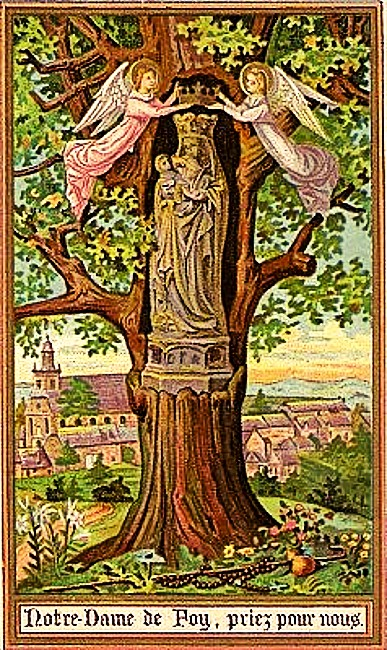
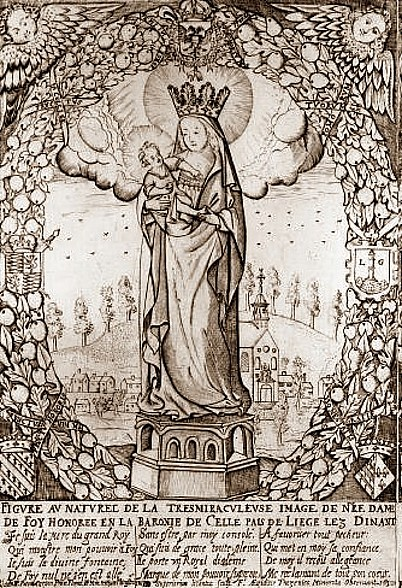
Notre-Dame-de-Foy / Our Lady of Faith,Gravelines, Liege, France (1616) – 27 July:
Not far from the small town of Dinant, in Liege near a home belonging to the Lord of Celles, two magnificent oaks once grew. One of the two venerable old trees was felled in the year 1609 by a man named Gilles, a lumberjack. The worker who inspected the tree found a small terracotta statue of the Mother of God, enthroned, as it were, with three iron bars that served as a trellis. The old oak stood on the edge of a path taken by pilgrims travelling to St Hubert. Apparently, at some time in the distant past, some pious Christian soul had placed the holy image in a hollow of the oak, as if in a niche. Then, over a period of time, the opening the tree had made while it was still young gradually closed and as it grew, the tree hid in its womb, the precious figure. Over the years the bark of the tree closed upon it and, as the road became less frequented, the existence of the Statue was completely forgotten.
To honour the Virgin, the Statue was subsequently displayed on the other oak, once again behind an iron grating, by order of the Baron of Celles. In this new Sanctuary, the Mother of God was honoured with the title of Our Lady of Faith. Those passing by did not fail to venerate the Statue;and there were many unexpected miracles. Graces of all kinds multiplied,and soon pilgrims began to flock to the area because of the dazzling miracles and very quickly a spontaneous cult grew.
The Statue was first placed in another oak but it was almost thrown away by servants who thought it had no value. The local Baron placed it near the door to his oratory at the Castle of Veves as pilgrims began to flock there. In this new Sanctuary, the image of Our Lady was honoured under the title of Our Lady of Faith, which was the name of the farm.
The first miracle occurred in 1616. As a result of the intercession of the Blessed Virgin Mary an old man was healed from a painful and debilitating hernia. The canonical investigation prescribed by the Bishop of Liege, was positive in its conclusion.
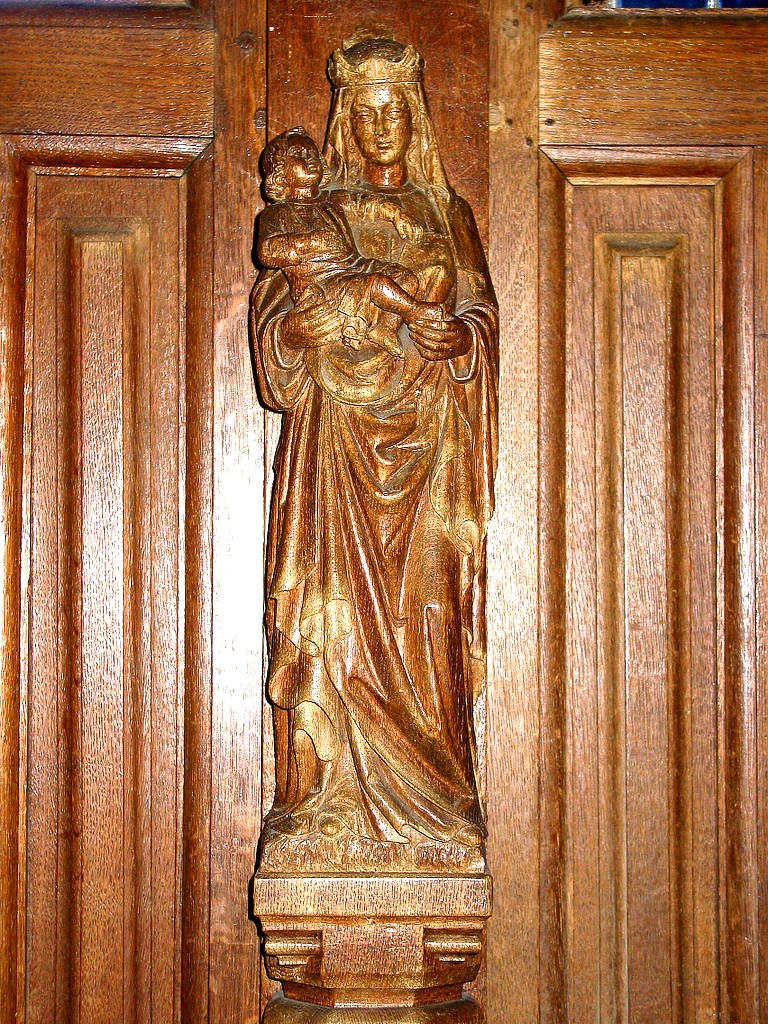
A Priest of the Society of Jesus had recently been sent to Gravelines. He worked diligently to cultivate souls, as if upon a fruitful vine and by his sermons excited the people of the region to a greater love for the Mother of God. Seeing that this devotion had taken root, he met with the local Magistrate to discuss how to maintain and increase the piety of the people. It was decided that they should make replicas of the Statue of Our Lady of Faith, made from the wood of the first oak. When the first was completed, the image was observed to have a great resemblance to the original. Received with great joy, it was placed in a large reliquary above the high Altar in the Parish Church.
St Aetherius of Auxerre St Anthusa of Constantinople St Arethas St Aurelius of Cordoba St Benno of Osnabruck (c 1020-1088) Bishop Bl Berthold of Garsten
St Pope Celestine I (Died 432) called “the Heresy Fighter.” Much is unknown about Celestine, including his birthday. But his reign as Pope – from 422 to his death in 432 – is credited with many achievements.
St Ecclesius of Ravenna Bl Felipe Hernández Martínez St Felix of Cordoba St Galactorio of Lescar St George of Cordoba St Hermippus St Hermocrates St Hermolaus Bl Jaime Ortiz Alzueta Bl Joaquín Vilanova Camallonga Bl José María Ruiz Cano St Juliana of Mataró St Lillian of Cordoba Bl Lucy Bufalari St Luican
Bl Maria Klemensa Staszewska Blessed Maria Magdalena Martinengo OSC Cap (1687-1737) Nun St Maurus of Bisceglia Bl Modesto Vegas y Vegas St Natalia of Cordoba Bl Nevolone of Tavenisa St Pantaleimon
St Pantaleon (Died c 305) Martyr, Lay Physician, one of the Fourteen Holy Helpers.
Bl Rudolf Aquaviva S.J. Bl Robert Sutton St Semproniana of Mataró St Sergius of Bisceglia Bl William Davies Bl Zacarías Abadía Buesa
Martyrs of Nicomedia – 3 saints: Three Christians martyred together. The only other information to survive are their names – Felix, Jucunda and Julia. Nicomedia, Asia Minor.
Seven Sleepers of Ephesus: A group of seven young Christian men who hid in a cave in hopes of avoiding the persecution of Decius in the year 250. Found and arrested, they were ordered by the pro-consul in Ephesus to renounce their faith; they refused and were sentenced to die. Legend says that they were walled up in their hiding cave, guarded by the dog Al Rakim; when the cave wall was breached in 479 – they all woke up!
It is likely that the youths were tortured to death in various ways and buried in the cave. The resurrection story confusion came from the phrase “went to sleep in the Lord” which was used to describe the death of Christians and 479 is when their relics were discovered. Their names were Constantinus, Dionysius, Joannes, Malchus, Martinianus, Maximianus and Serapion. They were martyred in 250 in Ephesus (in modern Turkey); tradition says that they were walled up in a cave to suffocate but other records indicate that they were tortured to death in various ways. Their relics discovered in 479 and translated to Marseilles, France and enshrined in a large stone coffin.
And He entered the temple, and began to cast out those who were selling and buying in it, saying to them, It is written, ‘My house is a house of prayer,’ but you have made it a den of thieves. And He was teaching daily in the temple.
Luke 19:41-47
REFLECTION – I have therefore hastened to exhort you to set yourselves in harmony with the mind of God. For even Jesus Christ, our inseparable Life, is the Mind of the Father, as also the bishops, established in the furthest quarters, are in the mind of Jesus Christ. Hence it is fitting for you to set yourselves in harmony with the mind of the bishop, as indeed you do. For your noble presbytery, worthy of God, is fitted to the bishop, as the strings to a harp. And thus by means of your accord and harmonious love Jesus Christ is sung. Form yourselves one and all into a choir, that blending in concord, taking the key-note of God, you may sing in unison with one voice through Jesus Christ to the Father.
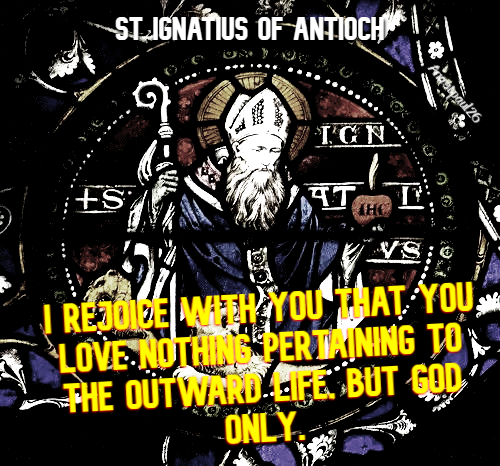
You are stones of the temple, prepared beforehand for a building of God the Father, being raised to the heights by the engine of Jesus Christ, which is the Cross, using as your rope the Holy Spirit. Your faith is the windlass, and love is the way which leads up to God. So then, you are all companions in festal procession along the way, bearing your God and shrine, bearing Christ and your holy treasures, fully arrayed in the commandments of Jesus Christ. And in your rejoicings I too have a part. I rejoice with you that you love nothing pertaining to the outward life, but God only.
Saint Ignatius of Antioch (Letter to the Ephesians)
PRAYER – All-powerful and ever-living God, splendour of true light and never-ending day, chase away the night of sin and fill our minds with the glory of Your coming. Take away our heart of stone and give us a heart of flesh, help us in our battle with sin and the devil. By our prayers, Your holy Sacraments and the strength of the Holy Spirit, may we be ever vigilant of the evil one. By our Baptism in Your Son, we are Your children, grant us Your protection. Kindly listen to the prayers of the Blessed Virgin Mary and all the saints and Angels, whose prayers we beg, through Christ our Lord, with the Holy Spirit, God for all eternity, amen.
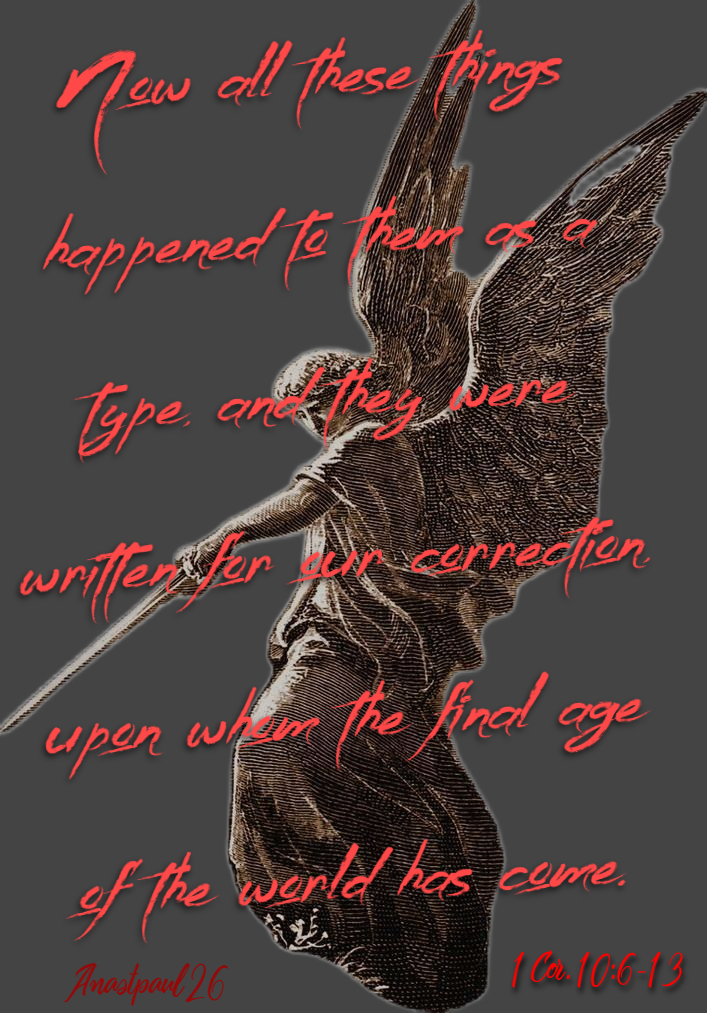
Now all these things happened to them as a type, and they were written for our correction, upon whom the final age of the world has come.
1 Cor. 10:6-13
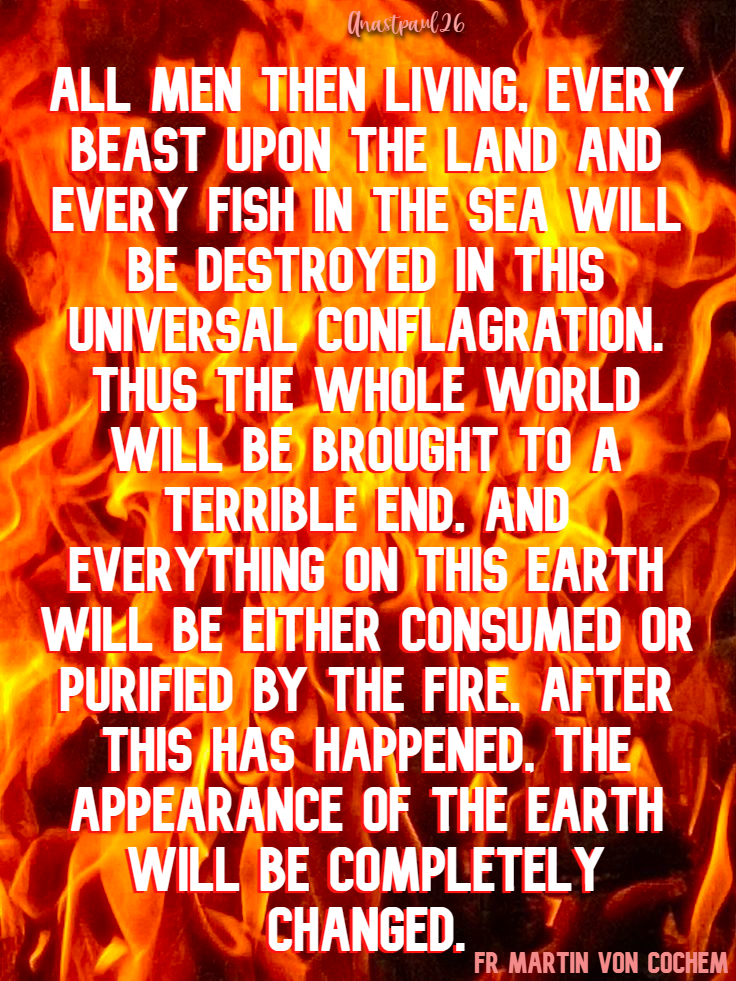
At length the whole earth will be on fire and a general conflagration will ensue, such as never has been seen or heard of. The heat of the raging flames will be so intense that the stones and rocks will melt, and the sea and all waters upon the earth will boil and hiss. All men then living, every beast upon the land and every fish in the sea will be destroyed in this universal conflagration. Thus the whole world will be brought to a terrible end, and everything on this earth will be either consumed or purified by the fire. After this has happened, the appearance of the earth will be completely changed.
Fr Martin Von Cochem (The Four Last Things)
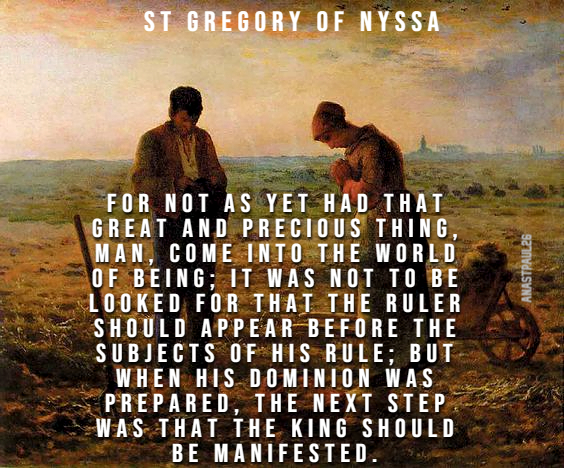
For not as yet had that great and precious thing, man, come into the world of being; it was not to be looked for that the ruler should appear before the subjects of his rule; but when his dominion was prepared, the next step was that the king should be manifested. When, then, the Maker of all had prepared beforehand, as it were, a royal lodging for the future king, he thus manifests man in the world, to be the beholder of some of the wonders therein, and the lord of others; that by his enjoyment he might have knowledge of the Giver, and by the beauty and majesty of the things he saw might trace out that power of the Maker which is beyond speech and language.
St Gregory of Nyssa (On the Making of Man)
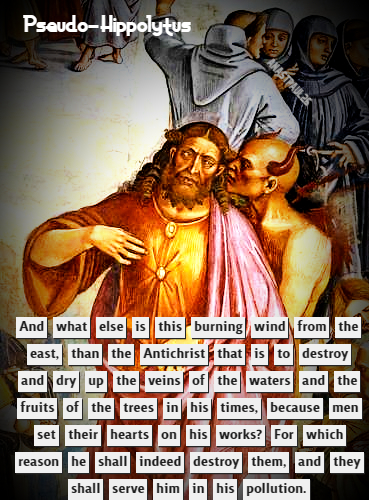
In those days the Lord shall bring on a burning wind from the desert against them, and shall make their veins dry, and shall make their springs desolate; and all their goodly vessels shall be spoiled. Because they rose up against God, they shall fall by the sword, and their women with child shall be ripped up. Hosea 13:15 And what else is this burning wind from the east, than the Antichrist that is to destroy and dry up the veins of the waters and the fruits of the trees in his times, because men set their hearts on his works? For which reason he shall indeed destroy them, and they shall serve him in his pollution.
Pseudo-Hippolytus (On the End of the World)
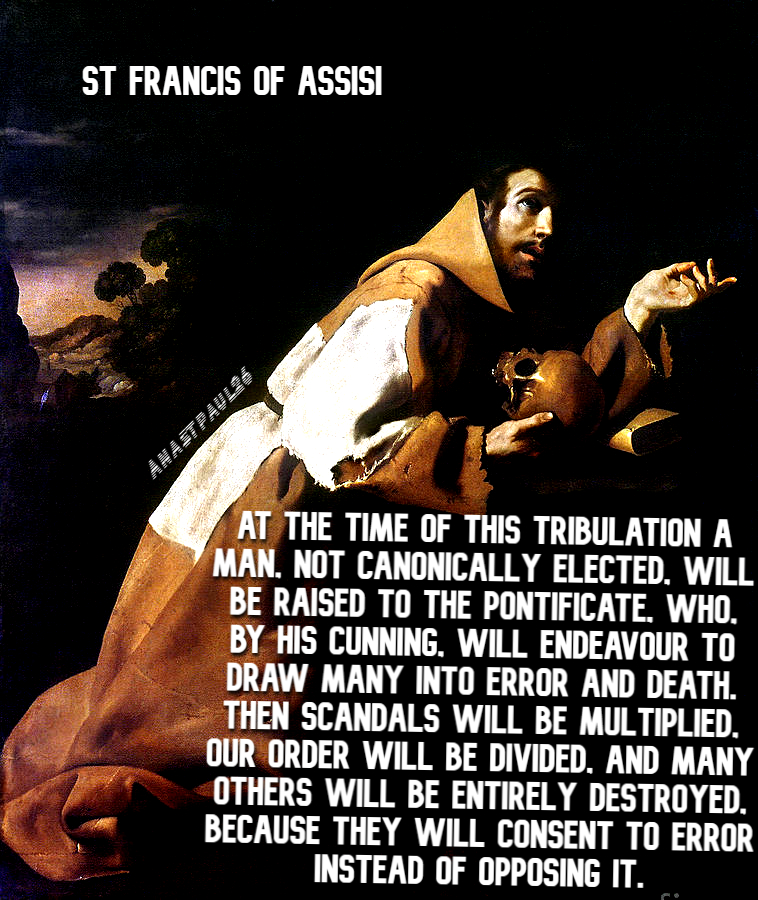
The devils will have unusual power, the immaculate purity of our Order, and of others, will be so much obscured that there will be very few Christians who will obey the true Sovereign Pontiff and the Roman Church with loyal hearts and perfect charity. At the time of this tribulation a man, not canonically elected, will be raised to the Pontificate, who, by his cunning, will endeavour to draw many into error and death. Then scandals will be multiplied, our Order will be divided, and many others will be entirely destroyed, because they will consent to error instead of opposing it.
St Francis of Assisi
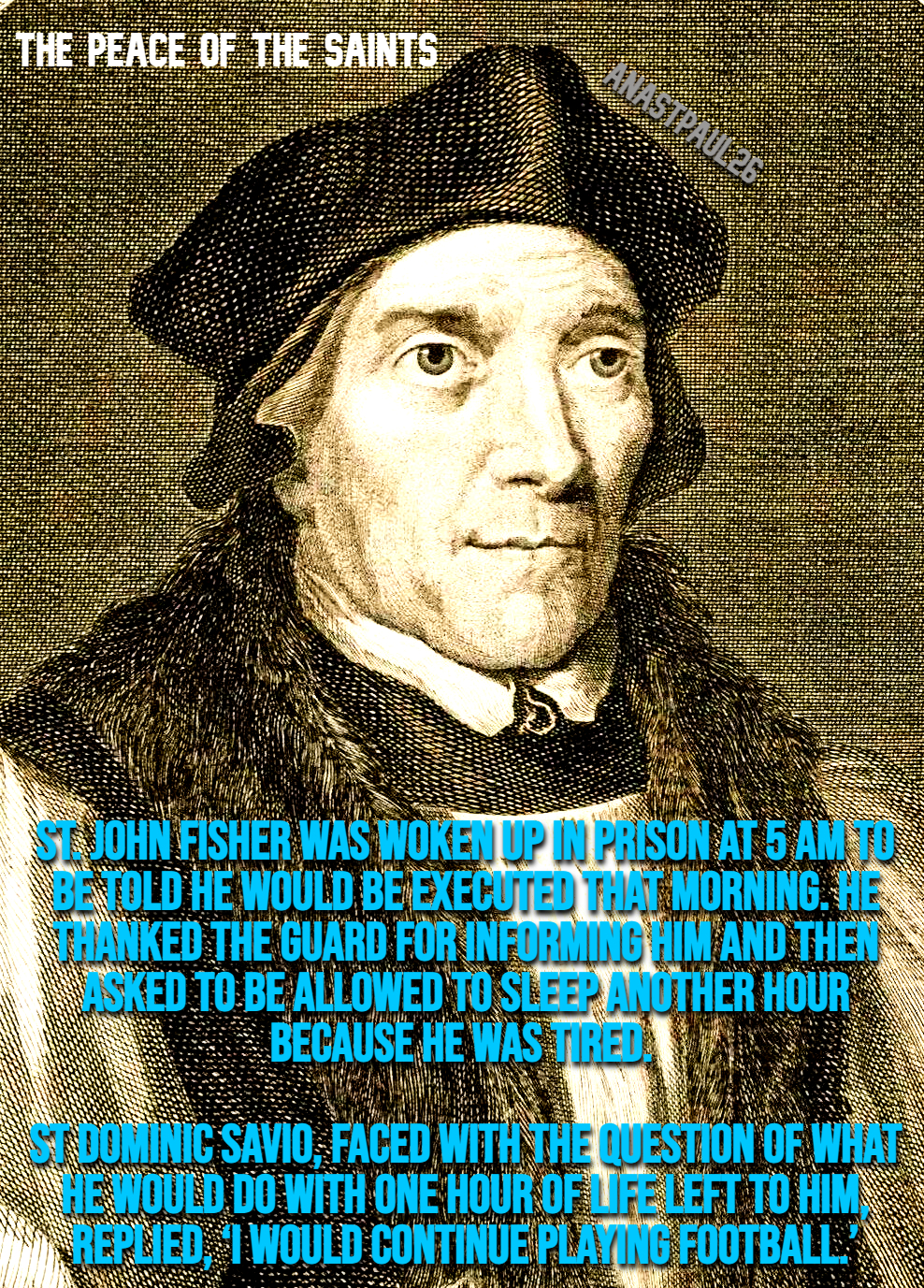
The bishop St. John Fisher was woken up in prison at 5 am to be told he would be executed that morning. He thanked the guard for informing him and then asked to be allowed to sleep another hour because he was tired. St Dominic Savio, faced with the question of what he would do with one hour of life left to him, replied, ‘I would continue playing football.’



You must be logged in to post a comment.