Posted in MARIAN TITLES

Our Lady of Chiquinquirá / La Chinita, Colombia and Memorials of the Saints – 9 July

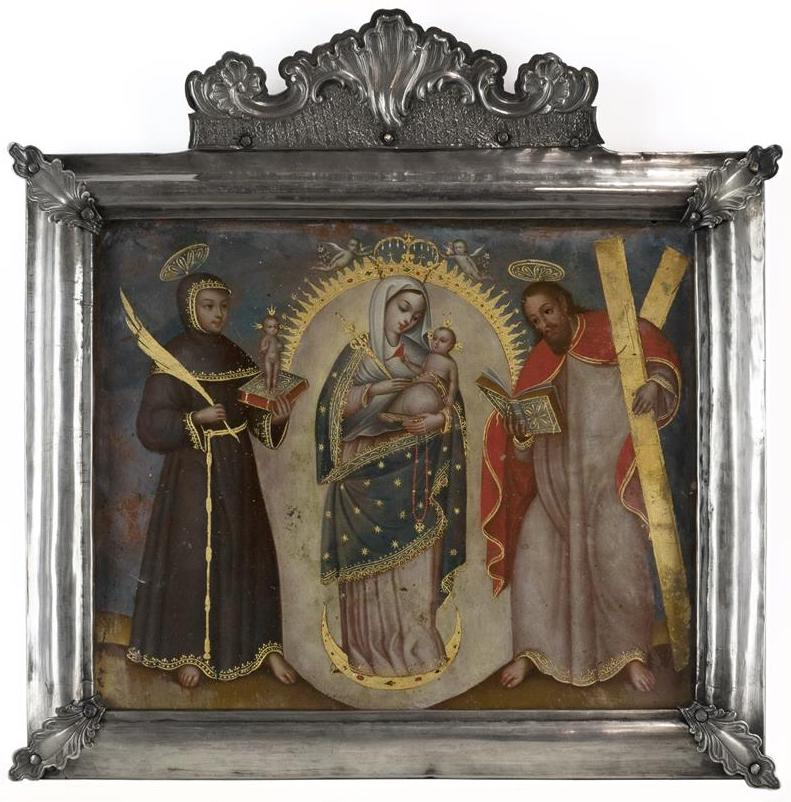
Virgen del Rosario / Our Lady of the Rosary (Chiquinquirá, Boyacá, Colombia) (1586) – 9 July, 26 December:

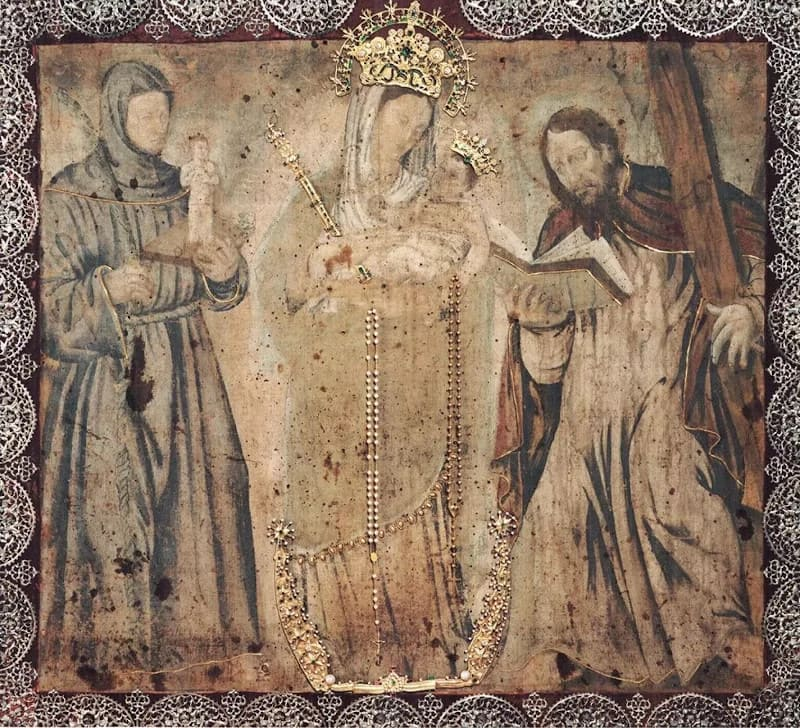
In the mid-16th century the Spanish painter Alonso de Narvaez created a portrait of the Virgin of the Rosary. He painted in pigments from the soil, herbs and flowers of the region of modern Colombia and his canvas was a rough 44 inch x 49 inch cloth woven by local Indians. The image of Mary is about a meter high. She has a small, sweet smile, both her face and the Divine Child’s are light coloured and she looks like she’s about to take a step. She wears a white toque, a rose-coloured robe and a sky blue cape. A Rosary hangs from the little finger of her left hand and she holds a sceptre in her right. She holds the Christ Child cradled in her left arm and looks toward Him. Christ has a little bird tied to His thumb and a small Rosary hangs from His left hand. To either side of Mary stand Saint Anthony of Padua and Saint Andrew the Apostle, the personal Patrons of the colonist, Don Antonio de Santana and Monk, Andrés Jadraque, who commissioned the work.
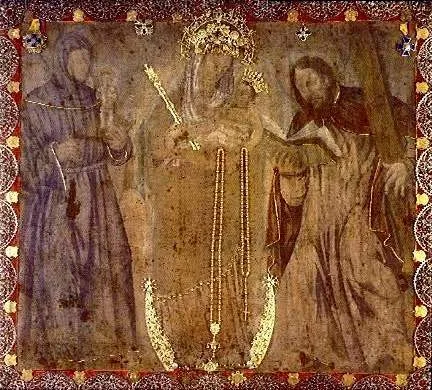
In 1562 the portrait was placed in a rustic Chapel. It was exposed to the air, the roof leaked and soon the damage caused by the humidity and sun completely obscured the image. In 1577 the damaged painting was moved to Chiquinquirá, Colombia and stored in an unused room. In 1585 Maria Ramos, a pious woman from Seville, cleaned up the little Chapel and hung the faded canvas in it. Though the image was in terrible shape, she loved to sit and contemplate it.
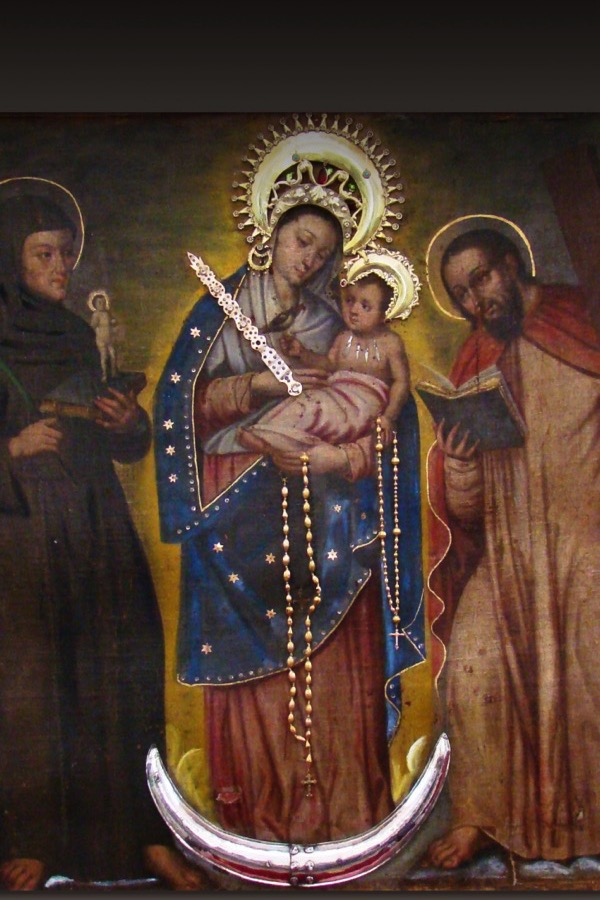
On Friday 26 December 1586 the faded, damaged image was suddenly restored. It’s colours were bright, the canvas cleaner, the image clear and seemingly brand new. The healing of the image continued as small holes and tears in the canvas miraculously self-sealed. It still has traces of its former damage and the figures seem brighter and clearer from a distance than up close. For 300 years the painting hung unprotected and thousands of objects were touched against the frail cotton cloth by pilgrims. This rough treatment should have destroyed it but it healed and survives. In 1829, Pope Pius VII declared Our Lady of Chiquinquirá Patroness of Colombia and granted a special liturgy. In 1897 a thick glass plate was placed over it to shield the painting from the weather and the excess zeal of the faithful. The image was canonically crowned in 1919 and in 1927 her sanctuary declared a Basilica.

Patronages – Colombia, Venezuelan National Guard.
St Augustine Zhao Rong, Priest and Martyr (Died + 1815) and his 119 companions or Martyrs of China (Died 1648–1930, Qing dynasty and Republic of China) (Optional Memorial): 25 priests, friars, nuns, seminarians and lay people. The 87 Chinese Catholics and 33 Western missionaries, from the mid-17th century to 1930, were martyred because of their ministry and, in some cases, for their refusal to apostatise.
Many died in the Boxer Rebellion, in which xenophobic peasants slaughtered 30,000 Chinese converts to Christianity along with missionaries and other foreigners.

Blessed Adrian Fortescue TOSD (1476-1539) Martyr,. A husband and father, a Justice of the Peace, a Knight of the Realm, a Knight of Malta and a Dominican Tertiary (Lay Dominican), he was at once a loyal servant of the Crown so far as he could be but still more, he was a man of unshakeable faith.

St Agrippinus of Autun
St Alexander of Egypt
St Audax of Thora
St Brictius of Martola
St Copra of Egypt
St Cyril of Gortyna
Bl Dionysius the Rhetorician
St Everild of Everingham
St Faustina of Rome
St Felician of Sicily
Bl Fidelis Chojnacki
Blessed Giovanna Scopelli O.Carm (1428 – 1491) Virgin, Religious of the CarmelitesIncorrupt.
St Floriana of Rome
St Hérombert of Minden
St Joachim Ho
Bl Luigi Caburlotto
Bl Marguerite-Marie-Anne de Rocher
Bl Marie-Anne-Madeleine de Guilhermier

St Patermutius of Egypt
St Paulina do Coração Agonizante de Jesus

St Veronica/Ursula Giuliani OSC Cap. (1660-1727) Italian Capuchin Poor Clares nun, Abbot, Mystic, Stigmatist.

Four Holy Polish Brothers – 4 saints: Four brothers who became hermits, Benedictine monks and saints – Andrew, Barnabas, Benedict and Justus. They were born in Poland and died in 1008 of natural causes.

Martyrs of Gorkum – 19 saints: Nineteen martyrs killed by Calvinists for loyalty to the Pope and for their belief in the Real Presence in the Eucharist. They are –
• Adrianus van Hilvarenbeek • Andreas Wouters • Antonius van Hoornaar • Antonius van Weert • Cornelius van Wijk • Francisus de Roye • Godfried van Duynen • Godfried van Melveren • Hieronymus van Weert • Jacobus Lacops • Joannes Lenaerts • John of Cologne • Leonardus van Veghel • Nicasius Janssen van Heeze • Nicolaas Pieck • Nicolaas Poppel • Petrus van Assche • Theodorus van der Eem • Willehad van Deem •
They werehanged on 9 July 1572 in Brielle, Zuid-Holland, Netherlands.
Beatified on 24 November 1675 by Pope Clement X and Canonised on 29 June 1867 by Pope Pius IX.

Martyrs of Orange – 32 beati: 32 nuns from several orders who spent up to 18 months in prison and were finally executed for refusing to renounce Christianity during the persecutions of the French Revolution.
• Anne Cartier • Anne-Andrée Minutte • Dorothée-Madeleine-Julie de Justamond • élisabeth Verchière • élisabeth-Thérèse de Consolin • Jeanne-Marie de Romillon • Madeleine-Françoise de Justamond • Madeleine-Thérèse Talieu • Marguerite-Eléonore de Justamond • Marguerite-Marie-Anne de Rocher • Marguerite-Rose de Gordon • Marguerite-Thérèse Charensol • Marie Cluse • Marie-Anastasie de Roquard • Marie-Anne Béguin-Royal • Marie-Anne Depeyre • Marie-Anne Doux • Marie-Anne Lambert • Marie-Anne-Madeleine de Guilhermier • Marie-Claire du Bac • Marie-Clotilde Blanc • Marie-Elisabeth Pélissier • Marie-Gabrielle-Françoise-Suzanne de Gaillard de Lavaldène • Marie-Gertrude de Ripert d’Alauzier • Marie-Marguerite Bonnet • Marie-Marguerite de Barbégie d’Albrède • Marie-Rose Laye • Rosalie-Clotilde Bes • Suzanne-Agathe Deloye • Sylvie-Agnès de Romillon • Thérèse-Henriette Faurie
They were guillotined between 6 July and 26 July 1794 at Orange, Vaucluse, France.
Beatified on 10 May 1925 by Pope Pius XI.

Martyrs of the Baths – 10,204 saints: A group of Christians enslaved by Diocletian to build the gigantic baths in imperial Rome, Italy. The end of their labours coincided with the beginning of the great persecutions of Diocletian and they were all executed. Ancient records indicated there were 10,204 of them; Zeno of Rome is the only one whose name has come down to us and we know nothing else about any of their individual lives.
Posted in SAINT of the DAY

Saints of the Day – 9 July – Sts Victoria, Anatolia and Audax 

‘In the town of Thora, on lake Velino, in Italy, the martyrdom of
the Saints Anatolia and Audax, under the emperor Decius. Anatolia, a virgin consecrated to Christ, cured, through the whole province of Picenum, many persons laboring under various infirmities, and made them believe in Christ. By order of the judge Fustinian, she was condemned to various
kinds of punishments. She was cured of the sting of a serpent to which she had been exposed; a miracle which converted Audax to the faith. Finally
she was transpierced with a sword, whilst her hands were extended in prayer. Audax was committed to prison, and being without delay sentenced
to capital punishment, obtained the crown of a martyr.’

(The Roman Martyrology)

In the time of the Emperor Decius, Anatolia and Victoria were sisters whose marriage was arranged to two noble, non-Christian Roman men. They resisted this. Their prospective grooms were reluctant to denounce them as Christians as that would mean that the women’s possessions would be forfeited to the state, so instead they received permission to imprison the women on their estates and convince them to renounce their faith. Anatolia’s suitor, Titus Aurelius, gave up, and gave her back to the authorities. Victoria’s suitor, Eugenius, was more persistent, but also ended up returning her to the authorities.

Victoria’s legend states that she was stabbed through the heart in 250 AD at Trebula Mutuesca after chasing away a dragon terrorizing the residents in exchange for their conversion. An elaboration states that her murderer was immediately struck with leprosy, and died six days later. Anatolia was killed, also in 250 AD, at Thora. Her legend states that she was at first locked up with a poisonous snake. The snake refused to bite her, and a soldier named Audax was sent into her cell to kill her. The snake attacked him instead, but Anatolia saved him from it. Impressed by her example, he converted to Christianity and was martyred by the sword with her.

Due to the translation of their relics, their cult spread across Italy. Some relics of Saint Victoria were transferred in 827 by Abbot Peter of Farfa from the Abbey to Mount Matenano in the Picene area because the Abbey was besieged by Saracens. The town of Santa Vittoria in Matenano is named after her. Ratfredus, a later Abbot of Farfa, brought the body from Farfa to Santa Vittoria in Matenano on 20 June 931.

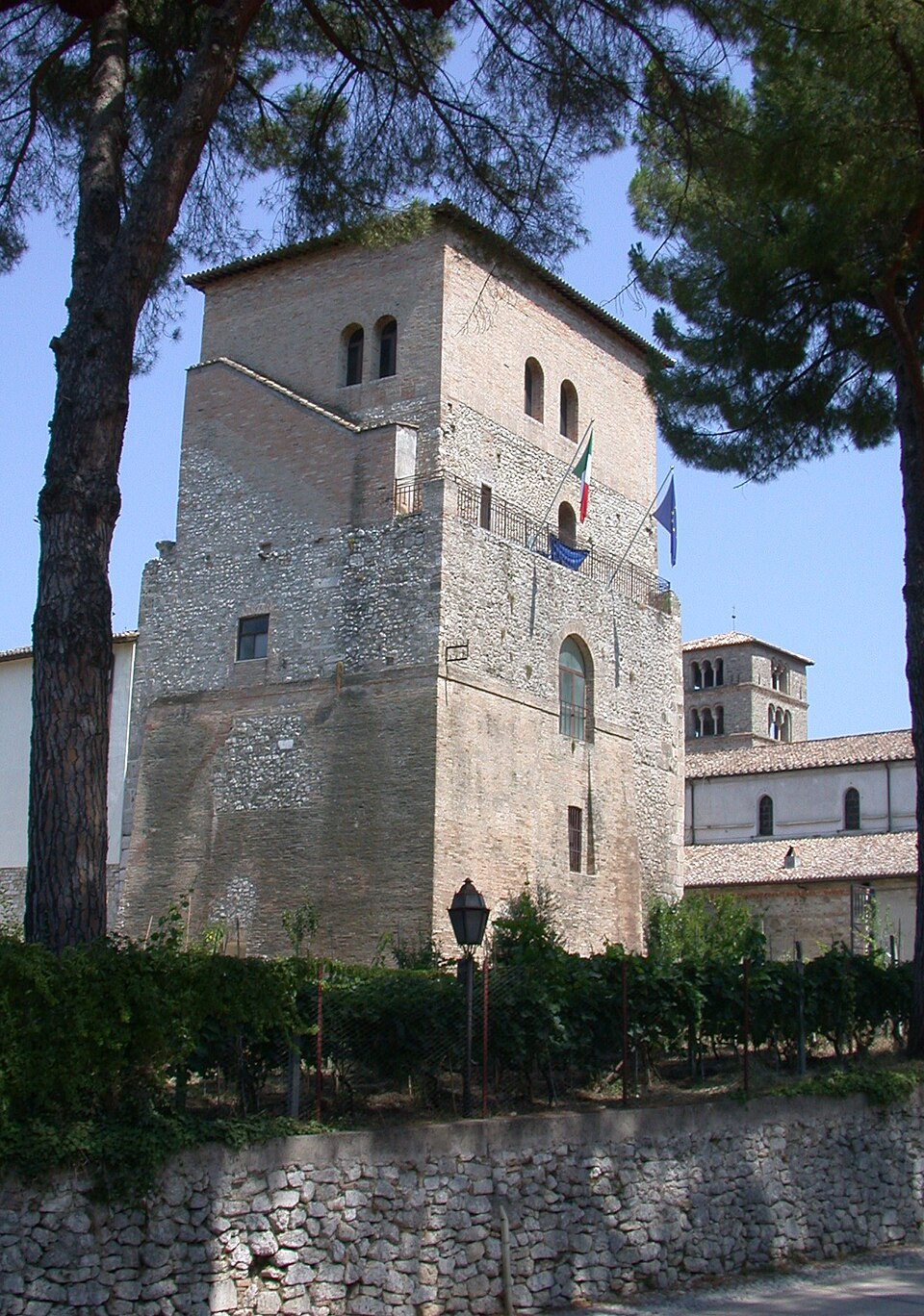
The bodies of Anatolia and Audax were transferred by Abbot Leo to Subiaco around 950. At an unknown date, a scapula of Anatolia was translated to the present-day Sant’Anatolia di Borgorose and an arm of the saint was translated to the present-day Esanatoglia. The bodies of Anatolia and Audax still rest at Subiaco in the basilica of Santa Scholastica, under the altar of the sacrament.

St Mary’s Cathedral, Kilkenny, Ireland also claims to hold St Victoria’s body, preserved in wax, along with a chalice containing some of her blood. These were sent to Kilkenny in 1845 by Pope Gregory XVI.

The Abbey of Farfa

Posted in Our MORNING Offering

Our Morning Offering – 9 July – Daily Offering to the Father

Our Morning Offering – 9 July – “Month of the Most Precious Blood”

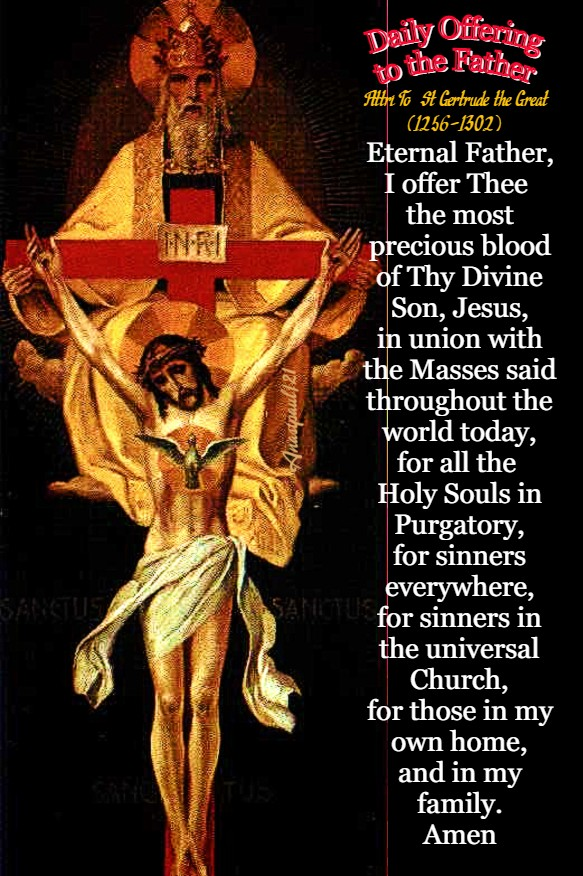
Daily Offering to the Father
Attri To St Gertrude the Great (1256-1302)

Eternal Father,
I offer Thee the most precious blood
of Thy Divine Son, Jesus,
in union with the Masses said
throughout the world today,
for all the Holy Souls in Purgatory,
for sinners everywhere,
for sinners in the universal Church,
for those in my own home,
and in my family.
Amen

Posted in ONE Minute REFLECTION

One Minute Reflection – 9 July – ‘Consider the times.’

I will go round, and offer in His tent, sacrifices with shouts of gladness; I will sing and chant praise to the Lord.

Ps. 26:6

REFLECTION – “I urge you, by the grace in which you are clothed, to press on in your race and urge everyone to be saved. Assert your office with all the diligence of flesh and spirit. Give your attention to unity, for there is nothing better. Carry your brethren as the Lord also carries you. Patiently, bear with them all in love, as indeed you do bear with them. Devote yourself to unceasing prayer. Ask for greater understanding than you have. Be watchful, possessing a wakeful spirit. Speak to each one individually, concerning God’s way. “Bear the infirmities” (cf Mt 8,17) of each as a perfect athlete. Where there is more toil, there is greater gain. If you only love the good disciples, this wins you no advantage. Rather, subdue by meekness the more annoying. Not every wound is cured by the same salve. Ease sharp pains with a hot compress. In everything “be wise as serpents” and always “harmless as doves”. You who are of flesh and spirit, humour those things visibly present before you but pray, too, that what is invisible may be manifested to you, so that you may lack nothing and may abound in every spiritual gift.

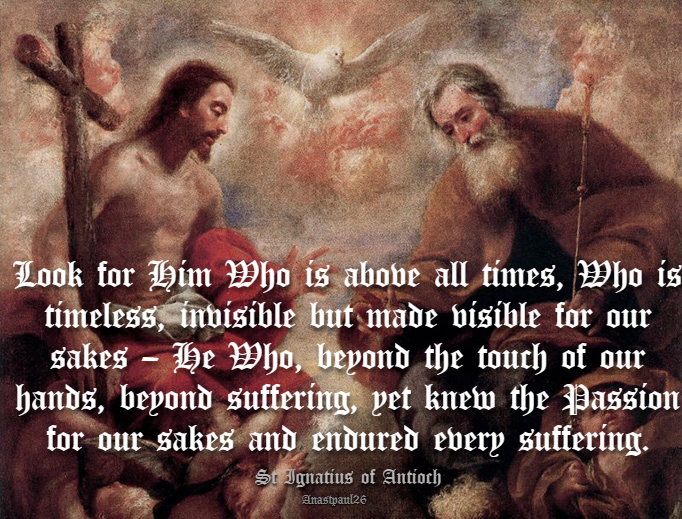
As pilots invoke the winds and tempest-tossed mariners call for haven, this season invites you to return to God. Be temperate, as God’s athlete. The prize is incorruption and life eternal… It is the part of a great athlete to suffer blows and to conquer. It is above all for God’s sake we ought to endure all things, that He too, may endure us. Become more zealous than you are already. Consider the times. Look for Him Who is above all times, Who is timeless, invisible but made visible for our sakes – He Who, beyond the touch of our hands, beyond suffering, yet knew the Passion for our sakes and endured every suffering.” – St Ignatius of Antioch (c 35-c 108) Father of the Church, Martyr, Bishop – Letter to St Polycarp (69-155) Bishop and Martyr), 1-3 ; SC 10

PRAYER – Mercifully hear our humble prayers, O Lord, and graciously accept these offerings of Your people, and grant that no prayer may be without effect, no petition in vain, so that what we ask in faith, we may really obtain.
Through our Lord…

Posted in The MOST HOLY REDEEMER, Our SAVIOUR

Quote/s of the Day – 9July – The Lord is the strength of His people, the saving refuge of His anointed

Quote/s of the Day – 9July – “Month of the Precious Blood” – Readings: Ps. 27:8-9., Ps 27:1, Rom 6:3-11, Ps. 89:13, 1, Ps. 30:2-3, Mark 8:1-9

The Lord is the strength of His people, the saving refuge of His anointed. Save Your people, O Lord, and bless Your inheritance; and rule them forever!

Ps. 27:8-9

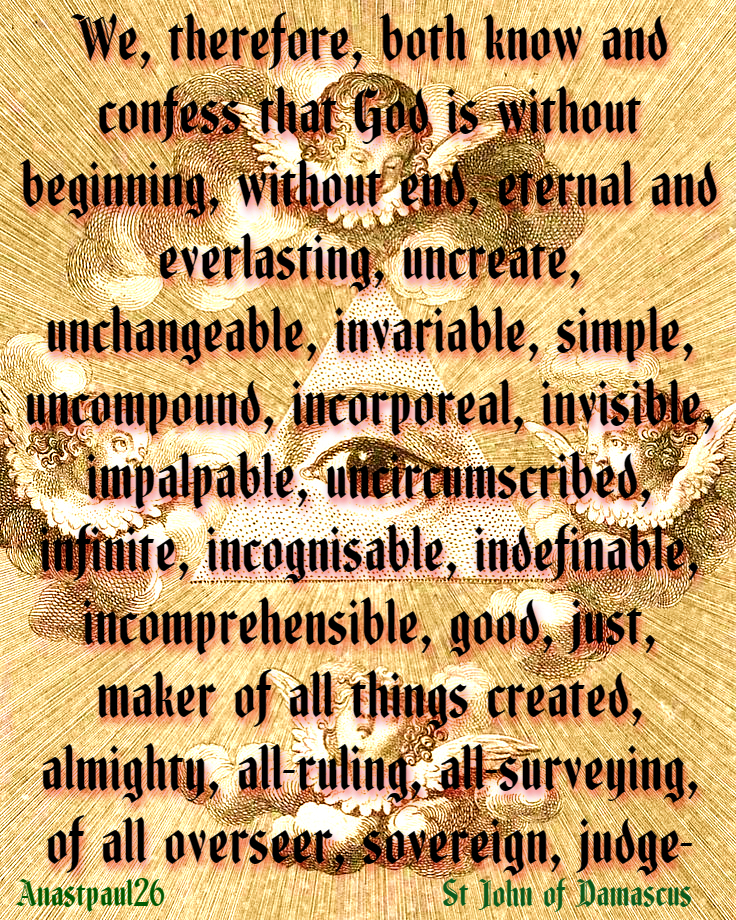
We, therefore, both know and confess that God is without beginning, without end, eternal and everlasting, uncreate, unchangeable, invariable, simple, uncompound, incorporeal, invisible, impalpable, uncircumscribed, infinite, incognisable, indefinable, incomprehensible, good, just, maker of all things created, almighty, all-ruling, all-surveying, of all overseer, sovereign, judge; and that God is One, that is to say, one essence ; and that He is known , and has His being in three subsistences, in Father, I say, and Son and Holy Ghost…

An Exposition of the Orthodox Faith (Book I) (St John of Damascus)

Return, O Lord! How long? Have pity on Your servants!
℣. O Lord, You have been our refuge through all generations.

Ps. 89:13, 1

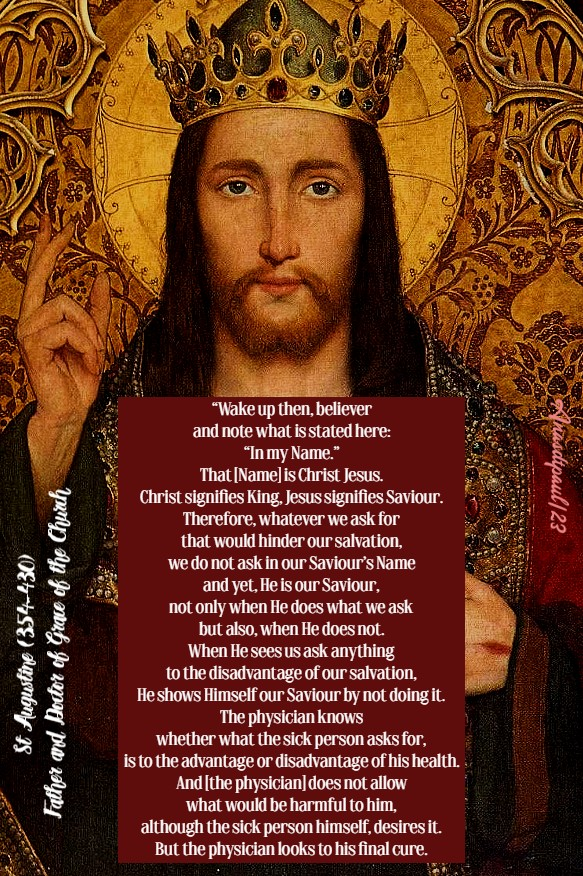
Wake up then, believer
and note what is stated here:
“In My Name.”
That [Name] is Christ Jesus.
Christ signifies King, Jesus signifies Saviour.
Therefore, whatever we ask for
that would hinder our salvation,
we do not ask in our Saviour’s Name
and yet, He is our Saviour,
not only when He does what we ask
but also, when He does not.
When He sees us ask anything
to the disadvantage of our salvation,
He shows Himself our Saviour by not doing it.
The physician knows
whether what the sick person asks for,
is to the advantage or disadvantage of his health.
And [the physician] does not allow
what would be harmful to him,
although the sick person himself, desires it.
But the physician looks to his final cure.

St Augustine (354-430)
Father and Doctor of Grace of the Church

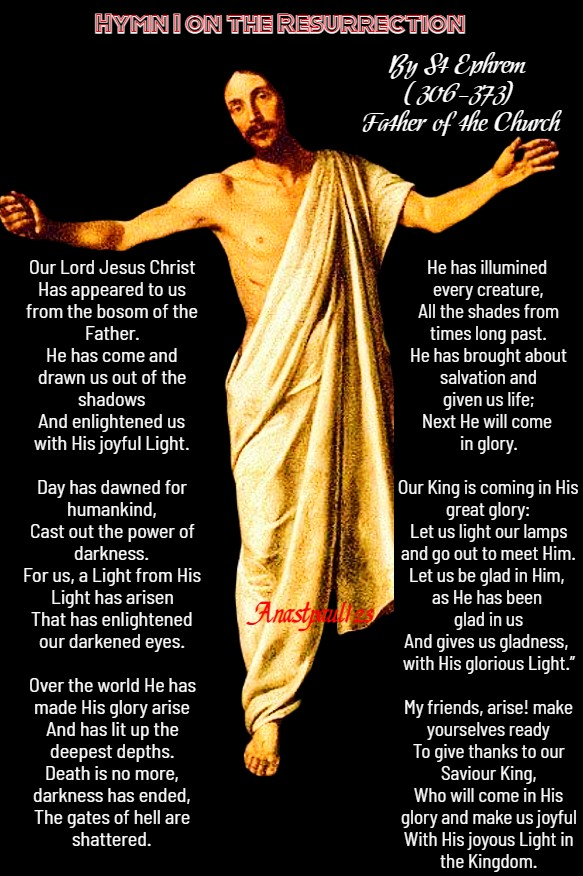
Our Lord Jesus Christ
Has appeared to us from the bosom of the Father.
He has come and drawn us out of the shadows
And enlightened us with His joyful Light.

Day has dawned for humankind,
Cast out the power of darkness.
For us, a Light from His Light has arisen
That has enlightened our darkened eyes.

Over the world He has made His glory arise
And has lit up the deepest depths.
Death is no more, darkness has ended,
The gates of hell are shattered.

He has illumined every creature,
All the shades from times long past.
He has brought about salvation and given us Life;
Next He will come in glory.

Our King is coming in His great glory:
Let us light our lamps
and go out to meet Him (Mt 25,6);
Let us be glad in Him, as He has been glad in us
And gives us gladness, with His glorious Light.

My friends, arise! make yourselves ready
To give thanks to our Saviour King,
Who will come in His glory and make us joyful
With His joyous Light in the Kingdom.

St Ephrem (306-373)
Father of the Church
(Hymn I on the Resurrection)

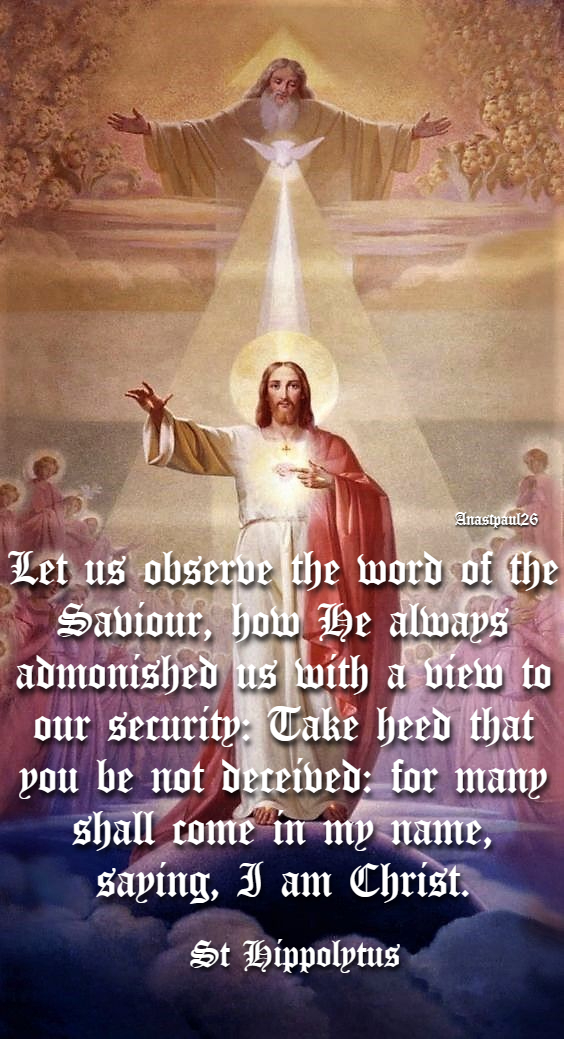
For, because iniquity shall abound, the love of many shall wax cold. By reason of the agitation and confusion of all these, the Lord of the universe cries in the Gospel, saying, Take heed that you be not deceived; for many shall come in my name, saying, I am Christ, and the time draws near: go not therefore after them. But when you shall hear of wars and commotions, be not terrified: for these things must first come to pass; but the end is not yet by and by. Let us observe the word of the Saviour, how He always admonished us with a view to our security: Take heed that you be not deceived: for many shall come in my name, saying, I am Christ.

On the End of the World (St Hippolytus)

Posted in ONE Minute REFLECTION

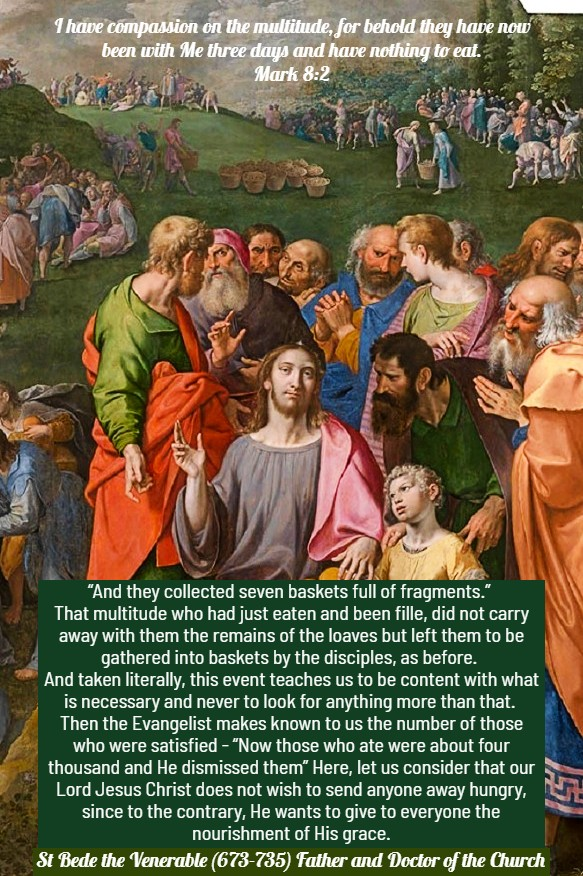
One Minute Reflection – 9 July – I have compassion on the multitude … Mark 8:1-9

I have compassion on the multitude, for behold they have now been with Me three days and have nothing to eat.” – Mark 8:2

REFLECTION – “ In this account of the miracle we must consider, in one and the same Redeemer, the separate operation of His Divinity and of His Humanity. And the error of Eutyches, who dared to teach that in Christ there is but one operation, must be wholly driven out from Christian lands. Who cannot see that the Lord, in having compassion on the multitude, lest they faint from want of food or from the weariness of the long journey home, was moved by the compassion of human pity but that, feeding four thousand people from seven loaves and a few fish, is a work of Divine Power?

And they collected seven baskets full of fragments.” That multitude who had just eaten and been fille, did not carry away with them the remains of the loaves but left them to be gathered into baskets by the disciples, as before. And taken literally, this event teaches us to be content with what is necessary and never to look for anything more than that. Then the Evangelist makes known to us the number of those who were satisfied – “Now those who ate were about four thousand and He dismissed them” Here, let us consider that our Lord Jesus Christ does not wish to send anyone away hungry, since to the contrary, He wants to give to everyone the nourishment of His grace.

In a figurative sense, there is this difference between this second miracle and the first multiplication of the five loaves and two fish – the first prefigures the letter of the Old Testament, which was as though full of the spiritual grace of the New, whereas the second, represents the truth and grace of the New Testament fully communicated to the faithful. The multitude who, according to Saint Matthew’s testimony, wait three days for the healing of their sick (Mt 15), represent the elect in the faith of the Holy Trinity, who beg for the forgiveness of their sins, with persevering prayer, or those who are converted to the Lord, through their thoughts, words and deeds.” – St Bede the Venerable (673-735) Monk, Father and Doctor of the Church (Homilies on Mark, Book II, ch8 cf PL 92 – quoted by Saint Thomas Aquinas in the Catena Aurea Vol 4)

PRAYER – O God of the heavenly powers, creator of all good things, implant in our hearts the love of Thy Name and bestow upon us, an increase of godliness, fostering what is good and, by Thy loving care, guarding what Thou hast fostered. Through the same Jesus Christ, Thy Son our Lord, Who lives and reigns with Thee, in the unity of the Holy Ghost, God, world without end. Amen

Posted in JULY - The MOST PRECIOUS BLOOD

One Minute Reflection – 9 July – The Precious Blood in its Earthly Origin

The Precious Blood – Short Meditations for July

By Rev. Richard F. Clarke

9th Day – The Precious Blood in its Earthly Origin

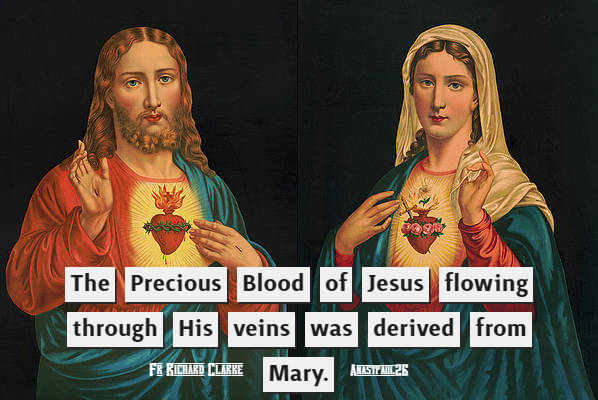
A child in its mother’s womb lives with the physical life of its mother. It is nourished by its mother, and her blood circulates in its veins. The Precious Blood of Jesus flowing through His veins was derived from Mary. She furnished from her immaculate body the Precious Blood that Jesus shed for us. How close must have been the union of Jesus and Mary! Can we wonder at her surpassing holiness when she not only carried her God within her womb, but furnished the very body with which His humanity clothed itself?

We also find in this thought a fresh proof of Mary’s unblemished purity. It is repugnant to our reverence for the Second Person of the Blessed Trinity to imagine Him dwelling in a womb that had ever been defiled by sin, and much more to suppose that the Precious Blood which flowed in His veins and was the price of our redemption did not come from a source as pure as God could make it. Make an act of faith in the Immaculate Conception of Mary, and thank God for that privilege conferred on her.

We must also remember that Jesus’ was wholly Mary’s. It was not as in the case of other children who have an earthly father. The body of Jesus was formed in Mary’s womb by the operation of the Holy Ghost, and naturally Jesus was altogether hers. In heaven, the body that Jesus wears is still derived from Mary, and their union is now closer than ever. In holy Communion Jesus is altogether ours. Do we conform ourselves to Him as Mary did?