Madonna del Faggio (Our Lady of the Beech Tree), Castelluccio, Bologna, Emilia Romagna, Italy (1672) – 26 July, Ascension Thursday:
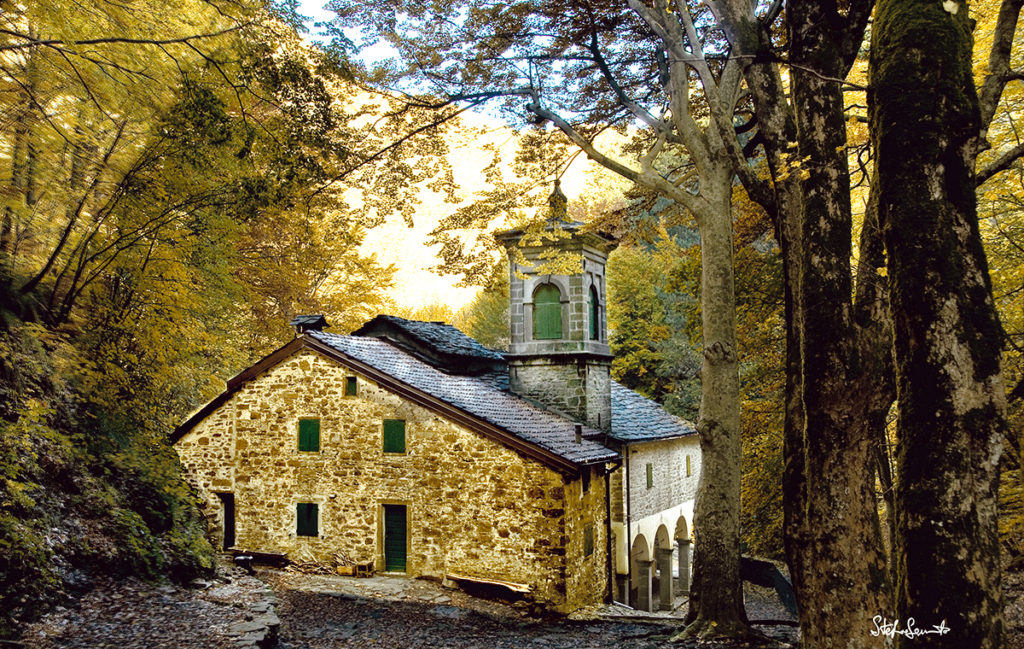
In 1672 the Blessed Virgin appeared to a shepherd boy and told him that she wished to be venerated at a certain place in the beech woods near Castelluccio in central Italy. The child , following the directions to the site, discovered a terracotta Madonna affixed to one of the trees. The tiny Statue, barely 18 centimetres tall (7 inches) was moved to a wayside Shrine and then, in 1722, to its own mountain Sanctuary. Until 1964 a caretaker lived in the hermitage there. Since then a volunteer opens the Chapel only in summer on Sundays. In 1975 the sacred image was stolen and a copy was made to replace it.
Since 1756, an annual pilgrimage on Ascension Day brings the image to the Town and back again, and on St Anne’s day, 26 July, a procession goes to the site of the beech tree where the Statue had been originally found, although the tree itself is no longer there as it fell during a storm.
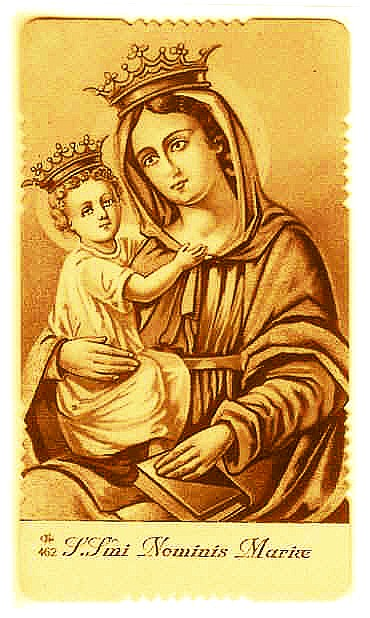
The Sanctuary’s holy card, shown above, does not seem to depict the terracotta image. It may represent one of the paintings of Lorenzo Pranzini, who decorated the interior of the Chapel in the 1800s.
St Benigno of Malcestine Bl Camilla Gentili St Charus of Malcestine Bl Edward Thwing Bl Élisabeth-Thérèse de Consolin St Erastus Bl Évangéliste of Verona St Exuperia the Martyr Bl George Swallowell St Gérontios Bl Giuseppina Maria de Micheli St Gothalm St Hyacinth Bl Jacques Netsetov Bl John Ingram St Joris Bl Marcel-Gaucher Labiche de Reignefort Bl Marie-Claire du Bac Bl Marie-Madeleine Justamond Bl Marie-Marguerite Bonnet St Olympius the Tribune St Parasceva of Rome (Died c 180) Virgin Martyr, Confessor St Pastor of Rome Bl Pérégrin of Verona Bl Pierre-Joseph le Groing de la Romagère
St Simeon of Padolirone St Symphronius the Slave St Theodulus the Martyr
Blessed Titus Brandsma OCD (1881-1942) Martyr of the Faith, Carmelite Religious Priest, Mystic, Philosopher, Lecturer, Writer, Editor, Preacher, Linguist, Social Activist.
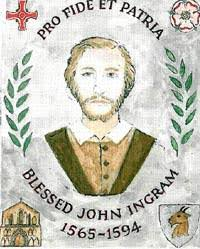
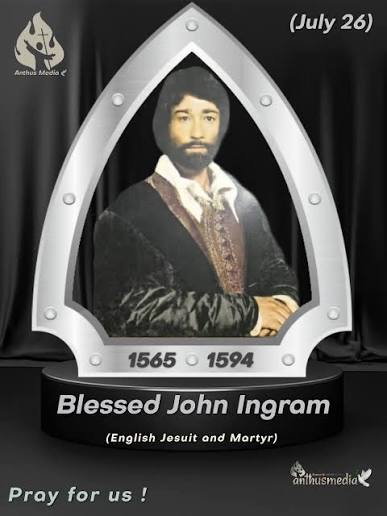
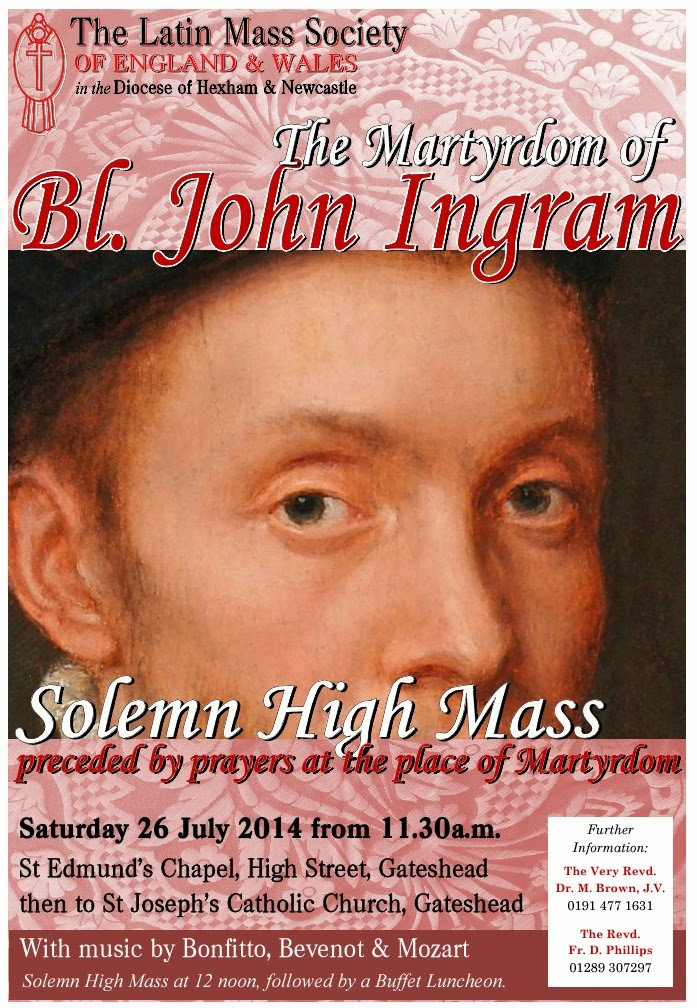
John Ingram, born in 1565 at Stoke Edith, Herefordshire, England. Son of Anthony Ingram of Wolford, Warwickshire, and Dorothy, daughter of Sir John Hungerford. He was an English Jesuit and martyr who was executed in Gateshead on 26 July 1594, during the reign of Elizabeth I, aged 29.
He was educated at Worcestershire and the New College, Oxford, England and was an adult convert to Catholicism. After graduating from there at 17 years old, he left England for Douai, then he attended the English College at Rheims, France; the Jesuit College at Pont-a-Mousson, France; and the English College Seminary, in Rome. On the way to Rheims he and three other young men were waylaid and held for ransom by a troop of Calvinist mercenaries in the pay of Francis, Duke of Anjou.
The first mention of Ingram is in a letter from William Allen, Principal at Rheims, to the rector of the English College in Rome: Even at the very moment of my writing to you bad tidings come of four young students. On their way to this college from Douai, they were robbed, and are still held captive, by the soldiery of my lord, the brother of his Majesty, and a large sum of money is demanded of us for their ransom. Meanwhile the soldiers are dragging their unhappy victims from town to town, and from province to province, in the direction of their camp in Belgium. God knows how much we shall have to pay to redeem them, for letters from the Mayor and Corporation of Rheims in their favour have been entirely without effect.”
But the four young men, John Ingram, Richard Haward, Thomas Heath and Christopher Haywood, managed to escape and made their way to Rheims, arriving, in a state of the utmost destitution during October and November 1582. On 10 June 1585, he took the oath of commitment to return to England as a Missionary Priest and took minor orders. John was ordained at Rome in 1589.
Sent on a mission to Scotland in 1592, he was supported by Lords Huntly, Angus, and Erroll, the Abbot of Dumbries, and Sir Walter Lindsay of Balgavies. To get there John traveled to Abbeville in France, then doubled back to Brussels where he said Mass in a secret chapel run by the Jesuits, and thence to Antwerp where he visited the Carthusian church and said Mass. There he abandoned his clerical garb and dressed as a layman. This circuitous route was possibly to obscure his intentions and identity, from the network of spies maintained by the English Government, who were always on the lookout for priests. John lived for 18 months as resident chaplain to the household of Sir Walter Lindsay, in the guise of a steward, ministering to the local faithful. He converted many people to the faith.
He lived under a number of aliases, but when Sir Walter Lindsay fled to Spain after angering the king by his own allegiance to the Faith, John fled south and to evade pursuit, slipped across the English border on 25 November 1593. He rested for some hours at Wark-on-Tweed and then traveled downriver seeking a means to cross back into Scotland but he was apprehended by the English border guards near Norham Castle.
Strenuous efforts were made by Scottish supporters to secure his release, one laird claiming Ingram as his own son, and others offering the substantial ransom of a thousand crowns for his release. This only confirmed the English belief that they had captured someone of significant importance, as up till then they were not certain whether he was a priest or some other enemy of the state.
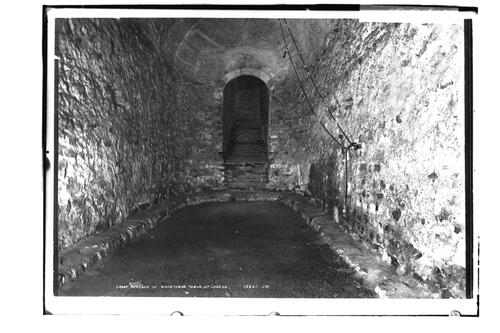
He was imprisoned for his faith at Berwick, Durgam, York, and the Tower of London. Tortured in the Tower for the names of other “traitorous” Catholics, he gave away nothing, ministered to and encouraged his fellow prisoners, and still wrote 20 Latin epigrams that have survived.
Ingram arrived at the Tower of London on Holy Saturday, 17 April 1593, and later wrote:
Rocks are quarried, the entrails of the earth, That Dives may have living rock for his tomb. No tomb seek I; and yet shall there be a living tomb
For my lifeless body — the carrion-crow.
He was severely tortured by priest hunter Richard Topcliffe. Hung by the joints of his fingers and arms, he was in extreme pain for so long that the feeling of his senses was taken completely from him. He was often put to the rack, but would give no information about persons and places. When he and another priest were moved to York, Ingram was in solitary confinement in a stinking vault of a locked jakehouse for four days, without either a bed to lie on or a stool to sit on. From York, he was transported to Newcastle and imprisoned in the Newgate prison there for four night. A woman visitor to the prison was struck by the serenity and joy of the priest, who said that he had good cause to be merry because his wedding day being at hand, the bridegroom must be glad, for within ten days he hoped to enjoy his Spouse. She remarked that it was true his hope was good, but his banquet was deadly; but he answered that the reward was sweet. The serenity and courage of John Ingram is reflected in two letters he wrote from prison to his friends or fellow prisoners in the same prison: “I look for my trial on Thursday and consequently for my death in God’s honour ( …) in my pained body; my spirit is not pained, nor in any disaster, distress or durance.”
Tower of London cell
Someone in Scotland offered the English Government a thousand crowns to spare Ingram’s life, but he was convicted with Saint John Boste and Saint George Swallowell (the other two Durham Martyrs), for the high crime of priesthood.
When he was asked what he had to say that he should not receive judgement, he made this answer, “I say that I am a priest, and that my exercise and practice of priesthood cannot be made treason by any Christian law; and I beseech God to forgive both you and them that make it otherways. And I do with all my heart forgive you, and all my accusers and persecutors, and so I beseech God to have mercy upon me, and to strengthen me with patience and constancy in mine agony.”
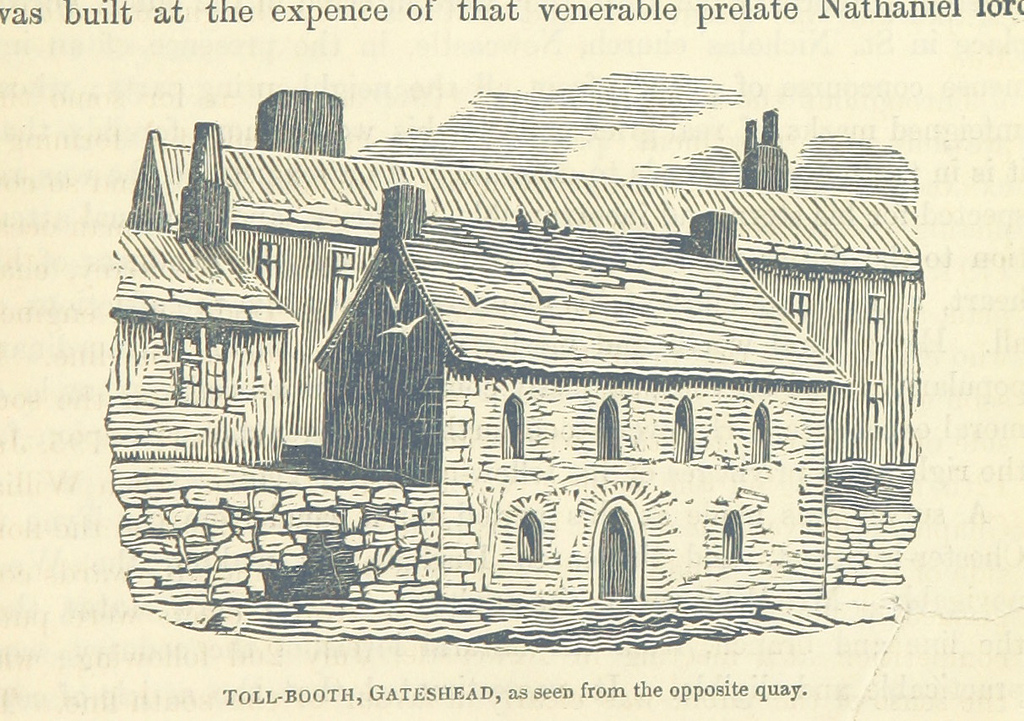
Immediately prior to his execution, he was held for a short while in the Toll-Booth in Gateshead, a small local gaol very close to the place of execution. Holtby gives an account of Ingram’s preparations, the prayers he said, his words to the bystanders, and of the execution itself:
“I take God and his holy angels to the record, that I die only for the holy Catholic faith and religion, and do rejoice and thank God with all my heart that hath made me worthy to testify my faith therein, by the spending of my blood in this manner.”
He was asked to pray for the Queen and he prayed to God that she might long reign to his glory, and that it might please him to procure her to live and die a good Catholic Christian prince. With rope around his neck he said more prayers, ending with the psalm Miserere mei Deus, after which, making the sign of the Cross and saying, “In manus tuas“, the ladder was turned; and being dead, he was cut down, bowelled, and quartered. His severed head was placed on a spike and displayed on the bridge across the Tyne.
The Toll-Booth
In Rome, at the English College, when the news of his martyrdom reached them, the staff and students sang the Te Deum in the college chapel and wrote against his name “Martyro insigni coronatus“.
Our Morning Offering – 26 July – “Month of the Most Precious Blood – Reminding you and myself, that in Catholic Time, Monday is the day of the Holy Ghost and/or the Holy Angels.
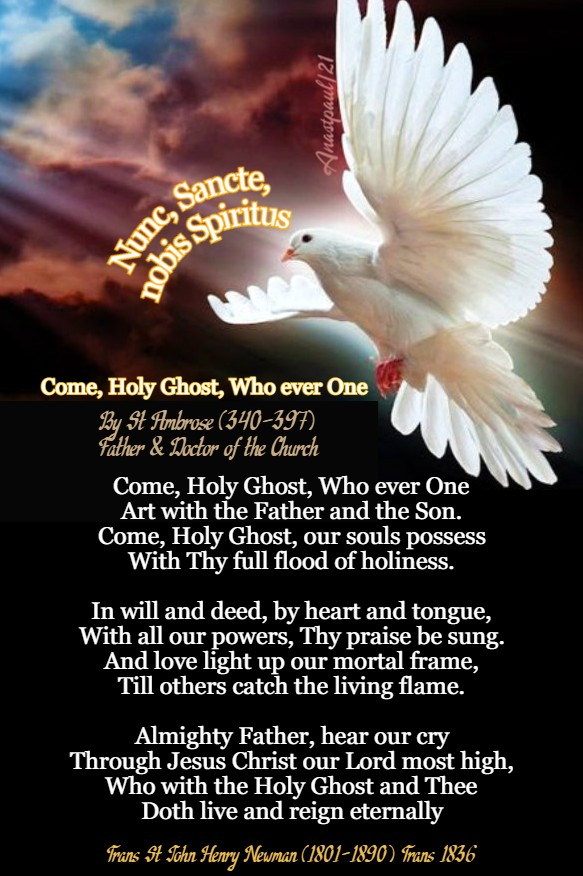
Nunc, Sancte, nobis Spiritus By St Ambrose (340-397) Come, Holy Ghost, Who ever One Trans John Henry Newman (1801-1890) Trans 1836
Come, Holy Ghost, Who ever One Art with the Father and the Son. Come, Holy Ghost, our souls possess With Thy full flood of holiness.
In will and deed, by heart and tongue, With all our powers, Thy praise be sung. And love light up our mortal frame, Till others catch the living flame.
Almighty Father, hear our cry Through Jesus Christ our Lord most high, Who with the Holy Ghost and Thee Doth live and reign eternally.
At that time, when Jesus drew near to Jerusalem and saw the city, He wept over it, saying, If you had known, in this your day, even you, the things that are for your peace! But now they are hidden from your eyes.
Luke 19:41-47
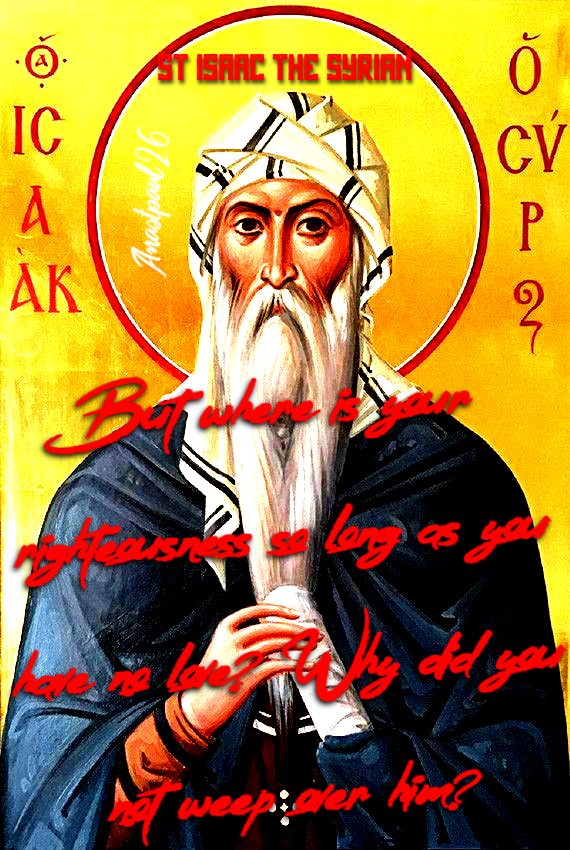
REFLECTION – Do not despise sinners because we are all guilty. If you rise up against him for love of God, weep for him, rather. Why despise him? Despise his sins and pray for him if you would be like Christ, who was not angered at sinners but prayed for them. Don’t you see how he wept over Jerusalem? For we too have been played around with by the devil more than once. Why despise someone just like ourselves, who has been a plaything of the devil who taunts us all? You who are merely a man, why despise the sinner? Is it because he is not righteous like you? But where is your righteousness so long as you have no love? Why did you not weep over him? To the contrary, you persecute him. It is because of their ignorance that some people are annoyed with others – those who think they have discernment into the works of sinners.
St Isaac the Syrian (Ascetical discourses)
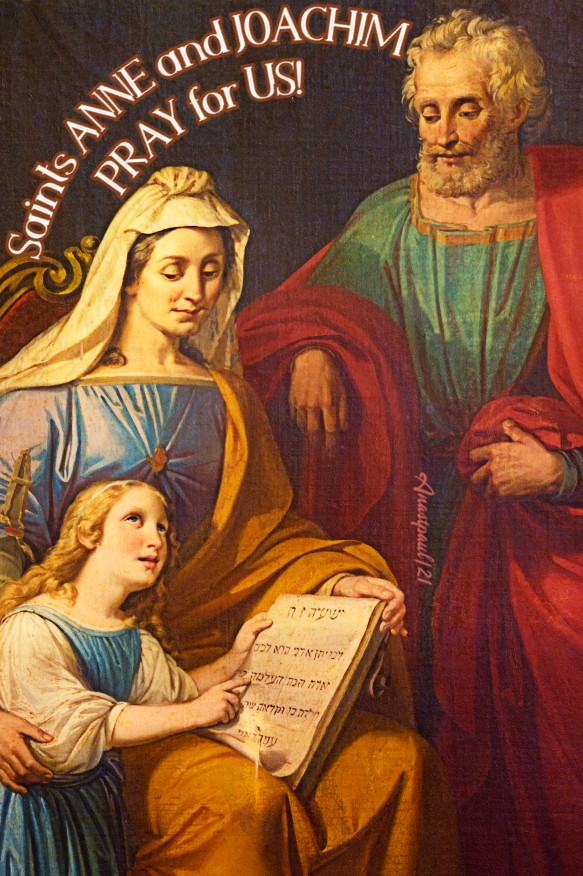
PRAYER – True light of the world, Lord Jesus Christ, as You enlighten all men for their salvation, give us grace, we pray, to herald Your coming by preparing the ways of justice and of peace. Help us Lord, that we may sprout and bear fruit, fitting to grow and be a home of comfort to our neighbour. By the prayers of Sts Anne and Joachim, may we too be beacons of Your Light and of the glory of Your Kingdom. Through Jesus our Lord, Who lives and reigns with the Father and the Holy Spirit, God forever, amen.
Quote/s of the Day – 26 July – “Month of the Most Precious Blood” – Readings: Ps 53:6-7, Ps 53:3, 1 Cor. 10:6-13, Luke 19:41-47
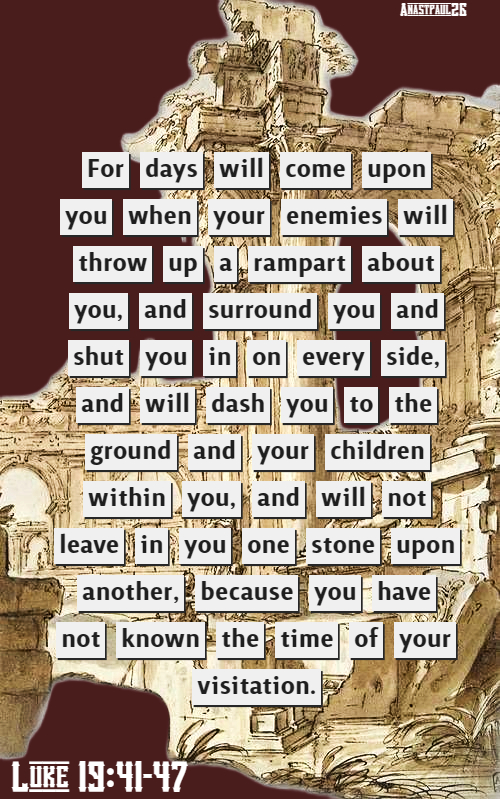
For days will come upon you when your enemies will throw up a rampart about you, and surround you and shut you in on every side, and will dash you to the ground and your children within you, and will not leave in you one stone upon another, because you have not known the time of your visitation.
Luke 19:41-47
As therefore with regard to the prisoner, when you see him with irons on his back, on his hands, and often on his feet too, you therefore most of all account him miserable; so also as to the rich man, when you see him encompassed with innumerable affairs, let him not be therefore rich, but rather for these very things wretched, in your account. For together with these bonds, he has a cruel jailor too, the wicked love of riches; which suffers him not to pass out of this prison, but provides for him thousands of fetters, and guards, and doors, and bolts; and when he has cast him into the inner prison, persuades him even to feel pleasure in these bonds; that he may not find so much as any hope of deliverance from the evils which press on him.
St John Chrysostom (Homily 14 on Matthew)
On account then of all these things let us entreat the Redeemer of our souls, that He would both burst asunder our bands, and remove this our cruel jailor, and having set us free from the burden of those iron chains, He would make our spirits lighter than any wing. And as we entreat Him, so let us contribute our own part, earnestness, and consideration, and an excellent zeal. For thus we shall be able both in a short time to be freed from the evils which now oppress us, and to learn in what condition we were before, and to lay hold on the liberty which belongs to us.
St John Chrysostom (Homily 14 on Matthew)
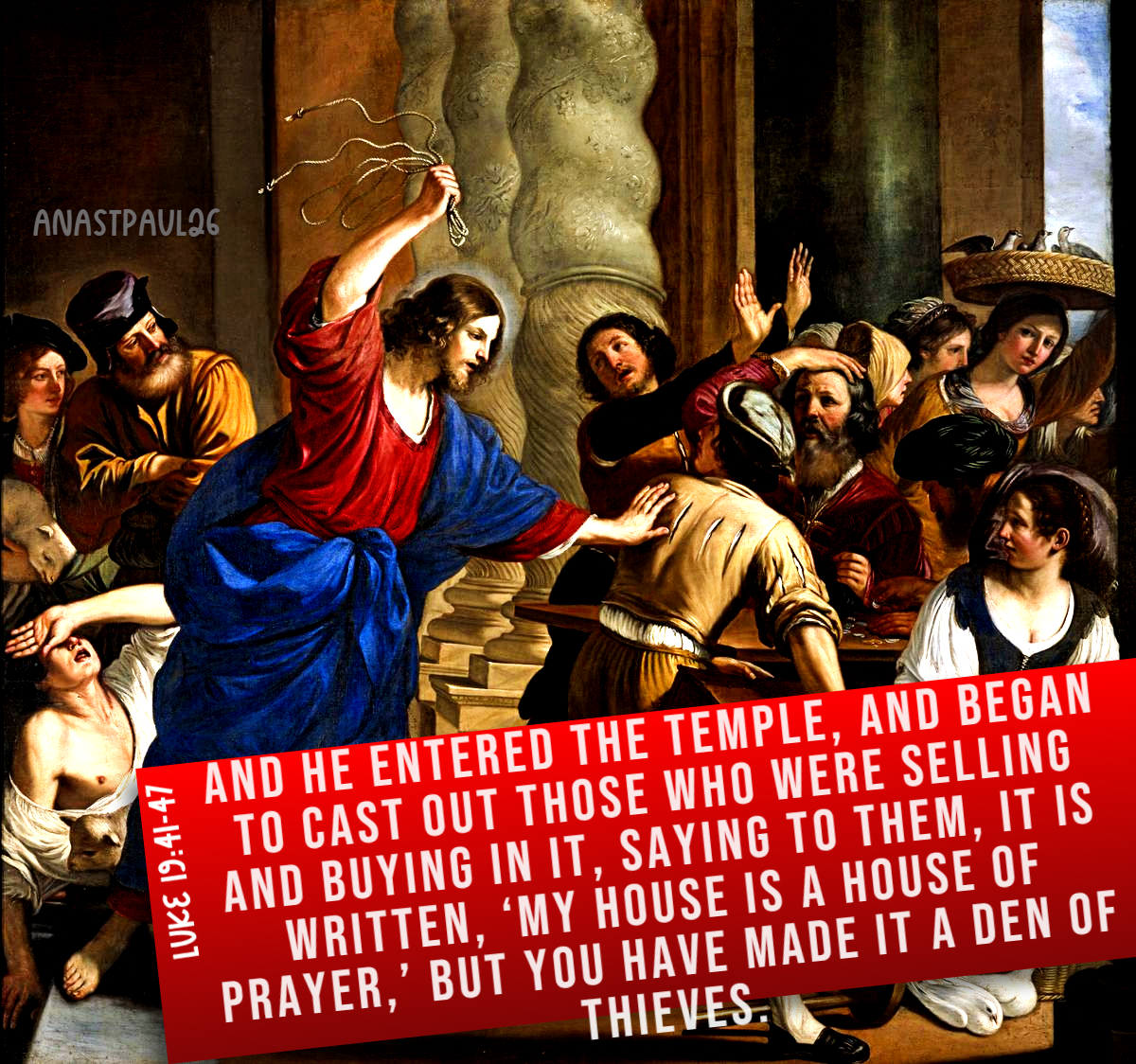
And He entered the temple, and began to cast out those who were selling and buying in it, saying to them, It is written, ‘My house is a house of prayer,’ but you have made it a den of thieves.
Luke 19:41-47
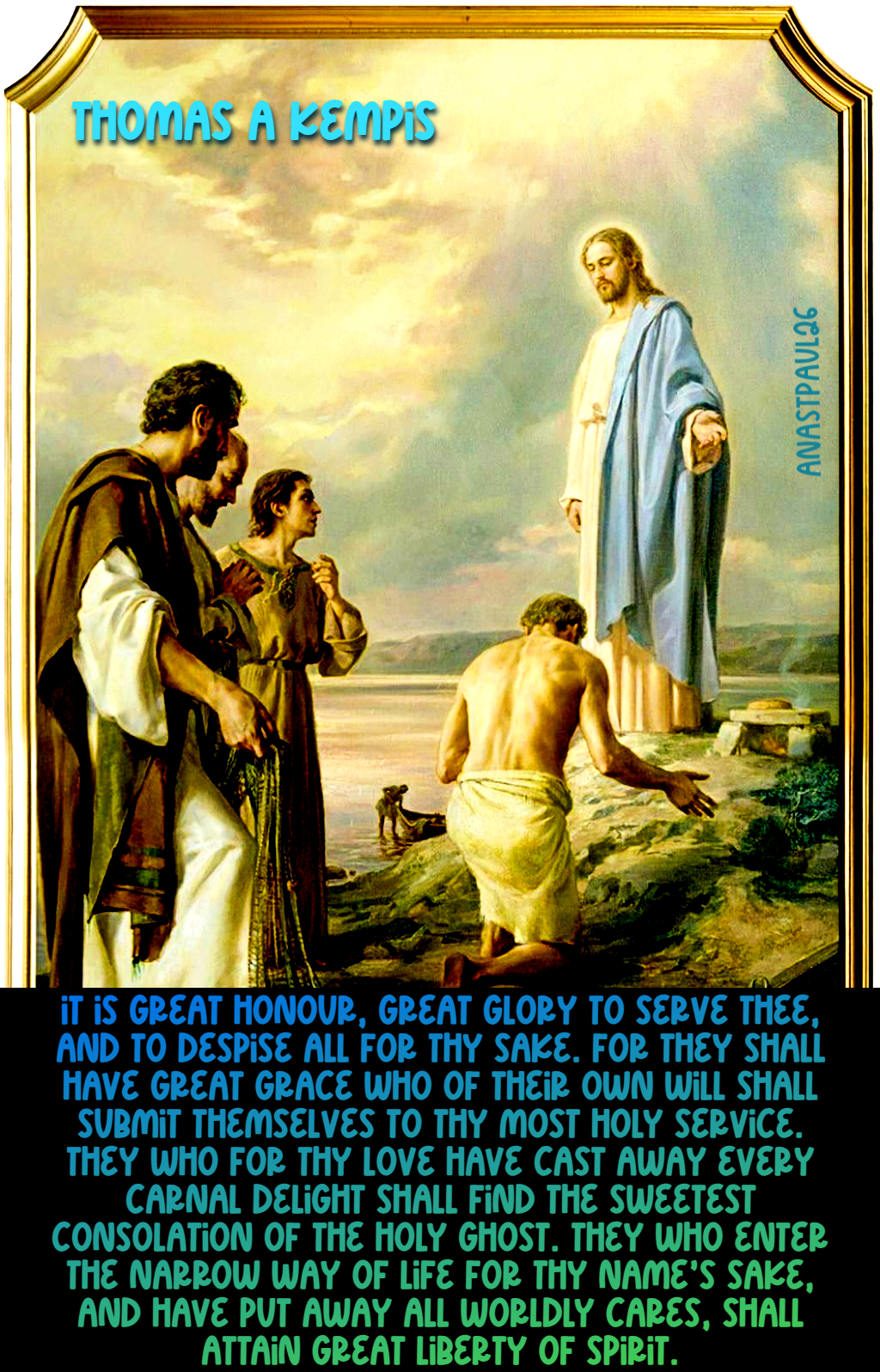
It is great honour, great glory to serve Thee, and to despise all for Thy sake. For they shall have great grace who of their own will shall submit themselves to Thy most holy service. They who for Thy love have cast away every carnal delight shall find the sweetest consolation of the Holy Ghost. They who enter the narrow way of life for Thy Name’s sake, and have put away all worldly cares, shall attain great liberty of spirit.
Thomas a Kempis (Third Book: Chapter X)
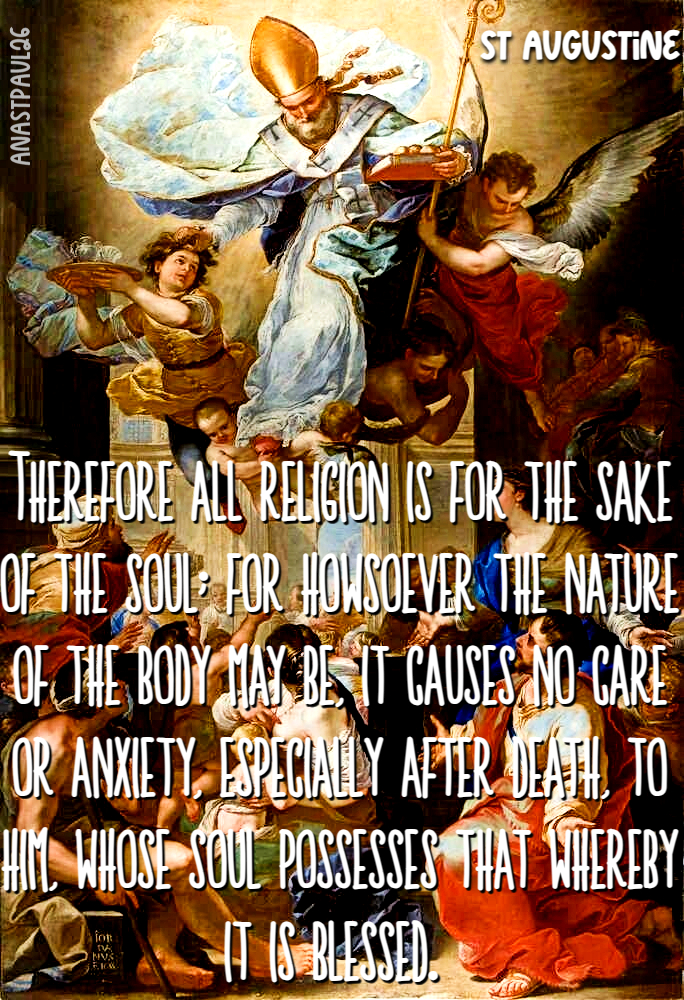
Therefore all religion is for the sake of the soul; for howsoever the nature of the body may be, it causes no care or anxiety, especially after death, to him, whose soul possesses that whereby it is blessed.
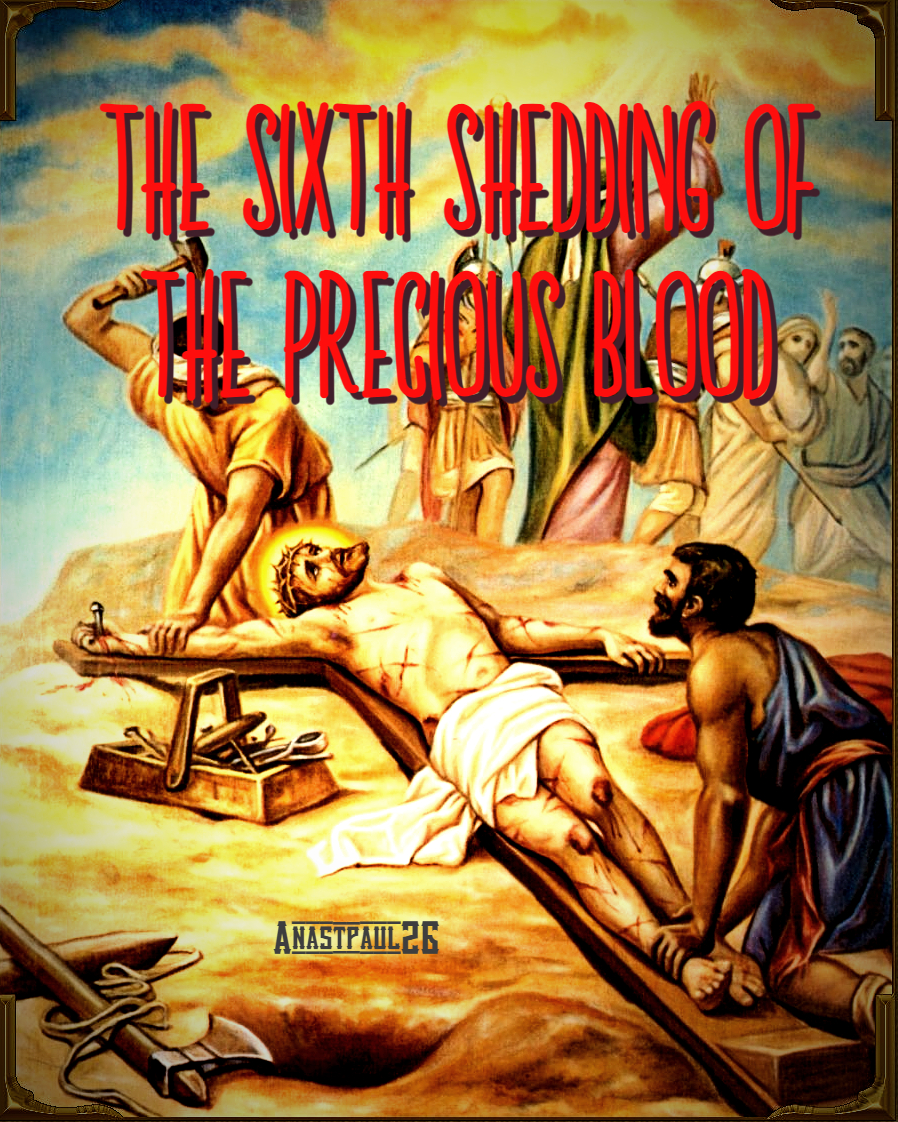
26th Day – The Sixth Shedding of the Precious Blood
Not the hands alone, that did for man those works of love, but also the feet, that went about doing good, were pierced by the cruel nails. It seems as if men were bent on requiting the very limbs that were employed for the good of man with evil in return. They not only hate Him without a cause, but they hated Him for His love to them. Such is man when he is in Satan’s power. Such have I too often been, so ungrateful to God, rebelling against the means which He employed to heal my soul and deliver me from sin.
What must have been the unutterable agony of those three hours during which the sacred body of Our Lord was dragging with all its weight on the wounds in His hands and feet! Who can describe it? The agony that racked each nerve so that there was no sound part of His body, the utter exhaustion, and, worst of all, the agonising thirst that was the effect of the the continual streams which drained His sacred body of the Precious Blood. Who can imagine it? “Behold and see, all who pass by the way, whether there is any sorrow like to My sorrow.”
Yet these wounds inflicted by man’s malignity, are now employed by Jesus as arguments pleading for mercy for sinners at His Father’s hands. Oh, Jesus, when shall I forgive, as Thou didst forgive me? When shall I learn that it is a privilege and a glory to return good for evil, and so to resemble Thee?
It’s been a month since my mom, the founder of this site, died, and I want to once again thank all who have supported her, and her family, in the past, and since her death. Such support, from donations to prayers, to the simplest comment of support, has been invaluable, and I cannot express our gratitude enough. I especially want to thank her great friend: Hugh. Everyone who has supported is being prayed for during our priest’s daily masses, and monthly supporters have masses offered for them and their intentions. Thank you so much ❤ God bless.




You must be logged in to post a comment.