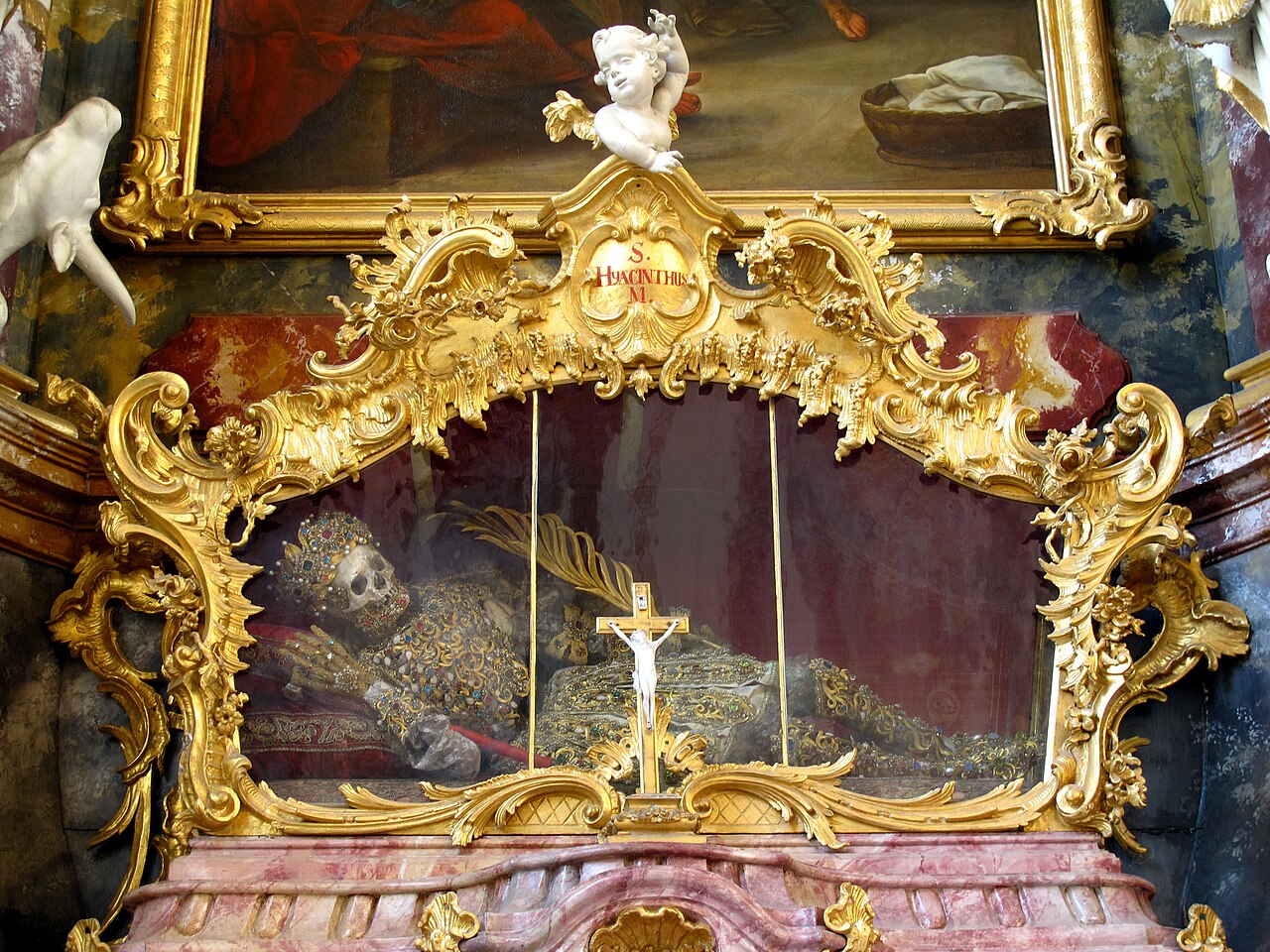
Hyacinth was a native of Caesarea in Cappadocia, and a member of a Christian family. As a boy, he was appointed to serve as an assistant to the chamberlain to the Emperor Trajan. His failure to participate in the sacrifices to the official Roman gods soon came to be noticed by other members of the Imperial household. One day, while the emperor and his entourage were offering sacrifice to idols, Hyacinth remained at the palace, shut himself up in a small room, and prayed fervently to the Lord Jesus Christ. One of the servants overheard him praying and denounced him to the emperor.
When he was denounced as a Christian, Hyacinth proclaimed his faith. He was brought to trial before Trajan, who tried to persuade him to deny Christ and sacrifice to idols, but the young boy refused. As a result, he was imprisoned and underwent numerous scourgings and tortures. He was deliberately served only food which had been blessed for sacrifice to the gods, the eating of which was banned to Christians. Thus, he starved to death after thirty-eight days, dying at the age of twelve. Just before his death, his jailers saw him being comforted by a pair of angels, one who covered him with his own robe, the other who bestowed a crown on him.
Hyacinth died in the city of Rome. Later, his relics were transferred to Caesarea.