Posted in CATHOLIC-PRAYERS OF THE CHURCH, franciscan OFM, PRAYERS of the CHURCH, PRAYERS of the SAINTS

Our Morning Offering – 13 October

Our Morning Offering – 13 October

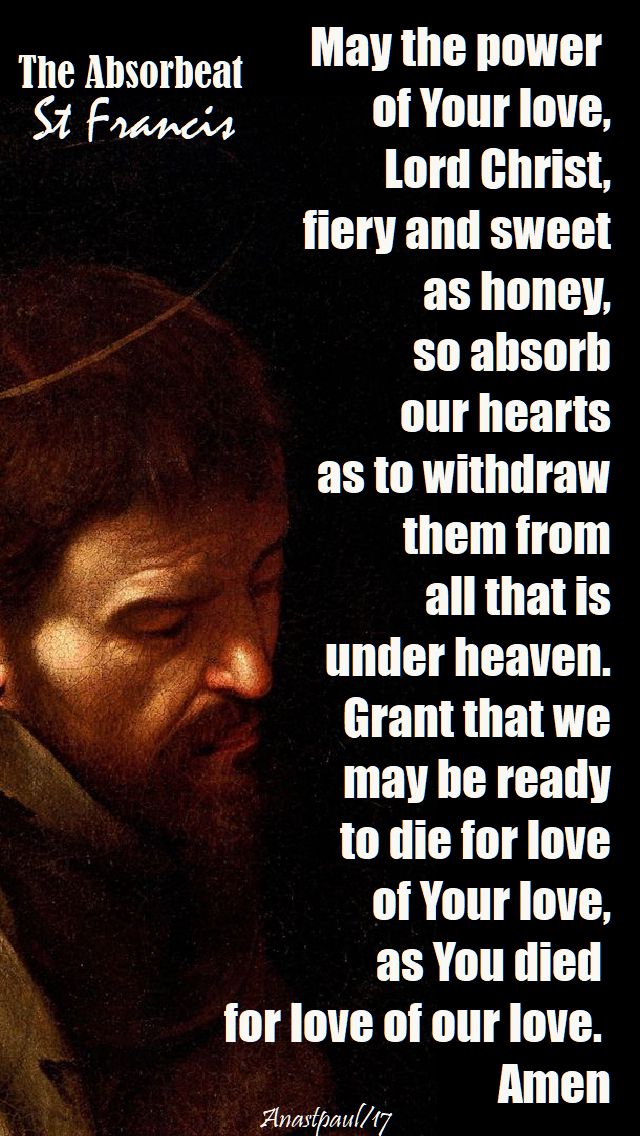
The Absorbeat
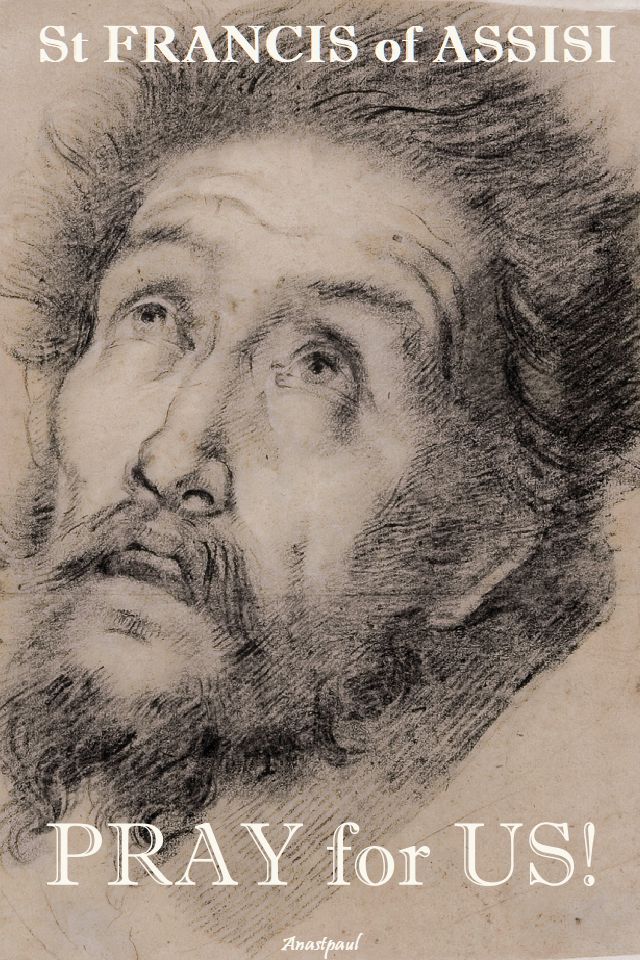
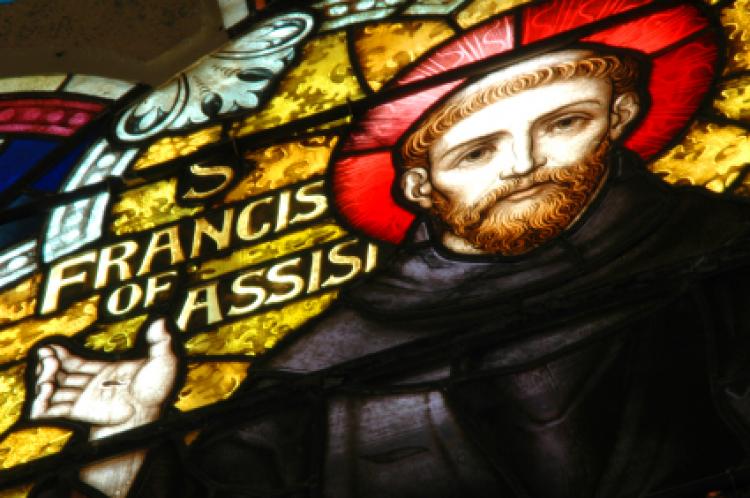
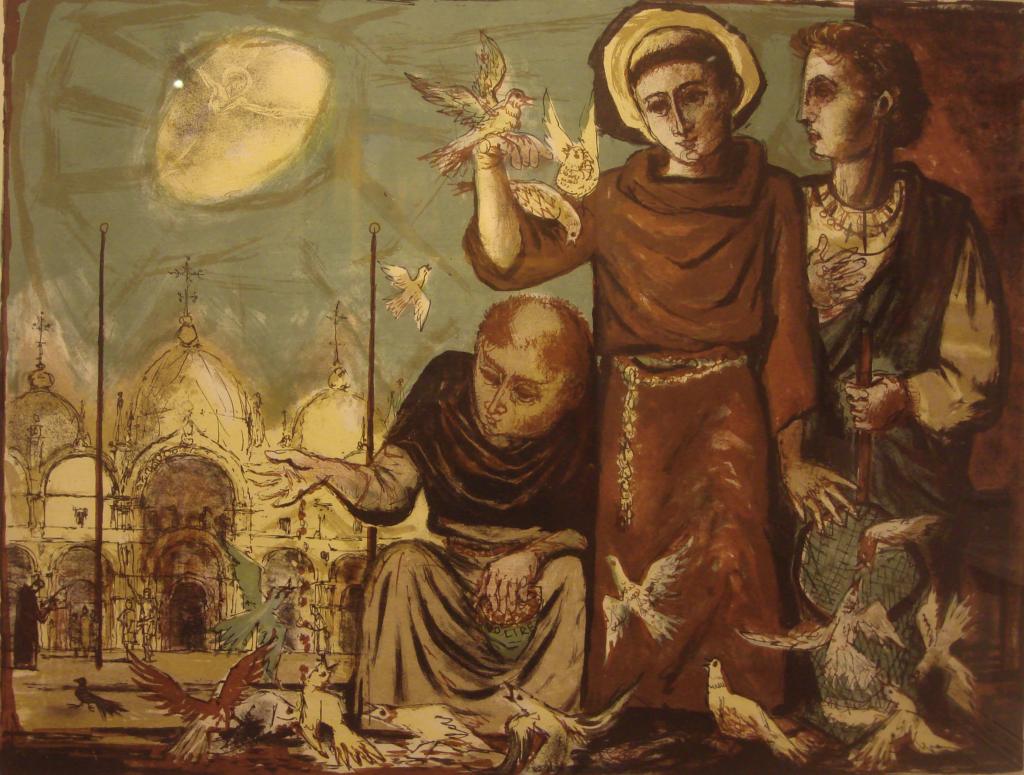
St Francis of Assisi

May the power of Your love, Lord Christ,
fiery and sweet as honey,
so absorb our hearts
as to withdraw them
from all that is under heaven.
Grant that we may be ready
to die for love of Your love,
as You died for love of our love.
Amenthe absorbeat - st franics 13 oct 2017

Posted in franciscan OFM, MORNING Prayers, SAINT of the DAY

Thought for the Day – 4 October – The Memorial of St Francis of Assisi (1181–1226)

Thought for the Day – 4 October – The Memorial of St Francis of Assisi (1181–1226)

Francis, the destitute and lowly, enters heaven, a rich man, acclaimed by the songs of angels!   (Antiphon for the Memoria of St Francis from the Divine Office)

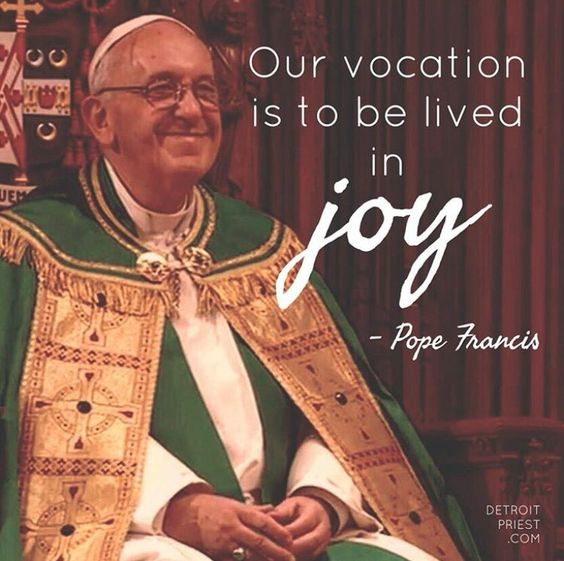
Joyful Saint, Joyful Pope!

In my presence and in the presence of others, try to be always joyful, for it is not fitting that a servant of God appear before the brothers or other men with a sad and glum face. —Saint Francis

The encounter with the living Jesus…fills the heart with joy, because it fills it with true life, a profound goodness that does not pass away or decay. —Pope Francispapa f - joy

Saint Francis called himself God’s court jester—the Jongleur de Dieu—as he went about singing the praise of God.   Pope Francis brought the house down the night of his election, telling his brother cardinals, “May God forgive you!

One can’t help but notice a kind of effervescent joy that spreads happiness to others. These men have shattered the stereotype of rigid, grim, calcified piety.   They radiate something entirely different: the joy of Christ.

Jesus was attractive, in the literal sense of the word.   People wanted to meet Him and hear Him and follow Him.   Saint Francis had a similar effect and if the three million people who showed up at World Youth Day in Rio de Janeiro are any indication, Pope Francis does too.   The wisdom and faith of these men make them intriguing, to be sure, but their spirit of joy goes a long way in drawing these crowds.

Jesus, too, “rejoiced in the Holy Spirit” (Luke 10:21).   And he wanted us to share in his joy. “These things I have spoken to you,” Jesus told his disciples, “that my joy may be in you, and that your joy may be full” (John 15:11).   Twice again Jesus speaks in these terms: “Ask, and you will receive, that your joy may be full” (John 16:24), and, “These things I speak in the world, that they may have my joy fulfilled in themselves” (John 17:13).

This fullness of joy is our inheritance as Christians.   And it doesn’t always have to come with suffering!   The gift of knowing Christ, being subjects of the King of Kings, is a great joy in and of itself.   This is what Jesus taught:  “The kingdom of heaven is like treasure hidden in a field, which a man found and covered up; then in his joy he goes and sells all that he has and buys that field” (Matthew 13:44).

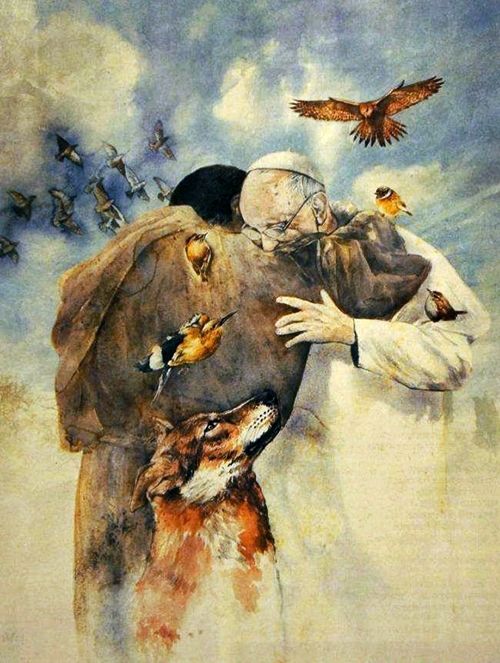
Saint Francis and Pope Francis have given everything, dedicating their entire lives for the sake of the kingdom of heaven.   And in this they have found great joy.francis and franics

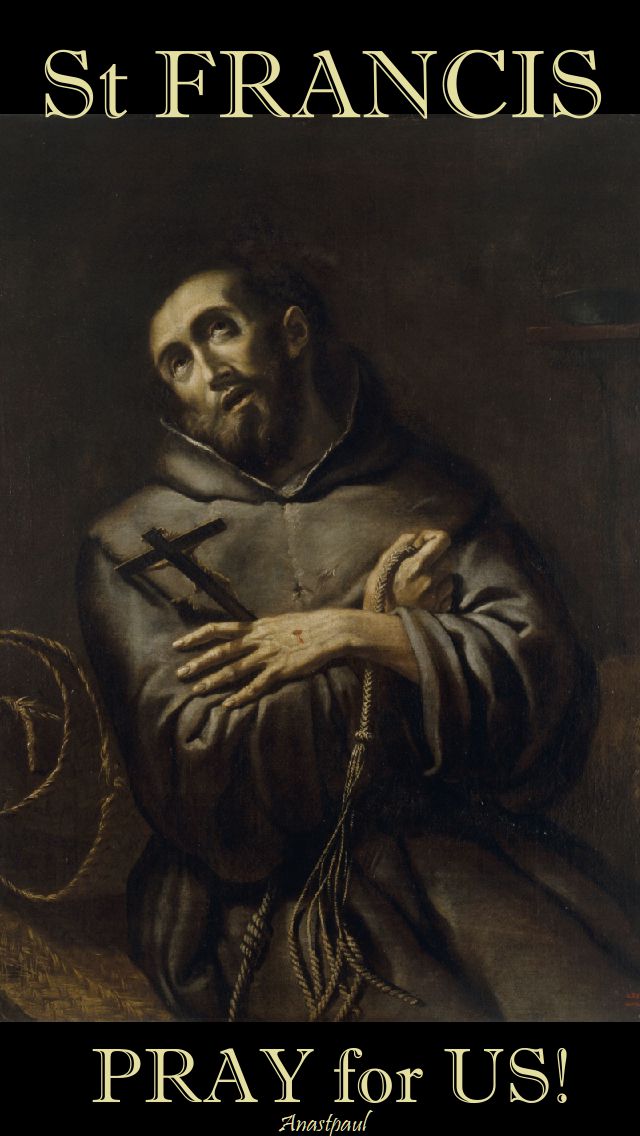
St Francis Pray for us and let us all pray for our Holy Father!francis pray 2 - 4 oct 2017

St Francis leaves us with his blessing:

May the Lord bless you and keep you.

May the Lord make His face to shine upon you

and be gracious to you.

May the Lord lift up His countenance upon you and give you peace.

ST FRANCIS PRAYER - MAY THE LORD BLESS YOU AND KEEP YOU

Posted in franciscan OFM, SAINT of the DAY

Saint Francis of Assisi’s Song of Praise

Saint Francis of Assisi’s Song of Praise

We could simply say that Francis’ prayer life was, “My God and my all!” and stop at that. Everything that can be stated about prayer in the life of Saint Francis of Assisi is expressed in those four little words.   While the truth is contained in that brief and holy phrase, the way in which Francis reached that apex of prayer needs exploration.

In searching Francis’ journey in prayer, we discover our own way to believing and living “My God and my all!”   There are many significant markers in Francis’ prayer life but among them shines the Canticle.

The Canticle sings in simple words of praise all that Francis discovered of the glory and goodness of God.   All he learned through visions in his early conversion, from the words from the crucifix of San Damiano, his pummeling of God in prayer in the caves, his experiences of the brotherhood of lesser brothers, his own illness and approaching death–all is distilled to praise.

Each path Francis took on his journey to God led him to a single action:  praise of God. Through the entire domain of earth, from the glory of daybreak to nightfall’s softened light, Francis praises the Lord.   Through all weather, the elements of fire and water and the motherhood of the earth, Francis continues in praise.   Sickness and trial give birth to continuing praise.   The inevitable encounter with Sister Death spurs Francis to close his work with praise, blessing and thanksgiving.   Everything that happened in Francis’ life fueled the fire of his praise to the Lord.

Francis leaves us with a legacy of praise.   If we claim it as our heritage, we must use it as Francis did–in every circumstance of life without reservation.   “But,” we think, “I can’t praise God for my father’s Alzheimer’s disease.   How can I praise God for joblessness? For debilitating illness?   For the pain and grief that thunder through my life?”

Francis, like the Lord he followed, teaches us to praise God through the trials that enter every life.   Only then can we experience release from the bonds of anguish and despair. If we release our deepest emotions to God, we defuse their power to create havoc in our lives.

Learning to praise God through all the events with which life confronts us may seem like an impossible task.   In reality, all we have to do is begin to follow the path of praise. God will lead us on.

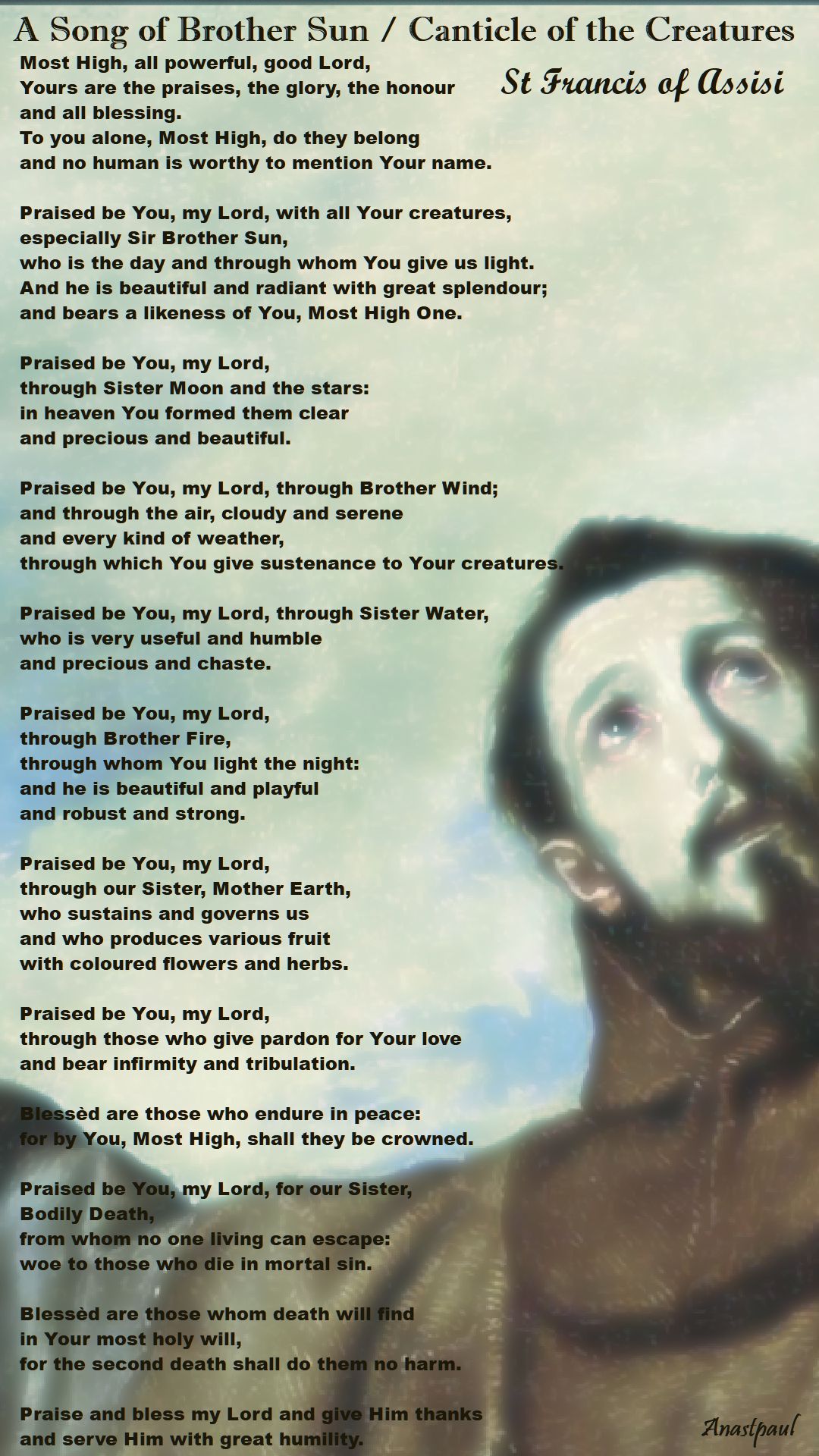
A Song of Brother Sun/Canticle of the Creatures
By St Francis of Assisi

Most High, all powerful, good Lord,
Yours are the praises, the glory, the honour
and all blessing.
To you alone, Most High, do they belong
and no human is worthy to mention Your name.

Praised be You, my Lord, with all Your creatures,
especially Sir Brother Sun,
who is the day and through whom You give us light.
And he is beautiful and radiant with great splendour;
and bears a likeness of You, Most High One.

Praised be You, my Lord,
through Sister Moon and the stars:
in heaven You formed them clear
and precious and beautiful.

Praised be You, my Lord, through Brother Wind;
and through the air, cloudy and serene
and every kind of weather,
through which You give sustenance to Your creatures.

Praised be You, my Lord, through Sister Water,
who is very useful and humble and precious and chaste.

Praised be You, my Lord,
through Brother Fire,
through whom You light the night:
and he is beautiful and playful and robust and strong.

Praised be You, my Lord,
through our Sister, Mother Earth,
who sustains and governs us
and who produces various fruit
with coloured flowers and herbs.

Praised be You, my Lord,
through those who give pardon for Your love
and bear infirmity and tribulation.

Blessèd are those who endure in peace:
for by You, Most High, shall they be crowned.

Praised be You, my Lord, for our Sister,
Bodily Death,
from whom no one living can escape:
woe to those who die in mortal sin.

Blessèd are those whom death will find
in Your most holy will,
for the second death shall do them no harm.

Praise and bless my Lord and give Him thanks
and serve Him with great humility.

a song of brother sun - st francis - 4 oct 2017

Posted in franciscan OFM, MORNING Prayers, QUOTES of the SAINTS, SAINT of the DAY

Quote/s of the Day – 4 October – The Memorial of St Francis of Assisi (1181–1226)

Quote/s of the Day – 4 October – The Memorial of St Francis of Assisi (1181–1226)

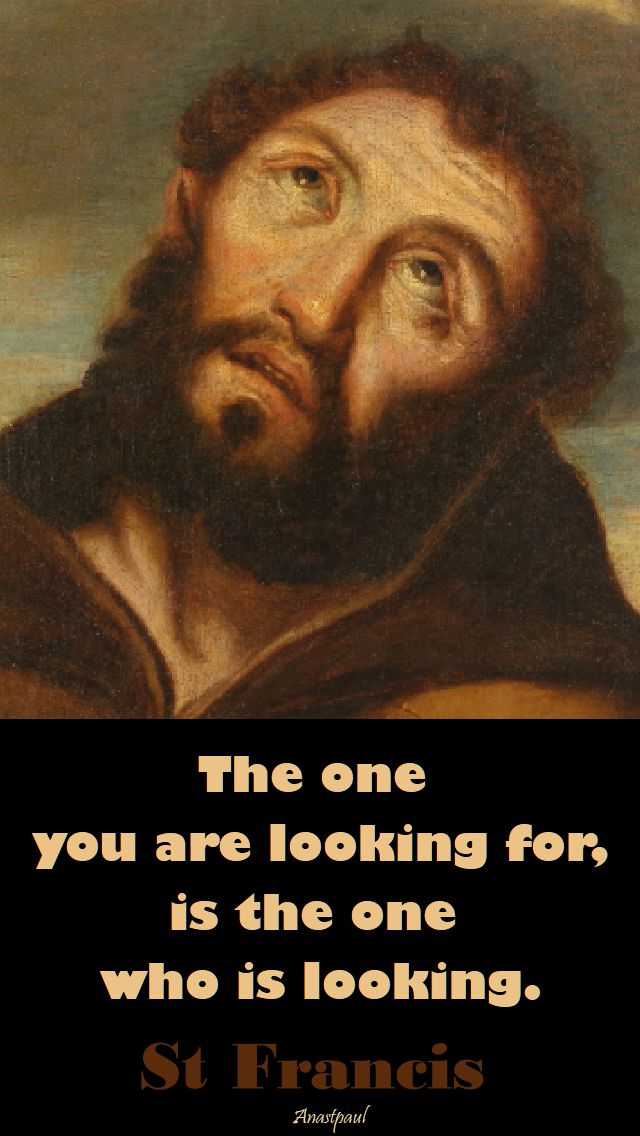
“The one you are looking for,
is the one who is looking.”the one you are looking for - st francis - 4 oct 2017

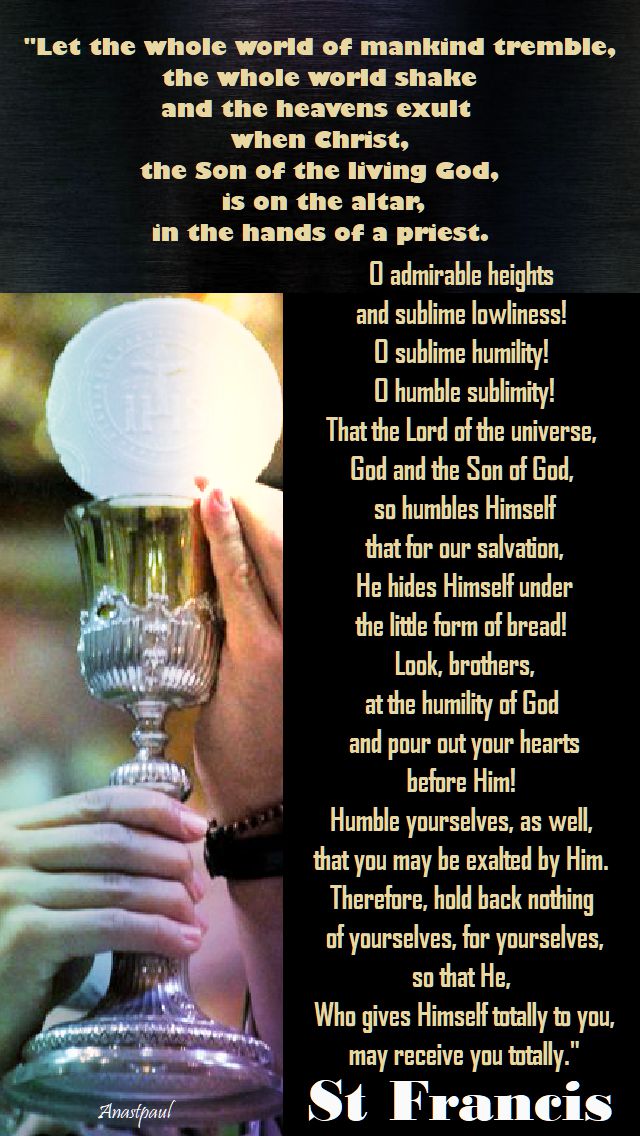
“Let the whole world of mankind tremble,
the whole world shake
and the heavens exult when Christ,
the Son of the living God,
is on the altar in the hands of a priest.
O admirable heights and sublime lowliness!
O sublime humility! O humble sublimity!
That the Lord of the universe, God and the Son of God,
so humbles Himself that for our salvation,
He hides Himself under the little form of bread!
Look, brothers, at the humility of God
and pour out your hearts before Him!
Humble yourselves, as well,
that you may be exalted by Him.
Therefore, hold back nothing
of yourselves, for yourselves,
so that He,
Who gives Himself totally to you,
may receive you totally.”let the whole world tremble - st francis - 4 oct 2017

“Therefore, O sons of men, how long will you be hard of heart?   Why do you not recognize the truth and believe in the Son of God? See, daily He humbles Himself as when He came from the royal throne into the womb of the Virgin;  daily He comes to us in a humble form;  daily He comes down from the bosom of the Father upon the altar in the hands of the priest.   And as He appeared to the holy apostles in true flesh, so now He reveals Himself to us in the sacred bread.   As they saw only his flesh by means of their bodily slight, yet believed Him to be God as they contemplated Him with the eyes of faith, so, as we see bread and wine with [our] bodily eyes, we too are to see and firmly believe them to be His most holy Body and Blood living and true.   And in this way the Lord is always with His faithful, as He Himself says:  Behold I am with you even to the end of the world (cf. Mt. 28:30).”therefore o sons of men - st francis - 2017

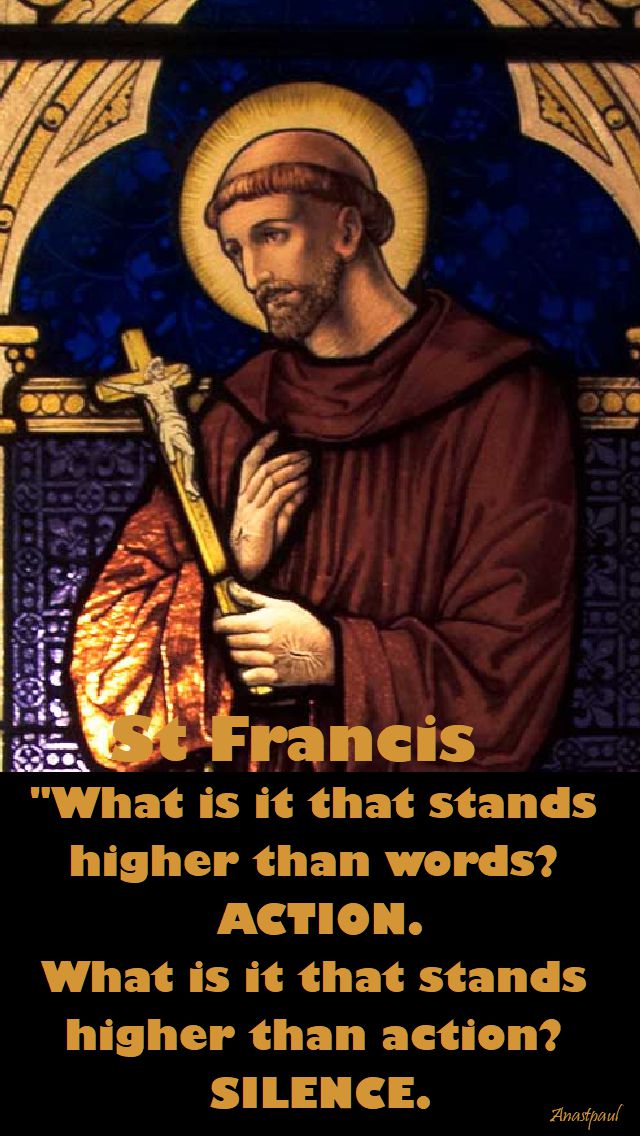
“What is it that stands higher than words?
ACTION.
What is it that stands higher than action?
SILENCE.”what is it that stands higher than words - st francis 4 oct 2017

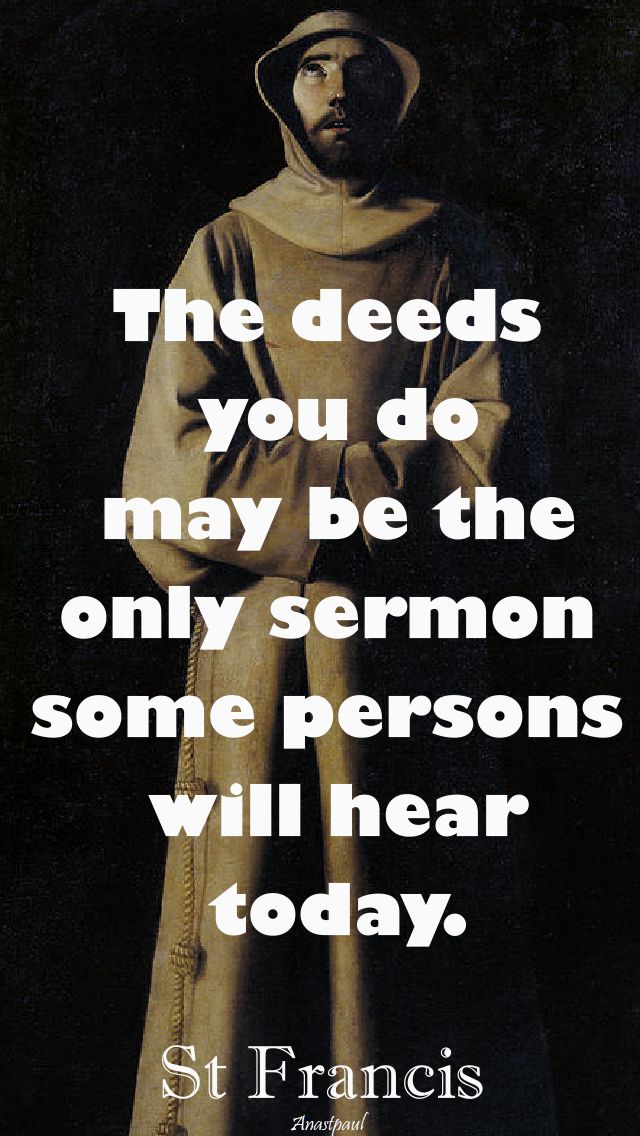
“The deeds you do may be the only sermon
some persons will hear today.”the deeds you do - 4 oct 2017

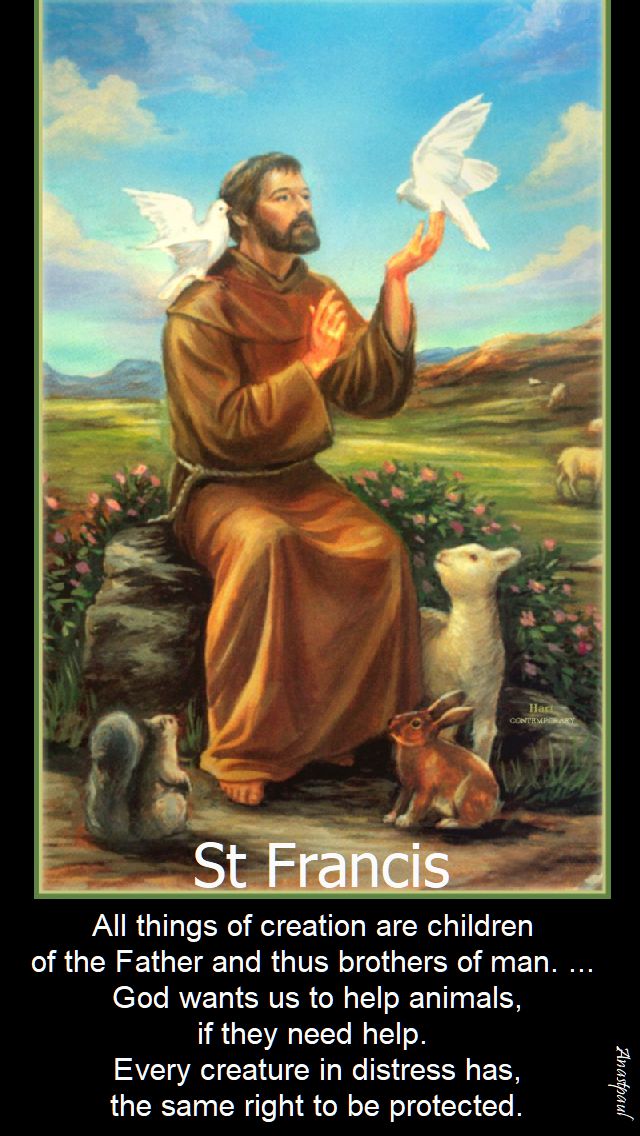
“All things of creation are children of the Father
and thus brothers of man. …
God wants us to help animals, if they need help.
Every creature in distress has,
the same right to be protected.”all things of creation - st francis - 4 oct 2017

St Francis of Assisi (1181–1226)

Posted in franciscan OFM, MORNING Prayers, QUOTES of the SAINTS, SAINT of the DAY, The WORD

One Minute Reflection – 4 October – The Memorial of St Francis of Assisi (1181–1226)

One Minute Reflection – 4 October – The Memorial of St Francis of Assisi (1181–1226)

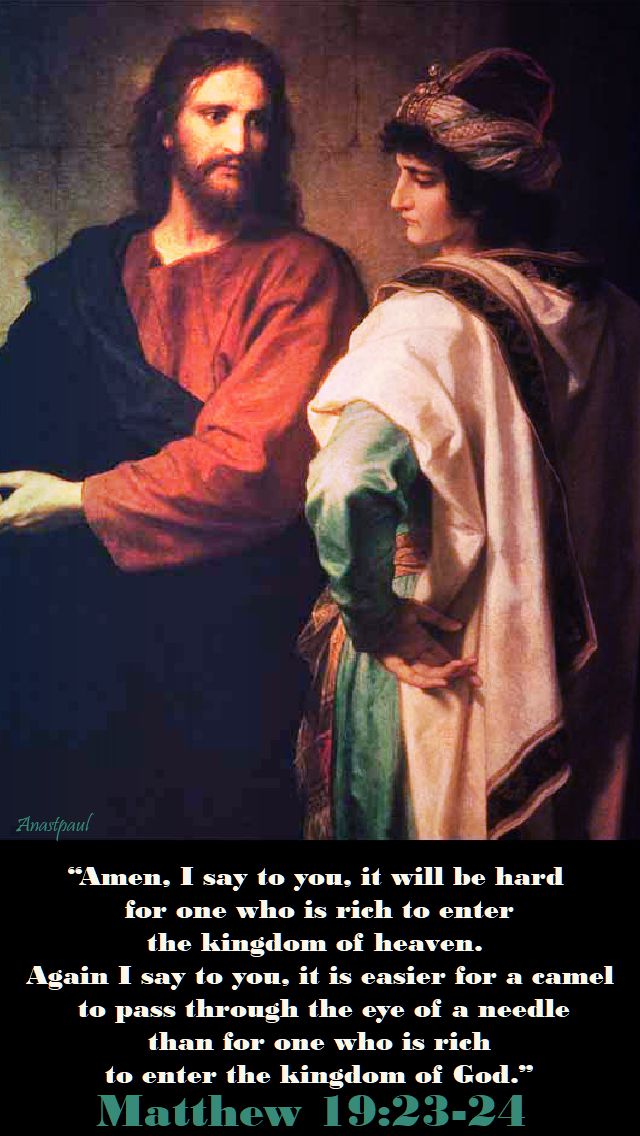
Then Jesus said to his disciples, “Amen, I say to you, it will be hard for one who is rich to enter the kingdom of heaven.
Again I say to you, it is easier for a camel to pass through the eye of a needle than for one who is rich to enter the kingdom of God.”….Matthew 19:23-24matthew 19 23-24

REFLECTION – “Remember that when you leave this earth, you can take with you nothing that you have received—only what you have given: a full heart, enriched by honest service, love, sacrifice and courage.”….St Francis of Assisiremember that when you leave - st francis - 4 oct 2017

PRAYER – Lord God, You made St Francis of Assisi, Christ-like in his poverty and humility, his gentleness and charity, his love and courage. Help us to walk in his ways that, with joy and love, we may follow Christ Your Son and be united with You. St Francis, pray for us, amen.st francis pray - 4 oct 2017

Posted in franciscan OFM, MORNING Prayers, PRAYERS of the SAINTS, SAINT of the DAY, The HOLY CROSS

Our Morning Offering – 4 October – The Memorial of St Francis of Assisi (1181–1226)

Our Morning Offering – 4 October – The Memorial of St Francis of Assisi (1181–1226)

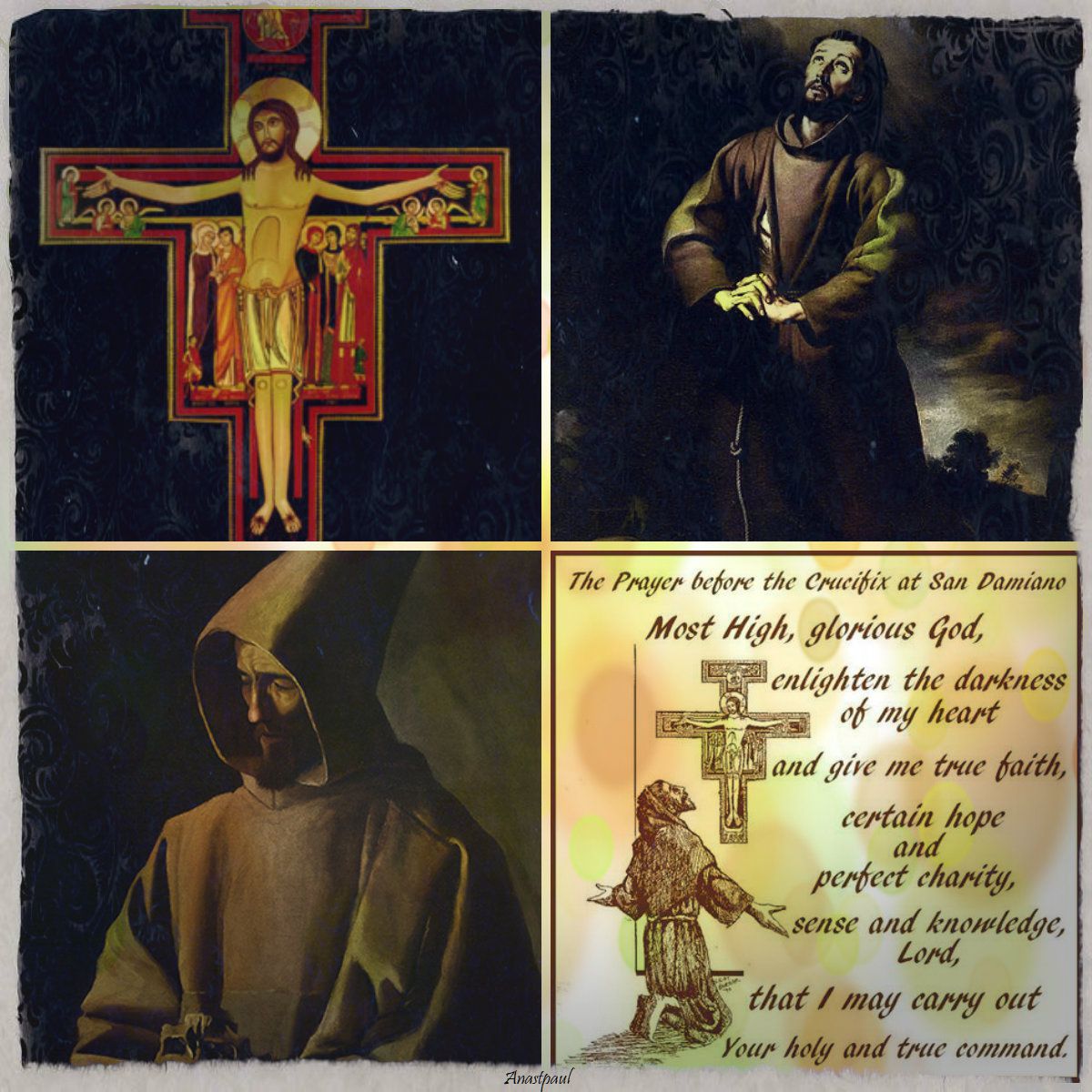
The Prayer before the San Damiano Crucifix
St Francis of Assisi

Most High, glorious God,
enlighten the darkness of my heart
and give me
true faith,
certain hope,
and perfect charity,
sense and knowledge,
Lord, that I may carry out,
Your holy and true command.  AmenPRAYER BEFORE THE CRUCIFIX SAN DAMIANO.2

Posted in DYING / LAST WORDS, franciscan OFM, Of and For PEACE, Of ANIMALS / ANIMAL WELFARE, Of PARENTS & FAMILIES of LARGE Families, SAINT of the DAY

Saint of the Day – 4 October – St Francis of Assisi OFM (1181–1226)

Saint of the Day – 4 October – St Francis of Assisi OFM Confessor, Religious, Deacon, Stigmatist and ounder, Apostle of the Holy Eucharist, the Blessed Virgin and of Charity, Preacher, Missionary, Mystic, Miracle-Worker, Co-patron of Italy, Founder of the Seraphic Order – the men’s Order of Friars Minor, the women’s Order of Saint Clare, the Third Order of Saint Francis and the Custody of the Holy Land, as well as being the Founder of the Nativity Crib and Manger as we know it today.

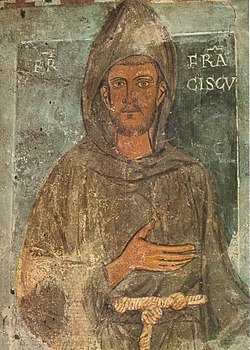
250px-S.Francesco_speco
The oldest surviving depiction of Saint Francis is a fresco near the entrance of the Benedictine abbey of Subiaco, painted between March 1228 and March 1229.   He is depicted without the stigmata but the image is a religious image and not a portrait.

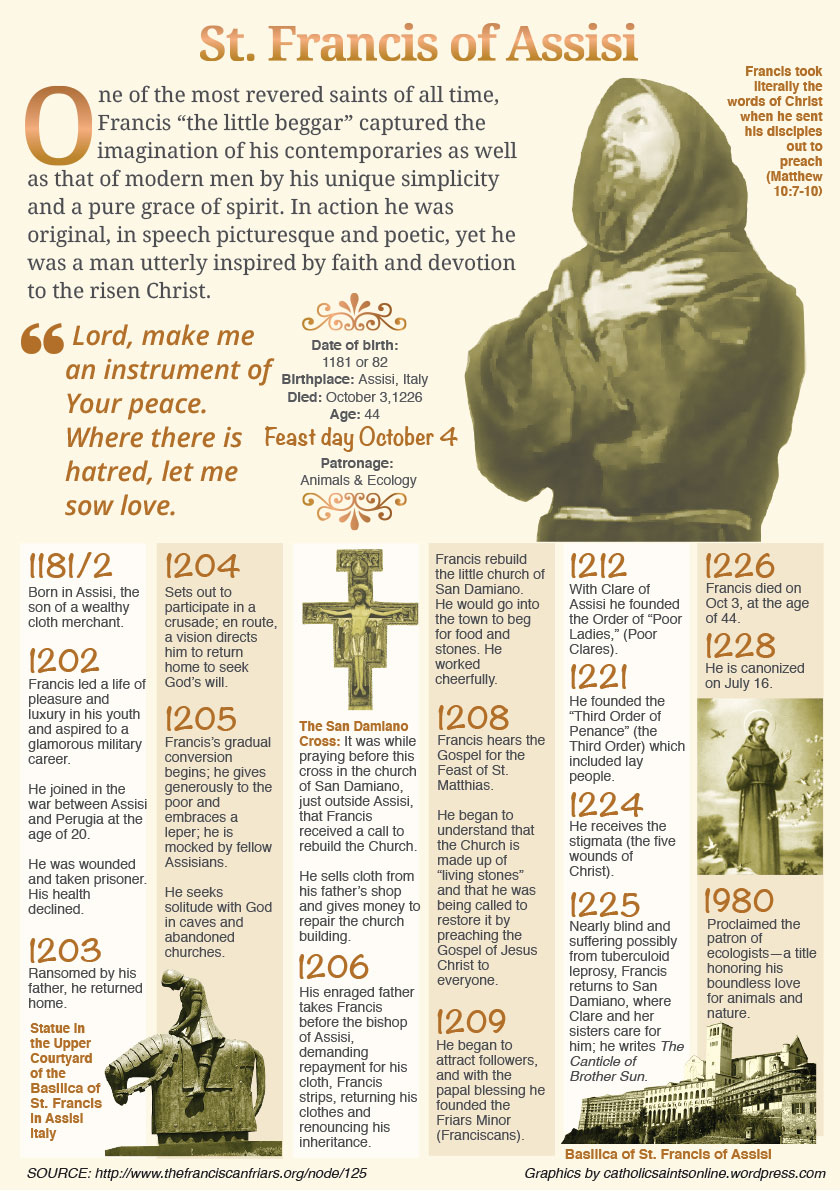
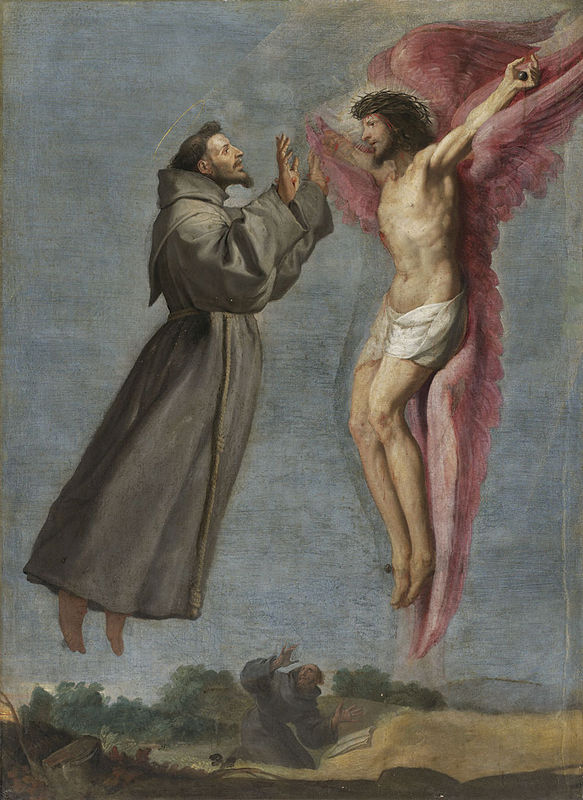
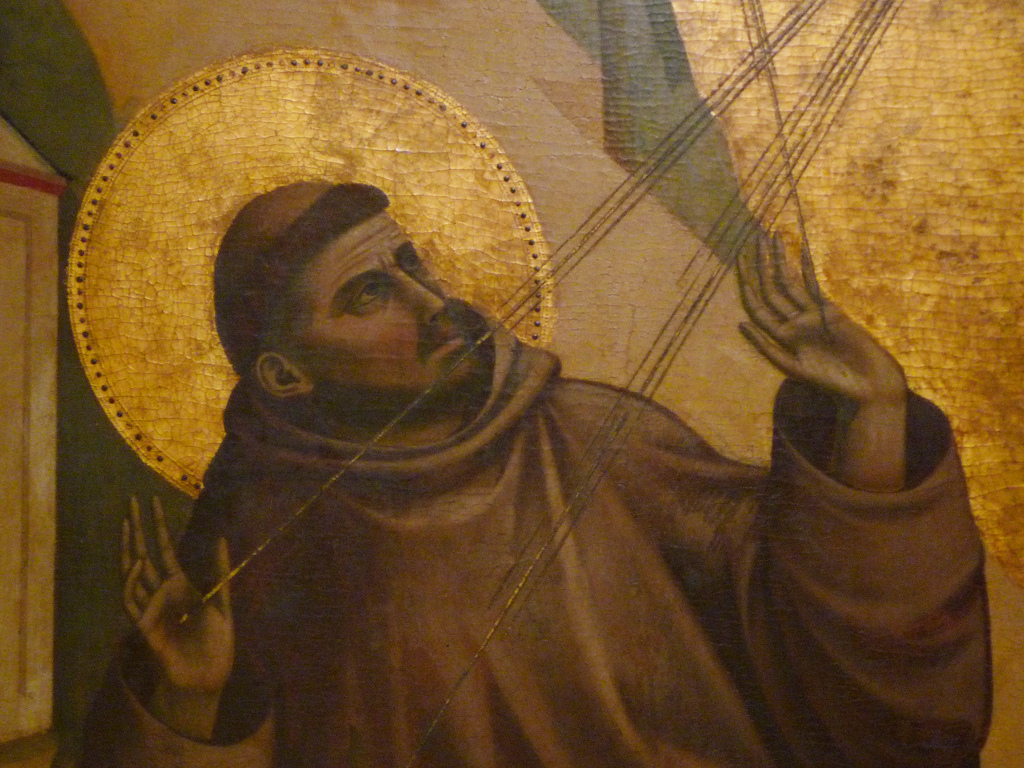
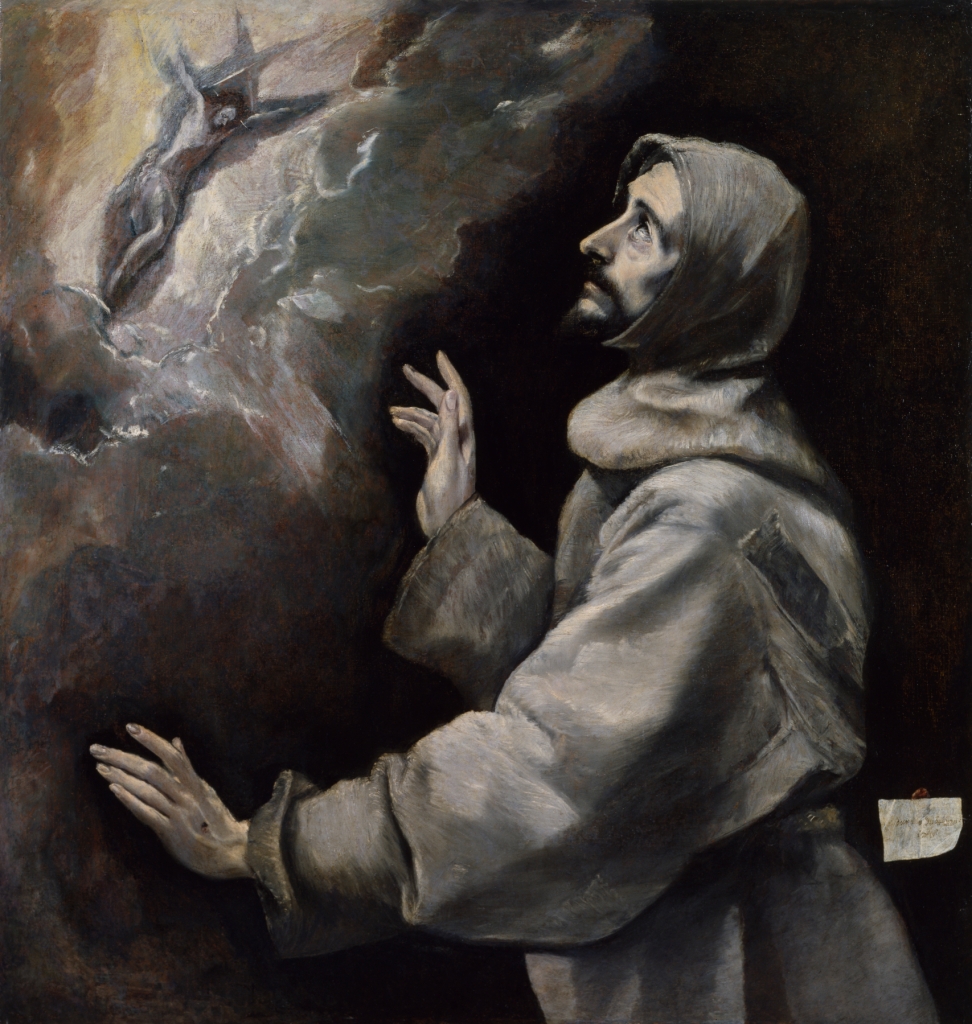
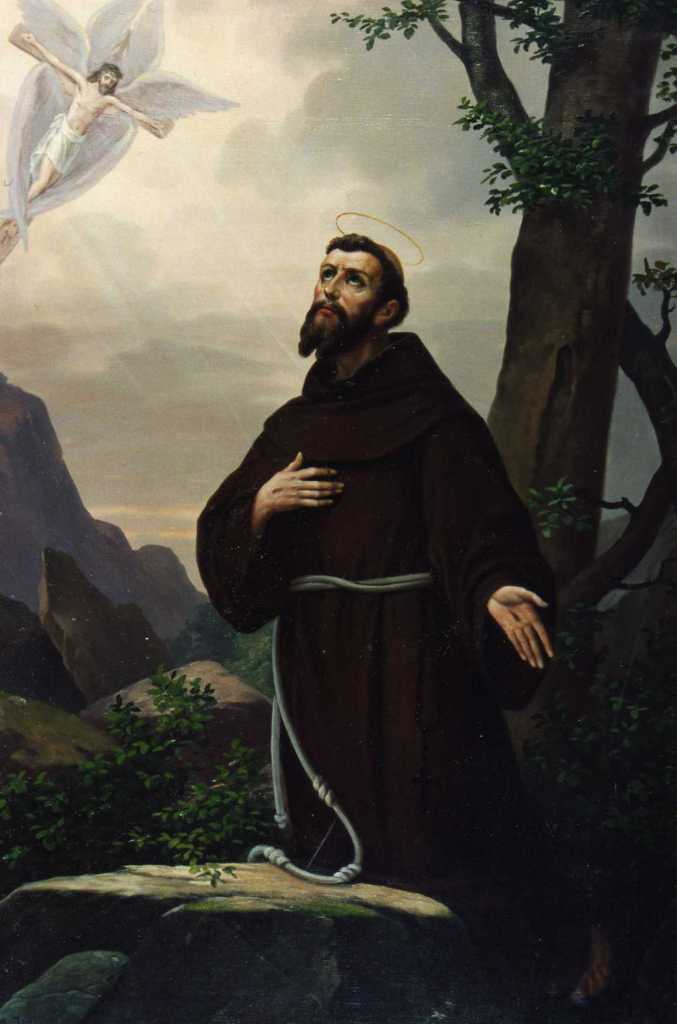
Born Giovanni di Pietro di Bernardone ( informally called Francesco by his Mother) – (1181 at Assisi, Umbria, Italy – 4 October 1226 at Portiuncula, Italy of natural causes).  His relics are enshrined in the Basilica built and named for him in Assisi, Italy.  St Francis was Canonised on 16 July 1228 by Pope Gregory IX.   Patronages – • against dying alone• against fire• animal welfare societies• animals• birds• ecologists, ecology• environment, environmentalism, environmentalists• families• lace makers, lace workers• merchants• needle workers• peace• tapestry workers• zoos• Italy• Colorado• Catholic Action• Franciscan Order• 10 dioceses• 10 cities.   Attributes – • apparition of Jesus• Christ child• birds• deer• fish• lamb• skull• stigmata• wolf.  In 1224 he received the stigmata during the apparition of Seraphic angels in a religious ecstasy making him the first recorded person in Christian history to bear the wounds of Christ’s Passion. He died during the evening hours of 3 October 1226, while listening to a reading he had requested of Psalm 142 (141).   Francis is one of the most venerated religious figures in history. 

A - ST Francis header
B. st francis and the crib info

Francis was born in Assisi in 1182, the son of a wealthy cloth merchant, Pietro Bernardone, and his wife, Pica.   He was baptised Giovanni (John) but soon gained the nickname Francesco because of his father’s close trading links with France.

Francis’ early years were not especially religious.   He was a leader among the young men of Assisi, enjoying a good social life, singing and partying.   His first biographer, Thomas of Celano, describes him as quite short, with black eyes, hair and beard;  he had a long face, with a straight nose and small, upright ears.   His arms were short but his hands and fingers slender and long.   He had a strong, clear, sweet voice.   Francis didn’t want to follow his father into the cloth trade;   he wanted to be a knight.   So at the age of twenty he joined the forces of Assisi in a minor skirmish with the neighbouring city of Perugia.   He was captured and spent a year in a Perugian jail, until his father ransomed him.   This became the first of a series of experiences through which God called Francis to the life which he finally embraced.

One of these experiences, at San Damiano, led to a rift with his father.   Francis, in response to a voice from the crucifix in this tiny ruined Church, began to rebuild churches;   when he ran out of money he took cloth from his father’s shop and sold it.   His father disowned him before the bishop of Assisi and Francis in his turn stripped off his clothes, returning to his father everything he had received from him and promising that in future he would call only God his Father.

And thus, Francis of Assisi, this poor little man began a journey to astound and inspire the Church by taking the gospel literally—not in a narrow fundamentalist sense but by actually following all that Jesus said and did, joyfully, without limit and without a mite of self-importance.Flemish School; St Francis of Assisi

Serious illness brought the young Francis to see the emptiness of his frolicking life as leader of Assisi’s youth.   Prayer—lengthy and difficult—led him to a self-emptying like that of Christ, climaxed by embracing a leper he met on the road.   It symbolised his complete obedience to what he had heard in prayer:  “Francis! Everything you have loved and desired in the flesh it is your duty to despise and hate, if you wish to know my will.   And when you have begun this, all that now seems sweet and lovely to you will become intolerable and bitter but all that you used to avoid will turn itself to great sweetness and exceeding joy.”

From the Cross in the neglected Chapel of San Damiano, Christ told him, “Francis, go out and build up my house, for it is nearly falling down.” Francis became the totally poor and humble workman.

ea8079bd13b0302d84e404c85418a950--saint-francis-pope-francis

He must have suspected a deeper meaning to “build up my house.” But he would have been content to be for the rest of his life the poor “nothing” man actually putting brick on brick in abandoned chapels.   He gave up every material thing he had, piling even his clothes before his earthly father (who was demanding restitution for Francis’ “gifts” to the poor) so that he would be totally free to say, “Our Father in heaven.”

He was, for a time, considered to be a religious “nut,” begging from door to door when he could not get money for his work, bringing sadness or disgust to the hearts of his former friends, ridicule from the unthinking.beeautiful francis 2.

But genuineness will tell.   A few people began to realise that this man was actually trying to be Christian.   He really believed what Jesus said:  “Announce the kingdom! Possess no gold or silver or copper in your purses, no traveling bag, no sandals, no staff” (see Lk 9:1-3).

Francis’ first rule for his followers was a collection of texts from the Gospels.   He had no idea of founding an order but once it began he protected it and accepted all the legal structures needed to support it.   His devotion and loyalty to the Church were absolute and highly exemplary at a time when various movements of reform tended to break the Church’s unity.

He was torn between a life devoted entirely to prayer and a life of active preaching of the Good News.   He decerned in favour of the latter but always returned to solitude when he could.   He wanted to be a missionary in Syria or in Africa but was prevented by shipwreck and illness in both cases.   He did try to convert the sultan of Egypt during the Fifth Crusade.beautiful francis 2.vision-of-st-francis-of-assisi-jusepe-de-ribera-detail-featured-w740x493

During the last years of his relatively short life (he died at 44) he was half blind and seriously ill.   Two years before his death, he received the stigmata, the real and painful wounds of Christ in his hands, feet and side.

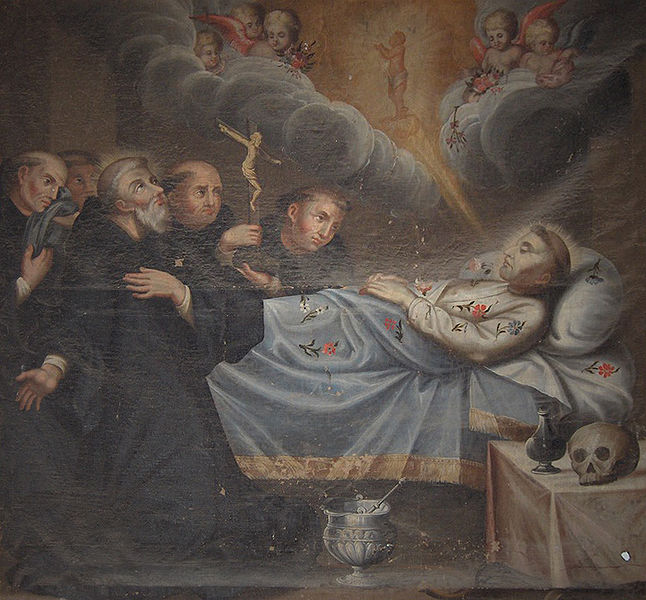
On his deathbed, he said over and over again the last addition to his Canticle of the Sun, “Be praised, O Lord, for our Sister Death.”   He sang Psalm 141 and at the end asked his superior to have his clothes removed when the last hour came and for permission to expire lying naked on the earth, in imitation of his Lord.Death-of-St-Francis-of-Assisi-Evora-Portugal-Igreja-de-Sao-Francisco

On 13 March 2013, upon his election as Pope, Archbishop and Cardinal Jorge Mario Bergoglio of Argentina chose Francis as his papal name in honour of Saint Francis of Assisi, becoming Pope Francis I.
At his first audience on 16 March 2013, Pope Francis told journalists that he had chosen the name in honour of Saint Francis of Assisi and had done so because he was especially concerned for the well-being of the poor.   He explained that, as it was becoming clear during the conclave voting that he would be elected the new bishop of Rome, the Brazilian Cardinal Cláudio Hummes had embraced him and whispered, “Don’t forget the poor”, which had made Bergoglio think of the saint.   Bergoglio had previously expressed his admiration for St Francis, explaining that “He brought to Christianity an idea of poverty against the luxury, pride, vanity of the civil and ecclesiastical powers of the time.   He changed history.”   Bergoglio’s selection of his papal name is the first time that a pope has been named Francis.

Posted in franciscan OFM, MORNING Prayers, PRAYERS of the SAINTS

Our Morning Offering – 24 September

Our Morning Offering – 24 September

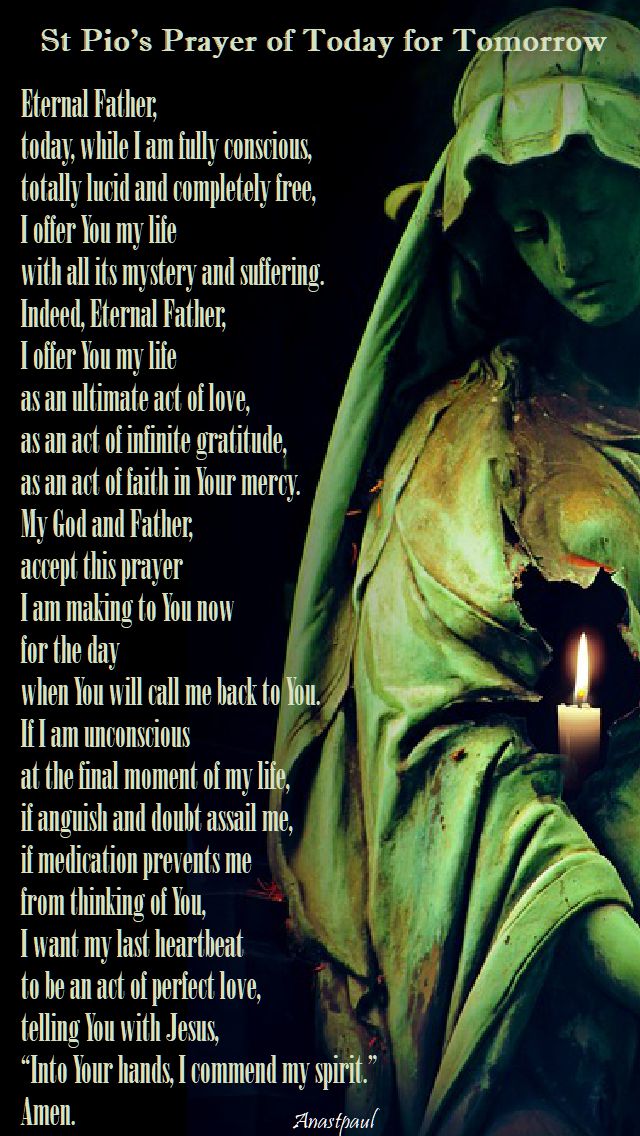
St Pio’s Prayer of Today for Tomorrow

Eternal Father,
today, while I am fully conscious,
totally lucid and completely free,
I offer You my life with all its mystery and suffering.
Indeed, Eternal Father,
I offer You my life as an ultimate act of love,
as an act of infinite gratitude,
as an act of faith in Your mercy.
My God and Father,
accept this prayer I am making to You now
for the day when You will call me back to You.
If I am unconscious at the final moment of my life,
if anguish and doubt assail me,
if medication prevents me from thinking of You,
I want my last heartbeat to be an act of perfect love,
telling You with Jesus,
“Into Your hands, I commend my spirit.”
Amen.

eternal father - st pios prayer of today for tomorrow-24 SEPT 2017

Posted in EUCHARISTIC Adoration, franciscan OFM, MORNING Prayers, QUOTES of the SAINTS, QUOTES on SUFFERING, SAINT of the DAY, The BLESSED VIRGIN MARY, The HOLY EUCHARIST / The HOLY MASS, The HOLY ROSARY/ROSARY CRUSADE, Uncategorized

Quote/s of the Day – The Memorial of St Padre Pio (1887-1968)

Quote/s of the Day – The Memorial of St Padre Pio (1887-1968)

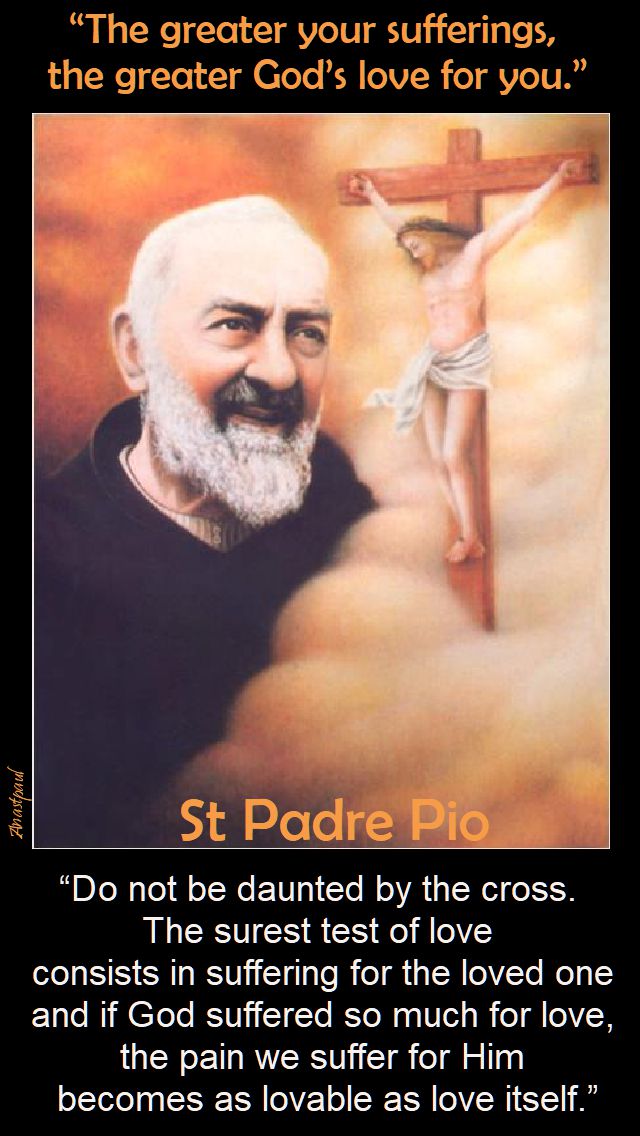
“Do not be daunted by the cross.
The surest test of love consists in suffering for the loved one
and if God suffered so much for love,
the pain we suffer for Him becomes as lovable as love itself.”

“The greater your sufferings, the greater God’s love for you.”the greater your sufferings - st pio - 23 sept 2017

“Do not fear!   Jesus is more powerful than all hell.”do not fear

“In all the free time you have,
once you have finished your duties of state,
you should kneel down and pray the Rosary.
Pray the Rosary before the Blessed Sacrament
or before a crucifix.”in all the free time - st pio no 2 - 23 sept 2017

“Do you not see the Madonna always beside the tabernacle?”do you not see - st pio - 23 sept 2017

“When you gossip about a person it means
that you have removed the person from your heart.
But be aware, when you remove a man from your heart,
Jesus also goes away from your heart with that man.”

St Padre Pio (1887-1968)when you gossip - st pio 23 sept 2017

Posted in franciscan OFM, MORNING Prayers, QUOTES of the SAINTS, SAINT of the DAY, The WORD

One Minute Reflection – 23 September – – The Memorial of St Padre Pio (1887-1968)

One Minute Reflection – 23 September – – The Memorial of St Padre Pio (1887-1968)

You need endurance to do the will of God and receive what he has promised….Hebrews 10:36

REFLECTION – “The life of a Christian is nothing but a perpetual struggle against self:
there is no flowering of the soul to the beauty of its perfection, except at the price of pain.”………St Pio of Pietrelcina (1887-1968)the life of a christian - st pio - 23 sept 2017

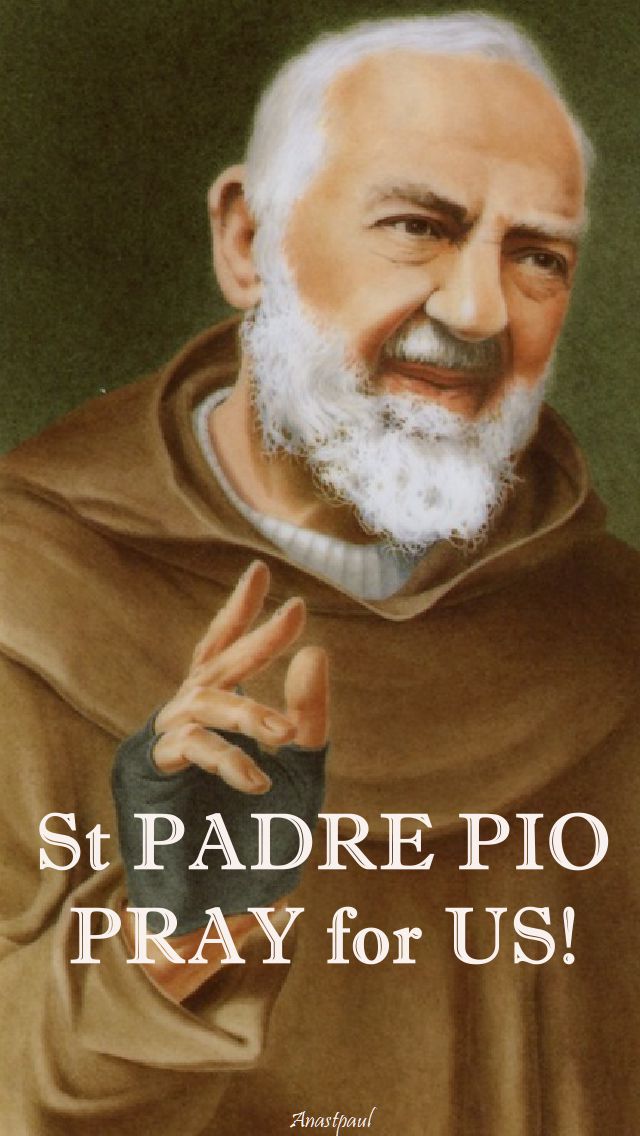
PRAYER – “And you, Blessed Padre Pio, look down from heaven upon us assembled in this square and upon all gathered in prayer before the Basilica of Saint John Lateran and in San Giovanni Rotondo. Intercede for all those who, in every part of the world, are spiritually united with this event and raise their prayers to you. Come to the help of everyone; give peace and consolation to every heart. Amen!” – from the homily of Pope John Paul II at the beatification of Padre PioST PADRE PIO - PRAY FOR US 23 sept 2017

Posted in franciscan OFM, MORNING Prayers, PRAYERS of the SAINTS, SAINT of the DAY, The HOLY EUCHARIST / The HOLY MASS

Our Morning Offering – 23 September – The Memorial of St Padre Pio (1887-1968)

Our Morning Offering – 23 September – The Memorial of St Padre Pio (1887-1968)

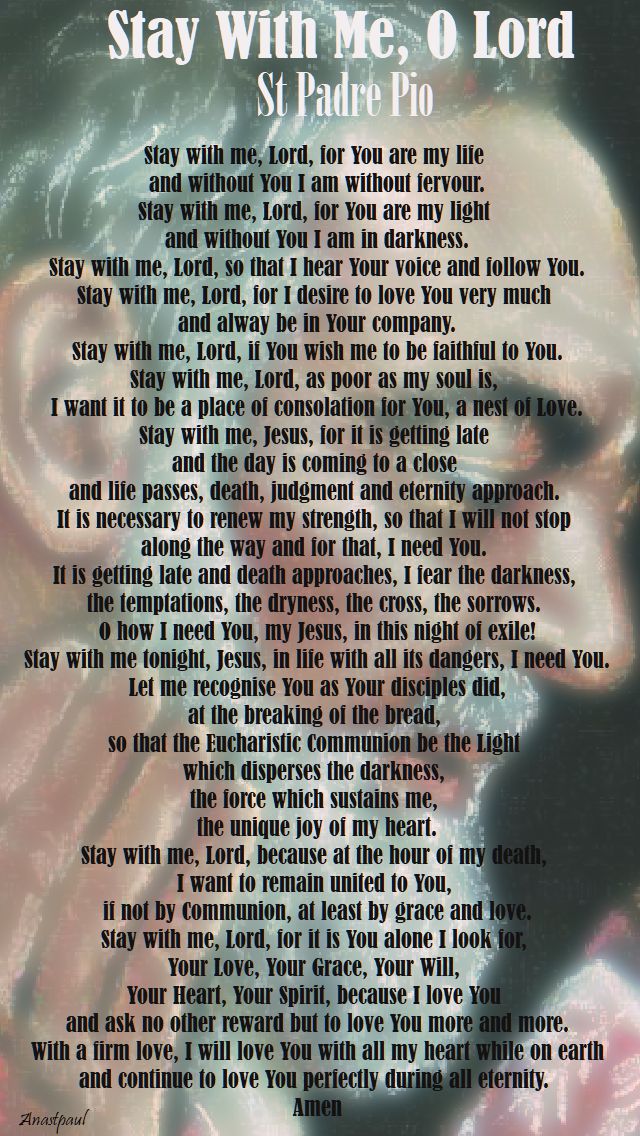
Stay With Me, O Lord
St Padre Pio

Stay with me, Lord, for You are my life
and without You I am without fervour.
Stay with me, Lord, for You are my light
and without You I am in darkness.
Stay with me, Lord, so that I hear Your voice and follow You.
Stay with me, Lord, for I desire to love You very much
and alway be in Your company.
Stay with me, Lord, if You wish me to be faithful to You.
Stay with me, Lord, as poor as my soul is,
I want it to be a place of consolation for You, a nest of Love.
Stay with me, Jesus, for it is getting late
and the day is coming to a close
and life passes, death, judgment and eternity approach.
It is necessary to renew my strength, so that I will not stop
along the way and for that, I need You.
It is getting late and death approaches, I fear the darkness,
the temptations, the dryness, the cross, the sorrows.
O how I need You, my Jesus, in this night of exile!
Stay with me tonight, Jesus, in life with all its dangers, I need You.
Let me recognise You as Your disciples did,
at the breaking of the bread,
so that the Eucharistic Communion be the Light
which disperses the darkness,
the force which sustains me,
the unique joy of my heart.
Stay with me, Lord, because at the hour of my death,
I want to remain united to You,
if not by Communion, at least by grace and love.
Stay with me, Lord, for it is You alone I look for,
Your Love, Your Grace, Your Will,
Your Heart, Your Spirit, because I love You
and ask no other reward but to love You more and more.
With a firm love, I will love You with all my heart while on earth
and continue to love You perfectly during all eternity.
Amenstay with me o lord - st pio - 23 sept 2017

Posted in franciscan OFM, INCORRUPTIBLES, SAINT of the DAY

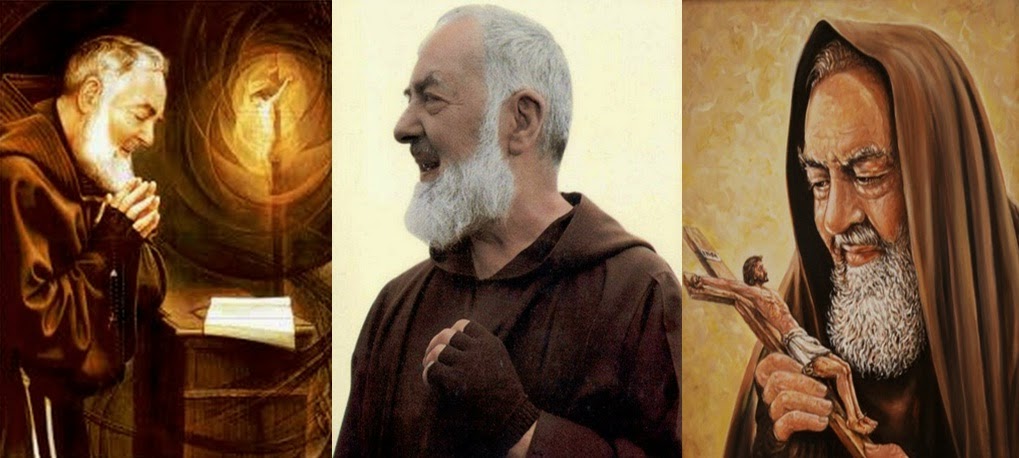
Saint of the Day – 23 September – St Pio of Pietrelcina O.F.M.Cap.

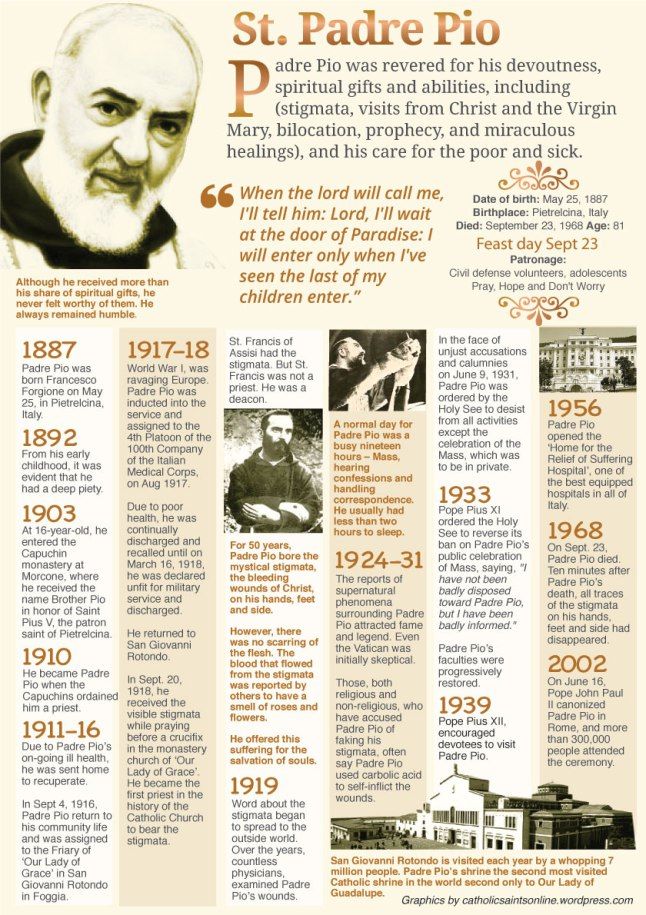
Saint of the Day – 23 September – St Pio of Pietrelcina O.F.M.Cap. – Priest,Franciscan Capuchin Friar, Stigmatist, Mystic, Confessor.  Born Francesco Forgione, he was given the name of Pius (Italian: Pio) when he joined the Order of Friars Minor Capuchin.  (25 May 1887 at Pietrelcina, Benevento, Italy – 23 September 1968 in San Giovanni Rotondo, Foggia, Italy of natural causes).  Beatified 2 May 1999 and Canonised on 16 June 2002 by Pope John Paul II at Rome, Italy.   Patronages – Civil defense volunteers, Adolescents, Pietrelcina, Stress relief, Italy and Malta.   Attributes  – Stigmata, Capuchin habit.   His Incorrupt Relics lie at home in San Giovanni Rotondo.

HEADER ST PIO 2st pio header 1st pio info

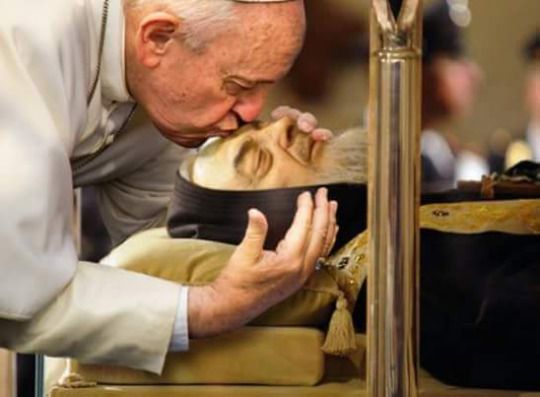
pope francis and st pio

Francesco was born to Mamma Peppa and Grazio Forgione in the little town called Pietrelcina, in Southern Italy, during the month of flowers, 25 May 1887.   He was fifth of eight children.   His Mamma Peppa confided he was different from other boys:  “he was never impolite or misbehaved”.   He had celestial visions and diabolical oppressions from the age of five years and he saw and spoke with Jesus and Our Lady and with his Guardian Angel but unfortunately this heavenly life was interwoven with hell and with the devil.

In 1903, discipline and ill health had been woven together to crown the youth of Pio. Doctors diagnosed him as consumptive and were sure he would die.   Strong in spirit Pio received the Capuchin Franciscan garb initialling religious life and therefore;  Novitiate twith its intense study, prayer, austerity, penance and finally vows of Poverty, Chastity and Obedience.

In 1909, St Pio is back at home at Pietrelcina because of his illness, at his mother’s side.   Now another intense chapter of extraordinary life opens with mystical afflictions an invisible stigmata and terrible battles with devils that wanted to destroy him began.   Yet, “It all happened here”, he said, his whole future was prepared here.   On August 10, 1910, he was ordained a Priest in the Cathedral of Benevento.st pio young

In 1916 in the church of San Giovanni Rotondo, soon to become his Jerusalem, with the mystical and historical calvary of Gargano, where he was soon recognised as the “saintly friar” by the locals.   Here he became a “victim of love”, by the reparation for sin, of the many crowds who flocked to him, to venerate his bleeding wounds of his hands and feet. This very important event occurred in Father Pio’s life on 20 September 1918, while he was praying in front of a Crucifix located in the choir in the little old church, when a strange personage like an angel, gave him the stigmata.   Those stigmata have been remained opened and bleeding for fifty years.   This was one of the reasons for which doctors, scientists, journalists and common people have gone to San Giovanni Rotondo for years, in order to meet the “Saintly friar “.

In a letter dated 22 October 1918, Padre Pio told his experience of crucifixion:  “… What I can tell you about my crucifixion?   My God!   What a confusion and what humiliation I feel when I try to show somebody else what you have done in me your unworthy creature!   It was the morning of the 20th. (September) and I was in choir, after the celebration of the Holy Mass, when a rest, similar to a sweet sleep surprised me.   All the inside and external senses, as well as the same faculties of the soul were in an indescribable quiet.   There was a deep silence around me and inside me;  a peace overcame me and then it all happened in a flash I felt abandonment with the complete loss of all senses.   While all this was taking place, I saw before me a mysterious appearance, similar to the one I had seen on 5 August, differing only because His hands, feet and side were dripping blood.   The sight of Him frightened me:  what I felt at that moment is indescribable.   I thought I would die and would have died if the Lord hadn’t intervened and strengthened my heart, which was about to burst out of my chest!  The appearance disappeared and I became aware that my hands, feet and side were pierced and were dripping with blood.   You can imagine the torment that I experienced then and that I am almost experiencing every day.   The wound of the heart bleeds profusely, particularly from the evening of Thursday until Saturday.   My God, I die of pain, torment and confusion that I feel in the intimate depths of the soul.   I am afraid I’ll bleed to death!   I hope that God listens to my moans and withdraws this humiliation from me… “

He usually woke up in the early morning (we could say at night) in order to get himself ready for the Holy Mass.   In fact, every morning, at 4 a.m. there were always hundreds and sometimes even a thousand people waiting for the door of the church to open.   After the Mass he used to spend most time of his day in prayer and confessions.   After fifty years of stigmata he died 23 September 1968, thus he closed his mission of the Heart’s desire, with the real cross and the real crucifixion of his body.

From every part of the world, the believers went to this stigmatised priest, to get his powerful intercession from God.   Fifty years lived in the prayer, in the humility, in the suffering and in the sacrifice, he lived his love, the Cross of Christ.   Padre Pio had two initiatives in two directions:   the vertical one toward God, with the constitution of the “Groups of prayer”, the horizontal one toward his suffering community, with the construction of a modern hospital: “House for the Relief of the Suffering.”

In September 1968, thousands of devotees and Padre Pio’s spiritual children were assembled in conference at St Giovanni Rotondo to commemorate together the 50 anniversary of the stigmata and to celebrate the fourth international conference of the Prayer Groups.   Nobody would have imagined that at 2:30 a.m., 23 September, 1968 we the earthly life of Father Pio of Pietrelcina would end.

Focusing too much on Padre Pio’s marvels and mystical phenomena gives the false impression that he led an abnormal life, more angelic than human.   While he opened our eyes to heavenly realities, he kept his feet firmly planted on the earth, enduring and enjoying ordinary things, as other human beings did.   Today we mainly imagine him as a wonder-working stigmatic with miracles flowing from his wounded hands.   But the people who knew him, while they appreciated his marvels, loved him more for his earthiness, his compassion, his gentleness, his humour and his common sense.   For instance, when he was asked his opinion of a thief who had stolen valuable gems from a church’s painting of the Virgin, he responded, “What do you want me to say? That poor young man was probably hungry and went to Our Lady to say: ‘Of what use are these jewels to you?’   And probably Our Lady gave them to him.   Silly him to get caught with the goods in his pocket.”

Padre Pio embraced his own great suffering as his personal share in the suffering of Christ.   But he could not endure the suffering of others.   Hundreds came to Our Lady of Grace hoping for a healing and he knew that only some of them would receive a miraculous cure.   His compassion for the many who would not be healed led him to work for the establishment of a world-class hospital at San Giovanni Rotondo that would serve the poor.   From the outset he planned to name it “House for the Relief of Suffering.”

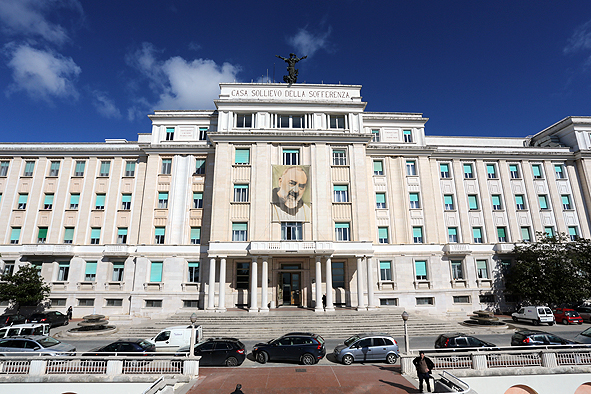
Padre Pio worked against all odds to achieve his goal of creating a medical center.  He faced obstacles that would have deflated the enthusiasm of lesser men.   How does a monk vowed to poverty build a hospital without any money in an impoverished town situated on an inaccessible mountain?   Padre Pio did it by faith and with a small army of friends.   His associates helped him raise money, design and construct the buildings and assemble a top-shelf medical staff.   When the House for the Relief of Suffering opened in 1956, many observers believed it could not survive because of its location on a desolate mountain.   However, Padre Pio believed otherwise.   When he inaugurated the first building, he said, “Now House for the Relief of Suffering is a small seed,but it will become a mighty oak, a hospital that is a small city and a center for clinical studies of international importance.”   That prophecy has come true. Today the hospital is a thriving centre whose expanding complex resembles a little city.

Casa-Sollievo-della-Sofferenza-seleziona-laureati-medicina-chirurgia

Padre Pio’s practical compassion and entrepreneurial genius defy those who might be tempted to dismiss him as a medieval weirdo.  Instead he stands for all as a modern icon of God’s inexhaustible love for human beings and his determination to rescue us at all costs.

Posted in franciscan OFM, MORNING Prayers, NOVENAS

NOVENA to St Padre Pio/St Pius of Pietrelcina – DAY NINE – 22 September

NOVENA to St Padre Pio/St Pius of Pietrelcina – DAY NINE – 22 September

St Padre Pio you have said:

How fortunate we are to be slaves of this great God who submitted Himself to death for us.

Let us Pray:

Gracious God,
You generously blessed Your servant, Padre Pio, with the gifts of the Spirit.
You marked his body with the five wounds of Christ Crucified,
as a powerful witness to the saving Passion and Death of Your Son
and as a stirring inspiration to many people,
of Your infinite mercy, forgiveness and love.
In the confessional, Padre Pio laboured endlessly for the salvation of souls.
Through his powerful intercession,
many who suffered were healed of sickness and disease.
Endowed with the gift of discernment, he could read people’s hearts.
With dignity and intense devotion, he celebrated daily Mass,
inviting countless men and women to a greater union with Jesus Christ,
in the Sacrament of the Holy Eucharist.
His life was a celebration of love for You
and an oblation of himself in gratitude to You.
We pray that You will bless us too
with total love and thanksgiving.
Through the intercession of Saint Pio,
we confidently beseech You to to grant us the grace of
………………… (state your petition here).
Help us to imitate his example of prayerful holiness and compassion,
so that we, too, may faithfully follow the Risen Lord
and one day rejoice in the Kingdom,
where You live and reign forever and ever. Amenday nine - novena padre pio - 22 sept

Posted in franciscan OFM, MORNING Prayers, SAINT of the DAY, The WORD

One Minute Reflection – 18 September – The Memorial of St Joseph of Cuperti

One Minute Reflection – 18 September – The Memorial of St Joseph of Cupertino

Each one has his own gift from God…..1 Corinthians 7:7

REFLECTION – “Clearly, what God wants above all, is our will,which we received as a free gift from God in creation and possess as though our own.   When a man trains himself to acts of virtue, it is with the help of grace from God, from whom all good things come that he does this.   The will is what man has as his unique possession.” – Saint Joseph of Cupertino, from the reading for his feast in the Franciscan breviary

clearly what god wants above all - st joseph of cupertino 18 sept 2017

PRAYER – Heavenly Father, help me to be holy in the way that You have laid out for me. Let me carry out my duties of my state of life to the full and grant me the grace to carry my crosses in honour of You.   Only in You may I attain holiness, learning to give myself, my will, my heart and my soul only to You.   St Joseph of Cupertino, you who were so disadvantaged, achieved by the grace of God, sanctity in this life and now behold His Face through all eternity. We ask for your intercession, amen.st joseph of cupertino pray for us

Posted in franciscan OFM, SAINT of the DAY

Memorials of the Saints and the Feast of the Stigmata of St Francis of Assisi

St Robert Bellarmine SJ (1542-1621) Doctor of the Church (Optional Memorial) -https://www.youtube.com/watch?
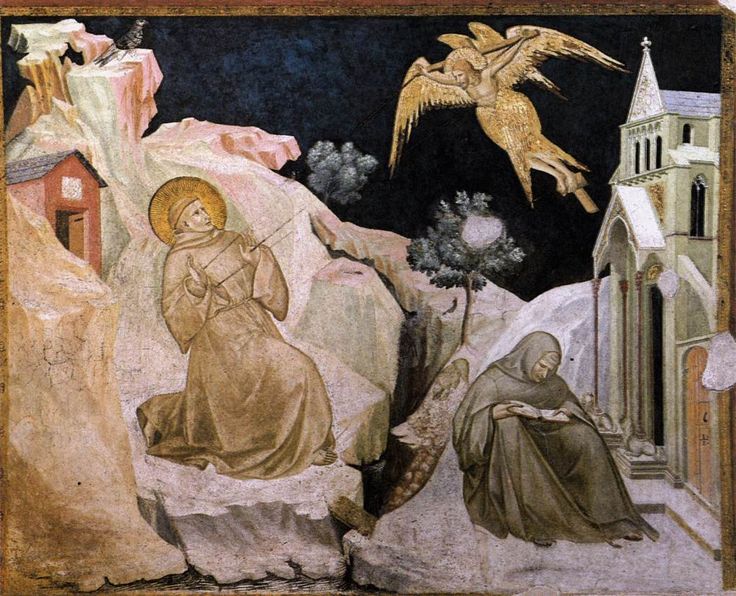
Stigmata of St Francis of Assisi:  While in meditation on Mount Alvernia in the Apennines in September 1224, Saint Francis received a vision of a six winged angel, a Seraphim.   Francis saw that the angel was crucified.   When the angel departed, Francis was left with wounds in his hands, feet and side as though he had been crucified.  The wound in his side often seeped blood.

Stigmata of St Francis by Pietro Lorenzetti

Francis

St Agathoclia
St Brogan of Ross Tuirc
St Columba of Cordova
St Crescentio of Rome
St Emmanuel Nguyen Van Trieu
St Flocellus
St Hildegard von Bingen
St Justin of Rome
St Lambert of Maastricht
St Narcissus of Rome
St Peter Arbues
St Rodingus
St Satyrus of Milan
St Socrates
Bl Stanislaus of Jesus and Mary
St Stephen
St Theodora
St Uni of Bremen
St Zygmunt Sajna
St Zygmunt Szcesny Felinski

Martyred in the Spanish Civil War
• Blessed Álvaro Santos Cejudo Moreno Chocano
• Blessed Juan Ventura Solsona
• Blessed Timoteo Valero Pérez

Posted in franciscan OFM, MORNING Prayers, NOVENAS

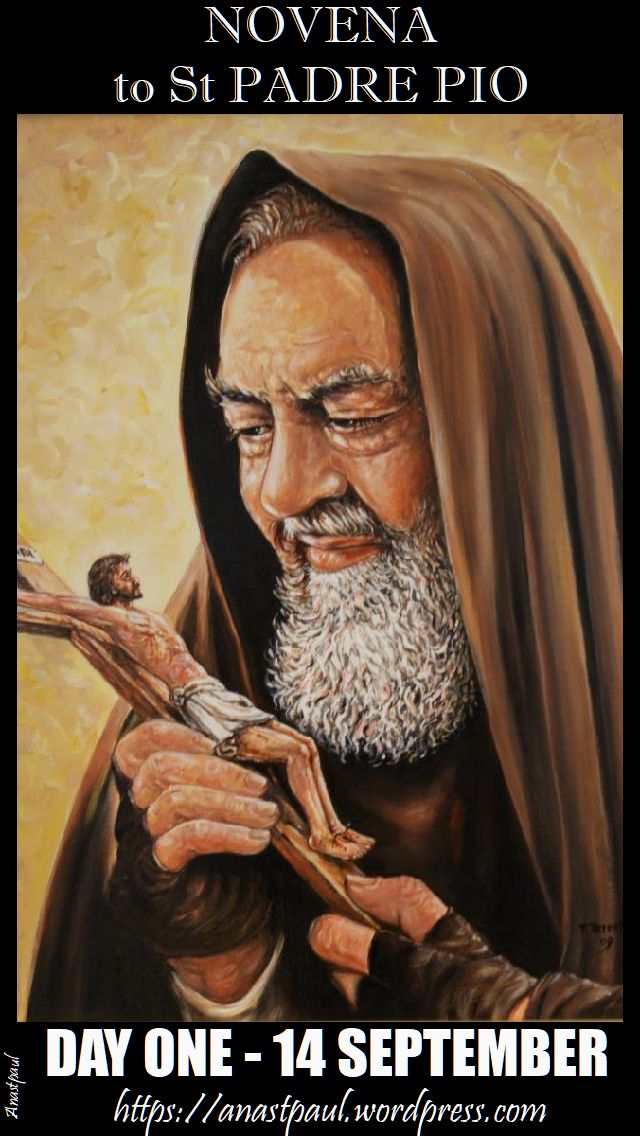
NOVENA to St Padre Pio/St Pius of Pietrelcina – DAY ONE – 14 September

NOVENA to St Padre Pio/St Pius of Pietrelcina – DAY ONE – 14 September

St Padre Pio you have said:

“Jesus keeps nothing for Himself of what is done for love of Him, and He will repay us very lavishly.
Don’t let us make our happiness depend on enjoying wonderful health,
or else we should be just like those foolish worldly people to whom it is not given to know the secrets of heaven….
Continue to love Jesus and make an effort to love Him more and more,
without wanting to know anything else, He alone will steer us to the haven of salvation.”

Let us Pray:

Gracious God,
You generously blessed Your servant, Padre Pio, with the gifts of the Spirit.
You marked his body with the five wounds of Christ Crucified,
as a powerful witness to the saving Passion and Death of Your Son
and as a stirring inspiration to many people of Your infinite mercy, forgiveness and love.
In the confessional, Padre Pio laboured endlessly for the salvation of souls.
Through his powerful intercession, many who suffered were healed of sickness and disease.
Endowed with the gift of discernment, he could read people’s hearts.
With dignity and intense devotion, he celebrated daily Mass,
inviting countless men and women to a greater union with Jesus Christ,
in the Sacrament of the Holy Eucharist.
Through the intercession of Saint Pio,
we confidently beseech You to to grant us the grace of
………………… (state your petition here).
Help us to imitate his example of prayerful holiness and compassion,
so that we, too, may faithfully follow the Risen Lord
and one day rejoice in the Kingdom,
where You live and reign forever and ever. Amenday one - novena st pio - 14 sept

Posted in DOCTORS of the Church, franciscan OFM, MORNING Prayers, QUOTES of the SAINTS, The BLESSED VIRGIN MARY, The WORD

One Minute Reflection – 12 September – The Feast of the Most Holy Name of Mary

One Minute Reflection – 12 September – The Feast of the Most Holy Name of Mary

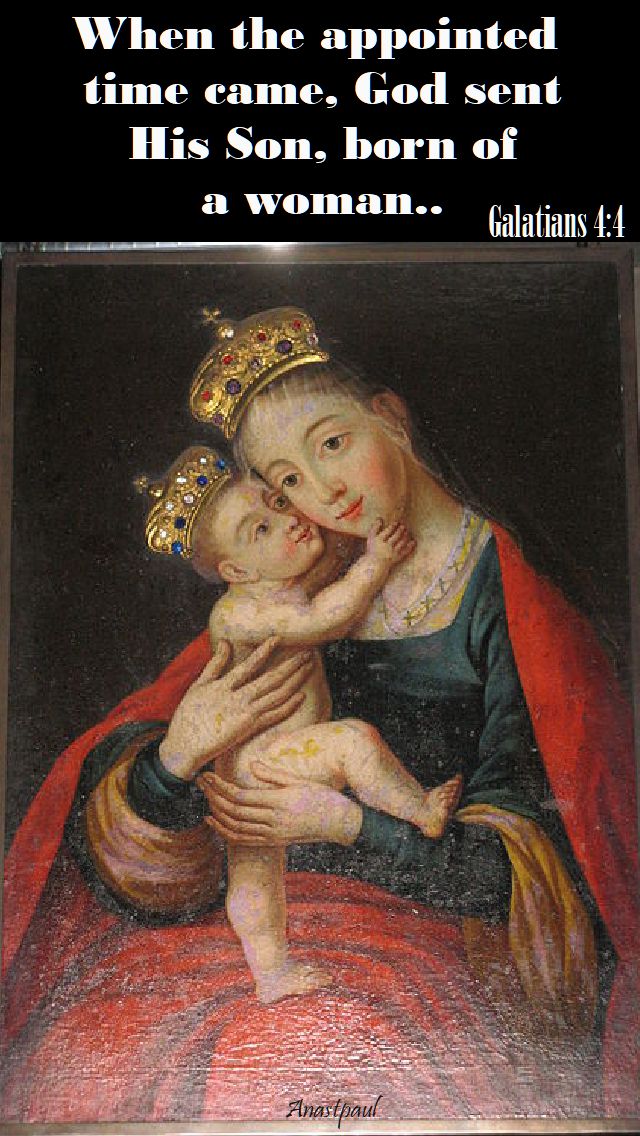
When the appointed time came, God sent His Son, born of a woman.….Galatians 4:4galatians 4 4

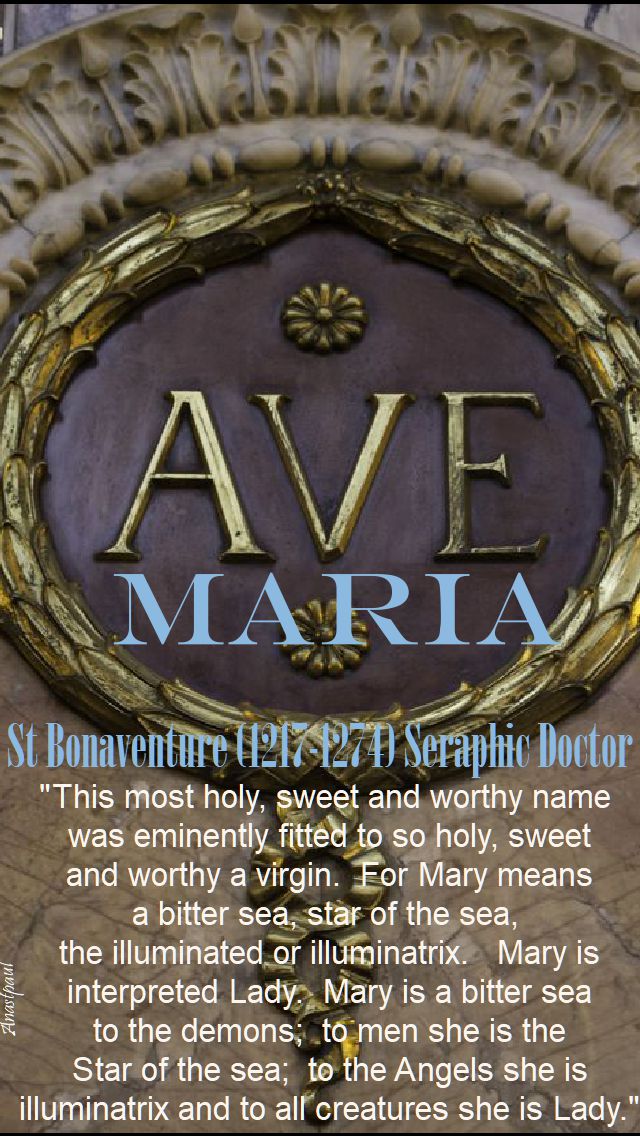
REFLECTION – “This most holy, sweet and worthy name was eminently fitted to so holy, sweet and worthy a virgin.   For Mary means a bitter sea, star of the sea, the illuminated or illuminatrix.   Mary is interpreted Lady.   Mary is a bitter sea to the demons;  to men she is the Star of the sea;  to the Angels she is illuminatrix and to all creatures she is Lady.” … St Bonaventure (1217-1274) Seraphic Doctorthis most holy sweet and worthy name - st bonaventure.2

PRAYER – Heavenly Father, assist us at all times to obtain a spirit of worthy penance, for our sins and that of all the world.   To the invocation of Your Divine Son, Jesus, we call on the intercession of His holy Mother to aid us on our pilgrimage.   With great affection and confidence, we honour the Holy Hearts and invoke the Holy Names of Jesus and Mary, to be our constant source of pure assistance and succour.   Blessed Virgin, Most Holy Mother, pray for us. Amenblessed virgin holy mother pray for us

Posted in franciscan OFM, MORNING Prayers, papal ENCYCLICALS, PRAYERS of the SAINTS

Quote/s of the Day – Pope Francis – Laudato Si – – 1 September – World Day of Prayer for the Care of Creation

Quote/s of the Day – Pope Francis – Laudato Si – – 1 September – World Day of Prayer for the Care of Creation

“Creatures are not just resources but have value in and of themselves and give glory to God

It is not enough, however, to think of different species merely as potential “resources” to be exploited, while overlooking the fact that they have value in themselves.  Each year sees the disappearance of thousands of plant and animal species which we will never know, which our children will never see because they have been lost for ever.   The great majority become extinct for reasons related to human activity.   Because of us, thousands of species will no longer give glory to God by their very existence, nor convey their message to us.   We have no such right. (33)”

“Overpopulation is not the problem

Instead of resolving the problems of the poor and thinking of how the world can be different, some can only propose a reduction in the birth rate.   At times, developing countries face forms of international pressure which make economic assistance contingent on certain policies of “reproductive health”. […]   To blame population growth instead of extreme and selective consumerism on the part of some, is one way of refusing to face the issues.   It is an attempt to legitimise the present model of distribution, where a minority believes that it has the right to consume in a way which can never be universalised, since the planet could not even contain the waste products of such consumption. (50)”

Pope Francis – Laudato Si

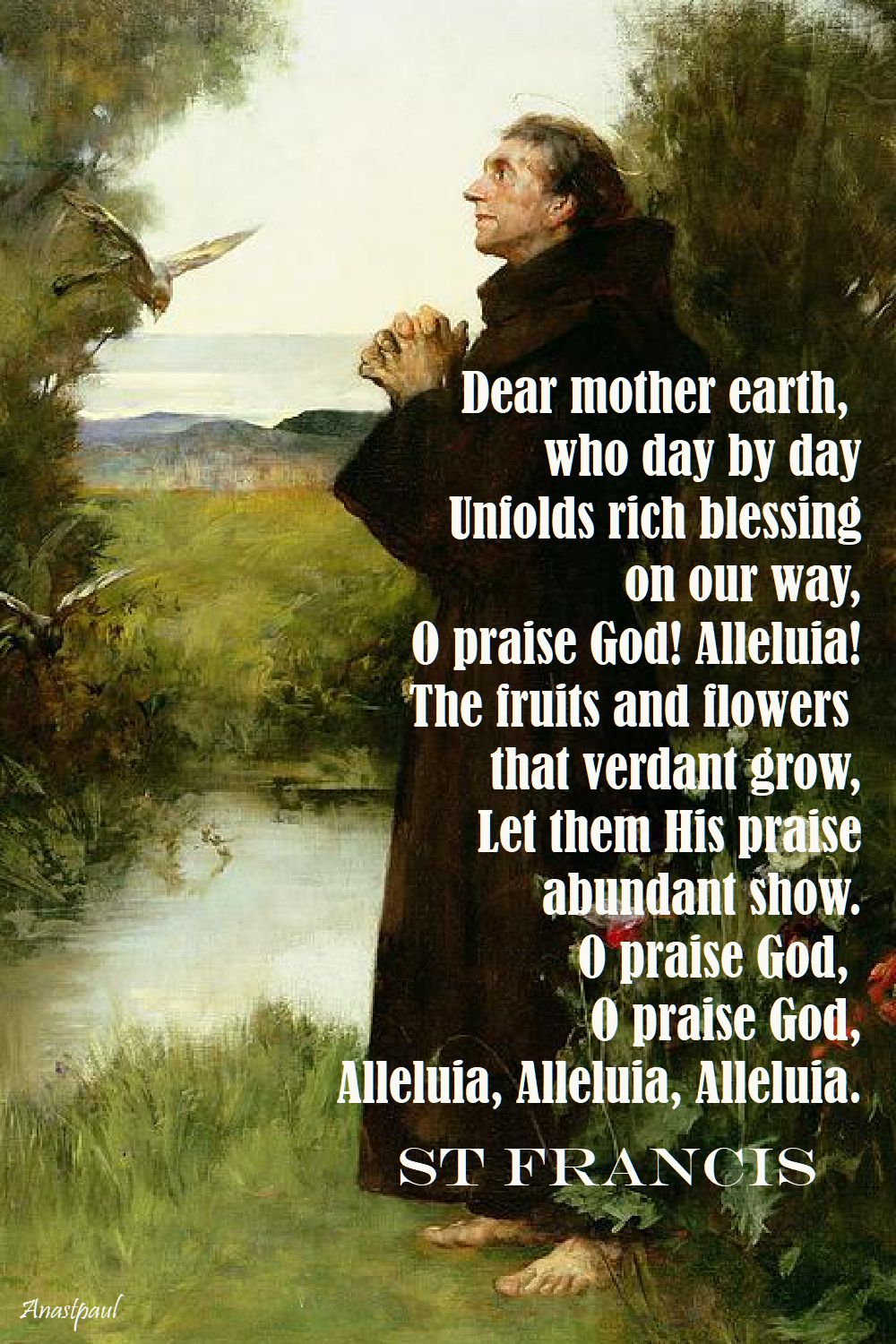
Dear mother earth, who day by day
Unfolds rich blessing on our way,
O praise God! Alleluia!
The fruits and flowers that verdant grow,
Let them His praise abundant show.
O praise God, O praise God,
Alleluia, Alleluia, Alleluia.

St. Francis of Assisi
(Translated by William H Draper) (Image by St Francis by Albert Chevallier Tayler)

dear mother earth - st francis prayer

Posted in DOCTORS of the Church, franciscan OFM, MORNING Prayers, QUOTES of the SAINTS, SAINT of the DAY, The BLESSED VIRGIN MARY, The WORD

One Minute Reflection – August 22 – The Memorial of the Queenship of Mary

One Minute Reflection – August 22 – The Memorial of the Queenship of Mary

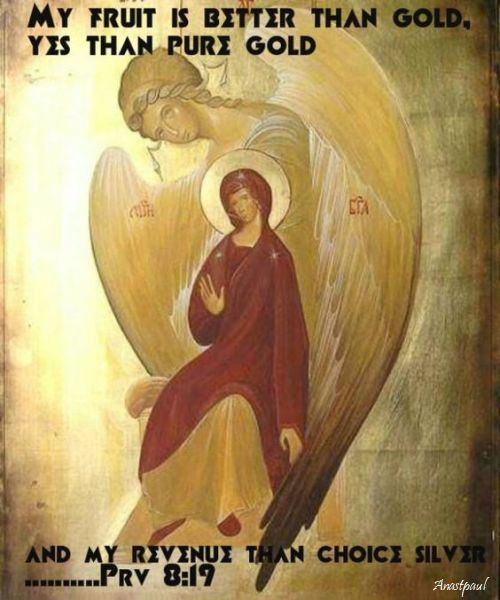
My fruit is better than gold, yes than pure gold and my revenue than choice silver………….Prv 8:19

proverbs 8 19

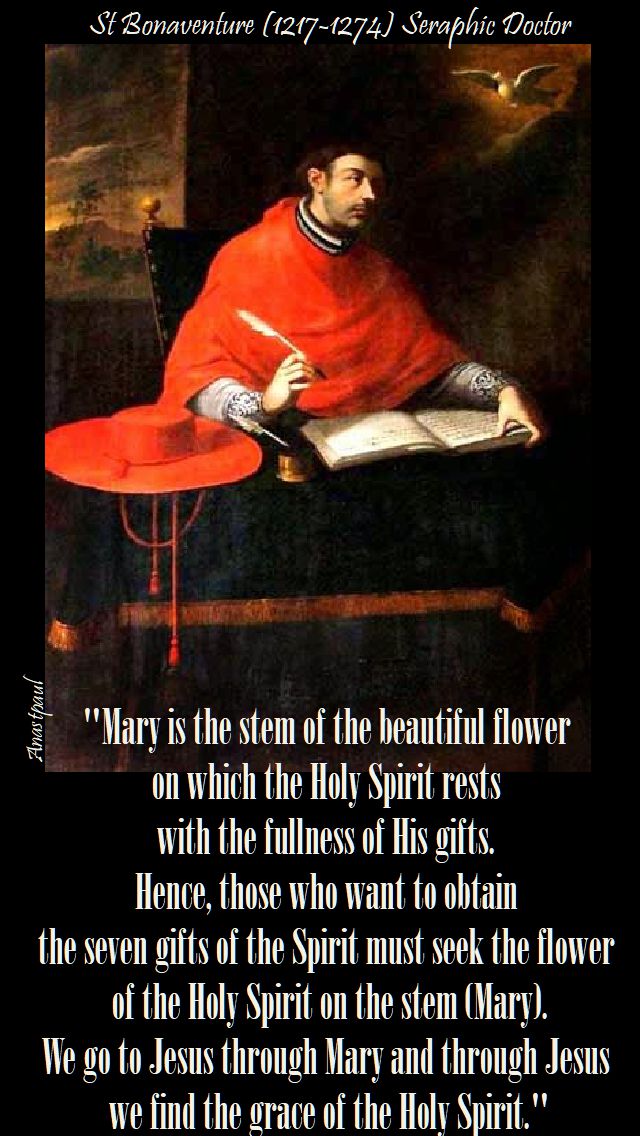
REFLECTION – “Mary is the stem of the beautiful flower on which the Holy Spirit rests with the fullness of His gifts.   Hence, those who want to obtain the seven gifts of the Spirit must seek the flower of the Holy Spirit on the stem (Mary).
We go to Jesus through Mary and through Jesus we find the grace of the Holy Spirit.”…St Bonaventure (1217-1274) Seraphic Doctor

mary is the stem - st bonaventure

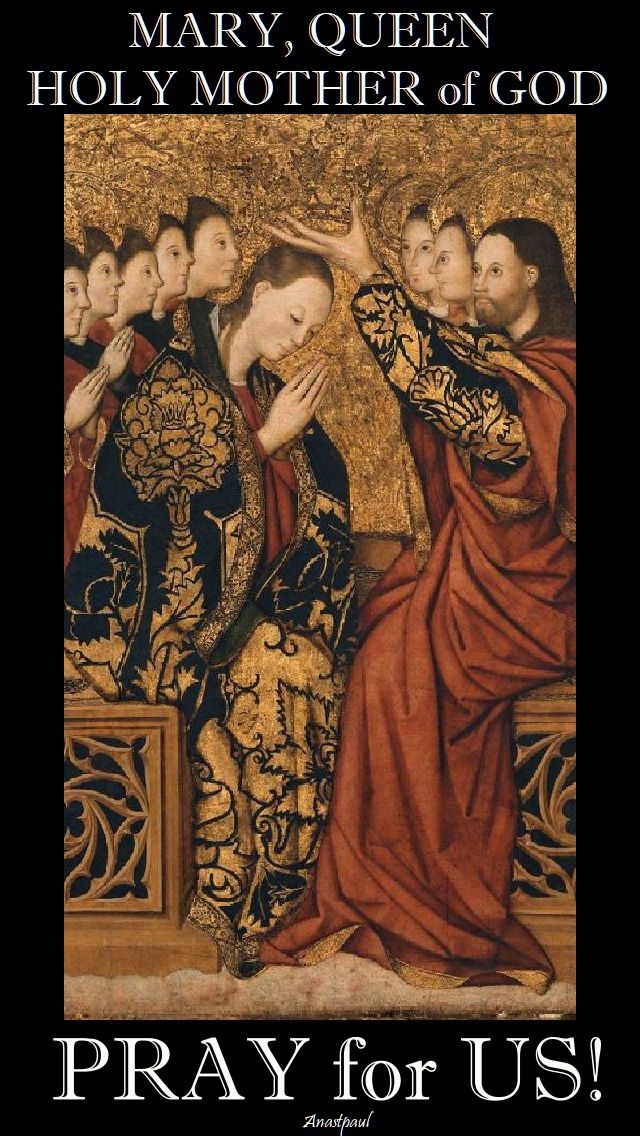
PRAYER – Heavenly Father, You made Mary the Spouse of the Holy Spirit.   Help me through Mary and Jesus to reach the Spirit and obtain His surpassing gifts.   Holy Mother of God, Queen of Heaven and Earth, be my companion and my guide. Amen

mary queen - pray for us


Posted in DOCTORS of the Church, franciscan OFM, MORNING Prayers, PRAYERS of the SAINTS, SAINT of the DAY, The BLESSED VIRGIN MARY

Our Morning Offering – 22 August – The Queenship of Mary

Our Morning Offering – 22 August – The Queenship of Mary

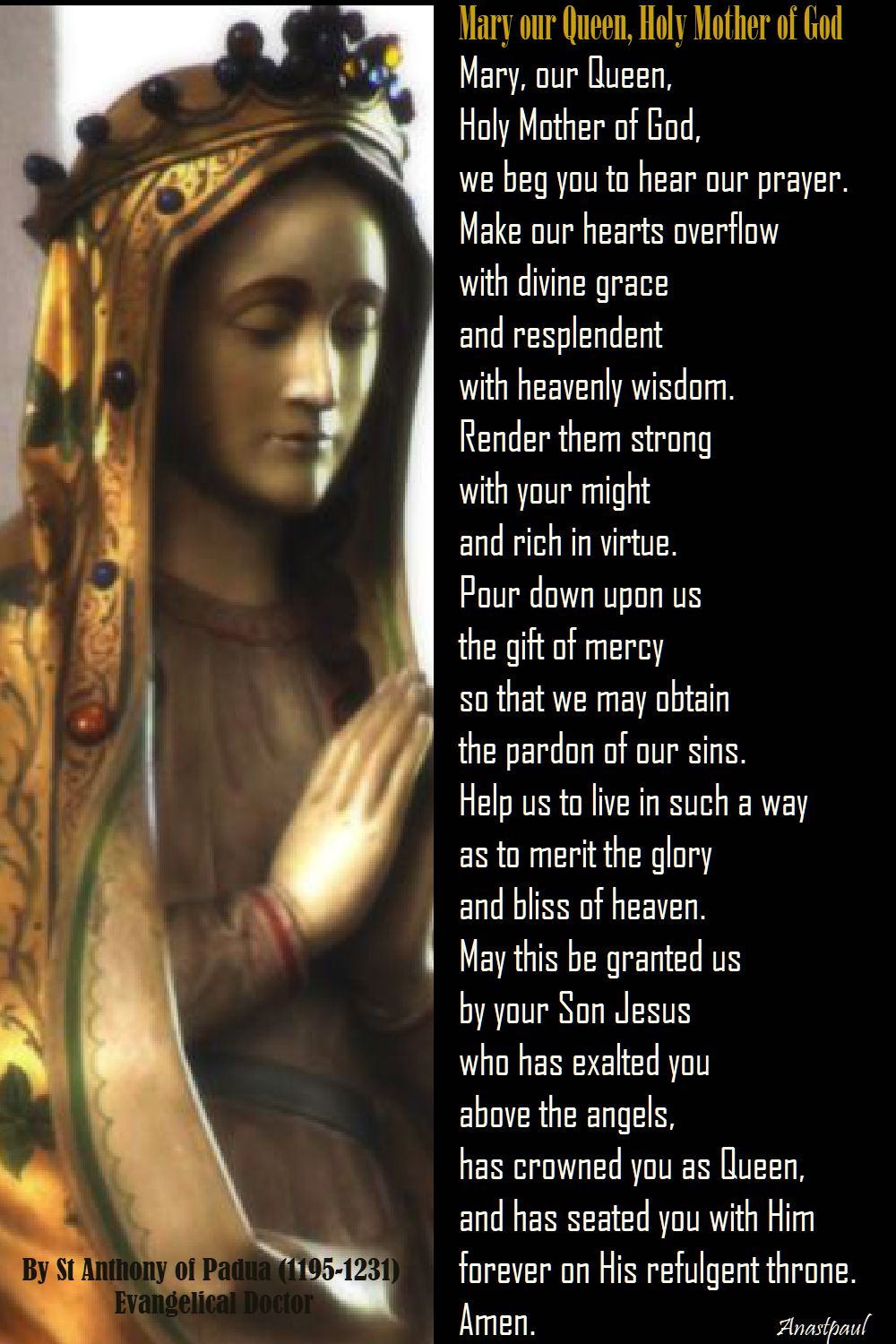
Mary our Queen, Holy Mother of God
By St Anthony of Padua (1195-1231) Evangelical Doctor

Mary, our Queen,
Holy Mother of God,
we beg you to hear our prayer.
Make our hearts overflow with divine grace
and resplendent with heavenly wisdom.
Render them strong with your might
and rich in virtue.
Pour down upon us the gift of mercy
so that we may obtain the pardon of our sins.
Help us to live in such a way
as to merit the glory and bliss of heaven.
May this be granted us by your Son Jesus
who has exalted you above the angels,
has crowned you as Queen,
and has seated you with Him
forever on His refulgent throne.
Amen.

mary our queen, holy mother of god by st anthony of padua.2

Posted in CONFESSION/PENANCE, EUCHARISTIC Adoration, franciscan OFM, MORNING Prayers, QUOTES of the SAINTS, SAINT of the DAY, The BLESSED VIRGIN MARY, The HOLY EUCHARIST / The HOLY MASS

Thought for the Day – 14 August – The Memorial of St Maximillian Kolbe

Thought for the Day – 14 August – The Memorial of St Maximillian Kolbe

St Maximilian’s “Secret” to Holiness and Happiness

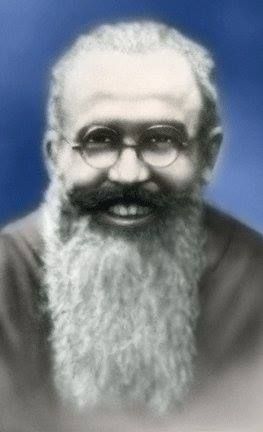
smiling kolbe

St. Maximilian says:  “It is a false and widely diffused idea that the saints were not like us.   They were also subject to temptation, they fell and got up, they also felt overwhelmed with sadness, weakened and paralyzed by discouragement.   But remember the words of the Saviour:  ‘Without me, you can do nothing’ (Jn 15:51) and those of St. Paul:  ‘I can do all things in him who strengthens me’ (Phil 4:13).   Not confiding in themselves, but, putting all their confidence in God after every humiliating fall, they repented sincerely, they purified their soul in the Sacrament of Penance and then they went back to work with still greater fervour.”
We are very much deceived if we think we cannot become a saint, or that we will be “lucky” if we even make it to Purgatory.   The great men of the world overcome all kinds of obstacles in order to become rich or famous.   Why do we not try harder to persevere, when that is precisely what Our Blessed Lord deserves?   After all, He poured Himself out for us so that we might be holy.   The saints were not supermen; they were sinners who persevered through hardship and adversity because they were humble and repentant and confident in God’s grace.”…(Fr Angelo M. Geiger F.I.)
In the end, holiness is not merely a warm feeling of God’s presence or even the ecstatic experiences of the saints.   St Maximilian tells us that true holiness is found in obedience and obedience is acquired through prayer, penance and perseverance.
And this obedience consists in living – truly living the life of a Catholic, St Maximillian said his own words):

“Go to confession with sincerity, diligence, a deep sorrow for his sins and a firm resolve to amend his life. He will suddenly feel a peace and happiness compared with which all the fleeting, unworthy pleasures of this world are really an odious torment.

Let everyone seek to come and receive Jesus in the Holy Eucharist with proper preparation.

Go to Eucharistic Adoration – for this is the the most important activity.

Let him never permit his soul to remain in sin but let him purify it immediately.

Let him do his duty manfully.

Let him address humble and frequent prayers to God’s throne, especially through the hands of the Immaculate Virgin.

Let him welcome his brethren with a charitable heart, bearing for God’s sake the sufferings and difficulties of life.

Let him do good to all, even his enemies, solely for the love of God and not in order to be praised or even thanked by men.”

Then we will come to understand what it means to have a foretaste of paradise;  and perhaps more than once we will find peace and joy even in poverty, suffering, disgrace, or illness.

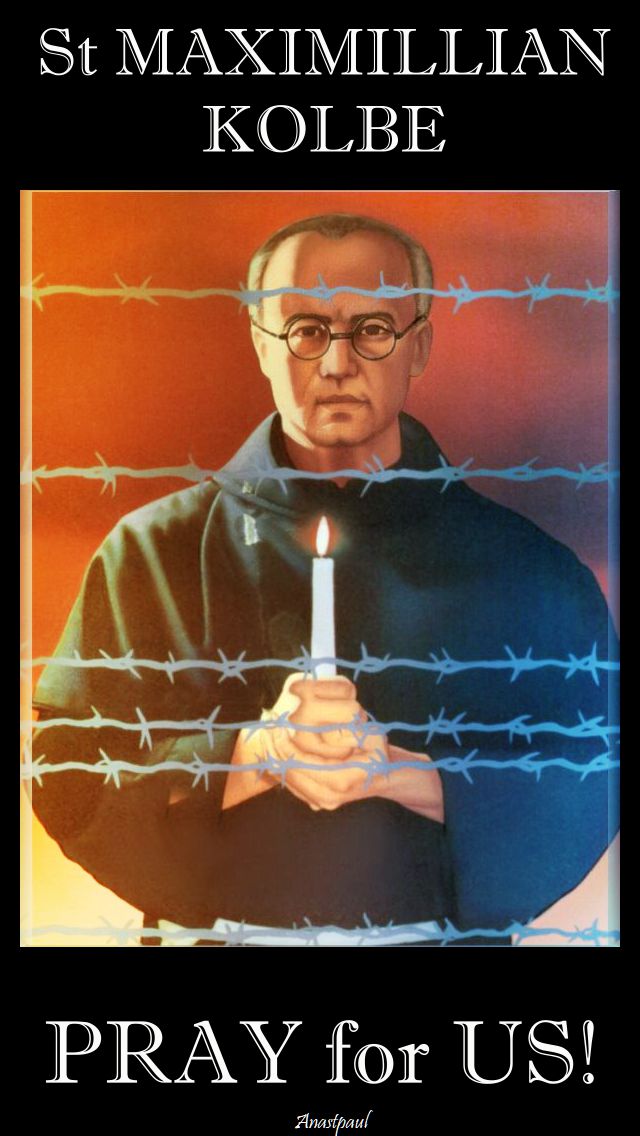
St Maximillian, pray for us!

st max pray for us

Posted in EUCHARISTIC Adoration, franciscan OFM, MORNING Prayers, QUOTES of the SAINTS, QUOTES on SUFFERING, SAINT of the DAY, The BLESSED VIRGIN MARY, The HOLY EUCHARIST / The HOLY MASS

Quote/s of the Day – 14 August – The Memorial of St Maximillian Kolbe

Quote/s of the Day – 14 August – The Memorial of St Maximillian Kolbe

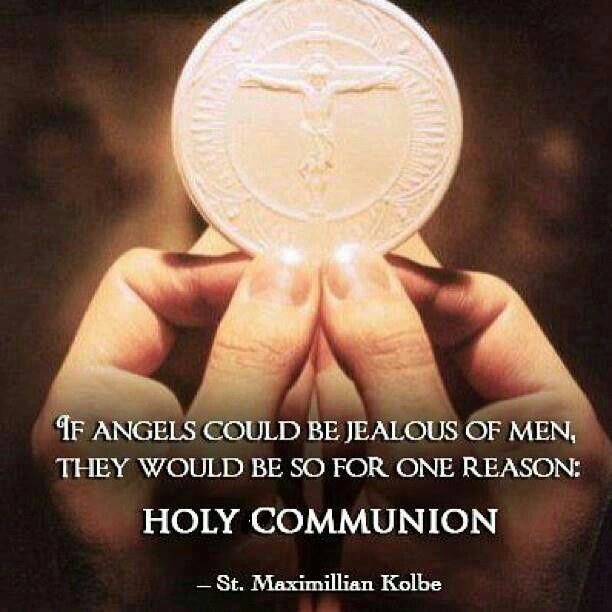
“If angels could be jealous of men,
they would be so, for one reason:
HOLY COMMUNION.”

if angels could be jealous of men - st maximillian kolbe

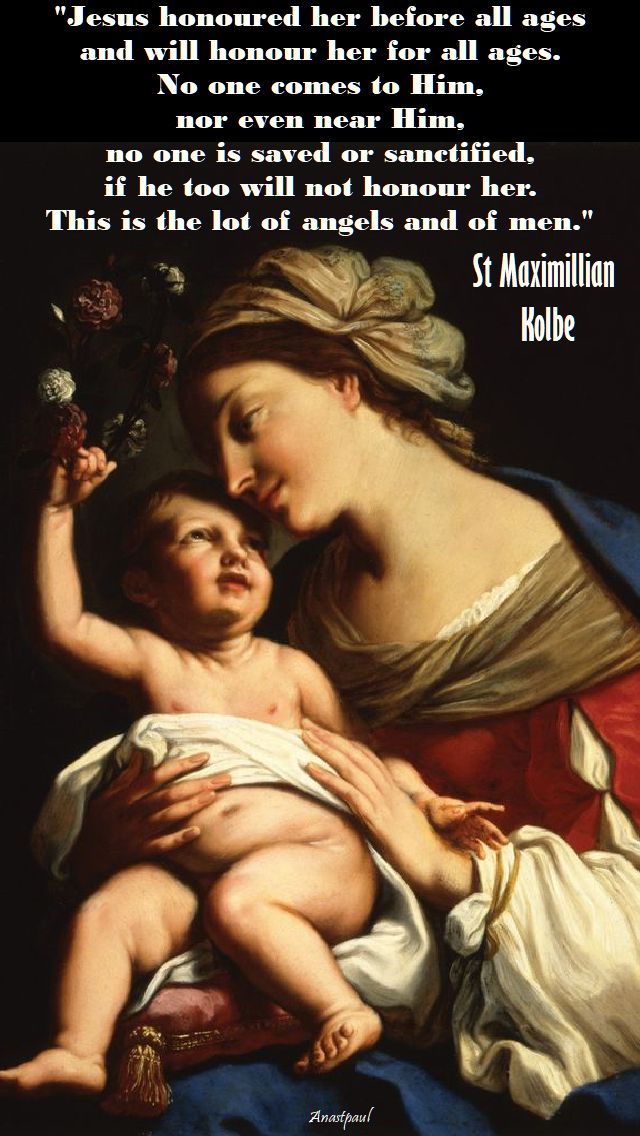
“Jesus honoured her before all ages
and will honour her for all ages.
No one comes to Him, nor even near Him,
no one is saved or sanctified,
if he too will not honour her.
This is the lot of Angels and of men.”

jesus honoured her before all ages - st maximillian kolbe

“Be a man! Don’t blush for your convictions.”

be a man! don't blush for your convictions - st maximillian kolbe

“Let us remember, that love lives through sacrifice
and is nourished by giving.
Without sacrifice, there is no love.”

remember that love lives through sacrifice - st maximillian kolbe

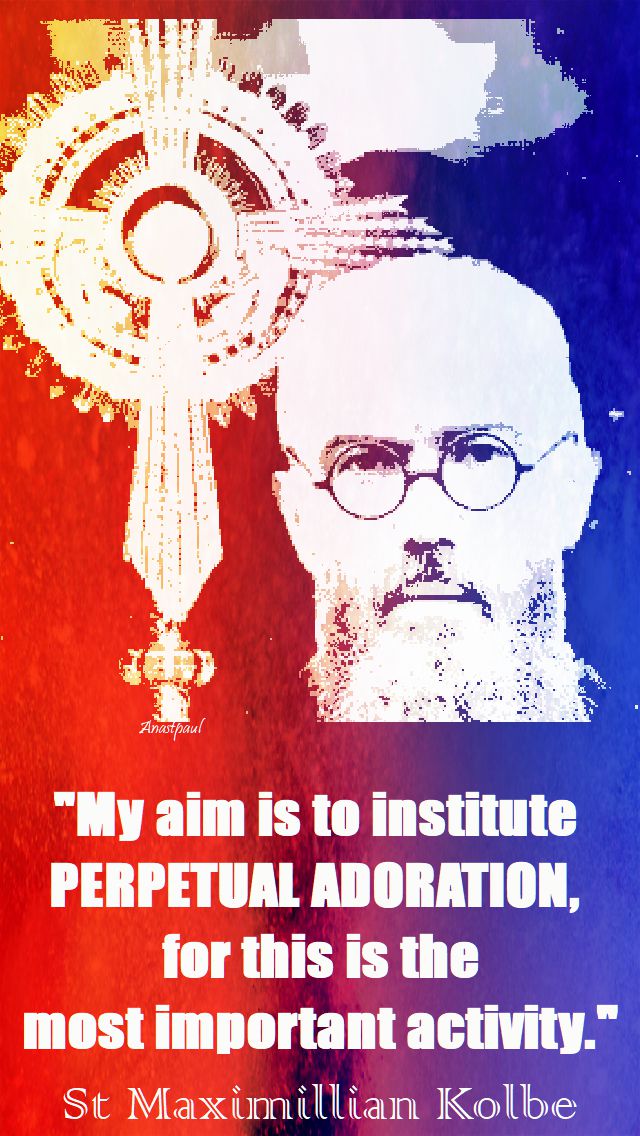
“My aim is to institute perpetual adoration,
for this is the the most important activity.”

my aim is to institute - st maximillian kolbe

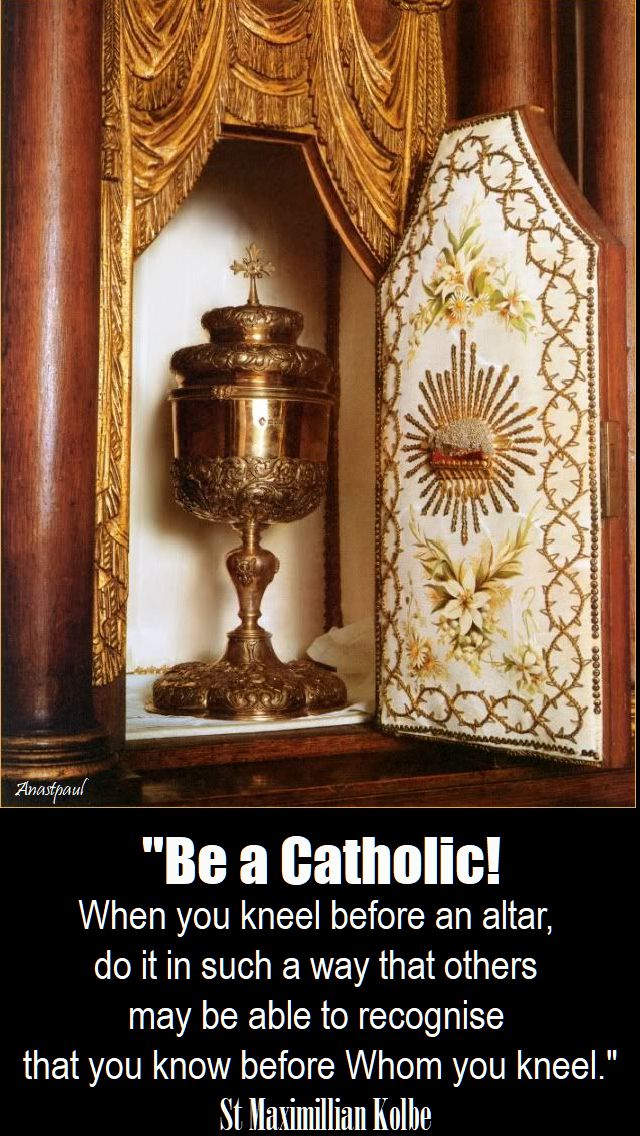
“Be a Catholic!
When you kneel before an altar,
do it in such a way that others
may be able to recognise
that you know before Whom you kneel.”

be a catholic - st maximillian kolbe

St Maximilian Kolbe

Posted in franciscan OFM, MORNING Prayers, QUOTES of the SAINTS, The BLESSED VIRGIN MARY, The WORD

One Minute Reflection – 14 August – The Memorial of St Maximillian Kolbe

One Minute Reflection – 14 August – The Memorial of St Maximillian Kolbe

Mine are counsel and advice; mine is strength; I am understanding….Proverbs 8:14

Proverbs 8-14

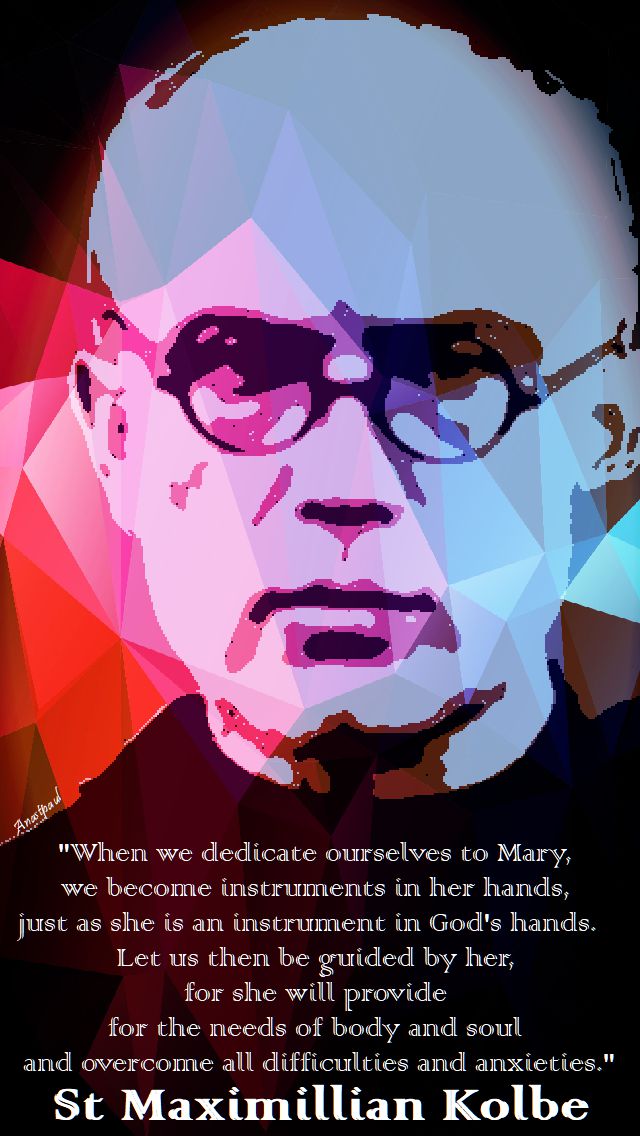
REFLECTION – “When we dedicate ourselves to Mary, we become instruments in her hands, just as she is an instrument in God’s hands.   Let us then be guided by her, for she will provide for the needs of body and soul and overcome all difficulties and anxieties.”…St Maximillian Kolbe

when we dedicate ourselves to Mary - st maximillian kolbe

PRAYER – My Lord and my God, You who are the fruit of Mary’s blessed womb and the most Divine Son of our Father, grant that I may always have recourse to You, through her who bore You. Grant that she may help and comfort me and lead me to You. Mary, Holy and loving Mother of God, pray for us all, amen

st maximillian - pray for us

Posted in CONSECRATION Prayers, franciscan OFM, MORNING Prayers, SAINT of the DAY, The BLESSED VIRGIN MARY

Our Morning Offering – 14 August

Our Morning Offering – 14 August

Consecration to the Immaculata – By St Maximillian Kolbe

O Immaculata, Queen of Heaven and earth,
Refuge of sinners and our most loving Mother,
God has willed to entrust the entire order of mercy to you.
I, ……………(name), a repentant sinner,
cast myself at your feet, humbly imploring you
to take me with all that I am and have,
wholly to yourself as your possession and property.
Please make of me, of all my powers of soul and body,
of my whole life, death and eternity, whatever most pleases you.
If it pleases you, use all that I am and have without reserve,
wholly to accomplish what was said of you:
“She will crush your head,” and
“You alone have destroyed all heresies in the whole world.”
Let me be a fit instrument in your immaculate and merciful hands
for introducing and increasing your glory to the maximum
in all the many strayed and indifferent souls
and thus help extend as far as possible,
the blessed kingdom of the most Sacred Heart of Jesus.
For wherever you enter you obtain the grace of conversion
and growth in holiness, since it is through your hands
that all graces come to us from the most Sacred Heart of Jesus.
Allow me to praise you, O Sacred Virgin
Give me strength against your enemies
Amen

A shorter version of the prayer can be used for the daily renewal of the consecration:

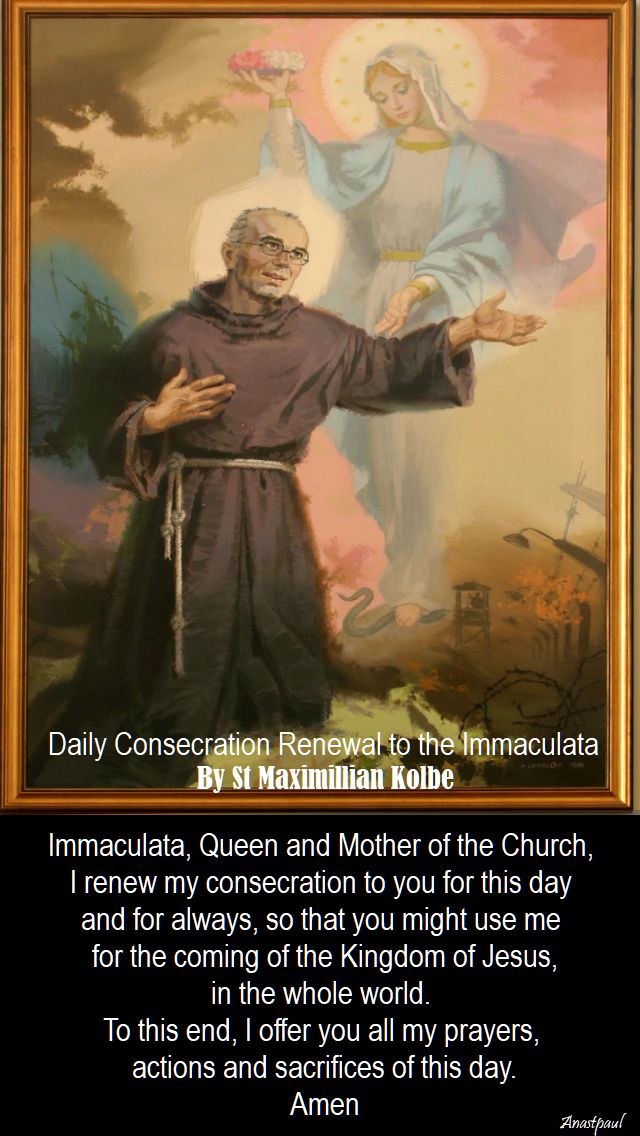
Daily Consecration Renewal to the Immaculata
By St Maximillian Kolbe

Immaculata, Queen and Mother of the Church,
I renew my consecration to you for this day
and for always, so that you might use me
for the coming of the Kingdom of Jesus in the whole world.
To this end, I offer you all my prayers,
actions and sacrifices of this day.
Amen

daily consecration renewal to the immaculata by st maximillian kolbe

Posted in franciscan OFM, SAINT of the DAY

Saint of the Day – 14 August – St Maximillian Kolbe OFM Conv – “MARTYR of CHARITY” and “Apostle of Consecration to Mary”

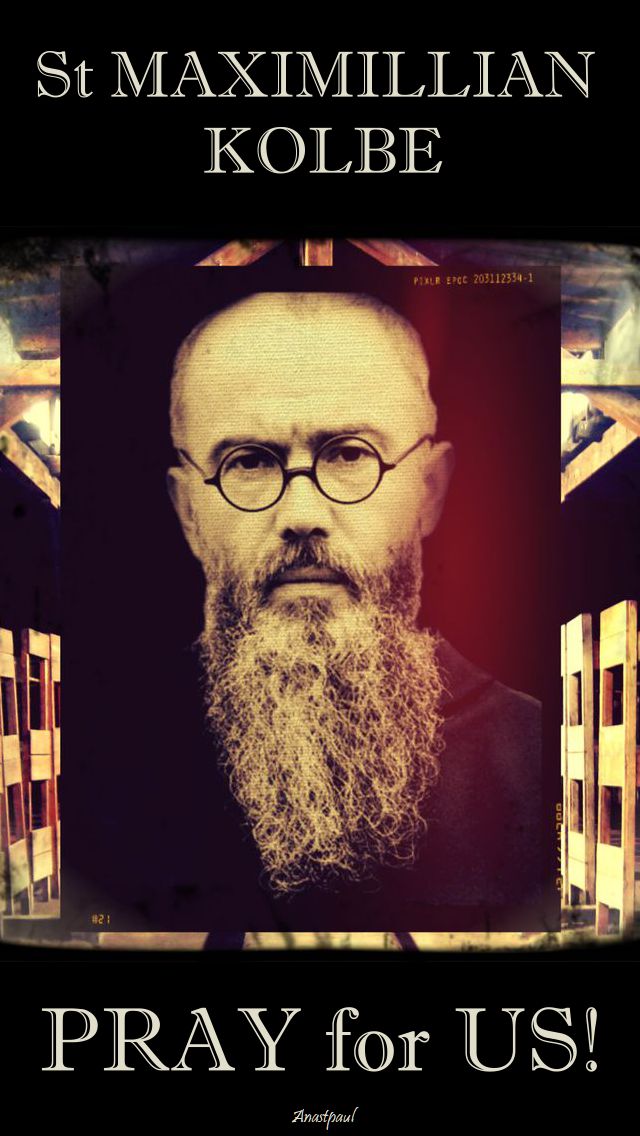
Saint of the Day – 14 August – St Maximillian Kolbe OFM Conv – “MARTYR of Charity” and “Apostle of Consecration to Mary”- Born Maksymilian Maria Kolbe(7 January 1894 at Zdunska Wola, Poland as Raymond Kolbe – 14 August 1941 by lethal carbonic acid injection after three weeks of starvation and dehydration at the Auschwitz, Poland death camp).   His body was burned in the ovens and the ashes scattered.   Some relics have been preserved and distributed by the friars at Niepokalanów, Poland.   He was Beatified on 17 October 1971 by Pope Paul VI – his beatification miracles include the July 1948 cure of intestinal tuberculosis of Angela Testoni and August 1950 cure of calcification of the arteries/sclerosis of Francis Ranier.   He was Canonised on 10 October 1982 by St Pope John Paul II, who declared him a ‘Martyr of Charity.’   Patronages – drug addicts, political prisoners, families, journalists, prisoners, amateur radio, the pro-life movement, Esperanto.  St John Paul II declared him “The Patron Saint of Our Difficult Century”. Due to Kolbe’s efforts to promote consecration and entrustment to Mary, he is known as the “Apostle of Consecration to Mary”.

Childhood
Maximilian Kolbe was born on 8 January 1894 in Zduńska Wola, in the Kingdom of Poland, which was a part of the Russian Empire, the second son of weaver Julius Kolbe and midwife Maria Dąbrowska.   His father was an ethnic German and his mother was Polish. He had four brothers.

Kolbe’s life was strongly influenced in 1906 by a childhood vision of the Virgin Mary. He later described this incident:  “That night I asked the Mother of God what was to become of me.   Then she came to me holding two crowns, one white, the other red.   She asked me if I was willing to accept either of these crowns.   The white one meant that I should persevere in purity and the red that I should become a martyr.  I said that I would accept them both.”

Franciscan Friar
In 1907, Kolbe and his elder brother Francis joined the Conventual Franciscans.   They enrolled at the Conventual Franciscan minor seminary in Lwow later that year.   In 1910, Kolbe was allowed to enter the novitiate, where he was given the religious name Maximilian.   He professed his first vows in 1911 and final vows in 1914, adopting the additional name of Maria.   He was sent to Rome in 1912, where he attended the Pontifical Gregorian University.   He earned a doctorate in philosophy in 1915 there. From 1915 he continued his studies at the Pontifical University of St Bonaventure where he earned a doctorate in theology in 1919 or 1922 (sources vary).   He was active in the consecration and entrustment to Mary.   During his time as a student, he witnessed vehement demonstrations against Popes St. Pius X and Benedict XV in Rome during an anniversary celebration by the Freemasons.   According to Kolbe:

“They placed the black standard of the “Giordano Brunisti” under the windows of the Vatican.   On this standard the archangel, St Michael, was depicted lying under the feet of the triumphant Lucifer.   At the same time, countless pamphlets were distributed to the people in which the Holy Father was attacked shamefully.”

Soon afterward, Kolbe organised the Militia Immaculatae (Army of the Immaculate One), to work for conversion of sinners and enemies of the Catholic Church, specifically the Freemasons, through the intercession of the Virgin Mary.   So serious was Kolbe about this goal that he added to the Miraculous Medal prayer:

“O Mary, conceived without sin, pray for us who have recourse to thee.   And for all those who do not have recourse to thee;  especially the Masons and all those recommended to thee.”


In 1918, Kolbe was ordained a priest.   In July 1919 he returned to the newly independent Poland, where he was active in promoting the veneration of the Immaculate Virgin Mary. He was strongly opposed to leftist – in particular, communist – movements.   From 1919 to 1922 he taught at the Kraków seminary.   Around that time, as well as earlier in Rome, he suffered from tuberculosis, which forced him to take a lengthy leave of absence from his teaching duties.   In January 1922 he founded the monthly periodical Rycerz Niepokalanej (Knight of the Immaculate), a devotional publication based on French Le Messager du Coeur de Jesus (Messenger of the Heart of Jesus).    From 1922 to 1926 he operated a religious publishing press in Grodno.   As his activities grew in scope, in 1927 he founded a new Conventual Franciscan monastery at Niepokalanów near Warsaw, which became a major religious publishing center.   A junior seminary was opened there two years later.

Between 1930 and 1936, Kolbe undertook a series of missions to East Asia.   At first, he arrived in Shanghai, China but failed to gather a following there.   Next, he moved to Japan, where by 1931 he founded a monastery at the outskirts of Nagasaki (it later gained a novitiate and a seminary) and started publishing a Japanese edition of the Knight of the Immaculate.   The monastery he founded remains prominent in the Roman Catholic Church in Japan.   Kolbe built the monastery on a mountainside that, according to Shinto beliefs, was not the side best suited to be in harmony with nature.   When the atomic bomb was dropped on Nagasaki, Kolbe’s monastery was saved because the other side of the mountain took the main force of the blast.   In mid-1932 he left Japan for Malabar, India, where he founded another monastery;  this one however closed after a while.   Meanwhile, the monastery at Niepokalanów began in his absence to publish the daily newspaper, Mały Dziennik (The Little Daily), in alliance with the political group, the National Radical Camp (Obóz Narodowo Radykalny).   This publication reached a circulation of 137,000, and nearly double that, 225,000, on weekends.

Death at Auschwitz
After the outbreak of World War II, which started with the invasion of Poland by Germany, Kolbe was one of the few brothers who remained in the monastery, where he organised a temporary hospital.   After the town was captured by the Germans, he was briefly arrested by them on 19 September 1939 but released on 8 December.   He refused to sign the Deutsche Volksliste, which would have given him rights similar to those of German citizens in exchange for recognising his German ancestry.   Upon his release he continued work at his monastery, where he and other monks provided shelter to refugees from Greater Poland, including 2,000 Jews whom he hid from German persecution in their friary in Niepokalanów.   Kolbe also received permission to continue publishing religious works, though significantly reduced in scope.   The monastery thus continued to act as a publishing house, issuing a number of anti-Nazi German publications.   On 17 February 1941, the monastery was shut down by the German authorities.   That day Kolbe and four others were arrested by the German Gestapo and imprisoned in the Pawiak prison.   On 28 May, he was transferred to Auschwitz as prisoner #16670.

Continuing to act as a priest, Kolbe was subjected to violent harassment, including beating and lashings and once had to be smuggled to a prison hospital by friendly inmates.   At the end of July 1941, three prisoners disappeared from the camp, prompting SS-Hauptsturmführer Karl Fritzsch, the deputy camp commander, to pick 10 men to be starved to death in an underground bunker to deter further escape attempts.   When one of the selected men, Franciszek Gajowniczek, cried out, “My wife! My children!”, Kolbe volunteered to take his place.  (The last pic below with St John Paul is at the Canonisation of St Maximillian).

According to an eye witness, an assistant janitor at that time, in his prison cell, Kolbe led the prisoners in prayer to Our Lady.   Each time the guards checked on him, he was standing or kneeling in the middle of the cell and looking calmly at those who entered. After two weeks of dehydration and starvation, only Kolbe remained alive.   “The guards wanted the bunker emptied, so they gave Kolbe a lethal injection of carbolic acid.   Kolbe is said to have raised his left arm and calmly waited for the deadly injection.” His remains were cremated on 15 August, the feast day of the Assumption of Mary.

Kolbe’s influence has found fertile ground in his own Order of Conventual Franciscan friars, in the form of continued existence of the Militia Immaculatae movement.   In recent years new religious and secular institutes have been founded, inspired from this spiritual way.   Among these the Missionaries of the Immaculate Mary – Father Kolbe, the Franciscan Friars of Mary Immaculate, and a parallel congregation of Religious Sisters, and others.   The Franciscan Friars of Mary Immaculate are even taught basic Polish so they can sing the traditional hymns sung by Kolbe, in the saint’s native tongue.   According to the friars,

“Our patron, St. Maximilian Kolbe, inspires us with his unique Mariology and apostolic mission, which is to bring all souls to the Sacred Heart of Christ through the Immaculate Heart of Mary, Christ’s most pure, efficient and holy instrument of evangelisation – especially those most estranged from the Church.”

Kolbe’s views into Marian theology echo today through their influence on Vatican II.   His image may be found in churches across Europe.   Several churches in Poland are under his patronage, such as the Sanctuary of Saint Maxymilian in Zduńska Wola or the Church of Saint Maxymilian Kolbe in Szczecin.   A museum, Museum of St. Maximilian Kolbe “There was a Man”, was opened in Niepokalanów in 1998.

In 1963 Rolf Hochhuth published a play significantly influenced by Kolbe’s life and dedicated to him, The Deputy.   In 2000, the National Conference of Catholic Bishops (U.S.) designated Marytown, home to a community of Conventual Franciscan friars, as the National Shrine of St. Maximilian Kolbe.   Marytown is located in Libertyville, Illinois, and also features the Kolbe Holocaust Exhibit.   In 1991, Krzysztof Zanussi released a Polish film about the life of Kolbe.   The Polish Senate declared the year 2011 to be the year of St Maximilian Kolbe.

First-class relics of Kolbe exist, in the form of hairs from his head and beard, preserved without his knowledge by two friars at Niepokalanów who served as barbers in his friary between 1930 and 1941.   Since his beatification in 1971, more than 1,000 such relics have been distributed around the world for public veneration.   Second-class relics such as his personal effects, clothing and liturgical vestments, are preserved in his monastery cell and in a chapel at Niepokalanów and may be viewed by visitors.

St Maximillian Pray for us!

 

Posted in franciscan OFM, MORNING Prayers, PRAYERS of the CHURCH, PRAYERS of the SAINTS, SAINT of the DAY, The HOLY EUCHARIST / The HOLY MASS

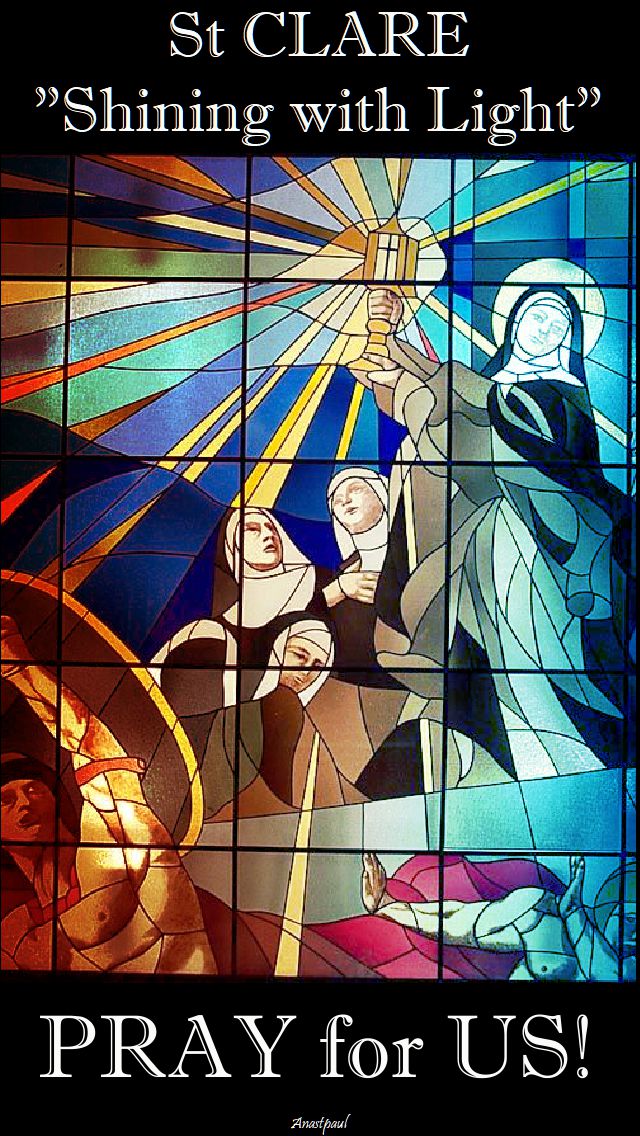
Thought for the Day – 11 August – The Memorial of St Clare of Assisi Clare (a name meaning “shining with light”)

Thought for the Day – 11 August – The Memorial of St Clare of Assisi

Clare (a name meaning “shining with light”)

The 41 years of Clare’s religious life are a model of piety and sanctity.   She demonstrated an indomitable resolve to lead the simple, literal gospel life as Francis taught her, resisting worldly pressures to dilute the rules of her order.   Through her commitment to the Gospel and her unwavering life of prayer, Clare established a new manner for women to live in community and serve the Lord—one of poverty and humility, service and contemplation, and generous concern for others.   Saint Clare continues to inspire us today through the example set forth in her life, as well as her writings which survive her.

Her life is one of simple focus.   From an early age she dedicated herself to the Lord and through a lifetime of humility, service, obedience, patient suffering, prayer and contemplation, Clare refined her being into a “model of perfection.”   Miracles aside, the daily life of poverty and labour resonates today, reminding us of the Lord’s call to us:  “He who is last shall be first.”   Saint Clare depended completely on the Lord, looking to the Eucharist as a source of joy and sustenance and never taking the gifts of God for granted.   Today, on her feast day, we might slow down and contemplate our relationship with the Lord, our dependence, the value we place upon our Eucharistic gift and privilege.   How well do we live the advice of Saint Clare:  “Totally love Him, Who gave Himself totally for your love.”

St Clare, shining with light – Pray for us!
ST CLARE PRAY FOR US 2

O wondrous blessed clarity of Clare!
In life she shone to a few;
after death she shines on the whole world!
On earth she was a clear light;
Now in heaven she is a brilliant sun.

O how great the vehemence of the
brilliance of this clarity!
On earth this light was indeed kept
within cloistered walls,
yet shed abroad its shining rays;
It was confined within a convent cell,
yet spread itself through the wide world.

– Pope Innocent IV

st clare pray for us 3


Posted in EUCHARISTIC Adoration, franciscan OFM, MORNING Prayers, QUOTES of the SAINTS, SAINT of the DAY, The BLESSED VIRGIN MARY, The HOLY EUCHARIST / The HOLY MASS

Quote/s of the Day – 11 August – The Memorial of St Clare of Assisi

Quote/s of the Day – 11 August – The Memorial of St Clare of Assisi

“He, Christ, is the splendour of eternal glory, “the brightness of eternal light and the mirror without cloud.”
Behold, I say, the birth of this mirror. Behold Christ’s poverty even as he was laid in the manger and wrapped in swaddling clothes. What wondrous humility, what marvellous poverty!
The King of angels, the Lord of heaven and earth resting in a manger!
Look more deeply into the mirror and meditate on His humility, or simply on His poverty.
Behold the many labours and sufferings He endured to redeem the human race.
Then, in the depths of this very mirror, ponder His unspeakable love which caused Him to suffer on the wood of the cross and to endure the most shameful kind of death.
The mirror Himself, from His position on the cross, warned passers-by to weigh carefully this act, as He said:
“All of you who pass by this way, behold and see if there is any sorrow like mine.”
Let us answer His cries and lamentations with one voice and one spirit:
“I will be mindful and remember and my soul will be consumed within me.”

Gerard_Seghers_-_St._Clare_and_St._Francis_of_Assisi_in_adoration_before_the_Child_Jesus
Gerard Seghers – St. Clare and St. Francis of Assisi in adoration before the Child Jesus.

“We become what we love and who we love shapes what we become.
If we love things, we become a thing.
If we love nothing, we become nothing.
Imitation is not a literal mimicking of Christ,
rather it means becoming the image of the beloved,
an image disclosed through transformation.
This means we are to become vessels of God’s
compassionate love for others.”

St Clare’s second letter to Blessed Agnes of Prague

we become what we love - st clare

“ Blessed be You, O God, for having created me. ”

St Clare’s Last Words

blessed be you o god - st clare

“Cling to His most sweet Mother,
who carried a Son whom the heavens could not contain;
and yet she carried Him in the little enclosure of her holy womb
and held Him on her virginal lap.”

cling to his most sweet Mother - st clare

“Gaze upon Him, consider Him, contemplate Him, 
as you desire to imitate Him.
….Totally love Him, Who gave Himself totally for your love.”

“They say that we are too poor
but can a heart which possesses the infinite God be truly called poor?
We should remember this miracle of the Blessed Sacrament when in Church.
Then we will pray with great Faith to Jesus in the Holy Eucharist:
‘Save me, O Lord, from every evil – of soul and body.’”

St Clare of Assisi

gaze upon Him, consider Him - st clare

St Pope John Paul II said of Saint Clare: 

“her whole life was a Eucharist because …
from her cloister she raised up a continual ‘thanksgiving’ to God 
in her prayer, praise, supplication, intercession, weeping, offering and sacrifice. 

She accepted everything from the Father in union with the infinite ‘thanks’ of the only begotten Son.

her whole life was a Eucharist - st john paul


Posted in franciscan OFM, MORNING Prayers, QUOTES of the SAINTS, SAINT of the DAY, The WORD

One Minute Reflection – 11 August – The Memorial of St Clare of Assisi

One Minute Reflection – 11 August – The Memorial of St Clare of Assisi

(Wisdom) is the refulgence of eternal light,
the spotless mirror of the power of God….Wisdom 7:26

REFLECTION – “Every day, look into the spotless mirror that is Jesus Christ and study well your reflection.
In that way, you may adorn yourself, mind and body, with every virtue.”…St Clare of Assisi

every day look into the spotless mirror - st clare of assisi

PRAYER – Lord Jesus, help me to dwell often on the manner in which I am following You. Let me strive each day to become more and more like You in all things and eventually, to become the light of You to all the world around me. St Clare of Assisi, you who were a light to all those around you, pray for us, amen.

st clare of assisi - pray for us

Posted in franciscan OFM, MORNING Prayers, PRAYERS of the CHURCH, SAINT of the DAY

Our Morning Offering – 11 August

Our Morning Offering – 11 August

Franciscan Prayer
St Francis and St Clare

Almighty, eternal, just and merciful God,
grant us in our misery the grace to do for You alone
what we know You want us to do
and always to desire what pleases You.
Thus, inwardly cleansed, interiorly enlightened
and inflamed by the fire of the Holy Spirit,
may we be able to follow in the footprints
of Your beloved Son, our Lord Jesus Christ.
And, by Your grace alone,
may we make our way to You, Most High,
Who live and rule in perfect Trinity and simple Unity
and are glorified God all-powerful forever and ever.
Amen.

-from ‘A Letter to the Entire Order’
Francis and Clare: The Complete Works. Regis J. Armstrong, OFM
CAP. and Ignatius C. Brady, OFM

almighty eternal just and merciful god - st francis and st clare

Posted in EYES - Diseases, of the BLIND, franciscan OFM, INCORRUPTIBLES, MORNING Prayers, PATRONAGE - TELEVISION

Saint of the Day – 11 August – St Clare of Assisi (1194-1253)

Saint of the Day – 11 August – St Clare of Assisi (1194-1253) – Virgin, Religious, Founder, Mystic, Friend and Follower of St Francis, Miracle-Worker – (16 July 1194 at Assisi, Italy – 11 August 1253 of natural causes).   St Clare was Canonised on 26 September 1255 by Pope Alexander IV.   St Clare was born Chiara Offreduccio (sometimes spelled Clair, Claire, etc.) is an Italian saint and one of the first followers of Saint Francis of Assisi.   She founded the Order of Poor Ladies, a monastic religious order for women in the Franciscan tradition and wrote their Rule of Life, the first set of monastic guidelines known to have been written by a woman.    Following her death, the Order she founded was renamed in her honour as the Order of Saint Clare, commonly referred to today as the Poor Clares.   Patronages – embroiderers, needle workers, eyes, against eye disease, for good weather, gilders, gold workers, goldsmiths, laundry workers, television (proclaimed on 14 February 1958 by Pope Pius XII because when St Clare was too ill to attend the Holy Mass, she had been able to see and hear it, on the wall of her room.), television writers, Poor Clares, Assisi, Italy, Santa Clara Indian Pueblo.  st-clare-of-assisi-header-info 2jpg

st-clare-of-assisi-header

St Clare was born in Assisi, the eldest daughter of Favorino Sciffi, Count of Sasso-Rosso and his wife Ortolana.   Traditional accounts say that Clare’s father was a wealthy representative of an ancient Roman family, who owned a large palace in Assisi and a castle on the slope of Mount Subasio. Ortolana belonged to the noble family of Fiumi and was a very devout woman who had undertaken pilgrimages to Rome, Santiago de Compostela and the Holy Land.   Later in life, Ortolana entered Clare’s monastery, as did Clare’s sisters, Beatrix and Catarina (who took the name Agnes).

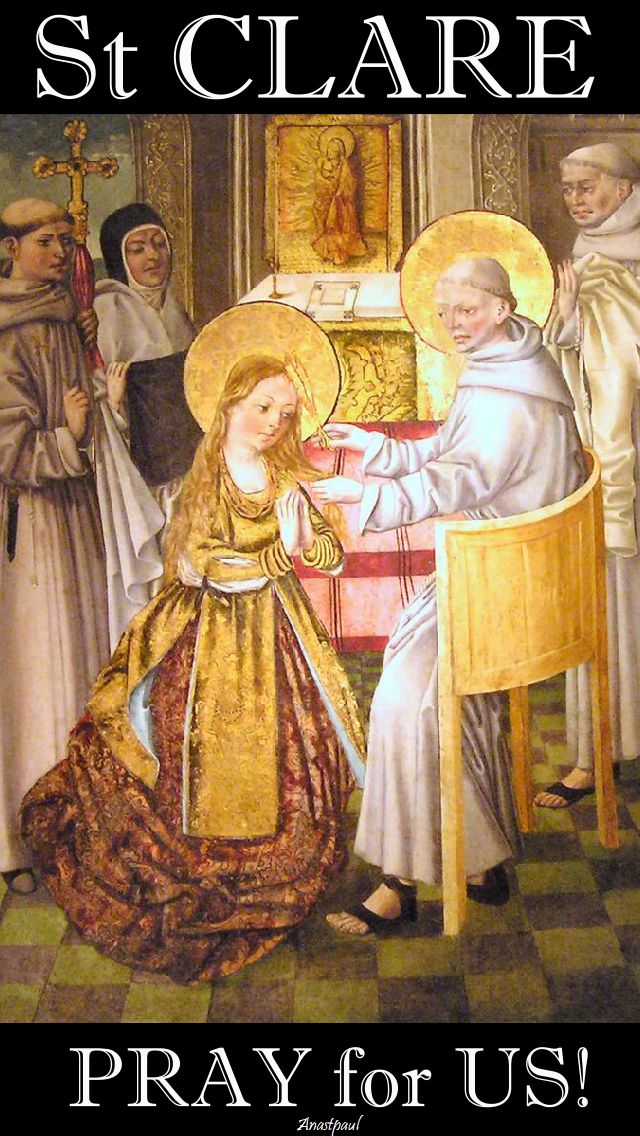
As a child, Clare was devoted to prayer.   Although there is no mention of this in any historical record, it is assumed that Clare was to be married in line with the family tradition.   However, at the age of 18 she heard Francis preach during a Lenten service in the church of San Giorgio at Assisi and asked him to help her to live after the manner of the Gospel.   On the evening of Palm Sunday, 20 March 1212, she left her father’s house and accompanied by her aunt Bianca and another companion proceeded to the chapel of the Porziuncula to meet Francis.  There, her hair was cut and she exchanged her rich gown for a plain robe and veil.

Francis placed Clare in the convent of the Benedictine nuns of San Paulo, near Bastia. Her father attempted to force her to return home.   She clung to the altar of the church and threw aside her veil to show her cropped hair.   She resisted any attempt, professing that she would have no other husband but Jesus Christ.   In order to provide the greater solitude Clare desired, a few days later Francis sent her to Sant’ Angelo in Panzo, another monastery of the Benedictine nuns on one of the flanks of Subasio.   Clare was soon joined by her sister Catarina, who took the name Agnes.   They remained with the Benedictines until a small dwelling was built for them next to the church of San Damiano, which Francis had repaired some years earlier.

Other women joined them and they were known as the “Poor Ladies of San Damiano”. They lived a simple life of poverty, austerity and seclusion from the world, according to a Rule which Francis gave them as a Second Order (Poor Clares).

San Damiano became the centre of Clare’s new religious order, which was known in her lifetime as the “Order of Poor Ladies of San Damiano.”   San Damiano was long thought to be the first house of this order, however, recent scholarship strongly suggests that San Damiano actually joined an existing network of women’s religious houses organised by Hugolino (who later became Pope Gregory IX).   Hugolino wanted San Damiano as part of the order he founded because of the prestige of Clare’s monastery.   San Damiano emerged as the most important house in the order and Clare became its undisputed leader.   By 1263, just ten years after Clare’s death, the order had become known as the Order of Saint Clare.   In 1228, when Gregory IX offered Clare a dispensation from the vow of strict poverty, she replied:  “ I need to be absolved from my sins but not from the obligation of following Christ.”   Accordingly, the Pope granted them the Privilegium Pauperitatis — that nobody could oblige them to accept any possession.

Unlike the Franciscan friars, whose members moved around the country to preach, Saint Clare’s sisters lived in enclosure, since an itinerant life was hardly conceivable at the time for women.   Their life consisted of manual labour and prayer. The nuns went barefoot, slept on the ground, ate no meat and observed almost complete silence.

For a short period, the order was directed by Francis himself.    Then in 1216, Clare accepted the role of abbess of San Damiano.   As abbess, Clare had more authority to lead the order than when she was the prioress and required to follow the orders of a priest heading the community.   Clare defended her order from the attempts of prelates to impose a rule on them that more closely resembled the Rule of Saint Benedict than Francis’ stricter vows.   Clare sought to imitate Francis’ virtues and way of life so much so that she was sometimes titled alter Franciscus, another Francis.   She also played a significant role in encouraging and aiding Francis, whom she saw as a spiritual father figure and she took care of him during his final illness.

After Francis’s death, Clare continued to promote the growth of her order, writing letters to abbesses in other parts of Europe and thwarting every attempt by each successive pope to impose a rule on her order which weakened the radical commitment to corporate poverty she had originally embraced.   She did this despite enduring a long period of poor health until her death.   Clare’s Franciscan theology of joyous poverty in imitation of Christ is evident in the rule she wrote for her community and in her four letters to Agnes of Prague.

In 1224, the army of Frederick II came to plunder Assisi.   Clare went out to meet them with the Blessed Sacrament in her hands.   Suddenly a mysterious terror seized the enemies, who fled without harming anybody in the city.

Before breathing her last in 1253, Clare said:  “ Blessed be You, O God, for having created me.”

On 9 August 1253, the papal bull Solet annuere of Pope Innocent IV confirmed that Clare’s rule would serve as the governing rule for Clare’s Order of Poor Ladies.   Two days later, on 11 August Clare died at the age of 59.   Her remains were interred at the chapel of San Giorgio while a church to hold her remains was being constructed.   At her funeral, Pope Innocent IV insisted the friars perform the Office for the Virgin Saints as opposed to the Office for the Dead (Bartoli, 1993).   This move by Pope Innocent ensured that the Canonisation process for Clare would begin shortly after her funeral.   Pope Innocent was cautioned by multiple advisers against having the Office for the Virgin Saints performed at Clare’s funeral (Bartoli, 1993).   The most vocal of these advisers was Cardinal Raynaldus who would later become Pope Alexander IV, who in two years time would canonise Clare (Pattenden, 2008).   At Pope Innocent’s request the canonisation process for Clare began immediately.   While the whole process took two years, the examination of Clare’s miracles took just six days.   On 26 September 1255, Pope Alexander IV Canonised Clare as Saint Clare of Assisi.   Construction of the Basilica of Saint Clare was completed in 1260, and on October 3 of that year Clare’s remains were transferred to the newly completed basilica where they were buried beneath the high altar.   In further recognition of the saint, Pope Urban IV officially changed the name of the Order of Poor Ladies to the Order of Saint Clare in 1263.

Some 600 years later in 1872, Saint Clare’s relics were transferred to a newly constructed shrine in the crypt of the Basilica of Saint Clare, where her relics can still be venerated today.    Her body is incorrupt.

OLYMPUS DIGITAL CAMERA

20100813-assisi-santa-chiara-10
St Clare’s Garment in the Centre with St Francis’ on each side

St-Clare-of-Assisi-relic

st clare relics

In art, Clare is often shown carrying a monstrance or pyx, in commemoration of the occasion when she warded away the soldiers of Frederick II at the gates of her convent by displaying the Blessed Sacrament and kneeling in prayer.

Pope Pius XII designated Clare as the Patron Saint of television in 1958 because when St Clare was too ill to attend the Holy Mass, she had been able to see and hear it, on the wall of her room.

There are traditions of bringing offerings of eggs to the Poor Clares for their intercessions for good weather, particularly for weddings.  This tradition remains popular in the Philippines, particularly at the Real Monasterio de Santa Clara in Quezon City.   According to the Filipino essayist Alejandro Roces, the practice arose because of Clare’s name. In Castilian clara refers to an interval of fair weather and in Spanish, it also refers to the white or albumen of the egg.