Posted in franciscan OFM, SAINT of the DAY

Saint of the Day – 22 May – Bl John Forest O.F.M. (1471-1538) Martyr

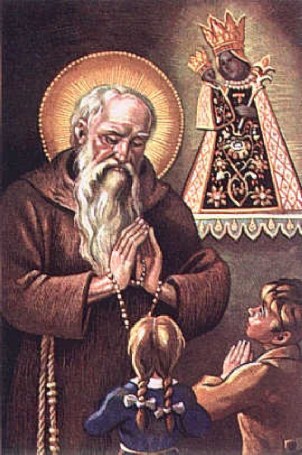
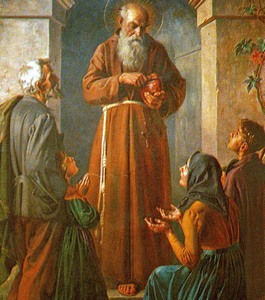
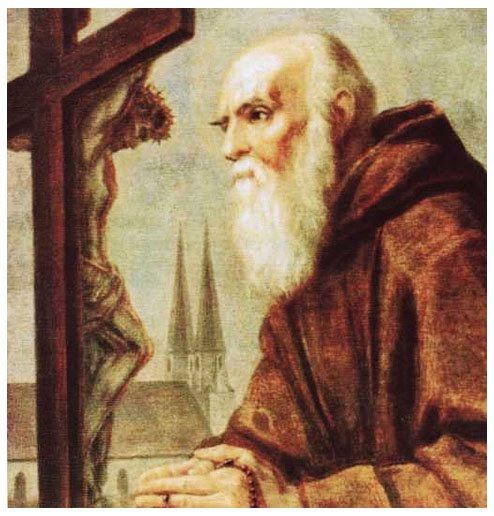
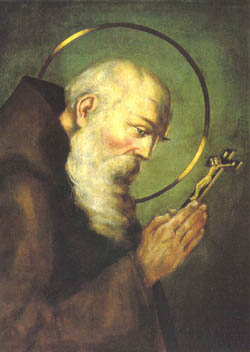
Saint of the Day – 22 May – Bl John Forest O.F.M. (1471-1538) Martyr – Franciscan Priest and Friar and Martyr – Born in 1471 at Oxford, England – died by being hanged and burned on 22 May 1538 at Smithfield, England.   Additional Memorial – 1 December as one of the Martyrs of Oxford University.

Already by the 15th century, England was upset about church and country relations. Many of the people were very proud to be English;  in fact too proud.   They did not want to listen to their Bishops and Priests and they did not want to obey the Pope in Rome. They felt that they knew what was best concerning the laws of the church and the laws of the country but they were wrong, very, very wrong.

During this period of time, in 1471, a very great man was born;  his name was John Forest.   He was born at Oxford, England of noble, well-to-do parents.    In spite of their wealth, John did not become a worldly person and during his boyhood, he got a very good religious education.   When he was 21 years old, he entered the Strict Franciscan Order at the Greenwich Monastery.   He proved to be a very brilliant student when he was sent to study at Oxford and there he received his doctorate in Theology, when he was about 26 years old.

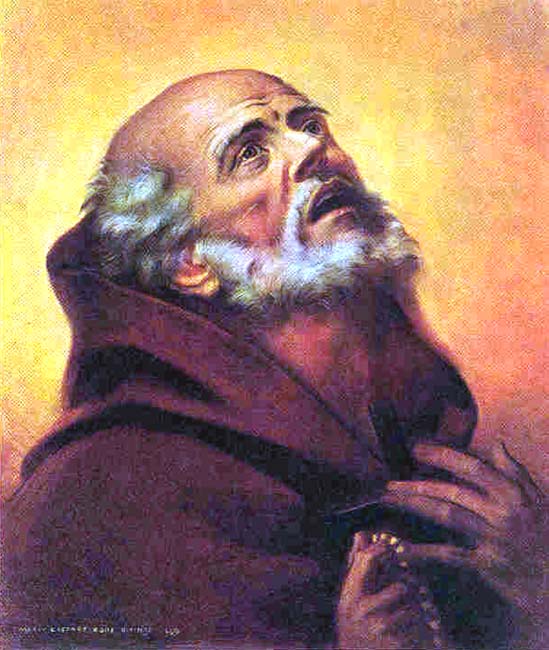
In time, John Forest became a Franciscan priest.   As the years passed, Fr Forest became known as a very holy and learned man.   And in 1520, when he was about 49 years old, the Franciscan brothers elected him as the Provincial Superior.   Then five years later, Cardinal Wolsey appointed him to be a regular preacher at St Paul’s, in the capital, London.bL jOHN fOREST - LG
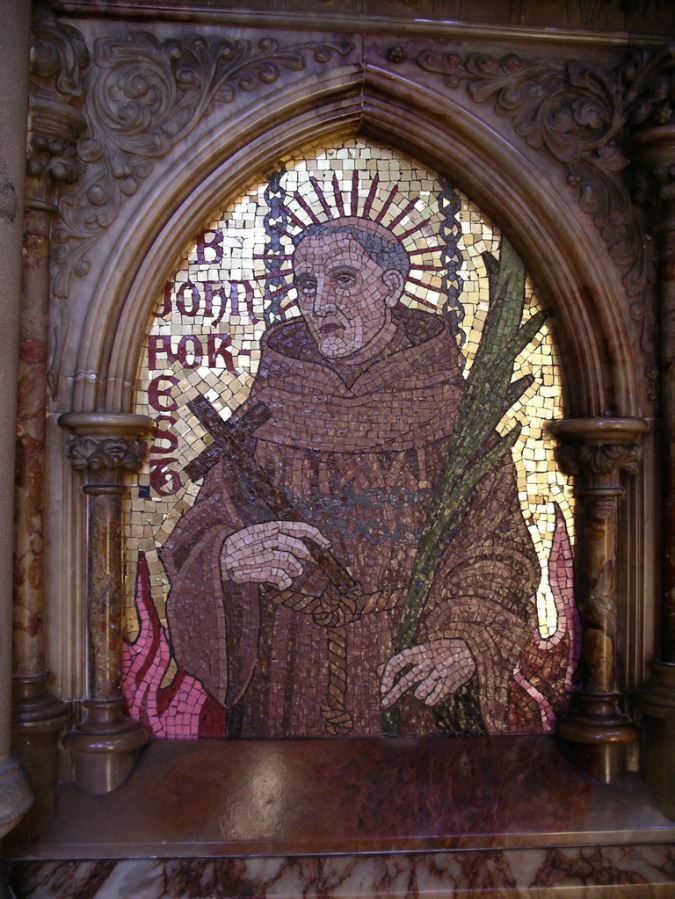
Then there quickly followed the appointment that was to lead him down the narrow road to martyrdom.   Catherine of Aragon was married to Henry VIII, the King of England.   She was a very devout Third Order Franciscan and asked Fr Forest to become her Confessor and Chaplain.   But before King Henry VIII got married to Catherine of Aragon, he had to get a dispensation from Pope Julius, to marry the widow of his dead brother.   Catherine was actually his sister-in-law.   The Pope gave the dispensation and after Henry and Catherine were married they had three sons and a daughter, Princess Mary.   Little Mary lived o, but the three boys died.   In time King Henry wanted to get an annulment from the Pope.   Henry figured that since he had to get permission to marry his sister–in-law in the first place, the Pope could now give him an annulment.   But the King was in for a big surprise when the Pope said he would not give Henry an annulment, their marriage was valid and he should stay married to his good wife Catherine.

By now, King Henry was already starting to look at another woman,her name was Anne Boleyn.   And to make matters worse, Anne was also looking at King Henry.   Now, both you and I know that it is wrong to desire to have another man or woman, when you are already married.   Henry’s second desire, was to have a male heir to the throne, he wanted a King to rule England, not a Queen!

Covetousness and Pride;  these were Henry’s faults.   In 1527, Henry asked Pope Clement  VII to annul the marriage, or to grant him a divorce.   But when the good Pope refused to go along with the king’s stupid ideas, Henry was most angry.   He got a divorce from Catherine and married Anne Boleyn, he didn’t care what the Pope told him to do.   In 1533, the Pope declared that King Henry was truly married to Catherine and that he was not married to Anne Boleyn.   Because of this, Henry VIII hated Catherine and all that was connected with her.   Now, not only Catherine, but also young Princess Mary and Fr Forest as well, suffered from the King’s anger.   Henry thought that when his wife Catherine had written to the Pope, that Fr Forest should have stopped her from doing so.

Fr Forest and the other Franciscan Friars lived at Greenwich, near King Henry’s palace. The friars discussed Henry’s affairs among themselves and they thought that they had nothing to fear from Henry because he had always admired these friars.   In fact, in the past, King Henry had written to Pope Leo X, telling him:  “I admire the holiness and life of the Greenwich Franciscans.   I find it quite impossible to describe their merits, as they deserve.   They present an ideal of Christian poverty, sincerity and charity.   Their lives are devoted to fasting, watching and prayer.   They are occupied in hard toil by day and night, to win sinners back to God.”

After, their discussions, the friars, especially Fr Forest, sided with Queen Catherine and not Henry VIII.   They knew that Henry was in the wrong and that Catherine was right. When Henry found out that the friars were against him, he demanded that Fr Forest be replaced by another person.   After a meeting, Fr Forest was moved to a convent in the North and later, in 1534, King Henry had the holy priest cast into prison at Newgate. While in this prison, Fr Forest spent his time in prayer and in writing a book, defending the Pope and the Church.   His reason for writing this book was because King Henry VIII had left the Catholic Church and was now calling himself the “Supreme Head of the Church” of England.   Only the Pope is the Head of the Church Henry was making a terrible mistake!   When Henry found out that Fr Forest had written this book, the King was furious.   He condemned the holy priest to death, because he refused to recognise the King as the Head of the Church, in England.

Henry also persecuted the Strict Franciscan Friars in England.   He took away all their monasteries and cast many of them into prison, where fifty of them died.   But a good friend also helped a lot of these good friars to escape to France and Scotland.

Because Fr Forest did not expect to be long in prison, he sent his rosary to Queen Catherine.   In a letter he had sent with the rosary, he had written:  “I presume to make you a poor present of my beads, as I have been given only three more days to live on this earth.”   He was now 63 years old and had been a monk for forty-three years.

But Fr Forest’s sufferings were just beginning, he was to be in prison for four years, (1534-1538).   During this long time in prison, King Henry had sent men to question and torture Fr Forest, so that he would break down and follow Henry’s new law.   But the good priest chose to suffer, rather than give up his faith.   Catherine died a few years before Fr Forest did and during her life she did all she could to ease the sufferings of the good priest.   After two more years of imprisonment, Fr. Forest was condemned to be hanged over a fire and slowly burned to death because he would not swear that the King was the Supreme Head of the Church of England.

On 22 May 1538, Fr Forest’s hands and feet were tied to a hurdle and he was dragged to the place of execution at Smithfield, near a Franciscan Monastery.   Upon arrival, the poor priest was forced to listen to an hours talk on the glories of the Supreme Headship of King Henry, given by Bishop Latimer, who had become an apostate.   Then Fr Forest’s tortures began, chains were wrapped around his waist and under his armpits and then he was suspended in the air above a fire.   The fire was kept low so that it would burn his feet and cause the poor priest even more suffering.   And all the while a bunch of apostates scoffed and jeered at the holy priest.   Throughout the two long hours that Fr Forest swayed over the fire, he prayed:  “In the shadow of Thy wings I will trust, O God, until iniquity pass away.”05_22_ivan_forest_blazeni_03

John Forest was the only Catholic martyr to be burned at the stake.   Extra fuel for the pyre is said to have been provided by an enormous statue of St Derfel, from the pilgrimage site of Llandderfel in north Wales and of which it was prophesied, would “one day set a forest on fire.”  Fr Forest, together with fifty-three other English martyrs, was Beatified by Pope Leo XIII on 9 December 1886.   His relics rest near the priory gate of at Smithfield.

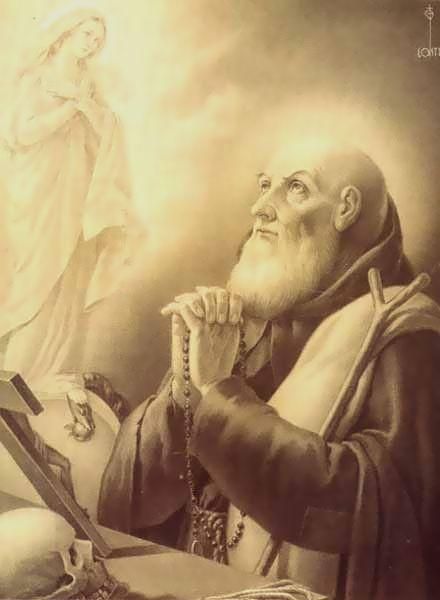
The tough times are returning.   We are fighting to keep the Catholic Faith,  so be faithful in saying your Rosary, wearing the Brown Scapular and being a good Catholic and God will help you now and in the tough times.    Blessed John Forest—Pray for Us!

2Bl john forest-St_Etheldreda,_Ely_Place,_London_EC1_-_Nave_statue_-_geograph.org.uk_-_1613379
Bl John Forest, nave statue – St Etheldreda, Ely Place, London
Posted in franciscan OFM, SAINT of the DAY

Saint of the Day – 19 May – St Ivo of Kermartin (1253-1303) “Advocate of the Poor”

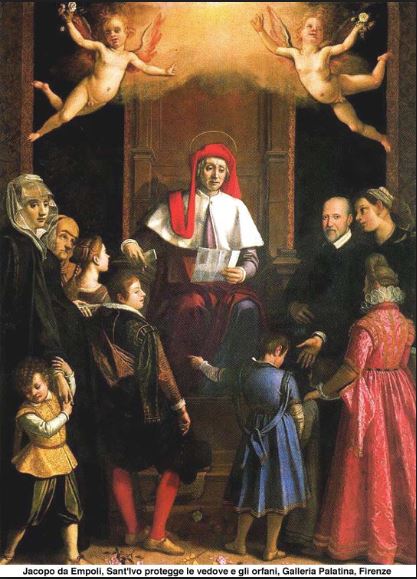
Saint of the Day – 19 May – St Ivo of Kermartin T.O.S.F. (1253-1303) also known Yvo or Ives – Priest, Franciscan Tertiary, known as the “Advocate of the Poor”, Civil Lawyer – born on 17 October 1253 at Kermartin near Treguier, Brittany and died on 19 May 1303 at Louannec, Brittany of natural causes following a sermon on Ascension Eve.  Patronages – abandoned people, advocates, attorneys, barristers, lawyers, bailiffs, Brittany, canon lawyers, canonists, judges, jurists, notaries, orphans, children.   Attributes – lawyer enthroned between rich and poor litigants, lawyer holding a book, with an angel near his head and a lion at his feet, lawyer surrounded by suppliants, holding a parchment and pointing upwards, lawyer surrounded by symbols of the Holy Spirit such as doves.

use this one - ivo-of-kermartin-f29f9332-3e04-4b19-a804-1d82a40ddbc-resize-750

Born at Kermartin, a manor near Tréguier in Brittany, on 17 October 1253, Ivo was the son of Helori, lord of Kermartin and Azo du Kenquis.   In 1267 Ivo was sent to the University of Paris, where he graduated in civil law.   While other students partied, Ivo studied, prayed and visited the sick.   He also refused to eat meat or drink wine.   Among his fellow-students were the scholars Blessed Duns Scotus (1266-1308 – Doctor Subtilis -Subtle Doctor) and Roger Bacon OFM (1219-1292 – Doctor Mirabilis – Miraculous Doctor). He went to Orléans in 1277 to study canon law under Peter de la Chapelle, a famous jurist who later became bishop of Toulouse and a cardinal.   On his return to Brittany, having received minor orders he was appointed an “official”, the title given to an ecclesiastical judge, of the archdeanery of Rennes (1280).   He protected orphans and widows, defended the poor and rendered fair and impartial verdicts.   It’s said that even those on the losing side, respected his decisions.   Ivo also represented the helpless in other courts, paid their expenses and visited them in prison.   He earned the title “Advocate of the Poor.”   Although it was common to give judges “gifts,” Ivo refused bribes.   He often helped disputing parties settle out of court so they could save money.

Meanwhile, he studied Scripture and there are strong reasons for believing the tradition held among Franciscans, that he joined the Third Order of St Francis sometime later at Guingamp.   Ivo was ordained to the priesthood in 1284.   He continued to practice law and once, when a mother and son couldn’t resolve their differences, he offered a Mass for them.   They immediately reached a settlement.ivo-of-kermartin-fe78cc2e-c1cc-4aaf-9379-400fd79478d-resize-750

The Widow of Tours
Tours was near Orleans, the bishop held his court there and Ivo, while visiting the court, lodged with a certain widow.   One day he found his widow-landlady in tears.   Her tale was that next day she must go to court to answer to the suit of a travelling merchant who had tricked her.   It seemed that two of them, Doe and Roe, lodging with her, had left in her charge a casket of valuables, while they went off on their business but with the strict injunction, that she was to deliver it up again, only to the two of them jointly demanding it.   That day, Doe had come back and called for the casket, saying that his partner Roe was detained elsewhere and she in good faith in his story, had delivered the casket to Doe.   But then later came Roe demanding it, charging his partner with wronging him, and holding the widow responsible for delivering up the casket to Doe, contrary to the terms of their directions.   And if she had to pay for those valuables it would ruin her. “Have no fear,” said young Ivo, “I will go to court tomorrow, for you.”

When the case was called before the Judge and the merchant Roe charged the widow with breach of faith, “Not so,” pleaded Ivo, “My client need not yet make answer to this claim.   The plaintiff has not proved his case.   The terms of the bailment were that the casket should be demanded by the two merchants coming together.   But here is only one of them making the demand.   Where is the other?   Let the plaintiff produce his partner.”   The judge promptly approved his plea.   Whereupon the merchant, required to produce his fellow, turned pale and would have retired.   But the judge, suspecting something from his plight, ordered him to be arrested and questioned; the other merchant was also traced and brought in and the casket was recovered, which, when opened, was found to contain nothing but old junk.   In short, they had conspired to plant the casket with the widow and then to coerce her to pay the value of the alleged contents.   Thus the young advocate saved the widow from ruin and the fame of his clever defence of the widow soon went far and wide.Saint-Yves-e1400492469950

Legacy
On the occasion of the 700th anniversary of the birth of St Ivo, St Pope John Paul II said, “The values proposed by St Ivo retain an astonishing timeliness.   His concern to promote impartial justice and to defend the rights of the poorest persons invites the builders of Europe today to make every effort to ensure that the rights of all, especially the weakest, are recognised and defended.”ST IVO - PATRON OF CHILDREN

Saint Ivo is the patron of lawyers.   As a result, many law schools and association of catholic lawyers have taken his names.   For instance, the Society of St. Yves in Jerusalem (a Catholic Centre for Human Rights and Legal Aid, Resources and Development), the Conférence Saint Yves in Luxembourg (the Luxembourg Catholic Lawyers Association), or the Association de la Saint Yves Lyonnais.

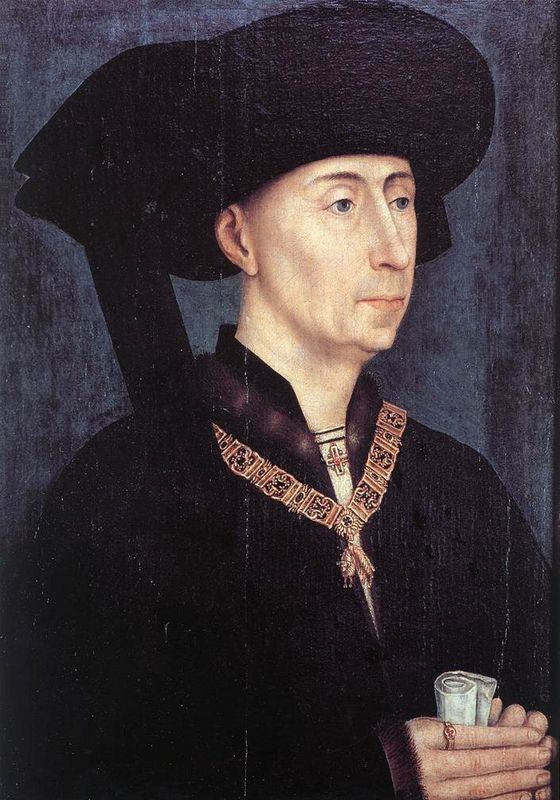
Ivo was Canonised in June 1347 by Clement VI at the urging of Philip I, Duke of Burgundy.   At the inquest into his sanctity in 1331, many of his parishioners testified as to his goodness, that he preached regularly in both chapel and field and that under him “the people of the land became twice as good as they had been before”.   The connection between religion and good behaviour was especially stressed in his sermons and he is reported to have “chased immorality and sin from the village of Louannec”.

Shortly after 1362, the future saint Jeanne-Marie de Maillé reported a vision of St Ivo, during which he told her, “If you are willing to abandon the world, you will taste here on earth the joys of heaven.”

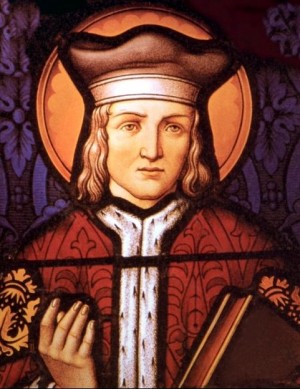
Ivo is often represented with a purse in his right hand (for all the money he gave to the poor during his life) and a rolled paper in the other hand (for his charge as a judge). Another popular representation of Ivo is between a rich man and a poor one.   The churches of Sant’Ivo alla Sapienza and Sant’Ivo dei Bretoni in Rome are dedicated to him.

A 14th century engraving on St Ivo’s Shrine:

Sanctus Ivo erat Brito,
Advocatus, et non latro
Res miranda populo.

Saint Yvo was a Breton and a lawyer
but not dishonest –
An astonishing thing in people’s eyes.

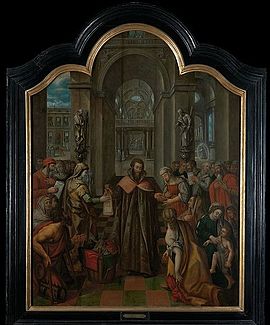
Josse_van_der_Baren_-_The_St_Ivo_Triptych_-_Central_Panel
St Ivo giving alms to the poor by Josse van der Baren
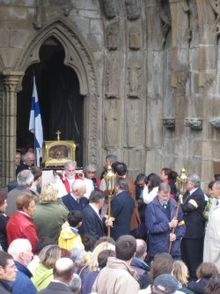
220px-St_Yves_Treguier_2005_petite
The relics of Saints Ivo and Tugdual in a procession at the gate of Tréguier’s cathedral in 2005. In the reliquary is the skull of Saint Ivo
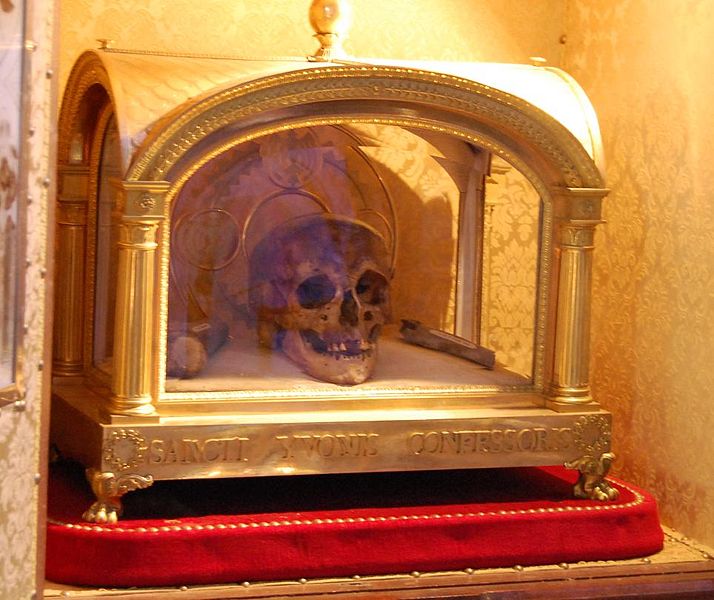
714px-St._Yves
Relic skull and reliquary of St Ivo in Tréguier, Brittany, France
Posted in EUCHARISTIC Adoration, franciscan OFM, MORNING Prayers, SAINT of the DAY, The BLESSED VIRGIN MARY, The HOLY EUCHARIST / The HOLY MASS, The PASSION

Thought for the Day – 18 May – Friday of the Seventh Week of Eastertide and the Memorial of St Felix of Cantalice O.F.M. Cap.(1515-1587) “Brother Deo Gratias”

Thought for the Day – 18 May – Friday of the Seventh Week of Eastertide and the Memorial of St Felix of Cantalice O.F.M. Cap.(1515-1587) “Brother Deo Gratias”

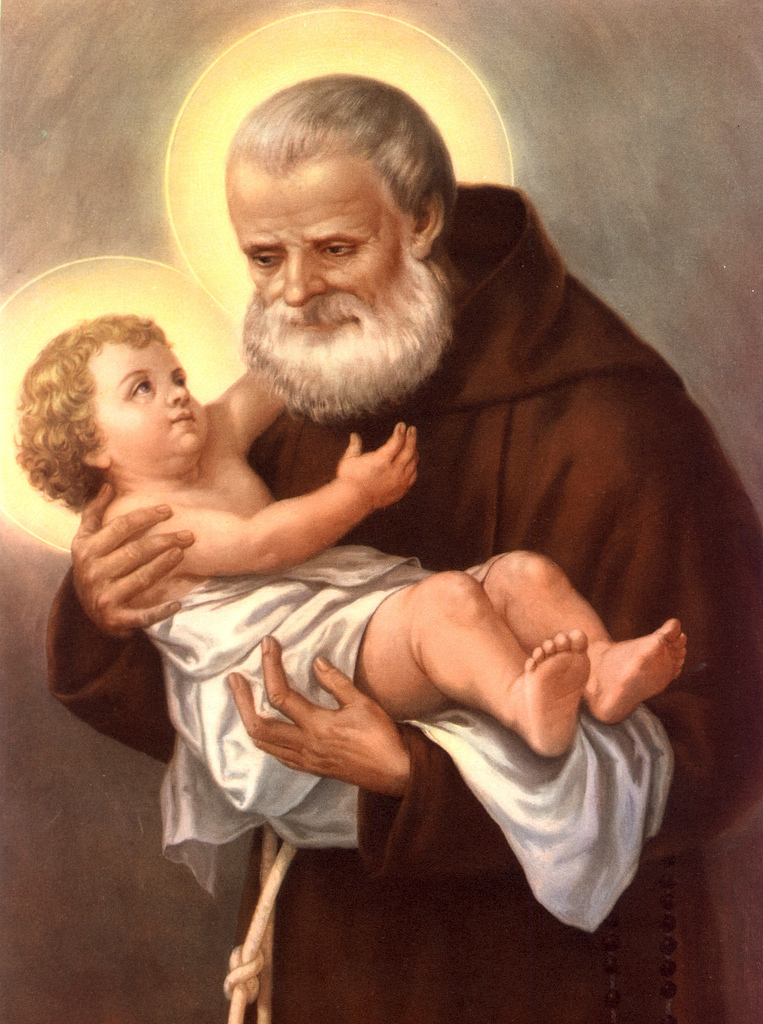
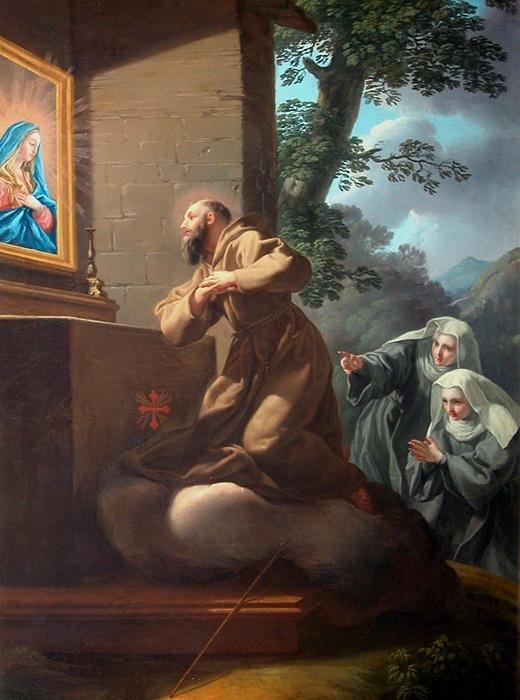
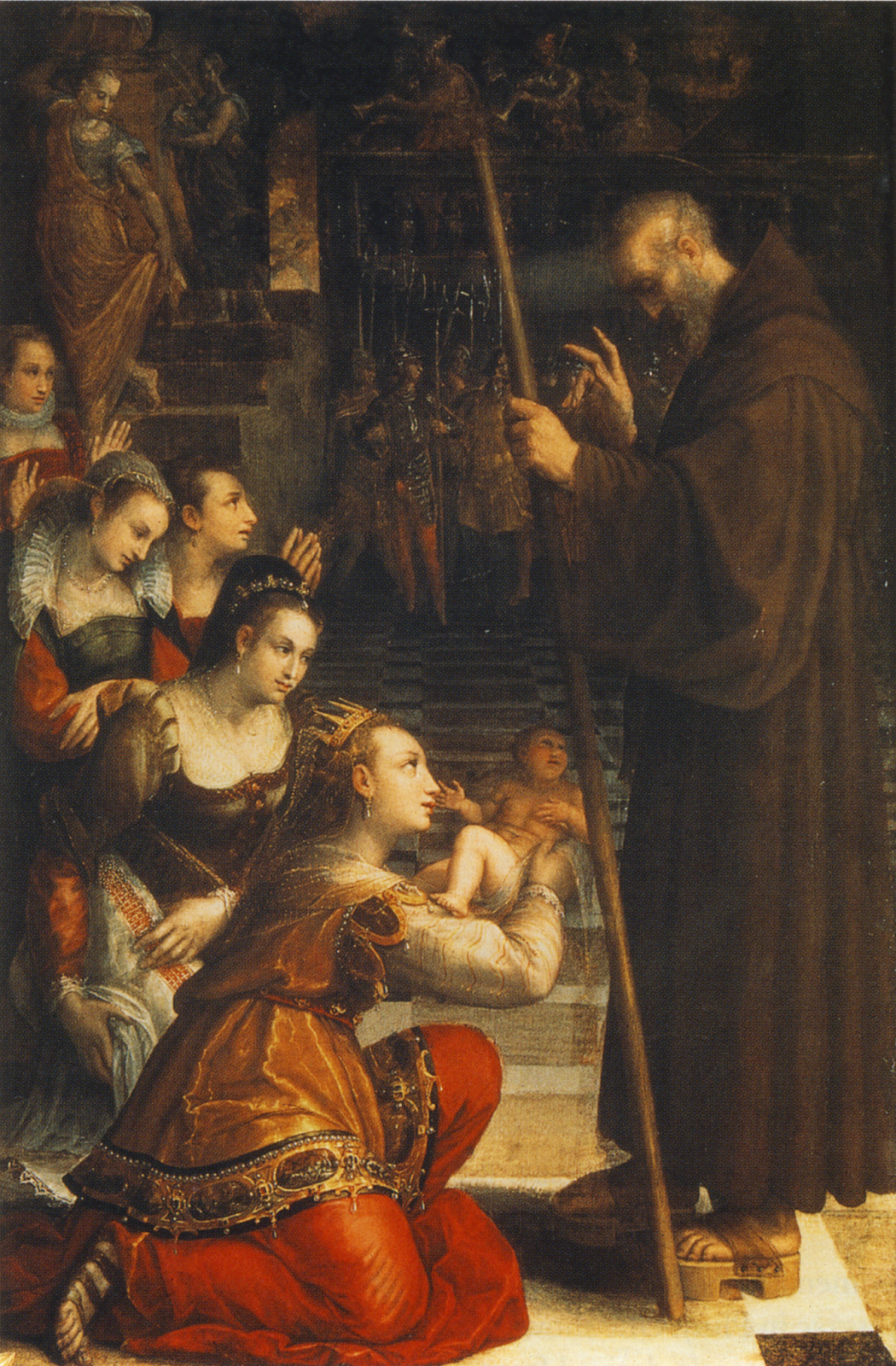
Saint Felix did not have what the world esteems;  his education was lacking.   But he knew five red letters — the wounds of the divine crucified One, Whom he worshipped daily in the Blessed Sacrament and one white one — the Virgin Mary, from whom he one day miraculously received the divine Child in his arms.

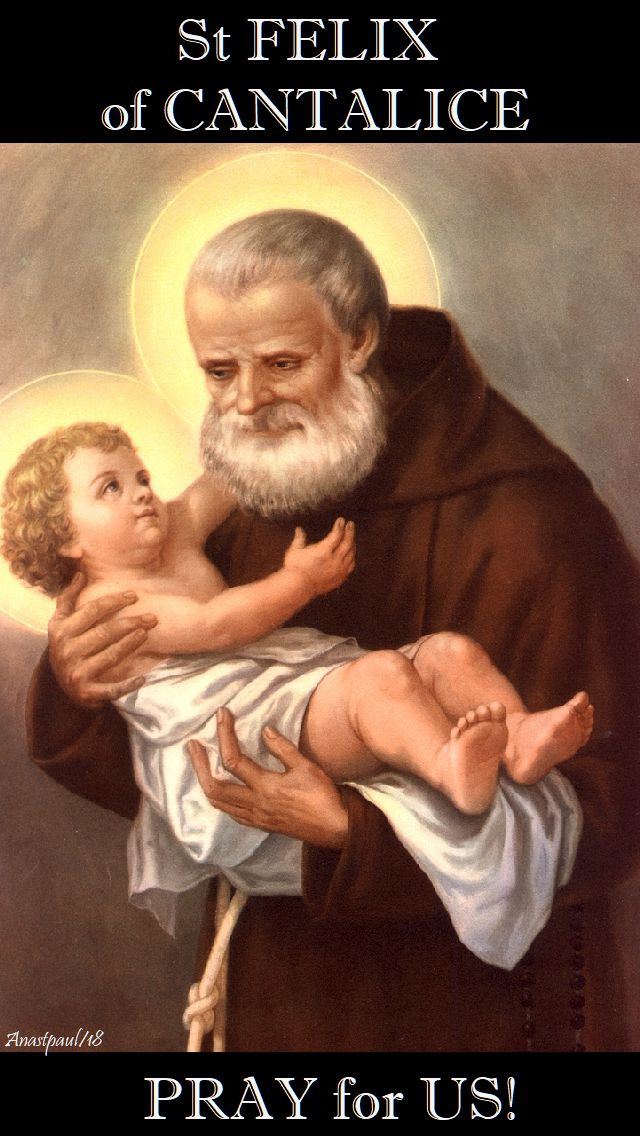
St Felix of Cantalice “Brother Deo Gratias”, Pray for us!st felix of cantalice - pray for us = 18 may 2018

Posted in franciscan OFM, MORNING Prayers, QUOTES of the SAINTS, QUOTES on GRATITUDE, SAINT of the DAY

Quote of the Day – 18 May – Friday of the Seventh Week of Eastertide and the Memorial of St Felix of Cantalice O.F.M. Cap.(1515-1587) “Brother Deo Gratias”

Quote of the Day – 18 May – Friday of the Seventh Week of Eastertide and the Memorial of St Felix of Cantalice O.F.M. Cap.(1515-1587) “Brother Deo Gratias”

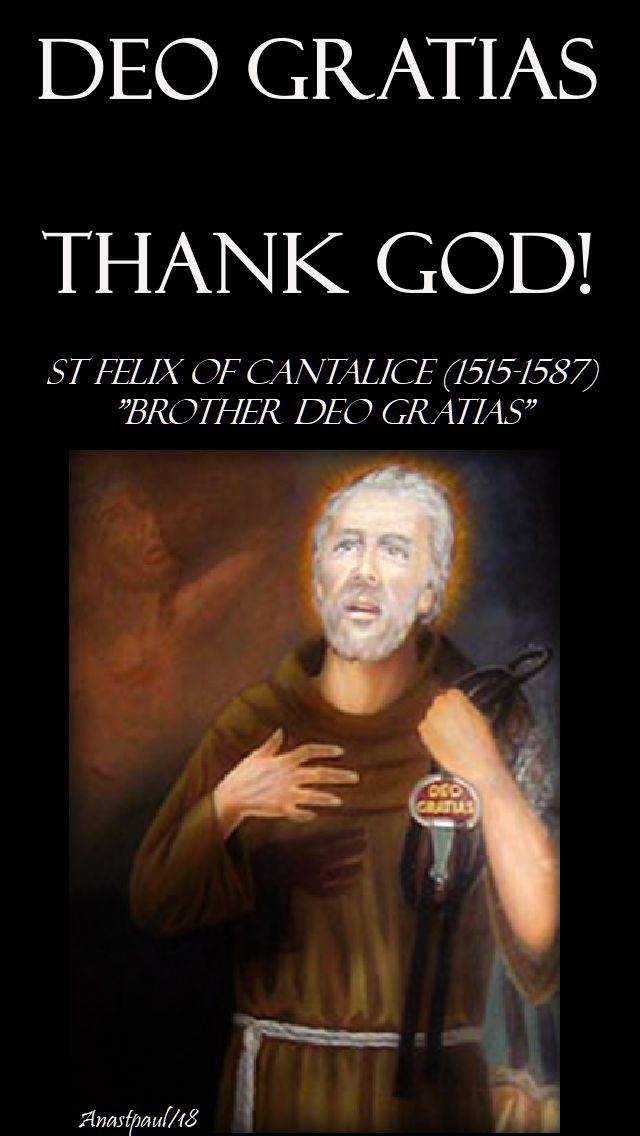
“Deo Gratias”
“Thank God”

St Felix of Cantalice (1515-1587)
“Brother Deo Gratias”

deo gratiasd - thank god - st felix of cantalice brother deo gratias - 18 may 2018

Posted in franciscan OFM, SAINT of the DAY

Saint of the Day – 18 May – St Felix of Cantalice O.F.M. Cap.(1515-1587)

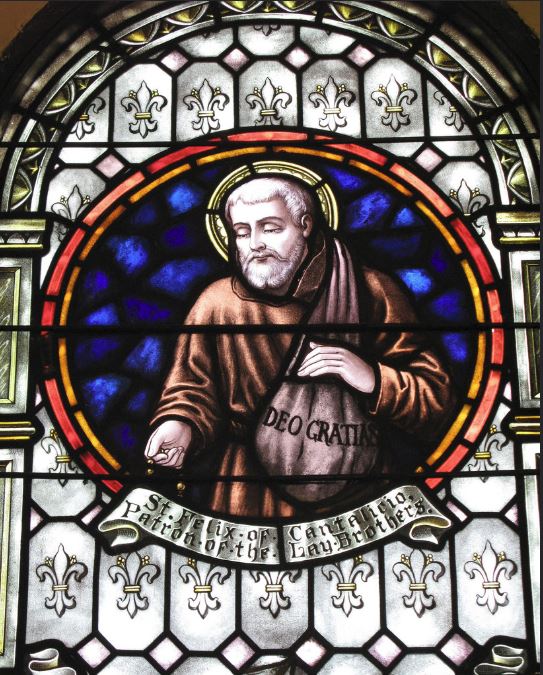
Saint of the Day – 18 May – St Felix of Cantalice O.F.M. Cap.(1515-1587) Capuchin Friar – (the first Capuchin to be Canonised), Confessor, Apostle of Charity, Preacher, Teacher, Writer.   Born on 18 May 1515 at Cantalice, Abruzzi, Italy and died on 18 May 1587 at Rome, Italy of natural causes.   Patronages – Cantalice, Italy, Spello, Italy.   Attributes – Capuchin habit; holding the Baby Jesus, carrying a sack.felixst-felix-of-cantalice-ofmcap-1513-1587-brother-deo-gratias-large

It was in a small village at the foot of Mount Appenine named Cantalice, that Saint Felix was born in 1513 of pious but poor parents, the third of four sons born to Santi and Santa Porri.   It was not long before the little boy, when he approached the other children, was hailed by them:  ‘Here comes Felix, the Saint!’   He showed a predilection for solitary prayer from his earliest youth and as a little shepherd used to retire to a quiet place to kneel there and meditate on the Passion of Jesus.

When he was a little older, he resolved to take the habit of the Capuchin Friars.   The rigour of their rule could not deter him but his obligations could;  he was employed as a labourer, to assist his family.   When his life was spared in an accident, during which two runaway bulls and a trailing plough should have killed him, the man for whom he was working saw the hand of God in his preservation and permitted him to leave, to enter religion.   He was at that time nearly thirty years old but the Superiors, observing his fervour, placed no obstacles.

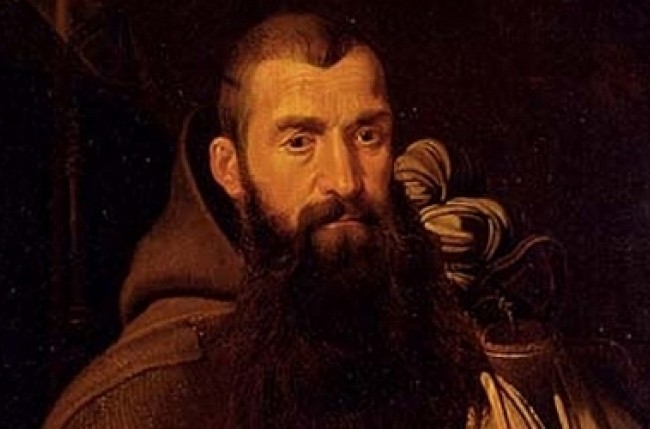
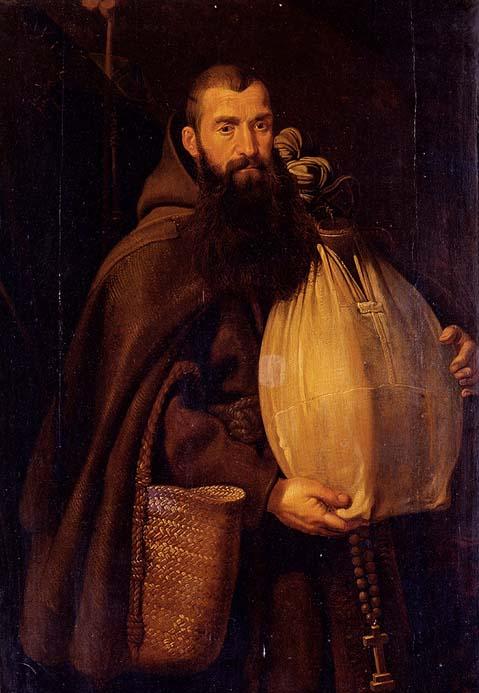
In 1545 he pronounced his vows and was sent to Rome, where for forty years he begged for the community.   His characteristic words to his companion were:  “Let us go, my Brother, with rosary in hand, our eyes to the ground and our spirit in heaven.”   He was of an exquisite politeness, extreme gentleness and great simplicity.   It is said that his begging sack was as bottomless as his heart. Rubens_Felice_da_Cantalice  Brother Felix blessed all benefactors and all those he met with a humble “Deo Gratias!” (thanks be to God!), causing many to refer to him as “Brother Deo Gratias”.   Felix was so successful in his work that during the famine of 1580, the political leader of Rome asked the Capuchins if they would ‘lend’ Felix to them so he could collect food and provisions for the entire city.   The Capuchins agreed and Felix embraced his new task with great success and love.

The sick persons he visited at night became attached to him and for his part, he sought them out everywhere in Rome, insofar as obedience permitted.  He preached in the street, rebuked corrupt politicians and officials and exhorted young men to stop leading dissolute lives. He also composed simple teaching canticles and arranged for children to gather in groups to sing them as a way to teach them the catechism.

One day on the street he met two duelists with sword in hand.   He begged them to repeat after him, Deo gratias! which finally they did and after taking him as arbiter of their quarrel, they separated as good friends.   Saint Felix met Saint Philip Neri (1515-1595 – Memorial 26 May) in Rome and they became friends who wished one another all possible torments for the love of Jesus Christ.   They sometimes remained together without speaking for considerable periods, seemingly transported with joy.   He was also a friend of St Charles Borromeo (1538-1584 – Memorial 4 November).

Saint Felix had a great devotion to the most Blessed Virgin, reciting Her rosary with such tenderness that he could not continue at times.   He loved the Holy Name of Jesus and invited the children he would meet, to say it with him.   He slept only for about two hours, going afterwards to the church to visit the Blessed Sacrament, to be with the Lord and remaining there in prayer until the office of Prime;  then he would serve the first Mass and receive Communion every day.

When he was sick and was given the last Sacraments, he saw the Blessed Virgin and a beautiful troop of Angels coming to fortify him in this last journey.   He cried out in joy and gave up his soul peacefully to his Creator in 1587.   So many attended his funeral that some were injured in the press to get into the church and an extra door had to be knocked through one wall so they could exit.

He was Beatified on 1 October 1625 by Pope Urban VIII and Canonised by Pope Clement XI on 22 May 1712. felix of cantlice - stained glass

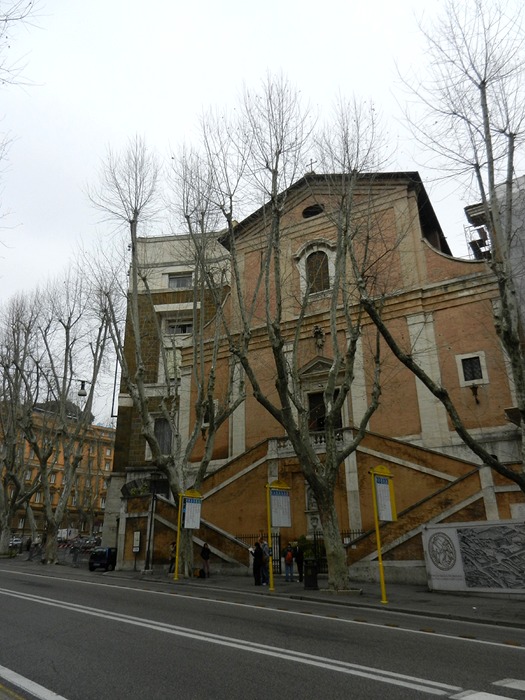
His body is in the Capuchin Church of Rome – the Church of the Immaculate Conception in Rome;  a plenary indulgence is granted to those who, fulfilling the ordinary conditions, visit a church of his Order on his feast day.

1389RomaSMariaConcezione
Santa Maria della Concezione dei Cappuccini
Posted in franciscan OFM, SAINT of the DAY

Memorials of the Saints – 18 May

St Pope John I (Optional Memorial)

Bl Burchard of Beinwil
St Dioscorus of Kynopolis
St Elgiva of Shaftesbury
St Eric of Sweden
St Felix of Cantalice O.F.M. Cap.(1515-1587)

St Felix of Spoleto
St Feredarius of Iona
Bl Jan Oprzadek
St Merililaun
St Ortasio of Alexandria
St Potamon of Heraclea
St Serapione of Alexandria
Bl Stanislaw Kubski
St Venantius of Camerino
Bl William of Toulouse

Martyrs of Ancyra – 8 saints: Seven nuns martyred in the persecutions of Diocletian and the innkeeper who was executed for giving them a Christian burial: Alexandria, Claudia, Euphrasia, Julitta, Matrona, Phaina, Thecusa and Theodatus. c.304 in Ancyra, Galatia (in modern Turkey)

Posted in EUCHARISTIC Adoration, franciscan OFM, MORNING Prayers, ON the SAINTS, SAINT of the DAY, The HOLY EUCHARIST / The HOLY MASS

Thought for the Day – 17 May – Thursday of the Seventh Week of Eastertide and the Memorial of St Paschal Baylon O.F.M. (1540-1592) “Seraph of the Eucharist”

Thought for the Day – 17 May – Thursday of the Seventh Week of Eastertide and the Memorial of St Paschal Baylon O.F.M. (1540-1592) “Seraph of the Eucharist”.

Prayer before the Blessed Sacrament occupied much of Saint Francis of Assisi’s energy.   Most of his letters were to promote devotion to the Eucharist. Paschal shared that concern.

The life of Saint Paschal Baylon is one of simple adoration of the Lord and great devotion to His Mother.   Saint Paschal recognised the importance of spending time before Our Saviour, in contemplation of His passion, love and sacrifice—in the earthly presence of God.   Through his devotion to the Blessed Sacrament, Saint Paschal was graced with wisdom beyond his education and obedience and charity, beyond measure.   His life inspires us to greater communion with the Lord, leading us to His spiritual treasures.
An hour in prayer before our Lord in the Eucharist could teach all of us a great deal.

Go to Jesus in the Most Blessed Sacrament
with bended knee and acknowledge that He is truly present Body, Blood, Soul and Divinity!

Go to Jesus in the Most Blessed Sacrament
with a silent tongue and confess “Jesus in The Most Blessed Sacrament, you are Lord!”

Go to Jesus in the Most Blessed Sacrament
with bowed head and say “lead me, Lord”.

Go to Jesus in The Most Blessed Sacrament
with a humble heart and say “show me how to love as You love, Lord”.

Go to Jesus in The Most Blessed Sacrament
with folded hands and say “take my hands, use them as Your hands Lord”

Go to Jesus in the Most Blessed Sacrament
with a closed mouth and listen to Him whispering to our soul, and responding with “Yes Lord”.

Go to Jesus in the Most Blessed Sacrament
with a meek spirit and say, “Not by my power and my might but by Your power and Your might Lord!”

Go to Jesus in the Most Blessed Sacrament
with a fiat and say, “Not my will but Your will be done Lord!”

St Paschal Baylon, Pray for us!st paschal baylon pray for us

Posted in EUCHARISTIC Adoration, franciscan OFM, MORNING Prayers, QUOTES of the SAINTS, SAINT of the DAY, The HOLY EUCHARIST / The HOLY MASS

Quote/s of the Day – 17 May – Thursday of the Seventh Week of Eastertide and the Memorial of St Paschal Baylon O.F.M. (1540-1592)

Quote/s of the Day – 17 May – Thursday of the Seventh Week of Eastertide and the Memorial of St Paschal Baylon O.F.M. (1540-1592)

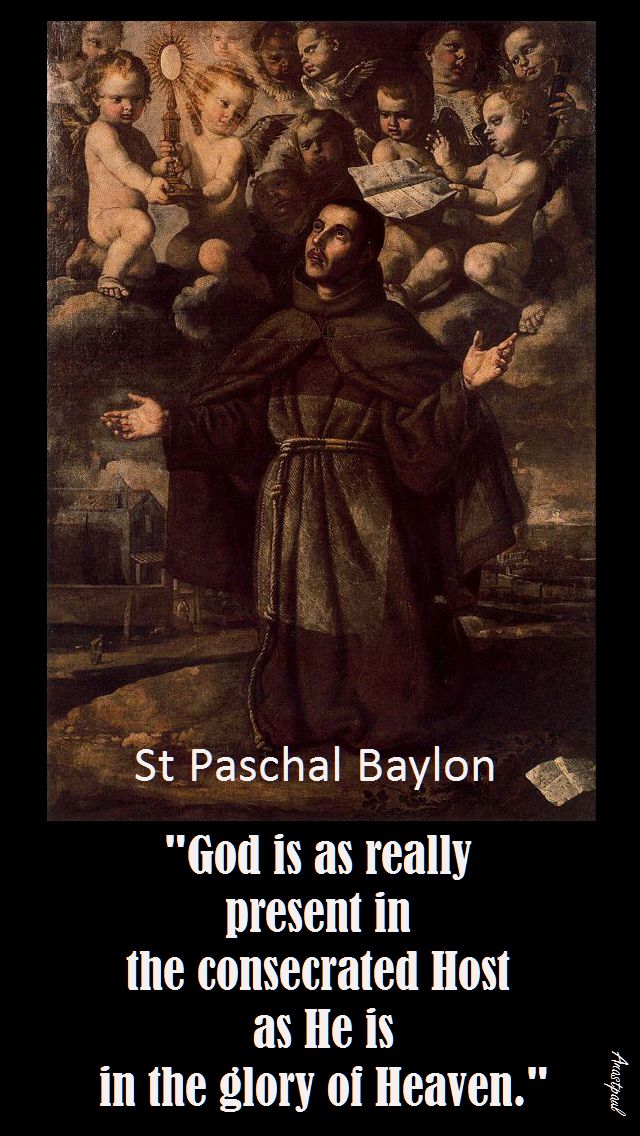
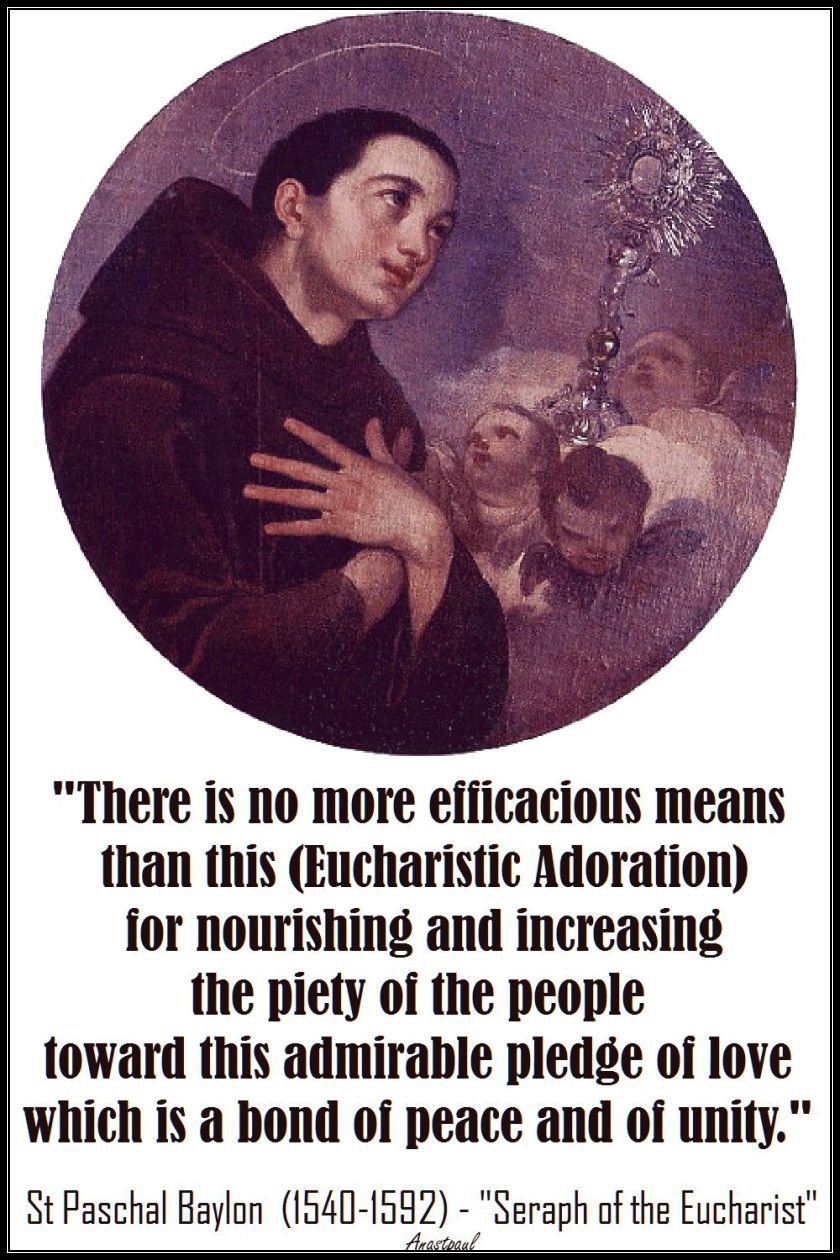
“God is as really present in the consecrated Host as He is in the glory of Heaven”god-is-really-present-st-paschal-baylon-17 may 2017

“There is no more efficacious means than this
(Eucharistic Adoration)
for nourishing and increasing the piety of the people
toward this admirable pledge of love
which is a bond of peace and of unity.

St Paschal Baylon (1540-1592)there-is-no-more-efficacious-means-st-baylon.17 may 2017

Posted in CHEFS and/or BAKERS, CONFECTIONERS, EUCHARISTIC ADORATION and Nocturnal, franciscan OFM, Of BOYS, JUVENILE DELINQUETS, SAINT of the DAY

Saint of the Day – 17 May – St Paschal Baylon OFM (1540-1592) The “Seraph of the Eucharist”

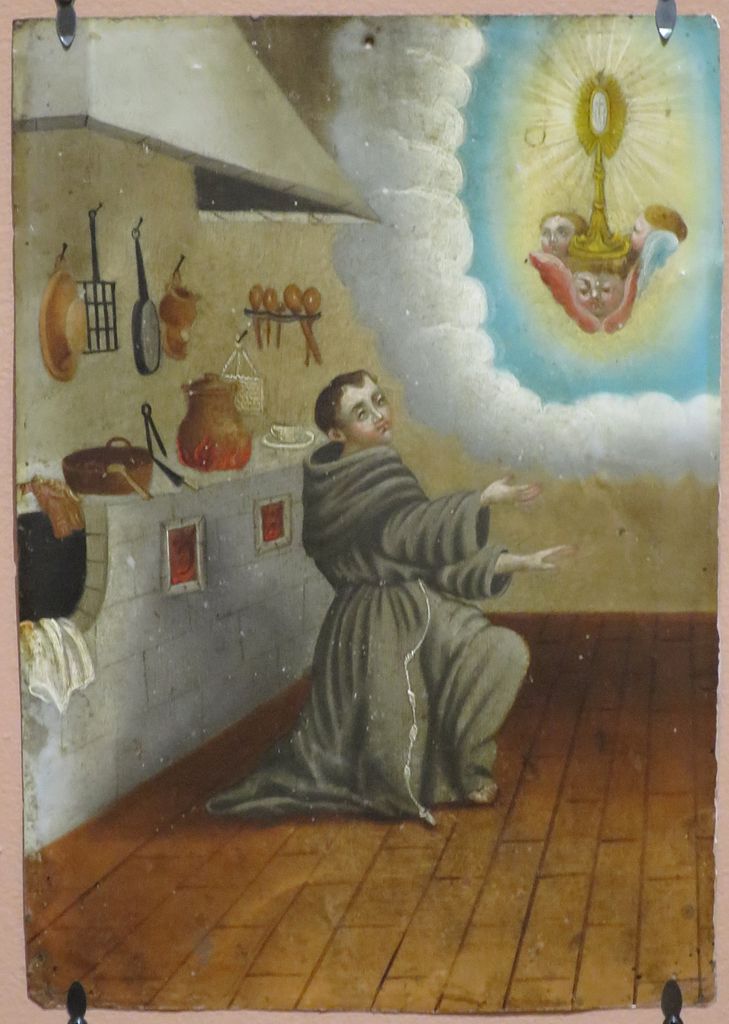
Saint of the Day – 17 May – St Paschal Baylon OFM (1540-1592)  Religious Brother of the  Order of Lay Brothers Minor, Mystic, Contemplative, Apostle of the Eucharist and Mary, Apostle of the Sick and the poor, known as the “Seraph of the Eucharist,” “Saint of the Blessed Sacrament,” “Servant of the Blessed Sacrament.”   St Paschal was born on 24 May 1540 (feast of Pentecost) at Torre Hermosa, Aragon, (modern Spain) and he died on 15 May 1592 (feast of Pentecost) at Villa Reale, Spain of natural causes.   Patronages – cooks, shepherds, Eucharistic congresses and organisations (proclaimed by Pope Leo XIII on 28 November 1897), Shepherds, Male Children and Priesthood Vocation, Eucharistic Adoration, Diocese of Segorbe-Castellón de la Plana, Spain, Obado, Bulacan, Philippines.    Like his holy father of the Franciscans, St Francis of Assisi, St Paschal is best known for his strong and deep devotion to the Eucharist, which manifested in his childhood.'Saint_Paschal_Baylon',_anonymous_Mexican_retablo,_oil_on_tin,_mid_19th_century,_El_Paso_Museum_of_Art

Paschal Baylon 2

In Paschal’s lifetime the Spanish empire in the New World was at the height of its power, though France and England were soon to reduce its influence.   The 16th century has been called the Golden Age of the Church in Spain, for it gave birth to Ignatius of Loyola, Francis Xavier, Teresa of Avila, John of the Cross, Peter of Alcantara, Francis Solano, Salvator of Horta, St John of Avila and many others.

Paschal’s Spanish parents were poor and pious.   Between the ages of seven and 24 he worked as a shepherd and began a life of mortification.   He was able to pray on the job and was especially attentive to the church bell, which rang at the Elevation during Mass. Paschal had a very honest streak in him.   He once offered to pay owners of crops for any damage his animals caused!

In 1564, Paschal joined the Friars Minor and gave himself wholeheartedly to a life of penance.   Though he was urged to study for the priesthood, he chose to be a brother.   At various times he served as porter, cook, gardener and official beggar.Espinosa_San_Pascual_Baylon_XVIIst paschal baylon

Paschal was careful to observe the vow of poverty.  He would never waste any food or anything given for the use of the friars.   When he was porter and took care of the poor coming to the door, he developed a reputation for great generosity.   The friars sometimes tried to moderate his liberality!

Paschal spent his spare moments praying before the Blessed Sacrament.   In time, many people sought his wise counsel.    It was Jesus in the Blessed Sacrament, that gave St Paschal great wisdom.   He was hardly able to read and write but he was able to hold intelligent conversations with learned doctors in theology.   Some of the theologians felt that Paschal was inspired by God.   The priests of the monastery used to ask his advice about preaching.   When the saint spoke about the Birth of Jesus and the Last Supper, it was as though he had been present at these events. st paschal baylon and the eucharist

On Whit-Sunday, in 1592, St Paschal turned fifty-two years old.   He knew that death was near and tried to put his habit on but being very weak he fell to the floor.   Just then, a Brother entered. He placed the habit on Paschal and put him in bed.

During this time the monks told Paschal that Mass had started and his heart was filled with joy.   As the monastery bell was ringing for the Elevation of the Host, the dying saint said, “Jesus, Jesus,” and then breathed his last.   The news of his death spread like fire over the whole country.

On the day of St Paschal’s funeral Mass, a wonderful miracle took place.   Paschal opened his eyes from the coffin and looked at the Host and the Chalice during the elevation of the Mass  – He adored God publicly, even though he was dead.

Perhaps the most amazing thing about St Paschal, are the strange happenings known as the “Knocks of St Paschal.”   At first, the knocks came from Paschal’s tomb.   Later they came from relics and pictures of the saint.   Sometimes the knocks have come as a kind of warning, to let people know that a terrible event was about to take place.   It is also said that in Spain and Italy, those who are devoted to St Paschal, are warned about their death, days before, so that they may have a chance to receive the Last Sacraments.

People flocked to his tomb immediately after his burial; miracles were reported promptly.   Paschal was Canonised in 1690 and was named patron of Eucharistic congresses and societies in 1897.

More on St Paschal here:  https://anastpaul.com/2017/05/17/saint-of-the-day-17-may-st-paschal-baylon/

787px-Giovanni_Battista_Tiepolo_-_Saint_Pascal_Baylon_-_no 2. Google_Art_Project

Posted in franciscan OFM, SAINT of the DAY

Memorials of the Saints – 17 May

St Adrione of Alexandria
Bl Antonia Messina
Bl Bernard of Verdun
St Cathan of Bute
St Fionnchan of Druim-Eanaigh
St Giulia Salzano
St Heraclius of Noviodunum
Bl Ivan Ziatyk
St Madron of Cornwall
St Maildulf of Malmesbury
St Maw
St Paschal Baylon O.F.M. (1540-1592)

St Paul of Noviodunum
St Peter Lieou
St Rasso of Grafrath
St Restituta of Carthage
St Silaus of Lucca
St Solochanus of Chalcedon
St Thethmar
St Victor Roma

Martyrs of Alexandria – 3 saints: Three Christians martyred together; no details about them have survived except their names: Adrio, Basilla and Victor. 4th century Alexandria, Egypt.

Martyrs of Nyon: A group of Christians martyred together in the persecutions of Diocletian. We know little more than three of their names: Aquilinus, Heradius and Paul. 303 at Noyon, Switzerland.

Posted in franciscan OFM, SAINT of the DAY

Saint of the Day – 11 May – St Ignatius of Laconi O.F.M. Cap. (1701-1781)

Saint of the Day – 11 May – St Ignatius of Laconi O.F.M. Cap. (1701-1781) Franciscan of the Order of Friars Minor Capuchin born as Vincenzo Peis on 17 December 1701 at Laconi, Nuoro, Italy and died on 11 May 1781 in Cagliari, Italy of natural causes.  Known as  “the Holy Friar,” “the Apostle of the Streets, “ “the Wonder-worker”,  “the Miracle-Worker” and “Padre Santo.”   His conquering a serious illness prompted him to consecrate his life to God and therefore entered the religious life though not as an ordained priest.   Peis was better known in Sardinia for his humble demeanour coupled with his concern for those who were poor.   He mingled with all people he met and was generous towards those who were ill.   But he became known as something of a wonder worker during his life and he had performed 121 miracles during his life. Patronages-Oristano, Students, Beggars.St Ignatius of Laconi

Vincenzo Peis was born on 10 December 1701 in Sardinia as one of seven children to the poor peasants Mattia Peis Cadello and Anna Maria Sanna Casu.   He was baptised as “Francesco Ignazio Vincenzo” since he was born out of a difficult pregnancy in which her mother invoked the intercession of Saint Francis of Assisi.

Ignatius worked on the fields to support his parents.   He suffered a serious illness circa 1719 (aged seventeen) that made him vow that he would consecrate himself to God and join the Order of Friars Minor Capuchin if he managed to recover from it.   He did so recover but put off the fulfilment of his vow after his father convinced him to wait;  his father was anxious about it because he depended on Ignatius for support in the fields. But there seems to be some indication that his parents objected to his entering the order. In 1721 he was in danger once more when the horse he was riding panicked.   He could have been thrown off but he called upon the assistance of Saint Francis of Assisi and renewed the vow he had made during his illness.   This time his parents did not raise objections to his becoming a friar and granted him their blessing.   In his childhood he often called the local church his “home” and took St Lawrence of Brindisi (1559-1619) as his personal role model.

He asked for admission at the convent in Cagliari but the superiors there hesitated because of his delicate health.   He then called upon an influential friend who interceded for him and he was allowed to be received into the novitiate on 10 November 1721. Ignatius made his profession on 10 November 1722.    Despite his infirmities his ardour allowed him to attend the spiritual exercises of the order and to excel in perfection of his observance of the order’s Rule.   From 1722 until 1737 he worked at the house’s weaving shed and from 1737 onwards was an alms beggar.

Ignatius spent his time in a number of different occupations and was later appointed as the quester of alms due to his humble and modest conduct.   He had good relations with the people in Cagliari who realised that although he was begging alms, he was also giving back to them in a spiritual manner.   His modest demeanour was seen as a quiet sermon for all who saw him going about which made him a noted figure.,, He seldom spoke; when required he spoke with exceptional kindness and great affection.   He would also instruct the children and the uneducated that he came across as well as going out to comfort the sick and urging sinners to be converted and to do penance.

There is a legend that he was known for his strict and total obedience to his superiors even when it required the denial of his own will.   He was accustomed to go to the house of an usurer because he feared that in accepting an alms from him he would share the guilt of this man’s injustices.   But when the man complained and the superior commanded him he accepted alms from the man.   It was when he returned that he opened the sack that the usurer offered and blood started to flow out.   To those around him the saint said:  “This is the blood of the poor squeezed from them by usury”.

His sister had often written to him asking him to visit her so that she could get his advice in certain matters.   Brother Ignatius had no mind to heed her request but when his superior ordered him to do so he at once undertook the visit.   But he left again as soon as he had given the required advice.   His brother was sent to prison and it was hoped that – in view of reputation of Brother Ignatius – the latter could obtain his brother’s release.   His superior sent him to speak to the governor but he asked that his brother be dealt with according to justice.

Despite his poor health and other infirmities he continued on in his work no matter how arduous it seemed.   Even after he became blind in 1779, he continued to work on for the benefit of those around him. Ignatius died on 11 May 1781 at 3:00pm in Cagliari where his remains were interred.

St Ignatius’ grave soon became a place in which miracles flourished and this was one dimension towards the opening of his cause for canonisation.   He was beatified on 16 June 1940 and was Canonised on 21 October 1951 by Pope Pius XII.   St Ignatius of Laconi WITH MARY

Posted in franciscan OFM, SAINT of the DAY

Memorials of the Saints – 11 May

St Anastasius of Lérida
St Anthimus of Rome
St Bassus of Sabina
St Bertilla
St Criotan of MacReddin
Bl Diego of Saldaña
St Evellius of Pisa
St Fabius of Sabina
St Francis of Girolamo
St Fremund of Dunstable
St Gengulphus of Burgundy
St Gjon Koda
St Gualberto
St Ignatius of Laconi (1701-1781)

Bl Illuminatus
St Illuminatus of San Severino
Bl James Walworth
Bl John Rochester
St Maiulo of Hadrumetum
St Majolus of Cluny
St Mamertus of Vienne
St Maximus of Sabina
St Mayeul
St Mozio of Constantinople
St Possessor of Verdun
St Principia of Rome
St Tudy
St Vincent L’Hénoret
Bl Vivaldus
St Walbert of Hainault

Martyrs of Camerino: An imperial Roman official, his wife, their children and servants, all of whom were converts and martyrs: Anastasius, Aradius, Callisto, Eufemia, Evodius, Felice, Primitiva, Theopista.

Posted in franciscan OFM, MORNING Prayers, QUOTES - J R R Tolkien and MORE, The GOOD SHEPHERD

Quote/s of the Day – 22 April – The Fourth Sunday of Easter Year B – “Good Shepherd/Vocations Sunday”

Quote/s of the Day – 22 April – The Fourth Sunday of Easter Year B – “Good Shepherd/Vocations Sunday” – Todays Readings: Acts 4:8-12, Psalm 118:1, 8-9, 21-23, 26, 28-29, 1 John 3:1-2, John 10:11-18

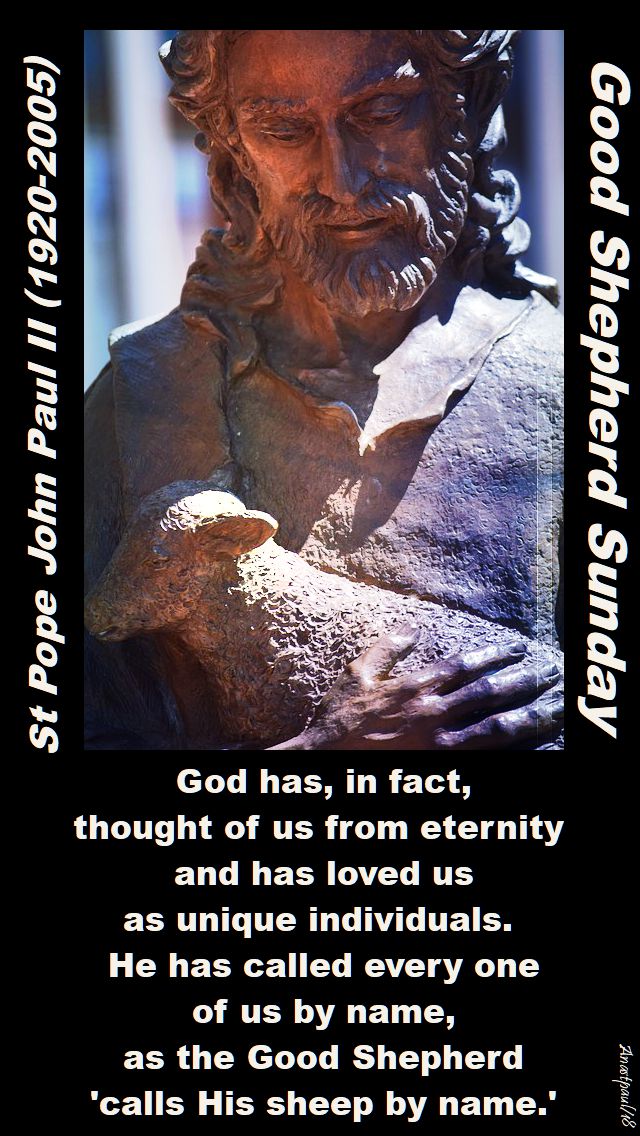
“God has, in fact, thought of us from eternity
and has loved us as unique individuals.
He has called every one of us by name,
as the Good Shepherd ‘calls His sheep by name.'”

St Pope John Paul II (1920-2005)god has in fact thought of us from eternity - 22 april 2018 - good shepherd sunday - st pope john paul

“What Jesus wants to say with these images is clear.
He knows His disciples (and, as God, all men),
He knows them “by name,” which, for the Bible,
means their innermost essence.
He loves them with a personal love
that treats each as if, they were the only one
who existed for Him.
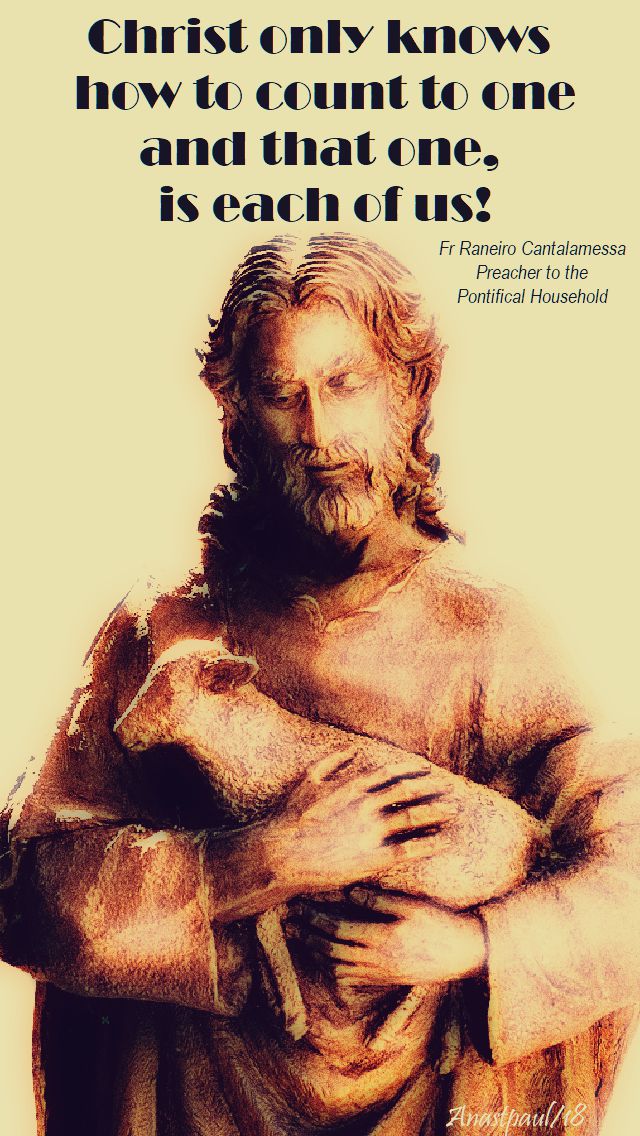
Christ only knows how to count to one
and that one, is each of us.”

Fr Raneiro Cantalamessa OFM CAP
Preacher to the Pontifical Householdchrist only knows how to count to one - fr raneriro cantalamessa - 22 april 2018 - vocations good shepherd sunday-no 2

Posted in franciscan OFM, MORNING Prayers, QUOTES of the SAINTS, QUOTES on CHARITY, QUOTES on FASTING, QUOTES on LOVE, QUOTES on OBEDIENCE, QUOTES on PEACE, QUOTES on PRAYER, QUOTES on SANCTITY, QUOTES on TEMPTATION, SAINT of the DAY, The BLESSED VIRGIN MARY

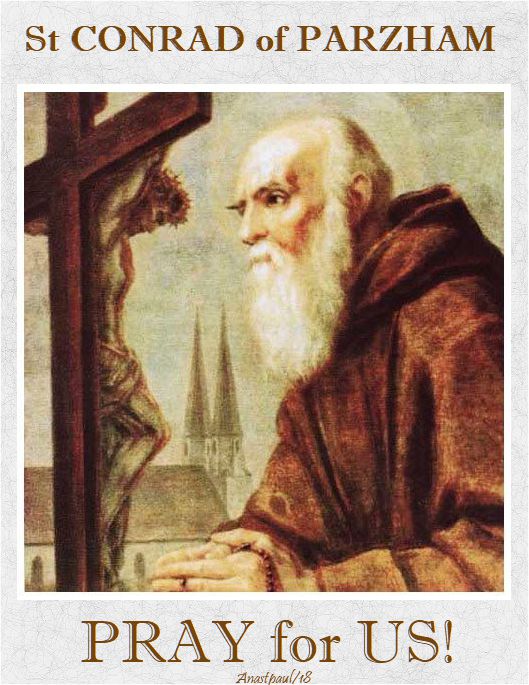
Thought for the Day -21 April – Saturday of the Third Week of Eastertide and the Memorial of St Conrad of Parzham OFM Cap. (1818-1894)

Thought for the Day -21 April – Saturday of the Third Week of Eastertide and the Memorial of St Conrad of Parzham OFM Cap. (1818-1894)

Resolutions of St Conrad whilst a Novice

1. I resolve in the first place to remain continually
in the presence of God
and to ask myself frequently if I would do this or that,
if my confessor or superior were watching me
and especially if God and my guardian angel were present.

2. I resolve to ask myself, whenever I have to encounter crosses of suffering,
“Conrad, why have you come here?”

3. I resolve to avoid leaving the friary, as far as possible,
unless it be out of love for my neighbour, obedience, reasons of health,
a pious pilgrimage or some other good cause.

4. I resolve to foster fraternal charity in myself and in others.
Therefore, I resolve to take care never to say an unkind word.
I resolve to bear up patiently with the defects and weaknesses of others
and as far as possible, to hide them, with the mantle of charity,
unless I am in duty bound, to manifest them, to someone,
who is in a position to correct them.

5. I resolve to observe silence conscientiously.
I resolve to speak briefly and so avoid many pitfalls
and be better able to converse with God.

6. When at table I resolve to place myself in the presence of God,
as far as I can, to remain recollected and to pass up my favorite dishes
so as to practice a hidden form of mortification.
I resolve not to eat between meals, unless ordered to do so,
under obedience.

7. I resolve to answer the first call of the bell unless legitimately hindered.

8. I resolve to avoid, as far as possible, conversing with the opposite sex
unless obedience imposes duties on me which make it necessary to speak with women.
In that case I resolve to be very reserved and maintain custody of the eyes.

9. I resolve to carry out orders punctually and to the letter.
I resolve especially to make every effort to conquer my own will in all things.

10. I resolve to force myself to pay close attention to minor details
and as far as possible avoid every imperfection.
I resolve to observe the holy rule faithfully
and not to depart from it a hairsbreadth, come what may.

11. I resolve to cultivate a deep devotion to the Blessed Virgin Mary
and strive to imitate her virtues.

St Conrad of Parzham (1818-1894)

Pray for us!st conrad of parzham - pray for us no 2, - 21 april 2018


Posted in franciscan OFM, MORNING Prayers, QUOTES of the SAINTS, SAINT of the DAY, The WORD

One Minute Reflection – – 21 April – Saturday of the Third Week of Eastertide and the Memorial of St Conrad of Parzham (1818-1894)

One Minute Reflection – 21 April – Saturday of the Third Week of Eastertide and the Memorial of St Conrad of Parzham (1818-1894)   Today’s Readings: Acts 9:31-42, Psalm 116:12-17, John 6:60-69

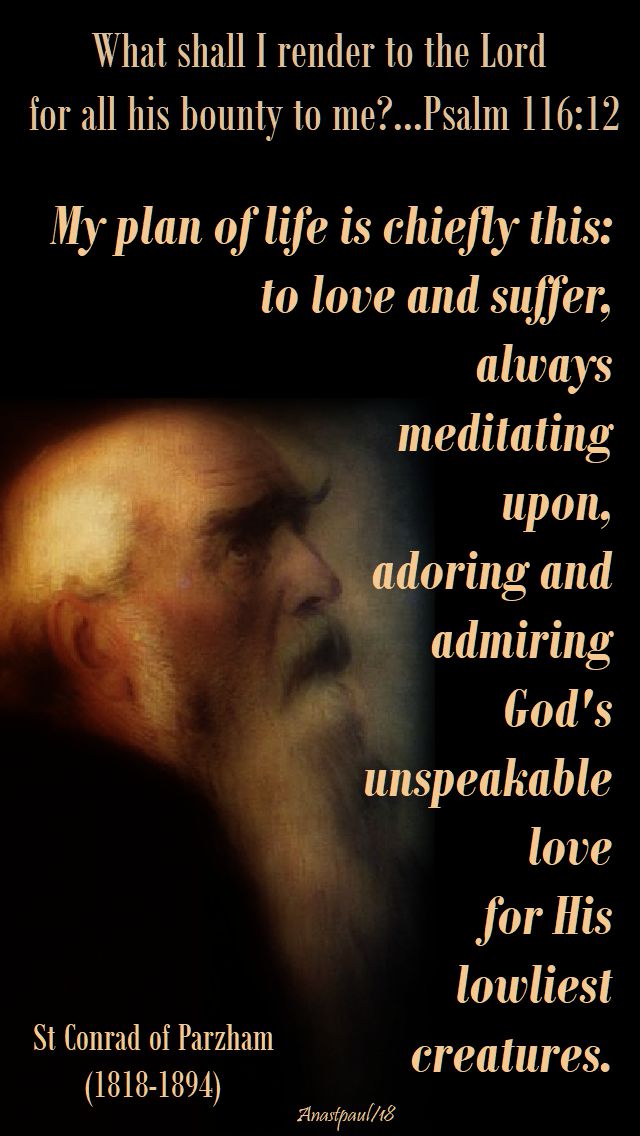
What shall I render to the Lord for all his bounty to me?…Psalm 116:12

REFLECTION – “It was God’s will that I should leave everything that was near and dear to me.   I thank Him for having called me to religious life where I have found such peace and joy as I could never have found in the world.   My plan of life is chiefly this: to love and suffer, always meditating upon, adoring and admiring God’s unspeakable love for His lowliest creatures.” – St Conrad of Parzham (1818-1894) (from a letter of Saint Conrad)my plan of life is chiefly this - st conrad of parzham - 21 april 2018

PRAYER – Lord God, our Father, in You is our hope and our life.   You have made us and be belong to You.   Give us Your grace and Your help to constantly render to You, our love and gratitude and to suffer for that great love, by which You sent your only Son to save us.   St Conrad, pray for us that we may grow in holiness and soon meet you in heaven, amen.

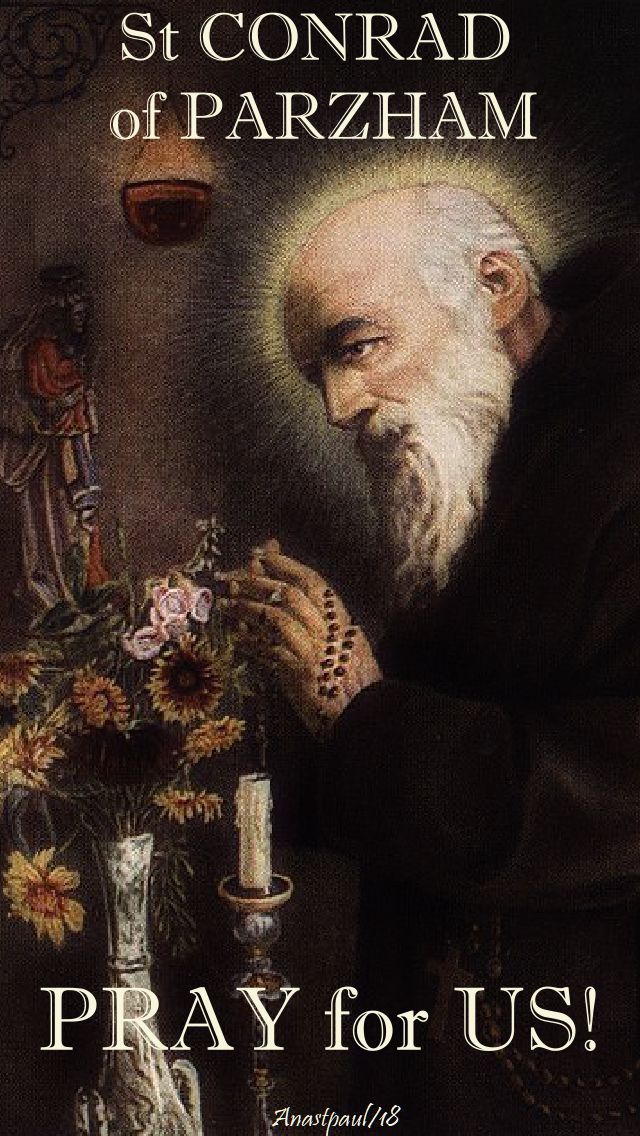
st conrad of parzham - pray for us - 21 april 2018

Posted in franciscan OFM, SAINT of the DAY

Saint of the Day – 21 April – St Conrad of Parzham OFM Cap (1818-1894)

st conrad - large

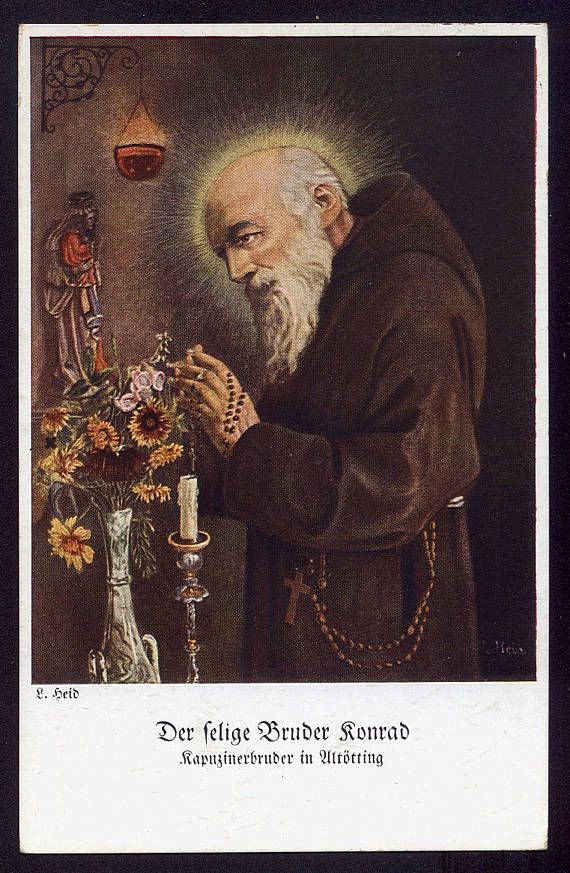
Saint of the Day – 21 April – St Conrad of Parzham OFM Cap (1818-1894) – Franciscan Religious Lay Friar, Blessed Sacrament and Marian devotee, Apostle of Charity, Miracle worker with the charism of prophecy – born on 22 December 1818 at Parzham, Bavaria, Germany as Johann Birndorfer and died on 21 April 1894 in Altötting, Bavaria, Germany of natural causes.  He served for over 40 years in the post of porter of the Capuchin friary in Altötting, through which work he gained a widespread reputation for his wisdom, holiness and charity.   Patronages – Capuchin-Franciscan Province of Mid-America, Catholic Student Association, doorkeepers, Passau, Germany, diocese of (since 1984).

St Conrad of Parzham was born in Bavaria, Germany on 22 December 1818.   He was the ninth son of a poor farming family.   From his early years he gave evident signs of a deep interior life, preferring places of solitude where he could be alone with God.   Despite the great distance from the nearest Church, Conrad walked frequently through rain and snow to attend the holy Mass.   He had a great devotion to Our Lady and prayed the Rosary daily.

konrad_parzham

Conrad remained on the farm without much thought of the future.   His mother died when he was only 14.   At age 31, with the passing of his father, Conrad decided to follow his heart and become a Capuchin Franciscan.   After giving away his possessions he was admitted to the novitiate as a lay brother and received the religious name Conrad (his Baptismal name was John).   Immediately after his profession he was sent to the friary of St Ann, in the city of Altötting.   The friary served the Shrine of Our Lady of Altötting, the National Shrine of Bavaria to the Blessed Mother.

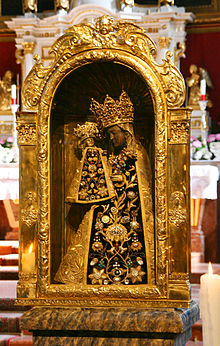
220px-Gnadenbild,_Gnadenkapelle_Altötting
Our Lady of Altötting

Conrad was given the position of porter at this shrine and retained it until his death.  Because it was a large and busy city, the duty of the friary porter was a very difficult one. Conrad was known to be diligent at his work, sparing in words, bountiful to the poor, eager and ready to receive and help strangers.   Brother Conrad fulfilled the task of porter for more than forty years, assisting the inhabitants of the town in their needs of body and soul.

Conrad loved silence!   As mentioned, he sought places of solitude as a child in order to raise his thoughts to God.   During his spare moments as a porter, he would duck into a nook near the door where it was possible to see the Blessed Sacrament in the nearby chapel.   During the night, he often deprived himself of hours of sleep in order to be alone with Jesus in the chapel.   It was generally believed that he never took any rest but continually occupied himself in work and exercises of devotion.   Conrad also continued his childhood devotion to Our Lady, deepening his love for the Mother of God with every year of his religious life.   These were his great secrets to sanctity:  Silence, the Blessed Sacrament and Mary, Queen of the Friars Minor.

During his lifetime, Brother Conrad was reputed to have been able to read the hearts of those he met and was attributed the gift of prophecy.   His heroic virtues and the miracles he performed won for him the distinction to be ranked among the Blessed by Pope Pius XI in 1930.   Four years later, the same pope, approving additional miracles which had been performed, solemnly inscribed his name in the list of saints.

800px-Reliquienschrein_Heiliger_Konrad_von_Parzham
Posted in EUCHARISTIC Adoration, franciscan OFM, MORNING Prayers, QUOTES of the SAINTS, SAINT of the DAY, The HOLY EUCHARIST / The HOLY MASS, The WORD

One Minute Reflection – Tuesday of the Third Week of Eastertide – Today’s Gospel: John 6:30–35 & the memorial of Bl Andrés Hibernón Real O.F.M. (1534-1602)

One Minute Reflection – Tuesday of the Third Week of Eastertide – Today’s Gospel: John 6:30–35 & the memorial of Bl Andrés Hibernón Real O.F.M. (1534-1602)

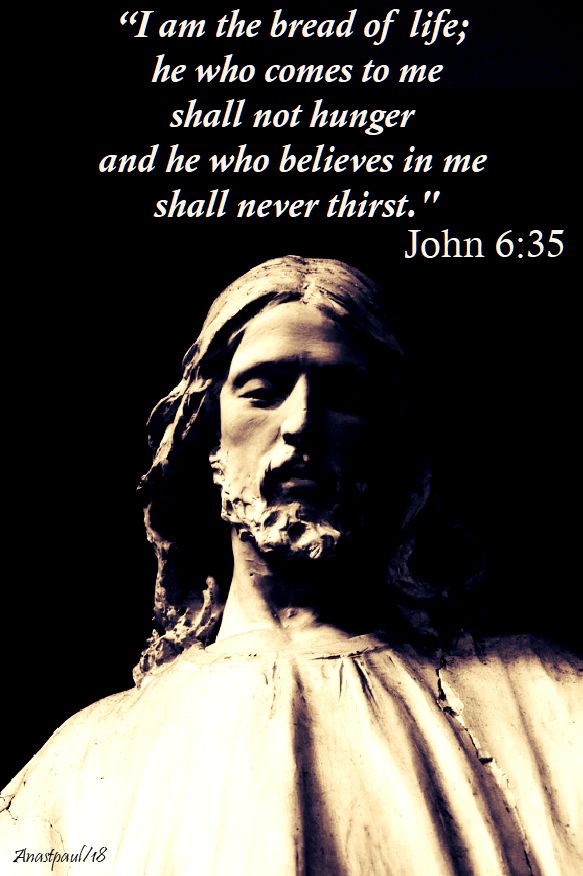
Jesus said to them, “I am the bread of life;  he who comes to me shall not hunger and he who believes in me shall never thirst…John 6:35i am the bread of life - john 6 35. - 17 april 2018

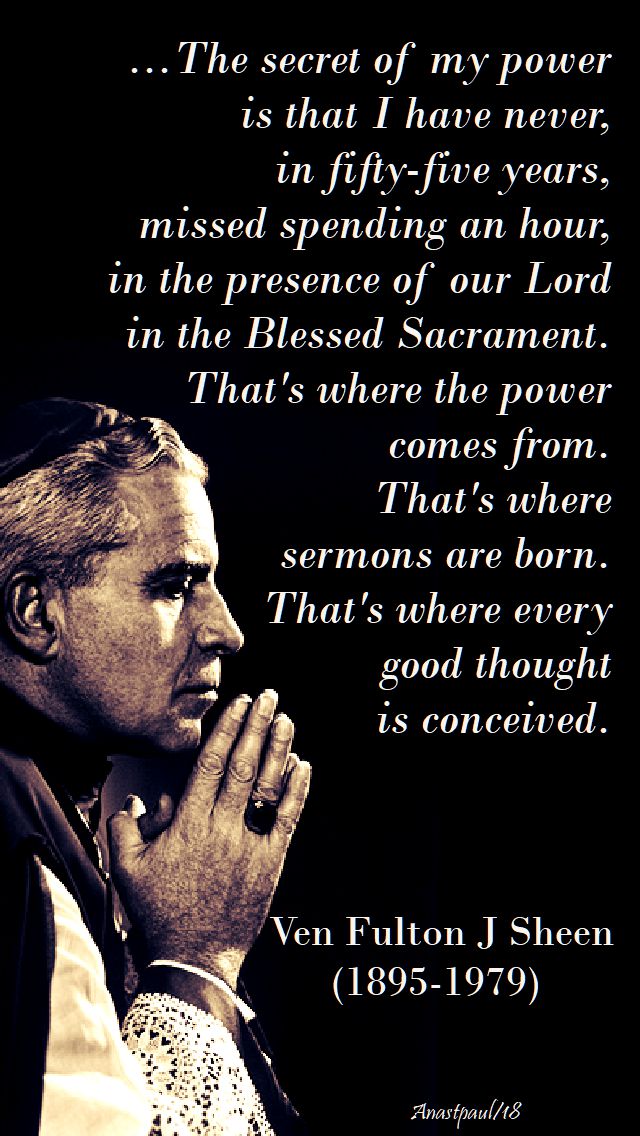
REFLECTION – “When I stand up to talk, people listen to me;  they will follow what I have to say.   Is it any power of mine?   Of course not.   St Paul says, ‘What have you that you have not received and you who have received, why do you glory as if you had not?’  But the secret of my power is that I have never, in fifty-five years, missed spending an hour in the presence of our Lord, in the Blessed Sacrament.   That’s where the power comes from.  That’s where sermons are born.  That’s where every good thought is conceived.” …Venerable Archbishop Fulton J Sheen (1895-1979)the secret of my power - ven fulton j sheen - 17 april 2018

PRAYER – Lord Jesus, present for me in the Holy Eucharist, everyday, everywhere. Lord Jesus, the life of my soul, the food of my life, the quenching of my thirst.   Let me love You in the Holy Eucharist.   May Your Sacred Heart become my heart.   Blessed Andrés Hibernón Real, you who loved to spend time with the Lord, who never missed a day being with Him, please pray for us, amen.bl andres hibernon real - pray for us - 17 april 2018

Posted in EASTER, franciscan OFM, MORNING Prayers, PRAYERS of the SAINTS

Our Morning Offering – Tuesday of the Third Week of Eastertide

Our Morning Offering – Tuesday of the Third Week of Eastertide

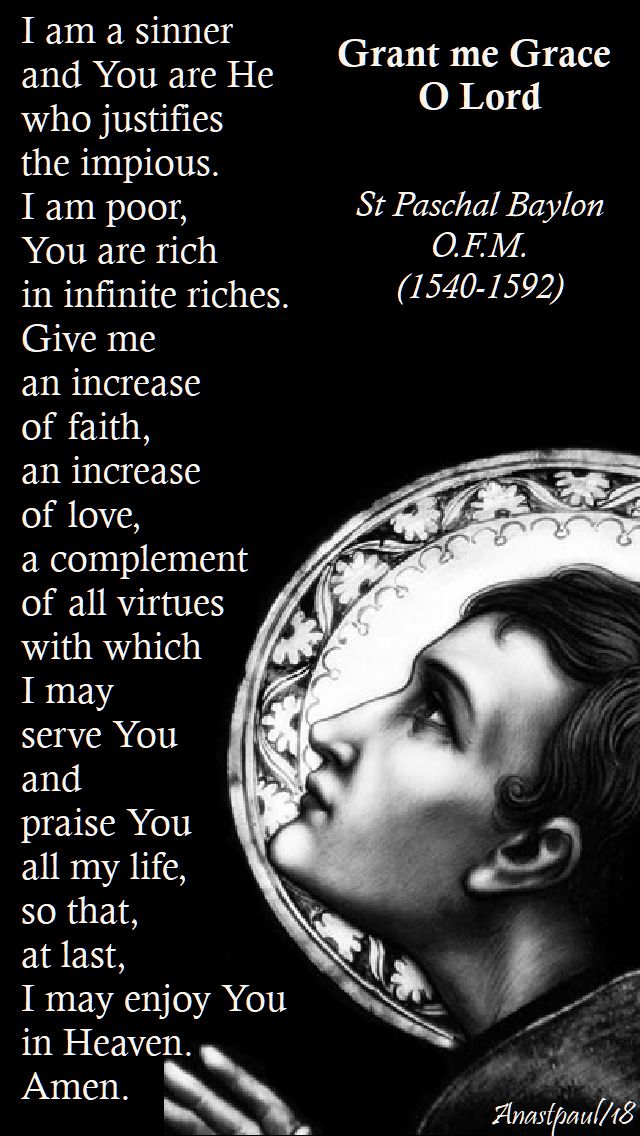
Grant me Grace O Lord
By St Paschal Baylon O.F.M. (1540-1592)

I am a sinner
and You are He
who justifies the impious.
I am poor,
You are rich in infinite riches.
Give me an increase of faith,
an increase of love,
a complement of all virtues
with which I may serve You
and praise You
all my life so that, at last,
I may enjoy You in Heaven.
Amengrant me grace o lord - st paschal baylon - 17 april 2018


Posted in franciscan OFM, INCORRUPTIBLES, SAINT of the DAY

Saint of the Day – 17 April – Blessed Andrés Hibernón Real O.F.M. (1534-1602)

Saint of the Day – 17 April – Blessed Andrés Hibernón Real O.F.M. (1534-1602) Religious Friar, Apostle of the Holy Eucharist, the Blessed Virgin and the Holy Rosary, Apostle of the poor.   Patronages –  Alcantarilla, Spain (chosen in May 1950), Murcia, Spain.   He was born in 1534 in Murcia, Spain.   He predicted the date of his death four years before the fact, which was 18 April 1602 in Gandia, Valencia, Spain of natural causes immediately after having prayed a rosary.   His body is incorrupt.duoandres

Andrés Hibernón Real was born in Murcia in 1534, he came from an old noble house that was reduced to the state of poorness due to a range of adverse circumstance.    His uncle in Valencia, assumed charge of his initial education, in order to relieve his parents.   He was baptised in the Murcia Cathedral where an uncle of his was a chaplain.

In his late childhood and into his adolescence he endeavoured to earn funds that would support his parents and siblings.   He saved a considerable amount on one occasion to provide for his sister’s impending marriage and so left where he was to travel back home to Murcia.   En route home a group of thieves attacked him and stripped him of all he had.   Hibernón interpreted this as a sign of how much he depended on material goods and so resolved to labour for the remainder of his life for goods not of this world.

In Albacete in 1556 he begged to be admitted into a convent of the Order of Friars Minor and so was admitted into it on 1 November 1557 where he commenced his period of novitiate and received the habit.220px-andres_hibernon

He frequented Marian shrines and often spent hours on end kneeling in silent and deep meditation before the tabernacle that housed the Eucharist.   He fostered an ardent devotion to the poor and the ill and often accompanied priests to visit ill people.   In February 1563 he relocated to the Alcantarine Franciscan reform convent of San José in Elche and in 1564 attended the vesting of the habit of Saint Paschal Baylon (1540-1592). He remained there until 1574 save for a short duration of time in Villena.   In 1574 his superiors sent him to undertake the establishment of a convent in Valencia where he made friends with the Archbishop of Valencia, Saint Juan de Ribera (1532-1611).

He died on 18 April 1602 – he had foretold that exact date of his death in 1598.   He died as he completed reciting the rosary.   His incorrupt remains are now housed in the Murcia Cathedral – though some are in Alcantarilla – after being relocated from Gandia in 1936 due to the Spanish Civil War.   He was Beatified on 22 May 1791 by Pope Pius VI at Saint Peter’s Basilica, Rome, Papal States (modern Italy) (cultus confirmation).

Murcia_Catedral5_tango7174
Murcia Cathedral

Posted in franciscan OFM, SAINT of the DAY

Memorials of the Saints – 18 April

Bl Andrés Hibernón Real O.F.M. (1534-1602)
St Agia of Hainault
St Anthia of Illyria
St Athanasia of Aegina
St Bitheus
St Calocerus of Brescia
St Cogitosus
St Corebus
St Eleuterius of Illyria
St Elpidius of Melitene
St Eusebius of Fano
St Galdinus of Milan
St Gebuinus of Lyons
St Genocus
St Hermogenes of Melitene
Bl Idesbald of Dunes
Bl James Oldo
Bl Joseph Moreau
St Laserian of Leighlin
Bl Louis Leroy
Bl Luca Passi
Bl Marie of the Incarnation
St Perfecto of Córdoba
St Pusicio
Bl Roman Archutowski
Bl Savina Petrilli
St Ursmar of Lobbes
St Wigbert of Augsburg

Posted in franciscan OFM, MORNING Prayers, PRAYERS of the SAINTS, SAINT of the DAY

Our Morning Offering – 14 April – Saturday of the Second Week of Eastertide and the Memorial of Bl Lucien Botovasoa O.F.S. (1908-1947) Martyr

Our Morning Offering – 14 April – Saturday of the Second Week of Eastertide and the Memorial of Bl Lucien Botovasoa O.F.S. (1908-1947) Martyr

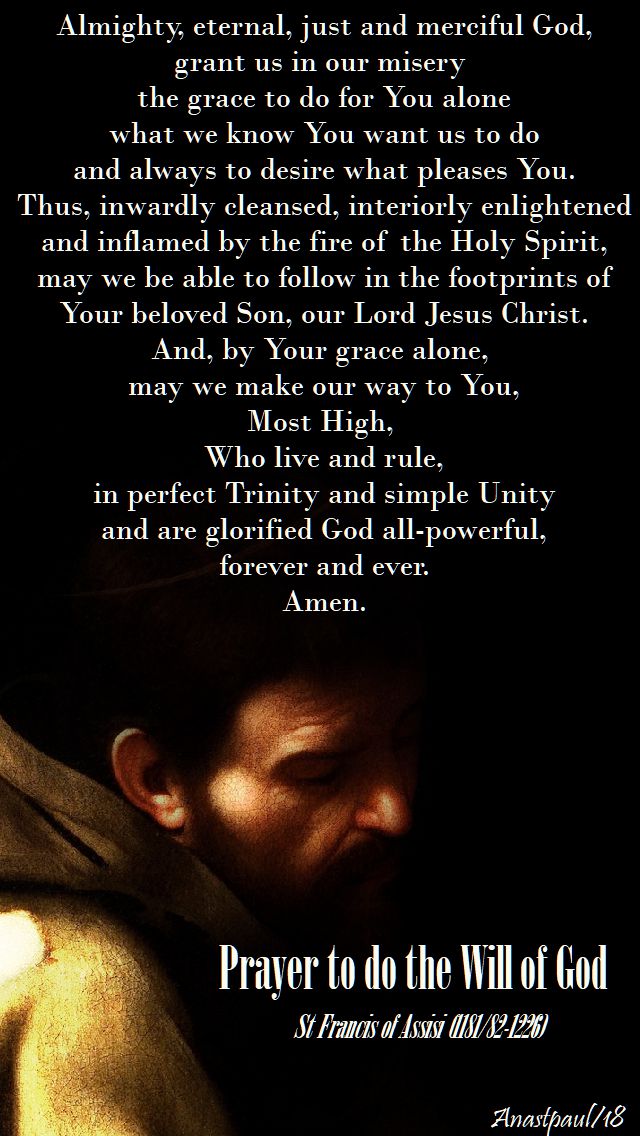
Prayer to Do the Will of God
By St Francis of Assisi (1181/82-1226)

Almighty, eternal, just and merciful God,
grant us in our misery, the grace to do for You alone
what we know You want us to do
and always to desire what pleases You.
Thus, inwardly cleansed,
interiorly enlightened
and inflamed by the fire of the Holy Spirit,
may we be able to follow
in the footprints of Your beloved Son,
our Lord Jesus Christ.
And, by Your grace alone,
may we make our way to You, Most High,
Who live and rule in perfect Trinity
and simple Unity
and are glorified God
all-powerful forever and ever.
Amen.

-from ‘A Letter to the Entire Order’

almighty eternal just and merciful god - st francis - 19 sept 2018

Posted in franciscan OFM, SAINT of the DAY

Saint of the Day – 14 April – Blessed Lucien Botovasoa O.F.S. (1908-1947) Martyr

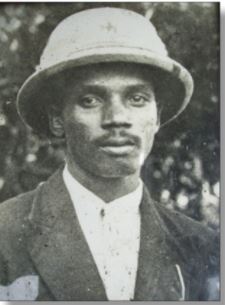
Saint of the Day – 14 April – Blessed Lucien Botovasoa O.F.S. (1908-1947) Martyr, Layman, Father, Multi-lingual Schoolteacher, Catechist, Franciscan Tertiary, Musician and Singer.  Blessed Lucien was born in 1908 in Vohipeno, Madagascar and died by being beheaded with a sword between 10pm and midnight on 14 April 1947 on the banks of the Mattanana River near Ambohimanarivo, Manakara, Madagascar.   He was wearing his tertiary “uniform” – khaki shirt and trousers with a black cord for a belt.   His body was tossed into the river.

img-Blessed-Lucien-Botovasoa

Bl Lucien was a Madagascan Roman Catholic schoolteacher and a professed member from the Secular Franciscan Order.   He served as a teacher for his entire life and was dedicated to both the religious and secular education of children.   His thirst for the religious life led him to discover the Secular Franciscan Order in 1940 and he became part of it;  he rallied others to know Saint Francis of Assisi and enter the order themselves.   Botovasoa likewise adopted the Franciscan charism for himself through his fasting and clothing habits.

Botovasoa’s murder came during a period of tumult in Madagascar and his cause for canonisation opened on 11 October 2011 under Pope Benedict XVI in which he became titled as a Servant of God.  Pope Francis confirmed in mid-2017 that Botovasoa was killed in hatred of his faith and decreed that he was to be beatified;   it shall be celebrated in Vohipeno, Madasgascar tomorrow, the Third Sunday of Easter, 15 April 2018.

bl lucient beatification.

Lucien Botovasoa was born in 1908 in Vohipeno, a rural town in the southeast of Madagascar, the province of Fianarantsoa.

In 1918 he began studies in the state school and then proceeded to the Jesuit College of St Joseph in Ambozontany.   In 1928 he concluded the studies and was awarded the teaching diploma and in the same year became a parish teacher in Vohipeno, making his own the motto of the Society of Jesus:  Ad maiorem Dei gloriam.

On 10 October 1930 he married Suzanna Soazana in the parish church of Vohipeno and on the following 12 September was born Vincent de Paul Hermann, the first of their eight children, of which only five survived.   The Servant of God was an excellent teacher, working not only as the village teacher but also in the parish, with generous availability to the needy.   In addition to Malagasy, he knew French, Latin, German, and Chinese.   He was an exceptional musician and appreciated as a singer, becoming also the director of the parish choir.   He was also an athlete and is described as always smiling and joyful.lucien_botovasoa_foto

In 1940 the Servant of God stumbled upon the Rule of the Franciscan Third Order and it became for him a text for study and meditation.   He decided to take up himself this following of Christ, with investiture in the habit of the Franciscan Third Order on 18 December 1944.   He thus began to live a poor life of Franciscan spirituality, characterised by a deep piety and by the burning desire to bring the gospel everywhere.

After the Second World War, in the years 1946-1947, there grew in Madagascar the desire for independence from France.   In 1946, as supporter of independence, Tsimihoño, from the Clan of Ambohimanarivo, became king (Mpanjaka).   At Vohipeno there were also violent clashes between the two factions.   On 30 March 1947, Palm Sunday, the parish church was burned and so began the king’s hunt for the ‘Christian teacher,’ Lucien Botovasoa, who was respected by both the Catholics and others in Vohipeno.  Lucien was commanded to appear, or his family would be massacred.

The Servant of God, realising what was happening, entrusted his wife and children to his brother and returned to Vohipeno.   Around nine o’clock in the evening of 17 April 1947, his brother André and two cousins, under threat of death, were charged with arresting Lucien.   Brought to the house of the king Tsimihoño, he was condemned to death without any trial.   Arriving at the place of execution he knelt and was beheaded while he was praying for his murderers.    His body was thrown in the river.

Bl Lucien, pray for us!

snip - bl lucien

Posted in franciscan OFM, INCORRUPTIBLES, SAINT of the DAY

Saint of the Day – 4 April – St Benedict of Sicily O.F.M. (1526-1589)

Saint of the Day – 4 April – St Benedict of Sicily O.F.M. (1526-1589) Religious Friar, Confessor, apostle of charity – also known as Benedict of Palermo, Benedict the Moor – born in 1526 at Messina, Italy on the estate of Chevalier de Lanza a San Fratello – died in 1589 of natural causes.   His body was reported incorrupt when exhumed several years later.   Patronages – African missions;  African Americans; black missions; black people; Palermo;  San Fratello; Sicily.SOD-0403-SaintBenedicttheMoor-790x480

St Benedict was born of Moorish parents who were slaves on an estate near Messina, Sicily.   Though of the lowest social rank, they possessed true nobility of heart and mind. As a baby Benedict was freed by his master and as a young boy he showed such a devout and gentle disposition that he was called the “holy Moor.”

While working in the fields one day some neighbours taunted him on account of his race and parentage.   His meek demeanour greatly impressed a Franciscan hermit who was passing by and who uttered the prophetic words: “You ridicule a poor Moor now;  before long you will hear great things of him.”

Wishing to join these hermits Benedict sold his meagre belongings and gave the proceeds to the poor and then entered the community.   After the death of the superior, Benedict was chosen his successor, though greatly against his will.   When Pope Pius IV ordered all hermits to disband or join some Order, Benedict became a Friar Minor of the Observance at Palermo and was made a cook.   He was happy in this work since it enabled him to perform many little acts of kindness toward the others.   His brethren were greatly edified by the saintly cook, especially when they saw angels at times helping him in his work.   The Chapter of 1578 made him guardian, or superior, of the friary, though he protested that he was not a priest, in fact could neither read nor write.   He was a model superior, however, and won the esteem and obedience as well as the love of his subjects.ST BENEDICT OF SICILY.2

As superior he gave free rein to his love for the poor and no matter how openhanded he was, the food never seemed to give out.   After serving as superior he was made novice master and to this difficult post he brought gifts that were evidently infused:  he was able to instruct with an amazing knowledge of theology and to read the hearts of others.   Benedict corrected the friars with humility and charity.   Once he corrected a novice and assigned him a penance only to learn that the novice was not the guilty party.   Benedict immediately knelt down before the novice and asked his pardon.

In later life, Benedict was not possessive of the few things he used.   He never referred to them as “mine,” but always called them “ours.”   His gifts for prayer and the guidance of souls earned him throughout Sicily a reputation for holiness.   Following the example of St Francis, Benedict kept seven 40-day fasts throughout the year; he also slept only a few hours each night.

Capela_do_Divino_Espírito_Santo_em_Porto_Alegre_011-aa

At his request he was relieved of his office and again made cook but he was no longer an obscure Brother, for thousands flocked to the friary, seeking cures or alms or counsel and help.

He died after a brief illness, having foretold the hour of his death.   After Benedict’s death, King Philip III of Spain paid for a special tomb for this holy friar.  His veneration has spread throughout the world, and the African Americans of North America have chosen him their patron.   He was Beatified on 15 May 1743 by Pope Benedict XIV and Canonised on 24 May 1807 by Pope Pius VIII.ST BENEDICT OF SICILY

Posted in Against EPIDEMICS, Against STORMS, EARTHQUAKES, THUNDER & LIGHTENING, FIRES, DROUGHT / NATURAL DISASTERS, franciscan OFM, INCORRUPTIBLES, Of TRAVELLERS / MOTORISTS, PATRONAGE-INFERTILITY & SAFE CHILDBIRTH, SAILORS, MARINERS, NAVIGATORS, SAINT of the DAY

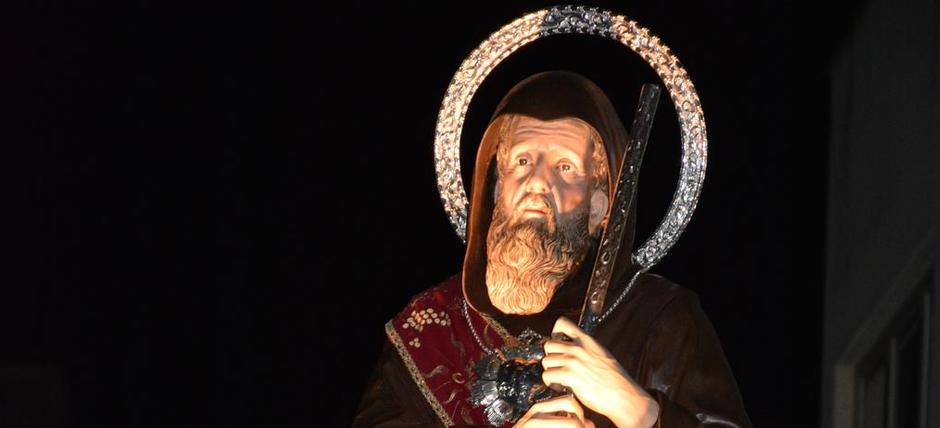
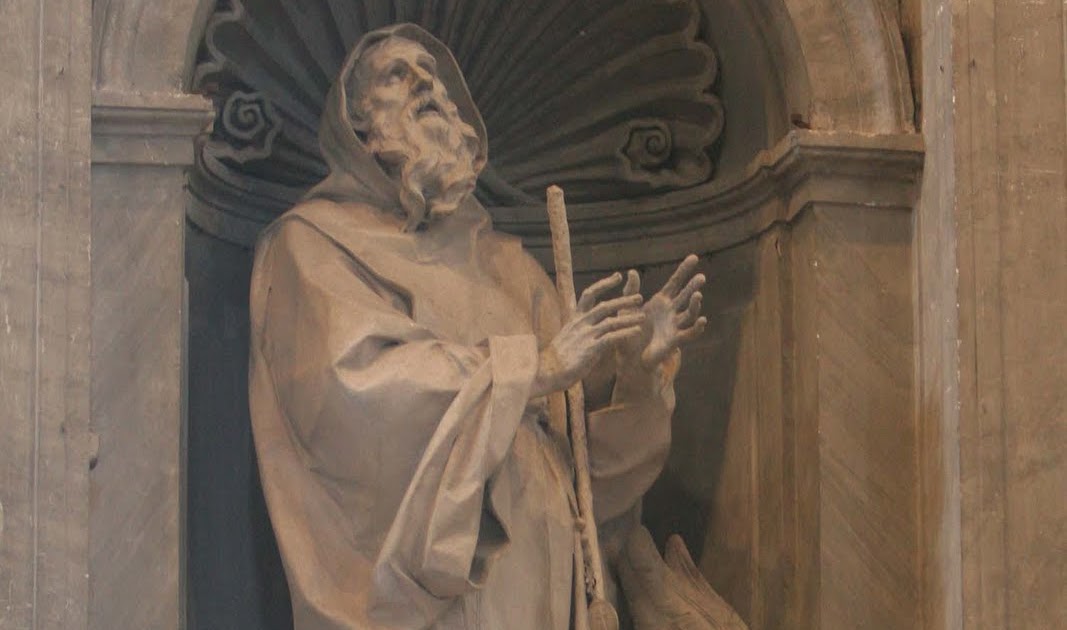
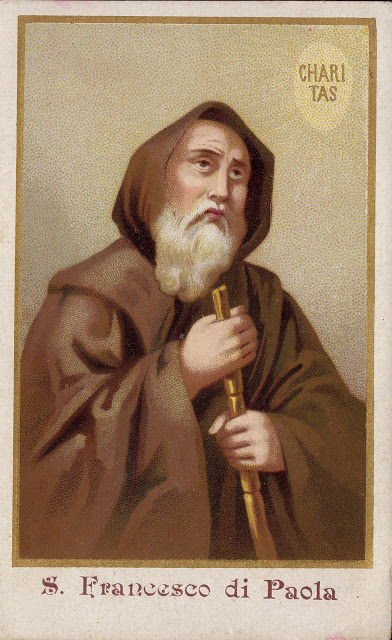
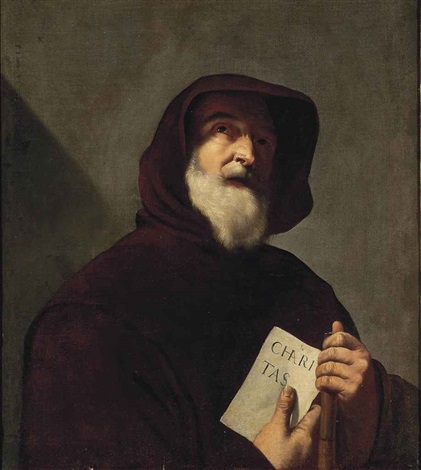
Saint of the Day – 2 April – St Francis of Paola O.M. (1416-1507)

Saint of the Day – 2 April – St Francis of Paola O.M. (1416-1507) also known as “Saint Francis the Fire Handler” – Monk and Founder, inspired with the Gift of Prophecy and still called the “Miracle-Worker“, Apostle of the poor, Peacemaker – born on 27 March 1416 at Paola, Calabria, Kingdom of Italy (part of modern Italy) and died on 2 April 1507 (Good Friday) at Plessis, France of natural causes.   He was an Italian mendicant Friar and the Founder of the Order of Minims.   Unlike the majority of founders of men’s religious orders and like his Patron Saint, Francis was never Ordained a Priest  In 1562 Huguenots broke open his tomb, found his body incorrupt and burned it. The bones were salvaged by Catholics and distributed as relics to various churches.    Patronages – against fire, against plague/epidemics, against sterility,  mariners, sailors,  naval officers, travellers, 7 Cities.

Festa di S. Francesco di Paola 1
St Francis founded the Hermits of St Francis which Rule was formally approved by Pope Alexander VI, who, however, changed their title into that of “Minims”.   Their name refers to their role as the “least of all the faithful”.   Humility was to be the hallmark of the brothers as it had been in Francis’s personal life.   bstinence from meat and other animal products became a “fourth vow” of his religious order, along with the traditional vows of poverty, chastity and obedience.   Francis instituted the continual, year-round observance of this diet in an effort to revive the tradition of fasting during Lent, which many Roman Catholics had ceased to practice by the 15th century.   The rule of life adopted by Francis and his religious was one of extraordinary severity.   He felt that heroic mortification was necessary as a means for spiritual growth.   They were to seek to live unknown and hidden from the world.   After the approbation of the order, Francis founded several new monasteries in Calabria and Sicily.   He also established monasteries of nuns and a third order for people living in the world, after the example of St Francis of Assisi.HEADER - StFrancisdePaola-FounderStatue

Francis was born in the town of Paola, which lies in the southern Italian Province of Cosenza, Calabria.   In his youth he was educated by the Franciscan friars in Paola.   His parents were remarkable for the holiness of their lives, having remained childless for some years after their marriage, they had recourse to prayer and especially commended themselves to the intercession of St Francis of Assisi, after whom they named their first-born son.   Two other children were eventually born to them.

When still in the cradle, Francis suffered from a swelling which endangered the sight of one of his eyes.   His parents again had recourse to Francis of Assisi and made a vow that their son should pass an entire year wearing the “little habit” of St Francis in one of the friaries of his Order, a not-uncommon practice in the Middle Ages.   The child was immediately cured.

From his early years Francis showed signs of extraordinary sanctity and at the age of 13, being admonished by a vision of a Franciscan friar, he entered a friary of the Franciscan Order to fulfil the vow made by his parents.   Here he gave great edification by his love of prayer and mortification, his profound humility and his prompt obedience.   At the completion of the year he went with his parents on a pilgrimage to Assisi, Rome, and other places of devotion.   Returning to Paola, he selected a secluded cave on his father’s estate and there lived in solitude;  but later on he found an even-more secluded cave on the sea coast.   Here he remained alone for about six years, giving himself to prayer and mortification.

st francis of paola 2

Soon others joined him and they took the name Hermits of Saint Francis of Assisi and followed the practices of the Franciscans, or the Franciscan Minim Friars.   The order attracted many candidates within a sort space of time.

Francis later felt God calling him to defend those who were poor and oppressed.   He scolded King Ferdinand of Naples and his sons for their wrongdoing.   In 1482, when King Louis XI of France was dying, he begged that Francis come to cure him.   Francis at first refused but Pope Sixtus IV ordered him to care for the king and prepare him for death.   When the king saw Francis, he pleaded for a miracle.   Francis rebuked him, saying that the lives of kings are in the hands of God.   Francis restored peace between France and Great Britain and between France and Spain.jusepe-de-ribera-saint-francis-of-paolast francis of paola

Famous Miracles:

According to a famous story, in the year 1464, he was refused passage by a boatman while trying to cross the Strait of Messina to Sicily.   He reportedly laid his cloak on the water, tied one end to his staff as a sail and sailed across the strait with his companions following in the boat.   The second of Franz Liszt’s “Legendes” (for solo piano) describes this story in music.

After his nephew died, the boy’s mother—the saint’s own sister—appealed to Francis for comfort and filled his apartment with lamentations.   After the Mass and divine office had been said for the repose of his soul, St Francis ordered the corpse to be carried from the church into his cell, where he continued praying until, to her great astonishment, the boy’s life was restored and Francis presented him to his mother in perfect health.   The young man entered his order and is the celebrated Nicholas Alesso who afterwards followed his uncle into France and was famous for sanctity and many great actions.St_Francis_of_Paola_Blessing_the_Son_of_Louisa_of_Savoy

St Francis also raised his pet lamb, Martinello, from the dead after it had been eaten by workmen. “Being in need of food, the workmen caught and slaughtered Francis’ pet lamb, Martinello, roasting it in their lime kiln.   They were eating when the Saint approached them, looking for his lamb.   They told him they had eaten it, having no other food.   He asked what they had done with the fleece and the bones.   They told him they had thrown them into the furnace.   Francis walked over to the furnace, looked into the fire and called ‘Martinello, come out!’   The lamb jumped out, completely untouched, bleating happily on seeing his master.”

Pope Leo X canonised him in 1519.   He is considered to be a patron saint of boatmen, mariners and naval officers.   His liturgical feast day is celebrated by the universal Church today, the day on which he died. In 1963, Pope John XXIII designated him as the patron saint of Calabria.   Though his miracles were numerous, he was canonised for his humility and discernment in blending the contemplative life with the active one.

Devotion of the Thirteen Fridays:
Pope Clement XII, in the brief “Coelestium Munerum Dispensatio” of 2 December 1738, promulgated an indulgence to all the faithful who, upon 13 Fridays continuously preceding the Feast of St Francis of Paola (2 April), or at any other time of the year, shall, in honour of this Saint, visit a church of the Minims and pray there for the Church.   In this brief, mention is made of a devotion which originated with St Francis himself, who, on each of 13 Fridays, used to recite 13 Pater Nosters (Our Fathers) and as many Ave Marias (Hail Marys) and this devotion he promulgated by word of mouth and by letter to his own devout followers, as an efficacious means of obtaining from God the graces they desired, provided they were for the greater good of their souls

Posted in franciscan OFM, SAINT of the DAY

Memorials of the Saints – 2 April

St Francis of Paola O.M. (1416-1507) (Optional Memorial)

St Abundius of Como
St Agnofleda of Maine
St Appian of Caesarea
St Bronach of Glen-Seichis
St Constantine of Scotland
St Ðaminh Tuoc
Bl Diego Luis de San Vitores-Alonso
St Ebbe the Younger
St Eustace of Luxeuil
St Francis Coll Guitart
St John Payne
Bl Leopold of Gaiche
St Lonochilus of Maine
St Musa of Rome
Bl Mykolai Charnetsky
St Nicetius of Lyon
St Pedro Calungsod
St Rufus of Glendalough
St Theodora of Tiria
St Urban of Langres
St Victor of Capua
Bl Vilmos Apor

Posted in franciscan OFM, HOLY WEEK, MORNING Prayers, QUOTES of the SAINTS, The HOLY CROSS, The PASSION

Quote of the Day – 26 March 2018 – Monday of Holy week

Quote of the Day – 26 March 2018 – Monday of Holy week

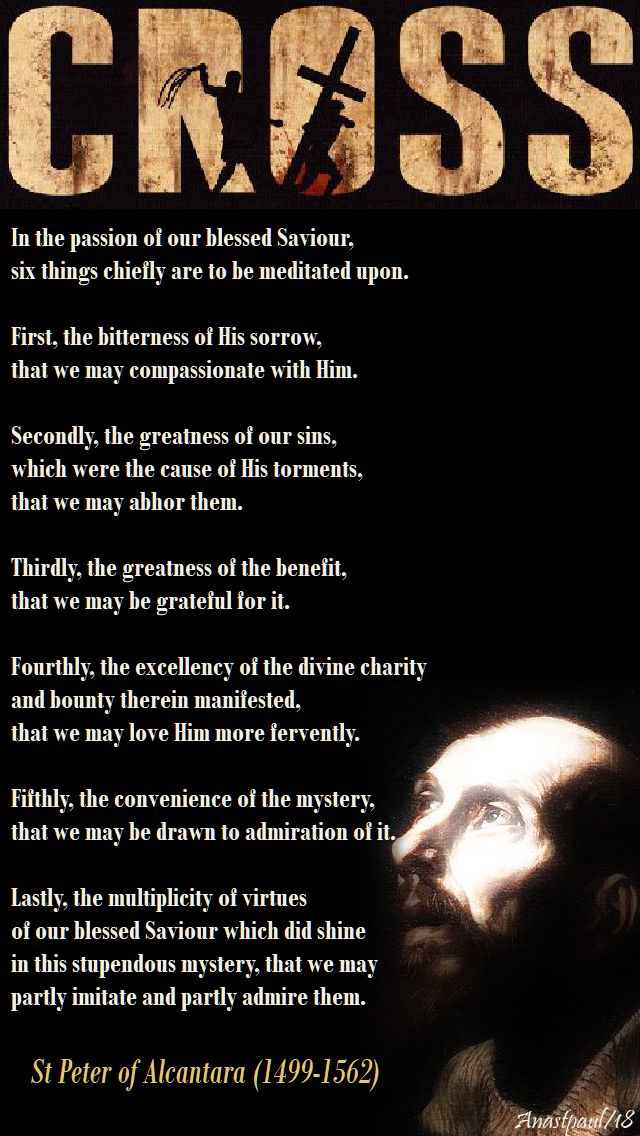
“In the passion of our blessed Saviour,
six things chiefly are to be meditated upon.

First, the bitterness of His sorrow,
that we may compassionate with Him.

Secondly, the greatness of our sins,
which were the cause of His torments,
that we may abhor them.

Thirdly, the greatness of the benefit,
that we may be grateful for it.

Fourthly, the excellency of the divine charity
and bounty therein manifested,
that we may love Him more fervently.

Fifthly, the convenience of the mystery,
that we may be drawn to admiration of it.

Lastly, the multiplicity of virtues
of our blessed Saviour which did shine
in this stupendous mystery, that we may
partly imitate and partly admire them.”

St Peter of Alcantara (1499-1562)in the passion of our blessed saviour, six things - st peter of alcantara - 26 march 2018

Posted in franciscan OFM, LENT, MORNING Prayers, QUOTES on FAITH, QUOTES on LOVE, QUOTES on SANCTITY, QUOTES on SUFFERING, SACRED and IMMACULATE HEARTS, SAINT of the DAY, The PASSION, The WORD

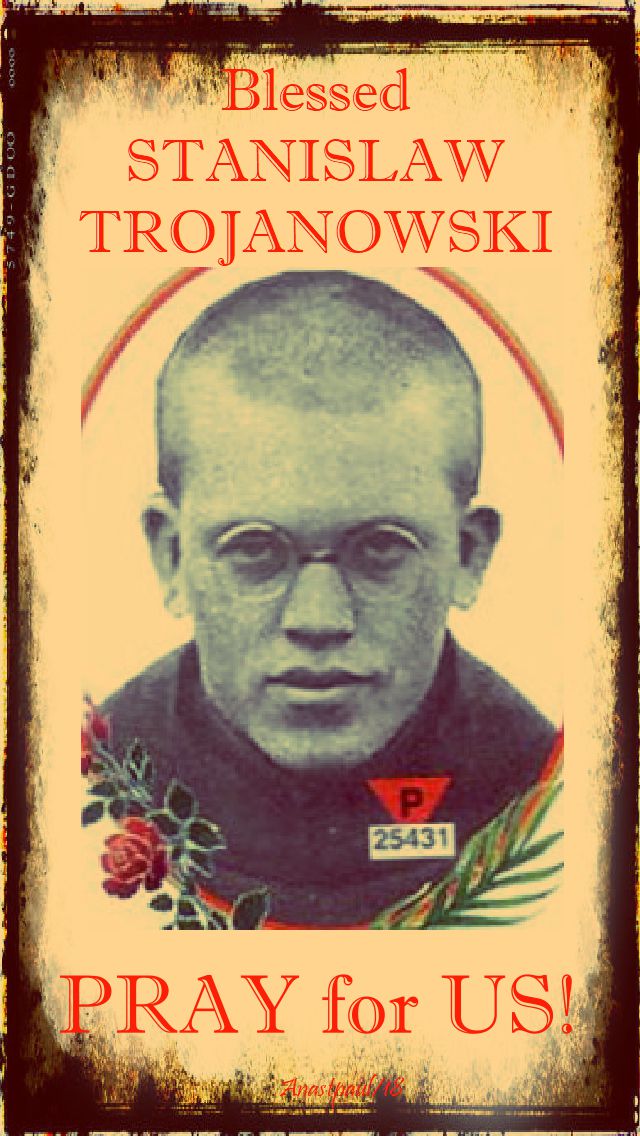
One Minute Reflection – 28 February 2018 – Wednesday of the Second Week of Lent and the Memorial of Blessed Stanislaw Antoni Trojanowski (1908-1942) Martyr

One Minute Reflection – 28 February 2018 – Wednesday of the Second Week of Lent and the Memorial of Blessed Stanislaw Antoni Trojanowski (1908-1942) Martyr

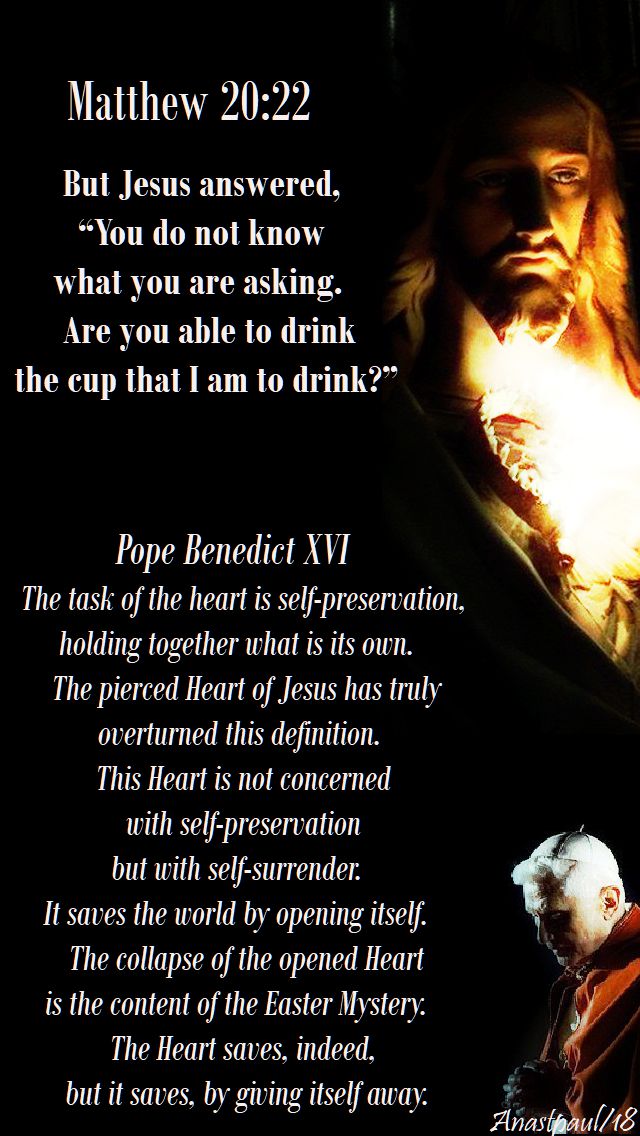
But Jesus answered, “You do not know what you are asking. Are you able to drink the cup that I am to drink?”…Matthew 20:22

REFLECTION – “The task of the heart is self-preservation, holding together what is its own.   The pierced Heart of Jesus has truly… overturned this definition.   This Heart is not concerned with self-preservation but with self-surrender.   It saves the world by opening itself.   The collapse of the opened Heart is the content of the Easter Mystery.   The Heart saves, indeed, but it saves, by giving itself away.”…Pope Benedict XVIthe task of the heart is self-preservation - pope benedict xvi - 28 feb 2018

PRAYER – We give You thanks Holy God and Father, for sending us Your Son to teach us how to love, to teach us that only in giving ourselves may we receive ourselves.   Our hearts are made of stone but You O God, can turn them into flesh and teach us to open our hearts completely to the way of the Cross.   May the Martyr Blessed Stanislaw Trojanowski, offer his prayers for us, as we strive to learn, as he did, this way our Lord taught us.   Through Jesus Christ, Your Son, in the unity of the Holy Spirit, one God forever, amen.bl stanislaw trojanowski pray for us - 28 feb 2018

Posted in franciscan OFM, JESUIT SJ, MORNING Prayers, PRAYERS of the SAINTS, The WORD

19 February 2018 – Monday of the First Week of Lent

19 February 2018 – Monday of the First Week of Lent

Leviticus 19:1-2, 11-18, Psalms 19:8-10, 15, Matthew 25:31-46

Levitus 19:1-2 – And the Lord said to Moses, “Say to all the congregation of the people of Israel, You shall be holy; for I the Lord your God am holy.
Matthew 25:34-36 – Then the King will say to those at his right hand, ‘Come, O blessed of my Father, inherit the kingdom prepared for you from the foundation of the world; for I was hungry and you gave me food, I was thirsty and you gave me drink, I was a stranger and you welcomed me, I was naked and you clothed me, I was sick and you visited me, I was in prison and you came to me.’monday of the first week of lent - 19 feb 2018

We are definitely off now.   Lent has really begun.
It begins with a programme for us, proposed by God Himself!
Deeper holiness, more evident godliness is the aim of Lent for us and for whole Church.
Ultimately, the litmus test of our faith is in how we respond to those in need:  the hungry, the lonely, the stranger, the sick and the prisoner.   We could add to this list – those who are survivors of abuse, refugees looking for a place of safety and many who so despair in finding work.
God identifies with all these so powerfully.   What we do or neglect to do for those in need is our response to God.
Sometimes we may feel a sense of ‘compassion fatigue’ – the whole world seems to be such a huge mess and there is so much need all around us.   How, where do we begin?   It may just feel easier to close our eyes to it.   And too, we may experience fear for our own safety.
But despite these obstacles, God is challenging us.   Often there are simple things that can make a big difference – a smile, a word of conversation and encouragement, soup delivered to a family in need, a visit to an elderly neighbour.   If we try it, because God is God, we shall find that we receive far more than we give!   Be not afraid, for I am with you! “The Lord will overshadow you and you will find refuge under his wings” (Communion Antiphon for today).

Can I slow down enough today to be fully present to someone in need – even just with a smile and a little chat?
What is my biggest obstacle in reaching out to others?
What grace do I most need from God?

(Excerpt Fr Nicholas King SJ – The Lenten Journey to Easter & The Long Journey to the Resurrection)

Prayer to do the Will of God
By St Francis of Assisi

Almighty, eternal, just and merciful God,
grant us in our misery, the grace to do for You alone
what we know You want us to do
and always to desire, what pleases You.
Thus, inwardly cleansed, interiorly enlightened
and inflamed by the fire of the Holy Spirit,
may we be able to follow in the footprints of
Your beloved Son, our Lord Jesus Christ.
And, by Your grace alone, may we make our way to You,
Most High, Who live and rule in perfect Trinity and simple Unity
and are glorified God all-powerful, forever and ever.
Amen.
(From “A Letter to the Entire Order”)

almighty eternal just and merciful god - st francis - 19 sept 2018


Posted in franciscan OFM, JESUIT SJ, MORNING Prayers, SAINT of the DAY

Thought for the Day – 6 February – The Memorial of St Paul Miki S.J. (1564/65-1597) & Companions – 26 Martyrs of Nagasaki

Thought for the Day – 6 February – The Memorial of St Paul Miki S.J. (1564/65-1597) & Companions – 26 Martyrs of Nagasaki

Twenty-six Franciscan and Jesuit missionaries and Japanese converts crucified together by order of Toyotomi Hideyoshi.

Following their arrests, they were taken to the public square of Meako to the city’s principal temple.   They each had a piece of their left ear cut off and then paraded from city to city for weeks with a man shouting their crimes and encouraging their abuse.   The priests and brothers were accused of preaching the outlawed faith of Christianity, the lay people of supporting and aiding them.  They were each repeatedly offered freedom if they would renounce Christianity.   They each declined.   Today, a new era has come for the Church in Japan.   Although the number of Catholics is not large, the Church is respected and has total religious freedom.   The spread of Christianity in the Far East is slow and difficult.   Faith such as that of the 26 martyrs is needed today as much as in 1597.

These Martyrs died an horrendous and agonising death in witness to their faith in Jesus Christ.   We may not be called to make such a sacrifice but we are all called to bear witness to Him, very often this will result in broken ‘friendships’, ostracisation, bad ‘vibes’ around us, loneliness and feelings of being rejected – remember these utterly courageous Martyrs, pray for their intercession and bear your sufferings in silence!

MARTYRS OF NAGASAKI, PRAY FOR US!martyrs-of-nagasaki-pray-for-us-2018

Posted in franciscan OFM, MORNING Prayers, QUOTES of the SAINTS, SAINT of the DAY, The WORD

One Minute Reflection – 4 February – The Memorial of St Joseph of Leonissa O.F.M. CAP (1556-1612)

One Minute Reflection – 4 February – The Memorial of St Joseph of Leonissa O.F.M. CAP (1556-1612)

Clearly you are a letter of Christ which I have delivered, a letter written not with ink but by the Spirit of the living God, not on tablets of stone but on tablets of flesh in the heart….2 Corinthians 3:3

REFLECTION – “Every Christian must be a living book wherein one can read the teaching of the gospel. This is what St Paul says to the Corinthians.   Our heart is the parchment;  through my ministry the Holy Spirit is the writer because ‘my tongue is like the pen of a ready scribe’ (Psalm 45:1).”….St Joseph of Leonissaevery christian must be a living book - st joseph of leonissa - 4 feb 2018

PRAYER – Almighty God, You made Saint Joseph of Leonessa, an illustrious preacher of the gospel. Through his prayers inflame us with love and with his zeal for souls that we may serve You alone. St Joseph of Leonissa, pray for us, amen.st joseph of leonissa - pray for us - 4 feb 2018