Posted in franciscan OFM, SAINT of the DAY

Saint of the Day – 4 February – Saint Jane of Valois O.Ann.M (1464-1505)

Saint of the Day – 4 February – Saint Jane of Valois O.Ann.M and T.O.S.F (1464-1505) Princess, Queen, Founder, Religious Sister, Mystic, Teacher.   St Jane was born a Princess as Jeanne de France, Jeanne de Valois on 23 April 1464 – 4 February 1505) and was briefly Queen of France as wife of King Louis XII, in between the death of her brother, King Charles VIII and the annulment of her marriage.   After that, she retired to her domain, where she soon founded the monastic Order of the Sisters of the Annunciation of Mary.   From this Order later sprang the religious congregation of the Apostolic Sisters of the Annunciation, founded in 1787 to teach the children of the poor. She was Beatified on 18 June 1742 by Pope Benedict XIV and canonised on 28 May 1950 by Pope Pius XIIand is known as Saint Joan of Valois, O.Ann.M.st joan valois header

Saint Jane of Valois, the daughter of Louis XI, king of France, was born April 23, 1464. Favoured with great gifts of mind and heart from her earliest years, she despised the pomp of the court and sought her joy in solitude, prayer and meditation.   This manner of life greatly displeased her proud and morose father as being unworthy of a royal princess and he always treated her harshly.st joan valois

Saint Jane, however, bore it patiently and complained of her sufferings only to God.   She once had a vision of the Blessed Virgin Mary and said to her:

“Be consoled, my daughter!   A time will still come when you will belong to me entirely. A   large group of young women consecrated to God will join you in serving me and proclaiming my praise everywhere.”

At these words a stream of heavenly consolation flooded Jane’s soul and she resolved anew to persevere in the service of God, cost what it might.st joan valois 3
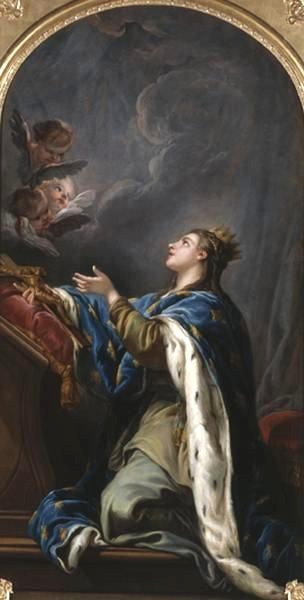
Her divinely guided director, Blessed Gabriel Mary or Father Gilbert Nicolas, a Franciscan, encouraged her in her resolution and was her support and director on the way to perfection.   From him she also received the habit of the Third Order.  From then on she entertained the thought of entering a convent in order to live and die as a bride of the Crucified but suddenly her father announced his decision that she should marry Louis, Duke of Orleans and she was to obey without remonstrance.   In filial obedience and for love of God Jane made this difficult sacrifice in the year 1486.

Her marriage was not a happy one.   Even before the ceremony took place, Duke Louis protested secretly before a notary and witnesses that he yielded to force and was marrying against his will, in order to escape the anger of the king.   He always treated Saint Jane of Valois as a stranger and if he ever permitted her to appear before him, he reproached and ill treated her.   When Duke Louis ascended to the throne of France in the year 1498 as Louis XII, his first act was to send the queen a bill of divorce.   Because of the compulsion employed, the pope declared the marriage null and void.   Jane accepted this great humiliation with a heart resigned to God and said:

“God has now detached me from the world and has made it possible for me to serve Him better than heretofore.”

She now repaired to Bourges and there the revelation that had been made to her in her youth was to be realised.   She united a group of young women to form a religious community which would devote itself to the special veneration of the Blessed Virgin Mary.   Her regular confessor, Father Gilbert, drew up the statutes, which treat in ten chapters on imitating the ten virtues of the Blessed Virgin:  the chastity, prudence, humility, faith, obedience, compassion, devotion, poverty, patience and piety of Mary.

In the year 1500 Pope Alexander VI approved this new institute, the members of which were called Sisters of the Annunciation of Mary, or Annunciades.   The pope placed them under the obedience of the minister general of the Franciscans and gave Father Gilbert the name of Gabriel Mary.   Jane herself took the veil in the convent of Bourges which she had built and on Pentecost, 1503, she pronounced her solemn vows.

Having for so long a time been prepared in the school of suffering and humiliation, she soon reached the summit of religious perfection and was ripe for heaven.   God called Saint Jane of Valois to Himself on 4 February 1505.   Her body was entombed in the church of the Annunciation and many miracles occurred at her tomb.

In the year 1562, the heretical Huguenots stormed the city of Bourges.   Also the convent and the church of the Annunciades were plundered and destroyed.   They tore Jane’s body, which was still incorrupt, out of the vault and when they pierced it with swords, blood flowed from the wounds.   The holy body was then burned.   This kind of activity by these heretics puts the lie to their claim to be “reformers” of the faith, or even followers of Christ.   Like the Pharaoh at the time of Moses, the miracle they had just witnessed only hardened their hearts in sin.

*from: The Franciscan Book of Saints, ed. by Marion Habig, ofm

Posted in franciscan OFM, MORNING Prayers, QUOTES of the SAINTS, QUOTES on PRAYER, SAINT of the DAY

Quote of the Day – 3 February – The Memorial of St Blaise – Martyr (Died c 316)

Quote of the Day – 3 February – The Memorial of St Blaise – Martyr (Died c 316)

“Speaking of Prayer”

The heart-rending and beautiful words of another Martyr, St Maximillian Kolbe (1894-1941), on the power of prayer.

The day was long,
The burden I had borne
Seemed heavier than I could longer bear
And then it lifted but I did not know
Some one had knelt in prayer;
Had taken me to God, that very hour,
And asked the easing of the load and He,
In infinite compassion, had stooped down
And taken it from me.
We cannot tell how often, as we pray
For some bewildered one,
Hurt and distressed,
The answer comes,
But many times those hearts,
find sudden peace and rest.
Someone had prayed and Faith,
a reaching hand,
Took hold of God
and brought Him down, that day!
So many, many hearts have need of prayer.
Oh, let us pray!

St Maximillian Kolbe (1894-1941)the day was long - st maximillian kolbe - 3 feb 2018

Posted in EUCHARISTIC Adoration, franciscan OFM, MORNING Prayers, QUOTES - J R R Tolkien and MORE, SAINT of the DAY, SUNDAY REFLECTIONS, The HOLY EUCHARIST / The HOLY MASS

Sunday Reflection – – 28 January – The Memorial of St Thomas Aquinas (1225-1274) Doctor angelicus (Angelic Doctor) and Doctor communis (Common Doctor)

Sunday Reflection – – 28 January – The Memorial of St Thomas Aquinas (1225-1274) Doctor angelicus (Angelic Doctor) and Doctor communis (Common Doctor)

Fr Raneiro Cantalamessa OFM – Preacher to the Papal Household – “This is My Body”

The Eucharist is the Father’s gift to the world.   The mystery contained in the words: “God so loved the world that he gave his only Son” (John 3:16) is made present in every Mass.   In the priest who offers us the body and blood of Christ at the moment of Communion, we can see, with the eyes of faith, the Father in person, who comes to give us “the bread of heaven, the true bread” and says: “Take, this is the body of my Only Begotten Son, which I have given for you.”

Not only does the Father give us the Eucharist, He also gives Himself in the Eucharist because there is only one indivisible divine nature, in receiving the divinity of the Son, we also receive the Father.   “Whoever sees me sees the Father,” also means “whoever receives me, receives the Father.”

One day (it was the Saturday of the Second Week of Lent) after listening to the Gospel passage of the parable of the Prodigal Son, I understood clearly that Communion offered me, there and then, the incredible opportunity of receiving the Father’s forgiving embrace – and not only mentally!

Fr Raneiro Cantalamessa OFM – Preacher to the Papal Household – “This is My Body” (out of interest, this entire book is a series of lectures to the Holy Father and his household, who was St John Paul at the time, (during the Year of the Eucharist 2004-2005) on St Thomas Aquinas, Adore Te Devote.the eucharist is god's gift to the world - fr raneiro - 28 jan 2018

Posted in All THEOLOGIANS, Moral Theologians, CATHOLIC PRESS, CONFESSORS, DOCTORS of the Church, franciscan OFM, Of the DEAF, against DEAFNESS, PATRONAGE - WRITERS, PRINTERS, PUBLISHERS, EDITORS, etc, SAINT of the DAY, TEACHERS, LECTURERS, INSTRUCTORS

Saint of the Day – 24 January – St Francis de Sales (1567-1622) – Doctor of the Church: Doctor caritatis (Doctor of Charity)

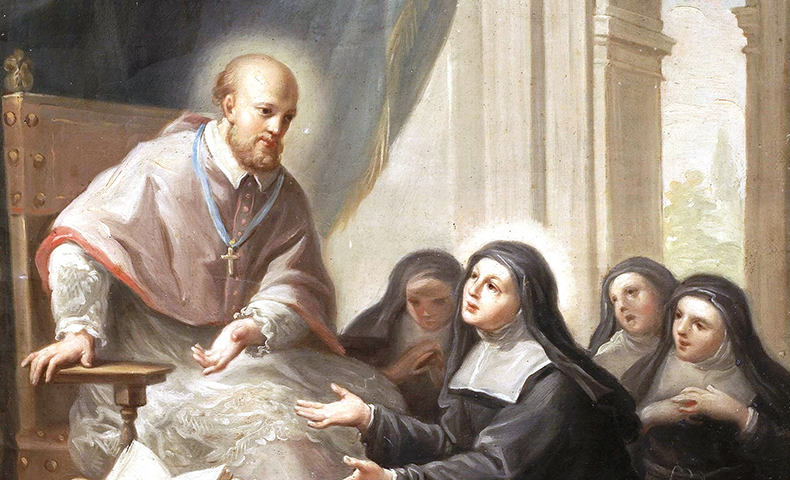
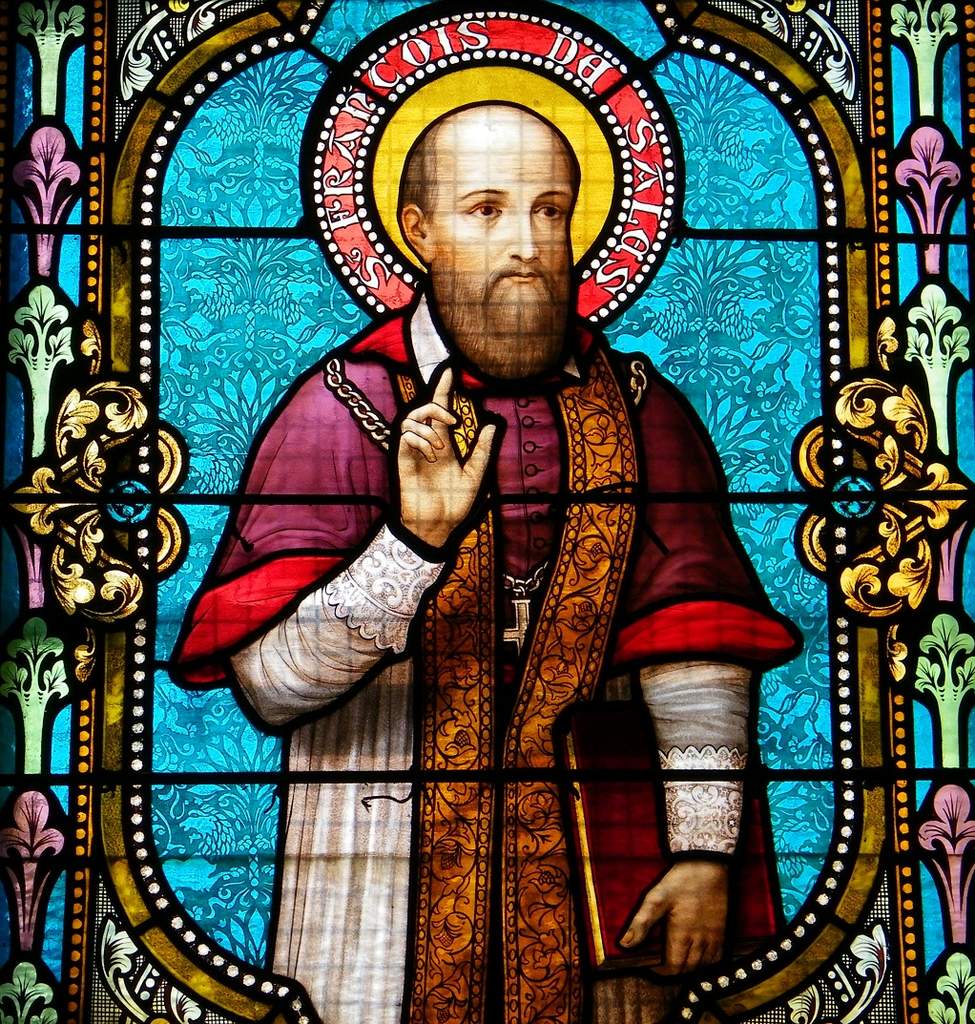
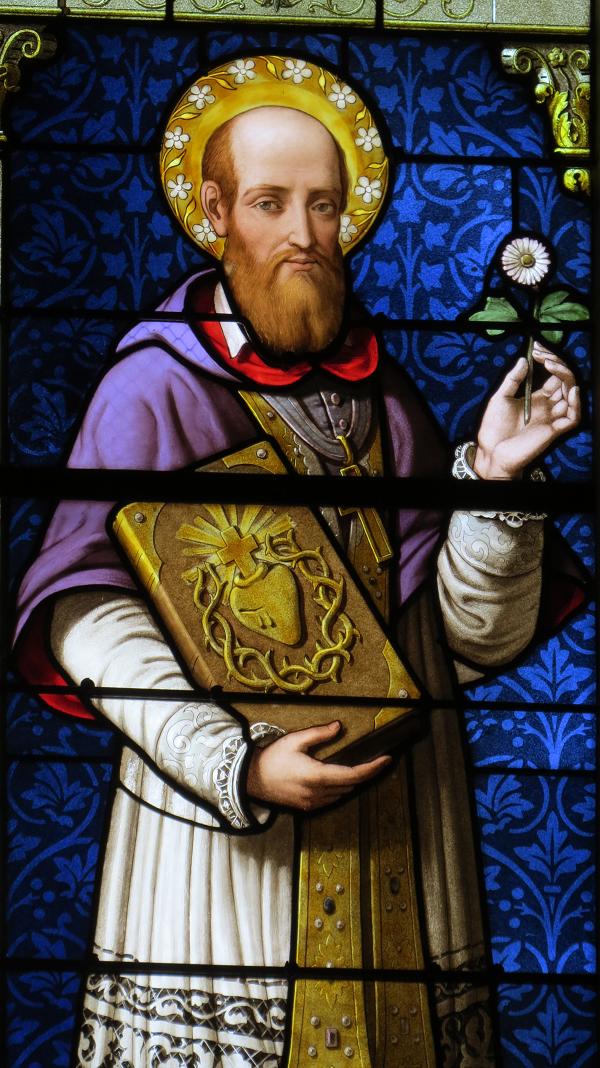
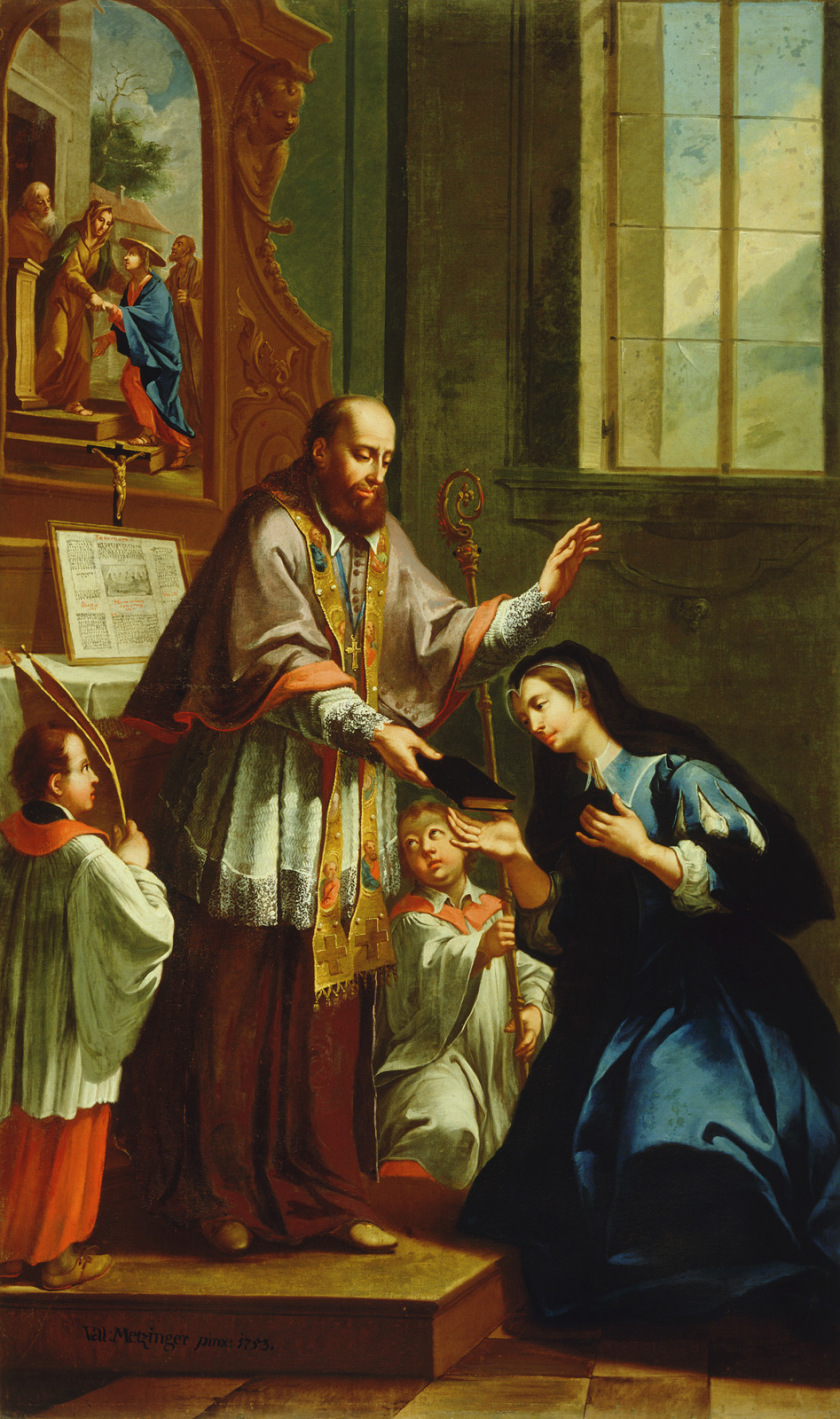
Saint of the Day – 24 January – St Francis de Sales  CO, OM, OFM (Cap) (1567-1622) – Doctor of the Church: Doctor caritatis (Doctor of Charity), Bishop of Geneva, Doctor of Law and Theology, Writer, Theologian, Mystic, Teacher, Preacher, Founder along with St Jane Frances de Chantal, founded the women’s Order of the Visitation of Holy Mary (Visitandines).  Born 21 August 1567 at Château de Thorens, Savoy (part of modern France) – 28 December 1622 at Lyon, France of natural causes.   St Francis is known as:  the Gentle Christ of Geneva and the Gentleman Saint.   Patronages –  against deafness, authors, writers (proclaimed on 26 April 1923 by Pope Pius XI), Catholic press, Confessors, journalists (proclaimed on 26 April 1923 by Pope Pius XI), teachers, Champdepraz, Aosta, Italy, 8 Dioceses.  His motto ‘Non-excidet’ – (No failure).   St Francis became noted for his deep faith and his gentle approach to the religious divisions in his land resulting from the Protestant Reformation.  He is known also for his writings on the topic of spiritual direction and spiritual formation, particularly the Introduction to the Devout Life and the Treatise on the Love of God.Cheader - st francis de salescoa_francis_de_sales-svgSOD-0124-SaintFrancisdeSales-790x480

Francis, the eldest of 13 children, was born into a family of nobility in France in 1567.   His father sent him to study at the University of Paris.   After six years, Francis was intellectually competent in many areas.   Francis was also a skilled swordsman who enjoyed fencing, an expert horseman and a superb dancer.  Then Francis studied at the University of Padua and received a doctorate in civil and canon law.   His father wanted him to marry but Francis desired to be a priest.    His father strongly opposed Francis in this and only after much patient persuasiveness on the part of the gentle Francis did his father finally consent.   Francis was ordained and elected provost of the Diocese of Geneva, then a centre for the Calvinists.   Francis set out to convert them, especially in the district of Chablais.   By preaching and distributing the little pamphlets he wrote to explain true Catholic doctrine, he had remarkable success, the majority of the Chablais inhabitants accepted the Catholic faith.st francis de sales - young - no 2

At 35, he became bishop of Geneva.  While administering his diocese he continued to preach, hear confessions and catechise the children.  His gentle character was a great asset in winning souls  . He practised his own axiom, “A spoonful of honey attracts more flies than a barrelful of vinegar.”

Besides his two well-known books, the Introduction to the Devout Life and A Treatise on the Love of God, he wrote other marvellous spiritual aid as well as many pamphlets and carried on a vast correspondence  . For his writings, he has been named patron of the Catholic Press.   His writings, filled with his characteristic gentle spirit, are addressed to lay people.   He wants to make them understand that they too are called to be saints.   As he wrote in The Introduction to the Devout Life: “It is an error, or rather a heresy, to say devotion is incompatible with the life of a soldier, a tradesman, a prince, or a married woman…. It has happened that many have lost perfection in the desert who had preserved it in the world. ”

In spite of his busy and comparatively short life, he had time to collaborate with another saint, Jane Frances de Chantal, in the work of establishing the Sisters of the Visitation. These women were to practice the virtues exemplified in Mary’s visit to Elizabeth: humility, piety, and mutual charity.   They at first engaged to a limited degree in works of mercy for the poor and the sick.   Today, while some communities conduct schools, others live a strictly contemplative life.124-st-francis-de-sales-eglise-d-hannevillestfrancois4 T

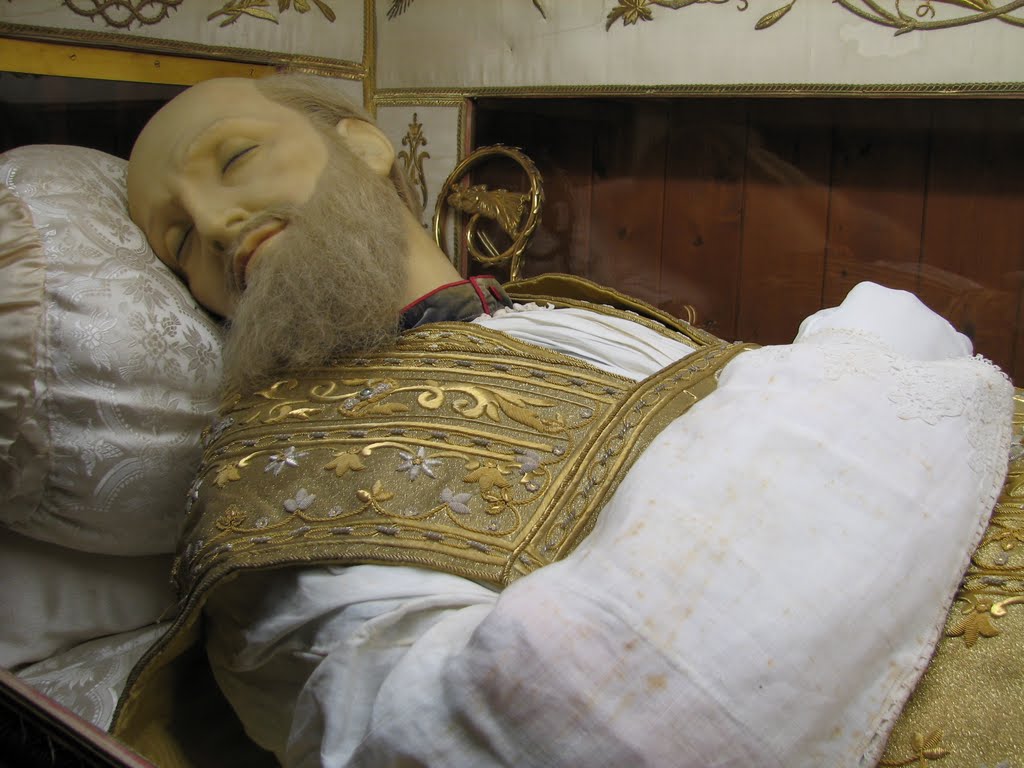
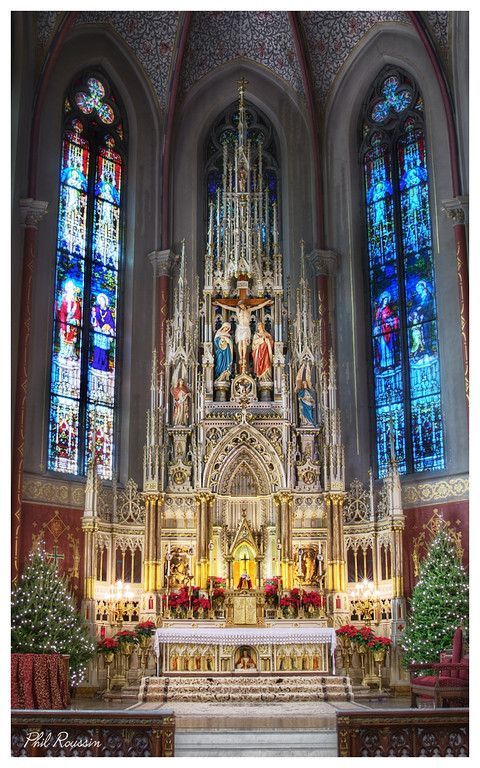
St Francis is buried at the Basilica of the Visitation, Annecy, France -below.   His heart was preserved as a Relic at Lyon but during the French Revolution his heart was was moved to Venice, Italy.   The Altar below is the High Altar of St Francis at the Cathedral in St Louis, USA.

St. François de Sales. La Basilique de La Visitation. Annecy, Fran
The High Altar at Saint Francis de Sale, St Louis
Posted in franciscan OFM, MARIAN QUOTES, MORNING Prayers, QUOTES of the SAINTS, QUOTES on SUFFERING, SAINT of the DAY, The BLESSED VIRGIN MARY

Quote/s of the Day – 23 January – The Memorial of St Ildephonsus (607-667) and St Marianne Cope (1838-1918)

Quote/s of the Day – 23 January – The Memorial of St Ildephonsus (607-667) and St Marianne Cope (1838-1918)

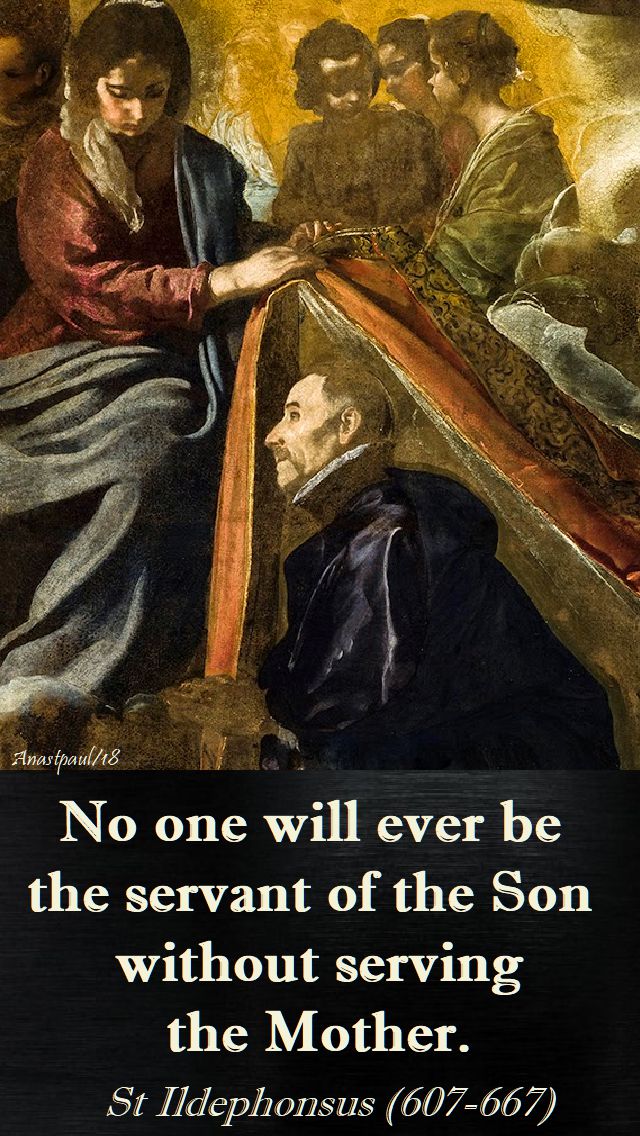
“No one will ever be
the servant of the Son
without serving the Mother.”no one will ever be - st ildephonsus - 23 jan 2018

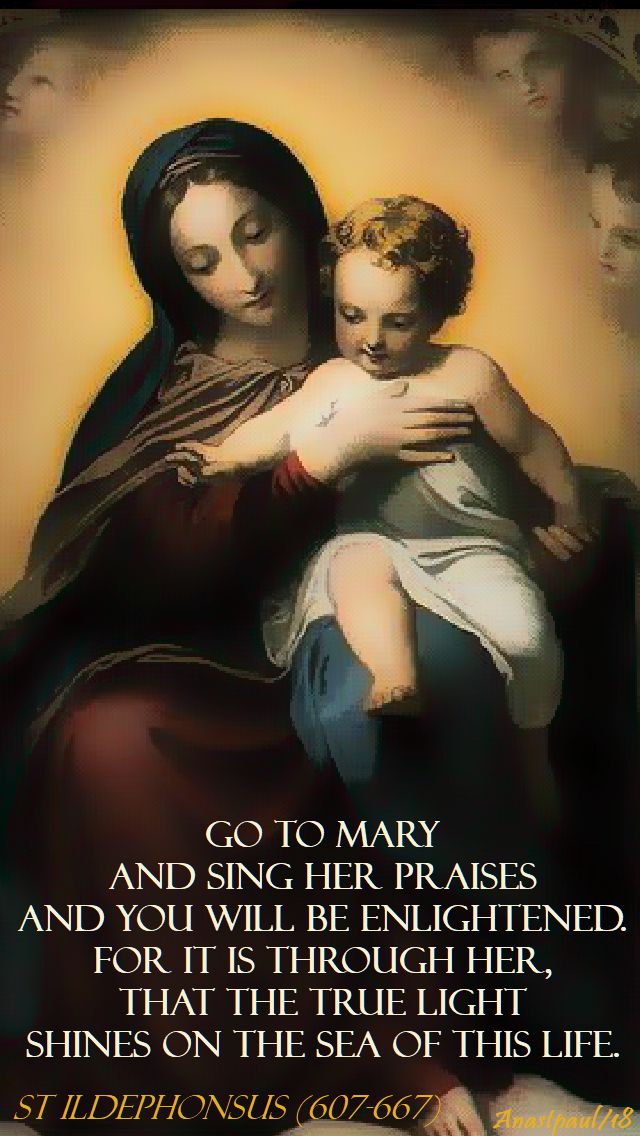
“Go to Mary and sing her praises
and you will be enlightened.
For it is through her,
that the true Light
shines on the sea of this life.”

St Ildephonsus (607-667)go to mary - st ildephonsus - 23 jan 2018

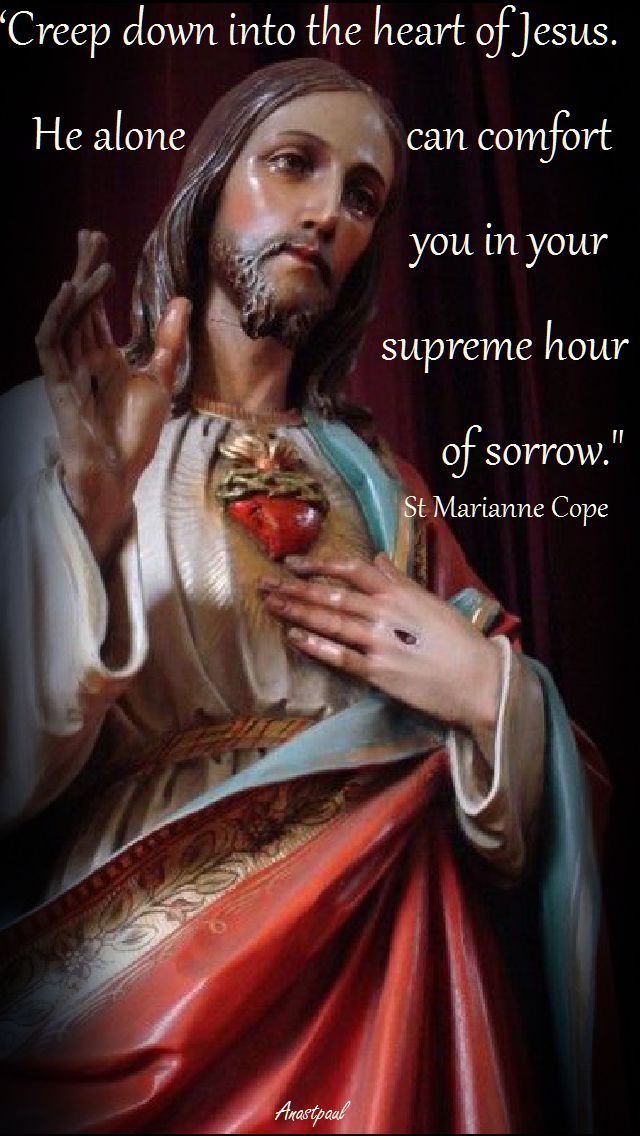
“Creep down into the heart of Jesus.
He alone can comfort you in your
supreme hour of sorrow.”creep down into the heart of Jesus - st marianne cope - 2017

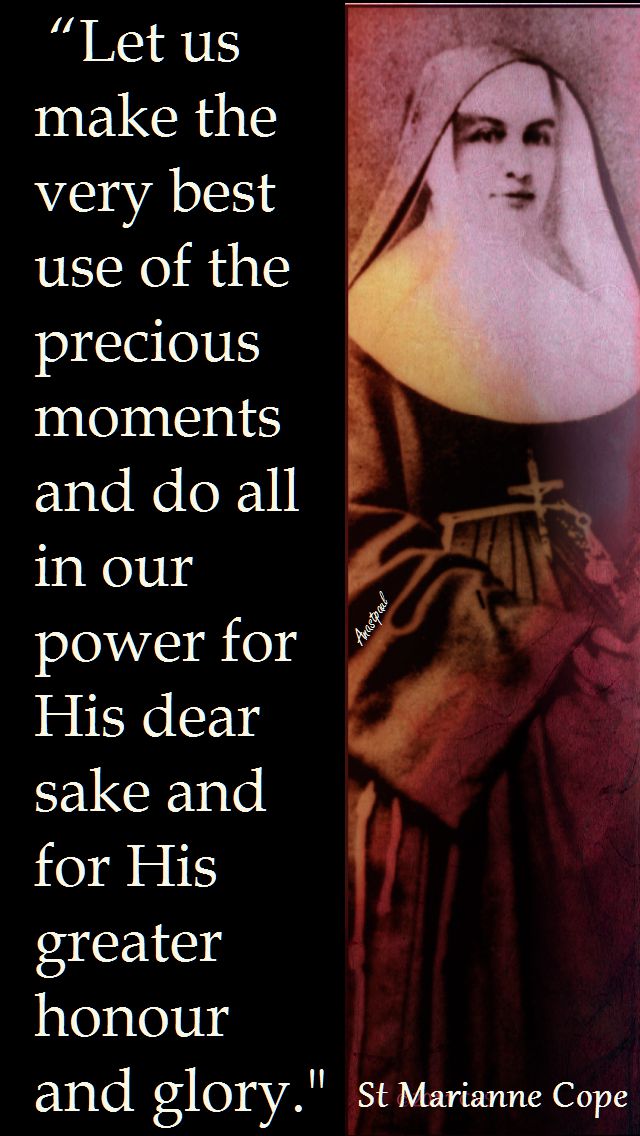
“Let us make the very best use of the precious moments
and do all in our power for His dear sake
and for His greater honour and glory…………
I do not think of reward;
I am working for God and do so cheerfully.”let-us-make - st marianne cope - 2017

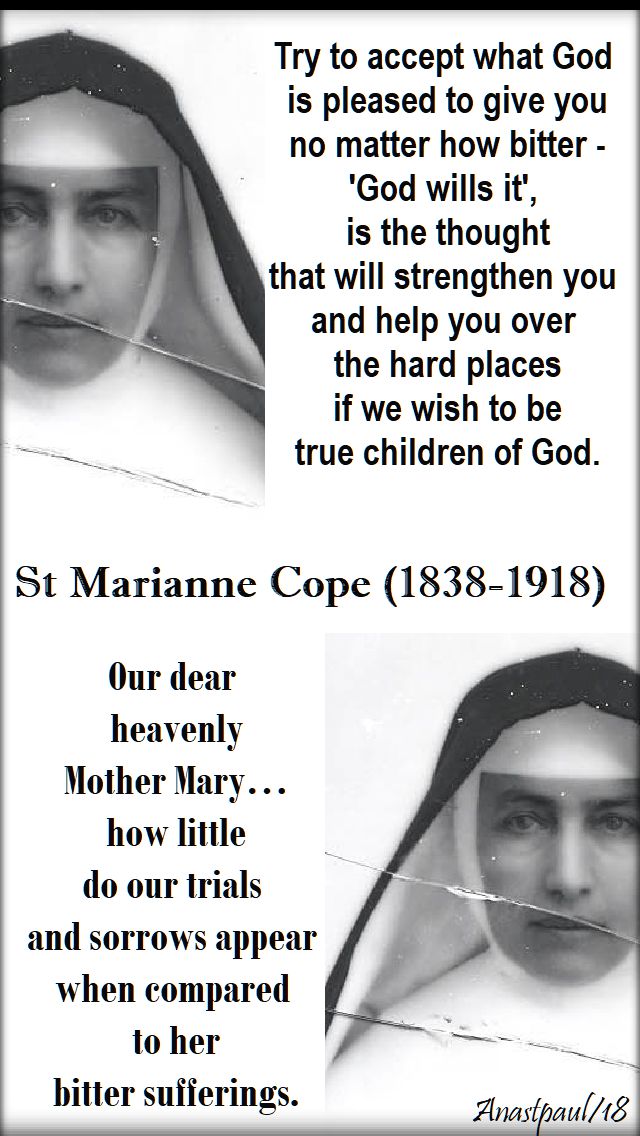
“Try to accept what God
is pleased to give you
no matter how bitter –
‘God wills it’,
is the thought
that will strengthen you
and help you over
the hard places
if we wish to be
true children of God.”

“Our dear
heavenly Mother Mary…
how little do our trials
and sorrows appear
when compared
to her bitter sufferings.”

St Marianne Cope (1838-1918)try to accept what god - st marianne cope - 23 jan 2018

Posted in franciscan OFM, MORNING Prayers, QUOTES on CHARITY, QUOTES on LOVE, QUOTES on SANCTITY, SAINT of the DAY

Thought for the Day – 6 January – The Memorial of Sts André Bessette C.S.C. (1845-1937) and St Charles of Sezze O.F.M. (1613-1670)

Thought for the Day – 6 January – The Memorial of Sts André Bessette C.S.C. (1845-1937) and St Charles of Sezze O.F.M. (1613-1670)

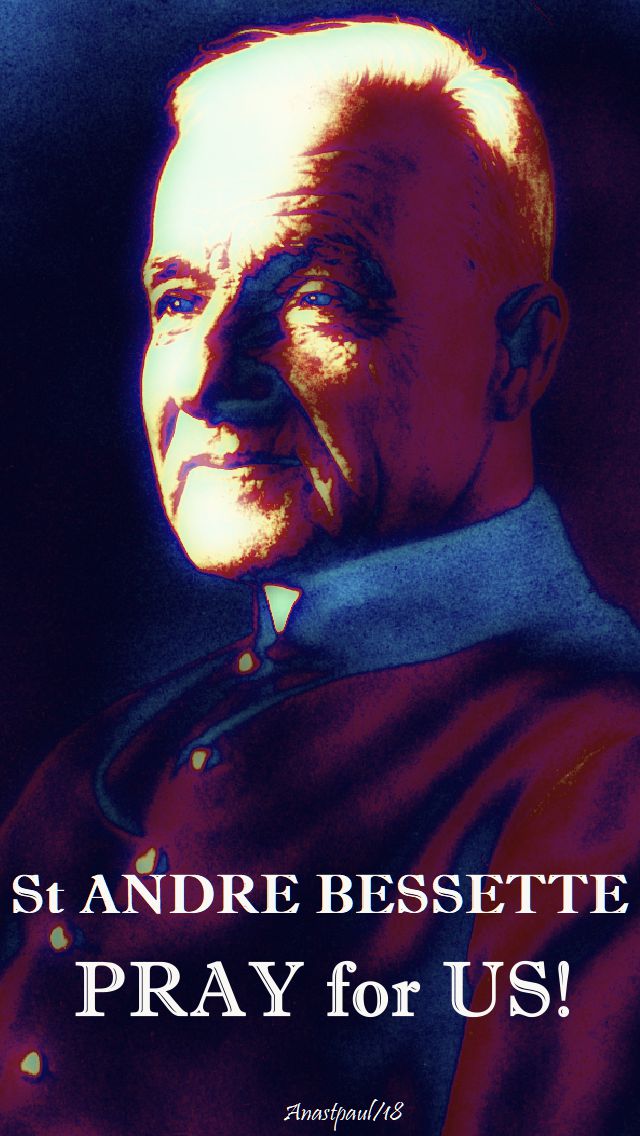
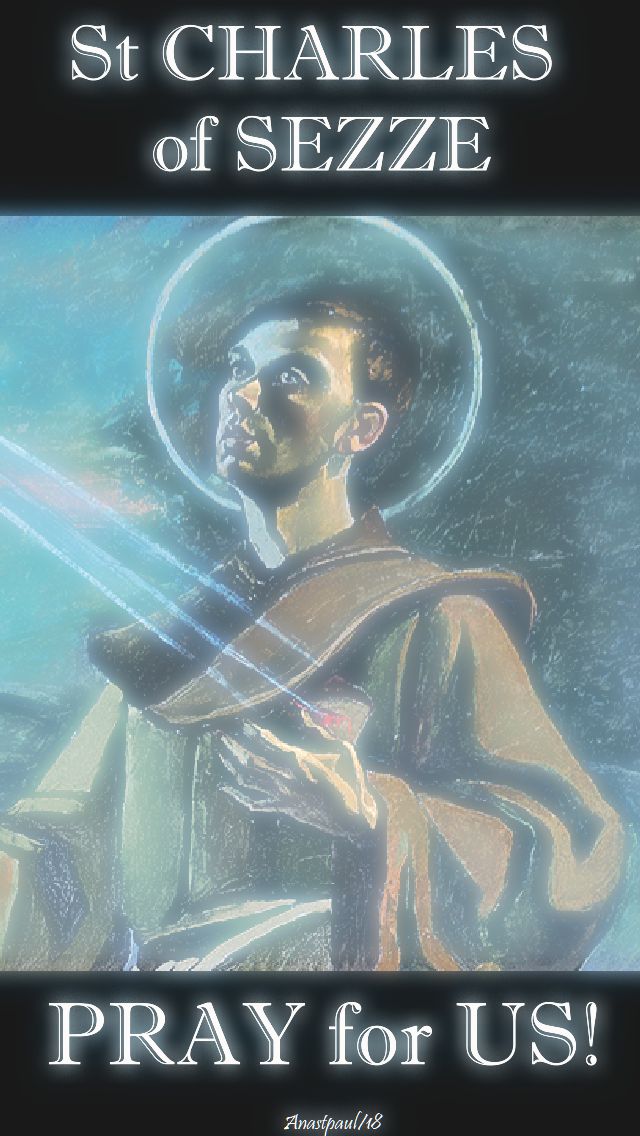
Both the Saints whose Memorials we celebrate today, lived their lives as simple porters, gardeners and the like.   But they both lived their lives in total charity and love of God.    And they are both saints.   They fulfilled their tasks with love and utter commitment to God their Father.   And through their faithfulness to these little things, God rewarded them with great things.

Since God through the Holy Spirit is the giver of charity and since true charity is beyond the capacity of human nature left to its own devices, God can give it without reference to natural gifts like intelligence.   And this seems true in the case of the uncharitable:  there are plenty of examples of intelligent people who lack charity—the “evil genius” is a standard literary character for a reason.   (Br. Bonaventure Chapman, OP)  But today also offers us a positive example of two men graced with charity which is love and is not love both question and answer and the new commandment given us.   What more is needed by the grace of God?

St André Bessette and St Charles of Sezze, Pray for us!st andre bessette pray for us -6 jan 2018st charles of sezze pray for us - 6 jan 2018

Posted in franciscan OFM, INCORRUPTIBLES, SAINT of the DAY

Saint of the Day – 6 January – St Charles of Sezze OFM (1613-1670)

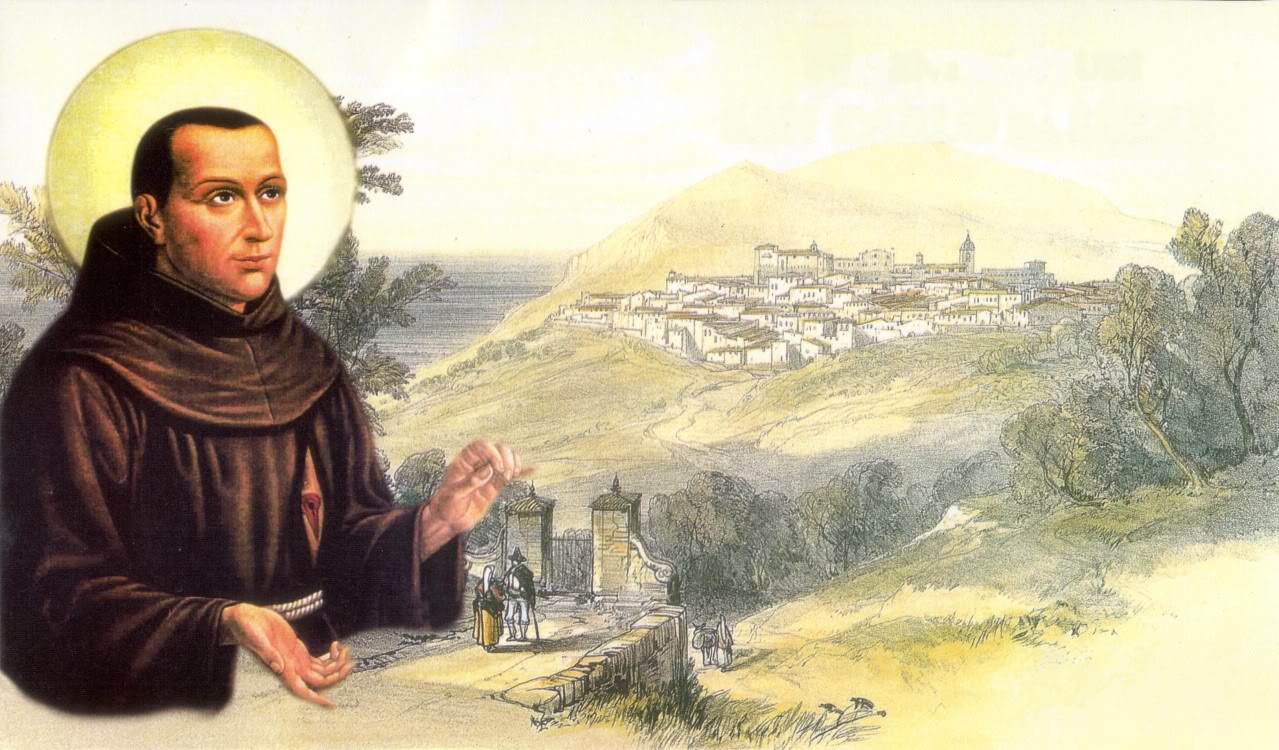
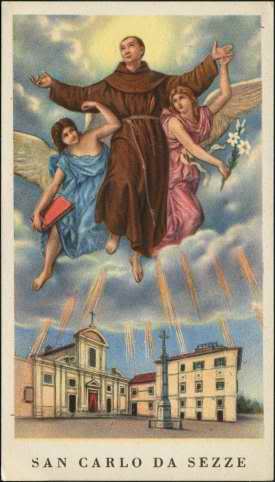
Saint of the Day – 6 January – St Charles of Sezze OFM (1613-1670) Stigmatist, Religious Friar, Mystic, Writer, Advisor.   St Charles was born on 19 October 1613 at Sezze, Roman Campagna, Italy as  Giancarlo Marchioni – 6 January 1670 at San Francesco a Ripa, Rome, Italy of natural causes.   His body is entombed at the Church of Saint Francis in Rome.   He became a religious despite the opposition of his parents who wanted him to become a Priest and he led an austere life doing menial tasks such as acting as a porter and gardener;   he was also a noted writer.   St Charles was held in high esteem across the Lazio region with noble families like the Colonna and Orsini praising him and seeking his counsel as did popes such as Innocent X and Clement IX.   His Beatification was celebrated in 1882 while Pope Pius XII approved his Canonisation in 1958 but the pope died before he could canonise the friar so his successor Pope John XXIII did so on 12 April 1959.   His body is incorrupt.118charles7charles of sezze centenary

Giancarlo Marchioni was born in Sezze on 19 October 1613 to the poor farmers Ruggero Marchioni and Antonia Maccione.   His baptism was celebrated on 22 October 1613.  His mother – when he was a toddler – liked to dress him in a dark tunic with a cord and hood in honour of friars Saint Francis of Assisi and Saint Anthony of Padua and she kept this ‘habit’ even after he outgrew it.

His maternal grandmother Valenza Pilorci instilled devout practices and other religious values within him in his childhood.   He worked on the farm as a shepherd to help his parents with the exhaustive workload and liked to plough in the fields because he liked the oxen.   He made a private vow to remain chaste in 1630 and in 1633 fell ill to the point of near death that he pledged to join the Order of Friars Minor if he were to be healed of his ailment.   His parents encouraged his call to become a priest but was a poor student and could not read or write much so there was no hope he would excel in advanced studies.

He felt a desire to serve in the missions in India and later became inspired from the lives of Saints Pascal Baylon and Salvador of Horta – who were both professed religious. Marchioni was admitted into the order at the San Francesco convent in 1635 at Nazzano; he received the habit of the order on 18 May 1635.   He later recounted that he did so out of a desire to live a poor life and to beg alms “for the love of Christ”.   He again set his heart on the missions but poor health halted this dream.

He lived the life of a religious and never requested ordination to the priesthood despite the protests of his parents to do so.   He made his solemn profession into the order on 19 May 1636 into the hands of Father Angelo Maria and his religious name was “Cosmas” at first but his mother’s insistence saw it changed to “Carlo”.   He worked at a range of jobs in various friaries:  he cooked and served as a porter and also worked as both a sacristan and gardener;  he also went out into the streets as a beggar.   He was not qualified in all of them as he became notorious for setting the kitchen of one house on fire.   From 1640 to 1642 he was stationed at the convent of Saint John the Baptist at Piglio and at San Francesco at Castel Gandolfo.   In October 1648 he attended Mass at the church of San Giuseppe a Capo le Case and a beam of light emanated from an elevated Host that pierced his side and left a visible open wound at his side.

118charles6

Though he was not a priest he was instructed to write the account of his life after his confessor requested it of him.   The result was “The Grandeurs of the Mercies of God” which was well-read;  he went on to write several other books.   Though he kept himself under the guidance of a spiritual director he himself – though not a priest – was often sought for spiritual advice and even Pope Innocent X and Alexander VII sought him out for advice.   In 1656 he tended to victims of cholera at Carpineto.   On 22 August 1664 he was at San Pietro in Montorio when he fell ill with malarial fever and so was taken to San Francesco a Ripa to recuperate;  he recovered on 30 August after bed rest was prescribed to him.   On 28 July 1665 he had a vision of Pope Saint Victor I and Saint Teresa of Ávila.

Pope Clement IX summoned him to his deathbed for comfort and a blessing not long before the two men died.   In the first week of December 1669 the pope summoned him but the friar was ill so was taken to the pope on a chair.   He greeted the pope: “Holy Father, how are you?” and the pope responded:  “As well as God wants me to be”.   Present in the room was Cardinal Giacomo Rospigliosi and the friar asked him to bless the pope with a special relic he carried but the pope wanted the frail friar to bless him and so he did.   Clement IX asked when the two would meet again and the friar told him it would be on the feast of the Epiphany to which those present thought the pope would get well and the two would meet in a month.   But the pope died on 9 December and people questioned how the friar was wrong though after the friar died on the Epiphany itself it was realised the pope would greet him as a friend in Heaven thus the two met again.

On 31 December 1669 he was forced to his bed due to pleurisy.    On 6 January 1670 he died in the convent attached to San Francesco a Ripa in Rome;  he was buried in that church.

The confirmation of his life of heroic virtue allowed for Pope Clement XIV to title the late Franciscan friar as Venerable on 14 June 1772 while the ratification of two miracles attributed to his intercession on 1 October 1881 allowed for Pope Leo XIII to preside over the beatification celebration on 22 January 1882 in Saint Peter’s Basilica. Pope Pius XII confirmed two additional miracles on 7 January 1958 but died before he could canonise the friar; Pope John XXIII canonised him on 12 April 1959 as a saint.

Published works
Birth of Holy Mary’s Novena
Christmas Novena
Holy Settenario
Invalid Path of the Soul
Jesus Christ’s Talk about Life
The Grandeurs of the Mercies of God
The Three Ways

Posted in CATHOLIC DEVOTIONS of the Month, franciscan OFM, MORNING Prayers, QUOTES of the SAINTS, The HOLY NAME, The WORD

May you be Blessed today on the Memorial of the Most Holy Name of Jesus 3 January 2018

May you be Blessed today on the Memorial of the Most Holy Name of Jesus
3 January 2018

The name of Jesus is the glory of preachers

From a sermon by Saint Bernardine of Siena, priest (Sermo 49, De glorioso Nomine Iesu Christi, cap 2: Opera omnia, 4. 505-506) – Prepared by the Spiritual Theology Department of the Pontifical University of the Holy Cross

“The name of Jesus is the glory of preachers because the shining splendour of that name causes His word to be proclaimed and heard.   And how do you think such an immense, sudden and dazzling light of faith came into the world, if not because Jesus was preached?   Was it not through the brilliance and sweet savour of this name that God called us into  His marvelous light?   When we have been enlightened and in that same light behold the light of heaven, rightly may the apostle Paul say to us:  Once you were darkness, but now you are light in the Lord; walk as children of light.

So this name must be proclaimed, that it may shine out and never be suppressed.   But it must not be preached by someone with sullied mind or unclean lipsbut stored up and poured out from a chosen vessel.   That is why our Lord said of Saint Paul:  He is a chosen instrument of mine, the vessel of my choice, to carry my name before the Gentiles and kings and the sons of Israel.   In this chosen vessel there was to be a drink more pleasing than earth ever knew, offered to all mankind for a price they could pay, so that they would be drawn to taste of it.   Poured into other chosen vessels, it would grow and radiate splendour.   For our Lord said:  He is to Carry my name.

When a fire is lit to clear a field, it burns off all the dry and useless weeds and thorns. When the sun rises and darkness is dispelled, robbers, night-prowlers and burglars hide away.   So when Paul’s voice was raised to preach the Gospel to the nations, like a great clap of thunder in the sky, his preaching was a blazing fire carrying all before it.   It was the sun rising in full glory.   Infidelity was consumed by it, false beliefs fled away and the truth appeared like a great candle lighting the whole world with its brilliant flame.

By word of mouth, by letters, by miracles and by the example of his own life, Saint Paul bore the name of Jesus wherever he went.   He praised the name of Jesus at all times but never more than when bearing witness to his faith.   Moreover, the Apostle did indeed carry this name before the Gentiles and kings and the sons of Israel as a light to enlighten all nations.   And this was his cry wherever he journeyed:  The night is passing away, the day is at hand.  Let us then cast off the works of darkness and put on the armour of light;  let us conduct ourselves honourably as in the day.   Paul himself showed forth the burning and shining light set upon a candlestick, everywhere proclaiming Jesus, and Him crucified.

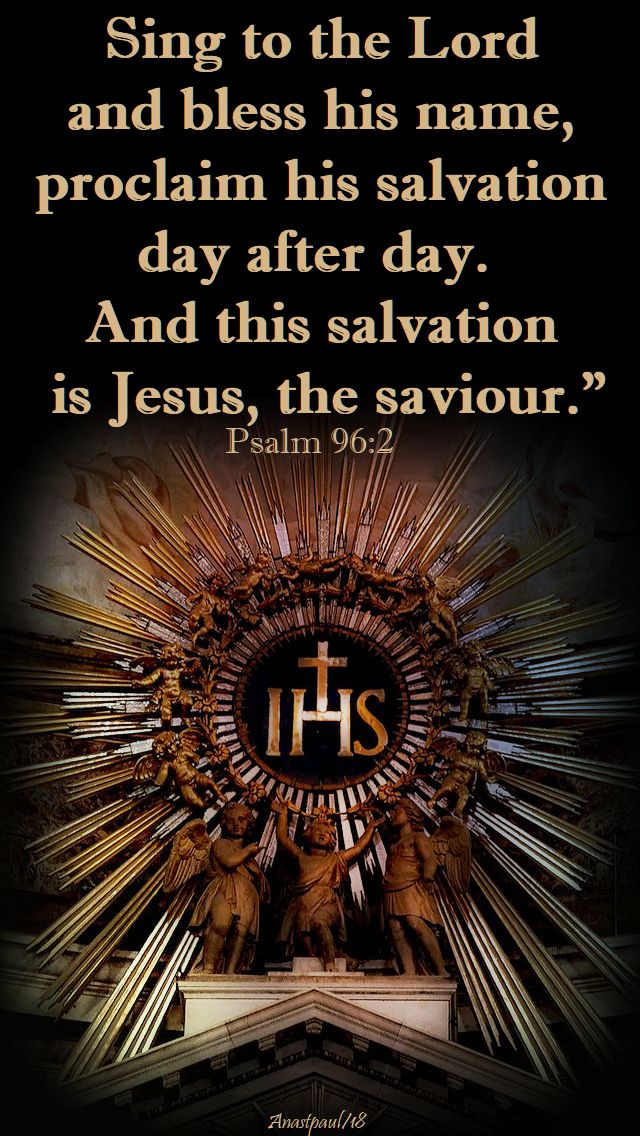
And so the Church, the bride of Christ strengthened by his testimony, rejoices with the psalmist, singing:  0 God, from my youth you have taught me, and I still proclaim your wondrous deeds.   The psalmist exhorts her to do this, as he says, Sing to the Lord and bless his name, proclaim his salvation day after day.   And this salvation is Jesus, her saviour.” (Psalm 96:2)psalm 96 2

Prayer

Father,
you gave St Bernardine a special love
for the holy name of Jesus.
By the help of his prayers,
may we always be alive with the spirit of Your love.
We ask this through our Lord Jesus Christ, Your Son,
who lives and reigns with You and the Holy Spirit,
one God, for ever and ever.

Posted in franciscan OFM, MORNING Prayers, PRAYERS of the SAINTS

Our Morning Offering – 22 November

Our Morning Offering – 22 November

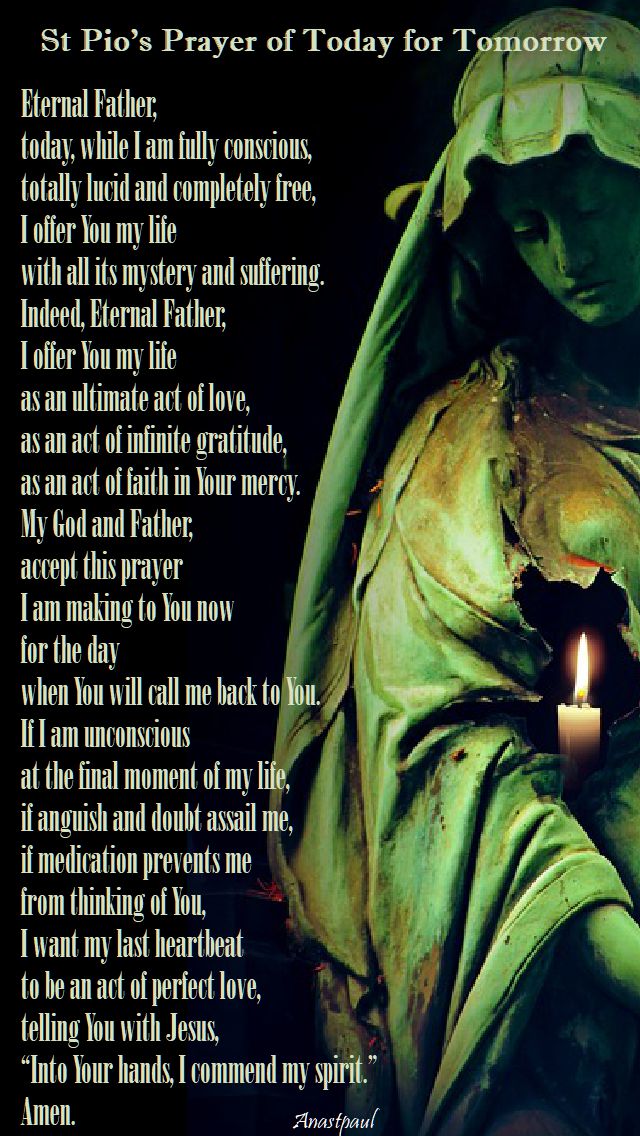
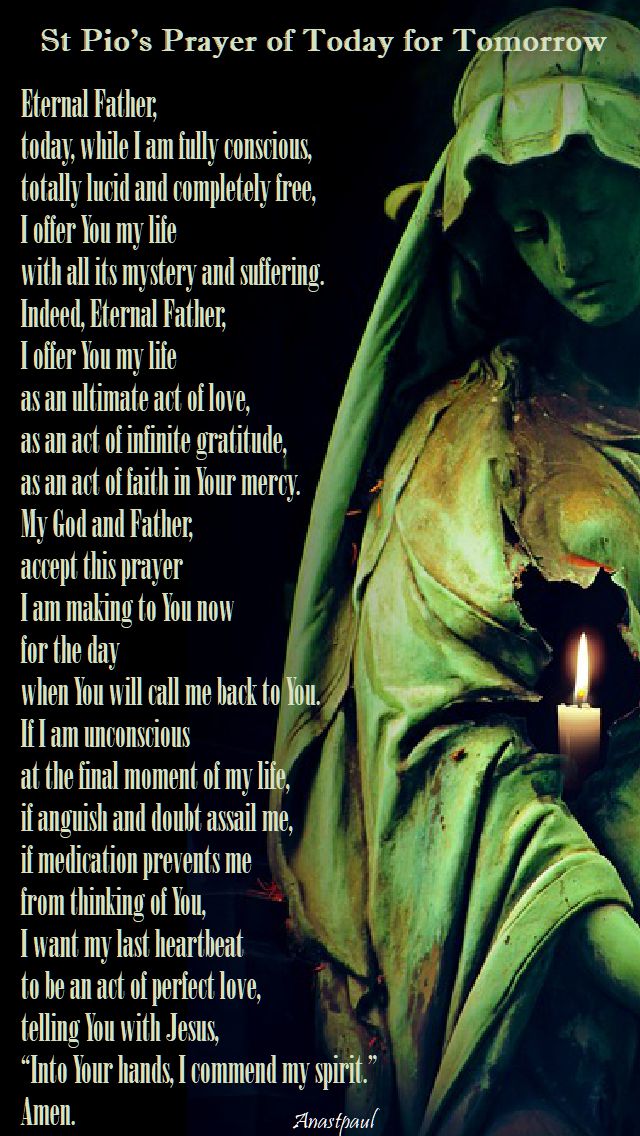
St Pio’s Prayer of Today for Tomorrow

Eternal Father,
today, while I am fully conscious,
totally lucid and completely free,
I offer You my life with all its mystery and suffering.
Indeed, Eternal Father,
I offer You my life as an ultimate act of love,
as an act of infinite gratitude,
as an act of faith in Your mercy.
My God and Father,
accept this prayer I am making to You now
for the day when You will call me back to You.
If I am unconscious at the final moment of my life,
if anguish and doubt assail me,
if medication prevents me from thinking of You,
I want my last heartbeat to be an act of perfect love,
telling You with Jesus,
“Into Your hands, I commend my spirit.”
Amen.eternal father - st pios prayer of today for tomorrow

Posted in franciscan OFM, MORNING Prayers, ON the SAINTS, QUOTES on CHARITY, SAINT of the DAY

Thought for the Day – 17 November – The Memorial of St Elizabeth of Hungary (1207-1231)

Thought for the Day – 17 November – The Memorial of St Elizabeth of Hungary (1207-1231)

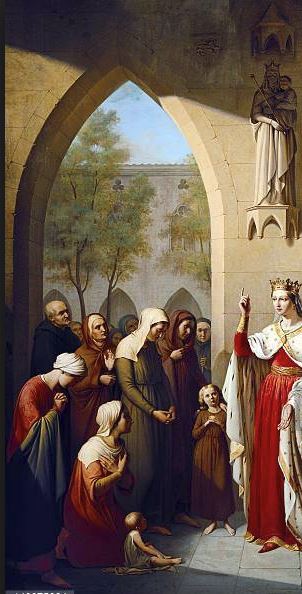
“Elizabeth was a lifelong friend of the poor and gave herself entirely to relieving the hungry.   She ordered that one of her castles should be converted into a hospital in which she gathered many of the weak and feeble.   She generously gave alms to all who were in need, not only in that place but in all the territories of her husband’s empire.   She spent all her own revenue from her husband’s four principalities and finally she sold her luxurious possessions and rich clothes for the sake of the poor.

Twice a day, in the morning and in the evening, Elizabeth went to visit the sick.   She personally cared for those who were particularly repulsive; to some she gave good, to others clothing; some she carried on her own shoulders and performed many other kindly services.   Her husband, of happy memory, gladly approved of these charitable works.   Finally, when her husband died, she sought the highest perfection;  filled with tears, she implored me to let her beg for alms from door to door.

On Good Friday of that year, when the altars had been stripped, she laid her hands on the altar in a chapel in her own town, where she had established the Friars Minor and before witnesses she voluntarily renounced all worldly display and everything that our Saviour in the gospel advises us to abandon.   Even then she saw that she could still be distracted by the cares and worldly glory which had surrounded her while her husband was alive.   Against my will she followed me to Marburg.   Here in the town she built a hospice where she gathered together the weak and the feeble.   There she attended the most wretched and contemptible at her own table.

st elizabeth visiting the hospital she founded
St Elizabeth at the Hospice she built

Apart from those active good works, I declare before God that I have seldom seen a more contemplative woman.

Before her death I heard her confession.   When I asked what should be done about her goods and possessions, she replied that anything which seemed to be hers belonged to the poor.   She asked me to distribute everything except one worn-out dress in which she wished to be buried.   When all this had been decided, she received the body of our Lord. Afterward, until vespers, she spoke often of the holiest things she had heard in sermons. Then, she devoutly commended to God all who were sitting near her and as if falling into a gentle sleep, she died.”   – from a letter by Fr Conrad of Marburg, spiritual director of Saint Elizabeth of Hungary

Elizabeth understood well the lesson Jesus taught when he washed his disciples’ feet at the Last Supper:  the Christian must be one who serves the humblest needs of others, even if one serves from an exalted position.   In her short life, Elizabeth manifested such great love for the poor and suffering that she has become the patroness of Catholic charities and of the Secular Franciscan Order.   The daughter of the King of Hungary, Elizabeth chose a life of penance and asceticism when a life of leisure and luxury could easily have been hers.   This choice endeared her in the hearts of the common people throughout Europe.  Of royal blood, Elizabeth could have lorded it over her subjects.   Yet she served them with such a loving heart that her brief life won for her a special place in the hearts of many.   Elizabeth is also an example to us in her following the guidance of a spiritual director.   Growth in the spiritual life is a difficult process.   We can play games very easily if we don’t have someone to challenge us.

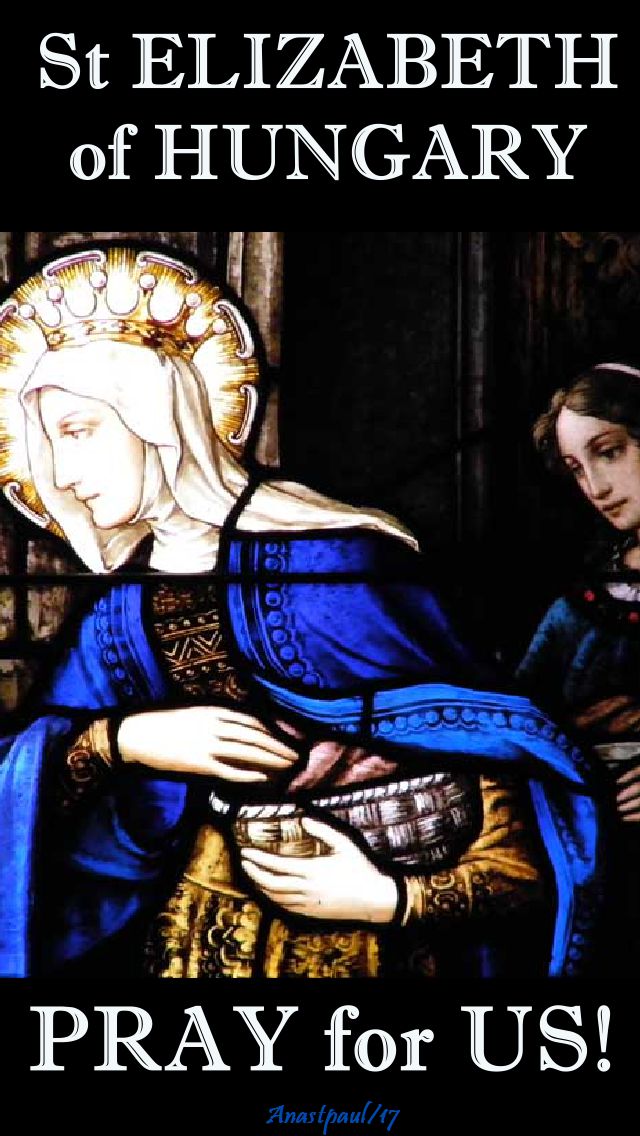
St Elizabeth of Hungary, pray for us!st elizabeth pray for us

Posted in franciscan OFM, MORNING Prayers, QUOTES of the SAINTS, QUOTES on CHARITY, SAINT of the DAY, The WORD

One Minute Reflection – 17 November – The Memorial of St Elizabeth of Hungary (1207-1231)

One Minute Reflection – 17 November – The Memorial of St Elizabeth of Hungary (1207-1231)

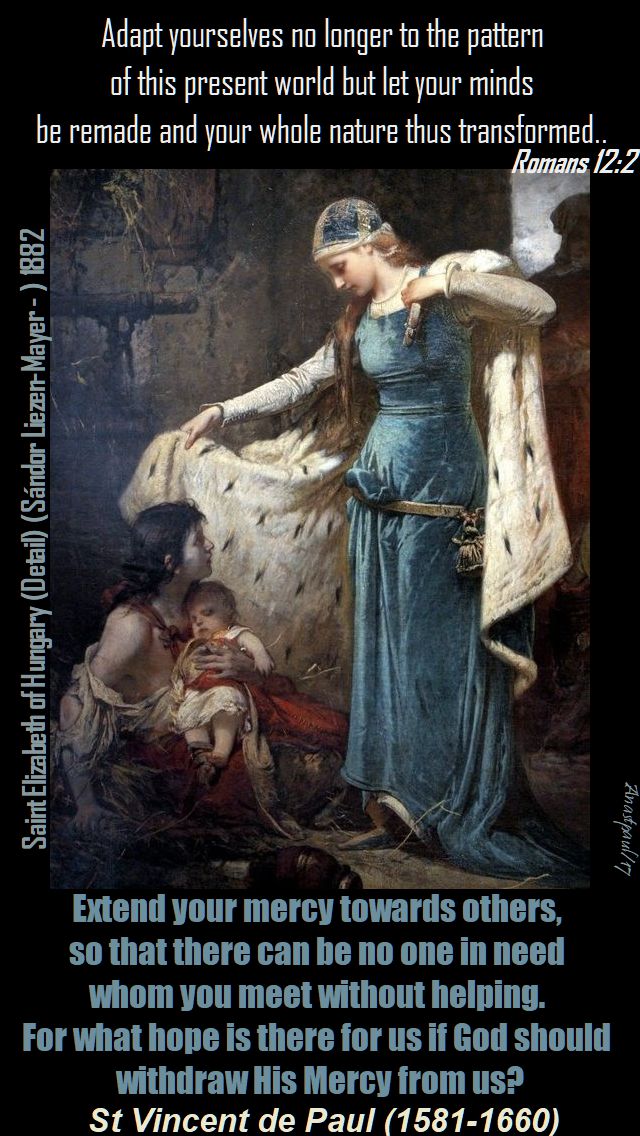
Adapt yourselves no longer to the pattern of this present world but let your minds be remade and your whole nature thus transformed…Romans 12:2

REFLECTION – “Extend your mercy towards others, so that there can be no one in need whom you meet without helping. For what hope is there for us if God should withdraw His Mercy from us?”…–St Vincent de Paul (1581-1660)extend your mercy towards others - st elizabeth of hungary - 17 nov 2017

PRAYER – Lord God, as You have taught Your Church that all the commandments are summed up in the love of You and of our neighbour, grant that as we follow St Elizabeth of Hungary in doing works of charity, we may be numbered among the blessed in Your Kingdom. May the prayers of St Elizabeth help us to give constant love and service to the afflicted and the needy. Through our Lord Jesus Christ, in union with You and the Holy Spirit, one God for all eternity. Amenst eliz of hungary pray for us 17 nov 2017

Posted in BREVIARY Prayers, franciscan OFM, HYMNS, MORNING Prayers, PRAYERS of the CHURCH, SAINT of the DAY

Our Morning Offering – 17 November – St Elizabeth of Hungary (1207-1231)

Our Morning Offering – 17 November – St Elizabeth of Hungary (1207-1231)

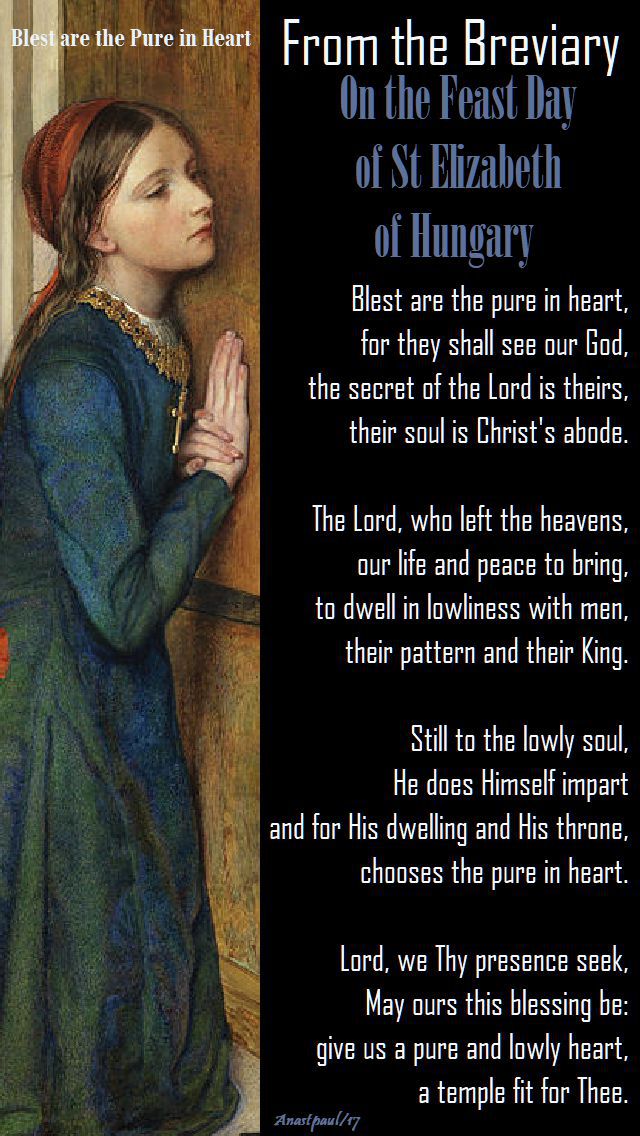
Blest are the Pure in Heart” – From the Breviary
(A perfect hymn/prayer for the Feast of St Elizabeth of Hungary)

Blest are the pure in heart,
for they shall see our God,
the secret of the Lord is theirs,
their soul is Christ’s abode.

The Lord, who left the heavens,
our life and peace to bring,
to dwell in lowliness with men,
their pattern and their King.

Still to the lowly soul,
He does Himself impart
and for His dwelling and His throne,
chooses the pure in heart.

Lord, we Thy presence seek,
May ours this blessing be:
give us a pure and lowly heart,
a temple fit for Theeblest are the pure in heart - on feast of st elizabeth of hungary - 17 nov 2017

Posted in franciscan OFM, MORNING Prayers, SAINT of the DAY

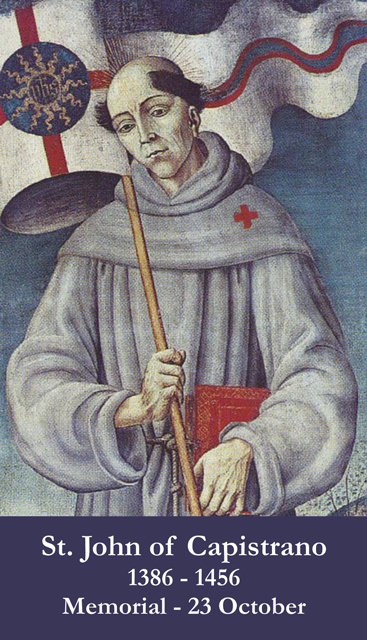
Thought for the Day – 23 October – The Memorial of St John of Capistrano (1386-1456)

Thought for the Day – 23 October – The Memorial of St John of Capistrano (1386-1456)

John was a Franciscan friar and priest, but not of the good-natured variety of Franciscans that holds the popular imagination.   To describe John as zealous would be an understatement.   He walked the fine line between zeal and fanaticism, allowing God to write straight with the crooked lines he drew throughout his life.   Some might wonder why such a man is even a saint but he is, and the lesson in that might be that being a saint is about more than just being nice and friendly.   Sanctity is an uncanny quality that can be as off-putting as it is attractive.

We might be “put off” by a saint like John Capistrano.  Perhaps the lesson there is that if he made it, there is hope for us all.

John Hofer, a biographer of John Capistrano, recalls a Brussels organization named after the saint.   Seeking to solve life problems in a fully Christian spirit, its motto was: “Initiative, Organisation, Activity.”   These three words characterised John’s life.   He was not one to sit around.   His deep Christian optimism drove him to battle problems at all levels with the confidence engendered by a deep faith in Christ.

We are not Christians because we build and maintain institutions.   We are Christians because people experience in us an invitation to know Jesus Christ and find in His Church the reality of His divine life and presence.

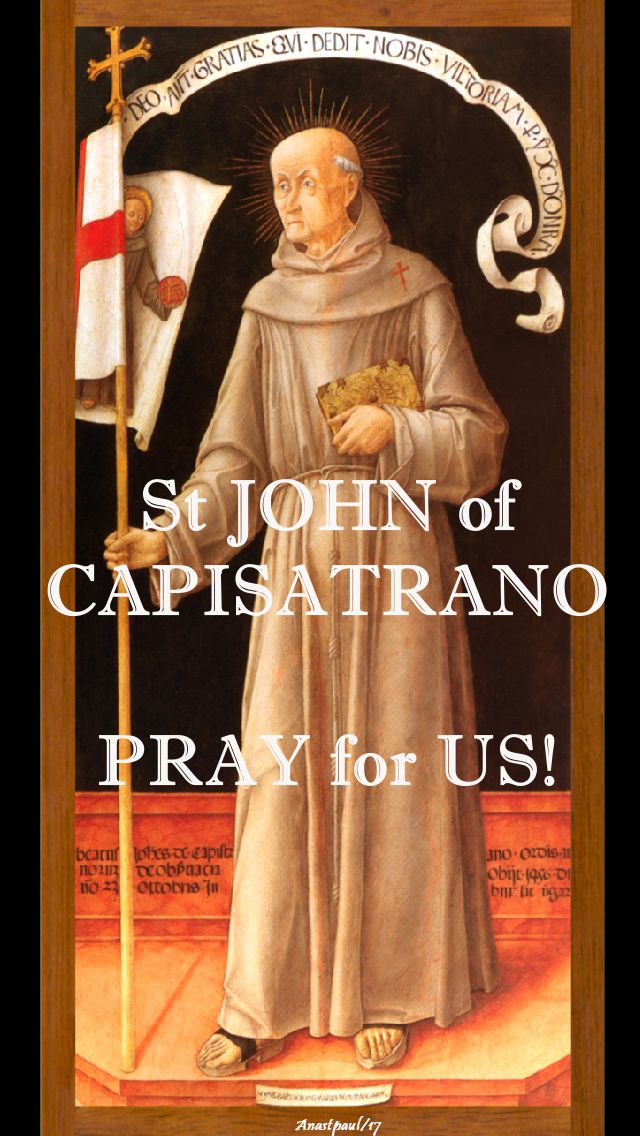
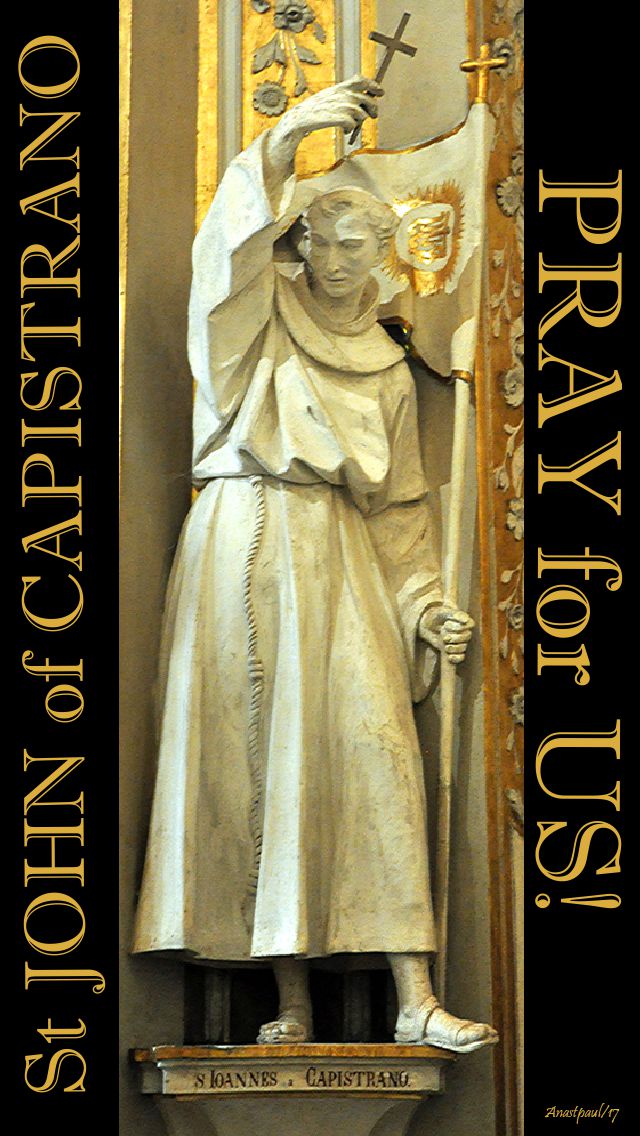
St John of Capistrano, pray for us!st john of capistrano pray for us 2 - 23 oct 2017

Posted in franciscan OFM, MORNING Prayers, QUOTES of the SAINTS, SAINT of the DAY

Quote of the Day – 23 October – The Memorial of St John of Capistrano (1386-1456)

Quote of the Day – 23 October – The Memorial of St John of Capistrano (1386-1456)

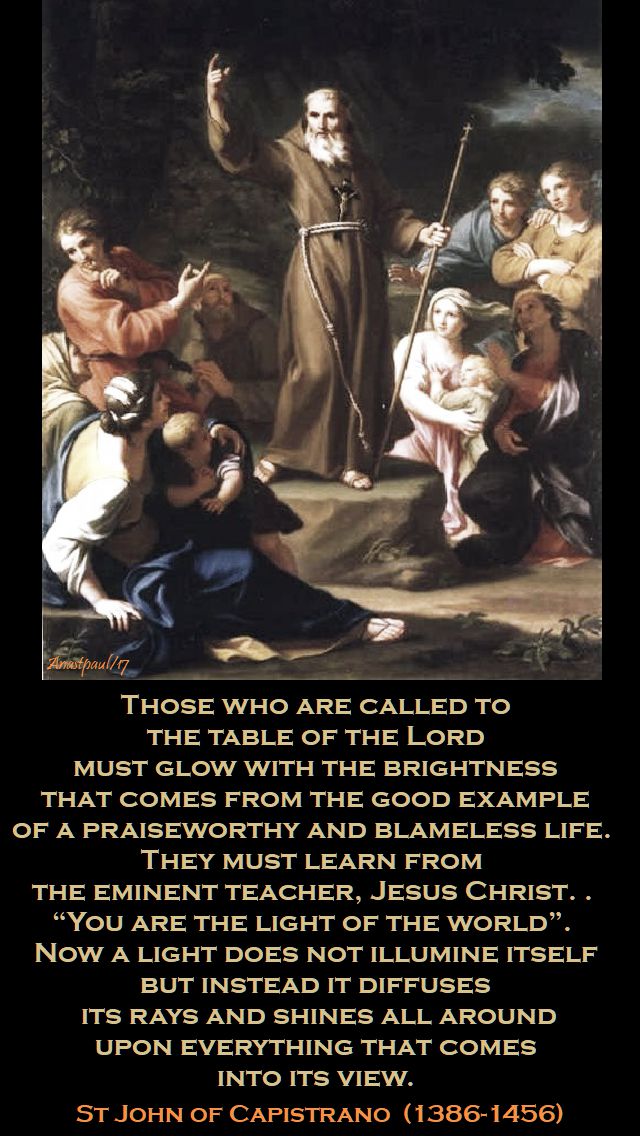
Those who are called to the table of the Lord
must glow with the brightness that comes from
the good example of a praiseworthy and blameless life.
They must learn from the eminent teacher, Jesus Christ. .
“You are the light of the world” (see Matthew 5:14).
Now a light does not illumine itself but instead it diffuses
its rays and shines all around upon everything that comes
into its view..

St John of Capistranothose who are called - st john of capistrano - 23 oct 2017

Posted in franciscan OFM, MORNING Prayers, SAINT of the DAY, The WORD

One Minute Reflection – 23 October – The Memorial of St John of Capistrano (1386-1456)

One Minute Reflection – 23 October – The Memorial of St John of Capistrano (1386-1456)

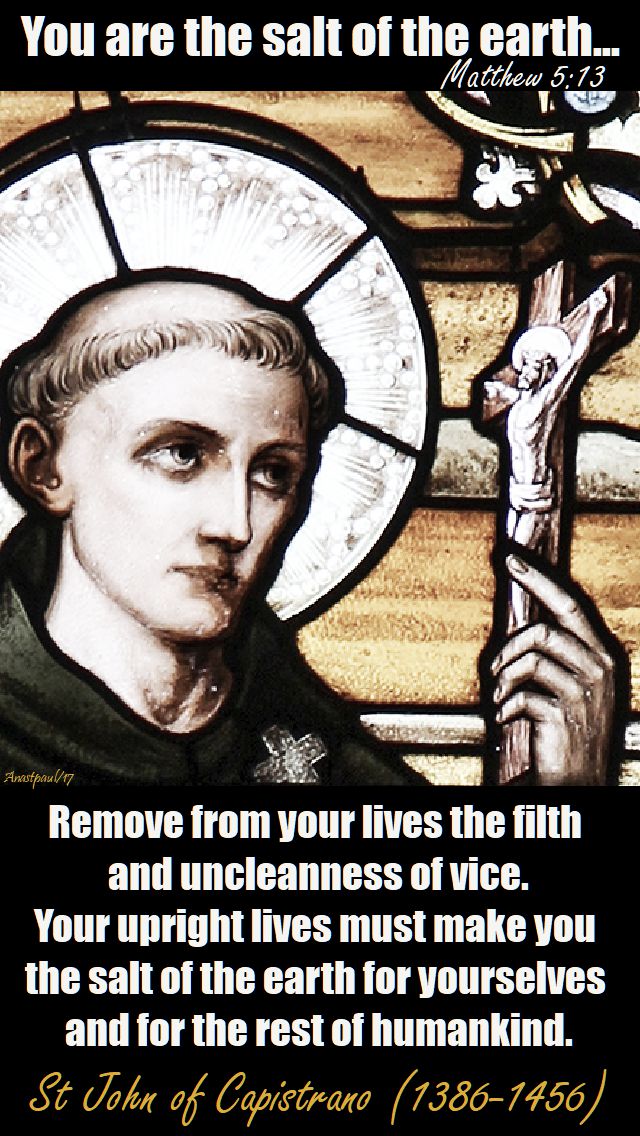
You are the salt of the earth.……Matthew 5:13

REFLECTION – Remove from your lives the filth and uncleanness of vice.
Your upright lives must make you the salt of the earth for yourselves
and for the rest of humankind…….St John of Capistranoremove from your lives - st john of capistrano - 23 oct 2017

PRAYER – Heavenly Father, enable me both to practice and to preach Your Message to all those I meet.   Grant that – in accord with Your Son’s mandate – I may be the salt of the earth.   St John of Capistrano, you lived a zealous life endlessly becoming “salt” to all.
Please pray for us that we may grow in zeal to glorify the Kingdom by our lives! Amenst john pray for us - 23 oct 2017

Posted in franciscan OFM, Of LAWYERS & CANON Lawyers, Attorneys, Solicitors, Barristers, Notaries, Para-Legals, SAINT of the DAY

Saint of the Day – 23 October – St John Capistrano OFM (1386-1456) – ‘the Soldier Saint’

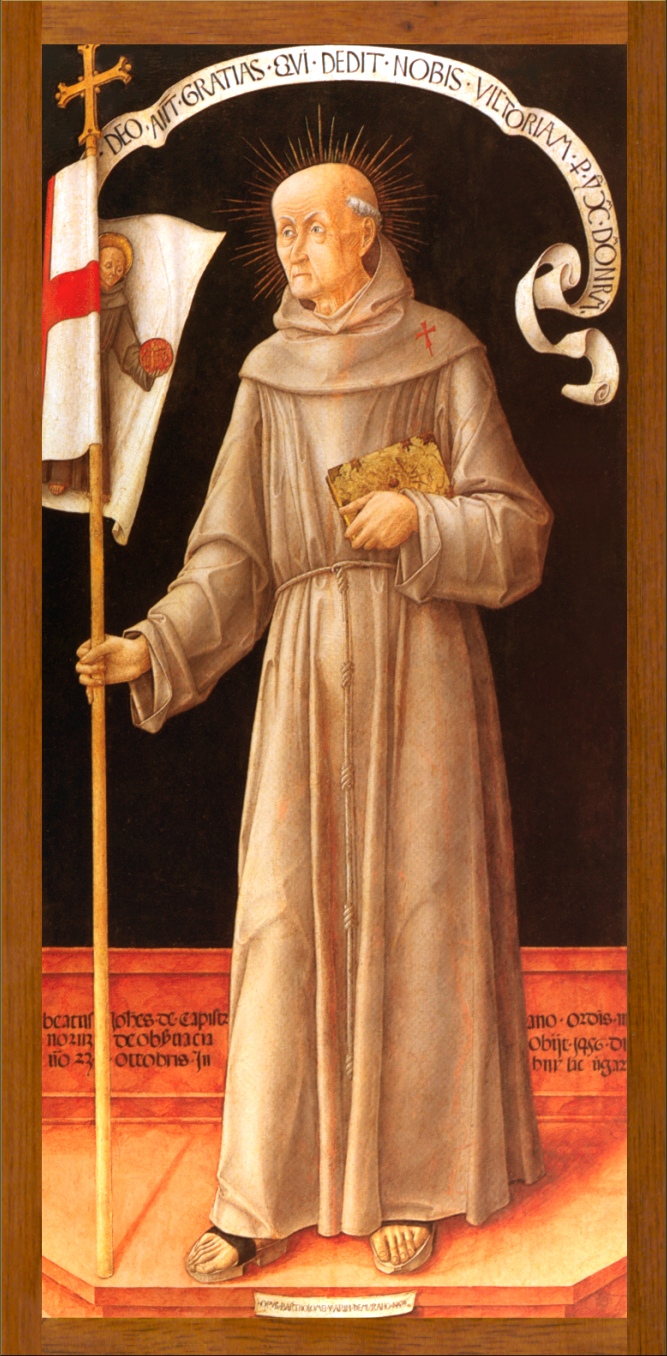
Saint of the Day – 23 October – St John Capistrano OFM (1386-1456) Priest and Friar of the Friars Minor, Confessor and Preacher.   Famous as a Preacher, Theologian and Inquisitor, trained Lawyer, he earned himself the nickname the Soldier Saint’ when, in 1456 at age 70 he led a Crusade against the invading Ottoman Empire at the Siege of Belgrade with the Hungarian Military Commander, John Hunyadi, called the Athleta Christi (“Christ’s Champion”) by Pope Pius II.   Born in 1386 at Capistrano, Italy – 23 October 1456 at Villach, Hungary of natural causes.   He was Beatified on 19 December 1650 by Pope Innocent X and Canonised on 16 October 1690 by Pope Alexander VIII.   Patronages – judges, jurists
• lawyers • military chaplains • military ordinariate of the Philippines • Hungary and Belgrade, Serbia.     He was buried in Ilok, Croatia.

400px-Ilok_church
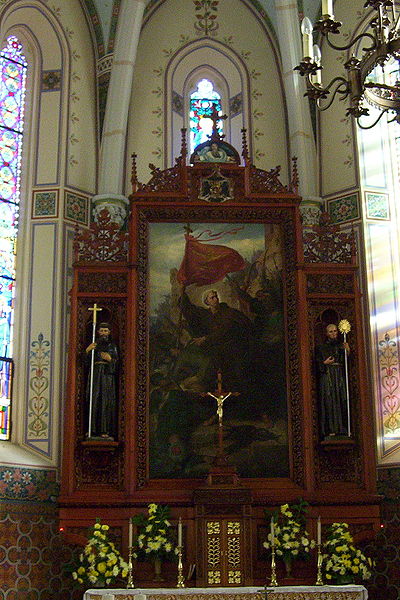
St John of Capistrano Church in Ilok, Croatia
ST JOHN OF CAPISTRANO 1.

As was the custom of this time, John is denoted by the village of Capestrano, in the Diocese of Sulmona, in the Abruzzi region, Kingdom of Naples.   He studied law at the University of Perugia. In 1412, King Ladislaus of Naples appointed him Governor of Perugia.   When war broke out between Perugia and the Malatestas in 1416, John was sent as ambassador to broker a peace but Malatesta threw him in prison.   It was during this imprisonment that he began to think more seriously about his soul.   He decided eventually to give up the world and become a Franciscan Friar, owing to a dream he had in which he saw St Francis and was warned by the saint to enter the Franciscan Order. Having never consummated the marriage, he asked and received permission from his wife to annul the marriage and started studying theology with St Bernardine of Siena.

Together with St James of the Marches, John entered the Order of Friars Minor at Perugia on 4 October 1416.   At once he gave himself up to the most rigorous asceticism, violently defending the ideal of strict observance and orthodoxy, following the example set by Bernardine.   From 1420 onwards, he preached with great effect in numerous cities and eventually became well known.capistrano

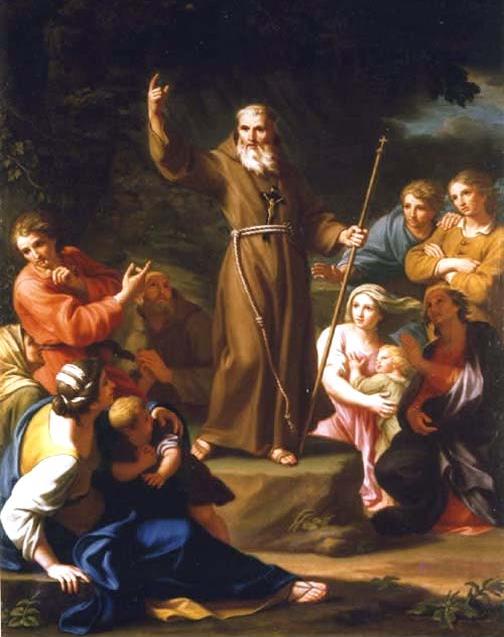
Unlike most Italian preachers of repentance in the 15th century, John was effective in northern and central Europe – in German states of Holy Roman Empire, Bohemia, Moravia, Austria, Hungary, Croatia and Kingdom of Poland.   The largest churches could not hold the crowds, so he preached in the public squares—at Brescia in Italy, he preached to a crowd of 126,000.

When he was not preaching, John was writing tracts against heresy of every kind.   This facet of his life is covered in great detail by his early biographers, Nicholas of Fara, Christopher of Varese and Girlamo of Udine. While he was thus evangelising, he was actively engaged in assisting Bernardine of Siena in the reform of the Franciscan Order, largely in the interests of a more rigorous discipline in the Franciscan communities. Like Bernardine, he strongly emphasised devotion to the Holy Name of Jesus and, together with that saint, was accused of heresy on this account.   In 1429, these Observant friars were called to Rome to answer charges of heresy and John was chosen by his companions to speak for them.   They were both acquitted by the Commission of Cardinals appointed to judge the accusations.

John, in spite of this restless life, found time to work—both during the lifetime of his mentor, Bernardine and afterwards—on the reform of the Order of Friars Minor.   He also upheld, in his writings, speeches and sermons, theories of papal supremacy rather than the theological wranglings of councils (see Conciliar Movement).   John, together with his teacher, Bernardine, his colleague, James of the Marche, and Blessed Albert Berdini of Sarteano, are considered the four great pillars of the Observant reform among the Friars Minor.

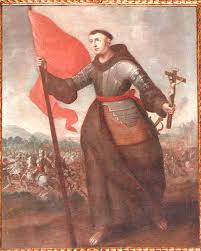
After the Fall of Constantinople in 1453, the Ottoman Empire, under Sultan Mehmed II, threatened Christian Europe.   That following year Pope Callixtus III sent John, who was already aged seventy, to preach a Crusade against the invading Turks at the Imperial Diet of Frankfurt.   Gaining little response in Bavaria and Austria, he decided to concentrate his efforts in Hungary.   John succeeded in gathering together enough troops to march onto Belgrade, which at that time was under siege by Turkish forces.   In the summer of 1456, these troops, together with John Hunyadi, managed to raise the siege of Belgrade; the old and frail friar actually led his own contingent into battle.   This feat earned him the moniker of ‘the Soldier Priest’.

Although he survived the battle, John fell victim to the bubonic plague, which flourished in the unsanitary conditions prevailing among armies of the day.   He died on 23 October 1456 at the nearby town of Ilok, Kingdom of Croatia in personal union with Hungary (now a Croatian border town on the Danube).

Posted in franciscan OFM, JESUIT SJ, MARIAN QUOTES, MORNING Prayers, The BLESSED VIRGIN MARY, The HOLY ROSARY/ROSARY CRUSADE, Uncategorized

Quote/s of the Day – 20 October – The Month of the Holy Rosary

Quote/s of the Day – 20 October – The Month of the Holy Rosary

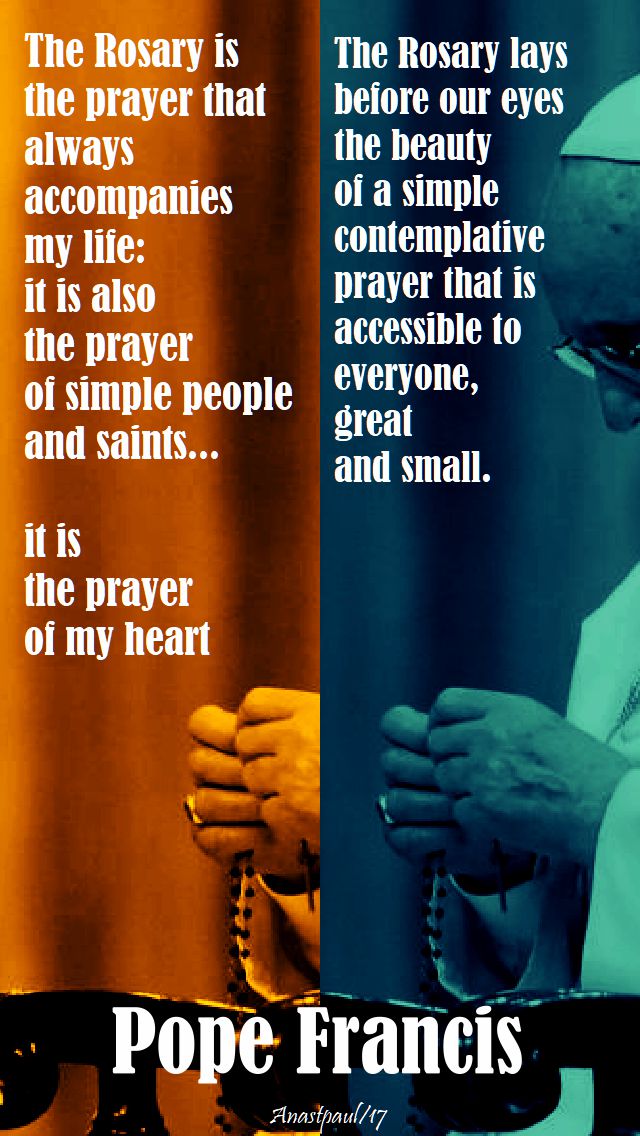
“The Rosary is the prayer
that always accompanies my life:
it is also the prayer
of simple people and saints…
it is the prayer of my heart”.

“The Rosary lays before our eyes the beauty
of a simple contemplative prayer
that is accessible to everyone, great and small.”

Pope Francispope francis on the rosary - quotes - 20 oct 2017

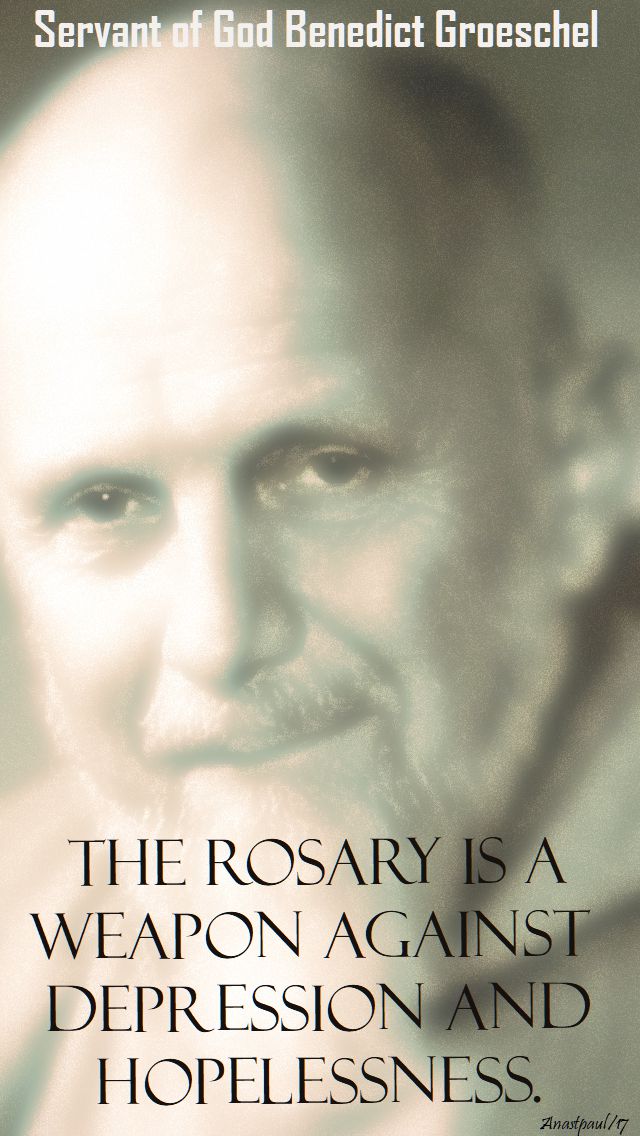
“The rosary is a weapon against
depression and hopelessness.”

Servant of God Benedict Groeschelthe rosary is - benedict groeschel

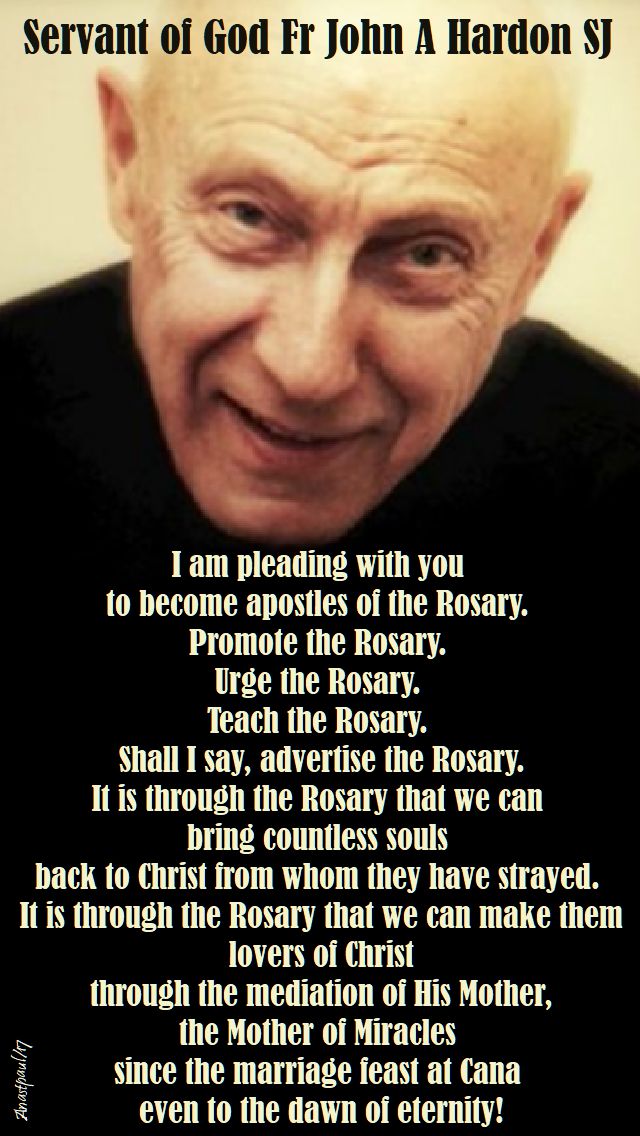
“I am pleading with you to become apostles of the Rosary.
Promote the Rosary.
Urge the Rosary.
Teach the Rosary.
Shall I say, advertise the Rosary.
It is through the Rosary that we can bring countless souls
back to Christ from whom they have strayed.
It is through the Rosary that we can make them
lovers of Christ through the mediation of His Mother,
the Mother of Miracles since the marriage feast at Cana
even to the dawn of eternity!”

Servant of God Fr John A Hardon SJ

(Father Hardon wrote and gave this conference before His Holiness, John Paul II, issued the Apostolic Letter Rosarium Virginis Mariae that added five more mysteries (the Luminous Mysteries) to the Rosary.)i am pleading with you - john a hardon - on the rosary - 20 oct 2017

Posted in CATHOLIC DEVOTIONS of the Month, FEASTS and SOLEMNITIES, franciscan OFM, MARIAN PRAYERS, MORNING Prayers, PRAYERS of the SAINTS

Our Morning Offering – 18 October 

Our Morning Offering – 18 October

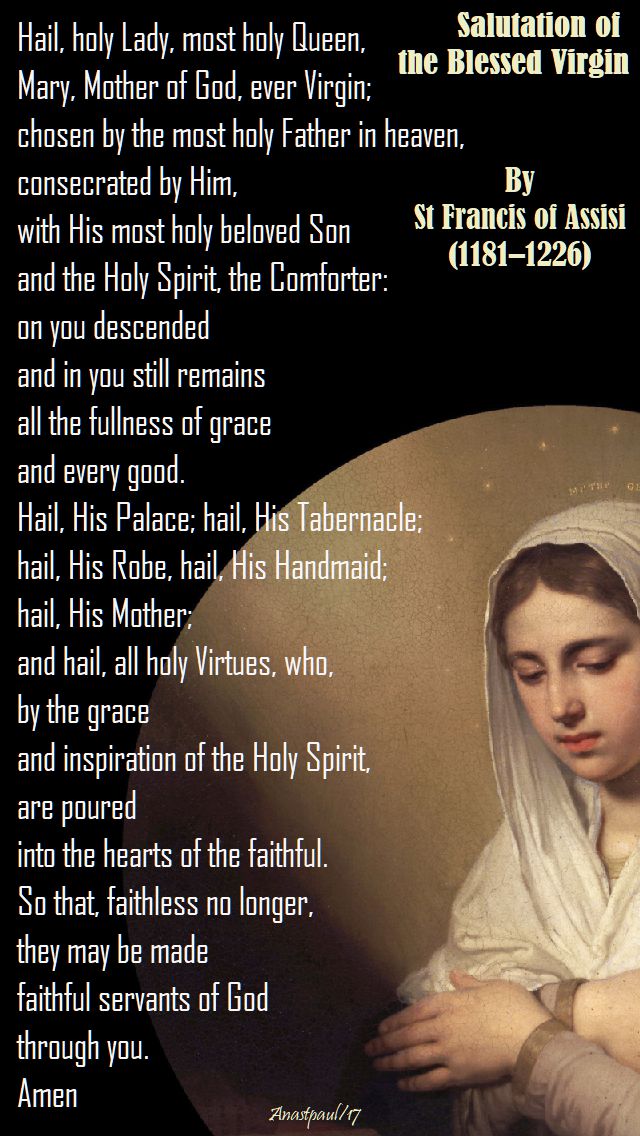
Salutation of the Blessed Virgin
By St Francis of Assisi (1181–1226)

Hail, holy Lady, most holy Queen,
Mary, Mother of God, ever Virgin;
chosen by the most holy Father in heaven,
consecrated by Him,
with His most holy beloved Son
and the Holy Spirit, the Comforter:
on you descended and in you still remains
all the fullness of grace and every good.
Hail, His Palace; hail, His Tabernacle;
hail, His Robe, hail, His Handmaid;
hail, His Mother;
and hail, all holy Virtues, who,
by the grace and inspiration of the Holy Spirit,
are poured into the hearts of the faithful.
So that, faithless no longer,
they may be made faithful servants of God
through you.
Amenhail holy lady - st francis of assisi - morning prayer on the feast of st luke 18 oct 2017

Posted in CATHOLIC-PRAYERS OF THE CHURCH, franciscan OFM, PRAYERS of the CHURCH, PRAYERS of the SAINTS

Our Morning Offering – 13 October

Our Morning Offering – 13 October

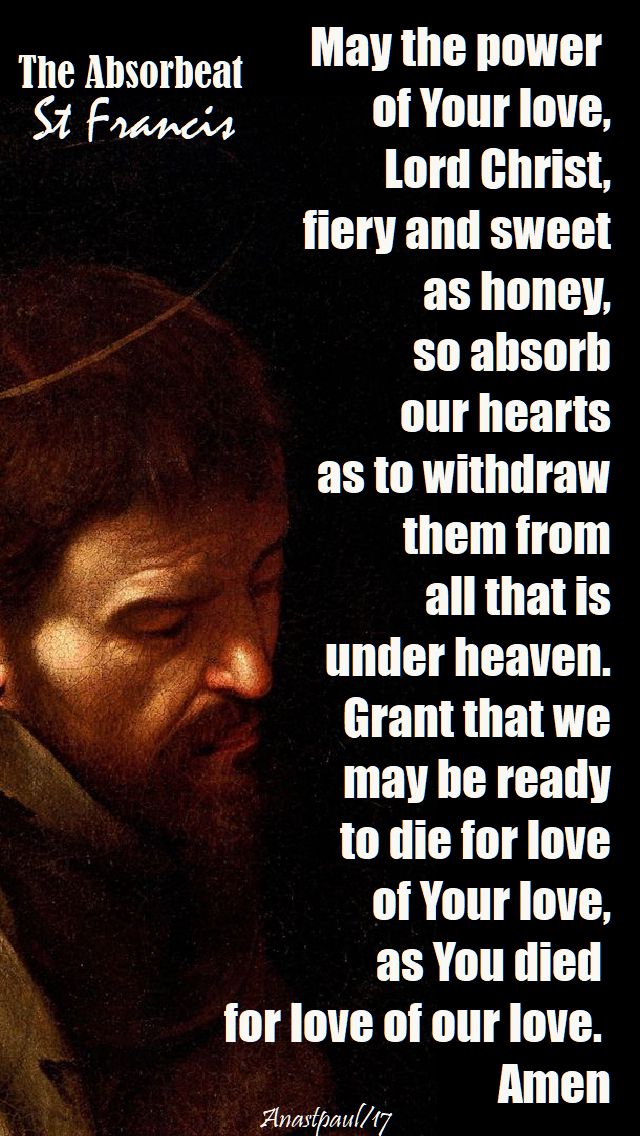
The Absorbeat
St Francis of Assisi

May the power of Your love, Lord Christ,
fiery and sweet as honey,
so absorb our hearts
as to withdraw them
from all that is under heaven.
Grant that we may be ready
to die for love of Your love,
as You died for love of our love.
Amenthe absorbeat - st franics 13 oct 2017

Posted in franciscan OFM, MORNING Prayers, SAINT of the DAY

Thought for the Day – 4 October – The Memorial of St Francis of Assisi (1181–1226)

Thought for the Day – 4 October – The Memorial of St Francis of Assisi (1181–1226)

Francis, the destitute and lowly, enters heaven, a rich man, acclaimed by the songs of angels!   (Antiphon for the Memoria of St Francis from the Divine Office)

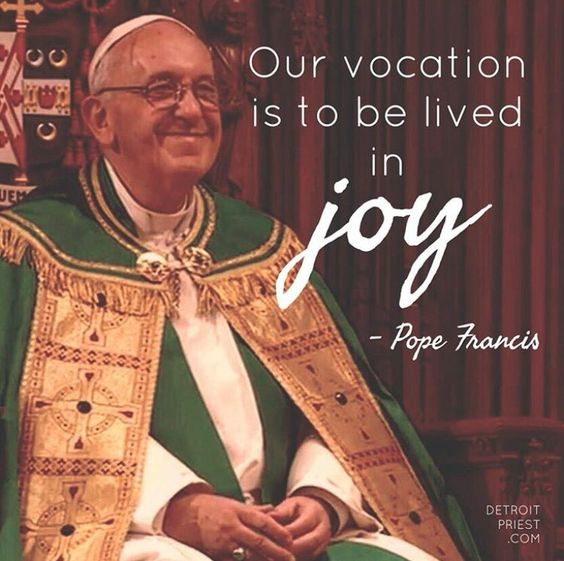
Joyful Saint, Joyful Pope!

In my presence and in the presence of others, try to be always joyful, for it is not fitting that a servant of God appear before the brothers or other men with a sad and glum face. —Saint Francis

The encounter with the living Jesus…fills the heart with joy, because it fills it with true life, a profound goodness that does not pass away or decay. —Pope Francispapa f - joy

Saint Francis called himself God’s court jester—the Jongleur de Dieu—as he went about singing the praise of God.   Pope Francis brought the house down the night of his election, telling his brother cardinals, “May God forgive you!

One can’t help but notice a kind of effervescent joy that spreads happiness to others. These men have shattered the stereotype of rigid, grim, calcified piety.   They radiate something entirely different: the joy of Christ.

Jesus was attractive, in the literal sense of the word.   People wanted to meet Him and hear Him and follow Him.   Saint Francis had a similar effect and if the three million people who showed up at World Youth Day in Rio de Janeiro are any indication, Pope Francis does too.   The wisdom and faith of these men make them intriguing, to be sure, but their spirit of joy goes a long way in drawing these crowds.

Jesus, too, “rejoiced in the Holy Spirit” (Luke 10:21).   And he wanted us to share in his joy. “These things I have spoken to you,” Jesus told his disciples, “that my joy may be in you, and that your joy may be full” (John 15:11).   Twice again Jesus speaks in these terms: “Ask, and you will receive, that your joy may be full” (John 16:24), and, “These things I speak in the world, that they may have my joy fulfilled in themselves” (John 17:13).

This fullness of joy is our inheritance as Christians.   And it doesn’t always have to come with suffering!   The gift of knowing Christ, being subjects of the King of Kings, is a great joy in and of itself.   This is what Jesus taught:  “The kingdom of heaven is like treasure hidden in a field, which a man found and covered up; then in his joy he goes and sells all that he has and buys that field” (Matthew 13:44).

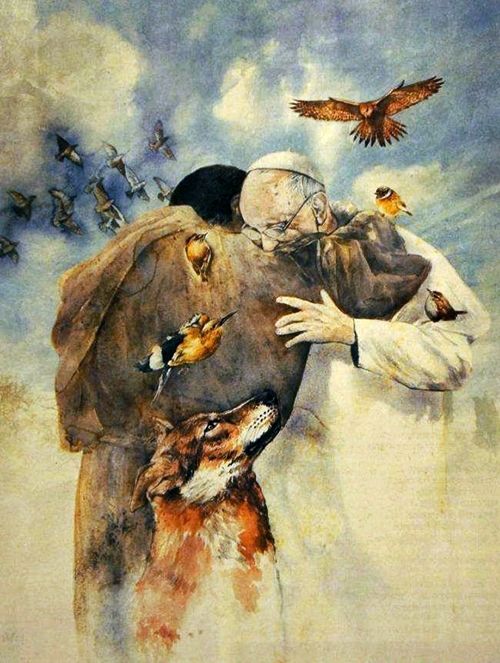
Saint Francis and Pope Francis have given everything, dedicating their entire lives for the sake of the kingdom of heaven.   And in this they have found great joy.francis and franics

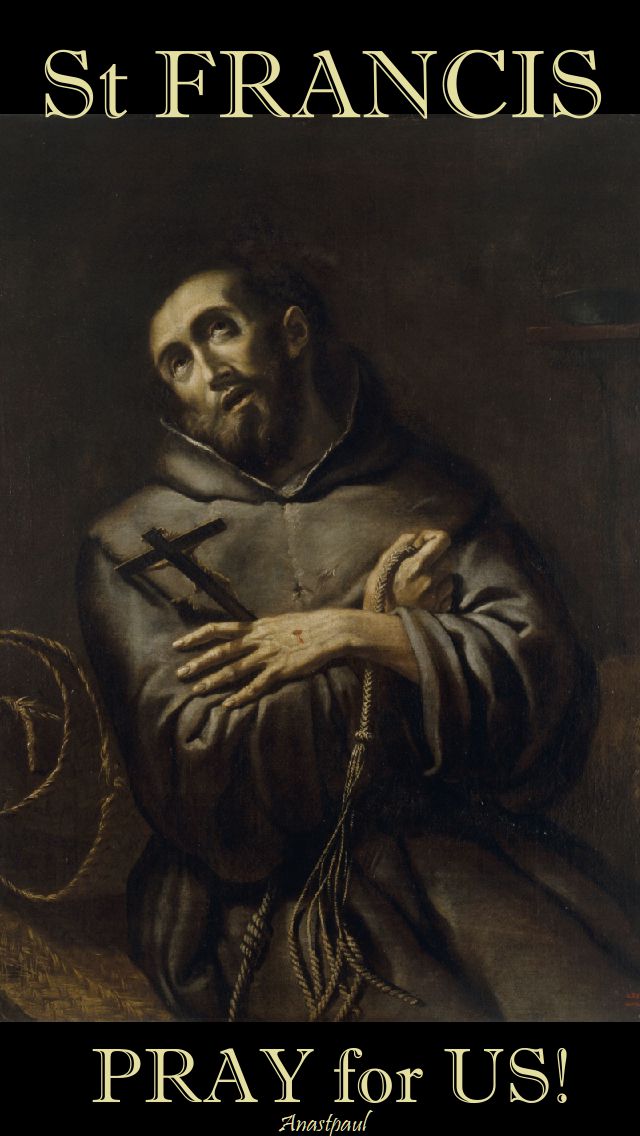
St Francis Pray for us and let us all pray for our Holy Father!francis pray 2 - 4 oct 2017

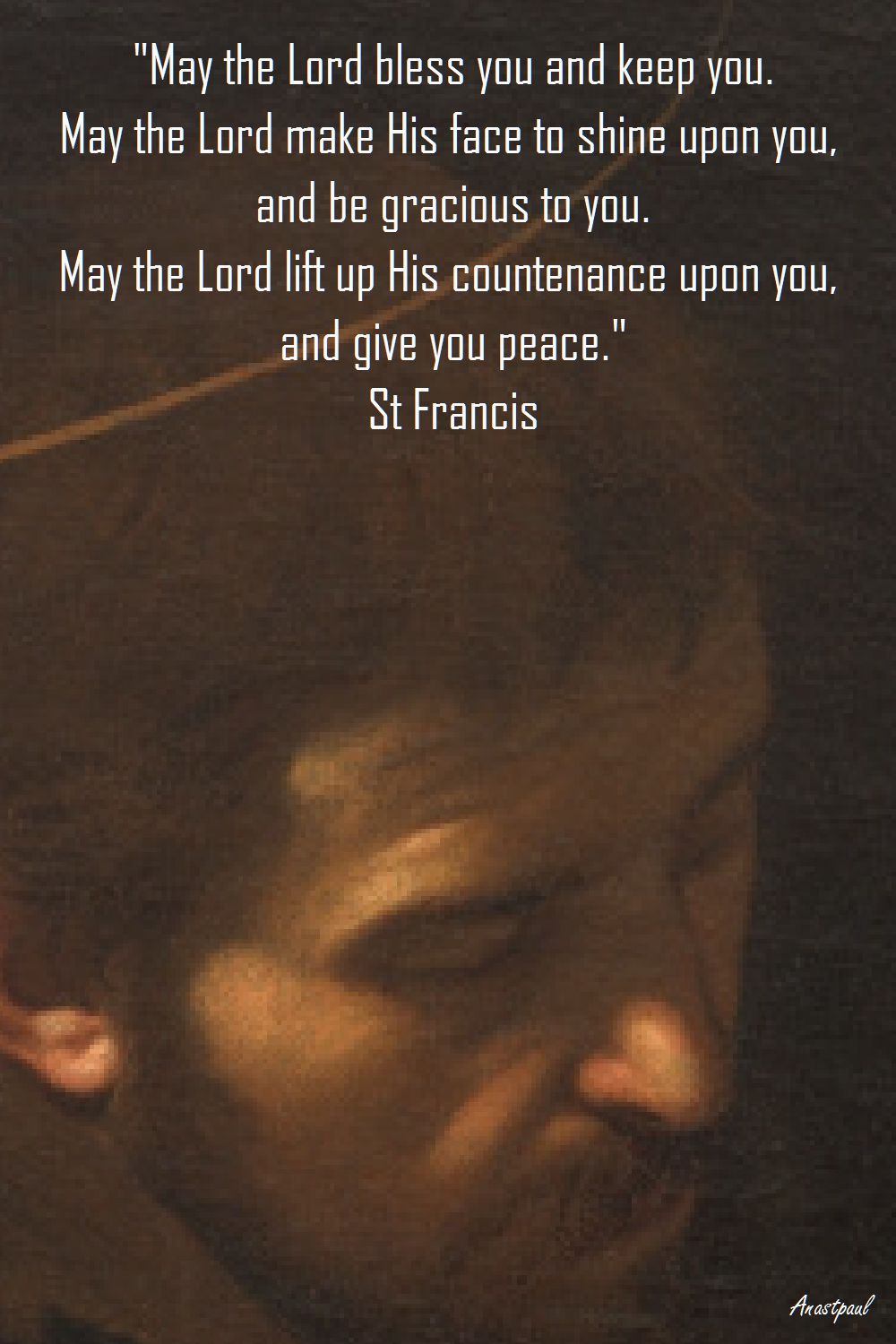
St Francis leaves us with his blessing:

May the Lord bless you and keep you.

May the Lord make His face to shine upon you

and be gracious to you.

May the Lord lift up His countenance upon you and give you peace.

ST FRANCIS PRAYER - MAY THE LORD BLESS YOU AND KEEP YOU

Posted in franciscan OFM, SAINT of the DAY

Saint Francis of Assisi’s Song of Praise

Saint Francis of Assisi’s Song of Praise

We could simply say that Francis’ prayer life was, “My God and my all!” and stop at that. Everything that can be stated about prayer in the life of Saint Francis of Assisi is expressed in those four little words.   While the truth is contained in that brief and holy phrase, the way in which Francis reached that apex of prayer needs exploration.

In searching Francis’ journey in prayer, we discover our own way to believing and living “My God and my all!”   There are many significant markers in Francis’ prayer life but among them shines the Canticle.

The Canticle sings in simple words of praise all that Francis discovered of the glory and goodness of God.   All he learned through visions in his early conversion, from the words from the crucifix of San Damiano, his pummeling of God in prayer in the caves, his experiences of the brotherhood of lesser brothers, his own illness and approaching death–all is distilled to praise.

Each path Francis took on his journey to God led him to a single action:  praise of God. Through the entire domain of earth, from the glory of daybreak to nightfall’s softened light, Francis praises the Lord.   Through all weather, the elements of fire and water and the motherhood of the earth, Francis continues in praise.   Sickness and trial give birth to continuing praise.   The inevitable encounter with Sister Death spurs Francis to close his work with praise, blessing and thanksgiving.   Everything that happened in Francis’ life fueled the fire of his praise to the Lord.

Francis leaves us with a legacy of praise.   If we claim it as our heritage, we must use it as Francis did–in every circumstance of life without reservation.   “But,” we think, “I can’t praise God for my father’s Alzheimer’s disease.   How can I praise God for joblessness? For debilitating illness?   For the pain and grief that thunder through my life?”

Francis, like the Lord he followed, teaches us to praise God through the trials that enter every life.   Only then can we experience release from the bonds of anguish and despair. If we release our deepest emotions to God, we defuse their power to create havoc in our lives.

Learning to praise God through all the events with which life confronts us may seem like an impossible task.   In reality, all we have to do is begin to follow the path of praise. God will lead us on.

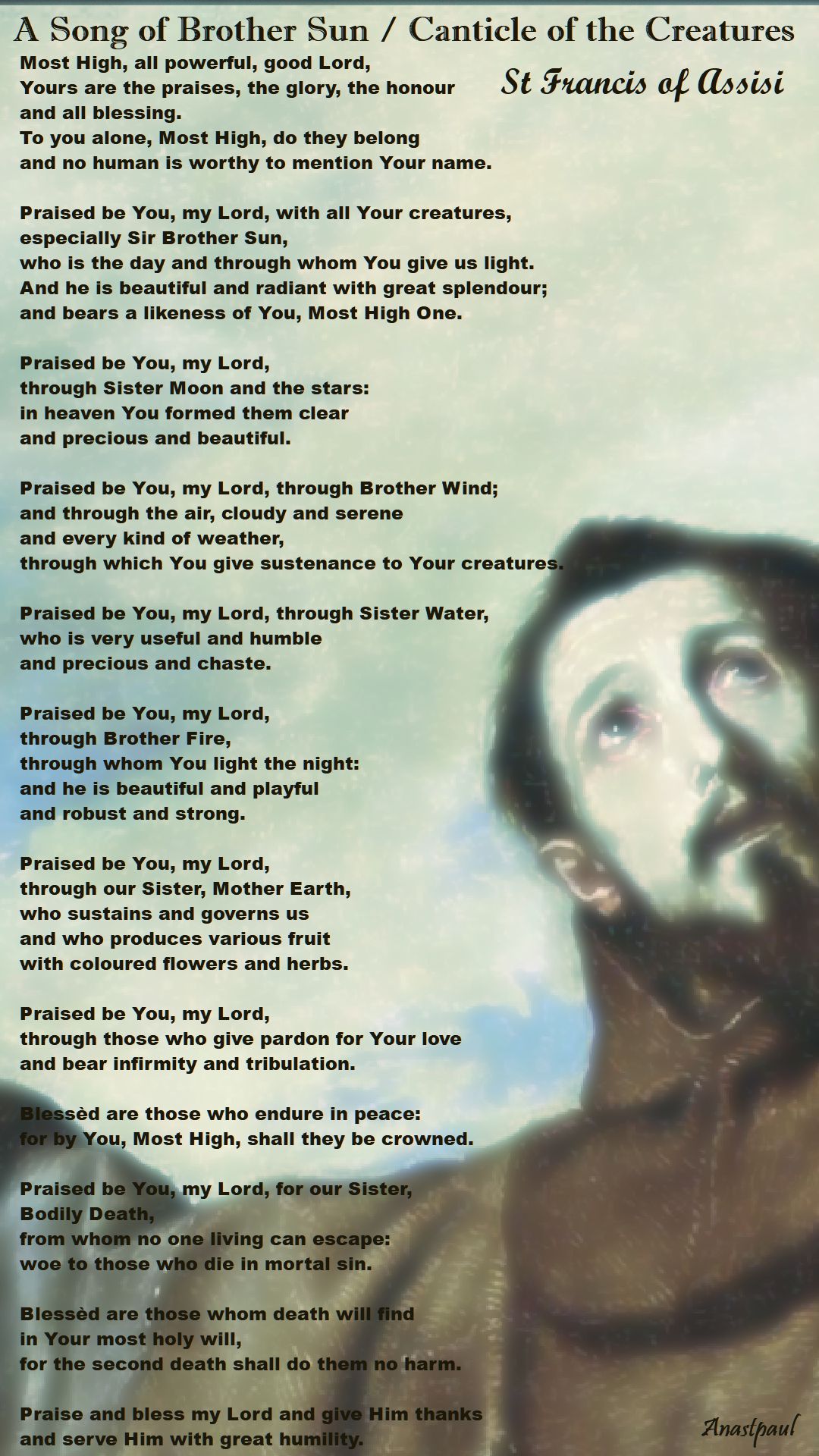
A Song of Brother Sun/Canticle of the Creatures
By St Francis of Assisi

Most High, all powerful, good Lord,
Yours are the praises, the glory, the honour
and all blessing.
To you alone, Most High, do they belong
and no human is worthy to mention Your name.

Praised be You, my Lord, with all Your creatures,
especially Sir Brother Sun,
who is the day and through whom You give us light.
And he is beautiful and radiant with great splendour;
and bears a likeness of You, Most High One.

Praised be You, my Lord,
through Sister Moon and the stars:
in heaven You formed them clear
and precious and beautiful.

Praised be You, my Lord, through Brother Wind;
and through the air, cloudy and serene
and every kind of weather,
through which You give sustenance to Your creatures.

Praised be You, my Lord, through Sister Water,
who is very useful and humble and precious and chaste.

Praised be You, my Lord,
through Brother Fire,
through whom You light the night:
and he is beautiful and playful and robust and strong.

Praised be You, my Lord,
through our Sister, Mother Earth,
who sustains and governs us
and who produces various fruit
with coloured flowers and herbs.

Praised be You, my Lord,
through those who give pardon for Your love
and bear infirmity and tribulation.

Blessèd are those who endure in peace:
for by You, Most High, shall they be crowned.

Praised be You, my Lord, for our Sister,
Bodily Death,
from whom no one living can escape:
woe to those who die in mortal sin.

Blessèd are those whom death will find
in Your most holy will,
for the second death shall do them no harm.

Praise and bless my Lord and give Him thanks
and serve Him with great humility.

a song of brother sun - st francis - 4 oct 2017

Posted in franciscan OFM, MORNING Prayers, QUOTES of the SAINTS, SAINT of the DAY

Quote/s of the Day – 4 October – The Memorial of St Francis of Assisi (1181–1226)

Quote/s of the Day – 4 October – The Memorial of St Francis of Assisi (1181–1226)

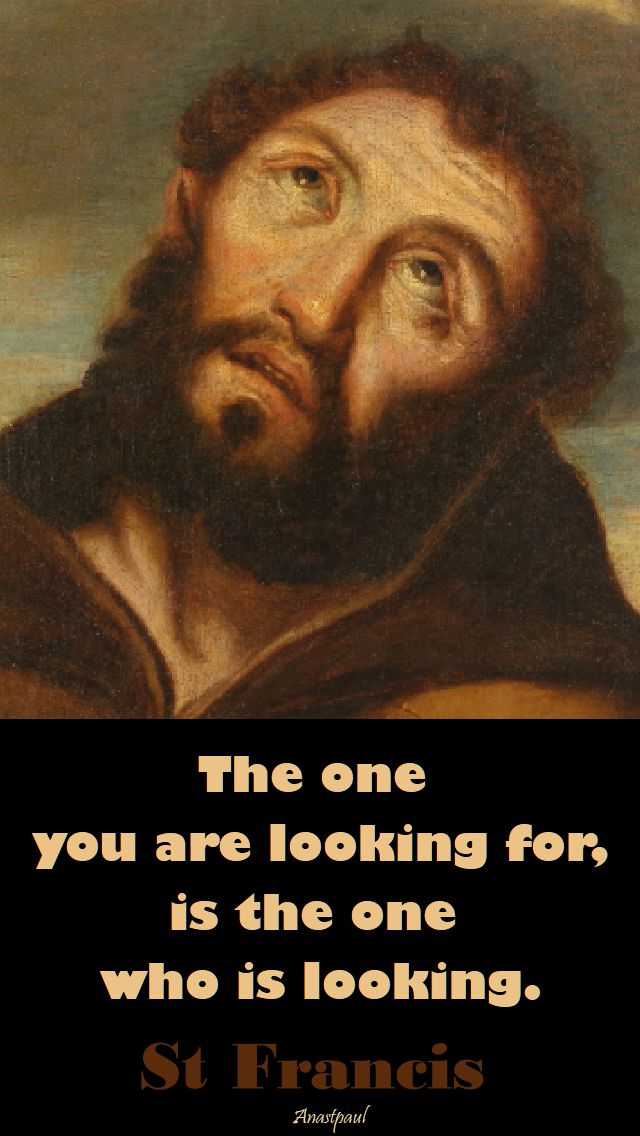
“The one you are looking for,
is the one who is looking.”the one you are looking for - st francis - 4 oct 2017

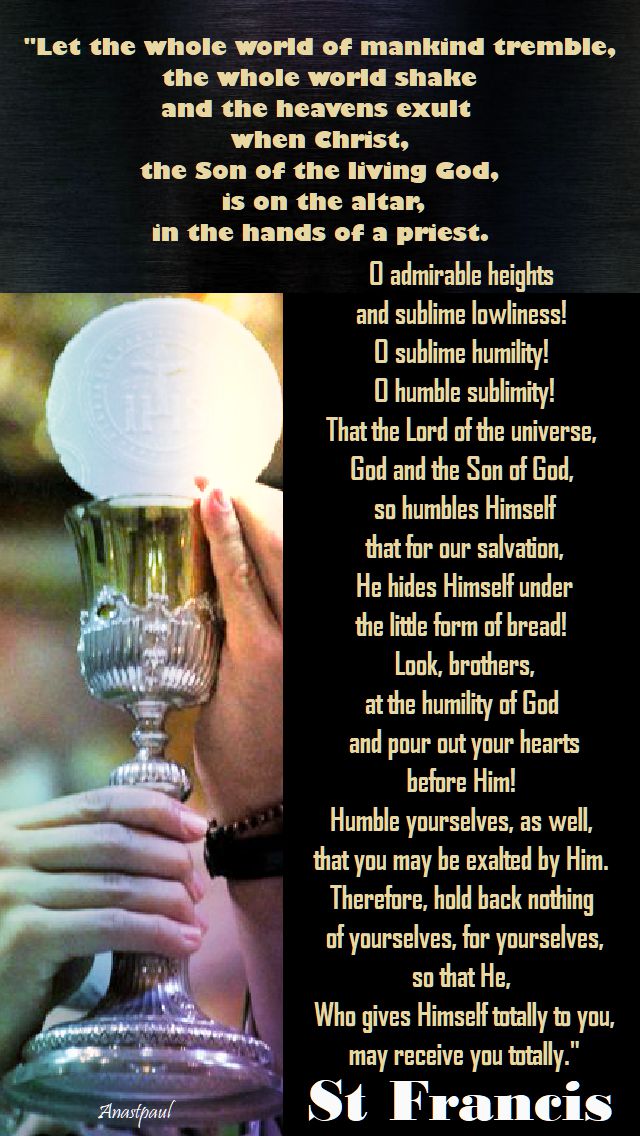
“Let the whole world of mankind tremble,
the whole world shake
and the heavens exult when Christ,
the Son of the living God,
is on the altar in the hands of a priest.
O admirable heights and sublime lowliness!
O sublime humility! O humble sublimity!
That the Lord of the universe, God and the Son of God,
so humbles Himself that for our salvation,
He hides Himself under the little form of bread!
Look, brothers, at the humility of God
and pour out your hearts before Him!
Humble yourselves, as well,
that you may be exalted by Him.
Therefore, hold back nothing
of yourselves, for yourselves,
so that He,
Who gives Himself totally to you,
may receive you totally.”let the whole world tremble - st francis - 4 oct 2017

“Therefore, O sons of men, how long will you be hard of heart?   Why do you not recognize the truth and believe in the Son of God? See, daily He humbles Himself as when He came from the royal throne into the womb of the Virgin;  daily He comes to us in a humble form;  daily He comes down from the bosom of the Father upon the altar in the hands of the priest.   And as He appeared to the holy apostles in true flesh, so now He reveals Himself to us in the sacred bread.   As they saw only his flesh by means of their bodily slight, yet believed Him to be God as they contemplated Him with the eyes of faith, so, as we see bread and wine with [our] bodily eyes, we too are to see and firmly believe them to be His most holy Body and Blood living and true.   And in this way the Lord is always with His faithful, as He Himself says:  Behold I am with you even to the end of the world (cf. Mt. 28:30).”therefore o sons of men - st francis - 2017

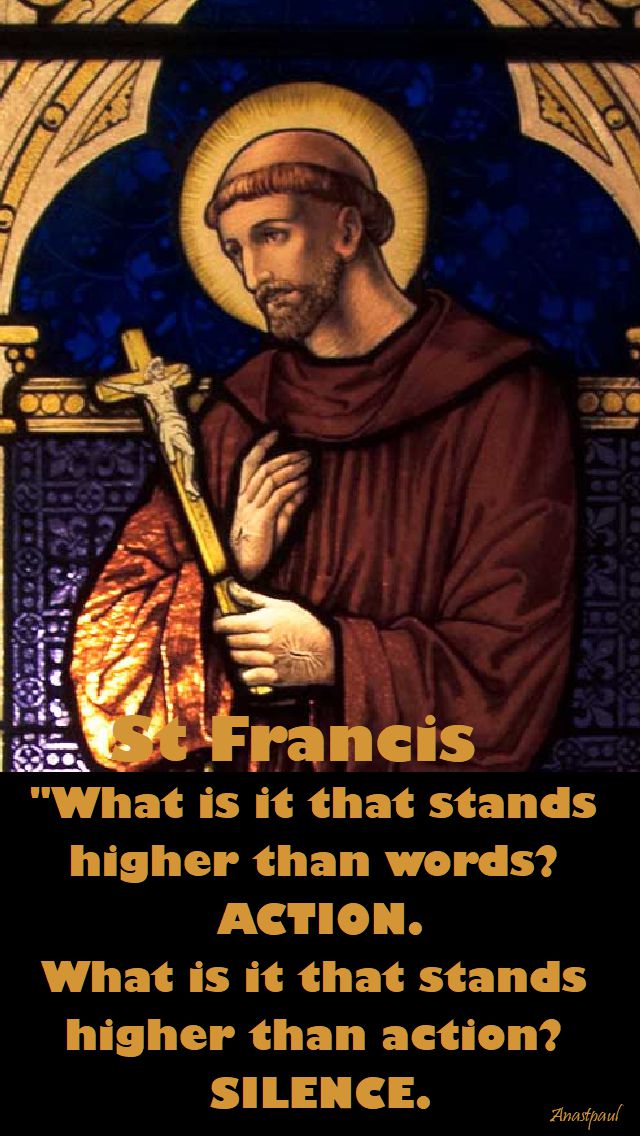
“What is it that stands higher than words?
ACTION.
What is it that stands higher than action?
SILENCE.”what is it that stands higher than words - st francis 4 oct 2017

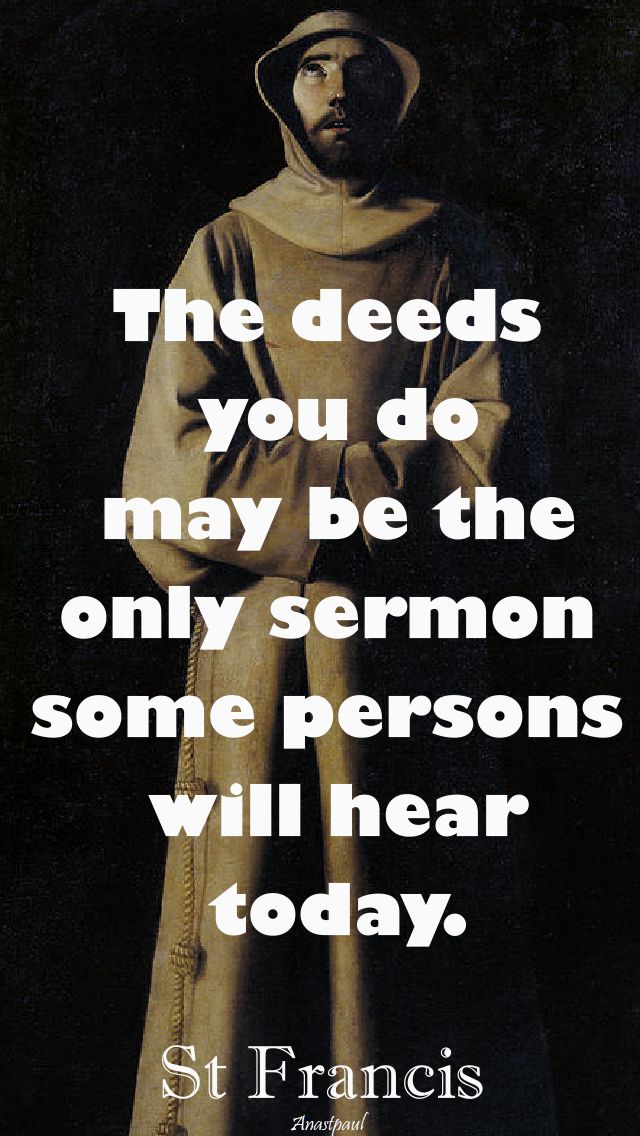
“The deeds you do may be the only sermon
some persons will hear today.”the deeds you do - 4 oct 2017

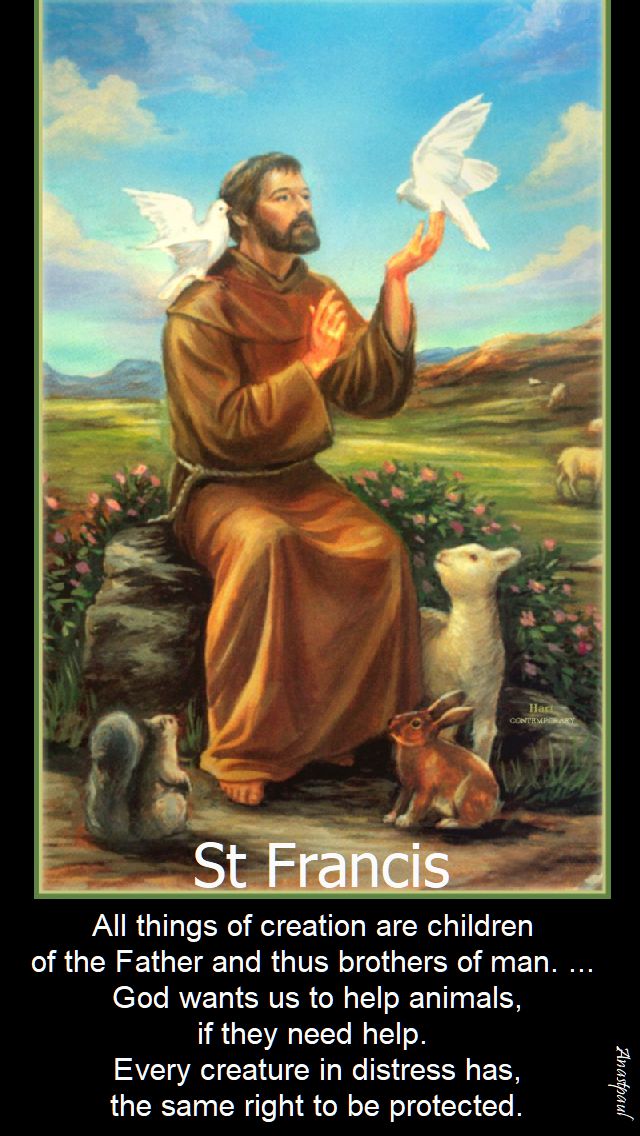
“All things of creation are children of the Father
and thus brothers of man. …
God wants us to help animals, if they need help.
Every creature in distress has,
the same right to be protected.”all things of creation - st francis - 4 oct 2017

St Francis of Assisi (1181–1226)

Posted in franciscan OFM, MORNING Prayers, QUOTES of the SAINTS, SAINT of the DAY, The WORD

One Minute Reflection – 4 October – The Memorial of St Francis of Assisi (1181–1226)

One Minute Reflection – 4 October – The Memorial of St Francis of Assisi (1181–1226)

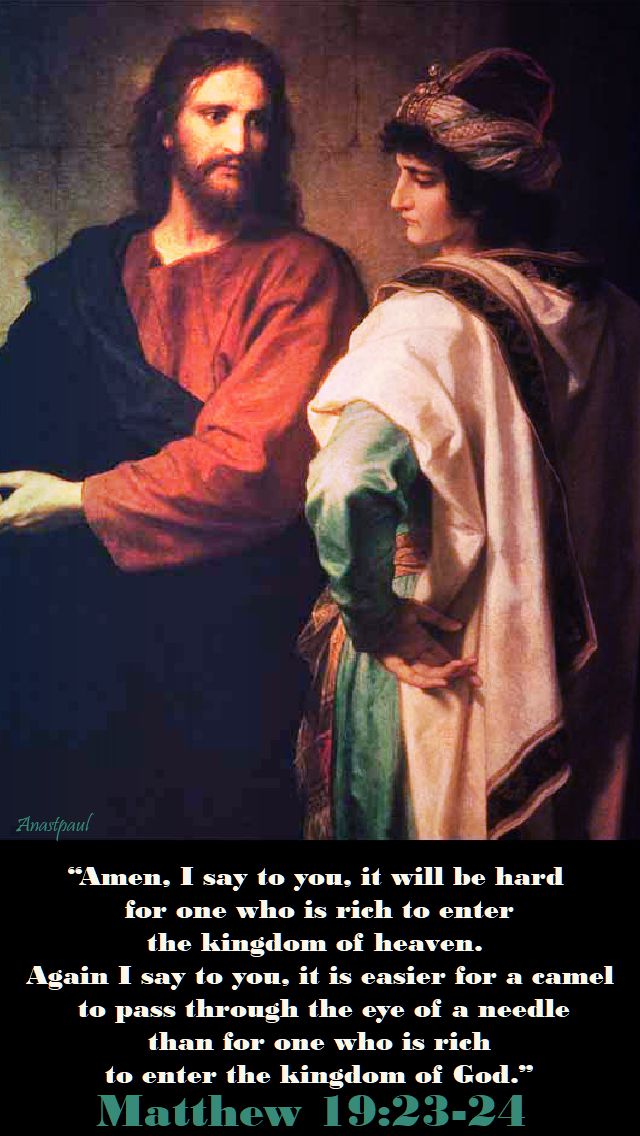
Then Jesus said to his disciples, “Amen, I say to you, it will be hard for one who is rich to enter the kingdom of heaven.
Again I say to you, it is easier for a camel to pass through the eye of a needle than for one who is rich to enter the kingdom of God.”….Matthew 19:23-24matthew 19 23-24

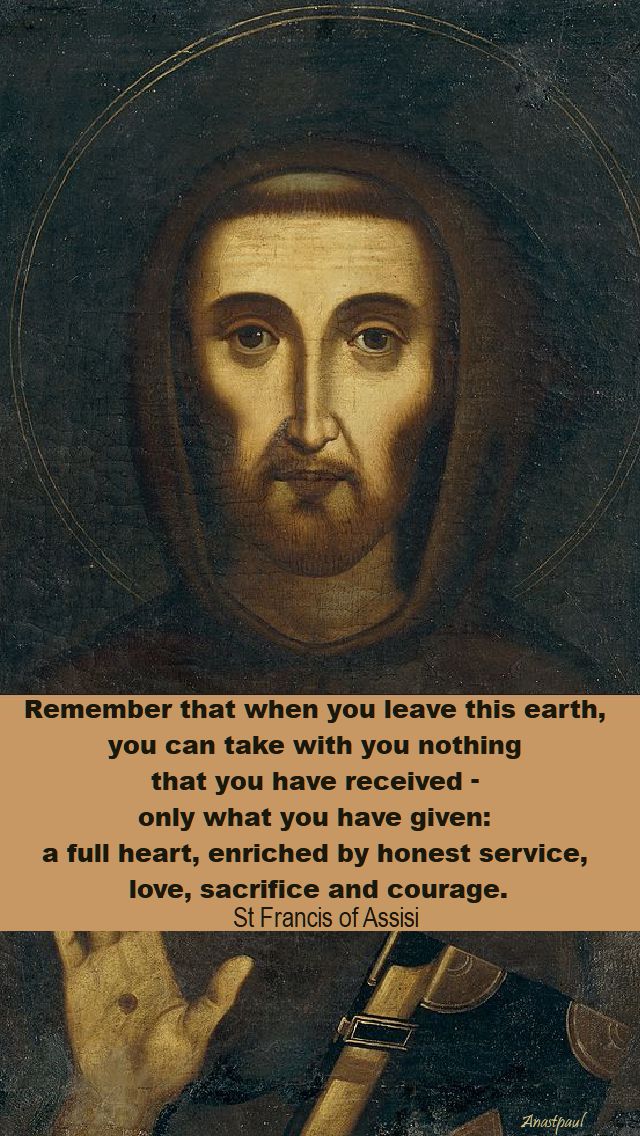
REFLECTION – “Remember that when you leave this earth, you can take with you nothing that you have received—only what you have given: a full heart, enriched by honest service, love, sacrifice and courage.”….St Francis of Assisiremember that when you leave - st francis - 4 oct 2017

PRAYER – Lord God, You made St Francis of Assisi, Christ-like in his poverty and humility, his gentleness and charity, his love and courage. Help us to walk in his ways that, with joy and love, we may follow Christ Your Son and be united with You. St Francis, pray for us, amen.st francis pray - 4 oct 2017

Posted in franciscan OFM, MORNING Prayers, PRAYERS of the SAINTS, SAINT of the DAY, The HOLY CROSS

Our Morning Offering – 4 October – The Memorial of St Francis of Assisi (1181–1226)

Our Morning Offering – 4 October – The Memorial of St Francis of Assisi (1181–1226)

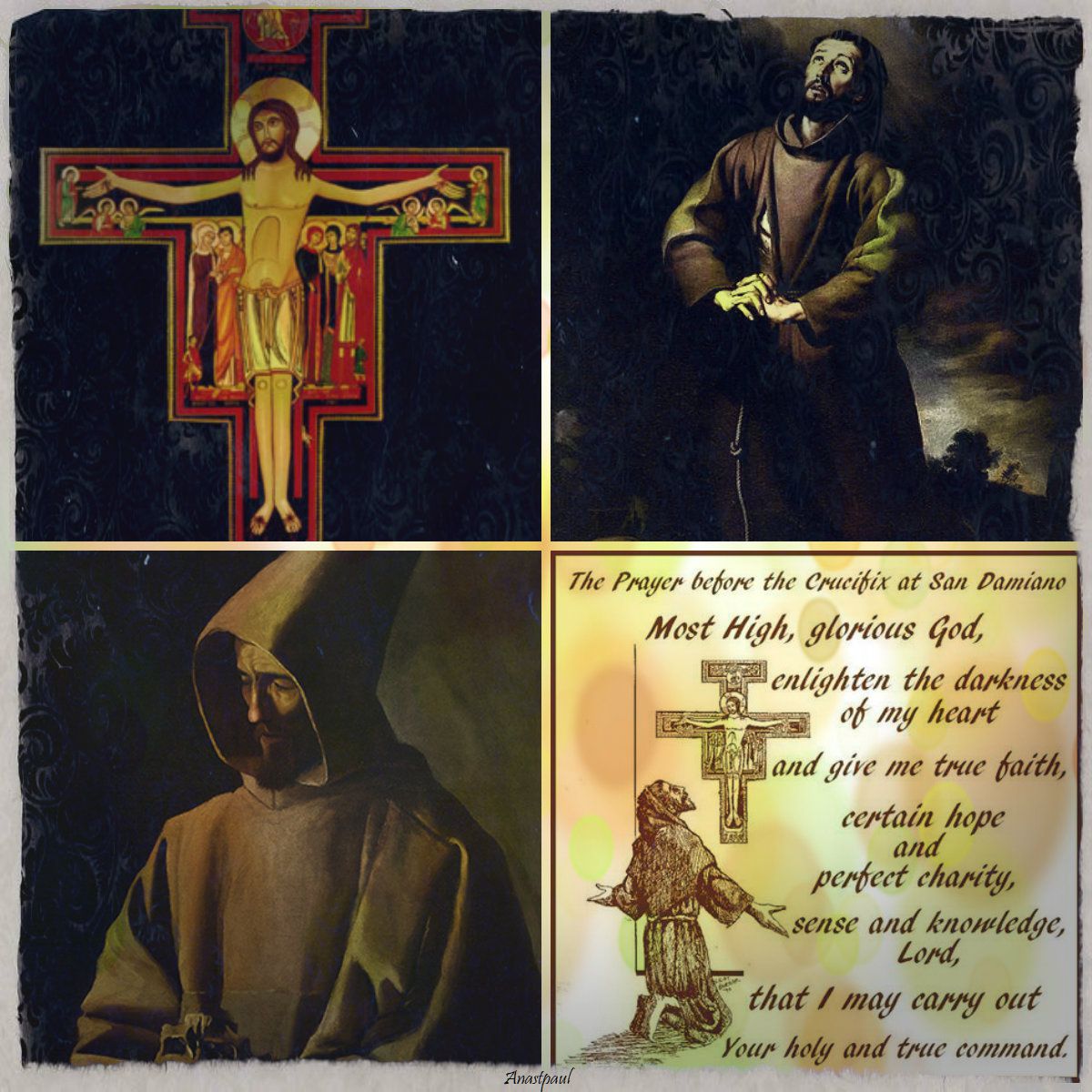
The Prayer before the San Damiano Crucifix
St Francis of Assisi

Most High, glorious God,
enlighten the darkness of my heart
and give me
true faith,
certain hope,
and perfect charity,
sense and knowledge,
Lord, that I may carry out,
Your holy and true command.  AmenPRAYER BEFORE THE CRUCIFIX SAN DAMIANO.2

Posted in DYING / LAST WORDS, franciscan OFM, Of and For PEACE, Of ANIMALS / ANIMAL WELFARE, Of PARENTS & FAMILIES of LARGE Families, SAINT of the DAY

Saint of the Day – 4 October – St Francis of Assisi OFM (1181–1226)

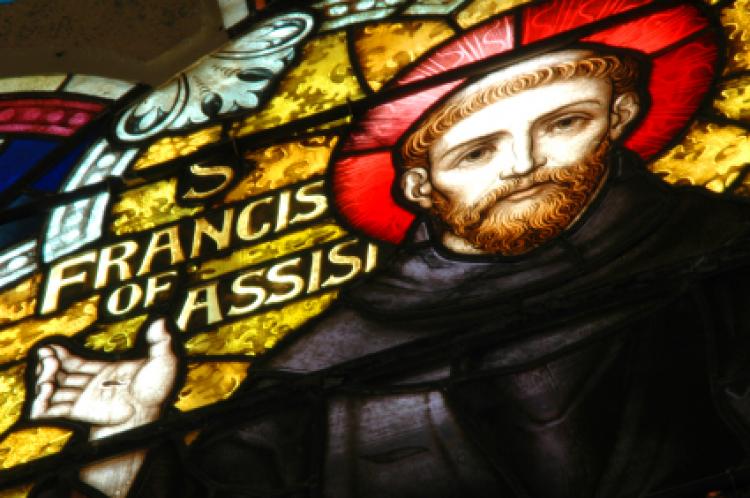
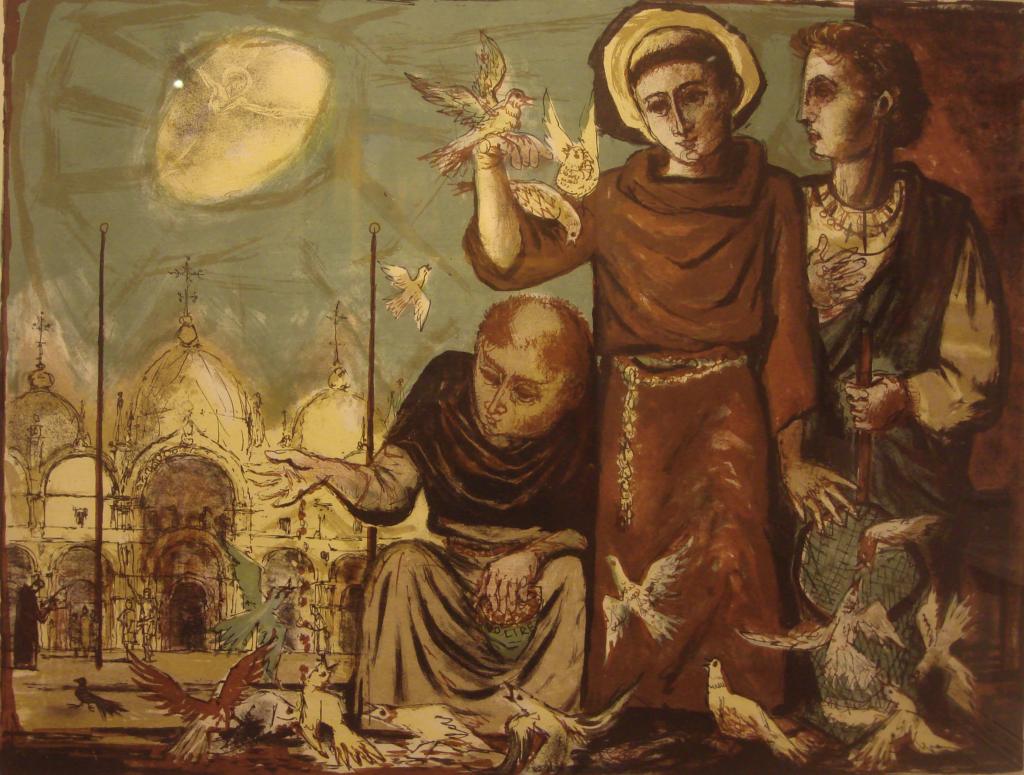
Saint of the Day – 4 October – St Francis of Assisi OFM Confessor, Religious, Deacon, Stigmatist and ounder, Apostle of the Holy Eucharist, the Blessed Virgin and of Charity, Preacher, Missionary, Mystic, Miracle-Worker, Co-patron of Italy, Founder of the Seraphic Order – the men’s Order of Friars Minor, the women’s Order of Saint Clare, the Third Order of Saint Francis and the Custody of the Holy Land, as well as being the Founder of the Nativity Crib and Manger as we know it today.

250px-S.Francesco_speco
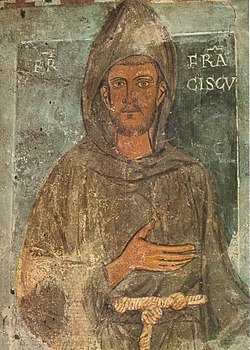
The oldest surviving depiction of Saint Francis is a fresco near the entrance of the Benedictine abbey of Subiaco, painted between March 1228 and March 1229.   He is depicted without the stigmata but the image is a religious image and not a portrait.

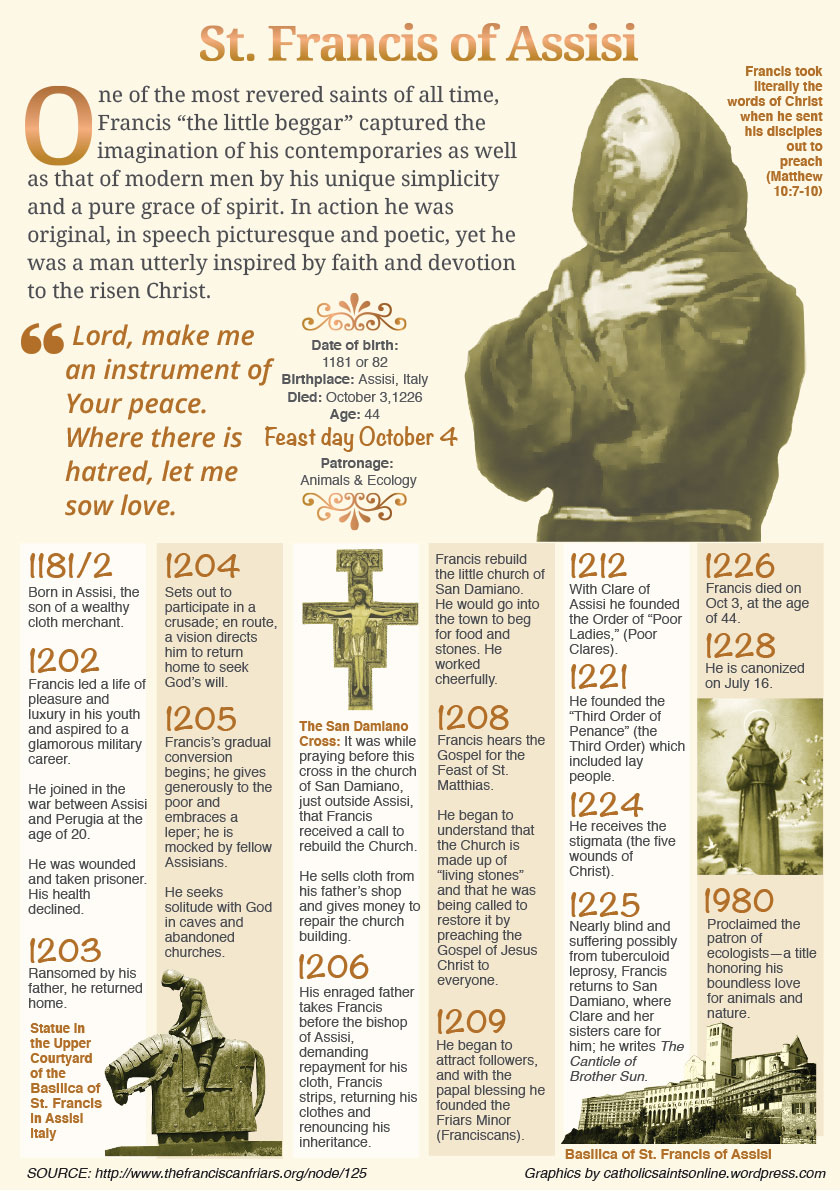
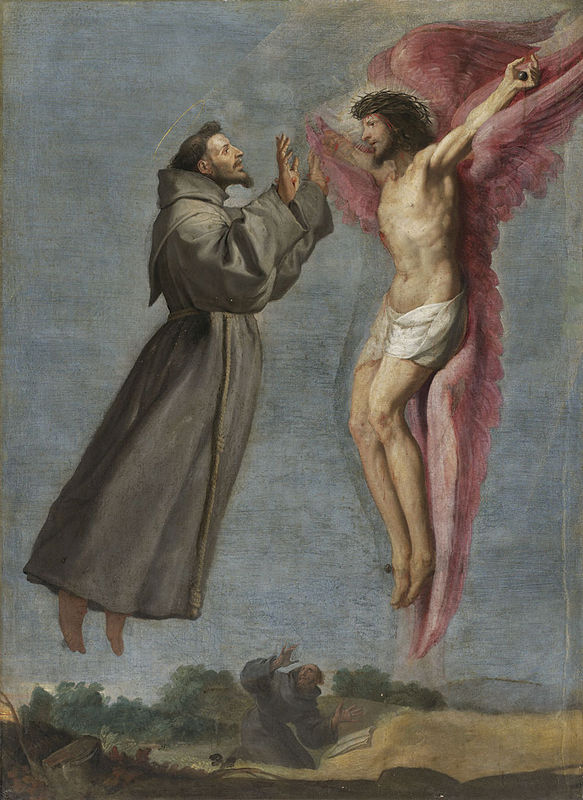
Born Giovanni di Pietro di Bernardone ( informally called Francesco by his Mother) – (1181 at Assisi, Umbria, Italy – 4 October 1226 at Portiuncula, Italy of natural causes).  His relics are enshrined in the Basilica built and named for him in Assisi, Italy.  St Francis was Canonised on 16 July 1228 by Pope Gregory IX.   Patronages – • against dying alone• against fire• animal welfare societies• animals• birds• ecologists, ecology• environment, environmentalism, environmentalists• families• lace makers, lace workers• merchants• needle workers• peace• tapestry workers• zoos• Italy• Colorado• Catholic Action• Franciscan Order• 10 dioceses• 10 cities.   Attributes – • apparition of Jesus• Christ child• birds• deer• fish• lamb• skull• stigmata• wolf.  In 1224 he received the stigmata during the apparition of Seraphic angels in a religious ecstasy making him the first recorded person in Christian history to bear the wounds of Christ’s Passion. He died during the evening hours of 3 October 1226, while listening to a reading he had requested of Psalm 142 (141).   Francis is one of the most venerated religious figures in history. 

A - ST Francis header
B. st francis and the crib info

Francis was born in Assisi in 1182, the son of a wealthy cloth merchant, Pietro Bernardone, and his wife, Pica.   He was baptised Giovanni (John) but soon gained the nickname Francesco because of his father’s close trading links with France.

Francis’ early years were not especially religious.   He was a leader among the young men of Assisi, enjoying a good social life, singing and partying.   His first biographer, Thomas of Celano, describes him as quite short, with black eyes, hair and beard;  he had a long face, with a straight nose and small, upright ears.   His arms were short but his hands and fingers slender and long.   He had a strong, clear, sweet voice.   Francis didn’t want to follow his father into the cloth trade;   he wanted to be a knight.   So at the age of twenty he joined the forces of Assisi in a minor skirmish with the neighbouring city of Perugia.   He was captured and spent a year in a Perugian jail, until his father ransomed him.   This became the first of a series of experiences through which God called Francis to the life which he finally embraced.

One of these experiences, at San Damiano, led to a rift with his father.   Francis, in response to a voice from the crucifix in this tiny ruined Church, began to rebuild churches;   when he ran out of money he took cloth from his father’s shop and sold it.   His father disowned him before the bishop of Assisi and Francis in his turn stripped off his clothes, returning to his father everything he had received from him and promising that in future he would call only God his Father.

And thus, Francis of Assisi, this poor little man began a journey to astound and inspire the Church by taking the gospel literally—not in a narrow fundamentalist sense but by actually following all that Jesus said and did, joyfully, without limit and without a mite of self-importance.Flemish School; St Francis of Assisi

Serious illness brought the young Francis to see the emptiness of his frolicking life as leader of Assisi’s youth.   Prayer—lengthy and difficult—led him to a self-emptying like that of Christ, climaxed by embracing a leper he met on the road.   It symbolised his complete obedience to what he had heard in prayer:  “Francis! Everything you have loved and desired in the flesh it is your duty to despise and hate, if you wish to know my will.   And when you have begun this, all that now seems sweet and lovely to you will become intolerable and bitter but all that you used to avoid will turn itself to great sweetness and exceeding joy.”

From the Cross in the neglected Chapel of San Damiano, Christ told him, “Francis, go out and build up my house, for it is nearly falling down.” Francis became the totally poor and humble workman.

ea8079bd13b0302d84e404c85418a950--saint-francis-pope-francis

He must have suspected a deeper meaning to “build up my house.” But he would have been content to be for the rest of his life the poor “nothing” man actually putting brick on brick in abandoned chapels.   He gave up every material thing he had, piling even his clothes before his earthly father (who was demanding restitution for Francis’ “gifts” to the poor) so that he would be totally free to say, “Our Father in heaven.”

He was, for a time, considered to be a religious “nut,” begging from door to door when he could not get money for his work, bringing sadness or disgust to the hearts of his former friends, ridicule from the unthinking.beeautiful francis 2.

But genuineness will tell.   A few people began to realise that this man was actually trying to be Christian.   He really believed what Jesus said:  “Announce the kingdom! Possess no gold or silver or copper in your purses, no traveling bag, no sandals, no staff” (see Lk 9:1-3).

Francis’ first rule for his followers was a collection of texts from the Gospels.   He had no idea of founding an order but once it began he protected it and accepted all the legal structures needed to support it.   His devotion and loyalty to the Church were absolute and highly exemplary at a time when various movements of reform tended to break the Church’s unity.

He was torn between a life devoted entirely to prayer and a life of active preaching of the Good News.   He decerned in favour of the latter but always returned to solitude when he could.   He wanted to be a missionary in Syria or in Africa but was prevented by shipwreck and illness in both cases.   He did try to convert the sultan of Egypt during the Fifth Crusade.beautiful francis 2.vision-of-st-francis-of-assisi-jusepe-de-ribera-detail-featured-w740x493

During the last years of his relatively short life (he died at 44) he was half blind and seriously ill.   Two years before his death, he received the stigmata, the real and painful wounds of Christ in his hands, feet and side.

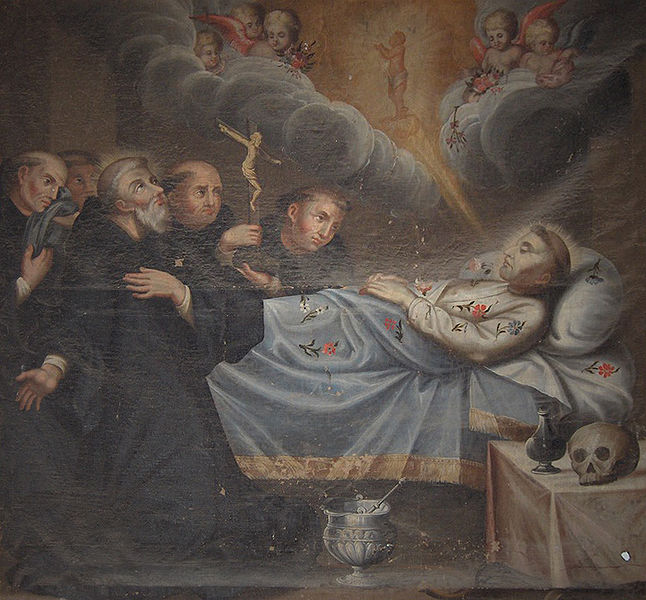
On his deathbed, he said over and over again the last addition to his Canticle of the Sun, “Be praised, O Lord, for our Sister Death.”   He sang Psalm 141 and at the end asked his superior to have his clothes removed when the last hour came and for permission to expire lying naked on the earth, in imitation of his Lord.Death-of-St-Francis-of-Assisi-Evora-Portugal-Igreja-de-Sao-Francisco

On 13 March 2013, upon his election as Pope, Archbishop and Cardinal Jorge Mario Bergoglio of Argentina chose Francis as his papal name in honour of Saint Francis of Assisi, becoming Pope Francis I.
At his first audience on 16 March 2013, Pope Francis told journalists that he had chosen the name in honour of Saint Francis of Assisi and had done so because he was especially concerned for the well-being of the poor.   He explained that, as it was becoming clear during the conclave voting that he would be elected the new bishop of Rome, the Brazilian Cardinal Cláudio Hummes had embraced him and whispered, “Don’t forget the poor”, which had made Bergoglio think of the saint.   Bergoglio had previously expressed his admiration for St Francis, explaining that “He brought to Christianity an idea of poverty against the luxury, pride, vanity of the civil and ecclesiastical powers of the time.   He changed history.”   Bergoglio’s selection of his papal name is the first time that a pope has been named Francis.

Posted in franciscan OFM, MORNING Prayers, PRAYERS of the SAINTS

Our Morning Offering – 24 September

Our Morning Offering – 24 September

St Pio’s Prayer of Today for Tomorrow

Eternal Father,
today, while I am fully conscious,
totally lucid and completely free,
I offer You my life with all its mystery and suffering.
Indeed, Eternal Father,
I offer You my life as an ultimate act of love,
as an act of infinite gratitude,
as an act of faith in Your mercy.
My God and Father,
accept this prayer I am making to You now
for the day when You will call me back to You.
If I am unconscious at the final moment of my life,
if anguish and doubt assail me,
if medication prevents me from thinking of You,
I want my last heartbeat to be an act of perfect love,
telling You with Jesus,
“Into Your hands, I commend my spirit.”
Amen.

eternal father - st pios prayer of today for tomorrow-24 SEPT 2017

Posted in EUCHARISTIC Adoration, franciscan OFM, MORNING Prayers, QUOTES of the SAINTS, QUOTES on SUFFERING, SAINT of the DAY, The BLESSED VIRGIN MARY, The HOLY EUCHARIST / The HOLY MASS, The HOLY ROSARY/ROSARY CRUSADE, Uncategorized

Quote/s of the Day – The Memorial of St Padre Pio (1887-1968)

Quote/s of the Day – The Memorial of St Padre Pio (1887-1968)

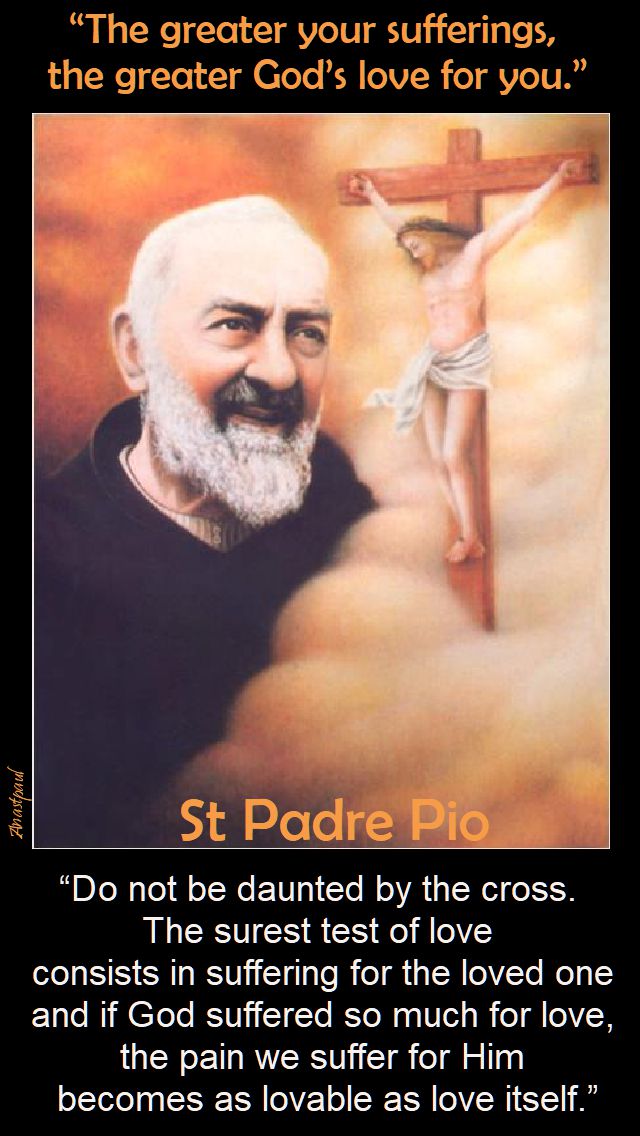
“Do not be daunted by the cross.
The surest test of love consists in suffering for the loved one
and if God suffered so much for love,
the pain we suffer for Him becomes as lovable as love itself.”

“The greater your sufferings, the greater God’s love for you.”the greater your sufferings - st pio - 23 sept 2017

“Do not fear!   Jesus is more powerful than all hell.”do not fear

“In all the free time you have,
once you have finished your duties of state,
you should kneel down and pray the Rosary.
Pray the Rosary before the Blessed Sacrament
or before a crucifix.”in all the free time - st pio no 2 - 23 sept 2017

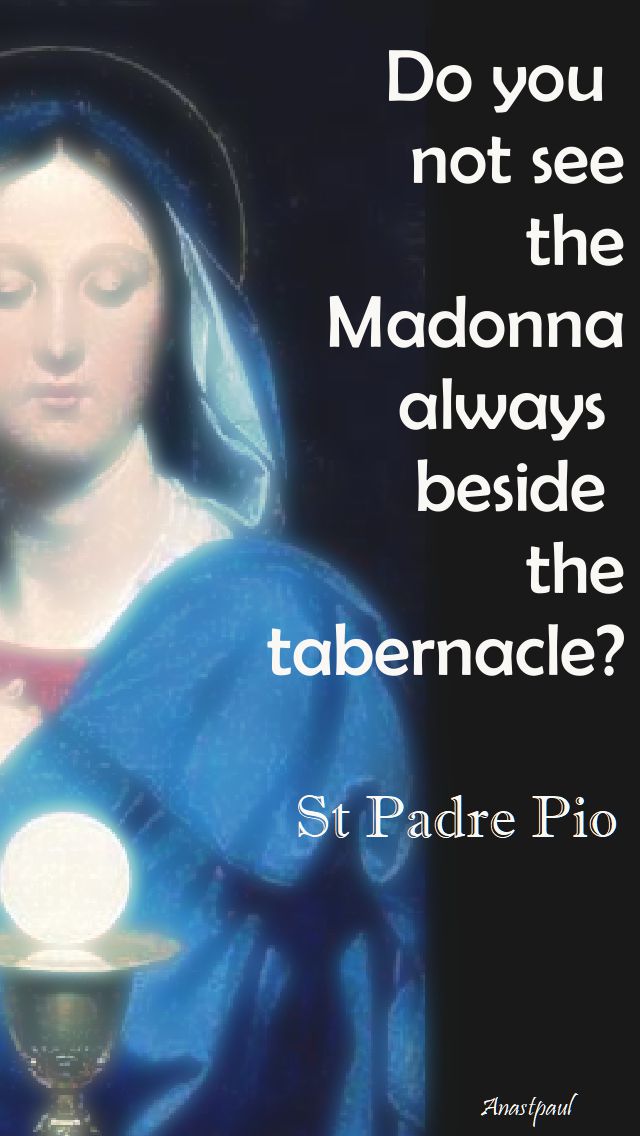
“Do you not see the Madonna always beside the tabernacle?”do you not see - st pio - 23 sept 2017

“When you gossip about a person it means
that you have removed the person from your heart.
But be aware, when you remove a man from your heart,
Jesus also goes away from your heart with that man.”

St Padre Pio (1887-1968)when you gossip - st pio 23 sept 2017

Posted in franciscan OFM, MORNING Prayers, QUOTES of the SAINTS, SAINT of the DAY, The WORD

One Minute Reflection – 23 September – – The Memorial of St Padre Pio (1887-1968)

One Minute Reflection – 23 September – – The Memorial of St Padre Pio (1887-1968)

You need endurance to do the will of God and receive what he has promised….Hebrews 10:36

REFLECTION – “The life of a Christian is nothing but a perpetual struggle against self:
there is no flowering of the soul to the beauty of its perfection, except at the price of pain.”………St Pio of Pietrelcina (1887-1968)the life of a christian - st pio - 23 sept 2017

PRAYER – “And you, Blessed Padre Pio, look down from heaven upon us assembled in this square and upon all gathered in prayer before the Basilica of Saint John Lateran and in San Giovanni Rotondo. Intercede for all those who, in every part of the world, are spiritually united with this event and raise their prayers to you. Come to the help of everyone; give peace and consolation to every heart. Amen!” – from the homily of Pope John Paul II at the beatification of Padre PioST PADRE PIO - PRAY FOR US 23 sept 2017

Posted in franciscan OFM, MORNING Prayers, PRAYERS of the SAINTS, SAINT of the DAY, The HOLY EUCHARIST / The HOLY MASS

Our Morning Offering – 23 September – The Memorial of St Padre Pio (1887-1968)

Our Morning Offering – 23 September – The Memorial of St Padre Pio (1887-1968)

Stay With Me, O Lord
St Padre Pio

Stay with me, Lord, for You are my life
and without You I am without fervour.
Stay with me, Lord, for You are my light
and without You I am in darkness.
Stay with me, Lord, so that I hear Your voice and follow You.
Stay with me, Lord, for I desire to love You very much
and alway be in Your company.
Stay with me, Lord, if You wish me to be faithful to You.
Stay with me, Lord, as poor as my soul is,
I want it to be a place of consolation for You, a nest of Love.
Stay with me, Jesus, for it is getting late
and the day is coming to a close
and life passes, death, judgment and eternity approach.
It is necessary to renew my strength, so that I will not stop
along the way and for that, I need You.
It is getting late and death approaches, I fear the darkness,
the temptations, the dryness, the cross, the sorrows.
O how I need You, my Jesus, in this night of exile!
Stay with me tonight, Jesus, in life with all its dangers, I need You.
Let me recognise You as Your disciples did,
at the breaking of the bread,
so that the Eucharistic Communion be the Light
which disperses the darkness,
the force which sustains me,
the unique joy of my heart.
Stay with me, Lord, because at the hour of my death,
I want to remain united to You,
if not by Communion, at least by grace and love.
Stay with me, Lord, for it is You alone I look for,
Your Love, Your Grace, Your Will,
Your Heart, Your Spirit, because I love You
and ask no other reward but to love You more and more.
With a firm love, I will love You with all my heart while on earth
and continue to love You perfectly during all eternity.
Amenstay with me o lord - st pio - 23 sept 2017

Posted in franciscan OFM, INCORRUPTIBLES, SAINT of the DAY

Saint of the Day – 23 September – St Pio of Pietrelcina O.F.M.Cap.

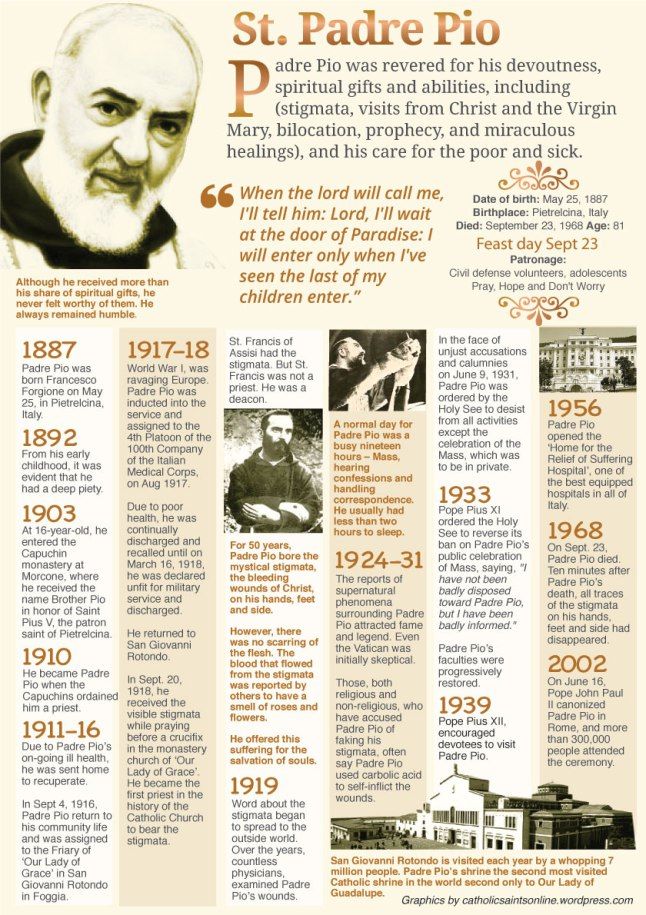
Saint of the Day – 23 September – St Pio of Pietrelcina O.F.M.Cap. – Priest,Franciscan Capuchin Friar, Stigmatist, Mystic, Confessor.  Born Francesco Forgione, he was given the name of Pius (Italian: Pio) when he joined the Order of Friars Minor Capuchin.  (25 May 1887 at Pietrelcina, Benevento, Italy – 23 September 1968 in San Giovanni Rotondo, Foggia, Italy of natural causes).  Beatified 2 May 1999 and Canonised on 16 June 2002 by Pope John Paul II at Rome, Italy.   Patronages – Civil defense volunteers, Adolescents, Pietrelcina, Stress relief, Italy and Malta.   Attributes  – Stigmata, Capuchin habit.   His Incorrupt Relics lie at home in San Giovanni Rotondo.

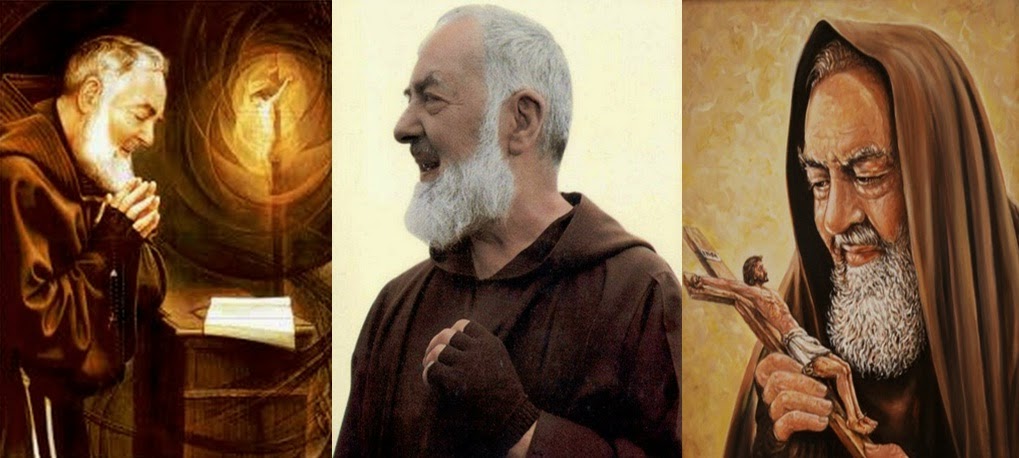
HEADER ST PIO 2st pio header 1st pio info

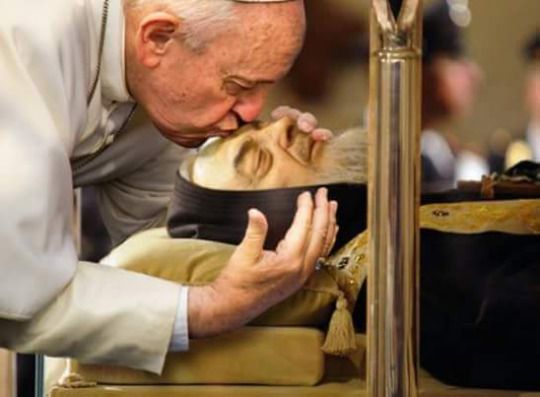
pope francis and st pio

Francesco was born to Mamma Peppa and Grazio Forgione in the little town called Pietrelcina, in Southern Italy, during the month of flowers, 25 May 1887.   He was fifth of eight children.   His Mamma Peppa confided he was different from other boys:  “he was never impolite or misbehaved”.   He had celestial visions and diabolical oppressions from the age of five years and he saw and spoke with Jesus and Our Lady and with his Guardian Angel but unfortunately this heavenly life was interwoven with hell and with the devil.

In 1903, discipline and ill health had been woven together to crown the youth of Pio. Doctors diagnosed him as consumptive and were sure he would die.   Strong in spirit Pio received the Capuchin Franciscan garb initialling religious life and therefore;  Novitiate twith its intense study, prayer, austerity, penance and finally vows of Poverty, Chastity and Obedience.

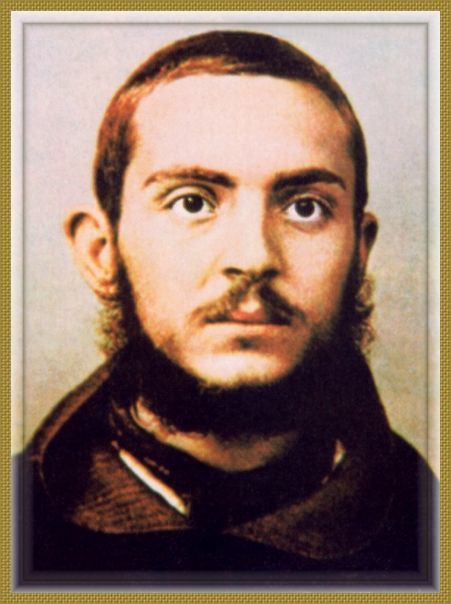
In 1909, St Pio is back at home at Pietrelcina because of his illness, at his mother’s side.   Now another intense chapter of extraordinary life opens with mystical afflictions an invisible stigmata and terrible battles with devils that wanted to destroy him began.   Yet, “It all happened here”, he said, his whole future was prepared here.   On August 10, 1910, he was ordained a Priest in the Cathedral of Benevento.st pio young

In 1916 in the church of San Giovanni Rotondo, soon to become his Jerusalem, with the mystical and historical calvary of Gargano, where he was soon recognised as the “saintly friar” by the locals.   Here he became a “victim of love”, by the reparation for sin, of the many crowds who flocked to him, to venerate his bleeding wounds of his hands and feet. This very important event occurred in Father Pio’s life on 20 September 1918, while he was praying in front of a Crucifix located in the choir in the little old church, when a strange personage like an angel, gave him the stigmata.   Those stigmata have been remained opened and bleeding for fifty years.   This was one of the reasons for which doctors, scientists, journalists and common people have gone to San Giovanni Rotondo for years, in order to meet the “Saintly friar “.

In a letter dated 22 October 1918, Padre Pio told his experience of crucifixion:  “… What I can tell you about my crucifixion?   My God!   What a confusion and what humiliation I feel when I try to show somebody else what you have done in me your unworthy creature!   It was the morning of the 20th. (September) and I was in choir, after the celebration of the Holy Mass, when a rest, similar to a sweet sleep surprised me.   All the inside and external senses, as well as the same faculties of the soul were in an indescribable quiet.   There was a deep silence around me and inside me;  a peace overcame me and then it all happened in a flash I felt abandonment with the complete loss of all senses.   While all this was taking place, I saw before me a mysterious appearance, similar to the one I had seen on 5 August, differing only because His hands, feet and side were dripping blood.   The sight of Him frightened me:  what I felt at that moment is indescribable.   I thought I would die and would have died if the Lord hadn’t intervened and strengthened my heart, which was about to burst out of my chest!  The appearance disappeared and I became aware that my hands, feet and side were pierced and were dripping with blood.   You can imagine the torment that I experienced then and that I am almost experiencing every day.   The wound of the heart bleeds profusely, particularly from the evening of Thursday until Saturday.   My God, I die of pain, torment and confusion that I feel in the intimate depths of the soul.   I am afraid I’ll bleed to death!   I hope that God listens to my moans and withdraws this humiliation from me… “

He usually woke up in the early morning (we could say at night) in order to get himself ready for the Holy Mass.   In fact, every morning, at 4 a.m. there were always hundreds and sometimes even a thousand people waiting for the door of the church to open.   After the Mass he used to spend most time of his day in prayer and confessions.   After fifty years of stigmata he died 23 September 1968, thus he closed his mission of the Heart’s desire, with the real cross and the real crucifixion of his body.

From every part of the world, the believers went to this stigmatised priest, to get his powerful intercession from God.   Fifty years lived in the prayer, in the humility, in the suffering and in the sacrifice, he lived his love, the Cross of Christ.   Padre Pio had two initiatives in two directions:   the vertical one toward God, with the constitution of the “Groups of prayer”, the horizontal one toward his suffering community, with the construction of a modern hospital: “House for the Relief of the Suffering.”

In September 1968, thousands of devotees and Padre Pio’s spiritual children were assembled in conference at St Giovanni Rotondo to commemorate together the 50 anniversary of the stigmata and to celebrate the fourth international conference of the Prayer Groups.   Nobody would have imagined that at 2:30 a.m., 23 September, 1968 we the earthly life of Father Pio of Pietrelcina would end.

Focusing too much on Padre Pio’s marvels and mystical phenomena gives the false impression that he led an abnormal life, more angelic than human.   While he opened our eyes to heavenly realities, he kept his feet firmly planted on the earth, enduring and enjoying ordinary things, as other human beings did.   Today we mainly imagine him as a wonder-working stigmatic with miracles flowing from his wounded hands.   But the people who knew him, while they appreciated his marvels, loved him more for his earthiness, his compassion, his gentleness, his humour and his common sense.   For instance, when he was asked his opinion of a thief who had stolen valuable gems from a church’s painting of the Virgin, he responded, “What do you want me to say? That poor young man was probably hungry and went to Our Lady to say: ‘Of what use are these jewels to you?’   And probably Our Lady gave them to him.   Silly him to get caught with the goods in his pocket.”

Padre Pio embraced his own great suffering as his personal share in the suffering of Christ.   But he could not endure the suffering of others.   Hundreds came to Our Lady of Grace hoping for a healing and he knew that only some of them would receive a miraculous cure.   His compassion for the many who would not be healed led him to work for the establishment of a world-class hospital at San Giovanni Rotondo that would serve the poor.   From the outset he planned to name it “House for the Relief of Suffering.”

Padre Pio worked against all odds to achieve his goal of creating a medical center.  He faced obstacles that would have deflated the enthusiasm of lesser men.   How does a monk vowed to poverty build a hospital without any money in an impoverished town situated on an inaccessible mountain?   Padre Pio did it by faith and with a small army of friends.   His associates helped him raise money, design and construct the buildings and assemble a top-shelf medical staff.   When the House for the Relief of Suffering opened in 1956, many observers believed it could not survive because of its location on a desolate mountain.   However, Padre Pio believed otherwise.   When he inaugurated the first building, he said, “Now House for the Relief of Suffering is a small seed,but it will become a mighty oak, a hospital that is a small city and a center for clinical studies of international importance.”   That prophecy has come true. Today the hospital is a thriving centre whose expanding complex resembles a little city.

Casa-Sollievo-della-Sofferenza-seleziona-laureati-medicina-chirurgia

Padre Pio’s practical compassion and entrepreneurial genius defy those who might be tempted to dismiss him as a medieval weirdo.  Instead he stands for all as a modern icon of God’s inexhaustible love for human beings and his determination to rescue us at all costs.